EP4414966B1 - Method for detecting a non-marked parking space for a vehicle, data processing apparatus, computer program and computer-readable storage medium - Google Patents
Method for detecting a non-marked parking space for a vehicle, data processing apparatus, computer program and computer-readable storage medium Download PDFInfo
- Publication number
- EP4414966B1 EP4414966B1 EP23156309.9A EP23156309A EP4414966B1 EP 4414966 B1 EP4414966 B1 EP 4414966B1 EP 23156309 A EP23156309 A EP 23156309A EP 4414966 B1 EP4414966 B1 EP 4414966B1
- Authority
- EP
- European Patent Office
- Prior art keywords
- vehicle
- information
- distance
- infrastructure
- computer
- Prior art date
- Legal status (The legal status is an assumption and is not a legal conclusion. Google has not performed a legal analysis and makes no representation as to the accuracy of the status listed.)
- Active
Links
Images

Classifications
-
- G—PHYSICS
- G08—SIGNALLING
- G08G—TRAFFIC CONTROL SYSTEMS
- G08G1/00—Traffic control systems for road vehicles
- G08G1/14—Traffic control systems for road vehicles indicating individual free spaces in parking areas
-
- G—PHYSICS
- G08—SIGNALLING
- G08G—TRAFFIC CONTROL SYSTEMS
- G08G1/00—Traffic control systems for road vehicles
- G08G1/16—Anti-collision systems
- G08G1/168—Driving aids for parking, e.g. acoustic or visual feedback on parking space
-
- B—PERFORMING OPERATIONS; TRANSPORTING
- B60—VEHICLES IN GENERAL
- B60Q—ARRANGEMENT OF SIGNALLING OR LIGHTING DEVICES, THE MOUNTING OR SUPPORTING THEREOF OR CIRCUITS THEREFOR, FOR VEHICLES IN GENERAL
- B60Q9/00—Arrangement or adaptation of signal devices not provided for in one of main groups B60Q1/00 - B60Q7/00, e.g. haptic signalling
-
- G—PHYSICS
- G06—COMPUTING OR CALCULATING; COUNTING
- G06V—IMAGE OR VIDEO RECOGNITION OR UNDERSTANDING
- G06V20/00—Scenes; Scene-specific elements
- G06V20/50—Context or environment of the image
- G06V20/56—Context or environment of the image exterior to a vehicle by using sensors mounted on the vehicle
- G06V20/58—Recognition of moving objects or obstacles, e.g. vehicles or pedestrians; Recognition of traffic objects, e.g. traffic signs, traffic lights or roads
- G06V20/586—Recognition of moving objects or obstacles, e.g. vehicles or pedestrians; Recognition of traffic objects, e.g. traffic signs, traffic lights or roads of parking space
-
- G—PHYSICS
- G08—SIGNALLING
- G08G—TRAFFIC CONTROL SYSTEMS
- G08G1/00—Traffic control systems for road vehicles
- G08G1/14—Traffic control systems for road vehicles indicating individual free spaces in parking areas
- G08G1/141—Traffic control systems for road vehicles indicating individual free spaces in parking areas with means giving the indication of available parking spaces
-
- G—PHYSICS
- G08—SIGNALLING
- G08G—TRAFFIC CONTROL SYSTEMS
- G08G1/00—Traffic control systems for road vehicles
- G08G1/14—Traffic control systems for road vehicles indicating individual free spaces in parking areas
- G08G1/141—Traffic control systems for road vehicles indicating individual free spaces in parking areas with means giving the indication of available parking spaces
- G08G1/142—Traffic control systems for road vehicles indicating individual free spaces in parking areas with means giving the indication of available parking spaces external to the vehicles
-
- G—PHYSICS
- G08—SIGNALLING
- G08G—TRAFFIC CONTROL SYSTEMS
- G08G1/00—Traffic control systems for road vehicles
- G08G1/14—Traffic control systems for road vehicles indicating individual free spaces in parking areas
- G08G1/145—Traffic control systems for road vehicles indicating individual free spaces in parking areas where the indication depends on the parking areas
Definitions
- the present disclosure relates to a method for detecting a non-marked parking space for a vehicle on a roadway.
- the present disclosure additionally is directed to a data processing apparatus.
- the present disclosure further relates to a computer program and a computer-readable storage medium.
- marked parking spaces can be considered as safe parking spaces.
- this is due to the fact that marked parking spaces are usually chosen such that vehicles parked thereon are not hindering traffic circulation in adjacent areas of the roadway.
- not all parking spaces are marked parking spaces and it may be generally allowable to park a vehicle in a non-marked parking space.
- it is the driver's responsibility to respect rules and laws relating to parking on non-marked parking spaces.
- the driver needs to make sure that the vehicle which is parking on a non-marked parking space is not hindering other traffic participants. This increases both the safety of the other traffic participants and the safety of the parked.
- making sure that the vehicle is not hindering other traffic participants and at the same time respecting relevant rules and laws puts a certain burden on the driver.
- a method for detecting and providing non-marked parking space information and/or road data information to vehicles is known from US 2018/0165962 A1 .
- the details of the spaces which are provided to a requesting vehicle may include the location of the space, the size of the space, the parking restrictions which apply to the space and if available, images of the parking spaces and images of the road data.
- a method for detecting a non-marked parking space for a vehicle on a roadway as set out in appended clam 1.
- This method respects the fact that certain infrastructure features may define a no-parking safety zone. This means that within a certain distance from such infrastructure features, parking is not allowed.
- the infrastructure features defining such no-parking safety zones and the corresponding safety distances may be defined by law or other public regulations. For example, parking may be prohibited within a distance of 10 m from a pedestrian crossing or cycle crossing or a junction.
- a driver of a vehicle who intends to park the vehicle on a non-marked parking space is obliged to know all infrastructure features defining a no-parking safety zone and the corresponding safety distances.
- the driver needs to visually estimate a distance between the vehicle he or she is driving and the infrastructure feature.
- Using the present method takes off this burden from the driver.
- Using the method automatically provides an information to the driver indicating a distance between the infrastructure feature and the vehicle. This allows the driver to know whether the relevant safety distance is respected or not. This saves time and effort for the driver.
- using the method is a lot more precise than visually estimating distances.
- a further effect of the enhanced precision is that non-marked parking space may be used in an efficient manner since a safety margin or estimation error with respect to the safety distance can be kept small.
- the infrastructure information additionally comprises a safety distance information describing a safety distance defining the no-parking safety zone.
- a safety distance information describing a safety distance defining the no-parking safety zone.
- estimating the distance between the location of the infrastructure feature and the vehicle is dynamic. This means that this estimation is regularly updated depending on a current position of the vehicle.
- the infrastructure feature is at least one of a pedestrian crossing, a cycle crossing, a cycle passage, a cycle path, a pedestrian path, and a junction.
- Pedestrians and cyclists may be summarized as a vulnerable road users. It is, thus, important for other vehicles, especially cars, buses and trucks, to keep a safety distance from roadway portions that are specifically dedicated to cyclists and pedestrians. This enhances road safety for vulnerable road users. The same applies to a junction. In the region of a junction, it is important for all traffic participants to have a good overview of the traffic situation. Using the present method, safety distances being associated with the above-mentioned infrastructure features may be easily respected.
- the infrastructure information is provided by a navigation system of the vehicle.
- the infrastructure information is provided by a computer vision system of the vehicle comprising at least one camera unit being mounted on the vehicle.
- the infrastructure information forms part of a map information which is used by the navigation system.
- the computer vision system of the vehicle is configured to detect infrastructure features defining the no-parking safety zone.
- the computer vision system may be configured to detect at least one of a pedestrian crossing, a cycle crossing, a cycle passage, a cycle path, a pedestrian path, and a junction based on an image captured by the camera unit.
- the infrastructure information is provided in an efficient and reliable manner.
- the infrastructure information is provided by a user input.
- the driver can generate a user input if the vehicle is currently at a location corresponding to a location of an infrastructure feature defining a no-parking safety zone.
- the driver can for example push a button or make a speech command or a make gesture command if he or she visually detects such an infrastructure feature and is travelling approximately at the same location as the infrastructure feature.
- the user input starts a distance counter. Consequently, starting from the location at which the user input has been generated, the distance travelled is estimated using the present method. In this special case, the driver needs to know that the infrastructure feature defines a no-parking safety zone.
- the driver needs to know the safety distance information describing a safety distance defining the no-parking safety zone of this specific infrastructure feature.
- using the information on the estimated distance as provided by the present method helps the driver in that the driver may easily know when the vehicle has left the no-parking safety zone.
- the method further comprises receiving a steering angle information and estimating the distance between the location of the infrastructure feature and the vehicle based on the received steering angle information.
- the steering angle of the vehicle provides an information on the traveling direction of the vehicle.
- the traveling direction has a direct influence on the distance between the location of the infrastructure feature and the vehicle.
- using the steering angle information allows to precisely estimate this distance.
- the method further comprises receiving at least one of a vehicle location information and a vehicle speed information and estimating the distance between the location of the infrastructure feature and the vehicle based on the at least one of the received vehicle location information and the vehicle speed information.
- the vehicle speed integration may be integrated in order to estimate the distance. This integration may be calculated in a regular manner, for example every 100 milliseconds. Consequently, the distance between the location of the infrastructure feature and the vehicle can be calculated in a precise manner.
- the method further comprises receiving an image captured by a camera unit installed on the vehicle and estimating the distance between the location of the infrastructure feature and the vehicle based on the received image.
- an image processing technique may be used.
- the camera unit installed on the vehicle may be a front camera or a rear camera. Also this alternative, the distance between the location of the infrastructure feature and the vehicle can be estimated in a precise manner.
- informing the user about the estimated distance comprises displaying at least one of a number indicating the estimated distance, a number indicating a difference between the estimated distance and the safety distance, an image showing a space between the vehicle and the infrastructure feature, and an indicator informing the user about a relationship between the estimated distance and the safety distance.
- a number indicating a difference between the estimated distance and a distance threshold may be called a counter.
- the indicator may be a color indicator.
- informing the user about the estimated distance comprises triggering an acoustic signal. For example, a sound may be played if the estimated distance exceeds a predefined value such as the safety distance.
- a sound may be played if the estimated distance exceeds a predefined value such as the safety distance.
- the method further comprises triggering a light projection indicating the safety distance.
- the light projection indicates a location of the no-parking safety zone.
- the light projection is only used in connection with forward parking.
- forward parking a light projection is easily visible by a driver.
- the light projection is only used if a surrounding lightness is below a predefined lightness threshold.
- the light projection is only used if the vehicle is located in an environment which is sufficiently dark. This enhances the visibility of the light projection.
- the method further comprises receiving at least one of a user input starting information and a gear status information and triggering the start of the method based on the at least one of the user input starting information and the gear status information.
- the method may be started by a user input.
- the user may for example press a button.
- the method may be started once the drive gear or the reverse gear is engaged. In the latter alternative, engaging the reverse gear or the drive gear is seen as an indicator that the driver intends to start a parking maneuver.
- the method further comprises receiving at least one of a user input abandoning information, a vehicle parking status information and a vehicle speed information exceeding a speed threshold and abandoning the method based on the at least one of the user input abandoning information, the vehicle parking status information and the vehicle speed information.
- the method may be abandoned based on a corresponding user input. Additionally or alternatively, the method may be abandoned if the vehicle is found to have parked. In a further alternative, the method is abandoned if the vehicle travels at a speed exceeding a predefined speed threshold. In all of these examples, the execution of the method is not necessary anymore.
- the method may be at least partly computer-implemented, and may be implemented in software or in hardware, or in software and hardware. Further, the method may be carried out by computer program instructions running on means that provide data processing functions.
- the data processing means may be a suitable computing means, such as an electronic control module etc., which may also be a distributed computer system.
- the data processing means or the computer respectively, may comprise one or more of a processor, a memory, a data interface, or the like.
- a data processing apparatus comprising means for carrying out the method of the present disclosure, as set out in appended claim 12.
- non-marked parking space may be used in a more efficient manner since a safety margin or estimation error with respect to the safety distance can be kept small.
- a computer program comprising instructions which, when the program is executed by a computer, cause the computer to carry out the method of the present disclosure, as set out in appended claim 13.
- certain infrastructure features may define a no-parking safety zone may be respected. This means that within a certain distance from such infrastructure features, parking may not be allowed.
- a driver of a vehicle who intends to park the vehicle on a non-marked parking space is obliged to know all infrastructure features defining in no-parking safety zone and the corresponding safety distances.
- Using the present computer program takes off this burden from the driver.
- Using the computer program automatically provides an information to the driver by which the driver can easily know whether the relevant safety distance is respected or not.
- a computer-readable storage medium comprising instructions which, when executed by a computer, cause the computer to carry out the method of the present as set out in appended claim 14.
- certain infrastructure features may define a no-parking safety zone may be respected. This means that within a certain distance from such infrastructure features, parking may not be allowed.
- a driver of a vehicle who intends to park the vehicle on a non-marked parking space is obliged to know all infrastructure features defining a no-parking safety zone and the corresponding safety distances.
- Using the present computer-readable storage medium takes off this burden from the driver.
- Using the computer-readable storage medium automatically provides an information to the driver by which the driver can easily know whether the relevant safety distance is respected or not.
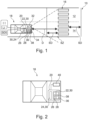
- Figure 1 shows a traffic situation
- the traffic situation comprises a roadway 10 with two lanes 12, 14.
- a pedestrian crossing 16 is crossing the roadway 10.
- the pedestrian crossing 16 is represented as a zebra crossing. It is understood, that the pedestrian crossing 16 be of any other type of a pedestrian crossing.
- a vehicle 18 is traveling on the roadway 10.
- the vehicle 18 comprises a data processing apparatus 20.
- the data processing apparatus 20 comprises a data storage unit 22 and a data processing unit 24.
- the data storage unit 22 further comprises a computer-readable storage medium 26.
- Both the computer-readable storage medium 26 and the computer program 28 comprise instructions which, when executed by the data processing unit 24 or, more generally speaking, a computer, cause the data processing unit 24 or the computer to carry out a method for detecting a non-marked parking space for the vehicle 18.
- the data storage unit 22 and the data processing unit 24 may be considered as means 30 for carrying out the method for detecting a non-marked parking space for the vehicle 18.
- the vehicle 18 additionally comprises a camera unit 32 which is communicatively connected to the data processing apparatus 20.
- the vehicle 18 comprises a light projection unit 34 which also is communicatively connected to the data processing apparatus 20.
- the no-parking safety zone SZ may be defined by a safety distance SD around the pedestrian crossing 16.
- the safety distance SD is for example 10 m. This means that it is not allowed to park a vehicle within a range of 10 m around the pedestrian crossing 16.
- the execution of this method is triggered in that a user input starting information is received at the data processing apparatus 20.
- the user input starting information may be generated by the user pushing a button on a touchscreen which is associated with the execution of the present method.
- the user input starting information may be generated by pressing the right button in the top row.
- the user of the vehicle 18 presses this button if he or she intends to park the vehicle 18 in a non-marked parking space.
- a first step S1 of the method an infrastructure information II is received.
- This infrastructure information II describes an infrastructure feature, in the present case the pedestrian crossing 16 defining the no-parking safety zone SZ.
- the infrastructure information II comprises at least a location information LI describing a location of the infrastructure feature, i.e. of the pedestrian crossing 16, and a safety distance information SDI describing a safety distance defining the no-parking safety zone SZ.
- the safety distance is assumed to be 10 m in the present example.
- the infrastructure information II is provided by a computer vision system of the vehicle comprising the camera unit 32.
- the camera unit 32 captures images of the surroundings of the vehicle 18. These images are analyzed by an infrastructure feature recognition method being carried out by the data processing apparatus 20.
- the storage unit 22 comprises another computer-readable storage medium 36 on which a further computer program 38 is provided.
- Both the further computer-readable storage medium 36 and the further computer program 38 comprise instructions which, when executed by the data processing unit 24 or, more generally speaking, a computer, cause the computer to carry out the method for detecting an infrastructure feature in an image received from the camera unit 34.
- the camera unit 32, the further computer-readable storage medium 36 and the further computer-program 38 form part of the computer vision system.
- the method for detecting the infrastructure feature in an image received from the camera unit 32 is also configured to provide a corresponding location information LI.
- the further computer-readable storage medium 36 comprises a list of safety distances for a plurality of relevant infrastructure features.
- a type of an infrastructure feature may be determined and a safety distance may be associated to the determined infrastructure feature. Consequently, the associated no-parking safety zone SZ is fully defined.
- a distance D between the location of the infrastructure feature and the vehicle 18 is estimated.
- the received location information LI of the infrastructure feature is used.
- a vehicle location information, a vehicle speed information and a steering angle information are received.
- the distance between the location of the infrastructure feature and the vehicle 18 may be reliably estimated. More precisely, starting from the vehicle location information, the vehicle speed information is regularly integrated. Moreover, the steering angle information gives an indication of the traveling direction of the vehicle 18.
- the distance between the vehicle 18 and the infrastructure feature, i.e. the pedestrian crossing 16 may be estimated based on the received image as captured by the camera unit 32.
- the user of the vehicle 18 is informed about the estimated distance D. This offers the possibility to compare this distance to the safety distance SD.
- a number indicating the estimated distance may be displayed on a central screen within the vehicle (cf. Figure 4 ). Additionally, a color indicator may be used for informing the user about a relationship between the estimated distance D and the safety distance SD.
- the distance being displayed on the central screen is presented in red color as long as the estimated distance D is smaller than the relevant safety distance SD.
- the displayed distance is represented in green color.
- the driver knows exactly when the vehicle 18 has left the no-parking safety zone SZ and, thus, can park the vehicle 18 in a safe and allowable manner.
- a number indicating a difference between the estimated distance D and the safety distance SD may be displayed on the central screen.
- an image showing a space between the vehicle 18 and the infrastructure feature, i.e. the pedestrian crossing 16 may be added.
- a sound may be played if the vehicle leaves the no-parking safety zone SZ.
- the vehicle 18 comprises a light projection unit 34.
- a light pattern is projected on the roadway 10 such that the light pattern indicates a location of the no-parking safety zone SZ.
- the driver can easily see where it is allowed to park the vehicle 18 and where not.
- the method is abandoned once the vehicle 18 has terminated the parking maneuver.
- a vehicle parking status information may be received at the data processing apparatus 20.
- the vehicle parking status information may be provided by a gearbox of the vehicle, e.g. if the gearbox is put into state "P".
- the method may be abandoned following a user action, e.g. by the user pushing a button.
- the button will generate a user input abandoning information which is provided to the data processing apparatus 20.
- FIG. 2 shows a vehicle 18 according to another example.
- the vehicle 18 of Figure 2 may replace the vehicle 18 of Figure 1 .
- the vehicle 18 of Figure 2 may replace the vehicle 18 of Figure 1 .
- only the differences between the vehicle 18 of Figure 1 in the vehicle 18 of Figure 2 will be explained.
- the vehicle 18 of Figure 2 does not comprise a camera unit. Instead, the vehicle 18 is equipped with the navigation system 40.
- the navigation system 40 On the navigation system 40, there is stored a map information comprising a representation of the roadway 10 and the pedestrian crossing 16. Also an information on a safety distance SD associated with the pedestrian crossing 16 is provided on the navigation system 40. Thus, in contrast to the example of Figure 1 , the infrastructure information II is provided by the navigation system 40.
- a computer program may be stored/distributed on a suitable medium such as an optical storage medium or a solid-state medium supplied together with or as part of other hardware, but may also be distributed in other forms, such as via the Internet or other wired or wireless telecommunication systems. Any reference signs in the claims should not be construed as limiting the scope of the claims.
Landscapes
- Physics & Mathematics (AREA)
- General Physics & Mathematics (AREA)
- Engineering & Computer Science (AREA)
- Human Computer Interaction (AREA)
- Mechanical Engineering (AREA)
- Multimedia (AREA)
- Theoretical Computer Science (AREA)
- Traffic Control Systems (AREA)
Description
- The present disclosure relates to a method for detecting a non-marked parking space for a vehicle on a roadway.
- The present disclosure additionally is directed to a data processing apparatus.
- The present disclosure further relates to a computer program and a computer-readable storage medium.
- In a traffic system, especially in an urban traffic system, it is important for general safety reasons that vehicles which are currently not in use are parked in a safe manner. In this context, for example marked parking spaces can be considered as safe parking spaces. Among other things, this is due to the fact that marked parking spaces are usually chosen such that vehicles parked thereon are not hindering traffic circulation in adjacent areas of the roadway.
- However, not all parking spaces are marked parking spaces and it may be generally allowable to park a vehicle in a non-marked parking space. In this context, it is the driver's responsibility to respect rules and laws relating to parking on non-marked parking spaces. On a more general level, the driver needs to make sure that the vehicle which is parking on a non-marked parking space is not hindering other traffic participants. This increases both the safety of the other traffic participants and the safety of the parked. However, making sure that the vehicle is not hindering other traffic participants and at the same time respecting relevant rules and laws puts a certain burden on the driver.
- It is an objective of the present disclosure to solve or at least alleviate this issue.
- The problem is at least partially solved or alleviated by the subject matter of the independent claims of the present disclosure, wherein further examples are incorporated in the dependent claims.
- A method for detecting and providing non-marked parking space information and/or road data information to vehicles is known from
US 2018/0165962 A1 . In this prior art document, the details of the spaces which are provided to a requesting vehicle may include the location of the space, the size of the space, the parking restrictions which apply to the space and if available, images of the parking spaces and images of the road data. - According to a first aspect, there is provided a method for detecting a non-marked parking space for a vehicle on a roadway, as set out in appended clam 1.
- This method respects the fact that certain infrastructure features may define a no-parking safety zone. This means that within a certain distance from such infrastructure features, parking is not allowed. The infrastructure features defining such no-parking safety zones and the corresponding safety distances may be defined by law or other public regulations. For example, parking may be prohibited within a distance of 10 m from a pedestrian crossing or cycle crossing or a junction. According to the prior art, a driver of a vehicle who intends to park the vehicle on a non-marked parking space is obliged to know all infrastructure features defining a no-parking safety zone and the corresponding safety distances. Moreover, in prior art solutions, the driver needs to visually estimate a distance between the vehicle he or she is driving and the infrastructure feature. Using the present method takes off this burden from the driver. Using the method automatically provides an information to the driver indicating a distance between the infrastructure feature and the vehicle. This allows the driver to know whether the relevant safety distance is respected or not. This saves time and effort for the driver. Moreover, using the method is a lot more precise than visually estimating distances. A further effect of the enhanced precision is that non-marked parking space may be used in an efficient manner since a safety margin or estimation error with respect to the safety distance can be kept small. Altogether, road safety is enhanced for both a vehicle being parked on the non-marked parking space and other traffic participants traveling on roadway portions adjacent to the non-marked parking space.
- According to the invention, the infrastructure information additionally comprises a safety distance information describing a safety distance defining the no-parking safety zone. Thus, in this example, the driver does not need to know the safety distance being associated with a specific infrastructure feature. This saves further time and effort for the driver.
- It is noted that in the present method, estimating the distance between the location of the infrastructure feature and the vehicle is dynamic. This means that this estimation is regularly updated depending on a current position of the vehicle.
- In an example, the infrastructure feature is at least one of a pedestrian crossing, a cycle crossing, a cycle passage, a cycle path, a pedestrian path, and a junction. Pedestrians and cyclists may be summarized as a vulnerable road users. It is, thus, important for other vehicles, especially cars, buses and trucks, to keep a safety distance from roadway portions that are specifically dedicated to cyclists and pedestrians. This enhances road safety for vulnerable road users. The same applies to a junction. In the region of a junction, it is important for all traffic participants to have a good overview of the traffic situation. Using the present method, safety distances being associated with the above-mentioned infrastructure features may be easily respected.
- In an example, the infrastructure information is provided by a navigation system of the vehicle. Alternatively, the infrastructure information is provided by a computer vision system of the vehicle comprising at least one camera unit being mounted on the vehicle. In other words, the infrastructure information forms part of a map information which is used by the navigation system. Alternatively, the computer vision system of the vehicle is configured to detect infrastructure features defining the no-parking safety zone. In this context, the computer vision system may be configured to detect at least one of a pedestrian crossing, a cycle crossing, a cycle passage, a cycle path, a pedestrian path, and a junction based on an image captured by the camera unit. In both alternatives, the infrastructure information is provided in an efficient and reliable manner.
- In a further example, the infrastructure information is provided by a user input. This means that the driver can generate a user input if the vehicle is currently at a location corresponding to a location of an infrastructure feature defining a no-parking safety zone. The driver can for example push a button or make a speech command or a make gesture command if he or she visually detects such an infrastructure feature and is travelling approximately at the same location as the infrastructure feature. The user input starts a distance counter. Consequently, starting from the location at which the user input has been generated, the distance travelled is estimated using the present method. In this special case, the driver needs to know that the infrastructure feature defines a no-parking safety zone. Furthermore, in this example, the driver needs to know the safety distance information describing a safety distance defining the no-parking safety zone of this specific infrastructure feature. Thus, using the information on the estimated distance as provided by the present method helps the driver in that the driver may easily know when the vehicle has left the no-parking safety zone.
- In an example, the method further comprises receiving a steering angle information and estimating the distance between the location of the infrastructure feature and the vehicle based on the received steering angle information. The steering angle of the vehicle provides an information on the traveling direction of the vehicle. The traveling direction has a direct influence on the distance between the location of the infrastructure feature and the vehicle. Thus, using the steering angle information allows to precisely estimate this distance.
- In an example, the method further comprises receiving at least one of a vehicle location information and a vehicle speed information and estimating the distance between the location of the infrastructure feature and the vehicle based on the at least one of the received vehicle location information and the vehicle speed information. In this context, the vehicle speed integration may be integrated in order to estimate the distance. This integration may be calculated in a regular manner, for example every 100 milliseconds. Consequently, the distance between the location of the infrastructure feature and the vehicle can be calculated in a precise manner.
- In an example, the method further comprises receiving an image captured by a camera unit installed on the vehicle and estimating the distance between the location of the infrastructure feature and the vehicle based on the received image. To this end, an image processing technique may be used. The camera unit installed on the vehicle may be a front camera or a rear camera. Also this alternative, the distance between the location of the infrastructure feature and the vehicle can be estimated in a precise manner.
- In an example, informing the user about the estimated distance comprises displaying at least one of a number indicating the estimated distance, a number indicating a difference between the estimated distance and the safety distance, an image showing a space between the vehicle and the infrastructure feature, and an indicator informing the user about a relationship between the estimated distance and the safety distance. In this context, a number indicating a difference between the estimated distance and a distance threshold may be called a counter. The indicator may be a color indicator. In all of the examples, the driver is able to know whether the vehicle is located inside the no-parking safety zone or outside the no-parking safety zone. Consequently, the vehicle may be parked in a safe and precise manner.
- In an example, informing the user about the estimated distance comprises triggering an acoustic signal. For example, a sound may be played if the estimated distance exceeds a predefined value such as the safety distance. Thus, the driver is informed about the fact whether the vehicle is located inside the no-parking safety zone or outside. Since this is done in an acoustic manner, the driver may perceive this information independent from a direction in which the driver is looking.
- In an example, the method further comprises triggering a light projection indicating the safety distance. In other words, the light projection indicates a location of the no-parking safety zone. Thus, it is simple for the driver to determine whether he or she has reached and allowable non-marked parking space, i.e. a parking space outside the no-parking safety zone.
- In an example, the light projection is only used in connection with forward parking. When forward parking, a light projection is easily visible by a driver.
- In another example, the light projection is only used if a surrounding lightness is below a predefined lightness threshold. In simplified words, the light projection is only used if the vehicle is located in an environment which is sufficiently dark. This enhances the visibility of the light projection.
- In an example, the method further comprises receiving at least one of a user input starting information and a gear status information and triggering the start of the method based on the at least one of the user input starting information and the gear status information. In other words, the method may be started by a user input. In this context, the user may for example press a button. Alternatively, the method may be started once the drive gear or the reverse gear is engaged. In the latter alternative, engaging the reverse gear or the drive gear is seen as an indicator that the driver intends to start a parking maneuver.
- In an example, the method further comprises receiving at least one of a user input abandoning information, a vehicle parking status information and a vehicle speed information exceeding a speed threshold and abandoning the method based on the at least one of the user input abandoning information, the vehicle parking status information and the vehicle speed information. Thus, the method may be abandoned based on a corresponding user input. Additionally or alternatively, the method may be abandoned if the vehicle is found to have parked. In a further alternative, the method is abandoned if the vehicle travels at a speed exceeding a predefined speed threshold. In all of these examples, the execution of the method is not necessary anymore.
- The method may be at least partly computer-implemented, and may be implemented in software or in hardware, or in software and hardware. Further, the method may be carried out by computer program instructions running on means that provide data processing functions. The data processing means may be a suitable computing means, such as an electronic control module etc., which may also be a distributed computer system. The data processing means or the computer, respectively, may comprise one or more of a processor, a memory, a data interface, or the like.
- According to a second aspect, there is provided a data processing apparatus comprising means for carrying out the method of the present disclosure, as set out in appended
claim 12. Thus, the fact that certain infrastructure features may define a no-parking safety zone may be respected. This means that within a certain distance from such infrastructure features, parking may not be allowed. According to the prior art, a driver of a vehicle who intends to park the vehicle on a non-marked parking space is obliged to know all infrastructure features defining a no-parking safety zone and the corresponding safety distances, using the present data processing apparatus takes off this burden from the driver. Using the data processing apparatus automatically provides an information to the driver by which the driver can easily know whether the relevant safety distance is respected or not. This saves time and effort for the driver. Moreover, using the data processing apparatus is a lot more precise than visually estimating distances. A further effect of the enhanced precision is that non-marked parking space may be used in a more efficient manner since a safety margin or estimation error with respect to the safety distance can be kept small. Altogether, road safety is enhanced for both a vehicle being parked on the non-marked parking space and other traffic participants traveling on roadway portions adjacent to the non-marked parking space. - According to a third aspect, there is provided a computer program comprising instructions which, when the program is executed by a computer, cause the computer to carry out the method of the present disclosure, as set out in appended claim 13. Thus, the fact that certain infrastructure features may define a no-parking safety zone may be respected. This means that within a certain distance from such infrastructure features, parking may not be allowed. According to the prior art, a driver of a vehicle who intends to park the vehicle on a non-marked parking space is obliged to know all infrastructure features defining in no-parking safety zone and the corresponding safety distances. Using the present computer program takes off this burden from the driver. Using the computer program automatically provides an information to the driver by which the driver can easily know whether the relevant safety distance is respected or not. This saves time and effort for the driver. Moreover, using the computer program is a lot more precise than visually estimating distances. A further effect of the enhanced precision is that non-marked parking space may be used in a more efficient manner since a safety margin or estimation error with respect to the safety distance can be kept small. Altogether, road safety is enhanced for both a vehicle being parked on the non-marked parking space and other traffic participants traveling on roadway portions adjacent to the non-marked parking space.
- According to a fourth aspect, there is provided a computer-readable storage medium comprising instructions which, when executed by a computer, cause the computer to carry out the method of the present as set out in appended
claim 14. Thus, the fact that certain infrastructure features may define a no-parking safety zone may be respected. This means that within a certain distance from such infrastructure features, parking may not be allowed. According to the prior art, a driver of a vehicle who intends to park the vehicle on a non-marked parking space is obliged to know all infrastructure features defining a no-parking safety zone and the corresponding safety distances. Using the present computer-readable storage medium takes off this burden from the driver. Using the computer-readable storage medium automatically provides an information to the driver by which the driver can easily know whether the relevant safety distance is respected or not. This saves time and effort for the driver. Moreover, using the computer-readable storage medium is a lot more precise than visually estimating distances. A further effect of the enhanced precision is that non-marked parking space may be used in a more efficient manner since a safety margin or estimation error with respect to the safety distance can be kept small. Altogether, road safety is enhanced for both a vehicle being parked on the non-marked parking space and other traffic participants traveling on roadway portions adjacent to the non-marked parking space. - These and other aspects of the present disclosure will become apparent from and elucidated with reference to the examples described hereinafter.
- Examples of the disclosure will be described in the following with reference to the following drawings.
- Figure 1
- shows a traffic situation comprising a vehicle with a data processing apparatus according to the present disclosure, a computer-readable storage medium according to the present disclosure, and a computer program according to the present disclosure, wherein the data processing apparatus comprises means for carrying out the method for detecting a non-marked parking space of the present disclosure,
- Figure 2
- shows a vehicle according to another example,
- Figure 3
- shows a central screen of the vehicles of
Figures 1 and 2 , and - Figure 4
- shows an information for a user of the vehicles of
Figures 1 and 2 being displayed on the central screen. - The Figures are merely schematic representations and serve only to illustrate examples of the disclosure. Identical or equivalent elements are in principle provided with the same reference signs.
-
Figure 1 shows a traffic situation. - The traffic situation comprises a
roadway 10 with twolanes - A
pedestrian crossing 16 is crossing theroadway 10. In the present example, thepedestrian crossing 16 is represented as a zebra crossing. It is understood, that thepedestrian crossing 16 be of any other type of a pedestrian crossing. - Moreover, a
vehicle 18 is traveling on theroadway 10. - The
vehicle 18 comprises adata processing apparatus 20. - The
data processing apparatus 20 comprises a data storage unit 22 and a data processing unit 24. - The data storage unit 22 further comprises a computer-
readable storage medium 26. - On the computer-
readable storage medium 26, there is provided acomputer program 28. - Both the computer-
readable storage medium 26 and thecomputer program 28 comprise instructions which, when executed by the data processing unit 24 or, more generally speaking, a computer, cause the data processing unit 24 or the computer to carry out a method for detecting a non-marked parking space for thevehicle 18. - Consequently, the data storage unit 22 and the data processing unit 24 may be considered as means 30 for carrying out the method for detecting a non-marked parking space for the
vehicle 18. - The
vehicle 18 additionally comprises acamera unit 32 which is communicatively connected to thedata processing apparatus 20. - Moreover, the
vehicle 18 comprises alight projection unit 34 which also is communicatively connected to thedata processing apparatus 20. - For the present explanations, it is assumed that for the
roadway 10 and thevehicle 18 traveling thereon, legislation defines a no-parking safety zone SZ aroundpedestrian crossings 16. The no-parking safety zone SZ may be defined by a safety distance SD around thepedestrian crossing 16. The safety distance SD is for example 10 m. This means that it is not allowed to park a vehicle within a range of 10 m around thepedestrian crossing 16. - In the following, the method for detecting a non-marked parking space for the
vehicle 18 is explained. - In the present example, the execution of this method is triggered in that a user input starting information is received at the
data processing apparatus 20. - The user input starting information may be generated by the user pushing a button on a touchscreen which is associated with the execution of the present method. In the example of
Figure 3 , the user input starting information may be generated by pressing the right button in the top row. - The user of the
vehicle 18 presses this button if he or she intends to park thevehicle 18 in a non-marked parking space. - In a first step S1 of the method, an infrastructure information II is received.
- This infrastructure information II describes an infrastructure feature, in the present case the
pedestrian crossing 16 defining the no-parking safety zone SZ. In this context, the infrastructure information II comprises at least a location information LI describing a location of the infrastructure feature, i.e. of thepedestrian crossing 16, and a safety distance information SDI describing a safety distance defining the no-parking safety zone SZ. As has been explained before, the safety distance is assumed to be 10 m in the present example. - In the present example, the infrastructure information II is provided by a computer vision system of the vehicle comprising the
camera unit 32. This means that thecamera unit 32 captures images of the surroundings of thevehicle 18. These images are analyzed by an infrastructure feature recognition method being carried out by thedata processing apparatus 20. This means that the date the storage unit 22 comprises another computer-readable storage medium 36 on which afurther computer program 38 is provided. Both the further computer-readable storage medium 36 and thefurther computer program 38 comprise instructions which, when executed by the data processing unit 24 or, more generally speaking, a computer, cause the computer to carry out the method for detecting an infrastructure feature in an image received from thecamera unit 34. - The
camera unit 32, the further computer-readable storage medium 36 and the further computer-program 38 form part of the computer vision system. - The method for detecting the infrastructure feature in an image received from the
camera unit 32 is also configured to provide a corresponding location information LI. Moreover, the further computer-readable storage medium 36 comprises a list of safety distances for a plurality of relevant infrastructure features. - Thus, based on an image captured by the
camera unit 32, a type of an infrastructure feature may be determined and a safety distance may be associated to the determined infrastructure feature. Consequently, the associated no-parking safety zone SZ is fully defined. - In a subsequent second step, a distance D between the location of the infrastructure feature and the
vehicle 18 is estimated. - To this end, the received location information LI of the infrastructure feature is used.
- Moreover, a vehicle location information, a vehicle speed information and a steering angle information are received.
- Based on this information, the distance between the location of the infrastructure feature and the
vehicle 18 may be reliably estimated. More precisely, starting from the vehicle location information, the vehicle speed information is regularly integrated. Moreover, the steering angle information gives an indication of the traveling direction of thevehicle 18. - It is noted that in an alternative, the distance between the
vehicle 18 and the infrastructure feature, i.e. thepedestrian crossing 16 may be estimated based on the received image as captured by thecamera unit 32. - Altogether, a distance D between the location of the infrastructure feature and the
vehicle 18 is known. - Thereafter, in a third step, the user of the
vehicle 18 is informed about the estimated distance D. This offers the possibility to compare this distance to the safety distance SD. - In this context, a number indicating the estimated distance may be displayed on a central screen within the vehicle (cf.
Figure 4 ). Additionally, a color indicator may be used for informing the user about a relationship between the estimated distance D and the safety distance SD. - In the present example, the distance being displayed on the central screen is presented in red color as long as the estimated distance D is smaller than the relevant safety distance SD.
- In case the estimated distance D exceeds the relevant safety distance SD, the displayed distance is represented in green color.
- Consequently, the driver knows exactly when the
vehicle 18 has left the no-parking safety zone SZ and, thus, can park thevehicle 18 in a safe and allowable manner. - It is understood that also other manners of informing the user about the estimated distance D are possible. For example, instead of the number indicating the estimated distance D, a number indicating a difference between the estimated distance D and the safety distance SD may be displayed on the central screen.
- Optionally, an image showing a space between the
vehicle 18 and the infrastructure feature, i.e. thepedestrian crossing 16 may be added. - It is also possible to inform the user about the estimated distance D by triggering an acoustic signal. For example, a sound may be played if the vehicle leaves the no-parking safety zone SZ.
- Additionally, in the present example, the
vehicle 18 comprises alight projection unit 34. Using thelight projection unit 34, a light pattern is projected on theroadway 10 such that the light pattern indicates a location of the no-parking safety zone SZ. Thus, the driver can easily see where it is allowed to park thevehicle 18 and where not. - In the present example, the method is abandoned once the
vehicle 18 has terminated the parking maneuver. - In this context, a vehicle parking status information may be received at the
data processing apparatus 20. The vehicle parking status information may be provided by a gearbox of the vehicle, e.g. if the gearbox is put into state "P". - Alternatively, the method may be abandoned following a user action, e.g. by the user pushing a button. The button will generate a user input abandoning information which is provided to the
data processing apparatus 20. -
Figure 2 shows avehicle 18 according to another example. - The
vehicle 18 ofFigure 2 may replace thevehicle 18 ofFigure 1 . In the following, only the differences between thevehicle 18 ofFigure 1 in thevehicle 18 ofFigure 2 will be explained. - The
vehicle 18 ofFigure 2 does not comprise a camera unit. Instead, thevehicle 18 is equipped with thenavigation system 40. - On the
navigation system 40, there is stored a map information comprising a representation of theroadway 10 and thepedestrian crossing 16. Also an information on a safety distance SD associated with thepedestrian crossing 16 is provided on thenavigation system 40. Thus, in contrast to the example ofFigure 1 , the infrastructure information II is provided by thenavigation system 40. - Even though the above examples have been explained in connection with an infrastructure feature being a pedestrian crossing, it is understood that the same method may be executed in connection with other infrastructure features. This may be the case for a cycle crossing, a cycle passage, a cycle path, a pedestrian path, and a junction. The above explanations apply mutatis mutandis to an execution of the method in connection with these infrastructure features.
- Other variations to the disclosed examples can be understood and effected by those skilled in the art in practicing the claimed disclosure, from the study of the drawings, the disclosure, and the appended claims. In the claims the word "comprising" does not exclude other elements or steps and the indefinite article "a" or "an" does not exclude a plurality. A single processor or other unit may fulfill the functions of several items or steps recited in the claims. The mere fact that certain measures are recited in mutually different dependent claims does not indicate that a combination of these measures cannot be used to advantage. A computer program may be stored/distributed on a suitable medium such as an optical storage medium or a solid-state medium supplied together with or as part of other hardware, but may also be distributed in other forms, such as via the Internet or other wired or wireless telecommunication systems. Any reference signs in the claims should not be construed as limiting the scope of the claims.
-
- 10
- roadway
- 12
- lane
- 14
- lane
- 16
- pedestrian crossing
- 18
- vehicle
- 20
- data processing apparatus
- 22
- data storage unit
- 24
- data processing unit
- 26
- computer-readable storage medium
- 28
- computer program
- 30
- means for carrying out a method for detecting a non-marked parking space for a vehicle
- 32
- camera unit
- 34
- light projection unit
- 36
- further computer-readable storage medium
- 38
- further computer program
- 40
- navigation system
- D
- distance between the vehicle and the infrastructure feature
- II
- infrastructure information
- LI
- location information
- SDI
- safety distance information
- SZ
- no-parking safety zone
- SD
- safety distance
Claims (14)
- A method for detecting a non-marked parking space for a vehicle (18) on a roadway (10), comprising:- receiving an infrastructure information (II) describing an infrastructure feature defining a no-parking safety zone (SZ), the infrastructure information (II) comprising at least a location information (LI) describing a location of the infrastructure feature and a safety distance (SD) information,- estimating a distance (D) between the location of the infrastructure feature and the vehicle (18) based on the received location information (LI), and- informing a user of the vehicle (18) about the estimated distance (D) and the relationship between the estimated distance (D) and the safety distance(SD).
- The method of claim 1, wherein the infrastructure feature is at least one of a pedestrian crossing (16), a cycle crossing, a cycle passage, a cycle path, a pedestrian path, and a junction.
- The method of claim 1 or 2, wherein the infrastructure information (II) is provided by a navigation system (40) of the vehicle (18) or a computer vision system of the vehicle comprising at least one camera unit (32) being mounted on the vehicle (18) or by a user input.
- The method of any one of the preceding claims, further comprising receiving a steering angle information and estimating the distance (D) between the location of the infrastructure feature and the vehicle (18) based on the received steering angle information.
- The method of any one of the preceding claims, further comprising receiving at least one of a vehicle location information and a vehicle speed information and estimating the distance (D) between the location of the infrastructure feature and the vehicle (18) based on the at least one of the received vehicle location information and the vehicle speed information.
- The method of any one of the preceding claims, further comprising receiving an image captured by a camera unit (32) installed on the vehicle (18) and estimating the distance (D) between the location of the infrastructure feature and the vehicle (18) based on the received image.
- The method of any one of the preceding claims, wherein informing the user about the estimated distance (D) comprises displaying at least one of a number indicating the estimated distance (D), a number indicating a difference between the estimated distance (D) and the safety distance (SD), an image showing a space between the vehicle (18) and the infrastructure feature, and an indicator informing the user about a relationship between the estimated distance (D) and the safety distance (SD).
- The method of any one of the preceding claims, wherein informing the user about the estimated distance (D) comprises triggering an acoustic signal.
- The method of any one of the preceding claims, further comprising triggering a light projection indicating the safety distance (SD).
- The method of any one of the preceding claims, further comprising receiving at least one of a user input starting information and a gear status information and triggering the start of the method based on the at least one of the user input starting information and the gear status information.
- The method of any one of the preceding claims, further comprising receiving at least one of a user input abandoning information, a vehicle parking status information and a vehicle speed information exceeding a speed threshold and abandoning the method based on the at least one of the user input abandoning information, the vehicle parking status information and the vehicle speed information.
- A data processing apparatus (20) comprising means (30) for carrying out the method of any one of the preceding claims.
- A computer program (28) comprising instructions which, when the computer program (28) is executed by a computer, cause the computer to carry out the method of claims 1 to 11.
- A computer-readable storage medium (26) comprising instructions which, when executed by a computer, cause the computer to carry out the method of claims 1 to 11.
Priority Applications (3)
| Application Number | Priority Date | Filing Date | Title |
|---|---|---|---|
| EP23156309.9A EP4414966B1 (en) | 2023-02-13 | 2023-02-13 | Method for detecting a non-marked parking space for a vehicle, data processing apparatus, computer program and computer-readable storage medium |
| US18/428,343 US12603001B2 (en) | 2023-02-13 | 2024-01-31 | Detecting a non-marked parking space for a vehicle |
| CN202410177134.4A CN118486185A (en) | 2023-02-13 | 2024-02-08 | Method for detecting an unmarked parking space for a vehicle, data processing device, computer program and computer-readable storage medium |
Applications Claiming Priority (1)
| Application Number | Priority Date | Filing Date | Title |
|---|---|---|---|
| EP23156309.9A EP4414966B1 (en) | 2023-02-13 | 2023-02-13 | Method for detecting a non-marked parking space for a vehicle, data processing apparatus, computer program and computer-readable storage medium |
Publications (2)
| Publication Number | Publication Date |
|---|---|
| EP4414966A1 EP4414966A1 (en) | 2024-08-14 |
| EP4414966B1 true EP4414966B1 (en) | 2025-05-21 |
Family
ID=85227221
Family Applications (1)
| Application Number | Title | Priority Date | Filing Date |
|---|---|---|---|
| EP23156309.9A Active EP4414966B1 (en) | 2023-02-13 | 2023-02-13 | Method for detecting a non-marked parking space for a vehicle, data processing apparatus, computer program and computer-readable storage medium |
Country Status (3)
| Country | Link |
|---|---|
| US (1) | US12603001B2 (en) |
| EP (1) | EP4414966B1 (en) |
| CN (1) | CN118486185A (en) |
Family Cites Families (6)
| Publication number | Priority date | Publication date | Assignee | Title |
|---|---|---|---|---|
| JP2016060226A (en) * | 2014-09-12 | 2016-04-25 | アイシン精機株式会社 | Parking support device, parking support method, and control program |
| US10486742B2 (en) * | 2016-08-01 | 2019-11-26 | Magna Electronics Inc. | Parking assist system using light projections |
| US10163347B2 (en) * | 2016-12-12 | 2018-12-25 | Arm Ip Limited | Method of detecting and providing parking space information and/or road obstacle information to vehicles |
| US10479333B2 (en) * | 2017-11-20 | 2019-11-19 | Ford Global Technologies, Llc | Method and apparatus for navigation accommodating train crossings |
| GB2591745B (en) * | 2020-01-31 | 2024-10-02 | Mclaren Automotive Ltd | Augmented reality system |
| US20230206608A1 (en) * | 2021-12-29 | 2023-06-29 | Mobileye Vision Technologies Ltd. | Systems and methods for analyzing and resolving image blockages |
-
2023
- 2023-02-13 EP EP23156309.9A patent/EP4414966B1/en active Active
-
2024
- 2024-01-31 US US18/428,343 patent/US12603001B2/en active Active
- 2024-02-08 CN CN202410177134.4A patent/CN118486185A/en active Pending
Also Published As
| Publication number | Publication date |
|---|---|
| US12603001B2 (en) | 2026-04-14 |
| EP4414966A1 (en) | 2024-08-14 |
| CN118486185A (en) | 2024-08-13 |
| US20240274008A1 (en) | 2024-08-15 |
Similar Documents
| Publication | Publication Date | Title |
|---|---|---|
| JP4614005B2 (en) | Moving locus generator | |
| JP7158352B2 (en) | DRIVING ASSIST DEVICE, VEHICLE CONTROL METHOD, AND PROGRAM | |
| CN109564734B (en) | Driving assistance device, driving assistance method, mobile body, and program | |
| KR102004062B1 (en) | Method for operating a driver assistance system of a motor vehicle, driver assistance system and motor vehicle | |
| AU2019101842A4 (en) | Prompting method and system for vehicle, and vehicle | |
| JP7848685B2 (en) | Information processing device, information processing method, program, and projection device | |
| CN105599610A (en) | Road sign information display system and method | |
| JP2018045482A (en) | Imaging apparatus, signal processing apparatus, and vehicle control system | |
| WO2017134876A1 (en) | Head-up display device and display control method therefor | |
| CN103052976A (en) | Lane Departure Prevention Assist Device, Demarcation Line Display Method, Program | |
| CN114987460A (en) | Method and apparatus for blind spot assist of vehicle | |
| US20190286125A1 (en) | Transportation equipment and traveling control method therefor | |
| CN115131749A (en) | Image processing apparatus, image processing method, and computer-readable storage medium | |
| JP2009139306A (en) | Road marking recognition device | |
| CN113044028A (en) | Information presentation device for autonomous vehicle | |
| CN115158153A (en) | Vehicle autonomous parking outside interaction method and device | |
| JP5259277B2 (en) | Driving assistance device | |
| CN110383361A (en) | Method and apparatus for reminding driver to start at optical signal equipment | |
| JP7432198B2 (en) | Situation awareness estimation system and driving support system | |
| EP4414966B1 (en) | Method for detecting a non-marked parking space for a vehicle, data processing apparatus, computer program and computer-readable storage medium | |
| JP2022126240A (en) | Display device for vehicle | |
| JP2015009777A (en) | Cruise control equipment | |
| CN120693272A (en) | Automatic driving control device, automatic driving control program, and automatic driving control method | |
| KR20110101990A (en) | Lane recognition system and method for vehicle | |
| CN106043312A (en) | Driving assistance system and method and motor vehicle provided with driving assistance system |
Legal Events
| Date | Code | Title | Description |
|---|---|---|---|
| PUAI | Public reference made under article 153(3) epc to a published international application that has entered the european phase |
Free format text: ORIGINAL CODE: 0009012 |
|
| STAA | Information on the status of an ep patent application or granted ep patent |
Free format text: STATUS: REQUEST FOR EXAMINATION WAS MADE |
|
| 17P | Request for examination filed |
Effective date: 20230919 |
|
| AK | Designated contracting states |
Kind code of ref document: A1 Designated state(s): AL AT BE BG CH CY CZ DE DK EE ES FI FR GB GR HR HU IE IS IT LI LT LU LV MC ME MK MT NL NO PL PT RO RS SE SI SK SM TR |
|
| GRAP | Despatch of communication of intention to grant a patent |
Free format text: ORIGINAL CODE: EPIDOSNIGR1 |
|
| STAA | Information on the status of an ep patent application or granted ep patent |
Free format text: STATUS: GRANT OF PATENT IS INTENDED |
|
| INTG | Intention to grant announced |
Effective date: 20241217 |
|
| GRAS | Grant fee paid |
Free format text: ORIGINAL CODE: EPIDOSNIGR3 |
|
| GRAA | (expected) grant |
Free format text: ORIGINAL CODE: 0009210 |
|
| STAA | Information on the status of an ep patent application or granted ep patent |
Free format text: STATUS: THE PATENT HAS BEEN GRANTED |
|
| AK | Designated contracting states |
Kind code of ref document: B1 Designated state(s): AL AT BE BG CH CY CZ DE DK EE ES FI FR GB GR HR HU IE IS IT LI LT LU LV MC ME MK MT NL NO PL PT RO RS SE SI SK SM TR |
|
| REG | Reference to a national code |
Ref country code: GB Ref legal event code: FG4D |
|
| REG | Reference to a national code |
Ref country code: CH Ref legal event code: EP |
|
| P01 | Opt-out of the competence of the unified patent court (upc) registered |
Free format text: CASE NUMBER: APP_21578/2025 Effective date: 20250507 |
|
| REG | Reference to a national code |
Ref country code: DE Ref legal event code: R096 Ref document number: 602023003542 Country of ref document: DE |
|
| REG | Reference to a national code |
Ref country code: IE Ref legal event code: FG4D |
|
| REG | Reference to a national code |
Ref country code: NL Ref legal event code: MP Effective date: 20250521 |
|
| PG25 | Lapsed in a contracting state [announced via postgrant information from national office to epo] |
Ref country code: FI Free format text: LAPSE BECAUSE OF FAILURE TO SUBMIT A TRANSLATION OF THE DESCRIPTION OR TO PAY THE FEE WITHIN THE PRESCRIBED TIME-LIMIT Effective date: 20250521 Ref country code: ES Free format text: LAPSE BECAUSE OF FAILURE TO SUBMIT A TRANSLATION OF THE DESCRIPTION OR TO PAY THE FEE WITHIN THE PRESCRIBED TIME-LIMIT Effective date: 20250521 Ref country code: PT Free format text: LAPSE BECAUSE OF FAILURE TO SUBMIT A TRANSLATION OF THE DESCRIPTION OR TO PAY THE FEE WITHIN THE PRESCRIBED TIME-LIMIT Effective date: 20250922 |
|
| REG | Reference to a national code |
Ref country code: LT Ref legal event code: MG9D |
|
| PG25 | Lapsed in a contracting state [announced via postgrant information from national office to epo] |
Ref country code: NO Free format text: LAPSE BECAUSE OF FAILURE TO SUBMIT A TRANSLATION OF THE DESCRIPTION OR TO PAY THE FEE WITHIN THE PRESCRIBED TIME-LIMIT Effective date: 20250821 Ref country code: GR Free format text: LAPSE BECAUSE OF FAILURE TO SUBMIT A TRANSLATION OF THE DESCRIPTION OR TO PAY THE FEE WITHIN THE PRESCRIBED TIME-LIMIT Effective date: 20250822 |
|
| PG25 | Lapsed in a contracting state [announced via postgrant information from national office to epo] |
Ref country code: NL Free format text: LAPSE BECAUSE OF FAILURE TO SUBMIT A TRANSLATION OF THE DESCRIPTION OR TO PAY THE FEE WITHIN THE PRESCRIBED TIME-LIMIT Effective date: 20250521 Ref country code: PL Free format text: LAPSE BECAUSE OF FAILURE TO SUBMIT A TRANSLATION OF THE DESCRIPTION OR TO PAY THE FEE WITHIN THE PRESCRIBED TIME-LIMIT Effective date: 20250521 |
|
| PG25 | Lapsed in a contracting state [announced via postgrant information from national office to epo] |
Ref country code: BG Free format text: LAPSE BECAUSE OF FAILURE TO SUBMIT A TRANSLATION OF THE DESCRIPTION OR TO PAY THE FEE WITHIN THE PRESCRIBED TIME-LIMIT Effective date: 20250521 |
|
| PG25 | Lapsed in a contracting state [announced via postgrant information from national office to epo] |
Ref country code: HR Free format text: LAPSE BECAUSE OF FAILURE TO SUBMIT A TRANSLATION OF THE DESCRIPTION OR TO PAY THE FEE WITHIN THE PRESCRIBED TIME-LIMIT Effective date: 20250521 |
|
| PG25 | Lapsed in a contracting state [announced via postgrant information from national office to epo] |
Ref country code: RS Free format text: LAPSE BECAUSE OF FAILURE TO SUBMIT A TRANSLATION OF THE DESCRIPTION OR TO PAY THE FEE WITHIN THE PRESCRIBED TIME-LIMIT Effective date: 20250821 |
|
| PG25 | Lapsed in a contracting state [announced via postgrant information from national office to epo] |
Ref country code: IS Free format text: LAPSE BECAUSE OF FAILURE TO SUBMIT A TRANSLATION OF THE DESCRIPTION OR TO PAY THE FEE WITHIN THE PRESCRIBED TIME-LIMIT Effective date: 20250921 |
|
| PG25 | Lapsed in a contracting state [announced via postgrant information from national office to epo] |
Ref country code: LV Free format text: LAPSE BECAUSE OF FAILURE TO SUBMIT A TRANSLATION OF THE DESCRIPTION OR TO PAY THE FEE WITHIN THE PRESCRIBED TIME-LIMIT Effective date: 20250521 |
|
| REG | Reference to a national code |
Ref country code: AT Ref legal event code: MK05 Ref document number: 1797480 Country of ref document: AT Kind code of ref document: T Effective date: 20250521 |
|
| PG25 | Lapsed in a contracting state [announced via postgrant information from national office to epo] |
Ref country code: SM Free format text: LAPSE BECAUSE OF FAILURE TO SUBMIT A TRANSLATION OF THE DESCRIPTION OR TO PAY THE FEE WITHIN THE PRESCRIBED TIME-LIMIT Effective date: 20250521 Ref country code: DK Free format text: LAPSE BECAUSE OF FAILURE TO SUBMIT A TRANSLATION OF THE DESCRIPTION OR TO PAY THE FEE WITHIN THE PRESCRIBED TIME-LIMIT Effective date: 20250521 Ref country code: AT Free format text: LAPSE BECAUSE OF FAILURE TO SUBMIT A TRANSLATION OF THE DESCRIPTION OR TO PAY THE FEE WITHIN THE PRESCRIBED TIME-LIMIT Effective date: 20250521 |
|
| PG25 | Lapsed in a contracting state [announced via postgrant information from national office to epo] |
Ref country code: CZ Free format text: LAPSE BECAUSE OF FAILURE TO SUBMIT A TRANSLATION OF THE DESCRIPTION OR TO PAY THE FEE WITHIN THE PRESCRIBED TIME-LIMIT Effective date: 20250521 |
|
| PG25 | Lapsed in a contracting state [announced via postgrant information from national office to epo] |
Ref country code: EE Free format text: LAPSE BECAUSE OF FAILURE TO SUBMIT A TRANSLATION OF THE DESCRIPTION OR TO PAY THE FEE WITHIN THE PRESCRIBED TIME-LIMIT Effective date: 20250521 |
|
| PG25 | Lapsed in a contracting state [announced via postgrant information from national office to epo] |
Ref country code: SK Free format text: LAPSE BECAUSE OF FAILURE TO SUBMIT A TRANSLATION OF THE DESCRIPTION OR TO PAY THE FEE WITHIN THE PRESCRIBED TIME-LIMIT Effective date: 20250521 |
|
| PG25 | Lapsed in a contracting state [announced via postgrant information from national office to epo] |
Ref country code: IT Free format text: LAPSE BECAUSE OF FAILURE TO SUBMIT A TRANSLATION OF THE DESCRIPTION OR TO PAY THE FEE WITHIN THE PRESCRIBED TIME-LIMIT Effective date: 20250521 |
|
| REG | Reference to a national code |
Ref country code: DE Ref legal event code: R097 Ref document number: 602023003542 Country of ref document: DE |
|
| PLBE | No opposition filed within time limit |
Free format text: ORIGINAL CODE: 0009261 |
|
| STAA | Information on the status of an ep patent application or granted ep patent |
Free format text: STATUS: NO OPPOSITION FILED WITHIN TIME LIMIT |
|
| REG | Reference to a national code |
Ref country code: CH Ref legal event code: L10 Free format text: ST27 STATUS EVENT CODE: U-0-0-L10-L00 (AS PROVIDED BY THE NATIONAL OFFICE) Effective date: 20260402 |
|
| PGFP | Annual fee paid to national office [announced via postgrant information from national office to epo] |
Ref country code: DE Payment date: 20260121 Year of fee payment: 4 |
|
| PGFP | Annual fee paid to national office [announced via postgrant information from national office to epo] |
Ref country code: FR Payment date: 20260121 Year of fee payment: 4 |
|
| 26N | No opposition filed |
Effective date: 20260224 |