EP4414896A2 - Deliberation model-based two-pass end-to-end speech recognition - Google Patents
Deliberation model-based two-pass end-to-end speech recognition Download PDFInfo
- Publication number
- EP4414896A2 EP4414896A2 EP24184116.2A EP24184116A EP4414896A2 EP 4414896 A2 EP4414896 A2 EP 4414896A2 EP 24184116 A EP24184116 A EP 24184116A EP 4414896 A2 EP4414896 A2 EP 4414896A2
- Authority
- EP
- European Patent Office
- Prior art keywords
- pass
- decoder
- encoder
- computer
- hypothesis
- Prior art date
- Legal status (The legal status is an assumption and is not a legal conclusion. Google has not performed a legal analysis and makes no representation as to the accuracy of the status listed.)
- Granted
Links
Images


Classifications
-
- G—PHYSICS
- G06—COMPUTING OR CALCULATING; COUNTING
- G06N—COMPUTING ARRANGEMENTS BASED ON SPECIFIC COMPUTATIONAL MODELS
- G06N3/00—Computing arrangements based on biological models
- G06N3/02—Neural networks
- G06N3/04—Architecture, e.g. interconnection topology
- G06N3/044—Recurrent networks, e.g. Hopfield networks
-
- G—PHYSICS
- G06—COMPUTING OR CALCULATING; COUNTING
- G06N—COMPUTING ARRANGEMENTS BASED ON SPECIFIC COMPUTATIONAL MODELS
- G06N3/00—Computing arrangements based on biological models
- G06N3/02—Neural networks
- G06N3/04—Architecture, e.g. interconnection topology
- G06N3/044—Recurrent networks, e.g. Hopfield networks
- G06N3/0442—Recurrent networks, e.g. Hopfield networks characterised by memory or gating, e.g. long short-term memory [LSTM] or gated recurrent units [GRU]
-
- G—PHYSICS
- G06—COMPUTING OR CALCULATING; COUNTING
- G06N—COMPUTING ARRANGEMENTS BASED ON SPECIFIC COMPUTATIONAL MODELS
- G06N3/00—Computing arrangements based on biological models
- G06N3/02—Neural networks
- G06N3/04—Architecture, e.g. interconnection topology
- G06N3/045—Combinations of networks
- G06N3/0455—Auto-encoder networks; Encoder-decoder networks
-
- G—PHYSICS
- G06—COMPUTING OR CALCULATING; COUNTING
- G06N—COMPUTING ARRANGEMENTS BASED ON SPECIFIC COMPUTATIONAL MODELS
- G06N3/00—Computing arrangements based on biological models
- G06N3/02—Neural networks
- G06N3/04—Architecture, e.g. interconnection topology
- G06N3/049—Temporal neural networks, e.g. delay elements, oscillating neurons or pulsed inputs
-
- G—PHYSICS
- G06—COMPUTING OR CALCULATING; COUNTING
- G06N—COMPUTING ARRANGEMENTS BASED ON SPECIFIC COMPUTATIONAL MODELS
- G06N3/00—Computing arrangements based on biological models
- G06N3/02—Neural networks
- G06N3/08—Learning methods
- G06N3/088—Non-supervised learning, e.g. competitive learning
-
- G—PHYSICS
- G06—COMPUTING OR CALCULATING; COUNTING
- G06N—COMPUTING ARRANGEMENTS BASED ON SPECIFIC COMPUTATIONAL MODELS
- G06N3/00—Computing arrangements based on biological models
- G06N3/02—Neural networks
- G06N3/08—Learning methods
- G06N3/09—Supervised learning
-
- G—PHYSICS
- G10—MUSICAL INSTRUMENTS; ACOUSTICS
- G10L—SPEECH ANALYSIS TECHNIQUES OR SPEECH SYNTHESIS; SPEECH RECOGNITION; SPEECH OR VOICE PROCESSING TECHNIQUES; SPEECH OR AUDIO CODING OR DECODING
- G10L15/00—Speech recognition
- G10L15/06—Creation of reference templates; Training of speech recognition systems, e.g. adaptation to the characteristics of the speaker's voice
- G10L15/063—Training
-
- G—PHYSICS
- G10—MUSICAL INSTRUMENTS; ACOUSTICS
- G10L—SPEECH ANALYSIS TECHNIQUES OR SPEECH SYNTHESIS; SPEECH RECOGNITION; SPEECH OR VOICE PROCESSING TECHNIQUES; SPEECH OR AUDIO CODING OR DECODING
- G10L15/00—Speech recognition
- G10L15/08—Speech classification or search
- G10L15/16—Speech classification or search using artificial neural networks
-
- G—PHYSICS
- G10—MUSICAL INSTRUMENTS; ACOUSTICS
- G10L—SPEECH ANALYSIS TECHNIQUES OR SPEECH SYNTHESIS; SPEECH RECOGNITION; SPEECH OR VOICE PROCESSING TECHNIQUES; SPEECH OR AUDIO CODING OR DECODING
- G10L15/00—Speech recognition
- G10L15/08—Speech classification or search
- G10L15/18—Speech classification or search using natural language modelling
- G10L15/1815—Semantic context, e.g. disambiguation of the recognition hypotheses based on word meaning
-
- G—PHYSICS
- G10—MUSICAL INSTRUMENTS; ACOUSTICS
- G10L—SPEECH ANALYSIS TECHNIQUES OR SPEECH SYNTHESIS; SPEECH RECOGNITION; SPEECH OR VOICE PROCESSING TECHNIQUES; SPEECH OR AUDIO CODING OR DECODING
- G10L15/00—Speech recognition
- G10L15/08—Speech classification or search
- G10L15/18—Speech classification or search using natural language modelling
- G10L15/183—Speech classification or search using natural language modelling using context dependencies, e.g. language models
- G10L15/187—Phonemic context, e.g. pronunciation rules, phonotactical constraints or phoneme n-grams
-
- G—PHYSICS
- G10—MUSICAL INSTRUMENTS; ACOUSTICS
- G10L—SPEECH ANALYSIS TECHNIQUES OR SPEECH SYNTHESIS; SPEECH RECOGNITION; SPEECH OR VOICE PROCESSING TECHNIQUES; SPEECH OR AUDIO CODING OR DECODING
- G10L15/00—Speech recognition
- G10L15/28—Constructional details of speech recognition systems
- G10L15/32—Multiple recognisers used in sequence or in parallel; Score combination systems therefor, e.g. voting systems
-
- G—PHYSICS
- G10—MUSICAL INSTRUMENTS; ACOUSTICS
- G10L—SPEECH ANALYSIS TECHNIQUES OR SPEECH SYNTHESIS; SPEECH RECOGNITION; SPEECH OR VOICE PROCESSING TECHNIQUES; SPEECH OR AUDIO CODING OR DECODING
- G10L19/00—Speech or audio signals analysis-synthesis techniques for redundancy reduction, e.g. in vocoders; Coding or decoding of speech or audio signals, using source filter models or psychoacoustic analysis
- G10L19/0018—Speech coding using phonetic or linguistical decoding of the source; Reconstruction using text-to-speech synthesis
-
- G—PHYSICS
- G06—COMPUTING OR CALCULATING; COUNTING
- G06N—COMPUTING ARRANGEMENTS BASED ON SPECIFIC COMPUTATIONAL MODELS
- G06N3/00—Computing arrangements based on biological models
- G06N3/02—Neural networks
- G06N3/08—Learning methods
- G06N3/084—Backpropagation, e.g. using gradient descent
-
- G—PHYSICS
- G10—MUSICAL INSTRUMENTS; ACOUSTICS
- G10L—SPEECH ANALYSIS TECHNIQUES OR SPEECH SYNTHESIS; SPEECH RECOGNITION; SPEECH OR VOICE PROCESSING TECHNIQUES; SPEECH OR AUDIO CODING OR DECODING
- G10L15/00—Speech recognition
- G10L15/02—Feature extraction for speech recognition; Selection of recognition unit
-
- G—PHYSICS
- G10—MUSICAL INSTRUMENTS; ACOUSTICS
- G10L—SPEECH ANALYSIS TECHNIQUES OR SPEECH SYNTHESIS; SPEECH RECOGNITION; SPEECH OR VOICE PROCESSING TECHNIQUES; SPEECH OR AUDIO CODING OR DECODING
- G10L15/00—Speech recognition
- G10L15/08—Speech classification or search
- G10L2015/081—Search algorithms, e.g. Baum-Welch or Viterbi
-
- G—PHYSICS
- G10—MUSICAL INSTRUMENTS; ACOUSTICS
- G10L—SPEECH ANALYSIS TECHNIQUES OR SPEECH SYNTHESIS; SPEECH RECOGNITION; SPEECH OR VOICE PROCESSING TECHNIQUES; SPEECH OR AUDIO CODING OR DECODING
- G10L15/00—Speech recognition
- G10L15/08—Speech classification or search
- G10L2015/085—Methods for reducing search complexity, pruning
Definitions
- This disclosure relates to two-pass end-to-end speech recognition.
- Modern automated speech recognition (ASR) systems focus on providing not only high quality (e.g., a low word error rate (WER)), but also low latency (e.g., a short delay between the user speaking and a transcription appearing).
- WER word error rate
- latency e.g., a short delay between the user speaking and a transcription appearing.
- ASR system decode utterances in a streaming fashion that corresponds to real-time or even faster than real-time.
- an application on the mobile phone using the ASR system may require the speech recognition to be streaming such that words appear on the screen as soon as they are spoken.
- the user of the mobile phone has a low tolerance for latency. Due to this low tolerance, the speech recognition strives to run on the mobile device in a manner that minimizes an impact from latency and inaccuracy that may detrimentally affect the user's experience.
- One aspect of the present disclosure provides a computer-implemented method that when executed on data processing hardware causes the data processing hardware to perform operations that include receiving a first-pass hypothesis and an encoded acoustic frame, and encoding the first-pass hypothesis at a hypothesis encode.
- the first-pass hypothesis is generated by a recurrent neural network (RNN) decoder model for the encoded acoustic frame.
- RNN recurrent neural network
- the operations also include generating, using a first attention mechanism attending to the encoded acoustic frame, a first context vector, and generating, using a second attention mechanism attending to the encoded first-pass hypothesis, a second context vector.
- the operations also include decoding the first context vector and the second context vector at a context vector decoder to form a second-pass hypothesis.
- decoding the first context vector and the second context vector includes decoding a concatenation of the first context vector and the second context vector.
- Encoding the first-pass hypothesis may include bi-directionally encoding the first-pass hypothesis at the hypothesis encoder to generate contextual information from the first-pass hypothesis.
- the hypothesis encoder may include a long short term memory (LSTM) network.
- the operations further include encoding the acoustic frame at a shared encoder and generating the first-pass hypothesis at the RNN decoder model based on the encoded acoustic frame communicated from the shared encoder.
- the operations may further include generating an acoustic embedding at a unidirectional audio encoder based on the encoded acoustic frame communicated from the shared encoder.
- the unidirectional audio encoder may include a long short term memory (LSTM) network that may have at least two layers.
- LSTM long short term memory
- the operations also include training the RNN decoder model and training a deliberation decoder while parameters of the trained RNN decoder model remain fixed.
- the deliberation decoder includes the hypothesis encoder, the first attention mechanism, the second attention mechanism, and the context vector decoder.
- the operations may also include minimizing a word error rate during training of the RNN decoder model and the deliberation decoder model.
- the operations include jointly training the RNN decoder model and a deliberation decoder that includes the hypothesis encoder, the first attention mechanism, the second attention mechanism, and the context vector decoder. In these implementations, the operations may further include minimizing a word error rate during the joint training of the RNN decoder model and the deliberation decoder model.
- the data processing hardware may reside on a user device.
- Another aspect of the present disclosure provides a system that includes data processing hardware and memory hardware in communication with the data processing hardware and storing instructions that when executed by the data processing hardware cause the data processing hardware to perform operations that include receiving a first-pass hypothesis and an encoded acoustic frame, and encoding the first-pass hypothesis at a hypothesis encode.
- the first-pass hypothesis is generated by a recurrent neural network (RNN) decoder model for the encoded acoustic frame.
- the operations also include generating, using a first attention mechanism attending to the encoded acoustic frame, a first context vector, and generating, using a second attention mechanism attending to the encoded first-pass hypothesis, a second context vector.
- the operations also include decoding the first context vector and the second context vector at a context vector decoder to form a second-pass hypothesis.
- decoding the first context vector and the second context vector includes decoding a concatenation of the first context vector and the second context vector.
- Encoding the first-pass hypothesis may include bi-directionally encoding the first-pass hypothesis at the hypothesis encoder to generate contextual information from the first-pass hypothesis.
- the hypothesis encoder may include a long short term memory (LSTM) network.
- the operations further include encoding the acoustic frame at a shared encoder and generating the first-pass hypothesis at the RNN decoder model based on the encoded acoustic frame communicated from the shared encoder.
- the operations may further include generating an acoustic embedding at a unidirectional audio encoder based on the encoded acoustic frame communicated from the shared encoder.
- the unidirectional audio encoder may include a long short term memory (LSTM) network that may have at least two layers.
- LSTM long short term memory
- the operations also include training the RNN decoder model and training a deliberation decoder while parameters of the trained RNN decoder model remain fixed.
- the deliberation decoder includes the hypothesis encoder, the first attention mechanism, the second attention mechanism, and the context vector decoder.
- the operations may also include minimizing a word error rate during training of the RNN decoder model and the deliberation decoder model.
- the operations include jointly training the RNN decoder model and a deliberation decoder that includes the hypothesis encoder, the first attention mechanism, the second attention mechanism, and the context vector decoder. In these implementations, the operations may further include minimizing a word error rate during the joint training of the RNN decoder model and the deliberation decoder model.
- the data processing hardware may reside on a user device.
- Speech recognition continues to evolve to meet the untethered and the nimble demands of a mobile environment.
- New speech recognition architectures or improvements to existing architectures continue to be developed that seek to increase the quality of automatic speech recognition systems (ASR).
- speech recognition initially employed multiple models where each model had a dedicated purpose.
- an ASR system included an acoustic model (AM), a pronunciation model (PM), and a language model (LM).
- AM acoustic model
- PM pronunciation model
- LM language model
- the acoustic model mapped segments of audio (i.e., frames of audio) to phonemes.
- the pronunciation model connected these phonemes together to form words while the language model was used to express the likelihood of given phrases (i.e., the probability of a sequence of words).
- each model was trained independently and often manually designed on different datasets.
- a LAS model transcribes speech utterances into characters using a listener component, an attender component, and a speller component.
- the listener is a recurrent neural network (RNN) encoder that receives an audio input (e.g., a time-frequency representation of speech input) and maps the audio input to a higher-level feature representation.
- the attender attends to the higher-level feature to learn an alignment between input features and predicted subword units (e.g., a grapheme or a wordpiece).
- the speller is an attention-based RNN decoder that generates character sequences from the input by producing a probability distribution over a set of hypothesized words.
- an E2E model refers to a model whose architecture is constructed entirely of a neural network.
- a fully neural network functions without external and/or manually designed components (e.g., finite state transducers, a lexicon, or text normalization modules). Additionally, when training E2E models, these models generally do not require bootstrapping from decision trees or time alignments from a separate system.
- E2E models Although early E2E models proved accurate and a training improvement over individually trained models, these E2E models, such as the LAS model, functioned by reviewing an entire input sequence before generating output text, and thus, did not allow streaming outputs as inputs were received. Without streaming capabilities, an LAS model is unable to perform real-time voice transcription. Due to this deficiency, deploying the LAS model for speech applications that are latency sensitive and/or require real-time voice transcription may pose issues. This makes an LAS model alone not an ideal model for mobile technology (e.g., mobile phones) that often relies on real-time applications (e.g., real-time communication applications).
- mobile technology e.g., mobile phones
- real-time applications e.g., real-time communication applications
- speech recognition systems that have acoustic, pronunciation, and language models, or such models composed together, may rely on a decoder that has to search a relatively large search graph associated with these models. With a large search graph, it is not conducive to host this type of speech recognition system entirely on-device.
- a speech recognition system is hosted "on-device," a device that receives the audio input uses its processor(s) to execute the functionality of the speech recognition system. For instance, when a speech recognition system is hosted entirely on-device, the processors of the device do not need to coordinate with any off-device computing resources to perform the functionality of the speech recognition system.
- a device that performs speech recognition not entirely on-device relies on remote computing (e.g., of a remote computing system or cloud computing) and therefore online connectivity to perform at least some function of the speech recognition system.
- remote computing e.g., of a remote computing system or cloud computing
- a speech recognition system performs decoding with a large search graph using a network connection with a server-based model.
- a RNN-T does not employ an attention mechanism and, unlike other sequence-to-sequence models that generally need to process an entire sequence (e.g., audio waveform) to produce an output (e.g., a sentence), the RNN-T continuously processes input samples and streams output symbols, a feature that is particularly attractive for real-time communication. For instance, speech recognition with an RNN-T may output characters one-by-one as spoken.
- an RNN-T uses a feedback loop that feeds symbols predicted by the model back into itself to predict the next symbols. Because decoding the RNN-T includes a beam search through a single neural network instead of a large decoder graph, an RNN-T may scale to a fraction of the size of a server-based speech recognition model. With the size reduction, the RNN-T may be deployed entirely on-device and able to run offline (i.e., without a network connection); therefore, avoiding unreliability issues with communication networks.
- a speech recognition system In addition to speech recognition systems operating with low latency, a speech recognition system also needs to be accurate at recognizing speech. Often for models that perform speech recognition, a metric that may define an accuracy of a model is a word error rate (WER).
- WER refers to a measure of how many words are changed compared to a number of words actually spoken. Commonly, these word changes refer to substitutions (i.e., when a word gets replaced), insertions (i.e., when a word is added), and/or deletions (i.e., when a word is omitted). To illustrate, a speaker says "car,” but an ASR system transcribes the word “car” as "bar.” This is an example of a substitution due to phonetic similarity. When measuring the capability of an ASR system compared to other ASR systems, the WER may indicate some measure of improvement or quality capability relative to another system or some baseline.
- an RNN-T model showed promise as a strong candidate model for on-device speech recognition
- the RNN-T model alone still lags behind a large state-of-the-art conventional model (e.g., a server-based model with separate AM, PM, and LMs) in terms of quality (e.g., speech recognition accuracy).
- a non-streaming E2E, LAS model has speech recognition quality that is comparable to large state-of-the-art conventional models.
- implementations herein are directed toward a two-pass speech recognition system (e.g., shown in FIG.
- the two-pass model benefits from the streaming nature of an RNN-T model with low latency while improving the accuracy of the RNN-T model through the second-pass incorporating the LAS network.
- the LAS network increases the latency when compared to only a RNN-T model, the increase in latency is reasonably slight and complies with latency constraints for on-device operation.
- a two-pass model achieves a 17-22% WER reduction when compared to a RNN-T alone and has a similar WER when compared to a large conventional model.
- the non-streaming LAS model for example, rescores streamed hypotheses from a first-pass.
- This second-pass LAS model approach attends to acoustics in order to rescore hypotheses.
- an alternative method known as a class of neural correction model uses text instead of acoustics to generate hypotheses.
- the model proposed herein is a variation on the RNN-T/LAS two-pass model. This variant uses a deliberation network that combines acoustics and first-pass text hypotheses for the second pass of the two-pass model.
- a two-pass model (e.g., as shown in FIG. 2B ) may become more accurate when compared to a two-pass model without a deliberation network (e.g., as shown in FIG. 2A ) and also more accurate than a large conventional speech recognition model.
- the deliberation two-pass model has achieved 12% relative WER reduction when compared to the two-pass model without a deliberation network and nearly 21% relative WER reduction when compared to a large convention speech recognition model.
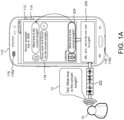
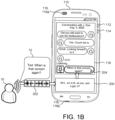
- FIGS. 1A and 1B are examples of a speech environment 100.
- a user's 10 manner of interacting with a computing device, such as a user device 110 may be through voice input.
- the user device 110 (also referred to generally as a device 110) is configured to capture sounds (e.g., streaming audio data) from one or more users 10 within the speech-enabled environment 100.
- the streaming audio data 12 may refer to a spoken utterance by the user 10 that functions as an audible query, a command for the device 110, or an audible communication captured by the device 110.
- Speech-enabled systems of the device 110 may field the query or the command by answering the query and/or causing the command to be performed.
- the user device 110 may correspond to any computing device associated with a user 10 and capable of receiving audio data 12.
- Some examples of user devices 110 include, but are not limited to, mobile devices (e.g., mobile phones, tablets, laptops, etc.), computers, wearable devices (e.g., smart watches), smart appliances, internet of things (IoT) devices, smart speakers, etc.
- the user device 110 includes data processing hardware 112 and memory hardware 114 in communication with the data processing hardware 112 and storing instructions, that when executed by the data processing hardware 112, cause the data processing hardware 112 to perform one or more operations.
- the user device 110 further includes an audio subsystem 116 with an audio capture device (e.g., microphone) 116, 116a for capturing and converting spoken utterances 12 within the speech-enabled system 100 into electrical signals and a speech output device (e.g., a speaker) 116, 116b for communicating an audible audio signal (e.g., as output audio data from the device 110).
- an audio capture device e.g., microphone
- a speech output device e.g., a speaker
- an audible audio signal e.g., as output audio data from the device 110.
- the user device 110 implements a single audio capture device 116a in the example shown, the user device 110 may implement an array of audio capture devices 116a without departing from the scope of the present disclosure, whereby one or more capture devices 116a in the array may not physically reside on the user device 110, but be in communication with the audio subsystem 116.
- the user device 110 (e.g., using the hardware 112, 114) is further configured to perform speech recognition processing on the streaming audio data 12 using a speech recognizer 200.
- the audio subsystem 116 of the user device 110 that includes the audio capture device 116a is configured to receive audio data 12 (e.g., spoken utterances) and to convert the audio data 12 into a digital format compatible with the speech recognizer 200.
- the digital format may correspond to acoustic frames (e.g., parameterized acoustic frames), such as mel frames.
- the parameterized acoustic frames correspond to log-mel filterbank energies.
- the user 10 interacts with a program or application 118 of the user device 110 that uses the speech recognizer 200.
- FIG. 1A depicts the user 10 communicating with an automated assistant application.
- the user 10 asks the automated assistant, "What time is the concert tonight?" This question from the user 10 is a spoken utterance 12 captured by the audio capture device 116a and processed by audio subsystems 116 of the user device 110.
- the speech recognizer 200 of the user device 110 receives the audio input 202 (e.g., as acoustic frames) of "what time is the concert tonight” and transcribes the audio input 202 into a transcription 204 (e.g., a text representation of "what time is the concert tonight?").
- the automated assistant of the application 118 may respond to the question posed by the user 10 using natural language processing. Natural language processing generally refers to a process of interpreting written language (e.g., the transcription 204) and determining whether the written language prompts any action.
- the automated assistant uses natural language processing to recognize that the question from the user 10 regards the user's schedule and more particularly a concert on the user's schedule.
- the automated assistant By recognizing these details with natural language processing, the automated assistant returns a response to the user's query where the response states, "Doors open at 8:30 pm for the concert tonight.”
- natural language processing may occur on a remote system in communication with the data processing hardware 112 of the user device 110.
- FIG. 1B is another example of speech recognition with the speech recognizer 200.
- the user 10 associated with the user device 110 is communicating with a friend named Jane Doe with a communication application 118.
- Ted communicates with Jane by having the speech recognizer 200 transcribe his voice inputs.
- the audio capture device 116 captures these voice inputs and communicates them in a digital form (e.g., acoustic frames) to the speech recognizer 200.
- the speech recognizer 200 transcribes these acoustic frames into text that is sent to Jane via the communication application 118. Because this type of application 118 communicates via text, the transcription 204 from the speech recognizer 200 may be sent to Jane without further processing (e.g., natural language processing).
- the speech recognizer 200 is configured in a two-pass architecture.
- the two-pass architecture of the speech recognizer 200 includes at least one encoder 210, an RNN-T decoder 220, and a LAS decoder 230.
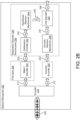
- FIG. 2A depicts a traditional two-pass architecture while FIG. 2B depicts an enhanced two-pass architecture with a deliberation network 240.
- the enhanced two-pass architecture of FIG. 2B builds on the fundamental two-pass structure of FIG. 2A .
- the second pass 208 may improve the initial outputs from the first pass 206 (e.g., shown as the RNN-T decoder 220) with techniques such as lattice rescoring or n-best re-ranking.
- the RNN-T decoder 220 produces streaming predictions and the LAS decoder 230 finalizes the prediction.
- the LAS decoder 230 rescores streamed hypotheses 222 y R from the RNN-T decoder 220.
- the LAS decoder 230 functions in a rescoring mode that rescores streamed hypotheses 222 y R from the RNN-T decoder 220
- the LAS decoder 230 is also capable of operating in different modes, such as a beam search mode, depending on design or other factors (e.g., utterance length).
- the at least one encoder 210 is configured to receive, as an audio input 202, acoustic frames corresponding to streaming audio data 12.
- the acoustic frames may be previously processed by the audio subsystem 116 into parameterized acoustic frames (e.g., mel frames and/or spectral frames).
- the parameterized acoustic frames correspond to log-mel filterbank energies with log-mel features.
- each parameterized acoustic frame includes 128-dimensional log-mel features computed within a short shifting window (e.g., 32 milliseconds and shifted every 10 milliseconds).
- Each feature may be stacked with previous frames (e.g., three previous frames) to form a higher-dimensional vector (e.g., a 512-dimensional vector using the three previous frames).
- the features forming the vector may then be downsampled (e.g., to a 30 millisecond frame rate).
- the encoder 210 is configured to generate an encoding e.
- the encoder 210 generates encoded acoustic frames (e.g., encoded mel frames or acoustic embeddings).
- the encoder 210 is a long-short term memory (LSTM) neural network.
- the encoder 210 includes eight LSTM layers.
- each layer may have 2,048 hidden units followed by a 640-dimensional projection layer.
- the encoder 210 is a shared encoder network. In other words, instead of each pass network 206, 208 having its own separate encoder, each pass 206, 208 shares a single encoder 210.
- an ASR speech recognizer 200 that uses a two-pass architecture may reduce its model size and/or its computational cost.
- a reduction in model size may help enable the speech recognizer 200 to function well entirely on-device.
- the encoder 210 receives each acoustic frame of the audio input 202 and generates an output 212 (e.g., shown as the encoding e of the acoustic frame).
- the RNN-T decoder 220 receives the output 212 for each frame and generates an output 222, shown as the hypothesis y R , at each time step in a streaming fashion.
- the RNN-T decoder 220 includes a prediction network and a joint network.
- the prediction network may have two LSTM layers of 2,048 hidden units and a 640-dimensional projection per layer as well as an embedding layer of 128 units.
- the outputs 212 of the encoder 210 and the prediction network may be fed into the joint network that includes a softmax predicting layer.
- the joint network of the RNN-T decoder 220 includes 640 hidden units followed by a softmax layer that predicts 4,096 mixed-case word pieces.
- the LAS decoder 230 receives the output 212 from the encoder 210 for each frame and generates an output 232 designated as the hypothesis y L .
- the LAS decoder 230 operates in a beam search mode, the LAS decoder 230 produces the output 232 from the output 212 alone; ignoring the output 222 of the RNN-T decoder 220.
- the LAS decoder 230 When the LAS decoder 230 operates in the rescoring mode, the LAS decoder 230 obtains the top-K hypotheses from the RNN-T decoder 220 and then the LAS decoder 230 is run on each sequence in a teacher-forcing mode, with attention on the output 212, to compute a score. For example, a score combines a log probability of the sequence and an attention coverage penalty.
- the LAS decoder 230 selects a sequence with the highest score to be the output 232.
- the LAS decoder 230 may include multi-headed attention (e.g., with four heads) to attend to the output 212.
- the LAS decoder 230 may be a two-layer LAS decoder 230 with a softmax layer for prediction.
- each layer of the LAS decoder 230 has 2,048 hidden units followed by a 640-dimensional projection.
- the softmax layer may include 4,096 dimensions to predict the same mixed-case word pieces from the softmax layer of the RNN-T decoder 220.
- the first pass 206 remains the same, but the second pass 208 uses a deliberation decoder 240 that includes a deliberation encoder 242 and two attention mechanisms 244, 246, a hypothesis attention mechanism 244 and an acoustic attention mechanism 246, in addition to the LAS decoder 230.
- the speech recognizer 200 of FIG. 2B attends to both acoustics, by attending to the output 212 of the encoder 210 at the acoustic attention mechanism 246, and the first-pass hypotheses, by attending to the outputs 222 of the RNN-T decoder 220 at the hypothesis attention mechanism 244.
- each attention mechanism 244, 246 forms a context vector 245, 247 (e.g., an acoustic context vector 247 and a hypothesis context vector 245) that is input into the LAS decoder 230 of the deliberation decoder 240.
- These context vectors 245, 247 may be concatenated as inputs into the LAS decoder 230.
- the attention mechanisms 244, 246 may have a similar structure such that each attention mechanism 244, 246 includes multi-headed attention (e.g., four heads).
- the deliberation encoder 242 further encodes the output 222 of the RNN-T decoder 220 (i.e., the output 222 of the first pass 206) to form the encoded hypotheses 243 (e.g., shown as h B ).
- the deliberation encoder 242 may also encode the output 222 for useful context information to include in the encoded hypotheses 243.
- the deliberation encoder 242 is a bidirectional encoder capable of including the context information.
- the deliberation encoder 242 may also be configured to encode multiple hypotheses 222. For instance, the deliberation encoder 242 encodes each hypothesis 222 separately and then concatenates each encoded hypothesis together.
- the deliberation encoder 242 may be a LSTM encoder (e.g., a 2-layer bidirectional LSTM encoder).
- LSTM encoder e.g., a 2-layer bidirectional LSTM encoder
- each layer of the deliberation encoder 242 may include 2,048 hidden units followed by a 320-dimensional projection.
- the speech recognizer 200 of FIG. 2B may perform a beam search mode or a rescoring mode to generate the output 248.
- the deliberation decoder 240 may run on the output 222 in a teacher-forcing mode. Additionally or alternatively, when in a rescoring mode, using a bidirectional deliberation encoder 242 may help to improve the relative WER of the deliberation decoder two-pass architecture.
- the speech recognizer 200 of FIG. 2B also includes an acoustic encoder 250.
- the deliberation encoder 242 and the LAS decoder 230 may have some degree of incompatibility that may be overcome by using the acoustic encoder 250.
- the acoustic encoder 250 may further encode the output 212.
- the acoustic encoder 250 is a LSTM encoder (e.g., a two-layer LSTM encoder) that further encodes the output 212 from the encoder 210.
- the encoder 210 may still be preserved as a shared encoder between passes 206, 208.
- the acoustic encoder 250 may be a unidirectional encoder to reduce potential latency within the enhanced two-pass architecture.
- a neural network is generally trained by back propagation that defines a loss function (e.g., a cross-entropy loss function).
- the loss function is defined as a difference between the actual outputs of the network and the desired outputs of the network.
- the speech recognizer 200 may be trained using either a cross entropy loss approach or a joint training approach.
- a deliberation model such as the speech recognizer 200 with the deliberation decoder 240 (i.e., deliberation-based recognizer 200), is trained in a two-step training process. During the first step of the training process, the RNN-T decoder 220 is trained.
- parameters for the RNN-T decoder 220 are fixed and only the deliberation decoder 240 and additional encoder layers (e.g., the deliberation encoder 242 and the acoustic encoder 250) are trained.
- ⁇ e , ⁇ 1 , and ⁇ 2 denote the parameters of the encoder 210, the RNN-T decoder 220, and the deliberation decoder 230, respectively.
- joint training is similar to the concept of "deep fine tuning" but without a pre-trained decoder.
- the speech recognizer 200 may be further trained using a minimum WER (MWER) loss to optimize the expected word error rate by using n-best hypotheses.
- y ⁇ is the number of word errors for y d i with respect to the ground truth target y*. P ⁇ y d i
- x is the probability of the ith hypothesis normalized over all other hypotheses to sum to 1.
- B is the beam size.
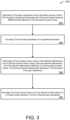
- FIG. 3 is a flowchart of an example arrangement of operations for a method 300 of performing automated speech recognition (e.g., ASR) using a deliberation two-pass architecture.
- the method 300 receives a first-pass hypothesis 222 and an encoded acoustic frame 212.
- the first pass hypothesis 222 is generated by a RNN decoder 220 for the encoded acoustic frame 212.
- the method 300 includes encoding the first pass hypothesis 222 at a hypothesis encoder 242.
- the method 300 includes generating a first context vector 247 using a first attention mechanism 246 and a second context vector 245 using a second attention mechanism 244.
- the first attention mechanism 246 attends to the encoded acoustic frame 212.
- the second attention mechanism 244 attends to the encoded first-pass hypothesis 243.
- the method 300 includes decoding the first context vector 247 and the second context vector 245 at a context vector decoder 230 to form a second-pass hypothesis 248.
- FIG. 4 is a schematic view of an example computing device 400 (e.g., a system 400) that may be used to implement the systems (e.g., the speech recognizer 200) and methods (e.g., the method 300) described in this document.
- the computing device 400 is intended to represent various forms of digital computers, such as laptops, desktops, workstations, personal digital assistants, servers, blade servers, mainframes, and other appropriate computers.
- the components shown here, their connections and relationships, and their functions, are meant to be exemplary only, and are not meant to limit implementations of the inventions described and/or claimed in this document.
- the computing device 400 includes a processor 410 (e.g., data processing hardware 410), memory 420 (e.g., memory hardware 520), a storage device 430, a high-speed interface/controller 440 connecting to the memory 420 and high-speed expansion ports 440, and a low speed interface/controller 460 connecting to a low speed bus 470 and a storage device 430.
- a processor 410 e.g., data processing hardware 410
- memory 420 e.g., memory hardware 520
- storage device 430 e.g., a high-speed interface/controller 440 connecting to the memory 420 and high-speed expansion ports 440, and a low speed interface/controller 460 connecting to a low speed bus 470 and a storage device 430.
- Each of the components 410, 420, 430, 440, 450, and 460 are interconnected using various busses, and may be mounted on a common motherboard or in other manners as appropriate.
- the processor 410 can process instructions for execution within the computing device 400, including instructions stored in the memory 420 or on the storage device 430 to display graphical information for a graphical user interface (GUI) on an external input/output device, such as display 480 coupled to high speed interface 440.
- GUI graphical user interface
- multiple processors and/or multiple buses may be used, as appropriate, along with multiple memories and types of memory.
- multiple computing devices 400 may be connected, with each device providing portions of the necessary operations (e.g., as a server bank, a group of blade servers, or a multiprocessor system).
- the memory 420 stores information non-transitorily within the computing device 400.
- the memory 420 may be a computer-readable medium, a volatile memory unit(s), or non-volatile memory unit(s).
- the non-transitory memory 420 may be physical devices used to store programs (e.g., sequences of instructions) or data (e.g., program state information) on a temporary or permanent basis for use by the computing device 400.
- non-volatile memory examples include, but are not limited to, flash memory and read-only memory (ROM) / programmable read-only memory (PROM) / erasable programmable read-only memory (EPROM) / electronically erasable programmable read-only memory (EEPROM) (e.g., typically used for firmware, such as boot programs).
- volatile memory examples include, but are not limited to, random access memory (RAM), dynamic random access memory (DRAM), static random access memory (SRAM), phase change memory (PCM) as well as disks or tapes.
- the storage device 430 is capable of providing mass storage for the computing device 400.
- the storage device 430 is a computer-readable medium.
- the storage device 430 may be a floppy disk device, a hard disk device, an optical disk device, or a tape device, a flash memory or other similar solid state memory device, or an array of devices, including devices in a storage area network or other configurations.
- a computer program product is tangibly embodied in an information carrier.
- the computer program product contains instructions that, when executed, perform one or more methods, such as those described above.
- the information carrier is a computer- or machine-readable medium, such as the memory 420, the storage device 430, or memory on processor 410.
- the high speed controller 440 manages bandwidth-intensive operations for the computing device 400, while the low speed controller 460 manages lower bandwidth-intensive operations. Such allocation of duties is exemplary only.
- the high-speed controller 440 is coupled to the memory 420, the display 480 (e.g., through a graphics processor or accelerator), and to the high-speed expansion ports 450, which may accept various expansion cards (not shown).
- the low-speed controller 460 is coupled to the storage device 430 and a low-speed expansion port 490.
- the low-speed expansion port 490 which may include various communication ports (e.g., USB, Bluetooth, Ethernet, wireless Ethernet), may be coupled to one or more input/output devices, such as a keyboard, a pointing device, a scanner, or a networking device such as a switch or router, e.g., through a network adapter.
- input/output devices such as a keyboard, a pointing device, a scanner, or a networking device such as a switch or router, e.g., through a network adapter.
- the computing device 400 may be implemented in a number of different forms, as shown in the figure. For example, it may be implemented as a standard server 400a or multiple times in a group of such servers 400a, as a laptop computer 400b, or as part of a rack server system 400c.
- implementations of the systems and techniques described herein can be realized in digital electronic and/or optical circuitry, integrated circuitry, specially designed ASICs (application specific integrated circuits), computer hardware, firmware, software, and/or combinations thereof.
- ASICs application specific integrated circuits
- These various implementations can include implementation in one or more computer programs that are executable and/or interpretable on a programmable system including at least one programmable processor, which may be special or general purpose, coupled to receive data and instructions from, and to transmit data and instructions to, a storage system, at least one input device, and at least one output device.
- the processes and logic flows described in this specification can be performed by one or more programmable processors executing one or more computer programs to perform functions by operating on input data and generating output.
- the processes and logic flows can also be performed by special purpose logic circuitry, e.g., an FPGA (field programmable gate array) or an ASIC (application specific integrated circuit).
- processors suitable for the execution of a computer program include, by way of example, both general and special purpose microprocessors, and any one or more processors of any kind of digital computer.
- a processor will receive instructions and data from a read only memory or a random access memory or both.
- the essential elements of a computer are a processor for performing instructions and one or more memory devices for storing instructions and data.
- a computer will also include, or be operatively coupled to receive data from or transfer data to, or both, one or more mass storage devices for storing data, e.g., magnetic, magneto optical disks, or optical disks.
- mass storage devices for storing data
- a computer need not have such devices.
- Computer readable media suitable for storing computer program instructions and data include all forms of non-volatile memory, media and memory devices, including by way of example semiconductor memory devices, e.g., EPROM, EEPROM, and flash memory devices; magnetic disks, e.g., internal hard disks or removable disks; magneto optical disks; and CD ROM and DVD-ROM disks.
- the processor and the memory can be supplemented by, or incorporated in, special purpose logic circuitry.
- one or more aspects of the disclosure can be implemented on a computer having a display device, e.g., a CRT (cathode ray tube), LCD (liquid crystal display) monitor, or touch screen for displaying information to the user and optionally a keyboard and a pointing device, e.g., a mouse or a trackball, by which the user can provide input to the computer.
- a display device e.g., a CRT (cathode ray tube), LCD (liquid crystal display) monitor, or touch screen for displaying information to the user and optionally a keyboard and a pointing device, e.g., a mouse or a trackball, by which the user can provide input to the computer.
- Other kinds of devices can be used to provide interaction with a user as well; for example, feedback provided to the user can be any form of sensory feedback, e.g., visual feedback, auditory feedback, or tactile feedback; and input from the user can be received in any form, including acoustic, speech, or tactile input
Landscapes
- Engineering & Computer Science (AREA)
- Physics & Mathematics (AREA)
- Computational Linguistics (AREA)
- Health & Medical Sciences (AREA)
- Artificial Intelligence (AREA)
- Theoretical Computer Science (AREA)
- Multimedia (AREA)
- Audiology, Speech & Language Pathology (AREA)
- Acoustics & Sound (AREA)
- Human Computer Interaction (AREA)
- Evolutionary Computation (AREA)
- Biomedical Technology (AREA)
- Data Mining & Analysis (AREA)
- General Engineering & Computer Science (AREA)
- General Physics & Mathematics (AREA)
- Mathematical Physics (AREA)
- Software Systems (AREA)
- Biophysics (AREA)
- Molecular Biology (AREA)
- General Health & Medical Sciences (AREA)
- Computing Systems (AREA)
- Life Sciences & Earth Sciences (AREA)
- Signal Processing (AREA)
- Telephonic Communication Services (AREA)
- Machine Translation (AREA)
- Electrophonic Musical Instruments (AREA)
- Compression, Expansion, Code Conversion, And Decoders (AREA)
- Character Discrimination (AREA)
Abstract
receiving a sequence of audio features characterizing an utterance;
based on the sequence of audio features, generating, using a first-pass decoder model, a plurality of first-pass speech recognition hypotheses, each first-pass speech recognition hypothesis corresponding to a candidate transcription of the utterance;
generating, using a long short-term memory (LSTM) encoder, a first-pass encoding of the plurality of first-pass speech recognition hypotheses; and
based on the sequence of audio features and the first-pass encoding, generating, using a second-pass decoder model, a second-pass hypothesis that rescores the plurality of first-pass speech recognition hypotheses.
Description
- This disclosure relates to two-pass end-to-end speech recognition.
- Modern automated speech recognition (ASR) systems focus on providing not only high quality (e.g., a low word error rate (WER)), but also low latency (e.g., a short delay between the user speaking and a transcription appearing). Moreover, when using an ASR system today there is a demand that the ASR system decode utterances in a streaming fashion that corresponds to real-time or even faster than real-time. To illustrate, when an ASR system is deployed on a mobile phone that experiences direct user interactivity, an application on the mobile phone using the ASR system may require the speech recognition to be streaming such that words appear on the screen as soon as they are spoken. Here, it is also likely that the user of the mobile phone has a low tolerance for latency. Due to this low tolerance, the speech recognition strives to run on the mobile device in a manner that minimizes an impact from latency and inaccuracy that may detrimentally affect the user's experience.
- One aspect of the present disclosure provides a computer-implemented method that when executed on data processing hardware causes the data processing hardware to perform operations that include receiving a first-pass hypothesis and an encoded acoustic frame, and encoding the first-pass hypothesis at a hypothesis encode. The first-pass hypothesis is generated by a recurrent neural network (RNN) decoder model for the encoded acoustic frame. The operations also include generating, using a first attention mechanism attending to the encoded acoustic frame, a first context vector, and generating, using a second attention mechanism attending to the encoded first-pass hypothesis, a second context vector. The operations also include decoding the first context vector and the second context vector at a context vector decoder to form a second-pass hypothesis.
- Implementations of the disclosure may include one or more of the following optional features. In some implementations, decoding the first context vector and the second context vector includes decoding a concatenation of the first context vector and the second context vector. Encoding the first-pass hypothesis may include bi-directionally encoding the first-pass hypothesis at the hypothesis encoder to generate contextual information from the first-pass hypothesis. Here, the hypothesis encoder may include a long short term memory (LSTM) network.
- In some examples, the operations further include encoding the acoustic frame at a shared encoder and generating the first-pass hypothesis at the RNN decoder model based on the encoded acoustic frame communicated from the shared encoder. In these examples, the operations may further include generating an acoustic embedding at a unidirectional audio encoder based on the encoded acoustic frame communicated from the shared encoder. Here, the unidirectional audio encoder may include a long short term memory (LSTM) network that may have at least two layers.
- In some implementations, the operations also include training the RNN decoder model and training a deliberation decoder while parameters of the trained RNN decoder model remain fixed. The deliberation decoder includes the hypothesis encoder, the first attention mechanism, the second attention mechanism, and the context vector decoder. In these implementations, the operations may also include minimizing a word error rate during training of the RNN decoder model and the deliberation decoder model.
- In other implementations, the operations include jointly training the RNN decoder model and a deliberation decoder that includes the hypothesis encoder, the first attention mechanism, the second attention mechanism, and the context vector decoder. In these implementations, the operations may further include minimizing a word error rate during the joint training of the RNN decoder model and the deliberation decoder model. The data processing hardware may reside on a user device.
- Another aspect of the present disclosure provides a system that includes data processing hardware and memory hardware in communication with the data processing hardware and storing instructions that when executed by the data processing hardware cause the data processing hardware to perform operations that include receiving a first-pass hypothesis and an encoded acoustic frame, and encoding the first-pass hypothesis at a hypothesis encode. The first-pass hypothesis is generated by a recurrent neural network (RNN) decoder model for the encoded acoustic frame. The operations also include generating, using a first attention mechanism attending to the encoded acoustic frame, a first context vector, and generating, using a second attention mechanism attending to the encoded first-pass hypothesis, a second context vector. The operations also include decoding the first context vector and the second context vector at a context vector decoder to form a second-pass hypothesis.
- This aspect may include one or more of the following optional features. In some implementations, decoding the first context vector and the second context vector includes decoding a concatenation of the first context vector and the second context vector. Encoding the first-pass hypothesis may include bi-directionally encoding the first-pass hypothesis at the hypothesis encoder to generate contextual information from the first-pass hypothesis. Here, the hypothesis encoder may include a long short term memory (LSTM) network.
- In some examples, the operations further include encoding the acoustic frame at a shared encoder and generating the first-pass hypothesis at the RNN decoder model based on the encoded acoustic frame communicated from the shared encoder. In these examples, the operations may further include generating an acoustic embedding at a unidirectional audio encoder based on the encoded acoustic frame communicated from the shared encoder. Here, the unidirectional audio encoder may include a long short term memory (LSTM) network that may have at least two layers.
- In some implementations, the operations also include training the RNN decoder model and training a deliberation decoder while parameters of the trained RNN decoder model remain fixed. The deliberation decoder includes the hypothesis encoder, the first attention mechanism, the second attention mechanism, and the context vector decoder. In these implementations, the operations may also include minimizing a word error rate during training of the RNN decoder model and the deliberation decoder model.
- In other implementations, the operations include jointly training the RNN decoder model and a deliberation decoder that includes the hypothesis encoder, the first attention mechanism, the second attention mechanism, and the context vector decoder. In these implementations, the operations may further include minimizing a word error rate during the joint training of the RNN decoder model and the deliberation decoder model. The data processing hardware may reside on a user device.
- The details of one or more implementations of the disclosure are set forth in the accompanying drawings and the description below. Other aspects, features, and advantages will be apparent from the description and drawings, and from the claims.
-
-
FIGS. 1A and1B are schematic views of example speech environments using a deliberation two-pass architecture. -
FIG. 2A is a schematic view of an example traditional two-pass architecture for speech recognition. -
FIG. 2B is a schematic view of the example deliberation two-pass architecture ofFIG. 1A for speech recognition. -
FIG. 3 is a flowchart of an example arrangement of operations for a method of performing speech recognition using the deliberation two-pass architecture ofFIG. 2B . -
FIG. 4 is a schematic view of an example computing device that may be used to implement the systems and methods described herein. - Like reference symbols in the various drawings indicate like elements.
- Speech recognition continues to evolve to meet the untethered and the nimble demands of a mobile environment. New speech recognition architectures or improvements to existing architectures continue to be developed that seek to increase the quality of automatic speech recognition systems (ASR). To illustrate, speech recognition initially employed multiple models where each model had a dedicated purpose. For instance, an ASR system included an acoustic model (AM), a pronunciation model (PM), and a language model (LM). The acoustic model mapped segments of audio (i.e., frames of audio) to phonemes. The pronunciation model connected these phonemes together to form words while the language model was used to express the likelihood of given phrases (i.e., the probability of a sequence of words). Yet although these individual models worked together, each model was trained independently and often manually designed on different datasets.
- The approach of separate models enabled a speech recognition system to be fairly accurate, especially when the training corpus (i.e., body of training data) for a given model caters to the effectiveness of the model. However, the need to independently train separate models introduced its own complexities and led to an architecture with integrated models. These integrated models sought to use a single neural network to directly map an audio waveform (i.e., input sequence) to an output sentence (i.e., output sequence). This resulted in a sequence-to-sequence approach, which generated a sequence of words (or graphemes) when given a sequence of audio features. Examples of sequence-to-sequence models include "attention-based" models and "listen-attend-spell" (LAS) models. A LAS model transcribes speech utterances into characters using a listener component, an attender component, and a speller component. Here, the listener is a recurrent neural network (RNN) encoder that receives an audio input (e.g., a time-frequency representation of speech input) and maps the audio input to a higher-level feature representation. The attender attends to the higher-level feature to learn an alignment between input features and predicted subword units (e.g., a grapheme or a wordpiece). The speller is an attention-based RNN decoder that generates character sequences from the input by producing a probability distribution over a set of hypothesized words. With an integrated structure, all components of a model may be trained jointly as a single end-to-end (E2E) neural network. Here, an E2E model refers to a model whose architecture is constructed entirely of a neural network. A fully neural network functions without external and/or manually designed components (e.g., finite state transducers, a lexicon, or text normalization modules). Additionally, when training E2E models, these models generally do not require bootstrapping from decision trees or time alignments from a separate system.
- Although early E2E models proved accurate and a training improvement over individually trained models, these E2E models, such as the LAS model, functioned by reviewing an entire input sequence before generating output text, and thus, did not allow streaming outputs as inputs were received. Without streaming capabilities, an LAS model is unable to perform real-time voice transcription. Due to this deficiency, deploying the LAS model for speech applications that are latency sensitive and/or require real-time voice transcription may pose issues. This makes an LAS model alone not an ideal model for mobile technology (e.g., mobile phones) that often relies on real-time applications (e.g., real-time communication applications).
- Additionally, speech recognition systems that have acoustic, pronunciation, and language models, or such models composed together, may rely on a decoder that has to search a relatively large search graph associated with these models. With a large search graph, it is not conducive to host this type of speech recognition system entirely on-device. Here, when a speech recognition system is hosted "on-device," a device that receives the audio input uses its processor(s) to execute the functionality of the speech recognition system. For instance, when a speech recognition system is hosted entirely on-device, the processors of the device do not need to coordinate with any off-device computing resources to perform the functionality of the speech recognition system. A device that performs speech recognition not entirely on-device relies on remote computing (e.g., of a remote computing system or cloud computing) and therefore online connectivity to perform at least some function of the speech recognition system. For example, a speech recognition system performs decoding with a large search graph using a network connection with a server-based model.
- Unfortunately, being reliant upon a remote connection makes a speech recognition system vulnerable to latency issues and/or inherent unreliability of communication networks. To improve the usefulness of speech recognition by avoiding these issues, speech recognition systems have again evolved into a form of a sequence-to-sequence model known as a recurrent neural network transducer (RNN-T). A RNN-T does not employ an attention mechanism and, unlike other sequence-to-sequence models that generally need to process an entire sequence (e.g., audio waveform) to produce an output (e.g., a sentence), the RNN-T continuously processes input samples and streams output symbols, a feature that is particularly attractive for real-time communication. For instance, speech recognition with an RNN-T may output characters one-by-one as spoken. Here, an RNN-T uses a feedback loop that feeds symbols predicted by the model back into itself to predict the next symbols. Because decoding the RNN-T includes a beam search through a single neural network instead of a large decoder graph, an RNN-T may scale to a fraction of the size of a server-based speech recognition model. With the size reduction, the RNN-T may be deployed entirely on-device and able to run offline (i.e., without a network connection); therefore, avoiding unreliability issues with communication networks.
- In addition to speech recognition systems operating with low latency, a speech recognition system also needs to be accurate at recognizing speech. Often for models that perform speech recognition, a metric that may define an accuracy of a model is a word error rate (WER). A WER refers to a measure of how many words are changed compared to a number of words actually spoken. Commonly, these word changes refer to substitutions (i.e., when a word gets replaced), insertions (i.e., when a word is added), and/or deletions (i.e., when a word is omitted). To illustrate, a speaker says "car," but an ASR system transcribes the word "car" as "bar." This is an example of a substitution due to phonetic similarity. When measuring the capability of an ASR system compared to other ASR systems, the WER may indicate some measure of improvement or quality capability relative to another system or some baseline.
- Although an RNN-T model showed promise as a strong candidate model for on-device speech recognition, the RNN-T model alone still lags behind a large state-of-the-art conventional model (e.g., a server-based model with separate AM, PM, and LMs) in terms of quality (e.g., speech recognition accuracy). Yet a non-streaming E2E, LAS model has speech recognition quality that is comparable to large state-of-the-art conventional models. To capitalize on the quality of a non-steaming E2E LAS model, implementations herein are directed toward a two-pass speech recognition system (e.g., shown in
FIG. 2A ) that includes a first-pass component of an RNN-T network followed by a second-pass component of a LAS network. With this design, the two-pass model benefits from the streaming nature of an RNN-T model with low latency while improving the accuracy of the RNN-T model through the second-pass incorporating the LAS network. Although the LAS network increases the latency when compared to only a RNN-T model, the increase in latency is reasonably slight and complies with latency constraints for on-device operation. With respect to accuracy, a two-pass model achieves a 17-22% WER reduction when compared to a RNN-T alone and has a similar WER when compared to a large conventional model. - In a two-pass model, the non-streaming LAS model, for example, rescores streamed hypotheses from a first-pass. This second-pass LAS model approach attends to acoustics in order to rescore hypotheses. In contrast, an alternative method known as a class of neural correction model uses text instead of acoustics to generate hypotheses. In other words, there are different variables that may be attended to in order to refine a hypothesis in a second-pass. As such, the model proposed herein is a variation on the RNN-T/LAS two-pass model. This variant uses a deliberation network that combines acoustics and first-pass text hypotheses for the second pass of the two-pass model. By using a deliberation network, a two-pass model (e.g., as shown in
FIG. 2B ) may become more accurate when compared to a two-pass model without a deliberation network (e.g., as shown inFIG. 2A ) and also more accurate than a large conventional speech recognition model. For instance, in some tests, the deliberation two-pass model has achieved 12% relative WER reduction when compared to the two-pass model without a deliberation network and nearly 21% relative WER reduction when compared to a large convention speech recognition model. -
FIGS. 1A and1B are examples of a speech environment 100. In the speech environment 100 a user's 10 manner of interacting with a computing device, such as auser device 110, may be through voice input. The user device 110 (also referred to generally as a device 110) is configured to capture sounds (e.g., streaming audio data) from one ormore users 10 within the speech-enabled environment 100. Here, the streamingaudio data 12 may refer to a spoken utterance by theuser 10 that functions as an audible query, a command for thedevice 110, or an audible communication captured by thedevice 110. Speech-enabled systems of thedevice 110 may field the query or the command by answering the query and/or causing the command to be performed. - The
user device 110 may correspond to any computing device associated with auser 10 and capable of receivingaudio data 12. Some examples ofuser devices 110 include, but are not limited to, mobile devices (e.g., mobile phones, tablets, laptops, etc.), computers, wearable devices (e.g., smart watches), smart appliances, internet of things (IoT) devices, smart speakers, etc. Theuser device 110 includesdata processing hardware 112 andmemory hardware 114 in communication with thedata processing hardware 112 and storing instructions, that when executed by thedata processing hardware 112, cause thedata processing hardware 112 to perform one or more operations. Theuser device 110 further includes anaudio subsystem 116 with an audio capture device (e.g., microphone) 116, 116a for capturing and converting spokenutterances 12 within the speech-enabled system 100 into electrical signals and a speech output device (e.g., a speaker) 116, 116b for communicating an audible audio signal (e.g., as output audio data from the device 110). While theuser device 110 implements a singleaudio capture device 116a in the example shown, theuser device 110 may implement an array ofaudio capture devices 116a without departing from the scope of the present disclosure, whereby one ormore capture devices 116a in the array may not physically reside on theuser device 110, but be in communication with theaudio subsystem 116. The user device 110 (e.g., using thehardware 112, 114) is further configured to perform speech recognition processing on the streamingaudio data 12 using aspeech recognizer 200. In some examples, theaudio subsystem 116 of theuser device 110 that includes theaudio capture device 116a is configured to receive audio data 12 (e.g., spoken utterances) and to convert theaudio data 12 into a digital format compatible with thespeech recognizer 200. The digital format may correspond to acoustic frames (e.g., parameterized acoustic frames), such as mel frames. For instance, the parameterized acoustic frames correspond to log-mel filterbank energies. - In some examples, such as
FIG. 1A , theuser 10 interacts with a program orapplication 118 of theuser device 110 that uses thespeech recognizer 200. For instance,FIG. 1A depicts theuser 10 communicating with an automated assistant application. In this example, theuser 10 asks the automated assistant, "What time is the concert tonight?" This question from theuser 10 is a spokenutterance 12 captured by theaudio capture device 116a and processed byaudio subsystems 116 of theuser device 110. In this example, thespeech recognizer 200 of theuser device 110 receives the audio input 202 (e.g., as acoustic frames) of "what time is the concert tonight" and transcribes theaudio input 202 into a transcription 204 (e.g., a text representation of "what time is the concert tonight?"). Here, the automated assistant of theapplication 118 may respond to the question posed by theuser 10 using natural language processing. Natural language processing generally refers to a process of interpreting written language (e.g., the transcription 204) and determining whether the written language prompts any action. In this example, the automated assistant uses natural language processing to recognize that the question from theuser 10 regards the user's schedule and more particularly a concert on the user's schedule. By recognizing these details with natural language processing, the automated assistant returns a response to the user's query where the response states, "Doors open at 8:30 pm for the concert tonight." In some configurations, natural language processing may occur on a remote system in communication with thedata processing hardware 112 of theuser device 110. -
FIG. 1B is another example of speech recognition with thespeech recognizer 200. In this example, theuser 10 associated with theuser device 110 is communicating with a friend named Jane Doe with acommunication application 118. Here, theuser 10 named Ted, communicates with Jane by having thespeech recognizer 200 transcribe his voice inputs. Theaudio capture device 116 captures these voice inputs and communicates them in a digital form (e.g., acoustic frames) to thespeech recognizer 200. Thespeech recognizer 200 transcribes these acoustic frames into text that is sent to Jane via thecommunication application 118. Because this type ofapplication 118 communicates via text, thetranscription 204 from thespeech recognizer 200 may be sent to Jane without further processing (e.g., natural language processing). - In some examples, such as
FIGS. 2A and2B , thespeech recognizer 200 is configured in a two-pass architecture. Generally speaking, the two-pass architecture of thespeech recognizer 200 includes at least oneencoder 210, an RNN-T decoder 220, and aLAS decoder 230. Here,FIG. 2A depicts a traditional two-pass architecture whileFIG. 2B depicts an enhanced two-pass architecture with adeliberation network 240. As can be seen in these figures, the enhanced two-pass architecture ofFIG. 2B builds on the fundamental two-pass structure ofFIG. 2A . In two-pass decoding, the second pass 208 (e.g., shown as the LAS decoder 230) may improve the initial outputs from the first pass 206 (e.g., shown as the RNN-T decoder 220) with techniques such as lattice rescoring or n-best re-ranking. In other words, the RNN-T decoder 220 produces streaming predictions and theLAS decoder 230 finalizes the prediction. Here, specifically, theLAS decoder 230 rescores streamed hypotheses 222 yR from the RNN-T decoder 220. Although it is generally discussed that theLAS decoder 230 functions in a rescoring mode that rescores streamed hypotheses 222 yR from the RNN-T decoder 220, theLAS decoder 230 is also capable of operating in different modes, such as a beam search mode, depending on design or other factors (e.g., utterance length). - The at least one
encoder 210 is configured to receive, as anaudio input 202, acoustic frames corresponding to streamingaudio data 12. The acoustic frames may be previously processed by theaudio subsystem 116 into parameterized acoustic frames (e.g., mel frames and/or spectral frames). In some implementations, the parameterized acoustic frames correspond to log-mel filterbank energies with log-mel features. For instance, the parameterized input acoustic frames that are output by theaudio subsystem 116 and that are input into theencoder 210 may be represented as x = (x1,..., xT), where xt
audio input 202, theencoder 210 is configured to generate an encoding e. For example, theencoder 210 generates encoded acoustic frames (e.g., encoded mel frames or acoustic embeddings). - Although the structure of the
encoder 210 may be implemented in different ways, in some implementations, theencoder 210 is a long-short term memory (LSTM) neural network. For instance, theencoder 210 includes eight LSTM layers. Here, each layer may have 2,048 hidden units followed by a 640-dimensional projection layer. In some examples, a time-reduction layer is inserted with the reduction factor N = 2 after the second LSTM layer ofencoder 210. - In some configurations, the
encoder 210 is a shared encoder network. In other words, instead of eachpass network pass single encoder 210. By sharing an encoder, anASR speech recognizer 200 that uses a two-pass architecture may reduce its model size and/or its computational cost. Here, a reduction in model size may help enable thespeech recognizer 200 to function well entirely on-device. - During the
first pass 206, theencoder 210 receives each acoustic frame of theaudio input 202 and generates an output 212 (e.g., shown as the encoding e of the acoustic frame). The RNN-T decoder 220 receives theoutput 212 for each frame and generates anoutput 222, shown as the hypothesis yR, at each time step in a streaming fashion. In some implementations, the RNN-T decoder 220 includes a prediction network and a joint network. Here, the prediction network may have two LSTM layers of 2,048 hidden units and a 640-dimensional projection per layer as well as an embedding layer of 128 units. Theoutputs 212 of theencoder 210 and the prediction network may be fed into the joint network that includes a softmax predicting layer. In some examples, the joint network of the RNN-T decoder 220 includes 640 hidden units followed by a softmax layer that predicts 4,096 mixed-case word pieces. - In the two-pass model of
FIG. 2A , during thesecond pass 208, theLAS decoder 230 receives theoutput 212 from theencoder 210 for each frame and generates anoutput 232 designated as the hypothesis yL. When theLAS decoder 230 operates in a beam search mode, theLAS decoder 230 produces theoutput 232 from theoutput 212 alone; ignoring theoutput 222 of the RNN-T decoder 220. When theLAS decoder 230 operates in the rescoring mode, theLAS decoder 230 obtains the top-K hypotheses from the RNN-T decoder 220 and then theLAS decoder 230 is run on each sequence in a teacher-forcing mode, with attention on theoutput 212, to compute a score. For example, a score combines a log probability of the sequence and an attention coverage penalty. TheLAS decoder 230 selects a sequence with the highest score to be theoutput 232. Here, in the rescoring mode, theLAS decoder 230 may include multi-headed attention (e.g., with four heads) to attend to theoutput 212. Furthermore, theLAS decoder 230 may be a two-layer LAS decoder 230 with a softmax layer for prediction. For instance, each layer of theLAS decoder 230 has 2,048 hidden units followed by a 640-dimensional projection. The softmax layer may include 4,096 dimensions to predict the same mixed-case word pieces from the softmax layer of the RNN-T decoder 220. - Referring to
FIG. 2B , thefirst pass 206 remains the same, but thesecond pass 208 uses adeliberation decoder 240 that includes adeliberation encoder 242 and twoattention mechanisms hypothesis attention mechanism 244 and anacoustic attention mechanism 246, in addition to theLAS decoder 230. Here, compared to thespeech recognizer 200 ofFIG. 2A , thespeech recognizer 200 ofFIG. 2B attends to both acoustics, by attending to theoutput 212 of theencoder 210 at theacoustic attention mechanism 246, and the first-pass hypotheses, by attending to theoutputs 222 of the RNN-T decoder 220 at thehypothesis attention mechanism 244. In contrast, thespeech recognizer 200 ofFIG. 2A only attends to the acoustics by attending to theoutput 212 of theencoder 210 at the LAS decoder itself. By attending to both acoustics (e.g., theoutput 212 represented as e) and the first-pass hypotheses, thedeliberation decoder 240 generates the output 248 (e.g., a prediction sequence). Here, eachattention mechanism context vector 245, 247 (e.g., anacoustic context vector 247 and a hypothesis context vector 245) that is input into theLAS decoder 230 of thedeliberation decoder 240. Thesecontext vectors LAS decoder 230. Much like the attention mechanism inherent to theLAS decoder 230 as described above, theattention mechanisms attention mechanism - The
deliberation encoder 242 further encodes theoutput 222 of the RNN-T decoder 220 (i.e., theoutput 222 of the first pass 206) to form the encoded hypotheses 243 (e.g., shown as hB). When further encoding theoutput 222, thedeliberation encoder 242 may also encode theoutput 222 for useful context information to include in the encodedhypotheses 243. For example, thedeliberation encoder 242 is a bidirectional encoder capable of including the context information. Thedeliberation encoder 242 may also be configured to encodemultiple hypotheses 222. For instance, thedeliberation encoder 242 encodes eachhypothesis 222 separately and then concatenates each encoded hypothesis together. Structurally, thedeliberation encoder 242 may be a LSTM encoder (e.g., a 2-layer bidirectional LSTM encoder). As an LSTM encoder, each layer of thedeliberation encoder 242 may include 2,048 hidden units followed by a 320-dimensional projection. - During the
second pass 208, thespeech recognizer 200 ofFIG. 2B may perform a beam search mode or a rescoring mode to generate theoutput 248. In a rescoring mode, thedeliberation decoder 240 may run on theoutput 222 in a teacher-forcing mode. Additionally or alternatively, when in a rescoring mode, using abidirectional deliberation encoder 242 may help to improve the relative WER of the deliberation decoder two-pass architecture. - In some examples, the
speech recognizer 200 ofFIG. 2B also includes anacoustic encoder 250. For instance, thedeliberation encoder 242 and theLAS decoder 230 may have some degree of incompatibility that may be overcome by using theacoustic encoder 250. In other words, theacoustic encoder 250 may further encode theoutput 212. In some implementations, theacoustic encoder 250 is a LSTM encoder (e.g., a two-layer LSTM encoder) that further encodes theoutput 212 from theencoder 210. By including an additional encoder, theencoder 210 may still be preserved as a shared encoder between passes 206, 208. Additionally or alternatively, theacoustic encoder 250 may be a unidirectional encoder to reduce potential latency within the enhanced two-pass architecture. - A neural network is generally trained by back propagation that defines a loss function (e.g., a cross-entropy loss function). For instance, the loss function is defined as a difference between the actual outputs of the network and the desired outputs of the network. Here, the
speech recognizer 200 may be trained using either a cross entropy loss approach or a joint training approach. In a cross entropy loss approach, a deliberation model, such as thespeech recognizer 200 with the deliberation decoder 240 (i.e., deliberation-based recognizer 200), is trained in a two-step training process. During the first step of the training process, the RNN-T decoder 220 is trained. After the RNN-T decoder 220 has been trained, parameters for the RNN-T decoder 220 are fixed and only thedeliberation decoder 240 and additional encoder layers (e.g., thedeliberation encoder 242 and the acoustic encoder 250) are trained. - In contrast, sometimes training the
deliberation decoder 240 while fixing parameters of the RNN-T decoder 220 is not optimal since components of a deliberation-basedrecognizer 200 are not jointly updated. As an alternative training approach, the deliberation-basedrecognizer 200 may be jointly trained using a combined loss approach represented by the following equation:
deliberation decoder 240. θe, θ 1 , and θ 2 denote the parameters of theencoder 210, the RNN-T decoder 220, and thedeliberation decoder 230, respectively. Here, joint training is similar to the concept of "deep fine tuning" but without a pre-trained decoder. - Following either of these approaches, the
speech recognizer 200 may be further trained using a minimum WER (MWER) loss to optimize the expected word error rate by using n-best hypotheses. This MWER loss training may be represented by the following equation:

ith hypothesis 248 from thedeliberation decoder 240, and


-
FIG. 3 is a flowchart of an example arrangement of operations for amethod 300 of performing automated speech recognition (e.g., ASR) using a deliberation two-pass architecture. Atoperation 302, themethod 300 receives a first-pass hypothesis 222 and an encodedacoustic frame 212. Here, thefirst pass hypothesis 222 is generated by aRNN decoder 220 for the encodedacoustic frame 212. Atoperation 304, themethod 300 includes encoding thefirst pass hypothesis 222 at ahypothesis encoder 242. Atoperation 306, themethod 300 includes generating afirst context vector 247 using afirst attention mechanism 246 and asecond context vector 245 using asecond attention mechanism 244. Thefirst attention mechanism 246 attends to the encodedacoustic frame 212. Thesecond attention mechanism 244 attends to the encoded first-pass hypothesis 243. Atoperations 308, themethod 300 includes decoding thefirst context vector 247 and thesecond context vector 245 at acontext vector decoder 230 to form a second-pass hypothesis 248. -
FIG. 4 is a schematic view of an example computing device 400 (e.g., a system 400) that may be used to implement the systems (e.g., the speech recognizer 200) and methods (e.g., the method 300) described in this document. Thecomputing device 400 is intended to represent various forms of digital computers, such as laptops, desktops, workstations, personal digital assistants, servers, blade servers, mainframes, and other appropriate computers. The components shown here, their connections and relationships, and their functions, are meant to be exemplary only, and are not meant to limit implementations of the inventions described and/or claimed in this document. - The
computing device 400 includes a processor 410 (e.g., data processing hardware 410), memory 420 (e.g., memory hardware 520), astorage device 430, a high-speed interface/controller 440 connecting to thememory 420 and high-speed expansion ports 440, and a low speed interface/controller 460 connecting to alow speed bus 470 and astorage device 430. Each of thecomponents processor 410 can process instructions for execution within thecomputing device 400, including instructions stored in thememory 420 or on thestorage device 430 to display graphical information for a graphical user interface (GUI) on an external input/output device, such asdisplay 480 coupled tohigh speed interface 440. In other implementations, multiple processors and/or multiple buses may be used, as appropriate, along with multiple memories and types of memory. Also,multiple computing devices 400 may be connected, with each device providing portions of the necessary operations (e.g., as a server bank, a group of blade servers, or a multiprocessor system). - The
memory 420 stores information non-transitorily within thecomputing device 400. Thememory 420 may be a computer-readable medium, a volatile memory unit(s), or non-volatile memory unit(s). Thenon-transitory memory 420 may be physical devices used to store programs (e.g., sequences of instructions) or data (e.g., program state information) on a temporary or permanent basis for use by thecomputing device 400. Examples of non-volatile memory include, but are not limited to, flash memory and read-only memory (ROM) / programmable read-only memory (PROM) / erasable programmable read-only memory (EPROM) / electronically erasable programmable read-only memory (EEPROM) (e.g., typically used for firmware, such as boot programs). Examples of volatile memory include, but are not limited to, random access memory (RAM), dynamic random access memory (DRAM), static random access memory (SRAM), phase change memory (PCM) as well as disks or tapes. - The
storage device 430 is capable of providing mass storage for thecomputing device 400. In some implementations, thestorage device 430 is a computer-readable medium. In various different implementations, thestorage device 430 may be a floppy disk device, a hard disk device, an optical disk device, or a tape device, a flash memory or other similar solid state memory device, or an array of devices, including devices in a storage area network or other configurations. In additional implementations, a computer program product is tangibly embodied in an information carrier. The computer program product contains instructions that, when executed, perform one or more methods, such as those described above. The information carrier is a computer- or machine-readable medium, such as thememory 420, thestorage device 430, or memory onprocessor 410. - The
high speed controller 440 manages bandwidth-intensive operations for thecomputing device 400, while thelow speed controller 460 manages lower bandwidth-intensive operations. Such allocation of duties is exemplary only. In some implementations, the high-speed controller 440 is coupled to thememory 420, the display 480 (e.g., through a graphics processor or accelerator), and to the high-speed expansion ports 450, which may accept various expansion cards (not shown). In some implementations, the low-speed controller 460 is coupled to thestorage device 430 and a low-speed expansion port 490. The low-speed expansion port 490, which may include various communication ports (e.g., USB, Bluetooth, Ethernet, wireless Ethernet), may be coupled to one or more input/output devices, such as a keyboard, a pointing device, a scanner, or a networking device such as a switch or router, e.g., through a network adapter. - The
computing device 400 may be implemented in a number of different forms, as shown in the figure. For example, it may be implemented as astandard server 400a or multiple times in a group ofsuch servers 400a, as alaptop computer 400b, or as part of arack server system 400c. - Various implementations of the systems and techniques described herein can be realized in digital electronic and/or optical circuitry, integrated circuitry, specially designed ASICs (application specific integrated circuits), computer hardware, firmware, software, and/or combinations thereof. These various implementations can include implementation in one or more computer programs that are executable and/or interpretable on a programmable system including at least one programmable processor, which may be special or general purpose, coupled to receive data and instructions from, and to transmit data and instructions to, a storage system, at least one input device, and at least one output device.
- These computer programs (also known as programs, software, software applications or code) include machine instructions for a programmable processor, and can be implemented in a high-level procedural and/or object-oriented programming language, and/or in assembly/machine language. As used herein, the terms "machine-readable medium" and "computer-readable medium" refer to any computer program product, non-transitory computer readable medium, apparatus and/or device (e.g., magnetic discs, optical disks, memory, Programmable Logic Devices (PLDs)) used to provide machine instructions and/or data to a programmable processor, including a machine-readable medium that receives machine instructions as a machine-readable signal. The term "machine-readable signal" refers to any signal used to provide machine instructions and/or data to a programmable processor.
- The processes and logic flows described in this specification can be performed by one or more programmable processors executing one or more computer programs to perform functions by operating on input data and generating output. The processes and logic flows can also be performed by special purpose logic circuitry, e.g., an FPGA (field programmable gate array) or an ASIC (application specific integrated circuit). Processors suitable for the execution of a computer program include, by way of example, both general and special purpose microprocessors, and any one or more processors of any kind of digital computer. Generally, a processor will receive instructions and data from a read only memory or a random access memory or both. The essential elements of a computer are a processor for performing instructions and one or more memory devices for storing instructions and data. Generally, a computer will also include, or be operatively coupled to receive data from or transfer data to, or both, one or more mass storage devices for storing data, e.g., magnetic, magneto optical disks, or optical disks. However, a computer need not have such devices. Computer readable media suitable for storing computer program instructions and data include all forms of non-volatile memory, media and memory devices, including by way of example semiconductor memory devices, e.g., EPROM, EEPROM, and flash memory devices; magnetic disks, e.g., internal hard disks or removable disks; magneto optical disks; and CD ROM and DVD-ROM disks. The processor and the memory can be supplemented by, or incorporated in, special purpose logic circuitry.
- To provide for interaction with a user, one or more aspects of the disclosure can be implemented on a computer having a display device, e.g., a CRT (cathode ray tube), LCD (liquid crystal display) monitor, or touch screen for displaying information to the user and optionally a keyboard and a pointing device, e.g., a mouse or a trackball, by which the user can provide input to the computer. Other kinds of devices can be used to provide interaction with a user as well; for example, feedback provided to the user can be any form of sensory feedback, e.g., visual feedback, auditory feedback, or tactile feedback; and input from the user can be received in any form, including acoustic, speech, or tactile input. In addition, a computer can interact with a user by sending documents to and receiving documents from a device that is used by the user; for example, by sending web pages to a web browser on a user's client device in response to requests received from the web browser.
- A number of implementations have been described. Nevertheless, it will be understood that various modifications may be made without departing from the spirit and scope of the disclosure. Accordingly, other implementations are within the scope of the following claims.
The following clauses are also disclosed herein: - 1. A computer-implemented method (300) when executed on data processing hardware (112) causes the data processing hardware (112) to perform operations comprising:
- receiving a first-pass hypothesis (222) and an encoded acoustic frame (212), the first-pass hypothesis (222) generated by a recurrent neural network (RNN) decoder model (220) for the encoded acoustic frame (212);
- encoding the first-pass hypothesis (222) at a hypothesis encoder (242);
- generating, using a first attention mechanism (246) attending to the encoded acoustic frame (212), a first context vector (247);
- generating, using a second attention mechanism (244) attending to the encoded first-pass hypothesis (222), a second context vector (245); and
- decoding the first context vector (247) and the second context vector (245) at a context vector decoder (230) to form a second-pass hypothesis (222).
- 2. The computer-implemented method (300) of clause 1, wherein decoding the first context vector (247) and the second context vector (245) comprises decoding a concatenation of the first context vector (247) and the second context vector (245).
- 3. The computer-implemented method (300) of clause 1 or 2, wherein encoding the first-pass hypothesis (222) comprises bi-directionally encoding the first-pass hypothesis (222) at the hypothesis encoder (242) to generate contextual information from the first-pass hypothesis (222).
- 4. The computer-implemented method (300) of clause 3, wherein the hypothesis encoder (242) comprises a long short term memory (LSTM) network.
- 5. The computer-implemented method (300) of any of clauses 1-4, wherein the operations further comprise:
- encoding the acoustic frame (212) at a shared encoder (210); and
- generating the first-pass hypothesis (222) at the RNN decoder model (220) based on the encoded acoustic frame (212) communicated from the shared encoder (210).
- 6. The computer-implemented method (300) of clause 5, wherein the operations further comprise generating an acoustic embedding (232) at a unidirectional audio encoder (250) based on the encoded acoustic frame (212) communicated from the shared encoder (210).
- 7. The computer-implemented method (300) of clause 6, wherein the unidirectional audio encoder (250) comprises a long short term memory (LSTM) network.
- 8. The computer-implemented method (300) of clause 7, wherein the LSTM network comprises at least two layers.
- 9. The computer-implemented method (300) of any of clauses 1-8, wherein the operations further comprise:
- training the RNN decoder model (220); and
- training a deliberation decoder (240) while parameters of the trained RNN decoder model (220) remain fixed, the deliberation decoder (240) comprising the hypothesis encoder (242), the first attention mechanism (246), the second attention mechanism (244), and the context vector decoder (230).
- 10. The computer-implemented method (300) of clause 9, wherein the operations further comprise minimizing a word error rate during training of the RNN decoder model (220) and the deliberation decoder (240).
- 11. The computer-implemented method (300) of any of clauses 1-10, wherein the operations further comprise jointly training the RNN decoder model (220) and a deliberation decoder (240), the deliberation decoder (240) comprising the hypothesis encoder (242), the first attention mechanism (246), the second attention mechanism (244), and the context vector decoder (230).
- 12. The computer-implemented method (300) of clause 11, wherein the operations further comprise minimizing a word error rate during the joint training of the RNN decoder model (220) and the deliberation decoder (240).
- 13. The computer-implemented method (300) of any of clauses 1-12, wherein the data processing hardware (112) resides on a user device (110).
- 14. A system (400) comprising:
- data processing hardware (112); and
- memory hardware (114) in communication with the data processing hardware (112), the memory hardware (114) storing instructions that when executed on the data processing hardware (112) cause the data processing hardware (112) to perform operations comprising:
- receiving a first-pass hypothesis (222) and an encoded acoustic frame (212), the first-pass hypothesis (222) generated by a recurrent neural network (RNN) decoder model (220) for the encoded acoustic frame (212);
- encoding the first-pass hypothesis (222) at a hypothesis encoder (242);
- generating, using a first attention mechanism (246) attending to the encoded acoustic frame (212), a first context vector (247);
- generating, using a second attention mechanism (244) attending to the encoded first-pass hypothesis (222), a second context vector (245); and
- decoding the first context vector (247) and the second context vector (245) at a context vector decoder (230) to form a second-pass hypothesis (222).
- 15. The system (400) of clause 14, wherein decoding the first context vector (247) and the second context vector (245) comprises decoding a concatenation of the first context vector (247) and the second context vector (245).
- 16. The system (400) of clause 14 or 15, wherein encoding the first-pass hypothesis (222) comprises bi-directionally encoding the first-pass hypothesis (222) at the hypothesis encoder (242) to generate contextual information from the first-pass hypothesis (222).
- 17. The system (400) of clause 16, wherein the hypothesis encoder (242) comprises a long short term memory (LSTM) network.
- 18. The system (400) of any of clauses 14-17, wherein the operations further comprise:
- encoding the acoustic frame (212) at a shared encoder (210); and
- generating the first-pass hypothesis (222) at the RNN decoder model (220) based on the encoded acoustic frame (212) communicated from the shared encoder (210).
- 19. The system (400) of clause 18, wherein the operations further comprise generating an acoustic embedding (232) at a unidirectional audio encoder (250) based on the encoded acoustic frame (212) communicated from the shared encoder (210).
- 20. The system (400) of clause 19, wherein the unidirectional audio encoder (250) comprises a long short term memory (LSTM) network.
- 21. The system (400) of clause 20, wherein the LSTM network comprises at least two layers.
- 22. The system (400) of any of clauses 14-21, wherein the operations further comprise:
- training the RNN decoder model (220); and
- training a deliberation decoder (240) while parameters of the trained RNN decoder model (220) remain fixed, the deliberation decoder (240) comprising the hypothesis encoder (242), the first attention mechanism (246), the second attention mechanism (244), and the context vector decoder (230).
- 23. The system (400) of clause 22, wherein the operations further comprise minimizing a word error rate during training of the RNN decoder model (220) and the deliberation decoder (240).
- 24. The system (400) of any of clauses 14-23, wherein the operations further comprise jointly training the RNN decoder model (220) and a deliberation decoder (240), the deliberation decoder (240) comprising the hypothesis encoder (242), the first attention mechanism (246), the second attention mechanism (244), and the context vector decoder (230).
- 25. The system (400) of clause 24, wherein the operations further comprise minimizing a word error rate during the joint training of the RNN decoder model (220) and the deliberation decoder (240).
- 26. The system (400) of any of clauses 14-25, wherein the data processing hardware (112) resides on a user device (110).
Claims (11)
- A computer-implemented method when executed on data processing hardware causes the data processing hardware to perform operations comprising:receiving a sequence of audio features characterizing an utterance;based on the sequence of audio features, generating, using a first-pass decoder model, a plurality of first-pass speech recognition hypotheses, each first-pass speech recognition hypothesis corresponding to a candidate transcription of the utterance;generating, using a long short-term memory (LSTM) encoder, a first-pass encoding of the plurality of first-pass speech recognition hypotheses; andbased on the sequence of audio features and the first-pass encoding, generating, using a second-pass decoder model, a second-pass hypothesis that rescores the plurality of first-pass speech recognition hypotheses.
- The computer-implemented method of claim 1, wherein the operations further comprise:encoding, using an acoustic encoder, the sequence of audio features into corresponding audio embeddings; andgenerating, using a first attention mechanism attending to the audio embeddings, a first context vector,wherein generating the second-pass hypothesis using the second-pass decoder model is based on the first context vector and the first-pass encoding.
- The computer-implemented method of claim 2, wherein the acoustic encoder comprises a unidirectional LSTM network.
- The computer-implemented method of claim 3, wherein the unidirectional LSTM network comprises at least two layers.
- The computer-implemented method of claim 2, wherein the operations further comprise:generating, using a second attention mechanism attending to the first-pass encoding, a second context vector,wherein generating the second-pass hypothesis comprises decoding, using the second-pass decoder model, the first context vector and the second context vector to form the second-pass hypothesis.
- The computer-implemented method of claim 5, wherein the first attention mechanism and the second attention mechanism each comprise multi-head attention.
- The computer-implemented method of claim 5, wherein decoding the first context vector and the second context vector comprises decoding a concatenation of the first context vector and the second context vector.
- The computer-implemented method of any preceding claim, wherein the first-pass decoder model comprises a recurrent neural network-transducer (RNN-T) decoder model.
- The computer-implemented method of preceding claim, wherein the first-pass decoder model, the LSTM encoder, and the second-pass decoder model are trained jointly.
- The computer-implemented method of preceding claim, wherein the data processing hardware resides on a user device.
- A system comprising:data processing hardware; andmemory hardware in communication with the data processing hardware, the memory hardware storing instructions that when executed on the data processing hardware cause the data processing hardware to perform operations comprising the method of any preceding claim.
Applications Claiming Priority (3)
| Application Number | Priority Date | Filing Date | Title |
|---|---|---|---|
| US202062963721P | 2020-01-21 | 2020-01-21 | |
| EP21706060.7A EP4062400B1 (en) | 2020-01-21 | 2021-01-14 | Deliberation model-based two-pass end-to-end speech recognition |
| PCT/US2021/013449 WO2021150424A1 (en) | 2020-01-21 | 2021-01-14 | Deliberation model-based two-pass end-to-end speech recognition |
Related Parent Applications (1)
| Application Number | Title | Priority Date | Filing Date |
|---|---|---|---|
| EP21706060.7A Division EP4062400B1 (en) | 2020-01-21 | 2021-01-14 | Deliberation model-based two-pass end-to-end speech recognition |
Publications (3)
| Publication Number | Publication Date |
|---|---|
| EP4414896A2 true EP4414896A2 (en) | 2024-08-14 |
| EP4414896A3 EP4414896A3 (en) | 2024-10-16 |
| EP4414896B1 EP4414896B1 (en) | 2025-10-22 |
Family
ID=74661446
Family Applications (2)
| Application Number | Title | Priority Date | Filing Date |
|---|---|---|---|
| EP24184116.2A Active EP4414896B1 (en) | 2020-01-21 | 2021-01-14 | Deliberation model-based two-pass end-to-end speech recognition |
| EP21706060.7A Active EP4062400B1 (en) | 2020-01-21 | 2021-01-14 | Deliberation model-based two-pass end-to-end speech recognition |
Family Applications After (1)
| Application Number | Title | Priority Date | Filing Date |
|---|---|---|---|
| EP21706060.7A Active EP4062400B1 (en) | 2020-01-21 | 2021-01-14 | Deliberation model-based two-pass end-to-end speech recognition |
Country Status (6)
| Country | Link |
|---|---|
| US (2) | US11908461B2 (en) |
| EP (2) | EP4414896B1 (en) |
| JP (2) | JP7222153B1 (en) |
| KR (1) | KR20220130699A (en) |
| CN (1) | CN115004296A (en) |
| WO (1) | WO2021150424A1 (en) |
Families Citing this family (17)
| Publication number | Priority date | Publication date | Assignee | Title |
|---|---|---|---|---|
| CN110648658B (en) * | 2019-09-06 | 2022-04-08 | 北京达佳互联信息技术有限公司 | Method and device for generating voice recognition model and electronic equipment |
| US11783811B2 (en) * | 2020-09-24 | 2023-10-10 | International Business Machines Corporation | Accuracy of streaming RNN transducer |
| US11532312B2 (en) * | 2020-12-15 | 2022-12-20 | Microsoft Technology Licensing, Llc | User-perceived latency while maintaining accuracy |
| US11908458B2 (en) * | 2020-12-29 | 2024-02-20 | International Business Machines Corporation | Customization of recurrent neural network transducers for speech recognition |
| EP4295362B1 (en) * | 2021-03-26 | 2024-12-18 | Google LLC | Multilingual re-scoring models for automatic speech recognition |
| US12462795B2 (en) * | 2021-05-28 | 2025-11-04 | Asapp, Inc. | Contextual feature vectors for processing speech |
| CN115831122A (en) * | 2021-09-18 | 2023-03-21 | 中国移动通信有限公司研究院 | Voice recognition method, device and equipment |
| JP7559288B1 (en) * | 2021-10-04 | 2024-10-01 | グーグル エルエルシー | A consideration of transducer-based streaming for cascaded encoders. |
| EP4405938A1 (en) * | 2021-10-05 | 2024-07-31 | Google LLC | Training for long-form speech recognition |
| CN114155834B (en) * | 2021-11-29 | 2025-08-01 | 中国科学技术大学 | Voice recognition method, device, equipment and storage medium |
| US11908454B2 (en) | 2021-12-01 | 2024-02-20 | International Business Machines Corporation | Integrating text inputs for training and adapting neural network transducer ASR models |
| CN114333778B (en) * | 2021-12-30 | 2025-09-05 | 中国科学技术大学 | A speech recognition method, device, storage medium and equipment |
| US12354595B2 (en) * | 2022-03-19 | 2025-07-08 | Google Llc | Deliberation by text-only and semi-supervised training |
| KR102478763B1 (en) * | 2022-06-28 | 2022-12-19 | (주)액션파워 | Method for speech recognition with grapheme information |
| WO2024091581A1 (en) * | 2022-10-26 | 2024-05-02 | Google Llc | Exporting modular encoder features for streaming and deliberation asr |
| CN117059070B (en) * | 2023-08-29 | 2024-06-28 | 北京百度网讯科技有限公司 | Speech recognition method, deep learning model training method, device and equipment |
| US20250252951A1 (en) * | 2024-02-02 | 2025-08-07 | Nvidia Corporation | Speech processing technique |
Family Cites Families (16)
| Publication number | Priority date | Publication date | Assignee | Title |
|---|---|---|---|---|
| JPH11119795A (en) * | 1997-10-16 | 1999-04-30 | Nec Corp | Method and device for concentration and synthesis of feature quantity |
| US10896681B2 (en) * | 2015-12-29 | 2021-01-19 | Google Llc | Speech recognition with selective use of dynamic language models |
| US10176799B2 (en) * | 2016-02-02 | 2019-01-08 | Mitsubishi Electric Research Laboratories, Inc. | Method and system for training language models to reduce recognition errors |
| US9799327B1 (en) * | 2016-02-26 | 2017-10-24 | Google Inc. | Speech recognition with attention-based recurrent neural networks |
| US10176802B1 (en) * | 2016-03-21 | 2019-01-08 | Amazon Technologies, Inc. | Lattice encoding using recurrent neural networks |
| GB2559618B (en) * | 2017-02-13 | 2020-07-08 | Toshiba Kk | A dialogue system, a dialogue method and a method of adapting a dialogue system |
| US10490183B2 (en) * | 2017-11-22 | 2019-11-26 | Amazon Technologies, Inc. | Fully managed and continuously trained automatic speech recognition service |
| JP6989951B2 (en) | 2018-01-09 | 2022-01-12 | 国立大学法人 奈良先端科学技術大学院大学 | Speech chain device, computer program and DNN speech recognition / synthesis mutual learning method |
| US11380301B2 (en) | 2018-02-21 | 2022-07-05 | Nippon Telegraph And Telephone Corporation | Learning apparatus, speech recognition rank estimating apparatus, methods thereof, and program |
| US10770066B2 (en) * | 2018-05-31 | 2020-09-08 | Robert Bosch Gmbh | Slot filling in spoken language understanding with joint pointer and attention |
| US11100920B2 (en) * | 2019-03-25 | 2021-08-24 | Mitsubishi Electric Research Laboratories, Inc. | System and method for end-to-end speech recognition with triggered attention |
| US11158307B1 (en) * | 2019-03-25 | 2021-10-26 | Amazon Technologies, Inc. | Alternate utterance generation |
| US10964309B2 (en) * | 2019-04-16 | 2021-03-30 | Microsoft Technology Licensing, Llc | Code-switching speech recognition with end-to-end connectionist temporal classification model |
| US11615785B2 (en) * | 2019-05-10 | 2023-03-28 | Robert Bosch Gmbh | Speech recognition using natural language understanding related knowledge via deep feedforward neural networks |
| CN110648658B (en) * | 2019-09-06 | 2022-04-08 | 北京达佳互联信息技术有限公司 | Method and device for generating voice recognition model and electronic equipment |
| US11373639B2 (en) * | 2019-12-12 | 2022-06-28 | Mitsubishi Electric Research Laboratories, Inc. | System and method for streaming end-to-end speech recognition with asynchronous decoders pruning prefixes using a joint label and frame information in transcribing technique |
-
2021
- 2021-01-14 EP EP24184116.2A patent/EP4414896B1/en active Active
- 2021-01-14 JP JP2022544204A patent/JP7222153B1/en active Active
- 2021-01-14 WO PCT/US2021/013449 patent/WO2021150424A1/en not_active Ceased
- 2021-01-14 US US17/149,018 patent/US11908461B2/en active Active
- 2021-01-14 KR KR1020227025101A patent/KR20220130699A/en active Pending
- 2021-01-14 EP EP21706060.7A patent/EP4062400B1/en active Active
- 2021-01-14 CN CN202180009642.6A patent/CN115004296A/en active Pending
-
2023
- 2023-02-02 JP JP2023014655A patent/JP7488381B2/en active Active
- 2023-02-06 US US18/164,923 patent/US12027158B2/en active Active
Also Published As
| Publication number | Publication date |
|---|---|
| KR20220130699A (en) | 2022-09-27 |
| JP7222153B1 (en) | 2023-02-14 |
| US11908461B2 (en) | 2024-02-20 |
| EP4062400B1 (en) | 2024-07-17 |
| CN115004296A (en) | 2022-09-02 |
| EP4414896A3 (en) | 2024-10-16 |
| US20210225369A1 (en) | 2021-07-22 |
| EP4414896B1 (en) | 2025-10-22 |
| JP7488381B2 (en) | 2024-05-21 |
| EP4062400A1 (en) | 2022-09-28 |
| US12027158B2 (en) | 2024-07-02 |
| US20230186907A1 (en) | 2023-06-15 |
| JP2023041867A (en) | 2023-03-24 |
| JP2023513430A (en) | 2023-03-31 |
| WO2021150424A1 (en) | 2021-07-29 |
Similar Documents
| Publication | Publication Date | Title |
|---|---|---|
| US12027158B2 (en) | Deliberation model-based two-pass end-to-end speech recognition | |
| EP4078573B1 (en) | Attention-based joint acoustic and text on-device end-to-end model | |
| US11749259B2 (en) | Proper noun recognition in end-to-end speech recognition | |
| US12361927B2 (en) | Emitting word timings with end-to-end models | |
| US20240428786A1 (en) | Transducer-Based Streaming Deliberation for Cascaded Encoders | |
| US12354595B2 (en) | Deliberation by text-only and semi-supervised training |
Legal Events
| Date | Code | Title | Description |
|---|---|---|---|
| PUAI | Public reference made under article 153(3) epc to a published international application that has entered the european phase |
Free format text: ORIGINAL CODE: 0009012 |
|
| STAA | Information on the status of an ep patent application or granted ep patent |
Free format text: STATUS: THE APPLICATION HAS BEEN PUBLISHED |
|
| AC | Divisional application: reference to earlier application |
Ref document number: 4062400 Country of ref document: EP Kind code of ref document: P |
|
| AK | Designated contracting states |
Kind code of ref document: A2 Designated state(s): AL AT BE BG CH CY CZ DE DK EE ES FI FR GB GR HR HU IE IS IT LI LT LU LV MC MK MT NL NO PL PT RO RS SE SI SK SM TR |
|
| REG | Reference to a national code |
Ref legal event code: R079 Free format text: PREVIOUS MAIN CLASS: G06N0003088000 Ipc: G10L0015160000 Ref country code: DE Ref legal event code: R079 Ref document number: 602021041099 Country of ref document: DE Free format text: PREVIOUS MAIN CLASS: G06N0003088000 Ipc: G10L0015160000 |
|
| PUAL | Search report despatched |
Free format text: ORIGINAL CODE: 0009013 |
|
| AK | Designated contracting states |
Kind code of ref document: A3 Designated state(s): AL AT BE BG CH CY CZ DE DK EE ES FI FR GB GR HR HU IE IS IT LI LT LU LV MC MK MT NL NO PL PT RO RS SE SI SK SM TR |
|
| RIC1 | Information provided on ipc code assigned before grant |
Ipc: G06N 3/084 20230101ALN20240910BHEP Ipc: G10L 15/08 20060101ALN20240910BHEP Ipc: G10L 15/02 20060101ALN20240910BHEP Ipc: G06N 3/088 20230101ALI20240910BHEP Ipc: G06N 3/044 20230101ALI20240910BHEP Ipc: G06N 3/04 20230101ALI20240910BHEP Ipc: G10L 15/32 20130101ALI20240910BHEP Ipc: G10L 15/16 20060101AFI20240910BHEP |
|
| STAA | Information on the status of an ep patent application or granted ep patent |
Free format text: STATUS: REQUEST FOR EXAMINATION WAS MADE |
|
| 17P | Request for examination filed |
Effective date: 20250212 |
|
| GRAP | Despatch of communication of intention to grant a patent |
Free format text: ORIGINAL CODE: EPIDOSNIGR1 |
|
| STAA | Information on the status of an ep patent application or granted ep patent |
Free format text: STATUS: GRANT OF PATENT IS INTENDED |
|
| RIC1 | Information provided on ipc code assigned before grant |
Ipc: G06N 3/084 20230101ALN20250522BHEP Ipc: G10L 15/08 20060101ALN20250522BHEP Ipc: G10L 15/02 20060101ALN20250522BHEP Ipc: G06N 3/088 20230101ALI20250522BHEP Ipc: G06N 3/044 20230101ALI20250522BHEP Ipc: G06N 3/04 20230101ALI20250522BHEP Ipc: G10L 15/32 20130101ALI20250522BHEP Ipc: G10L 15/16 20060101AFI20250522BHEP |
|
| INTG | Intention to grant announced |
Effective date: 20250603 |
|
| RIC1 | Information provided on ipc code assigned before grant |
Ipc: G06N 3/084 20230101ALN20250523BHEP Ipc: G10L 15/08 20060101ALN20250523BHEP Ipc: G10L 15/02 20060101ALN20250523BHEP Ipc: G06N 3/088 20230101ALI20250523BHEP Ipc: G06N 3/044 20230101ALI20250523BHEP Ipc: G06N 3/04 20230101ALI20250523BHEP Ipc: G10L 15/32 20130101ALI20250523BHEP Ipc: G10L 15/16 20060101AFI20250523BHEP |
|
| GRAS | Grant fee paid |
Free format text: ORIGINAL CODE: EPIDOSNIGR3 |
|
| GRAA | (expected) grant |
Free format text: ORIGINAL CODE: 0009210 |
|
| STAA | Information on the status of an ep patent application or granted ep patent |
Free format text: STATUS: THE PATENT HAS BEEN GRANTED |
|
| AC | Divisional application: reference to earlier application |
Ref document number: 4062400 Country of ref document: EP Kind code of ref document: P |
|
| AK | Designated contracting states |
Kind code of ref document: B1 Designated state(s): AL AT BE BG CH CY CZ DE DK EE ES FI FR GB GR HR HU IE IS IT LI LT LU LV MC MK MT NL NO PL PT RO RS SE SI SK SM TR |
|
| P01 | Opt-out of the competence of the unified patent court (upc) registered |
Free format text: CASE NUMBER: UPC_APP_6929_4414896/2025 Effective date: 20250912 |
|
| REG | Reference to a national code |
Ref country code: CH Ref legal event code: F10 Free format text: ST27 STATUS EVENT CODE: U-0-0-F10-F00 (AS PROVIDED BY THE NATIONAL OFFICE) Effective date: 20251022 Ref country code: GB Ref legal event code: FG4D |
|
| REG | Reference to a national code |
Ref country code: DE Ref legal event code: R096 Ref document number: 602021041099 Country of ref document: DE |
|
| REG | Reference to a national code |
Ref country code: IE Ref legal event code: FG4D |
|
| REG | Reference to a national code |
Ref country code: NL Ref legal event code: MP Effective date: 20251022 |
|
| PG25 | Lapsed in a contracting state [announced via postgrant information from national office to epo] |
Ref country code: NL Free format text: LAPSE BECAUSE OF FAILURE TO SUBMIT A TRANSLATION OF THE DESCRIPTION OR TO PAY THE FEE WITHIN THE PRESCRIBED TIME-LIMIT Effective date: 20251022 |
|
| PGFP | Annual fee paid to national office [announced via postgrant information from national office to epo] |
Ref country code: GB Payment date: 20260127 Year of fee payment: 6 |
|
| PG25 | Lapsed in a contracting state [announced via postgrant information from national office to epo] |
Ref country code: ES Free format text: LAPSE BECAUSE OF FAILURE TO SUBMIT A TRANSLATION OF THE DESCRIPTION OR TO PAY THE FEE WITHIN THE PRESCRIBED TIME-LIMIT Effective date: 20251022 |
|
| REG | Reference to a national code |
Ref country code: LT Ref legal event code: MG9D |
|
| PG25 | Lapsed in a contracting state [announced via postgrant information from national office to epo] |
Ref country code: NO Free format text: LAPSE BECAUSE OF FAILURE TO SUBMIT A TRANSLATION OF THE DESCRIPTION OR TO PAY THE FEE WITHIN THE PRESCRIBED TIME-LIMIT Effective date: 20260122 |
|
| PGFP | Annual fee paid to national office [announced via postgrant information from national office to epo] |
Ref country code: DE Payment date: 20260128 Year of fee payment: 6 |
|
| PG25 | Lapsed in a contracting state [announced via postgrant information from national office to epo] |
Ref country code: HR Free format text: LAPSE BECAUSE OF FAILURE TO SUBMIT A TRANSLATION OF THE DESCRIPTION OR TO PAY THE FEE WITHIN THE PRESCRIBED TIME-LIMIT Effective date: 20251022 Ref country code: AT Free format text: LAPSE BECAUSE OF FAILURE TO SUBMIT A TRANSLATION OF THE DESCRIPTION OR TO PAY THE FEE WITHIN THE PRESCRIBED TIME-LIMIT Effective date: 20251022 Ref country code: FI Free format text: LAPSE BECAUSE OF FAILURE TO SUBMIT A TRANSLATION OF THE DESCRIPTION OR TO PAY THE FEE WITHIN THE PRESCRIBED TIME-LIMIT Effective date: 20251022 |
|
| REG | Reference to a national code |
Ref country code: AT Ref legal event code: MK05 Ref document number: 1849925 Country of ref document: AT Kind code of ref document: T Effective date: 20251022 |
|
| PG25 | Lapsed in a contracting state [announced via postgrant information from national office to epo] |
Ref country code: RS Free format text: LAPSE BECAUSE OF FAILURE TO SUBMIT A TRANSLATION OF THE DESCRIPTION OR TO PAY THE FEE WITHIN THE PRESCRIBED TIME-LIMIT Effective date: 20260122 |
|
| PG25 | Lapsed in a contracting state [announced via postgrant information from national office to epo] |
Ref country code: IS Free format text: LAPSE BECAUSE OF FAILURE TO SUBMIT A TRANSLATION OF THE DESCRIPTION OR TO PAY THE FEE WITHIN THE PRESCRIBED TIME-LIMIT Effective date: 20260222 |
|
| PG25 | Lapsed in a contracting state [announced via postgrant information from national office to epo] |
Ref country code: PT Free format text: LAPSE BECAUSE OF FAILURE TO SUBMIT A TRANSLATION OF THE DESCRIPTION OR TO PAY THE FEE WITHIN THE PRESCRIBED TIME-LIMIT Effective date: 20260223 |
|
| PG25 | Lapsed in a contracting state [announced via postgrant information from national office to epo] |
Ref country code: PL Free format text: LAPSE BECAUSE OF FAILURE TO SUBMIT A TRANSLATION OF THE DESCRIPTION OR TO PAY THE FEE WITHIN THE PRESCRIBED TIME-LIMIT Effective date: 20251022 |
|
| PG25 | Lapsed in a contracting state [announced via postgrant information from national office to epo] |
Ref country code: LV Free format text: LAPSE BECAUSE OF FAILURE TO SUBMIT A TRANSLATION OF THE DESCRIPTION OR TO PAY THE FEE WITHIN THE PRESCRIBED TIME-LIMIT Effective date: 20251022 |
|
| PG25 | Lapsed in a contracting state [announced via postgrant information from national office to epo] |
Ref country code: BG Free format text: LAPSE BECAUSE OF FAILURE TO SUBMIT A TRANSLATION OF THE DESCRIPTION OR TO PAY THE FEE WITHIN THE PRESCRIBED TIME-LIMIT Effective date: 20251022 |