EP4414861A1 - Processing method, processing program, and information processing device - Google Patents
Processing method, processing program, and information processing device Download PDFInfo
- Publication number
- EP4414861A1 EP4414861A1 EP21959842.2A EP21959842A EP4414861A1 EP 4414861 A1 EP4414861 A1 EP 4414861A1 EP 21959842 A EP21959842 A EP 21959842A EP 4414861 A1 EP4414861 A1 EP 4414861A1
- Authority
- EP
- European Patent Office
- Prior art keywords
- cluster
- sentence
- vector
- vectors
- search query
- Prior art date
- Legal status (The legal status is an assumption and is not a legal conclusion. Google has not performed a legal analysis and makes no representation as to the accuracy of the status listed.)
- Pending
Links
Images





Classifications
-
- G—PHYSICS
- G06—COMPUTING OR CALCULATING; COUNTING
- G06F—ELECTRIC DIGITAL DATA PROCESSING
- G06F16/00—Information retrieval; Database structures therefor; File system structures therefor
- G06F16/20—Information retrieval; Database structures therefor; File system structures therefor of structured data, e.g. relational data
- G06F16/28—Databases characterised by their database models, e.g. relational or object models
- G06F16/284—Relational databases
- G06F16/285—Clustering or classification
-
- G—PHYSICS
- G06—COMPUTING OR CALCULATING; COUNTING
- G06F—ELECTRIC DIGITAL DATA PROCESSING
- G06F16/00—Information retrieval; Database structures therefor; File system structures therefor
- G06F16/20—Information retrieval; Database structures therefor; File system structures therefor of structured data, e.g. relational data
- G06F16/22—Indexing; Data structures therefor; Storage structures
- G06F16/2228—Indexing structures
- G06F16/2237—Vectors, bitmaps or matrices
-
- G—PHYSICS
- G06—COMPUTING OR CALCULATING; COUNTING
- G06F—ELECTRIC DIGITAL DATA PROCESSING
- G06F16/00—Information retrieval; Database structures therefor; File system structures therefor
- G06F16/30—Information retrieval; Database structures therefor; File system structures therefor of unstructured textual data
- G06F16/31—Indexing; Data structures therefor; Storage structures
-
- G—PHYSICS
- G06—COMPUTING OR CALCULATING; COUNTING
- G06F—ELECTRIC DIGITAL DATA PROCESSING
- G06F16/00—Information retrieval; Database structures therefor; File system structures therefor
- G06F16/30—Information retrieval; Database structures therefor; File system structures therefor of unstructured textual data
- G06F16/33—Querying
- G06F16/3331—Query processing
- G06F16/334—Query execution
- G06F16/3347—Query execution using vector based model
-
- G—PHYSICS
- G06—COMPUTING OR CALCULATING; COUNTING
- G06F—ELECTRIC DIGITAL DATA PROCESSING
- G06F16/00—Information retrieval; Database structures therefor; File system structures therefor
- G06F16/30—Information retrieval; Database structures therefor; File system structures therefor of unstructured textual data
- G06F16/35—Clustering; Classification
Definitions
- the present disclosure relates to a processing method and the like.
- a huge amount of data such as text is registered in a database (DB), and it is required to appropriately search for data similar to an input query designated by a user from the DB.
- DB database
- Patent Document 1 Japanese Laid-Open Patent Application No. 2017-111479
- the above-described related art has a problem that a load of a registration process of data is large for an artificial intelligence (AI) analysis corresponding to a multidimensional vector.
- AI artificial intelligence
- an object of the present disclosure is to provide a processing method, a processing program and a information processing apparatus which are capable of reducing the load of the registration process of the data.
- a computer executes the following processes.
- a computer receives a plurality of characters or character strings to be registered in a database
- the computer calculates a plurality of vectors corresponding to the plurality of characters or character strings.
- the computer classifies the calculated vectors into a plurality of clusters according to an inter-vector distance.
- the computer obtains, for each of the plurality of clusters, a representative vector representing one or more vectors included in each cluster and a distance corresponding to a magnitude of the one or more vectors included in each cluster from the representative vector of each cluster.
- the computer stores dictionary information in which the calculated representative vector and the obtained distance are associated with cluster identification information for identifying each cluster in a storage unit.
- the load of the data registration process may be reduced.
- the information processing apparatus sequentially executes a process of a preparation phase, a process of a registration phase, and a process of a search phase.
- a process of a preparation phase a process of a registration phase
- a process of a search phase a process of a search phase.
- FIG. 1 is a diagram for explaining the process of the preparation phase of the information processing apparatus according to the first embodiment.
- the description is made while a sentence having a plurality of words is regarded as a text.
- the description is given using sentence 1, sentence 2, sentence 3, and sentence 4. Note that it is assumed that the process of the preparation phase is performed on a population including a large number of sentences.
- sentence 1 is "A horse likes a carrot.”
- sentence 2 is "A carrot is a favorite food for a horse.”
- a sentence 3 is "Today's weather is fine.”
- a sentence 4 is "A cherry blossom has bloomed.”
- sentence 1 and the sentence 2 are sentences having the same meaning although a subject (S) and an object (O) are replaced.
- the information processing apparatus When receiving information on a plurality of sentences to be registered in the DB, the information processing apparatus calculates a vector of each sentence.
- the information processing apparatus calculates the vector of the sentence by integrating vectors of each word included in the sentence.
- the vector of the sentence is referred to as a "sentence vector”.
- the vector of each word is defined in the word vector dictionary.
- the vector of the word is referred to as a "word vector”.
- sentence vector of the sentence 1 is "SV1". It is assumed that the sentence vector of the sentence 2 is "SV2”. It is assumed that the sentence vector of the sentence 3 is "SV3”. It is assumed that the sentence vector of the sentence 4 is "SV4".
- the information processing apparatus classifies each sentence into a plurality of clusters by performing clustering based on the sentence vector of each sentence.
- the clusters are arranged in a seven dimensional feature space 1.
- a cluster identification (ID) for uniquely identifying a cluster is set for each cluster.
- the sentences 1 and 2 are classified into the cluster having the cluster identifier "Cr1”.
- the sentence 3 is classified into the cluster of the cluster identifier "Cr2”.
- the sentence 4 is classified into the cluster with the cluster identifier "Cr3".
- clusters having the cluster IDs "Cr1" to “Cr3” are respectively referred to as clusters Cr1 to Cr3. Although the clusters Cr1 to Cr3 are illustrated in FIG. 1 , the feature space 1 may include another cluster.
- the information processing apparatus generates a sentence vector dictionary based on a result of the clustering.
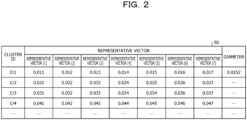
- FIG. 2 is a diagram illustrating an example of a data structure of the sentence vector dictionary. As illustrated in FIG. 2 , the sentence vector dictionary 50 associates the cluster ID, a representative vector, and a diameter with each other.
- the cluster ID is information for uniquely identifying the cluster.
- the representative vector is a vector representing the sentence vectors included in the same cluster.
- the representative vectors include representative vectors (1) to (7).
- the diameter indicates a diameter (length of a side) of a sphere (cube) of the cluster or the like.
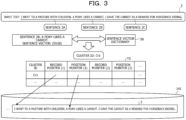
- FIG. 3 is a diagram for explaining the process of the registration phase of the information processing apparatus according to the first embodiment.
- the information processing apparatus When receiving an input text 2 to be registered in a DB 141, the information processing apparatus generates the sentence transposition index TS based on each sentence included in the input text 2 and a sentence vector dictionary 50.
- the input text 2 is "I went to a pasture with children. A pony likes a carrot. I gave the carrot as a reward for a horseback riding.”.
- "I went to a pasture with children.” among the sentences included in the input text 2 is referred to as a sentence 2A.
- "A pony likes a carrot.” is referred to as a sentence 2B.
- "I gave the carrot as a reward for a horseback riding.” is referred to as a sentence 2C.
- the description will be made by using the sentence 2B "A Pony likes a carrot".
- the information processing apparatus calculates a sentence vector "SV2B" by integrating the word vectors of the words included in the sentence 2B.
- the information processing apparatus compares the sentence vector of the sentence 2B with the representative vectors of the sentence vector dictionary 50 to specify the cluster ID to which the sentence 2B belongs.
- the information processing apparatus calculates the similarity (cosine similarity or distance) between the sentence vector and the representative vector, specifies the representative vector having the highest similarity to the sentence vector, and sets the cluster ID of the specified representative vector as the cluster ID to which the sentence 2B belongs.
- the information processing apparatus specifies the cluster ID to which the sentence 2B belongs as "Cr1".
- the information processing apparatus registers the input text 2 in the DB 141 by the unit of record.
- the information processing apparatus registers the cluster ID, a record pointer, and a position pointer in the sentence transposition index TS in association with each other.
- the record pointer indicates a position of a record on the DB 141 in which a text having a sentence belonging to the corresponding cluster is registered, and indicates a position from a head of the DB 141.
- the position pointer indicates a position on the record of the DB 141 in which the sentence belonging to the corresponding cluster is registered, and indicates a relative position from the record pointer.
- a head position (a position from the head of DB 141) of the corresponding record of DB 141 in which the input text 2 is registered is set in the record pointer (1) in the sentence transposition index TS.
- the position of the sentence 2B registered in the corresponding record of the DB 141 (a relative position from the head of the corresponding record) is set in the position pointer (1).
- the information processing apparatus registers the information described above in the record pointer (m + 1) and the position pointer (m + 1).
- m corresponds to a natural number.
- the information processing apparatus specifies the cluster IDs based on the sentence vectors for the sentences 2A and 2C in the same manner as for the sentence 2B, and registers the cluster IDs, the record pointers, and the position pointers in the sentence transposition index TS in association with one another.
- the information processing apparatus repeatedly executes the above process and updates the sentence transposition index TS even when acquiring another input text to be registered in the record of the DB 141.
- the information processing apparatus when registering the input text 2 in the record of DB 141, specifies which cluster ID the sentences of the input text belong to by using the sentence vector dictionary 50, and generates the sentence transposition index TS based on the specified result.
- the sentence vector dictionary 50 in which the representative vector and the diameter of each cluster of the sentence are stored in advance, the sentence and the cluster ID may be easily associated with each other, and thus the load of the registration process of the data may be reduced.
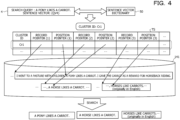
- FIG. 4 is a diagram for explaining the process of the search phase of the information processing apparatus according to the first embodiment.
- the information processing apparatus searches for a sentence based on the search query and the sentence transposition index TS.
- the information processing apparatus calculates a sentence vector "QV4" by integrating the word vectors of the words included in the search query 4.
- the information processing apparatus compares the sentence vector of the search query 4 with the representative vector of the sentence vector dictionary 50 and specifies the cluster ID to which the search query 4 belongs.
- the information processing apparatus calculates the similarity (cosine similarity or distance) between the sentence vector "QV4" of the search query 4 and the representative vector.
- the information processing apparatus specifies a representative vector having the highest similarity to the sentence vector "QV4" and sets the cluster ID of the specified representative vector as the cluster ID to which the search query 4 belongs.
- the description will be given assuming that the cluster ID to which the search query 4 belongs is "Cr1".
- the information processing apparatus compares the cluster ID "Cr1" to which the search query 4 belongs with the sentence transposition index TS, and searches for a sentence corresponding to the search query 4 from DB 141. For example, the information processing apparatus may extract a sentence "A pony likes a carrot.” indicated by the record pointer (1) and the position pointer (1) set in a row of the cluster ID "Cr1".
- the information processing apparatus extracts a sentence "A horse likes a carrot.” indicated by a record pointer (2) and a position pointer (2) set in the row of the cluster ID "Cr1".
- the information processing apparatus extracts a sentence "Horses like carrots.”, which is an originally-English sentence, indicated by a record pointer (3) and a position pointer (3) set in the row of the cluster ID "Cr1".
- the information processing apparatus extracts a statement indicated by a record pointer (m) and a position pointer (m) set in the row of the cluster ID "Cr1".
- the information processing apparatus may efficiently search for the sentence corresponding to the search query 4 by using the cluster ID to which the search query 4 belongs and the sentence transposition index TS.
- the information processing apparatus searches the sentence "A pony likes a carrot.”, the sentence "A horse likes a carrot.” and the sentence, which is the originally-English sentence, "Horses like carrots.”, corresponding to the search query 4.
- FIG. 5 is a functional block diagram illustrating the configuration of the information processing apparatus according to the first embodiment.
- an information processing apparatus 100 includes a communication unit 110, an input unit 120, a display unit 130, a storage unit 140, and a control unit 150.
- the communication unit 110 is coupled to an external device or the like in a wired or wireless manner, and transmits and receives information to and from the external device or the like.
- the communication unit 110 is realized by a network interface card (NIC) or the like.
- the communication unit 110 may be coupled to a network (not illustrated).
- the input unit 120 is an input device that inputs various kinds of information to the information processing apparatus 100.
- the input unit 120 corresponds to a keyboard, a mouse, a touch panel, or the like.
- a user may input a search query or the like by operating the input unit 120.
- the display unit 130 is a display device that displays information output from the control unit 150.
- the display unit 130 corresponds to a liquid crystal display, an organic electro luminescence (EL) display, a touch panel, or the like.
- EL organic electro luminescence
- the search result corresponding to the search query is displayed on the display unit 130.
- the storage unit 140 includes a text data 40, a cluster table 41, a word vector dictionary 45, a sentence vector dictionary 50, the DB 141, and the sentence transposition index TS.
- the storage unit 140 is implemented by, for example, a semiconductor memory device such as a random access memory (RAM) or a flash memory, or a storage device such as a hard disk or an optical disk.
- RAM random access memory
- flash memory or a storage device such as a hard disk or an optical disk.
- the text data 40 is information used to generate the sentence vector dictionary 50.
- the text data 40 includes a sentence included in Aozora Bunko or the like, a paper published on the network, or the like.
- the sentences included in the text data 40 correspond to the sentence 1 to the sentence 4 described in FIG. 1 or the like.
- the cluster table 41 holds information about clusters.
- FIG. 6 is a diagram illustrating an example of a data structure of the cluster table according to the first embodiment. As illustrated in FIG. 6 , the cluster table 41 associates a cluster ID with cluster data. The cluster ID is information for uniquely identifying a cluster.
- the cluster data includes information on the sentence vectors included in the corresponding cluster or the like.
- FIG. 7 is a diagram illustrating an example of cluster data.
- the cluster having the cluster ID "Cr1" is described.
- the cluster data 5 includes areas 5a and 5b and tables 5c and 5d.
- the cluster ID "Cr1" is set in the area 5a.
- the diameter of the cluster (cluster Cr1) is set in the area 5b.
- the representative vectors (1) to (7) of the cluster are set in the table 5c.
- the sentence vectors belonging to the cluster Cr1 are registered.
- the representative vectors (1) to (7) are calculated based on the sentence vectors registered in the table 5d.
- the representative vector (n) is a vector indicating a center of a vector of a n-th component of each vector of the table 5d.
- the word vector dictionary 45 is a table that defines codes and word vectors assigned to words.
- FIG. 8 is a diagram illustrating an example of a data structure of the word vector dictionary. As illustrated in FIG. 8 , the word vector dictionary 45 includes a code, a word, and word vectors (1) to (7).
- the code is a code assigned to the word.
- the word is a word included in the character string.
- the word vectors (1) to (7) are vectors assigned to the word.
- the sentence vector dictionary 50 corresponds to the sentence vector dictionary 50 described with reference to FIG. 2 . As described with reference to FIG. 2 , the cluster ID, the representative vector, and the diameter are associated with each other in the sentence vector dictionary 50.
- the DB 141 registers the input text and the like.
- the sentence transposition index TS corresponds to the sentence transposition index TS described with reference to FIGS. 3 and 4 .
- the sentence transposition index TS associates the cluster ID with a set of the record pointer and the position pointer. A plurality of sets of the record pointer and the position pointer may be registered in one cluster ID.
- the control unit 150 includes an acquisition unit 151, a preprocessing unit 152, and a search unit 153.
- the control unit 150 is implemented by, for example, a central processing unit (CPU) or a micro processing unit (MPU). Further, the control unit 150 may be implemented by an integrated circuit such as an application specific integrated circuit (ASIC) or a field programmable gate array (FPGA).
- ASIC application specific integrated circuit
- FPGA field programmable gate array
- the acquisition unit 151 acquires various data via the communication unit 110 and the input unit 120. For example, the acquisition unit 151 acquires the text data 40 and registers the text data 40 in the storage unit 140.
- the preprocessing unit 152 generates the sentence transposition index TS based on the text data 40.
- the preprocessing unit 152 sequentially executes a process of calculating the sentence vector, a process of generating the sentence vector dictionary, and a process of generating the sentence transposition index TS.
- FIGS. 9 and 10 are diagrams for explaining the process of calculating the sentence vector. The description will be made with reference to FIG. 9 .
- FIG. 9 a case will be described in which the preprocessing unit 152 extracts the sentence 1 "A horse likes a carrot.” which is included in the text data 40 and calculates the sentence vector of the sentence 1.
- the preprocessing unit 152 executes a morphological analysis on the sentence 1 "A horse likes a carrot.” and decomposes the sentence 1 into a plurality of words. Each of the words obtained by the decomposition is given " ⁇ (space)".
- the sentence 1 "A horse likes a carrot.” which is obtained by translating a Japanese sentence expressed by "Uma ha ninjin ga suki desu.”is decomposed into "Uma ⁇ ", “Ha ⁇ ", “Ninjin ⁇ ", “Ga ⁇ ”, “Suki ⁇ ", “Desu ⁇ ” and ". ⁇ " in Japanese.
- the preprocessing unit 152 compares each of the decomposed words with the word vector dictionary 45 to specify a code corresponding to each word and replaces the code with the word. For example, the words “Uma ⁇ ", “Ha ⁇ ”, “Ninjin ⁇ ”, “Ga ⁇ ”, “Suki ⁇ ”, “Desu ⁇ ” and “. ⁇ ” in Japanese are replaced with “ C1 “, “ C2 “, “ C3 “, “ C4 “, “ C5 “, “ C6 “, and “ C7 “, respectively.
- the preprocessing unit 152 specifies the word vectors (1) to (7) assigned to the codes based on the word vector dictionary 45 and each code. For example, it is assumed that the word vectors (1) to (7) of the code "C1" are wv1-1 to 1-7. The word vectors (1) to (7) of the code “C2” are wv2-1 to 2-7. The word vectors (1) to (7) of the code “C3” are wv3-1 to 3-7.
- the word vectors (1) to (7) of the code "C4" are wv4-1 to 4-7. It is assumed that the word vectors (1) to (7) of the code "C5" are wv5-1 to 5-7. It is assumed that the word vectors (1) to (7) of the code “C6” are wv6-1 to 6-7. It is assumed that the word vectors (1) to (7) of the code "C7” are wv7-1 to 7-7.
- the preprocessing unit 152 calculates the sentence vector SV1 of the sentence 1 by integrating the word vectors for the respective elements. For example, the preprocessing unit 152 calculates the first component "SV1-1" of the sentence vector SV1 by integrating wv1-1 to 7-1 that are each of the word vectors (1). The preprocessing unit 152 integrates wv1-2 to 7-2 that are each of the word vectors (2) to calculate the second component "SV1-2" of the sentence vector SV1. The third component "SV1-3" of the sentence vector SV1 is calculated by integrating wv1-3 to 7-3 which are each of the word vectors (3).
- the preprocessing unit 152 integrates wv1-4 to 7-4 that are each of the word vectors (4) to calculate the fourth component "SV1-4" of the sentence vector SV1.
- the preprocessing unit 152 integrates wv1-5 to 7-5, which are each of the word vectors (5), to calculate the fifth component "SV1-5" of the sentence vector SV1.
- the preprocessing unit 152 integrates wv1-6 to 7-6 , which are each of the word vectors (6), to calculate the sixth component "SV1-6" of the sentence vector SV1.
- the preprocessing unit 152 integrates wv1-7 to 7-7 that are each of the word vectors (7) to calculate the seventh component "SV1-7" of the sentence vector SV1.
- the preprocessing unit 152 also repeatedly executes the above process for each sentence included in the text data 40 to calculate the sentence vector of each sentence.
- the process of generating the sentence vector dictionary 50 by the preprocessing unit 152 corresponds to the process described with reference to FIGS. 1 and 2 .
- the preprocessing unit 152 classifies each sentence into a plurality of clusters by performing clustering based on the sentence vector calculated by the above process.
- the preprocessing unit 152 generates cluster data for each cluster, and registers the cluster ID and the cluster data in the cluster table 41 in association with each other.
- the description will be made in which the cluster data of the cluster Cr1 (cluster identifier "Cr1") described with reference to FIG. 7 is generated.
- the preprocessing unit 152 sets the sentence vectors belonging to the cluster Cr1 in the table 5d in the feature space.
- the preprocessing unit 152 calculates the centers of each of the components of each of the sentence vectors set in the table 5d to calculate the representative vectors (1) to (7) and sets the representative vectors in the table 5c.
- the preprocessing unit 152 sets a minimum sphere including all the sentence vectors belonging to the cluster Cr1 in the feature space.
- the preprocessing unit 152 registers the diameter of the set sphere in the area 5d.
- the preprocessing unit 152 repeatedly executes the above process for other clusters to generate the cluster data of each cluster and registers the cluster data in the cluster table 41.
- the preprocessing unit 152 extracts the cluster ID, the representative vectors (1) to (7), and the diameter from the cluster table 41, and registers the cluster ID, the representative vectors (1) to (7), and the diameter in the sentence vector dictionary 50.
- the process of generating the sentence transposition index TS by the preprocessing unit 152 corresponds to the process described with reference to FIG. 3 .
- the preprocessing unit 140 When the preprocessing unit 152 receives the input text 2 to be registered in the DB 141, the preprocessing unit 140 generates the sentence transposition index TS based on each sentence included in the input text 2 and the sentence vector dictionary 50.
- the preprocessing unit 152 calculates the sentence vector "SV2B" by integrating the word vectors of the words included in the sentence 2B.
- the preprocessing unit 152 calculates the sentence vector "SV2B" of the sentence 2B in the same manner as the process of calculating the sentence vector described above.
- the preprocessing unit 152 compares the sentence vector of the sentence 2B with the representative vector in the sentence vector dictionary 50 to identify the cluster ID to which the sentence 2B belongs.
- the preprocessing unit 152 calculates the similarity (cosine similarity or distance) between the sentence vector "SV2B" and the representative vector, and specifies the representative vector having the highest similarity to the sentence vector "SV2B".
- the preprocessing unit 152 sets the cluster ID of the identified representative vector as the cluster ID to which the sentence 2B belongs.
- the preprocessing unit 152 specifies the cluster ID to which the sentence 2B belongs as "Cr1".
- FIGS. 11 and 12 are diagrams for explaining a process for specifying the cluster ID.
- the feature space 1 includes clusters Cr1, Cr2, and Cr3.
- the preprocessing unit 152 specifies the cluster ID to which the sentence 2B belongs as "Cr1".
- the feature space 1 includes clusters Cr1, Cr2, and Cr3.
- the preprocessing unit 152 when the sentence vector SV2B of the sentence 2B is not included in the area of the clusters Cr1, Cr2, and Cr3, the preprocessing unit 152 performs the following process.
- the preprocessing unit 152 calculates a distance 11 between the sentence vector SV2B and a surface of the cluster Cr1, a distance 12 between the sentence vector SV2B and the surface of the cluster Cr2, and a distance 13 between the sentence vector SV2B and the surface of the cluster Cr3, respectively.
- the preprocessing unit 152 specifies the cluster ID of the cluster corresponding to the shortest distance among the distances 11 to 13 as the cluster ID to which the sentence 2B belongs. For example, when the distance 12 is the shortest distance among the lengths 11 to 13, the preprocessing unit 152 sets the cluster ID to which the sentence 2B belongs to "Cr2".
- the preprocessing unit 152 registers the input text 2 in the DB 141.
- the preprocessing unit 152 registers the cluster ID, the record pointer, and the position pointer in the sentence transposition index TS in association with each other.
- a head position of the input text 2 registered in the DB 141 (position from the head of the DB 141) is set in the record pointer (1) in the sentence transposition index TS.
- the position of the sentence 2B registered in the DB 141 (relative position from the record pointer) is set in the position pointer (1).
- the preprocessing unit 152 registers the above-described information in the record pointer (m + 1) and the position pointer (m + 1).
- M corresponds to a natural number.
- the preprocessing unit 152 specifies cluster ID for the sentence 2A and the sentence 2C based on the sentence vector in the same manner as the sentence 2B, and registers the cluster ID, the record pointer, and the position pointer in the sentence transposition index TS in association with each other.
- the preprocessing unit 152 repeatedly executes the above process and updates the sentence transposition index TS also when acquiring another input text to be registered in the record of the DB 141. Further, the preprocessing unit 152 may register each sentence of the text data 40 in the record of the DB 141 and update the sentence transposition index TS in the same manner as the sentence 2B.
- the search unit 153 searches for a sentence corresponding to the search query from each record of the DB 141 based on the search query and the sentence transposition index TS.
- the process of the search unit 153 corresponds to the process described in FIG. 4 .
- the search unit 153 calculates the sentence vector "QV4" by integrating the word vectors of the words included in the search query 4.
- the process of calculating the sentence vector of the search query 4 by the search unit 153 is the same as the process of calculating the sentence vector by the preprocessing unit 152.
- the search unit 153 compares the sentence vector "QV4" of the search query 4 with the representative vector in the sentence vector dictionary 50 and specifies the cluster ID to which the search query 4 belongs.
- the search unit 153 calculates the similarity (cosine similarity or difference) between the sentence vector "QV4" of the search query 4 and the representative vector.
- the search unit 153 specifies the representative vector having the highest similarity to the sentence vector "QV4" and sets the cluster ID of the specified representative vector as the cluster ID to which the search query 4 belongs.
- the description will be given assuming that the cluster ID to which the search query 4 belongs is "Cr1".
- the search unit 153 compares the cluster ID "Cr1" to which the search query 4 belongs with the sentence transposition index TS, and searches the DB 141 for a sentence corresponding to the search query 4. For example, the search unit 153 extracts the sentence "A pony likes a carrot.” indicated by the record pointer (1) and the position pointer (1) set in the row of the cluster ID "Cr1".
- the search unit 153 extracts the sentence "A horse likes a carrot.” indicated by the record pointer (2) and the position pointer (2) set in the row of the cluster ID "Cr1".
- the search unit 153 extracts the sentence "Horses like carrots.”, which is the originally-English sentence, indicated by the record pointer (3) and the position pointer (3) set in the row of the cluster ID "Cr1".
- the search unit 153 extracts a sentence indicated by the record pointer (m) and the position pointer (m) set in the row of the cluster ID "Cr1".
- the search unit 153 outputs the search result to the display unit 130 to display the search result.
- the search unit 153 repeatedly executes the above process every time the search query 4 is received.
- FIG. 13 is a flowchart illustrating a procedure of the preparation process.
- the acquiring unit 151 of the information processor 100 acquires the text data 40 and registers the text data 40 in the storage unit 140 (step S101).
- the preprocessing unit 152 of the information processing apparatus 100 calculates a sentence vector of each sentence included in the text data 40 (step S102).
- the preprocessing unit 152 performs clustering on the plurality of sentence vectors (step S103).
- the preprocessing unit 152 generates the cluster table 41 based on a clustering result (step S104).
- the preprocessing unit 152 generates a sentence vector dictionary based on the cluster table 41 (step S105).
- the preprocessing unit 152 acquires an input text to be registered in the DB 141 (step S106).
- the preprocessing unit 152 calculates the sentence vector of the input text (step S107).
- the preprocessing unit 152 specifies the cluster ID corresponding to the sentence of the input text based on the sentence vector of the input text and the sentence vector dictionary 50 (step S108).
- the preprocessing unit 152 registers the input text in the record of the DB 141 (step S109).
- the preprocessing unit 152 registers the cluster ID, the record pointer, and the position pointer in the sentence transposition index TS in association with one another (step S110).
- the preprocessing unit 152 proceeds to step S106.
- the preprocessing unit 152 ends the process.
- FIG. 14 is a flowchart of a procedure of the search process. As illustrated in FIG. 14 , the acquisition unit 151 of the information processing apparatus 100 acquires a search query (step S201).
- the search unit 153 of the information processing apparatus 100 calculates a sentence vector of the search query (step S202).
- the search unit 153 specifies the cluster ID of the search query based on the sentence vector of the search query and the sentence vector dictionary 50 (step S203).
- the search unit 153 searches for a sentence from the record of the DB 141 based on the cluster ID of the search query and the sentence transposition index (step S204).
- the search unit 153 outputs the search result to the display unit 130 (step S205).
- the information processing apparatus 100 calculates the sentence vectors of the plurality of sentences included in the text data 40 and performs clustering to generate information on the plurality of clusters and generate the sentence vector dictionary 50.
- the cluster ID is associated with the representative vector and the diameter. For example, when registering a new input text in the record of the DB 141, the information processor 100 may easily assign the cluster ID to which the sentence vector of the input text belongs by comparing the sentence vector of the input text with the representative vector and the diameter in the sentence vector dictionary 50.
- the information processing apparatus 100 When registering the input text 2 in the record of the DB 141, the information processing apparatus 100 specifies which cluster ID the sentence of the input text belong to by using the sentence vector dictionary 50, and generates the sentence transposition index TS by associating the specified cluster ID with the stored record and the position information of the sentence. In this way, since the sentence and the cluster ID may be easily associated with each other by using the sentence vector dictionary 50, it is possible to reduce the load of the registration process related to the sentence transposition index TS.
- the information processing apparatus 100 When receiving the search query, the information processing apparatus 100 specifies the cluster ID corresponding to the search query based on the search query and the sentence vector dictionary, and specifies the position of the sentence corresponding to the search query based on the specified cluster ID and the sentence transposition index TS.
- the sentence corresponding to the search query may be efficiently searched. For example, when a plurality of pieces of position information (record pointers and position pointers) are associated with the cluster ID, the plurality of pieces of position information may be specified at once, and the sentence corresponding to the search query may be efficiently searched for.
- the clustering is executed with the granularity of the sentence vector to generate the sentence transposition index, but the present disclosure is not limited thereto, and a transposition index (corresponding to the second word transposition index WS2 described later) may be generated with the granularity of the word vector.
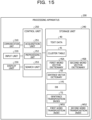
- FIG. 15 is a functional block diagram illustrating a configuration of the information processing apparatus according to the second embodiment.
- the information processing apparatus 200 includes a communication unit 210, an input unit 220, a display unit 230, a storage unit 240, and a control unit 250.
- the description of the communication unit 210, the input unit 220, and the display unit 230 is the same as the description of the communication unit 110, the input unit 120, and the display unit 130 described in the first embodiment.
- the storage unit 240 includes a text data 40, a cluster table 41, a first word vector dictionary 45A, a second word vector dictionary 45B, a sentence vector dictionary 50, a DB 141, and a sentence transposition index TS.
- the storage unit 240 includes a first word transposition index WS1 and a second word transposition index WS2.
- the storage unit 240 is realized by, for example, a semiconductor memory device such as a RAM or a flash memory, or a storage device such as a hard disk or an optical disk.
- the text data 40 is information used to generate the sentence vector dictionary 50.
- the description of the text data 40 is the same as that of the first embodiment.
- the cluster table 41 holds information about the cluster.
- the cluster table 41 associates the cluster ID with the cluster data.
- the cluster table 41 includes the cluster data based on a result of the clustering with the granularity of the sentence vector and the cluster data based on a result of the clustering with the granularity of the word vector.
- the first word vector dictionary 45A is a table that defines codes and word vectors assigned to words.
- the first word vector dictionary 45A corresponds to the word vector dictionary 45 described with reference to FIG. 8 .
- the second word vector dictionary 45B associates the cluster ID, the representative vector, and the diameter based on the result of the clustering with the granularity of the word vector.
- the sentence vector dictionary 50 associates the cluster ID, the representative vector, and the diameter based on a result of the clustering with the granularity of the sentence vector.
- the description of the sentence vector dictionary 50 is the same as that of the first embodiment.
- the input text and the like are registered in the record of the DB 141.
- the sentence transposition index TS associates the cluster ID to which the sentence vector belongs with the set of the record pointer and the position pointer.
- the description of the sentence transposition index TS is the same as that in the first embodiment.
- the first word transposition index WS1 associates the word with the position information (the record pointer and the position pointer).
- the second word transposition index WS2 associates the word with the position information (the record pointer and the position pointer).
- FIG. 16 is a diagram illustrating an example of the second word transposition index.
- the record pointer indicates a position on the record of the DB 141 in which the text having the word belonging to the corresponding cluster is registered and indicates a position from the head of the DB 141.
- the position pointer indicates a position on the record of the DB 141 in which the word belonging to the corresponding cluster is registered and indicates a relative position from the head of the corresponding record.
- the record pointer (1) is set to the head position of the input text 2 registered in the record of the DB 141 (the position from the head of the DB 141) in the second word transposition index WS2.
- the position of the word "carrot" registered in the DB 141 (the relative position from the head of the corresponding record) is set in the position pointer (1).
- the control unit 250 includes an acquisition unit 251, a preprocessing unit 252, and a search unit 253.
- the control unit 250 is realized by, for example, a CPU or an MPU. Further, the control unit 150 may be implemented by an integrated circuit such as an ASIC or an FPGA.
- the acquisition unit 251 acquires various data via the communication unit 210 and the input unit 220.
- the acquisition unit 151 acquires the text data 40 and registers the text data 40 in the storage unit 240.
- the preprocessing unit 252 generates the sentence transposition index TS, the first word index WS1, and the second word transposition index WS2 based on the text data 40.
- the process of generating the sentence transposition index TS by the preprocessing unit 252 is the same as that in the first embodiment.
- the preprocessing unit 252 extracts a sentence included in the text data 40 and divides the sentence into a plurality of words by performing the morphological analysis.
- the preprocessing unit 252 registers the word and the position information (the record pointer and the position pointer) corresponding to the word in the first word transposition index WS1 in association with each other. It is assumed that the position information is position information based on the text data 40 registered in the DB 141.
- the preprocessing unit 252 repeatedly executes the above process for each word included in the text data 40.
- the preprocessing unit 252 extracts a sentence included in the text data 40 and divides the sentence into a plurality of words by performing the morphological analysis.
- the preprocessing unit 252 compares each of the divided words with the first word vector dictionary 45A to specify a code corresponding to each word and replaces the code with the word.
- the preprocessing unit 252 specifies the word vectors (1) to (7) assigned to the code based on the first word vector dictionary 45A and each code.
- the preprocessing unit 252 performs clustering with the granularity of the word vector, generates the cluster data for each cluster, and registers the cluster ID and the cluster data in the cluster table 41 in association with each other.
- the preprocessing unit 252 distinguishes the clustering result performed with the granularity of the word vector from the clustering result performed with the granularity of the sentence vector described in the first embodiment and registers the clustering result in the cluster table 41.
- the cluster data executed with the granularity of the word vector includes the cluster ID, the representative vectors (1) to (7), and the diameter.
- the representative vectors (1) to (7) obtained with the granularity of the word vector are obtained by calculating the center of each component of each word vector.
- the preprocessing unit 252 registers the cluster ID, the representative vectors (1) to (7), and the diameter in the second word vector dictionary 45B.
- the preprocessing unit 252 When the preprocessing unit 252 receives the input text 2 to be registered in the DB 141, the preprocessing unit 252 generates the second word transposition index WS2 based on each word included in the input text 2, the first word vector dictionary 45A, and the second word vector dictionary 45B.
- the preprocessing unit 252 selects the word included in the input text 2, compares the selected word with the word vector in the first word vector dictionary 45A, and specifies the word vector.
- the preprocessing unit 252 compares the word vector with the second word vector dictionary 45B and specifies the cluster ID to which the word vector belongs.
- the preprocessing unit 252 registers the input text 2 in the DB 141.
- the preprocessing unit 252 registers the cluster ID to which the word vector belongs, the record pointer, and the position pointer in the second word inverted transposition index WS2 in association with one another.
- the search unit 253 searches for a sentence or a word corresponding to the search query from the DB 141 based on the search query, the sentence transposition index TS, and the second word transposition index WS2.
- the search query is specified by "sentence”
- the same process as that of the search unit 153 described in the first embodiment is executed.
- the search unit 253 When the search query is specified by "word", the search unit 253 specifies the word vector based on the word of the search query and the first word vector dictionary 45A, and specifies the cluster ID to which the word belongs based on the word vector and the second word vector dictionary 45B. The search unit 253 compares the cluster ID to which the word of the search query belongs with the second word transposition index WS2, and searches the DB 141 for the word (or the sentence including the word) corresponding to the search query. The search unit 253 outputs the search result to the display unit 230 and displays the search result.
- the search unit 253 may perform the search by dividing the sentence into a plurality of words and executing the above-described process for each word.
- the information processor 200 calculates word vectors of the plurality of words included in the text data 40, generates information on the plurality of clusters by performing clustering, and sets the cluster ID to which the word belongs in the second word vector dictionary 45B. For example, when registering a new input text in the DB 141, the information processor 200 may easily assign the cluster ID to which the word vector of the input text belongs by comparing the word vector of the input text with the second word vector dictionary 45B.
- FIG. 17 is a diagram for explaining another application example of the sentence transposition index TS.
- training data T1 is used.
- the learning model M1 corresponds to a convolutional neural network (CNN), a recurrent neural network (RNN), an autoencoder, or the like.
- the training data T1 is training data in which the Japanese sentence is set as input data and the English sentence is set as ground truth data.
- the Japanese sentence and the English sentence in the training data T1 may be converted into the cluster IDs using the sentence vector dictionary 50 or the second word vector dictionary 45B, and the machine learning may be executed using the cluster IDs.
- the same cluster ID is assigned to sentences (sentences belonging to the same cluster) which are similar wit each other, and a number of kinds of sentences is reduced (degeneracy). Therefore, the amount of calculation of a SoftMax function or the like may be significantly reduced in the machine learning.
- the text composed of the character strings is described as an example, but a program, an organic compound, a genome, or the like may be used. Instructions/variables (programs), functional groups (organic compounds), protein basic structures kmer (genomes), or the like, which correspond to a word and have meanings, may also be used. Further, a line (program), a functional group primary structure (organic compound), a protein primary structure (genome), or the like, which correspond to a sentence, may also be used.
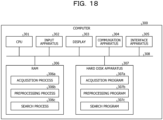
- FIG. 18 is a diagram illustrating an example of the hardware configuration of the computer that realizes the same function as that of the information processing apparatus according to the embodiment.
- a computer 300 includes a CPU 301 that executes various kinds of arithmetic processes, an input apparatus 302 that receives an input of data from a user, and a display 303. Further, the computer 300 also includes a communication apparatus 304 that transmits and receives data to and from an external device or the like via a wired or wireless network, and an interface apparatus 305. Further, the computer 300 also includes a RAM 306 that temporarily stores various kinds of information and a hard disk apparatus 307. Further, the apparatuses 301 to 307 are coupled to a bus 308.
- the hard disk apparatus 307 includes an acquisition program 307a, a preprocessing program 307b, and a search program 307c.
- the CPU 301 reads each of the programs 307a to 307c and develops the programs in the RAM 306.
- the acquisition program 307a functions as an acquisition process 306a.
- the preprocessing program 307b functions as a preprocessing process 306b.
- the search program 307c functions as a search process 306c.
- the acquisition process 306a corresponds to a process of the acquisition unit 151(251).
- the process of the preprocessing process 306b corresponds to a process of the preprocessing unit 152 (252).
- the process of the search process 306c corresponds to a process of the search unit 153 (253).
- each of the programs 307a to 307c may not necessarily be stored in the hard disk apparatus 307 from the beginning.
- each program is stored in a "portable physical medium" such as a flexible disk (FD), a CD-ROM, a DVD, a magneto-optical disk, or an IC card which is inserted into the computer 300.
- the computer 300 may also read and execute each of the programs 307a to 307c.
Landscapes
- Engineering & Computer Science (AREA)
- Theoretical Computer Science (AREA)
- Databases & Information Systems (AREA)
- Data Mining & Analysis (AREA)
- Physics & Mathematics (AREA)
- General Engineering & Computer Science (AREA)
- General Physics & Mathematics (AREA)
- Software Systems (AREA)
- Computational Linguistics (AREA)
- Information Retrieval, Db Structures And Fs Structures Therefor (AREA)
Abstract
Description
- The present disclosure relates to a processing method and the like.
- A huge amount of data such as text is registered in a database (DB), and it is required to appropriately search for data similar to an input query designated by a user from the DB.
- In the related art, when the input query is received, data search is executed using a transposition index set in advance. In a preparedness, in the related art, when each text is registered in the DB, the text is morphologically analyzed, and each word is associated with position information of the corresponding text in the DB, thereby generating the transposition index. This process is repeatedly executed each time a text is newly registered in the DB.
- [Patent Document 1]
Japanese Laid-Open Patent Application No. 2017-111479 - However, the above-described related art has a problem that a load of a registration process of data is large for an artificial intelligence (AI) analysis corresponding to a multidimensional vector.
- In the AI analysis, when registering texts composed of character strings, chemical structural formulas of organic compounds, base sequences of genomes or the like, a necessity to assign and accumulate vectors to words, functional groups, sentences, and primary structures of the functional groups, which are meaningful units, is generated. However, in the example of text there are generally about one million types of words, and it is difficult to register the vectors and positions of the words and the sentences of all text registered in the DB in association with the transposition index. Therefore, it is necessary to narrow down a number of the vectors to be registered in the transposition index, but it takes a long time to perform a process of identifying a vector effective for a search process from a huge number of vectors.
- In one aspect, an object of the present disclosure is to provide a processing method, a processing program and a information processing apparatus which are capable of reducing the load of the registration process of the data.
- In a first scheme, a computer executes the following processes. When a computer receives a plurality of characters or character strings to be registered in a database, the computer calculates a plurality of vectors corresponding to the plurality of characters or character strings. The computer classifies the calculated vectors into a plurality of clusters according to an inter-vector distance. The computer obtains, for each of the plurality of clusters, a representative vector representing one or more vectors included in each cluster and a distance corresponding to a magnitude of the one or more vectors included in each cluster from the representative vector of each cluster. The computer stores dictionary information in which the calculated representative vector and the obtained distance are associated with cluster identification information for identifying each cluster in a storage unit.
- The load of the data registration process may be reduced.
-
-
FIG. 1 is a diagram for explaining a process of a preparation phase of an information processing apparatus according to a first embodiment; -
FIG. 2 is a diagram illustrating an example of a data structure of a sentence vector dictionary; -
FIG. 3 is a diagram for explaining a process of a registration phase of the information processing apparatus according to the first embodiment; -
FIG. 4 is a diagram for explaining a process of a search phase of the information processing apparatus according to the first embodiment; -
FIG. 5 is a functional block diagram illustrating a configuration of the information processing apparatus according to the first embodiment; -
FIG. 6 is a diagram illustrating an example of a data structure of a cluster table according to the first embodiment; -
FIG. 7 is a diagram illustrating an example of cluster data; -
FIG. 8 is a diagram illustrating an example of a data structure of a word vector dictionary; -
FIG. 9 is a diagram (1) for explaining a process of calculating a sentence vector; -
FIG. 10 is a diagram (2) for explaining the process of calculating the sentence vector; -
FIG. 11 is a diagram (1) for explaining a process of specifying a cluster ID; -
FIG. 12 is a diagram (2) for explaining the process of specifying the cluster ID; -
FIG. 13 is a flowchart illustrating a processing procedure of a preparation process; -
FIG. 14 is a flowchart illustrating a processing procedure of a search process; -
FIG. 15 is a functional block diagram illustrating a configuration of an information processing apparatus according to the second embodiment; -
FIG. 16 is a diagram illustrating an example of a second word transposition index; -
FIG. 17 is a diagram for explaining another application example of a sentence transposition index TS; and -
FIG. 18 is a diagram illustrating an example of a hardware configuration of a computer that realizes the same functions as those of the information processing apparatus according to the embodiment. - Hereinafter, embodiments of a processing method, a processing program, and an information processing apparatus disclosed in the present application will be described in detail with reference to the drawings. Note that the present disclosure is not limited to the embodiments.
- The information processing apparatus according to the first embodiment sequentially executes a process of a preparation phase, a process of a registration phase, and a process of a search phase. Hereinafter, the process of the preparation phase and the process of the search phase executed by the information processing apparatus will be described in order.
-
FIG. 1 is a diagram for explaining the process of the preparation phase of the information processing apparatus according to the first embodiment. In the first embodiment, as an example, the description is made while a sentence having a plurality of words is regarded as a text. In the description ofFIG. 1 , the description is given usingsentence 1,sentence 2,sentence 3, andsentence 4. Note that it is assumed that the process of the preparation phase is performed on a population including a large number of sentences. - It is assumed that a
sentence 1 is "A horse likes a carrot.". It is assumed that asentence 2 is "A carrot is a favorite food for a horse.". It is assumed that asentence 3 is "Today's weather is fine.". It is assumed that asentence 4 is "A cherry blossom has bloomed.". Note that thesentence 1 and thesentence 2 are sentences having the same meaning although a subject (S) and an object (O) are replaced. - When receiving information on a plurality of sentences to be registered in the DB, the information processing apparatus calculates a vector of each sentence. The information processing apparatus calculates the vector of the sentence by integrating vectors of each word included in the sentence. In the following description, the vector of the sentence is referred to as a "sentence vector". The vector of each word is defined in the word vector dictionary. The vector of the word is referred to as a "word vector".
- It is assumed that the sentence vector of the
sentence 1 is "SV1". It is assumed that the sentence vector of thesentence 2 is "SV2". It is assumed that the sentence vector of thesentence 3 is "SV3". It is assumed that the sentence vector of thesentence 4 is "SV4". In the first embodiment, the description will be made by taking a dimension of the sentence vector as seven dimensions as an example. A vector of an n-th component of the sentence vector is denoted as a sentence vector (n) (n = 1 to 7). - The information processing apparatus classifies each sentence into a plurality of clusters by performing clustering based on the sentence vector of each sentence. The clusters are arranged in a seven
dimensional feature space 1. A cluster identification (ID) for uniquely identifying a cluster is set for each cluster. In the example illustrated inFIG. 1 , thesentences sentence 3 is classified into the cluster of the cluster identifier "Cr2". Thesentence 4 is classified into the cluster with the cluster identifier "Cr3". - In the following description, the clusters having the cluster IDs "Cr1" to "Cr3" are respectively referred to as clusters Cr1 to Cr3. Although the clusters Cr1 to Cr3 are illustrated in
FIG. 1 , thefeature space 1 may include another cluster. - The information processing apparatus generates a sentence vector dictionary based on a result of the clustering.
FIG. 2 is a diagram illustrating an example of a data structure of the sentence vector dictionary. As illustrated inFIG. 2 , thesentence vector dictionary 50 associates the cluster ID, a representative vector, and a diameter with each other. - The cluster ID is information for uniquely identifying the cluster. The representative vector is a vector representing the sentence vectors included in the same cluster. The representative vectors include representative vectors (1) to (7). The representative vector (n) is a vector corresponding to a center (centroid) of the sentence vectors (n) belonging to the same cluster (n = 1 to 7). The diameter indicates a diameter (length of a side) of a sphere (cube) of the cluster or the like.
-
FIG. 3 is a diagram for explaining the process of the registration phase of the information processing apparatus according to the first embodiment. When receiving aninput text 2 to be registered in aDB 141, the information processing apparatus generates the sentence transposition index TS based on each sentence included in theinput text 2 and asentence vector dictionary 50. - In the example illustrated in
FIG. 3 , it is assumed that theinput text 2 is "I went to a pasture with children. A pony likes a carrot. I gave the carrot as a reward for a horseback riding.". For convenience of description, "I went to a pasture with children." among the sentences included in theinput text 2 is referred to as asentence 2A. "A pony likes a carrot." is referred to as asentence 2B. "I gave the carrot as a reward for a horseback riding." is referred to as asentence 2C. - The description will be made by using the
sentence 2B "A Pony likes a carrot". The information processing apparatus calculates a sentence vector "SV2B" by integrating the word vectors of the words included in thesentence 2B. The information processing apparatus compares the sentence vector of thesentence 2B with the representative vectors of thesentence vector dictionary 50 to specify the cluster ID to which thesentence 2B belongs. - For example, the information processing apparatus calculates the similarity (cosine similarity or distance) between the sentence vector and the representative vector, specifies the representative vector having the highest similarity to the sentence vector, and sets the cluster ID of the specified representative vector as the cluster ID to which the
sentence 2B belongs. - When the similarity between the sentence vector "SV2B" of the
sentence 2B and the representative vector of the cluster Cr1 is the maximum, the information processing apparatus specifies the cluster ID to which thesentence 2B belongs as "Cr1". - The information processing apparatus registers the
input text 2 in theDB 141 by the unit of record. The information processing apparatus registers the cluster ID, a record pointer, and a position pointer in the sentence transposition index TS in association with each other. The record pointer indicates a position of a record on theDB 141 in which a text having a sentence belonging to the corresponding cluster is registered, and indicates a position from a head of theDB 141. The position pointer indicates a position on the record of theDB 141 in which the sentence belonging to the corresponding cluster is registered, and indicates a relative position from the record pointer. - For example, when the sentence vector "SV2B" of the
sentence 2B belongs to the cluster Cr1, a head position (a position from the head of DB 141) of the corresponding record ofDB 141 in which theinput text 2 is registered is set in the record pointer (1) in the sentence transposition index TS. The position of thesentence 2B registered in the corresponding record of the DB 141 (a relative position from the head of the corresponding record) is set in the position pointer (1). When other information has been already registered in the record pointer (m) and the position pointer (m) corresponding to the same cluster ID, the information processing apparatus registers the information described above in the record pointer (m + 1) and the position pointer (m + 1). m corresponds to a natural number. - The information processing apparatus specifies the cluster IDs based on the sentence vectors for the
sentences sentence 2B, and registers the cluster IDs, the record pointers, and the position pointers in the sentence transposition index TS in association with one another. - The information processing apparatus repeatedly executes the above process and updates the sentence transposition index TS even when acquiring another input text to be registered in the record of the
DB 141. - As described above, when registering the
input text 2 in the record ofDB 141, the information processing apparatus according to the first embodiment specifies which cluster ID the sentences of the input text belong to by using thesentence vector dictionary 50, and generates the sentence transposition index TS based on the specified result. In this way, by using thesentence vector dictionary 50 in which the representative vector and the diameter of each cluster of the sentence are stored in advance, the sentence and the cluster ID may be easily associated with each other, and thus the load of the registration process of the data may be reduced. - Next, the process of the search phase will be described.
FIG. 4 is a diagram for explaining the process of the search phase of the information processing apparatus according to the first embodiment. When receiving a search query, the information processing apparatus searches for a sentence based on the search query and the sentence transposition index TS. - In
FIG. 4 , the description will be given while thesearch query 4 is "A pony likes a carrot. The information processing apparatus calculates a sentence vector "QV4" by integrating the word vectors of the words included in thesearch query 4. The information processing apparatus compares the sentence vector of thesearch query 4 with the representative vector of thesentence vector dictionary 50 and specifies the cluster ID to which thesearch query 4 belongs. - For example, the information processing apparatus calculates the similarity (cosine similarity or distance) between the sentence vector "QV4" of the
search query 4 and the representative vector. The information processing apparatus specifies a representative vector having the highest similarity to the sentence vector "QV4" and sets the cluster ID of the specified representative vector as the cluster ID to which thesearch query 4 belongs. Here, the description will be given assuming that the cluster ID to which thesearch query 4 belongs is "Cr1". - The information processing apparatus compares the cluster ID "Cr1" to which the
search query 4 belongs with the sentence transposition index TS, and searches for a sentence corresponding to thesearch query 4 fromDB 141. For example, the information processing apparatus may extract a sentence "A pony likes a carrot." indicated by the record pointer (1) and the position pointer (1) set in a row of the cluster ID "Cr1". - The information processing apparatus extracts a sentence "A horse likes a carrot." indicated by a record pointer (2) and a position pointer (2) set in the row of the cluster ID "Cr1". The information processing apparatus extracts a sentence "Horses like carrots.", which is an originally-English sentence, indicated by a record pointer (3) and a position pointer (3) set in the row of the cluster ID "Cr1".
- Although not described, the information processing apparatus extracts a statement indicated by a record pointer (m) and a position pointer (m) set in the row of the cluster ID "Cr1".
- As in the above process, the information processing apparatus may efficiently search for the sentence corresponding to the
search query 4 by using the cluster ID to which thesearch query 4 belongs and the sentence transposition index TS. In the example described inFIG. 4 , the information processing apparatus searches the sentence "A pony likes a carrot.", the sentence "A horse likes a carrot." and the sentence, which is the originally-English sentence, "Horses like carrots.", corresponding to thesearch query 4. - Next, an example of the configuration of the information processing apparatus according to the first embodiment will be described.
FIG. 5 is a functional block diagram illustrating the configuration of the information processing apparatus according to the first embodiment. As illustrated inFIG. 5 , aninformation processing apparatus 100 includes a communication unit 110, aninput unit 120, a display unit 130, a storage unit 140, and acontrol unit 150. - The communication unit 110 is coupled to an external device or the like in a wired or wireless manner, and transmits and receives information to and from the external device or the like. For example, the communication unit 110 is realized by a network interface card (NIC) or the like. The communication unit 110 may be coupled to a network (not illustrated).
- The
input unit 120 is an input device that inputs various kinds of information to theinformation processing apparatus 100. Theinput unit 120 corresponds to a keyboard, a mouse, a touch panel, or the like. For example, a user may input a search query or the like by operating theinput unit 120. - The display unit 130 is a display device that displays information output from the
control unit 150. The display unit 130 corresponds to a liquid crystal display, an organic electro luminescence (EL) display, a touch panel, or the like. For example, the search result corresponding to the search query is displayed on the display unit 130. - The storage unit 140 includes a text data 40, a cluster table 41, a
word vector dictionary 45, asentence vector dictionary 50, theDB 141, and the sentence transposition index TS. The storage unit 140 is implemented by, for example, a semiconductor memory device such as a random access memory (RAM) or a flash memory, or a storage device such as a hard disk or an optical disk. - The text data 40 is information used to generate the
sentence vector dictionary 50. For example, the text data 40 includes a sentence included in Aozora Bunko or the like, a paper published on the network, or the like. The sentences included in the text data 40 correspond to thesentence 1 to thesentence 4 described inFIG. 1 or the like. - The cluster table 41 holds information about clusters.
FIG. 6 is a diagram illustrating an example of a data structure of the cluster table according to the first embodiment. As illustrated inFIG. 6 , the cluster table 41 associates a cluster ID with cluster data. The cluster ID is information for uniquely identifying a cluster. - The cluster data includes information on the sentence vectors included in the corresponding cluster or the like.
FIG. 7 is a diagram illustrating an example of cluster data. InFIG. 7 , the cluster having the cluster ID "Cr1" is described. As illustrated inFIG. 7 , thecluster data 5 includesareas 5a and 5b and tables 5c and 5d. The cluster ID "Cr1" is set in thearea 5a. The diameter of the cluster (cluster Cr1) is set in the area 5b. - The representative vectors (1) to (7) of the cluster (cluster Cr1) are set in the table 5c. In the table 5d, the sentence vectors belonging to the cluster Cr1 are registered. The representative vectors (1) to (7) are calculated based on the sentence vectors registered in the table 5d. The representative vector (n) is a vector indicating a center of a vector of a n-th component of each vector of the table 5d.
- Although not illustrated, it is assumed that the other cluster data illustrated in
FIG. 6 also has information similar to the information described inFIG. 7 . - The description returns to
FIG. 5 . Theword vector dictionary 45 is a table that defines codes and word vectors assigned to words.FIG. 8 is a diagram illustrating an example of a data structure of the word vector dictionary. As illustrated inFIG. 8 , theword vector dictionary 45 includes a code, a word, and word vectors (1) to (7). The code is a code assigned to the word. The word is a word included in the character string. The word vectors (1) to (7) are vectors assigned to the word. The n-th component of the word vector is denoted as a word vector (n) (n = 1 to 7). - The
sentence vector dictionary 50 corresponds to thesentence vector dictionary 50 described with reference toFIG. 2 . As described with reference toFIG. 2 , the cluster ID, the representative vector, and the diameter are associated with each other in thesentence vector dictionary 50. - The
DB 141 registers the input text and the like. - The sentence transposition index TS corresponds to the sentence transposition index TS described with reference to
FIGS. 3 and4 . The sentence transposition index TS associates the cluster ID with a set of the record pointer and the position pointer. A plurality of sets of the record pointer and the position pointer may be registered in one cluster ID. - The description returns to
FIG. 5 . Thecontrol unit 150 includes anacquisition unit 151, apreprocessing unit 152, and asearch unit 153. Thecontrol unit 150 is implemented by, for example, a central processing unit (CPU) or a micro processing unit (MPU). Further, thecontrol unit 150 may be implemented by an integrated circuit such as an application specific integrated circuit (ASIC) or a field programmable gate array (FPGA). - The
acquisition unit 151 acquires various data via the communication unit 110 and theinput unit 120. For example, theacquisition unit 151 acquires the text data 40 and registers the text data 40 in the storage unit 140. - The
preprocessing unit 152 generates the sentence transposition index TS based on the text data 40. Thepreprocessing unit 152 sequentially executes a process of calculating the sentence vector, a process of generating the sentence vector dictionary, and a process of generating the sentence transposition index TS. - The process of calculating the sentence vector executed by the
preprocessing unit 152 will be described.FIGS. 9 and10 are diagrams for explaining the process of calculating the sentence vector. The description will be made with reference toFIG. 9 . InFIG. 9 , a case will be described in which thepreprocessing unit 152 extracts thesentence 1 "A horse likes a carrot." which is included in the text data 40 and calculates the sentence vector of thesentence 1. - The
preprocessing unit 152 executes a morphological analysis on thesentence 1 "A horse likes a carrot." and decomposes thesentence 1 into a plurality of words. Each of the words obtained by the decomposition is given "Δ (space)". For example, thesentence 1 "A horse likes a carrot." which is obtained by translating a Japanese sentence expressed by "Uma ha ninjin ga suki desu."is decomposed into "Uma Δ", "Ha Δ", "Ninjin Δ", "Ga Δ", "Suki Δ", "Desu Δ" and ". Δ" in Japanese. - The
preprocessing unit 152 compares each of the decomposed words with theword vector dictionary 45 to specify a code corresponding to each word and replaces the code with the word. For example, the words "Uma Δ", "Ha Δ", "Ninjin Δ", "Ga Δ", "Suki Δ", "Desu Δ" and ". Δ" in Japanese are replaced with " C1 ", " C2 ", " C3 ", " C4 ", " C5 ", " C6 ", and " C7 ", respectively. - The description will proceed to
FIG. 10 . Thepreprocessing unit 152 specifies the word vectors (1) to (7) assigned to the codes based on theword vector dictionary 45 and each code. For example, it is assumed that the word vectors (1) to (7) of the code "C1" are wv1-1 to 1-7. The word vectors (1) to (7) of the code "C2" are wv2-1 to 2-7. The word vectors (1) to (7) of the code "C3" are wv3-1 to 3-7. - It is assumed that the word vectors (1) to (7) of the code "C4" are wv4-1 to 4-7. It is assumed that the word vectors (1) to (7) of the code "C5" are wv5-1 to 5-7. It is assumed that the word vectors (1) to (7) of the code "C6" are wv6-1 to 6-7. It is assumed that the word vectors (1) to (7) of the code "C7" are wv7-1 to 7-7.
- The
preprocessing unit 152 calculates the sentence vector SV1 of thesentence 1 by integrating the word vectors for the respective elements. For example, thepreprocessing unit 152 calculates the first component "SV1-1" of the sentence vector SV1 by integrating wv1-1 to 7-1 that are each of the word vectors (1). Thepreprocessing unit 152 integrates wv1-2 to 7-2 that are each of the word vectors (2) to calculate the second component "SV1-2" of the sentence vector SV1. The third component "SV1-3" of the sentence vector SV1 is calculated by integrating wv1-3 to 7-3 which are each of the word vectors (3). - The
preprocessing unit 152 integrates wv1-4 to 7-4 that are each of the word vectors (4) to calculate the fourth component "SV1-4" of the sentence vector SV1. Thepreprocessing unit 152 integrates wv1-5 to 7-5, which are each of the word vectors (5), to calculate the fifth component "SV1-5" of the sentence vector SV1. Thepreprocessing unit 152 integrates wv1-6 to 7-6 , which are each of the word vectors (6), to calculate the sixth component "SV1-6" of the sentence vector SV1. Thepreprocessing unit 152 integrates wv1-7 to 7-7 that are each of the word vectors (7) to calculate the seventh component "SV1-7" of the sentence vector SV1. - The
preprocessing unit 152 also repeatedly executes the above process for each sentence included in the text data 40 to calculate the sentence vector of each sentence. - Next, a process of generating the
sentence vector dictionary 50 executed by thepreprocessing unit 152 will be described. The process of generating thesentence vector dictionary 50 by thepreprocessing unit 152 corresponds to the process described with reference toFIGS. 1 and2 . Thepreprocessing unit 152 classifies each sentence into a plurality of clusters by performing clustering based on the sentence vector calculated by the above process. - The
preprocessing unit 152 generates cluster data for each cluster, and registers the cluster ID and the cluster data in the cluster table 41 in association with each other. In this example, the description will be made in which the cluster data of the cluster Cr1 (cluster identifier "Cr1") described with reference toFIG. 7 is generated. Thepreprocessing unit 152 sets the sentence vectors belonging to the cluster Cr1 in the table 5d in the feature space. - The
preprocessing unit 152 calculates the centers of each of the components of each of the sentence vectors set in the table 5d to calculate the representative vectors (1) to (7) and sets the representative vectors in the table 5c. Thepreprocessing unit 152 sets a minimum sphere including all the sentence vectors belonging to the cluster Cr1 in the feature space. Thepreprocessing unit 152 registers the diameter of the set sphere in thearea 5d. - The
preprocessing unit 152 repeatedly executes the above process for other clusters to generate the cluster data of each cluster and registers the cluster data in the cluster table 41. - The
preprocessing unit 152 extracts the cluster ID, the representative vectors (1) to (7), and the diameter from the cluster table 41, and registers the cluster ID, the representative vectors (1) to (7), and the diameter in thesentence vector dictionary 50. - Next, a process of generating the sentence transposition index x TS executed by the
preprocessing unit 152 will be described. The process of generating the sentence transposition index TS by thepreprocessing unit 152 corresponds to the process described with reference toFIG. 3 . When thepreprocessing unit 152 receives theinput text 2 to be registered in theDB 141, the preprocessing unit 140 generates the sentence transposition index TS based on each sentence included in theinput text 2 and thesentence vector dictionary 50. - The description will be made using the
sentence 2B inFIG. 3 "A Pony likes a carrot.2". Thepreprocessing unit 152 calculates the sentence vector "SV2B" by integrating the word vectors of the words included in thesentence 2B. Thepreprocessing unit 152 calculates the sentence vector "SV2B" of thesentence 2B in the same manner as the process of calculating the sentence vector described above. Thepreprocessing unit 152 compares the sentence vector of thesentence 2B with the representative vector in thesentence vector dictionary 50 to identify the cluster ID to which thesentence 2B belongs. - For example, the
preprocessing unit 152 calculates the similarity (cosine similarity or distance) between the sentence vector "SV2B" and the representative vector, and specifies the representative vector having the highest similarity to the sentence vector "SV2B". Thepreprocessing unit 152 sets the cluster ID of the identified representative vector as the cluster ID to which thesentence 2B belongs. - When the similarity between the sentence vector "SV2B" of the
sentence 2B and the representative vector of the cluster Cr1 is the maximum, thepreprocessing unit 152 specifies the cluster ID to which thesentence 2B belongs as "Cr1". -
FIGS. 11 and12 are diagrams for explaining a process for specifying the cluster ID. InFIG. 11 , thefeature space 1 includes clusters Cr1, Cr2, and Cr3. For example, as illustrated inFIG. 11 , when the sentence vector SV2B of thesentence 2B is included in an area of the cluster Cr1, thepreprocessing unit 152 specifies the cluster ID to which thesentence 2B belongs as "Cr1". - In
FIG. 12 , thefeature space 1 includes clusters Cr1, Cr2, and Cr3. For example, as illustrated inFIG. 12 , when the sentence vector SV2B of thesentence 2B is not included in the area of the clusters Cr1, Cr2, and Cr3, thepreprocessing unit 152 performs the following process. Thepreprocessing unit 152 calculates adistance 11 between the sentence vector SV2B and a surface of the cluster Cr1, adistance 12 between the sentence vector SV2B and the surface of the cluster Cr2, and adistance 13 between the sentence vector SV2B and the surface of the cluster Cr3, respectively. - The
preprocessing unit 152 specifies the cluster ID of the cluster corresponding to the shortest distance among thedistances 11 to 13 as the cluster ID to which thesentence 2B belongs. For example, when thedistance 12 is the shortest distance among thelengths 11 to 13, thepreprocessing unit 152 sets the cluster ID to which thesentence 2B belongs to "Cr2". - The
preprocessing unit 152 registers theinput text 2 in theDB 141. Thepreprocessing unit 152 registers the cluster ID, the record pointer, and the position pointer in the sentence transposition index TS in association with each other. - For example, when the sentence vector "SV2B" of the
sentence 2B belongs to the cluster Cr1, a head position of theinput text 2 registered in the DB 141 (position from the head of the DB 141) is set in the record pointer (1) in the sentence transposition index TS. The position of thesentence 2B registered in the DB 141 (relative position from the record pointer) is set in the position pointer (1). When other information has been already registered in the record pointer (m) and the position pointer (m) corresponding to the same cluster ID, thepreprocessing unit 152 registers the above-described information in the record pointer (m + 1) and the position pointer (m + 1). M corresponds to a natural number. - The
preprocessing unit 152 specifies cluster ID for thesentence 2A and thesentence 2C based on the sentence vector in the same manner as thesentence 2B, and registers the cluster ID, the record pointer, and the position pointer in the sentence transposition index TS in association with each other. - The
preprocessing unit 152 repeatedly executes the above process and updates the sentence transposition index TS also when acquiring another input text to be registered in the record of theDB 141. Further, thepreprocessing unit 152 may register each sentence of the text data 40 in the record of theDB 141 and update the sentence transposition index TS in the same manner as thesentence 2B. - The description returns to
FIG. 5 . When a search query is received, thesearch unit 153 searches for a sentence corresponding to the search query from each record of theDB 141 based on the search query and the sentence transposition index TS. The process of thesearch unit 153 corresponds to the process described inFIG. 4 . - A process in a case where the
search unit 153 acquires asearch query 4 "A pony likes a carrot." will be described below. Thesearch unit 153 calculates the sentence vector "QV4" by integrating the word vectors of the words included in thesearch query 4. The process of calculating the sentence vector of thesearch query 4 by thesearch unit 153 is the same as the process of calculating the sentence vector by thepreprocessing unit 152. - The
search unit 153 compares the sentence vector "QV4" of thesearch query 4 with the representative vector in thesentence vector dictionary 50 and specifies the cluster ID to which thesearch query 4 belongs. - For example, the
search unit 153 calculates the similarity (cosine similarity or difference) between the sentence vector "QV4" of thesearch query 4 and the representative vector. Thesearch unit 153 specifies the representative vector having the highest similarity to the sentence vector "QV4" and sets the cluster ID of the specified representative vector as the cluster ID to which thesearch query 4 belongs. Here, the description will be given assuming that the cluster ID to which thesearch query 4 belongs is "Cr1". - The
search unit 153 compares the cluster ID "Cr1" to which thesearch query 4 belongs with the sentence transposition index TS, and searches theDB 141 for a sentence corresponding to thesearch query 4. For example, thesearch unit 153 extracts the sentence "A pony likes a carrot." indicated by the record pointer (1) and the position pointer (1) set in the row of the cluster ID "Cr1". - The
search unit 153 extracts the sentence "A horse likes a carrot." indicated by the record pointer (2) and the position pointer (2) set in the row of the cluster ID "Cr1". Thesearch unit 153 extracts the sentence "Horses like carrots.", which is the originally-English sentence, indicated by the record pointer (3) and the position pointer (3) set in the row of the cluster ID "Cr1". - Although not described, the
search unit 153 extracts a sentence indicated by the record pointer (m) and the position pointer (m) set in the row of the cluster ID "Cr1". - The
search unit 153 outputs the search result to the display unit 130 to display the search result. Thesearch unit 153 repeatedly executes the above process every time thesearch query 4 is received. - Next, an example of a processing procedure of the
information processing apparatus 100 will be described.FIG. 13 is a flowchart illustrating a procedure of the preparation process. As illustrated inFIG. 13 , the acquiringunit 151 of theinformation processor 100 acquires the text data 40 and registers the text data 40 in the storage unit 140 (step S101). - The
preprocessing unit 152 of theinformation processing apparatus 100 calculates a sentence vector of each sentence included in the text data 40 (step S102). Thepreprocessing unit 152 performs clustering on the plurality of sentence vectors (step S103). - The
preprocessing unit 152 generates the cluster table 41 based on a clustering result (step S104). Thepreprocessing unit 152 generates a sentence vector dictionary based on the cluster table 41 (step S105). - The
preprocessing unit 152 acquires an input text to be registered in the DB 141 (step S106). Thepreprocessing unit 152 calculates the sentence vector of the input text (step S107). Thepreprocessing unit 152 specifies the cluster ID corresponding to the sentence of the input text based on the sentence vector of the input text and the sentence vector dictionary 50 (step S108). - The
preprocessing unit 152 registers the input text in the record of the DB 141 (step S109). Thepreprocessing unit 152 registers the cluster ID, the record pointer, and the position pointer in the sentence transposition index TS in association with one another (step S110). - When the
preprocessing unit 152 continues the process (Yes at step Sill), thepreprocessing unit 152 proceeds to step S106. On the other hand, when thepreprocessing unit 152 does not continue the process (No at step Sill), thepreprocessing unit 152 ends the process. -
FIG. 14 is a flowchart of a procedure of the search process. As illustrated inFIG. 14 , theacquisition unit 151 of theinformation processing apparatus 100 acquires a search query (step S201). - The
search unit 153 of theinformation processing apparatus 100 calculates a sentence vector of the search query (step S202). Thesearch unit 153 specifies the cluster ID of the search query based on the sentence vector of the search query and the sentence vector dictionary 50 (step S203). - The
search unit 153 searches for a sentence from the record of theDB 141 based on the cluster ID of the search query and the sentence transposition index (step S204). Thesearch unit 153 outputs the search result to the display unit 130 (step S205). - Next, the effect of the
information processing apparatus 100 according to the first embodiment will be described. Theinformation processing apparatus 100 calculates the sentence vectors of the plurality of sentences included in the text data 40 and performs clustering to generate information on the plurality of clusters and generate thesentence vector dictionary 50. In thesentence vector dictionary 50, the cluster ID is associated with the representative vector and the diameter. For example, when registering a new input text in the record of theDB 141, theinformation processor 100 may easily assign the cluster ID to which the sentence vector of the input text belongs by comparing the sentence vector of the input text with the representative vector and the diameter in thesentence vector dictionary 50. - When registering the
input text 2 in the record of theDB 141, theinformation processing apparatus 100 specifies which cluster ID the sentence of the input text belong to by using thesentence vector dictionary 50, and generates the sentence transposition index TS by associating the specified cluster ID with the stored record and the position information of the sentence. In this way, since the sentence and the cluster ID may be easily associated with each other by using thesentence vector dictionary 50, it is possible to reduce the load of the registration process related to the sentence transposition index TS. - When receiving the search query, the
information processing apparatus 100 specifies the cluster ID corresponding to the search query based on the search query and the sentence vector dictionary, and specifies the position of the sentence corresponding to the search query based on the specified cluster ID and the sentence transposition index TS. Thus, the sentence corresponding to the search query may be efficiently searched. For example, when a plurality of pieces of position information (record pointers and position pointers) are associated with the cluster ID, the plurality of pieces of position information may be specified at once, and the sentence corresponding to the search query may be efficiently searched for. - In the first embodiment described above, the clustering is executed with the granularity of the sentence vector to generate the sentence transposition index, but the present disclosure is not limited thereto, and a transposition index (corresponding to the second word transposition index WS2 described later) may be generated with the granularity of the word vector.
-
FIG. 15 is a functional block diagram illustrating a configuration of the information processing apparatus according to the second embodiment. As illustrated inFIG. 15 , theinformation processing apparatus 200 includes a communication unit 210, aninput unit 220, adisplay unit 230, a storage unit 240, and acontrol unit 250. - The description of the communication unit 210, the
input unit 220, and thedisplay unit 230 is the same as the description of the communication unit 110, theinput unit 120, and the display unit 130 described in the first embodiment. - The storage unit 240 includes a text data 40, a cluster table 41, a first
word vector dictionary 45A, a secondword vector dictionary 45B, asentence vector dictionary 50, aDB 141, and a sentence transposition index TS. The storage unit 240 includes a first word transposition index WS1 and a second word transposition index WS2. The storage unit 240 is realized by, for example, a semiconductor memory device such as a RAM or a flash memory, or a storage device such as a hard disk or an optical disk. - The text data 40 is information used to generate the
sentence vector dictionary 50. The description of the text data 40 is the same as that of the first embodiment. - The cluster table 41 holds information about the cluster. The cluster table 41 associates the cluster ID with the cluster data. The cluster table 41 includes the cluster data based on a result of the clustering with the granularity of the sentence vector and the cluster data based on a result of the clustering with the granularity of the word vector.
- The first
word vector dictionary 45A is a table that defines codes and word vectors assigned to words. The firstword vector dictionary 45A corresponds to theword vector dictionary 45 described with reference toFIG. 8 . - The second
word vector dictionary 45B associates the cluster ID, the representative vector, and the diameter based on the result of the clustering with the granularity of the word vector. - The
sentence vector dictionary 50 associates the cluster ID, the representative vector, and the diameter based on a result of the clustering with the granularity of the sentence vector. The description of thesentence vector dictionary 50 is the same as that of the first embodiment. - The input text and the like are registered in the record of the
DB 141. - The sentence transposition index TS associates the cluster ID to which the sentence vector belongs with the set of the record pointer and the position pointer. The description of the sentence transposition index TS is the same as that in the first embodiment.
- The first word transposition index WS1 associates the word with the position information (the record pointer and the position pointer).
- The second word transposition index WS2 associates the word with the position information (the record pointer and the position pointer).
FIG. 16 is a diagram illustrating an example of the second word transposition index. The record pointer indicates a position on the record of theDB 141 in which the text having the word belonging to the corresponding cluster is registered and indicates a position from the head of theDB 141. The position pointer indicates a position on the record of theDB 141 in which the word belonging to the corresponding cluster is registered and indicates a relative position from the head of the corresponding record. - For example, when the word vector of the word "carrot" belongs to the cluster wCr1, the record pointer (1) is set to the head position of the
input text 2 registered in the record of the DB 141 (the position from the head of the DB 141) in the second word transposition index WS2. The position of the word "carrot" registered in the DB 141 (the relative position from the head of the corresponding record) is set in the position pointer (1). - The description returns to
FIG. 15 . Thecontrol unit 250 includes anacquisition unit 251, a preprocessing unit 252, and asearch unit 253. Thecontrol unit 250 is realized by, for example, a CPU or an MPU. Further, thecontrol unit 150 may be implemented by an integrated circuit such as an ASIC or an FPGA. - The
acquisition unit 251 acquires various data via the communication unit 210 and theinput unit 220. For example, theacquisition unit 151 acquires the text data 40 and registers the text data 40 in the storage unit 240. - The preprocessing unit 252 generates the sentence transposition index TS, the first word index WS1, and the second word transposition index WS2 based on the text data 40. The process of generating the sentence transposition index TS by the preprocessing unit 252 is the same as that in the first embodiment.
- A process of generating the first word transposition index WS1 by the preprocessing unit 252 will be described. The preprocessing unit 252 extracts a sentence included in the text data 40 and divides the sentence into a plurality of words by performing the morphological analysis. The preprocessing unit 252 registers the word and the position information (the record pointer and the position pointer) corresponding to the word in the first word transposition index WS1 in association with each other. It is assumed that the position information is position information based on the text data 40 registered in the
DB 141. The preprocessing unit 252 repeatedly executes the above process for each word included in the text data 40. - A process of generating the second word transposition index WS2 by the preprocessing unit 252 will be described. The preprocessing unit 252 extracts a sentence included in the text data 40 and divides the sentence into a plurality of words by performing the morphological analysis. The preprocessing unit 252 compares each of the divided words with the first
word vector dictionary 45A to specify a code corresponding to each word and replaces the code with the word. The preprocessing unit 252 specifies the word vectors (1) to (7) assigned to the code based on the firstword vector dictionary 45A and each code. - The preprocessing unit 252 performs clustering with the granularity of the word vector, generates the cluster data for each cluster, and registers the cluster ID and the cluster data in the cluster table 41 in association with each other. The preprocessing unit 252 distinguishes the clustering result performed with the granularity of the word vector from the clustering result performed with the granularity of the sentence vector described in the first embodiment and registers the clustering result in the cluster table 41.
- The cluster data executed with the granularity of the word vector includes the cluster ID, the representative vectors (1) to (7), and the diameter. The representative vectors (1) to (7) obtained with the granularity of the word vector are obtained by calculating the center of each component of each word vector. The preprocessing unit 252 registers the cluster ID, the representative vectors (1) to (7), and the diameter in the second
word vector dictionary 45B. - When the preprocessing unit 252 receives the
input text 2 to be registered in theDB 141, the preprocessing unit 252 generates the second word transposition index WS2 based on each word included in theinput text 2, the firstword vector dictionary 45A, and the secondword vector dictionary 45B. - The preprocessing unit 252 selects the word included in the
input text 2, compares the selected word with the word vector in the firstword vector dictionary 45A, and specifies the word vector. The preprocessing unit 252 compares the word vector with the secondword vector dictionary 45B and specifies the cluster ID to which the word vector belongs. - The preprocessing unit 252 registers the
input text 2 in theDB 141. The preprocessing unit 252 registers the cluster ID to which the word vector belongs, the record pointer, and the position pointer in the second word inverted transposition index WS2 in association with one another. - When a search query is received, the
search unit 253 searches for a sentence or a word corresponding to the search query from theDB 141 based on the search query, the sentence transposition index TS, and the second word transposition index WS2. When the search query is specified by "sentence", the same process as that of thesearch unit 153 described in the first embodiment is executed. - When the search query is specified by "word", the
search unit 253 specifies the word vector based on the word of the search query and the firstword vector dictionary 45A, and specifies the cluster ID to which the word belongs based on the word vector and the secondword vector dictionary 45B. Thesearch unit 253 compares the cluster ID to which the word of the search query belongs with the second word transposition index WS2, and searches theDB 141 for the word (or the sentence including the word) corresponding to the search query. Thesearch unit 253 outputs the search result to thedisplay unit 230 and displays the search result. - Even when the search query is specified by "sentence", the
search unit 253 may perform the search by dividing the sentence into a plurality of words and executing the above-described process for each word. - Next, the effect of the
information processing apparatus 200 according to the second embodiment will be described. Theinformation processor 200 calculates word vectors of the plurality of words included in the text data 40, generates information on the plurality of clusters by performing clustering, and sets the cluster ID to which the word belongs in the secondword vector dictionary 45B. For example, when registering a new input text in theDB 141, theinformation processor 200 may easily assign the cluster ID to which the word vector of the input text belongs by comparing the word vector of the input text with the secondword vector dictionary 45B. - However, by applying the sentence transposition index TS described in the above embodiment to another process, the calculation cost for the other process may be reduced.
-
FIG. 17 is a diagram for explaining another application example of the sentence transposition index TS. For example, when a machine learning of a learning model M1 for translating a Japanese sentence into an English sentence is performed, training data T1 is used. The learning model M1 corresponds to a convolutional neural network (CNN), a recurrent neural network (RNN), an autoencoder, or the like. The training data T1 is training data in which the Japanese sentence is set as input data and the English sentence is set as ground truth data. For example, the Japanese sentence and the English sentence in the training data T1 may be converted into the cluster IDs using thesentence vector dictionary 50 or the secondword vector dictionary 45B, and the machine learning may be executed using the cluster IDs. Thus, the same cluster ID is assigned to sentences (sentences belonging to the same cluster) which are similar wit each other, and a number of kinds of sentences is reduced (degeneracy). Therefore, the amount of calculation of a SoftMax function or the like may be significantly reduced in the machine learning. - Note that in the first and second embodiments, the text composed of the character strings is described as an example, but a program, an organic compound, a genome, or the like may be used. Instructions/variables (programs), functional groups (organic compounds), protein basic structures kmer (genomes), or the like, which correspond to a word and have meanings, may also be used. Further, a line (program), a functional group primary structure (organic compound), a protein primary structure (genome), or the like, which correspond to a sentence, may also be used.
- Next, an example of a hardware configuration of a computer that realizes the same function as that of the information processing apparatus 100 (200) described in the above embodiments will be described.
FIG. 18 is a diagram illustrating an example of the hardware configuration of the computer that realizes the same function as that of the information processing apparatus according to the embodiment. - As illustrated in
FIG. 18 , acomputer 300 includes aCPU 301 that executes various kinds of arithmetic processes, aninput apparatus 302 that receives an input of data from a user, and adisplay 303. Further, thecomputer 300 also includes acommunication apparatus 304 that transmits and receives data to and from an external device or the like via a wired or wireless network, and aninterface apparatus 305. Further, thecomputer 300 also includes aRAM 306 that temporarily stores various kinds of information and ahard disk apparatus 307. Further, theapparatuses 301 to 307 are coupled to abus 308. - The
hard disk apparatus 307 includes anacquisition program 307a, apreprocessing program 307b, and asearch program 307c. In addition, theCPU 301 reads each of theprograms 307a to 307c and develops the programs in theRAM 306. - The
acquisition program 307a functions as anacquisition process 306a. Thepreprocessing program 307b functions as apreprocessing process 306b. Thesearch program 307c functions as asearch process 306c. - The
acquisition process 306a corresponds to a process of the acquisition unit 151(251). The process of thepreprocessing process 306b corresponds to a process of the preprocessing unit 152 (252). The process of thesearch process 306c corresponds to a process of the search unit 153 (253). - Note that each of the
programs 307a to 307c may not necessarily be stored in thehard disk apparatus 307 from the beginning. For example, each program is stored in a "portable physical medium" such as a flexible disk (FD), a CD-ROM, a DVD, a magneto-optical disk, or an IC card which is inserted into thecomputer 300. Further, thecomputer 300 may also read and execute each of theprograms 307a to 307c. -
- 100, 200
- information processing apparatus
- 110, 210
- communication unit
- 120, 220
- input unit
- 130, 230
- display unit
- 140, 240
- storage unit
- 141
- DB
- 150, 250
- control unit
- 151, 251
- acquisition unit
- 152, 252
- preprocessing unit
- 153, 253
- search unit
Claims (12)
- A processing method comprising:calculating, when receiving a plurality of characters or a plurality of character strings to be registered in a database, a plurality of vectors corresponding to the plurality of characters or the plurality of character strings;classifying the plurality of vectors into a plurality of clusters according to inter-vector distances;acquiring, for each of the plurality of clusters, a representative vector which represents one or more vectors included in each cluster and a distance corresponding to a magnitude of the one or more vectors included in each cluster from the representative vector of each cluster; andstoring, in a memory, dictionary information in which the representative vector and the distance are associated with cluster identification information which identifies each of the plurality of clusters.
- The processing method according to claim 1, further comprising:
identifying the cluster identification information corresponding to the plurality of vectors based on the plurality of vectors, the representative vector and the distance of the dictionary information. - The processing method according to claim 2, further comprising:
generating index information in which the cluster identification information corresponding to the plurality of vectors is associated with position information of the plurality of characters or the plurality of character strings registered in the database. - The processing method according to claim 3, further comprising:identifying, when receiving a search query is received, the cluster identification information corresponding to a vector of the search query based on the vector of the search query and the representative vector and the distance of the dictionary information; andidentifying the position information of the plurality of characters or the plurality of character strings corresponding to the search query based on the cluster identification information corresponding to the vector of the search query and the index information.
- A processing program causing a computer to execute a process of:calculating, when receiving a plurality of characters or a plurality of character strings to be registered in a database, a plurality of vectors corresponding to the plurality of characters or the plurality of character strings;classifying the plurality of vectors into a plurality of clusters according to inter-vector distances;acquiring, for each of the plurality of clusters, a representative vector which represents one or more vectors included in each cluster and a distance corresponding to a magnitude of the one or more vectors included in each cluster from the representative vector of each cluster; andstoring, in a memory, dictionary information in which the representative vector and the distance are associated with cluster identification information which identifies each of the plurality of clusters.
- The processing program according to claim 5, wherein the process further includes:
identifying the cluster identification information corresponding to the plurality of vectors based on the plurality of vectors, the representative vector and the distance of the dictionary information. - The processing program according to claim 6, wherein the process further includes:
generating index information in which the cluster identification information corresponding to the plurality of vectors is associated with position information of the plurality of characters or the plurality of character strings registered in the database. - The processing program according to claim 7, wherein the process further includes:identifying, when receiving a search query is received, the cluster identification information corresponding to a vector of the search query based on the vector of the search query and the representative vector and the distance of the dictionary information; andidentifying the position information of the plurality of characters or the plurality of character strings corresponding to the search query based on the cluster identification information corresponding to the vector of the search query and the index information.
- An information processing apparatus comprising:
a control unit configured to:calculate, when receiving a plurality of characters or a plurality of character strings to be registered in a database, a plurality of vectors corresponding to the plurality of characters or the plurality of character strings;classify the plurality of vectors into a plurality of clusters according to inter-vector distances;acquire, for each of the plurality of clusters, a representative vector which represents one or more vectors included in each cluster and a distance corresponding to a magnitude of the one or more vectors included in each cluster from the representative vector of each cluster; andstore, in a memory, dictionary information in which the representative vector and the distance are associated with cluster identification information which identifies each of the plurality of clusters. - The information processing apparatus according to claim 9, wherein the control unit is further configured to:
identify the cluster identification information corresponding to the plurality of vectors based on the plurality of vectors, the representative vector and the distance of the dictionary information. - The information processing apparatus according to claim 10, wherein the control unit is further configured to:
generate index information in which the cluster identification information corresponding to the plurality of vectors is associated with position information of the plurality of characters or the plurality of character strings registered in the database. - The information processing apparatus according to claim 11, wherein the control unit is further configured to:identify, when receiving a search query is received, the cluster identification information corresponding to a vector of the search query based on the vector of the search query and the representative vector and the distance of the dictionary information; andidentify the position information of the plurality of characters or the plurality of character strings corresponding to the search query based on the cluster identification information corresponding to the vector of the search query and the index information.
Applications Claiming Priority (1)
| Application Number | Priority Date | Filing Date | Title |
|---|---|---|---|
| PCT/JP2021/036696 WO2023058099A1 (en) | 2021-10-04 | 2021-10-04 | Processing method, processing program, and information processing device |
Publications (2)
| Publication Number | Publication Date |
|---|---|
| EP4414861A1 true EP4414861A1 (en) | 2024-08-14 |
| EP4414861A4 EP4414861A4 (en) | 2025-03-05 |
Family
ID=85804003
Family Applications (1)
| Application Number | Title | Priority Date | Filing Date |
|---|---|---|---|
| EP21959842.2A Pending EP4414861A4 (en) | 2021-10-04 | 2021-10-04 | Processing method, processing program, and information processing device |
Country Status (6)
| Country | Link |
|---|---|
| US (1) | US12517927B2 (en) |
| EP (1) | EP4414861A4 (en) |
| JP (1) | JP7643580B2 (en) |
| CN (1) | CN118043801A (en) |
| AU (1) | AU2021467326B2 (en) |
| WO (1) | WO2023058099A1 (en) |
Families Citing this family (1)
| Publication number | Priority date | Publication date | Assignee | Title |
|---|---|---|---|---|
| US20260105037A1 (en) * | 2024-10-13 | 2026-04-16 | Oracle International Corporation | Partitioning of inverted file (ivf) vector indexes in a database system |
Family Cites Families (9)
| Publication number | Priority date | Publication date | Assignee | Title |
|---|---|---|---|---|
| JP4423841B2 (en) | 2002-08-14 | 2010-03-03 | 日本電気株式会社 | Keyword determination device, determination method, document search device, search method, document classification device, classification method, and program |
| JP2005258910A (en) | 2004-03-12 | 2005-09-22 | Yamatake Corp | Hierarchical keyword extraction apparatus, method, and program |
| US9171071B2 (en) * | 2010-03-26 | 2015-10-27 | Nec Corporation | Meaning extraction system, meaning extraction method, and recording medium |
| US8719257B2 (en) | 2011-02-16 | 2014-05-06 | Symantec Corporation | Methods and systems for automatically generating semantic/concept searches |
| JP6635587B2 (en) | 2015-12-14 | 2020-01-29 | 日本放送協会 | Advertising sentence selection device and program |
| US10606873B2 (en) * | 2016-08-16 | 2020-03-31 | Ebay Inc. | Search index trimming |
| US11036764B1 (en) | 2017-01-12 | 2021-06-15 | Parallels International Gmbh | Document classification filter for search queries |
| JP2021022133A (en) | 2019-07-26 | 2021-02-18 | 京セラドキュメントソリューションズ株式会社 | Folder organization system and folder organization program |
| CN112256880B (en) * | 2020-11-11 | 2024-12-10 | 腾讯科技(深圳)有限公司 | Text recognition method and device, storage medium and electronic device |
-
2021
- 2021-10-04 CN CN202180102907.7A patent/CN118043801A/en active Pending
- 2021-10-04 WO PCT/JP2021/036696 patent/WO2023058099A1/en not_active Ceased
- 2021-10-04 EP EP21959842.2A patent/EP4414861A4/en active Pending
- 2021-10-04 AU AU2021467326A patent/AU2021467326B2/en active Active
- 2021-10-04 JP JP2023552424A patent/JP7643580B2/en active Active
-
2024
- 2024-03-27 US US18/617,818 patent/US12517927B2/en active Active
Also Published As
| Publication number | Publication date |
|---|---|
| EP4414861A4 (en) | 2025-03-05 |
| AU2021467326A1 (en) | 2024-04-04 |
| JPWO2023058099A1 (en) | 2023-04-13 |
| JP7643580B2 (en) | 2025-03-11 |
| WO2023058099A1 (en) | 2023-04-13 |
| CN118043801A (en) | 2024-05-14 |
| US12517927B2 (en) | 2026-01-06 |
| AU2021467326B2 (en) | 2025-06-05 |
| US20240241891A1 (en) | 2024-07-18 |
Similar Documents
| Publication | Publication Date | Title |
|---|---|---|
| CN113591457B (en) | Text error correction method, device, equipment and storage medium | |
| CN112800201B (en) | Natural language processing method and device and electronic equipment | |
| Dotan et al. | Effect of tokenization on transformers for biological sequences | |
| CN109344250B (en) | Rapid structuring method of single disease diagnosis information based on medical insurance data | |
| CN111444320A (en) | Text retrieval method and device, computer equipment and storage medium | |
| CN115563287B (en) | Data processing system for obtaining associated object | |
| AU2015357110B2 (en) | Method for text recognition and computer program product | |
| CN110851596A (en) | Text classification method and device and computer readable storage medium | |
| CN110188197B (en) | Active learning method and device for labeling platform | |
| CN109416705A (en) | It parses and predicts for data using information available in corpus | |
| US20080270386A1 (en) | Document retrieval system and document retrieval method | |
| EP3483747A1 (en) | Preserving and processing ambiguity in natural language | |
| JP5373998B1 (en) | Dictionary generating apparatus, method, and program | |
| CN113076748A (en) | Method, device and equipment for processing bullet screen sensitive words and storage medium | |
| CN112632264A (en) | Intelligent question and answer method and device, electronic equipment and storage medium | |
| CN119808752A (en) | Document comparison and tracing method, device and computer storage medium | |
| US12517927B2 (en) | Processing method, computer-readable recording medium storing processing program, and information processing apparatus | |
| US12443396B2 (en) | Identification of relevant code block within relevant software package for a query | |
| CN115687314B (en) | A Thangka cultural knowledge graph display system and its construction method | |
| CN114780577B (en) | SQL statement generation method, device, equipment and storage medium | |
| CN115698980B (en) | Methods, systems, and apparatus for evaluating the performance of document retrieval | |
| CN110413749B (en) | Method and device for determining standard problems | |
| JP2009271819A (en) | Document search system, document search method and document search program | |
| Atasever et al. | 3-state protein secondary structure prediction based on SCOPe classes | |
| Zitnik et al. | Token-and constituent-based linear-chain crf with svm for named entity recognition |
Legal Events
| Date | Code | Title | Description |
|---|---|---|---|
| STAA | Information on the status of an ep patent application or granted ep patent |
Free format text: STATUS: THE INTERNATIONAL PUBLICATION HAS BEEN MADE |
|
| PUAI | Public reference made under article 153(3) epc to a published international application that has entered the european phase |
Free format text: ORIGINAL CODE: 0009012 |
|
| STAA | Information on the status of an ep patent application or granted ep patent |
Free format text: STATUS: REQUEST FOR EXAMINATION WAS MADE |
|
| 17P | Request for examination filed |
Effective date: 20240319 |
|
| AK | Designated contracting states |
Kind code of ref document: A1 Designated state(s): AL AT BE BG CH CY CZ DE DK EE ES FI FR GB GR HR HU IE IS IT LI LT LU LV MC MK MT NL NO PL PT RO RS SE SI SK SM TR |
|
| DAV | Request for validation of the european patent (deleted) | ||
| DAX | Request for extension of the european patent (deleted) | ||
| A4 | Supplementary search report drawn up and despatched |
Effective date: 20250205 |
|
| RIC1 | Information provided on ipc code assigned before grant |
Ipc: G06F 16/334 20250101ALI20250130BHEP Ipc: G06F 16/22 20190101ALI20250130BHEP Ipc: G06F 16/33 20190101ALI20250130BHEP Ipc: G06F 16/28 20190101ALI20250130BHEP Ipc: G06F 16/35 20190101ALI20250130BHEP Ipc: G06F 16/31 20190101AFI20250130BHEP |