EP4414390A1 - Acylthiourea oligomers suitable as redox initiator components and radically polymerizable compositions comprising them - Google Patents
Acylthiourea oligomers suitable as redox initiator components and radically polymerizable compositions comprising them Download PDFInfo
- Publication number
- EP4414390A1 EP4414390A1 EP23156186.1A EP23156186A EP4414390A1 EP 4414390 A1 EP4414390 A1 EP 4414390A1 EP 23156186 A EP23156186 A EP 23156186A EP 4414390 A1 EP4414390 A1 EP 4414390A1
- Authority
- EP
- European Patent Office
- Prior art keywords
- groups
- group
- branched
- linear
- atoms
- Prior art date
- Legal status (The legal status is an assumption and is not a legal conclusion. Google has not performed a legal analysis and makes no representation as to the accuracy of the status listed.)
- Pending
Links
- 239000000203 mixture Substances 0.000 title claims abstract description 105
- 239000012966 redox initiator Substances 0.000 title description 20
- -1 hydroperoxide compound Chemical class 0.000 claims abstract description 84
- 239000000178 monomer Substances 0.000 claims abstract description 66
- 239000005548 dental material Substances 0.000 claims abstract description 22
- MHAJPDPJQMAIIY-UHFFFAOYSA-N Hydrogen peroxide Chemical compound OO MHAJPDPJQMAIIY-UHFFFAOYSA-N 0.000 claims abstract description 20
- 239000000945 filler Substances 0.000 claims description 107
- VYPSYNLAJGMNEJ-UHFFFAOYSA-N Silicium dioxide Chemical compound O=[Si]=O VYPSYNLAJGMNEJ-UHFFFAOYSA-N 0.000 claims description 53
- 125000004430 oxygen atom Chemical group O* 0.000 claims description 51
- 125000003837 (C1-C20) alkyl group Chemical group 0.000 claims description 50
- 239000002131 composite material Substances 0.000 claims description 44
- 239000000463 material Substances 0.000 claims description 41
- NIXOWILDQLNWCW-UHFFFAOYSA-M Acrylate Chemical compound [O-]C(=O)C=C NIXOWILDQLNWCW-UHFFFAOYSA-M 0.000 claims description 40
- 239000011521 glass Substances 0.000 claims description 40
- 125000002496 methyl group Chemical group [H]C([H])([H])* 0.000 claims description 37
- 150000001875 compounds Chemical class 0.000 claims description 32
- 125000001424 substituent group Chemical group 0.000 claims description 30
- 239000004568 cement Substances 0.000 claims description 29
- 125000004434 sulfur atom Chemical group 0.000 claims description 28
- 239000000377 silicon dioxide Substances 0.000 claims description 24
- 229920000642 polymer Polymers 0.000 claims description 20
- FRIBMENBGGCKPD-UHFFFAOYSA-N 3-(2,3-dimethoxyphenyl)prop-2-enal Chemical compound COC1=CC=CC(C=CC=O)=C1OC FRIBMENBGGCKPD-UHFFFAOYSA-N 0.000 claims description 18
- 125000001931 aliphatic group Chemical group 0.000 claims description 17
- 229910052681 coesite Inorganic materials 0.000 claims description 17
- 229910052906 cristobalite Inorganic materials 0.000 claims description 17
- 229910052682 stishovite Inorganic materials 0.000 claims description 17
- 229910052905 tridymite Inorganic materials 0.000 claims description 17
- 125000004400 (C1-C12) alkyl group Chemical group 0.000 claims description 16
- MCMNRKCIXSYSNV-UHFFFAOYSA-N Zirconium dioxide Chemical compound O=[Zr]=O MCMNRKCIXSYSNV-UHFFFAOYSA-N 0.000 claims description 16
- 239000004215 Carbon black (E152) Substances 0.000 claims description 13
- 125000002252 acyl group Chemical group 0.000 claims description 13
- 125000004185 ester group Chemical group 0.000 claims description 13
- 229930195733 hydrocarbon Natural products 0.000 claims description 13
- 150000003623 transition metal compounds Chemical class 0.000 claims description 13
- UEKHZPDUBLCUHN-UHFFFAOYSA-N 2-[[3,5,5-trimethyl-6-[2-(2-methylprop-2-enoyloxy)ethoxycarbonylamino]hexyl]carbamoyloxy]ethyl 2-methylprop-2-enoate Chemical compound CC(=C)C(=O)OCCOC(=O)NCCC(C)CC(C)(C)CNC(=O)OCCOC(=O)C(C)=C UEKHZPDUBLCUHN-UHFFFAOYSA-N 0.000 claims description 12
- 125000003118 aryl group Chemical group 0.000 claims description 12
- 238000011049 filling Methods 0.000 claims description 12
- 125000004169 (C1-C6) alkyl group Chemical group 0.000 claims description 11
- GWEVSGVZZGPLCZ-UHFFFAOYSA-N Titan oxide Chemical compound O=[Ti]=O GWEVSGVZZGPLCZ-UHFFFAOYSA-N 0.000 claims description 10
- 239000011248 coating agent Substances 0.000 claims description 10
- 238000000576 coating method Methods 0.000 claims description 10
- 229910052723 transition metal Inorganic materials 0.000 claims description 10
- 239000011572 manganese Substances 0.000 claims description 9
- 239000000843 powder Substances 0.000 claims description 9
- 125000004209 (C1-C8) alkyl group Chemical group 0.000 claims description 8
- 125000000041 C6-C10 aryl group Chemical group 0.000 claims description 8
- XLOMVQKBTHCTTD-UHFFFAOYSA-N Zinc monoxide Chemical compound [Zn]=O XLOMVQKBTHCTTD-UHFFFAOYSA-N 0.000 claims description 8
- 125000000524 functional group Chemical group 0.000 claims description 8
- 125000004435 hydrogen atom Chemical group [H]* 0.000 claims description 8
- 239000011256 inorganic filler Substances 0.000 claims description 8
- 229910003475 inorganic filler Inorganic materials 0.000 claims description 8
- 150000003624 transition metals Chemical class 0.000 claims description 8
- XASAPYQVQBKMIN-UHFFFAOYSA-K ytterbium(iii) fluoride Chemical compound F[Yb](F)F XASAPYQVQBKMIN-UHFFFAOYSA-K 0.000 claims description 8
- 125000000008 (C1-C10) alkyl group Chemical group 0.000 claims description 7
- AMFGWXWBFGVCKG-UHFFFAOYSA-N Panavia opaque Chemical group C1=CC(OCC(O)COC(=O)C(=C)C)=CC=C1C(C)(C)C1=CC=C(OCC(O)COC(=O)C(C)=C)C=C1 AMFGWXWBFGVCKG-UHFFFAOYSA-N 0.000 claims description 7
- 239000000654 additive Substances 0.000 claims description 7
- 125000005213 alkyl heteroaryl group Chemical group 0.000 claims description 7
- 229910052736 halogen Inorganic materials 0.000 claims description 7
- 150000002367 halogens Chemical class 0.000 claims description 7
- 238000004519 manufacturing process Methods 0.000 claims description 7
- PEDCQBHIVMGVHV-UHFFFAOYSA-N Glycerine Chemical compound OCC(O)CO PEDCQBHIVMGVHV-UHFFFAOYSA-N 0.000 claims description 6
- PXHVJJICTQNCMI-UHFFFAOYSA-N Nickel Chemical compound [Ni] PXHVJJICTQNCMI-UHFFFAOYSA-N 0.000 claims description 6
- 239000002202 Polyethylene glycol Substances 0.000 claims description 6
- QUZSUMLPWDHKCJ-UHFFFAOYSA-N bisphenol A dimethacrylate Chemical compound C1=CC(OC(=O)C(=C)C)=CC=C1C(C)(C)C1=CC=C(OC(=O)C(C)=C)C=C1 QUZSUMLPWDHKCJ-UHFFFAOYSA-N 0.000 claims description 6
- 125000001495 ethyl group Chemical group [H]C([H])([H])C([H])([H])* 0.000 claims description 6
- 125000001072 heteroaryl group Chemical group 0.000 claims description 6
- 125000000896 monocarboxylic acid group Chemical group 0.000 claims description 6
- 125000001997 phenyl group Chemical group [H]C1=C([H])C([H])=C(*)C([H])=C1[H] 0.000 claims description 6
- 229920001223 polyethylene glycol Polymers 0.000 claims description 6
- WOBHKFSMXKNTIM-UHFFFAOYSA-N Hydroxyethyl methacrylate Chemical compound CC(=C)C(=O)OCCO WOBHKFSMXKNTIM-UHFFFAOYSA-N 0.000 claims description 5
- 230000003647 oxidation Effects 0.000 claims description 5
- 238000007254 oxidation reaction Methods 0.000 claims description 5
- 239000000126 substance Substances 0.000 claims description 5
- 238000006467 substitution reaction Methods 0.000 claims description 5
- PBCFLUZVCVVTBY-UHFFFAOYSA-N tantalum pentoxide Inorganic materials O=[Ta](=O)O[Ta](=O)=O PBCFLUZVCVVTBY-UHFFFAOYSA-N 0.000 claims description 5
- LRZPQLZONWIQOJ-UHFFFAOYSA-N 10-(2-methylprop-2-enoyloxy)decyl 2-methylprop-2-enoate Chemical compound CC(=C)C(=O)OCCCCCCCCCCOC(=O)C(C)=C LRZPQLZONWIQOJ-UHFFFAOYSA-N 0.000 claims description 4
- SQHHYSUNMDYHMI-UHFFFAOYSA-N 2-(2-phenylphenoxy)ethyl 2-methylprop-2-enoate Chemical compound CC(=C)C(=O)OCCOC1=CC=CC=C1C1=CC=CC=C1 SQHHYSUNMDYHMI-UHFFFAOYSA-N 0.000 claims description 4
- PQPLFHTXLAYJNJ-UHFFFAOYSA-N 2-[4-(2-phenylpropan-2-yl)phenoxy]ethyl 2-methylprop-2-enoate Chemical compound C1=CC(OCCOC(=O)C(=C)C)=CC=C1C(C)(C)C1=CC=CC=C1 PQPLFHTXLAYJNJ-UHFFFAOYSA-N 0.000 claims description 4
- 125000006549 C4-C10 aryl group Chemical group 0.000 claims description 4
- VVQNEPGJFQJSBK-UHFFFAOYSA-N Methyl methacrylate Chemical compound COC(=O)C(C)=C VVQNEPGJFQJSBK-UHFFFAOYSA-N 0.000 claims description 4
- 230000000996 additive effect Effects 0.000 claims description 4
- TZCXTZWJZNENPQ-UHFFFAOYSA-L barium sulfate Chemical compound [Ba+2].[O-]S([O-])(=O)=O TZCXTZWJZNENPQ-UHFFFAOYSA-L 0.000 claims description 4
- 239000003479 dental cement Substances 0.000 claims description 4
- 239000012766 organic filler Substances 0.000 claims description 4
- BPUBBGLMJRNUCC-UHFFFAOYSA-N oxygen(2-);tantalum(5+) Chemical compound [O-2].[O-2].[O-2].[O-2].[O-2].[Ta+5].[Ta+5] BPUBBGLMJRNUCC-UHFFFAOYSA-N 0.000 claims description 4
- FIXNOXLJNSSSLJ-UHFFFAOYSA-N ytterbium(III) oxide Inorganic materials O=[Yb]O[Yb]=O FIXNOXLJNSSSLJ-UHFFFAOYSA-N 0.000 claims description 4
- CEXQWAAGPPNOQF-UHFFFAOYSA-N 2-phenoxyethyl 2-methylprop-2-enoate Chemical compound CC(=C)C(=O)OCCOC1=CC=CC=C1 CEXQWAAGPPNOQF-UHFFFAOYSA-N 0.000 claims description 3
- RYGMFSIKBFXOCR-UHFFFAOYSA-N Copper Chemical compound [Cu] RYGMFSIKBFXOCR-UHFFFAOYSA-N 0.000 claims description 3
- CERQOIWHTDAKMF-UHFFFAOYSA-M Methacrylate Chemical compound CC(=C)C([O-])=O CERQOIWHTDAKMF-UHFFFAOYSA-M 0.000 claims description 3
- CERQOIWHTDAKMF-UHFFFAOYSA-N Methacrylic acid Chemical compound CC(=C)C(O)=O CERQOIWHTDAKMF-UHFFFAOYSA-N 0.000 claims description 3
- 229910052788 barium Inorganic materials 0.000 claims description 3
- DSAJWYNOEDNPEQ-UHFFFAOYSA-N barium atom Chemical compound [Ba] DSAJWYNOEDNPEQ-UHFFFAOYSA-N 0.000 claims description 3
- 125000001797 benzyl group Chemical group [H]C1=C([H])C([H])=C(C([H])=C1[H])C([H])([H])* 0.000 claims description 3
- 239000010949 copper Substances 0.000 claims description 3
- 229910052802 copper Inorganic materials 0.000 claims description 3
- 125000001301 ethoxy group Chemical group [H]C([H])([H])C([H])([H])O* 0.000 claims description 3
- 229910021485 fumed silica Inorganic materials 0.000 claims description 3
- 239000002241 glass-ceramic Substances 0.000 claims description 3
- 229910052739 hydrogen Inorganic materials 0.000 claims description 3
- 239000001257 hydrogen Substances 0.000 claims description 3
- UZLYXNNZYFBAQO-UHFFFAOYSA-N oxygen(2-);ytterbium(3+) Chemical compound [O-2].[O-2].[O-2].[Yb+3].[Yb+3] UZLYXNNZYFBAQO-UHFFFAOYSA-N 0.000 claims description 3
- 150000003014 phosphoric acid esters Chemical class 0.000 claims description 3
- 239000010453 quartz Substances 0.000 claims description 3
- 229920002818 (Hydroxyethyl)methacrylate Polymers 0.000 claims description 2
- MOWRTLGRJDWCKX-UHFFFAOYSA-N 1-phenoxypropan-2-yl 2-methylprop-2-enoate Chemical compound CC(=C)C(=O)OC(C)COC1=CC=CC=C1 MOWRTLGRJDWCKX-UHFFFAOYSA-N 0.000 claims description 2
- HYQASEVIBPSPMK-UHFFFAOYSA-N 12-(2-methylprop-2-enoyloxy)dodecyl 2-methylprop-2-enoate Chemical compound CC(=C)C(=O)OCCCCCCCCCCCCOC(=O)C(C)=C HYQASEVIBPSPMK-UHFFFAOYSA-N 0.000 claims description 2
- JGBAASVQPMTVHO-UHFFFAOYSA-N 2,5-dihydroperoxy-2,5-dimethylhexane Chemical compound OOC(C)(C)CCC(C)(C)OO JGBAASVQPMTVHO-UHFFFAOYSA-N 0.000 claims description 2
- RXXNHRNSZAMAJY-UHFFFAOYSA-N 2-(benzylcarbamoyloxy)ethyl 2-methylprop-2-enoate Chemical compound CC(=C)C(=O)OCCOC(=O)NCc1ccccc1 RXXNHRNSZAMAJY-UHFFFAOYSA-N 0.000 claims description 2
- UTMZYPBQQRDBQG-UHFFFAOYSA-N 2-(phenylmethoxycarbonylamino)ethyl 2-methylprop-2-enoate Chemical compound CC(=C)C(=O)OCCNC(=O)OCC1=CC=CC=C1 UTMZYPBQQRDBQG-UHFFFAOYSA-N 0.000 claims description 2
- HWSSEYVMGDIFMH-UHFFFAOYSA-N 2-[2-[2-(2-methylprop-2-enoyloxy)ethoxy]ethoxy]ethyl 2-methylprop-2-enoate Chemical compound CC(=C)C(=O)OCCOCCOCCOC(=O)C(C)=C HWSSEYVMGDIFMH-UHFFFAOYSA-N 0.000 claims description 2
- LTHJXDSHSVNJKG-UHFFFAOYSA-N 2-[2-[2-[2-(2-methylprop-2-enoyloxy)ethoxy]ethoxy]ethoxy]ethyl 2-methylprop-2-enoate Chemical compound CC(=C)C(=O)OCCOCCOCCOCCOC(=O)C(C)=C LTHJXDSHSVNJKG-UHFFFAOYSA-N 0.000 claims description 2
- DXNINXCZCMZEOY-UHFFFAOYSA-N 2-[4-[2-[4-[1-(2-methylprop-2-enoyloxy)propan-2-yloxy]phenyl]propan-2-yl]phenoxy]propyl 2-methylprop-2-enoate Chemical compound C1=CC(OC(COC(=O)C(C)=C)C)=CC=C1C(C)(C)C1=CC=C(OC(C)COC(=O)C(C)=C)C=C1 DXNINXCZCMZEOY-UHFFFAOYSA-N 0.000 claims description 2
- MIRQGKQPLPBZQM-UHFFFAOYSA-N 2-hydroperoxy-2,4,4-trimethylpentane Chemical compound CC(C)(C)CC(C)(C)OO MIRQGKQPLPBZQM-UHFFFAOYSA-N 0.000 claims description 2
- XRXANEMIFVRKLN-UHFFFAOYSA-N 2-hydroperoxy-2-methylbutane Chemical group CCC(C)(C)OO XRXANEMIFVRKLN-UHFFFAOYSA-N 0.000 claims description 2
- BZGMEGUFFDTCNP-UHFFFAOYSA-N 2-hydroperoxy-2-methylpentane Chemical compound CCCC(C)(C)OO BZGMEGUFFDTCNP-UHFFFAOYSA-N 0.000 claims description 2
- ILZXXGLGJZQLTR-UHFFFAOYSA-N 2-phenylethyl 2-methylprop-2-enoate Chemical compound CC(=C)C(=O)OCCC1=CC=CC=C1 ILZXXGLGJZQLTR-UHFFFAOYSA-N 0.000 claims description 2
- XOJWAAUYNWGQAU-UHFFFAOYSA-N 4-(2-methylprop-2-enoyloxy)butyl 2-methylprop-2-enoate Chemical compound CC(=C)C(=O)OCCCCOC(=O)C(C)=C XOJWAAUYNWGQAU-UHFFFAOYSA-N 0.000 claims description 2
- 239000005995 Aluminium silicate Substances 0.000 claims description 2
- LCFVJGUPQDGYKZ-UHFFFAOYSA-N Bisphenol A diglycidyl ether Chemical compound C=1C=C(OCC2OC2)C=CC=1C(C)(C)C(C=C1)=CC=C1OCC1CO1 LCFVJGUPQDGYKZ-UHFFFAOYSA-N 0.000 claims description 2
- UFHFLCQGNIYNRP-UHFFFAOYSA-N Hydrogen Chemical compound [H][H] UFHFLCQGNIYNRP-UHFFFAOYSA-N 0.000 claims description 2
- PWHULOQIROXLJO-UHFFFAOYSA-N Manganese Chemical compound [Mn] PWHULOQIROXLJO-UHFFFAOYSA-N 0.000 claims description 2
- OKKRPWIIYQTPQF-UHFFFAOYSA-N Trimethylolpropane trimethacrylate Chemical compound CC(=C)C(=O)OCC(CC)(COC(=O)C(C)=C)COC(=O)C(C)=C OKKRPWIIYQTPQF-UHFFFAOYSA-N 0.000 claims description 2
- NMXWWAMBELVUOS-UHFFFAOYSA-N [2-(2-methylprop-2-enoyloxymethyl)-1-tricyclo[5.2.1.02,6]decanyl]methyl 2-methylprop-2-enoate Chemical compound C12CCCC2(COC(=O)C(C)=C)C2(COC(=O)C(=C)C)CC1CC2 NMXWWAMBELVUOS-UHFFFAOYSA-N 0.000 claims description 2
- 125000002947 alkylene group Chemical group 0.000 claims description 2
- 229910000323 aluminium silicate Inorganic materials 0.000 claims description 2
- 235000012211 aluminium silicate Nutrition 0.000 claims description 2
- 150000008064 anhydrides Chemical class 0.000 claims description 2
- 229910017052 cobalt Inorganic materials 0.000 claims description 2
- 239000010941 cobalt Substances 0.000 claims description 2
- GUTLYIVDDKVIGB-UHFFFAOYSA-N cobalt atom Chemical compound [Co] GUTLYIVDDKVIGB-UHFFFAOYSA-N 0.000 claims description 2
- SPTHWAJJMLCAQF-UHFFFAOYSA-M ctk4f8481 Chemical compound [O-]O.CC(C)C1=CC=CC=C1C(C)C SPTHWAJJMLCAQF-UHFFFAOYSA-M 0.000 claims description 2
- MRIZMKJLUDDMHF-UHFFFAOYSA-N cumene;hydrogen peroxide Chemical group OO.CC(C)C1=CC=CC=C1 MRIZMKJLUDDMHF-UHFFFAOYSA-N 0.000 claims description 2
- DWXAVNJYFLGAEF-UHFFFAOYSA-N furan-2-ylmethyl 2-methylprop-2-enoate Chemical compound CC(=C)C(=O)OCC1=CC=CO1 DWXAVNJYFLGAEF-UHFFFAOYSA-N 0.000 claims description 2
- CDOSHBSSFJOMGT-UHFFFAOYSA-N linalool Chemical compound CC(C)=CCCC(C)(O)C=C CDOSHBSSFJOMGT-UHFFFAOYSA-N 0.000 claims description 2
- 229910052748 manganese Inorganic materials 0.000 claims description 2
- ZZSKMNCIAKKVRB-UHFFFAOYSA-N morpholin-4-yl-(2-nitrophenyl)methanone Chemical compound [O-][N+](=O)C1=CC=CC=C1C(=O)N1CCOCC1 ZZSKMNCIAKKVRB-UHFFFAOYSA-N 0.000 claims description 2
- 229910052759 nickel Inorganic materials 0.000 claims description 2
- QUPCNWFFTANZPX-UHFFFAOYSA-M paramenthane hydroperoxide Chemical compound [O-]O.CC(C)C1CCC(C)CC1 QUPCNWFFTANZPX-UHFFFAOYSA-M 0.000 claims description 2
- 229920005651 polypropylene glycol dimethacrylate Polymers 0.000 claims description 2
- 229910052712 strontium Inorganic materials 0.000 claims description 2
- CIOAGBVUUVVLOB-UHFFFAOYSA-N strontium atom Chemical compound [Sr] CIOAGBVUUVVLOB-UHFFFAOYSA-N 0.000 claims description 2
- CIHOLLKRGTVIJN-UHFFFAOYSA-N tert‐butyl hydroperoxide Chemical compound CC(C)(C)OO CIHOLLKRGTVIJN-UHFFFAOYSA-N 0.000 claims description 2
- 230000001225 therapeutic effect Effects 0.000 claims description 2
- XEEYBQQBJWHFJM-UHFFFAOYSA-N Iron Chemical compound [Fe] XEEYBQQBJWHFJM-UHFFFAOYSA-N 0.000 claims 2
- SPPWGCYEYAMHDT-UHFFFAOYSA-N 1,4-di(propan-2-yl)benzene Chemical compound CC(C)C1=CC=C(C(C)C)C=C1 SPPWGCYEYAMHDT-UHFFFAOYSA-N 0.000 claims 1
- ABLZXFCXXLZCGV-UHFFFAOYSA-N Phosphorous acid Chemical compound OP(O)=O ABLZXFCXXLZCGV-UHFFFAOYSA-N 0.000 claims 1
- PZZYQPZGQPZBDN-UHFFFAOYSA-N aluminium silicate Chemical compound O=[Al]O[Si](=O)O[Al]=O PZZYQPZGQPZBDN-UHFFFAOYSA-N 0.000 claims 1
- 150000001491 aromatic compounds Chemical class 0.000 claims 1
- 150000001732 carboxylic acid derivatives Chemical class 0.000 claims 1
- 229910052742 iron Inorganic materials 0.000 claims 1
- 239000003999 initiator Substances 0.000 abstract description 21
- 238000010526 radical polymerization reaction Methods 0.000 abstract description 10
- 239000000306 component Substances 0.000 description 40
- 239000002245 particle Substances 0.000 description 32
- XLYOFNOQVPJJNP-UHFFFAOYSA-N water Chemical compound O XLYOFNOQVPJJNP-UHFFFAOYSA-N 0.000 description 30
- DGVVWUTYPXICAM-UHFFFAOYSA-N β‐Mercaptoethanol Chemical compound OCCS DGVVWUTYPXICAM-UHFFFAOYSA-N 0.000 description 25
- 150000004756 silanes Chemical class 0.000 description 22
- 239000003054 catalyst Substances 0.000 description 20
- WYURNTSHIVDZCO-UHFFFAOYSA-N Tetrahydrofuran Chemical compound C1CCOC1 WYURNTSHIVDZCO-UHFFFAOYSA-N 0.000 description 18
- 230000015572 biosynthetic process Effects 0.000 description 18
- 239000002253 acid Substances 0.000 description 17
- 239000000243 solution Substances 0.000 description 16
- CNHDIAIOKMXOLK-UHFFFAOYSA-N toluquinol Chemical compound CC1=CC(O)=CC=C1O CNHDIAIOKMXOLK-UHFFFAOYSA-N 0.000 description 16
- 239000000853 adhesive Substances 0.000 description 14
- 150000003254 radicals Chemical class 0.000 description 14
- 150000003839 salts Chemical class 0.000 description 14
- 239000002904 solvent Substances 0.000 description 14
- 238000003786 synthesis reaction Methods 0.000 description 14
- 239000012986 chain transfer agent Substances 0.000 description 13
- 238000003860 storage Methods 0.000 description 13
- 230000002378 acidificating effect Effects 0.000 description 12
- 150000001252 acrylic acid derivatives Chemical class 0.000 description 12
- UMGDCJDMYOKAJW-UHFFFAOYSA-N thiourea Chemical compound NC(N)=S UMGDCJDMYOKAJW-UHFFFAOYSA-N 0.000 description 12
- 229910019142 PO4 Inorganic materials 0.000 description 11
- 238000002156 mixing Methods 0.000 description 11
- 235000021317 phosphate Nutrition 0.000 description 11
- 238000006116 polymerization reaction Methods 0.000 description 11
- 238000012546 transfer Methods 0.000 description 11
- IJGRMHOSHXDMSA-UHFFFAOYSA-N Atomic nitrogen Chemical compound N#N IJGRMHOSHXDMSA-UHFFFAOYSA-N 0.000 description 10
- IAZDPXIOMUYVGZ-WFGJKAKNSA-N Dimethyl sulfoxide Chemical compound [2H]C([2H])([2H])S(=O)C([2H])([2H])[2H] IAZDPXIOMUYVGZ-WFGJKAKNSA-N 0.000 description 10
- 239000003795 chemical substances by application Substances 0.000 description 10
- 238000009833 condensation Methods 0.000 description 10
- 150000002432 hydroperoxides Chemical class 0.000 description 10
- 238000005259 measurement Methods 0.000 description 10
- 239000010936 titanium Substances 0.000 description 10
- OZAIFHULBGXAKX-UHFFFAOYSA-N 2-(2-cyanopropan-2-yldiazenyl)-2-methylpropanenitrile Chemical compound N#CC(C)(C)N=NC(C)(C)C#N OZAIFHULBGXAKX-UHFFFAOYSA-N 0.000 description 9
- QTBSBXVTEAMEQO-UHFFFAOYSA-N Acetic acid Chemical compound CC(O)=O QTBSBXVTEAMEQO-UHFFFAOYSA-N 0.000 description 9
- YMWUJEATGCHHMB-UHFFFAOYSA-N Dichloromethane Chemical compound ClCCl YMWUJEATGCHHMB-UHFFFAOYSA-N 0.000 description 9
- XEKOWRVHYACXOJ-UHFFFAOYSA-N Ethyl acetate Chemical compound CCOC(C)=O XEKOWRVHYACXOJ-UHFFFAOYSA-N 0.000 description 9
- 239000003638 chemical reducing agent Substances 0.000 description 9
- 230000000052 comparative effect Effects 0.000 description 9
- 238000005227 gel permeation chromatography Methods 0.000 description 9
- YLQBMQCUIZJEEH-UHFFFAOYSA-N tetrahydrofuran Natural products C=1C=COC=1 YLQBMQCUIZJEEH-UHFFFAOYSA-N 0.000 description 9
- VEXZGXHMUGYJMC-UHFFFAOYSA-N Hydrochloric acid Chemical compound Cl VEXZGXHMUGYJMC-UHFFFAOYSA-N 0.000 description 8
- 238000010306 acid treatment Methods 0.000 description 8
- 239000004840 adhesive resin Substances 0.000 description 8
- 229920006223 adhesive resin Polymers 0.000 description 8
- 125000000217 alkyl group Chemical group 0.000 description 8
- 229910052782 aluminium Inorganic materials 0.000 description 8
- PNEYBMLMFCGWSK-UHFFFAOYSA-N aluminium oxide Inorganic materials [O-2].[O-2].[O-2].[Al+3].[Al+3] PNEYBMLMFCGWSK-UHFFFAOYSA-N 0.000 description 8
- 229930006711 bornane-2,3-dione Natural products 0.000 description 8
- 230000005494 condensation Effects 0.000 description 8
- 229910052593 corundum Inorganic materials 0.000 description 8
- NWVVVBRKAWDGAB-UHFFFAOYSA-N hydroquinone methyl ether Natural products COC1=CC=C(O)C=C1 NWVVVBRKAWDGAB-UHFFFAOYSA-N 0.000 description 8
- 239000003446 ligand Substances 0.000 description 8
- 239000011159 matrix material Substances 0.000 description 8
- 238000000034 method Methods 0.000 description 8
- 150000003013 phosphoric acid derivatives Chemical class 0.000 description 8
- 238000002360 preparation method Methods 0.000 description 8
- 239000011541 reaction mixture Substances 0.000 description 8
- 150000003467 sulfuric acid derivatives Chemical class 0.000 description 8
- 238000005406 washing Methods 0.000 description 8
- 229910001845 yogo sapphire Inorganic materials 0.000 description 8
- VNQXSTWCDUXYEZ-UHFFFAOYSA-N 1,7,7-trimethylbicyclo[2.2.1]heptane-2,3-dione Chemical compound C1CC2(C)C(=O)C(=O)C1C2(C)C VNQXSTWCDUXYEZ-UHFFFAOYSA-N 0.000 description 7
- 238000005160 1H NMR spectroscopy Methods 0.000 description 7
- OMPJBNCRMGITSC-UHFFFAOYSA-N Benzoylperoxide Chemical compound C=1C=CC=CC=1C(=O)OOC(=O)C1=CC=CC=C1 OMPJBNCRMGITSC-UHFFFAOYSA-N 0.000 description 7
- 235000019400 benzoyl peroxide Nutrition 0.000 description 7
- 238000001035 drying Methods 0.000 description 7
- 229910052751 metal Inorganic materials 0.000 description 7
- 239000002184 metal Substances 0.000 description 7
- 239000003381 stabilizer Substances 0.000 description 7
- 150000003585 thioureas Chemical class 0.000 description 7
- CFKBCVIYTWDYRP-UHFFFAOYSA-N 10-phosphonooxydecyl 2-methylprop-2-enoate Chemical compound CC(=C)C(=O)OCCCCCCCCCCOP(O)(O)=O CFKBCVIYTWDYRP-UHFFFAOYSA-N 0.000 description 6
- SOGAXMICEFXMKE-UHFFFAOYSA-N Butylmethacrylate Chemical compound CCCCOC(=O)C(C)=C SOGAXMICEFXMKE-UHFFFAOYSA-N 0.000 description 6
- ZMXDDKWLCZADIW-UHFFFAOYSA-N N,N-Dimethylformamide Chemical compound CN(C)C=O ZMXDDKWLCZADIW-UHFFFAOYSA-N 0.000 description 6
- IMNFDUFMRHMDMM-UHFFFAOYSA-N N-Heptane Chemical compound CCCCCCC IMNFDUFMRHMDMM-UHFFFAOYSA-N 0.000 description 6
- YXFVVABEGXRONW-UHFFFAOYSA-N Toluene Chemical compound CC1=CC=CC=C1 YXFVVABEGXRONW-UHFFFAOYSA-N 0.000 description 6
- ZMANZCXQSJIPKH-UHFFFAOYSA-N Triethylamine Chemical compound CCN(CC)CC ZMANZCXQSJIPKH-UHFFFAOYSA-N 0.000 description 6
- XSQUKJJJFZCRTK-UHFFFAOYSA-N Urea Natural products NC(N)=O XSQUKJJJFZCRTK-UHFFFAOYSA-N 0.000 description 6
- YRKCREAYFQTBPV-UHFFFAOYSA-N acetylacetone Chemical compound CC(=O)CC(C)=O YRKCREAYFQTBPV-UHFFFAOYSA-N 0.000 description 6
- 150000004703 alkoxides Chemical class 0.000 description 6
- 150000001412 amines Chemical class 0.000 description 6
- ZKXWKVVCCTZOLD-FDGPNNRMSA-N copper;(z)-4-hydroxypent-3-en-2-one Chemical compound [Cu].C\C(O)=C\C(C)=O.C\C(O)=C\C(C)=O ZKXWKVVCCTZOLD-FDGPNNRMSA-N 0.000 description 6
- 239000006185 dispersion Substances 0.000 description 6
- 230000007062 hydrolysis Effects 0.000 description 6
- 238000006460 hydrolysis reaction Methods 0.000 description 6
- 229910052757 nitrogen Inorganic materials 0.000 description 6
- 239000007800 oxidant agent Substances 0.000 description 6
- LYCAIKOWRPUZTN-UHFFFAOYSA-N Ethylene glycol Chemical compound OCCO LYCAIKOWRPUZTN-UHFFFAOYSA-N 0.000 description 5
- 101001025773 Homo sapiens Germinal-center associated nuclear protein Proteins 0.000 description 5
- 101000869523 Homo sapiens Phosphatidylinositide phosphatase SAC2 Proteins 0.000 description 5
- 101000827703 Homo sapiens Polyphosphoinositide phosphatase Proteins 0.000 description 5
- 102100032287 Phosphatidylinositide phosphatase SAC2 Human genes 0.000 description 5
- NBIIXXVUZAFLBC-UHFFFAOYSA-N Phosphoric acid Chemical compound OP(O)(O)=O NBIIXXVUZAFLBC-UHFFFAOYSA-N 0.000 description 5
- 102100023591 Polyphosphoinositide phosphatase Human genes 0.000 description 5
- 238000006243 chemical reaction Methods 0.000 description 5
- 229920001577 copolymer Polymers 0.000 description 5
- 230000007423 decrease Effects 0.000 description 5
- 125000005842 heteroatom Chemical group 0.000 description 5
- 230000003301 hydrolyzing effect Effects 0.000 description 5
- 229910052719 titanium Inorganic materials 0.000 description 5
- XDLMVUHYZWKMMD-UHFFFAOYSA-N 3-trimethoxysilylpropyl 2-methylprop-2-enoate Chemical compound CO[Si](OC)(OC)CCCOC(=O)C(C)=C XDLMVUHYZWKMMD-UHFFFAOYSA-N 0.000 description 4
- 102100029952 Double-strand-break repair protein rad21 homolog Human genes 0.000 description 4
- LFQSCWFLJHTTHZ-UHFFFAOYSA-N Ethanol Chemical compound CCO LFQSCWFLJHTTHZ-UHFFFAOYSA-N 0.000 description 4
- 101000584942 Homo sapiens Double-strand-break repair protein rad21 homolog Proteins 0.000 description 4
- 101000869517 Homo sapiens Phosphatidylinositol-3-phosphatase SAC1 Proteins 0.000 description 4
- KKCBUQHMOMHUOY-UHFFFAOYSA-N Na2O Inorganic materials [O-2].[Na+].[Na+] KKCBUQHMOMHUOY-UHFFFAOYSA-N 0.000 description 4
- 102100032286 Phosphatidylinositol-3-phosphatase SAC1 Human genes 0.000 description 4
- BLRPTPMANUNPDV-UHFFFAOYSA-N Silane Chemical compound [SiH4] BLRPTPMANUNPDV-UHFFFAOYSA-N 0.000 description 4
- QAOWNCQODCNURD-UHFFFAOYSA-N Sulfuric acid Chemical class OS(O)(=O)=O QAOWNCQODCNURD-UHFFFAOYSA-N 0.000 description 4
- HEDRZPFGACZZDS-MICDWDOJSA-N Trichloro(2H)methane Chemical compound [2H]C(Cl)(Cl)Cl HEDRZPFGACZZDS-MICDWDOJSA-N 0.000 description 4
- DGEZNRSVGBDHLK-UHFFFAOYSA-N [1,10]phenanthroline Chemical compound C1=CN=C2C3=NC=CC=C3C=CC2=C1 DGEZNRSVGBDHLK-UHFFFAOYSA-N 0.000 description 4
- UKMBKKFLJMFCSA-UHFFFAOYSA-N [3-hydroxy-2-(2-methylprop-2-enoyloxy)propyl] 2-methylprop-2-enoate Chemical compound CC(=C)C(=O)OCC(CO)OC(=O)C(C)=C UKMBKKFLJMFCSA-UHFFFAOYSA-N 0.000 description 4
- 150000007513 acids Chemical class 0.000 description 4
- 230000001070 adhesive effect Effects 0.000 description 4
- 235000019658 bitter taste Nutrition 0.000 description 4
- 239000005388 borosilicate glass Substances 0.000 description 4
- 239000011575 calcium Substances 0.000 description 4
- 150000001879 copper Chemical class 0.000 description 4
- 238000002296 dynamic light scattering Methods 0.000 description 4
- 238000000227 grinding Methods 0.000 description 4
- 125000002887 hydroxy group Chemical group [H]O* 0.000 description 4
- BDAGIHXWWSANSR-UHFFFAOYSA-N methanoic acid Natural products OC=O BDAGIHXWWSANSR-UHFFFAOYSA-N 0.000 description 4
- GDOPTJXRTPNYNR-UHFFFAOYSA-N methyl-cyclopentane Natural products CC1CCCC1 GDOPTJXRTPNYNR-UHFFFAOYSA-N 0.000 description 4
- VMGSQCIDWAUGLQ-UHFFFAOYSA-N n',n'-bis[2-(dimethylamino)ethyl]-n,n-dimethylethane-1,2-diamine Chemical compound CN(C)CCN(CCN(C)C)CCN(C)C VMGSQCIDWAUGLQ-UHFFFAOYSA-N 0.000 description 4
- DWFKOMDBEKIATP-UHFFFAOYSA-N n'-[2-[2-(dimethylamino)ethyl-methylamino]ethyl]-n,n,n'-trimethylethane-1,2-diamine Chemical compound CN(C)CCN(C)CCN(C)CCN(C)C DWFKOMDBEKIATP-UHFFFAOYSA-N 0.000 description 4
- UKODFQOELJFMII-UHFFFAOYSA-N pentamethyldiethylenetriamine Chemical compound CN(C)CCN(C)CCN(C)C UKODFQOELJFMII-UHFFFAOYSA-N 0.000 description 4
- 150000002978 peroxides Chemical class 0.000 description 4
- 230000008569 process Effects 0.000 description 4
- 239000000047 product Substances 0.000 description 4
- 230000009257 reactivity Effects 0.000 description 4
- 229910000077 silane Inorganic materials 0.000 description 4
- CWERGRDVMFNCDR-UHFFFAOYSA-N thioglycolic acid Chemical compound OC(=O)CS CWERGRDVMFNCDR-UHFFFAOYSA-N 0.000 description 4
- RIOQSEWOXXDEQQ-UHFFFAOYSA-N triphenylphosphine Chemical compound C1=CC=CC=C1P(C=1C=CC=CC=1)C1=CC=CC=C1 RIOQSEWOXXDEQQ-UHFFFAOYSA-N 0.000 description 4
- OBETXYAYXDNJHR-UHFFFAOYSA-N 2-Ethylhexanoic acid Chemical class CCCCC(CC)C(O)=O OBETXYAYXDNJHR-UHFFFAOYSA-N 0.000 description 3
- CSCPPACGZOOCGX-UHFFFAOYSA-N Acetone Chemical compound CC(C)=O CSCPPACGZOOCGX-UHFFFAOYSA-N 0.000 description 3
- OKTJSMMVPCPJKN-UHFFFAOYSA-N Carbon Chemical group [C] OKTJSMMVPCPJKN-UHFFFAOYSA-N 0.000 description 3
- 239000005749 Copper compound Substances 0.000 description 3
- RWSOTUBLDIXVET-UHFFFAOYSA-N Dihydrogen sulfide Chemical class S RWSOTUBLDIXVET-UHFFFAOYSA-N 0.000 description 3
- IPCRBOOJBPETMF-UHFFFAOYSA-N N-acetylthiourea Chemical compound CC(=O)NC(N)=S IPCRBOOJBPETMF-UHFFFAOYSA-N 0.000 description 3
- PMZURENOXWZQFD-UHFFFAOYSA-L Sodium Sulfate Chemical compound [Na+].[Na+].[O-]S([O-])(=O)=O PMZURENOXWZQFD-UHFFFAOYSA-L 0.000 description 3
- 206010041662 Splinter Diseases 0.000 description 3
- QAOWNCQODCNURD-UHFFFAOYSA-L Sulfate Chemical compound [O-]S([O-])(=O)=O QAOWNCQODCNURD-UHFFFAOYSA-L 0.000 description 3
- BOTDANWDWHJENH-UHFFFAOYSA-N Tetraethyl orthosilicate Chemical compound CCO[Si](OCC)(OCC)OCC BOTDANWDWHJENH-UHFFFAOYSA-N 0.000 description 3
- KIMKGBGMXUPKJT-UHFFFAOYSA-N [diethyl-(4-methoxybenzoyl)germyl]-(4-methoxyphenyl)methanone Chemical compound C=1C=C(OC)C=CC=1C(=O)[Ge](CC)(CC)C(=O)C1=CC=C(OC)C=C1 KIMKGBGMXUPKJT-UHFFFAOYSA-N 0.000 description 3
- 150000001408 amides Chemical class 0.000 description 3
- 229910001422 barium ion Inorganic materials 0.000 description 3
- 230000008901 benefit Effects 0.000 description 3
- 229910052796 boron Inorganic materials 0.000 description 3
- 229910052791 calcium Inorganic materials 0.000 description 3
- WUKWITHWXAAZEY-UHFFFAOYSA-L calcium difluoride Chemical compound [F-].[F-].[Ca+2] WUKWITHWXAAZEY-UHFFFAOYSA-L 0.000 description 3
- 229910001634 calcium fluoride Inorganic materials 0.000 description 3
- 125000004432 carbon atom Chemical group C* 0.000 description 3
- 150000001805 chlorine compounds Chemical class 0.000 description 3
- 125000001309 chloro group Chemical group Cl* 0.000 description 3
- 150000001880 copper compounds Chemical class 0.000 description 3
- 230000000694 effects Effects 0.000 description 3
- 150000002148 esters Chemical class 0.000 description 3
- 238000009472 formulation Methods 0.000 description 3
- YNRXRRMQCMANTF-UHFFFAOYSA-N n-carbamothioylhexanamide Chemical compound CCCCCC(=O)NC(N)=S YNRXRRMQCMANTF-UHFFFAOYSA-N 0.000 description 3
- 239000013110 organic ligand Substances 0.000 description 3
- 230000001590 oxidative effect Effects 0.000 description 3
- 229910052760 oxygen Inorganic materials 0.000 description 3
- NBIIXXVUZAFLBC-UHFFFAOYSA-K phosphate Chemical compound [O-]P([O-])([O-])=O NBIIXXVUZAFLBC-UHFFFAOYSA-K 0.000 description 3
- 239000010452 phosphate Substances 0.000 description 3
- 239000011347 resin Substances 0.000 description 3
- 229920005989 resin Polymers 0.000 description 3
- CHQMHPLRPQMAMX-UHFFFAOYSA-L sodium persulfate Chemical compound [Na+].[Na+].[O-]S(=O)(=O)OOS([O-])(=O)=O CHQMHPLRPQMAMX-UHFFFAOYSA-L 0.000 description 3
- 239000007787 solid Substances 0.000 description 3
- 229910001427 strontium ion Inorganic materials 0.000 description 3
- 239000000725 suspension Substances 0.000 description 3
- 238000012360 testing method Methods 0.000 description 3
- 238000004627 transmission electron microscopy Methods 0.000 description 3
- LWIHDJKSTIGBAC-UHFFFAOYSA-K tripotassium phosphate Chemical compound [K+].[K+].[K+].[O-]P([O-])([O-])=O LWIHDJKSTIGBAC-UHFFFAOYSA-K 0.000 description 3
- LMAKYXZPGYZWRU-UHFFFAOYSA-N (2-methylphenyl)-tris(2-methylbenzoyl)germylmethanone Chemical compound CC1=C(C(=O)[Ge](C(C2=C(C=CC=C2)C)=O)(C(C2=C(C=CC=C2)C)=O)C(C2=C(C=CC=C2)C)=O)C=CC=C1 LMAKYXZPGYZWRU-UHFFFAOYSA-N 0.000 description 2
- CHRJZRDFSQHIFI-UHFFFAOYSA-N 1,2-bis(ethenyl)benzene;styrene Chemical compound C=CC1=CC=CC=C1.C=CC1=CC=CC=C1C=C CHRJZRDFSQHIFI-UHFFFAOYSA-N 0.000 description 2
- MDAXKAUIABOHTD-UHFFFAOYSA-N 1,4,8,11-tetraazacyclotetradecane Chemical compound C1CNCCNCCCNCCNC1 MDAXKAUIABOHTD-UHFFFAOYSA-N 0.000 description 2
- BVQVLAIMHVDZEL-UHFFFAOYSA-N 1-phenyl-1,2-propanedione Chemical compound CC(=O)C(=O)C1=CC=CC=C1 BVQVLAIMHVDZEL-UHFFFAOYSA-N 0.000 description 2
- VILCJCGEZXAXTO-UHFFFAOYSA-N 2,2,2-tetramine Chemical compound NCCNCCNCCN VILCJCGEZXAXTO-UHFFFAOYSA-N 0.000 description 2
- KWVGIHKZDCUPEU-UHFFFAOYSA-N 2,2-dimethoxy-2-phenylacetophenone Chemical compound C=1C=CC=CC=1C(OC)(OC)C(=O)C1=CC=CC=C1 KWVGIHKZDCUPEU-UHFFFAOYSA-N 0.000 description 2
- VHSHLMUCYSAUQU-UHFFFAOYSA-N 2-hydroxypropyl methacrylate Chemical compound CC(O)COC(=O)C(C)=C VHSHLMUCYSAUQU-UHFFFAOYSA-N 0.000 description 2
- MJQWABQELVFQJL-UHFFFAOYSA-N 3-Mercapto-2-butanol Chemical compound CC(O)C(C)S MJQWABQELVFQJL-UHFFFAOYSA-N 0.000 description 2
- OSWFIVFLDKOXQC-UHFFFAOYSA-N 4-(3-methoxyphenyl)aniline Chemical compound COC1=CC=CC(C=2C=CC(N)=CC=2)=C1 OSWFIVFLDKOXQC-UHFFFAOYSA-N 0.000 description 2
- VHYFNPMBLIVWCW-UHFFFAOYSA-N 4-Dimethylaminopyridine Chemical compound CN(C)C1=CC=NC=C1 VHYFNPMBLIVWCW-UHFFFAOYSA-N 0.000 description 2
- DDFHBQSCUXNBSA-UHFFFAOYSA-N 5-(5-carboxythiophen-2-yl)thiophene-2-carboxylic acid Chemical compound S1C(C(=O)O)=CC=C1C1=CC=C(C(O)=O)S1 DDFHBQSCUXNBSA-UHFFFAOYSA-N 0.000 description 2
- YYVYAPXYZVYDHN-UHFFFAOYSA-N 9,10-phenanthroquinone Chemical compound C1=CC=C2C(=O)C(=O)C3=CC=CC=C3C2=C1 YYVYAPXYZVYDHN-UHFFFAOYSA-N 0.000 description 2
- 101100532684 Arabidopsis thaliana SCC3 gene Proteins 0.000 description 2
- 102100035590 Cohesin subunit SA-1 Human genes 0.000 description 2
- KOPBYBDAPCDYFK-UHFFFAOYSA-N Cs2O Inorganic materials [O-2].[Cs+].[Cs+] KOPBYBDAPCDYFK-UHFFFAOYSA-N 0.000 description 2
- JPVYNHNXODAKFH-UHFFFAOYSA-N Cu2+ Chemical compound [Cu+2] JPVYNHNXODAKFH-UHFFFAOYSA-N 0.000 description 2
- RPNUMPOLZDHAAY-UHFFFAOYSA-N Diethylenetriamine Chemical compound NCCNCCN RPNUMPOLZDHAAY-UHFFFAOYSA-N 0.000 description 2
- KRHYYFGTRYWZRS-UHFFFAOYSA-N Fluorane Chemical compound F KRHYYFGTRYWZRS-UHFFFAOYSA-N 0.000 description 2
- KRHYYFGTRYWZRS-UHFFFAOYSA-M Fluoride anion Chemical compound [F-] KRHYYFGTRYWZRS-UHFFFAOYSA-M 0.000 description 2
- 101001093139 Homo sapiens MAU2 chromatid cohesion factor homolog Proteins 0.000 description 2
- 101001024120 Homo sapiens Nipped-B-like protein Proteins 0.000 description 2
- 101100043640 Homo sapiens STAG1 gene Proteins 0.000 description 2
- 229910021577 Iron(II) chloride Inorganic materials 0.000 description 2
- 102100036309 MAU2 chromatid cohesion factor homolog Human genes 0.000 description 2
- CSNNHWWHGAXBCP-UHFFFAOYSA-L Magnesium sulfate Chemical compound [Mg+2].[O-][S+2]([O-])([O-])[O-] CSNNHWWHGAXBCP-UHFFFAOYSA-L 0.000 description 2
- CVRXLMUYFMERMJ-UHFFFAOYSA-N N,N,N',N'-tetrakis(2-pyridylmethyl)ethylenediamine Chemical compound C=1C=CC=NC=1CN(CC=1N=CC=CC=1)CCN(CC=1N=CC=CC=1)CC1=CC=CC=N1 CVRXLMUYFMERMJ-UHFFFAOYSA-N 0.000 description 2
- KWYHDKDOAIKMQN-UHFFFAOYSA-N N,N,N',N'-tetramethylethylenediamine Chemical compound CN(C)CCN(C)C KWYHDKDOAIKMQN-UHFFFAOYSA-N 0.000 description 2
- 102100035377 Nipped-B-like protein Human genes 0.000 description 2
- JUJWROOIHBZHMG-UHFFFAOYSA-N Pyridine Chemical compound C1=CC=NC=C1 JUJWROOIHBZHMG-UHFFFAOYSA-N 0.000 description 2
- 101100062195 Saccharomyces cerevisiae (strain ATCC 204508 / S288c) CPR4 gene Proteins 0.000 description 2
- 101100532687 Saccharomyces cerevisiae (strain ATCC 204508 / S288c) IRR1 gene Proteins 0.000 description 2
- CDBYLPFSWZWCQE-UHFFFAOYSA-L Sodium Carbonate Chemical compound [Na+].[Na+].[O-]C([O-])=O CDBYLPFSWZWCQE-UHFFFAOYSA-L 0.000 description 2
- UIIMBOGNXHQVGW-UHFFFAOYSA-M Sodium bicarbonate Chemical compound [Na+].OC([O-])=O UIIMBOGNXHQVGW-UHFFFAOYSA-M 0.000 description 2
- PPBRXRYQALVLMV-UHFFFAOYSA-N Styrene Chemical compound C=CC1=CC=CC=C1 PPBRXRYQALVLMV-UHFFFAOYSA-N 0.000 description 2
- 229910009520 YbF3 Inorganic materials 0.000 description 2
- 238000005299 abrasion Methods 0.000 description 2
- 150000001242 acetic acid derivatives Chemical class 0.000 description 2
- 125000002877 alkyl aryl group Chemical group 0.000 description 2
- ROOXNKNUYICQNP-UHFFFAOYSA-N ammonium persulfate Chemical compound [NH4+].[NH4+].[O-]S(=O)(=O)OOS([O-])(=O)=O ROOXNKNUYICQNP-UHFFFAOYSA-N 0.000 description 2
- 229910001870 ammonium persulfate Inorganic materials 0.000 description 2
- 229910000148 ammonium phosphate Inorganic materials 0.000 description 2
- BFNBIHQBYMNNAN-UHFFFAOYSA-N ammonium sulfate Chemical compound N.N.OS(O)(=O)=O BFNBIHQBYMNNAN-UHFFFAOYSA-N 0.000 description 2
- 229910052921 ammonium sulfate Inorganic materials 0.000 description 2
- 239000008346 aqueous phase Substances 0.000 description 2
- 125000004429 atom Chemical group 0.000 description 2
- 238000010560 atom transfer radical polymerization reaction Methods 0.000 description 2
- 229920001400 block copolymer Polymers 0.000 description 2
- 239000012267 brine Substances 0.000 description 2
- 125000003178 carboxy group Chemical group [H]OC(*)=O 0.000 description 2
- 150000001735 carboxylic acids Chemical class 0.000 description 2
- 239000000919 ceramic Substances 0.000 description 2
- 239000007795 chemical reaction product Substances 0.000 description 2
- 230000000536 complexating effect Effects 0.000 description 2
- 238000001816 cooling Methods 0.000 description 2
- 238000007334 copolymerization reaction Methods 0.000 description 2
- QTMDXZNDVAMKGV-UHFFFAOYSA-L copper(ii) bromide Chemical compound [Cu+2].[Br-].[Br-] QTMDXZNDVAMKGV-UHFFFAOYSA-L 0.000 description 2
- 238000004132 cross linking Methods 0.000 description 2
- 239000008367 deionised water Substances 0.000 description 2
- 229910021641 deionized water Inorganic materials 0.000 description 2
- 239000011350 dental composite resin Substances 0.000 description 2
- 230000006866 deterioration Effects 0.000 description 2
- AKUNKIJLSDQFLS-UHFFFAOYSA-M dicesium;hydroxide Chemical compound [OH-].[Cs+].[Cs+] AKUNKIJLSDQFLS-UHFFFAOYSA-M 0.000 description 2
- 238000009826 distribution Methods 0.000 description 2
- 150000002019 disulfides Chemical class 0.000 description 2
- WNAHIZMDSQCWRP-UHFFFAOYSA-N dodecane-1-thiol Chemical compound CCCCCCCCCCCCS WNAHIZMDSQCWRP-UHFFFAOYSA-N 0.000 description 2
- 235000019253 formic acid Nutrition 0.000 description 2
- 238000013467 fragmentation Methods 0.000 description 2
- 238000006062 fragmentation reaction Methods 0.000 description 2
- 229920001519 homopolymer Polymers 0.000 description 2
- 150000002430 hydrocarbons Chemical group 0.000 description 2
- 238000010348 incorporation Methods 0.000 description 2
- NMCUIPGRVMDVDB-UHFFFAOYSA-L iron dichloride Chemical compound Cl[Fe]Cl NMCUIPGRVMDVDB-UHFFFAOYSA-L 0.000 description 2
- 125000001449 isopropyl group Chemical group [H]C([H])([H])C([H])(*)C([H])([H])[H] 0.000 description 2
- 150000007522 mineralic acids Chemical class 0.000 description 2
- UHOVQNZJYSORNB-UHFFFAOYSA-N monobenzene Natural products C1=CC=CC=C1 UHOVQNZJYSORNB-UHFFFAOYSA-N 0.000 description 2
- 125000004123 n-propyl group Chemical group [H]C([H])([H])C([H])([H])C([H])([H])* 0.000 description 2
- 150000002815 nickel Chemical class 0.000 description 2
- ZKATWMILCYLAPD-UHFFFAOYSA-N niobium pentoxide Chemical compound O=[Nb](=O)O[Nb](=O)=O ZKATWMILCYLAPD-UHFFFAOYSA-N 0.000 description 2
- 238000012705 nitroxide-mediated radical polymerization Methods 0.000 description 2
- 125000000962 organic group Chemical group 0.000 description 2
- 229920000620 organic polymer Polymers 0.000 description 2
- FZUGPQWGEGAKET-UHFFFAOYSA-N parbenate Chemical compound CCOC(=O)C1=CC=C(N(C)C)C=C1 FZUGPQWGEGAKET-UHFFFAOYSA-N 0.000 description 2
- 239000012071 phase Substances 0.000 description 2
- 150000003009 phosphonic acids Chemical class 0.000 description 2
- 235000011007 phosphoric acid Nutrition 0.000 description 2
- 229910052698 phosphorus Inorganic materials 0.000 description 2
- NOTVAPJNGZMVSD-UHFFFAOYSA-N potassium monoxide Inorganic materials [K]O[K] NOTVAPJNGZMVSD-UHFFFAOYSA-N 0.000 description 2
- OTYBMLCTZGSZBG-UHFFFAOYSA-L potassium sulfate Chemical compound [K+].[K+].[O-]S([O-])(=O)=O OTYBMLCTZGSZBG-UHFFFAOYSA-L 0.000 description 2
- 229910052939 potassium sulfate Inorganic materials 0.000 description 2
- 125000002924 primary amino group Chemical group [H]N([H])* 0.000 description 2
- WGYKZJWCGVVSQN-UHFFFAOYSA-N propylamine Chemical compound CCCN WGYKZJWCGVVSQN-UHFFFAOYSA-N 0.000 description 2
- 229920005604 random copolymer Polymers 0.000 description 2
- 229920006395 saturated elastomer Polymers 0.000 description 2
- 229910052710 silicon Inorganic materials 0.000 description 2
- 239000010703 silicon Substances 0.000 description 2
- 229910052938 sodium sulfate Inorganic materials 0.000 description 2
- HPALAKNZSZLMCH-UHFFFAOYSA-M sodium;chloride;hydrate Chemical compound O.[Na+].[Cl-] HPALAKNZSZLMCH-UHFFFAOYSA-M 0.000 description 2
- 238000003756 stirring Methods 0.000 description 2
- 238000010557 suspension polymerization reaction Methods 0.000 description 2
- 150000003513 tertiary aromatic amines Chemical class 0.000 description 2
- HJUGFYREWKUQJT-UHFFFAOYSA-N tetrabromomethane Chemical compound BrC(Br)(Br)Br HJUGFYREWKUQJT-UHFFFAOYSA-N 0.000 description 2
- VZGDMQKNWNREIO-UHFFFAOYSA-N tetrachloromethane Chemical compound ClC(Cl)(Cl)Cl VZGDMQKNWNREIO-UHFFFAOYSA-N 0.000 description 2
- 238000002560 therapeutic procedure Methods 0.000 description 2
- 230000008719 thickening Effects 0.000 description 2
- FYSNRJHAOHDILO-UHFFFAOYSA-N thionyl chloride Chemical compound ClS(Cl)=O FYSNRJHAOHDILO-UHFFFAOYSA-N 0.000 description 2
- JOXIMZWYDAKGHI-UHFFFAOYSA-N toluene-4-sulfonic acid Chemical compound CC1=CC=C(S(O)(=O)=O)C=C1 JOXIMZWYDAKGHI-UHFFFAOYSA-N 0.000 description 2
- 239000012780 transparent material Substances 0.000 description 2
- RYFMWSXOAZQYPI-UHFFFAOYSA-K trisodium phosphate Chemical compound [Na+].[Na+].[Na+].[O-]P([O-])([O-])=O RYFMWSXOAZQYPI-UHFFFAOYSA-K 0.000 description 2
- JOYRKODLDBILNP-UHFFFAOYSA-N urethane group Chemical group NC(=O)OCC JOYRKODLDBILNP-UHFFFAOYSA-N 0.000 description 2
- 238000001291 vacuum drying Methods 0.000 description 2
- DTGKSKDOIYIVQL-WEDXCCLWSA-N (+)-borneol Chemical group C1C[C@@]2(C)[C@@H](O)C[C@@H]1C2(C)C DTGKSKDOIYIVQL-WEDXCCLWSA-N 0.000 description 1
- VNQXSTWCDUXYEZ-LDWIPMOCSA-N (+/-)-Camphorquinone Chemical compound C1C[C@@]2(C)C(=O)C(=O)[C@@H]1C2(C)C VNQXSTWCDUXYEZ-LDWIPMOCSA-N 0.000 description 1
- KTUZJCZRXSXNHS-UHFFFAOYSA-N (2,4,6-trimethylphenyl)-tris(2,4,6-trimethylbenzoyl)stannylmethanone Chemical compound CC1=C(C(=O)[Sn](C(C2=C(C=C(C=C2C)C)C)=O)(C(C2=C(C=C(C=C2C)C)C)=O)C(C2=C(C=C(C=C2C)C)C)=O)C(=CC(=C1)C)C KTUZJCZRXSXNHS-UHFFFAOYSA-N 0.000 description 1
- SXGMVGOVILIERA-UHFFFAOYSA-N (2R,3S)-2,3-diaminobutanoic acid Natural products CC(N)C(N)C(O)=O SXGMVGOVILIERA-UHFFFAOYSA-N 0.000 description 1
- OBETXYAYXDNJHR-SSDOTTSWSA-M (2r)-2-ethylhexanoate Chemical compound CCCC[C@@H](CC)C([O-])=O OBETXYAYXDNJHR-SSDOTTSWSA-M 0.000 description 1
- IJAOUFAMBRPHSJ-UHFFFAOYSA-N (4-ethenylphenyl)methylphosphonic acid Chemical compound OP(O)(=O)CC1=CC=C(C=C)C=C1 IJAOUFAMBRPHSJ-UHFFFAOYSA-N 0.000 description 1
- 125000000027 (C1-C10) alkoxy group Chemical group 0.000 description 1
- LFKXWKGYHQXRQA-FDGPNNRMSA-N (z)-4-hydroxypent-3-en-2-one;iron Chemical compound [Fe].C\C(O)=C\C(C)=O.C\C(O)=C\C(C)=O LFKXWKGYHQXRQA-FDGPNNRMSA-N 0.000 description 1
- XMAWUPHYEABFDR-UHFFFAOYSA-N 1,2-bis(4-chlorophenyl)ethane-1,2-dione Chemical compound C1=CC(Cl)=CC=C1C(=O)C(=O)C1=CC=C(Cl)C=C1 XMAWUPHYEABFDR-UHFFFAOYSA-N 0.000 description 1
- AZYRZNIYJDKRHO-UHFFFAOYSA-N 1,3-bis(2-isocyanatopropan-2-yl)benzene Chemical compound O=C=NC(C)(C)C1=CC=CC(C(C)(C)N=C=O)=C1 AZYRZNIYJDKRHO-UHFFFAOYSA-N 0.000 description 1
- HRFJEOWVAGSJNW-UHFFFAOYSA-N 1,4,8,11-tetramethyl-1,4,8,11-tetrazacyclotetradecane Chemical compound CN1CCCN(C)CCN(C)CCCN(C)CC1 HRFJEOWVAGSJNW-UHFFFAOYSA-N 0.000 description 1
- RYHBNJHYFVUHQT-UHFFFAOYSA-N 1,4-Dioxane Chemical compound C1COCCO1 RYHBNJHYFVUHQT-UHFFFAOYSA-N 0.000 description 1
- UICXTANXZJJIBC-UHFFFAOYSA-N 1-(1-hydroperoxycyclohexyl)peroxycyclohexan-1-ol Chemical compound C1CCCCC1(O)OOC1(OO)CCCCC1 UICXTANXZJJIBC-UHFFFAOYSA-N 0.000 description 1
- VCEMVMJQVAYNAY-UHFFFAOYSA-N 1-[4-(2-phenylpropan-2-yl)phenoxy]ethane-1,2-diol Chemical compound C=1C=C(OC(O)CO)C=CC=1C(C)(C)C1=CC=CC=C1 VCEMVMJQVAYNAY-UHFFFAOYSA-N 0.000 description 1
- KCHNMIKAMRQBHD-UHFFFAOYSA-N 1-hydroperoxypentane Chemical compound CCCCCOO KCHNMIKAMRQBHD-UHFFFAOYSA-N 0.000 description 1
- KXZQYLBVMZGIKC-UHFFFAOYSA-N 1-pyridin-2-yl-n-(pyridin-2-ylmethyl)methanamine Chemical compound C=1C=CC=NC=1CNCC1=CC=CC=N1 KXZQYLBVMZGIKC-UHFFFAOYSA-N 0.000 description 1
- IBDVWXAVKPRHCU-UHFFFAOYSA-N 2-(2-methylprop-2-enoyloxy)ethyl 3-oxobutanoate Chemical compound CC(=O)CC(=O)OCCOC(=O)C(C)=C IBDVWXAVKPRHCU-UHFFFAOYSA-N 0.000 description 1
- XMNIXWIUMCBBBL-UHFFFAOYSA-N 2-(2-phenylpropan-2-ylperoxy)propan-2-ylbenzene Chemical compound C=1C=CC=CC=1C(C)(C)OOC(C)(C)C1=CC=CC=C1 XMNIXWIUMCBBBL-UHFFFAOYSA-N 0.000 description 1
- CHLIEYMSXLYEBR-UHFFFAOYSA-N 2-(2-phosphonooxyphenyl)ethyl 2-methylprop-2-enoate Chemical compound CC(=C)C(=O)OCCC1=CC=CC=C1OP(O)(O)=O CHLIEYMSXLYEBR-UHFFFAOYSA-N 0.000 description 1
- XILIYVSXLSWUAI-UHFFFAOYSA-N 2-(diethylamino)ethyl n'-phenylcarbamimidothioate;dihydrobromide Chemical compound Br.Br.CCN(CC)CCSC(N)=NC1=CC=CC=C1 XILIYVSXLSWUAI-UHFFFAOYSA-N 0.000 description 1
- JKNCOURZONDCGV-UHFFFAOYSA-N 2-(dimethylamino)ethyl 2-methylprop-2-enoate Chemical compound CN(C)CCOC(=O)C(C)=C JKNCOURZONDCGV-UHFFFAOYSA-N 0.000 description 1
- XNWFRZJHXBZDAG-UHFFFAOYSA-N 2-METHOXYETHANOL Chemical compound COCCO XNWFRZJHXBZDAG-UHFFFAOYSA-N 0.000 description 1
- JDKSTARXLKKYPS-UHFFFAOYSA-N 2-[10-(2-methylprop-2-enoyloxy)decyl]propanedioic acid Chemical compound CC(=C)C(=O)OCCCCCCCCCCC(C(O)=O)C(O)=O JDKSTARXLKKYPS-UHFFFAOYSA-N 0.000 description 1
- XQLIXIMAPOYOBV-UHFFFAOYSA-N 2-[2-(2,4,6-trimethylphenoxy)carbonylprop-2-enoxy]ethylphosphonic acid Chemical compound CC1=CC(C)=C(OC(=O)C(=C)COCCP(O)(O)=O)C(C)=C1 XQLIXIMAPOYOBV-UHFFFAOYSA-N 0.000 description 1
- HCZMHWVFVZAHCR-UHFFFAOYSA-N 2-[2-(2-sulfanylethoxy)ethoxy]ethanethiol Chemical compound SCCOCCOCCS HCZMHWVFVZAHCR-UHFFFAOYSA-N 0.000 description 1
- TXBCBTDQIULDIA-UHFFFAOYSA-N 2-[[3-hydroxy-2,2-bis(hydroxymethyl)propoxy]methyl]-2-(hydroxymethyl)propane-1,3-diol Chemical compound OCC(CO)(CO)COCC(CO)(CO)CO TXBCBTDQIULDIA-UHFFFAOYSA-N 0.000 description 1
- JUVSRZCUMWZBFK-UHFFFAOYSA-N 2-[n-(2-hydroxyethyl)-4-methylanilino]ethanol Chemical compound CC1=CC=C(N(CCO)CCO)C=C1 JUVSRZCUMWZBFK-UHFFFAOYSA-N 0.000 description 1
- WHXRTBSYYDIARO-UHFFFAOYSA-N 2-hydroperoxy-1,4-di(propan-2-yl)benzene Chemical compound CC(C)C1=CC=C(C(C)C)C(OO)=C1 WHXRTBSYYDIARO-UHFFFAOYSA-N 0.000 description 1
- 125000000954 2-hydroxyethyl group Chemical group [H]C([*])([H])C([H])([H])O[H] 0.000 description 1
- RFMHFOPFUZZBAD-UHFFFAOYSA-N 2-methyl-3-sulfanylbutan-1-ol Chemical compound CC(S)C(C)CO RFMHFOPFUZZBAD-UHFFFAOYSA-N 0.000 description 1
- RFSCGDQQLKVJEJ-UHFFFAOYSA-N 2-methylbutan-2-yl benzenecarboperoxoate Chemical compound CCC(C)(C)OOC(=O)C1=CC=CC=C1 RFSCGDQQLKVJEJ-UHFFFAOYSA-N 0.000 description 1
- MPBLPZLNKKGCGP-UHFFFAOYSA-N 2-methyloctane-2-thiol Chemical compound CCCCCCC(C)(C)S MPBLPZLNKKGCGP-UHFFFAOYSA-N 0.000 description 1
- RUMACXVDVNRZJZ-UHFFFAOYSA-N 2-methylpropyl 2-methylprop-2-enoate Chemical compound CC(C)COC(=O)C(C)=C RUMACXVDVNRZJZ-UHFFFAOYSA-N 0.000 description 1
- HCGFUIQPSOCUHI-UHFFFAOYSA-N 2-propan-2-yloxyethanol Chemical compound CC(C)OCCO HCGFUIQPSOCUHI-UHFFFAOYSA-N 0.000 description 1
- 125000003903 2-propenyl group Chemical group [H]C([*])([H])C([H])=C([H])[H] 0.000 description 1
- RVBUGGBMJDPOST-UHFFFAOYSA-N 2-thiobarbituric acid Chemical compound O=C1CC(=O)NC(=S)N1 RVBUGGBMJDPOST-UHFFFAOYSA-N 0.000 description 1
- HERJOAJMXZQYDO-UHFFFAOYSA-N 3,5-ditert-butyl-n,n-diethylaniline Chemical compound CCN(CC)C1=CC(C(C)(C)C)=CC(C(C)(C)C)=C1 HERJOAJMXZQYDO-UHFFFAOYSA-N 0.000 description 1
- TYZFMFVWHZKYSE-UHFFFAOYSA-N 3-mercaptohexanol Chemical compound CCCC(S)CCO TYZFMFVWHZKYSE-UHFFFAOYSA-N 0.000 description 1
- DKIDEFUBRARXTE-UHFFFAOYSA-N 3-mercaptopropanoic acid Chemical compound OC(=O)CCS DKIDEFUBRARXTE-UHFFFAOYSA-N 0.000 description 1
- PSALIMFZUGITJC-UHFFFAOYSA-N 3-methyl-3-sulfanylhexan-1-ol Chemical compound CCCC(C)(S)CCO PSALIMFZUGITJC-UHFFFAOYSA-N 0.000 description 1
- GBSGXZBOFKJGMG-UHFFFAOYSA-N 3-propan-2-yloxypropan-1-ol Chemical compound CC(C)OCCCO GBSGXZBOFKJGMG-UHFFFAOYSA-N 0.000 description 1
- SHLSSLVZXJBVHE-UHFFFAOYSA-N 3-sulfanylpropan-1-ol Chemical compound OCCCS SHLSSLVZXJBVHE-UHFFFAOYSA-N 0.000 description 1
- SJECZPVISLOESU-UHFFFAOYSA-N 3-trimethoxysilylpropan-1-amine Chemical compound CO[Si](OC)(OC)CCCN SJECZPVISLOESU-UHFFFAOYSA-N 0.000 description 1
- VFXXTYGQYWRHJP-UHFFFAOYSA-N 4,4'-azobis(4-cyanopentanoic acid) Chemical compound OC(=O)CCC(C)(C#N)N=NC(C)(CCC(O)=O)C#N VFXXTYGQYWRHJP-UHFFFAOYSA-N 0.000 description 1
- YRTHLWRYFMFPCC-UHFFFAOYSA-N 4,5-dimethyl-1,3-di(propan-2-yl)-2h-imidazole Chemical group CC(C)N1CN(C(C)C)C(C)=C1C YRTHLWRYFMFPCC-UHFFFAOYSA-N 0.000 description 1
- IRQWEODKXLDORP-UHFFFAOYSA-N 4-ethenylbenzoic acid Chemical compound OC(=O)C1=CC=C(C=C)C=C1 IRQWEODKXLDORP-UHFFFAOYSA-N 0.000 description 1
- WLHCBQAPPJAULW-UHFFFAOYSA-N 4-methylbenzenethiol Chemical compound CC1=CC=C(S)C=C1 WLHCBQAPPJAULW-UHFFFAOYSA-N 0.000 description 1
- BLDQUHPMDSICNF-UHFFFAOYSA-N 4-nonan-5-yl-2-(4-nonan-5-ylpyridin-2-yl)pyridine Chemical compound CCCCC(CCCC)C1=CC=NC(C=2N=CC=C(C=2)C(CCCC)CCCC)=C1 BLDQUHPMDSICNF-UHFFFAOYSA-N 0.000 description 1
- VHJFWJXYEWHCGD-UHFFFAOYSA-N 4-nonyl-2-(4-nonylpyridin-2-yl)pyridine Chemical compound CCCCCCCCCC1=CC=NC(C=2N=CC=C(CCCCCCCCC)C=2)=C1 VHJFWJXYEWHCGD-UHFFFAOYSA-N 0.000 description 1
- IZSHZLKNFQAAKX-UHFFFAOYSA-N 5-cyclopenta-2,4-dien-1-ylcyclopenta-1,3-diene Chemical group C1=CC=CC1C1C=CC=C1 IZSHZLKNFQAAKX-UHFFFAOYSA-N 0.000 description 1
- ZHUWXKIPGGZNJW-UHFFFAOYSA-N 6-methylheptyl 3-sulfanylpropanoate Chemical compound CC(C)CCCCCOC(=O)CCS ZHUWXKIPGGZNJW-UHFFFAOYSA-N 0.000 description 1
- 239000005725 8-Hydroxyquinoline Substances 0.000 description 1
- 229910002020 Aerosil® OX 50 Inorganic materials 0.000 description 1
- 239000004254 Ammonium phosphate Substances 0.000 description 1
- 229910015446 B(OCH3)3 Inorganic materials 0.000 description 1
- JLLMOYPIVVKFHY-UHFFFAOYSA-N Benzenethiol, 4,4'-thiobis- Chemical compound C1=CC(S)=CC=C1SC1=CC=C(S)C=C1 JLLMOYPIVVKFHY-UHFFFAOYSA-N 0.000 description 1
- ROFVEXUMMXZLPA-UHFFFAOYSA-N Bipyridyl Chemical compound N1=CC=CC=C1C1=CC=CC=N1 ROFVEXUMMXZLPA-UHFFFAOYSA-N 0.000 description 1
- ZOXJGFHDIHLPTG-UHFFFAOYSA-N Boron Chemical compound [B] ZOXJGFHDIHLPTG-UHFFFAOYSA-N 0.000 description 1
- NLZUEZXRPGMBCV-UHFFFAOYSA-N Butylhydroxytoluene Chemical compound CC1=CC(C(C)(C)C)=C(O)C(C(C)(C)C)=C1 NLZUEZXRPGMBCV-UHFFFAOYSA-N 0.000 description 1
- 125000006374 C2-C10 alkenyl group Chemical group 0.000 description 1
- 125000004648 C2-C8 alkenyl group Chemical group 0.000 description 1
- 125000005915 C6-C14 aryl group Chemical group 0.000 description 1
- OYPRJOBELJOOCE-UHFFFAOYSA-N Calcium Chemical compound [Ca] OYPRJOBELJOOCE-UHFFFAOYSA-N 0.000 description 1
- 229910021589 Copper(I) bromide Inorganic materials 0.000 description 1
- 229910021591 Copper(I) chloride Inorganic materials 0.000 description 1
- 229910021590 Copper(II) bromide Inorganic materials 0.000 description 1
- 229910021592 Copper(II) chloride Inorganic materials 0.000 description 1
- VMQMZMRVKUZKQL-UHFFFAOYSA-N Cu+ Chemical compound [Cu+] VMQMZMRVKUZKQL-UHFFFAOYSA-N 0.000 description 1
- QSJXEFYPDANLFS-UHFFFAOYSA-N Diacetyl Chemical group CC(=O)C(C)=O QSJXEFYPDANLFS-UHFFFAOYSA-N 0.000 description 1
- LCGLNKUTAGEVQW-UHFFFAOYSA-N Dimethyl ether Chemical compound COC LCGLNKUTAGEVQW-UHFFFAOYSA-N 0.000 description 1
- 206010013911 Dysgeusia Diseases 0.000 description 1
- ZMDDERVSCYEKPQ-UHFFFAOYSA-N Ethyl (mesitylcarbonyl)phenylphosphinate Chemical compound C=1C=CC=CC=1P(=O)(OCC)C(=O)C1=C(C)C=C(C)C=C1C ZMDDERVSCYEKPQ-UHFFFAOYSA-N 0.000 description 1
- CWYNVVGOOAEACU-UHFFFAOYSA-N Fe2+ Chemical compound [Fe+2] CWYNVVGOOAEACU-UHFFFAOYSA-N 0.000 description 1
- VTLYFUHAOXGGBS-UHFFFAOYSA-N Fe3+ Chemical compound [Fe+3] VTLYFUHAOXGGBS-UHFFFAOYSA-N 0.000 description 1
- DGAQECJNVWCQMB-PUAWFVPOSA-M Ilexoside XXIX Chemical compound C[C@@H]1CC[C@@]2(CC[C@@]3(C(=CC[C@H]4[C@]3(CC[C@@H]5[C@@]4(CC[C@@H](C5(C)C)OS(=O)(=O)[O-])C)C)[C@@H]2[C@]1(C)O)C)C(=O)O[C@H]6[C@@H]([C@H]([C@@H]([C@H](O6)CO)O)O)O.[Na+] DGAQECJNVWCQMB-PUAWFVPOSA-M 0.000 description 1
- 229910021575 Iron(II) bromide Inorganic materials 0.000 description 1
- 229910021578 Iron(III) chloride Inorganic materials 0.000 description 1
- KFZMGEQAYNKOFK-UHFFFAOYSA-N Isopropanol Chemical compound CC(C)O KFZMGEQAYNKOFK-UHFFFAOYSA-N 0.000 description 1
- 229910002567 K2S2O8 Inorganic materials 0.000 description 1
- YIVJZNGAASQVEM-UHFFFAOYSA-N Lauroyl peroxide Chemical compound CCCCCCCCCCCC(=O)OOC(=O)CCCCCCCCCCC YIVJZNGAASQVEM-UHFFFAOYSA-N 0.000 description 1
- WAEMQWOKJMHJLA-UHFFFAOYSA-N Manganese(2+) Chemical compound [Mn+2] WAEMQWOKJMHJLA-UHFFFAOYSA-N 0.000 description 1
- NTIZESTWPVYFNL-UHFFFAOYSA-N Methyl isobutyl ketone Chemical compound CC(C)CC(C)=O NTIZESTWPVYFNL-UHFFFAOYSA-N 0.000 description 1
- UIHCLUNTQKBZGK-UHFFFAOYSA-N Methyl isobutyl ketone Natural products CCC(C)C(C)=O UIHCLUNTQKBZGK-UHFFFAOYSA-N 0.000 description 1
- 229910004882 Na2S2O8 Inorganic materials 0.000 description 1
- 239000007832 Na2SO4 Substances 0.000 description 1
- 229910021585 Nickel(II) bromide Inorganic materials 0.000 description 1
- 229910021586 Nickel(II) chloride Inorganic materials 0.000 description 1
- GRYLNZFGIOXLOG-UHFFFAOYSA-N Nitric acid Chemical compound O[N+]([O-])=O GRYLNZFGIOXLOG-UHFFFAOYSA-N 0.000 description 1
- BPQQTUXANYXVAA-UHFFFAOYSA-N Orthosilicate Chemical compound [O-][Si]([O-])([O-])[O-] BPQQTUXANYXVAA-UHFFFAOYSA-N 0.000 description 1
- YNPNZTXNASCQKK-UHFFFAOYSA-N Phenanthrene Natural products C1=CC=C2C3=CC=CC=C3C=CC2=C1 YNPNZTXNASCQKK-UHFFFAOYSA-N 0.000 description 1
- OAICVXFJPJFONN-UHFFFAOYSA-N Phosphorus Chemical compound [P] OAICVXFJPJFONN-UHFFFAOYSA-N 0.000 description 1
- 239000004698 Polyethylene Substances 0.000 description 1
- 239000004793 Polystyrene Substances 0.000 description 1
- ZLMJMSJWJFRBEC-UHFFFAOYSA-N Potassium Chemical compound [K] ZLMJMSJWJFRBEC-UHFFFAOYSA-N 0.000 description 1
- 229910002808 Si–O–Si Inorganic materials 0.000 description 1
- RTAQQCXQSZGOHL-UHFFFAOYSA-N Titanium Chemical compound [Ti] RTAQQCXQSZGOHL-UHFFFAOYSA-N 0.000 description 1
- GSEJCLTVZPLZKY-UHFFFAOYSA-N Triethanolamine Chemical compound OCCN(CCO)CCO GSEJCLTVZPLZKY-UHFFFAOYSA-N 0.000 description 1
- XTXRWKRVRITETP-UHFFFAOYSA-N Vinyl acetate Chemical compound CC(=O)OC=C XTXRWKRVRITETP-UHFFFAOYSA-N 0.000 description 1
- QYKIQEUNHZKYBP-UHFFFAOYSA-N Vinyl ether Chemical class C=COC=C QYKIQEUNHZKYBP-UHFFFAOYSA-N 0.000 description 1
- YKTSYUJCYHOUJP-UHFFFAOYSA-N [O--].[Al+3].[Al+3].[O-][Si]([O-])([O-])[O-] Chemical compound [O--].[Al+3].[Al+3].[O-][Si]([O-])([O-])[O-] YKTSYUJCYHOUJP-UHFFFAOYSA-N 0.000 description 1
- CRFFPGKGPOBBHV-UHFFFAOYSA-N [benzoyl(diethyl)germyl]-phenylmethanone Chemical compound C=1C=CC=CC=1C(=O)[Ge](CC)(CC)C(=O)C1=CC=CC=C1 CRFFPGKGPOBBHV-UHFFFAOYSA-N 0.000 description 1
- GUCYFKSBFREPBC-UHFFFAOYSA-N [phenyl-(2,4,6-trimethylbenzoyl)phosphoryl]-(2,4,6-trimethylphenyl)methanone Chemical compound CC1=CC(C)=CC(C)=C1C(=O)P(=O)(C=1C=CC=CC=1)C(=O)C1=C(C)C=C(C)C=C1C GUCYFKSBFREPBC-UHFFFAOYSA-N 0.000 description 1
- KYIKRXIYLAGAKQ-UHFFFAOYSA-N abcn Chemical compound C1CCCCC1(C#N)N=NC1(C#N)CCCCC1 KYIKRXIYLAGAKQ-UHFFFAOYSA-N 0.000 description 1
- 238000011000 absolute method Methods 0.000 description 1
- 239000006096 absorbing agent Substances 0.000 description 1
- 230000009471 action Effects 0.000 description 1
- 239000004480 active ingredient Substances 0.000 description 1
- 150000001298 alcohols Chemical class 0.000 description 1
- 150000001338 aliphatic hydrocarbons Chemical group 0.000 description 1
- 150000008126 allyl sulfides Chemical class 0.000 description 1
- AZDRQVAHHNSJOQ-UHFFFAOYSA-N alumane Chemical class [AlH3] AZDRQVAHHNSJOQ-UHFFFAOYSA-N 0.000 description 1
- FWGZLZNGAVBRPW-UHFFFAOYSA-N alumane;strontium Chemical compound [AlH3].[Sr] FWGZLZNGAVBRPW-UHFFFAOYSA-N 0.000 description 1
- XAGFODPZIPBFFR-UHFFFAOYSA-N aluminium Chemical compound [Al] XAGFODPZIPBFFR-UHFFFAOYSA-N 0.000 description 1
- SMZOGRDCAXLAAR-UHFFFAOYSA-N aluminium isopropoxide Chemical compound [Al+3].CC(C)[O-].CC(C)[O-].CC(C)[O-] SMZOGRDCAXLAAR-UHFFFAOYSA-N 0.000 description 1
- 229910000147 aluminium phosphate Inorganic materials 0.000 description 1
- LHIJANUOQQMGNT-UHFFFAOYSA-N aminoethylethanolamine Chemical compound NCCNCCO LHIJANUOQQMGNT-UHFFFAOYSA-N 0.000 description 1
- 235000019289 ammonium phosphates Nutrition 0.000 description 1
- 150000003863 ammonium salts Chemical class 0.000 description 1
- 235000011130 ammonium sulphate Nutrition 0.000 description 1
- 238000004458 analytical method Methods 0.000 description 1
- 239000007864 aqueous solution Substances 0.000 description 1
- 238000000149 argon plasma sintering Methods 0.000 description 1
- 125000003289 ascorbyl group Chemical class [H]O[C@@]([H])(C([H])([H])O*)[C@@]1([H])OC(=O)C(O*)=C1O* 0.000 description 1
- QVGXLLKOCUKJST-UHFFFAOYSA-N atomic oxygen Chemical compound [O] QVGXLLKOCUKJST-UHFFFAOYSA-N 0.000 description 1
- 229940125717 barbiturate Drugs 0.000 description 1
- 230000004888 barrier function Effects 0.000 description 1
- 238000009835 boiling Methods 0.000 description 1
- 150000001639 boron compounds Chemical class 0.000 description 1
- 229910052794 bromium Inorganic materials 0.000 description 1
- XNNQFQFUQLJSQT-UHFFFAOYSA-N bromo(trichloro)methane Chemical compound ClC(Cl)(Cl)Br XNNQFQFUQLJSQT-UHFFFAOYSA-N 0.000 description 1
- 125000000484 butyl group Chemical group [H]C([*])([H])C([H])([H])C([H])([H])C([H])([H])[H] 0.000 description 1
- 229910001424 calcium ion Inorganic materials 0.000 description 1
- SHZIWNPUGXLXDT-UHFFFAOYSA-N caproic acid ethyl ester Natural products CCCCCC(=O)OCC SHZIWNPUGXLXDT-UHFFFAOYSA-N 0.000 description 1
- 229910052799 carbon Inorganic materials 0.000 description 1
- 150000001244 carboxylic acid anhydrides Chemical class 0.000 description 1
- 230000003197 catalytic effect Effects 0.000 description 1
- 238000005119 centrifugation Methods 0.000 description 1
- 229910052801 chlorine Inorganic materials 0.000 description 1
- XLJKHNWPARRRJB-UHFFFAOYSA-N cobalt(2+) Chemical compound [Co+2] XLJKHNWPARRRJB-UHFFFAOYSA-N 0.000 description 1
- 238000006482 condensation reaction Methods 0.000 description 1
- 239000000470 constituent Substances 0.000 description 1
- OXBLHERUFWYNTN-UHFFFAOYSA-M copper(I) chloride Chemical compound [Cu]Cl OXBLHERUFWYNTN-UHFFFAOYSA-M 0.000 description 1
- ORTQZVOHEJQUHG-UHFFFAOYSA-L copper(II) chloride Chemical compound Cl[Cu]Cl ORTQZVOHEJQUHG-UHFFFAOYSA-L 0.000 description 1
- 239000007822 coupling agent Substances 0.000 description 1
- 150000004292 cyclic ethers Chemical class 0.000 description 1
- 125000004122 cyclic group Chemical group 0.000 description 1
- 208000002925 dental caries Diseases 0.000 description 1
- 210000004268 dentin Anatomy 0.000 description 1
- 230000002542 deteriorative effect Effects 0.000 description 1
- 238000011161 development Methods 0.000 description 1
- LSXWFXONGKSEMY-UHFFFAOYSA-N di-tert-butyl peroxide Chemical compound CC(C)(C)OOC(C)(C)C LSXWFXONGKSEMY-UHFFFAOYSA-N 0.000 description 1
- MNNHAPBLZZVQHP-UHFFFAOYSA-N diammonium hydrogen phosphate Chemical compound [NH4+].[NH4+].OP([O-])([O-])=O MNNHAPBLZZVQHP-UHFFFAOYSA-N 0.000 description 1
- HPNMFZURTQLUMO-UHFFFAOYSA-N diethylamine Chemical compound CCNCC HPNMFZURTQLUMO-UHFFFAOYSA-N 0.000 description 1
- 238000009792 diffusion process Methods 0.000 description 1
- JGUQDUKBUKFFRO-CIIODKQPSA-N dimethylglyoxime Chemical compound O/N=C(/C)\C(\C)=N\O JGUQDUKBUKFFRO-CIIODKQPSA-N 0.000 description 1
- FHQRQPAFALORSL-UHFFFAOYSA-N dimethylsilyl(trimethyl)silane Chemical compound C[SiH](C)[Si](C)(C)C FHQRQPAFALORSL-UHFFFAOYSA-N 0.000 description 1
- VFHVQBAGLAREND-UHFFFAOYSA-N diphenylphosphoryl-(2,4,6-trimethylphenyl)methanone Chemical compound CC1=CC(C)=CC(C)=C1C(=O)P(=O)(C=1C=CC=CC=1)C1=CC=CC=C1 VFHVQBAGLAREND-UHFFFAOYSA-N 0.000 description 1
- 238000002845 discoloration Methods 0.000 description 1
- 239000000975 dye Substances 0.000 description 1
- 230000008030 elimination Effects 0.000 description 1
- 238000003379 elimination reaction Methods 0.000 description 1
- 239000003480 eluent Substances 0.000 description 1
- 238000005516 engineering process Methods 0.000 description 1
- 238000005530 etching Methods 0.000 description 1
- DNJIEGIFACGWOD-UHFFFAOYSA-N ethyl mercaptane Natural products CCS DNJIEGIFACGWOD-UHFFFAOYSA-N 0.000 description 1
- 238000001704 evaporation Methods 0.000 description 1
- 239000000284 extract Substances 0.000 description 1
- 230000002349 favourable effect Effects 0.000 description 1
- 239000012765 fibrous filler Substances 0.000 description 1
- 239000000706 filtrate Substances 0.000 description 1
- 230000009969 flowable effect Effects 0.000 description 1
- 239000007850 fluorescent dye Substances 0.000 description 1
- 150000004673 fluoride salts Chemical class 0.000 description 1
- 229910052731 fluorine Inorganic materials 0.000 description 1
- 238000007710 freezing Methods 0.000 description 1
- 230000008014 freezing Effects 0.000 description 1
- 239000000499 gel Substances 0.000 description 1
- 108010025899 gelatin film Proteins 0.000 description 1
- 230000009477 glass transition Effects 0.000 description 1
- VANNPISTIUFMLH-UHFFFAOYSA-N glutaric anhydride Chemical compound O=C1CCCC(=O)O1 VANNPISTIUFMLH-UHFFFAOYSA-N 0.000 description 1
- 150000004820 halides Chemical class 0.000 description 1
- 238000010438 heat treatment Methods 0.000 description 1
- 125000004051 hexyl group Chemical group [H]C([H])([H])C([H])([H])C([H])([H])C([H])([H])C([H])([H])C([H])([H])* 0.000 description 1
- WGCNASOHLSPBMP-UHFFFAOYSA-N hydroxyacetaldehyde Natural products OCC=O WGCNASOHLSPBMP-UHFFFAOYSA-N 0.000 description 1
- 125000002768 hydroxyalkyl group Chemical group 0.000 description 1
- 230000001771 impaired effect Effects 0.000 description 1
- 230000000977 initiatory effect Effects 0.000 description 1
- 150000002500 ions Chemical class 0.000 description 1
- 150000002505 iron Chemical class 0.000 description 1
- 159000000014 iron salts Chemical class 0.000 description 1
- RBTARNINKXHZNM-UHFFFAOYSA-K iron trichloride Chemical compound Cl[Fe](Cl)Cl RBTARNINKXHZNM-UHFFFAOYSA-K 0.000 description 1
- GYCHYNMREWYSKH-UHFFFAOYSA-L iron(ii) bromide Chemical compound [Fe+2].[Br-].[Br-] GYCHYNMREWYSKH-UHFFFAOYSA-L 0.000 description 1
- 239000012948 isocyanate Substances 0.000 description 1
- 150000002513 isocyanates Chemical class 0.000 description 1
- 150000002576 ketones Chemical class 0.000 description 1
- MRELNEQAGSRDBK-UHFFFAOYSA-N lanthanum oxide Inorganic materials [O-2].[O-2].[O-2].[La+3].[La+3] MRELNEQAGSRDBK-UHFFFAOYSA-N 0.000 description 1
- 239000007788 liquid Substances 0.000 description 1
- MMIPFLVOWGHZQD-UHFFFAOYSA-N manganese(3+) Chemical compound [Mn+3] MMIPFLVOWGHZQD-UHFFFAOYSA-N 0.000 description 1
- 150000002734 metacrylic acid derivatives Chemical class 0.000 description 1
- 229910021645 metal ion Inorganic materials 0.000 description 1
- 150000002739 metals Chemical class 0.000 description 1
- RBQRWNWVPQDTJJ-UHFFFAOYSA-N methacryloyloxyethyl isocyanate Chemical compound CC(=C)C(=O)OCCN=C=O RBQRWNWVPQDTJJ-UHFFFAOYSA-N 0.000 description 1
- HZVOZRGWRWCICA-UHFFFAOYSA-N methanediyl Chemical compound [CH2] HZVOZRGWRWCICA-UHFFFAOYSA-N 0.000 description 1
- 125000000956 methoxy group Chemical group [H]C([H])([H])O* 0.000 description 1
- 230000003641 microbiacidal effect Effects 0.000 description 1
- 238000012986 modification Methods 0.000 description 1
- UAELKGDBIZQDKE-UHFFFAOYSA-N n,n-bis(pyridin-2-ylmethyl)octan-1-amine Chemical compound C=1C=CC=NC=1CN(CCCCCCCC)CC1=CC=CC=N1 UAELKGDBIZQDKE-UHFFFAOYSA-N 0.000 description 1
- WVFLGSMUPMVNTQ-UHFFFAOYSA-N n-(2-hydroxyethyl)-2-[[1-(2-hydroxyethylamino)-2-methyl-1-oxopropan-2-yl]diazenyl]-2-methylpropanamide Chemical compound OCCNC(=O)C(C)(C)N=NC(C)(C)C(=O)NCCO WVFLGSMUPMVNTQ-UHFFFAOYSA-N 0.000 description 1
- 125000004108 n-butyl group Chemical group [H]C([H])([H])C([H])([H])C([H])([H])C([H])([H])* 0.000 description 1
- 125000000740 n-pentyl group Chemical group [H]C([H])([H])C([H])([H])C([H])([H])C([H])([H])C([H])([H])* 0.000 description 1
- 239000002121 nanofiber Substances 0.000 description 1
- 125000001624 naphthyl group Chemical group 0.000 description 1
- 230000007935 neutral effect Effects 0.000 description 1
- QMMRZOWCJAIUJA-UHFFFAOYSA-L nickel dichloride Chemical compound Cl[Ni]Cl QMMRZOWCJAIUJA-UHFFFAOYSA-L 0.000 description 1
- BMGNSKKZFQMGDH-FDGPNNRMSA-L nickel(2+);(z)-4-oxopent-2-en-2-olate Chemical compound [Ni+2].C\C([O-])=C\C(C)=O.C\C([O-])=C\C(C)=O BMGNSKKZFQMGDH-FDGPNNRMSA-L 0.000 description 1
- IPLJNQFXJUCRNH-UHFFFAOYSA-L nickel(2+);dibromide Chemical compound [Ni+2].[Br-].[Br-] IPLJNQFXJUCRNH-UHFFFAOYSA-L 0.000 description 1
- QEKXARSPUFVXIX-UHFFFAOYSA-L nickel(2+);triphenylphosphane;dibromide Chemical compound [Ni+2].[Br-].[Br-].C1=CC=CC=C1P(C=1C=CC=CC=1)C1=CC=CC=C1.C1=CC=CC=C1P(C=1C=CC=CC=1)C1=CC=CC=C1 QEKXARSPUFVXIX-UHFFFAOYSA-L 0.000 description 1
- 150000002823 nitrates Chemical class 0.000 description 1
- 229910017604 nitric acid Inorganic materials 0.000 description 1
- ZWWQICJTBOCQLA-UHFFFAOYSA-N o-propan-2-yl (propan-2-yloxycarbothioyldisulfanyl)methanethioate Chemical compound CC(C)OC(=S)SSC(=S)OC(C)C ZWWQICJTBOCQLA-UHFFFAOYSA-N 0.000 description 1
- 230000003287 optical effect Effects 0.000 description 1
- 150000007524 organic acids Chemical class 0.000 description 1
- 150000007530 organic bases Chemical class 0.000 description 1
- 150000002894 organic compounds Chemical class 0.000 description 1
- KTUFCUMIWABKDW-UHFFFAOYSA-N oxo(oxolanthaniooxy)lanthanum Chemical compound O=[La]O[La]=O KTUFCUMIWABKDW-UHFFFAOYSA-N 0.000 description 1
- 239000001301 oxygen Substances 0.000 description 1
- 229960003540 oxyquinoline Drugs 0.000 description 1
- 125000001147 pentyl group Chemical group C(CCCC)* 0.000 description 1
- 125000005385 peroxodisulfate group Chemical group 0.000 description 1
- 150000004965 peroxy acids Chemical class 0.000 description 1
- 239000011574 phosphorus Substances 0.000 description 1
- 239000000049 pigment Substances 0.000 description 1
- 239000004014 plasticizer Substances 0.000 description 1
- 238000013001 point bending Methods 0.000 description 1
- 229920000573 polyethylene Polymers 0.000 description 1
- 229920002223 polystyrene Polymers 0.000 description 1
- 239000011591 potassium Substances 0.000 description 1
- 229910052700 potassium Inorganic materials 0.000 description 1
- USHAGKDGDHPEEY-UHFFFAOYSA-L potassium persulfate Chemical compound [K+].[K+].[O-]S(=O)(=O)OOS([O-])(=O)=O USHAGKDGDHPEEY-UHFFFAOYSA-L 0.000 description 1
- 229910000160 potassium phosphate Inorganic materials 0.000 description 1
- 235000011009 potassium phosphates Nutrition 0.000 description 1
- 235000011151 potassium sulphates Nutrition 0.000 description 1
- 238000003825 pressing Methods 0.000 description 1
- 238000012545 processing Methods 0.000 description 1
- 230000002035 prolonged effect Effects 0.000 description 1
- BOQSSGDQNWEFSX-UHFFFAOYSA-N propan-2-yl 2-methylprop-2-enoate Chemical compound CC(C)OC(=O)C(C)=C BOQSSGDQNWEFSX-UHFFFAOYSA-N 0.000 description 1
- 125000001436 propyl group Chemical group [H]C([*])([H])C([H])([H])C([H])([H])[H] 0.000 description 1
- 230000005588 protonation Effects 0.000 description 1
- SLUHLANJIVXTRQ-UHFFFAOYSA-N pyridin-2-ylthiourea Chemical class NC(=S)NC1=CC=CC=N1 SLUHLANJIVXTRQ-UHFFFAOYSA-N 0.000 description 1
- UMJSCPRVCHMLSP-UHFFFAOYSA-N pyridine Natural products COC1=CC=CN=C1 UMJSCPRVCHMLSP-UHFFFAOYSA-N 0.000 description 1
- 230000001698 pyrogenic effect Effects 0.000 description 1
- MCJGNVYPOGVAJF-UHFFFAOYSA-N quinolin-8-ol Chemical compound C1=CN=C2C(O)=CC=CC2=C1 MCJGNVYPOGVAJF-UHFFFAOYSA-N 0.000 description 1
- 230000035484 reaction time Effects 0.000 description 1
- 238000007717 redox polymerization reaction Methods 0.000 description 1
- 238000006479 redox reaction Methods 0.000 description 1
- 230000009467 reduction Effects 0.000 description 1
- 239000012925 reference material Substances 0.000 description 1
- 238000010992 reflux Methods 0.000 description 1
- 230000002441 reversible effect Effects 0.000 description 1
- 125000002914 sec-butyl group Chemical group [H]C([H])([H])C([H])([H])C([H])(*)C([H])([H])[H] 0.000 description 1
- 238000000926 separation method Methods 0.000 description 1
- FZHAPNGMFPVSLP-UHFFFAOYSA-N silanamine Chemical class [SiH3]N FZHAPNGMFPVSLP-UHFFFAOYSA-N 0.000 description 1
- 238000002444 silanisation Methods 0.000 description 1
- 150000004819 silanols Chemical class 0.000 description 1
- 229910002027 silica gel Inorganic materials 0.000 description 1
- 239000000741 silica gel Substances 0.000 description 1
- 239000005368 silicate glass Substances 0.000 description 1
- 229910052708 sodium Inorganic materials 0.000 description 1
- 239000011734 sodium Substances 0.000 description 1
- 229910000030 sodium bicarbonate Inorganic materials 0.000 description 1
- 229910000029 sodium carbonate Inorganic materials 0.000 description 1
- 239000001488 sodium phosphate Substances 0.000 description 1
- 229910000162 sodium phosphate Inorganic materials 0.000 description 1
- 235000011152 sodium sulphate Nutrition 0.000 description 1
- 238000003980 solgel method Methods 0.000 description 1
- 238000004611 spectroscopical analysis Methods 0.000 description 1
- 239000012798 spherical particle Substances 0.000 description 1
- 229910001220 stainless steel Inorganic materials 0.000 description 1
- 239000010935 stainless steel Substances 0.000 description 1
- 230000003068 static effect Effects 0.000 description 1
- 238000001370 static light scattering Methods 0.000 description 1
- 229920006301 statistical copolymer Polymers 0.000 description 1
- 229910001637 strontium fluoride Inorganic materials 0.000 description 1
- FVRNDBHWWSPNOM-UHFFFAOYSA-L strontium fluoride Chemical compound [F-].[F-].[Sr+2] FVRNDBHWWSPNOM-UHFFFAOYSA-L 0.000 description 1
- BUUPQKDIAURBJP-UHFFFAOYSA-N sulfinic acid Chemical compound OS=O BUUPQKDIAURBJP-UHFFFAOYSA-N 0.000 description 1
- 150000003455 sulfinic acids Chemical class 0.000 description 1
- 229910052717 sulfur Inorganic materials 0.000 description 1
- 229920001059 synthetic polymer Polymers 0.000 description 1
- GJBRNHKUVLOCEB-UHFFFAOYSA-N tert-butyl benzenecarboperoxoate Chemical compound CC(C)(C)OOC(=O)C1=CC=CC=C1 GJBRNHKUVLOCEB-UHFFFAOYSA-N 0.000 description 1
- 150000003512 tertiary amines Chemical class 0.000 description 1
- LFQCEHFDDXELDD-UHFFFAOYSA-N tetramethyl orthosilicate Chemical compound CO[Si](OC)(OC)OC LFQCEHFDDXELDD-UHFFFAOYSA-N 0.000 description 1
- 238000007669 thermal treatment Methods 0.000 description 1
- KUAZQDVKQLNFPE-UHFFFAOYSA-N thiram Chemical compound CN(C)C(=S)SSC(=S)N(C)C KUAZQDVKQLNFPE-UHFFFAOYSA-N 0.000 description 1
- 229960002447 thiram Drugs 0.000 description 1
- 150000003609 titanium compounds Chemical class 0.000 description 1
- 231100000331 toxic Toxicity 0.000 description 1
- 230000002588 toxic effect Effects 0.000 description 1
- 238000006276 transfer reaction Methods 0.000 description 1
- 229910001428 transition metal ion Inorganic materials 0.000 description 1
- WOZZOSDBXABUFO-UHFFFAOYSA-N tri(butan-2-yloxy)alumane Chemical compound [Al+3].CCC(C)[O-].CCC(C)[O-].CCC(C)[O-] WOZZOSDBXABUFO-UHFFFAOYSA-N 0.000 description 1
- AJSTXXYNEIHPMD-UHFFFAOYSA-N triethyl borate Chemical compound CCOB(OCC)OCC AJSTXXYNEIHPMD-UHFFFAOYSA-N 0.000 description 1
- SRPWOOOHEPICQU-UHFFFAOYSA-N trimellitic anhydride Chemical compound OC(=O)C1=CC=C2C(=O)OC(=O)C2=C1 SRPWOOOHEPICQU-UHFFFAOYSA-N 0.000 description 1
- WRECIMRULFAWHA-UHFFFAOYSA-N trimethyl borate Chemical compound COB(OC)OC WRECIMRULFAWHA-UHFFFAOYSA-N 0.000 description 1
- PQDJYEQOELDLCP-UHFFFAOYSA-N trimethylsilane Chemical compound C[SiH](C)C PQDJYEQOELDLCP-UHFFFAOYSA-N 0.000 description 1
- 229910000404 tripotassium phosphate Inorganic materials 0.000 description 1
- 229910000406 trisodium phosphate Inorganic materials 0.000 description 1
- 229910052720 vanadium Inorganic materials 0.000 description 1
- GPPXJZIENCGNKB-UHFFFAOYSA-N vanadium Chemical compound [V]#[V] GPPXJZIENCGNKB-UHFFFAOYSA-N 0.000 description 1
- 150000003682 vanadium compounds Chemical class 0.000 description 1
- 238000000214 vapour pressure osmometry Methods 0.000 description 1
- 125000000391 vinyl group Chemical group [H]C([*])=C([H])[H] 0.000 description 1
- 229920002554 vinyl polymer Polymers 0.000 description 1
- 238000009736 wetting Methods 0.000 description 1
Classifications
-
- C—CHEMISTRY; METALLURGY
- C08—ORGANIC MACROMOLECULAR COMPOUNDS; THEIR PREPARATION OR CHEMICAL WORKING-UP; COMPOSITIONS BASED THEREON
- C08F—MACROMOLECULAR COMPOUNDS OBTAINED BY REACTIONS ONLY INVOLVING CARBON-TO-CARBON UNSATURATED BONDS
- C08F4/00—Polymerisation catalysts
- C08F4/28—Oxygen or compounds releasing free oxygen
- C08F4/32—Organic compounds
- C08F4/34—Per-compounds with one peroxy-radical
-
- A—HUMAN NECESSITIES
- A61—MEDICAL OR VETERINARY SCIENCE; HYGIENE
- A61K—PREPARATIONS FOR MEDICAL, DENTAL OR TOILETRY PURPOSES
- A61K6/00—Preparations for dentistry
- A61K6/60—Preparations for dentistry comprising organic or organo-metallic additives
- A61K6/61—Cationic, anionic or redox initiators
-
- A—HUMAN NECESSITIES
- A61—MEDICAL OR VETERINARY SCIENCE; HYGIENE
- A61K—PREPARATIONS FOR MEDICAL, DENTAL OR TOILETRY PURPOSES
- A61K6/00—Preparations for dentistry
- A61K6/20—Protective coatings for natural or artificial teeth, e.g. sealings, dye coatings or varnish
-
- A—HUMAN NECESSITIES
- A61—MEDICAL OR VETERINARY SCIENCE; HYGIENE
- A61K—PREPARATIONS FOR MEDICAL, DENTAL OR TOILETRY PURPOSES
- A61K6/00—Preparations for dentistry
- A61K6/80—Preparations for artificial teeth, for filling teeth or for capping teeth
- A61K6/884—Preparations for artificial teeth, for filling teeth or for capping teeth comprising natural or synthetic resins
- A61K6/887—Compounds obtained by reactions only involving carbon-to-carbon unsaturated bonds
-
- C—CHEMISTRY; METALLURGY
- C07—ORGANIC CHEMISTRY
- C07C—ACYCLIC OR CARBOCYCLIC COMPOUNDS
- C07C335/00—Thioureas, i.e. compounds containing any of the groups, the nitrogen atoms not being part of nitro or nitroso groups
- C07C335/04—Derivatives of thiourea
- C07C335/24—Derivatives of thiourea containing any of the groups, X being a hetero atom, Y being any atom
- C07C335/26—Y being a hydrogen or a carbon atom, e.g. benzoylthioureas
-
- C—CHEMISTRY; METALLURGY
- C08—ORGANIC MACROMOLECULAR COMPOUNDS; THEIR PREPARATION OR CHEMICAL WORKING-UP; COMPOSITIONS BASED THEREON
- C08F—MACROMOLECULAR COMPOUNDS OBTAINED BY REACTIONS ONLY INVOLVING CARBON-TO-CARBON UNSATURATED BONDS
- C08F20/00—Homopolymers and copolymers of compounds having one or more unsaturated aliphatic radicals, each having only one carbon-to-carbon double bond, and only one being terminated by only one carboxyl radical or a salt, anhydride, ester, amide, imide or nitrile thereof
- C08F20/02—Monocarboxylic acids having less than ten carbon atoms, Derivatives thereof
- C08F20/10—Esters
- C08F20/38—Esters containing sulfur
-
- C—CHEMISTRY; METALLURGY
- C08—ORGANIC MACROMOLECULAR COMPOUNDS; THEIR PREPARATION OR CHEMICAL WORKING-UP; COMPOSITIONS BASED THEREON
- C08F—MACROMOLECULAR COMPOUNDS OBTAINED BY REACTIONS ONLY INVOLVING CARBON-TO-CARBON UNSATURATED BONDS
- C08F220/00—Copolymers of compounds having one or more unsaturated aliphatic radicals, each having only one carbon-to-carbon double bond, and only one being terminated by only one carboxyl radical or a salt, anhydride ester, amide, imide or nitrile thereof
- C08F220/02—Monocarboxylic acids having less than ten carbon atoms; Derivatives thereof
- C08F220/10—Esters
- C08F220/12—Esters of monohydric alcohols or phenols
- C08F220/16—Esters of monohydric alcohols or phenols of phenols or of alcohols containing two or more carbon atoms
- C08F220/18—Esters of monohydric alcohols or phenols of phenols or of alcohols containing two or more carbon atoms with acrylic or methacrylic acids
- C08F220/1804—C4-(meth)acrylate, e.g. butyl (meth)acrylate, isobutyl (meth)acrylate or tert-butyl (meth)acrylate
-
- C—CHEMISTRY; METALLURGY
- C08—ORGANIC MACROMOLECULAR COMPOUNDS; THEIR PREPARATION OR CHEMICAL WORKING-UP; COMPOSITIONS BASED THEREON
- C08F—MACROMOLECULAR COMPOUNDS OBTAINED BY REACTIONS ONLY INVOLVING CARBON-TO-CARBON UNSATURATED BONDS
- C08F4/00—Polymerisation catalysts
- C08F4/40—Redox systems
Definitions
- the present invention relates to acylthiourea oligomers which in combination with hydroperoxides are active as initiators for the free radical polymerization, and to radically polymerizable compositions comprising the same.
- the oligomers are particularly suitable for the production of dental materials, e.g. luting materials, filling composites and temporary filling materials.
- composites are mainly used for the fabrication of direct restorations or for the cementation of indirect restorations.
- the polymerizable organic matrix of the composites usually consists of a mixture of monomers, initiator components, pigments and stabilizers, with mixtures of dimethacrylates often being used as monomers. Such materials can be cured by thermal, redox-initiated or light-induced radical polymerization.
- composites contain one or more fillers, which are usually surface-modified with a polymerizable coupling agent, such as 3-methacryloyloxypropyltrimethoxysilane. Fillers improve the mechanical properties (strength, modulus of elasticity, abrasion resistance) and the processing properties (paste consistency, sculptability) of the materials and impart radiopacity.
- Methacrylate-based dental materials are cured by radical polymerization using radical photoinitiators or redox initiator systems, depending on the field of application. Dual-curing systems contain a combination of photoinitiators and redox initiators.
- Common photoinitiators are ⁇ -diketones such as e.g. camphorquinone (1,7,7-tri-methylbicyclo[2.2.1]heptane-2,3-dione; CQ) and 9,10-phenanthrenequinone which are often used in combination with a coinitiator.
- camphorquinone (1,7,7-tri-methylbicyclo[2.2.1]heptane-2,3-dione; CQ) and 9,10-phenanthrenequinone which are often used in combination with a coinitiator.
- Redox initiator systems are used in dentistry to enable the self-cure of dental materials such as luting materials, composites, and temporary materials.
- the initiators are key components of luting materials, which are required to mediate a bond between the tooth substance and indirect restorations, such as ceramic restorations.
- Luting composites and self-adhesive composite cements are among the most commonly used luting materials in dentistry.
- These materials comprise an organic matrix, usually a mixture of dimethacrylates, an initiator system, additives, and inorganic fillers such as silanized glass fillers, spherical mixed oxides, ytterbium fluoride, etc. They are mostly available as light-curing (LC) or dual-curing (DC) materials.
- LC light-curing
- DC dual-curing
- Dual-curing is essential if not enough light can reach the cement through the restoration, e.g. due to its opacity, shade or thickness.
- the initiator system of DC luting materials contains both a photoinitiator and a redox initiator.
- redox initiator system-based materials are usually used as so-called 2-component (2C) systems, in which the components of the redox initiator, i.e. oxidizing agent, e.g. peroxide or hydroperoxide, and reducing agent, e.g. amines, sulfinic acids, barbiturates, thioureas, etc., are incorporated into separate components. These are mixed together just before use.
- oxidizing agent e.g. peroxide or hydroperoxide
- reducing agent e.g. amines, sulfinic acids, barbiturates, thioureas, etc.
- the first paste of two-component DC cements typically contains the oxidizing agent, while the second paste contains a reducing agent, and often also a metal catalyst.
- a redox reaction takes place, generating radicals that initiate polymerization.
- the working time of the material is inter alia determined by the reactivity of the redox initiator system. The working time should not be too short so that the dentist can carry out the cementation before the material hardens. However, long working times are also not desirable in order to avoid unnecessary waiting time in the dental practice.
- Redox-initiator systems are also used in temporary dental materials as well as in DC flowable composites for the direct filling therapy.
- the main advantage of DC composites is their unlimited depth of cure, as light is not mandatory for the curing of the material.
- Redox initiator systems based on a mixture of dibenzoyl peroxide (DBPO) with tertiary aromatic amines, such as 4-(N,N-dimethylamino)benzoic acid ethyl ester (EDMAB), N,N-diethanol-p-toluidine (DEPT), N,N-dimethyl-sym.-xylidine (DMSX) or N,N-diethyl-3,5-di-tert-butylaniline (DABA) have been widely used to initiate radically polymerization of two-component dental materials.
- this initiator system has major drawbacks. Due to the thermal instability of DBPO, dental materials containing this peroxide must be stored in the refrigerator. In addition, the radical formation using DBPO/amine-based redox initiator systems is greatly impaired by strong acids and thus also by strongly acidic adhesive monomers which react with the amine.
- hydroperoxides such as cumene hydroperoxide (CHP) or amyl hydroperoxide
- CHP cumene hydroperoxide
- amyl hydroperoxide are mostly used as oxidizing agents in DC dental materials.
- Such hydroperoxides exhibit significantly improved thermal stability and can be stored at room temperature.
- they do not react efficiently with tertiary aromatic amines, and therefore alternative reducing agents are needed.
- Redox initiator system that has been developed and used in dental materials involves (acyl)thioureas ( US 7,541,393 B2 ).
- Redox-initiator systems based on thiourea derivatives exhibit good acid-stability.
- combinations of a thiourea derivative, such as acetylthiourea, with a hydroperoxide, such as cumene hydroperoxide are stable in the presence of strongly acidic adhesive monomers.
- EP 1 693 046 A1 discloses a dental composition that is said to be compatible with acidic dental primers/adhesives.
- the composition contains a redox initiator system that results from the combination of a (2-pyridyl)-2-thiourea derivative with a hydroperoxide compound.
- WO 2007/016508 A1 discloses dental compositions that contain a thiourea/hydroperoxide combination as an initiator system. Those compositions do not contain acid-functional compounds.
- the reactivity of the thiourea/hydroperoxide system can be increased by adding a soluble copper compound.
- EP 2 233 544 B1 describes two-component dental compositions that contain a redox initiator system based on the combination of a thiourea derivative, a hydroperoxide and a vanadium compound as a polymerization accelerator.
- DC dental materials based on the thiourea and hydroperoxide system are storage stable, they still have drawbacks.
- thiourea derivatives have a bitter taste ( D. Mela, Chem. Senses 14 (1989) 131-135 ; Lange et al., Chem. Amer. Chem. Soc. 51 (1929) 1911-1914 ; Qin et al., Talanta 199 (2019) 131-139 ) that can still be perceived after curing, which many patients find unpleasant.
- EP 4 039 220 A1 discloses radically polymerizable dental materials wherein the redox system comprises a hydroperoxide and an acylthiourea derivative comprising a radically polymerizable group.
- the materials can additionally contain a transition metal compound.
- the acylthiourea derivatives are incorporated into the polymer network. If the acylthiourea derivatives do not polymerize completely, residual monomers can be leached out of the material and cause a bitter taste.
- the materials must not taste bitter and should have good biocompatibility.
- the materials should exhibit excellent mechanical properties (flexural strength and flexural modulus) as well as an appropriate working time.
- compositions comprising at least one acylthiourea oligomer according to Formula (I):
- acylthiourea oligomers according to Formula (I) do not have a bitter taste and in combination with a hydroperoxide are active as initiators for free radical polymerization.
- variables of Formula (II) have the following meanings:
- heteroatom of heteroaryl groups and/or alkylheteroaryl groups is preferably O, N or S and most preferably an O atom.
- the heteroatoms may be different or preferably the same.
- Particularly preferred thiourea oligomers according to the Formula (II) are (end groups derived from transfer agents are not shown):
- combinations of alkanediyl groups and cycloaliphatic groups are groups comprising at least one of the above defined branched or linear alkanediyl groups and at least one of the above defined cycloaliphatic groups, such as -CH 2 -(cyclo hexylene)-CH 2 -.
- the oligomers of formulas (I) and (II) are homopolymers or preferably copolymers, and the copolymers can be random copolymers or block copolymers, with random copolymers being preferred. They can be synthesized according to known synthetic routes. Preferably, a chain transfer agent (CTA) is used to control the molecular weight of the polymers.
- CTA chain transfer agent
- Homopolymers are preferably synthesized via the radical polymerization of the corresponding acylthiourea (meth)acrylate monomers in the presence of a free radical initiator (e.g. AIBN).
- a free radical initiator e.g. AIBN
- acylthiourea (meth)acrylate monomer is copolymerized with one or more, preferably one or two, and most preferably one comonomer. If two or more different acylthiourea (meth)acrylate monomers are used, oligomers are obtained which comprise acylthiourea (meth)acrylate units with different residues R 1 and R 2 , for instance, R 1 , R 1 , R 1 and/or R 2 , R 2' , R 2" etc.
- oligomers are obtained which comprise comonomer units with different residues R 3 , R 4 and R 5 , for instance, R 3 , R 3' , R 3" , R 4 , R 4' , R 4" and/or R 5 , R 5 , R 5" etc.
- Statistical copolymers are preferably prepared via the radical copolymerization of one acylthiourea (meth)acrylate with one or two comonomers, preferably (meth)acrylates, in the presence of a free radical initiator (e.g. AIBN) and a chain transfer agent (CTA).
- a free radical initiator e.g. AIBN
- CTA chain transfer agent
- a specific example is the copolymerization of 1-(methacryloyloxy)propan-2-yl 5-oxo-5-thioureidopentanoate with methyl methacrylate (MMA) using 2-mercaptoethanol as CTA:
- Block copolymers are preferably obtained by using the known methods of living free-radical polymerization.
- the synthesis is achieved by reversible addition fragmentation chain transfer (RAFT) polymerization, atom transfer radical polymerization (ATRP) or nitroxide-mediated polymerization (NMP).
- RAFT reversible addition fragmentation chain transfer
- ATRP atom transfer radical polymerization
- NMP nitroxide-mediated polymerization
- Preferred acylthiourea (meth)acrylate monomers for the synthesis of the oligomers according to Formula (I) or (II) are thiourea derivatives according to the following Formula (III): in which R 1 and R 2 have the meanings given above.
- acylthiourea (meth)acrylates according to Formula (III) can be prepared, for example, according to the synthetic routes that are described in EP 4 039 220 A1 .
- Preferred acylthiourea (meth)acrylate monomers according to Formula (III) are:
- the comonomers used for the synthesis of copolymers according to Formula (I) and (II) are monofunctional monomers, preferably monofunctional (meth)acrylates.
- Monofunctional monomers are understood to be compounds with only one radically polymerizable group.
- Monofunctional monomers have no crosslinking properties and result in the formation of linear polymer chains.
- Preferred monofunctional comonomers for the synthesis of copolymers according to Formula (I) and (II) are aromatic (meth)acrylates such as 2-phenoxyethyl (meth)acrylate, benzyl (meth)acrylate, p-cumylphenoxyethylene glycol (meth)acrylate and 2-(2-biphenyloxy)-ethyl (meth)acrylate, and cycloaliphatic monofunctional (meth)acrylates such as isobornyl (meth)acrylate, furfuryl (meth)acrylate, tetrahydrofurfuryl (meth)acrylate, dicyclopentadienyl (meth)acrylate and 4-tert-butylcyclohexyl (meth)acrylate are most preferred.
- aromatic (meth)acrylates such as 2-phenoxyethyl (meth)acrylate, benzyl (meth)acrylate, p-cumylphenoxyethylene glycol (meth)acrylate and
- monofunctional comonomers are (meth)acrylates comprising, in addition to the radically polymerizable group, a functional group, preferably a hydroxyl group, such as 2-hydroxyethyl (meth)acrylate, 2-hydroxypropyl (meth)acrylate as well as glycol (meth)acrylates such as ethylene glycol methyl ether (meth)acrylate, or di(ethylene glycol) methyl ether (meth)acrylate.
- a functional group preferably a hydroxyl group, such as 2-hydroxyethyl (meth)acrylate, 2-hydroxypropyl (meth)acrylate as well as glycol (meth)acrylates such as ethylene glycol methyl ether (meth)acrylate, or di(ethylene glycol) methyl ether (meth)acrylate.
- monofunctional (meth)acrylates comprising a urethane group can advantageously be used as comonomers. They can be synthesized, for example, via the reaction of a hydroxyalkyl (meth)acrylate with an isocyanate or via the reaction of an alcohol with 2-isocyanatoethyl methacrylate.
- Most preferred comonomers are aliphatic linear or branched C 1 -C 8 alkyl (meth)-acrylates such as methyl (meth)acrylate, ethyl (meth)acrylate, propyl (meth)acrylate, butyl (meth)acrylate, pentyl (meth)acrylate, hexyl (meth)acrylate, isopropyl methacrylate, isobutyl methacrylate and 2-ethylhexyl (meth)acrylate.
- methacrylates are preferred over acrylates.
- Styrene and vinyl acetate can also be used as comonomers.
- Preferred free radical initiators for the synthesis of oligomers according to Formula (I) or (II) are azo radical initiators such as azobis(isobutyronitrile) (AIBN), 2,2'-azobis[2-methyl-N-(2-hydroxyethyl)propionamide], 1,1'-azobis(cyclohexanecarbonitrile) or 4,4'-azobis(4-cyanovaleric acid); peroxides, preferably dibenzoyl peroxide, lauroyl peroxide, tert-amyl peroxybenzoate, dicumyl peroxide, cyclohexanone peroxide, tert-butyl peroxybenzoate and di- tert -butyl peroxide; and peroxodisulfate s, preferably potassium peroxodisulfate K 2 S 2 O 8 , ammonium persulfate (NH 4 ) 2 S 2 O 8 and sodium peroxodisulfate Na 2 S 2 O
- Chain transfer agents are used to control the chain length of oligomers and polymers. Chain transfer agents are also called chain regulators. Preferred chain transfer agents are mercaptans, in particular mercaptans of the formula R"-(SH) z , in which R" is a linear or branched aliphatic C 1 -C 15 hydrocarbon radical, which can be interrupted by one or more S and/or O atoms and/or -COO- groups and can be unsubstituted or substituted by one or more -Br and/or -Cl atoms and/or -OH or -COOH groups, or an aromatic C 6 -C 12 hydrocarbon radical, and z is 1 or 2, preferably 1.
- R" is preferably a branched and particularly preferably a linear C 2 -C 15 alkyl radical, which can be substituted by functional groups, in particular -Br, -Cl, -OH and/or -COOH, and which is preferably not substituted.
- Particularly preferred mercaptans are lauryl mercaptan (1-dodecanethiol, DDT), 2-mercaptoethanol, 3-mercaptopropanol, 3-mer-capto-2-butanol, 2-mercapto-3-butanol, 3-mercapto-2-methyl-butan-1-ol, 3-mercapto-3-methylhexan-1-ol, 3-mercaptohexanol, 2-mercaptoacetic acid, 3-mercaptopropionic acid, 4-methylbenzenethiol, isooctyl 3-mercaptopropionate, tert-nonylmercaptan, 4,4'-thiobisbenzenethiol and 1,8-dimercapto-3,6-dioxaoctane.
- Chain transfer agents are disulfides (R′′′-S-S-R′′′), in particular di-thiourethane disulfides, such as tetramethylthiuram disulfide and isopropylxanthic disulfide.
- Disulfides are also called photoiniferters because they act as photoinitiator (photoini-) during the radical photopolymerization and at the same time also take part in transfer reactions (-fer-) and termination reactions (-ter).
- silanes in particular trimethylsilane and pentamethyldisilane, as well as halogenated compounds, in particular carbon tetrachloride, carbon tetrabromide and bromotrichloromethane, can be used as chain transfer agent.
- chain transfer agents are addition-fragmentation chain transfer (AFCT) agents, such as vinyl ethers, allyl sulfides, allyl sulfones, allyl halides and allyl phosphonates.
- AFCT addition-fragmentation chain transfer
- the most preferred chain transfer agents according to the present invention are alkyl mercaptans according to the formula R"-SH, wherein R" is a linear C 2 -C 15 alkyl radical, mercaptoethanol and mercaptoacetic acid.
- the acylthiourea oligomers of Formula (I) or (II) preferably have a number-average molecular weight of from 500 to 10,000 g/mol, more preferably of from 800 to 7,000 g/mol and most preferably of from 1,000 to 5,000 g/mol. According to a particularly preferred embodiment of the invention, the molecular weight is within a range of 1,500 to 4,500 g/mol. Oligomers having a molecular weight within these ranges are preferred because they are soluble in monomer mixtures without causing a major increase of viscosity. A low viscosity is advantageous because it facilitates the incorporation of inorganic fillers into the formulations, e.g. for the production of dental composites or cements.
- the degree of polymerization and thus the molecular weight of the acylthiourea oligomers according formulas (I) and (II) can be controlled by the amount of chain transfer agent.
- the degree of polymerization Pn of the oligomers is defined as the quotient of the number average polymer molecular weight Mn of the oligomers divided by the molecular weights Mu of the monomer units.
- the number average molecular weight Mn is preferably determined by gel permeation chromatography (GPC).
- GPC Gel permeation chromatography
- the absolute molecular weight is determined by calibration with known standards. Preferably, narrowly distributed polystyrene standards are used as calibration standards. These are commercially available. Styrene-divinylbenzene columns are used as separation media and tetrahydrofuran (THF) as eluent. Styrene-divinylbenzene columns are suitable for organic soluble synthetic polymers. The measurement is carried out with dilute solutions (0.05 - 0.2 wt.%) of the polymers to be investigated.
- the number-average molecular weight can be determined by the known methods of freezing point depression (cryoscopy), boiling point elevation (ebullioscopy) or from vapor pressure depression (vapor pressure osmometry). These are absolute methods that do not require calibration standards. Concentration series of 4 to 6 diluted polymer solutions with concentrations of 0.005 to 0.10 mol/kg are examined and then the measured values are extrapolated to a concentration of 0 mol/kg.
- the acylthiourea oligomers of Formula (I) or (II), in combination with a hydroperoxide compound, are active as initiators for the radical polymerization.
- the acylthiourea oligomers and the hydroperoxides together form a redox initiator system.
- the present invention also relates to a redox initiator system for the radical polymerization comprising at least one acylthiourea according Formula (I) or (II) and at least one hydroperoxide, and to radically polymerizable compositions which in addition to the at least one acylthiourea according Formula (I) or (II) and the at least one hydroperoxide comprise at least one radically polymerizable monomer.
- the initiator system and radically polymerizable composition additionally comprise a transition metal compound.
- acylthiourea oligomers of Formula (I) or (II) are not released from the cured materials after polymerization of the polymerizable composition. They are physically and chemically bound into the polymer network. This is a significant advantage in terms of bitterness properties and possible toxic side effects.
- the acylthiourea oligomers of Formula (I) or (II) are therefore particularly suitable for dental and other medical applications.
- the aromatic hydrocarbon radicals preferably contain 6 to 12 carbon atoms.
- Particularly preferred hydroperoxides are t-amyl hydroperoxide, 1,1,3,3-tetramethylbutyl hydroperoxide, t-butyl hydroperoxide, t-hexyl hydroperoxide, 2,5-dimethyl-2,5-di(hydroperoxy)hexane, diisopropylbenzene monohydroperoxide, paramenthane hydroperoxide, p-isopropylcumene hydroperoxide and mixtures thereof.
- Cumene hydroperoxide (CHP) is quite particularly preferred.
- variables of Formula (IV) have the following meanings:
- Hydroperoxide derivatives of Formula IV particularly preferred according to the invention are:
- the hydroperoxide derivatives of Formula IV have a low odor and high storage stability at room temperature. They are therefore particularly suitable for the production of low-odor dental materials.
- the initiator systems and polymerizable compositions of the present invention can contain one or more hydroperoxides.
- the initiator systems and polymerizable compositions of the present invention preferably contain at least one transition metal compound. It was found that the addition of a transition metal compound yields materials which have significantly improved mechanical properties after hardening.
- Preferred transition metal compounds according to the invention are compounds which are derived from transition metals which have at least two stable oxidation states.
- Compounds of the elements copper, cobalt, nickel, vanadium and manganese are particularly preferred. These metals have the following stable oxidation states: Cu(I)/Cu(II), Fe(II)/Fe(III), Co(II)/Co(III), Ni(II)/Ni(III), V(III)/V(IV), V(IV)/V(V), Mn(II)/Mn(III).
- Materials which contain at least one copper compound are particularly preferred. In all cases, those compounds in which the respective transition metal is present in its most stable oxidation state are preferred. Compounds of Cu 2+ are thus most preferred.
- the transition metals are preferably used in the form of their salts.
- Preferred salts are the nitrates, acetates, 2-ethylhexanoates and halides, wherein chlorides are particularly preferred.
- transition metals can furthermore advantageously be used in complexed form, wherein complexes with chelate-forming ligands are particularly preferred.
- Preferred simple ligands for complexing the transition metals are 2-ethylhexanoate and THF.
- Preferred chelate-forming ligands are 2-(2-aminoethylamino)ethanol, aliphatic amines, particularly preferably 1,1,4,7,10,10-hexamethyltriethylenetetramine (HMTETA), N,N,N',N",N"-pentamethyldiethylenetriamine (PMDETA), tris[2-(dimethyl-amino)ethyl]amine (Me 6 TREN), N,N,N',N'-tetramethylethylenediamine (TMEDA), 1,4,8,11-tetraaza-1,4,8,11-tetramethyl-cyclotetradecane (Me4CYCLAM), diethylenetriamine (DETA), triethylenetetramine (TETA) and 1,4,8,11-tetraazacyclotetradecane (CYCLAM); pyridine-containing ligands, particularly preferably N,N,N',N'-tetrakis(2-pyridylmethyl)ethylenediamine (
- the charge of the transition metal ions must be balanced by suitable counterions.
- suitable counterions for this, the above-named ions which are used to form salts are preferred wherein acetates and chlorides are particularly preferred.
- Chlorides and complexes are characterized by a relatively good solubility in monomers, which are used to prepare dental materials.
- non-complex salts of the transition metals in combination with complex-forming organic compounds can be used to prepare the dental materials, preferably in combination with the above-named chelate-forming compounds.
- the organic ligands form the catalytically active complexes when mixed with the transition metal salts. The use of such combinations of transition metal salts and organic ligands is preferred.
- HMTETA 1,1,4,7,10,10-hexamethyltriethylenetetramine
- PMDETA N,N,N',N",N"-pentamethyldiethylenetriamine
- Me 6 TREN tris[2-(dimethyl-amino)ethyl]amine
- Preferred iron salts are FeCl 3 , FeBr 2 and FeCl 2 .
- Preferred iron complexes are complexes with the ligands acetylacetone, triphenylphosphine, 4,4'-di(5-nonyl)-2,2'-bipyridine (dNbpy) or 1,3-diisopropyl-4,5-dimethylimidazol-2-ylidene (Prilm).
- the complexes Fe(acac) 2 and FeCl 2 (PPh 3 ) 2 are quite particularly preferred.
- Preferred nickel salts are NiBr 2 and NiCl 2
- preferred nickel complexes are nickel acetylacetonate and NiBr 2 (PPh 3 ) 2 .
- copper compounds, copper complexes and in particular mixtures of copper salts and complexing organic ligands are particularly preferred.
- the acylthiourea oligomer or oligomers of Formula (I) or (II) are preferably used in an amount of from 0.2 to 10 wt.-%, preferably 0.3 to 8.0 wt.-% and more preferably 0.5 to 5.0 wt.-%.
- the hydroperoxide compound is preferably used in an amount of from 0.1 to 5.0 wt.-%, more preferably 0.2 to 4.0 wt% and most preferably 0.3 to 3.0 wt.-%.
- the transition metal compound is, where applicable, preferably used in an amount of from 0.0001 to 0.5 wt.-%, more preferably 0.0005 to 0.1 wt.-% and most preferably 0.001 to 0.020 wt.-%.
- the initiator system and the polymerizable compositions according to the invention can advantageously further comprise an initiator for the radical photopolymerization.
- Such compositions are dual-curing, i.e. they can be cured both chemically and by light.
- Photoinitiators can be added to the catalyst paste, the base paste or both.
- Preferred photoinitiators are alpha-diketones derivatives, preferably camphorquinone (CQ), 9,10-phenanthrenequinone, 1-phenylpropane-1,2-dione, 2,2-dimethoxy-2-phenylacetophenone, diacetyl or 4,4'-dichlorobenzil or derivatives thereof.
- Camphorquinone (CQ), 2,2-dimethoxy-2-phenylacetophenone and mixtures thereof are most particularly preferred.
- Alpha-diketones are preferably used in combination with tertiary amines as coinitiator.
- Preferred coinitiators are 4-(dimethylamino)benzoic acid ester (EDMAB), N,N-dimethylaminoethyl methacrylate, N,N-dimethyl-sym.-xylidine and triethanolamine.
- EDMAB 4-(dimethylamino)benzoic acid ester
- N,N-dimethylaminoethyl methacrylate N,N-dimethyl-sym.-xylidine
- triethanolamine triethanolamine.
- Bimolecular photoinitiators i.e. photoinitiators that require a second component to reach their optimal activity, are referred to as Norrish type 2 photoinitiators.
- Norrish type 1 photoinitiators can also be used.
- the materials according to the invention preferably contain one or more Norrish type 1 photoinitiator, more preferably such a photoinitiator which is active in a wavelength range of from 400 to 500 nm.
- Preferred Norrish type 1 photoinitiators are monoacyl- or bisacylphosphine oxides, diacyldialkylgermanium and tetraacylgermanium compounds as well as tetra-acylstannanes.
- Particularly preferred monomolecular photoinitiators are 2,4,6-trimethylbenzoyl diphenylphosphine oxide, bis(2,4,6-trimethylbenzoyl) phenylphosphine oxide, ethyl (2,4,6-trimethylbenzoyl) phenylphosphinate (TPO-L), dibenzoyldi-ethylgermane, bis(4-methoxybenzoyl)diethylgermanium (MBDEGe, trade name Ivocerin), tetrabenzoylgermane, tetrakis(o-methylbenzoyl)germane, tetrakis(mesitoyl)stannane and mixtures thereof.
- mixtures of the different photoinitiators can also be used, such as e.g. bis(4-methoxybenzoyl)diethylgermane or tetrakis(o-methylbenzoyl)germane in combination with camphorquinone and 4-dimethylaminobenzoic acid ethyl ester.
- the radically polymerizable compositions of the present invention comprise at least one multifunctional (meth)acrylate and may optionally comprise one or more monofunctional (meth)acrylates.
- Compositions that contain at least one multifunctional (meth)acrylate and at least one monofunctional monomer are particularly preferred.
- the multifunctional (meth)acrylates preferably comprise 2 to 4 radically polymerizable groups.
- Preferred multifunctional (meth)acrylates are bisphenol A dimethacrylate, bis-GMA (an addition product of methacrylic acid and bisphenol A diglycidyl ether), ethoxylated or propoxylated bisphenol A dimethacrylate, such as the bisphenol A dimethacrylate SR-348c (Sartomer) with 3 ethoxy groups or 2,2-bis[4-(2-methacryloyloxypropoxy)-phenyl]propane, UDMA (an addition product of 2-hydroxyethyl methacrylate and 2,2,4-trimethylhexamethylene-1,6-diisocyanate), 2- ⁇ [(2-(methacryloyloxy)ethoxy)carbonyl]amino ⁇ ethyl methacrylate, tetramethylxylylene diurethane ethylene glycol di(meth)acrylate and tetramethylxylylene diurethane ethylene glycol di(meth)acrylate, respectively, te
- UDMA, V-380, 2- ⁇ [(2-(methacryloyloxy)-ethoxy)carbonyl]amino ⁇ ethyl methacrylate, bisphenol A dimethacrylate SR-348c (Sartomer) and PEG-400-DMA (NK ester 9G) are particularly preferred.
- the monomer V380 has the following formula:
- the R 19 groups are each independently H or CH 3 , and the R 19 residues may have the same meaning or different meanings.
- a mixture is used which contains molecules in which both residues are H, molecules in which both residues are CH 3 , and molecules in which one residue is H and the other residue is CH 3 , the ratio of H to CH 3 preferably being 7:3.
- Such a mixture is obtainable, for example, by reaction of 1,3-bis(1-isocyanato-1-methylethyl)benzene with 2-hydroxypropyl methacrylate and 2-hydroxyethyl methacrylate.
- Preferred monofunctional monomers are benzyl and furfuryl methacrylate, 2-phenoxyethyl methacrylate, 2-(o-biphenyloxy)ethyl methacrylate, 2-hydroxy-3-phenoxypropyl methacrylate, phenethyl methacrylate, 2-[(benzyloxycarbonyl)-amino]-ethyl methacrylate, 2-[(benzylcarbamoyl)oxy]-ethyl methacrylate, 1-phenoxypropan-2-yl methacrylate and 2-(p-cumylphenoxy)-ethyl methacrylate, tricyclodecane methacrylate, tricyclodecane methyl methacrylate and/or 2-(p-cumylphenoxy)ethyl methacrylate, and in particular cumylphenoxyethylene glycol methacrylate (CMP-1E).
- CMP-1E cumylphenoxyethylene glycol methacrylate
- compositions according to the invention contain one or more acid-group-containing radically polymerizable monomers (adhesive monomers) in addition to the above-named monomers.
- acid-group-containing radically polymerizable monomers such as e.g. luting cements.
- Preferred acid-group-containing monomers are polymerizable carboxylic acids, phosphonic acids and phosphoric acid esters as well as their anhydrides.
- Preferred carboxylic acids and carboxylic acid anhydrides are 4-(meth)acryloyloxyethyl trimellitic acid anhydride, 10-methacryloyloxydecylmalonic acid, N-(2-hydroxy-3-methacryl-oyloxypropyl)-N-phenylglycine, 4-vinylbenzoic acid.
- Preferred phosphoric acid esters are 2-methacryloyloxyethylphenyl hydrogen phosphate, 10-methacryloyloxydecyl dihydrogen phosphate (MDP) and dipentaerythritol pentamethacryloyloxyphosphate.
- Preferred phosphonic acids are 4-vinylbenzyl-phosphonic acid, 2-[4-(dihydroxyphos-phoryl)-2-oxa-butyl]-acrylic acid and their amides, esters, such as e.g. 2-[4-(di-hydroxyphosphoryl)-2-oxa-butyl]-acrylic acid-2,4,6-trimethylphenyl ester.
- the polymerizable compositions according to the invention can moreover advantageously contain one or more organic or inorganic fillers.
- Particulate fillers are preferred.
- Filler-containing compositions are particularly suitable as dental fixing cements or filling composites.
- Preferred inorganic fillers are oxides, such as SiO 2 , ZrO 2 and TiO 2 or mixed oxides of SiO 2 , ZrO 2 , ZnO and/or TiO 2 , nanoparticulate or microfine fillers, such as pyrogenic silica or precipitated silica, glass powders, such as quartz, glass ceramic, borosilicate, or radiopaque glass powders, preferably barium or strontium aluminum silicate glasses or fluoroaluminosilicate glasses, and radiopaque fillers, such as ytterbium trifluoride, tantalum(V) oxide, barium sulfate or mixed oxides of SiO 2 with ytterbium(III) oxide or tantalum(V) oxide.
- the dental materials according to the invention can furthermore contain fibrous fillers, nanofibers, whiskers or mixtures thereof.
- the oxides have a particle size of from 0.010 to 15 ⁇ m
- the nanoparticulate or microfine fillers preferably have a particle size of from 10 to 300 nm
- the glass powders preferably have a particle size of from 0.01 to 15 ⁇ m, more preferably of from 0.2 to 1.5 ⁇ m
- the radiopaque fillers preferably have a particle size of from 0.2 to 5 ⁇ m.
- Particularly preferred fillers are mixed oxides of SiO 2 and ZrO 2 , with a particle size of from 10 to 300 nm, glass powders with a particle size of from 0.2 to 1.5 ⁇ m, in particular fluoroaluminosilicate glass powders and radiopaque glass powders, preferably of barium or strontium aluminium silicate glasses, and radiopaque fillers with a particle size of from 0.2 to 5 ⁇ m, in particular ytterbium trifluoride and/or mixed oxides of SiO 2 with ytterbium(III) oxide.
- Preferred radiopaque glass fillers have the following composition (wt.%): SiO 2 : 20-80; B 2 O 3 : 2-15, BaO or SrO: 10-40; Al 2 O 3 : 2-20; CaO and/or MgO: 0-20; Na 2 O, K 2 O, Cs 2 O: 0-10 each; WO 3 : 0-20; ZnO: 0-20; La 2 O 3 : 0-10; ZrO 2 : 0-15; P 2 O 5 : 0-30; Ta 2 O 5 , Nb 2 O 5 or Yb 2 O 3 : 0-5; and CaF 2 and/or SrF 2 0-10.
- radiopaque glass fillers having the composition (wt.%): SiO 2 : 40-75; B 2 O 3 : 2-15; BaO or SrO: 15-35; Al 2 O 3 : 2-15; CaO and/or MgO: 0-10; and Na 2 O: 0-10.
- Preferred fluoroaluminosilicate (FAS) glass fillers have the following composition (wt.%): SiO 2 : 20-35; Al 2 O 3 : 15-35; BaO or SrO: 10-25; CaO: 0-20; ZnO: 0-15; P 2 O 5 : 5-20; Na 2 O, K 2 O, Cs 2 O: 0-10 each; and CaF 2 : 0.5-20.
- the FAS fillers and radiopaque glass fillers preferably have an average particle size of 0.2 to 20 ⁇ m and particularly preferably of 0.4 to 5 ⁇ m.
- the fluoroaluminosilicate glass filler and/or radiopaque glass filler has been pre-treated with acid.
- acid treatment of the filler the storage stability of two-component materials containing acidic monomers can be significantly improved.
- Preferred acid treated fillers and their preparation are described in European Patent Application No. 21218194.5 , which is incorporated herein by reference.
- the acid treatment of the particulate FAS or glass fillers is carried out by washing the filler with acid, preferably by the following process:
- the acid used to treat the fillers is preferably completely removed from the fillers after the acid treatment.
- the fillers are not coated with an acid.
- Steps (i) and (iii) are preferably carried out at a temperature in the range from 5 to 50°C, particularly preferably at room temperature (23°C). The temperature is measured in the solution or dispersion in each case.
- Acids that form soluble salts with Ca, Al, Sr and Ba ions are preferred. Particularly preferred are formic acid, acetic acid and especially hydrochloric acid, and nitric acid. Alternatively, acids that form sparingly soluble salts with Ca, Al, Sr or Ba ions, such as phosphoric acid, may be used but these are less preferred. Poorly soluble salts are defined as salts with a solubility of less than 0.1 g/l (in water at room temperature). According to the invention, acidic organic monomers and acidic organic polymers as well as peracids and hydrofluoric acid are not suitable as acids.
- the washing step (iii) is preferably repeated 1 to 5 times, particularly preferably 3 times, so that the acid is completely removed from the filler.
- the filler is separated from the water following step (iii) and again dispersed and stirred in deionized water.
- the washing is repeated until the pH of the water in the last washing step is ⁇ 5.
- the filler can be subjected to further acid treatment and washing.
- the sequence of acid treatment and washing can be repeated once or several times.
- the acid treatment of the fillers significantly improves the storage stability of the compositions according to the invention.
- the content of radical polymerizable monomers comprising an acid group decreases only slowly, so that the compositions show high adhesion to the tooth structure and particularly to dentin even after prolonged storage.
- the acid treatment thus significantly improves the properties of dental composites with self-adhesive properties in a simple manner.
- the fluoroaluminosilicate glass fillers and/or radiopaque glass fillers are preferably used in combination with at least one sulfate and/or phosphate which is water-soluble at 20°C.
- Water-soluble sulfates or phosphates were found to improve the storage stability of compositions comprising a fluoroaluminosilicate glass filler and/or radiopaque glass filler in combination with acidic monomers.
- the fluoroaluminosilicate glass filler and/or radiopaque glass filler may be used in acid-treated or non-acid-treated form.
- Preferred fillers comprising a fluoroaluminosilicate glass and/or radiopaque glass in combination with at least one water-soluble sulfate and/or phosphate and their preparation are described in European Patent Application No. 21218209.1 , which is incorporated herein by reference.
- Preferred sulfates are inorganic salts of sulfuric acid and preferred phosphates are inorganic salts of orthophosphoric acid (H 3 PO 4 ).
- Water-soluble sulfates or phosphates are sulfates or phosphates which preferably have a water solubility of at least 100 g/l, preferably of 110 to 1,000 g/l and particularly preferably of 150 to 800 g/l.
- Preferred water-soluble sulfates are potassium sulfate (K 2 SO 4 ; water solubility 111 g/l), sodium sulfate (Na 2 SO 4 ; water solubility 170 g/l) and particularly preferably ammonium sulfate ((NH 4 ) 2 SO 4 ; water solubility 754 g/l).
- Preferred water-soluble phosphates are potassium phosphate (K 3 PO 4 ; water solubility 508 g/l), sodium phosphate (Na 3 PO 4 ; water solubility 285 g/l) and especially preferably ammonium phosphate ((NH 4 ) 3 PO 4 ; water solubility 580 g/l). All solubility data refer to solubility in water at 20°C.
- the one or more water-soluble sulfates and/or water-soluble phosphates are preferably added in a total amount of at least 0.3 wt.-% and, more preferably, at least 0.4 wt.-%.
- compositions are preferred which contain up to 0.3 to 9.0 wt.-%, more preferably 0.4 to 6.0 wt.%, and most preferably from 0.7 to 4.0 wt.-% of at least one water-soluble sulfate and/or phosphate. Unless otherwise stated, all percentages herein are based on the total mass of the composition.
- the sulfates or phosphates may be present in dissolved or preferably in solid form. According to the invention, sulfates are preferred.
- the fluoroaluminosilicate glass filler (FAS filler) and/or radiopaque glass filler is coated with a silica (hetero)polycondensate.
- a silica (hetero)polycondensate stands for silica polycondensate or silica hetero polycondensate.
- the coating of the fillers prevents significant amounts of metal ions, in particular Al, Ca, Ba or Sr ions, from diffusing from dental fillers, such as radiopaque glass fillers and FAS fillers, into the resin mixture and reacting there with acidic monomers. It also prevents acidic monomers from binding to the filler surface by forming insoluble salts. This avoids a decrease in the concentration of acid monomers in the resin matrix and a consequent deterioration in adhesion, and improves the storage stability of the materials.
- metal ions in particular Al, Ca, Ba or Sr ions
- the filler is preferably coated by a sol-gel process.
- a sol is prepared by hydrolytic condensation of one or more condensable compounds of silicon and optionally other elements from the group boron, aluminum, titanium or phosphorus and/or precondensates derived from these compounds, brought into contact with the filler and the filler is subsequently dried.
- Preferred hydrolytically condensable compounds of silicon are silanes of the general Formula (V): SiX" a R' 4-a Formula V in which the variables have the following meanings:
- R' or X" residues they may be different or preferably the same.
- silanes of the Formula (V) in which at least one and preferably all variables have one of the following meanings:
- the silanes of Formula (V) can be hydrolytically condensed via the radicals X" to form an inorganic network with Si-O-Si units. If the radicals R' contain radically polymerizable groups, an organic network can also be formed via them.
- Silanes of the formula SiX" 4 give a particularly high network density. They are preferably used in an amount of 40 to 100% by weight, more preferably 50 to 100% by weight and most preferably 60 to 95% by weight, based on the total amount of silanes of Formula (V).
- silanes of Formula (V) containing at least one free-radically polymerizable group 3-methacryloyloxypropyltrimethoxysilane being particularly preferred.
- the radically polymerizable group enables covalent bonding between the coated fillers and the radically polymerizable matrix during curing of the materials according to the invention.
- Silanes containing radically polymerizable groups are preferably used in an amount of 0 to 10% by weight, more preferably 0 to 8% by weight and most preferably 1 to 5% by weight, based on the total amount of silanes of the Formula (V).
- one or more further hydrolytically condensable compounds of the elements Al, Ti, B or P can be used to coat the fillers.
- Preferred compounds are those of Al, Ti and B.
- Preferred aluminum compounds are aluminum sec-butylate and aluminum isopropylate.
- Preferred titanium compounds are Ti(OC 2 H 5 ) 4 , Ti(OC 3 H 7 ) 4 , Ti(O-iC 3 H 7 ) 4 and Ti(OC 4 H 9 ) 4 .
- Preferred boron compounds are B(OCH 3 ) 3 and B(OC 2 H 5 ) 3 .
- One or more additional compounds may be used. These are preferably used in a total amount of 0 to 20% by weight, more preferably 0 to 15% by weight and most preferably 0 to 10% by weight, based on the total amount of silanes of Formula (V).
- Metal alkoxides for example of Al or Ti, can also be used in complexed form, for example in the form of the reaction products of Al or Ti alkoxides with (meth)acrylic acid or 2-acetoacetoxyethyl methacrylate.
- the proportion of silanes of the Formula (V) is preferably 80 to 100% by weight, more preferably 85 to 100% by weight and most preferably 90 to 100% by weight, based on the total amount of hydrolytically condensable compounds.
- silane or silanes of Formula (V) and optionally other hydrolytically condensable compounds are hydrolyzed and condensed in the presence of water, preferably at least the amount of water stoichiometrically required for hydrolysis, and optionally a condensation catalyst and/or a solvent.
- Polycondensates or heteropolycondensates are formed in this process.
- precondensates derived therefrom can also be used. Precondensates are reaction products of the alkoxysilanes and/or halosilanes and optionally of the metal alkoxides with water with partial or complete elimination of the alcohols or hydrogen halides.
- silanols are formed as precondensates.
- the hydrolytic condensation is carried out by dispersing the filler to be coated in the silane(s) of Formula (V) and, if desired, further hydrolytically condensable compounds or, preferably, a solution of the silane(s) and, if desired, further hydrolytically condensable compounds in a suitable solvent and then adding water.
- the mixture is preferably stirred in this process.
- the hydrolysis is preferably carried out at room temperature or under slight cooling.
- a hydrolysis or condensation catalyst is added. Polycondensates are obtained in this process.
- the resulting mixture (dispersion) is preferably stirred for several hours to several days at a temperature of -20 to 150°C, preferably 20 to 110°C.
- the filler is then separated, e.g. by centrifugation, then optionally washed with a solvent one or more times and then dried. Drying can be carried out at room temperature or at elevated temperature, preferably at 50 to 60°C.
- the filler is dried in a vacuum drying cabinet. Drying may extend over a period of several hours to several days.
- drying is carried out until the weight is constant.
- the fillers may be subjected to further heat treatment. This is preferably carried out at a temperature of from 20 to 150°C, more preferably from 30 to 100°C and most preferably from 40 to 80°C. Temperature and treatment time are selected so that any organic groups present in the coating are not destroyed and no glass layer is formed.
- the water is preferably added in stages at -20 to 100°C, preferably at 0 to 30°C. In this case, heteropolycondensates are formed.
- the method of water addition depends primarily on the reactivity of the hydrolytically condensable compounds used.
- the desired amount of water can be added, for example, in portions or in one portion.
- the water is preferably added in an amount of 0.5 to 10 moles of water per mole of hydrolyzable groups, particularly preferably in an amount of 1 to 10 moles of water per mole of hydrolyzable groups and most preferably in an amount of 1.5 to 5 moles of water per mole of hydrolyzable groups of the silanes of Formula (V) and optional other hydrolytically condensable compounds.
- the water or portions thereof may be introduced in pure form or as a constituent of other components, e.g. of the catalyst solution.
- Preferred solvents for performing the hydrolytic condensation are lower aliphatic alcohols, such as ethanol or i-propanol, lower dialkyl ketones, such as acetone or methyl isobutyl ketone, cyclic ethers, such as tetrahydrofuran or dioxane, aliphatic ethers, such as isopropoxyethanol or isopropoxypropanol, amides, such as dimethylformamide, and mixtures thereof.
- lower aliphatic alcohols such as ethanol or i-propanol
- lower dialkyl ketones such as acetone or methyl isobutyl ketone
- cyclic ethers such as tetrahydrofuran or dioxane
- aliphatic ethers such as isopropoxyethanol or isopropoxypropanol
- amides such as dimethylformamide, and mixtures thereof.
- Preferred hydrolysis or condensation catalysts are organic or inorganic acids, such as hydrochloric acid, sulfuric acid, p-toluenesulfonic acid, formic acid or acetic acid.
- Ammonium fluoride and organic bases in particular amines, such as n-propylamine, diethylamine or triethylamine, and aminosilanes, such as 3-aminopropyltrimethoxysilane, are further preferred.
- the condensation time depends on the respective starting components, their proportions, the catalyst used, if any, the reaction temperature, etc.
- the reaction time is in the range of 1 to 96 h, more preferably 2 to 72 h and most preferably 3 to 48 h.
- the hydrolysis and condensation reaction leads to the formation of a gel film via the formation of sol particles, which further cross-links in the course of drying and forms a dense inorganic network on the filler surface.
- the properties of the coating can be specifically adjusted by the selection of the silanes and the other hydrolytically condensable components and adapted to the particular application.
- the functionality of the silanes of Formula (V) which can vary between 4, e.g. in tetraethoxysilane (TEOS), and 2, e.g.
- silanes with polymerizable groups such as in 3-methacryloyloxypropyltrimethoxysilane, allow additional crosslinking of the coating by radical polymerization and covalent incorporation of the fillers into the polymer matrix.
- Co-condensation with metal alkoxides, such as Ti alkoxide allows control of the kinetics of the hydrolytic condensation and, for example, an increase in density and hardness as well as adjustment of the refractive index of the coating.
- the filler is preferably dispersed in the hydrolysis mixture in an amount of from 1 to 25% by weight, more preferably from 3 to 20% by weight and most preferably from 4 to 15% by weight, based on the total mass of the mixture.
- particulate fillers are preferred.
- inert fillers can also be used as fillers. These are glass fillers whose surface is coated with a diffusion barrier layer, e.g. on a sol-gel basis, or with a polymer layer, e.g. of PVC. Preferred fillers are those described in EP 2 103 296 A1 .
- Polymer particles in particular particles of crosslinked organic polymers, are preferred as organic fillers.
- Polymer particles can be obtained by curing one or more monomers and then grinding the cured mixture, or by suspension polymerization. The mixtures can be cured by light irradiation or thermally. Radically polymerizable monomers and in particular the monomers listed above are preferred as monomers. Dimethacrylates, specifically bis-GMA, UDMA, TMX-UDMA, DCP, D3MA and mixtures thereof, are most particularly preferred.
- Polymer particles prepared by grinding exhibit a splintery appearance under the microscope and are therefore also referred to as splinter polymerizates or splinter polymers.
- Pearl polymerizates obtained by suspension polymerization in contrast are characterized by spherical particles.
- Splinter polymerizates are preferred as organic fillers.
- composite fillers i.e. organic-inorganic fillers
- isofillers are fragmentary polymers which in turn contain an inorganic filler, preferably pyrogenic SiO 2 and/or ytterbium trifluoride.
- polymers based on dimethacrylates are preferred.
- the inorganic filler(s) is/are incorporated, for example, into a dimethacrylate resin matrix, and the resulting composite paste is subsequently thermally polymerized and then ground.
- a composite filler preferred according to the invention can be prepared, for example, by thermally curing a mixture of Bis-GMA (8.80% by weight), UDMA (6.60% by weight), 1,10-decanediol dimethacrylate (5.93% by weight), dibenzoyl peroxide + 2,6-di-tert. butyl-4-methylphenol (together 0.67 wt.%), glass filler (average grain size 0.4 ⁇ m; 53.0 wt.%) and YbF 3 (25.0 wt.%) and subsequent grinding of the cured material to the desired grain size.
- Another composite filler preferred according to the invention is a hot-cured composite filler ground to the desired grain size and prepared from UDMA (23.58 % by weight), 1,10-decanediol dimethacrylate (5.92 % by weight), dibenzoyl peroxide (0.50 % by weight), fumed silica Aerosil OX50 (50.0 % by weight) and YbF 3 (20.0 % by weight). All percentages refer to the total mass of the composite filler.
- all particle sizes are weight-average particle sizes, wherein particle-sizes within the range of from 0.1 ⁇ m to 10 ⁇ m are measured by means of static light scattering, preferably using an LA-960 static laser scattering particle size analyzer (Horiba, Japan).
- a laser diode with a wavelength of 655 nm and an LED with a wavelength of 405 nm are used as light sources.
- the use of two light sources with different wavelengths makes it possible to measure the entire particle-size distribution of a sample in only one measurement pass, wherein the measurement is carried out as a wet measurement.
- a 0.1 to 0.5% aqueous dispersion of the filler is prepared, and the scattered light thereof is measured in a flow cell.
- the scattered-light analysis for calculating particle size and particle-size distribution is performed in accordance with the Mie theory according to DIN/ISO 13320: 2020.
- Particle sizes smaller than 0.1 ⁇ m are preferably determined by means of dynamic light scattering (DLS).
- the measurement of the particle size in the range of from 5 nm to 0.1 ⁇ m is preferably effected by dynamic light scattering (DLS) of aqueous particle dispersions, preferably with a Malvern Zetasizer Nano ZS (Malvern Instruments, Malvern UK) with a He-Ne laser with a wavelength of 633 nm, at a scattering angle of 90° at 25° C.
- DLS dynamic light scattering
- Particle sizes smaller than 0.1 ⁇ m can also be determined by means of SEM or TEM spectroscopy.
- the transmission electron microscopy (TEM) is preferably carried out with a Philips CM30 TEM at an accelerating voltage of 300 kV.
- drops of the particle dispersion are applied to a 50 ⁇ thick copper grid (mesh size 300), which is coated with carbon, and then the solvent is evaporated.
- the light scattering decreases as the particle size decreases, but fillers with a small particle size have a greater thickening action.
- the fillers are divided according to their particle size into macrofillers and microfillers, wherein fillers with an average particle size of from 0.2 to 10 ⁇ m are called macrofillers and fillers with an average particle size of from approx. 5 to 100 nm are called microfillers.
- Macrofillers are obtained e.g. by grinding e.g. quartz, radiopaque glasses, borosilicates glasses or glass ceramics and usually consist of splintery parts.
- Microfillers such as mixed oxides can be prepared e.g. by hydrolytic co-condensation of metal alkoxides.
- the fillers are preferably surface-modified, particularly preferably by silanization, most particularly preferably by radically polymerizable silanes, in particular with 3-methacryloyloxypropyltrimethoxysilane.
- silanization most particularly preferably by radically polymerizable silanes, in particular with 3-methacryloyloxypropyltrimethoxysilane.
- functionalized acidic phosphates such as e.g. 10-methacryloyloxydecyl dihydrogen phosphate can also be used.
- compositions according to the invention preferably contain from 20% to 90% by weight, more preferably from 40% to 85% by weight and most preferably from 50% to 80% by weight of fillers, in each case based on the total mass of the composition.
- compositions according to the invention may also contain further additives, in particular stabilizers, such as e.g. polymerization stabilizers, dyes, microbiocidal active ingredients, fluoride-ion-releasing additives such as fluoride salts in particular NaF, ammonium fluoride, or fluorosilanes, optical brighteners, fluorescent agents, plasticizers, and/or UV absorbers.
- stabilizers such as e.g. polymerization stabilizers, dyes, microbiocidal active ingredients, fluoride-ion-releasing additives such as fluoride salts in particular NaF, ammonium fluoride, or fluorosilanes, optical brighteners, fluorescent agents, plasticizers, and/or UV absorbers.
- compositions according to the invention are particularly suitable as dental materials, in particular as luting materials, filling composites and temporary filling materials.
- compositions which comprise:
- the filling level depends on the desired intended use of the composition.
- Filling composites preferably have a filler content of from 50 to 85 wt.-% and luting composites of from 10 to 70 wt.-%.
- compositions which additionally contain
- compositions comprising at least one acylthiourea oligomer according to Formula (I) or (II) and at least one hydroperoxide are self-curing. They are used in the form of two spatially separated components, i.e. as a 2-component system (2C system). Oxidizing and reducing agents are incorporated into separate components of the composition.
- One component, the so-called catalyst paste contains the hydroperoxide, and optionally a photoinitiator
- the second component, the so-called base paste contains the acylthiourea oligomer, optionally a photoinitiator and optionally catalytic amounts of a transition metal compound. Polymerization is initiated by mixing the components.
- compositions containing both a redox initiator and a photoinitiator are referred to as dual-curing.
- the pastes are mixed together shortly before use, preferably with a double-push syringe.
- Base paste and catalyst paste are preferably mixed with each other in a volume ratio of 1:1.
- the compositions specified above relate to the mixed pastes.
- compositions according to the present invention preferably comprise a catalyst paste comprising:
- compositions according to the invention are particularly suitable as dental materials for intraoral use by the dentist for the restoration of damaged teeth (therapeutic use), especially as temporary materials, filling composites and luting materials.
- Two-component composites according to the invention can be used advantageously for the direct filling therapy.
- the dentist first removes the carious tissues, e.g., with a rose-head burr.
- a 2C composite according to the invention is placed in the cavity. Due to the redox polymerization, a high depth of cure can be achieved.
- the composite material additionally comprises a photoinitiator, and an additional photopolymerization step is performed.
- the material can be applied directly to the tooth without the need of a dental adhesive.
- compositions according to the invention can also be used for the fabrication of high-quality temporaries for dental crowns and bridges as well as for temporary inlays, onlays and veneers directly at chairside.
- compositions according to the invention can also be used for the cementation of indirect restorations such as crowns, bridges, inlays, onlays or veneers.
- indirect restorations such as crowns, bridges, inlays, onlays or veneers.
- the described compositions are used to mediate a strong bond between the tooth substance and the indirect restoration, e.g., a ceramic restoration or a cured composite. They can be used as luting composites or self-adhesive resin cements.
- Step 1 Synthesis of 5-[(1-methacryloyloxypropan-2-yl)oxy]-5-oxopentanoic acid
- the reaction mixture was washed with hydrochloric acid (2 N, 3 ⁇ 200 mL), water (2 ⁇ 200 mL), and brine (200 mL), dried over anhydrous magnesium sulfate, filtered, and the solvent was evaporated.
- the residue was dissolved in ethyl acetate (500 mL) and cooled to 0°C.
- Cold saturated aqueous Na 2 CO 3 solution 400 mL was added while stirring.
- the phases were separated and the aqueous phase was washed with ethyl acetate (3x 150mL).
- the aqueous phase was acidified with hydrochloric acid (2 N , 480 mL) and extracted with ethyl acetate (4x 100 mL).
- the combined extracts were dried over anhydrous magnesium sulfate, filtered, and the solvent was evaporated.
- the residue was dried under reduced pressure, affording 65.56 g (0.25 mol, 53%) of the desired product as a
- Step 2 Synthesis of 1-(methacryloyloxy)propan-2-yl 5-oxo-5-thioureidopentanoate TU1
- TU1 (633 mg, 2.0 mmol) and butyl methacrylate (853 mg, 6.0 mmol) were added to THF (8.6 mL) and nitrogen was bubbled through the solution for 15 min.
- 2-Mercaptoethanol (31.5 mg, 0.40 mmol) and AIBN (13.1 mg, 0.08 mmol) were added and the reaction mixture was heated to 70°C.
- the acylthiourea monomer TU1 represented 25% of the total amount of monomers.
- the chain transfer agent 2-mercaptoethanol was added in an amount of 5 mol-%, based on the total molar amount of monomers. After 16 h, the solvent was evaporated and the residue was dried under reduced pressure, affording 1.41 g of the desired oligomer.
- TU1 (1.27 g, 4.0 mmol) and butyl methacrylate (1.71 g, 12.0 mmol) were added to THF (14 mL) and nitrogen was bubbled through the solution for 15 min.
- 2-Mercaptoethanol (31.2 mg, 0.40 mmol) and AIBN (26.3 mg, 0.16 mmol) were added and the reaction mixture was heated to 70°C.
- the acylthiourea monomer TU1 represented 25% of the total amount of monomers.
- the chain transfer agent 2-mercaptoethanol was added in an amount of 2.5 mol-%, based on based on the total molar amount of monomers. After 16 h, the solvent was evaporated and the residue was dried under reduced pressure, affording 2.83 g of the desired oligomer.
- TU1 (2.53 g, 8.0 mmol) and butyl methacrylate (1.14 g, 8.0 mmol) were added to THF (16 mL) and nitrogen was bubbled through the solution for 15 min.
- 2-Mercaptoethanol (63.1 mg, 0.80 mmol) and AIBN (26.3 mg, 0.16 mmol) were added and the reaction mixture was heated to 70°C.
- the acylthiourea monomer TU1 represented 50% of the total amount of monomers.
- the chain transfer agent 2-mercaptoethanol was added in an amount of 5 mol-%, based on based on the total molar amount of monomers. After 16 h, the solvent was evaporated and the residue was dried under reduced pressure, affording 3.50 g of the desired oligomer.
- TU1 (2.53 g, 8.0 mmol) and methyl methacrylate (2.40 g, 24.0 mmol) were added to THF (28 mL) and nitrogen was bubbled through the solution for 15 min.
- 2-Mercaptoethanol 126 mg, 1.60 mmol
- AIBN 53 mg, 0.32 mmol
- the acylthiourea monomer TU1 represented 25% of the total amount of monomers.
- the chain transfer agent 2-mercaptoethanol was added in an amount of 5 mol-%, based on based on the total molar amount of monomers. After 16 h, the solvent was evaporated and the residue was dried under reduced pressure, affording 4.69 g of the desired oligomer.
- TU1 (1.27 g, 4.0 mmol) and 2-phenoxyethyl methacrylate (2.48 g, 12.0 mmol) were added to THF (21 mL) and nitrogen was bubbled through the solution for 15 min.
- 2-Mercaptoethanol (62.5 mg, 0.80 mmol) and AIBN (26 mg, 0.16 mmol) were added and the reaction mixture was heated to 70°C.
- the acylthiourea monomer TU1 represented 25% of the total amount of monomers.
- the chain transfer agent 2-mercaptoethanol was added in an amount of 5 mol-%, based on based on the total molar amount of monomers. After 16 h, the solvent was evaporated and the residue was dried under reduced pressure, affording 3.56 g of the desired oligomer.
- the catalyst pastes C1 and C2 listed in Table 1 were prepared by homogenous mixing of the components named in the table.
- the pastes contained the following monomers: Bis-GMA, bis-[(2-methacryloyloxyethoxycarbonyl)amino]2,2,4(2,4,4)-trimethyl-hexane (UDMA) and 2-(2-phenylphenoxy)ethyl methacrylate (PEM).
- Methylhydroquinone (MEHQ) was added as a stabilizer to each paste.
- Cumene hydroperoxide (CHP) was used as oxidant.
- the barium-aluminium-borosilicate glass filler GM27884 (Schott AG, average particle size 1 ⁇ m; BET specific surface area (BET DIN ISO 9277: 2010) 3.9 m 2 /g; composition (% by weight): Al 2 O 3 : 10, B 2 O 3 : 10, BaO: 25 and SiO 2 : 55) and a spherical SiO 2 -ZrO 2 mixed oxide (Spherosil, Transparent Materials) were used as fillers.
- the base pastes B1-B6 listed in Table 2 were prepared by homogeneous mixing of the components named in the table.
- TEMPO CAS Registry Number 2564-83-2
- the barium-aluminium-borosilicate glass filler GM27884 Schott AG, average particle size 1 ⁇ m; BET specific surface area (BET DIN ISO 9277: 2010) 3.9 m 2 /g; composition (% by weight ): Al 2 O 3 : 10, B 2 O 3 : 10, BaO: 25 and SiO 2 : 55) and a spherical SiO 2 -ZrO 2 mixed oxide (Spherosil, Transparent Materials) were used as fillers.
- the self-curing composites listed in Table 3 were prepared by mixing catalyst paste and base paste by hand in a ratio of 1/1 wt/wt.
- Flexural strength specimens (2 mm ⁇ 2 mm ⁇ 25 mm) were prepared using a stainless-steel mold. The mold was filled with the cement, then covered with a polyethylene film and placed in an oven at 37°C for 45 min. The specimens were removed from the mold and were stored in water at 37°C for 24 h.
- the measurement of the flexural strength and modulus was carried out in three-point bending tests (span: 20 mm) according to ISO4049 (Dentistry - Polymer-based filling, restorative and luting materials) with a speed of 0.8 mm min -1 using a Z2.5/TS universal testing machine (Zwick, Germany).
- the cements listed in Table 4 were prepared by mixing catalyst paste and base paste by hand in a ratio of 1/1 wt/wt.
- the working time was determined with an oscillating rheometer (Rheometer MCR 302, Anton Paar) using a plate / plate geometry, at 28.7°C.
- a graph representing the storage modulus (logarithmic) as a function of time (non-logarithmic) was then used for the determination of the working time.
- the inflexion point (to be found where the slope of the function reaches its highest value) was identified.
- a second point on the curve was set as soon as the storage modulus started to rise (end of the stable phase). A straight line was then drawn between the two points.
- Table 4 shows, that the composites according to the invention had good working times. For the development of self-cure composites, working times of about 2 to 4 minutes are usually targeted. Due to its lower amount of CHP, composite SCC1 had the longest working time.
- the catalyst pastes C3 and C4 listed in Table 5 were prepared by homogenous mixing of the components named in the table.
- the pastes contained the following monomers: tetramethylxylylene diurethane-2-methylethylene glycoldi(meth)acrylate (V380), glycerol dimethacrylate (GDMA), bis-[(2-methacryloyloxyethoxycarbonyl)-amino]2,2,4(2,4,4)-trimethylhexane (UDMA) and 2-(2-phenylphenoxy)ethyl methacrylate (PEM).
- Methylhydroquinone (MEHQ) was added as a stabilizer.
- Cumene hydroperoxide (CHP) was used as oxidant.
- the barium-aluminium-borosilicate glass filler GM27884 (Schott AG, average particle size 1 ⁇ m; BET specific surface area (BET DIN ISO 9277: 2010) 3.9 m 2 /g; composition (% by weight): Al 2 O 3 : 10, B 2 O 3 : 10, BaO: 25 and SiO 2 : 55) and ytterbium fluoride (200 nm, Sukgyung) were used as fillers.
- the base pastes B7 and B8 listed in Table 6 were prepared by homogeneous mixing of the components named in the table.
- the base pastes contained the acidic monomer 10-methacryloyloxydecyl dihydrogen phosphate (MDP).
- MDP acidic monomer 10-methacryloyloxydecyl dihydrogen phosphate
- TEMPO CAS Registry Number 2564-83-2 was used as additional stabilizer.
- the barium-aluminium-borosilicate glass filler GM27884 (Schott AG, average particle size 1 ⁇ m; BET specific surface area (BET DIN ISO 9277: 2010) 3.9 m 2 /g; composition (% by weight): Al 2 O 3 : 10, B 2 O 3 : 10, BaO: 25 and SiO 2 : 55) and ytterbium fluoride (200 nm, Sukgyung) were used as fillers. Copper(II) acetylacetonate (Cu(acac) 2 ) was used as transition metal compound.
- hexanoyl thiourea (HTU) was used as reducing agent.
- the self-adhesive cements listed in Table 7 were prepared by mixing catalyst paste and base paste by pressing the pastes out of the double-push syringes. The cements were filled directly into the mold for preparing the test specimens. Flexural strength and flexural modulus were determined as described in Example 8. Table 7: Mechanical properties of self-adhesive resin cements Self-adhesive resin cements Flexural strength [MPa] Flexural modulus [GPa] SAC1 (C3 + B7) 125.4 ⁇ 9.6 7.7 ⁇ 0.3 SAC2 (C3 + B8)* 119.6 ⁇ 7.4 7.0 ⁇ 0.1 SACS (C4 + B8)* 112.3 ⁇ 12.2 6.2 ⁇ 0.4 * comparative example
- the cement SAC1 according to the invention had a working time of 187 s.
- the working time of the comparative cement SAC2 was only 73 s, which is too short for many applications. Reducing the amount of hydroperoxide CHP in cement SAC3 gave an acceptable working time. However, as shown in Example 11, reducing the amount of peroxide also resulted in a significant decrease in flexural modulus.
- the acylthiourea oligomers according to the present invention enable the adjustment of the working time of self-adhesive cements without impairing their mechanical properties.
Landscapes
- Health & Medical Sciences (AREA)
- Chemical & Material Sciences (AREA)
- Organic Chemistry (AREA)
- Oral & Maxillofacial Surgery (AREA)
- Public Health (AREA)
- Epidemiology (AREA)
- Life Sciences & Earth Sciences (AREA)
- Animal Behavior & Ethology (AREA)
- General Health & Medical Sciences (AREA)
- Veterinary Medicine (AREA)
- Polymers & Plastics (AREA)
- Medicinal Chemistry (AREA)
- Chemical Kinetics & Catalysis (AREA)
- Plastic & Reconstructive Surgery (AREA)
- Engineering & Computer Science (AREA)
- Materials Engineering (AREA)
- Organic Low-Molecular-Weight Compounds And Preparation Thereof (AREA)
Abstract
Acylthiourea oligomers according to the formula

The acylthiourea oligomers, in combination with a hydroperoxide compound, are active as initiators for the radical polymerization. Radically polymerizable compositions comprising at least one acylthiourea, at least one hydroperoxide and at least one radically polymerizable monomer are particularly suitable as dental materials.
Description
- The present invention relates to acylthiourea oligomers which in combination with hydroperoxides are active as initiators for the free radical polymerization, and to radically polymerizable compositions comprising the same. The oligomers are particularly suitable for the production of dental materials, e.g. luting materials, filling composites and temporary filling materials.
- In the dental field, composites are mainly used for the fabrication of direct restorations or for the cementation of indirect restorations. The polymerizable organic matrix of the composites usually consists of a mixture of monomers, initiator components, pigments and stabilizers, with mixtures of dimethacrylates often being used as monomers. Such materials can be cured by thermal, redox-initiated or light-induced radical polymerization. In addition to the organic matrix, composites contain one or more fillers, which are usually surface-modified with a polymerizable coupling agent, such as 3-methacryloyloxypropyltrimethoxysilane. Fillers improve the mechanical properties (strength, modulus of elasticity, abrasion resistance) and the processing properties (paste consistency, sculptability) of the materials and impart radiopacity.
- Methacrylate-based dental materials are cured by radical polymerization using radical photoinitiators or redox initiator systems, depending on the field of application. Dual-curing systems contain a combination of photoinitiators and redox initiators.
- Common photoinitiators are α-diketones such as e.g. camphorquinone (1,7,7-tri-methylbicyclo[2.2.1]heptane-2,3-dione; CQ) and 9,10-phenanthrenequinone which are often used in combination with a coinitiator.
- Redox initiator systems are used in dentistry to enable the self-cure of dental materials such as luting materials, composites, and temporary materials. The initiators are key components of luting materials, which are required to mediate a bond between the tooth substance and indirect restorations, such as ceramic restorations. Luting composites and self-adhesive composite cements are among the most commonly used luting materials in dentistry. These materials comprise an organic matrix, usually a mixture of dimethacrylates, an initiator system, additives, and inorganic fillers such as silanized glass fillers, spherical mixed oxides, ytterbium fluoride, etc. They are mostly available as light-curing (LC) or dual-curing (DC) materials. Dual-curing is essential if not enough light can reach the cement through the restoration, e.g. due to its opacity, shade or thickness. The initiator system of DC luting materials contains both a photoinitiator and a redox initiator.
- To ensure adequate storage stability of the redox initiators, redox initiator system-based materials are usually used as so-called 2-component (2C) systems, in which the components of the redox initiator, i.e. oxidizing agent, e.g. peroxide or hydroperoxide, and reducing agent, e.g. amines, sulfinic acids, barbiturates, thioureas, etc., are incorporated into separate components. These are mixed together just before use. For mixing, double-push syringes are increasingly being used, which have separate cylindrical chambers for holding the components. The components are pressed out of the chambers simultaneously with two connected pistons and mixed in a nozzle. To obtain mixtures that are as homogeneous as possible, it is advantageous to mix the components in approximately equal proportions by volume.
- The first paste of two-component DC cements typically contains the oxidizing agent, while the second paste contains a reducing agent, and often also a metal catalyst. Upon mixing of the two pastes, a redox reaction takes place, generating radicals that initiate polymerization. The working time of the material is inter alia determined by the reactivity of the redox initiator system. The working time should not be too short so that the dentist can carry out the cementation before the material hardens. However, long working times are also not desirable in order to avoid unnecessary waiting time in the dental practice.
- Redox-initiator systems are also used in temporary dental materials as well as in DC flowable composites for the direct filling therapy. The main advantage of DC composites is their unlimited depth of cure, as light is not mandatory for the curing of the material.
- Redox initiator systems based on a mixture of dibenzoyl peroxide (DBPO) with tertiary aromatic amines, such as 4-(N,N-dimethylamino)benzoic acid ethyl ester (EDMAB), N,N-diethanol-p-toluidine (DEPT), N,N-dimethyl-sym.-xylidine (DMSX) or N,N-diethyl-3,5-di-tert-butylaniline (DABA) have been widely used to initiate radically polymerization of two-component dental materials. However, this initiator system has major drawbacks. Due to the thermal instability of DBPO, dental materials containing this peroxide must be stored in the refrigerator. In addition, the radical formation using DBPO/amine-based redox initiator systems is greatly impaired by strong acids and thus also by strongly acidic adhesive monomers which react with the amine.
- Moreover, oxidation of the amine can lead to discolorations of the materials. Materials comprising amines are therefore unstable.
- Consequently, the dental industry intensively searched for alternative redox initiator systems that would allow the formulation of materials that can be stored at room temperature. Nowadays, hydroperoxides, such as cumene hydroperoxide (CHP) or amyl hydroperoxide, are mostly used as oxidizing agents in DC dental materials. Such hydroperoxides exhibit significantly improved thermal stability and can be stored at room temperature. On the other hand, they do not react efficiently with tertiary aromatic amines, and therefore alternative reducing agents are needed.
- During the past decades, reducing agents such as (thio)barbituric acid, sulfinic acid, and ascorbic acid derivatives have been evaluated in dental materials (
EP 0 480 785 B1 ,US 6,953,535 B2 ,US 7,465,758 B2 ,EP 0 408 357 B1 ,US 10,932,994 B2 - For this reason, technologies based on the corresponding salts, such as sodium, calcium, potassium, ammonium salts, have been proposed (
US 8,236,871 B2 ). These salts are dispersed in one component of the DC cement, and an acid is added to the second component. After mixing of both components, the effective reducing agent is generated via the protonation of the corresponding salt, leading to an initiation of the polymerization. - Another redox initiator system that has been developed and used in dental materials involves (acyl)thioureas (
US 7,541,393 B2 ). Redox-initiator systems based on thiourea derivatives exhibit good acid-stability. In particular, combinations of a thiourea derivative, such as acetylthiourea, with a hydroperoxide, such as cumene hydroperoxide, are stable in the presence of strongly acidic adhesive monomers. -
EP 1 693 046 A1 discloses a dental composition that is said to be compatible with acidic dental primers/adhesives. The composition contains a redox initiator system that results from the combination of a (2-pyridyl)-2-thiourea derivative with a hydroperoxide compound. -
WO 2007/016508 A1 discloses dental compositions that contain a thiourea/hydroperoxide combination as an initiator system. Those compositions do not contain acid-functional compounds. - According to
EP 1 754 465 A1 , the reactivity of the thiourea/hydroperoxide system can be increased by adding a soluble copper compound. -
EP 2 233 544 B1 describes two-component dental compositions that contain a redox initiator system based on the combination of a thiourea derivative, a hydroperoxide and a vanadium compound as a polymerization accelerator. - Although DC dental materials based on the thiourea and hydroperoxide system are storage stable, they still have drawbacks. In particular, thiourea derivatives have a bitter taste (D. Mela, Chem. Senses 14 (1989) 131-135; Lange et al., Chem. Amer. Chem. Soc. 51 (1929) 1911-1914; Qin et al., Talanta 199 (2019) 131-139) that can still be perceived after curing, which many patients find unpleasant.
-
EP 4 039 220 A1 discloses radically polymerizable dental materials wherein the redox system comprises a hydroperoxide and an acylthiourea derivative comprising a radically polymerizable group. The materials can additionally contain a transition metal compound. On curing, the acylthiourea derivatives are incorporated into the polymer network. If the acylthiourea derivatives do not polymerize completely, residual monomers can be leached out of the material and cause a bitter taste. - It is an object of the invention to provide radically polymerizable materials which do not have the disadvantages of the state of the art and which are particularly suitable as dental materials. The materials must not taste bitter and should have good biocompatibility. In addition, the materials should exhibit excellent mechanical properties (flexural strength and flexural modulus) as well as an appropriate working time.
- These objects are achieved by radically polymerizable compositions comprising at least one acylthiourea oligomer according to Formula (I):

- It was found that acylthiourea oligomers according to Formula (I) do not have a bitter taste and in combination with a hydroperoxide are active as initiators for free radical polymerization.
- The variables of Formula (I) have the following meanings:
- R1
- is a branched or a linear C1-C16 alkanediyl group, preferably a C1-C12 alkanediyl group, and more preferably a C1-C8 alkanediyl group, that can be interrupted by one or more S atoms, O atoms, -C(O)O- groups and/or -C(O)NH- groups;
or- a C4-C16 cycloaliphatic group that can be unsubstituted or substituted by one or more substituents selected from branched or preferably linear C1-C20 alkyl groups, preferably C1-C12 alkyl groups, most preferably C1-C6 alkyl groups, and can be interrupted by one or more S atoms, O atoms, -C(O)O- groups and/or -C(O)NH- groups;
or - a combination of the branched or the linear C1-C16 alkanediyl group and the C4-C16 cycloaliphatic group;
or - a C7-C20-alkylaryl group that can be interrupted by one or more S atoms, O atoms, -C(O)O- groups and/or -C(O)NH- groups, and/or can be unsubstituted or substituted by one or more substituents selected from branched or preferably linear C1-C20 alkyl groups, branched or preferably linear -O-C1-C12 alkoxy groups, ester groups -C(O)O-R8, where R8 is a branched or preferably linear C1-C20 alkyl group, and/or acyl groups -C(O)-R9, where R9 is a branched or preferably linear C1-C20 alkyl group;
- a C4-C16 cycloaliphatic group that can be unsubstituted or substituted by one or more substituents selected from branched or preferably linear C1-C20 alkyl groups, preferably C1-C12 alkyl groups, most preferably C1-C6 alkyl groups, and can be interrupted by one or more S atoms, O atoms, -C(O)O- groups and/or -C(O)NH- groups;
- R2, R4
- are, independently of each other, hydrogen or a methyl group;
- R3
- is a branched or preferably linear C1-C12 alkyl group, preferably a C1-C10 alkyl group, and more preferably a C1-C8 alkyl group, that can be interrupted by one or more S atoms, O atoms, -C(O)O- groups and/or -C(O)NH- groups and/or can be substituted by one or more functional groups, preferably OH, COOH and/or halogen;
or- a C4-C16 cycloaliphatic group that can be unsubstituted or substituted by one or more substituents selected from branched or preferably linear C1-C20 alkyl groups, preferably C1-C12 alkyl groups, most preferably C1-C6 alkyl groups, that can be interrupted by one or more S atoms, O atoms, -C(O)O- groups and/or C(O)NH- groups;
or - a C4-C10 aryl or heteroaryl group which can be unsubstituted or substituted by one or more substituents which are selected from branched or preferably linear C1-C20 alkyl groups, -O-C1-C12 alkoxy groups, ester groups -C(O)O-R10, where R10 is a branched or preferably linear C1-C20 alkyl group, a C6-C10 aryl group or a C7-C20-alkylaryl group, and/or acyl groups -C(O)-R11, where R11 is a branched or preferably linear C1-C20 alkyl group, a C6-C10 aryl group or a C7-C20-alkylaryl group and/or can be interrupted by one or more S atoms or O atoms;
or - a C5-C20-alkylaryl or C5-C20-alkylheteroaryl group that can be interrupted by one or more S atoms, O atoms, -C(O)O- groups and/or -C(O)NH- groups, and/or can be unsubstituted or substituted by one or more substituents selected from branched or preferably linear C1-C20 alkyl groups, branched or preferably linear O-C1-C12 alkoxy groups, ester groups -C(O)O-R12, where R12 is a branched or preferably linear C1-C20 alkyl group, a C6-C10 aryl group or a C7-C20-alkylaryl group, and/or acyl groups -C(O)-R13, where R13 is a branched or preferably linear C1-C20 alkyl group, a C6-C10 aryl group or a C7-C20-alkylaryl group;
- a C4-C16 cycloaliphatic group that can be unsubstituted or substituted by one or more substituents selected from branched or preferably linear C1-C20 alkyl groups, preferably C1-C12 alkyl groups, most preferably C1-C6 alkyl groups, that can be interrupted by one or more S atoms, O atoms, -C(O)O- groups and/or C(O)NH- groups;
- R5
- is a phenyl or a -O(C=O)-CH3 group;
- m
- is an integer within a range from 1 to 100, preferably 2 to 50, most preferably 2 to 30;
- p
- is an integer within a range from 0 to 100, preferably 2 to 50, most preferably 5 to 50;
- q
- is an integer within a range from 0 and 100, preferably 0 to 50, most preferably 0 to 30;
- Acylthiourea oligomers according to Formula (I) wherein q = 0 are preferred according to the present invention. Such oligomers can be represented by Formula (II):

- Particularly preferred are compounds according to Formula (II) wherein the variables have the following meanings:
- R1
- is a branched or a linear C1-C16 alkanediyl group, preferably a C1-C12 alkanediyl group, and more preferably a C1-C8 alkanediyl group, that can be interrupted by one or more S atoms, O atoms, -C(O)O- groups and/or -C(O)NH- groups;
or- a C4-C16 cycloaliphatic group that can be unsubstituted or substituted by one or more substituents selected from branched or preferably linear C1-C20 alkyl groups, preferably C1-C12 alkyl groups, most preferably C1-C6 alkyl groups, and can be interrupted by one or more S atoms, O atoms, -C(O)O- groups and/or -C(O)NH- groups;
- or a combination of branched or the linear C1-C16 alkanediyl group and the C4-C16 cycloaliphatic group;
or - a C7-C20-alkylaryl group that can be interrupted by one or more S atoms, O atoms, -C(O)O- groups and/or -C(O)NH- groups, and/or can be unsubstituted or substituted by one or more substituents selected from branched or preferably linear C1-C20 alkyl groups, branched or preferably linear O-C1-C12 alkoxy groups, ester groups -C(O)O-R8, where R8 is a branched or preferably linear C1-C20 alkyl group, and/or acyl groups -C(O)-R9, where R9 is a branched or preferably linear C1-C20 alkyl group;
- R2
- is hydrogen atom or a methyl group;
- R3
- is a branched or preferably linear C1-C12 alkyl group, preferably a C1-C10 alkyl group, and more preferably a C1-C8 alkyl group, that can be interrupted by one or O atoms, -C(O)O- groups and/or -C(O)NH- groups and/or that can be substituted by one or more functional groups, preferably OH, COOH and/or halogen;
or- a C4-C16 cycloaliphatic group that can be unsubstituted or substituted by one or more substituents selected from branched or preferably linear C1-C20 alkyl groups, preferably C1-C12 alkyl groups, most preferably C1-C6 alkyl groups, and can be interrupted by one or more S atoms, O atoms, -C(O)O- groups and/or -C(O)NH- groups;
or - a C4-C10 aryl or heteroaryl group which can be unsubstituted or substituted by one or more substituents selected from branched or preferably linear C1-C20 alkyl groups, -O-C1-C12 alkoxy groups, ester groups -C(O)O-R10, where R10 is either a branched or preferably linear C1-C20 alkyl group, and/or acyl groups -C(O)-R11, where R11 is a branched or preferably a linear C1-C20 alkyl group;
or - a C5-C20-alkylaryl or alkylheteroaryl group that can be interrupted by one or more O atoms, -C(O)O- groups and/or -C(O)NH- groups, and/or can be unsubstituted or substituted by one or more substituents selected from branched or preferably linear C1-C20 alkyl groups, branched or preferably linear -O-C1-C12 alkoxy groups, ester groups -C(O)O-R12, where R12 is a branched or preferably linear C1-C20 alkyl group, and/or acyl groups -C(O)-R13, where R13 is a branched or preferably linear C1-C20 alkyl group;
- a C4-C16 cycloaliphatic group that can be unsubstituted or substituted by one or more substituents selected from branched or preferably linear C1-C20 alkyl groups, preferably C1-C12 alkyl groups, most preferably C1-C6 alkyl groups, and can be interrupted by one or more S atoms, O atoms, -C(O)O- groups and/or -C(O)NH- groups;
- R4
- is a hydrogen atom or a methyl group;
- m
- is an integer within a range from 1 to 100, preferably 2 to 50, most preferably 2 to 30;
- p
- is an integer within a range from 0 to 100, preferably 2 to 50, most preferably 5 and 50;
- m + p ≥ 2 and
- m/(m+p) is a value within the range from 0.1 to 1.0, preferably 0.1 to 0.5, most preferably 0.2 to 0.5.
- More preferably the variables of Formula (II) have the following meanings:
- R1
- is a branched or a linear C1-C16 alkanediyl group, preferably a C1-C12 alkanediyl group, and more preferably a C1-C8 alkanediyl group, that can be interrupted by one or more O atoms, -C(O)O- groups and/or -C(O)NH- groups, or is a -CH2-(cyclo hexylene)-CH2- group;
- R2
- is a hydrogen atom or a methyl group;
- R3
- is a branched or preferably a linear C1-C12 alkyl group, preferably a C1-C10 alkyl group, and more preferably a C1-C8 alkyl group, that can be interrupted by one or O atoms, -C(O)O- groups and/or -C(O)NH- groups or that can be substituted by one or more functional groups, preferably OH, COOH and/or halogen;
or- a C4-C16 cycloaliphatic group that can be unsubstituted or substituted by one or more substituents selected from branched or preferably linear C1-C20 alkyl groups, preferably C1-C12 alkyl groups, most preferably C1-C6 alkyl groups, and that can be interrupted by one or more O atoms, -C(O)O- groups and/or -C(O)NH- groups;
or - a C5-C20-alkylaryl or alkylheteroaryl group that can be interrupted by one or more O atoms, -C(O)O- groups and/or -C(O)NH- groups, and/or can be unsubstituted or substituted by one or more substituents selected from branched or preferably linear C1-C20 alkyl groups, branched or preferably linear O-C1-C12 alkoxy groups;
- a C4-C16 cycloaliphatic group that can be unsubstituted or substituted by one or more substituents selected from branched or preferably linear C1-C20 alkyl groups, preferably C1-C12 alkyl groups, most preferably C1-C6 alkyl groups, and that can be interrupted by one or more O atoms, -C(O)O- groups and/or -C(O)NH- groups;
- R4
- is a hydrogen atom or a methyl group;
- m
- is an integer within a range from 1 to 100, preferably 2 to 50, most preferably 2 to 30;
- p
- is an integer within a range from 0 to 100, preferably 2 to 50, most preferably 5 to 50;
- m + p ≥ 2 and
- m/(m+p) is a value within a range from 0.1 to 1.0, preferably 0.1 to 0.5, most preferably 0.2 to 0.5.
- Most preferably the variables of Formula (II) have the following meanings:
- R1
- is a branched or a linear C1-C8 alkanediyl group, that can be interrupted by 1 to 3 O atoms and/or one -C(O)O- group, or is a -CH2-(cyclo hexylene)-CH2-group;
- R2
- is H or preferably a methyl group;
- R3
- is a branched or preferably a linear C1-C8 alkyl group, that can be interrupted by one O atom and/or is unsubstituted or substituted by one -OH group;
or- a C4-C16 cycloaliphatic group that can be unsubstituted or substituted by one or more substituents selected from branched or preferably linear C1-C6 alkyl groups, and can be interrupted by one or more O atoms, -C(O)O- groups and/or -C(O)NH- groups;
or - a C5-C20-alkylaryl or alkylheteroaryl group that can be interrupted by one or more O atoms, -C(O)O- groups and/or -C(O)NH- groups, and/or can be unsubstituted or substituted by one or more substituents selected from branched or preferably linear C1-C20 alkyl groups, branched or preferably linear -O-C1-C12 alkoxy groups;
- a C4-C16 cycloaliphatic group that can be unsubstituted or substituted by one or more substituents selected from branched or preferably linear C1-C6 alkyl groups, and can be interrupted by one or more O atoms, -C(O)O- groups and/or -C(O)NH- groups;
- R4
- is H or preferably a methyl group;
- m
- is an integer within a range from 2 to 30;
- p
- is an integer within a range from 5 to 50;
- m + p ≥ 2 and
- m/(m+p) is a value within a range from 0.2 to 0.5.
- In all instances the heteroatom of heteroaryl groups and/or alkylheteroaryl groups is preferably O, N or S and most preferably an O atom. In oligomers comprising more than one heteroaryl groups or alkylheteroaryl groups, the heteroatoms may be different or preferably the same.
- Particularly preferred thiourea oligomers according to the Formula (II) are (end groups derived from transfer agents are not shown):


- All formulae shown herein extend only to those compounds which are compatible with the theory of chemical valence. The indication that a hydrocarbon group is interrupted e.g. by one or more groups or atoms is to be understood to mean that these groups or atoms are inserted in each case into the carbon chain of the hydrocarbon group. These groups are thus bordered on both sides by C atoms and cannot be terminal. C1 radicals cannot be interrupted. Groups can be inserted into the carbon chain in any orientation, e.g. -C(O)O- or -OC(O)-. Alkylaryl groups are groups which contain both aromatic and non-aromatic residues, such as in -CH2-Ph or -Ph-CH3 with Ph = phenyl. Similarly, combinations of alkanediyl groups and cycloaliphatic groups are groups comprising at least one of the above defined branched or linear alkanediyl groups and at least one of the above defined cycloaliphatic groups, such as -CH2-(cyclo hexylene)-CH2-.
- The preferred, more preferred and most preferred definitions given for the individual variables can be selected in each case independently of each other. Compounds in which all the variables have the preferred, more preferred or most preferred definitions are naturally particularly suitable according to the invention.
- The oligomers of formulas (I) and (II) are homopolymers or preferably copolymers, and the copolymers can be random copolymers or block copolymers, with random copolymers being preferred. They can be synthesized according to known synthetic routes. Preferably, a chain transfer agent (CTA) is used to control the molecular weight of the polymers.
- Homopolymers are preferably synthesized via the radical polymerization of the corresponding acylthiourea (meth)acrylate monomers in the presence of a free radical initiator (e.g. AIBN).

- For the synthesis of copolymers, at least one, preferably only one, acylthiourea (meth)acrylate monomer is copolymerized with one or more, preferably one or two, and most preferably one comonomer. If two or more different acylthiourea (meth)acrylate monomers are used, oligomers are obtained which comprise acylthiourea (meth)acrylate units with different residues R1 and R2, for instance, R1, R1, R1 and/or R2, R2', R2" etc. Analogously, if two or more comonomers are used, oligomers are obtained which comprise comonomer units with different residues R3, R4 and R5, for instance, R3, R3', R3", R4, R4', R4" and/or R5, R5, R5" etc.
- Statistical copolymers are preferably prepared via the radical copolymerization of one acylthiourea (meth)acrylate with one or two comonomers, preferably (meth)acrylates, in the presence of a free radical initiator (e.g. AIBN) and a chain transfer agent (CTA).

- A specific example is the copolymerization of 1-(methacryloyloxy)propan-2-yl 5-oxo-5-thioureidopentanoate with methyl methacrylate (MMA) using 2-mercaptoethanol as CTA:

- Block copolymers are preferably obtained by using the known methods of living free-radical polymerization. Preferably, the synthesis is achieved by reversible addition fragmentation chain transfer (RAFT) polymerization, atom transfer radical polymerization (ATRP) or nitroxide-mediated polymerization (NMP).
- Preferred acylthiourea (meth)acrylate monomers for the synthesis of the oligomers according to Formula (I) or (II) are thiourea derivatives according to the following Formula (III):

- The acylthiourea (meth)acrylates according to Formula (III) can be prepared, for example, according to the synthetic routes that are described in
EP 4 039 220 A1 . - Preferred acylthiourea (meth)acrylate monomers according to Formula (III) are:


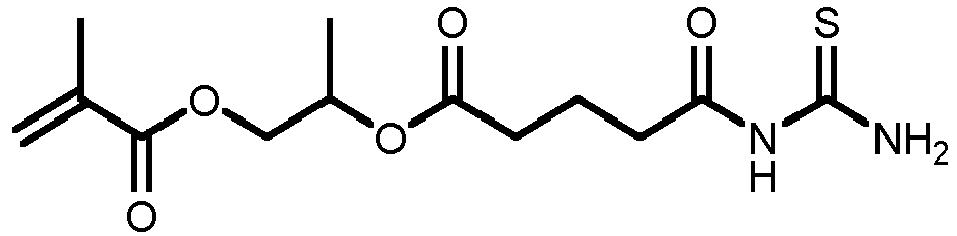


- The comonomers used for the synthesis of copolymers according to Formula (I) and (II) are monofunctional monomers, preferably monofunctional (meth)acrylates. Monofunctional monomers are understood to be compounds with only one radically polymerizable group. Monofunctional monomers have no crosslinking properties and result in the formation of linear polymer chains. No multifunctional monomers, i.e., monomers with two or more radically polymerizable groups, are used.
- Preferred monofunctional comonomers for the synthesis of copolymers according to Formula (I) and (II) are aromatic (meth)acrylates such as 2-phenoxyethyl (meth)acrylate, benzyl (meth)acrylate, p-cumylphenoxyethylene glycol (meth)acrylate and 2-(2-biphenyloxy)-ethyl (meth)acrylate, and cycloaliphatic monofunctional (meth)acrylates such as isobornyl (meth)acrylate, furfuryl (meth)acrylate, tetrahydrofurfuryl (meth)acrylate, dicyclopentadienyl (meth)acrylate and 4-tert-butylcyclohexyl (meth)acrylate are most preferred.
- Further preferred monofunctional comonomers are (meth)acrylates comprising, in addition to the radically polymerizable group, a functional group, preferably a hydroxyl group, such as 2-hydroxyethyl (meth)acrylate, 2-hydroxypropyl (meth)acrylate as well as glycol (meth)acrylates such as ethylene glycol methyl ether (meth)acrylate, or di(ethylene glycol) methyl ether (meth)acrylate.
- Furthermore, monofunctional (meth)acrylates comprising a urethane group can advantageously be used as comonomers. They can be synthesized, for example, via the reaction of a hydroxyalkyl (meth)acrylate with an isocyanate or via the reaction of an alcohol with 2-isocyanatoethyl methacrylate.
- Most preferred comonomers are aliphatic linear or branched C1-C8 alkyl (meth)-acrylates such as methyl (meth)acrylate, ethyl (meth)acrylate, propyl (meth)acrylate, butyl (meth)acrylate, pentyl (meth)acrylate, hexyl (meth)acrylate, isopropyl methacrylate, isobutyl methacrylate and 2-ethylhexyl (meth)acrylate. Generally, methacrylates are preferred over acrylates. Styrene and vinyl acetate can also be used as comonomers.
- Preferred free radical initiators for the synthesis of oligomers according to Formula (I) or (II) are azo radical initiators such as azobis(isobutyronitrile) (AIBN), 2,2'-azobis[2-methyl-N-(2-hydroxyethyl)propionamide], 1,1'-azobis(cyclohexanecarbonitrile) or 4,4'-azobis(4-cyanovaleric acid); peroxides, preferably dibenzoyl peroxide, lauroyl peroxide, tert-amyl peroxybenzoate, dicumyl peroxide, cyclohexanone peroxide, tert-butyl peroxybenzoate and di-tert-butyl peroxide; and peroxodisulfate s, preferably potassium peroxodisulfate K2S2O8, ammonium persulfate (NH4)2S2O8 and sodium peroxodisulfate Na2S2O8.
- Chain transfer agents (CTA) are used to control the chain length of oligomers and polymers. Chain transfer agents are also called chain regulators. Preferred chain transfer agents are mercaptans, in particular mercaptans of the formula R"-(SH)z, in which R" is a linear or branched aliphatic C1-C15 hydrocarbon radical, which can be interrupted by one or more S and/or O atoms and/or -COO- groups and can be unsubstituted or substituted by one or more -Br and/or -Cl atoms and/or -OH or -COOH groups, or an aromatic C6-C12 hydrocarbon radical, and z is 1 or 2, preferably 1. R" is preferably a branched and particularly preferably a linear C2-C15 alkyl radical, which can be substituted by functional groups, in particular -Br, -Cl, -OH and/or -COOH, and which is preferably not substituted. Particularly preferred mercaptans are lauryl mercaptan (1-dodecanethiol, DDT), 2-mercaptoethanol, 3-mercaptopropanol, 3-mer-capto-2-butanol, 2-mercapto-3-butanol, 3-mercapto-2-methyl-butan-1-ol, 3-mercapto-3-methylhexan-1-ol, 3-mercaptohexanol, 2-mercaptoacetic acid, 3-mercaptopropionic acid, 4-methylbenzenethiol, isooctyl 3-mercaptopropionate, tert-nonylmercaptan, 4,4'-thiobisbenzenethiol and 1,8-dimercapto-3,6-dioxaoctane.
- Further preferred chain transfer agents are disulfides (R‴-S-S-R‴), in particular di-thiourethane disulfides, such as tetramethylthiuram disulfide and isopropylxanthic disulfide. Disulfides are also called photoiniferters because they act as photoinitiator (photoini-) during the radical photopolymerization and at the same time also take part in transfer reactions (-fer-) and termination reactions (-ter).
- Moreover, silanes, in particular trimethylsilane and pentamethyldisilane, as well as halogenated compounds, in particular carbon tetrachloride, carbon tetrabromide and bromotrichloromethane, can be used as chain transfer agent.
- Also preferred as chain transfer agents are addition-fragmentation chain transfer (AFCT) agents, such as vinyl ethers, allyl sulfides, allyl sulfones, allyl halides and allyl phosphonates.
- The most preferred chain transfer agents according to the present invention are alkyl mercaptans according to the formula R"-SH, wherein R" is a linear C2-C15 alkyl radical, mercaptoethanol and mercaptoacetic acid.
- In formulas (I) and (II), the end groups of the polymer chains, derived from the transfer agents, are not shown according to the usual conventions. When transfer agents of the formula R"-SH are used, for example, polymer chains are obtained which carry an R"-S- end group.
- The acylthiourea oligomers of Formula (I) or (II) preferably have a number-average molecular weight of from 500 to 10,000 g/mol, more preferably of from 800 to 7,000 g/mol and most preferably of from 1,000 to 5,000 g/mol. According to a particularly preferred embodiment of the invention, the molecular weight is within a range of 1,500 to 4,500 g/mol. Oligomers having a molecular weight within these ranges are preferred because they are soluble in monomer mixtures without causing a major increase of viscosity. A low viscosity is advantageous because it facilitates the incorporation of inorganic fillers into the formulations, e.g. for the production of dental composites or cements. The degree of polymerization and thus the molecular weight of the acylthiourea oligomers according formulas (I) and (II) can be controlled by the amount of chain transfer agent. The degree of polymerization Pn of the oligomers is defined as the quotient of the number average polymer molecular weight Mn of the oligomers divided by the molecular weights Mu of the monomer units.
- The number average molecular weight Mn is preferably determined by gel permeation chromatography (GPC). Gel permeation chromatography (GPC) is a relative method in which the molecules are separated on the basis of their size, or more precisely on the basis of their hydrodynamic volume. The absolute molecular weight is determined by calibration with known standards. Preferably, narrowly distributed polystyrene standards are used as calibration standards. These are commercially available. Styrene-divinylbenzene columns are used as separation media and tetrahydrofuran (THF) as eluent. Styrene-divinylbenzene columns are suitable for organic soluble synthetic polymers. The measurement is carried out with dilute solutions (0.05 - 0.2 wt.%) of the polymers to be investigated.
- Alternatively, the number-average molecular weight can be determined by the known methods of freezing point depression (cryoscopy), boiling point elevation (ebullioscopy) or from vapor pressure depression (vapor pressure osmometry). These are absolute methods that do not require calibration standards. Concentration series of 4 to 6 diluted polymer solutions with concentrations of 0.005 to 0.10 mol/kg are examined and then the measured values are extrapolated to a concentration of 0 mol/kg.
- The acylthiourea oligomers of Formula (I) or (II), in combination with a hydroperoxide compound, are active as initiators for the radical polymerization. The acylthiourea oligomers and the hydroperoxides together form a redox initiator system. The present invention also relates to a redox initiator system for the radical polymerization comprising at least one acylthiourea according Formula (I) or (II) and at least one hydroperoxide, and to radically polymerizable compositions which in addition to the at least one acylthiourea according Formula (I) or (II) and the at least one hydroperoxide comprise at least one radically polymerizable monomer. According to a further preferred embodiment, the initiator system and radically polymerizable composition additionally comprise a transition metal compound.
- It is a particular advantage of the acylthiourea oligomers of Formula (I) or (II) that they are not released from the cured materials after polymerization of the polymerizable composition. They are physically and chemically bound into the polymer network. This is a significant advantage in terms of bitterness properties and possible toxic side effects. The acylthiourea oligomers of Formula (I) or (II) are therefore particularly suitable for dental and other medical applications.
- The initiator systems and polymerizable compositions of the present invention contain at least one hydroperoxide compound. Preferred hydroperoxides are compounds of the formula R14-(OOH)y, in which R14 is an aliphatic or aromatic hydrocarbon radical and y is 1 or 2. Preferred radicals R14 are alkyl and aryl groups. The alkyl groups can be straight-chain, branched or cyclic. Cyclic alkyl radicals can be substituted by aliphatic alkyl groups. Alkyl groups with 4 to 10 carbon atoms are preferred. Aryl groups can be unsubstituted or substituted by alkyl groups. Preferred aromatic hydrocarbon radicals are benzene radicals which are substituted with 1 or 2 alkyl groups. The aromatic hydrocarbon radicals preferably contain 6 to 12 carbon atoms. Particularly preferred hydroperoxides are t-amyl hydroperoxide, 1,1,3,3-tetramethylbutyl hydroperoxide, t-butyl hydroperoxide, t-hexyl hydroperoxide, 2,5-dimethyl-2,5-di(hydroperoxy)hexane, diisopropylbenzene monohydroperoxide, paramenthane hydroperoxide, p-isopropylcumene hydroperoxide and mixtures thereof. Cumene hydroperoxide (CHP) is quite particularly preferred.
- Further preferred are the low-odor CHP derivatives of Formula IV disclosed in European patent application
EP 3 692 976 A1 :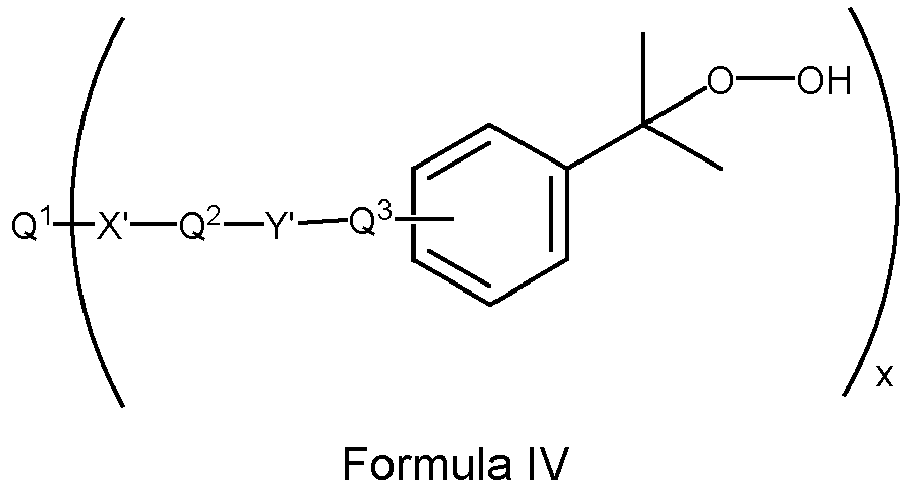
- Q1
- a x-valent, aromatic, aliphatic, linear or branched C1-C14 hydrocarbon radical, which can be interrupted by one or more S and/or O atoms and which can be unsubstituted or substituted by one or more substituents which are preferably selected from -OH, -OR15, -Cl and -Br, wherein R15 is an aliphatic, linear or branched C1-C10 hydrocarbon radical,
- X', Y'
- independently of each other are in each case absent, -O-, -COO-; -CONR16-, or -O-CO-NR17-, wherein R16 and R17 independently of each other represent H or a C1-C5 alkyl radical, preferably H, methyl and/or ethyl, particularly preferably H, and wherein X' and Y' are preferably not absent at the same time and wherein X' and/or Y' is absent if Q2 is absent,
- Q2
- is absent, an aliphatic, linear or branched C1-C14 alkylene radical, which can be interrupted by S and/or O atoms and which can be unsubstituted or substituted by -OH, -OR18, -Cl and/or -Br, wherein R18 is an aliphatic, linear or branched C1-C10 hydrocarbon radical,
- Q3
- a C1-C3 alkylene group or is absent, preferably -CH2- or is absent,
- x
- 1, 2, 3 or 4,
- The variables of Formula (IV) preferably have the following meanings:
- Q1
- a mono- or divalent, aliphatic, linear or branched C1-C10 hydrocarbon radical, which can be interrupted by one or more O atoms, preferably one O atom, and which can be substituted by one or more, preferably one, substituents which are selected from -OH and -OR15 or is preferably unsubstituted, wherein R15 is an aliphatic, linear or branched C1-C6 hydrocarbon radical,
- X', Y'
- independently of each other are in each case absent, -O-, -COO- or -O-CO-NR17-, wherein R17 represents H or a C1-C5 alkyl radical, preferably H, methyl and/or ethyl and quite particularly preferably H, and wherein X' and Y' are preferably not absent at the same time,
- Q2
- is absent, a linear or branched C1-C10 alkylene radical, which can be interrupted by one or more O atoms, preferably one O atom, and which can be substituted by one or more, preferably one, substituents which are selected from-OH and - OR18 or is preferably unsubstituted, wherein R18 is an aliphatic, linear or branched C1-C6 hydrocarbon radical,
- x
- 1 or 2,
- More preferably the variables of Formula (IV) have the following meanings:
- Q1
- a mono- or divalent, aliphatic, linear or branched C1-C5 hydrocarbon radical, which can be interrupted by one O atom and which can be substituted by one OH group,
- X'
- -COO-,
- Y'
- is absent,
- Q2
- is absent or a linear C1-C3 alkylene radical,
- x
- 1 or 2,
- Most preferably the variables of Formula (IV) have the following meanings:
- Q1
- a mono- or divalent, aliphatic, branched, preferably linear C1-C4 hydrocarbon radical,
- X
- -COO-,
- Y
- is absent,
- Q2
- is absent with or a methylene radical,
- x
- 1 or 2, and wherein the substitution on the aromatic ring takes place in position 4.
- Hydroperoxide derivatives of Formula IV particularly preferred according to the invention are:


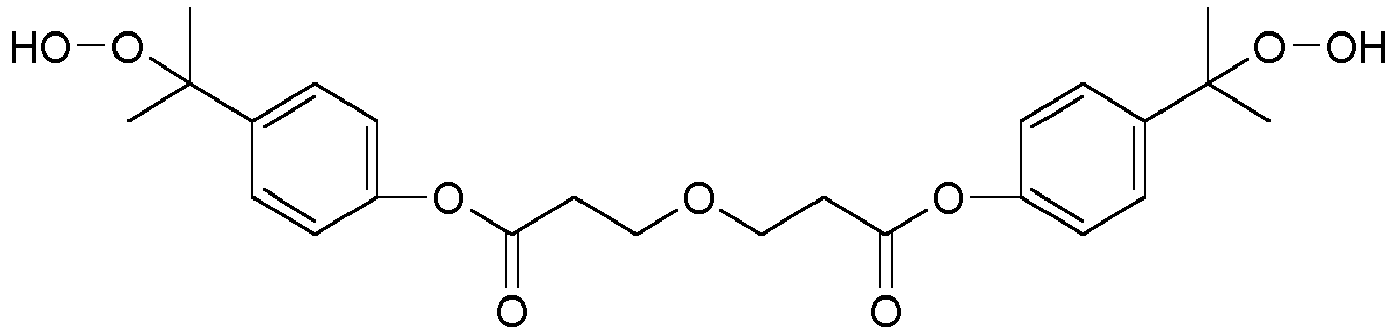


- The hydroperoxide derivatives of Formula IV have a low odor and high storage stability at room temperature. They are therefore particularly suitable for the production of low-odor dental materials. The initiator systems and polymerizable compositions of the present invention can contain one or more hydroperoxides.
- The initiator systems and polymerizable compositions of the present invention preferably contain at least one transition metal compound. It was found that the addition of a transition metal compound yields materials which have significantly improved mechanical properties after hardening.
- Preferred transition metal compounds according to the invention are compounds which are derived from transition metals which have at least two stable oxidation states. Compounds of the elements copper, cobalt, nickel, vanadium and manganese are particularly preferred. These metals have the following stable oxidation states: Cu(I)/Cu(II), Fe(II)/Fe(III), Co(II)/Co(III), Ni(II)/Ni(III), V(III)/V(IV), V(IV)/V(V), Mn(II)/Mn(III). Materials which contain at least one copper compound are particularly preferred. In all cases, those compounds in which the respective transition metal is present in its most stable oxidation state are preferred. Compounds of Cu2+ are thus most preferred.
- The transition metals are preferably used in the form of their salts. Preferred salts are the nitrates, acetates, 2-ethylhexanoates and halides, wherein chlorides are particularly preferred.
- The transition metals can furthermore advantageously be used in complexed form, wherein complexes with chelate-forming ligands are particularly preferred. Preferred simple ligands for complexing the transition metals are 2-ethylhexanoate and THF. Preferred chelate-forming ligands are 2-(2-aminoethylamino)ethanol, aliphatic amines, particularly preferably 1,1,4,7,10,10-hexamethyltriethylenetetramine (HMTETA), N,N,N',N",N"-pentamethyldiethylenetriamine (PMDETA), tris[2-(dimethyl-amino)ethyl]amine (Me6TREN), N,N,N',N'-tetramethylethylenediamine (TMEDA), 1,4,8,11-tetraaza-1,4,8,11-tetramethyl-cyclotetradecane (Me4CYCLAM), diethylenetriamine (DETA), triethylenetetramine (TETA) and 1,4,8,11-tetraazacyclotetradecane (CYCLAM); pyridine-containing ligands, particularly preferably N,N,N',N'-tetrakis(2-pyridylmethyl)ethylenediamine (TPEN), N, N-bis(2-pyridylmethyl)amine (BPMA), N,N-bis(2-pyridylmethyl)octylamine (BPMOA), 2,2'-bipyridine and 8-hydroxyquinoline. Most particularly preferred ligands are acetylacetone, dimethylglyoxime and 1,10-phenanthroline. Metal complexes that are soluble in the respective monomer mixture are particularly preferred.
- In the case of electrically neutral ligands, the charge of the transition metal ions must be balanced by suitable counterions. For this, the above-named ions which are used to form salts are preferred wherein acetates and chlorides are particularly preferred. Chlorides and complexes are characterized by a relatively good solubility in monomers, which are used to prepare dental materials.
- Instead of the transition metal complexes, non-complex salts of the transition metals in combination with complex-forming organic compounds can be used to prepare the dental materials, preferably in combination with the above-named chelate-forming compounds. The organic ligands form the catalytically active complexes when mixed with the transition metal salts. The use of such combinations of transition metal salts and organic ligands is preferred.
- Preferred copper salts are CuCl, CuBr, CuCl2, CuBr2, CuI2, Cu(II) carboxylates (e.g. of acetic acid or 2-ethylhexanoic acid). Preferred copper complexes are complexes with the ligands acetylacetone, phenanthroline (e.g. 1,10-phenanthroline (phen)), the aliphatic amines, such as e.g. 1,1,4,7,10,10-hexamethyltriethylenetetramine (HMTETA), N,N,N',N",N"-pentamethyldiethylenetriamine (PMDETA), tris[2-(dimethyl-amino)ethyl]amine (Me6TREN).
- Preferred iron salts are FeCl3, FeBr2 and FeCl2. Preferred iron complexes are complexes with the ligands acetylacetone, triphenylphosphine, 4,4'-di(5-nonyl)-2,2'-bipyridine (dNbpy) or 1,3-diisopropyl-4,5-dimethylimidazol-2-ylidene (Prilm). The complexes Fe(acac)2 and FeCl2(PPh3)2 are quite particularly preferred.
- Preferred nickel salts are NiBr2 and NiCl2, preferred nickel complexes are nickel acetylacetonate and NiBr2(PPh3)2.
- According to the invention, copper compounds, copper complexes and in particular mixtures of copper salts and complexing organic ligands are particularly preferred.
- Initiators systems and polymerizable compositions which contain at least one acylthiourea oligomer of Formula (I) or (II), at least one hydroperoxide derivative and at least one transition metal compound, wherein these components are in each case selected from the above-defined preferred and particularly preferred substances, are quite particularly preferred.
- The acylthiourea oligomer or oligomers of Formula (I) or (II) are preferably used in an amount of from 0.2 to 10 wt.-%, preferably 0.3 to 8.0 wt.-% and more preferably 0.5 to 5.0 wt.-%.
- The hydroperoxide compound is preferably used in an amount of from 0.1 to 5.0 wt.-%, more preferably 0.2 to 4.0 wt% and most preferably 0.3 to 3.0 wt.-%.
- The transition metal compound is, where applicable, preferably used in an amount of from 0.0001 to 0.5 wt.-%, more preferably 0.0005 to 0.1 wt.-% and most preferably 0.001 to 0.020 wt.-%.
- Unless otherwise stated, all percentages herein relate to the total mass of the polymerizable composition.
- The initiator system and the polymerizable compositions according to the invention can advantageously further comprise an initiator for the radical photopolymerization. Such compositions are dual-curing, i.e. they can be cured both chemically and by light. Photoinitiators can be added to the catalyst paste, the base paste or both.
- Preferred photoinitiators are alpha-diketones derivatives, preferably camphorquinone (CQ), 9,10-phenanthrenequinone, 1-phenylpropane-1,2-dione, 2,2-dimethoxy-2-phenylacetophenone, diacetyl or 4,4'-dichlorobenzil or derivatives thereof. Camphorquinone (CQ), 2,2-dimethoxy-2-phenylacetophenone and mixtures thereof are most particularly preferred. Alpha-diketones are preferably used in combination with tertiary amines as coinitiator. Preferred coinitiators are 4-(dimethylamino)benzoic acid ester (EDMAB), N,N-dimethylaminoethyl methacrylate, N,N-dimethyl-sym.-xylidine and triethanolamine. Bimolecular photoinitiators, i.e. photoinitiators that require a second component to reach their optimal activity, are referred to as Norrish type 2 photoinitiators.
- Norrish type 1 photoinitiators can also be used. The materials according to the invention preferably contain one or more Norrish type 1 photoinitiator, more preferably such a photoinitiator which is active in a wavelength range of from 400 to 500 nm.
- Preferred Norrish type 1 photoinitiators are monoacyl- or bisacylphosphine oxides, diacyldialkylgermanium and tetraacylgermanium compounds as well as tetra-acylstannanes. Particularly preferred monomolecular photoinitiators are 2,4,6-trimethylbenzoyl diphenylphosphine oxide, bis(2,4,6-trimethylbenzoyl) phenylphosphine oxide, ethyl (2,4,6-trimethylbenzoyl) phenylphosphinate (TPO-L), dibenzoyldi-ethylgermane, bis(4-methoxybenzoyl)diethylgermanium (MBDEGe, trade name Ivocerin), tetrabenzoylgermane, tetrakis(o-methylbenzoyl)germane, tetrakis(mesitoyl)stannane and mixtures thereof.
- Moreover, mixtures of the different photoinitiators can also be used, such as e.g. bis(4-methoxybenzoyl)diethylgermane or tetrakis(o-methylbenzoyl)germane in combination with camphorquinone and 4-dimethylaminobenzoic acid ethyl ester.
- The radically polymerizable compositions of the present invention comprise at least one multifunctional (meth)acrylate and may optionally comprise one or more monofunctional (meth)acrylates. Compositions that contain at least one multifunctional (meth)acrylate and at least one monofunctional monomer are particularly preferred. The multifunctional (meth)acrylates preferably comprise 2 to 4 radically polymerizable groups.
- Preferred multifunctional (meth)acrylates are bisphenol A dimethacrylate, bis-GMA (an addition product of methacrylic acid and bisphenol A diglycidyl ether), ethoxylated or propoxylated bisphenol A dimethacrylate, such as the bisphenol A dimethacrylate SR-348c (Sartomer) with 3 ethoxy groups or 2,2-bis[4-(2-methacryloyloxypropoxy)-phenyl]propane, UDMA (an addition product of 2-hydroxyethyl methacrylate and 2,2,4-trimethylhexamethylene-1,6-diisocyanate), 2-{[(2-(methacryloyloxy)ethoxy)carbonyl]amino} ethyl methacrylate, tetramethylxylylene diurethane ethylene glycol di(meth)acrylate and tetramethylxylylene diurethane ethylene glycol di(meth)acrylate, respectively, tetramethylxylylene diurethane-2-methylethylene glycoldi(meth)acrylate (V380), di-, tri- or tetraethylene glycol dimethacrylate, trimethylol propanetrimethacrylate, pentaerythritol tetramethacrylate and glycerol di- and trimethacrylate, 1,4-butanediol dimethacrylate, 1,10-decanediol dimethacrylate (D3MA), bis(methacryloyloxymethyl)tricyclo-[5.2.1.02,6]decane (DCP), polyethylene glycol or polypropylene glycol dimethacrylates, such as polyethylene glycol 200-dimethacrylate or polyethylene glycol 400-dimethacrylate (PEG-200- or PEG-400-DMA) or 1,12-dodecanediol dimethacrylate. UDMA, V-380, 2-{[(2-(methacryloyloxy)-ethoxy)carbonyl]amino} ethyl methacrylate, bisphenol A dimethacrylate SR-348c (Sartomer) and PEG-400-DMA (NK ester 9G) are particularly preferred.
- The monomer V380 has the following formula:

- In this formula, the R19 groups are each independently H or CH3, and the R19 residues may have the same meaning or different meanings. Preferably, a mixture is used which contains molecules in which both residues are H, molecules in which both residues are CH3, and molecules in which one residue is H and the other residue is CH3, the ratio of H to CH3 preferably being 7:3. Such a mixture is obtainable, for example, by reaction of 1,3-bis(1-isocyanato-1-methylethyl)benzene with 2-hydroxypropyl methacrylate and 2-hydroxyethyl methacrylate.
- Preferred monofunctional monomers are benzyl and furfuryl methacrylate, 2-phenoxyethyl methacrylate, 2-(o-biphenyloxy)ethyl methacrylate, 2-hydroxy-3-phenoxypropyl methacrylate, phenethyl methacrylate, 2-[(benzyloxycarbonyl)-amino]-ethyl methacrylate, 2-[(benzylcarbamoyl)oxy]-ethyl methacrylate, 1-phenoxypropan-2-yl methacrylate and 2-(p-cumylphenoxy)-ethyl methacrylate, tricyclodecane methacrylate, tricyclodecane methyl methacrylate and/or 2-(p-cumylphenoxy)ethyl methacrylate, and in particular cumylphenoxyethylene glycol methacrylate (CMP-1E).
- According to one embodiment, the compositions according to the invention contain one or more acid-group-containing radically polymerizable monomers (adhesive monomers) in addition to the above-named monomers. These give the materials self-adhesive and/or self-etching properties. Acid-group-containing monomers are therefore particularly suitable for the preparation of self-adhesive dental materials, such as e.g. luting cements.
- Preferred acid-group-containing monomers are polymerizable carboxylic acids, phosphonic acids and phosphoric acid esters as well as their anhydrides. Preferred carboxylic acids and carboxylic acid anhydrides are 4-(meth)acryloyloxyethyl trimellitic acid anhydride, 10-methacryloyloxydecylmalonic acid, N-(2-hydroxy-3-methacryl-oyloxypropyl)-N-phenylglycine, 4-vinylbenzoic acid. Preferred phosphoric acid esters are 2-methacryloyloxyethylphenyl hydrogen phosphate, 10-methacryloyloxydecyl dihydrogen phosphate (MDP) and dipentaerythritol pentamethacryloyloxyphosphate. Preferred phosphonic acids are 4-vinylbenzyl-phosphonic acid, 2-[4-(dihydroxyphos-phoryl)-2-oxa-butyl]-acrylic acid and their amides, esters, such as e.g. 2-[4-(di-hydroxyphosphoryl)-2-oxa-butyl]-acrylic acid-2,4,6-trimethylphenyl ester.
- It is known that the addition of acidic monomers to two-component composites based on the hydroperoxide/thiourea redox system results in a significant reduction of the working time. Therefore, the amount of redox components is often reduced to lower the reactivity, but this leads to a deterioration of the mechanical properties. For this reason, it is challenging to formulate two-component self-adhesive cements that have both excellent mechanical properties and an adequate working time. It was surprisingly found, that the acylthiourea oligomers of Formula (I) or (II) allow the formulation of 2C materials having a favourable working time without impairing the mechanical properties.
- The polymerizable compositions according to the invention can moreover advantageously contain one or more organic or inorganic fillers. Particulate fillers are preferred. Filler-containing compositions are particularly suitable as dental fixing cements or filling composites.
- Preferred inorganic fillers are oxides, such as SiO2, ZrO2 and TiO2 or mixed oxides of SiO2, ZrO2, ZnO and/or TiO2, nanoparticulate or microfine fillers, such as pyrogenic silica or precipitated silica, glass powders, such as quartz, glass ceramic, borosilicate, or radiopaque glass powders, preferably barium or strontium aluminum silicate glasses or fluoroaluminosilicate glasses, and radiopaque fillers, such as ytterbium trifluoride, tantalum(V) oxide, barium sulfate or mixed oxides of SiO2 with ytterbium(III) oxide or tantalum(V) oxide. The dental materials according to the invention can furthermore contain fibrous fillers, nanofibers, whiskers or mixtures thereof.
- Preferably, the oxides have a particle size of from 0.010 to 15 µm, the nanoparticulate or microfine fillers preferably have a particle size of from 10 to 300 nm, the glass powders preferably have a particle size of from 0.01 to 15 µm, more preferably of from 0.2 to 1.5 µm, and the radiopaque fillers preferably have a particle size of from 0.2 to 5 µm.
- Particularly preferred fillers are mixed oxides of SiO2 and ZrO2, with a particle size of from 10 to 300 nm, glass powders with a particle size of from 0.2 to 1.5 µm, in particular fluoroaluminosilicate glass powders and radiopaque glass powders, preferably of barium or strontium aluminium silicate glasses, and radiopaque fillers with a particle size of from 0.2 to 5 µm, in particular ytterbium trifluoride and/or mixed oxides of SiO2 with ytterbium(III) oxide.
- Preferred radiopaque glass fillers have the following composition (wt.%): SiO2: 20-80; B2O3: 2-15, BaO or SrO: 10-40; Al2O3: 2-20; CaO and/or MgO: 0-20; Na2O, K2O, Cs2O: 0-10 each; WO3: 0-20; ZnO: 0-20; La2O3: 0-10; ZrO2: 0-15; P2O5: 0-30; Ta2O5, Nb2O5 or Yb2O3: 0-5; and CaF2 and/or SrF2 0-10. Particularly preferred are radiopaque glass fillers having the composition (wt.%): SiO2: 40-75; B2O3: 2-15; BaO or SrO: 15-35; Al2O3: 2-15; CaO and/or MgO: 0-10; and Na2O: 0-10.
- Preferred fluoroaluminosilicate (FAS) glass fillers have the following composition (wt.%): SiO2: 20-35; Al2O3: 15-35; BaO or SrO: 10-25; CaO: 0-20; ZnO: 0-15; P2O5: 5-20; Na2O, K2O, Cs2O: 0-10 each; and CaF2: 0.5-20. Particularly preferred are FAS fillers with the composition (wt.%): SiO2: 20-30; Al2O3: 20-30; BaO or SrO: 10-25; CaO: 5-20; P2O5: 5-20; Na2O: 0-10; and CaF2: 5-20.
- The FAS fillers and radiopaque glass fillers preferably have an average particle size of 0.2 to 20 µm and particularly preferably of 0.4 to 5 µm.
- According to a preferred embodiment of the invention, the fluoroaluminosilicate glass filler and/or radiopaque glass filler has been pre-treated with acid. By the acid treatment of the filler, the storage stability of two-component materials containing acidic monomers can be significantly improved. Preferred acid treated fillers and their preparation are described in
European Patent Application No. 21218194.5 - The acid treatment of the particulate FAS or glass fillers is carried out by washing the filler with acid, preferably by the following process:
- (i) The particulate FAS or glass filler is dispersed in an aqueous solution of an organic or preferably inorganic acid. The acid is preferably used in a concentration of 0.1 to 5 mol/l, particularly preferably 0.5 to 3 mol/l.
- (ii) The dispersion from step (i) is then stirred, preferably for 0.5 to 24 h, more preferably for 1 to 5 h.
- (iii) After the stirring in an acid solution, the filler is separated and washed with deionized water. For this purpose, it is preferably dispersed in water and stirred for 1 to 60 minutes, particularly preferably for 2 to 20 minutes.
- (iv) After washing, the filler is separated and dried, preferably in a vacuum drying oven in a fine vacuum at 20 to 80 °C, particularly preferably at 40 to 60 °C. The filler is preferably dried to constant weight.
- (v) After drying, the filler is preferably subjected to an optional thermal treatment. For this purpose, it is preferably heated for 2 to 12 h, particularly preferably for 4 to 6 h, to a temperature that is well below the glass transition temperature of the filler, preferably 200 to 500 °C and particularly preferably 300 to 400 °C.
- The acid used to treat the fillers is preferably completely removed from the fillers after the acid treatment. The fillers are not coated with an acid.
- The acid treatment can be repeated once or several times. Steps (i) and (iii) are preferably carried out at a temperature in the range from 5 to 50°C, particularly preferably at room temperature (23°C). The temperature is measured in the solution or dispersion in each case.
- Acids that form soluble salts with Ca, Al, Sr and Ba ions are preferred. Particularly preferred are formic acid, acetic acid and especially hydrochloric acid, and nitric acid. Alternatively, acids that form sparingly soluble salts with Ca, Al, Sr or Ba ions, such as phosphoric acid, may be used but these are less preferred. Poorly soluble salts are defined as salts with a solubility of less than 0.1 g/l (in water at room temperature). According to the invention, acidic organic monomers and acidic organic polymers as well as peracids and hydrofluoric acid are not suitable as acids.
- The washing step (iii) is preferably repeated 1 to 5 times, particularly preferably 3 times, so that the acid is completely removed from the filler. For this purpose, the filler is separated from the water following step (iii) and again dispersed and stirred in deionized water. The washing is repeated until the pH of the water in the last washing step is ≥ 5. After washing, the filler can be subjected to further acid treatment and washing. The sequence of acid treatment and washing can be repeated once or several times.
- The acid treatment of the fillers significantly improves the storage stability of the compositions according to the invention. In particular, the content of radical polymerizable monomers comprising an acid group decreases only slowly, so that the compositions show high adhesion to the tooth structure and particularly to dentin even after prolonged storage. The acid treatment thus significantly improves the properties of dental composites with self-adhesive properties in a simple manner.
- According to another preferred embodiment of the invention, the fluoroaluminosilicate glass fillers and/or radiopaque glass fillers are preferably used in combination with at least one sulfate and/or phosphate which is water-soluble at 20°C. Water-soluble sulfates or phosphates were found to improve the storage stability of compositions comprising a fluoroaluminosilicate glass filler and/or radiopaque glass filler in combination with acidic monomers. The fluoroaluminosilicate glass filler and/or radiopaque glass filler may be used in acid-treated or non-acid-treated form. Preferred fillers comprising a fluoroaluminosilicate glass and/or radiopaque glass in combination with at least one water-soluble sulfate and/or phosphate and their preparation are described in
European Patent Application No. 21218209.1 - Preferred sulfates are inorganic salts of sulfuric acid and preferred phosphates are inorganic salts of orthophosphoric acid (H3PO4). Water-soluble sulfates or phosphates are sulfates or phosphates which preferably have a water solubility of at least 100 g/l, preferably of 110 to 1,000 g/l and particularly preferably of 150 to 800 g/l. Preferred water-soluble sulfates are potassium sulfate (K2SO4; water solubility 111 g/l), sodium sulfate (Na2SO4; water solubility 170 g/l) and particularly preferably ammonium sulfate ((NH4)2SO4; water solubility 754 g/l). Preferred water-soluble phosphates are potassium phosphate (K3PO4; water solubility 508 g/l), sodium phosphate (Na3PO4; water solubility 285 g/l) and especially preferably ammonium phosphate ((NH4)3PO4; water solubility 580 g/l). All solubility data refer to solubility in water at 20°C.
- The one or more water-soluble sulfates and/or water-soluble phosphates are preferably added in a total amount of at least 0.3 wt.-% and, more preferably, at least 0.4 wt.-%. According to the invention, compositions are preferred which contain up to 0.3 to 9.0 wt.-%, more preferably 0.4 to 6.0 wt.%, and most preferably from 0.7 to 4.0 wt.-% of at least one water-soluble sulfate and/or phosphate. Unless otherwise stated, all percentages herein are based on the total mass of the composition. The sulfates or phosphates may be present in dissolved or preferably in solid form. According to the invention, sulfates are preferred.
- According to still another preferred embodiment of the invention, the fluoroaluminosilicate glass filler (FAS filler) and/or radiopaque glass filler is coated with a silica (hetero)polycondensate. Preferred coated fillers and their preparation are described in
European Patent Application No. 22202860.7 - The filler is preferably coated by a sol-gel process. For this purpose, a sol is prepared by hydrolytic condensation of one or more condensable compounds of silicon and optionally other elements from the group boron, aluminum, titanium or phosphorus and/or precondensates derived from these compounds, brought into contact with the filler and the filler is subsequently dried.
- Preferred hydrolytically condensable compounds of silicon are silanes of the general Formula (V):
SiX"aR'4-a Formula V
in which the variables have the following meanings: - R' =
- C1-C20-alkyl or C2-C10-alkenyl, where alkyl and alkenyl radicals may comprise one or more O or S atoms, ester, amide, amino or urethane groups, C6-C14-aryl or C7 -C15-alkylaryl;
- X" =
- halogen, hydroxy, C1-C10-alkoxy, C1-C6-acyloxy;
- a =
- 2, 3 or 4, preferably 3 or 4.
- If there are multiple R' or X" residues, they may be different or preferably the same. Preferred alkylaryl groups are -CH2 -CH2 -Ph or a -Ph-CH3 group with Ph = phenyl.
- Particularly preferred are silanes of the Formula (V) in which at least one and preferably all variables have one of the following meanings:
- R' =
- C1-C10-alkyl or C2-C8-alkenyl, where alkyl and alkenyl radicals may comprise one or more O atoms or ester groups, phenyl or C7-C15-alkylaryl-,
- X" =
- hydroxy, C1-C5-alkoxy-, C1-C3-acyloxy;
- a =
- 3 or 4.
- The silanes of Formula (V) can be hydrolytically condensed via the radicals X" to form an inorganic network with Si-O-Si units. If the radicals R' contain radically polymerizable groups, an organic network can also be formed via them.
- More preferred are silanes of the Formula (V) where the variables have the following meanings:
- R'
- methyl, ethyl, n-propyl, i-propyl, n-butyl, s-butyl, n-pentyl, vinyl, a (meth)acryl group (H2C=C(CH3 )-COO-), allyl, phenyl or naphthyl, particularly preferred are ethyl, n-propyl, i-propyl and most preferred are methyl or 3-(meth)-acryloyloxypropyl;
- X"
- methoxy, ethoxy, n-propoxy, i-propoxy, n-butoxy, F, Cl, Br, especially preferably Cl and most preferably ethoxy;
- a
- 3 or 4.
- According to the invention, silanes of the formula SiX"4 (a = 4) are particularly preferred, with Si(OCH3)4 and Si(OC2H5)4 being even more preferred. Silanes of the formula SiX"4 give a particularly high network density. They are preferably used in an amount of 40 to 100% by weight, more preferably 50 to 100% by weight and most preferably 60 to 95% by weight, based on the total amount of silanes of Formula (V).
- Further preferred are silanes of Formula (V) containing at least one free-radically polymerizable group, 3-methacryloyloxypropyltrimethoxysilane being particularly preferred. The radically polymerizable group enables covalent bonding between the coated fillers and the radically polymerizable matrix during curing of the materials according to the invention. Silanes containing radically polymerizable groups are preferably used in an amount of 0 to 10% by weight, more preferably 0 to 8% by weight and most preferably 1 to 5% by weight, based on the total amount of silanes of the Formula (V).
- In addition to the silane(s) of Formula (V), one or more further hydrolytically condensable compounds of the elements Al, Ti, B or P can be used to coat the fillers. Preferred compounds are those of Al, Ti and B. Preferred aluminum compounds are aluminum sec-butylate and aluminum isopropylate. Preferred titanium compounds are Ti(OC2H5)4, Ti(OC3H7)4, Ti(O-iC3H7)4 and Ti(OC4H9)4. Preferred boron compounds are B(OCH3)3 and B(OC2H5)3 . By using additional hydrolytically condensable compounds, the properties of the coating, such as hardness and abrasion resistance, can be specifically controlled. One or more additional compounds may be used. These are preferably used in a total amount of 0 to 20% by weight, more preferably 0 to 15% by weight and most preferably 0 to 10% by weight, based on the total amount of silanes of Formula (V). Metal alkoxides, for example of Al or Ti, can also be used in complexed form, for example in the form of the reaction products of Al or Ti alkoxides with (meth)acrylic acid or 2-acetoacetoxyethyl methacrylate. The proportion of silanes of the Formula (V) is preferably 80 to 100% by weight, more preferably 85 to 100% by weight and most preferably 90 to 100% by weight, based on the total amount of hydrolytically condensable compounds.
- The silane or silanes of Formula (V) and optionally other hydrolytically condensable compounds are hydrolyzed and condensed in the presence of water, preferably at least the amount of water stoichiometrically required for hydrolysis, and optionally a condensation catalyst and/or a solvent. Polycondensates or heteropolycondensates are formed in this process. Instead of the hydrolytically condensable compounds, precondensates derived therefrom can also be used. Precondensates are reaction products of the alkoxysilanes and/or halosilanes and optionally of the metal alkoxides with water with partial or complete elimination of the alcohols or hydrogen halides. In the case of the alkoxysilanes, silanols are formed as precondensates.
- Preferably, the hydrolytic condensation is carried out by dispersing the filler to be coated in the silane(s) of Formula (V) and, if desired, further hydrolytically condensable compounds or, preferably, a solution of the silane(s) and, if desired, further hydrolytically condensable compounds in a suitable solvent and then adding water. The mixture is preferably stirred in this process.
- If only silanes are used, the hydrolysis is preferably carried out at room temperature or under slight cooling. Preferably, a hydrolysis or condensation catalyst is added. Polycondensates are obtained in this process. The resulting mixture (dispersion) is preferably stirred for several hours to several days at a temperature of -20 to 150°C, preferably 20 to 110°C. The filler is then separated, e.g. by centrifugation, then optionally washed with a solvent one or more times and then dried. Drying can be carried out at room temperature or at elevated temperature, preferably at 50 to 60°C. Preferably, the filler is dried in a vacuum drying cabinet. Drying may extend over a period of several hours to several days. Preferably, drying is carried out until the weight is constant. After drying, the fillers may be subjected to further heat treatment. This is preferably carried out at a temperature of from 20 to 150°C, more preferably from 30 to 100°C and most preferably from 40 to 80°C. Temperature and treatment time are selected so that any organic groups present in the coating are not destroyed and no glass layer is formed.
- If, in addition to the silanes of Formula (V), other hydrolytically condensable compounds are used to coat the filler, the water is preferably added in stages at -20 to 100°C, preferably at 0 to 30°C. In this case, heteropolycondensates are formed. The method of water addition depends primarily on the reactivity of the hydrolytically condensable compounds used. The desired amount of water can be added, for example, in portions or in one portion.
- In the preparation of both polycondensates and heteropolycondensates, the water is preferably added in an amount of 0.5 to 10 moles of water per mole of hydrolyzable groups, particularly preferably in an amount of 1 to 10 moles of water per mole of hydrolyzable groups and most preferably in an amount of 1.5 to 5 moles of water per mole of hydrolyzable groups of the silanes of Formula (V) and optional other hydrolytically condensable compounds. The water or portions thereof may be introduced in pure form or as a constituent of other components, e.g. of the catalyst solution.
- Preferred solvents for performing the hydrolytic condensation are lower aliphatic alcohols, such as ethanol or i-propanol, lower dialkyl ketones, such as acetone or methyl isobutyl ketone, cyclic ethers, such as tetrahydrofuran or dioxane, aliphatic ethers, such as isopropoxyethanol or isopropoxypropanol, amides, such as dimethylformamide, and mixtures thereof.
- Preferred hydrolysis or condensation catalysts are organic or inorganic acids, such as hydrochloric acid, sulfuric acid, p-toluenesulfonic acid, formic acid or acetic acid. Ammonium fluoride and organic bases, in particular amines, such as n-propylamine, diethylamine or triethylamine, and aminosilanes, such as 3-aminopropyltrimethoxysilane, are further preferred.
- The condensation time depends on the respective starting components, their proportions, the catalyst used, if any, the reaction temperature, etc. Preferably, the reaction time is in the range of 1 to 96 h, more preferably 2 to 72 h and most preferably 3 to 48 h.
- When drying the fillers and evaporating the solvent, the hydrolysis and condensation reaction leads to the formation of a gel film via the formation of sol particles, which further cross-links in the course of drying and forms a dense inorganic network on the filler surface. The properties of the coating, such as strength, flexibility, adhesion, hardness, refractive index and impermeability, can be specifically adjusted by the selection of the silanes and the other hydrolytically condensable components and adapted to the particular application. For example, the functionality of the silanes of Formula (V), which can vary between 4, e.g. in tetraethoxysilane (TEOS), and 2, e.g. in dialkoxysilane, can be used to adjust the degree of crosslink-linking and thus the strength, flexibility and impermeability of the coating. By selecting the organic groups of the silanes, it is possible to specifically influence, for example, the flexibility, polarity, wetting or thickening effect of the coating. Silanes with polymerizable groups, such as in 3-methacryloyloxypropyltrimethoxysilane, allow additional crosslinking of the coating by radical polymerization and covalent incorporation of the fillers into the polymer matrix. Co-condensation with metal alkoxides, such as Ti alkoxide, allows control of the kinetics of the hydrolytic condensation and, for example, an increase in density and hardness as well as adjustment of the refractive index of the coating.
- The filler is preferably dispersed in the hydrolysis mixture in an amount of from 1 to 25% by weight, more preferably from 3 to 20% by weight and most preferably from 4 to 15% by weight, based on the total mass of the mixture. According to the invention, particulate fillers are preferred.
- Furthermore, so-called inert fillers can also be used as fillers. These are glass fillers whose surface is coated with a diffusion barrier layer, e.g. on a sol-gel basis, or with a polymer layer, e.g. of PVC. Preferred fillers are those described in
EP 2 103 296 A1 . - Polymer particles, in particular particles of crosslinked organic polymers, are preferred as organic fillers. Polymer particles can be obtained by curing one or more monomers and then grinding the cured mixture, or by suspension polymerization. The mixtures can be cured by light irradiation or thermally. Radically polymerizable monomers and in particular the monomers listed above are preferred as monomers. Dimethacrylates, specifically bis-GMA, UDMA, TMX-UDMA, DCP, D3MA and mixtures thereof, are most particularly preferred.
- Polymer particles prepared by grinding exhibit a splintery appearance under the microscope and are therefore also referred to as splinter polymerizates or splinter polymers. Pearl polymerizates obtained by suspension polymerization in contrast are characterized by spherical particles. Splinter polymerizates are preferred as organic fillers.
- In addition, so-called composite fillers, i.e. organic-inorganic fillers, are preferred as fillers. These are also referred to as isofillers. These are fragmentary polymers which in turn contain an inorganic filler, preferably pyrogenic SiO2 and/or ytterbium trifluoride. Preferred are polymers based on dimethacrylates. For the production of isofillers, the inorganic filler(s) is/are incorporated, for example, into a dimethacrylate resin matrix, and the resulting composite paste is subsequently thermally polymerized and then ground.
- A composite filler preferred according to the invention can be prepared, for example, by thermally curing a mixture of Bis-GMA (8.80% by weight), UDMA (6.60% by weight), 1,10-decanediol dimethacrylate (5.93% by weight), dibenzoyl peroxide + 2,6-di-tert. butyl-4-methylphenol (together 0.67 wt.%), glass filler (average grain size 0.4 µm; 53.0 wt.%) and YbF3 (25.0 wt.%) and subsequent grinding of the cured material to the desired grain size. Another composite filler preferred according to the invention is a hot-cured composite filler ground to the desired grain size and prepared from UDMA (23.58 % by weight), 1,10-decanediol dimethacrylate (5.92 % by weight), dibenzoyl peroxide (0.50 % by weight), fumed silica Aerosil OX50 (50.0 % by weight) and YbF3 (20.0 % by weight). All percentages refer to the total mass of the composite filler.
- Unless otherwise stated, all particle sizes are weight-average particle sizes, wherein particle-sizes within the range of from 0.1 µm to 10 µm are measured by means of static light scattering, preferably using an LA-960 static laser scattering particle size analyzer (Horiba, Japan). Here, a laser diode with a wavelength of 655 nm and an LED with a wavelength of 405 nm are used as light sources. The use of two light sources with different wavelengths makes it possible to measure the entire particle-size distribution of a sample in only one measurement pass, wherein the measurement is carried out as a wet measurement. For this, a 0.1 to 0.5% aqueous dispersion of the filler is prepared, and the scattered light thereof is measured in a flow cell. The scattered-light analysis for calculating particle size and particle-size distribution is performed in accordance with the Mie theory according to DIN/ISO 13320: 2020.
- Particle sizes smaller than 0.1 µm are preferably determined by means of dynamic light scattering (DLS). The measurement of the particle size in the range of from 5 nm to 0.1 µm is preferably effected by dynamic light scattering (DLS) of aqueous particle dispersions, preferably with a Malvern Zetasizer Nano ZS (Malvern Instruments, Malvern UK) with a He-Ne laser with a wavelength of 633 nm, at a scattering angle of 90° at 25° C.
- Particle sizes smaller than 0.1 µm can also be determined by means of SEM or TEM spectroscopy. The transmission electron microscopy (TEM) is preferably carried out with a Philips CM30 TEM at an accelerating voltage of 300 kV. For the preparation of the samples, drops of the particle dispersion are applied to a 50 Å thick copper grid (mesh size 300), which is coated with carbon, and then the solvent is evaporated.
- The light scattering decreases as the particle size decreases, but fillers with a small particle size have a greater thickening action. The fillers are divided according to their particle size into macrofillers and microfillers, wherein fillers with an average particle size of from 0.2 to 10 µm are called macrofillers and fillers with an average particle size of from approx. 5 to 100 nm are called microfillers. Macrofillers are obtained e.g. by grinding e.g. quartz, radiopaque glasses, borosilicates glasses or glass ceramics and usually consist of splintery parts. Microfillers such as mixed oxides can be prepared e.g. by hydrolytic co-condensation of metal alkoxides.
- To improve the bond between the filler particles and the crosslinked polymerization matrix, the fillers are preferably surface-modified, particularly preferably by silanization, most particularly preferably by radically polymerizable silanes, in particular with 3-methacryloyloxypropyltrimethoxysilane. For the surface-modification of non-silicate fillers, e.g. of ZrO2 or TiO2, functionalized acidic phosphates, such as e.g. 10-methacryloyloxydecyl dihydrogen phosphate can also be used.
- The compositions according to the invention preferably contain from 20% to 90% by weight, more preferably from 40% to 85% by weight and most preferably from 50% to 80% by weight of fillers, in each case based on the total mass of the composition.
- The compositions according to the invention may also contain further additives, in particular stabilizers, such as e.g. polymerization stabilizers, dyes, microbiocidal active ingredients, fluoride-ion-releasing additives such as fluoride salts in particular NaF, ammonium fluoride, or fluorosilanes, optical brighteners, fluorescent agents, plasticizers, and/or UV absorbers.
- The compositions according to the invention are particularly suitable as dental materials, in particular as luting materials, filling composites and temporary filling materials.
- Compositions which comprise:
- (a) 0.2 to 10.0 wt.-%, preferably 0.3 to 8.0 wt.-% and more preferably 0.5 to 5.0 wt.-% of at least one acylthiourea oligomer according to Formula (I) or preferably Formula (II),
- (b) 0.1 to 5.0 wt.-%, preferably 0.1 to 4.0 wt.-% and more preferably 0.2 to 2.0 wt.-% of at least one hydroperoxide compound,
- (c) 5 to 80 wt.-%, preferably 10 to 60 wt.-% and more preferably 15 to 50 wt.-% of at least one radically polymerizable monomer,
- (d) 20 to 90 wt.-%, preferably 40 to 85 wt.-% and more preferably 50 to 80 wt.-% filler(s), and
- (e) 0.001 to 5 wt.-%, preferably 0.01 to 3 wt.-%, additive(s),
- All quantities herein are relative to the total mass of the composition, unless otherwise stated.
- The filling level depends on the desired intended use of the composition. Filling composites preferably have a filler content of from 50 to 85 wt.-% and luting composites of from 10 to 70 wt.-%.
- Compositions which additionally contain
- (f) 0.0001 to 0.5 wt.-%, preferably 0.0005 to 0.1 wt.-% and particularly preferably 0.001 to 0.02 wt.-% of at least one transition metal compound
- are particularly preferred.
- Compositions comprising at least one acylthiourea oligomer according to Formula (I) or (II) and at least one hydroperoxide are self-curing. They are used in the form of two spatially separated components, i.e. as a 2-component system (2C system). Oxidizing and reducing agents are incorporated into separate components of the composition. One component, the so-called catalyst paste, contains the hydroperoxide, and optionally a photoinitiator, and the second component, the so-called base paste, contains the acylthiourea oligomer, optionally a photoinitiator and optionally catalytic amounts of a transition metal compound. Polymerization is initiated by mixing the components. Compositions containing both a redox initiator and a photoinitiator are referred to as dual-curing. The pastes are mixed together shortly before use, preferably with a double-push syringe. Base paste and catalyst paste are preferably mixed with each other in a volume ratio of 1:1. The compositions specified above relate to the mixed pastes.
- The compositions according to the present invention preferably comprise a catalyst paste comprising:
- (b) 0.2 to 10.0 wt.-%, preferably 0.2 to 8.0 wt.-% and more preferably 0.4 to 4.0 wt.-% of at least one hydroperoxide compound,
- (c) 5 to 80 wt.-%, preferably 10 to 60 wt.-% and more preferably 15 to 50 wt.-% of at least one radically polymerizable monomer,
- (d) 20 to 90 wt.-%, preferably 40 to 85 wt.-% and more preferably 50 to 80 wt.-% filler(s), and
- (e) 0.001 to 5 wt.-%, preferably 0.01 to 3 wt.-%, additive(s),
- in each case relative to the total mass of the catalyst paste, and
- a base paste comprising:
- (a) 0.4 to 20.0 wt.-%, preferably 0.6 to 16.0 wt.-% and more preferably 1.0 to 10.0 wt.-% of at least one acylthiourea oligomer according to Formula (I) or preferably Formula (II),
- (c) 5 to 80 wt.-%, preferably 10 to 60 wt.-% and more preferably 15 to 50 wt.-% of at least one radically polymerizable monomer,
- (d) 20 to 90 wt.-%, preferably 40 to 85 wt.-% and more preferably 50 to 80 wt.-% filler(s),
- (e) 0.001 to 5 wt.-%, preferably 0.01 to 3 wt.-%, additive(s), and
- (f) 0.0002 to 1.0 wt.-%, preferably 0.0010 to 0.2 wt.-% and particularly preferably 0.002 to 0.04 wt.-% of at least one transition metal compound,
- in each case relative to the total mass of the base paste.
- The compositions according to the invention are particularly suitable as dental materials for intraoral use by the dentist for the restoration of damaged teeth (therapeutic use), especially as temporary materials, filling composites and luting materials.
- Two-component composites according to the invention can be used advantageously for the direct filling therapy. In the case of caries, the dentist first removes the carious tissues, e.g., with a rose-head burr. After the optional application of a dental adhesive, a 2C composite according to the invention is placed in the cavity. Due to the redox polymerization, a high depth of cure can be achieved. According to a preferred embodiment of the invention, the composite material additionally comprises a photoinitiator, and an additional photopolymerization step is performed. In the case of self-adhesive two-component composites, the material can be applied directly to the tooth without the need of a dental adhesive.
- The compositions according to the invention can also be used for the fabrication of high-quality temporaries for dental crowns and bridges as well as for temporary inlays, onlays and veneers directly at chairside.
- Furthermore, the compositions according to the invention can also be used for the cementation of indirect restorations such as crowns, bridges, inlays, onlays or veneers. In this case, the described compositions are used to mediate a strong bond between the tooth substance and the indirect restoration, e.g., a ceramic restoration or a cured composite. They can be used as luting composites or self-adhesive resin cements.
- The invention is explained in more detail below with reference to examples.
-

- A solution of triethylamine (48.63 g, 0.48 mol), 2-hydroxypropyl methacrylate (69.28 g, 0.48 mol), and 4-dimethylaminopyridine (0.29 g, 2.4 mmol) in dichloromethane (150 mL) was slowly added to a solution of glutaric anhydride (54.83 g, 0.48 mol) in dichloromethane (300 mL) at 0°C. The reaction mixture was stirred at 0°C for 2h and at ambient temperature for 18 h. The reaction mixture was washed with hydrochloric acid (2 N, 3× 200 mL), water (2 × 200 mL), and brine (200 mL), dried over anhydrous magnesium sulfate, filtered, and the solvent was evaporated. The residue was dissolved in ethyl acetate (500 mL) and cooled to 0°C. Cold saturated aqueous Na2CO3 solution (400 mL) was added while stirring. The phases were separated and the aqueous phase was washed with ethyl acetate (3x 150mL). The aqueous phase was acidified with hydrochloric acid (2N, 480 mL) and extracted with ethyl acetate (4x 100 mL). The combined extracts were dried over anhydrous magnesium sulfate, filtered, and the solvent was evaporated. The residue was dried under reduced pressure, affording 65.56 g (0.25 mol, 53%) of the desired product as a yellowish liquid.
- 1H-NMR (CDCl3, 400 MHz): δ = 6.14 - 6.08 (m, 1H; =CH), 5.62 - 5.55 (m, 1H; =CH), 5.28 - 5.15 (m, 1H; CH), 4.30 - 4.08 (m, 2H; O-CH2), 2.48 - 2.36 (m, 4H; CH2), 2.01 - 1.90 (m, 5H; CH2, CH3), 1.32 - 1.25 (m, 3H; CH3).
-
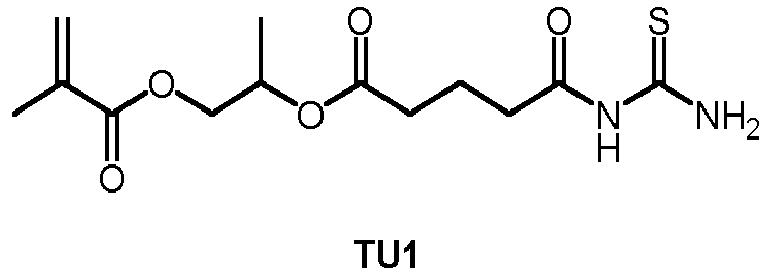
- 5-[(1-Methacryloyloxypropan-2-yl)oxy]-5-oxopentanoic acid (10.0 g, 38.7 mmol) was dissolved in dichloromethane (100 mL). N,N-Dimethylformamide (28 mg, 0.39 mmol) and thionyl chloride (4.61 g, 38.7 mmol) were added and the reaction mixture was stirred at ambient temperature for 22 h. Thiourea (7.37 g, 96.8 mmol) was added and the suspension was heated to reflux for 24 h. After cooling to RT, the suspension was filtered. The yellow filtrate was washed with water (2x 100 mL), saturated aqueous NaHCO3 solution (100 mL), and brine (100 ml), dried over anhydrous sodium sulfate, filtered through a pad of silica gel, and the solvent was evaporated. The residue was dissolved in toluene (50 mL). The solution was cooled in an ice bath and stirred until a solid precipitated. n-Heptane (25 mL) was added and the suspension was filtered. The residue was washed with n-heptane/toluene 1:2 (50 mL) and dried under reduced pressure, affording 7.62 g (24.1 mmol; 62%) of the desired product as a white solid.
- 1H-NMR (CDCl3, 400 MHz): δ = 9.90 (br s, 1H; NH), 9.73 (br s, 1H; NH), 7.71 (br s, 1H; NH), 6.15 - 6.10 (m, 1H; =CH), 5.63 - 5.58 (m, 1H; =CH), 5.29 - 5.17 (m, 1H; CH), 4.32 - 4.10 (m, 2H; O-CH2), 2.53 - 2.34 (m, 4H; CH2), 2,05 - 1.88 (m, 5H; CH2, CH3), 1.29 (d, J = 6.5 Hz, 3H; CH3).
-

- TU1 (633 mg, 2.0 mmol) and butyl methacrylate (853 mg, 6.0 mmol) were added to THF (8.6 mL) and nitrogen was bubbled through the solution for 15 min. 2-Mercaptoethanol (31.5 mg, 0.40 mmol) and AIBN (13.1 mg, 0.08 mmol) were added and the reaction mixture was heated to 70°C. The acylthiourea monomer TU1 represented 25% of the total amount of monomers. The chain transfer agent 2-mercaptoethanol was added in an amount of 5 mol-%, based on the total molar amount of monomers. After 16 h, the solvent was evaporated and the residue was dried under reduced pressure, affording 1.41 g of the desired oligomer.
- Mn = 4100 g/mol (GPC); 1H-NMR (DMSO-d6 , 400 MHz): δ = 11.07 (NH), 9.62 (NH), 9.36 (NH), 5.17 - 4.80 (CH- CH3), 4.02 - 3.76 (OCH2), 2.47 - 2.21 (CH2), 2.13 - 0.47 (CH2, CH3).
-

- TU1 (1.27 g, 4.0 mmol) and butyl methacrylate (1.71 g, 12.0 mmol) were added to THF (14 mL) and nitrogen was bubbled through the solution for 15 min. 2-Mercaptoethanol (31.2 mg, 0.40 mmol) and AIBN (26.3 mg, 0.16 mmol) were added and the reaction mixture was heated to 70°C. The acylthiourea monomer TU1 represented 25% of the total amount of monomers. The chain transfer agent 2-mercaptoethanol was added in an amount of 2.5 mol-%, based on based on the total molar amount of monomers. After 16 h, the solvent was evaporated and the residue was dried under reduced pressure, affording 2.83 g of the desired oligomer.
- Mn = 5600 g/mol (GPC); 1H-NMR (DMSO-d6 , 400 MHz): δ = 11.07 (NH), 9.63 (NH), 9.36 (NH), 5.19 - 4.70 (CH- CH3), 4.25 - 3.67 (OCH2), 2.48 - 2.20 (CH2), 2.12 - 0.34 (CH2, CH3).
-

- TU1 (2.53 g, 8.0 mmol) and butyl methacrylate (1.14 g, 8.0 mmol) were added to THF (16 mL) and nitrogen was bubbled through the solution for 15 min. 2-Mercaptoethanol (63.1 mg, 0.80 mmol) and AIBN (26.3 mg, 0.16 mmol) were added and the reaction mixture was heated to 70°C. The acylthiourea monomer TU1 represented 50% of the total amount of monomers. The chain transfer agent 2-mercaptoethanol was added in an amount of 5 mol-%, based on based on the total molar amount of monomers. After 16 h, the solvent was evaporated and the residue was dried under reduced pressure, affording 3.50 g of the desired oligomer.
- Mn = 3800 g/mol (GPC); 1H-NMR (DMSO-d6 , 400 MHz): δ = 11.06 (NH), 9.62 (NH), 9.35 (NH), 5.20 -4.80 (CH- CH3), 4.33 - 3.66 (OCH2), 2.68 -2.13 (CH2), 2.11 - 0.36 (CH2, CH3).
-

- TU1 (2.53 g, 8.0 mmol) and methyl methacrylate (2.40 g, 24.0 mmol) were added to THF (28 mL) and nitrogen was bubbled through the solution for 15 min. 2-Mercaptoethanol (126 mg, 1.60 mmol) and AIBN (53 mg, 0.32 mmol) were added and the reaction mixture was heated to 70°C. The acylthiourea monomer TU1 represented 25% of the total amount of monomers. The chain transfer agent 2-mercaptoethanol was added in an amount of 5 mol-%, based on based on the total molar amount of monomers. After 16 h, the solvent was evaporated and the residue was dried under reduced pressure, affording 4.69 g of the desired oligomer.
- Mn = 3200 g/mol (GPC); 1H-NMR (DMSO-d6 , 400 MHz): δ = 11.08 (NH), 9.63 (NH), 9.37 (NH), 5.17 - 4.80 (CH- CH3), 4.24 - 3.78 (OCH2), 3.56 (OCH3), 2.49 - 2.23 (CH2), 2.10 - 0.55 (CH2, CH3).
-

- TU1 (1.27 g, 4.0 mmol) and 2-phenoxyethyl methacrylate (2.48 g, 12.0 mmol) were added to THF (21 mL) and nitrogen was bubbled through the solution for 15 min. 2-Mercaptoethanol (62.5 mg, 0.80 mmol) and AIBN (26 mg, 0.16 mmol) were added and the reaction mixture was heated to 70°C. The acylthiourea monomer TU1 represented 25% of the total amount of monomers. The chain transfer agent 2-mercaptoethanol was added in an amount of 5 mol-%, based on based on the total molar amount of monomers. After 16 h, the solvent was evaporated and the residue was dried under reduced pressure, affording 3.56 g of the desired oligomer.
- Mn = 4000 g/mol (GPC); 1H-NMR (DMSO-d6 , 400 MHz): δ = 11.07 (NH), 9.63 (NH), 9.37 (NH), 7.34 - 7.15 (ArH), 7.01 - 6.81 (ArH), 5.11 - 4.81 (CH- CH3), 4.45 - 3.69 (OCH2), 2.55 - 2.46 (CH3), 2.44 - 2.17 (CH2), 2.05 - 0.48 (CH2, CH3).
- The catalyst pastes C1 and C2 listed in Table 1 were prepared by homogenous mixing of the components named in the table. The pastes contained the following monomers: Bis-GMA, bis-[(2-methacryloyloxyethoxycarbonyl)amino]2,2,4(2,4,4)-trimethyl-hexane (UDMA) and 2-(2-phenylphenoxy)ethyl methacrylate (PEM). Methylhydroquinone (MEHQ) was added as a stabilizer to each paste. Cumene hydroperoxide (CHP) was used as oxidant. The barium-aluminium-borosilicate glass filler GM27884 (Schott AG, average particle size 1 µm; BET specific surface area (BET DIN ISO 9277: 2010) 3.9 m2/g; composition (% by weight): Al2O3: 10, B2O3: 10, BaO: 25 and SiO2: 55) and a spherical SiO2-ZrO2 mixed oxide (Spherosil, Transparent Materials) were used as fillers.
Table 1: Composition of catalyst pastes C1 and C2 Component C1 [wt%] C2 [wt%] Bis-GMA 11.694 11.394 UDMA 15.592 15.192 PEM 11.694 11.394 CHP 1.00 2.00 MEHQ 0.02 0.02 Mixed oxide Spherosil 10.00 10.00 Glass filler GM27884 50.00 50.00 - The base pastes B1-B6 listed in Table 2 were prepared by homogeneous mixing of the components named in the table. TEMPO (CAS Registry Number 2564-83-2) was used as additional stabilizer. The barium-aluminium-borosilicate glass filler GM27884 (Schott AG, average particle size 1 µm; BET specific surface area (BET DIN ISO 9277: 2010) 3.9 m2/g; composition (% by weight ): Al2O3: 10, B2O3: 10, BaO: 25 and SiO2: 55) and a spherical SiO2-ZrO2 mixed oxide (Spherosil, Transparent Materials) were used as fillers. Copper(II) acetylacetonate (Cu(acac)2) was used as transition metal compound. For the comparative paste B6, acetylthiourea (ATU) was used as a reducing agent.
Table 2: Composition of base pastes B1 - B6 Component B1 [wt%] B2 [wt%] B3 [wt%] B4 [wt%] B5 [wt%] B6 [wt%]* Bis-GMA 10.7892 11.3892 10.7892 - - 11.811 UDMA 14.3856 15.1856 14.3856 - - 15.748 PEM 10.7892 11.3892 10.7892 - - 11.811 ATUO 1 4.00 2.00 - - - - ATUO 2 - - 4.00 - - - ATUO 3 - - - 4.00 - - ATUO 4 - - - 4.00 - ATU - - - - - 0.60 Cu(acac)2 0.008 0.008 0.008 0.008 0.008 0.002 MEHQ 0.02 0.02 0.02 0.02 0.02 0.02 TEMPO 0.008 0.008 0.008 0.008 0.008 0.008 Mixed oxide Spherosil 10.00 10.00 10.00 10.00 10.00 10.00 Glass filler GM27884 50.00 50.00 50.00 50.00 50.00 50.00 * comparative example - The self-curing composites listed in Table 3 were prepared by mixing catalyst paste and base paste by hand in a ratio of 1/1 wt/wt. Flexural strength specimens (2 mm × 2 mm × 25 mm) were prepared using a stainless-steel mold. The mold was filled with the cement, then covered with a polyethylene film and placed in an oven at 37°C for 45 min. The specimens were removed from the mold and were stored in water at 37°C for 24 h. The measurement of the flexural strength and modulus was carried out in three-point bending tests (span: 20 mm) according to ISO4049 (Dentistry - Polymer-based filling, restorative and luting materials) with a speed of 0.8 mm min-1 using a Z2.5/TS universal testing machine (Zwick, Germany).
Table 3: Mechanical properties of self-cure composites (SCC) Self-cure composite Flexural strength [MPa] Flexural modulus [GPa] SCC1 (C1 + B1) 85.9 ± 5.8 5.9 ± 0.2 SCC2 (C2 + B1) 93.3 ± 5.1 7.0 ± 0.2 SCC3 (C2 + B2) 107.9 ± 6.2 7.3 ± 0.2 SCC4 (C2 + B3) 98.7 ± 6.2 7.0 ± 0.2 SCC5 (C2 + B4) 90.8 ± 6.4 6.8 ± 0.2 SCC6 (C2 + B5) 100.6 ± 7.5 7.1 ± 0.2 SCC7 (C2 + B6*) 106.3 ± 7.4 7.0 ± 0.3 * comparative example - The data in Table 3 show that the acylthiourea oligomers according to the invention resulted in composites with excellent mechanical properties. Composite SCC1 exhibited slightly lower values for flexural strength and modulus compared to the other composites, which can be attributed to the lower amount of CHP in catalyst paste C1. The other composites according to the invention exhibited similar mechanical properties as the reference material SCC7.
- The cements listed in Table 4 were prepared by mixing catalyst paste and base paste by hand in a ratio of 1/1 wt/wt. The working time was determined with an oscillating rheometer (Rheometer MCR 302, Anton Paar) using a plate / plate geometry, at 28.7°C. The storage modulus was recorded as a function of time (frequency = 1 Hz). A graph representing the storage modulus (logarithmic) as a function of time (non-logarithmic) was then used for the determination of the working time. The inflexion point (to be found where the slope of the function reaches its highest value) was identified. A second point on the curve was set as soon as the storage modulus started to rise (end of the stable phase). A straight line was then drawn between the two points. The point on the curve (before the inflexion point) where the tangent line is parallel to this straight line gives the working time.
Table 4: Working times of self-cure composites (SCC) Self-cure composites Working time [s] SCC1 (C1 + B1) 269 ± 28 SCC2 (C2 + B1) 137 ± 2 SCC3 (C2 + B2) 160 ± 1 SCC4 (C2 + B3) 157 ± 7 SCC5 (C2 + B4) 198 ± 7 SCC6 (C2 + B5) 143 ± 7 SCC7 (C2 + B6*) 149 ± 6 * comparative example - Table 4 shows, that the composites according to the invention had good working times. For the development of self-cure composites, working times of about 2 to 4 minutes are usually targeted. Due to its lower amount of CHP, composite SCC1 had the longest working time.
- The catalyst pastes C3 and C4 listed in Table 5 were prepared by homogenous mixing of the components named in the table. The pastes contained the following monomers: tetramethylxylylene diurethane-2-methylethylene glycoldi(meth)acrylate (V380), glycerol dimethacrylate (GDMA), bis-[(2-methacryloyloxyethoxycarbonyl)-amino]2,2,4(2,4,4)-trimethylhexane (UDMA) and 2-(2-phenylphenoxy)ethyl methacrylate (PEM). Methylhydroquinone (MEHQ) was added as a stabilizer. Cumene hydroperoxide (CHP) was used as oxidant. The barium-aluminium-borosilicate glass filler GM27884 (Schott AG, average particle size 1 µm; BET specific surface area (BET DIN ISO 9277: 2010) 3.9 m2/g; composition (% by weight): Al2O3: 10, B2O3: 10, BaO: 25 and SiO2: 55) and ytterbium fluoride (200 nm, Sukgyung) were used as fillers.
Table 5: Composition of catalyst pastes C3 and C4 Component C3 [wt%] C4 [wt%] V380 10.128 10.23 GDMA 10.128 10.23 PEM 6.752 6.82 UDMA 6.752 6.82 CHP 1.22 0.88 MEHQ 0.02 0.02 Ytterbium fluoride 15.00 15.00 Glass filler GM27884 50.00 50.00 - The base pastes B7 and B8 listed in Table 6 were prepared by homogeneous mixing of the components named in the table. The base pastes contained the acidic monomer 10-methacryloyloxydecyl dihydrogen phosphate (MDP). TEMPO (CAS Registry Number 2564-83-2) was used as additional stabilizer. The barium-aluminium-borosilicate glass filler GM27884 (Schott AG, average particle size 1 µm; BET specific surface area (BET DIN ISO 9277: 2010) 3.9 m2/g; composition (% by weight): Al2O3: 10, B2O3: 10, BaO: 25 and SiO2: 55) and ytterbium fluoride (200 nm, Sukgyung) were used as fillers. Copper(II) acetylacetonate (Cu(acac)2) was used as transition metal compound. For the comparative paste B8, hexanoyl thiourea (HTU) was used as reducing agent.
Table 6: Composition of base pastes B7 and B8 Component B7 [wt%] B8* [wt%] V380 9.0654 9.291 GDMA 9.0654 9.291 PEM 6.0436 6.194 UDMA 6.0436 6.194 MDP 3.00 3.00 ATUO 1 1.75 - HTU - 1.00 Cu(acac)2 0.004 0.002 MEHQ 0.02 0.02 TEMPO 0.008 0.008 Yterbium fluoride 15.00 15.00 Glass filler GM27884 50.00 50.00 * comparative example - Sulzer Mixpack two-component syringes were each filled with a catalyst paste and a base paste to produce the self-adhesive resin cements SAC1 to SAC3.
- The self-adhesive cements listed in Table 7 were prepared by mixing catalyst paste and base paste by pressing the pastes out of the double-push syringes. The cements were filled directly into the mold for preparing the test specimens. Flexural strength and flexural modulus were determined as described in Example 8.
Table 7: Mechanical properties of self-adhesive resin cements Self-adhesive resin cements Flexural strength [MPa] Flexural modulus [GPa] SAC1 (C3 + B7) 125.4 ± 9.6 7.7 ± 0.3 SAC2 (C3 + B8)* 119.6 ± 7.4 7.0 ± 0.1 SACS (C4 + B8)* 112.3 ± 12.2 6.2 ± 0.4 * comparative example - Table 7 shows that the cements had excellent mechanical properties. Cements SAC2 and SAC3 comprise an acylthiourea derivative (HTU) according to the prior art. Compared to cement SAC2, cement SAC3 had a significantly lower flexural modulus due to its lower amount of the hydroperoxide CHP.
- The working times of self-adhesive cements were determined as described in Example 9.
Table 8: Working times of self-adhesive composites Self-adhesive resin cements Working time [s] SAC1 (C3 + B7) 187 ± 2 SAC2 (C3 + B8)* 73 ± 3 SAC3 (C3 + B8)* 139 ± 2 * comparative example - The cement SAC1 according to the invention had a working time of 187 s. The working time of the comparative cement SAC2 was only 73 s, which is too short for many applications. Reducing the amount of hydroperoxide CHP in cement SAC3 gave an acceptable working time. However, as shown in Example 11, reducing the amount of peroxide also resulted in a significant decrease in flexural modulus. The acylthiourea oligomers according to the present invention enable the adjustment of the working time of self-adhesive cements without impairing their mechanical properties.
Claims (15)
- An acylthiourea oligomer according to Formula (I)
 R1 is a branched or a linear C1-C16 alkanediyl group, preferably a C1-C12 alkanediyl group, and more preferably a C1-C8 alkanediyl group, that can be interrupted by one or more S atoms, O atoms, -C(O)O- groups and/or -C(O)NH- groups;
ora C4-C16 cycloaliphatic group that can be unsubstituted or substituted by one or more substituents selected from branched or preferably linear C1-C20 alkyl groups, preferably C1-C12 alkyl groups, most preferably C1-C6 alkyl groups, and can be interrupted by one or more S atoms, O atoms, -C(O)O- groups and/or -C(O)NH- groups;
ora combination of the branched or the linear C1-C16 alkanediyl group and the C4-C16 cycloaliphatic group;
ora C7-C20-alkylaryl group that can be interrupted by one or more S atoms, O atoms, -C(O)O- groups and/or -C(O)NH- groups, and/or can be unsubstituted or substituted by one or more substituents selected from branched or preferably linear C1-C20 alkyl groups, branched or preferably linear -O-C1-C12 alkoxy groups, ester groups -C(O)O-R8, where R8 is a branched or preferably linear C1-C20 alkyl group, and/or acyl groups -C(O)-R9, where R9 is a branched or preferably linear C1-C20 alkyl group;R2, R4 are, independently of each other, hydrogen or a methyl group;R3 is a branched or preferably linear C1-C12 alkyl group, preferably a C1-C10 alkyl group, and more preferably a C1-C8 alkyl group, that can be interrupted by one or more S atoms, O atoms, -C(O)O- groups and/or -C(O)NH- groups and/or can be substituted by one or more functional groups, preferably OH, COOH and/or halogen;
ora C4-C16 cycloaliphatic group that can be unsubstituted or substituted by one or more substituents selected from branched or preferably linear C1-C20 alkyl groups, preferably C1-C12 alkyl groups, most preferably C1-C6 alkyl groups, that can be interrupted by one or more S atoms, O atoms, -C(O)O- groups and/or C(O)NH- groups;
ora C4-C10 aryl or heteroaryl group which can be unsubstituted or substituted by one or more substituents which are selected from branched or preferably linear C1-C20 alkyl groups, -O-C1-C12 alkoxy groups, ester groups -C(O)O-R10, where R10 is a branched or preferably linear C1-C20 alkyl group, a C6-C10 aryl group or a C7-C20-alkylaryl group, and/or acyl groups -C(O)-R11, where R11 is a branched or preferably linear C1-C20 alkyl group, a C6-C10 aryl group or a C7-C20-alkylaryl group and/or can be interrupted by one or more S atoms or O atoms;
ora C5-C20-alkylaryl or C5-C20-alkylheteroaryl group that can be interrupted by one or more S atoms, O atoms, -C(O)O- groups and/or -C(O)NH-groups, and/or can be unsubstituted or substituted by one or more substituents selected from branched or preferably linear C1-C20 alkyl groups, branched or preferably linear -O-C1-C12 alkoxy groups, ester groups -C(O)O-R12, where R12 is a branched or preferably linear C1-C20 alkyl group, a C6-C10 aryl group or a C7-C20-alkylaryl group, and/or acyl groups -C(O)-R13, where R13 is a branched or preferably linear C1-C20 alkyl group, a C6-C10 aryl group or a C7-C20-alkylaryl group;R5 is a phenyl or a -O(C=O)-CH3 group;m is an integer within a range from 1 to 100, preferably 2 to 50, most preferably 2 to 30;p is an integer within a range from 0 to 100, preferably 2 to 50, most preferably 5 to 50;q is an integer within a range from 0 and 100, preferably 0 to 50, most preferably 0 to 30;m + p + q ≥ 2 and whereinm/(m + p + q) is a value within a range from 0.1 and 1.0, preferably 0.1 to 0.5, most preferably 0.2 to 0.5. - The acylthiourea oligomer according to claim 1, whereinR1 is a branched or a linear C1-C16 alkanediyl group, preferably a C1-C12 alkanediyl group, and more preferably a C1-C8 alkanediyl group, that can be interrupted by one or more S atoms, O atoms, -C(O)O- groups and/or -C(O)NH- groups;
ora C4-C16 cycloaliphatic group that can be unsubstituted or substituted by one or more substituents selected from branched or preferably linear C1-C20 alkyl groups, preferably C1-C12 alkyl groups, most preferably C1-C6 alkyl groups, and can be interrupted by one or more S atoms, O atoms, -C(O)O- groups and/or -C(O)NH- groups;
ora combination of branched or the linear C1-C16 alkanediyl group and the C4-C16 cycloaliphatic group;
ora C7-C20-alkylaryl group that can be interrupted by one or more S atoms, O atoms, -C(O)O- groups and/or -C(O)NH- groups, and/or can be unsubstituted or substituted by one or more substituents selected from branched or preferably linear C1-C20 alkyl groups, branched or preferably linear O-C1-C12 alkoxy groups, ester groups -C(O)O-R8, where R8 is a branched or preferably linear C1-C20 alkyl group, and/or acyl groups -C(O)-R9, where R9 is a branched or preferably linear C1-C20 alkyl group;R2 is hydrogen atom or a methyl group;R3 is a branched or preferably linear C1-C12 alkyl group, preferably a C1-C10 alkyl group, and more preferably a C1-C8 alkyl group, that can be interrupted by one or O atoms, -C(O)O- groups and/or -C(O)NH- groups and/or that can be substituted by one or more functional groups, preferably OH, COOH and/or halogen;
ora C4-C16 cycloaliphatic group that can be unsubstituted or substituted by one or more substituents selected from branched or preferably linear C1-C20 alkyl groups, preferably C1-C12 alkyl groups, most preferably C1-C6 alkyl groups, and can be interrupted by one or more S atoms, O atoms, -C(O)O- groups and/or -C(O)NH- groups;
ora C4-C10 aryl or heteroaryl group which can be unsubstituted or substituted by one or more substituents selected from branched or preferably linear C1-C20 alkyl groups, -O-C1-C12 alkoxy groups, ester groups -C(O)O-R10, where R10 is either a branched or preferably linear C1-C20 alkyl group, and/or acyl groups -C(O)-R11, where R11 is a branched or preferably a linear C1-C20 alkyl group;
ora C5-C20-alkylaryl or alkylheteroaryl group that can be interrupted by one or more O atoms, -C(O)O- groups and/or -C(O)NH- groups, and/or can be unsubstituted or substituted by one or more substituents selected from branched or preferably linear C1-C20 alkyl groups, branched or preferably linear -O-C1-C12 alkoxy groups, ester groups -C(O)O-R12, where R12 is a branched or preferably linear C1-C20 alkyl group, and/or acyl groups -C(O)-R13, where R13 is a branched or preferably linear C1-C20 alkyl group;R4 is a hydrogen atom or a methyl group;m is an integer within a range from 1 to 100, preferably 2 to 50, most preferably 2 to 30;p is an integer within a range from 0 to 100, preferably 2 to 50, most preferably 5 and 50;q is 0;m + p ≥ 2 andm/(m+p) is a value within the range from 0.1 to 1.0, preferably 0.1 to 0.5, most preferably 0.2 to 0.5. - The acylthiourea oligomer according to claim 2, whereinR1 is a branched or a linear C1-C16 alkanediyl group, preferably a C1-C12 alkanediyl group, and more preferably a C1-C8 alkanediyl group, that can be interrupted by one or more O atoms, -C(O)O- groups and/or -C(O)NH- groups;R2 is a hydrogen atom or a methyl group;R3 is a branched or preferably a linear C1-C12 alkyl group, preferably a C1-C10 alkyl group, and more preferably a C1-C8 alkyl group, that can be interrupted by one or O atoms, -C(O)O- groups and/or -C(O)NH- groups or that can be substituted by one or more functional groups, preferably OH, COOH and/or halogen;
ora C4-C16 cycloaliphatic group that can be unsubstituted or substituted by one or more substituents selected from branched or preferably linear C1-C20 alkyl groups, preferably C1-C12 alkyl groups, most preferably C1-C6 alkyl groups, and that can be interrupted by one or more O atoms, -C(O)O- groups and/or -C(O)NH- groups;
ora C5-C20-alkylaryl or alkylheteroaryl group that can be interrupted by one or more O atoms, -C(O)O- groups and/or -C(O)NH- groups, and/or can be unsubstituted or substituted by one or more substituents selected from branched or preferably linear C1-C20 alkyl groups, branched or preferably linear O-C1-C12 alkoxy groups;R4 is a hydrogen atom or a methyl group;m is an integer within a range from 1 to 100, preferably 2 to 50, most preferably 2 to 30;p is an integer within a range from 0 to 100, preferably 2 to 50, most preferably 5 to 50;q is 0;m + p ≥ 2 andm/(m+p) is a value within a range from 0.1 to 1.0, preferably 0.1 to 0.5, most preferably 0.2 to 0.5. - A radically polymerizable composition comprising at least one acylthiourea oligomer according to any one of claims 1 to 3, at least one hydroperoxide and at least one radically polymerizable monomer.
- The radically polymerizable composition according to claim 4, wherein the at least one hydroperoxide comprises a compound of the formula R14-(OOH)y, in which R14 is an aliphatic or aromatic hydrocarbon radical and y is 1 or 2.
- The radically polymerizable composition according to claim 5, wherein the at least one hydroperoxide is selected from t-amyl hydroperoxide, 1,1,3,3-tetramethylbutyl hydroperoxide, t-butyl hydroperoxide, t-hexyl hydroperoxide, 2,5-dimethyl-2,5-di(hydroperoxy)hexane, diisopropylbenzene monohydroperoxide, paramenthane hydroperoxide, p-isopropylcumene hydroperoxidem, cumene hydroperoxide (CHP) and a mixture thereof.
- The radically polymerizable composition according to any one of claims 4 to 6, wherein the hydroperoxide comprises a compound according to the following Formula (IV),
 Q1 a x-valent, aromatic, aliphatic, linear or branched C1-C14 hydrocarbon radical, which can be interrupted by one or more S and/or O atoms and which can be unsubstituted or substituted by one or more substituents which are preferably selected from -OH, -OR15, -Cl and -Br, wherein R15 is an aliphatic, linear or branched C1-C10 hydrocarbon radical,X', Y' independently of each other are in each case absent, -O-, -COO-; -CONR16-, or -O-CO-NR17-, wherein R16 and R17 independently of each other represent H or a C1-C5 alkyl radical, preferably H, methyl and/or ethyl, particularly preferably H, and wherein X' and Y' are preferably not absent at the same time, and wherein X' and/or Y' is absent if Q2 is absent,Q2 is absent, an aliphatic, linear or branched C1-C14 alkylene radical, which can be interrupted by S and/or O atoms and which can be unsubstituted or substituted by -OH, -OR18, -Cl and/or -Br, wherein R18 is an aliphatic, linear or branched C1-C10 hydrocarbon radical,Q3 a C1-C3 alkylene group or is absent, preferably -CH2- or is absent,x 1, 2, 3 or 4, and whereinthe substitution on the aromatic compound takes place in position 2, 3 or 4, relative to the cumene hydroperoxide group.
 - The radically polymerizable composition according to any one of claims 4 to 7, wherein the at least one radically polymerizable monomer is a multifunctional (meth)acrylate, preferably a dimethacrylate or a mixture of mono- and dimethacrylates.
- The radically polymerizable composition according to claim 8, wherein the at least one multifunctional (meth)acrylate is selected from bis-GMA (an addition product of methacrylic acid and bisphenol A diglycidyl ether), ethoxylated or propoxylated bisphenol A dimethacrylate, preferably the bisphenol A dimethacrylate with 3 ethoxy groups or 2,2-bis[4-(2-methacryloyloxypropoxy)phenyl]-propane, UDMA (an addition product of 2-hydroxyethyl methacrylate and 2,2,4-trimethylhexamethylene-1,6-diisocyanate), 2-{[(2-(methacryloyloxy)-ethoxy)carbonyl]amino} ethyl methacrylate, tetramethylxylylene diurethane ethylene glycol di(meth)acrylate, tetramethylxylylene diurethane ethylene glycol di(meth)acrylate, tetramethylxylylene diurethane-2-methylethylene glycoldi-(meth)acrylate (V380), di-, tri- or tetraethylene glycol dimethacrylate, trimethylol propanetrimethacrylate, pentaerythritol tetramethacrylate, glycerol di- and trimethacrylate, 1,4-butanediol dimethacrylate, 1,10-decanediol dimethacrylate (D3MA), bis(methacryloyloxymethyl)tricyclo-[5.2.1.02,6]decane (DCP), polyethylene glycol or polypropylene glycol dimethacrylates, polyethylene glycol 200-dimethacrylate or polyethylene glycol 400-dimethacrylate (PEG-200- or PEG-400-DMA), or 1,12-dodecanediol dimethacrylate or a mixture thereof,
and/or
wherein the at least one monofunctional (meth)acrylate is selected from benzyl and furfuryl methacrylate, 2-phenoxyethyl methacrylate, 2-(o-biphenyloxy)-ethyl methacrylate, 2-hydroxy-3-phenoxypropyl methacrylate, phenethyl methacrylate, 2-[(benzyloxycarbonyl)-amino]-ethyl methacrylate, 2-[(benzylcarbamoyl)oxy]ethyl methacrylate, 1-phenoxypropan-2-yl methacrylate, 2-(p-cumylphenoxy)ethyl methacrylate, tricyclodecane methacrylate, tricyclodecane methyl methacrylate, 2-(p-cumylphenoxy)ethyl methacrylate, cumylphenoxyethylene glycol methacrylate (CMP-1E) or a mixture thereof. - The radically polymerizable composition according to any one of claims 4 to 9, which additionally comprises at least one acid-group-containing radically polymerizable monomer, preferably a polymerizable carboxylic acid, phosphonic acid, a polymerizable phosphoric acid ester or an anhydride of these substances.
- The radically polymerizable composition according to any one of claims 4 to 10, which additionally comprises a transition metal compound, preferably a compound of a transition metal which has at least two stable oxidation states, preferably a compound of copper, iron, cobalt, nickel, manganese or a mixture thereof.
- The radically polymerizable composition according to any one of claims 4 to 11, which additionally comprises at least one organic or inorganic filler, preferably an oxide, such as SiO2, ZrO2 and TiO2 or a mixed oxide of SiO2, ZrO2, ZnO and/or TiO2, a nanoparticulate or microfine filler, such as pyrogenic silica or precipitated silica, glass powders, such as quartz, glass ceramic or radiopaque glass powder, preferably barium or strontium aluminium silicate glass powder, a radiopaque filler, such as ytterbium trifluoride, tantalum(V) oxide, barium sulfate, a mixed oxide of SiO2 with ytterbium(III) oxide or tantalum(V) oxide, a ground prepolymer or a pearl polymer.
- The radically polymerizable composition according to any one of claims 4 to 12, which comprises:(a) 0.2 to 10.0 wt.-%, preferably 0.3 to 8.0 wt.-% and more preferably 0.5 to 5.0 wt.-% of at least one acylthiourea oligomer according to Formula (I) or preferably Formula (II),(b) 0.1 to 5.0 wt.-%, preferably 0.1 to 4.0 wt.-% and more preferably 0.2 to 2.0 wt.-% of at least one hydroperoxide compound,(c) 5 to 80 wt.-%, preferably 10 to 60 wt.-% and more preferably 15 to 50 wt.-% of at least one radically polymerizable monomer,(d) 20 to 90 wt.-%, preferably 40 to 85 wt.-% and more preferably 50 to 80 wt.-% filler(s), and(e) 0.001 to 5 wt.-%, preferably 0.01 to 3 wt.-%, additive(s),in each case based on the total mass of the composition.
- The radically polymerizable composition according to any one of claims 4 to 13, for therapeutic use as a dental material, as a dental cement, coating or veneering material, filling composite or luting cement.
- Non-therapeutic use of a the radically polymerizable composition according to any one of claims 4 to 13, for the production or repair of dental restorations, such as prostheses, artificial teeth, inlays, onlays, crowns, bridges and complete dentures.
Priority Applications (2)
| Application Number | Priority Date | Filing Date | Title |
|---|---|---|---|
| EP23156186.1A EP4414390A1 (en) | 2023-02-10 | 2023-02-10 | Acylthiourea oligomers suitable as redox initiator components and radically polymerizable compositions comprising them |
| US18/437,500 US20240285477A1 (en) | 2023-02-10 | 2024-02-09 | Acylthiourea oligomers suitable as redox initiator components and radically polymerizable compositions comprising them |
Applications Claiming Priority (1)
| Application Number | Priority Date | Filing Date | Title |
|---|---|---|---|
| EP23156186.1A EP4414390A1 (en) | 2023-02-10 | 2023-02-10 | Acylthiourea oligomers suitable as redox initiator components and radically polymerizable compositions comprising them |
Publications (1)
| Publication Number | Publication Date |
|---|---|
| EP4414390A1 true EP4414390A1 (en) | 2024-08-14 |
Family
ID=85224957
Family Applications (1)
| Application Number | Title | Priority Date | Filing Date |
|---|---|---|---|
| EP23156186.1A Pending EP4414390A1 (en) | 2023-02-10 | 2023-02-10 | Acylthiourea oligomers suitable as redox initiator components and radically polymerizable compositions comprising them |
Country Status (2)
| Country | Link |
|---|---|
| US (1) | US20240285477A1 (en) |
| EP (1) | EP4414390A1 (en) |
Citations (14)
| Publication number | Priority date | Publication date | Assignee | Title |
|---|---|---|---|---|
| EP0408357B1 (en) | 1989-07-12 | 1994-06-01 | Kuraray Co., Ltd. | Polymerizable composition |
| EP0480785B1 (en) | 1990-09-14 | 1996-12-27 | Terumo Kabushiki Kaisha | Polymerization initiator composition controlling polymerization at interface and curable composition containing same |
| US6953535B2 (en) | 2001-05-16 | 2005-10-11 | 3M Espe Ag | Initiator system for acid dental formulations |
| EP1693046A1 (en) | 2005-02-21 | 2006-08-23 | Kerr Corporation | Acid tolerant dental composition |
| WO2007016508A1 (en) | 2005-08-02 | 2007-02-08 | Dentsply International Inc. | Catalyst system for dental compositions |
| EP1754465A1 (en) | 2005-08-19 | 2007-02-21 | Heraeus Kulzer GmbH | 2-component initiator system (amine free) with storage stability and especially suitable for acidic systems |
| US7465758B2 (en) | 2003-09-26 | 2008-12-16 | 3M Innovative Properties Company | Dental compositions and methods with arylsulfinate salts |
| US7541393B2 (en) | 2001-12-29 | 2009-06-02 | 3M Innovative Properties Company | Composition containing a polymerizable reducing agent, kit, and method |
| EP2103296A1 (en) | 2008-03-20 | 2009-09-23 | Ivoclar Vivadent AG | Polymer-coated glass filler for use in dental material |
| EP2233544B1 (en) | 2009-03-25 | 2011-12-21 | GC Corporation | Polymerizable composition |
| US8236871B2 (en) | 2006-05-31 | 2012-08-07 | 3M Innovative Properties Company | Polymerizable compositions containing salts of barbituric acid derivatives |
| EP3692976A1 (en) | 2019-02-07 | 2020-08-12 | Ivoclar Vivadent AG | Dental materials based on redox systems with low odor cumolhyde-hydroperoxide derivatives |
| US10932994B2 (en) | 2014-07-10 | 2021-03-02 | 3M Innovative Properties Company | Two-component self-adhesive dental composition, process of production and use thereof |
| EP4039220A1 (en) | 2021-02-05 | 2022-08-10 | Ivoclar Vivadent AG | Dental materials on the basis of polymerisable thiourea derivatives |
-
2023
- 2023-02-10 EP EP23156186.1A patent/EP4414390A1/en active Pending
-
2024
- 2024-02-09 US US18/437,500 patent/US20240285477A1/en active Pending
Patent Citations (14)
| Publication number | Priority date | Publication date | Assignee | Title |
|---|---|---|---|---|
| EP0408357B1 (en) | 1989-07-12 | 1994-06-01 | Kuraray Co., Ltd. | Polymerizable composition |
| EP0480785B1 (en) | 1990-09-14 | 1996-12-27 | Terumo Kabushiki Kaisha | Polymerization initiator composition controlling polymerization at interface and curable composition containing same |
| US6953535B2 (en) | 2001-05-16 | 2005-10-11 | 3M Espe Ag | Initiator system for acid dental formulations |
| US7541393B2 (en) | 2001-12-29 | 2009-06-02 | 3M Innovative Properties Company | Composition containing a polymerizable reducing agent, kit, and method |
| US7465758B2 (en) | 2003-09-26 | 2008-12-16 | 3M Innovative Properties Company | Dental compositions and methods with arylsulfinate salts |
| EP1693046A1 (en) | 2005-02-21 | 2006-08-23 | Kerr Corporation | Acid tolerant dental composition |
| WO2007016508A1 (en) | 2005-08-02 | 2007-02-08 | Dentsply International Inc. | Catalyst system for dental compositions |
| EP1754465A1 (en) | 2005-08-19 | 2007-02-21 | Heraeus Kulzer GmbH | 2-component initiator system (amine free) with storage stability and especially suitable for acidic systems |
| US8236871B2 (en) | 2006-05-31 | 2012-08-07 | 3M Innovative Properties Company | Polymerizable compositions containing salts of barbituric acid derivatives |
| EP2103296A1 (en) | 2008-03-20 | 2009-09-23 | Ivoclar Vivadent AG | Polymer-coated glass filler for use in dental material |
| EP2233544B1 (en) | 2009-03-25 | 2011-12-21 | GC Corporation | Polymerizable composition |
| US10932994B2 (en) | 2014-07-10 | 2021-03-02 | 3M Innovative Properties Company | Two-component self-adhesive dental composition, process of production and use thereof |
| EP3692976A1 (en) | 2019-02-07 | 2020-08-12 | Ivoclar Vivadent AG | Dental materials based on redox systems with low odor cumolhyde-hydroperoxide derivatives |
| EP4039220A1 (en) | 2021-02-05 | 2022-08-10 | Ivoclar Vivadent AG | Dental materials on the basis of polymerisable thiourea derivatives |
Non-Patent Citations (4)
| Title |
|---|
| D. MELA, CHEM. SENSES, vol. 14, 1989, pages 131 - 135 |
| LAMPARTH IRIS ET AL: "Polymerizable thioureas as innovative reducing agents for self-cured and dual-cured dental materials", DENTAL MATERIALS, vol. 38, no. 7, 1 July 2022 (2022-07-01), AMSTERDAM, NL, pages 1108 - 1116, XP093060957, ISSN: 0109-5641, DOI: 10.1016/j.dental.2022.04.027 * |
| LANGE ET AL., CHEM. AMER. CHEM. SOC, vol. 51, 1929, pages 1911 - 1914 |
| QIN ET AL., TALANTA, vol. 199, 2019, pages 131 - 139 |
Also Published As
| Publication number | Publication date |
|---|---|
| US20240285477A1 (en) | 2024-08-29 |
Similar Documents
| Publication | Publication Date | Title |
|---|---|---|
| US11357709B2 (en) | Dental materials based on redox systems with low-odour cumene hydroperoxide derivatives | |
| US11111320B2 (en) | Addition-fragmentation oligomers | |
| US20230203224A1 (en) | Sulfate-containing or phosphate-containing, self-adhesive dental composite cement with good transparency | |
| US8236871B2 (en) | Polymerizable compositions containing salts of barbituric acid derivatives | |
| US20230201083A1 (en) | Self-adhesive dental composite cement with good transparency based on acid-treated fillers | |
| US11141354B2 (en) | Dental materials with improved mechanical properties | |
| US12083194B2 (en) | Dental materials based on polymerizable thiourea derivatives | |
| CN110785159B (en) | Double paste type dental curable composition | |
| JP2017186526A (en) | Acidic hybrid monomers and dental materials based thereon | |
| US11141356B2 (en) | Dental materials with improved setting behaviour | |
| US12043683B2 (en) | Dental materials based on redox systems with oligomeric cumene hydroperoxide derivatives | |
| US20220226200A1 (en) | Dental Materials For The Production Of Temporary Crowns And Bridges | |
| US20240285477A1 (en) | Acylthiourea oligomers suitable as redox initiator components and radically polymerizable compositions comprising them | |
| EP4591847A1 (en) | 2-component dental materials based on crosslinked polymeric particles bearing acylthiourea groups | |
| US20260132235A1 (en) | 2-Component Dental Materials Based On Crosslinked Polymeric Particles Bearing Acylthiourea Groups | |
| US20240158614A1 (en) | Storage stable self-adhesive composite cements with good transparency and good radiopacity | |
| US20250017827A1 (en) | Acid-Stable Glass Fillers And Self-Adhesive Dental Composite Cements With Good Transparency Containing Them | |
| US20240099942A1 (en) | Radically polymerizable composition comprising a redox initiator system based on dihydropyridines |
Legal Events
| Date | Code | Title | Description |
|---|---|---|---|
| PUAI | Public reference made under article 153(3) epc to a published international application that has entered the european phase |
Free format text: ORIGINAL CODE: 0009012 |
|
| STAA | Information on the status of an ep patent application or granted ep patent |
Free format text: STATUS: THE APPLICATION HAS BEEN PUBLISHED |
|
| AK | Designated contracting states |
Kind code of ref document: A1 Designated state(s): AL AT BE BG CH CY CZ DE DK EE ES FI FR GB GR HR HU IE IS IT LI LT LU LV MC ME MK MT NL NO PL PT RO RS SE SI SK SM TR |
|
| STAA | Information on the status of an ep patent application or granted ep patent |
Free format text: STATUS: REQUEST FOR EXAMINATION WAS MADE |
|
| 17P | Request for examination filed |
Effective date: 20250212 |