EP4412384A1 - Method for using a user equipment with at least one telecommunications network, user equipment, system or telecommunications network, program and computer-readable medium - Google Patents
Method for using a user equipment with at least one telecommunications network, user equipment, system or telecommunications network, program and computer-readable medium Download PDFInfo
- Publication number
- EP4412384A1 EP4412384A1 EP23154432.1A EP23154432A EP4412384A1 EP 4412384 A1 EP4412384 A1 EP 4412384A1 EP 23154432 A EP23154432 A EP 23154432A EP 4412384 A1 EP4412384 A1 EP 4412384A1
- Authority
- EP
- European Patent Office
- Prior art keywords
- user plane
- telecommunications network
- user equipment
- network
- plane mode
- Prior art date
- Legal status (The legal status is an assumption and is not a legal conclusion. Google has not performed a legal analysis and makes no representation as to the accuracy of the status listed.)
- Granted
Links
Images


Classifications
-
- H—ELECTRICITY
- H04—ELECTRIC COMMUNICATION TECHNIQUE
- H04W—WIRELESS COMMUNICATION NETWORKS
- H04W76/00—Connection management
- H04W76/10—Connection setup
- H04W76/12—Setup of transport tunnels
-
- H—ELECTRICITY
- H04—ELECTRIC COMMUNICATION TECHNIQUE
- H04L—TRANSMISSION OF DIGITAL INFORMATION, e.g. TELEGRAPHIC COMMUNICATION
- H04L45/00—Routing or path finding of packets in data switching networks
- H04L45/34—Source routing
-
- H—ELECTRICITY
- H04—ELECTRIC COMMUNICATION TECHNIQUE
- H04W—WIRELESS COMMUNICATION NETWORKS
- H04W40/00—Communication routing or communication path finding
Definitions
- the present invention relates a method for using a user equipment with at least one telecommunications network, wherein the user equipment is connected to the telecommunications network using an access network of the telecommunications network and the telecommunications network further comprising a core network to which the user equipment is connected, wherein the user equipment is used with the telecommunications network by means of transmitting and/or receiving user plane data and control plane data, wherein, regarding user plane data exchanged between the user equipment and the telecommunications network, at least either a first user plane mode of operation or a second user plane mode of operation is able to be used for a given access technology.
- the present invention relates to a user equipment for being operated with at least one telecommunications network, wherein the user equipment is connected to the telecommunications network using an access network of the telecommunications network and the telecommunications network further comprising a core network to which the user equipment is connected, wherein the user equipment is used with the telecommunications network by means of transmitting and/or receiving user plane data and control plane data, wherein, regarding user plane data exchanged between the user equipment and the telecommunications network, at least either a first user plane mode of operation or a second user plane mode of operation is able to be used for a given access technology.
- the present invention relates to a system or telecommunications network for using a user equipment with the telecommunications network, wherein the user equipment is connected to the telecommunications network using an access network of the telecommunications network and the telecommunications network further comprising a core network to which the user equipment is connected, wherein the user equipment is used with the telecommunications network by means of transmitting and/or receiving user plane data and control plane data, wherein, regarding user plane data exchanged between the user equipment and the telecommunications network, at least either a first user plane mode of operation or a second user plane mode of operation is able to be used for a given access technology.
- the present invention relates to a program and to a computer-readable medium for using a user equipment with the telecommunications network according to the inventive method.
- segment routing In conventionally known telecommunications networks, it is known to use segment routing (SR) as a variant of source routing.
- SR segment routing
- an ingress node may prepend a header to data packets that contain a list of segments, which are instructions that are executed on subsequent nodes in the network. These instructions may be forwarding instructions, such as an instruction to forward a packet to a specific destination or interface.
- IPv6 Internet protocol version 6
- a data packet typically comprising some payload data
- IPv6 header N IPv6 headers
- an action 1 for IPv6 header 1 e.g. "apply quality-of-service”
- an action 2 for IPv6 header 2 e.g. "route via router A”
- ... an action N for IPv6 header N, e.g. "route via router B”
- network elements are able to add and/or to remove (push and/or pop) SRv6 headers based on network-defined logic, thereby especially reducing statefulness of network elements during network transit of data packets.
- the N3 interface is located between the access network (e.g. radio access network) and the core network user plane processing function, which in the case of a 5G network is the user plane function, UPF.
- the access network e.g. radio access network
- the core network user plane processing function which in the case of a 5G network is the user plane function, UPF.
- the user plane stack e.g., comprises, above the physical layer, the MAC layer, the RLC layer, the PDCP layer, and the service data adaptation protocol, SDAP, layer according to TS 38.300.
- the user plane stack e.g., comprises, above the physical layer, the MAC layer, the internet protocol, IP, layer, internet protocol security, IPsec, layer, generic routing encapsulation, GRE, layer according to TS 23.501.
- providing connectivity is a more complex issue and it often involves a plurality of operators and devices, often having different or divergent capabilities, e.g., - besides the telecommunications network to which the user equipment is directly connected - a further telecommunications network acting as the home network to the user equipment (roaming scenario of the user equipment).
- user needs may be location-dependent (e.g. a campus network or a network slice within a specific location may provide different capabilities than the nationwide network outside thereof).
- An object of the present invention is to provide a technically simple, effective and cost effective solution for using a user equipment with at least one telecommunications network, wherein user plane data are able to be exchanged between the user equipment and the telecommunications network by means of using at least either a first user plane mode of operation or a second user plane mode of operation for a given access technology.
- a further object of the present invention is to provide a corresponding user equipment, system or telecommunications network, and a corresponding program and computer-readable medium.
- the object of the present invention is achieved by a method for using a user equipment with at least one telecommunications network, wherein the user equipment is connected to the telecommunications network using an access network of or assigned to or associated with the telecommunications network and the telecommunications network further comprising a core network to which the user equipment is connected, wherein the user equipment is used with the telecommunications network by means of transmitting and/or receiving user plane data and control plane data, wherein, regarding user plane data exchanged between the user equipment and the telecommunications network, at least either a first user plane mode of operation or a second user plane mode of operation is able to be used for a given access technology, wherein the method comprises the following steps:
- the present invention it is advantageously possible that different user plane modes of operation are possible or able to be applied regarding user plane data being exchanged between the user equipment and the telecommunications network, and this in response to or in dependance on capability information being sent by the user equipment (and received by the telecommunications network) relating to the capability of the user equipment to apply or to use the first user plane mode of operation and/or the second user plane mode of operation.
- An analogous exchange (or transmission) of capability information is, according to the present invention, also envisaged regarding different telecommunications networks (e.g. between a visited network and a home network of the user equipment).
- a user plane mode of operation is associated with a user plane protocol stack, combination of user plane and control plane protocol stacks, configuration of user plane protocol stack, or configuration of control and user plane protocol stacks such that transmission and/or reception of user plane data is realized via a specific and/or specifically configured protocol stack(s).
- a specific and/or specifically configured protocol stack(s) especially GTP-U-based
- SR-based especially SRv6
- a conditional header manipulation of uplink/downlink data packets is able to be applied on the user equipment (or by the user equipment), whereas the conditions are especially based on location parameters, time parameters and/or network parameters. It is furthermore advantageously possible that given a partially overlapping support of user plane modes of operation, a common user plane mode of operation can be chosen end-to-end, E2E, e.g. between user equipment, visited network and home network such that the need for user plane translation and/or encapsulation/decapsulation can be minimized or even removed.
- a common user plane mode of operation is chosen for all access technologies supported by the user equipment, such that mobility and/or handover of user plane between different access technologies can be seamlessly realized.
- a common use case in roaming is that of network slice mapping, whereas different network slice identifiers are used in the visited public land mobile network, V-PLMN, of the user equipment and in the home public land mobile network, H-PLMN, of the user equipment for a given service.
- the user equipment (subscribed to the H-PLMN) receives a network slice mapping information informing it of the mapping between a H-PLMN network slice and a V-PLMN network slice.
- the 5G architecture defines - regarding control plane communication or data exchange - a secure element enabling secure and authenticated exchange of control plane information between the networks: the secure edge protection proxy (SEPP), cf. especially TS 23.501, clause 4.2.4.
- SEPP secure edge protection proxy
- 5G defines an inter PLMN user plane security (IPUPS) functionality, which can be deployed at the border of the respective networks to protect the respective networks from invalid inter-PLMN N9 traffic.
- the IPUPS functionality forwards GTP-U packets (received via the N9 interface) only if they belong to an active PDU Session and are not malformed, as described in TS 33.501.
- a user equipment is used with at least one telecommunications network (but typically, especially in a roaming situation, with two or more telecommunications networks).
- the user equipment is connected to the (visited or home) telecommunications network using an access network thereof (i.e. an access network, or radio access network, of the telecommunications network or assigned to or associated with the telecommunications network), and, of course, the telecommunications network furthermore also comprises a core network to which the user equipment is connected.
- the user equipment is used with the telecommunications network (or with the (radio) access network (thereof)) by means of transmitting and/or receiving user plane data and control plane data, wherein, regarding user plane data exchanged between the user equipment and the telecommunications network (or the (radio) access network (thereof)), at least either a first (or legacy) user plane mode of operation or a second (or non-legacy or segment routing-related) user plane mode of operation is able to be used for a given access technology.
- the user equipment transmits a capability information to the telecommunications network (or, rather or more specifically, to its (radio) access network), the capability information being related to the capability of the user equipment to apply or to use the first user plane mode of operation and/or the second user plane mode of operation.
- the capability information being related to the capability of the user equipment to apply or to use the first user plane mode of operation and/or the second user plane mode of operation.
- a first (or legacy) user plane mode of operation or a second (or non-legacy or segment routing-related) user plane mode of operation (regarding user plane data exchanged between the user equipment and the telecommunications network (or the (radio) access network (thereof))) is able to be used not only in dependency of a given access technology but also in dependency of a specific packet data unit session, i.e. in two different packet data unit sessions it might be possible (for one and the same user equipment) to apply different user plane modes of operation (e.g. the first user plane mode of operation in a first packet data unit session and the second user plane mode of operation in a second packet data unit session) - i.e. in such an implementation of the present invention:
- the user equipment is either capable of applying or using:
- the first user plane mode of operation corresponds to, or relies on, radio link control, RLC, packet data convergence protocol, PDCP, or using the service data adaptation protocol, SDAP, or a variant thereof
- the second user plane mode of operation corresponds to, or relies on, a segment routing protocol, especially the segment routing version 6 protocol, SRv6.
- the user plane protocol between the access network, especially a gNB, and the core network, especially a user plane function, UPF is chosen based on the applied user plane mode of operation used between the user equipment and the access network, especially when the first user plane mode of operation is associated to the GPRS tunneling protocol, GTP and the second user plane mode of operation is associated to a segment routing protocol, especially the segment routing version 6 protocol, SRv6.
- a further user equipment is connected to the telecommunications network and wherein the further user equipment transmits a further capability information to the telecommunications network, the further capability information being related to a further capability of the further user equipment to apply or to use the first user plane mode of operation and/or the second user plane mode of operation, wherein, especially in case that the capability information and the further capability information differ, the first user plane mode of operation is applied in accordance with the capability information, and the second user plane mode of operation is applied in accordance with the further capability information, or vice versa, between the user equipments and the telecommunications network.
- the capability information is transmitted, by the user equipment to the telecommunications network, by means of, or upon, at least one out of the following:
- a further telecommunications network connected to the telecommunications network is serving the user equipment, especially as a home network, wherein, regarding user plane data exchanged between the telecommunications network and the further telecommunications network, at least either the first user plane mode of operation or the second user plane mode of operation is able to be used for a given access technology, wherein either
- a further telecommunications network connected to the telecommunications network is serving the user equipment, especially as a home network, wherein, regarding user plane data exchanged between the user equipment and the further telecommunications network, at least either the first user plane mode of operation or the second user plane mode of operation is able to be used for a given access technology, wherein the user equipment transmits the capability information also to the further telecommunications network, the capability information being related to the capability of the user equipment to apply or to use the first user plane mode of operation and/or the second user plane mode of operation, this resulting in either the first user plane mode of operation or the second user plane mode of operation being applied in accordance with the capability information between the user equipment and the further telecommunications network.
- the present invention relates to a user equipment for being operated with at least one telecommunications network, wherein the user equipment is connected to the telecommunications network using an access network of or assigned to or associated with the telecommunications network and the telecommunications network further comprising a core network to which the user equipment is connected, wherein the user equipment is used with the telecommunications network by means of transmitting and/or receiving user plane data and control plane data, wherein, regarding user plane data exchanged between the user equipment and the telecommunications network, at least either a first user plane mode of operation or a second user plane mode of operation is able to be used for a given access technology, wherein the user equipment is configured such that:
- the present invention relates to a system or telecommunications network for using a user equipment with the telecommunications network, wherein the user equipment is connected to the telecommunications network using an access network of or assigned to or associated with the telecommunications network and the telecommunications network further comprising a core network to which the user equipment is connected,
- the present invention relates to a program comprising a computer readable program code which, when executed on a computer and/or on a user equipment and/or on a network node of a telecommunications network, especially a control plane and/or user plane function, or in part on the user equipment and/or in part on the network node of a telecommunications network, especially the control plane function and/or user plane function, causes the computer and/or the user equipment and/or the network node of the telecommunications network to perform the inventive method.
- the present invention relates to a computer-readable medium comprising instructions which when executed on a computer and/or on a user equipment and/or on a network node of a telecommunications network, especially a control plane function and/or user plane function, or in part on the user equipment and/or in part on the network node of a telecommunications network, especially the control plane function and/or user plane function, causes the computer and/or the user equipment and/or the network node of the telecommunications network to perform the inventive method.
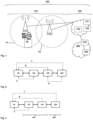
- a telecommunications network 100 comprising an access network 110, and a core network 120 as well as connected to a user equipment 20 is schematically shown, wherein - regarding user plane data exchanged between the user equipment and the telecommunications network, and especially regarding a specific packet data unit session - at least either a first user plane mode of operation or a second user plane mode of operation is able to be used for a given access technology, and wherein regarding such a use of user plane modes of operation capability information 320 is transmitted, by the user equipment, to the telecommunications network 100.
- the telecommunications network 100 is especially realized as a mobile (cellular) communication network 100 (and is, hereinafter and at least partly, also called like this).
- the telecommunications network 100 typically comprises a number of network functions or services, wherein of these, Figure 1 exemplarily shows an access and mobility management function 121 of the telecommunications network 100, a session management function 122, and a user plane function 123.
- the access network 110 comprises a plurality of radio cells 11, 12.
- a first base station entity 111 generates or is associated with or spans the first radio cell 11
- a second base station entity 112 generates or is associated with or spans the second radio cell 12.
- the user equipment 20 is connected to the telecommunications network 100 via a radio interface to the first base station entity 111 (and the user plane data being exchanged between the user equipment 20 and the telecommunications network 100 schematically being indicated by means of two opposed arrows between the user equipment 20 and the first base station entity 111).
- the user equipment 20 is typically, but not necessarily, mobile - i.e. able to move - with respect to the - typically, but not necessarily, static - radio cells 11, 12 or corresponding base station entities 111, 112 of the access network 110.
- the user equipment 20 might comprise an application (not specifically depicted in Figure 1 ) as part of the user equipment 20; the application typically runs on the user equipment 20, i.e.
- the user equipment 20 typically runs or executes an operating system (such as a mobile (devices) operating system, e.g., android, iOS, iPadOS, etc.), and the application is running on the operating system; alternatively, the application might also be a lower level application not running on or as part of the operating system but as part of, e.g., the subscriber identity module of the user equipment 20.
- an operating system such as a mobile (devices) operating system, e.g., android, iOS, iPadOS, etc.
- the application might also be a lower level application not running on or as part of the operating system but as part of, e.g., the subscriber identity module of the user equipment 20.
- Figure 1 also represents a further telecommunications network 200 connected to the telecommunications network 100, and the further telecommunications network 200 also comprising an access and core network, hereinafter called further access network 210 (designated by means of reference sign 210) and further core network 220 (designated by means of reference sign 220).
- further access network 210 designated by means of reference sign 2
- further core network 220 designated by means of reference sign 220
- GTP-U encapsulation used in the N3 interface (between the (radio) access network and the core network of a telecommunications network, especially for the transport of user plane traffic on its way to and/or from a data network DN) is established, and it has already been proposed to use segment routing to replace the GTP-U encapsulation protocol.
- an ingress node may prepend a header to data packets that contain a list of segments, which are instructions that are executed on subsequent nodes in the network. These instructions may be forwarding instructions, such as an instruction to forward a packet to a specific destination or interface.
- segment routing is combined with the IPv6 (internet protocol version 6) protocol.
- providing connectivity to the user equipment 20 often involves a plurality of operators and devices (such as, e.g., the further telecommunications network 200, e.g. acting, in a roaming scenario of the user equipment 20, as home network to the user equipment 20).
- operators and devices such as, e.g., the further telecommunications network 200, e.g. acting, in a roaming scenario of the user equipment 20, as home network to the user equipment 20).
- the present invention therefore proposes to apply - regarding user plane data being exchanged between the user equipment 20 and the telecommunications network 100 - different user plane modes of operation in response to or in dependance on capability information being sent by the user equipment 20 (and received by the telecommunications network 100) relating to the capability of the user equipment 20 to apply or to use these user plane modes of operation.
- a first user plane mode of operation and/or at least a second user plane mode of operation are possible to be applied (for a given access technology and especially in a specific packet data unit session), wherein, of course, for a specifically considered packet data unit session (or logical data channel or user plane data stream) only either the first or the second user plane mode of operation is able to be applied, and not both for the same packet data unit session and/or the same logical data channel or data stream.
- "user plane mode of operation” should not be mixed up with "packet data unit session type": While a packet data unit session may transmit traffic of type IP, ethernet or others, said user plane is transmitted in the same way, that is, via GTP-U encapsulation.
- the user plane mode of operation relates to how the user plane is transmitted, not the payload type being transported.
- An analogous exchange (or transmission) of capability information is, according to the present invention, also envisaged regarding different telecommunications networks (e.g. between a visited network and a home network of the user equipment, e.g. the telecommunications network 100 and the further telecommunications network 200).
- telecommunications networks e.g. between a visited network and a home network of the user equipment, e.g. the telecommunications network 100 and the further telecommunications network 200.
- Figure 2 schematically illustrates different interfaces or reference points - between different parts of a plurality of telecommunications networks 100, 200 - for such an exchange, or a transmission, of capability information.
- Figure 2 shows the user equipment 20, the access network 110 (especially of the telecommunications network 100 acting as visited network), the core network 120 (especially of the telecommunications network 100 acting as visited network), and the further core network 220 (especially of the further telecommunications network 200 acting as home network of the user equipment 20).
- Reference sign A designates the transmission of capability information 320 between the user equipment 20 and the access network 110, especially the transmission of (user equipment-related) capability information 320 towards the access network 110.
- Reference sign B designates the transmission of capability information 320 between the user equipment 20 and the core network 120, especially the transmission of (user equipment-related) capability information 320 towards the core network 120.
- Reference sign C designates the transmission of capability information 320 between the user equipment 20 and the further core network 220, especially the transmission of (user equipment-related) capability information 320 towards the further core network 220.
- Reference sign D designates the transmission of capability information between the core network 120 (of the telecommunications network 100) and the further core network 220 (of the further telecommunications network 200).
- segment routing capabilities are able to be signaled.
- the Introduction of a segment routing-based user plane mode (second user plane mode of operation) as a new user plane requires architectural changes in how user equipments and network elements are designed and how data packets are processed.
- flexibly usable means to provide for backward-compatibility are required; a network or user equipment supporting both segment routing-based and legacy-based (GTP-U/SDAP) user plane modes of operation can thus be considered as having more than one user plane mode of operation.
- a solution is provided how to enable the user equipment 20 to use multiple user plane modes of operation, especially to enable the user equipment 20 to be part of the SRv6 logic in a backwards-compatible manner, especially in multi-network setups such as roaming, which advantageously has the potential to allow the user equipment 20 to offload user plane processing from the network, especially the access network (no GTP-U encapsulation needed, reduced packet processing load) and the user plane function 123 (reduced packet processing load).
- the present invention allows for current (legacy) user equipments to still make use of such networks (being able to apply, e.g., SRv6 logic), i.e. according to the present invention, there is no service degradation to current users.
- Figure 2 shows how to flexibly apply this functionality of capability indication, or capability signaling, especially from the user equipment 20 towards the network (telecommunications network 100 or further telecommunications network 200), i.e. whether segment routing header functionality is supported (or not), and as well between communicating the networks 100, 200.
- multiple user plane modes of operation - i.e. to exchange user plane traffic between the user equipment 10 and the telecommunications network 100 - are supported, especially comprising network-based steering, via the control plane, so that the most optimum user plane mode of operation is able to be used based on network and/or user equipment capabilities and such that backwards-compatibility is able to be ensured.
- uplink traffic and regarding each individual traffic stream or logical data channel - it is decided, within the user equipment 20, which one of a plurality of different user plane modes of operation is to be used or applied for such uplink traffic towards the access network 110 and/or the core network 120.
- the capability information 320 that the user equipment 20 transmits, according to the present invention, to the access network 110 and/or the core network 120 of the telecommunications network 100 preferably indicates that the user equipment 20 is either capable of applying or using:
- the capability information 320 additionally indicates (especially in case that both user plane modes of operation are possible) a preferred user plane mode of operation out of the first and second user plane modes of operation.
- the capability information 320 indicates conditional application and/or preference of a given user plane mode of operation, especially the applicability to (or, the dependency of a conditional application and/or a preference of a given user plane mode of operation from) a given time and/or location and/or a given application or service (especially the applicability to local, home and/or roaming service), and/or a given type of traffic (especially internet protocol and ethernet traffic).
- the first user plane mode of operation or, alternatively, the second user plane mode of operation is used as a result of capability information being transmitted, by the user equipment 20, to the telecommunications network 100.
- the user equipment 20 In order for the access network 110 and/or the core network 120 to be able to know whether the user equipment 20 supports more than one user plane mode of operation, the user equipment 20 signals this capability (e.g. when the user equipment 20 registers at the network 100 as part of connection capabilities). This could trigger the network 100 to implicitly assume that all PDU session establishment requests imply the signaled capabilities. Alternatively or cumulatively, the user equipment 20 can indicate the requested/preferred user plane mode of operation in the packet data unit session establishment request (e.g. one or more), which the network 100, based on its own capabilities and deployment (e.g. the requested slice may support only legacy user plane) can then accordingly reply to.
- the packet data unit session establishment request e.g. one or more
- the network 100 based on its own capabilities and deployment (e.g. the requested slice may support only legacy user plane) can then accordingly reply to.
- Figure 4 shows the case when a user equipment 20 requests a given user plane mode of operation and it is granted, resulting in an end-to-end segment routing-based user plane.
- Figure 5 shows the case when the user equipment 20 is not granted its preferred/requested user plane mode of operation, but rather an alternative one, also supported by the user equipment 20 (fallback to legacy mode).
- FIG 4 a communication diagram between the user equipment 20 and network nodes or elements of the telecommunications network 100 is schematically and exemplarily shown, representing an example according to the present invention how the second user plane mode of operation is susceptible to be used between the user equipment 20 and the telecommunications network 100.
- Figure 4 explicitly shows the access and mobility management function 121, the session management function 122, and the user plane function 123 of the telecommunications network 100.
- a packet data unit session establishment request is sent, by the user equipment 20, to the session management function 122 of the telecommunications network 100, the packet data unit session establishment request comprising the request, that the second user plane mode of operation (e.g. SRv6) be used (regarding the specific packet data unit session considered or requested).
- the second user plane mode of operation e.g. SRv6
- the session management function evaluates segment routing support, especially based on, e.g., the capabilities of the requested (or to be used) S-NSSAI and/or data network name, DNN, as well as the capabilities of the user plane function 123. In case that this evaluation results in these capabilities being present and ready, in a fourth processing step 514, the session management function 122 configures the user plane function 123 for the second user plane mode of operation (i.e. especially for a segment routing-based packet data unit session), and, in a fifth processing step 515, the session management function 122 configures the access network 110 (especially via the access and mobility management function 121) for the second user plane mode of operation (i.e. especially for a segment routing-based packet data unit session).
- the session management function 122 transmits a packet data unit session establishment accept message to the user equipment 20, comprising an indication that the user plane mode of operation to be used corresponds to the second user plane mode of operation, i.e. especially the SRv6. Furthermore, the session management function 122 transmits to the user equipment 20 - especially as part of the packet data unit session establishment accept message - the relevant segment routing header information required to implement the segment routing-based user plane mode of operation.
- the user plane communication is able to be conducted between the user equipment 20 and the user plane function 123, based on using the second user plane mode of operation, especially using, or realizing, a segment routing-based N3 interface (or reference point).
- FIG. 5 a communication diagram (between, again, the user equipment 20 and network nodes or elements of the telecommunications network 100) is schematically and exemplarily shown, representing an example according to the present invention how the first user plane mode of operation is susceptible to be used between the user equipment 20 and the telecommunications network 100.
- Figure 5 explicitly shows the access and mobility management function 121, the session management function 122, and the user plane function 123 of the telecommunications network 100.
- a packet data unit session establishment request is sent, by the user equipment 20, to the session management function 122 of the telecommunications network 100, the packet data unit session establishment request comprising the request, that either one of the second user plane mode of operation (e.g. SRv6) or the first user plane mode of operation (GTP-U based) be used (regarding the specific packet data unit session considered or requested).
- the second user plane mode of operation e.g. SRv6
- GTP-U based the first user plane mode of operation
- the session management function evaluates segment routing support, especially based on, e.g., the capabilities of the requested (or to be used) S-NSSAI and/or data network name, DNN, as well as the capabilities of the user plane function 123. In case that this evaluation results in these capabilities (regarding using the second user plane mode of operation) are lacking (i.e. not being present and ready), in a fourth processing step 524, the session management function 122 configures the user plane function 123 for the first user plane mode of operation (i.e.
- the session management function 122 configures the access network 110 (especially via the access and mobility management function 121) for the first user plane mode of operation (i.e. especially for a GTP-U based packet data unit session).
- the session management function 122 transmits a packet data unit session establishment accept message to the user equipment 20, comprising an indication that the user plane mode of operation to be used corresponds to the first user plane mode of operation, i.e. especially GTP-U with legacy parameters.
- a seventh processing step 527 the user plane communication is able to be conducted between the user equipment 20 and the user plane function 123, based on using the first user plane mode of operation, especially using, or realizing, a legacy N3 interface (or reference point), i.e. using SDAP/GTP-U.
- the user equipment 20 had, in either the first processing step 521 or the second processing step 522, indicated that it supports only (or is only capable of) the first user plane mode of operation (i.e. especially a GTP-U based user plane mode of operation) or that it requests (as part of the packet data unit session establishment request of the second processing step 522) that the first user plane mode of operation (GTP-U based) be used (regarding the specific packet data unit session considered or requested), the evaluation, in the third processing step 523, would have needed to be conducted to verify that legacy support (especially GTP-U support) is available regarding the requested (or to be used) S-NSSAI and/or data network name, DNN, as well as regarding the user plane function 123; if this would have been verified, the fourth, fifth, sixth and seventh processing steps 524, 525, 526, 527 would have been conducted as described above.
- legacy support especially GTP-U support
- DNN data network name
- the packet data unit session establishment request (of the second processing step 522/512 as described above) comprises the indication that the first user plane mode of operation (GTP-U based) be used
- the packet data unit session establishment request (of the second processing step 522/512 as described above) comprises the indication that the second user plane mode of operation (segment routing-based) be used. It is then up to the telecommunications network 100 to decide (or to evaluate in the third processing step 523/513) which user plane mode of operation is to be used.
- a further user equipment (not shown) is connected to the telecommunications network 100 and transmits a further capability information to the telecommunications network 100 (analogously to the first and second processing steps 511/521, 512/522 - wherein, of course, the further capability information is related to a further capability of the further user equipment to apply or to use the first user plane mode of operation and/or the second user plane mode of operation) and that, in case that the capability information 320 and the further capability information differ, different user plane modes of operation are applied for the user equipment 20 and for the further user equipment.
- the first user plane mode of operation or, alternatively, the second user plane mode of operation is used as a result of network capability information being transmitted between different telecommunications networks, especially taking into consideration the case of a roaming situation (of the user equipment 20), i.e. where the further telecommunications network 200 is connected to the telecommunications network 100 (and is serving the user equipment 20, especially as a home network):
- a roaming situation of the user equipment 20
- the further telecommunications network 200 is connected to the telecommunications network 100 (and is serving the user equipment 20, especially as a home network):
- the first user plane mode of operation or the second user plane mode of operation is able to be used for a given access technology (and, especially, regarding a given packet data unit session or logical data channel or user plane data stream.
- the typical case is that of roaming.
- session management functions (SMFs) from each network are responsible for setting up a user plane path between two user plane functions (UPFs).
- the session management function exchange typically occurs via secure edge protection proxies (SEPPs or inter-PLMN secure gateways), while the user plane may be directly routed or routed with IPUPS functionality for additional security.
- SEPPs secure edge protection proxies
- IPUPS IPUPS functionality for additional security.
- Figure 6 shows method analogous to the above-mentioned user equipment-network case when both ends (i.e. both networks 100, 200) support a given user plane mode of operation, resulting, e.g., in an end-to-end segment routing-based user plane.
- Figure 7 shows a network 100 using a given user plane mode of operation (e.g. SRv6) that needs to bridge (or translate) between SRv6 and GTP-U.
- SRv6 user plane mode of operation
- FIG. 6 a communication diagram between the access network 110 and network nodes or elements of the telecommunications network 100 as well as of the further telecommunications network 200 is schematically and exemplarily shown, representing an example according to the present invention how the second user plane mode of operation is susceptible to be used between the telecommunications network 100 and the further telecommunications network 200.
- Figure 6 explicitly shows the session management function 122, the user plane function 123, and the secure edge protection proxy (function) 124 of the telecommunications network 100 (i.e.
- FIG. 6 explicitly shows the further session management function 222 of the further telecommunications network 200, the further user plane function 223 of the further telecommunications network 200, and the further secure edge protection proxy (function) 224 of the further telecommunications network 200 (i.e.
- the home session management function 222, the home user plane function 223 and the home secure edge protection proxy (function) 224, the home user plane function 223 especially also comprising or referring to the (visited) inter PLMN user plane security (IPUPS) functionality of the further telecommunications network 200).
- IPUPS inter PLMN user plane security
- the visited session management function 122 requests to the home session management function 221 (via the secure edge protection proxies 124, 224, thereby realizing, in a second processing step 532, an N32-based control plane exchange) to set up N9 connectivity (i.e. connectivity of or according to the N9 interface or reference point), the indication to use (or the indication that there is a capability to use) the second user plane mode of operation (i.e. segment routing-based) for user plane traffic as well as the corresponding segment routing header information (to be used by the home network 200, especially by the home user plane function 223), i.e.
- N9 connectivity i.e. connectivity of or according to the N9 interface or reference point
- the indication to use or the indication that there is a capability to use
- the second user plane mode of operation i.e. segment routing-based
- the home session management function 222 transmits, to the visited session management function 122 (again via the secure edge protection proxies 224, 124, thereby realizing, again, an N32-based control plane exchange) an accept message, especially comprising the indication of accepting the use of the second user plane mode of operation (i.e. segment routing-based) for user plane traffic as well as the corresponding segment routing header information (to be used by the visited network 100, especially by the visited user plane function 123).
- the visited session management function 122 sets up segment routing-based user plane functionality (by means of setting up - in the visited user plane function/IPUPS 123 - the processing of the segment routing header information received from the home session management function 223), and in a fifth processing step 535, the home session management function 222 sets up segment routing-based user plane functionality (by means of setting up - in the home user plane function/IPUPS 223 - the processing of the segment routing header information received from the visited session management function 123).
- the segment routing-based user plane communication i.e.
- the second user plane mode of operation is established, on the one hand between the access network 110 of the telecommunications network 100 towards the visited user plane function/IPUPS 123 (sixth processing step 536) as a segment routing-based N3 interface (or reference point), and on the other hand between the visited user plane function/IPUPS 123 and the home user plane function/IPUPS 223 (seventh processing step 537) as a segment routing-based N9 interface.
- FIG. 7 a communication diagram between, again, the access network 110 and network nodes or elements of the telecommunications network 100 as well as of the further telecommunications network 200 is schematically and exemplarily shown, representing an example according to the present invention how the first user plane mode of operation is susceptible to be used between the telecommunications network 100 and the further telecommunications network 200.
- Figure 7 explicitly shows the session management function 122, the user plane function 123, and the secure edge protection proxy (function) 124 of both the telecommunications network 100 and the further telecommunications network 200, the respective user plane functions 123, 223 again especially also comprising or referring to the (visited/home) inter PLMN user plane security (IPUPS) functionality of the respective telecommunications networks 100, 200.
- IPUPS inter PLMN user plane security
- the visited session management function 122 requests to the home session management function 221 (via the secure edge protection proxies 124, 224, thereby realizing, in a second processing step 542, an N32-based control plane exchange) to set up N9 connectivity, the indication to use (or the indication that there is a capability to use) the second user plane mode of operation (i.e. segment routing-based) for user plane traffic as well as the corresponding segment routing header information (to be used by the home network 200, especially by the home user plane function 223), i.e. the indication that it supports the second user plane mode of operation (or even that it supports both the first and second user plane mode of operation, i.e.
- the second user plane mode of operation i.e. segment routing-based
- the home session management function 222 transmits, to the visited session management function 122 (again via the secure edge protection proxies 224, 124, thereby realizing, again, an N32-based control plane exchange) a message indicating that segment routing-based user plane communication (second user plane mode of operation) is not supported and that a legacy user plane communication (first user plane mode of operation) shall be used.
- a fourth processing step 544 the visited session management function 122 setting up processing to convert or translate segment routing-based user plane processing or functionality to GTP-U-based user plane processing or functionality in the visited user plane function/IPUPS 123
- the home session management function 222 sets up legacy user plane processing in the home user plane function/IPUPS 223.
- the segment routing-based user plane communication i.e.
- the second user plane mode of operation is established between the access network 110 of the telecommunications network 100 towards the visited user plane function/IPUPS 123 (sixth processing step 546) as a segment routing-based N3 interface (or reference point), and the legacy GTP-U-based user plane processing is established between the visited user plane function/IPUPS 123 and the home user plane function/IPUPS 223 (seventh processing step 547) as a GTP-U-based N9 interface.
- the visited session management function 122 had, in the first processing step 541, indicated that it supports only (or is only capable of) the first user plane mode of operation (i.e. especially a GTP-U based user plane mode of operation) or that it requests the first user plane mode of operation to be used (regarding the specific packet data unit session considered or requested), the response, in the third processing step 543, from home session management function 222 would have been either identical (or perhaps with the indication that segment routing-based user plane processing would be possible), and the fourth, fifth, sixth and seventh processing steps 544, 545, 546, 547 would have been conducted as described above.
- the present invention comprises - besides transmitting capability information, e.g. the capability information 320 of the user equipment 20 or the further capability information or the network capability information - also transmitting segment routing header information (especially in case that segment routing-based user plane functionality is to be used).
- the method relates to the telecommunications network 100 (or the further telecommunications network 200) (either the access network 110 or the core network 120, 220) to signal the user equipment 20 segment routing-related functionality so that the user equipment 20 is able to:
- segment routing-related information - especially segment routing header information - is schematically shown in Figure 3 which schematically (and in a simplified manner) illustrates different interfaces or reference points, between different parts of a plurality of telecommunications networks, where segment routing header information (and/or corresponding conditions or condition information) is susceptible to be transmitted according to the present invention in order to define how the second user plane mode of operation is to be implemented.
- Figure 3 shows the user equipment 20, the access network 110 (especially of the telecommunications network 100 acting as visited network), the core network 120 (especially of the telecommunications network 100 acting as visited network), and the further core network 220 (especially of the further telecommunications network 200 acting as home network of the user equipment 20).
- Reference sign A designates the transmission of segment routing header information (and/or corresponding conditions or condition information) from the access network 110 to the user equipment 20.
- Reference sign B designates the transmission of segment routing header information (and/or corresponding conditions or condition information) from the core network 120 to the user equipment 20.
- Reference sign C designates the transmission of segment routing header information (and/or corresponding conditions or condition information) from the further core network 210 to the user equipment 20.
- the user equipment 20 evaluates the conditions and applies the segment routing header (information) based on the communicated conditions, i.e. for the uplink direction, the network 100, 200 instructs the user equipment 20 to add specific segment routing header(s) (segment routing header information) and to apply packet processing logic, to specific traffic and when given conditions such as time, location and/or network conditions are met.
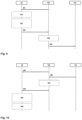
- FIG. 9 schematically illustrating a communication diagram between the user equipment 20, the telecommunications network 100, and (exemplarily) a data network 101, showing how the second user plane mode of operation (i.e. segment routing) is susceptible to be implemented regarding uplink traffic from the user equipment 20 towards the telecommunications network 100:
- a first processing step 551 information is transmitted, by the telecommunications network 100, to the user equipment 20, indicating the segment routing header information to add to uplink (user plane) traffic (i.e. user plane traffic to be sent, by the user equipment 20, towards the network 100, i.e. in uplink direction).
- uplink (user plane) traffic i.e. user plane traffic to be sent, by the user equipment 20, towards the network 100, i.e. in uplink direction.
- segment routing header information is used to indicate the segment routing header information per se (or: as such) as well as, if applicable, mapping information and, as well if applicable, information related to conditions to respect.
- matching traffic is generated by the user equipment 20, e.g. by an application running on the user equipment 20 hardware/operating system.
- segment routing header information i.e. one or a plurality of segment routing header(s) is added to (user plane) data packets or (user plane) payload so that the data packets can be further transmitted and/or processed accordingly.
- a fourth processing step 554 the data packets - i.e. including the segment routing header(s) - are sent (by the user equipment 20) towards the telecommunications network 100 (i.e. to the respective access network or core network node or element), and, in a fifth processing step 555, the traffic is processed (by the telecommunications network 100) as per the segment routing header(s), and, eventually, in a sixth processing step 556, sent (in the exemplary situation shown in Figure 9 ) to the data network 101.
- FIG. 10 schematically illustrates a communication diagram between the user equipment 20, the telecommunications network 100, and (exemplarily) a data network 101, showing how the second user plane mode of operation (i.e. segment routing) is susceptible to be implemented regarding downlink traffic from the telecommunications network 100 towards the user equipment 20:
- a first processing step 561 information is transmitted, by the telecommunications network 100, to the user equipment 20, indicating the segment routing header information to remove from downlink (user plane) traffic (i.e. user plane traffic to be sent, by the telecommunications network 100, towards the user equipment 20, i.e. in downlink direction).
- segment routing header information is used to indicate the segment routing header information per se (or: as such) as well as, if applicable, mapping information and, as well if applicable, information related to conditions to respect.
- the telecommunications network 100 receives data packets or traffic, in downlink direction from (exemplarily) the data network 101, the telecommunications network 100 furthermore adds, in a third processing step 563, segment routing header information to (user plane) the data packets/traffic or payload, and, in a fourth processing step 564, sends the data packets or traffic - i.e. including the segment routing header(s) - to the user equipment 20.
- the user equipment 20 removes the segment routing header(s) from the respective data packets, and applies the respective data processing. Finally, in a sixth processing step 556, the data packets (or the payload) is forwarded to the respective application of the user equipment 20.
- the user equipment 20 receives the user plane traffic containing the segment routing header(s) or segment routing header information, and the telecommunications network 100 instructs the user equipment 20 to remove specific segment routing header(s) (segment routing header information) and to apply packet processing logic, to specific traffic and when given conditions such as time, location and/or network conditions are met.
- mapping i.e. the establishment of a relationship between two elements, such as where to apply segment routing headers and/or what actions given segment routing headers trigger, which occurs for both uplink and downlink directions, the following mappings are considered to be signaled from the telecommunications network 100 to the user equipment 20:
- mapping information With regard to the question how to deliver the mapping information to the user equipment 20, several methods are considered. In terms of network functionality, and based on current protocol layers available for telecom networks, it is advantageous if current architectures are compatible with the use of segment routing header. The following delivery methods are possible and preferred according to the present invention:
- the core network can use non-access stratum (NAS) protocol, especially in the form of protocol containers within the non-access stratum protocol, especially the session management container (between the user equipment 20 and session management function 122), as exemplary shown in Figure 8 , which schematically illustrates different possibilities how the segment routing header information - or mapping information - is susceptible to be transmitted between different network elements or components, and especially towards the user equipment 20.
- NAS non-access stratum
- Figure 8 shows one alternative for transmitting such segment routing header information - or mapping information - towards the user equipment 20, namely using the session management function 122 (and via the packet data unit establishment procedure), wherein, in a first processing step 501, the packet data unit session establishment is requested (by means of a corresponding requesting message, sent by the user equipment 20 to the session management function 122), and, in the second processing step 502, the packet data unit session establishment accept message is sent, by the session management function 122 to the user equipment 20, the packet data unit session establishment accept message comprising the segment routing parameters and/or mapping information (i.e. the segment routing header information).
- Figure 8 shows, on its right hand side, a communication diagram between the user equipment 20 and a policy and charging function 125 of the telecommunications network 100, wherein the transmission of the corresponding information involves the policy and charging function 125 and is part of a user equipment route selection policy (URSP) rule transmission, i.e. via the policy container part in non-access stratum signaling, i.e.
- URSP user equipment route selection policy
- the user equipment 20 policy association between the user equipment 20 and the policy and charging function 125 occurs or takes place, and, in a second processing step 504, the segment routing parameters (or the segment routing header information) is included in user equipment route selection policy rules sent to the user equipment 20.
- multi-network routing is preferably enabled:
- the H-PLMN (or further telecommunications network 200) signals the user equipment 20 to include segment routing header information indicating the target network identifier (e.g. containing the PLMN ID of the home network 200) so that the V-PLMN (or telecommunications network 100) can easily route said data packets towards the home network 200.
- the target network identifier e.g. containing the PLMN ID of the home network 200
Landscapes
- Engineering & Computer Science (AREA)
- Computer Networks & Wireless Communication (AREA)
- Signal Processing (AREA)
- Data Exchanges In Wide-Area Networks (AREA)
Abstract
wherein the user equipment is used with the telecommunications network by means of transmitting and/or receiving user plane data and control plane data, wherein, regarding user plane data exchanged between the user equipment and the telecommunications network , at least either a first user plane mode of operation or a second user plane mode of operation is able to be used for a given access technology,
wherein the method comprises the following steps:
-- in a first step, the user equipment transmits a capability information to the telecommunications network , the capability information being related to a capability of the user equipment to apply or to use the first user plane mode of operation and/or the second user plane mode of operation,
-- in a second step, the first user plane mode of operation or the second user plane mode of operation is applied in accordance with the capability information.
Description
- The present invention relates a method for using a user equipment with at least one telecommunications network, wherein the user equipment is connected to the telecommunications network using an access network of the telecommunications network and the telecommunications network further comprising a core network to which the user equipment is connected, wherein the user equipment is used with the telecommunications network by means of transmitting and/or receiving user plane data and control plane data, wherein, regarding user plane data exchanged between the user equipment and the telecommunications network, at least either a first user plane mode of operation or a second user plane mode of operation is able to be used for a given access technology.
- Furthermore, the present invention relates to a user equipment for being operated with at least one telecommunications network, wherein the user equipment is connected to the telecommunications network using an access network of the telecommunications network and the telecommunications network further comprising a core network to which the user equipment is connected, wherein the user equipment is used with the telecommunications network by means of transmitting and/or receiving user plane data and control plane data, wherein, regarding user plane data exchanged between the user equipment and the telecommunications network, at least either a first user plane mode of operation or a second user plane mode of operation is able to be used for a given access technology.
- Additionally, the present invention relates to a system or telecommunications network for using a user equipment with the telecommunications network, wherein the user equipment is connected to the telecommunications network using an access network of the telecommunications network and the telecommunications network further comprising a core network to which the user equipment is connected, wherein the user equipment is used with the telecommunications network by means of transmitting and/or receiving user plane data and control plane data, wherein, regarding user plane data exchanged between the user equipment and the telecommunications network, at least either a first user plane mode of operation or a second user plane mode of operation is able to be used for a given access technology.
- Furthermore, the present invention relates to a program and to a computer-readable medium for using a user equipment with the telecommunications network according to the inventive method.
- In conventionally known telecommunications networks, it is known to use segment routing (SR) as a variant of source routing. In a segment-routed network, an ingress node may prepend a header to data packets that contain a list of segments, which are instructions that are executed on subsequent nodes in the network. These instructions may be forwarding instructions, such as an instruction to forward a packet to a specific destination or interface.
- In the case of SRv6, segment routing is combined with the IPv6 (internet protocol version 6) protocol, where it is possible for a data packet (typically comprising some payload data) to comprise a plurality of different IPv6 headers (such as
IPv6 header 1, IPv6 header 2, ... , IPv6 header N), wherein by means of each IPv6 header a corresponding action is indicated, e.g. anaction 1 forIPv6 header 1, e.g. "apply quality-of-service", an action 2 for IPv6 header 2, e.g. "route via router A", ... , an action N for IPv6 header N, e.g. "route via router B", and the like. Thereby, network elements are able to add and/or to remove (push and/or pop) SRv6 headers based on network-defined logic, thereby especially reducing statefulness of network elements during network transit of data packets. - It has already been proposed to use segment routing to replace the GTP-U encapsulation protocol used in the N3 interface between the (radio) access network (AN, RAN) and the core network (CN) of a telecommunications network or of a mobile communication network, which GTP-U encapsulation protocol transports user plane traffic on its way to and/or from a data network (DN).
- The N3 interface is located between the access network (e.g. radio access network) and the core network user plane processing function, which in the case of a 5G network is the user plane function, UPF.
- Between the UE and the AN (and in case of a 5G system - new radio, NR), the user plane stack, e.g., comprises, above the physical layer, the MAC layer, the RLC layer, the PDCP layer, and the service data adaptation protocol, SDAP, layer according to TS 38.300. Between the UE and the AN (and in case of a 5G system - untrusted non-3GPP Access), the user plane stack, e.g., comprises, above the physical layer, the MAC layer, the internet protocol, IP, layer, internet protocol security, IPsec, layer, generic routing encapsulation, GRE, layer according to TS 23.501.
- On the reverse side (AN-UE), the reverse process is performed.
- However, providing connectivity is a more complex issue and it often involves a plurality of operators and devices, often having different or divergent capabilities, e.g., - besides the telecommunications network to which the user equipment is directly connected - a further telecommunications network acting as the home network to the user equipment (roaming scenario of the user equipment).
- Furthermore, user needs may be location-dependent (e.g. a campus network or a network slice within a specific location may provide different capabilities than the nationwide network outside thereof).
- An object of the present invention is to provide a technically simple, effective and cost effective solution for using a user equipment with at least one telecommunications network, wherein user plane data are able to be exchanged between the user equipment and the telecommunications network by means of using at least either a first user plane mode of operation or a second user plane mode of operation for a given access technology. A further object of the present invention is to provide a corresponding user equipment, system or telecommunications network, and a corresponding program and computer-readable medium.
- The object of the present invention is achieved by a method for using a user equipment with at least one telecommunications network, wherein the user equipment is connected to the telecommunications network using an access network of or assigned to or associated with the telecommunications network and the telecommunications network further comprising a core network to which the user equipment is connected, wherein the user equipment is used with the telecommunications network by means of transmitting and/or receiving user plane data and control plane data, wherein, regarding user plane data exchanged between the user equipment and the telecommunications network, at least either a first user plane mode of operation or a second user plane mode of operation is able to be used for a given access technology,
wherein the method comprises the following steps: - -- in a first step, the user equipment transmits a capability information to the telecommunications network, the capability information being related to a capability of the user equipment to apply or to use the first user plane mode of operation and/or the second user plane mode of operation,
- -- in a second step, the first user plane mode of operation or the second user plane mode of operation is applied in accordance with the capability information.
- According to the present invention, it is advantageously possible that different user plane modes of operation are possible or able to be applied regarding user plane data being exchanged between the user equipment and the telecommunications network, and this in response to or in dependance on capability information being sent by the user equipment (and received by the telecommunications network) relating to the capability of the user equipment to apply or to use the first user plane mode of operation and/or the second user plane mode of operation. An analogous exchange (or transmission) of capability information is, according to the present invention, also envisaged regarding different telecommunications networks (e.g. between a visited network and a home network of the user equipment). Hence, according to the present invention, the operation on one or multiple networks of a combination of user plane modes of operation and the exchange of corresponding or related capability information is advantageously possible. It is thereby advantageously possible that a user plane mode of operation is associated with a user plane protocol stack, combination of user plane and control plane protocol stacks, configuration of user plane protocol stack, or configuration of control and user plane protocol stacks such that transmission and/or reception of user plane data is realized via a specific and/or specifically configured protocol stack(s). It is thereby advantageously possible that the simultaneous use of legacy user plane modes of operation (especially GTP-U-based) and also of more efficient user plane modes of operation or architectures, such as, e.g., SR-based, especially SRv6, is enabled without service degradation for legacy users.
- Hence, according to the present invention, it is advantageously possible to provide for a signaling of a segment routing capability for (or regarding) the user equipment and/or the (visited) access network (i.e. of the visited network of the user equipment, V-PLMN AN) and/or the (visited) core network (i.e. of the visited network of the user equipment, V-PLMN CN) and/or the (home) core network (i.e. of the home network of the user equipment, H-PLMN CN) so that the user equipment is especially able to be aware whether (or not) SRv6 is usable and/or whether (or not) two core networks (e.g. the ones of the visited and the home network of the user equipment) can know whether SRv6 is usable.
- Furthermore, it is advantageously possible according to the present invention that a conditional header manipulation of uplink/downlink data packets is able to be applied on the user equipment (or by the user equipment), whereas the conditions are especially based on location parameters, time parameters and/or network parameters. It is furthermore advantageously possible that given a partially overlapping support of user plane modes of operation, a common user plane mode of operation can be chosen end-to-end, E2E, e.g. between user equipment, visited network and home network such that the need for user plane translation and/or encapsulation/decapsulation can be minimized or even removed. It is furthermore advantageously possible that given a partially overlapping support of user plane modes of operation among different access technologies supported by a user equipment, a common user plane mode of operation is chosen for all access technologies supported by the user equipment, such that mobility and/or handover of user plane between different access technologies can be seamlessly realized.
- In a conventional telecommunications network, a common use case in roaming is that of network slice mapping, whereas different network slice identifiers are used in the visited public land mobile network, V-PLMN, of the user equipment and in the home public land mobile network, H-PLMN, of the user equipment for a given service. In such a case, the user equipment (subscribed to the H-PLMN) receives a network slice mapping information informing it of the mapping between a H-PLMN network slice and a V-PLMN network slice. Furthermore, regarding the communication between the visited and home public land mobile networks, the 5G architecture defines - regarding control plane communication or data exchange - a secure element enabling secure and authenticated exchange of control plane information between the networks: the secure edge protection proxy (SEPP), cf. especially TS 23.501, clause 4.2.4. Regarding user plane communication or data exchange, 5G defines an inter PLMN user plane security (IPUPS) functionality, which can be deployed at the border of the respective networks to protect the respective networks from invalid inter-PLMN N9 traffic. The IPUPS functionality forwards GTP-U packets (received via the N9 interface) only if they belong to an active PDU Session and are not malformed, as described in TS 33.501.
- According to the present invention, it is advantageously possible that a user equipment is used with at least one telecommunications network (but typically, especially in a roaming situation, with two or more telecommunications networks). The user equipment is connected to the (visited or home) telecommunications network using an access network thereof (i.e. an access network, or radio access network, of the telecommunications network or assigned to or associated with the telecommunications network), and, of course, the telecommunications network furthermore also comprises a core network to which the user equipment is connected. The user equipment is used with the telecommunications network (or with the (radio) access network (thereof)) by means of transmitting and/or receiving user plane data and control plane data, wherein, regarding user plane data exchanged between the user equipment and the telecommunications network (or the (radio) access network (thereof)), at least either a first (or legacy) user plane mode of operation or a second (or non-legacy or segment routing-related) user plane mode of operation is able to be used for a given access technology. In such a situation, according to the present invention, the user equipment transmits a capability information to the telecommunications network (or, rather or more specifically, to its (radio) access network), the capability information being related to the capability of the user equipment to apply or to use the first user plane mode of operation and/or the second user plane mode of operation. As a result thereof (i.e. of the transmission of the capability information transmitted by the user equipment, and irrespective of the form of such transmission or the kind of message transporting such capability information), either the first user plane mode of operation or the second user plane mode of operation is applied (especially between the user equipment and the access network) in accordance with the capability information. Especially according to the present invention, it is to be understood that the use of at least either a first (or legacy) user plane mode of operation or a second (or non-legacy or segment routing-related) user plane mode of operation (regarding user plane data exchanged between the user equipment and the telecommunications network (or the (radio) access network (thereof))) is able to be used not only in dependency of a given access technology but also in dependency of a specific packet data unit session, i.e. in two different packet data unit sessions it might be possible (for one and the same user equipment) to apply different user plane modes of operation (e.g. the first user plane mode of operation in a first packet data unit session and the second user plane mode of operation in a second packet data unit session) - i.e. in such an implementation of the present invention:
- -- the user equipment is used with the telecommunications network by means of transmitting and/or receiving user plane data and control plane data, wherein, regarding user plane data exchanged between the user equipment and the telecommunications network in a specific packet data unit session, at least either a first user plane mode of operation or a second user plane mode of operation is able to be used for a given access technology, and
- -- in the second step (i.e. after transmission of the capability information), the first user plane mode of operation or the second user plane mode of operation is applied to the specific packet data unit session logical data channel or user plane data stream or channel in accordance with the capability information.
- According to the present invention, it is furthermore advantageously possible and preferred that the user equipment is either capable of applying or using:
- -- the first user plane mode of operation only, or
- -- the first user plane mode of operation only, or, alternatively, the second user plane mode of operation, or
- -- the second user plane mode of operation only,
- -- a preferred user plane mode out of the first and second user plane modes of operation,
- -- conditional application and/or preference of a given user plane mode, especially the applicability to a given slice, time and/or location,
- -- conditional application and/or preference of a given user plane mode for a given application or service, especially the applicability to local, home and/or roaming service, and/or
- -- conditional application and/or preference of a given user plane mode for a given type of traffic, especially internet protocol and ethernet traffic.
- Furthermore, it is advantageously possible and preferred according to the present invention to support that only part of the access network, especially specific tracking areas, TAs, and/or locations, support a given user plane mode, such that the conditional application of the given user plane mode is restricted to that part of the access network. It is similarly advantageously possible and preferred according to the present invention to support that only a given slice or set of slices supports a given user plane mode such that the conditional application of the given user plane mode is restricted to elements serving the given slice or set of slices.
- It is thereby advantageously possible to realize and implement the inventive method in a comparatively simple and efficient manner.
- According to the present invention, it is furthermore advantageously possible and preferred that the first user plane mode of operation corresponds to, or relies on, radio link control, RLC, packet data convergence protocol, PDCP, or using the service data adaptation protocol, SDAP, or a variant thereof, and
wherein the second user plane mode of operation corresponds to, or relies on, a segment routing protocol, especially the segment routing version 6 protocol, SRv6. - It is thereby advantageously possible to realize and implement the inventive method in a comparatively simple and efficient manner.
- Furthermore, it is advantageously possible and preferred according to the present invention that the user plane protocol between the access network, especially a gNB, and the core network, especially a user plane function, UPF, is chosen based on the applied user plane mode of operation used between the user equipment and the access network, especially when the first user plane mode of operation is associated to the GPRS tunneling protocol, GTP and the second user plane mode of operation is associated to a segment routing protocol, especially the segment routing version 6 protocol, SRv6.
- It is thereby advantageously possible to efficiently realize and implement the inventive method in a comparatively simple and flexible manner
- Furthermore, it is advantageously possible and preferred according to the present invention that, besides the user equipment, a further user equipment is connected to the telecommunications network and wherein the further user equipment transmits a further capability information to the telecommunications network, the further capability information being related to a further capability of the further user equipment to apply or to use the first user plane mode of operation and/or the second user plane mode of operation, wherein, especially in case that the capability information and the further capability information differ, the first user plane mode of operation is applied in accordance with the capability information, and the second user plane mode of operation is applied in accordance with the further capability information, or vice versa, between the user equipments and the telecommunications network.
- It is thereby advantageously possible to realize and implement the inventive method in a comparatively simple and efficient manner, where - regarding different user equipments - different user plane modes of operation are possible to be used or applied.
- Furthermore, it is advantageously possible and preferred according to the present invention that the capability information is transmitted, by the user equipment to the telecommunications network, by means of, or upon, at least one out of the following:
- -- the user equipment registering at or with the telecommunications network, especially as part of connection capabilities,
- -- a packet data unit session, PDU session, establishment request of the user equipment,
- -- a radio resource management, RRM, message,
- -- a non-access stratum, NAS, message,
- It is thereby advantageously possible to realize and implement the inventive method in a comparatively simple and efficient manner.
- Furthermore, it is advantageously possible and preferred according to the present invention that a further telecommunications network, connected to the telecommunications network is serving the user equipment, especially as a home network, wherein, regarding user plane data exchanged between the telecommunications network and the further telecommunications network, at least either the first user plane mode of operation or the second user plane mode of operation is able to be used for a given access technology,
wherein either - -- the further telecommunications network transmits a network capability information to the telecommunications network, the network capability information being related to a capability of the further telecommunications network to apply or to use the first user plane mode of operation and/or the second user plane mode of operation, this resulting in either the first user plane mode of operation or the second user plane mode of operation being applied in accordance with the network capability information between the telecommunications network and the further telecommunications network, or
- -- the telecommunications network transmits a network capability information to the further telecommunications network, the network capability information being related to a capability of the telecommunications network to apply or to use the first user plane mode of operation and/or the second user plane mode of operation, this resulting in either the first user plane mode of operation or the second user plane mode of operation being applied in accordance with the network capability information between the telecommunications network and the further telecommunications network, or
- -- the telecommunications network transmits a network capability information to the further telecommunications network, the network capability information being related to a capability of the telecommunications network to apply or to use the first user plane mode of operation and/or the second user plane mode of operation, this resulting in either the first user plane mode of operation or the second user plane mode of operation being applied in accordance with the network capability information between the telecommunications network and the further telecommunications network.
- It is thereby advantageously possible to realize and implement the inventive method in a comparatively simple and efficient manner. `
- Furthermore, it is advantageously possible and preferred according to the present invention that a further telecommunications network, connected to the telecommunications network is serving the user equipment, especially as a home network, wherein, regarding user plane data exchanged between the user equipment and the further telecommunications network, at least either the first user plane mode of operation or the second user plane mode of operation is able to be used for a given access technology,
wherein the user equipment transmits the capability information also to the further telecommunications network, the capability information being related to the capability of the user equipment to apply or to use the first user plane mode of operation and/or the second user plane mode of operation, this resulting in either the first user plane mode of operation or the second user plane mode of operation being applied in accordance with the capability information between the user equipment and the further telecommunications network. - It is thereby advantageously possible to realize and implement the inventive method in a comparatively simple and efficient manner.
- Furthermore, it is advantageously possible and preferred according to the present invention that in case that the second user plane mode of operation is used, at least one out of the following applies:
- -- the telecommunications network, especially a network node of the access network and/or of the core network, signals to the user equipment the segment routing-related functionality,
- -- the user equipment adds segment routing header information to uplink traffic, especially according to a logic signaled by the telecommunications network, especially a specific segment routing header information is added and/or a data packet processing logic applied to specific traffic in case of a given time and/or a given location and/or given network conditions being met,
- -- the user equipment removes segment routing header information from downlink traffic, especially removes specific segment routing header information and applies data packet processing logic, especially for specific traffic in case of a given time and/or a given location and/or given network conditions being met,
- -- the user equipment applies, to either uplink or downlink traffic, packet processing logic to matching traffic, especially to data packets with a given segment routing header information,
- -- the user equipment applies a mapping between packet data unit sessions, quality-of-service flows or quality-of-service subflows and/or application traffic and one or more pieces of segment routing header information.
- It is thereby advantageously possible to realize and implement the inventive method in a comparatively simple and efficient manner.
- Furthermore, the present invention relates to a user equipment for being operated with at least one telecommunications network, wherein the user equipment is connected to the telecommunications network using an access network of or assigned to or associated with the telecommunications network and the telecommunications network further comprising a core network to which the user equipment is connected, wherein the user equipment is used with the telecommunications network by means of transmitting and/or receiving user plane data and control plane data, wherein, regarding user plane data exchanged between the user equipment and the telecommunications network, at least either a first user plane mode of operation or a second user plane mode of operation is able to be used for a given access technology, wherein the user equipment is configured such that:
- -- the user equipment transmits a capability information to the telecommunications network, the capability information being related to a capability of the user equipment to apply or to use the first user plane mode of operation and/or the second user plane mode of operation,
- -- the first user plane mode of operation or the second user plane mode of operation is applied in accordance with the capability information.
- Furthermore, the present invention relates to a system or telecommunications network for using a user equipment with the telecommunications network, wherein the user equipment is connected to the telecommunications network using an access network of or assigned to or associated with the telecommunications network and the telecommunications network further comprising a core network to which the user equipment is connected,
- wherein the user equipment is used with the telecommunications network by means of transmitting and/or receiving user plane data and control plane data, wherein, regarding user plane data exchanged between the user equipment and the telecommunications network, at least either a first user plane mode of operation or a second user plane mode of operation is able to be used for a given access technology,
- wherein the method comprises the following steps:
- -- in a first step, the user equipment transmits a capability information to the telecommunications network, the capability information being related to a capability of the user equipment to apply or to use the first user plane mode of operation and/or the second user plane mode of operation,
- -- in a second step, the first user plane mode of operation or the second user plane mode of operation is applied in accordance with the capability information.
- Additionally, the present invention relates to a program comprising a computer readable program code which, when executed on a computer and/or on a user equipment and/or on a network node of a telecommunications network, especially a control plane and/or user plane function, or in part on the user equipment and/or in part on the network node of a telecommunications network, especially the control plane function and/or user plane function, causes the computer and/or the user equipment and/or the network node of the telecommunications network to perform the inventive method.
- Additionally, the present invention relates to a computer-readable medium comprising instructions which when executed on a computer and/or on a user equipment and/or on a network node of a telecommunications network, especially a control plane function and/or user plane function, or in part on the user equipment and/or in part on the network node of a telecommunications network, especially the control plane function and/or user plane function, causes the computer and/or the user equipment and/or the network node of the telecommunications network to perform the inventive method.
- These and other characteristics, features and advantages of the present invention will become apparent from the following detailed description, taken in conjunction with the accompanying drawings, which illustrate, by way of example, the principles of the invention. The description is given for the sake of example only, without limiting the scope of the invention. The reference figures quoted below refer to the attached drawings.
-
-
Figure 1 schematically illustrates a telecommunications network comprising an access network, a core network and a user equipment, wherein the core network typically comprises a number of network functions or services, and wherein - regarding user plane data exchanged between the user equipment and the telecommunications network, and especially regarding a specific packet data unit session - at least either a first user plane mode of operation or a second user plane mode of operation is able to be used for a given access technology, and wherein regarding such a use of user plane modes of operation capability information is transmitted, by the user equipment, to the telecommunications network; exemplarily,Figure 1 also represents a further telecommunications network connected to the telecommunications network. -
Figure 2 schematically illustrates different interfaces or reference points - between different parts of a plurality of telecommunications networks - where capability information is susceptible to be transmitted according to the present invention in order to at least either use a first user plane mode of operation or a second user plane mode of operation for a given access technology in order to exchange user plane data between the user equipment and the telecommunications network(s) and/or between different parts or networks of the telecommunications networks. -
Figure 3 schematically illustrates different interfaces or reference points - between different parts of a plurality of telecommunications networks - where segment routing header information is susceptible to be transmitted according to the present invention in order to define how the second user plane mode of operation is to be implemented. -
Figure 4 schematically illustrates a communication diagram between the user equipment and network nodes or elements of the telecommunications network, showing how the second user plane mode of operation is susceptible to be used between the user equipment and the telecommunications network. -
Figure 5 schematically illustrates a communication diagram between the user equipment and network nodes or elements of the telecommunications network, showing how the first user plane mode of operation is susceptible to be used between the user equipment and the telecommunications network. -
Figure 6 schematically illustrates a communication diagram between the user equipment, network nodes or elements of the telecommunications network, and network nodes or elements of the further telecommunications network, showing how the second user plane mode of operation is susceptible to be used between at least a part of the transmission hops between the user equipment, the telecommunications network, secure edge protection proxy nodes, and the further telecommunications network. -
Figure 7 schematically illustrates a communication diagram between the user equipment, network nodes or elements of the telecommunications network, and network nodes or elements of the further telecommunications network, showing how the first user plane mode of operation is susceptible to be used between at least a part of the transmission hops between the user equipment, the telecommunications network, secure edge protection proxy nodes, and the further telecommunications network. -
Figure 8 schematically illustrates different possibilities how the segment routing header information - or mapping information - is susceptible to be transmitted between different network elements or components, and especially towards the user equipment. -
Figure 9 schematically illustrates a communication diagram between the user equipment, the telecommunications network, and a data network, showing how the second user plane mode of operation is susceptible to be implemented regarding uplink traffic from the user equipment towards the telecommunications network. -
Figure 10 schematically illustrates a communication diagram between the user equipment, the telecommunications network, and a data network, showing how the second user plane mode of operation is susceptible to be implemented regarding downlink traffic from the telecommunications network towards the user equipment. - The present invention will be described with respect to particular embodiments and with reference to certain drawings, but the invention is not limited thereto but only by the claims. The drawings described are only schematic and are nonlimiting. In the drawings, the size of some of the elements may be exaggerated and not drawn on scale for illustrative purposes.
- Where an indefinite or definite article is used when referring to a singular noun, e.g. "a", "an", "the", this includes a plural of that noun unless something else is specifically stated.
- Furthermore, the terms first, second, third and the like in the description and in the claims are used for distinguishing between similar elements and not necessarily for describing a sequential or chronological order. It is to be understood that the terms so used are interchangeable under appropriate circumstances and that the embodiments of the invention described herein are capable of operation in other sequences than described or illustrated herein.
- In
Figure 1 , atelecommunications network 100 comprising anaccess network 110, and acore network 120 as well as connected to auser equipment 20 is schematically shown, wherein - regarding user plane data exchanged between the user equipment and the telecommunications network, and especially regarding a specific packet data unit session - at least either a first user plane mode of operation or a second user plane mode of operation is able to be used for a given access technology, and wherein regarding such a use of user plane modes ofoperation capability information 320 is transmitted, by the user equipment, to thetelecommunications network 100. Thetelecommunications network 100 is especially realized as a mobile (cellular) communication network 100 (and is, hereinafter and at least partly, also called like this). Thetelecommunications network 100, especially thecore network 120, typically comprises a number of network functions or services, wherein of these,Figure 1 exemplarily shows an access andmobility management function 121 of thetelecommunications network 100, asession management function 122, and auser plane function 123. - The
access network 110 comprises a plurality ofradio cells Figure 1 , a firstbase station entity 111 generates or is associated with or spans thefirst radio cell 11, and a secondbase station entity 112 generates or is associated with or spans thesecond radio cell 12. In the exemplary situation shown inFigure 1 , theuser equipment 20 is connected to thetelecommunications network 100 via a radio interface to the first base station entity 111 (and the user plane data being exchanged between theuser equipment 20 and thetelecommunications network 100 schematically being indicated by means of two opposed arrows between theuser equipment 20 and the first base station entity 111). - The
user equipment 20 is typically, but not necessarily, mobile - i.e. able to move - with respect to the - typically, but not necessarily, static -radio cells base station entities access network 110. Especially, theuser equipment 20 might comprise an application (not specifically depicted inFigure 1 ) as part of theuser equipment 20; the application typically runs on theuser equipment 20, i.e. theuser equipment 20 typically runs or executes an operating system (such as a mobile (devices) operating system, e.g., android, iOS, iPadOS, etc.), and the application is running on the operating system; alternatively, the application might also be a lower level application not running on or as part of the operating system but as part of, e.g., the subscriber identity module of theuser equipment 20. - Exemplarily,
Figure 1 also represents afurther telecommunications network 200 connected to thetelecommunications network 100, and thefurther telecommunications network 200 also comprising an access and core network, hereinafter called further access network 210 (designated by means of reference sign 210) and further core network 220 (designated by means of reference sign 220). - In conventionally known telecommunications networks, the use of GTP-U encapsulation used in the N3 interface (between the (radio) access network and the core network of a telecommunications network, especially for the transport of user plane traffic on its way to and/or from a data network DN) is established, and it has already been proposed to use segment routing to replace the GTP-U encapsulation protocol. In a segment-routed network, an ingress node may prepend a header to data packets that contain a list of segments, which are instructions that are executed on subsequent nodes in the network. These instructions may be forwarding instructions, such as an instruction to forward a packet to a specific destination or interface. In the case of SRv6, segment routing is combined with the IPv6 (internet protocol version 6) protocol.
- However, providing connectivity to the
user equipment 20 often involves a plurality of operators and devices (such as, e.g., thefurther telecommunications network 200, e.g. acting, in a roaming scenario of theuser equipment 20, as home network to the user equipment 20). - The present invention therefore proposes to apply - regarding user plane data being exchanged between the
user equipment 20 and the telecommunications network 100 - different user plane modes of operation in response to or in dependance on capability information being sent by the user equipment 20 (and received by the telecommunications network 100) relating to the capability of theuser equipment 20 to apply or to use these user plane modes of operation. Basically according to the present invention, a first user plane mode of operation and/or at least a second user plane mode of operation are possible to be applied (for a given access technology and especially in a specific packet data unit session), wherein, of course, for a specifically considered packet data unit session (or logical data channel or user plane data stream) only either the first or the second user plane mode of operation is able to be applied, and not both for the same packet data unit session and/or the same logical data channel or data stream. - In this respect, "user plane mode of operation" should not be mixed up with "packet data unit session type": While a packet data unit session may transmit traffic of type IP, ethernet or others, said user plane is transmitted in the same way, that is, via GTP-U encapsulation. The user plane mode of operation relates to how the user plane is transmitted, not the payload type being transported.
- An analogous exchange (or transmission) of capability information is, according to the present invention, also envisaged regarding different telecommunications networks (e.g. between a visited network and a home network of the user equipment, e.g. the
telecommunications network 100 and the further telecommunications network 200). Hence, according to the present invention, the operation on one or multiple networks of a combination of user plane modes of operation and the exchange of corresponding or related capability information is advantageously possible. - The different possibilities where capability information is susceptible to be transmitted according to the present invention are schematically illustrated in
Figure 2 , which schematically illustrates different interfaces or reference points - between different parts of a plurality oftelecommunications networks 100, 200 - for such an exchange, or a transmission, of capability information. Specifically,Figure 2 shows theuser equipment 20, the access network 110 (especially of thetelecommunications network 100 acting as visited network), the core network 120 (especially of thetelecommunications network 100 acting as visited network), and the further core network 220 (especially of thefurther telecommunications network 200 acting as home network of the user equipment 20). Reference sign A designates the transmission ofcapability information 320 between theuser equipment 20 and theaccess network 110, especially the transmission of (user equipment-related)capability information 320 towards theaccess network 110. Reference sign B designates the transmission ofcapability information 320 between theuser equipment 20 and thecore network 120, especially the transmission of (user equipment-related)capability information 320 towards thecore network 120. Reference sign C designates the transmission ofcapability information 320 between theuser equipment 20 and thefurther core network 220, especially the transmission of (user equipment-related)capability information 320 towards thefurther core network 220. Reference sign D designates the transmission of capability information between the core network 120 (of the telecommunications network 100) and the further core network 220 (of the further telecommunications network 200). - By means of transmitting such capability information, especially user equipment-related
capability information 320, it is advantageously possible, according to the present invention, to enable theuser equipment 20 in thetelecommunications network 100 to realize multiple user plane modes, including, e.g., a SRv6 user plane mode, in multi-network setups. - Thus, the segment routing capabilities, if present, are able to be signaled. The Introduction of a segment routing-based user plane mode (second user plane mode of operation) as a new user plane requires architectural changes in how user equipments and network elements are designed and how data packets are processed. On the other hand, flexibly usable means to provide for backward-compatibility are required; a network or user equipment supporting both segment routing-based and legacy-based (GTP-U/SDAP) user plane modes of operation can thus be considered as having more than one user plane mode of operation.
- Hence especially, according to the present invention, a solution is provided how to enable the
user equipment 20 to use multiple user plane modes of operation, especially to enable theuser equipment 20 to be part of the SRv6 logic in a backwards-compatible manner, especially in multi-network setups such as roaming, which advantageously has the potential to allow theuser equipment 20 to offload user plane processing from the network, especially the access network (no GTP-U encapsulation needed, reduced packet processing load) and the user plane function 123 (reduced packet processing load). Furthermore, the present invention allows for current (legacy) user equipments to still make use of such networks (being able to apply, e.g., SRv6 logic), i.e. according to the present invention, there is no service degradation to current users. - Hence,
Figure 2 shows how to flexibly apply this functionality of capability indication, or capability signaling, especially from theuser equipment 20 towards the network (telecommunications network 100 or further telecommunications network 200), i.e. whether segment routing header functionality is supported (or not), and as well between communicating thenetworks - According to the present invention, multiple user plane modes of operation - i.e. to exchange user plane traffic between the user equipment 10 and the telecommunications network 100 - are supported, especially comprising network-based steering, via the control plane, so that the most optimum user plane mode of operation is able to be used based on network and/or user equipment capabilities and such that backwards-compatibility is able to be ensured. Especially - regarding uplink traffic and regarding each individual traffic stream or logical data channel - it is decided, within the
user equipment 20, which one of a plurality of different user plane modes of operation is to be used or applied for such uplink traffic towards theaccess network 110 and/or thecore network 120. - The
capability information 320 that theuser equipment 20 transmits, according to the present invention, to theaccess network 110 and/or thecore network 120 of thetelecommunications network 100 preferably indicates that theuser equipment 20 is either capable of applying or using: - -- the first user plane mode of operation only, or
- -- the first user plane mode of operation only, or, alternatively, the second user plane mode of operation, or
- -- the second user plane mode of operation only.
- Preferably, the
capability information 320 additionally indicates (especially in case that both user plane modes of operation are possible) a preferred user plane mode of operation out of the first and second user plane modes of operation. - It is furthermore preferred that, cumulatively or alternatively, the
capability information 320 indicates conditional application and/or preference of a given user plane mode of operation, especially the applicability to (or, the dependency of a conditional application and/or a preference of a given user plane mode of operation from) a given time and/or location and/or a given application or service (especially the applicability to local, home and/or roaming service), and/or a given type of traffic (especially internet protocol and ethernet traffic). - According to the present invention, it is advantageously possible to provide inter-operability between different kinds of user equipments and between different kinds of networks, especially including:
- -- legacy user equipments that, e.g., only support the legacy (SDAP) protocol stack (i.e. the first user plane mode of operation only), and even if the network would support SR-based user plane (i.e. the second user plane mode of operation), the user equipment can't, hence the network should use legacy user plane transmission (be able to switch or to adapt towards using the legacy protocol (first user plane mode of operation);
- -- user equipments and the corresponding network actually supporting SR-based user plane transmission (i.e. the second user plane mode of operation), however unfortunately, the interconnection with the corresponding H-PLMN (e.g. via an IPX) does not support SRv6; in such a situation, it is possible for the user equipment and the V-PLMN to use SR-based user plane (i.e. the second user plane mode of operation), but in order to exchange traffic with the H-PLMN, the V-PLMN must convert the SRv6 traffic (i.e. the second user plane mode of operation) to GTP-U (i.e. the first user plane mode of operation) and vice-versa;
- -- a further situation arises in case that not all network elements in a given (e.g. visited) network support SR-based user plane (i.e. the second user plane mode of operation); while some user plane functions (UPF or User Plane Function in 5GS being responsible for user plane, similar to S-GW-U/P-GW-U in EPS) may support SRv6, others may not (thus, resulting in an analogous situation as described before where the H-PLMN (or an IPX) does not support SRv6); similarly, an operator may decide to map a given network slice (S-NSSAI) or DNN to SRv6 user plane and have others mapped to use only legacy user plane.
- Hence for the case of a roaming-like situation of the
user equipment 20, having a H-PLMN registration (towards the further telecommunications network 200) and being connected to thetelecommunications network 100 obtaining connectivity towards a data network (DN) in a roaming-like situation: - -- segment routing-based user plane (second user plane mode of operation) is supported by the
user equipment 20, thetelecommunications network 100, and the further telecommunications network 200 (i.e. all networks in the path; situation A), or - -- the
user equipment 20 and the network used for access (V-PLMN, telecommunications network 100) support segment routing-based user plane (second user plane mode of operation), but the roaming interconnection (further telecommunications network 200) does not (hence, at the interface between thetelecommunications network 100 and thefurther telecommunications network 200 traffic needs to be converted) situation B, or - -- while the V-PLMN (telecommunications network 100) may support SR-based user plane (second user plane mode of operation), neither the
user equipment 20 nor the home network (further telecommunications network 200) it, hence the first user plane mode of operation needs to be used between theuser equipment 20 via the visitednetwork 100 towards the home network (and potentially also towards the data network) situation C. - This results in - dependent on the user plane capabilities of the transmission nodes (or networks) involved - the following typical or basic setups regarding the most efficient data plane with regards of usage of segment routing-based functionality:
- -- for situation A, an end-to-end segment routing-based user plane (second user plane mode of operation), with segment routing headers covering functionality for the V-PLMN, routing towards the H-PLMN and also for the H-PLMN routing,
- -- for situation B, segment routing support is used where possible, such that the
user equipment 20 uses a segment routing-based user plane while the interconnection to the H-PLMN is based on legacy protocols (i.e. GTP-U), - -- for situation C, the conventionally known legacy protocol stack is used, with the
user equipment 20 using SDAP (potentially GTP-U tunnels within the V-PLMN) and also legacy protocols in the interconnection with the H-PLMN - i.e. the first user plane mode of operation from theuser equipment 20 towards the home network and perhaps until the data network. - In the following, it is described in detail, exemplarily how the first user plane mode of operation, or, alternatively, the second user plane mode of operation is used as a result of capability information being transmitted, by the
user equipment 20, to thetelecommunications network 100. - In order for the
access network 110 and/or thecore network 120 to be able to know whether theuser equipment 20 supports more than one user plane mode of operation, theuser equipment 20 signals this capability (e.g. when theuser equipment 20 registers at thenetwork 100 as part of connection capabilities). This could trigger thenetwork 100 to implicitly assume that all PDU session establishment requests imply the signaled capabilities. Alternatively or cumulatively, theuser equipment 20 can indicate the requested/preferred user plane mode of operation in the packet data unit session establishment request (e.g. one or more), which thenetwork 100, based on its own capabilities and deployment (e.g. the requested slice may support only legacy user plane) can then accordingly reply to.Figure 4 shows the case when auser equipment 20 requests a given user plane mode of operation and it is granted, resulting in an end-to-end segment routing-based user plane.Figure 5 shows the case when theuser equipment 20 is not granted its preferred/requested user plane mode of operation, but rather an alternative one, also supported by the user equipment 20 (fallback to legacy mode). - In
Figure 4 , a communication diagram between theuser equipment 20 and network nodes or elements of thetelecommunications network 100 is schematically and exemplarily shown, representing an example according to the present invention how the second user plane mode of operation is susceptible to be used between theuser equipment 20 and thetelecommunications network 100.Figure 4 explicitly shows the access andmobility management function 121, thesession management function 122, and theuser plane function 123 of thetelecommunications network 100. - In a
first processing step 511, theuser equipment 20 indicates (e.g. as part of a registration procedure) to the access andmobility management function 121 of thetelecommunications network 100 that it supports both the first and second user plane mode of operation (i.e. especially both a segment routing-based and a GTP-U based user plane mode of operation). In asecond processing step 512, a packet data unit session establishment request is sent, by theuser equipment 20, to thesession management function 122 of thetelecommunications network 100, the packet data unit session establishment request comprising the request, that the second user plane mode of operation (e.g. SRv6) be used (regarding the specific packet data unit session considered or requested). In athird processing step 513, the session management function evaluates segment routing support, especially based on, e.g., the capabilities of the requested (or to be used) S-NSSAI and/or data network name, DNN, as well as the capabilities of theuser plane function 123. In case that this evaluation results in these capabilities being present and ready, in afourth processing step 514, thesession management function 122 configures theuser plane function 123 for the second user plane mode of operation (i.e. especially for a segment routing-based packet data unit session), and, in afifth processing step 515, thesession management function 122 configures the access network 110 (especially via the access and mobility management function 121) for the second user plane mode of operation (i.e. especially for a segment routing-based packet data unit session). In asixth processing step 516, thesession management function 122 transmits a packet data unit session establishment accept message to theuser equipment 20, comprising an indication that the user plane mode of operation to be used corresponds to the second user plane mode of operation, i.e. especially the SRv6. Furthermore, thesession management function 122 transmits to the user equipment 20 - especially as part of the packet data unit session establishment accept message - the relevant segment routing header information required to implement the segment routing-based user plane mode of operation. In aseventh processing step 517, the user plane communication is able to be conducted between theuser equipment 20 and theuser plane function 123, based on using the second user plane mode of operation, especially using, or realizing, a segment routing-based N3 interface (or reference point). - In contrast, in
Figure 5 , a communication diagram (between, again, theuser equipment 20 and network nodes or elements of the telecommunications network 100) is schematically and exemplarily shown, representing an example according to the present invention how the first user plane mode of operation is susceptible to be used between theuser equipment 20 and thetelecommunications network 100. Again,Figure 5 explicitly shows the access andmobility management function 121, thesession management function 122, and theuser plane function 123 of thetelecommunications network 100. - In a
first processing step 521, theuser equipment 20 indicates (e.g. as part of a registration procedure) to the access andmobility management function 121 of thetelecommunications network 100 that it supports both the first and second user plane mode of operation (i.e. especially both a segment routing-based and a GTP-U based user plane mode of operation). In asecond processing step 522, a packet data unit session establishment request is sent, by theuser equipment 20, to thesession management function 122 of thetelecommunications network 100, the packet data unit session establishment request comprising the request, that either one of the second user plane mode of operation (e.g. SRv6) or the first user plane mode of operation (GTP-U based) be used (regarding the specific packet data unit session considered or requested). In athird processing step 523, the session management function evaluates segment routing support, especially based on, e.g., the capabilities of the requested (or to be used) S-NSSAI and/or data network name, DNN, as well as the capabilities of theuser plane function 123. In case that this evaluation results in these capabilities (regarding using the second user plane mode of operation) are lacking (i.e. not being present and ready), in afourth processing step 524, thesession management function 122 configures theuser plane function 123 for the first user plane mode of operation (i.e. especially for a GTP-U based packet data unit session), and, in afifth processing step 525, thesession management function 122 configures the access network 110 (especially via the access and mobility management function 121) for the first user plane mode of operation (i.e. especially for a GTP-U based packet data unit session). In asixth processing step 526, thesession management function 122 transmits a packet data unit session establishment accept message to theuser equipment 20, comprising an indication that the user plane mode of operation to be used corresponds to the first user plane mode of operation, i.e. especially GTP-U with legacy parameters. In aseventh processing step 527, the user plane communication is able to be conducted between theuser equipment 20 and theuser plane function 123, based on using the first user plane mode of operation, especially using, or realizing, a legacy N3 interface (or reference point), i.e. using SDAP/GTP-U. - In case that, the
user equipment 20 had, in either thefirst processing step 521 or thesecond processing step 522, indicated that it supports only (or is only capable of) the first user plane mode of operation (i.e. especially a GTP-U based user plane mode of operation) or that it requests (as part of the packet data unit session establishment request of the second processing step 522) that the first user plane mode of operation (GTP-U based) be used (regarding the specific packet data unit session considered or requested), the evaluation, in thethird processing step 523, would have needed to be conducted to verify that legacy support (especially GTP-U support) is available regarding the requested (or to be used) S-NSSAI and/or data network name, DNN, as well as regarding theuser plane function 123; if this would have been verified, the fourth, fifth, sixth and seventh processing steps 524, 525, 526, 527 would have been conducted as described above. - It is possible, according to the present invention, that one and the
same user equipment 20 requests different user plane modes of operation for different packet data unit sessions: E.g. for a first packet data unit session (of thatuser equipment 20, e.g. relating to a first application thereof), the packet data unit session establishment request (of thesecond processing step 522/512 as described above) comprises the indication that the first user plane mode of operation (GTP-U based) be used, and for a second packet data unit session (of thatsame user equipment 20, e.g. relating to a second application thereof), the packet data unit session establishment request (of thesecond processing step 522/512 as described above) comprises the indication that the second user plane mode of operation (segment routing-based) be used. It is then up to thetelecommunications network 100 to decide (or to evaluate in thethird processing step 523/513) which user plane mode of operation is to be used. - It is furthermore possible, according to the present invention, that - besides the user equipment 20 - a further user equipment (not shown) is connected to the
telecommunications network 100 and transmits a further capability information to the telecommunications network 100 (analogously to the first and second processing steps 511/521, 512/522 - wherein, of course, the further capability information is related to a further capability of the further user equipment to apply or to use the first user plane mode of operation and/or the second user plane mode of operation) and that, in case that thecapability information 320 and the further capability information differ, different user plane modes of operation are applied for theuser equipment 20 and for the further user equipment. - In the following, it is described in detail, exemplarily how the first user plane mode of operation, or, alternatively, the second user plane mode of operation is used as a result of network capability information being transmitted between different telecommunications networks, especially taking into consideration the case of a roaming situation (of the user equipment 20), i.e. where the
further telecommunications network 200 is connected to the telecommunications network 100 (and is serving theuser equipment 20, especially as a home network): Regarding user plane data exchanged between thetelecommunications networks - Hence, in case of inter-network connectivity, the typical case is that of roaming. In this case, session management functions (SMFs) from each network are responsible for setting up a user plane path between two user plane functions (UPFs). The session management function exchange typically occurs via secure edge protection proxies (SEPPs or inter-PLMN secure gateways), while the user plane may be directly routed or routed with IPUPS functionality for additional security.
Figure 6 shows method analogous to the above-mentioned user equipment-network case when both ends (i.e. bothnetworks 100, 200) support a given user plane mode of operation, resulting, e.g., in an end-to-end segment routing-based user plane. However, also in case of inter-network connectivity, there is a need to support the case when one network, especially the interconnection between the two networks, does not support a given type of user plane; for this caseFigure 7 shows anetwork 100 using a given user plane mode of operation (e.g. SRv6) that needs to bridge (or translate) between SRv6 and GTP-U. - In
Figure 6 , a communication diagram between theaccess network 110 and network nodes or elements of thetelecommunications network 100 as well as of thefurther telecommunications network 200 is schematically and exemplarily shown, representing an example according to the present invention how the second user plane mode of operation is susceptible to be used between thetelecommunications network 100 and thefurther telecommunications network 200.Figure 6 explicitly shows thesession management function 122, theuser plane function 123, and the secure edge protection proxy (function) 124 of the telecommunications network 100 (i.e. the visitedsession management function 122, the visiteduser plane function 123 and the visited secure edge protection proxy (function) 124, the visiteduser plane function 123 especially also comprising or referring to the (visited) inter PLMN user plane security (IPUPS) functionality of the telecommunications network 100). Furthermore,Figure 6 explicitly shows the furthersession management function 222 of thefurther telecommunications network 200, the furtheruser plane function 223 of thefurther telecommunications network 200, and the further secure edge protection proxy (function) 224 of the further telecommunications network 200 (i.e. the homesession management function 222, the homeuser plane function 223 and the home secure edge protection proxy (function) 224, the homeuser plane function 223 especially also comprising or referring to the (visited) inter PLMN user plane security (IPUPS) functionality of the further telecommunications network 200). - In a
first processing step 531, the visitedsession management function 122 requests to the home session management function 221 (via the secureedge protection proxies second processing step 532, an N32-based control plane exchange) to set up N9 connectivity (i.e. connectivity of or according to the N9 interface or reference point), the indication to use (or the indication that there is a capability to use) the second user plane mode of operation (i.e. segment routing-based) for user plane traffic as well as the corresponding segment routing header information (to be used by thehome network 200, especially by the home user plane function 223), i.e. the indication that it supports the second user plane mode of operation (or even that it supports both the first and second user plane mode of operation, i.e. especially both a segment routing-based and a GTP-U based user plane mode of operation). In athird processing step 533, the homesession management function 222 transmits, to the visited session management function 122 (again via the secureedge protection proxies network 100, especially by the visited user plane function 123). In afourth processing step 534, the visitedsession management function 122 sets up segment routing-based user plane functionality (by means of setting up - in the visited user plane function/IPUPS 123 - the processing of the segment routing header information received from the home session management function 223), and in afifth processing step 535, the homesession management function 222 sets up segment routing-based user plane functionality (by means of setting up - in the home user plane function/IPUPS 223 - the processing of the segment routing header information received from the visited session management function 123). As a result thereof, in a sixth andseventh processing step access network 110 of thetelecommunications network 100 towards the visited user plane function/IPUPS 123 (sixth processing step 536) as a segment routing-based N3 interface (or reference point), and on the other hand between the visited user plane function/IPUPS 123 and the home user plane function/IPUPS 223 (seventh processing step 537) as a segment routing-based N9 interface. - In contrast, in
Figure 7 , a communication diagram between, again, theaccess network 110 and network nodes or elements of thetelecommunications network 100 as well as of thefurther telecommunications network 200 is schematically and exemplarily shown, representing an example according to the present invention how the first user plane mode of operation is susceptible to be used between thetelecommunications network 100 and thefurther telecommunications network 200. Again,Figure 7 explicitly shows thesession management function 122, theuser plane function 123, and the secure edge protection proxy (function) 124 of both thetelecommunications network 100 and thefurther telecommunications network 200, the respective user plane functions 123, 223 again especially also comprising or referring to the (visited/home) inter PLMN user plane security (IPUPS) functionality of therespective telecommunications networks - In a
first processing step 541, the visitedsession management function 122 requests to the home session management function 221 (via the secureedge protection proxies second processing step 542, an N32-based control plane exchange) to set up N9 connectivity, the indication to use (or the indication that there is a capability to use) the second user plane mode of operation (i.e. segment routing-based) for user plane traffic as well as the corresponding segment routing header information (to be used by thehome network 200, especially by the home user plane function 223), i.e. the indication that it supports the second user plane mode of operation (or even that it supports both the first and second user plane mode of operation, i.e. especially both a segment routing-based and a GTP-U based user plane mode of operation). In athird processing step 543, the homesession management function 222 transmits, to the visited session management function 122 (again via the secureedge protection proxies fourth processing step 544, the visitedsession management function 122 setting up processing to convert or translate segment routing-based user plane processing or functionality to GTP-U-based user plane processing or functionality in the visited user plane function/IPUPS 123, and in afifth processing step 545, the homesession management function 222 sets up legacy user plane processing in the home user plane function/IPUPS 223. As a result thereof, in a sixth andseventh processing step access network 110 of thetelecommunications network 100 towards the visited user plane function/IPUPS 123 (sixth processing step 546) as a segment routing-based N3 interface (or reference point), and the legacy GTP-U-based user plane processing is established between the visited user plane function/IPUPS 123 and the home user plane function/IPUPS 223 (seventh processing step 547) as a GTP-U-based N9 interface. - In case that, the visited
session management function 122 had, in thefirst processing step 541, indicated that it supports only (or is only capable of) the first user plane mode of operation (i.e. especially a GTP-U based user plane mode of operation) or that it requests the first user plane mode of operation to be used (regarding the specific packet data unit session considered or requested), the response, in thethird processing step 543, from homesession management function 222 would have been either identical (or perhaps with the indication that segment routing-based user plane processing would be possible), and the fourth, fifth, sixth and seventh processing steps 544, 545, 546, 547 would have been conducted as described above. - Again, it is possible, according to the present invention, that regarding different packet data unit sessions different user plane modes of operation are used between the
telecommunications network 100 and thefurther telecommunications network 200. - As has been mentioned, the present invention comprises - besides transmitting capability information, e.g. the
capability information 320 of theuser equipment 20 or the further capability information or the network capability information - also transmitting segment routing header information (especially in case that segment routing-based user plane functionality is to be used). In this sense, the method relates to the telecommunications network 100 (or the further telecommunications network 200) (either theaccess network 110 or thecore network 120, 220) to signal theuser equipment 20 segment routing-related functionality so that theuser equipment 20 is able to: - -- to uplink packets: Add segment routing headers (or segment routing header information) to uplink traffic according to a logic signaled by the network,
- -- to downlink packets: Remove segment routing headers (or segment routing header information) form downlink traffic,
- -- to either uplink or downlink:
- -- apply packet processing logic to matching traffic to packets with a given segment routing header (information
- -- map between packet data unit session, quality-of-service flow/subflow, application traffic and one or more segment routing headers.
- The transmission of (or the possibilities to transmit) segment routing-related information - especially segment routing header information - is schematically shown in
Figure 3 which schematically (and in a simplified manner) illustrates different interfaces or reference points, between different parts of a plurality of telecommunications networks, where segment routing header information (and/or corresponding conditions or condition information) is susceptible to be transmitted according to the present invention in order to define how the second user plane mode of operation is to be implemented. - Specifically,
Figure 3 shows theuser equipment 20, the access network 110 (especially of thetelecommunications network 100 acting as visited network), the core network 120 (especially of thetelecommunications network 100 acting as visited network), and the further core network 220 (especially of thefurther telecommunications network 200 acting as home network of the user equipment 20). Reference sign A designates the transmission of segment routing header information (and/or corresponding conditions or condition information) from theaccess network 110 to theuser equipment 20. Reference sign B designates the transmission of segment routing header information (and/or corresponding conditions or condition information) from thecore network 120 to theuser equipment 20. Reference sign C designates the transmission of segment routing header information (and/or corresponding conditions or condition information) from thefurther core network 210 to theuser equipment 20. Theuser equipment 20 evaluates the conditions and applies the segment routing header (information) based on the communicated conditions, i.e. for the uplink direction, thenetwork user equipment 20 to add specific segment routing header(s) (segment routing header information) and to apply packet processing logic, to specific traffic and when given conditions such as time, location and/or network conditions are met. - This is schematically shown in
Figure 9 , schematically illustrating a communication diagram between theuser equipment 20, thetelecommunications network 100, and (exemplarily) adata network 101, showing how the second user plane mode of operation (i.e. segment routing) is susceptible to be implemented regarding uplink traffic from theuser equipment 20 towards the telecommunications network 100: In afirst processing step 551, information is transmitted, by thetelecommunications network 100, to theuser equipment 20, indicating the segment routing header information to add to uplink (user plane) traffic (i.e. user plane traffic to be sent, by theuser equipment 20, towards thenetwork 100, i.e. in uplink direction). The term segment routing header information is used to indicate the segment routing header information per se (or: as such) as well as, if applicable, mapping information and, as well if applicable, information related to conditions to respect. In asecond processing step 552, matching traffic is generated by theuser equipment 20, e.g. by an application running on theuser equipment 20 hardware/operating system. In athird processing step 553, and in case that the conditions - indicated as part of the segment routing header information received by the user equipment 20 - are met, segment routing header information (i.e. one or a plurality of segment routing header(s)) is added to (user plane) data packets or (user plane) payload so that the data packets can be further transmitted and/or processed accordingly. In afourth processing step 554, the data packets - i.e. including the segment routing header(s) - are sent (by the user equipment 20) towards the telecommunications network 100 (i.e. to the respective access network or core network node or element), and, in afifth processing step 555, the traffic is processed (by the telecommunications network 100) as per the segment routing header(s), and, eventually, in asixth processing step 556, sent (in the exemplary situation shown inFigure 9 ) to thedata network 101. - Regarding the opposite direction, i.e. (user plane) traffic towards the
user equipment 20,Figure 10 schematically illustrates a communication diagram between theuser equipment 20, thetelecommunications network 100, and (exemplarily) adata network 101, showing how the second user plane mode of operation (i.e. segment routing) is susceptible to be implemented regarding downlink traffic from thetelecommunications network 100 towards the user equipment 20:
In afirst processing step 561, information is transmitted, by thetelecommunications network 100, to theuser equipment 20, indicating the segment routing header information to remove from downlink (user plane) traffic (i.e. user plane traffic to be sent, by thetelecommunications network 100, towards theuser equipment 20, i.e. in downlink direction). The term segment routing header information, again, is used to indicate the segment routing header information per se (or: as such) as well as, if applicable, mapping information and, as well if applicable, information related to conditions to respect. In asecond processing step 562, thetelecommunications network 100 receives data packets or traffic, in downlink direction from (exemplarily) thedata network 101, thetelecommunications network 100 furthermore adds, in athird processing step 563, segment routing header information to (user plane) the data packets/traffic or payload, and, in afourth processing step 564, sends the data packets or traffic - i.e. including the segment routing header(s) - to theuser equipment 20. In case that the conditions (being explicitly or implicitly) indicated are met, theuser equipment 20 removes the segment routing header(s) from the respective data packets, and applies the respective data processing. Finally, in asixth processing step 556, the data packets (or the payload) is forwarded to the respective application of theuser equipment 20. - Hence, in summary, the
user equipment 20 receives the user plane traffic containing the segment routing header(s) or segment routing header information, and thetelecommunications network 100 instructs theuser equipment 20 to remove specific segment routing header(s) (segment routing header information) and to apply packet processing logic, to specific traffic and when given conditions such as time, location and/or network conditions are met. - In terms of mapping, i.e. the establishment of a relationship between two elements, such as where to apply segment routing headers and/or what actions given segment routing headers trigger, which occurs for both uplink and downlink directions, the following mappings are considered to be signaled from the
telecommunications network 100 to the user equipment 20: - -- traffic mapping (used in the downlink direction), between:
- -- a specific traffic by means of an application identifier, packet data unit session identifier, packet data unit session type (e.g. IP, Ethernet), quality-of-service flow ID, IP tuple (e.g. source IP, destination IP), slice identifier, data network name (DNN), fully qualified domain name (FQDN) to
- -- a specific segment routing header
- -- segment routing header mapping (used in the uplink or downlink directions), between
- -- a specific segment routing header
- -- a specific action for packet processing, such as: drop packet; apply buffering; forward via specific packet data unit session, slice, DNN, network interface, forward towards specific application; apply quality-of-service (e.g. traffic shaping).
- By signaling appropriate segment routing header and mapping information to the
user equipment 20, the following use cases can be realized: - -- based on segment routing header information, ascertain to what PDU session, quality-of-service (sub-)flow a data packet belongs to
- -- identify traffic belonging to specific DNN and/or S-NSSA (slice) based on segment routing header information
- -- instruct the UE to perform user plane logic for uplink/downlink traffic for specific traffic based on segment routing header information
- -- it is possible to provide segment routing header processing independently at the core network and (radio) access network layers, e.g. to use certain headers at the RAN layer while the core network uses other headers. The access network can thus process (and pop/remove) access network-related headers and keep core network-related headers
- With regard to the question how to deliver the mapping information to the
user equipment 20, several methods are considered. In terms of network functionality, and based on current protocol layers available for telecom networks, it is advantageous if current architectures are compatible with the use of segment routing header. The following delivery methods are possible and preferred according to the present invention: - -- The access network can deliver segment routing-related information via access stratum, radio resource control (RRC) protocol layers, even via system information block (SIB) protocol layers.
- The core network can use non-access stratum (NAS) protocol, especially in the form of protocol containers within the non-access stratum protocol, especially the session management container (between the
user equipment 20 and session management function 122), as exemplary shown inFigure 8 , which schematically illustrates different possibilities how the segment routing header information - or mapping information - is susceptible to be transmitted between different network elements or components, and especially towards theuser equipment 20. On the left hand side,Figure 8 shows one alternative for transmitting such segment routing header information - or mapping information - towards theuser equipment 20, namely using the session management function 122 (and via the packet data unit establishment procedure), wherein, in afirst processing step 501, the packet data unit session establishment is requested (by means of a corresponding requesting message, sent by theuser equipment 20 to the session management function 122), and, in thesecond processing step 502, the packet data unit session establishment accept message is sent, by thesession management function 122 to theuser equipment 20, the packet data unit session establishment accept message comprising the segment routing parameters and/or mapping information (i.e. the segment routing header information). - As an alternative delivery method albeit only applicable to uplink traffic,
Figure 8 shows, on its right hand side, a communication diagram between theuser equipment 20 and a policy and chargingfunction 125 of thetelecommunications network 100, wherein the transmission of the corresponding information involves the policy and chargingfunction 125 and is part of a user equipment route selection policy (URSP) rule transmission, i.e. via the policy container part in non-access stratum signaling, i.e. in the signaling betweenuser equipment 20 and the policy and chargingfunction 125, in afirst processing step 503, theuser equipment 20 policy association between theuser equipment 20 and the policy and chargingfunction 125 occurs or takes place, and, in asecond processing step 504, the segment routing parameters (or the segment routing header information) is included in user equipment route selection policy rules sent to theuser equipment 20. - Furthermore according to the present invention, multi-network routing is preferably enabled: In order to better support the indication of the target for some considered data packets in transit through the visited telecommunications network (i.e.
telecommunications network 100 or V-PLMN), it is preferred that the H-PLMN (or further telecommunications network 200) signals theuser equipment 20 to include segment routing header information indicating the target network identifier (e.g. containing the PLMN ID of the home network 200) so that the V-PLMN (or telecommunications network 100) can easily route said data packets towards thehome network 200. - Thus, the present invention focuses on the following aspects:
- -- enable support of SRv6-based user plane while providing backwards compatibility, i.e. still allowing legacy-based user plane transport using the protocol stack in conventionally known telecommunications networks,
- -- enable the
user equipment 20 to perform user plane manipulation, based on geographical location, time constraints and what network theuser equipment 20 is connected to, - -- consider a multi-network deployment, especially the case of roaming and that of multiple networks (e.g. network federation),
- -- as a consequence, a simpler implementation of the core network and of the access network is possible, as well as a reduction of the number of protocols that need to be encapsulated or decapsulated while a data packet travels between
user equipment 20 and thedata network 101.
wherein especially the indication which user plane mode of operation to use is transmitted, to the user equipment, by means of or as part of a packet data unit session establishment accept message, a user equipment registration accept message, a radio resource management, RRM, message or a non-access stratum, NAS, message.
Claims (13)
- Method for using a user equipment (20) with at least one telecommunications network (100), wherein the user equipment (20) is connected to the telecommunications network (100) using an access network (110) of or assigned to or associated with the telecommunications network (100) and the telecommunications network (100) further comprising a core network (120) to which the user equipment (20) is connected,wherein the user equipment (20) is used with the telecommunications network (100) by means of transmitting and/or receiving user plane data and control plane data, wherein, regarding user plane data exchanged between the user equipment (20) and the telecommunications network (100), at least either a first user plane mode of operation or a second user plane mode of operation is able to be used for a given access technology,wherein the method comprises the following steps:-- in a first step, the user equipment (20) transmits a capability information (320) to the telecommunications network (100), the capability information (320) being related to a capability of the user equipment (20) to apply or to use the first user plane mode of operation and/or the second user plane mode of operation,-- in a second step, the first user plane mode of operation or the second user plane mode of operation is applied in accordance with the capability information (320).
- Method according to claim 1, wherein the user equipment (20) is either capable of applying or using:-- the first user plane mode of operation only, or-- the first user plane mode of operation only, or, alternatively, the second user plane mode of operation, or-- the second user plane mode of operation only,which is indicated by means of the capability information (320), wherein especially the capability information (320) additionally indicates:-- a preferred user plane mode of operation out of the first and second user plane modes of operation,-- conditional application and/or preference of a given user plane mode of operation, especially the applicability to a given slice, time and/or location,-- conditional application and/or preference of a given user plane mode of operation for a given application or service, especially the applicability to a data network, a local, home and/or roaming service, and/or-- conditional application and/or preference of a given user plane mode of operation for a given type of traffic, especially internet protocol and ethernet traffic.
- Method according to one of the preceding claims, wherein the first user plane mode of operation corresponds to, or relies on radio link control, RLC, packet data convergence protocol, PDCP, or using the service data adaptation protocol, SDAP, or a variant thereof and
wherein the second user plane mode of operation corresponds to, or relies on, a segment routing protocol, especially the segment routing version 6 protocol, SRv6. - Method according to one of the preceding claims, wherein the user plane protocol between the access network (110), especially a gNB, and the core network (120), especially a user plane function, UPF, is chosen based on the applied user plane mode of operation used between the user equipment (20) and the access network (110), especially when the first user plane mode of operation is associated to the GPRS tunneling protocol, GTP and the second user plane mode of operation is associated to a segment routing protocol, especially the segment routing version 6 protocol, SRv6.
- Method according to one of the preceding claims, wherein, besides the user equipment (20), a further user equipment is connected to the telecommunications network (100) and wherein the further user equipment transmits a further capability information to the telecommunications network (100), the further capability information being related to a further capability of the further user equipment to apply or to use the first user plane mode of operation and/or the second user plane mode of operation, wherein, especially in case that the capability information (320) and the further capability information differ, the first user plane mode of operation is applied in accordance with the capability information (320), and the second user plane mode of operation is applied in accordance with the further capability information, or vice versa, between the user equipments and the telecommunications network (100).
- Method according to one of the preceding claims, wherein the capability information (320) is transmitted, by the user equipment (20) to the telecommunications network (100), by means of, or upon, at least one out of the following:-- the user equipment (20) registering at or with the telecommunications network (100), especially as part of connection capabilities,-- a packet data unit session, PDU session, establishment request of the user equipment (20),-- a radio resource management, RRM, message,-- a non-access stratum, NAS, message,wherein especially - especially subsequent to the transmission, by the user equipment (20), of the capability information (320) to the telecommunications network (100) - the telecommunications network (100) transmits an indication regarding the user plane mode of operation to be used or to be applied by the user equipment,
wherein especially the indication which user plane mode of operation to use is transmitted, to the user equipment (20), by means of or as part of a packet data unit session establishment accept message, a user equipment registration accept message, a radio resource management, RRM, message or a non-access stratum, NAS, message. - Method according to one of the preceding claims, wherein a further telecommunications network (200), connected to the telecommunications network (100) is serving the user equipment (20), especially as a home network, wherein, regarding user plane data exchanged between the telecommunications network (100) and the further telecommunications network (200), at least either the first user plane mode of operation or the second user plane mode of operation is able to be used for a given access technology,
wherein either-- the further telecommunications network (200) transmits a network capability information to the telecommunications network (100), the network capability information being related to a capability of the further telecommunications network (200) to apply or to use the first user plane mode of operation and/or the second user plane mode of operation, this resulting in either the first user plane mode of operation or the second user plane mode of operation being applied in accordance with the network capability information between the telecommunications network (100) and the further telecommunications network (200), or-- the telecommunications network (100) transmits a network capability information to the further telecommunications network (200), the network capability information being related to a capability of the telecommunications network (100) to apply or to use the first user plane mode of operation and/or the second user plane mode of operation, this resulting in either the first user plane mode of operation or the second user plane mode of operation being applied in accordance with the network capability information between the telecommunications network (100) and the further telecommunications network (200), or-- the telecommunications network (100) transmits a network capability information to the further telecommunications network (200), the network capability information being related to a capability of the telecommunications network (100) to apply or to use the first user plane mode of operation and/or the second user plane mode of operation, this resulting in either the first user plane mode of operation or the second user plane mode of operation being applied in accordance with the network capability information between the telecommunications network (100) and the further telecommunications network (200). - Method according to one of the preceding claims, wherein a further telecommunications network (200), connected to the telecommunications network (100) is serving the user equipment (20), especially as a home network, wherein, regarding user plane data exchanged between the user equipment (20) and the further telecommunications network (200), at least either the first user plane mode of operation or the second user plane mode of operation is able to be used for a given access technology,
wherein the user equipment (20) transmits the capability information (320) also to the further telecommunications network (200), the capability information (320) being related to the capability of the user equipment (20) to apply or to use the first user plane mode of operation and/or the second user plane mode of operation, this resulting in either the first user plane mode of operation or the second user plane mode of operation being applied in accordance with the capability information (320) between the user equipment (20) and the further telecommunications network (200). - Method according to one of the preceding claims, wherein in case that the second user plane mode of operation is used, at least one out of the following applies:-- the telecommunications network (20), especially a network node of the access network (110) and/or of the core network (120), signals to the user equipment (20) the segment routing-related functionality,-- the user equipment (20) adds segment routing header information to uplink traffic, especially according to a logic signaled by the telecommunications network (100), especially a specific segment routing header information is added and/or a data packet processing logic applied to specific traffic in case of a given time and/or a given location and/or given network conditions being met,-- the user equipment (20) removes segment routing header information from downlink traffic, especially removes specific segment routing header information and applies data packet processing logic, especially for specific traffic in case of a given time and/or a given location and/or given network conditions being met,-- the user equipment (20) applies, to either uplink or downlink traffic, packet processing logic to matching traffic, especially to data packets with a given segment routing header information,-- the user equipment (20) applies a mapping between packet data unit sessions, quality-of-service flows or quality-of-service subflows and/or application traffic and one or more pieces of segment routing header information.
- User equipment (20) for being operated with at least one telecommunications network (100), wherein the user equipment (20) is connected to the telecommunications network (100) using an access network (110) of or assigned to or associated with the telecommunications network (100) and the telecommunications network (100) further comprising a core network (120) to which the user equipment (20) is connected,wherein the user equipment (20) is used with the telecommunications network (100) by means of transmitting and/or receiving user plane data and control plane data, wherein, regarding user plane data exchanged between the user equipment (20) and the telecommunications network (100), at least either a first user plane mode of operation or a second user plane mode of operation is able to be used for a given access technology,wherein the user equipment (20) is configured such that:-- the user equipment (20) transmits a capability information (320) to the telecommunications network (100), the capability information (320) being related to a capability of the user equipment (20) to apply or to use the first user plane mode of operation and/or the second user plane mode of operation,-- the first user plane mode of operation or the second user plane mode of operation is applied in accordance with the capability information (320).
- System or telecommunications network (100) for using a user equipment (20) with the telecommunications network (100), wherein the user equipment (20) is connected to the telecommunications network (100) using an access network (110) of or assigned to or associated with the telecommunications network (100) and the telecommunications network (100) further comprising a core network (120) to which the user equipment (20) is connected,wherein the user equipment (20) is used with the telecommunications network (100) by means of transmitting and/or receiving user plane data and control plane data, wherein, regarding user plane data exchanged between the user equipment (20) and the telecommunications network (100), at least either a first user plane mode of operation or a second user plane mode of operation is able to be used for a given access technology,wherein the method comprises the following steps:-- in a first step, the user equipment (20) transmits a capability information (320) to the telecommunications network (100), the capability information (320) being related to a capability of the user equipment (20) to apply or to use the first user plane mode of operation and/or the second user plane mode of operation,-- in a second step, the first user plane mode of operation or the second user plane mode of operation is applied in accordance with the capability information (320).
- Program comprising a computer readable program code which, when executed on a computer and/or on a user equipment (20) and/or on a network node of a telecommunications network (100), especially a control plane function and/or user plane function, or in part on the user equipment (20) and/or in part on the network node of a telecommunications network (100), especially the control plane function and/or user plane function, causes the computer and/or the user equipment (20) and/or the network node of the telecommunications network (100) to perform a method according one of claims 1 to 9.
- Computer-readable medium comprising instructions which when executed on a computer and/or on a user equipment (20) and/or on a network node of a telecommunications network (100), especially a control plane function and/or user plane function, or in part on the user equipment (20) and/or in part on the network node of a telecommunications network (100), especially the control plane function and/or user plane function, causes the computer and/or the user equipment (20) and/or the network node of the telecommunications network (100) to perform a method according one of claims 1 to 9.
Priority Applications (4)
| Application Number | Priority Date | Filing Date | Title |
|---|---|---|---|
| EP23154432.1A EP4412384B1 (en) | 2023-02-01 | 2023-02-01 | Method for using a user equipment with at least one telecommunications network, user equipment, system or telecommunications network, program and computer-readable medium |
| ES23154432T ES3003483T3 (en) | 2023-02-01 | 2023-02-01 | Method for using a user equipment with at least one telecommunications network, user equipment, system or telecommunications network, program and computer-readable medium |
| CN202480009361.4A CN120604617A (en) | 2023-02-01 | 2024-01-30 | Method, user equipment, system or telecommunication network, program and computer-readable medium for using user equipment with at least one telecommunication network |
| PCT/EP2024/052229 WO2024160816A1 (en) | 2023-02-01 | 2024-01-30 | Method for using a user equipment with at least one telecommunications network, user equipment, system or telecommunications network, program and computer-readable medium |
Applications Claiming Priority (1)
| Application Number | Priority Date | Filing Date | Title |
|---|---|---|---|
| EP23154432.1A EP4412384B1 (en) | 2023-02-01 | 2023-02-01 | Method for using a user equipment with at least one telecommunications network, user equipment, system or telecommunications network, program and computer-readable medium |
Publications (2)
| Publication Number | Publication Date |
|---|---|
| EP4412384A1 true EP4412384A1 (en) | 2024-08-07 |
| EP4412384B1 EP4412384B1 (en) | 2024-12-18 |
Family
ID=85172628
Family Applications (1)
| Application Number | Title | Priority Date | Filing Date |
|---|---|---|---|
| EP23154432.1A Active EP4412384B1 (en) | 2023-02-01 | 2023-02-01 | Method for using a user equipment with at least one telecommunications network, user equipment, system or telecommunications network, program and computer-readable medium |
Country Status (4)
| Country | Link |
|---|---|
| EP (1) | EP4412384B1 (en) |
| CN (1) | CN120604617A (en) |
| ES (1) | ES3003483T3 (en) |
| WO (1) | WO2024160816A1 (en) |
Cited By (1)
| Publication number | Priority date | Publication date | Assignee | Title |
|---|---|---|---|---|
| EP4765757A1 (en) * | 2024-12-20 | 2026-06-24 | INTEL Corporation | Segment routing and header/label compression for in-network computing in next generation cellular network |
Citations (3)
| Publication number | Priority date | Publication date | Assignee | Title |
|---|---|---|---|---|
| US20170317894A1 (en) * | 2016-05-02 | 2017-11-02 | Huawei Technologies Co., Ltd. | Method and apparatus for communication network quality of service capability exposure |
| WO2020072079A1 (en) * | 2018-10-05 | 2020-04-09 | Cisco Technology, Inc. | CROSS-DOMAIN CONTROL PLANE COLLABORATION FOR END-TO-END SRv6 SLA CONSTRAINED SERVICE DELIVERY |
| WO2021016631A2 (en) * | 2019-11-08 | 2021-01-28 | Futurewei Technologies, Inc. | Methods and apparatus for mobility management |
-
2023
- 2023-02-01 EP EP23154432.1A patent/EP4412384B1/en active Active
- 2023-02-01 ES ES23154432T patent/ES3003483T3/en active Active
-
2024
- 2024-01-30 CN CN202480009361.4A patent/CN120604617A/en active Pending
- 2024-01-30 WO PCT/EP2024/052229 patent/WO2024160816A1/en not_active Ceased
Patent Citations (3)
| Publication number | Priority date | Publication date | Assignee | Title |
|---|---|---|---|---|
| US20170317894A1 (en) * | 2016-05-02 | 2017-11-02 | Huawei Technologies Co., Ltd. | Method and apparatus for communication network quality of service capability exposure |
| WO2020072079A1 (en) * | 2018-10-05 | 2020-04-09 | Cisco Technology, Inc. | CROSS-DOMAIN CONTROL PLANE COLLABORATION FOR END-TO-END SRv6 SLA CONSTRAINED SERVICE DELIVERY |
| WO2021016631A2 (en) * | 2019-11-08 | 2021-01-28 | Futurewei Technologies, Inc. | Methods and apparatus for mobility management |
Cited By (1)
| Publication number | Priority date | Publication date | Assignee | Title |
|---|---|---|---|---|
| EP4765757A1 (en) * | 2024-12-20 | 2026-06-24 | INTEL Corporation | Segment routing and header/label compression for in-network computing in next generation cellular network |
Also Published As
| Publication number | Publication date |
|---|---|
| CN120604617A (en) | 2025-09-05 |
| WO2024160816A1 (en) | 2024-08-08 |
| EP4412384B1 (en) | 2024-12-18 |
| ES3003483T3 (en) | 2025-03-10 |
Similar Documents
| Publication | Publication Date | Title |
|---|---|---|
| US10778779B2 (en) | Method and system for session management for ultra reliable and low latency communications in high mobility scenarios | |
| EP4030864B1 (en) | Binding of multiple sessions | |
| EP3817447A1 (en) | Method and apparatus for supporting qos (quality of service) flow to drb (data radio bearer) remapping for sidelink communication in a wireless communication system | |
| US20220377043A1 (en) | Enabling nat for user plane traffic | |
| CN113950106B (en) | Method, device and system for establishing multiple access connections | |
| US8189607B2 (en) | Interface selection in a moving network | |
| EP1500212A4 (en) | LAYOUT OF APPLICATION-SPECIFIC FUNCTIONALITY DURING SEAMLESS EXTENSIONS ON NETWORK LAYER LEVEL | |
| CA2355042A1 (en) | Method and system for intersystem soft handoff | |
| KR20070041642A (en) | Mobile terminal device and call channel switching method | |
| CN117546596B (en) | System and method for configuring communication with an IAB MEC | |
| US20180183717A1 (en) | System and method for low-overhead interoperability between 4g and 5g networks | |
| WO2004003677A2 (en) | Method and system for securely transferring context updates towards a mobile node in a wireless network | |
| WO2021132193A1 (en) | User equipment (ue) | |
| JP7565301B2 (en) | UE | |
| EP4412384B1 (en) | Method for using a user equipment with at least one telecommunications network, user equipment, system or telecommunications network, program and computer-readable medium | |
| US20100046558A1 (en) | Header reduction of data packets by route optimization procedure | |
| WO2021132192A1 (en) | User equipment | |
| US20260142946A1 (en) | Dual proxy deployments in communications networks | |
| US20260006434A1 (en) | User equipment communicating with at least two of a plurality of network functions or services of a telecommunications network | |
| GB2637781A (en) | Method, apparatus and computer programme | |
| CN120380786A (en) | Methods and apparatus for mediation of VPLMN-conveyed traffic offload policies for home routing sessions | |
| EP4387301B1 (en) | Method for establishing a non-access stratum communication link between a user equipment and one of a plurality of network functions or services of a telecommunications network, user equipment, system or telecommunications network, user equipment bootstrapping function or service, program and computer program product | |
| Reddy | Distributed Mobility Management in 5G Using Segment Routing in IPv6 | |
| EP3993554A1 (en) | Qos alignment for non-3gpp tethering | |
| WO2026093910A1 (en) | An architecture for non-3gpp access to a 3gpp network based on quic |
Legal Events
| Date | Code | Title | Description |
|---|---|---|---|
| PUAI | Public reference made under article 153(3) epc to a published international application that has entered the european phase |
Free format text: ORIGINAL CODE: 0009012 |
|
| STAA | Information on the status of an ep patent application or granted ep patent |
Free format text: STATUS: REQUEST FOR EXAMINATION WAS MADE |
|
| 17P | Request for examination filed |
Effective date: 20240308 |
|
| AK | Designated contracting states |
Kind code of ref document: A1 Designated state(s): AL AT BE BG CH CY CZ DE DK EE ES FI FR GB GR HR HU IE IS IT LI LT LU LV MC ME MK MT NL NO PL PT RO RS SE SI SK SM TR |
|
| GRAP | Despatch of communication of intention to grant a patent |
Free format text: ORIGINAL CODE: EPIDOSNIGR1 |
|
| STAA | Information on the status of an ep patent application or granted ep patent |
Free format text: STATUS: GRANT OF PATENT IS INTENDED |
|
| RIC1 | Information provided on ipc code assigned before grant |
Ipc: H04L 45/00 20220101ALI20240819BHEP Ipc: H04W 40/00 20090101ALI20240819BHEP Ipc: H04W 76/12 20180101AFI20240819BHEP |
|
| INTG | Intention to grant announced |
Effective date: 20240910 |
|
| GRAS | Grant fee paid |
Free format text: ORIGINAL CODE: EPIDOSNIGR3 |
|
| GRAA | (expected) grant |
Free format text: ORIGINAL CODE: 0009210 |
|
| STAA | Information on the status of an ep patent application or granted ep patent |
Free format text: STATUS: THE PATENT HAS BEEN GRANTED |
|
| AK | Designated contracting states |
Kind code of ref document: B1 Designated state(s): AL AT BE BG CH CY CZ DE DK EE ES FI FR GB GR HR HU IE IS IT LI LT LU LV MC ME MK MT NL NO PL PT RO RS SE SI SK SM TR |
|
| REG | Reference to a national code |
Ref country code: CH Ref legal event code: EP |
|
| REG | Reference to a national code |
Ref country code: DE Ref legal event code: R096 Ref document number: 602023001352 Country of ref document: DE |
|
| REG | Reference to a national code |
Ref country code: IE Ref legal event code: FG4D |
|
| REG | Reference to a national code |
Ref country code: ES Ref legal event code: FG2A Ref document number: 3003483 Country of ref document: ES Kind code of ref document: T3 Effective date: 20250310 |
|
| REG | Reference to a national code |
Ref country code: LT Ref legal event code: MG9D |
|
| PG25 | Lapsed in a contracting state [announced via postgrant information from national office to epo] |
Ref country code: HR Free format text: LAPSE BECAUSE OF FAILURE TO SUBMIT A TRANSLATION OF THE DESCRIPTION OR TO PAY THE FEE WITHIN THE PRESCRIBED TIME-LIMIT Effective date: 20241218 |
|
| PG25 | Lapsed in a contracting state [announced via postgrant information from national office to epo] |
Ref country code: FI Free format text: LAPSE BECAUSE OF FAILURE TO SUBMIT A TRANSLATION OF THE DESCRIPTION OR TO PAY THE FEE WITHIN THE PRESCRIBED TIME-LIMIT Effective date: 20241218 |
|
| PG25 | Lapsed in a contracting state [announced via postgrant information from national office to epo] |
Ref country code: BG Free format text: LAPSE BECAUSE OF FAILURE TO SUBMIT A TRANSLATION OF THE DESCRIPTION OR TO PAY THE FEE WITHIN THE PRESCRIBED TIME-LIMIT Effective date: 20241218 |
|
| PG25 | Lapsed in a contracting state [announced via postgrant information from national office to epo] |
Ref country code: NO Free format text: LAPSE BECAUSE OF FAILURE TO SUBMIT A TRANSLATION OF THE DESCRIPTION OR TO PAY THE FEE WITHIN THE PRESCRIBED TIME-LIMIT Effective date: 20250318 |
|
| REG | Reference to a national code |
Ref country code: NL Ref legal event code: MP Effective date: 20241218 |
|
| PG25 | Lapsed in a contracting state [announced via postgrant information from national office to epo] |
Ref country code: GR Free format text: LAPSE BECAUSE OF FAILURE TO SUBMIT A TRANSLATION OF THE DESCRIPTION OR TO PAY THE FEE WITHIN THE PRESCRIBED TIME-LIMIT Effective date: 20250319 Ref country code: LV Free format text: LAPSE BECAUSE OF FAILURE TO SUBMIT A TRANSLATION OF THE DESCRIPTION OR TO PAY THE FEE WITHIN THE PRESCRIBED TIME-LIMIT Effective date: 20241218 |
|
| PG25 | Lapsed in a contracting state [announced via postgrant information from national office to epo] |
Ref country code: RS Free format text: LAPSE BECAUSE OF FAILURE TO SUBMIT A TRANSLATION OF THE DESCRIPTION OR TO PAY THE FEE WITHIN THE PRESCRIBED TIME-LIMIT Effective date: 20250318 |
|
| PG25 | Lapsed in a contracting state [announced via postgrant information from national office to epo] |
Ref country code: NL Free format text: LAPSE BECAUSE OF FAILURE TO SUBMIT A TRANSLATION OF THE DESCRIPTION OR TO PAY THE FEE WITHIN THE PRESCRIBED TIME-LIMIT Effective date: 20241218 |
|
| REG | Reference to a national code |
Ref country code: AT Ref legal event code: MK05 Ref document number: 1753304 Country of ref document: AT Kind code of ref document: T Effective date: 20241218 |
|
| PG25 | Lapsed in a contracting state [announced via postgrant information from national office to epo] |
Ref country code: SM Free format text: LAPSE BECAUSE OF FAILURE TO SUBMIT A TRANSLATION OF THE DESCRIPTION OR TO PAY THE FEE WITHIN THE PRESCRIBED TIME-LIMIT Effective date: 20241218 |
|
| PG25 | Lapsed in a contracting state [announced via postgrant information from national office to epo] |
Ref country code: PL Free format text: LAPSE BECAUSE OF FAILURE TO SUBMIT A TRANSLATION OF THE DESCRIPTION OR TO PAY THE FEE WITHIN THE PRESCRIBED TIME-LIMIT Effective date: 20241218 |
|
| PG25 | Lapsed in a contracting state [announced via postgrant information from national office to epo] |
Ref country code: IS Free format text: LAPSE BECAUSE OF FAILURE TO SUBMIT A TRANSLATION OF THE DESCRIPTION OR TO PAY THE FEE WITHIN THE PRESCRIBED TIME-LIMIT Effective date: 20250418 |
|
| PG25 | Lapsed in a contracting state [announced via postgrant information from national office to epo] |
Ref country code: PT Free format text: LAPSE BECAUSE OF FAILURE TO SUBMIT A TRANSLATION OF THE DESCRIPTION OR TO PAY THE FEE WITHIN THE PRESCRIBED TIME-LIMIT Effective date: 20250421 |
|
| PG25 | Lapsed in a contracting state [announced via postgrant information from national office to epo] |
Ref country code: EE Free format text: LAPSE BECAUSE OF FAILURE TO SUBMIT A TRANSLATION OF THE DESCRIPTION OR TO PAY THE FEE WITHIN THE PRESCRIBED TIME-LIMIT Effective date: 20241218 |
|
| PG25 | Lapsed in a contracting state [announced via postgrant information from national office to epo] |
Ref country code: AT Free format text: LAPSE BECAUSE OF FAILURE TO SUBMIT A TRANSLATION OF THE DESCRIPTION OR TO PAY THE FEE WITHIN THE PRESCRIBED TIME-LIMIT Effective date: 20241218 Ref country code: RO Free format text: LAPSE BECAUSE OF FAILURE TO SUBMIT A TRANSLATION OF THE DESCRIPTION OR TO PAY THE FEE WITHIN THE PRESCRIBED TIME-LIMIT Effective date: 20241218 |
|
| PG25 | Lapsed in a contracting state [announced via postgrant information from national office to epo] |
Ref country code: SK Free format text: LAPSE BECAUSE OF FAILURE TO SUBMIT A TRANSLATION OF THE DESCRIPTION OR TO PAY THE FEE WITHIN THE PRESCRIBED TIME-LIMIT Effective date: 20241218 |
|
| PG25 | Lapsed in a contracting state [announced via postgrant information from national office to epo] |
Ref country code: CZ Free format text: LAPSE BECAUSE OF FAILURE TO SUBMIT A TRANSLATION OF THE DESCRIPTION OR TO PAY THE FEE WITHIN THE PRESCRIBED TIME-LIMIT Effective date: 20241218 |
|
| PG25 | Lapsed in a contracting state [announced via postgrant information from national office to epo] |
Ref country code: SE Free format text: LAPSE BECAUSE OF FAILURE TO SUBMIT A TRANSLATION OF THE DESCRIPTION OR TO PAY THE FEE WITHIN THE PRESCRIBED TIME-LIMIT Effective date: 20241218 |
|
| PG25 | Lapsed in a contracting state [announced via postgrant information from national office to epo] |
Ref country code: MC Free format text: LAPSE BECAUSE OF FAILURE TO SUBMIT A TRANSLATION OF THE DESCRIPTION OR TO PAY THE FEE WITHIN THE PRESCRIBED TIME-LIMIT Effective date: 20241218 |
|
| REG | Reference to a national code |
Ref country code: DE Ref legal event code: R097 Ref document number: 602023001352 Country of ref document: DE |
|
| PG25 | Lapsed in a contracting state [announced via postgrant information from national office to epo] |
Ref country code: DK Free format text: LAPSE BECAUSE OF FAILURE TO SUBMIT A TRANSLATION OF THE DESCRIPTION OR TO PAY THE FEE WITHIN THE PRESCRIBED TIME-LIMIT Effective date: 20241218 |
|
| PG25 | Lapsed in a contracting state [announced via postgrant information from national office to epo] |
Ref country code: LU Free format text: LAPSE BECAUSE OF NON-PAYMENT OF DUE FEES Effective date: 20250201 |
|
| PLBE | No opposition filed within time limit |
Free format text: ORIGINAL CODE: 0009261 |
|
| STAA | Information on the status of an ep patent application or granted ep patent |
Free format text: STATUS: NO OPPOSITION FILED WITHIN TIME LIMIT |
|
| 26N | No opposition filed |
Effective date: 20250919 |
|
| REG | Reference to a national code |
Ref country code: BE Ref legal event code: MM Effective date: 20250228 |
|
| PG25 | Lapsed in a contracting state [announced via postgrant information from national office to epo] |
Ref country code: BE Free format text: LAPSE BECAUSE OF NON-PAYMENT OF DUE FEES Effective date: 20250228 |
|
| PG25 | Lapsed in a contracting state [announced via postgrant information from national office to epo] |
Ref country code: IE Free format text: LAPSE BECAUSE OF NON-PAYMENT OF DUE FEES Effective date: 20250201 |
|
| PGFP | Annual fee paid to national office [announced via postgrant information from national office to epo] |
Ref country code: ES Payment date: 20260319 Year of fee payment: 4 |
|
| PGFP | Annual fee paid to national office [announced via postgrant information from national office to epo] |
Ref country code: DE Payment date: 20260217 Year of fee payment: 4 |
|
| PGFP | Annual fee paid to national office [announced via postgrant information from national office to epo] |
Ref country code: IT Payment date: 20260228 Year of fee payment: 4 |
|
| PGFP | Annual fee paid to national office [announced via postgrant information from national office to epo] |
Ref country code: FR Payment date: 20260223 Year of fee payment: 4 |
|
| PG25 | Lapsed in a contracting state [announced via postgrant information from national office to epo] |
Ref country code: CY Free format text: LAPSE BECAUSE OF FAILURE TO SUBMIT A TRANSLATION OF THE DESCRIPTION OR TO PAY THE FEE WITHIN THE PRESCRIBED TIME-LIMIT Effective date: 20241218 |
|
| PG25 | Lapsed in a contracting state [announced via postgrant information from national office to epo] |
Ref country code: TR Free format text: LAPSE BECAUSE OF FAILURE TO SUBMIT A TRANSLATION OF THE DESCRIPTION OR TO PAY THE FEE WITHIN THE PRESCRIBED TIME-LIMIT Effective date: 20241218 |
|
| PG25 | Lapsed in a contracting state [announced via postgrant information from national office to epo] |
Ref country code: LT Free format text: LAPSE BECAUSE OF FAILURE TO SUBMIT A TRANSLATION OF THE DESCRIPTION OR TO PAY THE FEE WITHIN THE PRESCRIBED TIME-LIMIT Effective date: 20241218 |