EP4412356A1 - Method performed by user equipment, and user equipment - Google Patents
Method performed by user equipment, and user equipment Download PDFInfo
- Publication number
- EP4412356A1 EP4412356A1 EP22875080.8A EP22875080A EP4412356A1 EP 4412356 A1 EP4412356 A1 EP 4412356A1 EP 22875080 A EP22875080 A EP 22875080A EP 4412356 A1 EP4412356 A1 EP 4412356A1
- Authority
- EP
- European Patent Office
- Prior art keywords
- resource
- pscichs
- res
- optionally
- conflict
- Prior art date
- Legal status (The legal status is an assumption and is not a legal conclusion. Google has not performed a legal analysis and makes no representation as to the accuracy of the status listed.)
- Pending
Links
Images

Classifications
-
- H—ELECTRICITY
- H04—ELECTRIC COMMUNICATION TECHNIQUE
- H04W—WIRELESS COMMUNICATION NETWORKS
- H04W76/00—Connection management
- H04W76/10—Connection setup
- H04W76/14—Direct-mode setup
-
- H—ELECTRICITY
- H04—ELECTRIC COMMUNICATION TECHNIQUE
- H04L—TRANSMISSION OF DIGITAL INFORMATION, e.g. TELEGRAPHIC COMMUNICATION
- H04L1/00—Arrangements for detecting or preventing errors in the information received
- H04L1/12—Arrangements for detecting or preventing errors in the information received by using return channel
- H04L1/16—Arrangements for detecting or preventing errors in the information received by using return channel in which the return channel carries supervisory signals, e.g. repetition request signals
- H04L1/18—Automatic repetition systems, e.g. Van Duuren systems
- H04L1/1829—Arrangements specially adapted for the receiver end
- H04L1/1854—Scheduling and prioritising arrangements
-
- H—ELECTRICITY
- H04—ELECTRIC COMMUNICATION TECHNIQUE
- H04L—TRANSMISSION OF DIGITAL INFORMATION, e.g. TELEGRAPHIC COMMUNICATION
- H04L1/00—Arrangements for detecting or preventing errors in the information received
- H04L1/12—Arrangements for detecting or preventing errors in the information received by using return channel
- H04L1/16—Arrangements for detecting or preventing errors in the information received by using return channel in which the return channel carries supervisory signals, e.g. repetition request signals
- H04L1/18—Automatic repetition systems, e.g. Van Duuren systems
- H04L1/1829—Arrangements specially adapted for the receiver end
- H04L1/1861—Physical mapping arrangements
-
- H—ELECTRICITY
- H04—ELECTRIC COMMUNICATION TECHNIQUE
- H04L—TRANSMISSION OF DIGITAL INFORMATION, e.g. TELEGRAPHIC COMMUNICATION
- H04L5/00—Arrangements affording multiple use of the transmission path
- H04L5/003—Arrangements for allocating sub-channels of the transmission path
- H04L5/0053—Allocation of signalling, i.e. of overhead other than pilot signals
-
- H—ELECTRICITY
- H04—ELECTRIC COMMUNICATION TECHNIQUE
- H04W—WIRELESS COMMUNICATION NETWORKS
- H04W72/00—Local resource management
- H04W72/02—Selection of wireless resources by user or terminal
-
- H—ELECTRICITY
- H04—ELECTRIC COMMUNICATION TECHNIQUE
- H04W—WIRELESS COMMUNICATION NETWORKS
- H04W72/00—Local resource management
- H04W72/20—Control channels or signalling for resource management
- H04W72/25—Control channels or signalling for resource management between terminals via a wireless link, e.g. sidelink
-
- H—ELECTRICITY
- H04—ELECTRIC COMMUNICATION TECHNIQUE
- H04W—WIRELESS COMMUNICATION NETWORKS
- H04W72/00—Local resource management
- H04W72/50—Allocation or scheduling criteria for wireless resources
- H04W72/56—Allocation or scheduling criteria for wireless resources based on priority criteria
- H04W72/563—Allocation or scheduling criteria for wireless resources based on priority criteria of the wireless resources
Definitions
- the present invention relates to a method performed by a user equipment, and a user equipment.
- SL communication e.g., when SL resource allocation mode 2 is configured
- UE coordination functions e.g., coordination of resource allocation between two or more UEs.
- the inter-UE coordination functions need to solve a series of problems, for example, how to determine two or more UEs related to inter-UE coordination, and how to determine one or more messages related to inter-UE coordination and definitions, configurations, mapping, transmission, reception, etc., of resources respectively used thereby.
- the present invention provides a method performed by a user equipment and a user equipment.
- a priority is determined for each resource conflict, so as to determine, on the basis of the priority, whether to transmit one or more resource conflict indications triggered by the resource conflict, thereby effectively solving the problem of priority when resource conflict indications triggered by a plurality of resource conflicts are to be transmitted on overlapping time domain resources.
- a method performed by a user equipment characterized by comprising: determining a resource conflict caused by resources respectively reserved in one or more SCI formats 1-A, and transmitting a physical sidelink feedback channel (PSFCH) for indication of the resource conflict, wherein a priority value of the PSFCH is equal to the smallest value among priority values respectively indicated by the one or more SCI formats 1-A.
- PSFCH physical sidelink feedback channel
- a user equipment comprising: a processor; and a memory, having instructions stored therein, wherein the instructions, when run by the processor, perform the aforementioned method.
- the present invention provides a method, in which a priority is determined for each resource conflict, so as to determine, on the basis of the priority, whether to transmit one or more resource conflict indications triggered by the resource conflict, thereby effectively solving the problem of priority when resource conflict indications triggered by a plurality of resource conflicts are to be transmitted on overlapping time domain resources.
- a 5G (or referred to as “New Radio" (NR) or 5G NR) mobile communication system and later evolved versions thereof (e.g., 5G Advanced) are used as exemplary application environments to specifically describe a plurality of embodiments according to the present invention.
- NR New Radio
- 5G NR 5G NR
- later evolved versions thereof e.g., 5G Advanced
- the present invention is not limited to the following embodiments, but is applicable to many other wireless communication systems, such as a communication system after 5G and a 4G mobile communication system before 5G.
- LTE Long Term Evolution
- LTE-Advanced LTE-Advanced Pro
- NR NR
- subsequent communication systems but unified terms are used in the present invention.
- LTE Long Term Evolution
- LTE-Advanced Pro LTE-Advanced Pro
- NR NR
- subsequent communication systems but unified terms are used in the present invention.
- the terms may be replaced with terms used in the corresponding system.
- SL communication can support inter-UE coordination functions, e.g., coordination of resource allocation and/or reservation and/or indication between two or more UEs, so as to improve the efficiency of resource allocation and/or reservation and/or indication and/or reduce conflicts in resource allocation and/or reservation and/or indication, etc.
- one UE e.g., referred to as UE-A
- may separately transmit, to one or more other UEs e.g., referred to as UE-B if only one other UE is present, or referred to as UE-B1, UE-B2, ...
- a "coordination information indication” wherein coordination information included therein may explicitly or implicitly indicate (or correspond to, or be associated with) one or more resource sets (e.g., referred to as “coordination resource sets”).
- One coordination information indication (or one coordination resource set) may correspond to one coordination type (or referred to as a "coordination mode” or a “coordination scheme”).
- a resource in a coordination resource set may be a conflicting resource detected by UE-A, and correspondingly, the coordination information indication may be referred to as a "resource conflict indication" or a "conflict indication".
- a resource conflict (or referred to as a "conflict") may be related to one or more resources.
- a coordination resource set corresponding to each resource conflict indication may include one or more resources related to the resource conflict.
- UE-A may consider that the resource R 1 , the resource R 2 , ..., and the resource R n are conflicting resources:
- UE-A may consider that the resource R 1 is a conflicting resource:
- UE-A may transmit a resource conflict indication to one or more among UE-B 1 , UE-B 2 , ..., and UE-B n .
- UE-A transmits, on a "resource conflict indication resource" associated with the resource R 1 , a resource conflict indication to UE-B 1 , transmits, on a "resource conflict indication resource” associated with the resource R 2 , a resource conflict indication to UE-B 2 , ..., and transmits, on a "resource conflict indication resource” associated with the resource R n , a resource conflict indication to UE-B n . Due to reasons such as UE transmission capabilities and/or priority, UE-A may discard one or more resource conflict indications.
- a resource conflict may be a conflict in a slot that has passed, and corresponding resource conflict detection may be referred to as "post-conflict detection”.
- a resource conflict may be a conflict in a future slot (or be referred to as “a potential conflict” or “an expected conflict”), and corresponding resource conflict detection may be referred to as “pre-conflict detection”.
- a resource conflict may be a conflict of resources in the same resource pool, or in different resource pools (e.g., two different resource pools on an SL carrier or SL BWP), or in two different carriers (e.g., an SL carrier and a UL carrier).
- a resource in a coordination resource set may be a resource (a preferred resource) that UE-A expects UE-B to use preferentially (correspondingly, the coordination information indication may be referred to as a "preferred resource indication").
- the coordination information indication may be referred to as a "preferred resource indication").
- UE-A expects UE-B to select (or preferentially select) said resource when UE-B performs resource selection (e.g., resource selection performed for SL transmission from UE-B to UE-A).
- a resource in a coordination resource set may be a resource (a non-preferred resource) that UE-A does not expect UE-B to use (or, preferentially not to use) (correspondingly, the coordination information indication may be referred to as a "non-preferred resource indication").
- UE-A expects UE-B to exclude (or preferentially exclude) said resource when UE-B performs resource selection (e.g., resource selection performed for SL transmission from UE-B to UE-A).
- the coordination information may be included in control information.
- the control information may be physical layer control information, or higher layer control information.
- the coordination information may be included in 1 st -stage SCI.
- the coordination information may be included in 2 nd -stage SCI.
- the coordination information may be included in sidelink feedback control information (SFCI).
- the coordination information may be included in other control information (e.g., referred to as sidelink coordination control information (SCCI)).
- SCCI sidelink coordination control information
- the coordination information may be included in higher layer (e.g., the MAC layer, or the RRC layer) signaling.
- the coordination information may be included in a MAC Control Element (MAC CE).
- the coordination information may be included in an RRC message.
- one coordination information indication may be carried by one physical layer channel (or one transmission of the physical layer channel), or may be carried by one physical layer signal (or one transmission of the physical layer signal).
- the physical layer channel/signal may be referred to as a "Physical Sidelink Coordination Information Channel/Signal" (PSCICHS).
- the PSCICHS may be different physical layer channels or signals.
- the PSCICHS may be a PSCCH, a PSSCH, a PSCCH+PSSCH, a PSFCH, another physical layer channel, or a physical layer signal.
- the PSCICHS may be a PSFCH, or another physical layer channel, or a physical layer signal.
- a resource e.g., a time domain and/or frequency domain and/or code domain and/or spatial domain resource occupied by a PSCICHS (or a PSCICHS transmission) may be referred to as a "PSCICHS resource".
- a PSCICHS resource (or a time domain resource corresponding to the PSCICHS resource, e.g., a slot in which the PSCICHS resource is located, or one or more symbols in which the PSCICHS resource is located) may be referred to as a "PSCICHS occasion", a "PSCICHS occasion resource", or a "PSCICHS resource occasion”.
- a PSCICHS resource (or a time domain resource corresponding to the PSCICHS resource, e.g., a slot in which the PSCICHS resource is located, or one or more symbols in which the PSCICHS resource is located) may be referred to as a "PSCICHS transmission resource", a "PSCICHS transmission occasion", a "PSCICHS transmission occasion resource”, or a "PSCICHS transmission resource occasion”.
- a PSCICHS resource (or a time domain resource corresponding to the PSCICHS resource, e.g., a slot in which the PSCICHS resource is located, or one or more symbols in which the PSCICHS resource is located) may be referred to as a "PSCICHS reception resource", a "PSCICHS reception occasion", a "PSCICHS reception occasion resource”, or a "PSCICHS reception resource occasion”.
- the PSCICHS resource may be configured in an SL carrier (e.g., configured in an information element SL-FreqConfigCommon or configured in an information element SL-FreqConfig ). There may be zero or one or more "PSCICHS configurations" in one SL carrier.
- the PSCICHS resource may be configured in an SL BWP (e.g., configured in an information element SL-BWP-Config or configured in an information element SL-BWP-Generic ) .
- a PSCICHS resource may occupy one or more sub-channels (or one or more resource blocks) configured in one or more resource pools in the SL BWP, or does not occupy any sub-channel (or any resource block) configured in any resource pool in the SL BWP.
- the PSCICHS resource may be configured in a resource pool (e.g., configured in an information element SL-ResourcePool ). There may be zero or one PSCICHS configuration in one resource pool.
- a PSCICHS resource may occupy one or more sub-channels (or one or more resource blocks) configured in the resource pool, or does not occupy any sub-channel (or any resource block) configured in the resource pool.
- a PSCICHS configuration corresponding to a PSCICHS transmission and/or a corresponding PSCICHS resource may be determined according to a predefined or configured or pre-configured method. For example, no PSCICHS configuration is present in a resource pool u 1 , but a PSCICHS configuration is present in a resource pool u 2 .
- the resource pool u 1 does not support the coordination information indication (e.g., cannot indicate a resource conflict in the resource pool u 1 ), but the resource pool u 2 supports the coordination information indication (e.g., a resource conflict detected in the resource pool u 2 may be indicated by one or more PSCICHS transmissions in the resource pool u 2 ).
- coordination information related to the resource pool u 1 e.g., a resource conflict indication corresponding to a resource conflict detected in the resource pool u 1
- Coordination information related to the resource pool u 2 may be (by default) indicated by means of one or more PSCICHS transmissions in the resource pool u 2 , or may be predefined or configured or pre-configured to be indicated by means of one or more PSCICHS transmissions in the resource pool u 3 .
- no PSCICHS configuration is present in the resource pool u 1
- a PSCICHS configuration is present in an SL BWP in which the resource pool u 1 is located.
- coordination information related to the resource pool u 1 may be predefined or configured or pre-configured to be indicated by one or more PSCICHS transmissions in the SL BWP.
- coordination information may be defined in an SL BWP (for example, defined across a resource pool, and specifically, for example, a resource conflict may correspond to a conflict between a resource in the resource pool u 1 in the SL BWP and a resource in the resource pool u 2 in the SL BWP, and for example, the two resources overlap temporally).
- coordination information e.g., a resource conflict indication corresponding to a resource conflict
- the PSCICHS resource may be determined by means of sensing and/or a resource selection mechanism.
- a PSCICHS may be a PSCCH and/or a PSSCH.
- PSCICHS resources may occur periodically.
- a slot configured with PSCICHS resources may be referred to as a "PSCICHS resource slot" (or referred to as a "PSCICHS slot").
- a PSCICHS slot set may be denoted as T RES CI .
- one PSCICHS configuration may include one PSCICHS slot period (e.g., denoted as N RES CI , the units being, for example, slots) and one PSCICHS slot offset (e.g., denoted as O RES CI , the unit being, for example, slots).
- N RES CI may be a predefined or configured or pre-configured value, or may be determined by one or more predefined or configured or pre-configured values.
- O RES CI may be a predefined or configured or pre-configured value, or may be determined by one or more predefined or configured or pre-configured values.
- N RES CI and O RES CI may be defined in the physical slot set T all .
- N RES CI and O RES CI may be defined in the SL slot set T all SL .
- N RES CI and O RES CI may be defined in the slot set T u SL of the resource pool u.
- PSCICHS resources may be indexed (or numbered) according to a certain order within a time length T IDX CI , RES .
- the procedure of indexing PSCICHS resources may be a procedure of mapping a time domain index (e.g., a value set thereof is denoted as 0 , 1 , ⁇ ⁇ , N time , num CI , RES ⁇ 1 ) , a frequency domain index (e.g., a value set thereof is denoted as 0,1 , ⁇ ⁇ , N freq , num CI , RES ⁇ 1 ) , and a code domain index (e.g., a value set thereof is denoted as 0 , 1 , ⁇ ⁇ , N code , num CI , RES ⁇ 1 ) of each PSCICHS resource within the time length T IDX CI , RES to the index k of the PSCICHS resource.
- a time domain index e.g., a value set thereof is denoted as 0 , 1 , ⁇ ⁇ , N time , num CI ,
- a time domain index (e.g., denoted as id t ( k )), a frequency domain index (e.g., denoted as id f ( k )), and a code domain index (e.g., denoted as id c ( k )) can be determined.
- the time length T IDX CI , RES may occur periodically.
- the time length T IDX CI , RES may be equal to one or more PSCICHS slots, one or more PSCICHS occasions, one or more PSCICHS transmission occasions, one or more PSCICHS reception occasions, one or more physical slots, one or more SL slots, or slots in one or more resource pools.
- the method for indexing PSCICHS resources may be a "basic PSCICHS resource indexing method", and is, for example, one of the following:
- the method for indexing PSCICHS resources may be a "combined PSCICHS resource indexing method", and is, for example, one of the following:
- the size of a PSCICHS resource may be a predefined or configured or pre-configured value, or may be determined by one or more predefined or configured or pre-configured values.
- N time , size CI , RES 1 symbol or N time
- size CI , RES 2 symbols or N time
- size CI , RES 3 symbols.
- one PSCICHS resource may occupy N time , size CI , RES consecutive symbols (e.g., respectively denoted as PSCICHS symbol 0, PSCICHS symbol 1, ..., and PSCICHS symbol N time , size CI , RES ⁇ 1 ).
- PSCICHS symbol N time , size CI , RES ⁇ 1 may be used as a transmission gap, that is, a corresponding PSCICHS transmission does not occupy PSCICHS symbol N time , size CI , RES ⁇ 1 .
- PSCICHS symbol 0 may be used for automatic gain control (AGC).
- AGC automatic gain control
- resource elements in a predefined PSCICHS symbol e.g., PSCICHS symbol N time , size CI , RES ⁇ 2
- PSCICHS symbol N time e.g., size CI , RES ⁇ 1
- PSCICHS symbol N time e.g., size CI , RES ⁇ 1
- one PSCICHS resource may occupy N freq , size CI , RES consecutive subcarriers, or N freq , size CI , RES consecutive resource blocks, or N freq , size CI , RES consecutive resource block groups, or N freq , size CI , RES consecutive sub-channels.
- N freq , num CI , RES may be a predefined or configured or pre-configured value, or may be determined by one or more predefined or configured or pre-configured values.
- one PSCICHS resource may correspond to one cyclic shift, denoted, for example, as ⁇ .
- the cyclic shift corresponding to the PSCICHS resource r k CI , RES , IDX k ⁇ 0,1 , ... , N IDX CI , RES ⁇ 1 may be denoted as ⁇ k .
- the cyclic shift ⁇ k may be used to determine a sequence corresponding to a PSCICHS transmission on the PSCICHS resource.
- the sequence may be acquired by performing a corresponding cyclic shift on a base sequence, and is used to represent a value indicated in coordination information carried by the PSCICHS transmission.
- the base sequence may be determined according to a predefined and/or configured and/or pre-configured method.
- the value indicated in the coordination information carried by the PSCICHS transmission may be determined according to a predefined or configured or pre-configured method, and for example, may be configured or pre-configured to be "resource conflict detected" or may be configured or pre-configured to be "no resource conflict detected”.
- a cyclic shift may be represented by an index thereof in a set.
- corresponding cyclic shift indexes may be respectively 0, 1, ..., and 5.
- one PSCICHS resource may correspond to one cyclic shift pair including two cyclic shifts, for example, respectively referred to as a first cyclic shift and a second cyclic shift.
- the cyclic shift pair corresponding to the PSCICHS resource r k CI , RES , IDX k ⁇ 0,1 , ... , N IDX CI , RES ⁇ 1 may be denoted as ( ⁇ k 0 , ⁇ k 1 ), where ⁇ k ,0 and ⁇ k ,1 are respectively the first cyclic shift and the second cyclic shift.
- Each cyclic shift in the cyclic shift pair ( ⁇ k ,0 , ⁇ k ,1 ) may be used to determine a sequence corresponding to a PSCICHS transmission on the PSCICHS resource. For example, a first sequence acquired by performing the first cyclic shift on a base sequence is used to indicate a value, and a second sequence acquired by performing the second cyclic shift on the base sequence is used to indicate another value.
- the base sequence may be determined according to a predefined and/or configured and/or pre-configured method. Specifically, for example, two cyclic shifts in one cyclic shift pair are respectively used to indicate "resource conflict detected" and "no resource conflict detected".
- two cyclic shifts in one cyclic shift pair are respectively used to indicate two different resource conflict types, e.g., "time-frequency resource overlapping" and "half-duplex conflict".
- one cyclic shift is used to indicate "resource conflict detected", and the other cyclic shift does not indicate any value.
- one cyclic shift is used to indicate "no resource conflict detected", and the other cyclic shift does not indicate any value.
- a cyclic shift pair may be represented by an index thereof in a set.
- corresponding cyclic shift pair indexes may be respectively 0, 1, ..., and 5.
- whether one PSCICHS resource corresponds to one cyclic shift or one cyclic shift pair may be determined by means of a predefined or configured or pre-configured method.
- N code , num CI , RES may be the number of code domain PSCICHS resources multiplexed on a time-frequency resource having a time domain size of N time , size CI , RES and a frequency domain size of N freq , size CI , RES .
- N code , num CI , RES may be a predefined or configured or pre-configured value, or may be determined by one or more predefined or configured or pre-configured values.
- N code , num CI , RES 2 .
- N code , num CI , RES 4 .
- N code , num CI , RES 6 .
- N code , num CI , RES 8 .
- N code , num CI , RES 10 .
- N code , num CI , RES 12 .
- N code , num CI , RES 1 .
- N code , num CI , RES 3 .
- N code , num CI , RES 5 .
- N code , num CI , RES may represent the number of cyclic shifts, and correspondingly, the code domain index refers to a cyclic shift index.
- N code , num CI , RES may represent the number of cyclic shift pairs, and correspondingly, the code domain index refers to a cyclic shift pair index.
- two or more PSCICHS transmissions triggered by the same or different resource conflicts may correspond to the same PSCICHS resource r k CI ,RES ,IDX .
- one PSCICHS transmission and one PSFCH transmission may correspond to the same base sequence but different cyclic shifts.
- one PSCICHS transmission and one PSFCH transmission may correspond to different base sequences.
- one or more PSCICHS transmissions and one or more PSFCH transmissions may be multiplexed on the same time-frequency resource (e.g., a time-frequency resource having a time domain size of N time , size CI , RES and a frequency domain size of N freq , size CI , RES ).
- a time-frequency resource having a time domain size of N time , size CI , RES and a frequency domain size of N freq , size CI , RES ).
- one PSCICHS resource and one PSFCH resource may correspond to the same time-frequency resource (e.g., a time-frequency resource having a time domain size of N time , size CI , RES and a frequency domain size of N freq , size CI , RES ) and the same base sequence, but different cyclic shift pairs.
- time-frequency resource e.g., a time-frequency resource having a time domain size of N time , size CI , RES and a frequency domain size of N freq , size CI , RES
- one PSCICHS resource and one PSFCH resource may correspond to the same time-frequency resource (e.g., a time-frequency resource having a time domain size of N time , size CI , RES and a frequency domain size of N freq , size CI , RES ) and the same base sequence, but a cyclic shift corresponding to the PSCICHS resource is not equal to either cyclic shift in a cyclic shift pair corresponding to the PSFCH resource.
- a time-frequency resource e.g., a time-frequency resource having a time domain size of N time , size CI , RES and a frequency domain size of N freq , size CI , RES
- the parameter m 0 and the parameter m cs for calculating the cyclic shift ⁇ k may be respectively denoted as m 0 k and m cs k .
- the parameter m 0 and the parameter m cs for calculating the first cyclic shift ⁇ k , 0 may be respectively denoted as m 0 k , 0 and m cs k , 0 and the parameter m 0 and the parameter m cs for calculating the second cyclic shift ⁇ k, 1 may be respectively denoted as m 0 k , 1 and m cs k , 1 .
- m 0 k is equal to m 0 k , 1 .
- m 0 k may be used to represent m 0 k , 0 or m 0 k , 1 ) .
- m cs k is equal to m cs k , 1 .
- m cs k may be used to represent m cs k , 0 (or m cs k , 1 ).
- one resource conflict may be associated with one priority.
- the priority may be indicated by a priority value.
- a value set of the priority value may be ⁇ 0, 1, ..., 7 ⁇ .
- the value set of the priority value may be ⁇ 1, 2, ..., 8 ⁇ .
- a greater priority value indicates a lower priority (or "priority order”).
- a smaller priority value indicates a lower priority (or "priority order").
- one PSCICHS transmission may be associated with one priority.
- the priority may be indicated by a priority value.
- a value set of the priority value may be ⁇ 0, 1, ..., 7 ⁇ .
- the value set of the priority value may be ⁇ 1, 2, ..., 8 ⁇ .
- a greater priority value indicates a lower priority (or "priority order").
- a smaller priority value indicates a lower priority (or "priority order”).
- the priority of a PSCICHS transmission may be referred to as the priority of a PSCICHS.
- one PSCICHS reception may be associated with one priority.
- the priority may be indicated by a priority value.
- a value set of the priority value may be ⁇ 0, 1, ..., 7 ⁇ .
- the value set of the priority value may be ⁇ 1, 2, ..., 8 ⁇ .
- a greater priority value indicates a lower priority (or "priority order").
- a smaller priority value indicates a lower priority (or "priority order”).
- the priority of a PSCICHS reception may be referred to as the priority of a PSCICHS.
- the definition method of the priority associated with the PSCICHS transmission and the definition method of the priority associated with the PSCICHS reception may be the same.
- the value range of the priority of one PSCICHS transmission and the value range of the priority of one PSCICHS reception may be the same, and may be compared to each other (e.g., due to UE capability limitations, when only one operation among a PSCICHS transmission and a PSCICHS reception can be performed, the operation having the higher priority is performed).
- the definition method of the priority associated with the PSCICHS transmission and the definition method of the priority associated with the PSCICHS reception may be different from each other.
- the determination method of the priority value corresponding to the priority associated with the PSCICHS transmission and the determination method of the priority value corresponding to the priority associated with the PSCICHS reception may be the same or different from each other.
- a coordination information indication may be transmitted and/or received only when an inter-UE coordination function is activated.
- Methods of activating (or deactivating) the inter-UE coordination function may include a semi-persistent method (e.g., configured or pre-configured by means of a higher layer protocol) and/or a dynamic method (e.g., indicated in SCI). For example, if UE-A is not configured to activate the inter-UE coordination function, then UE-A does not transmit or receive a coordination information indication.
- UE-A may transmit a coordination information indication associated with SCI 1 (or Ri), but does not transmit a coordination information indication associated with SCI 2 (or R 2 ).
- a coordination information indication may be triggered according to one or more predefined or configured or pre-configured conditions by a UE transmitting the coordination information.
- a coordination information indication may be triggered by a "coordination request indication”.
- UE-B transmits a coordination request indication (e.g., which may include a coordination type indication, e.g., a "conflict indication request") to UE-A, and as a response, UE-A may detect whether a resource conflict occurs between UE-B and other UEs (e.g., including UE-A or not including UE-A), and include a detection result in a coordination information indication and transmit the same to UE-B.
- a coordination request indication e.g., which may include a coordination type indication, e.g., a "conflict indication request”
- UE-A may detect whether a resource conflict occurs between UE-B and other UEs (e.g., including UE-A or not including UE-A), and include a detection result in a coordination information indication and transmit the same to UE-B.
- the coordination request may be included in control information.
- the control information may be physical layer control information, or higher layer control information.
- the coordination request may be included in 1 st -stage SCI.
- the coordination request may be included in 2 nd -stage SCI.
- the coordination request may be included in SFCI.
- the coordination request may be included in other control information (e.g., in SCCI).
- the coordination request may be included in higher layer (e.g., the MAC layer, or the RRC layer) signaling.
- the coordination request may be included in a MAC CE.
- the coordination request may be included in an RRC message.
- a coordination request indication may be carried by one physical layer channel (or one transmission of the physical layer channel), or may be carried by one physical layer signal (or one transmission of the physical layer signal).
- the physical layer channel/signal may be referred to as a "Physical Sidelink Coordination Request Channel/Signal" (PSCRCHS).
- the PSCRCHS may be different physical layer channels or signals.
- the PSCRCHS may be a PSCCH, a PSSCH, a PSCCH+PSSCH, a PSFCH, another physical layer channel, or a physical layer signal.
- the PSCRCHS may be a PSFCH, another physical layer channel, or a physical layer signal.
- a resource (such as a time-domain and/or frequency-domain and/or code-domain and/or spatial-domain resource) occupied by a PSCRCHS (or a PSCRCHS transmission) may be referred to as a "PSCRCHS resource".
- a PSCRCHS resource (or a time domain resource corresponding to the PSCRCHS resource, e.g., a slot in which the PSCRCHS resource is located, or one or more symbols in which the PSCRCHS resource is located) may be referred to as a "PSCRCHS occasion", a "PSCRCHS occasion resource", or a "PSCRCHS resource occasion”.
- a PSCRCHS resource (or a time domain resource corresponding to the PSCRCHS resource, e.g., a slot in which the PSCRCHS resource is located, or one or more symbols in which the PSCRCHS resource is located) may be referred to as a "PSCRCHS transmission resource", a "PSCRCHS transmission occasion", a "PSCRCHS transmission occasion resource”, or a "PSCRCHS transmission resource occasion”.
- a PSCRCHS resource (or a time domain resource corresponding to the PSCRCHS resource, e.g., a slot in which the PSCRCHS resource is located, or one or more symbols in which the PSCRCHS resource is located) may be referred to as a "PSCRCHS reception resource", a "PSCRCHS reception occasion", a "PSCRCHS reception occasion resource”, or a "PSCRCHS reception resource occasion”.
- the PSCRCHS resource may be configured in an SL carrier (e.g., configured in an information element SL-FreqConfigCommon or configured in an information element SL-FreqConfig ) .
- SL carrier e.g., configured in an information element SL-FreqConfigCommon or configured in an information element SL-FreqConfig
- the PSCRCHS resource may be configured in an SL BWP (e.g., configured in an information element SL-BWP-Config or configured in an information element SL-BWP-Generic ) .
- the PSCRCHS resource may occupy one or more sub-channels (or one or more resource blocks) configured in one or more resource pools in the SL BWP, or does not occupy any sub-channel (or any resource block) configured in any resource pool in the SL BWP.
- the PSCRCHS resource may be configured in a resource pool (e.g., configured in an information element SL-ResourcePool ). There may be zero or one PSCRCHS configuration in one resource pool.
- the PSCRCHS resource may occupy one or more sub-channels (or one or more resource blocks) configured in the resource pool, or does not occupy any sub-channel (or any resource block) configured in the resource pool.
- the PSCRCHS resource may be determined by means of sensing and/or a resource selection mechanism.
- a PSCRCHS may be a PSCCH and/or a PSSCH.
- PSCRCHS resources may occur periodically.
- the size of a PSCRCHS resource may be a predefined or configured or pre-configured value, or may be determined by one or more predefined or configured or pre-configured values.
- one or more PSCRCHS resources may be present in one PSCRCHS slot.
- the size of a PSCRCHS resource may be a predefined or configured or pre-configured value, or may be determined by one or more predefined or configured or pre-configured values.
- one PSCRCHS resource may correspond to one cyclic shift or an index of the cyclic shift.
- the cyclic shift may be used to determine a sequence corresponding to a PSCRCHS transmission on the PSCRCHS resource.
- the sequence may be acquired by performing a corresponding cyclic shift on a predefined or configured or pre-configured base sequence, and is used to represent a value indicated in coordination information carried in the PSCRCHS transmission.
- one PSCRCHS resource may correspond to one cyclic shift pair or an index of the cyclic shift pair.
- the cyclic shift pair may correspond to two cyclic shifts (e.g., 0 and 6).
- Each cyclic shift may be used to determine a sequence corresponding to a PSCRCHS transmission on the PSCRCHS resource.
- each sequence may be acquired by performing a corresponding cyclic shift on a predefined or configured or pre-configured base sequence, and is used to represent a value indicated in coordination information carried in the PSCRCHS transmission.
- one of two cyclic shifts corresponding to one cyclic shift pair is used to represent a value indicated in coordination information carried in the PSCRCHS transmission, and the other does not indicate any value.
- one or more PSCRCHS transmissions and one or more PSFCH transmissions may be multiplexed on the same time-frequency resource (e.g., the same resource block in the same symbol).
- one PSCRCHS resource and one PSFCH resource may correspond to the same time-frequency resource (e.g., the same resource block in the same symbol) but different cyclic shift pairs.
- one PSCRCHS resource and one PSFCH resource may correspond to the same time-frequency resource (e.g., the same resource block in the same symbol), but a cyclic shift corresponding to the PSCRCHS resource is not equal to either cyclic shift in a cyclic shift pair corresponding to the PSFCH resource.
- one PSCRCHS transmission and one PSFCH transmission may correspond to the same base sequence but different cyclic shifts.
- one PSCRCHS transmission and one PSFCH transmission may correspond to different base sequences.
- Embodiment 1 of the present invention A method performed by a user equipment according to Embodiment 1 of the present invention will be described below with reference to FIG. 1 .
- FIG. 1 is a flowchart showing a method performed by a user equipment according to Embodiment 1 of the present invention.
- the steps performed by the user equipment include: step S101 and step S103.
- step S101 one or more PSCICHSs to be transmitted in a PSCICHS transmission occasion are determined.
- the one or more PSCICHSs are denoted as a PSCICHS set CHS PSCICHS SCH , TX , and correspondingly, the number of elements in the set CHS PSCICHS SCH , TX is denoted as N PSCICHS SCH , TX .
- the PSCICHS transmission occasion may correspond to a time domain resource, e.g., a slot (e.g., denoted as t y c SL ) or one or more symbols in the slot t y c SL .
- a time domain resource e.g., a slot (e.g., denoted as t y c SL ) or one or more symbols in the slot t y c SL .
- a PSCICHS "to be transmitted” may be a "scheduled PSCICHS” or a "triggered PSCICHS".
- a scheduled PSCICHS may be a PSCICHS triggered by a resource conflict detected before (e.g., several slots prior to) the PSCICHS transmission occasion and corresponding to a PSCICHS resource on the PSCICHS transmission occasion.
- the PSCICHS in the set CHS PSCICHS SCH , TX is triggered by N conflict SL , det resource conflicts (e.g., respectively denoted as c 0 SL , c 1 SL , ⁇ ⁇ , c N conflict SL , det ⁇ 1 SL ), where N conflict SL , det ⁇ 1 .
- det resource conflicts e.g., respectively denoted as c 0 SL , c 1 SL , ⁇ ⁇ , c N conflict SL , det ⁇ 1 SL
- N conflict SL det ⁇ 1 , j ⁇ 0,1 , ... , N i SL , det , conflict ⁇ 1 , chs i , j SCH , TX
- PSCICHS corresponds to a resource (e.g., denoted as R i , j SL , conflict ) related to the resource conflict c i SL , or chs i , j SCH , TX
- PSCICHS corresponds to the SCI (e.g., denoted as SCI i , j SL , conflict ) that reserved the resource R i , j SL , conflict .
- step S103 one or more PSCICHSs actually transmitted in the PSCICHS transmission occasion are determined (the one or more PSCICHSs are, for example, denoted as a PSCICHS set CHS PSCICHS FINAL , TX , and correspondingly, the number of elements in the set CHS PSCICHS FINAL , TX may be denoted as N PSCICHS FINAL , TX ).
- the set CHS PSCICHS FINAL , TX may be equal to one among the following:
- the set CHS PSCICHS INC , TX may be equal to a "preferred PSCICHS set" (e.g., denoted as CHS PSCICHS PRIO , TX ).
- the set CHS PSCICHS PRIO , TX may include (e.g., include and only include) some or all PSCICHSs in the PSCICHS set respectively triggered by N conflict SL , sel resource conflicts (e.g., sequentially denoted as c i 0 p SL , c i 1 p SL , ⁇ ⁇ , c i N conflict SL , sel ⁇ 1 p SL in descending order of the priorities) having the highest priorities among the resource conflicts c 0 SL , c 1 SL , ⁇ ⁇ , c N conflict SL , det ⁇ 1 SL , where N conflict SL , sel ⁇ 1 .
- the set CHS PSCICHS PRIO , TX may be defined according to one of the following methods:
- the set CHS PSCICHS PRIO , TX may include (e.g., include and only include) N PSCICHS SL , sel PSCICHSs having the highest priorities in the set CHS PSCICHS SCH , TX , where N PSCICHS SL , sel ⁇ 1 .
- N conflict SL , sel may be a predefined or configured or pre-configured value, or may be determined by one or more predefined or configured or pre-configured values.
- N PSCICHS SL , sel may be a predefined or configured or pre-configured value, or may be determined by one or more predefined or configured or pre-configured values.
- N conflict SL , set and/or N PSCICHS SL , set may be related to one or more among the following:
- N conflict SL set may be the number of resource conflicts satisfying N PSCICHS MAX , TX and/or P CMAX PSCICHS and/or other restrictive conditions (e.g., including N conflict SL , sel ⁇ N conflict SL , det ) (e.g., the maximum number of resource conflicts satisfying N PSCICHS MAX , TX and/or P CMAX PSCICHS and/or the other restrictive conditions, or the number of resource conflicts satisfying N PSCICHS MAX , TX and/or P CMAX PSCICHS and/or the other restrictive conditions and allowing the number of elements in the set CHS PSCICHS PRIO , TX to be the maximum, or the number of resource conflicts satisfying N PSCICHS MAX , TX and/or P CMAX PSCICHS and/or the other restrictive conditions and autonomously selected by the UE).
- restrictive conditions e.g., including N conflict SL , sel ⁇ N conflict SL , det
- N PSCICHS SL , sel may be the number of PSCICHSs satisfying N PSCICHS MAX , TX and/or P CMAX PSCICHS and/or other restrictive conditions (e.g., including N PSCICHS SL , sel ⁇ N PSCICHS SCH , TX ) (e.g., the maximum number of PSCICHSs satisfying N PSCICHS MAX , TX and/or P CMAX PSCICHS and/or the other restrictive conditions, or the number of PSCICHSs satisfying N PSCICHS MAX , TX and/or P CMAX PSCICHS and/or the other restrictive conditions and autonomously selected by the UE).
- restrictive conditions e.g., including N PSCICHS SL , sel ⁇ N PSCICHS SCH , TX
- TX e.g., the maximum number of PSCICHSs satisfying N PSCICHS MAX , TX and/or P CMAX PSCICHS
- the resource conflict c 0 SL triggers three PSCICHSs: chs 0,0 SCH , TX , PSCICHS , chs 0,1 SCH , TX , PSCICHS , and chs 0,2 SCH , TX , PSCICHS
- the resource conflict c 1 SL triggers two PSCICHSs: chs 1,0 SCH , TX , PSCICHS and chs 1,1 SCH , TX , PSCICHS
- the resource conflict c 2 SL triggers two PSCICHSs: chs 2,0 SCH , TX , PSCICHS and chs 2,1 SCH , TX , PSCICHS , and the priority order of the resource conflicts c 0 SL , c 1 SL and c 2 SL decreases sequentially, then N conflict SL
- the resource conflict c 0 SL triggers three PSCICHSs: chs 0,0 SCH , TX , PSCICHS , chs 0,1 SCH , TX , PSCICHS , chs 0,2 SCH , TX , PSCICHS
- the resource conflict c 1 SL triggers two PSCICHSs: chs 1,0 SCH , TX , PSCICHS , chs 1,1 SCH , TX , PSCICHS
- the resource conflict c 2 SL triggers two PSCICHSs: chs 2,0 SCH , TX , PSCICHS , chs 2,1 SCH , TX , PSCICHS , and the priority order of the resource conflicts c 0 SL , c 1 SL , and c 2 SL decreases sequentially, and
- N conflict SL sel is equal to 3.
- the priority value (e.g., denoted as p i , j SCH , TX , PSCICHS ) associated with (or "corresponding to") chs i , j SCH , TX , PSCICHS may be determined according to one of the following methods:
- p ⁇ i , j SCH , TX , PSCICHS may be determined according to one of the following methods:
- the priority value (e.g., denoted as p i SL , conflict ) associated with (or "corresponding to") the resource conflict c i SL may be related to one or more among p i , 0 SCH , TX , PSCICHS , p i , 1 SCH , TX , PSCICHS , ⁇ ⁇ , p i , N i SL , det , conflict ⁇ 1 SCH , TX , PSCICHS ,
- p i SL conflict may be determined according to one of the following methods:
- the set CHS PSCICHS EXC , TX may be equal to a set of all candidate exclusion objects in a reference PSCICHS set (e.g., denoted as a set CHS PSCICHS REF , TX ) .
- the set CHS PSCICHS REF , TX may be the set CHS PSCICHS SCH , TX , or the set CHS PSCICHS INC , TX , or the set CHS PSCICHS PRIO , TX .
- TX corresponds to the same PSCICHS resource (e.g., the same PSCICHS resource r k CI , RES , IDX in the same PSCICHS resource set R IDX CI , RES ), all of the two or more PSCICHSs, excluding several (e.g., one) PSCICHSs having the highest priorities, are candidate exclusion objects.
- TX CHS PSCICHS SCH , TX , if i 0 ⁇ 0,1 , ... , N conflict SL , det ⁇ 1 , j 0 ⁇ ⁇ 0,1 , ... , N i 0 SL , det , conflict ⁇ 1 ⁇ , i 1 ⁇ 0,1 , ... , N conflict SL , det ⁇ 1 , j 1 ⁇ 0,1 , ... , N i 1 SL , det , conflict ⁇ 1 , , i 2 ⁇ 0,1 , ... , N conflict SL , det ⁇ 1 , j 2 ⁇ 0,1 , ... , N i 1 SL , det , conflict ⁇ 1 , ( i 0 , j 0 ) ⁇ ( i 1 , j 1 ) ⁇ ( i 2 , j 2 ), and
- the UE autonomously determines which two among chs i 0 , j 0 SCH , TX , PSCICHS , chs i 1 , j 1 SCH , TX , PSCICHS and chs i 2 , j 2 SCH , TX , PSCICHS have the same priority, then the UE autonomously determines which two among chs i 0 , j 0 SCH , TX , PSCICHS , chs i 1 , j 1 SCH , TX , PSCICHS , and chs i 2 , j 2 SCH , TX , PSCICHS are candidate exclusion objects (e.g., randomly determines two from the three).
- candidate exclusion objects e.g., randomly determines two from the three.
- B-A may represent a set consisting of all elements that relate to the set B but do not relate to the set A.
- the present invention provides a method, in which a priority is determined for each resource conflict, so as to determine, on the basis of the priority, whether to transmit one or more resource conflict indications triggered by the resource conflict, thereby effectively solving the problem of priority when resource conflict indications triggered by a plurality of resource conflicts are to be transmitted on overlapping time domain resources.
- inter-UE coordination and other related terms (e.g., “coordination information indication”, “coordination request indication”, “preferred resource indication”, “non-preferred resource indication”, “resource conflict indication”, “sidelink coordination control information”, “physical sidelink coordination information channel/signal”, “physical sidelink coordination request channel/signal”, etc.) may be defined by functions thereof in a system and/or a corresponding procedure and/or corresponding signaling. When applied to a specific system, the terms may be replaced with other names.
- FIG. 2 is used to illustrate a user equipment that can perform the method performed by a user equipment described in detail above in the present invention as a variant embodiment.
- FIG. 2 shows a block diagram of a user equipment (UE) to which the present invention relates.
- UE user equipment
- a user equipment (UE) 20 includes a processor 201 and a memory 202.
- the processor 201 may include, for example, a microprocessor, a microcontroller, an embedded processor, and the like.
- the memory 202 may, for example, include a volatile memory (for example, a random access memory (RAM)), a hard disk drive (HDD), a nonvolatile memory (for example, a flash memory), or other memories.
- the memory 202 has program instructions stored thereon. The instructions, when run by the processor 201, can implement the above method performed by a user equipment as described in detail in the present invention.
- the method and related equipment according to the present invention have been described above in combination with preferred embodiments. It should be understood by those skilled in the art that the method shown above is only exemplary, and the above embodiments can be combined with one another as long as no contradiction arises.
- the method of the present invention is not limited to the steps or sequences illustrated above.
- the network node and user equipment shown above may include more modules, for example, modules that may be developed or developed in the future and that may be used for a base station, an Access and Mobility Management Function (AMF), a User Plane Function (UPF), a Mobility Management Entity (MME), a Serving Gateway (S-GW), or a UE.
- AMF Access and Mobility Management Function
- UPF User Plane Function
- MME Mobility Management Entity
- S-GW Serving Gateway
- UE User Plane Function
- Various identifiers shown above are only exemplary, and are not meant for limiting the present invention.
- various components of the base station and user equipment in the above embodiments can be implemented by multiple devices, and these devices include, but are not limited to: an analog circuit device, a digital circuit device, a digital signal processing (DSP) circuit, a programmable processor, an application-specific integrated circuit (ASIC), a field-programmable gate array (FPGA), a complex programmable logic device (CPLD), and the like.
- DSP digital signal processing
- ASIC application-specific integrated circuit
- FPGA field-programmable gate array
- CPLD complex programmable logic device
- the term “base station” may refer to a mobile communication data and/or control switching center having specific transmission power and a specific coverage area and including functions such as resource allocation and scheduling, data reception and transmission, and the like.
- “User equipment” may refer to a user mobile terminal, for example, including terminal devices that can communicate with a base station or a micro base station wirelessly, such as a mobile phone, a laptop computer, and the like.
- the embodiments of the present invention disclosed herein may be implemented on a computer program product.
- the computer program product is a product provided with a computer-readable medium having computer program logic encoded thereon.
- the computer program logic When executed on a computing device, the computer program logic provides related operations to implement the above technical solutions of the present invention.
- the computer program logic When executed on at least one processor of a computing system, the computer program logic causes the processor to perform the operations (the method) described in the embodiments of the present invention.
- Such setting of the present invention is typically provided as software, codes and/or other data structures provided or encoded on the computer-readable medium, e.g., an optical medium (e.g., compact disc read-only memory (CD-ROM)), a flexible disk or a hard disk and the like, or other media such as firmware or micro codes on one or more read-only memory (ROM) or random access memory (RAM) or programmable read-only memory (PROM) chips, or a downloadable software image, a shared database and the like in one or more modules.
- Software or firmware or such configuration may be installed on a computing device such that one or more processors in the computing device perform the technical solutions described in the embodiments of the present invention.
- each functional module or each feature of the base station device and terminal device used in each of the above embodiments may be implemented or executed by a circuit, which is usually one or more integrated circuits.
- Circuits designed to execute various functions described in this description may include general-purpose processors, digital signal processors (DSPs), application-specific integrated circuits (ASICs) or general-purpose integrated circuits, field-programmable gate arrays (FPGAs) or other programmable logic devices, discrete gates or transistor logic, or discrete hardware components, or any combination of the above.
- the general purpose processor may be a microprocessor, or the processor may be an existing processor, a controller, a microcontroller, or a state machine.
- the aforementioned general purpose processor or each circuit may be configured by a digital circuit or may be configured by a logic circuit. Furthermore, when advanced technology capable of replacing current integrated circuits emerges due to advances in semiconductor technology, the present invention can also use integrated circuits obtained using this advanced technology.
Landscapes
- Engineering & Computer Science (AREA)
- Signal Processing (AREA)
- Computer Networks & Wireless Communication (AREA)
- Mobile Radio Communication Systems (AREA)
Abstract
Description
- The present invention relates to a method performed by a user equipment, and a user equipment.
- Sidelink (SL) communication (e.g., when SL resource allocation mode 2 is configured) can support inter-user equipment (UE) coordination functions, e.g., coordination of resource allocation between two or more UEs. The inter-UE coordination functions need to solve a series of problems, for example, how to determine two or more UEs related to inter-UE coordination, and how to determine one or more messages related to inter-UE coordination and definitions, configurations, mapping, transmission, reception, etc., of resources respectively used thereby.
-
- Non-Patent Document 1: RP-152293, New WI proposal: Support for V2V services based on LTE sidelink
- Non-Patent Document 2: RP-170798, New WID on 3GPP V2X Phase 2
- Non-Patent Document 3: RP-170855, New WID on New Radio Access Technology
- Non-Patent Document 4: RP-190766, New WID on 5G V2X with NR sidelink
- Non-Patent Document 5: RP-201385, WID revision: NR sidelink enhancement
- In order to solve at least some of the above problems, the present invention provides a method performed by a user equipment and a user equipment. A priority is determined for each resource conflict, so as to determine, on the basis of the priority, whether to transmit one or more resource conflict indications triggered by the resource conflict, thereby effectively solving the problem of priority when resource conflict indications triggered by a plurality of resource conflicts are to be transmitted on overlapping time domain resources.
- According to the present invention, provided is a method performed by a user equipment, characterized by comprising: determining a resource conflict caused by resources respectively reserved in one or more SCI formats 1-A, and transmitting a physical sidelink feedback channel (PSFCH) for indication of the resource conflict, wherein a priority value of the PSFCH is equal to the smallest value among priority values respectively indicated by the one or more SCI formats 1-A.
- In addition, according to the present invention, provided is a user equipment, comprising: a processor; and a memory, having instructions stored therein, wherein the instructions, when run by the processor, perform the aforementioned method.
- Therefore, the present invention provides a method, in which a priority is determined for each resource conflict, so as to determine, on the basis of the priority, whether to transmit one or more resource conflict indications triggered by the resource conflict, thereby effectively solving the problem of priority when resource conflict indications triggered by a plurality of resource conflicts are to be transmitted on overlapping time domain resources.
- The above and other features of the present invention will be more apparent from the following detailed description in combination with the accompanying drawings, in which:
-
FIG. 1 is a flowchart showing a method performed by a user equipment according to Embodiment 1 of the present invention; and - FIG. 2 shows a block diagram of a user equipment (UE) according to the present invention.
- The following describes the present invention in detail with reference to the accompanying drawings and specific embodiments. It should be noted that the present invention should not be limited to the specific embodiments described below. In addition, detailed descriptions of well-known technologies not directly related to the present invention are omitted for the sake of brevity, in order to avoid obscuring the understanding of the present invention.
- In the following description, a 5G (or referred to as "New Radio" (NR) or 5G NR) mobile communication system and later evolved versions thereof (e.g., 5G Advanced) are used as exemplary application environments to specifically describe a plurality of embodiments according to the present invention. However, it is to be noted that the present invention is not limited to the following embodiments, but is applicable to many other wireless communication systems, such as a communication system after 5G and a 4G mobile communication system before 5G.
- The terms given in the present invention may vary in Long Term Evolution (LTE), LTE-Advanced, LTE-Advanced Pro, NR, and subsequent communication systems, but unified terms are used in the present invention. When applied to a specific system, the terms may be replaced with terms used in the corresponding system.
- Unless otherwise specified, in all embodiments and implementations of the present invention:
- Optionally, the eNB may refer to a 4G base station. For example, the eNB may provide termination of Evolved UMTS Terrestrial Radio Access (E-UTRA) user plane and control plane protocols to the UE. As another example, the eNB may be connected to an Evolved Packet Core (EPC) by means of an S1 interface.
- Optionally, the ng-eNB may refer to an enhanced 4G base station. For example, the ng-eNB may provide termination of E-UTRA user plane and control plane protocols to the UE. As another example, the ng-eNB may be connected to a 5G core network (5GC) by means of an NG interface.
- Optionally, the gNB may refer to a 5G base station. For example, the gNB may provide termination of NR user plane and control plane protocols to the UE. As another example, the gNB may be connected to a 5GC by means of an NG interface.
- Optionally, "send" and "transmit" are interchangeable where applicable.
- Optionally, a "symbol" may refer to an Orthogonal Frequency Division Multiplexing (OFDM) symbol.
- Optionally, any two among "within X", "in X", and "on X" are interchangeable with one another where applicable, wherein X may be one or more carriers (e.g., SL carriers), one or more Bandwidth Parts (BWPs) (e.g., SL BWPs), one or more resource pools (e.g., SL resource pools), one or more links (e.g., uplinks (ULs), downlinks (DLs), or SLs), one or more channels (e.g., a Physical Sidelink Shared Channel (PSSCH)), one or more sub-channels, one or more Resource Block Groups (RBGs), one or more Resource Blocks (RBs), one or more "occasions" (e.g., Physical Downlink Control Channel (PDCCH) monitoring occasions, PSSCH transmission occasions, PSSCH reception occasions, physical sidelink feedback channel (PSFCH) transmission occasions, PSFCH reception occasions, or the like), one or more OFDM symbols, one or more slots, one or more subframes, one or more half-frames, one or more frames, or one or more other time-domain and/or frequency-domain and/or code-domain and/or spatial-domain resources, etc.
- Optionally, higher layer(s) or upper layer(s) may refer to one or more protocol layers or protocol sub-layers above one reference protocol layer (or a reference protocol sub-layer) in one given protocol stack. For example, for a physical layer, a "higher layer" may refer to a Medium Access Control (MAC) layer, a Radio Link Control (RLC) layer, a Packet Data Convergence Protocol (PDCP) layer, a PC5 Radio Resource Control (RRC) layer, a PC5-S layer, an RRC layer, a Vehicle-to-everything (V2X) layer, an application layer, a V2X application layer, or the like. Unless otherwise specified, the reference protocol layer (or the reference protocol sub-layer) refers to a physical layer.
- Optionally, "pre-configure" may be pre-configuration performed in a higher layer (e.g., an RRC layer) protocol, such as pre-configured (for example, pre-configured according to the specification of the higher layer protocol) in a specific storage location in the UE, or pre-configured (for example, pre-configured according to the specification of the higher layer protocol) in a specific storage location that can be accessed by the UE.
- Optionally, "configure" may be configuration performed in a higher layer protocol by means of signaling. For example, configuration is performed for the UE by means of RRC signaling transmitted from the base station to the UE.
- Optionally, one "resource" may correspond to one or more parameters in the time domain (e.g., a starting symbol of the resource, a starting slot of the resource, the number of symbols occupied by the resource, the number of slots occupied by the resource, the symbol in which the resource is located (e.g., when the resource occupies only one symbol), or the slot in which the resource is located (e.g., when the resource occupies only one slot)), and/or one or more parameters in the frequency domain (e.g., a starting sub-channel of the resource, a starting resource block of the resource, a starting subcarrier of the resource, the number of sub-channels occupied by the resource, the number of resource blocks occupied by the resource, or the number of subcarriers occupied by the resource), and/or one or more parameters in the code domain (e.g., a cyclic shift corresponding to the resource or a corresponding cyclic shift index, a cyclic shift pair corresponding to the resource or a corresponding cyclic shift pair index), and/or one or more parameters in the spatial domain (e.g., a layer, or referred to as a Multiple Input Multiple Output (MIMO) layer, corresponding to the resource).
- Optionally, a time-domain resource may also be referred to as a time resource.
- Optionally, a frequency-domain resource may also be referred to as a frequency resource.
- Optionally, a resource block may refer to a Virtual Resource Block (VRB), a Physical Resource Block (PRB), a Common Resource Block (CRB), or a resource block defined in another means.
- Optionally, frequency domain resource numbers (e.g., in ascending order of the frequency) may start from 0. For example, if the number of sub-channels (or subchannels) configured in one resource pool is


- Optionally, time domain resource numbers (e.g., in chronological order) may start from 0. For example, for 30 kHz SCS, a set of slots in a subframe may be represented by a set of corresponding slot indexes as {0, 1}.
- Optionally, "SCI" (Sidelink Control Information) may refer to an instance of an SCI format (e.g., a 1st-stage SCI format, or a 2nd-stage SCI format), or a combination of an instance of a 1st-stage SCI format (e.g., SCI format 1-A) and an instance of a corresponding 2nd-stage SCI format (e.g., SCI format 2-A), where applicable. For example, in a received SCI format 1-A, each field corresponds to a determined value. As another example, in an SCI format 1-A for transmission (or, to be transmitted), each field respectively corresponds to one value that has been determined (or is to be determined). As another example, for a received SCI format 1-A and a corresponding SCI format 2-A, each field of the SCI format 1-A respectively corresponds to a determined value, and each field of the SCI format 2-A respectively corresponds to a determined value.
- Optionally, an "SL transmission" may include any one or more among the following where applicable:
- ◆ PSSCH transmission.
- ◆ Physical Sidelink Control Channel (PSCCH) and corresponding (or associated) PSSCH transmission.
- ◆ PSCCH or corresponding (or associated) PSSCH transmission.
- ◆ PSFCH transmission.
- ◆ Sidelink-Synchronization Signal/Physical Sidelink Broadcast Channel (S-SS/PSBCH) transmission (or referred to as S-SSB transmission).
- Optionally, an "SL resource" is a resource that can be used for SL transmission and/or SL reception.
- Optionally, "resource pool" may be replaced with "SL resource pool" where applicable.
- Optionally, "PSSCH transmission" may be replaced with "PSCCH and/or corresponding (or associated) PSSCH transmission" where applicable.
- Optionally, an "SL slot" is a slot that may belong to a certain resource pool, for example, if a set of indexes of all slots (e.g., referred to as "physical slots") in a predefined period (e.g., a System Frame Number (SFN) period, or a Direct Frame Number (DFN) period; e.g., a duration of 10240 milliseconds; e.g., from SFN = 0 to SFN = 1023, or from DFN = 0 to DFN = 1023) is denoted as Tall = {0,1, ··· ,10240 × 2µ
SL - 1} (where µSL is a subcarrier spacing configuration of corresponding SL carriers or SL BWPs), then an "SL slot" set (e.g., denoted as

- ◆ S-SSB slot set: a set of slots configured with an S-SSB. The number of slots in the S-SSB slot set is denoted as NS_SSB.
- ◆ Non-SL slot set: slots in which at least one of SL symbols (e.g.,


- ◆ Reserved slot set: slots that remain after the slots in the S-SSB slot set and the slots in the S-SSB slot set are excluded from the physical slot set Tall are respectively denoted as


SSB - NnonSL ) belongs to the reserved slot set, where m = 0, 1, ..., Nreserved -1, Nreserved = (10240 × 2 µ - NSSSB - NnonSL )mod Lbitmap , where Lbitmap is the length of a bitmap (e.g., a bitmap for determining which slots in the slot set
- Optionally, an offset between a slot t 1 and a slot t 2 (or referred to as an offset of the slot t 2 relative to the slot t 1, or referred to as an offset from the slot t 1 to the slot t 2) may be denoted as Δ(t 1, t 2). Optionally, if Δ(t 1, t 2) > 0, then the slot t 1 is earlier than the slot t 2, and if Δ(t 1, t 2) < 0, then the slot t 1 is later than the slot t 2. Δ(t 1, t 2) may be defined in one of the following ways:
- ◆ A physical slot offset. For example, Δ(t 1, t 2) may be the difference between the index of the slot t 2 in the physical slot set Tall and the index of the slot t 1 in the physical slot set Tall. The slot t 1 and the slot t 2 may belong to the same resource pool, belong to two different resource pools, or do not belong to any resource pool, or one among the slot t 1 and the slot t 2 belongs to a certain resource pool and the other does not belong to any resource pool.
- ◆ An SL slot offset. For example, Δ(t 1, t 2) may be the difference between the subscript of the slot t 2 in the SL slot set


- ◆ A slot offset in a resource pool. For example, if a slot set of a resource pool u in a predefined period (e.g., an SFN period, or a DFN period; e.g., a duration of 10240 milliseconds; e.g., from SFN = 0 to SFN = 1023, or from DFN = 0 to DFN = 1023) is denoted as


- ◆ A slot offset in a given slot set. For example, if a slot set in a predefined period (e.g., an SFN period, or a DFN period; e.g., a duration of 10240 milliseconds; e.g., from SFN = 0 to SFN = 1023, or from DFN = 0 to DFN = 1023) is denoted as


- SL communication can support inter-UE coordination functions, e.g., coordination of resource allocation and/or reservation and/or indication between two or more UEs, so as to improve the efficiency of resource allocation and/or reservation and/or indication and/or reduce conflicts in resource allocation and/or reservation and/or indication, etc. Specifically, for example, one UE (e.g., referred to as UE-A) may separately transmit, to one or more other UEs (e.g., referred to as UE-B if only one other UE is present, or referred to as UE-B1, UE-B2, ... if more than one other UE is present), a "coordination information indication", wherein coordination information included therein may explicitly or implicitly indicate (or correspond to, or be associated with) one or more resource sets (e.g., referred to as "coordination resource sets"). One coordination information indication (or one coordination resource set) may correspond to one coordination type (or referred to as a "coordination mode" or a "coordination scheme").
- Optionally, a resource in a coordination resource set may be a conflicting resource detected by UE-A, and correspondingly, the coordination information indication may be referred to as a "resource conflict indication" or a "conflict indication". A resource conflict (or referred to as a "conflict") may be related to one or more resources. After UE-A detects the resource conflict, one or more resource conflict indications may be transmitted. A coordination resource set corresponding to each resource conflict indication may include one or more resources related to the resource conflict.
- For example, for a resource R1 reserved by UE-B1, a resource R2 reserved by UE-B2, ..., and a resource Rn reserved by UE-Bn that are detected by UE-A, when one or more among the following are satisfied, UE-A may consider that the resource R1 , the resource R 2, ..., and the resource Rn are conflicting resources:
- Any one resource among the resource R1 , the resource R2 , ..., and the resource Rn overlaps with one or more resources among the remainder of the resource R1 , the resource R2 , ..., and the resource Rn in the time domain and/or the frequency domain.
- Any one resource among the resource R1 , the resource R2 , ..., and the resource Rn overlaps with all of the remaining resources among the resource R1 , the resource R2 , ..., and the resource Rn in the time domain and/or the frequency domain.
- UE-A is the destination UE of transport blocks to be respectively carried by one or more resources among the resource R1 , the resource R2 , ..., or the resource Rn . For example, UE-A may determine, according to a destination ID and/or a source ID indicated in the SCI that reserved a resource, whether UE-A is the destination UE of a transport block to be carried by said resource.
- UE-A is the destination UE of transport blocks to be respectively carried by all of the resources among the resource R1 , the resource R2 , ..., and the resource Rn .
- As another example, if UE-A detects that UE-B1 has reserved the resource R1 , and when one or more of the following are satisfied, UE-A may consider that the resource R1 is a conflicting resource:
- UE-A is the destination UE of a transport block to be carried by the resource R1 .
- UE-A needs to perform UL transmission on a time resource overlapping with the resource R1 , and the priority of the UL transmission is higher than the priority of SL reception on the resource R1 .
- Due to UE capability limitations, UE-A cannot perform UL transmission and SL reception at the same time.
- UE-A needs to perform SL transmission on a time resource overlapping with the resource R1 , and the priority of the SL transmission is higher than the priority of SL reception on the resource R1 .
- Due to UE capability limitations, UE-A cannot perform SL transmission and SL reception at the same time.
- Optionally, when UE-A detects that the resource R1 reserved by the UE-B1, the resource R2 reserved by the UE-B2, ..., and the resource Rn reserved by the UE-Bn are conflicting resources, UE-A may transmit a resource conflict indication to one or more among UE-B1, UE-B2, ..., and UE-Bn. Optionally, UE-A transmits, on a "resource conflict indication resource" associated with the resource R1 , a resource conflict indication to UE-B1, transmits, on a "resource conflict indication resource" associated with the resource R2 , a resource conflict indication to UE-B2, ..., and transmits, on a "resource conflict indication resource" associated with the resource Rn , a resource conflict indication to UE-Bn. Due to reasons such as UE transmission capabilities and/or priority, UE-A may discard one or more resource conflict indications.
- Optionally, a resource conflict may be a conflict in a slot that has passed, and corresponding resource conflict detection may be referred to as "post-conflict detection".
- Optionally, a resource conflict may be a conflict in a future slot (or be referred to as "a potential conflict" or "an expected conflict"), and corresponding resource conflict detection may be referred to as "pre-conflict detection".
- Optionally, a resource conflict may be a conflict of resources in the same resource pool, or in different resource pools (e.g., two different resource pools on an SL carrier or SL BWP), or in two different carriers (e.g., an SL carrier and a UL carrier).
- Optionally, a resource in a coordination resource set may be a resource (a preferred resource) that UE-A expects UE-B to use preferentially (correspondingly, the coordination information indication may be referred to as a "preferred resource indication"). For example, UE-A expects UE-B to select (or preferentially select) said resource when UE-B performs resource selection (e.g., resource selection performed for SL transmission from UE-B to UE-A).
- Optionally, a resource in a coordination resource set may be a resource (a non-preferred resource) that UE-A does not expect UE-B to use (or, preferentially not to use) (correspondingly, the coordination information indication may be referred to as a "non-preferred resource indication"). For example, UE-A expects UE-B to exclude (or preferentially exclude) said resource when UE-B performs resource selection (e.g., resource selection performed for SL transmission from UE-B to UE-A).
- Optionally, the coordination information may be included in control information. The control information may be physical layer control information, or higher layer control information. For example, the coordination information may be included in 1st-stage SCI. As another example, the coordination information may be included in 2nd-stage SCI. As another example, the coordination information may be included in sidelink feedback control information (SFCI). As another example, the coordination information may be included in other control information (e.g., referred to as sidelink coordination control information (SCCI)).
- Optionally, the coordination information may be included in higher layer (e.g., the MAC layer, or the RRC layer) signaling. For example, the coordination information may be included in a MAC Control Element (MAC CE). As another example, the coordination information may be included in an RRC message.
- Optionally, one coordination information indication may be carried by one physical layer channel (or one transmission of the physical layer channel), or may be carried by one physical layer signal (or one transmission of the physical layer signal). For convenience, the physical layer channel/signal may be referred to as a "Physical Sidelink Coordination Information Channel/Signal" (PSCICHS). Optionally, depending on different coordination types, the PSCICHS may be different physical layer channels or signals. For example, for a preferred resource indication and/or a non-preferred resource indication, the PSCICHS may be a PSCCH, a PSSCH, a PSCCH+PSSCH, a PSFCH, another physical layer channel, or a physical layer signal. For a resource conflict indication, the PSCICHS may be a PSFCH, or another physical layer channel, or a physical layer signal.
- Optionally, a resource (e.g., a time domain and/or frequency domain and/or code domain and/or spatial domain resource) occupied by a PSCICHS (or a PSCICHS transmission) may be referred to as a "PSCICHS resource". Optionally, a PSCICHS resource (or a time domain resource corresponding to the PSCICHS resource, e.g., a slot in which the PSCICHS resource is located, or one or more symbols in which the PSCICHS resource is located) may be referred to as a "PSCICHS occasion", a "PSCICHS occasion resource", or a "PSCICHS resource occasion". For a UE transmitting a PSCICHS, a PSCICHS resource (or a time domain resource corresponding to the PSCICHS resource, e.g., a slot in which the PSCICHS resource is located, or one or more symbols in which the PSCICHS resource is located) may be referred to as a "PSCICHS transmission resource", a "PSCICHS transmission occasion", a "PSCICHS transmission occasion resource", or a "PSCICHS transmission resource occasion". For a UE receiving a PSCICHS, a PSCICHS resource (or a time domain resource corresponding to the PSCICHS resource, e.g., a slot in which the PSCICHS resource is located, or one or more symbols in which the PSCICHS resource is located) may be referred to as a "PSCICHS reception resource", a "PSCICHS reception occasion", a "PSCICHS reception occasion resource", or a "PSCICHS reception resource occasion".
- Optionally, the PSCICHS resource may be configured in an SL carrier (e.g., configured in an information element SL-FreqConfigCommon or configured in an information element SL-FreqConfig). There may be zero or one or more "PSCICHS configurations" in one SL carrier.
- Optionally, the PSCICHS resource may be configured in an SL BWP (e.g., configured in an information element SL-BWP-Config or configured in an information element SL-BWP-Generic). There may be zero or one or more PSCICHS configurations in one SL BWP. For each PSCICHS configuration, a PSCICHS resource may occupy one or more sub-channels (or one or more resource blocks) configured in one or more resource pools in the SL BWP, or does not occupy any sub-channel (or any resource block) configured in any resource pool in the SL BWP.
- Optionally, the PSCICHS resource may be configured in a resource pool (e.g., configured in an information element SL-ResourcePool). There may be zero or one PSCICHS configuration in one resource pool. A PSCICHS resource may occupy one or more sub-channels (or one or more resource blocks) configured in the resource pool, or does not occupy any sub-channel (or any resource block) configured in the resource pool.
- Optionally, a PSCICHS configuration corresponding to a PSCICHS transmission and/or a corresponding PSCICHS resource may be determined according to a predefined or configured or pre-configured method. For example, no PSCICHS configuration is present in a resource pool u 1, but a PSCICHS configuration is present in a resource pool u 2. Correspondingly, the resource pool u 1 does not support the coordination information indication (e.g., cannot indicate a resource conflict in the resource pool u 1), but the resource pool u 2 supports the coordination information indication (e.g., a resource conflict detected in the resource pool u 2 may be indicated by one or more PSCICHS transmissions in the resource pool u 2). As another example, no PSCICHS configuration is present in the resource pool u 1, but a PSCICHS configuration is present in each of the resource pool u 2 and a resource pool u 3. Correspondingly, coordination information related to the resource pool u 1 (e.g., a resource conflict indication corresponding to a resource conflict detected in the resource pool u 1) may be predefined or configured or pre-configured to be indicated by means of one or more PSCICHS transmissions in the resource pool u 2. Coordination information related to the resource pool u 2 (e.g., a resource conflict indication corresponding to a resource conflict detected in the resource pool u 2) may be (by default) indicated by means of one or more PSCICHS transmissions in the resource pool u 2, or may be predefined or configured or pre-configured to be indicated by means of one or more PSCICHS transmissions in the resource pool u 3. As another example, no PSCICHS configuration is present in the resource pool u 1, but a PSCICHS configuration is present in an SL BWP in which the resource pool u 1 is located. Correspondingly, coordination information related to the resource pool u 1 (e.g., a resource conflict indication corresponding to a resource conflict detected in the resource pool u 1) may be predefined or configured or pre-configured to be indicated by one or more PSCICHS transmissions in the SL BWP. As another example, coordination information may be defined in an SL BWP (for example, defined across a resource pool, and specifically, for example, a resource conflict may correspond to a conflict between a resource in the resource pool u 1 in the SL BWP and a resource in the resource pool u 2 in the SL BWP, and for example, the two resources overlap temporally). Correspondingly, coordination information (e.g., a resource conflict indication corresponding to a resource conflict) may be predefined or configured or pre-configured to be indicated by one or more PSCICHS transmissions in the SL BWP.
- Optionally, the PSCICHS resource may be determined by means of sensing and/or a resource selection mechanism. For example, a PSCICHS may be a PSCCH and/or a PSSCH.
- Optionally, in the time domain, PSCICHS resources may occur periodically. A slot configured with PSCICHS resources may be referred to as a "PSCICHS resource slot" (or referred to as a "PSCICHS slot"). For a PSCICHS configuration, in a predefined period (e.g., an SFN period, or a DFN period; e.g., a duration of 10240 milliseconds; e.g., from SFN = 0 to SFN = 1023, or from DFN = 0 to DFN = 1023), a PSCICHS slot set may be denoted as











- Optionally, for a PSCICHS configuration, PSCICHS resources may be indexed (or numbered) according to a certain order within a time length

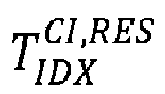



- Optionally, the method for indexing PSCICHS resources may be a "basic PSCICHS resource indexing method", and is, for example, one of the following:
- • First the time domain, then the frequency domain, and then the code domain. For example, indexing is performed according to a mapping method shown by an example in Table 1, that is, arranging the time domain indexes in ascending order, then arranging the frequency domain indexes in ascending order, and then arranging the code domain indexes in ascending order (assuming that


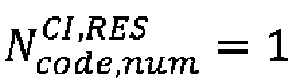
- First the time domain, then the code domain, and then the frequency domain.
- First the frequency domain, then the time domain, and then the code domain.
- First the frequency domain, then the code domain, and then the time domain.
- First the code domain, then the time domain, and then the frequency domain.
- First the code domain, then the frequency domain, and then the time domain.
- Optionally, the method for indexing PSCICHS resources may be a "combined PSCICHS resource indexing method", and is, for example, one of the following:
- Frequency domain combination. For example, one or more (e.g., denoted as




- Time domain combination. For example, one or more (e.g., denoted as





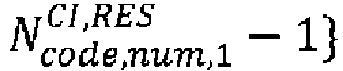


- Optionally, in the time domain, the size of a PSCICHS resource (e.g., denoted as


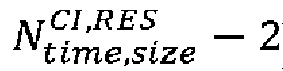

- Optionally, in the time domain,


- Optionally, in the frequency domain, the size of a PSCICHS resource (e.g., denoted as


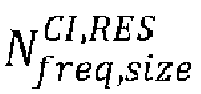
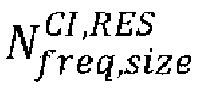


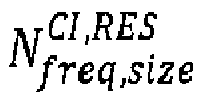


- Optionally, in the frequency domain,


- Optionally, in the code domain, one PSCICHS resource may correspond to one cyclic shift, denoted, for example, as α. Specifically, for example, the cyclic shift corresponding to the PSCICHS resource


- Optionally, in the code domain, one PSCICHS resource may correspond to one cyclic shift pair including two cyclic shifts, for example, respectively referred to as a first cyclic shift and a second cyclic shift. Specifically, for example, the cyclic shift pair corresponding to the PSCICHS resource



- Optionally, in the code domain, whether one PSCICHS resource corresponds to one cyclic shift or one cyclic shift pair may be determined by means of a predefined or configured or pre-configured method.
- Optionally, in the code domain,


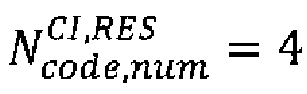


- Optionally, due to limitations on the number of PSCICHS resources, two or more PSCICHS transmissions triggered by the same or different resource conflicts may correspond to the same PSCICHS resource

- Optionally, one PSCICHS transmission and one PSFCH transmission may correspond to the same base sequence but different cyclic shifts.
- Optionally, one PSCICHS transmission and one PSFCH transmission may correspond to different base sequences.
- Optionally, one or more PSCICHS transmissions and one or more PSFCH transmissions may be multiplexed on the same time-frequency resource (e.g., a time-frequency resource having a time domain size of


- Optionally, one PSCICHS resource and one PSFCH resource may correspond to the same time-frequency resource (e.g., a time-frequency resource having a time domain size of


- Optionally, one PSCICHS resource and one PSFCH resource may correspond to the same time-frequency resource (e.g., a time-frequency resource having a time domain size of


- Optionally, a sequence corresponding to a PSCICHS transmission may be denoted as

- n = 0, 1, ..., MZC - 1. MZC may be equal to
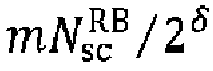


-
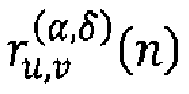
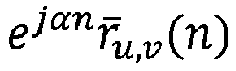


- u may be a predefined or configured or pre-configured value (e.g., u = 0).
- u may be determined by one or more predefined or configured or pre-configured values. For example,


- α may be a function of the slot index and/or the symbol index. For example, α may be equal to αl , and

- ◆ m int may be equal to 0.
- ◆ m 0 may be a predefined or configured or pre-configured value, or may be determined by one or more predefined or configured or pre-configured values.
- ◆ mcs may be a predefined or configured or pre-configured value, or may be determined by one or more predefined or configured or pre-configured values.
- ◆ I may be equal to 0.
- ◆ l' may be the index of a predefined symbol of a corresponding PSCICHS transmission in a slot.
- Optionally, for the PSCICHS resource


- Optionally, for the PSCICHS resource


- Optionally, for the PSCICHS resource


- Optionally, for the PSCICHS resource


- Optionally, one resource conflict may be associated with one priority. The priority may be indicated by a priority value. For example, a value set of the priority value may be {0, 1, ..., 7}. As another example, the value set of the priority value may be {1, 2, ..., 8}. Optionally, a greater priority value indicates a lower priority (or "priority order"). Alternatively, a smaller priority value indicates a lower priority (or "priority order").
- Optionally, one PSCICHS transmission may be associated with one priority. The priority may be indicated by a priority value. For example, a value set of the priority value may be {0, 1, ..., 7}. As another example, the value set of the priority value may be {1, 2, ..., 8}. Optionally, a greater priority value indicates a lower priority (or "priority order"). Alternatively, a smaller priority value indicates a lower priority (or "priority order"). Optionally, when no confusion is caused, the priority of a PSCICHS transmission may be referred to as the priority of a PSCICHS.
- Optionally, one PSCICHS reception may be associated with one priority. The priority may be indicated by a priority value. For example, a value set of the priority value may be {0, 1, ..., 7}. As another example, the value set of the priority value may be {1, 2, ..., 8}. Optionally, a greater priority value indicates a lower priority (or "priority order"). Alternatively, a smaller priority value indicates a lower priority (or "priority order"). Optionally, when no confusion is caused, the priority of a PSCICHS reception may be referred to as the priority of a PSCICHS.
- Optionally, the definition method of the priority associated with the PSCICHS transmission and the definition method of the priority associated with the PSCICHS reception may be the same. For example, the value range of the priority of one PSCICHS transmission and the value range of the priority of one PSCICHS reception may be the same, and may be compared to each other (e.g., due to UE capability limitations, when only one operation among a PSCICHS transmission and a PSCICHS reception can be performed, the operation having the higher priority is performed). Optionally, the definition method of the priority associated with the PSCICHS transmission and the definition method of the priority associated with the PSCICHS reception may be different from each other.
- Optionally, the determination method of the priority value corresponding to the priority associated with the PSCICHS transmission and the determination method of the priority value corresponding to the priority associated with the PSCICHS reception may be the same or different from each other.
- Optionally, a coordination information indication may be transmitted and/or received only when an inter-UE coordination function is activated. Methods of activating (or deactivating) the inter-UE coordination function may include a semi-persistent method (e.g., configured or pre-configured by means of a higher layer protocol) and/or a dynamic method (e.g., indicated in SCI). For example, if UE-A is not configured to activate the inter-UE coordination function, then UE-A does not transmit or receive a coordination information indication. As another example, if UE-A has been configured to activate the inter-UE coordination function, and UE-A detects a resource conflict between a resource R1 reserved by SCI1 and a resource R2 reserved by SCI2, and "coordination enable" is indicated in SCI1 while "coordination enable" is not indicated in SCI2 (or, "coordination disable" is indicated in SCI2), then UE-A may transmit a coordination information indication associated with SCI1 (or Ri), but does not transmit a coordination information indication associated with SCI2 (or R2).
- Optionally, a coordination information indication may be triggered according to one or more predefined or configured or pre-configured conditions by a UE transmitting the coordination information.
- Optionally, a coordination information indication may be triggered by a "coordination request indication". For example, UE-B transmits a coordination request indication (e.g., which may include a coordination type indication, e.g., a "conflict indication request") to UE-A, and as a response, UE-A may detect whether a resource conflict occurs between UE-B and other UEs (e.g., including UE-A or not including UE-A), and include a detection result in a coordination information indication and transmit the same to UE-B.
- Optionally, the coordination request may be included in control information. The control information may be physical layer control information, or higher layer control information. For example, the coordination request may be included in 1st-stage SCI. As another example, the coordination request may be included in 2nd-stage SCI. As another example, the coordination request may be included in SFCI. As another example, the coordination request may be included in other control information (e.g., in SCCI).
- Optionally, the coordination request may be included in higher layer (e.g., the MAC layer, or the RRC layer) signaling. For example, the coordination request may be included in a MAC CE. As another example, the coordination request may be included in an RRC message.
- Optionally, a coordination request indication may be carried by one physical layer channel (or one transmission of the physical layer channel), or may be carried by one physical layer signal (or one transmission of the physical layer signal). For convenience, the physical layer channel/signal may be referred to as a "Physical Sidelink Coordination Request Channel/Signal" (PSCRCHS). Optionally, depending on different coordination types, the PSCRCHS may be different physical layer channels or signals. For example, for a preferred resource indication and/or a non-preferred resource indication, the PSCRCHS may be a PSCCH, a PSSCH, a PSCCH+PSSCH, a PSFCH, another physical layer channel, or a physical layer signal. For a resource conflict indication, the PSCRCHS may be a PSFCH, another physical layer channel, or a physical layer signal.
- Optionally, a resource (such as a time-domain and/or frequency-domain and/or code-domain and/or spatial-domain resource) occupied by a PSCRCHS (or a PSCRCHS transmission) may be referred to as a "PSCRCHS resource". Optionally, a PSCRCHS resource (or a time domain resource corresponding to the PSCRCHS resource, e.g., a slot in which the PSCRCHS resource is located, or one or more symbols in which the PSCRCHS resource is located) may be referred to as a "PSCRCHS occasion", a "PSCRCHS occasion resource", or a "PSCRCHS resource occasion". For a UE transmitting a PSCRCHS, a PSCRCHS resource (or a time domain resource corresponding to the PSCRCHS resource, e.g., a slot in which the PSCRCHS resource is located, or one or more symbols in which the PSCRCHS resource is located) may be referred to as a "PSCRCHS transmission resource", a "PSCRCHS transmission occasion", a "PSCRCHS transmission occasion resource", or a "PSCRCHS transmission resource occasion". For a UE receiving a PSCRCHS, a PSCRCHS resource (or a time domain resource corresponding to the PSCRCHS resource, e.g., a slot in which the PSCRCHS resource is located, or one or more symbols in which the PSCRCHS resource is located) may be referred to as a "PSCRCHS reception resource", a "PSCRCHS reception occasion", a "PSCRCHS reception occasion resource", or a "PSCRCHS reception resource occasion".
- Optionally, the PSCRCHS resource may be configured in an SL carrier (e.g., configured in an information element SL-FreqConfigCommon or configured in an information element SL-FreqConfig). There may be zero or one or more "PSCRCHS configurations" in one SL carrier.
- Optionally, the PSCRCHS resource may be configured in an SL BWP (e.g., configured in an information element SL-BWP-Config or configured in an information element SL-BWP-Generic). There may be zero or one or more "PSCRCHS configurations" in one SL BWP. For each PSCRCHS configuration, the PSCRCHS resource may occupy one or more sub-channels (or one or more resource blocks) configured in one or more resource pools in the SL BWP, or does not occupy any sub-channel (or any resource block) configured in any resource pool in the SL BWP.
- Optionally, the PSCRCHS resource may be configured in a resource pool (e.g., configured in an information element SL-ResourcePool). There may be zero or one PSCRCHS configuration in one resource pool. The PSCRCHS resource may occupy one or more sub-channels (or one or more resource blocks) configured in the resource pool, or does not occupy any sub-channel (or any resource block) configured in the resource pool.
- Optionally, the PSCRCHS resource may be determined by means of sensing and/or a resource selection mechanism. For example, a PSCRCHS may be a PSCCH and/or a PSSCH.
- Optionally, in the time domain, PSCRCHS resources may occur periodically.
- Optionally, in the time domain, the size of a PSCRCHS resource may be a predefined or configured or pre-configured value, or may be determined by one or more predefined or configured or pre-configured values.
- Optionally, in the time domain, one or more PSCRCHS resources may be present in one PSCRCHS slot.
- Optionally, in the frequency domain, the size of a PSCRCHS resource may be a predefined or configured or pre-configured value, or may be determined by one or more predefined or configured or pre-configured values.
- Optionally, in the code domain, one PSCRCHS resource may correspond to one cyclic shift or an index of the cyclic shift. The cyclic shift may be used to determine a sequence corresponding to a PSCRCHS transmission on the PSCRCHS resource. For example, the sequence may be acquired by performing a corresponding cyclic shift on a predefined or configured or pre-configured base sequence, and is used to represent a value indicated in coordination information carried in the PSCRCHS transmission.
- Optionally, in the code domain, one PSCRCHS resource may correspond to one cyclic shift pair or an index of the cyclic shift pair. The cyclic shift pair may correspond to two cyclic shifts (e.g., 0 and 6). Each cyclic shift may be used to determine a sequence corresponding to a PSCRCHS transmission on the PSCRCHS resource. For example, each sequence may be acquired by performing a corresponding cyclic shift on a predefined or configured or pre-configured base sequence, and is used to represent a value indicated in coordination information carried in the PSCRCHS transmission. Optionally, one of two cyclic shifts corresponding to one cyclic shift pair is used to represent a value indicated in coordination information carried in the PSCRCHS transmission, and the other does not indicate any value.
- Optionally, one or more PSCRCHS transmissions and one or more PSFCH transmissions may be multiplexed on the same time-frequency resource (e.g., the same resource block in the same symbol).
- Optionally, one PSCRCHS resource and one PSFCH resource may correspond to the same time-frequency resource (e.g., the same resource block in the same symbol) but different cyclic shift pairs.
- Optionally, one PSCRCHS resource and one PSFCH resource may correspond to the same time-frequency resource (e.g., the same resource block in the same symbol), but a cyclic shift corresponding to the PSCRCHS resource is not equal to either cyclic shift in a cyclic shift pair corresponding to the PSFCH resource.
- Optionally, one PSCRCHS transmission and one PSFCH transmission may correspond to the same base sequence but different cyclic shifts.
- Optionally, one PSCRCHS transmission and one PSFCH transmission may correspond to different base sequences.
- A method performed by a user equipment according to Embodiment 1 of the present invention will be described below with reference to
FIG. 1 . -
FIG. 1 is a flowchart showing a method performed by a user equipment according to Embodiment 1 of the present invention. - As shown in
FIG. 1 , in Embodiment 1 of the present invention, the steps performed by the user equipment (UE) include: step S101 and step S103. - Specifically, in step S101, one or more PSCICHSs to be transmitted in a PSCICHS transmission occasion are determined. For example, the one or more PSCICHSs are denoted as a PSCICHS set



- Optionally, the PSCICHS transmission occasion may correspond to a time domain resource, e.g., a slot (e.g., denoted as


- Optionally, a PSCICHS "to be transmitted" may be a "scheduled PSCICHS" or a "triggered PSCICHS". For example, a scheduled PSCICHS may be a PSCICHS triggered by a resource conflict detected before (e.g., several slots prior to) the PSCICHS transmission occasion and corresponding to a PSCICHS resource on the PSCICHS transmission occasion.
- Optionally, the PSCICHS in the set



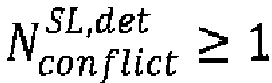


- Optionally, for


- In addition, in step S103, one or more PSCICHSs actually transmitted in the PSCICHS transmission occasion are determined (the one or more PSCICHSs are, for example, denoted as a PSCICHS set


- For example, the set

-


-

-

- Optionally, the set


- Optionally, the set


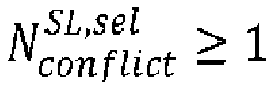

- A first definition of the preferred PSCICHS set: the set


- A second definition of the preferred PSCICHS set: the set




- Optionally, the set




- Optionally,

- Optionally,

- Optionally,


- The maximum number (e.g., denoted as

- The maximum PSCICHS output power (e.g., denoted as


- For example,





- As another example,





- Optionally, for the first definition of the preferred PSCICHS set, for


- Optionally, for the second definition of the preferred PSCICHS set, for



- Optionally, for


-

-

-

- For example,

-

-

-

-

-

-

- If


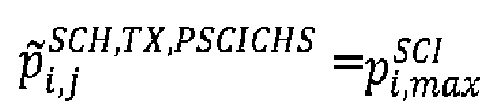
- If


-


-

-

-


-

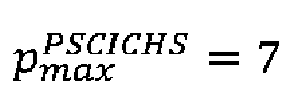

- Optionally, for


-

-

- Optionally, the set


- Optionally, in Embodiment 1 of the present invention, for a set A and a set B, "B-A" may represent a set consisting of all elements that relate to the set B but do not relate to the set A.
- In this way, according to Embodiment 1, the present invention provides a method, in which a priority is determined for each resource conflict, so as to determine, on the basis of the priority, whether to transmit one or more resource conflict indications triggered by the resource conflict, thereby effectively solving the problem of priority when resource conflict indications triggered by a plurality of resource conflicts are to be transmitted on overlapping time domain resources.
- In the present invention, "inter-UE coordination" and other related terms (e.g., "coordination information indication", "coordination request indication", "preferred resource indication", "non-preferred resource indication", "resource conflict indication", "sidelink coordination control information", "physical sidelink coordination information channel/signal", "physical sidelink coordination request channel/signal", etc.) may be defined by functions thereof in a system and/or a corresponding procedure and/or corresponding signaling. When applied to a specific system, the terms may be replaced with other names.
- Hereinafter, FIG. 2 is used to illustrate a user equipment that can perform the method performed by a user equipment described in detail above in the present invention as a variant embodiment.
- FIG. 2 shows a block diagram of a user equipment (UE) to which the present invention relates.
- As shown in FIG. 2, a user equipment (UE) 20 includes a processor 201 and a memory 202. The processor 201 may include, for example, a microprocessor, a microcontroller, an embedded processor, and the like. The memory 202 may, for example, include a volatile memory (for example, a random access memory (RAM)), a hard disk drive (HDD), a nonvolatile memory (for example, a flash memory), or other memories. The memory 202 has program instructions stored thereon. The instructions, when run by the processor 201, can implement the above method performed by a user equipment as described in detail in the present invention.
- The method and related equipment according to the present invention have been described above in combination with preferred embodiments. It should be understood by those skilled in the art that the method shown above is only exemplary, and the above embodiments can be combined with one another as long as no contradiction arises. The method of the present invention is not limited to the steps or sequences illustrated above. The network node and user equipment shown above may include more modules, for example, modules that may be developed or developed in the future and that may be used for a base station, an Access and Mobility Management Function (AMF), a User Plane Function (UPF), a Mobility Management Entity (MME), a Serving Gateway (S-GW), or a UE. Various identifiers shown above are only exemplary, and are not meant for limiting the present invention. The present invention is not limited to specific information elements serving as examples of these identifiers. A person skilled in the art could make various alterations and modifications according to the teachings of the illustrated embodiments. Those skilled in the art should understand that part or all of the mathematical expressions, mathematical equations, or mathematical inequalities may be simplified or transformed or rewritten to some extent, for example, incorporating constant terms, or interchanging two addition terms, or interchanging two multiplication terms, or moving a term from the left side of an equation or inequality to the right side after changing the plus or minus sign thereof, or moving a term from the right side of an equation or inequality to the left side after changing the plus or minus sign thereof or the like. Mathematical expressions, mathematical equations, or mathematical inequalities before and after the simplification or transformation or rewriting may be considered to be equivalent to each other.
- It should be understood that the above-described embodiments of the present invention may be implemented through software, hardware, or a combination of software and hardware. For example, various components of the base station and user equipment in the above embodiments can be implemented by multiple devices, and these devices include, but are not limited to: an analog circuit device, a digital circuit device, a digital signal processing (DSP) circuit, a programmable processor, an application-specific integrated circuit (ASIC), a field-programmable gate array (FPGA), a complex programmable logic device (CPLD), and the like.
- In the present invention, the term "base station" may refer to a mobile communication data and/or control switching center having specific transmission power and a specific coverage area and including functions such as resource allocation and scheduling, data reception and transmission, and the like. "User equipment" may refer to a user mobile terminal, for example, including terminal devices that can communicate with a base station or a micro base station wirelessly, such as a mobile phone, a laptop computer, and the like.
- In addition, the embodiments of the present invention disclosed herein may be implemented on a computer program product. More specifically, the computer program product is a product provided with a computer-readable medium having computer program logic encoded thereon. When executed on a computing device, the computer program logic provides related operations to implement the above technical solutions of the present invention. When executed on at least one processor of a computing system, the computer program logic causes the processor to perform the operations (the method) described in the embodiments of the present invention. Such setting of the present invention is typically provided as software, codes and/or other data structures provided or encoded on the computer-readable medium, e.g., an optical medium (e.g., compact disc read-only memory (CD-ROM)), a flexible disk or a hard disk and the like, or other media such as firmware or micro codes on one or more read-only memory (ROM) or random access memory (RAM) or programmable read-only memory (PROM) chips, or a downloadable software image, a shared database and the like in one or more modules. Software or firmware or such configuration may be installed on a computing device such that one or more processors in the computing device perform the technical solutions described in the embodiments of the present invention.
- In addition, each functional module or each feature of the base station device and terminal device used in each of the above embodiments may be implemented or executed by a circuit, which is usually one or more integrated circuits. Circuits designed to execute various functions described in this description may include general-purpose processors, digital signal processors (DSPs), application-specific integrated circuits (ASICs) or general-purpose integrated circuits, field-programmable gate arrays (FPGAs) or other programmable logic devices, discrete gates or transistor logic, or discrete hardware components, or any combination of the above. The general purpose processor may be a microprocessor, or the processor may be an existing processor, a controller, a microcontroller, or a state machine. The aforementioned general purpose processor or each circuit may be configured by a digital circuit or may be configured by a logic circuit. Furthermore, when advanced technology capable of replacing current integrated circuits emerges due to advances in semiconductor technology, the present invention can also use integrated circuits obtained using this advanced technology.
- While the present invention has been illustrated in combination with the preferred embodiments of the present invention, it will be understood by those skilled in the art that various modifications, substitutions, and alterations may be made to the present invention without departing from the spirit and scope of the present invention. Therefore, the present invention should not be limited by the above-described embodiments, but should be defined by the appended claims and their equivalents.
| PSCICHS Resource Index | Time Domain Index | Frequency Domain Index | Code Domain Index |
| 0 | 0 | 0 | 0 |
| 1 | 1 | 0 | 0 |
| 2 | 0 | 1 | 0 |
| 3 | 1 | 1 | 0 |
| 4 | 0 | 0 | 1 |
| 5 | 1 | 0 | 1 |
| 6 | 0 | 1 | 1 |
| 7 | 1 | 1 | 1 |



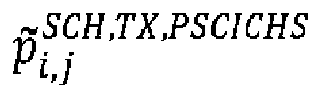


Claims (2)
- A method performed by a user equipment (UE), characterized by comprising:determining a resource conflict caused by resources respectively reserved in one or more SCI formats 1-A, andtransmitting a physical sidelink feedback channel (PSFCH) for indication of the resource conflict, whereina priority value of the PSFCH is equal to the smallest value among priority values respectively indicated by the one or more SCI formats 1-A.
- A user equipment, comprising:a processor; anda memory, having instructions stored therein,wherein the instructions, when run by the processor, perform the method according to claim 1.
Applications Claiming Priority (2)
| Application Number | Priority Date | Filing Date | Title |
|---|---|---|---|
| CN202111168893.7A CN115915411A (en) | 2021-09-30 | 2021-09-30 | Method performed by user equipment and user equipment |
| PCT/CN2022/122603 WO2023051699A1 (en) | 2021-09-30 | 2022-09-29 | Method performed by user equipment and user equipment |
Publications (2)
| Publication Number | Publication Date |
|---|---|
| EP4412356A1 true EP4412356A1 (en) | 2024-08-07 |
| EP4412356A4 EP4412356A4 (en) | 2025-05-14 |
Family
ID=85743023
Family Applications (1)
| Application Number | Title | Priority Date | Filing Date |
|---|---|---|---|
| EP22875080.8A Pending EP4412356A4 (en) | 2021-09-30 | 2022-09-29 | Method performed by user equipment, and user equipment |
Country Status (4)
| Country | Link |
|---|---|
| US (1) | US20240406977A1 (en) |
| EP (1) | EP4412356A4 (en) |
| CN (1) | CN115915411A (en) |
| WO (1) | WO2023051699A1 (en) |
Family Cites Families (6)
| Publication number | Priority date | Publication date | Assignee | Title |
|---|---|---|---|---|
| US7941531B2 (en) * | 2008-11-24 | 2011-05-10 | Nortel Networks Limited | Age biased distributed collision resolution without clocks |
| EP3909179A4 (en) * | 2019-01-10 | 2022-04-20 | Panasonic Intellectual Property Corporation of America | User equipment and wireless communication method |
| CN111757342A (en) * | 2019-03-28 | 2020-10-09 | 夏普株式会社 | Methods performed by user equipment |
| EP4005315B1 (en) * | 2019-07-23 | 2024-09-04 | Fg Innovation Company Limited | Method of determining physical sidelink feedback channel resource for hybrid automatic repeat request feedback and related device |
| WO2021090459A1 (en) * | 2019-11-07 | 2021-05-14 | 株式会社Nttドコモ | Terminal and communication method |
| US12477568B2 (en) * | 2021-09-29 | 2025-11-18 | Samsung Electronics Co., Ltd. | Method and apparatus for inter-UE coordination signaling |
-
2021
- 2021-09-30 CN CN202111168893.7A patent/CN115915411A/en active Pending
-
2022
- 2022-09-29 WO PCT/CN2022/122603 patent/WO2023051699A1/en not_active Ceased
- 2022-09-29 EP EP22875080.8A patent/EP4412356A4/en active Pending
- 2022-09-29 US US18/696,246 patent/US20240406977A1/en active Pending
Also Published As
| Publication number | Publication date |
|---|---|
| WO2023051699A1 (en) | 2023-04-06 |
| EP4412356A4 (en) | 2025-05-14 |
| US20240406977A1 (en) | 2024-12-05 |
| CN115915411A (en) | 2023-04-04 |
Similar Documents
| Publication | Publication Date | Title |
|---|---|---|
| US20240080866A1 (en) | Method performed by user equipment, and user equipment | |
| EP4187999B1 (en) | Method performed by user equipment, and user equipment | |
| CN111148128A (en) | Method performed by user equipment and user equipment | |
| US20250386371A1 (en) | Wireless communication method and user equipment | |
| EP4597899A1 (en) | Method executed by user equipment, and user equipment | |
| EP4376448A1 (en) | Method executed by user equipment, and user equipment | |
| US20230069535A1 (en) | Method performed by user equipment, and user equipment | |
| EP4572396A1 (en) | Method executed by user equipment and user equipment | |
| EP4546913A1 (en) | Method executed by user equipment and user equipment | |
| EP4131826A1 (en) | Method implemented by user equipment, and user equipment | |
| US20250274953A1 (en) | Method performed by user equipment, and user equipment | |
| EP4383623A1 (en) | Method executed by user equipment, and user equipment | |
| EP4412356A1 (en) | Method performed by user equipment, and user equipment | |
| US20250159698A1 (en) | Method performed by user equipment, and user equipment | |
| EP4514003A1 (en) | Method executed by user equipment, and user equipment | |
| WO2023078344A1 (en) | Method executed by user equipment, and user equipment | |
| US12446095B2 (en) | Method performed by user equipment, user equipment, and base station to determine HARQ-ACK codebooks for sidelink and downlink transmissions | |
| US12395989B2 (en) | Method performed by user equipment, and user equipment | |
| EP4550926A1 (en) | Method executed by means of user equipment, and user equipment | |
| EP4319221A1 (en) | Method implemented by user equipment, and user equipment | |
| EP4597900A1 (en) | Method executed by user equipment, and user equipment | |
| CN116095629A (en) | Method performed by user equipment and user equipment | |
| CN116095630A (en) | Method performed by user equipment and user equipment | |
| US20230379121A1 (en) | Method performed by user equipment, and user equipment | |
| CN120302454A (en) | Method performed by user equipment and user equipment |
Legal Events
| Date | Code | Title | Description |
|---|---|---|---|
| STAA | Information on the status of an ep patent application or granted ep patent |
Free format text: STATUS: THE INTERNATIONAL PUBLICATION HAS BEEN MADE |
|
| PUAI | Public reference made under article 153(3) epc to a published international application that has entered the european phase |
Free format text: ORIGINAL CODE: 0009012 |
|
| STAA | Information on the status of an ep patent application or granted ep patent |
Free format text: STATUS: REQUEST FOR EXAMINATION WAS MADE |
|
| 17P | Request for examination filed |
Effective date: 20240418 |
|
| AK | Designated contracting states |
Kind code of ref document: A1 Designated state(s): AL AT BE BG CH CY CZ DE DK EE ES FI FR GB GR HR HU IE IS IT LI LT LU LV MC MK MT NL NO PL PT RO RS SE SI SK SM TR |
|
| DAV | Request for validation of the european patent (deleted) | ||
| DAX | Request for extension of the european patent (deleted) | ||
| A4 | Supplementary search report drawn up and despatched |
Effective date: 20250415 |
|
| RIC1 | Information provided on ipc code assigned before grant |
Ipc: H04W 76/14 20180101ALI20250410BHEP Ipc: H04L 1/1829 20230101ALI20250410BHEP Ipc: H04L 5/00 20060101ALI20250410BHEP Ipc: H04W 24/02 20090101ALI20250410BHEP Ipc: H04W 72/56 20230101ALI20250410BHEP Ipc: H04W 72/02 20090101ALI20250410BHEP Ipc: H04W 72/04 20230101AFI20250410BHEP |