EP4412327A1 - Device and method - Google Patents
Device and method Download PDFInfo
- Publication number
- EP4412327A1 EP4412327A1 EP22875809.0A EP22875809A EP4412327A1 EP 4412327 A1 EP4412327 A1 EP 4412327A1 EP 22875809 A EP22875809 A EP 22875809A EP 4412327 A1 EP4412327 A1 EP 4412327A1
- Authority
- EP
- European Patent Office
- Prior art keywords
- list
- information
- processing
- message
- network node
- Prior art date
- Legal status (The legal status is an assumption and is not a legal conclusion. Google has not performed a legal analysis and makes no representation as to the accuracy of the status listed.)
- Pending
Links
Images











Classifications
-
- H—ELECTRICITY
- H04—ELECTRIC COMMUNICATION TECHNIQUE
- H04W—WIRELESS COMMUNICATION NETWORKS
- H04W60/00—Affiliation to network, e.g. registration; Terminating affiliation with the network, e.g. de-registration
- H04W60/04—Affiliation to network, e.g. registration; Terminating affiliation with the network, e.g. de-registration using triggered events
-
- G—PHYSICS
- G08—SIGNALLING
- G08G—TRAFFIC CONTROL SYSTEMS
- G08G5/00—Traffic control systems for aircraft
- G08G5/20—Arrangements for acquiring, generating, sharing or displaying traffic information
- G08G5/22—Arrangements for acquiring, generating, sharing or displaying traffic information located on the ground
-
- G—PHYSICS
- G08—SIGNALLING
- G08G—TRAFFIC CONTROL SYSTEMS
- G08G5/00—Traffic control systems for aircraft
- G08G5/20—Arrangements for acquiring, generating, sharing or displaying traffic information
- G08G5/26—Transmission of traffic-related information between aircraft and ground stations
-
- G—PHYSICS
- G08—SIGNALLING
- G08G—TRAFFIC CONTROL SYSTEMS
- G08G5/00—Traffic control systems for aircraft
- G08G5/50—Navigation or guidance aids
- G08G5/53—Navigation or guidance aids for cruising
-
- G—PHYSICS
- G08—SIGNALLING
- G08G—TRAFFIC CONTROL SYSTEMS
- G08G5/00—Traffic control systems for aircraft
- G08G5/50—Navigation or guidance aids
- G08G5/55—Navigation or guidance aids for a single aircraft
-
- G—PHYSICS
- G08—SIGNALLING
- G08G—TRAFFIC CONTROL SYSTEMS
- G08G5/00—Traffic control systems for aircraft
- G08G5/70—Arrangements for monitoring traffic-related situations or conditions
- G08G5/72—Arrangements for monitoring traffic-related situations or conditions for monitoring traffic
- G08G5/727—Arrangements for monitoring traffic-related situations or conditions for monitoring traffic from a ground station
-
- H—ELECTRICITY
- H04—ELECTRIC COMMUNICATION TECHNIQUE
- H04W—WIRELESS COMMUNICATION NETWORKS
- H04W4/00—Services specially adapted for wireless communication networks; Facilities therefor
- H04W4/02—Services making use of location information
- H04W4/029—Location-based management or tracking services
-
- H—ELECTRICITY
- H04—ELECTRIC COMMUNICATION TECHNIQUE
- H04W—WIRELESS COMMUNICATION NETWORKS
- H04W60/00—Affiliation to network, e.g. registration; Terminating affiliation with the network, e.g. de-registration
-
- H—ELECTRICITY
- H04—ELECTRIC COMMUNICATION TECHNIQUE
- H04W—WIRELESS COMMUNICATION NETWORKS
- H04W64/00—Locating users or terminals or network equipment for network management purposes, e.g. mobility management
-
- H—ELECTRICITY
- H04—ELECTRIC COMMUNICATION TECHNIQUE
- H04W—WIRELESS COMMUNICATION NETWORKS
- H04W64/00—Locating users or terminals or network equipment for network management purposes, e.g. mobility management
- H04W64/006—Locating users or terminals or network equipment for network management purposes, e.g. mobility management with additional information processing, e.g. for direction or speed determination
-
- H—ELECTRICITY
- H04—ELECTRIC COMMUNICATION TECHNIQUE
- H04W—WIRELESS COMMUNICATION NETWORKS
- H04W76/00—Connection management
- H04W76/20—Manipulation of established connections
- H04W76/27—Transitions between radio resource control [RRC] states
-
- G—PHYSICS
- G08—SIGNALLING
- G08G—TRAFFIC CONTROL SYSTEMS
- G08G5/00—Traffic control systems for aircraft
- G08G5/50—Navigation or guidance aids
- G08G5/57—Navigation or guidance aids for unmanned aircraft
-
- H—ELECTRICITY
- H04—ELECTRIC COMMUNICATION TECHNIQUE
- H04W—WIRELESS COMMUNICATION NETWORKS
- H04W84/00—Network topologies
- H04W84/02—Hierarchically pre-organised networks, e.g. paging networks, cellular networks, WLAN [Wireless Local Area Network] or WLL [Wireless Local Loop]
- H04W84/04—Large scale networks; Deep hierarchical networks
- H04W84/06—Airborne or Satellite Networks
Definitions
- the present disclosure relates to an apparatus and a method.
- 3GPP 3rd Generation Partnership Project
- UAVs unmanned aerial vehicles
- UEs user equipments
- Flight Path feature a flight path of a UAV is reported from the UAV to a network in response to a request from the network. This is intended to serve for control such as a handover or beamforming based on a moving plan of the UAV on the network side (NPL 2).
- the TSs define a tracking area (TA) that is managed as information indicating the location of a UE.
- the TA includes one or more cells.
- the UE receives, from a network, a TA list indicating the one or more TAs configured for the UE. Specifically, the UE receives a RegistrationAccept message including the TA list from the network by transmitting a RegistrationRequest message to the network.
- the UE does not perform a tracking area update (TAU) procedure that is a procedure of updating location information.
- TAU tracking area update
- the UE performs a TAU procedure for the network.
- the conventional technology may lead to an increase in the signaling for updating or configuring a TA list.
- the UE may move more easily to a place other than a TA indicated by the TA list.
- the TAU is invoked with high frequency, which may increase signaling.
- An object of the present disclosure is to provide an apparatus and a method that each make it possible to suppress an increase in the signaling for updating or configuring a TA list.
- An apparatus (100) includes: an information obtaining unit (131) configured to obtain provided information that is used for configuring a tracking area, TA, list for the apparatus; and a communication processing unit (135) configured to transmit, to a network (200, 300, 400), a message including the provided information at a timing of a predetermined event.
- the provided information is associated with a moving path of the apparatus.
- the predetermined event is associated with movement of the apparatus with respect to the TA list.
- a method performed by an apparatus (100) includes: obtaining provided information that is used for configuring a tracking area, TA, list for the apparatus; and transmitting, to a network (200, 300, 400), a message including the provided information at a timing of a predetermined event.
- the provided information is associated with a moving path of the apparatus.
- the predetermined event is associated with movement of the apparatus with respect to the TA list.
- the present disclosure it is possible to suppress an increase in the signaling for updating or configuring a TA list. Note that, instead of or in addition to this advantageous effect, the present disclosure may yield another advantageous effect.
- the system 1 includes a user equipment (communication apparatus) 100, a base station 200, and a core network 30.
- the core network 30 includes a network node 300 and a processing node 400.
- the system 1 is a system compliant with technical specifications (TSs) in 3GPP. More specifically, for example, the system 1 is a system compliant with the TSs of 5G or new radio (NR). Naturally, the system 1 is not limited to this example.
- the system 1 may be a system compliant with other TSs in 3GPP.
- the system 1 may be a system compliant with the TSs of LTE, LTE advanced (LTE-A), or 4G and the base station 200 may be an evolved node B (eNB).
- the base station 200 may be an ng-eNB.
- the system 1 may be a system compliant with the TSs of 3G and the base station 200 may be a Node B.
- the system 1 may be a system compliant with next generation (for example, 6G) TSs.
- the system 1 may be a system compliant with TSs of another standards organization for mobile communications.
- the UE 100 communicates with a base station.
- the UE 100 communicates with the base station 200 in a case where the UE 100 is located within a coverage area 10 of the base station 200.
- the UE 100 communicates with a base station (for example, base station 200) by using a radio access network (RAN) protocol stack.
- RAN radio access network
- the protocol stack includes protocols of radio resource control (RRC), service data adaptation protocol (SDAP), packet data convergence protocol (PDCP), radio link control (RLC), medium access control (MAC), and physical (PHY) layers.
- RRC radio resource control
- SDAP service data adaptation protocol
- PDCP packet data convergence protocol
- RLC radio link control
- MAC medium access control
- PHY physical layers
- the protocol stack does not have to include all of these protocols, but may include some of these protocols.
- the UE 100 communicates with a network node (for example, network node 300) by using a non-access stratum (NAS) protocol.
- NAS non-access stratum
- the UE 100 transmits a NAS message to the base station 200.
- the NAS message is transmitted from the base station 200 to the network node 300.
- the UE 100 is mounted on a mobile body.
- the mobile body may be an aircraft such as a UAV or a vehicle such as an autonomous driving car or a manual driving car with a navigation function.
- a moving path may be set in advance. It is possible for the UE 100 to receive benefits of communication control based on the moving path by reporting the moving path to the network (that is, base station 200).
- a report of the moving path may be supported by, for example, a Flight Path mechanism or another moving path reporting mechanism.
- the UE 100 reports the set moving path to the base station 200.
- the base station 200 preliminarily performs, for example, processing for a handover or beamforming based on a future location of the UE 100 that is estimated from the reported moving path. This allows communication control suitable for the estimated location to be performed at a timing at which the UE 100 reaches the location.
- the UE 100 is configured with a TA list for location management.
- the TA list is a tracking area identity (TAI) list.
- the TA list is configured by the network node 300.
- the UE 100 receives the configured TA list from the network node 300.
- the UE 100 does not perform a TAU procedure (referred to as a TAU below).
- the UE 100 performs a TAU for the network node 300.
- the TA list is updated through the TAU and the UE 100 receives the updated TA list from the network node 300.
- the base station 200 is a node in an RAN and communicates with a UE (for example, UE 100) located within the coverage area 10 of the base station 200.
- a UE for example, UE 100
- the base station 200 communicates with a UE (for example, UE 100) by using the protocol stack.
- a UE for example, UE 100
- the base station 200 communicates with nodes (for example, the network node 300 and the processing node 400) located within the core network 30.
- nodes for example, the network node 300 and the processing node 400 located within the core network 30.
- the base station 200 communicates with nodes (for example, the network node 300 and the processing node 400) located within the core network 30 by using an NG application protocol (NGAP).
- nodes for example, the network node 300 and the processing node 400 located within the core network 30 by using an NG application protocol (NGAP).
- NGAP NG application protocol
- the base station 200 is a gNB.
- the gNB is a node that provides NR user plane and control plane protocol terminations towards a UE and is connected to a 5G core network (5GC) through an NG interface.
- the base station 200 may be an en-gNB.
- the en-gNB is a node that provides NR user plane and control plane protocol terminations toward a UE and operates as a secondary node in E-UTRA-NR dual connectivity (EN-DC).
- the base station 200 may include a plurality of nodes.
- the plurality of nodes may include a first node that hosts higher layers included in the protocol stack and a second node that hosts lower layers included in the protocol stack.
- the higher layers may include the RRC layer, the SDAP layer, and the PDCP layer, while the lower layers may include the RLC layer, the MAC layer, and the PHY layer.
- the first node may be a central unit (CU) and the second node may be a distributed unit (DU).
- the plurality of nodes may include a third node that performs lower-level processing of the PHY layer and the second node may perform higher-level processing of the PHY layer.
- the third node may be a radio unit (RU).
- the base station 200 may be one of the plurality of nodes and may be connected to another unit of the plurality of nodes.
- the base station 200 may be an integrated access and backhaul (IAB) donor or an IAB node.
- IAB integrated access and backhaul
- the network node 300 is a network function of the core network 30.
- the network node 300 is an access and mobility management function (AMF).
- AMF access and mobility management function
- the network node 300 communicates with a UE (for example, UE 100) through a base station (for example, base station 200). For example, the network node 300 communicates with the base station 200 by using an NGAP. In addition, the network node 300 communicates with the UE 100 by using a NAS protocol.
- the network node 300 configures a TA list. Specifically, the network node 300 configures a TA list including one or more TAs based on the cell within which the UE 100 is located in response to a request from the UE 100. The network node 300 transmits the configured TA list to the UE 100. In addition, the network node 300 updates the TA list and transmits the updated TA list to the UE 100 in a TAU.
- the processing node 400 is a network function of performing processing by using artificial intelligence (AI).
- AI may be trained through machine learning (ML).
- ML machine learning
- 3GPP Release 18 has been discussing the use of AI or ML in a communication system (see, for example, TR 22.874).
- the processing node 400 may be a form of the use of the AI or the ML.
- the processing node 400 may be implemented in the form of a server, but the form for implementing the processing node 400 is not limited to this.
- the processing node 400 is disposed in the core network 30 as illustrated in FIG. 1 .
- the processing node 400 may be disposed in a network other than the core network.
- the processing node 400 may be disposed in an external network such as the Internet, or a radio access network.
- the processing node 400 communicates with a UE (for example, UE 100), a base station (for example, base station 200), and a network node (for example, network node 300).
- a communication method corresponding to the disposition of the processing node 400 may be used for the communication of the processing node 400.
- the processing node 400 may communicate with the base station 200 by using an NGAP.
- the processing node 400 may communicate with the UE 100 by using a NAS protocol.
- a protocol defined for the communication of the processing node 400 may be used instead of or along with any of the existing protocols.
- FIGS. 3 and 4 An example of a configuration of the UE 100 according to embodiments of the present disclosure will be described with reference to FIGS. 3 and 4 .
- the UE 100 includes a radio communication unit 110, a storage unit 120, and a processing unit 130.
- the radio communication unit 110 wirelessly transmits and receives signals.
- the radio communication unit 110 receives a signal from a base station and transmits a signal to the base station.
- the radio communication unit 110 receives a signal from another UE and transmits a signal to the other UE.
- the storage unit 120 stores various kinds of information for the UE 100.
- the processing unit 130 provides various functions of the UE 100.
- the processing unit 130 includes an information obtaining unit 131, a control unit 133, and a communication processing unit 135. Note that the processing unit 130 may further include other components in addition to these components. That is, the processing unit 130 may also perform an operation other than operations of these components. Specific operations of the information obtaining unit 131, the control unit 133, and the communication processing unit 135 will be described in detail below.
- the processing unit 130 communicates with a base station (for example, base station 200) or another UE through the radio communication unit 110.
- the processing unit 130 communicates with a core network (for example, network node 300) through the base station.
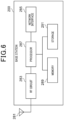
- the UE 100 includes an antenna 181, a radio frequency (RF) circuit 183, a processor 185, a memory 187, and a storage 189.
- RF radio frequency
- the antenna 181 converts signals into radio waves and emits the radio waves into the air. In addition, the antenna 181 receives radio waves in the air and converts the radio waves into signals.
- the antenna 181 may include a transmitting antenna and a receiving antenna or may be a single antenna for transmission and reception.
- the antenna 181 may be a directional antenna and may include a plurality of antenna elements.
- the RF circuit 183 performs analog processing on signals that are transmitted and received through the antenna 181.
- the RF circuit 183 may include a high-frequency filter, an amplifier, a modulator, a lowpass filter, and the like.
- the processor 185 performs digital processing on signals that are transmitted and received through the antenna 181 and the RF circuit 183.
- the digital processing includes processing of the RAN protocol stack.
- the processor 185 may include a plurality of processors or may be a single processor.
- the plurality of processors may include a baseband processor that performs the digital processing and one or more processors that perform other processing.
- the memory 187 stores a program to be performed by the processor 185, a parameter associated with the program, and other various kinds of information.
- the memory 187 may include at least one of a read only memory (ROM), an erasable programmable read only memory (EPROM), an electrically erasable programmable read only memory (EEPROM), a random-access memory (RAM), and a flash memory. All or part of the memory 187 may be included in the processor 185.
- the storage 189 stores various kinds of information.
- the storage 189 may include at least one of a solid-state drive (SSD) and a hard disc drive (HDD).
- SSD solid-state drive
- HDD hard disc drive
- the radio communication unit 110 may be implemented by the antenna 181 and the RF circuit 183.
- the storage unit 120 may be implemented by the storage 189.
- the processing unit 130 may be implemented by the processor 185 and the memory 187.
- the processing unit 130 may be implemented by a system on a chip (SoC) including the processor 185 and the memory 187.
- SoC system on a chip
- the SoC may include the RF circuit 183 and the radio communication unit 110 may also be implemented by the SoC.
- the UE 100 may include a memory (that is, memory 187) that stores a program and one or more processors (that is, processor 185) capable of executing the program and the one or more processors may perform operations of the processing unit 130 by executing the program.
- the program may be a program for causing the processors to perform the operations of the processing unit 130.
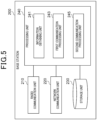
- the base station 200 includes a radio communication unit 210, a network communication unit 220, a storage unit 230, and a processing unit 240.
- the radio communication unit 210 wirelessly transmits and receives signals. For example, the radio communication unit 210 receives a signal from a UE and transmits a signal to the UE.
- the network communication unit 220 receives a signal from a network and transmits a signal to the network.
- the storage unit 230 stores various kinds of information for the base station 200.
- the processing unit 240 provides various functions of the base station 200.
- the processing unit 240 includes an information obtaining unit 241, a first communication processing unit 243, and a second communication processing unit 245.
- the processing unit 240 may further include other components in addition to these components. That is, the processing unit 240 may also perform an operation other than operations of these components. Specific operations of the information obtaining unit 241, the first communication processing unit 243, and the second communication processing unit 245 will be described in detail below.
- the processing unit 240 (first communication processing unit 243) communicates with a UE (for example, UE 100) through the radio communication unit 210.
- the processing unit 240 (second communication processing unit 245) communicates with another node (for example, the network node 300 or the processing node 400 within the core network 30, or another base station) through the network communication unit 220.
- the base station 200 includes an antenna 281, an RF circuit 283, a network interface 285, a processor 287, a memory 289, and a storage 291.
- the antenna 281 converts signals into radio waves and emits the radio waves into the air. In addition, the antenna 281 receives radio waves in the air and converts the radio waves into signals.
- the antenna 281 may include a transmitting antenna and a receiving antenna or may be a single antenna for transmission and reception.
- the antenna 281 may be a directional antenna and may include a plurality of antenna elements.
- the RF circuit 283 performs analog processing on signals that are transmitted and received through the antenna 281.
- the RF circuit 283 may include a high-frequency filter, an amplifier, a modulator, a lowpass filter, and the like.
- the network interface 285 is, for example, a network adaptor, and transmits a signal to a network and receives a signal from the network.
- the processor 287 performs digital processing on signals that are transmitted and received through the antenna 281 and the RF circuit 283.
- the digital processing includes processing of the RAN protocol stack.
- the processor 287 also performs processing on signals that are transmitted and received through the network interface 285.
- the processor 287 may include a plurality of processors or may be a single processor.
- the plurality of processors may include a baseband processor that performs the digital processing and one or more processors that perform other processing.
- the memory 289 stores a program to be performed by the processor 287, a parameter associated with the program, and other various kinds of information.
- the memory 289 may include at least one of a ROM, an EPROM, an EEPROM, a RAM, and a flash memory. All or part of the memory 289 may be included in the processor 287.
- the storage 291 stores various kinds of information.
- the storage 291 may include at least one of an SSD and an HDD.
- the radio communication unit 210 may be implemented by the antenna 281 and the RF circuit 283.
- the network communication unit 220 may be implemented by the network interface 285.
- the storage unit 230 may be implemented by the storage 291.
- the processing unit 240 may be implemented by the processor 287 and the memory 289.
- Part or all of the processing unit 240 may be virtualized. In other words, part or all of the processing unit 240 may be implemented as a virtual machine. In this case, part or all of the processing unit 240 may operate as a virtual machine on a physical machine (that is, hardware) including a processor, a memory, and the like and a hypervisor.
- a physical machine that is, hardware
- the base station 200 may include a memory (that is, memory 289) that stores a program and one or more processors (that is, processor 287) capable of executing the program and the one or more processors may perform operations of the processing unit 240 by executing the program.
- the program may be a program for causing the processors to perform the operations of the processing unit 240.
- FIGS. 7 and 8 An example of a configuration of the network node 300 according to embodiments of the present disclosure will be described with reference to FIGS. 7 and 8 .
- the network node 300 includes a network communication unit 310, a storage unit 320, and a processing unit 330.
- the network communication unit 310 receives a signal from a network and transmits a signal to the network.
- the storage unit 320 stores various kinds of information for the network node 300.
- the processing unit 330 provides various functions of the network node 300.
- the processing unit 330 includes an information obtaining unit 331, a control unit 333, and a communication processing unit 335.
- the processing unit 330 may further include other components in addition to these components. That is, the processing unit 330 may also perform an operation other than operations of these components. Specific operations of the information obtaining unit 331, the control unit 333, and the communication processing unit 335 will be described in detail below.
- the processing unit 330 communicates with a base station (for example, base station 200) through the network communication unit 310.
- the processing unit 330 (communication processing unit 335) communicates with a UE (for example, UE 100) via a base station (for example, base station 200) through the network communication unit 310.
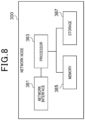
- the network node 300 includes a network interface 381, a processor 383, a memory 385, and a storage 387.
- the network interface 381 is, for example, a network adaptor, and transmits a signal to a network and receives a signal from the network.
- the processor 383 performs processing on signals that are transmitted and received through the network interface 381.
- the processor 383 may include a plurality of processors or may be a single processor.
- the memory 385 stores a program to be performed by the processor 383, a parameter associated with the program, and other various kinds of information.
- the memory 385 may include at least one of a ROM, an EPROM, an EEPROM, a RAM, and a flash memory. All or part of the memory 385 may be included in the processor 383.
- the storage 387 stores various kinds of information.
- the storage 387 may include at least one of an SSD and an HDD.
- the network communication unit 310 may be implemented by the network interface 381.
- the storage unit 320 may be implemented by the storage 387.
- the processing unit 330 may be implemented by the processor 383 and the memory 385
- Part or all of the processing unit 330 may be virtualized. In other words, part or all of the processing unit 330 may be implemented as a virtual machine. In this case, part or all of the processing unit 330 may operate as a virtual machine on a physical machine (that is, hardware) including a processor, a memory, and the like and a hypervisor.
- a physical machine that is, hardware
- the network node 300 may include a memory (that is, memory 385) that stores a program and one or more processors (that is, processor 383) capable of executing the program and the one or more processors may perform operations of the processing unit 330 by executing the program.
- the program may be a program for causing the processors to perform the operations of the processing unit 330.
- processing node 400 An example of a configuration of the processing node 400 according to embodiments of the present disclosure will be described. Note that the functional configuration and the hardware configuration of the processing node 400 are each substantially the same as the configuration of the network node 300 having the same name and will not be thus illustrated or described in detail.
- the processing node 400 includes a network communication unit 410, a storage unit 420, and a processing unit 430.
- the processing unit 430 includes an information obtaining unit 431, a control unit 433, and a communication processing unit 435.
- the processing node 400 includes a network interface 481, a processor 483, a memory 485, and a storage 487.
- path information is transmitted from the UE 100 to the network node 300 via the base station 200 as provided information.
- the path information is provided from the network node 300 to the processing node 400 and the path information is converted to a TA list by the processing node 400.
- the UE 100 transmits path information to the network node 300.
- the UE 100 receives a TA list from the network node 300 as a response to the path information.
- the following describes an operation of the UE 100 and relevant information in detail.
- the UE 100 obtains provided information associated with a moving path of the UE 100.
- the provided information is information that is used for configuring a TA list for the UE 100.
- the provided information is path information indicating at least the moving path of the UE 100.
- the UE 100 obtains the path information.
- the UE 100 obtains the path information from an application.
- the NAS layer of the UE 100 obtains the path information from a higher layer (for example, application layer) of the NAS layer.
- the moving path is a scheduled (that is, planned) moving path.
- the application may be a navigation application.
- the path information may be flightPathInfoReport or information corresponding to this.
- the UE 100 transmits obtained path information to a network. Specifically, the UE 100 (communication processing unit 135) transmits a message including path information serving as provided information to the network.
- the network that is the transmission destination of the message is the network node 300 within the core network 30.
- the UE 100 transmits a NAS message including the path information to the AMF that is the network node 300.
- the NAS message is transmitted to the network node 300 via the base station 200.
- Such use of signaling between the UE and the network node allows the path information to be transmitted from the UE 100 to the network node 300 without modifying the operation of a lower layer.
- the NAS message including the path information may be a RegistrationRequest message or a ServiceRequest message.
- the NAS message including the path information may be a NAS message which is additionally defined and used for transmitting the path information. In this case, it is possible to transmit the path information to the network node 300 without modifying the existing NAS message.
- the UE 100 receives a message including a TA list from a network after the transmission of provided information. Specifically, the UE 100 (communication processing unit 135) receives the message including the TA list from the network as a response to path information serving as the provided information. The TA list is based on the path information.
- the UE 100 receives a NAS message including the TA list configured for the UE 100 from the AMF that is the network node 300 via the base station 200 as a response to a NAS message including the path information.
- Such use of signaling between the UE and the network node allows the TA list to be transmitted from the network node 300 to the UE 100 without modifying the operation of a lower layer.
- the NAS message including the TA list may be a RegistrationAccept message that is a response to the RegistrationRequest message or a ServiceAccept message that is a response to the ServiceRequest message.
- the message including the TA list may be a message which is additionally defined and used for transmitting the TA list. In this case, it is possible to receive the TA list from the network without modifying any of the existing messages.
- the base station 200 transfers path information received from the UE 100 to the network node 300.
- the base station 200 transfers a TA list received from the network node 300 to the UE 100.
- the following describes an operation of the base station 200 and relevant information in detail. Note that the contents which are substantially the same as the description of an operation of the UE 100 will not be described in detail.
- the base station 200 transfers path information received from the UE 100 to the network node 300. Specifically, the base station 200 (first communication processing unit 243) receives a message including path information serving as provided information from the UE 100. The base station 200 (second communication processing unit 245) transmits a message including the path information to the network node 300.
- the base station 200 receives a NAS message including the path information serving as the provided information from the UE 100.
- the base station 200 (second communication processing unit 245) transmits the NAS message to the AMF that is the network node 300.
- the base station 200 transfers a TA list received from the network node 300 to the UE 100. Specifically, the base station 200 (second communication processing unit 245) receives a message including the TA list from the network node 300. The base station 200 (first communication processing unit 243) transmits a message including the TA list to the UE 100.
- the base station 200 receives a NAS message including the TA list from the AMF that is the network node 300.
- the base station 200 (first communication processing unit 243) transmits the NAS message to the UE 100.
- the network node 300 receives path information from the UE 100.
- the network node 300 obtains a TA list based on the path information.
- the network node 300 transmits the TA list to the UE 100.
- the following describes an operation of the network node 300 and relevant information in detail. Note that the contents which are substantially the same as the description of an operation of the UE 100 or the base station 200 will not be described in detail.
- the network node 300 receives path information from the UE 100 via the base station 200. Specifically, the network node 300 (communication processing unit 335) receives a message including path information serving as provided information from the UE 100. The network node 300 (information obtaining unit 331) obtains the path information included in the message.
- the network node 300 receives a NAS message including the path information from the UE 100 via the base station 200.
- the network node 300 obtains the path information included in the received NAS message.
- the network node 300 receives a RegistrationRequest message or a ServiceRequest message including the path information.
- the network node 300 obtains a TA list based on path information. Specifically, the network node 300 (communication processing unit 335) transmits a message including the path information to a processing function that performs TA list conversion processing, and receives a message including the TA list from the processing function. The network node 300 (information obtaining unit 331) obtains the TA list included in the message received from the processing function.
- the processing function is, for example, the processing node 400.
- the network node 300 transmits a message that is received from the UE 100 and includes the path information to the processing node 400, and receives a message including the TA list obtained based on the path information from the processing node 400.
- a protocol and a message which are used for communication between the network node 300 and the processing node 400 may be an existing protocol and message or may be newly defined.
- the network node 300 obtains the TA list based on the path information by using the processing node 400. This makes it possible to reduce the calculation cost of the network node 300 as compared with the calculation cost for the network node 300 to compute a TA list from the path information.
- TA list conversion processing is performed by the processing node 400, which makes it possible to use more computational resources for the TA list conversion processing as compared with a case where TA list conversion processing is performed by the network node 300 such as the AMF that performs other various kinds of processing. This allows the accuracy of a computational result to be increased.
- the network node 300 transmits a TA list to the UE 100. Specifically, the network node 300 (communication processing unit 335) transmits a message including the obtained TA list to the UE 100.
- the network node 300 transmits a NAS message including the TA list to the UE 100 via the base station 200.
- a received NAS message including the path information is a RegistrationRequest message
- the network node 300 transmits a RegistrationAccept message including the TA list to the UE 100.
- the network node 300 transmits a ServiceAccept message including the TA list to the UE 100.
- the processing node 400 converts path information received from the network node 300 to a TA list.
- the processing node 400 transmits the converted TA list to the network node 300.
- the following describes an operation of the processing node 400 and relevant information in detail. Note that the contents which are substantially the same as the description of an operation of the network node 300 will not be described in detail.
- the processing node 400 receives path information from the network node 300. Specifically, the processing node 400 (communication processing unit 435) receives a message including the path information from the network node 300. The processing node 400 (information obtaining unit 431) obtains the path information included in the message.
- the processing node 400 obtains a TA list based on path information. Specifically, the processing node 400 (information obtaining unit 431) obtains a TA list through TA list conversion processing based on the path information. The processing node 400 performs the TA list conversion processing by using AI.
- the processing node 400 inputs the received path information to AI that performs TA list conversion processing, and obtains a TA list that is outputted from the AI.
- the AI is a computational model.
- the AI may be trained through ML by using the path information.
- the AI is a trained ML model.
- the processing node 400 transmits a TA list to the network node 300. Specifically, the processing node 400 (communication processing unit 435) transmits a message including a TA list obtained through TA list conversion processing to the network node 300.
- the message including the TA list may be a response message to a message including path information received from the network node 300.
- the UE 100 transmits a NAS message including path information to the network node 300 via the base station 200 (S510). For example, the UE 100 transmits the NAS message including the path information to the base station 200. The base station 200 transfers the NAS message to the network node 300.
- the network node 300 transmits a message including the path information to the processing node 400 (S520). For example, the network node 300 transmits the path information included in the NAS message received from the UE 100 to the processing node 400.
- the processing node 400 transmits a message including a TA list to the network node 300 (S530). For example, the processing node 400 obtains the TA list by inputting the path information received from the network node 300 to AI (for example, machine learning model). The processing node 400 transmits a message including the obtained TA list to the network node 300.
- AI for example, machine learning model
- the network node 300 transmits a message including the TA list to the UE 100 via the base station 200 (S540). For example, the network node 300 transmits a NAS message including the TA list included in the message received from the processing node 400 to the base station 200. The base station 200 transfers the NAS message to the UE 100.
- a message including provided information that is information which is used for configuring a TA list for the UE 100 and associated with a moving path of the UE 100 is transmitted from the UE 100 to a network.
- This allows the network side to configure a TA list for the UE 100 in which the moving path of the UE 100 is taken into consideration. Specifically, it is possible to decrease the possibility that the UE 100 moves to the outside of a TA indicated by the TA list. The TA list is therefore prevented from being updated. It is thus possible to suppress an increase in the signaling for updating the TA list. It is eventually possible to reduce the consumption of radio resources and power.
- the provided information includes path information. This allows the network side that configures a TA list to generate a TA list suitable for the moving path. For example, the generation of a TA list by the network that is richer in computational resources than the UE 100 makes it possible to expect a decrease in the generation time and an increase in the accuracy of a result of the generation as compared with the generation of the TA list by the UE 100.
- a TA includes one or more cells and a TA list including a plurality of TAs is configured. For example, as illustrated in FIG. 10 , TA1 to TA6 are configured, and TA list A including TA1 and TA2, TA list B including TA3 and T4, and TA list C including TA5 and TA6 are configured.
- TA list A is thus configured for the UE 100 located within TA2.
- the UE 100 moves along a path like the arrow illustrated in FIG. 10 , the UE 100 moves from TA2 to TA3.
- TA2 and TA3 belong to different TA lists, invoking a TAU.
- the movement from TA3 to TA5 also invokes a TAU.
- a TAU is invoked with high frequency. That is, the signaling for updating the TA list increases.
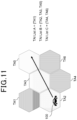
- TA1 to TA6 are configured as in FIG. 10 .
- a moving path of the UE 100 is taken into consideration as illustrated in FIG. 11 , thereby configuring TA list A including TA1, TA list B including TA2, TA3, and T5, and TA list C including TA4 and TA6.
- TA list B is configured for the UE 100 located within TA2.
- the UE 100 passes through TA3 and T5 indicated by TA list B.
- the UE 100 does not move to any TA outside TA list B, invoking no TAU.
- it is thus possible to prevent a TAU from being invoked. That is, it is possible to suppress an increase in the signaling for updating the TA list.
- the processing node 400 performs TA list conversion processing.
- the subject of the TA conversion processing according to the first embodiment of the present disclosure is not, however, limited to this example.
- the network node 300 may perform TA list conversion processing.
- the network node 300 (control unit 333) performs TA list conversion processing based on path information.
- the network node 300 (information obtaining unit 331) obtains a TA list through the TA list conversion processing. For example, when the network node 300 obtains the path information from the UE 100, the network node 300 performs TA list conversion processing based on the path information. The TA list based on the path information is obtained through the TA list conversion processing. Note that AI held by the network node 300 may be used for the TA list conversion processing.
- the network node 300 performs TA list conversion processing instead of the processing in S520 and S530 surrounded by the dashed line illustrated in FIG. 9 .
- the network node 300 may also perform TA list conversion processing in the second modification example described below.
- the network node 300 may perform TA list conversion processing instead of the processing in S630 and S640, and S750 and S760 surrounded by the dashed lines illustrated in FIGS. 12 and 13 .
- the network node 300 it is possible for the network node 300 to obtain the TA list based on the path information without communicating with the processing node 400. It is thus possible to reduce signaling. That is, it is possible to reduce the consumption of communication resources and power for signaling.
- the path information and the TA list are transmitted by using a NAS protocol.
- the communication protocol according to the first embodiment of the present disclosure used for transmitting the path information and the TA list is not, however, limited to this example.
- an RRC protocol and an NGAP may be used for transmitting the path information and the TA list.
- an RRC message including path information is transmitted from the UE 100 to the base station 200 in a RAN and an NGAP message including the path information is transmitted from the base station 200 to the network node 300.
- the UE 100 transmits an RRC message including the path information to the base station 200.
- the base station 200 receives the RRC message from the UE 100.
- the base station 200 (information obtaining unit 241) obtains the path information from the RRC message.
- the base station 200 (second communication processing unit 245) transmits the NGAP message including the path information to the network node 300.
- the RRC message including the path information may be a UEInformationResponse message or a UEAssistanceInformation message.
- the RRC message including the path information may be an RRC message which is additionally defined and used for transmitting the path information. In this case, it is possible to transmit the path information to the base station 200 without modifying an existing RRC message.
- an NGAP message including a TA list is transmitted from the network node 300 to the base station 200 and an RRC message including the TA list is transmitted from the base station 200 to the UE 100.
- the network node 300 transmits an NGAP message including the TA list to the base station 200.
- the base station 200 receives the NGAP message from the network node 300.
- the base station 200 (information obtaining unit 241) obtains the TA list from the NGAP message.
- the base station 200 (first communication processing unit 243) transmits an RRC message including the TA list to the UE 100.
- the RRC message including the TA list may be an RRCReconfiguration message.
- the RRC message including the TA list may be an RRC message for RRCSetup, RRCReestablishment, RRCResume, or the like.
- the UE 100 transmits an RRC message including path information to the base station 200 (S610). For example, the UE 100 transmits a UEInformationResponse message or a UEAssistanceInformation message including the path information to the base station 200.
- the base station 200 transmits an NGAP message including path information to the network node 300 (S620). For example, the base station 200 transmits an NGAP message including the path information received from the UE 100 to the network node 300.
- the network node 300 transmits a message including the path information to the processing node 400 (S630).
- the processing node 400 transmits a message including a TA list to the network node 300 (S640).
- the network node 300 transmits an NGAP message including the TA list to the base station 200 (S650). For example, the network node 300 transmits an NGAP message including the TA list received from the processing node 400 to the base station 200.
- the base station 200 transmits an RCC message including the TA list to the UE 100 (S660). For example, the base station 200 transmits an RRCReconfiguration message including the TA list received from the network node 300 to the UE 100. Note that the TA list may be transmitted to the UE 100 at the timing of invoking a procedure such as RRCSetup, RRCReestablishment, or RRCResume by using a downlink RRC message corresponding to each of the procedures.
- a procedure such as RRCSetup, RRCReestablishment, or RRCResume by using a downlink RRC message corresponding to each of the procedures.
- an RRC message including the path information is a UEInformationResponse message
- the existing Flight Path mechanism in Release 15 may be used.
- An example of processing in a case where the existing Flight Path mechanism is used will be described with reference to FIG. 13 . Note that processing which is substantially the same as that of FIGS. 9 and 12 will not be described.
- the UE 100 transmits an RRC message including information indicating the availability of path information to the base station 200 (S710).
- the UE 100 transmits an RRC message including flightPathInfoAvailable or information corresponding to this to the base station 200.
- the RRC message may be an RRC message (for example, RRCSetupComp, RRCReestablishmentComp, RRCResumeComp, or RRCReconfigurationComp) serving as a response to an RRC message from the base station.
- the base station 200 transmits an RRC message including path request information to the UE 100 (S720). For example, in a case where the received RRC message includes information indicating the availability of the path information, the base station 200 transmits a UEInformationRequest message including flightPathInfoReq or path request information corresponding to this to the UE 100.
- the UE 100 transmits an RRC message including path information to the base station 200 (S730). For example, in a case where the received UEInformationRequest message includes the path request information, the UE 100 transmits a UEInformationResponse message including flightPathInfoReport or path information corresponding to this to the base station 200.
- the path information is transmitted from the network node 300 to the processing node 400.
- the information that is transmitted to the processing node 400 according to the first embodiment of the present disclosure is not, however, limited to this example.
- intermediate information obtained by processing the path information may be transmitted from the network node 300 to the processing node 400.
- the network node 300 (control unit 333) performs part of TA list conversion processing based on path information.
- the network node 300 (information obtaining unit 331) obtains intermediate information through part of the TA list conversion processing.
- the network node 300 (communication processing unit 335) transmits a message including the intermediate information to the processing node 400.
- the processing node 400 receives the message including the intermediate information from the network node 300.
- the processing node 400 (control unit 433) performs the rest of the TA list conversion processing based on the intermediate information.
- the processing node 400 (information obtaining unit 431) obtains a TA list through the rest of the TA list conversion processing.
- the processing node 400 (communication processing unit 435) transmits a message including the TA list to the network node 300.
- the intermediate information may be an output of AI that performs part of the TA list conversion processing.
- the AI may be part of AI that performs the TA list conversion processing.
- the AI may be transmitted from the processing node 400 or another node to the network node 300.
- the third modification example of the first embodiment of the present disclosure it is possible to reduce the calculation cost or the processing load of the processing node 400 by performing part of the TA list conversion processing in the network node 300. In other words, it is possible to distribute the calculation cost or the processing load of the processing between the network node 300 and the processing node 400.
- the network node 300 selects, in accordance with the status of the processing load of the processing node 400, whether to transmit the intermediate information or transmit the path information. For example, in a case where the processing node 400 has a heavy processing load, the network node 300 transmits the intermediate information. In a case where the processing node 400 does not have a heavy processing load, the network node 300 transmits the path information. In addition, it may be selected in accordance with the status of the processing load of the network node 300 whether to transmit the intermediate information or transmit the path information. For example, in a case where the network node 300 has a heavy processing load, the intermediate information is transmitted. In a case where the network node 300 does not have a heavy processing load, the path information is transmitted.
- a TA list is transmitted from the UE 100 to the network node 300 via the base station 200 as provided information.
- the path information is provided from the UE 100 to the processing node 400 and the path information is converted to a TA list by the processing node 400.
- the UE 100 transmits a TA list to the network node 300.
- the following describes an operation of the UE 100 and relevant information in detail.
- the UE 100 obtains a TA list as provided information. Specifically, the UE 100 (information obtaining unit 131) obtains a TA list based on path information.
- the UE 100 transmits a message including the path information to the processing node 400.
- the UE 100 receives a message including the TA list from the processing node 400.
- the UE 100 transmits a message including the path information to the processing node 400.
- the UE 100 receives a message including the TA list based on the path information from the processing node 400.
- a protocol and a message which are used for communication between the UE 100 and the processing node 400 may be an existing protocol and message or may be newly defined.
- the UE 100 obtains the TA list based on the path information by using the processing node 400.
- This makes it possible to reduce the calculation cost of the UE 100 as compared with the calculation cost for the UE 100 to compute a TA list from the path information.
- it is possible to increase the accuracy of a computational result by performing TA list conversion processing in the processing node 400 as compared with a case where TA list conversion processing is performed in the UE 100 that is not rich in computational resources.
- the UE 100 transmits a TA list to the network node 300. Specifically, the UE 100 (communication processing unit 135) transmits a message including a TA list serving as provided information to the network node 300.
- the UE 100 transmits a NAS message including a TA list based on the path information to the AMF that is the network node 300.
- the NAS message is transmitted to the network node 300 via the base station 200.
- the NAS message including the TA list may be a RegistrationRequest message or a ServiceRequest message.
- the NAS message including the TA list may be a NAS message which is additionally defined and used for transmitting the TA list. In this case, it is possible to transmit the TA list to the network node 300 without modifying the existing NAS message.
- the base station 200 transfers a TA list received from the UE 100 to the network node 300.
- the following describes an operation of the base station 200 and relevant information in detail. Note that the contents which are substantially the same as the description of an operation of the UE 100 will not be described in detail.
- the base station 200 transfers a TA list received from the UE 100 to the network node 300. Specifically, the base station 200 (first communication processing unit 243) receives a message including the TA list serving as provided information from the UE 100. The base station 200 (second communication processing unit 245) transmits a message including the TA list to the network node 300.
- the base station 200 receives a NAS message including the TA list from the UE 100.
- the base station 200 (second communication processing unit 245) transmits the NAS message to the AMF that is the network node 300.
- the network node 300 receives a TA list from the UE 100 and configures the TA list.
- the following describes an operation of the network node 300 and relevant information in detail. Note that the contents which are substantially the same as the description of an operation of the UE 100 or the base station 200 will not be described in detail.
- the network node 300 receives a TA list from the UE 100 via the base station 200. Specifically, the network node 300 (communication processing unit 335) receives a message including a TA list serving as provided information from the UE 100. The network node 300 (information obtaining unit 331) obtains the TA list included in the message.
- the network node 300 receives a NAS message including the TA list from the UE 100 via the base station 200.
- the network node 300 obtains the TA list included in the received NAS message.
- the network node 300 receives a RegistrationRequest message or a ServiceRequest message including the TA list.
- the network node 300 configures the received TA list for the UE 100. Note that, in a case where the TA list has been already configured for the UE 100, the configured TA list is updated with the received TA list.
- the processing node 400 converts path information received from the UE 100 to a TA list.
- the processing node 400 transmits the TA list resulting from the conversion to the UE 100.
- the following describes an operation of the processing node 400 and relevant information in detail. Note that the contents which are substantially the same as the description of an operation of the UE 100 will not be described in detail.
- the processing node 400 receives path information from the UE 100. Specifically, the processing node 400 (communication processing unit 435) receives a message including the path information from the UE 100. The processing node 400 (information obtaining unit 431) obtains the path information included in the message.
- the processing node 400 obtains a TA list based on path information. Note that the TA list conversion processing is substantially the same as the processing according to the first embodiment and will not be thus described in detail.
- the processing node 400 transmits a TA list to the UE 100. Specifically, the processing node 400 (communication processing unit 435) transmits, to the UE 100, a message including a TA list obtained through TA list conversion processing.
- the message including the TA list may be a response message to a message including path information received from the UE 100.
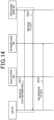
- the UE 100 transmits a message including path information to the processing node 400 (S810).
- the UE 100 transmits the message including the path information to the processing node 400 via the base station 200.
- a message between the UE 100 and the base station 200 may be an RRC message.
- the processing node 400 transmits a message including a TA list to the UE 100 (S820). For example, the processing node 400 obtains the TA list by inputting the path information received from the UE 100 to AI (for example, machine learning model). The processing node 400 transmits a message including the obtained TA list to the UE 100 via the base station 200.
- AI for example, machine learning model
- the UE 100 transmits a message including the TA list to the network node 300 via the base station 200 (S830). For example, the UE 100 transmits a NAS message including the TA list included in the message received from the processing node 400 to the base station 200. The base station 200 transfers the NAS message to the network node 300.
- the provided information includes the TA list based on the path information. This makes it possible to configure a TA list in which the moving path is taken into consideration without generating a TA list on the network side. That is, it is possible to configure a TA list suitable for the moving path while suppressing an increase in the processing load of the network node 300.
- the processing node 400 performs TA list conversion processing.
- the subject of the TA conversion processing according to the second embodiment of the present disclosure is not, however, limited to this example.
- the UE 100 may perform TA list conversion processing.
- the UE 100 (control unit 133) performs TA list conversion processing based on path information.
- the UE 100 (information obtaining unit 131) obtains a TA list through the TA list conversion processing. For example, when the UE 100 obtains the path information from a higher layer, the UE 100 performs TA list conversion processing based on the path information. The TA list based on the path information is obtained through the TA list conversion processing. Note that AI held by the UE 100 may be used for the TA list conversion processing.
- the UE 100 performs TA list conversion processing instead of the processing in S810 and S820 surrounded by the dashed line illustrated in FIG. 14 .
- the UE 100 may also perform TA list conversion processing in the second modification example described below.
- the UE 100 may perform TA list conversion processing instead of the processing in S910 and S920 surrounded by the dashed line illustrated in FIG. 15 .
- the UE 100 it is possible for the UE 100 to obtain the TA list based on the path information without communicating with the processing node 400. It is thus possible to reduce signaling. That is, it is possible to reduce the consumption of communication resources and power for signaling.
- the TA list is transmitted by using a NAS protocol.
- the communication protocol according to the second embodiment of the present disclosure used for transmitting the TA list is not, however, limited to this example.
- an RRC protocol and an NGAP may be used for transmitting the TA list.
- an RRC message including a TA list is transmitted from the UE 100 to the base station 200 in a RAN and an NGAP message including the TA list is transmitted from the base station 200 to the network node 300.
- the UE 100 transmits an RRC message including the TA list to the base station 200.
- the base station 200 receives the RRC message from the UE 100.
- the base station 200 (information obtaining unit 241) obtains the TA list from the RRC message.
- the base station 200 (second communication processing unit 245) transmits an NGAP message including the TA list to the network node 300.
- the RRC message including the TA list may be a UEInformationResponse message or a UEAssistanceInformation message.
- the RRC message including the TA list may be an RRC message which is additionally defined and used for transmitting the TA list. In this case, it is possible to transmit the TA list to the base station 200 without modifying an existing RRC message.
- the UE 100 transmits a message including path information to the processing node 400 (S910).
- the processing node 400 transmits a message including a TA list to the UE 100 (S920).
- the UE 100 transmits an RRC message including the TA list to the base station 200 (S930). For example, the UE 100 transmits a UEInformationResponse message or a UEAssistanceInformation message including the TA list to the base station 200.
- the base station 200 transmits an NGAP message including the TA list to the network node 300 (S940). For example, the base station 200 transmits the NGAP message including the TA list received from the UE 100 to the network node 300.
- the path information is transmitted from the UE 100 to the processing node 400.
- the information that is transmitted to the processing node 400 according to the second embodiment of the present disclosure is not, however, limited to this example.
- intermediate information obtained by processing the path information may be transmitted from the UE 100 to the processing node 400.
- the UE 100 (control unit 133) performs part of TA list conversion processing based on the path information.
- the UE 100 (information obtaining unit 131) obtains intermediate information through part of the TA list conversion processing.
- the UE 100 (communication processing unit 135) transmits a message including the intermediate information to the processing node 400.
- the processing node 400 receives the message including the intermediate information from the UE 100.
- the processing node 400 (control unit 433) performs the rest of the TA list conversion processing based on the intermediate information.
- the processing node 400 (information obtaining unit 431) obtains a TA list through the rest of the TA list conversion processing.
- the processing node 400 (communication processing unit 435) transmits a message including the TA list to the UE 100.
- the intermediate information may be an output of AI that performs part of the TA list conversion processing.
- the AI may be part of AI that performs the TA list conversion processing.
- the AI may be transmitted from the processing node 400 or another node to the UE 100.
- the third modification example of the second embodiment of the present disclosure it is possible to reduce the calculation cost or the processing load of the processing node 400 by performing part of the TA conversion processing in the UE 100. In other words, it is possible to distribute the calculation cost or the processing load of the processing between the UE 100 and the processing node 400.
- a third embodiment of the present disclosure will be described.
- the provided information described in the first and second embodiments is transmitted from the UE 100 to the network node 300 via the base station 200 at the timing of a predetermined event.
- the predetermined event is an event associated with the setting or the update of path information with which provided information is associated. Note that the provided information and a message for transmitting the provided information are substantially the same as those of the first or second embodiment described above and will not be thus described in detail.
- the UE 100 transmits provided information at the timing of a predetermined event.
- the predetermined event is associated with the movement of the UE 100 for a TA list.
- the predetermined event includes an event associated with the setting or the update of path information indicating at least a moving path of the UE 100.
- the path information is used for configuring the TA list.
- the event associated with the setting or the update of the path information includes a notification of the setting or the update of the path information.
- the notification of the setting or the update of the path information is a notification of the setting or the update of the path information from a higher layer (for example, application layer) of the NAS or RRC layer.
- the processing layer of the UE 100 information obtaining unit 131) corresponding to the NAS or RRC layer receives the notification of the setting or the update of the path information from the higher layer.
- the UE 100 (communication processing unit 135) transmits a message including provided information to a network at the timing of a predetermined event.
- the base station 200 receives, from the UE 100, the message that is transmitted at the timing of the predetermined event and includes the provided information.
- the base station 200 transmits a message including the provided information to the network node 300.
- the network node 300 receives, from the UE 100 via the base station 200, the message that is transmitted at the timing of the predetermined event and includes the provided information.
- the processing node 400 receives, from the UE 100, the message that is transmitted at the timing of the predetermined event and includes the provided information.
- the UE 100 transmits a NAS message including path information to the network node 300 via the base station 200 at the timing of an event associated with the setting or the update of the path information.
- the base station 200 receives the NAS message and transfers the NAS message to the network node 300.
- the network node 300 receives the NAS message.
- the UE 100 transmits an RCC message including path information to the base station 200 at the timing of an event associated with the setting or the update of the path information.
- the base station 200 receives the RRC message and transmits an NGAP message including the path information included in the RRC message to the network node 300.
- the network node 300 receives the NGAP message.
- the UE 100 transmits a message including path information to the processing node 400 via the base station 200 at the timing of an event associated with the setting or the update of the path information.
- the processing node 400 obtains a TA list based on the path information included in the received message.
- the processing node 400 transmits a message including the obtained TA list to the UE 100 via the base station 200.
- the UE 100 transmits a NAS message including the TA list included in the received message to the network node 300 via the base station 200.
- the UE 100 transmits an RRC message including the TA list to the base station 200 and the base station 200 transmits an NGAP message including the TA list to the network node 300.
- the UE 100 obtains a TA list based on the path information at the timing of an event associated with the setting or the update of the path information.
- the UE 100 transmits a NAS message including the obtained TA list to the network node 300 via the base station 200.
- the UE 100 transmits an RRC message including the TA list to the base station 200 and the base station 200 transmits an NGAP message including the TA list to the network node 300.
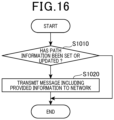
- the UE 100 determines whether or not path information is set or updated (S1010). For example, the UE 100 (information obtaining unit 131) determines whether or not a notification of the setting or the update of the path information is issued from a higher layer of the NAS or RRC layer.
- the UE 100 transmits a message including provided information to a network (S1020). For example, in a case where a notification of the setting or the update of the path information is issued from the higher layer, the UE 100 (communication processing unit 135) transmits a message including the path information or a TA list based on the path information to a network.
- the advantageous effects of suppressing an increase in the signaling for configuring the TA list may be attained. Further, it is considered to be possible to increase the advantageous effects by improving the transmission timing of the provided information.
- a message including the provided information is transmitted to a network at the timing of a predetermined event.
- the predetermined event is associated with the movement of the UE 100 for a TA list.
- This makes it possible to transmit the provided information at a timing that takes into consideration the movement of the UE 100 and the TA list. For example, it is possible to transmit the provided information at a timing corresponding to the necessity to reflect the path or the movement of the UE 100 in the TA list. It is thus possible to increase the accuracy of the TA list based on the moving path or increase the efficiency of signaling. In other words, it is possible to suppress a decrease in the accuracy of the TA list or suppress a decrease in the efficiency of signaling.
- the predetermined event includes an event associated with the setting or the update of the path information about the UE 100.
- This makes it possible to configure or update the TA list in accordance with the setting or the update of the path information. It is thus possible to reduce a temporal gap between the path information and the TA list and increase the accuracy of the TA list.
- the event associated with the setting or the update of the path information includes a notification of the setting or the update of the path information. This allows even a layer that performs processing without the communication processing layer recognizing the path information or a layer that is incapable of recognizing the path information to transmit the provided information in accordance with the setting or the update of the path information.
- the provided information is transmitted in accordance with a notification of the setting or the update of the path information.
- the transmission timing of the provided information according to the third embodiment of the present disclosure is not, however, limited to this example.
- provided information may be transmitted in accordance with an event for obtaining path information.
- an event associated with the setting or the update of the path information includes the obtainment of the set or updated path information.
- the path information is obtained from a higher layer (for example, application layer) of the NAS or RRC layer.
- the processing layer of the UE 100 information obtaining unit 131) corresponding to the NAS or RRC layer receives the set or updated path information from the higher layer.
- the UE 100 may determine whether or not the set or updated path information is obtained from the higher layer of the NAS or RRC layer.
- the event associated with the setting or the update of the path information includes the obtainment of the set or updated path information. This makes it possible to transmit the provided information at the timing at which the communication processing layer actually obtains the path information.
- a predetermined event for the timing at which provided information is transmitted is a TAU procedure (also referred to simply as a TAU below).
- TAU procedure also referred to simply as a TAU below.
- the provided information and a message for transmitting the provided information are substantially the same as those of the first or second embodiment described above and will not be thus described in detail.
- the contents which are substantially the same as the description in the third embodiment will not be described in detail.
- a predetermined event for the transmission timing of provided information includes a TAU procedure.
- a trigger of the TAU procedure includes the movement of the communication apparatus to a place other than a TA indicated by the TA list.
- the UE 100 determines whether or not the UE 100 moves to the place other than the TA indicated by the TA list. In a case where the UE 100 moves to the place other than the TA indicated by the TA list, the UE 100 (communication processing unit 135) performs a TAU procedure. That is, the UE 100 transmits the provided information.
- the place other than the TA indicated by the TA list may be another TA which is not included in the TA list, but is configured or a place in which no TA is configured.
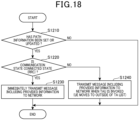
- the UE 100 does not immediately transmit the provided information unlike the third embodiment.
- the UE 100 transmits the provided information at the timing of a TAU procedure after path information is set or updated.
- the UE 100 (communication processing unit 135) transmits a message including provided information to a network at the timing of a TAU procedure.
- the UE 100 transmits a NAS message including path information to the network node 300 via the base station 200 at the timing of a TAU procedure.
- the UE 100 transmits a message including path information to the processing node 400 via the base station 200 at the timing of a TAU procedure.
- the processing node 400 transmits a message including a TA list based on the path information to the UE 100 via the base station 200.
- the UE 100 transmits a NAS message including the TA list included in the received message to the network node 300 via the base station 200.
- the UE 100 obtains the TA list based on the path information at the timing of a TAU procedure.
- the UE 100 transmits a NAS message including the obtained TA list to the network node 300 via the base station 200.
- the NAS message may be a RegistrationRequest message or a ServiceRequest message.
- the UE 100 determines whether or not a TAU is invoked (S1110). For example, the UE 100 (control unit 133) determines whether or not the UE 100 moves to a place other than a TA indicated by a TA list.
- the UE 100 transmits a message including provided information to a network (S 1120). For example, in a case where the UE 100 moves to a place other than a TA indicated by a TA list, the UE 100 (communication processing unit 135) transmits a message including path information or a TA list based on the path information to the network.
- a predetermined event for the transmission timing of provided information includes a TAU procedure. This makes it possible to use the signaling of the TAU for transmitting the provided information. It is thus possible to suppress an increase in signaling. That is, it is possible to suppress a decrease in the efficiency of signaling.
- the provided information is transmitted at an existing TA list update timing and it is thus possible to configure a TA list suitable for a moving path of the UE 100 without considerably modifying an existing TA list update mechanism, in other words, while keeping compatibility.
- a trigger of the TAU procedure includes the movement of the UE 100 to a place other than a TA indicated by the TA list.
- the provided information is not thus transmitted unless the UE 100 moves to the place other than the TA indicated by the TA list.
- the TA list covers the moving path of the UE 100 as long as the UE 100 does not move to the place other than the TA indicated by the TA list. Even in a case where the moving path is changed or in a case where the moving path is set after the TA list is configured, it is unnecessary to change the TA list as long as the TA list covers the moving path. That is, it is also unnecessary to transmit the provided information. This makes it possible to suppress an increase in signaling even when the moving path is changed with high frequency within the range of the TA list.
- the trigger of the TAU procedure is the movement of the UE 100 to a place other than a TA indicated by a TA list.
- the trigger of the TAU procedure according to the fourth embodiment of the present disclosure is not, however, limited to this example.
- a trigger of a TAU procedure may be an event associated with the setting or the update of path information about the UE 100.
- the trigger of the TAU procedure is an event associated with the setting or the update of the path information according to the third embodiment described above.
- the UE 100 determines whether or not the event associated with the setting or the update of the path information occurs.
- the UE 100 (communication processing unit 135) performs a TAU procedure. That is, the UE 100 transmits the provided information.
- the provided information is transmitted by using a NAS message in this case.
- the UE 100 may determine whether or not path information is set or updated based on a notification or information from a higher layer of the NAS or RRC layer.
- the trigger of the TAU procedure includes an event associated with the setting or the update of path information about the UE 100. This makes it possible to process the transmission of the provided information based on the event associated with the setting or the update of the path information as a TAU procedure.
- a fifth embodiment of the present disclosure will be described.
- provided information is transmitted at a timing corresponding to a communication state (that is, the state of a communication function).
- a communication state that is, the state of a communication function.
- the provided information and a message for transmitting the provided information are substantially the same as those of the first or second embodiment described above and will not be thus described in detail.
- the contents which are substantially the same as the description in the third or fourth embodiment will not be described in detail.
- the transmission timing of provided information is determined in accordance with the state of the communication function of the UE 100. In other words, the transmission timing of the provided information is selected in accordance with the state of the communication function. Specifically, in a case where the state of the communication function of the UE 100 is a connected state, a message including the provided information is transmitted at the timing of an event associated with the setting or the update of path information. The message is transmitted at the timing at which the UE 100 moves to a place other than a TA indicated by the TA list in a case where the state of the communication function of the UE 100 is not a connected state.
- the connected state includes an RRC connected state.
- the UE 100 determines whether or not the state of the communication function of the UE 100 is an RRC connected state.
- the provided information is transmitted at the timing of an event associated with the setting or the update of the path information.
- the state of the communication function is not an RRC connected state (for example, in a case where the state of the communication function is an RRC idle state or an RRC inactive state)
- the provided information is transmitted at the timing at which the UE 100 moves to a place other than a TA indicated by a TA list. Note that the provided information may be transmitted at the timing of a TAU in the latter case.
- the connected state may be a connection management (CM) connected state.
- the UE 100 determines whether or not the state of the communication function of the UE 100 is a CM connected state.
- the provided information is transmitted at the timing of an event associated with the setting or the update of the path information.
- the state of the communication function is not a CM connected state (for example, in a case where the state of the communication function is a CM idle state)
- the provided information is transmitted at the timing at which the UE 100 moves to a place other than a TA indicated by a TA list.
- the provided information may be transmitted at the timing of a TAU in the latter case.
- the RRC state may be an RRC inactive state.
- the overhead for transition from the RRC inactive state to the RRC connected state is, however, smaller than the overhead for transition from the RRC idle state to the RRC connected state.
- the UE 100 and the network node 300 are connected to each other and the overhead for transmitting a NAS message is also small. In a case where the connected state is a CM connected state, it is thus possible to increase transmission opportunities for the provided information while suppressing an increase in overhead.
- the UE 100 (communication processing unit 135) transmits a message including provided information to a network at the timing of a predetermined event corresponding to the state of the communication function of the UE 100.
- the UE 100 transmits a message including the provided information at the timing of an event associated with the setting or the update of path information.
- the UE 100 transmits the message at the timing at which the UE 100 moves to a place other than a TA indicated by the TA list in a case where the state of the communication function of the UE 100 is not a connected state.
- the UE 100 transmits the message including the provided information to the network at the timing of an event associated with the setting or the update of the path information.
- the UE 100 transmits the message including the provided information to the network at the timing at which the UE 100 moves to a place other than a TA indicated by the TA list in a case where the state of the communication function is not an RRC connected state.
- the UE 100 determines whether or not path information is set or updated (S1210).
- the UE 100 determines whether or not the state of the communication function of the UE 100 is a connected state (S1220). For example, in a case where a notification of the setting or the update of the path information is issued from a higher layer, the UE 100 (control unit 133) determines whether or not the RRC state of the UE 100 is an RRC connected state.
- the UE 100 In a case where it is determined the state of the communication function is a connected state, the UE 100 immediately transmits a message including the provided information to a network (S1230). For example, in a case where the RRC state is an RRC connected state, the UE 100 (communication processing unit 135) immediately transmits a message including the provided information to the network. Note that immediately means a transmission timing at the current time point and means here a timing at which path information is set or updated.
- the UE 100 transmits a message including the provided information to a network when a TAU is invoked (S1240). For example, in a case where the RRC state is not an RRC connected state, the UE 100 (communication processing unit 135) transmits a message including the provided information to the network at the timing at which the UE 100 moves to a place other than a TA indicated by a TA list.
- a message including provided information is transmitted at the timing of a predetermined event corresponding to the state of the communication function of the UE 100.
- This makes it possible to transmit the provided information at the timing at which the state of the communication function is a communicable state or a state in which the overhead for transition to the communicable state is relatively small. It is thus possible to reduce the communication of the provided information and the overhead for configuring or updating a TA list.
- the overhead may include, for example, the overhead for a return from a sleep state, a reconnection in an RRC or a NAS, or the like.
- the message is transmitted at the timing of an event associated with the setting or the update of the path information about the UE 100.
- the message is transmitted at the timing at which the UE 100 moves to a place other than a TA indicated by the TA list. This causes the provided information to be immediately transmitted in a case where the state of the communication function is a communicable state. It is thus possible to update the TA list without the overhead for the state transition of the communication function.
- the provided information is not transmitted before the timing of a TAU, that is, the timing at which the state of the communication function is scheduled to transition to a communicable state. This makes it possible to suppress an increase in the overhead for the state transition of the communication function.
- the connected state includes an RRC connected state.
- transition to the RRC connected state from the RRC idle state or the RRC inactive state causes overhead.
- the provided information is thus transmitted only at the time of the RRC connected state, making it possible to configure or update a TA list without the overhead.
- the provided information is transmitted at the timing of a TAU.
- the transmission timing of the provided information according to the fifth embodiment of the present disclosure in a case where the communication state is not a connected state is not, however, limited to this example.
- provided information may be transmitted at the timing of the transition of the communication state.
- the UE 100 transmits a message including the provided information at the timing of an event associated with the setting or the update of path information.
- the UE 100 transmits the message at the timing at which the state of the communication function transitions to a connected state.
- the UE 100 transmits the message including the provided information to the network at the timing of an event associated with the setting or the update of the path information.
- the UE 100 transmits a message including the provided information to the network at the timing at which the state of the communication function transitions to an RRC connected state.
- the state of the communication function may be the CM state described above instead of the RRC state.
- processing according to the present modification example will be described with reference to FIG. 19 . Note that processing which is substantially the same as the processing of FIG. 18 will not be described in detail.
- the UE 100 determines whether or not path information is set or updated (S13 10).
- the UE 100 determines whether or not the state of the communication function of the UE 100 is a connected state (S 1320).
- the UE 100 In a case where it is determined the state of the communication function is a connected state, the UE 100 immediately transmits a message including the provided information to a network (S1330).
- the UE 100 transmits a message including the provided information to a network at the time of transition to a connected state (S1340).
- the UE 100 (communication processing unit 135) transmits a message including the provided information to the network at the timing at which the RRC state transitions to an RRC connected state.
- the timing is the timing of transition from the RRC idle state or the RRC inactive state to the RRC connected state.
- the message including the provided information is transmitted at the timing of an event associated with the setting or the update of the path information.
- the state of the communication function of the UE 100 is not a connected state
- the message is transmitted at the timing at which the state of the communication function transitions to a connected state. This causes the provided information to be immediately transmitted in a case where the state of the communication function is a communicable state. It is thus possible to update the TA list without the overhead for the state transition of the communication function.
- the provided information is not transmitted before the timing of a TAU and the timing of transition to a communicable state other than the TAU. This makes it possible to increase transmission opportunities for the provided information while suppressing an increase in the overhead for the state transition of the communication function.
- provided information is transmitted at a timing other than the predetermined event.
- the provided information and a message for transmitting the provided information are substantially the same as those of the first or second embodiment described above and will not be thus described in detail.
- the contents which are substantially the same as the description in the third to fifth embodiments will not be described in detail.
- Provided information is transmitted at the timing of a request to the network node 300 that is made for a purpose other than the purpose of updating a TA list. Specifically, the provided information is transmitted at the timing of transmitting a request to the network node 300 other than a TAU.
- the UE 100 determines whether or not a request is made in the first access to the network node 300. In a case where the request is made, the UE 100 (communication processing unit 135) transmits the provided information along with the request.
- the request includes a registration request or a service request to the network node 300. Note that the request is not limited to a request in the first access. For example, the request may be a request in reconnection.
- the UE 100 does not immediately transmit the provided information unlike the third embodiment.
- the UE 100 transmits the provided information at the timing of a request to the network node 300 other than a TAU after path information is set or updated.
- the UE 100 (communication processing unit 135) transmits a message including provided information to a network at the timing of request to the network node 300 other than a TAU.
- the UE 100 transmits a NAS message including path information to the network node 300 via the base station 200 at the timing of a request to the network node 300 other than a TAU.
- the UE 100 transmits a message including path information to the processing node 400 via the base station 200 at the timing of a request to the network node 300 other than a TAU.
- the processing node 400 transmits a message including a TA list based on the path information to the UE 100 via the base station 200.
- the UE 100 transmits a NAS message including the TA list included in the received message to the network node 300 via the base station 200.
- the UE 100 obtains the TA list based on the path information at the timing of a request to the network node 300 other than a TAU.
- the UE 100 transmits a NAS message including the obtained TA list to the network node 300 via the base station 200.
- the NAS message may be a RegistrationRequest message or a ServiceRequest message.
- FIG. 20 An example of processing according to the sixth embodiment of the present disclosure will be described with reference to FIG. 20 . Note that processing which is substantially the same as the processing of FIG. 16 or 17 will not be described in detail.
- the UE 100 determines whether or not path information is set or updated (S1410).
- the UE 100 determines whether or not a request to the network node 300 other than a TAU is made (S1420). For example, the UE 100 (control unit 133) determines whether or not a registration request or a service request to the network node 300 is made.
- the UE 100 transmits a message including provided information to a network (S1430). For example, in a case where a registration request or a service request to the network node 300 is made, the UE 100 (communication processing unit 135) transmits a message including the path information or a TA list based on the path information to the network.
- a message including provided information is transmitted to a network at the timing of a request to the network node 300 made for a purpose other than the purpose of updating a TA list.
- This makes it possible to use the signaling other than the signaling for a TAU for transmitting the provided information. It is thus possible to increase transmission opportunities for the provided information while suppressing an increase in signaling.
- a seventh embodiment of the present disclosure will be described.
- information indicating the timing at which provided information is transmitted is transmitted to the UE 100.
- the provided information and a message for transmitting the provided information are substantially the same as those of the first or second embodiment described above and will not be thus described in detail.
- the contents which are substantially the same as the description in the third to sixth embodiments will not be described in detail.
- the transmission timing of provided information is set for the UE 100 and a notification of the transmission timing is issued. Specifically, transmission timing information indicating the transmission timing of the provided information is set for the UE 100.
- the transmission timing information indicates at least one of the timing of a predetermined event described in the third to fifth embodiments or the timing of a request to the network node 300 other than a TAU described in the sixth embodiment.
- the transmission timing information indicates at least one of an event associated with the setting or the update of path information, a TAU, a transmission timing corresponding to the communication state, or the timing of a request to the network node 300 other than a TAU.
- the transmission timing information can also be regarded as the transmission mode of the provided information.
- the UE 100 is notified of transmission timing information from a network.
- the UE 100 (communication processing unit 135) receives a message including the transmission timing information from the network.
- the network node 300 transmits the message including the transmission timing information to the UE 100 via the base station 200.
- the UE 100 transmits provided information based on the transmission timing information included in the received message.
- the communication of the transmission timing information may be performed by using a NAS or may be performed by using an RRC and an NGAP.
- the UE 100 may request the network to transmit the transmission timing information.
- the UE 100 (communication processing unit 135) transmits a message including a request of the transmission timing information to the network node 300 via the base station 200.
- the network node 300 transmits a message including the transmission timing information to the UE 100 as a response to the request of the transmission timing information.
- the UE 100 transmits a message including a request of transmission timing information to the network node 300 (S1510).
- the UE 100 transmits the message including the request of the transmission timing information to the network node 300 via the base station 200. Note that the processing in S1510 surrounded by the dashed line may be omitted.
- the network node 300 transmits a message including the transmission timing information to the UE 100 (S1520). For example, when the request of the transmission timing information is received, the network node 300 transmits a message including the transmission timing information to the UE 100 via the base station 200.
- a message including transmission timing information indicating the timing of a predetermined event for transmitting a message including provided information is transmitted from a network to the UE 100.
- This makes it possible to dynamically change the transmission timing of the provided information.
- it is possible to each set the transmission timing of the provided information for the individual UEs 100 and it is possible to achieve signaling suitable for each UE 100 and the entire system.
- steps in processing described in the present specification do not necessarily have to be performed chronologically in the order described in the flowchart or the sequence diagram.
- steps in processing may be performed in an order different from the order described as the flowchart or the sequence diagram or may be performed in parallel.
- some of steps in processing may be removed or a further step may be added to the processing.
- a method including the operations of one or more components of the apparatus described in the present specification or there may be provided a program for causing a computer to perform the operations of the components.
- a non-transitory tangible computer-readable storage medium having stored therein the program.
- a user equipment may be referred to by another name such as mobile station, mobile terminal, mobile apparatus, mobile unit, subscriber station, subscriber terminal, subscriber apparatus, subscriber unit, wireless station, wireless terminal, wireless apparatus, wireless unit, remote station, remote terminal, remote apparatus, or remote unit.
- “transmit” may mean performing processing of at least one layer in a protocol stack used for transmission or physically transmitting a signal wirelessly or by wire.
- “transmit” may mean a combination of performing the processing of the at least one layer and physically transmitting a signal wirelessly or by wire.
- “receive” may mean performing processing of at least one layer in a protocol stack used for reception or physically receiving a signal wirelessly or by wire.
- “receive” may mean a combination of performing the processing of the at least one layer and physically receiving a signal wirelessly or by wire.
- the at least one layer may be replaced with at least one protocol.
- "obtain/acquire” may mean obtaining/acquiring information from stored information, obtaining/acquiring information from information received from another node, or obtaining/acquiring information by generating the information.
- a communication apparatus (100) comprising:
- the communication apparatus according to Feature 2, wherein the event associated with the setting or the update of the path information includes a notification of the setting or the update of the path information.
- the communication apparatus according to Feature 2 or 3, wherein the event associated with the setting or the update of the path information includes obtainment of the set or updated path information.
- the communication apparatus according to any one of Features 1 to 4, wherein the predetermined event includes a tracking area update, TAU, procedure.
- a trigger of the TAU procedure includes movement of the communication apparatus to a place other than a TA indicated by the TA list.
- a trigger of the TAU procedure includes an event associated with setting or update of path information indicating at least the moving path of the communication apparatus.
- the communication apparatus according to any one of Features 1 to 7, wherein the communication processing unit is further configured to transmit the message at a timing of a request to a network node made for a purpose other than a purpose of updating the TA list.
- the communication apparatus according to any one of Features 1 to 8, wherein the communication processing unit is configured to transmit the message at the timing of the predetermined event corresponding to a state of a communication function of the communication apparatus.
- the communication apparatus according to Feature 10 or 11, wherein the connected state includes a radio resource control, RRC, connected state.
- RRC radio resource control
- connection management CM
- the communication apparatus according to any one of Features 1 to 13, wherein the communication processing unit is configured to receive, from the network, a message including transmission timing information that indicates a timing of the predetermined event for transmitting the message.
- the communication apparatus according to any one of Features 1 to 14, wherein the provided information includes path information indicating at least the moving path of the communication apparatus.
- the communication apparatus according to any one of Features 1 to 15, wherein the provided information includes the TA list based on path information indicating at least the moving path of the communication apparatus.
- the communication apparatus further comprising a control unit (133) configured to perform TA list conversion processing based on the path information at a timing of the predetermined event, wherein the information obtaining unit is configured to obtain the TA list through the TA list conversion processing.
- the communication apparatus is configured to transmit a message including the path information to a processing function (400) and receive a message including the TA list from the processing function at a timing of the predetermined event, the processing function performing TA list conversion processing.
- the communication apparatus according to Feature 19, wherein the NAS message is a RegistrationRequest message or a ServiceRequest message.
- the communication apparatus according to Feature 21, wherein the RRC message is a UEInformationResponse message or a UEAssistanceInformation message.
- a network node (300) comprising:
- a base station (200) comprising:
- a processing node (400) comprising:
- a method performed by a communication apparatus comprising:
- a non-transitory tangible computer-readable storage medium having stored therein a program for causing a computer to execute operations of:
- a non-transitory tangible computer-readable storage medium having stored therein a program for causing a computer to execute operations of:
- a non-transitory tangible computer-readable storage medium having stored therein a program for causing a computer to execute operations of:
- a non-transitory tangible computer-readable storage medium having stored therein a program for causing a computer to execute operations of:
Landscapes
- Engineering & Computer Science (AREA)
- Computer Networks & Wireless Communication (AREA)
- Signal Processing (AREA)
- Aviation & Aerospace Engineering (AREA)
- Physics & Mathematics (AREA)
- General Physics & Mathematics (AREA)
- Mobile Radio Communication Systems (AREA)
Abstract
Description
- This application is based on
Japanese Patent Application No. 2021-162063, filed on September 30, 2021 - The present disclosure relates to an apparatus and a method.
- In 3rd Generation Partnership Project (3GPP) (registered trademark) Release 15, as a work item for long term evolution (LTE), some features for unmanned aerial vehicles (UAVs) as user equipments (UEs) have been discussed and specified (NPL 1).
- One of the specified features is a Flight Path feature. With the Flight Path feature, a flight path of a UAV is reported from the UAV to a network in response to a request from the network. This is intended to serve for control such as a handover or beamforming based on a moving plan of the UAV on the network side (NPL 2).
- Although the Flight Path feature has not yet been defined for new radio (NR), the utilization of the Flight Path feature has been mentioned in proposals of work items for Release 18 (NPLs 3 to 5).
- In addition, the TSs define a tracking area (TA) that is managed as information indicating the location of a UE. The TA includes one or more cells. The UE receives, from a network, a TA list indicating the one or more TAs configured for the UE. Specifically, the UE receives a RegistrationAccept message including the TA list from the network by transmitting a RegistrationRequest message to the network. In a case where the UE is located within a cell corresponding to a TA indicated by the received TA list, the UE does not perform a tracking area update (TAU) procedure that is a procedure of updating location information. However, in a case where the UE is located within a cell corresponding to a TA other than the TA indicated by the received TA list, the UE performs a TAU procedure for the network.
-
- NPL 1: 3GPP TS 36.331 V15.14.0 (2021-06), "3rd Generation Partnership Project; Technical Specification Group Radio Access Network; Evolved Universal Terrestrial Radio Access (E-UTRA); Radio Resource Control (RRC); protocol specification (Release 15)"
- NPL 2: 3GPP TSG-RAN WG2 Meeting #101bis Sanya, China, 16 - 20 Apr 2018, R2-1805125, Huawei, HiSilicon, CMCC, Fraunhofer, Nokia, Nokia Shanghai Bell, Lenovo, Motorola Mobility, InterDigital, KDDI, "Discussion on flight path information"
- NPL 3: 3GPP TSG RAN - RAN-Rel-18 workshop, Online, 2021-06-28 - 2021-07-02, RWS-210190, Ericsson, "Motivation for Rel-18 UAV"
- NPL 4: 3GPP TSG RAN Rel-18 workshop, Electronic Meeting, June 28 - July 2, 2021, RWS-210254, Lenovo, Motorola Mobility, "Discussion on UAV Swarm Support in NR RAN for Rel-18"
- NPL 5: 3GPP TSG RAN Rel-18 workshop, Electronic Meeting, June 28- July 2, 2021, RWS-210474, ZTE, Sanechips, "Support of UAV for 5G Advanced"
- A detailed study by the inventors has revealed the following issue. That is, the conventional technology may lead to an increase in the signaling for updating or configuring a TA list. For example, in a case where a TA list configured for a UE is not suitable for a moving path of the UE, the UE may move more easily to a place other than a TA indicated by the TA list. In this case, the TAU is invoked with high frequency, which may increase signaling.
- An object of the present disclosure is to provide an apparatus and a method that each make it possible to suppress an increase in the signaling for updating or configuring a TA list.
- An apparatus (100) according to an aspect of the present disclosure includes: an information obtaining unit (131) configured to obtain provided information that is used for configuring a tracking area, TA, list for the apparatus; and a communication processing unit (135) configured to transmit, to a network (200, 300, 400), a message including the provided information at a timing of a predetermined event. The provided information is associated with a moving path of the apparatus. The predetermined event is associated with movement of the apparatus with respect to the TA list.
- A method performed by an apparatus (100) according to an aspect of the present disclosure includes: obtaining provided information that is used for configuring a tracking area, TA, list for the apparatus; and transmitting, to a network (200, 300, 400), a message including the provided information at a timing of a predetermined event. The provided information is associated with a moving path of the apparatus. The predetermined event is associated with movement of the apparatus with respect to the TA list.
- According to the present disclosure, it is possible to suppress an increase in the signaling for updating or configuring a TA list. Note that, instead of or in addition to this advantageous effect, the present disclosure may yield another advantageous effect.
-
-
FIG. 1 is an explanatory diagram illustrating an example of a schematic configuration of a system according to embodiments of the present disclosure. -
FIG. 2 is an explanatory diagram for explaining an example of communication control based on a moving path of a user equipment according to embodiments of the present disclosure. -
FIG. 3 is a block diagram illustrating an example of a schematic functional configuration of the user equipment according to embodiments of the present disclosure. -
FIG. 4 is a block diagram illustrating an example of a schematic hardware configuration of the user equipment according to embodiments of the present disclosure. -
FIG. 5 is a block diagram illustrating an example of a schematic functional configuration of a base station according to embodiments of the present disclosure. -
FIG. 6 is a block diagram illustrating an example of a schematic hardware configuration of the base station according to embodiments of the present disclosure. -
FIG. 7 is a block diagram illustrating an example of a schematic functional configuration of a network node according to embodiments of the present disclosure. -
FIG. 8 is a block diagram illustrating an example of a schematic hardware configuration of the network node according to embodiments of the present disclosure. -
FIG. 9 is a sequence diagram for explaining an example of a schematic flow of processing according to a first embodiment of the present disclosure. -
FIG. 10 is an explanatory diagram for explaining an example of conventional TA list configuration. -
FIG. 11 is an explanatory diagram for explaining an example of TA list configuration according to the first embodiment of the present disclosure. -
FIG. 12 is a sequence diagram for explaining an example of a schematic flow of processing according to a modification example of the first embodiment of the present disclosure. -
FIG. 13 is a sequence diagram for explaining another example of the schematic flow of the processing according to the modification example of the first embodiment of the present disclosure. -
FIG. 14 is a sequence diagram for explaining an example of a schematic flow of processing according to a second embodiment of the present disclosure. -
FIG. 15 is a sequence diagram for explaining an example of a schematic flow of processing according to a modification example of the second embodiment of the present disclosure. -
FIG. 16 is a flowchart for explaining an example of a schematic flow of processing according to a third embodiment of the present disclosure. -
FIG. 17 is a flowchart for explaining an example of a schematic flow of processing according to a fourth embodiment of the present disclosure. -
FIG. 18 is a flowchart for explaining an example of a schematic flow of processing according to a fifth embodiment of the present disclosure. -
FIG. 19 is a flowchart for explaining an example of a schematic flow of processing according to a modification example of the fifth embodiment of the present disclosure. -
FIG. 20 is a flowchart for explaining an example of a schematic flow of processing according to a sixth embodiment of the present disclosure. -
FIG. 21 is a sequence diagram for explaining an example of a schematic flow of processing according to a seventh embodiment of the present disclosure. - Hereinafter, embodiments of the present disclosure will be described in detail with reference to the appended drawings. In the present specification and the drawings, elements to which similar descriptions are applicable are denoted with the same reference signs, thereby omitting duplicate descriptions.
- Descriptions will be given in the following order:
- 1. Configuration of System
- 2. Configuration of User Equipment
- 3. Configuration of Base Station
- 4. Configuration of Network Node
- 5. Configuration of Processing Node
- 6. First Embodiment (Provision of Path Information)
- 7. Second Embodiment (Provision of TA List)
- 8. Third Embodiment (Transmission upon Setting or Updating Path Information)
- 9. Fourth Embodiment (Transmission at Time of TAU (Movement to Outside of TA List))
- 10. Fifth Embodiment (Transmission Timing Corresponding to Communication State)
- 11. Sixth Embodiment (Transmission Upon Making Request to Network Node)
- 12. Seventh Embodiment (Notification of Transmission Timing Information)
- An example of a configuration of a
system 1 according to embodiments of the present disclosure will be described with reference toFIG. 1 . Referring toFIG. 1 , thesystem 1 includes a user equipment (communication apparatus) 100, abase station 200, and acore network 30. Thecore network 30 includes anetwork node 300 and aprocessing node 400. - For example, the
system 1 is a system compliant with technical specifications (TSs) in 3GPP. More specifically, for example, thesystem 1 is a system compliant with the TSs of 5G or new radio (NR). Naturally, thesystem 1 is not limited to this example. Thesystem 1 may be a system compliant with other TSs in 3GPP. As an example, thesystem 1 may be a system compliant with the TSs of LTE, LTE advanced (LTE-A), or 4G and thebase station 200 may be an evolved node B (eNB). Alternatively, thebase station 200 may be an ng-eNB. As another example, thesystem 1 may be a system compliant with the TSs of 3G and thebase station 200 may be a Node B. As yet another example, thesystem 1 may be a system compliant with next generation (for example, 6G) TSs. Alternatively, thesystem 1 may be a system compliant with TSs of another standards organization for mobile communications. - The
UE 100 communicates with a base station. For example, theUE 100 communicates with thebase station 200 in a case where theUE 100 is located within acoverage area 10 of thebase station 200. - For example, the
UE 100 communicates with a base station (for example, base station 200) by using a radio access network (RAN) protocol stack. For example, the protocol stack includes protocols of radio resource control (RRC), service data adaptation protocol (SDAP), packet data convergence protocol (PDCP), radio link control (RLC), medium access control (MAC), and physical (PHY) layers. Alternatively, the protocol stack does not have to include all of these protocols, but may include some of these protocols. - In addition, the
UE 100 communicates with a network node (for example, network node 300) by using a non-access stratum (NAS) protocol. For example, theUE 100 transmits a NAS message to thebase station 200. The NAS message is transmitted from thebase station 200 to thenetwork node 300. - In particular, the
UE 100 is mounted on a mobile body. For example, the mobile body may be an aircraft such as a UAV or a vehicle such as an autonomous driving car or a manual driving car with a navigation function. In the mobile body, a moving path may be set in advance. It is possible for theUE 100 to receive benefits of communication control based on the moving path by reporting the moving path to the network (that is, base station 200). A report of the moving path may be supported by, for example, a Flight Path mechanism or another moving path reporting mechanism. - Referring to the example of
FIG. 2 , for example, theUE 100 reports the set moving path to thebase station 200. Thebase station 200 preliminarily performs, for example, processing for a handover or beamforming based on a future location of theUE 100 that is estimated from the reported moving path. This allows communication control suitable for the estimated location to be performed at a timing at which theUE 100 reaches the location. - In addition, the
UE 100 is configured with a TA list for location management. For example, the TA list is a tracking area identity (TAI) list. The TA list is configured by thenetwork node 300. TheUE 100 receives the configured TA list from thenetwork node 300. In a case where theUE 100 is located within a TA indicated by the TA list, theUE 100 does not perform a TAU procedure (referred to as a TAU below). However, in a case where theUE 100 moves to a TA other than the TA indicated by the TA list, theUE 100 performs a TAU for thenetwork node 300. The TA list is updated through the TAU and theUE 100 receives the updated TA list from thenetwork node 300. - The
base station 200 is a node in an RAN and communicates with a UE (for example, UE 100) located within thecoverage area 10 of thebase station 200. - For example, the
base station 200 communicates with a UE (for example, UE 100) by using the protocol stack. - In addition, the
base station 200 communicates with nodes (for example, thenetwork node 300 and the processing node 400) located within thecore network 30. - For example, the
base station 200 communicates with nodes (for example, thenetwork node 300 and the processing node 400) located within thecore network 30 by using an NG application protocol (NGAP). - For example, the
base station 200 is a gNB. The gNB is a node that provides NR user plane and control plane protocol terminations towards a UE and is connected to a 5G core network (5GC) through an NG interface. Alternatively, thebase station 200 may be an en-gNB. The en-gNB is a node that provides NR user plane and control plane protocol terminations toward a UE and operates as a secondary node in E-UTRA-NR dual connectivity (EN-DC). - The
base station 200 may include a plurality of nodes. The plurality of nodes may include a first node that hosts higher layers included in the protocol stack and a second node that hosts lower layers included in the protocol stack. The higher layers may include the RRC layer, the SDAP layer, and the PDCP layer, while the lower layers may include the RLC layer, the MAC layer, and the PHY layer. The first node may be a central unit (CU) and the second node may be a distributed unit (DU). Note that the plurality of nodes may include a third node that performs lower-level processing of the PHY layer and the second node may perform higher-level processing of the PHY layer. The third node may be a radio unit (RU). - Alternatively, the
base station 200 may be one of the plurality of nodes and may be connected to another unit of the plurality of nodes. - The
base station 200 may be an integrated access and backhaul (IAB) donor or an IAB node. - The
network node 300 is a network function of thecore network 30. For example, thenetwork node 300 is an access and mobility management function (AMF). - The
network node 300 communicates with a UE (for example, UE 100) through a base station (for example, base station 200). For example, thenetwork node 300 communicates with thebase station 200 by using an NGAP. In addition, thenetwork node 300 communicates with theUE 100 by using a NAS protocol. - The
network node 300 configures a TA list. Specifically, thenetwork node 300 configures a TA list including one or more TAs based on the cell within which theUE 100 is located in response to a request from theUE 100. Thenetwork node 300 transmits the configured TA list to theUE 100. In addition, thenetwork node 300 updates the TA list and transmits the updated TA list to theUE 100 in a TAU. - The
processing node 400 is a network function of performing processing by using artificial intelligence (AI). In addition, the AI may be trained through machine learning (ML). 3GPP Release 18 has been discussing the use of AI or ML in a communication system (see, for example, TR 22.874). Theprocessing node 400 may be a form of the use of the AI or the ML. For example, theprocessing node 400 may be implemented in the form of a server, but the form for implementing theprocessing node 400 is not limited to this. - For example, the
processing node 400 is disposed in thecore network 30 as illustrated inFIG. 1 . Note that theprocessing node 400 may be disposed in a network other than the core network. For example, theprocessing node 400 may be disposed in an external network such as the Internet, or a radio access network. - The
processing node 400 communicates with a UE (for example, UE 100), a base station (for example, base station 200), and a network node (for example, network node 300). A communication method corresponding to the disposition of theprocessing node 400 may be used for the communication of theprocessing node 400. For example, in a case where theprocessing node 400 is disposed in the core network, theprocessing node 400 may communicate with thebase station 200 by using an NGAP. In that case, theprocessing node 400 may communicate with theUE 100 by using a NAS protocol. Note that a protocol defined for the communication of theprocessing node 400 may be used instead of or along with any of the existing protocols. - An example of a configuration of the
UE 100 according to embodiments of the present disclosure will be described with reference toFIGS. 3 and4 . - First, an example of a functional configuration of the
UE 100 according to embodiments of the present disclosure will be described with reference toFIG. 3 . Referring toFIG. 3 , theUE 100 includes aradio communication unit 110, astorage unit 120, and aprocessing unit 130. - The
radio communication unit 110 wirelessly transmits and receives signals. For example, theradio communication unit 110 receives a signal from a base station and transmits a signal to the base station. For example, theradio communication unit 110 receives a signal from another UE and transmits a signal to the other UE. - The
storage unit 120 stores various kinds of information for theUE 100. - The
processing unit 130 provides various functions of theUE 100. Theprocessing unit 130 includes aninformation obtaining unit 131, acontrol unit 133, and acommunication processing unit 135. Note that theprocessing unit 130 may further include other components in addition to these components. That is, theprocessing unit 130 may also perform an operation other than operations of these components. Specific operations of theinformation obtaining unit 131, thecontrol unit 133, and thecommunication processing unit 135 will be described in detail below. - For example, the processing unit 130 (communication processing unit 135) communicates with a base station (for example, base station 200) or another UE through the
radio communication unit 110. In addition, the processing unit 130 (communication processing unit 135) communicates with a core network (for example, network node 300) through the base station. - Next, an example of a hardware configuration of the
UE 100 according to embodiments of the present disclosure will be described with reference toFIG. 4 . Referring toFIG. 4 , theUE 100 includes anantenna 181, a radio frequency (RF)circuit 183, aprocessor 185, amemory 187, and astorage 189. - The
antenna 181 converts signals into radio waves and emits the radio waves into the air. In addition, theantenna 181 receives radio waves in the air and converts the radio waves into signals. Theantenna 181 may include a transmitting antenna and a receiving antenna or may be a single antenna for transmission and reception. Theantenna 181 may be a directional antenna and may include a plurality of antenna elements. - The
RF circuit 183 performs analog processing on signals that are transmitted and received through theantenna 181. TheRF circuit 183 may include a high-frequency filter, an amplifier, a modulator, a lowpass filter, and the like. - The
processor 185 performs digital processing on signals that are transmitted and received through theantenna 181 and theRF circuit 183. The digital processing includes processing of the RAN protocol stack. Theprocessor 185 may include a plurality of processors or may be a single processor. The plurality of processors may include a baseband processor that performs the digital processing and one or more processors that perform other processing. - The
memory 187 stores a program to be performed by theprocessor 185, a parameter associated with the program, and other various kinds of information. Thememory 187 may include at least one of a read only memory (ROM), an erasable programmable read only memory (EPROM), an electrically erasable programmable read only memory (EEPROM), a random-access memory (RAM), and a flash memory. All or part of thememory 187 may be included in theprocessor 185. - The
storage 189 stores various kinds of information. Thestorage 189 may include at least one of a solid-state drive (SSD) and a hard disc drive (HDD). - The
radio communication unit 110 may be implemented by theantenna 181 and theRF circuit 183. Thestorage unit 120 may be implemented by thestorage 189. Theprocessing unit 130 may be implemented by theprocessor 185 and thememory 187. - The
processing unit 130 may be implemented by a system on a chip (SoC) including theprocessor 185 and thememory 187. The SoC may include theRF circuit 183 and theradio communication unit 110 may also be implemented by the SoC. - Given the hardware configuration described above, the
UE 100 may include a memory (that is, memory 187) that stores a program and one or more processors (that is, processor 185) capable of executing the program and the one or more processors may perform operations of theprocessing unit 130 by executing the program. The program may be a program for causing the processors to perform the operations of theprocessing unit 130. - An example of a configuration of the
base station 200 according to embodiments of the present disclosure will be described with reference toFIGS. 5 and6 . - First, an example of a functional configuration of the
base station 200 according to embodiments of the present disclosure will be described with reference toFIG. 5 . Referring toFIG. 5 , thebase station 200 includes aradio communication unit 210, anetwork communication unit 220, astorage unit 230, and aprocessing unit 240. - The
radio communication unit 210 wirelessly transmits and receives signals. For example, theradio communication unit 210 receives a signal from a UE and transmits a signal to the UE. - The
network communication unit 220 receives a signal from a network and transmits a signal to the network. - The
storage unit 230 stores various kinds of information for thebase station 200. - The
processing unit 240 provides various functions of thebase station 200. Theprocessing unit 240 includes aninformation obtaining unit 241, a firstcommunication processing unit 243, and a secondcommunication processing unit 245. Note that theprocessing unit 240 may further include other components in addition to these components. That is, theprocessing unit 240 may also perform an operation other than operations of these components. Specific operations of theinformation obtaining unit 241, the firstcommunication processing unit 243, and the secondcommunication processing unit 245 will be described in detail below. - For example, the processing unit 240 (first communication processing unit 243) communicates with a UE (for example, UE 100) through the
radio communication unit 210. For example, the processing unit 240 (second communication processing unit 245) communicates with another node (for example, thenetwork node 300 or theprocessing node 400 within thecore network 30, or another base station) through thenetwork communication unit 220. - Next, an example of a hardware configuration of the
base station 200 according to embodiments of the present disclosure will be described with reference toFIG. 6 . Referring toFIG. 6 , thebase station 200 includes anantenna 281, anRF circuit 283, anetwork interface 285, aprocessor 287, amemory 289, and astorage 291. - The
antenna 281 converts signals into radio waves and emits the radio waves into the air. In addition, theantenna 281 receives radio waves in the air and converts the radio waves into signals. Theantenna 281 may include a transmitting antenna and a receiving antenna or may be a single antenna for transmission and reception. Theantenna 281 may be a directional antenna and may include a plurality of antenna elements. - The
RF circuit 283 performs analog processing on signals that are transmitted and received through theantenna 281. TheRF circuit 283 may include a high-frequency filter, an amplifier, a modulator, a lowpass filter, and the like. - The
network interface 285 is, for example, a network adaptor, and transmits a signal to a network and receives a signal from the network. - The
processor 287 performs digital processing on signals that are transmitted and received through theantenna 281 and theRF circuit 283. The digital processing includes processing of the RAN protocol stack. Theprocessor 287 also performs processing on signals that are transmitted and received through thenetwork interface 285. Theprocessor 287 may include a plurality of processors or may be a single processor. The plurality of processors may include a baseband processor that performs the digital processing and one or more processors that perform other processing. - The
memory 289 stores a program to be performed by theprocessor 287, a parameter associated with the program, and other various kinds of information. Thememory 289 may include at least one of a ROM, an EPROM, an EEPROM, a RAM, and a flash memory. All or part of thememory 289 may be included in theprocessor 287. - The
storage 291 stores various kinds of information. Thestorage 291 may include at least one of an SSD and an HDD. - The
radio communication unit 210 may be implemented by theantenna 281 and theRF circuit 283. Thenetwork communication unit 220 may be implemented by thenetwork interface 285. Thestorage unit 230 may be implemented by thestorage 291. Theprocessing unit 240 may be implemented by theprocessor 287 and thememory 289. - Part or all of the
processing unit 240 may be virtualized. In other words, part or all of theprocessing unit 240 may be implemented as a virtual machine. In this case, part or all of theprocessing unit 240 may operate as a virtual machine on a physical machine (that is, hardware) including a processor, a memory, and the like and a hypervisor. - Given the hardware configuration described above, the
base station 200 may include a memory (that is, memory 289) that stores a program and one or more processors (that is, processor 287) capable of executing the program and the one or more processors may perform operations of theprocessing unit 240 by executing the program. The program may be a program for causing the processors to perform the operations of theprocessing unit 240. - An example of a configuration of the
network node 300 according to embodiments of the present disclosure will be described with reference toFIGS. 7 and8 . - First, an example of a functional configuration of the
network node 300 according to embodiments of the present disclosure will be described with reference toFIG. 7 . Referring toFIG. 7 , thenetwork node 300 includes anetwork communication unit 310, astorage unit 320, and aprocessing unit 330. - The
network communication unit 310 receives a signal from a network and transmits a signal to the network. - The
storage unit 320 stores various kinds of information for thenetwork node 300. - The
processing unit 330 provides various functions of thenetwork node 300. Theprocessing unit 330 includes aninformation obtaining unit 331, acontrol unit 333, and acommunication processing unit 335. Note that theprocessing unit 330 may further include other components in addition to these components. That is, theprocessing unit 330 may also perform an operation other than operations of these components. Specific operations of theinformation obtaining unit 331, thecontrol unit 333, and thecommunication processing unit 335 will be described in detail below. - For example, the processing unit 330 (communication processing unit 335) communicates with a base station (for example, base station 200) through the
network communication unit 310. For example, the processing unit 330 (communication processing unit 335) communicates with a UE (for example, UE 100) via a base station (for example, base station 200) through thenetwork communication unit 310. - Next, an example of a hardware configuration of the
network node 300 according to embodiments of the present disclosure will be described with reference toFIG. 8 . Referring toFIG. 8 , thenetwork node 300 includes anetwork interface 381, aprocessor 383, amemory 385, and astorage 387. - The
network interface 381 is, for example, a network adaptor, and transmits a signal to a network and receives a signal from the network. - The
processor 383 performs processing on signals that are transmitted and received through thenetwork interface 381. Theprocessor 383 may include a plurality of processors or may be a single processor. - The
memory 385 stores a program to be performed by theprocessor 383, a parameter associated with the program, and other various kinds of information. Thememory 385 may include at least one of a ROM, an EPROM, an EEPROM, a RAM, and a flash memory. All or part of thememory 385 may be included in theprocessor 383. - The
storage 387 stores various kinds of information. Thestorage 387 may include at least one of an SSD and an HDD. - The
network communication unit 310 may be implemented by thenetwork interface 381. Thestorage unit 320 may be implemented by thestorage 387. Theprocessing unit 330 may be implemented by theprocessor 383 and thememory 385 - Part or all of the
processing unit 330 may be virtualized. In other words, part or all of theprocessing unit 330 may be implemented as a virtual machine. In this case, part or all of theprocessing unit 330 may operate as a virtual machine on a physical machine (that is, hardware) including a processor, a memory, and the like and a hypervisor. - Given the hardware configuration described above, the
network node 300 may include a memory (that is, memory 385) that stores a program and one or more processors (that is, processor 383) capable of executing the program and the one or more processors may perform operations of theprocessing unit 330 by executing the program. The program may be a program for causing the processors to perform the operations of theprocessing unit 330. - An example of a configuration of the
processing node 400 according to embodiments of the present disclosure will be described. Note that the functional configuration and the hardware configuration of theprocessing node 400 are each substantially the same as the configuration of thenetwork node 300 having the same name and will not be thus illustrated or described in detail. - First, an example of a functional configuration of the
processing node 400 according to embodiments of the present disclosure will be described. Theprocessing node 400 includes a network communication unit 410, a storage unit 420, and a processing unit 430. The processing unit 430 includes an information obtaining unit 431, a control unit 433, and a communication processing unit 435. - Next, an example of a hardware configuration of the
processing node 400 according to embodiments of the present disclosure will be described. Theprocessing node 400 includes a network interface 481, a processor 483, a memory 485, and a storage 487. - A first embodiment of the present disclosure will be described. In the first embodiment, path information is transmitted from the
UE 100 to thenetwork node 300 via thebase station 200 as provided information. In addition, the path information is provided from thenetwork node 300 to theprocessing node 400 and the path information is converted to a TA list by theprocessing node 400. - Examples of operations of the
UE 100, thebase station 200, thenetwork node 300, and theprocessing node 400 according to the first embodiment of the present disclosure, and pieces of relevant information will be described with reference toFIG. 9 . - The
UE 100 transmits path information to thenetwork node 300. TheUE 100 receives a TA list from thenetwork node 300 as a response to the path information. The following describes an operation of theUE 100 and relevant information in detail. - The
UE 100 obtains provided information associated with a moving path of theUE 100. The provided information is information that is used for configuring a TA list for theUE 100. For example, the provided information is path information indicating at least the moving path of theUE 100. - Specifically, the UE 100 (information obtaining unit 131) obtains the path information. For example, the
UE 100 obtains the path information from an application. In other words, the NAS layer of theUE 100 obtains the path information from a higher layer (for example, application layer) of the NAS layer. For example, the moving path is a scheduled (that is, planned) moving path. In addition, the application may be a navigation application. - For example, the path information may be flightPathInfoReport or information corresponding to this.
- The
UE 100 transmits obtained path information to a network. Specifically, the UE 100 (communication processing unit 135) transmits a message including path information serving as provided information to the network. - Specifically, the network that is the transmission destination of the message is the
network node 300 within thecore network 30. For example, theUE 100 transmits a NAS message including the path information to the AMF that is thenetwork node 300. The NAS message is transmitted to thenetwork node 300 via thebase station 200. - Such use of signaling between the UE and the network node allows the path information to be transmitted from the
UE 100 to thenetwork node 300 without modifying the operation of a lower layer. - For example, the NAS message including the path information may be a RegistrationRequest message or a ServiceRequest message.
- This makes it possible to transmit, to the
network node 300 that configures a TA list, path information serving as provided information that is used for configuring the TA list by using the existing signaling between the UE and the network. It is thus possible to prevent new signaling from being added. - Note that the NAS message including the path information may be a NAS message which is additionally defined and used for transmitting the path information. In this case, it is possible to transmit the path information to the
network node 300 without modifying the existing NAS message. - The
UE 100 receives a message including a TA list from a network after the transmission of provided information. Specifically, the UE 100 (communication processing unit 135) receives the message including the TA list from the network as a response to path information serving as the provided information. The TA list is based on the path information. - For example, the
UE 100 receives a NAS message including the TA list configured for theUE 100 from the AMF that is thenetwork node 300 via thebase station 200 as a response to a NAS message including the path information. - Such use of signaling between the UE and the network node allows the TA list to be transmitted from the
network node 300 to theUE 100 without modifying the operation of a lower layer. - For example, the NAS message including the TA list may be a RegistrationAccept message that is a response to the RegistrationRequest message or a ServiceAccept message that is a response to the ServiceRequest message.
- This makes it possible to receive the TA list from the network by using the exiting signaling and response mechanism between the UE and the network. It is thus possible to prevent new signaling from being added.
- Note that the message including the TA list may be a message which is additionally defined and used for transmitting the TA list. In this case, it is possible to receive the TA list from the network without modifying any of the existing messages.
- The
base station 200 transfers path information received from theUE 100 to thenetwork node 300. In addition, thebase station 200 transfers a TA list received from thenetwork node 300 to theUE 100. The following describes an operation of thebase station 200 and relevant information in detail. Note that the contents which are substantially the same as the description of an operation of theUE 100 will not be described in detail. - The
base station 200 transfers path information received from theUE 100 to thenetwork node 300. Specifically, the base station 200 (first communication processing unit 243) receives a message including path information serving as provided information from theUE 100. The base station 200 (second communication processing unit 245) transmits a message including the path information to thenetwork node 300. - For example, the base station 200 (first communication processing unit 243) receives a NAS message including the path information serving as the provided information from the
UE 100. The base station 200 (second communication processing unit 245) transmits the NAS message to the AMF that is thenetwork node 300. - The
base station 200 transfers a TA list received from thenetwork node 300 to theUE 100. Specifically, the base station 200 (second communication processing unit 245) receives a message including the TA list from thenetwork node 300. The base station 200 (first communication processing unit 243) transmits a message including the TA list to theUE 100. - For example, the base station 200 (second communication processing unit 245) receives a NAS message including the TA list from the AMF that is the
network node 300. The base station 200 (first communication processing unit 243) transmits the NAS message to theUE 100. - The
network node 300 receives path information from theUE 100. Thenetwork node 300 obtains a TA list based on the path information. Thenetwork node 300 transmits the TA list to theUE 100. The following describes an operation of thenetwork node 300 and relevant information in detail. Note that the contents which are substantially the same as the description of an operation of theUE 100 or thebase station 200 will not be described in detail. - The
network node 300 receives path information from theUE 100 via thebase station 200. Specifically, the network node 300 (communication processing unit 335) receives a message including path information serving as provided information from theUE 100. The network node 300 (information obtaining unit 331) obtains the path information included in the message. - For example, the
network node 300 receives a NAS message including the path information from theUE 100 via thebase station 200. Thenetwork node 300 obtains the path information included in the received NAS message. For example, thenetwork node 300 receives a RegistrationRequest message or a ServiceRequest message including the path information. - The
network node 300 obtains a TA list based on path information. Specifically, the network node 300 (communication processing unit 335) transmits a message including the path information to a processing function that performs TA list conversion processing, and receives a message including the TA list from the processing function. The network node 300 (information obtaining unit 331) obtains the TA list included in the message received from the processing function. The processing function is, for example, theprocessing node 400. - For example, the
network node 300 transmits a message that is received from theUE 100 and includes the path information to theprocessing node 400, and receives a message including the TA list obtained based on the path information from theprocessing node 400. Note that a protocol and a message which are used for communication between thenetwork node 300 and theprocessing node 400 may be an existing protocol and message or may be newly defined. - In this way, the
network node 300 obtains the TA list based on the path information by using theprocessing node 400. This makes it possible to reduce the calculation cost of thenetwork node 300 as compared with the calculation cost for thenetwork node 300 to compute a TA list from the path information. In addition, TA list conversion processing is performed by theprocessing node 400, which makes it possible to use more computational resources for the TA list conversion processing as compared with a case where TA list conversion processing is performed by thenetwork node 300 such as the AMF that performs other various kinds of processing. This allows the accuracy of a computational result to be increased. - The
network node 300 transmits a TA list to theUE 100. Specifically, the network node 300 (communication processing unit 335) transmits a message including the obtained TA list to theUE 100. - For example, the
network node 300 transmits a NAS message including the TA list to theUE 100 via thebase station 200. For example, in a case where a received NAS message including the path information is a RegistrationRequest message, thenetwork node 300 transmits a RegistrationAccept message including the TA list to theUE 100. In addition, in a case where the received NAS message including the path information is a ServiceRequest message, thenetwork node 300 transmits a ServiceAccept message including the TA list to theUE 100. - The
processing node 400 converts path information received from thenetwork node 300 to a TA list. Theprocessing node 400 transmits the converted TA list to thenetwork node 300. The following describes an operation of theprocessing node 400 and relevant information in detail. Note that the contents which are substantially the same as the description of an operation of thenetwork node 300 will not be described in detail. - The
processing node 400 receives path information from thenetwork node 300. Specifically, the processing node 400 (communication processing unit 435) receives a message including the path information from thenetwork node 300. The processing node 400 (information obtaining unit 431) obtains the path information included in the message. - The
processing node 400 obtains a TA list based on path information. Specifically, the processing node 400 (information obtaining unit 431) obtains a TA list through TA list conversion processing based on the path information. Theprocessing node 400 performs the TA list conversion processing by using AI. - For example, the
processing node 400 inputs the received path information to AI that performs TA list conversion processing, and obtains a TA list that is outputted from the AI. The AI is a computational model. Note that the AI may be trained through ML by using the path information. In this case, the AI is a trained ML model. - In this way, it is possible to expect reductions in the calculation cost and the calculation time of the TA list conversion processing by performing the TA list conversion processing with the AI. In addition, it is possible to expect reductions in the calculation cost and the calculation time and an increase in the accuracy of a result of the processing by training the AI through ML.
- The
processing node 400 transmits a TA list to thenetwork node 300. Specifically, the processing node 400 (communication processing unit 435) transmits a message including a TA list obtained through TA list conversion processing to thenetwork node 300. - Note that the message including the TA list may be a response message to a message including path information received from the
network node 300. - An example of processing according to the first embodiment of the present disclosure will be described with reference to
FIG. 9 . - The
UE 100 transmits a NAS message including path information to thenetwork node 300 via the base station 200 (S510). For example, theUE 100 transmits the NAS message including the path information to thebase station 200. Thebase station 200 transfers the NAS message to thenetwork node 300. - The
network node 300 transmits a message including the path information to the processing node 400 (S520). For example, thenetwork node 300 transmits the path information included in the NAS message received from theUE 100 to theprocessing node 400. - The
processing node 400 transmits a message including a TA list to the network node 300 (S530). For example, theprocessing node 400 obtains the TA list by inputting the path information received from thenetwork node 300 to AI (for example, machine learning model). Theprocessing node 400 transmits a message including the obtained TA list to thenetwork node 300. - The
network node 300 transmits a message including the TA list to theUE 100 via the base station 200 (S540). For example, thenetwork node 300 transmits a NAS message including the TA list included in the message received from theprocessing node 400 to thebase station 200. Thebase station 200 transfers the NAS message to theUE 100. - In this way, according to the first embodiment of the present disclosure, a message including provided information that is information which is used for configuring a TA list for the
UE 100 and associated with a moving path of theUE 100 is transmitted from theUE 100 to a network. This allows the network side to configure a TA list for theUE 100 in which the moving path of theUE 100 is taken into consideration. Specifically, it is possible to decrease the possibility that theUE 100 moves to the outside of a TA indicated by the TA list. The TA list is therefore prevented from being updated. It is thus possible to suppress an increase in the signaling for updating the TA list. It is eventually possible to reduce the consumption of radio resources and power. - In addition, the provided information includes path information. This allows the network side that configures a TA list to generate a TA list suitable for the moving path. For example, the generation of a TA list by the network that is richer in computational resources than the
UE 100 makes it possible to expect a decrease in the generation time and an increase in the accuracy of a result of the generation as compared with the generation of the TA list by theUE 100. - Further, the conventional technology and the first embodiment of the present disclosure will be compared with respect to the configuration of a TA list with reference to
FIGS. 10 and11 and the advantageous effects of the first embodiment of the present disclosure will be described. - First, the conventional TA list configuration will be described with reference to
FIG. 10 . A TA includes one or more cells and a TA list including a plurality of TAs is configured. For example, as illustrated inFIG. 10 , TA1 to TA6 are configured, and TA list A including TA1 and TA2, TA list B including TA3 and T4, and TA list C including TA5 and TA6 are configured. - Conventionally, a moving path of the
UE 100 has not been taken into consideration to configure a TA list. TA list A is thus configured for theUE 100 located within TA2. However, when theUE 100 moves along a path like the arrow illustrated inFIG. 10 , theUE 100 moves from TA2 to TA3. TA2 and TA3 belong to different TA lists, invoking a TAU. Similarly, the movement from TA3 to TA5 also invokes a TAU. A TAU is invoked with high frequency. That is, the signaling for updating the TA list increases. - Next, the TA list configuration according to the first embodiment of the present disclosure will be described with reference to
FIG. 11 . For example, TA1 to TA6 are configured as inFIG. 10 . However, in the first embodiment of the present disclosure, a moving path of theUE 100 is taken into consideration as illustrated inFIG. 11 , thereby configuring TA list A including TA1, TA list B including TA2, TA3, and T5, and TA list C including TA4 and TA6. - TA list B is configured for the
UE 100 located within TA2. Thus, even when theUE 100 moves along a path like the arrow illustrated inFIG. 11 , theUE 100 passes through TA3 and T5 indicated by TA list B. In this way, theUE 100 does not move to any TA outside TA list B, invoking no TAU. According to the first embodiment of the present disclosure, it is thus possible to prevent a TAU from being invoked. That is, it is possible to suppress an increase in the signaling for updating the TA list. - First to third modification examples according to the first embodiment of the present disclosure will be described with reference to
FIGS. 12 and13 . Note that two or more of these modification examples may be combined. - In the first embodiment of the present disclosure described above, the
processing node 400 performs TA list conversion processing. The subject of the TA conversion processing according to the first embodiment of the present disclosure is not, however, limited to this example. - As the first modification example of the first embodiment of the present disclosure, the
network node 300 may perform TA list conversion processing. - Specifically, the network node 300 (control unit 333) performs TA list conversion processing based on path information. The network node 300 (information obtaining unit 331) obtains a TA list through the TA list conversion processing. For example, when the
network node 300 obtains the path information from theUE 100, thenetwork node 300 performs TA list conversion processing based on the path information. The TA list based on the path information is obtained through the TA list conversion processing. Note that AI held by thenetwork node 300 may be used for the TA list conversion processing. - For example, the
network node 300 performs TA list conversion processing instead of the processing in S520 and S530 surrounded by the dashed line illustrated inFIG. 9 . - Note that the
network node 300 may also perform TA list conversion processing in the second modification example described below. For example, thenetwork node 300 may perform TA list conversion processing instead of the processing in S630 and S640, and S750 and S760 surrounded by the dashed lines illustrated inFIGS. 12 and13 . - In this way, according to the first modification example of the first embodiment of the present disclosure, it is possible for the
network node 300 to obtain the TA list based on the path information without communicating with theprocessing node 400. It is thus possible to reduce signaling. That is, it is possible to reduce the consumption of communication resources and power for signaling. - In the first embodiment of the present disclosure described above, the path information and the TA list are transmitted by using a NAS protocol. The communication protocol according to the first embodiment of the present disclosure used for transmitting the path information and the TA list is not, however, limited to this example.
- As the second modification example of the first embodiment of the present disclosure, an RRC protocol and an NGAP may be used for transmitting the path information and the TA list.
- Specifically, an RRC message including path information is transmitted from the
UE 100 to thebase station 200 in a RAN and an NGAP message including the path information is transmitted from thebase station 200 to thenetwork node 300. - For example, the UE 100 (communication processing unit 135) transmits an RRC message including the path information to the
base station 200. The base station 200 (first communication processing unit 243) receives the RRC message from theUE 100. The base station 200 (information obtaining unit 241) obtains the path information from the RRC message. The base station 200 (second communication processing unit 245) transmits the NGAP message including the path information to thenetwork node 300. - For example, the RRC message including the path information may be a UEInformationResponse message or a UEAssistanceInformation message.
- This makes it possible to transmit path information serving as provided information from the
UE 100 to thenetwork node 300 by using the existing signaling between the UE and the base station and the existing signaling between the base station and the network node. It is thus possible to prevent new signaling from being added. - Note that the RRC message including the path information may be an RRC message which is additionally defined and used for transmitting the path information. In this case, it is possible to transmit the path information to the
base station 200 without modifying an existing RRC message. - In addition, an NGAP message including a TA list is transmitted from the
network node 300 to thebase station 200 and an RRC message including the TA list is transmitted from thebase station 200 to theUE 100. - For example, the network node 300 (communication processing unit 335) transmits an NGAP message including the TA list to the
base station 200. The base station 200 (second communication processing unit 245) receives the NGAP message from thenetwork node 300. The base station 200 (information obtaining unit 241) obtains the TA list from the NGAP message. The base station 200 (first communication processing unit 243) transmits an RRC message including the TA list to theUE 100. - For example, the RRC message including the TA list may be an RRCReconfiguration message. In addition, in a case where available, the RRC message including the TA list may be an RRC message for RRCSetup, RRCReestablishment, RRCResume, or the like.
- This makes it possible to transmit a TA list from the
network node 300 to theUE 100 by using the existing signaling between the UE and the base station and the existing signaling between the base station and the network node. It is thus possible to prevent new signaling from being added. - An example of processing according to the second modification example of the first embodiment of the present disclosure will be described with reference to
FIG. 12 . Note that processing which is substantially the same as that ofFIG. 9 will not be described. - The
UE 100 transmits an RRC message including path information to the base station 200 (S610). For example, theUE 100 transmits a UEInformationResponse message or a UEAssistanceInformation message including the path information to thebase station 200. - The
base station 200 transmits an NGAP message including path information to the network node 300 (S620). For example, thebase station 200 transmits an NGAP message including the path information received from theUE 100 to thenetwork node 300. - The
network node 300 transmits a message including the path information to the processing node 400 (S630). Theprocessing node 400 transmits a message including a TA list to the network node 300 (S640). - The
network node 300 transmits an NGAP message including the TA list to the base station 200 (S650). For example, thenetwork node 300 transmits an NGAP message including the TA list received from theprocessing node 400 to thebase station 200. - The
base station 200 transmits an RCC message including the TA list to the UE 100 (S660). For example, thebase station 200 transmits an RRCReconfiguration message including the TA list received from thenetwork node 300 to theUE 100. Note that the TA list may be transmitted to theUE 100 at the timing of invoking a procedure such as RRCSetup, RRCReestablishment, or RRCResume by using a downlink RRC message corresponding to each of the procedures. - In addition, in a case where an RRC message including the path information is a UEInformationResponse message, the existing Flight Path mechanism in Release 15 may be used. An example of processing in a case where the existing Flight Path mechanism is used will be described with reference to
FIG. 13 . Note that processing which is substantially the same as that ofFIGS. 9 and12 will not be described. - The
UE 100 transmits an RRC message including information indicating the availability of path information to the base station 200 (S710). For example, theUE 100 transmits an RRC message including flightPathInfoAvailable or information corresponding to this to thebase station 200. For example, the RRC message may be an RRC message (for example, RRCSetupComp, RRCReestablishmentComp, RRCResumeComp, or RRCReconfigurationComp) serving as a response to an RRC message from the base station. - The
base station 200 transmits an RRC message including path request information to the UE 100 (S720). For example, in a case where the received RRC message includes information indicating the availability of the path information, thebase station 200 transmits a UEInformationRequest message including flightPathInfoReq or path request information corresponding to this to theUE 100. - The
UE 100 transmits an RRC message including path information to the base station 200 (S730). For example, in a case where the received UEInformationRequest message includes the path request information, theUE 100 transmits a UEInformationResponse message including flightPathInfoReport or path information corresponding to this to thebase station 200. - Note that the processing in S740 and subsequent steps is substantially the same as the processing in S620 and subsequent steps in
FIG. 12 and will not be thus described. - In this way, according to the second modification example of the first embodiment of the present disclosure, even when no communication is directly established between the UE and the network node, it is possible to transmit path information serving as provided information from the
UE 100 to thenetwork node 300 or transmit a TA list from thenetwork node 300 to theUE 100. - In the first embodiment of the present disclosure described above, the path information is transmitted from the
network node 300 to theprocessing node 400. The information that is transmitted to theprocessing node 400 according to the first embodiment of the present disclosure is not, however, limited to this example. - As the third modification example of the first embodiment of the present disclosure, intermediate information (in other words, intermediate product) obtained by processing the path information may be transmitted from the
network node 300 to theprocessing node 400. - Specifically, the network node 300 (control unit 333) performs part of TA list conversion processing based on path information. The network node 300 (information obtaining unit 331) obtains intermediate information through part of the TA list conversion processing. The network node 300 (communication processing unit 335) transmits a message including the intermediate information to the
processing node 400. - In addition, the processing node 400 (communication processing unit 435) receives the message including the intermediate information from the
network node 300. The processing node 400 (control unit 433) performs the rest of the TA list conversion processing based on the intermediate information. The processing node 400 (information obtaining unit 431) obtains a TA list through the rest of the TA list conversion processing. The processing node 400 (communication processing unit 435) transmits a message including the TA list to thenetwork node 300. - For example, the intermediate information may be an output of AI that performs part of the TA list conversion processing. The AI may be part of AI that performs the TA list conversion processing. In addition, the AI may be transmitted from the
processing node 400 or another node to thenetwork node 300. - In this way, according to the third modification example of the first embodiment of the present disclosure, it is possible to reduce the calculation cost or the processing load of the
processing node 400 by performing part of the TA list conversion processing in thenetwork node 300. In other words, it is possible to distribute the calculation cost or the processing load of the processing between thenetwork node 300 and theprocessing node 400. - Note that it may be selected whether or not to transmit the intermediate information to the
processing node 400. Specifically, thenetwork node 300 selects, in accordance with the status of the processing load of theprocessing node 400, whether to transmit the intermediate information or transmit the path information. For example, in a case where theprocessing node 400 has a heavy processing load, thenetwork node 300 transmits the intermediate information. In a case where theprocessing node 400 does not have a heavy processing load, thenetwork node 300 transmits the path information. In addition, it may be selected in accordance with the status of the processing load of thenetwork node 300 whether to transmit the intermediate information or transmit the path information. For example, in a case where thenetwork node 300 has a heavy processing load, the intermediate information is transmitted. In a case where thenetwork node 300 does not have a heavy processing load, the path information is transmitted. - Subsequently, a second embodiment of the present disclosure will be described. In the second embodiment, a TA list is transmitted from the
UE 100 to thenetwork node 300 via thebase station 200 as provided information. In addition, the path information is provided from theUE 100 to theprocessing node 400 and the path information is converted to a TA list by theprocessing node 400. - Examples of operations of the
UE 100, thebase station 200, thenetwork node 300, and theprocessing node 400 according to the second embodiment of the present disclosure, and pieces of relevant information will be described with reference toFIG. 14 . Note that the contents which are substantially the same as the description in the first embodiment will not be described in detail. - The
UE 100 transmits a TA list to thenetwork node 300. The following describes an operation of theUE 100 and relevant information in detail. - The
UE 100 obtains a TA list as provided information. Specifically, the UE 100 (information obtaining unit 131) obtains a TA list based on path information. - More specifically, when the path information is obtained, the UE 100 (communication processing unit 135) transmits a message including the path information to the
processing node 400. The UE 100 (communication processing unit 135) receives a message including the TA list from theprocessing node 400. - For example, when the path information is obtained from a higher layer such as an application, the
UE 100 transmits a message including the path information to theprocessing node 400. TheUE 100 receives a message including the TA list based on the path information from theprocessing node 400. Note that a protocol and a message which are used for communication between theUE 100 and theprocessing node 400 may be an existing protocol and message or may be newly defined. - In this way, the
UE 100 obtains the TA list based on the path information by using theprocessing node 400. This makes it possible to reduce the calculation cost of theUE 100 as compared with the calculation cost for theUE 100 to compute a TA list from the path information. In addition, it is possible to increase the accuracy of a computational result by performing TA list conversion processing in theprocessing node 400 as compared with a case where TA list conversion processing is performed in theUE 100 that is not rich in computational resources. In addition, it is possible to reduce the consumption of the power of theUE 100 that holds limited power. - The
UE 100 transmits a TA list to thenetwork node 300. Specifically, the UE 100 (communication processing unit 135) transmits a message including a TA list serving as provided information to thenetwork node 300. - For example, the
UE 100 transmits a NAS message including a TA list based on the path information to the AMF that is thenetwork node 300. The NAS message is transmitted to thenetwork node 300 via thebase station 200. - For example, the NAS message including the TA list may be a RegistrationRequest message or a ServiceRequest message.
- Note that the NAS message including the TA list may be a NAS message which is additionally defined and used for transmitting the TA list. In this case, it is possible to transmit the TA list to the
network node 300 without modifying the existing NAS message. - The
base station 200 transfers a TA list received from theUE 100 to thenetwork node 300. The following describes an operation of thebase station 200 and relevant information in detail. Note that the contents which are substantially the same as the description of an operation of theUE 100 will not be described in detail. - The
base station 200 transfers a TA list received from theUE 100 to thenetwork node 300. Specifically, the base station 200 (first communication processing unit 243) receives a message including the TA list serving as provided information from theUE 100. The base station 200 (second communication processing unit 245) transmits a message including the TA list to thenetwork node 300. - For example, the base station 200 (first communication processing unit 243) receives a NAS message including the TA list from the
UE 100. The base station 200 (second communication processing unit 245) transmits the NAS message to the AMF that is thenetwork node 300. - The
network node 300 receives a TA list from theUE 100 and configures the TA list. The following describes an operation of thenetwork node 300 and relevant information in detail. Note that the contents which are substantially the same as the description of an operation of theUE 100 or thebase station 200 will not be described in detail. - The
network node 300 receives a TA list from theUE 100 via thebase station 200. Specifically, the network node 300 (communication processing unit 335) receives a message including a TA list serving as provided information from theUE 100. The network node 300 (information obtaining unit 331) obtains the TA list included in the message. - For example, the
network node 300 receives a NAS message including the TA list from theUE 100 via thebase station 200. Thenetwork node 300 obtains the TA list included in the received NAS message. For example, thenetwork node 300 receives a RegistrationRequest message or a ServiceRequest message including the TA list. - The
network node 300 configures the received TA list for theUE 100. Note that, in a case where the TA list has been already configured for theUE 100, the configured TA list is updated with the received TA list. - The
processing node 400 converts path information received from theUE 100 to a TA list. Theprocessing node 400 transmits the TA list resulting from the conversion to theUE 100. The following describes an operation of theprocessing node 400 and relevant information in detail. Note that the contents which are substantially the same as the description of an operation of theUE 100 will not be described in detail. - The
processing node 400 receives path information from theUE 100. Specifically, the processing node 400 (communication processing unit 435) receives a message including the path information from theUE 100. The processing node 400 (information obtaining unit 431) obtains the path information included in the message. - The
processing node 400 obtains a TA list based on path information. Note that the TA list conversion processing is substantially the same as the processing according to the first embodiment and will not be thus described in detail. - The
processing node 400 transmits a TA list to theUE 100. Specifically, the processing node 400 (communication processing unit 435) transmits, to theUE 100, a message including a TA list obtained through TA list conversion processing. - Note that the message including the TA list may be a response message to a message including path information received from the
UE 100. - An example of processing according to the second embodiment of the present disclosure will be described with reference to
FIG. 14 . - The
UE 100 transmits a message including path information to the processing node 400 (S810). For example, theUE 100 transmits the message including the path information to theprocessing node 400 via thebase station 200. Note that a message between theUE 100 and thebase station 200 may be an RRC message. - The
processing node 400 transmits a message including a TA list to the UE 100 (S820). For example, theprocessing node 400 obtains the TA list by inputting the path information received from theUE 100 to AI (for example, machine learning model). Theprocessing node 400 transmits a message including the obtained TA list to theUE 100 via thebase station 200. - The
UE 100 transmits a message including the TA list to thenetwork node 300 via the base station 200 (S830). For example, theUE 100 transmits a NAS message including the TA list included in the message received from theprocessing node 400 to thebase station 200. Thebase station 200 transfers the NAS message to thenetwork node 300. - In this way, according to the second embodiment of the present disclosure, it is possible to suppress an increase in the signaling for updating a TA list as in the first embodiment. It is eventually possible to reduce the consumption of radio resources and power. Note that the advantageous effects as described with reference to
FIG. 11 are attained as in the first embodiment. - In addition, the provided information includes the TA list based on the path information. This makes it possible to configure a TA list in which the moving path is taken into consideration without generating a TA list on the network side. That is, it is possible to configure a TA list suitable for the moving path while suppressing an increase in the processing load of the
network node 300. - First to third modification examples according to the second embodiment of the present disclosure will be described with reference to
FIG. 15 . Note that two or more of these modification examples may be combined. - In the second embodiment of the present disclosure described above, the
processing node 400 performs TA list conversion processing. The subject of the TA conversion processing according to the second embodiment of the present disclosure is not, however, limited to this example. - As the first modification example of the second embodiment of the present disclosure, the
UE 100 may perform TA list conversion processing. - Specifically, the UE 100 (control unit 133) performs TA list conversion processing based on path information. The UE 100 (information obtaining unit 131) obtains a TA list through the TA list conversion processing. For example, when the
UE 100 obtains the path information from a higher layer, theUE 100 performs TA list conversion processing based on the path information. The TA list based on the path information is obtained through the TA list conversion processing. Note that AI held by theUE 100 may be used for the TA list conversion processing. - For example, the
UE 100 performs TA list conversion processing instead of the processing in S810 and S820 surrounded by the dashed line illustrated inFIG. 14 . - Note that the
UE 100 may also perform TA list conversion processing in the second modification example described below. For example, theUE 100 may perform TA list conversion processing instead of the processing in S910 and S920 surrounded by the dashed line illustrated inFIG. 15 . - In this way, according to the first modification example of the second embodiment of the present disclosure, it is possible for the
UE 100 to obtain the TA list based on the path information without communicating with theprocessing node 400. It is thus possible to reduce signaling. That is, it is possible to reduce the consumption of communication resources and power for signaling. - In the second embodiment of the present disclosure described above, the TA list is transmitted by using a NAS protocol. The communication protocol according to the second embodiment of the present disclosure used for transmitting the TA list is not, however, limited to this example.
- As the second modification example of the second embodiment of the present disclosure, an RRC protocol and an NGAP may be used for transmitting the TA list.
- Specifically, an RRC message including a TA list is transmitted from the
UE 100 to thebase station 200 in a RAN and an NGAP message including the TA list is transmitted from thebase station 200 to thenetwork node 300. - For example, the UE 100 (communication processing unit 135) transmits an RRC message including the TA list to the
base station 200. The base station 200 (first communication processing unit 243) receives the RRC message from theUE 100. The base station 200 (information obtaining unit 241) obtains the TA list from the RRC message. The base station 200 (second communication processing unit 245) transmits an NGAP message including the TA list to thenetwork node 300. - For example, the RRC message including the TA list may be a UEInformationResponse message or a UEAssistanceInformation message.
- Note that the RRC message including the TA list may be an RRC message which is additionally defined and used for transmitting the TA list. In this case, it is possible to transmit the TA list to the
base station 200 without modifying an existing RRC message. - An example of processing according to the second modification example of the second embodiment of the present disclosure will be described with reference to
FIG. 15 . Note that processing which is substantially the same as that ofFIG. 14 will not be described. - The
UE 100 transmits a message including path information to the processing node 400 (S910). Theprocessing node 400 transmits a message including a TA list to the UE 100 (S920). - The
UE 100 transmits an RRC message including the TA list to the base station 200 (S930). For example, theUE 100 transmits a UEInformationResponse message or a UEAssistanceInformation message including the TA list to thebase station 200. - The
base station 200 transmits an NGAP message including the TA list to the network node 300 (S940). For example, thebase station 200 transmits the NGAP message including the TA list received from theUE 100 to thenetwork node 300. - In this way, according to the second modification example of the second embodiment of the present disclosure, even when no communication is directly established between the UE and the network node, it is possible to transmit a TA list serving as provided information from the
UE 100 to thenetwork node 300. - In the second embodiment of the present disclosure described above, the path information is transmitted from the
UE 100 to theprocessing node 400. The information that is transmitted to theprocessing node 400 according to the second embodiment of the present disclosure is not, however, limited to this example. - As the third modification example of the second embodiment of the present disclosure, intermediate information obtained by processing the path information may be transmitted from the
UE 100 to theprocessing node 400. - Specifically, the UE 100 (control unit 133) performs part of TA list conversion processing based on the path information. The UE 100 (information obtaining unit 131) obtains intermediate information through part of the TA list conversion processing. The UE 100 (communication processing unit 135) transmits a message including the intermediate information to the
processing node 400. - In addition, the processing node 400 (communication processing unit 435) receives the message including the intermediate information from the
UE 100. The processing node 400 (control unit 433) performs the rest of the TA list conversion processing based on the intermediate information. The processing node 400 (information obtaining unit 431) obtains a TA list through the rest of the TA list conversion processing. The processing node 400 (communication processing unit 435) transmits a message including the TA list to theUE 100. - For example, the intermediate information may be an output of AI that performs part of the TA list conversion processing. The AI may be part of AI that performs the TA list conversion processing. In addition, the AI may be transmitted from the
processing node 400 or another node to theUE 100. - In this way, according to the third modification example of the second embodiment of the present disclosure, it is possible to reduce the calculation cost or the processing load of the
processing node 400 by performing part of the TA conversion processing in theUE 100. In other words, it is possible to distribute the calculation cost or the processing load of the processing between theUE 100 and theprocessing node 400. - A third embodiment of the present disclosure will be described. The provided information described in the first and second embodiments is transmitted from the
UE 100 to thenetwork node 300 via thebase station 200 at the timing of a predetermined event. In the third embodiment, the predetermined event is an event associated with the setting or the update of path information with which provided information is associated. Note that the provided information and a message for transmitting the provided information are substantially the same as those of the first or second embodiment described above and will not be thus described in detail. - Examples of operations of the
UE 100, thebase station 200, thenetwork node 300, and theprocessing node 400 according to the third embodiment of the present disclosure, and pieces of relevant information will be described with reference toFIG. 16 . - The
UE 100 transmits provided information at the timing of a predetermined event. The predetermined event is associated with the movement of theUE 100 for a TA list. - Specifically, the predetermined event includes an event associated with the setting or the update of path information indicating at least a moving path of the
UE 100. The path information is used for configuring the TA list. - More specifically, the event associated with the setting or the update of the path information includes a notification of the setting or the update of the path information. For example, the notification of the setting or the update of the path information is a notification of the setting or the update of the path information from a higher layer (for example, application layer) of the NAS or RRC layer. For example, the processing layer of the UE 100 (information obtaining unit 131) corresponding to the NAS or RRC layer receives the notification of the setting or the update of the path information from the higher layer.
- The UE 100 (communication processing unit 135) transmits a message including provided information to a network at the timing of a predetermined event. The
base station 200 receives, from theUE 100, the message that is transmitted at the timing of the predetermined event and includes the provided information. Thebase station 200 transmits a message including the provided information to thenetwork node 300. Thenetwork node 300 receives, from theUE 100 via thebase station 200, the message that is transmitted at the timing of the predetermined event and includes the provided information. Alternatively, theprocessing node 400 receives, from theUE 100, the message that is transmitted at the timing of the predetermined event and includes the provided information. - Specifically, the
UE 100 transmits a NAS message including path information to thenetwork node 300 via thebase station 200 at the timing of an event associated with the setting or the update of the path information. Thebase station 200 receives the NAS message and transfers the NAS message to thenetwork node 300. Thenetwork node 300 receives the NAS message. - Alternatively, the
UE 100 transmits an RCC message including path information to thebase station 200 at the timing of an event associated with the setting or the update of the path information. Thebase station 200 receives the RRC message and transmits an NGAP message including the path information included in the RRC message to thenetwork node 300. Thenetwork node 300 receives the NGAP message. - Alternatively, the
UE 100 transmits a message including path information to theprocessing node 400 via thebase station 200 at the timing of an event associated with the setting or the update of the path information. Theprocessing node 400 obtains a TA list based on the path information included in the received message. Theprocessing node 400 transmits a message including the obtained TA list to theUE 100 via thebase station 200. TheUE 100 transmits a NAS message including the TA list included in the received message to thenetwork node 300 via thebase station 200. Alternatively, theUE 100 transmits an RRC message including the TA list to thebase station 200 and thebase station 200 transmits an NGAP message including the TA list to thenetwork node 300. - Alternatively, the
UE 100 obtains a TA list based on the path information at the timing of an event associated with the setting or the update of the path information. TheUE 100 transmits a NAS message including the obtained TA list to thenetwork node 300 via thebase station 200. Alternatively, theUE 100 transmits an RRC message including the TA list to thebase station 200 and thebase station 200 transmits an NGAP message including the TA list to thenetwork node 300. - An example of processing according to the third embodiment of the present disclosure will be described with reference to
FIG. 16 . - The
UE 100 determines whether or not path information is set or updated (S1010). For example, the UE 100 (information obtaining unit 131) determines whether or not a notification of the setting or the update of the path information is issued from a higher layer of the NAS or RRC layer. - In a case where it is determined that the path information is set or updated, the
UE 100 transmits a message including provided information to a network (S1020). For example, in a case where a notification of the setting or the update of the path information is issued from the higher layer, the UE 100 (communication processing unit 135) transmits a message including the path information or a TA list based on the path information to a network. - Here, in a case where the provided information is transmitted to configure the TA list as in the first or second embodiment of the present disclosure, the advantageous effects of suppressing an increase in the signaling for configuring the TA list may be attained. Further, it is considered to be possible to increase the advantageous effects by improving the transmission timing of the provided information.
- According to the third embodiment of the present disclosure, a message including the provided information is transmitted to a network at the timing of a predetermined event. The predetermined event is associated with the movement of the
UE 100 for a TA list. This makes it possible to transmit the provided information at a timing that takes into consideration the movement of theUE 100 and the TA list. For example, it is possible to transmit the provided information at a timing corresponding to the necessity to reflect the path or the movement of theUE 100 in the TA list. It is thus possible to increase the accuracy of the TA list based on the moving path or increase the efficiency of signaling. In other words, it is possible to suppress a decrease in the accuracy of the TA list or suppress a decrease in the efficiency of signaling. - In addition, the predetermined event includes an event associated with the setting or the update of the path information about the
UE 100. This makes it possible to configure or update the TA list in accordance with the setting or the update of the path information. It is thus possible to reduce a temporal gap between the path information and the TA list and increase the accuracy of the TA list. In addition, it is possible to transmit the provided information before theUE 100 moves to a place other than a TA indicated by the TA list, and update the TA list. This makes it possible to reduce the overhead for using the TA list after the movement as compared with a case where the provided information is transmitted after the movement. - In addition, the event associated with the setting or the update of the path information includes a notification of the setting or the update of the path information. This allows even a layer that performs processing without the communication processing layer recognizing the path information or a layer that is incapable of recognizing the path information to transmit the provided information in accordance with the setting or the update of the path information.
- A modification example according to the third embodiment of the present disclosure will be described. In the third embodiment of the present disclosure described above, the provided information is transmitted in accordance with a notification of the setting or the update of the path information. The transmission timing of the provided information according to the third embodiment of the present disclosure is not, however, limited to this example.
- As the modification example of the third embodiment of the present disclosure, provided information may be transmitted in accordance with an event for obtaining path information.
- Specifically, an event associated with the setting or the update of the path information includes the obtainment of the set or updated path information. For example, the path information is obtained from a higher layer (for example, application layer) of the NAS or RRC layer. For example, the processing layer of the UE 100 (information obtaining unit 131) corresponding to the NAS or RRC layer receives the set or updated path information from the higher layer.
- For example, in the processing in S1010 of
FIG. 16 , the UE 100 (information obtaining unit 131) may determine whether or not the set or updated path information is obtained from the higher layer of the NAS or RRC layer. - In this way, according to the modification example of the third embodiment of the present disclosure, the event associated with the setting or the update of the path information includes the obtainment of the set or updated path information. This makes it possible to transmit the provided information at the timing at which the communication processing layer actually obtains the path information.
- A fourth embodiment of the present disclosure will be described. In the fourth embodiment, a predetermined event for the timing at which provided information is transmitted is a TAU procedure (also referred to simply as a TAU below). Note that the provided information and a message for transmitting the provided information are substantially the same as those of the first or second embodiment described above and will not be thus described in detail. In addition, the contents which are substantially the same as the description in the third embodiment will not be described in detail.
- Examples of operations of the
UE 100, thebase station 200, thenetwork node 300, and theprocessing node 400 according to the fourth embodiment of the present disclosure, and pieces of relevant information will be described with reference toFIG. 17 . - A predetermined event for the transmission timing of provided information includes a TAU procedure. Specifically, a trigger of the TAU procedure includes the movement of the communication apparatus to a place other than a TA indicated by the TA list.
- For example, the UE 100 (control unit 133) determines whether or not the
UE 100 moves to the place other than the TA indicated by the TA list. In a case where theUE 100 moves to the place other than the TA indicated by the TA list, the UE 100 (communication processing unit 135) performs a TAU procedure. That is, theUE 100 transmits the provided information. Note that the place other than the TA indicated by the TA list may be another TA which is not included in the TA list, but is configured or a place in which no TA is configured. - Note that, even in a case where path information is set or updated, the
UE 100 does not immediately transmit the provided information unlike the third embodiment. TheUE 100 transmits the provided information at the timing of a TAU procedure after path information is set or updated. - The UE 100 (communication processing unit 135) transmits a message including provided information to a network at the timing of a TAU procedure.
- More specifically, the
UE 100 transmits a NAS message including path information to thenetwork node 300 via thebase station 200 at the timing of a TAU procedure. - Alternatively, the
UE 100 transmits a message including path information to theprocessing node 400 via thebase station 200 at the timing of a TAU procedure. Theprocessing node 400 transmits a message including a TA list based on the path information to theUE 100 via thebase station 200. TheUE 100 transmits a NAS message including the TA list included in the received message to thenetwork node 300 via thebase station 200. - Alternatively, the
UE 100 obtains the TA list based on the path information at the timing of a TAU procedure. TheUE 100 transmits a NAS message including the obtained TA list to thenetwork node 300 via thebase station 200. - For example, the NAS message may be a RegistrationRequest message or a ServiceRequest message.
- An example of processing according to the fourth embodiment of the present disclosure will be described with reference to
FIG. 17 . - The
UE 100 determines whether or not a TAU is invoked (S1110). For example, the UE 100 (control unit 133) determines whether or not theUE 100 moves to a place other than a TA indicated by a TA list. - In a case where it is determined that the TAU is invoked, the
UE 100 transmits a message including provided information to a network (S 1120). For example, in a case where theUE 100 moves to a place other than a TA indicated by a TA list, the UE 100 (communication processing unit 135) transmits a message including path information or a TA list based on the path information to the network. - In this way, according to the fourth embodiment of the present disclosure, a predetermined event for the transmission timing of provided information includes a TAU procedure. This makes it possible to use the signaling of the TAU for transmitting the provided information. It is thus possible to suppress an increase in signaling. That is, it is possible to suppress a decrease in the efficiency of signaling. In addition, the provided information is transmitted at an existing TA list update timing and it is thus possible to configure a TA list suitable for a moving path of the
UE 100 without considerably modifying an existing TA list update mechanism, in other words, while keeping compatibility. - A trigger of the TAU procedure includes the movement of the
UE 100 to a place other than a TA indicated by the TA list. The provided information is not thus transmitted unless theUE 100 moves to the place other than the TA indicated by the TA list. It can be said that the TA list covers the moving path of theUE 100 as long as theUE 100 does not move to the place other than the TA indicated by the TA list. Even in a case where the moving path is changed or in a case where the moving path is set after the TA list is configured, it is unnecessary to change the TA list as long as the TA list covers the moving path. That is, it is also unnecessary to transmit the provided information. This makes it possible to suppress an increase in signaling even when the moving path is changed with high frequency within the range of the TA list. - A modification example according to the fourth embodiment of the present disclosure will be described. In the fourth embodiment of the present disclosure described above, the trigger of the TAU procedure is the movement of the
UE 100 to a place other than a TA indicated by a TA list. The trigger of the TAU procedure according to the fourth embodiment of the present disclosure is not, however, limited to this example. - As the modification example of the fourth embodiment of the present disclosure, a trigger of a TAU procedure may be an event associated with the setting or the update of path information about the
UE 100. - Specifically, the trigger of the TAU procedure is an event associated with the setting or the update of the path information according to the third embodiment described above. For example, the UE 100 (control unit 133) determines whether or not the event associated with the setting or the update of the path information occurs. In a case where the event occurs, the UE 100 (communication processing unit 135) performs a TAU procedure. That is, the
UE 100 transmits the provided information. Note that the provided information is transmitted by using a NAS message in this case. - For example, in the processing in S 1110 of
FIG. 17 , the UE 100 (information obtaining unit 131) may determine whether or not path information is set or updated based on a notification or information from a higher layer of the NAS or RRC layer. - In this way, according to the modification example of the fourth embodiment of the present disclosure, the trigger of the TAU procedure includes an event associated with the setting or the update of path information about the
UE 100. This makes it possible to process the transmission of the provided information based on the event associated with the setting or the update of the path information as a TAU procedure. - A fifth embodiment of the present disclosure will be described. In the fifth embodiment, provided information is transmitted at a timing corresponding to a communication state (that is, the state of a communication function). Note that the provided information and a message for transmitting the provided information are substantially the same as those of the first or second embodiment described above and will not be thus described in detail. In addition, the contents which are substantially the same as the description in the third or fourth embodiment will not be described in detail.
- Examples of operations of the
UE 100, thebase station 200, thenetwork node 300, and theprocessing node 400 according to the fifth embodiment of the present disclosure, and pieces of relevant information will be described with reference toFIG. 18 . - The transmission timing of provided information is determined in accordance with the state of the communication function of the
UE 100. In other words, the transmission timing of the provided information is selected in accordance with the state of the communication function. Specifically, in a case where the state of the communication function of theUE 100 is a connected state, a message including the provided information is transmitted at the timing of an event associated with the setting or the update of path information. The message is transmitted at the timing at which theUE 100 moves to a place other than a TA indicated by the TA list in a case where the state of the communication function of theUE 100 is not a connected state. - More specifically, the connected state includes an RRC connected state. For example, the UE 100 (control unit 133) determines whether or not the state of the communication function of the
UE 100 is an RRC connected state. In a case where the state of the communication function is an RRC connected state, the provided information is transmitted at the timing of an event associated with the setting or the update of the path information. In a case where the state of the communication function is not an RRC connected state (for example, in a case where the state of the communication function is an RRC idle state or an RRC inactive state), the provided information is transmitted at the timing at which theUE 100 moves to a place other than a TA indicated by a TA list. Note that the provided information may be transmitted at the timing of a TAU in the latter case. - Note that the connected state may be a connection management (CM) connected state. For example, the UE 100 (control unit 133) determines whether or not the state of the communication function of the
UE 100 is a CM connected state. In a case where the state of the communication function is a CM connected state, the provided information is transmitted at the timing of an event associated with the setting or the update of the path information. In a case where the state of the communication function is not a CM connected state (for example, in a case where the state of the communication function is a CM idle state), the provided information is transmitted at the timing at which theUE 100 moves to a place other than a TA indicated by a TA list. Note that the provided information may be transmitted at the timing of a TAU in the latter case. - Here, in a CM connected state, the RRC state may be an RRC inactive state. The overhead for transition from the RRC inactive state to the RRC connected state is, however, smaller than the overhead for transition from the RRC idle state to the RRC connected state. In addition, in the CM connected state, the
UE 100 and thenetwork node 300 are connected to each other and the overhead for transmitting a NAS message is also small. In a case where the connected state is a CM connected state, it is thus possible to increase transmission opportunities for the provided information while suppressing an increase in overhead. - The UE 100 (communication processing unit 135) transmits a message including provided information to a network at the timing of a predetermined event corresponding to the state of the communication function of the
UE 100. - Specifically, in a case where the state of the communication function of the
UE 100 is a connected state, the UE 100 (communication processing unit 135) transmits a message including the provided information at the timing of an event associated with the setting or the update of path information. The UE 100 (communication processing unit 135) transmits the message at the timing at which theUE 100 moves to a place other than a TA indicated by the TA list in a case where the state of the communication function of theUE 100 is not a connected state. - For example, in a case where the state of the communication function is an RRC connected state, the UE 100 (communication processing unit 135) transmits the message including the provided information to the network at the timing of an event associated with the setting or the update of the path information. The UE 100 (communication processing unit 135) transmits the message including the provided information to the network at the timing at which the
UE 100 moves to a place other than a TA indicated by the TA list in a case where the state of the communication function is not an RRC connected state. - Note that the transmission of a message including the provided information at each timing is substantially the same as that of the third and fourth embodiments described above and will not be thus described in detail.
- An example of processing according to the fifth embodiment of the present disclosure will be described with reference to
FIG. 18 . Note that processing which is substantially the same as the processing ofFIG. 16 or17 will not be described in detail. - The
UE 100 determines whether or not path information is set or updated (S1210). - In a case where it is determined that path information is set or updated, the
UE 100 determines whether or not the state of the communication function of theUE 100 is a connected state (S1220). For example, in a case where a notification of the setting or the update of the path information is issued from a higher layer, the UE 100 (control unit 133) determines whether or not the RRC state of theUE 100 is an RRC connected state. - In a case where it is determined the state of the communication function is a connected state, the
UE 100 immediately transmits a message including the provided information to a network (S1230). For example, in a case where the RRC state is an RRC connected state, the UE 100 (communication processing unit 135) immediately transmits a message including the provided information to the network. Note that immediately means a transmission timing at the current time point and means here a timing at which path information is set or updated. - In a case where it is determined the state of the communication function is not a connected state, the
UE 100 transmits a message including the provided information to a network when a TAU is invoked (S1240). For example, in a case where the RRC state is not an RRC connected state, the UE 100 (communication processing unit 135) transmits a message including the provided information to the network at the timing at which theUE 100 moves to a place other than a TA indicated by a TA list. - In this way, according to the fifth embodiment of the present disclosure, a message including provided information is transmitted at the timing of a predetermined event corresponding to the state of the communication function of the
UE 100. This makes it possible to transmit the provided information at the timing at which the state of the communication function is a communicable state or a state in which the overhead for transition to the communicable state is relatively small. It is thus possible to reduce the communication of the provided information and the overhead for configuring or updating a TA list. Note that the overhead may include, for example, the overhead for a return from a sleep state, a reconnection in an RRC or a NAS, or the like. - In addition, in a case where the state of the communication function of the
UE 100 is a connected state, the message is transmitted at the timing of an event associated with the setting or the update of the path information about theUE 100. In a case where the state of the communication function is not a connected state, the message is transmitted at the timing at which theUE 100 moves to a place other than a TA indicated by the TA list. This causes the provided information to be immediately transmitted in a case where the state of the communication function is a communicable state. It is thus possible to update the TA list without the overhead for the state transition of the communication function. In addition, in a case where the state of the communication function is not a communicable state, the provided information is not transmitted before the timing of a TAU, that is, the timing at which the state of the communication function is scheduled to transition to a communicable state. This makes it possible to suppress an increase in the overhead for the state transition of the communication function. - In addition, the connected state includes an RRC connected state. For example, transition to the RRC connected state from the RRC idle state or the RRC inactive state causes overhead. The provided information is thus transmitted only at the time of the RRC connected state, making it possible to configure or update a TA list without the overhead.
- A modification example according to the fifth embodiment of the present disclosure will be described. In the fifth embodiment of the present disclosure described above, in a case where the communication state is not a connected state, the provided information is transmitted at the timing of a TAU. The transmission timing of the provided information according to the fifth embodiment of the present disclosure in a case where the communication state is not a connected state is not, however, limited to this example.
- As the modification example of the fifth embodiment of the present disclosure, in a case where the communication state is not a connected state, provided information may be transmitted at the timing of the transition of the communication state.
- Specifically, in a case where the state of the communication function is a connected state, the UE 100 (communication processing unit 135) transmits a message including the provided information at the timing of an event associated with the setting or the update of path information. In a case where the state of the communication function is not a connected state, the UE 100 (communication processing unit 135) transmits the message at the timing at which the state of the communication function transitions to a connected state.
- For example, in a case where the state of the communication function is an RRC connected state, the UE 100 (communication processing unit 135) transmits the message including the provided information to the network at the timing of an event associated with the setting or the update of the path information. In a case where the state of the communication function is not an RRC connected state, the UE 100 (communication processing unit 135) transmits a message including the provided information to the network at the timing at which the state of the communication function transitions to an RRC connected state. Note that the state of the communication function may be the CM state described above instead of the RRC state.
- Further, an example of processing according to the present modification example will be described with reference to
FIG. 19 . Note that processing which is substantially the same as the processing ofFIG. 18 will not be described in detail. - The
UE 100 determines whether or not path information is set or updated (S13 10). - In a case where it is determined that path information is set or updated, the
UE 100 determines whether or not the state of the communication function of theUE 100 is a connected state (S 1320). - In a case where it is determined the state of the communication function is a connected state, the
UE 100 immediately transmits a message including the provided information to a network (S1330). - In a case where it is determined the state of the communication function is not a connected state, the
UE 100 transmits a message including the provided information to a network at the time of transition to a connected state (S1340). For example, in a case where the RRC state is not an RRC connected state, the UE 100 (communication processing unit 135) transmits a message including the provided information to the network at the timing at which the RRC state transitions to an RRC connected state. For example, the timing is the timing of transition from the RRC idle state or the RRC inactive state to the RRC connected state. - In this way, according to the modification example of the fifth embodiment of the present disclosure, in a case where the state of the communication function of the
UE 100 is a connected state, the message including the provided information is transmitted at the timing of an event associated with the setting or the update of the path information. In a case where the state of the communication function of theUE 100 is not a connected state, the message is transmitted at the timing at which the state of the communication function transitions to a connected state. This causes the provided information to be immediately transmitted in a case where the state of the communication function is a communicable state. It is thus possible to update the TA list without the overhead for the state transition of the communication function. In addition, in a case where the state of the communication function is not a communicable state, the provided information is not transmitted before the timing of a TAU and the timing of transition to a communicable state other than the TAU. This makes it possible to increase transmission opportunities for the provided information while suppressing an increase in the overhead for the state transition of the communication function. - A sixth embodiment of the present disclosure will be described. In the sixth embodiment, provided information is transmitted at a timing other than the predetermined event. Note that the provided information and a message for transmitting the provided information are substantially the same as those of the first or second embodiment described above and will not be thus described in detail. In addition, the contents which are substantially the same as the description in the third to fifth embodiments will not be described in detail.
- Examples of operations of the
UE 100, thebase station 200, thenetwork node 300, and theprocessing node 400 according to the sixth embodiment of the present disclosure, and pieces of relevant information will be described with reference toFIG. 20 . - Provided information is transmitted at the timing of a request to the
network node 300 that is made for a purpose other than the purpose of updating a TA list. Specifically, the provided information is transmitted at the timing of transmitting a request to thenetwork node 300 other than a TAU. - For example, the UE 100 (control unit 133) determines whether or not a request is made in the first access to the
network node 300. In a case where the request is made, the UE 100 (communication processing unit 135) transmits the provided information along with the request. For example, the request includes a registration request or a service request to thenetwork node 300. Note that the request is not limited to a request in the first access. For example, the request may be a request in reconnection. - Note that, even in a case where path information is set or updated, the
UE 100 does not immediately transmit the provided information unlike the third embodiment. TheUE 100 transmits the provided information at the timing of a request to thenetwork node 300 other than a TAU after path information is set or updated. - The UE 100 (communication processing unit 135) transmits a message including provided information to a network at the timing of request to the
network node 300 other than a TAU. - Specifically, the
UE 100 transmits a NAS message including path information to thenetwork node 300 via thebase station 200 at the timing of a request to thenetwork node 300 other than a TAU. - Alternatively, the
UE 100 transmits a message including path information to theprocessing node 400 via thebase station 200 at the timing of a request to thenetwork node 300 other than a TAU. Theprocessing node 400 transmits a message including a TA list based on the path information to theUE 100 via thebase station 200. TheUE 100 transmits a NAS message including the TA list included in the received message to thenetwork node 300 via thebase station 200. - Alternatively, the
UE 100 obtains the TA list based on the path information at the timing of a request to thenetwork node 300 other than a TAU. TheUE 100 transmits a NAS message including the obtained TA list to thenetwork node 300 via thebase station 200. - For example, the NAS message may be a RegistrationRequest message or a ServiceRequest message.
- An example of processing according to the sixth embodiment of the present disclosure will be described with reference to
FIG. 20 . Note that processing which is substantially the same as the processing ofFIG. 16 or17 will not be described in detail. - The
UE 100 determines whether or not path information is set or updated (S1410). - In a case where it is determined that path information is set or updated, the
UE 100 determines whether or not a request to thenetwork node 300 other than a TAU is made (S1420). For example, the UE 100 (control unit 133) determines whether or not a registration request or a service request to thenetwork node 300 is made. - In a case where it is determined that a request to the
network node 300 other than a TAU is made, theUE 100 transmits a message including provided information to a network (S1430). For example, in a case where a registration request or a service request to thenetwork node 300 is made, the UE 100 (communication processing unit 135) transmits a message including the path information or a TA list based on the path information to the network. - In this way, according to the sixth embodiment of the present disclosure, a message including provided information is transmitted to a network at the timing of a request to the
network node 300 made for a purpose other than the purpose of updating a TA list. This makes it possible to use the signaling other than the signaling for a TAU for transmitting the provided information. It is thus possible to increase transmission opportunities for the provided information while suppressing an increase in signaling. - A seventh embodiment of the present disclosure will be described. In the seventh embodiment, information indicating the timing at which provided information is transmitted is transmitted to the
UE 100. Note that the provided information and a message for transmitting the provided information are substantially the same as those of the first or second embodiment described above and will not be thus described in detail. In addition, the contents which are substantially the same as the description in the third to sixth embodiments will not be described in detail. - Examples of operations of the
UE 100, thebase station 200, thenetwork node 300, and theprocessing node 400 according to the seventh embodiment of the present disclosure, and pieces of relevant information will be described with reference toFIG. 21 . - The transmission timing of provided information is set for the
UE 100 and a notification of the transmission timing is issued. Specifically, transmission timing information indicating the transmission timing of the provided information is set for theUE 100. - More specifically, the transmission timing information indicates at least one of the timing of a predetermined event described in the third to fifth embodiments or the timing of a request to the
network node 300 other than a TAU described in the sixth embodiment. For example, the transmission timing information indicates at least one of an event associated with the setting or the update of path information, a TAU, a transmission timing corresponding to the communication state, or the timing of a request to thenetwork node 300 other than a TAU. The transmission timing information can also be regarded as the transmission mode of the provided information. - The
UE 100 is notified of transmission timing information from a network. Specifically, the UE 100 (communication processing unit 135) receives a message including the transmission timing information from the network. For example, thenetwork node 300 transmits the message including the transmission timing information to theUE 100 via thebase station 200. TheUE 100 transmits provided information based on the transmission timing information included in the received message. The communication of the transmission timing information may be performed by using a NAS or may be performed by using an RRC and an NGAP. - Note that the
UE 100 may request the network to transmit the transmission timing information. For example, the UE 100 (communication processing unit 135) transmits a message including a request of the transmission timing information to thenetwork node 300 via thebase station 200. Thenetwork node 300 transmits a message including the transmission timing information to theUE 100 as a response to the request of the transmission timing information. - An example of processing according to the seventh embodiment of the present disclosure will be described with reference to
FIG. 21 . - The
UE 100 transmits a message including a request of transmission timing information to the network node 300 (S1510). For example, theUE 100 transmits the message including the request of the transmission timing information to thenetwork node 300 via thebase station 200. Note that the processing in S1510 surrounded by the dashed line may be omitted. - The
network node 300 transmits a message including the transmission timing information to the UE 100 (S1520). For example, when the request of the transmission timing information is received, thenetwork node 300 transmits a message including the transmission timing information to theUE 100 via thebase station 200. - In this way, according to the seventh embodiment of the present disclosure, a message including transmission timing information indicating the timing of a predetermined event for transmitting a message including provided information is transmitted from a network to the
UE 100. This makes it possible to dynamically change the transmission timing of the provided information. In addition, it is possible to each set the transmission timing of the provided information for theindividual UEs 100 and it is possible to achieve signaling suitable for eachUE 100 and the entire system. - While embodiments of the present disclosure have been described above, the present disclosure is not limited to the embodiments. It will be understood by those skilled in the art that the embodiments are merely examples and various changes can be made without departing from the scope and the spirit of the present disclosure.
- For example, steps in processing described in the present specification do not necessarily have to be performed chronologically in the order described in the flowchart or the sequence diagram. For example, steps in processing may be performed in an order different from the order described as the flowchart or the sequence diagram or may be performed in parallel. In addition, some of steps in processing may be removed or a further step may be added to the processing.
- For example, there may be provided a method including the operations of one or more components of the apparatus described in the present specification or there may be provided a program for causing a computer to perform the operations of the components. Moreover, there may be provided a non-transitory tangible computer-readable storage medium having stored therein the program. Naturally, such a method, program, and non-transitory tangible computer-readable storage medium are also included in the present disclosure.
- For example, in the present disclosure, a user equipment (UE) may be referred to by another name such as mobile station, mobile terminal, mobile apparatus, mobile unit, subscriber station, subscriber terminal, subscriber apparatus, subscriber unit, wireless station, wireless terminal, wireless apparatus, wireless unit, remote station, remote terminal, remote apparatus, or remote unit.
- For example, in the present disclosure, "transmit" may mean performing processing of at least one layer in a protocol stack used for transmission or physically transmitting a signal wirelessly or by wire. Alternatively, "transmit" may mean a combination of performing the processing of the at least one layer and physically transmitting a signal wirelessly or by wire. Similarly, "receive" may mean performing processing of at least one layer in a protocol stack used for reception or physically receiving a signal wirelessly or by wire. Alternatively, "receive" may mean a combination of performing the processing of the at least one layer and physically receiving a signal wirelessly or by wire. The at least one layer may be replaced with at least one protocol.
- For example, in the present disclosure, "obtain/acquire" may mean obtaining/acquiring information from stored information, obtaining/acquiring information from information received from another node, or obtaining/acquiring information by generating the information.
- For example, in the present disclosure, "include" and "comprise" do not mean that listed items alone are included, but mean that listed items alone may be included or a further item may be included in addition to the listed items.
- For example, in the present disclosure, "or" does not mean exclusive OR, but means inclusive OR.
- Note that the technical features included in the embodiments may be represented as the following features. Naturally, the present disclosure is not limited to the following features.
- A communication apparatus (100) comprising:
- an information obtaining unit (131) configured to obtain provided information that is used for configuring a tracking area, TA, list for the communication apparatus; and
- a communication processing unit (135) configured to transmit, to a network (200, 300, 400), a message including the provided information at a timing of a predetermined event, wherein
- the provided information is associated with a moving path of the communication apparatus, and
- the predetermined event is associated with movement of the communication apparatus with respect to the TA list.
- The communication apparatus according to
Feature 1, wherein - the predetermined event includes an event associated with setting or update of path information indicating at least the moving path of the communication apparatus, and
- the path information is used for configuring the TA list.
- The communication apparatus according to Feature 2, wherein
the event associated with the setting or the update of the path information includes a notification of the setting or the update of the path information. - The communication apparatus according to Feature 2 or 3, wherein
the event associated with the setting or the update of the path information includes obtainment of the set or updated path information. - The communication apparatus according to any one of
Features 1 to 4, wherein
the predetermined event includes a tracking area update, TAU, procedure. - The communication apparatus according to Feature 5, wherein
a trigger of the TAU procedure includes movement of the communication apparatus to a place other than a TA indicated by the TA list. - The communication apparatus according to Feature 5 or 6, wherein
a trigger of the TAU procedure includes an event associated with setting or update of path information indicating at least the moving path of the communication apparatus. - The communication apparatus according to any one of
Features 1 to 7, wherein
the communication processing unit is further configured to transmit the message at a timing of a request to a network node made for a purpose other than a purpose of updating the TA list. - The communication apparatus according to any one of
Features 1 to 8, wherein
the communication processing unit is configured to transmit the message at the timing of the predetermined event corresponding to a state of a communication function of the communication apparatus. - The communication apparatus according to Feature 9, wherein
- the communication processing unit is configured to transmit the message at a timing of an event associated with setting or update of path information in a case where the state of the communication function of the communication apparatus is a connected state, the path information indicating at least the moving path of the communication apparatus, and
- the communication processing unit is configured to transmit the message at a timing at which the communication apparatus moves to a place other than a TA indicated by the TA list in a case where the state of the communication function of the communication apparatus is not a connected state.
- The communication apparatus according to Feature 9, wherein
- the communication processing unit is configured to transmit the message at a timing of an event associated with setting or update of path information in a case where the state of the communication function of the communication apparatus is a connected state, the path information indicating at least the moving path of the communication apparatus, and
- the communication processing unit is configured to transmit the message at a timing at which the state of the communication function of the communication apparatus transitions to a connected state in a case where the state of the communication function of the communication apparatus is not a connected state.
- The communication apparatus according to
Feature 10 or 11, wherein
the connected state includes a radio resource control, RRC, connected state. - The communication apparatus according to
Feature 10 or 11, wherein
the connected state includes a connection management, CM, connected state. - The communication apparatus according to any one of
Features 1 to 13, wherein
the communication processing unit is configured to receive, from the network, a message including transmission timing information that indicates a timing of the predetermined event for transmitting the message. - The communication apparatus according to any one of
Features 1 to 14, wherein
the provided information includes path information indicating at least the moving path of the communication apparatus. - The communication apparatus according to any one of
Features 1 to 15, wherein
the provided information includes the TA list based on path information indicating at least the moving path of the communication apparatus. - The communication apparatus according to Feature 16, further comprising a control unit (133) configured to perform TA list conversion processing based on the path information at a timing of the predetermined event, wherein
the information obtaining unit is configured to obtain the TA list through the TA list conversion processing. - The communication apparatus according to Feature 16, wherein
the communication processing unit is configured to transmit a message including the path information to a processing function (400) and receive a message including the TA list from the processing function at a timing of the predetermined event, the processing function performing TA list conversion processing. - The communication apparatus according to any one of
Features 1 to 18, wherein - the network includes a network node (300) within a core network, and
- the message including the provided information includes a non-access stratum, NAS, message.
- The communication apparatus according to Feature 19, wherein
the NAS message is a RegistrationRequest message or a ServiceRequest message. - The communication apparatus according to any one of
Features 1 to 20, wherein - the network includes a base station (200) in a radio access network, and
- the message including the provided information includes a radio resource control, RRC, message.
- The communication apparatus according to Feature 21, wherein
the RRC message is a UEInformationResponse message or a UEAssistanceInformation message. - A network node (300) comprising:
- a communication processing unit (335) configured to receive, from a communication apparatus (100), a message including provided information used for configuring a tracking area, TA, list for the communication apparatus; and
- an information obtaining unit (331) configured to obtain the provided information included in the message, wherein
- the provided information is associated with a moving path of the communication apparatus,
- the message is transmitted from the communication apparatus at a timing of a predetermined event, and
- the predetermined event is associated with movement of the communication apparatus with respect to the TA list.
- A base station (200) comprising:
- a first communication processing unit (243) configured to receive, from a communication apparatus (100), a message including provided information used for configuring a tracking area, TA, list for the communication apparatus;
- a second communication processing unit (245) configured to transmit a message including the provided information to a network node (300), wherein
- the provided information is associated with a moving path of the communication apparatus,
- the message is transmitted from the communication apparatus at a timing of a predetermined event, and
- the predetermined event is associated with movement of the communication apparatus with respect to the TA list.
- A processing node (400) comprising:
- a communication processing unit (435) configured to receive, from a communication apparatus (100), a message including provided information used for configuring a tracking area, TA, list for the communication apparatus; and
- an information obtaining unit (431) configured to obtain the provided information included in the message, wherein
- the provided information is associated with a moving path of the communication apparatus,
- the message is transmitted from the communication apparatus at a timing of a predetermined event, and
- the predetermined event is associated with movement of the communication apparatus with respect to the TA list.
- A method performed by a communication apparatus (100), comprising:
- obtaining provided information that is used for configuring a tracking area, TA, list for the communication apparatus; and
- transmitting, to a network (200, 300, 400), a message including the provided information at a timing of a predetermined event, wherein
- the provided information is associated with a moving path of the communication apparatus, and
- the predetermined event is associated with movement of the communication apparatus with respect to the TA list.
- A method performed by a network node (300), comprising:
- receiving, from a communication apparatus (100), a message including provided information used for configuring a tracking area, TA, list for the communication apparatus; and
- obtaining the provided information included in the message, wherein
- the provided information is associated with a moving path of the communication apparatus,
- the message is transmitted from the communication apparatus at a timing of a predetermined event, and
- the predetermined event is associated with movement of the communication apparatus with respect to the TA list.
- A method performed by a base station (200), comprising:
- receiving, from a communication apparatus (100), a message including provided information used for configuring a tracking area, TA, list for the communication apparatus; and
- transmitting a message including the provided information to a network node (300), wherein
- the provided information is associated with a moving path of the communication apparatus,
- the message is transmitted from the communication apparatus at a timing of a predetermined event, and
- the predetermined event is associated with movement of the communication apparatus with respect to the TA list.
- A method performed by a processing node (400), comprising:
- receiving, from a communication apparatus (100), a message including provided information used for configuring a tracking area, TA, list for the communication apparatus; and
- obtaining the provided information included in the message, wherein
- the provided information is associated with a moving path of the communication apparatus,
- the message is transmitted from the communication apparatus at a timing of a predetermined event, and
- the predetermined event is associated with movement of the communication apparatus with respect to the TA list.
- A program for causing a computer to execute operations of:
- obtaining provided information that is used for configuring a tracking area, TA, list for a communication apparatus (100); and
- transmitting, to a network (200, 300, 400), a message including the provided information at a timing of a predetermined event, wherein
- the provided information is associated with a moving path of the communication apparatus, and
- the predetermined event is associated with movement of the communication apparatus with respect to the TA list.
- A program for causing a computer to execute operations of:
- receiving, from a communication apparatus (100), a message including provided information used for configuring a tracking area, TA, list for the communication apparatus; and
- obtaining the provided information included in the message, wherein
- the provided information is associated with a moving path of the communication apparatus,
- the message is transmitted from the communication apparatus at a timing of a predetermined event, and
- the predetermined event is associated with movement of the communication apparatus with respect to the TA list.
- A program for causing a computer to execute operations of:
- receiving, from a communication apparatus (100), a message including provided information used for configuring a tracking area, TA, list for the communication apparatus; and
- transmitting a message including the provided information to a network node (300), wherein
- the provided information is associated with a moving path of the communication apparatus,
- the message is transmitted from the communication apparatus at a timing of a predetermined event, and
- the predetermined event is associated with movement of the communication apparatus with respect to the TA list.
- A program for causing a computer to execute operations of:
- receiving, from a communication apparatus (100), a message including provided information used for configuring a tracking area, TA, list for the communication apparatus; and
- obtaining the provided information included in the message, wherein
- the provided information is associated with a moving path of the communication apparatus,
- the message is transmitted from the communication apparatus at a timing of a predetermined event, and
- the predetermined event is associated with movement of the communication apparatus with respect to the TA list.
- A non-transitory tangible computer-readable storage medium having stored therein a program for causing a computer to execute operations of:
- obtaining provided information that is used for configuring a tracking area, TA, list for a communication apparatus (100); and
- transmitting, to a network (200, 300, 400), a message including the provided information at a timing of a predetermined event, wherein
- the provided information is associated with a moving path of the communication apparatus, and
- the predetermined event is associated with movement of the communication apparatus with respect to the TA list.
- A non-transitory tangible computer-readable storage medium having stored therein a program for causing a computer to execute operations of:
- receiving, from a communication apparatus (100), a message including provided information used for configuring a tracking area, TA, list for the communication apparatus; and
- obtaining the provided information included in the message, wherein
- the provided information is associated with a moving path of the communication apparatus,
- the message is transmitted from the communication apparatus at a timing of a predetermined event, and
- the predetermined event is associated with movement of the communication apparatus with respect to the TA list.
- A non-transitory tangible computer-readable storage medium having stored therein a program for causing a computer to execute operations of:
- receiving, from a communication apparatus (100), a message including provided information used for configuring a tracking area, TA, list for the communication apparatus; and
- transmitting a message including the provided information to a network node (300), wherein
- the provided information is associated with a moving path of the communication apparatus,
- the message is transmitted from the communication apparatus at a timing of a predetermined event, and
- the predetermined event is associated with movement of the communication apparatus with respect to the TA list.
- A non-transitory tangible computer-readable storage medium having stored therein a program for causing a computer to execute operations of:
- receiving, from a communication apparatus (100), a message including provided information used for configuring a tracking area, TA, list for the communication apparatus; and
- obtaining the provided information included in the message, wherein
- the provided information is associated with a moving path of the communication apparatus,
- the message is transmitted from the communication apparatus at a timing of a predetermined event, and
- the predetermined event is associated with movement of the communication apparatus with respect to the TA list.
Claims (15)
- An apparatus (100) comprising:an information obtaining unit (131) configured to obtain provided information that is used for configuring a tracking area, TA, list for the apparatus; anda communication processing unit (135) configured to transmit, to a network (200, 300, 400), a message including the provided information at a timing of a predetermined event, wherein the provided information is associated with a moving path of the apparatus, andthe predetermined event is associated with movement of the apparatus with respect to the TA list.
- The apparatus according to claim 1, whereinthe predetermined event includes an event associated with setting or update of path information indicating at least the moving path of the apparatus, andthe path information is used for configuring the TA list.
- The apparatus according to claim 2, wherein
the event associated with the setting or the update of the path information includes a notification of the setting or the update of the path information. - The apparatus according to any one of claims 1 to 3, wherein
the predetermined event includes a tracking area update, TAU, procedure. - The apparatus according to claim 4, wherein
a trigger of the TAU procedure includes movement of the apparatus to a place other than a TA indicated by the TA list. - The apparatus according to any one of claims 1 to 5, wherein
the communication processing unit is further configured to transmit the message at a timing of a request to a network node made for a purpose other than a purpose of updating the TA list. - The apparatus according to any one of claims 1 to 6, wherein
the communication processing unit is configured to transmit the message at the timing of the predetermined event corresponding to a state of a communication function of the apparatus. - The apparatus according to claim 7, whereinthe communication processing unit is configured to transmit the message at a timing of an event associated with setting or update of path information in a case where the state of the communication function of the apparatus is a connected state, the path information indicating at least the moving path of the apparatus, andthe communication processing unit is configured to transmit the message at a timing at which the apparatus moves to a place other than a TA indicated by the TA list in a case where the state of the communication function of the apparatus is not a connected state.
- The apparatus according to claim 7, whereinthe communication processing unit is configured to transmit the message at a timing of an event associated with setting or update of path information in a case where the state of the communication function of the apparatus is a connected state, the path information indicating at least the moving path of the apparatus, andthe communication processing unit is configured to transmit the message at a timing at which the state of the communication function of the apparatus transitions to a connected state in a case where the state of the communication function of the apparatus is not a connected state.
- The apparatus according to claim 8 or 9, wherein
the connected state includes a radio resource control, RRC, connected state. - The apparatus according to any one of claims 1 to 10, wherein
the provided information includes path information indicating at least the moving path of the apparatus. - The apparatus according to any one of claims 1 to 11, wherein
the provided information includes the TA list based on path information indicating at least the moving path of the apparatus. - The apparatus according to any one of claims 1 to 12, whereinthe network includes a network node (300) within a core network, andthe message including the provided information includes a non-access stratum, NAS, message.
- The apparatus according to any one of claims 1 to 13, whereinthe network includes a base station (200) in a radio access network, andthe message including the provided information includes a radio resource control, RRC, message.
- A method performed by an apparatus (100), comprising:obtaining provided information that is used for configuring a tracking area, TA, list for the apparatus; andtransmitting, to a network (200, 300, 400), a message including the provided information at a timing of a predetermined event, whereinthe provided information is associated with a moving path of the apparatus, andthe predetermined event is associated with movement of the apparatus with respect to the TA list.
Applications Claiming Priority (2)
| Application Number | Priority Date | Filing Date | Title |
|---|---|---|---|
| JP2021162063 | 2021-09-30 | ||
| PCT/JP2022/034193 WO2023053937A1 (en) | 2021-09-30 | 2022-09-13 | Device and method |
Publications (2)
| Publication Number | Publication Date |
|---|---|
| EP4412327A1 true EP4412327A1 (en) | 2024-08-07 |
| EP4412327A4 EP4412327A4 (en) | 2025-01-22 |
Family
ID=85782436
Family Applications (1)
| Application Number | Title | Priority Date | Filing Date |
|---|---|---|---|
| EP22875809.0A Pending EP4412327A4 (en) | 2021-09-30 | 2022-09-13 | DEVICE AND METHOD |
Country Status (5)
| Country | Link |
|---|---|
| US (1) | US20240244561A1 (en) |
| EP (1) | EP4412327A4 (en) |
| JP (1) | JP7712375B2 (en) |
| CN (1) | CN118120305A (en) |
| WO (1) | WO2023053937A1 (en) |
Family Cites Families (3)
| Publication number | Priority date | Publication date | Assignee | Title |
|---|---|---|---|---|
| KR102799664B1 (en) * | 2017-03-23 | 2025-04-23 | 프라운호퍼 게젤샤프트 쭈르 푀르데룽 데어 안겐반텐 포르슝 에. 베. | Preemptive handover preparation and tracking/paging area handling and intelligent route selection in a cellular network |
| WO2019218114A1 (en) | 2018-05-14 | 2019-11-21 | Lenovo (Beijing) Limited | Method and apparatus for flight path information reporting |
| EP3804395B1 (en) * | 2018-06-04 | 2025-01-08 | Telefonaktiebolaget LM Ericsson (publ) | Flight path information availability and change indication |
-
2022
- 2022-09-13 WO PCT/JP2022/034193 patent/WO2023053937A1/en not_active Ceased
- 2022-09-13 EP EP22875809.0A patent/EP4412327A4/en active Pending
- 2022-09-13 JP JP2023551279A patent/JP7712375B2/en active Active
- 2022-09-13 CN CN202280065434.2A patent/CN118120305A/en active Pending
-
2024
- 2024-03-28 US US18/619,411 patent/US20240244561A1/en active Pending
Also Published As
| Publication number | Publication date |
|---|---|
| US20240244561A1 (en) | 2024-07-18 |
| WO2023053937A1 (en) | 2023-04-06 |
| EP4412327A4 (en) | 2025-01-22 |
| JPWO2023053937A1 (en) | 2023-04-06 |
| CN118120305A (en) | 2024-05-31 |
| JP7712375B2 (en) | 2025-07-23 |
Similar Documents
| Publication | Publication Date | Title |
|---|---|---|
| CN115315931B (en) | Dynamic service discovery and offloading framework for edge computing based cellular network systems | |
| EP3855787A1 (en) | Network slice selection in cellular system | |
| CN111885681B (en) | Intelligent core network selection | |
| EP4111764B1 (en) | Revocation and modification of user consent | |
| EP4247079A1 (en) | Base station and user device | |
| EP4412266A1 (en) | Device and method | |
| CN118661455A (en) | Assisted positioning of terminal equipment | |
| EP4412327A1 (en) | Device and method | |
| EP4395416A1 (en) | First device, second device, and method | |
| CN116456363A (en) | Information configuration method, transmission method, device, base station, LMF and terminal | |
| EP4383825A1 (en) | Device and method | |
| WO2025065623A1 (en) | A communication method for uav | |
| US20230354265A1 (en) | User equipment, network node, and base station | |
| WO2023013738A1 (en) | Device and method | |
| EP4395385A1 (en) | Device and method | |
| EP4395388A1 (en) | Device and method | |
| EP4395386A1 (en) | Device and method | |
| WO2023053936A1 (en) | Device and method | |
| US20240196467A1 (en) | Communication apparatus, base station and method | |
| CN117580183B (en) | Network priority negotiation method and related equipment | |
| EP4485903A1 (en) | Network repository function and producer operations in a standalone network architecture | |
| CN120021289A (en) | Communication method and device | |
| WO2026074177A1 (en) | Service continuity for broadcast services in ntn | |
| CN120166584A (en) | Tethering in Communications | |
| WO2025113222A1 (en) | User equipment capability reporting method and apparatus, network configuration method and apparatus, and storage medium |
Legal Events
| Date | Code | Title | Description |
|---|---|---|---|
| STAA | Information on the status of an ep patent application or granted ep patent |
Free format text: STATUS: THE INTERNATIONAL PUBLICATION HAS BEEN MADE |
|
| PUAI | Public reference made under article 153(3) epc to a published international application that has entered the european phase |
Free format text: ORIGINAL CODE: 0009012 |
|
| STAA | Information on the status of an ep patent application or granted ep patent |
Free format text: STATUS: REQUEST FOR EXAMINATION WAS MADE |
|
| 17P | Request for examination filed |
Effective date: 20240409 |
|
| AK | Designated contracting states |
Kind code of ref document: A1 Designated state(s): AL AT BE BG CH CY CZ DE DK EE ES FI FR GB GR HR HU IE IS IT LI LT LU LV MC MK MT NL NO PL PT RO RS SE SI SK SM TR |
|
| REG | Reference to a national code |
Ref country code: DE Ref legal event code: R079 Free format text: PREVIOUS MAIN CLASS: H04W0060040000 Ipc: H04W0004029000 |
|
| DAV | Request for validation of the european patent (deleted) | ||
| DAX | Request for extension of the european patent (deleted) | ||
| A4 | Supplementary search report drawn up and despatched |
Effective date: 20241219 |
|
| RIC1 | Information provided on ipc code assigned before grant |
Ipc: H04W 84/06 20090101ALN20241213BHEP Ipc: H04W 76/27 20180101ALI20241213BHEP Ipc: H04W 64/00 20090101ALI20241213BHEP Ipc: H04W 60/04 20090101ALI20241213BHEP Ipc: H04W 4/029 20180101AFI20241213BHEP |
|
| STAA | Information on the status of an ep patent application or granted ep patent |
Free format text: STATUS: EXAMINATION IS IN PROGRESS |
|
| STAA | Information on the status of an ep patent application or granted ep patent |
Free format text: STATUS: THE APPLICATION HAS BEEN WITHDRAWN |
|
| 17Q | First examination report despatched |
Effective date: 20260326 |