EP4412320A1 - Resource utilization rate counting method and apparatus, and related device - Google Patents
Resource utilization rate counting method and apparatus, and related device Download PDFInfo
- Publication number
- EP4412320A1 EP4412320A1 EP22875013.9A EP22875013A EP4412320A1 EP 4412320 A1 EP4412320 A1 EP 4412320A1 EP 22875013 A EP22875013 A EP 22875013A EP 4412320 A1 EP4412320 A1 EP 4412320A1
- Authority
- EP
- European Patent Office
- Prior art keywords
- mimo layers
- prbs
- period
- sampling
- prb
- Prior art date
- Legal status (The legal status is an assumption and is not a legal conclusion. Google has not performed a legal analysis and makes no representation as to the accuracy of the status listed.)
- Pending
Links
Images
Classifications
-
- H—ELECTRICITY
- H04—ELECTRIC COMMUNICATION TECHNIQUE
- H04W—WIRELESS COMMUNICATION NETWORKS
- H04W28/00—Network traffic management; Network resource management
- H04W28/02—Traffic management, e.g. flow control or congestion control
- H04W28/10—Flow control between communication endpoints
-
- H—ELECTRICITY
- H04—ELECTRIC COMMUNICATION TECHNIQUE
- H04B—TRANSMISSION
- H04B7/00—Radio transmission systems, i.e. using radiation field
- H04B7/02—Diversity systems; Multi-antenna system, i.e. transmission or reception using multiple antennas
- H04B7/04—Diversity systems; Multi-antenna system, i.e. transmission or reception using multiple antennas using two or more spaced independent antennas
- H04B7/0413—MIMO systems
-
- H—ELECTRICITY
- H04—ELECTRIC COMMUNICATION TECHNIQUE
- H04L—TRANSMISSION OF DIGITAL INFORMATION, e.g. TELEGRAPHIC COMMUNICATION
- H04L5/00—Arrangements affording multiple use of the transmission path
- H04L5/003—Arrangements for allocating sub-channels of the transmission path
- H04L5/0058—Allocation criteria
- H04L5/0076—Allocation utility-based
-
- H—ELECTRICITY
- H04—ELECTRIC COMMUNICATION TECHNIQUE
- H04L—TRANSMISSION OF DIGITAL INFORMATION, e.g. TELEGRAPHIC COMMUNICATION
- H04L5/00—Arrangements affording multiple use of the transmission path
- H04L5/0091—Signalling for the administration of the divided path, e.g. signalling of configuration information
- H04L5/0092—Indication of how the channel is divided
-
- H—ELECTRICITY
- H04—ELECTRIC COMMUNICATION TECHNIQUE
- H04W—WIRELESS COMMUNICATION NETWORKS
- H04W72/00—Local resource management
- H04W72/04—Wireless resource allocation
-
- H—ELECTRICITY
- H04—ELECTRIC COMMUNICATION TECHNIQUE
- H04L—TRANSMISSION OF DIGITAL INFORMATION, e.g. TELEGRAPHIC COMMUNICATION
- H04L5/00—Arrangements affording multiple use of the transmission path
- H04L5/0001—Arrangements for dividing the transmission path
- H04L5/0014—Three-dimensional division
- H04L5/0023—Time-frequency-space
Definitions
- the embodiments of the disclosure relate to a field of communication technologies, in particular to a method for calculating a resource utilization rate, an apparatus for calculating a resource utilization rate, and a relevant device.
- the PRB utilization rate is usually described by the quotient of the number of used PRBs and the total number of PRBs.
- Space division multiplexing which can increase transmission speed, has been widely utilized. Space division multiplexing refers to antenna signals of different data streams, frequencies of carriers used by the antenna signals are exactly the same, and spectrum widths used by the antenna signals are also completely overlapped. That is, the space division multiplexing is a technique that allows the same frequency band to be reused in different spaces. Therefore, the data that can be transmitted in the same bandwidth can be multiplied by the space division multiplexing, and the spectrum utilization rate can also be multiplied.
- the current method for calculating a resource utilization rate does not take into account the space division multiplexing, resulting in low accuracy of resource utilization rate in space division multiplexing scenarios.
- the embodiments of the disclosure provide a method for calculating a resource utilization rate, an apparatus for calculating a resource utilization rate, and a relevant device, to solve the problem of inaccurate calculation of the resource utilization rate in space division multiplexing scenarios.
- a method for calculating a resource utilization rate, applied to a network side device includes: calculating the resource utilization rate by using a total number of PRBs corrected by a layer factor, in which the layer factor is determined according to PRB usage information of at least one sampling occasion, and the PRB usage information of the at least one sampling occasion at least includes a number of multiple input multiple output (MIMO) layers used by a PRB in data transmission.
- MIMO multiple input multiple output
- the layer factor is:
- the average value of MIMO layers is: ⁇ ⁇ j ⁇ ⁇ k M kj T 1 ⁇ L kj T 1 ⁇ ⁇ j ⁇ ⁇ k M kj T 1 or, ⁇ ⁇ j ⁇ ⁇ a M aj T 1 ⁇ L aj T 1 ⁇ ⁇ j ⁇ ⁇ a M aj T 1
- T 1 is the first period
- j is a sampling occasion within the first period
- a is a serial number of a user equipment (UE)
- k is a number of kinds of MIMO layers
- M kj ( T 1) is a number of PRBs used for transmission corresponding to a k th kind of MIMO layers at a j th sampling occasion within the first period
- L kj ( T 1) is a number of MIMO layers corresponding to the k th kind of MIMO layers at the j th sampling occasion within the first period
- M aj ( T 1) is a number of
- the total number of PRBs corrected by the layer factor is a product of the layer factor and a total number of available PRBs.
- the total number of available PRBs is:
- the second period is identical to the first period.
- an apparatus for calculating a resource utilization rate includes: a calculating module, configured to calculate the resource utilization rate by using a total number of PRBs corrected by a layer factor, in which the layer factor is determined according to PRB usage information of at least one sampling occasion, and the PRB usage information of the at least one sampling occasion at least includes a number of MIMO layers used by a PRB in data transmission.
- the layer factor is:
- the average value of MIMO layers is: ⁇ ⁇ j ⁇ ⁇ k M kj T 1 ⁇ L kj T 1 ⁇ ⁇ j ⁇ ⁇ k M kj T 1 or, ⁇ ⁇ j ⁇ ⁇ a M aj T 1 ⁇ L aj T 1 ⁇ ⁇ j ⁇ ⁇ a M aj T 1
- T 1 is the first period
- j is a sampling occasion within the first period
- a is a serial number of a UE
- k is a number of kinds of MIMO layers
- M kj ( T 1) is a number of PRBs used for transmission corresponding to a k th kind of MIMO layers at a j th sampling occasion within the first period
- L kj ( T 1) is a number of MIMO layers corresponding to the k th kind of MIMO layers at the j th sampling occasion within the first period
- M aj ( T 1) is a number of PRBs
- the total number of PRBs corrected by the layer factor is a product of the layer factor and a total number of available PRBs.
- the total number of available PRBs is:
- the second period is identical to the first period.
- a network side device includes: a processor, configured to calculate a resource utilization rate by using a total number of PRBs corrected by a layer factor, in which the layer factor is determined according to PRB usage information of at least one sampling occasion, and the PRB usage information of the at least one sampling occasion at least includes a number of MIMO layers used by a PRB in data transmission.
- the layer factor is:
- the average value of MIMO layers is: ⁇ ⁇ j ⁇ ⁇ k M kj T 1 ⁇ L kj T 1 ⁇ ⁇ j ⁇ ⁇ k M kj T 1 or, ⁇ ⁇ j ⁇ ⁇ a M aj T 1 ⁇ L aj T 1 ⁇ ⁇ j ⁇ ⁇ a M aj T 1
- T 1 is the first period
- j is a sampling occasion within the first period
- a is a serial number of a user equipment (UE)
- k is a number of kinds of MIMO layers
- M kj ( T 1) is a number of PRBs used for transmission corresponding to a k th kind of MIMO layers at a j th sampling occasion within the first period
- L kj ( T 1) is a number of MIMO layers corresponding to the k th kind of MIMO layers at the j th sampling occasion within the first period
- M aj ( T 1) is a number of
- the total number of PRBs corrected by the layer factor is a product of the layer factor and a total number of available PRBs.
- the total number of available PRBs is:
- the second period is identical to the first period.
- a communication device includes: a processor, a memory and computer programs stored on the memory and executable by the processor, in which when the computer programs are executed by the processor, the steps in the above method of the first aspect are implemented.
- a computer-readable storage medium having computer programs stored thereon is provided.
- the computer programs are executed by a processor, the steps in the above method of the first aspect are implemented.
- the layer factor is determined according to the PRB usage information of the at least one sampling occasion. Since different PRB usage information can be obtained under different load conditions of the cell at the at least one sampling occasion, a dynamic layer factor can be determined. It can be understood that in a network operation process, the layer factor may change according to changes in cell channel conditions, network states, and numbers of users, etc. The total number of PRBs corrected by the dynamic layer factor can more accurately reflect an actual utilization degree of PRB resources of the cell. An accuracy of a calculated resource utilization rate is improved, and an assessment of the load condition of the cell is more accurate.
- first”, “second”, etc. in the embodiments of the disclosure are used to distinguish similar objects and are not necessarily used to indicate a specific order or sequence.
- the terms “including”, “comprising” and any variations thereof are meant to cover non-exclusive including, e.g., a process, method, system, product or apparatus comprising a series of steps or units need not be limited to those clearly listed, but may include other steps or units that are not clearly listed or are inherent to the process, method, product or apparatus.
- “and/or” is used in the disclosure to indicate at least one of connected objects.
- a and/or B and/or C it indicates 7 cases, i.e., A exists alone, B exists alone, C exists alone, and both A and B exist, both B and C exist, both A and C exist, and A, B and C all exist.
- SDM Space Division Multiplexing
- the number of MIMO layers UEs with better channel conditions can be configured with a plurality of MIMO streams, which is equivalent to transmitting multiple copies of data using the same PRB resource.
- the number of MIMO layers can also be called a number of MIMO streams, a number of space division streams, a number of SDM layers, or a number of scheduled layers. For example, if the number of MIMO layers is 2, the same PRB resource can transmit 2 copies of the data, and if the number of MIMO layers is 3, the same PRB resource can transmit 3 copies of the data.
- a number of used PRBs can also be referred to as a number of occupied PRBs or a number of scheduled PRBs. It refers to the number of PRBs used for transmission of Physical Downlink Shared Channel (PDSCH), which can be specifically understood as the number of PRBs scheduled by a current cell for all UEs.
- PDSCH Physical Downlink Shared Channel
- a total number of PRBs is the total number of PRBs configured by the current cell.
- the following describes the method for calculating a resource utilization rate provided by the embodiments of the disclosure.
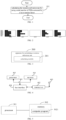
- FIG. 1 is a flowchart of a method for calculating a resource utilization rate according to an embodiment of the disclosure. As illustrated in FIG. 1 , the method is executed by a network side device.
- the method includes the following steps.
- the resource utilization rate is calculated by using a total number of PRBs corrected by a layer factor.
- ⁇ is used to represent the layer factor in this disclosure.
- the layer factor mentioned above can also be called a multiplexing factor, a modification factor, a multiplication factor, an adjustment factor, a MIMO stream factor, a MIMO layer factor, all of which are used to correct the total number of PRBs, to more accurately determine a total number of actually available PRB resources, which is more in line with an actual condition of the network.
- the layer factor ⁇ is determined according to PRB usage information of at least one sampling occasion, and the PRB usage information of the at least one sampling occasion at least includes the number of MIMO layers used by the PRB in data transmission.
- the PRB usage information at least includes the number of MIMO layers.
- the number of MIMO layers used by the PRB in data transmission is not fixed. The greater the number of MIMO layers, the more data can be transmitted simultaneously by a single PRB, i.e., the greater a degree of availability of the PRB of the cell, and thus different layer factors ⁇ should be determined. Meanwhile, the cell corresponds to different numbers of MIMO layers in different network environments, and thus different layer factors ⁇ should be determined.
- ⁇ is determined based on the PRB usage information of the at least one sampling occasion. That is, ⁇ is determined based on historical usage information of the PRB. Since the historical usage information can faithfully record the number of MIMO layers used by the PRB in data transmission, it can actually reflect different load statuses and an SDM usage condition of PRBs in different network environments (e.g., a number of UEs, and a strength of communication, etc.). Therefore, the total number of PRBs can be corrected using ⁇ determined based on the historical usage information of PRB, which can more accurately represent the total number of actually available PRB resources in SDM scenarios, and thus a more accurate resource utilization rate can be obtained.
- the PRB usage information may also include other information, such as the number of used PRBs, etc., so that ⁇ can be determined according to the number of MIMO layers in combination with other usage information, which is not limited herein.
- the at least one sampling occasion may include sampling occasions within one time period or sampling occasions within a plurality of time periods.
- the PRB usage information over the plurality of time periods can be combined to more accurately determine the layer factor ⁇ .
- the sampling occasion may be in the unit of a slot, a symbol, or a subframe, which is not limited herein.
- the layer factor ⁇ can represent the PRB SDM conditions at different stages depending on the stage at which the collected PRB usage information is located.
- the PRB usage information of the at least one sampling occasion can represent the historical usage condition of the PRB of the cell, which can reflect a historical load condition of the cell.
- the total number of actually available PRB resources in a certain historical time period of the cell is determined according to the layer factor ⁇ .
- the PRB usage information of the at least one sampling occasion can also represent a real-time usage condition of the PRB, which reflects the real-time load condition of the cell.
- the total number of actually available PRB resources by the cell can be determined by the layer factor ⁇ described above.
- the above mentioned layer factor ⁇ is a stage-related factor based on historical data statistics, which has a characteristic of varying over time (or can be called as having a dynamic characteristic).
- the total number of actually available PRB resources corrected by the above layer factor ⁇ is more in line with the actual condition of the network than a preset static layer factor.
- the layer factor ⁇ obtained in the various cases described above may be used as a basis for correcting the total number of PRBs in the current stage, so that a current load condition of the cell assessed based on the resource utilization rate is more accurate.
- the above layer factor ⁇ can also be used in the next stage of resource utilization rate assessment.
- the layer factor ⁇ is determined according to the PRB usage information of the at least one sampling occasion. Since different PRB usage information can be obtained under different load conditions of the cell at the at least one sampling occasion, a dynamic layer factor ⁇ can be determined. It is understood that in the course of network operation, the layer factor ⁇ may change according to changes in cell channel conditions, network states, and numbers of users, etc. The total number of PRBs corrected by the dynamic layer factor ⁇ can more accurately reflect an actual utilization degree of PRB resources of the cell, which is more in line with the actual condition of the network. The accuracy of the calculated resource utilization rate is improved, and an assessment of the load condition of the cell is more accurate.
- the layer factor ⁇ is:
- a first method is determining the layer factor ⁇ according to a maximum value of the average values of MIMO layers.
- a second method is determining the layer factor ⁇ according to an average value of the maximum values of MIMO layers.
- the at least one sampling occasion is distributed in N sampling time intervals (i.e., the first period as described above), and N is a positive integer.
- the first set includes N average values of MIMO layers, and one average value of MIMO layers corresponds to one sampling time interval.
- the second set includes N maximum values of MIMO layers, and one maximum value of MIMO layers corresponds to one sampling time interval.
- the first time interval may be understood as any sampling time interval of the N sampling time intervals, which is denoted herein as T1, and the first period includes at least one sampling occasion.
- the first method is determining the layer factor ⁇ according to the maximum value of the average values of MIMO layers.
- step 1 an average value of MIMO layers corresponding to each sampling time interval is calculated.
- the average value of MIMO layers corresponding to the first period is represented by expression 1: ⁇ ⁇ j number of used PRBs * number of MIMO layers ⁇ ⁇ j number of used PRBs or, ⁇ ⁇ j number of used PRBs * number of MIMO layers ⁇ ⁇ j number of available PRBs where, j is a sampling occasion within the first period.
- a numerator of the above expression 1 or expression 2 can be obtained by first calculating a sum of products of the number of used PRBs corresponding to each sampling occasion and the respective number of MIMO layers, which is denoted as a first sum, and then adding up the first sums of all the sampling occasions within the first period.
- a denominator of the above expression 1 can be understood as the sum of the number of used PRBs of all sampling occasions within the first period (when a PRB is reused for n times, the corresponding count of that PRB is n).
- a denominator of the above expression 2 can be understood as the sum of the numbers of available PRBs of all sampling occasions within the first period.
- the available PRBs at a sampling occasion include PRB1, PRB2 and PRB3.
- the numbers of MIMO layers corresponding to PRB1, PRB2, and PRB3 are 4, 2, and 0, respectively.
- the number of used PRBs corresponding to the sampling occasion is 2, and the number of available PRBs corresponding to the sampling occasion is 3.
- the above expression 1 excludes unused PRBs, so it can more accurately reflect an actual transmission capability of PRBs.
- the layer factor ⁇ is determined based on the average value of MIMO layers obtained by expression 1, which can more accurately reflect an SDM condition of the cell, and the resource utilization rate obtained by statistics can be more accurate.
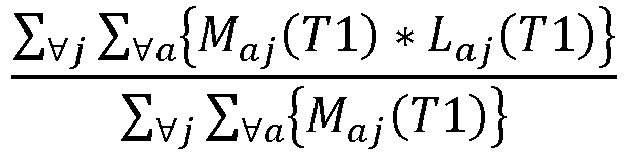
- the average value of MIMO layers can be further described as: ⁇ ⁇ j ⁇ ⁇ k M kj T 1 ⁇ L kj T 1 ⁇ ⁇ j ⁇ ⁇ k M kj T 1 or, ⁇ ⁇ j ⁇ ⁇ a M aj T 1 ⁇ L aj T 1 ⁇ ⁇ j ⁇ ⁇ a M aj T 1 where, T1 is the first period, j is a sampling occasion within the first period, a is a serial number of a UE, k is a number of kinds of MIMO layers, M kj ( T 1) is a number of PRBs used for transmission corresponding to a k th kind of MIMO layers at a j th sampling occasion within the first period, L kj ( T 1) is a number of MIMO layers corresponding to the k th kind of MIMO layers at the j th sampling occasion within the first period, M
- the first method of the above two calculation methods is to determine the average value of MIMO layers corresponding to the first period from a perspective of the kind of MIMO layers.
- the kind of MIMO layers i.e., the value of k
- the value of k can be predefined globally. That is, the number of MIMO layers that may exist globally can be defined in advance, and all possible values of k can be predefined globally.
- the value of L kj ( T 1) can be defined as the same value at all sampling occasions.
- the value of k can also be redefined based on an actual condition of each sampling occasion.
- the globally predefined numbers of MIMO layers include a total of 6 kinds which is 0, 1, 2, 3, 4, and 5, respectively, and k can take the values of 1, 2, 3, 4, 5, and 6, correspondingly.
- the number of MIMO layers of each RRB is represented by a corresponding number of blocks.
- the first period includes 5 sampling occasions, namely sampling occasion 1 (slot0), sampling occasion 2 (slot1), sampling occasion 3 (slot2), sampling occasion 4 (slot3) and sampling occasion 5 (slot4).
- the numbers of MIMO layers corresponding to the 5 sampling occasions include 0, 2, 3, 4, and 5, which belong to 5 kinds, and k can take the values of 1, 2, 3, 4, and 5, respectively.
- M 1 j ( T 1) represents the number of PRBs transmitted in 0 stream at the j th sampling occasion
- the second method of the above two calculation methods is to determine the average value of MIMO layers corresponding to the first period from a perspective of UE.
- the current cell is connected to a total of 3 UEs, i.e., UE1, UE2 and UE3, respectively, and a takes the values of 1, 2 and 3, respectively.
- the maximum value of the average values of MIMO layers in the N sampling time intervals is determined.
- the maximum value of the average values of MIMO layers is determined as the layer factor ⁇ , and then the resource utilization rate can be maximized.
- the second determination method is to determine the layer factor ⁇ according to an average value of the maximum values of MIMO layers.
- a maximum value of MIMO layers corresponding to each sampling time interval is calculated.
- the maximum value of MIMO layers corresponding to the first period is the maximum value of MIMO layers of at least one sampling occasion within the first period.
- sampling occasion1 (slot0)
- sampling occasion2 (slot1)
- sampling occasions (slot2)
- sampling occasion4 (slot3)
- sampling occasions (slot4).
- the maximum value of MIMO layers corresponding to the first period is 5.
- an average value of the maximum values of MIMO layers at N sampling time intervals is determined.
- step 1 is executed at each sampling time interval, and the maximum value of MIMO layers corresponding to each sampling time interval can be obtained.
- An average value of the N maximum values of MIMO layers can be obtained and determined as the layer factor ⁇ .
- the average value of the maximum values is determined instead of selecting the maximum value from the maximum values of MIMO layers, which avoids overestimation of PRB resources actually used by the cell, and further improves the accuracy of determination of the resource utilization rate.
- the method for determining the layer factor ⁇ may also include the following two ways.
- a third determination method is to determine the layer factor ⁇ according to an average value of average values of MIMO layers.
- the average value of MIMO layers corresponding to each sampling time interval is first calculated, and then an average value of the average values of MIMO layers corresponding to the N sampling time intervals is obtained and determined to be the layer factor ⁇ .
- the specific implementation of the determination method is described with reference to the relevant descriptions of the first determination method and the second determination method described above, and which is repeated herein to avoid repetition.
- a fourth determination method is to determine the layer factor ⁇ according to a maximum value of maximum values of MIMO layers.
- the maximum value of MIMO layers corresponding to each sampling time interval is first calculated, and then a maximum value of the maximum values of MIMO layers corresponding to the N sampling time intervals is determined as the layer factor ⁇ .
- the specific implementation of the determination method is described with reference to the relevant descriptions of the first determination method and the second determination method described above, and which is not repeated herein to avoid repetition.
- the current time interval whose resource utilization rate needs to be determined is defined as a second period, which is denoted as T 2.
- the second period includes at least one sampling occasion.
- the second period is the same as the first period.
- PRB usage data of the current time period is utilized to calculate the resource utilization rate of the time interval in real time.
- the resource utilization rate can be calculated in real time, so that the load condition of the cell assessed based on the resource utilization rate can be more accurate.
- the second period is different from the first period and may be a time period after the first period. In this way, the PRB usage data of the first period is used to calculate the resource utilization rate of a subsequent time period, so as to reduce amount of computation and simplify network configuration.
- the resource utilization rate can be determined according to the following process.
- a number of PRBs that are actually occupied by a cell is determined.
- the number of PRBs actually occupied by the cell is not necessarily equal to a sum of the numbers of PRBs occupied by each UE in the cell.
- the number of PRBs actually occupied by a UE in the cell at a sampling occasion can be a product of the number of PRBs occupied by the UE and a number of actual space division streams of the UE, i.e., a product of the number of PRBs used by the UE and the number of actual MIMO layers of the UE, which is denoted as a second product.
- the number of PRBs actually occupied by the cell may be a sum of the second products of all UEs of the cell at all sampling occasions within the second period, which can be represented as: ⁇ ⁇ a ⁇ ⁇ i number of occupied PRBs ⁇ number of actual space division streams ; or, ⁇ ⁇ a ⁇ ⁇ i number of used PRBs ⁇ number of actual MIMO layers ; where, i is a sampling occasion within the second period, a is a serial number of a UE.
- a total number of PRBs corrected by the layer factor ⁇ is determined.
- the total number of PRBs corrected by the layer factor ⁇ is a product of the layer factor and a total number of available PRBs.
- the total number of available PRBs is used to represent a sum of numbers of actually available PRBs at all sampling occasions within the second period.
- the total number of available PRBs is: 1) a product of a number of sampling occasions within the second period and a number of available PRBs at one sampling occasion of the sampling occasions; or, 2) a sum of the numbers of available PRBs at all sampling occasions within the second period.
- the number of available PRBs at the one sampling occasion can be a number of available PRBs corresponding to any sampling occasion within the second period, or may be a number of available PRBs corresponding to the sampling occasion having the largest number of available PRBs within the second period, but the total number of available PRBs determined in this way may belong to an extreme case, which may cause a larger corrected total number of PRBs.
- the number of available PRBs of which one sampling occasion within the second period can be determined according to actual condition and is not specifically limited herein. Compared to the method 1), the total number of available PRBs obtained in the above method 2) is more accurate.
- a resource utilization rate of the cell is calculated.
- the resource utilization rate of the cell the number of PRBs actually occupied by the cell/the total number of PRBs corrected by the layer factor ⁇ .
- the number of PRBs actually occupied by the cell is obtained by step 1, and the total number of PRBs corrected by the layer factor ⁇ is obtained by step 2.
- the resource utilization rate of the cell can be represented as: ⁇ ⁇ a ⁇ ⁇ i number of occupied PRBs ⁇ number of actual space division streams total number of available PRBs ⁇ maximum average value of MIMO layers where, the maximum average value of MIMO layers is a maximum value of the average values of MIMO layers.
- the resource utilization rate of the cell can be represented as: ⁇ ⁇ a ⁇ ⁇ i number of occupied PRBs ⁇ number of actual space division streams total number of available PRBs ⁇ average maximum value of MIMO layers where, the average maximum value of MIMO layers is an average value of the maximum values of MIMO layers.
- a number of PRBs that are actually occupied by a cell is determined.
- the second period (T2) includes i sampling occasions and there are a UEs in the cell
- the number of PRBs actually occupied by the a th UE at i th sampling occasion is denoted as M ai ( T 2)
- the actual number of MIMO layers of the a th UE at the i th sampling occasion is denoted as L ai ( T 2).
- the number of PRBs actual occupied by the cell can be represented as: ⁇ ⁇ a ⁇ ⁇ i M ai T 2 ⁇ L ai T 2 .
- a total number of PRBs corrected by the layer factor ⁇ is determined.
- the resource utilization rate of the cell is calculated.
- the resource utilization rate is represented as: ⁇ ⁇ ⁇ a ⁇ ⁇ i M ai T 2 ⁇ L ai T 2 N T 2 ⁇ P T 2 ⁇ ⁇ ⁇ 100 ⁇ or, ⁇ ⁇ ⁇ a ⁇ ⁇ i M ai T 2 ⁇ L ai T 2 ⁇ ⁇ i P i T 2 ⁇ ⁇ ⁇ 100 ⁇
- ⁇ ⁇ in the above expression represents ceiling, and a value range of the resource utilization rate in the above expression is 0 to 100. It can be understood that the value of the described resource utilization rate is not limited thereto, and can be represented using a percentage, i.e., 100 in the expression is replaced with %, without ceiling. What description manner specifically used by the resource utilization rate may be determined according to actual situation, and which is not specifically limited herein.
- a calculation equation G of the resource utilization rate can be obtained by bring ⁇ into the expression: ⁇ ⁇ ⁇ a ⁇ ⁇ i M ai T 2 ⁇ L ai T 2 N T 2 ⁇ P T 2 ⁇ max ⁇ ⁇ j ⁇ ⁇ k M kj T 1 ⁇ L kj T 1 ⁇ ⁇ j ⁇ ⁇ k M kj T 1 ⁇ 100 ⁇ or, ⁇ ⁇ ⁇ a ⁇ ⁇ i M ai T 2 ⁇ L ai T 2 N T 2 ⁇ P T 2 ⁇ max ⁇ ⁇ j ⁇ ⁇ k M kj T 1 ⁇ L kj T 1 ⁇ ⁇ j ⁇ ⁇ a M aj T 1 ⁇ 100 ⁇ or, ⁇ ⁇ ⁇ a ⁇ ⁇ i M ai T 2 ⁇ L ai T 2 ⁇ i P i T 2 ⁇ max ⁇ ⁇ j ⁇ k M
- the average value of MIMO layers or the maximum value of MIMO layers is calculated first, and the layer factor ⁇ is calculated, and then the resource utilization rate is calculated.
- the resource utilization rate is calculated directly by using the equation G, which may be decided according to the actual situation, and which is not be limited herein.
- the steps of the method for calculating the resource utilization rate may all be performed by a first network node (a base station). Or, a part of the parameters may be determined by the first network node and then sent to a second network node (e.g., a network manager) to obtain the layer factor ⁇ through calculation. Afterwards, the second network node sends the layer factor ⁇ to the first network node, and the first network node corrects the total number of PRBs according to the layer factor ⁇ and calculates the resource utilization rate.
- a first network node a base station
- a part of the parameters may be determined by the first network node and then sent to a second network node (e.g., a network manager) to obtain the layer factor ⁇ through calculation.
- the second network node sends the layer factor ⁇ to the first network node
- the first network node corrects the total number of PRBs according to the layer factor ⁇ and calculates the resource utilization rate.
- FIG. 3 is a block diagram of an apparatus 300 for calculating a resource utilization rate according to an embodiment of the disclosure.
- the apparatus 300 includes: a calculating module 301, configured to calculate the resource utilization rate by using a total number of PRBs corrected by a layer factor, in which the layer factor is determined according to PRB usage information of at least one sampling occasion, and the PRB usage information of the at least one sampling occasion at least includes a number of MIMO layers used by a PRB in data transmission.
- a calculating module 301 configured to calculate the resource utilization rate by using a total number of PRBs corrected by a layer factor, in which the layer factor is determined according to PRB usage information of at least one sampling occasion, and the PRB usage information of the at least one sampling occasion at least includes a number of MIMO layers used by a PRB in data transmission.
- the layer factor is:
- the average value of MIMO layers is: ⁇ ⁇ j ⁇ ⁇ k M kj T 1 ⁇ L kj T 1 ⁇ ⁇ j ⁇ ⁇ k M kj T 1 or, ⁇ ⁇ j ⁇ ⁇ a M aj T 1 ⁇ L aj T 1 ⁇ ⁇ j ⁇ ⁇ a M aj T 1
- T 1 is the first period
- j is a sampling occasion within the first period
- a is a serial number of a user equipment (UE)
- k is a value of a kind of MIMO layers
- M kj ( T 1) is a number of PRBs transmitted using a k th kind of MIMO layers at a j th sampling occasion within the first period
- L kj ( T 1) is a number of MIMO layers corresponding to the k th kind of MIMO layers at the j th sampling occasion within the first period
- M aj ( T 1) is a number of PRB
- the total number of PRBs corrected by the layer factor is a product of the layer factor and a total number of available PRBs.
- the total number of available PRBs is:
- the second period is identical to the first period.
- the apparatus 300 is capable of realizing the process shown in the method embodiment of FIG. 1 , and achieving the same beneficial effects, which is not repeated herein to avoid repetition.
- FIG. 4 is a block diagram of a network side device according to an embodiment of the disclosure.
- the network side device includes: a bus 401, a transceiver 402, an antenna 403, a bus interface 404, a processor 405, and a memory 406.
- the processor 405 is configured to calculate a resource utilization rate by using a total number of PRBs corrected by a layer factor, in which the layer factor is determined according to PRB usage information of at least one sampling occasion, and the PRB usage information of the at least one sampling occasion at least includes a number of MIMO layers used by a PRB in data transmission.
- the network side device is capable of realizing the process shown in the method embodiment of FIG. 1 , and achieving the same beneficial effects, which is not repeated herein to avoid repetition.
- the embodiment of the disclosure also provides a communication device.
- the communication device includes: a processor 501, a memory 502, and a program 5021 stored on the memory 502 and executable on the processor 501.
- the steps in the method embodiment corresponding to FIG. 1 can be realized and the same beneficial effects can be achieved, which is not repeated herein to avoid repetition.
- the storage medium may be a read-only memory (ROM), a random access memory (RAM), a diskette or a CD-ROM.
Landscapes
- Engineering & Computer Science (AREA)
- Signal Processing (AREA)
- Computer Networks & Wireless Communication (AREA)
- Radio Transmission System (AREA)
- Mobile Radio Communication Systems (AREA)
Abstract
Description
- This application is based on and claims priority to
Chinese patent application No. 202111151553.3, filed on September 29, 2021 - The embodiments of the disclosure relate to a field of communication technologies, in particular to a method for calculating a resource utilization rate, an apparatus for calculating a resource utilization rate, and a relevant device.
- Statistics of Physical Resource Block (PRB) utilization rate are usually used to assist operators and network side devices in knowing the PRB utilization rate of each cell, so as to more intuitively obtain the operation condition (e.g., idle or busy) and load condition of each cell. For example, if certain cells are found to be under high load for a long period of time based on the PRB utilization rates of the cells, expansion of the cells or adjustment of network planning can be considered.
- Currently, the PRB utilization rate is usually described by the quotient of the number of used PRBs and the total number of PRBs. Space division multiplexing, which can increase transmission speed, has been widely utilized. Space division multiplexing refers to antenna signals of different data streams, frequencies of carriers used by the antenna signals are exactly the same, and spectrum widths used by the antenna signals are also completely overlapped. That is, the space division multiplexing is a technique that allows the same frequency band to be reused in different spaces. Therefore, the data that can be transmitted in the same bandwidth can be multiplied by the space division multiplexing, and the spectrum utilization rate can also be multiplied. However, the current method for calculating a resource utilization rate does not take into account the space division multiplexing, resulting in low accuracy of resource utilization rate in space division multiplexing scenarios.
- The embodiments of the disclosure provide a method for calculating a resource utilization rate, an apparatus for calculating a resource utilization rate, and a relevant device, to solve the problem of inaccurate calculation of the resource utilization rate in space division multiplexing scenarios.
- In order to solve the above problem, the disclosure is implemented as follows.
- According to a first aspect of embodiments of the disclosure, a method for calculating a resource utilization rate, applied to a network side device, is provided. The method includes:
calculating the resource utilization rate by using a total number of PRBs corrected by a layer factor, in which the layer factor is determined according to PRB usage information of at least one sampling occasion, and the PRB usage information of the at least one sampling occasion at least includes a number of multiple input multiple output (MIMO) layers used by a PRB in data transmission. - Optionally, at the at least one sampling occasion, the greater the number of MIMO layers used by the PRB in data transmission, the greater the layer factor.
- Optionally, the layer factor is:
- a maximum value of a first set, in which the first set includes at least one average value of MIMO layers, the average value of MIMO layers is an average value of scheduled MIMO layers per PRB or on all the PRBs within a corresponding first period in data transmission;
or, - an average value of a second set, in which the second set includes at least one maximum value of MIMO layers, the maximum value of MIMO layers is a maximum value of scheduled MIMO layers per PRB or on all the PRBs within the corresponding first period in data transmission.
- Optionally, the average value of MIMO layers is:


- Optionally, the total number of PRBs corrected by the layer factor is a product of the layer factor and a total number of available PRBs.
- Optionally, the total number of available PRBs is:
- a product of a number of sampling occasions within a second period and a number of available PRBs at one sampling occasion of the sampling occasions;
or, - a sum of the numbers of available PRBs at all the sampling occasions within the second period.
- Optionally, the second period is identical to the first period.
- According to a second aspect of embodiments of the disclosure, an apparatus for calculating a resource utilization rate is provided. The apparatus includes:
a calculating module, configured to calculate the resource utilization rate by using a total number of PRBs corrected by a layer factor, in which the layer factor is determined according to PRB usage information of at least one sampling occasion, and the PRB usage information of the at least one sampling occasion at least includes a number of MIMO layers used by a PRB in data transmission. - Optionally, at the at least one sampling occasion, the greater the number of MIMO layers used by the PRB in data transmission, the greater the layer factor.
- Optionally, the layer factor is:
- a maximum value of a first set, in which the first set includes at least one average value of MIMO layers, the average value of MIMO layers is an average value of scheduled MIMO layers per PRB or on all the PRBs within a corresponding first period in data transmission;
or, - an average value of a second set, in which the second set includes at least one maximum value of MIMO layers, the maximum value of MIMO layers is a maximum value of scheduled MIMO layers per PRB or on all the PRBs within the corresponding first period in data transmission.
- Optionally, the average value of MIMO layers is:


- Optionally, the total number of PRBs corrected by the layer factor is a product of the layer factor and a total number of available PRBs.
- Optionally, the total number of available PRBs is:
- a product of a number of sampling occasions within a second period and a number of available PRBs at one sampling occasion of the sampling occasions;
or, - a sum of the numbers of available PRBs at all the sampling occasions within the second period.
- Optionally, the second period is identical to the first period.
- According to a third aspect of embodiments of the disclosure, a network side device is provided. The network side device includes:
a processor, configured to calculate a resource utilization rate by using a total number of PRBs corrected by a layer factor, in which the layer factor is determined according to PRB usage information of at least one sampling occasion, and the PRB usage information of the at least one sampling occasion at least includes a number of MIMO layers used by a PRB in data transmission. - Optionally, at the at least one sampling occasion, the greater the number of MIMO layers used by the PRB in data transmission, the greater the layer factor.
- Optionally, the layer factor is:
- a maximum value of a first set, in which the first set includes at least one average value of MIMO layers, the average value of MIMO layers is an average value of scheduled MIMO layers per PRB or on all the PRBs within a corresponding first period in data transmission;
or, - an average value of a second set, in which the second set includes at least one maximum value of MIMO layers, the maximum value of MIMO layers is a maximum value of scheduled MIMO layers per PRB or on all the PRBs within the corresponding first period in data transmission.
- Optionally, the average value of MIMO layers is:


- Optionally, the total number of PRBs corrected by the layer factor is a product of the layer factor and a total number of available PRBs.
- Optionally, the total number of available PRBs is:
- a product of a number of sampling occasions within a second period and a number of available PRBs for one of the sampling occasions;
or, - a sum of the numbers of available PRBs for all the sampling occasions within the second period.
- Optionally, the second period is identical to the first period.
- According to a fourth aspect of embodiments of the disclosure, a communication device is provided. The communication device includes: a processor, a memory and computer programs stored on the memory and executable by the processor, in which when the computer programs are executed by the processor, the steps in the above method of the first aspect are implemented.
- According to a fifth aspect of embodiments of the disclosure, a computer-readable storage medium having computer programs stored thereon is provided. When the computer programs are executed by a processor, the steps in the above method of the first aspect are implemented.
- In the embodiment of the disclosure, the layer factor is determined according to the PRB usage information of the at least one sampling occasion. Since different PRB usage information can be obtained under different load conditions of the cell at the at least one sampling occasion, a dynamic layer factor can be determined. It can be understood that in a network operation process, the layer factor may change according to changes in cell channel conditions, network states, and numbers of users, etc. The total number of PRBs corrected by the dynamic layer factor can more accurately reflect an actual utilization degree of PRB resources of the cell. An accuracy of a calculated resource utilization rate is improved, and an assessment of the load condition of the cell is more accurate.
- In order to explain the technical solutions of the embodiments of the disclosure more clearly, the drawings to be used in the description of the embodiments of the disclosure will be briefly introduced below. Obviously, the drawings in the following description are only some embodiments of the disclosure. For those skilled in the art, other drawings can be obtained based on these drawings without inventive work.
-
FIG. 1 is a flowchart of a method for calculating a resource utilization rate according to an embodiment of the disclosure. -
FIG. 2 is a schematic diagram of PRB usage statistics according to an embodiment of the disclosure. -
FIG. 3 is a block diagram of an apparatus for calculating a resource utilization rate according to an embodiment of the disclosure. -
FIG. 4 is a block diagram of a network side device according to an embodiment of the disclosure. -
FIG. 5 is a block diagram of a communication device according to an embodiment of the disclosure. - The technical solutions in the embodiments of the disclosure are clearly and completely described below with reference to the accompanying drawings in the embodiments of the disclosure. Obviously, the described embodiments are part of the embodiments of the disclosure, not all of them. Based on the embodiments of the disclosure, all other embodiments obtained by those skilled in the art without inventive work fall within the scope of protection of the disclosure.
- The terms "first", "second", etc. in the embodiments of the disclosure are used to distinguish similar objects and are not necessarily used to indicate a specific order or sequence. In addition, the terms "including", "comprising" and any variations thereof are meant to cover non-exclusive including, e.g., a process, method, system, product or apparatus comprising a series of steps or units need not be limited to those clearly listed, but may include other steps or units that are not clearly listed or are inherent to the process, method, product or apparatus. In addition, "and/or" is used in the disclosure to indicate at least one of connected objects. For example, for A and/or B and/or C, it indicates 7 cases, i.e., A exists alone, B exists alone, C exists alone, and both A and B exist, both B and C exist, both A and C exist, and A, B and C all exist.
- For ease of understanding, some of the elements involved in this disclosure are described below.
- Space Division Multiplexing (SDM) refers to allowing the same frequency band to be reused in different spaces. That is, for antenna signals of different data streams, frequencies of carriers used by them are exactly the same, and the spectrum widths used by them are also completely overlapped. Therefore, under the same bandwidth, the amount of transmitted data can be multiplied by SDM, and the spectrum utilization rate can also be multiplied.
- The number of MIMO layers: UEs with better channel conditions can be configured with a plurality of MIMO streams, which is equivalent to transmitting multiple copies of data using the same PRB resource. The number of MIMO layers can also be called a number of MIMO streams, a number of space division streams, a number of SDM layers, or a number of scheduled layers. For example, if the number of MIMO layers is 2, the same PRB resource can transmit 2 copies of the data, and if the number of MIMO layers is 3, the same PRB resource can transmit 3 copies of the data.
- A number of used PRBs can also be referred to as a number of occupied PRBs or a number of scheduled PRBs. It refers to the number of PRBs used for transmission of Physical Downlink Shared Channel (PDSCH), which can be specifically understood as the number of PRBs scheduled by a current cell for all UEs.
- A total number of PRBs is the total number of PRBs configured by the current cell.
- The following describes the method for calculating a resource utilization rate provided by the embodiments of the disclosure.
-
FIG. 1 is a flowchart of a method for calculating a resource utilization rate according to an embodiment of the disclosure. As illustrated inFIG. 1 , the method is executed by a network side device. - As illustrated in
FIG. 1 , the method includes the following steps. - At
step 101, the resource utilization rate is calculated by using a total number of PRBs corrected by a layer factor. - For ease of description, β is used to represent the layer factor in this disclosure. The layer factor mentioned above can also be called a multiplexing factor, a modification factor, a multiplication factor, an adjustment factor, a MIMO stream factor, a MIMO layer factor, all of which are used to correct the total number of PRBs, to more accurately determine a total number of actually available PRB resources, which is more in line with an actual condition of the network.
- The layer factor β is determined according to PRB usage information of at least one sampling occasion, and the PRB usage information of the at least one sampling occasion at least includes the number of MIMO layers used by the PRB in data transmission.
- In a specific implementation, the PRB usage information at least includes the number of MIMO layers. When the PRB of the cell is configured with a plurality of MIMO streams, the number of MIMO layers used by the PRB in data transmission is not fixed. The greater the number of MIMO layers, the more data can be transmitted simultaneously by a single PRB, i.e., the greater a degree of availability of the PRB of the cell, and thus different layer factors β should be determined. Meanwhile, the cell corresponds to different numbers of MIMO layers in different network environments, and thus different layer factors β should be determined.
- In the embodiments of the disclosure, β is determined based on the PRB usage information of the at least one sampling occasion. That is, β is determined based on historical usage information of the PRB. Since the historical usage information can faithfully record the number of MIMO layers used by the PRB in data transmission, it can actually reflect different load statuses and an SDM usage condition of PRBs in different network environments (e.g., a number of UEs, and a strength of communication, etc.). Therefore, the total number of PRBs can be corrected using β determined based on the historical usage information of PRB, which can more accurately represent the total number of actually available PRB resources in SDM scenarios, and thus a more accurate resource utilization rate can be obtained.
- The PRB usage information may also include other information, such as the number of used PRBs, etc., so that β can be determined according to the number of MIMO layers in combination with other usage information, which is not limited herein.
- The at least one sampling occasion may include sampling occasions within one time period or sampling occasions within a plurality of time periods. In the case where the at least one sampling occasion includes sampling occasions within a plurality of time periods, the PRB usage information over the plurality of time periods can be combined to more accurately determine the layer factor β. The sampling occasion may be in the unit of a slot, a symbol, or a subframe, which is not limited herein.
- In the embodiments of the disclosure, the layer factor β can represent the PRB SDM conditions at different stages depending on the stage at which the collected PRB usage information is located.
- The PRB usage information of the at least one sampling occasion can represent the historical usage condition of the PRB of the cell, which can reflect a historical load condition of the cell. The total number of actually available PRB resources in a certain historical time period of the cell is determined according to the layer factor β.
- The PRB usage information of the at least one sampling occasion can also represent a real-time usage condition of the PRB, which reflects the real-time load condition of the cell. The total number of actually available PRB resources by the cell can be determined by the layer factor β described above.
- The above mentioned layer factor β is a stage-related factor based on historical data statistics, which has a characteristic of varying over time (or can be called as having a dynamic characteristic). The total number of actually available PRB resources corrected by the above layer factor β is more in line with the actual condition of the network than a preset static layer factor.
- In one case, the layer factor β obtained in the various cases described above may be used as a basis for correcting the total number of PRBs in the current stage, so that a current load condition of the cell assessed based on the resource utilization rate is more accurate. In another case, the above layer factor β can also be used in the next stage of resource utilization rate assessment.
- In an embodiment of the disclosure, the layer factor β is determined according to the PRB usage information of the at least one sampling occasion. Since different PRB usage information can be obtained under different load conditions of the cell at the at least one sampling occasion, a dynamic layer factor β can be determined. It is understood that in the course of network operation, the layer factor β may change according to changes in cell channel conditions, network states, and numbers of users, etc. The total number of PRBs corrected by the dynamic layer factor β can more accurately reflect an actual utilization degree of PRB resources of the cell, which is more in line with the actual condition of the network. The accuracy of the calculated resource utilization rate is improved, and an assessment of the load condition of the cell is more accurate.
- Optionally, at the at least one sampling occasion, the greater the number of MIMO layers used by the PRB in data transmission, the greater the layer factor β. That is, the number of MIMO layers is positively correlated with the layer factor β.
- The determination of the layer factor β is explained below.
- In a possible implementation, the layer factor β is:
- a maximum value of a first set, in which the first set includes at least one average value of MIMO layers, the average value of MIMO layers is an average value of scheduled MIMO layers per PRB or on all the PRBs within a corresponding first period in data transmission;
or, - an average value of a second set, in which the second set includes at least one maximum value of MIMO layers, the maximum value of MIMO layers is a maximum value of scheduled MIMO layers per PRB or on all the PRBs within the corresponding first period in data transmission.
- That is, in the implementation, there are at least two methods for determining the layer factor β. A first method is determining the layer factor β according to a maximum value of the average values of MIMO layers. A second method is determining the layer factor β according to an average value of the maximum values of MIMO layers.
- For the sake of illustration, assuming that the at least one sampling occasion is distributed in N sampling time intervals (i.e., the first period as described above), and N is a positive integer. The first set includes N average values of MIMO layers, and one average value of MIMO layers corresponds to one sampling time interval. The second set includes N maximum values of MIMO layers, and one maximum value of MIMO layers corresponds to one sampling time interval. The first time interval may be understood as any sampling time interval of the N sampling time intervals, which is denoted herein as T1, and the first period includes at least one sampling occasion.
- The above determination methods are described below respectively.
- The first method is determining the layer factor β according to the maximum value of the average values of MIMO layers.
- In this method, the specific processes are provided as follows.
- At
step 1, an average value of MIMO layers corresponding to each sampling time interval is calculated. - Taking the first period as an example, the average value of MIMO layers corresponding to the first period is represented by expression 1:


above expression 1 or expression 2 can be obtained by first calculating a sum of products of the number of used PRBs corresponding to each sampling occasion and the respective number of MIMO layers, which is denoted as a first sum, and then adding up the first sums of all the sampling occasions within the first period. - A denominator of the
above expression 1 can be understood as the sum of the number of used PRBs of all sampling occasions within the first period (when a PRB is reused for n times, the corresponding count of that PRB is n). A denominator of the above expression 2 can be understood as the sum of the numbers of available PRBs of all sampling occasions within the first period. - For ease of understanding, by way of example, it is assumed that the available PRBs at a sampling occasion include PRB1, PRB2 and PRB3. The numbers of MIMO layers corresponding to PRB1, PRB2, and PRB3 are 4, 2, and 0, respectively. The number of used PRBs corresponding to the sampling occasion is 2, and the number of available PRBs corresponding to the sampling occasion is 3.
- In practical applications, compared to expression 2, the
above expression 1 excludes unused PRBs, so it can more accurately reflect an actual transmission capability of PRBs. The layer factor β is determined based on the average value of MIMO layers obtained byexpression 1, which can more accurately reflect an SDM condition of the cell, and the resource utilization rate obtained by statistics can be more accurate. - When the number of available PRBs is selected as the denominator, the average value of MIMO layers can be further described as:

- The first method of the above two calculation methods is to determine the average value of MIMO layers corresponding to the first period from a perspective of the kind of MIMO layers.
- In specific implementation, the kind of MIMO layers, i.e., the value of k, can be predefined globally. That is, the number of MIMO layers that may exist globally can be defined in advance, and all possible values of k can be predefined globally. In this case, the value of Lkj (T1) can be defined as the same value at all sampling occasions. In addition, the value of k can also be redefined based on an actual condition of each sampling occasion.
- To facilitate understanding, for example, for globally predefined kinds of MIMO layers, it is assumed that the globally predefined numbers of MIMO layers include a total of 6 kinds which is 0, 1, 2, 3, 4, and 5, respectively, and k can take the values of 1, 2, 3, 4, 5, and 6, correspondingly. As shown in
FIG. 2 , the number of MIMO layers of each RRB is represented by a corresponding number of blocks. In all adopted moments, L 1j (T1)=0, L 2j (T1)=1, L 3j (T1)=2, L 4j (T1)=3, L 5j (T1)=4, and L 6j (T1)=5. When each sampling occasion is redefined, as shown inFIG. 2 , in the sampling occasion 1 (slot 0), actual numbers of MIMO layers include 2, 3, and 4, which belong to 3 kinds, and k can take thevalues 1, 2, and 3 respectively. That is, L 1j (T1)=2, L 2j (T1)=3, and L 3j (T1)=4. - As shown in
FIG. 2 , the first period includes 5 sampling occasions, namely sampling occasion 1 (slot0), sampling occasion 2 (slot1), sampling occasion 3 (slot2), sampling occasion 4 (slot3) and sampling occasion 5 (slot4). The numbers of MIMO layers corresponding to the 5 sampling occasions include 0, 2, 3, 4, and 5, which belong to 5 kinds, and k can take the values of 1, 2, 3, 4, and 5, respectively. When k=1, the corresponding number of MIMO layers is 0. When k=2, the corresponding number of MIMO layers is 2. When k=3, the corresponding number of MIMO layers is 3. When k=4, the corresponding number of MIMO layers is 4. When k=5, the corresponding number of MIMO layers is 5. That is, L 1j (T1) =0, L 2j (T1)=2, L 3j (T1)=3, L 4j (T1)=4, and L 5j (T1)=5. - M 1j (T1) represents the number of PRBs transmitted in 0 stream at the j th sampling occasion, M 2j (T1)=2 represents the number of PRBs transmitted in 2 streams at the j th sampling occasion, M 3j (T1)=3 represents the number of PRBs transmitted in 3 streams at the j th sampling occasion, M 4j (T1)=4 represents the number of PRBs transmitted in 4 streams at the j th sampling occasion, and M 5j (T1)=5 represents the number of PRBs transmitted in 2 streams at the j th sampling occasion. Taking slot0 as an example, M 11(T1)=0, M 21(T1)=1, M 31(T1)=1, M 41(T1)=4, and M 51(T1)=0.
- The second method of the above two calculation methods is to determine the average value of MIMO layers corresponding to the first period from a perspective of UE.
- For ease of understanding, for example, assuming that the current cell is connected to a total of 3 UEs, i.e., UE1, UE2 and UE3, respectively, and a takes the values of 1, 2 and 3, respectively. For example, at the sampling occasion 1 (slot0), the number of PRBs assigned to UE1 is 1, and the number of MIMO layers is 2. That is, M 11(T1)=1, and L 11(T1)=2.
- At step 2, the maximum value of the average values of MIMO layers in the N sampling time intervals is determined.
- The process of
step 1 is executed at each sampling time interval, and the average value of MIMO layers corresponding to each sampling time interval can be obtained, and the maximum value of the N average values of MIMO layers is determined as the layer factor β, which can be represented as:

- In this determination method, since the average value of MIMO layers at each sampling time interval is obtained, the maximum value of the average values of MIMO layers is determined as the layer factor β, and then the resource utilization rate can be maximized.
- The second determination method is to determine the layer factor β according to an average value of the maximum values of MIMO layers.
- The specific process of this determination method is provided as follows.
- At
step 1, a maximum value of MIMO layers corresponding to each sampling time interval is calculated. - Taking the first period as an example, the maximum value of MIMO layers corresponding to the first period is the maximum value of MIMO layers of at least one sampling occasion within the first period.
- For ease of understanding, for example, as shown in
FIG. 2 , assuming that 5 sampling occasions are included in the first period, namely sampling occasion1 (slot0), sampling occasion2 (slot1), sampling occasions (slot2), sampling occasion4 (slot3) and sampling occasions (slot4). The maximum value of MIMO layers corresponding to the first period is 5. - At step 2, an average value of the maximum values of MIMO layers at N sampling time intervals is determined.
- The process of
step 1 is executed at each sampling time interval, and the maximum value of MIMO layers corresponding to each sampling time interval can be obtained. An average value of the N maximum values of MIMO layers can be obtained and determined as the layer factor β. - In this determination method, since the maximum value of MIMO layers at each sampling time interval is obtained, the average value of the maximum values is determined instead of selecting the maximum value from the maximum values of MIMO layers, which avoids overestimation of PRB resources actually used by the cell, and further improves the accuracy of determination of the resource utilization rate.
- It should be noted that in addition to the above two determination methods, in an optional implementation, the method for determining the layer factor β may also include the following two ways.
- A third determination method is to determine the layer factor β according to an average value of average values of MIMO layers.
- That is, the average value of MIMO layers corresponding to each sampling time interval is first calculated, and then an average value of the average values of MIMO layers corresponding to the N sampling time intervals is obtained and determined to be the layer factor β. The specific implementation of the determination method is described with reference to the relevant descriptions of the first determination method and the second determination method described above, and which is repeated herein to avoid repetition.
- A fourth determination method is to determine the layer factor β according to a maximum value of maximum values of MIMO layers.
- That is, the maximum value of MIMO layers corresponding to each sampling time interval is first calculated, and then a maximum value of the maximum values of MIMO layers corresponding to the N sampling time intervals is determined as the layer factor β. The specific implementation of the determination method is described with reference to the relevant descriptions of the first determination method and the second determination method described above, and which is not repeated herein to avoid repetition.
- The determination of the resource utilization rate is described below.
- In the embodiment of the disclosure, for ease of illustration, the current time interval whose resource utilization rate needs to be determined is defined as a second period, which is denoted as T2. The second period includes at least one sampling occasion.
- In an optional implementation, the second period is the same as the first period. In this way, PRB usage data of the current time period is utilized to calculate the resource utilization rate of the time interval in real time. In this way, the resource utilization rate can be calculated in real time, so that the load condition of the cell assessed based on the resource utilization rate can be more accurate. In another implementation, the second period is different from the first period and may be a time period after the first period. In this way, the PRB usage data of the first period is used to calculate the resource utilization rate of a subsequent time period, so as to reduce amount of computation and simplify network configuration.
- In specific implementation, the resource utilization rate can be determined according to the following process.
- At
step 1, a number of PRBs that are actually occupied by a cell is determined. - When considering the SDM, since one PRB can transmit multiple pieces of data at the same time, the number of PRBs actually occupied by the cell is not necessarily equal to a sum of the numbers of PRBs occupied by each UE in the cell. In detail, the number of PRBs actually occupied by a UE in the cell at a sampling occasion can be a product of the number of PRBs occupied by the UE and a number of actual space division streams of the UE, i.e., a product of the number of PRBs used by the UE and the number of actual MIMO layers of the UE, which is denoted as a second product. The number of PRBs actually occupied by the cell may be a sum of the second products of all UEs of the cell at all sampling occasions within the second period, which can be represented as:


- At step 2, a total number of PRBs corrected by the layer factor β is determined.
- In a possible implementation, the total number of PRBs corrected by the layer factor β is a product of the layer factor and a total number of available PRBs.
- In the implementation, the total number of available PRBs is used to represent a sum of numbers of actually available PRBs at all sampling occasions within the second period. Optionally, the total number of available PRBs is: 1) a product of a number of sampling occasions within the second period and a number of available PRBs at one sampling occasion of the sampling occasions; or, 2) a sum of the numbers of available PRBs at all sampling occasions within the second period.
- In the above method 1), the number of available PRBs at the one sampling occasion can be a number of available PRBs corresponding to any sampling occasion within the second period, or may be a number of available PRBs corresponding to the sampling occasion having the largest number of available PRBs within the second period, but the total number of available PRBs determined in this way may belong to an extreme case, which may cause a larger corrected total number of PRBs. The number of available PRBs of which one sampling occasion within the second period can be determined according to actual condition and is not specifically limited herein. Compared to the method 1), the total number of available PRBs obtained in the above method 2) is more accurate.
- At step 3, a resource utilization rate of the cell is calculated.
- In a specific implementation, the resource utilization rate of the cell = the number of PRBs actually occupied by the cell/the total number of PRBs corrected by the layer factor β. The number of PRBs actually occupied by the cell is obtained by
step 1, and the total number of PRBs corrected by the layer factor β is obtained by step 2. - It should be noted that, in the case where the layer factor β is determined based on the first determination method, the resource utilization rate of the cell can be represented as:

- In the case where the layer factor β is determined based on the second determination method, the resource utilization rate of the cell can be represented as:

- For ease of understanding, an example of the process for determining the resource utilization rate is described below.
- At
step 1, a number of PRBs that are actually occupied by a cell is determined. - Assuming that the second period (T2) includes i sampling occasions and there are a UEs in the cell, the number of PRBs actually occupied by the a th UE at i th sampling occasion is denoted as Mai (T2), and the actual number of MIMO layers of the a th UE at the i th sampling occasion is denoted as Lai (T2). The number of PRBs actual occupied by the cell can be represented as:

- At step 2, a total number of PRBs corrected by the layer factor β is determined.
- 1) The layer factor β is determined.
The layer factor β is represented as:

- 2) A total number of available PRBs is determined.
The number of sampling occasions in the second period (T2) is denoted as N(T2), the number of available PRBs corresponding to a selected sampling occasion is denoted as P(T2), and the number of available PRBs corresponding to the i th sampling occasion is denoted as Pi (T2). Thus the total number of available PRBs is represented as:

- 3) A total number of PRBs corrected by the layer factor β is determined.
The total number of PRBs corrected by the layer factor β is represented as:

- At step 3, the resource utilization rate of the cell is calculated.
- The resource utilization rate is represented as:


- It should be noted that └ ┘ in the above expression represents ceiling, and a value range of the resource utilization rate in the above expression is 0 to 100. It can be understood that the value of the described resource utilization rate is not limited thereto, and can be represented using a percentage, i.e., 100 in the expression is replaced with %, without ceiling. What description manner specifically used by the resource utilization rate may be determined according to actual situation, and which is not specifically limited herein.
- A calculation equation G of the resource utilization rate can be obtained by bring β into the expression:


- It should be noted that, in the embodiments of the disclosure, the average value of MIMO layers or the maximum value of MIMO layers is calculated first, and the layer factor β is calculated, and then the resource utilization rate is calculated. Or, the resource utilization rate is calculated directly by using the equation G, which may be decided according to the actual situation, and which is not be limited herein.
- It should be noted that, the steps of the method for calculating the resource utilization rate provided by the embodiments of the disclosure may all be performed by a first network node (a base station). Or, a part of the parameters may be determined by the first network node and then sent to a second network node (e.g., a network manager) to obtain the layer factor β through calculation. Afterwards, the second network node sends the layer factor β to the first network node, and the first network node corrects the total number of PRBs according to the layer factor β and calculates the resource utilization rate.
-
FIG. 3 is a block diagram of anapparatus 300 for calculating a resource utilization rate according to an embodiment of the disclosure. - As illustrated in
FIG. 3 , theapparatus 300 includes:
a calculatingmodule 301, configured to calculate the resource utilization rate by using a total number of PRBs corrected by a layer factor, in which the layer factor is determined according to PRB usage information of at least one sampling occasion, and the PRB usage information of the at least one sampling occasion at least includes a number of MIMO layers used by a PRB in data transmission. - Optionally, at the at least one sampling occasion, the greater the number of MIMO layers used by the PRB in data transmission, the greater the layer factor.
- Optionally, the layer factor is:
- a maximum value of a first set, in which the first set includes at least one average value of MIMO layers, the average value of MIMO layers is an average value of scheduled MIMO layers per PRB or on all the PRBs within a corresponding first period in data transmission;
or, - an average value of a second set, in which the second set includes at least one maximum value of MIMO layers, the maximum value of MIMO layers is a maximum value of scheduled MIMO layers per PRB or on all the PRBs within the corresponding first period in data transmission.
- Optionally, the average value of MIMO layers is:


- Optionally, the total number of PRBs corrected by the layer factor is a product of the layer factor and a total number of available PRBs.
- Optionally, the total number of available PRBs is:
- a product of a number of sampling occasions within a second period and a number of available PRBs at one sampling occasion of the sampling occasions;
or, - a sum of the numbers of available PRBs at all the sampling occasions within the second period.
- Optionally, the second period is identical to the first period.
- The
apparatus 300 is capable of realizing the process shown in the method embodiment ofFIG. 1 , and achieving the same beneficial effects, which is not repeated herein to avoid repetition. - Referring to
FIG. 4, FIG. 4 is a block diagram of a network side device according to an embodiment of the disclosure. As illustrated inFIG. 4 , the network side device includes: abus 401, a transceiver 402, anantenna 403, abus interface 404, aprocessor 405, and amemory 406. - The
processor 405 is configured to calculate a resource utilization rate by using a total number of PRBs corrected by a layer factor, in which the layer factor is determined according to PRB usage information of at least one sampling occasion, and the PRB usage information of the at least one sampling occasion at least includes a number of MIMO layers used by a PRB in data transmission. - The network side device is capable of realizing the process shown in the method embodiment of
FIG. 1 , and achieving the same beneficial effects, which is not repeated herein to avoid repetition. - The embodiment of the disclosure also provides a communication device. As illustrated in
FIG. 5 , the communication device includes: aprocessor 501, amemory 502, and aprogram 5021 stored on thememory 502 and executable on theprocessor 501. - In the case where the communication device is a network side device, when the
program 5021 is executed by theprocessor 501, the steps in the method embodiment corresponding toFIG. 1 can be realized and the same beneficial effects can be achieved, which is not repeated herein to avoid repetition. - Those skilled in the art may understand that all or some of the steps for realizing the method of the above embodiments can be achieved by hardware associated with program instructions, and the programs may be stored in a readable medium. The embodiment of the disclosure also provides a readable storage medium having computer programs stored thereon. When the computer programs are executed by the processor, the steps in the method embodiment corresponding to
FIG. 1 can be realized and the same beneficial effects can be achieved, which is not repeated herein to avoid repetition. - The storage medium may be a read-only memory (ROM), a random access memory (RAM), a diskette or a CD-ROM.
- The foregoing is a preferred embodiment of the disclosure, and it should be noted that for those skilled in the art, a number of improvements and embellishments may be made without departing from the principles described in the disclosure, and these improvements and embellishments should also be regarded as within the scope of protection of the disclosure.
Claims (11)
- A method for calculating a resource utilization rate, applied to a network side device, comprising:
calculating the resource utilization rate by using a total number of physical resource blocks (PRBs) corrected by a layer factor, wherein the layer factor is determined according to PRB usage information of at least one sampling occasion, and the PRB usage information of the at least one sampling occasion at least comprises a number of multiple input multiple output (MIMO) layers used by a PRB in data transmission. - The method of claim 1, wherein at the at least one sampling occasion, the greater the number of MIMO layers used by a PRB in data transmission, the greater the layer factor.
- The method of claim 1, wherein the layer factor is:a maximum value of a first set, wherein the first set comprises at least one average value of MIMO layers, the average value of MIMO layers is an average value of scheduled MIMO layers per PRB or on all the PRBs within a corresponding first period in data transmission;
or,an average value of a second set, wherein the second set comprises at least one maximum value of MIMO layers, the maximum value of MIMO layers is a maximum value of scheduled MIMO layers per PRB or on all the PRBs within the corresponding first period in data transmission. - The method of claim 3, wherein the average value of MIMO layers is:


- The method of any one of claims 1-4, wherein the total number of PRBs corrected by the layer factor is a product of the layer factor and a total number of available PRBs.
- The method of claim 5, wherein the total number of available PRBs is:a product of a number of sampling occasions within a second period and a number of available PRBs at one sampling occasion of the sampling occasions;
or,a sum of the numbers of available PRBs at all the sampling occasions within the second period. - The method of claim 6, wherein the second period is identical to a first period.
- An apparatus for calculating a resource utilization rate, comprising:
a calculating module, configured to calculate the resource utilization rate by using a total number of PRBs corrected by a layer factor, wherein the layer factor is determined according to PRB usage information of at least one sampling occasion, and the PRB usage information of the at least one sampling occasion at least comprises a number of MIMO layers used by a PRB in data transmission. - A network side device, comprising:
a processor, configured to calculate a resource utilization rate by using a total number of PRBs corrected by a layer factor, wherein the layer factor is determined according to PRB usage information of at least one sampling occasion, and the PRB usage information of the at least one sampling occasion at least comprises a number of MIMO layers used by a PRB in data transmission. - A communication device, comprising a processor, a memory and computer programs stored on the memory and executable by the processor, wherein when the computer programs are executed by the processor, the steps in the method for calculating a resource utilization rate of any one of claims 1-7 are implemented.
- A computer-readable storage medium having computer programs stored thereon, wherein when the computer programs are executed by a processor, the steps in the method for calculating a resource utilization rate of any one of claims 1-7 are implemented.
Applications Claiming Priority (2)
| Application Number | Priority Date | Filing Date | Title |
|---|---|---|---|
| CN202111151553.3A CN115942381A (en) | 2021-09-29 | 2021-09-29 | Statistical method, device and related equipment of resource utilization rate |
| PCT/CN2022/122216 WO2023051630A1 (en) | 2021-09-29 | 2022-09-28 | Resource utilization rate counting method and apparatus, and related device |
Publications (2)
| Publication Number | Publication Date |
|---|---|
| EP4412320A1 true EP4412320A1 (en) | 2024-08-07 |
| EP4412320A4 EP4412320A4 (en) | 2025-09-17 |
Family
ID=85781338
Family Applications (1)
| Application Number | Title | Priority Date | Filing Date |
|---|---|---|---|
| EP22875013.9A Pending EP4412320A4 (en) | 2021-09-29 | 2022-09-28 | Method and device for counting the resource utilization rate and associated device |
Country Status (5)
| Country | Link |
|---|---|
| US (1) | US12452737B2 (en) |
| EP (1) | EP4412320A4 (en) |
| JP (1) | JP7719298B2 (en) |
| CN (1) | CN115942381A (en) |
| WO (1) | WO2023051630A1 (en) |
Families Citing this family (2)
| Publication number | Priority date | Publication date | Assignee | Title |
|---|---|---|---|---|
| CN115942381A (en) | 2021-09-29 | 2023-04-07 | 中国移动通信有限公司研究院 | Statistical method, device and related equipment of resource utilization rate |
| CN118102448B (en) * | 2024-02-09 | 2025-10-03 | 中国移动通信集团设计院有限公司 | PDCCH channel load evaluation method, device and electronic device |
Family Cites Families (9)
| Publication number | Priority date | Publication date | Assignee | Title |
|---|---|---|---|---|
| CN101820669B (en) * | 2010-01-28 | 2012-11-14 | 北京邮电大学 | Method and device for allocating PDCCH resources |
| WO2013098558A1 (en) * | 2011-12-30 | 2013-07-04 | Aircom International Ltd | Cell performance assessment |
| CN102595385B (en) * | 2012-03-02 | 2014-06-18 | 电信科学技术研究院 | Downlink transmission method and device |
| CN104348580A (en) * | 2013-08-06 | 2015-02-11 | 夏普株式会社 | Downlink physical channel transmitting and receiving methods, base station and user equipment |
| CN108289017B (en) * | 2017-01-09 | 2022-12-30 | 中兴通讯股份有限公司 | Signal receiving and transmitting method, and control channel receiving and transmitting method and device |
| US11405874B2 (en) * | 2019-02-11 | 2022-08-02 | Comcast Cable Communications, Llc | Power control and retransmission |
| CN111866902B (en) * | 2020-07-01 | 2022-09-27 | 中国联合网络通信集团有限公司 | Resource utilization rate evaluation method and device |
| US12550133B2 (en) * | 2020-11-11 | 2026-02-10 | Telefonaktiebolaget Lm Ericsson (Publ) | Methods of calculating physical resource block utilization and related network nodes |
| CN115942381A (en) | 2021-09-29 | 2023-04-07 | 中国移动通信有限公司研究院 | Statistical method, device and related equipment of resource utilization rate |
-
2021
- 2021-09-29 CN CN202111151553.3A patent/CN115942381A/en active Pending
-
2022
- 2022-09-28 WO PCT/CN2022/122216 patent/WO2023051630A1/en not_active Ceased
- 2022-09-28 JP JP2024519804A patent/JP7719298B2/en active Active
- 2022-09-28 US US18/697,100 patent/US12452737B2/en active Active
- 2022-09-28 EP EP22875013.9A patent/EP4412320A4/en active Pending
Also Published As
| Publication number | Publication date |
|---|---|
| JP2024535478A (en) | 2024-09-30 |
| US20240405809A1 (en) | 2024-12-05 |
| WO2023051630A1 (en) | 2023-04-06 |
| US12452737B2 (en) | 2025-10-21 |
| EP4412320A4 (en) | 2025-09-17 |
| CN115942381A (en) | 2023-04-07 |
| JP7719298B2 (en) | 2025-08-05 |
Similar Documents
| Publication | Publication Date | Title |
|---|---|---|
| US11337244B2 (en) | Scheduling subband allocation method and apparatus, and device and readable storage medium | |
| CN107231218B (en) | ACK/NACK feedback method and related equipment | |
| KR101449556B1 (en) | User device, base station device, and method | |
| EP3393167B1 (en) | Resource allocation method and device, and base station | |
| US11109389B2 (en) | Method for reporting network performance parameter and device | |
| EP2416619A1 (en) | Method for reporting channel state information, channel estimating method, terminal and base station | |
| US12452737B2 (en) | Method for determining resource utilization rate, communication device and storage medium | |
| US10230489B2 (en) | Adaptive modulation and coding method and apparatus | |
| EP3637644B1 (en) | A data entry method, related device, and system. | |
| EP4380222A1 (en) | Wireless resource utilization rate determination method and apparatus, electronic device and storage medium | |
| EP3297180A1 (en) | Coordinated beamforming method and device | |
| CN105991177A (en) | Method and device for antenna calibration | |
| CN100464607C (en) | Transmitting apparatus for allocating data of receiving apparatus selected from a plurality of receiving apparatuses to a shared channel | |
| CN110572794B (en) | Congestion control method and device, storage medium, and user equipment | |
| EP4152857B1 (en) | Method and apparatus for acquiring uplink channel state information | |
| US20090046691A1 (en) | Robust scheduling request mechanism in a cellular environment | |
| Nota et al. | Context-based Latency Guarantees Considering Channel Degradation in 5G Network Slicing | |
| CN112311498B (en) | Terminal capability processing method and device, network side equipment and terminal | |
| CN103974342B (en) | A kind of SRS network parameters determine method and apparatus | |
| HK40108024A (en) | Resource utilization rate counting method and apparatus, and related device | |
| EP3214888B1 (en) | Signal transmission method and apparatus | |
| CN108400837B (en) | Data sending method and terminal equipment | |
| CN113098665B (en) | Processing method and device for allocating PUCCH resources for CSI | |
| CN111800792B (en) | Resource processing method and device | |
| CN108834214A (en) | A time slot resource allocation method and device based on uplink and downlink queue equalization |
Legal Events
| Date | Code | Title | Description |
|---|---|---|---|
| STAA | Information on the status of an ep patent application or granted ep patent |
Free format text: STATUS: THE INTERNATIONAL PUBLICATION HAS BEEN MADE |
|
| PUAI | Public reference made under article 153(3) epc to a published international application that has entered the european phase |
Free format text: ORIGINAL CODE: 0009012 |
|
| STAA | Information on the status of an ep patent application or granted ep patent |
Free format text: STATUS: REQUEST FOR EXAMINATION WAS MADE |
|
| 17P | Request for examination filed |
Effective date: 20240411 |
|
| AK | Designated contracting states |
Kind code of ref document: A1 Designated state(s): AL AT BE BG CH CY CZ DE DK EE ES FI FR GB GR HR HU IE IS IT LI LT LU LV MC MK MT NL NO PL PT RO RS SE SI SK SM TR |
|
| REG | Reference to a national code |
Ref country code: HK Ref legal event code: DE Ref document number: 40108024 Country of ref document: HK |
|
| DAV | Request for validation of the european patent (deleted) | ||
| DAX | Request for extension of the european patent (deleted) | ||
| REG | Reference to a national code |
Ref country code: DE Ref legal event code: R079 Free format text: PREVIOUS MAIN CLASS: H04W0052140000 Ipc: H04L0005000000 |
|
| A4 | Supplementary search report drawn up and despatched |
Effective date: 20250814 |
|
| RIC1 | Information provided on ipc code assigned before grant |
Ipc: H04L 5/00 20060101AFI20250808BHEP Ipc: H04W 52/14 20090101ALI20250808BHEP Ipc: H04B 7/0413 20170101ALI20250808BHEP Ipc: H04W 72/04 20230101ALI20250808BHEP Ipc: H04W 28/10 20090101ALN20250808BHEP |