EP4412239A1 - Control of onu activation in high bit rate pons - Google Patents
Control of onu activation in high bit rate pons Download PDFInfo
- Publication number
- EP4412239A1 EP4412239A1 EP24155618.2A EP24155618A EP4412239A1 EP 4412239 A1 EP4412239 A1 EP 4412239A1 EP 24155618 A EP24155618 A EP 24155618A EP 4412239 A1 EP4412239 A1 EP 4412239A1
- Authority
- EP
- European Patent Office
- Prior art keywords
- onu
- rate
- upstream
- line rate
- olt
- Prior art date
- Legal status (The legal status is an assumption and is not a legal conclusion. Google has not performed a legal analysis and makes no representation as to the accuracy of the status listed.)
- Granted
Links
Images



Classifications
-
- H—ELECTRICITY
- H04—ELECTRIC COMMUNICATION TECHNIQUE
- H04Q—SELECTING
- H04Q11/00—Selecting arrangements for multiplex systems
- H04Q11/0001—Selecting arrangements for multiplex systems using optical switching
- H04Q11/0062—Network aspects
- H04Q11/0067—Provisions for optical access or distribution networks, e.g. Gigabit Ethernet Passive Optical Network (GE-PON), ATM-based Passive Optical Network (A-PON), PON-Ring
-
- H—ELECTRICITY
- H04—ELECTRIC COMMUNICATION TECHNIQUE
- H04B—TRANSMISSION
- H04B10/00—Transmission systems employing electromagnetic waves other than radio-waves, e.g. infrared, visible or ultraviolet light, or employing corpuscular radiation, e.g. quantum communication
- H04B10/07—Arrangements for monitoring or testing transmission systems; Arrangements for fault measurement of transmission systems
- H04B10/075—Arrangements for monitoring or testing transmission systems; Arrangements for fault measurement of transmission systems using an in-service signal
- H04B10/079—Arrangements for monitoring or testing transmission systems; Arrangements for fault measurement of transmission systems using an in-service signal using measurements of the data signal
- H04B10/0795—Performance monitoring; Measurement of transmission parameters
-
- H—ELECTRICITY
- H04—ELECTRIC COMMUNICATION TECHNIQUE
- H04B—TRANSMISSION
- H04B10/00—Transmission systems employing electromagnetic waves other than radio-waves, e.g. infrared, visible or ultraviolet light, or employing corpuscular radiation, e.g. quantum communication
- H04B10/25—Arrangements specific to fibre transmission
- H04B10/2589—Bidirectional transmission
-
- H—ELECTRICITY
- H04—ELECTRIC COMMUNICATION TECHNIQUE
- H04J—MULTIPLEX COMMUNICATION
- H04J14/00—Optical multiplex systems
- H04J14/02—Wavelength-division multiplex systems
- H04J14/0201—Add-and-drop multiplexing
- H04J14/0215—Architecture aspects
- H04J14/0216—Bidirectional architectures
-
- H—ELECTRICITY
- H04—ELECTRIC COMMUNICATION TECHNIQUE
- H04J—MULTIPLEX COMMUNICATION
- H04J14/00—Optical multiplex systems
- H04J14/02—Wavelength-division multiplex systems
- H04J14/0278—WDM optical network architectures
- H04J14/028—WDM bus architectures
-
- H—ELECTRICITY
- H04—ELECTRIC COMMUNICATION TECHNIQUE
- H04Q—SELECTING
- H04Q11/00—Selecting arrangements for multiplex systems
- H04Q11/0001—Selecting arrangements for multiplex systems using optical switching
- H04Q11/0005—Switch and router aspects
- H04Q2011/0037—Operation
- H04Q2011/0045—Synchronisation
-
- H—ELECTRICITY
- H04—ELECTRIC COMMUNICATION TECHNIQUE
- H04Q—SELECTING
- H04Q11/00—Selecting arrangements for multiplex systems
- H04Q11/0001—Selecting arrangements for multiplex systems using optical switching
- H04Q11/0062—Network aspects
- H04Q2011/0064—Arbitration, scheduling or medium access control aspects
-
- H—ELECTRICITY
- H04—ELECTRIC COMMUNICATION TECHNIQUE
- H04Q—SELECTING
- H04Q11/00—Selecting arrangements for multiplex systems
- H04Q11/0001—Selecting arrangements for multiplex systems using optical switching
- H04Q11/0062—Network aspects
- H04Q2011/0088—Signalling aspects
Definitions
- ONUs optical network units
- PON passive optical network
- a PON is known as comprising a collection of disparate ONUs that communicate with customer locations and direct communications to/from an optical line terminal (OTL) through an optical distribution network (ODN).
- ODN optical distribution network
- the ODN comprises a tree and branch topology of optical fiber spans that are used to provide communication between a single OLT and the collection of disparate ONUs.
- the PON is dynamic in the sense that individual ONUs may either join or leave the network at any point in time.
- Standards organizations such as ITU-T have developed specific protocols that may be followed to ensure that a common procedure is utilized for making changes in the PON, regardless of the equipment supplier, network provider, etc.
- the steps followed to add a new ONU to an existing PON may utilize an "activation cycle" protocol described in the ITU-T standard G.9804.2, "Higher speed passive optical network - Common transmission convergence layer specification.”
- An ONU activation cycle includes three sequential phases: downstream synchronization between the OLT and a new ONU, discovery/ serial number acquisition from a new ONU, and ranging.
- the ranging phase is used to determine the transmission delay attributed to the physical separation between the new ONU and the OLT.
- the transmission delay is critical information since the passive network architecture relies on time-division techniques for controlling communication between a large number of individual ONUs and a single OLT.
- 50G 50 Gb/s
- ONUs that can all receive 50G downstream data but can only transmit upstream data at one of these of 12.5, 25, or 50G rates.
- the activation process requires the OLT to properly decode burst-mode upstream messages at 12.5G and 25G as well as 50G messages from each of the new ONUs.
- the OLT's recovery of activation messages from the new ONU may include significant errors.
- a proposed solution to the problems associated with performing ONU activation in a high line rate PON is presented.
- the use of a lower line rate e.g., 25G or even 12.5G improves the accuracy of the recovered upstream messages at the OLT since receiver equalization techniques are not necessary at these lower line rates.
- the ranging process involves a calculation of the message delay between the OLT and the new ONU, where the calculation is independent of the line rate used to transmit messages between the OLT and the new ONU, it may be presumed that there is no loss in accuracy by performing the activation steps at a lower line rate, and then switching to the higher line rate once the activation process is completed.
- an OLT may request that a new 50G ONU transmit activation messages at a line rate less than 50G (for example, 25G).
- the OLT may directly message the new 50G ONU to use a lower line rate for activation, or the ONU itself may be preconfigured to automatically use the lower line rate during activation.
- the OLT may be further configured to communicate, in some example embodiments, a "switch line rate" message to the new ONU once the activation process is completed, allowing the activated ONU to now operate at the preferred 50G (or higher) upstream line rate.
- Other example embodiments may rely on the newly-activated ONU to recognize the end of the activation process and automatically switch over to the higher line rate (e.g., 50G) for initiating data transmission.
- One example aspect of the disclosed concepts takes the form of an apparatus for use by an optical line terminal, OLT, in a passive optical network, PON, operating at a predefined upstream line rate, where the OLT is communicatively connected to optical network units, ONUs.
- the apparatus in this example comprising: at least one memory including instructions; at least one processor configured to execute the instructions and cause the apparatus to perform an ONU activation process including: instructing the ONUs to operate at a low line rate that is less than the predefined upstream line rate; recovering burst-mode upstream activation messages transmitted at the instructed low line rate from one or more ONUs; generating, in response to the recovered burst-mode low line rate activation messages from a new ONU, specific ONU operating parameters; and transmitting the specific ONU operating parameters to the new ONU.
- a new 50G ONU may already be pre-configured to perform the activation process at a lower line rate, obviating the need for the OLT to instruct the new 50G ONU to do so.
- the apparatus is further caused to perform, subsequent to a completion of the ONU activation process, instructing the new high-rate ONU to switch its transmission rate to the predefined high upstream line rate.
- the new high-rate ONU automatically switches its transmitter to operate at the predefined high upstream line rate.
- the predefined high upstream line rate is at least 50G and the reduced line rate is no greater than 25G.
- the apparatus is caused to perform: transmitting a ranging request message to the new high-rate ONU; measuring, in response to a recovered burst-mode reduced line rate registration message, a round-trip delay measurement; computing an equalization delay for the new high-rate ONU from the measured round-trip delay measurement; and transmitting the computed equalization delay to the new high-rate ONU for use in adjusting its upstream frame clock.
- the specific ONU operating parameters include a unique ID associated with the new high-rate ONU and a specific equalization delay calculated for the new high-rate ONU.
- the apparatus is further caused to perform, prior to recovering upstream activation messages, instructing the one or more high-rate ONUs to transmit the activation messages at a selected upstream line rate less than the predefined high upstream line rate.
- Another example aspect of the disclosed concepts may take the form of a method for use by an OLT during an ONU activation process when communicatively connected to a plurality of ONUs within a PON operating at a predefined upstream line rate, where the method includes the steps of: if required, instructing the ONUs to operate at a low line rate that is less than the predefined upstream line rate; recovering burst-mode upstream activation messages transmitted at the instructed low line rate from one or more ONUs; generating (in response to the recovered burst-mode low line rate activation messages from a new ONU) specific ONU operating parameters; and transmitting the specific ONU operating parameters to the new ONU.
- the method further includes the step of instructing the new high-rate ONU to switch its transmission rate to the predefined high upstream line rate.
- the predefined high upstream line rate is at least 50G and the reduced line rate is no greater than 25G.
- the step of generating specific ONU operating parameters comprises: transmitting a ranging request message to the new high-rate ONU; measuring, in response to a recovered burst-mode reduced line rate registration message, a round-trip delay measurement; computing an equalization delay for the new high-rate ONU from the measured round-trip delay measurement; and transmitting the computed equalization delay to the new high-rate ONU for use in adjusting its upstream frame clock.
- the method further includes the step of instructing the one or more high-rate ONUs to transmit the activation messages at a selected upstream line rate less than the predefined high upstream line rate.
- Another example aspect of the disclosed concepts may take the form of an apparatus, for use by an ONU operating at a predefined upstream line rate in a passive optical network, PON, the ONU communicatively connected to an OLT, the apparatus comprising: at least one memory including instructions; at least one processor configured to execute the instructions and cause the apparatus to perform an ONU activation process including: transmitting burst-mode upstream activation messages to the OLT at a reduced line rate less than the predefined upstream line rate; receiving specific ONU operating parameters from the OLT in response to the upstream activation messages; and upon completion of the activation process, switching the burst-mode upstream transmission rate to the predefined upstream line rate.
- the apparatus in performing the switching, is further caused to perform: responding to an update line rate instruction from the OLT to switch its transmission rate to the predefined high upstream line rate.
- the new high-rate ONU in performing the switching, automatically switches its transmitter to operate at the predefined high upstream line rate.
- the predefined high upstream line rate is at least 50G and the reduced line rate is no greater than 25G.
- Another example aspect of the disclosed concepts may take the form of a method, for use by high-rate ONUs communicatively connected to an OLT in a PON, comprising: during an activation process at a new high-rate ONU, transmitting burst-mode upstream activation messages to the OLT at a reduced line rate less than a predefined upstream line rate associated with the high-rate ONUs; receiving specific ONU operating parameters from the OLT in response to the upstream activation messages; and upon completion of the activation process, switching the burst-mode upstream transmission rate to the predefined upstream line rate.
- the switching step includes responding to an update line rate instruction from the OLT to switch its transmission rate to the predefined upstream line rate.
- the switching step automatically commences at the completion of the activation process.
- the predefined upstream line rate is at least 50G and the reduced line rate is no greater than 25G.
- FIG. 1 is a diagram of an example PON, illustrating a basic architecture of an OLT 10 that communicates with a plurality of ONUs 20 via an ODN 30.
- ODN 30 may have a tree-and-branch architecture, shown in this simple example as including a feeder fiber 32, a passive 1:N splitter/ combiner 34 and a plurality of N distribution fibers 36 (also referred to at times as "drop fibers").
- Feeder fiber 32 is connected between OLT 10 and splitter/combiner 34, with individual fibers 36i forming the plurality of N distribution fibers 36 used to couple individual ONUs 20i to splitter/combiner 34.
- several OLTs may be located at a common central office (CO) of a communication network.
- CO central office
- Feeder fiber 32 is used for the downstream transmissions from OLT 10 to the individual ONUs 20, as well as to support the upstream burst-mode transmissions from these same ONUs 20 back to OLT 10.
- the ability to maintain communication order among these various transmissions in a passive network configuration is provided by using a time-based system, with a time-division multiplex (TDM) protocol used in the downstream direction from OLT 10 to ONUs 20, and a time-division multiple access (TDMA) protocol used in the upstream direction from ONUs 20 to OLT 10. It should be evident that maintaining a common system clock between OLT 10 and ONUs 20 is a basic requirement for ensuring communication integrity within the PON.
- TDM time-division multiplex
- TDMA time-division multiple access
- FIG. 1 The diagram of FIG. 1 is intended to illustrate that the individual ONUs 20 may be located at various distances from OLT 10, with different lengths of distribution fiber 36 necessarily required to provide the connection between the ONUs 20 and splitter/combiner 34. Given the requirement to maintain strict timing control of downstream and upstream transmissions, the delay associated with the different lengths of the plurality of N distribution fibers 36 forming ODN 30 needs to be taken into consideration in establishing scheduled transmissions within the PON. Also particularly illustrated in FIG. 1 is a new ONU 20a that is identified as beginning the activation process.
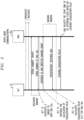
- FIG. 2 contains a message flow diagram associated with an example activation process for establishing communication between OLT 10 and new ONU 20a.
- OLT 10 may periodically broadcast a series of parameter learning messages across the network, communicating the configuration of the PON environment to all "attached" ONUs 20 (both established ONUs and any new ONUs). These messages typically include synchronization information and this phase of activation is thus sometimes referred to as the synchronization phase.
- New ONU 20a is initialized to collect profile information about the network, and at some point will energize its transmitter to enable two-way communication with OLT 10.
- OLT 10 Upon expiration of the learning phase, OLT 10 begins a process of determining specific ONU operating parameters by entering the ONU discovery phase during which OLT 10 will broadcast a series of "serial number" grant messages across the network. These transmissions occur during a "quiet" window (here, referred to as a “discovery window” in FIG. 2 ), which is a defined time period where the established ONUs are not permitted to transmit data to the OLT. At some point in time within the discovery window, ONU 20a responds to a grant message by transmitting its serial number back to OLT 10.
- a "quiet” window here, referred to as a "discovery window” in FIG. 2
- ONU 20a responds to a grant message by transmitting its serial number back to OLT 10.
- OLT 10 then associates a unique ID with the serial number of ONU 20a and once the discovery window closes, transmits this unique ID (an example of a specific ONU operating parameter) to ONU 20a.
- a "ranging window” then opens, where OLT 10 transmits a "directed ranging" grant message specifically to ONU 20a, as shown in FIG. 2 .
- the ranging process is utilized by OLT 10 to determine the delay in communication with ONU 20a (which is a function of the path length within ODN 30 between OLT 10 and ONU 20a).
- the sending of this ranging grant initiates the ranging process during which OLT 10 prepares to perform a calculation of the time delay between transmitted and received messages.
- ONU 20a responds to the ranging grant with a specific "registration" message during the ranging window time period.
- the ranging window is also a quiet period where established ONUs cannot transmit upstream data.
- OLT 10 Based on the response time measured at OLT 10 (and/or, perhaps a different between the measured response time and an expected ideal response time), OLT 10 computes an equalization time delay ( ⁇ ) that will be used by ONU 20a going forward to adjust its timing for the transmission of burst-mode upstream data transmissions to OLT 10. As a following step in the activation process and as shown in FIG. 2 , OLT 10 transmits this equalization delay message as another specific ONU operating parameter to ONU 20a, which responds by adjusting the start time of its upstream frame clock to account for the ⁇ delay.
- ⁇ equalization time delay
- the burst-mode upstream messages transmitted by ONU 20a to OLT 10 during the activation process include both the transmission of the ONU's serial number, as well as a specific registration message that is used in the calculation of the equalization delay to be associated with ONU 20a.
- the presence of errors in the recovered versions of these messages as processed by the receiver at OLT 10 may result in the inability to establish bidirectional communication between OLT 10 and ONU 20a (if the recovered and decoded serial number is not in an expected format), or may result in a miscalculation of the equalization delay between the two elements (if the registration message is not properly decoded), which would result in ONU 20a not transmitting its upstream burst mode data transmission during its assigned time slot.
- the receiver at the OLT is able to accurately recover the upstream activation messages from ONU 20a.
- the introduction of the 50G standard brings with it the presumption that the OLT receivers will include some type of equalization (e.g., digital signal processing (DSP)-based) to properly convert the 50G upstream received optical signal into its electrical equivalent.
- DSP digital signal processing
- the use of a 50G upstream line rate requires digital signal processing (in the form of equalizers) at the receiver components with the network to mitigate component bandwidth limitations, as well as a chromatic dispersion penalty inherent in transmitting through an optical fiber-based network.
- digital signal processing in the form of equalizers
- the use of electronic equalization on the electrical signal recovered from the received optical signal enables the cost-effective use of standard, legacy (bandwidth-limited) components (such as, for example, the photodetectors for O/E conversion) for successful transmission, it is unlikely that the receiver at OLT 10 will exhibit the correct (and specific) equalization parameters during the ONU activation process, since it requires training time on the signal to obtain them.
- upstream transmissions at line rate that is less than a predefined ONU upstream line rate during the ONU activation process.
- a predefined upstream line rate of 50G the use of a lower rate (such as 25G or 12.5G, for example) for an ONU's upstream burst-mode transmissions, the receivers within the OLT are capable of recovering the "serial number" and "registration" messages from an ONU (such as ONU 20a) without the need to perform any type of equalization.
- FIG. 3 is an updated version of the message flow diagram of FIG. 2 , illustrating an example of the disclosed process for enabling activation of an ONU at a lower rate than the standard data transmission rate of a particular ONU.
- the grant message when the discovery window opens and OLT 10 begins to transmit downstream serial number grants, the grant message also includes an instruction for any responding ONU 20 to use a "low line rate" speed for its upstream burst-mode transmissions during the activation process.
- This direct instruction from the OLT for the ONU to use a lower line may not be necessary in all situations, since new 50G ONUS may be preconfigured to automatically use a lower line rate during activation.
- a "low line rate" of 25G is used, with the understanding that these elements are part of a 50G PON. Since it is rather straightforward to enable ONUs to operate at different line rates, the request to operate at a low line rate should not be problematic as long as a common (standardized) signaling is in place between the OLT and the ONUs for this purpose.
- Any ONU responding to the serial number grant such as ONU 20a in this example, will set its transmitter to operate at the lower line rate and respond to the serial number grant with a 25G burst-mode transmission of its serial number.
- the receiver at OLT 10 is able to properly decode the information, and proceeds to assign a unique ID (a specific ONU operating parameter) to ONU 20a.
- OLT 10 initiates a directed ranging grant to ONU 20a, and includes the assigned ID number as part of that message. The same process as described above with FIG.
- ONU 20a continues to use the lower line rate of 25G and thus sends a burst-mode 25G transmission of a "registration" message back to OLT 10.
- the transmission of this information at 25G (instead of the standard 50G of the example PON), the receiver at OLT 10 is able to decode the information without the need to first equalize its performance, allowing for OLT 10 to calculate an accurate equalization delay for ONU 20a to use going forward during data transmission.
- OLT 10 transmits the assigned equalization delay to ONU 20a and the ONU adjusts the start time of its upstream clock based on this delay value.
- the final message transmitted from OLT 10 at the end of the ranging phase may include an instruction for ONU 20a to now reset its transmitter to operate at the 50G upstream rate, which ONU 20a will use going forward for upstream burst-mode transmissions to OLT 10.
- ONU 20a may be configured to automatically reset its transmitter to operate at 50G upon reception of the equalization delay message from OLT 10.
- FIG. 4 is a block diagram of one example of OLT 10 configured to initiate and perform ONU activation at line rate that is lower than the standard upstream transmission rate.
- OLT 10 may include a memory 12, a processor 14, a transceiver 16, and a media access controller (MAC) 18.
- Memory 12 may store computer readable instructions for operating OLT 10, as well as the information to be sent to ONUs 20 or information received from the ONUs.
- Processor 14 may control OLT 10 (including memory 12, transceiver 16, and MAC 18) based on executing instructions stored in memory 12.
- Transceiver 16 includes a transmitter 16T and a receiver 16R, where the details of receiver 16R are more relevant to the present subject matter.
- receiver 16R is shown as including an O/E module 16.1, a clock and data recovery (CDR) element 16.2 and a decoder 16.3.
- CDR clock and data recovery
- O/E module 16.1 which functions to convert the incoming optical signal to its electrical equivalent.
- the electrical signal is applied as an input to both CDR 16.2 and decoder 16.3.
- MAC 18 may control OLT transmitter 16T to send a "line rate" message to ONU 20a, instructing ONU 20a to use 25G burst-mode communications on its upstream messaging with OLT 10.
- MAC 18 instructs OLT transmitter 16T to send an updated "line rate" message to ONU 20a, in this case instructing ONU 20a to switch to the 50G line rate for the following data transmission.
- FIG. 5 is a flow chart of an example process that may be performed by an OLT to perform reduced line rate activation of an ONU.
- the process begins at step 500 with OLT 10 broadcasting downstream synchronization messages across the network.
- ONU 20a is operating in a "listening" mode, collecting protocol and burst profile information associated with the specific network.
- OLT 10 continues the process by broadcasting downstream "serial number grant" messages within the network (step 520).
- OLT 10 includes with this grant message an instruction for ONUs to respond at a 25G line rate.
- the line rate instruction may be transmitted in a subsequent message from OLT 10.
- ONU 20a recognizes and then responds to the serial number grant with a message including its specific serial number. In accordance with the disclosed principles, this message is transmitted to OLT 10 at the 25G line rate.
- OLT receiver 16R proceeds to recover the transmitted serial number (step 540), assign a unique ID to this serial number and store this information in memory 12.
- OLT 10 is instructed to transmit a direct communication to ONU 20a (step 550), the message included in the communication including the assigned ID.
- OLT 10 transmits a "directed ranging grant" (step 560) to ONU 20a to initiate the ranging phase of the activation process.
- the ranging grant opens a "ranging window" which continues to suspend communication between OLT 10 and the established ONUs 20.
- processor 14 As part of the OLT's functionality it prepares processor 14 to be ready to measure a timing delay between OLT and ONU transmissions and then calculate the related equalization delay ⁇ .
- ONU responds with a "registration" message in a defined format (step 570). Again, this burst-mode message is transmitted to OLT 10 at the lower line rate of 25G.
- receiver 16R at OLT 10 is able receive and properly decode the 25G registration message (step 580) without need any equalization of the decoding process.
- the combination of processor 14 and MAC 16 use this received information, as well as the time stamp of the initial directed ranging grant to calculate the equalization delay ⁇ , sending this message to ONU 20a (step 580).
- ONU 20a Upon receipt, ONU 20a adjusts its upstream frame clock to account for the equalization delay (step 590), completing the activation process. In association with the disclosed process, OLT 10 then transmits a message to ONU 20a (step 600) to update its line rate to the standard 50G rate. Inasmuch as most ONUs are configured as multi-rate components, the ability to switch between 25G and 50G is a straightforward process and is likely to already be a capability built into the ONU (for example, used to switch between 50G and 25G when experiencing transmission problems within the PON). 482028
- circuitry may refer to one or more or all of the following:
- circuitry also covers an implementation of merely a hardware circuit or processor (or multiple processors) or portion of a hardware circuit or processor and its (or their) accompanying software and/or firmware.
- circuitry also covers, for example and if applicable to the particular claim element, a baseband integrated circuit or processor integrated circuit for a mobile device or a similar integrated circuit in a server, a cellular network device, or other computing or network device.
Landscapes
- Engineering & Computer Science (AREA)
- Computer Networks & Wireless Communication (AREA)
- Signal Processing (AREA)
- Physics & Mathematics (AREA)
- Electromagnetism (AREA)
- Small-Scale Networks (AREA)
Abstract
Description
- Disclosed herein is a technique for activating optical network units (ONUs) joining a passive optical network (PON).
- A PON is known as comprising a collection of disparate ONUs that communicate with customer locations and direct communications to/from an optical line terminal (OTL) through an optical distribution network (ODN). The ODN comprises a tree and branch topology of optical fiber spans that are used to provide communication between a single OLT and the collection of disparate ONUs.
- The PON is dynamic in the sense that individual ONUs may either join or leave the network at any point in time. Standards organizations such as ITU-T have developed specific protocols that may be followed to ensure that a common procedure is utilized for making changes in the PON, regardless of the equipment supplier, network provider, etc. In particular, the steps followed to add a new ONU to an existing PON may utilize an "activation cycle" protocol described in the ITU-T standard G.9804.2, "Higher speed passive optical network - Common transmission convergence layer specification."
- An ONU activation cycle includes three sequential phases: downstream synchronization between the OLT and a new ONU, discovery/ serial number acquisition from a new ONU, and ranging. The ranging phase is used to determine the transmission delay attributed to the physical separation between the new ONU and the OLT. The transmission delay is critical information since the passive network architecture relies on time-division techniques for controlling communication between a large number of individual ONUs and a single OLT.
- In light of the introduction of a 50 Gb/s ("50G") line rate for passive optical networks, there are at least three different classes of ONUs that can all receive 50G downstream data but can only transmit upstream data at one of these of 12.5, 25, or 50G rates. The activation process requires the OLT to properly decode burst-mode upstream messages at 12.5G and 25G as well as 50G messages from each of the new ONUs. At the 50G upstream line rate, it becomes necessary to use equalization techniques at the OLT's receiver to properly recover the information in the burst. Without a priori knowledge of the particular receiver equalization required for the new OLT (which may be determined during a following receiver training process), it is quite possible that the OLT's recovery of activation messages from the new ONU (particularly, but not limited to the ranging information) may include significant errors.
- A proposed solution to the problems associated with performing ONU activation in a high line rate PON is presented. In particular, it is proposed to perform the ONU activation process at a lower line rate than the 50G upstream rate that is now being used in symmetrical 50GPONs. The use of a lower line rate (e.g., 25G or even 12.5G) improves the accuracy of the recovered upstream messages at the OLT since receiver equalization techniques are not necessary at these lower line rates. Inasmuch as the ranging process involves a calculation of the message delay between the OLT and the new ONU, where the calculation is independent of the line rate used to transmit messages between the OLT and the new ONU, it may be presumed that there is no loss in accuracy by performing the activation steps at a lower line rate, and then switching to the higher line rate once the activation process is completed.
- In accordance with the disclosed solution, it is proposed to configure an OLT to request that a new 50G ONU transmit activation messages at a line rate less than 50G (for example, 25G). The OLT may directly message the new 50G ONU to use a lower line rate for activation, or the ONU itself may be preconfigured to automatically use the lower line rate during activation. The OLT may be further configured to communicate, in some example embodiments, a "switch line rate" message to the new ONU once the activation process is completed, allowing the activated ONU to now operate at the preferred 50G (or higher) upstream line rate. Other example embodiments may rely on the newly-activated ONU to recognize the end of the activation process and automatically switch over to the higher line rate (e.g., 50G) for initiating data transmission.
- One example aspect of the disclosed concepts takes the form of an apparatus for use by an optical line terminal, OLT, in a passive optical network, PON, operating at a predefined upstream line rate, where the OLT is communicatively connected to optical network units, ONUs. The apparatus in this example comprising: at least one memory including instructions; at least one processor configured to execute the instructions and cause the apparatus to perform an ONU activation process including: instructing the ONUs to operate at a low line rate that is less than the predefined upstream line rate; recovering burst-mode upstream activation messages transmitted at the instructed low line rate from one or more ONUs; generating, in response to the recovered burst-mode low line rate activation messages from a new ONU, specific ONU operating parameters; and transmitting the specific ONU operating parameters to the new ONU. As discussed above, a new 50G ONU may already be pre-configured to perform the activation process at a lower line rate, obviating the need for the OLT to instruct the new 50G ONU to do so.
- According to a further embodiment, the apparatus is further caused to perform, subsequent to a completion of the ONU activation process, instructing the new high-rate ONU to switch its transmission rate to the predefined high upstream line rate.
- According to a further embodiment, subsequent to the ONU activation process, the new high-rate ONU automatically switches its transmitter to operate at the predefined high upstream line rate.
- According to a further embodiment, the predefined high upstream line rate is at least 50G and the reduced line rate is no greater than 25G.
- According to a further embodiment, during the process of generating specific ONU operating parameters, the apparatus is caused to perform: transmitting a ranging request message to the new high-rate ONU; measuring, in response to a recovered burst-mode reduced line rate registration message, a round-trip delay measurement; computing an equalization delay for the new high-rate ONU from the measured round-trip delay measurement; and transmitting the computed equalization delay to the new high-rate ONU for use in adjusting its upstream frame clock.
- According to a further embodiment, the specific ONU operating parameters include a unique ID associated with the new high-rate ONU and a specific equalization delay calculated for the new high-rate ONU.
- According to a further embodiment, the apparatus is further caused to perform, prior to recovering upstream activation messages, instructing the one or more high-rate ONUs to transmit the activation messages at a selected upstream line rate less than the predefined high upstream line rate.
- Another example aspect of the disclosed concepts may take the form of a method for use by an OLT during an ONU activation process when communicatively connected to a plurality of ONUs within a PON operating at a predefined upstream line rate, where the method includes the steps of: if required, instructing the ONUs to operate at a low line rate that is less than the predefined upstream line rate; recovering burst-mode upstream activation messages transmitted at the instructed low line rate from one or more ONUs; generating (in response to the recovered burst-mode low line rate activation messages from a new ONU) specific ONU operating parameters; and transmitting the specific ONU operating parameters to the new ONU.
- According to a further embodiment, subsequent to a completion of the ONU activation process, the method further includes the step of instructing the new high-rate ONU to switch its transmission rate to the predefined high upstream line rate.
- According to a further embodiment, the predefined high upstream line rate is at least 50G and the reduced line rate is no greater than 25G.
- According to a further embodiment, the step of generating specific ONU operating parameters comprises: transmitting a ranging request message to the new high-rate ONU; measuring, in response to a recovered burst-mode reduced line rate registration message, a round-trip delay measurement; computing an equalization delay for the new high-rate ONU from the measured round-trip delay measurement; and transmitting the computed equalization delay to the new high-rate ONU for use in adjusting its upstream frame clock.
- According to a further embodiment, prior to recovering upstream activation messages, the method further includes the step of instructing the one or more high-rate ONUs to transmit the activation messages at a selected upstream line rate less than the predefined high upstream line rate.
- Another example aspect of the disclosed concepts may take the form of an apparatus, for use by an ONU operating at a predefined upstream line rate in a passive optical network, PON, the ONU communicatively connected to an OLT, the apparatus comprising: at least one memory including instructions; at least one processor configured to execute the instructions and cause the apparatus to perform an ONU activation process including: transmitting burst-mode upstream activation messages to the OLT at a reduced line rate less than the predefined upstream line rate; receiving specific ONU operating parameters from the OLT in response to the upstream activation messages; and upon completion of the activation process, switching the burst-mode upstream transmission rate to the predefined upstream line rate.
- According to a further embodiment, in performing the switching, the apparatus is further caused to perform: responding to an update line rate instruction from the OLT to switch its transmission rate to the predefined high upstream line rate.
- According to a further embodiment, in performing the switching, the new high-rate ONU automatically switches its transmitter to operate at the predefined high upstream line rate.
- According to a further embodiment, the predefined high upstream line rate is at least 50G and the reduced line rate is no greater than 25G.
- Another example aspect of the disclosed concepts may take the form of a method, for use by high-rate ONUs communicatively connected to an OLT in a PON, comprising: during an activation process at a new high-rate ONU, transmitting burst-mode upstream activation messages to the OLT at a reduced line rate less than a predefined upstream line rate associated with the high-rate ONUs; receiving specific ONU operating parameters from the OLT in response to the upstream activation messages; and upon completion of the activation process, switching the burst-mode upstream transmission rate to the predefined upstream line rate.
- According to a further embodiment, the switching step includes responding to an update line rate instruction from the OLT to switch its transmission rate to the predefined upstream line rate.
- According to a further embodiment, the switching step automatically commences at the completion of the activation process.
- According to a further embodiment, the predefined upstream line rate is at least 50G and the reduced line rate is no greater than 25G.
- Referring now to the drawings, some example embodiments will now be described, where
-
FIG. 1 is a diagram of an example architecture of a PON; -
FIG. 2 is a message flow diagram associated with a typical activation process for establishing communication between the OLT and a new ONU recently added to the PON; -
FIG. 3 is an updated message flow diagram, showing the inclusion of specific messages related to the disclosed low line rate activation process; -
FIG. 4 is a block diagram of an example OLT configured to initiate and perform ONU activation at a line rate that is lower than the predefined upstream line rate; and -
FIG. 5 contains an example flow chart for a low line rate ONU activation process as performed by an OLT. -
FIG. 1 is a diagram of an example PON, illustrating a basic architecture of anOLT 10 that communicates with a plurality ofONUs 20 via an ODN 30. ODN 30 may have a tree-and-branch architecture, shown in this simple example as including afeeder fiber 32, a passive 1:N splitter/ combiner 34 and a plurality of N distribution fibers 36 (also referred to at times as "drop fibers").Feeder fiber 32 is connected between OLT 10 and splitter/combiner 34, with individual fibers 36i forming the plurality ofN distribution fibers 36 used to couple individual ONUs 20i to splitter/combiner 34. In a typical environment, several OLTs may be located at a common central office (CO) of a communication network. -
Feeder fiber 32 is used for the downstream transmissions from OLT 10 to theindividual ONUs 20, as well as to support the upstream burst-mode transmissions from thesesame ONUs 20 back to OLT 10. The ability to maintain communication order among these various transmissions in a passive network configuration is provided by using a time-based system, with a time-division multiplex (TDM) protocol used in the downstream direction fromOLT 10 to ONUs 20, and a time-division multiple access (TDMA) protocol used in the upstream direction from ONUs 20 to OLT 10. It should be evident that maintaining a common system clock betweenOLT 10 and ONUs 20 is a basic requirement for ensuring communication integrity within the PON. - The diagram of
FIG. 1 is intended to illustrate that theindividual ONUs 20 may be located at various distances fromOLT 10, with different lengths ofdistribution fiber 36 necessarily required to provide the connection between theONUs 20 and splitter/combiner 34. Given the requirement to maintain strict timing control of downstream and upstream transmissions, the delay associated with the different lengths of the plurality ofN distribution fibers 36 formingODN 30 needs to be taken into consideration in establishing scheduled transmissions within the PON. Also particularly illustrated inFIG. 1 is a new ONU 20a that is identified as beginning the activation process. -
FIG. 2 contains a message flow diagram associated with an example activation process for establishing communication betweenOLT 10 and new ONU 20a. To initiate the process,OLT 10 may periodically broadcast a series of parameter learning messages across the network, communicating the configuration of the PON environment to all "attached" ONUs 20 (both established ONUs and any new ONUs). These messages typically include synchronization information and this phase of activation is thus sometimes referred to as the synchronization phase.New ONU 20a is initialized to collect profile information about the network, and at some point will energize its transmitter to enable two-way communication withOLT 10. - Upon expiration of the learning phase,
OLT 10 begins a process of determining specific ONU operating parameters by entering the ONU discovery phase during whichOLT 10 will broadcast a series of "serial number" grant messages across the network. These transmissions occur during a "quiet" window (here, referred to as a "discovery window" inFIG. 2 ), which is a defined time period where the established ONUs are not permitted to transmit data to the OLT. At some point in time within the discovery window,ONU 20a responds to a grant message by transmitting its serial number back toOLT 10.OLT 10 then associates a unique ID with the serial number ofONU 20a and once the discovery window closes, transmits this unique ID (an example of a specific ONU operating parameter) toONU 20a. A "ranging window" then opens, whereOLT 10 transmits a "directed ranging" grant message specifically toONU 20a, as shown inFIG. 2 . The ranging process is utilized byOLT 10 to determine the delay in communication withONU 20a (which is a function of the path length withinODN 30 betweenOLT 10 andONU 20a). The sending of this ranging grant initiates the ranging process during whichOLT 10 prepares to perform a calculation of the time delay between transmitted and received messages. Again as shown inFIG. 2 ,ONU 20a responds to the ranging grant with a specific "registration" message during the ranging window time period. The ranging window is also a quiet period where established ONUs cannot transmit upstream data. - Based on the response time measured at OLT 10 (and/or, perhaps a different between the measured response time and an expected ideal response time),
OLT 10 computes an equalization time delay (Δτ) that will be used byONU 20a going forward to adjust its timing for the transmission of burst-mode upstream data transmissions toOLT 10. As a following step in the activation process and as shown inFIG. 2 ,OLT 10 transmits this equalization delay message as another specific ONU operating parameter toONU 20a, which responds by adjusting the start time of its upstream frame clock to account for the Δτ delay. - In reviewing the message flow of
FIG. 2 , it is clear that the burst-mode upstream messages transmitted byONU 20a toOLT 10 during the activation process include both the transmission of the ONU's serial number, as well as a specific registration message that is used in the calculation of the equalization delay to be associated withONU 20a. The presence of errors in the recovered versions of these messages as processed by the receiver atOLT 10 may result in the inability to establish bidirectional communication betweenOLT 10 andONU 20a (if the recovered and decoded serial number is not in an expected format), or may result in a miscalculation of the equalization delay between the two elements (if the registration message is not properly decoded), which would result inONU 20a not transmitting its upstream burst mode data transmission during its assigned time slot. As long as the upstream line rate used by the PON remains at speeds less 50G, the receiver at the OLT is able to accurately recover the upstream activation messages fromONU 20a. However, as mentioned above, the introduction of the 50G standard brings with it the presumption that the OLT receivers will include some type of equalization (e.g., digital signal processing (DSP)-based) to properly convert the 50G upstream received optical signal into its electrical equivalent. - In particular, the use of a 50G upstream line rate requires digital signal processing (in the form of equalizers) at the receiver components with the network to mitigate component bandwidth limitations, as well as a chromatic dispersion penalty inherent in transmitting through an optical fiber-based network. While the use of electronic equalization on the electrical signal recovered from the received optical signal enables the cost-effective use of standard, legacy (bandwidth-limited) components (such as, for example, the photodetectors for O/E conversion) for successful transmission, it is unlikely that the receiver at
OLT 10 will exhibit the correct (and specific) equalization parameters during the ONU activation process, since it requires training time on the signal to obtain them. While one approach to addressing this problem is to increase the length of time that the discovery and ranging windows are open (allowing forONU 20a to transmit multiple copies of the same message over a time period sufficient to train the OLT receiver), these extended time periods necessarily introduce latency into the PON, which is in conflict with a goal of using a 50G upstream line rate to increase the volume of traffic that is handled by the PON over time. Indeed, latency is a significant parameter for many time-sensitive applications of the 50G PON, including but not limited to, transport of mobile signals. - Accordingly, it is proposed to utilize upstream transmissions at line rate that is less than a predefined ONU upstream line rate during the ONU activation process. For example, with a predefined upstream line rate of 50G, the use of a lower rate (such as 25G or 12.5G, for example) for an ONU's upstream burst-mode transmissions, the receivers within the OLT are capable of recovering the "serial number" and "registration" messages from an ONU (such as
ONU 20a) without the need to perform any type of equalization. Reducing their transmission rate from a predefined upstream line rate such as 50G (or higher) to 25G (or perhaps 12.5G) is not considered to add an appreciable latency to the overall network performance, since the following data transmissions (which obviously comprise multiple messages sent over an extended period of time) comprise the majority of the transmission that will transpire betweenOLT 10 andONU 20a going forward. -
FIG. 3 is an updated version of the message flow diagram ofFIG. 2 , illustrating an example of the disclosed process for enabling activation of an ONU at a lower rate than the standard data transmission rate of a particular ONU. In this example, when the discovery window opens andOLT 10 begins to transmit downstream serial number grants, the grant message also includes an instruction for any respondingONU 20 to use a "low line rate" speed for its upstream burst-mode transmissions during the activation process. This direct instruction from the OLT for the ONU to use a lower line may not be necessary in all situations, since new 50G ONUS may be preconfigured to automatically use a lower line rate during activation. For explanatory purposes, a "low line rate" of 25G is used, with the understanding that these elements are part of a 50G PON. Since it is rather straightforward to enable ONUs to operate at different line rates, the request to operate at a low line rate should not be problematic as long as a common (standardized) signaling is in place between the OLT and the ONUs for this purpose. - Any ONU responding to the serial number grant, such as
ONU 20a in this example, will set its transmitter to operate at the lower line rate and respond to the serial number grant with a 25G burst-mode transmission of its serial number. By virtue of transmitting this information at the 25G line rate, the receiver atOLT 10 is able to properly decode the information, and proceeds to assign a unique ID (a specific ONU operating parameter) toONU 20a. When the discovery window closes,OLT 10 initiates a directed ranging grant toONU 20a, and includes the assigned ID number as part of that message. The same process as described above withFIG. 2 and known in the art follows, except thatONU 20a continues to use the lower line rate of 25G and thus sends a burst-mode 25G transmission of a "registration" message back toOLT 10. Again, the transmission of this information at 25G (instead of the standard 50G of the example PON), the receiver atOLT 10 is able to decode the information without the need to first equalize its performance, allowing forOLT 10 to calculate an accurate equalization delay forONU 20a to use going forward during data transmission. - At the close of the ranging window,
OLT 10 transmits the assigned equalization delay toONU 20a and the ONU adjusts the start time of its upstream clock based on this delay value. The final message transmitted fromOLT 10 at the end of the ranging phase may include an instruction forONU 20a to now reset its transmitter to operate at the 50G upstream rate, whichONU 20a will use going forward for upstream burst-mode transmissions toOLT 10. Alternatively,ONU 20a may be configured to automatically reset its transmitter to operate at 50G upon reception of the equalization delay message fromOLT 10. -
FIG. 4 is a block diagram of one example ofOLT 10 configured to initiate and perform ONU activation at line rate that is lower than the standard upstream transmission rate.OLT 10 may include amemory 12, aprocessor 14, atransceiver 16, and a media access controller (MAC) 18.Memory 12 may store computer readable instructions for operatingOLT 10, as well as the information to be sent toONUs 20 or information received from the ONUs.Processor 14 may control OLT 10 (includingmemory 12,transceiver 16, and MAC 18) based on executing instructions stored inmemory 12.Transceiver 16 includes atransmitter 16T and areceiver 16R, where the details ofreceiver 16R are more relevant to the present subject matter. - In this example block diagram,
receiver 16R is shown as including an O/E module 16.1, a clock and data recovery (CDR) element 16.2 and a decoder 16.3. In operation, an incoming burst-mode transmission from an ONU is provided as an input to O/E module 16.1, which functions to convert the incoming optical signal to its electrical equivalent. Thereafter, the electrical signal is applied as an input to both CDR 16.2 and decoder 16.3. These standard elements, without more are capable to properly convert and decode messages transmitted at less than 50G, such as 25G or 12.5G. - At the initiation of the activation process and with reference to the diagram of
FIG. 3 ,MAC 18 may controlOLT transmitter 16T to send a "line rate" message toONU 20a, instructingONU 20a to use 25G burst-mode communications on its upstream messaging withOLT 10. Once the activation process is completed (as recognized, for example, byMAC 18 and/or processor 16),MAC 18 instructsOLT transmitter 16T to send an updated "line rate" message toONU 20a, in thiscase instructing ONU 20a to switch to the 50G line rate for the following data transmission. -
FIG. 5 is a flow chart of an example process that may be performed by an OLT to perform reduced line rate activation of an ONU. The process begins atstep 500 withOLT 10 broadcasting downstream synchronization messages across the network. At this point in time,ONU 20a is operating in a "listening" mode, collecting protocol and burst profile information associated with the specific network. OnceONU 20a has sufficiently progressed along this initialization, it will energize its transmitter (step 510) so that it will be able to respond to downstream communications fromOLT 10.OLT 10 continues the process by broadcasting downstream "serial number grant" messages within the network (step 520). In the particular example process illustrated inFIG. 5 ,OLT 10 includes with this grant message an instruction for ONUs to respond at a 25G line rate. In other examples, the line rate instruction may be transmitted in a subsequent message fromOLT 10. - Continuing with the description of the flow chart,
ONU 20a recognizes and then responds to the serial number grant with a message including its specific serial number. In accordance with the disclosed principles, this message is transmitted toOLT 10 at the 25G line rate.OLT receiver 16R proceeds to recover the transmitted serial number (step 540), assign a unique ID to this serial number and store this information inmemory 12. When the pairing is completed,OLT 10 is instructed to transmit a direct communication toONU 20a (step 550), the message included in the communication including the assigned ID. Following this,OLT 10 then transmits a "directed ranging grant" (step 560) toONU 20a to initiate the ranging phase of the activation process. The ranging grant opens a "ranging window" which continues to suspend communication betweenOLT 10 and the establishedONUs 20. - As part of the OLT's functionality it prepares
processor 14 to be ready to measure a timing delay between OLT and ONU transmissions and then calculate the related equalization delay Δτ. In response to the directed ranging grant, ONU responds with a "registration" message in a defined format (step 570). Again, this burst-mode message is transmitted toOLT 10 at the lower line rate of 25G. Thus,receiver 16R atOLT 10 is able receive and properly decode the 25G registration message (step 580) without need any equalization of the decoding process. The combination ofprocessor 14 andMAC 16 use this received information, as well as the time stamp of the initial directed ranging grant to calculate the equalization delay Δτ, sending this message toONU 20a (step 580). - Upon receipt,
ONU 20a adjusts its upstream frame clock to account for the equalization delay (step 590), completing the activation process. In association with the disclosed process,OLT 10 then transmits a message toONU 20a (step 600) to update its line rate to the standard 50G rate. Inasmuch as most ONUs are configured as multi-rate components, the ability to switch between 25G and 50G is a straightforward process and is likely to already be a capability built into the ONU (for example, used to switch between 50G and 25G when experiencing transmission problems within the PON). 482028 - It is to be understood that while the illustrated examples describe the use of 25G as a "lower line rate" as compared to a standard 50G rate that may be used for upstream data transmission in the PON, other lower line rates are also acceptable for use (such as 12.5G).
- As used in this application, the term "circuitry" may refer to one or more or all of the following:
- (a) hardware-only circuit implementations such as implementations in only analog and/or digital circuitry,
- (b) combinations of hardware circuits and software, such as (as applicable):
- (i) a combination of analog and/or digital hardware circuits(s) with software/firmware and
- (ii) any portions of hardware processor(s) with software (including digital signal processor(s)), software, and memory(ies) that work together to cause an apparatus, such as a mobile phone or server, to perform various functions), and
- (c) hardware circuit(s) and/or processor(s), such as microprocessor(s) or a portion of a microprocessor(s) that requires software (e.g., firmware) for operation, but the software may not be present when it is not needed for operation.
- This definition of circuitry applies to all uses of this term in this application, including in any claims. As a further example, as used in this application, the term circuitry also covers an implementation of merely a hardware circuit or processor (or multiple processors) or portion of a hardware circuit or processor and its (or their) accompanying software and/or firmware. The term circuitry also covers, for example and if applicable to the particular claim element, a baseband integrated circuit or processor integrated circuit for a mobile device or a similar integrated circuit in a server, a cellular network device, or other computing or network device.
- It will furthermore be understood that the terms "comprising" or "comprise" do not exclude other elements or steps, that the indefinite articles "a" or "an" do not exclude a plurality, and that a single element, such as a computer system, a processor, or another integrated unit may fulfill the functions of several means as recited in the claims. Any reference signs in the claims shall not be construed as limiting the respective claims concerned. The identifying terms "first", "second", "third", "a", "b", "c", and the like, when used in the description or the claims are introduced to distinguish between similar elements or steps and are not necessarily describing a sequential or chronological order. Similarly, the descriptive terms "top", "bottom", "over", "under", and the like are introduced for descriptive purposes and not necessarily to denote relative positions. It is to be understood that the terms so used are interchangeable under appropriate circumstances and embodiments of the invention are capable of operating according to the present invention in other sequences, or in orientations different from the one(s) described or illustrated above.
- When an element is referred to as being "connected" or "coupled" to another element, it can be directly connected or coupled to the other element, or intervening elements may be present. By contrast, when an element is specifically referred to as being "directly connected", or "directly coupled", to another element, there are no intervening elements present. Other words used to describe the relationship between elements should be interpreted in like fashion (e.g., "between" versus "directly between", "adjacent" versus "directly adjacent", and the like).
- Although the present invention has been illustrated by reference to specific embodiments, it will be apparent to those skilled in the art that the invention is not limited to the details of the foregoing illustrative embodiments, and that the present invention may be embodied with various changes and modifications without departing from the scope thereof. The present embodiments are therefore to be considered in all respects as illustrative and not restrictive, the scope of the invention being indicated by the appended claims rather than by the foregoing description, and all changes which come within the scope of the claims are therefore intended to be embraced therein.
Claims (15)
- An apparatus, for use by an optical line terminal, OLT, in a passive optical network, PON, and communicatively connected to one or more high-rate optical network units, ONUs, operating at a predefined high upstream line rate, the apparatus comprising:at least one memory including instructions;at least one processor configured to execute the instructions and cause the apparatus to perform an ONU activation process including:recovering burst-mode upstream activation messages from a new high-rate ONU, the activation messages transmitted at a reduced upstream line rate less than the predefined high upstream line rate;generating, in response to the recovered burst-mode activation messages, specific ONU operating parameters; andtransmitting the specific ONU operating parameters to the new high-rate ONU.
- The apparatus according to claim 1, wherein the apparatus is further caused to perform,
subsequent to a completion of the ONU activation process, instructing the new high-rate ONU to switch its transmission rate to the predefined high upstream line rate. - The apparatus according to claim 1, wherein subsequent to the ONU activation process, the new high-rate ONU automatically switches its transmitter to operate at the predefined high upstream line rate.
- The apparatus according to claim 1, wherein the predefined high upstream line rate is at least 50G and the reduced line rate is no greater than 25G.
- The apparatus according to claim 1, wherein during the process of generating specific ONU operating parameters, the apparatus is caused to perform:transmitting a ranging request message to the new high-rate ONU;measuring, in response to a recovered burst-mode reduced line rate registration message, a round-trip delay measurement;computing an equalization delay for the new high-rate ONU from the measured round-trip delay measurement; andtransmitting the computed equalization delay to the new high-rate ONU for use in adjusting its upstream frame clock.
- The apparatus according to claim 1, wherein the specific ONU operating parameters include a unique ID associated with the new high-rate ONU and a specific equalization delay calculated for the new high-rate ONU.
- The apparatus according to claim 1, wherein the apparatus is further caused to perform,
prior to recovering upstream activation messages, instructing the one or more high-rate ONUs to transmit the activation messages at a selected upstream line rate less than the predefined high upstream line rate. - A method, for use by an optical line terminal, OLT, communicatively connected to a plurality of ONUs within a passive optical network, PON, with one or more high-rate ONUs operating at a predefined high upstream line rate, comprising:
during an ONU activation process,recovering burst-mode upstream activation messages from a new high-rate ONU, the activation messages transmitted at a reduced upstream line rate less than the predefined high upstream line rate;generating, in response to the recovered burst-mode activation messages, specific ONU operating parameters; andtransmitting the specific ONU operating parameters to the new high-rate ONU. - An apparatus, for use by an ONU operating at a predefined upstream line rate in a passive optical network, PON, the ONU communicatively connected to an OLT, the apparatus comprising:at least one memory including instructions;at least one processor configured to execute the instructions and cause the apparatus to perform an ONU activation process including:transmitting burst-mode upstream activation messages to the OLT at a reduced line rate less than the predefined upstream line rate;receiving specific ONU operating parameters from the OLT in response to the upstream activation messages; andupon completion of the activation process, switching the burst-mode upstream transmission rate to the predefined upstream line rate.
- The apparatus according to claim 9, wherein in performing the switching, the apparatus is further caused to perform,
responding to an update line rate instruction from the OLT to switch its transmission rate to the predefined high upstream line rate. - The apparatus according to claim 9, wherein in performing the switching, the new high-rate ONU automatically switches its transmitter to operate at the predefined high upstream line rate.
- The apparatus according to claim 9, wherein the predefined high upstream line rate is at least 50G and the reduced line rate is no greater than 25G.
- A method, for use by high-rate ONUs communicatively connected to an OLT in a PON, comprising:
during an activation process at a new high-rate ONU,transmitting burst-mode upstream activation messages to the OLT at a reduced line rate less than a predefined upstream line rate associated with the high-rate ONUs;receiving specific ONU operating parameters from the OLT in response to the upstream activation messages; andupon completion of the activation process, switching the burst-mode upstream transmission rate to the predefined upstream line rate. - The method according to claim 13, wherein the switching step includes responding to an update line rate instruction from the OLT to switch its transmission rate to the predefined upstream line rate.
- The method according to claim 13, wherein the switching step automatically commences at the completion of the activation process.
Applications Claiming Priority (1)
| Application Number | Priority Date | Filing Date | Title |
|---|---|---|---|
| US18/105,307 US12598406B2 (en) | 2023-02-03 | 2023-02-03 | Control of ONU activation in high bit rate PONs |
Publications (2)
| Publication Number | Publication Date |
|---|---|
| EP4412239A1 true EP4412239A1 (en) | 2024-08-07 |
| EP4412239B1 EP4412239B1 (en) | 2025-09-17 |
Family
ID=89843396
Family Applications (1)
| Application Number | Title | Priority Date | Filing Date |
|---|---|---|---|
| EP24155618.2A Active EP4412239B1 (en) | 2023-02-03 | 2024-02-02 | Control of onu activation in high bit rate pons |
Country Status (3)
| Country | Link |
|---|---|
| US (1) | US12598406B2 (en) |
| EP (1) | EP4412239B1 (en) |
| CN (1) | CN118449595A (en) |
Families Citing this family (1)
| Publication number | Priority date | Publication date | Assignee | Title |
|---|---|---|---|---|
| EP4425953A1 (en) * | 2023-02-28 | 2024-09-04 | Nokia Solutions and Networks Oy | Tuning of receiver components in an optical line terminal |
Citations (2)
| Publication number | Priority date | Publication date | Assignee | Title |
|---|---|---|---|---|
| EP3985893A1 (en) * | 2019-07-15 | 2022-04-20 | ZTE Corporation | Method for reducing uplink time delay of passive optical network, and related device |
| CN114666684A (en) * | 2020-12-23 | 2022-06-24 | 中国移动通信有限公司研究院 | Optical network unit online registration method, optical network unit and optical line terminal |
Family Cites Families (4)
| Publication number | Priority date | Publication date | Assignee | Title |
|---|---|---|---|---|
| JP5097641B2 (en) * | 2008-08-07 | 2012-12-12 | 株式会社日立製作所 | Passive optical network system, optical multiple termination device, and optical network termination device |
| US10439924B2 (en) * | 2013-11-19 | 2019-10-08 | Time Warner Cable Enterprises Llc | Switched measurement probe for large-scale broadband performance measurement |
| CN110943783B (en) * | 2018-09-25 | 2022-08-19 | 中兴通讯股份有限公司 | Distance measurement method of optical network, OLT, ONU and optical network system |
| CN115499066A (en) * | 2021-06-18 | 2022-12-20 | 中兴通讯股份有限公司 | Optical signal receiving device, terminal, system and method |
-
2023
- 2023-02-03 US US18/105,307 patent/US12598406B2/en active Active
-
2024
- 2024-02-02 CN CN202410148150.0A patent/CN118449595A/en active Pending
- 2024-02-02 EP EP24155618.2A patent/EP4412239B1/en active Active
Patent Citations (2)
| Publication number | Priority date | Publication date | Assignee | Title |
|---|---|---|---|---|
| EP3985893A1 (en) * | 2019-07-15 | 2022-04-20 | ZTE Corporation | Method for reducing uplink time delay of passive optical network, and related device |
| CN114666684A (en) * | 2020-12-23 | 2022-06-24 | 中国移动通信有限公司研究院 | Optical network unit online registration method, optical network unit and optical line terminal |
Also Published As
| Publication number | Publication date |
|---|---|
| EP4412239B1 (en) | 2025-09-17 |
| US12598406B2 (en) | 2026-04-07 |
| CN118449595A (en) | 2024-08-06 |
| US20240267658A1 (en) | 2024-08-08 |
Similar Documents
| Publication | Publication Date | Title |
|---|---|---|
| CN101411099B (en) | Method of introducing an outstation into an optical network and outstation therefor | |
| EP2322008B1 (en) | Scheduling device | |
| US9686036B2 (en) | Method, apparatus and system for transmitting upstream burst data in PON system | |
| US9025964B2 (en) | Receiver, data identifying and reproducing apparatus, pon system, and data identifying and reproducing method | |
| US8755695B2 (en) | Burst transmission method, and receiver resetting method and apparatus in a passive optical network | |
| EP3836430A1 (en) | An optical line terminal and a method therefor | |
| EP4412239B1 (en) | Control of onu activation in high bit rate pons | |
| US11646791B2 (en) | Passive optical network systems | |
| US5654815A (en) | Synchronization method as well as synchronizing units, terminal and exchange therefor | |
| US9287981B2 (en) | Station-side apparatus and PON system | |
| WO2010096969A1 (en) | Method of sending upstream frame in passive optical network and apparatus thereof | |
| CN102318239B (en) | Method and device for transmitting upstream transmission frame in passive optical network | |
| EP2562947B1 (en) | Method, apparatus and system for passive optical network communication | |
| CN101783975A (en) | Method, device and system for measuring distance in communication network | |
| JP2009302876A (en) | Subscriber terminating apparatus and power supply control method | |
| WO2017179241A1 (en) | Optical signal relay apparatus and relay method | |
| EP4333454A1 (en) | Data transmission method and apparatus, network device, system, and storage medium | |
| EP4436066A1 (en) | Phased burst mode receiver equalization training | |
| CN118264938A (en) | PON system, data processing method and related equipment | |
| KR20020093294A (en) | Data process apparatus and method for transmission convergence layer of Passive Optical Network | |
| US20240292133A1 (en) | Tuning of receiver components in an optical line terminal | |
| JPH10233734A (en) | Optical transmission system | |
| JP2007189356A (en) | Burst bit synchronization circuit |
Legal Events
| Date | Code | Title | Description |
|---|---|---|---|
| PUAI | Public reference made under article 153(3) epc to a published international application that has entered the european phase |
Free format text: ORIGINAL CODE: 0009012 |
|
| STAA | Information on the status of an ep patent application or granted ep patent |
Free format text: STATUS: THE APPLICATION HAS BEEN PUBLISHED |
|
| AK | Designated contracting states |
Kind code of ref document: A1 Designated state(s): AL AT BE BG CH CY CZ DE DK EE ES FI FR GB GR HR HU IE IS IT LI LT LU LV MC ME MK MT NL NO PL PT RO RS SE SI SK SM TR |
|
| STAA | Information on the status of an ep patent application or granted ep patent |
Free format text: STATUS: REQUEST FOR EXAMINATION WAS MADE |
|
| 17P | Request for examination filed |
Effective date: 20250207 |
|
| GRAP | Despatch of communication of intention to grant a patent |
Free format text: ORIGINAL CODE: EPIDOSNIGR1 |
|
| STAA | Information on the status of an ep patent application or granted ep patent |
Free format text: STATUS: GRANT OF PATENT IS INTENDED |
|
| INTG | Intention to grant announced |
Effective date: 20250509 |
|
| GRAS | Grant fee paid |
Free format text: ORIGINAL CODE: EPIDOSNIGR3 |
|
| GRAA | (expected) grant |
Free format text: ORIGINAL CODE: 0009210 |
|
| STAA | Information on the status of an ep patent application or granted ep patent |
Free format text: STATUS: THE PATENT HAS BEEN GRANTED |
|
| AK | Designated contracting states |
Kind code of ref document: B1 Designated state(s): AL AT BE BG CH CY CZ DE DK EE ES FI FR GB GR HR HU IE IS IT LI LT LU LV MC ME MK MT NL NO PL PT RO RS SE SI SK SM TR |
|
| REG | Reference to a national code |
Ref country code: GB Ref legal event code: FG4D |
|
| REG | Reference to a national code |
Ref country code: CH Ref legal event code: EP |
|
| REG | Reference to a national code |
Ref country code: IE Ref legal event code: FG4D |
|
| REG | Reference to a national code |
Ref country code: DE Ref legal event code: R096 Ref document number: 602024000661 Country of ref document: DE |
|
| REG | Reference to a national code |
Ref country code: NL Ref legal event code: FP |
|
| PG25 | Lapsed in a contracting state [announced via postgrant information from national office to epo] |
Ref country code: NO Free format text: LAPSE BECAUSE OF FAILURE TO SUBMIT A TRANSLATION OF THE DESCRIPTION OR TO PAY THE FEE WITHIN THE PRESCRIBED TIME-LIMIT Effective date: 20251217 |
|
| REG | Reference to a national code |
Ref country code: LT Ref legal event code: MG9D |
|
| PG25 | Lapsed in a contracting state [announced via postgrant information from national office to epo] |
Ref country code: FI Free format text: LAPSE BECAUSE OF FAILURE TO SUBMIT A TRANSLATION OF THE DESCRIPTION OR TO PAY THE FEE WITHIN THE PRESCRIBED TIME-LIMIT Effective date: 20250917 |
|
| PG25 | Lapsed in a contracting state [announced via postgrant information from national office to epo] |
Ref country code: HR Free format text: LAPSE BECAUSE OF FAILURE TO SUBMIT A TRANSLATION OF THE DESCRIPTION OR TO PAY THE FEE WITHIN THE PRESCRIBED TIME-LIMIT Effective date: 20250917 |
|
| PG25 | Lapsed in a contracting state [announced via postgrant information from national office to epo] |
Ref country code: GR Free format text: LAPSE BECAUSE OF FAILURE TO SUBMIT A TRANSLATION OF THE DESCRIPTION OR TO PAY THE FEE WITHIN THE PRESCRIBED TIME-LIMIT Effective date: 20251218 |
|
| PG25 | Lapsed in a contracting state [announced via postgrant information from national office to epo] |
Ref country code: SE Free format text: LAPSE BECAUSE OF FAILURE TO SUBMIT A TRANSLATION OF THE DESCRIPTION OR TO PAY THE FEE WITHIN THE PRESCRIBED TIME-LIMIT Effective date: 20250917 |
|
| PG25 | Lapsed in a contracting state [announced via postgrant information from national office to epo] |
Ref country code: LV Free format text: LAPSE BECAUSE OF FAILURE TO SUBMIT A TRANSLATION OF THE DESCRIPTION OR TO PAY THE FEE WITHIN THE PRESCRIBED TIME-LIMIT Effective date: 20250917 |
|
| PG25 | Lapsed in a contracting state [announced via postgrant information from national office to epo] |
Ref country code: BG Free format text: LAPSE BECAUSE OF FAILURE TO SUBMIT A TRANSLATION OF THE DESCRIPTION OR TO PAY THE FEE WITHIN THE PRESCRIBED TIME-LIMIT Effective date: 20250917 |
|
| PG25 | Lapsed in a contracting state [announced via postgrant information from national office to epo] |
Ref country code: RS Free format text: LAPSE BECAUSE OF FAILURE TO SUBMIT A TRANSLATION OF THE DESCRIPTION OR TO PAY THE FEE WITHIN THE PRESCRIBED TIME-LIMIT Effective date: 20251217 |
|
| REG | Reference to a national code |
Ref country code: AT Ref legal event code: MK05 Ref document number: 1839435 Country of ref document: AT Kind code of ref document: T Effective date: 20250917 |
|
| PG25 | Lapsed in a contracting state [announced via postgrant information from national office to epo] |
Ref country code: SM Free format text: LAPSE BECAUSE OF FAILURE TO SUBMIT A TRANSLATION OF THE DESCRIPTION OR TO PAY THE FEE WITHIN THE PRESCRIBED TIME-LIMIT Effective date: 20250917 |
|
| PG25 | Lapsed in a contracting state [announced via postgrant information from national office to epo] |
Ref country code: ES Free format text: LAPSE BECAUSE OF FAILURE TO SUBMIT A TRANSLATION OF THE DESCRIPTION OR TO PAY THE FEE WITHIN THE PRESCRIBED TIME-LIMIT Effective date: 20250917 |
|
| PGFP | Annual fee paid to national office [announced via postgrant information from national office to epo] |
Ref country code: DE Payment date: 20251230 Year of fee payment: 3 |
|
| PG25 | Lapsed in a contracting state [announced via postgrant information from national office to epo] |
Ref country code: AT Free format text: LAPSE BECAUSE OF FAILURE TO SUBMIT A TRANSLATION OF THE DESCRIPTION OR TO PAY THE FEE WITHIN THE PRESCRIBED TIME-LIMIT Effective date: 20250917 |
|
| PG25 | Lapsed in a contracting state [announced via postgrant information from national office to epo] |
Ref country code: IT Free format text: LAPSE BECAUSE OF FAILURE TO SUBMIT A TRANSLATION OF THE DESCRIPTION OR TO PAY THE FEE WITHIN THE PRESCRIBED TIME-LIMIT Effective date: 20250917 |
|
| PG25 | Lapsed in a contracting state [announced via postgrant information from national office to epo] |
Ref country code: IS Free format text: LAPSE BECAUSE OF FAILURE TO SUBMIT A TRANSLATION OF THE DESCRIPTION OR TO PAY THE FEE WITHIN THE PRESCRIBED TIME-LIMIT Effective date: 20260117 |
|
| PG25 | Lapsed in a contracting state [announced via postgrant information from national office to epo] |
Ref country code: CZ Free format text: LAPSE BECAUSE OF FAILURE TO SUBMIT A TRANSLATION OF THE DESCRIPTION OR TO PAY THE FEE WITHIN THE PRESCRIBED TIME-LIMIT Effective date: 20250917 Ref country code: PT Free format text: LAPSE BECAUSE OF FAILURE TO SUBMIT A TRANSLATION OF THE DESCRIPTION OR TO PAY THE FEE WITHIN THE PRESCRIBED TIME-LIMIT Effective date: 20260119 |
|
| PG25 | Lapsed in a contracting state [announced via postgrant information from national office to epo] |
Ref country code: PL Free format text: LAPSE BECAUSE OF FAILURE TO SUBMIT A TRANSLATION OF THE DESCRIPTION OR TO PAY THE FEE WITHIN THE PRESCRIBED TIME-LIMIT Effective date: 20250917 |
|
| PG25 | Lapsed in a contracting state [announced via postgrant information from national office to epo] |
Ref country code: SK Free format text: LAPSE BECAUSE OF FAILURE TO SUBMIT A TRANSLATION OF THE DESCRIPTION OR TO PAY THE FEE WITHIN THE PRESCRIBED TIME-LIMIT Effective date: 20250917 Ref country code: EE Free format text: LAPSE BECAUSE OF FAILURE TO SUBMIT A TRANSLATION OF THE DESCRIPTION OR TO PAY THE FEE WITHIN THE PRESCRIBED TIME-LIMIT Effective date: 20250917 |