EP4412219A1 - Encoding method and apparatus, decoding method and apparatus, device, and readable storage medium - Google Patents
Encoding method and apparatus, decoding method and apparatus, device, and readable storage medium Download PDFInfo
- Publication number
- EP4412219A1 EP4412219A1 EP22875157.4A EP22875157A EP4412219A1 EP 4412219 A1 EP4412219 A1 EP 4412219A1 EP 22875157 A EP22875157 A EP 22875157A EP 4412219 A1 EP4412219 A1 EP 4412219A1
- Authority
- EP
- European Patent Office
- Prior art keywords
- channel
- range
- codebook
- adaptive
- priori
- Prior art date
- Legal status (The legal status is an assumption and is not a legal conclusion. Google has not performed a legal analysis and makes no representation as to the accuracy of the status listed.)
- Pending
Links
Images

Classifications
-
- H—ELECTRICITY
- H04—ELECTRIC COMMUNICATION TECHNIQUE
- H04N—PICTORIAL COMMUNICATION, e.g. TELEVISION
- H04N19/00—Methods or arrangements for coding, decoding, compressing or decompressing digital video signals
- H04N19/10—Methods or arrangements for coding, decoding, compressing or decompressing digital video signals using adaptive coding
- H04N19/169—Methods or arrangements for coding, decoding, compressing or decompressing digital video signals using adaptive coding characterised by the coding unit, i.e. the structural portion or semantic portion of the video signal being the object or the subject of the adaptive coding
- H04N19/17—Methods or arrangements for coding, decoding, compressing or decompressing digital video signals using adaptive coding characterised by the coding unit, i.e. the structural portion or semantic portion of the video signal being the object or the subject of the adaptive coding the unit being an image region, e.g. an object
- H04N19/176—Methods or arrangements for coding, decoding, compressing or decompressing digital video signals using adaptive coding characterised by the coding unit, i.e. the structural portion or semantic portion of the video signal being the object or the subject of the adaptive coding the unit being an image region, e.g. an object the region being a block, e.g. a macroblock
-
- H—ELECTRICITY
- H04—ELECTRIC COMMUNICATION TECHNIQUE
- H04N—PICTORIAL COMMUNICATION, e.g. TELEVISION
- H04N19/00—Methods or arrangements for coding, decoding, compressing or decompressing digital video signals
- H04N19/10—Methods or arrangements for coding, decoding, compressing or decompressing digital video signals using adaptive coding
- H04N19/102—Methods or arrangements for coding, decoding, compressing or decompressing digital video signals using adaptive coding characterised by the element, parameter or selection affected or controlled by the adaptive coding
- H04N19/13—Adaptive entropy coding, e.g. adaptive variable length coding [AVLC] or context adaptive binary arithmetic coding [CABAC]
-
- H—ELECTRICITY
- H04—ELECTRIC COMMUNICATION TECHNIQUE
- H04N—PICTORIAL COMMUNICATION, e.g. TELEVISION
- H04N19/00—Methods or arrangements for coding, decoding, compressing or decompressing digital video signals
- H04N19/10—Methods or arrangements for coding, decoding, compressing or decompressing digital video signals using adaptive coding
- H04N19/169—Methods or arrangements for coding, decoding, compressing or decompressing digital video signals using adaptive coding characterised by the coding unit, i.e. the structural portion or semantic portion of the video signal being the object or the subject of the adaptive coding
- H04N19/17—Methods or arrangements for coding, decoding, compressing or decompressing digital video signals using adaptive coding characterised by the coding unit, i.e. the structural portion or semantic portion of the video signal being the object or the subject of the adaptive coding the unit being an image region, e.g. an object
- H04N19/174—Methods or arrangements for coding, decoding, compressing or decompressing digital video signals using adaptive coding characterised by the coding unit, i.e. the structural portion or semantic portion of the video signal being the object or the subject of the adaptive coding the unit being an image region, e.g. an object the region being a slice, e.g. a line of blocks or a group of blocks
-
- H—ELECTRICITY
- H04—ELECTRIC COMMUNICATION TECHNIQUE
- H04N—PICTORIAL COMMUNICATION, e.g. TELEVISION
- H04N19/00—Methods or arrangements for coding, decoding, compressing or decompressing digital video signals
- H04N19/42—Methods or arrangements for coding, decoding, compressing or decompressing digital video signals characterised by implementation details or hardware specially adapted for video compression or decompression, e.g. dedicated software implementation
-
- H—ELECTRICITY
- H04—ELECTRIC COMMUNICATION TECHNIQUE
- H04N—PICTORIAL COMMUNICATION, e.g. TELEVISION
- H04N19/00—Methods or arrangements for coding, decoding, compressing or decompressing digital video signals
- H04N19/44—Decoders specially adapted therefor, e.g. video decoders which are asymmetric with respect to the encoder
-
- H—ELECTRICITY
- H04—ELECTRIC COMMUNICATION TECHNIQUE
- H04N—PICTORIAL COMMUNICATION, e.g. TELEVISION
- H04N19/00—Methods or arrangements for coding, decoding, compressing or decompressing digital video signals
- H04N19/90—Methods or arrangements for coding, decoding, compressing or decompressing digital video signals using coding techniques not provided for in groups H04N19/10-H04N19/85, e.g. fractals
- H04N19/91—Entropy coding, e.g. variable length coding [VLC] or arithmetic coding
Definitions
- the present disclosure relates to the field of communication technology, in particular to an encoding method, an encoding apparatus, a decoding method, a decoding apparatus, a device, and a readable storage medium.
- An object of the present disclosure is to provide an encoding method, an encoding apparatus, a decoding method, a decoding apparatus, a device, and a readable storage medium, so as to increase an encoding speed and a decoding speed.
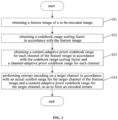
- the present disclosure provides in some embodiments an encoding method, including: obtaining a feature image of a to-be-encoded image; obtaining a codebook range scaling factor in accordance with the feature image; obtaining a content-adaptive priori codebook range for each channel of the feature image in accordance with the codebook range scaling factor and a channel-adaptive priori codebook range for each channel; and performing entropy encoding on a target channel in accordance with an actual symbol range for the target channel of the feature image and a content-adaptive priori codebook range for the target channel, so as to form an encoded stream.
- the target channel is any channel of the feature image.
- the present disclosure provides in some embodiments a decoding method, including: obtaining an encoded stream; determining a decoding codebook range in accordance with information in the encoded stream; and performing entropy decoding on the encoded stream in accordance with the decoding codebook range.
- the decoding codebook range includes an actual symbol range for a channel or a content-adaptive priori codebook range for the channel.
- an encoding apparatus including: a first obtaining module configured to obtain a feature image of a to-be-encoded image; a second obtaining module configured to obtain a codebook range scaling factor in accordance with the feature image; a third obtaining module configured to obtain a content-adaptive priori codebook range for each channel of the feature image in accordance with the codebook range scaling factor and a channel-adaptive priori codebook range for each channel; and a first encoding module configured to perform entropy encoding on a target channel in accordance with an actual symbol range for the target channel of the feature image and a content-adaptive priori codebook range for the target channel, so as to form an encoded stream.
- the target channel is any channel of the feature image.
- the present disclosure provides in some embodiments a decoding apparatus, including: a fourth obtaining module configured to obtain an encoded stream; a first determination module configured to determine a decoding codebook range in accordance with information in the encoded stream; and a first decoding module configured to perform entropy decoding on the encoded stream in accordance with the decoding codebook range.
- the decoding codebook range includes an actual symbol range for a channel or a content-adaptive priori codebook range for the channel.
- the present disclosure provides in some embodiments an electronic device, including a transceiver, a memory, a processor, and a program stored in the memory and executed by the processor.
- the processor is configured to execute the program so as to implement the above-mentioned encoding method or decoding method.
- the present disclosure provides in some embodiments a readable storage medium storing therein a program.
- the program is executed by a processor so as to implement the above-mentioned encoding method or decoding method.
- the codebook range scaling factor is obtained in accordance with the feature image of the to-be-encoded image
- the content-adaptive priori codebook range for each channel of the feature image is obtained in accordance with the codebook range scaling factor and the channel-adaptive priori codebook range for each channel, so as to form the encoded stream.
- the content-adaptive priori codebook range is obtained through scaling the channel-adaptive priori codebook range for each channel, so when encoding each channel, each channel is encoded using a codebook range adapted to the channel, so it is able to increase an encoding speed.
- the decoding codebook range is determined, and each channel is decoded in accordance with the actual symbol range for the channel or the content-adaptive priori codebook range for the channel, so it is able to increase a decoding speed.
- the present disclosure provides in some embodiments an encoding method, which includes the following steps.
- Step 101 obtaining a feature image of a to-be-encoded image.
- the to-be-encoded image is split into a plurality of sub-blocks each having size of M*N, where M and N are a length and a width of each sub-block respectively, and M and N are greater than 0. Then, the sub-blocks are inputted into an encoding sub-network, so as to obtain the feature image.
- M and N are 512 respectively.
- each completed sub-block is a multiple of 64.
- the plurality of sub-blocks and the completed sub-blocks are inputted into the encoding sub-network, so as to obtain the feature image.
- the encoding sub-network is a network structure for processing the plurality of sub-blocks to generate a feature map.
- a convolution parameter is determined, and the convolution parameter is mapped to a convolutional kernel in the encoding sub-network, so as to generate a parameter-associated convolutional kernel.
- the plurality of sub-blocks is multiplied one by one with the parameter-associated convolutional kernel, so as to generate a feature map corresponding to each sub-block.
- Step 102 obtaining a codebook range scaling factor in accordance with the feature image.
- the codebook range scaling factor is used to scale a channel-adaptive priori codebook range for each channel, so as to obtain a content-adaptive priori codebook range for the channel.
- the channel-adaptive priori codebook range for each channel is obtained in advance or during the execution.
- pre-experiment is performed on a fully-connected neural network model at each code rate using a training set having a certain size (e.g., 800 training images each having a size of 256*256), and a maximum value and a minimum value of symbols in the training sets for each channel of the model are obtained through traversing, so as to obtain the channel-adaptive priori codebook range for each channel.
- a training set having a certain size e.g. 800 training images each having a size of 256*256
- the codebook range scaling factor is calculated as follows.
- an actual symbol range for each channel of the feature image is compared with t times of a channel-adaptive priori codebook range, so as to obtain a first parameter n, where n represents the quantity of channels for which the actual symbol range is greater than t times of the corresponding channel-adaptive priori codebook range in the feature image, and t is a second parameter.
- n is greater than a predetermined value, a second parameter obtained through an (i-1) th judgment or an initial second parameter is reduced so as to obtain a second parameter outputted through the i th judgment; and when n is smaller than the predetermined value, the second parameter obtained through the (i-1) th judgment or the initial second parameter is increased, so as to obtain the second parameter outputted through the i th judgment.
- the predetermined value is set according to the practical need, e.g., 20.
- the judgment ending condition includes that the first parameter obtained through the i th judgment is equal to the predetermined value, or i is greater than 3.
- the second parameter outputted through the i th judgment is obtained on the basis of the second parameter obtained through the (i-1) th judgment, and in the second formula, the second parameter outputted through the i th judgment is obtained on the basis of the second parameter obtained through the (i-1) th judgment, where s is a constant greater than 0.
- the second parameter outputted through the i th judgment is obtained on the basis of the second parameter obtained through the (i-1) th judgment
- the second parameter outputted through the i th judgment is obtained on the basis of the second parameter obtained through the (i-1) th judgment.
- n is obtained in accordance with a comparison result.
- an actual symbol range for a first channel is compared with a channel-adaptive priori codebook range for the first channel, so as to determine whether the actual symbol range for the first channel exceeds t times of the channel-adaptive priori codebook range for the first channel.
- t 1.
- n 1.
- n is incremented by 1; otherwise, the value of n remains unchanged. All the channels are judged so as to obtain a final value of n.
- t is calculated through the first formula for the subsequent processing.
- t is calculated through the second formula for the subsequent processing.
- the actual symbol range for the first channel is compared with the channel-adaptive priori codebook range for the first channel, so as to determine whether the actual symbol range for the first channel exceeds t times of the channel-adaptive priori codebook range for the first channel.
- the actual symbol range for the second channel is compared with the channel-adaptive priori codebook range for the second channel, so as to determine whether the actual symbol range for the second channel exceeds t times of the channel-adaptive priori codebook range for the second channel.
- n is incremented by 1; otherwise, the value of n remains unchanged. All the channels are judged so as to obtain a final value of n.
- t is calculated through the first formula for the subsequent processing.
- t is calculated through the second formula for the subsequent processing.
- the actual symbol rang for the first channel is compared with the channel-adaptive priori codebook range for the first channel, so as to determine whether the actual symbol range for the first channel exceeds t times of the channel-adaptive priori codebook range for the first channel.
- n 1
- the actual symbol range for the second channel is compared with the channel-adaptive priori codebook range for the second channel, so as to determine whether the actual symbol range for the second channel exceeds t times of the channel-adaptive priori codebook range for the second channel.
- n is incremented by 1; otherwise, the value of n remains unchanged. All the channels are judged so as to obtain a final value of n.
- t is calculated through the first formula for the subsequent processing.
- t is calculated through the second formula for the subsequent processing.
- the values of t and n are obtained as mentioned hereinabove.
- the value of t obtained through the last judgment is taken as the codebook range scaling factor, and the value of n is taken as a value of a third parameter Q.
- the i th judgment when n is greater than the predetermined value, a certain value is reduced from the second parameter obtained through the (i-1) th judgment or the initial second parameter, and this value is set according to the practical need.
- a certain value is added to the second parameter obtained through the (i-1) th judgment or the initial second parameter, and this value is also set according to the practical need.
- the values added or reduced in different judgments may be the same or different from each other. For example, when values need to be added to the second parameter in the first judgment and the second judgment, the value added in the first judgment may be the same as, or different from, the value added in the second judgment.
- Step 103 obtaining a content-adaptive priori codebook range for each channel of the feature image in accordance with the codebook range scaling factor and a channel-adaptive priori codebook range for each channel.
- a maximum value and a minimum value in the channel-adaptive priori codebook range for each channel are multiplied by the codebook range scaling factor respectively, so as to obtain a scaled maximum value and a scaled minimum value. Then, the content-adaptive priori codebook range for each channel of the feature image is formed in accordance with the scaled maximum value and the scaled minimum value.
- Step 104 performing entropy encoding on a target channel in accordance with an actual symbol range for the target channel of the feature image and a content-adaptive priori codebook range for the target channel, so as to form an encoded stream.
- the target channel is any channel of the feature image.
- the entropy encoding is performed on the target channel in accordance with a relationship between the actual symbol range for the target channel of the feature image and the content-adaptive priori codebook range for the target channel.
- the entropy encoding is not performed on the target channel.
- the entropy encoding is performed on the target channel using the content-adaptive priori codebook range or in the content-adaptive priori codebook range.
- the entropy encoding is performed on the target channel using the actual symbol range for the target channel.
- information indicating that the actual symbol range for the target channel exceeds the content-adaptive priori codebook range further needs to be notified to the decoding end, e.g., an index of a channel, and a maximum value and a minimum value of an actual symbol range for the channel.
- the information needs to include two indices of the channel, one of which indicates the maximum value and the other of which indicates the minimum value.
- the encoded stream includes any one of the followings.
- the third parameter is used to indicate the quantity of channels in the feature image for which the actual symbol range is greater than T times of the corresponding channel-adaptive priori codebook range, where T represents the codebook range scaling factor, and T is greater than or equal to 1.
- the information about the first channel includes an index of the first channel, a maximum value and/or a minimum value of the actual symbol range, etc.
- the codebook range scaling factor is obtained in accordance with the feature image of the to-be-encoded image
- the content-adaptive priori codebook range for each channel of the feature image is obtained in accordance with the codebook range scaling factor and the channel-adaptive priori codebook range for each channel, so as to form the encoded stream.
- the content-adaptive priori codebook range is obtained through scaling the channel-adaptive priori codebook range for each channel, so when encoding each channel, each channel is encoded using a codebook range adapted to the channel, so it is able to increase an encoding speed.
- the present disclosure further provides in some embodiments a decoding method, which includes: Step 201 of obtaining an encoded stream; Step 202 of determining a decoding codebook range in accordance with information in the encoded stream; and Step 203 of performing entropy decoding on the encoded stream in accordance with the decoding codebook range.
- the decoding codebook range includes an actual symbol range for a channel or a content-adaptive priori codebook range for the channel.
- the decoding is performed in accordance with an order of channels in conjunction with the above-mentioned information.
- An actual symbol range for the first channel is greater than a content-adaptive priori codebook range for the first channel.
- the third parameter is used to indicate the quantity of channels in the feature image for which the actual symbol range is greater than T times of the corresponding channel-adaptive priori codebook range, where T represents the codebook range scaling factor, and T is greater than or equal to 1.
- the information about the first channel includes an index of the first channel, a maximum value and/or a minimum value of the actual symbol range, etc.
- the decoding codebook range is determined in different ways.
- the decoding codebook range is determined as follows.
- a position of the indication information in the encoded stream is determined in accordance with a position of the first parameter.
- the indication information is read to obtain the information about the first channel, e.g., the index, the maximum value and/or the minimum value, and the first channel is determined in accordance with the index.
- the actual symbol range for the first channel is determined.
- the indication information includes the maximum value of the actual symbol range for the first channel
- the actual symbol range for the first channel is formed in accordance with the maximum value and the scaled minimum value of the actual symbol range for the first channel.
- the actual symbol range for the first channel is formed in accordance with the scaled maximum value and the minimum value of the actual symbol range for the first channel.
- the indication information includes the maximum value and the minimum value of the actual symbol range for the first channel, the actual symbol range for the first channel is formed in accordance with the maximum value and the minimum value of the actual symbol range for the first channel.
- the scaled maximum value and/or the scaled minimum value obtained in (1) are updated in accordance with the maximum value and/or the minimum value in the indication information.
- the first channel is decoded in accordance with the actual symbol range for the first channel.
- a content-adaptive priori codebook range for a second channel is formed in accordance with the scaled maximum value and the scaled minimum value, and taken as a decoding codebook range for the second channel.
- the second channel is a channel other than the first channel.
- the second channel is decoded in accordance with the content-adaptive priori codebook range for the second channel.
- the second channel is decoded as 0.
- the second channel is decoded in accordance with the content-adaptive priori codebook range for the second channel.
- the channel-adaptive priori codebook range for each channel is obtained in advance or during the execution.
- the channel-adaptive priori codebook range for each channel is consistent with that at the encoding end, so as to achieve information synchronization between the encoding end and the decoding end.
- pre-experiment is performed on a fully-connected neural network model at each code rate using a training set having a certain size (e.g., 800 training images each having a size of 256*256), and a maximum value and a minimum value of symbols in the training sets for each channel of the model are obtained through traversing, so as to obtain the channel-adaptive priori codebook range for each channel.
- a training set having a certain size e.g. 800 training images each having a size of 256*256
- the codebook range scaling factor is obtained in accordance with the feature image of the to-be-encoded image
- the content-adaptive priori codebook range for each channel of the feature image is obtained in accordance with the codebook range scaling factor and the channel-adaptive priori codebook range for each channel, so as to form the encoded stream.
- the content-adaptive priori codebook range is obtained through scaling the channel-adaptive priori codebook range for each channel, so when encoding each channel, each channel is encoded using a codebook range adapted to the channel, so it is able to increase an encoding speed.
- the decoding codebook range is determined, and each channel is decoded in accordance with the actual symbol range for the channel or the content-adaptive priori codebook range for the channel, so it is able to increase a decoding speed.
- an entropy encoder/decoder NIC-0.3 As compared with the other entropy encoder/decoder for image encoding through the fully-connected neural network, e.g., an entropy encoder/decoder NIC-0.3, through the scheme in the embodiments of the present disclosure, it is able to achieve entropy encoding in a content-adaptive and channel-adaptive manner, thereby to improve the encoding/decoding efficiency, with the rate distortion performance being acceptable. Due to the introduction of a new entropy encoding/decoding algorithm, it is able to remarkably increase the encoding speed and the decoding speed. An encoding time is reduced by 51% (averaging on a Kodak testing set, the same below), a decoding time is reduced by 47%, and a rate distortion loss is merely 0.8%.
- the present disclosure further provides in some embodiments an encoding apparatus, as shown in FIG. 3 .
- a principle of the encoding apparatus for solving the problem is similar to that of the encoding method, so the implementation of the encoding device may refer to that of the encoding method, which will not be particularly defined herein.
- the encoding apparatus 300 includes: a first obtaining module 301 configured to obtain a feature image of a to-be-encoded image; a second obtaining module 302 configured to obtain a codebook range scaling factor in accordance with the feature image; a third obtaining module 303 configured to obtain a content-adaptive priori codebook range for each channel of the feature image in accordance with the codebook range scaling factor and a channel-adaptive priori codebook range for each channel; and a first encoding module 304 configured to perform entropy encoding on a target channel in accordance with an actual symbol range for the target channel of the feature image and a content-adaptive priori codebook range for the target channel, so as to form an encoded stream.
- the target channel is any channel of the feature image.
- the first obtaining module 301 includes: a splitting sub-module configured to split the to-be-encoded image into a plurality of sub-blocks each having a size of M*N, M and N being a length and a width of each sub-block respectively, and M and N being greater than 0; and a processing sub-module configured to input the sub-blocks into an encoding sub-network to obtain the feature image.
- the first obtaining module 301 further includes a completion sub-module configured to, when there are remaining pixels after the to-be-encoded image is split into the plurality of sub-blocks each having a size of M*N, complete the remaining pixel with zeros, so as to obtain completed sub-blocks, a length and a width of each completed sub-block are multiples of 64, and the processing sub-module is further configured to input the plurality of sub-blocks each having a size of M*N and the completed sub-blocks into the encoding sub-network so as to obtain the feature image.
- a completion sub-module configured to, when there are remaining pixels after the to-be-encoded image is split into the plurality of sub-blocks each having a size of M*N, complete the remaining pixel with zeros, so as to obtain completed sub-blocks, a length and a width of each completed sub-block are multiples of 64, and the processing sub-module is further configured to input the plurality of sub-blocks each having
- the second obtaining module 302 is configured to: (S1) for an i th judgment, compare an actual symbol range for each channel of the feature image with t times of the channel-adaptive priori codebook range, so as to obtain a first parameter n in accordance with a comparison result, n being the quantity of channels for which the actual symbol range is greater than t times of the corresponding channel-adaptive priori codebook range in the feature image, and t being a second parameter; (S2) when n is greater than a predetermined value, reduce a second parameter obtained through an (i-1) th judgment or an initial second parameter so as to obtain a second parameter outputted through the i th judgment, and when n is smaller than the predetermined value, increase the second parameter obtained through the (i-1) th judgment or the initial second parameter, so as to obtain the second parameter outputted through the i th judgment; and when a judgment ending condition is not satisfied, increment a value of i by 1, repeat S1 to S2 until the judgment
- i 1 in the first formula, the second parameter outputted through a first judgment is obtained on the basis of the initial second parameter, and in the second formula, the second parameter outputted through the first judgment is obtained on the basis of the initial second parameter.
- the second parameter outputted through the i th judgment is obtained on the basis of the second parameter obtained through the (i-1) th judgment, and in the second formula, the second parameter outputted through the i th judgment is obtained on the basis of the second parameter obtained through the (i-1) th judgment, where s is a constant greater than 0.
- the third obtaining module 303 is configured to multiply a maximum value and a minimum value of the channel-adaptive priori codebook range for each channel by the codebook range scaling factor so as to obtain a scaled maximum value and a scaled minimum value, and form the content-adaptive priori codebook range for each channel of the feature image in accordance with the scaled maximum value and the scaled minimum value.
- the first encoding module 304 includes: a first encoding sub-module configured to, when the content-adaptive priori codebook range for the target channel is 0, not perform entropy encoding on the target channel; a second encoding sub-module configured to, when the actual symbol range for the target channel is smaller than or equal to the content-adaptive priori codebook range, perform entropy encoding on the target channel in accordance with the content-adaptive priori codebook range or within the content-adaptive priori codebook range; and a third encoding sub-module configured to, when the actual symbol range for the target channel is greater than the content-adaptive priori codebook range, perform entropy encoding on the target channel in accordance with the actual symbol range for the target channel.
- the indication information is used to indicate information about a first channel, an actual symbol range for the first channel is greater than a content-adaptive priori codebook range for the first channel
- the third parameter is used to indicate the quantity of channels in the feature image whose actual symbol range is greater than T times of the corresponding channel-adaptive priori codebook range, where T is the codebook range scaling parameter, and T is greater than or equal to 1.
- the encoding apparatus further includes a fifth obtaining module configured to obtain the channel-adaptive priori codebook range for each channel.
- the encoding apparatus 300 in the embodiments of the present disclosure is used to implement the above-mentioned encoding method with a similar principle and a similar technical effect, which will not be particularly defined herein.
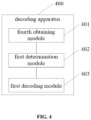
- the present disclosure further provides in some embodiments a decoding apparatus, as shown in FIG. 4 .
- a principle of the decoding apparatus for solving the problem is similar to that of the decoding method, so the implementation of the decoding apparatus may refer to that of the decoding method, which will not be particularly defined herein.
- the decoding apparatus 400 includes: a fourth obtaining module 401 configured to obtain an encoded stream; a first determination module 402 configured to determine a decoding codebook range in accordance with information in the encoded stream; and a first decoding module 403 configured to perform entropy decoding on the encoded stream in accordance with the decoding codebook range.
- the decoding codebook range includes an actual symbol range for a channel or a content-adaptive priori codebook range for the channel.
- the indication information is used to indicate information about a first channel, an actual symbol range for the first channel is greater than a content-adaptive priori codebook range for the first channel
- the third parameter is used to indicate the quantity of channels in the feature image whose actual symbol range is greater than T times of a corresponding channel-adaptive priori codebook range, where T is the codebook range scaling parameter, and T is greater than or equal to 1.
- the first determination module 402 is further configured to multiply a maximum value and a minimum value of the channel-adaptive priori codebook range for each channel by the codebook range scaling factor respectively, so as to obtain a scaled maximum value and a scaled minimum value, and form the content-adaptive priori codebook range for each channel in accordance with the scaled maximum value and the scaled minimum value.
- the first decoding module 403 is further configured to: when the content-adaptive priori codebook range for a target channel is 0, decode the target channel as 0; and when the content-adaptive priori codebook range for the target channel is not 0, decode the target channel in accordance with the content-adaptive priori codebook range for the target channel.
- the target channel is any channel.
- the first determination module 402 when the encoded stream includes the codebook range scaling factor, the third parameter Q corresponding to the codebook range scaling factor and the indication information, includes: a first obtaining sub-module configured to multiply a maximum value and a minimum value of a channel-adaptive priori codebook range for each channel by the codebook range scaling factor respectively, so as to obtain a scaled maximum value and a scaled minimum value; a first determination sub-module configured to determine an actual symbol range for a first channel in accordance with the first parameter and the indication information, and take the actual symbol range for the first channel as a decoding codebook range for the first channel; and a second determination sub-module configured to form a content-adaptive priori codebook range for a second channel in accordance with the scaled maximum value and the scaled minimum value, and take the content-adaptive priori codebook range for the second channel as a decoding codebook range for the second channel.
- the second channel is a channel other than the first channel.
- the first determination sub-module is configured to: when the indication information includes a maximum value of the actual symbol range for the first channel, form the actual symbol range for the first channel in accordance with the maximum value and a scaled minimum value of the actual symbol range for the first channel; when the indication information includes a minimum value of the actual symbol range for the first channel, form the actual symbol range for the first channel in accordance with a scaled maximum value and the minimum value of the actual symbol range for the first channel; and when the indication information includes the maximum value and the minimum value of the actual symbol range for the first channel, form the actual symbol range for the first channel in accordance with the maximum value and the minimum value of the actual symbol range for the first channel.
- the first decoding module 403 includes: a first decoding sub-module configured to decode the first channel in accordance with the actual symbol range for the first channel; and a second decoding sub-module configured to decode the second channel in accordance with the content-adaptive priori codebook range for the second channel.
- the second decoding sub-module is configured to: when the content-adaptive priori codebook range for the second channel is 0, decode the second channel as 0; and when the content-adaptive priori codebook range for the second channel is not 0, decode the second channel in accordance with the content-adaptive priori codebook range for the second channel.
- the decoding apparatus 400 in the embodiments of the present disclosure is used to implement the above-mentioned decoding method with a similar principle and a similar technical effect, which will not be particularly defined herein.
- the units in the embodiments of the present disclosure are for illustrative purposes, and they are provided merely on the basis of their logic functions.
- the units may be integrated in a processing unit, or physically separated from each other, or two or more units may be integrated in one unit.
- the integrated units may be implemented in the form of hardware or a software functional unit.
- the functional units are implemented in a software form and sold or used as a separate product, they may be stored in a computer-readable medium.
- the technical solutions of the present disclosure partial or full, or parts of the technical solutions of the present disclosure contributing to the related art, may appear in the form of software products, which may be stored in a storage medium and include several instructions so as to enable computer equipment (a personal computer, a server or network equipment) to execute all or parts of the steps of the method according to the embodiments of the present disclosure.
- the storage medium includes any medium capable of storing therein program codes, e.g., a universal serial bus (USB) flash disc, a mobile hard disc (HD), a read-only memory (ROM), a random access memory (RAM), a magnetic disc or an optical disc.
- program codes e.g., a universal serial bus (USB) flash disc, a mobile hard disc (HD), a read-only memory (ROM), a random access memory (RAM), a magnetic disc or an optical disc.
- the present disclosure further provides in some embodiments an electronic device, which includes a transceiver, a memory, a processor, and a program stored in the memory and the executed by the processor.
- the processor is configured to execute the program so as to implement the above-mentioned encoding method or decoding method.
- the present disclosure further provides in some embodiments a readable storage medium storing therein a program.
- the program is executed by a processor so as to implement the above-mentioned encoding method or decoding method with a same technical effect, which will not be particularly defined herein.
- the readable storage medium may be any available medium or data storage device capable of being accessed by the processor, which includes, but not limited to, a magnetic memory (e.g., floppy disc, hard disc, magnetic tape, or Magnetic Optical (MO) disc), an optical memory (e.g., Compact Disc (CD), Digital Video Disc (DVD), Blue-ray Disc (BD), or High-definition Versatile Disc (HVD)), or a semiconductor memory (e.g., ROM, Electrically Programmable ROM (EPROM), Electrically Erasable PROM (EEPROM), NAND flash, or Solid-State Disc (SSD)).
- a magnetic memory e.g., floppy disc, hard disc, magnetic tape, or Magnetic Optical (MO) disc
- an optical memory e.g., Compact Disc (CD), Digital Video Disc (DVD), Blue-ray Disc (BD), or High-definition Versatile Disc (HVD)
- ROM Read Only Memory
- EPROM
- the present disclosure may be implemented by software as well as a necessary common hardware platform, or by hardware, and the former may be better in most cases.
- the technical solutions of the present disclosure partial or full, or parts of the technical solutions of the present disclosure contributing to the related art, may appear in the form of software products, which may be stored in a storage medium (e.g., ROM/RAM, magnetic disk or optical disk) and include several instructions so as to enable a terminal device (mobile phone, computer, server, air conditioner or network device) to execute the method in the embodiments of the present disclosure.
- a storage medium e.g., ROM/RAM, magnetic disk or optical disk
- the present disclosure provides the encoding method, the encoding apparatus, the decoding method, the decoding apparatus, the device and the readable storage medium, and it relates to the field of communication technology, so as to increase an encoding speed and a decoding speed.
- the encoding method includes: obtaining a feature image of a to-be-encoded image; obtaining a codebook range scaling factor in accordance with the feature image; obtaining a content-adaptive priori codebook range for each channel of the feature image in accordance with the codebook range scaling factor and a channel-adaptive priori codebook range for each channel; and performing entropy encoding on a target channel in accordance with an actual symbol range for the target channel of the feature image and a content-adaptive priori codebook range for the target channel, so as to form an encoded stream.
- the target channel is any channel of the feature image.
Landscapes
- Engineering & Computer Science (AREA)
- Multimedia (AREA)
- Signal Processing (AREA)
- Compression, Expansion, Code Conversion, And Decoders (AREA)
Abstract
Description
- This application claims a priority of the
Chinese patent application No. 202111163092.1 filed on September 30, 2021 by Migu Co., LTD, China Mobile Communications Group Co., LTD, and Peking University - The present disclosure relates to the field of communication technology, in particular to an encoding method, an encoding apparatus, a decoding method, a decoding apparatus, a device, and a readable storage medium.
- Recently, an image compression technique based on a fully-connected neural network has become a research trend. For a majority of deep-learning image compression methods, a maximum value and a minimum value of an entire hidden variable are used to determine a codebook range in an entropy encoding algorithm. However, values in channels of the hidden variable are distributed in different ways, and the values in most of the channels are small, so an encoding/decoding speed is adversely affected in the case of a large codebook range.
- An object of the present disclosure is to provide an encoding method, an encoding apparatus, a decoding method, a decoding apparatus, a device, and a readable storage medium, so as to increase an encoding speed and a decoding speed.
- In one aspect, the present disclosure provides in some embodiments an encoding method, including: obtaining a feature image of a to-be-encoded image; obtaining a codebook range scaling factor in accordance with the feature image; obtaining a content-adaptive priori codebook range for each channel of the feature image in accordance with the codebook range scaling factor and a channel-adaptive priori codebook range for each channel; and performing entropy encoding on a target channel in accordance with an actual symbol range for the target channel of the feature image and a content-adaptive priori codebook range for the target channel, so as to form an encoded stream. The target channel is any channel of the feature image.
- In another aspect, the present disclosure provides in some embodiments a decoding method, including: obtaining an encoded stream; determining a decoding codebook range in accordance with information in the encoded stream; and performing entropy decoding on the encoded stream in accordance with the decoding codebook range. The decoding codebook range includes an actual symbol range for a channel or a content-adaptive priori codebook range for the channel.
- In yet another aspect, the present disclosure provides in some embodiments an encoding apparatus, including: a first obtaining module configured to obtain a feature image of a to-be-encoded image; a second obtaining module configured to obtain a codebook range scaling factor in accordance with the feature image; a third obtaining module configured to obtain a content-adaptive priori codebook range for each channel of the feature image in accordance with the codebook range scaling factor and a channel-adaptive priori codebook range for each channel; and a first encoding module configured to perform entropy encoding on a target channel in accordance with an actual symbol range for the target channel of the feature image and a content-adaptive priori codebook range for the target channel, so as to form an encoded stream. The target channel is any channel of the feature image.
- In still yet another aspect, the present disclosure provides in some embodiments a decoding apparatus, including: a fourth obtaining module configured to obtain an encoded stream; a first determination module configured to determine a decoding codebook range in accordance with information in the encoded stream; and a first decoding module configured to perform entropy decoding on the encoded stream in accordance with the decoding codebook range. The decoding codebook range includes an actual symbol range for a channel or a content-adaptive priori codebook range for the channel.
- In still yet another aspect, the present disclosure provides in some embodiments an electronic device, including a transceiver, a memory, a processor, and a program stored in the memory and executed by the processor. The processor is configured to execute the program so as to implement the above-mentioned encoding method or decoding method.
- In still yet another aspect, the present disclosure provides in some embodiments a readable storage medium storing therein a program. The program is executed by a processor so as to implement the above-mentioned encoding method or decoding method.
- According to the embodiments of the present disclosure, at an encoding end, the codebook range scaling factor is obtained in accordance with the feature image of the to-be-encoded image, and the content-adaptive priori codebook range for each channel of the feature image is obtained in accordance with the codebook range scaling factor and the channel-adaptive priori codebook range for each channel, so as to form the encoded stream. The content-adaptive priori codebook range is obtained through scaling the channel-adaptive priori codebook range for each channel, so when encoding each channel, each channel is encoded using a codebook range adapted to the channel, so it is able to increase an encoding speed. Correspondingly, at a decoding end, the decoding codebook range is determined, and each channel is decoded in accordance with the actual symbol range for the channel or the content-adaptive priori codebook range for the channel, so it is able to increase a decoding speed.
-
-
FIG. 1 is a flow chart of an encoding method according to one embodiment of the present disclosure; -
FIG. 2 is a flow chart of a decoding method according to one embodiment of the present disclosure; -
FIG. 3 is a schematic view showing an encoding apparatus according to one embodiment of the present disclosure; and -
FIG. 4 is a schematic view showing a decoding apparatus according to one embodiment of the present disclosure. - The expression "and/or" in the embodiments of the present disclosure may be merely used to describe the relationship between objects, and it may include three relationships. For example, "A and/or B" may represent that, there is only A, there are both A and B, and there is only B. Further, the symbol "/" usually refers to "or".
- The expression "a plurality of" refers to two or more, and the other quantifiers are similar.
- In order to make the objects, the technical solutions and the advantages of the present disclosure more apparent, the present disclosure will be described hereinafter in a clear and complete manner in conjunction with the drawings and embodiments. Obviously, the following embodiments merely relate to a part of, rather than all of, the embodiments of the present disclosure, and based on these embodiments, a person skilled in the art may, without any creative effort, obtain the other embodiments, which also fall within the scope of the present disclosure.
- As shown in
FIG. 1 , the present disclosure provides in some embodiments an encoding method, which includes the following steps. - Step 101: obtaining a feature image of a to-be-encoded image.
- For example, in this step, the to-be-encoded image is split into a plurality of sub-blocks each having size of M*N, where M and N are a length and a width of each sub-block respectively, and M and N are greater than 0. Then, the sub-blocks are inputted into an encoding sub-network, so as to obtain the feature image. In the embodiments of the present disclosure, M and N are 512 respectively. Usually, after the to-be-encoded image is split, there may exist remaining pixels. In order to ensure the encoding accuracy and the information integrity, when there are remaining pixels after splitting the to-be-encoded image into the plurality of sub-blocks, the remaining pixels are completed with zeros(0s), so as to obtain the completed sub-blocks. A length and a width of each completed sub-block are each a multiple of 64. In this case, the plurality of sub-blocks and the completed sub-blocks are inputted into the encoding sub-network, so as to obtain the feature image.
- The encoding sub-network is a network structure for processing the plurality of sub-blocks to generate a feature map. In a possible embodiment of the present disclosure, when the feature image is generated in accordance with the plurality of blocks, a convolution parameter is determined, and the convolution parameter is mapped to a convolutional kernel in the encoding sub-network, so as to generate a parameter-associated convolutional kernel. Finally, the plurality of sub-blocks is multiplied one by one with the parameter-associated convolutional kernel, so as to generate a feature map corresponding to each sub-block.
- Step 102: obtaining a codebook range scaling factor in accordance with the feature image.
- In the embodiments of the present disclosure, the codebook range scaling factor is used to scale a channel-adaptive priori codebook range for each channel, so as to obtain a content-adaptive priori codebook range for the channel.
- Here, the channel-adaptive priori codebook range for each channel is obtained in advance or during the execution.
- For example, pre-experiment is performed on a fully-connected neural network model at each code rate using a training set having a certain size (e.g., 800 training images each having a size of 256*256), and a maximum value and a minimum value of symbols in the training sets for each channel of the model are obtained through traversing, so as to obtain the channel-adaptive priori codebook range for each channel.
- In this step, the codebook range scaling factor is calculated as follows.
- S1: for an ith judgment, an actual symbol range for each channel of the feature image is compared with t times of a channel-adaptive priori codebook range, so as to obtain a first parameter n, where n represents the quantity of channels for which the actual symbol range is greater than t times of the corresponding channel-adaptive priori codebook range in the feature image, and t is a second parameter.
- S2: when n is greater than a predetermined value, a second parameter obtained through an (i-1)th judgment or an initial second parameter is reduced so as to obtain a second parameter outputted through the ith judgment; and when n is smaller than the predetermined value, the second parameter obtained through the (i-1)th judgment or the initial second parameter is increased, so as to obtain the second parameter outputted through the ith judgment. The predetermined value is set according to the practical need, e.g., 20.
- When a judgment ending condition is not satisfied, a value of i is incremented by 1, and S1 to S2 are repeated until the judgment ending condition has been satisfied. Then, the second parameter obtained through the last judgment is taken as the codebook range scaling factor, where i is a serial number of a current judgment, and i is an integer and has an initial value of 1. When i=1, t=1. The judgment ending condition includes that the first parameter obtained through the ith judgment is equal to the predetermined value, or i is greater than 3.
- For example, in S2, when n is greater than the predetermined value, the second parameter obtained through the ith judgment is calculated through a first formula t = t - si , and when n is smaller than the predetermined value, the second parameter obtained through the ith judgment is calculated through a second formula t = t + si . When i=1, in the first formula, the second parameter outputted through a first judgment is obtained on the basis of the initial second parameter, and in the second formula, the second parameter outputted through the first judgment is obtained on the basis of the initial second parameter. When 2≤i≤3, in the first formula, the second parameter outputted through the ith judgment is obtained on the basis of the second parameter obtained through the (i-1)th judgment, and in the second formula, the second parameter outputted through the ith judgment is obtained on the basis of the second parameter obtained through the (i-1)th judgment, where s is a constant greater than 0.
- For example, when n is greater than the predetermined value, the second parameter outputted through the ith judgment is calculated through a third formula t = t - 0.5 i , and when n is smaller than the predetermined value, the second parameter outputted through the ith judgment is calculated through a fourth formula t = t + 0.5 i . When i=1, in the third formula, the second parameter outputted through the first judgment is obtained on the basis of the initial second parameter, and in the fourth formula, the second parameter outputted through the first judgment is obtained on the basis of the initial second parameter. When 2≤i≤3, in the third formula, the second parameter outputted through the ith judgment is obtained on the basis of the second parameter obtained through the (i-1)th judgment, and in the fourth formula, the second parameter outputted through the ith judgment is obtained on the basis of the second parameter obtained through the (i-1)th judgment.
- In the above-mentioned formulae, when s=0.5, a better encoding/decoding effect is obtained. However, in actual use, s may have any other values.
- In some embodiments of the present disclosure, when i=1, t=1 through initialization. For each channel of the feature image, the actual symbol range for the channel is compared with the channel-adaptive priori codebook range, and n is obtained in accordance with a comparison result.
- For example, an actual symbol range for a first channel is compared with a channel-adaptive priori codebook range for the first channel, so as to determine whether the actual symbol range for the first channel exceeds t times of the channel-adaptive priori codebook range for the first channel. At this time, t=1. When the actual symbol range for the first channel exceeds t times of the channel-adaptive priori codebook range for the first channel, n=1. An actual symbol range for a second channel is compared with a channel-adaptive priori codebook range for the second channel, so as to determine whether the actual symbol range for the second channel exceeds t times of the channel-adaptive priori codebook range for the second channel. At this time, t=1. When the actual symbol range for the second channel exceeds t times of the channel-adaptive priori codebook range for the second channel, a value of n is incremented by 1; otherwise, the value of n remains unchanged. All the channels are judged so as to obtain a final value of n. When n>20, t is calculated through the first formula for the subsequent processing. When n<20, t is calculated through the second formula for the subsequent processing. When n=20, the cycle is ended, and at this time, t=1 and n=20.
- When i=2, a value of t is equal to a value calculated in the case of i=1. The actual symbol range for the first channel is compared with the channel-adaptive priori codebook range for the first channel, so as to determine whether the actual symbol range for the first channel exceeds t times of the channel-adaptive priori codebook range for the first channel. When the actual symbol range for the first channel exceeds t times of the channel-adaptive priori codebook range for the first channel, n=1. The actual symbol range for the second channel is compared with the channel-adaptive priori codebook range for the second channel, so as to determine whether the actual symbol range for the second channel exceeds t times of the channel-adaptive priori codebook range for the second channel. When the actual symbol range for the second channel exceeds t times of the channel-adaptive priori codebook range for the second channel, a value of n is incremented by 1; otherwise, the value of n remains unchanged. All the channels are judged so as to obtain a final value of n. When n>20, t is calculated through the first formula for the subsequent processing. When n<20, t is calculated through the second formula for the subsequent processing. When n=20, the cycle is ended, and at this time, the value of t and n=20 are obtained as mentioned hereinabove.
- When i=3, a value of t is equal to a value calculated in the case of i=2. The actual symbol rang for the first channel is compared with the channel-adaptive priori codebook range for the first channel, so as to determine whether the actual symbol range for the first channel exceeds t times of the channel-adaptive priori codebook range for the first channel. When the actual symbol range for the first channel exceeds t times of the channel-adaptive priori codebook range for the first channel, n=1. The actual symbol range for the second channel is compared with the channel-adaptive priori codebook range for the second channel, so as to determine whether the actual symbol range for the second channel exceeds t times of the channel-adaptive priori codebook range for the second channel. When the actual symbol range for the second channel exceeds t times of the channel-adaptive priori codebook range for the second channel, a value of n is incremented by 1; otherwise, the value of n remains unchanged. All the channels are judged so as to obtain a final value of n. When n>20, t is calculated through the first formula for the subsequent processing. When n<20, t is calculated through the second formula for the subsequent processing. When n=20, the cycle is ended, and at this time, the value of t and n=20 are obtained as mentioned hereinabove.
- The values of t and n are obtained as mentioned hereinabove. The value of t obtained through the last judgment is taken as the codebook range scaling factor, and the value of n is taken as a value of a third parameter Q.
- Alternatively, in actual use, for the ith judgment, when n is greater than the predetermined value, a certain value is reduced from the second parameter obtained through the (i-1)th judgment or the initial second parameter, and this value is set according to the practical need. For the ith judgment, when n is smaller than the predetermined value, a certain value is added to the second parameter obtained through the (i-1)th judgment or the initial second parameter, and this value is also set according to the practical need. In addition, the values added or reduced in different judgments may be the same or different from each other. For example, when values need to be added to the second parameter in the first judgment and the second judgment, the value added in the first judgment may be the same as, or different from, the value added in the second judgment.
- Step 103: obtaining a content-adaptive priori codebook range for each channel of the feature image in accordance with the codebook range scaling factor and a channel-adaptive priori codebook range for each channel.
- For example, a maximum value and a minimum value in the channel-adaptive priori codebook range for each channel are multiplied by the codebook range scaling factor respectively, so as to obtain a scaled maximum value and a scaled minimum value. Then, the content-adaptive priori codebook range for each channel of the feature image is formed in accordance with the scaled maximum value and the scaled minimum value.
- Step 104: performing entropy encoding on a target channel in accordance with an actual symbol range for the target channel of the feature image and a content-adaptive priori codebook range for the target channel, so as to form an encoded stream. The target channel is any channel of the feature image.
- In this step, on the basis of an order of channels, the entropy encoding is performed on the target channel in accordance with a relationship between the actual symbol range for the target channel of the feature image and the content-adaptive priori codebook range for the target channel. (1) When the content-adaptive priori codebook range for the target channel is 0, the entropy encoding is not performed on the target channel. (2) When the actual symbol range for the target channel is smaller than or equal to the content-adaptive priori codebook range, the entropy encoding is performed on the target channel using the content-adaptive priori codebook range or in the content-adaptive priori codebook range. (3) When the actual symbol range for the target channel is greater than the content-adaptive priori codebook range, the entropy encoding is performed on the target channel using the actual symbol range for the target channel.
- In this case, information indicating that the actual symbol range for the target channel exceeds the content-adaptive priori codebook range further needs to be notified to the decoding end, e.g., an index of a channel, and a maximum value and a minimum value of an actual symbol range for the channel. When the maximum value and the minimum value of a certain channel both exceed the content-adaptive priori codebook range, the information needs to include two indices of the channel, one of which indicates the maximum value and the other of which indicates the minimum value.
- Based on the above description, in the embodiments of the present disclosure, the encoded stream includes any one of the followings.
- (1) The codebook range scaling factor and a third parameter Q corresponding to the codebook range scaling factor, where Q=0. In other words, in this case, the actual symbol range for each channel is within the content-adaptive priori codebook range for the channel.
- (2) The codebook range scaling factor, the third parameter Q corresponding to the codebook range scaling factor (Q is an integer greater than 0), and indication information for indicating information about a first channel. An actual symbol range for the first channel is greater than the content-adaptive priori codebook range for the first channel.
- The third parameter is used to indicate the quantity of channels in the feature image for which the actual symbol range is greater than T times of the corresponding channel-adaptive priori codebook range, where T represents the codebook range scaling factor, and T is greater than or equal to 1. The information about the first channel includes an index of the first channel, a maximum value and/or a minimum value of the actual symbol range, etc.
- According to the embodiments of the present disclosure, at the encoding end, the codebook range scaling factor is obtained in accordance with the feature image of the to-be-encoded image, and the content-adaptive priori codebook range for each channel of the feature image is obtained in accordance with the codebook range scaling factor and the channel-adaptive priori codebook range for each channel, so as to form the encoded stream. The content-adaptive priori codebook range is obtained through scaling the channel-adaptive priori codebook range for each channel, so when encoding each channel, each channel is encoded using a codebook range adapted to the channel, so it is able to increase an encoding speed.
- As shown in
FIG. 2 , the present disclosure further provides in some embodiments a decoding method, which includes: Step 201 of obtaining an encoded stream; Step 202 of determining a decoding codebook range in accordance with information in the encoded stream; and Step 203 of performing entropy decoding on the encoded stream in accordance with the decoding codebook range. - The decoding codebook range includes an actual symbol range for a channel or a content-adaptive priori codebook range for the channel. In actual use, the decoding is performed in accordance with an order of channels in conjunction with the above-mentioned information.
- As mentioned hereinabove, the encoded stream includes any one of: (1) the codebook range scaling factor and the third parameter Q corresponding to the codebook range scaling factor, where Q=0; or (2) the codebook range scaling factor, the third parameter Q corresponding to the codebook range scaling factor (Q is an integer greater than 0), and the indication information for indicating information about a first channel. An actual symbol range for the first channel is greater than a content-adaptive priori codebook range for the first channel. The third parameter is used to indicate the quantity of channels in the feature image for which the actual symbol range is greater than T times of the corresponding channel-adaptive priori codebook range, where T represents the codebook range scaling factor, and T is greater than or equal to 1. The information about the first channel includes an index of the first channel, a maximum value and/or a minimum value of the actual symbol range, etc.
- With respect to the above-mentioned two cases, the decoding codebook range is determined in different ways.
- (1) When the encoded stream includes the codebook range scaling factor and the third parameter Q corresponding to the codebook range scaling factor, and Q=0, the actual symbol range for each channel is within the content-adaptive priori codebook range for the channel, so the maximum value and the minimum value of the channel-adaptive priori codebook range for each channel are multiplied by the codebook range scaling factor respectively, so as to obtain a scaled maximum value and a scaled minimum value, and then the content-adaptive priori codebook range for each channel is formed in accordance with the scaled maximum value and the scaled minimum value.
In this case, when a content-adaptive priori codebook range for a target channel is 0, the target channel is decoded as 0. When the content-adaptive priori codebook range for the target channel is not 0, the target channel is decoded in accordance with the content-adaptive priori codebook range for the target channel. The target channel is any one of the channels. - (2) When the encoded stream includes the codebook range scaling factor, the third parameter Q corresponding to the codebook range scaling factor, and the indication information, a channel for which the actual symbol range is greater than T times of the corresponding channel-adaptive priori codebook range, i.e., the first channel, and a second channel (a channel other than the first channel) need to be determined. Then, with respect to different types of channels, a corresponding decoding codebook is determined for the subsequent decoding.
- For example, the decoding codebook range is determined as follows.
- (1) The maximum value and the minimum value of the channel-adaptive priori codebook range for each channel are multiplied by the codebook range scaling factor respectively, so as to obtain the scaled maximum value and the scaled minimum value.
- (2) The actual symbol range for the first channel is determined in accordance with the first parameter and the indication information, and taken as a decoding codebook range for the first channel.
- A position of the indication information in the encoded stream is determined in accordance with a position of the first parameter. Next, the indication information is read to obtain the information about the first channel, e.g., the index, the maximum value and/or the minimum value, and the first channel is determined in accordance with the index. Then, the actual symbol range for the first channel is determined. To be specific, when the indication information includes the maximum value of the actual symbol range for the first channel, the actual symbol range for the first channel is formed in accordance with the maximum value and the scaled minimum value of the actual symbol range for the first channel. When the indication information includes the minimum value of the actual symbol range for the first channel, the actual symbol range for the first channel is formed in accordance with the scaled maximum value and the minimum value of the actual symbol range for the first channel. When the indication information includes the maximum value and the minimum value of the actual symbol range for the first channel, the actual symbol range for the first channel is formed in accordance with the maximum value and the minimum value of the actual symbol range for the first channel.
- In other words, in the above process, the scaled maximum value and/or the scaled minimum value obtained in (1) are updated in accordance with the maximum value and/or the minimum value in the indication information.
- The first channel is decoded in accordance with the actual symbol range for the first channel.
- (3) A content-adaptive priori codebook range for a second channel is formed in accordance with the scaled maximum value and the scaled minimum value, and taken as a decoding codebook range for the second channel. The second channel is a channel other than the first channel.
- There is no strict sequential order between (1) and (2). When an index of a certain channel is not included in the indication information, this channel is considered as the second channel.
- The second channel is decoded in accordance with the content-adaptive priori codebook range for the second channel.
- For example, when the content-adaptive priori codebook range for the second channel is 0, the second channel is decoded as 0. When the content-adaptive priori codebook range for the second channel is not 0, the second channel is decoded in accordance with the content-adaptive priori codebook range for the second channel.
- In the embodiments of the present disclosure, the channel-adaptive priori codebook range for each channel is obtained in advance or during the execution. The channel-adaptive priori codebook range for each channel is consistent with that at the encoding end, so as to achieve information synchronization between the encoding end and the decoding end.
- For example, pre-experiment is performed on a fully-connected neural network model at each code rate using a training set having a certain size (e.g., 800 training images each having a size of 256*256), and a maximum value and a minimum value of symbols in the training sets for each channel of the model are obtained through traversing, so as to obtain the channel-adaptive priori codebook range for each channel.
- According to the embodiments of the present disclosure, at the encoding end, the codebook range scaling factor is obtained in accordance with the feature image of the to-be-encoded image, and the content-adaptive priori codebook range for each channel of the feature image is obtained in accordance with the codebook range scaling factor and the channel-adaptive priori codebook range for each channel, so as to form the encoded stream. The content-adaptive priori codebook range is obtained through scaling the channel-adaptive priori codebook range for each channel, so when encoding each channel, each channel is encoded using a codebook range adapted to the channel, so it is able to increase an encoding speed. Correspondingly, at the decoding end, the decoding codebook range is determined, and each channel is decoded in accordance with the actual symbol range for the channel or the content-adaptive priori codebook range for the channel, so it is able to increase a decoding speed.
- As compared with the other entropy encoder/decoder for image encoding through the fully-connected neural network, e.g., an entropy encoder/decoder NIC-0.3, through the scheme in the embodiments of the present disclosure, it is able to achieve entropy encoding in a content-adaptive and channel-adaptive manner, thereby to improve the encoding/decoding efficiency, with the rate distortion performance being acceptable. Due to the introduction of a new entropy encoding/decoding algorithm, it is able to remarkably increase the encoding speed and the decoding speed. An encoding time is reduced by 51% (averaging on a Kodak testing set, the same below), a decoding time is reduced by 47%, and a rate distortion loss is merely 0.8%.
- The present disclosure further provides in some embodiments an encoding apparatus, as shown in
FIG. 3 . A principle of the encoding apparatus for solving the problem is similar to that of the encoding method, so the implementation of the encoding device may refer to that of the encoding method, which will not be particularly defined herein. - As shown in
FIG. 3 , theencoding apparatus 300 includes: a first obtainingmodule 301 configured to obtain a feature image of a to-be-encoded image; a second obtainingmodule 302 configured to obtain a codebook range scaling factor in accordance with the feature image; a third obtainingmodule 303 configured to obtain a content-adaptive priori codebook range for each channel of the feature image in accordance with the codebook range scaling factor and a channel-adaptive priori codebook range for each channel; and afirst encoding module 304 configured to perform entropy encoding on a target channel in accordance with an actual symbol range for the target channel of the feature image and a content-adaptive priori codebook range for the target channel, so as to form an encoded stream. The target channel is any channel of the feature image. - In some embodiments of the present disclosure, the first obtaining
module 301 includes: a splitting sub-module configured to split the to-be-encoded image into a plurality of sub-blocks each having a size of M*N, M and N being a length and a width of each sub-block respectively, and M and N being greater than 0; and a processing sub-module configured to input the sub-blocks into an encoding sub-network to obtain the feature image. - In some embodiments of the present disclosure, the first obtaining
module 301 further includes a completion sub-module configured to, when there are remaining pixels after the to-be-encoded image is split into the plurality of sub-blocks each having a size of M*N, complete the remaining pixel with zeros, so as to obtain completed sub-blocks, a length and a width of each completed sub-block are multiples of 64, and the processing sub-module is further configured to input the plurality of sub-blocks each having a size of M*N and the completed sub-blocks into the encoding sub-network so as to obtain the feature image. - In some embodiments of the present disclosure, the second obtaining module 302 is configured to: (S1) for an ith judgment, compare an actual symbol range for each channel of the feature image with t times of the channel-adaptive priori codebook range, so as to obtain a first parameter n in accordance with a comparison result, n being the quantity of channels for which the actual symbol range is greater than t times of the corresponding channel-adaptive priori codebook range in the feature image, and t being a second parameter; (S2) when n is greater than a predetermined value, reduce a second parameter obtained through an (i-1)th judgment or an initial second parameter so as to obtain a second parameter outputted through the ith judgment, and when n is smaller than the predetermined value, increase the second parameter obtained through the (i-1)th judgment or the initial second parameter, so as to obtain the second parameter outputted through the ith judgment; and when a judgment ending condition is not satisfied, increment a value of i by 1, repeat S1 to S2 until the judgment ending condition is satisfied, and take the second parameter obtained through a last judgment as the codebook range scaling factor, where i is a serial number of a current judgment, i is an integer and has an initial value of 1, and when i=1, t=1. The judgment ending condition includes that the first parameter obtained through the ith judgment is equal to the predetermined value, or i is greater than 3.
- In some embodiments of the present disclosure, the second obtaining
module 302 is configured to, in S2, when n is greater than the predetermined value, calculate the second parameter obtained through the ith judgment using a first formula t = t - s1, and when n is smaller than the predetermined value, calculate the second parameter obtained through the ith judgment using a second formula t = t + si . When i=1, in the first formula, the second parameter outputted through a first judgment is obtained on the basis of the initial second parameter, and in the second formula, the second parameter outputted through the first judgment is obtained on the basis of the initial second parameter. When 2≤i≤3, in the first formula, the second parameter outputted through the ith judgment is obtained on the basis of the second parameter obtained through the (i-1)th judgment, and in the second formula, the second parameter outputted through the ith judgment is obtained on the basis of the second parameter obtained through the (i-1)th judgment, where s is a constant greater than 0. - In some embodiments of the present disclosure, the third obtaining
module 303 is configured to multiply a maximum value and a minimum value of the channel-adaptive priori codebook range for each channel by the codebook range scaling factor so as to obtain a scaled maximum value and a scaled minimum value, and form the content-adaptive priori codebook range for each channel of the feature image in accordance with the scaled maximum value and the scaled minimum value. - In some embodiments of the present disclosure, the
first encoding module 304 includes: a first encoding sub-module configured to, when the content-adaptive priori codebook range for the target channel is 0, not perform entropy encoding on the target channel; a second encoding sub-module configured to, when the actual symbol range for the target channel is smaller than or equal to the content-adaptive priori codebook range, perform entropy encoding on the target channel in accordance with the content-adaptive priori codebook range or within the content-adaptive priori codebook range; and a third encoding sub-module configured to, when the actual symbol range for the target channel is greater than the content-adaptive priori codebook range, perform entropy encoding on the target channel in accordance with the actual symbol range for the target channel. - In some embodiments of the present disclosure, the encoded stream includes any one of: the codebook range scaling factor and a third parameter Q corresponding to the codebook range scaling factor, where Q=0; or the codebook range scaling factor, the third parameter Q corresponding to the codebook range scaling factor, and indication information, where Q is an integer greater than 0. The indication information is used to indicate information about a first channel, an actual symbol range for the first channel is greater than a content-adaptive priori codebook range for the first channel, and the third parameter is used to indicate the quantity of channels in the feature image whose actual symbol range is greater than T times of the corresponding channel-adaptive priori codebook range, where T is the codebook range scaling parameter, and T is greater than or equal to 1.
- In some embodiments of the present disclosure, the encoding apparatus further includes a fifth obtaining module configured to obtain the channel-adaptive priori codebook range for each channel.
- The
encoding apparatus 300 in the embodiments of the present disclosure is used to implement the above-mentioned encoding method with a similar principle and a similar technical effect, which will not be particularly defined herein. - The present disclosure further provides in some embodiments a decoding apparatus, as shown in
FIG. 4 . A principle of the decoding apparatus for solving the problem is similar to that of the decoding method, so the implementation of the decoding apparatus may refer to that of the decoding method, which will not be particularly defined herein. - As shown in
FIG. 4 , thedecoding apparatus 400 includes: a fourth obtainingmodule 401 configured to obtain an encoded stream; afirst determination module 402 configured to determine a decoding codebook range in accordance with information in the encoded stream; and afirst decoding module 403 configured to perform entropy decoding on the encoded stream in accordance with the decoding codebook range. The decoding codebook range includes an actual symbol range for a channel or a content-adaptive priori codebook range for the channel. - In some embodiments of the present disclosure, the encoded stream includes any one of: a codebook range scaling factor and a third parameter Q corresponding to the codebook range scaling factor, where Q=0; or the codebook range scaling factor, the third parameter Q corresponding to the codebook range scaling factor, and indication information, where Q is an integer greater than 0. The indication information is used to indicate information about a first channel, an actual symbol range for the first channel is greater than a content-adaptive priori codebook range for the first channel, and the third parameter is used to indicate the quantity of channels in the feature image whose actual symbol range is greater than T times of a corresponding channel-adaptive priori codebook range, where T is the codebook range scaling parameter, and T is greater than or equal to 1.
- In some embodiments of the present disclosure, when the encoded stream includes the codebook range scaling factor and the third parameter Q corresponding to the codebook range scaling factor, and Q=0, the
first determination module 402 is further configured to multiply a maximum value and a minimum value of the channel-adaptive priori codebook range for each channel by the codebook range scaling factor respectively, so as to obtain a scaled maximum value and a scaled minimum value, and form the content-adaptive priori codebook range for each channel in accordance with the scaled maximum value and the scaled minimum value. - In some embodiments of the present disclosure, the
first decoding module 403 is further configured to: when the content-adaptive priori codebook range for a target channel is 0, decode the target channel as 0; and when the content-adaptive priori codebook range for the target channel is not 0, decode the target channel in accordance with the content-adaptive priori codebook range for the target channel. The target channel is any channel. - In some embodiments of the present disclosure, when the encoded stream includes the codebook range scaling factor, the third parameter Q corresponding to the codebook range scaling factor and the indication information, the
first determination module 402 includes: a first obtaining sub-module configured to multiply a maximum value and a minimum value of a channel-adaptive priori codebook range for each channel by the codebook range scaling factor respectively, so as to obtain a scaled maximum value and a scaled minimum value; a first determination sub-module configured to determine an actual symbol range for a first channel in accordance with the first parameter and the indication information, and take the actual symbol range for the first channel as a decoding codebook range for the first channel; and a second determination sub-module configured to form a content-adaptive priori codebook range for a second channel in accordance with the scaled maximum value and the scaled minimum value, and take the content-adaptive priori codebook range for the second channel as a decoding codebook range for the second channel. The second channel is a channel other than the first channel. - In some embodiments of the present disclosure, the first determination sub-module is configured to: when the indication information includes a maximum value of the actual symbol range for the first channel, form the actual symbol range for the first channel in accordance with the maximum value and a scaled minimum value of the actual symbol range for the first channel; when the indication information includes a minimum value of the actual symbol range for the first channel, form the actual symbol range for the first channel in accordance with a scaled maximum value and the minimum value of the actual symbol range for the first channel; and when the indication information includes the maximum value and the minimum value of the actual symbol range for the first channel, form the actual symbol range for the first channel in accordance with the maximum value and the minimum value of the actual symbol range for the first channel.
- In some embodiments of the present disclosure, the
first decoding module 403 includes: a first decoding sub-module configured to decode the first channel in accordance with the actual symbol range for the first channel; and a second decoding sub-module configured to decode the second channel in accordance with the content-adaptive priori codebook range for the second channel. - In some embodiments of the present disclosure, the second decoding sub-module is configured to: when the content-adaptive priori codebook range for the second channel is 0, decode the second channel as 0; and when the content-adaptive priori codebook range for the second channel is not 0, decode the second channel in accordance with the content-adaptive priori codebook range for the second channel.
- The
decoding apparatus 400 in the embodiments of the present disclosure is used to implement the above-mentioned decoding method with a similar principle and a similar technical effect, which will not be particularly defined herein. - It should be appreciated that, the units in the embodiments of the present disclosure are for illustrative purposes, and they are provided merely on the basis of their logic functions. The units may be integrated in a processing unit, or physically separated from each other, or two or more units may be integrated in one unit. The integrated units may be implemented in the form of hardware or a software functional unit.
- In the case that the functional units are implemented in a software form and sold or used as a separate product, they may be stored in a computer-readable medium. Based on this, the technical solutions of the present disclosure, partial or full, or parts of the technical solutions of the present disclosure contributing to the related art, may appear in the form of software products, which may be stored in a storage medium and include several instructions so as to enable computer equipment (a personal computer, a server or network equipment) to execute all or parts of the steps of the method according to the embodiments of the present disclosure. The storage medium includes any medium capable of storing therein program codes, e.g., a universal serial bus (USB) flash disc, a mobile hard disc (HD), a read-only memory (ROM), a random access memory (RAM), a magnetic disc or an optical disc.
- The present disclosure further provides in some embodiments an electronic device, which includes a transceiver, a memory, a processor, and a program stored in the memory and the executed by the processor. The processor is configured to execute the program so as to implement the above-mentioned encoding method or decoding method.
- The present disclosure further provides in some embodiments a readable storage medium storing therein a program. The program is executed by a processor so as to implement the above-mentioned encoding method or decoding method with a same technical effect, which will not be particularly defined herein. The readable storage medium may be any available medium or data storage device capable of being accessed by the processor, which includes, but not limited to, a magnetic memory (e.g., floppy disc, hard disc, magnetic tape, or Magnetic Optical (MO) disc), an optical memory (e.g., Compact Disc (CD), Digital Video Disc (DVD), Blue-ray Disc (BD), or High-definition Versatile Disc (HVD)), or a semiconductor memory (e.g., ROM, Electrically Programmable ROM (EPROM), Electrically Erasable PROM (EEPROM), NAND flash, or Solid-State Disc (SSD)).
- It should be appreciated that, such words as "include" or "including" or any other variations involved in the present disclosure intend to provide non-exclusive coverage, so that a procedure, method, article or device including a series of elements may also include any other elements not listed herein, or may include any inherent elements of the procedure, method, article or device. If without any further limitations, for the elements defined by such sentence as "including one ...", it is not excluded that the procedure, method, article or device including the elements may also include any other identical elements.
- Through the above-mentioned description, it may be apparent for a person skilled in the art that the present disclosure may be implemented by software as well as a necessary common hardware platform, or by hardware, and the former may be better in most cases. Based on this, the technical solutions of the present disclosure, partial or full, or parts of the technical solutions of the present disclosure contributing to the related art, may appear in the form of software products, which may be stored in a storage medium (e.g., ROM/RAM, magnetic disk or optical disk) and include several instructions so as to enable a terminal device (mobile phone, computer, server, air conditioner or network device) to execute the method in the embodiments of the present disclosure.
- The above embodiments are for illustrative purposes only, but the present disclosure is not limited thereto. Obviously, a person skilled in the art may make further modifications and improvements without departing from the spirit of the present disclosure, and these modifications and improvements shall also fall within the scope of the present disclosure.
- The present disclosure provides the encoding method, the encoding apparatus, the decoding method, the decoding apparatus, the device and the readable storage medium, and it relates to the field of communication technology, so as to increase an encoding speed and a decoding speed. The encoding method includes: obtaining a feature image of a to-be-encoded image; obtaining a codebook range scaling factor in accordance with the feature image; obtaining a content-adaptive priori codebook range for each channel of the feature image in accordance with the codebook range scaling factor and a channel-adaptive priori codebook range for each channel; and performing entropy encoding on a target channel in accordance with an actual symbol range for the target channel of the feature image and a content-adaptive priori codebook range for the target channel, so as to form an encoded stream. The target channel is any channel of the feature image.
Claims (22)
- An encoding method, comprising:obtaining a feature image of a to-be-encoded image;obtaining a codebook range scaling factor in accordance with the feature image;obtaining a content-adaptive priori codebook range for each channel of the feature image in accordance with the codebook range scaling factor and a channel-adaptive priori codebook range for each channel; andperforming entropy encoding on a target channel in accordance with an actual symbol range for the target channel of the feature image and a content-adaptive priori codebook range for the target channel, so as to form an encoded stream,wherein the target channel is any channel of the feature image.
- The encoding method according to claim 1, wherein the obtaining the feature image of the to-be-encoded image comprises:splitting the to-be-encoded image into a plurality of sub-blocks each having a size of M*N, M and N being a length and a width of each sub-block respectively, and M and N being greater than 0; andinputting the sub-blocks into an encoding sub-network to obtain the feature image.
- The encoding method according to claim 2, wherein prior to inputting the sub-blocks into the encoding sub-network to obtain the feature image, the encoding method further comprises, when there are remaining pixels after the to-be-encoded image is split into the plurality of sub-blocks each having a size of M*N, completing the remaining pixel with zeros, so as to obtain completed sub-blocks, a length and a width of each completed sub-block are multiples of 64,
wherein the inputting the sub-blocks into the encoding sub-network to obtain the feature image comprises inputting the plurality of sub-blocks each having a size of M*N and the completed sub-blocks into the encoding sub-network so as to obtain the feature image. - The encoding method according to claim 1, wherein the obtaining the codebook range scaling factor in accordance with the feature image comprises:(S1) for an ith judgment, comparing an actual symbol range for each channel of the feature image with t times of the channel-adaptive priori codebook range, so as to obtain a first parameter n in accordance with a comparison result, n being the quantity of channels for which the actual symbol range is greater than t times of the corresponding channel-adaptive priori codebook range in the feature image, and t being a second parameter;(S2) when n is greater than a predetermined value, reducing a second parameter obtained through an (i-1)th judgment or an initial second parameter so as to obtain a second parameter outputted through the ith judgment, and when n is smaller than the predetermined value, increasing the second parameter obtained through the (i-1)th judgment or the initial second parameter, so as to obtain the second parameter outputted through the ith judgment; andwhen a judgment ending condition is not satisfied, incrementing a value of i by 1, repeating (S1) to (S2) until the judgment ending condition is satisfied, and taking the second parameter obtained through a last judgment as the codebook range scaling factor, where i is a serial number of a current judgment, i is an integer and has an initial value of 1, and when i=1, t=1, the judgment ending condition comprises that the first parameter obtained through the ith judgment is equal to the predetermined value, or i is greater than 3.
- The encoding method according to claim 4, wherein in (S2), when n is greater than the predetermined value, calculate the second parameter obtained through the ith judgment using a first formula t = t - si , and when n is smaller than the predetermined value, calculate the second parameter obtained through the ith judgment using a second formula t = t + si ,wherein when i=1, in the first formula, the second parameter outputted through a first judgment is obtained on the basis of the initial second parameter, and in the second formula, the second parameter outputted through the first judgment is obtained on the basis of the initial second parameter,wherein when 2≤i≤3, in the first formula, the second parameter outputted through the ith judgment is obtained on the basis of the second parameter obtained through the (i-1)th judgment, and in the second formula, the second parameter outputted through the ith judgment is obtained on the basis of the second parameter obtained through the (i-1)th judgment, where s is a constant greater than 0.
- The encoding method according to claim 1, wherein the obtaining the content-adaptive priori codebook range for each channel of the feature image in accordance with the codebook range scaling factor and the channel-adaptive priori codebook range for each channel comprises:
multiplying a maximum value and a minimum value of the channel-adaptive priori codebook range for each channel by the codebook range scaling factor so as to obtain a scaled maximum value and a scaled minimum value, and forming the content-adaptive priori codebook range for each channel of the feature image in accordance with the scaled maximum value and the scaled minimum value. - The encoding method according to claim 1, wherein the performing entropy encoding on the target channel in accordance with the actual symbol range for the target channel of the feature image and the content-adaptive priori codebook range for the target channel comprises:when the content-adaptive priori codebook range for the target channel is 0, not performing entropy encoding on the target channel;when the actual symbol range for the target channel is smaller than or equal to the content-adaptive priori codebook range, performing entropy encoding on the target channel in accordance with the content-adaptive priori codebook range or within the content-adaptive priori codebook range;when the actual symbol range for the target channel is greater than the content-adaptive priori codebook range, performing entropy encoding on the target channel in accordance with the actual symbol range for the target channel.
- The encoding method according to claim 1, wherein the encoded stream comprises any one of:the codebook range scaling factor and a third parameter Q corresponding to the codebook range scaling factor, where Q=0; orthe codebook range scaling factor, the third parameter Q corresponding to the codebook range scaling factor, and indication information, where Q is an integer greater than 0,wherein the indication information is used to indicate information about a first channel, an actual symbol range for the first channel is greater than a content-adaptive priori codebook range for the first channel, and the third parameter is used to indicate the quantity of channels in the feature image whose actual symbol range is greater than T times of the corresponding channel-adaptive priori codebook range, where T is the codebook range scaling parameter, and T is greater than or equal to 1.
- The encoding method according to claim 8, wherein the indication information comprises an index of the first channel, and a maximum value and/or a minimum value of the actual symbol range for the first channel.
- The encoding method according to any one of claims 1 to 9, further comprising obtaining the channel-adaptive priori codebook range for each channel.
- A decoding method, comprising:obtaining an encoded stream;determining a decoding codebook range in accordance with information in the encoded stream; andperforming entropy decoding on the encoded stream in accordance with the decoding codebook range,wherein the decoding codebook range comprises an actual symbol range for a channel or a content-adaptive priori codebook range for the channel.
- The decoding method according to claim 11, wherein the encoded stream comprises any one of:a codebook range scaling factor and a third parameter Q corresponding to the codebook range scaling factor, where Q=0; orthe codebook range scaling factor, the third parameter Q corresponding to the codebook range scaling factor, and indication information, where Q is an integer greater than 0,wherein the indication information is used to indicate information about a first channel, an actual symbol range for the first channel is greater than a content-adaptive priori codebook range for the first channel, and the third parameter is used to indicate the quantity of channels in the feature image whose actual symbol range is greater than T times of a corresponding channel-adaptive priori codebook range, where T is the codebook range scaling parameter, and T is greater than or equal to 1.
- The decoding method according to claim 12, wherein when the encoded stream comprises the codebook range scaling factor and the third parameter Q corresponding to the codebook range scaling factor, and Q=0, the determining the decoding codebook range in accordance with the information in the encoded stream comprises:
multiplying a maximum value and a minimum value of the channel-adaptive priori codebook range for each channel by the codebook range scaling factor so as to obtain a scaled maximum value and a scaled minimum value, and forming the content-adaptive priori codebook range for each channel in accordance with the scaled maximum value and the scaled minimum value. - The decoding method according to claim 13, wherein the performing entropy decoding on the encoded stream in accordance with the decoding codebook range comprises:when the content-adaptive priori codebook range for a target channel is 0, decoding the target channel as 0; andwhen the content-adaptive priori codebook range for the target channel is not 0, decoding the target channel in accordance with the content-adaptive priori codebook range for the target channel,wherein the target channel is any channel.
- The decoding method according to claim 12, wherein when the encoded stream comprises the codebook range scaling factor, the third parameter Q corresponding to the codebook range scaling factor and the indication information, the determining the decoding codebook range in accordance with the information in the encoded stream comprises:multiplying a maximum value and a minimum value of a channel-adaptive priori codebook range for each channel by the codebook range scaling factor, so as to obtain a scaled maximum value and a scaled minimum value;determining an actual symbol range for a first channel in accordance with the first parameter and the indication information, and take the actual symbol range for the first channel as a decoding codebook range for the first channel; andforming a content-adaptive priori codebook range for a second channel in accordance with the scaled maximum value and the scaled minimum value, and take the content-adaptive priori codebook range for the second channel as a decoding codebook range for the second channel,wherein the second channel is a channel other than the first channel.
- The decoding method according to claim 15, wherein the determining the actual symbol range for the first channel in accordance with the first parameter and the indication information comprises:when the indication information comprises a maximum value of the actual symbol range for the first channel, forming the actual symbol range for the first channel in accordance with the maximum value and a scaled minimum value of the actual symbol range for the first channel;when the indication information comprises a minimum value of the actual symbol range for the first channel, forming the actual symbol range for the first channel in accordance with a scaled maximum value and the minimum value of the actual symbol range for the first channel; andwhen the indication information comprises the maximum value and the minimum value of the actual symbol range for the first channel, forming the actual symbol range for the first channel in accordance with the maximum value and the minimum value of the actual symbol range for the first channel.
- The decoding method according to claim 15, wherein the performing entropy decoding on the encoded stream in accordance with the decoding codebook range comprises:decoding the first channel in accordance with the actual symbol range for the first channel; anddecoding the second channel in accordance with the content-adaptive priori codebook range for the second channel.
- The decoding method according to claim 17, wherein the decoding the second channel in accordance with the content-adaptive priori codebook range for the second channel comprises:when the content-adaptive priori codebook range for the second channel is 0, decoding the second channel as 0; andwhen the content-adaptive priori codebook range for the second channel is not 0, decoding the second channel in accordance with the content-adaptive priori codebook range for the second channel.
- An encoding apparatus, comprising:a first obtaining module configured to obtain a feature image of a to-be-encoded image;a second obtaining module configured to obtain a codebook range scaling factor in accordance with the feature image;a third obtaining module configured to obtain a content-adaptive priori codebook range for each channel of the feature image in accordance with the codebook range scaling factor and a channel-adaptive priori codebook range for each channel; anda first encoding module configured to perform entropy encoding on a target channel in accordance with an actual symbol range for the target channel of the feature image and a content-adaptive priori codebook range for the target channel, so as to form an encoded stream,wherein the target channel is any channel of the feature image.
- A decoding apparatus, comprising:a fourth obtaining module configured to obtain an encoded stream;a first determination module configured to determine a decoding codebook range in accordance with information in the encoded stream; anda first decoding module configured to perform entropy decoding on the encoded stream in accordance with the decoding codebook range,wherein the decoding codebook range comprises an actual symbol range for a channel or a content-adaptive priori codebook range for the channel.
- An electronic device, comprising a memory, a processor, and a program stored in the memory and executed by the processor, wherein the processor is configured to read the program in the memory so as to implement the encoding method according to any one of claims 1 to 10, or the decoding method according to any one of claims 11 to 18.
- A readable storage medium storing therein a program, wherein the program is executed by a processor, so as to implement the encoding method according to any one of claims 1 to 10, or the decoding method according to any one of claims 11 to 18.
Applications Claiming Priority (2)
| Application Number | Priority Date | Filing Date | Title |
|---|---|---|---|
| CN202111163092.1A CN113766237B (en) | 2021-09-30 | 2021-09-30 | Encoding method, decoding method, device, equipment and readable storage medium |
| PCT/CN2022/123194 WO2023051776A1 (en) | 2021-09-30 | 2022-09-30 | Encoding method and apparatus, decoding method and apparatus, device, and readable storage medium |
Publications (2)
| Publication Number | Publication Date |
|---|---|
| EP4412219A1 true EP4412219A1 (en) | 2024-08-07 |
| EP4412219A4 EP4412219A4 (en) | 2025-10-29 |
Family
ID=78798608
Family Applications (1)
| Application Number | Title | Priority Date | Filing Date |
|---|---|---|---|
| EP22875157.4A Pending EP4412219A4 (en) | 2021-09-30 | 2022-09-30 | Coding method and device, decoding method and device, device and readable storage medium |
Country Status (3)
| Country | Link |
|---|---|
| EP (1) | EP4412219A4 (en) |
| CN (1) | CN113766237B (en) |
| WO (1) | WO2023051776A1 (en) |
Families Citing this family (3)
| Publication number | Priority date | Publication date | Assignee | Title |
|---|---|---|---|---|
| CN113766237B (en) * | 2021-09-30 | 2024-07-02 | 咪咕文化科技有限公司 | Encoding method, decoding method, device, equipment and readable storage medium |
| CN114581542B (en) * | 2022-03-04 | 2025-08-19 | 北京市商汤科技开发有限公司 | Image preview method and device, electronic equipment and storage medium |
| CN117036755B (en) * | 2023-07-28 | 2025-11-21 | 上海交通大学 | Image compression error detection method and error-resistant image compression method and system |
Family Cites Families (23)
| Publication number | Priority date | Publication date | Assignee | Title |
|---|---|---|---|---|
| US5136374A (en) * | 1990-04-03 | 1992-08-04 | At&T Bell Laboratories | Geometric vector quantization |
| US6701021B1 (en) * | 2000-11-22 | 2004-03-02 | Canadian Space Agency | System and method for encoding/decoding multidimensional data using successive approximation multi-stage vector quantization |
| US7657429B2 (en) * | 2003-06-16 | 2010-02-02 | Panasonic Corporation | Coding apparatus and coding method for coding with reference to a codebook |
| CN100527843C (en) * | 2003-12-31 | 2009-08-12 | 中国科学院计算技术研究所 | Method for obtaining image by decode |
| US7262719B2 (en) * | 2006-01-30 | 2007-08-28 | International Business Machines Corporation | Fast data stream decoding using apriori information |
| CN100583649C (en) * | 2007-07-23 | 2010-01-20 | 华为技术有限公司 | Vector encoding/decoding method, device and streaming media player |
| US20110243437A1 (en) * | 2008-10-24 | 2011-10-06 | Solomon Systech Limited. | System and method for image compression |
| CN101742330B (en) * | 2008-11-24 | 2013-03-27 | 北京中星微电子有限公司 | Image coding method and device |
| US7880647B1 (en) * | 2009-07-07 | 2011-02-01 | Silicon Motion Inc. | Huffman decoding method |
| CN101668204A (en) * | 2009-09-25 | 2010-03-10 | 西安电子科技大学 | Immune clone image compression method |
| WO2012060171A1 (en) * | 2010-11-04 | 2012-05-10 | シャープ株式会社 | Movie image encoding device, movie image decoding device, movie image transmitting system, method of controlling movie image encoding device, method of controlling movie image decoding device, movie image encoding device controlling program, movie image decoding device controlling program, and recording medium |
| JPWO2013118476A1 (en) * | 2012-02-10 | 2015-05-11 | パナソニック インテレクチュアル プロパティ コーポレーション オブアメリカPanasonic Intellectual Property Corporation of America | Acoustic / speech encoding apparatus, acoustic / speech decoding apparatus, acoustic / speech encoding method, and acoustic / speech decoding method |
| CN105761269A (en) * | 2016-03-14 | 2016-07-13 | 北京大学 | Image salient object detection method based on multiscale discrimination subspaces |
| CN109428602A (en) * | 2017-08-30 | 2019-03-05 | 前海中科芯片控股(深圳)有限公司 | A kind of data-encoding scheme, device and storage medium |
| CN110602494A (en) * | 2019-08-01 | 2019-12-20 | 杭州皮克皮克科技有限公司 | Image coding and decoding system and method based on deep learning |
| EP4062375A4 (en) * | 2019-11-22 | 2022-12-28 | Tencent America Llc | METHOD AND APPARATUS FOR QUANTIZATION, ADAPTIVE BLOCK PARTITIONING AND CODEBOOK CODING FOR COMPRESSION OF A NEURAL NETWORK MODEL |
| US11245903B2 (en) * | 2019-11-22 | 2022-02-08 | Tencent America LLC | Method and apparatus for quantization, adaptive block partitioning and codebook coding for neural network model compression |
| EP4088454A4 (en) * | 2020-01-10 | 2024-01-17 | Nokia Technologies Oy | A cascaded prediction-transform approach for mixed machine-human targeted video coding |
| CN111901596B (en) * | 2020-06-29 | 2021-10-22 | 北京大学 | Video hybrid encoding and decoding method, device and medium based on deep learning |
| CN112887722B (en) * | 2020-12-09 | 2023-03-14 | 清华大学 | Lossless image compression method |
| CN113225554B (en) * | 2021-03-17 | 2022-08-16 | 北京大学 | Image coding and decoding method and device based on neural network, storage medium and terminal |
| CN113382265B (en) * | 2021-05-19 | 2023-03-24 | 北京大学深圳研究生院 | Hardware implementation method, apparatus, medium, and program product for video data entropy coding |
| CN113766237B (en) * | 2021-09-30 | 2024-07-02 | 咪咕文化科技有限公司 | Encoding method, decoding method, device, equipment and readable storage medium |
-
2021
- 2021-09-30 CN CN202111163092.1A patent/CN113766237B/en active Active
-
2022
- 2022-09-30 EP EP22875157.4A patent/EP4412219A4/en active Pending
- 2022-09-30 WO PCT/CN2022/123194 patent/WO2023051776A1/en not_active Ceased
Also Published As
| Publication number | Publication date |
|---|---|
| CN113766237B (en) | 2024-07-02 |
| EP4412219A4 (en) | 2025-10-29 |
| CN113766237A (en) | 2021-12-07 |
| WO2023051776A1 (en) | 2023-04-06 |
Similar Documents
| Publication | Publication Date | Title |
|---|---|---|
| US11949868B2 (en) | Method and device for selecting context model of quantization coefficient end flag bit | |
| EP3509305A1 (en) | Intra-prediction video coding method and device | |
| EP2916543A1 (en) | Method for coding/decoding depth image and coding/decoding device | |
| US20110181448A1 (en) | Lossless compression | |
| CN113556442B (en) | Video denoising method and device, electronic equipment and computer readable storage medium | |
| CN110781960B (en) | Training method, classification method, device and equipment for video classification model | |
| CN113766237B (en) | Encoding method, decoding method, device, equipment and readable storage medium | |
| CN113595557B (en) | Data processing method and device | |
| EP3186781B1 (en) | Extension of the mpeg/sc3dmc standard to polygon meshes | |
| CN116506073A (en) | A method and system for fast data transmission on an industrial computer platform | |
| CN110298895B (en) | Picture compression method, device, equipment and storage medium based on artificial intelligence | |
| WO2010044099A1 (en) | Lossless content encoding | |
| CN119094758A (en) | System and method for distortion removal at multiple quality levels | |
| US20080252498A1 (en) | Coding data using different coding alphabets | |
| JP2017527165A (en) | Method and apparatus for performing arithmetic coding with limited carry operations | |
| CN103746704A (en) | Chip testing data transmission method based on dual-run-length alternative coding | |
| US20140133772A1 (en) | Electronic device and method for splitting image | |
| CN111384974B (en) | Confidence quantization method, device and decoder for multi-system LDPC code | |
| CN114024551A (en) | Data lossless compression method, system, electronic device and medium | |
| CN115297223A (en) | Video processing method and device and electronic equipment | |
| CN113365060A (en) | Image filtering method, device, equipment and storage medium | |
| KR102412244B1 (en) | Method and apparatus for coding and decoding mode information, and electronic device | |
| CN111384976A (en) | Storage method and reading method of sparse check matrix | |
| CN112019862A (en) | Image processing method, device and equipment | |
| CN112784952B (en) | Convolutional neural network operation system, method and equipment |
Legal Events
| Date | Code | Title | Description |
|---|---|---|---|
| STAA | Information on the status of an ep patent application or granted ep patent |
Free format text: STATUS: THE INTERNATIONAL PUBLICATION HAS BEEN MADE |
|
| PUAI | Public reference made under article 153(3) epc to a published international application that has entered the european phase |
Free format text: ORIGINAL CODE: 0009012 |
|
| STAA | Information on the status of an ep patent application or granted ep patent |
Free format text: STATUS: REQUEST FOR EXAMINATION WAS MADE |
|
| 17P | Request for examination filed |
Effective date: 20231215 |
|
| AK | Designated contracting states |
Kind code of ref document: A1 Designated state(s): AL AT BE BG CH CY CZ DE DK EE ES FI FR GB GR HR HU IE IS IT LI LT LU LV MC MK MT NL NO PL PT RO RS SE SI SK SM TR |
|
| DAV | Request for validation of the european patent (deleted) | ||
| DAX | Request for extension of the european patent (deleted) | ||
| A4 | Supplementary search report drawn up and despatched |
Effective date: 20250929 |
|
| RIC1 | Information provided on ipc code assigned before grant |
Ipc: H04N 19/91 20140101AFI20250923BHEP Ipc: H04N 19/13 20140101ALI20250923BHEP Ipc: H04N 19/174 20140101ALI20250923BHEP |