EP4412109A1 - Adaptive equalization method and apparatus for probabilistic shaping system, and readable storage medium - Google Patents
Adaptive equalization method and apparatus for probabilistic shaping system, and readable storage medium Download PDFInfo
- Publication number
- EP4412109A1 EP4412109A1 EP22880239.3A EP22880239A EP4412109A1 EP 4412109 A1 EP4412109 A1 EP 4412109A1 EP 22880239 A EP22880239 A EP 22880239A EP 4412109 A1 EP4412109 A1 EP 4412109A1
- Authority
- EP
- European Patent Office
- Prior art keywords
- output signals
- equalizer
- adaptive equalization
- error
- coefficient
- Prior art date
- Legal status (The legal status is an assumption and is not a legal conclusion. Google has not performed a legal analysis and makes no representation as to the accuracy of the status listed.)
- Pending
Links
- 230000003044 adaptive effect Effects 0.000 title claims abstract description 52
- 238000007493 shaping process Methods 0.000 title claims abstract description 37
- 238000000034 method Methods 0.000 title claims abstract description 35
- 238000001914 filtration Methods 0.000 claims abstract description 12
- 238000004364 calculation method Methods 0.000 claims description 9
- 230000021615 conjugation Effects 0.000 claims description 4
- 230000010287 polarization Effects 0.000 abstract description 15
- 238000004422 calculation algorithm Methods 0.000 description 9
- 238000004891 communication Methods 0.000 description 9
- 230000005540 biological transmission Effects 0.000 description 8
- 239000006185 dispersion Substances 0.000 description 8
- 230000003287 optical effect Effects 0.000 description 7
- 238000005516 engineering process Methods 0.000 description 6
- 238000011084 recovery Methods 0.000 description 4
- 238000010586 diagram Methods 0.000 description 3
- 238000004088 simulation Methods 0.000 description 2
- 239000013589 supplement Substances 0.000 description 1
- 230000007723 transport mechanism Effects 0.000 description 1
Images

Classifications
-
- H—ELECTRICITY
- H04—ELECTRIC COMMUNICATION TECHNIQUE
- H04L—TRANSMISSION OF DIGITAL INFORMATION, e.g. TELEGRAPHIC COMMUNICATION
- H04L25/00—Baseband systems
- H04L25/02—Details ; arrangements for supplying electrical power along data transmission lines
- H04L25/03—Shaping networks in transmitter or receiver, e.g. adaptive shaping networks
-
- H—ELECTRICITY
- H04—ELECTRIC COMMUNICATION TECHNIQUE
- H04L—TRANSMISSION OF DIGITAL INFORMATION, e.g. TELEGRAPHIC COMMUNICATION
- H04L27/00—Modulated-carrier systems
- H04L27/01—Equalisers
-
- H—ELECTRICITY
- H04—ELECTRIC COMMUNICATION TECHNIQUE
- H04B—TRANSMISSION
- H04B10/00—Transmission systems employing electromagnetic waves other than radio-waves, e.g. infrared, visible or ultraviolet light, or employing corpuscular radiation, e.g. quantum communication
- H04B10/25—Arrangements specific to fibre transmission
- H04B10/2507—Arrangements specific to fibre transmission for the reduction or elimination of distortion or dispersion
- H04B10/2513—Arrangements specific to fibre transmission for the reduction or elimination of distortion or dispersion due to chromatic dispersion
-
- H—ELECTRICITY
- H04—ELECTRIC COMMUNICATION TECHNIQUE
- H04L—TRANSMISSION OF DIGITAL INFORMATION, e.g. TELEGRAPHIC COMMUNICATION
- H04L25/00—Baseband systems
- H04L25/02—Details ; arrangements for supplying electrical power along data transmission lines
- H04L25/03—Shaping networks in transmitter or receiver, e.g. adaptive shaping networks
- H04L25/03006—Arrangements for removing intersymbol interference
- H04L25/03012—Arrangements for removing intersymbol interference operating in the time domain
- H04L25/03019—Arrangements for removing intersymbol interference operating in the time domain adaptive, i.e. capable of adjustment during data reception
-
- H—ELECTRICITY
- H04—ELECTRIC COMMUNICATION TECHNIQUE
- H04L—TRANSMISSION OF DIGITAL INFORMATION, e.g. TELEGRAPHIC COMMUNICATION
- H04L25/00—Baseband systems
- H04L25/02—Details ; arrangements for supplying electrical power along data transmission lines
- H04L25/03—Shaping networks in transmitter or receiver, e.g. adaptive shaping networks
- H04L25/03006—Arrangements for removing intersymbol interference
- H04L25/03012—Arrangements for removing intersymbol interference operating in the time domain
- H04L25/03019—Arrangements for removing intersymbol interference operating in the time domain adaptive, i.e. capable of adjustment during data reception
- H04L25/03038—Arrangements for removing intersymbol interference operating in the time domain adaptive, i.e. capable of adjustment during data reception with a non-recursive structure
- H04L25/0305—Arrangements for removing intersymbol interference operating in the time domain adaptive, i.e. capable of adjustment during data reception with a non-recursive structure using blind adaptation
-
- H—ELECTRICITY
- H04—ELECTRIC COMMUNICATION TECHNIQUE
- H04L—TRANSMISSION OF DIGITAL INFORMATION, e.g. TELEGRAPHIC COMMUNICATION
- H04L27/00—Modulated-carrier systems
- H04L27/32—Carrier systems characterised by combinations of two or more of the types covered by groups H04L27/02, H04L27/10, H04L27/18 or H04L27/26
- H04L27/34—Amplitude- and phase-modulated carrier systems, e.g. quadrature-amplitude modulated carrier systems
- H04L27/3405—Modifications of the signal space to increase the efficiency of transmission, e.g. reduction of the bit error rate, bandwidth, or average power
-
- H—ELECTRICITY
- H04—ELECTRIC COMMUNICATION TECHNIQUE
- H04L—TRANSMISSION OF DIGITAL INFORMATION, e.g. TELEGRAPHIC COMMUNICATION
- H04L25/00—Baseband systems
- H04L25/02—Details ; arrangements for supplying electrical power along data transmission lines
- H04L25/03—Shaping networks in transmitter or receiver, e.g. adaptive shaping networks
- H04L25/03006—Arrangements for removing intersymbol interference
- H04L2025/0335—Arrangements for removing intersymbol interference characterised by the type of transmission
- H04L2025/03375—Passband transmission
- H04L2025/0342—QAM
-
- Y—GENERAL TAGGING OF NEW TECHNOLOGICAL DEVELOPMENTS; GENERAL TAGGING OF CROSS-SECTIONAL TECHNOLOGIES SPANNING OVER SEVERAL SECTIONS OF THE IPC; TECHNICAL SUBJECTS COVERED BY FORMER USPC CROSS-REFERENCE ART COLLECTIONS [XRACs] AND DIGESTS
- Y02—TECHNOLOGIES OR APPLICATIONS FOR MITIGATION OR ADAPTATION AGAINST CLIMATE CHANGE
- Y02D—CLIMATE CHANGE MITIGATION TECHNOLOGIES IN INFORMATION AND COMMUNICATION TECHNOLOGIES [ICT], I.E. INFORMATION AND COMMUNICATION TECHNOLOGIES AIMING AT THE REDUCTION OF THEIR OWN ENERGY USE
- Y02D30/00—Reducing energy consumption in communication networks
- Y02D30/70—Reducing energy consumption in communication networks in wireless communication networks
Definitions
- the present disclosure relates to the field of communication technologies, and in particular, to an adaptive equalization method and apparatus for a probabilistic shaping system, and a readable storage medium.
- DSP Digital Signal Processing
- CMA Constant Module Algorithm
- An objective of the present disclosure is to solve at least one of the technical problems in existing technologies and provide an adaptive equalization method and apparatus for a probabilistic shaping system, and a readable storage medium.
- an embodiment provides an adaptive equalization method for a probabilistic shaping system, including: determining a tap length of a filter and setting an initial coefficient of an equalizer; performing butterfly filtering on two polarized input signals according to the coefficient of the equalizer to obtain two polarized output signals; determining an error signal according to the two polarized output signals, where the error signal is a sum of a first error which is a minimum value of differences between a target convergence radius and squares of modulus of the output signals, and a second error which is a difference between an average value of squares of modulus of a plurality of output signals and a target average power; and adjusting the coefficient of the equalizer according to the error signal.
- an embodiment provides an adaptive equalization apparatus for a probabilistic shaping system, including: a setting module, configured to determine a tap length of a filter and set an initial coefficient of an equalizer; a filtering module, configured to perform butterfly filtering on two polarized input signals according to the coefficient of the equalizer to obtain two polarized output signals; an error calculation module, configured to determine an error signal according to the two polarized output signals, where the error signal is a sum of a first error which is a minimum value of differences between a target convergence radius and squares of modulus of the output signals, and a second error which is a difference between an average value of squares of modulus of a plurality of output signals and a target average power; and an adjustment module, configured to adjust the coefficient of the equalizer according to the error signal.
- an embodiment provides a DSP chip, including the adaptive equalization apparatus in the embodiment of the second aspect of the present disclosure.
- an embodiment provides a computer-readable storage medium, storing a computer-executable instruction which, when executed by a computer, causes the computer to implement the adaptive equalization method in the embodiment of the first aspect of the present disclosure.
- DSP technologies are usually used to compensate for the loss of devices and channels in optical communication systems, including dispersion compensation, adaptive equalization compensation, clock recovery, carrier phase recovery, etc.
- the introduction of probabilistic shaping leads to the failure of some conventional DSP algorithms. For example, in the case of a high degree of probabilistic shaping, the CMA fails and cannot correctly compensate for the polarization crosstalk and polarization mode dispersion in the channels. As a result, the system cannot operate. Therefore, it is necessary to propose an improved adaptive equalization algorithm for the probabilistic shaping mode.
- Embodiments of the present disclosure provide an adaptive equalization method and apparatus for a probabilistic shaping system, and a readable storage medium, to effectively compensate for the channel loss and reduce the bit error rate.
- an embodiment provides an adaptive equalization method for a probabilistic shaping system, including the following steps S 110 to S140.
- a tap length of a filter is determined and an initial coefficient of an equalizer is set.
- butterfly filtering is performed on two polarized input signals according to the coefficient of the equalizer to obtain two polarized output signals.
- an error signal is determined according to the two polarized output signals.
- the error signal is a sum of a first error which is a minimum value of differences between a target convergence radius and squares of modulus of the output signals, and a second error which is a difference between an average value of squares of modulus of a plurality of output signals and a target average power.
- the coefficient of the equalizer is adjusted according to the error signal.
- R 1,2... k represent squares of k modulus of a probabilistic shaping QAM signal, respectively
- p represents the target average power
- n represents a number of samples used, e.g., a number of samples used for calculating an average signal power
- min represents an operation of calculating a minimum value
- ⁇ x and ⁇ y are error signals of the two polarized output signals, respectively.
- the target average power p is an average power of the output signals when it converges correctly.
- a modulation format used by the probabilistic shaping system includes a PS-16QAM format, a PS-64QAM format, or a PS-QAM format with an order higher than 64.
- the second error i.e., the difference between the average value of the squares of the modulus of the plurality of output signals and the target average power
- the second error is introduced for the calculation of the error signal, to adjust the coefficient of the equalizer.
- the method of the present disclosure is different from a conventional CMA algorithm mainly in the improvement of the error calculation.
- the method of the present disclosure can correctly compensate for the polarization crosstalk, polarization mode dispersion, and other losses in the probabilistic shaping system, thereby effectively compensating for the channel loss and reducing the bit error rate.
- the probability distribution of 16 constellation points is as shown in the following table. 0.0062 0.0331 0.0331 0.0062 0.0331 0.1776 0.1776 0.0331 0.0331 0.1776 0.1776 0.0331 0.0062 0.0331 0.0331 0.0062 0.0331 0.0331 0.0062
- the coefficient of the equalizer is adjusted according to the S140, and the step size ⁇ is set to 0.0001.
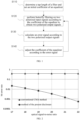
- FIG. 2 is a schematic diagram showing comparison between simulation results of an adaptive equalization method for a probabilistic shaping system according to an embodiment of the present disclosure and a conventional CMA adaptive equalization method. It can be seen that the bit error rate of the conventional CMA adaptive equalization method is always very high, and the adaptive equalization method provided in the present disclosure can effectively compensate for the channel loss and reduce the bit error rate.
- an embodiment provides an adaptive equalization apparatus for a probabilistic shaping system, including the following modules.
- a setting module 310 is configured to determine a tap length of a filter and set an initial coefficient of an equalizer.
- a filtering module 320 is configured to perform butterfly filtering on two polarized input signals according to the coefficient of the equalizer to obtain two polarized output signals.
- An error calculation module 330 is configured to determine an error signal according to the two polarized output signals.
- the error signal is a sum of a first error which is a minimum value of differences between a target convergence radius and squares of modulus of the output signals, and a second error which is a difference between an average value of squares of modulus of a plurality of output signals and a target average power.
- An adjustment module 340 is configured to adjust the coefficient of the equalizer according to the error signal.
- R 1,2... k represent squares of k modulus of a probabilistic shaping QAM signal, respectively
- p represents the target average power
- n represents a number of samples used
- min represents an operation of calculating a minimum value
- ⁇ x and ⁇ y are error signals of the two polarized output signals, respectively.
- a modulation format used by the probabilistic shaping system includes a PS-16QAM format, a PS-64QAM format, or a PS-QAM format with an order higher than 64.
- the second error i.e., the difference between the average value of the squares of the modulus of the plurality of output signals and the target average power
- the apparatus of the present disclosure can correctly compensate for the polarization crosstalk, polarization mode dispersion, and other losses in the probabilistic shaping system, thereby effectively compensating for the channel loss and reducing the bit error rate.
- an embodiment provides a DSP chip, including the adaptive equalization apparatus in the embodiment of the second aspect.
- the second error i.e., the difference between the average value of the squares of the modulus of the plurality of output signals and the target average power
- the schemes of the present disclosure can correctly compensate for the polarization crosstalk, polarization mode dispersion, and other losses in the probabilistic shaping system, thereby effectively compensating for the channel loss and reducing the bit error rate.
- an embodiment provides a computer-readable storage medium, storing a computer-executable instruction which, when executed by a computer, causes the computer to implement the adaptive equalization method in the embodiment of the first aspect of the present disclosure, for example, to implement the foregoing steps S110 to S140 of the method in FIG. 1 .
- the second error i.e., the difference between the average value of the squares of the modulus of the plurality of output signals and the target average power
- the schemes of the present disclosure can correctly compensate for the polarization crosstalk, polarization mode dispersion, and other losses in the probabilistic shaping system, thereby effectively compensating for the channel loss and reducing the bit error rate.
- the term "computer storage medium” includes volatile and nonvolatile, removable and non-removable media implemented in any method or technology for storage of information such as computer readable instructions, data structures, program modules, or other data.
- the computer storage medium includes, but not limited to, Random Access Memory (RAM), Read-Only Memory (ROM), Electrically Erasable Programmable Read-Only Memory (EEPROM), flash memory or other memory technology, Compact Disc Read-Only Memory (CD-ROM), Digital Versatile Disc (DVD) or other optical storage, cassette, magnetic tape, magnetic disk storage or other magnetic storage device, or any other medium which can be used to store the desired information and which can be accessed by a computer.
- the communication medium typically includes computer-readable instructions, data structures, program modules, or other data in a modulated data signal such as a carrier or other transport mechanism, and can include any information delivery medium.
Landscapes
- Engineering & Computer Science (AREA)
- Computer Networks & Wireless Communication (AREA)
- Signal Processing (AREA)
- Power Engineering (AREA)
- Physics & Mathematics (AREA)
- Electromagnetism (AREA)
- Cable Transmission Systems, Equalization Of Radio And Reduction Of Echo (AREA)
- Optical Communication System (AREA)
Abstract
Description
- This application is filed on the basis of
Chinese patent application No. 202111191070.6 filed October 13, 2021 - The present disclosure relates to the field of communication technologies, and in particular, to an adaptive equalization method and apparatus for a probabilistic shaping system, and a readable storage medium.
- With the development of big data, 4K video, virtual reality and the increasingly urgent demand of 5G bearer, optical transmission systems need to provide a higher transmission capacity. As early as 1948, Shannon, the founder of information theory, proved in his paper "A Mathematical Theory of Communication" that when the source distribution accords with the channel distribution, the channel has the maximum transmission capacity. Probability Shaping (PS) optical communication systems have been studied in recent years, which improve the transmission performance of the system by changing the probability distribution of the source to make it close to a Gaussian distribution.
- Digital Signal Processing (DSP) technologies are usually used to compensate for the loss of devices and channels in optical communication systems, including dispersion compensation, adaptive equalization compensation, clock recovery, carrier phase recovery, etc. The introduction of probabilistic shaping leads to the failure of some conventional DSP algorithms. For example, in the case of a high degree of probabilistic shaping, the conventional Constant Module Algorithm (CMA) fails and cannot correctly compensate for the polarization crosstalk and polarization mode dispersion in the channels. As a result, the system cannot operate.
- An objective of the present disclosure is to solve at least one of the technical problems in existing technologies and provide an adaptive equalization method and apparatus for a probabilistic shaping system, and a readable storage medium.
- In accordance with a first aspect of the present disclosure, an embodiment provides an adaptive equalization method for a probabilistic shaping system, including: determining a tap length of a filter and setting an initial coefficient of an equalizer; performing butterfly filtering on two polarized input signals according to the coefficient of the equalizer to obtain two polarized output signals; determining an error signal according to the two polarized output signals, where the error signal is a sum of a first error which is a minimum value of differences between a target convergence radius and squares of modulus of the output signals, and a second error which is a difference between an average value of squares of modulus of a plurality of output signals and a target average power; and adjusting the coefficient of the equalizer according to the error signal.
- In accordance with a second aspect of the present disclosure, an embodiment provides an adaptive equalization apparatus for a probabilistic shaping system, including: a setting module, configured to determine a tap length of a filter and set an initial coefficient of an equalizer; a filtering module, configured to perform butterfly filtering on two polarized input signals according to the coefficient of the equalizer to obtain two polarized output signals; an error calculation module, configured to determine an error signal according to the two polarized output signals, where the error signal is a sum of a first error which is a minimum value of differences between a target convergence radius and squares of modulus of the output signals, and a second error which is a difference between an average value of squares of modulus of a plurality of output signals and a target average power; and an adjustment module, configured to adjust the coefficient of the equalizer according to the error signal.
- In accordance with a third aspect of the present disclosure, an embodiment provides a DSP chip, including the adaptive equalization apparatus in the embodiment of the second aspect of the present disclosure.
- In accordance with a fourth aspect of the present disclosure, an embodiment provides a computer-readable storage medium, storing a computer-executable instruction which, when executed by a computer, causes the computer to implement the adaptive equalization method in the embodiment of the first aspect of the present disclosure.
- Additional features and advantages of the present disclosure will be set forth in the subsequent description, and it will in part be obvious from the description, or may be learned by the practice of the present disclosure. The objects and other advantages of the present disclosure can be realized and obtained by the structures particularly pointed out in the description, claims and drawings.
- The drawings are provided for a further understanding of the technical schemes of the present disclosure, and constitute a part of the description. The drawings and the embodiments of the present disclosure are used to illustrate the technical schemes of the present disclosure, and are not intended to limit the technical schemes of the present disclosure.
- The present disclosure is further described below with reference to the accompanying drawings and embodiments.
-
FIG. 1 is a flowchart of an adaptive equalization method for a probabilistic shaping system according to an embodiment of the present disclosure; -
FIG. 2 is a schematic diagram showing comparison between simulation results of an adaptive equalization method for a probabilistic shaping system according to an embodiment of the present disclosure and a conventional CMA adaptive equalization method; and -
FIG. 3 is a schematic structural diagram of an adaptive equalization apparatus for a probabilistic shaping system according to an embodiment of the present disclosure. - This section will give a detailed description of embodiments of the present disclosure. Preferred embodiments of the present disclosure are shown in the accompanying drawings. The accompanying drawings supplement the description of the text part of the description in a graphic way, such that those having ordinary skills in the art can intuitively and vividly understand each technical feature and the overall technical scheme of the present disclosure, but the accompanying drawings are not intended to be construed as limiting the scope of protection of the present disclosure.
- In the description of the present disclosure, the terms such as "first", "second" and the like used herein are merely used for distinguishing technical features, and are not intended to indicate or imply relative importance, or implicitly indicate the number of the specific technical features, or implicitly indicate a precedence order of the specific technical features.
- In the description of the present disclosure, unless otherwise explicitly defined, the terms such as "configure", "install/mount" and "connect" should be understood in a broad sense, and those having ordinary skills in the art can reasonably determine the specific meanings of the above terms in the present disclosure based on the specific contents of the technical scheme.
- With the development of big data, 4K video, virtual reality and the increasingly urgent demand of 5G bearer, optical transmission systems need to provide a higher transmission capacity. As early as 1948, Shannon, the founder of information theory, proved in his paper "A Mathematical Theory of Communication" that when the source distribution accords with the channel distribution, the channel has the maximum transmission capacity. Probability Shaping (PS) optical communication systems have been studied in recent years, which improve the transmission performance of the system by changing the probability distribution of the source to make it close to a Gaussian distribution.
- DSP technologies are usually used to compensate for the loss of devices and channels in optical communication systems, including dispersion compensation, adaptive equalization compensation, clock recovery, carrier phase recovery, etc. The introduction of probabilistic shaping leads to the failure of some conventional DSP algorithms. For example, in the case of a high degree of probabilistic shaping, the CMA fails and cannot correctly compensate for the polarization crosstalk and polarization mode dispersion in the channels. As a result, the system cannot operate. Therefore, it is necessary to propose an improved adaptive equalization algorithm for the probabilistic shaping mode.
- Embodiments of the present disclosure provide an adaptive equalization method and apparatus for a probabilistic shaping system, and a readable storage medium, to effectively compensate for the channel loss and reduce the bit error rate.
- The embodiments of the present disclosure will be further described in detail below with reference to the accompanying drawings.
- Referring to
FIG. 1 or FIG. 2 , in accordance with a first aspect of the present disclosure, an embodiment provides an adaptive equalization method for a probabilistic shaping system, including thefollowing steps S 110 to S140. - At S110, a tap length of a filter is determined and an initial coefficient of an equalizer is set.
- At
S 120, butterfly filtering is performed on two polarized input signals according to the coefficient of the equalizer to obtain two polarized output signals. - At S130, an error signal is determined according to the two polarized output signals. For example, the error signal is a sum of a first error which is a minimum value of differences between a target convergence radius and squares of modulus of the output signals, and a second error which is a difference between an average value of squares of modulus of a plurality of output signals and a target average power.
- At S140, the coefficient of the equalizer is adjusted according to the error signal.
- In S120 of the adaptive equalization method, the two polarized output signals are obtained according to the following formula:


- In S130 of the adaptive equalization method, the error signal is obtained according to the following formula:


- In S140 of the adaptive equalization method, the coefficient of the equalizer according to the error signal is adjusted according to the following formula:


- It should be noted that after the coefficient of the equalizer is adjusted, the process needs to return to S120 to filter the input signals.
- In the adaptive equalization method, a modulation format used by the probabilistic shaping system includes a PS-16QAM format, a PS-64QAM format, or a PS-QAM format with an order higher than 64.
- In the adaptive equalization method for a probabilistic shaping system according to the embodiments of the present disclosure, the second error, i.e., the difference between the average value of the squares of the modulus of the plurality of output signals and the target average power, is introduced for the calculation of the error signal, to adjust the coefficient of the equalizer. The method of the present disclosure is different from a conventional CMA algorithm mainly in the improvement of the error calculation. Compared with the conventional CMA adaptive equalization algorithm, the method of the present disclosure can correctly compensate for the polarization crosstalk, polarization mode dispersion, and other losses in the probabilistic shaping system, thereby effectively compensating for the channel loss and reducing the bit error rate.
- The adaptive equalization method provided in the present disclosure will be further described below in conjunction with the embodiments.
- Assuming that the modulation format used by the probabilistic shaping system is the PS-16QAM format, the probability distribution of 16 constellation points is as shown in the following table.
0.0062 0.0331 0.0331 0.0062 0.0331 0.1776 0.1776 0.0331 0.0331 0.1776 0.1776 0.0331 0.0062 0.0331 0.0331 0.0062 - The tap length of the filter is set to 11, and the initial coefficient of the adaptive equalizer is set as follows:


- Butterfly filtering is performed on the input signals according to S120 to obtain output signals, and then the errors of the output signals are calculated as follows:


- The coefficient of the equalizer is adjusted according to the S140, and the step size µ is set to 0.0001.
-
FIG. 2 is a schematic diagram showing comparison between simulation results of an adaptive equalization method for a probabilistic shaping system according to an embodiment of the present disclosure and a conventional CMA adaptive equalization method. It can be seen that the bit error rate of the conventional CMA adaptive equalization method is always very high, and the adaptive equalization method provided in the present disclosure can effectively compensate for the channel loss and reduce the bit error rate. - Referring to
FIG. 3 , in accordance with a second aspect of the present disclosure, an embodiment provides an adaptive equalization apparatus for a probabilistic shaping system, including the following modules. - A
setting module 310 is configured to determine a tap length of a filter and set an initial coefficient of an equalizer. - A
filtering module 320 is configured to perform butterfly filtering on two polarized input signals according to the coefficient of the equalizer to obtain two polarized output signals. - An
error calculation module 330 is configured to determine an error signal according to the two polarized output signals. For example, the error signal is a sum of a first error which is a minimum value of differences between a target convergence radius and squares of modulus of the output signals, and a second error which is a difference between an average value of squares of modulus of a plurality of output signals and a target average power. - An
adjustment module 340 is configured to adjust the coefficient of the equalizer according to the error signal. - In the
filtering module 320 of the adaptive equalization apparatus, the two polarized output signals are obtained according to the following formula:

- In the
error calculation module 330 of the adaptive equalization apparatus, the error signal is determined according to the following formula:

- In the
adjustment module 340 of the adaptive equalization apparatus, the coefficient of the equalizer is adjusted according to the error signal using the following formula:


- In the adaptive equalization apparatus, a modulation format used by the probabilistic shaping system includes a PS-16QAM format, a PS-64QAM format, or a PS-QAM format with an order higher than 64.
- In the adaptive equalization apparatus for a probabilistic shaping system according to the embodiments of the present disclosure, the second error, i.e., the difference between the average value of the squares of the modulus of the plurality of output signals and the target average power, is introduced for the calculation of the error signal, to adjust the coefficient of the equalizer. Compared with the conventional CMA adaptive equalization algorithm, the apparatus of the present disclosure can correctly compensate for the polarization crosstalk, polarization mode dispersion, and other losses in the probabilistic shaping system, thereby effectively compensating for the channel loss and reducing the bit error rate.
- In addition, in accordance with a third aspect of the present disclosure, an embodiment provides a DSP chip, including the adaptive equalization apparatus in the embodiment of the second aspect.
- In the DSP chip according to the embodiments of the present disclosure, the second error, i.e., the difference between the average value of the squares of the modulus of the plurality of output signals and the target average power, is introduced for the calculation of the error signal, to adjust the coefficient of the equalizer. Compared with the conventional CMA adaptive equalization algorithm, the schemes of the present disclosure can correctly compensate for the polarization crosstalk, polarization mode dispersion, and other losses in the probabilistic shaping system, thereby effectively compensating for the channel loss and reducing the bit error rate.
- In addition, in accordance with a fourth aspect of the present disclosure, an embodiment provides a computer-readable storage medium, storing a computer-executable instruction which, when executed by a computer, causes the computer to implement the adaptive equalization method in the embodiment of the first aspect of the present disclosure, for example, to implement the foregoing steps S110 to S140 of the method in
FIG. 1 . - In the computer-readable storage medium according to the embodiments of the present disclosure, the second error, i.e., the difference between the average value of the squares of the modulus of the plurality of output signals and the target average power, is introduced for the calculation of the error signal, to adjust the coefficient of the equalizer. Compared with the conventional CMA adaptive equalization algorithm, the schemes of the present disclosure can correctly compensate for the polarization crosstalk, polarization mode dispersion, and other losses in the probabilistic shaping system, thereby effectively compensating for the channel loss and reducing the bit error rate.
- Those having ordinary skills in the art can understand that all or some of the steps in the methods disclosed above and the functional modules/units in the system and the apparatus can be implemented as software, firmware, hardware, and appropriate combinations thereof. Some or all physical components may be implemented as software executed by a processor, such as a central processing unit, a digital signal processor, or a microprocessor, or as hardware, or as an integrated circuit, such as an application-specific integrated circuit. Such software may be distributed on a computer-readable medium, which may include a computer storage medium or non-transitory medium and a communication medium or transitory medium. As is known to those having ordinary skills in the art, the term "computer storage medium" includes volatile and nonvolatile, removable and non-removable media implemented in any method or technology for storage of information such as computer readable instructions, data structures, program modules, or other data. The computer storage medium includes, but not limited to, Random Access Memory (RAM), Read-Only Memory (ROM), Electrically Erasable Programmable Read-Only Memory (EEPROM), flash memory or other memory technology, Compact Disc Read-Only Memory (CD-ROM), Digital Versatile Disc (DVD) or other optical storage, cassette, magnetic tape, magnetic disk storage or other magnetic storage device, or any other medium which can be used to store the desired information and which can be accessed by a computer. In addition, as well known to those having ordinary skills in the art, the communication medium typically includes computer-readable instructions, data structures, program modules, or other data in a modulated data signal such as a carrier or other transport mechanism, and can include any information delivery medium.
- The embodiments of the present disclosure have been described in detail above with reference to the accompanying drawings, but the present disclosure is not limited to the above embodiments, and various changes may be made within the knowledge of those having ordinary skills in the art without departing from the protection scope of the present disclosure.
Claims (12)
- An adaptive equalization method for a probabilistic shaping system, comprising:determining a tap length of a filter, and setting an initial coefficient of an equalizer;performing butterfly filtering on two polarized input signals according to the coefficient of the equalizer to obtain two polarized output signals;determining an error signal according to the two polarized output signals, wherein the error signal is a sum of a first error which is a minimum value of differences between a target convergence radius and squares of modulus of the output signals, and a second error which is a difference between an average value of squares of modulus of a plurality of output signals and a target average power; andadjusting the coefficient of the equalizer according to the error signal.
- The adaptive equalization method of claim 1, wherein the two polarized output signals are:


- The adaptive equalization method of claim 2, wherein the error signal is determined according to the following formula:


- The adaptive equalization method of claim 3, wherein the coefficient of the equalizer according to the error signal is adjusted according to the following formula:


- The method of claim 1, wherein a modulation format used by the probabilistic shaping system comprises a PS-16QAM format, a PS-64QAM format, or a PS-QAM format with an order higher than 64.
- An adaptive equalization apparatus for a probabilistic shaping system, comprising:a setting module, configured to determine a tap length of a filter, and set an initial coefficient of an equalizer;a filtering module, configured to perform butterfly filtering on two polarized input signals according to the coefficient of the equalizer to obtain two polarized output signals;an error calculation module, configured to determine an error signal according to the two polarized output signals, wherein the error signal is a sum of a first error which is a minimum value of differences between a target convergence radius and squares of modulus of the output signals, and a second error which is a difference between an average value of squares of modulus of a plurality of output signals and a target average power; andan adjustment module, configured to adjust the coefficient of the equalizer according to the error signal.
- The adaptive equalization apparatus of claim 6, wherein the two polarized output signals are:


- The adaptive equalization apparatus of claim 7, wherein the error signal is determined according to the following formula:


- The adaptive equalization apparatus of claim 8, wherein the coefficient of the equalizer according to the error signal is adjusted according to the following formula:


- The adaptive equalization apparatus of claim 6, wherein a modulation format used by the probabilistic shaping system comprises a PS-16QAM format, a PS-64QAM format, or a PS-QAM format with an order higher than 64.
- A Data Signal Processing, DSP, chip, comprising the adaptive equalization apparatus of any one of claims 6 to 10.
- A computer-readable storage medium, storing a computer-executable instruction which, when executed by a computer, causes the computer to perform the adaptive equalization method of any one of claims 1 to 5.
Applications Claiming Priority (2)
| Application Number | Priority Date | Filing Date | Title |
|---|---|---|---|
| CN202111191070.6A CN115967443A (en) | 2021-10-13 | 2021-10-13 | Adaptive equalization method and device of probability shaping system and readable storage medium |
| PCT/CN2022/124163 WO2023061300A1 (en) | 2021-10-13 | 2022-10-09 | Adaptive equalization method and apparatus for probabilistic shaping system, and readable storage medium |
Publications (2)
| Publication Number | Publication Date |
|---|---|
| EP4412109A1 true EP4412109A1 (en) | 2024-08-07 |
| EP4412109A4 EP4412109A4 (en) | 2025-01-22 |
Family
ID=85889997
Family Applications (1)
| Application Number | Title | Priority Date | Filing Date |
|---|---|---|---|
| EP22880239.3A Pending EP4412109A4 (en) | 2021-10-13 | 2022-10-09 | ADAPTIVE EQUALIZATION METHOD AND DEVICE FOR A PROBABILISTIC FORMING SYSTEM AND READABLE STORAGE MEDIUM |
Country Status (5)
| Country | Link |
|---|---|
| US (1) | US20240414038A1 (en) |
| EP (1) | EP4412109A4 (en) |
| JP (1) | JP7714128B2 (en) |
| CN (1) | CN115967443A (en) |
| WO (1) | WO2023061300A1 (en) |
Family Cites Families (10)
| Publication number | Priority date | Publication date | Assignee | Title |
|---|---|---|---|---|
| US6661837B1 (en) * | 1999-03-08 | 2003-12-09 | International Business Machines Corporation | Modems, methods, and computer program products for selecting an optimum data rate using error signals representing the difference between the output of an equalizer and the output of a slicer or detector |
| EP2251993B1 (en) * | 2009-05-11 | 2013-07-10 | Alcatel Lucent | Adjustment scheme for a polarization demultiplexer in an optical dual-polarization BPSK receiver |
| CN102082749B (en) * | 2010-12-24 | 2014-01-15 | 西安空间无线电技术研究所 | Weight coefficient updating device and method for equalizer |
| WO2013084367A1 (en) * | 2011-12-07 | 2013-06-13 | 日本電気株式会社 | Equalization signal processing device, and optical receiver device and equalization signal processing method employing same |
| CN103684601B (en) * | 2012-09-14 | 2016-04-20 | 富士通株式会社 | Coefficient determination device, equalizer, receiver and transmitter |
| CN103684600B (en) * | 2012-09-14 | 2016-08-31 | 富士通株式会社 | The updating device of equalizer coefficients and method and receiver and optical communication system |
| CN107809281A (en) * | 2017-10-23 | 2018-03-16 | 中国舰船研究设计中心 | A kind of optical communication system simplified nonlinear modeling and model coefficient adaptive acquiring method |
| CN108111446B (en) * | 2017-12-31 | 2021-05-25 | 国网河南省电力公司电力科学研究院 | A receiver equalization module and equalization method |
| JP7338419B2 (en) * | 2019-11-19 | 2023-09-05 | 富士通株式会社 | Adaptive equalizer, optical receiver, and adaptive equalization method |
| US11265086B2 (en) * | 2019-12-19 | 2022-03-01 | Fujitsu Limited | Low rate loss bit-level distribution matcher for constellation shaping |
-
2021
- 2021-10-13 CN CN202111191070.6A patent/CN115967443A/en active Pending
-
2022
- 2022-10-09 US US18/700,553 patent/US20240414038A1/en active Pending
- 2022-10-09 EP EP22880239.3A patent/EP4412109A4/en active Pending
- 2022-10-09 JP JP2024521220A patent/JP7714128B2/en active Active
- 2022-10-09 WO PCT/CN2022/124163 patent/WO2023061300A1/en not_active Ceased
Also Published As
| Publication number | Publication date |
|---|---|
| JP7714128B2 (en) | 2025-07-28 |
| WO2023061300A1 (en) | 2023-04-20 |
| US20240414038A1 (en) | 2024-12-12 |
| JP2024536904A (en) | 2024-10-08 |
| EP4412109A4 (en) | 2025-01-22 |
| CN115967443A (en) | 2023-04-14 |
Similar Documents
| Publication | Publication Date | Title |
|---|---|---|
| US10873493B2 (en) | Carrier-phase recovery system and method | |
| US20140079407A1 (en) | Updating apparatus and method for equalizer coefficient, receiver and otpical communication system | |
| DE602004005343T2 (en) | RECEIVER FOR A MULTI-SUPPORT COMMUNICATION SYSTEM | |
| JPS6297433A (en) | Apparatus and method of adjusting equalizer | |
| CN103581079A (en) | Method and apparatus for adapting transmitter equalization coefficient based on receiver gain adaptation | |
| EP4412109A1 (en) | Adaptive equalization method and apparatus for probabilistic shaping system, and readable storage medium | |
| JPS63228826A (en) | Determined instruction controller and method of regulating the same | |
| US7660344B2 (en) | AGC fine-tuning by the adaptive time domain equalizer | |
| US8744024B2 (en) | Clock-data recovery with non-zero h(−1) target | |
| DE112007000538T5 (en) | Effective adaptive filtering methods | |
| EP1056248A1 (en) | Modulator using separate phase and amplitude stages | |
| EP4376365A1 (en) | Address synchronization method, switches, cross-device link aggregation system, and storage medium | |
| CN113489543B (en) | A nonlinear damage compensation method and system in a long-distance optical communication system | |
| US20080240412A1 (en) | Maintaining convergence of a receiver during changing conditions | |
| CN115801136A (en) | Method, system and equipment for nonlinear damage compensation of multi-dimensional optical signal in optical transmission system | |
| US8731104B2 (en) | Apparatus and method for compensating for clipping power losses | |
| CN112533290B (en) | Feedback information sending method and device based on PUCCH | |
| US20040183594A1 (en) | Gain control of a power amplifier | |
| JP3185403B2 (en) | Data receiving device | |
| EP1861921A1 (en) | A method to track analog gain step magnitudes online during operation of wireless mobile devices | |
| CN121036927A (en) | A transmission method and system for blind retransmission and merging | |
| US7656977B2 (en) | Method and system of frequency domain equalization | |
| US20250337621A1 (en) | Equalizer circuit | |
| JPH07202764A (en) | Data restoration technology that avoids illegality convergence state | |
| US10735039B1 (en) | Removal of channel impairments due to skew and channel asymmetry with a composite filter |
Legal Events
| Date | Code | Title | Description |
|---|---|---|---|
| STAA | Information on the status of an ep patent application or granted ep patent |
Free format text: STATUS: THE INTERNATIONAL PUBLICATION HAS BEEN MADE |
|
| PUAI | Public reference made under article 153(3) epc to a published international application that has entered the european phase |
Free format text: ORIGINAL CODE: 0009012 |
|
| STAA | Information on the status of an ep patent application or granted ep patent |
Free format text: STATUS: REQUEST FOR EXAMINATION WAS MADE |
|
| 17P | Request for examination filed |
Effective date: 20240502 |
|
| AK | Designated contracting states |
Kind code of ref document: A1 Designated state(s): AL AT BE BG CH CY CZ DE DK EE ES FI FR GB GR HR HU IE IS IT LI LT LU LV MC ME MK MT NL NO PL PT RO RS SE SI SK SM TR |
|
| A4 | Supplementary search report drawn up and despatched |
Effective date: 20241220 |
|
| DAV | Request for validation of the european patent (deleted) | ||
| DAX | Request for extension of the european patent (deleted) | ||
| RIC1 | Information provided on ipc code assigned before grant |
Ipc: H04L 25/03 20060101ALI20241216BHEP Ipc: H04B 10/2513 20130101AFI20241216BHEP |