EP4411941A1 - Battery assembly and method of manufacturing same - Google Patents
Battery assembly and method of manufacturing same Download PDFInfo
- Publication number
- EP4411941A1 EP4411941A1 EP23219347.4A EP23219347A EP4411941A1 EP 4411941 A1 EP4411941 A1 EP 4411941A1 EP 23219347 A EP23219347 A EP 23219347A EP 4411941 A1 EP4411941 A1 EP 4411941A1
- Authority
- EP
- European Patent Office
- Prior art keywords
- separator
- battery
- protrusions
- battery cells
- battery assembly
- Prior art date
- Legal status (The legal status is an assumption and is not a legal conclusion. Google has not performed a legal analysis and makes no representation as to the accuracy of the status listed.)
- Granted
Links
Images




Classifications
-
- H—ELECTRICITY
- H01—ELECTRIC ELEMENTS
- H01M—PROCESSES OR MEANS, e.g. BATTERIES, FOR THE DIRECT CONVERSION OF CHEMICAL ENERGY INTO ELECTRICAL ENERGY
- H01M10/00—Secondary cells; Manufacture thereof
- H01M10/04—Construction or manufacture in general
- H01M10/0422—Cells or battery with cylindrical casing
-
- H—ELECTRICITY
- H01—ELECTRIC ELEMENTS
- H01M—PROCESSES OR MEANS, e.g. BATTERIES, FOR THE DIRECT CONVERSION OF CHEMICAL ENERGY INTO ELECTRICAL ENERGY
- H01M50/00—Constructional details or processes of manufacture of the non-active parts of electrochemical cells other than fuel cells, e.g. hybrid cells
- H01M50/20—Mountings; Secondary casings or frames; Racks, modules or packs; Suspension devices; Shock absorbers; Transport or carrying devices; Holders
- H01M50/289—Mountings; Secondary casings or frames; Racks, modules or packs; Suspension devices; Shock absorbers; Transport or carrying devices; Holders characterised by spacing elements or positioning means within frames, racks or packs
- H01M50/291—Mountings; Secondary casings or frames; Racks, modules or packs; Suspension devices; Shock absorbers; Transport or carrying devices; Holders characterised by spacing elements or positioning means within frames, racks or packs characterised by their shape
-
- H—ELECTRICITY
- H01—ELECTRIC ELEMENTS
- H01M—PROCESSES OR MEANS, e.g. BATTERIES, FOR THE DIRECT CONVERSION OF CHEMICAL ENERGY INTO ELECTRICAL ENERGY
- H01M50/00—Constructional details or processes of manufacture of the non-active parts of electrochemical cells other than fuel cells, e.g. hybrid cells
- H01M50/20—Mountings; Secondary casings or frames; Racks, modules or packs; Suspension devices; Shock absorbers; Transport or carrying devices; Holders
- H01M50/289—Mountings; Secondary casings or frames; Racks, modules or packs; Suspension devices; Shock absorbers; Transport or carrying devices; Holders characterised by spacing elements or positioning means within frames, racks or packs
-
- H—ELECTRICITY
- H01—ELECTRIC ELEMENTS
- H01M—PROCESSES OR MEANS, e.g. BATTERIES, FOR THE DIRECT CONVERSION OF CHEMICAL ENERGY INTO ELECTRICAL ENERGY
- H01M10/00—Secondary cells; Manufacture thereof
- H01M10/04—Construction or manufacture in general
- H01M10/0404—Machines for assembling batteries
-
- H—ELECTRICITY
- H01—ELECTRIC ELEMENTS
- H01M—PROCESSES OR MEANS, e.g. BATTERIES, FOR THE DIRECT CONVERSION OF CHEMICAL ENERGY INTO ELECTRICAL ENERGY
- H01M10/00—Secondary cells; Manufacture thereof
- H01M10/04—Construction or manufacture in general
- H01M10/0431—Cells with wound or folded electrodes
-
- H—ELECTRICITY
- H01—ELECTRIC ELEMENTS
- H01M—PROCESSES OR MEANS, e.g. BATTERIES, FOR THE DIRECT CONVERSION OF CHEMICAL ENERGY INTO ELECTRICAL ENERGY
- H01M10/00—Secondary cells; Manufacture thereof
- H01M10/60—Heating or cooling; Temperature control
- H01M10/61—Types of temperature control
- H01M10/613—Cooling or keeping cold
-
- H—ELECTRICITY
- H01—ELECTRIC ELEMENTS
- H01M—PROCESSES OR MEANS, e.g. BATTERIES, FOR THE DIRECT CONVERSION OF CHEMICAL ENERGY INTO ELECTRICAL ENERGY
- H01M10/00—Secondary cells; Manufacture thereof
- H01M10/60—Heating or cooling; Temperature control
- H01M10/64—Heating or cooling; Temperature control characterised by the shape of the cells
- H01M10/647—Prismatic or flat cells, e.g. pouch cells
-
- H—ELECTRICITY
- H01—ELECTRIC ELEMENTS
- H01M—PROCESSES OR MEANS, e.g. BATTERIES, FOR THE DIRECT CONVERSION OF CHEMICAL ENERGY INTO ELECTRICAL ENERGY
- H01M10/00—Secondary cells; Manufacture thereof
- H01M10/60—Heating or cooling; Temperature control
- H01M10/65—Means for temperature control structurally associated with the cells
- H01M10/655—Solid structures for heat exchange or heat conduction
- H01M10/6554—Rods or plates
- H01M10/6555—Rods or plates arranged between the cells
-
- H—ELECTRICITY
- H01—ELECTRIC ELEMENTS
- H01M—PROCESSES OR MEANS, e.g. BATTERIES, FOR THE DIRECT CONVERSION OF CHEMICAL ENERGY INTO ELECTRICAL ENERGY
- H01M10/00—Secondary cells; Manufacture thereof
- H01M10/60—Heating or cooling; Temperature control
- H01M10/65—Means for temperature control structurally associated with the cells
- H01M10/658—Means for temperature control structurally associated with the cells by thermal insulation or shielding
-
- H—ELECTRICITY
- H01—ELECTRIC ELEMENTS
- H01M—PROCESSES OR MEANS, e.g. BATTERIES, FOR THE DIRECT CONVERSION OF CHEMICAL ENERGY INTO ELECTRICAL ENERGY
- H01M50/00—Constructional details or processes of manufacture of the non-active parts of electrochemical cells other than fuel cells, e.g. hybrid cells
- H01M50/10—Primary casings; Jackets or wrappings
- H01M50/147—Lids or covers
- H01M50/166—Lids or covers characterised by the methods of assembling casings with lids
- H01M50/167—Lids or covers characterised by the methods of assembling casings with lids by crimping
-
- H—ELECTRICITY
- H01—ELECTRIC ELEMENTS
- H01M—PROCESSES OR MEANS, e.g. BATTERIES, FOR THE DIRECT CONVERSION OF CHEMICAL ENERGY INTO ELECTRICAL ENERGY
- H01M50/00—Constructional details or processes of manufacture of the non-active parts of electrochemical cells other than fuel cells, e.g. hybrid cells
- H01M50/10—Primary casings; Jackets or wrappings
- H01M50/183—Sealing members
- H01M50/186—Sealing members characterised by the disposition of the sealing members
-
- H—ELECTRICITY
- H01—ELECTRIC ELEMENTS
- H01M—PROCESSES OR MEANS, e.g. BATTERIES, FOR THE DIRECT CONVERSION OF CHEMICAL ENERGY INTO ELECTRICAL ENERGY
- H01M50/00—Constructional details or processes of manufacture of the non-active parts of electrochemical cells other than fuel cells, e.g. hybrid cells
- H01M50/20—Mountings; Secondary casings or frames; Racks, modules or packs; Suspension devices; Shock absorbers; Transport or carrying devices; Holders
- H01M50/204—Racks, modules or packs for multiple batteries or multiple cells
- H01M50/207—Racks, modules or packs for multiple batteries or multiple cells characterised by their shape
- H01M50/209—Racks, modules or packs for multiple batteries or multiple cells characterised by their shape adapted for prismatic or rectangular cells
-
- H—ELECTRICITY
- H01—ELECTRIC ELEMENTS
- H01M—PROCESSES OR MEANS, e.g. BATTERIES, FOR THE DIRECT CONVERSION OF CHEMICAL ENERGY INTO ELECTRICAL ENERGY
- H01M50/00—Constructional details or processes of manufacture of the non-active parts of electrochemical cells other than fuel cells, e.g. hybrid cells
- H01M50/20—Mountings; Secondary casings or frames; Racks, modules or packs; Suspension devices; Shock absorbers; Transport or carrying devices; Holders
- H01M50/233—Mountings; Secondary casings or frames; Racks, modules or packs; Suspension devices; Shock absorbers; Transport or carrying devices; Holders characterised by physical properties of casings or racks, e.g. dimensions
- H01M50/242—Mountings; Secondary casings or frames; Racks, modules or packs; Suspension devices; Shock absorbers; Transport or carrying devices; Holders characterised by physical properties of casings or racks, e.g. dimensions adapted for protecting batteries against vibrations, collision impact or swelling
-
- H—ELECTRICITY
- H01—ELECTRIC ELEMENTS
- H01M—PROCESSES OR MEANS, e.g. BATTERIES, FOR THE DIRECT CONVERSION OF CHEMICAL ENERGY INTO ELECTRICAL ENERGY
- H01M50/00—Constructional details or processes of manufacture of the non-active parts of electrochemical cells other than fuel cells, e.g. hybrid cells
- H01M50/20—Mountings; Secondary casings or frames; Racks, modules or packs; Suspension devices; Shock absorbers; Transport or carrying devices; Holders
- H01M50/244—Secondary casings; Racks; Suspension devices; Carrying devices; Holders characterised by their mounting method
-
- H—ELECTRICITY
- H01—ELECTRIC ELEMENTS
- H01M—PROCESSES OR MEANS, e.g. BATTERIES, FOR THE DIRECT CONVERSION OF CHEMICAL ENERGY INTO ELECTRICAL ENERGY
- H01M50/00—Constructional details or processes of manufacture of the non-active parts of electrochemical cells other than fuel cells, e.g. hybrid cells
- H01M50/20—Mountings; Secondary casings or frames; Racks, modules or packs; Suspension devices; Shock absorbers; Transport or carrying devices; Holders
- H01M50/262—Mountings; Secondary casings or frames; Racks, modules or packs; Suspension devices; Shock absorbers; Transport or carrying devices; Holders with fastening means, e.g. locks
- H01M50/264—Mountings; Secondary casings or frames; Racks, modules or packs; Suspension devices; Shock absorbers; Transport or carrying devices; Holders with fastening means, e.g. locks for cells or batteries, e.g. straps, tie rods or peripheral frames
-
- H—ELECTRICITY
- H01—ELECTRIC ELEMENTS
- H01M—PROCESSES OR MEANS, e.g. BATTERIES, FOR THE DIRECT CONVERSION OF CHEMICAL ENERGY INTO ELECTRICAL ENERGY
- H01M50/00—Constructional details or processes of manufacture of the non-active parts of electrochemical cells other than fuel cells, e.g. hybrid cells
- H01M50/20—Mountings; Secondary casings or frames; Racks, modules or packs; Suspension devices; Shock absorbers; Transport or carrying devices; Holders
- H01M50/289—Mountings; Secondary casings or frames; Racks, modules or packs; Suspension devices; Shock absorbers; Transport or carrying devices; Holders characterised by spacing elements or positioning means within frames, racks or packs
- H01M50/293—Mountings; Secondary casings or frames; Racks, modules or packs; Suspension devices; Shock absorbers; Transport or carrying devices; Holders characterised by spacing elements or positioning means within frames, racks or packs characterised by the material
-
- H—ELECTRICITY
- H01—ELECTRIC ELEMENTS
- H01M—PROCESSES OR MEANS, e.g. BATTERIES, FOR THE DIRECT CONVERSION OF CHEMICAL ENERGY INTO ELECTRICAL ENERGY
- H01M50/00—Constructional details or processes of manufacture of the non-active parts of electrochemical cells other than fuel cells, e.g. hybrid cells
- H01M50/30—Arrangements for facilitating escape of gases
- H01M50/342—Non-re-sealable arrangements
- H01M50/3425—Non-re-sealable arrangements in the form of rupturable membranes or weakened parts, e.g. pierced with the aid of a sharp member
-
- H—ELECTRICITY
- H01—ELECTRIC ELEMENTS
- H01M—PROCESSES OR MEANS, e.g. BATTERIES, FOR THE DIRECT CONVERSION OF CHEMICAL ENERGY INTO ELECTRICAL ENERGY
- H01M50/00—Constructional details or processes of manufacture of the non-active parts of electrochemical cells other than fuel cells, e.g. hybrid cells
- H01M50/50—Current conducting connections for cells or batteries
- H01M50/543—Terminals
- H01M50/552—Terminals characterised by their shape
- H01M50/559—Terminals adapted for cells having curved cross-section, e.g. round, elliptic or button cells
-
- Y—GENERAL TAGGING OF NEW TECHNOLOGICAL DEVELOPMENTS; GENERAL TAGGING OF CROSS-SECTIONAL TECHNOLOGIES SPANNING OVER SEVERAL SECTIONS OF THE IPC; TECHNICAL SUBJECTS COVERED BY FORMER USPC CROSS-REFERENCE ART COLLECTIONS [XRACs] AND DIGESTS
- Y02—TECHNOLOGIES OR APPLICATIONS FOR MITIGATION OR ADAPTATION AGAINST CLIMATE CHANGE
- Y02E—REDUCTION OF GREENHOUSE GAS [GHG] EMISSIONS, RELATED TO ENERGY GENERATION, TRANSMISSION OR DISTRIBUTION
- Y02E60/00—Enabling technologies; Technologies with a potential or indirect contribution to GHG emissions mitigation
- Y02E60/10—Energy storage using batteries
-
- Y—GENERAL TAGGING OF NEW TECHNOLOGICAL DEVELOPMENTS; GENERAL TAGGING OF CROSS-SECTIONAL TECHNOLOGIES SPANNING OVER SEVERAL SECTIONS OF THE IPC; TECHNICAL SUBJECTS COVERED BY FORMER USPC CROSS-REFERENCE ART COLLECTIONS [XRACs] AND DIGESTS
- Y02—TECHNOLOGIES OR APPLICATIONS FOR MITIGATION OR ADAPTATION AGAINST CLIMATE CHANGE
- Y02P—CLIMATE CHANGE MITIGATION TECHNOLOGIES IN THE PRODUCTION OR PROCESSING OF GOODS
- Y02P70/00—Climate change mitigation technologies in the production process for final industrial or consumer products
- Y02P70/50—Manufacturing or production processes characterised by the final manufactured product
Definitions
- the present technology relates to a battery assembly and a method of manufacturing the battery assembly.
- Japanese Utility Model No. 215119123 a structure in which a heat insulating material and an elastic body are placed on each other is disclosed as a structure of a separator disposed between a plurality of battery cells.
- Japanese Patent Laying-Open No. 2021-150079 discloses an elastic body in which a hard portion protrudes from a through hole of a soft portion.
- a total of a tolerance of the thickness of the heat insulating material and a tolerance of the thickness of the elastic body is a tolerance of the thickness of the separator.
- the tolerance of the thickness of the separator tends to be larger than that of a separator constituted of one member.
- a restraint load on battery cells become large even though design values of sizes of the battery cells in a stacking direction are the same.
- strength of a strength member in the battery module needs to be improved, which can lead to increased weight and increased cost of the battery module.
- the soft portion is normally separated from an electrode assembly in a state in which it is incorporated in a secondary battery module. Further, since the hard portions interspersed in the elastic body are likely to be deformed, it is considered that a load is received from the electrode assembly.
- the present technology provides the following battery assembly and method of manufacturing the battery assembly.
- the terms “comprise”, “include”, and “have” are open-end terms. That is, when a certain configuration is included, a configuration other than the foregoing configuration may or may not be included.
- battery is not limited to a lithium ion battery, and may include other batteries such as a nickel-metal hydride battery and a sodium ion battery.
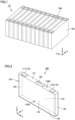
- Fig. 1 is a perspective view of a battery assembly 1A.
- Battery assembly 1A shown in Fig. 1 includes battery cells 100 and separators 200 (inter-cell separator). Battery cells 100 and separators 200 are alternately arranged along a Y axis direction (first direction).
- the plurality of battery cells 100 are battery cells each having a prismatic shape, and are provided along the Y axis direction.
- the plurality of battery cells 100 are electrically connected together by a bus bar (not shown).
- Separators 200 are provided between the plurality of battery cells 100. Each of separators 200 prevents unintended electrical conduction between adjacent battery cells 100. Separator 200 secures an electrical insulation property between adjacent battery cells 100.
- Fig. 2 is a perspective view of each battery cell 100. As shown in Fig. 2 , battery cell 100 has a prismatic shape. Battery cell 100 has electrode terminals 110, a battery case 120, and a gas-discharge valve 130.
- Electrode terminal 110 is formed on battery case 120. Electrode terminals 110 have a positive electrode terminal 111 and a negative electrode terminal 112 arranged side by side along an X axis direction (second direction) orthogonal to the Y axis direction (first direction). Positive electrode terminal 111 and negative electrode terminal 112 are provided to be separated from each other in the X axis direction.
- Battery case 120 has a rectangular parallelepiped shape and forms an external appearance of battery cell 100.
- Battery case 120 includes: a case main body 120A that accommodates an electrode assembly (not shown) and an electrolyte solution (not shown); and a sealing plate 120B that seals an opening of case main body 120A. Sealing plate 120B is joined to case main body 120A by welding.
- Battery case 120 has an upper surface 121, a lower surface 122, a first side surface 123, a second side surface 124, and two third side surfaces 125.
- Upper surface 121 is a flat surface orthogonal to a Z axis direction (third direction) orthogonal to the Y axis direction and the X axis direction. Electrode terminals 110 are disposed on upper surface 121. Lower surface 122 faces upper surface 121 along the Z axis direction.
- Each of first side surface 123 and second side surface 124 is constituted of a flat surface orthogonal to the Y axis direction.
- Each of first side surface 123 and second side surface 124 has the largest area among the areas of the plurality of side surfaces of battery case 120.
- Each of first side surface 123 and second side surface 124 has a rectangular shape when viewed in the Y axis direction.
- Each of first side surface 123 and second side surface 124 has a rectangular shape in which the X axis direction corresponds to the long-side direction and the Z axis direction corresponds to the short-side direction when viewed in the Y axis direction.
- the plurality of battery cells 100 are stacked such that first side surfaces 123 of battery cells 100, 100 adjacent to each other in the Y direction face each other and second side surfaces 124 of battery cells 100, 100 adjacent to each other in the Y axis direction face each other.
- positive electrode terminals 111 and negative electrode terminals 112 are alternately arranged in the Y axis direction in which the plurality of battery cells 100 are stacked.
- Gas-discharge valve 130 is provided in upper surface 121.
- gas-discharge valve 130 discharges the gas to outside of battery case 120.
- Fig. 3 is a perspective view of battery module 1. As shown in Fig. 3 , battery module 1 includes battery cells 100, separators 200, restraint members 300, and end plates 400.
- Battery cells 100 and separators 200 alternately arranged along the Y axis direction (first direction) are pressed by end plates 400 and are restrained between two end plates 400.
- End plates 400 are disposed at both ends in the Y axis direction. Each of end plates 400 is fixed to a base such as a case that accommodates battery module 1. Restraint member 300 connects two end plates 400 to each other to restrain the plurality of battery cells 100 and separators 200 along the Y axis direction.
- Restraint member 300 is fixed to end plates 400 with a compression force in the Y axis direction being exerted to the stack of battery cells 100, separators 200 and end plates 400, and then the compression force is released, with the result that tensile force acts on restraint member 300 that connects two end plates 400 to each other. As a reaction thereto, restraint members 300 press two end plates 400 in directions of bringing them closer to each other. In this way, battery module 1 is constructed.
- a battery pack is formed (cell-module-pack structure).
- a structure (cell-to-pack structure) may be employed in which battery assembly 1A shown in Fig. 1 is directly supported by a wall surface of the pack case.
- Fig. 4 is a cross sectional view of each separator 200.
- Fig. 5 is a diagram showing a state in which separator 200 shown in Fig. 4 is disposed between battery cells 100.
- Fig. 6 is a top view of a first member 210, and
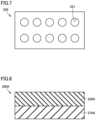
- Fig. 7 is a top view of a second member 220.
- separator 200 includes first member 210 and second member 220.
- First member 210 and second member 220 are placed on each other in the stacking direction (Y axis direction) of the plurality of battery cells 100.
- First member 210 includes a base portion 211 and a plurality of protrusions 212 protruding from base portion 211 in the Y axis direction.
- Each of protrusions 212 has a tapered shape having a diameter that is decreased toward its tip.
- base portion 211 and the plurality of protrusions 212 are integrally molded, but base portion 211 and protrusions 212 provided as separate members may be joined together.
- Second member 220 is provided with hole portions 221. Protrusions 212 of first member 210 are inserted into hole portions 221 of second member 220. As a result, second member 220 is located between the plurality of protrusions 212. As an example, the outer size of first member 210 and the outer size of second member 220 are substantially equal to each other.
- a protruding height of each of the plurality of protrusions 212 is larger than a thickness of second member 220. It should be noted that the scope of the present technology is not limited thereto.
- separators 200 each shown in Fig. 4 are prepared, the plurality of battery cells 100 and separators 200 are alternately arranged in the Y axis direction and are restrained along the Y axis direction.
- protrusions 212 of first member 210 are compressed together with second member 220.
- First member 210 can be composed of an elastic body.
- First member 210 can be composed of, for example, a silicone rubber, a fluororubber, a urethane rubber, a natural rubber, a styrene-butadiene rubber, a butyl rubber, an ethylene propylene rubber (EPM, EPDM), a butadiene rubber, an isoprene rubber, a norbornene rubber, or the like (is preferably composed of the silicone rubber or fluororubber).
- First member 210 is preferably composed of a material having an elastic modulus of about 1 MPa or more and 10 MPa or less as measured by the following method.
- first member 210 it is preferable to form first member 210 using such a material that a sample thickness measured by a micrometer with resting of two hours after the pressure application test (after unloading) is about -20% or less from an initial state (before the pressure application test).
- Second member 220 has such a property that second member 220 has a higher heat insulation property than that of first member 210 and is more likely to be deformed than first member 210.
- Second member 220 can be composed of a foamed resin.
- Second member 220 can be composed of, for example, an inorganic fiber (ceramic fiber or the like), a molding of an inorganic fiber and an organic binder, an inorganic filler and an organic binder, a foamed silicon sheet having a space therein, or the like.
- Second member 220 preferably has a heat insulation property of about 0.15 W/mK or less, and more preferably has a heat insulation property of about 0.1 W/mK or less.
- separator 200 has the two-layer structure with first member 210 having a higher elastic modulus and second member 220 having a higher heat insulation property, both deformation absorption property and heat insulation property in separator 200 can be achieved.
- Fig. 8 is a cross sectional view of a separator 200A according to a comparative example.
- Fig. 9 is a diagram showing a state in which separator 200A shown in Fig. 8 is disposed between battery cells 100.
- separator 200A shown in Figs. 8 and 9 a two-layer structure is disclosed in which a first member 210A having a higher elastic modulus and a second member 220A having a higher heat insulation property are placed on each other.
- separator 200A employs the two-layer structure with first member 210A and second member 220A, a total of a tolerance of the thickness of first member 210A and a tolerance of the thickness of second member 220A is a tolerance of the thickness of separator 200A.
- the tolerance of the thickness of the separator becomes larger than that of a separator constituted of one member.
- a restraint load on battery cells 100 and separator 200A becomes large depending on the thickness of separator 200A even though design values of sizes of battery cells 100 in the stacking direction (Y axis direction) are the same.
- strength of a strength member in battery assembly 1A or battery module 1 needs to be improved, which can lead to increased weight and increased cost of battery module 1.
- separator 200 since the structure is employed in which second member 220 is provided between protrusions 212 of first member 210, only the size tolerance of first member 210 of first member 210 and second member 220 needs to be managed, with the result that variation in the thickness of separator 200 becomes small as a whole. As a result, battery module 1 in which variation in reaction force acting on battery cell 100 is small is provided, thus contributing to reduced weight or reduced manufacturing cost of the battery module.
- Fig. 10 is a top view of a separator 200 according to a modification.
- Fig. 11 is a cross sectional view along XI-XI in Fig. 10 .
- each second member 220 a foam having an air layer therein is used as each second member 220.
- a resin is foamed in a recess 213 surrounded by a series of protrusions 212 of first member 210.
- second member 220 composed of the foamed resin is formed between the plurality of protrusions 212 of first member 210.
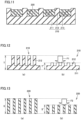
- Fig. 12 is a diagram showing deformation when a load is applied to first member 210 of separator 200.
- Fig. 13 is a diagram showing deformation when a load is applied to second member 220 of separator 200.
- first member 210 having a thickness T under application of no load is fed with a load F1
- protrusions 212 are mainly compressed and deformed, with the result that the thickness of first member 210 is decreased to T'.
- Fig. 14 is a graph showing an exemplary load-thickness curve of each of first member 210 and second member 220 in separator 200.
- a curve 10 is an exemplary load-thickness curve of first member 210 in separator 200
- each of curves 20A, 20B is an exemplary load-thickness curve of second member 220 in separator 200.
- the vertical axis represents a load acting on each of first member 210 and the second member in separator 200
- the horizontal axis represents the thickness of separator 200 (first member 210).
- each of the loads acting on first member 210 and second member 220 in separator 200 is increased as the thickness of separator 200 (first member 210) is decreased.
- the load (elastic force of first member 210) acting on first member 210 is preferably larger than the load (elastic force of second member 220) acting on second member 220 in a region (region of T50 to T90 in Fig. 14 ) in which at least the thickness of separator 200 (first member 210) is 50% to 90% of thickness T that is under application of no load (the same applies to each example of curves 20A, 20B). More preferably, the load (elastic force of first member 210) acting on first member 210 is larger than the load (elastic force of second member 220) acting on second member 220 in a region (region of T40 to T95 in Fig. 14 ) in which at least the thickness of separator 200 (first member 210) is 40% to 95% of thickness T that is under application of no load (the same applies to each example of curves 20A, 20B).
- second member 220 can be provided so as not to affect the deformation absorption property of first member 210 excessively within a practical use range of separator 200.
Landscapes
- Chemical & Material Sciences (AREA)
- Chemical Kinetics & Catalysis (AREA)
- Electrochemistry (AREA)
- General Chemical & Material Sciences (AREA)
- Engineering & Computer Science (AREA)
- Manufacturing & Machinery (AREA)
- Battery Mounting, Suspending (AREA)
- Secondary Cells (AREA)
- Cell Separators (AREA)
Abstract
Description
- This nonprovisional application is based on
Japanese Patent Application No. 2023-012614 filed on January 31, 2023 - The present technology relates to a battery assembly and a method of manufacturing the battery assembly.
- In
Chinese Utility Model No. 215119123 , a structure in which a heat insulating material and an elastic body are placed on each other is disclosed as a structure of a separator disposed between a plurality of battery cells.Japanese Patent Laying-Open No. 2021-150079 - Since the separator described in
Chinese Utility Model No. 215119123 employs the two-layer structure with the heat insulating material and the elastic body, a total of a tolerance of the thickness of the heat insulating material and a tolerance of the thickness of the elastic body is a tolerance of the thickness of the separator. - Therefore, the tolerance of the thickness of the separator tends to be larger than that of a separator constituted of one member. When the thickness of the separator is large, a restraint load on battery cells become large even though design values of sizes of the battery cells in a stacking direction are the same. When the maximum value of the restraint load on the battery cells becomes large, strength of a strength member in the battery module needs to be improved, which can lead to increased weight and increased cost of the battery module.
- In the elastic body described in
Japanese Patent Laying-Open No. 2021-150079 - It is an object of the present technology to provide: a battery assembly in which variation in reaction force acting on a battery cell is small; and a method of manufacturing the battery assembly.
- The present technology provides the following battery assembly and method of manufacturing the battery assembly.
- [1] A battery assembly comprising: a plurality of battery cells arranged in a first direction; a separator disposed between the plurality of battery cells; and a restraint member that restrains the plurality of battery cells and the separator along the first direction, wherein the separator includes a first member including a base portion and a plurality of protrusions each protruding from the base portion in the first direction, and a second member disposed between the plurality of protrusions, the second member having a higher heat insulation property than a heat insulation property of the first member, the second member being more likely to be deformed than the first member.
- [2] The battery assembly according to [1], wherein in a state in which the separator is detached from the battery assembly, a protruding height of each of the plurality of protrusions is larger than a thickness of the second member.
- [3] The battery assembly according to [1] or [2], wherein an outer size of the first member and an outer size of the second member are substantially equal to each other.
- [4] The battery assembly according to any one of [1] to [3], wherein the base portion of the first member and the plurality of protrusions are integrally molded.
- [5] The battery assembly according to any one of [1] to [4], wherein the second member is composed of a foamed resin.
- [6] A method of manufacturing a battery assembly, the method comprising: preparing a plurality of battery cells and a separator; arranging the plurality of battery cells and the separator alternately in a first direction; and restraining the plurality of battery cells and the separator along the first direction, wherein the preparing of the separator includes preparing a first member including a base portion and a plurality of protrusions protruding from the base portion in the first direction, and providing a second member disposed between the plurality of protrusions, the second member having a higher heat insulation property than a heat insulation property of the first member, the second member being more likely to be deformed than the first member, and the preparing of the first member includes causing a protruding height of each of the plurality of protrusions to be larger than a thickness of the second member.
- [7] The method of manufacturing the battery assembly according to [6], wherein the preparing of the separator includes disposing the second member composed of a foamed resin between the plurality of protrusions of the first member by foaming a resin in a recess surrounded by a series of the protrusions of the first member.
- The foregoing and other objects, features, aspects and advantages of the present invention will become more apparent from the following detailed description of the present invention when taken in conjunction with the accompanying drawings.
-
-
Fig. 1 is a perspective view of a battery assembly. -
Fig. 2 is a perspective view of a battery cell. -
Fig. 3 is a perspective view of a battery module. -
Fig. 4 is a cross sectional view of a separator included in the battery assembly. -
Fig. 5 is a diagram showing a state in which the separator shown inFig. 4 is disposed between battery cells. -
Fig. 6 is a top view of a first member of the separator. -
Fig. 7 is a top view of a second member of the separator. -
Fig. 8 is a cross sectional view of a separator according to a comparative example. -
Fig. 9 is a diagram showing a state in which the separator shown inFig. 8 is disposed between battery cells. -
Fig. 10 is a top view of a separator according to a modification. -
Fig. 11 is a cross sectional view along XI-XI inFig. 10 . -
Fig. 12 is a diagram showing deformation when a load is applied to the first member of the separator. -
Fig. 13 is a diagram showing deformation when a load is applied to the second member of the separator. -
Fig. 14 is a graph showing an exemplary load-thickness curve of each of the first member and the second member in the separator. - Hereinafter, embodiments of the present technology will be described. It should be noted that the same or corresponding portions are denoted by the same reference characters, and may not be described repeatedly.
- It should be noted that in the embodiments described below, when reference is made to number, amount, and the like, the scope of the present technology is not necessarily limited to the number, amount, and the like unless otherwise stated particularly. Further, in the embodiments described below, each component is not necessarily essential to the present technology unless otherwise stated particularly. Further, the present technology is not limited to one that necessarily exhibits all the functions and effects stated in the present embodiment.
- It should be noted that in the present specification, the terms "comprise", "include", and "have" are open-end terms. That is, when a certain configuration is included, a configuration other than the foregoing configuration may or may not be included.
- Also, in the present specification, when geometric terms and terms representing positional/directional relations are used, for example, when terms such as "parallel", "orthogonal", "obliquely at 45°", "coaxial", and "along" are used, these terms permit manufacturing errors or slight fluctuations. In the present specification, when terms representing relative positional relations such as "upper side" and "lower side" are used, each of these terms is used to indicate a relative positional relation in one state, and the relative positional relation may be reversed or turned at any angle in accordance with an installation direction of each mechanism (for example, the entire mechanism is reversed upside down).
- In the present specification, the term "battery" is not limited to a lithium ion battery, and may include other batteries such as a nickel-metal hydride battery and a sodium ion battery.
- In the present specification, the term "battery cell" is not necessarily limited to a prismatic battery cell and may include a cell having another shape, such as a cylindrical battery cell, a pouch battery cell, or a blade battery cell. Further, the "battery cell" can be mounted on vehicles such as a hybrid electric vehicle (HEV), a plug-in hybrid electric vehicle (PHEV), and a battery electric vehicle (BEV). It should be noted that the use of the "battery cell" is not limited to the use in a vehicle.
-
Fig. 1 is a perspective view of abattery assembly 1A.Battery assembly 1A shown inFig. 1 includesbattery cells 100 and separators 200 (inter-cell separator).Battery cells 100 andseparators 200 are alternately arranged along a Y axis direction (first direction). - The plurality of
battery cells 100 are battery cells each having a prismatic shape, and are provided along the Y axis direction. The plurality ofbattery cells 100 are electrically connected together by a bus bar (not shown). -
Separators 200 are provided between the plurality ofbattery cells 100. Each ofseparators 200 prevents unintended electrical conduction betweenadjacent battery cells 100.Separator 200 secures an electrical insulation property betweenadjacent battery cells 100. -
Fig. 2 is a perspective view of eachbattery cell 100. As shown inFig. 2 ,battery cell 100 has a prismatic shape.Battery cell 100 haselectrode terminals 110, abattery case 120, and a gas-discharge valve 130. -
Electrode terminal 110 is formed onbattery case 120.Electrode terminals 110 have apositive electrode terminal 111 and anegative electrode terminal 112 arranged side by side along an X axis direction (second direction) orthogonal to the Y axis direction (first direction).Positive electrode terminal 111 andnegative electrode terminal 112 are provided to be separated from each other in the X axis direction. -
Battery case 120 has a rectangular parallelepiped shape and forms an external appearance ofbattery cell 100.Battery case 120 includes: a casemain body 120A that accommodates an electrode assembly (not shown) and an electrolyte solution (not shown); and asealing plate 120B that seals an opening of casemain body 120A.Sealing plate 120B is joined to casemain body 120A by welding. -
Battery case 120 has anupper surface 121, alower surface 122, afirst side surface 123, asecond side surface 124, and two third side surfaces 125. -
Upper surface 121 is a flat surface orthogonal to a Z axis direction (third direction) orthogonal to the Y axis direction and the X axis direction.Electrode terminals 110 are disposed onupper surface 121.Lower surface 122 facesupper surface 121 along the Z axis direction. - Each of
first side surface 123 andsecond side surface 124 is constituted of a flat surface orthogonal to the Y axis direction. Each offirst side surface 123 andsecond side surface 124 has the largest area among the areas of the plurality of side surfaces ofbattery case 120. Each offirst side surface 123 andsecond side surface 124 has a rectangular shape when viewed in the Y axis direction. Each offirst side surface 123 andsecond side surface 124 has a rectangular shape in which the X axis direction corresponds to the long-side direction and the Z axis direction corresponds to the short-side direction when viewed in the Y axis direction. - The plurality of
battery cells 100 are stacked such that first side surfaces 123 ofbattery cells battery cells positive electrode terminals 111 andnegative electrode terminals 112 are alternately arranged in the Y axis direction in which the plurality ofbattery cells 100 are stacked. - Gas-
discharge valve 130 is provided inupper surface 121. When the temperature ofbattery cell 100 is increased (thermal runaway) and internal pressure ofbattery case 120 becomes more than or equal to a predetermined value due to gas generated insidebattery case 120, gas-discharge valve 130 discharges the gas to outside ofbattery case 120. -
Fig. 3 is a perspective view ofbattery module 1. As shown inFig. 3 ,battery module 1 includesbattery cells 100,separators 200,restraint members 300, andend plates 400. -
Battery cells 100 andseparators 200 alternately arranged along the Y axis direction (first direction) are pressed byend plates 400 and are restrained between twoend plates 400. -
End plates 400 are disposed at both ends in the Y axis direction. Each ofend plates 400 is fixed to a base such as a case that accommodatesbattery module 1.Restraint member 300 connects twoend plates 400 to each other to restrain the plurality ofbattery cells 100 andseparators 200 along the Y axis direction. -
Restraint member 300 is fixed to endplates 400 with a compression force in the Y axis direction being exerted to the stack ofbattery cells 100,separators 200 andend plates 400, and then the compression force is released, with the result that tensile force acts onrestraint member 300 that connects twoend plates 400 to each other. As a reaction thereto,restraint members 300 press twoend plates 400 in directions of bringing them closer to each other. In this way,battery module 1 is constructed. - By accommodating
battery module 1 in a pack case, a battery pack is formed (cell-module-pack structure). Instead of this, a structure (cell-to-pack structure) may be employed in whichbattery assembly 1A shown inFig. 1 is directly supported by a wall surface of the pack case. -
Fig. 4 is a cross sectional view of eachseparator 200.Fig. 5 is a diagram showing a state in which separator 200 shown inFig. 4 is disposed betweenbattery cells 100.Fig. 6 is a top view of afirst member 210, andFig. 7 is a top view of asecond member 220. - As shown in
Figs. 4 to 7 ,separator 200 includesfirst member 210 andsecond member 220.First member 210 andsecond member 220 are placed on each other in the stacking direction (Y axis direction) of the plurality ofbattery cells 100. -
First member 210 includes abase portion 211 and a plurality ofprotrusions 212 protruding frombase portion 211 in the Y axis direction. Each ofprotrusions 212 has a tapered shape having a diameter that is decreased toward its tip. In the example ofFig. 4 ,base portion 211 and the plurality ofprotrusions 212 are integrally molded, butbase portion 211 andprotrusions 212 provided as separate members may be joined together. -
Second member 220 is provided withhole portions 221.Protrusions 212 offirst member 210 are inserted intohole portions 221 ofsecond member 220. As a result,second member 220 is located between the plurality ofprotrusions 212. As an example, the outer size offirst member 210 and the outer size ofsecond member 220 are substantially equal to each other. - Typically, as shown in
Fig. 4 , in a state in which separator 200 is detached frombattery assembly 1A, a protruding height of each of the plurality ofprotrusions 212 is larger than a thickness ofsecond member 220. It should be noted that the scope of the present technology is not limited thereto. Afterseparators 200 each shown inFig. 4 are prepared, the plurality ofbattery cells 100 andseparators 200 are alternately arranged in the Y axis direction and are restrained along the Y axis direction. On this occasion, as shown inFig. 5 ,protrusions 212 offirst member 210 are compressed together withsecond member 220. -
First member 210 can be composed of an elastic body.First member 210 can be composed of, for example, a silicone rubber, a fluororubber, a urethane rubber, a natural rubber, a styrene-butadiene rubber, a butyl rubber, an ethylene propylene rubber (EPM, EPDM), a butadiene rubber, an isoprene rubber, a norbornene rubber, or the like (is preferably composed of the silicone rubber or fluororubber). -
First member 210 is preferably composed of a material having an elastic modulus of about 1 MPa or more and 10 MPa or less as measured by the following method. -
- (1) A square test piece having each side of 5 cm (surface facing the battery cell) is prepared.
- (2) For the test piece, a load displacement curve (F-S curve) is obtained up to a pressure application force of 3.9 MPa (pressure application rate: 30 N/min).
- (3) In a graph in which the horizontal axis represents a compression ratio and the vertical axis represents a pressure, the elastic modulus is calculated from the slope of a compression ratio of 1% to 20%.
- Further, it is preferable to form
first member 210 using such a material that a sample thickness measured by a micrometer with resting of two hours after the pressure application test (after unloading) is about -20% or less from an initial state (before the pressure application test). -
Second member 220 has such a property thatsecond member 220 has a higher heat insulation property than that offirst member 210 and is more likely to be deformed thanfirst member 210. -
Second member 220 can be composed of a foamed resin.Second member 220 can be composed of, for example, an inorganic fiber (ceramic fiber or the like), a molding of an inorganic fiber and an organic binder, an inorganic filler and an organic binder, a foamed silicon sheet having a space therein, or the like. -
Second member 220 preferably has a heat insulation property of about 0.15 W/mK or less, and more preferably has a heat insulation property of about 0.1 W/mK or less. - As shown in
Figs. 4 to 7 , sinceseparator 200 has the two-layer structure withfirst member 210 having a higher elastic modulus andsecond member 220 having a higher heat insulation property, both deformation absorption property and heat insulation property inseparator 200 can be achieved. -
Fig. 8 is a cross sectional view of aseparator 200A according to a comparative example.Fig. 9 is a diagram showing a state in whichseparator 200A shown inFig. 8 is disposed betweenbattery cells 100. - In
separator 200A shown inFigs. 8 and9 , a two-layer structure is disclosed in which afirst member 210A having a higher elastic modulus and asecond member 220A having a higher heat insulation property are placed on each other. - Since
separator 200A employs the two-layer structure withfirst member 210A andsecond member 220A, a total of a tolerance of the thickness offirst member 210A and a tolerance of the thickness ofsecond member 220A is a tolerance of the thickness ofseparator 200A. - Thus, with the total of the tolerances of the thicknesses of the two members, the tolerance of the thickness of the separator becomes larger than that of a separator constituted of one member. As a result, a restraint load on
battery cells 100 andseparator 200A becomes large depending on the thickness ofseparator 200A even though design values of sizes ofbattery cells 100 in the stacking direction (Y axis direction) are the same. As a result, strength of a strength member inbattery assembly 1A orbattery module 1 needs to be improved, which can lead to increased weight and increased cost ofbattery module 1. - On the other hand, in
separator 200 according to the present embodiment, since the structure is employed in whichsecond member 220 is provided betweenprotrusions 212 offirst member 210, only the size tolerance offirst member 210 offirst member 210 andsecond member 220 needs to be managed, with the result that variation in the thickness ofseparator 200 becomes small as a whole. As a result,battery module 1 in which variation in reaction force acting onbattery cell 100 is small is provided, thus contributing to reduced weight or reduced manufacturing cost of the battery module. -
Fig. 10 is a top view of aseparator 200 according to a modification.Fig. 11 is a cross sectional view along XI-XI inFig. 10 . - In the modification shown in
Figs. 10 and11 , a foam having an air layer therein is used as eachsecond member 220. When preparingseparator 200, a resin is foamed in arecess 213 surrounded by a series ofprotrusions 212 offirst member 210. As a result,second member 220 composed of the foamed resin is formed between the plurality ofprotrusions 212 offirst member 210. - Next, a relation between the elastic modulus of
first member 210 and the elastic modulus ofsecond member 220 will be described with reference toFigs. 12 to 14 . -
Fig. 12 is a diagram showing deformation when a load is applied tofirst member 210 ofseparator 200.Fig. 13 is a diagram showing deformation when a load is applied tosecond member 220 ofseparator 200. - As shown in
Fig. 12 , whenfirst member 210 having a thickness T under application of no load is fed with a load F1,protrusions 212 are mainly compressed and deformed, with the result that the thickness offirst member 210 is decreased to T'. - As shown in
Fig. 13 , whensecond member 220 having a thickness S under application of no load is fed with a load F2,second member 220 is compressed and deformed, with the result that the thickness ofsecond member 220 is decreased to S'. -
Fig. 14 is a graph showing an exemplary load-thickness curve of each offirst member 210 andsecond member 220 inseparator 200. InFig. 14 , acurve 10 is an exemplary load-thickness curve offirst member 210 inseparator 200, and each ofcurves second member 220 inseparator 200. InFig. 14 , the vertical axis represents a load acting on each offirst member 210 and the second member inseparator 200, and the horizontal axis represents the thickness of separator 200 (first member 210). - As indicated by
curves Fig. 14 , each of the loads acting onfirst member 210 andsecond member 220 inseparator 200 is increased as the thickness of separator 200 (first member 210) is decreased. - Here, the load (elastic force of first member 210) acting on
first member 210 is preferably larger than the load (elastic force of second member 220) acting onsecond member 220 in a region (region of T50 to T90 inFig. 14 ) in which at least the thickness of separator 200 (first member 210) is 50% to 90% of thickness T that is under application of no load (the same applies to each example ofcurves first member 210 is larger than the load (elastic force of second member 220) acting onsecond member 220 in a region (region of T40 to T95 inFig. 14 ) in which at least the thickness of separator 200 (first member 210) is 40% to 95% of thickness T that is under application of no load (the same applies to each example ofcurves - In this way,
second member 220 can be provided so as not to affect the deformation absorption property offirst member 210 excessively within a practical use range ofseparator 200. - Although the embodiments of the present invention have been described and illustrated in detail, it is clearly understood that the same is by way of illustration and example only and is not to be taken by way of limitation. The scope of the present invention is defined by the terms of the claims, and is intended to include any modifications within the scope and meaning equivalent to the terms of the claims.
Claims (7)
- A battery assembly comprising:a plurality of battery cells (100) arranged in a first direction;a separator (200) disposed between the plurality of battery cells (100); anda restraint member (300) that restrains the plurality of battery cells (100) and the separator (200) along the first direction, whereinthe separator (200) includesa first member (210) including a base portion (211) and a plurality of protrusions (212) each protruding from the base portion (211) in the first direction, anda second member (220) disposed between the plurality of protrusions (212), the second member (220) having a higher heat insulation property than a heat insulation property of the first member (210), the second member (220) being more likely to be deformed than the first member (210).
- The battery assembly according to claim 1, wherein in a state in which the separator (200) is detached from the battery assembly (1), a protruding height of each of the plurality of protrusions (212) is larger than a thickness of the second member (220).
- The battery assembly according to claim 1 or 2, wherein an outer size of the first member (210) and an outer size of the second member (220) are substantially equal to each other.
- The battery assembly according to any one of claims 1 to 3, wherein the base portion (211) of the first member (210) and the plurality of protrusions (212) are integrally molded.
- The battery assembly according to any one of claims 1 to 4, wherein the second member (220) is composed of a foamed resin.
- A method of manufacturing a battery assembly, the method comprising:preparing a plurality of battery cells (100) and a separator (200);arranging the plurality of battery cells (100) and the separator (200) alternately in a first direction; andrestraining the plurality of battery cells (100) and the separator (200) along the first direction, whereinthe preparing of the separator (200) includespreparing a first member (210) including a base portion (211) and a plurality of protrusions (212) protruding from the base portion (211) in the first direction, andproviding a second member (220) disposed between the plurality of protrusions (212), the second member (220) having a higher heat insulation property than a heat insulation property of the first member (210), the second member (220) being more likely to be deformed than the first member (210), andthe preparing of the first member (210) includes causing a protruding height of each of the plurality of protrusions (212) to be larger than a thickness of the second member (220).
- The method of manufacturing the battery assembly according to claim 6, wherein the preparing of the separator (200) includes disposing the second member (220) composed of a foamed resin between the plurality of protrusions (212) of the first member (210) by foaming a resin in a recess (213) surrounded by a series of the protrusions (212) of the first member (210).
Applications Claiming Priority (1)
| Application Number | Priority Date | Filing Date | Title |
|---|---|---|---|
| JP2023012614A JP7719814B2 (en) | 2023-01-31 | 2023-01-31 | Battery pack and manufacturing method thereof |
Publications (2)
| Publication Number | Publication Date |
|---|---|
| EP4411941A1 true EP4411941A1 (en) | 2024-08-07 |
| EP4411941B1 EP4411941B1 (en) | 2025-08-13 |
Family
ID=89308534
Family Applications (1)
| Application Number | Title | Priority Date | Filing Date |
|---|---|---|---|
| EP23219347.4A Active EP4411941B1 (en) | 2023-01-31 | 2023-12-21 | Battery assembly and method of manufacturing same |
Country Status (5)
| Country | Link |
|---|---|
| US (1) | US20240258635A1 (en) |
| EP (1) | EP4411941B1 (en) |
| JP (1) | JP7719814B2 (en) |
| KR (1) | KR20240120662A (en) |
| CN (1) | CN118431660A (en) |
Citations (3)
| Publication number | Priority date | Publication date | Assignee | Title |
|---|---|---|---|---|
| WO2020054228A1 (en) * | 2018-09-11 | 2020-03-19 | 三洋電機株式会社 | Power supply device |
| US20210296639A1 (en) * | 2020-03-17 | 2021-09-23 | Panasonic Corporation | Nonaqueous electrolyte secondary battery and secondary battery module |
| CN215119123U (en) | 2021-03-12 | 2021-12-10 | 广州汽车集团股份有限公司 | A power battery pack |
Family Cites Families (1)
| Publication number | Priority date | Publication date | Assignee | Title |
|---|---|---|---|---|
| JP7724662B2 (en) | 2021-08-31 | 2025-08-18 | 住友理工株式会社 | Heat insulating elastic material |
-
2023
- 2023-01-31 JP JP2023012614A patent/JP7719814B2/en active Active
- 2023-12-21 EP EP23219347.4A patent/EP4411941B1/en active Active
-
2024
- 2024-01-24 KR KR1020240010652A patent/KR20240120662A/en active Pending
- 2024-01-26 CN CN202410111189.5A patent/CN118431660A/en active Pending
- 2024-01-30 US US18/426,820 patent/US20240258635A1/en active Pending
Patent Citations (4)
| Publication number | Priority date | Publication date | Assignee | Title |
|---|---|---|---|---|
| WO2020054228A1 (en) * | 2018-09-11 | 2020-03-19 | 三洋電機株式会社 | Power supply device |
| US20210296639A1 (en) * | 2020-03-17 | 2021-09-23 | Panasonic Corporation | Nonaqueous electrolyte secondary battery and secondary battery module |
| JP2021150079A (en) | 2020-03-17 | 2021-09-27 | パナソニック株式会社 | Nonaqueous electrolyte secondary battery and secondary battery module |
| CN215119123U (en) | 2021-03-12 | 2021-12-10 | 广州汽车集团股份有限公司 | A power battery pack |
Also Published As
| Publication number | Publication date |
|---|---|
| JP7719814B2 (en) | 2025-08-06 |
| EP4411941B1 (en) | 2025-08-13 |
| JP2024108308A (en) | 2024-08-13 |
| KR20240120662A (en) | 2024-08-07 |
| CN118431660A (en) | 2024-08-02 |
| US20240258635A1 (en) | 2024-08-01 |
Similar Documents
| Publication | Publication Date | Title |
|---|---|---|
| CN110998902B (en) | Battery module and method of manufacturing the same | |
| EP4228060A1 (en) | Battery module | |
| US20240258651A1 (en) | Battery module and method of manufacturing same | |
| EP4037078B1 (en) | Battery module comprising constant-force spring, and battery pack comprising same | |
| US20240258636A1 (en) | Battery pack | |
| US20230261303A1 (en) | Battery module, and battery pack and automobile including same | |
| US20230253684A1 (en) | Battery pack | |
| US20230009260A1 (en) | Power storage module and power storage pack | |
| EP4411941A1 (en) | Battery assembly and method of manufacturing same | |
| US20240170794A1 (en) | Battery Module | |
| US20240079709A1 (en) | Battery module | |
| US20240014503A1 (en) | Battery module | |
| US12476311B2 (en) | Power storage device contained by expansion restraint module | |
| EP4697456A1 (en) | Battery assembly | |
| US20250055139A1 (en) | Battery module | |
| US20250233258A1 (en) | Separator and battery assembly | |
| US20250246743A1 (en) | Battery module | |
| US20240291093A1 (en) | Battery pack and method of manufacturing same | |
| EP4203154B1 (en) | Battery module | |
| US20250105412A1 (en) | Secondary battery and battery assembly | |
| US20260058290A1 (en) | Battery assembly | |
| US20260018728A1 (en) | Battery device | |
| EP4333156A1 (en) | Battery module | |
| US20240079710A1 (en) | Battery module | |
| JP2024147183A (en) | Battery pack |
Legal Events
| Date | Code | Title | Description |
|---|---|---|---|
| PUAI | Public reference made under article 153(3) epc to a published international application that has entered the european phase |
Free format text: ORIGINAL CODE: 0009012 |
|
| STAA | Information on the status of an ep patent application or granted ep patent |
Free format text: STATUS: REQUEST FOR EXAMINATION WAS MADE |
|
| 17P | Request for examination filed |
Effective date: 20231221 |
|
| AK | Designated contracting states |
Kind code of ref document: A1 Designated state(s): AL AT BE BG CH CY CZ DE DK EE ES FI FR GB GR HR HU IE IS IT LI LT LU LV MC ME MK MT NL NO PL PT RO RS SE SI SK SM TR |
|
| GRAP | Despatch of communication of intention to grant a patent |
Free format text: ORIGINAL CODE: EPIDOSNIGR1 |
|
| STAA | Information on the status of an ep patent application or granted ep patent |
Free format text: STATUS: GRANT OF PATENT IS INTENDED |
|
| GRAS | Grant fee paid |
Free format text: ORIGINAL CODE: EPIDOSNIGR3 |
|
| INTG | Intention to grant announced |
Effective date: 20250605 |
|
| GRAA | (expected) grant |
Free format text: ORIGINAL CODE: 0009210 |
|
| STAA | Information on the status of an ep patent application or granted ep patent |
Free format text: STATUS: THE PATENT HAS BEEN GRANTED |
|
| P01 | Opt-out of the competence of the unified patent court (upc) registered |
Free format text: CASE NUMBER: APP_29420/2025 Effective date: 20250620 |
|
| AK | Designated contracting states |
Kind code of ref document: B1 Designated state(s): AL AT BE BG CH CY CZ DE DK EE ES FI FR GB GR HR HU IE IS IT LI LT LU LV MC ME MK MT NL NO PL PT RO RS SE SI SK SM TR |
|
| REG | Reference to a national code |
Ref country code: GB Ref legal event code: FG4D |
|
| REG | Reference to a national code |
Ref country code: CH Ref legal event code: EP |
|
| REG | Reference to a national code |
Ref country code: DE Ref legal event code: R096 Ref document number: 602023005710 Country of ref document: DE |
|
| REG | Reference to a national code |
Ref country code: IE Ref legal event code: FG4D |
|
| REG | Reference to a national code |
Ref country code: NL Ref legal event code: MP Effective date: 20250813 |
|
| PG25 | Lapsed in a contracting state [announced via postgrant information from national office to epo] |
Ref country code: IS Free format text: LAPSE BECAUSE OF FAILURE TO SUBMIT A TRANSLATION OF THE DESCRIPTION OR TO PAY THE FEE WITHIN THE PRESCRIBED TIME-LIMIT Effective date: 20251213 |
|
| PGFP | Annual fee paid to national office [announced via postgrant information from national office to epo] |
Ref country code: DE Payment date: 20251030 Year of fee payment: 3 |
|
| PG25 | Lapsed in a contracting state [announced via postgrant information from national office to epo] |
Ref country code: NO Free format text: LAPSE BECAUSE OF FAILURE TO SUBMIT A TRANSLATION OF THE DESCRIPTION OR TO PAY THE FEE WITHIN THE PRESCRIBED TIME-LIMIT Effective date: 20251113 |
|
| REG | Reference to a national code |
Ref country code: LT Ref legal event code: MG9D |
|
| PG25 | Lapsed in a contracting state [announced via postgrant information from national office to epo] |
Ref country code: PT Free format text: LAPSE BECAUSE OF FAILURE TO SUBMIT A TRANSLATION OF THE DESCRIPTION OR TO PAY THE FEE WITHIN THE PRESCRIBED TIME-LIMIT Effective date: 20251215 |
|
| PG25 | Lapsed in a contracting state [announced via postgrant information from national office to epo] |
Ref country code: FI Free format text: LAPSE BECAUSE OF FAILURE TO SUBMIT A TRANSLATION OF THE DESCRIPTION OR TO PAY THE FEE WITHIN THE PRESCRIBED TIME-LIMIT Effective date: 20250813 |
|
| PG25 | Lapsed in a contracting state [announced via postgrant information from national office to epo] |
Ref country code: NL Free format text: LAPSE BECAUSE OF FAILURE TO SUBMIT A TRANSLATION OF THE DESCRIPTION OR TO PAY THE FEE WITHIN THE PRESCRIBED TIME-LIMIT Effective date: 20250813 Ref country code: HR Free format text: LAPSE BECAUSE OF FAILURE TO SUBMIT A TRANSLATION OF THE DESCRIPTION OR TO PAY THE FEE WITHIN THE PRESCRIBED TIME-LIMIT Effective date: 20250813 |
|
| PGFP | Annual fee paid to national office [announced via postgrant information from national office to epo] |
Ref country code: FR Payment date: 20251103 Year of fee payment: 3 |
|
| PG25 | Lapsed in a contracting state [announced via postgrant information from national office to epo] |
Ref country code: GR Free format text: LAPSE BECAUSE OF FAILURE TO SUBMIT A TRANSLATION OF THE DESCRIPTION OR TO PAY THE FEE WITHIN THE PRESCRIBED TIME-LIMIT Effective date: 20251114 |
|
| PG25 | Lapsed in a contracting state [announced via postgrant information from national office to epo] |
Ref country code: SE Free format text: LAPSE BECAUSE OF FAILURE TO SUBMIT A TRANSLATION OF THE DESCRIPTION OR TO PAY THE FEE WITHIN THE PRESCRIBED TIME-LIMIT Effective date: 20250813 |
|
| PG25 | Lapsed in a contracting state [announced via postgrant information from national office to epo] |
Ref country code: LV Free format text: LAPSE BECAUSE OF FAILURE TO SUBMIT A TRANSLATION OF THE DESCRIPTION OR TO PAY THE FEE WITHIN THE PRESCRIBED TIME-LIMIT Effective date: 20250813 |
|
| PG25 | Lapsed in a contracting state [announced via postgrant information from national office to epo] |
Ref country code: PL Free format text: LAPSE BECAUSE OF FAILURE TO SUBMIT A TRANSLATION OF THE DESCRIPTION OR TO PAY THE FEE WITHIN THE PRESCRIBED TIME-LIMIT Effective date: 20250813 Ref country code: BG Free format text: LAPSE BECAUSE OF FAILURE TO SUBMIT A TRANSLATION OF THE DESCRIPTION OR TO PAY THE FEE WITHIN THE PRESCRIBED TIME-LIMIT Effective date: 20250813 |
|
| PG25 | Lapsed in a contracting state [announced via postgrant information from national office to epo] |
Ref country code: RS Free format text: LAPSE BECAUSE OF FAILURE TO SUBMIT A TRANSLATION OF THE DESCRIPTION OR TO PAY THE FEE WITHIN THE PRESCRIBED TIME-LIMIT Effective date: 20251113 |
|
| PG25 | Lapsed in a contracting state [announced via postgrant information from national office to epo] |
Ref country code: ES Free format text: LAPSE BECAUSE OF FAILURE TO SUBMIT A TRANSLATION OF THE DESCRIPTION OR TO PAY THE FEE WITHIN THE PRESCRIBED TIME-LIMIT Effective date: 20250813 |
|
| REG | Reference to a national code |
Ref country code: AT Ref legal event code: MK05 Ref document number: 1825722 Country of ref document: AT Kind code of ref document: T Effective date: 20250813 |
|
| PG25 | Lapsed in a contracting state [announced via postgrant information from national office to epo] |
Ref country code: RO Free format text: LAPSE BECAUSE OF FAILURE TO SUBMIT A TRANSLATION OF THE DESCRIPTION OR TO PAY THE FEE WITHIN THE PRESCRIBED TIME-LIMIT Effective date: 20250813 |
|
| PG25 | Lapsed in a contracting state [announced via postgrant information from national office to epo] |
Ref country code: SM Free format text: LAPSE BECAUSE OF FAILURE TO SUBMIT A TRANSLATION OF THE DESCRIPTION OR TO PAY THE FEE WITHIN THE PRESCRIBED TIME-LIMIT Effective date: 20250813 |
|
| PG25 | Lapsed in a contracting state [announced via postgrant information from national office to epo] |
Ref country code: DK Free format text: LAPSE BECAUSE OF FAILURE TO SUBMIT A TRANSLATION OF THE DESCRIPTION OR TO PAY THE FEE WITHIN THE PRESCRIBED TIME-LIMIT Effective date: 20250813 |
|
| PG25 | Lapsed in a contracting state [announced via postgrant information from national office to epo] |
Ref country code: AT Free format text: LAPSE BECAUSE OF FAILURE TO SUBMIT A TRANSLATION OF THE DESCRIPTION OR TO PAY THE FEE WITHIN THE PRESCRIBED TIME-LIMIT Effective date: 20250813 |
|
| PG25 | Lapsed in a contracting state [announced via postgrant information from national office to epo] |
Ref country code: IT Free format text: LAPSE BECAUSE OF FAILURE TO SUBMIT A TRANSLATION OF THE DESCRIPTION OR TO PAY THE FEE WITHIN THE PRESCRIBED TIME-LIMIT Effective date: 20250813 |
|
| PG25 | Lapsed in a contracting state [announced via postgrant information from national office to epo] |
Ref country code: CZ Free format text: LAPSE BECAUSE OF FAILURE TO SUBMIT A TRANSLATION OF THE DESCRIPTION OR TO PAY THE FEE WITHIN THE PRESCRIBED TIME-LIMIT Effective date: 20250813 |
|
| PG25 | Lapsed in a contracting state [announced via postgrant information from national office to epo] |
Ref country code: EE Free format text: LAPSE BECAUSE OF FAILURE TO SUBMIT A TRANSLATION OF THE DESCRIPTION OR TO PAY THE FEE WITHIN THE PRESCRIBED TIME-LIMIT Effective date: 20250813 Ref country code: SK Free format text: LAPSE BECAUSE OF FAILURE TO SUBMIT A TRANSLATION OF THE DESCRIPTION OR TO PAY THE FEE WITHIN THE PRESCRIBED TIME-LIMIT Effective date: 20250813 |