EP4411877A1 - Lithium iron phosphate composite material, and preparation method therefor and use thereof - Google Patents
Lithium iron phosphate composite material, and preparation method therefor and use thereof Download PDFInfo
- Publication number
- EP4411877A1 EP4411877A1 EP22905731.0A EP22905731A EP4411877A1 EP 4411877 A1 EP4411877 A1 EP 4411877A1 EP 22905731 A EP22905731 A EP 22905731A EP 4411877 A1 EP4411877 A1 EP 4411877A1
- Authority
- EP
- European Patent Office
- Prior art keywords
- lithium
- iron phosphate
- source
- lithium iron
- range
- Prior art date
- Legal status (The legal status is an assumption and is not a legal conclusion. Google has not performed a legal analysis and makes no representation as to the accuracy of the status listed.)
- Pending
Links
Images


Classifications
-
- C—CHEMISTRY; METALLURGY
- C01—INORGANIC CHEMISTRY
- C01B—NON-METALLIC ELEMENTS; COMPOUNDS THEREOF; METALLOIDS OR COMPOUNDS THEREOF NOT COVERED BY SUBCLASS C01C
- C01B25/00—Phosphorus; Compounds thereof
- C01B25/16—Oxyacids of phosphorus; Salts thereof
- C01B25/26—Phosphates
- C01B25/45—Phosphates containing plural metal, or metal and ammonium
-
- H—ELECTRICITY
- H01—ELECTRIC ELEMENTS
- H01M—PROCESSES OR MEANS, e.g. BATTERIES, FOR THE DIRECT CONVERSION OF CHEMICAL ENERGY INTO ELECTRICAL ENERGY
- H01M4/00—Electrodes
- H01M4/02—Electrodes composed of, or comprising, active material
- H01M4/36—Selection of substances as active materials, active masses, active liquids
- H01M4/58—Selection of substances as active materials, active masses, active liquids of inorganic compounds other than oxides or hydroxides, e.g. sulfides, selenides, tellurides, halogenides or LiCoFy; of polyanionic structures, e.g. phosphates, silicates or borates
- H01M4/5825—Oxygenated metallic salts or polyanionic structures, e.g. borates, phosphates, silicates, olivines
-
- C—CHEMISTRY; METALLURGY
- C01—INORGANIC CHEMISTRY
- C01G—COMPOUNDS CONTAINING METALS NOT COVERED BY SUBCLASSES C01D OR C01F
- C01G45/00—Compounds of manganese
- C01G45/12—Complex oxides containing manganese and at least one other metal element
- C01G45/1207—Permanganates ([MnO4)-] or manganates ([MnO4)2-]
- C01G45/1214—Permanganates ([MnO4)-] or manganates ([MnO4)2-] containing alkali metals
-
- H—ELECTRICITY
- H01—ELECTRIC ELEMENTS
- H01M—PROCESSES OR MEANS, e.g. BATTERIES, FOR THE DIRECT CONVERSION OF CHEMICAL ENERGY INTO ELECTRICAL ENERGY
- H01M10/00—Secondary cells; Manufacture thereof
- H01M10/05—Accumulators with non-aqueous electrolyte
- H01M10/052—Li-accumulators
- H01M10/0525—Rocking-chair batteries, i.e. batteries with lithium insertion or intercalation in both electrodes; Lithium-ion batteries
-
- H—ELECTRICITY
- H01—ELECTRIC ELEMENTS
- H01M—PROCESSES OR MEANS, e.g. BATTERIES, FOR THE DIRECT CONVERSION OF CHEMICAL ENERGY INTO ELECTRICAL ENERGY
- H01M4/00—Electrodes
- H01M4/02—Electrodes composed of, or comprising, active material
- H01M4/04—Processes of manufacture in general
- H01M4/0471—Processes of manufacture in general involving thermal treatment, e.g. firing, sintering, backing particulate active material, thermal decomposition, pyrolysis
-
- H—ELECTRICITY
- H01—ELECTRIC ELEMENTS
- H01M—PROCESSES OR MEANS, e.g. BATTERIES, FOR THE DIRECT CONVERSION OF CHEMICAL ENERGY INTO ELECTRICAL ENERGY
- H01M4/00—Electrodes
- H01M4/02—Electrodes composed of, or comprising, active material
- H01M4/36—Selection of substances as active materials, active masses, active liquids
-
- H—ELECTRICITY
- H01—ELECTRIC ELEMENTS
- H01M—PROCESSES OR MEANS, e.g. BATTERIES, FOR THE DIRECT CONVERSION OF CHEMICAL ENERGY INTO ELECTRICAL ENERGY
- H01M4/00—Electrodes
- H01M4/02—Electrodes composed of, or comprising, active material
- H01M4/36—Selection of substances as active materials, active masses, active liquids
- H01M4/362—Composites
- H01M4/366—Composites as layered products
-
- H—ELECTRICITY
- H01—ELECTRIC ELEMENTS
- H01M—PROCESSES OR MEANS, e.g. BATTERIES, FOR THE DIRECT CONVERSION OF CHEMICAL ENERGY INTO ELECTRICAL ENERGY
- H01M4/00—Electrodes
- H01M4/02—Electrodes composed of, or comprising, active material
- H01M4/36—Selection of substances as active materials, active masses, active liquids
- H01M4/48—Selection of substances as active materials, active masses, active liquids of inorganic oxides or hydroxides
- H01M4/50—Selection of substances as active materials, active masses, active liquids of inorganic oxides or hydroxides of manganese
- H01M4/505—Selection of substances as active materials, active masses, active liquids of inorganic oxides or hydroxides of manganese of mixed oxides or hydroxides containing manganese for inserting or intercalating light metals, e.g. LiMn2O4 or LiMn2OxFy
-
- H—ELECTRICITY
- H01—ELECTRIC ELEMENTS
- H01M—PROCESSES OR MEANS, e.g. BATTERIES, FOR THE DIRECT CONVERSION OF CHEMICAL ENERGY INTO ELECTRICAL ENERGY
- H01M4/00—Electrodes
- H01M4/02—Electrodes composed of, or comprising, active material
- H01M4/62—Selection of inactive substances as ingredients for active masses, e.g. binders, fillers
- H01M4/624—Electric conductive fillers
- H01M4/625—Carbon or graphite
-
- C—CHEMISTRY; METALLURGY
- C01—INORGANIC CHEMISTRY
- C01P—INDEXING SCHEME RELATING TO STRUCTURAL AND PHYSICAL ASPECTS OF SOLID INORGANIC COMPOUNDS
- C01P2004/00—Particle morphology
- C01P2004/01—Particle morphology depicted by an image
- C01P2004/03—Particle morphology depicted by an image obtained by SEM
-
- C—CHEMISTRY; METALLURGY
- C01—INORGANIC CHEMISTRY
- C01P—INDEXING SCHEME RELATING TO STRUCTURAL AND PHYSICAL ASPECTS OF SOLID INORGANIC COMPOUNDS
- C01P2004/00—Particle morphology
- C01P2004/01—Particle morphology depicted by an image
- C01P2004/04—Particle morphology depicted by an image obtained by TEM, STEM, STM or AFM
-
- C—CHEMISTRY; METALLURGY
- C01—INORGANIC CHEMISTRY
- C01P—INDEXING SCHEME RELATING TO STRUCTURAL AND PHYSICAL ASPECTS OF SOLID INORGANIC COMPOUNDS
- C01P2004/00—Particle morphology
- C01P2004/80—Particles consisting of a mixture of two or more inorganic phases
- C01P2004/82—Particles consisting of a mixture of two or more inorganic phases two phases having the same anion, e.g. both oxidic phases
- C01P2004/84—Particles consisting of a mixture of two or more inorganic phases two phases having the same anion, e.g. both oxidic phases one phase coated with the other
-
- C—CHEMISTRY; METALLURGY
- C01—INORGANIC CHEMISTRY
- C01P—INDEXING SCHEME RELATING TO STRUCTURAL AND PHYSICAL ASPECTS OF SOLID INORGANIC COMPOUNDS
- C01P2006/00—Physical properties of inorganic compounds
- C01P2006/40—Electric properties
-
- H—ELECTRICITY
- H01—ELECTRIC ELEMENTS
- H01M—PROCESSES OR MEANS, e.g. BATTERIES, FOR THE DIRECT CONVERSION OF CHEMICAL ENERGY INTO ELECTRICAL ENERGY
- H01M4/00—Electrodes
- H01M4/02—Electrodes composed of, or comprising, active material
- H01M2004/021—Physical characteristics, e.g. porosity, surface area
-
- H—ELECTRICITY
- H01—ELECTRIC ELEMENTS
- H01M—PROCESSES OR MEANS, e.g. BATTERIES, FOR THE DIRECT CONVERSION OF CHEMICAL ENERGY INTO ELECTRICAL ENERGY
- H01M4/00—Electrodes
- H01M4/02—Electrodes composed of, or comprising, active material
- H01M2004/026—Electrodes composed of, or comprising, active material characterised by the polarity
- H01M2004/028—Positive electrodes
-
- Y—GENERAL TAGGING OF NEW TECHNOLOGICAL DEVELOPMENTS; GENERAL TAGGING OF CROSS-SECTIONAL TECHNOLOGIES SPANNING OVER SEVERAL SECTIONS OF THE IPC; TECHNICAL SUBJECTS COVERED BY FORMER USPC CROSS-REFERENCE ART COLLECTIONS [XRACs] AND DIGESTS
- Y02—TECHNOLOGIES OR APPLICATIONS FOR MITIGATION OR ADAPTATION AGAINST CLIMATE CHANGE
- Y02E—REDUCTION OF GREENHOUSE GAS [GHG] EMISSIONS, RELATED TO ENERGY GENERATION, TRANSMISSION OR DISTRIBUTION
- Y02E60/00—Enabling technologies; Technologies with a potential or indirect contribution to GHG emissions mitigation
- Y02E60/10—Energy storage using batteries
Definitions
- the present disclosure relates to the technical field of battery materials, for example, to a lithium iron phosphate composite material, a preparation method therefor and a use thereof.
- Lithium-ion batteries mainly comprise three parts: positive electrode, electrolyte and negative electrode.
- the positive electrode material of lithium-ion battery is the key factor which determines the electrochemical performance, safety performance, energy density and price cost of the battery.
- positive electrode materials for lithium-ion batteries such as cobalt-based positive electrode materials, nickel-based positive electrode materials, manganese-based positive electrode materials, and lithium iron phosphate positive electrode materials.
- the theoretical capacity of the lithium iron phosphate (LiFePO 4 ) positive electrode material is 170mAh/g, with high reversible charge-discharge specific capacity, high energy density is, stable voltage platform, long service life, low cost, good safety performance and at the same time, it has the advantages of wide source of raw materials, low pollution, good safety and long cycle life, etc., and it is currently an ideal positive electrode material for power and energy storage lithium-ion batteries, which is widely used in power vehicles and energy storage and other industries.
- the crystal structure of lithium iron phosphate belongs to the olivine structure.
- the atoms in the crystal are arranged in a hexagonal close-packed manner, but there is a slight twist. It is an orthorhombic crystal system, and the space group is Pnma. Due to the structure of the LiFePO 4 material, the electronic conductivity is low and the diffusion coefficient of lithium ions is small, resulting in poor rate capability, which greatly limits its development in the field of high-rate battery applications.
- the present disclosure provides a lithium iron phosphate composite material, a preparation method therefor and a use thereof.
- lithium iron phosphate composite material the lithium iron phosphate comprises a core and a shell that covers the surface of the core, the core is Li 6 MnO 4 , and the shell is carbon-coated lithium iron phosphate.
- the lithium iron phosphate composite material uses Li 6 MnO 4 as a positive electrode lithium supplementation material, which solves the problems of the loss of active lithium and the severe capacity depletion of a lithium iron phosphate positive electrode material during high-rate charging and discharging, such that the rate capability of the lithium iron phosphate material is improved, and the cycle life of a battery under high-rate conditions is prolonged.
- using a carbon-coated lithium iron phosphate layer as the shell can form a complete conductive network on the surface of lithium iron phosphate, which significantly improves the conductivity of carbon-coated lithium iron phosphate; at the same time, the carbon-coated lithium iron phosphate is spherical, which is beneficial to improve the tap density of the carbon-coated lithium iron phosphate.
- the mass ratio of the core to the shell is in the range of 0.005:1 to 0.05:1, such as 0.005:1, 0.01:1, 0.015:1, 0.02:1, 0.025:1, 0.03:1, 0.035: 1, 0.04:1, 0.045:1 or 0.05:1 and so on.
- the present disclosure provides a method for preparing the lithium iron phosphate composite material, wherein the method comprises: preparing a carbon-coated lithium iron phosphate precursor sol by a sol-gel method, and mixing and stirring a Li 6 MnO 4 precursor and the carbon-coated lithium iron phosphate precursor sol until the solvent is completely volatilized to obtain a wet material, and calcining the wet material to obtain the lithium iron phosphate composite material.
- a preparation process of the Li 6 MnO 4 precursor comprises: weighting a manganese source and a first lithium source respectively according to the stoichiometric ratio in Li 6 MnO 4 , and mixing the manganese source and the first lithium source, followed by ball milling and pre-calcining to obtain the Li 6 MnO 4 precursor.
- the first lithium source comprises any one or a combination of at least two of lithium hydroxide, lithium carbonate, lithium acetate and lithium nitrate.
- the manganese source comprises any one or a combination of at least two of manganese hydroxide, manganese acetate and manganese monoxide.
- the ball milling is carried out with a rotational speed ranging from 1000 r/min to 3500r/min, such as 1000r/min, 1200r/min, 1400r/min, 1600r/min, 1800r/min, 2000r/min, 2200r/min, 2400r/min, 2600r/min, 2800r/min, 3000r/min, 3200r/min, 3400r/min or 3500r/min and so on.
- the time of the ball milling is in a range from 0.5 hours to 2 hours, such as 0.5 hours, 0.6 hours, 0.7 hours, 0.8 hours, 0.9 hours, 1.0 hours, 1.1 hours, 1.2 hours, 1.3 hours, 1.4 hours, 1.5 hours, 1.6 hours, 1.7 hours, 1.8 hours, 1.9 hours or 2.0 hours and so on.
- the temperature of pre-calcining is in a range from 300°C to 400°C, such as 300°C, 310°C, 320°C, 330°C, 340°C, 350°C, 360°C, 370°C, 380°C, 390°C or 400°C and so on.
- the time of pre-calcining is in a range from 1 hour to 3 hours, such as 1.0 hours, 1.2 hours, 1.4 hours, 1.6 hours, 1.8 hours, 2.0 hours, 2.2 hours, 2.4 hours, 2.6 hours, 2.8 hours or 3.0 hours.
- the pre-calcining is carried out under a nitrogen atmosphere or an argon atmosphere.
- a preparation process of the carbon-coated lithium iron phosphate precursor sol comprises: mixing and stirring an iron source and a solvent, and dispersing to obtain a dispersion liquid, adding a carbon source, a chelating agent, a phosphorus source and a second lithium source under stirring conditions, and performing a heat preservation for a period of time to obtain the carbon-coated lithium iron phosphate precursor sol.
- the iron source comprises any one or a combination of at least two of ferric nitrate, ferrous sulfate and ferrous oxalate.
- the solvent comprises deionized water.
- the carbon source comprises any one or a combination of at least two of glucose, sucrose and polyethylene glycol.
- the chelating agent comprises polyethylene glycol and/or citric acid.
- the phosphorus source comprises any one or a combination of at least two of lithium dihydrogen phosphate, ammonium dihydrogen phosphate and diammonium hydrogen phosphate.
- the second lithium source comprises any one or a combination of at least two of lithium hydroxide, lithium acetate, lithium nitrate and lithium dihydrogen phosphate.
- the molar ratio of Li element in the second lithium source, Fe element in the iron source and P element in the phosphorus source is in the range of 1.001:1:1 to 1.01:1:1, such as 1.001:1:1, 1.002:1:1, 1.003:1:1, 1.004:1:1, 1.005:1:1, 1.006:1:1, 1.007:1:1, 1.008:1:1, 1.009:1:1, or 1.01:1:1 and so on.
- the mass ratio of the total mass of the second lithium source, the iron source and the phosphorus source to the carbon source is in the range of 1:0.01 to 1:0.05, such as 1:0.01, 1:0.015, 1:0.02, 1:0.025, 1:0.03, 1:0.035, 1:0.04, 1:0.045 or 1:0.05 and so on.
- the mass ratio of the total mass of the second lithium source, the iron source and the phosphorus source to the chelating agent is in the range of 1:0.01 to 1:0.05, such as 1:0.01, 1:0.015, 1:0.02, 1:0.025, 1:0.03, 1:0.035, 1:0.04, 1:0.045 or 1:0.05 and so on.
- the temperature of the heat preservation is in a range from 50°C to 70°C, such as 50°C, 52°C, 54°C, 56°C, 58°C, 60°C, 62°C, 64°C, 66°C, 68°C or 70°C and so on.
- the time of the heat preservation is in a range from 5 hours to 10 hours, such as 5.0 hours, 5.5 hours, 6.0 hours, 6.5 hours, 7.0 hours, 7.5 hours, 8.0 hours, 8.5 hours, 9.0 hours, 9.5 hours or 10.0 hours.
- the temperature of the mixing and stirring is in a range from 70°C to 90°C, such as 70°C, 72°C, 74°C, 76°C, 78°C, 80°C, 82°C, 84°C, 86°C, 88°C or 90°C and so on.
- the calcining is carried out using gradient calcination.
- the gradient calcination process comprises: raising the temperature of the material to T 1 , keeping warm at H 1 , then continuing to raise the temperature to T 2 , and keeping warm at H 2 .
- the T 1 is in a range from 350°C to 390°C, such as 350°C, 355°C, 360°C, 365°C, 370°C, 375°C, 380°C, 385°C or 390°C.
- the H 2 is in a range from 12 min to 25 min, such as 12 min, 13 min, 14 min, 15 min, 16 min, 17 min, 18 min, 19 min, 20 min, 21 min, 22 min, 23 min, 24 min or 25 min.
- the T 2 is in a range from 600°C to 770°C, such as 600°C, 610°C, 620°C, 630°C, 640°C, 650°C, 660°C, 670°C, 680°C, 690°C, 700°C, 710°C, 720°C, 730°C, 740°C, 750°C, 760°C or 770°C and so on.
- the H 2 is in a range from 0.5 hours to 5 hours, such as 0.5 hours, 1 hour, 1.5 hours, 2 hours, 2.5 hours, 3 hours, 3.5 hours, 4 hours, 4.5 hours or 5 hours.
- the calcining is carried out under a nitrogen atmosphere or an argon atmosphere.
- the present disclosure provides a lithium battery.
- the lithium battery comprises a positive electrode, a separator and a negative electrode stacked in sequence, the positive electrode comprises a positive current collector and a positive active layer arranged on the surface of the positive current collector, and the positive active layer comprises the lithium iron phosphate composite material provided in an embodiment.
- the method for preparing lithium iron phosphate composite material is provided in the example, and the method comprises:
- FIG. 1 is a SEM image of the prepared lithium iron phosphate composite material. It can be seen from Figure 1 that the particle size of the composite material is relatively uniform, and the particle size is basically kept within 1 ⁇ m;
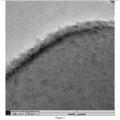
- Figure 2 is a TEM image of the prepared lithium iron phosphate composite material. It can be seen from Figure 2 that the thickness of the outer coating layer of carbon-coated lithium iron phosphate is about 1.5 nm to 2nm, and the coating layer is relatively uniform.
- Table 1 The physical and chemical indexes of the prepared lithium iron phosphate composite material were tested by conventional technical means, and the results are shown in Table 1 below: Table 1 index D10 D50 D90 Dmax carbon content numerical value 0.13 ⁇ m 0.25 ⁇ m 0.42 ⁇ m 0.59 ⁇ m 1.52% pH SSA TD powder compacted density grain size cell volume 9.25 13.95m 2 /g 0.83g/cm 3 2.39g/cc 102.7nm 290.65 ⁇ ⁇ 3
- This example provides a method for preparing a lithium iron phosphate composite material, the preparation method comprises:
- Li 6 MnO 4 was used as the core and carbon-coated lithium iron phosphate was used as the outer coating layer, and the mass ratio of Li 6 MnO 4 to carbon-coated lithium iron phosphate was 0.005:1.
- This example provides a method for preparing a lithium iron phosphate composite material, the preparation method comprises:
- Li 6 MnO 4 was used as the core and carbon-coated lithium iron phosphate as the outer coating layer, and the mass ratio of Li 6 MnO 4 to carbon-coated lithium iron phosphate was 0.01:1.
- This comparative example provides a method for preparing a lithium iron phosphate composite material, the preparation method comprises:
- Example 1 95.71 108.16 107.75 104.65
- Example 2 95.9 106.14 105.93 102.18
- Example 3 95.3 108.02 106.95 103.97
- Example 1 corresponds to a battery performance discharge capacity retention rate of 95.71% for 400 cycles, while the lithium iron phosphate material of the comparative example corresponds to a battery discharge capacity retention rate of only 91.82% for 400 cycles.
- Example 1 corresponds to battery performance with 1C discharge capacity of 108.16mAh, 2C discharge capacity of 107.75mAh, and 3C discharge capacity of 104.65mAh, while the comparative example of lithium iron phosphate material corresponds to battery performance with 1C discharge capacity of 97.36mAh, 2C discharge capacity of 92.97mAh, and 3C discharge capacity of 85.05mAh, indicating that the lithium iron phosphate composite material prepared in Example 1 has good rate capability and cycling performance.
- the preparation method of the present disclosure prepares the nano-scale lithium iron phosphate precursor by the sol-gel method, and uses the nano-scale lithium iron phosphate as the shell, uniformly coated on Li 6 MnO 4 , and uses Li 6 MnO 4 as the positive electrode lithium supplementation material and solves the problems of the loss of active lithium and the severe capacity depletion of a lithium iron phosphate positive electrode material during high-rate charging and discharging, such that the rate capability of the lithium iron phosphate material is improved, and the cycle life of a battery under high-rate conditions is prolonged.
- the preparation method disclosed in this disclosure can effectively reduce the temperature and time requirements for sintering of lithium iron phosphate materials, reduce production energy consumption and production cycle.
Landscapes
- Chemical & Material Sciences (AREA)
- Chemical Kinetics & Catalysis (AREA)
- Electrochemistry (AREA)
- General Chemical & Material Sciences (AREA)
- Inorganic Chemistry (AREA)
- Engineering & Computer Science (AREA)
- Organic Chemistry (AREA)
- Composite Materials (AREA)
- Manufacturing & Machinery (AREA)
- Materials Engineering (AREA)
- Crystallography & Structural Chemistry (AREA)
- Battery Electrode And Active Subsutance (AREA)
Abstract
Description
- The present disclosure relates to the technical field of battery materials, for example, to a lithium iron phosphate composite material, a preparation method therefor and a use thereof.
- With the innovation and development of technology, the market's requirements for the performance of lithium-ion batteries continue to increase, and high-rate lithium-ion batteries have gradually entered people's vision. Electric equipment such as car models, aircraft models, and ship models need to continuously provide large currents to meet high power requirements during work, so high-rate lithium-ion batteries are gradually selected as power sources; in the fields of national defense and military industry, such as electromagnetic interference, electromagnetic track launcher, magnetron and other equipment. Lithium-ion batteries mainly comprise three parts: positive electrode, electrolyte and negative electrode. Among them, the positive electrode material of lithium-ion battery is the key factor which determines the electrochemical performance, safety performance, energy density and price cost of the battery. At present, there are many positive electrode materials for lithium-ion batteries, such as cobalt-based positive electrode materials, nickel-based positive electrode materials, manganese-based positive electrode materials, and lithium iron phosphate positive electrode materials.
- Among them, the theoretical capacity of the lithium iron phosphate (LiFePO4) positive electrode material is 170mAh/g, with high reversible charge-discharge specific capacity, high energy density is, stable voltage platform, long service life, low cost, good safety performance and at the same time, it has the advantages of wide source of raw materials, low pollution, good safety and long cycle life, etc., and it is currently an ideal positive electrode material for power and energy storage lithium-ion batteries, which is widely used in power vehicles and energy storage and other industries.
- The crystal structure of lithium iron phosphate belongs to the olivine structure. The atoms in the crystal are arranged in a hexagonal close-packed manner, but there is a slight twist. It is an orthorhombic crystal system, and the space group is Pnma. Due to the structure of the LiFePO4 material, the electronic conductivity is low and the diffusion coefficient of lithium ions is small, resulting in poor rate capability, which greatly limits its development in the field of high-rate battery applications. At present, a large number of researches on the modification of lithium iron phosphate have been carried out at home and abroad to improve the conductivity of lithium iron phosphate, mainly including the preparation of nano-scale LiFePO4, the preparation of porous LiFePO4, and metal ion doping. However, there is still a lot of room for improvement in the electronic and ionic conductivity of lithium iron phosphate prepared by the above methods.
- The present disclosure provides a lithium iron phosphate composite material, a preparation method therefor and a use thereof.
- One embodiment of the present disclosure provides a lithium iron phosphate composite material, the lithium iron phosphate comprises a core and a shell that covers the surface of the core, the core is Li6MnO4, and the shell is carbon-coated lithium iron phosphate.
- In an embodiment provided by the present disclosure, the lithium iron phosphate composite material uses Li6MnO4 as a positive electrode lithium supplementation material, which solves the problems of the loss of active lithium and the severe capacity depletion of a lithium iron phosphate positive electrode material during high-rate charging and discharging, such that the rate capability of the lithium iron phosphate material is improved, and the cycle life of a battery under high-rate conditions is prolonged. Moreover, using a carbon-coated lithium iron phosphate layer as the shell can form a complete conductive network on the surface of lithium iron phosphate, which significantly improves the conductivity of carbon-coated lithium iron phosphate; at the same time, the carbon-coated lithium iron phosphate is spherical, which is beneficial to improve the tap density of the carbon-coated lithium iron phosphate.
- In one embodiment, the mass ratio of the core to the shell is in the range of 0.005:1 to 0.05:1, such as 0.005:1, 0.01:1, 0.015:1, 0.02:1, 0.025:1, 0.03:1, 0.035: 1, 0.04:1, 0.045:1 or 0.05:1 and so on.
- In one embodiment, the present disclosure provides a method for preparing the lithium iron phosphate composite material, wherein the method comprises:
preparing a carbon-coated lithium iron phosphate precursor sol by a sol-gel method, and mixing and stirring a Li6MnO4 precursor and the carbon-coated lithium iron phosphate precursor sol until the solvent is completely volatilized to obtain a wet material, and calcining the wet material to obtain the lithium iron phosphate composite material. - In one embodiment, a preparation process of the Li6MnO4 precursor comprises:
weighting a manganese source and a first lithium source respectively according to the stoichiometric ratio in Li6MnO4, and mixing the manganese source and the first lithium source, followed by ball milling and pre-calcining to obtain the Li6MnO4 precursor. - In one embodiment, the first lithium source comprises any one or a combination of at least two of lithium hydroxide, lithium carbonate, lithium acetate and lithium nitrate.
- The manganese source comprises any one or a combination of at least two of manganese hydroxide, manganese acetate and manganese monoxide.
- In one embodiment, the ball milling is carried out with a rotational speed ranging from 1000 r/min to 3500r/min, such as 1000r/min, 1200r/min, 1400r/min, 1600r/min, 1800r/min, 2000r/min, 2200r/min, 2400r/min, 2600r/min, 2800r/min, 3000r/min, 3200r/min, 3400r/min or 3500r/min and so on.
- The time of the ball milling is in a range from 0.5 hours to 2 hours, such as 0.5 hours, 0.6 hours, 0.7 hours, 0.8 hours, 0.9 hours, 1.0 hours, 1.1 hours, 1.2 hours, 1.3 hours, 1.4 hours, 1.5 hours, 1.6 hours, 1.7 hours, 1.8 hours, 1.9 hours or 2.0 hours and so on.
- In one embodiment, the temperature of pre-calcining is in a range from 300°C to 400°C, such as 300°C, 310°C, 320°C, 330°C, 340°C, 350°C, 360°C, 370°C, 380°C, 390°C or 400°C and so on.
- The time of pre-calcining is in a range from 1 hour to 3 hours, such as 1.0 hours, 1.2 hours, 1.4 hours, 1.6 hours, 1.8 hours, 2.0 hours, 2.2 hours, 2.4 hours, 2.6 hours, 2.8 hours or 3.0 hours.
- The pre-calcining is carried out under a nitrogen atmosphere or an argon atmosphere.
- In one embodiment, a preparation process of the carbon-coated lithium iron phosphate precursor sol comprises:
mixing and stirring an iron source and a solvent, and dispersing to obtain a dispersion liquid, adding a carbon source, a chelating agent, a phosphorus source and a second lithium source under stirring conditions, and performing a heat preservation for a period of time to obtain the carbon-coated lithium iron phosphate precursor sol. - In one embodiment, the iron source comprises any one or a combination of at least two of ferric nitrate, ferrous sulfate and ferrous oxalate.
- The solvent comprises deionized water.
- The carbon source comprises any one or a combination of at least two of glucose, sucrose and polyethylene glycol.
- The chelating agent comprises polyethylene glycol and/or citric acid.
- The phosphorus source comprises any one or a combination of at least two of lithium dihydrogen phosphate, ammonium dihydrogen phosphate and diammonium hydrogen phosphate.
- The second lithium source comprises any one or a combination of at least two of lithium hydroxide, lithium acetate, lithium nitrate and lithium dihydrogen phosphate.
- In one embodiment, the molar ratio of Li element in the second lithium source, Fe element in the iron source and P element in the phosphorus source is in the range of 1.001:1:1 to 1.01:1:1, such as 1.001:1:1, 1.002:1:1, 1.003:1:1, 1.004:1:1, 1.005:1:1, 1.006:1:1, 1.007:1:1, 1.008:1:1, 1.009:1:1, or 1.01:1:1 and so on.
- The mass ratio of the total mass of the second lithium source, the iron source and the phosphorus source to the carbon source is in the range of 1:0.01 to 1:0.05, such as 1:0.01, 1:0.015, 1:0.02, 1:0.025, 1:0.03, 1:0.035, 1:0.04, 1:0.045 or 1:0.05 and so on.
- The mass ratio of the total mass of the second lithium source, the iron source and the phosphorus source to the chelating agent is in the range of 1:0.01 to 1:0.05, such as 1:0.01, 1:0.015, 1:0.02, 1:0.025, 1:0.03, 1:0.035, 1:0.04, 1:0.045 or 1:0.05 and so on.
- In one embodiment, the temperature of the heat preservation is in a range from 50°C to 70°C, such as 50°C, 52°C, 54°C, 56°C, 58°C, 60°C, 62°C, 64°C, 66°C, 68°C or 70°C and so on.
- The time of the heat preservation is in a range from 5 hours to 10 hours, such as 5.0 hours, 5.5 hours, 6.0 hours, 6.5 hours, 7.0 hours, 7.5 hours, 8.0 hours, 8.5 hours, 9.0 hours, 9.5 hours or 10.0 hours.
- In one embodiment, the temperature of the mixing and stirring is in a range from 70°C to 90°C, such as 70°C, 72°C, 74°C, 76°C, 78°C, 80°C, 82°C, 84°C, 86°C, 88°C or 90°C and so on.
- In one embodiment, the calcining is carried out using gradient calcination.
- The gradient calcination process comprises:
raising the temperature of the material to T1, keeping warm at H1, then continuing to raise the temperature to T2, and keeping warm at H2. - The T1 is in a range from 350°C to 390°C, such as 350°C, 355°C, 360°C, 365°C, 370°C, 375°C, 380°C, 385°C or 390°C.
- The H2 is in a range from 12 min to 25 min, such as 12 min, 13 min, 14 min, 15 min, 16 min, 17 min, 18 min, 19 min, 20 min, 21 min, 22 min, 23 min, 24 min or 25 min.
- The T2 is in a range from 600°C to 770°C, such as 600°C, 610°C, 620°C, 630°C, 640°C, 650°C, 660°C, 670°C, 680°C, 690°C, 700°C, 710°C, 720°C, 730°C, 740°C, 750°C, 760°C or 770°C and so on.
- The H2 is in a range from 0.5 hours to 5 hours, such as 0.5 hours, 1 hour, 1.5 hours, 2 hours, 2.5 hours, 3 hours, 3.5 hours, 4 hours, 4.5 hours or 5 hours.
- The calcining is carried out under a nitrogen atmosphere or an argon atmosphere.
- In one embodiment, the present disclosure provides a lithium battery. The lithium battery comprises a positive electrode, a separator and a negative electrode stacked in sequence, the positive electrode comprises a positive current collector and a positive active layer arranged on the surface of the positive current collector, and the positive active layer comprises the lithium iron phosphate composite material provided in an embodiment.
- The drawings are used to provide a further understanding of the technical solutions of the present disclosure, and constitute a part of the description, and are used together with the embodiments of the application to explain the technical solutions of the present disclosure, and do not constitute limitations to the technical solutions of the present disclosure.
-
Figure 1 is a SEM image of the lithium iron phosphate composite material prepared by an example of the present disclosure; -
Figure 2 is a TEM image of the lithium iron phosphate composite material prepared by an example of the present disclosure; -
Figure 3 is a diagram of the discharge capacity retention rate of an example and a comparative example of the present disclosure under the conditions of 25°C and 3C rate; -
Figure 4 is a diagram of the discharge capacity of an example and a comparative example of the present disclosure under the conditions of -10°C and different rate. - The technical solutions of the present disclosure will be further described below in conjunction with the drawings and detailed embodiments.
- The method for preparing lithium iron phosphate composite material is provided in the example, and the method comprises:
- (1) Preparation of Li6MnO4 precursor: lithium hydroxide and manganese monoxide were weighted according to the molar ratio Li:Mn=6:1, lithium hydroxide and manganese monoxide were mixed, and ball milled at 3500r/min in a high-speed ball mill for 0.5h, pre-calcined at 400°C for 1h to obtain the Li6MnO4 precursor, ready for use;
- (2) Preparation of carbon-coated lithium iron phosphate precursor sol: ferrous oxalate was added to deionized water and stirred to disperse to form a dispersion liquid. Under stirring conditions, sucrose, polyethylene glycol, ammonium dihydrogen phosphate and hydrogen lithium oxide were added, and the dispersion liquid was kept at 70°C for 5h to obtain the carbon-coated lithium iron phosphate precursor sol, wherein the molar ratio of Li:Fe:P in lithium hydroxide, iron nitrate and ammonium dihydrogen phosphate was 1.01: 1:1, the mass ratio of the total mass of lithium hydroxide, ferric nitrate and ammonium dihydrogen phosphate to glucose was 1:0.05, the mass ratio of the total mass of lithium hydroxide, ferric nitrate and ammonium dihydrogen phosphate to polyethylene glycol was 1:0.05;
- (3) Preparation of lithium iron phosphate composite material: the Li6MnO4 precursor prepared in step (1) were added to the carbon-coated lithium iron phosphate precursor sol prepared in step (2), and the solution temperature was kept at 90°C, and kept stirring until the solvent was fully volatilized to obtain the wet material; the wet material was gradient calcined, and heated to 390°C in a high-purity nitrogen atmosphere, and kept for 12 min; then continued to heat to 770°C, kept for 0.5h to obtain the lithium iron phosphate composite material.
- In the lithium iron phosphate composite material, Li6MnO4 was used as the core and carbon-coated lithium iron phosphate was used as the outer coating layer, and the mass ratio of Li6MnO4 to carbon-coated lithium iron phosphate was 0.05:1. Among them,
Figure 1 is a SEM image of the prepared lithium iron phosphate composite material. It can be seen fromFigure 1 that the particle size of the composite material is relatively uniform, and the particle size is basically kept within 1 µm;Figure 2 is a TEM image of the prepared lithium iron phosphate composite material. It can be seen fromFigure 2 that the thickness of the outer coating layer of carbon-coated lithium iron phosphate is about 1.5 nm to 2nm, and the coating layer is relatively uniform. - The physical and chemical indexes of the prepared lithium iron phosphate composite material were tested by conventional technical means, and the results are shown in Table 1 below:
Table 1 index D10 D50 D90 Dmax carbon content numerical value 0.13µm 0.25µm 0.42µm 0.59µm 1.52% pH SSA TD powder compacted density grain size cell volume 9.25 13.95m2/g 0.83g/cm3 2.39g/cc 102.7nm 290.65Å^3 - This example provides a method for preparing a lithium iron phosphate composite material, the preparation method comprises:
- (1) Preparation of Li6MnO4 precursor: lithium hydroxide and manganese hydroxide were weighted according to the molar ratio Li:Mn=6:1, lithium hydroxide and manganese monoxide were mixed, and ball milled at 1000r/min in a high-speed ball mill for 2h , pre-calcined at 300°C for 3h to obtain the Li6MnO4 precursor, ready for use;
- (2) Preparation of carbon-coated lithium iron phosphate precursor sol: iron nitrate was added to deionized water and stirred to disperse to form a dispersion liquid. Under stirring conditions, sucrose, polyethylene glycol, ammonium dihydrogen phosphate and dihydrogen phosphate were added in sequence. The dispersion liquid was kept at 50°C for 10h to obtain the carbon-coated lithium iron phosphate precursor sol, wherein the molar ratio of Li:Fe:P in dihydrogen phosphate, iron nitrate and ammonium dihydrogen phosphate was 1.001: 1:1, the mass ratio of the total mass of dihydrogen phosphate, iron nitrate and ammonium dihydrogen phosphate to glucose was 1:0.01, the mass ratio of the total mass of dihydrogen phosphate, iron nitrate and ammonium dihydrogen phosphate to polyethylene glycol was 1:0.01;
- (3) Preparation of lithium iron phosphate composite material: the Li6MnO4 precursor prepared in step (1) were added to the carbon-coated lithium iron phosphate precursor sol prepared in step (2), and the solution temperature was kept at 70°C, and kept stirring until the solvent was fully volatilized to obtain the wet material; the wet material was gradient calcined, and heated to 350°C in a high-purity nitrogen atmosphere, and kept for 25 min; then continued to heat to 600°C, kept for 5h to obtain the lithium iron phosphate composite material.
- In the lithium iron phosphate composite material, Li6MnO4 was used as the core and carbon-coated lithium iron phosphate was used as the outer coating layer, and the mass ratio of Li6MnO4 to carbon-coated lithium iron phosphate was 0.005:1.
- This example provides a method for preparing a lithium iron phosphate composite material, the preparation method comprises:
- (1) Preparation of Li6MnO4 precursor: lithium hydroxide and manganese monoxide were weighted according to the molar ratio Li:Mn=6:1, lithium hydroxide and manganese monoxide were mixed, and ball milled at 2400r/min in a high-speed ball mill for 1h, pre-calcined at 360°C for 2h to obtain the Li6MnO4 precursor, ready for use;
- (2) Preparation of carbon-coated lithium iron phosphate precursor sol: ferrous oxalate was added to deionized water and stirred to disperse to form a dispersion liquid. Under stirring conditions, sucrose, citric acid, ammonium dihydrogen phosphate and lithium nitrate were added in sequence, and the dispersion liquid was kept at 60°C for 7h to obtain the carbon-coated lithium iron phosphate precursor sol, wherein the molar ratio of Li:Fe:P in lithium nitrate, ferrous oxalate and ammonium dihydrogen phosphate was 1.005:1:1, the mass ratio of the total mass of lithium nitrate, ferrous oxalate and ammonium dihydrogen phosphate to sucrose was 1:0.02, the mass ratio of the total mass of lithium nitrate, ferrous oxalate and ammonium dihydrogen phosphate to polyethylene glycol was 1:0.03;
- (3) Preparation of lithium iron phosphate composite material: the Li6MnO4 precursor prepared in step (1) were added to the carbon-coated lithium iron phosphate precursor sol prepared in step (2), and the solution temperature was kept at 80°C, and kept stirring until the solvent was fully volatilized to obtain the wet material; the wet material was gradient calcined, and heated to 370°C in a high-purity nitrogen atmosphere, and kept for 20 min; then continued to heat to 700°C, kept for 2h to obtain the lithium iron phosphate composite material.
- In the lithium iron phosphate composite material, Li6MnO4 was used as the core and carbon-coated lithium iron phosphate as the outer coating layer, and the mass ratio of Li6MnO4 to carbon-coated lithium iron phosphate was 0.01:1.
- This comparative example provides a method for preparing a lithium iron phosphate composite material, the preparation method comprises:
- (1) Preparation of carbon-coated lithium iron phosphate precursor sol: ferrous oxalate was added to deionized water and stirred to disperse to form a dispersion liquid. Under stirring conditions, sucrose, polyethylene glycol, ammonium dihydrogen phosphate and hydrogen lithium oxide were added, and the dispersion liquid was kept at 50°C for 5h to obtain the carbon-coated lithium iron phosphate precursor sol, wherein the molar ratio of Li:Fe:P in lithium hydroxide, iron nitrate and ammonium dihydrogen phosphate was 1.001:1:1, the mass ratio of the total mass of lithium hydroxide, ferric nitrate and ammonium dihydrogen phosphate to glucose was 0.01:1, the mass ratio of the total mass of lithium hydroxide, ferric nitrate and ammonium dihydrogen phosphate to polyethylene glycol was 0.01:1;
- (2) The carbon-coated lithium iron phosphate precursor prepared in step (1) was continuously stirred at 70°C until the solvent was fully volatilized to obtain a wet material, the wet material was gradient calcined, and heated to 350°C in a high-purity nitrogen atmosphere, and kept for 12 min; then continued to heat to 600°C, kept for 0.5h to obtain the carbon-coated lithium iron phosphate composite material.
- The lithium iron phosphate materials prepared in Examples 1-3 and Comparative Example were tested for electrochemical performance in a lithium-ion battery, and the results are shown in Table 2.
Figure 3 shows the comparison of discharge capacity retention rates between Example 1 and the comparison example under the conditions of 25°C and 3C rate, andFigure 4 shows the comparison of discharge capacities between Example 1 and the comparison example under the conditions of -10°C and different rate.Table 2 Example 25 °C 3C discharge capacity 400 cycles retention rate (%)-10°C 1C discharge capacity (mAh) -10°C 2C discharge capacity (mAh) -10°C 3C discharge capacity (mAh) Example 1 95.71 108.16 107.75 104.65 Example 2 95.9 106.14 105.93 102.18 Example 3 95.3 108.02 106.95 103.97 Comparative example 91.82 97.36 92.97 85.05 - It can be seen from the data in Table 1 that the capacity retention rate of the carbon-coated lithium iron phosphate positive electrode material prepared in Comparative Example 1 and the discharge capacity at different discharge rates are smaller than those in the examples.
- It can be seen from
Figure 3 that under the condition of 3C (25°C 2.0-3.65V), Example 1 corresponds to a battery performance discharge capacity retention rate of 95.71% for 400 cycles, while the lithium iron phosphate material of the comparative example corresponds to a battery discharge capacity retention rate of only 91.82% for 400 cycles. It can be seen fromFigure 4 that under the conditions of -10°C (1C/2C/3C 2.0-3.65V), Example 1 corresponds to battery performance with 1C discharge capacity of 108.16mAh, 2C discharge capacity of 107.75mAh, and 3C discharge capacity of 104.65mAh, while the comparative example of lithium iron phosphate material corresponds to battery performance with 1C discharge capacity of 97.36mAh, 2C discharge capacity of 92.97mAh, and 3C discharge capacity of 85.05mAh, indicating that the lithium iron phosphate composite material prepared in Example 1 has good rate capability and cycling performance. - In conclusion, the preparation method of the present disclosure prepares the nano-scale lithium iron phosphate precursor by the sol-gel method, and uses the nano-scale lithium iron phosphate as the shell, uniformly coated on Li6MnO4, and uses Li6MnO4 as the positive electrode lithium supplementation material and solves the problems of the loss of active lithium and the severe capacity depletion of a lithium iron phosphate positive electrode material during high-rate charging and discharging, such that the rate capability of the lithium iron phosphate material is improved, and the cycle life of a battery under high-rate conditions is prolonged. And the preparation method disclosed in this disclosure can effectively reduce the temperature and time requirements for sintering of lithium iron phosphate materials, reduce production energy consumption and production cycle.
Claims (14)
- A lithium iron phosphate composite material, wherein the lithium iron phosphate composite material comprises a core and a shell that covers the surface of the core, the core is Li6MnO4, and the shell is carbon-coated lithium iron phosphate.
- The lithium iron phosphate composite material of claim 1, wherein the mass ratio of the core to the shell is in the range of 0.005:1 to 0.05:1.
- A method for preparing the lithium iron phosphate composite material of claim 1 or 2, wherein the method comprises:
preparing a carbon-coated lithium iron phosphate precursor sol by a sol-gel method, and mixing and stirring a Li6MnO4 precursor and the carbon-coated lithium iron phosphate precursor sol until the solvent is completely volatilized to obtain a wet material, and calcining the wet material to obtain the lithium iron phosphate composite material. - The method of claim 3, wherein a preparation process of the Li6MnO4 precursor comprises:
weighting a manganese source and a first lithium source respectively according to the stoichiometric ratio in Li6MnO4, and mixing the manganese source and the first lithium source, followed by ball milling and pre-calcining to obtain the Li6MnO4 precursor. - The method of claim 4, wherein the first lithium source comprises any one or a combination of at least two of lithium hydroxide, lithium carbonate, lithium acetate and lithium nitrate; and
the manganese source comprises any one or a combination of at least two of manganese hydroxide, manganese acetate and manganese monoxide. - The method of claim 4, wherein the ball milling is carried out with a rotational speed ranging from 1000 r/min to 3500 r/min; and
the time of ball milling is in a range from 0.5 hours to 2 hours. - The method of claim 4, wherein the temperature of pre-calcining is in a range from 300°C to 400°C;the time of pre-calcining is in a range from 1hour to 3 hours; andthe pre-calcining is carried out under a nitrogen atmosphere or an argon atmosphere.
- The method of claim 3, wherein a preparation process of the carbon-coated lithium iron phosphate precursor sol comprises:
mixing and stirring an iron source and a solvent, and dispersing to obtain a dispersion liquid, adding a carbon source, a chelating agent, a phosphorus source and a second lithium source under stirring conditions, and performing a heat preservation for a period of time to obtain the carbon-coated lithium iron phosphate precursor sol. - The method of claim 8, wherein the iron source comprises any one or a combination of at least two of ferric nitrate, ferrous sulfate and ferrous oxalate;the solvent comprises deionized water;the carbon source comprises any one or a combination of at least two of glucose, sucrose and polyethylene glycol;the chelating agent comprises polyethylene glycol and/or citric acid;the phosphorus source comprises any one or a combination of at least two of lithium dihydrogen phosphate, ammonium dihydrogen phosphate and diammonium hydrogen phosphate; andthe second lithium source comprises any one or a combination of at least two of lithium hydroxide, lithium acetate, lithium nitrate and lithium dihydrogen phosphate.
- The method of claim 8, wherein the molar ratio of Li element in the second lithium source, Fe element in the iron source and P element in the phosphorus source is in the range of 1.001:1:1 to 1.01:1:1;the mass ratio of the total mass of the second lithium source, the iron source and the phosphorus source to the carbon source is in the range of 1:0.01 to 1:0.05;the mass ratio of the total mass of the second lithium source, the iron source and the phosphorus source to the chelating agent is in the range of 1:0.01 to 1:0.05.
- The method of claim 8, wherein the temperature of the heat preservation is in a range from 50°C to 70°C; and the time of the heat preservation is in a range from 5 hours to 10 hours.
- The method of claim 3, wherein the temperature of the mixing and stirring is in a range from 70°C to 90°C.
- The method of claim 3, wherein the calcining is carried out using gradient calcination;
the gradient calcination process comprises:raising the temperature of the material to T1, keeping warm at H1, then continuing to raise the temperature to T2, and keeping warm at H2;the T1 is in a range from 350°C to 390°C;the H2 is in a range from 12min to 25 min;the T2 is in a range from 600°C to 770°C;the H2 is in a range from 0.5h to 5h; andthe calcining is carried out under a nitrogen atmosphere or an argon atmosphere. - A lithium battery, wherein the lithium battery comprises a positive electrode, a separator and a negative electrode stacked in sequence, the positive electrode comprises a positive current collector and a positive active layer arranged on the surface of the positive current collector, and the positive active layer comprises the lithium iron phosphate composite material of claim 1 or 2.
Applications Claiming Priority (2)
| Application Number | Priority Date | Filing Date | Title |
|---|---|---|---|
| CN202111547010.3A CN114242980B (en) | 2021-12-16 | 2021-12-16 | A kind of lithium iron phosphate composite material, preparation method and use |
| PCT/CN2022/086015 WO2023108961A1 (en) | 2021-12-16 | 2022-04-11 | Lithium iron phosphate composite material, and preparation method therefor and use thereof |
Publications (2)
| Publication Number | Publication Date |
|---|---|
| EP4411877A1 true EP4411877A1 (en) | 2024-08-07 |
| EP4411877A4 EP4411877A4 (en) | 2025-10-15 |
Family
ID=80757509
Family Applications (1)
| Application Number | Title | Priority Date | Filing Date |
|---|---|---|---|
| EP22905731.0A Pending EP4411877A4 (en) | 2021-12-16 | 2022-04-11 | Lithium iron phosphate composite material and manufacturing process therefor and use thereof |
Country Status (4)
| Country | Link |
|---|---|
| US (1) | US20250304446A1 (en) |
| EP (1) | EP4411877A4 (en) |
| CN (1) | CN114242980B (en) |
| WO (1) | WO2023108961A1 (en) |
Families Citing this family (8)
| Publication number | Priority date | Publication date | Assignee | Title |
|---|---|---|---|---|
| CN114242980B (en) * | 2021-12-16 | 2023-10-31 | 蜂巢能源科技股份有限公司 | A kind of lithium iron phosphate composite material, preparation method and use |
| CN115057487B (en) * | 2022-06-30 | 2025-01-14 | 蜂巢能源科技股份有限公司 | Single crystal cobalt-free positive electrode material, preparation method thereof and lithium ion battery |
| TWI838075B (en) * | 2023-01-11 | 2024-04-01 | 台灣立凱電能科技股份有限公司 | Manufacturing method of carbon-coated lithium iron phosphate material |
| TWI838175B (en) * | 2023-03-21 | 2024-04-01 | 台灣立凱電能科技股份有限公司 | Manufacturing method of carbon-coated lithium iron phosphate material |
| WO2025065339A1 (en) * | 2023-09-27 | 2025-04-03 | 广东邦普循环科技有限公司 | Lithium iron phosphate composite material, and preparation method therefor and use thereof |
| CN117985675A (en) * | 2024-02-26 | 2024-05-07 | 深圳市德方纳米科技股份有限公司 | Phosphate-based positive electrode material and preparation method thereof, positive electrode sheet and battery |
| CN119812243A (en) * | 2024-12-11 | 2025-04-11 | 国网湖南省电力有限公司 | Coated lithium supplement material, preparation method and application thereof, and lithium ion battery |
| CN120172377B (en) * | 2025-05-16 | 2025-08-05 | 江苏正力新能电池技术股份有限公司 | Preparation method of lithium iron phosphate positive electrode material, pole piece and battery |
Family Cites Families (19)
| Publication number | Priority date | Publication date | Assignee | Title |
|---|---|---|---|---|
| CN101740752B (en) * | 2009-12-16 | 2012-01-18 | 深圳市德方纳米科技有限公司 | Core-shell composite anode material for lithium ion battery and preparation method thereof |
| CN103359701B (en) * | 2013-06-28 | 2015-10-21 | 清华大学 | The preparation method of iron lithium phosphate |
| WO2015011883A1 (en) * | 2013-07-25 | 2015-01-29 | 株式会社豊田自動織機 | Pre-doping agent, positive electrode, lithium ion secondary battery, and method for producing same |
| CN103500829B (en) * | 2013-08-15 | 2016-12-28 | 江苏华东锂电技术研究院有限公司 | The preparation method of LiFePO 4 |
| CN103682344A (en) * | 2013-12-25 | 2014-03-26 | 天津斯特兰能源科技有限公司 | Method for synthetizing lithium iron phosphate material by utilizing sol-gel method |
| CN109390563B (en) * | 2017-08-03 | 2021-03-16 | 宁德新能源科技有限公司 | Modified lithium iron phosphate positive electrode material and preparation method thereof, positive electrode sheet, and lithium secondary battery |
| CN107968195A (en) * | 2017-11-22 | 2018-04-27 | 合肥国轩高科动力能源有限公司 | Lithium-rich cathode material coated with lithium iron phosphate and preparation method thereof |
| JP2019145402A (en) * | 2018-02-22 | 2019-08-29 | 株式会社豊田自動織機 | Lithium ion secondary battery |
| CN108598383A (en) * | 2018-03-15 | 2018-09-28 | 桑顿新能源科技有限公司 | A kind of preparation method of the spherical composite ferric lithium phosphate material of Ti, N codope |
| CN110299515B (en) * | 2018-03-23 | 2023-08-08 | 比亚迪股份有限公司 | A kind of positive electrode active material and preparation method thereof, positive electrode and battery |
| CN108682894A (en) * | 2018-05-11 | 2018-10-19 | 江西中汽瑞华新能源科技有限公司 | A kind of lithium ion battery manufacture craft |
| CN109346335A (en) * | 2018-09-28 | 2019-02-15 | 桑顿新能源科技有限公司 | Lithium source active material, anode pole piece, lithium-ion capacitor and preparation method thereof |
| CN111146412A (en) * | 2018-11-02 | 2020-05-12 | 常州烯蓬新材料科技有限公司 | Method for manufacturing novel composite phase lithium battery positive electrode material |
| CN112054166B (en) * | 2019-06-06 | 2021-08-06 | 苏州第一元素纳米技术有限公司 | Core-shell structure electrochemical active material, preparation method and battery |
| CN113097455B (en) * | 2021-02-23 | 2022-03-18 | 云南航开科技有限公司 | Modified lithium iron phosphate composite material, positive electrode material and preparation method thereof |
| CN113555538A (en) * | 2021-06-21 | 2021-10-26 | 深圳市德方纳米科技股份有限公司 | Carbon-free high-capacity cathode material and preparation method thereof |
| CN115810725A (en) * | 2021-09-15 | 2023-03-17 | 天合光能股份有限公司 | Core-shell three-layer composite structure cathode material and preparation method and application thereof |
| CN113772650B (en) * | 2021-09-22 | 2023-04-28 | 河南佰利新能源材料有限公司 | Preparation method and application of lithium iron phosphate |
| CN114242980B (en) * | 2021-12-16 | 2023-10-31 | 蜂巢能源科技股份有限公司 | A kind of lithium iron phosphate composite material, preparation method and use |
-
2021
- 2021-12-16 CN CN202111547010.3A patent/CN114242980B/en active Active
-
2022
- 2022-04-11 WO PCT/CN2022/086015 patent/WO2023108961A1/en not_active Ceased
- 2022-04-11 EP EP22905731.0A patent/EP4411877A4/en active Pending
-
2024
- 2024-06-13 US US18/719,409 patent/US20250304446A1/en active Pending
Also Published As
| Publication number | Publication date |
|---|---|
| CN114242980B (en) | 2023-10-31 |
| WO2023108961A1 (en) | 2023-06-22 |
| CN114242980A (en) | 2022-03-25 |
| EP4411877A4 (en) | 2025-10-15 |
| US20250304446A1 (en) | 2025-10-02 |
Similar Documents
| Publication | Publication Date | Title |
|---|---|---|
| EP4343891A1 (en) | Sodium-containing oxide positive electrode material and preparation method therefor and use thereof, and positive electrode plate and use thereof | |
| US20250304446A1 (en) | Lithium iron phosphate composite material, preparation method and use | |
| EP4024519A1 (en) | Positive electrode material, preparation method therefor and lithium ion battery | |
| KR101400593B1 (en) | Cathode active material, method for preparing the same, and lithium secondary batteries comprising the same | |
| WO2023185548A1 (en) | Modified lithium manganese iron phosphate positive electrode material, and preparation method and application thereof | |
| CN109659542A (en) | A kind of high voltage lithium cobalt oxide anode of core-shell structure and preparation method thereof | |
| US20120264018A1 (en) | Composite positive electrode material with core-shell structure for lithium ion batteries and preparing method thereof | |
| CN108777296A (en) | A kind of surface is modified nickelic tertiary cathode material and its prepares and its manufactured battery | |
| CN107204428A (en) | A kind of method of phosphoric acid vanadium lithium coated lithium ion battery ternary material | |
| CN103441252A (en) | Method for preparing lithium-enriched manganese-based anode material of nano-oxide-coated lithium ion battery | |
| CN102024947B (en) | LiFePO4/Li-Al-O composite positive electrode material and preparation method thereof | |
| CN116230882B (en) | A high-nickel ternary positive electrode material for lithium battery, preparation method and lithium battery | |
| CN110783546A (en) | Lithium ion battery positive electrode material and preparation method thereof, lithium ion battery positive electrode slurry and positive electrode, lithium ion battery and equipment | |
| CN108807920B (en) | LASO-coated octahedral-structure lithium nickel manganese oxide composite material and preparation method thereof | |
| CN108777291A (en) | A kind of LiMn2O4 coats the preparation method of nickelic ternary anode material of lithium battery | |
| CN115806319A (en) | Layered high-entropy oxide, preparation method and application thereof | |
| CN116924371A (en) | Preparation method of core-shell structure ferric manganese sodium phosphate anode material | |
| CN117525317A (en) | Manganese-assisted carbon-coated lithium iron manganese phosphate material and preparation method thereof | |
| CN119637958A (en) | High-entropy doping site design modified high-magnification lithium nickel manganese oxide material, preparation method thereof and lithium ion battery | |
| CN112573585A (en) | High-voltage lithium cobalt oxide cathode material and preparation method thereof | |
| CN103456945A (en) | Preparation method of low-cost lithium ion battery anode material | |
| CN109461930B (en) | Gradient-structured multi-component material for lithium ion battery and preparation method thereof | |
| CN114142010A (en) | Magnesium oxide and cerium fluoride composite coated lithium ion battery positive electrode material and preparation method thereof | |
| CN113161534A (en) | Co-doped modified lithium ion battery ternary cathode material and preparation method thereof | |
| CN118054005A (en) | Sodium ion layered anode material and preparation method and application thereof |
Legal Events
| Date | Code | Title | Description |
|---|---|---|---|
| STAA | Information on the status of an ep patent application or granted ep patent |
Free format text: STATUS: THE INTERNATIONAL PUBLICATION HAS BEEN MADE |
|
| PUAI | Public reference made under article 153(3) epc to a published international application that has entered the european phase |
Free format text: ORIGINAL CODE: 0009012 |
|
| STAA | Information on the status of an ep patent application or granted ep patent |
Free format text: STATUS: REQUEST FOR EXAMINATION WAS MADE |
|
| 17P | Request for examination filed |
Effective date: 20240503 |
|
| AK | Designated contracting states |
Kind code of ref document: A1 Designated state(s): AL AT BE BG CH CY CZ DE DK EE ES FI FR GB GR HR HU IE IS IT LI LT LU LV MC MK MT NL NO PL PT RO RS SE SI SK SM TR |
|
| DAV | Request for validation of the european patent (deleted) | ||
| DAX | Request for extension of the european patent (deleted) | ||
| A4 | Supplementary search report drawn up and despatched |
Effective date: 20250915 |
|
| RIC1 | Information provided on ipc code assigned before grant |
Ipc: H01M 4/36 20060101AFI20250909BHEP Ipc: H01M 4/505 20100101ALI20250909BHEP Ipc: H01M 4/58 20100101ALI20250909BHEP Ipc: H01M 4/62 20060101ALI20250909BHEP Ipc: H01M 10/0525 20100101ALI20250909BHEP |