EP4411203A1 - Gas quantity estimation device, gas processing device, transportation container, gas quantity estimation method, and program - Google Patents
Gas quantity estimation device, gas processing device, transportation container, gas quantity estimation method, and program Download PDFInfo
- Publication number
- EP4411203A1 EP4411203A1 EP22876258.9A EP22876258A EP4411203A1 EP 4411203 A1 EP4411203 A1 EP 4411203A1 EP 22876258 A EP22876258 A EP 22876258A EP 4411203 A1 EP4411203 A1 EP 4411203A1
- Authority
- EP
- European Patent Office
- Prior art keywords
- gas
- amount
- refrigerator
- processing
- data
- Prior art date
- Legal status (The legal status is an assumption and is not a legal conclusion. Google has not performed a legal analysis and makes no representation as to the accuracy of the status listed.)
- Pending
Links
Images





Classifications
-
- F—MECHANICAL ENGINEERING; LIGHTING; HEATING; WEAPONS; BLASTING
- F17—STORING OR DISTRIBUTING GASES OR LIQUIDS
- F17C—VESSELS FOR CONTAINING OR STORING COMPRESSED, LIQUEFIED OR SOLIDIFIED GASES; FIXED-CAPACITY GAS-HOLDERS; FILLING VESSELS WITH, OR DISCHARGING FROM VESSELS, COMPRESSED, LIQUEFIED, OR SOLIDIFIED GASES
- F17C13/00—Details of vessels or of the filling or discharging of vessels
- F17C13/02—Special adaptations of indicating, measuring, or monitoring equipment
-
- F—MECHANICAL ENGINEERING; LIGHTING; HEATING; WEAPONS; BLASTING
- F25—REFRIGERATION OR COOLING; COMBINED HEATING AND REFRIGERATION SYSTEMS; HEAT PUMP SYSTEMS; MANUFACTURE OR STORAGE OF ICE; LIQUEFACTION SOLIDIFICATION OF GASES
- F25D—REFRIGERATORS; COLD ROOMS; ICE-BOXES; COOLING OR FREEZING APPARATUS NOT OTHERWISE PROVIDED FOR
- F25D17/00—Arrangements for circulating cooling fluids; Arrangements for circulating gas, e.g. air, within refrigerated spaces
- F25D17/04—Arrangements for circulating cooling fluids; Arrangements for circulating gas, e.g. air, within refrigerated spaces for circulating air, e.g. by convection
- F25D17/042—Air treating means within refrigerated spaces
-
- F—MECHANICAL ENGINEERING; LIGHTING; HEATING; WEAPONS; BLASTING
- F25—REFRIGERATION OR COOLING; COMBINED HEATING AND REFRIGERATION SYSTEMS; HEAT PUMP SYSTEMS; MANUFACTURE OR STORAGE OF ICE; LIQUEFACTION SOLIDIFICATION OF GASES
- F25D—REFRIGERATORS; COLD ROOMS; ICE-BOXES; COOLING OR FREEZING APPARATUS NOT OTHERWISE PROVIDED FOR
- F25D11/00—Self-contained movable devices, e.g. domestic refrigerators
- F25D11/003—Transport containers
-
- G—PHYSICS
- G06—COMPUTING OR CALCULATING; COUNTING
- G06Q—INFORMATION AND COMMUNICATION TECHNOLOGY [ICT] SPECIALLY ADAPTED FOR ADMINISTRATIVE, COMMERCIAL, FINANCIAL, MANAGERIAL OR SUPERVISORY PURPOSES; SYSTEMS OR METHODS SPECIALLY ADAPTED FOR ADMINISTRATIVE, COMMERCIAL, FINANCIAL, MANAGERIAL OR SUPERVISORY PURPOSES, NOT OTHERWISE PROVIDED FOR
- G06Q50/00—Information and communication technology [ICT] specially adapted for implementation of business processes of specific business sectors, e.g. utilities or tourism
- G06Q50/10—Services
Definitions
- the present disclosure relates to a gas amount estimation apparatus, a gas processing apparatus, a transportation container, a gas amount estimation method, and a program.
- Patent document 1 Japanese Unexamined Patent Application Publication No. S54-72099
- CA gas when CA gas is injected into a truck or the like, it is unclear what amount of CA gas needs to be processed during transportation, such as the amount of CA gas to be supplied or removed. Therefore, when the injected CA gas is insufficient, the freshness of perishable products cannot be maintained above a certain level. Further, although relatively large amounts of CA gas may be injected, a problem arises that a gas processing apparatus such as a CA gas cylinder becomes large and the amount of perishable products that can be transported becomes small.
- an object of the present disclosure is to optimize the injection amount of the CA gas.
- a first aspect of the present disclosure is a gas amount estimation apparatus including
- the injection amount of CA gas can be optimized.
- a second aspect of the present disclosure is the gas amount estimation apparatus according to the first aspect, wherein the control unit calculates the supply amount or the processing amount of the CA gas by using a result obtained by learning, by machine learning, a relationship between the input data, which is the information relating to the type and the amount of the perishable product stored in the CA refrigerator, and a true supply amount or a true processing amount of the CA gas.
- the injection amount of the CA gas can be optimized by using the result learned by machine learning.
- a third aspect of the present disclosure is the gas amount estimation apparatus according to the first aspect, wherein the control unit calculates the supply amount or the processing amount of the CA gas by using table data indicating a relationship between the input data, which is the information relating to the type and the amount of the perishable product stored in the CA refrigerator, and a true supply amount or a true processing amount of the CA gas.
- the CA gas injection amount can be optimized by using table data.
- a fourth aspect of the present disclosure is the gas amount estimation apparatus according to any one of the first to third aspects, wherein
- the CA gas injection amount can be optimized with higher accuracy by including the temperature or humidity in the CA refrigerator during the transportation of the perishable product in the input data.
- a fifth aspect of the present disclosure is the gas amount estimation apparatus according to any one of the first to third aspects, wherein the control unit further estimates the supply amount or the processing amount of the CA gas based on a transportation time of the perishable product.
- the injection amount of the CA gas can be optimized with higher accuracy even when the transportation time is relatively long.
- the sixth aspect of the present disclosure is the gas amount estimation apparatus according to any one of the first to fifth aspects, wherein
- the CA gas injection amount can be optimized with higher accuracy by estimating the CA gas supply amount or removal amount.
- the seventh aspect of the present disclosure is the gas amount estimation apparatus according to any one of the first to fifth aspects, wherein the control unit calculates a number of gas amount control apparatuses configured to control a gas amount of the CA gas in each of a plurality of the CA refrigerators based on the type and the amount of the perishable product, according to the supply amount or the processing amount of the CA gas in each of the plurality of the CA refrigerators.
- the number of gas amount control apparatuses for controlling the gas amount of CA gas in each of the plurality of CA refrigerators can be calculated.
- An eighth aspect of the present disclosure is the gas amount estimation apparatus according to any one of the first to seventh aspects, wherein the output data is data relating to oxygen, carbon dioxide, nitrogen, or ethylene.
- the case where the output data is oxygen, carbon dioxide, nitrogen, or ethylene can also be accommodated.
- a ninth aspect of the present disclosure is a gas processing apparatus configured to process the CA gas with respect to the CA refrigerator, wherein a predetermined amount of the CA gas is injected in the gas processing apparatus based on the supply amount or the processing amount of the CA gas estimated by the gas amount estimation apparatus according to any one of the first to fifth aspects.
- a gas processing apparatus such as a CA gas cylinder in which the injection amount of CA gas is optimized can be prepared.
- a tenth aspect of the present disclosure is a transportation container including the gas processing apparatus according to the ninth aspect.
- a transportation container equipped with a gas processing apparatus such as a CA gas cylinder in which the injection amount of CA gas is optimized can be prepared.
- An eleventh aspect of the present disclosure is the transportation container according to the tenth aspect, further including: a gas amount control apparatus configured to control a gas amount of the CA gas in the CA refrigerator based on the type and the amount of the perishable product.
- a gas processing apparatus such as a CA gas cylinder in which the injection amount of CA gas is optimized based on the type and the amount of the perishable product can be prepared.
- a twelfth aspect of the present disclosure is a gas amount estimation method executed by a computer, the gas amount estimation method including:
- the injection amount of CA gas can be optimized.
- a thirteenth aspect of the present disclosure is the gas amount estimation method according to the twelfth aspect, wherein the computer calculates the supply amount or the processing amount of the CA gas by using a result obtained by learning, by machine learning, a relationship between the input data, which is the information relating to the type and the amount of the perishable product stored in the CA refrigerator, and a true supply amount or a true processing amount of the CA gas.
- the injection amount of CA gas can be optimized by using the result of machine learning.
- a fourteenth aspect of the present disclosure is the gas amount estimation method according to the twelfth aspect, wherein the computer calculates the supply amount or the processing amount of the CA gas by using table data indicating a relationship between the input data, which is the information relating to the type and the amount of the perishable product stored in the CA refrigerator, and a true supply amount or a true processing amount of the CA gas.
- the injection amount of CA gas can be optimized by using table data.
- a fifteenth aspect of the present disclosure is a program that causes a computer to execute the gas amount estimation method according to any one of the twelfth to fourteenth aspects.
- the injection amount of CA gas can be optimized.
- FIGS. 1 to 9 Embodiments of the present invention will now be described with reference to FIGS. 1 to 9 .
- CA controlled atmosphere
- FIG. 1 is a schematic diagram of a transportation company where a gas amount estimation apparatus according to an embodiment of the present invention is installed.
- a truck 1 for transportation before departure is parked at a transportation company A.
- the truck 1 is equipped with a transportation container 2 (the transportation container is hereinafter referred to as "container”.) for storing products (here, perishable products).
- the transportation company A is also equipped with a gas injection apparatus 4 for storing CA gas to be injected into a CA gas cylinder 104a provided in the container 2.
- the transportation company A is also equipped with a gas amount estimation apparatus 5.
- the gas amount estimation apparatus 5 is an example of a computer that estimates the amount of CA gas that needs to be supplied and removed to maintain the freshness of perishable products based on the transportation time of the truck 1.
- the gas amount estimation apparatus 5 may estimate the amount of CA gas to be supplied or removed.
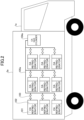
- FIG. 2 is a schematic diagram of a truck of the present embodiment.
- a truck 1a illustrated in FIG. 2 is an example of the truck 1 of FIG. 1 .
- a container 2a mounted on the truck 1a is provided with a plurality of sets of a CA refrigerator 101, a CA refrigeration unit 102, and a valve 103.
- a CA refrigerator, a CA refrigeration unit, and a valve is denoted by reference numerals.
- the container 2a is provided with a CA gas cylinder 104a and a CA gas pipe 105a.
- the CA refrigerator 101 is a refrigerator that is highly airtight, has thermal insulation properties, and can maintain freshness of perishable products above a certain level by refrigeration and CA gas.
- Different kinds of perishable products are stored in each of the CA refrigerators 101.
- avocados that are perishable products respire significantly, so to keep avocados fresh, CO 2 needs to be removed from the CA refrigerator 101, and nitrogen needs to be supplied instead in the CA refrigerator 101.
- Fruit that respire less do not require such processing.
- the environment and situation in the stored CA refrigerator 101 differ depending on the type of perishable products, and, therefore, different kinds of perishable products are stored separately in each of the CA refrigerators 101.
- the CA refrigeration unit 102 is an example of a gas amount control apparatus for controlling the temperature and humidity in the CA refrigerator 101 and controlling the CA gas.
- the valve 103 adjusts the gas amount of CA gas supplied from the CA gas cylinder 104a through the CA gas pipe 105a by driving control by the CA refrigeration unit 102.
- the CA gas cylinder 104a stores a predetermined amount of CA gas injected from the gas injection apparatus 4 based on the amount of CA gas to be supplied and removed estimated by the gas amount estimation apparatus 5 in FIG. 1 .
- the CA gas cylinder 104a may store a predetermined amount of CA gas injected from the gas injection apparatus 4 based on the amount of CA gas to be supplied or removed estimated by the gas amount estimation apparatus 5.
- the CA gas cylinder 104a is an example of a gas processing apparatus.
- the gas processing apparatus includes a CA gas generation apparatus that generates CA gas.
- the CA gas generation apparatus separates air components in the atmosphere and supplies CA gas.
- the CA gas pipe 105a is used to supply CA gas from the CA gas cylinder 104a to the CA refrigeration unit 102.
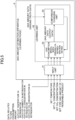
- FIG. 3 is a hardware configuration diagram of a CA refrigeration device of the present embodiment.
- a CA refrigeration device 300 is provided in each CA refrigeration unit 102 of FIG. 2 .
- the CA refrigeration device 300 is provided in the container 2a and may perform processing on each CA refrigeration unit 102.
- the CA refrigeration device 300 is provided with a sensor group 310 for detecting the environment and situation of the CA refrigerator 101 in the same set.
- the sensor group 310 includes, for example, a suction temperature sensor 311, a humidity sensor 312, a blow-out temperature sensor 313, an O 2 (oxygen) concentration sensor, a CO 2 (carbon dioxide) concentration sensor, and a gas consumption sensor 316, as illustrated in FIG. 3 .
- the CA refrigeration device 300 is provided with a setting value input device 321, a CA refrigerator control device 322, and a display device 323.
- the setting value input device 321 is a device for inputting each setting value of the environment and the situation in the CA refrigerator 101 by a user (such as a truck driver).
- the setting values are the set temperature, the set O 2 concentration, the set CO 2 concentration, and the set type and the set amount of perishable products.
- “setting type and setting amount” will be referred to as “setting type and amount”.
- the setting value may include the set nitrogen concentration or the set ethylene concentration, as long as the setting type and amount of perishable products are included.
- the CA refrigerator control device 322 controls the temperature and humidity in the CA refrigerator 101 based on each setting value input to the setting value input device 321.
- the CA refrigerator control device 322 may control the temperature or humidity in the CA refrigerator 101.
- the display device 323 displays each setting value input to the setting value input device 321 and displays the detection result of the sensor group 310.
- the display device 323 is provided with a display for displaying the setting value and the detection result.
- FIG. 4 is a hardware configuration diagram of the gas amount estimation apparatus according to the present embodiment.
- FIG. 4 is a hardware configuration diagram of the gas amount estimation apparatus.
- the gas amount estimation apparatus 5 includes a control unit 501, a ROM (Read Only Memory) 502, a RAM (Random Access Memory) 503, a storage device 504, a keyboard 506, a display 507, an external device I/F (interface) 508, a network I/F 509, and a bus line 510.
- control unit 501 is configured by a CPU (Central Processing Unit), but may include a GPGPU (General-purpose computing on graphics processing units).
- the control unit 501 controls the operation of the entire gas amount estimation apparatus 5.
- the ROM 502 stores a program used for the processing of the control unit 501.
- the RAM 503 is used as a work area of the control unit 501.
- the storage device 504 is configured by a solid state drive (SSD), a hard disk drive (HDD), or a flash memory.
- the storage device 504 reads or writes various kinds of data, such as a program executed by the gas amount estimation apparatus, in accordance with the control by the control unit 501.
- the various kinds of data include a data set for machine learning.
- the data set for machine learning in the present embodiment is data correlated to the gas consumption amount when driving the CA refrigeration device 300 and gas amount data indicating the gas consumption amount when driving the CA refrigeration device 300. These kinds of data will be described in detail later.
- the keyboard 506 is a type of input means having a plurality of keys for inputting characters, numbers, various instructions, etc.
- the display 507 is a type of display means such as a liquid crystal or an organic EL (Electro Luminescence) for displaying data, images, various icons, etc.
- a liquid crystal or an organic EL Electro Luminescence
- the external device I/F 508 is an interface for connecting various external devices.
- the external devices in this case are an external display as an example of a display means, a mouse, keyboard, or microphone as an example of an input means, a printer or speaker as an example of an output means, and a USB (Universal Serial Bus) memory as an example of a storage means.
- USB Universal Serial Bus
- the network I/F 509 performs data communication with an operation terminal or a server other than the gas amount estimation apparatus 5 via a communication network such as the Internet.
- the bus line 510 is an address bus, a data bus, or the like for electrically connecting the elements such as the control unit 501 illustrated in FIG. 5 .
- FIG. 5 is a functional block diagram of the gas amount estimation apparatus in the learning phase. As illustrated in FIG. 5 , the gas amount estimation apparatus 5 in the learning phase has an input unit 51 and a learning unit 52. These units are functions implemented by an instruction from the control unit 501 in FIG. 4 based on a program.
- the input unit 51 inputs data related to the gas consumption amount in the CA refrigerator 101 from the sensor group 310 in FIG. 3 .
- the data related to the gas consumption amount includes data of the temperature in the refrigerator, data of the humidity in the refrigerator, data of the O 2 concentration in the refrigerator, data of the CO 2 concentration in the refrigerator, and the like.
- the data related to the gas consumption amount may be at least one piece of data of the temperature in the refrigerator, data of the humidity in the refrigerator, data of the O 2 concentration in the refrigerator, or data of the CO 2 concentration in the refrigerator.
- the data related to the gas consumption amount may be data of the O 2 concentration in the refrigerator or data of the CO 2 concentration in the refrigerator.
- the input unit 51 inputs data of each setting value of the set temperature, the set O 2 concentration, the set CO 2 concentration, and the set type and amount of the perishable product from the setting value input device 321.
- the input unit 51 may input data of at least the set type and amount of the perishable product.
- the input unit 51 may input data on the set O 2 concentration or the set CO 2 concentration in addition to the data on the set type and amount of the perishable product.
- the gas amount estimation apparatus 5 inputs each piece of output data (data related to the gas consumption amount, set temperature data, etc.) after transportation from a storage device storing each piece of output data of the CA refrigeration device 300 mounted on the truck 1a.
- the gas amount estimation apparatus 5 may be mounted on the truck 1a without being installed in the transportation company A, and the gas amount estimation apparatus 5 may directly input each piece of output data (data related to the gas consumption amount, set temperature data, etc.) during transportation.
- the learning unit 52 has a machine learning model and generates a machine learning model capable of outputting information with high accuracy by machine learning using a machine learning algorithm such as a neural network.
- the machine learning model of the present embodiment is a gas consumption model 50 at the time of the operation of the CA refrigeration device.
- the learning unit 52 sets, as input data, at least information on the type and amount of perishable products stored in the CA refrigerator 101, and sets, as output data, the amount of CA gas supplied to and removed from the CA refrigerator 101 at a predetermined time.
- the output data is data on oxygen, carbon dioxide, nitrogen, or ethylene.
- the learning unit 52 has a comparison changing unit 53, which compares the gas amount data as output data output from the gas consumption model 50 at the time of the operation of the CA refrigeration device, with the true gas amount data (data of the supply amount or the processing amount of the CA gas) as ground truth data, and changes the model parameters of the gas consumption model 50 at the time of the operation of the CA refrigeration device according to the error.
- the learning unit 52 performs machine learning of the gas consumption model 50 at the time of the operation of the CA refrigeration device, and can generate the learned gas consumption model 60 at the time of the operation of the CA refrigeration device described later.
- FIG. 6 is a functional block diagram of the gas amount estimation apparatus in the estimation phase. As illustrated in FIG. 6 , the gas amount estimation apparatus 5 in the estimation phase has an input unit 61, an estimation unit 62, and an output unit 64. These units are functions implemented by an instruction by the control unit 501 in FIG. 4 based on a program.
- the gas amount estimation apparatus 5 can acquire each piece of data from the CA refrigeration device 300 in a wired or wireless manner before the truck 1a departs from the transportation company A.
- the input unit 51 inputs data related to the gas consumption amount at the start of driving from the sensor group 310 of FIG. 3 .
- the data related to the gas consumption amount at the start of the driving includes data of the temperature in the refrigerator, data of the humidity in the refrigerator, data of the O 2 concentration in the refrigerator, data of the CO 2 concentration in the refrigerator, and the like.
- the types of data related to the gas consumption amount at the start of the driving in the estimation phase are the same as the types of data related to the gas consumption amount in the learning phase.
- the input unit 51 inputs data of each setting value of the set temperature, the set O 2 concentration, the set CO 2 concentration, and the set type and amount of the perishable product from the setting value input device 321, and further inputs data of the set transportation time as the setting value.
- the types of the setting values (set temperature, etc.) in the estimation phase are the same as the types of the setting values in the learning phase.
- the estimation unit 62 has a gas consumption model 60 generated by the learning unit 52 when the CA refrigeration device is driven. For example, the estimation unit 62 sets at least the information on the type and amount of perishable product stored in the CA refrigerator 101 as input data, and estimates the amount of CA gas supplied to and removed from the CA refrigerator 101 at a predetermined time and sets these amounts as output data. The estimation unit 62 may estimate the amount of CA gas supplied or removed. Specifically, the estimation unit 62 estimates the amount of CA gas supplied when the output data includes the amount of CA gas supplied, or estimates the amount of CA gas removed when the output data includes the amount of CA gas removed.
- the estimation unit 62 further includes a cumulative processing unit 63.
- the cumulative processing unit 63 calculates the total gas consumption amount estimation value of the set transportation time based on the gas amount data, which is the output data acquired from the learned gas consumption model 60 when the CA refrigeration device is driven, and the data of the set transportation time data acquired from the input unit 61.
- the total gas consumption amount estimation value is an estimation value of the supply amount and the removal amount of the CA gas.
- the cumulative processing unit 63 calculates the total gas consumption amount estimation value for each CA refrigerator.
- the total gas consumption amount estimation value may be an estimation value of the amount of CA gas supplied or removed.
- the total gas consumption amount estimation value may be an estimation value of at least one of the amount of CA gas supplied or removed. If the gas amount data that is the output data indicates the amount of CA gas supplied, the total gas consumption amount estimation value may be an estimation value of the amount of CA gas supplied. If the gas amount data that is the output data indicates the amount of CA gas removed, the total gas consumption amount estimation value may be an estimation value of the amount of CA gas removed.
- the amount of CA gas removed is an example of the amount of CA gas processed.
- the cumulative processing unit 63 may calculate the number of CA refrigeration units 102 for controlling the amount of CA gas in each of the plurality of CA refrigerators 101 based on the type and amount of the perishable product in accordance with the amount of CA gas supplied or processed in each of the plurality of CA refrigerators 100.
- the output unit 64 acquires the total gas consumption amount estimation value calculated by the cumulative processing unit 63 and outputs the total gas consumption amount estimation value to the display 507 or the above-mentioned external device via the external device I/F 508.
- the learning unit 52 learns the gas consumption model 50 at the time of the operation of the CA refrigeration device by machine learning using a machine learning algorithm such as a neural network, and generates the learned gas consumption model 60 at the time of the operation of the CA refrigeration device (S12).
- a machine learning algorithm such as a neural network
- the learning unit 52 determines whether the machine learning is completed (S13). Then, if the machine learning is not completed (S13; NO), the processing returns to step S11 and continues. On the other hand, when the machine learning ends (S13; YES), the processing in the learning phase ends.
- FIG. 8 is a flowchart illustrating the processing in the estimation phase.
- the input unit 61 inputs data related to the gas consumption amount in the CA refrigerator 101 output by the sensor group 310 of FIG. 3 , and inputs data of the set temperature, the set O 2 concentration, the set CO 2 concentration, and the set type and amount of the perishable product, and furthermore the set transportation time output by the setting value input device 321 as input data (S21).
- the estimation unit 62 uses information on the type and amount of the perishable product stored in the CA refrigerator 101 as input data, and estimates the supply amount and the removal amount of the CA gas with respect to the CA refrigerator 101 at a predetermined time and uses the estimated amounts as output data (S22).
- the estimation unit 62 may estimate the supply amount or the removal amount of the CA gas.
- the cumulative processing unit 63 of the estimation unit 62 calculates a total gas consumption amount estimation value of the set transportation time based on the gas amount data, which is the output data acquired from the learned gas consumption model 60 at the time of the operation of the CA refrigeration device, and the set transportation time data acquired from the input unit 61 (S23).
- the output unit 64 acquires the total gas consumption amount estimation value calculated by the cumulative processing unit 63 and outputs the total gas consumption amount estimation value to the display 507 or the above-mentioned external device via the external device I/F 508 (S24). Thus, the processing in the estimation phase is completed.
- CA gas corresponding to the CA gas amount considering the transportation time can be injected based on the total gas consumption amount estimation value output in step S24.
- the user may inject CA gas corresponding to the CA gas amount greater than or equal to the total gas consumption amount estimation value output in step S24 within the range that can be injected into the CA gas cylinder 104a as a precaution.
- FIG. 9 is a diagram illustrating standard processing of a CA mode operation.
- the CA refrigerator control device 322 of the CA refrigeration device 300 controls the CA refrigerator 101 in the container 2a to the desired air composition by transitioning from the atmospheric state to the oxygen concentration reduction mode and then to the air composition adjustment mode, as illustrated in FIG. 2 .
- the air composition adjustment mode is an operation mode in which the O 2 concentration and CO 2 concentration are adjusted from t2 (seconds) by the supply of low-concentration oxygen gas, ventilation by supplying outside air, and respiration of perishable products.
- the mode automatically transitions to the air composition adjustment mode.
- FIG. 10 is a schematic diagram of a modified example of the truck of the present embodiment.
- a truck 1b illustrated in FIG. 10 is an example of the truck 1 of FIG. 1 .
- a container 2b mounted on the truck 1b is provided with a plurality of sets of the CA refrigerator 101, the CA refrigeration unit 102, a CA gas cylinder 104b, and a CA gas pipe 105b.
- the CA refrigerator 101, the CA refrigeration unit 102, the CA gas cylinder 104b, and the CA gas pipe 105b is denoted by reference numerals.
- the CA refrigerator 101 and the CA refrigeration unit 102 have already been described in the above embodiment, and, therefore, descriptions thereof will be omitted.
- the CA gas cylinder 104b is a miniaturized version of the CA gas cylinder 104a in FIG. 2 .
- the CA gas cylinder 104b is an example of a gas processing apparatus.
- the CA gas pipe 105b is shorter than the CA gas pipe 105a illustrated in FIG. 2 , and is used to supply CA gas from the CA gas cylinder 104b to the CA refrigeration unit 102.
- the gas amount estimation apparatus 5 estimates the total gas consumption amount of each of the plurality of CA gas cylinders 104b.
- the injection amount of CA gas can be optimized.
- the injection amount of CA gas can be optimized by using the results learned by machine learning.
- the injection amount of CA gas can be optimized by using table data.
- the injection amount of CA gas can be optimized with higher accuracy by including, in the input data, the temperature or humidity in the CA refrigerator during the transportation of perishable products.
- the injection amount of CA gas can be optimized with higher accuracy even when the transportation time of perishable products is relatively long, by considering the transportation time of perishable products.
- the CA gas injection amount can be optimized with higher accuracy by estimating the CA gas supply amount or removal amount.
- the number of gas amount control apparatuses for controlling the gas amount of CA gas in each of the plurality of CA refrigerators can be calculated.
- the case where the output data is oxygen, carbon dioxide, nitrogen, or ethylene can also be accommodated.
- the ninth aspect it is possible to prepare a gas processing apparatus such as a CA gas cylinder in which the injection amount of CA gas is optimized.
- a transportation container equipped with a gas processing apparatus such as a CA gas cylinder in which the injection amount of CA gas is optimized.
- a gas processing apparatus such as a CA gas cylinder in which the injection amount of CA gas is optimized based on the type and amount of the perishable product.
- the injection amount of CA gas can be optimized.
- the injection amount of CA gas can be optimized with higher accuracy by including, in the input data, the temperature or humidity in the CA refrigerator during the transportation of the perishable product.
- the injection amount of CA gas can be optimized by using the results learned by machine learning.
- the injection amount of CA gas can be optimized by using table data.
- the injection amount of CA gas can be optimized.
- the present invention is not limited to the above-described embodiments and modified examples, and may be the following configuration or processing (operation) as described below.
- the control unit 501 calculates the CA gas supply or processing amount by using the result of machine learning of the relationship between the input data, which is information on the type and amount of perishable products stored in the CA refrigerator 101, and the true CA gas supply or processing amount, but the embodiment is not limited thereto.
- the control unit 501 may use table data to calculate the CA gas supply amount or processing amount, based on the relationship between the input data, which is information on the type and amount of perishable products stored in the CA refrigerator 101, and the true CA gas supply or processing amount.
- the table data information on the type and amount of perishable products stored in the CA refrigerator 101 is managed in association with information on the true CA gas supply or processing amount.
- the CA refrigerator 101 is provided in the container 2 mounted on the truck 1, but the embodiment is not limited thereto.
- the CA refrigerator 101 may be a CA refrigerated delivery box.
- the CA refrigerator 101 may be provided in a CA truck trailer equipped with a refrigeration device.
- the container 2 also includes a marine container.
- a ship transports the marine container instead of the truck 1.
- the program for implementing the functions of the gas amount estimation apparatus 3 can be recorded and distributed on a recording medium such as a DVD (Digital Versatile Disc), and can be widely provided via a communication network such as the Internet.
- a recording medium such as a DVD (Digital Versatile Disc)
- a communication network such as the Internet.
- the control unit 501 may be configured by a plurality of CPUs.
- the present disclosure is useful in the technical fields of gas amount estimation apparatuses, gas processing apparatuses, transportation containers, gas amount estimation methods, and programs.
Landscapes
- Engineering & Computer Science (AREA)
- Physics & Mathematics (AREA)
- Mechanical Engineering (AREA)
- General Engineering & Computer Science (AREA)
- Business, Economics & Management (AREA)
- Chemical & Material Sciences (AREA)
- Combustion & Propulsion (AREA)
- Thermal Sciences (AREA)
- Tourism & Hospitality (AREA)
- Economics (AREA)
- Health & Medical Sciences (AREA)
- General Health & Medical Sciences (AREA)
- Human Resources & Organizations (AREA)
- Marketing (AREA)
- Primary Health Care (AREA)
- Strategic Management (AREA)
- General Business, Economics & Management (AREA)
- General Physics & Mathematics (AREA)
- Theoretical Computer Science (AREA)
- Devices That Are Associated With Refrigeration Equipment (AREA)
- Cold Air Circulating Systems And Constructional Details In Refrigerators (AREA)
- Management, Administration, Business Operations System, And Electronic Commerce (AREA)
Abstract
Description
- The present disclosure relates to a gas amount estimation apparatus, a gas processing apparatus, a transportation container, a gas amount estimation method, and a program.
- In recent years, regional specialties of rural areas have been transported to destinations such as urban areas to revitalize rural areas. When regional specialties are perishable products, the regional specialties may be transported by air shipment in order to maintain the freshness of the regional specialties above a certain level, but because of the high cost of transportation, surface transportation by sea shipment or by trucks is the main means of transportation. When perishable products are produced on a remote island without an airport, it may take more than ten days to transport the perishable products to the destination.
- On the other hand, in order to maintain the freshness of perishable products above a certain level, there is disclosed a technology of a controlled atmosphere (CA) gas refrigerator that maintains the freshness of perishable products above a certain level by refrigeration and CA gas (see Patent Document 1). Therefore, if a truck or the like equipped with a CA gas refrigerator is used for transportation of perishable products, it is possible to maintain the freshness of perishable products above a certain level while reducing transportation costs even if the transportation time increases.
- [Patent document 1]
Japanese Unexamined Patent Application Publication No. S54-72099 - However, when CA gas is injected into a truck or the like, it is unclear what amount of CA gas needs to be processed during transportation, such as the amount of CA gas to be supplied or removed. Therefore, when the injected CA gas is insufficient, the freshness of perishable products cannot be maintained above a certain level. Further, although relatively large amounts of CA gas may be injected, a problem arises that a gas processing apparatus such as a CA gas cylinder becomes large and the amount of perishable products that can be transported becomes small.
- Considering the above circumstances, an object of the present disclosure is to optimize the injection amount of the CA gas.
- A first aspect of the present disclosure is a gas amount estimation apparatus including
- a control unit, wherein
- the control unit is configured to
- set, as input data, information relating to a type and an amount of a perishable product stored in a controlled atmosphere (CA) refrigerator, and
- estimate a supply amount or a processing amount of CA gas with respect to the CA refrigerator in a predetermined time and set the estimated supply amount or the estimated processing amount as output data.
- According to the first aspect, the injection amount of CA gas can be optimized.
- A second aspect of the present disclosure is the gas amount estimation apparatus according to the first aspect, wherein the control unit calculates the supply amount or the processing amount of the CA gas by using a result obtained by learning, by machine learning, a relationship between the input data, which is the information relating to the type and the amount of the perishable product stored in the CA refrigerator, and a true supply amount or a true processing amount of the CA gas.
- According to the second aspect, the injection amount of the CA gas can be optimized by using the result learned by machine learning.
- A third aspect of the present disclosure is the gas amount estimation apparatus according to the first aspect, wherein the control unit calculates the supply amount or the processing amount of the CA gas by using table data indicating a relationship between the input data, which is the information relating to the type and the amount of the perishable product stored in the CA refrigerator, and a true supply amount or a true processing amount of the CA gas.
- According to the third aspect, the CA gas injection amount can be optimized by using table data.
- A fourth aspect of the present disclosure is the gas amount estimation apparatus according to any one of the first to third aspects, wherein
- the input data includes a temperature or a humidity inside the CA refrigerator during transportation of the perishable product, and
- the control unit further estimates the supply amount or the processing amount of the CA gas based on the temperature or the humidity.
- According to the fourth aspect, the CA gas injection amount can be optimized with higher accuracy by including the temperature or humidity in the CA refrigerator during the transportation of the perishable product in the input data.
- A fifth aspect of the present disclosure is the gas amount estimation apparatus according to any one of the first to third aspects, wherein the control unit further estimates the supply amount or the processing amount of the CA gas based on a transportation time of the perishable product.
- According to the fifth aspect, by considering the transportation time of the perishable product, the injection amount of the CA gas can be optimized with higher accuracy even when the transportation time is relatively long.
- The sixth aspect of the present disclosure is the gas amount estimation apparatus according to any one of the first to fifth aspects, wherein
- the output data includes the supply amount of the CA gas supplied to the CA refrigerator to maintain the CA gas in the CA refrigerator at a predetermined concentration during transportation of the perishable product, or a removal amount of the CA gas removed from the CA refrigerator to maintain the CA gas in the CA refrigerator at the predetermined concentration during the transportation of the perishable product, and
- the control unit estimates the supply amount of the CA gas when the supply amount of the CA gas is included in the output data, or estimates the removal amount within the processing amount of the CA gas when the removal amount of the CA gas is included in the output data.
- According to the sixth aspect, the CA gas injection amount can be optimized with higher accuracy by estimating the CA gas supply amount or removal amount.
- The seventh aspect of the present disclosure is the gas amount estimation apparatus according to any one of the first to fifth aspects, wherein the control unit calculates a number of gas amount control apparatuses configured to control a gas amount of the CA gas in each of a plurality of the CA refrigerators based on the type and the amount of the perishable product, according to the supply amount or the processing amount of the CA gas in each of the plurality of the CA refrigerators.
- According to the seventh aspect, even in the case of transportation by the plurality of CA refrigerators, the number of gas amount control apparatuses for controlling the gas amount of CA gas in each of the plurality of CA refrigerators can be calculated.
- An eighth aspect of the present disclosure is the gas amount estimation apparatus according to any one of the first to seventh aspects, wherein the output data is data relating to oxygen, carbon dioxide, nitrogen, or ethylene.
- According to the eighth aspect, the case where the output data is oxygen, carbon dioxide, nitrogen, or ethylene can also be accommodated.
- A ninth aspect of the present disclosure is a gas processing apparatus configured to process the CA gas with respect to the CA refrigerator, wherein
a predetermined amount of the CA gas is injected in the gas processing apparatus based on the supply amount or the processing amount of the CA gas estimated by the gas amount estimation apparatus according to any one of the first to fifth aspects. - According to the ninth aspect, a gas processing apparatus such as a CA gas cylinder in which the injection amount of CA gas is optimized can be prepared.
- A tenth aspect of the present disclosure is a transportation container including
the gas processing apparatus according to the ninth aspect. - According to the tenth aspect, a transportation container equipped with a gas processing apparatus such as a CA gas cylinder in which the injection amount of CA gas is optimized can be prepared.
- An eleventh aspect of the present disclosure is the transportation container according to the tenth aspect, further including:
a gas amount control apparatus configured to control a gas amount of the CA gas in the CA refrigerator based on the type and the amount of the perishable product. - According to the eleventh aspect, a gas processing apparatus such as a CA gas cylinder in which the injection amount of CA gas is optimized based on the type and the amount of the perishable product can be prepared.
- A twelfth aspect of the present disclosure is a gas amount estimation method executed by a computer, the gas amount estimation method including:
- setting, as input data, information relating to a type and an amount of a perishable product stored in a CA refrigerator; and
- estimating a supply amount or a processing amount of CA gas with respect to the CA refrigerator in a predetermined time and setting the estimated supply amount or the estimated processing amount as output data.
- According to the twelfth aspect, the injection amount of CA gas can be optimized.
- A thirteenth aspect of the present disclosure is the gas amount estimation method according to the twelfth aspect, wherein the computer calculates the supply amount or the processing amount of the CA gas by using a result obtained by learning, by machine learning, a relationship between the input data, which is the information relating to the type and the amount of the perishable product stored in the CA refrigerator, and a true supply amount or a true processing amount of the CA gas.
- According to the thirteenth aspect, the injection amount of CA gas can be optimized by using the result of machine learning.
- A fourteenth aspect of the present disclosure is the gas amount estimation method according to the twelfth aspect, wherein the computer calculates the supply amount or the processing amount of the CA gas by using table data indicating a relationship between the input data, which is the information relating to the type and the amount of the perishable product stored in the CA refrigerator, and a true supply amount or a true processing amount of the CA gas.
- According to the fourteenth aspect, the injection amount of CA gas can be optimized by using table data.
- A fifteenth aspect of the present disclosure is a program that causes a computer to execute the gas amount estimation method according to any one of the twelfth to fourteenth aspects.
- According to the fifteenth aspect, the injection amount of CA gas can be optimized.
-
-
FIG. 1 is a schematic diagram of a transportation company where a gas amount estimation apparatus according to an embodiment of the present invention is installed. -
FIG. 2 is a schematic diagram of a truck according to the present embodiment. -
FIG. 3 is a hardware configuration diagram of the CA refrigeration device according to the present embodiment. -
FIG. 4 is a hardware configuration diagram of the gas amount estimation apparatus according to the present embodiment. -
FIG. 5 is a functional block diagram of the gas amount estimation apparatus in the learning phase. -
FIG. 6 is a functional block diagram of the gas amount estimation apparatus in the estimation phase. -
FIG. 7 is a flowchart illustrating the processing in the learning phase. -
FIG. 8 is a flowchart illustrating the processing in the estimation phase. -
FIG. 9 is a diagram illustrating the standard processing in CA mode operation. -
FIG. 10 is a schematic diagram of a modified example of the truck of the present embodiment. - Embodiments of the present invention will now be described with reference to
FIGS. 1 to 9 . - In general, the freshness retention period can be greatly extended by adjusting the composition (oxygen concentration, carbon dioxide concentration, nitrogen concentration, ethylene concentration, etc.) of the air in the refrigerator (storage), and reducing the respiration action of perishable products such as fruit and vegetables to prevent the consumption of sugars and acids contained in the perishable products. This is referred to as controlled atmosphere (CA) storage, and is one of the storage methods for perishable products. There are two types of CA: a "passive type", which adjusts the composition of air in the refrigerator by using the respiration action of perishable products, and an "active type", which adjusts the composition of air in the refrigerator by supplying nitrogen gas or the like to the refrigerator. In the present embodiment, a particular case of implementing the active type will be described. Hereinafter, the gas which is supplied and/or removed in order to adjust the composition of air in the refrigerator will be collectively referred to as "CA gas ".
-
FIG. 1 is a schematic diagram of a transportation company where a gas amount estimation apparatus according to an embodiment of the present invention is installed. InFIG. 1 , atruck 1 for transportation before departure is parked at a transportation company A. Thetruck 1 is equipped with a transportation container 2 (the transportation container is hereinafter referred to as "container".) for storing products (here, perishable products). The transportation company A is also equipped with a gas injection apparatus 4 for storing CA gas to be injected into aCA gas cylinder 104a provided in the container 2. The transportation company A is also equipped with a gasamount estimation apparatus 5. The gasamount estimation apparatus 5 is an example of a computer that estimates the amount of CA gas that needs to be supplied and removed to maintain the freshness of perishable products based on the transportation time of thetruck 1. The gasamount estimation apparatus 5 may estimate the amount of CA gas to be supplied or removed. -
FIG. 2 is a schematic diagram of a truck of the present embodiment. Atruck 1a illustrated inFIG. 2 is an example of thetruck 1 ofFIG. 1 . Acontainer 2a mounted on thetruck 1a is provided with a plurality of sets of aCA refrigerator 101, aCA refrigeration unit 102, and avalve 103. InFIG. 2 , for convenience of explanation, only one set (a CA refrigerator, a CA refrigeration unit, and a valve) is denoted by reference numerals. Further, thecontainer 2a is provided with aCA gas cylinder 104a and aCA gas pipe 105a. - The
CA refrigerator 101 is a refrigerator that is highly airtight, has thermal insulation properties, and can maintain freshness of perishable products above a certain level by refrigeration and CA gas. Different kinds of perishable products are stored in each of theCA refrigerators 101. For example, avocados that are perishable products respire significantly, so to keep avocados fresh, CO2 needs to be removed from theCA refrigerator 101, and nitrogen needs to be supplied instead in theCA refrigerator 101. Fruit that respire less do not require such processing. The environment and situation in the storedCA refrigerator 101 differ depending on the type of perishable products, and, therefore, different kinds of perishable products are stored separately in each of theCA refrigerators 101. - The
CA refrigeration unit 102 is an example of a gas amount control apparatus for controlling the temperature and humidity in theCA refrigerator 101 and controlling the CA gas. Thevalve 103 adjusts the gas amount of CA gas supplied from theCA gas cylinder 104a through theCA gas pipe 105a by driving control by theCA refrigeration unit 102. - The
CA gas cylinder 104a stores a predetermined amount of CA gas injected from the gas injection apparatus 4 based on the amount of CA gas to be supplied and removed estimated by the gasamount estimation apparatus 5 inFIG. 1 . TheCA gas cylinder 104a may store a predetermined amount of CA gas injected from the gas injection apparatus 4 based on the amount of CA gas to be supplied or removed estimated by the gasamount estimation apparatus 5. TheCA gas cylinder 104a is an example of a gas processing apparatus. The gas processing apparatus includes a CA gas generation apparatus that generates CA gas. The CA gas generation apparatus separates air components in the atmosphere and supplies CA gas. TheCA gas pipe 105a is used to supply CA gas from theCA gas cylinder 104a to theCA refrigeration unit 102. -
FIG. 3 is a hardware configuration diagram of a CA refrigeration device of the present embodiment. ACA refrigeration device 300 is provided in eachCA refrigeration unit 102 ofFIG. 2 . TheCA refrigeration device 300 is provided in thecontainer 2a and may perform processing on eachCA refrigeration unit 102. - The
CA refrigeration device 300 is provided with asensor group 310 for detecting the environment and situation of theCA refrigerator 101 in the same set. Thesensor group 310 includes, for example, asuction temperature sensor 311, ahumidity sensor 312, a blow-outtemperature sensor 313, an O2 (oxygen) concentration sensor, a CO2 (carbon dioxide) concentration sensor, and agas consumption sensor 316, as illustrated inFIG. 3 . - Among these, the
suction temperature sensor 311 is a sensor for detecting the temperature of a gas suctioned into theCA refrigerator 101. Thehumidity sensor 312 is a sensor for detecting the humidity in theCA refrigerator 101. The blow-outtemperature sensor 313 is a sensor for detecting the temperature of a gas blown out from theCA refrigerator 101. The O2 concentration sensor is a sensor for detecting the concentration of O2 in theCA refrigerator 101. The CO2 concentration sensor is a sensor for detecting the concentration of CO2 in theCA refrigerator 101. Thegas consumption sensor 316 is a sensor for detecting the consumption of CA gas in theCA refrigerator 101. Thesensor group 310 may include a nitrogen concentration sensor for detecting the nitrogen concentration in theCA refrigerator 101 or an ethylene concentration sensor for detecting the ethylene concentration in theCA refrigerator 101. - The
CA refrigeration device 300 is provided with a settingvalue input device 321, a CArefrigerator control device 322, and adisplay device 323. - Among these, the setting
value input device 321 is a device for inputting each setting value of the environment and the situation in theCA refrigerator 101 by a user (such as a truck driver). For example, as illustrated inFIG. 3 , the setting values are the set temperature, the set O2 concentration, the set CO2 concentration, and the set type and the set amount of perishable products. Hereinafter, "setting type and setting amount" will be referred to as "setting type and amount". The setting value may include the set nitrogen concentration or the set ethylene concentration, as long as the setting type and amount of perishable products are included. - The CA
refrigerator control device 322 controls the temperature and humidity in theCA refrigerator 101 based on each setting value input to the settingvalue input device 321. The CArefrigerator control device 322 may control the temperature or humidity in theCA refrigerator 101. - The
display device 323 displays each setting value input to the settingvalue input device 321 and displays the detection result of thesensor group 310. Thedisplay device 323 is provided with a display for displaying the setting value and the detection result. -
FIG. 4 is a hardware configuration diagram of the gas amount estimation apparatus according to the present embodiment.FIG. 4 is a hardware configuration diagram of the gas amount estimation apparatus. As illustrated inFIG. 4 , the gasamount estimation apparatus 5 includes acontrol unit 501, a ROM (Read Only Memory) 502, a RAM (Random Access Memory) 503, astorage device 504, akeyboard 506, adisplay 507, an external device I/F (interface) 508, a network I/F 509, and abus line 510. - Among these, the
control unit 501 is configured by a CPU (Central Processing Unit), but may include a GPGPU (General-purpose computing on graphics processing units). Thecontrol unit 501 controls the operation of the entire gasamount estimation apparatus 5. - The
ROM 502 stores a program used for the processing of thecontrol unit 501. TheRAM 503 is used as a work area of thecontrol unit 501. - The
storage device 504 is configured by a solid state drive (SSD), a hard disk drive (HDD), or a flash memory. Thestorage device 504 reads or writes various kinds of data, such as a program executed by the gas amount estimation apparatus, in accordance with the control by thecontrol unit 501. The various kinds of data include a data set for machine learning. The data set for machine learning in the present embodiment is data correlated to the gas consumption amount when driving theCA refrigeration device 300 and gas amount data indicating the gas consumption amount when driving theCA refrigeration device 300. These kinds of data will be described in detail later. - The
keyboard 506 is a type of input means having a plurality of keys for inputting characters, numbers, various instructions, etc. - The
display 507 is a type of display means such as a liquid crystal or an organic EL (Electro Luminescence) for displaying data, images, various icons, etc. - The external device I/
F 508 is an interface for connecting various external devices. The external devices in this case are an external display as an example of a display means, a mouse, keyboard, or microphone as an example of an input means, a printer or speaker as an example of an output means, and a USB (Universal Serial Bus) memory as an example of a storage means. - The network I/
F 509 performs data communication with an operation terminal or a server other than the gasamount estimation apparatus 5 via a communication network such as the Internet. - The
bus line 510 is an address bus, a data bus, or the like for electrically connecting the elements such as thecontrol unit 501 illustrated inFIG. 5 . -
FIG. 5 is a functional block diagram of the gas amount estimation apparatus in the learning phase. As illustrated inFIG. 5 , the gasamount estimation apparatus 5 in the learning phase has aninput unit 51 and alearning unit 52. These units are functions implemented by an instruction from thecontrol unit 501 inFIG. 4 based on a program. - The
input unit 51 inputs data related to the gas consumption amount in theCA refrigerator 101 from thesensor group 310 inFIG. 3 . The data related to the gas consumption amount includes data of the temperature in the refrigerator, data of the humidity in the refrigerator, data of the O2 concentration in the refrigerator, data of the CO2 concentration in the refrigerator, and the like. The data related to the gas consumption amount may be at least one piece of data of the temperature in the refrigerator, data of the humidity in the refrigerator, data of the O2 concentration in the refrigerator, or data of the CO2 concentration in the refrigerator. For example, the data related to the gas consumption amount may be data of the O2 concentration in the refrigerator or data of the CO2 concentration in the refrigerator. - Further, the
input unit 51 inputs data of each setting value of the set temperature, the set O2 concentration, the set CO2 concentration, and the set type and amount of the perishable product from the settingvalue input device 321. Among the data of each setting value of the set temperature, the set O2 concentration, the set CO2 concentration, and the set type and amount of the perishable product, theinput unit 51 may input data of at least the set type and amount of the perishable product. For example, theinput unit 51 may input data on the set O2 concentration or the set CO2 concentration in addition to the data on the set type and amount of the perishable product. - In the learning phase, the gas
amount estimation apparatus 5 inputs each piece of output data (data related to the gas consumption amount, set temperature data, etc.) after transportation from a storage device storing each piece of output data of theCA refrigeration device 300 mounted on thetruck 1a. The gasamount estimation apparatus 5 may be mounted on thetruck 1a without being installed in the transportation company A, and the gasamount estimation apparatus 5 may directly input each piece of output data (data related to the gas consumption amount, set temperature data, etc.) during transportation. - The
learning unit 52 has a machine learning model and generates a machine learning model capable of outputting information with high accuracy by machine learning using a machine learning algorithm such as a neural network. The machine learning model of the present embodiment is agas consumption model 50 at the time of the operation of the CA refrigeration device. For example, thelearning unit 52 sets, as input data, at least information on the type and amount of perishable products stored in theCA refrigerator 101, and sets, as output data, the amount of CA gas supplied to and removed from theCA refrigerator 101 at a predetermined time. The output data is data on oxygen, carbon dioxide, nitrogen, or ethylene. - Further, the
learning unit 52 has acomparison changing unit 53, which compares the gas amount data as output data output from thegas consumption model 50 at the time of the operation of the CA refrigeration device, with the true gas amount data (data of the supply amount or the processing amount of the CA gas) as ground truth data, and changes the model parameters of thegas consumption model 50 at the time of the operation of the CA refrigeration device according to the error. Thus, thelearning unit 52 performs machine learning of thegas consumption model 50 at the time of the operation of the CA refrigeration device, and can generate the learnedgas consumption model 60 at the time of the operation of the CA refrigeration device described later. -
FIG. 6 is a functional block diagram of the gas amount estimation apparatus in the estimation phase. As illustrated inFIG. 6 , the gasamount estimation apparatus 5 in the estimation phase has aninput unit 61, anestimation unit 62, and anoutput unit 64. These units are functions implemented by an instruction by thecontrol unit 501 inFIG. 4 based on a program. - The gas
amount estimation apparatus 5 can acquire each piece of data from theCA refrigeration device 300 in a wired or wireless manner before thetruck 1a departs from the transportation company A. When theCA refrigerator 101 starts driving before thetruck 1a departs from the transportation company A, theinput unit 51 inputs data related to the gas consumption amount at the start of driving from thesensor group 310 ofFIG. 3 . The data related to the gas consumption amount at the start of the driving includes data of the temperature in the refrigerator, data of the humidity in the refrigerator, data of the O2 concentration in the refrigerator, data of the CO2 concentration in the refrigerator, and the like. Basically, the types of data related to the gas consumption amount at the start of the driving in the estimation phase (data of temperature in the refrigerator, etc.) are the same as the types of data related to the gas consumption amount in the learning phase. - Further, the
input unit 51 inputs data of each setting value of the set temperature, the set O2 concentration, the set CO2 concentration, and the set type and amount of the perishable product from the settingvalue input device 321, and further inputs data of the set transportation time as the setting value. Basically, the types of the setting values (set temperature, etc.) in the estimation phase are the same as the types of the setting values in the learning phase. - The
estimation unit 62 has agas consumption model 60 generated by thelearning unit 52 when the CA refrigeration device is driven. For example, theestimation unit 62 sets at least the information on the type and amount of perishable product stored in theCA refrigerator 101 as input data, and estimates the amount of CA gas supplied to and removed from theCA refrigerator 101 at a predetermined time and sets these amounts as output data. Theestimation unit 62 may estimate the amount of CA gas supplied or removed. Specifically, theestimation unit 62 estimates the amount of CA gas supplied when the output data includes the amount of CA gas supplied, or estimates the amount of CA gas removed when the output data includes the amount of CA gas removed. - The
estimation unit 62 further includes acumulative processing unit 63. Thecumulative processing unit 63 calculates the total gas consumption amount estimation value of the set transportation time based on the gas amount data, which is the output data acquired from the learnedgas consumption model 60 when the CA refrigeration device is driven, and the data of the set transportation time data acquired from theinput unit 61. The total gas consumption amount estimation value is an estimation value of the supply amount and the removal amount of the CA gas. When there aremultiple CA refrigerators 101, thecumulative processing unit 63 calculates the total gas consumption amount estimation value for each CA refrigerator. The total gas consumption amount estimation value may be an estimation value of the amount of CA gas supplied or removed. For example, if the gas amount data that is the output data indicates the amount of CA gas supplied or removed, the total gas consumption amount estimation value may be an estimation value of at least one of the amount of CA gas supplied or removed. If the gas amount data that is the output data indicates the amount of CA gas supplied, the total gas consumption amount estimation value may be an estimation value of the amount of CA gas supplied. If the gas amount data that is the output data indicates the amount of CA gas removed, the total gas consumption amount estimation value may be an estimation value of the amount of CA gas removed. The amount of CA gas removed is an example of the amount of CA gas processed. - Further, the
cumulative processing unit 63 may calculate the number ofCA refrigeration units 102 for controlling the amount of CA gas in each of the plurality ofCA refrigerators 101 based on the type and amount of the perishable product in accordance with the amount of CA gas supplied or processed in each of the plurality of CA refrigerators 100. - The
output unit 64 acquires the total gas consumption amount estimation value calculated by thecumulative processing unit 63 and outputs the total gas consumption amount estimation value to thedisplay 507 or the above-mentioned external device via the external device I/F 508. - Next, the processing or operation of the present embodiment will be described with reference to
FIGS. 7 to 9 . -
FIG. 7 is a flowchart illustrating processing in the learning phase. As illustrated inFIG. 7 , theinput unit 51 inputs data related to the gas consumption amount in theCA refrigerator 101 output by thesensor group 310 ofFIG. 3 , and inputs data of the set temperature, the set O2 concentration, the set CO2 concentration, and the set type and amount of the perishable product output by the settingvalue input device 321 as input data (S11). - Next, the
learning unit 52 learns thegas consumption model 50 at the time of the operation of the CA refrigeration device by machine learning using a machine learning algorithm such as a neural network, and generates the learnedgas consumption model 60 at the time of the operation of the CA refrigeration device (S12). - Next, the
learning unit 52 determines whether the machine learning is completed (S13). Then, if the machine learning is not completed (S13; NO), the processing returns to step S11 and continues. On the other hand, when the machine learning ends (S13; YES), the processing in the learning phase ends. -
FIG. 8 is a flowchart illustrating the processing in the estimation phase. As illustrated inFIG. 9 , theinput unit 61 inputs data related to the gas consumption amount in theCA refrigerator 101 output by thesensor group 310 ofFIG. 3 , and inputs data of the set temperature, the set O2 concentration, the set CO2 concentration, and the set type and amount of the perishable product, and furthermore the set transportation time output by the settingvalue input device 321 as input data (S21). - Next, the
estimation unit 62 uses information on the type and amount of the perishable product stored in theCA refrigerator 101 as input data, and estimates the supply amount and the removal amount of the CA gas with respect to theCA refrigerator 101 at a predetermined time and uses the estimated amounts as output data (S22). Theestimation unit 62 may estimate the supply amount or the removal amount of the CA gas. - Next, the
cumulative processing unit 63 of theestimation unit 62 calculates a total gas consumption amount estimation value of the set transportation time based on the gas amount data, which is the output data acquired from the learnedgas consumption model 60 at the time of the operation of the CA refrigeration device, and the set transportation time data acquired from the input unit 61 (S23). - Next, the
output unit 64 acquires the total gas consumption amount estimation value calculated by thecumulative processing unit 63 and outputs the total gas consumption amount estimation value to thedisplay 507 or the above-mentioned external device via the external device I/F 508 (S24). Thus, the processing in the estimation phase is completed. - Thus, as illustrated in
FIG. 1 , when the user injects a predetermined amount of CA gas from the gas injection apparatus 4 into theCA gas cylinder 104a in thecontainer 2a, CA gas corresponding to the CA gas amount considering the transportation time can be injected based on the total gas consumption amount estimation value output in step S24. In this case, the user may inject CA gas corresponding to the CA gas amount greater than or equal to the total gas consumption amount estimation value output in step S24 within the range that can be injected into theCA gas cylinder 104a as a precaution. -
FIG. 9 is a diagram illustrating standard processing of a CA mode operation. - When the
truck 1a is performing transportation, the CArefrigerator control device 322 of theCA refrigeration device 300 controls theCA refrigerator 101 in thecontainer 2a to the desired air composition by transitioning from the atmospheric state to the oxygen concentration reduction mode and then to the air composition adjustment mode, as illustrated inFIG. 2 . - The oxygen concentration reduction mode is an operation mode in which the O2 concentration is brought close to the set concentration by the supply of low-concentration oxygen gas and the respiration of perishable products from t1 (seconds) to t2 (seconds) after the start of the
CA refrigeration device 300. After starting the CA refrigeration device, the mode automatically transitions to the "oxygen concentration reduction mode". - The air composition adjustment mode is an operation mode in which the O2 concentration and CO2 concentration are adjusted from t2 (seconds) by the supply of low-concentration oxygen gas, ventilation by supplying outside air, and respiration of perishable products. When the O2 concentration reaches the set concentration, the mode automatically transitions to the air composition adjustment mode.
-
FIG. 10 is a schematic diagram of a modified example of the truck of the present embodiment. - A
truck 1b illustrated inFIG. 10 is an example of thetruck 1 ofFIG. 1 . Acontainer 2b mounted on thetruck 1b is provided with a plurality of sets of theCA refrigerator 101, theCA refrigeration unit 102, aCA gas cylinder 104b, and aCA gas pipe 105b. InFIG. 10 , for convenience of explanation, only one set (theCA refrigerator 101, theCA refrigeration unit 102, theCA gas cylinder 104b, and theCA gas pipe 105b) is denoted by reference numerals. - The
CA refrigerator 101 and theCA refrigeration unit 102 have already been described in the above embodiment, and, therefore, descriptions thereof will be omitted. - The
CA gas cylinder 104b is a miniaturized version of theCA gas cylinder 104a inFIG. 2 . TheCA gas cylinder 104b is an example of a gas processing apparatus. TheCA gas pipe 105b is shorter than theCA gas pipe 105a illustrated inFIG. 2 , and is used to supply CA gas from theCA gas cylinder 104b to theCA refrigeration unit 102. - In this modified example, the gas
amount estimation apparatus 5 estimates the total gas consumption amount of each of the plurality ofCA gas cylinders 104b. - As described above, according to the first aspect of the present disclosure, the injection amount of CA gas can be optimized.
- According to the second aspect, the injection amount of CA gas can be optimized by using the results learned by machine learning.
- According to the third aspect, the injection amount of CA gas can be optimized by using table data.
- According to the fourth aspect, the injection amount of CA gas can be optimized with higher accuracy by including, in the input data, the temperature or humidity in the CA refrigerator during the transportation of perishable products.
- According to the fifth aspect, the injection amount of CA gas can be optimized with higher accuracy even when the transportation time of perishable products is relatively long, by considering the transportation time of perishable products.
- According to the sixth aspect, the CA gas injection amount can be optimized with higher accuracy by estimating the CA gas supply amount or removal amount.
- According to the seventh aspect, even in the case of transportation by a plurality of CA refrigerators, the number of gas amount control apparatuses for controlling the gas amount of CA gas in each of the plurality of CA refrigerators can be calculated.
- According to the eighth aspect, the case where the output data is oxygen, carbon dioxide, nitrogen, or ethylene can also be accommodated.
- According to the ninth aspect, it is possible to prepare a gas processing apparatus such as a CA gas cylinder in which the injection amount of CA gas is optimized.
- According to a tenth aspect, it is possible to prepare a transportation container equipped with a gas processing apparatus such as a CA gas cylinder in which the injection amount of CA gas is optimized.
- According to an eleventh aspect, it is possible to prepare a gas processing apparatus such as a CA gas cylinder in which the injection amount of CA gas is optimized based on the type and amount of the perishable product.
- According to the twelfth aspect, the injection amount of CA gas can be optimized. According to the second aspect, the injection amount of CA gas can be optimized with higher accuracy by including, in the input data, the temperature or humidity in the CA refrigerator during the transportation of the perishable product.
- According to the thirteenth aspect, the injection amount of CA gas can be optimized by using the results learned by machine learning.
- According to the fourteenth aspect, the injection amount of CA gas can be optimized by using table data.
- According to the fifteenth aspect, the injection amount of CA gas can be optimized.
- The present invention is not limited to the above-described embodiments and modified examples, and may be the following configuration or processing (operation) as described below.
- In the above embodiment, the
control unit 501 calculates the CA gas supply or processing amount by using the result of machine learning of the relationship between the input data, which is information on the type and amount of perishable products stored in theCA refrigerator 101, and the true CA gas supply or processing amount, but the embodiment is not limited thereto. For example, thecontrol unit 501 may use table data to calculate the CA gas supply amount or processing amount, based on the relationship between the input data, which is information on the type and amount of perishable products stored in theCA refrigerator 101, and the true CA gas supply or processing amount. In this case, in the table data, information on the type and amount of perishable products stored in theCA refrigerator 101 is managed in association with information on the true CA gas supply or processing amount. - In the above embodiment, the
CA refrigerator 101 is provided in the container 2 mounted on thetruck 1, but the embodiment is not limited thereto. For example, theCA refrigerator 101 may be a CA refrigerated delivery box. Further, theCA refrigerator 101 may be provided in a CA truck trailer equipped with a refrigeration device. - The container 2 also includes a marine container. In this case, a ship transports the marine container instead of the
truck 1. - Further, the program for implementing the functions of the gas amount estimation apparatus 3 can be recorded and distributed on a recording medium such as a DVD (Digital Versatile Disc), and can be widely provided via a communication network such as the Internet.
- The
control unit 501 may be configured by a plurality of CPUs. - The present international application is based upon and claims priority to
Japanese patent application no. 2021-160698 filed on September 30, 2021 - As described above, the present disclosure is useful in the technical fields of gas amount estimation apparatuses, gas processing apparatuses, transportation containers, gas amount estimation methods, and programs.
-
- 1 truck
- 2 container
- 4 gas injection apparatus
- 5 gas amount estimation apparatus
- 50 gas consumption model when driving CA refrigeration device
- 51 input unit
- 52 learning unit
- 53 comparison changing unit
- 60 learned gas consumption model when driving CA refrigeration device
- 61 input unit
- 62 estimation unit
- 63 cumulative processing unit
- 64 output unit
- 101 CA refrigerator
- 102 CA refrigeration unit (an example of a gas amount control apparatus)
- 103 valve
- 104a CA gas cylinder (an example of a gas processing apparatus)
- 104b CA gas cylinder (an example of a gas processing apparatus)
- 105a CA gas pipe
- 105b CA gas pipe
- 501 control unit
Claims (15)
- A gas amount estimation apparatus (5) comprising:a control unit (501), whereinthe control unit is configured toset, as input data, information relating to a type and an amount of a perishable product stored in a controlled atmosphere (CA) refrigerator (101), andestimate a supply amount or a processing amount of CA gas with respect to the CA refrigerator in a predetermined time and set the estimated supply amount or the estimated processing amount as output data.
- The gas amount estimation apparatus according to claim 1, wherein the control unit calculates the supply amount or the processing amount of the CA gas by using a result obtained by learning, by machine learning, a relationship between the input data, which is the information relating to the type and the amount of the perishable product stored in the CA refrigerator (101), and a true supply amount or a true processing amount of the CA gas.
- The gas amount estimation apparatus according to claim 1, wherein the control unit calculates the supply amount or the processing amount of the CA gas by using table data indicating a relationship between the input data, which is the information relating to the type and the amount of the perishable product stored in the CA refrigerator (101), and a true supply amount or a true processing amount of the CA gas.
- The gas amount estimation apparatus according to any one of claims 1 to 3, whereinthe input data includes a temperature or a humidity inside the CA refrigerator during transportation of the perishable product, andthe control unit further estimates the supply amount or the processing amount of the CA gas based on the temperature or the humidity.
- The gas amount estimation apparatus according to any one of claims 1 to 3, wherein the control unit further estimates the supply amount or the processing amount of the CA gas based on a transportation time of the perishable product.
- The gas amount estimation apparatus according to any one of claims 1 to 5, whereinthe output data includes the supply amount of the CA gas supplied to the CA refrigerator to maintain the CA gas in the CA refrigerator at a predetermined concentration during transportation of the perishable product, or a removal amount of the CA gas removed from the CA refrigerator to maintain the CA gas in the CA refrigerator at the predetermined concentration during the transportation of the perishable product, andthe control unit estimates the supply amount of the CA gas when the supply amount of the CA gas is included in the output data, or estimates the removal amount within the processing amount of the CA gas when the removal amount of the CA gas is included in the output data.
- The gas amount estimation apparatus according to any one of claims 1 to 5, wherein the control unit calculates a number of gas amount control apparatuses (102) configured to control a gas amount of the CA gas in each of a plurality of the CA refrigerators based on the type and the amount of the perishable product, according to the supply amount or the processing amount of the CA gas in each of the plurality of the CA refrigerators.
- The gas amount estimation apparatus according to any one of claims 1 to 7, wherein the output data is data relating to oxygen, carbon dioxide, nitrogen, or ethylene.
- A gas processing apparatus (104a, 104b) configured to process the CA gas with respect to the CA refrigerator, wherein
a predetermined amount of the CA gas is injected in the gas processing apparatus based on the supply amount or the processing amount of the CA gas estimated by the gas amount estimation apparatus according to any one of claims 1 to 5. - A transportation container (2) comprising:
the gas processing apparatus according to claim 9. - The transportation container according to claim 10, further comprising:
a gas amount control apparatus configured to control a gas amount of the CA gas in the CA refrigerator based on the type and the amount of the perishable product. - A gas amount estimation method executed by a computer, the gas amount estimation method comprising:setting, as input data, information relating to a type and an amount of a perishable product stored in a CA refrigerator; andestimating a supply amount or a processing amount of CA gas with respect to the CA refrigerator in a predetermined time and setting the estimated supply amount or the estimated processing amount as output data.
- The gas amount estimation method according to claim 12, wherein the computer calculates the supply amount or the processing amount of the CA gas by using a result obtained by learning, by machine learning, a relationship between the input data, which is the information relating to the type and the amount of the perishable product stored in the CA refrigerator (101), and a true supply amount or a true processing amount of the CA gas.
- The gas amount estimation method according to claim 12, wherein the computer calculates the supply amount or the processing amount of the CA gas by using table data indicating a relationship between the input data, which is the information relating to the type and the amount of the perishable product stored in the CA refrigerator (101), and a true supply amount or a true processing amount of the CA gas.
- A program that causes a computer to execute the gas amount estimation method according to any one of claims 12 to 14.
Applications Claiming Priority (2)
| Application Number | Priority Date | Filing Date | Title |
|---|---|---|---|
| JP2021160698 | 2021-09-30 | ||
| PCT/JP2022/036011 WO2023054392A1 (en) | 2021-09-30 | 2022-09-27 | Gas quantity estimation device, gas processing device, transportation container, gas quantity estimation method, and program |
Publications (2)
| Publication Number | Publication Date |
|---|---|
| EP4411203A1 true EP4411203A1 (en) | 2024-08-07 |
| EP4411203A4 EP4411203A4 (en) | 2025-10-08 |
Family
ID=85782771
Family Applications (1)
| Application Number | Title | Priority Date | Filing Date |
|---|---|---|---|
| EP22876258.9A Pending EP4411203A4 (en) | 2021-09-30 | 2022-09-27 | Device for estimating a gas quantity, gas processing device, transport container, method for estimating a gas quantity and program |
Country Status (5)
| Country | Link |
|---|---|
| US (1) | US20240384917A1 (en) |
| EP (1) | EP4411203A4 (en) |
| JP (1) | JP7406143B2 (en) |
| CN (1) | CN117980652A (en) |
| WO (1) | WO2023054392A1 (en) |
Families Citing this family (1)
| Publication number | Priority date | Publication date | Assignee | Title |
|---|---|---|---|---|
| CN117870249A (en) * | 2023-12-25 | 2024-04-12 | 珠海格力电器股份有限公司 | Refrigerator and temperature and humidity regulating method thereof |
Family Cites Families (11)
| Publication number | Priority date | Publication date | Assignee | Title |
|---|---|---|---|---|
| JPS5472099A (en) | 1977-11-21 | 1979-06-09 | Susumu Yagiyuu | System for measuring active carbon content |
| JPS63283539A (en) * | 1987-05-18 | 1988-11-21 | Norin Suisansyo Nogyo Seibutsu Shigen Kenkyusho | Method for multiple chamber storage having different gaseous condition |
| JPH09172959A (en) * | 1995-12-25 | 1997-07-08 | Mitsubishi Heavy Ind Ltd | Apparatus for retaining freshness |
| BRPI0711325A2 (en) * | 2006-05-05 | 2011-08-30 | Plascoenergy Ip Holdings S L Bilbao Schaffhausen Branch | control system for converting a carbonaceous feedstock into gas |
| WO2015028072A1 (en) * | 2013-08-29 | 2015-03-05 | A.P. Møller - Mærsk A/S | A computer-implemented method of monitoring the operation of a cargo shipping reefer container |
| JP6700063B2 (en) * | 2016-02-23 | 2020-05-27 | 兼八産業株式会社 | Drying processing device |
| JP2017227370A (en) * | 2016-06-22 | 2017-12-28 | パナソニックIpマネジメント株式会社 | Food storage |
| JP7002721B2 (en) * | 2017-08-30 | 2022-02-04 | 株式会社ケーイーコーポレーション | Optimal freshness control system for fruits and vegetables |
| KR102482089B1 (en) * | 2018-03-30 | 2022-12-29 | 한국조선해양 주식회사 | operation management system and ship having the same |
| JP6915718B1 (en) * | 2020-03-31 | 2021-08-04 | ダイキン工業株式会社 | Learning equipment, perishables storage equipment and programs |
| JP7545022B2 (en) | 2020-04-03 | 2024-09-04 | 横浜ゴム株式会社 | Pneumatic tires |
-
2022
- 2022-09-26 JP JP2022152055A patent/JP7406143B2/en active Active
- 2022-09-27 WO PCT/JP2022/036011 patent/WO2023054392A1/en not_active Ceased
- 2022-09-27 EP EP22876258.9A patent/EP4411203A4/en active Pending
- 2022-09-27 US US18/692,520 patent/US20240384917A1/en active Pending
- 2022-09-27 CN CN202280062635.7A patent/CN117980652A/en active Pending
Also Published As
| Publication number | Publication date |
|---|---|
| US20240384917A1 (en) | 2024-11-21 |
| WO2023054392A1 (en) | 2023-04-06 |
| CN117980652A (en) | 2024-05-03 |
| JP7406143B2 (en) | 2023-12-27 |
| JP2023051809A (en) | 2023-04-11 |
| EP4411203A4 (en) | 2025-10-08 |
Similar Documents
| Publication | Publication Date | Title |
|---|---|---|
| US11181515B2 (en) | Scent-based spoilage sensing refrigerator | |
| US10591207B2 (en) | Automated and predictive monitoring of perishable good parameters throughout a cold chain distribution system | |
| CN108713208B (en) | Perishable product cargo transport system | |
| US20240384917A1 (en) | Gas amount estimation apparatus, gas processing apparatus, transportation container, gas amount estimation method, and program | |
| US9766600B2 (en) | Management system for refrigerated containers | |
| US20210357852A1 (en) | Data processing device, data processing method, recording medium having recorded thereon data processing program, evaluation system, evaluation method, and recording medium having recorded thereon evaluation program | |
| US20190242716A1 (en) | Cold chain transportation route modeling system | |
| CN107851234A (en) | Method and apparatus for generating the dynamic environment profile for cargo transport | |
| Wills et al. | Reduction of energy usage during storage and transport of bananas by management of exogenous ethylene levels | |
| CA2983300A1 (en) | Controlled environment shipping containers | |
| CA3033213A1 (en) | Smart package | |
| JP2001520151A (en) | Method and apparatus for transporting extremely frozen material | |
| WO2023056119A1 (en) | Controlling produce ripening during transit | |
| US20220240527A1 (en) | Controlling ripening of vegetable produce in a transport unit | |
| WO2017160499A2 (en) | Scent-based spoilage sensing refrigerator | |
| US11067999B2 (en) | Vehicle and delivery system | |
| CN107439674A (en) | Cherry fresh-keeping transport vehicle based on air-controlled packaging | |
| US10013953B2 (en) | Display control device | |
| CN115034698A (en) | Fresh product monitoring method and system and server | |
| CN207645014U (en) | Freshness preserving equipment, cold chain transportation device and cold chain system | |
| US12252281B2 (en) | Measurement and control of respiration of perishable commodities in low absolute pressure method, system, and apparatus | |
| JP7054034B2 (en) | Adjustment system and adjustment method | |
| CN218839136U (en) | Cargo storage system and device | |
| KR101213784B1 (en) | Container security device using shock sensing and method for correcting location the same | |
| CN114399244A (en) | Monitoring method and system for cold chain transportation of food |
Legal Events
| Date | Code | Title | Description |
|---|---|---|---|
| STAA | Information on the status of an ep patent application or granted ep patent |
Free format text: STATUS: THE INTERNATIONAL PUBLICATION HAS BEEN MADE |
|
| PUAI | Public reference made under article 153(3) epc to a published international application that has entered the european phase |
Free format text: ORIGINAL CODE: 0009012 |
|
| STAA | Information on the status of an ep patent application or granted ep patent |
Free format text: STATUS: REQUEST FOR EXAMINATION WAS MADE |
|
| 17P | Request for examination filed |
Effective date: 20240319 |
|
| AK | Designated contracting states |
Kind code of ref document: A1 Designated state(s): AL AT BE BG CH CY CZ DE DK EE ES FI FR GB GR HR HU IE IS IT LI LT LU LV MC MK MT NL NO PL PT RO RS SE SI SK SM TR |
|
| DAV | Request for validation of the european patent (deleted) | ||
| DAX | Request for extension of the european patent (deleted) | ||
| P01 | Opt-out of the competence of the unified patent court (upc) registered |
Free format text: CASE NUMBER: APP_1101/2025 Effective date: 20250108 |
|
| A4 | Supplementary search report drawn up and despatched |
Effective date: 20250908 |
|
| RIC1 | Information provided on ipc code assigned before grant |
Ipc: F17C 13/02 20060101AFI20250902BHEP Ipc: G06Q 50/10 20120101ALI20250902BHEP |