EP4410968A1 - Modified enzyme and method for producing imidazole dipeptide using same - Google Patents
Modified enzyme and method for producing imidazole dipeptide using same Download PDFInfo
- Publication number
- EP4410968A1 EP4410968A1 EP22876557.4A EP22876557A EP4410968A1 EP 4410968 A1 EP4410968 A1 EP 4410968A1 EP 22876557 A EP22876557 A EP 22876557A EP 4410968 A1 EP4410968 A1 EP 4410968A1
- Authority
- EP
- European Patent Office
- Prior art keywords
- amino acid
- mutation
- enzyme
- modified
- acid sequence
- Prior art date
- Legal status (The legal status is an assumption and is not a legal conclusion. Google has not performed a legal analysis and makes no representation as to the accuracy of the status listed.)
- Pending
Links
Images

Classifications
-
- C—CHEMISTRY; METALLURGY
- C12—BIOCHEMISTRY; BEER; SPIRITS; WINE; VINEGAR; MICROBIOLOGY; ENZYMOLOGY; MUTATION OR GENETIC ENGINEERING
- C12N—MICROORGANISMS OR ENZYMES; COMPOSITIONS THEREOF; PROPAGATING, PRESERVING, OR MAINTAINING MICROORGANISMS; MUTATION OR GENETIC ENGINEERING; CULTURE MEDIA
- C12N5/00—Undifferentiated human, animal or plant cells, e.g. cell lines; Tissues; Cultivation or maintenance thereof; Culture media therefor
- C12N5/10—Cells modified by introduction of foreign genetic material
-
- C—CHEMISTRY; METALLURGY
- C07—ORGANIC CHEMISTRY
- C07K—PEPTIDES
- C07K5/00—Peptides containing up to four amino acids in a fully defined sequence; Derivatives thereof
- C07K5/02—Peptides containing up to four amino acids in a fully defined sequence; Derivatives thereof containing at least one abnormal peptide link
- C07K5/0202—Peptides containing up to four amino acids in a fully defined sequence; Derivatives thereof containing at least one abnormal peptide link containing the structure -NH-X-X-C(=0)-, X being an optionally substituted carbon atom or a heteroatom, e.g. beta-amino acids
-
- C—CHEMISTRY; METALLURGY
- C07—ORGANIC CHEMISTRY
- C07K—PEPTIDES
- C07K5/00—Peptides containing up to four amino acids in a fully defined sequence; Derivatives thereof
- C07K5/02—Peptides containing up to four amino acids in a fully defined sequence; Derivatives thereof containing at least one abnormal peptide link
- C07K5/0205—Peptides containing up to four amino acids in a fully defined sequence; Derivatives thereof containing at least one abnormal peptide link containing the structure -NH-(X)3-C(=0)-, e.g. statine or derivatives thereof
-
- C—CHEMISTRY; METALLURGY
- C07—ORGANIC CHEMISTRY
- C07K—PEPTIDES
- C07K5/00—Peptides containing up to four amino acids in a fully defined sequence; Derivatives thereof
- C07K5/02—Peptides containing up to four amino acids in a fully defined sequence; Derivatives thereof containing at least one abnormal peptide link
- C07K5/0207—Peptides containing up to four amino acids in a fully defined sequence; Derivatives thereof containing at least one abnormal peptide link containing the structure -NH-(X)4-C(=0), e.g. 'isosters', replacing two amino acids
-
- C—CHEMISTRY; METALLURGY
- C07—ORGANIC CHEMISTRY
- C07K—PEPTIDES
- C07K5/00—Peptides containing up to four amino acids in a fully defined sequence; Derivatives thereof
- C07K5/04—Peptides containing up to four amino acids in a fully defined sequence; Derivatives thereof containing only normal peptide links
- C07K5/06—Dipeptides
- C07K5/06008—Dipeptides with the first amino acid being neutral
- C07K5/06017—Dipeptides with the first amino acid being neutral and aliphatic
- C07K5/06026—Dipeptides with the first amino acid being neutral and aliphatic the side chain containing 0 or 1 carbon atom, i.e. Gly or Ala
-
- C—CHEMISTRY; METALLURGY
- C07—ORGANIC CHEMISTRY
- C07K—PEPTIDES
- C07K5/00—Peptides containing up to four amino acids in a fully defined sequence; Derivatives thereof
- C07K5/04—Peptides containing up to four amino acids in a fully defined sequence; Derivatives thereof containing only normal peptide links
- C07K5/06—Dipeptides
- C07K5/06086—Dipeptides with the first amino acid being basic
-
- C—CHEMISTRY; METALLURGY
- C12—BIOCHEMISTRY; BEER; SPIRITS; WINE; VINEGAR; MICROBIOLOGY; ENZYMOLOGY; MUTATION OR GENETIC ENGINEERING
- C12N—MICROORGANISMS OR ENZYMES; COMPOSITIONS THEREOF; PROPAGATING, PRESERVING, OR MAINTAINING MICROORGANISMS; MUTATION OR GENETIC ENGINEERING; CULTURE MEDIA
- C12N15/00—Mutation or genetic engineering; DNA or RNA concerning genetic engineering, vectors, e.g. plasmids, or their isolation, preparation or purification; Use of hosts therefor
- C12N15/09—Recombinant DNA-technology
- C12N15/11—DNA or RNA fragments; Modified forms thereof; Non-coding nucleic acids having a biological activity
- C12N15/52—Genes encoding for enzymes or proenzymes
-
- C—CHEMISTRY; METALLURGY
- C12—BIOCHEMISTRY; BEER; SPIRITS; WINE; VINEGAR; MICROBIOLOGY; ENZYMOLOGY; MUTATION OR GENETIC ENGINEERING
- C12N—MICROORGANISMS OR ENZYMES; COMPOSITIONS THEREOF; PROPAGATING, PRESERVING, OR MAINTAINING MICROORGANISMS; MUTATION OR GENETIC ENGINEERING; CULTURE MEDIA
- C12N15/00—Mutation or genetic engineering; DNA or RNA concerning genetic engineering, vectors, e.g. plasmids, or their isolation, preparation or purification; Use of hosts therefor
- C12N15/09—Recombinant DNA-technology
- C12N15/63—Introduction of foreign genetic material using vectors; Vectors; Use of hosts therefor; Regulation of expression
-
- C—CHEMISTRY; METALLURGY
- C12—BIOCHEMISTRY; BEER; SPIRITS; WINE; VINEGAR; MICROBIOLOGY; ENZYMOLOGY; MUTATION OR GENETIC ENGINEERING
- C12N—MICROORGANISMS OR ENZYMES; COMPOSITIONS THEREOF; PROPAGATING, PRESERVING, OR MAINTAINING MICROORGANISMS; MUTATION OR GENETIC ENGINEERING; CULTURE MEDIA
- C12N9/00—Enzymes; Proenzymes; Compositions thereof; Processes for preparing, activating, inhibiting, separating or purifying enzymes
- C12N9/14—Hydrolases (3)
- C12N9/48—Hydrolases (3) acting on peptide bonds (3.4)
-
- C—CHEMISTRY; METALLURGY
- C12—BIOCHEMISTRY; BEER; SPIRITS; WINE; VINEGAR; MICROBIOLOGY; ENZYMOLOGY; MUTATION OR GENETIC ENGINEERING
- C12N—MICROORGANISMS OR ENZYMES; COMPOSITIONS THEREOF; PROPAGATING, PRESERVING, OR MAINTAINING MICROORGANISMS; MUTATION OR GENETIC ENGINEERING; CULTURE MEDIA
- C12N9/00—Enzymes; Proenzymes; Compositions thereof; Processes for preparing, activating, inhibiting, separating or purifying enzymes
- C12N9/14—Hydrolases (3)
- C12N9/48—Hydrolases (3) acting on peptide bonds (3.4)
- C12N9/485—Exopeptidases (3.4.11-3.4.19)
-
- C—CHEMISTRY; METALLURGY
- C12—BIOCHEMISTRY; BEER; SPIRITS; WINE; VINEGAR; MICROBIOLOGY; ENZYMOLOGY; MUTATION OR GENETIC ENGINEERING
- C12P—FERMENTATION OR ENZYME-USING PROCESSES TO SYNTHESISE A DESIRED CHEMICAL COMPOUND OR COMPOSITION OR TO SEPARATE OPTICAL ISOMERS FROM A RACEMIC MIXTURE
- C12P21/00—Preparation of peptides or proteins
- C12P21/02—Preparation of peptides or proteins having a known sequence of two or more amino acids, e.g. glutathione
-
- C—CHEMISTRY; METALLURGY
- C12—BIOCHEMISTRY; BEER; SPIRITS; WINE; VINEGAR; MICROBIOLOGY; ENZYMOLOGY; MUTATION OR GENETIC ENGINEERING
- C12Y—ENZYMES
- C12Y304/00—Hydrolases acting on peptide bonds, i.e. peptidases (3.4)
- C12Y304/11—Aminopeptidases (3.4.11)
- C12Y304/11019—D-Stereospecific aminopeptidase (3.4.11.19)
Definitions
- the present invention relates to a modified enzyme, a method of producing an imidazole dipeptide using thesame, and the like.
- Carnosine ( ⁇ -alanyl histidine) is an imidazole dipeptide composed of ⁇ -alanine and histidine. Carnosine is abundantly present in muscles, brains, and hearts of mammals including humans, and has been reported to have pH-regulating effects, anti-inflammatory effects, tissue repair effects, immunomodulatory effects, antioxidant effects, anti-protein glycation effects, and the like.
- Non Patent Literature 1 Non Patent Literature 2, and Patent Literature 1
- these enzymes have required ATP in the reaction.
- Patent Literature 2 describes that some enzymes derived from multiple microorganisms can produce ⁇ -alanyl amino acids or derivatives thereof from ⁇ -alanyl esters or ⁇ -alanyl amides and amino acids or derivatives thereof without requiring ATP, and examples of such enzymes include wild-type RhDmpA3 enzymes derived from Rhodotorula minuta.
- a modified enzyme of wild-type RhDmpA3 derived from Rhodotorula minuta exhibits properties useful for production of a target peptide. More specifically, the present inventors have found that such a modified enzyme is excellent in imidazole dipeptide production activity and/or excellent in thermal stability without requiring ATP.
- the prior art neither describes nor suggests such identification.
- the present inventors have completed the present invention based on such findings and the like.
- the present inventions are as follows.
- the modified enzyme of the present invention does not require ATP. Therefore, according to the present invention, an enzyme reaction using the modified enzyme of the present invention can be performed at low cost.
- an imidazole dipeptide can efficiently be produced.
- the modified enzyme of the present invention having excellent thermal stability, it is possible to inactivate a contaminating enzyme (e.g., other enzymes that utilize the same substrate to produce other products, target product-degrading enzymes) in a solution that may affect a target reaction, so that the target reaction can be caused to specifically and efficiently proceed.
- a contaminating enzyme e.g., other enzymes that utilize the same substrate to produce other products, target product-degrading enzymes
- a contaminating enzyme e.g., other enzymes that utilize the same substrate to produce other products, target product-degrading enzymes
- a contaminating enzyme e.g., other enzymes that utilize the same substrate to produce other products, target product-degrading enzymes
- the modified enzyme of the present invention having excellent thermal stability is considered to have excellent long-term storage stability.
- FIG. 1 shows an amino acid sequence of a wild-type RhDmpA3 enzyme derived from Rhodotorula minuta (SEQ ID NO: 1).
- the present invention provides a modified enzyme comprising:
- the amino acid residue to be mutated in the modified amino acid sequence (A) is one or more amino acid residues selected from the group consisting of E81, I127, I136, T139, F140, G142, W143, I147, I181, I201, Q219, T229, M244, A249, P255, E256, I260, S293, N294, Y295, and I299.
- the amino acid residue to be mutated in the modified amino acid sequence (A) may be one or more amino acid residues selected from the group consisting of I136, T139, F140, G142, W143, I147, Q219, T229, P255, E256, I260, Y295, and I299.
- the amino acid residue to be mutated in the modified amino acid sequence (A) may be an amino acid residue in an ⁇ -subunit and/or an amino acid residue in a ⁇ -subunit in the enzyme consisting of the amino acid sequence of SEQ ID NO: 1.
- the amino acid residue in the ⁇ -subunit is present in a region consisting of amino acid residues at positions 1 to 257 in SEQ ID NO: 1 among the amino acid residues at the positions described above.
- the amino acid residue in the ⁇ -subunit is present in a region consisting of amino acid residues at positions 258 to 383 in SEQ ID NO: 1 among the amino acid residues at the positions described above.
- the amino acid residue to be mutated in the modified amino acid sequence (A) may be a combination of mutations of a certain amino acid residue and other amino acid residues.
- a certain amino acid residue may be, for example, one or more amino acid residues selected from the group consisting of E81, I127, I181, F140, I201, M244, A249, S293, N294, and Y295.
- such a certain amino acid residue may be F140 or Y295.
- the number of amino acid residues to be mutated in the modified amino acid sequence (A) may be, for example, 1 to 20, preferably 1 to 10, more preferably 1 to 5, still more preferably 1 to 3, and particularly preferably 1 or 2.
- the modified enzyme of the present invention comprising the modified amino acid sequence (A) is not particularly limited as long as it has the above property enhanced relative to the enzyme consisting of the amino acid sequence of SEQ ID NO: 1, but preferred mutations include the following.
- Preferred mutations of E81 include, for example, E81D.
- Preferred mutations of I127 include, for example, I127V and I127L.
- Preferred mutations of I136 include, for example, I136V.
- T139 Preferred mutations of T139 include, for example, T139S and T139A.
- F140 Preferred mutations of F140 include, for example, F140A, F140Y, F140H, F140W, F140N, F140Q, and F140D.
- Preferred mutations of G142 include, for example, G142A.
- W143 include, for example, W143F and W143A.
- Preferred mutations of I147 include, for example, I147A.
- Preferred mutations of I181 include, for example, I181V.
- Preferred mutations of I201 include, for example, I201F.
- Preferred mutations of Q219 include, for example, Q219A.
- T229A Preferred mutations of T229 include, for example, T229A.
- Preferred mutations of M244 include, for example, M244L.
- A249 include, for example, A249F and A249L.
- Preferred mutations of P255 include, for example, P255A.
- E256 include, for example, E256A and E256D.
- Preferred mutations of I260 include, for example, I260A.
- Preferred mutations of S293 include, for example, S293F.
- N294H Preferred mutations of N294 include, for example, N294H.
- Preferred mutations of Y295 include, for example, Y295A, Y295W, and Y295V.
- I299 include, for example, I299V and I299F.
- one or several amino acid residues can be modified by one or more (e.g., one, two, three, or four) additional mutations selected from the group consisting of deletion, substitution, addition, and insertion of an amino acid residue.
- the additional mutations of the amino acid residue may be introduced into one region in an amino acid sequence, or may be introduced into multiple different regions in the amino acid sequence.
- the term "one or several" refers to the number that does not greatly impair the imidazole dipeptide production activity.
- the number represented by the term "one or several” is, for example, 1 to 50, preferably 1 to 40, more preferably 1 to 35, still more preferably 1 to 30, and particularly preferably 1 to 20, 1 to 10, or 1 to 5 (e.g., 1, 2, 3, 4, or 5).
- the percent identity in the amino acid sequence (C) is 90% or more.
- the percent identity may be 910 or more, 92% or more, 93% or more, 94% or more, 95% or more, 96% or more, 97% or more, 98% or more, or 99% or more.
- NBI National Center for Biotechnology Information
- the imidazole dipeptide production activity is an activity of producing an imidazole dipeptide by bonding an amino group-containing compound and a carboxyl group-containing compound (either one contains a side chain having an imidazole group) by an amide bond.
- the imidazole dipeptide production activity may be an activity of producing an imidazole dipeptide from an amino acid ester as the amino group-containing compound and an L-amino acid having an imidazole group in a side chain (e.g., L-histidine or a derivative thereof) as the carboxyl group-containing compound.
- the amino acid ester may be a compound represented by the following formula (I): wherein
- the L-amino acid having an imidazole group in a side chain may be an L-form of a compound represented by the following formula (II): wherein R 2 and R 3 are each independently absent, a hydrogen atom, or an alkyl group having 1 to 3 carbon atoms.
- the imidazole dipeptide may be a compound represented by the following formula (III) : wherein
- examples of the alkyl group having 1 to 3 carbon atoms include methyl, ethyl, n-propyl, and iso-propyl.
- the alkyl group having 1 to 3 carbon atoms is preferably methyl or ethyl, and more preferably methyl.
- n is preferably 2 or 3, and more preferably 2.
- the imidazole dipeptide may be carnosine produced from a ⁇ -alanine ester and L-histidine as raw materials.
- the imidazole dipeptide may be anserine produced from a ⁇ -alanine ester and L-3-methyl histidine as raw materials.
- the imidazole dipeptide may be balenine produced from a ⁇ -alanine ester and L-1-methyl histidine as raw materials.
- the imidazole dipeptide may be homocarnosine produced from ⁇ -aminobutyric acid (GABA) and L-histidine as raw materials.
- GABA ⁇ -aminobutyric acid
- additional mutations may be introduced into sites in a catalytic domain and sites other than the catalytic domain as long as the modified enzyme can retain the imidazole dipeptide production activity.
- a position of an amino acid residue to which the additional mutation may be introduced is evident to a person skilled in the art. Specifically, a person skilled in the art can recognize correlation between structures and functions by (1) comparing amino acid sequences of similar multiple proteins, (2) revealing relatively conserved regions and relatively not conserved regions, and then (3) predicting regions capable of playing a functionally important role and regions incapable of playing a functionally important role from the relatively conserved regions and the relatively not conserved regions, respectively. Therefore, a person skilled in the art can identify the position of the amino acid residue to which the additional mutation may be introduced in the amino acid sequence of the protein used in the present invention.
- substitution of the amino acid residue may be conservative substitution.
- conservative substitution refers to substitution of a certain amino acid residue with an amino acid residue having a similar side chain. Families of amino acid residues having the similar side chain are well known in the art.
- such families include amino acids having a basic side chain (e.g., lysine, arginine, histidine), amino acids having an acidic side chain (e.g., aspartic acid, glutamic acid), amino acids having an uncharged polar side chain (e.g., asparagine, glutamine, serine, threonine, tyrosine, cysteine), amino acids having a non-polar side chain (e.g., glycine, alanine, valine, leucine, isoleucine, proline, phenylalanine, methionine, tryptophan), amino acids having a ⁇ position branched side chain (e.g., valine, isoleucine), amino acids having an aromatic side chain (e.g., tyrosine, phenylalanine, tryptophan, histidine), amino acids having a hydroxyl group (e.g., alcoholic, phenolic)-containing side chain (e.g.,
- the conservative substitution of amino acids may be the substitution between aspartic acid and glutamic acid, the substitution among arginine and lysine and histidine, the substitution between tryptophan and phenylalanine, the substitution between phenylalanine and valine, the substitution among leucine and isoleucine and alanine, and the substitution between glycine and alanine.
- the modified enzyme of the present invention has imidazole dipeptide production activity enhanced relative to the enzyme consisting of the amino acid sequence of SEQ ID NO: 1.
- the modified enzyme of the present invention may have the activity that is 1.05 times or higher, preferably 1.10 times or higher, more preferably 1.15 times or higher, still more preferably 1.20 times or higher, particularly preferably 1.25 times or higher, 1.30 times or higher, 1.35 times or higher, 1.40 times or higher, 1.45 times or higher, or 1.50 times or higher based on the activity of the enzyme consisting of the amino acid sequence of SEQ ID NO: 1.
- the imidazole dipeptide production activity can be evaluated under the following measurement conditions.
- a purified enzyme that may be heated under conditions such as 60°C and 2 hours
- an enzyme solution and pH 8.5
- pH 8.5 is prepared, and a reaction is performed at 25°C.
- the reaction is stopped after 15 minutes by 50 mM NaH 2 PO 4 (adjusted to pH 2.5 with phosphoric acid).
- the reaction stop solution is subjected to HPLC analysis to evaluate the imidazole dipeptide production activity.
- the imidazole dipeptide production activity can be evaluated based on any one of the following (i) to (iii) :
- the imidazole dipeptide production activity can be evaluated based on (i) or (ii).
- the modified enzyme of the present invention has thermal stability enhanced relative to the enzyme consisting of the amino acid sequence of SEQ ID NO: 1.
- the modified enzyme of the present invention may have the thermal stability that is 1.1 times or higher, preferably 1.2 times or higher, more preferably 1.3 times or higher, still more preferably 1.4 times or higher, particularly preferably 1.5 times or higher, 1.6 times or higher, 1.7 times or higher, 1.8 times or higher, 1.9 times or higher, 2.0 times or higher, 2.5 times or higher, or 3.0 times or higher based on the thermal stability of the enzyme consisting of the amino acid sequence of SEQ ID NO: 1.
- the thermal stability of the enzyme can be evaluated by calculating a ratio of the residual activity of the enzyme solution after heating to the enzyme activity of the enzyme solution before heating (60°C, 2 hours). In such evaluation of the residual activity, the imidazole dipeptide production activity described above can be utilized.
- the modified enzyme of the present invention may also be a fusion protein linked to a heterologous portion through an amide bond (e.g., a fusion protein with a heterologous portion added at the C-terminus or N-terminus).
- a heterologous portion includes, for example, peptide components that make purification of a target protein easy (e.g., tag portions including histidine tag and Strep-tag II; proteins utilized for the purification of the target protein including glutathione-S-transferase, maltose binding protein and mutants thereof), peptide components that enhance solubility of the target protein (e.g., Nus-tag), peptide components that work as a chaperon (e.g., trigger factor), peptide components that are recognized by a protease for cleaving the above purification tag (e.g., thrombin recognition sequence, TEV protease recognition sequence), peptide components having another function (e.g., a full length protein or parts thereof
- the present invention also provides a polynucleotide encoding the modified enzyme of the present invention.
- the polynucleotide of the present invention may be DNA or RNA, and is preferably DNA.
- the polynucleotide of the present invention may be a degenerate mutant.
- the term "degenerate mutant” refers to a polynucleotide mutant in which at least one codon encoding a given amino acid residue in a polynucleotide before mutation has been changed to another codon encoding the same amino acid residue.
- Such a degenerate mutant is a mutant based on a silent mutation, and thus a protein (enzyme) encoded by the degenerate mutant is the same as a protein (enzyme) encoded by a polynucleotide before the mutation.
- the degenerate mutant is a polynucleotide mutant in which a codon is changed to adapt to a codon usage of a host cell to which it is to be introduced.
- a certain gene is expressed in a heterologous host cell (e.g., microorganism)
- due to difference in codon usage corresponding tRNA molecular species is sometimes not sufficiently supplied to result in a reduced translation efficiency and/or incorrect translation (e.g., termination of translation).
- a low frequency of codon usage shown in Table A is known in Escherichia coli. Table A.
- the degenerate mutants may be those in which a codon(s) encoding one or more amino acid residues selected from the group consisting of an arginine residue, a glycine residue, an isoleucine residue, a leucine residue, and a proline residue has been changed. More specifically, the degenerate mutants may be those in which one or more codons selected from the group consisting of low frequenccy codon (e.g., AGG, AGA, CGG, CGA, GGA, AUA, CUA, and CCC) have been changed.
- the degenerate mutant may comprise changes of one or more (e.g., one, two, three, four, or five) codons selected from the group consisting of the following:
- nucleotide residue "U” When the degenerate mutant is RNA, a nucleotide residue "U" should be used as described above, but when the degenerate mutant is DNA, "T” should be used in place of the nucleotide residue "U".
- the number of mutations of nucleotide residues for adapting the codon usage in a host cell is not particularly limited as long as the nucleotide residues encode the same protein before and after the mutation, and for example is 1 to 400, 1 to 300, 1 to 200, or 1 to 100.
- the degenerate mutant may comprise the change of a low frequency codon to a non-low frequency codon (e.g., high frequency codon).
- Methods of designing mutants by taking account of not only the low frequency codons but also factors such as compatibility to a genomic GC content of a production bacterium strain have been known (Alan Villalobos et al., Gene Designer: a synthetic biology tool for constructing artificial DNA segments, BMC Bioinformatics. 2006 Jun 6;7:285 ). Thus, such methods may be utilized. In this way, the mutants described above can appropriately be made depending on a type of any host cell (e.g., a microorganism as described later) into which it can be introduced.
- the present invention provides an expression vector.
- the expression vector of the present invention comprises a polynucleotide encoding the modified enzyme of the present invention.
- the expression vector of the present invention comprises an expression unit containing a polynucleotide encoding the modified enzyme of the present invention and a promoter operably linked thereto.
- the term "expression unit” refers to a minimum unit comprising a given polynucleotide to be expressed as a protein and a promoter operably linked thereto and enabling transcription of the polynucleotide and further production of the protein encoded by the polynucleotide.
- the expression unit may further comprise elements such as a terminator, a ribosome binding site, and a drug resistant gene.
- the expression unit may be DNA or RNA, but is preferably DNA.
- the expression unit may be homologous (i.e., inherent) or heterologous (i.e., non-inherent) to a host cell.
- the expression unit may also be an expression unit comprising one polynucleotide to be expressed as a protein and a promoter operably linked thereto (i.e., an expression unit enabling expression of monocistronic mRNA) or an expression unit comprising a plurality of polynucleotides to be expressed as proteins (e.g., 2 or more, preferably 3 or more, more preferably 4 or more, still more preferably 5 or more, particularly preferably 10 or more polynucleotides) and promoters operably linked thereto (i.e., an expression unit enabling expression of polycistronic mRNA).
- an expression unit comprising one polynucleotide to be expressed as a protein and a promoter operably linked thereto
- an expression unit comprising a plurality of polynucleotides to be expressed as proteins (e.g., 2 or more, preferably 3 or more, more preferably 4 or more, still more preferably 5 or more, particularly preferably 10 or more polynucle
- the expression unit can be included in a genomic region (e.g., a natural genomic region that is a natural locus in which the polynucleotide encoding the above protein inherently occurs or a non-natural genomic region that is not the natural locus) or a non-genomic region (e.g., intracellularly) in a microorganism (host cell).
- the expression unit may be included at one or two or more (e.g., one, two, three, four, or five) different positions in the genomic region.
- Specific forms of the expression unit included in the non-genomic region include, for example, plasmids, viral vectors, phages, and artificial chromosomes.
- a promoter that constitutes the expression unit is not particularly limited as long as it can allow to express a protein (enzyme) encoded by a polynucleotide linked downstream thereto in a host cell.
- a promoter may be homologous or heterologous to a host cell.
- constitutive or inducible promoters commonly used for the production of recombinant proteins can be used.
- Such a promoter includes, for example, PhoA promoter, PhoC promoter, T7 promoter, T5 promoter, T3 promoter, lac promoter, trp promoter, trc promoter, tac promoter, PR promoter, PL promoter, SP6 promoter, arabinose inducible promoter, cold shock promoter, tetracycline inducible promoter, and rpoH promoter.
- a promoter having a potent transcription activity in a host cell can be used.
- the promoter having the potent transcription activity in the host cell includes, for example, promoters of genes highly expressed in host cells and promoters from viruses.
- An expression vector may further comprise elements such as a terminator, a ribosome binding site, and a drug resistant gene that function in a host cell as an expression unit, in addition to the minimum unit described above.
- the drug resistant genes include, for example, genes resistant to drugs such as tetracycline, ampicillin, kanamycin, hygromycin, phosphinothricin, and chloramphenicol.
- An expression vector may also further comprise a region capable of homologous recombination with the genome of a host cell for the homologous recombination with genomic DNA of the host cell.
- the expression vector may be designed so that an expression unit contained therein is located between a pair of homologous regions (e.g., homologous homology arm, loxP, FRT to a certain sequence in the genome of the host cell).
- a genomic region (target of a homologous region) of a host cell to which an expression unit is to be introduced is not particularly limited, and may be a locus of a gene highly expressed in amount in the host cell.
- An expression vector may be a plasmid, a viral vector, a phage, or an artificial chromosome.
- the expression vector may be an integrative vector or a non-integrative vector.
- the integrative vector may be a vector that is entirely integrated into the genome of the host cell.
- the integrative vector may be a vector, only a part (e.g., an expression unit) of which is integrated into the genome of the host cell.
- the expression vector may further be a DNA vector or an RNA vector (e.g., a retrovirus vector).
- the expression vector may also be a commonly used expression vector.
- Such an expression vector includes, for example, pUC (e.g., pUC19, pUC18), pSTV, pBR (e.g., pBR322), pHSG (e.g., pHSG299, pHSG298, pHSG399, pHSG398), RSF (e.g., RSF1010), pACYC (e.g., pACYC177, pACYC184), pMW (e.g., pMW119, pMW118, pMW219, pMW218), pQE (e.g., pQE30), pET (e.g., pET28a), and derivatives thereof.
- pUC e.g., pUC19, pUC18
- pSTV e.g., pBR322
- pHSG e.g., pHSG299, pHSG298, pHSG399, pHSG398
- RSF e.g
- the present invention provides a host cell.
- the host cell of the present invention comprises an expression unit of a polynucleotide encoding the modified enzyme of the present invention.
- the host cell of the present invention preferably comprises an expression unit containing a polynucleotide encoding the modified enzyme of the present invention and a promoter operably linked thereto.
- the host cell of the present invention is preferably a microorganism.
- the host cell of the present invention is preferably a transformed microorganism.
- the bacteria include bacteria such as bacteria belonging to Enterobacteriaceae, and fungi.
- the bacteria may be gram positive bacteria or gram negative bacteria.
- the gram positive bacteria include, for example, bacteria in the genera Bacillus and Corynebacterium. Bacillus subtilis is preferred as the bacterium in the genus Bacillus. Corynebacterium glutamicum is preferred as the bacterium in the genus Corynebacterium.
- the gram negative bacteria include, for example, bacteria in the genera Escherichia and Pantoea. Escherichia coli is preferred as the bacterium in the genus Escherichia.
- Pantoea ananatis is preferred as the bacterium in the genus Pantoea.
- Microorganisms in the genera Saccharomyces and Schizosaccharomyces are preferred as fungi. Saccharomyces cerevisiae is preferred as the microorganism in the genus Saccharomyces.
- Schizosaccharomyces pombe is preferred as the microorganism in the genus Schizosaccharomyces.
- the host cell of the present invention is preferably a bacterium belonging to Enterobacteriaceae, more preferably bacteria in the genera Escherichia and Pantoea, and still more preferably Escherichia coli and Pantoea ananatis.
- the host cell of the present invention can be used to produce an imidazole dipeptide or a salt thereof by using the modified enzyme of the present invention produced in the host cell, using the host cell itself (e.g., host cell cultures) or a treated product thereof (e.g., disrupted host cells, lysed host cells, lyophilized host cells).
- the host cell itself e.g., host cell cultures
- a treated product thereof e.g., disrupted host cells, lysed host cells, lyophilized host cells.
- the host cell of the present invention can be used to obtain the modified enzyme of the present invention.
- the host cell of the present invention may be further modified in its gene.
- modifications include, for example:
- Examples of the host cell in which the above enzyme is weakened or defective include a host cell containing a mutation that reduces or deletes the expression level of the above enzyme in the genome of the host cell, and a host cell containing a mutation that reduces or deletes the activity of the above enzyme in the genome of the host cell.
- the host cell of the present invention can be made by any known method in the art.
- the transformed microorganism as described above can be made by a method using an expression vector (e.g., a competent cell method, an electroporation method) or genome modification technology.
- an expression vector e.g., a competent cell method, an electroporation method
- an expression unit can be integrated into the genomic DNA of the host cell by transformation.
- the expression vector is a non-integrative vector that does not produce homologous recombination with genomic DNA of a host cell
- the expression unit is not integrated into the genomic DNA of the host cell by transformation, can remain as a state of the expression vector, and exist independently from the genomic DNA.
- genome-editing technology e.g., CRISPR/Cas System
- a culture condition of the host cell of the present invention is not particularly limited, and a standard cell culture condition can be used depending on the host.
- a medium for culturing the transformed microorganism is known, and for example, a nutrient medium such as an LB medium or a minimum medium such as an M9 medium can be added with the addition of a carbon source, a nitrogen source, a vitamin source, or the like.
- a culture temperature is preferably 4 to 40°C and more preferably 10 to 37°C.
- a culture time is preferably 5 to 168 hours and more preferably 8 to 72 hours.
- a CO 2 concentration is preferably about 6% to about 84%, and a pH is preferably about 5 to 9. Also it is preferred to perform the culture under an aerobic, anoxic, or anaerobic condition depending on nature of a host cell.
- a culture method includes, for example, a batch culture method, a feeding culture method, and a continuous culture method.
- an inducible promoter such as lac promoter
- the expression of the protein may be induced by adding an inducer such as IPTG (isopropyl- ⁇ -thiogalactopyranoside) to the culture medium.
- the modified enzyme of the present invention produced in the host cell of the present invention can be purified from an extract of the host cell of the present invention by any purification method.
- a purification method include salting out, a precipitation method (e.g., isoelectric point precipitation method, solvent precipitation method), a method using a molecular weight difference (e.g., dialysis, ultrafiltration, gel filtration), chromatography (e.g., ion exchange chromatography, hydrophobic chromatography, reverse phase chromatography, affinity chromatography), electrophoresis (e.g., SDS polyacrylamide electrophoresis, isoelectric focusing), or a combination thereof.
- a precipitation method e.g., isoelectric point precipitation method, solvent precipitation method
- a method using a molecular weight difference e.g., dialysis, ultrafiltration, gel filtration
- chromatography e.g., ion exchange chromatography, hydrophobic chromatography, reverse phase chromat
- a culture supernatant containing the modified enzyme of the present invention is obtained by removing microbial cells from a culture medium obtained by culturing the modified enzyme of the present invention, by centrifugation or the like.
- the modified enzyme of the present invention can be purified from this culture supernatant.
- the present invention provides a method of producing an imidazole dipeptide or a salt thereof.
- the method of the present invention comprises contacting an amino acid ester or a salt thereof and an amino acid having an imidazole group in a side chain or a salt thereof with the modified enzyme of the present invention to form the imidazole dipeptide or the salt thereof.
- the imidazole dipeptide, the amino acid ester, and the amino acid having an imidazole group in a side chain are as described above.
- Examples of the salt include inorganic salts and organic salts.
- Examples of the inorganic salt include a salt of a metal (e.g., monovalent metals such as lithium, sodium, potassium, rubidium, and cesium, and divalent metals such as calcium, magnesium, and zinc), a salt of an inorganic acid (e.g., hydrochloride, sulfate), and a salt of an inorganic base (e.g., ammonia).
- a metal e.g., monovalent metals such as lithium, sodium, potassium, rubidium, and cesium, and divalent metals such as calcium, magnesium, and zinc
- a salt of an inorganic acid e.g., hydrochloride, sulfate
- a salt of an inorganic base e.g., ammonia
- organic salt examples include a salt with an organic acid (e.g., acetic acid, succinic acid, malonic acid, oxalic acid) and a salt of an organic base (e.g., ethylenediamine, propylenediamine, ethanolamine, monoalkylethanolamine, dialkylethanolamine, diethanolamine, triethanolamine).
- organic acid e.g., acetic acid, succinic acid, malonic acid, oxalic acid
- organic base e.g., ethylenediamine, propylenediamine, ethanolamine, monoalkylethanolamine, dialkylethanolamine, diethanolamine, triethanolamine.
- the above contacting may be performed using the modified enzyme of the present invention in an aqueous solution (i.e., enzyme method).
- the modified enzyme of the present invention may be an unpurified, crude, or purified enzyme.
- the modified enzyme of the present invention can be utilized in a form of the host cell of the present invention or a treated product thereof (e.g., disrupted microorganisms, lysed microorganisms, lyophilized microorganisms).
- the modified enzyme of the present invention may also be utilized in a form immobilized on a solid phase.
- an aqueous solution containing (a) the modified enzyme of the present invention, (b) an amino acid ester or a salt thereof, and (c) an amino acid having an imidazole group in a side chain or a salt thereof can be used as a reaction system.
- the modified enzyme of the present invention can be brought into contact with the amino acid ester or a salt thereof and the amino acid having an imidazole group in a side chain or a salt thereof in the aqueous solution to allow a target reaction to proceed.
- the aqueous solution is preferably a buffer.
- the buffer examples include a phosphate buffer, a Tris buffer, a carbonate buffer, an acetate buffer, and a citrate buffer.
- a pH is, for example, 6 to 10, preferably 7.5 to 9.5.
- Amounts of the modified enzyme of the present invention, the amino acid ester or a salt thereof, and the amino acid having an imidazole group in a side chain or a salt thereof (substrate) in the reaction system, and a reaction time can be appropriately adjusted according to an amount of the imidazole dipeptide or a salt thereof to be produced.
- a reaction temperature is not particularly limited as long as the reaction proceeds, and is, for example, 5 to 40°C, preferably 8 to 30°C.
- the above-mentioned contacting may be performed using the host cell of the present invention in a culture medium (i.e., fermentation method).
- a culture solution containing (a) the host cell of the present invention, (b) an amino acid ester or a salt thereof, and (c) an amino acid having an imidazole group in a side chain or a salt thereof can be used as a reaction system.
- the modified enzyme of the present invention can be brought into contact with the amino acid ester or a salt thereof and the amino acid having an imidazole group in a side chain or a salt thereof in the culture solution or the host cell of the present invention contained in the culture solution to allow a target reaction to proceed.
- the method of the present invention can be performed under the same conditions as the culture conditions of the host cell of the present invention (e.g., culture solution, culture temperature).
- Amounts of the modified enzyme of the present invention, the amino acid ester or a salt thereof, and the amino acid having an imidazole group in a side chain or a salt thereof (substrate), and a reaction time can be appropriately adjusted according to an amount of the imidazole dipeptide or a salt thereof to be produced.
- the imidazole dipeptide or a salt thereof obtained by the method of the present invention can be purified by any purification method.
- a purification method for example, the same method as the above-described purification method for the modified enzyme of the present invention can be used.
- RhDmpA3 comprising a nucleotide sequence encoding an amino acid sequence of RhDmpA3 (SEQ ID NO: 1) and a nucleotide sequence encoding an rpoH promoter from an E. coli MG1655 strain (SEQ ID NO: 2) operably linked thereto was designed.
- a plasmid in which such an expression unit was inserted into XbaI and HindIII sites in a multiple cloning site of pUC18 (Takara Bio Inc.) was generated and named prpoH_01_RhDmpA(3) (purchased from GenScript Japan Inc.).
- prpoH_01_RhDmpA(3) purchasedd from GenScript Japan Inc.
- RhDmpA3 an amino acid sequence encoded by an RhDmpA3 gene corresponds to an amino acid sequence consisting of amino acid residues at positions 13 to 395 in the amino acid sequence of SEQ ID NO: 5 disclosed in WO 2009/139392 A1 .
- prpoH_01_RhDmpA(3) as a template plasmid, a gene sequence was designed in order to site-specifically introduce an amino acid mutation into the amino acid sequence of RhDmpA3 (purchased from GenScript Japan Inc.).
- a DNA fragment of about 1.2 kb was amplified by PCR using a primer (DmpA3-Fw.) and a primer (DmpA3-Rv.) for the gene sequence encoding mutant RhDmpA3.
- a primer DmpA3-Fw.
- DmpA3-Rv. primer for the gene sequence encoding mutant RhDmpA3.
- PrimeSTAR Max DNA Polymerase Takara Bio Inc.
- 1 cycle 98°C, 1 min
- 25 cycles 98°C, 10 sec, 55°C, 62 sec, 72°C, 18 sec
- 1 cycle 72°C, 5 min
- 4°C, hold were set with the reaction solution composition described in the instruction manual.
- a primer pET28a-Fw.
- a primer pET28a-Rv.
- 1 cycle 98°C, 1 min
- 25 cycles 98°C, 10 sec, 62°C, 5 sec, 72°C, 80 sec
- 1 cycle 72°C, 5 min
- E. coli BL21 (DE3) was transformed by a plasmid expressing RhDmpA3 (wild-type enzyme) to which a histidine tag was added and a mutant enzyme, and an expression strain having the plasmid was obtained from kanamycin-resistant strains.
- the expression strain generated in (1) was inoculated into 3 mL of an LB medium containing 50 mg/L kanamycin, and shake-cultured at 33°C using a test tube, and seed culture was performed by a culture time of 16 hours.
- 0.1 mL of the seed culture medium was inoculated into 20 mL of Overnight Express TM Instant TB Medium (Novagen) containing 50 mg/L kanamycin in a Sakaguchi flask, and shake-cultured at 25°C to prepare a culture solution in 24 hours.
- bacteria were collected by centrifugation (12,000 x g, 5 minutes, 4°C), resuspended with 2 mL of xTractor buffer (Takara Bio Inc.), and allowed to stand at room temperature for 20 minutes to obtain a microbial cell disrupted liquid.
- the obtained microbial cell disrupted liquid was centrifuged (15,000 x g, 20 minutes, 4°C) to separate insoluble fractions.
- the resulting supernatant was obtained as a cell-free extract.
- the cell-free extract was heated for 1 hour using a water bath at 55°C. After the heat treatment, the cell-free extract was rapidly cooled in an ice bath, the insoluble matter was separated by centrifugation (15,000 x g, 10 minutes, 4°C), and the supernatant was collected to obtain a crude purified enzyme solution.
- an affinity enzyme was performed by TALON (registered trademark) Spin Column (Takara Bio Inc.) according to a manufacturer protocol.
- Equilibration Buffer contained in HisTALON Buffer set (Takara Bio Inc.) was used as an equilibration buffer
- Elution buffer contained in HisTALON Buffer set (Takara Bio Inc.) was used as an elution buffer.
- the obtained eluate was collected, and buffer exchange was performed with Amicon ultra 0.5 10 kda (Merck) into 50 mmol/L Tris-HCl buffer (pH 7.6) to obtain a purified enzyme solution.
- Carnosine production activity was measured under the following conditions using ⁇ -Ala-OMe and L-His as substrates.
- a composition of 100 mM borate buffer, 100 mM KCl, 50 mM ⁇ -Ala-OMe, 100 mM L-His, enzyme solution, and pH 8.5 was prepared, a reaction was performed at 25°C, and the reaction was stopped by 50 mM NaH 2 PO 4 (adjusted to pH 2.5 with phosphoric acid) after 15 minutes.
- the reaction stop solution was subjected to HPLC analysis to quantify the produced carnosine.
- HPLC analysis conditions are as follows.
- the protein concentration of the enzyme solution was quantified according to the method described in the instruction manual of Protein Assay CBB Solution (5x concentrate) (NACALAI TESQUE, INC.). Regarding a standard protein, Quick Start Bovine Serum Albumin Standard (Bio-Rad Laboratories, Inc.) was used to prepare a calibration curve, and the protein concentration in the sample was calculated.
- Enzyme activity was measured using the purified preparations of RhDmpA3 (wild-type enzyme) and a mutant enzyme prepared in Example 3, and activity values per unit protein weight were compared. Table 3. Enzyme activity of RhDmpA3 mutant Introduced mutation Carnosine production activity (U/mg) Wild type 34.1 I136V 35.5 F140Y 42.3 W143A 34.6 I260A 37.7 Y295A 99.5 Y295W 48.2 F140W 67.0 F140Q 36.7 F140Y/Y295A 77.6 F140Y/Y295W 63.9 F140Y/Y295V 34.8
- Carnosine synthesis reaction using ⁇ -Ala-OMe and L-His as substrates was performed using the purified preparations of RhDmpA3 (wild-type enzyme) and a mutant enzyme prepared in Example 3.
- a reaction was performed at 25°C for 2 hours with a composition of 100 mM borate buffer, 100 mM ⁇ -Ala-OMe, 100 mM L-His, and 1 U/0.2 mL of purified enzyme.
- Carnosine yield by RhDmpA3 mutant Introduced mutation Carnosine synthesis yield (mol% based on ⁇ -Ala-Ome) Wild type 51.5 I136V 55.9 F140A 66.3 F140Y 58.7 W143F 57.9 W143A 60.7 I147A 54.4 Q219A 56.3 T229A 52.0 P255A 63.6 E256A 52.5 I260A 59.8 Y295A 59.1 Y295W 55.8 I299V 62.7 I299F 60.0 F140H 66.2 F140W 57.2 F140Q 53.9 F140D 53.3 F140Y/Y295A 57.9 F140Y/Y295V 52.1
- Enzyme activity was measured after heating the purified preparations of RhDmpA3 (wild-type enzyme) and a mutant enzyme prepared in Example 3, and thermal stability was measured by comparing activity values per unit protein weight before and after the heat treatment.
- Carnosine production activity was measured under the following conditions using ⁇ -Ala-OMe and L-His as substrates.
- a composition of 100 mM borate buffer, 100 mM KCl, 50 mM ⁇ -Ala-OMe, 100 mM L-His, and enzymatic solution, and pH 8.5 was prepared, a reaction was performed at 25°C, and the reaction was stopped by 50 mM NaH 2 PO 4 (adjusted to pH 2.5 with phosphoric acid) after 15 minutes.
- the reaction stop solution was subjected to HPLC analysis to quantify the produced carnosine.
- Enzyme activity was measured using the purified preparations of RhDmpA3 (wild-type enzyme) and a mutant enzyme prepared in Example 3, and activity values per unit protein weight were compared.
- Anserine production activity was measured under the following conditions using ⁇ -Ala-OMe and 3-Methyl-L-His as substrates.
- a composition of 100 mM borate buffer, 100 mM KCl, 50 mM ⁇ -Ala-OMe, 100 mM 3-Methyl-L-His, enzyme solution, and pH 8.5 was prepared, a reaction was performed at 25°C, and the reaction was stopped by 50 mM NaH 2 PO 4 (adjusted to pH 2.5 with phosphoric acid) after 15 minutes.
- the reaction stop solution was subjected to HPLC analysis to quantify the produced anserine.
- HPLC analysis conditions are as follows.
- an amount of enzyme capable of producing 1 ⁇ mol of anserine per minute was defined as 1 U.
- the protein concentration of the enzyme solution was quantified according to the method described in the instruction manual of Protein Assay CBB Solution (5x concentrate) (NACALAI TESQUE, INC.). Regarding a standard protein, Quick Start Bovine Serum Albumin Standard (Bio-Rad Laboratories, Inc.) was used to prepare a calibration curve, and the protein concentration in the sample was calculated.
- Enzyme activity was measured using the purified preparations of RhDmpA3 (wild-type enzyme) and a mutant enzyme prepared in Example 3, and activity values per unit protein weight were compared. Table 6. Enzyme activity of RhDmpA3 mutant Introduced mutation Anserine production activity (U/mg) Wild type 75.3 I136V 75.8 G142A 99.1 W143F 77.1 W143A 75.3 T229A 86.8 E256D 80.1 Y295A 93.6 F140Y/Y295A 91.8
- mutants described above were further generated.
- a DNA fragment of about 3.8 kb was amplified by PCR using a primer (Fw.) and a primer (Rv.).
- a DNA fragment of about 1.2 kb was amplified by PCR using a primer (DmpA3-Fw.) and a primer (DmpA3-Rv.) for the gene sequence encoding mutant RhDmpA3.
- a primer DmpA3-Fw.
- DmpA3-Rv. primer for the gene sequence encoding mutant RhDmpA3.
- PrimeSTAR Max DNA Polymerase Takara Bio Inc.
- 1 cycle 98°C, 1 min
- 25 cycles 98°C, 10 sec, 55°C, 62 sec, 72°C, 18 sec
- 1 cycle 72°C, 5 min
- 4°C, hold were set with the reaction solution composition described in the instruction manual.
- a primer pET28a-Fw.
- a primer pET28a-Rv.
- 1 cycle 98°C, 1 min
- 25 cycles 98°C, 10 sec, 62°C, 5 sec, 72°C, 80 sec
- 1 cycle 72°C, 5 min
- E. coli BL21 (DE3) was transformed by a plasmid expressing RhDmpA3 (wild-type enzyme) to which a histidine tag was added and a mutant enzyme, and an expression strain having the plasmid was obtained from kanamycin-resistant strains.
- the expression strain generated in (1) was inoculated into 3 mL of an LB medium containing 50 mg/L kanamycin, and shake-cultured at 33°C using a test tube, and seed culture was performed by a culture time of 16 hours.
- 0.1 mL of the seed culture medium was inoculated into 20 mL of Overnight Express TM Instant TB Medium (Novagen) containing 50 mg/L kanamycin in a Sakaguchi flask, and shake-cultured at 25°C to prepare a culture solution in 24 hours.
- bacteria were collected by centrifugation (12,000 x g, 5 minutes, 4°C), resuspended with 2 mL of xTractor buffer (Takara Bio Inc.), and allowed to stand at room temperature for 20 minutes to obtain a microbial cell disrupted liquid.
- the obtained microbial cell disrupted liquid was centrifuged (15,000 x g, 20 minutes, 4°C) to separate insoluble fractions.
- the resulting supernatant was obtained as a cell-free extract.
- the cell-free extract was heated for 1 hour using a water bath at 55°C. After the heat treatment, the cell-free extract was rapidly cooled in an ice bath, the insoluble matter was separated by centrifugation (15,000 x g, 10 minutes, 4°C), and the supernatant was collected to obtain a crude purified enzyme solution.
- an affinity enzyme was performed by TALON (registered trademark) Spin Column (Takara Bio Inc.) according to a manufacturer protocol.
- Equilibration Buffer contained in HisTALON Buffer set (Takara Bio Inc.) was used as an equilibration buffer
- Elution buffer contained in HisTALON Buffer set (Takara Bio Inc.) was used as an elution buffer.
- the obtained eluate was collected, and buffer exchange was performed with Amicon ultra 0.5 10 kda (Merck) into 50 mmol/L Tris-HCl buffer (pH 7.6) to obtain a purified enzyme solution.
- Carnosine production activity was measured under the following conditions using ⁇ -Ala-OMe and L-His as substrates.
- a composition of 100 mM borate buffer, 100 mM KCl, 50 mM ⁇ -Ala-OMe, 100 mM L-His, enzyme solution, and pH 8.5 was prepared, a reaction was performed at 25°C, and the reaction was stopped by 50 mM NaH 2 PO 4 (adjusted to pH 2.5 with phosphoric acid) after 15 minutes.
- the reaction stop solution was subjected to HPLC analysis to quantify the produced carnosine.
- HPLC analysis conditions are as follows.
- the protein concentration of the enzyme solution was quantified according to the method described in the instruction manual of Protein Assay CBB Solution (5x concentrate) (NACALAI TESQUE, INC.). Regarding a standard protein, Quick Start Bovine Serum Albumin Standard (Bio-Rad Laboratories, Inc.) was used to prepare a calibration curve, and the protein concentration in the sample was calculated.
- Enzyme activity was measured using the purified preparations of RhDmpA3 (wild-type enzyme) and a mutant enzyme prepared in Example 10, and activity values per unit protein weight were compared. Table 10. Enzyme activity of RhDmpA3 mutant Introduced mutation Carnosine production activity (U/mg) Wild type 34.1 S293F 58.0 I127V 36.6
- Carnosine synthesis reaction using ⁇ -Ala-OMe and L-His as substrates was performed using the purified preparations of RhDmpA3 (wild-type enzyme) and a mutant enzyme prepared in Example 10.
- a reaction was performed at 25°C for 2 hours with a composition of 100 mM borate buffer, 100 mM ⁇ -Ala-OMe, 100 mM L-His, and 1 U/0.2 mL of purified enzyme.
- Carnosine yield by RhDmpA3 mutant Introduced mutation Carnosine synthesis yield (mol% based on ⁇ -Ala-Ome) Wild type 51.5 I201F 57.0 A249L 57.6 I181V 60.5 I127V 60.7 N294H 57.7 E81D 58.3 M244L 57.2 I127L 58.0
- Enzyme activity was measured using the purified preparations of RhDmpA3 (wild-type enzyme) and a mutant enzyme prepared in Example 10, and activity values per unit protein weight were compared.
- Anserine production activity was measured under the following conditions using ⁇ -Ala-OMe and 3-Methyl-L-His as substrates.
- a composition of 100 mM borate buffer, 100 mM KCl, 50 mM ⁇ -Ala-OMe, 100 mM 3-Methyl-L-His, enzyme solution, and pH 8.5 was prepared, a reaction was performed at 25°C, and the reaction was stopped by 50 mM NaH 2 PO 4 (adjusted to pH 2.5 with phosphoric acid) after 15 minutes.
- the reaction stop solution was subjected to HPLC analysis to quantify the produced anserine.
- HPLC analysis conditions are as follows.
- an amount of enzyme capable of producing 1 ⁇ mol of anserine per minute was defined as 1 U.
- the protein concentration of the enzyme solution was quantified according to the method described in the instruction manual of Protein Assay CBB Solution (5x concentrate) (NACALAI TESQUE, INC.). Regarding a standard protein, Quick Start Bovine Serum Albumin Standard (Bio-Rad Laboratories, Inc.) was used to prepare a calibration curve, and the protein concentration in the sample was calculated.
- Enzyme activity was measured using the purified preparations of RhDmpA3 (wild-type enzyme) and a mutant enzyme prepared in Example 10, and activity values per unit protein weight were compared. Table 12. Enzyme activity of RhDmpA3 mutant Introduced mutation Anserine production activity (U/mg) Wild type 75.3 A249F 78.4 S293F 76.1 I127V 77.8
Landscapes
- Chemical & Material Sciences (AREA)
- Life Sciences & Earth Sciences (AREA)
- Health & Medical Sciences (AREA)
- Organic Chemistry (AREA)
- Genetics & Genomics (AREA)
- Engineering & Computer Science (AREA)
- Zoology (AREA)
- Wood Science & Technology (AREA)
- Bioinformatics & Cheminformatics (AREA)
- General Health & Medical Sciences (AREA)
- Biochemistry (AREA)
- Molecular Biology (AREA)
- Biotechnology (AREA)
- General Engineering & Computer Science (AREA)
- Biomedical Technology (AREA)
- Microbiology (AREA)
- Medicinal Chemistry (AREA)
- Proteomics, Peptides & Aminoacids (AREA)
- Biophysics (AREA)
- General Chemical & Material Sciences (AREA)
- Chemical Kinetics & Catalysis (AREA)
- Crystallography & Structural Chemistry (AREA)
- Plant Pathology (AREA)
- Physics & Mathematics (AREA)
- Cell Biology (AREA)
- Micro-Organisms Or Cultivation Processes Thereof (AREA)
- Enzymes And Modification Thereof (AREA)
Abstract
having the following property (a) or (b) enhanced relative to an enzyme consisting of the amino acid sequence of SEQ ID NO: 1:
(a) imidazole dipeptide production activity; or
(b) thermal stability.
Description
- The present invention relates to a modified enzyme, a method of producing an imidazole dipeptide using thesame, and the like.
- Carnosine (β-alanyl histidine) is an imidazole dipeptide composed of β-alanine and histidine. Carnosine is abundantly present in muscles, brains, and hearts of mammals including humans, and has been reported to have pH-regulating effects, anti-inflammatory effects, tissue repair effects, immunomodulatory effects, antioxidant effects, anti-protein glycation effects, and the like.
- As a method of producing carnosine, a method using an enzyme that catalyzes a reaction of producing β-alanyl histidine from β-alanine and histidine (β-Ala + His → β-Ala-His) is known (Non Patent Literature 1, Non Patent Literature 2, and Patent Literature 1). However, these enzymes have required ATP in the reaction.
- On the other hand, Patent Literature 2 describes that some enzymes derived from multiple microorganisms can produce β-alanyl amino acids or derivatives thereof from β-alanyl esters or β-alanyl amides and amino acids or derivatives thereof without requiring ATP, and examples of such enzymes include wild-type RhDmpA3 enzymes derived from Rhodotorula minuta.
-
- Patent Literature 1: United States Patent Application Publication
US 2005/0287627A - Patent Literature 2: International Publication
WO 2009/139392A -
- Non Patent Literature 1: Skaper SD et al., J Neurochem. 1973 Dec; 21(6): 1429-45.
- Non Patent Literature 2: Horinishi H et al., J Neurochem. 1978 Oct; 31(4): 909-19.
- It is an object of the present invention to provide an enzyme useful for producing a target peptide, capable of producing the target peptide without requiring ATP.
Means for Solving Problems[0008] As a result of an extensive study, the present inventors have found that a modified enzyme of wild-type RhDmpA3 derived from Rhodotorula minuta exhibits properties useful for production of a target peptide. More specifically, the present inventors have found that such a modified enzyme is excellent in imidazole dipeptide production activity and/or excellent in thermal stability without requiring ATP. The prior art neither describes nor suggests such identification. The present inventors have completed the present invention based on such findings and the like. - That is, the present inventions are as follows.
- [1] A modified enzyme comprising:
- (A) a modified amino acid sequence comprising a mutation of one or more amino acid residues selected from the group consisting of E81, 1127, 1136, T139, F140, G142, W143, 1147, 1181, I201, Q219, T229, M244, A249, P255, E256, I260, S293, N294, Y295, and I299 in the amino acid sequence of SEQ ID NO: 1;
- (B) an amino acid sequence comprising an additional mutation of one or more amino acid residues selected from the group consisting of substitution, deletion, insertion, and addition of an amino acid residue in said modified amino acid sequence, wherein the mutation of (A) in said modified amino acid sequence is maintained; or
- (C) an amino acid sequence having 90% or more identity to said modified amino acid sequence, wherein the mutation of (A) in said modified amino acid sequence is maintained; and
having the following property (a) or (b) enhanced relative to an enzyme consisting of the amino acid sequence of SEQ ID NO: 1:- (a) imidazole dipeptide production activity; or
- (b) thermal stability.
- [2] The modified enzyme according to [1], wherein the mutation of (A) in said modified amino acid sequence is:
- (1) a mutation of E81
E81D; - (2) a mutation of I127
I127V or I127L; - (3) a mutation of I136
I136V; - (4) a mutation of T139
T139S or T139A; - (5) a mutation of F140
F140A, F140Y, F140H, F140W, F140Q, F140N, or F140D; - (6) a mutation of G142
G142A; - (7) a mutation of W143
W143F or W143A; - (8) a mutation of I147
I147A; - (9) a mutation of I181
I181V; - (10) a mutation of I201
I201F; - (11) a mutation of Q219
Q219A; - (12) a mutation of T229
T229A; - (13) a mutation of M244
M244L; - (14) a mutation of A249
A249F or A249L; - (15) a mutation of P255
P255A; - (16) a mutation of E256
E256A or E256D; - (17) a mutation of I260
I260A; - (18) a mutation of S293
S293F; - (19) a mutation of N294
N294H; - (20) a mutation of Y295
Y295A, Y295W, or Y295V; - (21) a mutation of I299
I299V or I299F.
- (1) a mutation of E81
- [3] The modified enzyme according to [1] or [2], wherein the imidazole dipeptide production activity is an activity of producing an imidazole dipeptide from an amino acid ester and an L-amino acid having an imidazole group in a side chain.
- [4] The modified enzyme according to [3], wherein
- the amino acid ester is a compound represented by formula (I),
- the L-amino acid having an imidazole group in a side chain is an L-form of a compound represented by formula (II), and
- the imidazole dipeptide is represented by formula (III) .
- [5] The modified enzyme according to [3] or [4], wherein the imidazole dipeptide is carnosine or anserine.
- [6] A polynucleotide encoding the modified enzyme according to any one of [1] to [5].
- [7] An expression vector comprising the polynucleotide according to [6].
- [8] A host cell comprising an expression unit containing a polynucleotide encoding the modified enzyme according to any one of [1] to [5] and a promoter operably linked thereto.
- [9] A method of producing an imidazole dipeptide or a salt thereof, comprising contacting an amino acid ester or a salt thereof and an L-amino acid having an imidazole group in a side chain or a salt thereof with the modified enzyme according to any one of [1] to [5] to form the imidazole dipeptide or the salt thereof.
- [10] The method according to [9], wherein said contacting is performed using said modified enzyme.
- [11] The method according to [9], wherein said contacting is performed using a host cell comprising an expression unit containing a polynucleotide encoding the modified enzyme and a promoter operably linked thereto.
- [12] The method according to any one of [9] to [11], wherein
- the amino acid ester is a compound represented by formula (I),
- the L-amino acid having an imidazole group in a side chain is an L-form of a compound represented by formula (II), and
- the imidazole dipeptide is represented by formula (III) .
- [13] The method according to any one of [9] to [12], wherein the imidazole dipeptide is carnosine or anserine.
- The modified enzyme of the present invention does not require ATP. Therefore, according to the present invention, an enzyme reaction using the modified enzyme of the present invention can be performed at low cost.
- In addition, according to the modified enzyme of the present invention having an excellent imidazole dipeptide production activity, an imidazole dipeptide can efficiently be produced.
- Furthermore, according to the modified enzyme of the present invention having excellent thermal stability, it is possible to inactivate a contaminating enzyme (e.g., other enzymes that utilize the same substrate to produce other products, target product-degrading enzymes) in a solution that may affect a target reaction, so that the target reaction can be caused to specifically and efficiently proceed. In addition, in view of the fact that long-term storage stability (e.g., liquid stability) of an enzyme is often and simply evaluated by an accelerated test under heating (high temperature) conditions, the modified enzyme of the present invention having excellent thermal stability is considered to have excellent long-term storage stability.
-
FIG. 1 shows an amino acid sequence of a wild-type RhDmpA3 enzyme derived from Rhodotorula minuta (SEQ ID NO: 1). - The present invention provides a modified enzyme comprising:
- (A) a modified amino acid sequence comprising a mutation of one or more amino acid residues selected from the group consisting of E81, I127, I136, T139, F140, G142, W143, I147, I181, I201, Q219, T229, M244, A249, P255, E256, I260, S293, N294, Y295, and I299 in the amino acid sequence of SEQ ID NO: 1;
- (B) an amino acid sequence comprising an additional mutation of one or more amino acid residues by one or more mutations selected from the group consisting of substitution, deletion, insertion, and addition of an amino acid residue in said modified amino acid sequence, wherein the mutation of (A) in said modified amino acid sequence is maintained; or
- (C) an amino acid sequence having 90% or more identity to said modified amino acid sequence, wherein the mutation of (A) in said modified amino acid sequence is maintained; and
having the following property (a) or (b) enhanced relative to an enzyme consisting of the amino acid sequence of SEQ ID NO: 1:- (a) imidazole dipeptide production activity; or
- (b) thermal stability.
- The amino acid residue to be mutated in the modified amino acid sequence (A) is one or more amino acid residues selected from the group consisting of E81, I127, I136, T139, F140, G142, W143, I147, I181, I201, Q219, T229, M244, A249, P255, E256, I260, S293, N294, Y295, and I299.
- In a certain embodiment, the amino acid residue to be mutated in the modified amino acid sequence (A) may be one or more amino acid residues selected from the group consisting of I136, T139, F140, G142, W143, I147, Q219, T229, P255, E256, I260, Y295, and I299.
- In another certain embodiment, the amino acid residue to be mutated in the modified amino acid sequence (A) may be an amino acid residue in an α-subunit and/or an amino acid residue in a β-subunit in the enzyme consisting of the amino acid sequence of SEQ ID NO: 1. The amino acid residue in the α-subunit is present in a region consisting of amino acid residues at positions 1 to 257 in SEQ ID NO: 1 among the amino acid residues at the positions described above. The amino acid residue in the β-subunit is present in a region consisting of amino acid residues at positions 258 to 383 in SEQ ID NO: 1 among the amino acid residues at the positions described above.
- In yet another certain embodiment, the amino acid residue to be mutated in the modified amino acid sequence (A) may be a combination of mutations of a certain amino acid residue and other amino acid residues. Such a certain amino acid residue may be, for example, one or more amino acid residues selected from the group consisting of E81, I127, I181, F140, I201, M244, A249, S293, N294, and Y295. Preferably, such a certain amino acid residue may be F140 or Y295.
- The number of amino acid residues to be mutated in the modified amino acid sequence (A) may be, for example, 1 to 20, preferably 1 to 10, more preferably 1 to 5, still more preferably 1 to 3, and particularly preferably 1 or 2.
- The modified enzyme of the present invention comprising the modified amino acid sequence (A) is not particularly limited as long as it has the above property enhanced relative to the enzyme consisting of the amino acid sequence of SEQ ID NO: 1, but preferred mutations include the following.
- Preferred mutations of E81 include, for example, E81D.
- Preferred mutations of I127 include, for example, I127V and I127L.
- Preferred mutations of I136 include, for example, I136V.
- Preferred mutations of T139 include, for example, T139S and T139A.
- Preferred mutations of F140 include, for example, F140A, F140Y, F140H, F140W, F140N, F140Q, and F140D.
- Preferred mutations of G142 include, for example, G142A.
- Preferred mutations of W143 include, for example, W143F and W143A.
- Preferred mutations of I147 include, for example, I147A.
- Preferred mutations of I181 include, for example, I181V.
- Preferred mutations of I201 include, for example, I201F.
- Preferred mutations of Q219 include, for example, Q219A.
- Preferred mutations of T229 include, for example, T229A.
- Preferred mutations of M244 include, for example, M244L.
- Preferred mutations of A249 include, for example, A249F and A249L.
- Preferred mutations of P255 include, for example, P255A.
- Preferred mutations of E256 include, for example, E256A and E256D.
- Preferred mutations of I260 include, for example, I260A.
- Preferred mutations of S293 include, for example, S293F.
- Preferred mutations of N294 include, for example, N294H.
- Preferred mutations of Y295 include, for example, Y295A, Y295W, and Y295V.
- Preferred mutations of I299 include, for example, I299V and I299F.
- In the amino acid sequence (B), one or several amino acid residues can be modified by one or more (e.g., one, two, three, or four) additional mutations selected from the group consisting of deletion, substitution, addition, and insertion of an amino acid residue. The additional mutations of the amino acid residue may be introduced into one region in an amino acid sequence, or may be introduced into multiple different regions in the amino acid sequence. The term "one or several" refers to the number that does not greatly impair the imidazole dipeptide production activity. The number represented by the term "one or several" is, for example, 1 to 50, preferably 1 to 40, more preferably 1 to 35, still more preferably 1 to 30, and particularly preferably 1 to 20, 1 to 10, or 1 to 5 (e.g., 1, 2, 3, 4, or 5).
- The percent identity in the amino acid sequence (C) is 90% or more. Preferably, the percent identity may be 910 or more, 92% or more, 93% or more, 94% or more, 95% or more, 96% or more, 97% or more, 98% or more, or 99% or more. The percent identity can be calculated by the algorithm blastp in default settings. More specifically, the percent identity can be calculated using Scoring Parameters (Matrix: BLOSUM62; Gap Costs: Existence = 11 Extension = 1; Compositional Adjustments: Conditional compositional score matrix adjustment) of default settings in the algorithm blastp provided in National Center for Biotechnology Information (NCBI).
- The imidazole dipeptide production activity is an activity of producing an imidazole dipeptide by bonding an amino group-containing compound and a carboxyl group-containing compound (either one contains a side chain having an imidazole group) by an amide bond. Preferably, the imidazole dipeptide production activity may be an activity of producing an imidazole dipeptide from an amino acid ester as the amino group-containing compound and an L-amino acid having an imidazole group in a side chain (e.g., L-histidine or a derivative thereof) as the carboxyl group-containing compound.
- In a certain embodiment, the amino acid ester may be a compound represented by the following formula (I):

- R1 is an alkyl group having 1 to 3 carbon atoms, and
- n is an integer of 1 to 4.
- In a certain embodiment, the L-amino acid having an imidazole group in a side chain may be an L-form of a compound represented by the following formula (II):

R2 and R3 are each independently absent, a hydrogen atom, or an alkyl group having 1 to 3 carbon atoms. - In a certain embodiment, the imidazole dipeptide may be a compound represented by the following formula (III) :

- R2 and R3 are each independently absent, a hydrogen atom, or an alkyl group having 1 to 3 carbon atoms, and
- n is an integer of 1 to 4.
- In formulas (I) to (III), examples of the alkyl group having 1 to 3 carbon atoms include methyl, ethyl, n-propyl, and iso-propyl. The alkyl group having 1 to 3 carbon atoms is preferably methyl or ethyl, and more preferably methyl.
- In formulas (I) and (III), n is preferably 2 or 3, and more preferably 2.
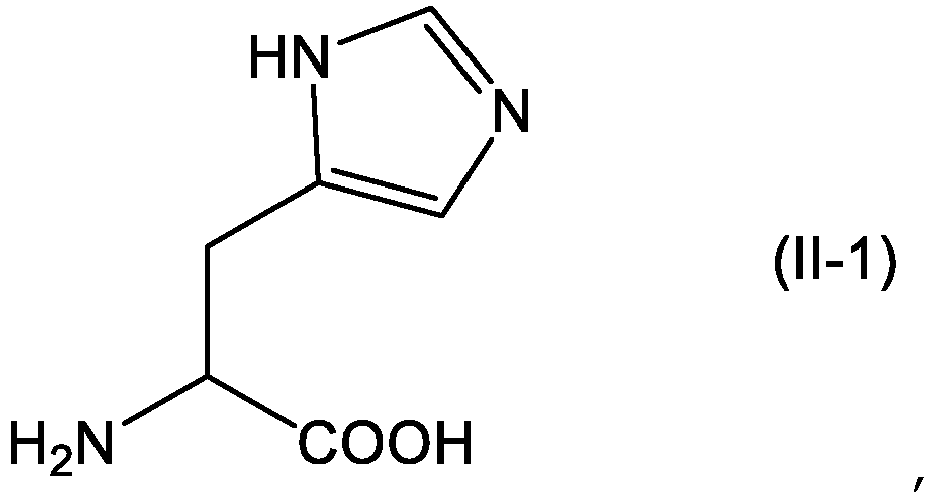
- In one embodiment, the imidazole dipeptide may be carnosine produced from a β-alanine ester and L-histidine as raw materials. In this case, the compound represented by formula (II) is an L-form of histidine represented by the following formula (II-1):

- In another embodiment, the imidazole dipeptide may be anserine produced from a β-alanine ester and L-3-methyl histidine as raw materials. In this case, the compound represented by formula (II) is an L-form of 3-histidine represented by the following formula (II-2):


- In yet another embodiment, the imidazole dipeptide may be balenine produced from a β-alanine ester and L-1-methyl histidine as raw materials. In this case, the compound represented by formula (II) is an L-form of 1-histidine represented by the following formula (II-3):


- In yet another embodiment, the imidazole dipeptide may be homocarnosine produced from γ-aminobutyric acid (GABA) and L-histidine as raw materials. In this case, the compound represented by formula (II) is an L-form of histidine represented by the following formula (II-1):


- In the amino acid sequences (B) and (C), additional mutations may be introduced into sites in a catalytic domain and sites other than the catalytic domain as long as the modified enzyme can retain the imidazole dipeptide production activity. A position of an amino acid residue to which the additional mutation may be introduced is evident to a person skilled in the art. Specifically, a person skilled in the art can recognize correlation between structures and functions by (1) comparing amino acid sequences of similar multiple proteins, (2) revealing relatively conserved regions and relatively not conserved regions, and then (3) predicting regions capable of playing a functionally important role and regions incapable of playing a functionally important role from the relatively conserved regions and the relatively not conserved regions, respectively. Therefore, a person skilled in the art can identify the position of the amino acid residue to which the additional mutation may be introduced in the amino acid sequence of the protein used in the present invention.
- When the additional mutation is substitution of an amino acid residue, the substitution of the amino acid residue may be conservative substitution. As used herein, the term "conservative substitution" refers to substitution of a certain amino acid residue with an amino acid residue having a similar side chain. Families of amino acid residues having the similar side chain are well known in the art. For example, such families include amino acids having a basic side chain (e.g., lysine, arginine, histidine), amino acids having an acidic side chain (e.g., aspartic acid, glutamic acid), amino acids having an uncharged polar side chain (e.g., asparagine, glutamine, serine, threonine, tyrosine, cysteine), amino acids having a non-polar side chain (e.g., glycine, alanine, valine, leucine, isoleucine, proline, phenylalanine, methionine, tryptophan), amino acids having a β position branched side chain (e.g., valine, isoleucine), amino acids having an aromatic side chain (e.g., tyrosine, phenylalanine, tryptophan, histidine), amino acids having a hydroxyl group (e.g., alcoholic, phenolic)-containing side chain (e.g., serine, threonine, tyrosine), and amino acids having a sulfur-containing side chain (e.g., cysteine, methionine). Preferably, the conservative substitution of amino acids may be the substitution between aspartic acid and glutamic acid, the substitution among arginine and lysine and histidine, the substitution between tryptophan and phenylalanine, the substitution between phenylalanine and valine, the substitution among leucine and isoleucine and alanine, and the substitution between glycine and alanine.
- In a certain embodiment, the modified enzyme of the present invention has imidazole dipeptide production activity enhanced relative to the enzyme consisting of the amino acid sequence of SEQ ID NO: 1. Preferably, the modified enzyme of the present invention may have the activity that is 1.05 times or higher, preferably 1.10 times or higher, more preferably 1.15 times or higher, still more preferably 1.20 times or higher, particularly preferably 1.25 times or higher, 1.30 times or higher, 1.35 times or higher, 1.40 times or higher, 1.45 times or higher, or 1.50 times or higher based on the activity of the enzyme consisting of the amino acid sequence of SEQ ID NO: 1.
- The imidazole dipeptide production activity can be evaluated under the following measurement conditions. A purified enzyme (that may be heated under conditions such as 60°C and 2 hours) is prepared, a composition of 100 mM borate buffer, 100 mM KCl, 50 mM β-alanine methyl ester (β-Ala-OMe), 100 mM histidine having an imidazole group in a side chain (L-His) or a derivative thereof (e.g., 3-methyl-L-His), an enzyme solution, and pH 8.5 is prepared, and a reaction is performed at 25°C. The reaction is stopped after 15 minutes by 50 mM NaH2PO4 (adjusted to pH 2.5 with phosphoric acid). The reaction stop solution is subjected to HPLC analysis to evaluate the imidazole dipeptide production activity.
- The imidazole dipeptide production activity can be evaluated based on any one of the following (i) to (iii) :
- (i) amount of dipeptide produced per unit weight of enzyme (protein);
- (ii) peptide production yield relative to amino acid ester (raw material); or
- (iii) peptide production yield relative to amino acid having an imidazole group in a side chain (raw material).
- Preferably, the imidazole dipeptide production activity can be evaluated based on (i) or (ii).
- In another certain embodiment, the modified enzyme of the present invention has thermal stability enhanced relative to the enzyme consisting of the amino acid sequence of SEQ ID NO: 1. Preferably, the modified enzyme of the present invention may have the thermal stability that is 1.1 times or higher, preferably 1.2 times or higher, more preferably 1.3 times or higher, still more preferably 1.4 times or higher, particularly preferably 1.5 times or higher, 1.6 times or higher, 1.7 times or higher, 1.8 times or higher, 1.9 times or higher, 2.0 times or higher, 2.5 times or higher, or 3.0 times or higher based on the thermal stability of the enzyme consisting of the amino acid sequence of SEQ ID NO: 1.
- The thermal stability of the enzyme can be evaluated by calculating a ratio of the residual activity of the enzyme solution after heating to the enzyme activity of the enzyme solution before heating (60°C, 2 hours). In such evaluation of the residual activity, the imidazole dipeptide production activity described above can be utilized.
- The modified enzyme of the present invention may also be a fusion protein linked to a heterologous portion through an amide bond (e.g., a fusion protein with a heterologous portion added at the C-terminus or N-terminus). Such a heterologous portion includes, for example, peptide components that make purification of a target protein easy (e.g., tag portions including histidine tag and Strep-tag II; proteins utilized for the purification of the target protein including glutathione-S-transferase, maltose binding protein and mutants thereof), peptide components that enhance solubility of the target protein (e.g., Nus-tag), peptide components that work as a chaperon (e.g., trigger factor), peptide components that are recognized by a protease for cleaving the above purification tag (e.g., thrombin recognition sequence, TEV protease recognition sequence), peptide components having another function (e.g., a full length protein or parts thereof), and linkers.
- The present invention also provides a polynucleotide encoding the modified enzyme of the present invention. The polynucleotide of the present invention may be DNA or RNA, and is preferably DNA.
- The polynucleotide of the present invention may be a degenerate mutant. The term "degenerate mutant" refers to a polynucleotide mutant in which at least one codon encoding a given amino acid residue in a polynucleotide before mutation has been changed to another codon encoding the same amino acid residue. Such a degenerate mutant is a mutant based on a silent mutation, and thus a protein (enzyme) encoded by the degenerate mutant is the same as a protein (enzyme) encoded by a polynucleotide before the mutation.
- Preferably, the degenerate mutant is a polynucleotide mutant in which a codon is changed to adapt to a codon usage of a host cell to which it is to be introduced. When a certain gene is expressed in a heterologous host cell (e.g., microorganism), due to difference in codon usage, corresponding tRNA molecular species is sometimes not sufficiently supplied to result in a reduced translation efficiency and/or incorrect translation (e.g., termination of translation). For example, a low frequency of codon usage shown in Table A is known in Escherichia coli.
Table A. Low frequency codon in Escherichia coli Amino acid residu Codon Low frequency codon Arg AGG/AGA/CGG/CGA/CGU/CGC AGG/AGA/CGG/CGA Gly GGG/GGA/GGU/GGC GGA Ile AUA/AUU/AUC AUA Leu UUG/UUA/CUG/CUA/CUU/CUC CUA Pro CCG/CCA/CCU/CCC CCC - Therefore, in the present invention, it is possible to use a degenerate mutant that adapts to a codon usage of a host cell as described later. For example, the degenerate mutants may be those in which a codon(s) encoding one or more amino acid residues selected from the group consisting of an arginine residue, a glycine residue, an isoleucine residue, a leucine residue, and a proline residue has been changed. More specifically, the degenerate mutants may be those in which one or more codons selected from the group consisting of low frequenccy codon (e.g., AGG, AGA, CGG, CGA, GGA, AUA, CUA, and CCC) have been changed. Preferably, the degenerate mutant may comprise changes of one or more (e.g., one, two, three, four, or five) codons selected from the group consisting of the following:
- i) change of at least one codon selected from the group consisting of four codons encoding Arg (AGG, AGA, CGG, and CGA) to another codon that encodes Arg (CGU or CGC) ;
- ii) change of one codon encoding Gly (GGA) to another codon encoding Gly (GGG, GGU, or GGC);
- iii) change of one codon encoding Ile (AUA) to another codon encoding Ile (AUU or AUC);
- iv) change of one codon encoding Leu (CUA) to another codon encoding Leu (UUG, UUA, CUG, CUU, or CUC); and
- v) change of one codon encoding Pro (CCC) to another codon encoding Pro (CCG, CCA, or CCU).
- When the degenerate mutant is RNA, a nucleotide residue "U" should be used as described above, but when the degenerate mutant is DNA, "T" should be used in place of the nucleotide residue "U". The number of mutations of nucleotide residues for adapting the codon usage in a host cell is not particularly limited as long as the nucleotide residues encode the same protein before and after the mutation, and for example is 1 to 400, 1 to 300, 1 to 200, or 1 to 100.
- A low frequency codon can easily be identified based on a type of any host cell and genome sequence information by utilizing known technology in the art. Therefore, the degenerate mutant may comprise the change of a low frequency codon to a non-low frequency codon (e.g., high frequency codon). Methods of designing mutants by taking account of not only the low frequency codons but also factors such as compatibility to a genomic GC content of a production bacterium strain have been known (Alan Villalobos et al., Gene Designer: a synthetic biology tool for constructing artificial DNA segments, BMC Bioinformatics. 2006 Jun 6;7:285). Thus, such methods may be utilized. In this way, the mutants described above can appropriately be made depending on a type of any host cell (e.g., a microorganism as described later) into which it can be introduced.
- The present invention provides an expression vector. The expression vector of the present invention comprises a polynucleotide encoding the modified enzyme of the present invention. Preferably, the expression vector of the present invention comprises an expression unit containing a polynucleotide encoding the modified enzyme of the present invention and a promoter operably linked thereto.
- In the present invention, the term "expression unit" refers to a minimum unit comprising a given polynucleotide to be expressed as a protein and a promoter operably linked thereto and enabling transcription of the polynucleotide and further production of the protein encoded by the polynucleotide. The expression unit may further comprise elements such as a terminator, a ribosome binding site, and a drug resistant gene. The expression unit may be DNA or RNA, but is preferably DNA. The expression unit may be homologous (i.e., inherent) or heterologous (i.e., non-inherent) to a host cell. The expression unit may also be an expression unit comprising one polynucleotide to be expressed as a protein and a promoter operably linked thereto (i.e., an expression unit enabling expression of monocistronic mRNA) or an expression unit comprising a plurality of polynucleotides to be expressed as proteins (e.g., 2 or more, preferably 3 or more, more preferably 4 or more, still more preferably 5 or more, particularly preferably 10 or more polynucleotides) and promoters operably linked thereto (i.e., an expression unit enabling expression of polycistronic mRNA). The expression unit can be included in a genomic region (e.g., a natural genomic region that is a natural locus in which the polynucleotide encoding the above protein inherently occurs or a non-natural genomic region that is not the natural locus) or a non-genomic region (e.g., intracellularly) in a microorganism (host cell). The expression unit may be included at one or two or more (e.g., one, two, three, four, or five) different positions in the genomic region. Specific forms of the expression unit included in the non-genomic region include, for example, plasmids, viral vectors, phages, and artificial chromosomes.
- A promoter that constitutes the expression unit is not particularly limited as long as it can allow to express a protein (enzyme) encoded by a polynucleotide linked downstream thereto in a host cell. For example, a promoter may be homologous or heterologous to a host cell. For example, constitutive or inducible promoters commonly used for the production of recombinant proteins can be used. Such a promoter includes, for example, PhoA promoter, PhoC promoter, T7 promoter, T5 promoter, T3 promoter, lac promoter, trp promoter, trc promoter, tac promoter, PR promoter, PL promoter, SP6 promoter, arabinose inducible promoter, cold shock promoter, tetracycline inducible promoter, and rpoH promoter. Preferably, a promoter having a potent transcription activity in a host cell can be used. The promoter having the potent transcription activity in the host cell includes, for example, promoters of genes highly expressed in host cells and promoters from viruses.
- An expression vector may further comprise elements such as a terminator, a ribosome binding site, and a drug resistant gene that function in a host cell as an expression unit, in addition to the minimum unit described above. The drug resistant genes include, for example, genes resistant to drugs such as tetracycline, ampicillin, kanamycin, hygromycin, phosphinothricin, and chloramphenicol.
- An expression vector may also further comprise a region capable of homologous recombination with the genome of a host cell for the homologous recombination with genomic DNA of the host cell. For example, the expression vector may be designed so that an expression unit contained therein is located between a pair of homologous regions (e.g., homologous homology arm, loxP, FRT to a certain sequence in the genome of the host cell). A genomic region (target of a homologous region) of a host cell to which an expression unit is to be introduced is not particularly limited, and may be a locus of a gene highly expressed in amount in the host cell.
- An expression vector may be a plasmid, a viral vector, a phage, or an artificial chromosome. The expression vector may be an integrative vector or a non-integrative vector. The integrative vector may be a vector that is entirely integrated into the genome of the host cell. Alternatively, the integrative vector may be a vector, only a part (e.g., an expression unit) of which is integrated into the genome of the host cell. The expression vector may further be a DNA vector or an RNA vector (e.g., a retrovirus vector). The expression vector may also be a commonly used expression vector. Such an expression vector includes, for example, pUC (e.g., pUC19, pUC18), pSTV, pBR (e.g., pBR322), pHSG (e.g., pHSG299, pHSG298, pHSG399, pHSG398), RSF (e.g., RSF1010), pACYC (e.g., pACYC177, pACYC184), pMW (e.g., pMW119, pMW118, pMW219, pMW218), pQE (e.g., pQE30), pET (e.g., pET28a), and derivatives thereof.
- The present invention provides a host cell. The host cell of the present invention comprises an expression unit of a polynucleotide encoding the modified enzyme of the present invention. The host cell of the present invention preferably comprises an expression unit containing a polynucleotide encoding the modified enzyme of the present invention and a promoter operably linked thereto. The host cell of the present invention is preferably a microorganism.
- The host cell of the present invention is preferably a transformed microorganism. Examples of the host cell of the present invention include bacteria such as bacteria belonging to Enterobacteriaceae, and fungi. The bacteria may be gram positive bacteria or gram negative bacteria. The gram positive bacteria include, for example, bacteria in the genera Bacillus and Corynebacterium. Bacillus subtilis is preferred as the bacterium in the genus Bacillus. Corynebacterium glutamicum is preferred as the bacterium in the genus Corynebacterium. The gram negative bacteria include, for example, bacteria in the genera Escherichia and Pantoea. Escherichia coli is preferred as the bacterium in the genus Escherichia. Pantoea ananatis is preferred as the bacterium in the genus Pantoea. Microorganisms in the genera Saccharomyces and Schizosaccharomyces are preferred as fungi. Saccharomyces cerevisiae is preferred as the microorganism in the genus Saccharomyces. Schizosaccharomyces pombe is preferred as the microorganism in the genus Schizosaccharomyces. The host cell of the present invention is preferably a bacterium belonging to Enterobacteriaceae, more preferably bacteria in the genera Escherichia and Pantoea, and still more preferably Escherichia coli and Pantoea ananatis.
- In one embodiment, the host cell of the present invention can be used to produce an imidazole dipeptide or a salt thereof by using the modified enzyme of the present invention produced in the host cell, using the host cell itself (e.g., host cell cultures) or a treated product thereof (e.g., disrupted host cells, lysed host cells, lyophilized host cells).
- In another embodiment, the host cell of the present invention can be used to obtain the modified enzyme of the present invention.
- The host cell of the present invention may be further modified in its gene. Such modifications include, for example:
- (1) deficiency or weakening of an amino acid-degrading enzyme;
- (2) deficiency or weakening of an amino acid ester-degrading enzyme; or
- (3) deficiency or weakening of a peptide-degrading enzyme.
- Examples of the host cell in which the above enzyme is weakened or defective include a host cell containing a mutation that reduces or deletes the expression level of the above enzyme in the genome of the host cell, and a host cell containing a mutation that reduces or deletes the activity of the above enzyme in the genome of the host cell.
- The host cell of the present invention can be made by any known method in the art. For example, the transformed microorganism as described above can be made by a method using an expression vector (e.g., a competent cell method, an electroporation method) or genome modification technology. When the expression vector is an integrative vector that produces homologous recombination with genomic DNA of a host cell, an expression unit can be integrated into the genomic DNA of the host cell by transformation. On the other hand, when the expression vector is a non-integrative vector that does not produce homologous recombination with genomic DNA of a host cell, the expression unit is not integrated into the genomic DNA of the host cell by transformation, can remain as a state of the expression vector, and exist independently from the genomic DNA. Alternatively, according to genome-editing technology (e.g., CRISPR/Cas System), it is possible to integrate the expression unit into the genomic DNA of the host cell and modify the expression unit inherently possessed by the host cell.
- A culture condition of the host cell of the present invention is not particularly limited, and a standard cell culture condition can be used depending on the host. A medium for culturing the transformed microorganism is known, and for example, a nutrient medium such as an LB medium or a minimum medium such as an M9 medium can be added with the addition of a carbon source, a nitrogen source, a vitamin source, or the like.
- A culture temperature is preferably 4 to 40°C and more preferably 10 to 37°C. A culture time is preferably 5 to 168 hours and more preferably 8 to 72 hours. As a gas composition, a CO2 concentration is preferably about 6% to about 84%, and a pH is preferably about 5 to 9. Also it is preferred to perform the culture under an aerobic, anoxic, or anaerobic condition depending on nature of a host cell.
- Any appropriate methods can be used as a culture method. Depending on the host cell, either shaking culture or static culture is possible, but stirring may be performed as necessary, or aeration may be performed. Such a culture method includes, for example, a batch culture method, a feeding culture method, and a continuous culture method. When the expression of a certain protein produced by the transformed microorganism is under the control of an inducible promoter such as lac promoter, the expression of the protein may be induced by adding an inducer such as IPTG (isopropyl-β-thiogalactopyranoside) to the culture medium.
- The modified enzyme of the present invention produced in the host cell of the present invention can be purified from an extract of the host cell of the present invention by any purification method. Examples of such a purification method include salting out, a precipitation method (e.g., isoelectric point precipitation method, solvent precipitation method), a method using a molecular weight difference (e.g., dialysis, ultrafiltration, gel filtration), chromatography (e.g., ion exchange chromatography, hydrophobic chromatography, reverse phase chromatography, affinity chromatography), electrophoresis (e.g., SDS polyacrylamide electrophoresis, isoelectric focusing), or a combination thereof. When the modified enzyme of the present invention is secreted, a culture supernatant containing the modified enzyme of the present invention is obtained by removing microbial cells from a culture medium obtained by culturing the modified enzyme of the present invention, by centrifugation or the like. The modified enzyme of the present invention can be purified from this culture supernatant.
- (Method of producing imidazole dipeptide or salt thereof)
- The present invention provides a method of producing an imidazole dipeptide or a salt thereof. The method of the present invention comprises contacting an amino acid ester or a salt thereof and an amino acid having an imidazole group in a side chain or a salt thereof with the modified enzyme of the present invention to form the imidazole dipeptide or the salt thereof.
- The imidazole dipeptide, the amino acid ester, and the amino acid having an imidazole group in a side chain are as described above.
- Examples of the salt include inorganic salts and organic salts. Examples of the inorganic salt include a salt of a metal (e.g., monovalent metals such as lithium, sodium, potassium, rubidium, and cesium, and divalent metals such as calcium, magnesium, and zinc), a salt of an inorganic acid (e.g., hydrochloride, sulfate), and a salt of an inorganic base (e.g., ammonia). Examples of the organic salt include a salt with an organic acid (e.g., acetic acid, succinic acid, malonic acid, oxalic acid) and a salt of an organic base (e.g., ethylenediamine, propylenediamine, ethanolamine, monoalkylethanolamine, dialkylethanolamine, diethanolamine, triethanolamine).
- In one embodiment, the above contacting may be performed using the modified enzyme of the present invention in an aqueous solution (i.e., enzyme method). The modified enzyme of the present invention may be an unpurified, crude, or purified enzyme. The modified enzyme of the present invention can be utilized in a form of the host cell of the present invention or a treated product thereof (e.g., disrupted microorganisms, lysed microorganisms, lyophilized microorganisms). The modified enzyme of the present invention may also be utilized in a form immobilized on a solid phase.
- When the method of the present invention is performed using the modified enzyme of the present invention in an aqueous solution, an aqueous solution containing (a) the modified enzyme of the present invention, (b) an amino acid ester or a salt thereof, and (c) an amino acid having an imidazole group in a side chain or a salt thereof can be used as a reaction system. In such a case, the modified enzyme of the present invention can be brought into contact with the amino acid ester or a salt thereof and the amino acid having an imidazole group in a side chain or a salt thereof in the aqueous solution to allow a target reaction to proceed. The aqueous solution is preferably a buffer. Examples of the buffer include a phosphate buffer, a Tris buffer, a carbonate buffer, an acetate buffer, and a citrate buffer. A pH is, for example, 6 to 10, preferably 7.5 to 9.5. Amounts of the modified enzyme of the present invention, the amino acid ester or a salt thereof, and the amino acid having an imidazole group in a side chain or a salt thereof (substrate) in the reaction system, and a reaction time can be appropriately adjusted according to an amount of the imidazole dipeptide or a salt thereof to be produced. A reaction temperature is not particularly limited as long as the reaction proceeds, and is, for example, 5 to 40°C, preferably 8 to 30°C.
- In another embodiment, the above-mentioned contacting may be performed using the host cell of the present invention in a culture medium (i.e., fermentation method). In such a case, a culture solution containing (a) the host cell of the present invention, (b) an amino acid ester or a salt thereof, and (c) an amino acid having an imidazole group in a side chain or a salt thereof can be used as a reaction system. In such a case, the modified enzyme of the present invention can be brought into contact with the amino acid ester or a salt thereof and the amino acid having an imidazole group in a side chain or a salt thereof in the culture solution or the host cell of the present invention contained in the culture solution to allow a target reaction to proceed. In such a case, the method of the present invention can be performed under the same conditions as the culture conditions of the host cell of the present invention (e.g., culture solution, culture temperature). Amounts of the modified enzyme of the present invention, the amino acid ester or a salt thereof, and the amino acid having an imidazole group in a side chain or a salt thereof (substrate), and a reaction time can be appropriately adjusted according to an amount of the imidazole dipeptide or a salt thereof to be produced.
- The imidazole dipeptide or a salt thereof obtained by the method of the present invention can be purified by any purification method. As such a purification method, for example, the same method as the above-described purification method for the modified enzyme of the present invention can be used.
- Subsequently, the present invention is described in detail with reference to Examples, but the present invention is not limited to the following Examples. Examples
- An expression unit of RhDmpA3 comprising a nucleotide sequence encoding an amino acid sequence of RhDmpA3 (SEQ ID NO: 1) and a nucleotide sequence encoding an rpoH promoter from an E. coli MG1655 strain (SEQ ID NO: 2) operably linked thereto was designed. A plasmid in which such an expression unit was inserted into XbaI and HindIII sites in a multiple cloning site of pUC18 (Takara Bio Inc.) was generated and named prpoH_01_RhDmpA(3) (purchased from GenScript Japan Inc.). For an rpoH promoter sequence from the E. coli MG1655 strain, reference was made to the information published on https://www.genome.jp/kegg/. An amino acid sequence encoded by an RhDmpA3 gene corresponds to an amino acid sequence consisting of amino acid residues at positions 13 to 395 in the amino acid sequence of SEQ ID NO: 5 disclosed in
WO 2009/139392 A1 . - Using prpoH_01_RhDmpA(3) as a template plasmid, a gene sequence was designed in order to site-specifically introduce an amino acid mutation into the amino acid sequence of RhDmpA3 (purchased from GenScript Japan Inc.).
- Using the generated expression plasmid as a template DNA, a DNA fragment of about 1.2 kb was amplified by PCR using a primer (DmpA3-Fw.) and a primer (DmpA3-Rv.) for the gene sequence encoding mutant RhDmpA3. For PCR, PrimeSTAR Max DNA Polymerase (Takara Bio Inc.) was used, and 1 cycle (98°C, 1 min), 25 cycles (98°C, 10 sec, 55°C, 62 sec, 72°C, 18 sec), 1 cycle (72°C, 5 min), and 1 cycle (4°C, hold) were set with the reaction solution composition described in the instruction manual. Using an expression vector pET-28a(+) (purchased from Merck) as a template DNA, a primer (pET28a-Fw.) and a primer (pET28a-Rv.) were used to obtain a DNA fragment of about 5.3 kb. For PCR, PrimeSTAR Max DNA Polymerase (Takara Bio Inc.) was used, and 1 cycle (98°C, 1 min), 25 cycles (98°C, 10 sec, 62°C, 5 sec, 72°C, 80 sec), 1 cycle (72°C, 5 min), and 1 cycle (4°C, hold) were set with the reaction solution composition described in the instruction manual. The obtained DNA fragment of about 1.2 kb and DNA fragment of about 5.3 kb were ligated with In-Fusion HD Cloning Kit (purchased from Takara Bio Inc.), E. coli JM109 was transformed with the obtained reaction solution, and a target plasmid was extracted from kanamycin-resistant strains. The mutant number and the introduced mutation points are as follows.
Table 1. Primers used to generate histidine-tagged mutant RhDmpA3 expression plasmid Name Sequence pET28a-Rv. 5'-ATGGCTGCCGCGCGGCACCAGGCCGCTGCTGT-3' (SEQ ID NO:3) pET28a-Fw. 5'-CTCGAGCACCACCACCACCACCACTGAGAT-3' (SEQ ID NO:4) DmpA3-Fw. 
DmpA3-Rv. 
Table 2. Introduced mutation points of histidine-tagged mutant RhDmpA3 No. Mutation point to be introduced 1 I136V 2 F140A 3 F140Y 4 G142A 5 W143F 6 W143A 7 I147A 8 Q219A 9 T229A 10 P255A 11 E256A 12 E256D 13 I260A 14 Y295A 15 Y295W 16 I299V 17 I299F 18 F140H 19 F140W 20 F140Q 21 F140D 22 F140Y/Y295A 23 F140Y/Y295W 24 F140Y/Y295V - E. coli BL21 (DE3) was transformed by a plasmid expressing RhDmpA3 (wild-type enzyme) to which a histidine tag was added and a mutant enzyme, and an expression strain having the plasmid was obtained from kanamycin-resistant strains.
- The expression strain generated in (1) was inoculated into 3 mL of an LB medium containing 50 mg/L kanamycin, and shake-cultured at 33°C using a test tube, and seed culture was performed by a culture time of 16 hours. 0.1 mL of the seed culture medium was inoculated into 20 mL of Overnight Express TM Instant TB Medium (Novagen) containing 50 mg/L kanamycin in a Sakaguchi flask, and shake-cultured at 25°C to prepare a culture solution in 24 hours. Using 10 mL of the culture medium as a starting material, bacteria were collected by centrifugation (12,000 x g, 5 minutes, 4°C), resuspended with 2 mL of xTractor buffer (Takara Bio Inc.), and allowed to stand at room temperature for 20 minutes to obtain a microbial cell disrupted liquid. The obtained microbial cell disrupted liquid was centrifuged (15,000 x g, 20 minutes, 4°C) to separate insoluble fractions. The resulting supernatant was obtained as a cell-free extract. The cell-free extract was heated for 1 hour using a water bath at 55°C. After the heat treatment, the cell-free extract was rapidly cooled in an ice bath, the insoluble matter was separated by centrifugation (15,000 x g, 10 minutes, 4°C), and the supernatant was collected to obtain a crude purified enzyme solution.
- Using the cell-free extract as a starting material, an affinity enzyme was performed by TALON (registered trademark) Spin Column (Takara Bio Inc.) according to a manufacturer protocol. Equilibration Buffer contained in HisTALON Buffer set (Takara Bio Inc.) was used as an equilibration buffer, and Elution buffer contained in HisTALON Buffer set (Takara Bio Inc.) was used as an elution buffer. The obtained eluate was collected, and buffer exchange was performed with Amicon ultra 0.5 10 kda (Merck) into 50 mmol/L Tris-HCl buffer (pH 7.6) to obtain a purified enzyme solution.
- Carnosine production activity was measured under the following conditions using β-Ala-OMe and L-His as substrates. A composition of 100 mM borate buffer, 100 mM KCl, 50 mM β-Ala-OMe, 100 mM L-His, enzyme solution, and pH 8.5 was prepared, a reaction was performed at 25°C, and the reaction was stopped by 50 mM NaH2PO4 (adjusted to pH 2.5 with phosphoric acid) after 15 minutes. The reaction stop solution was subjected to HPLC analysis to quantify the produced carnosine.
- HPLC analysis conditions are as follows.
- (Analysis condition 1)
- Column: Capsule Pack UG type UG80S5 type UG80, functional group SCX, particle size 5 micron, inner diameter 2 mm, length 150 mm (OSAKA SODA CO., LTD.)
- Mobile phase: 50 mmol/L NaH2PO4 (adjusted to pH 2.5 by phosphoric acid)
- Flow rate: 1.0 mL/min
- Column temperature: 40°C
- Detection: UV 210 nm
- Under these conditions, an amount of enzyme capable of producing 1 µmol of carnosine per minute was defined as 1 U.
- The protein concentration of the enzyme solution was quantified according to the method described in the instruction manual of Protein Assay CBB Solution (5x concentrate) (NACALAI TESQUE, INC.). Regarding a standard protein, Quick Start Bovine Serum Albumin Standard (Bio-Rad Laboratories, Inc.) was used to prepare a calibration curve, and the protein concentration in the sample was calculated.
- Enzyme activity was measured using the purified preparations of RhDmpA3 (wild-type enzyme) and a mutant enzyme prepared in Example 3, and activity values per unit protein weight were compared.
Table 3. Enzyme activity of RhDmpA3 mutant Introduced mutation Carnosine production activity (U/mg) Wild type 34.1 I136V 35.5 F140Y 42.3 W143A 34.6 I260A 37.7 Y295A 99.5 Y295W 48.2 F140W 67.0 F140Q 36.7 F140Y/Y295A 77.6 F140Y/Y295W 63.9 F140Y/Y295V 34.8 - Carnosine synthesis reaction using β-Ala-OMe and L-His as substrates was performed using the purified preparations of RhDmpA3 (wild-type enzyme) and a mutant enzyme prepared in Example 3. A reaction was performed at 25°C for 2 hours with a composition of 100 mM borate buffer, 100 mM β-Ala-OMe, 100 mM L-His, and 1 U/0.2 mL of purified enzyme.
Table 4. Carnosine yield by RhDmpA3 mutant Introduced mutation Carnosine synthesis yield (mol% based on β-Ala-Ome) Wild type 51.5 I136V 55.9 F140A 66.3 F140Y 58.7 W143F 57.9 W143A 60.7 I147A 54.4 Q219A 56.3 T229A 52.0 P255A 63.6 E256A 52.5 I260A 59.8 Y295A 59.1 Y295W 55.8 I299V 62.7 I299F 60.0 F140H 66.2 F140W 57.2 F140Q 53.9 F140D 53.3 F140Y/Y295A 57.9 F140Y/Y295V 52.1 - Enzyme activity was measured after heating the purified preparations of RhDmpA3 (wild-type enzyme) and a mutant enzyme prepared in Example 3, and thermal stability was measured by comparing activity values per unit protein weight before and after the heat treatment.
- Heating of the purified preparations of RhDmpA3 (wild-type enzyme) and a mutant enzyme was performed under the following conditions. The purified enzyme solution prepared in Example 3 was heated at 60°C for 2 hours and stored on ice until measurement of enzyme activity.
- Carnosine production activity was measured under the following conditions using β-Ala-OMe and L-His as substrates. A composition of 100 mM borate buffer, 100 mM KCl, 50 mM β-Ala-OMe, 100 mM L-His, and enzymatic solution, and pH 8.5 was prepared, a reaction was performed at 25°C, and the reaction was stopped by 50 mM NaH2PO4 (adjusted to pH 2.5 with phosphoric acid) after 15 minutes. The reaction stop solution was subjected to HPLC analysis to quantify the produced carnosine.
- Under these conditions, a ratio of the residual enzyme activity of the enzyme solution after heating to the enzyme activity of the enzyme solution before heating was calculated and defined as the thermal stability of the enzyme.
Table 5. Thermal stability of RhDmpA3 mutant Introduced mutation Residual activity (%) Wild type 23.6 I136V 91.4 T139S 75.3 T139A 62.4 F140Y 49.4 W143F 64.2 E256A 65.4 E256D 64.8 I299F 86.4 F140W 83.2 F140N 48.3 - Enzyme activity was measured using the purified preparations of RhDmpA3 (wild-type enzyme) and a mutant enzyme prepared in Example 3, and activity values per unit protein weight were compared.
- Anserine production activity was measured under the following conditions using β-Ala-OMe and 3-Methyl-L-His as substrates. A composition of 100 mM borate buffer, 100 mM KCl, 50 mM β-Ala-OMe, 100 mM 3-Methyl-L-His, enzyme solution, and pH 8.5 was prepared, a reaction was performed at 25°C, and the reaction was stopped by 50 mM NaH2PO4 (adjusted to pH 2.5 with phosphoric acid) after 15 minutes. The reaction stop solution was subjected to HPLC analysis to quantify the produced anserine.
- HPLC analysis conditions are as follows.
- (Analysis condition 1)
- Column: Capsule Pack UG type UG80S5 type UG80, functional group SCX, particle size 5 micron, inner diameter 2 mm, length 150 mm (OSAKA SODA CO., LTD.)
- Mobile phase: 50 mmol/L NaH2PO4 (adjusted to pH 2.5 by phosphoric acid)
- Flow rate: 1.0 mL/min
- Column temperature: 40°C
- Detection: UV 210 nm
- Under these conditions, an amount of enzyme capable of producing 1 µmol of anserine per minute was defined as 1 U.
- The protein concentration of the enzyme solution was quantified according to the method described in the instruction manual of Protein Assay CBB Solution (5x concentrate) (NACALAI TESQUE, INC.). Regarding a standard protein, Quick Start Bovine Serum Albumin Standard (Bio-Rad Laboratories, Inc.) was used to prepare a calibration curve, and the protein concentration in the sample was calculated.
- Enzyme activity was measured using the purified preparations of RhDmpA3 (wild-type enzyme) and a mutant enzyme prepared in Example 3, and activity values per unit protein weight were compared.
Table 6. Enzyme activity of RhDmpA3 mutant Introduced mutation Anserine production activity (U/mg) Wild type 75.3 I136V 75.8 G142A 99.1 W143F 77.1 W143A 75.3 T229A 86.8 E256D 80.1 Y295A 93.6 F140Y/Y295A 91.8 - Anserine synthesis reaction using β-Ala-OMe and 3-Methyl-L-His as substrates was performed using the purified preparations of RhDmpA3 (wild-type enzyme) and a mutant enzyme prepared in Example 3. A reaction was performed at 25°C for 2 hours with a composition of 100 mM borate buffer, 100 mM β-Ala-OMe, 100 mM 3-Methyl-L-His, and 1 U/0.2 mL of purified enzyme.
Table 7. Anserine yield by RhDmpA3 mutant Introduced mutation Anserine synthesis yield (mol% based on β-Ala-Ome) Wild type 72.4 F140A 77.7 F140Y 76.1 G142A 79.3 W143F 76.0 W143A 79.5 P255A 72.7 Y295A 73.7 I299V 74.7 I299F 77.3 F140H 87.0 F140W 76.7 F140Y/Y295A 73.8 F140Y/Y295W 73.2 F140Y/Y295V 73.0 - In addition to the mutants described above, the following mutants were further generated. In order to site-specifically introduce an amino acid mutation into the amino acid sequence of RhDmpA3 using the above plasmid prpoH_01_RhDmpA(3) as a template plasmid, a DNA fragment of about 3.8 kb was amplified by PCR using a primer (Fw.) and a primer (Rv.). For PCR, PrimeSTAR Max DNA Polymerase (Takara Bio Inc.) was used, and 1 cycle (98°C, 1 min), 25 cycles (98°C, 10 sec, 55°C, 62 sec, 72°C, 18 sec), 1 cycle (72°C, 5 min), and 1 cycle (4°C, hold) were set with the reaction solution composition described in the instruction manual. E. coli JM109 was transformed with a reaction solution obtained by treating the obtained reaction solution with DpnI, and a target plasmid was extracted from ampicillin-resistant strains. The introduced mutation points and primer sequences are as follows.
Table 8. Introduced mutation points of further mutants and primers used for plasmid generation Introduced mutation Template* Primer I201F WT Forward: GTTAAAtttGACAGCAAAGGCGAGAAA(SEQ ID NO:7) Reverse: GCTGTCaaaTTTAACGGAATCGATCAC(SEQ ID NO:8) A249F WT Forward: AAGAAAtttGGCCCAATGGATGGGCCG(SEQ ID NO:9) Reverse: TGGGCCaaaTTTCTTCGCCGCCATTGC(SEQ ID NO:10) A249L WT Forward: AAGAAAttgGGCCCAATGGATGGGCCG(SEQ ID NO:11) Reverse: TGGGCCcaaTTTCTTCGCCGCCATTGC(SEQ ID NO:12) S293F WT Forward: TGGGGTtttAACTACTCTGGCGACATC(SEQ ID NO:13) Reverse: GTAGTTaaaACCCCAGCCACCTGTACG(SEQ ID NO:14) I181V WT Forward: GGAATGgttACCATGGGCTTCAAAGCT(SEQ ID NO:15) Reverse: CATGGTaacCATTCCGGTACCTCCGCC(SEQ ID NO:16) I127V WT Forward: AAAGGAgttTGCGACTGGTTCCTGACT(SEQ ID NO:17) Reverse: GTCGCAaacTCCTTTCTCATCCTTGTG(SEQ ID NO:18) N294H WT Forward: GGTTCGcatTACTCTGGCGACATCTTT(SEQ ID NO:19) Reverse: AGAGTAatgCGAACCCCAGCCACCTGT(SEQ ID NO:20) E81D WT Forward: TCTGGCgatATGACCGGCTCCCATTGG(SEQ ID NO:21) Reverse: GGTCATatcGCCAGAGCCGTTGAACCG(SEQ ID NO:22) M244L WT Forward: GAAGCAttgGCGGCGAAGAAAGCAGGC(SEQ ID NO:23) Reverse: CGCCGCcaaTGCTTCATCTTCGAGAAT(SEQ ID NO:24) I127L WT Forward: AAAGGAttgTGCGACTGGTTCCTGACT(SEQ ID NO:25) Reverse: GTCGCAcaaTCCTTTCTCATCCTTGTG(SEQ ID NO:26) *The plasmid used as the template is the WT described above. - Using the generated expression plasmid as a template DNA, a DNA fragment of about 1.2 kb was amplified by PCR using a primer (DmpA3-Fw.) and a primer (DmpA3-Rv.) for the gene sequence encoding mutant RhDmpA3. For PCR, PrimeSTAR Max DNA Polymerase (Takara Bio Inc.) was used, and 1 cycle (98°C, 1 min), 25 cycles (98°C, 10 sec, 55°C, 62 sec, 72°C, 18 sec), 1 cycle (72°C, 5 min), and 1 cycle (4°C, hold) were set with the reaction solution composition described in the instruction manual. Using an expression vector pET-28a(+) (purchased from Merck) as a template DNA, a primer (pET28a-Fw.) and a primer (pET28a-Rv.) were used to obtain a DNA fragment of about 5.3 kb. For PCR, PrimeSTAR Max DNA Polymerase (Takara Bio Inc.) was used, and 1 cycle (98°C, 1 min), 25 cycles (98°C, 10 sec, 62°C, 5 sec, 72°C, 80 sec), 1 cycle (72°C, 5 min), and 1 cycle (4°C, hold) were set with the reaction solution composition described in the instruction manual. The obtained DNA fragment of about 1.2 kb and DNA fragment of about 5.3 kb were ligated with In-Fusion HD Cloning Kit (purchased from Takara Bio Inc.), E. coli JM109 was transformed with the obtained reaction solution, and a target plasmid was extracted from kanamycin-resistant strains.
Table 9. Primers used to generate histidine-tagged mutant RhDmpA3 expression plasmid Name Sequence pET28a-Rv. 5'-ATGGCTGCCGCGCGGCACCAGGCCGCTGCTGT-3' (SEQ ID NO:3) pET28a-Fw. 5'-CTCGAGCACCACCACCACCACCACTGAGAT-3' (SEQ ID NO:4) DmpA3-Fw. 
DmpA3-Rv. 
- E. coli BL21 (DE3) was transformed by a plasmid expressing RhDmpA3 (wild-type enzyme) to which a histidine tag was added and a mutant enzyme, and an expression strain having the plasmid was obtained from kanamycin-resistant strains.
- The expression strain generated in (1) was inoculated into 3 mL of an LB medium containing 50 mg/L kanamycin, and shake-cultured at 33°C using a test tube, and seed culture was performed by a culture time of 16 hours. 0.1 mL of the seed culture medium was inoculated into 20 mL of Overnight Express TM Instant TB Medium (Novagen) containing 50 mg/L kanamycin in a Sakaguchi flask, and shake-cultured at 25°C to prepare a culture solution in 24 hours. Using 10 mL of the culture medium as a starting material, bacteria were collected by centrifugation (12,000 x g, 5 minutes, 4°C), resuspended with 2 mL of xTractor buffer (Takara Bio Inc.), and allowed to stand at room temperature for 20 minutes to obtain a microbial cell disrupted liquid. The obtained microbial cell disrupted liquid was centrifuged (15,000 x g, 20 minutes, 4°C) to separate insoluble fractions. The resulting supernatant was obtained as a cell-free extract. The cell-free extract was heated for 1 hour using a water bath at 55°C. After the heat treatment, the cell-free extract was rapidly cooled in an ice bath, the insoluble matter was separated by centrifugation (15,000 x g, 10 minutes, 4°C), and the supernatant was collected to obtain a crude purified enzyme solution.
- Using the cell-free extract as a starting material, an affinity enzyme was performed by TALON (registered trademark) Spin Column (Takara Bio Inc.) according to a manufacturer protocol. Equilibration Buffer contained in HisTALON Buffer set (Takara Bio Inc.) was used as an equilibration buffer, and Elution buffer contained in HisTALON Buffer set (Takara Bio Inc.) was used as an elution buffer. The obtained eluate was collected, and buffer exchange was performed with Amicon ultra 0.5 10 kda (Merck) into 50 mmol/L Tris-HCl buffer (pH 7.6) to obtain a purified enzyme solution.
- Carnosine production activity was measured under the following conditions using β-Ala-OMe and L-His as substrates. A composition of 100 mM borate buffer, 100 mM KCl, 50 mM β-Ala-OMe, 100 mM L-His, enzyme solution, and pH 8.5 was prepared, a reaction was performed at 25°C, and the reaction was stopped by 50 mM NaH2PO4 (adjusted to pH 2.5 with phosphoric acid) after 15 minutes. The reaction stop solution was subjected to HPLC analysis to quantify the produced carnosine.
- HPLC analysis conditions are as follows.
- (Analysis condition 1)
- Column: Capsule Pack UG type UG80S5 type UG80, functional group SCX, particle size 5 micron, inner diameter 2 mm, length 150 mm (OSAKA SODA CO., LTD.)
- Mobile phase: 50 mmol/L NaH2PO4 (adjusted to pH 2.5 by phosphoric acid)
- Flow rate: 1.0 mL/min
- Column temperature: 40°C
- Detection: UV 210 nm
- Under these conditions, an amount of enzyme capable of producing 1 µmol of carnosine per minute was defined as 1 U.
- The protein concentration of the enzyme solution was quantified according to the method described in the instruction manual of Protein Assay CBB Solution (5x concentrate) (NACALAI TESQUE, INC.). Regarding a standard protein, Quick Start Bovine Serum Albumin Standard (Bio-Rad Laboratories, Inc.) was used to prepare a calibration curve, and the protein concentration in the sample was calculated.
- Enzyme activity was measured using the purified preparations of RhDmpA3 (wild-type enzyme) and a mutant enzyme prepared in Example 10, and activity values per unit protein weight were compared.
Table 10. Enzyme activity of RhDmpA3 mutant Introduced mutation Carnosine production activity (U/mg) Wild type 34.1 S293F 58.0 I127V 36.6 - Carnosine synthesis reaction using β-Ala-OMe and L-His as substrates was performed using the purified preparations of RhDmpA3 (wild-type enzyme) and a mutant enzyme prepared in Example 10. A reaction was performed at 25°C for 2 hours with a composition of 100 mM borate buffer, 100 mM β-Ala-OMe, 100 mM L-His, and 1 U/0.2 mL of purified enzyme.
Table 11. Carnosine yield by RhDmpA3 mutant Introduced mutation Carnosine synthesis yield (mol% based on β-Ala-Ome) Wild type 51.5 I201F 57.0 A249L 57.6 I181V 60.5 I127V 60.7 N294H 57.7 E81D 58.3 M244L 57.2 I127L 58.0 - Enzyme activity was measured using the purified preparations of RhDmpA3 (wild-type enzyme) and a mutant enzyme prepared in Example 10, and activity values per unit protein weight were compared.
- Anserine production activity was measured under the following conditions using β-Ala-OMe and 3-Methyl-L-His as substrates. A composition of 100 mM borate buffer, 100 mM KCl, 50 mM β-Ala-OMe, 100 mM 3-Methyl-L-His, enzyme solution, and pH 8.5 was prepared, a reaction was performed at 25°C, and the reaction was stopped by 50 mM NaH2PO4 (adjusted to pH 2.5 with phosphoric acid) after 15 minutes. The reaction stop solution was subjected to HPLC analysis to quantify the produced anserine.
- HPLC analysis conditions are as follows.
- (Analysis condition 1)
- Column: Capsule Pack UG type UG80S5 type UG80, functional group SCX, particle size 5 micron, inner diameter 2 mm, length 150 mm (OSAKA SODA CO., LTD.)
- Mobile phase: 50 mmol/L NaH2PO4 (adjusted to pH 2.5 by phosphoric acid)
- Flow rate: 1.0 mL/min
- Column temperature: 40°C
- Detection: UV 210 nm
- Under these conditions, an amount of enzyme capable of producing 1 µmol of anserine per minute was defined as 1 U.
- The protein concentration of the enzyme solution was quantified according to the method described in the instruction manual of Protein Assay CBB Solution (5x concentrate) (NACALAI TESQUE, INC.). Regarding a standard protein, Quick Start Bovine Serum Albumin Standard (Bio-Rad Laboratories, Inc.) was used to prepare a calibration curve, and the protein concentration in the sample was calculated.
- Enzyme activity was measured using the purified preparations of RhDmpA3 (wild-type enzyme) and a mutant enzyme prepared in Example 10, and activity values per unit protein weight were compared.
Table 12. Enzyme activity of RhDmpA3 mutant Introduced mutation Anserine production activity (U/mg) Wild type 75.3 A249F 78.4 S293F 76.1 I127V 77.8 - Anserine synthesis reaction using β-Ala-OMe and 3-Methyl-L-His as substrates was performed using the purified preparations of RhDmpA3 (wild-type enzyme) and a mutant enzyme prepared in Example 10. A reaction was performed at 25°C for 2 hours with a composition of 100 mM borate buffer, 100 mM β-Ala-OMe, 100 mM 3-Methyl-L-His, and 1 U/0.2 mL of purified enzyme.
Table 13. Anserine yield by RhDmpA3 mutant Introduced mutation Anserine synthesis yield (mol% based on β-Ala-Ome) Wild type 72.4 I201F 73.4 A249L 75.0 I181V 72.8 I127V 75.8 N294H 76.4 E81D 73.4 M244L 74.0 I127L 76.8
Sequence Listing
Claims (13)
- A modified enzyme comprising:(A) a modified amino acid sequence comprising a mutation of one or more amino acid residues selected from the group consisting of E81, I127, I136, T139, F140, G142, W143, I147, I181, I201, Q219, T229, M244, A249, P255, E256, I260, S293, N294, Y295, and I299 in the amino acid sequence of SEQ ID NO: 1;(B) an amino acid sequence comprising an additional mutation of one or more amino acid residues selected from the group consisting of substitution, deletion, insertion, and addition of an amino acid residue in said modified amino acid sequence, wherein the mutation of (A) in said modified amino acid sequence is maintained; or(C) an amino acid sequence having 90% or more identity to said modified amino acid sequence, wherein the mutation of (A) in said modified amino acid sequence is maintained; andhaving the following property (a) or (b) enhanced relative to an enzyme consisting of the amino acid sequence of SEQ ID NO: 1:(a) imidazole dipeptide production activity; or(b) thermal stability.
- The modified enzyme according to claim 1, wherein the mutation of (A) in said modified amino acid sequence is:(1) a mutation of E81
E81D;(2) a mutation of I127
I127V or I127L;(3) a mutation of I136
I136V;(4) a mutation of T139
T139S or T139A;(5) a mutation of F140
F140A, F140Y, F140H, F140W, F140Q, F140N, or F140D;(6) a mutation of G142
G142A;(7) a mutation of W143
W143F or W143A;(8) a mutation of I147
I147A;(9) a mutation of I181
I181V;(10) a mutation of I201
I201F;(11) a mutation of Q219
Q219A;(12) a mutation of T229
T229A;(13) a mutation of M244
M244L;(14) a mutation of A249
A249F or A249L;(15) a mutation of P255
P255A;(16) a mutation of E256
E256A or E256D;(17) a mutation of I260
I260A;(18) a mutation of S293
S293F;(19) a mutation of N294
N294H;(20) a mutation of Y295
Y295A, Y295W, or Y295V;(21) a mutation of I299
I299V or I299F. - The modified enzyme according to claim 1, wherein the imidazole dipeptide production activity is an activity of producing an imidazole dipeptide from an amino acid ester and an L-amino acid having an imidazole group in a side chain.
- The modified enzyme according to claim 3, whereinthe amino acid ester is a compound represented by the following formula (I):
 whereinR1 is an alkyl group having 1 to 3 carbon atoms, andn is an integer of 1 to 4;the L-amino acid having an imidazole group in a side chain is an L-form of a compound represented by the following formula (II):
 whereinR2 and R3 are each independently absent, a hydrogen atom, or an alkyl group having 1 to 3 carbon atoms; andthe imidazole dipeptide is represented by the following formula (III):
 whereinR2 and R3 are the same as in said formula (II), andn is the same as in said formula (I).
 - The modified enzyme according to claim 3, wherein the imidazole dipeptide is carnosine or anserine.
- A polynucleotide encoding the modified enzyme according to any one of claims 1 to 5.
- An expression vector comprising the polynucleotide according to claim 6.
- A host cell comprising an expression unit containing a polynucleotide encoding the modified enzyme according to any one of claims 1 to 5 and a promoter operably linked thereto.
- A method of producing an imidazole dipeptide or a salt thereof, comprising contacting an amino acid ester or a salt thereof and an L-amino acid having an imidazole group in a side chain or a salt thereof with the modified enzyme according to any one of claims 1 to 5 to form the imidazole dipeptide or the salt thereof.
- The method according to claim 9, wherein said contacting is performed using said modified enzyme.
- The method according to claim 9, wherein said contacting is performed using a host cell comprising an expression unit containing a polynucleotide encoding the modified enzyme and a promoter operably linked thereto.
- The method according to claim 9, whereinthe amino acid ester is a compound represented by said formula (I),the L-amino acid having an imidazole group in a side chain is an L-form of a compound represented by said formula (II), andthe imidazole dipeptide is represented by said formula (III) .
- The method according to claim 9, wherein the imidazole dipeptide is carnosine or anserine.
Applications Claiming Priority (2)
| Application Number | Priority Date | Filing Date | Title |
|---|---|---|---|
| JP2021160738 | 2021-09-30 | ||
| PCT/JP2022/036782 WO2023054695A1 (en) | 2021-09-30 | 2022-09-30 | Modified enzyme and method for producing imidazole dipeptide using same |
Publications (2)
| Publication Number | Publication Date |
|---|---|
| EP4410968A1 true EP4410968A1 (en) | 2024-08-07 |
| EP4410968A4 EP4410968A4 (en) | 2025-12-17 |
Family
ID=85780785
Family Applications (1)
| Application Number | Title | Priority Date | Filing Date |
|---|---|---|---|
| EP22876557.4A Pending EP4410968A4 (en) | 2021-09-30 | 2022-09-30 | Modified enzyme and method for producing imidazole dipeptide using same |
Country Status (6)
| Country | Link |
|---|---|
| US (1) | US12618056B2 (en) |
| EP (1) | EP4410968A4 (en) |
| JP (1) | JPWO2023054695A1 (en) |
| KR (1) | KR20240073032A (en) |
| CN (1) | CN118043464A (en) |
| WO (1) | WO2023054695A1 (en) |
Families Citing this family (1)
| Publication number | Priority date | Publication date | Assignee | Title |
|---|---|---|---|---|
| CN119776326A (en) * | 2025-03-07 | 2025-04-08 | 浙江震元生物科技有限公司 | Aminopeptidase and its preparation method and application |
Family Cites Families (8)
| Publication number | Priority date | Publication date | Assignee | Title |
|---|---|---|---|---|
| WO2006001382A1 (en) | 2004-06-25 | 2006-01-05 | Kyowa Hakko Kogyo Co., Ltd. | Method of producing dipeptide or dipeptide derivative |
| DE112009001080T5 (en) | 2008-05-12 | 2011-03-03 | Ajinomoto Co., Inc. | A process for producing β-alanyl amino acid or a derivative thereof |
| JP5951953B2 (en) * | 2011-10-07 | 2016-07-13 | 協和発酵バイオ株式会社 | Novel dipeptide synthase and method for producing dipeptide using the same |
| JP6934774B2 (en) * | 2016-12-27 | 2021-09-15 | 東海物産株式会社 | A protein having imidazole dipeptide synthesizing activity and a method for producing an imidazole dipeptide |
| US10704036B2 (en) | 2016-12-27 | 2020-07-07 | Tokai Bussan Co., Ltd. | Protein having synthetic activity for imidazole dipeptid and production method of imidazole dipeptide |
| CN107217048A (en) * | 2017-07-10 | 2017-09-29 | 江苏诚信药业有限公司 | It is a kind of to catalyze and synthesize aminopeptidase of carnosine and its preparation method and application |
| CN109851658B (en) * | 2019-01-16 | 2021-02-09 | 常熟理工学院 | Method for synthesizing L-carnosine by one-step method and truncated L-carnosine synthetase |
| CN113403287B (en) * | 2021-05-24 | 2024-06-14 | 中国农业大学 | Isolated polypeptides, nucleic acids and their applications |
-
2022
- 2022-09-30 JP JP2023551915A patent/JPWO2023054695A1/ja active Pending
- 2022-09-30 KR KR1020247010507A patent/KR20240073032A/en active Pending
- 2022-09-30 WO PCT/JP2022/036782 patent/WO2023054695A1/en not_active Ceased
- 2022-09-30 CN CN202280065771.1A patent/CN118043464A/en active Pending
- 2022-09-30 EP EP22876557.4A patent/EP4410968A4/en active Pending
-
2024
- 2024-03-27 US US18/618,330 patent/US12618056B2/en active Active
Also Published As
| Publication number | Publication date |
|---|---|
| CN118043464A (en) | 2024-05-14 |
| WO2023054695A1 (en) | 2023-04-06 |
| EP4410968A4 (en) | 2025-12-17 |
| JPWO2023054695A1 (en) | 2023-04-06 |
| US20240240167A1 (en) | 2024-07-18 |
| US12618056B2 (en) | 2026-05-05 |
| KR20240073032A (en) | 2024-05-24 |
Similar Documents
| Publication | Publication Date | Title |
|---|---|---|
| US11525132B2 (en) | Ligase mutant | |
| US9453206B2 (en) | Modified leucine dehydrogenase | |
| JP7800607B2 (en) | Method for producing N-acyl-amino group-containing compounds | |
| JP6020706B2 (en) | DNA encoding dipeptide synthase (variant), bacteria belonging to the genus Escherichia, and method for producing dipeptod using them | |
| JP6690529B2 (en) | γ-Glutamylvaline synthase and method for producing γ-glutamyl valylglycine | |
| US12618056B2 (en) | Modified enzyme and method of producing imidazole dipeptide using same | |
| US11788109B2 (en) | Microorganism and method for producing gamma-glutamyl-valyl-glycine | |
| US20220235333A1 (en) | Modified Phenylalanine Dehydrogenase | |
| US20060188976A1 (en) | Mutant protein having the peptide-synthesizing activity | |
| WO2021050371A1 (en) | Biotin synthases for efficient production of biotin | |
| JP6742891B2 (en) | Method for producing Nα-acyl-L-amino acid | |
| WO2001079503A1 (en) | L-glutamate oxidase | |
| JP2011223896A (en) | Method for producing peptide | |
| US8372607B2 (en) | Method for producing serine derivative and protein used for the same | |
| WO2025178069A1 (en) | Ligase variant | |
| WO2009096541A1 (en) | Method of producing cysteine derivative | |
| BR112020000525A2 (en) | microorganism that expresses active d-proline reductase, methods for producing active d-proline reductase and one or more acids, prdh protein, and method for producing a microorganism that expresses active d-proline reductase. | |
| JP2014180224A (en) | Oxaloacetate decarboxylase variants | |
| JP2009183255A (en) | Peptide synthetase, gene thereof and application thereof |
Legal Events
| Date | Code | Title | Description |
|---|---|---|---|
| STAA | Information on the status of an ep patent application or granted ep patent |
Free format text: STATUS: THE INTERNATIONAL PUBLICATION HAS BEEN MADE |
|
| PUAI | Public reference made under article 153(3) epc to a published international application that has entered the european phase |
Free format text: ORIGINAL CODE: 0009012 |
|
| STAA | Information on the status of an ep patent application or granted ep patent |
Free format text: STATUS: REQUEST FOR EXAMINATION WAS MADE |
|
| 17P | Request for examination filed |
Effective date: 20240329 |
|
| AK | Designated contracting states |
Kind code of ref document: A1 Designated state(s): AL AT BE BG CH CY CZ DE DK EE ES FI FR GB GR HR HU IE IS IT LI LT LU LV MC MK MT NL NO PL PT RO RS SE SI SK SM TR |
|
| DAV | Request for validation of the european patent (deleted) | ||
| DAX | Request for extension of the european patent (deleted) | ||
| RIC1 | Information provided on ipc code assigned before grant |
Ipc: C12N 5/10 20060101AFI20250821BHEP Ipc: C12N 1/15 20060101ALI20250821BHEP Ipc: C12N 1/19 20060101ALI20250821BHEP Ipc: C12N 1/21 20060101ALI20250821BHEP Ipc: C12N 15/30 20060101ALI20250821BHEP Ipc: C12N 15/57 20060101ALI20250821BHEP Ipc: C12N 15/63 20060101ALI20250821BHEP Ipc: C12P 21/02 20060101ALI20250821BHEP Ipc: C12N 9/48 20060101ALI20250821BHEP Ipc: C07K 5/02 20060101ALI20250821BHEP Ipc: C07K 5/062 20060101ALI20250821BHEP Ipc: C12N 15/52 20060101ALI20250821BHEP |
|
| A4 | Supplementary search report drawn up and despatched |
Effective date: 20251118 |
|
| RIC1 | Information provided on ipc code assigned before grant |
Ipc: C12N 5/10 20060101AFI20251112BHEP Ipc: C12N 1/15 20060101ALI20251112BHEP Ipc: C12N 1/19 20060101ALI20251112BHEP Ipc: C12N 1/21 20060101ALI20251112BHEP Ipc: C12N 15/30 20060101ALI20251112BHEP Ipc: C12N 15/57 20060101ALI20251112BHEP Ipc: C12N 15/63 20060101ALI20251112BHEP Ipc: C12P 21/02 20060101ALI20251112BHEP Ipc: C12N 9/48 20060101ALI20251112BHEP Ipc: C07K 5/02 20060101ALI20251112BHEP Ipc: C07K 5/062 20060101ALI20251112BHEP Ipc: C12N 15/52 20060101ALI20251112BHEP |