EP4410795A1 - Pikfyve kinase inhibitor - Google Patents
Pikfyve kinase inhibitor Download PDFInfo
- Publication number
- EP4410795A1 EP4410795A1 EP22876952.7A EP22876952A EP4410795A1 EP 4410795 A1 EP4410795 A1 EP 4410795A1 EP 22876952 A EP22876952 A EP 22876952A EP 4410795 A1 EP4410795 A1 EP 4410795A1
- Authority
- EP
- European Patent Office
- Prior art keywords
- pyrimidin
- thieno
- phenyl
- morpholino
- pyridin
- Prior art date
- Legal status (The legal status is an assumption and is not a legal conclusion. Google has not performed a legal analysis and makes no representation as to the accuracy of the status listed.)
- Pending
Links
Classifications
-
- C—CHEMISTRY; METALLURGY
- C07—ORGANIC CHEMISTRY
- C07D—HETEROCYCLIC COMPOUNDS
- C07D495/00—Heterocyclic compounds containing in the condensed system at least one hetero ring having sulfur atoms as the only ring hetero atoms
- C07D495/02—Heterocyclic compounds containing in the condensed system at least one hetero ring having sulfur atoms as the only ring hetero atoms in which the condensed system contains two hetero rings
- C07D495/04—Ortho-condensed systems
-
- A—HUMAN NECESSITIES
- A61—MEDICAL OR VETERINARY SCIENCE; HYGIENE
- A61K—PREPARATIONS FOR MEDICAL, DENTAL OR TOILETRY PURPOSES
- A61K31/00—Medicinal preparations containing organic active ingredients
- A61K31/33—Heterocyclic compounds
- A61K31/395—Heterocyclic compounds having nitrogen as a ring hetero atom, e.g. guanethidine or rifamycins
- A61K31/535—Heterocyclic compounds having nitrogen as a ring hetero atom, e.g. guanethidine or rifamycins having six-membered rings with at least one nitrogen and one oxygen as the ring hetero atoms, e.g. 1,2-oxazines
- A61K31/5375—1,4-Oxazines, e.g. morpholine
- A61K31/5377—1,4-Oxazines, e.g. morpholine not condensed and containing further heterocyclic rings, e.g. timolol
-
- A—HUMAN NECESSITIES
- A61—MEDICAL OR VETERINARY SCIENCE; HYGIENE
- A61P—SPECIFIC THERAPEUTIC ACTIVITY OF CHEMICAL COMPOUNDS OR MEDICINAL PREPARATIONS
- A61P35/00—Antineoplastic agents
-
- C—CHEMISTRY; METALLURGY
- C07—ORGANIC CHEMISTRY
- C07D—HETEROCYCLIC COMPOUNDS
- C07D519/00—Heterocyclic compounds containing more than one system of two or more relevant hetero rings condensed among themselves or condensed with a common carbocyclic ring system not provided for in groups C07D453/00 or C07D455/00
Definitions
- the present disclosure relates to a thieno[3,2- d ]pyrimidine derivative compound which is useful as a PlKfyve kinase inhibitor, a pharmaceutically acceptable salt thereof, a preparation method thereof, and an intermediate thereof.
- PlKfyve Phosphorylated derivatives of phophatidylinositol (PI) regulate cytoskeletal functions, membrane trafficking, and receptor signaling by recruiting protein complexes to cells and endosomal membranes.
- the PlKfyve signaling pathway has been reported to regulate a number of biological processes, mostly through well-documented roles in endosomal trafficking.
- PlKfyve refers to a FYVE finger-containing phosphoinositide kinase, which is an enzyme encoded by the PIKFYVE gene in human, and this enzyme is also known as phosphatidylinositol-3-phosphate 5-kinase type III or PIPKIII.
- PlKfyve is to phophorylate phosphatidylinositol 3-phosphate (also referred to as 'Ptdlns(3)P' or 'PI(3)P') to phosphatidylinositol 3,5-bisphosphate (also referred to as 'PtdIns(3,5)P 2 ' or 'PI(3,5)P 2 '), and PtdIns(3,5)P 2 thus produced is essential for maintaining late endocytosis integrity.
- a decrease in the PlKfyve enzymatic activity may cause endosome expansion and cytoplasm vacuolation due to a decrease in PI(3,5)P 2 synthesis.
- PlKfyve is involved in the production of phosphatidylinositol 5-phosphate (PI5P), and regulates celllar endisomal events (division and fusion) that maintain proper performance of transport pathways and intracellular membrane homeostasis.
- P5P phosphatidylinositol 5-phosphate
- the present disclosure provides a thieno[3,2-d]pyrimidine derivative compound which is useful as a PlKfyve kinase inhibitor, a pharmaceutically acceptable salt thereof, a preparation method thereof, and an intermediate thereof.
- An aspect provides a compound of Formula (1) or a pharmaceutically acceptable salt thereof.
- R 1 may be a halogen or an amino group.
- R 6 may be one of methyl, ethyl, and propyl.
- halogen as used in the present specification may include fluorine, chlorine, bromine, or iodine, unless otherwise specified.
- alkyl refers to a saturated monovalent hydrocarbon radical.
- alkenyl refers to a monovalent hydrocarbon radical containing at least one carbon-carbon double bond, wherein each double bond may have an E- configuration or a Z-type configuration.
- alkoxy refers to a straight-chain or branched hydrocarbon residue linked by oxygen.
- alkylene refers to a divalent straight-chain or branched hydrocarbon group having (-CH 2 -) n .
- alkyl, alkenyl, alkoxy, and alkylene groups may each be a linear type, i.e., a straight-chain, or a brached type with side chains.
- -(C 1 -C 4 alkylene)-OH is also referred to as a hydroxy(C 1 -C 4 )alkyl group, and may be, for example, a hydroxymethyl group, a hydroxyethyl group, a hydroxypropyl group, or a hydroxybutyl group.
- a -(C 1 -C 4 alkylene)-(C 1 -C 4 alkoxy) group is also referred to as a (C 1 -C 4 )alkoxy(C 1 -C 4 )alkyl group, and may be, for example, a methoxymethyl group, a methoxyethyl group, a methoxypropyl group, an ethoxypropyl group, or a propoxymethyl group.
- -(C 1 -C 4 alkylene)-CHO is also referred to as a formyl(C 1 -C 4 )alkyl group, and may be, for example, a formylmethyl group, a formylethyl group, a formylpropyl group, or a formylisopropyl group.
- the compound of Formula (1) or a pharmaceutically acceptable salt thereof may be prepared by using known organic synthesis techniques, or may be synthesized according to any of a number of available pathways. Those skilled in the art know how to select and practice appropriate synthetic protocols, and recognize that a broad repertoire of synthetic organic reactions can potentially be used to synthesize the compounds provided in the present specification.
- Reactions to prepare the compounds provided in the present specification may be carried out in suitable solvents that can be readily selected by those skilled in the art of organic synthesis.
- suitable solvents may be substantially non-reactive with starting materials (reactants), intermediates, or products at the temperature at which reactions are carried out, such as a temperature that can range from the freezing temperature of the solvent to the boiling temperature of the solvent.
- a given reaction may be carried out in one solvent or in a mixture of more than one solvent.
- suitable solvents for the particular reaction processes may be selected by those skilled in the art.
- the present application also provides: an effective amount of the compound of Formula (1) disclosed in the present specification or a pharmaceutically acceptable salt thereof; and a pharmaceutical composition including a pharmaceutically acceptable carrier.
- one of the compounds and therapeutic agents described in the present specification may be contained in an amount in a range of 0.005 % to 100 %, as well as a suitable pharmaceutical excipient in the remaining amount.
- the pharmaceutical composition of the present application may include substances suitable for any acceptable routh of administration.
- Example 1 71 mg (yield: 55 %) of the title compound was obtained in the same manner as in Example 1, except that 3-pyridine boronic acid was used instead of the 4-pyridine boronic acid in Process 3) in Example 1 and nicotinic acid was used instead of the isonicotinic acid in Process 6) in Example 1.
- Example 1 71 mg (yield: 81 %) of the title compound was obtained in the same manner as in Example 1, except that 1-(t-butylcarbonyl)-7-azaindole-4-boronic acid pinacol ester was used instead of the 4-pyridine boronic acid in Process 3) in Example 1 and nicotinic acid was used instead of the isonicotinic acid in Process 6) in Example 1.
- Example 1 5 mg (yield: 8 %) of the title compound was obtained in the same manner as in Example 1, except that 1-(t-butylcarbonyl)-7-pyrazolo[3,4-b]pyridin-4-boronic acid pinacol ester was used instead of the 4-pyridine boronic acid in Process 3) in Example 1 and nicotinic acid was used instead of the isonicotinic acid in Process 6) in Example 1.
- Example 4 4 mg (yield: 99 %) of the title compound was obtained in the same manner as in Example 1, except that 1-(t-butylcarbonyl)-6- pyrrolo[2,3-c]pyridin-4-boronic acid pinacol ester was used instead of the 4-pyridine boronic acid in Process 3) in Example 1 and nicotinic acid was used instead of the isonicotinic acid in Process 6) in Example 1.
- Example 14 44 mg (yield: 35 %) of the title compound was obtained in the same manner as in Example 1, except that 3-pyridine boronic acid was used instead of the 4-pyridine boronic acid in Process 3) in Example 1 and oxazol-5-carboxylic acid was used instead of the isonicotinic acid in Process 6) in Example 1.
- Example 1 73 mg (yield: 56 %) of the title compound was obtained in the same manner as in Example 1, except that 3-pyridine boronic acid was used instead of the 4-pyridine boronic acid in Process 3) in Example 1 and 4-methyloxazol-5-carboxylic acid was used instead of the isonicotinic acid in Process 6) in Example 1.
- Example 1 63 mg (yield: 49 %) of the title compound was obtained in the same manner as in Example 1, except that 3-pyridine boronic acid was used instead of the 4-pyridine boronic acid in Process 3) in Example 1 and thiazole-4-carboxylic acid was used instead of the isonicotinic acid in Process 6) in Example 1.
- Example 1 80 mg (yield: 63 %) of the title compound was obtained in the same manner as in Example 1, except that 3-pyridine boronic acid was used instead of the 4-pyridine boronic acid in Process 3) in Example 1 and thiazole-2-carboxylic acid was used instead of the isonicotinic acid in Process 6) in Example 1.
- Example 14 140 mg (yield: 52 %) of the title compound was obtained in the same manner as in Example 1, except that 3-pyridine boronic acid was used instead of the 4-pyridine boronic acid in Process 3) in Example 1 and 1-(t-butylcarbonyl)piperidine-3-carboxylic acid was used instead of the isonicotinic acid in Process 6) in Example 1.
- Example 2 25 mg (yield: 22 %) of the title compound was obtained in the same manner as in Example 1, except that 3-pyridine boronic acid was used instead of the 4-pyridine boronic acid in Process 3) in Example 1 and 1-(2-methoxyethyl)piperidine-4-carboxylic acid was used instead of the isonicotinic acid in Process 6) in Example 1.
- Example 1 70 mg (yield: 65 %) of the title compound was obtained in the same manner as in Example 1, except that 3-pyridine boronic acid was used instead of the 4-pyridine boronic acid in Process 3) in Example 1 and 1-acetylpiperidine-4-carboxylic acid was used instead of the isonicotinic acid in Process 6) in Example 1.
- Example 14 mg (yield: 12 %) of the title compound was obtained in the same manner as in Example 1, except that 3-pyridine boronic acid was used instead of the 4-pyridine boronic acid in Process 3) in Example 1 and 1-(ethoxycarbonyl)piperidine-4-carboxylic acid was used instead of the isonicotinic acid in Process 6) in Example 1.
- Example 1 80 mg (yield: 77 %) of the title compound was obtained in the same manner as in Example 1, except that 5-oxazole boronic acid was used instead of the 4-pyridine boronic acid in Process 3) in Example 1 and 4-oxazole carboxylic acid was used instead of the isonicotinic acid in Process 6) in Example 1.
- the PlKfyve enzyme inhibitory activity was measured by using a QS S Assis PIKFYVE (PIP5K3)_ADP-Glo TM Kit (Cat. #11-118) made by Carna Bioscience.
- 5 ⁇ L of each of human-derived PlKfyve kinase, PI(3)P, and ATP solution was added to a 384-well plate (such that final concentrations of each solution are 375 ng/mL, 10 ⁇ m, and 2 ⁇ m, respectively).
- the compound to be evaluated underwent serial dilution according to the set concentrations, and 5 ⁇ L of the diluted solution was added to each well and caused a reaction for 60 minutes.
- MgCl 2 was mixed in ADP-Glo TM solution (Promega, Cat. #V9102) to a final concentration of 100 mM, and 20 ⁇ L of the mixed solution was added to each well and caused a reaction at room temperature for 40 minutes. 40 ⁇ L of kinase detection solution was added to each well and caused a reaction at room temperature for 40 minutes. Then, the luminescence signals were detected by using a Synergy TM NEO microplate analyzer. Well to which no enzyme was added were used as a negative control, whereas wells to which no drug was added were used as a positive control, so as to calculate the enzyme inhibitory ability (%) of drugs. The 50 % inhibitor concentration (IC 50 ) values were calculated by using a GraphPad Prism software.
- the present disclosure provides a thieno[3,2-d]pyrimidine derivative compound which is useful as a PlKfyve kinase inhibitor, a pharmaceutically acceptable salt thereof, a preparation method thereof, and an intermediate thereof.
Landscapes
- Chemical & Material Sciences (AREA)
- Organic Chemistry (AREA)
- Health & Medical Sciences (AREA)
- General Health & Medical Sciences (AREA)
- Pharmacology & Pharmacy (AREA)
- Life Sciences & Earth Sciences (AREA)
- Animal Behavior & Ethology (AREA)
- Medicinal Chemistry (AREA)
- Public Health (AREA)
- Veterinary Medicine (AREA)
- Epidemiology (AREA)
- Chemical Kinetics & Catalysis (AREA)
- General Chemical & Material Sciences (AREA)
- Nuclear Medicine, Radiotherapy & Molecular Imaging (AREA)
- Heterocyclic Carbon Compounds Containing A Hetero Ring Having Oxygen Or Sulfur (AREA)
- Pharmaceuticals Containing Other Organic And Inorganic Compounds (AREA)
Abstract
Description
- The present disclosure relates to a thieno[3,2-d]pyrimidine derivative compound which is useful as a PlKfyve kinase inhibitor, a pharmaceutically acceptable salt thereof, a preparation method thereof, and an intermediate thereof.
- Phosphorylated derivatives of phophatidylinositol (PI) regulate cytoskeletal functions, membrane trafficking, and receptor signaling by recruiting protein complexes to cells and endosomal membranes. The PlKfyve signaling pathway has been reported to regulate a number of biological processes, mostly through well-documented roles in endosomal trafficking. PlKfyve refers to a FYVE finger-containing phosphoinositide kinase, which is an enzyme encoded by the PIKFYVE gene in human, and this enzyme is also known as phosphatidylinositol-3-phosphate 5-kinase type III or PIPKIII. PlKfyve is to phophorylate phosphatidylinositol 3-phosphate (also referred to as 'Ptdlns(3)P' or 'PI(3)P') to phosphatidylinositol 3,5-bisphosphate (also referred to as 'PtdIns(3,5)P2' or 'PI(3,5)P2'), and PtdIns(3,5)P2 thus produced is essential for maintaining late endocytosis integrity. A decrease in the PlKfyve enzymatic activity may cause endosome expansion and cytoplasm vacuolation due to a decrease in PI(3,5)P2 synthesis. In addition, PlKfyve is involved in the production of phosphatidylinositol 5-phosphate (PI5P), and regulates celllar endisomal events (division and fusion) that maintain proper performance of transport pathways and intracellular membrane homeostasis.
- The present disclosure provides a thieno[3,2-d]pyrimidine derivative compound which is useful as a PlKfyve kinase inhibitor, a pharmaceutically acceptable salt thereof, a preparation method thereof, and an intermediate thereof.
- An aspect provides a compound of Formula (1) or a pharmaceutically acceptable salt thereof.

-


- X4 and X7 may each independently be CH2, an oxygen atom, or NH,
- in each case, R1, R2, and R3 may each independently be one selected from a halogen, an amino group, -NH(C1-C3alkyl), -N(C1-C3alkyl)2, C1-C6alkyl, C2-C6alkenyl, and C1-C6alkoxy,
- n may be an integer of 0 to 4,
- m may be an integer from 0 to 2,
- k may be an integer of 0 to 4,
-

- Y3, Y4, and Y5 may each independently be CH2, an oxygen atom, NH, or a sulfur atom,
- in each case, R4 and R6 may each independently be one selected from hydrogen, a halogen, an amino group, C1-C6alkyl, C2-C6alkenyl, and C1-C6alkoxy,
- R5 may be one selected from hydrogen, -T-OH, -T-CHO, -T-(C1-C4alkyl), and -T-(C1-C4alkoxy), wherein -T- may be absent or may be -C(=O), C1-C4alkylene or C2-C4alkenylene,
- p may be an integer of 0 to 4,
- q may be an integer of 0 to 4, and
- r may be an integer from 0 to 2.
- In an embodiment,


- In an embodiment,




- In an embodiment, R1 may be a halogen or an amino group.
- In an embodiment, R5 may be one of hydroxy, -(C1-C4alkylene)-OH, -(C1-C4alkylene)-(C1-C4alkoxy), -C(=O)H, -C(=O)(C1-C4alkyl), -C(=O)-(C1-C4alkoxy), and - (C1-C4alkylene)-CHO.
- In an embodiment, R6 may be one of methyl, ethyl, and propyl.
- The term "halogen" as used in the present specification may include fluorine, chlorine, bromine, or iodine, unless otherwise specified.
- The term "alkyl" as used in the present specification refers to a saturated monovalent hydrocarbon radical. The term "alkenyl" as used in the present specification refers to a monovalent hydrocarbon radical containing at least one carbon-carbon double bond, wherein each double bond may have an E- configuration or a Z-type configuration.
- The term "alkoxy" as used in the present specification refers to a straight-chain or branched hydrocarbon residue linked by oxygen. The term "alkylene" as used in the present specification refers to a divalent straight-chain or branched hydrocarbon group having (-CH2-)n.
- Such alkyl, alkenyl, alkoxy, and alkylene groups may each be a linear type, i.e., a straight-chain, or a brached type with side chains.
- In the present specification, -(C1-C4alkylene)-OH is also referred to as a hydroxy(C1-C4)alkyl group, and may be, for example, a hydroxymethyl group, a hydroxyethyl group, a hydroxypropyl group, or a hydroxybutyl group.
- In the present specification, a -(C1-C4alkylene)-(C1-C4alkoxy) group is also referred to as a (C1-C4)alkoxy(C1-C4)alkyl group, and may be, for example, a methoxymethyl group, a methoxyethyl group, a methoxypropyl group, an ethoxypropyl group, or a propoxymethyl group.
- In the present specification, -C(=O)H is also referred to as a formyl group (-CHO).
- In the present specification, -C(=O)(C1-C4alkyl) is also referred to as a (C1-C4)acyl group, and may be, for example, an acetyl group (-COCH3), a propionyl group (-COCH2CH3), or a butyryl group (-COCH2CH2CH3).
- In the present specification, -C(=O)-(C1-C4alkoxy) is also referred to as a (C1-C4alkoxy)carbonyl group, and may be, for example, a methoxycarbonyl group, an ethoxycarbonyl group, a propoxycarbonyl group, an isopropoxycarbonyl group, a butoxycarbonyl group, an isobutoxycarbonyl group, or a tert-butoxycarbonyl group.
- In the present specification, -(C1-C4alkylene)-CHO is also referred to as a formyl(C1-C4)alkyl group, and may be, for example, a formylmethyl group, a formylethyl group, a formylpropyl group, or a formylisopropyl group.
- In addition, preferable examples of the compound of Formula (1) according to the present disclosure are as follows, but are not limited thereto:
- N-(3-(4-morpholino-6-(pyridin-4-yl)thieno[3,2-d]pyrimidin-2-yl)phenyl)isonicotinamide
- N-(3-(4-morpholino-6-(pyridin-3-yl)thieno[3,2-d]pyrimidin-2-yl)phenyl)isonicotinamide
- N-(3-(4-morpholino-6-(oxazol-5-yl)thieno[3,2-d]pyrimidin-2-yl)phenyl)isonicotinamide
- N-(3-(4-morpholino-6-(pyridin-4-yl)thieno[3,2-d]pyrimidin-2-yl)phenyl)nicotinamide
- N-(3-(4-morpholino-6-(pyridin-3-yl)thieno[3,2-d]pyrimidin-2-yl)phenyl)nicotinamide
- N-(3-(6-(4-aminophenyl)-4-morpholinothieno[3,2-d]pyrimidin-2-yl)phenyl)nicotinamide hydrochloride
- N-(3-(4-morpholino-6-(oxazol-5-yl)thieno[3,2-d]pyrimidin-2-yl)phenyl)nicotinamide
- N-(3-(4-morpholino-6-(1H-pyrazole-4-yl)thieno[3,2-d]pyrimidin-2-yl)phenyl)isonicotinamide
- N-(3-(4-morpholino-6-(1H-pyrrolo[2,3-b]pyridin-4-yl)thieno[3,2-d]pyrimidin-2-yl)phenyl)nicotinamide
- N-(3-(4-morpholino-6-(1H-pyrazolo[3,4-b]pyridin-4-yl)thieno[3,2-d]pyrimidin-2-yl)phenyl)nicotinamide
- N-(3-(4-morpholino-6-(1H-pyrrolo[2,3-c]pyridin-4-yl)thieno[3,2-d]pyrimidin-2-yl)phenyl)nicotinamide
- N-(3-(4-morpholino-6-(pyridin-3-yl)thieno[3,2-d]pyrimidin-2-yl)phenyl)oxazole-4-carboxamide
- N-(3-(4-morpholino-6-(pyridin-3-yl)thieno[3,2-d]pyrimidin-2-yl)phenyl)oxazole-5-carboxamide
- N-(3-(4-morpholino-6-(pyridin-3-yl)thieno[3,2-d]pyrimidin-2-yl)phenyl)oxazole-2-carboxamide
- 2-methyl-N-(3-(4-morpholino-6-(pyridin-3-yl)thieno[3,2-d]pyrimidin-2-yl)phenyl)oxazole-5-carboxamide
- 4-methyl-N-(3-(4-morpholino-6-(pyridin-3-yl)thieno[3,2-d]pyrimidin-2-yl)phenyl)oxazole-5-carboxamide
- 2,4-dimethyl-N-(3-(4-morpholino-6-(pyridin-3-yl)thieno[3,2-d]pyrimidin-2-yl)phenyl)oxazole-5-carboxamide
- N-(3-(4-morpholino-6-(pyridin-3-yl)thieno[3,2-d]pyrimidin-2-yl)phenyl)thiazole-4-carboxamide
- N-(3-(4-morpholino-6-(pyridin-3-yl)thieno[3,2-d]pyrimidin-2-yl)phenyl)thiazole-5-carboxamide
- N-(3-(4-morpholino-6-(pyridin-3-yl)thieno[3,2-d]pyrimidin-2-yl)phenyl)thiazole-2-carboxamide
- 2-methyl-N-(3-(4-morpholino-6-(pyridin-3-yl)thieno[3,2-d]pyrimidin-2-yl)phenyl)thiazole-5-carboxamide
- 4-methyl-N-(3-(4-morpholino-6-(pyridin-3-yl)thieno[3,2-d]pyrimidin-2-yl)phenyl)thiazole-5-carboxamide
- 2,4-dimethyl-N-(3-(4-morpholino-6-(pyridin-3-yl)thieno[3,2-d]pyrimidin-2-yl)phenyl)thiazole-5-carboxamide
- N-(3-(4-morpholino-6-(pyridin-3-yl)thieno[3,2-d]pyrimidin-2-yl)phenyl)piperidine-3-carboxamide
- N-(3-(4-morpholino-6-(pyridin-3-yl)thieno[3,2-d]pyrimidin-2-yl)phenyl)piperidine-4-carboxamide
- 1-(2-hydroxyethyl)-N-(3-(4-morpholino-6-(pyridin-3-yl)thieno[3,2-d]pyrimidin-2-yl)phenyl)piperidine-4-carboxamide
- 1-(2-methoxyethyl)-N-(3-(4-morpholino-6-(pyridin-3-yl)thieno[3,2-d]pyrimidin-2-yl)phenyl)piperidine-4-carboxamide
- 1-formyl-N-(3-(4-morpholino-6-(pyridin-3-yl)thieno[3,2-d]pyrimidin-2-yl)phenyl)piperidine-4-carboxamide
- 1-acetyl-N-(3-(4-morpholino-6-(pyridin-3-yl)thieno[3,2-d]pyrimidin-2-yl)phenyl)piperidine-4-carboxamide
- methyl 4-((3-(4-morpholino-6-(pyridin-3-yl)thieno[3,2-d]pyrimidin-2-yl)phenyl)carbamoyl)piperidine-1-carboxylate
- ethyl 4-((3-(4-morpholino-6-(pyridin-3-yl)thieno[3,2-d]pyrimidin-2-yl)phenyl)carbamoyl)piperidine-1-carboxylate
- (1s,4s)-4-hydroxy-N-(3-(4-morpholino-6-(pyridin-3-yl)thieno[3,2-d]pyrimidin-2-yl)phenyl)cyclohexane-1-carboxamide
- N-(3-(4-morpholino-6-(oxazol-5-yl)thieno[3,2-d]pyrimidin-2-yl)phenyl)oxazole-4-carboxamide
- The compound of Formula (1) or a pharmaceutically acceptable salt thereof may be prepared by using known organic synthesis techniques, or may be synthesized according to any of a number of available pathways. Those skilled in the art know how to select and practice appropriate synthetic protocols, and recognize that a broad repertoire of synthetic organic reactions can potentially be used to synthesize the compounds provided in the present specification.
- Reactions to prepare the compounds provided in the present specification may be carried out in suitable solvents that can be readily selected by those skilled in the art of organic synthesis. Suitable solvents may be substantially non-reactive with starting materials (reactants), intermediates, or products at the temperature at which reactions are carried out, such as a temperature that can range from the freezing temperature of the solvent to the boiling temperature of the solvent. A given reaction may be carried out in one solvent or in a mixture of more than one solvent. Depending on particular reaction steps, suitable solvents for the particular reaction processes may be selected by those skilled in the art.
- The present application also provides: an effective amount of the compound of Formula (1) disclosed in the present specification or a pharmaceutically acceptable salt thereof; and a pharmaceutical composition including a pharmaceutically acceptable carrier.
- Regarding the pharmaceutical composition or dosage forms, one of the compounds and therapeutic agents described in the present specification may be contained in an amount in a range of 0.005 % to 100 %, as well as a suitable pharmaceutical excipient in the remaining amount.
- The pharmaceutical composition of the present application may include substances suitable for any acceptable routh of administration.
- All technical terms as used in the present disclosure have the same meaning as commonly understood by those of ordinary skill in the relevant art, unless otherwise defined. Preferable methods or samples are described in the present specification, but similar or equivalent ones are also within the scope of the present specification. Although not explicitly stated, numerical values described in the present specification are considered to include the meaning of "about". The term "about" as used in the present specification refers to a value within 5 % of a given value or range, preferably within 1 % to 2 %. In the present specification, a numerical range expressed with the term "to" includes a numerical range including numerical values written before and after the term "to" as a lower limit and an upper limits, respectively.
- Hereinafter, the present disclosure will be described in more detail through the following Examples and Experimental Examples. However, these Examples and Experimental Examples are only intended to aid understanding of the present disclosure, and the scope of the present disclosure is not limited thereto in any way.
-

- 100 g of (490 mmoml)2,4-dichlorothieno[3,2-d]pyrimidine and 92.5 mL (1070 mmoml) of morpholin were diluted in 2 L of methanol, and stirred at room temperature for 2 hours. After completion of the reaction, the produced solid was filtered. The solid thus obtained was then washed, filtered under reduced pressure, and dried under reduced pressure, so as to obtain 122.8 g (yield : 98 %) of the title compound.
- 1H-NMR (300MHz, DMSO-d 6) δ 8.32(d, 1H), 7.42(d, 1H), 3.94~3.91 (m, 4H), 3.78~3.75 (m, 4H).
- MS (ESI+) m/z 204.93 [M+H]+.
- 60 g (234.6 mmol) of the compound prepared in Process 1) was dissolved in 600 mL of tetrahydrofuran, and 150 mL (370.7 mmol) of normal-butyllithium (2.5 M in hexane) was added dropwise thereto at -78 °C for 30 minutes, followed by stirring at - 40 °C for 2 hours. Next, 94.2 g (370.7 mmol) of iodine was dissolved in 600 mL of tetrahydrofuran, and this solution was added dropwise to the reaction mixture at -78 °C, followed by stirring for 1 hour. After raising the reaction temperature to room temperature, the resulting reaction mixture was washed with a saturated aqueous solution of sodium bicarbonate, and an extraction process was perofrmed thereon by using ethyl acetate. The organic layer thus separated was dried with anhydrous sodium sulfate and filtered under reduced pressure, and the filtrate was distilled under reduced pressure. The solid thus obtained was washed with diethyl ether, so as to obtain 72 g (yield: 80 %) of the title compound.
- 1H-NMR (300MHz, DMSO-d 6) δ 7.4 (s, 1H), 3.84-3.83 (m, 4H), 3.76-3.74 (m, 4H).
- MS (ESI+) m/z 381.92 [M+H]+.
- 120 g (314.4 mmol) of the compound prepared in Process 2), 46.4 g (377.2 mmol) of 4-pyridine boronic acid, 1,1'-bis(diphenylphosphino)ferrocene]dichloropalladium(II), 12.8 mg (15.72 mmol) of dichloromethane composite, and 133.2 g (1257.6 mmol) of sodium carbonate were diluted in 3 L of a mixed solution containing diethylene glycol dimethyl ether and water (at a volume ratio of 4:1), and then stirred at 90 °C for 3 hours. After completion of the reaction, the resulting reaction mixture was cooled to room temperature and distilled under reduced pressure. The resulting residue was washed with water and filtered under reduced presure. The solid thus obtained was filtered through a filter filled with Celite (contianing dichloromethane and methanol at a volume ratio of 9:1), and the filtrate was distilled under reduced pressure. Afterwards, the resulting product was washed with ethyl acetate, filtered under reduced pressure, and dried under reduced pressure, so as to obtain 95 g (yield: 91 %) of the title compound.
- 1H-NMR (300MHz, DMSO-d 6) δ 9.11-9.10 (m, 1H), 8.67~8.66 (m, 1H), 8.29~8.26 (m, 1H), 8.00 (s, 1H), 7.58-7.54 (m, 1H), 3.95-3.93 (m, 4H), 3.80~3.78 (m, 4H).
- MS (ESI+) m/z 333.05 [M+H]+.
- 95 g (285 mmol) of the compound prepared in Process 3), 71.4 g (427.5 mmol) of 3-nitrophenyl boronic acid, 23.1 g (20 mmol) of tetrakis(triphenylphosphine)palladium, and 118.2 g (855 mmol) of potassium carbonate were diluted in 1.33 L of a mixed solution containing dioxane and water (at a volume ratio of 3:1), and then stirred at 100 °C for 16 hours. After completion of the reaction, the resulting reaction mixture was cooled to room temperature and distilled under reduced pressure. The solid thus obtained was washed with ethanol and ethyl acetate in the stated order and filtered under reduced pressure, and the filtrate was dried under reduced pressure, so as to obtain 101 g (yield: 84 %) of the title compound.
- 1H-NMR (300MHz, DMSO-d 6) δ 9.17-9.16 (m, 2H), 8.87-8.85 (m, 1H), 8.69-8.67 (m, 1H), 8.39-8.34 (s, 2H), 8.23 (s, 1H), 7.86-7.60 (m, 1H), 7.60-7.56 (m, 1H), 4.09-4,07 (m, 4H), 3.87-3.86 (m, 4H).
- MS (ESI+) m/z 420.11 [M+H]+.
- 100 g (238 mmol) of the compound prepared in Process 4) was diluted in 2.4 mL of a mixed solvent containing ethanol and distilled water (at a volume ratio of 3:1), and 4.46 g (71.4 mmol) of zinc and 7.62 g (142.8 mmol) of ammonium chloride were added thereto, followed by stirring at 100 °C for 1 hour. After completion of the reaction, the resulting reaction mixture was filtered through a filter filled with Celite to remove the zinc therefrom, and the filtrate was distilled under reduced pressure. The residue thus obtained was diluted with ethyl acetate and washed with a saturated aqueous solution of sodium bicarbonate. The organic layer thus obtained was dried with anhydrous sodium sulfate and filtered under reduced pressure, and the filtrate was dried under reduced pressure, so as to obtain 65 g (yield: 70 %) of the title compound.
- 1H-NMR (300MHz, DMSO-d 6) δ 9.13~9.12 (m, 1H), 8.66~6.64 (m, 1H), 8.32~8.23 (m, 1H), 8.05 (s, 1H), 7.69~7.68 (m, 1H), 7.61 (s, 1H), 7.59~7.54 (m, 2H), 7.17~7.11 (m, 1H), 6.71~6.68 (m, 1H), 5.20~5.15 (m, 2H), 4.04~4,01 (m, 4H), 3.84~3.81 (m, 4H).
- MS (ESI+) m/z 390.13 [M+H]+.
- 41 mg (0.105 mmol) of the compound prepared in Process 5) was diluted in 1 mL of N,N-dimethylformamide 1, and 26 mg (0.21 mmol) of isonicotinic acid, 160 mg (1.42 mmol) of (1-[bis(dimethylamino)methylene]-1H-1,2,3-triazolo[4,5-b]pyridinium 3-oxide hexafluorophosphate, and 92 µL (0.53 mmol) of diisopropylethylamine were added thereto, followed by stirring at room temperature for 3 hours. After completion of the reaction, 10 mL of water was added, and the produced solid was filtered. The product thus obtained was then washed with ethyl acetate and filtered under reduced pressure, and the filtrate was dried under reduced pressure, so as to obtain 34 mg (yield: 65 %) of the title compound.
- 1H-NMR (300MHz, DMSO-d 6) δ 10.64 (bs, 1H), 8.79~8.77 (m, 3H), 8.69~8.67 (m, 2H), 8.22 (s, 1H), 8.19~8.17 (m, 1H), 7.96~7.93 (m, 1H), 7.90~7.85 (m, 4H), 7.51~7.45 (t, 1H), 4.05~4.02 (m, 4H), 3.83~3.80 (m, 4H).
- MS (ESI+) m/z 495.15 [M+H]+.
-

- 72 mg (yield: 57 %) of the title compound was obtained in the same manner as in Example 1, except that 3-pyridine boronic acid was used instead of the 4-pyridine boronic acid in Process 3) in Example 1.
- 1H-NMR (300MHz, DMSO-d 6) δ 10.65 (bs, 1H), 9.15 (s, 1H), 8.81~8.79 (m, 3H), 8.66~8.64 (m, 1H), 8.31~8.27 (m, 1H), 8.22~8.18 (m, 1H), 8.10 (s, 1H), 7.99~7.96 (m, 1H), 7.92~7.90 (m, 2H), 7.57~7.53 (m, 1H), 7.52~7.47 (m, 1H), 4.07~4.04 (m, 4H), 3.85~3.81 (m, 4H).
- MS (ESI+) m/z 495.15 [M+H]+.
-
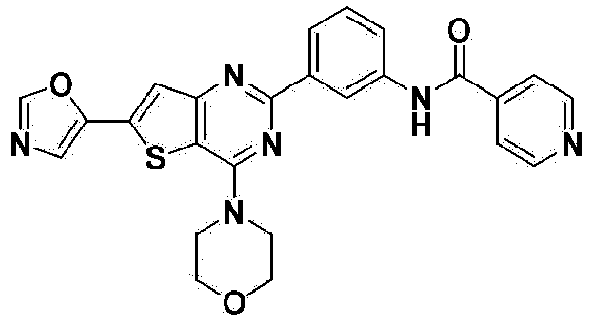
- 37 mg (yield: 42 %) of the title compound was obtained in the same manner as in Example 1, except that 5-oxazole boronic acid was used instead of the 4-pyridine boronic acid in Process 3) in Example 1.
- 1H-NMR (300MHz, DMSO-d 6) δ 10.67 (s, 1H), 8.82~8.78 (m, 3H), 8.62 (s, 1H), 8.22~8.19 (d, 1H), 8.10 (s, 1H), 8.01~7.98 (d, 1H), 7.94~7.90 (m, 3H), 7.88 (s, 1H), 7.54~7.48 (t, 1H), 4.06~4.03 (m, 4H), 3.85~3.82 (m, 4H).
- MS (ESI+) m/z 485.13 [M+H]+.
-

- 83 mg (yield: 65 %) of the title compound was obtained in the same manner as in Example 1, except that nicotinic acid was used instead of the isonicotinic acid in Process 6) in Example 1.
- 1H-NMR (300MHz, DMSO-d 6) δ 10.59 (bs, 1H), 9.15~9.14 (m, 1H), 8.79~8.75 (m, 2H), 8.71~8.69 (d, 2H), 8.35~8.31 (m, 1H), 8.24 (s, 1H), 8.20~8.17 (m, 1H), 7.98~7.95 (m, 1H), 7.89~7.87 (d, 2H), 7.60~7.56 (m, 1H), 7.51~7.46 (t, 1H), 4.07~4.04 (m, 4H), 3.84~3.81 (m, 4H).
- MS (ESI+) m/z 495.15 [M+H]+.
-

- 71 mg (yield: 55 %) of the title compound was obtained in the same manner as in Example 1, except that 3-pyridine boronic acid was used instead of the 4-pyridine boronic acid in Process 3) in Example 1 and nicotinic acid was used instead of the isonicotinic acid in Process 6) in Example 1.
- 1H-NMR (300MHz, DMSO-d 6) δ 10.67 (s, 1H), 8.82~8.78 (m, 3H), 8.62 (s, 1H), 8.22~8.19 (d, 1H), 8.10 (s, 1H), 7.98~8.01 (d, 1H), 7.94~7.90 (m, 3H), 7.88 (s, 1H), 7.54~7.48 (t, 1H), 4.06~4.03 (m, 4H), 3.85~3.82 (m, 4H).
- MS (ESI+) m/z 495.15 [M+H]+.
-

- 23 mg (yield: 32 %) of the title compound was obtained in the same manner as in Example 1, except that 4-(t-butylcarbonyl)-aminophenyl boronic acid was used instead of the 4-pyridine boronic acid in Process 3) in Example 1 and nicotinic acid was used instead of the isonicotinic acid in Process 6) in Example 1.
- 1H-NMR (300MHz, DMSO-d 6) δ 10.68 (s, 1H), 9.19, 9.18 (d, 1H), 8.82~8.80 (m, 1H), 8.76 (s, 1H), 8.42~8.38 (m, 1H), 8.17, 8.15 (d, 1H), 8.02, 8.00 (d, 1H), 7.67~7.62 (m, 4H), 7.57, 7.55 (d, 1H), 6.74, 6.71 (d, 2H), 4.08 (m, 4H), 3.85 (m, 4H).
- MS (ESI+) m/z 508.92 [M+H]+.
-

- 82 mg (yield: 77 %) of the title compound was obtained in the same manner as in Example 1, except that 5-oxazole boronic acid was used instead of the 4-pyridine boronic acid in Process 3) in Example 1 and nicotinic acid was used instead of the isonicotinic acid in Process 6) in Example 1.
- 1H-NMR (300MHz, DMSO-d 6) δ 10.61 (s, 1H), 9.16~9.15 (m, 1H), 8.79~8.77 (m, 2H), 8.62 (s, 1H), 8.37~8.33 (m, 1H), 8.21~8.18 (d, 1H), 8.01~7.98 (m, 1H), 7.94 (s, 1H), 7.88 (s, 1H), 7.61~7.59 (m, 1H), 7.57~7.48 (t, 1H), 4.06~4.03 (m, 4H), 3.85~3.82 (m, 4H).
- MS (ESI+) m/z 485.13 [M+H]+.
-

- 21 mg (yield: 16 %) of the title compound was obtained in the same manner as in Example 1, except that 1-(t-butylcarbonyl)-pyrazole-4-boronic acid was used instead of the 4-pyridine boronic acid in Process 3) in Example 1 and nicotinic acid was used instead of the isonicotinic acid in Process 6) in Example 1.
- 1H-NMR (300MHz, DMSO-d 6) δ 13.24 (s, 1H), 10.60 (s, 1H), 9.16 (s, 1H), 8.78~8.77 (m, 2H), 8.36 (d, 1H), 8.20~8.17 (m, 2H), 7.98 (d, 1H), 7.66 (s, 1H), 7.61~7.57 (m, 1H), 7.52~7.47 (m, 2H), 4.07~4.04 (m, 4H), 3.85~3.81 (m, 4H).
- MS (ESI+) m/z 484.55 [M+H]+.
-

- 71 mg (yield: 81 %) of the title compound was obtained in the same manner as in Example 1, except that 1-(t-butylcarbonyl)-7-azaindole-4-boronic acid pinacol ester was used instead of the 4-pyridine boronic acid in Process 3) in Example 1 and nicotinic acid was used instead of the isonicotinic acid in Process 6) in Example 1.
- 1H-NMR (300MHz, DMSO-d 6) δ 10.62 (s, 1H), 9.18 (m, 1H), 8.81 (m, 2H), 8.39 (m, 2H), 8.23 (m, 1H), 8.15 (s, 1H), 8.00 (m, 1H), 7.73 (m, 1H), 7.61 (m, 1H), 7.53 (m, 1H), 7.05 (m, 1H), 4.14 (m, 4H), 3.86 (m, 4H)
- MS (ESI+) m/z 534.16 [M+H]+.
-

- 5 mg (yield: 8 %) of the title compound was obtained in the same manner as in Example 1, except that 1-(t-butylcarbonyl)-7-pyrazolo[3,4-b]pyridin-4-boronic acid pinacol ester was used instead of the 4-pyridine boronic acid in Process 3) in Example 1 and nicotinic acid was used instead of the isonicotinic acid in Process 6) in Example 1.
- 1H-NMR (300MHz, DMSO-d 6) δ 14.04 (s, 1H), 10.64 (s, 1H), 9.17~9.16 (m, 1H), 8.83 (s, 1H), 8.80~8.78 (m, 1H), 8.76 (s, 1H), 8.67~8.66 (m, 1H), 8.38~8.34 (m, 2H), 8.26~8.23 (d, 1H), 8.01~7.98 (m, 1H), 7.76~7.75 (m, 1H), 7.63~7.59 (m, 1H), 7.57~7.48 (t, 1H), 4.14~4.09 (m, 4H), 3.89~3.87 (m, 4H).
- MS (ESI+) m/z 535.16 [M+H]+.
-

- 4 mg (yield: 99 %) of the title compound was obtained in the same manner as in Example 1, except that 1-(t-butylcarbonyl)-6- pyrrolo[2,3-c]pyridin-4-boronic acid pinacol ester was used instead of the 4-pyridine boronic acid in Process 3) in Example 1 and nicotinic acid was used instead of the isonicotinic acid in Process 6) in Example 1.
- 1H-NMR (300MHz, DMSO-d 6) δ 12.11 (s, 1H), 10.65 (s, 1H), 9.17 (m, 1H), 8.85~8.81 (m, 3H), 8.64 (m, 1H), 8.38~8.36 (m, 1H), 8.24~8.22 (m, 1H), 8.02~7.99 (m, 2H), 7.84 (m, 2H), 7.60~7.51 (m, 2H), 7.06 (m, 1H), 4.10 (m, 4H), 3.87 (m, 4H).
- MS (ESI+) m/z 534.16 [M+H]+.
-

- 61 mg (yield: 61 %) of the title compound was obtained in the same manner as in Example 1, except that 3-pyridine boronic acid was used instead of the 4-pyridine boronic acid in Process 3) in Example 1 and oxazol-4-carboxylic acid was used instead of the isonicotinic acid in Process 6) in Example 1.
- 1H-NMR (300MHz, DMSO-d 6) δ 10.30 (bs, 1H), 9.15 (s, 1H), 8.84~8.83 (m, 2H), 8.66~8.63 (m, 2H), 8.31~8.27 (m, 1H), 8.18~8.15 (m, 1H), 8.11 (s, 1H), 7.94~7.91 (m, 1H), 7.57~7.52 (m, 1H), 7.48~7.43 (t, 1H), 4.07~4.04 (m, 4H), 3.85~3.81 (m, 4H).
- MS (ESI+) m/z 485.13 [M+H]+.
-

- 44 mg (yield: 35 %) of the title compound was obtained in the same manner as in Example 1, except that 3-pyridine boronic acid was used instead of the 4-pyridine boronic acid in Process 3) in Example 1 and oxazol-5-carboxylic acid was used instead of the isonicotinic acid in Process 6) in Example 1.
- 1H-NMR (300MHz, DMSO-d 6) δ 10.61 (s, 1H), 9.17~9.16 (m, 1H), 8.77~8.76(m, 1H), 8.68~8.67 (m, 2H), 8.34~8.31 (m, 1H), 8.23~8.20 (m, 1H), 8.12 (s, 1H), 8.06 (s, 1H), 7.96~7.93 (m, 1H), 7.60~7.56 (m, 1H), 7.54~7.48 (t, 1H), 4.09~4.06 (m, 4H), 3.87~3.84 (m, 4H).
- MS (ESI+) m/z 485.13 [M+H]+.
-

- 37 mg (yield: 29 %) of the title compound was obtained in the same manner as in Example 1, except that 3-pyridine boronic acid was used instead of the 4-pyridine boronic acid in Process 3) in Example 1 and oxazol-2-carboxylic acid was used instead of the isonicotinic acid in Process 6) in Example 1.
- 1H-NMR (300MHz, DMSO-d 6) δ 10.32 (s, 1H), 9.16 (s, 1H), 8.87 (s, 1H), 8.85 (s, 1H), 8.66 (m, 1H), 8.65 (s, 1H), 8.32 (d, 1H), 8.19 (d, 1H), 8.14 (s, 1H), 7.95 (d, 1H), 7.57 (q, 1H), 7.48 (t, 1H), 4.07 (t, 4H), 3.87 (t, 4H).
- MS (ESI+) m/z 485.13 [M+H]+.
-

- 35 mg (yield: 45 %) of the title compound was obtained in the same manner as in Example 1, except that 3-pyridine boronic acid was used instead of the 4-pyridine boronic acid in Process 3) in Example 1 and 2-methyloxazol-5-carboxylic acid was used instead of the isonicotinic acid in Process 6) in Example 1.
- 1H-NMR (300MHz, DMSO-d 6) δ 10.47 (s, 1H), 9.16 (s, 1H), 8.73 (s, 1H), 8.68 (d, 1H), 8.33~8.29 (m, 1H), 8.19 (d, 1H), 8.18 (s, 1H), 7.93~7.91 (m, 2H), 7.59~7.55 (m, 1H), 7.49 (t, 1H), 4.08~4.05 (m, 4H), 3.86~3.83 (m, 4H), 2.55 (s, 3H).
- MS (ESI+) m/z 499.56 [M+H]+.
-

- 73 mg (yield: 56 %) of the title compound was obtained in the same manner as in Example 1, except that 3-pyridine boronic acid was used instead of the 4-pyridine boronic acid in Process 3) in Example 1 and 4-methyloxazol-5-carboxylic acid was used instead of the isonicotinic acid in Process 6) in Example 1.
- 1H-NMR (300MHz, DMSO-d 6) δ 10.44 (s, 1H), 9.16 (s, 1H), 8.81 (s, 1H), 8.67 (d, 1H), 8.56 (s, 1H), 8.31 (d, 1H), 8.19 (d, 1H), 8.13 (s, 1H), 7.90 (d, 1H), 7.57 (q, 1H), 7.48 (t, 1H) 4.07 (t, 4H), 3.85 (t, 4H), 2.47 (s, 3H).
- MS (ESI+) m/z 499.15 [M+H]+.
-

- 108 mg (yield: 81 %) of the title compound was obtained in the same manner as in Example 1, except that 3-pyridine boronic acid was used instead of the 4-pyridine boronic acid in Process 3) in Example 1 and 2,4-dimethyloxazol-5-carboxylic acid was used instead of the isonicotinic acid in Process 6) in Example 1.
- 1H-NMR (300MHz, DMSO-d 6) δ 10.30 (s, 1H), 9.16 (s, 1H), 8.80 (s, 1H), 8.67 (d, 1H), 8.32 (d, 1H), 8.19 (d, 1H), 8.14 (s, 1H), 7.89 (d, 1H), 7.59 (q, 1H), 7.47 (t, 1H), 4.09 (t, 4H), 3.85 (t, 4H), 2.49 (s, 3H), 2.41 (s, 3H).
- MS (ESI+) m/z 513.16 [M+H]+.
-

- 63 mg (yield: 49 %) of the title compound was obtained in the same manner as in Example 1, except that 3-pyridine boronic acid was used instead of the 4-pyridine boronic acid in Process 3) in Example 1 and thiazole-4-carboxylic acid was used instead of the isonicotinic acid in Process 6) in Example 1.
- 1H-NMR (300MHz, DMSO-d 6) δ 10.46 (bs, 1H), 9.28 (s, 1H), 9.13 (bs, 1H), 8.90 (s, 1H), 8.65~8.63 (m, 1H), 8.53~8.52 (m, 1H), 8.31~8.27 (m, 1H), 8.18~8.15 (m, 1H), 8.12 (s, 1H), 7.97~7.94 (m, 1H), 7.56~7.52 (m, 1H), 7.48'7.43 (m, 1H), 4.07~4.04 (m, 4H), 3.84~3.81 (m, 4H).
- MS (ESI+) m/z 501.11 [M+H]+.
-

- 43 mg (yield: 34 %) of the title compound was obtained in the same manner as in Example 1, except that 3-pyridine boronic acid was used instead of the 4-pyridine boronic acid in Process 3) in Example 1 and thiazole-5-carboxylic acid was used instead of the isonicotinic acid in Process 6) in Example 1.
- 1H-NMR (300MHz, DMSO-d 6) δ 10.62 (bs, 1H), 9.31 (s, 1H), 9.14~9.13 (m, 1H), 8.76 (s, 1H), 8.73~8.71 (m, 1H), 8.66~8.64 (m, 1H), 8.32~8.28 (m, 1H), 8.20~8.18 (m, 1H), 8.09 (s, 1H), 7.94~7.91 (m, 1H), 7.57~7.52 (m, 1H), 7.49~7.46 (m, 1H), 4.07~4.04 (m, 4H), 3.85~3.82 (m, 4H).
- MS (ESI+) m/z 501.11 [M+H]+.
-

- 80 mg (yield: 63 %) of the title compound was obtained in the same manner as in Example 1, except that 3-pyridine boronic acid was used instead of the 4-pyridine boronic acid in Process 3) in Example 1 and thiazole-2-carboxylic acid was used instead of the isonicotinic acid in Process 6) in Example 1.
- 1H-NMR (300MHz, DMSO-d 6) δ 10.90 (bs, 1H), 9.13 (s, 1H), 8.93~8.92 (m, 1H), 8.65~8.63 (m, 1H), 8.31~8.27 (m, 1H), 8.21~8.12 (m, 3H), 7.98~7.95 (m, 1H), 7.57~7.52 (m, 1H), 7.50~7.45 (t, 1H), 4.07~4.04 (m, 4H), 3.85~3.82 (m, 4H).
- MS (ESI+) m/z 501.11 [M+H]+.
-

- 96 mg (yield: 60 %) of the title compound was obtained in the same manner as in Example 1, except that 3-pyridine boronic acid was used instead of the 4-pyridine boronic acid in Process 3) in Example 1 and 2-methylthiazole-5-carboxylic acid was used instead of the isonicotinic acid in Process 6) in Example 1.
- 1H-NMR (300MHz, DMSO-d 6) δ 10.53 (s, 1H), 9.17 (m, 1H), 8.72 (m, 1H), 8.67 (m, 1H), 8.52 (s, 1H), 8.35 (m, 1H), 8.21 (m, 1H), 8.11 (s, 1H), 7.91 (m, 1H), 7.56 (m, 1H), 7.48 (m, 1H), 4.08 (m, 4H), 3.86 (m, 4H), 2.73 (s, 3H).
- MS (ESI+) m/z 515.12 [M+H]+.
-

- 64 mg (yield: 48 %) of the title compound was obtained in the same manner as in Example 1, except that 3-pyridine boronic acid was used instead of the 4-pyridine boronic acid in Process 3) in Example 1 and 4-methylthiazole-5-carboxylic acid was used instead of the isonicotinic acid in Process 6) in Example 1.
- 1H-NMR (300MHz, DMSO-d 6) δ 10.39 (s, 1H), 9.15 (m, 1H), 8.72~8.71 (m, 1H), 8.67~8.65 (m, 1H), 8.33~8.29 (m, 1H), 8.21~8.18 (m, 1H), 8.12 (s, 1H), 7.88~7.85 (m, 1H), 7.59~7.56 (m, 1H), 7.51 (t, 1H), 4.08~4.05 (m, 4H), 3.86~3.84 (m, 4H).
- MS (ESI+) m/z 515.12 [M+H]+.
-

- 118 mg (yield: 74 %) of the title compound was obtained in the same manner as in Example 1, except that 3-pyridine boronic acid was used instead of the 4-pyridine boronic acid in Process 3) in Example 1 and 2,4-dimethylthiazole-5-carboxylic acid was used instead of the isonicotinic acid in Process 6) in Example 1.
- 1H-NMR (300MHz, DMSO-d 6) δ 10.26 (s, 1H), 9.17 (m, 1H), 8.72 (m, 1H), 8.67 (m, 1H), 8.34 (m, 1H), 8.21 (m, 1H), 8.10 (s, 1H), 7.84 (m, 1H), 7.58 (m, 1H), 7.45 (m, 1H), 4.07 (m, 4H), 3.85 (m, 4H), 2.69 (s, 3H), 2.58 (s, 3H).
- MS (ESI+) m/z 529.14 [M+H]+.
-

- 140 mg (yield: 52 %) of the title compound was obtained in the same manner as in Example 1, except that 3-pyridine boronic acid was used instead of the 4-pyridine boronic acid in Process 3) in Example 1 and 1-(t-butylcarbonyl)piperidine-3-carboxylic acid was used instead of the isonicotinic acid in Process 6) in Example 1.
- 1H-NMR (300MHz, DMSO-d 6) δ 10.11 (s, 1H), 9.14 (d, 1H), 8.67 (dd, 1H), 8.60 (s, 1H), 8.32 (m, 1H), 8.10 (s, 1H), 8.09 (d, 1H), 7.82 (m, 1H), 7.58 (m, 1H), 7.43 (t, 1H), 4.46 (m, 1H), 4.06 (m, 4H), 3.85 (m, 4H), 3.11 (m, 1H), 2.89 (m, 1H), 2.66 (m, 1H), 1.92 (m, 1H), 1.66 (m, 2H), 1.55 (m, 1H), 1.39 (m, 1H), 0.82 (m, 1H).
- MS (ESI+) m/z 501.12 [M+H]+.
-

- 1.8 mg (yield: 94 %) of the title compound was obtained in the same manner as in Example 1, except that 3-pyridine boronic acid was used instead of the 4-pyridine boronic acid in Process 3) in Example 1 and 1-(t-butylcarbonyl)piperidine-4-carboxylic acid was used instead of the isonicotinic acid in Process 6) in Example 1.
- 1H-NMR (300MHz, DMSO-d 6) δ 10.19 (s, 1H), 9.16~9.15 (m, 1H), 8.68~8.66 (m, 1H), 8.62 (m, 1H), 8.33`8.29 (m, 1H), 8.14~8.10 (m, 2H), 7.84~7.81 (m, 1H), 7.59~7.55 (m, 1H), 7.46~7.40 (t, 1H), 4.08~4.04 (m, 4H), 3.86~3.83 (m, 4H), 2.96~2.89 (m, 2H), 2.73~2.64 (m, 1H), 1.99~1.80 (m, 5H).
- MS (ESI+) m/z 501.20 [M+H]+.
-

- 7 mg (yield: 23 %) of the title compound was obtained in the same manner as in Example 1, except that 3-pyridine boronic acid was used instead of the 4-pyridine boronic acid in Process 3) in Example 1 and 1-(2-hydroxyethyl)piperidine-4-carboxylic acid was used instead of the isonicotinic acid in Process 6) in Example 1.
- 1H-NMR (300MHz, DMSO-d 6) δ 9.14 (m, 1H), 8.67~8.65 (m, 1H), 8.43~8.40 (m, 1H), 8.33~8.28 (m, 2H), 8.16 (s, 1H), 7.62~7.55 (m, 2H), 7.48 (m, 1H), 4.70 (brs, 1H), 4.06~4.03 (m, 4H), 3.85~3.81 (m, 4H), 3.72 (m, 2H), 3.49 (m, 2H), 2.90-2.86 (m, 2H), 2.32~2.18 (m, 2H), 1.57~1.54 (m, 4H).
- MS (ESI+) m/z 545.23 [M+H]+.
-

- 25 mg (yield: 22 %) of the title compound was obtained in the same manner as in Example 1, except that 3-pyridine boronic acid was used instead of the 4-pyridine boronic acid in Process 3) in Example 1 and 1-(2-methoxyethyl)piperidine-4-carboxylic acid was used instead of the isonicotinic acid in Process 6) in Example 1.
- 1H-NMR (300MHz, DMSO-d 6) δ 10.01 (s, 1H), 9.15 (s, 1H), 8.66 (d, 1H), 8.65 (s, 1H), 8.32 (d, 1H), 8.15 (s, 1H), 8.10 (s, 1H), 7.82 (d, 1H), 7.58~7.54 (m, 1H), 7.40 (t, 1H), 4.07~4.04 (m, 4H), 3.85~3.81 (m, 4H), 3.45~3.39 (m, 4H), 3.32 (s, 3H), 2.98~2.94 (m, 2H), 2.35~2.31 (m 1H), 2.08~2.02 (m, 2H), 1.99~1.77 (m, 2H), 1.69~1.61 (m, 2H).
- MS (ESI+) m/z 559.70 [M+H]+.
-

- 4 mg (yield: 3 %) of the title compound was obtained in the same manner as in Example 1, except that 3-pyridine boronic acid was used instead of the 4-pyridine boronic acid in Process 3) in Example 1 and 1-formylpiperidine-4-carboxylic acid was used instead of the isonicotinic acid in Process 6) in Example 1.
- 1H-NMR (300MHz, DMSO-d 6) δ 10.12 (s, 1H), 9.16 (d, 1H), 8.67 (dd, 1H), 8.62 (s, 1H), 8.34~8.30 (m, 1H), 8.13~8.10 (m, 2H), 8.03 (s, 1H), 7.86~7.83 (m, 1H), 7.51 (dd, 1H), 7.43 (d, 1H), 4.23 (m, 1H), 4.07 (m, 4H), 3.85 (m, 4H), 3.77 (m, 1H), 3.10 (m, 2H), 2.74~2.64 (m, 2H), 1.91~1.86 (m, 2H), 1.60~1.44 (m, 2H).
- MS (ESI+) m/z 529.19 [M+H]+.
-

- 70 mg (yield: 65 %) of the title compound was obtained in the same manner as in Example 1, except that 3-pyridine boronic acid was used instead of the 4-pyridine boronic acid in Process 3) in Example 1 and 1-acetylpiperidine-4-carboxylic acid was used instead of the isonicotinic acid in Process 6) in Example 1.
- 1H-NMR (300MHz, DMSO-d 6) δ 10.09 (s, 1H), 9.16, 9.15 (d, 1H), 8.68~8.67 (m, 1H), 8.67 (d, 1H), 8.34~8.30 (m, 1H), 8.13~8.10 (m, 2H), 7.85 (d, 1H), 7.60~7.56 (m, 1H), 7.42 (t, 1H), 4.08~4.05 (m, 4H), 3.87~3.85 (m, 4H), 3.62 (s, 3H), 3.18 (d, 1H), 2.93~2.88 (m, 2H), 1.89~1.82 (m, 2H), 1.61~1.53 (m, 2H), 1.26~1.24 (m, 1H), 0.96~0.84 (m, 1H).
- MS (ESI+) m/z 559.4 [M+H]+.
-

- 54 mg (yield: 48 %) of the title compound was obtained in the same manner as in Example 1, except that 3-pyridine boronic acid was used instead of the 4-pyridine boronic acid in Process 3) in Example 1 and 1-(methoxycarbonyl)piperidine-4-carboxylic acid was used instead of the isonicotinic acid in Process 6) in Example 1.
- 1H-NMR (300MHz, DMSO-d 6) δ 10.08 (s, 1H), 9.14 (d, 1H), 8.67 (dd, 1H), 8.61 (s, 1H), 8.32 (m, 1H), 8.11 (m, 1H), 8.10 (s, 1H), 7.84 (d, 1H), 7.58 (m, 1H), 7.44 (t, 1H), 4.44 (d, 1H), 4.05 (m, 4H), 3.85 (m, 1H), 3.84 (m, 4H), 3.12 (t, 1H), 2.64 (m, 2H), 2.02 (s, 3H), 1.90 (m, 2H), 1.55 (m, 2H).
- MS (ESI+) m/z 543.30 [M+H]+.
-

- 14 mg (yield: 12 %) of the title compound was obtained in the same manner as in Example 1, except that 3-pyridine boronic acid was used instead of the 4-pyridine boronic acid in Process 3) in Example 1 and 1-(ethoxycarbonyl)piperidine-4-carboxylic acid was used instead of the isonicotinic acid in Process 6) in Example 1.
- 1H-NMR (300MHz, DMSO-d 6) δ 10.09 (s, 1H), 9.15~9.14 (m, 1H), 8.68~8.65 (m, 1H), 8.62~8.60 (m, 1H), 8.33~8.29 (m, 1H), 8.12~8.09 (m, 2H), 7.85~7.82 (m, 2H), 7.59~7.54 (m, 1H), 7.44~7.39 (t, 1H), 4.09~4.02 (m, 6H), 3.86~3.83 (m, 4H), 2.90~2.85 (m, 2H), 2.73~2.50 (m, 2H), 1.85~1.81 (m, 2H), 1.59~1.47 (m, 2H), 1.22~1.17 (t, 3H).
- MS (ESI+) m/z 573.22 [M+H]+.
-

- 112 mg (yield: 84 %) of the title compound was obtained in the same manner as in Example 1, except that 3-pyridine boronic acid was used instead of the 4-pyridine boronic acid in Process 3) in Example 1 and (1s,4s)-4-hydroxycyclohexylcarboxylic acid was used instead of the isonicotinic acid in Process 6) in Example 1.
- 1H-NMR (300MHz, DMSO-d 6) δ 9.94 (s, 1H), 9.16 (d, 1H), 8.68~8.66 (m, 1H), 8.63 (m, 1H), 8.34~8.30 (m, 1H), 8.12~8.10 (m, 2H), 7.86~7.83 (m, 1H), 7.60~7.56 (m, 1H), 7.44~7.39 (m, 1H), 4.36~4.35 (m, 1H), 4.08~4.05 (m, 4H), 3.87~3.84 (m, 5H), 2.40 (m, 1H), 1.92~1.84 (m, 2H), 1.75~1.71 (m, 2H), 1.57~1.45 (m, 4H).
- MS (ESI+) m/z 516.2 [M+H]+.
-

- 80 mg (yield: 77 %) of the title compound was obtained in the same manner as in Example 1, except that 5-oxazole boronic acid was used instead of the 4-pyridine boronic acid in Process 3) in Example 1 and 4-oxazole carboxylic acid was used instead of the isonicotinic acid in Process 6) in Example 1.
- 1H-NMR (300MHz, DMSO-d 6) δ 10.31 (s, 1H), 8.84 (m, 1H), 8.64~8.62 (m, 2H), 8.18~8.15 (d, 1H), 7.98 (m, 1H), 7.94 (s, 1H), 7. 88 (s, 1H), 7.50~7.45 (t, 1H), 4.05 (m, 4H), 3.85~3.84 (m, 4H).
- MS (ESI+) m/z 475.11 [M+H]+.
- For each of the compounds prepared in Examples 1 to 33, the PlKfyve enzyme inhibitory activity was measured by using a QS S Assis PIKFYVE (PIP5K3)_ADP-Glo™ Kit (Cat. #11-118) made by Carna Bioscience. 5 µL of each of human-derived PlKfyve kinase, PI(3)P, and ATP solution was added to a 384-well plate (such that final concentrations of each solution are 375 ng/mL, 10 µm, and 2 µm, respectively). The compound to be evaluated underwent serial dilution according to the set concentrations, and 5 µL of the diluted solution was added to each well and caused a reaction for 60 minutes. MgCl2 was mixed in ADP-Glo™ solution (Promega, Cat. #V9102) to a final concentration of 100 mM, and 20 µL of the mixed solution was added to each well and caused a reaction at room temperature for 40 minutes. 40 µL of kinase detection solution was added to each well and caused a reaction at room temperature for 40 minutes. Then, the luminescence signals were detected by using a Synergy™ NEO microplate analyzer. Well to which no enzyme was added were used as a negative control, whereas wells to which no drug was added were used as a positive control, so as to calculate the enzyme inhibitory ability (%) of drugs. The 50 % inhibitor concentration (IC50) values were calculated by using a GraphPad Prism software.
- Results thereof are shown in Table 1. In Table 1, when the case where the IC50 value was 50 nM or less was indicated as A, the case where the IC50 value was greater than 50 nM but equal to or less than 100 nM was indicated as B, and the case where the IC50 value was greater than 100 nM was indicated as C.
[Table1] PlKfyve enzyme inhibitory assay Example IC50 (nM) Example IC50 (nM) Example IC50 (nM) 1 A 12 A 23 B 2 A 13 A 24 A 3 A 14 A 25 A 4 A 15 B 26 B 5 A 16 A 27 B 6 A 17 A 28 C 7 A 18 C 29 C 8 A 19 A 30 C 9 A 20 C 31 A 10 B 21 A 32 A 11 C 22 A 33 A - The present disclosure provides a thieno[3,2-d]pyrimidine derivative compound which is useful as a PlKfyve kinase inhibitor, a pharmaceutically acceptable salt thereof, a preparation method thereof, and an intermediate thereof.
- Hereinabove, the present disclosure was examined with respect to the specific embodiments. Those of ordinary skill in the art to which the present disclosure pertains will understand that the present disclosure may be implemented in a modified form without departing from the essential characteristics of the present disclosure. Therefore, the disclosed specific embodiments are to be considered in an descriptive point of view rather than a restrictive sense. The scope of the present disclosure is indicated in the claims rather than the above description, and differences within the scope equivalent thereto should be construed as being included in the invention.
Claims (7)
- A compound Formula (1) or a pharmaceutically acceptable salt thereof:


 X4 and X7 are each independently CH2, an oxygen atom, or NH,in each case, R1, R2, and R3 are each independently one selected from a halogen, an amino group, -NH(C1-C3alkyl), -N(C1-C3alkyl)2, C1-C6alkyl, C2-C6alkenyl, and C1-C6alkoxy,n is an integer of 0 to 4,m is an integer from 0 to 2,k is an integer of 0 to 4,
 Y3, Y4, and Y5 are each independently CH2, an oxygen atom, NH, or a sulfur atom,in each case, R4 and R6 are each independently one selected from hydrogen, a halogen, an amino group, C1-C6alkyl, C2-C6alkenyl, and C1-C6alkoxy,R5 is one selected from hydrogen, -T-OH, -T-CHO, -T-(C1-C4alkyl), and -T-(C1-C4alkoxy), wherein -T- is absent or is -C(=O), C1-C4alkylene or C2-C4alkenylene,p is an integer of 0 to 4,q is an integer of 0 to 4, andr is an integer from 0 to 2.
 - The compound of claim 1, wherein


- The compound of claim 1, wherein


- The compound of claim 1, wherein R1 is a halogen or an amino group.
- The compound of claim 1, wherein R5 is one of hydroxy, -(C1-C4alkylene)-OH, -(C1-C4alkylene)-(C1-C4alkoxy), -C(=O)H, -C(=O)(C1-C4alkyl), -C(=O)-(C1-C4alkoxy), and -(C1-C4alkylene)-CHO.
- The compound of claim 1, wherein R6 is one of methyl, ethyl, and propyl.
- The compound of claim 1, wherein the compound is one selected from the group consisting of the following compounds.
Structural Formula Name 1 
N-(3-(4-morpholino-6-(pyridin-4-yl)thieno[3,2-d]pyrimidin-2-yl)phenyl)isonicotinamide 2 
N-(3-(4-morpholino-6-(pyridin-3-yl)thieno[3,2-d]pyrimidin-2-yl)phenyl)isonicotinamide 3 
N-(3-(4-morpholino-6-(oxazol-5-yl)thieno[3,2-d]pyrimidin-2-yl)phenyl)isonicotinamide 4 
N-(3-(4-morpholino-6-(pyridin-4-yl)thieno[3,2-d]pyrimidin-2-yl)phenyl)nicotinamide 5 
N-(3-(4-morpholino-6-(pyridin-3-yl)thieno[3,2-d]pyrimidin-2-yl)phenyl)nicotinamide 6 
N-(3-(6-(4-aminophenyl)-4-morpholinothieno[3,2-d]pyrimidin-2-yl)phenyl)nicotinamide hydrochloride 7 
N-(3-(4-morpholino-6-(oxazol-5-yl)thieno[3,2-d]pyrimidin-2-yl)phenyl)nicotinamide 8 
N-(3-(4-morpholino-6-(1H-pyrazole-4-yl)thieno[3,2-d]pyrimidin-2-yl)phenyl)isonicotinamide 9 
N-(3-(4-morpholino-6-(1H-pyrrolo[2,3-b]pyridin-4-yl)thieno[3,2-d]pyrimidin-2-yl)phenyl)nicotinamide 10 
N-(3-(4-morpholino-6-(1H-pyrazolo[3,4-b]pyridin-4-yl)thieno[3,2-d]pyrimidin-2-yl)phenyl)nicotinamide 11 
N-(3-(4-morpholino-6-(1H-pyrrolo[2,3-c]pyridin-4-yl)thieno[3,2-d]pyrimidin-2-yl)phenyl)nicotinamide 12 
N-(3-(4-morpholino-6-(pyridin-3-yl)thieno[3,2-d]pyrimidin-2-yl)phenyl)oxazole-4-carboxamide 13 
N-(3-(4-morpholino-6-(pyridin-3-yl)thieno[3,2-d]pyrimidin-2-yl)phenyl)oxazole-5-carboxamide 14 
N-(3-(4-morpholino-6-(pyridin-3-yl)thieno[3,2-d]pyrimidin-2-yl)phenyl)oxazole-2-carboxamide 15 
2-methyl-N-(3-(4-morpholino-6-(pyridin-3-yl)thieno[3,2-d]pyrimidin-2-yl)phenyl)oxazole-5-carboxamide 16 
4-methyl-N-(3-(4-morpholino-6-(pyridin-3-yl)thieno[3,2-d]pyrimidin-2-yl)phenyl)oxazole-5-carboxamide 17 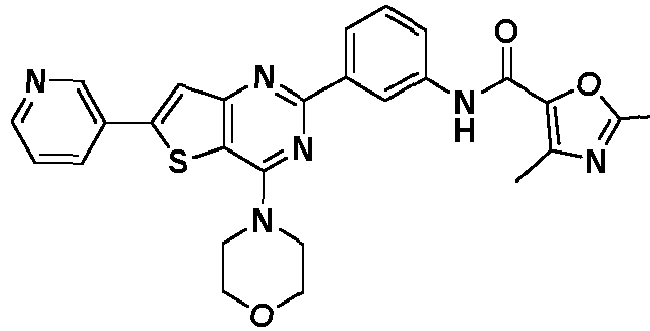
2,4-dimethyl-N-(3-(4-morpholino-6-(pyridin-3-yl)thieno[3,2-d]pyrimidin-2-yl)phenyl)oxazole-5-carboxamide 18 
N-(3-(4-morpholino-6-(pyridin-3-yl)thieno[3,2-d]pyrimidin-2-yl)phenyl)thiazole-4-carboxamide 19 
N-(3-(4-morpholino-6-(pyridin-3-yl)thieno[3,2-d]pyrimidin-2-yl)phenyl)thiazole-5-carboxamide 20 
N-(3-(4-morpholino-6-(pyridin-3-yl)thieno[3,2-d]pyrimidin-2-yl)phenyl)thiazole-2-carboxamide 21 
2-methyl-N-(3-(4-morpholino-6-(pyridin-3-yl)thieno[3,2-d]pyrimidin-2-yl)phenyl)thiazole-5-carboxamide 22 
4-methyl-N-(3-(4-morpholino-6-(pyridin-3-yl)thieno[3,2-d]pyrimidin-2-yl)phenyl)thiazole-5-carboxamide 23 
2,4-dimethyl-N-(3-(4-morpholino-6-(pyridin-3-yl)thieno[3,2-d]pyrimidin-2-yl)phenyl)thiazole-5-carboxamide 24 
N-(3-(4-morpholino-6-(pyridin-3-yl)thieno[3,2-d]pyrimidin-2-yl)phenyl)piperidine-3-carboxamide 25 
N-(3-(4-morpholino-6-(pyridin-3-yl)thieno[3,2-d]pyrimidin-2-yl)phenyl)piperidine-4-carboxamide 26 
1-(2-hydroxyethyl)-N-(3-(4-morpholino-6-(pyridin-3-yl)thieno[3,2-d]pyrimidin-2-yl)phenyl)piperidine-4-carboxamide 27 
1-(2-methoxyethyl)-N-(3-(4-morpholino-6-(pyridin-3-yl)thieno[3,2-d]pyrimidin-2-yl)phenyl)piperidine-4-carboxamide 28 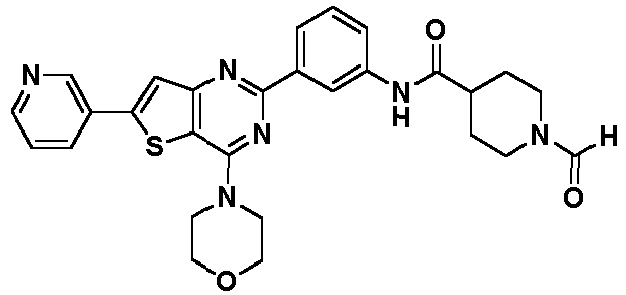
1-formyl-N-(3-(4-morpholino-6-(pyridin-3-yl)thieno[3,2-d]pyrimidin-2-yl)phenyl)piperidine-4-carboxamide 29 
1-acetyl-N-(3-(4-morpholino-6-(pyridin-3-yl)thieno[3,2-d]pyrimidin-2-yl)phenyl)piperidine-4-carboxamide 30 
methyl 4-((3-(4-morpholino-6-(pyridin-3-yl)thieno[3,2-d]pyrimidin-2-yl)phenyl)carbamoyl)piperidine-1-carboxylate 31 
ethyl 4-((3-(4-morpholino-6-(pyridin-3-yl)thieno[3,2-d]pyrimidin-2-yl)phenyl)carbamoyl)piperidine-1-carboxylate 32 
(1s,4s)-4-hydroxy-N-(3-(4-morpholino-6-(pyridin-3-yl)thieno[3,2-d]pyrimidin-2-yl)phenyl)cyclohexane-1-carboxamide 33 
N-(3-(4-morpholino-6-(oxazol-5-yl)thieno[3,2-d]pyrimidin-2-yl)phenyl)oxazole-4-carboxamide
Applications Claiming Priority (2)
| Application Number | Priority Date | Filing Date | Title |
|---|---|---|---|
| KR20210129839 | 2021-09-30 | ||
| PCT/KR2022/014781 WO2023055181A1 (en) | 2021-09-30 | 2022-09-30 | Pikfyve kinase inhibitor |
Publications (2)
| Publication Number | Publication Date |
|---|---|
| EP4410795A1 true EP4410795A1 (en) | 2024-08-07 |
| EP4410795A4 EP4410795A4 (en) | 2025-10-01 |
Family
ID=85780845
Family Applications (1)
| Application Number | Title | Priority Date | Filing Date |
|---|---|---|---|
| EP22876952.7A Pending EP4410795A4 (en) | 2021-09-30 | 2022-09-30 | PIKFYVE kinase inhibition |
Country Status (6)
| Country | Link |
|---|---|
| US (1) | US20250042914A1 (en) |
| EP (1) | EP4410795A4 (en) |
| JP (1) | JP2024533630A (en) |
| KR (1) | KR20230047047A (en) |
| CN (1) | CN118019744A (en) |
| WO (1) | WO2023055181A1 (en) |
Family Cites Families (5)
| Publication number | Priority date | Publication date | Assignee | Title |
|---|---|---|---|---|
| JP5291616B2 (en) * | 2006-04-26 | 2013-09-18 | ジェネンテック, インコーポレイテッド | Phosphoinositide 3-kinase inhibitor compounds and methods of use thereof |
| CN101479274B (en) * | 2006-04-26 | 2013-06-12 | 霍夫曼-拉罗奇有限公司 | Pharmaceutical compounds |
| EP2385832B1 (en) * | 2009-01-08 | 2015-07-15 | Curis, Inc. | Phosphoinositide 3-kinase inhibitors with a zinc binding moiety |
| WO2017040971A1 (en) * | 2015-09-03 | 2017-03-09 | Biomarin Pharmaceutical Inc. | Methods of using inhibitors of pikfyve for the treatment of lysosomal storage disorders and neurodegenerative diseases |
| CN109384782A (en) * | 2017-08-04 | 2019-02-26 | 厦门大学 | Substituted five-membered and six-membered heterocyclic compound, its preparation method, pharmaceutical combination and use thereof |
-
2022
- 2022-09-30 EP EP22876952.7A patent/EP4410795A4/en active Pending
- 2022-09-30 US US18/696,960 patent/US20250042914A1/en active Pending
- 2022-09-30 WO PCT/KR2022/014781 patent/WO2023055181A1/en not_active Ceased
- 2022-09-30 CN CN202280065074.6A patent/CN118019744A/en active Pending
- 2022-09-30 KR KR1020220125748A patent/KR20230047047A/en active Pending
- 2022-09-30 JP JP2024517561A patent/JP2024533630A/en active Pending
Also Published As
| Publication number | Publication date |
|---|---|
| EP4410795A4 (en) | 2025-10-01 |
| WO2023055181A1 (en) | 2023-04-06 |
| CN118019744A (en) | 2024-05-10 |
| US20250042914A1 (en) | 2025-02-06 |
| JP2024533630A (en) | 2024-09-12 |
| KR20230047047A (en) | 2023-04-06 |
Similar Documents
| Publication | Publication Date | Title |
|---|---|---|
| EP2344474B1 (en) | Picolinamide derivatives as kinase inhibitors | |
| US11629145B2 (en) | SHP2 phosphatase inhibitors and methods of use thereof | |
| KR101697982B1 (en) | Novel pyrimidine and pyridine compounds and their usage | |
| EP2864318B1 (en) | 2-aminopyrazine derivatives as csf-1r kinase inhibitors | |
| EP3515916A1 (en) | Shp2 phosphatase inhibitors and methods of use thereof | |
| CA2961589A1 (en) | Benzyl substituted indazoles as bub1 inhibitors | |
| EP2838898A1 (en) | Substituted hetero-bicyclic compounds, compositions and medicinal applications thereof | |
| WO2014062938A1 (en) | Rory modulators | |
| CA2929394C (en) | Nitrogenous heterocyclic derivatives and their application in drugs | |
| US11866436B2 (en) | Benzo[c][2,6]naphthyridine derivatives, compositions and therapeutic uses thereof | |
| CN117222642A (en) | Analogs used to treat diseases | |
| US20160280699A1 (en) | Substituted phenylalanine derivatives | |
| KR20220118425A (en) | nuclear receptor active compounds | |
| US20160237045A1 (en) | Substituted phenylalanine derivatives | |
| AU2010293429B2 (en) | 8-oxodihydropurine derivative | |
| TW201910312A (en) | Cyclic amine derivative and pharmaceutical use thereof | |
| EP3672967B1 (en) | Azaindolylpyridone and diazaindolylpyridone compounds | |
| US20250042914A1 (en) | Pikfyve kinase inhibitor | |
| US9453003B2 (en) | Pyrimidine derivatives as PIM kinase inhibitors and preparation methods and use in medicinal manufacture thereof | |
| CN112707873B (en) | Substituted oxazole derivatives and their applications in pharmaceuticals | |
| TW202510869A (en) | Novel compounds | |
| CN104496978A (en) | Substituted oxazolidinone compound and use method and use thereof | |
| HK40072566A (en) | Azaindolylpyridone and diazaindolylpyridone compounds | |
| KR20100066870A (en) | Novel 6-indazolylamino-3-nitropyridine derivative compounds, preparation thereof and pharmaceutical composition comprising the same | |
| WO2022060764A1 (en) | Modified benzofuran-carboxamides as glucosylceramide synthase inhibitors |
Legal Events
| Date | Code | Title | Description |
|---|---|---|---|
| STAA | Information on the status of an ep patent application or granted ep patent |
Free format text: STATUS: THE INTERNATIONAL PUBLICATION HAS BEEN MADE |
|
| PUAI | Public reference made under article 153(3) epc to a published international application that has entered the european phase |
Free format text: ORIGINAL CODE: 0009012 |
|
| STAA | Information on the status of an ep patent application or granted ep patent |
Free format text: STATUS: REQUEST FOR EXAMINATION WAS MADE |
|
| 17P | Request for examination filed |
Effective date: 20240325 |
|
| AK | Designated contracting states |
Kind code of ref document: A1 Designated state(s): AL AT BE BG CH CY CZ DE DK EE ES FI FR GB GR HR HU IE IS IT LI LT LU LV MC MK MT NL NO PL PT RO RS SE SI SK SM TR |
|
| DAV | Request for validation of the european patent (deleted) | ||
| DAX | Request for extension of the european patent (deleted) | ||
| A4 | Supplementary search report drawn up and despatched |
Effective date: 20250829 |
|
| RIC1 | Information provided on ipc code assigned before grant |
Ipc: C07D 495/04 20060101AFI20250825BHEP Ipc: C07D 519/00 20060101ALI20250825BHEP Ipc: A61P 35/00 20060101ALI20250825BHEP |