EP4410763A1 - Process for catalytic dehydrobromination of one or more c2-10-bromohydrocarbons to the corresponding c2-10-alkenes - Google Patents
Process for catalytic dehydrobromination of one or more c2-10-bromohydrocarbons to the corresponding c2-10-alkenes Download PDFInfo
- Publication number
- EP4410763A1 EP4410763A1 EP23155185.4A EP23155185A EP4410763A1 EP 4410763 A1 EP4410763 A1 EP 4410763A1 EP 23155185 A EP23155185 A EP 23155185A EP 4410763 A1 EP4410763 A1 EP 4410763A1
- Authority
- EP
- European Patent Office
- Prior art keywords
- catalyst
- ppm
- less
- accordance
- reaction
- Prior art date
- Legal status (The legal status is an assumption and is not a legal conclusion. Google has not performed a legal analysis and makes no representation as to the accuracy of the status listed.)
- Pending
Links
- 238000000034 method Methods 0.000 title claims abstract description 50
- 230000008569 process Effects 0.000 title claims abstract description 44
- 238000007269 dehydrobromination reaction Methods 0.000 title description 18
- 230000003197 catalytic effect Effects 0.000 title description 13
- 239000003054 catalyst Substances 0.000 claims abstract description 104
- 238000006243 chemical reaction Methods 0.000 claims abstract description 72
- 239000000463 material Substances 0.000 claims abstract description 60
- 229910052723 transition metal Inorganic materials 0.000 claims abstract description 25
- 150000003624 transition metals Chemical class 0.000 claims abstract description 23
- 229910052751 metal Inorganic materials 0.000 claims abstract description 22
- 239000002184 metal Substances 0.000 claims abstract description 22
- 229910000510 noble metal Inorganic materials 0.000 claims abstract description 21
- 239000000203 mixture Substances 0.000 claims abstract description 20
- VYPSYNLAJGMNEJ-UHFFFAOYSA-N Silicium dioxide Chemical compound O=[Si]=O VYPSYNLAJGMNEJ-UHFFFAOYSA-N 0.000 claims description 91
- IJGRMHOSHXDMSA-UHFFFAOYSA-N Atomic nitrogen Chemical compound N#N IJGRMHOSHXDMSA-UHFFFAOYSA-N 0.000 claims description 46
- 239000000377 silicon dioxide Substances 0.000 claims description 34
- PNEYBMLMFCGWSK-UHFFFAOYSA-N Alumina Chemical group [O-2].[O-2].[O-2].[Al+3].[Al+3] PNEYBMLMFCGWSK-UHFFFAOYSA-N 0.000 claims description 26
- 239000010457 zeolite Substances 0.000 claims description 26
- 229910052757 nitrogen Inorganic materials 0.000 claims description 23
- 229910010271 silicon carbide Inorganic materials 0.000 claims description 20
- 150000001875 compounds Chemical class 0.000 claims description 19
- -1 silica-aluminas Substances 0.000 claims description 18
- CURLTUGMZLYLDI-UHFFFAOYSA-N Carbon dioxide Chemical compound O=C=O CURLTUGMZLYLDI-UHFFFAOYSA-N 0.000 claims description 12
- DGAQECJNVWCQMB-PUAWFVPOSA-M Ilexoside XXIX Chemical compound C[C@@H]1CC[C@@]2(CC[C@@]3(C(=CC[C@H]4[C@]3(CC[C@@H]5[C@@]4(CC[C@@H](C5(C)C)OS(=O)(=O)[O-])C)C)[C@@H]2[C@]1(C)O)C)C(=O)O[C@H]6[C@@H]([C@H]([C@@H]([C@H](O6)CO)O)O)O.[Na+] DGAQECJNVWCQMB-PUAWFVPOSA-M 0.000 claims description 12
- 239000011734 sodium Substances 0.000 claims description 12
- 229910052708 sodium Inorganic materials 0.000 claims description 12
- XEEYBQQBJWHFJM-UHFFFAOYSA-N Iron Chemical compound [Fe] XEEYBQQBJWHFJM-UHFFFAOYSA-N 0.000 claims description 10
- 229910017052 cobalt Inorganic materials 0.000 claims description 10
- 239000010941 cobalt Substances 0.000 claims description 10
- GUTLYIVDDKVIGB-UHFFFAOYSA-N cobalt atom Chemical compound [Co] GUTLYIVDDKVIGB-UHFFFAOYSA-N 0.000 claims description 10
- CYNYIHKIEHGYOZ-UHFFFAOYSA-N 1-bromopropane Chemical compound CCCBr CYNYIHKIEHGYOZ-UHFFFAOYSA-N 0.000 claims description 7
- 239000002808 molecular sieve Substances 0.000 claims description 7
- BASFCYQUMIYNBI-UHFFFAOYSA-N platinum Chemical compound [Pt] BASFCYQUMIYNBI-UHFFFAOYSA-N 0.000 claims description 7
- URGAHOPLAPQHLN-UHFFFAOYSA-N sodium aluminosilicate Chemical compound [Na+].[Al+3].[O-][Si]([O-])=O.[O-][Si]([O-])=O URGAHOPLAPQHLN-UHFFFAOYSA-N 0.000 claims description 7
- XKRFYHLGVUSROY-UHFFFAOYSA-N Argon Chemical compound [Ar] XKRFYHLGVUSROY-UHFFFAOYSA-N 0.000 claims description 6
- PXHVJJICTQNCMI-UHFFFAOYSA-N Nickel Chemical compound [Ni] PXHVJJICTQNCMI-UHFFFAOYSA-N 0.000 claims description 6
- 239000001569 carbon dioxide Substances 0.000 claims description 6
- 229910002092 carbon dioxide Inorganic materials 0.000 claims description 6
- 229910052783 alkali metal Inorganic materials 0.000 claims description 5
- 150000001340 alkali metals Chemical class 0.000 claims description 5
- 229910001593 boehmite Inorganic materials 0.000 claims description 5
- FAHBNUUHRFUEAI-UHFFFAOYSA-M hydroxidooxidoaluminium Chemical compound O[Al]=O FAHBNUUHRFUEAI-UHFFFAOYSA-M 0.000 claims description 5
- 229910052742 iron Inorganic materials 0.000 claims description 5
- KDLHZDBZIXYQEI-UHFFFAOYSA-N Palladium Chemical compound [Pd] KDLHZDBZIXYQEI-UHFFFAOYSA-N 0.000 claims description 4
- NINIDFKCEFEMDL-UHFFFAOYSA-N Sulfur Chemical compound [S] NINIDFKCEFEMDL-UHFFFAOYSA-N 0.000 claims description 4
- VNWKTOKETHGBQD-UHFFFAOYSA-N methane Chemical compound C VNWKTOKETHGBQD-UHFFFAOYSA-N 0.000 claims description 4
- 229910052717 sulfur Inorganic materials 0.000 claims description 4
- 239000011593 sulfur Substances 0.000 claims description 4
- VYZAMTAEIAYCRO-UHFFFAOYSA-N Chromium Chemical compound [Cr] VYZAMTAEIAYCRO-UHFFFAOYSA-N 0.000 claims description 3
- HCHKCACWOHOZIP-UHFFFAOYSA-N Zinc Chemical compound [Zn] HCHKCACWOHOZIP-UHFFFAOYSA-N 0.000 claims description 3
- 150000001336 alkenes Chemical class 0.000 claims description 3
- 229910052786 argon Inorganic materials 0.000 claims description 3
- 229910052804 chromium Inorganic materials 0.000 claims description 3
- 239000011651 chromium Substances 0.000 claims description 3
- 239000000499 gel Substances 0.000 claims description 3
- WPBNNNQJVZRUHP-UHFFFAOYSA-L manganese(2+);methyl n-[[2-(methoxycarbonylcarbamothioylamino)phenyl]carbamothioyl]carbamate;n-[2-(sulfidocarbothioylamino)ethyl]carbamodithioate Chemical compound [Mn+2].[S-]C(=S)NCCNC([S-])=S.COC(=O)NC(=S)NC1=CC=CC=C1NC(=S)NC(=O)OC WPBNNNQJVZRUHP-UHFFFAOYSA-L 0.000 claims description 3
- 229910052759 nickel Inorganic materials 0.000 claims description 3
- 229910052697 platinum Inorganic materials 0.000 claims description 3
- 238000001179 sorption measurement Methods 0.000 claims description 3
- 229910052725 zinc Inorganic materials 0.000 claims description 3
- 239000011701 zinc Substances 0.000 claims description 3
- ZAMOUSCENKQFHK-UHFFFAOYSA-N Chlorine atom Chemical compound [Cl] ZAMOUSCENKQFHK-UHFFFAOYSA-N 0.000 claims description 2
- GYHNNYVSQQEPJS-UHFFFAOYSA-N Gallium Chemical compound [Ga] GYHNNYVSQQEPJS-UHFFFAOYSA-N 0.000 claims description 2
- ZOKXTWBITQBERF-UHFFFAOYSA-N Molybdenum Chemical compound [Mo] ZOKXTWBITQBERF-UHFFFAOYSA-N 0.000 claims description 2
- KJTLSVCANCCWHF-UHFFFAOYSA-N Ruthenium Chemical compound [Ru] KJTLSVCANCCWHF-UHFFFAOYSA-N 0.000 claims description 2
- BQCADISMDOOEFD-UHFFFAOYSA-N Silver Chemical compound [Ag] BQCADISMDOOEFD-UHFFFAOYSA-N 0.000 claims description 2
- 239000000460 chlorine Substances 0.000 claims description 2
- 229910052801 chlorine Inorganic materials 0.000 claims description 2
- 229910052733 gallium Inorganic materials 0.000 claims description 2
- 229910052741 iridium Inorganic materials 0.000 claims description 2
- GKOZUEZYRPOHIO-UHFFFAOYSA-N iridium atom Chemical compound [Ir] GKOZUEZYRPOHIO-UHFFFAOYSA-N 0.000 claims description 2
- 239000011133 lead Substances 0.000 claims description 2
- 229910052750 molybdenum Inorganic materials 0.000 claims description 2
- 239000011733 molybdenum Substances 0.000 claims description 2
- 229910052763 palladium Inorganic materials 0.000 claims description 2
- 229910052707 ruthenium Inorganic materials 0.000 claims description 2
- 229910052709 silver Inorganic materials 0.000 claims description 2
- 239000004332 silver Substances 0.000 claims description 2
- 235000010215 titanium dioxide Nutrition 0.000 claims description 2
- UFHFLCQGNIYNRP-UHFFFAOYSA-N Hydrogen Chemical compound [H][H] UFHFLCQGNIYNRP-UHFFFAOYSA-N 0.000 description 33
- 239000001257 hydrogen Substances 0.000 description 33
- 229910052739 hydrogen Inorganic materials 0.000 description 33
- OKTJSMMVPCPJKN-UHFFFAOYSA-N Carbon Chemical compound [C] OKTJSMMVPCPJKN-UHFFFAOYSA-N 0.000 description 27
- NAMYKGVDVNBCFQ-UHFFFAOYSA-N 2-bromopropane Chemical compound CC(C)Br NAMYKGVDVNBCFQ-UHFFFAOYSA-N 0.000 description 26
- 229910052799 carbon Inorganic materials 0.000 description 25
- CPELXLSAUQHCOX-UHFFFAOYSA-N Hydrogen bromide Chemical compound Br CPELXLSAUQHCOX-UHFFFAOYSA-N 0.000 description 24
- 229910021536 Zeolite Inorganic materials 0.000 description 20
- HNPSIPDUKPIQMN-UHFFFAOYSA-N dioxosilane;oxo(oxoalumanyloxy)alumane Chemical compound O=[Si]=O.O=[Al]O[Al]=O HNPSIPDUKPIQMN-UHFFFAOYSA-N 0.000 description 20
- 239000000571 coke Substances 0.000 description 18
- QQONPFPTGQHPMA-UHFFFAOYSA-N propylene Natural products CC=C QQONPFPTGQHPMA-UHFFFAOYSA-N 0.000 description 18
- 125000004805 propylene group Chemical group [H]C([H])([H])C([H])([*:1])C([H])([H])[*:2] 0.000 description 18
- HBMJWWWQQXIZIP-UHFFFAOYSA-N silicon carbide Chemical compound [Si+]#[C-] HBMJWWWQQXIZIP-UHFFFAOYSA-N 0.000 description 18
- XUIMIQQOPSSXEZ-UHFFFAOYSA-N Silicon Chemical compound [Si] XUIMIQQOPSSXEZ-UHFFFAOYSA-N 0.000 description 12
- 229910000042 hydrogen bromide Inorganic materials 0.000 description 12
- 239000011230 binding agent Substances 0.000 description 11
- 229910052710 silicon Inorganic materials 0.000 description 11
- 239000010703 silicon Substances 0.000 description 11
- VGGSQFUCUMXWEO-UHFFFAOYSA-N Ethene Chemical compound C=C VGGSQFUCUMXWEO-UHFFFAOYSA-N 0.000 description 10
- 239000005977 Ethylene Substances 0.000 description 10
- 239000002245 particle Substances 0.000 description 10
- 239000002253 acid Substances 0.000 description 9
- 239000011148 porous material Substances 0.000 description 9
- RMAQACBXLXPBSY-UHFFFAOYSA-N silicic acid Chemical compound O[Si](O)(O)O RMAQACBXLXPBSY-UHFFFAOYSA-N 0.000 description 9
- 235000012239 silicon dioxide Nutrition 0.000 description 9
- 238000001354 calcination Methods 0.000 description 8
- 230000000052 comparative effect Effects 0.000 description 8
- 230000035484 reaction time Effects 0.000 description 8
- QVGXLLKOCUKJST-UHFFFAOYSA-N atomic oxygen Chemical compound [O] QVGXLLKOCUKJST-UHFFFAOYSA-N 0.000 description 7
- 239000011324 bead Substances 0.000 description 7
- 238000006356 dehydrogenation reaction Methods 0.000 description 7
- 239000001301 oxygen Substances 0.000 description 7
- 229910052760 oxygen Inorganic materials 0.000 description 7
- VOITXYVAKOUIBA-UHFFFAOYSA-N triethylaluminium Chemical compound CC[Al](CC)CC VOITXYVAKOUIBA-UHFFFAOYSA-N 0.000 description 7
- 239000004215 Carbon black (E152) Substances 0.000 description 6
- ATUOYWHBWRKTHZ-UHFFFAOYSA-N Propane Chemical compound CCC ATUOYWHBWRKTHZ-UHFFFAOYSA-N 0.000 description 6
- 239000004411 aluminium Substances 0.000 description 6
- 229910052782 aluminium Inorganic materials 0.000 description 6
- 238000010438 heat treatment Methods 0.000 description 6
- 238000005470 impregnation Methods 0.000 description 6
- 239000010453 quartz Substances 0.000 description 6
- 239000000243 solution Substances 0.000 description 6
- WKBOTKDWSSQWDR-UHFFFAOYSA-N Bromine atom Chemical compound [Br] WKBOTKDWSSQWDR-UHFFFAOYSA-N 0.000 description 5
- GDTBXPJZTBHREO-UHFFFAOYSA-N bromine Substances BrBr GDTBXPJZTBHREO-UHFFFAOYSA-N 0.000 description 5
- 238000011161 development Methods 0.000 description 5
- 230000018109 developmental process Effects 0.000 description 5
- 229930195733 hydrocarbon Natural products 0.000 description 5
- 150000002430 hydrocarbons Chemical class 0.000 description 5
- 230000008929 regeneration Effects 0.000 description 5
- 238000011069 regeneration method Methods 0.000 description 5
- XLYOFNOQVPJJNP-UHFFFAOYSA-N water Substances O XLYOFNOQVPJJNP-UHFFFAOYSA-N 0.000 description 5
- 229910052794 bromium Inorganic materials 0.000 description 4
- RDHPKYGYEGBMSE-UHFFFAOYSA-N bromoethane Chemical compound CCBr RDHPKYGYEGBMSE-UHFFFAOYSA-N 0.000 description 4
- ZCCIPPOKBCJFDN-UHFFFAOYSA-N calcium nitrate Chemical compound [Ca+2].[O-][N+]([O-])=O.[O-][N+]([O-])=O ZCCIPPOKBCJFDN-UHFFFAOYSA-N 0.000 description 4
- 238000004817 gas chromatography Methods 0.000 description 4
- 239000002609 medium Substances 0.000 description 4
- 238000005245 sintering Methods 0.000 description 4
- 239000000126 substance Substances 0.000 description 4
- XFNJYAKDBJUJAJ-UHFFFAOYSA-N 1,2-dibromopropane Chemical compound CC(Br)CBr XFNJYAKDBJUJAJ-UHFFFAOYSA-N 0.000 description 3
- QGZKDVFQNNGYKY-UHFFFAOYSA-N Ammonia Chemical compound N QGZKDVFQNNGYKY-UHFFFAOYSA-N 0.000 description 3
- QPLDLSVMHZLSFG-UHFFFAOYSA-N Copper oxide Chemical compound [Cu]=O QPLDLSVMHZLSFG-UHFFFAOYSA-N 0.000 description 3
- 239000005751 Copper oxide Substances 0.000 description 3
- LYCAIKOWRPUZTN-UHFFFAOYSA-N Ethylene glycol Chemical compound OCCO LYCAIKOWRPUZTN-UHFFFAOYSA-N 0.000 description 3
- PEDCQBHIVMGVHV-UHFFFAOYSA-N Glycerine Chemical compound OCC(O)CO PEDCQBHIVMGVHV-UHFFFAOYSA-N 0.000 description 3
- FYYHWMGAXLPEAU-UHFFFAOYSA-N Magnesium Chemical compound [Mg] FYYHWMGAXLPEAU-UHFFFAOYSA-N 0.000 description 3
- DNIAPMSPPWPWGF-UHFFFAOYSA-N Propylene glycol Chemical compound CC(O)CO DNIAPMSPPWPWGF-UHFFFAOYSA-N 0.000 description 3
- 230000002378 acidificating effect Effects 0.000 description 3
- 239000000654 additive Substances 0.000 description 3
- 230000000996 additive effect Effects 0.000 description 3
- 150000001298 alcohols Chemical class 0.000 description 3
- 229910052784 alkaline earth metal Inorganic materials 0.000 description 3
- WNROFYMDJYEPJX-UHFFFAOYSA-K aluminium hydroxide Chemical compound [OH-].[OH-].[OH-].[Al+3] WNROFYMDJYEPJX-UHFFFAOYSA-K 0.000 description 3
- 230000001588 bifunctional effect Effects 0.000 description 3
- 230000015572 biosynthetic process Effects 0.000 description 3
- 238000005229 chemical vapour deposition Methods 0.000 description 3
- 229910001981 cobalt nitrate Inorganic materials 0.000 description 3
- 229910000431 copper oxide Inorganic materials 0.000 description 3
- 125000000816 ethylene group Chemical group [H]C([H])([*:1])C([H])([H])[*:2] 0.000 description 3
- 229910021485 fumed silica Inorganic materials 0.000 description 3
- 229910002804 graphite Inorganic materials 0.000 description 3
- 239000010439 graphite Substances 0.000 description 3
- 238000005342 ion exchange Methods 0.000 description 3
- 239000011777 magnesium Substances 0.000 description 3
- 229910052749 magnesium Inorganic materials 0.000 description 3
- 238000004519 manufacturing process Methods 0.000 description 3
- 150000004706 metal oxides Chemical class 0.000 description 3
- 150000002739 metals Chemical class 0.000 description 3
- 238000002156 mixing Methods 0.000 description 3
- 230000004048 modification Effects 0.000 description 3
- 238000012986 modification Methods 0.000 description 3
- 239000000843 powder Substances 0.000 description 3
- 238000002360 preparation method Methods 0.000 description 3
- 239000001294 propane Substances 0.000 description 3
- 229910052761 rare earth metal Inorganic materials 0.000 description 3
- 150000002910 rare earth metals Chemical class 0.000 description 3
- 150000003388 sodium compounds Chemical class 0.000 description 3
- 239000007787 solid Substances 0.000 description 3
- 239000007858 starting material Substances 0.000 description 3
- 238000003786 synthesis reaction Methods 0.000 description 3
- 238000012546 transfer Methods 0.000 description 3
- 238000011282 treatment Methods 0.000 description 3
- OYPRJOBELJOOCE-UHFFFAOYSA-N Calcium Chemical compound [Ca] OYPRJOBELJOOCE-UHFFFAOYSA-N 0.000 description 2
- LFQSCWFLJHTTHZ-UHFFFAOYSA-N Ethanol Chemical compound CCO LFQSCWFLJHTTHZ-UHFFFAOYSA-N 0.000 description 2
- 229910002651 NO3 Inorganic materials 0.000 description 2
- OFBQJSOFQDEBGM-UHFFFAOYSA-N Pentane Chemical compound CCCCC OFBQJSOFQDEBGM-UHFFFAOYSA-N 0.000 description 2
- NBIIXXVUZAFLBC-UHFFFAOYSA-N Phosphoric acid Chemical compound OP(O)(O)=O NBIIXXVUZAFLBC-UHFFFAOYSA-N 0.000 description 2
- OAICVXFJPJFONN-UHFFFAOYSA-N Phosphorus Chemical compound [P] OAICVXFJPJFONN-UHFFFAOYSA-N 0.000 description 2
- 239000004698 Polyethylene Substances 0.000 description 2
- 239000004743 Polypropylene Substances 0.000 description 2
- 229910052581 Si3N4 Inorganic materials 0.000 description 2
- 239000004115 Sodium Silicate Substances 0.000 description 2
- BOTDANWDWHJENH-UHFFFAOYSA-N Tetraethyl orthosilicate Chemical compound CCO[Si](OCC)(OCC)OCC BOTDANWDWHJENH-UHFFFAOYSA-N 0.000 description 2
- 230000004913 activation Effects 0.000 description 2
- 150000004703 alkoxides Chemical class 0.000 description 2
- XAGFODPZIPBFFR-UHFFFAOYSA-N aluminium Chemical compound [Al] XAGFODPZIPBFFR-UHFFFAOYSA-N 0.000 description 2
- 229910021502 aluminium hydroxide Inorganic materials 0.000 description 2
- 238000013459 approach Methods 0.000 description 2
- 239000007864 aqueous solution Substances 0.000 description 2
- 238000003877 atomic layer epitaxy Methods 0.000 description 2
- 230000008901 benefit Effects 0.000 description 2
- 125000001246 bromo group Chemical group Br* 0.000 description 2
- ODWXUNBKCRECNW-UHFFFAOYSA-M bromocopper(1+) Chemical compound Br[Cu+] ODWXUNBKCRECNW-UHFFFAOYSA-M 0.000 description 2
- 229910052791 calcium Inorganic materials 0.000 description 2
- 239000011575 calcium Substances 0.000 description 2
- 125000004432 carbon atom Chemical group C* 0.000 description 2
- 238000004939 coking Methods 0.000 description 2
- 230000003247 decreasing effect Effects 0.000 description 2
- 230000000694 effects Effects 0.000 description 2
- 238000005516 engineering process Methods 0.000 description 2
- 230000002708 enhancing effect Effects 0.000 description 2
- 238000001125 extrusion Methods 0.000 description 2
- 239000012530 fluid Substances 0.000 description 2
- 229910001679 gibbsite Inorganic materials 0.000 description 2
- BHEPBYXIRTUNPN-UHFFFAOYSA-N hydridophosphorus(.) (triplet) Chemical compound [PH] BHEPBYXIRTUNPN-UHFFFAOYSA-N 0.000 description 2
- 239000012535 impurity Substances 0.000 description 2
- NLYAJNPCOHFWQQ-UHFFFAOYSA-N kaolin Chemical compound O.O.O=[Al]O[Si](=O)O[Si](=O)O[Al]=O NLYAJNPCOHFWQQ-UHFFFAOYSA-N 0.000 description 2
- 239000007788 liquid Substances 0.000 description 2
- 238000011068 loading method Methods 0.000 description 2
- 229910044991 metal oxide Inorganic materials 0.000 description 2
- 150000005673 monoalkenes Chemical class 0.000 description 2
- 229910052698 phosphorus Inorganic materials 0.000 description 2
- 239000011574 phosphorus Substances 0.000 description 2
- 150000003018 phosphorus compounds Chemical class 0.000 description 2
- 239000006069 physical mixture Substances 0.000 description 2
- 239000004014 plasticizer Substances 0.000 description 2
- 229920000573 polyethylene Polymers 0.000 description 2
- 229920001155 polypropylene Polymers 0.000 description 2
- 239000011541 reaction mixture Substances 0.000 description 2
- 230000009467 reduction Effects 0.000 description 2
- 150000003839 salts Chemical class 0.000 description 2
- NTHWMYGWWRZVTN-UHFFFAOYSA-N sodium silicate Chemical compound [Na+].[Na+].[O-][Si]([O-])=O NTHWMYGWWRZVTN-UHFFFAOYSA-N 0.000 description 2
- 229910052911 sodium silicate Inorganic materials 0.000 description 2
- 238000012360 testing method Methods 0.000 description 2
- LFQCEHFDDXELDD-UHFFFAOYSA-N tetramethyl orthosilicate Chemical compound CO[Si](OC)(OC)OC LFQCEHFDDXELDD-UHFFFAOYSA-N 0.000 description 2
- NNQDMQVWOWCVEM-NSCUHMNNSA-N (e)-1-bromoprop-1-ene Chemical compound C\C=C\Br NNQDMQVWOWCVEM-NSCUHMNNSA-N 0.000 description 1
- PAAZPARNPHGIKF-UHFFFAOYSA-N 1,2-dibromoethane Chemical compound BrCCBr PAAZPARNPHGIKF-UHFFFAOYSA-N 0.000 description 1
- VEFLKXRACNJHOV-UHFFFAOYSA-N 1,3-dibromopropane Chemical compound BrCCCBr VEFLKXRACNJHOV-UHFFFAOYSA-N 0.000 description 1
- MPPPKRYCTPRNTB-UHFFFAOYSA-N 1-bromobutane Chemical compound CCCCBr MPPPKRYCTPRNTB-UHFFFAOYSA-N 0.000 description 1
- BXXWFOGWXLJPPA-UHFFFAOYSA-N 2,3-dibromobutane Chemical compound CC(Br)C(C)Br BXXWFOGWXLJPPA-UHFFFAOYSA-N 0.000 description 1
- OVSKIKFHRZPJSS-UHFFFAOYSA-N 2,4-D Chemical compound OC(=O)COC1=CC=C(Cl)C=C1Cl OVSKIKFHRZPJSS-UHFFFAOYSA-N 0.000 description 1
- SMZOUWXMTYCWNB-UHFFFAOYSA-N 2-(2-methoxy-5-methylphenyl)ethanamine Chemical compound COC1=CC=C(C)C=C1CCN SMZOUWXMTYCWNB-UHFFFAOYSA-N 0.000 description 1
- NIXOWILDQLNWCW-UHFFFAOYSA-N 2-Propenoic acid Natural products OC(=O)C=C NIXOWILDQLNWCW-UHFFFAOYSA-N 0.000 description 1
- PHMRPWPDDRGGGF-UHFFFAOYSA-N 2-bromoprop-1-ene Chemical compound CC(Br)=C PHMRPWPDDRGGGF-UHFFFAOYSA-N 0.000 description 1
- NTIGNJOEVBTPJJ-UHFFFAOYSA-N 3,3-dibromopentane Chemical compound CCC(Br)(Br)CC NTIGNJOEVBTPJJ-UHFFFAOYSA-N 0.000 description 1
- VTOQFOCYBTVOJZ-UHFFFAOYSA-N 3-bromopentane Chemical compound CCC(Br)CC VTOQFOCYBTVOJZ-UHFFFAOYSA-N 0.000 description 1
- 241000238876 Acari Species 0.000 description 1
- NLHHRLWOUZZQLW-UHFFFAOYSA-N Acrylonitrile Chemical compound C=CC#N NLHHRLWOUZZQLW-UHFFFAOYSA-N 0.000 description 1
- 229910002016 Aerosil® 200 Inorganic materials 0.000 description 1
- 239000005995 Aluminium silicate Substances 0.000 description 1
- 241000269350 Anura Species 0.000 description 1
- 229910000873 Beta-alumina solid electrolyte Inorganic materials 0.000 description 1
- ZOXJGFHDIHLPTG-UHFFFAOYSA-N Boron Chemical compound [B] ZOXJGFHDIHLPTG-UHFFFAOYSA-N 0.000 description 1
- 239000007848 Bronsted acid Substances 0.000 description 1
- RYGMFSIKBFXOCR-UHFFFAOYSA-N Copper Chemical compound [Cu] RYGMFSIKBFXOCR-UHFFFAOYSA-N 0.000 description 1
- VTLYFUHAOXGGBS-UHFFFAOYSA-N Fe3+ Chemical compound [Fe+3] VTLYFUHAOXGGBS-UHFFFAOYSA-N 0.000 description 1
- 239000004354 Hydroxyethyl cellulose Substances 0.000 description 1
- 229920000663 Hydroxyethyl cellulose Polymers 0.000 description 1
- NHNBFGGVMKEFGY-UHFFFAOYSA-N Nitrate Chemical compound [O-][N+]([O-])=O NHNBFGGVMKEFGY-UHFFFAOYSA-N 0.000 description 1
- 229910019142 PO4 Inorganic materials 0.000 description 1
- 239000002202 Polyethylene glycol Substances 0.000 description 1
- GOOHAUXETOMSMM-UHFFFAOYSA-N Propylene oxide Chemical compound CC1CO1 GOOHAUXETOMSMM-UHFFFAOYSA-N 0.000 description 1
- MCMNRKCIXSYSNV-UHFFFAOYSA-N ZrO2 Inorganic materials O=[Zr]=O MCMNRKCIXSYSNV-UHFFFAOYSA-N 0.000 description 1
- 238000010306 acid treatment Methods 0.000 description 1
- 229910052910 alkali metal silicate Inorganic materials 0.000 description 1
- 125000005210 alkyl ammonium group Chemical group 0.000 description 1
- BHELZAPQIKSEDF-UHFFFAOYSA-N allyl bromide Chemical compound BrCC=C BHELZAPQIKSEDF-UHFFFAOYSA-N 0.000 description 1
- 229910000147 aluminium phosphate Inorganic materials 0.000 description 1
- 235000012211 aluminium silicate Nutrition 0.000 description 1
- 229910021529 ammonia Inorganic materials 0.000 description 1
- 239000000728 ammonium alginate Substances 0.000 description 1
- 235000010407 ammonium alginate Nutrition 0.000 description 1
- KPGABFJTMYCRHJ-YZOKENDUSA-N ammonium alginate Chemical compound [NH4+].[NH4+].O1[C@@H](C([O-])=O)[C@@H](OC)[C@H](O)[C@H](O)[C@@H]1O[C@@H]1[C@@H](C([O-])=O)O[C@@H](O)[C@@H](O)[C@H]1O KPGABFJTMYCRHJ-YZOKENDUSA-N 0.000 description 1
- LFVGISIMTYGQHF-UHFFFAOYSA-N ammonium dihydrogen phosphate Chemical compound [NH4+].OP(O)([O-])=O LFVGISIMTYGQHF-UHFFFAOYSA-N 0.000 description 1
- 238000004873 anchoring Methods 0.000 description 1
- 239000012736 aqueous medium Substances 0.000 description 1
- 239000007900 aqueous suspension Substances 0.000 description 1
- 125000003118 aryl group Chemical group 0.000 description 1
- 229960000892 attapulgite Drugs 0.000 description 1
- 239000002585 base Substances 0.000 description 1
- 229910001680 bayerite Inorganic materials 0.000 description 1
- 239000000440 bentonite Substances 0.000 description 1
- 229910000278 bentonite Inorganic materials 0.000 description 1
- SVPXDRXYRYOSEX-UHFFFAOYSA-N bentoquatam Chemical compound O.O=[Si]=O.O=[Al]O[Al]=O SVPXDRXYRYOSEX-UHFFFAOYSA-N 0.000 description 1
- 229910052796 boron Inorganic materials 0.000 description 1
- 150000001642 boronic acid derivatives Chemical class 0.000 description 1
- 229910000435 bromine oxide Inorganic materials 0.000 description 1
- 239000001506 calcium phosphate Substances 0.000 description 1
- 235000011010 calcium phosphates Nutrition 0.000 description 1
- 239000006229 carbon black Substances 0.000 description 1
- 238000004523 catalytic cracking Methods 0.000 description 1
- 238000006555 catalytic reaction Methods 0.000 description 1
- 238000001833 catalytic reforming Methods 0.000 description 1
- 239000001913 cellulose Substances 0.000 description 1
- 229920002678 cellulose Polymers 0.000 description 1
- 125000003636 chemical group Chemical group 0.000 description 1
- 239000003245 coal Substances 0.000 description 1
- UFMZWBIQTDUYBN-UHFFFAOYSA-N cobalt dinitrate Chemical class [Co+2].[O-][N+]([O-])=O.[O-][N+]([O-])=O UFMZWBIQTDUYBN-UHFFFAOYSA-N 0.000 description 1
- 238000001246 colloidal dispersion Methods 0.000 description 1
- 239000008119 colloidal silica Substances 0.000 description 1
- 238000002485 combustion reaction Methods 0.000 description 1
- 239000002131 composite material Substances 0.000 description 1
- 238000009833 condensation Methods 0.000 description 1
- 230000005494 condensation Effects 0.000 description 1
- 229910052802 copper Inorganic materials 0.000 description 1
- 239000010949 copper Substances 0.000 description 1
- PTVDYARBVCBHSL-UHFFFAOYSA-N copper;hydrate Chemical compound O.[Cu] PTVDYARBVCBHSL-UHFFFAOYSA-N 0.000 description 1
- 239000013078 crystal Substances 0.000 description 1
- 125000000753 cycloalkyl group Chemical group 0.000 description 1
- 230000009849 deactivation Effects 0.000 description 1
- 230000018044 dehydration Effects 0.000 description 1
- 238000006297 dehydration reaction Methods 0.000 description 1
- 238000000151 deposition Methods 0.000 description 1
- 230000008021 deposition Effects 0.000 description 1
- GUJOJGAPFQRJSV-UHFFFAOYSA-N dialuminum;dioxosilane;oxygen(2-);hydrate Chemical compound O.[O-2].[O-2].[O-2].[Al+3].[Al+3].O=[Si]=O.O=[Si]=O.O=[Si]=O.O=[Si]=O GUJOJGAPFQRJSV-UHFFFAOYSA-N 0.000 description 1
- MNNHAPBLZZVQHP-UHFFFAOYSA-N diammonium hydrogen phosphate Chemical compound [NH4+].[NH4+].OP([O-])([O-])=O MNNHAPBLZZVQHP-UHFFFAOYSA-N 0.000 description 1
- 229910000388 diammonium phosphate Inorganic materials 0.000 description 1
- 229910001648 diaspore Inorganic materials 0.000 description 1
- 239000003085 diluting agent Substances 0.000 description 1
- 239000006185 dispersion Substances 0.000 description 1
- 238000007580 dry-mixing Methods 0.000 description 1
- 238000001035 drying Methods 0.000 description 1
- 238000000921 elemental analysis Methods 0.000 description 1
- 238000005538 encapsulation Methods 0.000 description 1
- 125000001495 ethyl group Chemical group [H]C([H])([H])C([H])([H])* 0.000 description 1
- 238000001704 evaporation Methods 0.000 description 1
- 230000008020 evaporation Effects 0.000 description 1
- 238000002474 experimental method Methods 0.000 description 1
- 229910001657 ferrierite group Inorganic materials 0.000 description 1
- 238000009472 formulation Methods 0.000 description 1
- 239000000446 fuel Substances 0.000 description 1
- 229910052732 germanium Inorganic materials 0.000 description 1
- GNPVGFCGXDBREM-UHFFFAOYSA-N germanium atom Chemical compound [Ge] GNPVGFCGXDBREM-UHFFFAOYSA-N 0.000 description 1
- 239000011521 glass Substances 0.000 description 1
- 235000011187 glycerol Nutrition 0.000 description 1
- 238000001033 granulometry Methods 0.000 description 1
- 150000002431 hydrogen Chemical class 0.000 description 1
- 230000007062 hydrolysis Effects 0.000 description 1
- 238000006460 hydrolysis reaction Methods 0.000 description 1
- 150000004679 hydroxides Chemical class 0.000 description 1
- 235000019447 hydroxyethyl cellulose Nutrition 0.000 description 1
- 230000008676 import Effects 0.000 description 1
- 229910010272 inorganic material Inorganic materials 0.000 description 1
- 239000011147 inorganic material Substances 0.000 description 1
- 229910052500 inorganic mineral Inorganic materials 0.000 description 1
- 229910052622 kaolinite Inorganic materials 0.000 description 1
- 229910052746 lanthanum Inorganic materials 0.000 description 1
- FZLIPJUXYLNCLC-UHFFFAOYSA-N lanthanum atom Chemical compound [La] FZLIPJUXYLNCLC-UHFFFAOYSA-N 0.000 description 1
- 239000006193 liquid solution Substances 0.000 description 1
- 238000000626 liquid-phase infiltration Methods 0.000 description 1
- 235000012245 magnesium oxide Nutrition 0.000 description 1
- 229940127554 medical product Drugs 0.000 description 1
- 229910052914 metal silicate Inorganic materials 0.000 description 1
- YLGXILFCIXHCMC-JHGZEJCSSA-N methyl cellulose Chemical compound COC1C(OC)C(OC)C(COC)O[C@H]1O[C@H]1C(OC)C(OC)C(OC)OC1COC YLGXILFCIXHCMC-JHGZEJCSSA-N 0.000 description 1
- 239000004005 microsphere Substances 0.000 description 1
- 239000011707 mineral Substances 0.000 description 1
- 235000010755 mineral Nutrition 0.000 description 1
- 239000000178 monomer Substances 0.000 description 1
- 229910052901 montmorillonite Inorganic materials 0.000 description 1
- 229910052680 mordenite Inorganic materials 0.000 description 1
- 229910052605 nesosilicate Inorganic materials 0.000 description 1
- 150000002823 nitrates Chemical class 0.000 description 1
- 238000005121 nitriding Methods 0.000 description 1
- 229910000069 nitrogen hydride Inorganic materials 0.000 description 1
- 229910001682 nordstrandite Inorganic materials 0.000 description 1
- 230000009965 odorless effect Effects 0.000 description 1
- 239000003921 oil Substances 0.000 description 1
- 238000006384 oligomerization reaction Methods 0.000 description 1
- 150000002894 organic compounds Chemical class 0.000 description 1
- 150000002903 organophosphorus compounds Chemical class 0.000 description 1
- 150000004762 orthosilicates Chemical class 0.000 description 1
- 230000003647 oxidation Effects 0.000 description 1
- 238000007254 oxidation reaction Methods 0.000 description 1
- 230000001590 oxidative effect Effects 0.000 description 1
- RVTZCBVAJQQJTK-UHFFFAOYSA-N oxygen(2-);zirconium(4+) Chemical compound [O-2].[O-2].[Zr+4] RVTZCBVAJQQJTK-UHFFFAOYSA-N 0.000 description 1
- 238000012856 packing Methods 0.000 description 1
- 229910052625 palygorskite Inorganic materials 0.000 description 1
- 238000005453 pelletization Methods 0.000 description 1
- 239000002006 petroleum coke Substances 0.000 description 1
- 235000021317 phosphate Nutrition 0.000 description 1
- 150000003013 phosphoric acid derivatives Chemical class 0.000 description 1
- 239000006187 pill Substances 0.000 description 1
- 229920001223 polyethylene glycol Polymers 0.000 description 1
- 229920000642 polymer Polymers 0.000 description 1
- 229920000036 polyvinylpyrrolidone Polymers 0.000 description 1
- 239000001267 polyvinylpyrrolidone Substances 0.000 description 1
- 235000013855 polyvinylpyrrolidone Nutrition 0.000 description 1
- 238000001556 precipitation Methods 0.000 description 1
- 239000002243 precursor Substances 0.000 description 1
- 238000012545 processing Methods 0.000 description 1
- 238000010926 purge Methods 0.000 description 1
- 238000000746 purification Methods 0.000 description 1
- 239000002994 raw material Substances 0.000 description 1
- 238000004064 recycling Methods 0.000 description 1
- 229910000275 saponite Inorganic materials 0.000 description 1
- 238000007493 shaping process Methods 0.000 description 1
- 239000000741 silica gel Substances 0.000 description 1
- 229910002027 silica gel Inorganic materials 0.000 description 1
- 150000004760 silicates Chemical class 0.000 description 1
- 150000003377 silicon compounds Chemical class 0.000 description 1
- HQVNEWCFYHHQES-UHFFFAOYSA-N silicon nitride Chemical compound N12[Si]34N5[Si]62N3[Si]51N64 HQVNEWCFYHHQES-UHFFFAOYSA-N 0.000 description 1
- 239000011863 silicon-based powder Substances 0.000 description 1
- 229910001415 sodium ion Inorganic materials 0.000 description 1
- 238000001694 spray drying Methods 0.000 description 1
- 239000003381 stabilizer Substances 0.000 description 1
- 238000010025 steaming Methods 0.000 description 1
- 239000004753 textile Substances 0.000 description 1
- 230000007704 transition Effects 0.000 description 1
- QORWJWZARLRLPR-UHFFFAOYSA-H tricalcium bis(phosphate) Chemical class [Ca+2].[Ca+2].[Ca+2].[O-]P([O-])([O-])=O.[O-]P([O-])([O-])=O QORWJWZARLRLPR-UHFFFAOYSA-H 0.000 description 1
- 239000002699 waste material Substances 0.000 description 1
- 229910052727 yttrium Inorganic materials 0.000 description 1
- VWQVUPCCIRVNHF-UHFFFAOYSA-N yttrium atom Chemical compound [Y] VWQVUPCCIRVNHF-UHFFFAOYSA-N 0.000 description 1
Images

Classifications
-
- C—CHEMISTRY; METALLURGY
- C07—ORGANIC CHEMISTRY
- C07C—ACYCLIC OR CARBOCYCLIC COMPOUNDS
- C07C1/00—Preparation of hydrocarbons from one or more compounds, none of them being a hydrocarbon
- C07C1/26—Preparation of hydrocarbons from one or more compounds, none of them being a hydrocarbon starting from organic compounds containing only halogen atoms as hetero-atoms
- C07C1/30—Preparation of hydrocarbons from one or more compounds, none of them being a hydrocarbon starting from organic compounds containing only halogen atoms as hetero-atoms by splitting-off the elements of hydrogen halide from a single molecule
-
- B—PERFORMING OPERATIONS; TRANSPORTING
- B01—PHYSICAL OR CHEMICAL PROCESSES OR APPARATUS IN GENERAL
- B01J—CHEMICAL OR PHYSICAL PROCESSES, e.g. CATALYSIS OR COLLOID CHEMISTRY; THEIR RELEVANT APPARATUS
- B01J23/00—Catalysts comprising metals or metal oxides or hydroxides, not provided for in group B01J21/00
- B01J23/70—Catalysts comprising metals or metal oxides or hydroxides, not provided for in group B01J21/00 of the iron group metals or copper
- B01J23/89—Catalysts comprising metals or metal oxides or hydroxides, not provided for in group B01J21/00 of the iron group metals or copper combined with noble metals
-
- C—CHEMISTRY; METALLURGY
- C07—ORGANIC CHEMISTRY
- C07C—ACYCLIC OR CARBOCYCLIC COMPOUNDS
- C07C2521/00—Catalysts comprising the elements, oxides or hydroxides of magnesium, boron, aluminium, carbon, silicon, titanium, zirconium or hafnium
- C07C2521/02—Boron or aluminium; Oxides or hydroxides thereof
- C07C2521/04—Alumina
-
- C—CHEMISTRY; METALLURGY
- C07—ORGANIC CHEMISTRY
- C07C—ACYCLIC OR CARBOCYCLIC COMPOUNDS
- C07C2521/00—Catalysts comprising the elements, oxides or hydroxides of magnesium, boron, aluminium, carbon, silicon, titanium, zirconium or hafnium
- C07C2521/06—Silicon, titanium, zirconium or hafnium; Oxides or hydroxides thereof
- C07C2521/08—Silica
-
- C—CHEMISTRY; METALLURGY
- C07—ORGANIC CHEMISTRY
- C07C—ACYCLIC OR CARBOCYCLIC COMPOUNDS
- C07C2523/00—Catalysts comprising metals or metal oxides or hydroxides, not provided for in group C07C2521/00
- C07C2523/38—Catalysts comprising metals or metal oxides or hydroxides, not provided for in group C07C2521/00 of noble metals
- C07C2523/40—Catalysts comprising metals or metal oxides or hydroxides, not provided for in group C07C2521/00 of noble metals of the platinum group metals
- C07C2523/42—Platinum
-
- C—CHEMISTRY; METALLURGY
- C07—ORGANIC CHEMISTRY
- C07C—ACYCLIC OR CARBOCYCLIC COMPOUNDS
- C07C2523/00—Catalysts comprising metals or metal oxides or hydroxides, not provided for in group C07C2521/00
- C07C2523/70—Catalysts comprising metals or metal oxides or hydroxides, not provided for in group C07C2521/00 of the iron group metals or copper
- C07C2523/74—Iron group metals
- C07C2523/745—Iron
-
- C—CHEMISTRY; METALLURGY
- C07—ORGANIC CHEMISTRY
- C07C—ACYCLIC OR CARBOCYCLIC COMPOUNDS
- C07C2523/00—Catalysts comprising metals or metal oxides or hydroxides, not provided for in group C07C2521/00
- C07C2523/70—Catalysts comprising metals or metal oxides or hydroxides, not provided for in group C07C2521/00 of the iron group metals or copper
- C07C2523/74—Iron group metals
- C07C2523/75—Cobalt
-
- C—CHEMISTRY; METALLURGY
- C07—ORGANIC CHEMISTRY
- C07C—ACYCLIC OR CARBOCYCLIC COMPOUNDS
- C07C2523/00—Catalysts comprising metals or metal oxides or hydroxides, not provided for in group C07C2521/00
- C07C2523/70—Catalysts comprising metals or metal oxides or hydroxides, not provided for in group C07C2521/00 of the iron group metals or copper
- C07C2523/89—Catalysts comprising metals or metal oxides or hydroxides, not provided for in group C07C2521/00 of the iron group metals or copper combined with noble metals
Definitions
- the present invention relates to a process for catalytic dehydrobromination or reacting, respectively, a composition containing one or more C 2-10 -bromohydro-carbons to the corresponding C 2-10 -alkenes.
- Olefins or alkenes, respectively, and particularly C 2-10 -alkenes, such as ethylene and propylene, are valuable raw material for chemical syntheses and belong in fact to the most important starting materials in the petrochemical industry.
- ethylene is the starting material for producing polyethylene
- propylene is the starting material for producing polypropylene, which are two of the most widely used polymers, since they are odorless, skin-friendly, physiologically harmless and have excellent mechanical properties.
- polyethylene and polypropylene are used for packings, films, textiles, caps, medical products, mattress ticks and many other articles.
- ethylene and propylene are used for the production of other important chemicals, such as for producing ethylene glycol, propylene glycol, acrylonitrile, acrylic acid and propylene oxide.
- C 2-10 -alkenes are commonly produced by a direct catalytic dehydrogenation of the corresponding C 2-10 -alkane, such as propylene by a direct catalytic dehydrogenation of propane.
- the catalytic dehydrogenation of propane to propylene is usually performed at a relatively high temperature of 550 to 680°C and at a comparable low-pressure, which is typically below atmospheric pressure.
- C 2-10 -alkenes are known, such as for instance processes based on a chemical looping.
- a process for producing propylene in which a bromopropane is reacted with copper oxide to form propylene, copper bromide and water, before the copper oxide is regenerated by reacting copper bromide with oxygen to bromine and copper oxide.
- this process is very energy intensive.
- the object underlying the present invention is to provide a process for reacting a C 2-10 -bromohydrocarbon to the corresponding C 2-10 -alkene, which can be operated in an industrial scale, has a comparable low energy demand, is ecologically friendly and in particular does not produce high amounts of carbon dioxide and does not require high capital expenditures.
- this object is solved by providing a process for catalytically reacting a composition containing one or more C 2-10 -bromohydrocarbons to the corresponding C 2-10 -alkenes, wherein the reaction is performed in the presence of a catalyst comprising a support material and thereon at least 200 ppm of at least one metal being selected from the group consisting of transition metals, noble metals and arbitrary combinations of two or more thereof.
- a catalyst comprising a support material and thereon at least 200 ppm of at least one metal being selected from the group consisting of transition metals, noble metals and arbitrary combinations of two or more thereof particularly efficiently catalyzes the dehydrobromination of C 2-10 -bromohydrocarbons, such as of a C 2-10 -bromoalkane to the corresponding C 2-10 -alkene and hydrogen bromide or of a C 4-10 -dibromoalkane to the corresponding C 4-10 -dialkene and hydrogen bromide or of a C 4-10 -mono-bromoalkene to the corresponding C 4-10 -dialkene and hydrogen bromide.
- C 2-10 -bromohydrocarbons such as of a C 2-10 -bromoalkane to the corresponding C 2-10 -alkene and hydrogen bromide or of a C 4-10 -dibromoalkane to the corresponding C 4-10 -dialkene and
- a further advantage of the aforementioned catalyst is that it is very stable. Without wishing to be bound by any theory, it is considered that that a catalyst comprising a support material and thereon at least 200 ppm of at least one metal being selected from the group consisting of transition metals, noble metals and arbitrary combinations of two or more thereof is modified during the time in which it is subjected in a contact with a bromo-containing hydrocarbon to supported metal bifunctional catalyst comprising dehydrogenation and acid functionalities. The promotion with bromine creates acid sites, which are localized directly on the surface of the support material and are very efficient in catalyzing a dehydrobromination reaction.
- the catalyst being used in accordance with the present invention does not convert - even after being modified to the metallic bifunctional catalyst in the presence of a bromo-containing hydrocarbon - the produced C 2-10 -alkene to any secondary product, such as an oligomer or an aromatic. It was further shown in the present invention that this catalyst shows a very high activity, a very high selectivity and a very stable performance both, in the presence of hydrogen as well as in the absence of hydrogen.
- a composition containing one or more C 2-10 -bromohydrocarbons is catalytically reacted to the corresponding C 2-10 -alkenes in the presence of the catalyst.
- Corresponding C 2-10 -alkene means any C 2-10 -alkene, which has the same number of carbon atoms as the C 2-10 -bromohydrocarbon, from which it is obtained during the reaction.
- the C 4-10 -alkene may be a monoalkene, a dialkene or a mixture of monoalkene and dialkene.
- C 2-10 -bromohydro-carbon denotes C 2-10 -monobromohydrocarbons, C 2-10 -dibromohydrocarbons and higher C 2-10 -bromohydrocarbons.
- C 2-10 -bromoalkane denotes C 2-10 -monobromoalkanes, C 2-10 -dibromoalkanes and higher C 2-10 -bromoalkanes
- C 2-10 -bromoalkene denotes C 2-10 -monobromoalkenes, C 2-10 -dibromoalkenes and higher C 2-10 -bromoalkenes.
- the catalyst used in the process comprises a support material.
- the catalyst used in the process comprises at least 75% by weight, more preferably least 75% by weight to 99.6% by weight, still more preferably least 85% by weight to 99.6% by weight and most preferably least 95% by weight to 99.6% by weight of support material.
- the support material of the catalyst used in the process has a specific surface area, measured by nitrogen adsorption, of at least 5 m 2 /g more, preferably of at least 20 m 2 /g and more preferably of at least 50 m 2 /g.
- the present invention is not particularly limited concerning the chemical nature of the support material. Good results are, however, in particular obtained, when the support material is selected from the group consisting of aluminas, silicas, silica gels, silica-aluminas, zeolites, zirconias, titanias, niobias, silicon carbides, carbons, aluminophosphates molecular sieves, metalloaluminophosphate molecular sieves, amorphous aluminophosphates and arbitrary combinations of two or more thereof.
- the support material is selected from the group consisting of aluminas, silicas, silica gels, silica-aluminas, zeolites, zirconias, titanias, niobias, silicon carbides, carbons, aluminophosphates molecular sieves, metalloaluminophosphate molecular sieves, amorphous aluminophosphates and
- the support material of the catalyst is gamma-alumina oxide and/or boehmite.
- Alumina of a high purity of 99.99% or even higher is preferably be synthesized by the alkoxide route.
- Alkoxide route is known production technology, which is based on hydrolysis of aluminium alkoxide. In this process, the alcohol(s) of the aluminium alkoxide is/are recycled back to the synthesis.
- the alumina is produced either as co-product with synthetic linear alcohols (Ziegler method) or directly from aluminium metal (on-purpose route).
- the Ziegler route for the synthesis of alumina involves the oligomerization of ethylene using triethylaluminium followed by oxidation.
- the triethylaluminium may be produced by reacting aluminium, ethylene and hydrogen gas.
- Triethylaluminium reacts with ethylene to form higher molecular weight trialkylaluminium.
- Trialkylaluminium is oxidized with air to form aluminium alkoxides, and finally hydrolyzed to aluminium hydroxide and the desired alcohols.
- the alumina used as support material is selected from the group consisting of aluminium oxyhydroxide, gamma-alumina, boehmite, diaspore, transitional aluminas, ⁇ -alumina and arbitrary combinations of two or more thereof.
- Suitable examples for transitional aluminas are ⁇ -alumina, ⁇ -alumina, ⁇ -alumina, ⁇ -alumina, ⁇ -alumina and ⁇ -alumina
- suitable examples for ⁇ -alumina are aluminium trihydroxide, such as gibbsite, bayerite, nordstrandite and doyelite.
- the support material of the catalyst used according to the present invention is a silica.
- Suitable examples for sources of silica are silicates, precipitated silicas, for example, Zeosil range available from Rhodia, fumed silicas, for example, Aerosil-200 available from Degussa Inc., New York, N.Y., silicon compounds, such as tetraalkyl orthosilicates, for example, tetramethyl orthosilicate (TMOS) and tetraethylorthosilicate (TEOS), colloidal silicas or aqueous suspensions thereof, for example Ludox-HS-40 sol available from E.I.
- silicates precipitated silicas
- Zeosil range available from Rhodia
- fumed silicas for example, Aerosil-200 available from Degussa Inc., New York, N.Y.
- silicon compounds such as tetraalkyl orthosilicates, for example, tetramethyl orthosilicate (TMOS) and
- amorphous silica include silica powders, such as Ultrasil VN3SP (commercially available from Degussa), which has the advantages of being very cheap and of being easily available in large commercial scale quantities.
- suitable solid silica sources are granulated hydrophilic fumed silicas, for example AEROPERL ® 300/30, mesoporous silica grade EXP & high surface area precipitated silica SIPERNAT from Evonik, HiSil 233 EP (available from PPG Industries) and Tokusil (available from Tokuyama Asia Pacific).
- suitable amorphous silica sources include silica sols, which are stable colloidal dispersions of amorphous silica particles in an aqueous or organic liquid medium, preferably water.
- Non-limiting examples of suitable silica sols include those sold under the tradenames Nyacol (available from Nyacol Nano Technologies, Inc. or PQ Corp.), Nalco (available from Nalco Chemical Company), Ultra-Sol (available from RESI Inc), Ludox (available from W.R. Grace Davison), NexSil (available from NNTI). Many silica sols are prepared from sodium silicate and inevitably contain sodium. It is, however, been found in the present invention that the presence of sodium ions can cause sintering of the silica body at high temperature and/or affect catalytic performance.
- the silica sol is preferably subjected to at least one step of ion exchange in order to reduce its sodium content or even completely remove sodium therefrom.
- the silica sol used for the preparation of the catalyst is slightly acidic with or without addition of one or more polymeric stabilizers.
- Non limiting examples of silica sols that contain no detectable traces of sodium are Bindzil 2034DI, Levasil 200, Nalco 1034A, Ultra-Sol 7H or NexSil 20A.
- silica dispersion prepared with alkylammonium for the preparation of the catalyst.
- Non-limiting examples of commercially low sodium silica sols stabilized by ammonia or alkylammonium cations include LUDOX TMA (available from W.R. Grace Davison) or VP WR 8520 from Evonik.
- Silica sols with higher silica content than 30% by weight and even up to 50% by weight are for example W1250, W1836, WK341, WK7330 from Evonik.
- Silica sols used to form a support are commercially also available as aquasols or organosols containing dispersed colloidal silica particles.
- sodium silicate can be used as a silica sol.
- a silica gel, fumed or pyrogenic silica may also be used to provide a silica binder in the molecular sieve catalyst.
- Silicic acid is another possible source of silica.
- the binder contains low amount of sodium below 1000 ppm.
- a silica sol or a combination of silica sol with precipitated or fumed silica is used as source of silicon for preparing the catalyst.
- a preferred zeolite is a so-called "medium pore size zeolite", which is a zeolite having a pore size of 0.5 to 0.65 nm measured by argon adsorption, meaning a zeolite, which has a pore size between the pore size of a "small pore size zeolite", such as an A-type zeolite, and the pore size of a "large pore size zeolite”, such as a mordenite, an X-type zeolite and a Y-type zeolite), i.e.
- medium pore size zeolite is a zeolite having a pore size of 0.5 to 0.65 nm measured by argon adsorption, meaning a zeolite, which has a pore size between the pore size of a "small pore size zeolite", such as an A-type zeolite, and the pore size of a "large pore size zeo
- a Zeolite containing 10-membered rings in the crystal framework thereof a Zeolite containing 10-membered rings in the crystal framework thereof.
- medium pore size zeolites are ZSM 5, ZSM-8, ZSM-11, ZSM-12, ZSM-21, ZSM-23, ZSM-35 and ZSM-38, most preferred are ZSM-5, ZSM-8, ZSM-11, ZSM-35 (Ferrierite) and ZSM-38.
- the Zeolite has preferably an Si/AI atomic ratio of from 11 to 5000, more preferably from 50 to 4000 and most preferably from 150 to 2000 as measured by elemental analysis.
- the zeolite may contain 0.01 to 10 wt% of phosphorus. Such a modification is for example carried out by treating a zeolite with a phosphorous compound in an aqueous or a non-aqueous medium, by chemical vapor deposition of an organic phosphorous compound or by impregnation.
- the catalyst may be pre-formulated with binder or not.
- a preferred phosphorous compound is phosphoric acid, NH 4 H 2 PO 4 or (NH 4 ) 2 HPO 4 .
- the zeolite may be exchanged with Ca-, Mg-, La- and/or Ce-compounds or directly with the salts of the transition and/or noble metal(s) being provided on the support material of the catalyst to be used according to the present invention.
- the aforementioned compounds bay be selected from organic compounds, salts, hydroxides and oxides. These compounds may also contain phosphorus. It is preferred that these compounds are present in solubilized form, before they are brough into contact with the zeolite or by forming a solution when being in contact with the zeolite.
- the zeolite - before modification with a metal and phosphorous - may be calcined, steamed, ion-exchanged, treated with acid solution or it may have been subjected to another treatment leading to dealumination. Dealumination of the zeolite can be performed simultaneously with the phosphorous modification.
- the above-mentioned Zeolite is subjected to a heat treatment at 500°C or more in the presence of steam.
- this heat (steaming) treatment is conducted at 500°C to 900°C under a steam partial pressure of 0.01 MPa or more.
- a carbon is used as source of silicon for preparing the catalyst used in the process of the present invention.
- the carbon is selected from graphite, carbon black, coke, petroleum coke and any arbitrary combination of two or more thereof. Particularly preferred is graphite.
- silicon carbide is used as source of silicon for preparing the catalyst used in the process of the present invention.
- Suitable examples therefore are sintered silicon carbide, nitride-bounded silicon carbide, recrystallised silicon carbide, reaction bonded silicon carbide and any arbitrary combination of two or more thereof.
- Sintered silicon carbide (sSiC) is a self-bonded material containing a sintering aid, such as typically boron, in a content of less than 1% by weight
- recrystallized silicon carbide (rSiC) is a high purity silicon carbide having been sintered by a process of evaporation - condensation without any additive.
- Nitride-bonded silicon carbide is prepared by adding fine silicon powder to silicon carbide particles eventually in the presence of a mineral additive and sintering the mixture in a nitrogen furnace.
- the silicon carbide is bonded by the silicon nitride phase (Si3N 4 ) formed during nitriding.
- Reaction bonded silicon carbide (rbSC), which is also denoted as siliconized silicon carbide or siSiC, is a type of silicon carbide, which is manufactured by a chemical reaction between porous carbon or graphite with molten silicon. The silicon reacts with the carbon forming silicon carbide and bonds the silicon carbide particles. Any excess silicon fills the remaining pores in the body and produces a dense silicon carbide-silicium composite. Due to the left-over traces of silicon, reaction bonded silicon carbide is often referred to as siliconized silicon carbide, wherein the process is denoted as reaction bonding, reaction sintering, self-bonding or melt infiltration.
- aluminophosphate (ALPO) and/or metalloaluminophosphate (MeAPO) is used as source of silicon for preparing the catalyst used in the process of the present invention.
- MeAPO's are described in US 4,440,871 , US 6,207,872 , US 6,540,970 and US 6,303,534 .
- ALPO corresponds to MeAPO, in which the content of Me is 0. If the Me in MeAPO is Si, it is denoted as SAPO.
- Me ay be a metal being selected from the group consisting of silicon, germanium, magnesium, copper, zinc, iron, cobalt, nickel, manganese, chromium and arbitrary combinations of two or more thereof. Particularly preferred metals are silicon, magnesium and cobalt.
- the ALPO and/or MeAPO used in the present invention has the structure AFI (SAPO-5), AEL (SAPO-11), AEI (SAPO-18), ERI (SAPO-17), LEV (SAPO-35), CHA (SAPO-34) or CHA (SAPO-44). More preferably, the ALPO and/or MeAPO used in the present invention the structure CHA or AEI.
- the MeAPO may be an intergrown phase of two MeAPO's having AEI and CHA framework types, as they are described in US 7,067,095 , US 6,953,767 and US 6,334,994 .
- the support material is substantially free of any strong Bronsted acid sites so as to avoid formation of coke on the catalyst and heavy products.
- strong acid sites can be found in H-form zeolites with Si/AI framework atomic ratio below 150.
- acid sites of a moderate strength on the support material can be advantageous in order to improve the dispersion of the metal on the surface, but this is not mandatory.
- An example of the acid sites of the moderate strength can be found at the gamma alumina support.
- the typical acidic catalysts used in dehydration of alcohols which are free of metals - such as pure silica alumina, acidic zeolites, or a very pure alumina - are not sufficiently active in dehydrobromination.
- metals - such as pure silica alumina, acidic zeolites, or a very pure alumina - are not sufficiently active in dehydrobromination.
- the use of those materials in the reaction still may improve the yield of the thermal process due to better heat transfer and improved hydrodynamics.
- the metal free materials are not very efficient catalytically in dehydrobromination, because the co-produced hydrogen bromide is a very strong acid.
- an impurity of a metal on the support at a level of 200 ppm will immediately promote the catalytic reaction.
- a catalyst which comprises a support material and thereon at least 200 ppm of at least one metal being selected from the group consisting of transition metals, noble metals and arbitrary combinations of two or more thereof.
- the support material comprises therein 200 ppm to 20% by weight of one or more transition metals.
- the present invention is not particularly limited concerning the kind of transition metal.
- the catalyst comprises as transition metal at least one compound being selected from the group consisting of iron, cobalt, nickel, molybdenum, manganese, lead, cupper, chromium, zinc, gallium and arbitrary combinations of two or more thereof.
- a catalyst which comprises a support material and thereon 200 ppm to 5% by weight of one or more noble metals.
- the one or more noble metals may be provided on the support material instead of one or more transition metals or in addition to one or more transition metals.
- the present invention is not particularly limited. However, good results are in particular obtained, when the catalyst comprises as noble metal at least one compound being selected from the group consisting of silver, platinum, palladium, ruthenium, iridium and arbitrary combinations of two or more thereof.
- the transition metal and/or noble metal may be introduced onto the support material in any known manner, such as by precipitation, by deposition, by impregnation, by ion exchange, by grafting, by anchoring, by chemical vapor deposition (CVD), by atomic layer epitaxy (ALE) or by encapsulation.
- the transition metal and/or noble metal is introduced onto the support material by impregnation, because this technique allows to load a given porous support material with the transition metal and/or noble metal in a solid-state way (i.e. physical mixture of both component in solid state) or more preferably via wet impregnation (i.e. physical mixture of the support in solid state and the metal component dissolved in a liquid solution).
- Incipient wetness impregnation is the most preferred method for the preparation of the catalyst to be used according to the invention, because of its technical simplicity, of its low costs and of the limited amount of waste produced therewith. More specifically, a support is impregnated with a precursor-containing solution and dried at the temperature below 200°C for several hours. The dry product is then further treated through activation treatments, such as calcination and/or reduction, so as to obtain the desired catalyst. The impregnation may be made using the already shaped support material.
- the metal-containing precursorcompound such as noble metal oxide, transition metal cation or the like, is reduced to the individual metal with hydrogen or an inert hydrocarbon flow at a temperature at least 200°C before the reaction. However, this is not mandatory, because the reduction will take place also under the reaction conditions.
- the support material Before loading the transition metals and/or noble metal onto the support material, the support material is preferably shaped, which allows it to be processed to a catalyst having a desired granulometry and good crush strength. This is advantageous, because it allows to limit the pressure drop during the reaction and to prevent that the catalyst breaks down during the reaction into powder-like materials.
- the support material is preferably shaped, either alone or with addition of a binder.
- the binder may be selected to be resistant to the temperature and other conditions employed in the processes using the catalyst and the binder may be an inorganic material selected from the same chemical group as the material of the support material, namely silicas, metal silicates, zirconias, borates, aluminas, silica-aluminas, phosphates, for example amorphous aluminophosphates, calcium phosphates, clays, xonotlites, magnesias, metal oxides, such as zirconium dioxide, metals and gels including mixtures of silica and metal oxides.
- Clays are known to be essentially inert under a wide range of reaction conditions.
- Suitable clays include commercially available products such as kaolin, kaolinite, montmorillonite, attapulgite, saponite and bentonite. These clays may be used as mined in their natural state or they may also be employed in highly active forms, such as activated by an acid treatment procedure. Clays contribute to strength as a binder enhancing the attrition resistance properties of the catalyst particles, and clays in combination with other binders contributes to the hardness of the particles. Clays also start as small particles and have a higher density, such that when combined with the molecular sieve and binder provide for denser particles, imparting the desirable characteristic of higher density.
- the catalyst particles are combined with the binder material initially by dry-mixing, before the mixture is dispersed in a liquid, preferably water, more preferably together with a plasticizer, so as to yield a paste.
- a plasticizer e.g. ethylene glycol.
- plasticizers as shaping additive are alkylated cellulose derivatives, hydroxyethylcellulose, tylose, ammonium alginate, polyvinyl pyrrolidone, glycerol and polyethylene glycol. These materials will be decomposed during any subsequent heat treatment, e.g. calcination.
- the binder material allows the molecular sieve crystallite powder to be bound into larger particle sizes suitable for commercial catalytic processes.
- the formulation of the mixture may be formed into a wide variety of shapes including extrudates, spheres, pills, and the like.
- the uniformly mixed paste is then subsequently shaped, for example by spray drying to yield microspheres, pelletizing or, preferably or by extrusion.
- Extrusion may be for example performed in a piston extruder so as to obtain strings, for example cylindrical, which are then dried, again calcined and chopped into pieces of a desired length.
- the transition metal and/or noble metal is loaded onto the support material and the catalyst is present in a substantially dry or dried state, preferably a heat treatment, for example calcination, is performed in order to harden and/to or activate the composition.
- a heat treatment for example calcination, is performed in order to harden and/to or activate the composition.
- the heat treatment is carried out at a temperature of at least 400°C for a period of 1 to 48 hours.
- a calcination may be carried out, for example, in a rotary calciner, fluid bed calciner, or a batch oven.
- the alumina and/or boehmite support material of the catalyst has a silica content of less than 0.4% by weight, has a content of sulfur and sulfur containing compounds of less than 0.5% by weight and has a content of sodium and sodium containing compounds of less than 200 ppm.
- the catalyst contains, in sum, alkali earth metals, rare earth metals, compounds containing at least one alkali earth metal and compounds containing at least rare earth metal in an amount of 0.1% by weight to 5% by weight.
- alkali earth metals and rare earth metals are calcium, magnesium, yttrium and lanthanum.
- the catalyst contains low amounts of or better even no alkali metals.
- the catalyst contains, in sum, alkali metals and compounds containing at least one alkali metal in an amount of less than 1,000 ppm, preferably of less than 200 ppm, more preferably of less than 100 ppm.
- the catalyst contains, in sum, chlorine in an amount of less than 1,000 ppm, preferably of less than 200 ppm, more preferably of less than 100 ppm, yet more preferably of less than 50 ppm, still more preferably of less than 20 ppm and most preferably of less than 10 ppm.
- the present invention is not particularly limited concerning the kind of C 2-10 -bromo-hydrocarbon to be dehydrobrominated to the corresponding C 2-10 -alkene and hydrogen bromide.
- the C 2-10 -bromoalkane may be any at least one bromeresidue containing hydrocarbon having from 2 to 10 carbon atoms, such as any C 2-10 -bromoalkane or C 4-10 -bromoalkene. Suitable examples therefore are C 2-5 -bromoalkanes and particularly C 2-4 -bromoalkanes.
- non-cyclic hydrocarbons More specific examples for non-cyclic hydrocarbons are monobromoethane, 1,2-dibromoethane, 1-bromopropane, 2-bromopropane, 1,2-dipromopropane, 1,3-dibromopropane, 1-bromo-1-propene, 2-bromo-1-propene, 3-bromo-1-propene, monobromobutane, dibromobutane, monobromopentane, dibromopentane and arbitrary mixtures of two or more of the aforementioned compounds.
- the composition being catalytically reacted contains one or more C 2-10 -bromohydrocarbons and hydrogen, wherein the molar ratio of the one or more C2-10-bromohydrocarbons and the hydrogen is 100:1 to 1:10 and preferably 10:1 to 1:5.
- the addition of hydrogen to the reaction mixture prevents a potential rebromination of the obtained C2-10-alkene by a reaction of the C2-10-alkene with the co-produced hydrogen bromide.
- the molar ratio of the one or more C2-10-monobromoalkane and the hydrogen may be comparably low, such as 10:1 to 1:10 and preferably 5:1 to 1:5.
- the molar ratio of i) the one or more C2-10-dibromoalkane or C4-10-monobromoalkene C2-10-monobromoalkane and ii) the hydrogen is higher, such as 5:1 to 1:100 and preferably 2:1 to 1:10.
- the weight ratio of the one or more C2-10-bromohydrocarbons and the inert component is preferably 10:1 to 1:10 and preferably 5:1 to 1:5.
- Suitable examples for the inert component are C1-10-alkanes, steam, nitrogen, argon, methane, carbon dioxide, naphtha and arbitrary combinations of two or more of the aforementioned inert compounds. Good results are in particular obtained, when the inert component is a C 3-7 -alkane, more preferably a C 4-6 -alkane and most preferably pentane.
- the present invention is not particularly limited.
- the reaction is performed in a fixed bed reactor, in a radial reactor, in a multi-tubular reactor, in a moving bed reactor or in a fluidized bed reactor.
- a suitable fluid bed reactor is one of the FCC types used for fluidized-bed catalytic cracking in the oil refinery.
- a typical moving bed reactor is of the continuous catalytic reforming type.
- the dehydrobromination reaction may be in a fixed bed reactor configuration using a pair of parallel "swing" reactors. This is possible on account of the high stability of the catalyst to be used in the process of the present invention.
- the reaction is performed at an absolute pressure of 50 kPa to 3 MPa, more preferably of 50 kPa to 1 MPa, yet more preferably of 50 kPa to 500 kPa, still more preferably of 120 kPa to 500 kPa and most preferably of 120 kPa to 400 kPa.
- the pressure is adjusted so that a partial pressure of the formed C 2-10 -alkenes of lower than 2 bars and more preferably of lower than 1 bar is achieved in the effluent of the reactor.
- the dehydrobromination reaction is an endothermic reaction and thus requires the input of reaction heat in order to maintain the catalyst activity sufficiently high and in order to shift the thermodynamic equilibrium to sufficiently high reaction levels.
- the reaction is performed at a temperature of 200°C to 500°C, more preferably of 225°C to 450°C and most preferably of 250°C to 400°C.
- the reaction temperature is substantially homogeneous throughout the catalyst bed.
- the temperature in the catalyst bed approaches - depending on the degree of catalyst back mixing - either homogeneous conditions in case of a lot of back mixing or approaches plug flow conditions and hence a decreasing temperature profile will be formed as the reaction proceeds in case that nearly no back mixing occurs.
- a decreasing temperature profile will form as the reaction of the proceeds.
- reaction heat may be introduced by using several catalyst beds in series with inter heating of the reactor effluent from the first bed to higher temperatures and introducing the heated effluent in a second catalyst bed, etc.
- a multi-tubular reactor may be used, in which the catalyst is loaded in small-diameter tubes that are installed in the reactor shell.
- a heating medium may be introduced that provides the required reaction heat by heat-transfer through the wall of the reactor tubes to the catalyst.
- a radial or spherical reactor may be used to overcome a too import pressure drop.
- the weight hourly space velocity (WHSV) of the composition being catalytically reacted is 1 to 100 h -1 , more preferably 2 to 50 h -1 , still more preferably 3 to 20 h -1 and most preferably 4 to 12 h -1 .
- the weight hourly space velocity of the composition is measured as the ratio of the weight of the one or more C 2-10 -bromohydro-carbons and the weight of the catalyst, without considering the diluent flow.
- the catalyst is periodically regenerated by subjecting it in an oxygen containing atmosphere to a temperature of 400 to 650°C and preferably of 420 to 500°C.
- the carbon on the catalyst is burnt with oxygen.
- the regeneration is performed at about 450°C with a temperature variation across the reactor of at most 50°C. This is typically achieved by limiting the amount of the oxygen in the regeneration loop at the initial stage to at most 1% by mole. After the removal of the main part of the carbon, the oxygen content may be raised to up to 5% by mole. Steam, hydrogen bromide and/or carbon dioxide may be present in the regeneration loop. After the end of the regeneration, it is preferred that all the traces of oxygen are removed from the catalyst, because the presence of oxygen catalyzes the rebromination of the C 2-10 -alkane with hydrogen bromide.
- the reaction was performed during 9 hours with the on-line GC analysis.
- the reaction was performed during 10 hours with the on-line GC analysis.
- the so obtained material was pelletized and then crushed and seized to a 35 to 45 mesh fraction.
- Two grams of the fraction of the catalyst were loaded in a fixed-bed tubular reactor with an inner diameter of 10 mm.
- the loaded catalyst was heated up in 3 Nl/h nitrogen flow to 450°C at atmospheric pressure followed by stopping the nitrogen flow and switching to 3 NI/h of hydrogen for 1 h.
- the reactor was cooled down from 450°C in hydrogen flow to 350°C. Thereafter, 4.8 ml/h (6.3 g/h) of 2-bromopropane and of 15.64 ml/min hydrogen were fed to the reactor at atmospheric pressure.
- the reaction was performed during 8 hours with the on-line GC analysis.
- gamma-alumina as support material having a specific surface area of 180 m 2 /g, having a content of sodium compounds of less than 100 ppm and having a silica content of less than 100 ppm were incipiency wetness impregnated with a solution of iron(III)nitrates so as to obtain about 5% by weight of iron on the support material.
- the conversion and selectivity to propylene (the catalyst performance) in the catalytic dehydrobromination of 2-bromopropane on the prepared above catalyst were measure for 50 hours on-stream at temperature 300°C, WHSV (2-bromopropane) 8 h -1 , hydrogen/2-bromopropane molar ratio of 1. Then the temperature was increased to 350°C and the performance was measured for 25 additional hours on-stream. Afterwards, the hydrogen flow was replaced by the same flow on nitrogen and the test was continued for 25 additional hours on-stream keeping the rest of the parameters the same.
- the conversion and selectivity to propylene (the catalyst performance) in the catalytic dehydrobromination of 2-bromopropane on the prepared above catalyst were measure for about 200 hours on-stream at temperature 350°C, WHSV (2-bromopropane) 8 h -1 , hydrogen/2-bromopropane molar ratio of 1.
- Example 4 was repeated except that the catalyst was additionally impregnated with 2,000 ppm by weight of platinum added as tetraamminplatin(II)-nitrate (Pt(NH 3 ) 4 (NO 3 ) 2 ) and with 0.5% by weight of calcium as calcium nitrate (Ca(NO 3 ) 2 ) followed by the same drying and calcination procedures as in example 4.
- platinum added as tetraamminplatin(II)-nitrate (Pt(NH 3 ) 4 (NO 3 ) 2 ) and with 0.5% by weight of calcium as calcium nitrate (Ca(NO 3 ) 2 ) followed by the same drying and calcination procedures as in example 4.
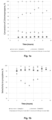
- the results are shown in figure 4 .
- the abscissa shows the time on stream in hours and the ordinate shows the % of the conversion (circle data points) and of the selectivity (square data points). Again, the conversion was calculated on carbon basis, coke free basis and the selectivity was calculated on carbon basis, coke free basis.
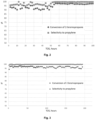
- the results are shown in figure 5 .
- the abscissa shows the time on stream in hours and the ordinate shows the % of the conversion (circle data points) and of the selectivity (square data points). Again, the conversion was calculated on carbon basis, coke free basis and the selectivity was calculated on carbon basis, coke free basis.
Landscapes
- Chemical & Material Sciences (AREA)
- Organic Chemistry (AREA)
- Engineering & Computer Science (AREA)
- Materials Engineering (AREA)
- Chemical Kinetics & Catalysis (AREA)
- Organic Low-Molecular-Weight Compounds And Preparation Thereof (AREA)
Abstract
The present invention relates to a process for catalytically reacting a composition containing one or more C2-10-bromohydrocarbons to the corresponding C2-10-alkenes, wherein the reaction is performed in the presence of a catalyst comprising a support material and thereon at least 200 ppm of at least one metal being selected from the group consisting of transition metals, noble metals and arbitrary combinations of two or more thereof.
Description
- The present invention relates to a process for catalytic dehydrobromination or reacting, respectively, a composition containing one or more C2-10-bromohydro-carbons to the corresponding C2-10-alkenes.
- Olefins or alkenes, respectively, and particularly C2-10-alkenes, such as ethylene and propylene, are valuable raw material for chemical syntheses and belong in fact to the most important starting materials in the petrochemical industry. For instance, ethylene is the starting material for producing polyethylene and propylene is the starting material for producing polypropylene, which are two of the most widely used polymers, since they are odorless, skin-friendly, physiologically harmless and have excellent mechanical properties. For example, polyethylene and polypropylene are used for packings, films, textiles, caps, medical products, mattress ticks and many other articles. Furthermore, ethylene and propylene are used for the production of other important chemicals, such as for producing ethylene glycol, propylene glycol, acrylonitrile, acrylic acid and propylene oxide.
- C2-10-alkenes are commonly produced by a direct catalytic dehydrogenation of the corresponding C2-10-alkane, such as propylene by a direct catalytic dehydrogenation of propane. The catalytic dehydrogenation of propane to propylene is usually performed at a relatively high temperature of 550 to 680°C and at a comparable low-pressure, which is typically below atmospheric pressure. However, such processes based on the direct catalytic dehydrogenation of C2-10-alkanes are - among others on account of the required high reaction temperature - energy intensive and ecologically harmful, if non-regenerable fuels, such as coal or the like, forming tremendous amounts of carbon dioxide during their combustion, are used to generate the required energy for maintaining the required high reaction temperature. The predominantly used direct dehydrogenation processes utilize circulating catalysts or multiple reactors circulating in sequence production-purge-regeneration-purge. This requirement derives from the alkane-alkene equilibrium limitation, which is mitigated by the high temperature and/or low-pressure operation. All in all, these processes based on the direct catalytic dehydrogenation of a C2-10-alkane have the drawback of high capital expenditures, of high operational costs and of producing high amounts of carbon dioxide.
- Other processes for producing C2-10-alkenes are known, such as for instance processes based on a chemical looping. For example, a process for producing propylene is known, in which a bromopropane is reacted with copper oxide to form propylene, copper bromide and water, before the copper oxide is regenerated by reacting copper bromide with oxygen to bromine and copper oxide. However, this process is very energy intensive.
- Also known are processes, in which propane is brominated with bromine and the so obtained bromopropane is dehydrobrominated to propylene and hydrogen bromide, before bromine is recovered from the hydrogen bromide by oxidizing hydrogen bromide to bromine and water. However, the thermal dehydrobromination of C2-10-bromoalkanes to the corresponding C2-10-alkenes is slow and thus not economical, because it requires too long residence times and high temperatures in order to achieve a suitable reaction.
- In view of this, the object underlying the present invention is to provide a process for reacting a C2-10-bromohydrocarbon to the corresponding C2-10-alkene, which can be operated in an industrial scale, has a comparable low energy demand, is ecologically friendly and in particular does not produce high amounts of carbon dioxide and does not require high capital expenditures.
- In accordance with the present invention, this object is solved by providing a process for catalytically reacting a composition containing one or more C2-10-bromohydrocarbons to the corresponding C2-10-alkenes, wherein the reaction is performed in the presence of a catalyst comprising a support material and thereon at least 200 ppm of at least one metal being selected from the group consisting of transition metals, noble metals and arbitrary combinations of two or more thereof.
- This solution bases on the finding that a catalyst comprising a support material and thereon at least 200 ppm of at least one metal being selected from the group consisting of transition metals, noble metals and arbitrary combinations of two or more thereof particularly efficiently catalyzes the dehydrobromination of C2-10-bromohydrocarbons, such as of a C2-10-bromoalkane to the corresponding C2-10-alkene and hydrogen bromide or of a C4-10-dibromoalkane to the corresponding C4-10-dialkene and hydrogen bromide or of a C4-10-mono-bromoalkene to the corresponding C4-10-dialkene and hydrogen bromide. A further advantage of the aforementioned catalyst is that it is very stable. Without wishing to be bound by any theory, it is considered that that a catalyst comprising a support material and thereon at least 200 ppm of at least one metal being selected from the group consisting of transition metals, noble metals and arbitrary combinations of two or more thereof is modified during the time in which it is subjected in a contact with a bromo-containing hydrocarbon to supported metal bifunctional catalyst comprising dehydrogenation and acid functionalities. The promotion with bromine creates acid sites, which are localized directly on the surface of the support material and are very efficient in catalyzing a dehydrobromination reaction. Moreover, an intimacy between the transition metal(s) and/or noble metal(s) and the acid functions in this bifunctional catalyst generates unique catalytic properties for catalytic dehydrobromination making them very active and stable in the reaction. It has been further found in the present invention that the catalyst being used in accordance with the present invention does not convert - even after being modified to the metallic bifunctional catalyst in the presence of a bromo-containing hydrocarbon - the produced C2-10-alkene to any secondary product, such as an oligomer or an aromatic. It was further shown in the present invention that this catalyst shows a very high activity, a very high selectivity and a very stable performance both, in the presence of hydrogen as well as in the absence of hydrogen.
- In accordance with the present invention, a composition containing one or more C2-10-bromohydrocarbons is catalytically reacted to the corresponding C2-10-alkenes in the presence of the catalyst. Corresponding C2-10-alkene means any C2-10-alkene, which has the same number of carbon atoms as the C2-10-bromohydrocarbon, from which it is obtained during the reaction. In case of C4-10-alkenes, the C4-10-alkene may be a monoalkene, a dialkene or a mixture of monoalkene and dialkene. The term "C2-10-bromohydro-carbon" denotes C2-10-monobromohydrocarbons, C2-10-dibromohydrocarbons and higher C2-10-bromohydrocarbons. Analogously, "C2-10-bromoalkane" denotes C2-10-monobromoalkanes, C2-10-dibromoalkanes and higher C2-10-bromoalkanes and "C2-10-bromoalkene" denotes C2-10-monobromoalkenes, C2-10-dibromoalkenes and higher C2-10-bromoalkenes.
- In accordance with the present invention, the catalyst used in the process comprises a support material. Preferably the catalyst used in the process comprises at least 75% by weight, more preferably least 75% by weight to 99.6% by weight, still more preferably least 85% by weight to 99.6% by weight and most preferably least 95% by weight to 99.6% by weight of support material.
- In a further development of the idea of the present invention, it is suggested that the support material of the catalyst used in the process has a specific surface area, measured by nitrogen adsorption, of at least 5 m2/g more, preferably of at least 20 m2/g and more preferably of at least 50 m2/g.
- The present invention is not particularly limited concerning the chemical nature of the support material. Good results are, however, in particular obtained, when the support material is selected from the group consisting of aluminas, silicas, silica gels, silica-aluminas, zeolites, zirconias, titanias, niobias, silicon carbides, carbons, aluminophosphates molecular sieves, metalloaluminophosphate molecular sieves, amorphous aluminophosphates and arbitrary combinations of two or more thereof.
- In accordance with a particularly preferred embodiment of the present invention, the support material of the catalyst is gamma-alumina oxide and/or boehmite.
- Alumina of a high purity of 99.99% or even higher is preferably be synthesized by the alkoxide route. Alkoxide route is known production technology, which is based on hydrolysis of aluminium alkoxide. In this process, the alcohol(s) of the aluminium alkoxide is/are recycled back to the synthesis. The alumina is produced either as co-product with synthetic linear alcohols (Ziegler method) or directly from aluminium metal (on-purpose route). The Ziegler route for the synthesis of alumina involves the oligomerization of ethylene using triethylaluminium followed by oxidation. The triethylaluminium may be produced by reacting aluminium, ethylene and hydrogen gas. In the production process, two-thirds of the triethylaluminium produced is recycled back into the reactor and only one-third is used to produce the alcohol. The recycling step is used to produce triethylaluminium at a higher yield and in less time. Triethylaluminium reacts with ethylene to form higher molecular weight trialkylaluminium. The number of equivalents of ethylene n equals the total number of monomer units being grown on the initial ethylene chains, wherein n = x + y + z, wherein x, y, and z are the number of ethylene units per chain. Trialkylaluminium is oxidized with air to form aluminium alkoxides, and finally hydrolyzed to aluminium hydroxide and the desired alcohols.
- 1.
Al+3 C2H4 +1.5 H2→ Al(C2H5)3
- 2.
Al(C2H5)3 + n ethylene → Al((CH2CH2)nCH2CH3)3
- 3.
Al((CH2CH2)nCH2CH3)3+ O2 → Al(O(CH2CH2)nCH2CH3)3
- 4.
Al(O(CH2CH2)nCH2CH3)3 → Al(OH)3 + CH3CH2(CH2C2)mOH
- In accordance with another embodiment of the present invention, the alumina used as support material is selected from the group consisting of aluminium oxyhydroxide, gamma-alumina, boehmite, diaspore, transitional aluminas, ρ-alumina and arbitrary combinations of two or more thereof. Suitable examples for transitional aluminas are α-alumina, β-alumina, γ-alumina, δ-alumina, ε-alumina and κ-alumina, whereas suitable examples for ρ-alumina are aluminium trihydroxide, such as gibbsite, bayerite, nordstrandite and doyelite.
- In accordance with an alternative embodiment of the present invention, the support material of the catalyst used according to the present invention is a silica. Suitable examples for sources of silica are silicates, precipitated silicas, for example, Zeosil range available from Rhodia, fumed silicas, for example, Aerosil-200 available from Degussa Inc., New York, N.Y., silicon compounds, such as tetraalkyl orthosilicates, for example, tetramethyl orthosilicate (TMOS) and tetraethylorthosilicate (TEOS), colloidal silicas or aqueous suspensions thereof, for example Ludox-HS-40 sol available from E.I. du Pont de Nemours, Wilmington, Del., silicic acid, alkali-metal silicate, or any combination thereof. Other suitable examples of amorphous silica include silica powders, such as Ultrasil VN3SP (commercially available from Degussa), which has the advantages of being very cheap and of being easily available in large commercial scale quantities. Other examples of suitable solid silica sources are granulated hydrophilic fumed silicas, for example AEROPERL® 300/30, mesoporous silica grade EXP & high surface area precipitated silica SIPERNAT from Evonik, HiSil 233 EP (available from PPG Industries) and Tokusil (available from Tokuyama Asia Pacific). In addition, suitable amorphous silica sources include silica sols, which are stable colloidal dispersions of amorphous silica particles in an aqueous or organic liquid medium, preferably water.
- Non-limiting examples of suitable silica sols include those sold under the tradenames Nyacol (available from Nyacol Nano Technologies, Inc. or PQ Corp.), Nalco (available from Nalco Chemical Company), Ultra-Sol (available from RESI Inc), Ludox (available from W.R. Grace Davison), NexSil (available from NNTI). Many silica sols are prepared from sodium silicate and inevitably contain sodium. It is, however, been found in the present invention that the presence of sodium ions can cause sintering of the silica body at high temperature and/or affect catalytic performance. Therefore, if silica sols containing sodium are used, the silica sol is preferably subjected to at least one step of ion exchange in order to reduce its sodium content or even completely remove sodium therefrom. In order to avoid the purification of the silica sol with one or more ion exchange steps, it is preferred to use a silica sol containing very little or, ideally, no detectable traces of sodium and have a pH value of less than 7. Most preferably, the silica sol used for the preparation of the catalyst is slightly acidic with or without addition of one or more polymeric stabilizers. Non limiting examples of silica sols that contain no detectable traces of sodium are Bindzil 2034DI,
Levasil 200, Nalco 1034A, Ultra-Sol 7H or NexSil 20A. - In a further development of the idea of the present invention, it is proposed to use silica dispersion prepared with alkylammonium for the preparation of the catalyst. Non-limiting examples of commercially low sodium silica sols stabilized by ammonia or alkylammonium cations include LUDOX TMA (available from W.R. Grace Davison) or VP WR 8520 from Evonik.
- Silica sols with higher silica content than 30% by weight and even up to 50% by weight are for example W1250, W1836, WK341, WK7330 from Evonik.
- Silica sols used to form a support are commercially also available as aquasols or organosols containing dispersed colloidal silica particles. For example, sodium silicate can be used as a silica sol. Otherwise, a silica gel, fumed or pyrogenic silica may also be used to provide a silica binder in the molecular sieve catalyst. Silicic acid is another possible source of silica. Advantageously, the binder contains low amount of sodium below 1000 ppm.
- In accordance with a particular embodiment of the present invention, a silica sol or a combination of silica sol with precipitated or fumed silica is used as source of silicon for preparing the catalyst.
- Also one or more zeolites may be used as support material of the catalyst to be used in the process of the present invention. A preferred zeolite is a so-called "medium pore size zeolite", which is a zeolite having a pore size of 0.5 to 0.65 nm measured by argon adsorption, meaning a zeolite, which has a pore size between the pore size of a "small pore size zeolite", such as an A-type zeolite, and the pore size of a "large pore size zeolite", such as a mordenite, an X-type zeolite and a Y-type zeolite), i.e. a Zeolite containing 10-membered rings in the crystal framework thereof. Examples of medium pore size zeolites are
ZSM 5, ZSM-8, ZSM-11, ZSM-12, ZSM-21, ZSM-23, ZSM-35 and ZSM-38, most preferred are ZSM-5, ZSM-8, ZSM-11, ZSM-35 (Ferrierite) and ZSM-38. The Zeolite has preferably an Si/AI atomic ratio of from 11 to 5000, more preferably from 50 to 4000 and most preferably from 150 to 2000 as measured by elemental analysis. - The zeolite may contain 0.01 to 10 wt% of phosphorus. Such a modification is for example carried out by treating a zeolite with a phosphorous compound in an aqueous or a non-aqueous medium, by chemical vapor deposition of an organic phosphorous compound or by impregnation. The catalyst may be pre-formulated with binder or not. A preferred phosphorous compound is phosphoric acid, NH4H2PO4 or (NH4)2HPO4.
- The zeolite may be exchanged with Ca-, Mg-, La- and/or Ce-compounds or directly with the salts of the transition and/or noble metal(s) being provided on the support material of the catalyst to be used according to the present invention. The aforementioned compounds bay be selected from organic compounds, salts, hydroxides and oxides. These compounds may also contain phosphorus. It is preferred that these compounds are present in solubilized form, before they are brough into contact with the zeolite or by forming a solution when being in contact with the zeolite.
- The zeolite - before modification with a metal and phosphorous - may be calcined, steamed, ion-exchanged, treated with acid solution or it may have been subjected to another treatment leading to dealumination. Dealumination of the zeolite can be performed simultaneously with the phosphorous modification.
- In order to further improve the resistance of the zeolite to coking deactivation, it is suggested in a further development of the idea of the present invention that - prior to the contact with the hydrocarbon feedstock - the above-mentioned Zeolite is subjected to a heat treatment at 500°C or more in the presence of steam. Preferably, this heat (steaming) treatment is conducted at 500°C to 900°C under a steam partial pressure of 0.01 MPa or more.
- In accordance with an alternative embodiment of the present invention, a carbon is used as source of silicon for preparing the catalyst used in the process of the present invention.
- Preferably, the carbon is selected from graphite, carbon black, coke, petroleum coke and any arbitrary combination of two or more thereof. Particularly preferred is graphite.
- In accordance with an alternative embodiment of the present invention, silicon carbide is used as source of silicon for preparing the catalyst used in the process of the present invention. Suitable examples therefore are sintered silicon carbide, nitride-bounded silicon carbide, recrystallised silicon carbide, reaction bonded silicon carbide and any arbitrary combination of two or more thereof. Sintered silicon carbide (sSiC) is a self-bonded material containing a sintering aid, such as typically boron, in a content of less than 1% by weight, whereas recrystallized silicon carbide (rSiC) is a high purity silicon carbide having been sintered by a process of evaporation - condensation without any additive. Nitride-bonded silicon carbide (nbSiC), in turn, is prepared by adding fine silicon powder to silicon carbide particles eventually in the presence of a mineral additive and sintering the mixture in a nitrogen furnace. The silicon carbide is bonded by the silicon nitride phase (Si3N4) formed during nitriding. Reaction bonded silicon carbide (rbSC), which is also denoted as siliconized silicon carbide or siSiC, is a type of silicon carbide, which is manufactured by a chemical reaction between porous carbon or graphite with molten silicon. The silicon reacts with the carbon forming silicon carbide and bonds the silicon carbide particles. Any excess silicon fills the remaining pores in the body and produces a dense silicon carbide-silicium composite. Due to the left-over traces of silicon, reaction bonded silicon carbide is often referred to as siliconized silicon carbide, wherein the process is denoted as reaction bonding, reaction sintering, self-bonding or melt infiltration.
- In accordance with yet an alternative embodiment of the present invention, aluminophosphate (ALPO) and/or metalloaluminophosphate (MeAPO) is used as source of silicon for preparing the catalyst used in the process of the present invention. MeAPO's are described in
US 4,440,871 ,US 6,207,872 ,US 6,540,970 andUS 6,303,534 . ALPO corresponds to MeAPO, in which the content of Me is 0. If the Me in MeAPO is Si, it is denoted as SAPO. Alternatively, Me ay be a metal being selected from the group consisting of silicon, germanium, magnesium, copper, zinc, iron, cobalt, nickel, manganese, chromium and arbitrary combinations of two or more thereof. Particularly preferred metals are silicon, magnesium and cobalt. In addition, it is preferred that the ALPO and/or MeAPO used in the present invention has the structure AFI (SAPO-5), AEL (SAPO-11), AEI (SAPO-18), ERI (SAPO-17), LEV (SAPO-35), CHA (SAPO-34) or CHA (SAPO-44). More preferably, the ALPO and/or MeAPO used in the present invention the structure CHA or AEI. Furthermore, the MeAPO may be an intergrown phase of two MeAPO's having AEI and CHA framework types, as they are described inUS 7,067,095 ,US 6,953,767 andUS 6,334,994 . - Furthermore, it is preferable that the support material is substantially free of any strong Bronsted acid sites so as to avoid formation of coke on the catalyst and heavy products. An example of strong acid sites can be found in H-form zeolites with Si/AI framework atomic ratio below 150. However, the presence of acid sites of a moderate strength on the support material can be advantageous in order to improve the dispersion of the metal on the surface, but this is not mandatory. An example of the acid sites of the moderate strength can be found at the gamma alumina support. These type of acid sites due to the presence of a significant amount of co-produced HBr will not impact the selectivity and will not result in high coking rate. Moreover, it is noted that the typical acidic catalysts used in dehydration of alcohols, which are free of metals - such as pure silica alumina, acidic zeolites, or a very pure alumina - are not sufficiently active in dehydrobromination. However, the use of those materials in the reaction still may improve the yield of the thermal process due to better heat transfer and improved hydrodynamics. Nevertheless, the metal free materials are not very efficient catalytically in dehydrobromination, because the co-produced hydrogen bromide is a very strong acid. In contrast thereto, an impurity of a metal on the support at a level of 200 ppm will immediately promote the catalytic reaction.
- In accordance with the present invention, in the process a catalyst is used, which comprises a support material and thereon at least 200 ppm of at least one metal being selected from the group consisting of transition metals, noble metals and arbitrary combinations of two or more thereof. Preferably, the support material comprises therein 200 ppm to 20% by weight of one or more transition metals.
- The present invention is not particularly limited concerning the kind of transition metal. However, good results are in particular obtained, when the catalyst comprises as transition metal at least one compound being selected from the group consisting of iron, cobalt, nickel, molybdenum, manganese, lead, cupper, chromium, zinc, gallium and arbitrary combinations of two or more thereof.
- Moreover, it is preferred that in the process a catalyst is used, which comprises a support material and thereon 200 ppm to 5% by weight of one or more noble metals. The one or more noble metals may be provided on the support material instead of one or more transition metals or in addition to one or more transition metals.
- Also concerning the kind of noble metal, the present invention is not particularly limited. However, good results are in particular obtained, when the catalyst comprises as noble metal at least one compound being selected from the group consisting of silver, platinum, palladium, ruthenium, iridium and arbitrary combinations of two or more thereof.
- The transition metal and/or noble metal may be introduced onto the support material in any known manner, such as by precipitation, by deposition, by impregnation, by ion exchange, by grafting, by anchoring, by chemical vapor deposition (CVD), by atomic layer epitaxy (ALE) or by encapsulation. Preferably, the transition metal and/or noble metal is introduced onto the support material by impregnation, because this technique allows to load a given porous support material with the transition metal and/or noble metal in a solid-state way (i.e. physical mixture of both component in solid state) or more preferably via wet impregnation (i.e. physical mixture of the support in solid state and the metal component dissolved in a liquid solution).
- Incipient wetness impregnation is the most preferred method for the preparation of the catalyst to be used according to the invention, because of its technical simplicity, of its low costs and of the limited amount of waste produced therewith. More specifically, a support is impregnated with a precursor-containing solution and dried at the temperature below 200°C for several hours. The dry product is then further treated through activation treatments, such as calcination and/or reduction, so as to obtain the desired catalyst. The impregnation may be made using the already shaped support material. Preferably, the metal-containing precursorcompound, such as noble metal oxide, transition metal cation or the like, is reduced to the individual metal with hydrogen or an inert hydrocarbon flow at a temperature at least 200°C before the reaction. However, this is not mandatory, because the reduction will take place also under the reaction conditions.
- Before loading the transition metals and/or noble metal onto the support material, the support material is preferably shaped, which allows it to be processed to a catalyst having a desired granulometry and good crush strength. This is advantageous, because it allows to limit the pressure drop during the reaction and to prevent that the catalyst breaks down during the reaction into powder-like materials. For this purpose, the support material is preferably shaped, either alone or with addition of a binder. The binder may be selected to be resistant to the temperature and other conditions employed in the processes using the catalyst and the binder may be an inorganic material selected from the same chemical group as the material of the support material, namely silicas, metal silicates, zirconias, borates, aluminas, silica-aluminas, phosphates, for example amorphous aluminophosphates, calcium phosphates, clays, xonotlites, magnesias, metal oxides, such as zirconium dioxide, metals and gels including mixtures of silica and metal oxides. Clays are known to be essentially inert under a wide range of reaction conditions. Suitable clays include commercially available products such as kaolin, kaolinite, montmorillonite, attapulgite, saponite and bentonite. These clays may be used as mined in their natural state or they may also be employed in highly active forms, such as activated by an acid treatment procedure. Clays contribute to strength as a binder enhancing the attrition resistance properties of the catalyst particles, and clays in combination with other binders contributes to the hardness of the particles. Clays also start as small particles and have a higher density, such that when combined with the molecular sieve and binder provide for denser particles, imparting the desirable characteristic of higher density.
- It is preferred that for preparing the catalyst, the catalyst particles are combined with the binder material initially by dry-mixing, before the mixture is dispersed in a liquid, preferably water, more preferably together with a plasticizer, so as to yield a paste. Suitable examples of plasticizers as shaping additive are alkylated cellulose derivatives, hydroxyethylcellulose, tylose, ammonium alginate, polyvinyl pyrrolidone, glycerol and polyethylene glycol. These materials will be decomposed during any subsequent heat treatment, e.g. calcination. In addition to enhancing the catalyst strength properties, the binder material allows the molecular sieve crystallite powder to be bound into larger particle sizes suitable for commercial catalytic processes. The formulation of the mixture may be formed into a wide variety of shapes including extrudates, spheres, pills, and the like. The uniformly mixed paste is then subsequently shaped, for example by spray drying to yield microspheres, pelletizing or, preferably or by extrusion. Extrusion may be for example performed in a piston extruder so as to obtain strings, for example cylindrical, which are then dried, again calcined and chopped into pieces of a desired length.
- Once the support material is shaped, the transition metal and/or noble metal is loaded onto the support material and the catalyst is present in a substantially dry or dried state, preferably a heat treatment, for example calcination, is performed in order to harden and/to or activate the composition. Preferably, the heat treatment is carried out at a temperature of at least 400°C for a period of 1 to 48 hours. A calcination may be carried out, for example, in a rotary calciner, fluid bed calciner, or a batch oven.
- In accordance with a further preferred embodiment of the present invention, the alumina and/or boehmite support material of the catalyst has a silica content of less than 0.4% by weight, has a content of sulfur and sulfur containing compounds of less than 0.5% by weight and has a content of sodium and sodium containing compounds of less than 200 ppm.
- Good results are in particular obtained, when the catalyst contains, in sum, alkali earth metals, rare earth metals, compounds containing at least one alkali earth metal and compounds containing at least rare earth metal in an amount of 0.1% by weight to 5% by weight. Preferred alkali earth metals and rare earth metals are calcium, magnesium, yttrium and lanthanum.
- Good results are in particular obtained, when the catalyst contains low amounts of or better even no alkali metals. In view of this, it is preferred that the catalyst contains, in sum, alkali metals and compounds containing at least one alkali metal in an amount of less than 1,000 ppm, preferably of less than 200 ppm, more preferably of less than 100 ppm.
- In accordance with a further preferred embodiment of the present invention, the catalyst contains, in sum, chlorine in an amount of less than 1,000 ppm, preferably of less than 200 ppm, more preferably of less than 100 ppm, yet more preferably of less than 50 ppm, still more preferably of less than 20 ppm and most preferably of less than 10 ppm.
- The present invention is not particularly limited concerning the kind of C2-10-bromo-hydrocarbon to be dehydrobrominated to the corresponding C2-10-alkene and hydrogen bromide. Thus, the C2-10-bromoalkane may be any at least one bromeresidue containing hydrocarbon having from 2 to 10 carbon atoms, such as any C2-10-bromoalkane or C4-10-bromoalkene. Suitable examples therefore are C2-5-bromoalkanes and particularly C2-4-bromoalkanes. More specific examples for non-cyclic hydrocarbons are monobromoethane, 1,2-dibromoethane, 1-bromopropane, 2-bromopropane, 1,2-dipromopropane, 1,3-dibromopropane, 1-bromo-1-propene, 2-bromo-1-propene, 3-bromo-1-propene, monobromobutane, dibromobutane, monobromopentane, dibromopentane and arbitrary mixtures of two or more of the aforementioned compounds.
- In accordance with a particularly preferred embodiment of the present invention, the composition being catalytically reacted contains one or more C2-10-bromohydrocarbons and hydrogen, wherein the molar ratio of the one or more C2-10-bromohydrocarbons and the hydrogen is 100:1 to 1:10 and preferably 10:1 to 1:5. The addition of hydrogen to the reaction mixture prevents a potential rebromination of the obtained C2-10-alkene by a reaction of the C2-10-alkene with the co-produced hydrogen bromide. In case of the dehydrobromination of a C2-10-monobromo-alkane, the molar ratio of the one or more C2-10-monobromoalkane and the hydrogen may be comparably low, such as 10:1 to 1:10 and preferably 5:1 to 1:5. However, in the case of the dehydrobromination of a C2-10-dibromoalkane or of a C4-10-monobromoalkene, the molar ratio of i) the one or more C2-10-dibromoalkane or C4-10-monobromoalkene C2-10-monobromoalkane and ii) the hydrogen is higher, such as 5:1 to 1:100 and preferably 2:1 to 1:10.
- Because the dehydrobromination reaction is endothermic, it is preferred to add as heat vector an inert component to the reaction mixture so as to bring energy to the reactor. Preferably the weight ratio of the one or more C2-10-bromohydrocarbons and the inert component is preferably 10:1 to 1:10 and preferably 5:1 to 1:5. Suitable examples for the inert component are C1-10-alkanes, steam, nitrogen, argon, methane, carbon dioxide, naphtha and arbitrary combinations of two or more of the aforementioned inert compounds. Good results are in particular obtained, when the inert component is a C3-7-alkane, more preferably a C4-6-alkane and most preferably pentane.
- Concerning the type of reactor, in which the dehydrobromination reaction is performed, the present invention is not particularly limited. Preferably, the reaction is performed in a fixed bed reactor, in a radial reactor, in a multi-tubular reactor, in a moving bed reactor or in a fluidized bed reactor. A suitable fluid bed reactor is one of the FCC types used for fluidized-bed catalytic cracking in the oil refinery. A typical moving bed reactor is of the continuous catalytic reforming type. Alternatively, the dehydrobromination reaction may be in a fixed bed reactor configuration using a pair of parallel "swing" reactors. This is possible on account of the high stability of the catalyst to be used in the process of the present invention.
- It is proposed in a further development of the idea of the present invention that the reaction is performed at an absolute pressure of 50 kPa to 3 MPa, more preferably of 50 kPa to 1 MPa, yet more preferably of 50 kPa to 500 kPa, still more preferably of 120 kPa to 500 kPa and most preferably of 120 kPa to 400 kPa. Preferably, the pressure is adjusted so that a partial pressure of the formed C2-10-alkenes of lower than 2 bars and more preferably of lower than 1 bar is achieved in the effluent of the reactor.
- The dehydrobromination reaction is an endothermic reaction and thus requires the input of reaction heat in order to maintain the catalyst activity sufficiently high and in order to shift the thermodynamic equilibrium to sufficiently high reaction levels. In view of this, it is preferred that the reaction is performed at a temperature of 200°C to 500°C, more preferably of 225°C to 450°C and most preferably of 250°C to 400°C.
- In the case that the reaction is performed in a fluidized bed reactor using a stationary fluidized bed without catalyst circulation, the reaction temperature is substantially homogeneous throughout the catalyst bed. However, in the case that the reaction is performed in a fluidized bed reactor using a circulating fluidized bed so that the catalyst circulates between a reaction section and a catalyst regeneration section, the temperature in the catalyst bed approaches - depending on the degree of catalyst back mixing - either homogeneous conditions in case of a lot of back mixing or approaches plug flow conditions and hence a decreasing temperature profile will be formed as the reaction proceeds in case that nearly no back mixing occurs. In the case of performing the reaction in a fixed bed reactor or in a moving bed reactor, a decreasing temperature profile will form as the reaction of the proceeds. In this case reaction heat may be introduced by using several catalyst beds in series with inter heating of the reactor effluent from the first bed to higher temperatures and introducing the heated effluent in a second catalyst bed, etc. When the reaction is performed in a fixed bed reactor, a multi-tubular reactor may be used, in which the catalyst is loaded in small-diameter tubes that are installed in the reactor shell. At the shell side, a heating medium may be introduced that provides the required reaction heat by heat-transfer through the wall of the reactor tubes to the catalyst. A radial or spherical reactor may be used to overcome a too import pressure drop.
- In accordance with a further preferred embodiment of the present invention, the weight hourly space velocity (WHSV) of the composition being catalytically reacted is 1 to 100 h-1, more preferably 2 to 50 h-1, still more preferably 3 to 20 h-1 and most preferably 4 to 12 h-1. Preferably, the weight hourly space velocity of the composition is measured as the ratio of the weight of the one or more C2-10-bromohydro-carbons and the weight of the catalyst, without considering the diluent flow.
- In a further development of the idea of the present invention, it is suggested that the catalyst is periodically regenerated by subjecting it in an oxygen containing atmosphere to a temperature of 400 to 650°C and preferably of 420 to 500°C.
- Thereby, the carbon on the catalyst is burnt with oxygen. In view of the noble and/or transition metals being contained in the catalyst, it is preferred to limit the exposition of the catalyst to a temperature of at most 650°C and preferably of 500°C. Preferably, the regeneration is performed at about 450°C with a temperature variation across the reactor of at most 50°C. This is typically achieved by limiting the amount of the oxygen in the regeneration loop at the initial stage to at most 1% by mole. After the removal of the main part of the carbon, the oxygen content may be raised to up to 5% by mole. Steam, hydrogen bromide and/or carbon dioxide may be present in the regeneration loop. After the end of the regeneration, it is preferred that all the traces of oxygen are removed from the catalyst, because the presence of oxygen catalyzes the rebromination of the C2-10-alkane with hydrogen bromide.
- Subsequently, the present invention is further described by means of illustrating, but not restricting examples.
- In the figures:
- Fig. 1a and 1b
- show the results in terms of conversion of 2-bromopropane and selectivity to propylene of comparative examples 1 and 2 and of examples 1 and 2.
- Fig. 2
- shows the results of example 3.
- Fig. 3
- shows the results of example 4.
- Fig. 4
- shows the results of example 5.
- Fig. 5
- shows the results of example 6.
- An empty quartz reactor with a 10 mm inner diameter was heated to 450°C in a 3 ml/min nitrogen flow at atmospheric pressure followed by stopping the nitrogen flow and switching to 3 Nl/h of hydrogen for 1 h. Then, the reactor was cooled down from 450°C in hydrogen flow to the reaction temperature of 350°C. Thereafter, 4.8 ml/h (6.3 g/h) of 2-bromopropane and of 15.64 ml/min hydrogen were fed to the reactor at atmospheric pressure.
- The reaction was performed during 9 hours with the on-line GC analysis.
- The results are shown in
figure 1a in terms of conversion in % (on the abscissa; calculated on carbon basis, coke free basis) of 2-bromopropane in dependency of the reaction time in hours (ordinate) and infigure 1b in terms of selectivity in % (on the abscissa; calculated on carbon basis, coke free basis) to propylene in dependency of the reaction time in hours (ordinate) of comparative examples 1 and 2 and of examples 1 and 2. - These results show that the dehydrobromination does occur in the absence of any catalyst thermally, but only in an insignificant extent so that it is not suitable to be used industrially. Also, the selectivity of the reaction to propylene is low and hardly controllable.
- 10 g of beads with a diameter of 1 mm and made from metal free silica were loaded in a quartz reactor of 10 mm in inner diameter. The reactor was heated to 450°C in 3 ml/min nitrogen flow at atmospheric pressure followed by stopping the nitrogen flow and switching to 3 NI/h of hydrogen for 1 h. Then, the reactor was cooled down from 450°C in hydrogen flow to the reaction temperature of 350°C. Then, the nitrogen was stopped and 4.8 ml/h (6.3 g/h) of 2-bromopropane and of 15.64 ml/min hydrogen were fed to the reactor at atmospheric pressure.
- The reaction was performed during 8 hours with the on-line GC analysis
- The results are shown in
figure 1a in terms of conversion in % (on the abscissa; calculated on carbon basis, coke free basis) of 2-bromopropane in dependency of the reaction time in hours (ordinate) and infigure 1b in terms of selectivity in % (on the abscissa; calculated on carbon basis, coke free basis) to propylene in dependency of the reaction time in hours (ordinate) of comparative examples 1 and 2 and of examples 1 and 2. - These results show that the addition of an inert support (beads with a diameter of 1 mm and made from metal free silica) allows to increase the thermal conversion of 2-bromopropane in comparison to comparative example 1 thanks to a better heat transfer and to an improved hydrodynamics. However, the performance remains modest and insufficient for a commercial unit.
- 10 g of beads with a diameter of 1 mm and made from metal free silica as support material were immersed in cobalt nitrates hexahydrate aqueous solution so as to introduce 400 ppm of cobalt as transition metal on the support material. The water was slowly evaporated. The so treated glass beads were loaded in a quartz reactor with an inner diameter of 10 mm and heated to 450°C in 3 ml/min nitrogen flow at atmospheric pressure followed by stopping the nitrogen flow and switching to 3 NI/h of hydrogen for 1 h. Then, the reactor was cooled down from 450°C in hydrogen flow to the reaction temperature of 350°C. Thereafter, 4.8 ml/h (6.3 g/h) of 2-bromopropane and of 15.64 ml/min hydrogen were fed to the reactor at atmospheric pressure.
- The reaction was performed during 10 hours with the on-line GC analysis.
- The results are shown in
figure 1a in terms of conversion in % (on the abscissa; calculated on carbon basis, coke free basis) of 2-bromopropane in dependency of the reaction time in hours (ordinate) and infigure 1b in terms of selectivity in % (on the abscissa; calculated on carbon basis, coke free basis) to propylene in dependency of the reaction time in hours (ordinate) of comparative examples 1 and 2 and of examples 1 and 2. - These results show that the addition of a catalyst in accordance with the present invention (here a catalyst of silica support containing 400 ppm cobalt as transition metal) drastically increases the conversion rate of 2-bromopropane and the selectivity.
- A powder a gamma-alumina as support material being prepared by the aluminium alkoxide route having a specific surface area of 180 m2/g, having a content of sodium compounds of less than 100 ppm and having a silica content of less than 100 ppm, was incipiency wetness impregnated with an aqueous solution of cobalt nitrates hexahydrate so as to obtain 0.5% by weight (i.e. 5,000 ppm) by of cobalt on the support material. The material was dried for 24 h at 100°C and was then subjected to calcination at 550°C for 5 h in an air flow (ramp = 5 °C and hold = 5 h). The so obtained material was pelletized and then crushed and seized to a 35 to 45 mesh fraction. Two grams of the fraction of the catalyst were loaded in a fixed-bed tubular reactor with an inner diameter of 10 mm. The loaded catalyst was heated up in 3 Nl/h nitrogen flow to 450°C at atmospheric pressure followed by stopping the nitrogen flow and switching to 3 NI/h of hydrogen for 1 h. Then, the reactor was cooled down from 450°C in hydrogen flow to 350°C. Thereafter, 4.8 ml/h (6.3 g/h) of 2-bromopropane and of 15.64 ml/min hydrogen were fed to the reactor at atmospheric pressure.
- The reaction was performed during 8 hours with the on-line GC analysis.
- The results are shown in
figure 1a in terms of conversion in % (on the abscissa; calculated on carbon basis, coke free basis) of 2-bromopropane in dependency of the reaction time in hours (ordinate) and infigure 1b in terms of selectivity in % (on the abscissa; calculated on carbon basis, coke free basis) to propylene in dependency of the reaction time in hours (ordinate) of comparative examples 1 and 2 and of examples 1 and 2. - These results show that the addition of a catalyst in accordance with the present invention (here a catalyst of silica support containing 5,000 cobalt as transition metal) drastically increases the conversion rate of 2-bromopropane and the selectivity.
- Two grams of gamma-alumina as support material having a specific surface area of 180 m2/g, having a content of sodium compounds of less than 100 ppm and having a silica content of less than 100 ppm were incipiency wetness impregnated with a solution of iron(III)nitrates so as to obtain about 5% by weight of iron on the support material. The material was dried for 24 h at 100°C and subjected to calcination at 550°C for 5 h in an air flow (ramp = 5 °C and hold = 5 h). The so obtained material was pelletized and then crushed and seized to a 35 to 45 mesh fraction.
- Two grams of the so obtained fraction of the catalyst containing 5wt% of iron on alumina was loaded in a fixed-bed tubular quartz reactor with an inner diameter of 10 mm. The dead volume above the catalyst in the reactor was filled with spherical silica beads. The loaded catalyst was heated up in 3 NI/h nitrogen flow to 450°C at atmospheric pressure followed by stopping the nitrogen flow and switching to 3 NI/h of hydrogen for 1 h. Then, the reactor was cooled down from 450°C in hydrogen flow to the reaction temperature, the hydrogen flow was increased to 48.6 ml/min and the gaseous 2-bromopropane (16 g/h) was fed into the reactor.
- The conversion and selectivity to propylene (the catalyst performance) in the catalytic dehydrobromination of 2-bromopropane on the prepared above catalyst were measure for 50 hours on-stream at temperature 300°C, WHSV (2-bromopropane) 8 h-1, hydrogen/2-bromopropane molar ratio of 1. Then the temperature was increased to 350°C and the performance was measured for 25 additional hours on-stream. Afterwards, the hydrogen flow was replaced by the same flow on nitrogen and the test was continued for 25 additional hours on-stream keeping the rest of the parameters the same.
- The results are shown in
figure 2 . The abscissa shows the time on stream in hours and the ordinate shows the % of the conversion (circle data points) and of the selectivity (square data points). Again, the conversion of 2-bromopropane was calculated on carbon basis, coke free basis and the selectivity was calculated on carbon basis, coke free basis. - The results show that the used catalyst assures a stable conversion of bromopropane and a very high selectivity to propylene of above 99%.
- Two grams of the gamma-alumina as support material having a specific surface area of 180 m2/g, having a content of sodium compounds of less than 100 ppm and having a silica content of less than 100 ppm were incipiency wetness impregnated with a solution of cobalt nitrates so as to obtain about 5% by weight of cobalt on the support material. The material was dried for 24 h at 100°C and subjected to calcination at 550°C for 5 h in an air flow (ramp = 5 °C and hold = 5 h). The obtained material was pelletized and then crushed and seized to a 35 to 45 mesh fraction.
- Two grams of the so obtained fraction of the catalyst containing 5wt% of Co on alumina was loaded in a fixed-bed tubular quartz reactor with an inner diameter of 10 mm. The dead volume above the catalyst in the reactor was filled with spherical silica beads. The loaded catalyst was heated up in 3 NI/h nitrogen flow to 450°C at atmospheric pressure followed by stopping the nitrogen flow and switching to 3 Nl/h of hydrogen for 1 h. Then, the reactor was cooled down from 450°C in hydrogen flow to the reaction temperature, the hydrogen flow was increase to 48.6 ml/min and the gaseous 2-bromopropane (16 g/h) was sent into the reactor.
- The conversion and selectivity to propylene (the catalyst performance) in the catalytic dehydrobromination of 2-bromopropane on the prepared above catalyst were measure for about 200 hours on-stream at temperature 350°C, WHSV (2-bromopropane) 8 h-1, hydrogen/2-bromopropane molar ratio of 1.
- The results are shown in
figure 3 . The abscissa shows the time on stream in hours and the ordinate shows the % of the conversion (circle data points) and of the selectivity (square data points). Again, the conversion of 2-bromopropane was calculated on carbon basis, coke free basis and the selectivity was calculated on carbon basis, coke free basis. - The results show that the used catalyst assures a stable conversion of bromopropane and a very high selectivity to propylene of above 99%.
- Example 4 was repeated except that the catalyst was additionally impregnated with 2,000 ppm by weight of platinum added as tetraamminplatin(II)-nitrate (Pt(NH3)4(NO3)2) and with 0.5% by weight of calcium as calcium nitrate (Ca(NO3)2) followed by the same drying and calcination procedures as in example 4.
- The same catalyst loading (2g of catalyst, 35 to 45 mesh) and the same activation procedure was used as in example 4.
- In order to assess the impact of the 1,2-dibromopropane impurities in bromopropane, the experiment was started with a pure 2-bromopropane (WHSV-4h-1) feedstock, with H2-feed molar ratio of 0.2, with a nitrogen flow of 26 ml/min at a temperature of 350°C and at atmospheric pressure (TOS: 1 to 6 h). Then, the feedstock was switched to a mixture of 98% by weight of 2-bromopropane and of 2% by weight of 1,2- dibromopropane without changing hydrogen and nitrogen flow to the reactor at atmospheric pressure for 30 hours (TOS: 6 to 36 hours).
- The results are shown in
figure 4 . The abscissa shows the time on stream in hours and the ordinate shows the % of the conversion (circle data points) and of the selectivity (square data points). Again, the conversion was calculated on carbon basis, coke free basis and the selectivity was calculated on carbon basis, coke free basis. - The results show no changes in the performance after switching to a mixture of 2-bromopropane with 2% by weight of 1,2- di-bromopropane. That shows that the catalysts according to the invention is also efficient in processing of di-bromo-alkanes.
- In this example the sample of the catalyst prepared in the example 4 was tested concerning its bromoethane conversion.
- Two grams of the 35 to 45 mesh fraction of the catalyst made of 5% by weight of cobalt on alumina as prepared in example 4 was loaded in a fixed-bed tubular quartz reactor with an inner diameter of 10 mm. The dead volume above the catalyst in the reactor was filled with spherical silica beads. The loaded catalyst was heated up in 3 NI/h nitrogen flow to 450°C at atmospheric pressure followed by stopping the nitrogen flow and switching to 3 NI/h of hydrogen for 1 h. Then, the reactor was cooled down from 450°C to 375°C in hydrogen flow to the reaction temperature, the hydrogen flow was increased to 27.4 ml/min and bromoethane was sent in a flow of 8 g/h into the reactor under atmospheric pressure. The test was performed during 47 hours on-stream (TOS, h).
- The results are shown in
figure 5 . The abscissa shows the time on stream in hours and the ordinate shows the % of the conversion (circle data points) and of the selectivity (square data points). Again, the conversion was calculated on carbon basis, coke free basis and the selectivity was calculated on carbon basis, coke free basis. - The results show that the catalyst used in example 5 is also very active and selective in bromoethane dehydrobromination.
Claims (15)
- A process for catalytically reacting a composition containing one or more C2-10-bromohydrocarbons to the corresponding C2-10-alkenes, wherein the reaction is performed in the presence of a catalyst comprising a support material and thereon at least 200 ppm of at least one metal being selected from the group consisting of transition metals, noble metals and arbitrary combinations of two or more thereof.
- The process in accordance with claim 1, wherein the content of the support material of the catalyst is at least 75% by weight.
- The process in accordance with claim 1 or 2, wherein the support material has a specific surface area, measured by nitrogen adsorption, of at least 5 m2/g more, preferably of at least 20 m2/g and more preferably of at least 50 m2/g.
- The process in accordance with any of the preceding claims, wherein the support material is selected from the group consisting of aluminas, silicas, silica gels, silica-aluminas, zeolites, zirconias, titanias, niobias, silicon carbides, carbons, aluminophosphates molecular sieves, metalloaluminophosphate molecular sieves, amorphous aluminophosphates and arbitrary combinations of two or more thereof.
- The process in accordance with with any of the preceding claims, wherein the support material of the catalyst is gamma-alumina and/or boehmite.
- The process in accordance with with any of the preceding claims, wherein the catalyst comprises 200 ppm to 20% by weight of one or more transition metals.
- The process in accordance with with any of the preceding claims, wherein the catalyst as transition metal at least one compound being selected from the group consisting of iron, cobalt, nickel, molybdenum, manganese, lead, cupper, chromium, zinc, gallium and arbitrary combinations of two or more thereof.
- The process in accordance with with any of the preceding claims, wherein the catalyst comprises 200 ppm to 5% by weight of one or more noble metals.
- The process in accordance with with any of the preceding claims, wherein the catalyst as noble metal at least one compound being selected from the group consisting of silver, platinum, palladium, ruthenium, iridium and arbitrary combinations of two or more thereof.
- The process in accordance with any of the preceding claims, wherein the alumina or gamma-alumina and/or boehmite support material of the catalyst has a silica content of less than 0.4% by weight, has a content of sulfur and sulfur containing compounds of less than 0.5% by weight and has a content of sodium and sodium containing compounds of less than 200 ppm.
- The process in accordance with any of the preceding claims, wherein the catalyst contains, in sum, alkali metals and compounds containing at least one alkali metal in an amount of less than 1,000 ppm, preferably of less than 200 ppm, more preferably of less than 100 ppm, yet more preferably of less than 50 ppm, still more preferably of less than 20 ppm and most preferably of less than 10 ppm.
- The process in accordance with any of the preceding claims, wherein the catalyst contains, in sum, chlorine in an amount of less than 1,000 ppm, preferably of less than 200 ppm, more preferably of less than 100 ppm, yet more preferably of less than 50 ppm, still more preferably of less than 20 ppm and most preferably of less than 10 ppm.
- The process in accordance with any of the preceding claims, wherein a C2-10-bromoalkane, C2-5-bromoalkane, more preferably a C2-4-bromoalkane and most preferably bromopropane is catalytically reacted to the corresponding alkenes.
- The process in accordance with any of the preceding claims, wherein the composition being catalytically reacted contains one or more inert compounds being preferably selected from the group consisting of C1-10-alkanes, steam, nitrogen, argon, methane, carbon dioxide, naphtha and arbitrary combinations of two or more of the aforementioned inert compounds.
- The process in accordance with any of the preceding claims, wherein the reaction is performed in a fixed bed reactor, in a radial reactor, in a multitubular reactor, in a moving bed reactor or in a fluidized bed reactor, wherein preferably the reaction is performed at an absolute pressure of 50 kPa to 3 MPa, preferably of 50 kPa to 1 MPa, more preferably of 50 kPa to 500 kPa, still more preferably of 120 kPa to 500 kPa and most preferably of 120 kPa to 400 kPa, wherein preferably the reaction is performed at a temperature of 200°C to 500°C, preferably of 225°C to 450°C and more preferably of 250°C to 400°C, and wherein preferably the weight hourly space velocity of the composition being catalytically reacted is 1 to 100 h-1, preferably 2 to 50 h-1, more preferably 3 to 20 h-1 and most preferably 4 to 12 h-1.
Priority Applications (5)
| Application Number | Priority Date | Filing Date | Title |
|---|---|---|---|
| EP23155185.4A EP4410763A1 (en) | 2023-02-06 | 2023-02-06 | Process for catalytic dehydrobromination of one or more c2-10-bromohydrocarbons to the corresponding c2-10-alkenes |
| PCT/EP2024/051825 WO2024165332A1 (en) | 2023-02-06 | 2024-01-25 | Process for catalytic dehydrobromination of one or more c 2-10-bromohydrocarbons to the corresponding c 2‑10‑alkenes |
| CN202480008965.7A CN120584097A (en) | 2023-02-06 | 2024-01-25 | Method for catalytic dehydrobromination of one or more C2-10 bromohydrocarbons to corresponding C2-10 olefins |
| EP24702507.5A EP4662191A1 (en) | 2023-02-06 | 2024-01-25 | Process for catalytic dehydrobromination of one or more c 2-10-bromohydrocarbons to the corresponding c 2-10-alkenes |
| TW113103326A TW202448827A (en) | 2023-02-06 | 2024-01-29 | Process for catalytic dehydrobromination of one or more c--bromohydrocarbons to the corresponding c--alkenes |
Applications Claiming Priority (1)
| Application Number | Priority Date | Filing Date | Title |
|---|---|---|---|
| EP23155185.4A EP4410763A1 (en) | 2023-02-06 | 2023-02-06 | Process for catalytic dehydrobromination of one or more c2-10-bromohydrocarbons to the corresponding c2-10-alkenes |
Publications (1)
| Publication Number | Publication Date |
|---|---|
| EP4410763A1 true EP4410763A1 (en) | 2024-08-07 |
Family
ID=85175709
Family Applications (2)
| Application Number | Title | Priority Date | Filing Date |
|---|---|---|---|
| EP23155185.4A Pending EP4410763A1 (en) | 2023-02-06 | 2023-02-06 | Process for catalytic dehydrobromination of one or more c2-10-bromohydrocarbons to the corresponding c2-10-alkenes |
| EP24702507.5A Pending EP4662191A1 (en) | 2023-02-06 | 2024-01-25 | Process for catalytic dehydrobromination of one or more c 2-10-bromohydrocarbons to the corresponding c 2-10-alkenes |
Family Applications After (1)
| Application Number | Title | Priority Date | Filing Date |
|---|---|---|---|
| EP24702507.5A Pending EP4662191A1 (en) | 2023-02-06 | 2024-01-25 | Process for catalytic dehydrobromination of one or more c 2-10-bromohydrocarbons to the corresponding c 2-10-alkenes |
Country Status (4)
| Country | Link |
|---|---|
| EP (2) | EP4410763A1 (en) |
| CN (1) | CN120584097A (en) |
| TW (1) | TW202448827A (en) |
| WO (1) | WO2024165332A1 (en) |
Citations (9)
| Publication number | Priority date | Publication date | Assignee | Title |
|---|---|---|---|---|
| US4440871A (en) | 1982-07-26 | 1984-04-03 | Union Carbide Corporation | Crystalline silicoaluminophosphates |
| US6207872B1 (en) | 1997-12-09 | 2001-03-27 | Uop Llc | Metallo aluminophosphate molecular sieve with cubic crystal morphology and methanol to olefin process using the sieve |
| US6303534B1 (en) | 1998-05-26 | 2001-10-16 | Exxonmobil Chemical Patents Inc. | Silicoaluminophosphates having an AEL structure, and their preparation |
| US6334994B1 (en) | 1996-10-09 | 2002-01-01 | Norsk Hydro Asa | Microporous crystalline silico-alumino-phosphate composition, catalytic material comprising said composition and use of these for production of olefins from methanol |
| US20020198416A1 (en) * | 2001-06-20 | 2002-12-26 | Zhou Xiao Ping | Integrated process for synthesizing alcohols, ethers, and olefins from alkanes |
| US6540970B1 (en) | 1999-11-18 | 2003-04-01 | Exxon Mobil Chemical Patents, Inc. | Method for the synthesis of molecular sieves |
| US6953767B2 (en) | 2001-03-01 | 2005-10-11 | Exxonmobil Chemical Patents Inc. | Silicoaluminophosphate molecular sieve |
| US7067095B1 (en) | 2004-12-09 | 2006-06-27 | Exxonmobil Chemical Patents Inc. | Synthesis of silicoaluminophosphate molecular sieves |
| US20220356127A1 (en) * | 2019-11-22 | 2022-11-10 | Totalenergies Onetech | Alkyl halides conversion into acyclic c3-c6 olefins |
-
2023
- 2023-02-06 EP EP23155185.4A patent/EP4410763A1/en active Pending
-
2024
- 2024-01-25 CN CN202480008965.7A patent/CN120584097A/en active Pending
- 2024-01-25 WO PCT/EP2024/051825 patent/WO2024165332A1/en not_active Ceased
- 2024-01-25 EP EP24702507.5A patent/EP4662191A1/en active Pending
- 2024-01-29 TW TW113103326A patent/TW202448827A/en unknown
Patent Citations (9)
| Publication number | Priority date | Publication date | Assignee | Title |
|---|---|---|---|---|
| US4440871A (en) | 1982-07-26 | 1984-04-03 | Union Carbide Corporation | Crystalline silicoaluminophosphates |
| US6334994B1 (en) | 1996-10-09 | 2002-01-01 | Norsk Hydro Asa | Microporous crystalline silico-alumino-phosphate composition, catalytic material comprising said composition and use of these for production of olefins from methanol |
| US6207872B1 (en) | 1997-12-09 | 2001-03-27 | Uop Llc | Metallo aluminophosphate molecular sieve with cubic crystal morphology and methanol to olefin process using the sieve |
| US6303534B1 (en) | 1998-05-26 | 2001-10-16 | Exxonmobil Chemical Patents Inc. | Silicoaluminophosphates having an AEL structure, and their preparation |
| US6540970B1 (en) | 1999-11-18 | 2003-04-01 | Exxon Mobil Chemical Patents, Inc. | Method for the synthesis of molecular sieves |
| US6953767B2 (en) | 2001-03-01 | 2005-10-11 | Exxonmobil Chemical Patents Inc. | Silicoaluminophosphate molecular sieve |
| US20020198416A1 (en) * | 2001-06-20 | 2002-12-26 | Zhou Xiao Ping | Integrated process for synthesizing alcohols, ethers, and olefins from alkanes |
| US7067095B1 (en) | 2004-12-09 | 2006-06-27 | Exxonmobil Chemical Patents Inc. | Synthesis of silicoaluminophosphate molecular sieves |
| US20220356127A1 (en) * | 2019-11-22 | 2022-11-10 | Totalenergies Onetech | Alkyl halides conversion into acyclic c3-c6 olefins |
Non-Patent Citations (1)
| Title |
|---|
| M.K. EBERHARDT: "Formation of olefins from alkyl radicals with leaving groups in the beta-position", JOURNAL OF ORGANIC CHEMISTRY, vol. 49, no. 20, 1 October 1984 (1984-10-01), American Chemical Society, Washington, DC, US, pages 3720 - 3725, XP055450229, ISSN: 0022-3263, DOI: 10.1021/jo00194a010 * |
Also Published As
| Publication number | Publication date |
|---|---|
| EP4662191A1 (en) | 2025-12-17 |
| TW202448827A (en) | 2024-12-16 |
| CN120584097A (en) | 2025-09-02 |
| WO2024165332A1 (en) | 2024-08-15 |
Similar Documents
| Publication | Publication Date | Title |
|---|---|---|
| US10300467B2 (en) | Method for making a catalyst comprising a phosphorous modified zeolite and use of said zeolite | |
| US9862653B2 (en) | Use of a catalyst comprising a phosphorous modified zeolite in an alcohol dehydration process | |
| JP4819679B2 (en) | Olefin production | |
| EA019181B1 (en) | Dehydration of alcohols in the presence of an inert component | |
| EA007872B1 (en) | COMPOSITIONS OF MOLECULAR SITES, THEIR CATALYST, THEIR PREPARATION AND APPLICATION IN THE PROCESSES OF TURNING | |
| WO2004016572A1 (en) | Production of olefins | |
| EP4410764A1 (en) | Process for mitigating a reaction of hydrogen bromide and an olefinically unsaturated compound | |
| WO2024165332A1 (en) | Process for catalytic dehydrobromination of one or more c 2-10-bromohydrocarbons to the corresponding c 2‑10‑alkenes |
Legal Events
| Date | Code | Title | Description |
|---|---|---|---|
| PUAI | Public reference made under article 153(3) epc to a published international application that has entered the european phase |
Free format text: ORIGINAL CODE: 0009012 |
|
| STAA | Information on the status of an ep patent application or granted ep patent |
Free format text: STATUS: THE APPLICATION HAS BEEN PUBLISHED |
|
| AK | Designated contracting states |
Kind code of ref document: A1 Designated state(s): AL AT BE BG CH CY CZ DE DK EE ES FI FR GB GR HR HU IE IS IT LI LT LU LV MC ME MK MT NL NO PL PT RO RS SE SI SK SM TR |