EP4410641A1 - Electric empennage control method and apparatus, and electronic device and vehicle - Google Patents
Electric empennage control method and apparatus, and electronic device and vehicle Download PDFInfo
- Publication number
- EP4410641A1 EP4410641A1 EP22882532.9A EP22882532A EP4410641A1 EP 4410641 A1 EP4410641 A1 EP 4410641A1 EP 22882532 A EP22882532 A EP 22882532A EP 4410641 A1 EP4410641 A1 EP 4410641A1
- Authority
- EP
- European Patent Office
- Prior art keywords
- spoiler
- preset
- deviation
- learning
- vehicle
- Prior art date
- Legal status (The legal status is an assumption and is not a legal conclusion. Google has not performed a legal analysis and makes no representation as to the accuracy of the status listed.)
- Granted
Links
Images


Classifications
-
- B—PERFORMING OPERATIONS; TRANSPORTING
- B62—LAND VEHICLES FOR TRAVELLING OTHERWISE THAN ON RAILS
- B62D—MOTOR VEHICLES; TRAILERS
- B62D35/00—Vehicle bodies characterised by streamlining
- B62D35/007—Rear spoilers
-
- B—PERFORMING OPERATIONS; TRANSPORTING
- B62—LAND VEHICLES FOR TRAVELLING OTHERWISE THAN ON RAILS
- B62D—MOTOR VEHICLES; TRAILERS
- B62D37/00—Stabilising vehicle bodies without controlling suspension arrangements
- B62D37/02—Stabilising vehicle bodies without controlling suspension arrangements by aerodynamic means
-
- Y—GENERAL TAGGING OF NEW TECHNOLOGICAL DEVELOPMENTS; GENERAL TAGGING OF CROSS-SECTIONAL TECHNOLOGIES SPANNING OVER SEVERAL SECTIONS OF THE IPC; TECHNICAL SUBJECTS COVERED BY FORMER USPC CROSS-REFERENCE ART COLLECTIONS [XRACs] AND DIGESTS
- Y02—TECHNOLOGIES OR APPLICATIONS FOR MITIGATION OR ADAPTATION AGAINST CLIMATE CHANGE
- Y02T—CLIMATE CHANGE MITIGATION TECHNOLOGIES RELATED TO TRANSPORTATION
- Y02T10/00—Road transport of goods or passengers
- Y02T10/80—Technologies aiming to reduce greenhouse gasses emissions common to all road transportation technologies
- Y02T10/82—Elements for improving aerodynamics
Definitions
- the present disclosure relates to the technical field of automobiles, in particular, to an electronic spoiler control method, an apparatus, an electronic device and a vehicle.
- the spoiler is installed at the rear of the vehicle, which not only plays a decorative role for the whole vehicle, but also improves the stability and economy of the vehicle, and increases the safety factor of the vehicle.
- the position of the spoiler is easy to shift.
- the angle of the spoiler cannot be corrected in time, which will affect the traveling of the vehicle.
- the present disclosure relates to an electric spoiler control method, an apparatus, an electronic device and a vehicle, which are intended to solve the problem that an angle of the spoiler angle cannot be corrected in time when the spoiler is deviated.
- a first aspect of the embodiments of the present disclosure provides an electric spoiler control method, including:
- the determining whether the spoiler is deviated based on the current t position of the spoiler and a preset position of the spoiler includes:
- the outputting the deviation signal about the deviation of the spoiler when the spoiler is determined to be deviated includes:
- controlling the spoiler to enter an spoiler self-learning state when a confirmation adjustment signal for the deviation signal is detected includes:
- the controlling the spoiler to perform the preset learning action between the plurality of calibration positions includes:
- the preset deviation value includes a first preset deviation value corresponding to the first calibration position and a second preset deviation value corresponding to the second calibration position
- the determining that the spoiler self-learning is successful when the deviation value between the actual position and the corresponding calibration position is detected to be less than the preset deviation value includes:
- control method further includes:
- a third aspect of the embodiments of the present disclosure provides an electronic device, including:
- a fourth aspect of an embodiment of the present disclosure provides a vehicle, including a control apparatus configured to implement the above control method.
- a fifth aspect of the embodiments of the present disclosure provides a computer program product, including a computer program/instruction, and the computer program/instruction implements the above control method when executed by a processor.
- the apparatus when the electric spoiler moves to a preset position during traveling of the vehicle, the current position of the spoiler is acquired in real time.
- the position of the spoiler is detected to be deviated, that is, when the current position is different from the preset position, the spoiler is determined to be deviated, and then a deviation signal about the deviation of the spoiler is output to inquire whether to adjust the spoiler.
- the spoiler is controlled to enter a self-learning state of the spoiler.
- the spoiler self-learning state includes controlling the spoiler to perform a preset learning action between a plurality of calibration positions to eliminate the deviation of the spoiler.
- the self-learning of the spoiler is determined to be successful, and the spoiler can continue to be controlled for subsequent movement, thereby solving the problem that the angle of the spoiler cannot be corrected in time when the spoiler is deviated, and effectively improving the applicability of the spoiler.
- the spoiler is installed at the rear of the vehicle, which not only plays a decorative role for the whole vehicle, but also can improve the stability and economy of the vehicle, increase the safety factor of the vehicle, attracts customers, give customers a more luxurious and sporty vehicle experience, and show a young and fashionable sports style which users pursue.
- the influence of the spoiler on the airflow can improve the traveling performance of the vehicle.
- the spoiler does not match the traveling state of the vehicle, and it is easy to affect the traveling state of the vehicle.
- the driver often cannot correct the angle of the spoiler in time, which will influence the traveling of the vehicle.
- a first aspect of the present disclosure provides an electric spoiler control method including S1-S4, as shown in FIG.1 .
- a current position of the spoiler is acquired, and whether the spoiler is deviated is determined based on the current position and the preset position, where the preset position is a position corresponding to the current traveling mode of the vehicle.
- the position of the spoiler of the vehicle is determined based on the current traveling state of the vehicle, the preset scheme and algorithm, so that the influence of the airflow on the vehicle is reduced, and the traveling state of the vehicle is improved. That is, the current preset position of the spoiler is determined based on to the traveling state of the vehicle, and the motor of the spoiler is controlled to drive the spoiler to the preset position.
- the position of the spoiler is acquired in real time by a detection module.
- the current position of the spoiler can be detected by a Hall sensor, and compared with the preset position. When the deviation between the current position of the spoiler and the preset position, the spoiler is determined to be deviated and needs to be adjusted.
- the current operating condition of the vehicle are acquired first, including a current power-on condition of the vehicle, a current speed of the vehicle and a power supply condition of the spoiler, etc.
- a deviation signal about the deviation of the spoiler is output.
- a driver when the vehicle receives the deviation signal, a driver is prompted through a multimedia display screen of the vehicle whether the spoiler needs to be adjusted, confirms through a button on the multimedia display screen whether to adjust the spoiler.
- the spoiler is controlled to enter an spoiler self-learning state, where the spoiler self-learning state includes controlling the spoiler to perform a preset learning action between a plurality of calibration positions to eliminate the deviation of the spoiler.
- the spoiler When the confirmation adjustment signal for the deviation signal is received, that is, the spoiler is determined to be adjusted, the spoiler is controlled to enter the spoiler self-learning state.
- the spoiler When the spoiler enters the self-learning state, the spoiler is controlled to perform the preset learning action between a plurality of calibration positions.
- the mechanical engagement or mating state between driving devices of the spoiler is adjusted by performing the preset learning action to eliminate the deviation of the spoiler.
- the calibration position can be an initial position of the spoiler.
- the motor of the spoiler drives the spoiler to start moving, and drives the spoiler to move to the pre-calibrated initial position, so that the position of the spoiler is reset to zero. When the spoiler moves again, it moves from the initial position, so that the deviation is corrected.
- the calibration position can also be set by the driver based on the vehicle condition.
- the driver when the vehicle satisfies the preset condition, the driver can enter the calibration position setting mode through the multimedia display screen or a controller, such as a vehicle key, to control the spoiler to move to a certain position as the calibration position.
- the spoiler when the spoiler is adjusted, the spoiler may be deviated due to jamming, so the jamming is eliminated by performing the preset action.
- the spoiler when the spoiler is adjusted, the spoiler is controlled to perform a lifting action and then return to the initial position. Foreign matter that may be present in the spoiler is cleared by controlling the spoiler to unfold and fold, so as to avoid jamming in the spoiler caused by the foreign matter.
- the adjustment action of the spoiler can be set by the driver based on the vehicle condition.
- the driver can enter the adjustment action setting mode through the multimedia display screen or the controller, such as the vehicle key, to control the movement of the spoiler through the multimedia display screen or the controller, and record the movement action of the spoiler as the adjustment action of the spoiler, such as controlling the spoiler to lift and lower reciprocally for several times, which effectively improves the applicability of the spoiler.
- the current position of the spoiler is detected again.
- the deviation value between the actual position and the corresponding calibration position is detected to be less than the preset deviation value, the current actual position can be considered as an expected position, or the error is within the acceptable range, the spoiler self-learning is determined to be successful.
- the current position of the spoiler is acquired in real time.
- the spoiler is determined to be deviated, and then the deviation signal about the deviation of the spoiler to inquire whether to adjust the spoiler is output.
- the spoiler is controlled to enter the spoiler self-learning state.
- the spoiler self-learning state includes controlling the spoiler to perform the preset learning action between a plurality of calibration positions to eliminate the deviation of the spoiler.
- the spoiler self-learning is determined to be successful, and the spoiler can continue to be controlled for subsequent movement.
- the position of the spoiler is monitored in real time, the deviation value between the current position of the spoiler and the preset position is determined, whether the spoiler is deviated is determined in time, and the user is reminded in time to adjust when the spoiler is deviated, which solves the problem that the angle of the spoiler cannot be corrected in time, and effectively improves the applicability of the spoiler.
- determining whether the spoiler is deviated based on the current position of the spoiler and the preset position of the spoiler includes S101-S103.
- the mechanical deviation between the transmission mechanisms during use will accumulate continuously over a long period of time of use, which can easily lead to an increase in the error of the spoiler.
- the error reaches a certain value, it can easily affect the traveling of the vehicle. Therefore, the current deviation value between the current position of the spoiler and the preset position is acquired in real time to determine whether the current error of the spoiler is within the allowable range.
- the deviation determination value is a deviation value that can easily affect the vehicle, and the deviation determination value can be adjusted based on the vehicle model or the spoiler model, etc.
- the current deviation value of the spoiler is greater than or equal to the offset determination value, it indicates that the deviation of the spoiler will affect the vehicle, and the spoiler is determined to be deviated and needs to be adjusted, so as to reduce or eliminate the deviation value, and reduce the influence of the deviation of the spoiler on the traveling of the vehicle.
- outputting the deviation signal about the deviation of the spoiler offset when the spoiler is determined to be deviated includes:
- the first preset condition includes the power supply state of the spoiler being in a power-on state, the current vehicle speed not exceeding the first preset vehicle speed, and the tailgate of the vehicle being in a closed state.
- the motor, etc. of the spoiler When the motor, etc. of the spoiler is in the power-on state and the tailgate of the vehicle is in the closed state, it is determined that the motor can drive the spoiler to move. Since the higher the vehicle speed, the greater the influence of the spoiler on the vehicle, the current vehicle speed is detected. When the current vehicle speed does not exceed the first preset vehicle speed, the movement of the spoiler has less influence on the vehicle, thereby determining that the current vehicle condition allows the spoiler to be adjusted.
- the first preset vehicle speed may be 5km/h, and when the vehicle speed is lower than 5km/h, the movement of the spoiler has less influence on the vehicle.
- the first preset vehicle speed can be a higher vehicle speed.
- a signal about the deviation of the spoiler is sent to the driver, and the driver is reminded that the vehicle speed is faster and it is necessary to slow down the speed to adjust the spoiler, so as to improve the applicability of the whole method.
- controlling the spoiler to enter the spoiler self-learning state when the confirmation adjustment signal for the deviation signal is detected includes S301-S302.
- the current operating condition of the vehicle is acquired when the confirmation adjustment signal for the deviation signal is detected.
- the driver needs to determine whether to adjust the spoiler and change the traveling state of the vehicle based on the deviation signal, or the vehicle condition changes. Therefore, when the confirmation adjustment signal for the deviation signal is detected, the current operating condition is acquired again to determine whether the spoiler can be adjusted.
- the spoiler when the current operating condition satisfies the second preset condition, the spoiler is controlled to enter the self-learning state, where the second preset condition includes the power state of the spoiler being in the power-on state, the current vehicle speed of the vehicle not exceeding the second preset vehicle speed , and the tailgate of the vehicle being in the closed state.
- the motor, etc. of the spoiler When the motor, etc. of the spoiler is in the power-on state and the tailgate of the vehicle is in the closed state, it is determined that the motor can drive the spoiler to move, that is, the spoiler can be adjusted only when the motor, etc. of the spoiler is in the power-on state and the tailgate of the vehicle is in the closed state. Therefore, the power state of the spoiler and the state of the tailgate of the vehicle are detected to determine whether the spoiler can be controlled. In addition, since the higher the vehicle speed, the greater the influence of the spoiler on the vehicle, the current vehicle speed is detected. When the current vehicle speed does not exceed the second preset vehicle speed, the movement of the spoiler has less influence on the vehicle, thereby determining that the current vehicle condition allows the spoiler to be adjusted.
- the second preset vehicle speed may be 5km/h, and when the vehicle speed is lower than 5km/h, the movement of the spoiler has less impact on the vehicle.
- the second preset vehicle speed can be a higher vehicle speed.
- a signal about the deviation of the spoiler is sent to the driver, and the driver is reminded that the vehicle speed is faster, and the spoiler is adjusted after deceleration.
- the spoiler is controlled to return to the calibration position. Confirming the vehicle condition for the second time can effectively avoid the influence of adjusting the spoiler on the vehicle caused by the change in the vehicle condition.
- the plurality of calibration positions include at least a first calibration position and a second calibration position. Controlling the spoiler to perform the preset learning action between the plurality of calibration positions includes S401-S402.
- the spoiler is controlled to move to any one of the first calibration position and the second calibration position.
- the spoiler When it is determined that the spoiler performs a preset learning action, the spoiler is first controlled to move to either of the first calibration position and the second calibration position as a starting point of the movement, so as to determine the current deviation value of the spoiler and determine the orientation of the current position of the spoiler with respect to the calibration position, so that the movement rule is determined, and the preset learning action is performed from the calibration position.
- the first calibration position and the second calibration position can be the starting position and the maximum opening position, and can also be any two different positions that can be calibrated by themselves. After the starting point of the movement is determined, the reciprocating movement is controlled to adjust the mechanical engagement or matching state between the driving apparatuses of the spoiler to eliminate the deviation of the spoiler.
- the preset deviation value includes a first preset deviation value corresponding to the first calibration position and a second preset deviation value corresponding to the second calibration position. Determining that the spoiler self-learning is successful when the deviation value between the actual position and the corresponding calibration position is detected to be less than the preset deviation value, includes:
- the deviation value between the spoiler and the calibration position is detected when the spoiler movement is finished.
- the preset deviation value can be 2mm.
- the error can be eliminated whether the spoiler moves at the first calibration position or the second calibration position. Therefore, the deviation values of two positions are acquired in real time to determine in time whether the self-leaning at the two positions is successful.
- the spoiler self-learning at either calibration position is determined to be successful, the spoiler is controlled to stop, which effectively reduces the time for the self-learning action and improves the accuracy of the method.
- control method further includes S601 and S602.
- the deviation value When the deviation value is detected to be greater than or equal to the preset deviation value, it can be considered that the current deviation of the spoiler cannot be eliminated by performing the preset learning action, so the spoiler is controlled to stop moving to avoid damaging the spoiler, and the spoiler self-learning is determined to be unsuccessful.
- a signal that the spoiler is adjusted successfully is output through the multimedia display screen or the controller, e.g., the multimedia display screen displays that the adjustment is successful, or the controller emits a flashing light or a sound prompt to notify the driver that the adjustment is successful.
- a signal that the spoiler is adjusted unsuccessfully through the multimedia display screen or the controller e.g., the multimedia display screen displays that the adjustment is unsuccessful, so that the driver can repair it in time.
- control method further includes:
- the preset position of the spoiler is determined by determining the vehicle state, and a control signal containing the preset position information is output to the spoiler.
- the motor is controlled to drive the spoiler to move to the preset position corresponding to the control signal.
- determining the first preset position corresponding to the spoiler based on the traveling mode includes:
- the position of the spoiler position with the best effect on improving the traveling state of the vehicle at different vehicle speeds is determined by pre-testing.
- the spoiler is controlled to move to the position which has the best effect on improving the traveling state of the vehicle at the current vehicle speed, so as. to effectively improve the performance of the vehicle.
- the position of the spoiler is maintained to avoid the effect on the vehicle when the position of the spoiler changes.
- a fold command is output by the multimedia display screen or the controller, so as to control the spoiler to fold.
- control method further includes: The state of the tailgate is detected when the spoiler is moving or adjusted. When the tailgate is in the open state, the movement of the spoiler is limited to avoid damage to the spoiler or the vehicle.
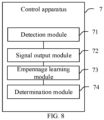
- FIG. 8 another embodiment of the present disclosure provides an electric spoiler control apparatus, and the control apparatus 7 includes a detection module 71, a signal output module 72, an spoiler learning module 73 and a determination module 74.
- the detection module 71 is configured for acquiring a current position of the spoiler and determining whether the spoiler is deviated based on the current position of the spoiler and a preset position of the spoiler.
- the preset position is a position corresponding to a current traveling mode of the vehicle.
- the detection module 71 includes an spoiler controller for determining whether the spoiler is deviated and a Hall sensor arranged on the spoiler controller and configured to detect the current position of the spoiler.
- the signal output module 72 is configured for outputting a deviation signal about deviation of the spoiler when the spoiler is determined to be deviated.
- the signal output module 72 includes a Channel Element Module (CEM) for outputting a deviation signal about the deviation of the spoiler.
- CEM Channel Element Module
- the spoiler learning module 73 is configured for controlling the spoiler to enter an spoiler self-learning state when a confirmation adjustment signal for the deviation signal is detected.
- the spoiler self-learning state includes controlling the spoiler to perform a preset learning action between a plurality of calibration positions to eliminate the deviation of the spoiler.
- the spoiler learning module 73 includes a multimedia host.
- the multimedia host detects the deviation signal about the deviation of the spoiler which the CEM outputs, it outputs the deviation signal through the multimedia screen, so that the driver selects whether to adjust the spoiler for the deviation signal.
- a confirmation adjustment signal for the deviation signal is output, and the spoiler adjustment signal is sent to the CEM, so that the spoiler controller is controlled by the CEM to adjust the spoiler, and the spoiler is controlled to return to the calibration position.
- the determination module 74 is configured for acquiring an actual position in real time when the spoiler is detected to move to each of the calibration positions, and determining that the spoiler self-learning is successful when the deviation value between the actual position and the corresponding calibration position is detected to be less than the preset deviation value.
- the determination module 74 When the determination module 74 detects that the spoiler moves to the calibration position, it sends a signal about the completion of the spoiler adjustment to the CEM, so as to determine that the spoiler adjustment is completed.
- the detection module 71 is further configured for:
- the detection module 71 is further configured for:
- the spoiler learning module 73 is further configured for:
- the determining module 74 is further configured for:
- the determining module 74 is further configured for:
- control apparatus further includes:
- an electronic device including:
- another embodiment of the present disclosure provides a vehicle including a control apparatus, and the control apparatus is configured to implement the above control method.
- another embodiment of the present disclosure provides a computer program product including a computer program/instruction, and when the computer program/instruction is executed by a processor to implement the above control method.
- the apparatus embodiment is basically similar to the method embodiment, and the description is relatively simple. For relevant parts, please refer to part of the description of the method embodiment.
- the embodiments of the present application may be provided as methods, apparatuses or computer program products. Accordingly, the embodiments of the present application can take the form of an entirely hardware embodiment, an entirely software embodiment, or a combination embodiment of software and hardware. Moreover, the embodiments of the present invention may take the form of a computer program product embodied on one or more computer usable storage media (including but not limited to disk storage, CD-ROM, optical storage, etc.) in which computer usable program codes are included.
- computer usable storage media including but not limited to disk storage, CD-ROM, optical storage, etc.
- each flow and/or block in the flow charts and/or block diagrams, and combinations of the flows and/or blocks in the flow charts and/or block diagrams can be implemented by computer program instructions.
- These computer program instructions may be provided to a general purpose computer, a special purpose computer, an embedded processor, or a processor of other programmable data processing terminal device to produce a machine for the instructions executed by the computer or the processor of other programmable data processing terminal device to generate an apparatus for implementing the functions specified in one or more flows of the flow chart and/or in one or more blocks of the block diagram.
- These computer program instructions may also be provided to a computer-readable memory that can guide the computer or other programmable data processing terminal device to work in a given manner, so that the instructions stored in the computer-readable memory generate a product including an instruction apparatus that implements the functions specified in one or more flows of the flow chart and/or in one or more blocks of the block diagram.
- These computer program instructions may also be loaded to a computer, or other programmable terminal device, so that a series of operating steps are executed on the computer, or other programmable terminal device to produce processing implemented by the computer, so that the instructions executed in the computer or other programmable terminal device provide steps for implementing the functions specified in one or more flows of the flow chart and/or in one or more blocks of the block diagram.
Landscapes
- Engineering & Computer Science (AREA)
- Chemical & Material Sciences (AREA)
- Combustion & Propulsion (AREA)
- Transportation (AREA)
- Mechanical Engineering (AREA)
- Physics & Mathematics (AREA)
- Fluid Mechanics (AREA)
- Power-Operated Mechanisms For Wings (AREA)
- Feedback Control In General (AREA)
- Vehicle Body Suspensions (AREA)
Abstract
Description
- This application claims the priority of the
Chinese patent application No.202111217240.3 titled "ELECTRIC SPOILER CONTROL METHOD AND APPARATUS, AND ELECTRONIC DEVICE AND VEHICLE" filed in China National Intellectual Property Administration on October 19, 2021 - The present disclosure relates to the technical field of automobiles, in particular, to an electronic spoiler control method, an apparatus, an electronic device and a vehicle.
- With the improvement of human living standards, automobile products have become an important part of people's lives, and people's requirements for automobiles are also increasing. In the purchase of a vehicle, not only the comfort, power, maneuverability and economy of the vehicle should be considered, but also the appearance and functional configuration of the vehicle should be considered. The spoiler is installed at the rear of the vehicle, which not only plays a decorative role for the whole vehicle, but also improves the stability and economy of the vehicle, and increases the safety factor of the vehicle.
- During use, the position of the spoiler is easy to shift. When the spoiler shifts, the angle of the spoiler cannot be corrected in time, which will affect the traveling of the vehicle.
- The present disclosure relates to an electric spoiler control method, an apparatus, an electronic device and a vehicle, which are intended to solve the problem that an angle of the spoiler angle cannot be corrected in time when the spoiler is deviated.
- A first aspect of the embodiments of the present disclosure provides an electric spoiler control method, including:
- acquiring a current position of an spoiler, and determining whether the spoiler is deviated based on the current position of the spoiler and a preset position of the spoiler, wherein the preset position is a position corresponding to a current traveling mode of a vehicle;
- outputting a deviation signal about the deviation of the spoiler when the spoiler is determined to be deviated;
- controlling the spoiler to enter an spoiler self-learning state when a confirmation adjustment signal for the deviation signal is detected, wherein the spoiler self-learning state includes controlling the spoiler to perform a preset learning action between a plurality of calibration positions to eliminate the deviation of the spoiler; and
- acquiring an actual position of the spoiler during the performing the preset learning action, and determining that the spoiler self-learning is successful when the deviation value between the actual position and a corresponding calibration position is detected to be less than the preset deviation value.
- Optionally, the determining whether the spoiler is deviated based on the current t position of the spoiler and a preset position of the spoiler includes:
- acquiring a current deviation value between the current position of the spoiler and the preset position;
- acquiring a deviation determination value corresponding to the preset position; and
- determining that the spoiler is deviated when the current deviation value is greater than or equal to the deviation determination value.
- Optionally, the outputting the deviation signal about the deviation of the spoiler when the spoiler is determined to be deviated includes:
- acquiring a current operating condition of the vehicle when the spoiler is determined to be deviated; and
- outputting a deviation signal about the deviation of the spoiler when the current operating condition satisfies a first preset condition,
- wherein the first preset condition includes a power state of the spoiler being in a power-on state, a current vehicle speed not exceeding a first preset vehicle speed, and a tailgate of the vehicle being in a closed state.
- Optionally, the controlling the spoiler to enter an spoiler self-learning state when a confirmation adjustment signal for the deviation signal is detected includes:
- acquiring a current operating condition of the vehicle when the confirmation adjustment signal for the deviation signal is detected; and
- controlling the spoiler to enter the self-learning state when the current operating condition satisfies a second preset condition,
- wherein the second preset condition includes a power state of the spoiler being in a power-on state, a current vehicle speed not exceeding a second preset vehicle speed, and a tailgate of the vehicle being in a closed state.
- Optionally, wherein the plurality of calibration positions include at least a first calibration position and a second calibration position, and the controlling the spoiler to perform the preset learning action between the plurality of calibration positions includes:
- controlling the spoiler to move to either of the first calibration position and the second calibration position; and
- controlling the spoiler to reciprocate between the first calibration position and the second calibration position after the spoiler moves to the calibration position.
- Optionally, the preset deviation value includes a first preset deviation value corresponding to the first calibration position and a second preset deviation value corresponding to the second calibration position, and the determining that the spoiler self-learning is successful when the deviation value between the actual position and the corresponding calibration position is detected to be less than the preset deviation value includes:
- acquiring the first deviation value between the actual position and the first calibration position when the spoiler moves to the first calibration position;
- acquiring the second deviation value between the actual position and the second calibration position when the spoiler moves to the second calibration position; and
- determining that the spoiler self-learning is successful when the first deviation value is less than the first preset deviation value and/or the second deviation value is less than the second preset deviation value.
- Optionally, the control method further includes:
- controlling the spoiler to stop moving and determining that the spoiler self-learning is successful when the deviation value is detected to be greater than or equal to the preset deviation value after the spoiler reciprocates between the first calibration position and the second calibration position for a preset number of times; and
- outputting an unsuccessful self-learning signal when the spoiler self-learning is determined to be unsuccessful.
- A second aspect of the embodiments of the present disclosure provides an electric spoiler control apparatus including:
- a detection module for acquiring a current position of the spoiler, and determining whether the spoiler is deviated based on the current position of the spoiler and a preset position of the spoiler, wherein the preset position is a position corresponding to a current traveling mode of the vehicle;
- a signal output module for outputting a deviation signal about deviation of the spoiler when the spoiler is determined to be deviated;
- an spoiler learning module for controlling the spoiler to enter an spoiler self-learning state when a confirmation adjustment signal for the deviation signal is detected, wherein the spoiler self-learning state includes controlling the spoiler to perform a preset learning action between a plurality of calibration positions to eliminate the deviation of the spoiler; and
- a determination module for acquiring an actual position of the spoiler in real time when the spoiler moves to each of the calibration positions, and determining that the spoiler self-learning is successful when the deviation value between the actual position and a corresponding calibration position is detected to be less than the preset deviation value.
- A third aspect of the embodiments of the present disclosure provides an electronic device, including:
- memory for storing a computer program;
- a processor for executing the computer program stored in the memory to implement the above control method.
- A fourth aspect of an embodiment of the present disclosure provides a vehicle, including a control apparatus configured to implement the above control method.
- A fifth aspect of the embodiments of the present disclosure provides a computer program product, including a computer program/instruction, and the computer program/instruction implements the above control method when executed by a processor.
- In the electric spoiler control method, the apparatus, the electronic device and the vehicle provided in the present disclosure, when the electric spoiler moves to a preset position during traveling of the vehicle, the current position of the spoiler is acquired in real time. When the position of the spoiler is detected to be deviated, that is, when the current position is different from the preset position, the spoiler is determined to be deviated, and then a deviation signal about the deviation of the spoiler is output to inquire whether to adjust the spoiler. When a confirmation adjustment signal for the deviation signal is detected, the spoiler is controlled to enter a self-learning state of the spoiler. The spoiler self-learning state includes controlling the spoiler to perform a preset learning action between a plurality of calibration positions to eliminate the deviation of the spoiler. When the deviation value between the actual position and a corresponding calibration position is detected to be less than a preset deviation value, the self-learning of the spoiler is determined to be successful, and the spoiler can continue to be controlled for subsequent movement, thereby solving the problem that the angle of the spoiler cannot be corrected in time when the spoiler is deviated, and effectively improving the applicability of the spoiler.
- In order to more clearly illustrate the technical solutions of the embodiments of the present disclosure or the prior art, the figures that are required to describe the embodiments or the prior art may be briefly introduced below. Apparently, the figures that are described below are embodiments of the present disclosure, and a person skilled in the art can obtain other figures according to these figures without paying creative work.
-
FIG. 1 schematically shows a schematic flowchart of a control method according to an embodiment of the present disclosure; -
Fig. 2 schematically shows a schematic flowchart for determining whether an spoiler is deviated according to an embodiment of the present disclosure; -
Fig. 3 schematically shows a schematic flowchart for outputting a deviation signal according to an embodiment of the present disclosure; -
Fig. 4 schematically shows a schematic flowchart for determining an operating condition before a self-learning state is entered according to an embodiment of the present disclosure; -
Fig. 5 schematically shows a schematic flowchart for performing a preset learning action according to an embodiment of the present disclosure; -
Fig. 6 schematically shows a schematic flowchart for determining that an spoiler self-learning is successful according to an embodiment of the present disclosure; -
Fig. 7 schematically shows a schematic flowchart for determining that the spoiler self-learning is unsuccessful according to an embodiment of the present disclosure; -
Fig. 8 schematically shows a schematic diagram of modules of an apparatus according to an embodiment of the present disclosure; - In order to make the objects, the technical solutions and the advantages of the embodiments of the present disclosure clearer, the technical solutions of the embodiments of the present disclosure may be clearly and completely described below with reference to the drawings of the embodiments of the present disclosure. Apparently, the described embodiments are merely certain embodiments of the present disclosure, rather than all of the embodiments. All of the other embodiments that a person skilled in the art obtains on the basis of the embodiments of the present disclosure without paying creative work fall within the protection scope of the present disclosure.
- With the improvement of human living standards, automobile products have become an important part of people's lives, and people's requirements for automobiles are also increasing. In purchase of vehicles, the comfort, power, maneuverability and economy of the vehicle should be considered, but also the appearance and functional configuration of the vehicle should also be considered. The spoiler is installed at the rear of the vehicle, which not only plays a decorative role for the whole vehicle, but also can improve the stability and economy of the vehicle, increase the safety factor of the vehicle, attracts customers, give customers a more luxurious and sporty vehicle experience, and show a young and fashionable sports style which users pursue.
- During the use of the spoiler, the influence of the spoiler on the airflow can improve the traveling performance of the vehicle. However, during the use of the spoiler, when the spoiler is deviated, the spoiler does not match the traveling state of the vehicle, and it is easy to affect the traveling state of the vehicle. However, when the spoiler is deviated, the driver often cannot correct the angle of the spoiler in time, which will influence the traveling of the vehicle.
- In view of this, a first aspect of the present disclosure provides an electric spoiler control method including S1-S4, as shown in
FIG.1 . - In S1, a current position of the spoiler is acquired, and whether the spoiler is deviated is determined based on the current position and the preset position, where the preset position is a position corresponding to the current traveling mode of the vehicle.
- During the traveling process of the vehicle, as the speed of the vehicle changes, the airflow state at the rear of the vehicle is different, and the influence on the vehicle is also different. Therefore, the position of the spoiler of the vehicle is determined based on the current traveling state of the vehicle, the preset scheme and algorithm, so that the influence of the airflow on the vehicle is reduced, and the traveling state of the vehicle is improved. That is, the current preset position of the spoiler is determined based on to the traveling state of the vehicle, and the motor of the spoiler is controlled to drive the spoiler to the preset position.
- After the spoiler moves to the preset position, the position of the spoiler is acquired in real time by a detection module. In one embodiment, the current position of the spoiler can be detected by a Hall sensor, and compared with the preset position. When the deviation between the current position of the spoiler and the preset position, the spoiler is determined to be deviated and needs to be adjusted.
- In S2, when the spoiler is determined to be deviated, a deviation signal about the deviation of the spoiler is output.
- During the traveling process of the vehicle, in some cases, the change of the spoiler will have an influence on the traveling state of the vehicle. Therefore, the current operating condition of the vehicle are acquired first, including a current power-on condition of the vehicle, a current speed of the vehicle and a power supply condition of the spoiler, etc. When the current operating condition of the vehicle satisfies a preset condition, that is, when the current operating condition of the vehicle allows the vehicle to adjust the spoiler, a deviation signal about the deviation of the spoiler is output.
- In one embodiment, when the vehicle receives the deviation signal, a driver is prompted through a multimedia display screen of the vehicle whether the spoiler needs to be adjusted, confirms through a button on the multimedia display screen whether to adjust the spoiler.
- In S3, when a confirmation adjustment signal for the deviation signal is detected, the spoiler is controlled to enter an spoiler self-learning state, where the spoiler self-learning state includes controlling the spoiler to perform a preset learning action between a plurality of calibration positions to eliminate the deviation of the spoiler.
- When the confirmation adjustment signal for the deviation signal is received, that is, the spoiler is determined to be adjusted, the spoiler is controlled to enter the spoiler self-learning state. When the spoiler enters the self-learning state, the spoiler is controlled to perform the preset learning action between a plurality of calibration positions. The mechanical engagement or mating state between driving devices of the spoiler is adjusted by performing the preset learning action to eliminate the deviation of the spoiler.
- The calibration position can be an initial position of the spoiler. The motor of the spoiler drives the spoiler to start moving, and drives the spoiler to move to the pre-calibrated initial position, so that the position of the spoiler is reset to zero. When the spoiler moves again, it moves from the initial position, so that the deviation is corrected.
- The calibration position can also be set by the driver based on the vehicle condition. In some embodiments, when the vehicle satisfies the preset condition, the driver can enter the calibration position setting mode through the multimedia display screen or a controller, such as a vehicle key, to control the spoiler to move to a certain position as the calibration position.
- In some embodiments, when the spoiler is adjusted, the spoiler may be deviated due to jamming, so the jamming is eliminated by performing the preset action. In a specific embodiment, when the spoiler is adjusted, the spoiler is controlled to perform a lifting action and then return to the initial position. Foreign matter that may be present in the spoiler is cleared by controlling the spoiler to unfold and fold, so as to avoid jamming in the spoiler caused by the foreign matter.
- In some embodiments, the adjustment action of the spoiler can be set by the driver based on the vehicle condition. When the vehicle satisfies the preset condition, the driver can enter the adjustment action setting mode through the multimedia display screen or the controller, such as the vehicle key, to control the movement of the spoiler through the multimedia display screen or the controller, and record the movement action of the spoiler as the adjustment action of the spoiler, such as controlling the spoiler to lift and lower reciprocally for several times, which effectively improves the applicability of the spoiler.
- In S4, the actual position of the spoiler during the preset learning action is acquired, and when the deviation value between the actual position and the corresponding calibration position is detected to be less than the preset deviation value, the spoiler self-learning is determined to be successful.
- After the motor drives the spoiler to move, the current position of the spoiler is detected again. When the deviation value between the actual position and the corresponding calibration position is detected to be less than the preset deviation value, the current actual position can be considered as an expected position, or the error is within the acceptable range, the spoiler self-learning is determined to be successful.
- After the electric spoiler moves to the preset position during the traveling of the vehicle, the current position of the spoiler is acquired in real time. When the position of the spoiler is detected to be deviated, that is, when the current position is different from the preset position, the spoiler is determined to be deviated, and then the deviation signal about the deviation of the spoiler to inquire whether to adjust the spoiler is output. When the confirmation adjustment signal for the deviation signal is detected, the spoiler is controlled to enter the spoiler self-learning state. The spoiler self-learning state includes controlling the spoiler to perform the preset learning action between a plurality of calibration positions to eliminate the deviation of the spoiler. When the deviation value between the actual position and the corresponding calibration position is detected to be less than the preset deviation value, the spoiler self-learning is determined to be successful, and the spoiler can continue to be controlled for subsequent movement. The position of the spoiler is monitored in real time, the deviation value between the current position of the spoiler and the preset position is determined, whether the spoiler is deviated is determined in time, and the user is reminded in time to adjust when the spoiler is deviated, which solves the problem that the angle of the spoiler cannot be corrected in time, and effectively improves the applicability of the spoiler.
- In some embodiments, as shown in
FIG. 2 , determining whether the spoiler is deviated based on the current position of the spoiler and the preset position of the spoiler includes S101-S103. - In S101, a current deviation value between the current position of the spoiler and the preset position is acquired.
- During the operating process of the spoiler, the mechanical deviation between the transmission mechanisms during use will accumulate continuously over a long period of time of use, which can easily lead to an increase in the error of the spoiler. When the error reaches a certain value, it can easily affect the traveling of the vehicle. Therefore, the current deviation value between the current position of the spoiler and the preset position is acquired in real time to determine whether the current error of the spoiler is within the allowable range.
- In S102, a deviation determination value corresponding to the preset position is acquired.
- The deviation determination value is a deviation value that can easily affect the vehicle, and the deviation determination value can be adjusted based on the vehicle model or the spoiler model, etc.
- In S103, when the current deviation value is greater than or equal to the deviation determination value, the spoiler is determined to be deviated.
- If the current deviation value of the spoiler is greater than or equal to the offset determination value, it indicates that the deviation of the spoiler will affect the vehicle, and the spoiler is determined to be deviated and needs to be adjusted, so as to reduce or eliminate the deviation value, and reduce the influence of the deviation of the spoiler on the traveling of the vehicle.
- In some embodiments, as shown in
FIG. 3 , outputting the deviation signal about the deviation of the spoiler offset when the spoiler is determined to be deviated, includes: - S201: acquiring the current operating condition of the vehicle when the spoiler is determined to be deviated; and
- S202: outputting the deviation signal about the deviation of the spoiler when the current operating condition satisfies the first preset condition.
- The first preset condition includes the power supply state of the spoiler being in a power-on state, the current vehicle speed not exceeding the first preset vehicle speed, and the tailgate of the vehicle being in a closed state.
- When the motor, etc. of the spoiler is in the power-on state and the tailgate of the vehicle is in the closed state, it is determined that the motor can drive the spoiler to move. Since the higher the vehicle speed, the greater the influence of the spoiler on the vehicle, the current vehicle speed is detected. When the current vehicle speed does not exceed the first preset vehicle speed, the movement of the spoiler has less influence on the vehicle, thereby determining that the current vehicle condition allows the spoiler to be adjusted. For example, the first preset vehicle speed may be 5km/h, and when the vehicle speed is lower than 5km/h, the movement of the spoiler has less influence on the vehicle.
- In other embodiments, the first preset vehicle speed can be a higher vehicle speed. When the speed is higher, a signal about the deviation of the spoiler is sent to the driver, and the driver is reminded that the vehicle speed is faster and it is necessary to slow down the speed to adjust the spoiler, so as to improve the applicability of the whole method.
- In some embodiments, as shown in
FIG. 4 , controlling the spoiler to enter the spoiler self-learning state when the confirmation adjustment signal for the deviation signal is detected, includes S301-S302. - In S301, the current operating condition of the vehicle is acquired when the confirmation adjustment signal for the deviation signal is detected.
- When the vehicle receives the deviation signal that the spoiler is deviated, the driver needs to determine whether to adjust the spoiler and change the traveling state of the vehicle based on the deviation signal, or the vehicle condition changes. Therefore, when the confirmation adjustment signal for the deviation signal is detected, the current operating condition is acquired again to determine whether the spoiler can be adjusted.
- In S302, when the current operating condition satisfies the second preset condition, the spoiler is controlled to enter the self-learning state, where the second preset condition includes the power state of the spoiler being in the power-on state, the current vehicle speed of the vehicle not exceeding the second preset vehicle speed , and the tailgate of the vehicle being in the closed state.
- When the motor, etc. of the spoiler is in the power-on state and the tailgate of the vehicle is in the closed state, it is determined that the motor can drive the spoiler to move, that is, the spoiler can be adjusted only when the motor, etc. of the spoiler is in the power-on state and the tailgate of the vehicle is in the closed state. Therefore, the power state of the spoiler and the state of the tailgate of the vehicle are detected to determine whether the spoiler can be controlled. In addition, since the higher the vehicle speed, the greater the influence of the spoiler on the vehicle, the current vehicle speed is detected. When the current vehicle speed does not exceed the second preset vehicle speed, the movement of the spoiler has less influence on the vehicle, thereby determining that the current vehicle condition allows the spoiler to be adjusted. For example, the second preset vehicle speed may be 5km/h, and when the vehicle speed is lower than 5km/h, the movement of the spoiler has less impact on the vehicle.
- In other embodiments, the second preset vehicle speed can be a higher vehicle speed. When the vehicle speed is higher, a signal about the deviation of the spoiler is sent to the driver, and the driver is reminded that the vehicle speed is faster, and the spoiler is adjusted after deceleration. When the vehicle condition is detected again, and the current operating condition satisfies the second preset condition, that is, the current vehicle condition allows the vehicle to adjust the spoiler, the spoiler is controlled to return to the calibration position. Confirming the vehicle condition for the second time can effectively avoid the influence of adjusting the spoiler on the vehicle caused by the change in the vehicle condition.
- In some embodiments, as shown in
FIG. 5 , the plurality of calibration positions include at least a first calibration position and a second calibration position. Controlling the spoiler to perform the preset learning action between the plurality of calibration positions includes S401-S402. - In S401, the spoiler is controlled to move to any one of the first calibration position and the second calibration position.
- When it is determined that the spoiler performs a preset learning action, the spoiler is first controlled to move to either of the first calibration position and the second calibration position as a starting point of the movement, so as to determine the current deviation value of the spoiler and determine the orientation of the current position of the spoiler with respect to the calibration position, so that the movement rule is determined, and the preset learning action is performed from the calibration position.
- In S402, when the spoiler moves to either calibration position, the spoiler is controlled to reciprocate between the first calibration position and the second calibration position.
- The first calibration position and the second calibration position can be the starting position and the maximum opening position, and can also be any two different positions that can be calibrated by themselves. After the starting point of the movement is determined, the reciprocating movement is controlled to adjust the mechanical engagement or matching state between the driving apparatuses of the spoiler to eliminate the deviation of the spoiler.
- In some embodiments, as shown in
FIG. 6 , the preset deviation value includes a first preset deviation value corresponding to the first calibration position and a second preset deviation value corresponding to the second calibration position. Determining that the spoiler self-learning is successful when the deviation value between the actual position and the corresponding calibration position is detected to be less than the preset deviation value, includes: - S501: acquiring a first deviation value between the actual position and the first calibration position when the spoiler moves to the first calibration position;
- S502: acquiring a second deviation value between the actual position and the second calibration position when the spoiler moves to the second calibration position; and
- S503: determining that the spoiler self-learning is successful when the first deviation value is less than the first preset deviation value and/or the second deviation value is less than the second preset deviation value.
- Since there is a certain error when the spoiler moves, the deviation value between the spoiler and the calibration position is detected when the spoiler movement is finished. When the deviation is less than the preset deviation value, it can be considered that the spoiler has successfully moved to the calibration position, e.g., the preset deviation value can be 2mm.
- During the preset learning action, the error can be eliminated whether the spoiler moves at the first calibration position or the second calibration position. Therefore, the deviation values of two positions are acquired in real time to determine in time whether the self-leaning at the two positions is successful. When the spoiler self-learning at either calibration position is determined to be successful, the spoiler is controlled to stop, which effectively reduces the time for the self-learning action and improves the accuracy of the method.
- In some embodiments, as shown in
FIG. 7 , the control method further includes S601 and S602. - In S601, When the deviation value is detected to be greater than or equal to the preset deviation value after the spoiler reciprocates between the first calibration position and the second calibration position for a preset number of times, the spoiler is controlled to stop moving, and the spoiler self-learning is determined to be unsuccessful.
- When the deviation value is detected to be greater than or equal to the preset deviation value, it can be considered that the current deviation of the spoiler cannot be eliminated by performing the preset learning action, so the spoiler is controlled to stop moving to avoid damaging the spoiler, and the spoiler self-learning is determined to be unsuccessful.
- In S602, when the spoiler self-learning is determined to be unsuccessful, a signal that the spoiler self-learning is unsuccessful is output.
- When the spoiler is adjusted successfully, a signal that the spoiler is adjusted successfully is output through the multimedia display screen or the controller, e.g., the multimedia display screen displays that the adjustment is successful, or the controller emits a flashing light or a sound prompt to notify the driver that the adjustment is successful.
- When the spoiler is adjusted unsuccessfully, a signal that the spoiler is adjusted unsuccessfully through the multimedia display screen or the controller, e.g., the multimedia display screen displays that the adjustment is unsuccessful, so that the driver can repair it in time.
- In some embodiments, the control method further includes:
- acquiring a current traveling mode of the vehicle;
- acquiring a current power-on state of the vehicle and a vehicle speed, and determining a current traveling state of the vehicle, such as a starting state, a high-speed moving state, or a stalled state; and
- determining a preset position corresponding to the spoiler based on the traveling mode, and outputting a control signal about the preset position.
- Different vehicle states correspond to different positions of the spoiler. The preset position of the spoiler is determined by determining the vehicle state, and a control signal containing the preset position information is output to the spoiler.
- When the control signal of the spoiler is detected, the motor is controlled to drive the spoiler to move to the preset position corresponding to the control signal.
- In some embodiments, determining the first preset position corresponding to the spoiler based on the traveling mode includes:
- determining the preset position as the position corresponding to a fully open state of the spoiler when the vehicle is detected to start,
- controlling the spoiler to open to the fully open state, so that the spoiler enters the welcome mode when the vehicle starts, which effectively improves the sense of traveling ceremony;
- determining the preset position as an initial position when the vehicle is detected to be stall;
- controlling the spoiler to automatically fold when the vehicle is detected to stall, which avoids affecting the opening of the trunk, and entry of debris between the spoiler and the vehicle, so as to protect the spoiler; and
- determining the preset position as the position corresponding to the highest current vehicle speed determined based on the preset solution when the vehicle is detected to travel at a high speed.
- Based on the model of the vehicle, etc., the position of the spoiler position with the best effect on improving the traveling state of the vehicle at different vehicle speeds is determined by pre-testing. When the vehicle travels at a certain vehicle speed, the spoiler is controlled to move to the position which has the best effect on improving the traveling state of the vehicle at the current vehicle speed, so as. to effectively improve the performance of the vehicle. In some embodiments, when the vehicle speed decreases, the position of the spoiler is maintained to avoid the effect on the vehicle when the position of the spoiler changes.
- In some specific embodiments, it is also possible to manually control the spoiler to fold, e.g., a fold command is output by the multimedia display screen or the controller, so as to control the spoiler to fold.
- In some embodiments, the control method further includes:
The state of the tailgate is detected when the spoiler is moving or adjusted. When the tailgate is in the open state, the movement of the spoiler is limited to avoid damage to the spoiler or the vehicle. - Based on the same inventive concept, as shown in
FIG. 8 , another embodiment of the present disclosure provides an electric spoiler control apparatus, and thecontrol apparatus 7 includes adetection module 71, asignal output module 72, anspoiler learning module 73 and adetermination module 74. - The
detection module 71 is configured for acquiring a current position of the spoiler and determining whether the spoiler is deviated based on the current position of the spoiler and a preset position of the spoiler. The preset position is a position corresponding to a current traveling mode of the vehicle. Thedetection module 71 includes an spoiler controller for determining whether the spoiler is deviated and a Hall sensor arranged on the spoiler controller and configured to detect the current position of the spoiler. - The
signal output module 72 is configured for outputting a deviation signal about deviation of the spoiler when the spoiler is determined to be deviated. - The
signal output module 72 includes a Channel Element Module (CEM) for outputting a deviation signal about the deviation of the spoiler. - The
spoiler learning module 73 is configured for controlling the spoiler to enter an spoiler self-learning state when a confirmation adjustment signal for the deviation signal is detected. The spoiler self-learning state includes controlling the spoiler to perform a preset learning action between a plurality of calibration positions to eliminate the deviation of the spoiler. - The
spoiler learning module 73 includes a multimedia host. When the multimedia host detects the deviation signal about the deviation of the spoiler which the CEM outputs, it outputs the deviation signal through the multimedia screen, so that the driver selects whether to adjust the spoiler for the deviation signal. When adjusting the spoiler is selected, a confirmation adjustment signal for the deviation signal is output, and the spoiler adjustment signal is sent to the CEM, so that the spoiler controller is controlled by the CEM to adjust the spoiler, and the spoiler is controlled to return to the calibration position. - The
determination module 74 is configured for acquiring an actual position in real time when the spoiler is detected to move to each of the calibration positions, and determining that the spoiler self-learning is successful when the deviation value between the actual position and the corresponding calibration position is detected to be less than the preset deviation value. - When the
determination module 74 detects that the spoiler moves to the calibration position, it sends a signal about the completion of the spoiler adjustment to the CEM, so as to determine that the spoiler adjustment is completed. - In some embodiments, the
detection module 71 is further configured for: - acquiring a current deviation value between the current position of the spoiler and the preset position;
- acquiring a deviation determination value corresponding to the preset position; and
- determining that the spoiler is deviated when the current deviation value is greater than or equal to the offset determination value.
- In some embodiments, the
detection module 71 is further configured for: - acquiring a current operating condition of the vehicle when the spoiler is determined to be deviated;
- outputting a deviation signal about the deviation of the spoiler when the current operating condition satisfies a first preset condition,
- where the first preset condition includes a power state of the spoiler being in a power-on state, a current vehicle speed not exceeding the first preset vehicle speed, and a tailgate of the vehicle being in a closed state.
- In some embodiments, the
spoiler learning module 73 is further configured for: - acquiring the current operating condition of the vehicle when the confirmation adjustment signal for the deviation signal is detected;
- controlling the spoiler to enter the self-learning state when the current operating condition satisfies a second preset condition,
- where the second preset condition includes the power state of the spoiler being in the power-on state, the current vehicle speed not exceeding the second preset vehicle speed, and the tailgate of the vehicle being in a closed state.
- In some embodiments, the determining
module 74 is further configured for: - controlling the spoiler to move to either of the first calibration position and the second calibration position;
- controlling the spoiler to reciprocate between the first calibration position and the second calibration position after the spoiler moves to either calibration position.
- In some embodiments, the determining
module 74 is further configured for: - acquiring a first deviation value between the actual position and the first calibration position when the spoiler moves to the first calibration position;
- acquiring a second deviation value between the actual position and the second calibration position when the spoiler moves to the second calibration position; and
- determining that the spoiler self-learning is successful when the first deviation value is less than the first preset deviation value and/or the second deviation value is less than the second preset deviation value.
- In some embodiments, the control apparatus further includes:
- a prompting module 75 for controlling the spoiler to stop moving and determining that the spoiler self-learning is unsuccessful when the deviation value is detected to be greater than or equal to the preset deviation value after the spoiler reciprocates between the first calibration position and the second calibration position for a preset number of times; and
- outputting a signal that the spoiler self-learning is unsuccessful when the spoiler self-learning is determined to be unsuccessful.
- Based on the same inventive concept, another embodiment of the present disclosure provides an electronic device, including:
- A memory for storing a computer program; and
- a processor for executing a computer program stored on the memory to implement the above control method.
- Based on the same inventive concept, another embodiment of the present disclosure provides a vehicle including a control apparatus, and the control apparatus is configured to implement the above control method.
- Based on the same inventive concept, another embodiment of the present disclosure provides a computer program product including a computer program/instruction, and when the computer program/instruction is executed by a processor to implement the above control method.
- The apparatus embodiment is basically similar to the method embodiment, and the description is relatively simple. For relevant parts, please refer to part of the description of the method embodiment.
- Each embodiment in this specification is described in a progressive manner, each embodiment focuses on the difference from other embodiments, and the same and similar parts of each embodiment can be referred to each other.
- It should be appreciated by those skilled in the art that the embodiments of the present application may be provided as methods, apparatuses or computer program products. Accordingly, the embodiments of the present application can take the form of an entirely hardware embodiment, an entirely software embodiment, or a combination embodiment of software and hardware. Moreover, the embodiments of the present invention may take the form of a computer program product embodied on one or more computer usable storage media (including but not limited to disk storage, CD-ROM, optical storage, etc.) in which computer usable program codes are included.
- The embodiments of the present application are described with reference to the flow charts and/or block diagrams of the method, terminal device (system), and computer program products according to the embodiments of the present application. It should be appreciated that each flow and/or block in the flow charts and/or block diagrams, and combinations of the flows and/or blocks in the flow charts and/or block diagrams can be implemented by computer program instructions. These computer program instructions may be provided to a general purpose computer, a special purpose computer, an embedded processor, or a processor of other programmable data processing terminal device to produce a machine for the instructions executed by the computer or the processor of other programmable data processing terminal device to generate an apparatus for implementing the functions specified in one or more flows of the flow chart and/or in one or more blocks of the block diagram.
- These computer program instructions may also be provided to a computer-readable memory that can guide the computer or other programmable data processing terminal device to work in a given manner, so that the instructions stored in the computer-readable memory generate a product including an instruction apparatus that implements the functions specified in one or more flows of the flow chart and/or in one or more blocks of the block diagram.
- These computer program instructions may also be loaded to a computer, or other programmable terminal device, so that a series of operating steps are executed on the computer, or other programmable terminal device to produce processing implemented by the computer, so that the instructions executed in the computer or other programmable terminal device provide steps for implementing the functions specified in one or more flows of the flow chart and/or in one or more blocks of the block diagram.
- Although the preferred embodiments of the present application have been described, those skilled in the art can make additional changes and modifications to these embodiments once they know the basic inventive concepts. Therefore, the appended claims are intended to be interpreted as including the preferred embodiments and all the changes and modifications that fall within the scope of the embodiments of the present application.
- Finally, it should also be noted that relational terms herein such as first and second, etc., are used merely to distinguish one entity or operation from another entity or operation, and do not necessarily require or imply there is any such relationship or order between these entities or operations. Furthermore, the terms "including", "comprising" or any variations thereof are intended to embrace a non-exclusive inclusion, such that a process, method, article, or terminal device including a plurality of elements includes not only those elements but also includes other elements not expressly listed, or also includes elements inherent to such a process, method, article, or device. In the absence of further limitation, an element defined by the phrase "including a ..." does not exclude the presence of additional identical element in the process, method, article, or terminal device.
- The electronic spoiler control method, the apparatus, the electronic device and the vehicle provided in the present application are described in detail above. Specific examples are applied to explain the principle and implementation of the present application herein. The above embodiments are only used to help understand the method of the present application and the core idea thereof. Meanwhile, for those of ordinary skills in the art, there may be changes in the specific implementation and application scope according to the idea of the present application. To sum up, the contents of this specification should not be construed as limiting the present application.
Claims (11)
- An electric spoiler control method, comprising:acquiring a current position of an spoiler, and determining whether the spoiler is deviated based on the current position of the spoiler and a preset position of the spoiler, wherein the preset position is a position corresponding to a current traveling mode of a vehicle;outputting a deviation signal about the deviation of the spoiler when the spoiler is determined to be deviated;controlling the spoiler to enter an spoiler self-learning state when a confirmation adjustment signal for the deviation signal is detected, wherein the spoiler self-learning state comprises controlling the spoiler to perform a preset learning action between a plurality of calibration positions to eliminate the deviation of the spoiler; andacquiring an actual position of the spoiler during the performing the preset learning action, and determining that the spoiler self-learning is successful when the deviation value between the actual position and a corresponding calibration position is detected to be less than the preset deviation value.
- The according to claim 1, wherein the determining whether the spoiler is deviated based on the current t position of the spoiler and a preset position of the spoiler comprises:acquiring a current deviation value between the current position of the spoiler and the preset position;acquiring a deviation determination value corresponding to the preset position; anddetermining that the spoiler is deviated when the current deviation value is greater than or equal to the deviation determination value.
- The method according to claim 1, wherein the outputting the deviation signal about the deviation of the spoiler when the spoiler is determined to be deviated comprises:acquiring a current operating condition of the vehicle when the spoiler is determined to be deviated; andoutputting a deviation signal about the deviation of the spoiler when the current operating condition satisfies a first preset condition,wherein the first preset condition comprises a power state of the spoiler being in a power-on state, a current vehicle speed not exceeding a first preset vehicle speed, and a tailgate of the vehicle being in a closed state.
- The method according to claim 1, wherein the controlling the spoiler to enter an spoiler self-learning state when a confirmation adjustment signal for the deviation signal is detected comprises:acquiring a current operating condition of the vehicle when the confirmation adjustment signal for the deviation signal is detected; andcontrolling the spoiler to enter the self-learning state when the current operating condition satisfies a second preset condition,wherein the second preset condition comprises a power state of the spoiler being in a power-on state, a current vehicle speed not exceeding a second preset vehicle speed, and a tailgate of the vehicle being in a closed state.
- The method according to claim 1, wherein the plurality of calibration positions comprise at least a first calibration position and a second calibration position, and the controlling the spoiler to perform the preset learning action between the plurality of calibration positions comprises:controlling the spoiler to move to either of the first calibration position and the second calibration position; andcontrolling the spoiler to reciprocate between the first calibration position and the second calibration position after the spoiler moves to the calibration position.
- The method according to claim 5, wherein the preset deviation value comprises a first preset deviation value corresponding to the first calibration position and a second preset deviation value corresponding to the second calibration position, and the determining that the spoiler self-learning is successful when the deviation value between the actual position and the corresponding calibration position is detected to be less than the preset deviation value comprises:acquiring the first deviation value between the actual position and the first calibration position when the spoiler moves to the first calibration position;acquiring the second deviation value between the actual position and the second calibration position when the spoiler moves to the second calibration position; anddetermining that the spoiler self-learning is successful when the first deviation value is less than the first preset deviation value and/or the second deviation value is less than the second preset deviation value.
- The control method according to claim 5, wherein the control method further comprises:controlling the spoiler to stop moving and determining that the spoiler self-learning is successful when the deviation value is detected to be greater than or equal to the preset deviation value after the spoiler reciprocates between the first calibration position and the second calibration position for a preset number of times; andoutputting an unsuccessful self-learning signal when the spoiler self-learning is determined to be unsuccessful.
- An electric spoiler control apparatus, comprising:a detection module for acquiring a current position of the spoiler, and determining whether the spoiler is deviated based on the current position of the spoiler and a preset position of the spoiler, wherein the preset position is a position corresponding to a current traveling mode of the vehicle;a signal output module for outputting a deviation signal about deviation of the spoiler when the spoiler is determined to be deviated;an spoiler learning module for controlling the spoiler to enter an spoiler self-learning state when a confirmation adjustment signal for the deviation signal is detected, wherein the spoiler self-learning state comprises controlling the spoiler to perform a preset learning action between a plurality of calibration positions to eliminate the deviation of the spoiler; anda determination module for acquiring an actual position of the spoiler in real time when the spoiler moves to each of the calibration positions, and determining that the spoiler self-learning is successful when the deviation value between the actual position and a corresponding calibration position is detected to be less than the preset deviation value.
- An electronic device, comprising:a memory for storing a computer program;a processor for executing the computer program stored in the memory to implement the method according to any one of claims 1-7.
- A vehicle, comprising a control apparatus for implementing the method according to any one of claims 1-7.
- A computer program product, comprising a computer program/instruction, wherein the computer program/instruction, when executed by a processor, implements the method according to any one of claims 1-7.
Applications Claiming Priority (2)
| Application Number | Priority Date | Filing Date | Title |
|---|---|---|---|
| CN202111217240.3A CN114954698B (en) | 2021-10-19 | 2021-10-19 | Electric tail wing control method and device, electronic equipment and vehicle |
| PCT/CN2022/119687 WO2023065921A1 (en) | 2021-10-19 | 2022-09-19 | Electric empennage control method and apparatus, and electronic device and vehicle |
Publications (3)
| Publication Number | Publication Date |
|---|---|
| EP4410641A1 true EP4410641A1 (en) | 2024-08-07 |
| EP4410641A4 EP4410641A4 (en) | 2025-02-12 |
| EP4410641B1 EP4410641B1 (en) | 2026-03-04 |
Family
ID=82974725
Family Applications (1)
| Application Number | Title | Priority Date | Filing Date |
|---|---|---|---|
| EP22882532.9A Active EP4410641B1 (en) | 2021-10-19 | 2022-09-19 | Electric empennage control method and apparatus, and electronic device and vehicle |
Country Status (3)
| Country | Link |
|---|---|
| EP (1) | EP4410641B1 (en) |
| CN (1) | CN114954698B (en) |
| WO (1) | WO2023065921A1 (en) |
Families Citing this family (6)
| Publication number | Priority date | Publication date | Assignee | Title |
|---|---|---|---|---|
| CN114954698B (en) * | 2021-10-19 | 2023-03-21 | 长城汽车股份有限公司 | Electric tail wing control method and device, electronic equipment and vehicle |
| CN115675665A (en) * | 2022-11-16 | 2023-02-03 | 长城汽车股份有限公司 | Method and device for controlling tail wing of vehicle, electronic equipment, storage medium and vehicle |
| CN115709762A (en) * | 2022-12-06 | 2023-02-24 | 曼德电子电器有限公司 | Control method and device for three-section type electric tail wing, storage medium and automobile |
| CN117698858A (en) * | 2023-11-20 | 2024-03-15 | 广州汽车集团股份有限公司 | Tail wing control method and device, electronic equipment and computer readable storage medium |
| CN118770396A (en) * | 2024-06-26 | 2024-10-15 | 东风商用车有限公司 | Spoiler automatic adjustment device and method |
| CN118877091A (en) * | 2024-08-01 | 2024-11-01 | 武汉路特斯汽车有限公司 | Spoiler control method, device, equipment, system, vehicle and storage medium |
Family Cites Families (22)
| Publication number | Priority date | Publication date | Assignee | Title |
|---|---|---|---|---|
| DE3580290D1 (en) * | 1984-02-29 | 1990-12-06 | Nissan Motor | MOTOR VEHICLE WIND DEFLECTOR WITH ADJUSTABLE ANGLE. |
| US7213870B1 (en) * | 2005-12-01 | 2007-05-08 | Williams Joseph L | Adjustable spoiler |
| JP2008168843A (en) * | 2007-01-15 | 2008-07-24 | Aisin Seiki Co Ltd | Spoiler equipment |
| DE102007021180B4 (en) * | 2007-05-05 | 2012-10-11 | Dr. Ing. H.C. F. Porsche Aktiengesellschaft | Assembly of a motor vehicle body and control device of such an assembly |
| DE102011006908B4 (en) * | 2011-04-07 | 2021-05-20 | Bayerische Motoren Werke Aktiengesellschaft | Aerodynamically effective device for a motor vehicle |
| CN103171632B (en) * | 2013-03-29 | 2015-11-11 | 长城汽车股份有限公司 | A kind of spoiler adjustment control system |
| US10102692B2 (en) * | 2015-09-25 | 2018-10-16 | GM Global Technology Operations LLC | Aerodynamic system and method for diagnosing the aerodynamic system and verifying downforce estimation using a force sensor |
| US10189513B2 (en) * | 2015-09-25 | 2019-01-29 | GM Global Technology Operations LLC | Sensor based closed loop control of active aerodynamic elements |
| CN106938670A (en) * | 2017-03-30 | 2017-07-11 | 重庆大学 | A kind of adjustable empennage control system of automobile |
| US10604197B2 (en) * | 2017-09-25 | 2020-03-31 | GM Global Technology Operations LLC | Downforce feedback systems and control logic for active aerodynamic devices of motor vehicles |
| US10618573B2 (en) * | 2017-10-16 | 2020-04-14 | GM Global Technology Operations LLC | System and method for controlling an active aerodynamic member |
| CN108945117A (en) * | 2018-08-22 | 2018-12-07 | 东风商用车有限公司 | Control structure and control method for spoiler of commercial vehicle |
| CN109927799B (en) * | 2019-03-15 | 2021-07-02 | 風速汽車有限公司 | An adjustable carbon fiber vehicle tail structure and its control method |
| CN110949550A (en) * | 2019-12-11 | 2020-04-03 | 广州小鹏汽车科技有限公司 | A vehicle tail control method, controller, vehicle and storage medium |
| CN111336247B (en) * | 2020-02-10 | 2021-06-08 | 浙江轩孚自动变速器有限公司 | Gear switch control method and device, electronic device, and readable storage medium |
| CN212890632U (en) * | 2020-07-22 | 2021-04-06 | 昆山海圳汽车技术发展有限公司 | Electric lifting tail wing |
| CN112550491A (en) * | 2020-11-25 | 2021-03-26 | 丹阳市骆氏车辆部件有限公司 | Non-embedded intelligent control automatic lifting automobile tail wing |
| CN114954698B (en) * | 2021-10-19 | 2023-03-21 | 长城汽车股份有限公司 | Electric tail wing control method and device, electronic equipment and vehicle |
| CN117302368A (en) * | 2022-06-21 | 2023-12-29 | 长城汽车股份有限公司 | A car rear wing correction method, correction device and vehicle |
| CN115946786B (en) * | 2022-12-30 | 2026-04-10 | 曼德电子电器有限公司 | Electric rear wing control methods, devices and storage media and automobiles |
| CN117698858A (en) * | 2023-11-20 | 2024-03-15 | 广州汽车集团股份有限公司 | Tail wing control method and device, electronic equipment and computer readable storage medium |
| CN118597134A (en) * | 2024-05-28 | 2024-09-06 | 东风汽车集团股份有限公司 | A vehicle wind resistance dynamic control method and system based on minimum power |
-
2021
- 2021-10-19 CN CN202111217240.3A patent/CN114954698B/en active Active
-
2022
- 2022-09-19 WO PCT/CN2022/119687 patent/WO2023065921A1/en not_active Ceased
- 2022-09-19 EP EP22882532.9A patent/EP4410641B1/en active Active
Also Published As
| Publication number | Publication date |
|---|---|
| EP4410641A4 (en) | 2025-02-12 |
| EP4410641B1 (en) | 2026-03-04 |
| WO2023065921A1 (en) | 2023-04-27 |
| CN114954698B (en) | 2023-03-21 |
| CN114954698A (en) | 2022-08-30 |
Similar Documents
| Publication | Publication Date | Title |
|---|---|---|
| EP4410641B1 (en) | Electric empennage control method and apparatus, and electronic device and vehicle | |
| US9731764B2 (en) | Automatic parking controlling apparatus and method of vehicle | |
| KR101448786B1 (en) | Smart parking assistant system and parking balance method | |
| US20140067207A1 (en) | Smart parking assist system of vehicle and control method thereof | |
| JP2013530867A (en) | Car driver support method, driver support device, and car when parking in a parking space | |
| US20180362023A1 (en) | Smart parking assist system and control method thereof | |
| CN112455428A (en) | Automatic parking control device and automatic parking control method | |
| AU1871602A (en) | Parking assisting device | |
| US20080119998A1 (en) | Seat apparatus for vehicle | |
| KR102514989B1 (en) | Vehicle control apparatus and control method thereof | |
| JP6815929B2 (en) | Open / close body control system and open / close device control method | |
| KR20160054926A (en) | Method and apparatus for driver-adaptive parking assistance | |
| US11881035B2 (en) | Calibration device, calibration method, drive recorder, vehicle, and storage medium | |
| KR20090041086A (en) | Automatic parking system and vehicle parking method using the same | |
| JP4899417B2 (en) | Sliding door system and sliding door operation control method | |
| EP1710382B1 (en) | Power window device | |
| JP2020117091A (en) | Vehicle control device and vehicle | |
| KR102934867B1 (en) | Apparatus for recognizing posion of mobile object using a hall sensor and method thereof | |
| CN117703199A (en) | Collision protection method for vehicle back door and related device | |
| JP6176442B2 (en) | Power window device | |
| JP7087699B2 (en) | Window open / close position detection device, window open / close position detection method | |
| JPWO2022003822A5 (en) | ||
| US12236009B2 (en) | Calibration device, calibration method, drive recorder, vehicle, and storage medium | |
| KR102010526B1 (en) | Apparatus and method for controlling a smart mirror for a vehicle | |
| JP6776921B2 (en) | Opening and closing member drive device |
Legal Events
| Date | Code | Title | Description |
|---|---|---|---|
| STAA | Information on the status of an ep patent application or granted ep patent |
Free format text: STATUS: THE INTERNATIONAL PUBLICATION HAS BEEN MADE |
|
| PUAI | Public reference made under article 153(3) epc to a published international application that has entered the european phase |
Free format text: ORIGINAL CODE: 0009012 |
|
| STAA | Information on the status of an ep patent application or granted ep patent |
Free format text: STATUS: REQUEST FOR EXAMINATION WAS MADE |
|
| 17P | Request for examination filed |
Effective date: 20240502 |
|
| AK | Designated contracting states |
Kind code of ref document: A1 Designated state(s): AL AT BE BG CH CY CZ DE DK EE ES FI FR GB GR HR HU IE IS IT LI LT LU LV MC MK MT NL NO PL PT RO RS SE SI SK SM TR |
|
| DAV | Request for validation of the european patent (deleted) | ||
| DAX | Request for extension of the european patent (deleted) | ||
| A4 | Supplementary search report drawn up and despatched |
Effective date: 20250113 |
|
| RIC1 | Information provided on ipc code assigned before grant |
Ipc: B62D 35/00 20060101AFI20250107BHEP |
|
| GRAP | Despatch of communication of intention to grant a patent |
Free format text: ORIGINAL CODE: EPIDOSNIGR1 |
|
| STAA | Information on the status of an ep patent application or granted ep patent |
Free format text: STATUS: GRANT OF PATENT IS INTENDED |
|
| INTG | Intention to grant announced |
Effective date: 20251009 |
|
| GRAS | Grant fee paid |
Free format text: ORIGINAL CODE: EPIDOSNIGR3 |
|
| GRAA | (expected) grant |
Free format text: ORIGINAL CODE: 0009210 |
|
| STAA | Information on the status of an ep patent application or granted ep patent |
Free format text: STATUS: THE PATENT HAS BEEN GRANTED |
|
| AK | Designated contracting states |
Kind code of ref document: B1 Designated state(s): AL AT BE BG CH CY CZ DE DK EE ES FI FR GB GR HR HU IE IS IT LI LT LU LV MC MK MT NL NO PL PT RO RS SE SI SK SM TR |
|
| REG | Reference to a national code |
Ref country code: CH Ref legal event code: F10 Free format text: ST27 STATUS EVENT CODE: U-0-0-F10-F00 (AS PROVIDED BY THE NATIONAL OFFICE) Effective date: 20260304 Ref country code: GB Ref legal event code: FG4D |
|
| REG | Reference to a national code |
Ref country code: IE Ref legal event code: FG4D |
|
| REG | Reference to a national code |
Ref country code: DE Ref legal event code: R096 Ref document number: 602022031868 Country of ref document: DE |
|
| P01 | Opt-out of the competence of the unified patent court (upc) registered |
Free format text: CASE NUMBER: UPC_APP_0006666_4410641/2026 Effective date: 20260224 |