EP4410549A1 - Sealant film, laminate film in which same is used, packaging bag, packaging container, and method for producing sealant film - Google Patents
Sealant film, laminate film in which same is used, packaging bag, packaging container, and method for producing sealant film Download PDFInfo
- Publication number
- EP4410549A1 EP4410549A1 EP22876041.9A EP22876041A EP4410549A1 EP 4410549 A1 EP4410549 A1 EP 4410549A1 EP 22876041 A EP22876041 A EP 22876041A EP 4410549 A1 EP4410549 A1 EP 4410549A1
- Authority
- EP
- European Patent Office
- Prior art keywords
- polyester
- film
- structural unit
- unit derived
- layer
- Prior art date
- Legal status (The legal status is an assumption and is not a legal conclusion. Google has not performed a legal analysis and makes no representation as to the accuracy of the status listed.)
- Pending
Links
Images


Classifications
-
- C—CHEMISTRY; METALLURGY
- C08—ORGANIC MACROMOLECULAR COMPOUNDS; THEIR PREPARATION OR CHEMICAL WORKING-UP; COMPOSITIONS BASED THEREON
- C08J—WORKING-UP; GENERAL PROCESSES OF COMPOUNDING; AFTER-TREATMENT NOT COVERED BY SUBCLASSES C08B, C08C, C08F, C08G or C08H
- C08J5/00—Manufacture of articles or shaped materials containing macromolecular substances
- C08J5/18—Manufacture of films or sheets
-
- C—CHEMISTRY; METALLURGY
- C09—DYES; PAINTS; POLISHES; NATURAL RESINS; ADHESIVES; COMPOSITIONS NOT OTHERWISE PROVIDED FOR; APPLICATIONS OF MATERIALS NOT OTHERWISE PROVIDED FOR
- C09J—ADHESIVES; NON-MECHANICAL ASPECTS OF ADHESIVE PROCESSES IN GENERAL; ADHESIVE PROCESSES NOT PROVIDED FOR ELSEWHERE; USE OF MATERIALS AS ADHESIVES
- C09J7/00—Adhesives in the form of films or foils
-
- B—PERFORMING OPERATIONS; TRANSPORTING
- B29—WORKING OF PLASTICS; WORKING OF SUBSTANCES IN A PLASTIC STATE IN GENERAL
- B29C—SHAPING OR JOINING OF PLASTICS; SHAPING OF MATERIAL IN A PLASTIC STATE, NOT OTHERWISE PROVIDED FOR; AFTER-TREATMENT OF THE SHAPED PRODUCTS, e.g. REPAIRING
- B29C48/00—Extrusion moulding, i.e. expressing the moulding material through a die or nozzle which imparts the desired form; Apparatus therefor
- B29C48/022—Extrusion moulding, i.e. expressing the moulding material through a die or nozzle which imparts the desired form; Apparatus therefor characterised by the choice of material
-
- B—PERFORMING OPERATIONS; TRANSPORTING
- B29—WORKING OF PLASTICS; WORKING OF SUBSTANCES IN A PLASTIC STATE IN GENERAL
- B29C—SHAPING OR JOINING OF PLASTICS; SHAPING OF MATERIAL IN A PLASTIC STATE, NOT OTHERWISE PROVIDED FOR; AFTER-TREATMENT OF THE SHAPED PRODUCTS, e.g. REPAIRING
- B29C48/00—Extrusion moulding, i.e. expressing the moulding material through a die or nozzle which imparts the desired form; Apparatus therefor
- B29C48/03—Extrusion moulding, i.e. expressing the moulding material through a die or nozzle which imparts the desired form; Apparatus therefor characterised by the shape of the extruded material at extrusion
- B29C48/07—Flat, e.g. panels
- B29C48/08—Flat, e.g. panels flexible, e.g. films
-
- B—PERFORMING OPERATIONS; TRANSPORTING
- B29—WORKING OF PLASTICS; WORKING OF SUBSTANCES IN A PLASTIC STATE IN GENERAL
- B29C—SHAPING OR JOINING OF PLASTICS; SHAPING OF MATERIAL IN A PLASTIC STATE, NOT OTHERWISE PROVIDED FOR; AFTER-TREATMENT OF THE SHAPED PRODUCTS, e.g. REPAIRING
- B29C48/00—Extrusion moulding, i.e. expressing the moulding material through a die or nozzle which imparts the desired form; Apparatus therefor
- B29C48/16—Articles comprising two or more components, e.g. co-extruded layers
- B29C48/18—Articles comprising two or more components, e.g. co-extruded layers the components being layers
- B29C48/21—Articles comprising two or more components, e.g. co-extruded layers the components being layers the layers being joined at their surfaces
-
- B—PERFORMING OPERATIONS; TRANSPORTING
- B29—WORKING OF PLASTICS; WORKING OF SUBSTANCES IN A PLASTIC STATE IN GENERAL
- B29C—SHAPING OR JOINING OF PLASTICS; SHAPING OF MATERIAL IN A PLASTIC STATE, NOT OTHERWISE PROVIDED FOR; AFTER-TREATMENT OF THE SHAPED PRODUCTS, e.g. REPAIRING
- B29C48/00—Extrusion moulding, i.e. expressing the moulding material through a die or nozzle which imparts the desired form; Apparatus therefor
- B29C48/25—Component parts, details or accessories; Auxiliary operations
- B29C48/30—Extrusion nozzles or dies
- B29C48/32—Extrusion nozzles or dies with annular openings, e.g. for forming tubular articles
- B29C48/335—Multiple annular extrusion nozzles in coaxial arrangement, e.g. for making multi-layered tubular articles
-
- B—PERFORMING OPERATIONS; TRANSPORTING
- B29—WORKING OF PLASTICS; WORKING OF SUBSTANCES IN A PLASTIC STATE IN GENERAL
- B29C—SHAPING OR JOINING OF PLASTICS; SHAPING OF MATERIAL IN A PLASTIC STATE, NOT OTHERWISE PROVIDED FOR; AFTER-TREATMENT OF THE SHAPED PRODUCTS, e.g. REPAIRING
- B29C48/00—Extrusion moulding, i.e. expressing the moulding material through a die or nozzle which imparts the desired form; Apparatus therefor
- B29C48/25—Component parts, details or accessories; Auxiliary operations
- B29C48/92—Measuring, controlling or regulating
-
- B—PERFORMING OPERATIONS; TRANSPORTING
- B32—LAYERED PRODUCTS
- B32B—LAYERED PRODUCTS, i.e. PRODUCTS BUILT-UP OF STRATA OF FLAT OR NON-FLAT, e.g. CELLULAR OR HONEYCOMB, FORM
- B32B15/00—Layered products comprising a layer of metal
- B32B15/04—Layered products comprising a layer of metal comprising metal as the main or only constituent of a layer, which is next to another layer of the same or of a different material
- B32B15/08—Layered products comprising a layer of metal comprising metal as the main or only constituent of a layer, which is next to another layer of the same or of a different material of synthetic resin
- B32B15/082—Layered products comprising a layer of metal comprising metal as the main or only constituent of a layer, which is next to another layer of the same or of a different material of synthetic resin comprising vinyl resins; comprising acrylic resins
-
- B—PERFORMING OPERATIONS; TRANSPORTING
- B32—LAYERED PRODUCTS
- B32B—LAYERED PRODUCTS, i.e. PRODUCTS BUILT-UP OF STRATA OF FLAT OR NON-FLAT, e.g. CELLULAR OR HONEYCOMB, FORM
- B32B15/00—Layered products comprising a layer of metal
- B32B15/04—Layered products comprising a layer of metal comprising metal as the main or only constituent of a layer, which is next to another layer of the same or of a different material
- B32B15/08—Layered products comprising a layer of metal comprising metal as the main or only constituent of a layer, which is next to another layer of the same or of a different material of synthetic resin
- B32B15/085—Layered products comprising a layer of metal comprising metal as the main or only constituent of a layer, which is next to another layer of the same or of a different material of synthetic resin comprising polyolefins
-
- B—PERFORMING OPERATIONS; TRANSPORTING
- B32—LAYERED PRODUCTS
- B32B—LAYERED PRODUCTS, i.e. PRODUCTS BUILT-UP OF STRATA OF FLAT OR NON-FLAT, e.g. CELLULAR OR HONEYCOMB, FORM
- B32B15/00—Layered products comprising a layer of metal
- B32B15/04—Layered products comprising a layer of metal comprising metal as the main or only constituent of a layer, which is next to another layer of the same or of a different material
- B32B15/08—Layered products comprising a layer of metal comprising metal as the main or only constituent of a layer, which is next to another layer of the same or of a different material of synthetic resin
- B32B15/09—Layered products comprising a layer of metal comprising metal as the main or only constituent of a layer, which is next to another layer of the same or of a different material of synthetic resin comprising polyesters
-
- B—PERFORMING OPERATIONS; TRANSPORTING
- B32—LAYERED PRODUCTS
- B32B—LAYERED PRODUCTS, i.e. PRODUCTS BUILT-UP OF STRATA OF FLAT OR NON-FLAT, e.g. CELLULAR OR HONEYCOMB, FORM
- B32B15/00—Layered products comprising a layer of metal
- B32B15/20—Layered products comprising a layer of metal comprising aluminium or copper
-
- B—PERFORMING OPERATIONS; TRANSPORTING
- B32—LAYERED PRODUCTS
- B32B—LAYERED PRODUCTS, i.e. PRODUCTS BUILT-UP OF STRATA OF FLAT OR NON-FLAT, e.g. CELLULAR OR HONEYCOMB, FORM
- B32B27/00—Layered products comprising a layer of synthetic resin
- B32B27/06—Layered products comprising a layer of synthetic resin as the main or only constituent of a layer, which is next to another layer of the same or of a different material
- B32B27/08—Layered products comprising a layer of synthetic resin as the main or only constituent of a layer, which is next to another layer of the same or of a different material of synthetic resin
-
- B—PERFORMING OPERATIONS; TRANSPORTING
- B32—LAYERED PRODUCTS
- B32B—LAYERED PRODUCTS, i.e. PRODUCTS BUILT-UP OF STRATA OF FLAT OR NON-FLAT, e.g. CELLULAR OR HONEYCOMB, FORM
- B32B27/00—Layered products comprising a layer of synthetic resin
- B32B27/06—Layered products comprising a layer of synthetic resin as the main or only constituent of a layer, which is next to another layer of the same or of a different material
- B32B27/10—Layered products comprising a layer of synthetic resin as the main or only constituent of a layer, which is next to another layer of the same or of a different material of paper or cardboard
-
- B—PERFORMING OPERATIONS; TRANSPORTING
- B32—LAYERED PRODUCTS
- B32B—LAYERED PRODUCTS, i.e. PRODUCTS BUILT-UP OF STRATA OF FLAT OR NON-FLAT, e.g. CELLULAR OR HONEYCOMB, FORM
- B32B27/00—Layered products comprising a layer of synthetic resin
- B32B27/30—Layered products comprising a layer of synthetic resin comprising vinyl (co)polymers; comprising acrylic (co)polymers
- B32B27/308—Layered products comprising a layer of synthetic resin comprising vinyl (co)polymers; comprising acrylic (co)polymers comprising acrylic (co)polymers
-
- B—PERFORMING OPERATIONS; TRANSPORTING
- B32—LAYERED PRODUCTS
- B32B—LAYERED PRODUCTS, i.e. PRODUCTS BUILT-UP OF STRATA OF FLAT OR NON-FLAT, e.g. CELLULAR OR HONEYCOMB, FORM
- B32B27/00—Layered products comprising a layer of synthetic resin
- B32B27/32—Layered products comprising a layer of synthetic resin comprising polyolefins
-
- B—PERFORMING OPERATIONS; TRANSPORTING
- B32—LAYERED PRODUCTS
- B32B—LAYERED PRODUCTS, i.e. PRODUCTS BUILT-UP OF STRATA OF FLAT OR NON-FLAT, e.g. CELLULAR OR HONEYCOMB, FORM
- B32B27/00—Layered products comprising a layer of synthetic resin
- B32B27/36—Layered products comprising a layer of synthetic resin comprising polyesters
-
- B—PERFORMING OPERATIONS; TRANSPORTING
- B32—LAYERED PRODUCTS
- B32B—LAYERED PRODUCTS, i.e. PRODUCTS BUILT-UP OF STRATA OF FLAT OR NON-FLAT, e.g. CELLULAR OR HONEYCOMB, FORM
- B32B7/00—Layered products characterised by the relation between layers; Layered products characterised by the relative orientation of features between layers, or by the relative values of a measurable parameter between layers, i.e. products comprising layers having different physical, chemical or physicochemical properties; Layered products characterised by the interconnection of layers
- B32B7/04—Interconnection of layers
- B32B7/12—Interconnection of layers using interposed adhesives or interposed materials with bonding properties
-
- B—PERFORMING OPERATIONS; TRANSPORTING
- B65—CONVEYING; PACKING; STORING; HANDLING THIN OR FILAMENTARY MATERIAL
- B65D—CONTAINERS FOR STORAGE OR TRANSPORT OF ARTICLES OR MATERIALS, e.g. BAGS, BARRELS, BOTTLES, BOXES, CANS, CARTONS, CRATES, DRUMS, JARS, TANKS, HOPPERS, FORWARDING CONTAINERS; ACCESSORIES, CLOSURES, OR FITTINGS THEREFOR; PACKAGING ELEMENTS; PACKAGES
- B65D29/00—Sacks or like containers made of fabrics; Flexible containers of open-work, e.g. net-like construction
-
- B—PERFORMING OPERATIONS; TRANSPORTING
- B65—CONVEYING; PACKING; STORING; HANDLING THIN OR FILAMENTARY MATERIAL
- B65D—CONTAINERS FOR STORAGE OR TRANSPORT OF ARTICLES OR MATERIALS, e.g. BAGS, BARRELS, BOTTLES, BOXES, CANS, CARTONS, CRATES, DRUMS, JARS, TANKS, HOPPERS, FORWARDING CONTAINERS; ACCESSORIES, CLOSURES, OR FITTINGS THEREFOR; PACKAGING ELEMENTS; PACKAGES
- B65D65/00—Wrappers or flexible covers; Packaging materials of special type or form
- B65D65/38—Packaging materials of special type or form
- B65D65/40—Applications of laminates for particular packaging purposes
-
- B—PERFORMING OPERATIONS; TRANSPORTING
- B65—CONVEYING; PACKING; STORING; HANDLING THIN OR FILAMENTARY MATERIAL
- B65D—CONTAINERS FOR STORAGE OR TRANSPORT OF ARTICLES OR MATERIALS, e.g. BAGS, BARRELS, BOTTLES, BOXES, CANS, CARTONS, CRATES, DRUMS, JARS, TANKS, HOPPERS, FORWARDING CONTAINERS; ACCESSORIES, CLOSURES, OR FITTINGS THEREFOR; PACKAGING ELEMENTS; PACKAGES
- B65D75/00—Packages comprising articles or materials partially or wholly enclosed in strips, sheets, blanks, tubes or webs of flexible sheet material, e.g. in folded wrappers
- B65D75/26—Articles or materials wholly enclosed in laminated sheets or wrapper blanks
-
- C—CHEMISTRY; METALLURGY
- C08—ORGANIC MACROMOLECULAR COMPOUNDS; THEIR PREPARATION OR CHEMICAL WORKING-UP; COMPOSITIONS BASED THEREON
- C08G—MACROMOLECULAR COMPOUNDS OBTAINED OTHERWISE THAN BY REACTIONS ONLY INVOLVING UNSATURATED CARBON-TO-CARBON BONDS
- C08G63/00—Macromolecular compounds obtained by reactions forming a carboxylic ester link in the main chain of the macromolecule
- C08G63/02—Polyesters derived from hydroxycarboxylic acids or from polycarboxylic acids and polyhydroxy compounds
- C08G63/12—Polyesters derived from hydroxycarboxylic acids or from polycarboxylic acids and polyhydroxy compounds derived from polycarboxylic acids and polyhydroxy compounds
- C08G63/16—Dicarboxylic acids and dihydroxy compounds
- C08G63/18—Dicarboxylic acids and dihydroxy compounds the acids or hydroxy compounds containing carbocyclic rings
- C08G63/181—Acids containing aromatic rings
- C08G63/183—Terephthalic acids
-
- C—CHEMISTRY; METALLURGY
- C08—ORGANIC MACROMOLECULAR COMPOUNDS; THEIR PREPARATION OR CHEMICAL WORKING-UP; COMPOSITIONS BASED THEREON
- C08L—COMPOSITIONS OF MACROMOLECULAR COMPOUNDS
- C08L67/00—Compositions of polyesters obtained by reactions forming a carboxylic ester link in the main chain; Compositions of derivatives of such polymers
- C08L67/02—Polyesters derived from dicarboxylic acids and dihydroxy compounds
-
- C—CHEMISTRY; METALLURGY
- C09—DYES; PAINTS; POLISHES; NATURAL RESINS; ADHESIVES; COMPOSITIONS NOT OTHERWISE PROVIDED FOR; APPLICATIONS OF MATERIALS NOT OTHERWISE PROVIDED FOR
- C09J—ADHESIVES; NON-MECHANICAL ASPECTS OF ADHESIVE PROCESSES IN GENERAL; ADHESIVE PROCESSES NOT PROVIDED FOR ELSEWHERE; USE OF MATERIALS AS ADHESIVES
- C09J167/00—Adhesives based on polyesters obtained by reactions forming a carboxylic ester link in the main chain; Adhesives based on derivatives of such polymers
- C09J167/02—Polyesters derived from dicarboxylic acids and dihydroxy compounds
-
- C—CHEMISTRY; METALLURGY
- C09—DYES; PAINTS; POLISHES; NATURAL RESINS; ADHESIVES; COMPOSITIONS NOT OTHERWISE PROVIDED FOR; APPLICATIONS OF MATERIALS NOT OTHERWISE PROVIDED FOR
- C09J—ADHESIVES; NON-MECHANICAL ASPECTS OF ADHESIVE PROCESSES IN GENERAL; ADHESIVE PROCESSES NOT PROVIDED FOR ELSEWHERE; USE OF MATERIALS AS ADHESIVES
- C09J7/00—Adhesives in the form of films or foils
- C09J7/10—Adhesives in the form of films or foils without carriers
-
- C—CHEMISTRY; METALLURGY
- C09—DYES; PAINTS; POLISHES; NATURAL RESINS; ADHESIVES; COMPOSITIONS NOT OTHERWISE PROVIDED FOR; APPLICATIONS OF MATERIALS NOT OTHERWISE PROVIDED FOR
- C09J—ADHESIVES; NON-MECHANICAL ASPECTS OF ADHESIVE PROCESSES IN GENERAL; ADHESIVE PROCESSES NOT PROVIDED FOR ELSEWHERE; USE OF MATERIALS AS ADHESIVES
- C09J7/00—Adhesives in the form of films or foils
- C09J7/20—Adhesives in the form of films or foils characterised by their carriers
- C09J7/29—Laminated material
-
- C—CHEMISTRY; METALLURGY
- C09—DYES; PAINTS; POLISHES; NATURAL RESINS; ADHESIVES; COMPOSITIONS NOT OTHERWISE PROVIDED FOR; APPLICATIONS OF MATERIALS NOT OTHERWISE PROVIDED FOR
- C09J—ADHESIVES; NON-MECHANICAL ASPECTS OF ADHESIVE PROCESSES IN GENERAL; ADHESIVE PROCESSES NOT PROVIDED FOR ELSEWHERE; USE OF MATERIALS AS ADHESIVES
- C09J7/00—Adhesives in the form of films or foils
- C09J7/30—Adhesives in the form of films or foils characterised by the adhesive composition
- C09J7/35—Heat-activated
-
- B—PERFORMING OPERATIONS; TRANSPORTING
- B29—WORKING OF PLASTICS; WORKING OF SUBSTANCES IN A PLASTIC STATE IN GENERAL
- B29C—SHAPING OR JOINING OF PLASTICS; SHAPING OF MATERIAL IN A PLASTIC STATE, NOT OTHERWISE PROVIDED FOR; AFTER-TREATMENT OF THE SHAPED PRODUCTS, e.g. REPAIRING
- B29C48/00—Extrusion moulding, i.e. expressing the moulding material through a die or nozzle which imparts the desired form; Apparatus therefor
- B29C48/001—Combinations of extrusion moulding with other shaping operations
- B29C48/0018—Combinations of extrusion moulding with other shaping operations combined with shaping by orienting, stretching or shrinking, e.g. film blowing
-
- B—PERFORMING OPERATIONS; TRANSPORTING
- B29—WORKING OF PLASTICS; WORKING OF SUBSTANCES IN A PLASTIC STATE IN GENERAL
- B29C—SHAPING OR JOINING OF PLASTICS; SHAPING OF MATERIAL IN A PLASTIC STATE, NOT OTHERWISE PROVIDED FOR; AFTER-TREATMENT OF THE SHAPED PRODUCTS, e.g. REPAIRING
- B29C55/00—Shaping by stretching, e.g. drawing through a die; Apparatus therefor
- B29C55/28—Shaping by stretching, e.g. drawing through a die; Apparatus therefor of blown tubular films, e.g. by inflation
-
- B—PERFORMING OPERATIONS; TRANSPORTING
- B29—WORKING OF PLASTICS; WORKING OF SUBSTANCES IN A PLASTIC STATE IN GENERAL
- B29K—INDEXING SCHEME ASSOCIATED WITH SUBCLASSES B29B, B29C OR B29D, RELATING TO MOULDING MATERIALS OR TO MATERIALS FOR MOULDS, REINFORCEMENTS, FILLERS OR PREFORMED PARTS, e.g. INSERTS
- B29K2023/00—Use of polyalkenes or derivatives thereof as moulding material
- B29K2023/04—Polymers of ethylene
- B29K2023/06—PE, i.e. polyethylene
-
- B—PERFORMING OPERATIONS; TRANSPORTING
- B29—WORKING OF PLASTICS; WORKING OF SUBSTANCES IN A PLASTIC STATE IN GENERAL
- B29K—INDEXING SCHEME ASSOCIATED WITH SUBCLASSES B29B, B29C OR B29D, RELATING TO MOULDING MATERIALS OR TO MATERIALS FOR MOULDS, REINFORCEMENTS, FILLERS OR PREFORMED PARTS, e.g. INSERTS
- B29K2067/00—Use of polyesters or derivatives thereof, as moulding material
-
- B—PERFORMING OPERATIONS; TRANSPORTING
- B29—WORKING OF PLASTICS; WORKING OF SUBSTANCES IN A PLASTIC STATE IN GENERAL
- B29K—INDEXING SCHEME ASSOCIATED WITH SUBCLASSES B29B, B29C OR B29D, RELATING TO MOULDING MATERIALS OR TO MATERIALS FOR MOULDS, REINFORCEMENTS, FILLERS OR PREFORMED PARTS, e.g. INSERTS
- B29K2096/00—Use of specified macromolecular materials not provided for in a single one of main groups B29K2001/00 - B29K2095/00, as moulding material
- B29K2096/02—Graft polymers
-
- B—PERFORMING OPERATIONS; TRANSPORTING
- B29—WORKING OF PLASTICS; WORKING OF SUBSTANCES IN A PLASTIC STATE IN GENERAL
- B29L—INDEXING SCHEME ASSOCIATED WITH SUBCLASS B29C, RELATING TO PARTICULAR ARTICLES
- B29L2031/00—Other particular articles
- B29L2031/712—Containers; Packaging elements or accessories, Packages
- B29L2031/7128—Bags, sacks, sachets
- B29L2031/7129—Bags, sacks, sachets open
-
- B—PERFORMING OPERATIONS; TRANSPORTING
- B32—LAYERED PRODUCTS
- B32B—LAYERED PRODUCTS, i.e. PRODUCTS BUILT-UP OF STRATA OF FLAT OR NON-FLAT, e.g. CELLULAR OR HONEYCOMB, FORM
- B32B2255/00—Coating on the layer surface
- B32B2255/10—Coating on the layer surface on synthetic resin layer or on natural or synthetic rubber layer
-
- B—PERFORMING OPERATIONS; TRANSPORTING
- B32—LAYERED PRODUCTS
- B32B—LAYERED PRODUCTS, i.e. PRODUCTS BUILT-UP OF STRATA OF FLAT OR NON-FLAT, e.g. CELLULAR OR HONEYCOMB, FORM
- B32B2255/00—Coating on the layer surface
- B32B2255/20—Inorganic coating
-
- B—PERFORMING OPERATIONS; TRANSPORTING
- B32—LAYERED PRODUCTS
- B32B—LAYERED PRODUCTS, i.e. PRODUCTS BUILT-UP OF STRATA OF FLAT OR NON-FLAT, e.g. CELLULAR OR HONEYCOMB, FORM
- B32B2307/00—Properties of the layers or laminate
- B32B2307/30—Properties of the layers or laminate having particular thermal properties
-
- B—PERFORMING OPERATIONS; TRANSPORTING
- B32—LAYERED PRODUCTS
- B32B—LAYERED PRODUCTS, i.e. PRODUCTS BUILT-UP OF STRATA OF FLAT OR NON-FLAT, e.g. CELLULAR OR HONEYCOMB, FORM
- B32B2307/00—Properties of the layers or laminate
- B32B2307/30—Properties of the layers or laminate having particular thermal properties
- B32B2307/308—Heat stability
-
- B—PERFORMING OPERATIONS; TRANSPORTING
- B32—LAYERED PRODUCTS
- B32B—LAYERED PRODUCTS, i.e. PRODUCTS BUILT-UP OF STRATA OF FLAT OR NON-FLAT, e.g. CELLULAR OR HONEYCOMB, FORM
- B32B2307/00—Properties of the layers or laminate
- B32B2307/30—Properties of the layers or laminate having particular thermal properties
- B32B2307/31—Heat sealable
-
- B—PERFORMING OPERATIONS; TRANSPORTING
- B32—LAYERED PRODUCTS
- B32B—LAYERED PRODUCTS, i.e. PRODUCTS BUILT-UP OF STRATA OF FLAT OR NON-FLAT, e.g. CELLULAR OR HONEYCOMB, FORM
- B32B2307/00—Properties of the layers or laminate
- B32B2307/70—Other properties
- B32B2307/724—Permeability to gases, adsorption
- B32B2307/7242—Non-permeable
-
- B—PERFORMING OPERATIONS; TRANSPORTING
- B32—LAYERED PRODUCTS
- B32B—LAYERED PRODUCTS, i.e. PRODUCTS BUILT-UP OF STRATA OF FLAT OR NON-FLAT, e.g. CELLULAR OR HONEYCOMB, FORM
- B32B2307/00—Properties of the layers or laminate
- B32B2307/70—Other properties
- B32B2307/732—Dimensional properties
- B32B2307/737—Dimensions, e.g. volume or area
- B32B2307/7375—Linear, e.g. length, distance or width
- B32B2307/7376—Thickness
-
- B—PERFORMING OPERATIONS; TRANSPORTING
- B32—LAYERED PRODUCTS
- B32B—LAYERED PRODUCTS, i.e. PRODUCTS BUILT-UP OF STRATA OF FLAT OR NON-FLAT, e.g. CELLULAR OR HONEYCOMB, FORM
- B32B2307/00—Properties of the layers or laminate
- B32B2307/70—Other properties
- B32B2307/748—Releasability
-
- B—PERFORMING OPERATIONS; TRANSPORTING
- B32—LAYERED PRODUCTS
- B32B—LAYERED PRODUCTS, i.e. PRODUCTS BUILT-UP OF STRATA OF FLAT OR NON-FLAT, e.g. CELLULAR OR HONEYCOMB, FORM
- B32B2439/00—Containers; Receptacles
- B32B2439/40—Closed containers
- B32B2439/46—Bags
-
- C—CHEMISTRY; METALLURGY
- C08—ORGANIC MACROMOLECULAR COMPOUNDS; THEIR PREPARATION OR CHEMICAL WORKING-UP; COMPOSITIONS BASED THEREON
- C08J—WORKING-UP; GENERAL PROCESSES OF COMPOUNDING; AFTER-TREATMENT NOT COVERED BY SUBCLASSES C08B, C08C, C08F, C08G or C08H
- C08J2367/00—Characterised by the use of polyesters obtained by reactions forming a carboxylic ester link in the main chain; Derivatives of such polymers
- C08J2367/02—Polyesters derived from dicarboxylic acids and dihydroxy compounds
-
- C—CHEMISTRY; METALLURGY
- C09—DYES; PAINTS; POLISHES; NATURAL RESINS; ADHESIVES; COMPOSITIONS NOT OTHERWISE PROVIDED FOR; APPLICATIONS OF MATERIALS NOT OTHERWISE PROVIDED FOR
- C09J—ADHESIVES; NON-MECHANICAL ASPECTS OF ADHESIVE PROCESSES IN GENERAL; ADHESIVE PROCESSES NOT PROVIDED FOR ELSEWHERE; USE OF MATERIALS AS ADHESIVES
- C09J2301/00—Additional features of adhesives in the form of films or foils
- C09J2301/30—Additional features of adhesives in the form of films or foils characterized by the chemical, physicochemical or physical properties of the adhesive or the carrier
- C09J2301/304—Additional features of adhesives in the form of films or foils characterized by the chemical, physicochemical or physical properties of the adhesive or the carrier the adhesive being heat-activatable, i.e. not tacky at temperatures inferior to 30°C
-
- C—CHEMISTRY; METALLURGY
- C09—DYES; PAINTS; POLISHES; NATURAL RESINS; ADHESIVES; COMPOSITIONS NOT OTHERWISE PROVIDED FOR; APPLICATIONS OF MATERIALS NOT OTHERWISE PROVIDED FOR
- C09J—ADHESIVES; NON-MECHANICAL ASPECTS OF ADHESIVE PROCESSES IN GENERAL; ADHESIVE PROCESSES NOT PROVIDED FOR ELSEWHERE; USE OF MATERIALS AS ADHESIVES
- C09J2301/00—Additional features of adhesives in the form of films or foils
- C09J2301/40—Additional features of adhesives in the form of films or foils characterized by the presence of essential components
- C09J2301/414—Additional features of adhesives in the form of films or foils characterized by the presence of essential components presence of a copolymer
-
- C—CHEMISTRY; METALLURGY
- C09—DYES; PAINTS; POLISHES; NATURAL RESINS; ADHESIVES; COMPOSITIONS NOT OTHERWISE PROVIDED FOR; APPLICATIONS OF MATERIALS NOT OTHERWISE PROVIDED FOR
- C09J—ADHESIVES; NON-MECHANICAL ASPECTS OF ADHESIVE PROCESSES IN GENERAL; ADHESIVE PROCESSES NOT PROVIDED FOR ELSEWHERE; USE OF MATERIALS AS ADHESIVES
- C09J2423/00—Presence of polyolefin
- C09J2423/006—Presence of polyolefin in the substrate
-
- C—CHEMISTRY; METALLURGY
- C09—DYES; PAINTS; POLISHES; NATURAL RESINS; ADHESIVES; COMPOSITIONS NOT OTHERWISE PROVIDED FOR; APPLICATIONS OF MATERIALS NOT OTHERWISE PROVIDED FOR
- C09J—ADHESIVES; NON-MECHANICAL ASPECTS OF ADHESIVE PROCESSES IN GENERAL; ADHESIVE PROCESSES NOT PROVIDED FOR ELSEWHERE; USE OF MATERIALS AS ADHESIVES
- C09J2433/00—Presence of (meth)acrylic polymer
- C09J2433/006—Presence of (meth)acrylic polymer in the substrate
-
- C—CHEMISTRY; METALLURGY
- C09—DYES; PAINTS; POLISHES; NATURAL RESINS; ADHESIVES; COMPOSITIONS NOT OTHERWISE PROVIDED FOR; APPLICATIONS OF MATERIALS NOT OTHERWISE PROVIDED FOR
- C09J—ADHESIVES; NON-MECHANICAL ASPECTS OF ADHESIVE PROCESSES IN GENERAL; ADHESIVE PROCESSES NOT PROVIDED FOR ELSEWHERE; USE OF MATERIALS AS ADHESIVES
- C09J2451/00—Presence of graft polymer
- C09J2451/006—Presence of graft polymer in the substrate
-
- C—CHEMISTRY; METALLURGY
- C09—DYES; PAINTS; POLISHES; NATURAL RESINS; ADHESIVES; COMPOSITIONS NOT OTHERWISE PROVIDED FOR; APPLICATIONS OF MATERIALS NOT OTHERWISE PROVIDED FOR
- C09J—ADHESIVES; NON-MECHANICAL ASPECTS OF ADHESIVE PROCESSES IN GENERAL; ADHESIVE PROCESSES NOT PROVIDED FOR ELSEWHERE; USE OF MATERIALS AS ADHESIVES
- C09J2467/00—Presence of polyester
-
- C—CHEMISTRY; METALLURGY
- C09—DYES; PAINTS; POLISHES; NATURAL RESINS; ADHESIVES; COMPOSITIONS NOT OTHERWISE PROVIDED FOR; APPLICATIONS OF MATERIALS NOT OTHERWISE PROVIDED FOR
- C09J—ADHESIVES; NON-MECHANICAL ASPECTS OF ADHESIVE PROCESSES IN GENERAL; ADHESIVE PROCESSES NOT PROVIDED FOR ELSEWHERE; USE OF MATERIALS AS ADHESIVES
- C09J2467/00—Presence of polyester
- C09J2467/001—Presence of polyester in the barrier layer
Definitions
- the present invention relates to a sealant film, a multilayer film including the same, a packaging bag and a packaging container, and a method for producing a sealant film.
- a sealant film is widely used in a packaging bag of food, beverage, medicine or the like.
- a sealant film is provided on an innermost layer of a packaging bag, and heat-sealed to seal the packaging bag.
- a sealant film a polyolefin resin such as polyethylene or polypropylene, having high seal strength, has been used.
- a sealant film easily adsorbs an ingredient made of an organic compound such as fat and oil or perfume, and thus a packaging bag having such a sealant film has the problem of adsorbing a fragrance ingredient, a medicinal ingredient or the like of contents.
- a polyester resin As a solution, a polyester resin, a polyacrylonitrile copolymer (PAN), a polyethylene terephthalate (PET) or the like is used in place of a polyolefin resin.
- PAN polyacrylonitrile copolymer
- PET polyethylene terephthalate
- a polyester resin can not only allow contents to keep low adsorption properties, but also impart low-temperature sealing properties and control fluidity during sealing, by selection of dibasic acid and glycol as comonomer ingredients.
- a problem is that the presence of such comonomer ingredients generate a low-molecular weight substance (oligomer) as a by-product at a polymerization stage, deteriorating odor and taste, lowering adsorption properties of contents, or the like.
- oligomer low-molecular weight substance
- Japanese Patent Laying-Open No. 2006-305975 discloses a sealant film consisting of an isophthalic acid-modified PET resin as a polyester resin, in which the resin is produced by a T-die casting method. It is also disclosed that the sealant film is excellent in low adsorption properties and barrier properties, and can provide stable heat-sealing.
- the sealant film described in PTL 1 has room for improvement in odor and taste.
- the present inventors have focused on dibasic acid and glycol as comonomer ingredients of a polyester resin, and have found that generation of an oligomer can be suppressed by limiting the dibasic acid to terephthalic acid and isophthalic acid and limiting the glycol to ethylene glycol, respectively, copolymerizing terephthalic acid and isophthalic acid in a specified ratio, and manufacturing by an inflation method.
- reduction in adsorption properties of contents, and deterioration in odor and taste can be suppressed.
- the present disclosure has been made in view of above problems, and has an object to allow a sealant film including a polyester resin to not only keep low adsorption properties of contents, but also inhibit odor and taste from being deteriorated.
- a sealant film including a polyester resin it is possible to allow a sealant film including a polyester resin to not only keep low adsorption properties of contents, but also inhibit odor and taste from being deteriorated.
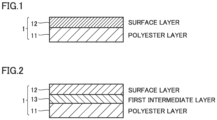
- a sealant film 1 of this embodiment is a sealant film made of two layers of a polyester layer 11 (on the seal side) and a surface layer 12. Sealant film 1 of this embodiment is made of two layers, and may also be made of only polyester layer 11.
- Polyester layer 11 contains polyester as a main ingredient.
- the phrase "contains as a main ingredient” means, for example, that the amount of polyester contained is more than 50% by mass relative to the total amount of polyester layer 11.
- the content rate of polyester contained in polyester layer 11 is preferably 90% by mass or more, more preferably 95% by mass or more, further preferably 98% by mass.
- Other polymer materials, various additives or the like may be blended in polyester layer 11.
- the polyester in this embodiment is made of a structural unit derived from ethylene glycol, a structural unit derived from terephthalic acid and a structural unit derived from isophthalic acid.
- the polyester has a number average molecular weight of 15000 or more and 21000 or less.
- the ratio of the structural unit derived from isophthalic acid is 3.0 mol% or more and 15 mol% or less relative to the ratios of the structural unit derived from terephthalic acid and the structural unit derived from isophthalic acid constituting the polyester.
- the sealant film is inferior in low-temperature sealing properties.
- the ratio of the structural unit derived from isophthalic acid is more than 15 mol%, an amorphous or low-crystalline polyester layer is formed and the amount of adsorption of contents is increased.
- the ratio of the structural unit derived from isophthalic acid is preferably 8.0 mol% or more, more preferably 9.0 mol% or more, further preferably 10 mol% or more, and may be 10.5 mol% or more, and is preferably 13 mol% or less, more preferably 12.5 mol% or less, further preferably 12 mol% or less, and may be 11.5 mol% or less.
- Polyester layer 11 contains an oligomer.
- the oligomer in this embodiment is a polymer having a smaller molecular weight than that of polyester generated at a polymerization stage of polyester, and encompasses both a linear oligomer and a cyclic oligomer.
- the oligomer causes the problems of deterioration in odor and taste and reduction in adsorption properties of contents.
- the present inventors have found that the content rate of the oligomer contained in polyester layer 11 can be less than 2.0% by mass by adopting the above-mentioned ingredients and ratios in the configuration of the polyester and performing production by a method described below. When the content rate of the oligomer contained in polyester layer 11 is less than 2.0% by mass, the above-mentioned problems are suppressed.
- the content rate of the oligomer contained in polyester layer 11 is preferably 1.8% by mass or less.
- the content rate of the oligomer contained in polyester layer 11 can be measured with high performance liquid chromatography (HPLC). Specifically, a polyester layer serving as a measurement subject is dissolved in hexafluoroisopropanol (HFIP), then the polyester layer is re-precipitated in acetonitrile and the supernatant was subjected to filtration with a filter to prepare a sample solution, and measurement is performed in the following conditions with reverse-phase HPLC (1260 Infinity II LC system made by Agilent Technologies, Inc.).
- HPLC high performance liquid chromatography
- peak waveform processing with a chromatogram peak areas are each vertically divided with respect to each elution time and the quantity of each of the peak areas is normalized with the measured weight of the polyester layer. Such processing is repeated three times and the average value of the peak areas is adopted.
- the peak area may be any value as long as it is less than 2%.
- the thickness of polyester layer 11 can be appropriately changed depending on the intended use, and is, for example, 20 ⁇ m or more and 50 ⁇ m or less. When the thickness of polyester layer 11 is less than 20 ⁇ m, the amount of adsorption of contents is increased. When the thickness of polyester layer 11 is more than 50 ⁇ m, the load of discharge in film formation is large and no film formation may be made.
- the thickness of polyester layer 11 is preferably 25 ⁇ m or more and 45 ⁇ m or less.
- Polyester layer 11 may contain an anti-blocking agent. This is because an anti-blocking agent is contained to enhance sliding ability of polyester layer 11, hardly causing blocking.
- the anti-blocking agent include silica, talc and diatomaceous earth.
- the amount of the anti-blocking agent contained is, for example, 0.1% by mass or more and 3% by mass or less, and is preferably 0.5% by mass or more and 1.5% by mass or less.
- the glass transition temperature (Tg) of the polyester is preferably 60°C or more and 80°C or less, and more preferably 70°C or more and 75°C or less.
- sealant film 1 can be obtained having appropriate seal strength.
- Tg can be measured based on JIS K7121.
- the crystallization temperature (Tc) of the polyester is preferably 130°C or more, and more preferably 135°C or more.
- sealant film 1 can be obtained having appropriate seal strength.
- Tc can be measured based on JIS K7121.
- the melting temperature (Tm) of the polyester is preferably 200°C or more, and more preferably 210°C or more.
- sealant film 1 can be obtained having appropriate seal strength. Tm can be measured based on JIS K7121.
- Sealant film 1 may have surface layer 12.
- Examples of surface layer 12 include polyethylene (PE) and an ethylene-ester copolymer.
- Examples of the ethylene-ester copolymer include an ethylene-acrylate copolymer and an ethylene-methacrylate copolymer.
- the thickness of sealant film 1 can be appropriately changed depending on the intended use, and is, for example, 30 ⁇ m or more and 80 ⁇ m or less.
- Sealant film 1 of this embodiment is provided with the above-mentioned layers, thus it has non-adsorption properties such that adsorption or absorption of contents (fragrance ingredient, medicinal ingredient, etc.) is suppressed, and can inhibit an oligomer from being free.
- the sealant film also has sufficient seal strength and low-temperature sealing properties.
- the sealing initiation temperature of the sealant film is preferably 130°C or less in terms of the temperature where a seal strength of 5 N/15 mm width or more is exhibited under a sealing condition of a sealing pressure of 0.1 MPa and a sealing time of 1.0 second.
- the sealing initiation temperature is measured according to JIS Z0238.
- the seal strength of the sealant film is preferably 30 N/15 mm width or more under a sealing condition of a sealing temperature of 160°C, a sealing pressure of 0.1 MPa and a sealing time of 1.0 second.
- the seal strength is measured according to JIS Z0238.
- sealant film 1 of this embodiment is the same as that of embodiment 1, except that a first intermediate layer 13 is provided between polyester layer 11 and surface layer 12.
- First intermediate layer 13 is provided to enhance adhesive force between polyester layer 11 and surface layer 12 and enhance seal strength of sealant film 1.
- first intermediate layer 13 include acid anhydride-grafted polyethylene (PE) and an ethylene-ester copolymer.
- acid anhydride-grafted PE include maleic anhydride-grafted PE and itaconic anhydride-grafted PE.
- sealant film 1 of this embodiment is a sealant film obtained by stacking surface layer 12, first intermediate layer 13, an interposed layer 14, a second intermediate layer 15, and polyester layer 11 in this order.
- the sealant film is the same as that of embodiment 2, except that interposed layer 14 and second intermediate layer 15 are further stacked.
- interposed layer 14 the same material as that for surface layer 12 can be used.
- Surface layer 12 and interposed layer 14 may include the same material or may include different materials.
- First intermediate layer 13 and second intermediate layer 15 may include the same material or may include different materials.
- sealant film 1 of this embodiment is a sealant film made of two layers of polyester layer 11 and a back surface layer 16.
- the polyester layer is not usually contacted with contents and thus deterioration in odor and taste due to an oligomer, as described above, is considered to be hardly caused.
- an oligomer in the polyester layer may be leaked out into such contents due to driving force of such contents.
- Sealant film 1 of this embodiment is provided with polyester layer 11, and thus can exert the effects even in this case.
- back surface layer 16 the same material as that for surface layer 12 can be used.
- sealant film 1 of this embodiment is the same as that of embodiment 4, except that first intermediate layer 13 is provided between polyester layer 11 and back surface layer 16.
- First intermediate layer 13 is provided to enhance adhesive force between polyester layer 11 and back surface layer 16 and enhance seal strength of sealant film 1.
- sealant film 1 of this embodiment is a sealant film obtained by stacking polyester layer 11, first intermediate layer 13, interposed layer 14, second intermediate layer 15, and back surface layer 16 in this order.
- the sealant film is the same as that of embodiment 5, except that interposed layer 14 and second intermediate layer 15 are further stacked.
- Back surface layer 16 and interposed layer 14 may include the same material or may include different materials.
- a multilayer film 2 (packaging material) of this embodiment is a multilayer film obtained by stacking a base film 31, an adhesive layer 51, a gas barrier film 4, an adhesive layer 52, and sealant film 1 in this order.
- a plastic film, paper, a nonwoven fabric or the like can be used, but not particularly limited, as long as it has mechanical strength and dimensional stability.
- the constituent material of the plastic film include polyester such as polyethylene terephthalate (PET) or polyethylene naphthalate, polyolefin such as PE or polypropylene, polystyrene, polyamide such as 6-nylon, polycarbonate, polyacrylonitrile, and polyimide.
- PET polyethylene terephthalate
- polyethylene naphthalate polyethylene naphthalate
- polyolefin such as PE or polypropylene
- polystyrene polyamide such as 6-nylon
- polycarbonate polyacrylonitrile
- polyimide polyimide
- Multilayer film 2 of this embodiment may have gas barrier film 4.
- Gas barrier film 4 can suppress degradation of contents due to oxygen gas, decrease of contents due to dissipation thereof to the outside, etc.
- gas barrier film 41 metal foil such as aluminum foil, or a multilayer film of metal foil and a plastic film can be used.
- a gas barrier film 42 a transparent vapor deposition film having a vapor deposition layer of inorganic oxide or metal on a plastic film can be used.
- the plastic film include those described above, and examples of the transparent vapor deposition film include a vapor deposition film of metal oxide such as silicon oxide or aluminum oxide.
- a film of an ethylene-vinyl alcohol copolymer, a polyamide resin, a polyvinylidene chloride resin, a polyacrylonitrile resin or the like can also be used. In this embodiment, when the transparent vapor deposition film is used as gas barrier film 4, neither base film 31 nor adhesive layer 51 may be provided.
- Multilayer film 2 of this embodiment may have adhesive layer 51 between base film 31 and gas barrier film 41.
- Adhesive layer 51 can enhance adhesive strength between base film 31 and gas barrier film 41.
- an adhesive for dry lamination can be suitably used, but not particularly limited.
- the adhesive for dry lamination include a two-component curing type urethane adhesive, a polyester-urethane adhesive, a polyether urethane adhesive, an acrylic adhesive, a polyester adhesive, a polyamide adhesive, and an epoxy adhesive.
- the two-component curing type adhesive is made of a main agent and a curing agent, and examples thereof include a two-component curing type adhesive made of polyester, polyol and polyfunctional polyisocyanate.
- Examples of a method for laminating base film 31 and gas barrier film 41 with such an adhesive include a dry lamination method.
- Multilayer film 2 of this embodiment may have adhesive layer 52 between sealant film 1 and gas barrier film 4.
- adhesive layer 52 the same material as that for adhesive layer 51 can be used.
- the ingredient of the adhesive constituting adhesive 51 and that of the adhesive constituting adhesive layer 52 may be the same or different.
- Examples of a method for laminating sealant film 1 and gas barrier film 4 include a dry lamination method.
- Multilayer film 2 of this embodiment is provided with sealant film 1 of the above embodiment, thus it has non-adsorption properties such that adsorption or absorption of contents (fragrance ingredient, medicinal ingredient, etc.) is suppressed, and can inhibit an oligomer from being free. It also has sufficient seal strength and low-temperature sealing properties. Also in the following embodiments, the same effect is achieved by providing sealant film 1 of the above embodiment.
- multilayer film 2 of this embodiment is a multilayer film obtained by stacking base film 31, adhesive layer 51, gas barrier film 4, adhesive layer 52, a base film 32, an adhesive layer 53, and sealant film 1 in this order.
- the multilayer film is the same as that of embodiment 7, except that base film 32 and adhesive layer 53 are further stacked.
- base film 32 the same material as that for base film 31 can be used.
- Base film 31 and base film 32 may include the same material or may include different materials.
- an adhesive constituting adhesive layer 53 the same material as that for adhesive layer 51 can be used.
- the ingredient of the adhesive constituting adhesive 51, that of the adhesive constituting adhesive layer 52 and that of the adhesive constituting adhesive layer 53 may be the same or different.
- Examples of a method for laminating sealant film 1 and base film 32 include a dry lamination method.
- the multilayer film formed as described above is used to form a packaging bag having a desired shape.
- a packaging bag having a desired shape For example, a pillow type packaging bag, a gusset type packaging bag, a self-standing type packaging bag, etc., may be produced depending on the purpose (design of the packaging bag, amount of contents, ease of use, etc.).
- the packaging bag of this embodiment can be particularly suitably used for a content containing a fragrance ingredient, a medicinal ingredient or the like (an ingredient that is easily adsorbed to or absorbed in a packaging bag, or an ingredient that causes a problem when it is adsorbed to or absorbed in a packaging bag).
- the packaging bag of this embodiment can be suitably used for accommodating, for example, an alcohol beverage, a cosmetic product containing a fragrance ingredient such as perfume, or a patch or mouthwash containing a medicinal ingredient.
- the multilayer film formed as described above is used to form a packaging container having a desired shape.
- a brick type packaging container, a cup type packaging container, a tray type packaging container, etc. may be produced depending on the purpose (design of the packaging container, amount of contents, ease of use, etc.).
- Examples of contents include those that are the same as those in embodiment 10.
- the sealant film in this embodiment is produced by an inflation method.
- the inflation method includes an extrusion step of extruding a resin constituting the polyester layer, in which the temperature in the extrusion step is 180°C or more and 260°C or less.
- the sealant film is produced by such a method and thus an oligomer can be inhibited from being free.
- the inflation method in this embodiment is preferably an air cooling inflation method.
- a resin constituting the polyester layer, a resin constituting the surface layer and a resin constituting the intermediate layer are preferably co-extruded.
- a method for producing the sealant film composed of the polyester layer, the surface layer and the intermediate layer by an air cooling inflation method is described.
- the air cooling inflation method has a co-extrusion step of melting the resin constituting the polyester layer, the resin constituting the surface layer and the resin constituting the intermediate layer in separate extruders and co-extruding the resins molten, through a die, an inflation cooling step of supplying air to the resins co-extruded and molten, to inflate them into a tube shape and at the same time air-cool and solidify the resins molten, by the air, obtaining a tube film, and a drawing step of drawing the tube film with evacuating air in the tube film.
- An inflation molding machine that can be used in the method is not particularly limited, as long as two or more layers can be extruded.
- the temperature in the extruder in the co-extrusion step is 180°C or more and 260°C or less, and is preferably 200°C or more and 230°C or less.
- the resins used may not be molten.
- the temperature in the extruder is more than 260°C, the amount of a free oligomer can be increased.
- the resins used can also be thermally degraded.
- the shape of the die in the inflation molding machine is usually round.
- the diameter of the die is, for example, 100 mm ⁇ or more and 300 mm ⁇ or less, and is preferably 200 mm ⁇ or more and 250 ⁇ mm or less.
- the diameter of the die is less than 100 mm ⁇ , the film formation efficiency can be inferior.
- the diameter of the die is more than 300 mm ⁇ , a valve shape of the sealant film is not stable.
- the degree of inflation in the inflation cooling step is determined by the blowing ratio, and has an effect on seal strength, film formation stability, or the like.
- the blowing ratio is, for example, 1.5 or more and 2.5 or less, and is preferably 1.8 or more and 2.2 or less. When the blowing ratio is less than 1.5, the film formation efficiency can be inferior. When the blowing ratio is more than 2.5, a valve shape of the sealant film is not stable.
- the molding speed in the drawing step is, for example, 5.0 m/min or more and 25 m/min or less, and is preferably 10 m/min or more and 20 m/min or less.
- the molding speed is less than 5.0 m/min, no stable film formation may be made.
- the molding speed is more than 25 m/min, cracking of the sealant film can be caused.
- Each resin having a composition shown in Table 1 was used as a polyester resin constituting a polyester layer in a sealant film of a multilayer film having a layer configuration of Fig. 7(a) .
- PE was used in a surface layer and maleic anhydride-grafted PE was used in an intermediate layer.
- TPA represents “terephthalic acid”
- IPA represents “isophthalic acid”
- EG represents “ethylene glycol”
- other glycol represents a glycol ingredient other than EG, respectively, used in Comparative Examples 5 to 11 described below.
- the polyester layer in Example 1 includes 95 mol% of TPA and 5 mol% of IPA as dicarboxylic acid and 100 mol% of EG as diol.
- An inflation molding machine for multiple layers of three kinds of three layers including an extruder for the polyester layer, having a diameter of 250 mm ⁇ , an extruder for a surface layer, having a diameter of 250 mm ⁇ , and an extruder for the intermediate layer, having a diameter of 250 mm ⁇ , was used for production in the following condition, and thus each sealant film of Examples 1 to 4 and Comparative Examples 1 to 3 was obtained.
- the thicknesses of the polyester layer, the surface layer and the intermediate layer as each layer of the sealant film produced were 40 ⁇ m, 15 ⁇ m and 5 ⁇ m, respectively, in all of Examples 1 to 4 and Comparative Examples 1 to 3.
- the base film is polyethylene terephthalate (PET) and have a thickness of 12 ⁇ m.
- the gas barrier film is aluminum foil and have a thickness of 9 ⁇ m.
- a multilayer film was prepared in the same manner as in Example 3, except that the sealant film was formed by a T-die method.
- the extruder temperature in a T-die extruder was 290°C.
- Each multilayer film was prepared in the same manner as in Example 1, except that butanediol was used in Comparative Examples 5 and 6, neopentyl glycol was used in Comparative Example 7, hexanediol was used in Comparative Example 8 and cyclohexane dimethanol was used in Comparative Examples 9 to 11, as glycol other than EG constituting the polyester layer, in respective ratio shown in Table 1.
- the low-temperature sealing properties were evaluated. Specifically, the multilayer films of Examples and Comparative Examples were individually sealed with the sealant films facing inwardly.
- the sealing pressure was 0.1 MPa and the sealing time was 1.0 second, and the sealing temperature was varied and a temperature where a seal strength of 5 N/15 mm width or more was exhibited was determined as the sealing initiation temperature based on JIS Z0238.
- the results are shown in the column "Sealing initiation temperature (°C)" in Table 1. A temperature of 130°C or less was evaluated as favorable.
- the seal strength was evaluated. Specifically, the multilayer films of Examples and Comparative Examples were individually sealed with the sealant films facing inwardly. For the sealing condition, the sealing temperature was 160°C, the sealing pressure was 0.1 MPa and the sealing time was 1.0 second. The seal strength (N/15 mm) of two sealed multilayer films was measured for the strip-shaped cut multilayer films based on JIS X0238. The results are shown in the column "Seal strength (N/15 mm)" in Table 1. 30 N/15 mm or more was evaluated as favorable.
- the adsorption properties were evaluated. Specifically, the multilayer films of Examples and Comparative Examples, cut into a predetermined shape (length: 120 mm, width: 120 mm), were individually placed on a bag making machine in a state where two multilayer films were stacked such that the sealant films were in contact with each other, and then the predetermined areas (periphery portion of the sealant film: range within 10 mm from the peripheral edge) were sealed to prepare a three-way sealed type packaging bag. At this point in time, in order to fill the packaging bag with a content, the upper end (top seal portion) of the packaging bag had not yet been sealed. For the sealing condition, the sealing temperature was 160°C, the sealing pressure was 0.1 MPa and the sealing time was 1.0 second.
- the packaging bag was filled with sake ("Daiginjo” made by Hakutsuru Sake Brewing Co., Ltd.) under a nitrogen atmosphere, and then the upper end (top seal portion) of the packaging bag was sealed to seal the content.
- sake Diginjo
- ethyl caprate as an ingredient of sake here used is an ingredient that is generally easily adsorbed to a sealant film.
- the packaging bag accommodating the content as described above was stored in a thermostatic chamber maintained at 40°C for 3 months. After storage, the head space in the packaging bag was subjected to concentration by a solid phase micro extraction method (SPME), quantitative determination from the preparation concentration of ethyl caprate used as the internal standard was performed by gas chromatography-mass spectroscopy analysis (GC-MS), and a ratio of the residual amount after the storage period to the initial amount was calculated as the residual ratio of ethyl caprate (%). The results are shown in the column "Residual ratio (%)" in Table 1. 70% or more was evaluated as favorable.
- SPME solid phase micro extraction method
- GC-MS gas chromatography-mass spectroscopy analysis
- each polyester layer of Examples and Comparative Examples described above was dissolved in hexafluoroisopropanol (HFIP), then the polyester layer was re-precipitated in acetonitrile and the supernatant was subjected to filtration with a filter to prepare a sample solution, and measurement was performed in the following condition with reverse-phase HPLC (1260 Infinity II LC system made by Agilent Technologies, Inc.).
- HFIP hexafluoroisopropanol
- Peak waveform processing was performed by vertically dividing the peak areas of a plurality of peak portions at an elution time of 5 minutes to 20 minutes, with respect to each elution time, and normalizing the quantity of each of the peak areas with the measured weight of the polyester layer, in the molecular weight distribution by HPLC as obtained above. The measurement was repeated three times and the average value of the peak areas was adopted. The results are shown in the column "Amount of oligomer (wt%)" in Table 1. An amount of less than 2.0 wt% was evaluated as favorable.
- Example 1 For each polyester layer of the sealant films used in Examples 1 to 4 and Comparative Examples 1 to 11, the glass transition temperature, the crystallization temperature and the melting temperature measured based on JIS K7121 with a differential scanning calorimeter are shown together in Table 1.
- Table 1 Configuration of polyester layer Evaluation items Dibasic acid Diol Glass transition temperature (°C) Crystallization temperature (°C) Melting temperature (°C) Sealing initiation temperature (°C) Seal strength (N/15 mm) Residual ratio (%) Amount of oligomer (wt%) TPA (mol%) IPA (mol%) EG (mol%) Other glycol (mol%)
- Example 1 95 5 100 0 76 135 238 130 42.4 74.9 1.8
- Example 2 92 8 100 0 72 132 231 125 38.5 71.0 1.8
- Example 3 90 10 100 0 74 138 222 120 34.8 81.2 1.7
- Example 4 88 12 100 0 71 149 214 120 33.0 78.0 1.7 Comparative Example 1
- each of the multilayer films of Examples 1 to 4 including the sealant film including a polyester layer containing specified polyester as a main ingredient includes an oligomer in a small amount of less than 2.0 wt%, and is excellent in low adsorption properties of contents and can inhibit odor and taste from being deteriorated.
- Comparative Examples 1 to 3 where a polyester containing IPA in an amount exceeding a defined amount was used, it is found that the amount of an oligomer is 2.0 wt% or more, adsorption properties of contents are high and deterioration in odor and taste cannot be suppressed. Furthermore, in Comparative Example 4 where the sealant film was produced at the same composition as that in Example 3, except that the sealant film is formed by a T-die method, it is found that the amount of an oligomer is 2.0 wt%, adsorption properties of contents are high and deterioration in odor and taste cannot be suppressed. Furthermore, in Comparative Examples 5 to 11 where glycol other than EG was used, it is found that adsorption properties of contents are high.
Landscapes
- Engineering & Computer Science (AREA)
- Chemical & Material Sciences (AREA)
- Mechanical Engineering (AREA)
- Organic Chemistry (AREA)
- Chemical Kinetics & Catalysis (AREA)
- Manufacturing & Machinery (AREA)
- Medicinal Chemistry (AREA)
- Polymers & Plastics (AREA)
- Health & Medical Sciences (AREA)
- Materials Engineering (AREA)
- Wrappers (AREA)
- Laminated Bodies (AREA)
- Compositions Of Macromolecular Compounds (AREA)
- Polyesters Or Polycarbonates (AREA)
- Bag Frames (AREA)
- Manufacture Of Macromolecular Shaped Articles (AREA)
- Extrusion Moulding Of Plastics Or The Like (AREA)
Abstract
Description
- The present invention relates to a sealant film, a multilayer film including the same, a packaging bag and a packaging container, and a method for producing a sealant film.
- A sealant film is widely used in a packaging bag of food, beverage, medicine or the like. A sealant film is provided on an innermost layer of a packaging bag, and heat-sealed to seal the packaging bag. As a sealant film, a polyolefin resin such as polyethylene or polypropylene, having high seal strength, has been used.
- However, such a sealant film easily adsorbs an ingredient made of an organic compound such as fat and oil or perfume, and thus a packaging bag having such a sealant film has the problem of adsorbing a fragrance ingredient, a medicinal ingredient or the like of contents.
- As a solution, a polyester resin, a polyacrylonitrile copolymer (PAN), a polyethylene terephthalate (PET) or the like is used in place of a polyolefin resin. In particular, a polyester resin can not only allow contents to keep low adsorption properties, but also impart low-temperature sealing properties and control fluidity during sealing, by selection of dibasic acid and glycol as comonomer ingredients.
- On the other hand, a problem is that the presence of such comonomer ingredients generate a low-molecular weight substance (oligomer) as a by-product at a polymerization stage, deteriorating odor and taste, lowering adsorption properties of contents, or the like.
-
Japanese Patent Laying-Open No. 2006-305975 - PTL 1:
Japanese Patent Laying-Open No. 2006-305975 - However, the sealant film described in
PTL 1 has room for improvement in odor and taste. The present inventors have focused on dibasic acid and glycol as comonomer ingredients of a polyester resin, and have found that generation of an oligomer can be suppressed by limiting the dibasic acid to terephthalic acid and isophthalic acid and limiting the glycol to ethylene glycol, respectively, copolymerizing terephthalic acid and isophthalic acid in a specified ratio, and manufacturing by an inflation method. Thus, reduction in adsorption properties of contents, and deterioration in odor and taste can be suppressed. - The present disclosure has been made in view of above problems, and has an object to allow a sealant film including a polyester resin to not only keep low adsorption properties of contents, but also inhibit odor and taste from being deteriorated.
-
- [1] A sealant film including a polyester layer containing polyester as a main ingredient,
- wherein the polyester is made of a structural unit derived from ethylene glycol, a structural unit derived from terephthalic acid and a structural unit derived from isophthalic acid,
- a ratio of the structural unit derived from isophthalic acid is 3.0 mol% or more and 15 mol% or less relative to ratios of the structural unit derived from terephthalic acid and the structural unit derived from isophthalic acid constituting the polyester, and
- a content rate of an oligomer contained in the polyester layer is less than 2.0% by mass.
- [2] The sealant film according to [1], wherein the polyester has a glass transition temperature of 60°C or more and 80°C or less.
- [3] The sealant film according to [1] or [2], including a surface layer,
wherein the surface layer is at least one selected from the group consisting of polyethylene, an ethylene-acrylate copolymer and an ethylene-methacrylate copolymer. - [4] The sealant film according to [3], further including an intermediate layer between the polyester layer and the surface layer,
wherein the intermediate layer is at least one selected from the group consisting of an acid anhydride-grafted polyethylene and an ethylene-ester copolymer. - [5] The sealant film according to any one of [1] to [4], wherein the polyester layer has a thickness of 20 µm or more and 50 µm or less.
- [6] A multilayer film including:
- a base film; and
- the sealant film according to any one of [1] to [5].
- [7] The multilayer film according to [6], further including a gas barrier film between the base film and the sealant film.
- [8] A packaging bag including the multilayer film according to [6] or [7] sealed such that the sealant films are fused to each other.
- [9] A packaging container including the multilayer film according to [6] or [7] sealed such that the sealant films are fused to each other.
- [10] A method for producing a sealant film including a polyester layer containing polyester as a main ingredient,
- wherein the production method of the sealant film includes an extrusion step of extruding a resin constituting the polyester layer, by an inflation method,
- a temperature in the extrusion step is 180°C or more and 260°C or less,
- the polyester is made of a structural unit derived from ethylene glycol, a structural unit derived from terephthalic acid and a structural unit derived from isophthalic acid,
- a ratio of the structural unit derived from isophthalic acid is 3.0 mol% or more and 15 mol% or less relative to ratios of the structural unit derived from terephthalic acid and the structural unit derived from isophthalic acid constituting the polyester, and
- a content rate of an oligomer contained in the polyester layer is less than 2.0% by mass.
- According to the present disclosure, it is possible to allow a sealant film including a polyester resin to not only keep low adsorption properties of contents, but also inhibit odor and taste from being deteriorated.
-
-
Fig. 1 is a schematic cross-sectional view showing one example of a sealant film used inembodiment 1. -
Fig. 2 is a schematic cross-sectional view showing one example of a sealant film used inembodiment 2. -
Fig. 3 is a schematic cross-sectional view showing one example of a sealant film used in embodiment 3. -
Fig. 4 is a schematic cross-sectional view showing one example of a sealant film used in embodiment 4. -
Fig. 5 is a schematic cross-sectional view showing one example of a sealant film used in embodiment 5. -
Fig. 6 is a schematic cross-sectional view showing one example of a sealant film used in embodiment 6. -
Fig. 7 is a schematic cross-sectional view showing one example of a multilayer film of embodiment 7. -
Fig. 8 is a schematic cross-sectional view showing one example of the multilayer film of embodiment 7. -
Fig. 9 is a schematic cross-sectional view showing one example of a multilayer film of embodiment 8. -
Fig. 10 is a schematic cross-sectional view showing one example of the multilayer film of embodiment 8. -
Fig. 11 is a schematic cross-sectional view showing one example of a multilayer film of embodiment 9. - Hereinafter, a description is made of embodiments of the present disclosure with reference to the drawings. In the drawings, the same reference signs denote the same parts or corresponding parts.
- Referring to
Fig. 1 , asealant film 1 of this embodiment is a sealant film made of two layers of a polyester layer 11 (on the seal side) and asurface layer 12.Sealant film 1 of this embodiment is made of two layers, and may also be made of onlypolyester layer 11. -
Polyester layer 11 contains polyester as a main ingredient. The phrase "contains as a main ingredient" means, for example, that the amount of polyester contained is more than 50% by mass relative to the total amount ofpolyester layer 11. The content rate of polyester contained inpolyester layer 11 is preferably 90% by mass or more, more preferably 95% by mass or more, further preferably 98% by mass. Other polymer materials, various additives or the like may be blended inpolyester layer 11. - The polyester in this embodiment is made of a structural unit derived from ethylene glycol, a structural unit derived from terephthalic acid and a structural unit derived from isophthalic acid. The polyester has a number average molecular weight of 15000 or more and 21000 or less.
- The ratio of the structural unit derived from isophthalic acid is 3.0 mol% or more and 15 mol% or less relative to the ratios of the structural unit derived from terephthalic acid and the structural unit derived from isophthalic acid constituting the polyester. When the ratio of the structural unit derived from isophthalic acid is less than 3.0 mol%, the sealant film is inferior in low-temperature sealing properties. When the ratio of the structural unit derived from isophthalic acid is more than 15 mol%, an amorphous or low-crystalline polyester layer is formed and the amount of adsorption of contents is increased. The ratio of the structural unit derived from isophthalic acid is preferably 8.0 mol% or more, more preferably 9.0 mol% or more, further preferably 10 mol% or more, and may be 10.5 mol% or more, and is preferably 13 mol% or less, more preferably 12.5 mol% or less, further preferably 12 mol% or less, and may be 11.5 mol% or less.
-
Polyester layer 11 contains an oligomer. The oligomer in this embodiment is a polymer having a smaller molecular weight than that of polyester generated at a polymerization stage of polyester, and encompasses both a linear oligomer and a cyclic oligomer. The oligomer causes the problems of deterioration in odor and taste and reduction in adsorption properties of contents. The present inventors have found that the content rate of the oligomer contained inpolyester layer 11 can be less than 2.0% by mass by adopting the above-mentioned ingredients and ratios in the configuration of the polyester and performing production by a method described below. When the content rate of the oligomer contained inpolyester layer 11 is less than 2.0% by mass, the above-mentioned problems are suppressed. The content rate of the oligomer contained inpolyester layer 11 is preferably 1.8% by mass or less. - The content rate of the oligomer contained in
polyester layer 11 can be measured with high performance liquid chromatography (HPLC). Specifically, a polyester layer serving as a measurement subject is dissolved in hexafluoroisopropanol (HFIP), then the polyester layer is re-precipitated in acetonitrile and the supernatant was subjected to filtration with a filter to prepare a sample solution, and measurement is performed in the following conditions with reverse-phase HPLC (1260 Infinity II LC system made by Agilent Technologies, Inc.). -
- Detector: ultraviolet absorption photometer
- Measurement wavelength: 242 nm
- Column: reverse-phase column C18 ODS5 µ (length: 250 mm, inner diameter: 4.6 mm)
- Column temperature: 25°C
- Eluent: acetonitrile/water = 7/3
- Flow rate: 1.5 ml/min
- Amount of sample injected: 20 µl
- A molecular weight distribution by HPLC, of the oligomer in this embodiment, shows a plurality of peak portions at an elution time of 5 minutes to 20 minutes. In peak waveform processing with a chromatogram, peak areas are each vertically divided with respect to each elution time and the quantity of each of the peak areas is normalized with the measured weight of the polyester layer. Such processing is repeated three times and the average value of the peak areas is adopted. The peak area may be any value as long as it is less than 2%.
- The thickness of
polyester layer 11 can be appropriately changed depending on the intended use, and is, for example, 20 µm or more and 50 µm or less. When the thickness ofpolyester layer 11 is less than 20 µm, the amount of adsorption of contents is increased. When the thickness ofpolyester layer 11 is more than 50 µm, the load of discharge in film formation is large and no film formation may be made. The thickness ofpolyester layer 11 is preferably 25 µm or more and 45 µm or less. -
Polyester layer 11 may contain an anti-blocking agent. This is because an anti-blocking agent is contained to enhance sliding ability ofpolyester layer 11, hardly causing blocking. Examples of the anti-blocking agent include silica, talc and diatomaceous earth. The amount of the anti-blocking agent contained is, for example, 0.1% by mass or more and 3% by mass or less, and is preferably 0.5% by mass or more and 1.5% by mass or less. - The glass transition temperature (Tg) of the polyester is preferably 60°C or more and 80°C or less, and more preferably 70°C or more and 75°C or less. In this case,
sealant film 1 can be obtained having appropriate seal strength. Tg can be measured based on JIS K7121. - The crystallization temperature (Tc) of the polyester is preferably 130°C or more, and more preferably 135°C or more. In this case,
sealant film 1 can be obtained having appropriate seal strength. Tc can be measured based on JIS K7121. - The melting temperature (Tm) of the polyester is preferably 200°C or more, and more preferably 210°C or more. In this case,
sealant film 1 can be obtained having appropriate seal strength. Tm can be measured based on JIS K7121. -
Sealant film 1 may havesurface layer 12. - Examples of
surface layer 12 include polyethylene (PE) and an ethylene-ester copolymer. Examples of the ethylene-ester copolymer include an ethylene-acrylate copolymer and an ethylene-methacrylate copolymer. - The thickness of
sealant film 1 can be appropriately changed depending on the intended use, and is, for example, 30 µm or more and 80 µm or less. -
Sealant film 1 of this embodiment is provided with the above-mentioned layers, thus it has non-adsorption properties such that adsorption or absorption of contents (fragrance ingredient, medicinal ingredient, etc.) is suppressed, and can inhibit an oligomer from being free. The sealant film also has sufficient seal strength and low-temperature sealing properties. - Regarding the low-temperature sealing properties, specifically, the sealing initiation temperature of the sealant film is preferably 130°C or less in terms of the temperature where a seal strength of 5 N/15 mm width or more is exhibited under a sealing condition of a sealing pressure of 0.1 MPa and a sealing time of 1.0 second. The sealing initiation temperature is measured according to JIS Z0238.
- Regarding the seal strength, specifically, the seal strength of the sealant film is preferably 30 N/15 mm width or more under a sealing condition of a sealing temperature of 160°C, a sealing pressure of 0.1 MPa and a sealing time of 1.0 second. The seal strength is measured according to JIS Z0238.
- Referring to
Fig. 2 ,sealant film 1 of this embodiment is the same as that ofembodiment 1, except that a firstintermediate layer 13 is provided betweenpolyester layer 11 andsurface layer 12. - First
intermediate layer 13 is provided to enhance adhesive force betweenpolyester layer 11 andsurface layer 12 and enhance seal strength ofsealant film 1. Examples of firstintermediate layer 13 include acid anhydride-grafted polyethylene (PE) and an ethylene-ester copolymer. Examples of the acid anhydride-grafted PE include maleic anhydride-grafted PE and itaconic anhydride-grafted PE. - Referring to
Fig. 3 ,sealant film 1 of this embodiment is a sealant film obtained by stackingsurface layer 12, firstintermediate layer 13, an interposedlayer 14, a secondintermediate layer 15, andpolyester layer 11 in this order. The sealant film is the same as that ofembodiment 2, except that interposedlayer 14 and secondintermediate layer 15 are further stacked. - For interposed
layer 14, the same material as that forsurface layer 12 can be used.Surface layer 12 and interposedlayer 14 may include the same material or may include different materials. - For second
intermediate layer 15, the same material as that for firstintermediate layer 13 can be used. Firstintermediate layer 13 and secondintermediate layer 15 may include the same material or may include different materials. - Referring to
Fig. 4 ,sealant film 1 of this embodiment is a sealant film made of two layers ofpolyester layer 11 and aback surface layer 16. - When the configuration of the sealant film of this embodiment is adopted, the polyester layer is not usually contacted with contents and thus deterioration in odor and taste due to an oligomer, as described above, is considered to be hardly caused. However, for example, when food or beverage, such as alcohol or oily food, or medicine such as a patch is filled as contents, an oligomer in the polyester layer may be leaked out into such contents due to driving force of such contents.
Sealant film 1 of this embodiment is provided withpolyester layer 11, and thus can exert the effects even in this case. - For
back surface layer 16, the same material as that forsurface layer 12 can be used. - Referring to
Fig. 5 ,sealant film 1 of this embodiment is the same as that of embodiment 4, except that firstintermediate layer 13 is provided betweenpolyester layer 11 and backsurface layer 16. - First
intermediate layer 13 is provided to enhance adhesive force betweenpolyester layer 11 and backsurface layer 16 and enhance seal strength ofsealant film 1. - Referring to
Fig. 6 ,sealant film 1 of this embodiment is a sealant film obtained by stackingpolyester layer 11, firstintermediate layer 13, interposedlayer 14, secondintermediate layer 15, and backsurface layer 16 in this order. The sealant film is the same as that of embodiment 5, except that interposedlayer 14 and secondintermediate layer 15 are further stacked. - Back
surface layer 16 and interposedlayer 14 may include the same material or may include different materials. - Referring to
Figs. 7 and8 , a multilayer film 2 (packaging material) of this embodiment is a multilayer film obtained by stacking abase film 31, anadhesive layer 51, a gas barrier film 4, anadhesive layer 52, andsealant film 1 in this order. - In
base film 31, a plastic film, paper, a nonwoven fabric or the like can be used, but not particularly limited, as long as it has mechanical strength and dimensional stability. Examples of the constituent material of the plastic film include polyester such as polyethylene terephthalate (PET) or polyethylene naphthalate, polyolefin such as PE or polypropylene, polystyrene, polyamide such as 6-nylon, polycarbonate, polyacrylonitrile, and polyimide. The plastic film is preferably PET, PE, or paper. -
Multilayer film 2 of this embodiment may have gas barrier film 4. Gas barrier film 4 can suppress degradation of contents due to oxygen gas, decrease of contents due to dissipation thereof to the outside, etc. - As a
gas barrier film 41, metal foil such as aluminum foil, or a multilayer film of metal foil and a plastic film can be used. As agas barrier film 42, a transparent vapor deposition film having a vapor deposition layer of inorganic oxide or metal on a plastic film can be used. Examples of the plastic film include those described above, and examples of the transparent vapor deposition film include a vapor deposition film of metal oxide such as silicon oxide or aluminum oxide. As the gas barrier film, a film of an ethylene-vinyl alcohol copolymer, a polyamide resin, a polyvinylidene chloride resin, a polyacrylonitrile resin or the like can also be used. In this embodiment, when the transparent vapor deposition film is used as gas barrier film 4, neitherbase film 31 noradhesive layer 51 may be provided. -
Multilayer film 2 of this embodiment may haveadhesive layer 51 betweenbase film 31 andgas barrier film 41.Adhesive layer 51 can enhance adhesive strength betweenbase film 31 andgas barrier film 41. - As an adhesive
constituting adhesive layer 51, an adhesive for dry lamination can be suitably used, but not particularly limited. Examples of the adhesive for dry lamination include a two-component curing type urethane adhesive, a polyester-urethane adhesive, a polyether urethane adhesive, an acrylic adhesive, a polyester adhesive, a polyamide adhesive, and an epoxy adhesive. - Among the above-mentioned adhesives, a two-component curing type adhesive that is excellent in adhesive force and hardly reduces the adhesive force due to a chemical ingredient from contents can be suitably used. The two-component curing type adhesive is made of a main agent and a curing agent, and examples thereof include a two-component curing type adhesive made of polyester, polyol and polyfunctional polyisocyanate. Examples of a method for laminating
base film 31 andgas barrier film 41 with such an adhesive include a dry lamination method. -
Multilayer film 2 of this embodiment may haveadhesive layer 52 betweensealant film 1 and gas barrier film 4. As an adhesiveconstituting adhesive layer 52, the same material as that foradhesive layer 51 can be used. The ingredient of theadhesive constituting adhesive 51 and that of the adhesive constitutingadhesive layer 52 may be the same or different. Examples of a method for laminatingsealant film 1 and gas barrier film 4 include a dry lamination method. -
Multilayer film 2 of this embodiment is provided withsealant film 1 of the above embodiment, thus it has non-adsorption properties such that adsorption or absorption of contents (fragrance ingredient, medicinal ingredient, etc.) is suppressed, and can inhibit an oligomer from being free. It also has sufficient seal strength and low-temperature sealing properties. Also in the following embodiments, the same effect is achieved by providingsealant film 1 of the above embodiment. - Referring to
Figs. 9 and10 ,multilayer film 2 of this embodiment is a multilayer film obtained by stackingbase film 31,adhesive layer 51, gas barrier film 4,adhesive layer 52, abase film 32, anadhesive layer 53, andsealant film 1 in this order. The multilayer film is the same as that of embodiment 7, except thatbase film 32 andadhesive layer 53 are further stacked. - For
base film 32, the same material as that forbase film 31 can be used.Base film 31 andbase film 32 may include the same material or may include different materials. - As an adhesive
constituting adhesive layer 53, the same material as that foradhesive layer 51 can be used. The ingredient of theadhesive constituting adhesive 51, that of the adhesive constitutingadhesive layer 52 and that of the adhesive constitutingadhesive layer 53 may be the same or different. Examples of a method for laminatingsealant film 1 andbase film 32 include a dry lamination method. - Referring to
Fig. 11 ,multilayer film 2 of this embodiment is a multilayer film obtained by stacking abase film 33, abase film 34, abase film 35, gas barrier film 4,adhesive layer 52, andsealant film 1 in this order.Base film 32 andadhesive layer 53 may be further stacked betweenadhesive layer 52 andsealant film 1. - The multilayer film formed as described above is used to form a packaging bag having a desired shape. For example, a pillow type packaging bag, a gusset type packaging bag, a self-standing type packaging bag, etc., may be produced depending on the purpose (design of the packaging bag, amount of contents, ease of use, etc.).
- Examples of contents include food, beverage, medicine or quasi-drug. The packaging bag of this embodiment can be particularly suitably used for a content containing a fragrance ingredient, a medicinal ingredient or the like (an ingredient that is easily adsorbed to or absorbed in a packaging bag, or an ingredient that causes a problem when it is adsorbed to or absorbed in a packaging bag). Specifically, the packaging bag of this embodiment can be suitably used for accommodating, for example, an alcohol beverage, a cosmetic product containing a fragrance ingredient such as perfume, or a patch or mouthwash containing a medicinal ingredient.
- The multilayer film formed as described above is used to form a packaging container having a desired shape. For example, a brick type packaging container, a cup type packaging container, a tray type packaging container, etc., may be produced depending on the purpose (design of the packaging container, amount of contents, ease of use, etc.). Examples of contents include those that are the same as those in embodiment 10.
- The sealant film in this embodiment is produced by an inflation method. The inflation method includes an extrusion step of extruding a resin constituting the polyester layer, in which the temperature in the extrusion step is 180°C or more and 260°C or less. The sealant film is produced by such a method and thus an oligomer can be inhibited from being free.
- The inflation method in this embodiment is preferably an air cooling inflation method. When the surface layer and the intermediate layer are provided, a resin constituting the polyester layer, a resin constituting the surface layer and a resin constituting the intermediate layer are preferably co-extruded. Hereinafter, a method for producing the sealant film composed of the polyester layer, the surface layer and the intermediate layer by an air cooling inflation method is described.
- The air cooling inflation method has a co-extrusion step of melting the resin constituting the polyester layer, the resin constituting the surface layer and the resin constituting the intermediate layer in separate extruders and co-extruding the resins molten, through a die, an inflation cooling step of supplying air to the resins co-extruded and molten, to inflate them into a tube shape and at the same time air-cool and solidify the resins molten, by the air, obtaining a tube film, and a drawing step of drawing the tube film with evacuating air in the tube film.
- An inflation molding machine that can be used in the method is not particularly limited, as long as two or more layers can be extruded.
- The temperature in the extruder in the co-extrusion step is 180°C or more and 260°C or less, and is preferably 200°C or more and 230°C or less. When the temperature in the extruder is less than 180°C, the resins used may not be molten. When the temperature in the extruder is more than 260°C, the amount of a free oligomer can be increased. The resins used can also be thermally degraded.
- The shape of the die in the inflation molding machine is usually round. The diameter of the die is, for example, 100 mmΦ or more and 300 mmΦ or less, and is preferably 200 mmΦ or more and 250 Φmm or less. When the diameter of the die is less than 100 mmΦ, the film formation efficiency can be inferior. When the diameter of the die is more than 300 mmΦ, a valve shape of the sealant film is not stable.
- The degree of inflation in the inflation cooling step is determined by the blowing ratio, and has an effect on seal strength, film formation stability, or the like. The blowing ratio is, for example, 1.5 or more and 2.5 or less, and is preferably 1.8 or more and 2.2 or less. When the blowing ratio is less than 1.5, the film formation efficiency can be inferior. When the blowing ratio is more than 2.5, a valve shape of the sealant film is not stable.
- The molding speed in the drawing step is, for example, 5.0 m/min or more and 25 m/min or less, and is preferably 10 m/min or more and 20 m/min or less. When the molding speed is less than 5.0 m/min, no stable film formation may be made. When the molding speed is more than 25 m/min, cracking of the sealant film can be caused.
- Hereinafter, a more detailed description is made of the present disclosure with reference to examples, but the present disclosure is not limited thereto.
- Each resin having a composition shown in Table 1 was used as a polyester resin constituting a polyester layer in a sealant film of a multilayer film having a layer configuration of
Fig. 7(a) . PE was used in a surface layer and maleic anhydride-grafted PE was used in an intermediate layer. - In the column "Configuration of polyester layer" in Table 1, TPA represents "terephthalic acid", IPA represents "isophthalic acid", EG represents "ethylene glycol", and other glycol represents a glycol ingredient other than EG, respectively, used in Comparative Examples 5 to 11 described below. For example, it is meant that the polyester layer in Example 1 includes 95 mol% of TPA and 5 mol% of IPA as dicarboxylic acid and 100 mol% of EG as diol.
- An inflation molding machine for multiple layers of three kinds of three layers, including an extruder for the polyester layer, having a diameter of 250 mmΦ, an extruder for a surface layer, having a diameter of 250 mmΦ, and an extruder for the intermediate layer, having a diameter of 250 mmΦ, was used for production in the following condition, and thus each sealant film of Examples 1 to 4 and Comparative Examples 1 to 3 was obtained. The thicknesses of the polyester layer, the surface layer and the intermediate layer as each layer of the sealant film produced were 40 µm, 15 µm and 5 µm, respectively, in all of Examples 1 to 4 and Comparative Examples 1 to 3.
-
- Extruder temperature: 230°C
- Die diameter: 250 mmΦ
- Blowing ratio: 2.0
- Molding speed: 13 m/min
- A base film and a gas barrier film, separately from the sealant film, were stacked with a two-component curing type polyester-urethane adhesive interposed, by a dry lamination method. The sealant film produced above was stacked on the gas barrier film with a two-component curing type polyester-urethane adhesive interposed, by a dry lamination method, and thus each multilayer film of Examples 1 to 4 and Comparative Examples 1 to 3 was obtained.
- The base film is polyethylene terephthalate (PET) and have a thickness of 12 µm. The gas barrier film is aluminum foil and have a thickness of 9 µm.
- A multilayer film was prepared in the same manner as in Example 3, except that the sealant film was formed by a T-die method. The extruder temperature in a T-die extruder was 290°C.
- Each multilayer film was prepared in the same manner as in Example 1, except that butanediol was used in Comparative Examples 5 and 6, neopentyl glycol was used in Comparative Example 7, hexanediol was used in Comparative Example 8 and cyclohexane dimethanol was used in Comparative Examples 9 to 11, as glycol other than EG constituting the polyester layer, in respective ratio shown in Table 1.
- As an
evaluation test 1, the low-temperature sealing properties were evaluated. Specifically, the multilayer films of Examples and Comparative Examples were individually sealed with the sealant films facing inwardly. For the sealing condition, the sealing pressure was 0.1 MPa and the sealing time was 1.0 second, and the sealing temperature was varied and a temperature where a seal strength of 5 N/15 mm width or more was exhibited was determined as the sealing initiation temperature based on JIS Z0238. The results are shown in the column "Sealing initiation temperature (°C)" in Table 1. A temperature of 130°C or less was evaluated as favorable. - As an
evaluation test 2, the seal strength was evaluated. Specifically, the multilayer films of Examples and Comparative Examples were individually sealed with the sealant films facing inwardly. For the sealing condition, the sealing temperature was 160°C, the sealing pressure was 0.1 MPa and the sealing time was 1.0 second. The seal strength (N/15 mm) of two sealed multilayer films was measured for the strip-shaped cut multilayer films based on JIS X0238. The results are shown in the column "Seal strength (N/15 mm)" in Table 1. 30 N/15 mm or more was evaluated as favorable. - As an evaluation test 3, the adsorption properties were evaluated. Specifically, the multilayer films of Examples and Comparative Examples, cut into a predetermined shape (length: 120 mm, width: 120 mm), were individually placed on a bag making machine in a state where two multilayer films were stacked such that the sealant films were in contact with each other, and then the predetermined areas (periphery portion of the sealant film: range within 10 mm from the peripheral edge) were sealed to prepare a three-way sealed type packaging bag. At this point in time, in order to fill the packaging bag with a content, the upper end (top seal portion) of the packaging bag had not yet been sealed. For the sealing condition, the sealing temperature was 160°C, the sealing pressure was 0.1 MPa and the sealing time was 1.0 second.
- Next, through the upper end of the packaging bag, the packaging bag was filled with sake ("Daiginjo" made by Hakutsuru Sake Brewing Co., Ltd.) under a nitrogen atmosphere, and then the upper end (top seal portion) of the packaging bag was sealed to seal the content. Note that ethyl caprate as an ingredient of sake here used is an ingredient that is generally easily adsorbed to a sealant film.
- The packaging bag accommodating the content as described above was stored in a thermostatic chamber maintained at 40°C for 3 months. After storage, the head space in the packaging bag was subjected to concentration by a solid phase micro extraction method (SPME), quantitative determination from the preparation concentration of ethyl caprate used as the internal standard was performed by gas chromatography-mass spectroscopy analysis (GC-MS), and a ratio of the residual amount after the storage period to the initial amount was calculated as the residual ratio of ethyl caprate (%). The results are shown in the column "Residual ratio (%)" in Table 1. 70% or more was evaluated as favorable.
- As an evaluation test 4, the amount of an oligomer was evaluated. Specifically, each polyester layer of Examples and Comparative Examples described above was dissolved in hexafluoroisopropanol (HFIP), then the polyester layer was re-precipitated in acetonitrile and the supernatant was subjected to filtration with a filter to prepare a sample solution, and measurement was performed in the following condition with reverse-phase HPLC (1260 Infinity II LC system made by Agilent Technologies, Inc.).
-
- Detector: ultraviolet absorption photometer
- Measurement wavelength: 242 nm
- Column: reverse-phase column C18 ODS5 µ (length: 250 mm, inner diameter: 4.6 mm)
- Column temperature: 25°C
- Eluent: acetonitrile/water = 7/3
- Flow rate: 1.5 ml/min
- Amount of sample injected: 20 µl
- Peak waveform processing was performed by vertically dividing the peak areas of a plurality of peak portions at an elution time of 5 minutes to 20 minutes, with respect to each elution time, and normalizing the quantity of each of the peak areas with the measured weight of the polyester layer, in the molecular weight distribution by HPLC as obtained above. The measurement was repeated three times and the average value of the peak areas was adopted. The results are shown in the column "Amount of oligomer (wt%)" in Table 1. An amount of less than 2.0 wt% was evaluated as favorable.
- For each polyester layer of the sealant films used in Examples 1 to 4 and Comparative Examples 1 to 11, the glass transition temperature, the crystallization temperature and the melting temperature measured based on JIS K7121 with a differential scanning calorimeter are shown together in Table 1.
[Table 1] Configuration of polyester layer Evaluation items Dibasic acid Diol Glass transition temperature (°C) Crystallization temperature (°C) Melting temperature (°C) Sealing initiation temperature (°C) Seal strength (N/15 mm) Residual ratio (%) Amount of oligomer (wt%) TPA (mol%) IPA (mol%) EG (mol%) Other glycol (mol%) Example 1 95 5 100 0 76 135 238 130 42.4 74.9 1.8 Example 2 92 8 100 0 72 132 231 125 38.5 71.0 1.8 Example 3 90 10 100 0 74 138 222 120 34.8 81.2 1.7 Example 4 88 12 100 0 71 149 214 120 33.0 78.0 1.7 Comparative Example 1 83 17 100 0 70 - - 120 28.5 66.5 2.1 Comparative Example 2 80 20 100 0 72 - - 115 27.1 58.8 2.4 Comparative Example 3 70 30 100 0 73 - - 115 26.5 50.1 2.7 Comparative Example 4* 90 10 100 0 74 138 222 120 33.3 80.2 2.0 Comparative Example 5 100 0 65 35 54 114 180 180 - 37.7 2.1 Comparative Example 6 92 8 65 35 52 - - 135 22.6 35.0 2.3 Comparative Example 7 100 0 50 50 56 118 168 170 - 36.8 2.0 Comparative Example 8 100 0 70 30 58 120 173 175 - 37.2 2.2 Comparative Example 9 100 0 70 30 72 - - 140 19.8 38.5 1.9 Comparative Example 10 97 3 95 5 79 124 249 - 16.6 43.5 2.1 Comparative Example 11 90 10 95 5 69 - - 130 27.4 53.3 2.1 * Sealant layer formed by T-die method - From the results shown in Table 1, it is found that each of the multilayer films of Examples 1 to 4 including the sealant film including a polyester layer containing specified polyester as a main ingredient includes an oligomer in a small amount of less than 2.0 wt%, and is excellent in low adsorption properties of contents and can inhibit odor and taste from being deteriorated.
- In contrast, in Comparative Examples 1 to 3 where a polyester containing IPA in an amount exceeding a defined amount was used, it is found that the amount of an oligomer is 2.0 wt% or more, adsorption properties of contents are high and deterioration in odor and taste cannot be suppressed. Furthermore, in Comparative Example 4 where the sealant film was produced at the same composition as that in Example 3, except that the sealant film is formed by a T-die method, it is found that the amount of an oligomer is 2.0 wt%, adsorption properties of contents are high and deterioration in odor and taste cannot be suppressed. Furthermore, in Comparative Examples 5 to 11 where glycol other than EG was used, it is found that adsorption properties of contents are high.
- It should be considered that the embodiments and examples now disclosed are illustrative in all respects and not intended to be limiting. The scope of the present disclosure is defined not by the description above but by the claims, and is intended to include all modifications within the meaning equivalent to the claims and the scope of the claims.
- 1 Sealant film; 11 Polyester layer; 12 Surface layer; 13 First intermediate layer; 14 Interposed layer; 15 Second intermediate layer; 16 Back surface layer; 2 Multilayer film; 31, 32, 33, 34, 35 Base film; 4, 41, 42 Gas barrier film; 51, 52, 53 Adhesive layer
Claims (10)
- A sealant film comprising a polyester layer containing polyester as a main ingredient,wherein the polyester is made of a structural unit derived from ethylene glycol, a structural unit derived from terephthalic acid and a structural unit derived from isophthalic acid,a ratio of the structural unit derived from isophthalic acid is 3.0 mol% or more and 15 mol% or less relative to ratios of the structural unit derived from terephthalic acid and the structural unit derived from isophthalic acid constituting the polyester, anda content rate of an oligomer contained in the polyester layer is less than 2.0% by mass.
- The sealant film according to claim 1, wherein the polyester has a glass transition temperature of 60°C or more and 80°C or less.
- The sealant film according to claim 1 or claim 2, comprising a surface layer,
wherein the surface layer is at least one selected from the group consisting of polyethylene, an ethylene-acrylate copolymer and an ethylene-methacrylate copolymer. - The sealant film according to claim 3, further comprising an intermediate layer between the polyester layer and the surface layer,
wherein the intermediate layer is at least one selected from the group consisting of an acid anhydride-grafted polyethylene and an ethylene-ester copolymer. - The sealant film according to any one of claim 1 to claim 4, wherein the polyester layer has a thickness of 20 µm or more and 50 µm or less.
- A multilayer film comprising:a base film; andthe sealant film according to any one of claim 1 to claim 5.
- The multilayer film according to claim 6, further comprising a gas barrier film between the base film and the sealant film.
- A packaging bag comprising the multilayer film according to claim 6 or claim 7 sealed such that the sealant films are fused to each other.
- A packaging container comprising the multilayer film according to claim 6 or claim 7 sealed such that the sealant films are fused to each other.
- A method for producing a sealant film comprising a polyester layer containing polyester as a main ingredient,wherein the production method of the sealant film comprises an extrusion step of extruding a resin constituting the polyester layer, by an inflation method,a temperature in the extrusion step is 180°C or more and 260°C or less,the polyester is made of a structural unit derived from ethylene glycol, a structural unit derived from terephthalic acid and a structural unit derived from isophthalic acid,a ratio of the structural unit derived from isophthalic acid is 3.0 mol% or more and 15 mol% or less relative to ratios of the structural unit derived from terephthalic acid and the structural unit derived from isophthalic acid constituting the polyester, anda content rate of an oligomer contained in the polyester layer is less than 2.0% by mass.
Applications Claiming Priority (2)
| Application Number | Priority Date | Filing Date | Title |
|---|---|---|---|
| JP2021159097A JP7819458B2 (en) | 2021-09-29 | 2021-09-29 | Sealant film, laminated film using same, packaging bag and packaging container, and method for manufacturing sealant film |
| PCT/JP2022/035411 WO2023054174A1 (en) | 2021-09-29 | 2022-09-22 | Sealant film, laminate film in which same is used, packaging bag, packaging container, and method for producing sealant film |
Publications (2)
| Publication Number | Publication Date |
|---|---|
| EP4410549A1 true EP4410549A1 (en) | 2024-08-07 |
| EP4410549A4 EP4410549A4 (en) | 2025-01-01 |
Family
ID=85782566
Family Applications (1)
| Application Number | Title | Priority Date | Filing Date |
|---|---|---|---|
| EP22876041.9A Pending EP4410549A4 (en) | 2021-09-29 | 2022-09-22 | SEALING FILM, LAMINATE FILM THEREOF, PACKAGING BAG, PACKAGING CONTAINER AND METHOD FOR PRODUCING A SEALING FILM |
Country Status (6)
| Country | Link |
|---|---|
| US (1) | US20240228831A1 (en) |
| EP (1) | EP4410549A4 (en) |
| JP (1) | JP7819458B2 (en) |
| KR (1) | KR20240088836A (en) |
| CN (1) | CN117980144A (en) |
| WO (1) | WO2023054174A1 (en) |
Family Cites Families (10)
| Publication number | Priority date | Publication date | Assignee | Title |
|---|---|---|---|---|
| JP2986010B2 (en) * | 1994-12-16 | 1999-12-06 | 東レ株式会社 | Polyester film for metal plate lamination processing |
| JP3132320B2 (en) * | 1994-12-16 | 2001-02-05 | 東レ株式会社 | Polyester film for metal plate lamination processing |
| JP3544231B2 (en) * | 1994-10-20 | 2004-07-21 | 大日本印刷株式会社 | Packaging material |
| US5591518A (en) * | 1994-12-16 | 1997-01-07 | Toray Industries, Inc. | Polyester film for use of a laminate with a metal plate |
| JP2005194331A (en) | 2003-12-26 | 2005-07-21 | Toyobo Co Ltd | Polyester sheet and heat-resistant polyester container made of the same |
| JP4672429B2 (en) | 2005-05-02 | 2011-04-20 | 藤森工業株式会社 | Method for forming sealant layer of laminated film, method for producing laminated film, and method for producing packaging bag |
| JP5042161B2 (en) | 2007-10-05 | 2012-10-03 | ユニチカ株式会社 | Easy adhesive film |
| JP2010083985A (en) * | 2008-09-30 | 2010-04-15 | Unitika Ltd | Copolyester resin composition and adhesive composed thereof |
| WO2011049611A1 (en) * | 2009-10-19 | 2011-04-28 | Eastman Chemical Company | Radio-frequency sealable polymer and articles thereof |
| CN108883569B (en) | 2016-03-22 | 2022-07-08 | 株式会社可乐丽 | Sealing film and method for producing same |
-
2021
- 2021-09-29 JP JP2021159097A patent/JP7819458B2/en active Active
-
2022
- 2022-09-22 KR KR1020247012187A patent/KR20240088836A/en active Pending
- 2022-09-22 EP EP22876041.9A patent/EP4410549A4/en active Pending
- 2022-09-22 WO PCT/JP2022/035411 patent/WO2023054174A1/en not_active Ceased
- 2022-09-22 CN CN202280064612.XA patent/CN117980144A/en active Pending
-
2024
- 2024-03-27 US US18/618,397 patent/US20240228831A1/en active Pending
Also Published As
| Publication number | Publication date |
|---|---|
| JP2023049391A (en) | 2023-04-10 |
| US20240228831A1 (en) | 2024-07-11 |
| CN117980144A (en) | 2024-05-03 |
| JP7819458B2 (en) | 2026-02-25 |
| KR20240088836A (en) | 2024-06-20 |
| EP4410549A4 (en) | 2025-01-01 |
| WO2023054174A1 (en) | 2023-04-06 |
Similar Documents
| Publication | Publication Date | Title |
|---|---|---|
| JP7586207B2 (en) | Laminated film for packaging materials and packaging bags | |
| EP3489014B1 (en) | Sealant film, multilayer film including same and packaging bag | |
| EP2837578B1 (en) | Cover material for packaging container for retortion | |
| TW296355B (en) | ||
| EP2590791B1 (en) | Labeled containers and processes for producing labeled containers | |
| KR101039278B1 (en) | High barrier multilayer film for functional fluid products | |
| EP2883697B1 (en) | Laminate for paper container, and paper container obtained therefrom | |
| EP2018960A1 (en) | Antibacterial laminate | |
| EP3434442A1 (en) | Sealant film and production method therefor | |
| JP2001162724A (en) | Low-elution packaging material and packaging bag using the same | |
| EP3083426A1 (en) | Liners for bulk containers | |
| KR20160063312A (en) | Antifogging multilayer film, laminate using same, and packaging material | |
| EP0785067A1 (en) | Multilayer polyester sheet | |
| US6500519B2 (en) | Oxygen absorbable laminate and production method thereof | |
| JP6511713B2 (en) | Laminate for packaging material | |
| US20240228831A1 (en) | Sealant film, multilayer film including same, packaging bag and packaging container, and method for producing sealant film | |
| JP2005335108A (en) | Multilayer film and its laminate | |
| JP6137397B1 (en) | Sealant film, laminated film and packaging bag using the same | |
| JP5846539B2 (en) | Liquid paper container | |
| JP6202156B1 (en) | Sealant film, laminated film and packaging bag using the same | |
| JP2013039938A (en) | Paper container for liquid | |
| JP2002234101A (en) | Gas barrier laminate and method for producing the same | |
| JPH05156144A (en) | Resin composition and container | |
| JP2015137130A (en) | Packaging bag | |
| KR100902372B1 (en) | Food packaging container with excellent oxygen absorption |
Legal Events
| Date | Code | Title | Description |
|---|---|---|---|
| STAA | Information on the status of an ep patent application or granted ep patent |
Free format text: STATUS: THE INTERNATIONAL PUBLICATION HAS BEEN MADE |
|
| TPAC | Observations filed by third parties |
Free format text: ORIGINAL CODE: EPIDOSNTIPA |
|
| PUAI | Public reference made under article 153(3) epc to a published international application that has entered the european phase |
Free format text: ORIGINAL CODE: 0009012 |
|
| STAA | Information on the status of an ep patent application or granted ep patent |
Free format text: STATUS: REQUEST FOR EXAMINATION WAS MADE |
|
| 17P | Request for examination filed |
Effective date: 20240408 |
|
| AK | Designated contracting states |
Kind code of ref document: A1 Designated state(s): AL AT BE BG CH CY CZ DE DK EE ES FI FR GB GR HR HU IE IS IT LI LT LU LV MC MK MT NL NO PL PT RO RS SE SI SK SM TR |
|
| A4 | Supplementary search report drawn up and despatched |
Effective date: 20241129 |
|
| RIC1 | Information provided on ipc code assigned before grant |
Ipc: B32B 27/32 20060101ALI20241125BHEP Ipc: B32B 27/30 20060101ALI20241125BHEP Ipc: B32B 15/09 20060101ALI20241125BHEP Ipc: B32B 15/085 20060101ALI20241125BHEP Ipc: B32B 15/082 20060101ALI20241125BHEP Ipc: B32B 27/08 20060101ALI20241125BHEP Ipc: B32B 7/12 20060101ALI20241125BHEP Ipc: C08J 5/18 20060101ALI20241125BHEP Ipc: B65D 65/40 20060101ALI20241125BHEP Ipc: B29C 48/335 20190101ALI20241125BHEP Ipc: B29C 48/08 20190101ALI20241125BHEP Ipc: B32B 27/36 20060101AFI20241125BHEP |
|
| DAV | Request for validation of the european patent (deleted) | ||
| DAX | Request for extension of the european patent (deleted) |