EP4410521A1 - Device for sealing pouch-type secondary battery, and method for sealing pouch-type secondary battery - Google Patents
Device for sealing pouch-type secondary battery, and method for sealing pouch-type secondary battery Download PDFInfo
- Publication number
- EP4410521A1 EP4410521A1 EP23858439.5A EP23858439A EP4410521A1 EP 4410521 A1 EP4410521 A1 EP 4410521A1 EP 23858439 A EP23858439 A EP 23858439A EP 4410521 A1 EP4410521 A1 EP 4410521A1
- Authority
- EP
- European Patent Office
- Prior art keywords
- pouch
- secondary battery
- type secondary
- sealing
- sealing portion
- Prior art date
- Legal status (The legal status is an assumption and is not a legal conclusion. Google has not performed a legal analysis and makes no representation as to the accuracy of the status listed.)
- Pending
Links
Images

Classifications
-
- H—ELECTRICITY
- H01—ELECTRIC ELEMENTS
- H01M—PROCESSES OR MEANS, e.g. BATTERIES, FOR THE DIRECT CONVERSION OF CHEMICAL ENERGY INTO ELECTRICAL ENERGY
- H01M50/00—Constructional details or processes of manufacture of the non-active parts of electrochemical cells other than fuel cells, e.g. hybrid cells
- H01M50/10—Primary casings; Jackets or wrappings
- H01M50/102—Primary casings; Jackets or wrappings characterised by their shape or physical structure
- H01M50/105—Pouches or flexible bags
-
- B—PERFORMING OPERATIONS; TRANSPORTING
- B29—WORKING OF PLASTICS; WORKING OF SUBSTANCES IN A PLASTIC STATE IN GENERAL
- B29C—SHAPING OR JOINING OF PLASTICS; SHAPING OF MATERIAL IN A PLASTIC STATE, NOT OTHERWISE PROVIDED FOR; AFTER-TREATMENT OF THE SHAPED PRODUCTS, e.g. REPAIRING
- B29C65/00—Joining or sealing of preformed parts, e.g. welding of plastics materials; Apparatus therefor
- B29C65/02—Joining or sealing of preformed parts, e.g. welding of plastics materials; Apparatus therefor by heating, with or without pressure
- B29C65/18—Joining or sealing of preformed parts, e.g. welding of plastics materials; Apparatus therefor by heating, with or without pressure using heated tools
-
- B—PERFORMING OPERATIONS; TRANSPORTING
- B29—WORKING OF PLASTICS; WORKING OF SUBSTANCES IN A PLASTIC STATE IN GENERAL
- B29C—SHAPING OR JOINING OF PLASTICS; SHAPING OF MATERIAL IN A PLASTIC STATE, NOT OTHERWISE PROVIDED FOR; AFTER-TREATMENT OF THE SHAPED PRODUCTS, e.g. REPAIRING
- B29C65/00—Joining or sealing of preformed parts, e.g. welding of plastics materials; Apparatus therefor
- B29C65/02—Joining or sealing of preformed parts, e.g. welding of plastics materials; Apparatus therefor by heating, with or without pressure
- B29C65/022—Particular heating or welding methods not otherwise provided for
-
- B—PERFORMING OPERATIONS; TRANSPORTING
- B29—WORKING OF PLASTICS; WORKING OF SUBSTANCES IN A PLASTIC STATE IN GENERAL
- B29C—SHAPING OR JOINING OF PLASTICS; SHAPING OF MATERIAL IN A PLASTIC STATE, NOT OTHERWISE PROVIDED FOR; AFTER-TREATMENT OF THE SHAPED PRODUCTS, e.g. REPAIRING
- B29C65/00—Joining or sealing of preformed parts, e.g. welding of plastics materials; Apparatus therefor
- B29C65/78—Means for handling the parts to be joined, e.g. for making containers or hollow articles, e.g. means for handling sheets, plates, web-like materials, tubular articles, hollow articles or elements to be joined therewith; Means for discharging the joined articles from the joining apparatus
- B29C65/7858—Means for handling the parts to be joined, e.g. for making containers or hollow articles, e.g. means for handling sheets, plates, web-like materials, tubular articles, hollow articles or elements to be joined therewith; Means for discharging the joined articles from the joining apparatus characterised by the feeding movement of the parts to be joined
- B29C65/7861—In-line machines, i.e. feeding, joining and discharging are in one production line
- B29C65/787—In-line machines, i.e. feeding, joining and discharging are in one production line using conveyor belts or conveyor chains
-
- B—PERFORMING OPERATIONS; TRANSPORTING
- B29—WORKING OF PLASTICS; WORKING OF SUBSTANCES IN A PLASTIC STATE IN GENERAL
- B29C—SHAPING OR JOINING OF PLASTICS; SHAPING OF MATERIAL IN A PLASTIC STATE, NOT OTHERWISE PROVIDED FOR; AFTER-TREATMENT OF THE SHAPED PRODUCTS, e.g. REPAIRING
- B29C65/00—Joining or sealing of preformed parts, e.g. welding of plastics materials; Apparatus therefor
- B29C65/78—Means for handling the parts to be joined, e.g. for making containers or hollow articles, e.g. means for handling sheets, plates, web-like materials, tubular articles, hollow articles or elements to be joined therewith; Means for discharging the joined articles from the joining apparatus
- B29C65/7858—Means for handling the parts to be joined, e.g. for making containers or hollow articles, e.g. means for handling sheets, plates, web-like materials, tubular articles, hollow articles or elements to be joined therewith; Means for discharging the joined articles from the joining apparatus characterised by the feeding movement of the parts to be joined
- B29C65/7888—Means for handling of moving sheets or webs
- B29C65/7894—Means for handling of moving sheets or webs of continuously moving sheets or webs
-
- B—PERFORMING OPERATIONS; TRANSPORTING
- B29—WORKING OF PLASTICS; WORKING OF SUBSTANCES IN A PLASTIC STATE IN GENERAL
- B29C—SHAPING OR JOINING OF PLASTICS; SHAPING OF MATERIAL IN A PLASTIC STATE, NOT OTHERWISE PROVIDED FOR; AFTER-TREATMENT OF THE SHAPED PRODUCTS, e.g. REPAIRING
- B29C66/00—General aspects of processes or apparatus for joining preformed parts
- B29C66/01—General aspects dealing with the joint area or with the area to be joined
- B29C66/05—Particular design of joint configurations
- B29C66/10—Particular design of joint configurations particular design of the joint cross-sections
- B29C66/11—Joint cross-sections comprising a single joint-segment, i.e. one of the parts to be joined comprising a single joint-segment in the joint cross-section
- B29C66/112—Single lapped joints
- B29C66/1122—Single lap to lap joints, i.e. overlap joints
-
- B—PERFORMING OPERATIONS; TRANSPORTING
- B29—WORKING OF PLASTICS; WORKING OF SUBSTANCES IN A PLASTIC STATE IN GENERAL
- B29C—SHAPING OR JOINING OF PLASTICS; SHAPING OF MATERIAL IN A PLASTIC STATE, NOT OTHERWISE PROVIDED FOR; AFTER-TREATMENT OF THE SHAPED PRODUCTS, e.g. REPAIRING
- B29C66/00—General aspects of processes or apparatus for joining preformed parts
- B29C66/40—General aspects of joining substantially flat articles, e.g. plates, sheets or web-like materials; Making flat seams in tubular or hollow articles; Joining single elements to substantially flat surfaces
- B29C66/41—Joining substantially flat articles ; Making flat seams in tubular or hollow articles
- B29C66/43—Joining a relatively small portion of the surface of said articles
- B29C66/431—Joining the articles to themselves
- B29C66/4312—Joining the articles to themselves for making flat seams in tubular or hollow articles, e.g. transversal seams
- B29C66/43121—Closing the ends of tubular or hollow single articles, e.g. closing the ends of bags
-
- B—PERFORMING OPERATIONS; TRANSPORTING
- B29—WORKING OF PLASTICS; WORKING OF SUBSTANCES IN A PLASTIC STATE IN GENERAL
- B29C—SHAPING OR JOINING OF PLASTICS; SHAPING OF MATERIAL IN A PLASTIC STATE, NOT OTHERWISE PROVIDED FOR; AFTER-TREATMENT OF THE SHAPED PRODUCTS, e.g. REPAIRING
- B29C66/00—General aspects of processes or apparatus for joining preformed parts
- B29C66/80—General aspects of machine operations or constructions and parts thereof
- B29C66/81—General aspects of the pressing elements, i.e. the elements applying pressure on the parts to be joined in the area to be joined, e.g. the welding jaws or clamps
- B29C66/814—General aspects of the pressing elements, i.e. the elements applying pressure on the parts to be joined in the area to be joined, e.g. the welding jaws or clamps characterised by the design of the pressing elements, e.g. of the welding jaws or clamps
- B29C66/8141—General aspects of the pressing elements, i.e. the elements applying pressure on the parts to be joined in the area to be joined, e.g. the welding jaws or clamps characterised by the design of the pressing elements, e.g. of the welding jaws or clamps characterised by the surface geometry of the part of the pressing elements, e.g. welding jaws or clamps, coming into contact with the parts to be joined
- B29C66/81431—General aspects of the pressing elements, i.e. the elements applying pressure on the parts to be joined in the area to be joined, e.g. the welding jaws or clamps characterised by the design of the pressing elements, e.g. of the welding jaws or clamps characterised by the surface geometry of the part of the pressing elements, e.g. welding jaws or clamps, coming into contact with the parts to be joined comprising a single cavity, e.g. a groove
-
- B—PERFORMING OPERATIONS; TRANSPORTING
- B29—WORKING OF PLASTICS; WORKING OF SUBSTANCES IN A PLASTIC STATE IN GENERAL
- B29C—SHAPING OR JOINING OF PLASTICS; SHAPING OF MATERIAL IN A PLASTIC STATE, NOT OTHERWISE PROVIDED FOR; AFTER-TREATMENT OF THE SHAPED PRODUCTS, e.g. REPAIRING
- B29C66/00—General aspects of processes or apparatus for joining preformed parts
- B29C66/80—General aspects of machine operations or constructions and parts thereof
- B29C66/81—General aspects of the pressing elements, i.e. the elements applying pressure on the parts to be joined in the area to be joined, e.g. the welding jaws or clamps
- B29C66/814—General aspects of the pressing elements, i.e. the elements applying pressure on the parts to be joined in the area to be joined, e.g. the welding jaws or clamps characterised by the design of the pressing elements, e.g. of the welding jaws or clamps
- B29C66/8145—General aspects of the pressing elements, i.e. the elements applying pressure on the parts to be joined in the area to be joined, e.g. the welding jaws or clamps characterised by the design of the pressing elements, e.g. of the welding jaws or clamps characterised by the constructional aspects of the pressing elements, e.g. of the welding jaws or clamps
- B29C66/81457—General aspects of the pressing elements, i.e. the elements applying pressure on the parts to be joined in the area to be joined, e.g. the welding jaws or clamps characterised by the design of the pressing elements, e.g. of the welding jaws or clamps characterised by the constructional aspects of the pressing elements, e.g. of the welding jaws or clamps comprising a block or layer of deformable material, e.g. sponge, foam, rubber
-
- B—PERFORMING OPERATIONS; TRANSPORTING
- B29—WORKING OF PLASTICS; WORKING OF SUBSTANCES IN A PLASTIC STATE IN GENERAL
- B29C—SHAPING OR JOINING OF PLASTICS; SHAPING OF MATERIAL IN A PLASTIC STATE, NOT OTHERWISE PROVIDED FOR; AFTER-TREATMENT OF THE SHAPED PRODUCTS, e.g. REPAIRING
- B29C66/00—General aspects of processes or apparatus for joining preformed parts
- B29C66/80—General aspects of machine operations or constructions and parts thereof
- B29C66/83—General aspects of machine operations or constructions and parts thereof characterised by the movement of the joining or pressing tools
- B29C66/834—General aspects of machine operations or constructions and parts thereof characterised by the movement of the joining or pressing tools moving with the parts to be joined
- B29C66/8341—Roller, cylinder or drum types; Band or belt types; Ball types
- B29C66/83421—Roller, cylinder or drum types; Band or belt types; Ball types band or belt types
-
- H—ELECTRICITY
- H01—ELECTRIC ELEMENTS
- H01M—PROCESSES OR MEANS, e.g. BATTERIES, FOR THE DIRECT CONVERSION OF CHEMICAL ENERGY INTO ELECTRICAL ENERGY
- H01M10/00—Secondary cells; Manufacture thereof
- H01M10/04—Construction or manufacture in general
- H01M10/0404—Machines for assembling batteries
-
- H—ELECTRICITY
- H01—ELECTRIC ELEMENTS
- H01M—PROCESSES OR MEANS, e.g. BATTERIES, FOR THE DIRECT CONVERSION OF CHEMICAL ENERGY INTO ELECTRICAL ENERGY
- H01M50/00—Constructional details or processes of manufacture of the non-active parts of electrochemical cells other than fuel cells, e.g. hybrid cells
- H01M50/10—Primary casings; Jackets or wrappings
- H01M50/172—Arrangements of electric connectors penetrating the casing
- H01M50/174—Arrangements of electric connectors penetrating the casing adapted for the shape of the cells
- H01M50/178—Arrangements of electric connectors penetrating the casing adapted for the shape of the cells for pouch or flexible bag cells
-
- B—PERFORMING OPERATIONS; TRANSPORTING
- B29—WORKING OF PLASTICS; WORKING OF SUBSTANCES IN A PLASTIC STATE IN GENERAL
- B29C—SHAPING OR JOINING OF PLASTICS; SHAPING OF MATERIAL IN A PLASTIC STATE, NOT OTHERWISE PROVIDED FOR; AFTER-TREATMENT OF THE SHAPED PRODUCTS, e.g. REPAIRING
- B29C66/00—General aspects of processes or apparatus for joining preformed parts
- B29C66/01—General aspects dealing with the joint area or with the area to be joined
- B29C66/346—Making joints having variable thicknesses in the joint area, e.g. by using jaws having an adapted configuration
-
- B—PERFORMING OPERATIONS; TRANSPORTING
- B29—WORKING OF PLASTICS; WORKING OF SUBSTANCES IN A PLASTIC STATE IN GENERAL
- B29C—SHAPING OR JOINING OF PLASTICS; SHAPING OF MATERIAL IN A PLASTIC STATE, NOT OTHERWISE PROVIDED FOR; AFTER-TREATMENT OF THE SHAPED PRODUCTS, e.g. REPAIRING
- B29C66/00—General aspects of processes or apparatus for joining preformed parts
- B29C66/80—General aspects of machine operations or constructions and parts thereof
- B29C66/81—General aspects of the pressing elements, i.e. the elements applying pressure on the parts to be joined in the area to be joined, e.g. the welding jaws or clamps
- B29C66/814—General aspects of the pressing elements, i.e. the elements applying pressure on the parts to be joined in the area to be joined, e.g. the welding jaws or clamps characterised by the design of the pressing elements, e.g. of the welding jaws or clamps
- B29C66/8141—General aspects of the pressing elements, i.e. the elements applying pressure on the parts to be joined in the area to be joined, e.g. the welding jaws or clamps characterised by the design of the pressing elements, e.g. of the welding jaws or clamps characterised by the surface geometry of the part of the pressing elements, e.g. welding jaws or clamps, coming into contact with the parts to be joined
- B29C66/81411—General aspects of the pressing elements, i.e. the elements applying pressure on the parts to be joined in the area to be joined, e.g. the welding jaws or clamps characterised by the design of the pressing elements, e.g. of the welding jaws or clamps characterised by the surface geometry of the part of the pressing elements, e.g. welding jaws or clamps, coming into contact with the parts to be joined characterised by its cross-section, e.g. transversal or longitudinal, being non-flat
- B29C66/81425—General aspects of the pressing elements, i.e. the elements applying pressure on the parts to be joined in the area to be joined, e.g. the welding jaws or clamps characterised by the design of the pressing elements, e.g. of the welding jaws or clamps characterised by the surface geometry of the part of the pressing elements, e.g. welding jaws or clamps, coming into contact with the parts to be joined characterised by its cross-section, e.g. transversal or longitudinal, being non-flat being stepped, e.g. comprising a shoulder
-
- B—PERFORMING OPERATIONS; TRANSPORTING
- B29—WORKING OF PLASTICS; WORKING OF SUBSTANCES IN A PLASTIC STATE IN GENERAL
- B29C—SHAPING OR JOINING OF PLASTICS; SHAPING OF MATERIAL IN A PLASTIC STATE, NOT OTHERWISE PROVIDED FOR; AFTER-TREATMENT OF THE SHAPED PRODUCTS, e.g. REPAIRING
- B29C66/00—General aspects of processes or apparatus for joining preformed parts
- B29C66/80—General aspects of machine operations or constructions and parts thereof
- B29C66/83—General aspects of machine operations or constructions and parts thereof characterised by the movement of the joining or pressing tools
- B29C66/832—Reciprocating joining or pressing tools
- B29C66/8322—Joining or pressing tools reciprocating along one axis
-
- B—PERFORMING OPERATIONS; TRANSPORTING
- B29—WORKING OF PLASTICS; WORKING OF SUBSTANCES IN A PLASTIC STATE IN GENERAL
- B29C—SHAPING OR JOINING OF PLASTICS; SHAPING OF MATERIAL IN A PLASTIC STATE, NOT OTHERWISE PROVIDED FOR; AFTER-TREATMENT OF THE SHAPED PRODUCTS, e.g. REPAIRING
- B29C66/00—General aspects of processes or apparatus for joining preformed parts
- B29C66/90—Measuring or controlling the joining process
- B29C66/91—Measuring or controlling the joining process by measuring or controlling the temperature, the heat or the thermal flux
- B29C66/919—Measuring or controlling the joining process by measuring or controlling the temperature, the heat or the thermal flux characterised by specific temperature, heat or thermal flux values or ranges
-
- B—PERFORMING OPERATIONS; TRANSPORTING
- B29—WORKING OF PLASTICS; WORKING OF SUBSTANCES IN A PLASTIC STATE IN GENERAL
- B29C—SHAPING OR JOINING OF PLASTICS; SHAPING OF MATERIAL IN A PLASTIC STATE, NOT OTHERWISE PROVIDED FOR; AFTER-TREATMENT OF THE SHAPED PRODUCTS, e.g. REPAIRING
- B29C66/00—General aspects of processes or apparatus for joining preformed parts
- B29C66/90—Measuring or controlling the joining process
- B29C66/92—Measuring or controlling the joining process by measuring or controlling the pressure, the force, the mechanical power or the displacement of the joining tools
- B29C66/929—Measuring or controlling the joining process by measuring or controlling the pressure, the force, the mechanical power or the displacement of the joining tools characterized by specific pressure, force, mechanical power or displacement values or ranges
-
- B—PERFORMING OPERATIONS; TRANSPORTING
- B29—WORKING OF PLASTICS; WORKING OF SUBSTANCES IN A PLASTIC STATE IN GENERAL
- B29C—SHAPING OR JOINING OF PLASTICS; SHAPING OF MATERIAL IN A PLASTIC STATE, NOT OTHERWISE PROVIDED FOR; AFTER-TREATMENT OF THE SHAPED PRODUCTS, e.g. REPAIRING
- B29C66/00—General aspects of processes or apparatus for joining preformed parts
- B29C66/90—Measuring or controlling the joining process
- B29C66/93—Measuring or controlling the joining process by measuring or controlling the speed
- B29C66/939—Measuring or controlling the joining process by measuring or controlling the speed characterised by specific speed values or ranges
-
- B—PERFORMING OPERATIONS; TRANSPORTING
- B29—WORKING OF PLASTICS; WORKING OF SUBSTANCES IN A PLASTIC STATE IN GENERAL
- B29K—INDEXING SCHEME ASSOCIATED WITH SUBCLASSES B29B, B29C OR B29D, RELATING TO MOULDING MATERIALS OR TO MATERIALS FOR MOULDS, REINFORCEMENTS, FILLERS OR PREFORMED PARTS, e.g. INSERTS
- B29K2627/00—Use of polyvinylhalogenides or derivatives thereof for preformed parts, e.g. for inserts
- B29K2627/12—Use of polyvinylhalogenides or derivatives thereof for preformed parts, e.g. for inserts containing fluorine
- B29K2627/18—PTFE, i.e. polytetrafluoroethylene, e.g. ePTFE, i.e. expanded polytetrafluoroethylene
-
- B—PERFORMING OPERATIONS; TRANSPORTING
- B29—WORKING OF PLASTICS; WORKING OF SUBSTANCES IN A PLASTIC STATE IN GENERAL
- B29K—INDEXING SCHEME ASSOCIATED WITH SUBCLASSES B29B, B29C OR B29D, RELATING TO MOULDING MATERIALS OR TO MATERIALS FOR MOULDS, REINFORCEMENTS, FILLERS OR PREFORMED PARTS, e.g. INSERTS
- B29K2995/00—Properties of moulding materials, reinforcements, fillers, preformed parts or moulds
- B29K2995/0037—Other properties
- B29K2995/0077—Yield strength; Tensile strength
-
- B—PERFORMING OPERATIONS; TRANSPORTING
- B29—WORKING OF PLASTICS; WORKING OF SUBSTANCES IN A PLASTIC STATE IN GENERAL
- B29L—INDEXING SCHEME ASSOCIATED WITH SUBCLASS B29C, RELATING TO PARTICULAR ARTICLES
- B29L2031/00—Other particular articles
-
- B—PERFORMING OPERATIONS; TRANSPORTING
- B29—WORKING OF PLASTICS; WORKING OF SUBSTANCES IN A PLASTIC STATE IN GENERAL
- B29L—INDEXING SCHEME ASSOCIATED WITH SUBCLASS B29C, RELATING TO PARTICULAR ARTICLES
- B29L2031/00—Other particular articles
- B29L2031/34—Electrical apparatus, e.g. sparking plugs or parts thereof
- B29L2031/3468—Batteries, accumulators or fuel cells
-
- B—PERFORMING OPERATIONS; TRANSPORTING
- B29—WORKING OF PLASTICS; WORKING OF SUBSTANCES IN A PLASTIC STATE IN GENERAL
- B29L—INDEXING SCHEME ASSOCIATED WITH SUBCLASS B29C, RELATING TO PARTICULAR ARTICLES
- B29L2031/00—Other particular articles
- B29L2031/712—Containers; Packaging elements or accessories, Packages
- B29L2031/7146—Battery-cases
-
- Y—GENERAL TAGGING OF NEW TECHNOLOGICAL DEVELOPMENTS; GENERAL TAGGING OF CROSS-SECTIONAL TECHNOLOGIES SPANNING OVER SEVERAL SECTIONS OF THE IPC; TECHNICAL SUBJECTS COVERED BY FORMER USPC CROSS-REFERENCE ART COLLECTIONS [XRACs] AND DIGESTS
- Y02—TECHNOLOGIES OR APPLICATIONS FOR MITIGATION OR ADAPTATION AGAINST CLIMATE CHANGE
- Y02E—REDUCTION OF GREENHOUSE GAS [GHG] EMISSIONS, RELATED TO ENERGY GENERATION, TRANSMISSION OR DISTRIBUTION
- Y02E60/00—Enabling technologies; Technologies with a potential or indirect contribution to GHG emissions mitigation
- Y02E60/10—Energy storage using batteries
-
- Y—GENERAL TAGGING OF NEW TECHNOLOGICAL DEVELOPMENTS; GENERAL TAGGING OF CROSS-SECTIONAL TECHNOLOGIES SPANNING OVER SEVERAL SECTIONS OF THE IPC; TECHNICAL SUBJECTS COVERED BY FORMER USPC CROSS-REFERENCE ART COLLECTIONS [XRACs] AND DIGESTS
- Y02—TECHNOLOGIES OR APPLICATIONS FOR MITIGATION OR ADAPTATION AGAINST CLIMATE CHANGE
- Y02P—CLIMATE CHANGE MITIGATION TECHNOLOGIES IN THE PRODUCTION OR PROCESSING OF GOODS
- Y02P70/00—Climate change mitigation technologies in the production process for final industrial or consumer products
- Y02P70/50—Manufacturing or production processes characterised by the final manufactured product
Definitions
- the demand for secondary batteries such as electric vehicles and mobile devices is rapidly expanding, and there is an increasing need for the condition diagnosis and the quality stability of the secondary batteries.
- the secondary batteries may be divided into a nickel-cadmium battery, a nickel-metal hydride battery, a nickel-hydrogen battery, a lithium secondary battery, and the like.
- the secondary batteries are being widely used in a cutting-edge electronic device field such as phones, laptop computers, and camcorders.
- the secondary battery may be classified into a can-type secondary battery in which an electrode assembly is embedded in a metal can, and a pouch-type secondary battery in which an electrode assembly is embedded in a pouch.
- the pouch-type secondary battery includes an electrode assembly, electrode leads coupled to the electrode assembly, and a pouch configured to accommodate the electrode assembly in a state in which tips of the electrode leads are extended to the outside. Further, the electrode assembly has a structure in which electrodes and separators are alternately stacked.
- the pouch includes an accommodation portion configured to accommodate the electrode assembly, and a sealing portion configured to tightly seal the accommodation portion.
- the present invention has been made in an effort to provide an apparatus and method for sealing a pouch-type secondary battery, which is capable of efficiently sealing an electrode lead/pouch section.
- An embodiment of the present invention provides an apparatus for sealing a pouch-type secondary battery including a sealing portion, the apparatus including: a transfer part configured to move the pouch-type secondary battery in one direction; a pressing part including an elastic body configured to press at least one surface of the sealing portion; and a heating part configured to heat the sealing portion.
- Another embodiment of the present invention provides a method of sealing a pouch-type secondary battery including a sealing portion, the method including: moving the pouch-type secondary battery in one direction; heating at least one surface of the sealing portion of the pouch-type secondary battery moving in one direction; and pressing, by an elastic body, at least one surface of the sealing portion of the pouch-type secondary battery moving in one direction.
- the apparatus and method for sealing a pouch-type secondary battery according to the embodiment of the present invention may prevent the occurrence of a non-sealed region, thereby reducing a likelihood of the occurrence of a defect caused by a problem of a leak of the electrolyte to the outside of the pouch.
- the apparatus and method for sealing a pouch-type secondary battery according to the embodiment of the present invention may efficiently manage the process.
- the apparatus and method for sealing a pouch-type secondary battery according to the embodiment of the present invention may continuously seal the pouch-type secondary battery, thereby reducing the amount of time required for the sealing process.
- the pouch-type secondary battery which is manufactured by the apparatus and method for sealing a pouch-type secondary battery according to the embodiment of the present invention, has excellent performance.
- 'p to q' means 'p or more and q or less'.
- the term 'sealing portion' means a region of a pouch that is sealed to seal the pouch that accommodates an electrode assembly.
- the sealing portion may include an electrode lead/pouch section and a pouch/pouch section.
- electrode lead/pouch section means a region in which the electrode lead and the pouch are sealed in the sealing region, i.e., a region corresponding to a distance between ends of the electrode lead based on a movement direction of the pouch-type battery.
- the term "pouch/pouch section” means a region in which the pouches are sealed in the sealing region, i.e., a region made by excluding the electrode lead/pouch section from the sealing region.
- An embodiment of the present invention provides an apparatus for sealing a pouch-type secondary battery including a sealing portion, in which a pressing part including an elastic body presses the sealing portion.
- a sealing portion in which a pressing part including an elastic body presses the sealing portion.
- the sealing portion and the pressing part come into close contact with each other. Therefore, it is possible to prevent the occurrence of a region (non-sealed region) that is not sealed at a portion where a stepped portion, such as a boundary portion between the electrode lead and the pouch, exists.
- a transfer part may be a conveyor belt. In this case, it is easier to continuously move the pouch-type secondary battery.
- the pressing part may be installed in one direction.
- the pressing part may further include a pressing roller.
- the pressing roller may apply additional pressure to the sealing portion during a process in which the elastic body presses the sealing portion. That is, the pressing roller may also press at least one surface of the sealing portion.
- the elastic body may be a flexible band.
- the configuration in which the elastic body is flexible means that the elastic body has flexibility and features, such that the elastic body is deformed when predetermined pressure or load is applied to the elastic body, and the elastic body is restored to an original shape when the predetermined pressure or load is eliminated. Materials having the above-mentioned features may be expressed as the elastic body.
- the pressing part may include a pair of elastic bodies.
- the pressing part may further include a pair of pressing rollers.
- the apparatus for sealing a pouch-type secondary battery according to the embodiment of the present invention may press two opposite surfaces of the sealing portion.
- the heating part may include a heater.
- the heater may heat at least one surface of the sealing portion.
- the heating part may include a pair of heaters to improve sealing efficiency. That is, the two opposite surfaces of the sealing portion may be heated.
- the embodiment of the present invention provides the apparatus for sealing a pouch-type secondary battery, the apparatus including the conveyor belt configured to move the pouch-type secondary battery in one direction, the elastic body installed in one direction in which the pouch-type secondary battery moves, the elastic body being configured to come into contact with at least one surface of the sealing portion, the heater configured to heat at least one surface of the sealing portion, and the pressing roller configured to press at least one surface of the sealing portion there has been heated by the heater.
- the embodiment of the present invention provides the apparatus for sealing a pouch-type secondary battery, the apparatus including a conveyor belt configured to move the pouch-type secondary battery in one direction, the pair of elastic bodies installed in one direction in which the pouch-type secondary battery moves, the pair of elastic bodies being configured to come into contact with the sealing portion, and the pair of heaters configured to heat the sealing portion, and the pair of pressing rollers configured to press the sealing portion heated by the pair of heaters.
- the apparatus for sealing a pouch-type secondary battery seals the pouch-type secondary battery while moving the pouch-type secondary battery in one direction by using the conveyor belt, and the apparatus may prevent the occurrence of a non-sealed region, thereby reducing a likelihood of the occurrence of a defect caused by a problem of a leak of the electrolyte to the outside of the pouch.
- the apparatus may seal the pouch-type secondary battery through the continuous process, thereby efficiently managing the process and reducing the amount of time required for the sealing process.
- the pouch-type secondary battery which is manufactured by using the apparatus for sealing a secondary battery according to the embodiment of the present invention, has excellent performance.
- the pair of heaters configured to heat the sealing portion may be disposed in the elastic body
- the pair of pressing rollers configured to press the sealing portion heated by the pair of heaters may be disposed in the elastic body.
- the configuration in which the pair of heaters and the pair of pressing rollers are disposed in the elastic body means a structure in which the heat generated by the heaters and the pressure generated by the pressing rollers are transferred to the sealing portion through the elastic body.
- the apparatus for sealing a pouch-type secondary battery may include movable rollers configured to enable the elastic body to move along a predetermined route.
- the elastic body may include the movable rollers.
- the movable rollers enable the elastic body to consistently move along the predetermined route. That is, the movable rollers enable the elastic body to circulate in the predetermined route.
- the movable roller may be provided as a pair of movable rollers.
- the predetermined route may be referred to as a circulation route for the elastic body. Because the elastic bodies move along the circulation routes, the heat generated by the heaters and the pressure generated by the pressing rollers may be continuously transferred to the sealing portion that passes between the elastic bodies.
- the pressing part may include the elastic bodies, and the movable rollers, the heaters, and the pressing rollers may be included in the elastic bodies.
- the movable rollers, the heaters, and the pressing rollers may be respectively provided as a pair of movable rollers, a pair of heaters, and a pair of pressing rollers.
- a length of the elastic body may be equal to or shorter than 0.5 m to 1.5 m, but the present invention is not limited thereto.
- the length may be determined depending on a size of the sealing apparatus, a size of the pouch-type secondary battery, and the like.
- the sealing portion may include the electrode lead/pouch section. That is, in the apparatus for sealing a secondary battery according to the embodiment of the present invention, a section, in which the electrode lead and the pouch are simultaneously positioned among the regions required to be sealed, may be a main sealing target, but the present invention is not limited thereto.
- the pouch/pouch section may also be the sealing portion.
- the elastic body may have a Young's modulus of 0.01 GPa to 1.0 GPa, particularly 0.01 GPa to 0.8 GPa, and more particularly 0.01 GPa to 0.6 GPa.
- the elastic body may effectively come into contact with the sealing portion as the properties of the elastic body are identical to properties of rubber.
- the configuration in which the elastic body meets the range of the Young's modulus means that the properties of the elastic body are similar to the properties of rubber. That is, the sealing may be more efficiently performed in case that the elastic body meets the range of the Young's modulus.
- the elastic body may be made of polytetrafluoroethylene (PTFE).
- PTFE polytetrafluoroethylene
- Teflon Teflon
- the elastic body may be used for a long period of time while improving sealing efficiency.
- the elastic body made of PTFE may have high thermal stability and chemical resistance, the elastic body may be advantageously applied to seal the electrode lead/pouch section that needs to be pressed while being heated at a relatively high temperature.
- a temperature condition of the heating part may be 200°C to 250°C, particularly 200°C to 240°C, and more particularly 210°C to 230°C.
- the temperature condition means a temperature condition under which the heating part heats the sealing portion. When the condition is satisfied, the electrode lead/pouch section may be effectively sealed.
- a pressing condition of the pressing part may be 0.1 MPa to 1.5 MPa, particularly 0.2 MPa to 1.3 MPa, and more particularly 0.3 MPa to 1.0 MPa.
- the electrode lead/pouch section may be effectively sealed.
- the pressing condition may be pressure applied to the sealing portion by the pressing roller, and the elastic body may effectively transfer the pressure, which is generated by the pressing roller, to the sealing portion. That is, the elastic body comes into close contact with the sealing portion, which may prevent the occurrence of a region that is not pressed.
- the sealing portion may be heated, and the heated sealing portion may be pressed. Because the sealing portion is a portion made by melting a part of a region of the pouch and then pressing the melted portion, the sealing portion may be heated, and then the heated sealing portion may be pressed. However, the sealing portion may be simultaneously pressed and heated as long as the sealing may be performed.
- the pouch-type secondary battery is configured such that the electrode assembly is accommodated in the pouch.
- the electrode assembly means a power generation element that is chargeable and dischargeable and has a layered structure including electrodes and separators.
- the types of electrode assemblies may be approximately classified into a Jelly-roll-type electrode assembly made by winding sheet-shaped positive and negative electrodes coated with active materials with a separator interposed therebetween, a stack-type electrode assembly made by sequentially stacking a plurality of positive and negative electrodes in a state in which separators are interposed between the plurality of positive and negative electrodes, and a stack-and-folding-type electrode assembly made by winding stack-type unit cells by using long separation films.
- An embodiment of the present invention provides a method of sealing a pouch-type secondary battery including a sealing portion, in which the sealing portion is heated and pressed by the elastic body while the secondary battery moves in one direction. Because the elastic body presses the sealing portion, it is possible to prevent the occurrence of a region (non-sealed region) that is not sealed at a portion where a stepped portion, such as a boundary portion between the electrode lead and the pouch.
- the elastic body may be a flexible band
- the sealing portion may be pressed by the pressing roller
- the sealing portion may be heated by the heater.
- the secondary battery may be moved by the conveyor belt.
- the elastic body, the pressing roller, and the heater may be provided as a pair of elastic bodies, a pair of pressing rollers, and a pair of heaters.
- the present invention is not limited thereto.
- the sealing portion may be simultaneously pressed and heated as long as the sealing process may be performed.
- the sealing portion may be heated and then pressed.
- the embodiment of the present invention provides the method of sealing a pouch-type secondary battery, which seals the pouch that accommodates the electrode assembly, the method including moving the pouch-type secondary battery in one direction by using the conveyor belt, and allowing the sealing portion of the pouch-type secondary battery, which is moved by the conveyor belt, to pass between the pair of elastic bodies, in which the allowing of the sealing portion of the pouch-type secondary battery, which is moved by the conveyor belt, to pass between the pair of elastic bodies includes heating the sealing portion while the sealing portion passing between the pair of elastic bodies, and pressing the sealing portion, which has been heated by the pair of heaters, while the sealing portion passes between the pair of elastic bodies.
- a movement speed of the pouch-type secondary battery in the moving of the pouch-type secondary battery in one direction, may be 5 m/min to 20 m/min, particularly 8 m/min to 15 m/min, and more particularly 10 m/min to 15 m/min. More specifically, the moving of the pouch-type secondary battery in one direction may use the conveyor belt, and the movement speed may mean a movement speed of the conveyor belt. When the movement speed is satisfied, the electrode lead/pouch section may be effectively sealed. That is, a non-sealed portion may be formed when the movement speed of the conveyor belt is higher than the above-mentioned speed. That is, when the movement speed of the conveyor belt is lower than the above-mentioned speed, the heating/pressing time increases, which may cause unnecessary damage.
- the pressing of the at least one surface of the sealing portion of the pouch-type secondary battery, which moves in one direction, by the elastic body may be performed so that one sealing portion passes over the elastic body for 1 second to 15 seconds, particularly 1 second to 12 seconds, and more particularly 1 second to 6 seconds based on a length of 1 m of the elastic body.
- the present invention is not limited thereto. The condition may be determined depending on a size of the sealing apparatus, a size of the pouch-type secondary battery, and the like.
- the description of the apparatus for sealing a pouch-type secondary battery may be applied to the description of the method of sealing a pouch-type secondary battery, and vice versa.
- FIG. 1 is a view illustrating an embodiment of an apparatus and method for sealing a pouch-type secondary battery according to the present invention.
- FIG. 1 illustrates an example in which a pair of elastic bodies, a pair of heaters, a pair of pressing rollers, and a pair of movable rollers are provided.
- the present invention is not limited thereto.
- FIG. 1 is a view illustrating an example in which a sealing position of the pouch-type secondary battery is on an electrode lead/pouch section.
- a sealing portion of the pouch-type secondary battery 4 which is moved by the conveyor belt, passes between a pair of elastic bodies 1 (flexible bands).
- the elastic bodies 1 may each include a pair of movable rollers 1a and 1b, a heater 2, and a pressing roller 3. That is, the sealing portion may be heated and pressed by the heaters 2 and the pressing rollers 3 while passing between the elastic bodies 1.
- the heater 2 and the pressing roller 3 are disposed in the elastic body 1, heat generated by the heaters 2 and pressure generated by the pressing rollers 3 may be transferred to the sealing portion through the elastic bodies 1.
- the elastic bodies 1 may uniformly transfer the heat and pressure to the sealing portion, thereby preventing a non-sealed region from being formed.
- the pair of movable rollers 1a and 1b is positioned inside the ends of the elastic body 1 and enables the elastic body 1 to consistently move along a predetermined route (circulation route). Because the elastic bodies 1 move along the circulation routes, the heat generated by the heaters 2 and the pressure generated by the pressing rollers 4 may be transferred to the sealing portion that continuously passes between the elastic bodies 1.
- FIG. 2 is a view illustrating an apparatus and method for sealing a pouch-type secondary battery in the related art.
- FIG. 2 also illustrates an example in which an electrode lead/pouch section are sealed.
- a non-sealed region is formed on a boundary portion A (indicated by the dotted circle) between the electrode lead and the pouch.
- an apparatus for sealing a pouch-type secondary battery in the related art may have a structure in which a region in which the sealing apparatus comes into contact with the sealing portion of the pouch is changed from section E to section D while an angle of 45° is maintained between the sealing portion of the pouch and section B based on a height, and a region in which the sealing apparatus comes into contact with the sealing portion of the pouch is changed from section D to section C while an angle of 45° is maintained between the sealing portion of the pouch and section A based on the height.
- the apparatus for sealing a pouch-type secondary battery in the related art heats and presses the sealing portion, a non-sealed region may be formed on the boundary portion A (indicated by the dotted circle) between the electrode lead and the pouch.
- an angle of 45° is provided for illustrative purposes only, and the angle may vary depending on the shape of the pouch.
- the apparatus and method for sealing a pouch-type secondary battery according to the present invention may efficiently seal the pouch-type secondary battery, and the efficiency may be further improved in case that the sealing portion includes the electrode lead/pouch section.
- the higher sealing efficiency means that the non-sealed region is less likely to be formed.
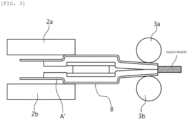
- FIG. 3 is an enlarged view of an electrode lead/pouch section that is sealed by the apparatus and method for sealing a pouch-type secondary battery according to the present invention.
- FIG. 3 also illustrates a case in which the components are each provided as a pair of components.
- FIG. 3 is an enlarged view of the electrode lead/pouch section that is being sealed, as illustrated in FIG. 1 .
- the sealing process is performed by heaters 2a and 2b and pressing rollers 3a and 3b respectively disposed in a pair of elastic bodies (not illustrated). Because the elastic bodies may effectively transfer heat and pressure even to a boundary portion A' between the electrode lead and the pouch, it is possible to effectively seal the boundary portion A' between the electrode lead and the pouch and seal section B that is not the boundary portion between the electrode lead and the pouch.
- the pouch may include polypropylene. That is, the pouch is sealed as the pouch is pressed in a state in which polypropylene contained in the pouch is melted by heat, and then polypropylene is cured again as a temperature decreases. Therefore, the sealing portion may be simultaneously heated and pressed as described above. However, the sealing portion may be heated and then pressed.
- the methods, materials, devices, and the like which are typically used in the corresponding field, may be used as long as the apparatus and method for sealing a pouch-type secondary battery are used.
Landscapes
- Engineering & Computer Science (AREA)
- Mechanical Engineering (AREA)
- Chemical & Material Sciences (AREA)
- Chemical Kinetics & Catalysis (AREA)
- Electrochemistry (AREA)
- General Chemical & Material Sciences (AREA)
- Manufacturing & Machinery (AREA)
- Secondary Cells (AREA)
- Sealing Battery Cases Or Jackets (AREA)
- Package Closures (AREA)
Abstract
Description
- This application claims priority to and the benefit of
Korean Patent Application No. 10-2022-0183248 filed with the Korean Intellectual Property Office on December 23, 2022 - The present invention relates to an apparatus and method for sealing a pouch-type secondary battery.
- The demand for secondary batteries such as electric vehicles and mobile devices is rapidly expanding, and there is an increasing need for the condition diagnosis and the quality stability of the secondary batteries. The secondary batteries may be divided into a nickel-cadmium battery, a nickel-metal hydride battery, a nickel-hydrogen battery, a lithium secondary battery, and the like.
- The secondary batteries are being widely used in a cutting-edge electronic device field such as phones, laptop computers, and camcorders. The secondary battery may be classified into a can-type secondary battery in which an electrode assembly is embedded in a metal can, and a pouch-type secondary battery in which an electrode assembly is embedded in a pouch.
- The pouch-type secondary battery includes an electrode assembly, electrode leads coupled to the electrode assembly, and a pouch configured to accommodate the electrode assembly in a state in which tips of the electrode leads are extended to the outside. Further, the electrode assembly has a structure in which electrodes and separators are alternately stacked. The pouch includes an accommodation portion configured to accommodate the electrode assembly, and a sealing portion configured to tightly seal the accommodation portion.
- In this case, because of a relatively large thickness of the electrode lead, a pre-sealing process of sealing an electrode lead/pouch section is additionally required. Further, because of a difference in thickness between the electrode lead/pouch section and the pouch/pouch section, a region (non-sealed region) in which an end portion of the electrode lead/pouch section are not sealed is formed, which causes a problem of a leak of an electrolyte to the outside of the pouch.
- Therefore, there is a need for a technology for ensuring process efficiency and preventing the electrode lead/pouch section from having a non-sealed region.
-
Korean Patent Application Laid-Open No. 10-2018-0023185 - The present invention has been made in an effort to provide an apparatus and method for sealing a pouch-type secondary battery, which is capable of efficiently sealing an electrode lead/pouch section.
- An embodiment of the present invention provides an apparatus for sealing a pouch-type secondary battery including a sealing portion, the apparatus including: a transfer part configured to move the pouch-type secondary battery in one direction; a pressing part including an elastic body configured to press at least one surface of the sealing portion; and a heating part configured to heat the sealing portion.
- Another embodiment of the present invention provides a method of sealing a pouch-type secondary battery including a sealing portion, the method including: moving the pouch-type secondary battery in one direction; heating at least one surface of the sealing portion of the pouch-type secondary battery moving in one direction; and pressing, by an elastic body, at least one surface of the sealing portion of the pouch-type secondary battery moving in one direction.
- The apparatus and method for sealing a pouch-type secondary battery according to the embodiment of the present invention may prevent the occurrence of a non-sealed region, thereby reducing a likelihood of the occurrence of a defect caused by a problem of a leak of the electrolyte to the outside of the pouch.
- The apparatus and method for sealing a pouch-type secondary battery according to the embodiment of the present invention may efficiently manage the process.
- The apparatus and method for sealing a pouch-type secondary battery according to the embodiment of the present invention may continuously seal the pouch-type secondary battery, thereby reducing the amount of time required for the sealing process.
- The pouch-type secondary battery, which is manufactured by the apparatus and method for sealing a pouch-type secondary battery according to the embodiment of the present invention, has excellent performance.
-
-
FIG. 1 is a view illustrating an embodiment of an apparatus and method for sealing a pouch-type secondary battery according to the present invention. -
FIG. 2 is a view illustrating an apparatus and method for sealing a pouch-type secondary battery in the related art. -
FIG. 3 is an enlarged view of an electrode lead/pouch section that is sealed by the apparatus and method for sealing a pouch-type secondary battery according to the present invention. -
- 1: Elastic body
- 1a, 1b: Movable roller
- 2, 2a, 2b: Heater
- 3, 3a, 3b: pressing roller
- 4: Pouch-type secondary battery
- Hereinafter, the present invention will be described in detail so that those with ordinary skill in the art to which the present invention pertains may easily carry out the present invention. However, the present invention may be implemented in various different ways and is not limited to the embodiments described herein.
- Throughout the specification, unless explicitly described to the contrary, the word "comprise" or "include" and variations, such as "comprises", "comprising", "includes" or "including", means the further inclusion of stated constituent elements, not the exclusion of any other constituent elements.
- In the present specification, the term 'p to q' means 'p or more and q or less'.
- In the present specification, the term 'sealing portion' means a region of a pouch that is sealed to seal the pouch that accommodates an electrode assembly. As described below, the sealing portion may include an electrode lead/pouch section and a pouch/pouch section.
- In the present specification, the term "electrode lead/pouch section" means a region in which the electrode lead and the pouch are sealed in the sealing region, i.e., a region corresponding to a distance between ends of the electrode lead based on a movement direction of the pouch-type battery.
- In addition, in the present specification, the term "pouch/pouch section" means a region in which the pouches are sealed in the sealing region, i.e., a region made by excluding the electrode lead/pouch section from the sealing region.
- In the description of the present invention, the specific descriptions of well-known related technologies will be omitted when it is determined that the specific descriptions may unnecessarily obscure the subject matter of the present invention.
- An embodiment of the present invention provides an apparatus for sealing a pouch-type secondary battery including a sealing portion, in which a pressing part including an elastic body presses the sealing portion. In case that the elastic body presses the sealing portion, the sealing portion and the pressing part come into close contact with each other. Therefore, it is possible to prevent the occurrence of a region (non-sealed region) that is not sealed at a portion where a stepped portion, such as a boundary portion between the electrode lead and the pouch, exists.
- In the embodiment of the present invention, a transfer part may be a conveyor belt. In this case, it is easier to continuously move the pouch-type secondary battery.
- In the embodiment of the present invention, the pressing part may be installed in one direction.
- In the embodiment of the present invention, the pressing part may further include a pressing roller. The pressing roller may apply additional pressure to the sealing portion during a process in which the elastic body presses the sealing portion. That is, the pressing roller may also press at least one surface of the sealing portion.
- In the embodiment of the present invention, the elastic body may be a flexible band. In the present specification, the configuration in which the elastic body is flexible means that the elastic body has flexibility and features, such that the elastic body is deformed when predetermined pressure or load is applied to the elastic body, and the elastic body is restored to an original shape when the predetermined pressure or load is eliminated. Materials having the above-mentioned features may be expressed as the elastic body.
- In the embodiment of the present invention, the pressing part may include a pair of elastic bodies.
- In the embodiment of the present invention, the pressing part may further include a pair of pressing rollers.
- That is, the apparatus for sealing a pouch-type secondary battery according to the embodiment of the present invention may press two opposite surfaces of the sealing portion.
- In the embodiment of the present invention, the heating part may include a heater.
- The heater may heat at least one surface of the sealing portion. In addition, the heating part may include a pair of heaters to improve sealing efficiency. That is, the two opposite surfaces of the sealing portion may be heated.
- That is, the embodiment of the present invention provides the apparatus for sealing a pouch-type secondary battery, the apparatus including the conveyor belt configured to move the pouch-type secondary battery in one direction, the elastic body installed in one direction in which the pouch-type secondary battery moves, the elastic body being configured to come into contact with at least one surface of the sealing portion, the heater configured to heat at least one surface of the sealing portion, and the pressing roller configured to press at least one surface of the sealing portion there has been heated by the heater.
- The embodiment of the present invention provides the apparatus for sealing a pouch-type secondary battery, the apparatus including a conveyor belt configured to move the pouch-type secondary battery in one direction, the pair of elastic bodies installed in one direction in which the pouch-type secondary battery moves, the pair of elastic bodies being configured to come into contact with the sealing portion, and the pair of heaters configured to heat the sealing portion, and the pair of pressing rollers configured to press the sealing portion heated by the pair of heaters.
- The apparatus for sealing a pouch-type secondary battery according to the embodiment of the present invention seals the pouch-type secondary battery while moving the pouch-type secondary battery in one direction by using the conveyor belt, and the apparatus may prevent the occurrence of a non-sealed region, thereby reducing a likelihood of the occurrence of a defect caused by a problem of a leak of the electrolyte to the outside of the pouch. In addition, the apparatus may seal the pouch-type secondary battery through the continuous process, thereby efficiently managing the process and reducing the amount of time required for the sealing process.
- As a result, the pouch-type secondary battery, which is manufactured by using the apparatus for sealing a secondary battery according to the embodiment of the present invention, has excellent performance.
- In the embodiment of the present invention, the pair of heaters configured to heat the sealing portion may be disposed in the elastic body, and the pair of pressing rollers configured to press the sealing portion heated by the pair of heaters may be disposed in the elastic body. The configuration in which the pair of heaters and the pair of pressing rollers are disposed in the elastic body means a structure in which the heat generated by the heaters and the pressure generated by the pressing rollers are transferred to the sealing portion through the elastic body.
- The apparatus for sealing a pouch-type secondary battery according to the embodiment of the present invention may include movable rollers configured to enable the elastic body to move along a predetermined route.
- That is, in the embodiment of the present invention, the elastic body may include the movable rollers. The movable rollers enable the elastic body to consistently move along the predetermined route. That is, the movable rollers enable the elastic body to circulate in the predetermined route. The movable roller may be provided as a pair of movable rollers.
- In the present specification, the predetermined route may be referred to as a circulation route for the elastic body. Because the elastic bodies move along the circulation routes, the heat generated by the heaters and the pressure generated by the pressing rollers may be continuously transferred to the sealing portion that passes between the elastic bodies.
- That is, in the embodiment of the present invention, the pressing part may include the elastic bodies, and the movable rollers, the heaters, and the pressing rollers may be included in the elastic bodies. In this case, the movable rollers, the heaters, and the pressing rollers may be respectively provided as a pair of movable rollers, a pair of heaters, and a pair of pressing rollers.
- In the embodiment of the present invention, a length of the elastic body may be equal to or shorter than 0.5 m to 1.5 m, but the present invention is not limited thereto. The length may be determined depending on a size of the sealing apparatus, a size of the pouch-type secondary battery, and the like.
- In the embodiment of the present invention, the sealing portion may include the electrode lead/pouch section. That is, in the apparatus for sealing a secondary battery according to the embodiment of the present invention, a section, in which the electrode lead and the pouch are simultaneously positioned among the regions required to be sealed, may be a main sealing target, but the present invention is not limited thereto. The pouch/pouch section may also be the sealing portion.
- In the embodiment of the present invention, the elastic body may have a Young's modulus of 0.01 GPa to 1.0 GPa, particularly 0.01 GPa to 0.8 GPa, and more particularly 0.01 GPa to 0.6 GPa. The elastic body may effectively come into contact with the sealing portion as the properties of the elastic body are identical to properties of rubber. The configuration in which the elastic body meets the range of the Young's modulus means that the properties of the elastic body are similar to the properties of rubber. That is, the sealing may be more efficiently performed in case that the elastic body meets the range of the Young's modulus.
- In the embodiment of the present invention, the elastic body may be made of polytetrafluoroethylene (PTFE). Polytetrafluoroethylene (PTFE) may also be called Teflon and be a crystalline material having high thermal stability and chemical resistance. That is, in case that the elastic body is made of PTFE, the heat transferred by the heater may be transferred to the sealing portion, and the elastic body itself may not be damaged. That is, the elastic body made of PTFE may be used for a long period of time while improving sealing efficiency.
- In addition, because the elastic body made of PTFE may have high thermal stability and chemical resistance, the elastic body may be advantageously applied to seal the electrode lead/pouch section that needs to be pressed while being heated at a relatively high temperature.
- In the embodiment of the present invention, a temperature condition of the heating part may be 200°C to 250°C, particularly 200°C to 240°C, and more particularly 210°C to 230°C. The temperature condition means a temperature condition under which the heating part heats the sealing portion. When the condition is satisfied, the electrode lead/pouch section may be effectively sealed.
- In the embodiment of the present invention, a pressing condition of the pressing part may be 0.1 MPa to 1.5 MPa, particularly 0.2 MPa to 1.3 MPa, and more particularly 0.3 MPa to 1.0 MPa. When the pressure condition is satisfied, the electrode lead/pouch section may be effectively sealed.
- In this case, the pressing condition may be pressure applied to the sealing portion by the pressing roller, and the elastic body may effectively transfer the pressure, which is generated by the pressing roller, to the sealing portion. That is, the elastic body comes into close contact with the sealing portion, which may prevent the occurrence of a region that is not pressed.
- In addition, the sealing portion may be heated, and the heated sealing portion may be pressed. Because the sealing portion is a portion made by melting a part of a region of the pouch and then pressing the melted portion, the sealing portion may be heated, and then the heated sealing portion may be pressed. However, the sealing portion may be simultaneously pressed and heated as long as the sealing may be performed.
- In the present specification, the pouch-type secondary battery is configured such that the electrode assembly is accommodated in the pouch. The electrode assembly means a power generation element that is chargeable and dischargeable and has a layered structure including electrodes and separators. The types of electrode assemblies may be approximately classified into a Jelly-roll-type electrode assembly made by winding sheet-shaped positive and negative electrodes coated with active materials with a separator interposed therebetween, a stack-type electrode assembly made by sequentially stacking a plurality of positive and negative electrodes in a state in which separators are interposed between the plurality of positive and negative electrodes, and a stack-and-folding-type electrode assembly made by winding stack-type unit cells by using long separation films.
- An embodiment of the present invention provides a method of sealing a pouch-type secondary battery including a sealing portion, in which the sealing portion is heated and pressed by the elastic body while the secondary battery moves in one direction. Because the elastic body presses the sealing portion, it is possible to prevent the occurrence of a region (non-sealed region) that is not sealed at a portion where a stepped portion, such as a boundary portion between the electrode lead and the pouch.
- As described above, the elastic body may be a flexible band, the sealing portion may be pressed by the pressing roller, and the sealing portion may be heated by the heater. In addition, the secondary battery may be moved by the conveyor belt. The elastic body, the pressing roller, and the heater may be provided as a pair of elastic bodies, a pair of pressing rollers, and a pair of heaters. However, the present invention is not limited thereto.
- In addition, the sealing portion may be simultaneously pressed and heated as long as the sealing process may be performed. However, particularly, the sealing portion may be heated and then pressed.
- In this case, the embodiment of the present invention provides the method of sealing a pouch-type secondary battery, which seals the pouch that accommodates the electrode assembly, the method including moving the pouch-type secondary battery in one direction by using the conveyor belt, and allowing the sealing portion of the pouch-type secondary battery, which is moved by the conveyor belt, to pass between the pair of elastic bodies, in which the allowing of the sealing portion of the pouch-type secondary battery, which is moved by the conveyor belt, to pass between the pair of elastic bodies includes heating the sealing portion while the sealing portion passing between the pair of elastic bodies, and pressing the sealing portion, which has been heated by the pair of heaters, while the sealing portion passes between the pair of elastic bodies.
- In the embodiment of the present invention, in the moving of the pouch-type secondary battery in one direction, a movement speed of the pouch-type secondary battery may be 5 m/min to 20 m/min, particularly 8 m/min to 15 m/min, and more particularly 10 m/min to 15 m/min. More specifically, the moving of the pouch-type secondary battery in one direction may use the conveyor belt, and the movement speed may mean a movement speed of the conveyor belt. When the movement speed is satisfied, the electrode lead/pouch section may be effectively sealed. That is, a non-sealed portion may be formed when the movement speed of the conveyor belt is higher than the above-mentioned speed. That is, when the movement speed of the conveyor belt is lower than the above-mentioned speed, the heating/pressing time increases, which may cause unnecessary damage.
- In the embodiment of the present invention, the pressing of the at least one surface of the sealing portion of the pouch-type secondary battery, which moves in one direction, by the elastic body may be performed so that one sealing portion passes over the elastic body for 1 second to 15 seconds, particularly 1 second to 12 seconds, and more particularly 1 second to 6 seconds based on a length of 1 m of the elastic body. However, the present invention is not limited thereto. The condition may be determined depending on a size of the sealing apparatus, a size of the pouch-type secondary battery, and the like.
- In the present specification, the description of the apparatus for sealing a pouch-type secondary battery may be applied to the description of the method of sealing a pouch-type secondary battery, and vice versa.
- Hereinafter, the present invention will be more specifically described with reference to
FIG. 1. FIG. 1 is a view illustrating an embodiment of an apparatus and method for sealing a pouch-type secondary battery according to the present invention. Specifically,FIG. 1 illustrates an example in which a pair of elastic bodies, a pair of heaters, a pair of pressing rollers, and a pair of movable rollers are provided. However, the present invention is not limited thereto. - As illustrated in
FIG. 1 , a sealing process starts while moving pouch-typesecondary batteries 4 in one direction (corresponding to a traveling direction inFIG. 1 ) by using a conveyor belt (not illustrated).FIG. 1 is a view illustrating an example in which a sealing position of the pouch-type secondary battery is on an electrode lead/pouch section. As described above, a sealing portion of the pouch-typesecondary battery 4, which is moved by the conveyor belt, passes between a pair of elastic bodies 1 (flexible bands). Theelastic bodies 1 may each include a pair ofmovable rollers heater 2, and a pressing roller 3. That is, the sealing portion may be heated and pressed by theheaters 2 and the pressing rollers 3 while passing between theelastic bodies 1. More specifically, because theheater 2 and the pressing roller 3 are disposed in theelastic body 1, heat generated by theheaters 2 and pressure generated by the pressing rollers 3 may be transferred to the sealing portion through theelastic bodies 1. In this case, because theelastic bodies 1 may uniformly transfer the heat and pressure to the sealing portion, thereby preventing a non-sealed region from being formed. In this case, the pair ofmovable rollers elastic body 1 and enables theelastic body 1 to consistently move along a predetermined route (circulation route). Because theelastic bodies 1 move along the circulation routes, the heat generated by theheaters 2 and the pressure generated by thepressing rollers 4 may be transferred to the sealing portion that continuously passes between theelastic bodies 1. -
FIG. 2 is a view illustrating an apparatus and method for sealing a pouch-type secondary battery in the related art.FIG. 2 also illustrates an example in which an electrode lead/pouch section are sealed. In the case of the related art, it can be ascertained that a non-sealed region is formed on a boundary portion A (indicated by the dotted circle) between the electrode lead and the pouch. That is, an apparatus for sealing a pouch-type secondary battery in the related art may have a structure in which a region in which the sealing apparatus comes into contact with the sealing portion of the pouch is changed from section E to section D while an angle of 45° is maintained between the sealing portion of the pouch and section B based on a height, and a region in which the sealing apparatus comes into contact with the sealing portion of the pouch is changed from section D to section C while an angle of 45° is maintained between the sealing portion of the pouch and section A based on the height. However, even though the apparatus for sealing a pouch-type secondary battery in the related art heats and presses the sealing portion, a non-sealed region may be formed on the boundary portion A (indicated by the dotted circle) between the electrode lead and the pouch. InFIG. 2 , an angle of 45° is provided for illustrative purposes only, and the angle may vary depending on the shape of the pouch. - That is, with reference to the comparison between
FIGS. 1 and 2 , it can be ascertained that the apparatus and method for sealing a pouch-type secondary battery according to the present invention may efficiently seal the pouch-type secondary battery, and the efficiency may be further improved in case that the sealing portion includes the electrode lead/pouch section. The higher sealing efficiency means that the non-sealed region is less likely to be formed. -
FIG. 3 is an enlarged view of an electrode lead/pouch section that is sealed by the apparatus and method for sealing a pouch-type secondary battery according to the present invention.FIG. 3 also illustrates a case in which the components are each provided as a pair of components. In other words,FIG. 3 is an enlarged view of the electrode lead/pouch section that is being sealed, as illustrated inFIG. 1 . As illustrated inFIG. 3 , the sealing process is performed byheaters pressing rollers - In the embodiment of the present invention, the pouch may include polypropylene. That is, the pouch is sealed as the pouch is pressed in a state in which polypropylene contained in the pouch is melted by heat, and then polypropylene is cured again as a temperature decreases. Therefore, the sealing portion may be simultaneously heated and pressed as described above. However, the sealing portion may be heated and then pressed.
- In the present specification, the methods, materials, devices, and the like, which are typically used in the corresponding field, may be used as long as the apparatus and method for sealing a pouch-type secondary battery are used.
Claims (9)
- An apparatus for sealing a pouch-type secondary battery including a sealing portion, the apparatus comprising:a transfer part configured to move the pouch-type secondary battery in one direction;a pressing part including an elastic body configured to press at least one surface of the sealing portion; anda heating part configured to heat the sealing portion.
- The apparatus of claim 1, wherein the sealing portion includes an electrode lead/pouch section.
- The apparatus of claim 1, wherein the elastic body has a Young's modulus of 0.01 GPa to 1 Gpa.
- The apparatus of claim 1, wherein the elastic body is made of polytetrafluoroethylene (PTFE).
- The apparatus of claim 1, wherein a temperature condition of the heating part is 200°C to 250°C.
- The apparatus of claim 1, wherein a pressing condition of the pressing part is 0.1 MPa to 1.5 MPa.
- A method of sealing a pouch-type secondary battery including a sealing portion, the method comprising:moving the pouch-type secondary battery in one direction;heating at least one surface of the sealing portion of the pouch-type secondary battery moving in one direction; andpressing, by an elastic body, at least one surface of the sealing portion of the pouch-type secondary battery moving in one direction.
- The method of claim 7, wherein in the moving of the pouch-type secondary battery in one direction, a movement speed of the pouch-type secondary battery is 5 m/min to 20 m/min.
- The method of claim 7, wherein the pressing of the at least one surface of the sealing portion of the pouch-type secondary battery moving in one direction by the elastic body is performed so that one sealing portion passes over the elastic body for 1 second to 15 seconds based on a length of 1 m of the elastic body.
Applications Claiming Priority (3)
| Application Number | Priority Date | Filing Date | Title |
|---|---|---|---|
| KR20220183248 | 2022-12-23 | ||
| KR1020230108284A KR20240101339A (en) | 2022-12-23 | 2023-08-18 | Pouch-type secondary battery sealing device and pouch-type secondary battery sealing method |
| PCT/KR2023/012388 WO2024135989A1 (en) | 2022-12-23 | 2023-08-22 | Device for sealing pouch-type secondary battery, and method for sealing pouch-type secondary battery |
Publications (2)
| Publication Number | Publication Date |
|---|---|
| EP4410521A1 true EP4410521A1 (en) | 2024-08-07 |
| EP4410521A4 EP4410521A4 (en) | 2025-11-26 |
Family
ID=90363385
Family Applications (1)
| Application Number | Title | Priority Date | Filing Date |
|---|---|---|---|
| EP23858439.5A Pending EP4410521A4 (en) | 2022-12-23 | 2023-08-22 | DEVICE FOR SEALING A POUCH-STYLE SECONDARY BATTERY AND METHOD FOR SEALING A POUCH-STYLE SECONDARY BATTERY |
Country Status (4)
| Country | Link |
|---|---|
| US (1) | US20250121566A1 (en) |
| EP (1) | EP4410521A4 (en) |
| JP (1) | JP7772340B2 (en) |
| WO (1) | WO2024135989A1 (en) |
Family Cites Families (12)
| Publication number | Priority date | Publication date | Assignee | Title |
|---|---|---|---|---|
| JP4581167B2 (en) * | 2000-01-19 | 2010-11-17 | ソニー株式会社 | Heat sealing method and heat sealing apparatus for polymer battery electrode |
| AT507384B1 (en) * | 2008-09-18 | 2011-07-15 | Westwind Verpackungen Gmbh | CLOSING DEVICE FOR CLOSING PREFERABLY BAGGED PACKAGING UNITS |
| JP2013001110A (en) * | 2011-06-17 | 2013-01-07 | Ichikawa Co Ltd | Cushioning material for mold pressing |
| KR101411813B1 (en) * | 2012-11-09 | 2014-06-27 | 앰코 테크놀로지 코리아 주식회사 | Semiconductor device and manufacturing method thereof |
| KR101675960B1 (en) * | 2014-01-28 | 2016-11-14 | 주식회사 엘지화학 | Device for Manufacturing Battery Cell Having Means for Applying Curing Material |
| KR101883536B1 (en) * | 2015-04-29 | 2018-07-30 | 주식회사 엘지화학 | Pouch type secondary battery and method of fabricating the same |
| KR102407509B1 (en) * | 2015-05-11 | 2022-06-13 | 에스케이온 주식회사 | Pouch sealing apparatus and method of manufacturing secondary battery |
| KR101835372B1 (en) | 2016-08-25 | 2018-03-09 | 김태완 | Laminating device for secondary cell |
| CN112955309A (en) * | 2018-11-06 | 2021-06-11 | 克里奥瓦克公司 | Composite belt, belt sealer and belt sealing method |
| KR102843785B1 (en) * | 2020-08-11 | 2025-08-07 | 주식회사 엘지에너지솔루션 | Sealing device for rechargeable battery |
| KR102899157B1 (en) * | 2020-08-28 | 2025-12-10 | 삼성에스디아이 주식회사 | All Solid secondary battery |
| CN216720024U (en) * | 2021-10-13 | 2022-06-10 | 衍化新能源科技(惠州)有限公司 | Soft packet of spacing encapsulation head of lithium ion battery double step |
-
2023
- 2023-08-22 EP EP23858439.5A patent/EP4410521A4/en active Pending
- 2023-08-22 JP JP2024515535A patent/JP7772340B2/en active Active
- 2023-08-22 WO PCT/KR2023/012388 patent/WO2024135989A1/en not_active Ceased
- 2023-08-22 US US18/694,676 patent/US20250121566A1/en active Pending
Also Published As
| Publication number | Publication date |
|---|---|
| US20250121566A1 (en) | 2025-04-17 |
| WO2024135989A1 (en) | 2024-06-27 |
| JP2025503362A (en) | 2025-02-04 |
| JP7772340B2 (en) | 2025-11-18 |
| EP4410521A4 (en) | 2025-11-26 |
Similar Documents
| Publication | Publication Date | Title |
|---|---|---|
| JP6039086B2 (en) | Pouch type secondary battery sealing tool | |
| CN103907223B (en) | Rechargeable electrochemical cell and the method for its manufacture | |
| US12420489B2 (en) | Sealing apparatus for secondary battery | |
| US20180047950A1 (en) | Sealing apparatus of pouch-type secondary battery | |
| US20150118533A1 (en) | Secondary batteries and methods of manufacturing the same | |
| US20170309871A1 (en) | Pouch-type secondary battery | |
| US20160380302A1 (en) | Curved secondary battery and manufacturing method thereof | |
| EP4057415A1 (en) | Method for manufacturing secondary battery and pre-degassing apparatus for manufacturing secondary battery | |
| US20220238924A1 (en) | Method for Manufacturing Secondary Battery and Secondary Battery | |
| CN110729424B (en) | secondary battery | |
| US20240322278A1 (en) | Secondary battery including pouch with gas adsorbent interposed therein and method for manufacturing same | |
| CN101442139A (en) | Electrode assembly and secondary battery using the same | |
| CN116635683A (en) | Electrode pad drying equipment capable of preventing thermal wrinkles in uncoated parts | |
| US12592462B2 (en) | Pouch-shaped battery cell configured such that replenishment of electrolytic solution is possible | |
| US20250121566A1 (en) | Apparatus and Method for Sealing Pouch-Type Secondary Battery | |
| CN118541259A (en) | Apparatus and method for sealing pouch-type secondary batteries | |
| US10593999B2 (en) | Electrode assembly and rechargeable battery including the same | |
| KR20240101339A (en) | Pouch-type secondary battery sealing device and pouch-type secondary battery sealing method | |
| CN114927806B (en) | Battery cell and method for manufacturing battery cell | |
| US12586809B2 (en) | Method for manufacturing secondary battery, coupling clip for manufacturing secondary battery, and secondary battery | |
| US20230369690A1 (en) | Secondary Battery And Method For Manufacturing The Same | |
| KR20230090675A (en) | Lithium secondary battery | |
| US20240347754A1 (en) | Method for Sealing Pouch-Type Secondary Battery, Method for Manufacturing Pouch-Type Secondary Battery, Apparatus for Sealing Pouch-Type Secondary Battery, and Poch-Type Secondary Battery Manufactured Using the Same | |
| EP4489155A1 (en) | Electrode assembly sealing device and sealing method | |
| US20260058240A1 (en) | Pouch-type secondary batteries, press devices thereof, and manufacturing methods thereof |
Legal Events
| Date | Code | Title | Description |
|---|---|---|---|
| STAA | Information on the status of an ep patent application or granted ep patent |
Free format text: STATUS: UNKNOWN |
|
| STAA | Information on the status of an ep patent application or granted ep patent |
Free format text: STATUS: THE INTERNATIONAL PUBLICATION HAS BEEN MADE |
|
| PUAI | Public reference made under article 153(3) epc to a published international application that has entered the european phase |
Free format text: ORIGINAL CODE: 0009012 |
|
| STAA | Information on the status of an ep patent application or granted ep patent |
Free format text: STATUS: REQUEST FOR EXAMINATION WAS MADE |
|
| 17P | Request for examination filed |
Effective date: 20240308 |
|
| AK | Designated contracting states |
Kind code of ref document: A1 Designated state(s): AL AT BE BG CH CY CZ DE DK EE ES FI FR GB GR HR HU IE IS IT LI LT LU LV MC ME MK MT NL NO PL PT RO RS SE SI SK SM TR |
|
| A4 | Supplementary search report drawn up and despatched |
Effective date: 20251024 |
|
| RIC1 | Information provided on ipc code assigned before grant |
Ipc: B29C 65/02 20060101AFI20251020BHEP Ipc: B29C 65/00 20060101ALI20251020BHEP Ipc: B29C 65/78 20060101ALI20251020BHEP Ipc: H01M 50/105 20210101ALI20251020BHEP Ipc: H01M 50/178 20210101ALI20251020BHEP Ipc: B29C 65/18 20060101ALI20251020BHEP Ipc: H01M 10/04 20060101ALI20251020BHEP Ipc: B29L 31/00 20060101ALN20251020BHEP Ipc: B29L 31/34 20060101ALN20251020BHEP |
|
| DAV | Request for validation of the european patent (deleted) | ||
| DAX | Request for extension of the european patent (deleted) |