EP4410184B1 - Detection method of event, event detection system and inference server - Google Patents
Detection method of event, event detection system and inference server Download PDFInfo
- Publication number
- EP4410184B1 EP4410184B1 EP23162532.8A EP23162532A EP4410184B1 EP 4410184 B1 EP4410184 B1 EP 4410184B1 EP 23162532 A EP23162532 A EP 23162532A EP 4410184 B1 EP4410184 B1 EP 4410184B1
- Authority
- EP
- European Patent Office
- Prior art keywords
- event
- compressed data
- data
- encoder
- ecr
- Prior art date
- Legal status (The legal status is an assumption and is not a legal conclusion. Google has not performed a legal analysis and makes no representation as to the accuracy of the status listed.)
- Active
Links
Images




Classifications
-
- A—HUMAN NECESSITIES
- A61—MEDICAL OR VETERINARY SCIENCE; HYGIENE
- A61B—DIAGNOSIS; SURGERY; IDENTIFICATION
- A61B5/00—Measuring for diagnostic purposes; Identification of persons
- A61B5/48—Other medical applications
- A61B5/4806—Sleep evaluation
- A61B5/4818—Sleep apnoea
-
- A—HUMAN NECESSITIES
- A61—MEDICAL OR VETERINARY SCIENCE; HYGIENE
- A61B—DIAGNOSIS; SURGERY; IDENTIFICATION
- A61B5/00—Measuring for diagnostic purposes; Identification of persons
- A61B5/02—Detecting, measuring or recording for evaluating the cardiovascular system, e.g. pulse, heart rate, blood pressure or blood flow
- A61B5/0205—Simultaneously evaluating both cardiovascular conditions and different types of body conditions, e.g. heart and respiratory condition
-
- A—HUMAN NECESSITIES
- A61—MEDICAL OR VETERINARY SCIENCE; HYGIENE
- A61B—DIAGNOSIS; SURGERY; IDENTIFICATION
- A61B5/00—Measuring for diagnostic purposes; Identification of persons
- A61B5/103—Measuring devices for testing the shape, pattern, colour, size or movement of the body or parts thereof, for diagnostic purposes
- A61B5/11—Measuring movement of the entire body or parts thereof, e.g. head or hand tremor or mobility of a limb
- A61B5/1116—Determining posture transitions
- A61B5/1117—Fall detection
-
- A—HUMAN NECESSITIES
- A61—MEDICAL OR VETERINARY SCIENCE; HYGIENE
- A61B—DIAGNOSIS; SURGERY; IDENTIFICATION
- A61B5/00—Measuring for diagnostic purposes; Identification of persons
- A61B5/24—Detecting, measuring or recording bioelectric or biomagnetic signals of the body or parts thereof
- A61B5/316—Modalities, i.e. specific diagnostic methods
- A61B5/318—Heart-related electrical modalities, e.g. electrocardiography [ECG]
-
- A—HUMAN NECESSITIES
- A61—MEDICAL OR VETERINARY SCIENCE; HYGIENE
- A61B—DIAGNOSIS; SURGERY; IDENTIFICATION
- A61B5/00—Measuring for diagnostic purposes; Identification of persons
- A61B5/72—Signal processing specially adapted for physiological signals or for diagnostic purposes
- A61B5/7235—Details of waveform analysis
- A61B5/7264—Classification of physiological signals or data, e.g. using neural networks, statistical classifiers, expert systems or fuzzy systems
-
- A—HUMAN NECESSITIES
- A61—MEDICAL OR VETERINARY SCIENCE; HYGIENE
- A61B—DIAGNOSIS; SURGERY; IDENTIFICATION
- A61B5/00—Measuring for diagnostic purposes; Identification of persons
- A61B5/72—Signal processing specially adapted for physiological signals or for diagnostic purposes
- A61B5/7235—Details of waveform analysis
- A61B5/7264—Classification of physiological signals or data, e.g. using neural networks, statistical classifiers, expert systems or fuzzy systems
- A61B5/7267—Classification of physiological signals or data, e.g. using neural networks, statistical classifiers, expert systems or fuzzy systems involving training the classification device
-
- A—HUMAN NECESSITIES
- A61—MEDICAL OR VETERINARY SCIENCE; HYGIENE
- A61B—DIAGNOSIS; SURGERY; IDENTIFICATION
- A61B5/00—Measuring for diagnostic purposes; Identification of persons
- A61B5/72—Signal processing specially adapted for physiological signals or for diagnostic purposes
- A61B5/7271—Specific aspects of physiological measurement analysis
- A61B5/7282—Event detection, e.g. detecting unique waveforms indicative of a medical condition
-
- A—HUMAN NECESSITIES
- A61—MEDICAL OR VETERINARY SCIENCE; HYGIENE
- A61B—DIAGNOSIS; SURGERY; IDENTIFICATION
- A61B5/00—Measuring for diagnostic purposes; Identification of persons
- A61B5/74—Details of notification to user or communication with user or patient; User input means
- A61B5/746—Alarms related to a physiological condition, e.g. details of setting alarm thresholds or avoiding false alarms
-
- H—ELECTRICITY
- H04—ELECTRIC COMMUNICATION TECHNIQUE
- H04L—TRANSMISSION OF DIGITAL INFORMATION, e.g. TELEGRAPHIC COMMUNICATION
- H04L67/00—Network arrangements or protocols for supporting network services or applications
- H04L67/01—Protocols
- H04L67/12—Protocols specially adapted for proprietary or special-purpose networking environments, e.g. medical networks, sensor networks, networks in vehicles or remote metering networks
-
- A—HUMAN NECESSITIES
- A61—MEDICAL OR VETERINARY SCIENCE; HYGIENE
- A61B—DIAGNOSIS; SURGERY; IDENTIFICATION
- A61B2560/00—Constructional details of operational features of apparatus; Accessories for medical measuring apparatus
- A61B2560/02—Operational features
- A61B2560/0204—Operational features of power management
- A61B2560/0209—Operational features of power management adapted for power saving
Definitions
- the invention relates to a machine learning technique, and in particular to a detection method of an event, an event detection system, and an inference server.
- Sleep apnea refers to the symptoms of involuntary weakening or even cessation of breathing during sleep. The cessation of breathing is often unnoticed until the body is severely deprived of oxygen and wakes up due to discomfort. However, hypoxia causes damage to the body, and patients can even die suddenly due to cardiovascular disease after a long period of time. It's worth noting that the effects of sleep apnea go beyond daytime inattention and tiredness. Since the heart rate slows down and blood pressure drops during normal sleep, normal sleep gives the cardiovascular system a chance to rest and recover. However, sleep in apnea patients can be interrupted several times a night, depriving them of cardiovascular rest.
- repeated apnea can cause blood oxygen levels to drop, cause a certain amount of stress on the body and lead to a systemic inflammatory response, and can also increase the risk of cardiovascular disease.
- People with sleep apnea are often unaware of symptoms. Symptoms can only be discovered when the patient goes to the hospital for detection and diagnosis with special equipment. researchers estimate that about 80 percent of people with moderate to severe sleep apnea are undiagnosed.
- sleep apnea is involved in a wide range of levels, such as traffic accidents, industrial safety accidents, cardiovascular diseases, metabolic diseases, etc.
- US2022/303288A1 , CN110876621A and US2021/244339A1 define systems for event detection and data compression.
- the embodiments of the disclosure provide a detection method of an event, an event detection system, and an inference server that can detect sleep quality and an unexpected event.
- An event detection system of an embodiment includes (but not limited to) one or more terminal devices and an inference server.
- the terminal device generates first compressed data.
- the first compressed data is related to a sensing result of a physiological state or a motion state.
- the inference server decodes the first compressed data into reconstructed data via a decoder in an anomaly detection model, encodes the reconstructed data into second compressed data via an encoder, and determines an event of the physiological state or the motion state by an error between the first compressed data and the second compressed data.
- the anomaly detection model includes the encoder and the decoder.
- a detection method of an event of an embodiment includes (but not limited to) the following steps. First compressed data is received. The first compressed data is related to a sensing result of a physiological state or a motion state. The first compressed data is decoded into reconstructed data via a decoder in an anomaly detection model. The anomaly detection model includes the decoder and an encoder. The reconstructed data is encoded into second compressed data via the encoder. An event of the physiological state or the motion state is determined by an error between the first compressed data and the second compressed data.
- An inference server of an embodiment includes (but not limited to) a communication transceiver, a memory, and a processor.
- the communication transceiver transmits or receives data.
- the memory stores a program code.
- the processor loads the program code to execute: receiving first compressed data via the communication transceiver, decoding first compressed data into reconstructed data via a decoder in an anomaly detection model, encoding the reconstructed data into second compressed data via an encoder in the anomaly detection model, and determining an event of a physiological state or a motion state by an error between the first compressed data and the second compressed data.
- the first compressed data is related to a sensing result of the physiological state or the motion state.
- the anomaly detection model is based on an autoencoder, and the anomaly detection model includes the decoder and the encoder.
- the terminal device only transmits compressed data
- the inference server determines events based on the compressed data from the terminal device and the compressed data converted by the decoder and the compressor of the anomaly detection model. In this way, bandwidth can be effectively utilized, power can be saved, and event detection with data privacy can be provided.
- FIG. 1 is a block diagram of elements of an event detection system 1 according to an embodiment.
- the event detection system 1 includes (but not limited to) one or more terminal devices 10, an inference server 20, a training device 30, and a warning system 40.
- the terminal device 10 can be an IoT device, a wearable device, a medical testing instrument, a smart phone, a tablet computer, or a sensing device.
- the terminal device 10 includes (but not limited to) a communication transceiver 11, a memory 12, a sensor 13, and a processor 14.
- the communication transceiver 11 can be a communication transceiver circuit supporting low power wide area network (LPWAN) techniques (LPWAN communication techniques such as long distance (LoRa) techniques, Narrow Band Internet of Things (NB-IoT), Sigfox, LTE Advanced for Machine Type Communications (LTE-MTC)), and it can also be a communication transceiver circuit or a transmission interface card supporting Wi-Fi, Bluetooth, mobile communication, USB, or Ethernet.
- LPWAN communication techniques such as long distance (LoRa) techniques, Narrow Band Internet of Things (NB-IoT), Sigfox, LTE Advanced for Machine Type Communications (LTE-MTC)
- LTE-MTC LTE Advanced for Machine Type Communications
- the communication transceiver 11 transmits or receives data with an external device (e.g., the inference server 20 or the training device 30).
- the memory 12 can be any form of a fixed or movable random-access memory (RAM), read-only memory (ROM), flash memory, traditional hard disk drive (HDD), solid-state drive (SSD), or similar devices.
- the memory 12 stores a program code, a software module, a configuration, data, or a file (for example, compress data, a sensing result, or a feature), and is described in detail in subsequent embodiments.
- the sensor 13 can be a heartbeat sensor, a physiological sensor, an image sensor, a motion sensor, or other types of sensors.
- the sensor 13 senses a physiological state (e.g., heartbeat, respiration rate, or blood oxygen level) or a motion state (e.g., inertial attitude, acceleration, or moving direction) to obtain a sensing result.
- the sensing result is time-dependent data. That is, data recorded with time sequence, continuous time, or multiple points in time.
- the sensing result is an electrocardiography (ECG), respiratory airflow in a polysomnography (PSG) of a night's sleep, chest movement, abdominal muscle behavior, or an electroencephalogram.
- ECG electrocardiography
- PSG polysomnography
- the processor 14 is coupled to the communication transceiver 11, the memory 12, and the sensor 13.
- the processor 14 can be a central processing unit (CPU), a graphics processing unit (GPU), or other programmable general-purpose or special-purpose microprocessors, digital signal processors (DSPs), programmable controllers, field-programmable gate arrays (FPGAs), application-specific integrated circuits (ASICs), neural network accelerators, or other similar devices or a combination of the above devices.
- the processor 14 performs all or part of the operations of the terminal device 10, and can load and execute each of the program codes, software modules, files, and data stored in the memory 12.
- the inference server 20 can be a cloud/edge computing server, a workstation, or a computer.
- the inference server 20 includes (but not limited to) a communication transceiver 21, a memory 22, and a processor 24.
- the communication transceiver 21 transmits or receives data with an external device (e.g., the warning system 40 or the training device 30).
- an external device e.g., the warning system 40 or the training device 30.
- the memory 22 stores data such as compressed data, reconstructed data, errors, or determination results, which is described in detail in subsequent embodiments.
- the processor 24 is coupled to the communication transceiver 21 and the memory 22.
- the implementation and functions of the processor 24 are as provided in the description of the processor 14 and is not repeated herein.
- the processor 24 performs all or part of the operations of the inference server 20, and can load and execute each of the program codes, software modules, files, and data stored in the memory 22. In some embodiments, some operations in a method of an embodiment can be implemented by different or the same processor 24.
- the training device 30 is communicatively connected to the terminal device 10 and the inference server 20.
- the training device 30 can be a smart phone, a tablet, a computer, a server, or a workstation.
- the training device 30 trains a model based on a machine learning algorithm (e.g., autoencoder, neural network, decision tree, or random forest).
- the machine learning algorithm can analyze training samples to obtain patterns therefrom, so as to predict unknown data via the patterns.
- the machine learning model establishes the association between the nodes in the hidden layer between feature data (i.e., the input of the model) and a respiratory event (i.e., the output of the model) by the labeled samples (e.g., feature data of known hypopnea/apnea events, or feature data of known normal breathing events).
- the machine learning model is a model constructed after learning, and can accordingly infer data to be evaluated (for example, feature data or compressed data).
- the warning system 40 is communicatively connected to the inference server 20.
- the warning system 40 can be a display, a speaker, or a communication transceiver. In an embodiment, the warning system 40 sends out a warning message.
- the functions of the training device 30 and/or the warning system 40 can also be implemented via the inference server 20, or these devices are integrated into a single device.
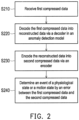
- FIG. 2 is a flowchart of a detection method of an event according to an embodiment.
- the processor 24 of the inference server 20 receives first compressed data via the communication transceiver 21 (step S210). Specifically, the processor 14 of the terminal device 10 generates the first compressed data by the sensing result (i.e., raw data) of the sensor 13 for a physiological device or a motion device. In other words, the first compressed data is related to the sensing result of the physiological state or the motion state.
- the physiological state is a heartbeat.
- the sensing result of the heartbeat is the R-R interval of a heartbeat waveform in a time sequence.
- the normal adult heart rate is 60 to 100 beats per minute.
- a normal person's heart rate is affected by many factors. The heart beats faster when exercising, slows down when resting or sleeping, and slows down some more when exhaling. In addition, conditions such as fever, nervousness, stress, and pain can also affect heart rate. Heart rate is affected by breathing rate. Under normal circumstances, the heart rate of women is faster than that of men. A normal adult breathes about 16 to 20 times per minute.
- the ratio of the number of breaths to heart rate is 1:4, that is, for every breath, the heart beats four times. Therefore, heartbeat can be used as an indicator of a person's mood, exercise, and breathing conditions.
- the human respiratory condition can be detected by observing heart rate variability.
- Heart rate variability is as the acceleration and deceleration of the heart rhythm. Via such variation of the heart rhythm, it is also possible to understand the health condition of an individual.
- the terminal device 10 can collect the R-R interval of the heartbeat via ECG.
- FIG. 3 is a timing diagram illustrating an example of a heartbeat.
- a series of wave bands in the ECG include a P wave, a QRS complex, and a T wave.
- the QRS complex consists of a series of 3 deviations.
- the negative wave of the first deviation in the complex is called Q wave
- the first positive deviation in the complex is called R wave
- the negative deviation after R wave is called S wave.
- the distance between two consecutive R waves can be called R-R interval RRI.
- the processor 14 of the terminal device 10 can encode the sensing result of the heartbeat into the first compressed data via an encoder.
- the anomaly detection model includes the decoder and the encoder.
- the abnormal detecting model is based on an autoencoder architecture, a machine learning architecture composed of the encoder and the decoder, or other neural network architectures reconstructing a sample or other specified samples.
- the training device 30 trains the anomaly detection model by the plurality of samples labeled as events.
- the anomaly detection model for heartbeats can determine a sleep apnea event, wherein the waveform of the heartbeat can have significant rapid fluctuations when a sleep apnea event occurs.
- T (i is one of 1 to I) is the training sample of the R-R interval in the time sequence
- R t i is the t-th R-R interval value of the i-th patient having a sleep apnea symptom (that is, a sleep apnea event occurs) at the moment
- I represents the number of all apnea patients in the training sample.
- R ⁇ i ⁇ can be standardized to R ⁇ ⁇ i ⁇ , so that these training samples have the characteristics of the average value of 0 and the variation of 1:
- R ⁇ i R ⁇ 1 i , ... , R ⁇ t i , ... . T .
- an RRI sample with a sample number of #( R ⁇ ⁇ i ⁇ ) is cut into M segments, and each segment has N RRI samples.
- K represents the K-th segment RRI sample after segmentation, and the symbol # is the number of RRI samples.
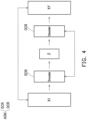
- FIG. 4 is a schematic diagram of an autoencoder according to an embodiment.
- X k i is input data X1 in an anomaly detection model ADM.
- Reconstructed data X1' is data compressed by an encoder ECR of the anomaly detection model ADM and decompressed by a decoder DCR.
- the number of samples of the reconstructed data X1' is the same as that of the input data X1. That is, if the number of samples of the input data X1 is N, the reconstructed data X1' also has N samples.
- the anomaly detection model ADM can be split into two neural networks, the encoder ECR and the decoder DCR.
- the input data is input to the encoder ECR, and is compressed into relatively low-dimensional compressed data Z1 (for example, a one-dimensional vector) by the encoder ECR.
- the compressed data Z1 is input to the decoder DCR, and the reconstructed data X1' having the same size as the input data X1 is restored by the decoder DCR.
- mean-square error (MSE), mean absolute error (MAE), cross entropy, or focal loss can be used as the loss function.
- the training device 30 can update the weights in the neural network via backpropagation to minimize the loss function, and then train the abnormality detection model ADM.
- the training device 30 can transmit the encoder ECR in the anomaly detection model ADM to the terminal device 10, and transmit the encoder ECR and decoder DCR in the anomaly detection model ADM to the inference server 20.
- the motion state is an inertial attitude.
- motion index e.g., velocity, angular velocity, or acceleration
- orientation e.g., orientation
- displacement e.g., displacement on three or six axes.
- the processor 14 of the terminal device 10 can encode the sensing result of the inertial attitude into the first compressed data via an encoder. That is, the terminal device 10 can encode the sensing result into the first compressed data via the trained encoder ECR.
- the anomaly detection model for inertial attitude can determine a fall event or a car accident event, wherein when a fall event or a car accident event occurs, the intensity of the acceleration and the orientation of the attitude can be changed rapidly.
- the processor 14 of the terminal device 10 can transmit the first compressed data to the inference server 20 via the communication transceiver 11.
- the processor 24 of the inference server 20 can receive the first compressed data from one or more terminal devices 10 via a low power wide area network (LPWAN) via the communication transceiver 21.
- LPWAN has the characteristics of long-distance communication and power saving, and LPWAN can solve the transmission issue of the Internet of Things. It is worth noting that, compared with mobile network standards that pursue larger bandwidth, higher speed, or lower latency but consume more power, there is a wider deployment range for machine-to-machine (M2M) communication, and the need for frequent battery replacement is avoided, and LPWAN techniques provide the characteristics of less data volume, long-distance transmission, and power saving, and therefore are suitable for the application field of Internet of Things.
- M2M machine-to-machine
- LPWAN techniques for environmental monitoring or asset tracking, LPWAN techniques with a transmission distance of up to 20 kilometers can significantly reduce deployment costs, and only a few stations are needed to cover a large area.
- LPWAN techniques are, for example, LoRa, Sigfox, and NB-IoT.
- LPWAN emphasizes coverage and power saving, but has relatively limited bandwidth.
- LoRA is only 100 bps
- Sigfox is 300 bps to 50 kbps
- NB-IOT is 50 kbps.
- the sensing result can be compressed, thus not only reducing the amount of data to effectively utilize bandwidth, but can also achieve the effect of data privacy.
- the network between the terminal device 10 and the inference server 20 can also be other communication techniques.
- Wi-Fi Wireless Fidelity
- Bluetooth Wireless Fidelity
- FIG. 5 is a schematic diagram of an anomaly detection model ADM according to an embodiment.
- FIG. 5 is an architecture diagram of an autoencoder.
- g ⁇ is the mathematical function of the encoder ECR
- f ⁇ is the mathematical function of the decoder DCR.
- Compressed data Z2 (hereinafter referred to as the first compressed data) is the data obtained by compressing the input data X2 (i.e., the above sensing result) via the function g ⁇ .
- the compression operation corresponding to the function g ⁇ can be implemented via the terminal device 10, so that the first compressed data can be transmitted via the network.
- the input data X2 is a sequence of heartbeat time data (the number of samples can exceed a certain number (for example, 70, 100, or 200) or the sensing time can exceed a certain time (for example, 5 minutes, 30 minutes, or 1 hour)), and the first compressed data Z2 is the data after the input data X2 is compressed via the encoder ECR.
- the reconstruction data X2' is data decoded by the decoder DCR.
- the models of the functions g ⁇ and f ⁇ are trained using the heartbeat time sequence data of sleep apnea as described above.
- the models of the encoder ECR and the decoder DCR can be used to detect whether there is a sleep apnea event within a period of time. If the input data X2 of the heartbeat time sequence is sequentially reconstructed by the encoder ECR and the decoder DCR in the anomaly detection model ADM, and the reconstructed data X2' is equal to or approximate to the input data X2, it is considered normal (i.e., a sleep apnea event occurs). Otherwise, it is considered abnormal (i.e., a sleep apnea event does not occur or a normal event occurs).
- the processor 24 can determine whether the error between the input data X2 and the reconstructed data X2' (for example,
- the first threshold can be obtained by data occupying a specific quantile (e.g., 97.5, 95, or 90) in the data distribution of all training samples in which a sleep apnea event occurs.
- the processor 24 can determine that an event (such as a sleep apnea event) occurs.
- the processor 24 can determine that an event does not occur (for example, a sleep apnea event does not occur or a normal event occurs).
- the decoding operation corresponding to the function f ⁇ can be implemented via the inference server 20. It should be noted that, in the architecture of FIG. 5 , the terminal device 10 still needs to transmit the input data X2 for the inference server 20 to compare the reconstructed data X2'. In other words, the terminal device 10 needs to transmit both the input data X2 and the compressed data Z2, thus affecting bandwidth usage and cannot achieve the effect of data protection.
- FIG. 6 is a schematic diagram of the anomaly detection model ADM according to another embodiment.
- the inference server 20 also implements the compression operation corresponding to the function g ⁇ . That is, the encoder ECR encodes the reconstructed data X2' into compressed data Z2' (hereinafter referred to as second compressed data).
- the second compressed data Z2' of the input data X2 sequentially processed by the encoder ECR, the decoder DCR, and the encoder ECR in the anomaly detection model ADM is equal to or approximate to the first compressed data Z2, it is considered normal (for example, a sleep apnea event occurs, a fall event occurs, or a car accident event occurs). Otherwise, it is considered abnormal (e.g., a sleep apnea event does not occur or a normal event occurs). It can be seen from this that the terminal device 10 only needs to transmit the first compressed data Z2 to the inference server 20.
- the processor 24 determines the event of the physiological state or the motion state by the error between the first compressed data and the second compressed data (step S240).
- the event determined by the processor 24 by the error between the first compressed data and the second compressed data refers to a predicted event output by the inference server 20. That is, the prediction result of the anomaly detection model is an event of the physiological state or the motion state.
- FIG. 7 is a flowchart of event determination according to an embodiment of the invention.
- the processor 24 can determine whether the error between the first compressed data Z2 and the second compressed data Z2' (for example,
- the second threshold can be obtained by data occupying a specific quantile (e.g., 97.5, 95, or 90) in the data distribution of all training samples in which a sleep apnea event occurs.
- the processor 24 can determine that an event occurs (such as a sleep apnea event) (step S720).
- the processor 24 can determine that an event does not occur (such as a sleep apnea event does not occur or a normal event occurs) (step S730).
- the training phase utilizes training samples labeled as normal events (e.g., a sleep apnea event does not occur, a normal breathing event does not occur, a fall event does not occur, or a car accident event does not occur)
- normal events e.g., a sleep apnea event does not occur, a normal breathing event does not occur, a fall event does not occur, or a car accident event does not occur
- an abnormal event occurs when the error between the first compressed data and the second compressed data is not less than the corresponding threshold (for example, a sleep apnea event occurs, a fall event occurs, or a car accident occurs).
- normal events refer to time sequence segments marked as free of anomalies.
- the features of these time sequence segments are usually distributed within a certain range. It is assumed that there is a time sequence data with a Gaussian distribution. If the data to be evaluated is detected to be located within 95% of the standard deviation of the mean value of the Gaussian distribution, the data to be evaluated is usually determined to come from the Gaussian distribution (regarded as normal). On the contrary, if located outside 95% of the standard deviation, the data to be evaluated is identified as abnormal. From the concept of distance, normal data is closer to the data in the data distribution of the normal data. Conversely, abnormal data is compared to data in a data distribution farther than the normal data.
- this model means that the prediction thereof of the normal data is relatively more accurate. That is, when the normal data goes through the anomaly detection model, the compressed and restored value (that is, the reconstructed data) is closer to the original input value. If the abnormal data is brought into this abnormal detection model, it is difficult to restore the abnormal data via compression. Therefore, the distance between the abnormal data and the restored data is farther.
- the first threshold and second threshold are based on this concept.
- the inference server 20 can deploy corresponding anomaly detection models respectively.
- a set of decoders and encoders is deployed; and for the first compressed data from another terminal device 10, another set of decoders and encoders is deployed.
- the deployment of the anomaly detection models is not limited to one-to-one relationships.
- the inference server 20 runs fewer anomaly detection models concurrently, but with prioritization.
- the inference server 20 can request the warning system 40 to send a warning message for events such as falls, sleep apnea, or car accidents. For example, sending a push notification, making a phone call to the relevant authorities, or sounding a warning.
- the inference server 20 can also transmit the determination result to the warning system 40 periodically or based on a trigger event.
- the warning system 40 can report the overall health status.
- the terminal device transmits the first compressed data to the inference server.
- the inference server further generates the second compressed data via the decoder.
- the transmission of compressed data across networks can provide data privacy.
Landscapes
- Health & Medical Sciences (AREA)
- Life Sciences & Earth Sciences (AREA)
- Engineering & Computer Science (AREA)
- Physics & Mathematics (AREA)
- General Health & Medical Sciences (AREA)
- Medical Informatics (AREA)
- Public Health (AREA)
- Animal Behavior & Ethology (AREA)
- Veterinary Medicine (AREA)
- Surgery (AREA)
- Molecular Biology (AREA)
- Heart & Thoracic Surgery (AREA)
- Biophysics (AREA)
- Pathology (AREA)
- Biomedical Technology (AREA)
- Physiology (AREA)
- Artificial Intelligence (AREA)
- Cardiology (AREA)
- Signal Processing (AREA)
- Computer Vision & Pattern Recognition (AREA)
- Psychiatry (AREA)
- Evolutionary Computation (AREA)
- Mathematical Physics (AREA)
- Fuzzy Systems (AREA)
- Pulmonology (AREA)
- Dentistry (AREA)
- Oral & Maxillofacial Surgery (AREA)
- Computing Systems (AREA)
- Computer Networks & Wireless Communication (AREA)
- Measurement Of The Respiration, Hearing Ability, Form, And Blood Characteristics Of Living Organisms (AREA)
- Collating Specific Patterns (AREA)
Description
- The invention relates to a machine learning technique, and in particular to a detection method of an event, an event detection system, and an inference server.
- Sleep apnea refers to the symptoms of involuntary weakening or even cessation of breathing during sleep. The cessation of breathing is often unnoticed until the body is severely deprived of oxygen and wakes up due to discomfort. However, hypoxia causes damage to the body, and patients can even die suddenly due to cardiovascular disease after a long period of time. It's worth noting that the effects of sleep apnea go beyond daytime inattention and tiredness. Since the heart rate slows down and blood pressure drops during normal sleep, normal sleep gives the cardiovascular system a chance to rest and recover. However, sleep in apnea patients can be interrupted several times a night, depriving them of cardiovascular rest. In addition, repeated apnea can cause blood oxygen levels to drop, cause a certain amount of stress on the body and lead to a systemic inflammatory response, and can also increase the risk of cardiovascular disease. People with sleep apnea are often unaware of symptoms. Symptoms can only be discovered when the patient goes to the hospital for detection and diagnosis with special equipment. Researchers estimate that about 80 percent of people with moderate to severe sleep apnea are undiagnosed. In addition, sleep apnea is involved in a wide range of levels, such as traffic accidents, industrial safety accidents, cardiovascular diseases, metabolic diseases, etc.
- Moreover, events such as falls, car accidents, etc., are accidents that humans can encounter. If these accidents are detected early, the damage can be minimized.
-
US2022/303288A1 ,CN110876621A andUS2021/244339A1 define systems for event detection and data compression. - Accordingly, the embodiments of the disclosure provide a detection method of an event, an event detection system, and an inference server that can detect sleep quality and an unexpected event.
- An event detection system of an embodiment includes (but not limited to) one or more terminal devices and an inference server. The terminal device generates first compressed data. The first compressed data is related to a sensing result of a physiological state or a motion state. The inference server decodes the first compressed data into reconstructed data via a decoder in an anomaly detection model, encodes the reconstructed data into second compressed data via an encoder, and determines an event of the physiological state or the motion state by an error between the first compressed data and the second compressed data. The anomaly detection model includes the encoder and the decoder.
- A detection method of an event of an embodiment includes (but not limited to) the following steps. First compressed data is received. The first compressed data is related to a sensing result of a physiological state or a motion state. The first compressed data is decoded into reconstructed data via a decoder in an anomaly detection model. The anomaly detection model includes the decoder and an encoder. The reconstructed data is encoded into second compressed data via the encoder. An event of the physiological state or the motion state is determined by an error between the first compressed data and the second compressed data.
- An inference server of an embodiment includes (but not limited to) a communication transceiver, a memory, and a processor. The communication transceiver transmits or receives data. The memory stores a program code. The processor loads the program code to execute: receiving first compressed data via the communication transceiver, decoding first compressed data into reconstructed data via a decoder in an anomaly detection model, encoding the reconstructed data into second compressed data via an encoder in the anomaly detection model, and determining an event of a physiological state or a motion state by an error between the first compressed data and the second compressed data. The first compressed data is related to a sensing result of the physiological state or the motion state. The anomaly detection model is based on an autoencoder, and the anomaly detection model includes the decoder and the encoder.
- Based on the above, according to the detection method and the event detection system and the inference server of the embodiments , the terminal device only transmits compressed data, and the inference server determines events based on the compressed data from the terminal device and the compressed data converted by the decoder and the compressor of the anomaly detection model. In this way, bandwidth can be effectively utilized, power can be saved, and event detection with data privacy can be provided.
- In order to make the aforementioned features and advantages of the disclosure more comprehensible, embodiments accompanied with figures are described in detail below. The invention is defined in the appended claims.
-
-
FIG. 1 is a block diagram of elements of a detection system according to an embodiment . -
FIG. 2 is a flowchart of a detection method of an event according to an embodiment -
FIG. 3 is a timing diagram illustrating an example of a heartbeat. -
FIG. 4 is a schematic diagram of an autoencoder according to an embodiment -
FIG. 5 is a schematic diagram of an anomaly detection model according to an embodiment -
FIG. 6 is a schematic diagram of an anomaly detection model according to another embodiment -
FIG. 7 is a flowchart of event determination according to an embodiment -
FIG. 1 is a block diagram of elements of anevent detection system 1 according to an embodiment. Referring toFIG. 1 , theevent detection system 1 includes (but not limited to) one or moreterminal devices 10, aninference server 20, atraining device 30, and awarning system 40. - The
terminal device 10 can be an IoT device, a wearable device, a medical testing instrument, a smart phone, a tablet computer, or a sensing device. - The
terminal device 10 includes (but not limited to) acommunication transceiver 11, amemory 12, asensor 13, and aprocessor 14. - The
communication transceiver 11 can be a communication transceiver circuit supporting low power wide area network (LPWAN) techniques (LPWAN communication techniques such as long distance (LoRa) techniques, Narrow Band Internet of Things (NB-IoT), Sigfox, LTE Advanced for Machine Type Communications (LTE-MTC)), and it can also be a communication transceiver circuit or a transmission interface card supporting Wi-Fi, Bluetooth, mobile communication, USB, or Ethernet. In an embodiment, the communication transceiver 11 transmits or receives data with an external device (e.g., theinference server 20 or the training device 30). - The
memory 12 can be any form of a fixed or movable random-access memory (RAM), read-only memory (ROM), flash memory, traditional hard disk drive (HDD), solid-state drive (SSD), or similar devices. In an embodiment, thememory 12 stores a program code, a software module, a configuration, data, or a file (for example, compress data, a sensing result, or a feature), and is described in detail in subsequent embodiments. - The
sensor 13 can be a heartbeat sensor, a physiological sensor, an image sensor, a motion sensor, or other types of sensors. In an embodiment, thesensor 13 senses a physiological state (e.g., heartbeat, respiration rate, or blood oxygen level) or a motion state (e.g., inertial attitude, acceleration, or moving direction) to obtain a sensing result. In an embodiment, the sensing result is time-dependent data. That is, data recorded with time sequence, continuous time, or multiple points in time. For example, the sensing result is an electrocardiography (ECG), respiratory airflow in a polysomnography (PSG) of a night's sleep, chest movement, abdominal muscle behavior, or an electroencephalogram. - The
processor 14 is coupled to thecommunication transceiver 11, thememory 12, and thesensor 13. Theprocessor 14 can be a central processing unit (CPU), a graphics processing unit (GPU), or other programmable general-purpose or special-purpose microprocessors, digital signal processors (DSPs), programmable controllers, field-programmable gate arrays (FPGAs), application-specific integrated circuits (ASICs), neural network accelerators, or other similar devices or a combination of the above devices. In an embodiment, theprocessor 14 performs all or part of the operations of theterminal device 10, and can load and execute each of the program codes, software modules, files, and data stored in thememory 12. - The
inference server 20 can be a cloud/edge computing server, a workstation, or a computer. - The
inference server 20 includes (but not limited to) acommunication transceiver 21, amemory 22, and aprocessor 24. - The implementation and functions of the
communication transceiver 21 are as provided in the description of thecommunication transceiver 11 and are not repeated herein. In an embodiment, thecommunication transceiver 21 transmits or receives data with an external device (e.g., thewarning system 40 or the training device 30). - The implementation and functions of the
memory 22 are as provided in the description of thememory 12 and are not repeated herein. In an embodiment, thememory 22 stores data such as compressed data, reconstructed data, errors, or determination results, which is described in detail in subsequent embodiments. - The
processor 24 is coupled to thecommunication transceiver 21 and thememory 22. The implementation and functions of theprocessor 24 are as provided in the description of theprocessor 14 and is not repeated herein. In an embodiment, theprocessor 24 performs all or part of the operations of theinference server 20, and can load and execute each of the program codes, software modules, files, and data stored in thememory 22. In some embodiments, some operations in a method of an embodiment can be implemented by different or thesame processor 24. - The
training device 30 is communicatively connected to theterminal device 10 and theinference server 20. Thetraining device 30 can be a smart phone, a tablet, a computer, a server, or a workstation. In an embodiment, thetraining device 30 trains a model based on a machine learning algorithm (e.g., autoencoder, neural network, decision tree, or random forest). The machine learning algorithm can analyze training samples to obtain patterns therefrom, so as to predict unknown data via the patterns. For example, the machine learning model establishes the association between the nodes in the hidden layer between feature data (i.e., the input of the model) and a respiratory event (i.e., the output of the model) by the labeled samples (e.g., feature data of known hypopnea/apnea events, or feature data of known normal breathing events). The machine learning model is a model constructed after learning, and can accordingly infer data to be evaluated (for example, feature data or compressed data). - The
warning system 40 is communicatively connected to theinference server 20. Thewarning system 40 can be a display, a speaker, or a communication transceiver. In an embodiment, thewarning system 40 sends out a warning message. - In some embodiments, the functions of the
training device 30 and/or thewarning system 40 can also be implemented via theinference server 20, or these devices are integrated into a single device. - Hereinafter, the method described in an embodiment is described in conjunction with various devices and elements in the
event detection system 1. Each of the processes of the present method can be adjusted according to embodiment conditions and is not limited thereto. -
FIG. 2 is a flowchart of a detection method of an event according to an embodiment. Referring toFIG. 2 , theprocessor 24 of theinference server 20 receives first compressed data via the communication transceiver 21 (step S210). Specifically, theprocessor 14 of theterminal device 10 generates the first compressed data by the sensing result (i.e., raw data) of thesensor 13 for a physiological device or a motion device. In other words, the first compressed data is related to the sensing result of the physiological state or the motion state. - In an embodiment, the physiological state is a heartbeat. For example, the sensing result of the heartbeat is the R-R interval of a heartbeat waveform in a time sequence. It is worth noting that each person's heart rate is different, and under normal circumstances, the normal adult heart rate is 60 to 100 beats per minute. A normal person's heart rate is affected by many factors. The heart beats faster when exercising, slows down when resting or sleeping, and slows down some more when exhaling. In addition, conditions such as fever, nervousness, stress, and pain can also affect heart rate. Heart rate is affected by breathing rate. Under normal circumstances, the heart rate of women is faster than that of men. A normal adult breathes about 16 to 20 times per minute. The ratio of the number of breaths to heart rate is 1:4, that is, for every breath, the heart beats four times. Therefore, heartbeat can be used as an indicator of a person's mood, exercise, and breathing conditions. According to the literature (https://www.ncbi.nlm.nih.gov/pmc/articles/PMC8590683/pdf/11325_2020_Article_22 49.pdf), the human respiratory condition can be detected by observing heart rate variability. Heart rate variability is as the acceleration and deceleration of the heart rhythm. Via such variation of the heart rhythm, it is also possible to understand the health condition of an individual. The
terminal device 10 can collect the R-R interval of the heartbeat via ECG. - For example,
FIG. 3 is a timing diagram illustrating an example of a heartbeat. Please refer toFIG. 3 , generally speaking, a series of wave bands in the ECG include a P wave, a QRS complex, and a T wave. The QRS complex consists of a series of 3 deviations. The negative wave of the first deviation in the complex is called Q wave, the first positive deviation in the complex is called R wave, and the negative deviation after R wave is called S wave. The distance between two consecutive R waves can be called R-R interval RRI. - In an embodiment, the
processor 14 of theterminal device 10 can encode the sensing result of the heartbeat into the first compressed data via an encoder. The anomaly detection model includes the decoder and the encoder. The abnormal detecting model is based on an autoencoder architecture, a machine learning architecture composed of the encoder and the decoder, or other neural network architectures reconstructing a sample or other specified samples. - In an embodiment, the
training device 30 trains the anomaly detection model by the plurality of samples labeled as events. For example, the anomaly detection model for heartbeats can determine a sleep apnea event, wherein the waveform of the heartbeat can have significant rapid fluctuations when a sleep apnea event occurs. Medical testing equipment can mark R-R interval segments having a sleep apnea event. Assuming that


- For the anomaly detection model of the autoencoder, the
training device 30 can divide the time sequence data of the R-R interval labeled as the sleep apnea event into a plurality of RRI time sequence segments having the same samples. For example, if


-
FIG. 4 is a schematic diagram of an autoencoder according to an embodiment. Please refer toFIG. 4 ,
- In the training of the anomaly detection model, the anomaly detection model ADM can be split into two neural networks, the encoder ECR and the decoder DCR. The input data is input to the encoder ECR, and is compressed into relatively low-dimensional compressed data Z1 (for example, a one-dimensional vector) by the encoder ECR. The compressed data Z1 is input to the decoder DCR, and the reconstructed data X1' having the same size as the input data X1 is restored by the decoder DCR. In order to make the reconstructed data X1' similar to or the same as the input data X1, mean-square error (MSE), mean absolute error (MAE), cross entropy, or focal loss can be used as the loss function. In addition, the
training device 30 can update the weights in the neural network via backpropagation to minimize the loss function, and then train the abnormality detection model ADM. - The
training device 30 can transmit the encoder ECR in the anomaly detection model ADM to theterminal device 10, and transmit the encoder ECR and decoder DCR in the anomaly detection model ADM to theinference server 20. - In another embodiment, the motion state is an inertial attitude. For example, motion index (e.g., velocity, angular velocity, or acceleration), orientation, or displacement on three or six axes. The
processor 14 of theterminal device 10 can encode the sensing result of the inertial attitude into the first compressed data via an encoder. That is, theterminal device 10 can encode the sensing result into the first compressed data via the trained encoder ECR. The anomaly detection model for inertial attitude can determine a fall event or a car accident event, wherein when a fall event or a car accident event occurs, the intensity of the acceleration and the orientation of the attitude can be changed rapidly. - It should be noted that the types of events can still be changed according to the actual needs of the user.
- Then, the
processor 14 of theterminal device 10 can transmit the first compressed data to theinference server 20 via thecommunication transceiver 11. - In an embodiment, the
processor 24 of theinference server 20 can receive the first compressed data from one or moreterminal devices 10 via a low power wide area network (LPWAN) via thecommunication transceiver 21. LPWAN has the characteristics of long-distance communication and power saving, and LPWAN can solve the transmission issue of the Internet of Things. It is worth noting that, compared with mobile network standards that pursue larger bandwidth, higher speed, or lower latency but consume more power, there is a wider deployment range for machine-to-machine (M2M) communication, and the need for frequent battery replacement is avoided, and LPWAN techniques provide the characteristics of less data volume, long-distance transmission, and power saving, and therefore are suitable for the application field of Internet of Things. For example, for environmental monitoring or asset tracking, LPWAN techniques with a transmission distance of up to 20 kilometers can significantly reduce deployment costs, and only a few stations are needed to cover a large area. LPWAN techniques are, for example, LoRa, Sigfox, and NB-IoT. However, LPWAN emphasizes coverage and power saving, but has relatively limited bandwidth. For example, LoRA is only 100 bps, Sigfox is 300 bps to 50 kbps, and NB-IOT is 50 kbps. Under the limitation of limited bandwidth, it should be difficult to load a large number ofterminal devices 10 for simultaneous transmission, and it is even more difficult to meet instant communication requirements such as health and industrial safety monitoring. However, in the embodiments the sensing result can be compressed, thus not only reducing the amount of data to effectively utilize bandwidth, but can also achieve the effect of data privacy. - In other embodiments, the network between the
terminal device 10 and theinference server 20 can also be other communication techniques. For example, Wi-Fi or Bluetooth. - Referring to
FIG. 2 , theprocessor 24 of theinference server 20 decodes the first compressed data into reconstructed data via the decoder in the anomaly detection model (step S220). Specifically,FIG. 5 is a schematic diagram of an anomaly detection model ADM according to an embodiment. Please refer toFIG. 5 , which is an architecture diagram of an autoencoder. One of the objects of the autoencoder is to find the functions g ø and fθ such that X2'= fθ (g ø (X2)), and X2≈X2'. g ø is the mathematical function of the encoder ECR, and fθ is the mathematical function of the decoder DCR. Compressed data Z2 (hereinafter referred to as the first compressed data) is the data obtained by compressing the input data X2 (i.e., the above sensing result) via the function g ø. In an embodiment the compression operation corresponding to the function g ø can be implemented via theterminal device 10, so that the first compressed data can be transmitted via the network. - Taking heartbeat time sequence data as an example, the input data X2 is a sequence of heartbeat time data (the number of samples can exceed a certain number (for example, 70, 100, or 200) or the sensing time can exceed a certain time (for example, 5 minutes, 30 minutes, or 1 hour)), and the first compressed data Z2 is the data after the input data X2 is compressed via the encoder ECR. The reconstruction data X2' is data decoded by the decoder DCR. To detect abnormal conditions (for example, the above events), the models of the functions g ø and fθ are trained using the heartbeat time sequence data of sleep apnea as described above. After training, the models of the encoder ECR and the decoder DCR can be used to detect whether there is a sleep apnea event within a period of time. If the input data X2 of the heartbeat time sequence is sequentially reconstructed by the encoder ECR and the decoder DCR in the anomaly detection model ADM, and the reconstructed data X2' is equal to or approximate to the input data X2, it is considered normal (i.e., a sleep apnea event occurs). Otherwise, it is considered abnormal (i.e., a sleep apnea event does not occur or a normal event occurs).
- In an embodiment, the
processor 24 can determine whether the error between the input data X2 and the reconstructed data X2' (for example, |X2-X2'|) is less than a first threshold. The first threshold can be obtained by data occupying a specific quantile (e.g., 97.5, 95, or 90) in the data distribution of all training samples in which a sleep apnea event occurs. In response to the error between the input data X2 and the reconstructed data X2' being less than the first threshold, theprocessor 24 can determine that an event (such as a sleep apnea event) occurs. In response to that the error between the input data X2 and the reconstructed data X2' is not less than the first threshold, theprocessor 24 can determine that an event does not occur (for example, a sleep apnea event does not occur or a normal event occurs). - In an embodiment the decoding operation corresponding to the function fθ can be implemented via the
inference server 20. It should be noted that, in the architecture ofFIG. 5 , theterminal device 10 still needs to transmit the input data X2 for theinference server 20 to compare the reconstructed data X2'. In other words, theterminal device 10 needs to transmit both the input data X2 and the compressed data Z2, thus affecting bandwidth usage and cannot achieve the effect of data protection. - Referring to
FIG. 2 , theprocessor 24 of theinference server 20 encodes the reconstructed data into second compressed data via the encoder of the anomaly detection model (step S230). Specifically,FIG. 6 is a schematic diagram of the anomaly detection model ADM according to another embodiment. Please refer toFIG. 6 , compared with the architecture inFIG. 5 , theinference server 20 also implements the compression operation corresponding to the function g ø. That is, the encoder ECR encodes the reconstructed data X2' into compressed data Z2' (hereinafter referred to as second compressed data). If the second compressed data Z2' of the input data X2 sequentially processed by the encoder ECR, the decoder DCR, and the encoder ECR in the anomaly detection model ADM is equal to or approximate to the first compressed data Z2, it is considered normal (for example, a sleep apnea event occurs, a fall event occurs, or a car accident event occurs). Otherwise, it is considered abnormal (e.g., a sleep apnea event does not occur or a normal event occurs). It can be seen from this that theterminal device 10 only needs to transmit the first compressed data Z2 to theinference server 20. - Referring to
FIG. 2 , theprocessor 24 determines the event of the physiological state or the motion state by the error between the first compressed data and the second compressed data (step S240). In an embodiment, the event determined by theprocessor 24 by the error between the first compressed data and the second compressed data refers to a predicted event output by theinference server 20. That is, the prediction result of the anomaly detection model is an event of the physiological state or the motion state. - Specifically,
FIG. 7 is a flowchart of event determination according to an embodiment of the invention. Referring toFIG. 7 , theprocessor 24 can determine whether the error between the first compressed data Z2 and the second compressed data Z2' (for example, |Z2-Z2'|) is less than a second threshold (step S710). The second threshold can be obtained by data occupying a specific quantile (e.g., 97.5, 95, or 90) in the data distribution of all training samples in which a sleep apnea event occurs. In response to the error between the first compressed data Z2 and the second compressed data Z2' being less than the second threshold, theprocessor 24 can determine that an event occurs (such as a sleep apnea event) (step S720). In response to the error between the first compressed data Z2 and the second compressed data Z2' being not less than the second threshold, theprocessor 24 can determine that an event does not occur (such as a sleep apnea event does not occur or a normal event occurs) (step S730). - Similarly, for the determination of a fall, a car accident, or other events, it is also possible to determine whether the event occurs by the error between the first compressed data Z2 and the second compressed data Z2', and details are not repeated herein.
- In other embodiments, if the training phase utilizes training samples labeled as normal events (e.g., a sleep apnea event does not occur, a normal breathing event does not occur, a fall event does not occur, or a car accident event does not occur), then it can also be that an abnormal event occurs when the error between the first compressed data and the second compressed data is not less than the corresponding threshold (for example, a sleep apnea event occurs, a fall event occurs, or a car accident occurs). When the error between the first compressed data and the second compressed data is less than the corresponding threshold, there is an abnormal event (for example, a sleep apnea event does not occur, a normal breathing event occurs, a fall event does not occur, or a car accident event does not occur).
- For example, normal events refer to time sequence segments marked as free of anomalies. The features of these time sequence segments are usually distributed within a certain range. It is assumed that there is a time sequence data with a Gaussian distribution. If the data to be evaluated is detected to be located within 95% of the standard deviation of the mean value of the Gaussian distribution, the data to be evaluated is usually determined to come from the Gaussian distribution (regarded as normal). On the contrary, if located outside 95% of the standard deviation, the data to be evaluated is identified as abnormal. From the concept of distance, normal data is closer to the data in the data distribution of the normal data. Conversely, abnormal data is compared to data in a data distribution farther than the normal data. If the model is trained on the normal data, this model means that the prediction thereof of the normal data is relatively more accurate. That is, when the normal data goes through the anomaly detection model, the compressed and restored value (that is, the reconstructed data) is closer to the original input value. If the abnormal data is brought into this abnormal detection model, it is difficult to restore the abnormal data via compression. Therefore, the distance between the abnormal data and the restored data is farther. The first threshold and second threshold are based on this concept.
- It should be noted that, for different terminal devices, the
inference server 20 can deploy corresponding anomaly detection models respectively. In other words, for the first compressed data from oneterminal device 10, a set of decoders and encoders is deployed; and for the first compressed data from anotherterminal device 10, another set of decoders and encoders is deployed. However, the deployment of the anomaly detection models is not limited to one-to-one relationships. For example, theinference server 20 runs fewer anomaly detection models concurrently, but with prioritization. - In an embodiment, the
inference server 20 can request thewarning system 40 to send a warning message for events such as falls, sleep apnea, or car accidents. For example, sending a push notification, making a phone call to the relevant authorities, or sounding a warning. In addition, theinference server 20 can also transmit the determination result to thewarning system 40 periodically or based on a trigger event. Thewarning system 40 can report the overall health status. - Based on the above, in the detection method of event, the event detection system, and the inference server of the embodiments the terminal device transmits the first compressed data to the inference server. In addition to the decoder, the inference server further generates the second compressed data via the decoder. Ultimately, it is only necessary to compare the first compressed data and the second compressed data to determine whether an event occurs. In this way, energy and electricity can be lowered, data transmission is reduced, and bandwidth is lowered, so as to be suitable for IoT networks and implement long-term event monitoring. In addition, the transmission of compressed data across networks can provide data privacy.
Claims (15)
- An event detection system (1), wherein the event detection system (1) comprises:a terminal device (10) encoding a sensing result of a physiological state or a motion state into first compressed data (Z2) via an encoder (ECR); andan inference server (20):receiving the first compressed data (Z2) via a network;decoding the first compressed data (Z2) into reconstructed data (X2') via a decoder (DCR) in an anomaly detection model (ADM); wherein the anomaly detection model (ADM) comprises the decoder (DCR) and the encoder (ECR);encoding the reconstructed data (X2') into second compressed data (Z2') via the encoder (ECR); anddetermining an event of the physiological state or the motion state by an error between the first compressed data (Z2) and the second compressed data (Z2').
- The event detection system (1) of claim 1, characterized in that the physiological state is a heartbeat, and the terminal device (10) further:encodes a sensing result of the heartbeat into the first compressed data (Z2) via the encoder (ECR); wherein the event is a sleep apnea event, wherein the sensing result of the heartbeat is an R-R interval (RRI) of a heartbeat waveform in a time sequence; orthe motion state is an inertial attitude, and the terminal device (10) further:
encodes a sensing result of the inertial attitude into the first compressed data (Z2) via the encoder (ECR); wherein the event is a fall event. - The event detection system (1) of any one of claims 1-2, characterized in that the inference server (20) further:determines whether the error is less than a threshold; wherein the threshold is obtained by a plurality of samples labeled as the event;the event occurs in response to the error being less than the threshold; andthe event does not occur in response to the error not being less than the threshold.
- The event detection system (1) of any one of claims 1-3, characterized in that the inference server (20) further:
receives the first compressed data (Z2) from the terminal device (10) via a low power wide area network, named LPWAN. - The event detection system (1) of any one of claims 1-4, characterized in that the event detection system (1) further comprises:
a training device (30) training the anomaly detection model (ADM) by a plurality of samples labeled as the event; wherein the anomaly detection model (ADM) is trained based on an autoencoder. - A detection method of an event, wherein the detection method comprises:encoding a sensing result of a physiological state or a motion state into first compressed data (Z2) via an encoder (ECR);receiving the first compressed data (Z2) via a network;decoding the first compressed data (Z2) into reconstructed data (X2') via a decoder (DCR) in an anomaly detection model (ADM); wherein the anomaly detection model (ADM) is based on an autoencoder, and the anomaly detection model (ADM) comprises the decoder (DCR) and the encoder (ECR);encoding the reconstructed data (X2') into second compressed data (Z2') via the encoder (ECR); anddetermining an event of the physiological state or the motion state by an error between the first compressed data (Z2) and the second compressed data (Z2').
- The detection method of the event of claim 6, characterized in that the physiological state is a heartbeat, the first compressed data (Z2) is obtained by encoding a sensing result of the heartbeat via the encoder (ECR), and the event is a sleep apnea event, wherein the sensing result of the heartbeat is an R-R interval (RRI) of a heartbeat waveform in a time sequence; or
the motion state is an inertial attitude, the first compressed data (Z2) is obtained by encoding a sensing result of the inertial attitude via the encoder (ECR), and the event is a fall event. - The detection method of the event of any one of claims 6-7, characterized in that the step of determining the event comprises:determining whether the error is less than a threshold; wherein the threshold is obtained by a plurality of samples labeled as the event;the event occurs in response to the error being less than the threshold; andthe event does not occur in response to the error not being less than the threshold.
- The detection method of the event of any one of claims 6-8, characterized in that the step of receiving the first compressed data (Z2) comprises:
receiving the first compressed data (Z2) via a low power wide area network, named LPWAN. - The detection method of the event of any one claims 6-9, characterized in that the detection method further comprises:
training the anomaly detection model (ADM) by a plurality of samples labeled as the event. - An inference server (20), comprising:a communication transceiver (11) transmitting or receiving data;a memory (12) storing a program code; anda processor (14), characterized in that the processor (14) loads the program code to execute:receiving first compressed data (Z2) via the communication transceiver (11); wherein the first compressed data (Z2) is generated by encoding a sensing result of a physiological state or a motion state via an encoder (ECR);decoding the first compressed data (Z2) into reconstructed data (X2') via a decoder (DCR) in an anomaly detection model (ADM); wherein the anomaly detection model (ADM) is based on an autoencoder, and the anomaly detection model (ADM) comprises the decoder (DCR) and the encoder (ECR);encoding the reconstructed data (X2') into second compressed data (Z2') via the encoder (ECR); anddetermining an event of the physiological state or the motion state by an error between the first compressed data (Z2) and the second compressed data (Z2').
- The inference server (20) of claim 11, characterized in that the physiological state is a heartbeat, a sensing result of the heartbeat is an R-R interval (RRI) of a heartbeat waveform in a time sequence, the first compressed data (Z2) is obtained by encoding the sensing result of the heartbeat via the encoder (ECR), and the event is a sleep apnea event; or
the motion state is an inertial attitude, the first compressed data (Z2) is obtained by encoding a sensing result of the inertial attitude via the encoder (ECR), and the event is a fall event. - The inference server (20) of any one of claims 11-12, characterized in that the processor (14) further executes:determining whether the error is less than a threshold; wherein the threshold is obtained by a plurality of samples labeled as the event;the event occurs in response to the error being less than the threshold; andthe event does not occur in response to the error not being less than the threshold.
- The inference server (20) of any one of claims 11-13, characterized in that the processor (14) further executes:
receiving the first compressed data (Z2) via a low power wide area network, named LPWAN, via the communication transceiver (11). - The inference server (20) of any one of claims 11-14, characterized in that the anomaly detection model (ADM) is trained by a plurality of samples labeled as the event; wherein the anomaly detection model (ADM) is trained based on an autoencoder.
Applications Claiming Priority (1)
| Application Number | Priority Date | Filing Date | Title |
|---|---|---|---|
| TW112103260A TWI826247B (en) | 2023-01-31 | 2023-01-31 | Detection method and detection system of event and inference server |
Publications (3)
| Publication Number | Publication Date |
|---|---|
| EP4410184A1 EP4410184A1 (en) | 2024-08-07 |
| EP4410184C0 EP4410184C0 (en) | 2025-06-11 |
| EP4410184B1 true EP4410184B1 (en) | 2025-06-11 |
Family
ID=85703743
Family Applications (1)
| Application Number | Title | Priority Date | Filing Date |
|---|---|---|---|
| EP23162532.8A Active EP4410184B1 (en) | 2023-01-31 | 2023-03-17 | Detection method of event, event detection system and inference server |
Country Status (4)
| Country | Link |
|---|---|
| US (1) | US20240252108A1 (en) |
| EP (1) | EP4410184B1 (en) |
| CN (1) | CN118415583A (en) |
| TW (1) | TWI826247B (en) |
Family Cites Families (8)
| Publication number | Priority date | Publication date | Assignee | Title |
|---|---|---|---|---|
| US8775340B2 (en) * | 2008-12-19 | 2014-07-08 | The Board Of Trustees Of The University Of Illinois | Detection and prediction of physiological events in people with sleep disordered breathing using a LAMSTAR neural network |
| CN110876621A (en) * | 2018-09-06 | 2020-03-13 | 南京大学 | A neural network-based detection system for sleep apnea syndrome |
| CN112641424B (en) * | 2019-10-11 | 2024-01-30 | 京东方科技集团股份有限公司 | Sleep monitoring method, device, equipment and storage medium |
| EP4096503B8 (en) * | 2020-01-31 | 2025-08-20 | ResMed Sensor Technologies Limited | Sleep status detection for apnea-hypopnea index calculation |
| AU2021218704B2 (en) * | 2020-02-12 | 2023-11-02 | Irhythm Technologies, Inc. | Non-invasive cardiac monitor and methods of using recorded cardiac data to infer a physiological characteristic of a patient |
| TWI776284B (en) * | 2020-11-20 | 2022-09-01 | 巨安長齡股份有限公司 | Home long-term intelligent care system and method |
| US11843623B2 (en) * | 2021-03-16 | 2023-12-12 | Mitsubishi Electric Research Laboratories, Inc. | Apparatus and method for anomaly detection |
| TWM618094U (en) * | 2021-04-27 | 2021-10-11 | 大立雲康科技股份有限公司 | Sleep detection device, sleep detection data collection platform and sleep quality analyzation system |
-
2023
- 2023-01-31 TW TW112103260A patent/TWI826247B/en active
- 2023-02-10 CN CN202310106907.5A patent/CN118415583A/en active Pending
- 2023-03-13 US US18/183,129 patent/US20240252108A1/en active Pending
- 2023-03-17 EP EP23162532.8A patent/EP4410184B1/en active Active
Also Published As
| Publication number | Publication date |
|---|---|
| CN118415583A (en) | 2024-08-02 |
| US20240252108A1 (en) | 2024-08-01 |
| EP4410184C0 (en) | 2025-06-11 |
| EP4410184A1 (en) | 2024-08-07 |
| TWI826247B (en) | 2023-12-11 |
| TW202433492A (en) | 2024-08-16 |
Similar Documents
| Publication | Publication Date | Title |
|---|---|---|
| US9220444B2 (en) | System method and device for determining the risk of dehydration | |
| US11538585B2 (en) | Detecting abnormalities in ECG signals | |
| US8775340B2 (en) | Detection and prediction of physiological events in people with sleep disordered breathing using a LAMSTAR neural network | |
| KR20210154675A (en) | System of providing complex living support solution by monitoring and analyzing biosignal based on artificial intelligence and operating method thereof | |
| CN109620180B (en) | Method, device, equipment and storage medium for controlling wearable equipment to alarm | |
| US12310743B2 (en) | Sleep apnea syndrome determination apparatus, sleep apnea syndrome determination method, and sleep apnea syndrome determination program | |
| CN120241012B (en) | A dynamic monitoring system for elderly heart patients | |
| Nagdeo et al. | Wireless body area network sensor faults and anomalous data detection and classification using machine learning | |
| US20170273600A1 (en) | System and method for monitoring motor recovery in a post acute stroke treatment | |
| CN108460957A (en) | A kind of the elder's health group monitoring warning system and method | |
| KR20240018729A (en) | System and method for analyzing health condition of user based on multimodal biological signal | |
| TWM593240U (en) | Detection device for apnea based on unipolar ecg | |
| Bsoul et al. | Real-time sleep quality assessment using single-lead ECG and multi-stage SVM classifier | |
| EP4410184A1 (en) | Detection method of event, event detection system and inference server | |
| WO2018077199A1 (en) | Health monitoring device and method | |
| CN107669251B (en) | Heartbeat respiration monitoring method and monitoring bracelet | |
| KR102114638B1 (en) | Monitoring system for stroke during sleep | |
| US12293833B2 (en) | Heart condition detection sensor device and system for providing complex life support solution using same | |
| TWI766471B (en) | System capable of detecting sleep breathing intensity based on wavelet transformation and spectral intensity | |
| CN117083015A (en) | A system and method for determining a person's stroke risk | |
| Bayar et al. | Elderly fall detection system with ESP32 module and edge impulse studio | |
| Kumaresh et al. | Non-invasive fetus heart rate and growth measurement with abnormality detection using IoT | |
| TWI733247B (en) | Detection device and detection method for obstructive sleep apnea | |
| CN114947871A (en) | Portable electrocardiogram monitor real-time data processing system and method based on Internet of things | |
| WO2023273640A1 (en) | Epilepsy detection method and apparatus |
Legal Events
| Date | Code | Title | Description |
|---|---|---|---|
| PUAI | Public reference made under article 153(3) epc to a published international application that has entered the european phase |
Free format text: ORIGINAL CODE: 0009012 |
|
| STAA | Information on the status of an ep patent application or granted ep patent |
Free format text: STATUS: REQUEST FOR EXAMINATION WAS MADE |
|
| 17P | Request for examination filed |
Effective date: 20231115 |
|
| AK | Designated contracting states |
Kind code of ref document: A1 Designated state(s): AL AT BE BG CH CY CZ DE DK EE ES FI FR GB GR HR HU IE IS IT LI LT LU LV MC ME MK MT NL NO PL PT RO RS SE SI SK SM TR |
|
| GRAP | Despatch of communication of intention to grant a patent |
Free format text: ORIGINAL CODE: EPIDOSNIGR1 |
|
| STAA | Information on the status of an ep patent application or granted ep patent |
Free format text: STATUS: GRANT OF PATENT IS INTENDED |
|
| GRAS | Grant fee paid |
Free format text: ORIGINAL CODE: EPIDOSNIGR3 |
|
| GRAA | (expected) grant |
Free format text: ORIGINAL CODE: 0009210 |
|
| STAA | Information on the status of an ep patent application or granted ep patent |
Free format text: STATUS: THE PATENT HAS BEEN GRANTED |
|
| INTG | Intention to grant announced |
Effective date: 20250417 |
|
| AK | Designated contracting states |
Kind code of ref document: B1 Designated state(s): AL AT BE BG CH CY CZ DE DK EE ES FI FR GB GR HR HU IE IS IT LI LT LU LV MC ME MK MT NL NO PL PT RO RS SE SI SK SM TR |
|
| REG | Reference to a national code |
Ref country code: GB Ref legal event code: FG4D |
|
| REG | Reference to a national code |
Ref country code: CH Ref legal event code: EP |
|
| REG | Reference to a national code |
Ref country code: IE Ref legal event code: FG4D |
|
| REG | Reference to a national code |
Ref country code: DE Ref legal event code: R096 Ref document number: 602023003892 Country of ref document: DE |
|
| U01 | Request for unitary effect filed |
Effective date: 20250623 |
|
| U07 | Unitary effect registered |
Designated state(s): AT BE BG DE DK EE FI FR IT LT LU LV MT NL PT RO SE SI Effective date: 20250701 |
|
| PG25 | Lapsed in a contracting state [announced via postgrant information from national office to epo] |
Ref country code: ES Free format text: LAPSE BECAUSE OF FAILURE TO SUBMIT A TRANSLATION OF THE DESCRIPTION OR TO PAY THE FEE WITHIN THE PRESCRIBED TIME-LIMIT Effective date: 20250611 |
|
| PG25 | Lapsed in a contracting state [announced via postgrant information from national office to epo] |
Ref country code: GR Free format text: LAPSE BECAUSE OF FAILURE TO SUBMIT A TRANSLATION OF THE DESCRIPTION OR TO PAY THE FEE WITHIN THE PRESCRIBED TIME-LIMIT Effective date: 20250912 Ref country code: NO Free format text: LAPSE BECAUSE OF FAILURE TO SUBMIT A TRANSLATION OF THE DESCRIPTION OR TO PAY THE FEE WITHIN THE PRESCRIBED TIME-LIMIT Effective date: 20250911 |
|
| PG25 | Lapsed in a contracting state [announced via postgrant information from national office to epo] |
Ref country code: HR Free format text: LAPSE BECAUSE OF FAILURE TO SUBMIT A TRANSLATION OF THE DESCRIPTION OR TO PAY THE FEE WITHIN THE PRESCRIBED TIME-LIMIT Effective date: 20250611 |
|
| PG25 | Lapsed in a contracting state [announced via postgrant information from national office to epo] |
Ref country code: RS Free format text: LAPSE BECAUSE OF FAILURE TO SUBMIT A TRANSLATION OF THE DESCRIPTION OR TO PAY THE FEE WITHIN THE PRESCRIBED TIME-LIMIT Effective date: 20250911 |
|
| PG25 | Lapsed in a contracting state [announced via postgrant information from national office to epo] |
Ref country code: IS Free format text: LAPSE BECAUSE OF FAILURE TO SUBMIT A TRANSLATION OF THE DESCRIPTION OR TO PAY THE FEE WITHIN THE PRESCRIBED TIME-LIMIT Effective date: 20251011 |
|
| PG25 | Lapsed in a contracting state [announced via postgrant information from national office to epo] |
Ref country code: SM Free format text: LAPSE BECAUSE OF FAILURE TO SUBMIT A TRANSLATION OF THE DESCRIPTION OR TO PAY THE FEE WITHIN THE PRESCRIBED TIME-LIMIT Effective date: 20250611 |
|
| PG25 | Lapsed in a contracting state [announced via postgrant information from national office to epo] |
Ref country code: CZ Free format text: LAPSE BECAUSE OF FAILURE TO SUBMIT A TRANSLATION OF THE DESCRIPTION OR TO PAY THE FEE WITHIN THE PRESCRIBED TIME-LIMIT Effective date: 20250611 |
|
| PG25 | Lapsed in a contracting state [announced via postgrant information from national office to epo] |
Ref country code: PL Free format text: LAPSE BECAUSE OF FAILURE TO SUBMIT A TRANSLATION OF THE DESCRIPTION OR TO PAY THE FEE WITHIN THE PRESCRIBED TIME-LIMIT Effective date: 20250611 |
|
| PG25 | Lapsed in a contracting state [announced via postgrant information from national office to epo] |
Ref country code: SK Free format text: LAPSE BECAUSE OF FAILURE TO SUBMIT A TRANSLATION OF THE DESCRIPTION OR TO PAY THE FEE WITHIN THE PRESCRIBED TIME-LIMIT Effective date: 20250611 |
|
| PLBE | No opposition filed within time limit |
Free format text: ORIGINAL CODE: 0009261 |
|
| STAA | Information on the status of an ep patent application or granted ep patent |
Free format text: STATUS: NO OPPOSITION FILED WITHIN TIME LIMIT |
|
| REG | Reference to a national code |
Ref country code: CH Ref legal event code: L10 Free format text: ST27 STATUS EVENT CODE: U-0-0-L10-L00 (AS PROVIDED BY THE NATIONAL OFFICE) Effective date: 20260423 |
|
| U20 | Renewal fee for the european patent with unitary effect paid |
Year of fee payment: 4 Effective date: 20260323 |