EP4407760A1 - Cell pouch film maintaining or increasing high-temperature sealing strength, method for preparing the same, secondary battery using the cell pouch and method for manufacturing the secondary battery - Google Patents
Cell pouch film maintaining or increasing high-temperature sealing strength, method for preparing the same, secondary battery using the cell pouch and method for manufacturing the secondary battery Download PDFInfo
- Publication number
- EP4407760A1 EP4407760A1 EP23220627.6A EP23220627A EP4407760A1 EP 4407760 A1 EP4407760 A1 EP 4407760A1 EP 23220627 A EP23220627 A EP 23220627A EP 4407760 A1 EP4407760 A1 EP 4407760A1
- Authority
- EP
- European Patent Office
- Prior art keywords
- temperature
- sealing strength
- pouch film
- cell pouch
- sealing
- Prior art date
- Legal status (The legal status is an assumption and is not a legal conclusion. Google has not performed a legal analysis and makes no representation as to the accuracy of the status listed.)
- Pending
Links
Images
Classifications
-
- H—ELECTRICITY
- H01—ELECTRIC ELEMENTS
- H01M—PROCESSES OR MEANS, e.g. BATTERIES, FOR THE DIRECT CONVERSION OF CHEMICAL ENERGY INTO ELECTRICAL ENERGY
- H01M50/00—Constructional details or processes of manufacture of the non-active parts of electrochemical cells other than fuel cells, e.g. hybrid cells
- H01M50/10—Primary casings; Jackets or wrappings
- H01M50/102—Primary casings; Jackets or wrappings characterised by their shape or physical structure
- H01M50/105—Pouches or flexible bags
-
- H—ELECTRICITY
- H01—ELECTRIC ELEMENTS
- H01M—PROCESSES OR MEANS, e.g. BATTERIES, FOR THE DIRECT CONVERSION OF CHEMICAL ENERGY INTO ELECTRICAL ENERGY
- H01M50/00—Constructional details or processes of manufacture of the non-active parts of electrochemical cells other than fuel cells, e.g. hybrid cells
- H01M50/10—Primary casings; Jackets or wrappings
- H01M50/183—Sealing members
- H01M50/19—Sealing members characterised by the material
- H01M50/198—Sealing members characterised by the material characterised by physical properties, e.g. adhesiveness or hardness
-
- H—ELECTRICITY
- H01—ELECTRIC ELEMENTS
- H01M—PROCESSES OR MEANS, e.g. BATTERIES, FOR THE DIRECT CONVERSION OF CHEMICAL ENERGY INTO ELECTRICAL ENERGY
- H01M50/00—Constructional details or processes of manufacture of the non-active parts of electrochemical cells other than fuel cells, e.g. hybrid cells
- H01M50/10—Primary casings; Jackets or wrappings
- H01M50/116—Primary casings; Jackets or wrappings characterised by the material
- H01M50/124—Primary casings; Jackets or wrappings characterised by the material having a layered structure
- H01M50/126—Primary casings; Jackets or wrappings characterised by the material having a layered structure comprising three or more layers
-
- B—PERFORMING OPERATIONS; TRANSPORTING
- B29—WORKING OF PLASTICS; WORKING OF SUBSTANCES IN A PLASTIC STATE IN GENERAL
- B29C—SHAPING OR JOINING OF PLASTICS; SHAPING OF MATERIAL IN A PLASTIC STATE, NOT OTHERWISE PROVIDED FOR; AFTER-TREATMENT OF THE SHAPED PRODUCTS, e.g. REPAIRING
- B29C48/00—Extrusion moulding, i.e. expressing the moulding material through a die or nozzle which imparts the desired form; Apparatus therefor
- B29C48/03—Extrusion moulding, i.e. expressing the moulding material through a die or nozzle which imparts the desired form; Apparatus therefor characterised by the shape of the extruded material at extrusion
- B29C48/07—Flat, e.g. panels
- B29C48/08—Flat, e.g. panels flexible, e.g. films
-
- B—PERFORMING OPERATIONS; TRANSPORTING
- B32—LAYERED PRODUCTS
- B32B—LAYERED PRODUCTS, i.e. PRODUCTS BUILT-UP OF STRATA OF FLAT OR NON-FLAT, e.g. CELLULAR OR HONEYCOMB, FORM
- B32B15/00—Layered products comprising a layer of metal
- B32B15/04—Layered products comprising a layer of metal comprising metal as the main or only constituent of a layer, which is next to another layer of the same or of a different material
- B32B15/08—Layered products comprising a layer of metal comprising metal as the main or only constituent of a layer, which is next to another layer of the same or of a different material of synthetic resin
- B32B15/085—Layered products comprising a layer of metal comprising metal as the main or only constituent of a layer, which is next to another layer of the same or of a different material of synthetic resin comprising polyolefins
-
- B—PERFORMING OPERATIONS; TRANSPORTING
- B32—LAYERED PRODUCTS
- B32B—LAYERED PRODUCTS, i.e. PRODUCTS BUILT-UP OF STRATA OF FLAT OR NON-FLAT, e.g. CELLULAR OR HONEYCOMB, FORM
- B32B15/00—Layered products comprising a layer of metal
- B32B15/04—Layered products comprising a layer of metal comprising metal as the main or only constituent of a layer, which is next to another layer of the same or of a different material
- B32B15/08—Layered products comprising a layer of metal comprising metal as the main or only constituent of a layer, which is next to another layer of the same or of a different material of synthetic resin
- B32B15/088—Layered products comprising a layer of metal comprising metal as the main or only constituent of a layer, which is next to another layer of the same or of a different material of synthetic resin comprising polyamides
-
- B—PERFORMING OPERATIONS; TRANSPORTING
- B32—LAYERED PRODUCTS
- B32B—LAYERED PRODUCTS, i.e. PRODUCTS BUILT-UP OF STRATA OF FLAT OR NON-FLAT, e.g. CELLULAR OR HONEYCOMB, FORM
- B32B15/00—Layered products comprising a layer of metal
- B32B15/04—Layered products comprising a layer of metal comprising metal as the main or only constituent of a layer, which is next to another layer of the same or of a different material
- B32B15/08—Layered products comprising a layer of metal comprising metal as the main or only constituent of a layer, which is next to another layer of the same or of a different material of synthetic resin
- B32B15/09—Layered products comprising a layer of metal comprising metal as the main or only constituent of a layer, which is next to another layer of the same or of a different material of synthetic resin comprising polyesters
-
- B—PERFORMING OPERATIONS; TRANSPORTING
- B32—LAYERED PRODUCTS
- B32B—LAYERED PRODUCTS, i.e. PRODUCTS BUILT-UP OF STRATA OF FLAT OR NON-FLAT, e.g. CELLULAR OR HONEYCOMB, FORM
- B32B27/00—Layered products comprising a layer of synthetic resin
- B32B27/06—Layered products comprising a layer of synthetic resin as the main or only constituent of a layer, which is next to another layer of the same or of a different material
- B32B27/08—Layered products comprising a layer of synthetic resin as the main or only constituent of a layer, which is next to another layer of the same or of a different material of synthetic resin
-
- B—PERFORMING OPERATIONS; TRANSPORTING
- B32—LAYERED PRODUCTS
- B32B—LAYERED PRODUCTS, i.e. PRODUCTS BUILT-UP OF STRATA OF FLAT OR NON-FLAT, e.g. CELLULAR OR HONEYCOMB, FORM
- B32B27/00—Layered products comprising a layer of synthetic resin
- B32B27/32—Layered products comprising a layer of synthetic resin comprising polyolefins
-
- B—PERFORMING OPERATIONS; TRANSPORTING
- B32—LAYERED PRODUCTS
- B32B—LAYERED PRODUCTS, i.e. PRODUCTS BUILT-UP OF STRATA OF FLAT OR NON-FLAT, e.g. CELLULAR OR HONEYCOMB, FORM
- B32B27/00—Layered products comprising a layer of synthetic resin
- B32B27/34—Layered products comprising a layer of synthetic resin comprising polyamides
-
- B—PERFORMING OPERATIONS; TRANSPORTING
- B32—LAYERED PRODUCTS
- B32B—LAYERED PRODUCTS, i.e. PRODUCTS BUILT-UP OF STRATA OF FLAT OR NON-FLAT, e.g. CELLULAR OR HONEYCOMB, FORM
- B32B27/00—Layered products comprising a layer of synthetic resin
- B32B27/36—Layered products comprising a layer of synthetic resin comprising polyesters
-
- B—PERFORMING OPERATIONS; TRANSPORTING
- B32—LAYERED PRODUCTS
- B32B—LAYERED PRODUCTS, i.e. PRODUCTS BUILT-UP OF STRATA OF FLAT OR NON-FLAT, e.g. CELLULAR OR HONEYCOMB, FORM
- B32B7/00—Layered products characterised by the relation between layers; Layered products characterised by the relative orientation of features between layers, or by the relative values of a measurable parameter between layers, i.e. products comprising layers having different physical, chemical or physicochemical properties; Layered products characterised by the interconnection of layers
- B32B7/02—Physical, chemical or physicochemical properties
-
- H—ELECTRICITY
- H01—ELECTRIC ELEMENTS
- H01M—PROCESSES OR MEANS, e.g. BATTERIES, FOR THE DIRECT CONVERSION OF CHEMICAL ENERGY INTO ELECTRICAL ENERGY
- H01M50/00—Constructional details or processes of manufacture of the non-active parts of electrochemical cells other than fuel cells, e.g. hybrid cells
- H01M50/10—Primary casings; Jackets or wrappings
- H01M50/116—Primary casings; Jackets or wrappings characterised by the material
- H01M50/117—Inorganic material
- H01M50/119—Metals
-
- H—ELECTRICITY
- H01—ELECTRIC ELEMENTS
- H01M—PROCESSES OR MEANS, e.g. BATTERIES, FOR THE DIRECT CONVERSION OF CHEMICAL ENERGY INTO ELECTRICAL ENERGY
- H01M50/00—Constructional details or processes of manufacture of the non-active parts of electrochemical cells other than fuel cells, e.g. hybrid cells
- H01M50/10—Primary casings; Jackets or wrappings
- H01M50/116—Primary casings; Jackets or wrappings characterised by the material
- H01M50/121—Organic material
-
- H—ELECTRICITY
- H01—ELECTRIC ELEMENTS
- H01M—PROCESSES OR MEANS, e.g. BATTERIES, FOR THE DIRECT CONVERSION OF CHEMICAL ENERGY INTO ELECTRICAL ENERGY
- H01M50/00—Constructional details or processes of manufacture of the non-active parts of electrochemical cells other than fuel cells, e.g. hybrid cells
- H01M50/10—Primary casings; Jackets or wrappings
- H01M50/116—Primary casings; Jackets or wrappings characterised by the material
- H01M50/124—Primary casings; Jackets or wrappings characterised by the material having a layered structure
-
- H—ELECTRICITY
- H01—ELECTRIC ELEMENTS
- H01M—PROCESSES OR MEANS, e.g. BATTERIES, FOR THE DIRECT CONVERSION OF CHEMICAL ENERGY INTO ELECTRICAL ENERGY
- H01M50/00—Constructional details or processes of manufacture of the non-active parts of electrochemical cells other than fuel cells, e.g. hybrid cells
- H01M50/10—Primary casings; Jackets or wrappings
- H01M50/131—Primary casings; Jackets or wrappings characterised by physical properties, e.g. gas permeability, size or heat resistance
-
- H—ELECTRICITY
- H01—ELECTRIC ELEMENTS
- H01M—PROCESSES OR MEANS, e.g. BATTERIES, FOR THE DIRECT CONVERSION OF CHEMICAL ENERGY INTO ELECTRICAL ENERGY
- H01M50/00—Constructional details or processes of manufacture of the non-active parts of electrochemical cells other than fuel cells, e.g. hybrid cells
- H01M50/10—Primary casings; Jackets or wrappings
- H01M50/183—Sealing members
-
- H—ELECTRICITY
- H01—ELECTRIC ELEMENTS
- H01M—PROCESSES OR MEANS, e.g. BATTERIES, FOR THE DIRECT CONVERSION OF CHEMICAL ENERGY INTO ELECTRICAL ENERGY
- H01M50/00—Constructional details or processes of manufacture of the non-active parts of electrochemical cells other than fuel cells, e.g. hybrid cells
- H01M50/10—Primary casings; Jackets or wrappings
- H01M50/183—Sealing members
- H01M50/184—Sealing members characterised by their shape or structure
-
- H—ELECTRICITY
- H01—ELECTRIC ELEMENTS
- H01M—PROCESSES OR MEANS, e.g. BATTERIES, FOR THE DIRECT CONVERSION OF CHEMICAL ENERGY INTO ELECTRICAL ENERGY
- H01M50/00—Constructional details or processes of manufacture of the non-active parts of electrochemical cells other than fuel cells, e.g. hybrid cells
- H01M50/10—Primary casings; Jackets or wrappings
- H01M50/183—Sealing members
- H01M50/186—Sealing members characterised by the disposition of the sealing members
-
- H—ELECTRICITY
- H01—ELECTRIC ELEMENTS
- H01M—PROCESSES OR MEANS, e.g. BATTERIES, FOR THE DIRECT CONVERSION OF CHEMICAL ENERGY INTO ELECTRICAL ENERGY
- H01M50/00—Constructional details or processes of manufacture of the non-active parts of electrochemical cells other than fuel cells, e.g. hybrid cells
- H01M50/10—Primary casings; Jackets or wrappings
- H01M50/183—Sealing members
- H01M50/19—Sealing members characterised by the material
- H01M50/197—Sealing members characterised by the material having a layered structure
-
- B—PERFORMING OPERATIONS; TRANSPORTING
- B32—LAYERED PRODUCTS
- B32B—LAYERED PRODUCTS, i.e. PRODUCTS BUILT-UP OF STRATA OF FLAT OR NON-FLAT, e.g. CELLULAR OR HONEYCOMB, FORM
- B32B2307/00—Properties of the layers or laminate
- B32B2307/30—Properties of the layers or laminate having particular thermal properties
-
- B—PERFORMING OPERATIONS; TRANSPORTING
- B32—LAYERED PRODUCTS
- B32B—LAYERED PRODUCTS, i.e. PRODUCTS BUILT-UP OF STRATA OF FLAT OR NON-FLAT, e.g. CELLULAR OR HONEYCOMB, FORM
- B32B2307/00—Properties of the layers or laminate
- B32B2307/70—Other properties
- B32B2307/702—Amorphous
-
- B—PERFORMING OPERATIONS; TRANSPORTING
- B32—LAYERED PRODUCTS
- B32B—LAYERED PRODUCTS, i.e. PRODUCTS BUILT-UP OF STRATA OF FLAT OR NON-FLAT, e.g. CELLULAR OR HONEYCOMB, FORM
- B32B2307/00—Properties of the layers or laminate
- B32B2307/70—Other properties
- B32B2307/704—Crystalline
-
- H—ELECTRICITY
- H01—ELECTRIC ELEMENTS
- H01M—PROCESSES OR MEANS, e.g. BATTERIES, FOR THE DIRECT CONVERSION OF CHEMICAL ENERGY INTO ELECTRICAL ENERGY
- H01M10/00—Secondary cells; Manufacture thereof
- H01M10/05—Accumulators with non-aqueous electrolyte
- H01M10/052—Li-accumulators
- H01M10/0525—Rocking-chair batteries, i.e. batteries with lithium insertion or intercalation in both electrodes; Lithium-ion batteries
-
- Y—GENERAL TAGGING OF NEW TECHNOLOGICAL DEVELOPMENTS; GENERAL TAGGING OF CROSS-SECTIONAL TECHNOLOGIES SPANNING OVER SEVERAL SECTIONS OF THE IPC; TECHNICAL SUBJECTS COVERED BY FORMER USPC CROSS-REFERENCE ART COLLECTIONS [XRACs] AND DIGESTS
- Y02—TECHNOLOGIES OR APPLICATIONS FOR MITIGATION OR ADAPTATION AGAINST CLIMATE CHANGE
- Y02E—REDUCTION OF GREENHOUSE GAS [GHG] EMISSIONS, RELATED TO ENERGY GENERATION, TRANSMISSION OR DISTRIBUTION
- Y02E60/00—Enabling technologies; Technologies with a potential or indirect contribution to GHG emissions mitigation
- Y02E60/10—Energy storage using batteries
Definitions
- the present disclosure relates to a high-temperature sealing strength-maintaining or increasing cell pouch film, and a method for preparing the same, and specifically, the present disclosure relates to a cell pouch film wherein the sealant layer is formed by extrusion, and the high-temperature sealing strength may be maintained or increased by controlling a glass transition temperature and crystallinity of a sealant layer, a method for preparing the same, a secondary battery using the same, and a method for manufacturing the secondary battery.
- Lithium secondary batteries are being applied to many applications based on various advantages such as high energy density and excellent output.
- a secondary battery pouch film is a key component material that determines the battery's stability, lifespan characteristics, and operational sustainability and requires mechanical flexibility and strength, high oxygen/water vapor barrier properties, high thermal sealing strength, chemical resistance to electrolyte solutions, electrical insulation, and high temperature stability, etc.
- Cell pouch films typically consist of an outer layer, a barrier layer and an inner sealant layer.
- the outer or outermost layer is composed of nylon or a blend of nylon and PET (polyethylene terephthalate), OPP (oriented polypropylene), polyethylene, and the like.
- the required properties of these outer layers or outermost layers include heat resistance, pinhole resistance, chemical resistance, formability, and insulation, etc.
- the barrier layer requires formability as well as barrier properties against water vapor and other gases.
- metals with formability such as aluminum (Al), iron (Fe), copper (Cu), and nickel (Ni) etc. are used in the barrier layer, and aluminum is currently used the most.
- sealant layer which is an inner layer is in contact with the electrolyte, it requires electrolyte resistance, and insulation resistance etc. as well as thermal adhesiveness and formability.
- a heat sealing is to make the inner surfaces (sealant layer) of the cell pouch film face each other, and then apply heat to seal them, so as to make the cell pouch film into a cell pouch.
- the reason for measuring sealing strength at high temperatures regarding the heat sealing is that batteries are subjected to high temperatures during use, and if the sealing strength is weak at high temperatures, the sealing may lead to a leakage during use, which in turn may lead to a battery explosion.
- a cell pouch film wherein its sealing strength may be maintained or increased at high temperature
- a method for preparing the same a secondary battery using the same, and a method for manufacturing the secondary battery.
- a cell pouch film wherein its sealing strength may be maintained or increased at high temperature, thereby having excellent high-temperature stability and preventing leakage of electrolyte and securing battery safety even during battery use in a high-temperature environment, a method for preparing the same, a secondary battery using the same, and a method for manufacturing the secondary battery.
- a cell pouch film comprising at least an outer layer, a barrier layer, and a sealant layer structured in that order, wherein the sealant layer is formed by non-lamination extrusion on the barrier layer, wherein the sealant layer has a glass transition temperature (Tg) of -10°C to -7°C, and wherein a crystallinity of the sealant layer, as measured by a method below, is 28% to 32%.
- Tg glass transition temperature
- Crystallinity of a sealant layer delaminated from a cell pouch film is measured using DSC equipment at a temperature range of -50°C to 200°C, with a heating rate of 10°C/min and a cooling rate of -20°C/min.
- a crystallinity value is expressed as a percentage where an enthalpy value ( ⁇ H (J/g)) at a crystallization temperature (Tc) is divided by 100% crystallization enthalpy value of isopolypropylene (Iso-PP), which is 209 J/g.
- a sealing strength of the cell pouch film in a TD direction when sealed at 180°C for 2 seconds may be at least -5% at high temperature relative to ambient temperature.
- a sealing strength of the cell pouch film in the TD direction when sealed at 200°C for 2 seconds may be at least 1% at high temperature relative to ambient temperature.
- a sealing strength of the cell pouch film in the TD direction when sealed at 220°C for 2 seconds may be at least -5% at high temperature relative to ambient temperature.
- a sealing strength of the cell pouch film in a MD direction when sealed at 180°C for 2 seconds may be at least 1% at high temperature relative to ambient temperature.
- a sealing strength of the cell pouch film in the MD direction when sealed at 200°C for 2 seconds may be at least 10% at high temperature relative to ambient temperature.
- a sealing strength of the cell pouch film in the MD direction when sealed at 220°C for 2 seconds may be at least -5% at high temperature relative to ambient temperature.
- an average value of an increase ratio of a high-temperature sealing strength of the cell pouch film in the TD direction of the following [Formula 1] for each case of sealing at 180°C for 2 seconds, sealing at 200°C for 2 seconds, and sealing at 220°C for 2 seconds may be within a range of -1% to 20%.
- an average value of an increase ratio of a high-temperature sealing strength of the cell pouch film in the MD direction of the following [Formula 2] for each case of sealing at 180°C for 2 seconds, sealing at 200°C for 2 seconds, and sealing at 220°C for 2 seconds may be within the range of 5% to 25%.
- a sum of ⁇ the high-temperature sealing strength of the cell pouch film in the TD direction minus the ambient temperature sealing strength of the cell pouch film in the TD direction> and ⁇ the high-temperature sealing strength of the cell pouch film in the MD direction minus the ambient temperature sealing strength of the cell pouch film in the MD direction> for each case of sealing at 180°C, 200°C, and 220°C for 2 seconds may be within the range of -10 to 70 N/15mm.
- a method for preparing the aforementioned cell pouch film comprising forming a sealant layer by extruding by non-lamination extrusion on a barrier layer, wherein the sealant layer has a glass transition temperature (Tg) of -10°C to -7°C, and wherein a crystallinity of the sealant layer, as measured by a method below, is 28% to 32%.
- Tg glass transition temperature
- Crystallinity of a sealant layer delaminated from a cell pouch film is measured using DSC equipment at a temperature range of -50°C to 200°C, with a heating rate of 10°C/min and a cooling rate of -20°C/min.
- a crystallinity value is expressed as a percentage where an enthalpy value ( ⁇ H (J/g)) at a crystallization temperature (Tc) is divided by 100% crystallization enthalpy value of isopolypropylene (Iso-PP), which is 209 J/g.
- a secondary battery encased in the aforementioned cell pouch film.
- the secondary battery may be for use in an electric vehicle or energy storage device.
- a method for manufacturing a secondary battery comprising encasing the secondary battery in the aforementioned cell pouch film.
- the sealing strength of a cell pouch film may be maintained or increased at high temperatures. Consequently, the cell pouch film can exhibit excellent high-temperature stability, preventing electrolyte leakage and reducing defects during battery usage in high-temperature environments, thereby ensuring battery safety.
- These secondary battery pouch films are useful for medium-sized to large-sized secondary battery pouches for electric vehicles and energy storage devices that require safety, especially high-temperature safety.
- the secondary battery pouch does not necessarily consist of only that layer, and additional layers may be included therein.
- being formed "on" a specific layer includes not only being formed directly on that layer, but also being formed after interposing another additional layer in between.
- Extrusion Coating (EC) layer in the sealant layers refers to a layer of an extruded resin, such as a polyolefin-based resin, preferably a polypropylene-based resin, serving as a bonding layer with the barrier layer (in the case of an extrusion lamination method) or serving as a sealing layer as well as a bonding layer with the barrier layer (in the case of a non-lamination extrusion method).
- an extruded resin such as a polyolefin-based resin, preferably a polypropylene-based resin, serving as a bonding layer with the barrier layer (in the case of an extrusion lamination method) or serving as a sealing layer as well as a bonding layer with the barrier layer (in the case of a non-lamination extrusion method).
- maintaining or increasing of sealing strength at high temperature means that the increase ratio in the high-temperature sealing strength over the ambient temperature sealing strength, i.e., [(high-temperature sealing strength - ambient temperature sealing strength)/ambient temperature sealing strength]x100, is at least -5%.
- An increase ratio of -5% to 0% in the high-temperature sealing strength may be considered to mean that the sealing strength is maintained, even if it is a negative value.
- MD is herein used as an abbreviation for machine direction.
- TD is herein used as an abbreviation for transverse direction.
- Ambient temperature herein may refer to a temperature of 20 ⁇ 5 °C.
- High temperature herein may refer to a temperature of 60 °C.
- sealant layer When preparing a secondary battery pouch, there are three methods for manufacturing a sealant layer: non-lamination extrusion, extrusion lamination, and solvent-dry lamination (hereinafter, "SDL").
- the solvent dry lamination method is a method of bonding a barrier layer (metal layer) using a solvent-based adhesive on a polypropylene (PP) layer and drying the solvent-based adhesive, so that the sealant layer produced is composed of a polypropylene (PP) layer.
- the solvent-based adhesive may remain in the polypropylene (PP) layer after drying, but it is present in a thickness of about 4 pm or less and is insignificant, so its thickness may be neglected.
- the extrusion lamination method is a method of extruding a polypropylene-based resin layer, preferably a polyolefin-based resin, preferably a polypropylene resin, which is mainly used as a sealing resin for a sealant layer, especially a cast polypropylene (CPP) resin layer, when bonding a barrier layer (metal layer).
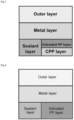
- the sealant layer consists of an Extrusion Coating (EC) layer (mainly an extruded polypropylene layer) and a polypropylene (PP) layer resin, preferably a cast polypropylene (CPP) layer (or film) underneath (inward with respect to the pouch film) (see FIG. 1 ).
- EC Extrusion Coating
- PP polypropylene
- CPP cast polypropylene
- the non-lamination extrusion method is a method of forming a sealant layer during the manufacture of a cell pouch film by extruding (or co-extruding) a polyolefin-based resin, preferably a polypropylene-based resin, directly onto the barrier layer, instead of joining (laminating) the sealing resin layer or film such as a polypropylene-based resin with the barrier layer, as in the case of extrusion lamination or solvent dry lamination.
- the sealant layer consists of a layer by extrusion, e.g. a polypropylene layer by extrusion.
- Such a sealant layer by non-lamination extrusion may also be formed by co-extruding a first extruded layer and a second extruded layer.
- the inventors of the present disclosure have found that when a sealant layer is formed by performing a non-lamination extrusion method, the glass transition temperature (Tg) of the sealant layer is -10°C to -7°C, and the crystallinity of the sealant layer measured by the following method is controlled to 28% to 32%, the sealing strength may be maintained or increased under high-temperature conditions after being left for 10 minutes at 60°C, and thus the high-temperature stability is excellent, which may prevent leakage of electrolyte even during use of the battery in high-temperature environments and secure battery safety.
- Tg glass transition temperature
- the high-temperature sealing strength property is an essential property for the safety of medium and large-sized batteries such as automotive batteries, and by performing a non-lamination extrusion method while controlling the glass transition temperature (Tg) of the sealant layer to -10°C ⁇ -7°C and the crystallinity of the sealant layer measured by the following method to 28-32%, the sealing strength may be surprisingly maintained or increased under high-temperature conditions (measured after 10 minutes at 60°C).
- Tg glass transition temperature
- the glass transition temperature (Tg) of the sealant layer may be -10°C ⁇ -7°C, preferably -9.5°C ⁇ -7°C, more preferably -9°C ⁇ -7°C. It may be seen that it is advantageous for high-temperature sealing strength when the sealant layer has a relatively high glass transition temperature (Tg). If the glass transition temperature (Tg) of the sealant layer is less than the above -10°C, the high-temperature sealing strength may be reduced, as may be seen from the data described below.
- the glass transition temperature (Tg) of the sealant layer may be at least -10°C, at least -9.5°C, at least -9°C, at least -8.5°C, at least -8°C, or at least -7.5°C. Alternatively, it may be -7°C or less, -7.5°C or less, -8°C or less, -8.5°C or less, -9°C or less, or -9.5°C or less.
- the crystallinity of the sealant layer may be 28-32%, preferably 28.5-31.5%, more preferably 29-30%. It may be seen that a relatively low crystallinity is advantageous in terms of the fluidity of the polymer, which is advantageous for sealing strength at high temperatures. If the crystallinity of the sealant layer is greater than the above 32%, the high-temperature sealing strength may be reduced, as may be seen from the data described below.
- the crystallinity of the sealant layer may be at least 28%, at least 28.5%, at least 29%, at least 29.5%, at least 30%, at least 30.5%, at least 31%, or at least 31.5%. Alternatively, it may be 32% or less, 31.5% or less, 31% or less, 30.5% or less, 30% or less, 29.5% or less, 29% or less, or 28.5% or less.
- the aforementioned glass transition temperature (Tg) or crystallinity may vary depending on the type of resin used in the sealant layer, such as the commonly used polypropylene-based resin, as known in the art, and may be appropriately adjusted by a skilled person in the art, for example, by changing the content of the main polymer of the polypropylene-based resin (changing the homopolypropylene or block polypropylene polymer content) or by using low molecular weight additives such as rubber components.
- the cell pouch film may have a sealing strength in the TD direction when sealed at 180°C for 2 seconds that is at least -5%, such as within a range of -5% to 20%, or -3% to 15%, or -2% to 14%, at high temperature relative to ambient temperature.
- the cell pouch film may have a sealing strength in the TD direction when sealed at 200°C for 2 seconds that is at least 1%, such as within a range of 1% to 20%, or 2% to 15%, or 2% to 14%, at high temperature relative to ambient temperature.
- the cell pouch film may have a sealing strength in the TD direction when sealed at 220°C for 2 seconds that is at least -5%, such as within a range of -5% to 30%, or -3% to 29%, or -1% to 27%, at high temperature relative to ambient temperature.
- the cell pouch film may have a sealing strength in the MD direction when sealed at 180°C for 2 seconds that is at least 1%, such as within a range of 1% to 10%, or 3% to 8%, or 4% to 7%, at high temperature relative to ambient temperature.
- the cell pouch film may have a sealing strength in the MD direction when sealed at 200°C for 2 seconds that is at least 10%, such as within a range of 10% to 30%, or 15% to 25%, or 20% to 25%, at high temperature relative to ambient temperature.
- the cell pouch film may have a sealing strength in the MD direction when sealed at 220°C for 2 seconds that is at least -5%, such as within a range of -5% to 45%, or -4% to 40%, or -4% to 38%, at high temperature relative to ambient temperature.
- the cell pouch film may be such that the average value of the increase ratio of the high-temperature sealing strength in the TD direction of the following [Formula 1] in each case of sealing at 180°C for 2 seconds, sealing at 200°C for 2 seconds, and sealing at 220°C for 2 seconds is within the range of -1% to 20%, or -0.4% to 18.2%.
- the cell pouch film may be such that the average value of the increase ratio of the high-temperature sealing strength in the MD direction of the following [Formula 2] in each case of sealing at 180°C for 2 seconds, sealing at 200°C for 2 seconds, and sealing at 220°C for 2 seconds is within the range of 5% to 25%, or 7.6% to 21.5%.
- the cell pouch film may be such that the sum of the high-temperature sealing strength in the TD direction minus the ambient temperature sealing strength in the TD direction and the high-temperature sealing strength in the MD direction minus the ambient temperature sealing strength in the MD direction in each case of sealing at 180°C, 200°C, and 220°C for 2 seconds is within the range of -10 to 70 N/15mm, or -6 to 67 N/15mm.
- the outer layer may be formed of nylon, polyethylene terephthalate (PET), polybutylene terephthalate (PBT), a mixed layer of nylon and PET, and the like.
- the outer layer may preferably be a PET film of 7 to 12pm on the outermost side and a nylon film of 20 to 30pm on the inner side.
- the metal layer may be formed of a metal such as aluminum, SUS, or copper, and is moisture permeable and impact resistant.
- the polypropylene (CPP) layer of the sealant layer may contain various additives (rubber, elastomer, slip agent, etc.) depending on the required properties.
- the total thickness of the secondary battery pouch film may be, for example, 60 to 185 pm.
- the secondary battery pouch film may be 153 pm or more or 113 pm or less.
- the thickness of the metal layer, which is the barrier layer may be, for example, 20 to 80 pm, preferably 40 to 60 pm.
- the thickness of the sealant layer may be, for example, 20 to 80 pm.
- a method for preparing a secondary battery pouch film according to exemplary embodiments of the present disclosure includes forming a sealant layer by extruding polypropylene resin on a barrier layer, wherein the glass transition temperature (Tg) of the sealant layer is between -10°C and -7°C, and the crystallinity of the sealant layer measured by the method described above is between 28% and 32%.
- Tg glass transition temperature
- a secondary battery encased with the aforementioned secondary battery pouch film.
- a secondary battery may be, for example, a lithium-ion battery, and in particular, a medium to large-scale secondary battery for an electric vehicle (EV) or energy storage system (ESS).
- EV electric vehicle
- ESS energy storage system
- exemplary embodiments of the present disclosure provide a method for manufacturing a secondary battery including encasing the secondary battery with the aforementioned secondary cell pouch film as described above.
- the outer layer is composed of a PET and nylon composite layer, and the metal layer is aluminum foil.
- the Examples are formed by extruding polypropylene onto a barrier layer (non-lamination extrusion method), while the Comparative Examples are prepared by extrusion-lamination method in which polypropylene is extruded on a polypropylene (PP) layer and bonded to the barrier layer.
- the thickness of the metal layer, the respective thicknesses of the extruded and PP layers of the sealant layer, and the glass transition temperature, enthalpy, and crystallinity of the sealant layer are shown in Table 1.
- the total thickness of the pouch film is shown in Table 3 below.
- sealing strength, defect (defective product) evaluation, and burst tests were performed as follows.
- the specimen is prepared by cutting the cell pouch film to 200 mm across (MD) and 100 mm down (TD).
- the specimen is heat sealed in the MD direction.
- the sealing conditions are as follows.
- the specimen prepared above is cut to a 15 mm width in the longitudinal (TD) direction, and both sides of the film are held in a universal testing machine (UTM) jig for 90 degree peeling (UTM equipment: AGS-X by SIMADZU).
- UTM equipment AGS-X by SIMADZU.
- Sealing strength is measured at ambient temperature and high-temperature conditions. The maximum strength is expressed as the sealing strength.
- the unit is N/15mm.
- the sealant layer is delaminated from the aforementioned specimen (the sealant layer is delaminated from the specimen before measuring the sealing strength).
- the specimen is completely immersed in a solution of FLOIL (Remover 200) from KantoKasei. Once the sealant layer is removed from the specimen, it is wiped with a rag or cotton tissue, washed with ethanol, wiped again with cotton tissue, and dried at ambient temperature.
- FLOIL Remover 200
- DSC250 equipment by TA is used.
- the measurement conditions are as follows: at a temperature range of -50°C to 200°C, with a heating rate of 10°C/min and a cooling rate of -20°C/min.
- the Tg value is calculated using an analysis program (TRIOS) at -50°C, which is the approximate Tg value range of polypropylene.
- DSC250 equipment by TA is used, as the same as the Tg measurement method.
- the measurement conditions are as follows: at a temperature range of -50°C to 200°C, with a heating rate of 10°C/min and a cooling rate of - 20°C/min.
- the value of crystallinity is calculated by obtaining the enthalpy of Tc ( ⁇ (J/g)) through the analysis program (TRIOS) and dividing it by the enthalpy of 100% crystallization of general isopolypropylene (Iso-PP), which is 209 J/g.
- Iso-PP general isopolypropylene
- the Tg value is about - 8°C for Examples 1 and 2, and about -11°C to -14°C for the Comparative Examples. From Table 1 and Table 2, it can be seen that Examples 1 and 2 with higher Tg values increase or maintain sealing strength at high temperatures. Therefore, it can be seen that a relatively high Tg value of the sealant layer is advantageous for high-temperature sealing strength.
- the crystallinity is 29.7% and 31.4% for Examples 1 and 2, and 33% or more for the Comparative Examples.
- a relatively low crystallinity is advantageous in terms of the fluidity of the polymer, and advantageous for sealing strength at high temperatures.
- a cell pouch film in which the sealant layer consists only of an extruded layer and has a certain glass transition temperature and crystallinity is advantageous for high-temperature sealing strength.
- the cell pouch film iss foamed to 12 mm and then three-way sealed.
- the cell pouch is filled with red penetrant and water. The one remaining direction is sealed.
- the sealing width is 2 mm, the time is 2 seconds, and the pressure is 0.2 MPa.
- the number of defects (high-temperature defects) is obtained and summed, i.e., the number of defects (high-temperature defects) among a total of 30 samples of 10 samples at 180°C, 10 samples at 200°C, and 10 samples at 220°C is determined.
- the criterion for defects is when the seal bursts, i.e., when red penetrant leaks out of the seal during pressing after sealing.
- the average value of the high-temperature sealing strength increase (%) of the sealing temperatures in the Examples is at least -0.4% (TD direction) and at least 7.6% (MD direction), and it can be seen that the Examples are particularly superior to the Comparative Examples, with less than 10 high-temperature failures.
- the cell pouch film is foamed to 12 mm and then three-way sealed.
- the cell pouch is filled with red penetrant and water. The one remaining direction is sealed.
- the sealing width is 2 mm, the time is 2 seconds, and the pressure is 0.2 MPa.
- [Table 6] shows the values of high-temperature sealing strength in the TD direction minus ambient temperature sealing strength in the TD direction ("TD high temperature-ambient temperature” in the left table below) and the high-temperature sealing strength in the MD direction minus the ambient temperature sealing strength in the MD direction (“MD high temperature-ambient temperature” in the right table below) for each case of sealing at 180°C, 200°C, and 220°C for 2 seconds, and their sums ["TD high temperature-ambient temperature” + "high temperature-ambient temperature”].
- [Table 7] shows the sum values and the air pressure according to the burst test (pressuring test) (after one day in a 60°C chamber).
Landscapes
- Chemical & Material Sciences (AREA)
- Chemical Kinetics & Catalysis (AREA)
- Electrochemistry (AREA)
- General Chemical & Material Sciences (AREA)
- Engineering & Computer Science (AREA)
- Mechanical Engineering (AREA)
- Inorganic Chemistry (AREA)
- Sealing Battery Cases Or Jackets (AREA)
- Aviation & Aerospace Engineering (AREA)
- Secondary Cells (AREA)
Abstract
Description
- The present disclosure relates to a high-temperature sealing strength-maintaining or increasing cell pouch film, and a method for preparing the same, and specifically, the present disclosure relates to a cell pouch film wherein the sealant layer is formed by extrusion, and the high-temperature sealing strength may be maintained or increased by controlling a glass transition temperature and crystallinity of a sealant layer, a method for preparing the same, a secondary battery using the same, and a method for manufacturing the secondary battery.
- [National Research and Development Project Supporting The Present Invention]
- [Assignment unique number] 1415181922
- [Assignment number] 20022450
- [Name of ministry] Ministry of Trade, Industry and Energy
- [Name of project management organization] Korea Institute of Industrial Technology Evaluation and Planning
- [Research project name] Material/Parts Package Type (Top Company)
- [Research assignment name] Development of a next-generation secondary battery pouch capable of realizing more than twice the high adhesive strength at 60°C
- [Contribution rate] 1/1
- [Name of agency in charge of assignment] Youlchon Chemical Co., Ltd.
- [Research period] 2022-09-01 ~ 2022-12-31
- [Assignment unique number] 1415185612
- [Assignment number] 20022450
- [Name of ministry] Ministry of Trade, Industry and Energy
- [Name of project management organization] Korea Institute of Industrial Technology Evaluation and Planning
- [Research project name] Material/Parts Package Type (Top Company)
- [Research assignment name] Development of a next-generation secondary battery pouch capable of realizing more than twice the high adhesive strength at 60°C
- [Contribution rate] 1/1
- [Name of agency in charge of assignment] Youlchon Chemical Co., Ltd.
- [Research period] 2023-01-01 ~ 2023-12-31
- Lithium secondary batteries (LiB) are being applied to many applications based on various advantages such as high energy density and excellent output.
- As a laminated film for encasing a secondary battery, with a multilayer structure that surrounds an electrode group and an electrolyte of the secondary battery, a secondary battery pouch film is a key component material that determines the battery's stability, lifespan characteristics, and operational sustainability and requires mechanical flexibility and strength, high oxygen/water vapor barrier properties, high thermal sealing strength, chemical resistance to electrolyte solutions, electrical insulation, and high temperature stability, etc.
- Cell pouch films typically consist of an outer layer, a barrier layer and an inner sealant layer.
- The outer or outermost layer is composed of nylon or a blend of nylon and PET (polyethylene terephthalate), OPP (oriented polypropylene), polyethylene, and the like. The required properties of these outer layers or outermost layers include heat resistance, pinhole resistance, chemical resistance, formability, and insulation, etc.
- The barrier layer requires formability as well as barrier properties against water vapor and other gases. In this respect, metals with formability such as aluminum (Al), iron (Fe), copper (Cu), and nickel (Ni) etc. are used in the barrier layer, and aluminum is currently used the most.
- Since the sealant layer which is an inner layer is in contact with the electrolyte, it requires electrolyte resistance, and insulation resistance etc. as well as thermal adhesiveness and formability.
- Meanwhile, a heat sealing is to make the inner surfaces (sealant layer) of the cell pouch film face each other, and then apply heat to seal them, so as to make the cell pouch film into a cell pouch.
- The reason why heat sealing of the cell pouch film is important is that if the sealing is poor or weak, the electrolyte may leak out and the battery will not function properly.
- In particular, the reason for measuring sealing strength at high temperatures regarding the heat sealing is that batteries are subjected to high temperatures during use, and if the sealing strength is weak at high temperatures, the sealing may lead to a leakage during use, which in turn may lead to a battery explosion.
- Such seal stability at high temperatures is required for medium-sized and large-sized batteries for automotive and ESS applications with high safety requirements, but it is not easy to achieve and maintain high sealing strength at high temperatures in the actual manufacturing of pouch films for medium-sized and large-sized secondary batteries.
- In exemplary embodiments of the present disclosure, there are provided, in one aspect, a cell pouch film wherein its sealing strength may be maintained or increased at high temperature, a method for preparing the same, a secondary battery using the same, and a method for manufacturing the secondary battery.
- In exemplary embodiments of the present disclosure, there are provided, in another aspect, a cell pouch film wherein its sealing strength may be maintained or increased at high temperature, thereby having excellent high-temperature stability and preventing leakage of electrolyte and securing battery safety even during battery use in a high-temperature environment, a method for preparing the same, a secondary battery using the same, and a method for manufacturing the secondary battery.
- In exemplary embodiments of the present disclosure, there is provided a cell pouch film, comprising at least an outer layer, a barrier layer, and a sealant layer structured in that order, wherein the sealant layer is formed by non-lamination extrusion on the barrier layer, wherein the sealant layer has a glass transition temperature (Tg) of -10°C to -7°C, and wherein a crystallinity of the sealant layer, as measured by a method below, is 28% to 32%.
- Crystallinity of a sealant layer delaminated from a cell pouch film is measured using DSC equipment at a temperature range of -50°C to 200°C, with a heating rate of 10°C/min and a cooling rate of -20°C/min.
- A crystallinity value is expressed as a percentage where an enthalpy value (△H (J/g)) at a crystallization temperature (Tc) is divided by 100% crystallization enthalpy value of isopolypropylene (Iso-PP), which is 209 J/g.
- According to an exemplary embodiment, a sealing strength of the cell pouch film in a TD direction when sealed at 180°C for 2 seconds may be at least -5% at high temperature relative to ambient temperature.
- According to an exemplary embodiment, a sealing strength of the cell pouch film in the TD direction when sealed at 200°C for 2 seconds may be at least 1% at high temperature relative to ambient temperature.
- According to an exemplary embodiment, a sealing strength of the cell pouch film in the TD direction when sealed at 220°C for 2 seconds may be at least -5% at high temperature relative to ambient temperature.
- According to an exemplary embodiment, a sealing strength of the cell pouch film in a MD direction when sealed at 180°C for 2 seconds may be at least 1% at high temperature relative to ambient temperature.
- According to an exemplary embodiment, a sealing strength of the cell pouch film in the MD direction when sealed at 200°C for 2 seconds may be at least 10% at high temperature relative to ambient temperature.
- According to an exemplary embodiment, a sealing strength of the cell pouch film in the MD direction when sealed at 220°C for 2 seconds may be at least -5% at high temperature relative to ambient temperature.
- According to an exemplary embodiment, an average value of an increase ratio of a high-temperature sealing strength of the cell pouch film in the TD direction of the following [Formula 1] for each case of sealing at 180°C for 2 seconds, sealing at 200°C for 2 seconds, and sealing at 220°C for 2 seconds may be within a range of -1% to 20%.

- According to an exemplary embodiment, an average value of an increase ratio of a high-temperature sealing strength of the cell pouch film in the MD direction of the following [Formula 2] for each case of sealing at 180°C for 2 seconds, sealing at 200°C for 2 seconds, and sealing at 220°C for 2 seconds may be within the range of 5% to 25%.

- According to an exemplary embodiment, a sum of <the high-temperature sealing strength of the cell pouch film in the TD direction minus the ambient temperature sealing strength of the cell pouch film in the TD direction> and <the high-temperature sealing strength of the cell pouch film in the MD direction minus the ambient temperature sealing strength of the cell pouch film in the MD direction> for each case of sealing at 180°C, 200°C, and 220°C for 2 seconds may be within the range of -10 to 70 N/15mm.
- In addition, in exemplary embodiments of the present disclosure, provided is a method for preparing the aforementioned cell pouch film, comprising forming a sealant layer by extruding by non-lamination extrusion on a barrier layer, wherein the sealant layer has a glass transition temperature (Tg) of -10°C to -7°C, and wherein a crystallinity of the sealant layer, as measured by a method below, is 28% to 32%.
- Crystallinity of a sealant layer delaminated from a cell pouch film is measured using DSC equipment at a temperature range of -50°C to 200°C, with a heating rate of 10°C/min and a cooling rate of -20°C/min.
- A crystallinity value is expressed as a percentage where an enthalpy value (△H (J/g)) at a crystallization temperature (Tc) is divided by 100% crystallization enthalpy value of isopolypropylene (Iso-PP), which is 209 J/g.
- In addition, in exemplary embodiments of the present disclosure, provided is a secondary battery encased in the aforementioned cell pouch film.
- According to an exemplary embodiment, the secondary battery may be for use in an electric vehicle or energy storage device.
- In addition, in exemplary embodiments of the present disclosure, provided is a method for manufacturing a secondary battery, comprising encasing the secondary battery in the aforementioned cell pouch film.
- In exemplary embodiments of the present disclosure, the sealing strength of a cell pouch film may be maintained or increased at high temperatures. Consequently, the cell pouch film can exhibit excellent high-temperature stability, preventing electrolyte leakage and reducing defects during battery usage in high-temperature environments, thereby ensuring battery safety.
- These secondary battery pouch films are useful for medium-sized to large-sized secondary battery pouches for electric vehicles and energy storage devices that require safety, especially high-temperature safety.
- The above and other aspects, features and advantages of the disclosed exemplary embodiments will be more apparent from the following detailed description taken in conjunction with the accompanying drawings in which:
-
FIG. 1 is a schematic diagram illustrating a configuration of a cell pouch film prepared by extrusion lamination. -
FIG. 2 is a schematic diagram illustrating a configuration of a cell pouch film prepared by a non-lamination extrusion method. - Exemplary embodiments are described more fully hereinafter. The invention may, however, be embodied in many different forms and should not be construed as limited to the exemplary embodiments set forth herein. Rather, these exemplary embodiments are provided so that this disclosure will be thorough and complete, and will fully convey the scope of the invention to those skilled in the art. In the description, details of features and techniques may be omitted to more clearly disclose exemplary embodiments.
- In this disclosure, when a secondary battery pouch film includes layer(s), the secondary battery pouch does not necessarily consist of only that layer, and additional layers may be included therein.
- In this disclosure, being formed "on" a specific layer includes not only being formed directly on that layer, but also being formed after interposing another additional layer in between.
- In this disclosure, Extrusion Coating (EC) layer in the sealant layers refers to a layer of an extruded resin, such as a polyolefin-based resin, preferably a polypropylene-based resin, serving as a bonding layer with the barrier layer (in the case of an extrusion lamination method) or serving as a sealing layer as well as a bonding layer with the barrier layer (in the case of a non-lamination extrusion method).
- As used herein, maintaining or increasing of sealing strength at high temperature means that the increase ratio in the high-temperature sealing strength over the ambient temperature sealing strength, i.e., [(high-temperature sealing strength - ambient temperature sealing strength)/ambient temperature sealing strength]x100, is at least -5%. An increase ratio of -5% to 0% in the high-temperature sealing strength may be considered to mean that the sealing strength is maintained, even if it is a negative value.
- MD is herein used as an abbreviation for machine direction.
- TD is herein used as an abbreviation for transverse direction.
- Ambient temperature herein may refer to a temperature of 20 ± 5 °C.
- High temperature herein may refer to a temperature of 60 °C.
- Exemplary implementations of the present disclosure are described below.
- When preparing a secondary battery pouch, there are three methods for manufacturing a sealant layer: non-lamination extrusion, extrusion lamination, and solvent-dry lamination (hereinafter, "SDL").
- The solvent dry lamination method is a method of bonding a barrier layer (metal layer) using a solvent-based adhesive on a polypropylene (PP) layer and drying the solvent-based adhesive, so that the sealant layer produced is composed of a polypropylene (PP) layer. The solvent-based adhesive may remain in the polypropylene (PP) layer after drying, but it is present in a thickness of about 4 pm or less and is insignificant, so its thickness may be neglected.
- The extrusion lamination method is a method of extruding a polypropylene-based resin layer, preferably a polyolefin-based resin, preferably a polypropylene resin, which is mainly used as a sealing resin for a sealant layer, especially a cast polypropylene (CPP) resin layer, when bonding a barrier layer (metal layer). As a result, the sealant layer consists of an Extrusion Coating (EC) layer (mainly an extruded polypropylene layer) and a polypropylene (PP) layer resin, preferably a cast polypropylene (CPP) layer (or film) underneath (inward with respect to the pouch film) (see
FIG. 1 ). - On the other hand, the non-lamination extrusion method is a method of forming a sealant layer during the manufacture of a cell pouch film by extruding (or co-extruding) a polyolefin-based resin, preferably a polypropylene-based resin, directly onto the barrier layer, instead of joining (laminating) the sealing resin layer or film such as a polypropylene-based resin with the barrier layer, as in the case of extrusion lamination or solvent dry lamination. As a result, the sealant layer consists of a layer by extrusion, e.g. a polypropylene layer by extrusion. Such a sealant layer by non-lamination extrusion may also be formed by co-extruding a first extruded layer and a second extruded layer.
- The inventors of the present disclosure have found that when a sealant layer is formed by performing a non-lamination extrusion method, the glass transition temperature (Tg) of the sealant layer is -10°C to -7°C, and the crystallinity of the sealant layer measured by the following method is controlled to 28% to 32%, the sealing strength may be maintained or increased under high-temperature conditions after being left for 10 minutes at 60°C, and thus the high-temperature stability is excellent, which may prevent leakage of electrolyte even during use of the battery in high-temperature environments and secure battery safety.
- The high-temperature sealing strength property is an essential property for the safety of medium and large-sized batteries such as automotive batteries, and by performing a non-lamination extrusion method while controlling the glass transition temperature (Tg) of the sealant layer to -10°C~-7°C and the crystallinity of the sealant layer measured by the following method to 28-32%, the sealing strength may be surprisingly maintained or increased under high-temperature conditions (measured after 10 minutes at 60°C).
- According to an exemplary embodiment, the glass transition temperature (Tg) of the sealant layer may be -10°C ~ -7°C, preferably -9.5°C ~ -7°C, more preferably -9°C ~ -7°C. It may be seen that it is advantageous for high-temperature sealing strength when the sealant layer has a relatively high glass transition temperature (Tg). If the glass transition temperature (Tg) of the sealant layer is less than the above -10°C, the high-temperature sealing strength may be reduced, as may be seen from the data described below.
- In a non-limiting example, the glass transition temperature (Tg) of the sealant layer may be at least -10°C, at least -9.5°C, at least -9°C, at least -8.5°C, at least -8°C, or at least -7.5°C. Alternatively, it may be -7°C or less, -7.5°C or less, -8°C or less, -8.5°C or less, -9°C or less, or -9.5°C or less.
- According to an exemplary embodiment, the crystallinity of the sealant layer may be 28-32%, preferably 28.5-31.5%, more preferably 29-30%. It may be seen that a relatively low crystallinity is advantageous in terms of the fluidity of the polymer, which is advantageous for sealing strength at high temperatures. If the crystallinity of the sealant layer is greater than the above 32%, the high-temperature sealing strength may be reduced, as may be seen from the data described below.
- In a non-limiting example, the crystallinity of the sealant layer may be at least 28%, at least 28.5%, at least 29%, at least 29.5%, at least 30%, at least 30.5%, at least 31%, or at least 31.5%. Alternatively, it may be 32% or less, 31.5% or less, 31% or less, 30.5% or less, 30% or less, 29.5% or less, 29% or less, or 28.5% or less.
- According to an exemplary embodiment, the aforementioned glass transition temperature (Tg) or crystallinity may vary depending on the type of resin used in the sealant layer, such as the commonly used polypropylene-based resin, as known in the art, and may be appropriately adjusted by a skilled person in the art, for example, by changing the content of the main polymer of the polypropylene-based resin (changing the homopolypropylene or block polypropylene polymer content) or by using low molecular weight additives such as rubber components.
- According to an exemplary embodiment, the cell pouch film may have a sealing strength in the TD direction when sealed at 180°C for 2 seconds that is at least -5%, such as within a range of -5% to 20%, or -3% to 15%, or -2% to 14%, at high temperature relative to ambient temperature.
- According to an exemplary embodiment, the cell pouch film may have a sealing strength in the TD direction when sealed at 200°C for 2 seconds that is at least 1%, such as within a range of 1% to 20%, or 2% to 15%, or 2% to 14%, at high temperature relative to ambient temperature.
- According to an exemplary embodiment, the cell pouch film may have a sealing strength in the TD direction when sealed at 220°C for 2 seconds that is at least -5%, such as within a range of -5% to 30%, or -3% to 29%, or -1% to 27%, at high temperature relative to ambient temperature.
- According to an exemplary embodiment, the cell pouch film may have a sealing strength in the MD direction when sealed at 180°C for 2 seconds that is at least 1%, such as within a range of 1% to 10%, or 3% to 8%, or 4% to 7%, at high temperature relative to ambient temperature.
- According to an exemplary embodiment, the cell pouch film may have a sealing strength in the MD direction when sealed at 200°C for 2 seconds that is at least 10%, such as within a range of 10% to 30%, or 15% to 25%, or 20% to 25%, at high temperature relative to ambient temperature.
- According to an exemplary embodiment, the cell pouch film may have a sealing strength in the MD direction when sealed at 220°C for 2 seconds that is at least -5%, such as within a range of -5% to 45%, or -4% to 40%, or -4% to 38%, at high temperature relative to ambient temperature.
- According to an exemplary embodiment, the cell pouch film may be such that the average value of the increase ratio of the high-temperature sealing strength in the TD direction of the following [Formula 1] in each case of sealing at 180°C for 2 seconds, sealing at 200°C for 2 seconds, and sealing at 220°C for 2 seconds is within the range of -1% to 20%, or -0.4% to 18.2%.

- According to an exemplary embodiment, the cell pouch film may be such that the average value of the increase ratio of the high-temperature sealing strength in the MD direction of the following [Formula 2] in each case of sealing at 180°C for 2 seconds, sealing at 200°C for 2 seconds, and sealing at 220°C for 2 seconds is within the range of 5% to 25%, or 7.6% to 21.5%.

- According to an exemplary embodiment, the cell pouch film may be such that the sum of the high-temperature sealing strength in the TD direction minus the ambient temperature sealing strength in the TD direction and the high-temperature sealing strength in the MD direction minus the ambient temperature sealing strength in the MD direction in each case of sealing at 180°C, 200°C, and 220°C for 2 seconds is within the range of -10 to 70 N/15mm, or -6 to 67 N/15mm.
- According to an exemplary embodiment, the outer layer may be formed of nylon, polyethylene terephthalate (PET), polybutylene terephthalate (PBT), a mixed layer of nylon and PET, and the like. In a non-limiting example, the outer layer may preferably be a PET film of 7 to 12pm on the outermost side and a nylon film of 20 to 30pm on the inner side.
- According to an exemplary embodiment, the metal layer may be formed of a metal such as aluminum, SUS, or copper, and is moisture permeable and impact resistant.
- According to an exemplary embodiment, the polypropylene (CPP) layer of the sealant layer may contain various additives (rubber, elastomer, slip agent, etc.) depending on the required properties.
- According to an exemplary embodiment, the total thickness of the secondary battery pouch film may be, for example, 60 to 185 pm. In an exemplary embodiment, the secondary battery pouch film may be 153 pm or more or 113 pm or less.
- According to an exemplary embodiment, the thickness of the metal layer, which is the barrier layer, may be, for example, 20 to 80 pm, preferably 40 to 60 pm.
- According to an exemplary embodiment, the thickness of the sealant layer may be, for example, 20 to 80 pm.
- A method for preparing a secondary battery pouch film according to exemplary embodiments of the present disclosure includes forming a sealant layer by extruding polypropylene resin on a barrier layer, wherein the glass transition temperature (Tg) of the sealant layer is between -10°C and -7°C, and the crystallinity of the sealant layer measured by the method described above is between 28% and 32%.
- Meanwhile, exemplary embodiments of the present disclosure provide a secondary battery encased with the aforementioned secondary battery pouch film. Such a secondary battery may be, for example, a lithium-ion battery, and in particular, a medium to large-scale secondary battery for an electric vehicle (EV) or energy storage system (ESS).
- In addition, exemplary embodiments of the present disclosure provide a method for manufacturing a secondary battery including encasing the secondary battery with the aforementioned secondary cell pouch film as described above.
- Exemplary embodiments of the present disclosure are described in more detail in the following examples. The embodiments disclosed herein are illustrated for purposes of illustration only, and embodiments of the present disclosure may be practiced in various forms and the scope of the present disclosure should not be construed as being limited to the embodiments described herein.
- In the Examples and Comparative Examples, the outer layer is composed of a PET and nylon composite layer, and the metal layer is aluminum foil.
- The Examples are formed by extruding polypropylene onto a barrier layer (non-lamination extrusion method), while the Comparative Examples are prepared by extrusion-lamination method in which polypropylene is extruded on a polypropylene (PP) layer and bonded to the barrier layer. The thickness of the metal layer, the respective thicknesses of the extruded and PP layers of the sealant layer, and the glass transition temperature, enthalpy, and crystallinity of the sealant layer are shown in Table 1. The total thickness of the pouch film is shown in Table 3 below.
[Table 1] Sealant layer Ratio of layers Tg ΔH(J/g) crystallini ty Al Sealant layer thickness Extrude d layer PP layer Example 1 60 80 80 0 0:80 -8.68°C 62.045 29.7% Example 2 40 80 80 0 0:80 -8.29°C 65.545 31.4% Comparativ e Example 1 60 80 30 50 50:80 -13.41°C 72.687 34.8% Comparativ e Example 2 40 80 30 50 50:80 -14.37°C 70.229 33.6% Comparativ e Example 3 60 100 30 70 70:100 -14.23°C 72.479 34.7% Comparativ e Example 4 40 110 40 70 70:110 -13.95°C 71.245 33.9% Comparativ e Example 5 40 80 40 40 40:80 -11.89°C 69.743 33.2% Comparativ e Example 6 60 80 40 40 40:80 -11.73°C 69.395 33.4% Comparativ e Example 7 40 80 0 80 80:80 -14.31°C 74.256 36.2% - For the above Examples and Comparative Examples, sealing strength, defect (defective product) evaluation, and burst tests were performed as follows.
- The specimen is prepared by cutting the cell pouch film to 200 mm across (MD) and 100 mm down (TD).
- The specimen is heat sealed in the MD direction.
- The sealing conditions are as follows.
- (1) Sealing time: 2.0 seconds
- (2) Sealing temperature: Each 180°C, 200°C, 220°C
- (3) Sealing pressure: 0.2MPa
- The specimen prepared above is cut to a 15 mm width in the longitudinal (TD) direction, and both sides of the film are held in a universal testing machine (UTM) jig for 90 degree peeling (UTM equipment: AGS-X by SIMADZU).
- Sealing strength is measured at ambient temperature and high-temperature conditions. The maximum strength is expressed as the sealing strength. The unit is N/15mm.
- (1) Ambient temperature conditions: Measurement speed (10mpm)
- (2) High-temperature conditions: The measurement is performed under the same conditions as the ambient temperature measurement above, but after being placed in a 60°C heat chamber for 3 minutes. The heat chamber is a TCE-N300 from SIMADZU.
- The sealant layer is delaminated from the aforementioned specimen (the sealant layer is delaminated from the specimen before measuring the sealing strength). For this purpose, the specimen is completely immersed in a solution of FLOIL (Remover 200) from KantoKasei. Once the sealant layer is removed from the specimen, it is wiped with a rag or cotton tissue, washed with ethanol, wiped again with cotton tissue, and dried at ambient temperature.
- DSC250 equipment by TA is used. The measurement conditions are as follows: at a temperature range of -50°C to 200°C, with a heating rate of 10°C/min and a cooling rate of -20°C/min.
- The Tg value is calculated using an analysis program (TRIOS) at -50°C, which is the approximate Tg value range of polypropylene.
- DSC250 equipment by TA is used, as the same as the Tg measurement method. The measurement conditions are as follows: at a temperature range of -50°C to 200°C, with a heating rate of 10°C/min and a cooling rate of - 20°C/min. The value of crystallinity is calculated by obtaining the enthalpy of Tc (△(J/g)) through the analysis program (TRIOS) and dividing it by the enthalpy of 100% crystallization of general isopolypropylene (Iso-PP), which is 209 J/g. The results are shown in [Table 2] below.
[Table 2] Di re cti on Sealing strength (180°C 2.0 sec) (N/15mm) Sealing strength (200°C 2.0 sec) (N/15mm) Sealing strength (220°C 2.0 sec) (N/15mm) Amb ient tern P High temp (after leaving for 3 min at 60°C) High temp sealing strength increase (%) Ambi ent temp High temp (after leaving for 3 min at 60°C) High temp sealing strength increase (%) Ambie nt temp High temp (after leaving for 3 min at 60°C) High temp sealing strength increase (%) Example 1 M D 112. 3 120.3 7.1% 90 107.7 19.7% 101.9 140.2 37.6% T D 89.6 101.7 13.5 % 100.8 114.9 14.0% 105.4 133.9 27.0% Example 2 M D 99.9 103.8 3.9 % 107.9 132.9 23.2% 113.5 108.8 -4.1% T D 105. 6 103.8 -1.7% 115.6 117.4 1.6% 124.6 123.2 -1.1% Comparative Example 1 M D 104. 3 59.4624 -43.0% 112.3 82.6736 -26.4% 113.7 94.9312 -16.5% T D 93.3 7 67.2212 -28.0% 118.9 82.478 -30.6% 123.4 102.186 -17.2% Comparative Example 2 M D 88.6 1 63.7656 -28.0% 101.5 66.2432 -34.7% 101.3 75.8276 -25.2% T D 96.5 6 72.698 -24.7% 95.32 71.068 -25.4% 98.84 77.5228 -21.6% Comparative Example 3 M D 100 89.0632 -11.0% 120.3 101.43 -15.7% 131.2 98.847 -24.7% T D 108. 7 75.1104 -30.9% 105.3 92.9752 -11.7% 128.2 93.1708 -27.3% Comparative Example 4 M D 93.7 6 80.6524 -14.0% 107.1 85.6076 -20.0% 123.4 93.7576 -24.0% T D 99.6 9 80.7176 -19.0% 103.3 81.5652 -21.0% 127 97.7348 -23.0% Comparative Example 5 M D 103. 8 86.1292 -17.0% 113.2 101.8424 -10.0% 114.3 101.619 -11.1% T D 102. 5 90.1716 -12.0% 111 100.9948 -9.0% 113.3 101.748 -10.2% Comparative Example 6 M D 105. 7 91.932 -13.0% 116.2 103.4072 -11.0% 119.4 103.32 -13.5% T D 97.4 1 81.826 -16.0% 106.3 92.5188 -13.0% 111.6 101.5816 -9.0% Comparative Example 7 M D 89.4 5 69.764 -22.0% 92.26 74.7192 -19.0% 94.47 77.4576 -18.0% T D 86.4 6 70.0248 -19.0% 90.37 76.8056 -15.0% 92.65 76.8708 -17.0% - As can be seen from [Table 1] and [Table 2] above, in the case of Examples 1 and 2, the sealant layer consists only of an extruded layer, while in the case of Comparative Examples 1, 2, and 3, the sealant layer consists of an extruded layer and a PP layer. In Table 2, it can be seen that the sealing strength increases and is maintained at high temperature (measured after 3 minutes at 60°C) in the case of Examples 1 and 2, while the sealing strength decreases in the case of Comparative Examples 1 to 7. Therefore, it is confirmed that the case where the sealant layer consists only of an extruded layer is advantageous for high-temperature sealing strength.
- Meanwhile, in Table 1, it can be seen that the Tg value is about - 8°C for Examples 1 and 2, and about -11°C to -14°C for the Comparative Examples. From Table 1 and Table 2, it can be seen that Examples 1 and 2 with higher Tg values increase or maintain sealing strength at high temperatures. Therefore, it can be seen that a relatively high Tg value of the sealant layer is advantageous for high-temperature sealing strength.
- In addition, it can be seen from Table 1 that the crystallinity is 29.7% and 31.4% for Examples 1 and 2, and 33% or more for the Comparative Examples. As described above, it can be seen that a relatively low crystallinity is advantageous in terms of the fluidity of the polymer, and advantageous for sealing strength at high temperatures.
- From the above, it is confirmed that a cell pouch film in which the sealant layer consists only of an extruded layer and has a certain glass transition temperature and crystallinity is advantageous for high-temperature sealing strength.
- To evaluate the reliability of high-temperature sealing, the number of defects after sealing is evaluated.
- Specifically, the cell pouch film iss foamed to 12 mm and then three-way sealed. The cell pouch is filled with red penetrant and water. The one remaining direction is sealed.
- The sealing width is 2 mm, the time is 2 seconds, and the pressure is 0.2 MPa.
- After heating in the 60°C chamber as described above for one day, it is pressed with a pressure tester for 30 minutes at a constant pressure (pressure: 300kgf).
- For each of the 10 samples sealed at 180°C for 2 seconds, 10 samples sealed at 200°C for 2 seconds, and 10 samples sealed at 220°C for 2 seconds described above, the number of defects (high-temperature defects) is obtained and summed, i.e., the number of defects (high-temperature defects) among a total of 30 samples of 10 samples at 180°C, 10 samples at 200°C, and 10 samples at 220°C is determined. The criterion for defects is when the seal bursts, i.e., when red penetrant leaks out of the seal during pressing after sealing.
- The average value of the increase rate of high-temperature sealing strength in the MD direction [((high temperature-ambient temperature)/ambient temperature)x100] for each case of sealing at 180°C for 2 seconds, sealing at 200°C for 2 seconds, and sealing at 220°C for 2 seconds is shown in [Table 3], and the average value of the increase rate of high-temperature sealing strength in the TD direction [((high temperature-ambient temperature)/ambient temperature)x100] is shown in Table 4. [Table 5] lists the number of high-temperature defects.
[Table 3] Thickness Direction Average value of increase rate(%) of high-temp sealing strength Example 1 183 MD 21.5% Example 2 153 MD 7.6% Comparative example 1 183 MD -28.6% Comparative example 2 153 MD -29.3% Comparative example 3 203 MD -17.1% Comparative example 4 203 MD -19.3% Comparative example 5 153 MD -12.7% Comparative example 6 183 MD -12.5% Comparative example 7 183 MD -19.7% [Table 4] Thickness Direction Average value of increase rate(%) of high-temp sealing strength Example 1 183 TD 18.2% Example 2 153 TD -0.4% Comparative example 1 183 TD -25.3% Comparative example 2 153 TD -23.9% Comparative example 3 203 TD -23.3% Comparative example 4 203 TD -21.0% Comparative example 5 153 TD -10.4% Comparative example 6 183 TD -12.7% Comparative example 7 183 TD -17.0% [Table 5] Direction Average value of increase rate(%) of high-temp sealing strength Number of high-temp defects (among 30) Example 1 MD 21.5% 5/30 TD 18.2% 8/30 Example 2 MD 7.6% 10/30 TD -0.4% 8/30 Comparative example 1 MD -28.6% 28/30 TD -25.3% 25/30 Comparative example 2 MD -29.3% 30/30 TD -23.9% 30/30 Comparative example 3 MD -17.1% 21/30 TD -23.3% 27/30 Comparative example 4 MD -19.3% 28/30 TD -21.0% 27/30 Comparative example 5 MD -12.7% 22/30 TD -10.4% 21/30 Comparative example 6 MD -12.5% 19/30 TD -12.7% 24/30 Comparative example 7 MD -19.7% 30/30 TD -17.0% 30/30 - As can be seen from [Table 3] to [Table 5] above, the average value of the high-temperature sealing strength increase (%) of the sealing temperatures in the Examples is at least -0.4% (TD direction) and at least 7.6% (MD direction), and it can be seen that the Examples are particularly superior to the Comparative Examples, with less than 10 high-temperature failures.
- To evaluate the reliability of high-temperature sealing, the air pressure after burst test (pressuring test) is evaluated.
- Specifically, the cell pouch film is foamed to 12 mm and then three-way sealed. The cell pouch is filled with red penetrant and water. The one remaining direction is sealed.
- The sealing width is 2 mm, the time is 2 seconds, and the pressure is 0.2 MPa.
- After heating in the 60°C chamber for one day as described above, it is pressed with a pressure tester for 30 minutes at a constant pressure (pressure: 300kgf). The penetrant is checked for leakage, and the air pressure of the sample with no penetrant leakage (OK) is evaluated.
- [Table 6] shows the values of high-temperature sealing strength in the TD direction minus ambient temperature sealing strength in the TD direction ("TD high temperature-ambient temperature" in the left table below) and the high-temperature sealing strength in the MD direction minus the ambient temperature sealing strength in the MD direction ("MD high temperature-ambient temperature" in the right table below) for each case of sealing at 180°C, 200°C, and 220°C for 2 seconds, and their sums ["TD high temperature-ambient temperature" + "high temperature-ambient temperature"]. [Table 7] shows the sum values and the air pressure according to the burst test (pressuring test) (after one day in a 60°C chamber).
[Table 6] TD N/15mm 180°C sealing MD N/15mm 180°C sealing Ambient temperature High temperature TD High temp - Ambient temp Ambient temperature High temperature MD High temp - Ambient temp Sum Example 1 89.6 101.7 12.1 Example 1 112.3 120.3 8 20.1 Example 2 105.6 103.8 -1.8 Example 2 99.9 103.8 3.9 2.1 Comparative example 1 93.3664 67.2212 -26.145 Comparative example 1 104.32 59.4624 -44.858 -71.003 Comparative example 2 96.5612 72.698 -23.863 Comparative example 2 88.6068 63.7656 -24.841 -48.704 Comparative example 3 108.688 75.1104 -33.578 Comparative example 3 100.017 89.0632 -10.954 -44.532 Comparative example 4 99.6908 80.7176 -18.973 Comparative example 4 93.7576 80.6524 -13.105 -32.078 Comparative example 5 102.494 90.1716 -12.323 Comparative example 5 103.798 86.1292 -17.669 -29.992 Comparative example 6 97.4088 81.826 -15.583 Comparative example 6 105.689 91.932 -13.757 -29.34 Comparative example 7 86.4552 70.0248 -16.43 Comparative example 7 89.4544 69.764 -19.69 -36.121 TD N/15mm 200°C sealing MD N/15mm 200°C sealing Ambient temperature High temperature TD High temp - Ambient temp Ambient temperature High temperature MD High temp - Ambient temp Sum Example 1 100.8 114.9 14.1 Example 1 90 107.7 17.7 31.8 Example 2 115.6 117.4 1.8 Example 2 107.9 132.9 25 26.8 Comparative example 1 118.925 82.478 -36.447 Comparative example 1 112.274 82.6736 -29.601 -66.048 Comparative example 2 95.3224 71.068 -24.254 Comparative example 2 101.516 66.2432 -35.273 -59.528 Comparative example 3 105.298 92.9752 -12.323 Comparative example 3 120.294 101.43 -18.864 -31.187 Comparative example 4 103.277 81.5652 -21.712 Comparative example 4 107.058 85.6076 -21.451 -43.162 Comparative example 5 111.036 100.995 -10.041 Comparative example 5 113.187 101.842 -11.345 -21.386 Comparative example 6 106.341 92.5188 -13.822 Comparative example 6 116.186 103.407 -12.779 -26.602 Comparative example 7 90.3672 76.8056 -13.562 Comparative example 7 92.258 74.7192 -17.539 -31.1 TD N/15mm 220°C sealing MD N/15mm 220°C sealing Ambient temperature High temperature TD High temp - Ambient temp Ambient temperature High temperature MD High temp - Ambient temp Sum Example 1 105.4 133.9 28.5 Example 1 101.9 140.2 38.3 66.8 Example 2 124.6 123.2 -1.4 Example 2 113.5 108.8 -4.7 -6.1 Comparative example 1 123.358 102.186 -21.172 Comparative example 1 113.709 94.9312 -18.778 -39.95 Comparative example 2 98.8432 77.5228 -21.32 Comparative example 2 101.321 75.8276 -25.493 -46.814 Comparative example 3 128.183 93.1708 -35.012 Comparative example 3 131.248 98.847 -32.401 -67.413 Comparative example 4 12701 97.7348 -29.275 Comparative example 4 123.358 93.7576 -29.601 -58.876 Comparative example 5 113.252 101.748 -11.504 Comparative example 5 114.296 101.691 -12.677 -24.181 Comparative example 6 111.622 101.582 -10.041 Comparative example 6 119.446 103.32 -16.126 -26.167 Comparative example 7 92.6492 76.8708 -15.778 Comparative example 7 94.4748 77.4576 -17.017 -32.796 [Table 7] 180°C sealing Burst test (after leaving in High temp 60°C chamber for one day) (TD High temp-Ambient temp)+(MD high temp-Ambient temp) Example 1 20.1 300kgf Example 2 2.1 300kgf Comparative example 1 -71.003 200kgf Comparative example 2 -48.704 200kgf Comparative example 3 -44.532 200kgf Comparative example 4 -32.078 200kgf Comparative example 5 -29.992 260kgf Comparative example 6 -29.34 260kgf Comparative example 7 -36.121 200kgf 200°C sealing (TD High temp-Ambient temp)+(MD high temp-Ambient temp) Example 1 31.8 300kgf Example 2 26.8 300kgf Comparative example 1 -66.048 160kgf Comparative example 2 --59.528 160kgf Comparative example 3 -31.187 260kgf Comparative example 4 -43.162 160kgf Comparative example 5 -21.386 260kgf Comparative example 6 -26.602 260kgf Comparative example 7 -31.1 160kgf 220°C sealing (TD High temp-Ambient temp)+(MD high temp-Ambient temp) Example 1 66.8 300kgf Example 2 -6.1 300kgf Comparative example 1 -39.95 260kgf Comparative example 2 -46.814 160kgf Comparative example 3 -67.413 160kgf Comparative example 4 -58.876 160kgf Comparative -24.181 300kgf example 5 Comparative example 6 -26.167 300kgf Comparative example 7 -32.796 160kgf - As shown in [Table 7], if the sum of the high-temperature sealing strength minus the ambient temperature sealing strength in the MD and TD directions is high, it can be seen that the three-way sealing (C-type sealing) during molding is good in both the MD and TD directions, and the sealing is well maintained at high external and internal pressures. This can improve battery safety.
- While non-limiting and exemplary embodiments of the present disclosure have been described above, the technical idea of the present disclosure is not limited to the accompanying drawings or the above description. It will be apparent to a skilled person in the art that various modifications are possible without departing from the technical ideas of the present disclosure, and that such modifications fall within the scope of the claims of the present disclosure.
Claims (14)
- A cell pouch film, comprising at least an outer layer, a barrier layer, and a sealant layer structured in that order,wherein the sealant layer is formed by non-lamination extrusion on the barrier layer,wherein the sealant layer has a glass transition temperature (Tg) of -10°C to -7°C, andwherein a crystallinity of the sealant layer is 28% to 32% as measured by a crystallinity measurement method, wherein in said crystallinity measurement method:crystallinity of a sealant layer delaminated from a cell pouch film is measured using DSC equipment at a temperature range of -50°C to 200°C, with a heating rate of 10°C/min and a cooling rate of -20°C/min;a crystallinity value is expressed as a percentage where an enthalpy value (△H (J/g)) at a crystallization temperature (Tc) is divided by 100% crystallization enthalpy value of isopolypropylene (Iso-PP), which is 209 J/g.
- The cell pouch film of claim 1, wherein an increase ratio of a sealing strength in a TD direction when sealed at 180°C for 2 seconds is at least -5% at high temperature relative to ambient temperature.
- The cell pouch film of any one of claims 1 to 2, wherein an increase ratio of the sealing strength in the TD direction when sealed at 200°C for 2 seconds is at least 1% at high temperature relative to ambient temperature.
- The cell pouch film of any one of claims 1 to 3, wherein an increase ratio of the sealing strength in the TD direction when sealed at 220°C for 2 seconds is at least -5% at high temperature relative to ambient temperature.
- The cell pouch film of any one of claims 1 to 4, wherein an increase ratio of the sealing strength in a MD direction when sealed at 180°C for 2 seconds is at least 1% at high temperature relative to ambient temperature.
- The cell pouch film of any one of claims 1 to 5, wherein an increase ratio of the sealing strength in the MD direction when sealed at 200°C for 2 seconds is at least 10% at high temperature relative to ambient temperature.
- The cell pouch film of any one of claims 1 to 6, wherein an increase ratio of the sealing strength in the MD direction when sealed at 220°C for 2 seconds is at least -5% at high temperature relative to ambient temperature.
- The cell pouch film of any one of claims 1 to 7, wherein an average value of an increase ratio of the high-temperature sealing strength in the TD direction of the following [Formula 1] in each case of sealing at 180°C for 2 seconds, sealing at 200°C for 2 seconds, and sealing at 220°C for 2 seconds is within a range of -1% to 20%

- The cell pouch film of any one of claims 1 to 8, wherein an average value of an increase ratio of the high-temperature sealing strength in the MD direction of the following [Formula 2] in each case of sealing at 180°C for 2 seconds, sealing at 200°C for 2 seconds, and sealing at 220°C for 2 seconds is within the range of 5% to 25%

- The cell pouch film of any one of claims 1 to 9, wherein a sum of <the high-temperature sealing strength of the cell pouch film in the TD direction minus the ambient temperature sealing strength of the cell pouch film in the TD direction> and <the high-temperature sealing strength of the cell pouch film in the MD direction minus the ambient temperature sealing strength of the cell pouch film in the MD direction> for each case of sealing at 180°C, 200°C, and 220°C for 2 seconds is within the range of -10 to 70 N/15mm.
- A method for preparing a cell pouch film, comprising forming a sealant layer by extruding by non-lamination extrusion on a barrier layer,wherein the sealant layer has a glass transition temperature (Tg) of -10°C to -7°C, andwherein a crystallinity of the sealant layer is 28% to 32% as measured by a crystallinity measurement method, wherein in said crystallinity measurement method:crystallinity of a sealant layer delaminated from a cell pouch film is measured using DSC equipment at a temperature range of -50°C to 200°C, with a heating rate of 10°C/min and a cooling rate of -20°C/min;a crystallinity value is expressed as a percentage where an enthalpy value (△H (J/g)) at a crystallization temperature (Tc) is divided by 100% crystallization enthalpy value of isopolypropylene (Iso-PP), which is 209 J/g.
- A secondary battery, wherein the battery is encased with the cell pouch film of any one of claims 1 to 10.
- The secondary battery of claim 12, wherein the secondary battery is for use in an electric vehicle or energy storage device.
- A method for manufacturing a secondary battery, comprising encasing the secondary battery with the cell pouch film of any one of claims 1 to 10.
Applications Claiming Priority (1)
| Application Number | Priority Date | Filing Date | Title |
|---|---|---|---|
| KR1020220189862A KR102668914B1 (en) | 2022-12-29 | 2022-12-29 | Cell pouch film maintaining or increasing high-temperature sealing strength, and manufacturing method thereof |
Publications (1)
| Publication Number | Publication Date |
|---|---|
| EP4407760A1 true EP4407760A1 (en) | 2024-07-31 |
Family
ID=89427083
Family Applications (1)
| Application Number | Title | Priority Date | Filing Date |
|---|---|---|---|
| EP23220627.6A Pending EP4407760A1 (en) | 2022-12-29 | 2023-12-28 | Cell pouch film maintaining or increasing high-temperature sealing strength, method for preparing the same, secondary battery using the cell pouch and method for manufacturing the secondary battery |
Country Status (5)
| Country | Link |
|---|---|
| US (1) | US20240222756A1 (en) |
| EP (1) | EP4407760A1 (en) |
| JP (1) | JP2024096046A (en) |
| KR (1) | KR102668914B1 (en) |
| CN (1) | CN118281440A (en) |
Families Citing this family (1)
| Publication number | Priority date | Publication date | Assignee | Title |
|---|---|---|---|---|
| KR102942070B1 (en) | 2024-06-03 | 2026-03-24 | 율촌화학 주식회사 | Cell pouch film and method for preparing the same, secondary battery using the cell pouch film and method for manufacturing the secondary battery |
Citations (10)
| Publication number | Priority date | Publication date | Assignee | Title |
|---|---|---|---|---|
| JP2006134692A (en) * | 2004-11-05 | 2006-05-25 | Toppan Printing Co Ltd | Lithium battery exterior materials |
| JP2014043065A (en) | 2012-08-28 | 2014-03-13 | Toray Ind Inc | Laminate sheet and production method of the same |
| JP2016081869A (en) | 2014-10-22 | 2016-05-16 | 凸版印刷株式会社 | Outer package material for power storage device and power storage device |
| JP2016162558A (en) | 2015-02-27 | 2016-09-05 | 大日本印刷株式会社 | Battery packaging material and battery |
| JP6276047B2 (en) * | 2014-01-31 | 2018-02-07 | 昭和電工パッケージング株式会社 | Packaging material, packaging material manufacturing method and molded case |
| JP2018035255A (en) | 2016-08-31 | 2018-03-08 | 東レ株式会社 | Solar cell module sealing material, solar cell module sheet, method for manufacturing solar cell module, and solar cell module |
| KR102184118B1 (en) * | 2018-12-19 | 2020-11-27 | 율촌화학 주식회사 | A cell pouch with improved high-temperature stability and secondary battery including the same |
| JP2022049182A (en) | 2020-09-16 | 2022-03-29 | 昭和電工パッケージング株式会社 | Exterior material for power storage device, power storage device, and manufacturing method of exterior material for power storage device |
| CN114474927A (en) * | 2022-01-11 | 2022-05-13 | 江苏睿捷新材料科技有限公司 | Packaging material |
| JP2022190244A (en) | 2021-06-14 | 2022-12-26 | 凸版印刷株式会社 | Sheath material for power storage device and power storage device |
Family Cites Families (5)
| Publication number | Priority date | Publication date | Assignee | Title |
|---|---|---|---|---|
| KR20130011976A (en) * | 2011-07-21 | 2013-01-30 | 한화케미칼 주식회사 | Packaging material for cell and process for producing the same |
| JP5725224B1 (en) * | 2014-03-20 | 2015-05-27 | 大日本印刷株式会社 | Battery packaging materials |
| JP2017062872A (en) * | 2015-09-23 | 2017-03-30 | 株式会社デンソー | Nonaqueous electrolyte secondary battery |
| TWI707026B (en) * | 2015-09-29 | 2020-10-11 | 日商昭和電工包裝股份有限公司 | Sealing film for exterior material of power storage device, exterior material for power storage device, and power storage device |
| WO2021131865A1 (en) * | 2019-12-27 | 2021-07-01 | 凸版印刷株式会社 | Outer package material for electricity storage devices, electricity storage device using same, method for producing outer package material for electricity storage devices, and method for selecting sealant film that is used as sealant layer in outer package material for electricity storage devices |
-
2022
- 2022-12-29 KR KR1020220189862A patent/KR102668914B1/en active Active
-
2023
- 2023-12-26 JP JP2023219368A patent/JP2024096046A/en active Pending
- 2023-12-28 EP EP23220627.6A patent/EP4407760A1/en active Pending
- 2023-12-28 US US18/398,938 patent/US20240222756A1/en active Pending
- 2023-12-29 CN CN202311861321.6A patent/CN118281440A/en active Pending
Patent Citations (10)
| Publication number | Priority date | Publication date | Assignee | Title |
|---|---|---|---|---|
| JP2006134692A (en) * | 2004-11-05 | 2006-05-25 | Toppan Printing Co Ltd | Lithium battery exterior materials |
| JP2014043065A (en) | 2012-08-28 | 2014-03-13 | Toray Ind Inc | Laminate sheet and production method of the same |
| JP6276047B2 (en) * | 2014-01-31 | 2018-02-07 | 昭和電工パッケージング株式会社 | Packaging material, packaging material manufacturing method and molded case |
| JP2016081869A (en) | 2014-10-22 | 2016-05-16 | 凸版印刷株式会社 | Outer package material for power storage device and power storage device |
| JP2016162558A (en) | 2015-02-27 | 2016-09-05 | 大日本印刷株式会社 | Battery packaging material and battery |
| JP2018035255A (en) | 2016-08-31 | 2018-03-08 | 東レ株式会社 | Solar cell module sealing material, solar cell module sheet, method for manufacturing solar cell module, and solar cell module |
| KR102184118B1 (en) * | 2018-12-19 | 2020-11-27 | 율촌화학 주식회사 | A cell pouch with improved high-temperature stability and secondary battery including the same |
| JP2022049182A (en) | 2020-09-16 | 2022-03-29 | 昭和電工パッケージング株式会社 | Exterior material for power storage device, power storage device, and manufacturing method of exterior material for power storage device |
| JP2022190244A (en) | 2021-06-14 | 2022-12-26 | 凸版印刷株式会社 | Sheath material for power storage device and power storage device |
| CN114474927A (en) * | 2022-01-11 | 2022-05-13 | 江苏睿捷新材料科技有限公司 | Packaging material |
Non-Patent Citations (1)
| Title |
|---|
| ANONYMOUS: "Dictionary of plastic material", DICTIONARY OF PLASTIC MATERIAL, 20 October 2001 (2001-10-20), pages 1 - 4, XP093241692 |
Also Published As
| Publication number | Publication date |
|---|---|
| KR102668914B1 (en) | 2024-05-27 |
| JP2024096046A (en) | 2024-07-11 |
| US20240222756A1 (en) | 2024-07-04 |
| CN118281440A (en) | 2024-07-02 |
Similar Documents
| Publication | Publication Date | Title |
|---|---|---|
| EP2779267B1 (en) | Outer package material for lithium ion batteries | |
| EP4116999A1 (en) | Adhesive film for metal terminals, method for producing adhesive film for metal terminals, metal terminal with adhesive film for metal terminal, electricity storage device using said adhesive film for metal terminals, and method for producing electricity storage device | |
| JP7822705B2 (en) | Adhesive film for metal terminal, metal terminal with adhesive film for metal terminal, electricity storage device using said adhesive film for metal terminal, and method for manufacturing electricity storage device | |
| KR101540857B1 (en) | Polymer film for lead tab of secondary battery | |
| WO2013105763A1 (en) | Aluminum pouch film for secondary battery, packaging material including same, secondary battery including same, and method for manufacturing aluminum pouch film for secondary battery | |
| KR20130081445A (en) | Aluminium pouch film for the secondary battery, the pack containing the same and the secondary battery containing the same | |
| EP4393691A1 (en) | Pouch film for secondary battery with excellent room temperature and high temperature sealing strength, method for preparing the pouch film, secondary battery using the same and method for manufacturing the secondary battery | |
| JP7367646B2 (en) | Exterior material for power storage device, manufacturing method thereof, and power storage device | |
| EP3998650A1 (en) | Adhesive film for metal terminals, metal terminal with adhesive film for metal terminals, electricity storage device using said adhesive film for metal terminals, and method for producing electricity storage device | |
| EP3660941B1 (en) | Adhesive film for metal terminals, metal terminal with adhesive film for metal terminals attached thereto, battery comprising adhesive film for metal terminals, and method for producing battery | |
| CN116547150A (en) | Process membrane used in production of all solid battery and method for producing all solid battery | |
| EP4366043A1 (en) | Pouch film for secondary battery according to extrusion lamination with controlled thickness parameter and method for preparing the same, secondary battery using the pouch film and method for manufacturing the secondary battery | |
| CN112913070A (en) | Exterior material for storage device, method for producing the same, and storage device | |
| EP4407760A1 (en) | Cell pouch film maintaining or increasing high-temperature sealing strength, method for preparing the same, secondary battery using the cell pouch and method for manufacturing the secondary battery | |
| KR102662517B1 (en) | Pouch film for secondary battery having peeling shape of sealant layer showing excellent electrolyte resistant peeling strength and manufacturing method thereof | |
| EP4468475A1 (en) | Metal-terminal adhesive film, production method therefor, metal terminal having metal-terminal adhesive film, power storage device using said metal-terminal adhesive film, kit including metal-terminal adhesive film and power-storage-device exterior material, and production method for power storage device | |
| JP2019212534A (en) | Exterior package material for secondary battery and production method thereof | |
| EP4393688A1 (en) | Pouch film for secondary battery with excellent room temperature and high temperature sealing strength where sealant layer yield strength, sealant layer thickness ratio and sealant layer glass transition temperature are controlled, method for preparing the pouch film, secondary battery using the same and method for manufacturing the secondary battery | |
| KR20130081446A (en) | The manufacturing method of aluminium pouch film for the secondary battery | |
| JP2024075583A (en) | Exterior material for power storage device, manufacturing method thereof, and power storage device | |
| KR102647429B1 (en) | Sealant resin composition, and secondary battery packaging material using the same | |
| KR102830260B1 (en) | Cell pouch film with enhanced compression strength at high temperature, method for preparing the same, secondary battery using the cell pouch and method for manufacturing the secondary battery | |
| EP4393689A1 (en) | Pouch film for secondary battery with excellent room temperature and high temperature sealing strength characteristics in which tearing thickness ratio or tearing thickness difference is controlled, method for preparing the same, secondary battery using the same, and method for manufacturing the secondary battery | |
| EP4393690A1 (en) | Pouch film for secondary battery having high poisson's ratio, method for preparing the pouch film, secondary battery using the same and method for manufacturing the secondary battery | |
| EP4366044A1 (en) | Pouch film for secondary battery with controlled thickness parameter according to solvent dry lamination or extrusion lamination and method for preparing the same, secondary battery using the pouch film and method for manufacturing the secondary battery |
Legal Events
| Date | Code | Title | Description |
|---|---|---|---|
| PUAI | Public reference made under article 153(3) epc to a published international application that has entered the european phase |
Free format text: ORIGINAL CODE: 0009012 |
|
| STAA | Information on the status of an ep patent application or granted ep patent |
Free format text: STATUS: REQUEST FOR EXAMINATION WAS MADE |
|
| 17P | Request for examination filed |
Effective date: 20231228 |
|
| AK | Designated contracting states |
Kind code of ref document: A1 Designated state(s): AL AT BE BG CH CY CZ DE DK EE ES FI FR GB GR HR HU IE IS IT LI LT LU LV MC ME MK MT NL NO PL PT RO RS SE SI SK SM TR |
|
| TPAC | Observations filed by third parties |
Free format text: ORIGINAL CODE: EPIDOSNTIPA |
|
| TPAC | Observations filed by third parties |
Free format text: ORIGINAL CODE: EPIDOSNTIPA |
|
| TPAC | Observations filed by third parties |
Free format text: ORIGINAL CODE: EPIDOSNTIPA |