EP4407747A1 - Method for preparing active negative electrode material by recycling battery powder leaching residues - Google Patents
Method for preparing active negative electrode material by recycling battery powder leaching residues Download PDFInfo
- Publication number
- EP4407747A1 EP4407747A1 EP22879937.5A EP22879937A EP4407747A1 EP 4407747 A1 EP4407747 A1 EP 4407747A1 EP 22879937 A EP22879937 A EP 22879937A EP 4407747 A1 EP4407747 A1 EP 4407747A1
- Authority
- EP
- European Patent Office
- Prior art keywords
- conducted
- residue
- mol
- powder
- negative electrode
- Prior art date
- Legal status (The legal status is an assumption and is not a legal conclusion. Google has not performed a legal analysis and makes no representation as to the accuracy of the status listed.)
- Pending
Links
- 238000002386 leaching Methods 0.000 title claims abstract description 27
- 239000000843 powder Substances 0.000 title claims abstract description 26
- 238000000034 method Methods 0.000 title claims abstract description 25
- 238000004064 recycling Methods 0.000 title claims abstract description 13
- 239000007773 negative electrode material Substances 0.000 title abstract 4
- 238000005810 carbonylation reaction Methods 0.000 claims abstract description 20
- OKTJSMMVPCPJKN-UHFFFAOYSA-N Carbon Chemical compound [C] OKTJSMMVPCPJKN-UHFFFAOYSA-N 0.000 claims abstract description 19
- 239000012535 impurity Substances 0.000 claims abstract description 15
- 239000011259 mixed solution Substances 0.000 claims abstract description 14
- 239000003960 organic solvent Substances 0.000 claims abstract description 12
- 238000011282 treatment Methods 0.000 claims abstract description 11
- 239000007788 liquid Substances 0.000 claims abstract description 9
- 238000006138 lithiation reaction Methods 0.000 claims abstract description 8
- 238000000926 separation method Methods 0.000 claims abstract description 8
- UGFAIRIUMAVXCW-UHFFFAOYSA-N Carbon monoxide Chemical compound [O+]#[C-] UGFAIRIUMAVXCW-UHFFFAOYSA-N 0.000 claims abstract description 7
- 229910002091 carbon monoxide Inorganic materials 0.000 claims abstract description 7
- 238000002791 soaking Methods 0.000 claims abstract description 7
- 239000002253 acid Substances 0.000 claims abstract description 6
- VTLYFUHAOXGGBS-UHFFFAOYSA-N Fe3+ Chemical class [Fe+3] VTLYFUHAOXGGBS-UHFFFAOYSA-N 0.000 claims abstract description 4
- 239000010405 anode material Substances 0.000 claims description 23
- HEMHJVSKTPXQMS-UHFFFAOYSA-M Sodium hydroxide Chemical compound [OH-].[Na+] HEMHJVSKTPXQMS-UHFFFAOYSA-M 0.000 claims description 15
- 230000006315 carbonylation Effects 0.000 claims description 15
- WHXSMMKQMYFTQS-UHFFFAOYSA-N Lithium Chemical compound [Li] WHXSMMKQMYFTQS-UHFFFAOYSA-N 0.000 claims description 14
- 229910052744 lithium Inorganic materials 0.000 claims description 14
- 238000005406 washing Methods 0.000 claims description 13
- QAOWNCQODCNURD-UHFFFAOYSA-N Sulfuric acid Chemical compound OS(O)(=O)=O QAOWNCQODCNURD-UHFFFAOYSA-N 0.000 claims description 10
- 239000003513 alkali Substances 0.000 claims description 10
- UHOVQNZJYSORNB-UHFFFAOYSA-N Benzene Chemical compound C1=CC=CC=C1 UHOVQNZJYSORNB-UHFFFAOYSA-N 0.000 claims description 9
- RTZKZFJDLAIYFH-UHFFFAOYSA-N Diethyl ether Chemical compound CCOCC RTZKZFJDLAIYFH-UHFFFAOYSA-N 0.000 claims description 9
- SECXISVLQFMRJM-UHFFFAOYSA-N N-Methylpyrrolidone Chemical compound CN1CCCC1=O SECXISVLQFMRJM-UHFFFAOYSA-N 0.000 claims description 9
- 239000000243 solution Substances 0.000 claims description 9
- CSCPPACGZOOCGX-UHFFFAOYSA-N Acetone Chemical compound CC(C)=O CSCPPACGZOOCGX-UHFFFAOYSA-N 0.000 claims description 8
- 239000000203 mixture Substances 0.000 claims description 7
- VZGDMQKNWNREIO-UHFFFAOYSA-N tetrachloromethane Chemical compound ClC(Cl)(Cl)Cl VZGDMQKNWNREIO-UHFFFAOYSA-N 0.000 claims description 6
- -1 hydrogen ions Chemical class 0.000 claims description 5
- RUTXIHLAWFEWGM-UHFFFAOYSA-H iron(3+) sulfate Chemical compound [Fe+3].[Fe+3].[O-]S([O-])(=O)=O.[O-]S([O-])(=O)=O.[O-]S([O-])(=O)=O RUTXIHLAWFEWGM-UHFFFAOYSA-H 0.000 claims description 5
- 229910000360 iron(III) sulfate Inorganic materials 0.000 claims description 5
- 150000003839 salts Chemical class 0.000 claims description 5
- LFQSCWFLJHTTHZ-UHFFFAOYSA-N Ethanol Chemical compound CCO LFQSCWFLJHTTHZ-UHFFFAOYSA-N 0.000 claims description 4
- FXHOOIRPVKKKFG-UHFFFAOYSA-N N,N-Dimethylacetamide Chemical compound CN(C)C(C)=O FXHOOIRPVKKKFG-UHFFFAOYSA-N 0.000 claims description 4
- 238000010438 heat treatment Methods 0.000 claims description 4
- RUOJZAUFBMNUDX-UHFFFAOYSA-N propylene carbonate Chemical compound CC1COC(=O)O1 RUOJZAUFBMNUDX-UHFFFAOYSA-N 0.000 claims description 4
- 238000000746 purification Methods 0.000 claims description 4
- 238000003756 stirring Methods 0.000 claims description 4
- HEDRZPFGACZZDS-UHFFFAOYSA-N Chloroform Chemical compound ClC(Cl)Cl HEDRZPFGACZZDS-UHFFFAOYSA-N 0.000 claims description 3
- 229960001701 chloroform Drugs 0.000 claims description 3
- JBTWLSYIZRCDFO-UHFFFAOYSA-N ethyl methyl carbonate Chemical compound CCOC(=O)OC JBTWLSYIZRCDFO-UHFFFAOYSA-N 0.000 claims description 3
- 229910001447 ferric ion Inorganic materials 0.000 claims description 3
- 229910052739 hydrogen Inorganic materials 0.000 claims description 3
- 239000001257 hydrogen Substances 0.000 claims description 3
- NAQWICRLNQSPPW-UHFFFAOYSA-N 1,2,3,4-tetrachloronaphthalene Chemical compound C1=CC=CC2=C(Cl)C(Cl)=C(Cl)C(Cl)=C21 NAQWICRLNQSPPW-UHFFFAOYSA-N 0.000 claims description 2
- WNXJIVFYUVYPPR-UHFFFAOYSA-N 1,3-dioxolane Chemical compound C1COCO1 WNXJIVFYUVYPPR-UHFFFAOYSA-N 0.000 claims description 2
- IEJIGPNLZYLLBP-UHFFFAOYSA-N dimethyl carbonate Chemical compound COC(=O)OC IEJIGPNLZYLLBP-UHFFFAOYSA-N 0.000 claims description 2
- 238000001035 drying Methods 0.000 claims description 2
- 238000002156 mixing Methods 0.000 claims description 2
- 239000002699 waste material Substances 0.000 abstract description 4
- 230000004913 activation Effects 0.000 abstract description 2
- 238000004140 cleaning Methods 0.000 abstract 1
- 229910052751 metal Inorganic materials 0.000 description 11
- 239000002184 metal Substances 0.000 description 11
- 238000006243 chemical reaction Methods 0.000 description 7
- 150000002739 metals Chemical class 0.000 description 7
- 229910017709 Ni Co Inorganic materials 0.000 description 6
- 239000011230 binding agent Substances 0.000 description 6
- 239000008151 electrolyte solution Substances 0.000 description 6
- XLYOFNOQVPJJNP-UHFFFAOYSA-N water Substances O XLYOFNOQVPJJNP-UHFFFAOYSA-N 0.000 description 6
- 238000009854 hydrometallurgy Methods 0.000 description 5
- 230000008569 process Effects 0.000 description 5
- 239000000047 product Substances 0.000 description 4
- 230000000694 effects Effects 0.000 description 3
- PXHVJJICTQNCMI-UHFFFAOYSA-N Nickel Chemical compound [Ni] PXHVJJICTQNCMI-UHFFFAOYSA-N 0.000 description 2
- QAOWNCQODCNURD-UHFFFAOYSA-L Sulfate Chemical compound [O-]S([O-])(=O)=O QAOWNCQODCNURD-UHFFFAOYSA-L 0.000 description 2
- 239000007772 electrode material Substances 0.000 description 2
- 229910002804 graphite Inorganic materials 0.000 description 2
- 239000010439 graphite Substances 0.000 description 2
- 229910000625 lithium cobalt oxide Inorganic materials 0.000 description 2
- BFZPBUKRYWOWDV-UHFFFAOYSA-N lithium;oxido(oxo)cobalt Chemical compound [Li+].[O-][Co]=O BFZPBUKRYWOWDV-UHFFFAOYSA-N 0.000 description 2
- 239000000463 material Substances 0.000 description 2
- 229910044991 metal oxide Inorganic materials 0.000 description 2
- 150000004706 metal oxides Chemical class 0.000 description 2
- 239000002245 particle Substances 0.000 description 2
- 238000009853 pyrometallurgy Methods 0.000 description 2
- 238000011084 recovery Methods 0.000 description 2
- HBBGRARXTFLTSG-UHFFFAOYSA-N Lithium ion Chemical compound [Li+] HBBGRARXTFLTSG-UHFFFAOYSA-N 0.000 description 1
- BIVQBWSIGJFXLF-UHFFFAOYSA-N PPM-18 Chemical compound C=1C(=O)C2=CC=CC=C2C(=O)C=1NC(=O)C1=CC=CC=C1 BIVQBWSIGJFXLF-UHFFFAOYSA-N 0.000 description 1
- NINIDFKCEFEMDL-UHFFFAOYSA-N Sulfur Chemical compound [S] NINIDFKCEFEMDL-UHFFFAOYSA-N 0.000 description 1
- QVGXLLKOCUKJST-UHFFFAOYSA-N atomic oxygen Chemical compound [O] QVGXLLKOCUKJST-UHFFFAOYSA-N 0.000 description 1
- 230000009286 beneficial effect Effects 0.000 description 1
- 229910052799 carbon Inorganic materials 0.000 description 1
- 125000002915 carbonyl group Chemical group [*:2]C([*:1])=O 0.000 description 1
- 239000010406 cathode material Substances 0.000 description 1
- 229910017052 cobalt Inorganic materials 0.000 description 1
- 239000010941 cobalt Substances 0.000 description 1
- GUTLYIVDDKVIGB-UHFFFAOYSA-N cobalt atom Chemical compound [Co] GUTLYIVDDKVIGB-UHFFFAOYSA-N 0.000 description 1
- 238000010586 diagram Methods 0.000 description 1
- 238000004146 energy storage Methods 0.000 description 1
- 239000012467 final product Substances 0.000 description 1
- 239000007789 gas Substances 0.000 description 1
- 230000008570 general process Effects 0.000 description 1
- 239000002920 hazardous waste Substances 0.000 description 1
- 229910001385 heavy metal Inorganic materials 0.000 description 1
- 238000005342 ion exchange Methods 0.000 description 1
- 229910001416 lithium ion Inorganic materials 0.000 description 1
- WPBNNNQJVZRUHP-UHFFFAOYSA-L manganese(2+);methyl n-[[2-(methoxycarbonylcarbamothioylamino)phenyl]carbamothioyl]carbamate;n-[2-(sulfidocarbothioylamino)ethyl]carbamodithioate Chemical compound [Mn+2].[S-]C(=S)NCCNC([S-])=S.COC(=O)NC(=S)NC1=CC=CC=C1NC(=S)NC(=O)OC WPBNNNQJVZRUHP-UHFFFAOYSA-L 0.000 description 1
- 229910021645 metal ion Inorganic materials 0.000 description 1
- 229910052759 nickel Inorganic materials 0.000 description 1
- 230000003647 oxidation Effects 0.000 description 1
- 238000007254 oxidation reaction Methods 0.000 description 1
- 229910052760 oxygen Inorganic materials 0.000 description 1
- 239000001301 oxygen Substances 0.000 description 1
- 239000011148 porous material Substances 0.000 description 1
- 239000010970 precious metal Substances 0.000 description 1
- 238000001556 precipitation Methods 0.000 description 1
- 229910001415 sodium ion Inorganic materials 0.000 description 1
- 229910052717 sulfur Inorganic materials 0.000 description 1
- 239000011593 sulfur Substances 0.000 description 1
- 239000002912 waste gas Substances 0.000 description 1
Images
Classifications
-
- H—ELECTRICITY
- H01—ELECTRIC ELEMENTS
- H01M—PROCESSES OR MEANS, e.g. BATTERIES, FOR THE DIRECT CONVERSION OF CHEMICAL ENERGY INTO ELECTRICAL ENERGY
- H01M10/00—Secondary cells; Manufacture thereof
- H01M10/05—Accumulators with non-aqueous electrolyte
- H01M10/052—Li-accumulators
- H01M10/0525—Rocking-chair batteries, i.e. batteries with lithium insertion or intercalation in both electrodes; Lithium-ion batteries
-
- C—CHEMISTRY; METALLURGY
- C01—INORGANIC CHEMISTRY
- C01B—NON-METALLIC ELEMENTS; COMPOUNDS THEREOF; METALLOIDS OR COMPOUNDS THEREOF NOT COVERED BY SUBCLASS C01C
- C01B32/00—Carbon; Compounds thereof
- C01B32/20—Graphite
- C01B32/21—After-treatment
- C01B32/215—Purification; Recovery or purification of graphite formed in iron making, e.g. kish graphite
-
- H—ELECTRICITY
- H01—ELECTRIC ELEMENTS
- H01M—PROCESSES OR MEANS, e.g. BATTERIES, FOR THE DIRECT CONVERSION OF CHEMICAL ENERGY INTO ELECTRICAL ENERGY
- H01M10/00—Secondary cells; Manufacture thereof
- H01M10/54—Reclaiming serviceable parts of waste accumulators
-
- H—ELECTRICITY
- H01—ELECTRIC ELEMENTS
- H01M—PROCESSES OR MEANS, e.g. BATTERIES, FOR THE DIRECT CONVERSION OF CHEMICAL ENERGY INTO ELECTRICAL ENERGY
- H01M4/00—Electrodes
- H01M4/02—Electrodes composed of, or comprising, active material
- H01M4/13—Electrodes for accumulators with non-aqueous electrolyte, e.g. for lithium-accumulators; Processes of manufacture thereof
- H01M4/133—Electrodes based on carbonaceous material, e.g. graphite-intercalation compounds or CFx
-
- H—ELECTRICITY
- H01—ELECTRIC ELEMENTS
- H01M—PROCESSES OR MEANS, e.g. BATTERIES, FOR THE DIRECT CONVERSION OF CHEMICAL ENERGY INTO ELECTRICAL ENERGY
- H01M4/00—Electrodes
- H01M4/02—Electrodes composed of, or comprising, active material
- H01M4/13—Electrodes for accumulators with non-aqueous electrolyte, e.g. for lithium-accumulators; Processes of manufacture thereof
- H01M4/139—Processes of manufacture
- H01M4/1393—Processes of manufacture of electrodes based on carbonaceous material, e.g. graphite-intercalation compounds or CFx
-
- H—ELECTRICITY
- H01—ELECTRIC ELEMENTS
- H01M—PROCESSES OR MEANS, e.g. BATTERIES, FOR THE DIRECT CONVERSION OF CHEMICAL ENERGY INTO ELECTRICAL ENERGY
- H01M4/00—Electrodes
- H01M4/02—Electrodes composed of, or comprising, active material
- H01M4/36—Selection of substances as active materials, active masses, active liquids
- H01M4/58—Selection of substances as active materials, active masses, active liquids of inorganic compounds other than oxides or hydroxides, e.g. sulfides, selenides, tellurides, halogenides or LiCoFy; of polyanionic structures, e.g. phosphates, silicates or borates
- H01M4/583—Carbonaceous material, e.g. graphite-intercalation compounds or CFx
- H01M4/587—Carbonaceous material, e.g. graphite-intercalation compounds or CFx for inserting or intercalating light metals
-
- H—ELECTRICITY
- H01—ELECTRIC ELEMENTS
- H01M—PROCESSES OR MEANS, e.g. BATTERIES, FOR THE DIRECT CONVERSION OF CHEMICAL ENERGY INTO ELECTRICAL ENERGY
- H01M4/00—Electrodes
- H01M4/02—Electrodes composed of, or comprising, active material
- H01M2004/026—Electrodes composed of, or comprising, active material characterised by the polarity
- H01M2004/027—Negative electrodes
-
- Y—GENERAL TAGGING OF NEW TECHNOLOGICAL DEVELOPMENTS; GENERAL TAGGING OF CROSS-SECTIONAL TECHNOLOGIES SPANNING OVER SEVERAL SECTIONS OF THE IPC; TECHNICAL SUBJECTS COVERED BY FORMER USPC CROSS-REFERENCE ART COLLECTIONS [XRACs] AND DIGESTS
- Y02—TECHNOLOGIES OR APPLICATIONS FOR MITIGATION OR ADAPTATION AGAINST CLIMATE CHANGE
- Y02E—REDUCTION OF GREENHOUSE GAS [GHG] EMISSIONS, RELATED TO ENERGY GENERATION, TRANSMISSION OR DISTRIBUTION
- Y02E60/00—Enabling technologies; Technologies with a potential or indirect contribution to GHG emissions mitigation
- Y02E60/10—Energy storage using batteries
-
- Y—GENERAL TAGGING OF NEW TECHNOLOGICAL DEVELOPMENTS; GENERAL TAGGING OF CROSS-SECTIONAL TECHNOLOGIES SPANNING OVER SEVERAL SECTIONS OF THE IPC; TECHNICAL SUBJECTS COVERED BY FORMER USPC CROSS-REFERENCE ART COLLECTIONS [XRACs] AND DIGESTS
- Y02—TECHNOLOGIES OR APPLICATIONS FOR MITIGATION OR ADAPTATION AGAINST CLIMATE CHANGE
- Y02W—CLIMATE CHANGE MITIGATION TECHNOLOGIES RELATED TO WASTEWATER TREATMENT OR WASTE MANAGEMENT
- Y02W30/00—Technologies for solid waste management
- Y02W30/50—Reuse, recycling or recovery technologies
- Y02W30/84—Recycling of batteries or fuel cells
Definitions
- the present disclosure belongs to the technical field of lithium battery recycling, and specifically relates to a method for preparing an active anode material by recycling a leaching residue of battery powder.
- lithium-ion batteries are booming in emerging fields such as new energy vehicles and large-scale industrial energy storage systems. According to estimations, a quantity of scrapped traction batteries used in new energy vehicles will reach 1.16 million tons by 2023.
- scrapped lithium batteries include a large amount of rare and precious metals such as cobalt, nickel, manganese, and lithium and organic matters. Therefore, if not effectively recycled, the scrapped lithium batteries will not only pollute the environment, but also result in a waste of resources.
- LCO lithium cobalt oxide
- recycling methods of lithium batteries mainly include pyrometallurgy and hydrometallurgy.
- pyrometallurgy metals or metal oxides in electrodes are extracted directly through high-temperature treatment, which involves a simple process, but leads to a low purity of a recovered material.
- An electrolytic solution, a binder, and other organic matters in a scrapped battery will cause the generation of harmful gases due to high-temperature reaction, and thus a supporting facility needs to be installed for secondary treatment of waste gas.
- a graphite anode of a battery is directly burned and scrapped due to high temperature, resulting in a waste of resources.
- Hydrometallurgy has the advantages of low pollution and easy control, and thus a large number of studies are concentrated on hydrometallurgy.
- a general process of hydrometallurgy includes: leaching out valuable metals, conducting fractional precipitation according to different properties of different metals, and conducting further purification to obtain a final product. Therefore, the selection of an efficient and low-cost leaching method is very important for the recovery of valuable metals in lithium batteries.
- a housing of a battery is first disassembled, then the battery is shredded and sieved to obtain an electrode material, and valuable metals in the electrode material are leached out in an acid or a biological solution and then separated to obtain the corresponding salt or oxide of each metal. After the leaching is completed, a leaching residue produced is discarded as hazardous waste due to heavy metal impurities, and thus the graphite anode is not recycled.
- the present disclosure is intended to solve at least one of the technical problems existing in the prior art.
- the present disclosure provides a method for preparing an active anode material by recycling a leaching residue of battery powder.
- a method for preparing an active anode material by recycling a leaching residue of battery powder including the following steps:
- the first organic solvent may be at least one selected from the group consisting of N-methyl pyrrolidone (NMP), N,N - dimethylacetamide (DMAC), propylene carbonate (PC), 1,3-dioxolane, dimethyl carbonate (DMC), and ethyl methyl carbonate (EMC).
- NMP N-methyl pyrrolidone
- DMAC N,N - dimethylacetamide
- PC propylene carbonate
- 1,3-dioxolane 1,3-dioxolane
- DMC dimethyl carbonate
- EMC ethyl methyl carbonate
- the high-temperature treatment may be conducted at 300°C to 600 °C for 0.5 h to 2.0 h.
- the mixed solution may be a mixed solution of ferric sulfate and sulfuric acid.
- the mixed solution in step S2, may have a concentration of ferric ions of 0.1 mol/L to 0.5 mol/L and a concentration of hydrogen ions of 0.1 mol/L to 4.0 mol/L; and preferably, a ratio of a mass of the treated residue to a volume of the mixed solution of a ferric salt and an acid (solid-to-liquid ratio) may be 1 g: (1-5) mL.
- step S2 the soaking may be conducted for 1.0 h to 4.0 h.
- the alkali washing may be conducted with a sodium hydroxide solution having a concentration of 0.5 mol/L to 2.0 mol/L at a temperature of 45 °C to 80 °C.
- the step S2 may further include water washing, and the water washing may be conducted at 50 °C to 90 °C.
- the carbonylation reaction in step S2, may be conducted in two stages.
- a first-stage carbonylation may be conducted at a temperature of 190 °C to 210 °C and a pressure of no less than 20 MPa, and preferably, the first-stage carbonylation may be conducted for 0.5 h to 1.0 h; and a second-stage carbonylation may be conducted at a temperature of 38 °C to 93 °C and a pressure of no less than 0.1 MPa, and preferably, the second-stage carbonylation may be conducted for 0.5 h to 1.0 h.
- the second organic solvent may be at least one selected from the group consisting of benzene, acetone, diethyl ether, tetrachloronaphthalene (TCN), ethanol, trichloromethane (TCM), and carbon tetrachloride (CTC).
- the pre-lithiation may include: mixing the graphite powder with a lithium powder and NMP, and heating and stirring a resulting mixture; and subjecting the mixture to a solid-liquid separation to obtain a filter residue, and drying the filter residue to obtain the active anode material.
- the heating in the pre-lithiation of step S3, the heating may be conducted at 70 °C to 80 °C, and the stirring may be conducted for 1.0 h to 4.0 h.
- the present disclosure at least has the following beneficial effects.
- a leaching residue produced from leaching of a shredded battery powder is subjected to a series of treatments of impurity removal and activation to finally obtain the active anode material, which avoids the waste of resources and the low disassembly efficiency in separate collection of negative current collectors.
- An organic solvent with high dissolvability is used to dissolve the leaching residue of battery powder to remove residual electrolytic solution, binder, and other organic impurities; high-temperature treatment is conducted under an oxygen-isolated condition to further decompose the residual electrolytic solution and binder and reduce metal impurities into elemental metals, during which carbon absorbs oxygen in some metal oxides and shows some activity to be ready for the subsequent pre-lithiation; ferric ions with a stronger oxidation potential than hydrogen ions are used to dissolve the elemental metals; washing is conducted with a hot alkali liquor to remove sulfate ions through the replacement of hydroxide ions, that is, the hydroxide ions are subjected to ion exchange with the sulfate ions adsorbed inside the particles/in surface pores of the particles, such as to reduce a sulfur impurity content in a product; washing is conducted with pure water to remove introduced sodium ions; carbonylation is conducted to obtain a graphite powder, where residual metal reacts with carbon monoxide
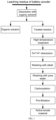
- FIG. 1 is a process flow diagram of Example 1 of the present disclosure.
- a method for preparing an active anode material by recycling a leaching residue of battery powder was provided, and as shown in FIG. 1 , a specific process was as follows: 100 g of the leaching residue of battery powder was collected and tested, and impurity element contents thereof were shown in Table 1.
- Table 1 Element Ni Co Mn Fe Cu Na P Al S ppm 1009 4363 601 435 88 5488 1515 398 71860
- the active anode material was prepared through the following steps:
- a method for preparing an active anode material by recycling a leaching residue of battery powder was provided, and a specific process was as follows: 100 g of the leaching residue of battery powder was collected and tested, and impurity element contents thereof were shown in Table 3.
- Table 3 Element Ni Co Mn Fe Cu Na P Al S ppm 1235 4103 586 501 76 5956 1233 263 80352
- the active anode material was prepared through the following steps:
- the active anode material was prepared through the following steps:
Landscapes
- Chemical & Material Sciences (AREA)
- Engineering & Computer Science (AREA)
- General Chemical & Material Sciences (AREA)
- Electrochemistry (AREA)
- Chemical Kinetics & Catalysis (AREA)
- Manufacturing & Machinery (AREA)
- Materials Engineering (AREA)
- Organic Chemistry (AREA)
- Geology (AREA)
- General Life Sciences & Earth Sciences (AREA)
- Life Sciences & Earth Sciences (AREA)
- Inorganic Chemistry (AREA)
- Environmental & Geological Engineering (AREA)
- Secondary Cells (AREA)
- Processing Of Solid Wastes (AREA)
- Battery Electrode And Active Subsutance (AREA)
Abstract
Description
- The present disclosure belongs to the technical field of lithium battery recycling, and specifically relates to a method for preparing an active anode material by recycling a leaching residue of battery powder.
- At present, lithium-ion batteries (LIBs) are booming in emerging fields such as new energy vehicles and large-scale industrial energy storage systems. According to estimations, a quantity of scrapped traction batteries used in new energy vehicles will reach 1.16 million tons by 2023. However, scrapped lithium batteries include a large amount of rare and precious metals such as cobalt, nickel, manganese, and lithium and organic matters. Therefore, if not effectively recycled, the scrapped lithium batteries will not only pollute the environment, but also result in a waste of resources. At present, there are many studies on the recovery of cathode materials of scrapped lithium batteries, and more attention is paid to the separation and purification of lithium cobalt oxide (LCO) and ternary materials.
- In recent years, recycling methods of lithium batteries mainly include pyrometallurgy and hydrometallurgy. In pyrometallurgy, metals or metal oxides in electrodes are extracted directly through high-temperature treatment, which involves a simple process, but leads to a low purity of a recovered material. An electrolytic solution, a binder, and other organic matters in a scrapped battery will cause the generation of harmful gases due to high-temperature reaction, and thus a supporting facility needs to be installed for secondary treatment of waste gas. In addition, a graphite anode of a battery is directly burned and scrapped due to high temperature, resulting in a waste of resources. Hydrometallurgy has the advantages of low pollution and easy control, and thus a large number of studies are concentrated on hydrometallurgy. A general process of hydrometallurgy includes: leaching out valuable metals, conducting fractional precipitation according to different properties of different metals, and conducting further purification to obtain a final product. Therefore, the selection of an efficient and low-cost leaching method is very important for the recovery of valuable metals in lithium batteries.
- However, in hydro metallurgy, a housing of a battery is first disassembled, then the battery is shredded and sieved to obtain an electrode material, and valuable metals in the electrode material are leached out in an acid or a biological solution and then separated to obtain the corresponding salt or oxide of each metal. After the leaching is completed, a leaching residue produced is discarded as hazardous waste due to heavy metal impurities, and thus the graphite anode is not recycled.
- The present disclosure is intended to solve at least one of the technical problems existing in the prior art. In view of this, the present disclosure provides a method for preparing an active anode material by recycling a leaching residue of battery powder.
- According to one aspect of the present disclosure, a method for preparing an active anode material by recycling a leaching residue of battery powder is provided, including the following steps:
- S1: soaking the leaching residue of battery powder in a first organic solvent to remove organic impurities, and conducting solid-liquid separation (SLS) to obtain a treated residue;
- S2: subjecting the treated residue to high-temperature treatment under an oxygen-isolated condition, soaking a resulting residue subjected to high-temperature treatment in a mixed solution of a ferric salt and an acid, followed by alkali washing to obtain a residue subjected to alkali washing, and subjecting the residue subjected to alkali washing to a carbonylation reaction with carbon monoxide and then purification with a second organic solvent; and conducting SLS to obtain a graphite powder; and
- S3: subjecting the graphite powder to pre-lithiation to obtain the active anode material.
- In some embodiments of the present disclosure, in step S1, the first organic solvent may be at least one selected from the group consisting of N-methyl pyrrolidone (NMP), N,N- dimethylacetamide (DMAC), propylene carbonate (PC), 1,3-dioxolane, dimethyl carbonate (DMC), and ethyl methyl carbonate (EMC).
- In some embodiments of the present disclosure, in step S2, the high-temperature treatment may be conducted at 300°C to 600 °C for 0.5 h to 2.0 h.
- In some embodiments of the present disclosure, in step S2, the mixed solution may be a mixed solution of ferric sulfate and sulfuric acid.
- In some embodiments of the present disclosure, in step S2, the mixed solution may have a concentration of ferric ions of 0.1 mol/L to 0.5 mol/L and a concentration of hydrogen ions of 0.1 mol/L to 4.0 mol/L; and preferably, a ratio of a mass of the treated residue to a volume of the mixed solution of a ferric salt and an acid (solid-to-liquid ratio) may be 1 g: (1-5) mL.
- In some embodiments of the present disclosure, in step S2, the soaking may be conducted for 1.0 h to 4.0 h.
- In some embodiments of the present disclosure, in step S2, the alkali washing may be conducted with a sodium hydroxide solution having a concentration of 0.5 mol/L to 2.0 mol/L at a temperature of 45 °C to 80 °C.
- In some embodiments of the present disclosure, after the alkali washing, the step S2 may further include water washing, and the water washing may be conducted at 50 °C to 90 °C.
- In some embodiments of the present disclosure, in step S2, the carbonylation reaction may be conducted in two stages. Wherein, a first-stage carbonylation may be conducted at a temperature of 190 °C to 210 °C and a pressure of no less than 20 MPa, and preferably, the first-stage carbonylation may be conducted for 0.5 h to 1.0 h; and a second-stage carbonylation may be conducted at a temperature of 38 °C to 93 °C and a pressure of no less than 0.1 MPa, and preferably, the second-stage carbonylation may be conducted for 0.5 h to 1.0 h.
- In some embodiments of the present disclosure, in step S2, the second organic solvent may be at least one selected from the group consisting of benzene, acetone, diethyl ether, tetrachloronaphthalene (TCN), ethanol, trichloromethane (TCM), and carbon tetrachloride (CTC).
- In some embodiments of the present disclosure, in step S3, the pre-lithiation may include: mixing the graphite powder with a lithium powder and NMP, and heating and stirring a resulting mixture; and subjecting the mixture to a solid-liquid separation to obtain a filter residue, and drying the filter residue to obtain the active anode material.
- In some embodiments of the present disclosure, in the pre-lithiation of step S3, the heating may be conducted at 70 °C to 80 °C, and the stirring may be conducted for 1.0 h to 4.0 h.
- According to a preferred embodiment of the present disclosure, the present disclosure at least has the following beneficial effects.
- In the present disclosure, a leaching residue produced from leaching of a shredded battery powder is subjected to a series of treatments of impurity removal and activation to finally obtain the active anode material, which avoids the waste of resources and the low disassembly efficiency in separate collection of negative current collectors. An organic solvent with high dissolvability is used to dissolve the leaching residue of battery powder to remove residual electrolytic solution, binder, and other organic impurities; high-temperature treatment is conducted under an oxygen-isolated condition to further decompose the residual electrolytic solution and binder and reduce metal impurities into elemental metals, during which carbon absorbs oxygen in some metal oxides and shows some activity to be ready for the subsequent pre-lithiation; ferric ions with a stronger oxidation potential than hydrogen ions are used to dissolve the elemental metals; washing is conducted with a hot alkali liquor to remove sulfate ions through the replacement of hydroxide ions, that is, the hydroxide ions are subjected to ion exchange with the sulfate ions adsorbed inside the particles/in surface pores of the particles, such as to reduce a sulfur impurity content in a product; washing is conducted with pure water to remove introduced sodium ions; carbonylation is conducted to obtain a graphite powder, where residual metal reacts with carbon monoxide to form metal carbonyl that is easily soluble in an organic solvent, which further removes the residual metal ions; and the graphite powder is activated through pre-lithiation to obtain the active anode material. The present disclosure can be widely used in the recycling of scrapped ternary lithium batteries, especially in the recycling of anode materials of ternary lithium batteries.
- The present disclosure is further described below with reference to accompanying drawings and examples.
-
FIG. 1 is a process flow diagram of Example 1 of the present disclosure. - The concepts and technical effects of the present disclosure are clearly and completely described below in conjunction with examples, so as to allow the objectives, features and effects of the present disclosure to be fully understood. Apparently, the described examples are merely some rather than all of the examples of the present disclosure. All other examples obtained by those skilled in the art based on the examples of the present disclosure without creative efforts should fall within the protection scope of the present disclosure.
- A method for preparing an active anode material by recycling a leaching residue of battery powder was provided, and as shown in
FIG. 1 , a specific process was as follows:
100 g of the leaching residue of battery powder was collected and tested, and impurity element contents thereof were shown in Table 1.Table 1 Element Ni Co Mn Fe Cu Na P Al S ppm 1009 4363 601 435 88 5488 1515 398 71860 - The active anode material was prepared through the following steps:
- (1) The collected leaching residue of ternary battery powder was dissolved with NMP to remove a residual electrolytic solution and a binder, and SLS was conducted to obtain an organic solution and a treated residue.
- (2) The treated residue was subjected to a reaction at 600 °C for 0.5 h under an oxygen-isolated condition, then soaked for 4.0 h in 500 mL of a mixed solution of 0.05 mol/L ferric sulfate and 0.05 mol/L sulfuric acid, washed first with a sodium hydroxide solution having a concentration of 0.5 mol/L at 80 °C and then with pure water at 90 °C, and placed in a closed container at 190 °C to 210 °C; carbon monoxide was introduced into the closed container to conduct carbonylation for 1.0 h at a pressure of no less than 20 MPa; the temperature was reduced and the pressure was released to conduct carbonylation for 1.0 h at a temperature of 38 °C and a pressure of no less than 0.1 MPa; and after the reaction was completed, benzene was added to soak for 1.0 h, and SLS was conducted to obtain a graphite powder.
- (3) The graphite powder was mixed with a lithium powder and then added to NMP, a resulting mixture was stirred at 70 °C to 80 °C for 4.0 h and then subjected to SLS, and a resulting product was dried to obtain the active anode material.
- Impurity element contents in the active anode material were tested and shown in Table 2.
Table 2 Element Ni Co Mn Fe Cu Na P Al S ppm 18 23 15 63 ND 103 ND ND 560 - A method for preparing an active anode material by recycling a leaching residue of battery powder was provided, and a specific process was as follows:
100 g of the leaching residue of battery powder was collected and tested, and impurity element contents thereof were shown in Table 3.Table 3 Element Ni Co Mn Fe Cu Na P Al S ppm 1235 4103 586 501 76 5956 1233 263 80352 - The active anode material was prepared through the following steps:
- (1) The collected leaching residue of ternary battery powder was dissolved with DMAC to remove a residual electrolytic solution and a binder, and SLS was conducted to obtain an organic solution and a treated residue.
- (2) The treated residue was subjected to a reaction at 300 °C for 2.0 h under an oxygen-isolated condition, then soaked for 4.0 h in 100 mL of a mixed solution of 0.25 mol/L ferric sulfate and 2.0 mol/L sulfuric acid, washed first with a sodium hydroxide solution having a concentration of 0.5 mol/L at 45 °C and then with pure water at 50 °C, and placed in a closed container at 190 °C to 210 °C; carbon monoxide was introduced into the closed container to conduct carbonylation for 0.5 h at a pressure of no less than 20 MPa; the temperature was reduced and the pressure was released to conduct carbonylation for 0.5 h at a temperature of 93 °C and a pressure of no less than 0.1 MPa; and after the reaction was completed, acetone was added to soak for 0.5 h, and SLS was conducted to obtain a graphite powder.
- (3) The graphite powder was mixed with a lithium powder and then added to NMP, a resulting mixture was stirred at 70 °C to 80 °C for 1.0 h and then subjected to SLS, and a resulting product was dried to obtain the active anode material.
- Impurity element contents in the active anode material were tested and shown in Table 4.
Table 4 Element Ni Co Mn Fe Cu Na P Al S ppm 56 53 62 87 ND 162 ND ND 732 - A method for preparing an active anode material by recycling a leaching residue of battery powder was provided, and a specific process was as follows:
100 g of the leaching residue of battery powder was collected and tested, and impurity element contents thereof were shown in Table 5.Table 5 Element Ni Co Mn Fe Cu Na P Al S ppm 837 3266 452 232 97 4600 1718 463 61735 - The active anode material was prepared through the following steps:
- (1) The collected leaching residue of ternary battery powder was dissolved with PC to remove a residual electrolytic solution and a binder, and SLS was conducted to obtain an organic solution and a treated residue.
- (2) The treated residue was subjected to a reaction at 500 °C for 1.0 h under an oxygen-isolated condition, then soaked for 2.0 h in 300 mL of a mixed solution of 0.1 mol/L ferric sulfate and 0.1 mol/L sulfuric acid, washed first with a sodium hydroxide solution having a concentration of 1 mol/L at 60 °C and then with pure water at 70 °C, and placed in a closed container at 190 °C to 210 °C; carbon monoxide was introduced into the closed container to conduct carbonylation for 1.0 h at a pressure of no less than 20 MPa; the temperature was reduced and the pressure was released to conduct carbonylation for 1.0 h at a temperature of 50 °C and a pressure of no less than 0.1 MPa; and after the reaction was completed, diethyl ether was added to soak for 1.0 h, and SLS was conducted to obtain a graphite powder.
- (3) The graphite powder was mixed with a lithium powder and then added to NMP, a resulting mixture was stirred at 70 °C to 80 °C for 2.0 h and then subjected to SLS, and a resulting product was dried to obtain the active anode material.
- Impurity element contents in the active anode material were tested and shown in Table 6.
Table 6 Element Ni Co Mn Fe Cu Na P Al S ppm 21 19 17 71 ND 90 ND ND 892 - The present disclosure is described in detail with reference to the accompanying drawings and examples, but the present disclosure is not limited to the above examples. Within the scope of knowledge possessed by those of ordinary skill in the technical field, various changes can also be made without departing from the purpose of the present disclosure. In addition, the examples in the present disclosure or features in the examples may be combined with each other in a non-conflicting situation.
Claims (10)
- A method for preparing an active anode material by recycling a leaching residue of battery powder, comprising the following steps:S1: soaking the leaching residue of battery powder in a first organic solvent to remove organic impurities, and conducting solid-liquid separation to obtain a treated residue;S2: subjecting the treated residue to high-temperature treatment under an oxygen-isolated condition, soaking a resulting residue subjected to high-temperature treatment in a mixed solution of a ferric salt and an acid, followed by alkali washing to obtain a residue subjected to alkali washing, and subjecting the residue subjected to alkali washing to a carbonylation reaction with carbon monoxide and then purification with a second organic solvent; and conducting solid-liquid separation to obtain a graphite powder; andS3: subjecting the graphite powder to pre-lithiation to obtain the active anode material.
- The method according to claim 1, wherein in step S1, the first organic solvent is at least one selected from the group consisting of N-methylpyrrolidone, N,N-dimethylacetamide, propylene carbonate, 1,3-dioxolane, dimethyl carbonate, and ethyl methyl carbonate.
- The method according to claim 1, wherein in step S2, the high-temperature treatment is conducted at 300 °C to 600 °C for 0.5 h to 2.0 h.
- The method according to claim 1, wherein in step S2, the mixed solution is a mixed solution of ferric sulfate and sulfuric acid.
- The method according to claim 1, wherein in step S2, the mixed solution has a concentration of ferric ions of 0.1 mol/L to 0.5 mol/L and a concentration of hydrogen ions of 0.1 mol/L to 4.0 mol/L; and preferably, a solid-to-liquid ratio of the treated residue to the mixed solution of a ferric salt and an acid is 1 g: (1-5) mL.
- The method according to claim 1, wherein in step S2, the alkali washing is conducted with a sodium hydroxide solution having a concentration of 0.5 mol/L to 2.0 mol/L at a temperature of 45 °C to 80 °C.
- The method according to claim 1, wherein in step S2, the carbonylation reaction is conducted in two stages,
wherein a first-stage carbonylation is conducted at a temperature of 190 °C to 210 °C and a pressure of no less than 20 MPa, and preferably, the first-stage carbonylation is conducted for 0.5 h to 1.0 h; and a second-stage carbonylation is conducted at a temperature of 38 °C to 93 °C and a pressure of no less than 0.1 MPa, and preferably, the second-stage carbonylation is conducted for 0.5 h to 1.0 h. - The method according to claim 7, wherein in step S2, the second organic solvent is at least one selected from the group consisting of benzene, acetone, diethyl ether, tetrachloronaphthalene, ethanol, trichloromethane, and carbon tetrachloride.
- The method according to claim 1, wherein in step S3, the pre-lithiation comprises: mixing the graphite powder with a lithium powder and N-methylpyrrolidone, and heating and stirring a resulting mixture; and subjecting the mixture to a solid-liquid separation to obtain a filter residue, and drying the filter residue to obtain the active anode material.
- The method according to claim 9, wherein in step S3, the heating is conducted at 70 °C to 80 °C, and the stirring is conducted for 1.0 h to 4.0 h.
Applications Claiming Priority (2)
| Application Number | Priority Date | Filing Date | Title |
|---|---|---|---|
| CN202111192752.9A CN113904018B (en) | 2021-10-13 | 2021-10-13 | Method for preparing active negative electrode material by recycling battery powder leaching slag |
| PCT/CN2022/108663 WO2023060990A1 (en) | 2021-10-13 | 2022-07-28 | Method for preparing active negative electrode material by recycling battery powder leaching residues |
Publications (2)
| Publication Number | Publication Date |
|---|---|
| EP4407747A1 true EP4407747A1 (en) | 2024-07-31 |
| EP4407747A4 EP4407747A4 (en) | 2025-04-30 |
Family
ID=79191895
Family Applications (1)
| Application Number | Title | Priority Date | Filing Date |
|---|---|---|---|
| EP22879937.5A Pending EP4407747A4 (en) | 2021-10-13 | 2022-07-28 | METHOD FOR PREPARING NEGATIVE ELECTRODE ACTIVE MATERIAL BY RECYCLING BATTERY POWDER LEACHING RESIDUES |
Country Status (4)
| Country | Link |
|---|---|
| EP (1) | EP4407747A4 (en) |
| CN (1) | CN113904018B (en) |
| MX (1) | MX2024004499A (en) |
| WO (1) | WO2023060990A1 (en) |
Families Citing this family (5)
| Publication number | Priority date | Publication date | Assignee | Title |
|---|---|---|---|---|
| CN113904018B (en) * | 2021-10-13 | 2024-07-09 | 广东邦普循环科技有限公司 | Method for preparing active negative electrode material by recycling battery powder leaching slag |
| CN116443950A (en) * | 2023-04-21 | 2023-07-18 | 厦门海辰储能科技股份有限公司 | Demagnetizing method of cathode material, pole piece, energy storage device and electric equipment |
| CN117125708B (en) * | 2023-08-28 | 2025-07-22 | 湖南宸宇富基新能源科技有限公司 | Regenerated graphite anode active material and preparation and application thereof |
| CN117604269B (en) * | 2023-11-07 | 2024-08-13 | 中山大学 | Leaching solution for recycling lithium battery anode material and recycling method |
| CN118929697B (en) * | 2024-08-07 | 2025-07-22 | 山东省昔利环境科技有限公司 | Method for biologically activating red mud to dealkalize and recycling sodium |
Family Cites Families (10)
| Publication number | Priority date | Publication date | Assignee | Title |
|---|---|---|---|---|
| JP5859332B2 (en) * | 2011-02-15 | 2016-02-10 | 住友化学株式会社 | Method for recovering active material from battery waste |
| US20160351893A1 (en) * | 2014-02-13 | 2016-12-01 | Rockwood Lithium GmbH | Galvanic Cells and (Partially) Lithiated Lithium Battery Anodes with Increased Capacity and Methods for Producing Synthetic Graphite Intercalation Compounds |
| CN106848471B (en) * | 2017-04-18 | 2021-11-09 | 中科过程(北京)科技有限公司 | Mixed acid leaching and recovery method of waste lithium ion battery anode material |
| IT201800002175A1 (en) * | 2018-01-30 | 2019-07-30 | Consiglio Nazionale Ricerche | Hydrometallurgical process for the treatment of lithium batteries and recovery of the metals contained in them. |
| CN109576498B (en) * | 2019-01-30 | 2020-07-17 | 广东光华科技股份有限公司 | Method for recovering graphite negative electrode material of lithium battery |
| CN111285366A (en) * | 2020-03-03 | 2020-06-16 | 广东邦普循环科技有限公司 | Regeneration method of lithium ion battery negative electrode graphite |
| EP3885458A1 (en) * | 2020-03-23 | 2021-09-29 | Basf Se | Battery recycling by reduction and carbonylation |
| CN111573662A (en) * | 2020-05-21 | 2020-08-25 | 北京蒙京石墨新材料科技研究院有限公司 | Method for preparing high-capacity negative electrode material by utilizing recovered graphite |
| CN113061726B (en) * | 2021-03-15 | 2021-11-23 | 中国科学院化学研究所 | Method for safely and efficiently recycling lithium from waste batteries |
| CN113904018B (en) * | 2021-10-13 | 2024-07-09 | 广东邦普循环科技有限公司 | Method for preparing active negative electrode material by recycling battery powder leaching slag |
-
2021
- 2021-10-13 CN CN202111192752.9A patent/CN113904018B/en active Active
-
2022
- 2022-07-28 MX MX2024004499A patent/MX2024004499A/en unknown
- 2022-07-28 EP EP22879937.5A patent/EP4407747A4/en active Pending
- 2022-07-28 WO PCT/CN2022/108663 patent/WO2023060990A1/en not_active Ceased
Also Published As
| Publication number | Publication date |
|---|---|
| MX2024004499A (en) | 2024-07-02 |
| EP4407747A4 (en) | 2025-04-30 |
| CN113904018A (en) | 2022-01-07 |
| WO2023060990A1 (en) | 2023-04-20 |
| CN113904018B (en) | 2024-07-09 |
Similar Documents
| Publication | Publication Date | Title |
|---|---|---|
| EP4407747A1 (en) | Method for preparing active negative electrode material by recycling battery powder leaching residues | |
| CN111392750B (en) | Method for removing impurities and recovering lithium from waste lithium ion batteries | |
| CN111463475B (en) | Method for selectively recycling waste power lithium battery positive electrode material | |
| CN110828926B (en) | Method for cooperatively recovering metal and graphite from anode and cathode materials of waste lithium ion battery | |
| CN107863583B (en) | Valuable metal leaching system and method in waste lithium battery | |
| CN114875243A (en) | Eutectic solvent, preparation method thereof and leaching method of lithium battery positive electrode material | |
| EP4151593B1 (en) | Method for graphite purification and lattice reconstruction in power battery | |
| CN108486376A (en) | A method of leaching metal in waste lithium ion cell anode material | |
| CN110034350B (en) | Method for comprehensive recovery of waste lithium batteries by hypoxic pyrolysis | |
| CN112320794A (en) | Deep impurity removal method for waste battery cathode recycling decommissioned graphite | |
| CN116723999B (en) | Repairing and regenerating method of lithium iron phosphate | |
| CN113206227B (en) | Method for preparing carbon-based metal sulfide negative electrode material by simultaneously recycling positive and negative electrode materials of waste nickel-cobalt-manganese lithium ion battery | |
| CN116706304B (en) | A method for regenerating lithium-rich layered oxide cathode materials from spent lithium batteries | |
| CN116240385B (en) | A method for separation and purification of valuable metals in waste lithium batteries | |
| CN111807388A (en) | Selective lithium leaching process for waste lithium ion battery | |
| CN117477082A (en) | A method for reusing scrapped lithium-ion battery negative electrode materials | |
| CN106693983A (en) | Method using waste ternary lithium battery cathode material to prepare methylbenzene degrading catalyst | |
| CN115939551A (en) | A kind of supercritical water reduction recovery method of waste lithium ion battery | |
| CN112591806A (en) | Method for recovering and regenerating anode active material of waste lithium ion battery | |
| CN111900507A (en) | Method for recycling retired lithium iron phosphate battery | |
| CN120099310A (en) | A method for preferentially extracting lithium from battery black powder | |
| CN115304059A (en) | Recycling treatment method for retired battery carbon slag | |
| CN113555615A (en) | Method and application of preparation of high-efficiency PMS activator from waste lithium-ion battery | |
| CN114950361B (en) | A method of preparing composite adsorbent from waste lithium batteries | |
| CN117144136A (en) | Method for leaching valuable metals from waste lithium batteries |
Legal Events
| Date | Code | Title | Description |
|---|---|---|---|
| STAA | Information on the status of an ep patent application or granted ep patent |
Free format text: STATUS: THE INTERNATIONAL PUBLICATION HAS BEEN MADE |
|
| PUAI | Public reference made under article 153(3) epc to a published international application that has entered the european phase |
Free format text: ORIGINAL CODE: 0009012 |
|
| STAA | Information on the status of an ep patent application or granted ep patent |
Free format text: STATUS: REQUEST FOR EXAMINATION WAS MADE |
|
| 17P | Request for examination filed |
Effective date: 20240423 |
|
| AK | Designated contracting states |
Kind code of ref document: A1 Designated state(s): AL AT BE BG CH CY CZ DE DK EE ES FI FR GB GR HR HU IE IS IT LI LT LU LV MC MK MT NL NO PL PT RO RS SE SI SK SM TR |
|
| DAX | Request for extension of the european patent (deleted) | ||
| RAV | Requested validation state of the european patent: fee paid |
Extension state: MA Effective date: 20240423 |
|
| A4 | Supplementary search report drawn up and despatched |
Effective date: 20250328 |
|
| RIC1 | Information provided on ipc code assigned before grant |
Ipc: H01M 10/54 20060101AFI20250324BHEP |