EP4407710A1 - Positive electrode material for lithium ion battery and preparation method therefor - Google Patents
Positive electrode material for lithium ion battery and preparation method therefor Download PDFInfo
- Publication number
- EP4407710A1 EP4407710A1 EP22913837.5A EP22913837A EP4407710A1 EP 4407710 A1 EP4407710 A1 EP 4407710A1 EP 22913837 A EP22913837 A EP 22913837A EP 4407710 A1 EP4407710 A1 EP 4407710A1
- Authority
- EP
- European Patent Office
- Prior art keywords
- lithium
- mxene
- suspension
- source
- preparation
- Prior art date
- Legal status (The legal status is an assumption and is not a legal conclusion. Google has not performed a legal analysis and makes no representation as to the accuracy of the status listed.)
- Pending
Links
Images

Classifications
-
- C—CHEMISTRY; METALLURGY
- C01—INORGANIC CHEMISTRY
- C01B—NON-METALLIC ELEMENTS; COMPOUNDS THEREOF; METALLOIDS OR COMPOUNDS THEREOF NOT COVERED BY SUBCLASS C01C
- C01B25/00—Phosphorus; Compounds thereof
- C01B25/16—Oxyacids of phosphorus; Salts thereof
- C01B25/26—Phosphates
- C01B25/30—Alkali metal phosphates
-
- H—ELECTRICITY
- H01—ELECTRIC ELEMENTS
- H01M—PROCESSES OR MEANS, e.g. BATTERIES, FOR THE DIRECT CONVERSION OF CHEMICAL ENERGY INTO ELECTRICAL ENERGY
- H01M4/00—Electrodes
- H01M4/02—Electrodes composed of, or comprising, active material
- H01M4/36—Selection of substances as active materials, active masses, active liquids
- H01M4/58—Selection of substances as active materials, active masses, active liquids of inorganic compounds other than oxides or hydroxides, e.g. sulfides, selenides, tellurides, halogenides or LiCoFy; of polyanionic structures, e.g. phosphates, silicates or borates
-
- C—CHEMISTRY; METALLURGY
- C01—INORGANIC CHEMISTRY
- C01B—NON-METALLIC ELEMENTS; COMPOUNDS THEREOF; METALLOIDS OR COMPOUNDS THEREOF NOT COVERED BY SUBCLASS C01C
- C01B25/00—Phosphorus; Compounds thereof
- C01B25/16—Oxyacids of phosphorus; Salts thereof
- C01B25/26—Phosphates
- C01B25/45—Phosphates containing plural metal, or metal and ammonium
-
- H—ELECTRICITY
- H01—ELECTRIC ELEMENTS
- H01M—PROCESSES OR MEANS, e.g. BATTERIES, FOR THE DIRECT CONVERSION OF CHEMICAL ENERGY INTO ELECTRICAL ENERGY
- H01M10/00—Secondary cells; Manufacture thereof
- H01M10/05—Accumulators with non-aqueous electrolyte
- H01M10/052—Li-accumulators
-
- H—ELECTRICITY
- H01—ELECTRIC ELEMENTS
- H01M—PROCESSES OR MEANS, e.g. BATTERIES, FOR THE DIRECT CONVERSION OF CHEMICAL ENERGY INTO ELECTRICAL ENERGY
- H01M10/00—Secondary cells; Manufacture thereof
- H01M10/05—Accumulators with non-aqueous electrolyte
- H01M10/052—Li-accumulators
- H01M10/0525—Rocking-chair batteries, i.e. batteries with lithium insertion or intercalation in both electrodes; Lithium-ion batteries
-
- H—ELECTRICITY
- H01—ELECTRIC ELEMENTS
- H01M—PROCESSES OR MEANS, e.g. BATTERIES, FOR THE DIRECT CONVERSION OF CHEMICAL ENERGY INTO ELECTRICAL ENERGY
- H01M4/00—Electrodes
- H01M4/02—Electrodes composed of, or comprising, active material
- H01M4/36—Selection of substances as active materials, active masses, active liquids
-
- H—ELECTRICITY
- H01—ELECTRIC ELEMENTS
- H01M—PROCESSES OR MEANS, e.g. BATTERIES, FOR THE DIRECT CONVERSION OF CHEMICAL ENERGY INTO ELECTRICAL ENERGY
- H01M4/00—Electrodes
- H01M4/02—Electrodes composed of, or comprising, active material
- H01M4/36—Selection of substances as active materials, active masses, active liquids
- H01M4/362—Composites
- H01M4/366—Composites as layered products
-
- H—ELECTRICITY
- H01—ELECTRIC ELEMENTS
- H01M—PROCESSES OR MEANS, e.g. BATTERIES, FOR THE DIRECT CONVERSION OF CHEMICAL ENERGY INTO ELECTRICAL ENERGY
- H01M4/00—Electrodes
- H01M4/02—Electrodes composed of, or comprising, active material
- H01M4/36—Selection of substances as active materials, active masses, active liquids
- H01M4/58—Selection of substances as active materials, active masses, active liquids of inorganic compounds other than oxides or hydroxides, e.g. sulfides, selenides, tellurides, halogenides or LiCoFy; of polyanionic structures, e.g. phosphates, silicates or borates
- H01M4/5825—Oxygenated metallic salts or polyanionic structures, e.g. borates, phosphates, silicates, olivines
-
- H—ELECTRICITY
- H01—ELECTRIC ELEMENTS
- H01M—PROCESSES OR MEANS, e.g. BATTERIES, FOR THE DIRECT CONVERSION OF CHEMICAL ENERGY INTO ELECTRICAL ENERGY
- H01M4/00—Electrodes
- H01M4/02—Electrodes composed of, or comprising, active material
- H01M4/62—Selection of inactive substances as ingredients for active masses, e.g. binders, fillers
-
- H—ELECTRICITY
- H01—ELECTRIC ELEMENTS
- H01M—PROCESSES OR MEANS, e.g. BATTERIES, FOR THE DIRECT CONVERSION OF CHEMICAL ENERGY INTO ELECTRICAL ENERGY
- H01M4/00—Electrodes
- H01M4/02—Electrodes composed of, or comprising, active material
- H01M4/62—Selection of inactive substances as ingredients for active masses, e.g. binders, fillers
- H01M4/624—Electric conductive fillers
- H01M4/625—Carbon or graphite
-
- C—CHEMISTRY; METALLURGY
- C01—INORGANIC CHEMISTRY
- C01P—INDEXING SCHEME RELATING TO STRUCTURAL AND PHYSICAL ASPECTS OF SOLID INORGANIC COMPOUNDS
- C01P2004/00—Particle morphology
- C01P2004/60—Particles characterised by their size
- C01P2004/64—Nanometer sized, i.e. from 1-100 nanometer
-
- C—CHEMISTRY; METALLURGY
- C01—INORGANIC CHEMISTRY
- C01P—INDEXING SCHEME RELATING TO STRUCTURAL AND PHYSICAL ASPECTS OF SOLID INORGANIC COMPOUNDS
- C01P2006/00—Physical properties of inorganic compounds
- C01P2006/40—Electric properties
-
- Y—GENERAL TAGGING OF NEW TECHNOLOGICAL DEVELOPMENTS; GENERAL TAGGING OF CROSS-SECTIONAL TECHNOLOGIES SPANNING OVER SEVERAL SECTIONS OF THE IPC; TECHNICAL SUBJECTS COVERED BY FORMER USPC CROSS-REFERENCE ART COLLECTIONS [XRACs] AND DIGESTS
- Y02—TECHNOLOGIES OR APPLICATIONS FOR MITIGATION OR ADAPTATION AGAINST CLIMATE CHANGE
- Y02E—REDUCTION OF GREENHOUSE GAS [GHG] EMISSIONS, RELATED TO ENERGY GENERATION, TRANSMISSION OR DISTRIBUTION
- Y02E60/00—Enabling technologies; Technologies with a potential or indirect contribution to GHG emissions mitigation
- Y02E60/10—Energy storage using batteries
Definitions
- the present disclosure belongs to the technical field of new energy materials and preparations thereof, and specifically relates to a cathode material for lithium ion battery of a Ti 3 C 2 MXene-coated lithium manganese iron phosphate material and preparation method therefor. This material can be applied in lithium ion batteries as a high-performance cathode material.
- Olivine type lithium iron phosphate (LiFePO 4 ) is one of the successfully commercialized cathode materials for lithium ion batteries. It has advantages of high safety, long cycle life, and low cost, etc., which make its market share have continuously increased in the cathode material for power batteries. However, the lower specific capacity and operating voltage (3.45Vvs.Li/Li + ) make it difficult to further improve the energy density of LiFePO 4 power batteries.
- Lithium manganese iron phosphate (LiMn x Fe 1-x PO 4 ) has a similar olivine-type structure to LiFePO 4 , and has an operating voltage of 4.10V and an energy density that increased by about 20% compared to LiFePO 4 .
- LiMn x Fe 1-x PO 4 cathode materials to replace LiFePO 4 cathode materials is of great significance for improving the energy density of power batteries.
- the lower electron conduction and ion diffusion rates result in poor high current charge-discharge performance of LiMn x Fe 1-x PO 4 .
- the material has poor structural stability, which reduces its electrochemical cycle stability and limits its practical application.
- the use of highly conductive materials for surface coating of LiMn x Fe 1-x PO 4 can effectively improve its ion and electron transmission capacity, thereby achieving good electrochemical performance.
- Commonly used highly conductive materials for coating of LiMn x Fe 1-x PO 4 include amorphous carbon, graphene, and conductive polymers, etc.
- the Chinese patent for disclosure ( CN109244391B ) discloses a nitrogen-doped carbon-coated lithium ferromanganese phosphate material and a preparation method thereof.
- the nitrogen-doped carbon lithium ferromanganese phosphate material prepared by the disclosure has good conductivity, high specific capacity, and the advantages of good low temperature resistance and high rate.
- the Chinese patent for disclosure introduces a preparation method of a conductive polymer coated lithium iron manganese phosphate cathode material.
- the disclosure effectively improves the electrochemical performance of LiMn x Fe 1-x PO 4 by subjecting it to polyaniline surface coating.
- the paper J. Power Sources, 329 (2016) 94 ) reported the coating of LiMn 0.5 Fe 0.5 PO 4 cathode material using graphene as a carbon source.
- the particles with a size of 20 nm were connected by continuous graphene sheets to form a stable conductive network, and the product can achieve discharge specific capacities of 166 mAh g -1 and 90 mAh g -1 at 0.1C and 20C rates, respectively.
- the surface coating of the above conductive materials can enhance the conductivity of lithium manganese iron phosphate to a certain extent, they have poor interaction and affinity with lithium manganese iron phosphate, which cannot fully improve the rate performance and structural stability of lithium manganese iron phosphate.
- Ti 3 C 2 MXene is a novel two-dimensional material, which has a structure similar to graphene, high conductivity, abundant surface functional groups, and excellent mechanical properties.
- the Ti 3 C 2 MXene is used for surface coating of electrode materials to optimize the ion and electron transmission capacity and structural stability of electrode materials, in order to obtain high-performance cathode materials for lithium ion batteries.
- the present disclosure proposes a cathode material for lithium ion battery with high electrochemical performance and a preparation method therefor, which is achieved by surface coating of Ti 3 C 2 MXene in order to effectively improve the ion and electron transmission capacity and structural stability of the lithium manganese iron phosphate material.
- the cathode material for a lithium ion battery is a Ti 3 C 2 MXene-coated lithium manganese iron phosphate material, specifically by uniformly coating Ti 3 C 2 MXene on the surfaces of lithium manganese iron phosphate nanoparticles and forming an electrically conductive mesh.
- a preparation method of the cathode material for a lithium ion battery including adding a phosphorus source and a lithium source to a deionized water/PEG solution to form a suspension A, adding a manganese source, an iron source, an antioxidant, and Ti 3 C 2 MXene to deionized water to form a suspension B, adding the suspension B to the suspension A dropwise under continuous stirring, to form a mixed solution, then transferring the mixed solution to a hydrothermal reactor to maintain the temperature for a period of time at a certain temperature, and after reaction is complete, centrifugally separating a product, then washing and oven-drying same, and finally annealing the dried product in an atmosphere furnace to obtain the Ti 3 C 2 MXene-coated lithium manganese iron phosphate material.
- the preparation method of the cathode material for a lithium ion battery includes the following specific steps:
- the lithium source is lithium hydroxide.
- the manganese source is one or more of manganese sulfate, manganese carbonate, manganese acetate, and manganese oxalate.
- the iron source is one or more of ferrous sulfate, ferrous chloride, ferrous nitrate, and ferrous oxalate.
- the antioxidant is ascorbic acid.
- the volume ratio of deionized water to PEG in the deionized water/PEG solution is 5:1, 2:1, or 1:1.
- the present disclosure first uses Ti 3 C 2 MXene, which has high conductivity, rich surface functional groups, and good mechanical properties, to coat lithium manganese iron phosphate material, and makes improvement on the overall technological process design of the preparation method, key hydrothermal reactions, and parameters of high-temperature annealing process conditions, which effectively improves the ion and electron transmission capacity of the lithium manganese iron phosphate material, meanwhile the strong interaction between Ti 3 C 2 MXene and lithium manganese iron phosphate material can enhance the structural stability of the lithium manganese iron phosphate material, so that the obtained Ti 3 C 2 MXene-coated lithium manganese iron phosphate cathode material can reach an initial discharge capacity of 157.4 mAh g -1 at 0.1C.
- Ti 3 C 2 MXene is used to coat the surface of the lithium manganese iron phosphate material in the present disclosure, the ion and electron transmission capacity and structural stability of the lithium manganese iron phosphate material can be effectively improved, and the Ti 3 C 2 MXene-coated lithium manganese iron phosphate cathode material can reach a discharge capacity of 157.4 mAh g -1 at 0.1C and a discharge capacity of 145.0 mAh g -1 at 1C, making it quite suitable for use as a high-energy and high-power-density cathode material for a lithium ion battery.
- the cathode material for a lithium ion battery of the present disclosure is a Ti 3 C 2 MXene-coated lithium manganese iron phosphate material, specifically by uniformly coating Ti 3 C 2 MXene on the surfaces of lithium manganese iron phosphate nanoparticles and forming an electrically conductive mesh, the use of Ti 3 C 2 MXene to coat lithium manganese iron phosphate can effectively improve the ion and electron transmission capacity and structural stability of the lithium manganese iron phosphate.
- a preparation method of the Ti 3 C 2 MXene-coated lithium manganese iron phosphate cathode material for a lithium ion battery including adding a phosphorus source and a lithium source to a deionized water/PEG solution to form a suspension A, adding a manganese source, an iron source, an antioxidant, and Ti 3 C 2 MXene to deionized water to form a suspension B, adding the suspension B to the suspension A dropwise under continuous stirring, to form a mixed solution, then transferring the mixed solution to a hydrothermal reactor to maintain the temperature for a period of time at a certain temperature, and after reaction is complete, centrifugally separating a product, then washing and oven-drying same, and finally annealing the dried product in an atmosphere furnace to obtain the Ti 3 C 2 MXene-coated lithium manganese iron phosphate material.
- This method includes the following specific steps:
- the phosphorus source is phosphoric acid;
- the lithium source is lithium hydroxide;
- the manganese source is one or more of manganese sulfate, manganese carbonate, manganese acetate, and manganese oxalate;
- the iron source is one or more of ferrous sulfate, ferrous chloride, ferrous nitrate, and ferrous oxalate;
- the antioxidant is ascorbic acid; and the volume ratio of deionized water to PEG in the deionized water/PEG solution is 5:1, 2:1, or 1:1.
- the protective atmosphere in step (4) is 95vol%Ar+5vol%H 2 .
- the volume ratio of deionized water to PEG in the deionized water/PEG solution is preferably 2:1.
- the addition amount of Ti 3 C 2 MXene allows the content of the material in the final product to be preferably 15 wt%.
- the temperature is preferably maintained at 180°C and for a period of time of 10 hours.
- the oven drying temperature is preferably 60 °C.
- the annealing temperature is preferably 650 °C and the annealing time is preferably 10 hours.
- the obtained Ti 3 C 2 MXene-coated lithium manganese iron phosphate material has an initial discharge capacity of 157.4 mAh g -1 at 0.1C, an initial coulombic efficiency of higher than 99%, and a discharge capacity at 1C of 145.0 mAh g -1 .
- the present disclosure also adopted an uncoated lithium manganese iron phosphate material, i.e., by comparison with the uncoated lithium manganese iron phosphate material without adding Ti 3 C 2 MXene during the preparation process, as shown in Figures 1, 2 , and 3 , it was not difficult from these figures to find that the surface coating of Ti 3 C 2 MXene can effectively enhance the electrochemical performance of the lithium manganese iron phosphate material, and a cathode material for a lithium ion battery with high energy and power density can be obtained.
Landscapes
- Chemical & Material Sciences (AREA)
- Chemical Kinetics & Catalysis (AREA)
- Electrochemistry (AREA)
- General Chemical & Material Sciences (AREA)
- Engineering & Computer Science (AREA)
- Organic Chemistry (AREA)
- Inorganic Chemistry (AREA)
- Manufacturing & Machinery (AREA)
- Materials Engineering (AREA)
- Composite Materials (AREA)
- Crystallography & Structural Chemistry (AREA)
- Battery Electrode And Active Subsutance (AREA)
Abstract
Description
- The present application claims the priority of a Chinese patent application submitted to the Patent Office of the People's Republic of
China on December 29, 2021, with application No. 202111631871.X - The present disclosure belongs to the technical field of new energy materials and preparations thereof, and specifically relates to a cathode material for lithium ion battery of a Ti3C2 MXene-coated lithium manganese iron phosphate material and preparation method therefor. This material can be applied in lithium ion batteries as a high-performance cathode material.
- Olivine type lithium iron phosphate (LiFePO4) is one of the successfully commercialized cathode materials for lithium ion batteries. It has advantages of high safety, long cycle life, and low cost, etc., which make its market share have continuously increased in the cathode material for power batteries. However, the lower specific capacity and operating voltage (3.45Vvs.Li/Li+) make it difficult to further improve the energy density of LiFePO4 power batteries. Lithium manganese iron phosphate (LiMnxFe1-xPO4) has a similar olivine-type structure to LiFePO4, and has an operating voltage of 4.10V and an energy density that increased by about 20% compared to LiFePO4. Therefore, developing high-performance LiMnxFe1-xPO4 cathode materials to replace LiFePO4 cathode materials is of great significance for improving the energy density of power batteries. However, the lower electron conduction and ion diffusion rates result in poor high current charge-discharge performance of LiMnxFe1-xPO4. In addition, the material has poor structural stability, which reduces its electrochemical cycle stability and limits its practical application.
- The use of highly conductive materials for surface coating of LiMnxFe1-xPO4 can effectively improve its ion and electron transmission capacity, thereby achieving good electrochemical performance. Commonly used highly conductive materials for coating of LiMnxFe1-xPO4 include amorphous carbon, graphene, and conductive polymers, etc. The Chinese patent for disclosure (
CN109244391B ) discloses a nitrogen-doped carbon-coated lithium ferromanganese phosphate material and a preparation method thereof. The nitrogen-doped carbon lithium ferromanganese phosphate material prepared by the disclosure has good conductivity, high specific capacity, and the advantages of good low temperature resistance and high rate. The Chinese patent for disclosure (CN113066969A ) introduces a preparation method of a conductive polymer coated lithium iron manganese phosphate cathode material. The disclosure effectively improves the electrochemical performance of LiMnxFe1-xPO4 by subjecting it to polyaniline surface coating. The paper (J. Power Sources, 329 (2016) 94) reported the coating of LiMn0.5Fe0.5PO4 cathode material using graphene as a carbon source. The particles with a size of 20 nm were connected by continuous graphene sheets to form a stable conductive network, and the product can achieve discharge specific capacities of 166 mAh g-1 and 90 mAh g-1 at 0.1C and 20C rates, respectively. Although the surface coating of the above conductive materials can enhance the conductivity of lithium manganese iron phosphate to a certain extent, they have poor interaction and affinity with lithium manganese iron phosphate, which cannot fully improve the rate performance and structural stability of lithium manganese iron phosphate. - Ti3C2 MXene is a novel two-dimensional material, which has a structure similar to graphene, high conductivity, abundant surface functional groups, and excellent mechanical properties.
- Therefore, it is needed to solve the technical problem that the Ti3C2 MXene is used for surface coating of electrode materials to optimize the ion and electron transmission capacity and structural stability of electrode materials, in order to obtain high-performance cathode materials for lithium ion batteries.
- In view of the aforementioned deficiencies and improvement needs in the prior art, the present disclosure proposes a cathode material for lithium ion battery with high electrochemical performance and a preparation method therefor, which is achieved by surface coating of Ti3C2 MXene in order to effectively improve the ion and electron transmission capacity and structural stability of the lithium manganese iron phosphate material.
- The present disclosure is realized through the following technical solutions:
the above cathode material for a lithium ion battery, the cathode material is a Ti3C2 MXene-coated lithium manganese iron phosphate material, specifically by uniformly coating Ti3C2 MXene on the surfaces of lithium manganese iron phosphate nanoparticles and forming an electrically conductive mesh. - A preparation method of the cathode material for a lithium ion battery, including adding a phosphorus source and a lithium source to a deionized water/PEG solution to form a suspension A, adding a manganese source, an iron source, an antioxidant, and Ti3C2 MXene to deionized water to form a suspension B, adding the suspension B to the suspension A dropwise under continuous stirring, to form a mixed solution, then transferring the mixed solution to a hydrothermal reactor to maintain the temperature for a period of time at a certain temperature, and after reaction is complete, centrifugally separating a product, then washing and oven-drying same, and finally annealing the dried product in an atmosphere furnace to obtain the Ti3C2 MXene-coated lithium manganese iron phosphate material.
- The preparation method of the cathode material for a lithium ion battery includes the following specific steps:
- (1) adding a phosphorus source and a lithium source to a deionized water/PEG solution to form a suspension A; adding a manganese source, an iron source, an antioxidant, and Ti3C2 MXene to deionized water to form a suspension B; adding the suspension B to the suspension A dropwise under continuous stirring, to form a mixed solution; wherein, the elemental molar ratio of lithium, manganese, iron, and phosphorus sources is Li:Mn:Fe:P = 3:1-x:x:2, 0.1≤x≤0.5, and the addition amount of Ti3C2 MXene should allow its content in the final product to be 5-30 wt%;
- (2) transferring the mixed solution obtained in step (1) to a hydrothermal reactor, tightening the reactor, and placing it in an oven for maintaining temperature at a temperature condition of 140-200 °C for 5-20 hours;
- (3) after the reaction is complete, centrifugally separating the hydrothermal product, and washing, then oven dried same under vacuum conditions at an oven drying temperature of 30-80 °C;
- (4) annealing the dried hydrothermal product obtained in step (3) under a protective atmosphere at a temperature of 500-800 °C for 5-20 hours to obtain the Ti3C2 MXene-coated lithium manganese iron phosphate material.
- The preparation method of the cathode material for a lithium ion battery, wherein the phosphorus source is phosphoric acid. The lithium source is lithium hydroxide. The manganese source is one or more of manganese sulfate, manganese carbonate, manganese acetate, and manganese oxalate. The iron source is one or more of ferrous sulfate, ferrous chloride, ferrous nitrate, and ferrous oxalate. The antioxidant is ascorbic acid. The volume ratio of deionized water to PEG in the deionized water/PEG solution is 5:1, 2:1, or 1:1.
- The present disclosure first uses Ti3C2 MXene, which has high conductivity, rich surface functional groups, and good mechanical properties, to coat lithium manganese iron phosphate material, and makes improvement on the overall technological process design of the preparation method, key hydrothermal reactions, and parameters of high-temperature annealing process conditions, which effectively improves the ion and electron transmission capacity of the lithium manganese iron phosphate material, meanwhile the strong interaction between Ti3C2 MXene and lithium manganese iron phosphate material can enhance the structural stability of the lithium manganese iron phosphate material, so that the obtained Ti3C2 MXene-coated lithium manganese iron phosphate cathode material can reach an initial discharge capacity of 157.4 mAh g-1 at 0.1C.
- Since Ti3C2 MXene is used to coat the surface of the lithium manganese iron phosphate material in the present disclosure, the ion and electron transmission capacity and structural stability of the lithium manganese iron phosphate material can be effectively improved, and the Ti3C2 MXene-coated lithium manganese iron phosphate cathode material can reach a discharge capacity of 157.4 mAh g-1 at 0.1C and a discharge capacity of 145.0 mAh g-1 at 1C, making it quite suitable for use as a high-energy and high-power-density cathode material for a lithium ion battery.
-
-
Figure 1 shows the XRD spectral diagram of lithium manganese iron phosphate and Ti3C2 MXene-coated lithium manganese iron phosphate; -
Figure 2(a) shows the SEM image of lithium manganese iron phosphate; andFigure 2(b) shows the SEM image of Ti3C2 MXene-coated lithium manganese iron phosphate; and -
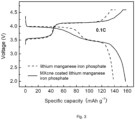
Figure 3 shows the initial charge-discharge diagram of lithium manganese iron phosphate and Ti3C2 MXene-coated lithium manganese iron phosphate. - The cathode material for a lithium ion battery of the present disclosure is a Ti3C2 MXene-coated lithium manganese iron phosphate material, specifically by uniformly coating Ti3C2 MXene on the surfaces of lithium manganese iron phosphate nanoparticles and forming an electrically conductive mesh, the use of Ti3C2 MXene to coat lithium manganese iron phosphate can effectively improve the ion and electron transmission capacity and structural stability of the lithium manganese iron phosphate.
- A preparation method of the Ti3C2 MXene-coated lithium manganese iron phosphate cathode material for a lithium ion battery, including adding a phosphorus source and a lithium source to a deionized water/PEG solution to form a suspension A, adding a manganese source, an iron source, an antioxidant, and Ti3C2 MXene to deionized water to form a suspension B, adding the suspension B to the suspension A dropwise under continuous stirring, to form a mixed solution, then transferring the mixed solution to a hydrothermal reactor to maintain the temperature for a period of time at a certain temperature, and after reaction is complete, centrifugally separating a product, then washing and oven-drying same, and finally annealing the dried product in an atmosphere furnace to obtain the Ti3C2 MXene-coated lithium manganese iron phosphate material. This method includes the following specific steps:
- (1) adding a phosphorus source and a lithium source to a deionized water/PEG solution to form a suspension A; adding a manganese source, an iron source, an antioxidant, and Ti3C2 MXene to deionized water to form a suspension B; adding the suspension B to the suspension A dropwise under continuous stirring, to form a mixed solution; wherein, the elemental molar ratio of lithium, manganese, iron, and phosphorus sources is Li:Mn:Fe:P = 3:1-x:x:2, 0.1≤x≤0.5, and the addition amount of Ti3C2 MXene should allow its content in the final product to be 5-30 wt%;
- (2) transferring the mixed solution obtained in step (1) to a hydrothermal reactor, tightening the reactor, and placing it in an oven for maintaining temperature at a temperature condition of 140-200 °C for 5-20 hours;
- (3) after the reaction is complete, centrifugally separating the hydrothermal product, and washing, then oven dried same under vacuum conditions at an oven drying temperature of 30-80 °C;
- (4) annealing the dried hydrothermal product obtained in step (3) under a protective atmosphere at a temperature of 500-800 °C for 5-20 hours to obtain the Ti3C2 MXene-coated lithium manganese iron phosphate material.
- Wherein, in step (1): the phosphorus source is phosphoric acid; the lithium source is lithium hydroxide; the manganese source is one or more of manganese sulfate, manganese carbonate, manganese acetate, and manganese oxalate; the iron source is one or more of ferrous sulfate, ferrous chloride, ferrous nitrate, and ferrous oxalate; the antioxidant is ascorbic acid; and the volume ratio of deionized water to PEG in the deionized water/PEG solution is 5:1, 2:1, or 1:1.
- The protective atmosphere in step (4) is 95vol%Ar+5vol%H2.
- Preferably, in step (1), the volume ratio of deionized water to PEG in the deionized water/PEG solution is preferably 2:1.
- Preferably, in step (1), the addition amount of Ti3C2 MXene allows the content of the material in the final product to be preferably 15 wt%.
- Preferably, in step (2), the temperature is preferably maintained at 180°C and for a period of time of 10 hours.
- Preferably, in step (3), the oven drying temperature is preferably 60 °C.
- Preferably, in step (4), the annealing temperature is preferably 650 °C and the annealing time is preferably 10 hours.
- In the present disclosure, by subjecting the lithium manganese iron phosphate to Ti3C2 MXene coating, the ion and electron transmission capacity as well as structural stability of the lithium manganese iron phosphate are effectively enhanced, making the material have prominent electrochemical performance, the obtained Ti3C2 MXene-coated lithium manganese iron phosphate material has an initial discharge capacity of 157.4 mAh g-1 at 0.1C, an initial coulombic efficiency of higher than 99%, and a discharge capacity at 1C of 145.0 mAh g-1.
- The present disclosure will be further illustrated below by the following specific examples:
- Phosphoric acid and lithium hydroxide were added to a volume ratio of 2:1 of deionized water/PEG solution to form suspension A, then manganese sulfate, ferrous sulfate, ascorbic acid, and Ti3C2 MXene were added to deionized water to form suspension B, the suspension B was added dropwise to the suspension A under continuous stirring to form a mixed solution, wherein the elemental molar ratio of lithium, manganese, iron, and phosphorus sources is Li:Mn:Fe:P=3:0.8:0.2:2; the above obtained mixture was transferred to a hydrothermal reactor, the reactor was tightened and placed in an oven to maintain the temperature at 180 °C for 10 hours, after the reaction was completed, the hydrothermal product was centrifugally separated, then washed, and oven-dried at 60 °C under vacuum conditions; finally, the dried hydrothermal product was annealed at 650 °C for 10 hours in a 95vol%Ar+5vol%H2 atmosphere, after the annealing was completed, Ti3C2 MXene-coated lithium manganese iron phosphate material as a black powder was obtained; the content of Ti3C2 MXene in the product was 15 wt%, with an initial discharge capacity of 157.4 mAh g-1 and an initial coulombic efficiency of 99.6%.
- Phosphoric acid and lithium hydroxide were added to a volume ratio of 2:1 of deionized water/PEG solution to form suspension A, then manganese carbonate, ferrous chloride, ascorbic acid, and Ti3C2 MXene were added to deionized water to form suspension B, the suspension B was added dropwise to the suspension A under continuous stirring to form a mixed solution, wherein the elemental molar ratio of lithium, manganese, iron, and phosphorus sources is Li:Mn:Fe:P=3:0.5:0.5:2; the above obtained mixture was transferred to a hydrothermal reactor, the reactor was tightened and placed in an oven to maintain the temperature at 140°C for 20 hours, after the reaction was completed, the hydrothermal product was centrifugally separated, then washed, and oven-dried at 80°C under vacuum conditions; finally, the dried hydrothermal product was annealed at 500 °C for 20 hours in a 95vol%Ar+5vol%H2 atmosphere, after the annealing was completed, Ti3C2 MXene-coated lithium manganese iron phosphate material as a black powder was obtained; the content of Ti3C2 MXene in the product was 5 wt%, with an initial discharge capacity of 130.4 mAh g-1 and an initial coulombic efficiency of 95.6%.
- Phosphoric acid and lithium hydroxide were added to a volume ratio of 1:1 of deionized water/PEG solution to form suspension A, then manganese acetate, ferrous nitrate, ascorbic acid, and Ti3C2 MXene were added to deionized water to form suspension B, the suspension B was added dropwise to the suspension A under continuous stirring to form a mixed solution, wherein the elemental molar ratio of lithium, manganese, iron, and phosphorus sources is Li:Mn:Fe:P=3:0.7:0.3:2; the above obtained mixture was transferred to a hydrothermal reactor, the reactor was tightened and placed in an oven to maintain the temperature at 160 °C for 15 hours, after the reaction was completed, the hydrothermal product was centrifugally separated, then washed, and oven-dried at 30 °C under vacuum conditions; finally, the dried hydrothermal product was annealed at 800 °C for 5 hours in a 95vol%Ar+5vol%H2 atmosphere, after the annealing was completed, Ti3C2 MXene-coated lithium manganese iron phosphate material as a black powder was obtained; the content of Ti3C2 MXene in the product was 15 wt%, with an initial discharge capacity of 135.1 mAh g-1 and an initial coulombic efficiency of 96.5%.
- Phosphoric acid and lithium hydroxide were added to a volume ratio of 1:1 of deionized water/PEG solution to form suspension A, then manganese acetate and manganese oxalate, ferrous sulfate and ferrous oxalate, ascorbic acid, and Ti3C2 MXene were added to deionized water to form suspension B, the suspension B was added dropwise to the suspension A under continuous stirring to form a mixed solution, wherein the elemental molar ratio of lithium, manganese, iron, and phosphorus sources is Li:Mn:Fe:P=3:0.6:0.4:2; the above obtained mixture was transferred to a hydrothermal reactor, the reactor was tightened and placed in an oven to maintain the temperature at 180 °C for 10 hours, after the reaction was completed, the hydrothermal product was centrifugally separated, then washed, and oven-dried at 50 °C under vacuum conditions; finally, the dried hydrothermal product was annealed at 500 °C for 20 hours in a 95vol%Ar+5vol%H2 atmosphere, after the annealing was completed, Ti3C2 MXene-coated lithium manganese iron phosphate material as a black powder was obtained; the content of Ti3C2 MXene in the product was 20 wt%, with an initial discharge capacity of 150.3 mAh g-1 and an initial coulombic efficiency of 97.1%.
- Phosphoric acid and lithium hydroxide were added to a volume ratio of 5:1 of deionized water/PEG solution to form suspension A, then manganese sulfate and manganese acetate, ferrous sulfate and ferrous nitrate, ascorbic acid, and Ti3C2 MXene were added to deionized water to form suspension B, the suspension B was added dropwise to the suspension A under continuous stirring to form a mixed solution, wherein the elemental molar ratio of lithium, manganese, iron, and phosphorus sources is Li:Mn:Fe:P=3:0.8:0.2:2; the above obtained mixture was transferred to a hydrothermal reactor, the reactor was tightened and placed in an oven to maintain the temperature at 200 °C for 5 hours, after the reaction was completed, the hydrothermal product was centrifugally separated, then washed, and oven-dried at 70 °C under vacuum conditions; finally, the dried hydrothermal product was annealed at 650 °C for 10 hours in a 95vol%Ar+5vol%H2 atmosphere, after the annealing was completed, Ti3C2 MXene-coated lithium manganese iron phosphate material as a black powder was obtained; the content of Ti3C2 MXene in the product was 30 wt%, with an initial discharge capacity of 140.6 mAh g-1 and an initial coulombic efficiency of 96.6%.
- The present disclosure also adopted an uncoated lithium manganese iron phosphate material, i.e., by comparison with the uncoated lithium manganese iron phosphate material without adding Ti3C2 MXene during the preparation process, as shown in
Figures 1, 2 , and3 , it was not difficult from these figures to find that the surface coating of Ti3C2 MXene can effectively enhance the electrochemical performance of the lithium manganese iron phosphate material, and a cathode material for a lithium ion battery with high energy and power density can be obtained. - It is easy for those skilled in the art to understand that the above contents are merely preferred examples of the present disclosure and are not intended to limit thereto. Any modifications, equivalent substitutions, and improvements, etc. made within the spirit and principles of the present disclosure should be included in the scope of protection of the present disclosure.
Claims (9)
- A cathode material for a lithium ion battery, is characterized in that, the cathode material is a Ti3C2 MXene-coated lithium manganese iron phosphate material, specifically Ti3C2 MXene being uniformly coated on surfaces of lithium manganese iron phosphate nanoparticles and forming an electrically conductive mesh.
- A preparation method of the cathode material for a lithium ion battery according to claim 1, is characterized that, the preparation method comprises adding a phosphorus source and a lithium source to a deionized water/PEG solution, to form a suspension A; adding a manganese source, an iron source, an antioxidant, and Ti3C2 MXene to deionized water to form a suspension B; adding the suspension B to the suspension A dropwise under continuous stirring, to form a mixed solution; then transferring the mixed solution to a hydrothermal reactor to maintain the temperature for a period of time at a certain temperature; and after the reaction is complete, centrifugally separating a product, then washing and oven-drying same, and finally annealing the dried product in an atmosphere furnace to obtain the Ti3C2 MXene-coated lithium manganese iron phosphate material.
- The preparation method of the cathode material for a lithium ion battery according to claim 2, the preparation method comprises the following specific steps:(1) adding a phosphorus source and a lithium source to a deionized water/PEG solution to form a suspension A; adding a manganese source, an iron source, an antioxidant, and Ti3C2 MXene to deionized water to form a suspension B; adding the suspension B to the suspension A dropwise under continuous stirring, to form a mixed solution; wherein, the elemental molar ratio of lithium, manganese, iron, and phosphorus sources is Li:Mn:Fe:P = 3:1-x:x:2, 0.1≤x≤0.5, and the addition amount of Ti3C2 MXene should allow its content in the final product to be 5-30 wt%;(2) transferring the mixed solution obtained in step (1) to a hydrothermal reactor, tightening the reactor, and placing it in an oven for maintaining temperature at a temperature condition of 140-200 °C for 5-20 hours;(3) after the reaction is complete, centrifugally separating the hydrothermal product, and washing, then oven dried same under vacuum conditions at an oven drying temperature of 30-80 °C;(4) annealing the dried hydrothermal product obtained in step (3) under a protective atmosphere at a temperature of 500-800 °C for 5-20 hours to obtain the Ti3C2 MXene-coated lithium manganese iron phosphate material.
- The preparation method of the cathode material for a lithium ion battery according to claim 3, wherein the phosphorus source is phosphoric acid.
- The preparation method of the cathode material for a lithium ion battery according to claim 3, wherein the lithium source is lithium hydroxide.
- The preparation method of the cathode material for a lithium ion battery according to claim 3, wherein the manganese source is one or more of manganese sulfate, manganese carbonate, manganese acetate, and manganese oxalate.
- The preparation method of the cathode material for a lithium ion battery according to claim 3, wherein the iron source is one or more of ferrous sulfate, ferrous chloride, ferrous nitrate, and ferrous oxalate.
- The preparation method of the cathode material for a lithium ion battery according to claim 3, wherein the antioxidant is ascorbic acid.
- The preparation method of the cathode material for a lithium ion battery according to claim 3, wherein the volume ratio of deionized water to PEG in the deionized water/PEG solution is 5:1, 2:1, or 1:1.
Applications Claiming Priority (2)
| Application Number | Priority Date | Filing Date | Title |
|---|---|---|---|
| CN202111631871.XA CN114335469B (en) | 2021-12-29 | 2021-12-29 | Lithium ion battery anode material and preparation method thereof |
| PCT/CN2022/131292 WO2023124575A1 (en) | 2021-12-29 | 2022-11-11 | Positive electrode material for lithium ion battery and preparation method therefor |
Publications (2)
| Publication Number | Publication Date |
|---|---|
| EP4407710A1 true EP4407710A1 (en) | 2024-07-31 |
| EP4407710A4 EP4407710A4 (en) | 2025-07-09 |
Family
ID=81015755
Family Applications (1)
| Application Number | Title | Priority Date | Filing Date |
|---|---|---|---|
| EP22913837.5A Pending EP4407710A4 (en) | 2021-12-29 | 2022-11-11 | POSITIVE ELECTRODE MATERIAL FOR A LITHIUM-ION BATTERY AND MANUFACTURING METHOD THEREOF |
Country Status (4)
| Country | Link |
|---|---|
| US (1) | US20240417257A1 (en) |
| EP (1) | EP4407710A4 (en) |
| CN (1) | CN114335469B (en) |
| WO (1) | WO2023124575A1 (en) |
Families Citing this family (14)
| Publication number | Priority date | Publication date | Assignee | Title |
|---|---|---|---|---|
| CN114335469B (en) * | 2021-12-29 | 2022-11-15 | 湖北万润新能源科技股份有限公司 | Lithium ion battery anode material and preparation method thereof |
| CN115036503B (en) * | 2022-07-12 | 2024-03-29 | 远景动力技术(江苏)有限公司 | Positive electrode active material, electrochemical device, and electronic device |
| CN115010168A (en) * | 2022-07-27 | 2022-09-06 | 中国科学院电工研究所 | A kind of CuS-MXene nanocomposite material and its preparation method and application |
| CN115548286A (en) * | 2022-09-06 | 2022-12-30 | 江苏大学 | A kind of coated modified lithium iron phosphate composite material and its preparation method and application |
| CN115548307B (en) * | 2022-10-12 | 2025-10-21 | 宁波容百新能源科技股份有限公司 | Positive electrode material and preparation method thereof, and lithium ion battery |
| CN116207254A (en) * | 2023-03-24 | 2023-06-02 | 蜂巢能源科技股份有限公司 | Positive electrode active material, preparation method, positive electrode plate, battery and electric equipment |
| CN116854151A (en) * | 2023-08-03 | 2023-10-10 | 上海纳米技术及应用国家工程研究中心有限公司 | Preparation method of lithium manganese iron phosphate cathode material for spherical lithium-ion batteries and its products and applications |
| CN120364665A (en) * | 2024-02-23 | 2025-07-25 | 湖南蒙星纳米材料科技有限公司 | Lithium iron manganese phosphate positive electrode material, and preparation method and application thereof |
| CN118387851A (en) * | 2024-03-15 | 2024-07-26 | 国网湖南省电力有限公司 | MXene modified lithium iron phosphate positive electrode material, and preparation method and application thereof |
| CN118610420B (en) * | 2024-06-14 | 2025-11-25 | 浙江大学 | A porous lithium manganese iron phosphate/carbon composite material and its preparation method |
| CN118658978B (en) * | 2024-07-03 | 2025-04-15 | 湖南蒙星纳米材料科技有限公司 | A high conductivity lithium manganese iron phosphate positive electrode material and preparation method thereof |
| CN118684206A (en) * | 2024-07-19 | 2024-09-24 | 国家能源集团科学技术研究院有限公司 | Lithium iron phosphate composite material suitable for coupling coal-fired power rapid load change and preparation method and application thereof |
| CN120004275B (en) * | 2024-12-31 | 2025-12-12 | 宇恒电池股份有限公司 | Manganese-based high-performance composite positive electrode material coated with polydopamine and grown on MXene material in situ and preparation method thereof |
| CN120089724B (en) * | 2025-04-18 | 2025-12-02 | 青岛乾运高科新材料股份有限公司 | Gradient composite coated modified lithium manganese iron phosphate cathode material and its preparation method |
Family Cites Families (7)
| Publication number | Priority date | Publication date | Assignee | Title |
|---|---|---|---|---|
| CN103956485B (en) * | 2014-01-21 | 2016-03-30 | 武汉理工大学 | Lithium iron phosphate electrode material of a kind of three-dimensional hierarchical structure and preparation method thereof |
| CN106058225A (en) * | 2016-08-19 | 2016-10-26 | 中航锂电(洛阳)有限公司 | LiMn1-XFexPO4 positive electrode material having core-shell structure, and preparation method thereof, and lithium ion battery |
| CN107895781A (en) * | 2017-10-27 | 2018-04-10 | 深圳市沃特玛电池有限公司 | A kind of composite positive pole of lithium ion battery and preparation method thereof |
| CN109244391B (en) | 2018-08-22 | 2021-06-22 | 江苏元景锂粉工业有限公司 | Nitrogen-doped carbon-coated lithium manganese iron phosphate material and preparation method thereof |
| CN110589793B (en) * | 2019-08-15 | 2022-08-05 | 广东东岛新能源股份有限公司 | Metal-doped and Mxene-coated double-modified lithium iron phosphate composite material, and preparation method and application thereof |
| CN113066969A (en) | 2021-03-26 | 2021-07-02 | 深圳市鹏冠新材料科技有限公司 | Preparation method of conductive polymer coated lithium manganese iron phosphate cathode material |
| CN114335469B (en) * | 2021-12-29 | 2022-11-15 | 湖北万润新能源科技股份有限公司 | Lithium ion battery anode material and preparation method thereof |
-
2021
- 2021-12-29 CN CN202111631871.XA patent/CN114335469B/en active Active
-
2022
- 2022-11-11 EP EP22913837.5A patent/EP4407710A4/en active Pending
- 2022-11-11 WO PCT/CN2022/131292 patent/WO2023124575A1/en not_active Ceased
- 2022-11-11 US US18/704,024 patent/US20240417257A1/en active Pending
Also Published As
| Publication number | Publication date |
|---|---|
| EP4407710A4 (en) | 2025-07-09 |
| WO2023124575A1 (en) | 2023-07-06 |
| CN114335469B (en) | 2022-11-15 |
| US20240417257A1 (en) | 2024-12-19 |
| CN114335469A (en) | 2022-04-12 |
Similar Documents
| Publication | Publication Date | Title |
|---|---|---|
| EP4407710A1 (en) | Positive electrode material for lithium ion battery and preparation method therefor | |
| CN111193019B (en) | Lithium supplement additive, preparation method thereof and lithium ion battery | |
| US20240391776A1 (en) | Lithium iron phosphate positive electrode material having a high tap density, method for preparing the same | |
| CN102024947B (en) | LiFePO4/Li-Al-O composite positive electrode material and preparation method thereof | |
| CN110148730B (en) | Silicon-based negative electrode material and preparation method and application thereof | |
| CN116344763B (en) | Metal/carbon coated lithium oxide composite positive electrode material, preparation method thereof, positive electrode plate containing positive electrode material and battery | |
| CN107425190A (en) | A kind of vanadium phosphate sodium combination electrode material and its preparation method and application | |
| CN114380282B (en) | Modified sodium vanadium phosphate positive electrode material and preparation method and application thereof | |
| WO2017121113A1 (en) | Carbon-coated zinc ferrite electrode material, and preparation method and application thereof | |
| CN109942001B (en) | Silicon negative electrode material with spherical thorn-shaped structure and preparation method thereof | |
| CN117317200B (en) | Positive electrode material, preparation method thereof and sodium ion battery | |
| CN117293273A (en) | A kind of positive electrode for lithium-ion battery modified by benzoquinone organic matter and its preparation method and application | |
| CN111732125A (en) | Layered Li-rich Manganese Oxide Cathode Material Effectively Improving Rate Capability and Its Preparation Method and Application | |
| CN115626637A (en) | Preparation method of carbon/graphene/lithium titanate composite negative electrode material | |
| CN109273670B (en) | A metal lithium negative electrode with a high specific surface mesoporous protective film and a preparation method thereof | |
| CN118588892B (en) | Lithium iron phosphate composite material and preparation method and application thereof | |
| CN113066988A (en) | Negative pole piece and preparation method and application thereof | |
| CN115571929B (en) | Nickel-manganese binary composite positive electrode material and preparation method thereof | |
| CN118486812A (en) | A positive electrode lithium supplement material and its preparation method and application | |
| CN117954628A (en) | Modified ferric phosphate, modified lithium iron phosphate, and preparation methods and application thereof | |
| GB2625624A (en) | Method for preparing tin-based coated positive electrode material precursor, and positive electrode material precursor | |
| CN109360936B (en) | Lithium ion battery positive plate and preparation method thereof | |
| CN112072084A (en) | Composite electrode material and preparation method and application thereof | |
| CN120328521B (en) | Preparation method and application of multi-level dense microsphere lithium iron phosphate | |
| CN115732677B (en) | A lithium-ion battery positive electrode sheet and its preparation method, and a lithium battery. |
Legal Events
| Date | Code | Title | Description |
|---|---|---|---|
| STAA | Information on the status of an ep patent application or granted ep patent |
Free format text: STATUS: THE INTERNATIONAL PUBLICATION HAS BEEN MADE |
|
| PUAI | Public reference made under article 153(3) epc to a published international application that has entered the european phase |
Free format text: ORIGINAL CODE: 0009012 |
|
| STAA | Information on the status of an ep patent application or granted ep patent |
Free format text: STATUS: REQUEST FOR EXAMINATION WAS MADE |
|
| 17P | Request for examination filed |
Effective date: 20240424 |
|
| AK | Designated contracting states |
Kind code of ref document: A1 Designated state(s): AL AT BE BG CH CY CZ DE DK EE ES FI FR GB GR HR HU IE IS IT LI LT LU LV MC ME MK MT NL NO PL PT RO RS SE SI SK SM TR |
|
| DAV | Request for validation of the european patent (deleted) | ||
| DAX | Request for extension of the european patent (deleted) | ||
| A4 | Supplementary search report drawn up and despatched |
Effective date: 20250610 |
|
| RIC1 | Information provided on ipc code assigned before grant |
Ipc: H01M 10/052 20100101ALI20250603BHEP Ipc: H01M 4/62 20060101ALI20250603BHEP Ipc: H01M 4/58 20100101ALI20250603BHEP Ipc: C01B 25/45 20060101ALI20250603BHEP Ipc: H01M 4/36 20060101AFI20250603BHEP |