EP4407624A1 - Method and system for designing drug-like molecules from desired gene expression signatures - Google Patents
Method and system for designing drug-like molecules from desired gene expression signatures Download PDFInfo
- Publication number
- EP4407624A1 EP4407624A1 EP23207229.8A EP23207229A EP4407624A1 EP 4407624 A1 EP4407624 A1 EP 4407624A1 EP 23207229 A EP23207229 A EP 23207229A EP 4407624 A1 EP4407624 A1 EP 4407624A1
- Authority
- EP
- European Patent Office
- Prior art keywords
- molecules
- gene expression
- vae
- drug
- dataset
- Prior art date
- Legal status (The legal status is an assumption and is not a legal conclusion. Google has not performed a legal analysis and makes no representation as to the accuracy of the status listed.)
- Granted
Links
Images


Classifications
-
- G—PHYSICS
- G16—INFORMATION AND COMMUNICATION TECHNOLOGY [ICT] SPECIALLY ADAPTED FOR SPECIFIC APPLICATION FIELDS
- G16B—BIOINFORMATICS, i.e. INFORMATION AND COMMUNICATION TECHNOLOGY [ICT] SPECIALLY ADAPTED FOR GENETIC OR PROTEIN-RELATED DATA PROCESSING IN COMPUTATIONAL MOLECULAR BIOLOGY
- G16B25/00—ICT specially adapted for hybridisation; ICT specially adapted for gene or protein expression
- G16B25/10—Gene or protein expression profiling; Expression-ratio estimation or normalisation
-
- G—PHYSICS
- G16—INFORMATION AND COMMUNICATION TECHNOLOGY [ICT] SPECIALLY ADAPTED FOR SPECIFIC APPLICATION FIELDS
- G16B—BIOINFORMATICS, i.e. INFORMATION AND COMMUNICATION TECHNOLOGY [ICT] SPECIALLY ADAPTED FOR GENETIC OR PROTEIN-RELATED DATA PROCESSING IN COMPUTATIONAL MOLECULAR BIOLOGY
- G16B40/00—ICT specially adapted for biostatistics; ICT specially adapted for bioinformatics-related machine learning or data mining, e.g. knowledge discovery or pattern finding
- G16B40/20—Supervised data analysis
-
- G—PHYSICS
- G16—INFORMATION AND COMMUNICATION TECHNOLOGY [ICT] SPECIALLY ADAPTED FOR SPECIFIC APPLICATION FIELDS
- G16B—BIOINFORMATICS, i.e. INFORMATION AND COMMUNICATION TECHNOLOGY [ICT] SPECIALLY ADAPTED FOR GENETIC OR PROTEIN-RELATED DATA PROCESSING IN COMPUTATIONAL MOLECULAR BIOLOGY
- G16B5/00—ICT specially adapted for modelling or simulations in systems biology, e.g. gene-regulatory networks, protein interaction networks or metabolic networks
Definitions
- the disclosure herein generally relates to the field of drug discovery and development and more particularly, to a method and system for designing drug-like molecules from desired gene expression signatures.
- Drug induced gene expression profiling provides useful information covering various aspects of drug discovery and development. Most importantly, this knowledge can be used to discover drugs mechanism of actions. Recently, deep learning-based drug design methods are in spotlight due to their ability to explore huge chemical space and design property optimized target-specific drug molecules. Recent advances in accessibility of open-source drug-induced transcriptomic data along with the ability of deep learning algorithms to understand hidden patterns have opened opportunities for designing drug molecules based on desired gene expression signatures.
- the deep learning-based generative methods can explore novel molecules from available chemical space, design target-specific de novo molecules, perform on-the-fly property optimization.
- design target-specific de novo molecules perform on-the-fly property optimization.
- Embodiments of the disclosure present technological improvements as solutions to one or more of the above-mentioned technical problems recognized by the inventors in conventional systems. For example, in one embodiment, a method and system for designing drug-like molecules from desired gene expression signatures is provided.
- a processor-implemented method for designing drug-like molecules from desired gene expression signatures comprising receiving, via an input/output interface, a gene expression profile in a cell-specific manner as an input and a dataset of molecules from a predefined drug-like small molecule database. Further, the processor-implemented method includes pre-processing, via one or more hardware processors, the received dataset of molecules to obtain a training dataset of molecules, wherein the molecules, represented by Simplified Molecular Input Line Entry System (SMILES) and within a predefined length are considered.
- SILES Simplified Molecular Input Line Entry System
- the processor-implemented method includes training, via one or more hardware processors, a simplified molecular input line entry system (SMILES) variational autoencoder (s-VAE) and a profile variational autoencoder (p-VAE) jointly with the obtained training dataset of molecules.
- the method includes generating, via the one or more hardware processors, one or more conditional novel small molecules in SMILES format from the received gene expression profile using jointly trained s-VAE and p-VAE.
- a system for designing drug-like molecules from desired gene expression signatures includes at least one memory storing programmed instructions, one or more Input /Output (I/O) interfaces, and one or more hardware processors operatively coupled to the at least one memory, wherein the one or more hardware processors are configured by the programmed instructions to receive a gene expression profile in a cell-specific manner as an input and a dataset of molecules from a predefined drug-like small molecule database. Further, the one or more hardware processors are configured by the programmed instructions to pre-process the received dataset of molecules to obtain a training dataset of molecules, wherein the molecules represented by Simplified Molecular Input Line Entry System (SMILES) and within a predefined length, are considered.
- SILES Simplified Molecular Input Line Entry System
- the one or more hardware processors are configured by the programmed instructions to train a simplified molecular input line entry system (SMILES) variational autoencoder (s-VAE) and a profile variational autoencoder (p-VAE) jointly with the obtained training dataset of molecules.
- SMILES simplified molecular input line entry system
- s-VAE variational autoencoder
- p-VAE profile variational autoencoder
- the one or more hardware processors are configured by the programmed instructions to generate conditional novel small molecules in SMILES format from the received gene expression profile using jointly trained s-VAE and p-VAE.
- one or more non-transitory machine-readable information storage mediums comprising one or more instructions, which when executed by one or more hardware processors causes a method for designing drug-like molecules from desired gene expression signatures.
- the processor-implemented method comprising receiving, via an input/output interface, a gene expression profile in a cell-specific manner as an input and a dataset of molecules from a ChEMBL database. Further, the processor-implemented method includes pre-processing, via one or more hardware processors, the received dataset of molecules to obtain a training dataset of molecules, wherein the molecules represented by Simplified Molecular Input Line Entry System (SMILES) and within a predefined length, are considered.
- SILES Simplified Molecular Input Line Entry System
- the processor-implemented method includes training, via one or more hardware processors, a simplified molecular input line entry system (SMILES) variational autoencoder (s-VAE) and a profile variational autoencoder (p-VAE) jointly with the obtained training dataset of molecules.
- the method includes generating, via the one or more hardware processors, conditional novel small molecules in SMILES format from the received gene expression profile using jointly trained s-VAE and p-VAE.
- SILES molecular input line entry system
- p-VAE profile variational autoencoder
- Drug discovery is a time-consuming, cost-intensive, and high-risk venture lasting over years from target identification to market approval.
- Drug discovery usually starts with a well-defined hypothesis about the disease, followed by target identification. Once a suitable target is identified, usually ligand-based or structure-based drug design methods are used for hitting identification. In the next subsequent stages, the identified hits go through various pre-clinical and clinical trial stages where drug toxicity, safety and efficacy are further tested. In most cases, little is known about the drug mechanism of action. The cumulative effect of all these factors contribute to high failure rates of 90% for drugs in the clinical trial stages alone. The failure rate is even higher in the pre-clinical stages.
- Gene-expression has become a useful tool for drug discovery and development as it can capture the molecular signature of a disease and its relationship with phenotypic environment. Gene expression can also identify probable drug targets.
- the drug induced gene expression is useful to understand how drug molecules target selected cellular pathways or avoid cellular pathways that lead to toxic effects. In recent times, it is a standard practice to perform drug induced gene expression analysis on the target cell lines to understand the effect of drugs on cellular pathways, their dose dependence and check pharmacodynamic properties.
- Several groups have used gene expressions to understand drug-dose response, drug safety, response of specific pathways and identify off-target side-effects.
- gene expression based omic approach can generate novel molecules without the need for prior knowledge about target-specific ligand dataset that are used for ligand-based drug discovery or three-dimensional structures of the target proteins that are used for structure-based drug design.
- embodiments herein provide a method and system for designing drug-like molecules from desired gene expression signatures.
- a gene expression profile is received in a cell-specific manner as an input, via an input/output interface, and a dataset of molecules from a predefined drug-like small molecule database such as ChEMBL.
- a pre-trained deep learning model comprises of a pretrained profile variational autoencoder (pVAE), which learns to project gene expression profiles into a latent space, which is then passed through a pre-trained SMILES variation autoencoder.
- pVAE pretrained profile variational autoencoder
- SMILES variation autoencoder a pre-trained SMILES variation autoencoder
- the pre-trained deep learning model is tested against three breast cancer target genes (using gene knocked out expression profiles of the respective genes), where it could design novel inhibitors with high bioactivity. Finally, the pre-trained deep learning model is tested against triple negative breast cancer profile (TNBC), a high-risk aggressive cancer, where the pre-trained deep learning model could design novel molecules similar to known inhibitors. It is to be noted that an in-silico validation is performed for both the cases, where designed molecules are found to be highly similar to existing inhibitors.
- FIG. 1 through FIG. 3 where similar reference characters denote corresponding features consistently throughout the figures, there are shown preferred embodiments and these embodiments are described in the context of the following exemplary system and/or method.
- FIG. 1 illustrates a network diagram of a system 100 for designing drug-like molecules from desired gene expression signatures.
- the system 100 comprises one or more computing devices 102, such as a laptop computer, a desktop computer, a notebook, a workstation, a cloud-based computing environment and the like. It will be understood that the system 100 may be accessed through one or more input/output interfaces 104-1, 104-2... 104-N, collectively referred to as I/O interface 104.
- Examples of the I/O interface 104 may include, but are not limited to, a user interface, a portable computer, a personal digital assistant, a handheld device, a smartphone, a tablet computer, a workstation and the like.
- the I/O interface 104 are communicatively coupled to the system 100 through a network 106.
- the network 106 may be a wireless or a wired network, or a combination thereof.
- the network 106 can be implemented as a computer network, as one of the different types of networks, such as virtual private network (VPN), intranet, local area network (LAN), wide area network (WAN), the internet, and such.
- the network 106 may either be a dedicated network or a shared network, which represents an association of the different types of networks that use a variety of protocols, for example, Hypertext Transfer Protocol (HTTP), Transmission Control Protocol/Internet Protocol (TCP/IP), and Wireless Application Protocol (WAP), to communicate with each other.
- the network 106 may include a variety of network devices, including routers, bridges, servers, computing devices, storage devices. The network devices within the network 106 may interact with the system 100 through communication links.
- the system 100 may be implemented in a workstation, a mainframe computer, a server, and a network server.
- the computing device 102 further comprises one or more hardware processors 108, one or more memory 110, hereinafter referred as a memory 110 and a data repository 112, for example, a repository 112.
- the data repository 112 may also be referred as a dynamic knowledge base 112 or a knowledge base 112.
- the memory 110 is in communication with the one or more hardware processors 108, wherein the one or more hardware processors 108 are configured to execute programmed instructions stored in the memory 110, to perform various functions as explained in the later part of the disclosure.
- the repository 112 may store data processed, received, and generated by the system 100.
- the memory 110 further comprises a plurality of modules. The plurality of modules is configured to perform various functions.
- the system 100 supports various connectivity options such as BLUETOOTH ® , USB, ZigBee and other cellular services.
- the network environment enables connection of various components of the system 100 using any communication link including Internet, WAN, MAN, and so on.
- the system 100 is implemented to operate as a stand-alone device.
- the system 100 may be implemented to work as a loosely coupled device to a smart computing environment. The components and functionalities of the system 100 are described further in detail.
- FIG. 2 is an exemplary flow diagrams illustrating a processor-implemented method 200 for designing drug-like molecules from desired gene expression signatures implemented by the system of FIG. 1 , according to some embodiments of the present disclosure.
- a gene expression profile in a cell-specific manner is received, via an input/output interface 104, as an input and a dataset of molecules from a predefined drug-like small molecule database such as a ChEMBL.
- the gene expression profile includes molecular signature of a disease and its relationship with a phenotypic environment.
- the one or more hardware processors 102 are configured by the programmed instructions to preprocess the received dataset of molecules to obtain a training dataset of molecules, wherein the molecules with a predefined length are considered.
- the one or more hardware processors 102 are configured by the programmed instructions to train a simplified molecular input line entry system (SMILES) variational autoencoder (s-VAE) and a profile variational autoencoder (p-VAE) jointly with the obtained training dataset of molecules.
- SMILES simplified molecular input line entry system
- the simplified molecular input line entry system (SMILES) is a string-based representation of the predefined molecules. It would be appreciated that the generating SMILES from gene expression data is considered as a mapping function of the molecular structure to gene expressions.
- the predefined molecules are represented in the SMILES format, where the system 100 learns grammar of the predefined molecules using the s-VAE.
- the dataset of molecules for training the s-VAE model is obtained from the ChEMBL database. This dataset is pre-processed to obtain the final training dataset with ⁇ 1.6 million molecules. The molecules with length smaller than 100 is only considered. Filters are applied to remove stereochemistry, salts, and molecules with undesirable atoms or groups and the remaining molecules are canonicalized as described in our earlier works.
- the molecules from both ChEMBL and L1000 CDS2 are represented in the SMILES format to leverage the effectiveness of deep learning networks. SMILES is a string-based representation of the molecules based on the principles of molecular graph theory.
- the deep neural network architecture of the s-VAE model consists of an encoder and a decoder. Both encoder and decoder consist of two layers of 1024 bidirectional gated recurrent units (GRU) as the internal memory, augmented with a stack acting as the dynamic external memory. The stack had a width of 256 units and a depth of 105 units. An embedding layer and a dense layer with log softmax activation are used to pass the input to the encoder and retrieve the output from the decoder, respectively.
- GRU gated recurrent units
- the L1000 dataset is used to obtain the mRNA gene-expression profiles which are generated as part of the Library of Integrated Network-based Cellular Signatures (LINCS).
- the L1000 contains gene perturbations including chemical, gene knockouts and overexpression.
- the L1000 gene expression profiles calculated using the characteristic direction (CD) method are used for all the analyses.
- the CD data set has been shown to be highly sensitive to differential gene expression.
- a high-quality CD dataset is extracted.
- the high-quality data is filtered based on the p-value ⁇ 0.05 across replicates.
- the p-value is a measure of reliability of the data obtained based on the expression values of the replicates of the experiment.
- MCF7, PC3 and VCAP cell lines had maximum high-quality data available.
- the perturbagen dosage concentration of 10 ⁇ M is administered most across the experiments and the time points of 6h and 24h are most frequently observed.
- the combination of MCF7 cell line, 10 ⁇ M concentration and 24h time points are considered for building the model as this consisted of the maximum number of available datasets.
- the induced drug is represented in SMILES format, pre-processed, filtered and canonicalized, resulting in 1,404 data points. This is randomly split at a 9:1 ratio for train and test set.
- the training data is used to update the weights of the VAE whereas the test data was never shown to the model during training.
- an encoder of the p-VAE learns to project the received gene expression profiles into a latent space.
- the pVAE consisted of an encoder with an input layer of 978, two hidden layers of size 768 and 512, and two vectors of 256 dimensions describing the mean and variance of the latent space distributions.
- the dimensionality of the latent space was kept at 256 for seamless transfer to the SMILES Variational.
- Autoencoder which was pretrained with a latent space of 256 dimensions. The dimensions of the interim layers were carefully chosen after several trials, where the aim was to select combinations with minimum loss.
- This latent space is the compressed knowledge representation of the gene expression data and is therefore the most important part of the network.
- the encoder generates a latent vector by sampling from defined mean and variance of the distributions and proceeds to develop a reconstruction of the original gene expression input.
- the decoder is the inverse of the encoder with input layers from 256 to an output of 978 via 512 and 768 nodes.
- the probability density function of P and Q were given by p(x) and q(x).
- the model was trained by minimizing equation 1, for 500 epochs using Adam optimizer and an initial learning rate of 1e-5.
- the dataset was split into minibatch sizes of 32 each.
- the one or more hardware processors 102 are configured by the programmed instructions for conditional novel small molecules generation in SMILES format from the received gene expression profile using jointly trained s-VAE and p-VAE.
- the designed conditional novel small molecule is pass through one or more physico-chemical filters to satisfy one or more drug-like properties.
- the generated conditional novel small molecule induces a desired gene expression.
- the combined model consists of the p-VAE encoder and the s-VAE decoder.
- the pretraining of the p-VAE ensured that it is capable of extracting essential features of the input gene expression while the pretrained s-VAE ensured better learning of the SMILES grammar which can generate more diverse molecules.
- the combined model is trained with CD values of L1000 gene expression data where the output is small molecules in SMILES representation.
- the model is trained for 500 epochs with the backpropagation limited only to the SMILES decoder.
- the small molecules and their corresponding induced gene expression data are used for the joint training of the model. As mentioned earlier, maximum amount of high-quality data could be extracted from the MCF7 cell line.
- the combinations of MCF7 cell line, 10 ⁇ M concentration and 24h time point is considered for further model building.
- the data is divided into 90% training data and 10% test data.
- This data is fed to the model in batches of 64 with a Kullback-Leibler growth rate of 0.05 and a learning rate of 1e-3.
- the model is trained to minimize a joint loss function, as in equation (1), with E as cross entropy loss (CE) of the adjacency matrix reconstruction and the Kullback-Leibler divergence (KLD) loss to enforce the latent variables to follow the Gaussian distribution.
- CE cross entropy loss
- KLD Kullback-Leibler divergence
- the available CRISPR knocked out profiles are extracted, and average Pearson Correlation Coefficient (PCC) is calculated for each knocked out gene. Most genes have multiple profiles and only high-quality profiles are considered for the current study. The profiles where the average PCC is greater than 0.7 is considered as high confidence profiles for further analyses.
- the single profile available for AURKA, a well-known anti-breast cancer gene target, is also considered.
- the molecules known to inhibit the respective human genes whose knocked out profiles are extracted are searched from a ExCape database.
- the molecules with pXC50 values of at least 5 or greater are considered as inhibitors for the given genes.
- the active molecules are converted to SMILES format, canonicalized and only with length less than 100 are stored as the validation dataset. Only those genes with more than 100 inhibitors are considered. If any of the small molecule from the validation dataset is present in the training dataset, they are removed from the list. This resulted in 2,316, 1,057 and 111 known inhibitors for AURKA, ADRB3 and PSMB5 respectively.
- the list of known inhibitors from the validation dataset, and the newly designed molecules are compared for in silico validation.
- generated molecules are compared with known inhibitors. Several generated molecules are found to be highly similar compared to the known inhibitors. The generated molecules also displayed a high internal diversity. The generated molecules are tested for their physio-chemical properties specifically for drug likeness, partition coefficient, molecular weight and found to be drug-like. The pre-trained deep learning model is further tested against a gene expression profile and is able to recall known breast cancer drugs. Overall, the pre-trained deep learning model is able to sample from the diverse chemical space and generated several potent drug-like compounds.
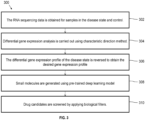
- FIG. 3 is a flow diagram illustrating a validation of the pre-trained deep learning model against a disease profile, according to some embodiments of the present disclosure.
- Ribonucleic acid (RNA) sequencing data is obtained for samples in the disease state and control (302). Further, a differential gene expression analysis is carried out using characteristic direction method (304). The differential gene expression profile of the disease state is reversed to obtain the desired gene expression profile (306). Small molecules are generated using the pre-trained deep learning model also referred as Gex2SGen (308). Finally, drug candidates are screened by applying one or more predefined biological filters (310).
- a validation of the pre-trained deep learning model is performed against a disease profile from a triple negative breast cancer (TNBC).
- TNBC triple negative breast cancer
- the gene expression signature for TNBC is collected from a high throughput sequencing (GSE113230), where ribosomal RNA-depleted total RNA was extracted and sequenced from three pairs of triple-negative breast cancer samples and adjacent normal tissues.
- the corresponding characteristic direction (CD) profile was obtained from SigCom LINCS portal.
- the desired effect of an anti-breast cancer drug is expected to reverse the differential expression of the genes in the disease state. Therefore, the inverse TNBC profile is obtained by transforming the expression values in the reverse direction.
- the values of the expressions are inversed by multiplying with negative one.
- the inverse TNBC cancer profile is considered as the desired gene expression input for the pre-trained deep learning model.
- the existing drugs against breast cancers are extracted from the DrugBank and compared against conditionally generated molecules by the model based on the desired profile.
- Various physiochemical properties of the molecules are calculated using rdkit package implemented in python. These physicochemical properties include Quantitative Estimate of Drug-likeness (QED), partition-coefficient (LogP), molecular weight (MW), number of hydrogen bond donors, number of hydrogen bond acceptor, molecular polar surface area, number of rotatable bonds, number of aromatic rings and the number of structure alerts.
- QED is based on the underlying distribution on eight molecular properties i.e., Molecular weight, octanol water partition coefficient, number of hydrogen bond donors, number of hydrogen bond acceptor, molecular polar surface area, number of rotatable bonds, number of aromatic rings and the number of structure alerts.
- Physicochemical properties of the generated molecules The 10,000 molecules generated for each the gene-knocked out profile are further examined for certain drug like properties (as described in the method section). The drug-likeness distribution of the generated molecules is found to be significantly better than the known inhibitors.
- the peak of the QED distribution is around 0.5 for the known inhibitors of AURKA, whereas for the generated molecules, the peak is around 0.8.
- the peak of the QED distribution for generated molecules is around 0.8, whereas the peak for the known inhibitors is around 0.2.
- the logP, molecular weight, hydrogen bond acceptor and hydrogen bond donor distribution of the generated molecules are significantly better for the generated molecules, compared to known inhibitors.
- Embodiments of present disclosure herein address the problem of generating molecules from the knocked-out gene expression profiles which are significantly unrelated (having low Tanimoto coefficients) with the known inhibitors of the genes.
- Embodiments herein provide a method and a system for a cell specific model where gene expressions are processed via a pretrained SMILES variational autoencoder to produce new molecules.
- the model is trained with the drug induced gene expression data as the input.
- Both the pretrained SMILES VAE and pVAE are trained jointly.
- the difference between the newly generated molecules and the existing drug molecules is calculated as a joint loss function composed of binary cross entropy loss and the Kullback-Leibler divergence (KLD) loss.
- KLD Kullback-Leibler divergence
- the method disclosed design drug-like small molecules from the desired gene expression profile, using two variational auto encoders, which jointly learnt the small molecules and their corresponding gene expression profiles.
- Such computer-readable storage means contain program-code means for implementation of one or more steps of the method, when the program runs on a server or mobile device or any suitable programmable device.
- the hardware device can be any kind of device which can be programmed including e.g., any kind of computer like a server or a personal computer, or the like, or any combination thereof.
- the device may also include means which could be e.g., hardware means like e.g., an application-specific integrated circuit (ASIC), a field-programmable gate array (FPGA), or a combination of hardware and software means, e.g., an ASIC and an FPGA, or at least one microprocessor and at least one memory with software processing components located therein.
- the means can include both hardware means, and software means.
- the method embodiments described herein could be implemented in hardware and software.
- the device may also include software means. Alternatively, the embodiments may be implemented on different hardware devices, e.g., using a plurality of CPUs, GPUs etc.
- the embodiments herein can comprise hardware and software elements.
- the embodiments that are implemented in software include but are not limited to, firmware, resident software, microcode, etc.
- the functions performed by various components described herein may be implemented in other components or combinations of other components.
- a computer-usable or computer readable medium can be any apparatus that can comprise, store, communicate, propagate, or transport the program for use by or in connection with the instruction execution system, apparatus, or device.
- a computer-readable storage medium refers to any type of physical memory on which information or data readable by a processor may be stored.
- a computer-readable storage medium may store instructions for execution by one or more processors, including instructions for causing the processor(s) to perform steps or stages consistent with the embodiments described herein.
- the term "computer-readable medium” should be understood to include tangible items and exclude carrier waves and transient signals, i.e., be non-transitory. Examples include random access memory (RAM), read-only memory (ROM), volatile memory, nonvolatile memory, hard drives, CD ROMs, DVDs, flash drives, disks, and any other known physical storage media.
Landscapes
- Health & Medical Sciences (AREA)
- Physics & Mathematics (AREA)
- Life Sciences & Earth Sciences (AREA)
- Engineering & Computer Science (AREA)
- Genetics & Genomics (AREA)
- Medical Informatics (AREA)
- Evolutionary Biology (AREA)
- General Health & Medical Sciences (AREA)
- Theoretical Computer Science (AREA)
- Spectroscopy & Molecular Physics (AREA)
- Biophysics (AREA)
- Biotechnology (AREA)
- Bioinformatics & Computational Biology (AREA)
- Bioinformatics & Cheminformatics (AREA)
- Molecular Biology (AREA)
- Data Mining & Analysis (AREA)
- Software Systems (AREA)
- Public Health (AREA)
- Bioethics (AREA)
- Evolutionary Computation (AREA)
- Artificial Intelligence (AREA)
- Epidemiology (AREA)
- Databases & Information Systems (AREA)
- Computer Vision & Pattern Recognition (AREA)
- Measuring Or Testing Involving Enzymes Or Micro-Organisms (AREA)
Abstract
Description
- The present application claims priority from
Indian patent application number 202321005947, filed on January 30, 2023 - The disclosure herein generally relates to the field of drug discovery and development and more particularly, to a method and system for designing drug-like molecules from desired gene expression signatures.
- Drug induced gene expression profiling provides useful information covering various aspects of drug discovery and development. Most importantly, this knowledge can be used to discover drugs mechanism of actions. Recently, deep learning-based drug design methods are in spotlight due to their ability to explore huge chemical space and design property optimized target-specific drug molecules. Recent advances in accessibility of open-source drug-induced transcriptomic data along with the ability of deep learning algorithms to understand hidden patterns have opened opportunities for designing drug molecules based on desired gene expression signatures.
- In recent times, number of deep learning based generative models have emerged, which showed promise to accelerate the whole drug discovery process. The deep learning-based generative methods can explore novel molecules from available chemical space, design target-specific de novo molecules, perform on-the-fly property optimization. However, there are lack of methods that can design molecules based on disease phenotype alone.
- Embodiments of the disclosure present technological improvements as solutions to one or more of the above-mentioned technical problems recognized by the inventors in conventional systems. For example, in one embodiment, a method and system for designing drug-like molecules from desired gene expression signatures is provided.
- In one aspect, a processor-implemented method for designing drug-like molecules from desired gene expression signatures is provided. The processor-implemented method comprising receiving, via an input/output interface, a gene expression profile in a cell-specific manner as an input and a dataset of molecules from a predefined drug-like small molecule database. Further, the processor-implemented method includes pre-processing, via one or more hardware processors, the received dataset of molecules to obtain a training dataset of molecules, wherein the molecules, represented by Simplified Molecular Input Line Entry System (SMILES) and within a predefined length are considered. Furthermore, the processor-implemented method includes training, via one or more hardware processors, a simplified molecular input line entry system (SMILES) variational autoencoder (s-VAE) and a profile variational autoencoder (p-VAE) jointly with the obtained training dataset of molecules. Finally, the method includes generating, via the one or more hardware processors, one or more conditional novel small molecules in SMILES format from the received gene expression profile using jointly trained s-VAE and p-VAE.
- In another aspect, a system for designing drug-like molecules from desired gene expression signatures is provided. The system includes at least one memory storing programmed instructions, one or more Input /Output (I/O) interfaces, and one or more hardware processors operatively coupled to the at least one memory, wherein the one or more hardware processors are configured by the programmed instructions to receive a gene expression profile in a cell-specific manner as an input and a dataset of molecules from a predefined drug-like small molecule database. Further, the one or more hardware processors are configured by the programmed instructions to pre-process the received dataset of molecules to obtain a training dataset of molecules, wherein the molecules represented by Simplified Molecular Input Line Entry System (SMILES) and within a predefined length, are considered. Furthermore, the one or more hardware processors are configured by the programmed instructions to train a simplified molecular input line entry system (SMILES) variational autoencoder (s-VAE) and a profile variational autoencoder (p-VAE) jointly with the obtained training dataset of molecules. Finally, the one or more hardware processors are configured by the programmed instructions to generate conditional novel small molecules in SMILES format from the received gene expression profile using jointly trained s-VAE and p-VAE.
- In yet another aspect, one or more non-transitory machine-readable information storage mediums are provided comprising one or more instructions, which when executed by one or more hardware processors causes a method for designing drug-like molecules from desired gene expression signatures. The processor-implemented method comprising receiving, via an input/output interface, a gene expression profile in a cell-specific manner as an input and a dataset of molecules from a ChEMBL database. Further, the processor-implemented method includes pre-processing, via one or more hardware processors, the received dataset of molecules to obtain a training dataset of molecules, wherein the molecules represented by Simplified Molecular Input Line Entry System (SMILES) and within a predefined length, are considered. Furthermore, the processor-implemented method includes training, via one or more hardware processors, a simplified molecular input line entry system (SMILES) variational autoencoder (s-VAE) and a profile variational autoencoder (p-VAE) jointly with the obtained training dataset of molecules. Finally, the method includes generating, via the one or more hardware processors, conditional novel small molecules in SMILES format from the received gene expression profile using jointly trained s-VAE and p-VAE.
- It is to be understood that both the foregoing general description and the following detailed description are exemplary and explanatory only and are not restrictive of the invention, as claimed.
- The accompanying drawings, which are incorporated in and constitute a part of this disclosure, illustrate exemplary embodiments and, together with the description, serve to explain the disclosed principles:
-
FIG. 1 illustrates a network diagram of a system for designing drug-like molecules from desired gene expression signatures, in accordance with some embodiments of the present disclosure. -
FIG. 2 is an exemplary flow diagram illustrating a method for designing drug-like molecules from desired gene expression signatures, in accordance with some embodiments of the present disclosure. -
FIG. 3 illustrates a block diagram to illustrate a validation of the pre-trained deep learning model against a disease profile, in accordance with some embodiments of the present disclosure. - Exemplary embodiments are described with reference to the accompanying drawings. In the figures, the left-most digit(s) of a reference number identifies the figure in which the reference number first appears. Wherever convenient, the same reference numbers are used throughout the drawings to refer to the same or like parts. While examples and features of disclosed principles are described herein, modifications, adaptations, and other implementations are possible without departing from the scope of the disclosed embodiments.
- Drug discovery is a time-consuming, cost-intensive, and high-risk venture lasting over years from target identification to market approval. Drug discovery usually starts with a well-defined hypothesis about the disease, followed by target identification. Once a suitable target is identified, usually ligand-based or structure-based drug design methods are used for hitting identification. In the next subsequent stages, the identified hits go through various pre-clinical and clinical trial stages where drug toxicity, safety and efficacy are further tested. In most cases, little is known about the drug mechanism of action. The cumulative effect of all these factors contribute to high failure rates of 90% for drugs in the clinical trial stages alone. The failure rate is even higher in the pre-clinical stages.
- Gene-expression has become a useful tool for drug discovery and development as it can capture the molecular signature of a disease and its relationship with phenotypic environment. Gene expression can also identify probable drug targets. The drug induced gene expression is useful to understand how drug molecules target selected cellular pathways or avoid cellular pathways that lead to toxic effects. In recent times, it is a standard practice to perform drug induced gene expression analysis on the target cell lines to understand the effect of drugs on cellular pathways, their dose dependence and check pharmacodynamic properties. Several groups have used gene expressions to understand drug-dose response, drug safety, response of specific pathways and identify off-target side-effects.
- Inclusion of gene-expression during initial stage of the drug-design can potentially resolve the problem of late-stage attrition of drug molecules and thereby it can greatly reduce the time and cost of the overall drug discovery and development. Moreover, gene expression based omic approach can generate novel molecules without the need for prior knowledge about target-specific ligand dataset that are used for ligand-based drug discovery or three-dimensional structures of the target proteins that are used for structure-based drug design.
- In recent times, number of deep learning based generative models have emerged, which showed promise to accelerate the whole drug discovery process. The deep learning-based generative methods can explore novel molecules from available chemical space, design target-specific de novo molecules, perform on-the-fly property optimization. However, there are lack of methods that can design molecules based on disease phenotype alone. Gene expression provides useful information like drug mechanism of action. Such a method does not require target information and provide important information like off-target effects, which is a major reason for late stage drug attrition.
- Therefore, embodiments herein provide a method and system for designing drug-like molecules from desired gene expression signatures. Initially, a gene expression profile is received in a cell-specific manner as an input, via an input/output interface, and a dataset of molecules from a predefined drug-like small molecule database such as ChEMBL. A pre-trained deep learning model comprises of a pretrained profile variational autoencoder (pVAE), which learns to project gene expression profiles into a latent space, which is then passed through a pre-trained SMILES variation autoencoder. After the completion of the combined training of pVAE and sVAE, a desired gene expression is supplied to the pre-trained deep learning model for conditional generation of novel small molecule in SMILES format. The pre-trained deep learning model is tested against three breast cancer target genes (using gene knocked out expression profiles of the respective genes), where it could design novel inhibitors with high bioactivity. Finally, the pre-trained deep learning model is tested against triple negative breast cancer profile (TNBC), a high-risk aggressive cancer, where the pre-trained deep learning model could design novel molecules similar to known inhibitors. It is to be noted that an in-silico validation is performed for both the cases, where designed molecules are found to be highly similar to existing inhibitors.
- Referring now to the drawings, and more particularly to
FIG. 1 through FIG. 3 , where similar reference characters denote corresponding features consistently throughout the figures, there are shown preferred embodiments and these embodiments are described in the context of the following exemplary system and/or method. -
FIG. 1 illustrates a network diagram of asystem 100 for designing drug-like molecules from desired gene expression signatures. Although the present disclosure is explained considering that thesystem 100 is implemented on a server, it may also be present elsewhere such as a local machine. It may be understood that thesystem 100 comprises one ormore computing devices 102, such as a laptop computer, a desktop computer, a notebook, a workstation, a cloud-based computing environment and the like. It will be understood that thesystem 100 may be accessed through one or more input/output interfaces 104-1, 104-2... 104-N, collectively referred to as I/O interface 104. Examples of the I/O interface 104 may include, but are not limited to, a user interface, a portable computer, a personal digital assistant, a handheld device, a smartphone, a tablet computer, a workstation and the like. The I/O interface 104 are communicatively coupled to thesystem 100 through anetwork 106. - In an embodiment, the
network 106 may be a wireless or a wired network, or a combination thereof. In an example, thenetwork 106 can be implemented as a computer network, as one of the different types of networks, such as virtual private network (VPN), intranet, local area network (LAN), wide area network (WAN), the internet, and such. Thenetwork 106 may either be a dedicated network or a shared network, which represents an association of the different types of networks that use a variety of protocols, for example, Hypertext Transfer Protocol (HTTP), Transmission Control Protocol/Internet Protocol (TCP/IP), and Wireless Application Protocol (WAP), to communicate with each other. Further, thenetwork 106 may include a variety of network devices, including routers, bridges, servers, computing devices, storage devices. The network devices within thenetwork 106 may interact with thesystem 100 through communication links. - The
system 100 may be implemented in a workstation, a mainframe computer, a server, and a network server. In an embodiment, thecomputing device 102 further comprises one ormore hardware processors 108, one ormore memory 110, hereinafter referred as amemory 110 and adata repository 112, for example, arepository 112. Thedata repository 112 may also be referred as adynamic knowledge base 112 or aknowledge base 112. Thememory 110 is in communication with the one ormore hardware processors 108, wherein the one ormore hardware processors 108 are configured to execute programmed instructions stored in thememory 110, to perform various functions as explained in the later part of the disclosure. Therepository 112 may store data processed, received, and generated by thesystem 100. Thememory 110 further comprises a plurality of modules. The plurality of modules is configured to perform various functions. - The
system 100 supports various connectivity options such as BLUETOOTH®, USB, ZigBee and other cellular services. The network environment enables connection of various components of thesystem 100 using any communication link including Internet, WAN, MAN, and so on. In an exemplary embodiment, thesystem 100 is implemented to operate as a stand-alone device. In another embodiment, thesystem 100 may be implemented to work as a loosely coupled device to a smart computing environment. The components and functionalities of thesystem 100 are described further in detail. -
FIG. 2 is an exemplary flow diagrams illustrating a processor-implementedmethod 200 for designing drug-like molecules from desired gene expression signatures implemented by the system ofFIG. 1 , according to some embodiments of the present disclosure. - Initially at
step 202 of themethod 200, a gene expression profile in a cell-specific manner is received, via an input/output interface 104, as an input and a dataset of molecules from a predefined drug-like small molecule database such as a ChEMBL. The gene expression profile includes molecular signature of a disease and its relationship with a phenotypic environment. - At the
next step 204 of themethod 200, the one ormore hardware processors 102 are configured by the programmed instructions to preprocess the received dataset of molecules to obtain a training dataset of molecules, wherein the molecules with a predefined length are considered. - At the
next step 206 of themethod 200, the one ormore hardware processors 102 are configured by the programmed instructions to train a simplified molecular input line entry system (SMILES) variational autoencoder (s-VAE) and a profile variational autoencoder (p-VAE) jointly with the obtained training dataset of molecules. The simplified molecular input line entry system (SMILES) is a string-based representation of the predefined molecules. It would be appreciated that the generating SMILES from gene expression data is considered as a mapping function of the molecular structure to gene expressions. The predefined molecules are represented in the SMILES format, where thesystem 100 learns grammar of the predefined molecules using the s-VAE. - In one illustration, the dataset of molecules for training the s-VAE model is obtained from the ChEMBL database. This dataset is pre-processed to obtain the final training dataset with ~1.6 million molecules. The molecules with length smaller than 100 is only considered. Filters are applied to remove stereochemistry, salts, and molecules with undesirable atoms or groups and the remaining molecules are canonicalized as described in our earlier works. The molecules from both ChEMBL and L1000 CDS2 are represented in the SMILES format to leverage the effectiveness of deep learning networks. SMILES is a string-based representation of the molecules based on the principles of molecular graph theory.
- This allows molecular structure depiction with straightforward rules and has been used in several papers representing molecular information in-silico. During the pre-training, only molecules from ChEMBL dataset is used so that the model can learn the grammar of small molecules from a bigger dataset and design diversified novel small molecules. The deep neural network architecture of the s-VAE model consists of an encoder and a decoder. Both encoder and decoder consist of two layers of 1024 bidirectional gated recurrent units (GRU) as the internal memory, augmented with a stack acting as the dynamic external memory. The stack had a width of 256 units and a depth of 105 units. An embedding layer and a dense layer with log softmax activation are used to pass the input to the encoder and retrieve the output from the decoder, respectively.
- In one example, wherein the L1000 dataset is used to obtain the mRNA gene-expression profiles which are generated as part of the Library of Integrated Network-based Cellular Signatures (LINCS). The L1000 contains gene perturbations including chemical, gene knockouts and overexpression. The L1000 gene expression profiles calculated using the characteristic direction (CD) method are used for all the analyses. The CD data set has been shown to be highly sensitive to differential gene expression. To further refine the input data, a high-quality CD dataset is extracted. The high-quality data is filtered based on the p-value ≤ 0.05 across replicates. The p-value is a measure of reliability of the data obtained based on the expression values of the replicates of the experiment. Lower p-values indicate that the expression values are consistent across the replicates and that the probability of obtaining the values by random chance is low. MCF7, PC3 and VCAP cell lines had maximum high-quality data available. The perturbagen dosage concentration of 10 µM is administered most across the experiments and the time points of 6h and 24h are most frequently observed. Based on the availability of the high-quality data, the combination of MCF7 cell line, 10 µM concentration and 24h time points are considered for building the model as this consisted of the maximum number of available datasets. For each expression profile, the induced drug is represented in SMILES format, pre-processed, filtered and canonicalized, resulting in 1,404 data points. This is randomly split at a 9:1 ratio for train and test set. The training data is used to update the weights of the VAE whereas the test data was never shown to the model during training.
- In another embodiment, an encoder of the p-VAE learns to project the received gene expression profiles into a latent space. The pVAE consisted of an encoder with an input layer of 978, two hidden layers of size 768 and 512, and two vectors of 256 dimensions describing the mean and variance of the latent space distributions. The dimensionality of the latent space was kept at 256 for seamless transfer to the SMILES Variational. Autoencoder which was pretrained with a latent space of 256 dimensions. The dimensions of the interim layers were carefully chosen after several trials, where the aim was to select combinations with minimum loss. This latent space is the compressed knowledge representation of the gene expression data and is therefore the most important part of the network. The encoder generates a latent vector by sampling from defined mean and variance of the distributions and proceeds to develop a reconstruction of the original gene expression input. The decoder is the inverse of the encoder with input layers from 256 to an output of 978 via 512 and 768 nodes.
- The reconstruction of the gene expression is considered as a regression problem and the loss of the auto encoder is measured by Mean squared error and Kullback-Leibler Divergence (KLD) using the formulae:


- Referring back to
FIG. 2 , at thelast step 208 of themethod 200, the one ormore hardware processors 102 are configured by the programmed instructions for conditional novel small molecules generation in SMILES format from the received gene expression profile using jointly trained s-VAE and p-VAE. The designed conditional novel small molecule is pass through one or more physico-chemical filters to satisfy one or more drug-like properties. The generated conditional novel small molecule induces a desired gene expression. - The combined model consists of the p-VAE encoder and the s-VAE decoder. The pretraining of the p-VAE ensured that it is capable of extracting essential features of the input gene expression while the pretrained s-VAE ensured better learning of the SMILES grammar which can generate more diverse molecules. The combined model is trained with CD values of L1000 gene expression data where the output is small molecules in SMILES representation. The model is trained for 500 epochs with the backpropagation limited only to the SMILES decoder. The small molecules and their corresponding induced gene expression data are used for the joint training of the model. As mentioned earlier, maximum amount of high-quality data could be extracted from the MCF7 cell line. The combinations of MCF7 cell line, 10 µM concentration and 24h time point is considered for further model building. The data is divided into 90% training data and 10% test data. This data is fed to the model in batches of 64 with a Kullback-Leibler growth rate of 0.05 and a learning rate of 1e-3. The model is trained to minimize a joint loss function, as in equation (1), with E as cross entropy loss (CE) of the adjacency matrix reconstruction and the Kullback-Leibler divergence (KLD) loss to enforce the latent variables to follow the Gaussian distribution.
- It would be appreciated that the validation of the pre-trained deep learning model is carried out in two ways:
- (i) The desired gene expression due to gene knockdown is collected, where each of the knocked down gene is assumed to be disease associated gene. The known inhibitors of these genes are collected and compared with the designed molecules.
- (ii) The disease gene expression profile is directly used to design molecules against the disease of interest. The CRISPR gene knockdown data is extracted from the SigCom LINCS L1000 CDS2 portal.
- The available CRISPR knocked out profiles are extracted, and average Pearson Correlation Coefficient (PCC) is calculated for each knocked out gene. Most genes have multiple profiles and only high-quality profiles are considered for the current study. The profiles where the average PCC is greater than 0.7 is considered as high confidence profiles for further analyses. The single profile available for AURKA, a well-known anti-breast cancer gene target, is also considered.
- Further, the molecules known to inhibit the respective human genes whose knocked out profiles are extracted, are searched from a ExCape database. The molecules with pXC50 values of at least 5 or greater are considered as inhibitors for the given genes. The active molecules are converted to SMILES format, canonicalized and only with length less than 100 are stored as the validation dataset. Only those genes with more than 100 inhibitors are considered. If any of the small molecule from the validation dataset is present in the training dataset, they are removed from the list. This resulted in 2,316, 1,057 and 111 known inhibitors for AURKA, ADRB3 and PSMB5 respectively. The list of known inhibitors from the validation dataset, and the newly designed molecules are compared for in silico validation.
- Further, to validate the effectiveness of the pre-trained deep learning model, generated molecules are compared with known inhibitors. Several generated molecules are found to be highly similar compared to the known inhibitors. The generated molecules also displayed a high internal diversity. The generated molecules are tested for their physio-chemical properties specifically for drug likeness, partition coefficient, molecular weight and found to be drug-like. The pre-trained deep learning model is further tested against a gene expression profile and is able to recall known breast cancer drugs. Overall, the pre-trained deep learning model is able to sample from the diverse chemical space and generated several potent drug-like compounds.
-
FIG. 3 is a flow diagram illustrating a validation of the pre-trained deep learning model against a disease profile, according to some embodiments of the present disclosure. Initially, Ribonucleic acid (RNA) sequencing data is obtained for samples in the disease state and control (302). Further, a differential gene expression analysis is carried out using characteristic direction method (304). The differential gene expression profile of the disease state is reversed to obtain the desired gene expression profile (306). Small molecules are generated using the pre-trained deep learning model also referred as Gex2SGen (308). Finally, drug candidates are screened by applying one or more predefined biological filters (310). - In one example, wherein a validation of the pre-trained deep learning model is performed against a disease profile from a triple negative breast cancer (TNBC). The gene expression signature for TNBC is collected from a high throughput sequencing (GSE113230), where ribosomal RNA-depleted total RNA was extracted and sequenced from three pairs of triple-negative breast cancer samples and adjacent normal tissues. The corresponding characteristic direction (CD) profile was obtained from SigCom LINCS portal. The desired effect of an anti-breast cancer drug is expected to reverse the differential expression of the genes in the disease state. Therefore, the inverse TNBC profile is obtained by transforming the expression values in the reverse direction. The values of the expressions are inversed by multiplying with negative one. The inverse TNBC cancer profile is considered as the desired gene expression input for the pre-trained deep learning model. The existing drugs against breast cancers are extracted from the DrugBank and compared against conditionally generated molecules by the model based on the desired profile.
- Various physiochemical properties of the molecules are calculated using rdkit package implemented in python. These physicochemical properties include Quantitative Estimate of Drug-likeness (QED), partition-coefficient (LogP), molecular weight (MW), number of hydrogen bond donors, number of hydrogen bond acceptor, molecular polar surface area, number of rotatable bonds, number of aromatic rings and the number of structure alerts. QED is based on the underlying distribution on eight molecular properties i.e., Molecular weight, octanol water partition coefficient, number of hydrogen bond donors, number of hydrogen bond acceptor, molecular polar surface area, number of rotatable bonds, number of aromatic rings and the number of structure alerts. As the QED values move towards 1, the more compounds can be considered as druglike. LogP not greater than 5, molecular weight not greater than 500, no more than 5 hydrogen bond acceptors and no more than 10 hydrogen bond donors were considered as other property filters to satisfy Lipinski's Rule of 5.
- Physicochemical properties of the generated molecules: The 10,000 molecules generated for each the gene-knocked out profile are further examined for certain drug like properties (as described in the method section). The drug-likeness distribution of the generated molecules is found to be significantly better than the known inhibitors. The peak of the QED distribution is around 0.5 for the known inhibitors of AURKA, whereas for the generated molecules, the peak is around 0.8. In case of ADRB3 and PSMB5, the peak of the QED distribution for generated molecules is around 0.8, whereas the peak for the known inhibitors is around 0.2. Similarly, the logP, molecular weight, hydrogen bond acceptor and hydrogen bond donor distribution of the generated molecules are significantly better for the generated molecules, compared to known inhibitors. After applying the property filters, 3940, 3465 and 3463 molecules were obtained from gene knocked out profiles of AURKA, ADRB3 and PSMB5 respectively.
- The written description describes the subject matter herein to enable any person skilled in the art to make and use the embodiments. The scope of the subject matter embodiments is defined by the claims and may include other modifications that occur to those skilled in the art. Such other modifications are intended to be within the scope of the claims if they have similar elements that do not differ from the literal language of the claims or if they include equivalent elements with insubstantial differences from the literal language of the claims.
- The embodiments of present disclosure herein address the problem of generating molecules from the knocked-out gene expression profiles which are significantly unrelated (having low Tanimoto coefficients) with the known inhibitors of the genes. Embodiments herein provide a method and a system for a cell specific model where gene expressions are processed via a pretrained SMILES variational autoencoder to produce new molecules. The model is trained with the drug induced gene expression data as the input. Both the pretrained SMILES VAE and pVAE are trained jointly. During the joint training, the difference between the newly generated molecules and the existing drug molecules is calculated as a joint loss function composed of binary cross entropy loss and the Kullback-Leibler divergence (KLD) loss. This loss is backpropagated to the decoder part of the model, which helped the model accurately learn the conditional mapping of the molecular space to the transcriptomic space in a cell-specific manner. The method disclosed design drug-like small molecules from the desired gene expression profile, using two variational auto encoders, which jointly learnt the small molecules and their corresponding gene expression profiles.
- It is to be understood that the scope of the protection is extended to such a program and in addition to a computer-readable means having a message therein; such computer-readable storage means contain program-code means for implementation of one or more steps of the method, when the program runs on a server or mobile device or any suitable programmable device. The hardware device can be any kind of device which can be programmed including e.g., any kind of computer like a server or a personal computer, or the like, or any combination thereof. The device may also include means which could be e.g., hardware means like e.g., an application-specific integrated circuit (ASIC), a field-programmable gate array (FPGA), or a combination of hardware and software means, e.g., an ASIC and an FPGA, or at least one microprocessor and at least one memory with software processing components located therein. Thus, the means can include both hardware means, and software means. The method embodiments described herein could be implemented in hardware and software. The device may also include software means. Alternatively, the embodiments may be implemented on different hardware devices, e.g., using a plurality of CPUs, GPUs etc.
- The embodiments herein can comprise hardware and software elements. The embodiments that are implemented in software include but are not limited to, firmware, resident software, microcode, etc. The functions performed by various components described herein may be implemented in other components or combinations of other components. For the purposes of this description, a computer-usable or computer readable medium can be any apparatus that can comprise, store, communicate, propagate, or transport the program for use by or in connection with the instruction execution system, apparatus, or device.
- The illustrated steps are set out to explain the exemplary embodiments shown, and it should be anticipated that ongoing technological development will change the manner in which particular functions are performed. These examples are presented herein for purposes of illustration, and not limitation. Further, the boundaries of the functional building blocks have been arbitrarily defined herein for the convenience of the description. Alternative boundaries can be defined so long as the specified functions and relationships thereof are appropriately performed. Alternatives (including equivalents, extensions, variations, deviations, etc., of those described herein) will be apparent to persons skilled in the relevant art(s) based on the teachings contained herein. Such alternatives fall within the scope of the disclosed embodiments. Also, the words "comprising," "having," "containing," and "including," and other similar forms are intended to be equivalent in meaning and be open ended in that an item or items following any one of these words is not meant to be an exhaustive listing of such item or items or meant to be limited to only the listed item or items. It must also be noted that as used herein and in the appended claims, the singular forms "a," "an," and "the" include plural references unless the context clearly dictates otherwise.
- Furthermore, one or more computer-readable storage media may be utilized in implementing embodiments consistent with the present disclosure. A computer-readable storage medium refers to any type of physical memory on which information or data readable by a processor may be stored. Thus, a computer-readable storage medium may store instructions for execution by one or more processors, including instructions for causing the processor(s) to perform steps or stages consistent with the embodiments described herein. The term "computer-readable medium" should be understood to include tangible items and exclude carrier waves and transient signals, i.e., be non-transitory. Examples include random access memory (RAM), read-only memory (ROM), volatile memory, nonvolatile memory, hard drives, CD ROMs, DVDs, flash drives, disks, and any other known physical storage media.
- It is intended that the disclosure and examples be considered as exemplary only, with a true scope of disclosed embodiments being indicated by the following claims.
Claims (15)
- A processor-implemented method (200) comprising:receiving (202), via an input/output interface, a gene expression profile in a cell-specific manner as an input and a dataset of molecules from a predefined drug-like small molecule database;pre-processing (204), via the one or more hardware processors, the received dataset of molecules to obtain a training dataset of molecules;jointly training (206), via the one or more hardware processors, a simplified molecular input line entry system (SMILES) variational autoencoder (s-VAE) and a profile variational autoencoder (p-VAE) with the obtained training dataset of molecules; andgenerating (208), via the one or more hardware processors, one or more conditional novel small molecules in SMILES format from the received gene expression profile using trained s-VAE and p-VAE.
- The processor-implemented method (200) of claim 1, wherein the gene expression profile includes molecular signature of a disease and an associated relationship with a phenotypic environment.
- The processor-implemented method (200) of claim 1, wherein the simplified molecular input line entry system (SMILES) is a string-based representation of the molecules.
- The processor-implemented method (200) of claim 1, wherein an encoder of the p-VAE learns to project the received gene expression profiles into a latent space, and wherein a decoder of the s-VAE generates one or more conditional novel small molecules.
- The processor-implemented method (200) of claim 1, wherein the generated one or more conditional novel small molecules induce a desired gene expression.
- The processor-implemented method (200) of claim 1, wherein the one or more conditional novel small molecules is passed through one or more physico-chemical filters to satisfy one or more drug-like properties.
- A system (100) comprising:an input/output interface (104) to receive a gene expression profile in a cell-specific manner as an input and a dataset of molecules from a predefined drug-like small molecule database;a memory (110) in communication with the one or more hardware processors (108), wherein the one or more hardware processors (108) are configured to execute programmed instructions stored in the memory (110) to:pre-process the received dataset of molecules to obtain a training dataset of molecules;jointly train a simplified molecular input line entry system (SMILES) variational autoencoder (s-VAE) and a profile variational autoencoder (p-VAE) with the obtained training dataset of molecules; andgenerate one or more conditional novel small molecules in SMILES format from the received gene expression profile using trained s-VAE and p-VAE.
- The system (100) of claim 7, wherein the gene expression profile includes molecular signature of a disease and an associated relationship with a phenotypic environment.
- The system (100) of claim 7, wherein the simplified molecular input line entry system (SMILES) is a string-based representation of the molecules.
- The system (100) of claim 7, wherein an encoder of the p-VAE learns to project the received gene expression profiles into a latent space, and wherein a decoder of the s-VAE generates one or more conditional novel small molecules.
- The system (100) of claim 7, wherein the generated one or more conditional novel small molecules induce a desired gene expression.
- The system (100) of claim 7, wherein the one or more conditional novel small molecules is passed through one or more physico-chemical filters to satisfy one or more drug-like properties.
- One or more non-transitory machine-readable information storage mediums comprising one or more instructions which when executed by one or more hardware processors cause:receiving, via an input/output interface, a gene expression profile in a cell-specific manner as an input and a dataset of molecules from a predefined drug-like small molecule database;pre-processing the received dataset of molecules to obtain a training dataset of molecules;jointly training a simplified molecular input line entry system (SMILES) variational autoencoder (s-VAE) and a profile variational autoencoder (p-VAE) with the obtained training dataset of molecules; andgenerating one or more conditional novel small molecules in SMILES format from the received gene expression profile using trained s-VAE and p-VAE.
- The one or more non-transitory machine-readable information storage mediums of claim 13, wherein the gene expression profile includes molecular signature of a disease and an associated relationship with a phenotypic environment.
- The one or more non-transitory machine-readable information storage mediums of claim 13, wherein the one or more conditional novel small molecules is passed through one or more physico-chemical filters to satisfy one or more drug-like properties.
Applications Claiming Priority (1)
| Application Number | Priority Date | Filing Date | Title |
|---|---|---|---|
| IN202321005947 | 2023-01-30 |
Publications (3)
| Publication Number | Publication Date |
|---|---|
| EP4407624A1 true EP4407624A1 (en) | 2024-07-31 |
| EP4407624B1 EP4407624B1 (en) | 2025-12-31 |
| EP4407624C0 EP4407624C0 (en) | 2025-12-31 |
Family
ID=88647692
Family Applications (1)
| Application Number | Title | Priority Date | Filing Date |
|---|---|---|---|
| EP23207229.8A Active EP4407624B1 (en) | 2023-01-30 | 2023-11-01 | METHOD AND SYSTEM FOR THE DESIGN OF DRUG-LIKE MOLECULES FROM DESIRED GENE EXPRESSION SIGNATURES |
Country Status (2)
| Country | Link |
|---|---|
| US (1) | US20240257908A1 (en) |
| EP (1) | EP4407624B1 (en) |
Citations (1)
| Publication number | Priority date | Publication date | Assignee | Title |
|---|---|---|---|---|
| US20200365238A1 (en) * | 2019-05-15 | 2020-11-19 | International Business Machines Corporation | Drug compound identification for target tissue cells |
-
2023
- 2023-10-31 US US18/385,604 patent/US20240257908A1/en active Pending
- 2023-11-01 EP EP23207229.8A patent/EP4407624B1/en active Active
Patent Citations (1)
| Publication number | Priority date | Publication date | Assignee | Title |
|---|---|---|---|---|
| US20200365238A1 (en) * | 2019-05-15 | 2020-11-19 | International Business Machines Corporation | Drug compound identification for target tissue cells |
Non-Patent Citations (2)
| Title |
|---|
| BORN JANNIS ET AL: "PaccMann^RL: De novo generation of hit-like anticancer molecules from transcriptomic data via reinforcement learning", vol. 24, no. 7, 5 March 2021 (2021-03-05), US, XP093148954, ISSN: 2589-0042, Retrieved from the Internet <URL:https://doi.org/10.1016/j.isci.2021.102269> [retrieved on 20240408], DOI: 10.1016/j.isci * |
| HONGYUAN DONG ET AL: "Variational Autoencoder for Anti-Cancer Drug Response Prediction", ARXIV.ORG, CORNELL UNIVERSITY LIBRARY, 201 OLIN LIBRARY CORNELL UNIVERSITY ITHACA, NY 14853, 18 September 2020 (2020-09-18), XP081765702 * |
Also Published As
| Publication number | Publication date |
|---|---|
| EP4407624B1 (en) | 2025-12-31 |
| US20240257908A1 (en) | 2024-08-01 |
| EP4407624C0 (en) | 2025-12-31 |
Similar Documents
| Publication | Publication Date | Title |
|---|---|---|
| EP4181145B1 (en) | Method and system for structure-based drug design using a multi-modal deep learning model | |
| Gong et al. | Big data toolsets to pharmacometrics: application of machine learning for time‐to‐event analysis | |
| Jin et al. | Predicting new protein conformations from molecular dynamics simulation conformational landscapes and machine learning | |
| US12190999B2 (en) | Systems and methods for predicting potential inhibitors of target protein | |
| US11651841B2 (en) | Drug compound identification for target tissue cells | |
| GB2624778A (en) | Genetic mutation detection using deep learning | |
| WO2018053511A1 (en) | Threat scoring system and method | |
| US20240265270A1 (en) | Rna location prediction method and apparatus, and storage medium | |
| AU2016209478A1 (en) | Systems and methods for response prediction to chemotherapy in high grade bladder cancer | |
| US20200365234A1 (en) | Sequence variation detection using deep learning | |
| Harel et al. | Accelerating prototype-based drug discovery using conditional diversity networks | |
| JP2023547571A (en) | Drug optimization through active learning | |
| Wang et al. | Predicting Protein Interactions Using a Deep Learning Method‐Stacked Sparse Autoencoder Combined with a Probabilistic Classification Vector Machine | |
| CN114743592B (en) | A method, device, equipment and medium for predicting drug clinical trial results | |
| JP7411079B2 (en) | Somatic mutation detection device and method that reduces specific errors in sequencing platforms | |
| EP4250304B1 (en) | Method and system for determining free energy of permeation for molecules | |
| EP4407624B1 (en) | METHOD AND SYSTEM FOR THE DESIGN OF DRUG-LIKE MOLECULES FROM DESIRED GENE EXPRESSION SIGNATURES | |
| Xiang et al. | Interpretable molecular property predictions using marginalized graph kernels | |
| Vasan et al. | High performance binding affinity prediction with a Transformer-based surrogate model | |
| US12119091B1 (en) | Utilizing masked autoencoder generative models to extract microscopy representation autoencoder embeddings | |
| Živković et al. | Monte Carlo optimization method based QSPR modeling of micelle–water partition coefficient | |
| Melo et al. | Machine learning for drug discovery | |
| Ningthoujam et al. | R software for QSAR analysis in phytopharmacological studies | |
| Madssen et al. | Statistical Validation of Multivariate Treatment Effects in Longitudinal Study Designs | |
| Qin | Self-Attention mechanisms as representations for gene interaction networks in hypothesis-driven gene-based transformer genomics AI Models |
Legal Events
| Date | Code | Title | Description |
|---|---|---|---|
| PUAI | Public reference made under article 153(3) epc to a published international application that has entered the european phase |
Free format text: ORIGINAL CODE: 0009012 |
|
| STAA | Information on the status of an ep patent application or granted ep patent |
Free format text: STATUS: THE APPLICATION HAS BEEN PUBLISHED |
|
| AK | Designated contracting states |
Kind code of ref document: A1 Designated state(s): AL AT BE BG CH CY CZ DE DK EE ES FI FR GB GR HR HU IE IS IT LI LT LU LV MC ME MK MT NL NO PL PT RO RS SE SI SK SM TR |
|
| STAA | Information on the status of an ep patent application or granted ep patent |
Free format text: STATUS: REQUEST FOR EXAMINATION WAS MADE |
|
| 17P | Request for examination filed |
Effective date: 20240828 |
|
| RBV | Designated contracting states (corrected) |
Designated state(s): AL AT BE BG CH CY CZ DE DK EE ES FI FR GB GR HR HU IE IS IT LI LT LU LV MC ME MK MT NL NO PL PT RO RS SE SI SK SM TR |
|
| GRAP | Despatch of communication of intention to grant a patent |
Free format text: ORIGINAL CODE: EPIDOSNIGR1 |
|
| STAA | Information on the status of an ep patent application or granted ep patent |
Free format text: STATUS: GRANT OF PATENT IS INTENDED |
|
| INTG | Intention to grant announced |
Effective date: 20250804 |
|
| GRAS | Grant fee paid |
Free format text: ORIGINAL CODE: EPIDOSNIGR3 |
|
| GRAA | (expected) grant |
Free format text: ORIGINAL CODE: 0009210 |
|
| STAA | Information on the status of an ep patent application or granted ep patent |
Free format text: STATUS: THE PATENT HAS BEEN GRANTED |
|
| AK | Designated contracting states |
Kind code of ref document: B1 Designated state(s): AL AT BE BG CH CY CZ DE DK EE ES FI FR GB GR HR HU IE IS IT LI LT LU LV MC ME MK MT NL NO PL PT RO RS SE SI SK SM TR |
|
| REG | Reference to a national code |
Ref country code: CH Ref legal event code: F10 Free format text: ST27 STATUS EVENT CODE: U-0-0-F10-F00 (AS PROVIDED BY THE NATIONAL OFFICE) Effective date: 20251231 Ref country code: GB Ref legal event code: FG4D |
|
| REG | Reference to a national code |
Ref country code: DE Ref legal event code: R096 Ref document number: 602023010373 Country of ref document: DE |
|
| REG | Reference to a national code |
Ref country code: CH Ref legal event code: R17 Free format text: ST27 STATUS EVENT CODE: U-0-0-R10-R17 (AS PROVIDED BY THE NATIONAL OFFICE) Effective date: 20260121 |
|
| REG | Reference to a national code |
Ref country code: IE Ref legal event code: FG4D |
|
| U01 | Request for unitary effect filed |
Effective date: 20260105 |
|
| U07 | Unitary effect registered |
Designated state(s): AT BE BG DE DK EE FI FR IT LT LU LV MT NL PT RO SE SI Effective date: 20260113 |
|
| PG25 | Lapsed in a contracting state [announced via postgrant information from national office to epo] |
Ref country code: NO Free format text: LAPSE BECAUSE OF FAILURE TO SUBMIT A TRANSLATION OF THE DESCRIPTION OR TO PAY THE FEE WITHIN THE PRESCRIBED TIME-LIMIT Effective date: 20260331 |
|
| PG25 | Lapsed in a contracting state [announced via postgrant information from national office to epo] |
Ref country code: HR Free format text: LAPSE BECAUSE OF FAILURE TO SUBMIT A TRANSLATION OF THE DESCRIPTION OR TO PAY THE FEE WITHIN THE PRESCRIBED TIME-LIMIT Effective date: 20251231 |
|
| PG25 | Lapsed in a contracting state [announced via postgrant information from national office to epo] |
Ref country code: RS Free format text: LAPSE BECAUSE OF FAILURE TO SUBMIT A TRANSLATION OF THE DESCRIPTION OR TO PAY THE FEE WITHIN THE PRESCRIBED TIME-LIMIT Effective date: 20260331 |