EP4407455A1 - Method and system for batch processing of jobs - Google Patents
Method and system for batch processing of jobs Download PDFInfo
- Publication number
- EP4407455A1 EP4407455A1 EP23220537.7A EP23220537A EP4407455A1 EP 4407455 A1 EP4407455 A1 EP 4407455A1 EP 23220537 A EP23220537 A EP 23220537A EP 4407455 A1 EP4407455 A1 EP 4407455A1
- Authority
- EP
- European Patent Office
- Prior art keywords
- jobs
- components
- constraints
- smaller components
- component
- Prior art date
- Legal status (The legal status is an assumption and is not a legal conclusion. Google has not performed a legal analysis and makes no representation as to the accuracy of the status listed.)
- Pending
Links
Images




Classifications
-
- G—PHYSICS
- G06—COMPUTING OR CALCULATING; COUNTING
- G06F—ELECTRIC DIGITAL DATA PROCESSING
- G06F9/00—Arrangements for program control, e.g. control units
- G06F9/06—Arrangements for program control, e.g. control units using stored programs, i.e. using an internal store of processing equipment to receive or retain programs
- G06F9/46—Multiprogramming arrangements
- G06F9/50—Allocation of resources, e.g. of the central processing unit [CPU]
- G06F9/5005—Allocation of resources, e.g. of the central processing unit [CPU] to service a request
- G06F9/5027—Allocation of resources, e.g. of the central processing unit [CPU] to service a request the resource being a machine, e.g. CPUs, Servers, Terminals
- G06F9/5038—Allocation of resources, e.g. of the central processing unit [CPU] to service a request the resource being a machine, e.g. CPUs, Servers, Terminals considering the execution order of a plurality of tasks, e.g. taking priority or time dependency constraints into consideration
-
- G—PHYSICS
- G06—COMPUTING OR CALCULATING; COUNTING
- G06F—ELECTRIC DIGITAL DATA PROCESSING
- G06F9/00—Arrangements for program control, e.g. control units
- G06F9/06—Arrangements for program control, e.g. control units using stored programs, i.e. using an internal store of processing equipment to receive or retain programs
- G06F9/46—Multiprogramming arrangements
- G06F9/50—Allocation of resources, e.g. of the central processing unit [CPU]
- G06F9/5005—Allocation of resources, e.g. of the central processing unit [CPU] to service a request
- G06F9/5027—Allocation of resources, e.g. of the central processing unit [CPU] to service a request the resource being a machine, e.g. CPUs, Servers, Terminals
- G06F9/5044—Allocation of resources, e.g. of the central processing unit [CPU] to service a request the resource being a machine, e.g. CPUs, Servers, Terminals considering hardware capabilities
-
- G—PHYSICS
- G06—COMPUTING OR CALCULATING; COUNTING
- G06Q—INFORMATION AND COMMUNICATION TECHNOLOGY [ICT] SPECIALLY ADAPTED FOR ADMINISTRATIVE, COMMERCIAL, FINANCIAL, MANAGERIAL OR SUPERVISORY PURPOSES; SYSTEMS OR METHODS SPECIALLY ADAPTED FOR ADMINISTRATIVE, COMMERCIAL, FINANCIAL, MANAGERIAL OR SUPERVISORY PURPOSES, NOT OTHERWISE PROVIDED FOR
- G06Q10/00—Administration; Management
- G06Q10/06—Resources, workflows, human or project management; Enterprise or organisation planning; Enterprise or organisation modelling
- G06Q10/063—Operations research, analysis or management
- G06Q10/0631—Resource planning, allocation, distributing or scheduling for enterprises or organisations
-
- G—PHYSICS
- G06—COMPUTING OR CALCULATING; COUNTING
- G06Q—INFORMATION AND COMMUNICATION TECHNOLOGY [ICT] SPECIALLY ADAPTED FOR ADMINISTRATIVE, COMMERCIAL, FINANCIAL, MANAGERIAL OR SUPERVISORY PURPOSES; SYSTEMS OR METHODS SPECIALLY ADAPTED FOR ADMINISTRATIVE, COMMERCIAL, FINANCIAL, MANAGERIAL OR SUPERVISORY PURPOSES, NOT OTHERWISE PROVIDED FOR
- G06Q10/00—Administration; Management
- G06Q10/06—Resources, workflows, human or project management; Enterprise or organisation planning; Enterprise or organisation modelling
- G06Q10/063—Operations research, analysis or management
- G06Q10/0633—Workflow analysis
-
- G—PHYSICS
- G06—COMPUTING OR CALCULATING; COUNTING
- G06Q—INFORMATION AND COMMUNICATION TECHNOLOGY [ICT] SPECIALLY ADAPTED FOR ADMINISTRATIVE, COMMERCIAL, FINANCIAL, MANAGERIAL OR SUPERVISORY PURPOSES; SYSTEMS OR METHODS SPECIALLY ADAPTED FOR ADMINISTRATIVE, COMMERCIAL, FINANCIAL, MANAGERIAL OR SUPERVISORY PURPOSES, NOT OTHERWISE PROVIDED FOR
- G06Q10/00—Administration; Management
- G06Q10/06—Resources, workflows, human or project management; Enterprise or organisation planning; Enterprise or organisation modelling
- G06Q10/063—Operations research, analysis or management
- G06Q10/0639—Performance analysis of employees; Performance analysis of enterprise or organisation operations
-
- G—PHYSICS
- G06—COMPUTING OR CALCULATING; COUNTING
- G06F—ELECTRIC DIGITAL DATA PROCESSING
- G06F2209/00—Indexing scheme relating to G06F9/00
- G06F2209/50—Indexing scheme relating to G06F9/50
- G06F2209/5017—Task decomposition
Definitions
- the disclosure herein generally relates to batch processing of jobs, and, more particularly, to a method and system for creating logical groups of jobs meeting objective function and satisfying constraints.
- Batch systems in any enterprise are involved in all back-end operations such as computation of net asset values in mutual fund, settlement of trades at end of day, invoice processing, and so on.
- Each batch may contain thousands of batch jobs and complex interdependencies between them.
- Each batch contains several business units which are logically created considering different business functionalities, geographies, and technology.
- Each business unit is further divided into business processes so that all jobs serving a single business deliverable can be tracked easily.
- an 'Order Management' business unit contains business processes such as 'business intelligence', 'meta data refresh', 'inventory check', 'order placement', 'invoice processing', and so on.
- Each business process contains business deliverables and is created with logical grouping of jobs. Even after the creation of several business units, business processes, the volume, scale, and complexity make life difficult for batch managers.
- a processor implemented method is provided.
- a plurality of input data including a) one or more precedence relationships, b) information on a plurality of business critical jobs, and c) one or more constraints are collected via one or more hardware processors.
- one or more logically connected components associated with the plurality of input data is created, via the one or more hardware processors.
- Creating the one or more logically connected components involves: determining one or more jobs that are dependent one or more of the plurality of business critical jobs, from a plurality of jobs, by performing a scope derivation on the input data; and deriving a plurality of independent components associated with the determined one or more jobs that are dependent on one or more of the plurality of business critical jobs, wherein the plurality of independent components form the one or more logically connected components. Further, it is determined via the one or more hardware processors, if one or more of the plurality of independent components violates at least one of the one or more constraints.
- a plurality of smaller components satisfying the one or more constraints, associated with the at least one independent component that has been identified as violating at least one of the one or more constraints are derived via the one or more hardware processors. Further, one or more logical groups of the plurality of smaller components and one or more of the plurality of independent components satisfying the one or more constraints are generated, via the one or more hardware processors.
- method of deriving the plurality of smaller components in the method includes: computing a variation factor based on variation in a plurality of historical start-times and end-times of the plurality of business-critical jobs; deriving the plurality of smaller components using a domain aware trimming approach, if the computed variation factor is below a threshold of variation; and deriving the plurality of smaller components using a domain aware splitting approach, if the computed variation factor is exceeding the threshold of variation.
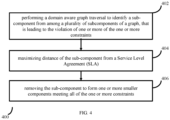
- method of deriving the plurality of smaller components using the domain aware trimming approach includes: performing a domain aware graph traversal to identify a sub-component from among a plurality of subcomponents of a graph, that is leading to the violation of one or more of the one or more constraints; maximizing distance of the sub-component from a Service Level Agreement (SLA); and removing the sub-component to form one or more smaller components meeting all of the one or more constraints.
- SLA Service Level Agreement
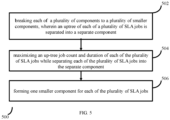
- method of deriving the plurality of smaller components using the domain aware splitting approach includes: breaking each of a plurality of components to a plurality of smaller components, wherein an uptree of each of a plurality of SLA jobs is separated into a separate component; maximizing an uptree job count and duration of each of the plurality of SLA jobs while separating each of the plurality of SLA jobs into the separate component; and forming one smaller component for each of the plurality of SLA jobs.
- method of generating the one or more logical groups of the plurality of smaller components includes merging at least a subset of the plurality of smaller components into a larger component until none of the one or more constraints is violated, wherein, all of a plurality of previously cut edges is retained while merging at least the subset of the plurality of smaller components, and one or more corrective actions are taken to reduce impact of deletion if one or more of the plurality of smaller components is deleted, wherein, the subset of the plurality of smaller components remaining after the deletion of one or more of the plurality of smaller components forms the logical group of the plurality of smaller components.
- a system in yet another aspect, includes one or more hardware processors, a communication interface, and a memory storing a plurality of instructions.
- the plurality of instructions when executed, cause the one or more hardware processors to collect a plurality of input data, wherein the plurality of input data comprising a) one or more precedence relationships, b) information on a plurality of business critical jobs, and c) one or more constraints.
- one or more logically connected components associated with the plurality of input data is created, via the one or more hardware processors.
- Creating the one or more logically connected components involves: determining one or more jobs that are dependent one or more of the plurality of business critical jobs, from a plurality of jobs, by performing a scope derivation on the input data; and deriving a plurality of independent components associated with the determined one or more jobs that are dependent on one or more of the plurality of business critical jobs, wherein the plurality of independent components form the one or more logically connected components. Further, it is determined via the one or more hardware processors, if one or more of the plurality of independent components violates at least one of the one or more constraints.
- a plurality of smaller components satisfying the one or more constraints, associated with the at least one independent component that has been identified as violating at least one of the one or more constraints are derived via the one or more hardware processors. Further, one or more logical groups of the plurality of smaller components and one or more of the plurality of independent components satisfying the one or more constraints are generated, via the one or more hardware processors.
- the system derives the plurality of smaller components in the method by: computing a variation factor based on variation in a plurality of historical start-times and end-times of the plurality of business-critical jobs; deriving the plurality of smaller components using a domain aware trimming approach, if the computed variation factor is below a threshold of variation; and deriving the plurality of smaller components using a domain aware splitting approach, if the computed variation factor is exceeding the threshold of variation.
- the system derives the plurality of smaller components using the domain aware trimming approach, by: performing a domain aware graph traversal to identify a sub-component from among a plurality of subcomponents of a graph, that is leading to the violation of one or more of the one or more constraints; maximizing distance of the sub-component from a Service Level Agreement (SLA); and removing the sub-component to form one or more smaller components meeting all of the one or more constraints.
- SLA Service Level Agreement
- the system derives the plurality of smaller components using the domain aware splitting approach, by: breaking each of a plurality of components to a plurality of smaller components, wherein an uptree of each of a plurality of SLA jobs is separated into a separate component; maximizing an uptree job count and duration of each of the plurality of SLA jobs while separating each of the plurality of SLA jobs into the separate component; and forming one smaller component for each of the plurality of SLA jobs.
- the system generates the one or more logical groups of the plurality of smaller components by merging at least a subset of the plurality of smaller components into a larger component until none of the one or more constraints is violated, wherein, all of a plurality of previously cut edges is retained while merging at least the subset of the plurality of smaller components, and one or more corrective actions are taken to reduce impact of deletion if one or more of the plurality of smaller components is deleted, wherein, the subset of the plurality of smaller components remaining after the deletion of one or more of the plurality of smaller components forms the logical group of the plurality of smaller components.
- a non-transitory computer readable medium includes a plurality of instructions, which when executed, causes one or more hardware processors to perform the following steps. Initially, a plurality of input data including a) one or more precedence relationships, b) information on a plurality of business critical jobs, and c) one or more constraints are collected via one or more hardware processors. Further, one or more logically connected components associated with the plurality of input data is created, via the one or more hardware processors.
- Creating the one or more logically connected components involves: determining one or more jobs that are dependent one or more of the plurality of business critical jobs, from a plurality of jobs, by performing a scope derivation on the input data; and deriving a plurality of independent components associated with the determined one or more jobs that are dependent on one or more of the plurality of business critical jobs, wherein the plurality of independent components form the one or more logically connected components. Further, it is determined via the one or more hardware processors, if one or more of the plurality of independent components violates at least one of the one or more constraints.
- a plurality of smaller components satisfying the one or more constraints, associated with the at least one independent component that has been identified as violating at least one of the one or more constraints are derived via the one or more hardware processors. Further, one or more logical groups of the plurality of smaller components and one or more of the plurality of independent components satisfying the one or more constraints are generated, via the one or more hardware processors.
- the non-transitory computer readable medium causes the one or more hardware processors to derive the plurality of smaller components by: computing a variation factor based on variation in a plurality of historical start-times and end-times of the plurality of business-critical jobs; deriving the plurality of smaller components using a domain aware trimming approach, if the computed variation factor is below a threshold of variation; and deriving the plurality of smaller components using a domain aware splitting approach, if the computed variation factor is exceeding the threshold of variation.
- the non-transitory computer readable medium causes the one or more hardware processors to derive the plurality of smaller components using the domain aware trimming approach by: performing a domain aware graph traversal to identify a sub-component from among a plurality of subcomponents of a graph, that is leading to the violation of one or more of the one or more constraints; maximizing distance of the sub-component from a Service Level Agreement (SLA); and removing the sub-component to form one or more smaller components meeting all of the one or more constraints.
- SLA Service Level Agreement
- the non-transitory computer readable medium causes the one or more hardware processors to derive the plurality of smaller components using the domain aware splitting approach by: breaking each of a plurality of components to a plurality of smaller components, wherein an uptree of each of a plurality of SLA jobs is separated into a separate component; maximizing an uptree job count and duration of each of the plurality of SLA jobs while separating each of the plurality of SLA jobs into the separate component; and forming one smaller component for each of the plurality of SLA jobs.
- the non-transitory computer readable medium causes the one or more hardware processors to generate the one or more logical groups of the plurality of smaller components by merging at least a subset of the plurality of smaller components into a larger component until none of the one or more constraints is violated, wherein, all of a plurality of previously cut edges is retained while merging at least the subset of the plurality of smaller components, and one or more corrective actions are taken to reduce impact of deletion if one or more of the plurality of smaller components is deleted, wherein, the subset of the plurality of smaller components remaining after the deletion of one or more of the plurality of smaller components forms the logical group of the plurality of smaller components.
- Some examples of the objective functions include minimizing the number of jobs that can be present in a component, or minimizing the overlap in the execution duration of two components, and so on. Often there is a conflict between different constraints and objective functions and there is no solution present to cater to all aspects.
- a method and system for batch processing of jobs perform the following steps. Initially, a plurality of input data including a) one or more precedence relationships, b) information on a plurality of business critical jobs, and c) one or more constraints are collected via one or more hardware processors. Further, one or more logically connected components associated with the plurality of input data are created, via the one or more hardware processors. Creating the one or more logically connected components involves the following steps. Initially, one or more jobs that are dependent one or more of the plurality of business critical jobs are determined, from a plurality of jobs, by performing a scope derivation on the input data.
- a plurality of independent components associated with the determined one or more jobs that are dependent on one or more of the plurality of business critical jobs are derived, wherein the plurality of independent components form the one or more logically connected components. Further, it is determined via the one or more hardware processors, if one or more of the plurality of independent components violates at least one of the one or more constraints. Further, a plurality of smaller components satisfying the one or more constraints, associated with the at least one independent component that has been identified as violating at least one of the one or more constraints, are derived via the one or more hardware processors. Further, one or more logical groups of the plurality of smaller components and one or more of the plurality of independent components satisfying the one or more constraints are generated, via the one or more hardware processors. By using this approach, grouping of the jobs is achieved, while ensuring that all constraints are satisfied.
- FIG. 1 through FIG. 9 where similar reference characters denote corresponding features consistently throughout the figures, there are shown preferred embodiments and these embodiments are described in the context of the following exemplary system and/or method.
- FIG. 1 illustrates an exemplary system 100 for grouping of jobs, according to some embodiments of the present disclosure.
- the system 100 includes or is otherwise in communication with hardware processors 102, at least one memory such as a memory 104, an I/O interface 112.
- the hardware processors 102, memory 104, and the Input /Output (I/O) interface 112 may be coupled by a system bus such as a system bus 108 or a similar mechanism.
- the hardware processors 102 can be one or more hardware processors.
- the I/O interface 112 may include a variety of software and hardware interfaces, for example, a web interface, a graphical user interface, and the like.
- the I/O interface 112 may include a variety of software and hardware interfaces, for example, interfaces for peripheral device(s), such as a keyboard, a mouse, an external memory, a printer and the like. Further, the I/O interface 112 may enable the system 100 to communicate with other devices, such as web servers, and external databases.
- the I/O interface 112 can facilitate multiple communications within a wide variety of networks and protocol types, including wired networks, for example, local area network (LAN), cable, etc., and wireless networks, such as Wireless LAN (WLAN), cellular, or satellite.
- the I/O interface 112 may include one or more ports for connecting several computing systems with one another or to another server computer.
- the I/O interface 112 may include one or more ports for connecting several devices to one another or to another server.
- the one or more hardware processors 102 may be implemented as one or more microprocessors, microcomputers, microcontrollers, digital signal processors, central processing units, node machines, logic circuitries, and/or any devices that manipulate signals based on operational instructions.
- the one or more hardware processors 102 is configured to fetch and execute computer-readable instructions stored in the memory 104.
- the memory 104 may include any computer-readable medium known in the art including, for example, volatile memory, such as static random-access memory (SRAM) and dynamic random-access memory (DRAM), and/or non-volatile memory, such as read only memory (ROM), erasable programmable ROM, flash memories, hard disks, optical disks, and magnetic tapes.
- volatile memory such as static random-access memory (SRAM) and dynamic random-access memory (DRAM)
- non-volatile memory such as read only memory (ROM), erasable programmable ROM, flash memories, hard disks, optical disks, and magnetic tapes.
- ROM read only memory
- erasable programmable ROM erasable programmable ROM
- flash memories hard disks
- optical disks optical disks
- magnetic tapes magnetic tapes
- the plurality of modules 106 include programs or coded instructions that supplement applications or functions performed by the system 100 for executing different steps involved in the process of batch processing of jobs, being performed by the system 100.
- the plurality of modules 106 can include routines, programs, objects, components, and data structures, which performs particular tasks or implement particular abstract data types.
- the plurality of modules 106 may also be used as, signal processor(s), node machine(s), logic circuitries, and/or any other device or component that manipulates signals based on operational instructions.
- the plurality of modules 106 can be used by hardware, by computer-readable instructions executed by the one or more hardware processors 102, or by a combination thereof.
- the plurality of modules 106 can include various sub-modules (not shown).
- the plurality of modules 106 may include computer-readable instructions that supplement applications or functions performed by the system 100 for the switching between hardware accelerators for the batch processing of jobs.
- the data repository (or repository) 110 may include a plurality of abstracted piece of code for refinement and data that is processed, received, or generated as a result of the execution of the plurality of modules in the module(s) 106.
- the data repository 110 is shown internal to the system 100, it will be noted that, in alternate embodiments, the data repository 110 can also be implemented external to the system 100, where the data repository 110 may be stored within a database (repository 110) communicatively coupled to the system 100.
- the data contained within such external database may be periodically updated. For example, new data may be added into the database (not shown in FIG. 1 ) and/or existing data may be modified and/or non-useful data may be deleted from the database.
- the data may be stored in an external system, such as a Lightweight Directory Access Protocol (LDAP) directory and a Relational Database Management System (RDBMS). Functions of the components of the system 100 are now explained with reference to the steps in flow diagrams in FIG. 2 , FIG. 3 , and FIG. 4 .
- LDAP Lightweight Directory Access Protocol
- RDBMS Relational Database Management System
- FIG. 2 is a flow diagram of a method 200 depicting steps involved in the process of grouping of jobs, by the system of FIG. 1 , according to some embodiments of the present disclosure.
- the system 100 comprises one or more data storage devices or the memory 104 operatively coupled to the processor(s) 102 and is configured to store instructions for execution of steps of the method 200 by the processor(s) or one or more hardware processors 102.
- the steps of the method 200 of the present disclosure will now be explained with reference to the components or blocks of the system 100 as depicted in FIG. 1 and the steps of flow diagram as depicted in FIG. 2 .
- process steps, method steps, techniques or the like may be described in a sequential order, such processes, methods, and techniques may be configured to work in alternate orders. In other words, any sequence or order of steps that may be described does not necessarily indicate a requirement that the steps to be performed in that order.
- the steps of processes described herein may be performed in any order practical. Further, some steps may be performed simultaneously.
- the system 100 collects, via the one or more hardware processors 102, a plurality of input data including a) one or more precedence relationships, b) information on a plurality of business critical jobs, and c) one or more constraints.
- the system 100 may receive the input data automatically from one or more sources, which may be connected to the system 100 via one or more suitable interfaces. In another embodiment, an authorized user may feed the input data to the system 100 via a suitable interface.
- the one or more constraints include, but not limited to, a) number of jobs in a component, b) duration of a component, c) time zone of a components, d) maximum depth of a component e) maximum number of business-critical jobs in a component, and f) no overlap in the execution of components.
- the precedence relationship indicates that a particular job (a child job) can start only after a prior job (i.e. a parent job) has been executed.
- a prior job i.e. a parent job
- FIG. 6A in which parent nodes and associated child nodes are depicted. The child nodes of each parent node are executed only after the associated parent node is executed.
- some of the jobs may have an associated timeline, which is governed by Service Level Agreements (SLAs).
- SLAs Service Level Agreements
- one or more logically connected components associated with the plurality of input data is created, via the one or more hardware processors 102. Steps involved in creating the one or more logically connected components are depicted in steps 204a and 204b.
- the system 100 determines one or more jobs from a plurality of jobs, that are dependent one or more of the plurality of business-critical jobs, by performing a scope derivation on the input data. Performing the scope derivation involves performing a graph traversal on the precedence relationships of the business critical jobs with other jobs to derive the scope.
- the system 100 derives a plurality of independent components associated with the determined one or more jobs that are dependent on one or more of the plurality of business-critical jobs, wherein the plurality of independent components form the one or more logically connected components.
- the system 100 determines via the one or more hardware processors, if one or more of the plurality of independent components violates at least one of the one or more constraints. This may be done by separately checking constraints satisfied by each of the plurality of independent components, and then determining if any constraint is not satisfied by any of the plurality of independent components. All of the plurality of independent components that are identified as satisfying the plurality of constraints are directly used to generate the logical groups in step 210 of the method 200. The independent components that are identified as not satisfying one or more of the constraints are processed at step 208 of the method 200.
- the system 100 derives a plurality of smaller components satisfying the one or more constraints, associated with the at least one independent component that has been identified as violating at least one of the one or more constraints, via the one or more hardware processors 102.
- the system 100 may perform the step of deriving the plurality of smaller components, till all the constrains are satisfied.
- the splitting of each of the independent components violating the one or more constraints maybe done in a plurality of iterations.
- the system 100 may check if resulting smaller components are satisfying the constraints, and if not, finer smaller components are derived from the smaller components derived in previous iteration. Steps in deriving the smaller components are depicted in method 300 in FIG. 3 , and is explained hereafter.
- the system 100 computes a variation factor based on variation in a plurality of historical start-times and end-times of the plurality of business-critical jobs.
- Information on the historical start-times and end-times maybe stored in a reference database associated with the system 100, and may be updated from time to time, with information on the start-times and end-times after each execution of the business-critical jobs.
- the system 100 uses one of a domain aware trimming approach and a domain aware splitting approach for deriving the smaller components. To determine which of these two approaches is to be used, the system 100 compares the computed variation score with a threshold of variation.
- the system 100 derives the plurality of smaller components using a domain aware trimming approach. If the computed variation factor is exceeding the threshold of variation, then the system 100 derives the plurality of smaller components using the domain aware splitting approach. Steps in the domain aware trimming approach and the domain aware splitting approach are explained in method 400 in FIG. 4 and method 500 in FIG. 5 , respectively.
- the method of deriving the plurality of smaller components using the domain aware trimming approach includes the following steps.
- the system 100 performs a domain aware graph traversal to identify a sub-component from among a plurality of subcomponents of a graph, that is leading to the violation of one or more of the one or more constraints.
- the system 100 maximizes distance of the sub-component from a Service Level Agreement (SLA).
- SLA Service Level Agreement
- the system 100 removes the sub-component to form one or more smaller components meeting all of the one or more constraints.
- SLA Service Level Agreement
- the method of deriving the plurality of smaller components using the domain aware splitting approach includes the following steps.
- the system 100 breaks each of a plurality of components to a plurality of smaller components, during which, an uptree of each of a plurality of SLA jobs is separated into a separate component.
- the system 100 maximizes an uptree job count and duration of each of the plurality of SLA jobs while separating each of the plurality of SLA jobs into the separate components, thus forming one smaller component for each of the plurality of SLA jobs at step 506 of the method 500. Maximizing the uptree job count makes it easy to navigate, visualize, and understand the component with minimal loss of jobs and minimal change in the performance.
- the system 100 may have to handle different scenarios. Different such example scenarios are depicted in FIG. 7 (for the domain aware trim approach) and FIG. 8 (for the domain aware split approach).
- Case 1 in FIG. 7 shows a single SLA with an independent uptree.
- the trim approach removes jobs A and C to form a single component that meets all the constraints.
- Case 2 in FIG. 7 depicts a scenario wherein uptree of one SLA is a subset of another SLA uptree.
- X and Y are two SLA jobs, ⁇ A, B, C ⁇ and ⁇ A, B, C, X, M, N ⁇ are their respective uptree jobs.
- the uptree jobs A, B, C are meeting the constraints w.r.t to the SLA X, they are not meeting the constraints w.r.t the SLA Y.
- the trim approach removes A, B, C to form the single trimmed component which meets both the constraints max count and max duration.
- the split approach made two components ⁇ A, B, C, X ⁇ and ⁇ M, N, Y ⁇ .
- the split approach is fair to both SLA jobs but leads to 2 components.
- the trim is unfair to one SLA but provides a single component.
- Case 3 in FIG. 7 depicts SLAs with overlapping uptree.
- This approach maintains a single component but tries to reduce the length by removing some jobs. It tries to reduce the smallest number of jobs to meet the maximum count criteria and maximum duration criteria while maximizing the length of each SLA uptree.
- X and Y are two SLAs and ⁇ A, B, C, D, E ⁇ and ⁇ A, B, C, D, M, N, Y ⁇ are their respective uptree jobs.
- the trim approach removes jobs A, B, C to meet the max_duration and max_count constraint. The difference between the trim and split for the same approach can be seen in FIGS. 7 and 8 .
- X is an SLA and A, B, C, D, E, F, G are associated uptree jobs. Removing processes A and C helps meet the maximum duration and the maximum count constraints while minimizing the impact on the SLA job's uptree length and duration.
- a component has 2 SLA jobs and one SLA job uptree is a subset of another SLA job uptree.
- the split approach first splits to form 2 components, one for each SLA and its uptree.
- A, B, C, and X form one component and M, N, and Y form another component. Both the components meet the count and duration constrains, while maximizing the uptree length and duration of the SLA uptree.
- a component has 2 SLA jobs with partially overlapping uptree.
- the split approach creates two components such that A, B, C, D, E, and X form one component while M, N, and Y form the second component.
- the system 100 generates the one or more logical groups of the plurality of smaller components and one or more of the plurality of independent components satisfying the one or more constraints, via the one or more hardware processors 102.
- the system 100 merges at least a subset of the plurality of smaller components into a larger component until none of the one or more constraints is violated.
- all of a plurality of previously cut edges are retained while merging at least the subset of the plurality of smaller components.
- one or more corrective actions are taken to reduce impact of deletion if one or more of the plurality of smaller components is deleted.
- An example of the corrective action is assigning fixed start time on a child job after deletion of edge. Subset of the plurality of smaller components remaining after the deletion of one or more of the plurality of smaller components forms the logical group of the plurality of smaller components.
- the embodiments of present disclosure herein address unresolved problem of creating batch jobs for interdependent jobs.
- the embodiment thus provides a method and system for creating batch jobs for interdependent jobs.
- the embodiments herein further provide mechanism of generating batch jobs while satisfying defined constraints.
- Such computer-readable storage means contain program-code means for implementation of one or more steps of the method, when the program runs on a server or mobile device or any suitable programmable device.
- the hardware device can be any kind of device which can be programmed including e.g., any kind of computer like a server or a personal computer, or the like, or any combination thereof.
- the device may also include means which could be e.g., hardware means like e.g., an application-specific integrated circuit (ASIC), a field-programmable gate array (FPGA), or a combination of hardware and software means, e.g., an ASIC and an FPGA, or at least one microprocessor and at least one memory with software processing components located therein.
- the means can include both hardware means and software means.
- the method embodiments described herein could be implemented in hardware and software.
- the device may also include software means. Alternatively, the embodiments may be implemented on different hardware devices, e.g., using a plurality of CPUs.
- the embodiments herein can comprise hardware and software elements.
- the embodiments that are implemented in software include but are not limited to, firmware, resident software, microcode, etc.
- the functions performed by various components described herein may be implemented in other components or combinations of other components.
- a computer-usable or computer readable medium can be any apparatus that can comprise, store, communicate, propagate, or transport the program for use by or in connection with the instruction execution system, apparatus, or device.
- a computer-readable storage medium refers to any type of physical memory on which information or data readable by a processor may be stored.
- a computer-readable storage medium may store instructions for execution by one or more processors, including instructions for causing the processor(s) to perform steps or stages consistent with the embodiments described herein.
- the term "computer-readable medium” should be understood to include tangible items and exclude carrier waves and transient signals, i.e., be non-transitory. Examples include random access memory (RAM), read-only memory (ROM), volatile memory, nonvolatile memory, hard drives, CD ROMs, DVDs, flash drives, disks, and any other known physical storage media.
Landscapes
- Engineering & Computer Science (AREA)
- Business, Economics & Management (AREA)
- Human Resources & Organizations (AREA)
- Theoretical Computer Science (AREA)
- Software Systems (AREA)
- Physics & Mathematics (AREA)
- General Physics & Mathematics (AREA)
- Economics (AREA)
- Entrepreneurship & Innovation (AREA)
- Strategic Management (AREA)
- Educational Administration (AREA)
- Development Economics (AREA)
- General Engineering & Computer Science (AREA)
- Quality & Reliability (AREA)
- Tourism & Hospitality (AREA)
- Operations Research (AREA)
- General Business, Economics & Management (AREA)
- Marketing (AREA)
- Game Theory and Decision Science (AREA)
- Stored Programmes (AREA)
Abstract
Description
- The present application claims priority to
Indian application no. 202321005946, filed on January 30, 2023 - The disclosure herein generally relates to batch processing of jobs, and, more particularly, to a method and system for creating logical groups of jobs meeting objective function and satisfying constraints.
- Batch systems in any enterprise are involved in all back-end operations such as computation of net asset values in mutual fund, settlement of trades at end of day, invoice processing, and so on. Each batch may contain thousands of batch jobs and complex interdependencies between them. Each batch contains several business units which are logically created considering different business functionalities, geographies, and technology. Each business unit is further divided into business processes so that all jobs serving a single business deliverable can be tracked easily. For example, an 'Order Management' business unit contains business processes such as 'business intelligence', 'meta data refresh', 'inventory check', 'order placement', 'invoice processing', and so on. Each business process contains business deliverables and is created with logical grouping of jobs. Even after the creation of several business units, business processes, the volume, scale, and complexity make life difficult for batch managers.
- Many of the existing approaches for grouping of jobs for processing are manual in nature, and are based on intuition. This makes it very difficult to track failures and delays, assess impact, and take timely corrective actions. Hence, it becomes very important to create logically independent groups of processes, so that it is easy to navigate, visualize, and analyze large complex processes, and highlight the areas that need attention.
- One of the existing approaches to address this problem is to model the batches as node-edge graphs and use existing graph theory solutions such as connected components or cliques to find logical subgraphs. However, this approach is not efficient due to the fact that there may be various constraints unique to batch systems. Bringing a range of objective functions in the mix makes the problem even more difficult to address. Some examples of the objective functions include minimizing the number of jobs that can be present in a component, or minimizing the overlap in the execution duration of two components, and so on. Often there is a conflict between different constraints and objective functions and there is no solution present to cater to all aspects.
- Embodiments of the present disclosure present technological improvements as solutions to one or more of the above-mentioned technical problems recognized by the inventors in conventional systems. For example, in one embodiment, A processor implemented method is provided. In this method, a plurality of input data including a) one or more precedence relationships, b) information on a plurality of business critical jobs, and c) one or more constraints are collected via one or more hardware processors. Further, one or more logically connected components associated with the plurality of input data is created, via the one or more hardware processors. Creating the one or more logically connected components involves: determining one or more jobs that are dependent one or more of the plurality of business critical jobs, from a plurality of jobs, by performing a scope derivation on the input data; and deriving a plurality of independent components associated with the determined one or more jobs that are dependent on one or more of the plurality of business critical jobs, wherein the plurality of independent components form the one or more logically connected components. Further, it is determined via the one or more hardware processors, if one or more of the plurality of independent components violates at least one of the one or more constraints. Further, a plurality of smaller components satisfying the one or more constraints, associated with the at least one independent component that has been identified as violating at least one of the one or more constraints, are derived via the one or more hardware processors. Further, one or more logical groups of the plurality of smaller components and one or more of the plurality of independent components satisfying the one or more constraints are generated, via the one or more hardware processors.
- In another aspect, method of deriving the plurality of smaller components in the method includes: computing a variation factor based on variation in a plurality of historical start-times and end-times of the plurality of business-critical jobs; deriving the plurality of smaller components using a domain aware trimming approach, if the computed variation factor is below a threshold of variation; and deriving the plurality of smaller components using a domain aware splitting approach, if the computed variation factor is exceeding the threshold of variation.
- In another aspect, method of deriving the plurality of smaller components using the domain aware trimming approach includes: performing a domain aware graph traversal to identify a sub-component from among a plurality of subcomponents of a graph, that is leading to the violation of one or more of the one or more constraints; maximizing distance of the sub-component from a Service Level Agreement (SLA); and removing the sub-component to form one or more smaller components meeting all of the one or more constraints.
- In yet another aspect, method of deriving the plurality of smaller components using the domain aware splitting approach includes: breaking each of a plurality of components to a plurality of smaller components, wherein an uptree of each of a plurality of SLA jobs is separated into a separate component; maximizing an uptree job count and duration of each of the plurality of SLA jobs while separating each of the plurality of SLA jobs into the separate component; and forming one smaller component for each of the plurality of SLA jobs.
- In yet another aspect, method of generating the one or more logical groups of the plurality of smaller components includes merging at least a subset of the plurality of smaller components into a larger component until none of the one or more constraints is violated, wherein, all of a plurality of previously cut edges is retained while merging at least the subset of the plurality of smaller components, and one or more corrective actions are taken to reduce impact of deletion if one or more of the plurality of smaller components is deleted, wherein, the subset of the plurality of smaller components remaining after the deletion of one or more of the plurality of smaller components forms the logical group of the plurality of smaller components.
- In yet another aspect, a system is provided. The system includes one or more hardware processors, a communication interface, and a memory storing a plurality of instructions. The plurality of instructions when executed, cause the one or more hardware processors to collect a plurality of input data, wherein the plurality of input data comprising a) one or more precedence relationships, b) information on a plurality of business critical jobs, and c) one or more constraints. Further, one or more logically connected components associated with the plurality of input data is created, via the one or more hardware processors. Creating the one or more logically connected components involves: determining one or more jobs that are dependent one or more of the plurality of business critical jobs, from a plurality of jobs, by performing a scope derivation on the input data; and deriving a plurality of independent components associated with the determined one or more jobs that are dependent on one or more of the plurality of business critical jobs, wherein the plurality of independent components form the one or more logically connected components. Further, it is determined via the one or more hardware processors, if one or more of the plurality of independent components violates at least one of the one or more constraints. Further, a plurality of smaller components satisfying the one or more constraints, associated with the at least one independent component that has been identified as violating at least one of the one or more constraints, are derived via the one or more hardware processors. Further, one or more logical groups of the plurality of smaller components and one or more of the plurality of independent components satisfying the one or more constraints are generated, via the one or more hardware processors.
- In yet another aspect, the system derives the plurality of smaller components in the method by: computing a variation factor based on variation in a plurality of historical start-times and end-times of the plurality of business-critical jobs; deriving the plurality of smaller components using a domain aware trimming approach, if the computed variation factor is below a threshold of variation; and deriving the plurality of smaller components using a domain aware splitting approach, if the computed variation factor is exceeding the threshold of variation.
- In yet another aspect, the system derives the plurality of smaller components using the domain aware trimming approach, by: performing a domain aware graph traversal to identify a sub-component from among a plurality of subcomponents of a graph, that is leading to the violation of one or more of the one or more constraints; maximizing distance of the sub-component from a Service Level Agreement (SLA); and removing the sub-component to form one or more smaller components meeting all of the one or more constraints.
- In yet another aspect, the system derives the plurality of smaller components using the domain aware splitting approach, by: breaking each of a plurality of components to a plurality of smaller components, wherein an uptree of each of a plurality of SLA jobs is separated into a separate component; maximizing an uptree job count and duration of each of the plurality of SLA jobs while separating each of the plurality of SLA jobs into the separate component; and forming one smaller component for each of the plurality of SLA jobs.
- In yet another aspect, the system generates the one or more logical groups of the plurality of smaller components by merging at least a subset of the plurality of smaller components into a larger component until none of the one or more constraints is violated, wherein, all of a plurality of previously cut edges is retained while merging at least the subset of the plurality of smaller components, and one or more corrective actions are taken to reduce impact of deletion if one or more of the plurality of smaller components is deleted, wherein, the subset of the plurality of smaller components remaining after the deletion of one or more of the plurality of smaller components forms the logical group of the plurality of smaller components.
- In yet another aspect, a non-transitory computer readable medium is provided. The non-transitory computer readable medium includes a plurality of instructions, which when executed, causes one or more hardware processors to perform the following steps. Initially, a plurality of input data including a) one or more precedence relationships, b) information on a plurality of business critical jobs, and c) one or more constraints are collected via one or more hardware processors. Further, one or more logically connected components associated with the plurality of input data is created, via the one or more hardware processors. Creating the one or more logically connected components involves: determining one or more jobs that are dependent one or more of the plurality of business critical jobs, from a plurality of jobs, by performing a scope derivation on the input data; and deriving a plurality of independent components associated with the determined one or more jobs that are dependent on one or more of the plurality of business critical jobs, wherein the plurality of independent components form the one or more logically connected components. Further, it is determined via the one or more hardware processors, if one or more of the plurality of independent components violates at least one of the one or more constraints. Further, a plurality of smaller components satisfying the one or more constraints, associated with the at least one independent component that has been identified as violating at least one of the one or more constraints, are derived via the one or more hardware processors. Further, one or more logical groups of the plurality of smaller components and one or more of the plurality of independent components satisfying the one or more constraints are generated, via the one or more hardware processors.
- In yet another aspect, the non-transitory computer readable medium causes the one or more hardware processors to derive the plurality of smaller components by: computing a variation factor based on variation in a plurality of historical start-times and end-times of the plurality of business-critical jobs; deriving the plurality of smaller components using a domain aware trimming approach, if the computed variation factor is below a threshold of variation; and deriving the plurality of smaller components using a domain aware splitting approach, if the computed variation factor is exceeding the threshold of variation.
- In yet another aspect, the non-transitory computer readable medium causes the one or more hardware processors to derive the plurality of smaller components using the domain aware trimming approach by: performing a domain aware graph traversal to identify a sub-component from among a plurality of subcomponents of a graph, that is leading to the violation of one or more of the one or more constraints; maximizing distance of the sub-component from a Service Level Agreement (SLA); and removing the sub-component to form one or more smaller components meeting all of the one or more constraints.
- In yet another aspect, the non-transitory computer readable medium causes the one or more hardware processors to derive the plurality of smaller components using the domain aware splitting approach by: breaking each of a plurality of components to a plurality of smaller components, wherein an uptree of each of a plurality of SLA jobs is separated into a separate component; maximizing an uptree job count and duration of each of the plurality of SLA jobs while separating each of the plurality of SLA jobs into the separate component; and forming one smaller component for each of the plurality of SLA jobs.
- In yet another aspect, the non-transitory computer readable medium causes the one or more hardware processors to generate the one or more logical groups of the plurality of smaller components by merging at least a subset of the plurality of smaller components into a larger component until none of the one or more constraints is violated, wherein, all of a plurality of previously cut edges is retained while merging at least the subset of the plurality of smaller components, and one or more corrective actions are taken to reduce impact of deletion if one or more of the plurality of smaller components is deleted, wherein, the subset of the plurality of smaller components remaining after the deletion of one or more of the plurality of smaller components forms the logical group of the plurality of smaller components.
- It is to be understood that both the foregoing general description and the following detailed description are exemplary and explanatory only and are not restrictive of the invention, as claimed.
- The accompanying drawings, which are incorporated in and constitute a part of this disclosure, illustrate exemplary embodiments and, together with the description, serve to explain the disclosed principles:
-
FIG. 1 illustrates an exemplary system for grouping of jobs, according to some embodiments of the present disclosure. -
FIG. 2 is a flow diagram depicting steps involved in the process of grouping of jobs, by the system ofFIG. 1 , according to some embodiments of the present disclosure. -
FIG. 3 is a flow diagram depicting steps involved in the process of deriving a plurality of smaller components, by the system ofFIG. 1 , according to some embodiments of the present disclosure. -
FIG. 4 is a flow diagram depicting steps involved in a domain aware trimming approach for deriving the plurality of smaller components, by the system ofFIG. 1 , according to some embodiments of the present disclosure. -
FIG. 5 is a flow diagram depicting steps involved in a domain aware splitting approach for deriving the plurality of smaller components, by the system ofFIG. 1 , according to some embodiments of the present disclosure. -
FIGS. 6A and 6B illustrate examples of scope and independent components, in a batch processing of jobs by the system ofFIG. 1 , according to some embodiments of the present disclosure. -
FIG. 7 illustrates example of derivation of the smaller components using the domain aware trimming approach, by the system ofFIG. 1 , according to some embodiments of the present disclosure. -
FIG. 8 illustrates example of derivation of the smaller components using the domain aware splitting approach, by the system ofFIG. 1 , according to some embodiments of the present disclosure. -
FIG. 9 illustrates example of merging of the smaller components by the system ofFIG. 1 , according to some embodiments of the present disclosure. - Exemplary embodiments are described with reference to the accompanying drawings. In the figures, the left-most digit(s) of a reference number identifies the figure in which the reference number first appears. Wherever convenient, the same reference numbers are used throughout the drawings to refer to the same or like parts. While examples and features of disclosed principles are described herein, modifications, adaptations, and other implementations are possible without departing from the scope of the disclosed embodiments.
- Many of the existing approaches for grouping of jobs for processing are manual in nature, and are based on intuition. This makes it very difficult to track failures and delays, assess impact, and take timely corrective actions. Hence, it becomes very important to create logically independent groups of processes, so that it is easy to navigate, visualize, and analyze large complex processes, and highlight the areas that need attention. One of the existing approaches to address this problem is to model the batches as node-edge graphs and use existing graph theory solutions such as connected components or cliques to find logical subgraphs. However, this approach is not efficient due to the fact that there may be various constraints unique to batch systems. Bringing a range of objective functions in the mix makes the problem even more difficult to address. Some examples of the objective functions include minimizing the number of jobs that can be present in a component, or minimizing the overlap in the execution duration of two components, and so on. Often there is a conflict between different constraints and objective functions and there is no solution present to cater to all aspects.
- In order to address these challenges, a method and system for batch processing of jobs is provided. The method and system perform the following steps. Initially, a plurality of input data including a) one or more precedence relationships, b) information on a plurality of business critical jobs, and c) one or more constraints are collected via one or more hardware processors. Further, one or more logically connected components associated with the plurality of input data are created, via the one or more hardware processors. Creating the one or more logically connected components involves the following steps. Initially, one or more jobs that are dependent one or more of the plurality of business critical jobs are determined, from a plurality of jobs, by performing a scope derivation on the input data. Further, a plurality of independent components associated with the determined one or more jobs that are dependent on one or more of the plurality of business critical jobs are derived, wherein the plurality of independent components form the one or more logically connected components. Further, it is determined via the one or more hardware processors, if one or more of the plurality of independent components violates at least one of the one or more constraints. Further, a plurality of smaller components satisfying the one or more constraints, associated with the at least one independent component that has been identified as violating at least one of the one or more constraints, are derived via the one or more hardware processors. Further, one or more logical groups of the plurality of smaller components and one or more of the plurality of independent components satisfying the one or more constraints are generated, via the one or more hardware processors. By using this approach, grouping of the jobs is achieved, while ensuring that all constraints are satisfied.
- Referring now to the drawings, and more particularly to
FIG. 1 through FIG. 9 , where similar reference characters denote corresponding features consistently throughout the figures, there are shown preferred embodiments and these embodiments are described in the context of the following exemplary system and/or method. -
FIG. 1 illustrates anexemplary system 100 for grouping of jobs, according to some embodiments of the present disclosure. Thesystem 100 includes or is otherwise in communication withhardware processors 102, at least one memory such as amemory 104, an I/O interface 112. Thehardware processors 102,memory 104, and the Input /Output (I/O)interface 112 may be coupled by a system bus such as asystem bus 108 or a similar mechanism. In an embodiment, thehardware processors 102 can be one or more hardware processors. - The I/
O interface 112 may include a variety of software and hardware interfaces, for example, a web interface, a graphical user interface, and the like. The I/O interface 112 may include a variety of software and hardware interfaces, for example, interfaces for peripheral device(s), such as a keyboard, a mouse, an external memory, a printer and the like. Further, the I/O interface 112 may enable thesystem 100 to communicate with other devices, such as web servers, and external databases. - The I/
O interface 112 can facilitate multiple communications within a wide variety of networks and protocol types, including wired networks, for example, local area network (LAN), cable, etc., and wireless networks, such as Wireless LAN (WLAN), cellular, or satellite. For the purpose, the I/O interface 112 may include one or more ports for connecting several computing systems with one another or to another server computer. The I/O interface 112 may include one or more ports for connecting several devices to one another or to another server. - The one or
more hardware processors 102 may be implemented as one or more microprocessors, microcomputers, microcontrollers, digital signal processors, central processing units, node machines, logic circuitries, and/or any devices that manipulate signals based on operational instructions. Among other capabilities, the one ormore hardware processors 102 is configured to fetch and execute computer-readable instructions stored in thememory 104. - The
memory 104 may include any computer-readable medium known in the art including, for example, volatile memory, such as static random-access memory (SRAM) and dynamic random-access memory (DRAM), and/or non-volatile memory, such as read only memory (ROM), erasable programmable ROM, flash memories, hard disks, optical disks, and magnetic tapes. In an embodiment, thememory 104 includes a plurality ofmodules 106. - The plurality of
modules 106 include programs or coded instructions that supplement applications or functions performed by thesystem 100 for executing different steps involved in the process of batch processing of jobs, being performed by thesystem 100. The plurality ofmodules 106, amongst other things, can include routines, programs, objects, components, and data structures, which performs particular tasks or implement particular abstract data types. The plurality ofmodules 106 may also be used as, signal processor(s), node machine(s), logic circuitries, and/or any other device or component that manipulates signals based on operational instructions. Further, the plurality ofmodules 106 can be used by hardware, by computer-readable instructions executed by the one ormore hardware processors 102, or by a combination thereof. The plurality ofmodules 106 can include various sub-modules (not shown). The plurality ofmodules 106 may include computer-readable instructions that supplement applications or functions performed by thesystem 100 for the switching between hardware accelerators for the batch processing of jobs. - The data repository (or repository) 110 may include a plurality of abstracted piece of code for refinement and data that is processed, received, or generated as a result of the execution of the plurality of modules in the module(s) 106.
- Although the
data repository 110 is shown internal to thesystem 100, it will be noted that, in alternate embodiments, thedata repository 110 can also be implemented external to thesystem 100, where thedata repository 110 may be stored within a database (repository 110) communicatively coupled to thesystem 100. The data contained within such external database may be periodically updated. For example, new data may be added into the database (not shown inFIG. 1 ) and/or existing data may be modified and/or non-useful data may be deleted from the database. In one example, the data may be stored in an external system, such as a Lightweight Directory Access Protocol (LDAP) directory and a Relational Database Management System (RDBMS). Functions of the components of thesystem 100 are now explained with reference to the steps in flow diagrams inFIG. 2 ,FIG. 3 , andFIG. 4 . -
FIG. 2 is a flow diagram of amethod 200 depicting steps involved in the process of grouping of jobs, by the system ofFIG. 1 , according to some embodiments of the present disclosure. - In an embodiment, the
system 100 comprises one or more data storage devices or thememory 104 operatively coupled to the processor(s) 102 and is configured to store instructions for execution of steps of themethod 200 by the processor(s) or one ormore hardware processors 102. The steps of themethod 200 of the present disclosure will now be explained with reference to the components or blocks of thesystem 100 as depicted inFIG. 1 and the steps of flow diagram as depicted inFIG. 2 . Although process steps, method steps, techniques or the like may be described in a sequential order, such processes, methods, and techniques may be configured to work in alternate orders. In other words, any sequence or order of steps that may be described does not necessarily indicate a requirement that the steps to be performed in that order. The steps of processes described herein may be performed in any order practical. Further, some steps may be performed simultaneously. - At
step 202 of themethod 200, thesystem 100 collects, via the one ormore hardware processors 102, a plurality of input data including a) one or more precedence relationships, b) information on a plurality of business critical jobs, and c) one or more constraints. Thesystem 100 may receive the input data automatically from one or more sources, which may be connected to thesystem 100 via one or more suitable interfaces. In another embodiment, an authorized user may feed the input data to thesystem 100 via a suitable interface. The one or more constraints include, but not limited to, a) number of jobs in a component, b) duration of a component, c) time zone of a components, d) maximum depth of a component e) maximum number of business-critical jobs in a component, and f) no overlap in the execution of components. The precedence relationship indicates that a particular job (a child job) can start only after a prior job (i.e. a parent job) has been executed. For example, refer toFIG. 6A , in which parent nodes and associated child nodes are depicted. The child nodes of each parent node are executed only after the associated parent node is executed. In an organizational context, some of the jobs may have an associated timeline, which is governed by Service Level Agreements (SLAs). Hence priority is given to the jobs having deadlines set by SLAs. Due to dependencies of the jobs, even though there may not be a direct SLA applicable, some of the jobs may come under scope of the SLA jobs, and some other may not come under the scope of the SLA jobs. This is depicted inFIG. 6A . - Further, at
step 204 of themethod 200, one or more logically connected components associated with the plurality of input data is created, via the one ormore hardware processors 102. Steps involved in creating the one or more logically connected components are depicted insteps step 204a, thesystem 100 determines one or more jobs from a plurality of jobs, that are dependent one or more of the plurality of business-critical jobs, by performing a scope derivation on the input data. Performing the scope derivation involves performing a graph traversal on the precedence relationships of the business critical jobs with other jobs to derive the scope. Further, atstep 204b, thesystem 100 derives a plurality of independent components associated with the determined one or more jobs that are dependent on one or more of the plurality of business-critical jobs, wherein the plurality of independent components form the one or more logically connected components. - Further, at
step 206 of themethod 200, thesystem 100 determines via the one or more hardware processors, if one or more of the plurality of independent components violates at least one of the one or more constraints. This may be done by separately checking constraints satisfied by each of the plurality of independent components, and then determining if any constraint is not satisfied by any of the plurality of independent components. All of the plurality of independent components that are identified as satisfying the plurality of constraints are directly used to generate the logical groups instep 210 of themethod 200. The independent components that are identified as not satisfying one or more of the constraints are processed atstep 208 of themethod 200. - At the
step 208 of themethod 200, thesystem 100 derives a plurality of smaller components satisfying the one or more constraints, associated with the at least one independent component that has been identified as violating at least one of the one or more constraints, via the one ormore hardware processors 102. In an embodiment, thesystem 100 may perform the step of deriving the plurality of smaller components, till all the constrains are satisfied. The splitting of each of the independent components violating the one or more constraints maybe done in a plurality of iterations. After each iteration, thesystem 100 may check if resulting smaller components are satisfying the constraints, and if not, finer smaller components are derived from the smaller components derived in previous iteration. Steps in deriving the smaller components are depicted inmethod 300 inFIG. 3 , and is explained hereafter. - At
step 302 of themethod 300, thesystem 100 computes a variation factor based on variation in a plurality of historical start-times and end-times of the plurality of business-critical jobs. Information on the historical start-times and end-times maybe stored in a reference database associated with thesystem 100, and may be updated from time to time, with information on the start-times and end-times after each execution of the business-critical jobs. Thesystem 100 uses one of a domain aware trimming approach and a domain aware splitting approach for deriving the smaller components. To determine which of these two approaches is to be used, thesystem 100 compares the computed variation score with a threshold of variation. If the computed variation factor is below the threshold of variation, then thesystem 100 derives the plurality of smaller components using a domain aware trimming approach. If the computed variation factor is exceeding the threshold of variation, then thesystem 100 derives the plurality of smaller components using the domain aware splitting approach. Steps in the domain aware trimming approach and the domain aware splitting approach are explained inmethod 400 inFIG. 4 andmethod 500 inFIG. 5 , respectively. - As depicted in
method 400 inFIG. 4 , the method of deriving the plurality of smaller components using the domain aware trimming approach includes the following steps. Atstep 402 of themethod 400, thesystem 100 performs a domain aware graph traversal to identify a sub-component from among a plurality of subcomponents of a graph, that is leading to the violation of one or more of the one or more constraints. Upon identifying all the subcomponents atstep 402, further atstep 404 of themethod 400, thesystem 100 maximizes distance of the sub-component from a Service Level Agreement (SLA). Further, atstep 406 of themethod 400, thesystem 100 removes the sub-component to form one or more smaller components meeting all of the one or more constraints. As depicted inFIG. 7 , there may be different possible scenarios/cases while using the domain aware trimming approach. - As depicted in
method 500 inFIG. 5 , the method of deriving the plurality of smaller components using the domain aware splitting approach includes the following steps. Atstep 502 of themethod 500, thesystem 100 breaks each of a plurality of components to a plurality of smaller components, during which, an uptree of each of a plurality of SLA jobs is separated into a separate component. Further, atstep 504 of themethod 500, thesystem 100 maximizes an uptree job count and duration of each of the plurality of SLA jobs while separating each of the plurality of SLA jobs into the separate components, thus forming one smaller component for each of the plurality of SLA jobs atstep 506 of themethod 500. Maximizing the uptree job count makes it easy to navigate, visualize, and understand the component with minimal loss of jobs and minimal change in the performance. - While using the domain aware splitting approach and the domain aware trimming approaches, the
system 100 may have to handle different scenarios. Different such example scenarios are depicted inFIG. 7 (for the domain aware trim approach) andFIG. 8 (for the domain aware split approach). -
Case 1 inFIG. 7 shows a single SLA with an independent uptree. There is one SLA job X and 7 uptree jobs A, B, C, D, E, F, G, and it does not meet the thresholds criteria. Hence, the trim approach removes jobs A and C to form a single component that meets all the constraints. -
Case 2 inFIG. 7 depicts a scenario wherein uptree of one SLA is a subset of another SLA uptree. As depicted, X and Y are two SLA jobs, {A, B, C} and {A, B, C, X, M, N} are their respective uptree jobs. Even though the uptree jobs A, B, C are meeting the constraints w.r.t to the SLA X, they are not meeting the constraints w.r.t the SLA Y. Hence, the trim approach removes A, B, C to form the single trimmed component which meets both the constraints max count and max duration. As depicted, the split approach made two components {A, B, C, X} and {M, N, Y}. The split approach is fair to both SLA jobs but leads to 2 components. The trim is unfair to one SLA but provides a single component. -
Case 3 inFIG. 7 depicts SLAs with overlapping uptree. This approach maintains a single component but tries to reduce the length by removing some jobs. It tries to reduce the smallest number of jobs to meet the maximum count criteria and maximum duration criteria while maximizing the length of each SLA uptree. As depicted, X and Y are two SLAs and {A, B, C, D, E} and {A, B, C, D, M, N, Y} are their respective uptree jobs. The trim approach removes jobs A, B, C to meet the max_duration and max_count constraint. The difference between the trim and split for the same approach can be seen inFIGS. 7 and8 . - An algorithmic representation of the domain aware trim approach is given below:
- 1. If max (end time of all SLA nodes) - min (start time of all uptree nodes) < max duration and (count of all nodes in component) < max count threshold, then return
- 2. Remove all nodes that are not part of any SLA node uptree
- 3. Check max_duration condition
- a. For each SLA
- i. i. compute its uptree
- ii. For each uptree node, compute the time gap (uptree node start time - SLA job start time)
- 1. If a node is part of uptree of more than one SLA, then time gap is max of time gaps of all SLAs
- b. Remove all edges of uptree nodes where time gap > max duration
- a. For each SLA
- 4. Check max_count condition
- a. While (count of all nodes in component) > max count threshold,
- i. Find the farthest uptree node with longest hop distance from all the SLAs
- ii. Remove all the edges between the node and the SLA uptree component
- iii. Update the trim component
- a. While (count of all nodes in component) > max count threshold,
- 5. Return the subgraph
- Similarly, the different scenarios depicted in
FIG. 8 are as follows. - In
Case 1 ofFIG. 8 , X is an SLA and A, B, C, D, E, F, G are associated uptree jobs. Removing processes A and C helps meet the maximum duration and the maximum count constraints while minimizing the impact on the SLA job's uptree length and duration. - In
Case 2 ofFIG. 8 , a component has 2 SLA jobs and one SLA job uptree is a subset of another SLA job uptree. In this case, the split approach first splits to form 2 components, one for each SLA and its uptree. A, B, C, and X form one component and M, N, and Y form another component. Both the components meet the count and duration constrains, while maximizing the uptree length and duration of the SLA uptree. - In
Case 3 ofFIG. 8 , a component has 2 SLA jobs with partially overlapping uptree. The SLAs X, Y with A, B, C, D as overlapping uptree for both X and Y. The split approach creates two components such that A, B, C, D, E, and X form one component while M, N, and Y form the second component. - An algorithmic representation of the domain aware splitting approach is given below:
- 1. If max (end time of all SLA nodes) - min (start time of all uptree nodes) < max duration threshold and (count of all nodes in component) < max count threshold, then return
- 2. Remove all nodes that are not part of any SLA node uptree
- 3. Check max_duration condition
- a. For each SLA,
- i. Compute its uptree
- ii. Identify the edges that are connecting uptree nodes with the other SLA uptree and remove them
- iii. For each uptree node, compute the time gap (uptree node start time - SLA node start time)
- iv. Remove all edges of uptree nodes where time gap > max duration
- a. For each SLA,
- 4. Check max_count condition
- a. For every split component, while (count of all nodes in component) > max count threshold,
- i. Find the farthest uptree node with longest hop distance from the SLA
- ii. Remove all the edges between the node and the split component
- iii. Update the split component
- a. For every split component, while (count of all nodes in component) > max count threshold,
- 5. Return the subgraph with split components
- Referring back to the
method 200, atstep 210 of themethod 200, thesystem 100 generates the one or more logical groups of the plurality of smaller components and one or more of the plurality of independent components satisfying the one or more constraints, via the one ormore hardware processors 102. In an embodiment, thesystem 100 merges at least a subset of the plurality of smaller components into a larger component until none of the one or more constraints is violated. At this step, all of a plurality of previously cut edges are retained while merging at least the subset of the plurality of smaller components. Also, one or more corrective actions are taken to reduce impact of deletion if one or more of the plurality of smaller components is deleted. An example of the corrective action is assigning fixed start time on a child job after deletion of edge. Subset of the plurality of smaller components remaining after the deletion of one or more of the plurality of smaller components forms the logical group of the plurality of smaller components. - The written description describes the subject matter herein to enable any person skilled in the art to make and use the embodiments. The scope of the subject matter embodiments is defined by the claims and may include other modifications that occur to those skilled in the art. Such other modifications are intended to be within the scope of the claims if they have similar elements that do not differ from the literal language of the claims or if they include equivalent elements with insubstantial differences from the literal language of the claims.
- The embodiments of present disclosure herein address unresolved problem of creating batch jobs for interdependent jobs. The embodiment, thus provides a method and system for creating batch jobs for interdependent jobs. Moreover, the embodiments herein further provide mechanism of generating batch jobs while satisfying defined constraints.
- It is to be understood that the scope of the protection is extended to such a program and in addition to a computer-readable means having a message therein; such computer-readable storage means contain program-code means for implementation of one or more steps of the method, when the program runs on a server or mobile device or any suitable programmable device. The hardware device can be any kind of device which can be programmed including e.g., any kind of computer like a server or a personal computer, or the like, or any combination thereof. The device may also include means which could be e.g., hardware means like e.g., an application-specific integrated circuit (ASIC), a field-programmable gate array (FPGA), or a combination of hardware and software means, e.g., an ASIC and an FPGA, or at least one microprocessor and at least one memory with software processing components located therein. Thus, the means can include both hardware means and software means. The method embodiments described herein could be implemented in hardware and software. The device may also include software means. Alternatively, the embodiments may be implemented on different hardware devices, e.g., using a plurality of CPUs.
- The embodiments herein can comprise hardware and software elements. The embodiments that are implemented in software include but are not limited to, firmware, resident software, microcode, etc. The functions performed by various components described herein may be implemented in other components or combinations of other components. For the purposes of this description, a computer-usable or computer readable medium can be any apparatus that can comprise, store, communicate, propagate, or transport the program for use by or in connection with the instruction execution system, apparatus, or device.
- The illustrated steps are set out to explain the exemplary embodiments shown, and it should be anticipated that ongoing technological development will change the manner in which particular functions are performed. These examples are presented herein for purposes of illustration, and not limitation. Further, the boundaries of the functional building blocks have been arbitrarily defined herein for the convenience of the description. Alternative boundaries can be defined so long as the specified functions and relationships thereof are appropriately performed. Alternatives (including equivalents, extensions, variations, deviations, etc., of those described herein) will be apparent to persons skilled in the relevant art(s) based on the teachings contained herein. Such alternatives fall within the scope of the disclosed embodiments. Also, the words "comprising," "having," "containing," and "including," and other similar forms are intended to be equivalent in meaning and be open ended in that an item or items following any one of these words is not meant to be an exhaustive listing of such item or items, or meant to be limited to only the listed item or items. It must also be noted that as used herein and in the appended claims, the singular forms "a," "an," and "the" include plural references unless the context clearly dictates otherwise.
- Furthermore, one or more computer-readable storage media may be utilized in implementing embodiments consistent with the present disclosure. A computer-readable storage medium refers to any type of physical memory on which information or data readable by a processor may be stored. Thus, a computer-readable storage medium may store instructions for execution by one or more processors, including instructions for causing the processor(s) to perform steps or stages consistent with the embodiments described herein. The term "computer-readable medium" should be understood to include tangible items and exclude carrier waves and transient signals, i.e., be non-transitory. Examples include random access memory (RAM), read-only memory (ROM), volatile memory, nonvolatile memory, hard drives, CD ROMs, DVDs, flash drives, disks, and any other known physical storage media.
- It is intended that the disclosure and examples be considered as exemplary only, with a true scope of disclosed embodiments being indicated by the following claims.
Claims (15)
- A processor implemented method (200), comprising:collecting (202), via one or more hardware processors, a plurality of input data, wherein the plurality of input data comprising a) one or more precedence relationships, b) information on a plurality of business critical j obs, and c) one or more constraints;creating (204), via the one or more hardware processors, one or more logically connected components associated with the plurality of input data, comprising:determining one or more jobs that are dependent one or more of the plurality of business critical jobs, from a plurality of jobs, by performing a scope derivation on the input data (204a); andderiving a plurality of independent components associated with the determined one or more jobs that are dependent on one or more of the plurality of business critical jobs, wherein the plurality of independent components form the one or more logically connected components (204b);determining (206), via the one or more hardware processors, if one or more of the plurality of independent components violates at least one of the one or more constraints;deriving (208), via the one or more hardware processors, a plurality of smaller components satisfying the one or more constraints, associated with the at least one independent component that has been identified as violating at least one of the one or more constraints; andgenerating (210), via the one or more hardware processors, one or more logical groups of the plurality of smaller components and one or more of the plurality of independent components satisfying the one or more constraints.
- The method as claimed in claim 1, wherein deriving the plurality of smaller components comprises:computing (302) a variation factor based on variation in a plurality of historical start-times and end-times of the plurality of business-critical jobs;deriving (304) the plurality of smaller components using a domain aware trimming approach, if the computed variation factor is below a threshold of variation; andderiving (306) the plurality of smaller components using a domain aware splitting approach, if the computed variation factor is exceeding the threshold of variation.
- The method as claimed in claim 2, wherein deriving the plurality of smaller components using the domain aware trimming approach comprises:performing (402) a domain aware graph traversal to identify a sub-component from among a plurality of subcomponents of a graph, that is leading to violation of one or more of the one or more constraints;maximizing (404) distance of the sub-component from a Service Level Agreement (SLA); andremoving (406) the sub-component to form one or more smaller components meeting all of the one or more constraints.
- The method as claimed in claim 2, wherein deriving the plurality of smaller components using the domain aware splitting approach comprises:breaking (502) each of a plurality of components to the plurality of smaller components, wherein an uptree of each of a plurality of SLA jobs is separated into a separate component;maximizing (504) an uptree job count and duration of each of the plurality of SLA jobs while separating each of the plurality of SLA jobs into the separate component; andforming (506) one smaller component for each of the plurality of SLA jobs.
- The method as claimed in claim 1, wherein generating the one or more logical groups of the plurality of smaller components comprises merging at least a subset of the plurality of smaller components into a larger component until none of the one or more constraints is violated, wherein,all of a plurality of previously cut edges is retained while merging at least the subset of the plurality of smaller components, andone or more corrective actions are taken to reduce impact of deletion if one or more of the plurality of smaller components is deleted, wherein, the subset of the plurality of smaller components remaining after the deletion of one or more of the plurality of smaller components forms the logical group of the plurality of smaller components.
- The method as claimed in claim 1, wherein the one or more constraints comprises a) number of jobs in a component, b) duration of the component, c) time zone of a components, d) maximum depth of a component e) maximum number of business-critical jobs in a component, and f) no overlap in the execution of components.
- A system (100), comprising:one or more hardware processors (102);a communication interface (112); anda memory (104) storing a plurality of instructions, wherein the plurality of instructions when executed, cause the one or more hardware processors to:collect a plurality of input data, wherein the plurality of input data comprising a) one or more precedence relationships, b) information on a plurality of business critical jobs, and c) one or more constraints;create one or more logically connected components associated with the plurality of input data, by:determining one or more jobs that are dependent one or more of the plurality of business critical jobs, from a plurality of jobs, by performing a scope derivation on the input data; andderiving a plurality of independent components associated with the determined one or more jobs that are dependent on one or more of the plurality of business critical jobs, wherein the plurality of independent components form the one or more logically connected components;determine if one or more of the plurality of independent components violates at least one of the one or more constraints;derive a plurality of smaller components satisfying the one or more constraints, associated with the at least one independent component that has been identified as violating at least one of the one or more constraints; andgenerate one or more logical groups of the plurality of smaller components and one or more of the plurality of independent components satisfying the one or more constraints.
- The system as claimed in claim 7, wherein the one or more hardware processors are configured to derive the plurality of smaller components by:computing a variation factor based on variation in a plurality of historical start-times and end-times of the plurality of business-critical jobs;deriving the plurality of smaller components using a domain aware trimming approach, if the computed variation factor is below a threshold of variation; andderiving the plurality of smaller components using a domain aware splitting approach, if the computed variation factor is exceeding the threshold of variation.
- The system as claimed in claim 8, wherein the one or more hardware processors are configured to derive the plurality of smaller components using the domain aware trimming approach by:performing a domain aware graph traversal to identify a sub-component from among a plurality of subcomponents of a graph, that is leading to violation of one or more of the one or more constraints;maximizing distance of the sub-component from a Service Level Agreement (SLA); andremoving the sub-component to form one or more smaller components meeting all of the one or more constraints.
- The system as claimed in claim 8, wherein the one or more hardware processors are configured to derive the plurality of smaller components using the domain aware splitting approach by:breaking each of a plurality of components to the plurality of smaller components, wherein an uptree of each of a plurality of SLA jobs is separated into a separate component;maximizing an uptree job count and duration of each of the plurality of SLA jobs while separating each of the plurality of SLA jobs into the separate component; andforming one smaller component for each of the plurality of SLA jobs.
- The system as claimed in claim 7, wherein the one or more hardware processors are configured to generate the one or more logical groups of the plurality of smaller components by merging at least a subset of the plurality of smaller components into a larger component until none of the one or more constraints is violated, wherein,all of a plurality of previously cut edges is retained while merging at least the subset of the plurality of smaller components, andone or more corrective actions are taken to reduce impact of deletion if one or more of the plurality of smaller components is deleted, wherein, the subset of the plurality of smaller components remaining after the deletion of one or more of the plurality of smaller components forms the logical group of the plurality of smaller components.
- The system as claimed in claim 7, wherein the one or more constraints comprises a) number of jobs in a component, b) duration of the component, c) time zone of a components, d) maximum depth of a component e) maximum number of business-critical jobs in a component, and f) no overlap in the execution of components.
- One or more non-transitory machine-readable information storage mediums comprising one or more instructions which when executed by one or more hardware processors cause:collecting a plurality of input data, wherein the plurality of input data comprising a) one or more precedence relationships, b) information on a plurality of business critical j obs, and c) one or more constraints;creating one or more logically connected components associated with the plurality of input data, comprising:determining one or more jobs that are dependent one or more of the plurality of business critical jobs, from a plurality of jobs, by performing a scope derivation on the input data; andderiving a plurality of independent components associated with the determined one or more jobs that are dependent on one or more of the plurality of business critical jobs, wherein the plurality of independent components form the one or more logically connected components;determining if one or more of the plurality of independent components violates at least one of the one or more constraints;deriving a plurality of smaller components satisfying the one or more constraints, associated with the at least one independent component that has been identified as violating at least one of the one or more constraints; andgenerating one or more logical groups of the plurality of smaller components and one or more of the plurality of independent components satisfying the one or more constraints.
- The one or more non-transitory machine-readable information storage mediums as claimed in claim 13, wherein deriving the plurality of smaller components comprises:computing a variation factor based on variation in a plurality of historical start-times and end-times of the plurality of business-critical jobs;deriving the plurality of smaller components using a domain aware trimming approach, if the computed variation factor is below a threshold of variation, comprises:
deriving the plurality of smaller components using a domain aware splitting approach, if the computed variation factor is exceeding the threshold of variation. - The one or more non-transitory machine-readable information storage mediums as claimed in claim 13, wherein generating the one or more logical groups of the plurality of smaller components comprises merging at least a subset of the plurality of smaller components into a larger component until none of the one or more constraints is violated, wherein,all of a plurality of previously cut edges is retained while merging at least the subset of the plurality of smaller components, andone or more corrective actions are taken to reduce impact of deletion if one or more of the plurality of smaller components is deleted, wherein, the subset of the plurality of smaller components remaining after the deletion of one or more of the plurality of smaller components forms the logical group of the plurality of smaller components.
Applications Claiming Priority (1)
| Application Number | Priority Date | Filing Date | Title |
|---|---|---|---|
| IN202321005946 | 2023-01-30 |
Publications (1)
| Publication Number | Publication Date |
|---|---|
| EP4407455A1 true EP4407455A1 (en) | 2024-07-31 |
Family
ID=89427001
Family Applications (1)
| Application Number | Title | Priority Date | Filing Date |
|---|---|---|---|
| EP23220537.7A Pending EP4407455A1 (en) | 2023-01-30 | 2023-12-28 | Method and system for batch processing of jobs |
Country Status (2)
| Country | Link |
|---|---|
| US (1) | US20240256349A1 (en) |
| EP (1) | EP4407455A1 (en) |
Citations (1)
| Publication number | Priority date | Publication date | Assignee | Title |
|---|---|---|---|---|
| WO2016176421A1 (en) * | 2015-04-28 | 2016-11-03 | NetSuite Inc. | Intelligent management of processing tasks on multi-tenant or other constrained data processing platform |
-
2023
- 2023-12-28 EP EP23220537.7A patent/EP4407455A1/en active Pending
- 2023-12-29 US US18/399,931 patent/US20240256349A1/en active Pending
Patent Citations (1)
| Publication number | Priority date | Publication date | Assignee | Title |
|---|---|---|---|---|
| WO2016176421A1 (en) * | 2015-04-28 | 2016-11-03 | NetSuite Inc. | Intelligent management of processing tasks on multi-tenant or other constrained data processing platform |
Also Published As
| Publication number | Publication date |
|---|---|
| US20240256349A1 (en) | 2024-08-01 |
Similar Documents
| Publication | Publication Date | Title |
|---|---|---|
| US11301136B2 (en) | Capacity forecasting based on capacity policies and transactions | |
| US10404526B2 (en) | Method and system for generating recommendations associated with client process execution in an organization | |
| US8726227B2 (en) | Modeling a governance process of establishing a subscription to a deployed service in a governed SOA | |
| US8607192B2 (en) | Automating a governance process of creating a new version of a service in a governed SOA | |
| US11307971B1 (en) | Computer analysis of software resource load | |
| US20220164222A1 (en) | Execution of Services Concurrently | |
| US20140257915A1 (en) | Automating a governance process of optimizing a portfolio of services in a governed soa | |
| US20260010853A1 (en) | Impact propagation in it systems | |
| Nekrasaite et al. | Discovering responsibilities with dynamic condition response graphs | |
| CN112613792A (en) | Data processing method, system, computer device and storage medium | |
| US20120066145A1 (en) | Automating A Governance Process Of Reviewing Service Artifacts In A Governed SOA | |
| KR102175326B1 (en) | Version management of modular process models to improve overall process model operability | |
| US12174963B1 (en) | Automated selection of secure design patterns | |
| US20120066146A1 (en) | Automating A Governance Process Of Investigating Service Reuse In A Governed SOA | |
| US12327134B2 (en) | Method and system for predicting batch processes | |
| US20240256349A1 (en) | Method and system for batch processing of jobs | |
| CN114281312A (en) | Software system construction method and device and computer readable storage medium | |
| US12197944B2 (en) | System and method for modernization of legacy batch based on functional context | |
| US20200183737A1 (en) | Coordinating processes with interfering external actions | |
| US20230267396A1 (en) | Generating automation recommendations for ad hoc processes | |
| US10191477B2 (en) | System and method for modification management of a configuration system | |
| US20180046966A1 (en) | System and method for analyzing and prioritizing issues for automation | |
| Martínez et al. | Requirements for a knowledge management framework to be used in software intensive organizations | |
| US20240386355A1 (en) | Method and system for generation of impact analysis specification document for a change request | |
| Emmadi et al. | Simplifying Process Navigations-Divide and Rule way |
Legal Events
| Date | Code | Title | Description |
|---|---|---|---|
| PUAI | Public reference made under article 153(3) epc to a published international application that has entered the european phase |
Free format text: ORIGINAL CODE: 0009012 |
|
| STAA | Information on the status of an ep patent application or granted ep patent |
Free format text: STATUS: THE APPLICATION HAS BEEN PUBLISHED |
|
| AK | Designated contracting states |
Kind code of ref document: A1 Designated state(s): AL AT BE BG CH CY CZ DE DK EE ES FI FR GB GR HR HU IE IS IT LI LT LU LV MC ME MK MT NL NO PL PT RO RS SE SI SK SM TR |
|
| STAA | Information on the status of an ep patent application or granted ep patent |
Free format text: STATUS: REQUEST FOR EXAMINATION WAS MADE |
|
| 17P | Request for examination filed |
Effective date: 20240829 |
|
| RBV | Designated contracting states (corrected) |
Designated state(s): AL AT BE BG CH CY CZ DE DK EE ES FI FR GB GR HR HU IE IS IT LI LT LU LV MC ME MK MT NL NO PL PT RO RS SE SI SK SM TR |
|
| STAA | Information on the status of an ep patent application or granted ep patent |
Free format text: STATUS: EXAMINATION IS IN PROGRESS |
|
| 17Q | First examination report despatched |
Effective date: 20260331 |