EP4407277A1 - Inertial axis fusion device, system and method - Google Patents
Inertial axis fusion device, system and method Download PDFInfo
- Publication number
- EP4407277A1 EP4407277A1 EP24152547.6A EP24152547A EP4407277A1 EP 4407277 A1 EP4407277 A1 EP 4407277A1 EP 24152547 A EP24152547 A EP 24152547A EP 4407277 A1 EP4407277 A1 EP 4407277A1
- Authority
- EP
- European Patent Office
- Prior art keywords
- axes
- fusion
- circuitry
- movement
- polar
- Prior art date
- Legal status (The legal status is an assumption and is not a legal conclusion. Google has not performed a legal analysis and makes no representation as to the accuracy of the status listed.)
- Pending
Links
Images



Classifications
-
- G—PHYSICS
- G01—MEASURING; TESTING
- G01C—MEASURING DISTANCES, LEVELS OR BEARINGS; SURVEYING; NAVIGATION; GYROSCOPIC INSTRUMENTS; PHOTOGRAMMETRY OR VIDEOGRAMMETRY
- G01C19/00—Gyroscopes; Turn-sensitive devices using vibrating masses; Turn-sensitive devices without moving masses; Measuring angular rate using gyroscopic effects
- G01C19/56—Turn-sensitive devices using vibrating masses, e.g. vibratory angular rate sensors based on Coriolis forces
- G01C19/5776—Signal processing not specific to any of the devices covered by groups G01C19/5607 - G01C19/5719
-
- G—PHYSICS
- G01—MEASURING; TESTING
- G01C—MEASURING DISTANCES, LEVELS OR BEARINGS; SURVEYING; NAVIGATION; GYROSCOPIC INSTRUMENTS; PHOTOGRAMMETRY OR VIDEOGRAMMETRY
- G01C21/00—Navigation; Navigational instruments not provided for in groups G01C1/00 - G01C19/00
- G01C21/10—Navigation; Navigational instruments not provided for in groups G01C1/00 - G01C19/00 by using measurements of speed or acceleration
- G01C21/12—Navigation; Navigational instruments not provided for in groups G01C1/00 - G01C19/00 by using measurements of speed or acceleration executed aboard the object being navigated; Dead reckoning
- G01C21/16—Navigation; Navigational instruments not provided for in groups G01C1/00 - G01C19/00 by using measurements of speed or acceleration executed aboard the object being navigated; Dead reckoning by integrating acceleration or speed, i.e. inertial navigation
-
- G—PHYSICS
- G01—MEASURING; TESTING
- G01C—MEASURING DISTANCES, LEVELS OR BEARINGS; SURVEYING; NAVIGATION; GYROSCOPIC INSTRUMENTS; PHOTOGRAMMETRY OR VIDEOGRAMMETRY
- G01C21/00—Navigation; Navigational instruments not provided for in groups G01C1/00 - G01C19/00
- G01C21/10—Navigation; Navigational instruments not provided for in groups G01C1/00 - G01C19/00 by using measurements of speed or acceleration
- G01C21/12—Navigation; Navigational instruments not provided for in groups G01C1/00 - G01C19/00 by using measurements of speed or acceleration executed aboard the object being navigated; Dead reckoning
-
- G—PHYSICS
- G06—COMPUTING OR CALCULATING; COUNTING
- G06F—ELECTRIC DIGITAL DATA PROCESSING
- G06F7/00—Methods or arrangements for processing data by operating upon the order or content of the data handled
- G06F7/38—Methods or arrangements for performing computations using exclusively denominational number representation, e.g. using binary, ternary, decimal representation
- G06F7/48—Methods or arrangements for performing computations using exclusively denominational number representation, e.g. using binary, ternary, decimal representation using non-contact-making devices, e.g. tube, solid state device; using unspecified devices
- G06F7/544—Methods or arrangements for performing computations using exclusively denominational number representation, e.g. using binary, ternary, decimal representation using non-contact-making devices, e.g. tube, solid state device; using unspecified devices for evaluating functions by calculation
-
- H—ELECTRICITY
- H04—ELECTRIC COMMUNICATION TECHNIQUE
- H04R—LOUDSPEAKERS, MICROPHONES, GRAMOPHONE PICK-UPS OR LIKE ACOUSTIC ELECTROMECHANICAL TRANSDUCERS; ELECTRIC HEARING AIDS; PUBLIC ADDRESS SYSTEMS
- H04R1/00—Details of transducers, loudspeakers or microphones
- H04R1/10—Earpieces; Attachments therefor ; Earphones; Monophonic headphones
-
- H—ELECTRICITY
- H04—ELECTRIC COMMUNICATION TECHNIQUE
- H04R—LOUDSPEAKERS, MICROPHONES, GRAMOPHONE PICK-UPS OR LIKE ACOUSTIC ELECTROMECHANICAL TRANSDUCERS; ELECTRIC HEARING AIDS; PUBLIC ADDRESS SYSTEMS
- H04R2460/00—Details of hearing devices, i.e. of ear- or headphones covered by H04R1/10 or H04R5/033 but not provided for in any of their subgroups, or of hearing aids covered by H04R25/00 but not provided for in any of its subgroups
- H04R2460/13—Hearing devices using bone conduction transducers
Definitions
- the present disclosure is directed to multi-axial inertial sensor devices, such as motion sensors used in portable electronic devices, and to systems, such as portable electronic devices and systems employing multi-axial inertial sensor devices.
- Multi-axial inertial sensor devices such as 3-axis gyroscopes, 3-axis accelerometers, sensor arrays including multiple single-axis inertial sensors, etc., generate data signals related to positions, motions, orientations, etc., or combinations thereof, related to a device or an object.
- motion or vibration data related to a device or an object may be sensed using multi-axial inertial sensors.
- sensors may typically be implemented using micro-electromechanical systems (MEMS).
- MEMS micro-electromechanical systems
- Portable electronic devices such as smart phones, headsets, tablets, smart watches, laptops, etc. may employ such multi-axial inertial sensors in various applications, such as event tracking applications (e.g., fitness programs executing, for example, on smart phones or smart watches), speech detection or recognition applications (e.g., audio programs executing, for example, on smart phones and headsets), navigational applications, etc., and various combinations thereof.
- event tracking applications e.g., fitness programs executing, for example, on smart phones or smart watches
- speech detection or recognition applications e.g., audio programs executing, for example, on smart phones and headsets
- navigational applications etc.
- the data of the respective axes of a multi-axial sensor needs to be fused in order to provide useful data to the applications.
- FIG. 1 is a functional block diagram of an embodiment of an electronic device or system 100 of the type to which described embodiments may apply.
- the system 100 comprises one or more processing cores or circuits 102.
- the processing cores 102 may comprise, for example, one or more processors, a state machine, a microprocessor, a programmable logic circuit, discrete circuitry, logic gates, registers, etc., and various combinations thereof.
- the processing cores may control overall operation of the system 100, execution of application programs by the system 100 (e.g., audio processing programs; programs which classify data, such as images, audio data, etc., using CNNs), etc.
- the system 100 includes one or more memories 104, such as one or more volatile and/or non-volatile memories which may store, for example, all or part of instructions and data related to control of the system 100, applications and operations performed by the system 100, etc.
- One or more of the memories 104 may include a memory array, general purpose registers, etc., which, in operation, may be shared by one or more processes executed by the system 100.
- the system 100 includes one or more interfaces 106 (e.g., wireless communication interfaces, wired communication interfaces, etc.), and other functional circuits 108, which may include antennas, power supplies, one or more built-in self-test (BIST) circuits, etc., and a main bus system 190.
- the main bus system 190 may include one or more data, address, power, interrupt, and/or control buses coupled to the various components of the system 100.
- the system 100 as illustrated also includes one or more hardware accelerators 110, which may be employed, for example, to accelerate the performance of one or more operations, such as operations associated with implementing a CNN to classify, for example, events associated with sensed sensor signals, such as signals associated with inertial sensor data, etc.
- the system 100 also includes one or sensor arrays 120 which may include various sensors (e.g., image sensors, inertial sensors, such as accelerometers, and gyroscopes (which may be multi-axial sensors), pressure sensors, temperature sensors, etc., and various combinations thereof).
- the sensors in operation, may generate sensor data for use in various applications executing, for example, under control of one or more of the processing cores 102.
- the sensor array 120 comprises one or more 3-axial accelerometers 130, one or more 3-axial gyroscopes 140, and one or more pressure sensors 150, such as a MEMS microphone.
- the sensor array 120 may also comprise an internal processing circuitry to perform edge AI processing on the fused sensor data.
- the sensor array 120 of Figure 1 may comprise a 6-axial combination accelerometer and gyroscope, a plurality of single axial sensors, etc., instead of or in addition to the illustrated sensors.
- data signals associated with different axes of a multi-axial sensor device such as a 3-axial accelerometer 130 or a 3-axial gyroscope 140, may need to be fused to provide a useful data signal to an application.
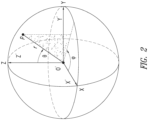
- FIG. 2 is a conceptual diagram illustrating the concept of fusion of accelerometer data generated by a 3-axial accelerometer with reference to a Cartesian coordinate system having perpendicular X, Y and Z axes and an origin O'.
- the 3-axial accelerometer generates data with respect to an X axis of the accelerometer which is represented by the vector X', generates data with respect to a Y axis of the accelerometer which is represented by the vector Y', and generates data with respect to a Z axis of the accelerometer which is represented by the vector Z'.
- the movement to be sensed is occurring along an axis of movement r , such as a vibration around a point p.
- the axis of movement r has an angle ⁇ with respect to the Z axis and an angle ⁇ with respect to the X axis.
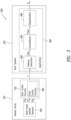
- FIG 3 is a functional block diagram of a system 300 illustrating an example process flow of an application using fused sensor data, such as an application to process audio signals sensed using bone conduction sensors (see Figure 7 ).
- the system 300 includes a sensor array 320 having one or more multi-axial inertial sensors 330, which may include multi-axial accelerometers, multi-axial gyroscopes, etc., configured to sense data, such as data sensed in response to bone vibrations, which may be used to generate audio signals.
- a multi-axial sensor 330 in operation, generates data signals, signals ax, ay, az as illustrated, for respective axes of the sensor 330.
- the data signals ax, ay, az are provided to data fusion circuitry 335.
- the data fusion circuitry 335 in operation, fuses the data signals ax, ay, az into a fused data signal F.
- the sensor array 320 may include other circuitry, not shown in Figure 3 , such as power control circuitry, communication circuitry (e.g., wired or wireless interfaces to couple the sensor array 320 with the host system 302), etc.
- the sensor array 320 generates the multi-axial sensor data and fuses the generated data into a fused data signal F.
- the host system 302 processes the fused data signal F.
- the fused data signal F is received by an application 380 executing on a host system 302.
- the host system 302 may contain processing circuitry to execute the application 380 (see, e.g., host processor 102, memory 104, hardware accelerator 120 of the system 100 of Figure 1 ).
- the application 380 performs feature extraction on the fused data signal F, generating feature data feat.
- the feature data feat is processed, as illustrated by performing convolutions 384, to generate predication data Pred.
- the prediction data Pred is subjected to classification 386 to generate a result R.
- the result R may be, for example: an indication that speech has been detected, which may result in initiation of audio processing of the fused signal F by the host system, initializing of additional sensors, etc.; a recognized word of a speech recognition application; etc.
- the data from a multi-axial sensor is fused using a modulo calculation.
- the magnitude of the vector r may be determined according to sqrt(
- Figure 3 is discussed in the context of a 3-axial accelerometer, the same concept may be applied to fuse other inertial sensor data, such as data from a 2-axial accelerometer, data from a 3-axial gyroscope, data from a 2-axial gyroscope, data from a 6-axial sensor having 3 accelerometer axes and 3 gyroscope axes, data from a plurality of single-axial sensors, data from a multi-axial pressure sensor, etc.
- data from a 2-axial accelerometer data from a 3-axial gyroscope
- data from a 2-axial gyroscope data from a 6-axial sensor having 3 accelerometer axes and 3 gyroscope axes
- data from a plurality of single-axial sensors data from a multi-axial pressure sensor, etc.
- modulo operation to fuse multi-axial sensor data may result in the loss of information in the fused signal during the fusion process. While a modulo fusion process generally works well for linear data without high-frequency vibrations, a modulo fusion process may lose vibration information and circular movement information present in unfused data signals, for example, when high frequency vibrations are present along an axis which is not aligned with an axis of the multi-axial sensor. For example, bone conduction sensors, such as those used in headphones, often need to detect high-frequency vibrations to detect speech. Generally, the bandwidth of MEMS inertial sensors continues to significantly increase, and conventional modulo-based fusion techniques often do not provide satisfactory results for higher bandwidth sensor applications.
- the use of the modulo process is computationally, power and area expensive.
- To fuse the data from a 3-axial accelerometer using a modulo process three multiplications, three additions and a square root function are needed.
- the use of a square root function means a processor is typically needed to performed fusion using a modulo process, as opposed to discrete circuitry such as adders and multipliers. This means that in order to fuse the data at the sensor array 320 using a modulo process, the data fusion circuitry 335 needs to include a processor, with associated processor area, memory, and power requirements.
- a speed modulo process may be employed which operates in a derivative domain.
- the magnitude of the vector r may be determined according to sqrt(diff
- the speed modulo process While the use of a speed modulo process may mitigate the loss of information in a fused signal to some extent, the speed modulo process also is computationally expensive. As with the modulo process, a lot of processing power is needed to fuse the data from a 3-axial accelerometer using a speed modulo process; indeed, eight additions, three multiplications and a square root function are needed. Thus, the use of a speed modulo fusion process to fuse the data would not reduce computation resource needs as compared to the use of the modulo process to fuse the data. The data fusion circuitry 335 would still need a processor to fuse the data.
- Another fusion process that may be employed would be to sum the signals of the individual axes of the multi-axial sensor 330, optionally performing high-pass filtering before summing. In some circumstances, a sum process results in less information loss than a modulo fusion process. However, the sum process is not suitable for use in some circumstances, such as when there is interference between the signals of the individual axes of the multi-axial sensor 330, and significant loss of information in the fused signal may still occur.
- the system 100 of Figure 1 includes polar fusion circuitry 160, and similarly, the system 300 of Figure 3 includes polar fusion circuitry 360, which in operation uses polar rotation to rotate the sensor data onto a determined one of the axes of a multi-axial sensor.
- rotating the sensor data onto one of the axes facilitates reducing loss of information in the fusion process due to vibrations along an axis which is not aligned with an axis of the sensor.
- the use of polar rotation may be performed using multiplication and addition operations, without using a square root operation.
- polar rotation may be performed using discrete circuitry of the data fusion circuitry 335, such as one or more adders and one or more multipliers (see adders 564 and multipliers 562 in Figure 5 ) in the polar fusion circuitry 360, and discrete circuitry may be used instead of a processor in the data fusion circuitry 335 to fuse the sensor data using polar rotation techniques.
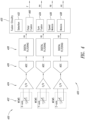
- FIG 4 is a functional block diagram on an embodiment of a multi-axial inertial sensing device 420, which may be employed as a sensor array 120 in the system 100 of Figure 1 or as the sensor array 320 in the system 300 of Figure 3 .
- the sensing device 420 includes a plurality of microelectromechanical systems (MEMS) sensors 422, which in operation sense inertial sensor data, such as motion data related orientations, linear movements, accelerations, etc.
- MEMS sensors 102 may include gyroscopes, accelerometers, etc.
- the plurality of MEMS sensors 422 includes three MEMS sensors 422, which together form a three-axial inertial sensor 430.
- One of the MEMS sensors 422 detects motion along the X axis
- one of the MEMS sensors 422 detects motion along the Y axis
- one of the MEMS sensors 422 detects motion along the Z axis.
- the multi-axial inertial sensing device 420 may include a different number of MEMS sensors to detect different number of axes.
- the MEMS sensors 422 convert mechanical movements into detectable capacitive variations.
- the capacitive variations are converted to analog electrical signals by respective capacitive to electrical converters 424.
- the analog signals are converted to digital signals by respective analog to digital converters 426.
- Digital filtering such as high-pass filtering may be applied to the digital signals by respective digital filters 428, for example, to improve the signal to noise ratio.
- the digital filters 428 provide respective inertial data signals ax, ay and az to fusion circuitry 435. In operation, the fusion circuitry 435 fuses the three inertial data signals ax, ay and az into a fused inertial data signal F, and outputs the fused inertial data signal F.
- the fusion circuitry 435 comprises selection circuitry 432, polar fusion circuitry 460, sum fusion circuitry 434, speed modulo fusion circuitry 436 and modulo fusion circuitry 438.
- the conventional modulo fusion approach provides satisfactory results in some circumstances, and there may be applications which are configured to process a fused inertial data signal F generated using a modulo fusion approach.
- Other applications may perform better when a different fusion approach is applied, such as a speed modulo fusion approach, a sum fusion approach, or a polar fusion approach.
- Still other applications may be configured to process unfused sensor data.
- the fusion circuitry 430 includes selection circuitry 432, which, in operation selects a fusion approach to be applied from a set of fusion approach options available to the fusion circuitry 430.
- the selection may be based, for example, on a control signal, a type of application requesting the sensor data, information included in a request for sensor data, default selections, etc., and various combinations thereof.
- the polar fusion circuitry 460 in operation, applies polar fusion techniques to the inertial data signals, e.g., ax, ay and az, to generate a fused signal F, as discussed in more detail below.
- the sum fusion circuitry 434 in operation, sums the inertial data signals, e.g., ax, ay and az, to generate a fused signal F.
- high-pass-filtering may be applied prior to summing the inertial data signals.
- the speed modulo circuitry 436 applies a speed modulo fusion process, discussed above, to fuse the inertial data signals, e.g., ax, ay and az, to generate a fused signal F.
- the modulo circuitry 436 applies a modulo fusion process, discussed above, to fuse the inertial data signals, e.g., ax, ay and az, to generate a fused signal F.
- the fusion circuitry 435 in some embodiments may omit one or more of the speed modulo circuitry 436, the modulo circuitry 438, and the sum circuitry 434 (e.g., in an embodiment, the selection circuitry may select between polar fusion, sum fusion and unfused data, for example, when it is desired to use discrete circuitry to perform the fusion operation).
- the fusion circuitry 435 may comprise edge AI circuitry.
- the sensor 430 may be physically rotated to align one of the axes of the multi-axial sensor 430 with the axis of movement r.
- the sensor 430 could be rotated to align the axis r with the x-axis of the sensor.
- the data sensed with respect to the x-axis e.g., ax in Figure 4 , could then be used as the fused data.
- the data may be rotated using Euler rotation or principal component analysis (PCA) to rotate the data onto a selected one of the axes of the multi-axial sensor 430.
- PCA principal component analysis
- the data is rotated onto the x-axis, and the result of the rotation onto the x-axis is used as the fused output signal F.
- the data may be rotated onto any of the axes of a multi-axial sensor system.
- three rotation matrixes may be applied to the data.
- Rz ( tz ) is a third rotation matrix for the angle tz between the axis of interest r and the z-axis.
- the rotation matrixes may be simplified to: where the crossed-out matrix elements need not be determined because the result for the data rotated onto the x-axis ax rxyz does not depend on these elements.
- the value F may be determined using eight multiplications and four sums.
- the data may be rotated onto any one of the axes of the multi-axial sensor, and a similar simplification of the rotation matrixes may be applied.
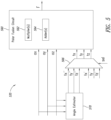
- FIG 5 is a functional block diagram of an embodiment of fusion circuitry 535 that may be employed, for example, as the fusion circuitry 435 of Figure 4 , or the fusion circuitry 335 of Figure 3 .
- the fusion circuitry 535 includes polar fusion circuit 560.
- the polar fusion circuit 560 as illustrated includes one or more multipliers 562 and one or more adders 564, which, in operation, generate a fused output signal based on the values ax, ay, az of the data signals of the X, Y and Z axes respectively, the angles between the X, Y and Z axis and the axis of interest of vibration, respectively, tx, ty and tz, and the simplified rotational matrixes Rx, Ry and Rz, for example, as discussed above.
- the angles between the axis of vibration and the axes of the sensor may be known and provided by an external source, stored and retrieved for use, or default values may be employed which provide satisfactory results.
- the angle between the axes of the multi-axes sensors and an axis of vibration may be known or generally within a range such that fixed angles may be employed.
- the fusion circuitry 535 includes a multiplexer 566 controlled by a selection signal Sel.
- the selection signal Sel may control the multiplexer 566 to select the known, externally generated or default angles tx', ty', tz' as the input angles tx, ty, tz provided to the polar fusion circuit 560.
- the angle between the axis of interest r and the axis of the sensor may change over time such that default values do not provide satisfactory results, and the angle information may not be readily available from an external source.
- an axis of vibration of a smart watch may change frequently.
- the fusion circuitry 535 includes an angle estimator 570, which, in operation, estimates respective rotation angles tx", ty" and tz" based on the values ax, ay, az of the data signals of the X, Y and Z axes respectively.
- the selection signal Sel may control the multiplexer 566 to select the estimated rotation angles tx", ty", tz" generated by the angle estimator 570 as the input angles tx, ty, tz provided to the polar fusion circuit 560.
- FIG. 6 is a functional block diagram of an embodiment of an angle estimator 670 that may be employed, for example, as the angle estimator 570 of Figure 5 .
- the angle estimator 670 in operation, estimates two-dimensional angles between an axis of interest r and the axes of a sensor X, Y, Z, based on the values ax, ay, az of the data signals of the X, Y and Z axes respectively.
- the angle estimator 670 may estimate angles which maximize the power of the signal on a selected axis.
- the angle estimator 670 includes high-pass filters 672, mask circuits 674, and angle estimation circuitry 675 including two-dimensional angle estimators 676, gated-average circuits 678, and multipliers 679.
- the high-pass filters 672 in operation, high-pass filter the data signals ax, ay, az to remove the DC components of the data signals ax, ay, az, generating corresponding filtered data signals aX_flt, aY_flt, aZ_flt.
- the mask circuits 674 in operation, generate masks mask_x, mask_y, mask_z indicating whether magnitudes of the respective filtered data signals aX_flt, aY_flt, aZ_flt exceed a threshold value, for example, to prevent noise from impacting the estimated angles as discussed below.
- the two-dimensional angle estimators 676 apply an arctangent function to respective pairs of the filtered data signals aX_flt, aY_flt, aZ_flt, generating estimated angles.
- the gated average circuits 678 determine average estimated angles for the respective pairs of the filtered data signals, using the associated masks mask_x, mask_y, mask_z to gate the averaging functions.
- the multipliers 679 multiply the gated-average estimated angles by minus 1, so that the rotation is applied in a direction opposite to the estimated angles.
- the resulting rotation angles tx", ty", tz" may be provided to a polar fusion circuit, such as the polar fusion circuit 560 of Figure 5 .
- the angle estimator 570 may be included in the polar fusion circuitry.
- the multiplexer 566 may be omitted in some embodiments, for example when a particular application will use a single source for the input angles tx, ty, tz (e.g., use the rotation angles estimated by the angle estimator 570).
- the multiplexer 566 and the angle estimator 570 may be omitted in some embodiments.
- other techniques to estimate angles may be employed by the angle estimator 670 in some embodiments.
- FIG. 7 is a functional block diagram of an embodiment of bone-conduction device 700 having one or more multi-axial bone conduction sensors 730.
- the bone-conduction device 700 may employ polar fusion techniques to fuse axial data generated by the one or more multi-axial bone-conduction sensors 730.
- the bone-conduction device 700 is a headset having two sensor pods 701 coupled together by a headpiece 703.
- the sensor pods 701, in operation, rest on the cheek bones of a user of the bone-conduction device 700. As the user speaks, the sounds are carried by the check bones as vibrations.
- the bone-conduction device 700 includes one or more interfaces 706 (e.g., wireless communication interfaces, wired communication interfaces, etc.), which may provide the fused data to a host system and receive audio data from the host system, such as the host system 302 of Figure 3 .
- the audio data may be converted into vibrations by bone-conduction actuators 709, and transmitted to the check bones of the user.
- a single fusion circuit 735 may be provided instead of two fusion circuits 735 as illustrated in Figure 7 .
- some embodiments may employ speakers in addition to or instead of the bone-conduction actuators 709.
- Figure 8 illustrates an embodiment of a method 800 of a process for fusing data generated by a multi-axial inertial sensor, that may be employed by various devices and systems, such as, for example, the system 100 of Figure 1 , the system 300 of Figure 3 , the fusion circuitry 435 of Figure 4 , the polar fusion circuit 560 of Figure 5 , and the bone conduction device 700 of Figure 7 .
- Figure 8 will be described with reference to Figures 1 , 4 and 5 .
- the method 800 starts at 802 and proceed to 804.
- the method 800 generates inertial sensor data values with respect to a plurality of axes of movement. This may be done, for example, using one or more sensors, such as the three-axial sensor 130 illustrated in Figure 1 , or the three MEMS sensors 422 of Figure 4 .
- the method 800 proceeds from 804 to 806.
- the method 800 optionally determines or selects a fusion mode to apply to generate a fused data signal based on the generated inertial sensor data. This may be done, for example, using the selection circuit 432 of Figure 4 . The selection may be based, for example, on a control signal, a type of application requesting the sensor data, information included in a request for sensor data, default selections, etc., and various combinations thereof.
- the method 800 proceeds from 806 to 808, to implement a polar fusion process.
- the method proceeds from 808 to 810.
- angles of rotation to be applied during polar rotation operations are determined.
- the angles of rotation may be retrieved values stored in a memory or from a host device, default values, or values estimated using an angle estimation circuit, such as described above with reference to Figures 5 and 6 .
- the method 800 proceeds from 810 to 812.
- the method 800 applies polar rotation operations using the inertial sensor data values generated at 804 and the angles of rotation determined at 810. This may be done, for example, using the simplified rotational matrixes Rx, Ry and Rz, discussed above with reference to Figures 4 and 5 .
- the method 800 proceeds from 812 to 814.
- the method 800 generates a fused data signal based on a result of the polar rotation operations.
- the result of the polar rotation operations for the x-axis, ax rxyz may be used as the fused data signal.
- the method 800 proceeds from 814 to 850.
- the method 800 may terminate, other processing may be performed by the method 800, such as processing of the fused data signal by a host processor (see host system 302 of Figure 3 , processing of additional generated inertial sensor data (e.g., returning to 808 to apply polar fusion to another set of inertial sensor data), or various combinations thereof.
- the method 800 proceeds from 806 to 820, to implement a summation fusion process.
- the method proceeds from 820 to 822.
- the values of the inertial sensor data generated at 804 may be summed.
- the method proceeds from 822 to 824.
- the method 800 generates a fused data signal based on a result of the summation operation performed at 822.
- the fused result may be set equal to the sum of the values of the inertial sensor data.
- the method 800 proceeds from 824 to 850.
- the method 800 may terminate, other processing may be performed by the method 800, such as processing of the fused data signal by a host processor (see host system 302 of Figure 3 , processing of additional generated inertial sensor data (e.g., returning to 820 to apply summation fusion to another set of inertial sensor data), or various combinations thereof.
- the method 800 proceeds from 806 to 830, to implement a modulo fusion process.
- the method proceeds from 830 to 832.
- the method 800 sums the squares of the values of the inertial sensor data generated at 804. The method proceeds from 832 to 834.
- the method 800 performs a square root operation on the sum determined at 832.
- the method 800 proceeds from 834 to 836.
- the method 800 generates a fused data signal based on a result of the square root operation performed at 834.
- the fused result may be set equal to the result of the square root operation.
- the method 800 proceeds from 836 to 850.
- the method 800 may terminate, other processing may be performed by the method 800, such as processing of the fused data signal by a host processor (see host system 302 of Figure 3 , processing of additional generated inertial sensor data (e.g., returning to 830 to apply modulo fusion to another set of inertial sensor data), or various combinations thereof.
- the method 800 proceeds from 806 to 840, to implement a speed modulo fusion process.
- the method proceeds from 840 to 842.
- the method 800 sums the squares of the values of derivative of the inertial sensor data generated at 804. The method proceeds from 842 to 844.
- the method 800 performs a square root operation on the sum determined at 842.
- the method 800 proceeds from 844 to 846.
- the method 800 generates a fused data signal based on a result of the square root operation performed at 844.
- the fused result may be set equal to the result of the square root operation.
- the method 800 proceeds from 846 to 850.
- the method 800 may terminate, other processing may be performed by the method 800, such as processing of the fused data signal by a host processor (see host system 302 of Figure 3 , processing of additional generated inertial sensor data (e.g., returning to 840 to apply speed modulo fusion to another set of inertial sensor data), or various combinations thereof.
- An embodiment of Figure 8 may be modified to omit one or more of the fusion techniques, to add additional fusion techniques, etc.
- the method 800 may proceed from 850 to 806, to select a fusion mode to be applied to a next set of inertial sensor data values.
- a device comprises one or more inertial sensors and fusion circuitry coupled to the one or more inertial sensors.
- the one or more inertial sensors in operation, generate inertial sensor data with respect to a plurality of axes of movement.
- the fusion circuitry in a polar fusion mode of operation, applies a plurality of polar rotation operations to the generated inertial sensor data to rotate the generated inertial sensor data onto an axis of the plurality of axes of movement.
- a fused data signal is generated based on a result of the plurality of polar rotation operations.
- the plurality of polar rotation operations are performed using: respective signal values associated with axes of the plurality of axes of movement; and angles associated with an axis of interest and respective axes of the plurality of axes of movement.
- the angles are default angles.
- the fusion circuitry in operation, receives the angles from a host device.
- the fusion circuitry comprises an angle estimator, and the angle estimator, in operation, estimates the angles based on the respective signal values associated with axes of the plurality of axes of movement.
- the angle estimator comprises: one or more high-pass filters, which, in operation, filter the respective signal values associated with axes of the plurality of axes of movement; mask circuitry, which, in operation, generates masks indicative of magnitudes of the respective signal values associated with axes of the plurality of axes of movement; and angle estimation circuitry, which, in operation, estimates the angles based on the filtered signal values associated with axes of the plurality of axes of movement and the masks indicative of magnitudes of the respective signal values associated with axes of the plurality of axes of movement.
- the angle estimation circuitry comprises: arctangent circuitry, which, in operation, estimates two-dimensional angles based on pairs of the filtered signal values associated with axes of the plurality of axes of movement; gated average circuitry, which generates gated averages of the estimated two-dimensional angles using gating based on the masks indicative of magnitudes of the respective signal values associated with axes of the plurality of axes of movement; and a plurality of multipliers, which, in operation, multiply the gated averages of the estimated two-dimensional angles by minus 1.
- the fusion circuitry comprises one or more multipliers and one or more adders, and, in operation, the polar rotation operations are performed using the one or more multipliers and the one or more adders.
- the fusion circuitry comprises selection circuitry, which, in operation, selects a fusion mode of a plurality of fusion modes of operation, the plurality of fusion modes including the polar fusion mode of operation.
- the plurality of fusion modes of operation include a sum fusion mode of operation, wherein the fusion circuitry, in the sum fusion mode of operation, sums the generated inertial sensor data to generate the fused data signal.
- the plurality of fusion modes of operation include a speed modulo mode of operation, wherein the fusion circuitry, in the speed modulo mode of operation, generates the fused data signal based on a square root of a sum of squares of differential signals associated with the generated inertial sensor data.
- the plurality of fusion modes of operation include a modulo mode of operation, wherein the fusion circuitry, in the modulo mode of operation, generates the fused data signal based on a square root of a sum of squares of the generated inertial sensor data.
- the one or more inertial sensors comprise micro-electromechanical sensors. In an embodiment, one or more inertial sensors comprise one or more multi-axial accelerometers. In an embodiment, the one or more inertial sensors comprise one or more multi-axial gyroscopes. In an embodiment, the one or more inertial sensors comprise one or more bone-conduction sensors, which, in operation, sense vibrations conducted by bones.
- a system comprises a host processor and a sensing device, which, in operation, is communicatively coupled to the host processor.
- the sensing device includes one or more inertial sensors and fusion circuitry coupled to the one or more inertial sensors.
- the inertial sensors in operation, generate inertial sensor data with respect to a plurality of axes of movement.
- the fusion circuitry in a polar fusion mode of operation, applies a plurality of polar rotation operations to the generated inertial sensor data to rotate the generated inertial sensor data onto an axis of the plurality of axes of movement.
- a fused data signal is generated based on a result of the plurality of polar rotation operations.
- the plurality of polar rotation operations are performed using respective signal values associated with axes of the plurality of axes of movement, and angles associated with an axis of interest and respective axes of the plurality of axes of movement.
- the fusion circuitry comprises an angle estimator, and the angle estimator, in operation, estimates the angles based on the respective signal values associated with axes of the plurality of axes of movement.
- the fusion circuitry comprises one or more multipliers and one or more adders, and, in operation, the polar rotation operations are performed using the one or more multipliers and the one or more adders.
- the fusion circuitry comprises selection circuitry, which, in operation, selects a fusion mode of a plurality of fusion modes of operation, the plurality of fusion modes including the polar fusion mode of operation.
- the one or more inertial sensors comprise micro-electromechanical sensors.
- the one or more inertial sensors comprise one or more bone-conduction sensors, which, in operation, sense vibrations conducted by bones.
- a method comprises generating, using one or more inertial sensors of a sensing device, inertial sensor data with respect to a plurality of axes of movement; applying, using fusion circuitry of the sensing device, a plurality of polar rotation operations to the generated inertial sensor data to rotate the generated inertial sensor data onto an axis of the plurality of axes of movement; and generating, using the fusion circuitry, a fused data signal based on a result of the plurality of polar rotation operations.
- the plurality of polar rotation operations are applied using: respective signal values associated with axes of the plurality of axes of movement; and angles associated with an axis of interest and respective axes of the plurality of axes of movement.
- the method comprises estimating, using the fusion circuitry, the angles based on the respective signal values associated with axes of the plurality of axes of movement.
- the method comprises selecting a fusion mode of a plurality of fusion modes of operation, the plurality of fusion modes of operation including a polar fusion mode of operation.
- the generating inertial sensor data comprises sensing vibrations conducted by bones.
- a non-transitory computer-readable medium's contents configure a sensing device to perform a method.
- the method comprises generating inertial sensor data with respect to a plurality of axes of movement; applying a plurality of polar rotation operations to the generated inertial sensor data to rotate the generated inertial sensor data onto an axis of the plurality of axes of movement; and generating a fused data signal based on a result of the plurality of polar rotation operations.
- the contents comprise instructions executable by the sensing device.
- a computer readable medium comprising a computer program adapted to perform one or more of the methods or functions described above.
- the medium may be a physical storage medium, such as for example a Read Only Memory (ROM) chip, or a disk such as a Digital Versatile Disk (DVD-ROM), Compact Disk (CD-ROM), a hard disk, a memory, a network, or a portable media article to be read by an appropriate drive or via an appropriate connection, including as encoded in one or more barcodes or other related codes stored on one or more such computer-readable mediums and being readable by an appropriate reader device.
- ROM Read Only Memory
- DVD-ROM Digital Versatile Disk
- CD-ROM Compact Disk
- some or all of the methods and/or functionality may be implemented or provided in other manners, such as at least partially in firmware and/or hardware, including, but not limited to, one or more application-specific integrated circuits (ASICs), digital signal processors, discrete circuitry, logic gates, standard integrated circuits, controllers (e.g., by executing appropriate instructions, and including microcontrollers and/or embedded controllers), field-programmable gate arrays (FPGAs), complex programmable logic devices (CPLDs), etc., as well as devices that employ RFID technology, and various combinations thereof.
- ASICs application-specific integrated circuits
- DSPs digital signal processors
- discrete circuitry discrete circuitry
- logic gates e.g., logic gates, standard integrated circuits
- controllers e.g., by executing appropriate instructions, and including microcontrollers and/or embedded controllers
- FPGAs field-programmable gate arrays
- CPLDs complex programmable logic devices
Landscapes
- Engineering & Computer Science (AREA)
- Radar, Positioning & Navigation (AREA)
- Remote Sensing (AREA)
- Physics & Mathematics (AREA)
- General Physics & Mathematics (AREA)
- Signal Processing (AREA)
- Automation & Control Theory (AREA)
- Gyroscopes (AREA)
Abstract
Description
- The present disclosure is directed to multi-axial inertial sensor devices, such as motion sensors used in portable electronic devices, and to systems, such as portable electronic devices and systems employing multi-axial inertial sensor devices.
- Multi-axial inertial sensor devices, such as 3-axis gyroscopes, 3-axis accelerometers, sensor arrays including multiple single-axis inertial sensors, etc., generate data signals related to positions, motions, orientations, etc., or combinations thereof, related to a device or an object. For example, motion or vibration data related to a device or an object may be sensed using multi-axial inertial sensors. Such sensors may typically be implemented using micro-electromechanical systems (MEMS).
- Portable electronic devices, such as smart phones, headsets, tablets, smart watches, laptops, etc., may employ such multi-axial inertial sensors in various applications, such as event tracking applications (e.g., fitness programs executing, for example, on smart phones or smart watches), speech detection or recognition applications (e.g., audio programs executing, for example, on smart phones and headsets), navigational applications, etc., and various combinations thereof.
- In many instances, the data of the respective axes of a multi-axial sensor needs to be fused in order to provide useful data to the applications.
- According to the present solution, a device, a system and a method are provided, as defined in the attached claims.
- One or more embodiments are described hereinafter with reference to the accompanying drawings.
-
Figure 1 is a functional block diagram of an embodiment of an electronic device or system employing one or more multi-axial inertial sensor devices. -
Figure 2 is a conceptual diagram illustrating the concept of fusing data generated by respective axis of a multi-axial inertial sensor device. -
Figure 3 is a functional block diagram of a system illustrating an example process flow of an application using fused sensor data. -
Figure 4 is a functional block diagram of an embodiment of multi-axial inertial sensor device. -
Figure 5 is a functional block diagram of an embodiment of a data fusion circuit of a multi-axial inertial sensor device. -
Figure 6 is a functional block diagram of an embodiment of an angle estimation circuit of a multi-axial inertial sensor device. -
Figure 7 is a functional block diagram of an embodiment of bone-conduction device having one or more multi-axial sensors. -
Figure 8 illustrates an embodiment of a method of a process for fusing data generated by a multi-axial inertial sensor. -
Figure 1 is a functional block diagram of an embodiment of an electronic device orsystem 100 of the type to which described embodiments may apply. Thesystem 100 comprises one or more processing cores orcircuits 102. Theprocessing cores 102 may comprise, for example, one or more processors, a state machine, a microprocessor, a programmable logic circuit, discrete circuitry, logic gates, registers, etc., and various combinations thereof. The processing cores may control overall operation of thesystem 100, execution of application programs by the system 100 (e.g., audio processing programs; programs which classify data, such as images, audio data, etc., using CNNs), etc. - The
system 100 includes one ormore memories 104, such as one or more volatile and/or non-volatile memories which may store, for example, all or part of instructions and data related to control of thesystem 100, applications and operations performed by thesystem 100, etc. One or more of thememories 104 may include a memory array, general purpose registers, etc., which, in operation, may be shared by one or more processes executed by thesystem 100. - The
system 100 includes one or more interfaces 106 (e.g., wireless communication interfaces, wired communication interfaces, etc.), and otherfunctional circuits 108, which may include antennas, power supplies, one or more built-in self-test (BIST) circuits, etc., and amain bus system 190. Themain bus system 190 may include one or more data, address, power, interrupt, and/or control buses coupled to the various components of thesystem 100. Thesystem 100 as illustrated also includes one ormore hardware accelerators 110, which may be employed, for example, to accelerate the performance of one or more operations, such as operations associated with implementing a CNN to classify, for example, events associated with sensed sensor signals, such as signals associated with inertial sensor data, etc. - The
system 100 also includes one orsensor arrays 120 which may include various sensors (e.g., image sensors, inertial sensors, such as accelerometers, and gyroscopes (which may be multi-axial sensors), pressure sensors, temperature sensors, etc., and various combinations thereof). The sensors, in operation, may generate sensor data for use in various applications executing, for example, under control of one or more of theprocessing cores 102. As illustrated, thesensor array 120 comprises one or more 3-axial accelerometers 130, one or more 3-axial gyroscopes 140, and one ormore pressure sensors 150, such as a MEMS microphone. - For example, the
sensor array 120 may also comprise an internal processing circuitry to perform edge AI processing on the fused sensor data. In another example, thesensor array 120 ofFigure 1 may comprise a 6-axial combination accelerometer and gyroscope, a plurality of single axial sensors, etc., instead of or in addition to the illustrated sensors. As mentioned above, data signals associated with different axes of a multi-axial sensor device, such as a 3-axial accelerometer 130 or a 3-axial gyroscope 140, may need to be fused to provide a useful data signal to an application.Figure 2 is a conceptual diagram illustrating the concept of fusion of accelerometer data generated by a 3-axial accelerometer with reference to a Cartesian coordinate system having perpendicular X, Y and Z axes and an origin O'. The 3-axial accelerometer generates data with respect to an X axis of the accelerometer which is represented by the vector X', generates data with respect to a Y axis of the accelerometer which is represented by the vector Y', and generates data with respect to a Z axis of the accelerometer which is represented by the vector Z'. The movement to be sensed is occurring along an axis of movement r, such as a vibration around a point p. The axis of movement r has an angle θ with respect to the Z axis and an angle ϕ with respect to the X axis. -
Figure 3 is a functional block diagram of asystem 300 illustrating an example process flow of an application using fused sensor data, such as an application to process audio signals sensed using bone conduction sensors (seeFigure 7 ). Thesystem 300 includes asensor array 320 having one or more multi-axialinertial sensors 330, which may include multi-axial accelerometers, multi-axial gyroscopes, etc., configured to sense data, such as data sensed in response to bone vibrations, which may be used to generate audio signals. Amulti-axial sensor 330, in operation, generates data signals, signals ax, ay, az as illustrated, for respective axes of thesensor 330. The data signals ax, ay, az are provided todata fusion circuitry 335. Thedata fusion circuitry 335, in operation, fuses the data signals ax, ay, az into a fused data signal F. In some embodiments, thesensor array 320 may include other circuitry, not shown inFigure 3 , such as power control circuitry, communication circuitry (e.g., wired or wireless interfaces to couple thesensor array 320 with the host system 302), etc. - As illustrated, the
sensor array 320 generates the multi-axial sensor data and fuses the generated data into a fused data signal F. Thehost system 302 processes the fused data signal F. In the illustrated example, the fused data signal F is received by anapplication 380 executing on ahost system 302. Thehost system 302 may contain processing circuitry to execute the application 380 (see, e.g.,host processor 102,memory 104,hardware accelerator 120 of thesystem 100 ofFigure 1 ). Theapplication 380 performs feature extraction on the fused data signal F, generating feature data feat. The feature data feat is processed, as illustrated by performingconvolutions 384, to generate predication data Pred. The prediction data Pred is subjected toclassification 386 to generate a result R. The result R may be, for example: an indication that speech has been detected, which may result in initiation of audio processing of the fused signal F by the host system, initializing of additional sensors, etc.; a recognized word of a speech recognition application; etc. - Conventionally, the data from a multi-axial sensor is fused using a modulo calculation. For example, with respect to a 3-axial sensor device, the magnitude of the vector r may be determined according to sqrt(|ax|2 + |ay|2 + |az|2), where sqrt is the square root function, ax is the sensor data signal with respect to the x-axis of the sensor, ay is the sensor data signal with respect to the y-axis of the sensor, and az is the sensor data signal with respect to the z axis of the sensor. While
Figure 3 is discussed in the context of a 3-axial accelerometer, the same concept may be applied to fuse other inertial sensor data, such as data from a 2-axial accelerometer, data from a 3-axial gyroscope, data from a 2-axial gyroscope, data from a 6-axial sensor having 3 accelerometer axes and 3 gyroscope axes, data from a plurality of single-axial sensors, data from a multi-axial pressure sensor, etc. - The use of the modulo operation to fuse multi-axial sensor data may result in the loss of information in the fused signal during the fusion process. While a modulo fusion process generally works well for linear data without high-frequency vibrations, a modulo fusion process may lose vibration information and circular movement information present in unfused data signals, for example, when high frequency vibrations are present along an axis which is not aligned with an axis of the multi-axial sensor. For example, bone conduction sensors, such as those used in headphones, often need to detect high-frequency vibrations to detect speech. Generally, the bandwidth of MEMS inertial sensors continues to significantly increase, and conventional modulo-based fusion techniques often do not provide satisfactory results for higher bandwidth sensor applications. In addition, the fused signal of a modulo fusion process is large, resulting in a loss of resolution. With reference to
Figure 3 , this loss of information may result in significant errors in thefeature extraction 382,convolution 384, andclassification 386 processes, resulting in results R that are inaccurate. - In addition, the use of the modulo process is computationally, power and area expensive. To fuse the data from a 3-axial accelerometer using a modulo process, three multiplications, three additions and a square root function are needed. The use of a square root function means a processor is typically needed to performed fusion using a modulo process, as opposed to discrete circuitry such as adders and multipliers. This means that in order to fuse the data at the
sensor array 320 using a modulo process, thedata fusion circuitry 335 needs to include a processor, with associated processor area, memory, and power requirements. - Instead of using a modulo process, a speed modulo process may be employed which operates in a derivative domain. For example, with respect to a 3-axial sensor device, the magnitude of the vector r may be determined according to sqrt(diff|ax||2 + diff|ay||2 + diff|az|2), where sqrt is the square root function, diff is the derivative function, ax is the sensor data signal with respect to the x-axis of the sensor, ay is the sensor data signal with respect to the y-axis of the sensor, and az is the sensor data signal with respect to the z axis of the sensor. While the use of a speed modulo process may mitigate the loss of information in a fused signal to some extent, the speed modulo process also is computationally expensive. As with the modulo process, a lot of processing power is needed to fuse the data from a 3-axial accelerometer using a speed modulo process; indeed, eight additions, three multiplications and a square root function are needed. Thus, the use of a speed modulo fusion process to fuse the data would not reduce computation resource needs as compared to the use of the modulo process to fuse the data. The
data fusion circuitry 335 would still need a processor to fuse the data. - Another fusion process that may be employed would be to sum the signals of the individual axes of the
multi-axial sensor 330, optionally performing high-pass filtering before summing. In some circumstances, a sum process results in less information loss than a modulo fusion process. However, the sum process is not suitable for use in some circumstances, such as when there is interference between the signals of the individual axes of themulti-axial sensor 330, and significant loss of information in the fused signal may still occur. - To facilitate reducing information loss in the fusion process, the
system 100 ofFigure 1 includespolar fusion circuitry 160, and similarly, thesystem 300 ofFigure 3 includespolar fusion circuitry 360, which in operation uses polar rotation to rotate the sensor data onto a determined one of the axes of a multi-axial sensor. With reference toFigure 2 , rotating the sensor data onto one of the axes facilitates reducing loss of information in the fusion process due to vibrations along an axis which is not aligned with an axis of the sensor. In addition, as discussed in more detail below, the use of polar rotation may be performed using multiplication and addition operations, without using a square root operation. Thus, polar rotation may be performed using discrete circuitry of thedata fusion circuitry 335, such as one or more adders and one or more multipliers (seeadders 564 andmultipliers 562 inFigure 5 ) in thepolar fusion circuitry 360, and discrete circuitry may be used instead of a processor in thedata fusion circuitry 335 to fuse the sensor data using polar rotation techniques. -
Figure 4 is a functional block diagram on an embodiment of a multi-axialinertial sensing device 420, which may be employed as asensor array 120 in thesystem 100 ofFigure 1 or as thesensor array 320 in thesystem 300 ofFigure 3 . Thesensing device 420 includes a plurality of microelectromechanical systems (MEMS)sensors 422, which in operation sense inertial sensor data, such as motion data related orientations, linear movements, accelerations, etc. The plurality ofMEMS sensors 102 may include gyroscopes, accelerometers, etc. - In the example illustrated, the plurality of
MEMS sensors 422 includes threeMEMS sensors 422, which together form a three-axialinertial sensor 430. One of theMEMS sensors 422 detects motion along the X axis, one of theMEMS sensors 422 detects motion along the Y axis, and one of theMEMS sensors 422 detects motion along the Z axis. - In various embodiments, the multi-axial
inertial sensing device 420 may include a different number of MEMS sensors to detect different number of axes. - As illustrated, the
MEMS sensors 422 convert mechanical movements into detectable capacitive variations. The capacitive variations are converted to analog electrical signals by respective capacitive toelectrical converters 424. The analog signals are converted to digital signals by respective analog todigital converters 426. Digital filtering, such as high-pass filtering may be applied to the digital signals by respectivedigital filters 428, for example, to improve the signal to noise ratio. Thedigital filters 428 provide respective inertial data signals ax, ay and az tofusion circuitry 435. In operation, thefusion circuitry 435 fuses the three inertial data signals ax, ay and az into a fused inertial data signal F, and outputs the fused inertial data signal F. - The
fusion circuitry 435, as illustrated, comprisesselection circuitry 432,polar fusion circuitry 460,sum fusion circuitry 434, speed modulofusion circuitry 436 and modulofusion circuitry 438. As discussed above, the conventional modulo fusion approach provides satisfactory results in some circumstances, and there may be applications which are configured to process a fused inertial data signal F generated using a modulo fusion approach. Other applications may perform better when a different fusion approach is applied, such as a speed modulo fusion approach, a sum fusion approach, or a polar fusion approach. Still other applications may be configured to process unfused sensor data. - To facilitate the use of different fusion approaches, the
fusion circuitry 430 includesselection circuitry 432, which, in operation selects a fusion approach to be applied from a set of fusion approach options available to thefusion circuitry 430. The selection may be based, for example, on a control signal, a type of application requesting the sensor data, information included in a request for sensor data, default selections, etc., and various combinations thereof. - The
polar fusion circuitry 460, in operation, applies polar fusion techniques to the inertial data signals, e.g., ax, ay and az, to generate a fused signal F, as discussed in more detail below. Thesum fusion circuitry 434, in operation, sums the inertial data signals, e.g., ax, ay and az, to generate a fused signal F. In some embodiments, high-pass-filtering may be applied prior to summing the inertial data signals. The speed modulocircuitry 436, in operation, applies a speed modulo fusion process, discussed above, to fuse the inertial data signals, e.g., ax, ay and az, to generate a fused signal F. The modulocircuitry 436, in operation, applies a modulo fusion process, discussed above, to fuse the inertial data signals, e.g., ax, ay and az, to generate a fused signal F. - The
fusion circuitry 435 in some embodiments may omit one or more of the speed modulocircuitry 436, the modulocircuitry 438, and the sum circuitry 434 (e.g., in an embodiment, the selection circuitry may select between polar fusion, sum fusion and unfused data, for example, when it is desired to use discrete circuitry to perform the fusion operation). In another example, thefusion circuitry 435 may comprise edge AI circuitry. - With reference to
Figures 2 and4 , when the vibration of interest is along an axis of movement r, conceptually thesensor 430 may be physically rotated to align one of the axes of themulti-axial sensor 430 with the axis of movement r. For example, thesensor 430 could be rotated to align the axis r with the x-axis of the sensor. The data sensed with respect to the x-axis, e.g., ax inFigure 4 , could then be used as the fused data. In practice, it is generally not feasible to physically rotate the sensor to align an axis of interest with a determined axis of amulti-axial sensor 430. - Instead of rotating the sensor, the data may be rotated using Euler rotation or principal component analysis (PCA) to rotate the data onto a selected one of the axes of the
multi-axial sensor 430. In the example discussed herein, with reference toFigures 2 and4 , the data is rotated onto the x-axis, and the result of the rotation onto the x-axis is used as the fused output signal F. The data, however, may be rotated onto any of the axes of a multi-axial sensor system. - In the context of a three-axial sensor, three rotation matrixes may be applied to the data. In a first rotation, the data may be rotated onto the x-axis according to:


- In a second rotation, the result of the first rotation may be rotated onto the y-axis according to:


- In a third rotation, the result of the second rotation may be rotated onto the z-axis according to:


- As the output fused data will be the result for the x-axis, axrxyz, the rotation matrixes may be simplified to:

-
Figure 5 is a functional block diagram of an embodiment offusion circuitry 535 that may be employed, for example, as thefusion circuitry 435 ofFigure 4 , or thefusion circuitry 335 ofFigure 3 . Thefusion circuitry 535 includespolar fusion circuit 560. - The
polar fusion circuit 560 as illustrated includes one ormore multipliers 562 and one ormore adders 564, which, in operation, generate a fused output signal based on the values ax, ay, az of the data signals of the X, Y and Z axes respectively, the angles between the X, Y and Z axis and the axis of interest of vibration, respectively, tx, ty and tz, and the simplified rotational matrixes Rx, Ry and Rz, for example, as discussed above. - In many applications, the angles between the axis of vibration and the axes of the sensor (with reference to
Figure 2 , the respective angles between the axis of interest r and the axes X, Y and Z of the sensor), may be known and provided by an external source, stored and retrieved for use, or default values may be employed which provide satisfactory results. For example, in a bone conduction headset, the angle between the axes of the multi-axes sensors and an axis of vibration may be known or generally within a range such that fixed angles may be employed. As illustrated inFigure 5 , thefusion circuitry 535 includes amultiplexer 566 controlled by a selection signal Sel. When the angles tx, ty, tz are known, externally generated, or default angles are employed, the selection signal Sel may control themultiplexer 566 to select the known, externally generated or default angles tx', ty', tz' as the input angles tx, ty, tz provided to thepolar fusion circuit 560. - In other applications, the angle between the axis of interest r and the axis of the sensor may change over time such that default values do not provide satisfactory results, and the angle information may not be readily available from an external source. For example, an axis of vibration of a smart watch may change frequently. As illustrated, the
fusion circuitry 535 includes anangle estimator 570, which, in operation, estimates respective rotation angles tx", ty" and tz" based on the values ax, ay, az of the data signals of the X, Y and Z axes respectively. When the estimated rotation angles tx", ty", and tz" generated by theangle estimator 570 are to be employed, the selection signal Sel may control themultiplexer 566 to select the estimated rotation angles tx", ty", tz" generated by theangle estimator 570 as the input angles tx, ty, tz provided to thepolar fusion circuit 560. -
Figure 6 is a functional block diagram of an embodiment of anangle estimator 670 that may be employed, for example, as theangle estimator 570 ofFigure 5 . Theangle estimator 670, in operation, estimates two-dimensional angles between an axis of interest r and the axes of a sensor X, Y, Z, based on the values ax, ay, az of the data signals of the X, Y and Z axes respectively. For example, theangle estimator 670 may estimate angles which maximize the power of the signal on a selected axis. As illustrated, theangle estimator 670 includes high-pass filters 672,mask circuits 674, andangle estimation circuitry 675 including two-dimensional angle estimators 676, gated-average circuits 678, andmultipliers 679. - The high-
pass filters 672, in operation, high-pass filter the data signals ax, ay, az to remove the DC components of the data signals ax, ay, az, generating corresponding filtered data signals aX_flt, aY_flt, aZ_flt. Themask circuits 674, in operation, generate masks mask_x, mask_y, mask_z indicating whether magnitudes of the respective filtered data signals aX_flt, aY_flt, aZ_flt exceed a threshold value, for example, to prevent noise from impacting the estimated angles as discussed below. The two-dimensional angle estimators 676 apply an arctangent function to respective pairs of the filtered data signals aX_flt, aY_flt, aZ_flt, generating estimated angles. The gatedaverage circuits 678 determine average estimated angles for the respective pairs of the filtered data signals, using the associated masks mask_x, mask_y, mask_z to gate the averaging functions. Themultipliers 679 multiply the gated-average estimated angles byminus 1, so that the rotation is applied in a direction opposite to the estimated angles. The resulting rotation angles tx", ty", tz", may be provided to a polar fusion circuit, such as thepolar fusion circuit 560 ofFigure 5 . - In some embodiments, the
angle estimator 570 may be included in the polar fusion circuitry. In another example, themultiplexer 566 may be omitted in some embodiments, for example when a particular application will use a single source for the input angles tx, ty, tz (e.g., use the rotation angles estimated by the angle estimator 570). In another example, when a particular application will use externally provided or default values for the rotation angles, themultiplexer 566 and theangle estimator 570 may be omitted in some embodiments. In another example, other techniques to estimate angles may be employed by theangle estimator 670 in some embodiments. -
Figure 7 is a functional block diagram of an embodiment of bone-conduction device 700 having one or more multi-axialbone conduction sensors 730. The bone-conduction device 700 may employ polar fusion techniques to fuse axial data generated by the one or more multi-axial bone-conduction sensors 730. As illustrated, the bone-conduction device 700 is a headset having twosensor pods 701 coupled together by aheadpiece 703. Thesensor pods 701, in operation, rest on the cheek bones of a user of the bone-conduction device 700. As the user speaks, the sounds are carried by the check bones as vibrations. In operation, these vibrations are sensed by the multi-axial bone-conduction sensors 730, and the multi-axial data generated by the multi-axial bone-conduction sensors 730 may be fused usingfusion circuitry 735. Thefusion circuitry 735 may be similar to and operate in a similar manner as thefusion circuitry 535 ofFigure 5 , thefusion circuitry 435 ofFigure 4 , or thefusion circuitry 335 ofFigure 3 . The bone-conduction device 700 includes one or more interfaces 706 (e.g., wireless communication interfaces, wired communication interfaces, etc.), which may provide the fused data to a host system and receive audio data from the host system, such as thehost system 302 ofFigure 3 . The audio data may be converted into vibrations by bone-conduction actuators 709, and transmitted to the check bones of the user. - In some embodiments a
single fusion circuit 735 may be provided instead of twofusion circuits 735 as illustrated inFigure 7 . In another example, some embodiments may employ speakers in addition to or instead of the bone-conduction actuators 709. -
Figure 8 illustrates an embodiment of amethod 800 of a process for fusing data generated by a multi-axial inertial sensor, that may be employed by various devices and systems, such as, for example, thesystem 100 ofFigure 1 , thesystem 300 ofFigure 3 , thefusion circuitry 435 ofFigure 4 , thepolar fusion circuit 560 ofFigure 5 , and thebone conduction device 700 ofFigure 7 . For convenience,Figure 8 will be described with reference toFigures 1 ,4 and5 . - The
method 800 starts at 802 and proceed to 804. At 804, themethod 800 generates inertial sensor data values with respect to a plurality of axes of movement. This may be done, for example, using one or more sensors, such as the three-axial sensor 130 illustrated inFigure 1 , or the threeMEMS sensors 422 ofFigure 4 . Themethod 800 proceeds from 804 to 806. - At 806, the
method 800 optionally determines or selects a fusion mode to apply to generate a fused data signal based on the generated inertial sensor data. This may be done, for example, using theselection circuit 432 ofFigure 4 . The selection may be based, for example, on a control signal, a type of application requesting the sensor data, information included in a request for sensor data, default selections, etc., and various combinations thereof. - When a polar fusion mode is selected at 806, the
method 800 proceeds from 806 to 808, to implement a polar fusion process. The method proceeds from 808 to 810. At 810, angles of rotation to be applied during polar rotation operations are determined. The angles of rotation may be retrieved values stored in a memory or from a host device, default values, or values estimated using an angle estimation circuit, such as described above with reference toFigures 5 and6 . Themethod 800 proceeds from 810 to 812. - At 812, the
method 800 applies polar rotation operations using the inertial sensor data values generated at 804 and the angles of rotation determined at 810. This may be done, for example, using the simplified rotational matrixes Rx, Ry and Rz, discussed above with reference toFigures 4 and5 . Themethod 800 proceeds from 812 to 814. - At 814, the
method 800 generates a fused data signal based on a result of the polar rotation operations. For example, the result of the polar rotation operations for the x-axis, axrxyz, may be used as the fused data signal. Themethod 800 proceeds from 814 to 850. - At 850, the
method 800 may terminate, other processing may be performed by themethod 800, such as processing of the fused data signal by a host processor (seehost system 302 ofFigure 3 , processing of additional generated inertial sensor data (e.g., returning to 808 to apply polar fusion to another set of inertial sensor data), or various combinations thereof. - When a summation fusion mode is selected at 806, the
method 800 proceeds from 806 to 820, to implement a summation fusion process. The method proceeds from 820 to 822. At 822, the values of the inertial sensor data generated at 804 may be summed. The method proceeds from 822 to 824. - At 824, the
method 800 generates a fused data signal based on a result of the summation operation performed at 822. For example, the fused result may be set equal to the sum of the values of the inertial sensor data. Themethod 800 proceeds from 824 to 850. - At 850, the
method 800 may terminate, other processing may be performed by themethod 800, such as processing of the fused data signal by a host processor (seehost system 302 ofFigure 3 , processing of additional generated inertial sensor data (e.g., returning to 820 to apply summation fusion to another set of inertial sensor data), or various combinations thereof. - When a modulo fusion mode is selected at 806, the
method 800 proceeds from 806 to 830, to implement a modulo fusion process. The method proceeds from 830 to 832. At 832, themethod 800 sums the squares of the values of the inertial sensor data generated at 804. The method proceeds from 832 to 834. - At 834, the
method 800 performs a square root operation on the sum determined at 832. Themethod 800 proceeds from 834 to 836. - At 836, the
method 800 generates a fused data signal based on a result of the square root operation performed at 834. For example, the fused result may be set equal to the result of the square root operation. Themethod 800 proceeds from 836 to 850. - At 850, the
method 800 may terminate, other processing may be performed by themethod 800, such as processing of the fused data signal by a host processor (seehost system 302 ofFigure 3 , processing of additional generated inertial sensor data (e.g., returning to 830 to apply modulo fusion to another set of inertial sensor data), or various combinations thereof. - When a speed modulo fusion mode is selected at 806, the
method 800 proceeds from 806 to 840, to implement a speed modulo fusion process. The method proceeds from 840 to 842. At 842, themethod 800 sums the squares of the values of derivative of the inertial sensor data generated at 804. The method proceeds from 842 to 844. - At 844, the
method 800 performs a square root operation on the sum determined at 842. Themethod 800 proceeds from 844 to 846. - At 846, the
method 800 generates a fused data signal based on a result of the square root operation performed at 844. For example, the fused result may be set equal to the result of the square root operation. Themethod 800 proceeds from 846 to 850. - At 850, the
method 800 may terminate, other processing may be performed by themethod 800, such as processing of the fused data signal by a host processor (seehost system 302 ofFigure 3 , processing of additional generated inertial sensor data (e.g., returning to 840 to apply speed modulo fusion to another set of inertial sensor data), or various combinations thereof. - An embodiment of
Figure 8 may be modified to omit one or more of the fusion techniques, to add additional fusion techniques, etc. In another example, in an embodiment themethod 800 may proceed from 850 to 806, to select a fusion mode to be applied to a next set of inertial sensor data values. - Finally, it is clear that modifications and variations may be made to what has been described and illustrated herein, without thereby departing from the scope of this disclosure, as defined in the attached claims.
- Exemplary embodiments of the present disclosure may be summarized as follows.
- In an embodiment, a device comprises one or more inertial sensors and fusion circuitry coupled to the one or more inertial sensors. The one or more inertial sensors, in operation, generate inertial sensor data with respect to a plurality of axes of movement. The fusion circuitry, in a polar fusion mode of operation, applies a plurality of polar rotation operations to the generated inertial sensor data to rotate the generated inertial sensor data onto an axis of the plurality of axes of movement. A fused data signal is generated based on a result of the plurality of polar rotation operations.
- In an embodiment, the plurality of polar rotation operations are performed using: respective signal values associated with axes of the plurality of axes of movement; and angles associated with an axis of interest and respective axes of the plurality of axes of movement. In an embodiment, the angles are default angles. In an embodiment, the fusion circuitry, in operation, receives the angles from a host device.
- In an embodiment, the fusion circuitry comprises an angle estimator, and the angle estimator, in operation, estimates the angles based on the respective signal values associated with axes of the plurality of axes of movement. In an embodiment, the angle estimator comprises: one or more high-pass filters, which, in operation, filter the respective signal values associated with axes of the plurality of axes of movement; mask circuitry, which, in operation, generates masks indicative of magnitudes of the respective signal values associated with axes of the plurality of axes of movement; and angle estimation circuitry, which, in operation, estimates the angles based on the filtered signal values associated with axes of the plurality of axes of movement and the masks indicative of magnitudes of the respective signal values associated with axes of the plurality of axes of movement. In an embodiment, the angle estimation circuitry comprises: arctangent circuitry, which, in operation, estimates two-dimensional angles based on pairs of the filtered signal values associated with axes of the plurality of axes of movement; gated average circuitry, which generates gated averages of the estimated two-dimensional angles using gating based on the masks indicative of magnitudes of the respective signal values associated with axes of the plurality of axes of movement; and a plurality of multipliers, which, in operation, multiply the gated averages of the estimated two-dimensional angles by
minus 1. - In an embodiment, the fusion circuitry comprises one or more multipliers and one or more adders, and, in operation, the polar rotation operations are performed using the one or more multipliers and the one or more adders.
- In an embodiment, the fusion circuitry comprises selection circuitry, which, in operation, selects a fusion mode of a plurality of fusion modes of operation, the plurality of fusion modes including the polar fusion mode of operation. In an embodiment, the plurality of fusion modes of operation include a sum fusion mode of operation, wherein the fusion circuitry, in the sum fusion mode of operation, sums the generated inertial sensor data to generate the fused data signal. In an embodiment, the plurality of fusion modes of operation include a speed modulo mode of operation, wherein the fusion circuitry, in the speed modulo mode of operation, generates the fused data signal based on a square root of a sum of squares of differential signals associated with the generated inertial sensor data. In an embodiment, the plurality of fusion modes of operation include a modulo mode of operation, wherein the fusion circuitry, in the modulo mode of operation, generates the fused data signal based on a square root of a sum of squares of the generated inertial sensor data.
- In an embodiment, the one or more inertial sensors comprise micro-electromechanical sensors. In an embodiment, one or more inertial sensors comprise one or more multi-axial accelerometers. In an embodiment, the one or more inertial sensors comprise one or more multi-axial gyroscopes. In an embodiment, the one or more inertial sensors comprise one or more bone-conduction sensors, which, in operation, sense vibrations conducted by bones.
- In an embodiment, a system comprises a host processor and a sensing device, which, in operation, is communicatively coupled to the host processor. The sensing device includes one or more inertial sensors and fusion circuitry coupled to the one or more inertial sensors. The inertial sensors, in operation, generate inertial sensor data with respect to a plurality of axes of movement. The fusion circuitry, in a polar fusion mode of operation, applies a plurality of polar rotation operations to the generated inertial sensor data to rotate the generated inertial sensor data onto an axis of the plurality of axes of movement. A fused data signal is generated based on a result of the plurality of polar rotation operations.
- In an embodiment, the plurality of polar rotation operations are performed using respective signal values associated with axes of the plurality of axes of movement, and angles associated with an axis of interest and respective axes of the plurality of axes of movement. In an embodiment, the fusion circuitry comprises an angle estimator, and the angle estimator, in operation, estimates the angles based on the respective signal values associated with axes of the plurality of axes of movement. In an embodiment, the fusion circuitry comprises one or more multipliers and one or more adders, and, in operation, the polar rotation operations are performed using the one or more multipliers and the one or more adders. In an embodiment, the fusion circuitry comprises selection circuitry, which, in operation, selects a fusion mode of a plurality of fusion modes of operation, the plurality of fusion modes including the polar fusion mode of operation. In an embodiment, the one or more inertial sensors comprise micro-electromechanical sensors. In an embodiment, the one or more inertial sensors comprise one or more bone-conduction sensors, which, in operation, sense vibrations conducted by bones.
- In an embodiment, a method comprises generating, using one or more inertial sensors of a sensing device, inertial sensor data with respect to a plurality of axes of movement; applying, using fusion circuitry of the sensing device, a plurality of polar rotation operations to the generated inertial sensor data to rotate the generated inertial sensor data onto an axis of the plurality of axes of movement; and generating, using the fusion circuitry, a fused data signal based on a result of the plurality of polar rotation operations. In an embodiment, the plurality of polar rotation operations are applied using: respective signal values associated with axes of the plurality of axes of movement; and angles associated with an axis of interest and respective axes of the plurality of axes of movement. In an embodiment, the method comprises estimating, using the fusion circuitry, the angles based on the respective signal values associated with axes of the plurality of axes of movement. In an embodiment, the method comprises selecting a fusion mode of a plurality of fusion modes of operation, the plurality of fusion modes of operation including a polar fusion mode of operation. In an embodiment, the generating inertial sensor data comprises sensing vibrations conducted by bones.
- In an embodiment, a non-transitory computer-readable medium's contents configure a sensing device to perform a method. The method comprises generating inertial sensor data with respect to a plurality of axes of movement; applying a plurality of polar rotation operations to the generated inertial sensor data to rotate the generated inertial sensor data onto an axis of the plurality of axes of movement; and generating a fused data signal based on a result of the plurality of polar rotation operations. In an embodiment, the contents comprise instructions executable by the sensing device.
- Some embodiments may take the form of or comprise computer program products. For example, according to one embodiment there is provided a computer readable medium comprising a computer program adapted to perform one or more of the methods or functions described above. The medium may be a physical storage medium, such as for example a Read Only Memory (ROM) chip, or a disk such as a Digital Versatile Disk (DVD-ROM), Compact Disk (CD-ROM), a hard disk, a memory, a network, or a portable media article to be read by an appropriate drive or via an appropriate connection, including as encoded in one or more barcodes or other related codes stored on one or more such computer-readable mediums and being readable by an appropriate reader device.
- Furthermore, in some embodiments, some or all of the methods and/or functionality may be implemented or provided in other manners, such as at least partially in firmware and/or hardware, including, but not limited to, one or more application-specific integrated circuits (ASICs), digital signal processors, discrete circuitry, logic gates, standard integrated circuits, controllers (e.g., by executing appropriate instructions, and including microcontrollers and/or embedded controllers), field-programmable gate arrays (FPGAs), complex programmable logic devices (CPLDs), etc., as well as devices that employ RFID technology, and various combinations thereof.
Claims (15)
- A device, comprising:one or more inertial sensors (130, 140, 330, 430, 730), configured to generate inertial sensor data (ax, ay, az) with respect to a plurality of axes of movement (x, y, z);fusion circuitry (335, 435, 535, 735) coupled to the one or more inertial sensors, wherein the fusion circuitry, in a polar fusion mode of operation, is configured to:apply a plurality of polar rotation operations to the generated inertial sensor data to rotate the generated inertial sensor data onto an axis of the plurality of axes of movement; andgenerate a fused data signal (F) based on a result of the plurality of polar rotation operations.
- The device of claim 1, wherein the fusion circuitry (335, 435, 535, 735) is configured to perform the plurality of polar rotation operations using:respective signal values associated with axes of the plurality of axes of movement (x, y, z);
andangles (tx, ty, tz) associated with an axis of interest and respective axes of the plurality of axes of movement. - The device of claim 2, wherein: the angles (tx, ty, tz) are default angles; or the fusion circuitry (335, 435, 535, 735) is configured to receive the angles from a host device; or the fusion circuitry comprises an angle estimator (570, 670), which is configured to estimate the angles based on the respective signal values associated with axes of the plurality of axes of movement (x, y, z).
- The device of claim 3, wherein the angle estimator (570, 670) comprises:one or more high-pass filters (672), which are configured to filter the respective signal values associated with axes of the plurality of axes of movement (x, y, z);mask circuitry (674), which is configured to generate masks indicative of magnitudes of the respective signal values associated with axes of the plurality of axes of movement; andangle estimation circuitry (675), which are configured to estimate the angles based on the filtered signal values associated with axes of the plurality of axes of movement and the masks indicative of magnitudes of the respective signal values associated with axes of the plurality of axes of movement.
- The device of claim 4, wherein the angle estimation circuitry (675) comprises:arctangent circuitry (676), which is configured to estimate two-dimensional angles based on pairs of the filtered signal values associated with axes of the plurality of axes of movement (x, y, z);gated average circuitry (678), which is configured to generate gated averages of the estimated two-dimensional angles using gating based on the masks indicative of magnitudes of the respective signal values associated with axes of the plurality of axes of movement; anda plurality of multipliers (679), which are configured to multiply the gated averages of the estimated two-dimensional angles by minus 1.
- The device of any of the preceding claims, wherein the fusion circuitry (335, 435, 535, 735) comprises one or more multipliers (562) and one or more adders (564), and is configured to perform the polar rotation operations using the one or more multipliers and the one or more adders.
- The device of any of the preceding claims, wherein the fusion circuitry (335, 435, 535, 735) comprises selection circuitry (432), which is configured to select a fusion mode of a plurality of fusion modes of operation, the plurality of fusion modes including the polar fusion mode of operation; a sum fusion mode of operation, wherein the fusion circuitry, in the sum fusion mode of operation, is configured to sum the generated inertial sensor data (ax, ay, az) to generate the fused data signal (F); a speed modulo mode of operation, wherein the fusion circuitry, in the speed modulo mode of operation, is configured to generate the fused data signal based on a square root of a sum of squares of differential signals associated with the generated inertial sensor data; a modulo mode of operation, wherein the fusion circuitry, in the modulo mode of operation, is configured to generate the fused data signal based on a square root of a sum of squares of the generated inertial sensor data.
- The device of any of the preceding claims, wherein the one or more inertial sensors (130, 140, 330, 430, 730) comprise micro-electromechanical sensors; in particular one or more of: multi-axial accelerometers; multi-axial gyroscopes; and bone-conduction sensors, which are configured to sense vibrations conducted by bones.
- A system (300), comprising:a host processor (302); anda sensing device (320), which is configured to be communicatively coupled to the host processor, the sensing device including:one or more inertial sensors (130, 140, 330, 430, 730), which, in operation, generate inertial sensor data (ax, ay, az) with respect to a plurality of axes of movement (x, y, z);fusion circuitry (335, 435, 535, 735) coupled to the one or more inertial sensors,
wherein the fusion circuitry, in a polar fusion mode of operation, is configured to:apply a plurality of polar rotation operations to the generated inertial sensor data to rotate the generated inertial sensor data onto an axis of the plurality of axes of movement;
andgenerate a fused data signal (F) based on a result of the plurality of polar rotation operations. - The system of claim 9, wherein the fusion circuitry (335, 435, 535, 735) is configured to perform the plurality of polar rotation operations using:respective signal values associated with axes of the plurality of axes of movement (x, y, z);
andangles (tx, ty, tz) associated with an axis of interest and respective axes of the plurality of axes of movement;and wherein the fusion circuitry (335, 435, 535, 735) comprises an angle estimator (570, 670), which is configured to estimate the angles (tx, ty, tz) based on the respective signal values associated with axes of the plurality of axes of movement (x, y, z). - The system of claim 9 or 10, wherein the fusion circuitry (335, 435, 535, 735) comprises one or more multipliers (562) and one or more adders (564), and is configured to perform the polar rotation operations using the one or more multipliers and the one or more adders.
- The system of any of claims 9-11, wherein the fusion circuitry (335, 435, 535, 735) comprises selection circuitry (432), which is configured to select a fusion mode of a plurality of fusion modes of operation, the plurality of fusion modes including the polar fusion mode of operation.
- A method (800), comprising:generating (804), using one or more inertial sensors (130, 140, 330, 430, 730) of a sensing device (320), inertial sensor data (ax, ay, az) with respect to a plurality of axes of movement (x, y, z);applying (812), using fusion circuitry (335, 435, 535, 735) of the sensing device, a plurality of polar rotation operations to the generated inertial sensor data to rotate the generated inertial sensor data onto an axis of the plurality of axes of movement; andgenerating (814), using the fusion circuitry, a fused data signal (F) based on a result of the plurality of polar rotation operations.
- The method of claim 13, wherein, the plurality of polar rotation operations are applied using:respective signal values associated with axes of the plurality of axes of movement (x, y, z);
andangles (tx, ty, tz) associated with an axis of interest and respective axes of the plurality of axes of movement;further comprising:
estimating, using the fusion circuitry (335, 435, 535, 735), the angles based on the respective signal values associated with axes of the plurality of axes of movement. - The method of claim 13 or 14, comprising:
selecting (806) a fusion mode of a plurality of fusion modes of operation, the plurality of fusion modes of operation including a polar fusion mode of operation.
Applications Claiming Priority (1)
| Application Number | Priority Date | Filing Date | Title |
|---|---|---|---|
| US18/160,723 US20240271935A1 (en) | 2023-01-27 | 2023-01-27 | Inertial axis fusion device, system and method |
Publications (1)
| Publication Number | Publication Date |
|---|---|
| EP4407277A1 true EP4407277A1 (en) | 2024-07-31 |
Family
ID=89661555
Family Applications (1)
| Application Number | Title | Priority Date | Filing Date |
|---|---|---|---|
| EP24152547.6A Pending EP4407277A1 (en) | 2023-01-27 | 2024-01-18 | Inertial axis fusion device, system and method |
Country Status (3)
| Country | Link |
|---|---|
| US (1) | US20240271935A1 (en) |
| EP (1) | EP4407277A1 (en) |
| CN (1) | CN118408538A (en) |
Citations (1)
| Publication number | Priority date | Publication date | Assignee | Title |
|---|---|---|---|---|
| US20120136573A1 (en) * | 2010-11-25 | 2012-05-31 | Texas Instruments Incorporated | Attitude estimation for pedestrian navigation using low cost mems accelerometer in mobile applications, and processing methods, apparatus and systems |
-
2023
- 2023-01-27 US US18/160,723 patent/US20240271935A1/en active Pending
-
2024
- 2024-01-15 CN CN202410055797.9A patent/CN118408538A/en active Pending
- 2024-01-18 EP EP24152547.6A patent/EP4407277A1/en active Pending
Patent Citations (1)
| Publication number | Priority date | Publication date | Assignee | Title |
|---|---|---|---|---|
| US20120136573A1 (en) * | 2010-11-25 | 2012-05-31 | Texas Instruments Incorporated | Attitude estimation for pedestrian navigation using low cost mems accelerometer in mobile applications, and processing methods, apparatus and systems |
Also Published As
| Publication number | Publication date |
|---|---|
| US20240271935A1 (en) | 2024-08-15 |
| CN118408538A (en) | 2024-07-30 |
Similar Documents
| Publication | Publication Date | Title |
|---|---|---|
| EP3786895B1 (en) | Method, device and apparatus for repositioning in camera orientation tracking process, and storage medium | |
| US11833692B2 (en) | Method and device for controlling arm of robot | |
| KR102462799B1 (en) | Method and apparatus for estimating pose | |
| US20120254809A1 (en) | Method and apparatus for motion gesture recognition | |
| US20070091292A1 (en) | System, medium, and method controlling operation according to instructional movement | |
| WO2013112230A1 (en) | In-use automatic calibration methodology for sensors in mobile devices | |
| US20070171202A1 (en) | Trajectory estimation apparatus, method, and medium for estimating two-dimensional trajectory of gesture | |
| CN106706018B (en) | Test method, device and test turntable for nine-axis sensor performance in VR equipment | |
| CN110068326B (en) | Attitude calculation method and apparatus, electronic device, and storage medium | |
| CN113498502A (en) | Gesture detection using external sensors | |
| US11468599B1 (en) | Monocular visual simultaneous localization and mapping data processing method apparatus, terminal, and readable storage medium | |
| CN113558771B (en) | Robot plane limit control method and device and surgical robot | |
| CN115839726B (en) | Method, system and medium for jointly calibrating magnetic sensor and angular velocity sensor | |
| US9460368B2 (en) | Method of learning a parameter to estimate posture of an articulated object and method of estimating posture of an articulated object | |
| CN112328099A (en) | Low power pointing method and electronic device implementing the same | |
| US10921122B2 (en) | Tilt event detection device, system and method | |
| US12422259B2 (en) | System and method for time synchronized fusion of multiple inertial sensors | |
| EP4407277A1 (en) | Inertial axis fusion device, system and method | |
| US12436624B2 (en) | Dynamic gravity vector estimation for memory constrained devices | |
| EP4206853A1 (en) | Electronic device and method with independent time point management | |
| US12231256B2 (en) | Method and system for recognizing 2D movement track based on smart watch | |
| AU2015249898A1 (en) | Initializing an inertial sensor using soft constraints and penalty functions | |
| US10678337B2 (en) | Context aware movement recognition system | |
| Amaro et al. | Bluetooth Low Energy based inertial sensors test and verification tool | |
| CN117621063A (en) | External force determination method, device, robot and computer-readable storage medium |
Legal Events
| Date | Code | Title | Description |
|---|---|---|---|
| PUAI | Public reference made under article 153(3) epc to a published international application that has entered the european phase |
Free format text: ORIGINAL CODE: 0009012 |
|
| STAA | Information on the status of an ep patent application or granted ep patent |
Free format text: STATUS: THE APPLICATION HAS BEEN PUBLISHED |
|
| AK | Designated contracting states |
Kind code of ref document: A1 Designated state(s): AL AT BE BG CH CY CZ DE DK EE ES FI FR GB GR HR HU IE IS IT LI LT LU LV MC ME MK MT NL NO PL PT RO RS SE SI SK SM TR |
|
| STAA | Information on the status of an ep patent application or granted ep patent |
Free format text: STATUS: REQUEST FOR EXAMINATION WAS MADE |
|
| 17P | Request for examination filed |
Effective date: 20250131 |
|
| STAA | Information on the status of an ep patent application or granted ep patent |
Free format text: STATUS: EXAMINATION IS IN PROGRESS |
|
| 17Q | First examination report despatched |
Effective date: 20260114 |