EP4406647A1 - Organic metal complex catalyst for olefin metathesis reaction - Google Patents
Organic metal complex catalyst for olefin metathesis reaction Download PDFInfo
- Publication number
- EP4406647A1 EP4406647A1 EP22872838.2A EP22872838A EP4406647A1 EP 4406647 A1 EP4406647 A1 EP 4406647A1 EP 22872838 A EP22872838 A EP 22872838A EP 4406647 A1 EP4406647 A1 EP 4406647A1
- Authority
- EP
- European Patent Office
- Prior art keywords
- group
- formula
- organic metal
- metal complex
- complex catalyst
- Prior art date
- Legal status (The legal status is an assumption and is not a legal conclusion. Google has not performed a legal analysis and makes no representation as to the accuracy of the status listed.)
- Granted
Links
Images


Classifications
-
- B—PERFORMING OPERATIONS; TRANSPORTING
- B01—PHYSICAL OR CHEMICAL PROCESSES OR APPARATUS IN GENERAL
- B01J—CHEMICAL OR PHYSICAL PROCESSES, e.g. CATALYSIS OR COLLOID CHEMISTRY; THEIR RELEVANT APPARATUS
- B01J31/00—Catalysts comprising hydrides, coordination complexes or organic compounds
- B01J31/16—Catalysts comprising hydrides, coordination complexes or organic compounds containing coordination complexes
- B01J31/18—Catalysts comprising hydrides, coordination complexes or organic compounds containing coordination complexes containing nitrogen, phosphorus, arsenic or antimony as complexing atoms, e.g. in pyridine ligands, or in resonance therewith, e.g. in isocyanide ligands C=N-R or as complexed central atoms
- B01J31/1805—Catalysts comprising hydrides, coordination complexes or organic compounds containing coordination complexes containing nitrogen, phosphorus, arsenic or antimony as complexing atoms, e.g. in pyridine ligands, or in resonance therewith, e.g. in isocyanide ligands C=N-R or as complexed central atoms the ligands containing nitrogen
- B01J31/181—Cyclic ligands, including e.g. non-condensed polycyclic ligands, comprising at least one complexing nitrogen atom as ring member, e.g. pyridine
- B01J31/1815—Cyclic ligands, including e.g. non-condensed polycyclic ligands, comprising at least one complexing nitrogen atom as ring member, e.g. pyridine with more than one complexing nitrogen atom, e.g. bipyridyl, 2-aminopyridine
-
- B—PERFORMING OPERATIONS; TRANSPORTING
- B01—PHYSICAL OR CHEMICAL PROCESSES OR APPARATUS IN GENERAL
- B01J—CHEMICAL OR PHYSICAL PROCESSES, e.g. CATALYSIS OR COLLOID CHEMISTRY; THEIR RELEVANT APPARATUS
- B01J31/00—Catalysts comprising hydrides, coordination complexes or organic compounds
- B01J31/16—Catalysts comprising hydrides, coordination complexes or organic compounds containing coordination complexes
- B01J31/24—Phosphines, i.e. phosphorus bonded to only carbon atoms, or to both carbon and hydrogen atoms, including e.g. sp2-hybridised phosphorus compounds such as phosphabenzene, phosphole or anionic phospholide ligands
-
- B—PERFORMING OPERATIONS; TRANSPORTING
- B01—PHYSICAL OR CHEMICAL PROCESSES OR APPARATUS IN GENERAL
- B01J—CHEMICAL OR PHYSICAL PROCESSES, e.g. CATALYSIS OR COLLOID CHEMISTRY; THEIR RELEVANT APPARATUS
- B01J31/00—Catalysts comprising hydrides, coordination complexes or organic compounds
- B01J31/16—Catalysts comprising hydrides, coordination complexes or organic compounds containing coordination complexes
- B01J31/1608—Catalysts comprising hydrides, coordination complexes or organic compounds containing coordination complexes the ligands containing silicon
-
- B—PERFORMING OPERATIONS; TRANSPORTING
- B01—PHYSICAL OR CHEMICAL PROCESSES OR APPARATUS IN GENERAL
- B01J—CHEMICAL OR PHYSICAL PROCESSES, e.g. CATALYSIS OR COLLOID CHEMISTRY; THEIR RELEVANT APPARATUS
- B01J31/00—Catalysts comprising hydrides, coordination complexes or organic compounds
- B01J31/16—Catalysts comprising hydrides, coordination complexes or organic compounds containing coordination complexes
- B01J31/1616—Coordination complexes, e.g. organometallic complexes, immobilised on an inorganic support, e.g. ship-in-a-bottle type catalysts
-
- B—PERFORMING OPERATIONS; TRANSPORTING
- B01—PHYSICAL OR CHEMICAL PROCESSES OR APPARATUS IN GENERAL
- B01J—CHEMICAL OR PHYSICAL PROCESSES, e.g. CATALYSIS OR COLLOID CHEMISTRY; THEIR RELEVANT APPARATUS
- B01J31/00—Catalysts comprising hydrides, coordination complexes or organic compounds
- B01J31/16—Catalysts comprising hydrides, coordination complexes or organic compounds containing coordination complexes
- B01J31/22—Organic complexes
- B01J31/2265—Carbenes or carbynes, i.e.(image)
- B01J31/2269—Heterocyclic carbenes
- B01J31/2273—Heterocyclic carbenes with only nitrogen as heteroatomic ring members, e.g. 1,3-diarylimidazoline-2-ylidenes
-
- B—PERFORMING OPERATIONS; TRANSPORTING
- B01—PHYSICAL OR CHEMICAL PROCESSES OR APPARATUS IN GENERAL
- B01J—CHEMICAL OR PHYSICAL PROCESSES, e.g. CATALYSIS OR COLLOID CHEMISTRY; THEIR RELEVANT APPARATUS
- B01J31/00—Catalysts comprising hydrides, coordination complexes or organic compounds
- B01J31/16—Catalysts comprising hydrides, coordination complexes or organic compounds containing coordination complexes
- B01J31/22—Organic complexes
- B01J31/2265—Carbenes or carbynes, i.e.(image)
- B01J31/2278—Complexes comprising two carbene ligands differing from each other, e.g. Grubbs second generation catalysts
-
- C—CHEMISTRY; METALLURGY
- C07—ORGANIC CHEMISTRY
- C07C—ACYCLIC OR CARBOCYCLIC COMPOUNDS
- C07C1/00—Preparation of hydrocarbons from one or more compounds, none of them being a hydrocarbon
- C07C1/20—Preparation of hydrocarbons from one or more compounds, none of them being a hydrocarbon starting from organic compounds containing only oxygen atoms as heteroatoms
- C07C1/207—Preparation of hydrocarbons from one or more compounds, none of them being a hydrocarbon starting from organic compounds containing only oxygen atoms as heteroatoms from carbonyl compounds
- C07C1/2072—Preparation of hydrocarbons from one or more compounds, none of them being a hydrocarbon starting from organic compounds containing only oxygen atoms as heteroatoms from carbonyl compounds by condensation
- C07C1/2074—Preparation of hydrocarbons from one or more compounds, none of them being a hydrocarbon starting from organic compounds containing only oxygen atoms as heteroatoms from carbonyl compounds by condensation of only one compound
-
- C—CHEMISTRY; METALLURGY
- C07—ORGANIC CHEMISTRY
- C07C—ACYCLIC OR CARBOCYCLIC COMPOUNDS
- C07C67/00—Preparation of carboxylic acid esters
- C07C67/30—Preparation of carboxylic acid esters by modifying the acid moiety of the ester, such modification not being an introduction of an ester group
- C07C67/333—Preparation of carboxylic acid esters by modifying the acid moiety of the ester, such modification not being an introduction of an ester group by isomerisation; by change of size of the carbon skeleton
-
- C—CHEMISTRY; METALLURGY
- C07—ORGANIC CHEMISTRY
- C07C—ACYCLIC OR CARBOCYCLIC COMPOUNDS
- C07C67/00—Preparation of carboxylic acid esters
- C07C67/475—Preparation of carboxylic acid esters by splitting of carbon-to-carbon bonds and redistribution, e.g. disproportionation or migration of groups between different molecules
-
- C—CHEMISTRY; METALLURGY
- C07—ORGANIC CHEMISTRY
- C07F—ACYCLIC, CARBOCYCLIC OR HETEROCYCLIC COMPOUNDS CONTAINING ELEMENTS OTHER THAN CARBON, HYDROGEN, HALOGEN, OXYGEN, NITROGEN, SULFUR, SELENIUM OR TELLURIUM
- C07F15/00—Compounds containing elements of Groups 8, 9, 10 or 18 of the Periodic Table
- C07F15/0006—Compounds containing elements of Groups 8, 9, 10 or 18 of the Periodic Table compounds of the platinum group
- C07F15/0046—Ruthenium compounds
-
- C—CHEMISTRY; METALLURGY
- C07—ORGANIC CHEMISTRY
- C07F—ACYCLIC, CARBOCYCLIC OR HETEROCYCLIC COMPOUNDS CONTAINING ELEMENTS OTHER THAN CARBON, HYDROGEN, HALOGEN, OXYGEN, NITROGEN, SULFUR, SELENIUM OR TELLURIUM
- C07F15/00—Compounds containing elements of Groups 8, 9, 10 or 18 of the Periodic Table
- C07F15/0006—Compounds containing elements of Groups 8, 9, 10 or 18 of the Periodic Table compounds of the platinum group
- C07F15/0073—Rhodium compounds
-
- B—PERFORMING OPERATIONS; TRANSPORTING
- B01—PHYSICAL OR CHEMICAL PROCESSES OR APPARATUS IN GENERAL
- B01J—CHEMICAL OR PHYSICAL PROCESSES, e.g. CATALYSIS OR COLLOID CHEMISTRY; THEIR RELEVANT APPARATUS
- B01J2231/00—Catalytic reactions performed with catalysts classified in B01J31/00
- B01J2231/50—Redistribution or isomerisation reactions of C-C, C=C or C-C triple bonds
- B01J2231/54—Metathesis reactions, e.g. olefin metathesis
-
- B—PERFORMING OPERATIONS; TRANSPORTING
- B01—PHYSICAL OR CHEMICAL PROCESSES OR APPARATUS IN GENERAL
- B01J—CHEMICAL OR PHYSICAL PROCESSES, e.g. CATALYSIS OR COLLOID CHEMISTRY; THEIR RELEVANT APPARATUS
- B01J2231/00—Catalytic reactions performed with catalysts classified in B01J31/00
- B01J2231/50—Redistribution or isomerisation reactions of C-C, C=C or C-C triple bonds
- B01J2231/54—Metathesis reactions, e.g. olefin metathesis
- B01J2231/543—Metathesis reactions, e.g. olefin metathesis alkene metathesis
-
- B—PERFORMING OPERATIONS; TRANSPORTING
- B01—PHYSICAL OR CHEMICAL PROCESSES OR APPARATUS IN GENERAL
- B01J—CHEMICAL OR PHYSICAL PROCESSES, e.g. CATALYSIS OR COLLOID CHEMISTRY; THEIR RELEVANT APPARATUS
- B01J2523/00—Constitutive chemical elements of heterogeneous catalysts
- B01J2523/80—Constitutive chemical elements of heterogeneous catalysts of Group VIII of the Periodic Table
- B01J2523/82—Metals of the platinum group
- B01J2523/822—Rhodium
-
- C—CHEMISTRY; METALLURGY
- C07—ORGANIC CHEMISTRY
- C07C—ACYCLIC OR CARBOCYCLIC COMPOUNDS
- C07C2531/00—Catalysts comprising hydrides, coordination complexes or organic compounds
- C07C2531/16—Catalysts comprising hydrides, coordination complexes or organic compounds containing coordination complexes
- C07C2531/24—Phosphines
-
- C—CHEMISTRY; METALLURGY
- C07—ORGANIC CHEMISTRY
- C07C—ACYCLIC OR CARBOCYCLIC COMPOUNDS
- C07C2601/00—Systems containing only non-condensed rings
- C07C2601/06—Systems containing only non-condensed rings with a five-membered ring
- C07C2601/10—Systems containing only non-condensed rings with a five-membered ring the ring being unsaturated
-
- Y—GENERAL TAGGING OF NEW TECHNOLOGICAL DEVELOPMENTS; GENERAL TAGGING OF CROSS-SECTIONAL TECHNOLOGIES SPANNING OVER SEVERAL SECTIONS OF THE IPC; TECHNICAL SUBJECTS COVERED BY FORMER USPC CROSS-REFERENCE ART COLLECTIONS [XRACs] AND DIGESTS
- Y02—TECHNOLOGIES OR APPLICATIONS FOR MITIGATION OR ADAPTATION AGAINST CLIMATE CHANGE
- Y02P—CLIMATE CHANGE MITIGATION TECHNOLOGIES IN THE PRODUCTION OR PROCESSING OF GOODS
- Y02P20/00—Technologies relating to chemical industry
- Y02P20/50—Improvements relating to the production of bulk chemicals
- Y02P20/52—Improvements relating to the production of bulk chemicals using catalysts, e.g. selective catalysts
Definitions
- the present invention relates to an organic metal complex catalyst used in the olefin metathesis reaction. More specifically, the present invention relates to an organic metal complex catalyst having a ligand including a nitrogen-containing heterocyclic carbene structure and having ruthenium as a coordination center and used in the olefin metathesis reaction.
- Olefin metathesis reactions such as ring-opening metathesis polymerization of olefin compounds, ring-closing metathesis reaction, cross-metathesis reaction of acyclic olefins, and metathesis polymerization of acyclic dienes are industrially useful reactions (for example, see Non-Patent Document 1).
- Grubbs catalyst first generation Grubbs catalyst
- benzylidene bis(tricyclohexylphosphine) dichlororuthenium represented by the following Formula (G1) (for example, see Non-Patent Document 2).
- Ph represents a phenyl group
- PCys represents tricyclohexylphosphine
- a catalyst used in the olefin metathesis reactions recently there has been attracted a ruthenium complex catalyst composed of a ligand including a structure of a nitrogen-containing heterocyclic carbene (N-Heterocyclic Carbene, hereinafter referred to as "NHC” as necessary) represented by the following Formula (G2) and a coordination center of ruthenium (hereinafter referred to as "NHC-Ru complex catalysts" as necessary) as a second-generation Grubbs catalysts (for example, see Non-Patent Documents 3 and 4).
- N-Heterocyclic Carbene N-Heterocyclic Carbene
- N-Ru complex catalysts a coordination center of ruthenium
- this NHC-Ru complex catalyst has a high coordination ability to ruthenium due to the strong ⁇ donor property and weak ⁇ acceptor property of NHC, and is stable in the complex state in air and water.
- a ruthenium-carbene complex having a benzylidene carbene ligand and two tricyclohexylphosphine ligands an NHC-Ru complex catalyst having 1,3-dimesitylimidazolidin-2-ylidene as a ligand
- an NHC-Ru complex catalyst having a 1,3-dimesitylimidazolin-2-ylidene as a ligand is to be a highly active catalyst for metathesis reactions (for example, see Patent Documents 1 to 3).
- Patent Document 4 discloses an organic metal complex catalyst such as a Pd complex catalyst having a 1,3-bis(2,6-isopropylphenyl)-2-imidazolidinylidene or a silyl-introduced 1,3-bis(2,6-isopropylphenyl)-2-imidazolidinylidene as a ligand and palladium as a coordination center (hereinafter referred to as "NHC-Pd complex catalyst" as necessary) as a catalyst used in the cross-coupling reactions.
- a Pd complex catalyst having a 1,3-bis(2,6-isopropylphenyl)-2-imidazolidinylidene or a silyl-introduced 1,3-bis(2,6-isopropylphenyl)-2-imidazolidinylidene as a ligand and palladium as a coordination center (hereinafter referred to as "NHC-Pd complex catalyst" as necessary) as a catalyst used
- the present invention was made in view of such technical circumstances, and an object of the present invention is to provide an organic metal complex catalyst that can obtain a higher yield of a target product than conventional catalysts in the olefin metathesis reaction.
- an organic metal complex catalyst having a structure represented by the following Formula (1) where a substituent "-SiR 1 R 2 R 3 " (hereinafter referred to as a "silyl group” as necessary) containing a bonded silicon atom is bonded to the carbon atom at the 4th or 5th position (hereinafter referred to as "backbone carbon” as necessary) in the structure of NHC of the imidazole ring.
- the present invention consists of the following technical matters.
- the present invention provides an organic metal complex catalyst, which is used in the olefin metathesis reaction and comprises a chemical structure represented by the following Formula (1).
- M is a coordination center and represents an Ru atom or an ion thereof.
- R 1 , R 2 and R 3 may be the same or different, and each represents at least one substituent selected from the group consisting of hydrogen atom, an alkyl group, an alkoxy group, an alkenyl group, an alkynyl group, and an aryl group.
- R 4 , R 5 , R 6 , and R 7 may be the same or different, and each represents at least one substituent selected from the group consisting of hydrogen atom, a halogen atom, an alkyl group, an alkoxy group, an alkenyl group, an alkynyl group, an aryl group, hydroxy group, a hydroxylate group, thiocarboxy group, dithiocarboxy group, sulfo group, sulfino group, oxycarbonyl group, carbamoyl group, hydradinocarbonyl group, amidino group, cyano group, isocyano group, cyanato group, isocyanato group, thiocyanato group, isothiocyanato group, formyl group, oxo group, thioformyl group, thioxo group, mercapto group, amino group, imino group, hydrazino group, allyloxy group, sulfide group
- X represents a halogen atom which is capable of coordinating to the coordination center M.
- L represents a phosphorus ligand which is capable of coordinating to the coordination center M, and.
- R 8 represents an alkyl group, an alkoxy group, an alkenyl group, an alkynyl group, or an aryl group having 3 to 20 carbon atoms.
- the organic metal complex catalyst of the present invention having the above-mentioned structure can obtain the target product in a higher yield than the conventional catalysts (Grubbs catalyst, and the like) exemplified in the prior art documents mentioned above in the olefin metathesis reaction. Moreover, the organic metal complex catalyst of the present invention can relatively shorten the reaction time.
- the present inventors investigates the electron donating property to the central metal by measuring the TEP value (Tolman electronic paramater) [cm -1 ] obtained from infrared spectroscopy.
- the present inventors also measured the TEP value with respect to the ligand (the following Formula (2-1)) having the structure in which hydrogen is bonded to the backbone carbon at the 4th or 5th position in the NHC structure of the imidazole ring.
- R 1 , R 2 , R 3 , R 4 , R 5 , R 6 and R 7 in the Formula (1) are arranged in combination, with respect to electron donating property of a ligand having a nitrogen-containing heterocyclic carbene structure represented by the following Formula (2) including these substituents to the coordination center M so that a TEP value (Tolman electronic paramater) [cm -1 ] obtained from infrared spectroscopy is shifted to a lower wavenumber side in comparison with a TEP value [cm -1 ] of a ligand represented by the following Formula (2-1).
- TEP value Tolman electronic paramater
- R 1 , R 2 , R 3 , R 4 , R 5 , R 6 and R 7 represent the same substituents as R 1 , R 2 , R 3 , R 4 , R 5 , R 6 and R 7 in the Formula (1).
- R 4 , R 5 , R 6 and R 7 represent the same substituents as R 4 , R 5 , R 6 and R 7 in the Formula (1).
- the present inventors measured the TEP value obtained by using the infrared absorption spectrum.
- the present inventors found that among the ligands represented by Formula (2), the TEP value shifts to the lower wavenumber side than the IPr ligand (Formula (P1)), that is, the organic metal complex catalyst having the ligand with a higher electron donating property than the IPr ligand (Formula (P1)) gave a higher yield of the target product than the first generation Grubbs catalyst represented by the Formula (G1) (Comparative Example 2 described later), or the second generation Grubbs catalyst represented by the Formula (G2) (Comparative Example 1 described later).
- the present inventors consider that, when employing the structure that the NHC structure of the imidazole ring has the structure in which the silyl group (-SiR 1 R 2 R 3 ) is bonded to the backbone carbon at the 4th or 5th position, and the structure that the TEP value satisfies the conditions as described above, M 0 (zero valent), which is a catalytically active species during the catalytic reaction, will be stabilized, and the target product will be obtained in high yield.
- the TEP value [cm -1 ] of the ligand having the nitrogen-containing heterocyclic carbene structure represented by the Formula (2) is a value determined from a stretching vibration frequency [cm -1 ] of the carbonyl group obtained from the infrared absorption spectrum measured for the Rh carbonyl complex represented by the following Formula (1-1) where the moiety represented by -MR 8 X in the Formula (1) is substituted with -Rh(CO) 2 Cl.
- ⁇ CO av/Rh represents the arithmetic average value of the stretching vibration frequency [cm -1 ] of the carbonyl group obtained from the infrared absorption spectrum measured for the Rh carbonyl complex
- the method for evaluating the electron donating property of the ligand containing the NHC structure of the organic metal complex catalyst for olefin metathesis reaction to the central metal by using the TEP value calculated according to the above-mentioned Equation (E1) the method described in the Non-Patent Document " T. Droge and F. Glorius, Angew. Chem. Int. Ed., 2010, 49, 6940 " is adopted.
- the TEP value (Tolman electronic paramater) is originally the stretching frequency of a carbonyl group obtained from the infrared absorption spectrum of a Ni carbonyl complex with Ni as the coordination center.
- the Ni carbonyl complex is highly toxic, making it difficult for an operator to measure the infrared absorption spectrum. Therefore, by using the stretching frequency of the carbonyl group obtained from the infrared absorption spectrum of the Rh carbonyl complex and the Equation (E1), it is possible for the operator to carry out the measurement work of the infrared absorption spectrum in an environment with improved safety.
- the organic metal complex catalyst for olefin metathesis reaction of the present invention has a structure represented by the following Formula (3).
- Me represents methyl group
- Ph represents phenyl group
- PCys represents tricyclohexylphosphine
- the organic metal complex catalyst of the present invention is used in a ring-closing metathesis reaction of a chain diolefin compound.
- the organic metal complex catalyst of the present invention is used in a ring-opening metathesis polymerization reaction of a cyclic olefin compound.
- the second generation Grubbs catalyst represented by the Formula (G2) is commercially available and is used in the ring-opening metathesis polymerization reactions of a cyclic olefin compound.
- the organic metal complex catalyst of the present invention has a structure in which a silyl group (-SiR 1 R 2 R 3 ) is further bonded to the backbone carbon at the 4th or 5th position of the IPr ligand, compared to the second generation Grubbs catalyst represented by the Formula (G2), and it is possible to similarly apply to the olefin metathesis reaction to which the second generation Grubbs catalyst is applied.
- the organic metal complex capable of obtaining a higher yield of a target product than conventional catalysts in the olefin metathesis reactions is provided.
- the organic metal complex catalyst for olefin metathesis reaction of the present embodiment is an organic metal complex catalyst used in the olefin metathesis reaction, preferably in the ring-closing metathesis reaction of the linear diolefin compounds and the ring-opening metathesis polymerization of the cyclic olefin compounds, and has the structure represented by the following Formula (1).
- the ligand of the organic metal complex catalyst for olefin metathesis reaction of the present embodiment has the structure of the nitrogen-containing heterocyclic carbene represented by the following Formula (2).
- M is a coordination center and represents an Ru atom or an ion thereof.
- R 1 , R 2 and R 3 may be the same or different, and each represents at least one substituent selected from the group consisting of hydrogen atom, an alkyl group, an alkoxy group, an alkenyl group, an alkynyl group, and an aryl group.
- R 4 , R 5 , R 6 , and R 7 may be the same or different, and each represents at least one substituent selected from the group consisting of hydrogen atom, a halogen atom, an alkyl group, an alkoxy group, an alkenyl group, an alkynyl group, an aryl group, hydroxy group, a hydroxylate group, thiocarboxy group, dithiocarboxy group, sulfo group, sulfino group, oxycarbonyl group, carbamoyl group, hydradinocarbonyl group, amidino group, cyano group, isocyano group, cyanato group, isocyanato group, thiocyanato group, isothiocyanato group, formyl group, oxo group, thioformyl group, thioxo group, mercapto group, amino group, imino group, hydrazino group, allyloxy group, sulfide group
- X represents a halogen atom which is capable of coordinating to the coordination center M.
- L represents a phosphorus ligand which is capable of coordinating to the coordination center M.
- R 8 represents an alkyl group, an alkoxy group, an alkenyl group, an alkynyl group, or an aryl group having 3 to 20 carbon atoms.
- R 1 , R 2 , R 3 , R 4 , R 5 , R 6 and R 7 in the Formula (1) are arranged in combination, with respect to electron donating property of a ligand having a nitrogen-containing heterocyclic carbene structure represented by the following Formula (2) including these substituents to the coordination center M so that a TEP value (Tolman electronic paramater) [cm-1] obtained from infrared spectroscopy is shifted to a lower wavenumber side in comparison with a TEP value [cm-1] of a ligand represented by the following Formula (2-1).
- TEP value Tolman electronic paramater
- R 1 , R 2 , R 3 , R 4 , R 5 , R 6 and R 7 represent the same substituents as R 1 , R 2 , R 3 , R 4 , R 5 , R 6 and R 7 in the Formula (1).
- R 4 , R 5 , R 6 and R 7 represent the same substituents as R 4 , R 5 , R 6 and R 7 in the Formula (1).
- the organic metal complex catalyst for olefin metathesis reaction of the present embodiment which includes the ligand of the present embodiment having the above-mentioned configuration as the constituent material, it is possible to obtain a higher yield of the target product than the conventional Grubbs catalysts exemplified in Non-Patent Documents 1 to 4 mentioned above in the olefin metathesis reaction.
- the present inventors think that, in contrast to that the conventional catalyst has the structure in which a hydrogen atom is bonded to the backbone carbon at the 4th or 5th position in the NHC structure of the imidazole ring (the structure of the IPr ligand (Formula (P1))), the organic metal complex catalyst of the present invention has the structure in which the above-mentioned silyl group (-SiR 1 R 2 R 3 ) is bonded to the backbone carbon at the 4th or 5th position in the NHC structure, which contributes to improving the yield of the target product. Furthermore, the present inventors think that the catalyst of the present embodiment has the structure that satisfies the above-mentioned TEP value condition, which further contributes to improving the yield of the target product.
- the present inventors measured the TEP value obtained by using the infrared absorption spectrum.
- the present inventors found that among the ligands represented by Formula (2), the TEP value shifts to the lower wavenumber side than the IPr ligand (Formula (P1)), that is, the organic metal complex catalyst having the ligand having the NHC structure with a higher electron donating property than the IPr ligand (Formula (P 1)) gave a higher yield of the target product than the conventional Grubbs catalysts represented by the Formulae (G1) and (G2).
- the present inventors consider that, when employing the structure that the NHC structure of the imidazole ring has the structure in which the silyl group (-SiR 1 R 2 R 3 ) is bonded to the backbone carbon at the 4th or 5th position, and the structure that the TEP value satisfies the conditions as described above, M 0 (zero valent), which is a catalytically active species during the catalytic reaction, will be stabilized, and the target product will be obtained in high yield (for example, see Example 1 later).
- the TEP value [cm -1 ] of the ligand having the nitrogen-containing heterocyclic carbene structure represented by the Formula (2) is a value determined from a stretching vibration frequency [cm -1 ] of the carbonyl group obtained from the infrared absorption spectrum measured for the Rh carbonyl complex represented by the following Formula (1-1) where the moiety represented by -MR 8 X in the Formula (1) is substituted with -Rh(CO) 2 Cl.
- ⁇ CO av/Rh represents the arithmetic average value of the stretching vibration frequency [cm -1 ] of the carbonyl group obtained from the infrared absorption spectrum measured for the Rh carbonyl complex
- the method for evaluating the electron donating property of the ligand containing the NHC structure of the organic metal complex catalyst to the central metal by using the TEP value calculated according to the above-mentioned Equation (E1) the method described in the Non-Patent Document " T. Droge and F. Glorius, Angew. Chem. Int. Ed., 2010, 49, 6940 " is adopted.
- the TEP value (Tolman electronic paramater) is originally the stretching frequency of a carbonyl group obtained from the infrared absorption spectrum of a Ni carbonyl complex with Ni as the coordination center.
- the Ni carbonyl complex is highly toxic, making it difficult for an operator to measure the infrared absorption spectrum. Therefore, by using the stretching frequency of the carbonyl group obtained from the infrared absorption spectrum of the Rh carbonyl complex and the Equation (E1), it is possible for the operator to carry out the measurement work of the infrared absorption spectrum in an environment with improved safety.
- the coordination center M is a Ru atom or an ion thereof.
- R 1 , R 2 and R 3 is an alkyl group or an alkoxy group from the viewpoint of more reliably obtaining the effects of the present invention. More preferably, it is an alkyl group or an alkoxy group having 1 to 3 carbon atoms.
- R 4 , R 5 , R 6 , and R 7 is an alkyl group having 1 to 3 carbon atoms from the viewpoint of more reliably obtaining the effects of the present invention.
- X is Cl among halogen atoms from the viewpoint of more reliably obtaining the effects of the present invention and the ease of obtaining raw materials.
- R 8 is a substituent having 3 to 10 carbon atoms that has a ⁇ bond that can coordinate to the coordination center M from the viewpoint of more reliably obtaining the effects of the present invention, and more preferably a substituent having 3 to 9 carbon atoms that has a ⁇ bond that can coordinate to the preferable coordination center Pd.
- the organic metal complex catalyst for olefin metathesis reaction of the present invention has a structure represented by the following Formula (3).
- Me represents methyl group
- Ph represents phenyl group
- PCys represents tricyclohexylphosphine
- the organic metal complex catalyst that can obtain a higher yield of the target product than conventional catalysts in the olefin metathesis reaction.
- the organic metal complex catalyst of the present invention is used in a ring-closing metathesis reaction of a chain diolefin compound.
- the organic metal complex catalyst of the present invention has excellent catalytic performance for the ring-closing metathesis reaction of a chain diolefin compound.
- the organic metal complex catalyst of the present invention is used in a ring-opening metathesis polymerization reaction of a cyclic olefin compound.
- the second generation Grubbs catalyst represented by the Formula (G2) is commercially available and is used in the ring-opening metathesis polymerization reactions of a cyclic olefin compound.
- the organic metal complex catalyst of the present invention has a structure in which a silyl group (-SiR 1 R 2 R 3 ) is further bonded to the backbone carbon at the 4th or 5th position of the IPr ligand, compared to the second generation Grubbs catalyst represented by the Formula (G2), and it is easily possible to similarly apply to the olefin metathesis reaction to which the second generation Grubbs catalyst is applied.
- the organic metal complex catalyst for olefin metathesis reaction of the present embodiment can be produced by, not particularly limited, combining and optimizing known methods for synthesizing ligands and methods for synthesizing complex catalysts.
- the first generation Grubbs catalyst represented by the above Formula (G1) typically represented by benzylidene bis(tricyclohexylphosphine) dichlororuthenium represented by can be used.
- the method for producing an organic metal complex catalyst for olefin metathesis reaction of the present embodiment further includes a fourth step of purifying the organic metal complex catalyst for olefin metathesis reaction of the present embodiment obtained after the third step.
- a known purification method can be adopted as the purification method in the fourth step.
- a recrystallization method by using a predetermined solvent may be employed.
- the method for producing the organic metal complex catalyst for olefin metathesis reaction of the present embodiment it is possible to reliably produce the organic metal complex catalyst with the ligand for olefin metathesis reaction and the organic metal complex catalyst that can obtain a higher yield of the target product than the conventional catalysts in the olefin metathesis reaction.
- the production method of the present embodiment it is possible to more easily and more reliably produce the organic metal complex catalyst with the ligand of the present embodiment for olefin metathesis reaction and the organic metal complex catalyst that can obtain a higher yield of the target product than the conventional catalysts in the olefin metathesis reaction.
- the production method of the present embodiment it is possible to easily produce the ligand of the present invention which has the structure in which the hydrogen bonded to the backbone carbon at the 4th or 5th position constituting the five-membered ring of the ligand having the NHC structure such as IPr is replaced with the silyl group, and has the structure that the TEP value satisfies the conditions as described above.
- the synthesis method of the Formula (C2) is a simple synthesis method discovered by the present inventors.
- commercially available first generation Grubbs catalysts can be used.
- TMS IPrRu organic metal complex catalyst ⁇ trade name "MTMS-RUA”, available from N.E.CHEMCAT (hereinafter referred to as " TMS IPrRu” as necessary) ⁇ was prepared.
- This TMS IPrRu is the organic metal complex catalyst represented by the Formula (3).
- the organic metal complex catalyst ⁇ TMS IPrRu ⁇ of Example 1 was synthesized by the following procedures.
- 2,6-Diisopropylaniline was used as a starting material, and the ligand "IPr" ⁇ 1,3-bis(2,6-diisopropylphenyl)imidazol-2-ylidene ⁇ having the NHC structure represented by the above-mentioned Formula (P1) was synthesized.
- the yield amount of the intermediate product 1 (yellow powder solid) in the Scheme (R1) was 5.49 g, and the yield was 86.0%.
- TMSC1 represents chlorotrimethylsilane
- EtOAc represents ethyl acetate
- the color of the solvent was changed from yellow to orange. After the reaction was completed, by immersing in an ice water and cooled to 0°C. After cooling, filtration was performed by a membrane filter, and the solid was washed with ethyl acetate. After vacuum drying, a pale pink powder solid was obtained.
- the yield amount of the intermediate product 2 (white powder solid) in the Scheme (R2) was 3.96 g, and the yield was 92.5%.
- t BuOK represents (CH 3 ) 3 COK
- THF represents tetrahydrofuran
- n BuLi CH 3 CH 2 CH 2 CH 2 Li
- THF tetrahydrofuran
- the yield amount of the intermediate product 4 (yellow powder solid) in the Scheme (R4) was 10.0 g, and the yield was 92.0%.
- the NHC structure obtained in the first step was The organic metal complex catalyst " TMS IPrRu" of Example 1 was synthesized by carrying out the reaction represented by the following Reaction Scheme (R5) by using the ligand ( TMS IPr) and the first generation Grubbs catalyst prepared in the second step.
- the ligand ( TMS IPr) (40.0 mg, 0.0868 mmol) was placed in a 20 mL recovery flask in a glove box, and dehydrated toluene (5 mL) was added.
- the first generation Grubbs catalyst bis(tricyclohexylphosphine)benzylideneruthenium(IV) dichloride (G1) (59.5 mg, 0.0723 mmol) was added, and the mixture was stirred for 3 hours while heating to 60°C.
- TMS IPrRu was confirmed by 1 H NMR, 31 P NMR, and 29 Si NMR. C 6 D 6 was used as a deuterated solvent in these three types of NMR measurements.
- FIG. 1 shows a 1 H NMR spectrum obtained for the organic metal complex catalyst ⁇ TMS IPrRu ⁇ of Example 1.
- FIG. 2 shows the 31 P NMR spectrum obtained for the organic metal complex catalyst ⁇ TMS IPrRu ⁇ of Example 1.
- FIG. 3 shows the 29 Si NMR spectrum obtained for the organic metal complex catalyst ⁇ TMS IPrRu ⁇ of Example 1.
- the presence of a small amount of the first generation Grubbs catalyst represented by the Formula (G1) and the second generation Grubbs catalyst represented by the Formula (G2) was confirmed as impurities. It is thought that the first generation Grubbs catalyst remained in the reaction system as an unreacted product. Furthermore, it is thought that the second generation Grubbs catalyst is one in which the silyl group of TMS IPr is removed during the reaction. Since 31 P NMR has high sensitivity, it is thought that these impurities were observed.
- the second generation Grubbs catalyst represented by the Formula (G2) was synthesized by the method described in Non-Patent Document 3.
- the commercially available first generation Grubbs catalyst represented by the Formula (G1) (available from Aldrich, trade name: "Grubbs Catalyst M102") was prepared.
- the organic metal complex catalyst (trade name "NTMS-RHA", available from N.E. CHEMCAT) was prepared.
- the Example 1-Rh is a catalyst having a structure in which the -Ru(CH 2 Ph)PCy 3 Cl 2 moiety of the organic metal complex catalyst of the above-mentioned Example 1 was replaced with -Rh(CO) 2 Cl.
- Example 1 At first, the same synthesis procedure and analysis as in Example 1 were performed to synthesize a ligand having the NHC structure represented by the above-mentioned Formula (3-1).
- Rh(CO) 2 Cl] 2 available from Aldrich was prepared as a ⁇ allyl Rh complex serving as an Rh source.
- Table 1 shows the TEP values determined for each organic metal complex catalyst.
- Trade name or abbreviation Arithmetic average value of stretching vibration frequency of carbonyl group of Rh complex Stretching vibration frequency of carbonyl group of Ni complex calculated from Equation E 1 ⁇ CO av/Rh / cm -1 TEP / cm -1 a
- the organic metal complex catalyst of Example 1 in which the coordination center was substituted from Rh to Ru also has the ligand having the NHC structure with higher electron donating property than the IPr ligand (Formula (P1)) of Comparative Example 1.
- TMS IPrRu (8.1 mg, 8.06 ⁇ mol) of Example 1 was placed in a 4 cc vial, and toluene-ds (0.25 mL) was added to prepare a TMS IPrRu/toluene-d 8 solution (16.0 ⁇ M).
- diethyl diallymalonate (9.2 mg, 0.080 mmol) and an internal standard substance (1,3,5-trimethylbenzene, 9.6 mg, 0.080 mmol) were placed in a sealable NMR sample tube, and toluene-ds (0.4mL) was added as a solvent.
- the catalyst of the present invention can provide a higher yield of the target product than conventional catalysts in the olefin metathesis reactions. Therefore, the present invention contributes to the development of mass production technology in the fields of medicines, agricultural chemicals, and electronic materials in which the olefin metathesis reactions can be used to synthesize target products (e.g., aromatic amines).
- target products e.g., aromatic amines
Landscapes
- Chemical & Material Sciences (AREA)
- Organic Chemistry (AREA)
- Inorganic Chemistry (AREA)
- Engineering & Computer Science (AREA)
- Materials Engineering (AREA)
- Chemical Kinetics & Catalysis (AREA)
- Catalysts (AREA)
Abstract
Description
- The present invention relates to an organic metal complex catalyst used in the olefin metathesis reaction. More specifically, the present invention relates to an organic metal complex catalyst having a ligand including a nitrogen-containing heterocyclic carbene structure and having ruthenium as a coordination center and used in the olefin metathesis reaction.
- Olefin metathesis reactions such as ring-opening metathesis polymerization of olefin compounds, ring-closing metathesis reaction, cross-metathesis reaction of acyclic olefins, and metathesis polymerization of acyclic dienes are industrially useful reactions (for example, see Non-Patent Document 1).
- As a catalyst used in the olefin metathesis reactions, there is known a Grubbs catalyst (first generation Grubbs catalyst) typically represented by benzylidene bis(tricyclohexylphosphine) dichlororuthenium represented by the following Formula (G1) (for example, see Non-Patent Document 2).

- Here, in the description, "Ph" represents a phenyl group, and "PCys" represents tricyclohexylphosphine.
- Furthermore, a catalyst used in the olefin metathesis reactions, recently there has been attracted a ruthenium complex catalyst composed of a ligand including a structure of a nitrogen-containing heterocyclic carbene (N-Heterocyclic Carbene, hereinafter referred to as "NHC" as necessary) represented by the following Formula (G2) and a coordination center of ruthenium (hereinafter referred to as "NHC-Ru complex catalysts" as necessary) as a second-generation Grubbs catalysts (for example, see Non-Patent Documents 3 and 4).
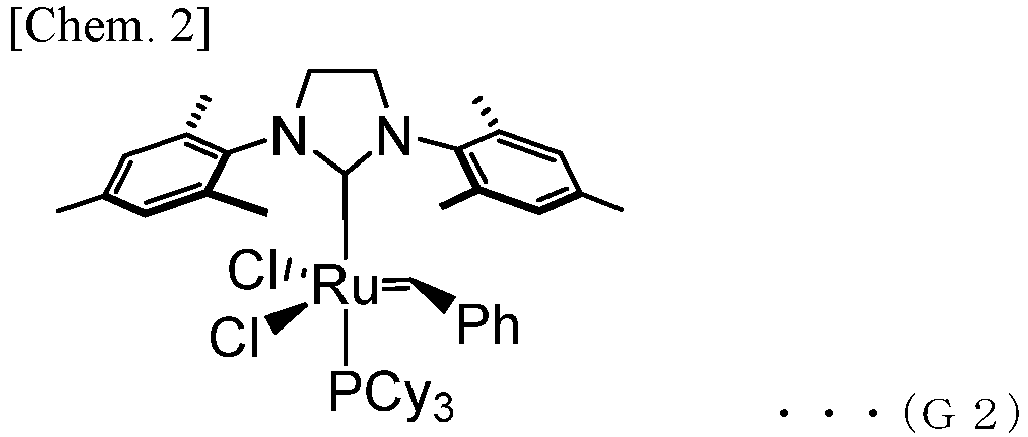
- It is known that this NHC-Ru complex catalyst has a high coordination ability to ruthenium due to the strong σ donor property and weak π acceptor property of NHC, and is stable in the complex state in air and water.
- In particular, there are known that a ruthenium-carbene complex having a benzylidene carbene ligand and two tricyclohexylphosphine ligands, an NHC-Ru complex catalyst having 1,3-dimesitylimidazolidin-2-ylidene as a ligand, and an NHC-Ru complex catalyst having a 1,3-dimesitylimidazolin-2-ylidene as a ligand is to be a highly active catalyst for metathesis reactions (for example, see
Patent Documents 1 to 3). - Further, as a catalyst that further improves the NHC-Ru complex catalyst of Formula (G2), Patent Document 4 discloses an organic metal complex catalyst such as a Pd complex catalyst having a 1,3-bis(2,6-isopropylphenyl)-2-imidazolidinylidene or a silyl-introduced 1,3-bis(2,6-isopropylphenyl)-2-imidazolidinylidene as a ligand and palladium as a coordination center (hereinafter referred to as "NHC-Pd complex catalyst" as necessary) as a catalyst used in the cross-coupling reactions.
- Note that, the applicant of the patent application presents the following publications as publications in which the inventions known in the above-mentioned documents are described.
-
- Non-Patent Document 1: Cesar A. Urbina-Blanco et al., J. Am. Chem. Soc. 2013, 135, 7073 - 7079.
- Non-Patent Document 2: P. Schwab et al. : Angew. Chem., Int. Ed., 34, 2039 (1995).
- Non-Patent Document 3: Jafarpour, L., Stevens, E. D., Nolan, S. P. J. Organomet. Chem. 2000, 606, 49-54.
- Non-Patent Document 4: M. Scholl, et al. : Org. Lett., 1, 953 (1999).
-
- Patent Document 1:
JP Hei 11-262667A - Patent Document 2:
JP 2003-500412A - Patent Document 3:
JP 2002-524250A - Patent Document 4:
WO 2018-105672 - However, from the viewpoint of obtaining a high yield of the target product in the olefin metathesis reaction, the present inventors have found that even the catalysts of the above-mentioned prior art still have room for improvement.
- The present invention was made in view of such technical circumstances, and an object of the present invention is to provide an organic metal complex catalyst that can obtain a higher yield of a target product than conventional catalysts in the olefin metathesis reaction.
- As a result of intensive studies for solving the above-mentioned problem, the present inventors have found the construction of an organic metal complex catalyst having a structure represented by the following Formula (1) where a substituent "-SiR1R2R3" (hereinafter referred to as a "silyl group" as necessary) containing a bonded silicon atom is bonded to the carbon atom at the 4th or 5th position (hereinafter referred to as "backbone carbon" as necessary) in the structure of NHC of the imidazole ring.
- More specifically, the present invention consists of the following technical matters.
- That is, the present invention provides an organic metal complex catalyst, which is used in the olefin metathesis reaction and comprises a chemical structure represented by the following Formula (1).


- Here, in the Formula (1), M is a coordination center and represents an Ru atom or an ion thereof.
- Further, R1, R2 and R3 may be the same or different, and each represents at least one substituent selected from the group consisting of hydrogen atom, an alkyl group, an alkoxy group, an alkenyl group, an alkynyl group, and an aryl group.
- Furthermore, R4, R5, R6, and R7 may be the same or different, and each represents at least one substituent selected from the group consisting of hydrogen atom, a halogen atom, an alkyl group, an alkoxy group, an alkenyl group, an alkynyl group, an aryl group, hydroxy group, a hydroxylate group, thiocarboxy group, dithiocarboxy group, sulfo group, sulfino group, oxycarbonyl group, carbamoyl group, hydradinocarbonyl group, amidino group, cyano group, isocyano group, cyanato group, isocyanato group, thiocyanato group, isothiocyanato group, formyl group, oxo group, thioformyl group, thioxo group, mercapto group, amino group, imino group, hydrazino group, allyloxy group, sulfide group, nitro group, and silyl group.
- Further, in the Formula (1), X represents a halogen atom which is capable of coordinating to the coordination center M.
- L represents a phosphorus ligand which is capable of coordinating to the coordination center M, and.
- Furthermore, R8 represents an alkyl group, an alkoxy group, an alkenyl group, an alkynyl group, or an aryl group having 3 to 20 carbon atoms.
- The organic metal complex catalyst of the present invention having the above-mentioned structure can obtain the target product in a higher yield than the conventional catalysts (Grubbs catalyst, and the like) exemplified in the prior art documents mentioned above in the olefin metathesis reaction. Moreover, the organic metal complex catalyst of the present invention can relatively shorten the reaction time.
- Although the detailed mechanism as to why the organic metal complex catalyst of the present invention can obtain the target product in a high yield has not been found, the present inventors speculate as follows.
- That is, the present inventors think that the fact that the organic metal complex catalyst of the present invention has the structure in which the above-mentioned silyl group (-SiR1R2R3) is bonded to the backbone carbon at the 4th or 5th position in the NHC structure contributes to improving the yield of the target product, but in contrast to the fact that the conventional catalyst is a ligand having a structure in which a hydrogen atom is bonded to the backbone carbon at the 4th or 5th position in the NHC structure of the imidazole ring {for example, a ligand having the NHC structure shown in Formula (P1) {(1,3-bis(2,6-diisopropylphenyl)imidazol-2-ylidene), hereinafter referred to as "IPr ligand"}.

- Further, with respect to the ligand (the following Formula (2)) in which a silyl group is bonded to the backbone carbon at the 4th or 5th position in the NHC structure of the imidazole ring, the present inventors investigates the electron donating property to the central metal by measuring the TEP value (Tolman electronic paramater) [cm-1] obtained from infrared spectroscopy.
- Further, the present inventors also measured the TEP value with respect to the ligand (the following Formula (2-1)) having the structure in which hydrogen is bonded to the backbone carbon at the 4th or 5th position in the NHC structure of the imidazole ring.
- Then, comparing the organic metal complex catalysts having the above two types of ligands, it was found that the organic metal complex catalyst having the ligand with higher electron donating ability to the central metal was also effective than the IPr ligand (Formula (P1)).
- That is, in the organic metal complex catalyst for the olefin metathesis reaction of the present invention, it is preferable that R1, R2, R3, R4, R5, R6 and R7 in the Formula (1) are arranged in combination, with respect to electron donating property of a ligand having a nitrogen-containing heterocyclic carbene structure represented by the following Formula (2) including these substituents to the coordination center M so that a TEP value (Tolman electronic paramater) [cm-1] obtained from infrared spectroscopy is shifted to a lower wavenumber side in comparison with a TEP value [cm-1] of a ligand represented by the following Formula (2-1).


- Here, in the Formula (2), R1, R2, R3, R4, R5, R6 and R7 represent the same substituents as R1, R2, R3, R4, R5, R6 and R7 in the Formula (1).
- Further, in the Formula (2-1), R4, R5, R6 and R7 represent the same substituents as R4, R5, R6 and R7 in the Formula (1).
- Furthermore, with respect to the Rh carbonyl complex in which the moiety represented by -MR8X of the organic metal complex of the present invention was replaced with -Rh(CO)2Cl, the present inventors measured the TEP value obtained by using the infrared absorption spectrum.
- As a result, the present inventors found that among the ligands represented by Formula (2), the TEP value shifts to the lower wavenumber side than the IPr ligand (Formula (P1)), that is, the organic metal complex catalyst having the ligand with a higher electron donating property than the IPr ligand (Formula (P1)) gave a higher yield of the target product than the first generation Grubbs catalyst represented by the Formula (G1) (Comparative Example 2 described later), or the second generation Grubbs catalyst represented by the Formula (G2) (Comparative Example 1 described later).
- Then, from these results, the present inventors consider that, when employing the structure that the NHC structure of the imidazole ring has the structure in which the silyl group (-SiR1R2R3) is bonded to the backbone carbon at the 4th or 5th position, and the structure that the TEP value satisfies the conditions as described above, M0 (zero valent), which is a catalytically active species during the catalytic reaction, will be stabilized, and the target product will be obtained in high yield.
- Further, in the organic metal complex catalyst for olefin metathesis reaction of the present invention, it is preferable that the TEP value [cm-1] of the ligand having the nitrogen-containing heterocyclic carbene structure represented by the Formula (2) is a value determined from a stretching vibration frequency [cm-1] of the carbonyl group obtained from the infrared absorption spectrum measured for the Rh carbonyl complex represented by the following Formula (1-1) where the moiety represented by -MR8X in the Formula (1) is substituted with -Rh(CO)2Cl.

- In this case, the TEP value can be determined by the following Equation (E1). [Eq. 1]

- Here, in the Equation (E1), νCO av/Rh represents the arithmetic average value of the stretching vibration frequency [cm-1] of the carbonyl group obtained from the infrared absorption spectrum measured for the Rh carbonyl complex, andνCO av/Ni represents the arithmetic average value [cm-1] of the stretching vibration frequency of the carbonyl group of the Ni carbonyl complex (=TEP value [cm-1]).
- In the present invention, as the method for evaluating the electron donating property of the ligand containing the NHC structure of the organic metal complex catalyst for olefin metathesis reaction to the central metal by using the TEP value calculated according to the above-mentioned Equation (E1), the method described in the Non-Patent Document "T. Droge and F. Glorius, Angew. Chem. Int. Ed., 2010, 49, 6940" is adopted.
- The TEP value (Tolman electronic paramater) is originally the stretching frequency of a carbonyl group obtained from the infrared absorption spectrum of a Ni carbonyl complex with Ni as the coordination center. However, the Ni carbonyl complex is highly toxic, making it difficult for an operator to measure the infrared absorption spectrum. Therefore, by using the stretching frequency of the carbonyl group obtained from the infrared absorption spectrum of the Rh carbonyl complex and the Equation (E1), it is possible for the operator to carry out the measurement work of the infrared absorption spectrum in an environment with improved safety.
- Furthermore, from the viewpoint of more reliably obtaining the effects of the present invention, it is preferable that the organic metal complex catalyst for olefin metathesis reaction of the present invention has a structure represented by the following Formula (3).

- Here, in the Formula (3), Me represents methyl group, Ph represents phenyl group, and PCys represents tricyclohexylphosphine.
- Further, from the viewpoint of more reliably obtaining the effects of the present invention, it is preferable that the organic metal complex catalyst of the present invention is used in a ring-closing metathesis reaction of a chain diolefin compound.
- Furthermore, from the viewpoint of more reliably obtaining the effects of the present invention, it is preferable that the organic metal complex catalyst of the present invention is used in a ring-opening metathesis polymerization reaction of a cyclic olefin compound. The second generation Grubbs catalyst represented by the Formula (G2) is commercially available and is used in the ring-opening metathesis polymerization reactions of a cyclic olefin compound. The organic metal complex catalyst of the present invention has a structure in which a silyl group (-SiR1R2R3) is further bonded to the backbone carbon at the 4th or 5th position of the IPr ligand, compared to the second generation Grubbs catalyst represented by the Formula (G2), and it is possible to similarly apply to the olefin metathesis reaction to which the second generation Grubbs catalyst is applied.
- According to the present invention, the organic metal complex capable of obtaining a higher yield of a target product than conventional catalysts in the olefin metathesis reactions is provided.
-
-
FIG. 1 is a graph showing a 1H NMR spectrum obtained for the organic metal complex catalyst for the olefin metathesis reactions of Example 1. -
FIG. 2 is a graph showing a 29Si NMR spectrum obtained for the organic metal complex catalyst for the olefin metathesis reactions of Example 1. -
FIG. 3 is a graph showing a 131P NMR spectrum obtained for the organic metal complex catalyst for the olefin metathesis reactions of Example 1. - Hereinafter, preferred embodiments of the present invention will be described in detail.
- The organic metal complex catalyst for olefin metathesis reaction of the present embodiment is an organic metal complex catalyst used in the olefin metathesis reaction, preferably in the ring-closing metathesis reaction of the linear diolefin compounds and the ring-opening metathesis polymerization of the cyclic olefin compounds, and has the structure represented by the following Formula (1).
- Further, the ligand of the organic metal complex catalyst for olefin metathesis reaction of the present embodiment has the structure of the nitrogen-containing heterocyclic carbene represented by the following Formula (2).

- Here, in Formula (1), M is a coordination center and represents an Ru atom or an ion thereof.
- Further, R1, R2 and R3 may be the same or different, and each represents at least one substituent selected from the group consisting of hydrogen atom, an alkyl group, an alkoxy group, an alkenyl group, an alkynyl group, and an aryl group.
- Furthermore, R4, R5, R6, and R7 may be the same or different, and each represents at least one substituent selected from the group consisting of hydrogen atom, a halogen atom, an alkyl group, an alkoxy group, an alkenyl group, an alkynyl group, an aryl group, hydroxy group, a hydroxylate group, thiocarboxy group, dithiocarboxy group, sulfo group, sulfino group, oxycarbonyl group, carbamoyl group, hydradinocarbonyl group, amidino group, cyano group, isocyano group, cyanato group, isocyanato group, thiocyanato group, isothiocyanato group, formyl group, oxo group, thioformyl group, thioxo group, mercapto group, amino group, imino group, hydrazino group, allyloxy group, sulfide group, nitro group, and silyl group.
- Further, in the Formula (1), X represents a halogen atom which is capable of coordinating to the coordination center M.
- L represents a phosphorus ligand which is capable of coordinating to the coordination center M.
- Furthermore, R8 represents an alkyl group, an alkoxy group, an alkenyl group, an alkynyl group, or an aryl group having 3 to 20 carbon atoms.
- Further, R1, R2, R3, R4, R5, R6 and R7 in the Formula (1) are arranged in combination, with respect to electron donating property of a ligand having a nitrogen-containing heterocyclic carbene structure represented by the following Formula (2) including these substituents to the coordination center M so that a TEP value (Tolman electronic paramater) [cm-1] obtained from infrared spectroscopy is shifted to a lower wavenumber side in comparison with a TEP value [cm-1] of a ligand represented by the following Formula (2-1).


- Here, in the Formula (2), R1, R2, R3, R4, R5, R6 and R7 represent the same substituents as R1, R2, R3, R4, R5, R6 and R7 in the Formula (1).
- Further, in the Formula (2-1), R4, R5, R6 and R7 represent the same substituents as R4, R5, R6 and R7 in the Formula (1).
- According to the organic metal complex catalyst for olefin metathesis reaction of the present embodiment, which includes the ligand of the present embodiment having the above-mentioned configuration as the constituent material, it is possible to obtain a higher yield of the target product than the conventional Grubbs catalysts exemplified in
Non-Patent Documents 1 to 4 mentioned above in the olefin metathesis reaction. - Although the detailed mechanism why the organic metal complex catalyst for olefin metathesis reaction of the present embodiment can obtain a high yield of the target product has not been solved, the present inventors think as follows.
- That is, the present inventors think that, in contrast to that the conventional catalyst has the structure in which a hydrogen atom is bonded to the backbone carbon at the 4th or 5th position in the NHC structure of the imidazole ring (the structure of the IPr ligand (Formula (P1))), the organic metal complex catalyst of the present invention has the structure in which the above-mentioned silyl group (-SiR1R2R3) is bonded to the backbone carbon at the 4th or 5th position in the NHC structure, which contributes to improving the yield of the target product. Furthermore, the present inventors think that the catalyst of the present embodiment has the structure that satisfies the above-mentioned TEP value condition, which further contributes to improving the yield of the target product.
- With respect to the Rh carbonyl complex in which the moiety represented by -MR8X of the organic metal complex of the present embodiment was replaced with -Rh(CO)2Cl, the present inventors measured the TEP value obtained by using the infrared absorption spectrum.
- As a result, the present inventors found that among the ligands represented by Formula (2), the TEP value shifts to the lower wavenumber side than the IPr ligand (Formula (P1)), that is, the organic metal complex catalyst having the ligand having the NHC structure with a higher electron donating property than the IPr ligand (Formula (P 1)) gave a higher yield of the target product than the conventional Grubbs catalysts represented by the Formulae (G1) and (G2).
- Then, from these results, the present inventors consider that, when employing the structure that the NHC structure of the imidazole ring has the structure in which the silyl group (-SiR1R2R3) is bonded to the backbone carbon at the 4th or 5th position, and the structure that the TEP value satisfies the conditions as described above, M0 (zero valent), which is a catalytically active species during the catalytic reaction, will be stabilized, and the target product will be obtained in high yield (for example, see Example 1 later).
- Further, in the organic metal complex catalyst of the present embodiment, it is preferable that the TEP value [cm-1] of the ligand having the nitrogen-containing heterocyclic carbene structure represented by the Formula (2) is a value determined from a stretching vibration frequency [cm-1] of the carbonyl group obtained from the infrared absorption spectrum measured for the Rh carbonyl complex represented by the following Formula (1-1) where the moiety represented by -MR8X in the Formula (1) is substituted with -Rh(CO)2Cl.

- In this case, the TEP value can be determined by the following Equation (E1). [Eq. 2]

- Here, in the Equation (E1), νCO av/Rh represents the arithmetic average value of the stretching vibration frequency [cm-1] of the carbonyl group obtained from the infrared absorption spectrum measured for the Rh carbonyl complex, andνCO av/Ni represents the arithmetic average value [cm-1] of the stretching vibration frequency of the carbonyl group of the Ni carbonyl complex (=TEP value [cm-1]).
- In the present invention, as the method for evaluating the electron donating property of the ligand containing the NHC structure of the organic metal complex catalyst to the central metal by using the TEP value calculated according to the above-mentioned Equation (E1), the method described in the Non-Patent Document "T. Droge and F. Glorius, Angew. Chem. Int. Ed., 2010, 49, 6940" is adopted.
- The TEP value (Tolman electronic paramater) is originally the stretching frequency of a carbonyl group obtained from the infrared absorption spectrum of a Ni carbonyl complex with Ni as the coordination center. However, the Ni carbonyl complex is highly toxic, making it difficult for an operator to measure the infrared absorption spectrum. Therefore, by using the stretching frequency of the carbonyl group obtained from the infrared absorption spectrum of the Rh carbonyl complex and the Equation (E1), it is possible for the operator to carry out the measurement work of the infrared absorption spectrum in an environment with improved safety.
- Here, the coordination center M is a Ru atom or an ion thereof.
- It is preferable that at least one of R1, R2 and R3 is an alkyl group or an alkoxy group from the viewpoint of more reliably obtaining the effects of the present invention.
More preferably, it is an alkyl group or an alkoxy group having 1 to 3 carbon atoms. - It is preferable that at least one of R4, R5, R6, and R7 is an alkyl group having 1 to 3 carbon atoms from the viewpoint of more reliably obtaining the effects of the present invention.
- It is preferable that X is Cl among halogen atoms from the viewpoint of more reliably obtaining the effects of the present invention and the ease of obtaining raw materials.
- It is preferable that R8 is a substituent having 3 to 10 carbon atoms that has a π bond that can coordinate to the coordination center M from the viewpoint of more reliably obtaining the effects of the present invention, and more preferably a substituent having 3 to 9 carbon atoms that has a π bond that can coordinate to the preferable coordination center Pd.
- Furthermore, from the viewpoint of more reliably obtaining the effects of the present invention, it is preferable that the organic metal complex catalyst for olefin metathesis reaction of the present invention has a structure represented by the following Formula (3).

- Here, in the Formula (3), Me represents methyl group, Ph represents phenyl group, and PCys represents tricyclohexylphosphine.
- According to the present embodiment, it is possible to provide the organic metal complex catalyst that can obtain a higher yield of the target product than conventional catalysts in the olefin metathesis reaction.
- Further, from the viewpoint of more reliably obtaining the effects of the present invention, it is preferable that the organic metal complex catalyst of the present invention is used in a ring-closing metathesis reaction of a chain diolefin compound. In the examples described below, it will be shown that the organic metal complex catalyst of the present invention has excellent catalytic performance for the ring-closing metathesis reaction of a chain diolefin compound.
- Furthermore, from the viewpoint of more reliably obtaining the effects of the present invention, it is preferable that the organic metal complex catalyst of the present invention is used in a ring-opening metathesis polymerization reaction of a cyclic olefin compound. The second generation Grubbs catalyst represented by the Formula (G2) is commercially available and is used in the ring-opening metathesis polymerization reactions of a cyclic olefin compound. The organic metal complex catalyst of the present invention has a structure in which a silyl group (-SiR1R2R3) is further bonded to the backbone carbon at the 4th or 5th position of the IPr ligand, compared to the second generation Grubbs catalyst represented by the Formula (G2), and it is easily possible to similarly apply to the olefin metathesis reaction to which the second generation Grubbs catalyst is applied.
- The organic metal complex catalyst for olefin metathesis reaction of the present embodiment can be produced by, not particularly limited, combining and optimizing known methods for synthesizing ligands and methods for synthesizing complex catalysts.
- The method for producing the organic metal complex catalyst for olefin metathesis reaction of the present embodiment includes:
- a first step of synthesizing the ligand having the NHC structure represented by the Formula (2),
- a second step of synthesizing a complex including the coordination center M, halogen atom X and the substituent R8 in the Formula (1), and
- a third step of synthesizing the organic metal complex catalyst for olefin metathesis reaction of the present embodiment by reacting the ligand having the NHC structure obtained in the first step and the complex obtained in the second step.
- As the complex including the coordination center M, halogen atom X and the substituent R8 in the Formula (1) used in the second step, the first generation Grubbs catalyst represented by the above Formula (G1), typically represented by benzylidene bis(tricyclohexylphosphine) dichlororuthenium represented by can be used.
- Furthermore, the method for producing an organic metal complex catalyst for olefin metathesis reaction of the present embodiment further includes a fourth step of purifying the organic metal complex catalyst for olefin metathesis reaction of the present embodiment obtained after the third step. A known purification method can be adopted as the purification method in the fourth step. For example, a recrystallization method by using a predetermined solvent may be employed.
- According to the method for producing the organic metal complex catalyst for olefin metathesis reaction of the present embodiment, it is possible to reliably produce the organic metal complex catalyst with the ligand for olefin metathesis reaction and the organic metal complex catalyst that can obtain a higher yield of the target product than the conventional catalysts in the olefin metathesis reaction.
- According to the production method of the present embodiment, it is possible to more easily and more reliably produce the organic metal complex catalyst with the ligand of the present embodiment for olefin metathesis reaction and the organic metal complex catalyst that can obtain a higher yield of the target product than the conventional catalysts in the olefin metathesis reaction.
- According to the production method of the present embodiment, it is possible to easily produce the ligand of the present invention which has the structure in which the hydrogen bonded to the backbone carbon at the 4th or 5th position constituting the five-membered ring of the ligand having the NHC structure such as IPr is replaced with the silyl group, and has the structure that the TEP value satisfies the conditions as described above.
- Conventionally, although the synthesis of a ligand having the NHC structure in which hydrogen on the backbone carbon is substituted with another substituent requires multiple synthesis steps, according to the production method of the present invention, it is possible to synthesize the ligand in which the silyl group is bonded to the backbone carbon at the 4th or 5th position through relatively few synthesis steps under relatively mild condition from the ligand in which the hydrogen is bonded to the backbone carbon at the 4th or 5th position such as IPr as the base. Moreover, in the production method of the present invention, various types of silyl groups can be introduced into the hydrogen moiety bonded to the backbone carbon at the 4th or 5th position by changing the silicon reagent used as the raw material.
- For example, according to the production method of the present embodiment, as exemplified in the Formulas (C1) and (C2) below, it is possible to reduce the necessary synthesis steps from the IPr to the final product (the organic Ru complex catalyst having the ligand in which the hydrogen bonded to the backbone carbon of the ligand with the NHC structure is replaced with the silyl group) to relatively few three steps.


- Here, in the Formula (C1) and Formula (C2), "BuLi represents CH3CH2CH2CH2Li, THF represents tetrahydrofuran, Me represents methyl group, Ph represents phenyl group, and PCys represents tricyclohexylphosphine.
- The synthesis method shown in the Formula (C1) is described, for example, in the Non-Patent Document: "Wang, Y et al., J. Am. Chem. Soc., 2010, 132, 14370".
An example is described in ". - The synthesis method of the Formula (C2) is a simple synthesis method discovered by the present inventors. For example, commercially available first generation Grubbs catalysts can be used.
- In the following, the present invention will be explained in more detail with reference to Examples, but the present invention is not limited to the following Examples.
- The following apparatus was used for analysis when synthesizing the organic metal complex catalysts of Example 1, Comparative Example 1, and Comparative Example 2 described below.
- 1H NMR, 31P NMR, 29Si NMR spectrum, and 13C NMR were measured by using Bruker Biospin Avance 400 (400 MHz) available from Bruker. Dehydrated deuterated solvents were used in all measurements of the ligands. This is to prevent decomposition of the ligand.
- An organic metal complex catalyst {trade name "MTMS-RUA", available from N.E.CHEMCAT (hereinafter referred to as "TMSIPrRu" as necessary)} was prepared. This TMSIPrRu is the organic metal complex catalyst represented by the Formula (3).
- The organic metal complex catalyst {TMSIPrRu} of Example 1 was synthesized by the following procedures.
- 2,6-Diisopropylaniline was used as a starting material, and the ligand "IPr" {1,3-bis(2,6-diisopropylphenyl)imidazol-2-ylidene} having the NHC structure represented by the above-mentioned Formula (P1) was synthesized.
- Specifically, by referring the methods described in the academic papers (Tang, P., Wang, W., Ritter, T. J. Am. Chem. Soc. 2011, 133, 11482, and Pompeo, M., Froese, R. D. J., Hadei, N., Organ, M. G. Angew. Chem. Int. Ed. 2012, 51, 11354), synthesis was carried out through three steps shown by the following Reaction Schemes (R1) to (R3).
- Identification was performed by using 1H NMR, and it was confirmed that the IPr and the intermediate products had been synthesized.

- In the Scheme (R1), MeOH represents methanol and HOAc represents acetic acid.
- The procedure for synthesizing the
intermediate product 1 in the Scheme (R1) is explained. - 6.00 g (33.8 mmol) of 2,6-diisopropylaniline, 30 mL of methanol, and 0.31 mL (3.5 mol%) of acetic acid were added to a 50 mL recovery flask, and the mixture was heated to 50°C. Next, a mixed solution of 2.40g (0.5eq.) of glyoxal 40% aq. and 10 mL of methanol was added dropwise. As adding dropwise, the mixture was changed from a colorless and transparent solution to a yellow and transparent solution. After stirring at 50° C for 15 minutes, the mixture was returned to room temperature and further stirred for 11 hours. Upon cooling to room temperature, a yellow solid precipitated out. After the reaction was completed, filtration was performed by using a membrane filter, and the solid was washed with methanol. When washed, since a small amount of the target
intermediate product 1 was dissolved in methanol, the filtrate was collected, the solvent was removed, and the resulting solid was washed again with a small amount of methanol and filtered. The yellow solids obtained in the first and second rounds were combined and dried. - The yield amount of the intermediate product 1 (yellow powder solid) in the Scheme (R1) was 5.49 g, and the yield was 86.0%.

- In the Scheme (R2), TMSC1 represents chlorotrimethylsilane, and EtOAc represents ethyl acetate.
- The procedure for synthesizing the
intermediate product 2 in the Scheme (R2) is explained. - 3.80 g (10.08 mmol) of (1E,2E)-1,2-bis(2,6-diisopropylphenylimino)ethane, 0.32 g (10.66 mmol) of paraformaldehyde, and 83 mL of ethyl acetate were added to a 500 mL recovery flask and the mixture was heated to 70°C. The mixed solution was in the state of a yellow slurry solution. Next, a mixed solution of 0.34 mL (10.66 mmol) of chlorotrimethylsilane and 8 mL of ethyl acetate was added dropwise over 20 minutes. Thereafter, the mixture was stirred at 70°C for 2 hours. The color of the solvent was changed from yellow to orange. After the reaction was completed, by immersing in an ice water and cooled to 0°C. After cooling, filtration was performed by a membrane filter, and the solid was washed with ethyl acetate. After vacuum drying, a pale pink powder solid was obtained.
- The yield amount of the intermediate product 2 (white powder solid) in the Scheme (R2) was 3.96 g, and the yield was 92.5%.

- In the Scheme (R3), tBuOK represents (CH3)3COK, and THF represents tetrahydrofuran.
- The procedure for synthesizing product 3 "IPr" in the Scheme (R3) is explained.
- Under an inert gas atmosphere, 0.43 g (1.01 mmol) of 1,3-bis(2,6-diisopropylphenyl)imidazolium chloride, 0.14 g (1.21 mmol) of tBuOK and 5 mL of dehydrated THF were added to 25 mL Schlenk and the mixture was stirred at room temperature for 3.5 hours. The white solution turned into a brown solution. After the completion of the reaction, the solvent was removed, 5 mL of dehydrated toluene was added, and the solid was dissolved by heating and stirring at 50°C. Thereafter, 5 mL of dehydrated hexane was added. In order to remove a salt (KCl) in the solution, celite filtration was performed in a glove box. A brown transparent solution was obtained. The solvent was removed and dried under vacuum to obtain a brown powder solid.
- The yield amount of the product 3 "IPr" (brown powder solid) in the Scheme (R3) was 0.30 g, and the yield was 78.0%.
- Identification was performed by using 1H NMR, and it was confirmed that the IPr and the intermediate products (the
intermediate product 1 in the Scheme (R1) and theintermediate product 2 in the Scheme (R2)) had been synthesized. - With respect to each of the ligands having the NHC structure represented by the Reaction Schemes (R1) to (R3), the 1H NMR spectra were measured and confirmed. In the 1H NMR spectrum measurement of the
intermediate product 1 in the Scheme (R1), CDCl3 was used as a deuterated solvent. In the 1H NMR spectrum measurement of theintermediate product 2 in the Scheme (R2), CD3CN was used as a deuterated solvent. In the 1H NMR spectrum measurement of the IPr represented by the product 3 in the Scheme (R3), C6D6 was used as a deuterated solvent. - The measurement results of the
intermediate product 1 are shown below. - 1H NMR (CDCl3, 400 MHz): δ8.10 (s, 2H), 7.20-7.13 (m, 6H), 2.94 (m, 4H), 1.21 (d, 24H, J = 6.8 Hz)
- The measurement results of the
intermediate product 2 are shown below. - 1H NMR (CD3CN, 400 MHz): δ9.35 (s, 1H), 7.87 (s, 2H), 7.65 (t, 2H, J = 7.5 Hz), 7.47 (d, 4H, J = 7.7 Hz), 2.41 (m, 4H), 1.26 (d, 12H, J = 6.8 Hz), 1.20 (d, 12H, J = 6.8 Hz)
- The measurement results of the product 3 "IPr" are shown below.
- 1H NMR (C6D6, 400 MHz): δ7.31-7.27 (m, 2H), 7.19-7.17 (m, 4H), 6.61 (s, 2H), 2.96 (m, 4H), 1.29 (d, 12H, J = 6.8 Hz), 1.18 (d, 12H, J = 7.0 Hz)
- By using the ligand IPr obtained in the above-mentioned [First Step-1], the ligand having the NHC structure (ligand represented by the following Formula (3-1)) used in the organic metal complex of Example 1 represented by the Formula (3) was synthesized.

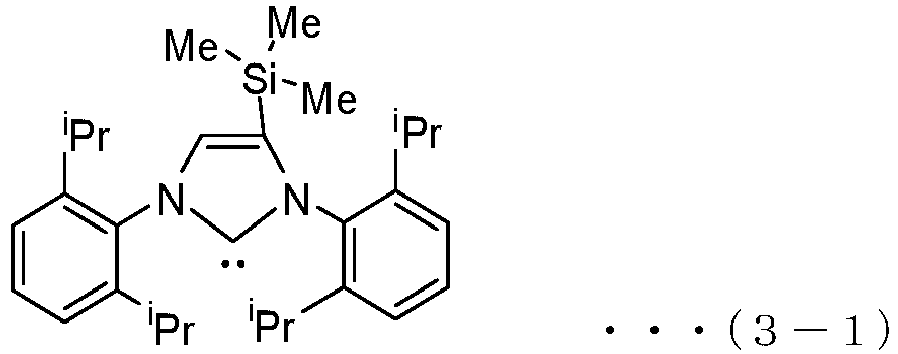
- Specifically, the method described in the academic paper (Wang, Y., Xie, Yaming., Abraham, M. Y., Wei, P., Schaefer III, H. F., Schleyer, P. R., Robinson, G. H. J. Am. Chem. Soc. 2010, 132, 14370) was modified, and through two steps represented by the following Reaction Scheme (R4), the ligand represented by the Formula (3-1) in which a trimethylsilyl group (-SiMe3, hereinafter referred to as "TMS group" as necessary) is bonded to the 4th carbon of the NHC structure of the IPr (reactant 3) (hereinafter referred to as "TMSIPr" as necessary) was synthesized.

- In the Scheme (R4), nBuLi represents CH3CH2CH2CH2Li, and THF represents tetrahydrofuran.
- The procedure for synthesizing the intermediate product 4 (Li-IPr) in the Scheme (R4) is explained.
- At first, 10.79 g (27.62 mmol) of the IPr (reactant 3) and 100 mL of dehydrated hexane were added to a 300 mL recovery flask in a glove box, and the mixture was stirred at room temperature for 30 minutes. Next, nBuLi was slowly added dropwise to the obtained suspension, and the mixture was stirred and reacted overnight at room temperature. The solution changed from a light brown slurry to a yellow slurry. After the reaction was completed, filtration was performed by a membrane filter, and the solid was washed with dehydrated hexane. The obtained yellow powder solid {intermediate product 4 (lithiated product: Li-IPr) in the Scheme (R4)} was dried.
- The yield amount of the intermediate product 4 (yellow powder solid) in the Scheme (R4) was 10.0 g, and the yield was 92.0%.
- Next, the synthesis procedure of the product 5 (TMSIPr) in the Scheme (R4) is explained.
- At first, 0.78 g (1.98 mmol) of the intermediate product 4 (Li-IPr) and 25 mL of dehydrated THF were added to a 50 mL Schlenk in a glove box and dissolved. Next, 0.26 mL (2.04 mmol) of chlorotrimethylsilane (ClSiMe3, hereinafter referred to as "ClTMS" as necessary) was slowly added dropwise, and the mixture was allowed to react for 25 minutes, and after the reaction was completed, the solvent was removed.
- In the glove box, 10 mL of dehydrated toluene was added to the solid product to dissolve, and the resulting liquid was transferred to a centrifuge tube. The liquid in the centrifuge tube was centrifuged at 4000 rpm for 6 minutes at room temperature to separate the salt (LiCl). Next, the obtained filtrate was passed through a filter (available from Advantec, 0.2 µm) and separated into a 50 mL Schlenk. The solvent was then removed to obtain a yellow powder solid (TMSIPr, that is the target ligand 5).
- The yield amount of the product 5 "TMSIPr" (yellow powder solid) in the Scheme (R4) was 0.901 g, and the yield was 98.9%.
- Identification was performed by using 1H NMR, and it was confirmed that the lithiation of the hydrogen atom bonded to the 4th carbon in the NHC structure of the IPr (reactant 3) progressed, and TMSIPr (target ligand 5) was synthesized.
- The measurement results for the product 5 "TMSIPr" (target ligand 5) are shown below.
- 1H NMR (C6D6, 400 MHz): δ=7.33-7.27 (m, 2H), 7.21-7.17 (m, 4H), 6.89 (s, 2H), 3.04 (m, 2H), 2.84 (m, 2H), 1.40 (d, 6H, J = 6.8 Hz), 1.28 (d, 12H, J =6.8 Hz, 6.9 Hz), 1.18 (d, 6H, J = 6.9 Hz), 0.05 ppm (s, 9H).
- From the results of the 1H NMR, it was confirmed that due to the TMS group bonding to the 4th carbon in the NHC structure of the IPr (reactant 3), the proton peak derived from -CH of the iPr group became asymmetrical and was split into two.
- Consumption of the mraw materials was also confirmed, and a peak derived from the methyl group of the TMS group was observed around 0 ppm. It was confirmed that TMSIPr (target ligand 5) was synthesized since the chemical shift and integral value matched with the literatures. Furthermore, it was confirmed that the lithiation of the IPr (reactant 3) by nBuLi was sufficiently progressing.
- A commercially available the first generation Grubbs catalyst (trade name: Grubbs Catalyst M102, available from Aldrich) represented by the above-mentioned Formula (G1) was prepared.
- The NHC structure obtained in the first step was The organic metal complex catalyst "TMSIPrRu" of Example 1 was synthesized by carrying out the reaction represented by the following Reaction Scheme (R5) by using the ligand (TMSIPr) and the first generation Grubbs catalyst prepared in the second step.
- In this third step, the reaction conditions were independently investigated by the present inventors.

- The ligand (TMSIPr) (40.0 mg, 0.0868 mmol) was placed in a 20 mL recovery flask in a glove box, and dehydrated toluene (5 mL) was added. To the solution, the first generation Grubbs catalyst: bis(tricyclohexylphosphine)benzylideneruthenium(IV) dichloride (G1) (59.5 mg, 0.0723 mmol) was added, and the mixture was stirred for 3 hours while heating to 60°C.
- After the reaction was completed, toluene was distilled off and the product was vacuum dried for 30 minutes. The obtained solid was dissolved in dehydrated hexane, poured into a 13.5 mL vial, and recrystallized at -40°C. After the recrystallization, filtration was performed by using a membrane filter to obtain the target substance, reddish-purple solid TMSIPrRu (6.2 mg, yield 99%).
- The identification of the TMSIPrRu was confirmed by 1H NMR, 31P NMR, and 29Si NMR. C6D6 was used as a deuterated solvent in these three types of NMR measurements.
-
FIG. 1 shows a 1H NMR spectrum obtained for the organic metal complex catalyst {TMSIPrRu} of Example 1.FIG. 2 shows the 31P NMR spectrum obtained for the organic metal complex catalyst {TMSIPrRu} of Example 1.FIG. 3 shows the 29Si NMR spectrum obtained for the organic metal complex catalyst {TMSIPrRu} of Example 1. - 1H NMR (400MHz, C6D6): See
FIG. 1 . - 31P NMR (162.1 MHz, C6D6): δ(ppm) = 28.1
- 29Si NMR (119.2 MHz, C6D6): δ(ppm) = -8. 13
- From the results shown in
FIG. 1 ,FIG. 2 , andFIG. 3 , it was determined that the target TMSIPrRu could be synthesized. - Note that, in
FIG. 2 , the presence of a small amount of the first generation Grubbs catalyst represented by the Formula (G1) and the second generation Grubbs catalyst represented by the Formula (G2) was confirmed as impurities. It is thought that the first generation Grubbs catalyst remained in the reaction system as an unreacted product. Furthermore, it is thought that the second generation Grubbs catalyst is one in which the silyl group of TMSIPr is removed during the reaction. Since 31P NMR has high sensitivity, it is thought that these impurities were observed. - The second generation Grubbs catalyst represented by the Formula (G2) was synthesized by the method described in Non-Patent Document 3.
- The commercially available first generation Grubbs catalyst represented by the Formula (G1) (available from Aldrich, trade name: "Grubbs Catalyst M102") was prepared.
- The organic metal complex catalyst (trade name "NTMS-RHA", available from N.E. CHEMCAT) was prepared. The Example 1-Rh is a catalyst having a structure in which the -Ru(CH2Ph)PCy3Cl2 moiety of the organic metal complex catalyst of the above-mentioned Example 1 was replaced with -Rh(CO)2Cl.
- At first, the same synthesis procedure and analysis as in Example 1 were performed to synthesize a ligand having the NHC structure represented by the above-mentioned Formula (3-1).
- Next, a commercially available [Rh(CO)2Cl]2 available from Aldrich was prepared as a π allyl Rh complex serving as an Rh source.
- Next, the reaction represented by the following Reaction Scheme (R6) was carried out by using the ligand having the NHC structure represented by the Formula (3-1) obtained in the first step and the π allyl Rh complex prepared in the second step to synthesize the organic metal complex catalyst of Example 1-Rh.

- The identification of the product of the Scheme (R11), that is, the organic metal complex catalyst of Example 1-Rh (trade name "NTMS-RHA", available from N.E. CHEMCAT) was confirmed by using 1H NMR, 13C NMR, 29Si NMR, MALDI-TOF-MS, and elemental analysis.
- The organic metal complex catalyst in which the -Ru(CH2Ph)PCy3Cl2 moiety of the second generation Grubbs catalyst represented by the above-mentioned Formula (G2) was replaced with -Rh(CO)2Cl (hereinafter referred to as "IPrRh" as necessary) was prepared.
- At first, the same synthesis procedure and analysis as in the first step-1 of Example 1 were performed to synthesize the ligand IPr having the NHC structure represented by the above-mentioned Formula (P1).
- Next, the commercially available [Rh(CO)2Cl]2 available from Aldrich was prepared as a π allyl Rh complex serving as a Rh source.
- Next, the reaction represented by the following Reaction Scheme (R7) was carried out by using the ligand IPr having the NHC structure represented by the Formula (P1) obtained in the first step and the π allyl Rh complex prepared in the second step to synthesize the organic metal complex catalyst IPrRh of Comparative Example 2-Rh.

- After the third step, recrystallization treatment was performed by using hexane or the like for the solid containing the product IPrRh of the Scheme (R7) to purify.
- The identification of the product of the Scheme (R7), that is, the organic metal complex catalyst IPrRh of Comparative Example 1-Rh was confirmed by using 1H NMR, 13C NMR, 29Si NMR, MALDI-TOF-MS, and elemental analysis.
- Infrared absorption spectra were measured for the organic metal complex catalysts of Example 1-Rh and Comparative Example 1-Rh. Then, by using the arithmetic average value of the stretching vibration frequency [cm-1] of the carbonyl group obtained from each infrared absorption spectrum, the TEP value [cm-1] of the organic metal complex catalyst in which the coordination center was changed from Rh to Ni was determined according to the following Equation (E1) described above.
-

- Table 1 shows the TEP values determined for each organic metal complex catalyst.
[Table 1] Trade name or abbreviation Arithmetic average value of stretching vibration frequency of carbonyl group of Rh complex Stretching vibration frequency of carbonyl group of Ni complex calculated from Equation E 1νCO av/Rh / cm-1 TEP / cm-1 a Ex 1-Rh MTEMS-RHA 2024.9 2040.1 (-3.5) Com. Ex 1-Rh IPrRh 2029.2 2043.6 *a The number in the parentheses indicates the difference between the TEP value of Comparative Example 1-Rh and the TEP value of each organic metal catalyst. - As is clear from the results shown in Table 1, it was confirmed that the TEP value of the organic metal complex catalyst of Example 1-Rh was shifted to the lower wavenumber side than the TEP value of Comparative Example 1-Rh. That is, it was found that the organic metal complex catalyst of Example 1-Rh had the ligand having the NHC structure with higher electron donating property than the IPr ligand (Formula (P1)) of Comparative Example 1-Rh.
- From this fact, it was found that the organic metal complex catalyst of Example 1 in which the coordination center was substituted from Rh to Ru also has the ligand having the NHC structure with higher electron donating property than the IPr ligand (Formula (P1)) of Comparative Example 1.
- By using the organic metal complex catalysts of Example 1, Comparative Example 1 and Comparative Example 2, the olefin metathesis reaction (chain diolefin compound ring-closing metathesis reaction) represented by the Reaction Scheme (R8) was performed.
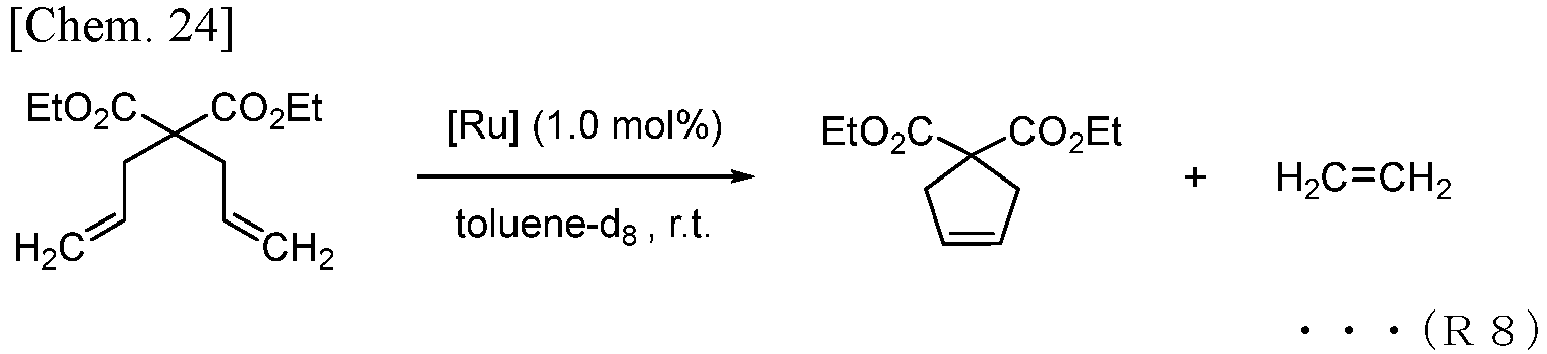
- TMSIPrRu (8.1 mg, 8.06 µmol) of Example 1 was placed in a 4 cc vial, and toluene-ds (0.25 mL) was added to prepare a TMSIPrRu/toluene-d8 solution (16.0 µM).
- In a glove box, diethyl diallymalonate (9.2 mg, 0.080 mmol) and an internal standard substance (1,3,5-trimethylbenzene, 9.6 mg, 0.080 mmol) were placed in a sealable NMR sample tube, and toluene-ds (0.4mL) was added as a solvent.
- Next, the TMSIPrRu/toluene-d8 solution (50 µL, TMSIPrRu: 0.80 µmol, 1.0 mol%) was added to this mixed solution, and the ring-closing metathesis reaction represented by the Reaction Scheme (R8) was performed at room temperature. The yield of the target cyclopentene compound was determined by 1
H NMR measurement 15 minutes after the start of the reaction. The results are shown in Table 2. - With respect to the organic metal complex catalyst of Comparative Example 1 (second generation Grubbs catalyst represented by the Formula (G2)), the ring-closing metathesis reaction represented by the Reaction Scheme (R8) was carried out at room temperature under the same conditions and procedures as in the reaction evaluation test described above. The yield of the target cyclopentene compound was determined by 1
H NMR measurement 15 minutes after the start of the reaction. The results are shown in Table 2. - With respect to the organic metal complex catalyst of Comparative Example 2 (first generation Grubbs catalyst represented by the Formula (G1)), the ring-closing metathesis reaction represented by the Reaction Scheme (R8) was carried out at room temperature under the same conditions and procedures as in the reaction evaluation test described above. The yield of the target cyclopentene compound was determined by 1
H NMR measurement 15 minutes after the start of the reaction. The results are shown in Table 2.[Table 2] Catalyst NMR yield 15 min after the start Ex 1 TMSIPrRu(MTMS-RUA 90% Com. Ex 1IPrRu 49% Com. Ex 2G1 46% - From the results shown in Table 2, compared to the organic metal complex catalysts of Comparative Example 1 and Comparative Example 2, which are conventional Grubbs catalysts, when the organic metal complex catalyst of Example 1, which satisfies the structure of the present invention, is used, it has become clear that the target product can be obtained in a very high yield for the olefin metathesis reactions (ring-closing metathesis reactions of chain diolefin compound).
- The catalyst of the present invention can provide a higher yield of the target product than conventional catalysts in the olefin metathesis reactions. Therefore, the present invention contributes to the development of mass production technology in the fields of medicines, agricultural chemicals, and electronic materials in which the olefin metathesis reactions can be used to synthesize target products (e.g., aromatic amines).
-
- IPr
- 1,3-bis(2,6-diisopropylphenyl)imidazol-2-ylidene
- NHC
- Nitrogen-containing heterocyclic carbene (N-Heterocyclic Carbene)
- TMS
- Trimethylsilyl group
Claims (6)
- An organic metal complex catalyst for olefin metathesis reaction, which is used in the olefin metathesis reaction and comprises a chemical structure represented by the following Formula (1):
 M is a coordination center and represents an Ru atom or an ion thereof,R1, R2 and R3 may be the same or different, and each represents at least one substituent selected from the group consisting of hydrogen atom, an alkyl group, an alkoxy group, an alkenyl group, an alkynyl group, and an aryl group,R4, R5, R6, and R7 may be the same or different, and each represents at least one substituent selected from the group consisting of hydrogen atom, a halogen atom, an alkyl group, an alkoxy group, an alkenyl group, an alkynyl group, an aryl group, hydroxy group, a hydroxylate group, thiocarboxy group, dithiocarboxy group, sulfo group, sulfino group, oxycarbonyl group, carbamoyl group, hydradinocarbonyl group, amidino group, cyano group, isocyano group, cyanato group, isocyanato group, thiocyanato group, isothiocyanato group, formyl group, oxo group, thioformyl group, thioxo group, mercapto group, amino group, imino group, hydrazino group, allyloxy group, sulfide group, nitro group, and silyl group,X represents a halogen atom which is capable of coordinating to the coordination center M,L represents a phosphorus ligand which is capable of coordinating to the coordination center M, andR8 represents an alkyl group, an alkoxy group, an alkenyl group, an alkynyl group, or an aryl group having 3 to 20 carbon atoms.
 - The organic metal complex catalyst for olefin metathesis reactions according to claim 1, wherein R1, R2, R3, R4, R5, R6 and R7 in the Formula (1) are arranged in combination, with respect to electron donating property of a ligand having a nitrogen-containing heterocyclic carbene structure represented by the following Formula (2) including these substituents to the coordination center M so that a TEP value (Tolman electronic paramater) [cm-1] obtained from infrared spectroscopy is shifted to a lower wavenumber side in comparison with a TEP value [cm-1] of a ligand represented by the following Formula (2-1).


- The organic metal complex catalyst for olefin metathesis reaction according to claim 2, wherein the TEP value of the ligand having the nitrogen-containing heterocyclic carbene structure represented by the Formula (2) is a value determined from a stretching vibration frequency of the carbonyl group obtained from the infrared absorption spectrum measured for the Rh carbonyl complex represented by the following Formula (1-1) where the moiety represented by -MR8X in the Formula (1) is substituted with -Rh(CO)2Cl.

- The organic metal complex catalyst for olefin metathesis reaction according to claim 1 or 2, which has a chemical structure represented by the following Formula (3).

- The organic metal complex catalyst for olefin metathesis reaction according to claim 1 or 2, which is used for ring-closing metathesis reactions of chain diolefin compounds.
- The organic metal complex catalyst for olefin metathesis reactions according to claim 1 or 2, which is used for ring-opening metathesis polymerization reactions of cyclic olefin compounds.
Applications Claiming Priority (2)
| Application Number | Priority Date | Filing Date | Title |
|---|---|---|---|
| JP2021154173 | 2021-09-22 | ||
| PCT/JP2022/034764 WO2023048084A1 (en) | 2021-09-22 | 2022-09-16 | Organic metal complex catalyst for olefin metathesis reaction |
Publications (3)
| Publication Number | Publication Date |
|---|---|
| EP4406647A1 true EP4406647A1 (en) | 2024-07-31 |
| EP4406647A4 EP4406647A4 (en) | 2024-12-04 |
| EP4406647B1 EP4406647B1 (en) | 2025-11-12 |
Family
ID=85720714
Family Applications (1)
| Application Number | Title | Priority Date | Filing Date |
|---|---|---|---|
| EP22872838.2A Active EP4406647B1 (en) | 2021-09-22 | 2022-09-16 | Organic metal complex catalyst for olefin metathesis reaction |
Country Status (4)
| Country | Link |
|---|---|
| US (1) | US20240359169A1 (en) |
| EP (1) | EP4406647B1 (en) |
| JP (1) | JPWO2023048084A1 (en) |
| WO (1) | WO2023048084A1 (en) |
Family Cites Families (8)
| Publication number | Priority date | Publication date | Assignee | Title |
|---|---|---|---|---|
| EP1253156A3 (en) | 1992-04-03 | 2004-01-07 | California Institute Of Technology | High activity ruthenium or osmium metal carbene complexes for olefin metathesis reactions and synthesis and application thereof |
| DE69941219D1 (en) | 1998-09-10 | 2009-09-17 | Univ New Orleans Foundation | CATALYST COMPLEX WITH PHENYLINDENYLIDEN LIGAND |
| CN1213032C (en) | 1999-05-24 | 2005-08-03 | 加州理工学院 | Imidazolidine-based metal carbene metathesis catalysts |
| US20060287450A1 (en) * | 2003-08-11 | 2006-12-21 | Katrin Kohler | Immobilizable ruthenium catalysts having n-heterocyclic carbene ligands |
| EP2506972B1 (en) * | 2009-12-03 | 2019-04-17 | Umicore AG & Co. KG | Supported olefin metathesis catalysts |
| FR3001965B1 (en) * | 2013-02-08 | 2015-02-20 | Arkema France | PROCESS FOR THE SYNTHESIS OF AMINOACID BY METATHESIS, HYDROLYSIS THEN HYDROGENATION |
| JP7048945B2 (en) * | 2016-12-07 | 2022-04-06 | 国立研究開発法人産業技術総合研究所 | Organometallic complex catalyst |
| CN115175889A (en) * | 2020-03-02 | 2022-10-11 | 国立大学法人东京大学 | Process for producing fluorine-containing olefin |
-
2022
- 2022-09-16 JP JP2023549524A patent/JPWO2023048084A1/ja active Pending
- 2022-09-16 EP EP22872838.2A patent/EP4406647B1/en active Active
- 2022-09-16 WO PCT/JP2022/034764 patent/WO2023048084A1/en not_active Ceased
- 2022-09-16 US US18/686,697 patent/US20240359169A1/en active Pending
Also Published As
| Publication number | Publication date |
|---|---|
| US20240359169A1 (en) | 2024-10-31 |
| WO2023048084A1 (en) | 2023-03-30 |
| EP4406647B1 (en) | 2025-11-12 |
| EP4406647A4 (en) | 2024-12-04 |
| JPWO2023048084A1 (en) | 2023-03-30 |
Similar Documents
| Publication | Publication Date | Title |
|---|---|---|
| JP4409087B2 (en) | Schiff base derivatives of ruthenium and osmium metathesis catalysts | |
| JP7231170B2 (en) | Organometallic complex catalyst | |
| Taige et al. | Platinum (II)-bis-(N-heterocyclic carbene) complexes: synthesis, structure and catalytic activity in the hydrosilylation of alkenes | |
| Wong et al. | DALTO N | |
| Beltrán et al. | Synthesis and complexation of superbulky imidazolium-2-dithiocarboxylate ligands | |
| Xue et al. | Platinum thiolate complexes supported by PBP and POCOP pincer ligands as efficient catalysts for the hydrosilylation of carbonyl compounds | |
| Darwish et al. | Synthesis and X-ray crystal structures of imido and ureato derivatives of titanium (IV) phthalocyanine and their application in the catalytic formation of carbodiimides by metathesis from isocyanates | |
| Junold et al. | Novel neutral hexacoordinate silicon (iv) complexes with two bidentate monoanionic benzamidinato ligands | |
| Zulys et al. | A samarium cyclooctatetraene complex as catalyst for hydroamination/cyclisation catalysis | |
| EP4406647B1 (en) | Organic metal complex catalyst for olefin metathesis reaction | |
| Guo et al. | Potassium complexes containing bidentate pyrrole ligands: synthesis, structures, and catalytic activity for the cyclotrimerization of isocyanates | |
| de la Mata | Synthesis and characterization of tungsten oxo alkylidene complexes via the reaction of WCl2 (O)[PX3] 3 (PX3 P (OMe) 3, PMe2Ph, PMePh2) with 4, 8-dioxaspiro [2, 5] oct-1-ene (ketalcyclopropene) | |
| Clark et al. | Metallacyclic complexes with ortho-silylated triphenylphosphine ligands, LnOs (κ2 (Si, P)-SiMe2C6H4PPh2), derived from thermal reactions of the coordinatively unsaturated trimethylsilyl, methyl complex, Os (SiMe3)(Me)(CO)(PPh3) 2 | |
| JP2025021524A (en) | Organometallic Complex Catalysts for Olefin Metathesis Reactions | |
| Leshinski et al. | Insertion reactions involving a triamidoamine-supported zirconium complex | |
| Apfelbacher et al. | New phosphino-oxazoline and related phosphino-iminolate palladium complexes; structure of an unusual zwitterionic dinuclear Pd (ii) complex | |
| Korostylev et al. | New palladium (II) complexes of (N, N-dimethylamino) alkoxy-1, 3, 2-oxazaphospholidine ligands | |
| Scharnhölz et al. | A comparative study of biradicaloids as ligands in iron tetracarbonyl complexes | |
| López et al. | C α, C ortho-Dimetalated phosphazene complexes | |
| Tsui et al. | Flexible bidentate aluminum Lewis acids for host–guest complex formation | |
| Ajioka et al. | Synthesis and characterization of planar-chiral cyclopentadienylruthenium–vinylidene complexes | |
| Patil et al. | Syntheses, characterizations and thermal analyses of four novel unsymmetrical β-diketiminates | |
| JP2025522560A (en) | Novel ruthenium complexes, methods for their synthesis, intermediate compounds used in the methods, methods for their synthesis, and use of novel ruthenium complexes in olefin metathesis reactions - Patents.com | |
| Castonguay et al. | Chapitre 5: Regioselective Hydroamination of Acrylonitrile Catalyzed by Cationic Pincer Complexes of Nickel | |
| Braunstein et al. | Novel Metal‐to‐Metal Silyl‐Migration Reactions in Heterometallic Complexes |
Legal Events
| Date | Code | Title | Description |
|---|---|---|---|
| STAA | Information on the status of an ep patent application or granted ep patent |
Free format text: STATUS: THE INTERNATIONAL PUBLICATION HAS BEEN MADE |
|
| PUAI | Public reference made under article 153(3) epc to a published international application that has entered the european phase |
Free format text: ORIGINAL CODE: 0009012 |
|
| STAA | Information on the status of an ep patent application or granted ep patent |
Free format text: STATUS: REQUEST FOR EXAMINATION WAS MADE |
|
| 17P | Request for examination filed |
Effective date: 20240318 |
|
| AK | Designated contracting states |
Kind code of ref document: A1 Designated state(s): AL AT BE BG CH CY CZ DE DK EE ES FI FR GB GR HR HU IE IS IT LI LT LU LV MC MK MT NL NO PL PT RO RS SE SI SK SM TR |
|
| A4 | Supplementary search report drawn up and despatched |
Effective date: 20241105 |
|
| RIC1 | Information provided on ipc code assigned before grant |
Ipc: C07F 19/00 20060101ALI20241029BHEP Ipc: C07F 15/00 20060101ALI20241029BHEP Ipc: C07F 9/6506 20060101ALI20241029BHEP Ipc: C07F 7/10 20060101ALI20241029BHEP Ipc: C07C 69/74 20060101ALI20241029BHEP Ipc: C07C 67/475 20060101ALI20241029BHEP Ipc: C07C 11/04 20060101ALI20241029BHEP Ipc: C07C 1/207 20060101ALI20241029BHEP Ipc: C07B 61/00 20060101ALI20241029BHEP Ipc: B01J 31/24 20060101AFI20241029BHEP |
|
| DAV | Request for validation of the european patent (deleted) | ||
| DAX | Request for extension of the european patent (deleted) | ||
| GRAP | Despatch of communication of intention to grant a patent |
Free format text: ORIGINAL CODE: EPIDOSNIGR1 |
|
| STAA | Information on the status of an ep patent application or granted ep patent |
Free format text: STATUS: GRANT OF PATENT IS INTENDED |
|
| INTG | Intention to grant announced |
Effective date: 20250624 |
|
| GRAS | Grant fee paid |
Free format text: ORIGINAL CODE: EPIDOSNIGR3 |
|
| GRAA | (expected) grant |
Free format text: ORIGINAL CODE: 0009210 |
|
| STAA | Information on the status of an ep patent application or granted ep patent |
Free format text: STATUS: THE PATENT HAS BEEN GRANTED |
|
| AK | Designated contracting states |
Kind code of ref document: B1 Designated state(s): AL AT BE BG CH CY CZ DE DK EE ES FI FR GB GR HR HU IE IS IT LI LT LU LV MC MK MT NL NO PL PT RO RS SE SI SK SM TR |
|
| REG | Reference to a national code |
Ref country code: CH Ref legal event code: F10 Free format text: ST27 STATUS EVENT CODE: U-0-0-F10-F00 (AS PROVIDED BY THE NATIONAL OFFICE) Effective date: 20251112 Ref country code: GB Ref legal event code: FG4D |
|
| REG | Reference to a national code |
Ref country code: IE Ref legal event code: FG4D |
|
| REG | Reference to a national code |
Ref country code: DE Ref legal event code: R096 Ref document number: 602022025063 Country of ref document: DE |
|
| REG | Reference to a national code |
Ref country code: NL Ref legal event code: MP Effective date: 20251112 |
|
| PG25 | Lapsed in a contracting state [announced via postgrant information from national office to epo] |
Ref country code: ES Free format text: LAPSE BECAUSE OF FAILURE TO SUBMIT A TRANSLATION OF THE DESCRIPTION OR TO PAY THE FEE WITHIN THE PRESCRIBED TIME-LIMIT Effective date: 20251112 |
|
| REG | Reference to a national code |
Ref country code: LT Ref legal event code: MG9D |
|
| PG25 | Lapsed in a contracting state [announced via postgrant information from national office to epo] |
Ref country code: NO Free format text: LAPSE BECAUSE OF FAILURE TO SUBMIT A TRANSLATION OF THE DESCRIPTION OR TO PAY THE FEE WITHIN THE PRESCRIBED TIME-LIMIT Effective date: 20260212 |
|
| PG25 | Lapsed in a contracting state [announced via postgrant information from national office to epo] |
Ref country code: AT Free format text: LAPSE BECAUSE OF FAILURE TO SUBMIT A TRANSLATION OF THE DESCRIPTION OR TO PAY THE FEE WITHIN THE PRESCRIBED TIME-LIMIT Effective date: 20251112 Ref country code: FI Free format text: LAPSE BECAUSE OF FAILURE TO SUBMIT A TRANSLATION OF THE DESCRIPTION OR TO PAY THE FEE WITHIN THE PRESCRIBED TIME-LIMIT Effective date: 20251112 Ref country code: HR Free format text: LAPSE BECAUSE OF FAILURE TO SUBMIT A TRANSLATION OF THE DESCRIPTION OR TO PAY THE FEE WITHIN THE PRESCRIBED TIME-LIMIT Effective date: 20251112 |
|
| REG | Reference to a national code |
Ref country code: AT Ref legal event code: MK05 Ref document number: 1856330 Country of ref document: AT Kind code of ref document: T Effective date: 20251112 |
|
| PG25 | Lapsed in a contracting state [announced via postgrant information from national office to epo] |
Ref country code: NL Free format text: LAPSE BECAUSE OF FAILURE TO SUBMIT A TRANSLATION OF THE DESCRIPTION OR TO PAY THE FEE WITHIN THE PRESCRIBED TIME-LIMIT Effective date: 20251112 |
|
| PG25 | Lapsed in a contracting state [announced via postgrant information from national office to epo] |
Ref country code: RS Free format text: LAPSE BECAUSE OF FAILURE TO SUBMIT A TRANSLATION OF THE DESCRIPTION OR TO PAY THE FEE WITHIN THE PRESCRIBED TIME-LIMIT Effective date: 20260212 |
|
| PG25 | Lapsed in a contracting state [announced via postgrant information from national office to epo] |
Ref country code: IS Free format text: LAPSE BECAUSE OF FAILURE TO SUBMIT A TRANSLATION OF THE DESCRIPTION OR TO PAY THE FEE WITHIN THE PRESCRIBED TIME-LIMIT Effective date: 20260312 |
|
| PG25 | Lapsed in a contracting state [announced via postgrant information from national office to epo] |
Ref country code: PT Free format text: LAPSE BECAUSE OF FAILURE TO SUBMIT A TRANSLATION OF THE DESCRIPTION OR TO PAY THE FEE WITHIN THE PRESCRIBED TIME-LIMIT Effective date: 20260312 |
|
| PG25 | Lapsed in a contracting state [announced via postgrant information from national office to epo] |
Ref country code: PL Free format text: LAPSE BECAUSE OF FAILURE TO SUBMIT A TRANSLATION OF THE DESCRIPTION OR TO PAY THE FEE WITHIN THE PRESCRIBED TIME-LIMIT Effective date: 20251112 |
|
| PG25 | Lapsed in a contracting state [announced via postgrant information from national office to epo] |
Ref country code: LV Free format text: LAPSE BECAUSE OF FAILURE TO SUBMIT A TRANSLATION OF THE DESCRIPTION OR TO PAY THE FEE WITHIN THE PRESCRIBED TIME-LIMIT Effective date: 20251112 |
|
| PG25 | Lapsed in a contracting state [announced via postgrant information from national office to epo] |
Ref country code: BG Free format text: LAPSE BECAUSE OF FAILURE TO SUBMIT A TRANSLATION OF THE DESCRIPTION OR TO PAY THE FEE WITHIN THE PRESCRIBED TIME-LIMIT Effective date: 20251112 |