EP4406586A2 - Catheter assembly having a valve within a side port of a catheter adapter - Google Patents
Catheter assembly having a valve within a side port of a catheter adapter Download PDFInfo
- Publication number
- EP4406586A2 EP4406586A2 EP24181645.3A EP24181645A EP4406586A2 EP 4406586 A2 EP4406586 A2 EP 4406586A2 EP 24181645 A EP24181645 A EP 24181645A EP 4406586 A2 EP4406586 A2 EP 4406586A2
- Authority
- EP
- European Patent Office
- Prior art keywords
- valve
- cannula
- catheter
- side port
- opening
- Prior art date
- Legal status (The legal status is an assumption and is not a legal conclusion. Google has not performed a legal analysis and makes no representation as to the accuracy of the status listed.)
- Pending
Links
Images


Classifications
-
- A—HUMAN NECESSITIES
- A61—MEDICAL OR VETERINARY SCIENCE; HYGIENE
- A61M—DEVICES FOR INTRODUCING MEDIA INTO, OR ONTO, THE BODY; DEVICES FOR TRANSDUCING BODY MEDIA OR FOR TAKING MEDIA FROM THE BODY; DEVICES FOR PRODUCING OR ENDING SLEEP OR STUPOR
- A61M25/00—Catheters; Hollow probes
- A61M25/0097—Catheters; Hollow probes characterised by the hub
-
- A—HUMAN NECESSITIES
- A61—MEDICAL OR VETERINARY SCIENCE; HYGIENE
- A61M—DEVICES FOR INTRODUCING MEDIA INTO, OR ONTO, THE BODY; DEVICES FOR TRANSDUCING BODY MEDIA OR FOR TAKING MEDIA FROM THE BODY; DEVICES FOR PRODUCING OR ENDING SLEEP OR STUPOR
- A61M25/00—Catheters; Hollow probes
- A61M25/01—Introducing, guiding, advancing, emplacing or holding catheters
- A61M25/06—Body-piercing guide needles or the like
- A61M25/0606—"Over-the-needle" catheter assemblies, e.g. I.V. catheters
-
- A—HUMAN NECESSITIES
- A61—MEDICAL OR VETERINARY SCIENCE; HYGIENE
- A61M—DEVICES FOR INTRODUCING MEDIA INTO, OR ONTO, THE BODY; DEVICES FOR TRANSDUCING BODY MEDIA OR FOR TAKING MEDIA FROM THE BODY; DEVICES FOR PRODUCING OR ENDING SLEEP OR STUPOR
- A61M25/00—Catheters; Hollow probes
- A61M25/01—Introducing, guiding, advancing, emplacing or holding catheters
- A61M25/06—Body-piercing guide needles or the like
- A61M25/0612—Devices for protecting the needle; Devices to help insertion of the needle, e.g. wings or holders
- A61M25/0631—Devices for protecting the needle; Devices to help insertion of the needle, e.g. wings or holders having means for fully covering the needle after its withdrawal, e.g. needle being withdrawn inside the handle or a cover being advanced over the needle
-
- A—HUMAN NECESSITIES
- A61—MEDICAL OR VETERINARY SCIENCE; HYGIENE
- A61M—DEVICES FOR INTRODUCING MEDIA INTO, OR ONTO, THE BODY; DEVICES FOR TRANSDUCING BODY MEDIA OR FOR TAKING MEDIA FROM THE BODY; DEVICES FOR PRODUCING OR ENDING SLEEP OR STUPOR
- A61M25/00—Catheters; Hollow probes
- A61M25/01—Introducing, guiding, advancing, emplacing or holding catheters
- A61M25/06—Body-piercing guide needles or the like
- A61M25/0612—Devices for protecting the needle; Devices to help insertion of the needle, e.g. wings or holders
- A61M25/0643—Devices having a blunt needle tip, e.g. due to an additional inner component
-
- A—HUMAN NECESSITIES
- A61—MEDICAL OR VETERINARY SCIENCE; HYGIENE
- A61M—DEVICES FOR INTRODUCING MEDIA INTO, OR ONTO, THE BODY; DEVICES FOR TRANSDUCING BODY MEDIA OR FOR TAKING MEDIA FROM THE BODY; DEVICES FOR PRODUCING OR ENDING SLEEP OR STUPOR
- A61M39/00—Tubes, tube connectors, tube couplings, valves, access sites or the like, specially adapted for medical use
- A61M39/02—Access sites
- A61M39/04—Access sites having pierceable self-sealing members
-
- A—HUMAN NECESSITIES
- A61—MEDICAL OR VETERINARY SCIENCE; HYGIENE
- A61M—DEVICES FOR INTRODUCING MEDIA INTO, OR ONTO, THE BODY; DEVICES FOR TRANSDUCING BODY MEDIA OR FOR TAKING MEDIA FROM THE BODY; DEVICES FOR PRODUCING OR ENDING SLEEP OR STUPOR
- A61M39/00—Tubes, tube connectors, tube couplings, valves, access sites or the like, specially adapted for medical use
- A61M39/02—Access sites
- A61M39/06—Haemostasis valves, i.e. gaskets sealing around a needle, catheter or the like, closing on removal thereof
-
- A—HUMAN NECESSITIES
- A61—MEDICAL OR VETERINARY SCIENCE; HYGIENE
- A61M—DEVICES FOR INTRODUCING MEDIA INTO, OR ONTO, THE BODY; DEVICES FOR TRANSDUCING BODY MEDIA OR FOR TAKING MEDIA FROM THE BODY; DEVICES FOR PRODUCING OR ENDING SLEEP OR STUPOR
- A61M39/00—Tubes, tube connectors, tube couplings, valves, access sites or the like, specially adapted for medical use
- A61M39/10—Tube connectors; Tube couplings
-
- A—HUMAN NECESSITIES
- A61—MEDICAL OR VETERINARY SCIENCE; HYGIENE
- A61M—DEVICES FOR INTRODUCING MEDIA INTO, OR ONTO, THE BODY; DEVICES FOR TRANSDUCING BODY MEDIA OR FOR TAKING MEDIA FROM THE BODY; DEVICES FOR PRODUCING OR ENDING SLEEP OR STUPOR
- A61M39/00—Tubes, tube connectors, tube couplings, valves, access sites or the like, specially adapted for medical use
- A61M39/22—Valves or arrangement of valves
-
- A—HUMAN NECESSITIES
- A61—MEDICAL OR VETERINARY SCIENCE; HYGIENE
- A61M—DEVICES FOR INTRODUCING MEDIA INTO, OR ONTO, THE BODY; DEVICES FOR TRANSDUCING BODY MEDIA OR FOR TAKING MEDIA FROM THE BODY; DEVICES FOR PRODUCING OR ENDING SLEEP OR STUPOR
- A61M25/00—Catheters; Hollow probes
- A61M25/01—Introducing, guiding, advancing, emplacing or holding catheters
- A61M2025/018—Catheters having a lateral opening for guiding elongated means lateral to the catheter
-
- A—HUMAN NECESSITIES
- A61—MEDICAL OR VETERINARY SCIENCE; HYGIENE
- A61M—DEVICES FOR INTRODUCING MEDIA INTO, OR ONTO, THE BODY; DEVICES FOR TRANSDUCING BODY MEDIA OR FOR TAKING MEDIA FROM THE BODY; DEVICES FOR PRODUCING OR ENDING SLEEP OR STUPOR
- A61M39/00—Tubes, tube connectors, tube couplings, valves, access sites or the like, specially adapted for medical use
- A61M39/02—Access sites
- A61M39/06—Haemostasis valves, i.e. gaskets sealing around a needle, catheter or the like, closing on removal thereof
- A61M2039/0633—Haemostasis valves, i.e. gaskets sealing around a needle, catheter or the like, closing on removal thereof the seal being a passive seal made of a resilient material with or without an opening
- A61M2039/066—Septum-like element
-
- A—HUMAN NECESSITIES
- A61—MEDICAL OR VETERINARY SCIENCE; HYGIENE
- A61M—DEVICES FOR INTRODUCING MEDIA INTO, OR ONTO, THE BODY; DEVICES FOR TRANSDUCING BODY MEDIA OR FOR TAKING MEDIA FROM THE BODY; DEVICES FOR PRODUCING OR ENDING SLEEP OR STUPOR
- A61M39/00—Tubes, tube connectors, tube couplings, valves, access sites or the like, specially adapted for medical use
- A61M39/10—Tube connectors; Tube couplings
- A61M2039/1077—Adapters, e.g. couplings adapting a connector to one or several other connectors
Definitions
- Catheters are generally used for parenteral nutrition, intravenous fluid replacement, and administering analgesics and antibiotics. Catheters are also used for blood draw. Catheters can be inserted at the bedside using sterile techniques and can remain in place for several weeks.
- a common type catheter is an over-the-needle catheter.
- a catheter that is "over-the-needle” may be mounted over an introducer needle having a sharp distal tip.
- the sharp distal tip may be used to pierce skin and a vein of a patient. Insertion of the catheter into the vein may follow the piercing of the vein by the introducer needle.
- the introducer needle typically has the sharp distal tip to pierce skin and the vein of the patient with minimal resistance to minimize the pain to the patient.
- the introducer needle is generally placed at a steep inclined angle with respect to a surface of the skin and a longitudinal dimension of the vein to be pierced to allow penetration through the skin and a wall of the vein.
- the introducer needle and the catheter are generally inserted with a bevel of the introducer needle facing away from the skin of the patient. After the tip of the introducer needle pierces the wall, the angle of the insertion is lowered to be able to slide the introducer needle and the catheter into the vein a distance sufficient to properly position the catheter in the vein.
- the catheter assembly may include a catheter adapter, which may include a body and a side port extending outwardly from the body.
- the body may include a distal end, a proximal end, and a lumen extending through the distal end of the body and the proximal end of the body.
- the side port may be disposed between the distal end and the proximal end.
- the side port may include an outer opening.
- the catheter assembly may include a valve disposed within the side port.
- the valve may include a channel extending through the valve.
- the catheter assembly may include a cannula, which may be fixed within the side port.
- the cannula may be disposed within the channel.
- the cannula may include one or more openings.
- the valve may be configured to compress to expose the openings from within the valve.
- the catheter assembly may include a catheter extending distally from the distal end of the body.
- the catheter assembly may include another valve, which may be generally cylindrical and/or disposed within the lumen.
- the side port and the body may be monolithically formed as a single unit.
- the valve may be constructed of rubber or another suitable resilient material.
- the valve may include a first end, a second end, and an accordion portion between the first end and the second end. In some embodiments, a diameter of the first end and a diameter of the second end may be greater than a diameter of the accordion portion.
- the valve may include a rim and the side port may include a groove. In some embodiments, the rim may be disposed within the groove to secure the valve within the side port.
- the cannula may include a blunt, closed end.
- the blunt, closed end of the cannula may seal an end of the channel, which may prevent bacteria from entering the catheter assembly.
- the blunt, closed end may include a first circumference and the end of the channel may include a second circumference approximately equal to the first circumference, which may facilitate a seal at the end of the channel.
- the openings may include a first opening, a second opening, and/or a third opening.
- one or more of the first opening, the second opening, and the third opening may be spaced apart around a circumference of the cannula.
- one or more of the first opening, the second opening, and the third opening may be proximate the blunt, closed end.
- the cannula may include an annular body.
- the first opening, the second opening, and/or the third opening may be disposed between the blunt, closed end of the cannula and the annular body.
- the catheter assembly may include a base, which may be fixed to the cannula.
- the cannula may include an opening which may extend along a length of the cannula from the blunt, closed end to the base.
- the blunt, closed end of the cannula may be semi-circular, and the end of the channel may be generally semi-cylindrical, which may facilitate a seal at the end of the channel.
- the channel may be generally semi-cylindrical.
- the base may include a hole, which may be aligned with the opening.
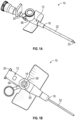
- a catheter assembly 10 may include a catheter adapter 12, which may include a body 14 and a side port 16 extending outwardly from the body 14.
- the side port 16 and the body 14 may be monolithically formed as a single unit.
- the body 14 may include a distal end 18, a proximal end 20, and a lumen 22 extending through the distal end 18 of the body 14 and the proximal end 20 of the body 14.
- the side port 16 may be disposed between the distal end 18 and the proximal end 20.
- the side port 16 may include an outer opening 24.
- the catheter assembly 10 may include a valve 26 disposed within the side port 16.
- the valve 26 may be constructed of rubber or another suitable resilient material.
- the valve 26 may include a channel 27 extending through the valve 26.
- the catheter assembly 10 may include a cannula 28.
- the cannula 28 may be disposed within the channel 27.
- the cannula 28 may include a blunt, closed end 30.
- the catheter assembly 10 may include a catheter 32 extending distally from the distal end 18 of the body 14.
- the catheter 32 may include a peripheral intravenous catheter ("PIVC"), a peripherally inserted central catheter (“PICC”), a midline catheter, or another suitable catheter.
- PIVC peripheral intravenous catheter
- PICC peripherally inserted central catheter
- a needle assembly that includes an introducer needle 33 may extend through the catheter adapter 12, as illustrated, for example, in Figure 1A .
- the needle assembly in response to the introducer needle 33 and catheter 32 being inserted into vasculature of a patient, the needle assembly may be removed from the catheter adapter 12, as illustrated, for example, in Figure 1B .
- a blood collection device may be coupled to the catheter adapter 12, and when the catheter 32 is inserted into the vasculature of the patient, blood may flow from the vasculature, distally through the catheter 32, through the catheter adapter 12, and into the blood collection device.
- the cannula 28 may include one or more openings 34.
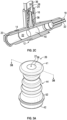
- the valve 26 may be configured to compress to expose the openings 34 from within the valve 26.
- a medical device 36 may be inserted into and/or coupled to the side port 16, which may compress the valve 26 to expose the openings 34 from within the valve 26 and allow fluid to flow from the medical device 36, through the openings 34, through an annular body 38 of the cannula 28.
- the valve 26 in response to the medical device 36 being removed and/or uncoupled from the side port 16, the valve 26 may resiliently return to a position in which the openings 34 are within the valve 26.
- the openings 34 may include a first opening 34a, a second opening 34b, and/or a third opening 34c (which may be referred to collectively in the present disclosure as "openings"). In some embodiments, the openings 34 may include more than three openings or only one opening. In some embodiments, one or more of the openings 34 may be spaced apart around a circumference of the cannula 28, as illustrated in Figure. In these embodiments, the openings 34 may be aligned with each other.
- one or more of the openings 34 may be proximate the blunt, closed end 30. In some embodiments, one or more of the openings 34 may be disposed between the blunt, closed end 30 of the cannula 28 and the annular body 38. In some embodiments, the annular body 38 may include a fluid pathway 39 or channel extending through the annular body 38. In some embodiments, the openings 34 may be in fluid communication with the fluid pathway 39. In some embodiments, the openings 34 may be spaced apart from each other by beams or separators, which may extend between the blunt, closed end 30 and the annular body 38. In some embodiments, the beams or separators may be monolithically formed with the blunt, closed end 30 and/or the annular body 38 as a single unit.
- the catheter assembly 10 may include another valve 40, which may be generally cylindrical and/or disposed within the lumen.
- the other valve 40 may be solid or may include a channel extending there through and aligned with a longitudinal axis of the body.
- the side port 16 may be generally perpendicular with respect to the body 14, which may facilitate fluid from the medical device 36 contacting the other valve 40 at about a 90° angle, which may facilitate operation and opening of the other valve 40.
- the other valve 40 may open to allow fluid communication between the side port 16 and the lumen 22.
- the other valve 40 may open when a portion of the other valve 40 is depressed in response to contact by the fluid.
- the other valve 40 may include any suitable valve, which may be generally perpendicular to the valve 26.
- the valve 26 may include a first end 41, a second end 42, and an accordion portion 44 between the first end 41 and the second end 42.
- a diameter of the first end 41 and a diameter of the second end 42 may be greater than a diameter of the accordion portion 44.
- an outer surface of the accordion portion 44 may be curved.
- the cannula 28 may be fixed within the side port 16.
- the cannula 28 may be fixed to the side port and/or the catheter adapter 12.
- the valve 26 may be coupled to the side port 16, and the cannula 28 may fit snugly within the valve 26.
- an end of the cannula 28 opposite the blunt, closed end 30 may have a diameter greater than an end 56 of the channel 27 prior to and/or after insertion of the medical device 36, which may facilitate the cannula 28 being secured within the valve 26.
- the end of the cannula 28 opposite the blunt, closed end 30 may contact and/or be secured to a stepped surface, which may facilitate securement of the cannula 28 within the side port 16.
- the valve 26 may be coupled to the catheter adapter 12 in any number of suitable ways.
- the valve 26 may include a rim 52, and the side port 16 may include a groove 54.
- the rim 52 may be disposed within the groove 54 to secure the valve 26 within the side port 16.
- the rim 52 and/or the groove 54 may be annular.
- the blunt, closed end 30 of the cannula 28 may seal the end 56 of the channel 27, which may prevent bacteria from entering the catheter assembly 10.
- the blunt, closed end 30 may include a first circumference and the end 56 of the channel 27 may include a second circumference approximately equal to the first circumference, which may facilitate a seal at the end 56 of the channel 27.
- the catheter assembly 10 may not include a cap 58 because the blunt, closed end 30 and the valve 26 may seal the catheter adapter 12 from the external environment.
- the catheter assembly 10 may include a valve 60 and a cannula 62.
- the valve 60 may include or correspond to the valve 26 described with respect to Figures 1A-3E and/or the cannula 62 may include or correspond to the cannula 28 described with respect to Figures 1A-3E .
- the valve 60 may include one or more features of the valve 26 described with respect to Figures 1A-3E and/or the cannula 62 may one or more features of the cannula 28 described with respect to Figures 1A-3E .
- the catheter assembly 10 may include a base 64, which may be fixed to the cannula 28.
- the cannula 28 and the base 62 may be monolithically formed as a single unit.
- the cannula 28 may include an opening 66 which may extend along a length of the cannula 28.
- the cannula 28 may include an opening 66 which may extend along a length of the cannula 28 from the blunt, closed end 30 to the base 64.
- the blunt, closed end 30 of the cannula 28 may be semi-circular, and the end 56 of the channel 27 may be generally semi-cylindrical, which may facilitate a seal at the end 56 of the channel 27.
- the channel 27 may be generally semi-cylindrical.
- the base 64 may include a hole 68, which may be aligned with the opening 66.
Landscapes
- Health & Medical Sciences (AREA)
- Life Sciences & Earth Sciences (AREA)
- Heart & Thoracic Surgery (AREA)
- Biomedical Technology (AREA)
- Engineering & Computer Science (AREA)
- Anesthesiology (AREA)
- Pulmonology (AREA)
- Hematology (AREA)
- Animal Behavior & Ethology (AREA)
- General Health & Medical Sciences (AREA)
- Public Health (AREA)
- Veterinary Medicine (AREA)
- Biophysics (AREA)
- Infusion, Injection, And Reservoir Apparatuses (AREA)
- Media Introduction/Drainage Providing Device (AREA)
Abstract

Description
- Catheters are generally used for parenteral nutrition, intravenous fluid replacement, and administering analgesics and antibiotics. Catheters are also used for blood draw. Catheters can be inserted at the bedside using sterile techniques and can remain in place for several weeks.
- A common type catheter is an over-the-needle catheter. As its name implies, a catheter that is "over-the-needle" may be mounted over an introducer needle having a sharp distal tip. The sharp distal tip may be used to pierce skin and a vein of a patient. Insertion of the catheter into the vein may follow the piercing of the vein by the introducer needle. The introducer needle typically has the sharp distal tip to pierce skin and the vein of the patient with minimal resistance to minimize the pain to the patient.
- The introducer needle is generally placed at a steep inclined angle with respect to a surface of the skin and a longitudinal dimension of the vein to be pierced to allow penetration through the skin and a wall of the vein. The introducer needle and the catheter are generally inserted with a bevel of the introducer needle facing away from the skin of the patient. After the tip of the introducer needle pierces the wall, the angle of the insertion is lowered to be able to slide the introducer needle and the catheter into the vein a distance sufficient to properly position the catheter in the vein. Once placement of the introducer needle within the vein has been confirmed, the user may temporarily occlude flow in the vein and withdraw the introducer needle, leaving the catheter in place for future fluid infusion and/or blood withdrawal.
- The subject matter claimed herein is not limited to embodiments that solve any disadvantages or that operate only in environments such as those described above. Rather, this background is only provided to illustrate one example technology area where some implementations described herein may be practiced.
- The present disclosure relates generally to a catheter assembly, as well as related devices, systems, and methods. In some embodiments, the catheter assembly may include a catheter adapter, which may include a body and a side port extending outwardly from the body. In some embodiments, the body may include a distal end, a proximal end, and a lumen extending through the distal end of the body and the proximal end of the body. In some embodiments, the side port may be disposed between the distal end and the proximal end. In some embodiments, the side port may include an outer opening.
- In some embodiments, the catheter assembly may include a valve disposed within the side port. In some embodiments, the valve may include a channel extending through the valve. In some embodiments, the catheter assembly may include a cannula, which may be fixed within the side port. In some embodiments, the cannula may be disposed within the channel. In some embodiments, the cannula may include one or more openings. In some embodiments, the valve may be configured to compress to expose the openings from within the valve. In some embodiments, the catheter assembly may include a catheter extending distally from the distal end of the body. In some embodiments, the catheter assembly may include another valve, which may be generally cylindrical and/or disposed within the lumen.
- In some embodiments, the side port and the body may be monolithically formed as a single unit. In some embodiments, the valve may be constructed of rubber or another suitable resilient material. In some embodiments, the valve may include a first end, a second end, and an accordion portion between the first end and the second end. In some embodiments, a diameter of the first end and a diameter of the second end may be greater than a diameter of the accordion portion. In some embodiments, the valve may include a rim and the side port may include a groove. In some embodiments, the rim may be disposed within the groove to secure the valve within the side port.
- In some embodiments, the cannula may include a blunt, closed end. In some embodiments, the blunt, closed end of the cannula may seal an end of the channel, which may prevent bacteria from entering the catheter assembly. In further detail, in some embodiments, the blunt, closed end may include a first circumference and the end of the channel may include a second circumference approximately equal to the first circumference, which may facilitate a seal at the end of the channel.
- In some embodiments, the openings may include a first opening, a second opening, and/or a third opening. In some embodiments, one or more of the first opening, the second opening, and the third opening may be spaced apart around a circumference of the cannula. In some embodiments, one or more of the first opening, the second opening, and the third opening may be proximate the blunt, closed end. In some embodiments, the cannula may include an annular body. In some embodiments, the first opening, the second opening, and/or the third opening may be disposed between the blunt, closed end of the cannula and the annular body.
- In some embodiments, the catheter assembly may include a base, which may be fixed to the cannula. In some embodiments, the cannula may include an opening which may extend along a length of the cannula from the blunt, closed end to the base. In these and other embodiments, the blunt, closed end of the cannula may be semi-circular, and the end of the channel may be generally semi-cylindrical, which may facilitate a seal at the end of the channel. In some embodiments, the channel may be generally semi-cylindrical. In some embodiments, the base may include a hole, which may be aligned with the opening.
- It is to be understood that both the foregoing general description and the following detailed description are exemplary and explanatory and are not restrictive of the invention, as claimed. It should be understood that the various embodiments are not limited to the arrangements and instrumentality shown in the drawings. It should also be understood that the embodiments may be combined, or that other embodiments may be utilized and that structural changes, unless so claimed, may be made without departing from the scope of the various embodiments of the present invention. The following detailed description is, therefore, not to be taken in a limiting sense.
- Example embodiments will be described and explained with additional specificity and detail through the use of the accompanying drawings in which:
-
Figure 1A is an upper perspective view of a catheter assembly, according to some embodiments; -
Figure 1B is a top view of the catheter assembly, illustrating an example cap opened; -
Figure 2A is a partial cutaway view of the catheter assembly, according to some embodiments; -
Figure 2B is a top view of an example side port of the catheter assembly, according to some embodiments; -
Figure 2C is a partial cutaway view of the catheter assembly, illustrating an example medical device inserted into the side port to compress an example valve, according to some embodiments; -
Figure 3A is an upper perspective view of the valve of the catheter assembly, according to some embodiments; -
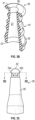
Figure 3B is a cross-sectional view of the valve, according to some embodiments; -
Figure 3C is an upper perspective view of an example cannula of the catheter assembly, according to some embodiments; -
Figure 3D is a cross-sectional view of the cannula along theline 3D-3D ofFigure 3C , according to some embodiments; -
Figure 3E is another cross-sectional view of the cannula, according to some embodiments; -
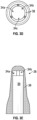
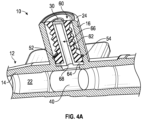
Figure 4A is a cross-sectional view of the catheter assembly, illustrating another example cannula and another example valve, according to some embodiments; -
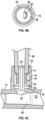
Figure 4B is a top view of the side port of the catheter assembly, according to some embodiments; -
Figure 4C is a cross-sectional view of the catheter assembly, illustrating the medical device inserted into the side port to compress the other valve, according to some embodiments; -
Figure 5A is an upper perspective view of the other valve, according to some embodiments; -
Figure 5B is a cross-sectional view of the other valve, according to some embodiments; and -
Figure 5C is an upper perspective view of the other cannula, according to some embodiments. - Referring now to
Figures 1A-3E , acatheter assembly 10 may include acatheter adapter 12, which may include abody 14 and aside port 16 extending outwardly from thebody 14. In some embodiments, theside port 16 and thebody 14 may be monolithically formed as a single unit. In some embodiments, thebody 14 may include adistal end 18, aproximal end 20, and alumen 22 extending through thedistal end 18 of thebody 14 and theproximal end 20 of thebody 14. In some embodiments, theside port 16 may be disposed between thedistal end 18 and theproximal end 20. In some embodiments, theside port 16 may include anouter opening 24. - In some embodiments, the
catheter assembly 10 may include avalve 26 disposed within theside port 16. In some embodiments, thevalve 26 may be constructed of rubber or another suitable resilient material. In some embodiments, thevalve 26 may include achannel 27 extending through thevalve 26. In some embodiments, thecatheter assembly 10 may include acannula 28. In some embodiments, thecannula 28 may be disposed within thechannel 27. In some embodiments, thecannula 28 may include a blunt,closed end 30. - In some embodiments, the
catheter assembly 10 may include acatheter 32 extending distally from thedistal end 18 of thebody 14. In some embodiments, thecatheter 32 may include a peripheral intravenous catheter ("PIVC"), a peripherally inserted central catheter ("PICC"), a midline catheter, or another suitable catheter. In some embodiments, a needle assembly that includes anintroducer needle 33 may extend through thecatheter adapter 12, as illustrated, for example, inFigure 1A . In some embodiments, in response to theintroducer needle 33 andcatheter 32 being inserted into vasculature of a patient, the needle assembly may be removed from thecatheter adapter 12, as illustrated, for example, inFigure 1B . In some embodiments, a blood collection device may be coupled to thecatheter adapter 12, and when thecatheter 32 is inserted into the vasculature of the patient, blood may flow from the vasculature, distally through thecatheter 32, through thecatheter adapter 12, and into the blood collection device. - In some embodiments, the
cannula 28 may include one or more openings 34. As illustrated inFigure 2C , in some embodiments, thevalve 26 may be configured to compress to expose the openings 34 from within thevalve 26. In some embodiments, amedical device 36 may be inserted into and/or coupled to theside port 16, which may compress thevalve 26 to expose the openings 34 from within thevalve 26 and allow fluid to flow from themedical device 36, through the openings 34, through anannular body 38 of thecannula 28. In some embodiments, in response to themedical device 36 being removed and/or uncoupled from theside port 16, thevalve 26 may resiliently return to a position in which the openings 34 are within thevalve 26. - In some embodiments, the openings 34 may include a
first opening 34a, asecond opening 34b, and/or athird opening 34c (which may be referred to collectively in the present disclosure as "openings"). In some embodiments, the openings 34 may include more than three openings or only one opening. In some embodiments, one or more of the openings 34 may be spaced apart around a circumference of thecannula 28, as illustrated in Figure. In these embodiments, the openings 34 may be aligned with each other. - In some embodiments, one or more of the openings 34 may be proximate the blunt,
closed end 30. In some embodiments, one or more of the openings 34 may be disposed between the blunt,closed end 30 of thecannula 28 and theannular body 38. In some embodiments, theannular body 38 may include afluid pathway 39 or channel extending through theannular body 38. In some embodiments, the openings 34 may be in fluid communication with thefluid pathway 39. In some embodiments, the openings 34 may be spaced apart from each other by beams or separators, which may extend between the blunt,closed end 30 and theannular body 38. In some embodiments, the beams or separators may be monolithically formed with the blunt,closed end 30 and/or theannular body 38 as a single unit. - In some embodiments, the
catheter assembly 10 may include anothervalve 40, which may be generally cylindrical and/or disposed within the lumen. In some embodiments, theother valve 40 may be solid or may include a channel extending there through and aligned with a longitudinal axis of the body. In some embodiments, theside port 16 may be generally perpendicular with respect to thebody 14, which may facilitate fluid from themedical device 36 contacting theother valve 40 at about a 90° angle, which may facilitate operation and opening of theother valve 40. In some embodiments, theother valve 40 may open to allow fluid communication between theside port 16 and thelumen 22. In some embodiments, theother valve 40 may open when a portion of theother valve 40 is depressed in response to contact by the fluid. In some embodiments, theother valve 40 may include any suitable valve, which may be generally perpendicular to thevalve 26. - In some embodiments, the
valve 26 may include afirst end 41, asecond end 42, and anaccordion portion 44 between thefirst end 41 and thesecond end 42. In some embodiments, a diameter of thefirst end 41 and a diameter of thesecond end 42 may be greater than a diameter of theaccordion portion 44. In some embodiments, an outer surface of theaccordion portion 44 may be curved. - In some embodiments, the
cannula 28 may be fixed within theside port 16. As an example, thecannula 28 may be fixed to the side port and/or thecatheter adapter 12. As another example, thevalve 26 may be coupled to theside port 16, and thecannula 28 may fit snugly within thevalve 26. In some embodiments, an end of thecannula 28 opposite the blunt,closed end 30 may have a diameter greater than anend 56 of thechannel 27 prior to and/or after insertion of themedical device 36, which may facilitate thecannula 28 being secured within thevalve 26. In some embodiments, the end of thecannula 28 opposite the blunt,closed end 30 may contact and/or be secured to a stepped surface, which may facilitate securement of thecannula 28 within theside port 16. - In some embodiments, the
valve 26 may be coupled to thecatheter adapter 12 in any number of suitable ways. In some embodiments, thevalve 26 may include arim 52, and theside port 16 may include agroove 54. In some embodiments, therim 52 may be disposed within thegroove 54 to secure thevalve 26 within theside port 16. In some embodiments, therim 52 and/or thegroove 54 may be annular. - In some embodiments, the blunt,
closed end 30 of thecannula 28 may seal theend 56 of thechannel 27, which may prevent bacteria from entering thecatheter assembly 10. In further detail, in some embodiments, the blunt,closed end 30 may include a first circumference and theend 56 of thechannel 27 may include a second circumference approximately equal to the first circumference, which may facilitate a seal at theend 56 of thechannel 27. In some embodiments, thecatheter assembly 10 may not include acap 58 because the blunt,closed end 30 and thevalve 26 may seal thecatheter adapter 12 from the external environment. - Referring now to
Figures 4A-5C , in some embodiments, thecatheter assembly 10 may include avalve 60 and acannula 62. In some embodiments, thevalve 60 may include or correspond to thevalve 26 described with respect toFigures 1A-3E and/or thecannula 62 may include or correspond to thecannula 28 described with respect toFigures 1A-3E . In some embodiments, thevalve 60 may include one or more features of thevalve 26 described with respect toFigures 1A-3E and/or thecannula 62 may one or more features of thecannula 28 described with respect toFigures 1A-3E . - In some embodiments, the
catheter assembly 10 may include abase 64, which may be fixed to thecannula 28. In some embodiments, thecannula 28 and the base 62 may be monolithically formed as a single unit. In some embodiments, thecannula 28 may include anopening 66 which may extend along a length of thecannula 28. In some embodiments, thecannula 28 may include anopening 66 which may extend along a length of thecannula 28 from the blunt,closed end 30 to thebase 64. In these and other embodiments, the blunt,closed end 30 of thecannula 28 may be semi-circular, and theend 56 of thechannel 27 may be generally semi-cylindrical, which may facilitate a seal at theend 56 of thechannel 27. In some embodiments, thechannel 27 may be generally semi-cylindrical. In some embodiments, thebase 64 may include ahole 68, which may be aligned with theopening 66. - It is to be understood that both the foregoing general description and the following detailed description are exemplary and explanatory and are not restrictive of the invention, as claimed. It should be understood that the various embodiments are not limited to the arrangements and instrumentality shown in the drawings. It should also be understood that the embodiments may be combined, or that other embodiments may be utilized and that structural changes, unless so claimed, may be made without departing from the scope of the various embodiments of the present invention. The following detailed description is, therefore, not to be taken in a limiting sense.
- All examples and conditional language recited herein are intended for pedagogical objects to aid the reader in understanding the invention and the concepts contributed by the inventor to furthering the art, and are to be construed as being without limitation to such specifically recited examples and conditions. Although embodiments of the present inventions have been described in detail, it should be understood that the various changes, substitutions, and alterations could be made hereto without departing from the spirit and scope of the invention.
- Further aspects of the application:
- 1. A catheter assembly, comprising:
- a catheter adapter, comprising:
- a body, comprising a distal end, a proximal end, and a lumen extending through the distal end and the proximal end; and
- a side port extending outwardly from the body and disposed between the distal end and the proximal end, wherein the side port comprises an outer opening;
- a valve disposed within the side port, wherein the valve comprises a channel extending through the valve;
- a cannula fixed within the side port and disposed within the channel, wherein the cannula comprises an opening, wherein the valve is configured to compress to expose the opening from within the valve; and
- a catheter extending distally from the distal end of the body.
- a catheter adapter, comprising:
- 2. The catheter assembly of claim 1, wherein the side port and the body are monolithically formed as a single unit.
- 3. The catheter assembly of claim 2, wherein the catheter assembly further comprises another valve, wherein the other valve is generally cylindrical and disposed within the lumen.
- 4. The catheter assembly of claim 2, wherein the valve is constructed of rubber.
- 5. The catheter assembly of claim 4, wherein the valve comprises a first end, a second end, and an accordion portion between the first end and the second end.
- 6. The catheter assembly of claim 5, wherein a diameter of the first end and a diameter of the second end are greater than a diameter of the accordion portion.
- 7. The catheter assembly of claim 6, wherein the valve further comprises a rim, wherein the side port comprises a groove, wherein the rim is disposed within the groove to secure the valve within the side port.
- 8. The catheter assembly of claim 1, wherein the cannula comprises a blunt, closed end, wherein the blunt, closed end of the cannula seals an end of the channel.
- 9. The catheter assembly of claim 8, wherein the blunt, closed end has a first circumference, wherein the end of the channel has a second circumference approximately equal to the first circumference.
- 10. The catheter assembly of claim 8, wherein the opening is a first opening, wherein the cannula comprises a second opening and a third opening, wherein the first opening, the second opening, and the third opening are spaced apart around a circumference of the cannula proximate the blunt, closed end.
- 11. The catheter assembly of claim 8, wherein the catheter assembly further comprises a base fixed to the cannula and comprising a hole, wherein the opening extends along a length of the cannula from the blunt, closed end to the base, wherein the opening is aligned with the hole.
- 12. The catheter assembly of claim 8, wherein the channel is generally semi-cylindrical.
- 13. The catheter assembly of
claim 12, wherein the blunt, closed end of the cannula is generally semi-circular, wherein the end of the channel is generally semi-circular. - 14. A catheter assembly, comprising:
- a catheter adapter, comprising:
- a body, comprising a distal end, a proximal end, and a lumen extending through the distal end and the proximal end; and
- a side port extending outwardly from the body and disposed between the distal end and the proximal end, wherein the side port comprises an outer opening;
- a valve disposed within the side port, wherein the valve comprises a channel extending through the valve;
- a cannula fixed within the side port and disposed within the channel, wherein the cannula comprises a first opening and a second opening, wherein the valve is configured to compress to expose the first opening and the second opening from within the valve, wherein the cannula comprises a blunt, closed end, wherein the blunt, closed end of the cannula seals an end of the channel; and
- a catheter extending distally from the distal end of the body.
- a catheter adapter, comprising:
- 15. The catheter assembly of
claim 14, wherein the cannula comprises an annular body, wherein the first opening and the second opening are disposed between the blunt, closed end of the cannula and the annular body. - 16. The catheter assembly of
claim 14, wherein the side port and the body are monolithically formed as a single unit. - 17. The catheter assembly of
claim 14, wherein the valve comprises a first end, a second end, and an accordion portion between the first end and the second end. - 18. A catheter assembly, comprising:
- a catheter adapter, comprising:
- a body, comprising a distal end, a proximal end, and a lumen extending through the distal end and the proximal end; and
- a side port extending outwardly from the body and disposed between the distal end and the proximal end, wherein the side port comprises an outer opening;
- a valve disposed within the side port, wherein the valve comprises a channel extending through the valve, wherein the channel is generally semi-cylindrical;
- a cannula fixed within the side port and disposed within the channel, wherein the cannula comprises an opening, wherein the valve is configured to compress to expose the opening from within the valve, wherein the cannula comprises a blunt, closed end, wherein the blunt, closed end of the cannula seals an end of the channel; and
- a catheter extending distally from the distal end of the body.
- a catheter adapter, comprising:
- 19. The catheter assembly of
claim 18, wherein the catheter assembly further comprises a base fixed to the cannula and comprising a hole, wherein the opening extends along a length of the cannula from the blunt, closed end to the base, wherein the opening is aligned with the hole - 20. The catheter assembly of
claim 18, wherein the side port and the body are monolithically formed as a single unit.
Claims (3)
- A catheter assembly, comprising:a catheter adapter, comprising:a body, comprising a distal end, a proximal end, and a lumen extending through the distal end and the proximal end; anda side port extending outwardly from the body and disposed between the distal end and the proximal end, wherein the side port comprises an outer opening;a valve disposed within the side port, wherein the valve comprises a channel extending through the valve, wherein the channel is generally semi-cylindrical;a cannula fixed within the side port and disposed within the channel, wherein the cannula comprises an opening, wherein the valve is configured to compress to expose the opening from within the valve, wherein the cannula comprises a blunt, closed end, wherein the blunt, closed end of the cannula seals an end of the channel; anda catheter extending distally from the distal end of the body.
- The catheter assembly of claim 1, wherein the catheter assembly further comprises a base fixed to the cannula and comprising a hole, wherein the opening extends along a length of the cannula from the blunt, closed end to the base, wherein the opening is aligned with the hole
- The catheter assembly of claim 1, wherein the side port and the body are monolithically formed as a single unit.
Applications Claiming Priority (4)
| Application Number | Priority Date | Filing Date | Title |
|---|---|---|---|
| US201962860537P | 2019-06-12 | 2019-06-12 | |
| US16/878,121 US11420025B2 (en) | 2019-06-12 | 2020-05-19 | Catheter assembly having a side port valve |
| EP20731757.9A EP3983046B1 (en) | 2019-06-12 | 2020-05-21 | Catheter assembly having a valve within a side port of a catheter adapter |
| PCT/US2020/034067 WO2020251738A1 (en) | 2019-06-12 | 2020-05-21 | Catheter assembly having a valve within a side port of a catheter adapter |
Related Parent Applications (2)
| Application Number | Title | Priority Date | Filing Date |
|---|---|---|---|
| EP20731757.9A Division EP3983046B1 (en) | 2019-06-12 | 2020-05-21 | Catheter assembly having a valve within a side port of a catheter adapter |
| EP20731757.9A Division-Into EP3983046B1 (en) | 2019-06-12 | 2020-05-21 | Catheter assembly having a valve within a side port of a catheter adapter |
Publications (2)
| Publication Number | Publication Date |
|---|---|
| EP4406586A2 true EP4406586A2 (en) | 2024-07-31 |
| EP4406586A3 EP4406586A3 (en) | 2024-10-30 |
Family
ID=73744855
Family Applications (2)
| Application Number | Title | Priority Date | Filing Date |
|---|---|---|---|
| EP24181645.3A Pending EP4406586A3 (en) | 2019-06-12 | 2020-05-21 | Catheter assembly having a valve within a side port of a catheter adapter |
| EP20731757.9A Active EP3983046B1 (en) | 2019-06-12 | 2020-05-21 | Catheter assembly having a valve within a side port of a catheter adapter |
Family Applications After (1)
| Application Number | Title | Priority Date | Filing Date |
|---|---|---|---|
| EP20731757.9A Active EP3983046B1 (en) | 2019-06-12 | 2020-05-21 | Catheter assembly having a valve within a side port of a catheter adapter |
Country Status (10)
| Country | Link |
|---|---|
| US (2) | US11420025B2 (en) |
| EP (2) | EP4406586A3 (en) |
| JP (1) | JP7670630B2 (en) |
| KR (1) | KR20220020335A (en) |
| CN (2) | CN113950349B (en) |
| AU (1) | AU2020291897B2 (en) |
| CA (1) | CA3140189A1 (en) |
| MX (1) | MX2021014824A (en) |
| MY (1) | MY210196A (en) |
| WO (1) | WO2020251738A1 (en) |
Families Citing this family (4)
| Publication number | Priority date | Publication date | Assignee | Title |
|---|---|---|---|---|
| JP7264819B2 (en) | 2017-09-29 | 2023-04-25 | テルモ株式会社 | catheter assembly |
| JP7387717B2 (en) | 2019-03-28 | 2023-11-28 | テルモ株式会社 | catheter assembly |
| US11420025B2 (en) | 2019-06-12 | 2022-08-23 | Becton, Dickinson And Company | Catheter assembly having a side port valve |
| EP4196011B1 (en) * | 2020-08-14 | 2026-04-15 | Becton, Dickinson and Company | Blood collection device and related systems |
Family Cites Families (8)
| Publication number | Priority date | Publication date | Assignee | Title |
|---|---|---|---|---|
| US20080228172A1 (en) * | 2007-03-15 | 2008-09-18 | Petry Thomas S | Intravenous access safety device |
| IT1392847B1 (en) | 2009-01-14 | 2012-03-23 | Borla Ind | VALVE VALVE FOR MEDICAL LINES |
| US8758306B2 (en) * | 2010-05-17 | 2014-06-24 | Icu Medical, Inc. | Medical connectors and methods of use |
| US9126012B2 (en) * | 2011-10-06 | 2015-09-08 | Becton, Dickinson And Company | Intravenous catheter with duckbill valve |
| US9737686B2 (en) | 2012-03-12 | 2017-08-22 | Becton, Dickinson And Company | Catheter adapter port valve |
| EP3563767B1 (en) * | 2014-08-26 | 2020-11-25 | Velano Vascular, Inc. | Apparatus for phlebotomy through a peripheral iv catheter |
| US10105529B2 (en) | 2014-11-12 | 2018-10-23 | Rymed Technologies, Llc | Needleless, intermittent, neutral displacement IV injection port |
| US11420025B2 (en) * | 2019-06-12 | 2022-08-23 | Becton, Dickinson And Company | Catheter assembly having a side port valve |
-
2020
- 2020-05-19 US US16/878,121 patent/US11420025B2/en active Active
- 2020-05-21 CN CN202080042647.4A patent/CN113950349B/en active Active
- 2020-05-21 WO PCT/US2020/034067 patent/WO2020251738A1/en not_active Ceased
- 2020-05-21 AU AU2020291897A patent/AU2020291897B2/en active Active
- 2020-05-21 MX MX2021014824A patent/MX2021014824A/en unknown
- 2020-05-21 EP EP24181645.3A patent/EP4406586A3/en active Pending
- 2020-05-21 EP EP20731757.9A patent/EP3983046B1/en active Active
- 2020-05-21 MY MYPI2021007292A patent/MY210196A/en unknown
- 2020-05-21 KR KR1020227000435A patent/KR20220020335A/en active Pending
- 2020-05-21 JP JP2021573895A patent/JP7670630B2/en active Active
- 2020-05-21 CA CA3140189A patent/CA3140189A1/en active Pending
- 2020-06-12 CN CN202021090778.3U patent/CN213554740U/en active Active
-
2022
- 2022-07-21 US US17/870,637 patent/US12083295B2/en active Active
Also Published As
| Publication number | Publication date |
|---|---|
| CN113950349A (en) | 2022-01-18 |
| AU2020291897B2 (en) | 2025-05-29 |
| EP3983046A1 (en) | 2022-04-20 |
| US20220355081A1 (en) | 2022-11-10 |
| JP7670630B2 (en) | 2025-04-30 |
| EP3983046C0 (en) | 2024-09-04 |
| AU2020291897A1 (en) | 2022-01-06 |
| KR20220020335A (en) | 2022-02-18 |
| US11420025B2 (en) | 2022-08-23 |
| CN113950349B (en) | 2023-09-22 |
| MX2021014824A (en) | 2022-01-18 |
| CA3140189A1 (en) | 2020-12-17 |
| CN213554740U (en) | 2021-06-29 |
| NZ783096A (en) | 2025-09-26 |
| MY210196A (en) | 2025-09-02 |
| EP3983046B1 (en) | 2024-09-04 |
| US20200391012A1 (en) | 2020-12-17 |
| WO2020251738A1 (en) | 2020-12-17 |
| JP2022536521A (en) | 2022-08-17 |
| BR112021024745A2 (en) | 2022-01-18 |
| US12083295B2 (en) | 2024-09-10 |
| EP4406586A3 (en) | 2024-10-30 |
Similar Documents
| Publication | Publication Date | Title |
|---|---|---|
| US20220355081A1 (en) | Catheter assembly having a side port valve | |
| US20210068732A1 (en) | Blood collection devices, systems, and methods | |
| US20200078565A1 (en) | Catheter stabilization platform, systems, and methods | |
| AU2020345560B2 (en) | Catheter system to facilitate blood sampling and related methods | |
| US20210068731A1 (en) | Catheter system to facilitate blood collection and related methods | |
| US20240023853A1 (en) | Blood Collection Set and Related Systems and Methods | |
| US12246157B2 (en) | Needleless access connector facilitating instrument delivery to a catheter assembly | |
| US12350453B2 (en) | Catheter system facilitating blood flashback visualization | |
| CN215995227U (en) | Catheter assembly | |
| BR112021024745B1 (en) | CATHETER ASSEMBLY WITH A VALVE INSIDE A SIDE PORT OF A CATHETER ADAPTER | |
| WO2022108786A1 (en) | Blood collection devices, systems, and methods |
Legal Events
| Date | Code | Title | Description |
|---|---|---|---|
| PUAI | Public reference made under article 153(3) epc to a published international application that has entered the european phase |
Free format text: ORIGINAL CODE: 0009012 |
|
| STAA | Information on the status of an ep patent application or granted ep patent |
Free format text: STATUS: THE APPLICATION HAS BEEN PUBLISHED |
|
| AC | Divisional application: reference to earlier application |
Ref document number: 3983046 Country of ref document: EP Kind code of ref document: P |
|
| AK | Designated contracting states |
Kind code of ref document: A2 Designated state(s): AL AT BE BG CH CY CZ DE DK EE ES FI FR GB GR HR HU IE IS IT LI LT LU LV MC MK MT NL NO PL PT RO RS SE SI SK SM TR |
|
| REG | Reference to a national code |
Ref country code: DE Ref legal event code: R079 Free format text: PREVIOUS MAIN CLASS: A61M0039060000 Ipc: A61M0025060000 |
|
| PUAL | Search report despatched |
Free format text: ORIGINAL CODE: 0009013 |
|
| AK | Designated contracting states |
Kind code of ref document: A3 Designated state(s): AL AT BE BG CH CY CZ DE DK EE ES FI FR GB GR HR HU IE IS IT LI LT LU LV MC MK MT NL NO PL PT RO RS SE SI SK SM TR |
|
| RIC1 | Information provided on ipc code assigned before grant |
Ipc: A61M 39/06 20060101ALI20240924BHEP Ipc: A61M 39/04 20060101ALI20240924BHEP Ipc: A61M 25/00 20060101ALI20240924BHEP Ipc: A61M 25/06 20060101AFI20240924BHEP |
|
| STAA | Information on the status of an ep patent application or granted ep patent |
Free format text: STATUS: REQUEST FOR EXAMINATION WAS MADE |
|
| 17P | Request for examination filed |
Effective date: 20250414 |
|
| GRAP | Despatch of communication of intention to grant a patent |
Free format text: ORIGINAL CODE: EPIDOSNIGR1 |
|
| STAA | Information on the status of an ep patent application or granted ep patent |
Free format text: STATUS: GRANT OF PATENT IS INTENDED |
|
| INTG | Intention to grant announced |
Effective date: 20260318 |