EP4406439A2 - Single-piece pad insert for bras - Google Patents
Single-piece pad insert for bras Download PDFInfo
- Publication number
- EP4406439A2 EP4406439A2 EP24180400.4A EP24180400A EP4406439A2 EP 4406439 A2 EP4406439 A2 EP 4406439A2 EP 24180400 A EP24180400 A EP 24180400A EP 4406439 A2 EP4406439 A2 EP 4406439A2
- Authority
- EP
- European Patent Office
- Prior art keywords
- bra
- layer
- breast
- pad insert
- Prior art date
- Legal status (The legal status is an assumption and is not a legal conclusion. Google has not performed a legal analysis and makes no representation as to the accuracy of the status listed.)
- Granted
Links
Images





Classifications
-
- A—HUMAN NECESSITIES
- A41—WEARING APPAREL
- A41C—CORSETS; BRASSIERES
- A41C3/00—Brassieres
- A41C3/0035—Brassieres with pockets
-
- A—HUMAN NECESSITIES
- A41—WEARING APPAREL
- A41C—CORSETS; BRASSIERES
- A41C3/00—Brassieres
- A41C3/10—Brassieres with stiffening or bust-forming inserts
-
- A—HUMAN NECESSITIES
- A41—WEARING APPAREL
- A41C—CORSETS; BRASSIERES
- A41C3/00—Brassieres
- A41C3/12—Component parts
- A41C3/14—Stiffening or bust-forming inserts
- A41C3/144—Pads
Definitions
- aspects herein relate to a support garment having a single-piece pad insert for modesty, shaping, and support.
- Traditional pad inserts for bras used to provide shaping or modesty generally comprise separate pad inserts for the left bra cup and the right bra cup that are insertable using small openings positioned on the sides of the bra. It is often difficult to correctly position or re-position the pad inserts due to the small openings, and once positioned, the pad inserts often become displaced during wear and/or during washing. Moreover, because two separate inserts are used, a wearer may be more likely to lose one of the inserts.
- aspects herein are directed to a bra system comprising a single-piece pad insert and a bra with a front portion formed from a first textile layer and a second textile layer.
- the front portion of the bra has one or more pocket openings in communication with a pocket space formed between the first and second textile layers of the front portion.
- the bra comprises a pocket opening positioned at an upper margin of the front portion.
- the bra comprises a first pocket opening located at a first or right side of the front portion and/or a second pocket opening located at a second or left side of the front portion.
- the single-piece pad insert is configured to be positioned within the pocket space by way of the pocket openings.
- the single-piece pad insert comprises a single or unitary pad formed from first and second layers of material and an elastically deformable pad portion positioned between the first and second layers and having a first breast-contacting surface and a second breast-contacting surface.
- the single-piece pad insert is sized to substantially fill the pocket space formed between the first and second textile layers of the front portion of the bra.
- the single-piece pad insert comprises a central portion extending between the first breast-contacting surface and the second breast-contacting surface of the pad insert.
- the single-piece pad insert may include material extensions that extend from each side of the pad insert and terminate in a right side margin and a left side margin of the pad insert.
- Both the central portion and the material extensions may include the elastically deformable pad portion positioned between the first and second layers, but the elastically deformable pad portion in these areas may have a minimal thickness (i.e., less than or equal to about 5 mm) to minimize the weight of the pad insert and to improve flexibility of the pad insert.
- the pad insert By having the pad insert comprise a single piece - as opposed to two separate pads - the pad insert is easier to manipulate by a wearer (due to, for instance, its larger size) and is less likely to be misplaced or lost.
- the elastically deformable pad portion comprises an open cell foam for breathability
- the first and second layers of material comprise a mesh construction to enhance the breathability achieved by using an open cell foam for the elastically deformable pad portion of the pad insert.
- the pad insert may be formed from a spacer mesh material having first and second layers (which may comprise a mesh construction) interknitted with tie yarns. Similar to using an open cell foam, use of a spacer mesh material enables moisture vapor to travel through the material.
- the wearer can removably insert the single-piece pad insert into the bra by way of the pocket opening(s) so that it is positioned between the first and second textile layers of the front portion of the bra. Because of the lightweight construction of the single-piece pad insert along with the breathability characteristics achieved by using, for instance, an open cell foam or spacer mesh material and a mesh construction, wearer comfort and/or performance is maintained when the pad insert is utilized. When the wearer no longer wishes to use the single-piece pad insert, the wearer can remove the pad by way of the pocket opening(s). Once removed, the pocket space can be used to stow additional items such as, for example, identification cards, phones, keys, and the like.
- aspects herein are directed to a bra system comprising a bra having a front portion.
- the front portion comprises a first textile layer, a second textile layer positioned adjacent to the first textile layer to define a pocket space between the first textile layer and the second textile layer, and a pocket opening in communication with the pocket space, the pocket opening positioned at an upper margin of the front portion.
- the bra system additionally comprises a single-piece pad comprising a first layer of material, a second layer of material, and an elastically deformable pad portion positioned between the first layer of material and the second layer of material to form a first breast-contacting surface and a second breast-contacting surface of the single-piece pad insert, where the single-piece pad insert is configured to be positioned in the pocket space of the front portion of the bra by insertion through the pocket opening.
- aspects herein are directed to a bra system comprising a bra having a front portion comprising a first textile layer, a second textile layer positioned adjacent to the first textile layer to define a pocket space between the first textile layer and the second textile layer, a first pocket opening in communication with the pocket space, the first pocket opening positioned at a first side margin of the front portion, and a second pocket opening in communication with the pocket space, the second pocket opening positioned at a second side margin of the front portion.
- the bra system additionally comprises a single-piece pad insert comprising a first layer of material, a second layer of material, and an elastically deformable pad portion positioned between the first layer of material and the second layer of material to form a first breast-contacting surface and a second breast-contacting surface of the single-piece pad insert, where the single-piece pad insert is configured to be positioned in the pocket space of the front portion of the bra by insertion through one or more of the first pocket opening and the second pocket opening.
- aspects herein are directed to a method using a bra having a single-piece pad insert.
- the method comprises providing a bra having a front portion comprising: 1) a first textile layer, 2) a second textile layer positioned adjacent to the first textile layer to define a pocket space between the first textile layer and the second textile layer, and 3) at least one pocket opening in communication with the pocket space.
- the method additionally comprises providing a single-piece pad insert comprising: 1) a first layer of material, 2) a second layer of material, 3) and an elastically deformable pad portion positioned between the first layer of material and the second layer of material to form a first breast-contacting surface and a second breast-contacting surface.
- the method further comprises inserting the single-piece pad insert into the pocket space by way of the pocket opening so that the single-piece pad insert is positioned between the first textile layer and the second textile layer of the bra.
- bra as used herein is meant to encompass any number of support garments such as bras, sport bras, tank tops, camisoles with built-in support, swimming suit tops, body suits, and other styles or types of support garments used to support breast tissue.
- breast contacting surface as used herein is meant to encompass any type of structure that is in contact with or positioned adjacent to (though not necessarily in contact with) the wearer's breasts when the support garment is worn.
- a bra and/or single-piece pad insert would comprise a first breast contacting surface configured to contact or be positioned adjacent to, for instance, a wearer's right breast and a second breast contacting surface configured to contact or be positioned adjacent to, for instance, a wearer's left breast.
- the bra may comprise a unitary or continuous band of material (molded or unmolded) that makes contact with both of the wearer's breasts. Any and all aspects, and any variation thereof, are contemplated as being within aspects herein.
- bra or support garment such as “front,” “back,” “upper,” “lower,” “bottom,” “inner-facing surface,” “outer-facing surface,” and the like are with respect to an appropriately sized bra or support garment being worn as intended and as shown and described herein by a wearer standing in an upright position.
- the phrase “configured to contact,” or other similar phrases used when describing different portions of the bra or support garment in relation to a wearer refer to a bra or support garment appropriately sized and dimensioned for the particular wearer.
- attachment may mean elements that are releasably attached to one another using, for example, snap systems, slider systems, hook-and-loop closure systems, releasable adhesives, buttons, hooks, and the like. These terms may further mean elements that are fixedly attached to one another using, for example, stitching, bonding, welding, and the like.
- the term “single” means that the pad insert comprises a unitary component configured to cover or be positioned adjacent to both of a wearer's breasts. This is opposed to separate, distinct pad inserts for each of the wearer's breasts (e.g., a first pad insert for the right breast, and a second separate pad insert for the left breast).
- the term “mesh material” or “mesh construction” when used with respect to the single-piece pad insert may mean a textile having a large number of closely spaced holes. Aspects herein contemplate that the mesh material may be formed from a loosely knitted or woven textile, or the mesh material may be formed by perforating a textile in a post-weaving or post-knitting step to form the holes.
- the term "elastically deformable” means a material that is able to spontaneously return to a resting shape after compression or distortion.
- Example materials that are elastically deformable and that are contemplated herein include foams (both closed cell and open cell foams), spacer mesh materials, silicone materials, and the like.
- the term "open cell” when describing foam materials means a foam material in which generally more than half of the cells walls are disrupted thereby allowing interconnection between the different cells. Due to the interconnection between the different cells, air and/or moisture vapor can generally move through the foam material.
- spacer mesh material as used herein is meant to encompass both warp knit and weft knit spacer knit materials as is known in the art of textiles.
- Spacer knit materials are generally formed by utilizing at least one tie yarn to interknit first and second layers of the textile. More specifically, each of the first layer and the second layer may be knit separately, and the tie yarn(s) is used to connect the first layer and the second layer where the tie yarn may extend generally perpendicular to the surface plane of the first layer and the second layer.
- the tie yarns may have "loop" portions that extend into each of the first layer and the second layer where the loop portions are interlooped with yarns in the first layer and the second layer to connect the two layers.
- the distance between the first layer and the second layer may be varied by, for instance, varying the length of the tie yarn that extends between the first layer and the second layer.
- apex portion means the central region of the first and second breast-contacting surfaces of the pad portion, where the apex portion is generally configured to cover a respective nipple area of a wearer's breast.
- peripheral portion means the outer edge or the area near the outer edge of the first and second breast-contacting surfaces of the pad portion.
- the bra 100 comprises a front portion 110 configured to generally cover a wearer's upper front torso when the bra 100 is worn.
- the front portion 110 comprises an upper margin 112 and a lower margin 114 positioned inferior to the upper margin 112.
- the lower margin 114 may comprise an underband portion of the bra 100.
- a pair of shoulder straps 116 extend from the upper margin 112 where the shoulder straps 116 are configured to extend over a wearer's shoulders when the bra 100 is worn.
- the bra 100 additionally comprises side portions 118 and 120 that are configured to extend around a wearer's torso when the bra 100 is worn.
- the front portion 110 comprises a first breast-contacting surface 122 (indicated generally by dashed lines) configured to cover or be positioned adjacent to a wearer's right breast when the bra 100 is worn, and a second breast-contacting surface 124 (indicated generally by dashed lines) configured to cover or be positioned adjacent to a wearer's left breast when the bra 100 is worn.
- a middle portion 127 extends between the first breast-contacting surface 122 and the second breast-contacting surface 124.
- the front portion 110 comprises a two-layer construction having a first textile layer 126 and a second textile layer 128 where respective surfaces of the first textile layer 126 and the second textile layer 128 are positioned adjacent to each other to define a pocket space 130 between the first and second textile layers 126 and 128.
- a pocket opening 132 in communication with the pocket space 130 is positioned at the upper margin 112 of the front portion 110.
- one or more of the first textile layer 126 and/or the second textile layer 128 may be formed from a textile having stretch and recovery properties (achieved, for instance, using elastic yarns).
- use of textiles having stretch and recovery properties may help provide support to the wearer's breasts and may also help secure the pad insert between the first and second textile layers 126 and 128 when the pad insert is utilized.
- the bra 100 further comprises a back portion 210 configured to cover an upper back torso of a wearer.
- the back portion 210 may be configured as a racerback style although other styles are contemplated herein.
- the shoulder straps 116 extend from an upper margin 212 of the back portion 210 and comprise a generally continuous extension of the shoulder straps 116 extending from the upper margin 112 of the front portion 110. Although shown with shoulder straps 116, it is contemplated herein that the bra 100 may not comprise shoulder straps and have a bandeau-style configuration.
- the back portion 210 further comprises a lower margin 214.
- the lower margin 214 comprises a circumferential extension of the lower margin 114 of the front portion 110.
- the bra 100 further comprises the side portions 118 and 120 as shown in FIG. 2 .
- the front portion 110 may integrally extend from the back portion 210 without the use of seams (i.e., the front portion 110 and the back portion 210 are created through a single knitting, weaving, or manufacturing event).
- the front portion 110 may comprise a separate pattern piece from the back portion 210 such that the front portion 110 is affixed to the back portion 210 at one or more seam lines generally positioned along the side portions 118 and 120 of the bra 100. Any and all aspects, and any variation thereof, are contemplated as being within aspects herein.
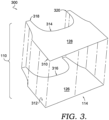
- FIG. 3 illustrates an example method of construction (referenced generally by the numeral 300) of the front portion 110 of the bra 100 in accordance with aspects herein.
- the front portion 110 comprises the first textile layer 126 and the second textile layer 128.
- the first textile layer 126 is configured to be positioned adjacent to a body surface of a wearer while the second textile layer 128 is configured to be positioned external to the first textile layer 126.
- a surface 310 of the second textile layer 128 is positioned adjacent to a surface 312 of the first textile layer 126, and the second textile layer 128 is affixed to the first textile layer 126 along one or more perimeter edges as generally indicated by the long-and-short lines.
- the second textile layer 128 may be affixed to the first textile layer 126 along perimeter edges that form the sides and lower margin 114 of the front portion 110.
- areas of the front portion 110 that are interior to the perimeter edges are not affixed to one another so that the pocket space 130 is formed between the first and second textile layers 126 and 128.
- the pocket space 130 may extend generally across an entirety of the front portion 110 from the side portion 118 to the side portion 120.
- an upper edge 314 of the second textile layer 128 may be generally unaffixed from an upper edge 316 of the first textile layer 126 to form the pocket opening 132 to the pocket space 130.
- the upper edge 314 of the second textile layer 128 may be affixed to the upper edge 316 of the first textile layer 126 on both a first side 318 and a second side 320 of an unaffixed portion of the upper edge 314 of the second textile layer 128 where the unaffixed portion comprises the pocket opening 132 to the pocket space 130. As illustrated in both FIGs.
- the pocket opening 132 generally extends a length of the upper margin 112 of the front portion 110 to allow for easy insertion and removal of, for example, a single-piece pad insert and/or other items.
- the attachment points indicated in FIG. 3 and described herein are illustrative only.
- the front portion 110 may comprise a different shape configuration and may have more or less perimeter edges than shown in FIG. 3 .
- FIGs. 4 and 5 front (e.g., outer-facing surface) and back (e.g., inner-facing surface) views respectively of an example single-piece pad insert 400 are illustrated in accordance with aspects herein.
- the pad insert 400 comprises a first layer of material 412 that extends generally continuously and without interruption along the outer-facing surface of the pad insert 400 and a second layer of material 414 that extends generally continuously and without interruption along the inner-facing surface of the pad insert 400.
- first layer of material 412 and/or the second layer of material 414 may comprise a mesh construction as indicated by reference numerals 416 and 418.
- the mesh material is only depicted in select locations for illustrative purposes, but it is contemplated herein that an entirety of the first layer of material 412 and an entirety of the second layer of material 414 includes a mesh construction.
- first layer of material 412 and/or the second layer of material 414 may comprise a non-mesh material such as, for instance, a lightweight polyester material.
- first layer of material 412 and/or the second layer of material 414 comprise a mesh material and remaining portions of the first layer of material 412 and the second layer of material 414 comprise a non-mesh material. Any and all aspects, and any variation thereof, are contemplated as being within aspects herein.
- the first layer of material 412 and the second layer of material 414 may comprise separate pattern pieces affixed together along their respective edges. It is also contemplated herein, that the first layer of material 412 and the second layer of material 414 may comprise a single or unitary piece of material that is folded over to form the front and back of the pad insert 400. In this instance, the single piece of material may be seamed or affixed to itself at one or more edges. Any and all aspects, and any variation thereof, are contemplated as being within aspects herein.
- the pad insert 400 further includes an elastically deformable pad portion 420 shown in dashed lines in FIG. 4 to indicate it is generally hidden from view, where the elastically deformable pad portion 420 is positioned between the first layer of material 412 and the second layer of material 414.
- the elastically deformable pad portion 420 extends continuously and without interruption between a right side margin 422 and a left side margin 423 of the pad insert 400 and between an upper margin 430 and a lower margin 432 of the pad insert 400.
- the elastically deformable pad portion 420 includes a first breast-contacting surface 434 and a second breast-contacting surface 436 of the pad insert 400.
- the elastically deformable pad portion 420 comprises an open cell foam to promote the movement of moisture vapor and/or heated air from a wearer's body surface to an external environment. And when combined with the mesh construction of the first layer of material 412 and the second layer of material 414, the moisture vapor and/or heated air may more easily escape into an environment external to the pad insert 400.
- the elastically deformable pad portion 420 is positioned between the first layer of material 412 and the second layer of material 414.
- the elastically deformable pad portion 420 is affixed to the first layer of material 412 and/or the second layer of material 414 using, for instance, stitching, spot welding, bonding, adhesives, and the like. By securing the elastically deformable pad portion 420 to the first and/or second layers of material 412 and 414, the elastically deformable pad portion 420 is prevented from becoming displaced during normal wear and during washing.
- the pad insert 400 further comprises a central portion 424 that extends between the first breast-contacting surface 434 and the second breast-contacting surface 436.
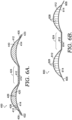
- the central portion 424 comprises the first layer of material 412, the second layer of material 414, and the elastically deformable pad portion 420 as shown in FIG. 6A .
- the elastically deformable pad portion 420 in this area may comprise a negligible thickness such as less than or equal to about 5 mm to minimize the weight of the pad insert 400 and to facilitate flexibility of the pad insert 400 in this area.
- the term "about” means within ⁇ 5% of a given value.
- the pad insert 400 further comprises material extensions 405 that extend from a right side and a left side of the pad insert 400.
- the terminal ends of the material extensions 405 form the right side margin 422 and the left side margin 423 of the pad insert 400.
- the material extensions 405 increase the length of the pad insert 400 and enable the pad insert 400 to substantially fill the pocket space 130 (i.e., occupy at least about 70% but not more than 100% of the pocket space 130) when inserted into the bra 100 thus helping to securely seat the pad insert 400 within the pocket space 130.
- the material extensions 405 include the first layer of material 412, the second layer of material 414, and the elastically deformable pad portion 420 as shown in FIG. 6A .
- the elastically deformable pad portion 420 in these areas may comprise a negligible thickness such as less than or equal to about 5 mm. Minimizing the thickness of the pad portion 420 in these areas enhances the flexibility of the material extensions 405 allowing them to partially wrap around a wearer's sides when the bra 100 and the pad insert 400 are worn by the wearer. This, in turn, limits the displacement of the pad insert 400 during movement. Moreover, minimizing the thickness of the pad portion 420 in the material extensions 405 also helps to make the pad insert 400 lightweight.
- the elastically deformable pad portion 420 is shaped or configured such that an apex portion 425 (indicated generally by dashed lines in FIG. 4 ) of the first and second breast-contacting surfaces 434 and 436 has a thickness 426 that is greater than a thickness 428 at a peripheral portion 427 of the first and second breast-contacting surfaces 434 and 436.
- the first and second breast-contacting surfaces 434 and 436 of the elastically deformable pad portion 420 may be thicker at the apex portions 425 and thinner at the peripheral portions 427.
- the first and second breast-contacting surfaces 434 and 436 may be able to provide shaping when the pad insert 400 is utilized.
- the pad insert 400 may provide better support (through, for instance, compression) than use of the pad insert 400 without the elastically deformable pad portion 420.
- the elastically deformable pad portion 420 may be molded to assume the shape illustrated in FIG. 6A .
- the pad insert may include a first elastically deformable pad portion and a separate second elastically deformable pad portion, where each of the first and second elastically deformable pad portions is configured to cover a right breast and a left breast respectively of a wearer when the pad insert is used.
- the first elastically deformable pad portion includes a first breast-contacting surface
- the second elastically deformable pad portion includes a second breast-contacting surface.
- the central portion may include the first layer of material and the second layer of material without an elastically deformable pad portion
- the material extensions may include the first layer of material and the second layer of material without the elastically deformable pad portion. Limiting the elastically deformable pad portion to two separate pad portions each having a respective breast-contacting surface further minimizes the weight of the pad insert and promotes breathability and/or permeability of the pad insert.
- the single-piece pad insert 600 may comprise a spacer mesh material having a first layer of material 612 and a second layer of material 614 interconnected by a plurality of tie yarns 628.
- the pad insert 600 may be entirely formed from the spacer mesh material.
- a length of the tie yarns 628 may be adjusted to be longer at the apex portions of the pad insert 600 and to be shorter at the peripheral portions of the pad insert 600. By having the tie yarns 628 be longer at the apex portions, a greater thickness is achieved at this area to provide more modesty. It is further contemplated herein that the length of the tie yarns 628 may be negligible (e.g., from about 0.1 mm to about 1 mm) at a central portion 624 of the pad insert 600 and at material extensions 605 of the pad insert 600 to provide a more lightweight construction. Similar to the pad insert 400, the spacer mesh material may be molded to assume the shape illustrated in FIG. 6B .
- a wearer 700 is depicted inserting the pad insert 400 (or the pad insert 600) into the bra 100 in accordance with aspects herein.
- the single-piece pad insert 400 can be inserted into the front portion 110 of the bra 100 by inserting the pad insert 400 into the pocket space 130 by way of the pocket opening 132 located at the upper margin 112 of the bra 100. Because of the large pocket opening 132, the pad insert 400 can be easily inserted (and removed) when desired. Moreover, the large pocket opening 132 also allows easy adjustment of the single-piece pad insert 400 once it has been inserted. As shown, the pad insert 400 is being inserted between the first textile layer 126 and the second textile layer 128 of the front portion 110 of the bra 100.
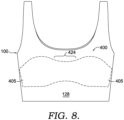
- FIG. 8 depicts a front view of the bra 100 after the single-piece pad insert 400 (or the pad insert 600) has been inserted and positioned in accordance with aspects herein.
- the first breast-contacting surface 434 of the elastically deformable pad portion 420 is generally aligned with the first breast-contacting surface 122 of the bra 100 (shown in FIG. 1 )
- the second breast-contacting surface 436 of the elastically deformable pad portion 420 is generally aligned with the second breast-contacting surface 124 of the bra 100 (shown in FIG. 1 ).
- the central portion 424 of the pad insert 400 is generally aligned with the middle portion 127 of the bra 100 (shown in FIG.
- first textile layer 126 and/or the second textile layer 128 of the bra 100 may be formed from a textile having stretch and recovery properties.
- first and second textile layers 126 and 128 may aid in preventing the pad insert 400 from moving or shifting during wear or movement due to the compressive force exerted on the pad insert 400 by the first and second textile layers 126 and 128.
- FIG. 9 which is a front view of a bra 900, an alternative configuration is depicted with respect to the pocket location in accordance with aspects herein.
- the bra 900 comprises a front portion 910 having an upper margin 912 and a lower margin 914. Similar to the front portion 110 of the bra 100, the front portion 910 may be formed of a first textile layer 926 and a second textile layer 928 where respective surfaces of the first and second textile layers 926 and 928 are positioned adjacent to each other to define a pocket space 930 between the first and second textile layers 926 and 928.
- the bra 900 comprises a first pocket opening 932 at a first side of the bra 900 and a second pocket opening 934 at a second side of the bra 900, where both the first pocket opening 932 and the second pocket opening 934 are in communication with the pocket space 930. It is contemplated herein that the bra 900 may include just the first pocket opening 932 or just the second pocket opening 934 instead of both.
- FIG. 10 illustrates an example method of construction (referenced generally by the numeral 1000) of the front portion 910 of the bra 900 in accordance with aspects herein.
- the front portion 910 comprises the first textile layer 926 and the second textile layer 928.
- the first textile layer 926 is configured to be positioned adjacent to a body surface of a wearer while the second textile layer 928 is configured to be positioned external to the first textile layer 926.
- a surface 1010 of the second textile layer 928 is positioned adjacent to a surface 1012 of the first textile layer 926, and the second textile layer 928 is affixed to the first textile layer 926 along one or more perimeter edges as generally indicated by the long-and-short lines.
- the second textile layer 928 may be affixed to the first textile layer 926 along perimeter edges that form the upper margin 912 and the lower margin 914 of the front portion 910.
- areas of the front portion 910 that are interior to the perimeter edges are not affixed to one another so that the pocket space 930 is formed between the first and second textile layers 926 and 928.
- the pocket space 930 may extend generally across an entirety of the front portion 910 from a first side to a second side.
- a first side edge 1014 of the second textile layer 928 may be generally unaffixed from a first side edge 1016 of the first textile layer 126 to form the first pocket opening 932 to the pocket space 930.
- a second side edge 1018 of the second textile layer 928 may be generally unaffixed from a second side edge 1020 of the first textile layer 926 to form the second pocket opening 934 to the pocket space 930.
- the first side edge 1014 of the second textile layer 928 may be affixed to the first side edge 1016 of the first textile layer 926 on both a first side 1022 and a second side 1024 of an unaffixed portion of the first side edge 1014 of the second textile layer 928 where the unaffixed portion comprises the first pocket opening 932 to the pocket space 930.
- a similar description is applicable to the second pocket opening 934.
- the attachment points indicated in FIG. 10 and described herein are illustrative only.
- the front portion 910 may comprise a different shape configuration and may have more or less perimeter edges than shown in FIG. 10 .
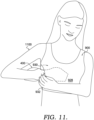
- FIG. 11 depicts a wearer 1100 inserting the pad insert 400 (or the pad insert 600) into the bra 900 in accordance with aspects herein.
- the single-piece pad insert 400 can be inserted into the front portion 910 of the bra 900 by inserting the pad insert 400 into the pocket space 930 by way of the first pocket opening 932 located at the side of the bra 900.
- the wearer 1100 could insert the pad insert 400 using the second pocket opening 934 located at the opposite side of the bra 900.
- the first pocket opening 932 is generally large enough to allow easy insertion and removal of the pad insert 400 as well as easy adjustment of the pad insert 400 once it has been inserted.
- the pad insert 400 is being inserted between the first textile layer 926 and the second textile layer 928 of the front portion 910 of the bra 900.
- the pad insert 400 can be removed using either the first pocket opening 932 or the second pocket opening 934.
- FIG. 12 depicts a front view of the bra 900 after the single-piece pad insert 400 (or the pad insert 600) has been inserted and positioned in accordance with aspects herein. Similar to above, once positioned, the first breast-contacting surface 434 of the elastically deformable pad portion 420 is generally aligned with a first breast contacting surface of the bra 900, and the second breast-contacting surface 436 of the elastically deformable pad portion 420 is generally aligned with a second breast contacting surface of the bra 100. Moreover, the central portion 424 of the pad insert 400 is generally aligned with a middle portion of the bra 900, and the material extensions 405 are configured to partially extend around the sides of the wearer.
- first textile layer 926 and/or the second textile layer 928 may be formed from a textile having stretch and recovery properties.
- the first and second textile layers 926 and 928 may aid in preventing the pad insert 400 from moving or shifting during wear or movement due to the compressive force exerted on the pad insert 400 by the first and second textile layers 926 and 928.
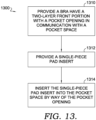
- FIG. 13 illustrates a flow diagram of an example method of using a bra having a single piece pad insert and is referenced generally by the numeral 1300.
- a bra is provided (e.g., provided by a manufacturer, third-party supplier, retail store, retail outlet, and the like) such as the bra 100 or the bra 900 where the bra comprises a front portion have a two-layer textile construction having a first textile layer and a second textile layer where respective surfaces of the textile layers are positioned adjacent to each other to define a pocket space, such as the pocket space 130 or the pocket space 930, between the textile layers.
- the front portion of the bra further comprises at last one pocket opening in communication with the pocket space.
- the pocket opening may be located at an upper margin of the front portion as described in relation to the bra 100. Or there may be first and/or second pocket openings located at the sides of the bra as described with respect to the bra 900. Any and all aspects, and any variation thereof, are contemplated as being within aspects herein.
- a single-piece pad insert such as the single-piece pad insert 400 or the single-piece pad insert 600, is provided (e.g., provided by a manufacturer, third-party supplier, retail store, retail outlet, and the like), where the pad insert comprises a first layer of material, a second layer of material, and an elastically deformable pad portion positioned between the first layer and the second layer to form a first breast-contacting surface and a second breast-contacting surface.
- the single-piece pad insert is positioned in the pocket space of the bra by way of the pocket opening.
- This action may occur by a manufacturer, a third-party supplier, a retail store, a retail outlet, and/or a wearer.
- the wearer may insert the pad insert into the bra when additional modesty, shaping, and/or support is desired. Additional steps may comprise removing the single-piece pad insert by way of the pocket opening after use. Once removed the pocket space in the bra may be useable for stowing other items such as, for instance, identification cards, keys, a cell phone, and the like.
- the present invention relates to the following items:
Landscapes
- Engineering & Computer Science (AREA)
- Textile Engineering (AREA)
- Corsets Or Brassieres (AREA)
- Details Of Garments (AREA)
Abstract
Description
- Aspects herein relate to a support garment having a single-piece pad insert for modesty, shaping, and support.
- Traditional pad inserts for bras used to provide shaping or modesty generally comprise separate pad inserts for the left bra cup and the right bra cup that are insertable using small openings positioned on the sides of the bra. It is often difficult to correctly position or re-position the pad inserts due to the small openings, and once positioned, the pad inserts often become displaced during wear and/or during washing. Moreover, because two separate inserts are used, a wearer may be more likely to lose one of the inserts.
- Examples of aspects herein are described in detail below with reference to the attached drawing figures, wherein:
-
FIG. 1 illustrates a front view of a bra with a pocket opening located at an upper margin of a front portion of the bra in accordance with aspects herein; -
FIG. 2 illustrates a back view of the bra ofFIG. 1 in accordance with aspects herein; -
FIG. 3 illustrates an example method of construction of the front portion of the bra ofFIG. 1 in accordance with aspects herein; -
FIG. 4 illustrates a front view of an example single-piece pad insert in accordance with aspects herein; -
FIG. 5 illustrates a back view of the single-piece pad insert ofFIG. 4 in accordance with aspects herein; -
FIG. 6A illustrates a cross-section taken alongcut line 6A-6A ofFIG. 4 in accordance with aspects herein; -
FIG. 6B illustrates an alternative construction where the single-piece pad insert is formed from a spacer mesh material in accordance with aspects herein; -
FIG. 7 illustrates a wearer inserting the single-piece pad insert ofFIG. 4 into the bra ofFIG. 1 by way of the pocket opening in accordance with aspects herein; -
FIG. 8 illustrates the bra ofFIG. 1 with the inserted single-piece pad insert ofFIG. 4 in accordance with aspects herein; -
FIG. 9 illustrates a front view of a bra having pocket openings located at the sides of a front portion of the bra in accordance with aspects herein; -
FIG. 10 illustrates an example method of construction of the front portion of the bra ofFIG. 9 in accordance with aspects herein; -
FIG. 11 illustrates a wearer inserting the single-piece insert ofFIG. 4 into the bra ofFIG. 9 by way of the side pocket openings in accordance with aspects herein; -
FIG. 12 illustrates the bra ofFIG. 9 with the inserted single-piece pad insert ofFIG. 4 in accordance with aspects herein; and -
FIG. 13 illustrates an example flow diagram of a method of using a bra having a single-piece pad insert in accordance with aspects herein. - The subject matter of the present invention is described with specificity herein to meet statutory requirements. However, the description itself is not intended to limit the scope of this disclosure. Rather, the inventors have contemplated that the claimed or disclosed subject matter might also be embodied in other ways, to include different steps or combinations of steps similar to the ones described in this document, in conjunction with other present or future technologies. Moreover, although the terms "step" and/or "block" might be used herein to connote different elements of methods employed, the terms should not be interpreted as implying any particular order among or between various steps herein disclosed unless and except when the order of individual steps is explicitly stated.
- At a high level, aspects herein are directed to a bra system comprising a single-piece pad insert and a bra with a front portion formed from a first textile layer and a second textile layer. The front portion of the bra has one or more pocket openings in communication with a pocket space formed between the first and second textile layers of the front portion. In one example aspect, the bra comprises a pocket opening positioned at an upper margin of the front portion. And in another example aspect, the bra comprises a first pocket opening located at a first or right side of the front portion and/or a second pocket opening located at a second or left side of the front portion. The single-piece pad insert is configured to be positioned within the pocket space by way of the pocket openings.
- Continuing, the single-piece pad insert comprises a single or unitary pad formed from first and second layers of material and an elastically deformable pad portion positioned between the first and second layers and having a first breast-contacting surface and a second breast-contacting surface. The single-piece pad insert is sized to substantially fill the pocket space formed between the first and second textile layers of the front portion of the bra. In example aspects, the single-piece pad insert comprises a central portion extending between the first breast-contacting surface and the second breast-contacting surface of the pad insert. In further example aspects, the single-piece pad insert may include material extensions that extend from each side of the pad insert and terminate in a right side margin and a left side margin of the pad insert. The material extensions help to more securely seat the pad insert when it is positioned within the pocket space of the bra and are configured to partially curve around the sides of wearer when the bra and pad insert system is utilized by the wearer. Both the central portion and the material extensions may include the elastically deformable pad portion positioned between the first and second layers, but the elastically deformable pad portion in these areas may have a minimal thickness (i.e., less than or equal to about 5 mm) to minimize the weight of the pad insert and to improve flexibility of the pad insert.
- By having the pad insert comprise a single piece - as opposed to two separate pads - the pad insert is easier to manipulate by a wearer (due to, for instance, its larger size) and is less likely to be misplaced or lost. In example aspects, the elastically deformable pad portion comprises an open cell foam for breathability, and the first and second layers of material comprise a mesh construction to enhance the breathability achieved by using an open cell foam for the elastically deformable pad portion of the pad insert. In other example aspects, the pad insert may be formed from a spacer mesh material having first and second layers (which may comprise a mesh construction) interknitted with tie yarns. Similar to using an open cell foam, use of a spacer mesh material enables moisture vapor to travel through the material.
- When a wearer desires more modesty, shaping, and/or support than is achieved by using the bra alone, the wearer can removably insert the single-piece pad insert into the bra by way of the pocket opening(s) so that it is positioned between the first and second textile layers of the front portion of the bra. Because of the lightweight construction of the single-piece pad insert along with the breathability characteristics achieved by using, for instance, an open cell foam or spacer mesh material and a mesh construction, wearer comfort and/or performance is maintained when the pad insert is utilized. When the wearer no longer wishes to use the single-piece pad insert, the wearer can remove the pad by way of the pocket opening(s). Once removed, the pocket space can be used to stow additional items such as, for example, identification cards, phones, keys, and the like.
- Accordingly, aspects herein are directed to a bra system comprising a bra having a front portion. The front portion comprises a first textile layer, a second textile layer positioned adjacent to the first textile layer to define a pocket space between the first textile layer and the second textile layer, and a pocket opening in communication with the pocket space, the pocket opening positioned at an upper margin of the front portion. The bra system additionally comprises a single-piece pad comprising a first layer of material, a second layer of material, and an elastically deformable pad portion positioned between the first layer of material and the second layer of material to form a first breast-contacting surface and a second breast-contacting surface of the single-piece pad insert, where the single-piece pad insert is configured to be positioned in the pocket space of the front portion of the bra by insertion through the pocket opening.
- In another example, aspects herein are directed to a bra system comprising a bra having a front portion comprising a first textile layer, a second textile layer positioned adjacent to the first textile layer to define a pocket space between the first textile layer and the second textile layer, a first pocket opening in communication with the pocket space, the first pocket opening positioned at a first side margin of the front portion, and a second pocket opening in communication with the pocket space, the second pocket opening positioned at a second side margin of the front portion. The bra system additionally comprises a single-piece pad insert comprising a first layer of material, a second layer of material, and an elastically deformable pad portion positioned between the first layer of material and the second layer of material to form a first breast-contacting surface and a second breast-contacting surface of the single-piece pad insert, where the single-piece pad insert is configured to be positioned in the pocket space of the front portion of the bra by insertion through one or more of the first pocket opening and the second pocket opening.
- In yet another example, aspects herein are directed to a method using a bra having a single-piece pad insert. The method comprises providing a bra having a front portion comprising: 1) a first textile layer, 2) a second textile layer positioned adjacent to the first textile layer to define a pocket space between the first textile layer and the second textile layer, and 3) at least one pocket opening in communication with the pocket space. The method additionally comprises providing a single-piece pad insert comprising: 1) a first layer of material, 2) a second layer of material, 3) and an elastically deformable pad portion positioned between the first layer of material and the second layer of material to form a first breast-contacting surface and a second breast-contacting surface. The method further comprises inserting the single-piece pad insert into the pocket space by way of the pocket opening so that the single-piece pad insert is positioned between the first textile layer and the second textile layer of the bra.
- The term "bra" as used herein is meant to encompass any number of support garments such as bras, sport bras, tank tops, camisoles with built-in support, swimming suit tops, body suits, and other styles or types of support garments used to support breast tissue. Further, the term "breast contacting surface" as used herein is meant to encompass any type of structure that is in contact with or positioned adjacent to (though not necessarily in contact with) the wearer's breasts when the support garment is worn. In example aspects, and for a typical wearer, a bra and/or single-piece pad insert would comprise a first breast contacting surface configured to contact or be positioned adjacent to, for instance, a wearer's right breast and a second breast contacting surface configured to contact or be positioned adjacent to, for instance, a wearer's left breast. In example aspects, the bra may comprise a unitary or continuous band of material (molded or unmolded) that makes contact with both of the wearer's breasts. Any and all aspects, and any variation thereof, are contemplated as being within aspects herein.
- Positional terms as used herein to describe a bra or support garment such as "front," "back," "upper," "lower," "bottom," "inner-facing surface," "outer-facing surface," and the like are with respect to an appropriately sized bra or support garment being worn as intended and as shown and described herein by a wearer standing in an upright position. The phrase "configured to contact," or other similar phrases used when describing different portions of the bra or support garment in relation to a wearer refer to a bra or support garment appropriately sized and dimensioned for the particular wearer. Terms such as "attached," "secured," "affixed," and the like may mean elements that are releasably attached to one another using, for example, snap systems, slider systems, hook-and-loop closure systems, releasable adhesives, buttons, hooks, and the like. These terms may further mean elements that are fixedly attached to one another using, for example, stitching, bonding, welding, and the like.
- With respect to the single-piece pad insert, the term "single" means that the pad insert comprises a unitary component configured to cover or be positioned adjacent to both of a wearer's breasts. This is opposed to separate, distinct pad inserts for each of the wearer's breasts (e.g., a first pad insert for the right breast, and a second separate pad insert for the left breast). The term "mesh material" or "mesh construction" when used with respect to the single-piece pad insert may mean a textile having a large number of closely spaced holes. Aspects herein contemplate that the mesh material may be formed from a loosely knitted or woven textile, or the mesh material may be formed by perforating a textile in a post-weaving or post-knitting step to form the holes.
- Continuing with respect to the elastically deformable pad portion of the single-piece pad insert, the term "elastically deformable" means a material that is able to spontaneously return to a resting shape after compression or distortion. Example materials that are elastically deformable and that are contemplated herein include foams (both closed cell and open cell foams), spacer mesh materials, silicone materials, and the like. The term "open cell" when describing foam materials means a foam material in which generally more than half of the cells walls are disrupted thereby allowing interconnection between the different cells. Due to the interconnection between the different cells, air and/or moisture vapor can generally move through the foam material. The term "spacer mesh material" as used herein is meant to encompass both warp knit and weft knit spacer knit materials as is known in the art of textiles. Spacer knit materials are generally formed by utilizing at least one tie yarn to interknit first and second layers of the textile. More specifically, each of the first layer and the second layer may be knit separately, and the tie yarn(s) is used to connect the first layer and the second layer where the tie yarn may extend generally perpendicular to the surface plane of the first layer and the second layer. For instance, the tie yarns may have "loop" portions that extend into each of the first layer and the second layer where the loop portions are interlooped with yarns in the first layer and the second layer to connect the two layers. The distance between the first layer and the second layer may be varied by, for instance, varying the length of the tie yarn that extends between the first layer and the second layer. Still further with respect to the elastically deformable pad portion, the term "apex portion" means the central region of the first and second breast-contacting surfaces of the pad portion, where the apex portion is generally configured to cover a respective nipple area of a wearer's breast. The term "peripheral portion" means the outer edge or the area near the outer edge of the first and second breast-contacting surfaces of the pad portion.
- Turning now to
FIG. 1 , a front view of abra 100 is depicted in accordance with aspects herein. In example aspects, thebra 100 comprises afront portion 110 configured to generally cover a wearer's upper front torso when thebra 100 is worn. Thefront portion 110 comprises anupper margin 112 and alower margin 114 positioned inferior to theupper margin 112. In example, aspects, thelower margin 114 may comprise an underband portion of thebra 100. A pair ofshoulder straps 116 extend from theupper margin 112 where theshoulder straps 116 are configured to extend over a wearer's shoulders when thebra 100 is worn. Thebra 100 additionally comprisesside portions bra 100 is worn. - With respect to the
front portion 110, thefront portion 110 comprises a first breast-contacting surface 122 (indicated generally by dashed lines) configured to cover or be positioned adjacent to a wearer's right breast when thebra 100 is worn, and a second breast-contacting surface 124 (indicated generally by dashed lines) configured to cover or be positioned adjacent to a wearer's left breast when thebra 100 is worn. Amiddle portion 127 extends between the first breast-contactingsurface 122 and the second breast-contactingsurface 124. - As will be explained in further depth below, in example aspects, the
front portion 110 comprises a two-layer construction having afirst textile layer 126 and asecond textile layer 128 where respective surfaces of thefirst textile layer 126 and thesecond textile layer 128 are positioned adjacent to each other to define apocket space 130 between the first and second textile layers 126 and 128. Apocket opening 132 in communication with thepocket space 130 is positioned at theupper margin 112 of thefront portion 110. In example aspects, one or more of thefirst textile layer 126 and/or thesecond textile layer 128 may be formed from a textile having stretch and recovery properties (achieved, for instance, using elastic yarns). As will be explained further below, use of textiles having stretch and recovery properties may help provide support to the wearer's breasts and may also help secure the pad insert between the first and second textile layers 126 and 128 when the pad insert is utilized. - Turning to
FIG. 2 , a back view of thebra 100 is illustrated in accordance with aspects herein. Thebra 100 further comprises aback portion 210 configured to cover an upper back torso of a wearer. In example aspects, and as shown inFIG. 2 , theback portion 210 may be configured as a racerback style although other styles are contemplated herein. The shoulder straps 116 extend from anupper margin 212 of theback portion 210 and comprise a generally continuous extension of theshoulder straps 116 extending from theupper margin 112 of thefront portion 110. Although shown withshoulder straps 116, it is contemplated herein that thebra 100 may not comprise shoulder straps and have a bandeau-style configuration. Theback portion 210 further comprises alower margin 214. In example aspects, thelower margin 214 comprises a circumferential extension of thelower margin 114 of thefront portion 110. Thebra 100 further comprises theside portions FIG. 2 . It is contemplated herein that thefront portion 110 may integrally extend from theback portion 210 without the use of seams (i.e., thefront portion 110 and theback portion 210 are created through a single knitting, weaving, or manufacturing event). It is also contemplated herein that thefront portion 110 may comprise a separate pattern piece from theback portion 210 such that thefront portion 110 is affixed to theback portion 210 at one or more seam lines generally positioned along theside portions bra 100. Any and all aspects, and any variation thereof, are contemplated as being within aspects herein. -
FIG. 3 illustrates an example method of construction (referenced generally by the numeral 300) of thefront portion 110 of thebra 100 in accordance with aspects herein. Thefront portion 110 comprises thefirst textile layer 126 and thesecond textile layer 128. When assembled, thefirst textile layer 126 is configured to be positioned adjacent to a body surface of a wearer while thesecond textile layer 128 is configured to be positioned external to thefirst textile layer 126. To assemble thefront portion 110, asurface 310 of thesecond textile layer 128 is positioned adjacent to asurface 312 of thefirst textile layer 126, and thesecond textile layer 128 is affixed to thefirst textile layer 126 along one or more perimeter edges as generally indicated by the long-and-short lines. For instance, thesecond textile layer 128 may be affixed to thefirst textile layer 126 along perimeter edges that form the sides andlower margin 114 of thefront portion 110. With respect to this aspect, areas of thefront portion 110 that are interior to the perimeter edges are not affixed to one another so that thepocket space 130 is formed between the first and second textile layers 126 and 128. As such, it is contemplated herein that thepocket space 130 may extend generally across an entirety of thefront portion 110 from theside portion 118 to theside portion 120. - In one example aspect, an
upper edge 314 of thesecond textile layer 128 may be generally unaffixed from anupper edge 316 of thefirst textile layer 126 to form thepocket opening 132 to thepocket space 130. To describe this a different way, theupper edge 314 of thesecond textile layer 128 may be affixed to theupper edge 316 of thefirst textile layer 126 on both afirst side 318 and asecond side 320 of an unaffixed portion of theupper edge 314 of thesecond textile layer 128 where the unaffixed portion comprises thepocket opening 132 to thepocket space 130. As illustrated in bothFIGs. 1 and3 , thepocket opening 132 generally extends a length of theupper margin 112 of thefront portion 110 to allow for easy insertion and removal of, for example, a single-piece pad insert and/or other items. The attachment points indicated inFIG. 3 and described herein are illustrative only. For example, thefront portion 110 may comprise a different shape configuration and may have more or less perimeter edges than shown inFIG. 3 . - Turning now to
FIGs. 4 and 5 , front (e.g., outer-facing surface) and back (e.g., inner-facing surface) views respectively of an example single-piece pad insert 400 are illustrated in accordance with aspects herein. With respect toFIGs. 4 and 5 , and also with respect toFIG. 6A which illustrates a cross-sectional view of thepad insert 400 taken alongcut line 6A-6A ofFIG. 4 , thepad insert 400 comprises a first layer ofmaterial 412 that extends generally continuously and without interruption along the outer-facing surface of thepad insert 400 and a second layer ofmaterial 414 that extends generally continuously and without interruption along the inner-facing surface of thepad insert 400. It is contemplated herein that the first layer ofmaterial 412 and/or the second layer ofmaterial 414 may comprise a mesh construction as indicated byreference numerals material 412 and an entirety of the second layer ofmaterial 414 includes a mesh construction. It is also contemplated herein that the first layer ofmaterial 412 and/or the second layer ofmaterial 414 may comprise a non-mesh material such as, for instance, a lightweight polyester material. It is also contemplated herein that one or more portions of the first layer ofmaterial 412 and/or the second layer ofmaterial 414 comprise a mesh material and remaining portions of the first layer ofmaterial 412 and the second layer ofmaterial 414 comprise a non-mesh material. Any and all aspects, and any variation thereof, are contemplated as being within aspects herein. - Continuing, in example aspects, the first layer of
material 412 and the second layer ofmaterial 414 may comprise separate pattern pieces affixed together along their respective edges. It is also contemplated herein, that the first layer ofmaterial 412 and the second layer ofmaterial 414 may comprise a single or unitary piece of material that is folded over to form the front and back of thepad insert 400. In this instance, the single piece of material may be seamed or affixed to itself at one or more edges. Any and all aspects, and any variation thereof, are contemplated as being within aspects herein. - The
pad insert 400 further includes an elasticallydeformable pad portion 420 shown in dashed lines inFIG. 4 to indicate it is generally hidden from view, where the elasticallydeformable pad portion 420 is positioned between the first layer ofmaterial 412 and the second layer ofmaterial 414. In example aspects, the elasticallydeformable pad portion 420 extends continuously and without interruption between aright side margin 422 and aleft side margin 423 of thepad insert 400 and between anupper margin 430 and alower margin 432 of thepad insert 400. The elasticallydeformable pad portion 420 includes a first breast-contactingsurface 434 and a second breast-contactingsurface 436 of thepad insert 400. In example aspects, the elasticallydeformable pad portion 420 comprises an open cell foam to promote the movement of moisture vapor and/or heated air from a wearer's body surface to an external environment. And when combined with the mesh construction of the first layer ofmaterial 412 and the second layer ofmaterial 414, the moisture vapor and/or heated air may more easily escape into an environment external to thepad insert 400. - As shown more clearly in
FIG. 6A , the elasticallydeformable pad portion 420 is positioned between the first layer ofmaterial 412 and the second layer ofmaterial 414. In example aspects, the elasticallydeformable pad portion 420 is affixed to the first layer ofmaterial 412 and/or the second layer ofmaterial 414 using, for instance, stitching, spot welding, bonding, adhesives, and the like. By securing the elasticallydeformable pad portion 420 to the first and/or second layers ofmaterial deformable pad portion 420 is prevented from becoming displaced during normal wear and during washing. - The
pad insert 400 further comprises acentral portion 424 that extends between the first breast-contactingsurface 434 and the second breast-contactingsurface 436. In example aspects, thecentral portion 424 comprises the first layer ofmaterial 412, the second layer ofmaterial 414, and the elasticallydeformable pad portion 420 as shown inFIG. 6A . The elasticallydeformable pad portion 420 in this area (e.g., the central portion 424) may comprise a negligible thickness such as less than or equal to about 5 mm to minimize the weight of thepad insert 400 and to facilitate flexibility of thepad insert 400 in this area. As used herein, the term "about" means within ± 5% of a given value. - The
pad insert 400 further comprisesmaterial extensions 405 that extend from a right side and a left side of thepad insert 400. The terminal ends of thematerial extensions 405 form theright side margin 422 and theleft side margin 423 of thepad insert 400. Thematerial extensions 405 increase the length of thepad insert 400 and enable thepad insert 400 to substantially fill the pocket space 130 (i.e., occupy at least about 70% but not more than 100% of the pocket space 130) when inserted into thebra 100 thus helping to securely seat thepad insert 400 within thepocket space 130. In example aspects, thematerial extensions 405 include the first layer ofmaterial 412, the second layer ofmaterial 414, and the elasticallydeformable pad portion 420 as shown inFIG. 6A . The elasticallydeformable pad portion 420 in these areas (e.g., the material extensions 405) may comprise a negligible thickness such as less than or equal to about 5 mm. Minimizing the thickness of thepad portion 420 in these areas enhances the flexibility of thematerial extensions 405 allowing them to partially wrap around a wearer's sides when thebra 100 and thepad insert 400 are worn by the wearer. This, in turn, limits the displacement of thepad insert 400 during movement. Moreover, minimizing the thickness of thepad portion 420 in thematerial extensions 405 also helps to make thepad insert 400 lightweight. - With respect to
FIGs. 4 and6A , the elasticallydeformable pad portion 420 is shaped or configured such that an apex portion 425 (indicated generally by dashed lines inFIG. 4 ) of the first and second breast-contactingsurfaces thickness 426 that is greater than athickness 428 at aperipheral portion 427 of the first and second breast-contactingsurfaces apex portions 425 thicker than theperipheral portions 427 of the first and second breast-contactingsurfaces deformable pad portion 420, greater modesty may be achieved over the wearer's nipple area when thepad insert 400 is utilized. Further, by configuring the first and second breast-contactingsurfaces deformable pad portion 420 to be thicker at theapex portions 425 and thinner at theperipheral portions 427, the first and second breast-contactingsurfaces pad insert 400 is utilized. Moreover, by using the elasticallydeformable pad portion 420 in thepad insert 400, thepad insert 400 may provide better support (through, for instance, compression) than use of thepad insert 400 without the elasticallydeformable pad portion 420. It is contemplated herein that the elasticallydeformable pad portion 420 may be molded to assume the shape illustrated inFIG. 6A . - In an alternative aspect contemplated herein, instead of the elastically
deformable pad portion 420 comprising a single piece that extends continuously from theright side margin 422 to theleft side margin 423, the pad insert may include a first elastically deformable pad portion and a separate second elastically deformable pad portion, where each of the first and second elastically deformable pad portions is configured to cover a right breast and a left breast respectively of a wearer when the pad insert is used. In other words, the first elastically deformable pad portion includes a first breast-contacting surface, and the second elastically deformable pad portion includes a second breast-contacting surface. In this aspect, the central portion may include the first layer of material and the second layer of material without an elastically deformable pad portion, and the material extensions may include the first layer of material and the second layer of material without the elastically deformable pad portion. Limiting the elastically deformable pad portion to two separate pad portions each having a respective breast-contacting surface further minimizes the weight of the pad insert and promotes breathability and/or permeability of the pad insert. - With respect to
FIG. 6B , an alternative construction is illustrated for the single-piece pad insert (now labelled 600). It is contemplated herein that the single-piece pad insert 600 may comprise a spacer mesh material having a first layer ofmaterial 612 and a second layer ofmaterial 614 interconnected by a plurality oftie yarns 628. Thus, instead of the pad insert comprising a first layer of material, a second layer of material, and a separate and distinct elastically deformable pad portion positioned between the first and second layers as described for thepad insert 400, thepad insert 600 may be entirely formed from the spacer mesh material. In example aspects, a length of thetie yarns 628 may be adjusted to be longer at the apex portions of thepad insert 600 and to be shorter at the peripheral portions of thepad insert 600. By having thetie yarns 628 be longer at the apex portions, a greater thickness is achieved at this area to provide more modesty. It is further contemplated herein that the length of thetie yarns 628 may be negligible (e.g., from about 0.1 mm to about 1 mm) at acentral portion 624 of thepad insert 600 and atmaterial extensions 605 of thepad insert 600 to provide a more lightweight construction. Similar to thepad insert 400, the spacer mesh material may be molded to assume the shape illustrated inFIG. 6B . - Turning now to
FIG. 7 , awearer 700 is depicted inserting the pad insert 400 (or the pad insert 600) into thebra 100 in accordance with aspects herein. As shown, the single-piece pad insert 400 can be inserted into thefront portion 110 of thebra 100 by inserting thepad insert 400 into thepocket space 130 by way of thepocket opening 132 located at theupper margin 112 of thebra 100. Because of thelarge pocket opening 132, thepad insert 400 can be easily inserted (and removed) when desired. Moreover, thelarge pocket opening 132 also allows easy adjustment of the single-piece pad insert 400 once it has been inserted. As shown, thepad insert 400 is being inserted between thefirst textile layer 126 and thesecond textile layer 128 of thefront portion 110 of thebra 100. -
FIG. 8 depicts a front view of thebra 100 after the single-piece pad insert 400 (or the pad insert 600) has been inserted and positioned in accordance with aspects herein. Once positioned, the first breast-contactingsurface 434 of the elasticallydeformable pad portion 420 is generally aligned with the first breast-contactingsurface 122 of the bra 100 (shown inFIG. 1 ), and the second breast-contactingsurface 436 of the elasticallydeformable pad portion 420 is generally aligned with the second breast-contactingsurface 124 of the bra 100 (shown inFIG. 1 ). Moreover, thecentral portion 424 of thepad insert 400 is generally aligned with themiddle portion 127 of the bra 100 (shown inFIG. 1 ), and thematerial extensions 405 are configured to extend partially around the sides of thebra 100. As described above, it is contemplated herein that thefirst textile layer 126 and/or thesecond textile layer 128 of thebra 100 may be formed from a textile having stretch and recovery properties. As such, the first and second textile layers 126 and 128 may aid in preventing thepad insert 400 from moving or shifting during wear or movement due to the compressive force exerted on thepad insert 400 by the first and second textile layers 126 and 128. - With respect to
FIG. 9 , which is a front view of abra 900, an alternative configuration is depicted with respect to the pocket location in accordance with aspects herein. Some of the features of thebra 900 are similar to thebra 100 and, as such, will not be described in detail herein. Thebra 900 comprises afront portion 910 having anupper margin 912 and alower margin 914. Similar to thefront portion 110 of thebra 100, thefront portion 910 may be formed of afirst textile layer 926 and asecond textile layer 928 where respective surfaces of the first and second textile layers 926 and 928 are positioned adjacent to each other to define apocket space 930 between the first and second textile layers 926 and 928. However, instead of a pocket opening at the upper margin as shown and described for thebra 100, thebra 900 comprises afirst pocket opening 932 at a first side of thebra 900 and a second pocket opening 934 at a second side of thebra 900, where both thefirst pocket opening 932 and thesecond pocket opening 934 are in communication with thepocket space 930. It is contemplated herein that thebra 900 may include just thefirst pocket opening 932 or just thesecond pocket opening 934 instead of both. -
FIG. 10 illustrates an example method of construction (referenced generally by the numeral 1000) of thefront portion 910 of thebra 900 in accordance with aspects herein. Thefront portion 910 comprises thefirst textile layer 926 and thesecond textile layer 928. When assembled, thefirst textile layer 926 is configured to be positioned adjacent to a body surface of a wearer while thesecond textile layer 928 is configured to be positioned external to thefirst textile layer 926. To assemble thefront portion 910, asurface 1010 of thesecond textile layer 928 is positioned adjacent to asurface 1012 of thefirst textile layer 926, and thesecond textile layer 928 is affixed to thefirst textile layer 926 along one or more perimeter edges as generally indicated by the long-and-short lines. For instance, thesecond textile layer 928 may be affixed to thefirst textile layer 926 along perimeter edges that form theupper margin 912 and thelower margin 914 of thefront portion 910. With respect to this aspect, areas of thefront portion 910 that are interior to the perimeter edges are not affixed to one another so that thepocket space 930 is formed between the first and second textile layers 926 and 928. As such, it is contemplated herein that thepocket space 930 may extend generally across an entirety of thefront portion 910 from a first side to a second side. - In one example aspect, a
first side edge 1014 of thesecond textile layer 928 may be generally unaffixed from afirst side edge 1016 of thefirst textile layer 126 to form thefirst pocket opening 932 to thepocket space 930. Similarly, asecond side edge 1018 of thesecond textile layer 928 may be generally unaffixed from asecond side edge 1020 of thefirst textile layer 926 to form the second pocket opening 934 to thepocket space 930. To describe this a different way, and with respect to thefirst pocket opening 932, thefirst side edge 1014 of thesecond textile layer 928 may be affixed to thefirst side edge 1016 of thefirst textile layer 926 on both afirst side 1022 and asecond side 1024 of an unaffixed portion of thefirst side edge 1014 of thesecond textile layer 928 where the unaffixed portion comprises thefirst pocket opening 932 to thepocket space 930. A similar description is applicable to thesecond pocket opening 934. The attachment points indicated inFIG. 10 and described herein are illustrative only. For example, thefront portion 910 may comprise a different shape configuration and may have more or less perimeter edges than shown inFIG. 10 . -
FIG. 11 depicts awearer 1100 inserting the pad insert 400 (or the pad insert 600) into thebra 900 in accordance with aspects herein. As shown, the single-piece pad insert 400 can be inserted into thefront portion 910 of thebra 900 by inserting thepad insert 400 into thepocket space 930 by way of thefirst pocket opening 932 located at the side of thebra 900. Alternatively, thewearer 1100 could insert thepad insert 400 using the second pocket opening 934 located at the opposite side of thebra 900. Similar to thebra 100, thefirst pocket opening 932 is generally large enough to allow easy insertion and removal of thepad insert 400 as well as easy adjustment of thepad insert 400 once it has been inserted. As shown, thepad insert 400 is being inserted between thefirst textile layer 926 and thesecond textile layer 928 of thefront portion 910 of thebra 900. Thepad insert 400 can be removed using either thefirst pocket opening 932 or thesecond pocket opening 934. -
FIG. 12 depicts a front view of thebra 900 after the single-piece pad insert 400 (or the pad insert 600) has been inserted and positioned in accordance with aspects herein. Similar to above, once positioned, the first breast-contactingsurface 434 of the elasticallydeformable pad portion 420 is generally aligned with a first breast contacting surface of thebra 900, and the second breast-contactingsurface 436 of the elasticallydeformable pad portion 420 is generally aligned with a second breast contacting surface of thebra 100. Moreover, thecentral portion 424 of thepad insert 400 is generally aligned with a middle portion of thebra 900, and thematerial extensions 405 are configured to partially extend around the sides of the wearer. Also similar to thebra 100, it is contemplated herein that thefirst textile layer 926 and/or thesecond textile layer 928 may be formed from a textile having stretch and recovery properties. As such, the first and second textile layers 926 and 928 may aid in preventing thepad insert 400 from moving or shifting during wear or movement due to the compressive force exerted on thepad insert 400 by the first and second textile layers 926 and 928. -
FIG. 13 illustrates a flow diagram of an example method of using a bra having a single piece pad insert and is referenced generally by the numeral 1300. At astep 1310, a bra is provided (e.g., provided by a manufacturer, third-party supplier, retail store, retail outlet, and the like) such as thebra 100 or thebra 900 where the bra comprises a front portion have a two-layer textile construction having a first textile layer and a second textile layer where respective surfaces of the textile layers are positioned adjacent to each other to define a pocket space, such as thepocket space 130 or thepocket space 930, between the textile layers. The front portion of the bra further comprises at last one pocket opening in communication with the pocket space. In example aspects, the pocket opening may be located at an upper margin of the front portion as described in relation to thebra 100. Or there may be first and/or second pocket openings located at the sides of the bra as described with respect to thebra 900. Any and all aspects, and any variation thereof, are contemplated as being within aspects herein. - At a
step 1312, a single-piece pad insert, such as the single-piece pad insert 400 or the single-piece pad insert 600, is provided (e.g., provided by a manufacturer, third-party supplier, retail store, retail outlet, and the like), where the pad insert comprises a first layer of material, a second layer of material, and an elastically deformable pad portion positioned between the first layer and the second layer to form a first breast-contacting surface and a second breast-contacting surface. - At a
step 1314, the single-piece pad insert is positioned in the pocket space of the bra by way of the pocket opening. This action may occur by a manufacturer, a third-party supplier, a retail store, a retail outlet, and/or a wearer. With respect to a wearer, the wearer may insert the pad insert into the bra when additional modesty, shaping, and/or support is desired. Additional steps may comprise removing the single-piece pad insert by way of the pocket opening after use. Once removed the pocket space in the bra may be useable for stowing other items such as, for instance, identification cards, keys, a cell phone, and the like. - Aspects of the present disclosure have been described with the intent to be illustrative rather than restrictive. Alternative aspects will become apparent to those skilled in the art that do not depart from its scope. A skilled artisan may develop alternative means of implementing the aforementioned improvements without departing from the scope of the present invention.
- It will be understood that certain features and subcombinations are of utility and may be employed without reference to other features and subcombinations and are contemplated within the scope of the claims. Not all steps listed in the various figures need be carried out in the specific order described.
- Moreover, the present invention relates to the following items:
- 1. A bra system comprising: a bra having a front portion comprising: a first textile layer, a second textile layer positioned adjacent to the first textile layer to define a pocket space between the first textile layer and the second textile layer, and a pocket opening in communication with the pocket space, the pocket opening positioned at an upper margin of the front portion; and a single-piece pad insert comprising: a first layer of material, a second layer of material, and an elastically deformable pad portion positioned between the first layer of material and the second layer of material to form a first breast-contacting surface and a second breast-contacting surface of the single-piece pad insert, the single-piece pad insert configured to be positioned in the pocket space of the front portion of the bra by insertion through the pocket opening.
- 2. The bra system of
item 1, the bra further comprising: a back portion; and a pair of side portions connecting the front portion and the back portion of the bra. - 3. The bra system of any of
items 1 and 2, wherein an upper edge of the first textile layer of the bra is affixed to an upper edge of the second textile layer of the bra on both a first side and a second side of an unaffixed portion of the upper edge of the second textile layer of the bra to form the pocket opening to the pocket space. - 4. The bra system of any of
items 1 through 3, wherein the first layer of material of the single-piece pad insert comprises a mesh material. - 5. The bra system of any of
items 1 through 4, wherein the second layer of material of the single-piece pad insert comprises a mesh material. - 6. The bra system of any of
items 1 through 5, wherein the elastically deformable pad portion comprises an open cell foam. - 7. The bra system of any of
items 1 through 6, wherein the elastically deformable pad portion comprises a greater thickness at an apex portion of the respective first breast-contacting surface and the second breast-contacting surface as compared to a peripheral portion of the respective first breast-contacting surface and the second breast-contacting surface. - 8. The bra system of any of
items 1 through 7, wherein the single-piece pad insert further comprises a central portion extending between the first breast-contacting surface of the single-piece pad insert and the second breast-contacting surface of the single-piece pad insert. - 9. The bra system of item 8, wherein the central portion comprises the first layer of material, the second layer of material, and the elastically deformable pad portion, and wherein the elastically deformable pad portion has a thickness of less than or equal to about 5 mm in the central portion.
- 10. A bra system comprising: a bra having a front portion comprising: a first textile layer, a second textile layer positioned adjacent to the first textile layer to define a pocket space between the first textile layer and the second textile layer, a first pocket opening in communication with the pocket space, the first pocket opening positioned at a first side margin of the front portion, and a second pocket opening in communication with the pocket space, the second pocket opening positioned at a second side margin of the front portion; and a single-piece pad insert comprising: a first layer of material, a second layer of material, and an elastically deformable pad portion positioned between the first layer of material and the second layer of material to form a first breast-contacting surface and a second breast-contacting surface of the single-piece pad insert, the single-piece pad insert configured to be positioned in the pocket space of the front portion of the bra by insertion through one or more of the first pocket opening and the second pocket opening.
- 11. The bra system of item 10, further comprising a central portion extending between the first breast-contacting surface of the single-piece pad insert and the second breast-contacting surface of the single-piece pad insert.
- 12. The bra system of item 11, wherein the central portion comprises the first layer of material, the second layer of material, and the elastically deformable pad portion, and wherein the elastically deformable pad portion has a thickness of less than or equal to about 5 mm in the central portion.
- 13. The bra system of any of items 10 through 12, wherein the elastically deformable pad portion is affixed to one or more of the first layer of material and the second layer of material.
- 14. The bra system of any of items 10 through 13, the bra further comprising: a back portion; and a pair of side portions connecting the front portion and the back portion of the bra.
- 15. The bra system of any of items 10 through 14, wherein the elastically deformable pad portion comprises an open cell foam.
- 16. The bra system of any of items 10 through 15, wherein the elastically deformable pad portion comprises a greater thickness at an apex portion of the respective first breast-contacting surface and the second breast-contacting surface as compared to a peripheral portion of the respective first breast-contacting surface and the second breast-contacting surface.
- 17. A method of using a bra having a single-piece pad insert, the method comprising: providing a bra having a front portion comprising: a first textile layer, a second textile layer positioned adjacent to the first textile layer to define a pocket space between the first textile layer and the second textile layer, and at least one pocket opening in communication with the pocket space; providing a single-piece pad insert comprising: a first layer of material, a second layer of material, and an elastically deformable pad portion positioned between the first layer of material and the second layer of material to form a first breast-contacting surface and a second breast-contacting surface; and inserting the single-piece pad insert into the pocket space by way of the at least one pocket opening so that the single-piece pad insert is positioned between the first textile layer and the second textile layer of the bra.
- 18. The method of using the bra having the single-piece pad insert of item 17, wherein the at least one pocket opening is located at an upper margin of the front portion of the bra.
- 19. The method of using the bra having the single-piece pad insert of item 17, wherein the at least one pocket opening is located at one or more of a right side margin and a left side margin of the front portion.
- 20. The method of using the bra having the single-piece pad insert of any of items 17 through 19, further comprising removing the single-piece pad insert from the pocket space by way of the at least one pocket opening.
Claims (12)
- A bra system comprising:a bra having a front portion comprising:a first textile layer,a second textile layer positioned adjacent to the first textile layer to define a pocket space between the first textile layer and the second textile layer, anda pocket opening in communication with the pocket space; anda single-piece pad insert having a first breast-covering portion, a second breast-covering portion, and a central portion extending between and separating the first breast-covering portion and the second breast-covering portion, the single-piece pad insert comprising:a first layer of material,a second layer of material that is interconnected with the first layer of material by a plurality of tie yarns, the single-piece pad insert configured to be positioned in the pocket space of the front portion of the bra by insertion through the pocket opening;wherein the single-piece pad insert comprises a first material extension extending from the first breast-covering portion and terminating in a linear right side margin, and a second material extension extending from the second breast-covering portion and terminating in a linear left side margin, each of the first material extension and the second material extension configured to partially curve around sides of a wearer when the bra is in an as-worn configuration;and wherein a length of the plurality of tie yarns is from about 0.1 mm to about 1 mm at the central portion, the first material extension, and the second material extension.
- The bra system of claim 1, wherein the pocket opening comprises a first pocket opening positioned at a first side margin of the front portion, and a second pocket opening positioned at a second side margin of the front portion.
- The bra system of claim 1 or 2, the bra further comprising:a back portion; anda pair of side portions connecting the front portion and the back portion of the bra.
- The bra system of any one of claims 1 to 3, wherein the plurality of tie yarns are interknitted with the first layer of material and the second layer of material.
- The bra system of any one of claims 1 to 4, wherein a length of the plurality of tie yarns is greater at apex portions of the first breast-covering portion and the second breast-covering portion of the single-piece pad insert relative to peripheral portions of the first breast-covering portion and the second breast-covering portion of the single-piece pad insert.
- The bra system of any one of claims 1 to 5, wherein the first layer of material and the second layer of material comprise a mesh construction.
- A bra system comprising:a bra having a front portion comprising:a first textile layer,a second textile layer positioned adjacent to the first textile layer to define a pocket space between the first textile layer and the second textile layer,a first pocket opening in communication with the pocket space, the first pocket opening positioned at a first side margin of the front portion, anda second pocket opening in communication with the pocket space, the second pocket opening positioned at a second side margin of the front portion; anda single-piece pad insert comprising:a first layer of material,a second layer of material that is interconnected with the first layer of material by a plurality of tie yarns, the single-piece pad insert configured to be positioned in the pocket space of the front portion of the bra by insertion through one or more of the first pocket opening and the second pocket opening;wherein the single-piece pad insert comprises a first breast-covering portion and a second breast-covering portion, and wherein each of the first breast-covering portion and the second breast-covering portion comprise an apex portion and a peripheral portion;wherein the single-piece pad insert comprises a central portion extending between and separating the first breast-covering portion and the second breast-covering portion; andwherein a length of the plurality of tie yarns is from about 0.1 mm to about 1 mm at the central portion.
- The bra system of claim 7, wherein a length of the plurality of tie yarns is greater at the apex portion relative to the peripheral portion.
- The bra system of claim 7 or 8, wherein the single-piece pad insert comprises a first material extension extending from the first breast-covering portion and terminating in a linear right side margin, and a second material extension extending from the second breast-covering portion and terminating in a linear left side margin, each of the first material extension and the second material extension configured to partially curve around sides of a wearer when the bra is in an as-worn configuration.
- The bra system of claim 9, wherein a length of the plurality of tie yarns is from about 0.1 mm to about 1 mm at each of the first material extension and the second material extension.
- The bra system of any one of claims 7 to 10, wherein each of the first layer of material and the second layer of material comprises a mesh construction.
- The bra system of any one of claims 7 to 11, wherein the plurality of tie yarns are interknitted with the first layer of material and the second layer of material.
Applications Claiming Priority (4)
| Application Number | Priority Date | Filing Date | Title |
|---|---|---|---|
| US201862731194P | 2018-09-14 | 2018-09-14 | |
| US16/554,791 US11406141B2 (en) | 2018-09-14 | 2019-08-29 | Single-piece pad insert for bras |
| EP19768982.1A EP3849360B1 (en) | 2018-09-14 | 2019-08-30 | Single-piece pad insert for bras |
| PCT/US2019/048974 WO2020055606A1 (en) | 2018-09-14 | 2019-08-30 | Single-piece pad insert for bras |
Related Parent Applications (1)
| Application Number | Title | Priority Date | Filing Date |
|---|---|---|---|
| EP19768982.1A Division EP3849360B1 (en) | 2018-09-14 | 2019-08-30 | Single-piece pad insert for bras |
Publications (3)
| Publication Number | Publication Date |
|---|---|
| EP4406439A2 true EP4406439A2 (en) | 2024-07-31 |
| EP4406439A3 EP4406439A3 (en) | 2024-10-02 |
| EP4406439B1 EP4406439B1 (en) | 2026-05-20 |
Family
ID=69773570
Family Applications (2)
| Application Number | Title | Priority Date | Filing Date |
|---|---|---|---|
| EP24180400.4A Active EP4406439B1 (en) | 2018-09-14 | 2019-08-30 | Single-piece pad insert for bras |
| EP19768982.1A Active EP3849360B1 (en) | 2018-09-14 | 2019-08-30 | Single-piece pad insert for bras |
Family Applications After (1)
| Application Number | Title | Priority Date | Filing Date |
|---|---|---|---|
| EP19768982.1A Active EP3849360B1 (en) | 2018-09-14 | 2019-08-30 | Single-piece pad insert for bras |
Country Status (5)
| Country | Link |
|---|---|
| US (2) | US11406141B2 (en) |
| EP (2) | EP4406439B1 (en) |
| CN (1) | CN112702930A (en) |
| CA (1) | CA3112844A1 (en) |
| WO (1) | WO2020055606A1 (en) |
Families Citing this family (26)
| Publication number | Priority date | Publication date | Assignee | Title |
|---|---|---|---|---|
| US11284648B2 (en) * | 2018-06-21 | 2022-03-29 | Nike, Inc. | Young adult modesty support garment |
| US11406141B2 (en) | 2018-09-14 | 2022-08-09 | Nike, Inc. | Single-piece pad insert for bras |
| IT201900016544A1 (en) * | 2019-09-17 | 2021-03-17 | Pro Medicare S R L | Tensioning strap, especially for a support system for the human body or for a segment of the human body |
| US11484070B2 (en) | 2019-10-18 | 2022-11-01 | Davin & Adley Llc | One-piece washable bra liner for nursing mothers |
| US11696606B2 (en) * | 2019-12-06 | 2023-07-11 | Under Armour, Inc. | Athletic bra |
| CN212877629U (en) * | 2020-07-31 | 2021-04-06 | 浙江梵丝璐服饰有限公司 | A reversible two-tone bra |
| US12201166B2 (en) * | 2020-08-10 | 2025-01-21 | Nike, Inc. | Bra with pad insert |
| US11957194B2 (en) * | 2021-03-11 | 2024-04-16 | Lululemon Athletica Canada Inc. | Garment having cup pockets with concealed openings |
| US12564225B2 (en) * | 2021-03-23 | 2026-03-03 | Essity Hygiene And Health Aktiebolag | Moisture management bra |
| US12285059B2 (en) * | 2021-05-20 | 2025-04-29 | Puma SE | Athletic bra |
| US11864598B2 (en) * | 2021-09-08 | 2024-01-09 | Taylor Linn Greenwood | Insertable brassiere pad having interlockable discs to prevent displacement within a garment pocket |
| US11432595B1 (en) * | 2021-11-19 | 2022-09-06 | Grand Gain Industrial Limited | Cup, mold and underwear |
| KR102684981B1 (en) * | 2021-11-25 | 2024-07-15 | (주)아이앤유앤아이 | Top garment with easy storage of detachable pad |
| WO2023115035A2 (en) * | 2021-12-16 | 2023-06-22 | Liotus Elizabeth D | Mastectomy bra with prosthesis |
| US12364292B2 (en) * | 2022-02-03 | 2025-07-22 | Wanda Garrin | Garment with breast coverage |
| US12245644B2 (en) * | 2022-04-28 | 2025-03-11 | Tamika MAYES | Support garments |
| DE102022111479A1 (en) * | 2022-05-09 | 2023-11-09 | Thuasne Deutschland Gmbh | Compression bra for decongesting care |
| US12660865B2 (en) * | 2022-06-27 | 2026-06-23 | Nike, Inc. | Upper-torso support garment |
| CA3263228A1 (en) * | 2022-07-26 | 2024-02-01 | The Huug Group Inc. | Washable quick-dry pads for use with apparel |
| US12201168B2 (en) * | 2022-08-02 | 2025-01-21 | Jennifer Tam Wong | Garment with integrated breastfeeding pad holding apparatus |
| US11785993B1 (en) | 2022-09-02 | 2023-10-17 | Alison Kara Zuniga | Security and safety sports bra |
| US12150496B2 (en) * | 2022-11-17 | 2024-11-26 | Robert K. Zarabi | Moisture trapping bra |
| US12402668B2 (en) * | 2023-03-22 | 2025-09-02 | Bustz LLC | Sports bra for female wrestlers |
| USD1083294S1 (en) | 2024-05-14 | 2025-07-15 | Alissa Nicole Cerrato | Sports brassiere |
| US20260107988A1 (en) * | 2024-10-21 | 2026-04-23 | Nomadlife OÜ | Breathable hole and adjustable thickness on anti wrinkle pillow bra |
| KR102984777B1 (en) * | 2025-02-11 | 2026-07-02 | (주)디어먼트 | Double-fabric clothing manufacturing method and double-fabric clothing manufactured thereby |
Family Cites Families (142)
| Publication number | Priority date | Publication date | Assignee | Title |
|---|---|---|---|---|
| US147264A (en) * | 1874-02-10 | Improvement in combined bosom-pads and lung-protectors | ||
| US162869A (en) * | 1875-05-04 | Improvement in bosom-pads | ||
| US862376A (en) * | 1907-05-11 | 1907-08-06 | Warren Featherbone Company | Bust-form. |
| US1018066A (en) * | 1910-06-27 | 1912-02-20 | Nature S Rival Company | Form-pads. |
| US1391936A (en) * | 1919-02-27 | 1921-09-27 | Bosky Sadie | Brassiere |
| US2289679A (en) * | 1940-06-14 | 1942-07-14 | Cecil A Porter | Breast pad |
| US2420575A (en) * | 1945-04-03 | 1947-05-13 | Jeannette E Treadwell | Brassiere |
| US2436430A (en) * | 1945-04-10 | 1948-02-24 | Gladys M Hart | Two-purpose body garment |
| US2524028A (en) * | 1946-03-11 | 1950-10-03 | Forms Inc | Artificial breast |
| US2435860A (en) * | 1946-10-10 | 1948-02-10 | Wilkenfeld Lewis | Bust form |
| US2505720A (en) * | 1947-04-24 | 1950-04-25 | Peiser Josephine | Bosom shield or guard |
| US2492862A (en) * | 1947-06-05 | 1949-12-27 | Etta E Harvey | Pocket equipped brassiere |
| US2503847A (en) * | 1947-12-05 | 1950-04-11 | Perle W Shanahan | Carrier brassiere |
| US2498487A (en) * | 1949-03-04 | 1950-02-21 | Elias Solomon | Brassiere halter |
| US2563241A (en) * | 1949-03-07 | 1951-08-07 | Henry M Herbener | Artificial bust |
| US2611129A (en) * | 1949-04-16 | 1952-09-23 | Copenhagen Jules | Breast supporter and former |
| US2585338A (en) | 1949-07-02 | 1952-02-12 | Venus Corp | Bust supporter |
| US2628356A (en) * | 1951-03-05 | 1953-02-17 | Arthur M Rosenfield | Brassiere |
| US3568681A (en) * | 1968-12-09 | 1971-03-09 | June M Comollo | Prosthetic brassiere and method of making same |
| US4100621A (en) * | 1975-08-11 | 1978-07-18 | Marion Carol Ettipio | Artificial breast and nightgown incorporating same |
| US4363144A (en) * | 1980-10-24 | 1982-12-14 | Goad Helen G | Prosthetic device for mastectomy patients |
| US4607640A (en) * | 1985-11-18 | 1986-08-26 | Mccusker Leroy H | Athletic/industrial brassiere with protective inserts |
| JPS6385606A (en) | 1986-09-30 | 1988-04-16 | Nec Corp | Optical connector plug |
| JPS6385606U (en) | 1986-11-22 | 1988-06-04 | ||
| US4816005A (en) * | 1987-06-10 | 1989-03-28 | Renelle Braaten | Sports bra |
| US5022887A (en) * | 1989-10-03 | 1991-06-11 | Playtex Apparel, Inc. | Hard cup brassiere |
| US5024628A (en) | 1990-02-20 | 1991-06-18 | Sanchez Mary M | Maternity and nursing brassiere with strap variations |
| US5060648A (en) * | 1990-10-11 | 1991-10-29 | Shahla Zarkesh | Breast binder |
| IT1265876B1 (en) | 1993-06-25 | 1996-12-12 | Solis Srl | METHOD AND DEVICE FOR PLACING TWO TUBULAR ARTICLES IN A PRESET POSITION ON A CORRESPONDING SUPPORT |
| US5839942A (en) * | 1994-12-22 | 1998-11-24 | International Medical Supplies, Inc. | Post-partum breast engorgement bra |
| JPH09157913A (en) * | 1995-12-11 | 1997-06-17 | Descente Ltd | Chest orthopedic pad |
| US5690537A (en) * | 1995-12-18 | 1997-11-25 | Kalmus; Phyllis | Protective brassiere with removable mounted inserts of electrically conductive material |
| US5690536A (en) * | 1995-12-20 | 1997-11-25 | Madden; Kathleen A. D. | Brassiere Liner |
| US5769688A (en) * | 1996-03-15 | 1998-06-23 | Holliday; David L. | Athletic breast and chest protector |
| US5850745A (en) * | 1997-03-05 | 1998-12-22 | The Russell Group, Ltd. | Knitted brassiere blank having integral seamless elasticated contours defining bra cup borders |
| KR100228537B1 (en) * | 1997-05-06 | 1999-11-01 | 주병진 | Men's Tops |
| US6110005A (en) * | 1998-03-04 | 2000-08-29 | Stephenson; Steve C. | Sports bra |
| US6083080A (en) * | 1999-02-23 | 2000-07-04 | Lawson; Lajean | Protective brassiere with local energy absorption |
| USD419279S (en) * | 1999-03-29 | 2000-01-25 | David Marco | Strapless, backless brassiere |
| US6443805B1 (en) * | 2000-02-09 | 2002-09-03 | Kathleen Kirkwood | Bra shelf and application thereof |
| US6306006B1 (en) * | 2000-03-08 | 2001-10-23 | Wei Sheng Fabric Enterprise Co., Ltd. | Brassiere pad |
| US6176761B1 (en) * | 2000-03-08 | 2001-01-23 | Annette K. Underhill | Sports bra with storage pouch |
| US6302760B1 (en) * | 2000-08-15 | 2001-10-16 | Fu Ming Dai | Air bag type brassiere |
| US6296545B1 (en) * | 2000-10-23 | 2001-10-02 | Hui-Mei Chen | Functional brassiere |
| US6434751B1 (en) * | 2000-11-30 | 2002-08-20 | Jamie K. Gustafson | Novelty tank top |
| US6431945B1 (en) * | 2001-01-26 | 2002-08-13 | Barbara S. Stephens | Garment having breast enhancement features |
| US6688942B2 (en) * | 2001-03-15 | 2004-02-10 | David L Holliday | Activity bra and method of producing same |
| US6406352B1 (en) * | 2001-04-10 | 2002-06-18 | Wei Sheng Fabric Enterprise Co., Ltd. | Brassiere cup of a bra |
| US6517410B1 (en) * | 2001-04-11 | 2003-02-11 | Annette K. Underhill | Sports bra with floating storage pouch |
| US6983489B2 (en) | 2002-02-05 | 2006-01-10 | Raggle, Inc. | Nursing garment and support bra |
| WO2003082032A1 (en) * | 2002-03-25 | 2003-10-09 | Roget, Inc. | Breast pad for athletic sports brassieres |
| US6659841B2 (en) * | 2002-05-10 | 2003-12-09 | Rick A. Raimondo | Nursing bra |
| US6796876B2 (en) * | 2003-01-21 | 2004-09-28 | Regina Miracle International Limited | Breast cup for a bra with visual enhancement |
| FR2850536B1 (en) * | 2003-02-03 | 2005-03-25 | Lee Sara Corp | TEXTILE ARTICLE OF LINGERIE MOLD, ESPECIALLY BRASS, WITH SILICONE SUPPORT REGION |
| CA2519637C (en) * | 2003-02-19 | 2010-10-12 | Sara Lee Corporation | A brassiere having a spacer fabric and a method of making same |
| US6863589B2 (en) * | 2003-04-03 | 2005-03-08 | Sara Lee Corporation | Tube brassiere and method of making |
| US7739753B2 (en) * | 2003-04-05 | 2010-06-22 | Susan Charlotte Jankowski | Protective elastic support top and breast shield |
| US7654989B2 (en) | 2003-04-08 | 2010-02-02 | C. R. Bard, Inc. | Ureteral access sheath |
| US7244167B2 (en) * | 2003-07-21 | 2007-07-17 | Hbi Branded Apparel Enterprises, Llc | Molded breast pad |
| US20050266770A1 (en) * | 2003-08-27 | 2005-12-01 | Henricksen Victoria E | Breast supporting garment utilizing slip resistant materials to control position of garment |
| TWM240833U (en) | 2003-08-28 | 2004-08-21 | Yohonda Entpr Co Ltd | Hidden-type bra |
| US20060010577A1 (en) * | 2004-07-16 | 2006-01-19 | Sarikelle Sarah J | Breast complement clothing adhesive pocket systems |
| WO2006015599A1 (en) * | 2004-08-12 | 2006-02-16 | Tytex A/S | Tubular spacer fabric |
| US7491113B2 (en) * | 2004-09-16 | 2009-02-17 | Gentle Bra, Llc | Post-surgical comfort brassiere and method of making |
| US7241199B2 (en) * | 2004-12-20 | 2007-07-10 | Huei-Rong Huang | Seamless brassiere |
| US8128457B2 (en) * | 2005-04-22 | 2012-03-06 | Nike, Inc. | Athletic bra |
| WO2006131774A1 (en) * | 2005-06-07 | 2006-12-14 | Lee-Anne Kassel | Brassiere especially for lactating mothers |
| US7081034B1 (en) * | 2005-06-30 | 2006-07-25 | Nicole Zoellner | Nursing bra with pocket |
| US8029332B2 (en) * | 2005-09-06 | 2011-10-04 | Ce Soir Lingerie Co., Inc. | Reuseable adhesive bra cups |
| JP5065585B2 (en) * | 2005-10-11 | 2012-11-07 | ユニ・チャーム株式会社 | Breastfeeding pad |
| US20070155283A1 (en) * | 2006-01-04 | 2007-07-05 | Mcqueer Pamela S | Protective activity garment |
| US7458877B2 (en) * | 2006-02-14 | 2008-12-02 | Li-Man Yu | Structure of bra made by means of hot-press shaping and method for hot-pressing to shape a bra |
| US20070249263A1 (en) * | 2006-04-12 | 2007-10-25 | Comfy Kangaroo | Nursing bra with detachable T-shirt |
| US20070281586A1 (en) * | 2006-05-18 | 2007-12-06 | Pritchard Jody B | Braless top garment with integral breast pads |
| US7381113B2 (en) * | 2006-06-07 | 2008-06-03 | Miyuki Hori | Figure-enhancing sports bra |
| JP5185511B2 (en) * | 2006-06-08 | 2013-04-17 | ユニ・チャーム株式会社 | Breastfeeding pad |
| US7488234B2 (en) * | 2006-07-16 | 2009-02-10 | Line Rothman | Garment with shelf bra having improved breast support |
| US7364491B2 (en) * | 2006-07-19 | 2008-04-29 | Lauren Grace Updyke | Sports bra with secure pocket and electronic device cord securing opening and loop |
| US20080090491A1 (en) * | 2006-10-13 | 2008-04-17 | Zhen Qiang Liu | Uplift brassiere |
| US7887389B1 (en) | 2006-12-15 | 2011-02-15 | A & F Trademark, Inc. | Support pad for an undergarment |
| US20080153387A1 (en) * | 2006-12-21 | 2008-06-26 | Zhen Qiang Liu | Partial core pad incorporating brassiere |
| KR100817304B1 (en) * | 2006-12-28 | 2008-03-27 | 김송희 | Women's shirts |
| GB2445725A (en) | 2007-01-19 | 2008-07-23 | Angela Fubara | Nursing bra with pocket and breast pad |
| US8840442B2 (en) * | 2007-01-24 | 2014-09-23 | Nicole Linkon | Brassiere |
| JP4916911B2 (en) * | 2007-02-20 | 2012-04-18 | ユニ・チャーム株式会社 | Breastfeeding pad |
| US7867058B2 (en) * | 2007-04-17 | 2011-01-11 | Nancy-Jane Sweeney | Sports bra |
| US7585200B1 (en) * | 2007-08-16 | 2009-09-08 | Mclaren Laura | Pocket bra insert |
| TWM335152U (en) * | 2008-01-16 | 2008-07-01 | Hung Mao Neng Liang Technology Corp | Bra structure containing negative energy |
| US8047891B1 (en) * | 2008-01-18 | 2011-11-01 | Nikita Albritton | Nikita bra |
| US20100075575A1 (en) * | 2008-03-17 | 2010-03-25 | Maria Pardo | Lightweight brassiere |
| US7878880B2 (en) * | 2008-04-24 | 2011-02-01 | Destination Maternity Corporation | Nursing garment |
| US7878881B2 (en) * | 2008-04-24 | 2011-02-01 | Destination Maternity Corporation | Pull up nursing garment |
| BRPI0909606A2 (en) * | 2008-05-30 | 2016-02-16 | Kci Licensing Inc | system for providing strength to a desired treatment area in a curved body part of a person, system for providing compression force to a desired treatment area on a person's torso, method for manufacturing a system for providing compression force to a person desired treatment area in a curved part of a person's body |
| US7731564B2 (en) * | 2008-07-10 | 2010-06-08 | Sanders El L | Undergarment with memory foam insert |
| US8388406B2 (en) * | 2008-09-02 | 2013-03-05 | Regina Miracle International Limited | Brassieres |
| US7794304B2 (en) | 2008-10-24 | 2010-09-14 | Frye Donna J | Comfort bra liner |
| US8128456B2 (en) * | 2009-05-11 | 2012-03-06 | Regina Miracle International Limited | Molded breast cup and a brassiere incorporating such a breast cup |
| US9332789B2 (en) * | 2009-06-10 | 2016-05-10 | Sheila K. Campbell | Adjustable breast support garment |
| US8419503B2 (en) * | 2009-06-15 | 2013-04-16 | Regina Miracle International Enterprises Limited | Cushioned brassiere |
| US8562388B2 (en) * | 2009-12-23 | 2013-10-22 | La Vie En Rose | Mastectomy prosthesis and bra |
| US7913520B1 (en) * | 2010-01-20 | 2011-03-29 | Li Cheng Enterprise Co., Ltd | Structure of spacer fabric and thickness-controlled knitting method for producing the same |
| US8657643B2 (en) | 2010-05-19 | 2014-02-25 | Carlos F. Perez | Nursing bra |
| US8376808B2 (en) * | 2010-07-13 | 2013-02-19 | Natascha Hopkins | Sports bra with integral fitted sauna suit |
| US8702471B2 (en) | 2010-07-21 | 2014-04-22 | Linda C. Lyman | Wearable, combined garment and mastectomy prosthesis |
| US20120046627A1 (en) * | 2010-08-20 | 2012-02-23 | Agnew Rhonda L | Nursing pad clothing liner |
| US20120064799A1 (en) * | 2010-09-13 | 2012-03-15 | Kendra Rivers | Bra with pockets |
| WO2012039455A1 (en) * | 2010-09-24 | 2012-03-29 | 東レ株式会社 | Brassiere |
| US8911416B2 (en) * | 2010-12-15 | 2014-12-16 | Principle Business Enterprises, Inc. | Liner for a bra |
| US10441003B2 (en) | 2011-03-02 | 2019-10-15 | Clover Mystique Co. Limited | X-shaped brassiere support and brassiere incorporating such support |
| US9295288B1 (en) * | 2011-04-26 | 2016-03-29 | Sharon J. Goff | Pocket bra system |
| US9289016B1 (en) * | 2011-04-26 | 2016-03-22 | Sharon Goff | Pocket bra system |
| US8597072B1 (en) * | 2011-04-26 | 2013-12-03 | Sharon J. Lucas | Pocket bra system |
| US8898816B2 (en) * | 2011-06-03 | 2014-12-02 | Kimberly K. Highfield | Women's sports top with integrated pocket assembly |
| US8672728B2 (en) * | 2012-03-29 | 2014-03-18 | Jennifer Wu Chan | Female breast pad |
| US9345272B2 (en) * | 2012-05-25 | 2016-05-24 | Nike, Inc. | Sport bra with moisture-transporting molded cups |
| US8926398B1 (en) * | 2012-11-26 | 2015-01-06 | Ruzaliya Mendeleev | Under garment |
| US9370206B1 (en) * | 2013-04-04 | 2016-06-21 | Gregory Martez Ellington | Medical device protection and comfort brassiere |
| US20150044943A1 (en) * | 2013-08-06 | 2015-02-12 | Vicky Marshall | Insulating Clothing Systems and Methods of Use |
| GB2520235A (en) | 2013-08-31 | 2015-05-20 | Boshra Benhamama | A nursing bra |
| ITMI20131743A1 (en) * | 2013-10-18 | 2015-04-19 | A M P Automazioni Meccaniche Pisan I S R L | CUP FOR BRA WITH IMPROVED FUNCTIONALITY. |
| JP6654565B2 (en) * | 2014-07-09 | 2020-02-26 | 公益財団法人がん研究会 | Clothing |
| CN204015146U (en) * | 2014-08-07 | 2014-12-17 | 白芳瑜 | Connected double internal bladder balance chest pad |
| US10653563B2 (en) | 2015-07-17 | 2020-05-19 | Donna Lilien | Bra liners |
| WO2017015452A1 (en) * | 2015-07-23 | 2017-01-26 | Debra Abbaszadeh | Pumping/nursing bra |
| KR101819440B1 (en) * | 2015-12-16 | 2018-01-17 | 주식회사 영원아웃도어 | Pad for brassiere |
| US9596892B1 (en) * | 2016-02-25 | 2017-03-21 | honey cloudz LLC | Method and apparatus for textured bra insert |
| US10117785B2 (en) * | 2016-03-04 | 2018-11-06 | Nicole Marquez | Breastmilk absorbing system |
| US10383373B2 (en) * | 2016-03-28 | 2019-08-20 | Nike, Inc. | Adjustable support garment with harness system |
| JP6402743B2 (en) | 2016-05-02 | 2018-10-10 | 株式会社ワコール | Upper body clothing |
| JP3208013U (en) * | 2016-10-04 | 2016-12-15 | 株式会社東京印 | Chest pad and clothing to store the chest pad |
| US11317658B2 (en) * | 2017-02-24 | 2022-05-03 | Nike, Inc. | Support garment |
| US10736363B2 (en) * | 2017-03-13 | 2020-08-11 | Katharine B. David | High-performance sports bra |
| US10786016B2 (en) * | 2017-05-03 | 2020-09-29 | Proof Company, Llc | Moisture absorbing anti-leak undergarments |
| US10010117B1 (en) * | 2017-05-17 | 2018-07-03 | Nike, Inc. | Bra with storage pockets |
| US20180344487A1 (en) * | 2017-05-30 | 2018-12-06 | Nicole Elisabeth Marie Mommers-McCaffrey | Padded Shirt for Mastectomy |
| US10231492B1 (en) * | 2017-11-27 | 2019-03-19 | Gelmart Industries, Inc. | Supportive light weight bra |
| US10721974B2 (en) * | 2017-11-27 | 2020-07-28 | Gelmart Industries, Inc. | Light weight supportive bra |
| US20200397069A1 (en) * | 2018-02-22 | 2020-12-24 | Regina Miracle International (Group) Limited | Bra cup for a brassiere and manufacturing method thereof |
| US11406141B2 (en) | 2018-09-14 | 2022-08-09 | Nike, Inc. | Single-piece pad insert for bras |
| US10448679B1 (en) * | 2018-09-14 | 2019-10-22 | The Gap, Inc. | High impact and high support bras |
| US10798977B1 (en) * | 2018-09-18 | 2020-10-13 | Valory Sheppard Ransom | Brasierre with integrated holster |
| US10905173B1 (en) * | 2020-01-29 | 2021-02-02 | Simple Wishes Llc | Pumping/nursing garment |
-
2019
- 2019-08-29 US US16/554,791 patent/US11406141B2/en active Active
- 2019-08-30 WO PCT/US2019/048974 patent/WO2020055606A1/en not_active Ceased
- 2019-08-30 CN CN201980060212.XA patent/CN112702930A/en active Pending
- 2019-08-30 CA CA3112844A patent/CA3112844A1/en active Pending
- 2019-08-30 EP EP24180400.4A patent/EP4406439B1/en active Active
- 2019-08-30 EP EP19768982.1A patent/EP3849360B1/en active Active
-
2022
- 2022-06-14 US US17/840,319 patent/US11918058B2/en active Active
Also Published As
| Publication number | Publication date |
|---|---|
| US20220304396A1 (en) | 2022-09-29 |
| CA3112844A1 (en) | 2020-03-19 |
| CN112702930A (en) | 2021-04-23 |
| WO2020055606A1 (en) | 2020-03-19 |
| EP4406439B1 (en) | 2026-05-20 |
| US20200085113A1 (en) | 2020-03-19 |
| EP4406439A3 (en) | 2024-10-02 |
| US11406141B2 (en) | 2022-08-09 |
| EP3849360A1 (en) | 2021-07-21 |
| EP3849360B1 (en) | 2024-06-12 |
| US11918058B2 (en) | 2024-03-05 |
Similar Documents
| Publication | Publication Date | Title |
|---|---|---|
| US11918058B2 (en) | Single-piece pad insert for bras | |
| EP3518697B1 (en) | Bra with storage pockets | |
| US12382999B2 (en) | Quick-drying lightweight bra | |
| CA2987279C (en) | Support garment with lock down support | |
| US12201166B2 (en) | Bra with pad insert | |
| HK40052999A (en) | Single-piece pad insert for bras | |
| JP5923909B2 (en) | Clothing with cup | |
| CA3167007C (en) | Quick-drying, lightweight bra | |
| HK40003831A (en) | Bra with storage pockets | |
| GB2519803A (en) | Improvement in or relating to bras | |
| JPH0683712U (en) | Clothing with breast receiving cup | |
| HK40046988A (en) | Young adult modesty support garment |
Legal Events
| Date | Code | Title | Description |
|---|---|---|---|
| PUAI | Public reference made under article 153(3) epc to a published international application that has entered the european phase |
Free format text: ORIGINAL CODE: 0009012 |
|
| STAA | Information on the status of an ep patent application or granted ep patent |
Free format text: STATUS: THE APPLICATION HAS BEEN PUBLISHED |
|
| AC | Divisional application: reference to earlier application |
Ref document number: 3849360 Country of ref document: EP Kind code of ref document: P |
|
| AK | Designated contracting states |
Kind code of ref document: A2 Designated state(s): AL AT BE BG CH CY CZ DE DK EE ES FI FR GB GR HR HU IE IS IT LI LT LU LV MC MK MT NL NO PL PT RO RS SE SI SK SM TR |
|
| REG | Reference to a national code |
Ref country code: DE Ref legal event code: R079 Free format text: PREVIOUS MAIN CLASS: A41C0003140000 Ipc: A41C0003000000 Ref document number: 602019085139 Country of ref document: DE |
|
| PUAL | Search report despatched |
Free format text: ORIGINAL CODE: 0009013 |
|
| AK | Designated contracting states |
Kind code of ref document: A3 Designated state(s): AL AT BE BG CH CY CZ DE DK EE ES FI FR GB GR HR HU IE IS IT LI LT LU LV MC MK MT NL NO PL PT RO RS SE SI SK SM TR |
|
| RIC1 | Information provided on ipc code assigned before grant |
Ipc: A41C 3/14 20060101ALI20240828BHEP Ipc: A41C 3/10 20060101ALI20240828BHEP Ipc: A41C 3/00 20060101AFI20240828BHEP |
|
| STAA | Information on the status of an ep patent application or granted ep patent |
Free format text: STATUS: REQUEST FOR EXAMINATION WAS MADE |
|
| 17P | Request for examination filed |
Effective date: 20250401 |
|
| P01 | Opt-out of the competence of the unified patent court (upc) registered |
Free format text: CASE NUMBER: APP_24993/2025 Effective date: 20250526 |
|
| STAA | Information on the status of an ep patent application or granted ep patent |
Free format text: STATUS: EXAMINATION IS IN PROGRESS |
|
| 17Q | First examination report despatched |
Effective date: 20250730 |
|
| GRAP | Despatch of communication of intention to grant a patent |
Free format text: ORIGINAL CODE: EPIDOSNIGR1 |
|
| STAA | Information on the status of an ep patent application or granted ep patent |
Free format text: STATUS: GRANT OF PATENT IS INTENDED |
|
| INTG | Intention to grant announced |
Effective date: 20251211 |
|
| GRAS | Grant fee paid |
Free format text: ORIGINAL CODE: EPIDOSNIGR3 |
|
| GRAA | (expected) grant |
Free format text: ORIGINAL CODE: 0009210 |
|
| STAA | Information on the status of an ep patent application or granted ep patent |
Free format text: STATUS: THE PATENT HAS BEEN GRANTED |
|
| AC | Divisional application: reference to earlier application |
Ref document number: 3849360 Country of ref document: EP Kind code of ref document: P |
|
| AK | Designated contracting states |
Kind code of ref document: B1 Designated state(s): AL AT BE BG CH CY CZ DE DK EE ES FI FR GB GR HR HU IE IS IT LI LT LU LV MC MK MT NL NO PL PT RO RS SE SI SK SM TR |
|
| REG | Reference to a national code |
Ref country code: CH Ref legal event code: F10 Free format text: ST27 STATUS EVENT CODE: U-0-0-F10-F00 (AS PROVIDED BY THE NATIONAL OFFICE) Effective date: 20260520 Ref country code: GB Ref legal event code: FG4D |
|
| REG | Reference to a national code |
Ref country code: DE Ref legal event code: R096 Ref document number: 602019085139 Country of ref document: DE |