EP4405188B1 - Aircraft window - Google Patents
Aircraft window Download PDFInfo
- Publication number
- EP4405188B1 EP4405188B1 EP22773323.5A EP22773323A EP4405188B1 EP 4405188 B1 EP4405188 B1 EP 4405188B1 EP 22773323 A EP22773323 A EP 22773323A EP 4405188 B1 EP4405188 B1 EP 4405188B1
- Authority
- EP
- European Patent Office
- Prior art keywords
- transparent
- face
- transparent sheet
- facing
- aircraft
- Prior art date
- Legal status (The legal status is an assumption and is not a legal conclusion. Google has not performed a legal analysis and makes no representation as to the accuracy of the status listed.)
- Active
Links
Images


Classifications
-
- B—PERFORMING OPERATIONS; TRANSPORTING
- B60—VEHICLES IN GENERAL
- B60J—WINDOWS, WINDSCREENS, NON-FIXED ROOFS, DOORS, OR SIMILAR DEVICES FOR VEHICLES; REMOVABLE EXTERNAL PROTECTIVE COVERINGS SPECIALLY ADAPTED FOR VEHICLES
- B60J1/00—Windows; Windscreens; Accessories therefor
- B60J1/001—Double glazing for vehicles
-
- B—PERFORMING OPERATIONS; TRANSPORTING
- B32—LAYERED PRODUCTS
- B32B—LAYERED PRODUCTS, i.e. PRODUCTS BUILT-UP OF STRATA OF FLAT OR NON-FLAT, e.g. CELLULAR OR HONEYCOMB, FORM
- B32B17/00—Layered products essentially comprising sheet glass, or glass, slag, or like fibres
- B32B17/06—Layered products essentially comprising sheet glass, or glass, slag, or like fibres comprising glass as the main or only constituent of a layer, next to another layer of a specific material
- B32B17/10—Layered products essentially comprising sheet glass, or glass, slag, or like fibres comprising glass as the main or only constituent of a layer, next to another layer of a specific material of synthetic resin
-
- B—PERFORMING OPERATIONS; TRANSPORTING
- B32—LAYERED PRODUCTS
- B32B—LAYERED PRODUCTS, i.e. PRODUCTS BUILT-UP OF STRATA OF FLAT OR NON-FLAT, e.g. CELLULAR OR HONEYCOMB, FORM
- B32B27/00—Layered products comprising a layer of synthetic resin
- B32B27/06—Layered products comprising a layer of synthetic resin as the main or only constituent of a layer, which is next to another layer of the same or of a different material
- B32B27/08—Layered products comprising a layer of synthetic resin as the main or only constituent of a layer, which is next to another layer of the same or of a different material of synthetic resin
-
- B—PERFORMING OPERATIONS; TRANSPORTING
- B32—LAYERED PRODUCTS
- B32B—LAYERED PRODUCTS, i.e. PRODUCTS BUILT-UP OF STRATA OF FLAT OR NON-FLAT, e.g. CELLULAR OR HONEYCOMB, FORM
- B32B27/00—Layered products comprising a layer of synthetic resin
- B32B27/30—Layered products comprising a layer of synthetic resin comprising vinyl (co)polymers; comprising acrylic (co)polymers
- B32B27/308—Layered products comprising a layer of synthetic resin comprising vinyl (co)polymers; comprising acrylic (co)polymers comprising acrylic (co)polymers
-
- B—PERFORMING OPERATIONS; TRANSPORTING
- B32—LAYERED PRODUCTS
- B32B—LAYERED PRODUCTS, i.e. PRODUCTS BUILT-UP OF STRATA OF FLAT OR NON-FLAT, e.g. CELLULAR OR HONEYCOMB, FORM
- B32B7/00—Layered products characterised by the relation between layers; Layered products characterised by the relative orientation of features between layers, or by the relative values of a measurable parameter between layers, i.e. products comprising layers having different physical, chemical or physicochemical properties; Layered products characterised by the interconnection of layers
- B32B7/02—Physical, chemical or physicochemical properties
-
- B—PERFORMING OPERATIONS; TRANSPORTING
- B64—AIRCRAFT; AVIATION; COSMONAUTICS
- B64C—AEROPLANES; HELICOPTERS
- B64C1/00—Fuselages; Constructional features common to fuselages, wings, stabilising surfaces or the like
- B64C1/14—Windows; Doors; Hatch covers or access panels; Surrounding frame structures; Canopies; Windscreens accessories therefor, e.g. pressure sensors, water deflectors, hinges, seals, handles, latches, windscreen wipers
- B64C1/1476—Canopies; Windscreens or similar transparent elements
- B64C1/1484—Windows
-
- B—PERFORMING OPERATIONS; TRANSPORTING
- B32—LAYERED PRODUCTS
- B32B—LAYERED PRODUCTS, i.e. PRODUCTS BUILT-UP OF STRATA OF FLAT OR NON-FLAT, e.g. CELLULAR OR HONEYCOMB, FORM
- B32B2255/00—Coating on the layer surface
- B32B2255/10—Coating on the layer surface on synthetic resin layer or on natural or synthetic rubber layer
-
- B—PERFORMING OPERATIONS; TRANSPORTING
- B32—LAYERED PRODUCTS
- B32B—LAYERED PRODUCTS, i.e. PRODUCTS BUILT-UP OF STRATA OF FLAT OR NON-FLAT, e.g. CELLULAR OR HONEYCOMB, FORM
- B32B2255/00—Coating on the layer surface
- B32B2255/26—Polymeric coating
-
- B—PERFORMING OPERATIONS; TRANSPORTING
- B32—LAYERED PRODUCTS
- B32B—LAYERED PRODUCTS, i.e. PRODUCTS BUILT-UP OF STRATA OF FLAT OR NON-FLAT, e.g. CELLULAR OR HONEYCOMB, FORM
- B32B2307/00—Properties of the layers or laminate
- B32B2307/70—Other properties
- B32B2307/732—Dimensional properties
- B32B2307/737—Dimensions, e.g. volume or area
- B32B2307/7375—Linear, e.g. length, distance or width
- B32B2307/7376—Thickness
-
- B—PERFORMING OPERATIONS; TRANSPORTING
- B32—LAYERED PRODUCTS
- B32B—LAYERED PRODUCTS, i.e. PRODUCTS BUILT-UP OF STRATA OF FLAT OR NON-FLAT, e.g. CELLULAR OR HONEYCOMB, FORM
- B32B2605/00—Vehicles
- B32B2605/18—Aircraft
Definitions
- the present invention relates to an aircraft window.
- the structure of an aircraft passenger window generically comprises: a first element of transparent material arranged, in use, facing the outside of the aircraft; a second element of transparent material arranged, in use, facing the cabin; and a gap that separates the first and second elements of transparent material which are arranged facing and spaced apart from one another.
- the window not only separates the outside of the aircraft from the inside in a gas-tight manner, thus allowing the cabin to be pressurised, but is also configured to reduce the transmission of noise and of the vibrations produced by the propellers towards the cabin.
- Patent US6132882A describes a transparent wall that can be used in an aircraft window comprising (a) a first rigid layer formed by a material selected from the group consisting of glass and plastic; (b) a second rigid layer formed by a material selected from the group consisting of glass and plastic; (c) a layer of anti-vibration material comprising a viscoelastic material placed between the first rigid layer and the second rigid layer; and (d) a first flexible plastic layer placed between the first rigid layer and the layer of anti-vibration material.
- Patent EP1928732B1 describes an aircraft window comprising: a first inner layer of transparent material; a second outer layer of transparent material parallel to the first layer of transparent material and separated from it by a hollow gap; a rubber gasket securing the first and second layers at a depth within the rubber gasket; and a window frame, wherein the window frame wraps around the rubber gasket and encloses the rubber gasket around an entire perimeter of the rubber gasket.
- Patent US7721844 B1 describes an aircraft window with damping devices of the type which can damp mechanical and/or acoustic vibrations in windows.
- Aim of the present invention is to realise an aircraft window that achieves a high damping of the noise and vibrations transmitted from outside the aircraft towards the cabin.
- Figure 1 denotes, as a whole, 1 an aircraft passenger window configured to reduce the intensity of noise and of vibrations transmitted from outside the aircraft to inside the aircraft cabin comprising:
- the first and second elements of transparent material 2, 3 are formed by weakly curved sheets made of acrylic or glass and have a thickness of about 2.5 cm; these elements 2, 3 have perimeter edges 2c, 3c fixed to the fuselage (shown schematically with hatching) with techniques of known type, e.g. by means of a very strong adhesive glue and a series of rivets.
- a first transparent sheet element 5 applied to a first face 6 of the first element of transparent material 2 facing the gap 4 and only a second transparent sheet element 7 applied to a second face 8 of the second element 3 facing the gap 4.
- the first transparent sheet element 5 covers a central area of the first face 6 and is spaced from the edges of the first face 6 so that the perimeter edges 2c of the first transparent element 2 are free of said first sheet element 5 (see Figure 3 ).
- the second transparent sheet element 7 covers a central area of the second face 8 and is spaced from the perimeter edges of the second face 8 so that the perimeter edges 3c of the second transparent element 3 are free of said second sheet element 7.
- the first and second transparent sheet elements 5, 6 are made of transparent viscoelastic material.
- the elastic materials respond to a normal stress exhibiting a behaviour consistent with Hooke's law, that is, by giving rise within them a normal strain equal to the product of Young's modulus and deformation (expressed in terms of percentage elongation) and returning to their original state when these stresses cease; if instead they are subjected to a tangential stress, they do not oppose in any way.
- Viscoelastic materials oppose both tangential stresses and normal stresses, thus generating both tangential strains and normal strains within them.
- viscoelastic materials are some amorphous polymers, some semi-crystalline polymers and some biopolymers.
- thermosetting polymers which at an appropriate temperature behave like a viscous fluid, and the polymers in a rubbery state such as the elastomer.
- the viscoelastic material may belong to the family of acrylic polymer materials and is provided with a silicone coating film.
- the first and second transparent elements may comprise a first plurality n of transparent sheet layers 5, 5a, ... 5n of viscoelastic material superimposed over one another (indicated in the drawing with hatching) so as to obtain a layered structure applied to the first face 6 of the first element 2 facing the gap 4 and a second plurality m of transparent sheet layer 7, 7a, ... 7m of viscoelastic material superimposed over one another (indicated in the drawing with hatching) so as to obtain a layered structure applied to the second face 8 of the second element 3 facing the gap 4.
- the transparent sheet layers 5, 5a, ... 5n belonging to the first layered structure have different thicknesses from one another.
- the thicknesses vary from one tenth of a millimetre to one millimetre and the elements may preferably have the same dimension as the one underneath or smaller dimensions to facilitate the passage of light through the window.
- the application is carried out through the adhesive property of the transparent elements of viscoelastic material 5, 5a, ... 5n.
- the transparent sheet layers 7, 7a, ... 7m belonging to the second layered structure have different thicknesses from one another.
- the thicknesses vary from one tenth of a millimetre to one millimetre and the elements may preferably have the same dimension as the one underneath or smaller dimensions to facilitate the passage of light through the window.
- the application is carried out through the adhesive property of the transparent elements of viscoelastic material 7, 7a, ... 7m.
- the window shown above solves the problem of vibration and noise transmission by providing one or more layers of varying thickness of viscoelastic material, each of which is applied internally to the transparent elements of which the pre-existing window configuration is composed.
- the two viscoelastic elements 5 and 7 dampen both the airborne vibrations (between the first element of transparent material 2 and the second element of transparent material 3) and the vibrations transmitted structurally (from the structure of the aircraft directly to the second element of transparent material 3) obtaining a high overall damping performance.
- the loss of sound transmission also called Insulating Power - Transmission Loss
- the loss of sound transmission represented by a measurement in dB of the ratio between the incident sound power and the power transmitted through a dividing element hit by an acoustic wavefront
- the loss of sound transmission is maintained between 20 and about 30 dB in the range 160Hz and 800 Hz which corresponds to both the multiple rotation frequencies of many turboprop engines, and to a portion of the frequencies of the noise generated by the turbulent aerodynamic flows on the fuselage.
- the line indicated with a non-continuous stroke indicates the performance of a window made according to the present invention (Window UP with viscoelastic) while the curve indicated with a solid stroke indicates the performance of a window made according to the known art (Window UP without viscoelastic) .
Landscapes
- Engineering & Computer Science (AREA)
- Mechanical Engineering (AREA)
- Aviation & Aerospace Engineering (AREA)
- Securing Of Glass Panes Or The Like (AREA)
- Laminated Bodies (AREA)
- Window Of Vehicle (AREA)
- Glass Compositions (AREA)
Description
- The present invention relates to an aircraft window.
- The structure of an aircraft passenger window generically comprises: a first element of transparent material arranged, in use, facing the outside of the aircraft; a second element of transparent material arranged, in use, facing the cabin; and a gap that separates the first and second elements of transparent material which are arranged facing and spaced apart from one another.
- The window not only separates the outside of the aircraft from the inside in a gas-tight manner, thus allowing the cabin to be pressurised, but is also configured to reduce the transmission of noise and of the vibrations produced by the propellers towards the cabin.
- Patent
US6132882A describes a transparent wall that can be used in an aircraft window comprising (a) a first rigid layer formed by a material selected from the group consisting of glass and plastic; (b) a second rigid layer formed by a material selected from the group consisting of glass and plastic; (c) a layer of anti-vibration material comprising a viscoelastic material placed between the first rigid layer and the second rigid layer; and (d) a first flexible plastic layer placed between the first rigid layer and the layer of anti-vibration material. - Patent
EP1928732B1 describes an aircraft window comprising: a first inner layer of transparent material; a second outer layer of transparent material parallel to the first layer of transparent material and separated from it by a hollow gap; a rubber gasket securing the first and second layers at a depth within the rubber gasket; and a window frame, wherein the window frame wraps around the rubber gasket and encloses the rubber gasket around an entire perimeter of the rubber gasket. - Patent
US7721844 B1 describes an aircraft window with damping devices of the type which can damp mechanical and/or acoustic vibrations in windows. - Aim of the present invention is to realise an aircraft window that achieves a high damping of the noise and vibrations transmitted from outside the aircraft towards the cabin.
- The above-mentioned aim is achieved by the present invention in that it relates to an aircraft window of the type described in claim 1.
- For a better understanding of the present invention, a preferred embodiment is described below, by way of nonlimiting example, with reference to the accompanying figures in which:
-
Figure 1 shows in simplified cross-section an aircraft window realized according to the dictates of the present invention; -
Figure 2 is a diagram showing the sound damping characteristics of the window ofFigure 1 ; -
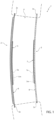
Figures 3 and 4 show, in front view, a portion of the window ofFigure 1 . -
Figure 1 denotes, as a whole, 1 an aircraft passenger window configured to reduce the intensity of noise and of vibrations transmitted from outside the aircraft to inside the aircraft cabin comprising: - a first element of
transparent material 2 arranged, in use, facing the outside of the aircraft; - a second element of
transparent material 3 arranged, in use, facing the cabin; - a gap 4 that separates the first and second elements of
transparent material - Typically, the first and second elements of
transparent material elements perimeter edges - According to the present invention there is provided a first
transparent sheet element 5 applied to a first face 6 of the first element oftransparent material 2 facing the gap 4 and only a secondtransparent sheet element 7 applied to a second face 8 of thesecond element 3 facing the gap 4. - The first
transparent sheet element 5 covers a central area of the first face 6 and is spaced from the edges of the first face 6 so that theperimeter edges 2c of the firsttransparent element 2 are free of said first sheet element 5 (seeFigure 3 ). - The second
transparent sheet element 7 covers a central area of the second face 8 and is spaced from the perimeter edges of the second face 8 so that theperimeter edges 3c of the secondtransparent element 3 are free of saidsecond sheet element 7. - The first and second
transparent sheet elements 5, 6 are made of transparent viscoelastic material. - As is well known, purely viscous materials respond to a tangential stress exhibiting a behaviour consistent with Newton's law, that is, by giving rise to a tangential strain within themselves equal to the product of the speed of deformation and viscosity; if they are subjected to a normal stress, they do not oppose in any way.
- The elastic materials respond to a normal stress exhibiting a behaviour consistent with Hooke's law, that is, by giving rise within them a normal strain equal to the product of Young's modulus and deformation (expressed in terms of percentage elongation) and returning to their original state when these stresses cease; if instead they are subjected to a tangential stress, they do not oppose in any way.
- Viscoelastic materials oppose both tangential stresses and normal stresses, thus generating both tangential strains and normal strains within them.
- Examples of viscoelastic materials are some amorphous polymers, some semi-crystalline polymers and some biopolymers.
- Other examples are the thermosetting polymers, which at an appropriate temperature behave like a viscous fluid, and the polymers in a rubbery state such as the elastomer.
- In particular, the viscoelastic material may belong to the family of acrylic polymer materials and is provided with a silicone coating film.
- Preferably, the first and second transparent elements may comprise a first plurality n of
transparent sheet layers first element 2 facing the gap 4 and a second plurality m oftransparent sheet layer second element 3 facing the gap 4. - Preferably, the
transparent sheet layers - The thicknesses vary from one tenth of a millimetre to one millimetre and the elements may preferably have the same dimension as the one underneath or smaller dimensions to facilitate the passage of light through the window. The application is carried out through the adhesive property of the transparent elements of
viscoelastic material - Furthermore, preferably the
transparent sheet layers - The thicknesses vary from one tenth of a millimetre to one millimetre and the elements may preferably have the same dimension as the one underneath or smaller dimensions to facilitate the passage of light through the window. The application is carried out through the adhesive property of the transparent elements of
viscoelastic material - The window shown above solves the problem of vibration and noise transmission by providing one or more layers of varying thickness of viscoelastic material, each of which is applied internally to the transparent elements of which the pre-existing window configuration is composed.
- The two
viscoelastic elements transparent material 2 and the second element of transparent material 3) and the vibrations transmitted structurally (from the structure of the aircraft directly to the second element of transparent material 3) obtaining a high overall damping performance. - This leads to acoustic performances that, at least up to 800 Hz, are advantageous compared to the solutions proposed by the prior art.
- In
Figure 2 in fact it can be seen that the loss of sound transmission (also called Insulating Power - Transmission Loss), represented by a measurement in dB of the ratio between the incident sound power and the power transmitted through a dividing element hit by an acoustic wavefront, is maintained between 20 and about 30 dB in the range 160Hz and 800 Hz which corresponds to both the multiple rotation frequencies of many turboprop engines, and to a portion of the frequencies of the noise generated by the turbulent aerodynamic flows on the fuselage. The line indicated with a non-continuous stroke indicates the performance of a window made according to the present invention (Window UP with viscoelastic) while the curve indicated with a solid stroke indicates the performance of a window made according to the known art (Window UP without viscoelastic) . -
- 1
- aircraft window
- 2
- first element of transparent material
- 3
- second element of transparent material
- 4
- gap
- 5
- first transparent sheet element
- 6
- face
- 7
- second transparent sheet element
- 8
- face
Claims (5)
- An aircraft window configured to reduce the intensity of vibrations transmitted from outside the aircraft to inside the aircraft cabin comprising:a first element of transparent material (2) arranged, in use, facing the outside of the aircraft;a second element of transparent material (3) arranged, in use, facing the cabin;a gap (4) that separates the first and second elements of transparent material (2,3) which are arranged facing and spaced apart from one another;at least a first transparent sheet element (5) applied to a first face of the first element (2) facing the gap;at least one second transparent sheet element (7) applied to a second face of the second element (3) facing the gap;the first and second transparent sheet elements (5,7) being made of transparent viscoelastic material, characterised in that it comprises:the first transparent sheet element (5) covers a central area of the first face (6) and is spaced from the edges of the first face (6) so that the perimeter edges (2c) of the first transparent sheet element (2) are free of said first sheet element (5);the second transparent sheet element (7) covers a central area of the second face (8) and is spaced from the perimeter edges of the second face (8) so that the perimeter edges (3c) of the second transparent sheet element (3) are free of said second sheet element (7).
- The window according to claim 1, wherein a first plurality of transparent sheet elements (5, 5a, ... 5n) of viscoelastic material are provided superimposed over one another so as to obtain a layered structure applied to the first face (6) of the first element facing the gap, and a second plurality of transparent sheet elements of transparent viscoelastic material superimposed over one another so as to obtain a layered structure applied to a first face of the second element facing the gap.
- The window according to claim 2, wherein the transparent sheet elements belonging to the first layered structure have different thicknesses from one another.
- The window according to claim 2 or 3, wherein the transparent sheet elements belonging to the second layered structure have different thicknesses from one another.
- The window according to any one of the preceding claims, wherein the viscoelastic material belongs to the family of acrylic polymer materials and is provided with a silicone coating film.
Applications Claiming Priority (2)
| Application Number | Priority Date | Filing Date | Title |
|---|---|---|---|
| IT102021000024506A IT202100024506A1 (en) | 2021-09-23 | 2021-09-23 | WINDOW FOR AIRCRAFT |
| PCT/IB2022/058862 WO2023047270A1 (en) | 2021-09-23 | 2022-09-20 | Aircraft window |
Publications (2)
| Publication Number | Publication Date |
|---|---|
| EP4405188A1 EP4405188A1 (en) | 2024-07-31 |
| EP4405188B1 true EP4405188B1 (en) | 2025-06-04 |
Family
ID=79018901
Family Applications (1)
| Application Number | Title | Priority Date | Filing Date |
|---|---|---|---|
| EP22773323.5A Active EP4405188B1 (en) | 2021-09-23 | 2022-09-20 | Aircraft window |
Country Status (4)
| Country | Link |
|---|---|
| US (1) | US20240391580A1 (en) |
| EP (1) | EP4405188B1 (en) |
| IT (1) | IT202100024506A1 (en) |
| WO (1) | WO2023047270A1 (en) |
Family Cites Families (10)
| Publication number | Priority date | Publication date | Assignee | Title |
|---|---|---|---|---|
| US4960631A (en) * | 1988-12-30 | 1990-10-02 | Ppg Industries, Inc. | Moisture seal for aircraft windows |
| US6132882A (en) | 1996-12-16 | 2000-10-17 | 3M Innovative Properties Company | Damped glass and plastic laminates |
| US5965853A (en) * | 1997-03-31 | 1999-10-12 | Ppg Industries Ohio, Inc. | Sound absorbing aircraft transparency and method of making same |
| US6294233B1 (en) * | 1999-03-23 | 2001-09-25 | C P Films, Inc. | Edge-sealed window films and methods |
| US6995339B2 (en) * | 2002-09-18 | 2006-02-07 | Ppg Industries Ohio, Inc. | Heatable wiper rest area for a transparency |
| EP1655357B1 (en) * | 2003-05-22 | 2008-02-20 | Affinity Co., Ltd. | Laminate controlling light autonomously and window using the same |
| US20070069080A1 (en) | 2005-09-28 | 2007-03-29 | The Boeing Company | Laminated passenger window with a vacuum layer for reduced noise transmission |
| US7721844B1 (en) * | 2006-10-13 | 2010-05-25 | Damping Technologies, Inc. | Vibration damping apparatus for windows using viscoelastic damping materials |
| DE102010031483A1 (en) * | 2010-07-16 | 2012-01-19 | Bayerische Motoren Werke Aktiengesellschaft | Insulating glazing, particularly for motor vehicle, has two disks arranged at distance to each other, where disks are made from conventional flat glass and is provided with transparent coating at inner side |
| JP6557412B2 (en) * | 2016-05-13 | 2019-08-14 | 株式会社レニアス | Resin glass plate and manufacturing method thereof |
-
2021
- 2021-09-23 IT IT102021000024506A patent/IT202100024506A1/en unknown
-
2022
- 2022-09-20 WO PCT/IB2022/058862 patent/WO2023047270A1/en not_active Ceased
- 2022-09-20 EP EP22773323.5A patent/EP4405188B1/en active Active
- 2022-09-20 US US18/691,759 patent/US20240391580A1/en active Pending
Also Published As
| Publication number | Publication date |
|---|---|
| WO2023047270A1 (en) | 2023-03-30 |
| US20240391580A1 (en) | 2024-11-28 |
| IT202100024506A1 (en) | 2023-03-23 |
| EP4405188A1 (en) | 2024-07-31 |
Similar Documents
| Publication | Publication Date | Title |
|---|---|---|
| US6132882A (en) | Damped glass and plastic laminates | |
| US6260660B1 (en) | Aircraft cabin interior noise treatment | |
| EP3180185B1 (en) | Progressive stiffness structural-acoustic sandwich panel | |
| US8616330B1 (en) | Actively tunable lightweight acoustic barrier materials | |
| JP5307800B2 (en) | Soundproof glazing elements | |
| ES2391145T3 (en) | Stratified passenger window that reduces noise transmission | |
| US8851423B1 (en) | Air-film vibration damping apparatus for windows | |
| Ghiringhelli et al. | Improvement of structures vibroacoustics by widespread embodiment of viscoelastic materials | |
| EP1657708A1 (en) | Sound insulation/absorption structure, and structure having these applied thereto | |
| CN103975385A (en) | High bandwidth anti-resonance film | |
| KR20100015386A (en) | Glazing with improved vibro-acoustic damping properties, method for making such glazing and method for acoustic protection in a vehicle passenger compartment | |
| RU2675770C2 (en) | Helicopter with additional noise and vibration transmission installation | |
| EP4405188B1 (en) | Aircraft window | |
| Aloufi et al. | Vibro-acoustic model of an active aircraft cabin window | |
| US2805830A (en) | Annular lift-producing wing | |
| US20070284185A1 (en) | Damped structural panel and method of making same | |
| US20220415297A1 (en) | Sound insulation device | |
| US12391359B2 (en) | Seal for a glazed element of an aircraft | |
| US20200207064A1 (en) | Multi-pane glazing for improved sound attenuation | |
| JP2022515841A5 (en) | ||
| US20240217647A1 (en) | Sound insulating glazing for an aircraft | |
| Marinova et al. | Noise-shield with membrane-type metamaterials for low-frequency sound insulation. Part II: Numerical investigation of the full-scale acoustic panel assembly | |
| US9434464B1 (en) | Window exhibiting reduced sound transmission and method of making the same | |
| MXPA99005366A (en) | Damped glass and plastic laminates | |
| Freeman et al. | Glazing for vehicle cabin sound reduction |
Legal Events
| Date | Code | Title | Description |
|---|---|---|---|
| STAA | Information on the status of an ep patent application or granted ep patent |
Free format text: STATUS: UNKNOWN |
|
| STAA | Information on the status of an ep patent application or granted ep patent |
Free format text: STATUS: THE INTERNATIONAL PUBLICATION HAS BEEN MADE |
|
| PUAI | Public reference made under article 153(3) epc to a published international application that has entered the european phase |
Free format text: ORIGINAL CODE: 0009012 |
|
| STAA | Information on the status of an ep patent application or granted ep patent |
Free format text: STATUS: REQUEST FOR EXAMINATION WAS MADE |
|
| 17P | Request for examination filed |
Effective date: 20240322 |
|
| AK | Designated contracting states |
Kind code of ref document: A1 Designated state(s): AL AT BE BG CH CY CZ DE DK EE ES FI FR GB GR HR HU IE IS IT LI LT LU LV MC MK MT NL NO PL PT RO RS SE SI SK SM TR |
|
| DAV | Request for validation of the european patent (deleted) | ||
| DAX | Request for extension of the european patent (deleted) | ||
| GRAP | Despatch of communication of intention to grant a patent |
Free format text: ORIGINAL CODE: EPIDOSNIGR1 |
|
| STAA | Information on the status of an ep patent application or granted ep patent |
Free format text: STATUS: GRANT OF PATENT IS INTENDED |
|
| INTG | Intention to grant announced |
Effective date: 20250102 |
|
| GRAS | Grant fee paid |
Free format text: ORIGINAL CODE: EPIDOSNIGR3 |
|
| GRAA | (expected) grant |
Free format text: ORIGINAL CODE: 0009210 |
|
| STAA | Information on the status of an ep patent application or granted ep patent |
Free format text: STATUS: THE PATENT HAS BEEN GRANTED |
|
| AK | Designated contracting states |
Kind code of ref document: B1 Designated state(s): AL AT BE BG CH CY CZ DE DK EE ES FI FR GB GR HR HU IE IS IT LI LT LU LV MC MK MT NL NO PL PT RO RS SE SI SK SM TR |
|
| REG | Reference to a national code |
Ref country code: GB Ref legal event code: FG4D |
|
| REG | Reference to a national code |
Ref country code: CH Ref legal event code: EP |
|
| REG | Reference to a national code |
Ref country code: DE Ref legal event code: R096 Ref document number: 602022015615 Country of ref document: DE |
|
| REG | Reference to a national code |
Ref country code: IE Ref legal event code: FG4D |
|
| REG | Reference to a national code |
Ref country code: NL Ref legal event code: MP Effective date: 20250604 |
|
| PG25 | Lapsed in a contracting state [announced via postgrant information from national office to epo] |
Ref country code: ES Free format text: LAPSE BECAUSE OF FAILURE TO SUBMIT A TRANSLATION OF THE DESCRIPTION OR TO PAY THE FEE WITHIN THE PRESCRIBED TIME-LIMIT Effective date: 20250604 Ref country code: FI Free format text: LAPSE BECAUSE OF FAILURE TO SUBMIT A TRANSLATION OF THE DESCRIPTION OR TO PAY THE FEE WITHIN THE PRESCRIBED TIME-LIMIT Effective date: 20250604 |
|
| REG | Reference to a national code |
Ref country code: LT Ref legal event code: MG9D |
|
| PG25 | Lapsed in a contracting state [announced via postgrant information from national office to epo] |
Ref country code: NO Free format text: LAPSE BECAUSE OF FAILURE TO SUBMIT A TRANSLATION OF THE DESCRIPTION OR TO PAY THE FEE WITHIN THE PRESCRIBED TIME-LIMIT Effective date: 20250904 Ref country code: GR Free format text: LAPSE BECAUSE OF FAILURE TO SUBMIT A TRANSLATION OF THE DESCRIPTION OR TO PAY THE FEE WITHIN THE PRESCRIBED TIME-LIMIT Effective date: 20250905 |
|
| PG25 | Lapsed in a contracting state [announced via postgrant information from national office to epo] |
Ref country code: PL Free format text: LAPSE BECAUSE OF FAILURE TO SUBMIT A TRANSLATION OF THE DESCRIPTION OR TO PAY THE FEE WITHIN THE PRESCRIBED TIME-LIMIT Effective date: 20250604 |
|
| PG25 | Lapsed in a contracting state [announced via postgrant information from national office to epo] |
Ref country code: BG Free format text: LAPSE BECAUSE OF FAILURE TO SUBMIT A TRANSLATION OF THE DESCRIPTION OR TO PAY THE FEE WITHIN THE PRESCRIBED TIME-LIMIT Effective date: 20250604 |
|
| PG25 | Lapsed in a contracting state [announced via postgrant information from national office to epo] |
Ref country code: HR Free format text: LAPSE BECAUSE OF FAILURE TO SUBMIT A TRANSLATION OF THE DESCRIPTION OR TO PAY THE FEE WITHIN THE PRESCRIBED TIME-LIMIT Effective date: 20250604 |
|
| PGFP | Annual fee paid to national office [announced via postgrant information from national office to epo] |
Ref country code: FR Payment date: 20250925 Year of fee payment: 4 Ref country code: AT Payment date: 20251020 Year of fee payment: 4 |
|
| PG25 | Lapsed in a contracting state [announced via postgrant information from national office to epo] |
Ref country code: RS Free format text: LAPSE BECAUSE OF FAILURE TO SUBMIT A TRANSLATION OF THE DESCRIPTION OR TO PAY THE FEE WITHIN THE PRESCRIBED TIME-LIMIT Effective date: 20250904 |
|
| PG25 | Lapsed in a contracting state [announced via postgrant information from national office to epo] |
Ref country code: LV Free format text: LAPSE BECAUSE OF FAILURE TO SUBMIT A TRANSLATION OF THE DESCRIPTION OR TO PAY THE FEE WITHIN THE PRESCRIBED TIME-LIMIT Effective date: 20250604 |
|
| PG25 | Lapsed in a contracting state [announced via postgrant information from national office to epo] |
Ref country code: NL Free format text: LAPSE BECAUSE OF FAILURE TO SUBMIT A TRANSLATION OF THE DESCRIPTION OR TO PAY THE FEE WITHIN THE PRESCRIBED TIME-LIMIT Effective date: 20250604 |
|
| PG25 | Lapsed in a contracting state [announced via postgrant information from national office to epo] |
Ref country code: PT Free format text: LAPSE BECAUSE OF FAILURE TO SUBMIT A TRANSLATION OF THE DESCRIPTION OR TO PAY THE FEE WITHIN THE PRESCRIBED TIME-LIMIT Effective date: 20251006 |
|
| REG | Reference to a national code |
Ref country code: AT Ref legal event code: MK05 Ref document number: 1800027 Country of ref document: AT Kind code of ref document: T Effective date: 20250604 |
|
| PG25 | Lapsed in a contracting state [announced via postgrant information from national office to epo] |
Ref country code: IS Free format text: LAPSE BECAUSE OF FAILURE TO SUBMIT A TRANSLATION OF THE DESCRIPTION OR TO PAY THE FEE WITHIN THE PRESCRIBED TIME-LIMIT Effective date: 20251004 |
|
| PG25 | Lapsed in a contracting state [announced via postgrant information from national office to epo] |
Ref country code: AT Free format text: LAPSE BECAUSE OF FAILURE TO SUBMIT A TRANSLATION OF THE DESCRIPTION OR TO PAY THE FEE WITHIN THE PRESCRIBED TIME-LIMIT Effective date: 20250604 Ref country code: SM Free format text: LAPSE BECAUSE OF FAILURE TO SUBMIT A TRANSLATION OF THE DESCRIPTION OR TO PAY THE FEE WITHIN THE PRESCRIBED TIME-LIMIT Effective date: 20250604 |
|
| PGFP | Annual fee paid to national office [announced via postgrant information from national office to epo] |
Ref country code: IT Payment date: 20250930 Year of fee payment: 4 |
|
| PG25 | Lapsed in a contracting state [announced via postgrant information from national office to epo] |
Ref country code: CZ Free format text: LAPSE BECAUSE OF FAILURE TO SUBMIT A TRANSLATION OF THE DESCRIPTION OR TO PAY THE FEE WITHIN THE PRESCRIBED TIME-LIMIT Effective date: 20250604 |
|
| PG25 | Lapsed in a contracting state [announced via postgrant information from national office to epo] |
Ref country code: EE Free format text: LAPSE BECAUSE OF FAILURE TO SUBMIT A TRANSLATION OF THE DESCRIPTION OR TO PAY THE FEE WITHIN THE PRESCRIBED TIME-LIMIT Effective date: 20250604 |
|
| PG25 | Lapsed in a contracting state [announced via postgrant information from national office to epo] |
Ref country code: SK Free format text: LAPSE BECAUSE OF FAILURE TO SUBMIT A TRANSLATION OF THE DESCRIPTION OR TO PAY THE FEE WITHIN THE PRESCRIBED TIME-LIMIT Effective date: 20250604 |
|
| REG | Reference to a national code |
Ref country code: DE Ref legal event code: R097 Ref document number: 602022015615 Country of ref document: DE |
|
| PG25 | Lapsed in a contracting state [announced via postgrant information from national office to epo] |
Ref country code: RO Free format text: LAPSE BECAUSE OF FAILURE TO SUBMIT A TRANSLATION OF THE DESCRIPTION OR TO PAY THE FEE WITHIN THE PRESCRIBED TIME-LIMIT Effective date: 20250604 |
|
| PLBE | No opposition filed within time limit |
Free format text: ORIGINAL CODE: 0009261 |
|
| STAA | Information on the status of an ep patent application or granted ep patent |
Free format text: STATUS: NO OPPOSITION FILED WITHIN TIME LIMIT |
|
| PG25 | Lapsed in a contracting state [announced via postgrant information from national office to epo] |
Ref country code: DK Free format text: LAPSE BECAUSE OF FAILURE TO SUBMIT A TRANSLATION OF THE DESCRIPTION OR TO PAY THE FEE WITHIN THE PRESCRIBED TIME-LIMIT Effective date: 20250604 |
|
| REG | Reference to a national code |
Ref country code: CH Ref legal event code: L10 Free format text: ST27 STATUS EVENT CODE: U-0-0-L10-L00 (AS PROVIDED BY THE NATIONAL OFFICE) Effective date: 20260416 |
|
| REG | Reference to a national code |
Ref country code: CH Ref legal event code: H13 Free format text: ST27 STATUS EVENT CODE: U-0-0-H10-H13 (AS PROVIDED BY THE NATIONAL OFFICE) Effective date: 20260425 |