EP4404504A1 - Wireless communication terminal device, authentication and key sharing method, program, and authentication and key sharing system - Google Patents
Wireless communication terminal device, authentication and key sharing method, program, and authentication and key sharing system Download PDFInfo
- Publication number
- EP4404504A1 EP4404504A1 EP22869765.2A EP22869765A EP4404504A1 EP 4404504 A1 EP4404504 A1 EP 4404504A1 EP 22869765 A EP22869765 A EP 22869765A EP 4404504 A1 EP4404504 A1 EP 4404504A1
- Authority
- EP
- European Patent Office
- Prior art keywords
- random number
- authentication
- authenticated
- unit
- terminal device
- Prior art date
- Legal status (The legal status is an assumption and is not a legal conclusion. Google has not performed a legal analysis and makes no representation as to the accuracy of the status listed.)
- Pending
Links
Images




Classifications
-
- G—PHYSICS
- G06—COMPUTING OR CALCULATING; COUNTING
- G06F—ELECTRIC DIGITAL DATA PROCESSING
- G06F21/00—Security arrangements for protecting computers, components thereof, programs or data against unauthorised activity
- G06F21/30—Authentication, i.e. establishing the identity or authorisation of security principals
- G06F21/44—Program or device authentication
-
- H—ELECTRICITY
- H04—ELECTRIC COMMUNICATION TECHNIQUE
- H04W—WIRELESS COMMUNICATION NETWORKS
- H04W12/00—Security arrangements; Authentication; Protecting privacy or anonymity
- H04W12/06—Authentication
- H04W12/069—Authentication using certificates or pre-shared keys
-
- H—ELECTRICITY
- H04—ELECTRIC COMMUNICATION TECHNIQUE
- H04L—TRANSMISSION OF DIGITAL INFORMATION, e.g. TELEGRAPHIC COMMUNICATION
- H04L9/00—Cryptographic mechanisms or cryptographic arrangements for secret or secure communications; Network security protocols
- H04L9/08—Key distribution or management, e.g. generation, sharing or updating, of cryptographic keys or passwords
- H04L9/0816—Key establishment, i.e. cryptographic processes or cryptographic protocols whereby a shared secret becomes available to two or more parties, for subsequent use
- H04L9/0819—Key transport or distribution, i.e. key establishment techniques where one party creates or otherwise obtains a secret value, and securely transfers it to the other(s)
- H04L9/083—Key transport or distribution, i.e. key establishment techniques where one party creates or otherwise obtains a secret value, and securely transfers it to the other(s) involving central third party, e.g. key distribution center [KDC] or trusted third party [TTP]
-
- H—ELECTRICITY
- H04—ELECTRIC COMMUNICATION TECHNIQUE
- H04L—TRANSMISSION OF DIGITAL INFORMATION, e.g. TELEGRAPHIC COMMUNICATION
- H04L9/00—Cryptographic mechanisms or cryptographic arrangements for secret or secure communications; Network security protocols
- H04L9/08—Key distribution or management, e.g. generation, sharing or updating, of cryptographic keys or passwords
- H04L9/0861—Generation of secret information including derivation or calculation of cryptographic keys or passwords
- H04L9/0869—Generation of secret information including derivation or calculation of cryptographic keys or passwords involving random numbers or seeds
-
- H—ELECTRICITY
- H04—ELECTRIC COMMUNICATION TECHNIQUE
- H04L—TRANSMISSION OF DIGITAL INFORMATION, e.g. TELEGRAPHIC COMMUNICATION
- H04L9/00—Cryptographic mechanisms or cryptographic arrangements for secret or secure communications; Network security protocols
- H04L9/14—Cryptographic mechanisms or cryptographic arrangements for secret or secure communications; Network security protocols using a plurality of keys or algorithms
-
- H—ELECTRICITY
- H04—ELECTRIC COMMUNICATION TECHNIQUE
- H04L—TRANSMISSION OF DIGITAL INFORMATION, e.g. TELEGRAPHIC COMMUNICATION
- H04L9/00—Cryptographic mechanisms or cryptographic arrangements for secret or secure communications; Network security protocols
- H04L9/32—Cryptographic mechanisms or cryptographic arrangements for secret or secure communications; Network security protocols including means for verifying the identity or authority of a user of the system or for message authentication, e.g. authorization, entity authentication, data integrity or data verification, non-repudiation, key authentication or verification of credentials
- H04L9/3271—Cryptographic mechanisms or cryptographic arrangements for secret or secure communications; Network security protocols including means for verifying the identity or authority of a user of the system or for message authentication, e.g. authorization, entity authentication, data integrity or data verification, non-repudiation, key authentication or verification of credentials using challenge-response
- H04L9/3273—Cryptographic mechanisms or cryptographic arrangements for secret or secure communications; Network security protocols including means for verifying the identity or authority of a user of the system or for message authentication, e.g. authorization, entity authentication, data integrity or data verification, non-repudiation, key authentication or verification of credentials using challenge-response for mutual authentication
-
- H—ELECTRICITY
- H04—ELECTRIC COMMUNICATION TECHNIQUE
- H04W—WIRELESS COMMUNICATION NETWORKS
- H04W12/00—Security arrangements; Authentication; Protecting privacy or anonymity
- H04W12/04—Key management, e.g. using generic bootstrapping architecture [GBA]
- H04W12/041—Key generation or derivation
-
- H—ELECTRICITY
- H04—ELECTRIC COMMUNICATION TECHNIQUE
- H04W—WIRELESS COMMUNICATION NETWORKS
- H04W12/00—Security arrangements; Authentication; Protecting privacy or anonymity
- H04W12/04—Key management, e.g. using generic bootstrapping architecture [GBA]
- H04W12/043—Key management, e.g. using generic bootstrapping architecture [GBA] using a trusted network node as an anchor
- H04W12/0431—Key distribution or pre-distribution; Key agreement
-
- H—ELECTRICITY
- H04—ELECTRIC COMMUNICATION TECHNIQUE
- H04W—WIRELESS COMMUNICATION NETWORKS
- H04W12/00—Security arrangements; Authentication; Protecting privacy or anonymity
- H04W12/04—Key management, e.g. using generic bootstrapping architecture [GBA]
- H04W12/043—Key management, e.g. using generic bootstrapping architecture [GBA] using a trusted network node as an anchor
- H04W12/0433—Key management protocols
-
- H—ELECTRICITY
- H04—ELECTRIC COMMUNICATION TECHNIQUE
- H04W—WIRELESS COMMUNICATION NETWORKS
- H04W12/00—Security arrangements; Authentication; Protecting privacy or anonymity
- H04W12/06—Authentication
-
- H—ELECTRICITY
- H04—ELECTRIC COMMUNICATION TECHNIQUE
- H04L—TRANSMISSION OF DIGITAL INFORMATION, e.g. TELEGRAPHIC COMMUNICATION
- H04L2209/00—Additional information or applications relating to cryptographic mechanisms or cryptographic arrangements for secret or secure communication H04L9/00
- H04L2209/80—Wireless
Definitions
- the present invention relates to a wireless communication terminal device, an authentication and key sharing method, a program, and an authentication and key sharing system.
- 5G networks are coming into widespread use.
- the security on 5G networks is performed by the mutual link authentication described below between wireless communication terminal devices and networks. That is, a unique secret key (K) written into a SIM card provided in a terminal device is shared with an authentication device on the network side, and an encryption key (CK) and an authentication key (IK) used for communication are dynamically derived from the secret key (K). Therefore, during link authentication between a terminal device and a network, three types of algorithms are used, for the key derivation process using the secret key (K), for the encryption process using the encryption key (CK) and the authentication key that have been derived, and for the authentication process.
- K unique secret key
- CK encryption key
- IK authentication key
- Such a security configuration for a 5G network is disclosed, for example, in Non-Patent Document 1.
- Non-Patent Document 1 3GPP TS 33. 102 V16.0.0 (2020-07), Technical Specification, 3rd Generation Partnership Project; Technical Specification Group Services and System Aspects; 3G Security; Security architecture (Release 16)
- One objective of the present invention is to provide a wireless communication terminal device, an authentication and key sharing method, a program, and an authentication and key sharing system that, by using authenticated encryption as a primitive, for an authentication process between wireless communication terminal devices and a network in a mobile communication network, makes the protocol more efficient, and allows for more simple execution while maintaining the necessary security level.
- a wireless communication terminal device is provided with a control unit, a storage unit that stores a unique key shared with an authentication server, and a communication unit, and the control unit is provided with an authentication request unit that generates a first random number, and that transmits to a base station, through the communication unit, an authentication request including the first random number and identification information for the wireless communication terminal device; an authenticated encryption key derivation unit that receives a response request from the base station, which has acquired a second random number generated by the authentication server that has received the authentication request from the base station, first authenticated ciphertext obtained by authenticated encryption of the first random number and the second random number, second authenticated ciphertext obtained by authenticated encryption of the second random number, and the first authenticated encryption key, the response request including the second random number and the first authenticated ciphertext, and that calculates a second authenticated encryption key based on the first random number, the second random number, and the unique key; and a response processing unit that returns to the base station, through the communication unit,
- the authentication request unit may transmit to the base station, through the communication unit, an authentication request obtained by encrypting the first random number and the identification information for the wireless communication terminal device by using a public key of the wireless communication terminal device.
- the authenticated encryption key derivation unit may derive a key for authentication and a key for encryption, based on the first random number, the second random number, and the unique key, using two different key derivation functions.
- the authenticated encryption key derivation unit may derive an authenticated encryption key, based on the first random number, the second random number, and the unique key, using a single key derivation function.
- the authenticated encryption key derivation unit may determine the validity of the calculated second authenticated encryption key based on the first authenticated ciphertext included in the response request received from the base station.
- An authentication and key sharing method is performed by a wireless communication terminal device, which is provided with a control unit, a storage unit that stores a unique key shared with an authentication server, and a communication unit, executing an authentication request step of generating a first random number, and of transmitting to a base station, through the communication unit, an authentication request including the first random number and identification information for the wireless communication terminal device; an authenticated encryption key derivation step of receiving a response request from the base station, which has acquired a second random number generated by the authentication server that has received the authentication request from the base station, first authenticated ciphertext obtained by authenticated encryption of the first random number and the second random number, second authenticated ciphertext obtained by authenticated encryption of the second random number, and the first authenticated encryption key, the response request including the second random number and the first authenticated ciphertext, and of calculating a second authenticated encryption key based on the first random number, the second random number, and the unique key; and a response processing step of returning to the base station
- a program according to one embodiment of the present invention makes a computer function as the wireless communication terminal device described above.
- An authentication and key sharing system includes a wireless communication terminal device, a base station, and an authentication server, wherein
- the authentication request unit may transmit to the base station, through the terminal device communication unit, an authentication request obtained by encrypting the first random number and the identification information for the wireless communication terminal device by using a public key of the wireless communication terminal device; the authentication request transfer unit may transmit the authentication request to the authentication server; and the authentication request reception unit may receive the authentication request through the authentication server communication unit, and may acquire the first random number and the identification information for the wireless communication terminal device by decrypting the authentication request by using a private key.
- the protocol by using authenticated encryption as a primitive, for an authentication process between wireless communication terminal devices and a network in a mobile communication network, the protocol can be made more efficient, and more simple execution is made possible while maintaining the necessary security level.
- FIG. 1 schematically illustrates an example of the overall configuration of a mobile communication system 1 to which the authentication and key sharing system according to an embodiment of the present invention is applied.
- a wireless communication terminal device 10 (hereinafter abbreviated to "terminal device 10" where the full name is not particularly necessary), a base station 20, and an authentication server 30 are communicably connected to a network 40.
- the network 40 is a mobile communication network including a wireless and a wired communication network.
- the terminal device 10 is a wireless communication terminal device, such as a smartphone or a tablet terminal, that can communication with another terminal device 10 by wireless communication with a base station 20.
- the base station 20 mediates communication between the terminal devices 10 and exchanges information with the authentication server to execute authentication processes of the terminal devices 10 for communicating with other terminal devices 10.
- the authentication server 30 executes various types of key derivation processes, etc. necessary for the authentication processes of the terminal devices 10 based on shared information, such as identification information for the terminal devices 10, received from the base station 20.
- an authenticated encryption process is used as a cryptographic primitive for the authentication process between the base station and the terminal devices described above.
- the algorithms used when executing the key derivation process, the encryption process, and the authentication process necessary for the authenticated encryption process are integrated to reduce data processing associated with the authentication process and to reduce hardware resources.
- the authentication and key sharing system according to the present embodiment can be favorably applied to a sixth-generation mobile communication system, or so-called 6G, though it is not limited thereto.
- FIG. 2 illustrates an example of the functional configuration of the wireless communication terminal device 10 according to the present embodiment.
- the terminal device 10 is an information processing device (computer) having communication functions, such as a smartphone or a tablet terminal, and is provided with a control unit 11, a storage unit 12, and a communication unit 13, as well as an input/output device, etc. for various types of data.
- a control unit 11 a storage unit 12, and a communication unit 13, as well as an input/output device, etc. for various types of data.
- the control unit 11 is a portion that controls the terminal device 10 overall, and that realizes the respective functions of the terminal device 10 in the present embodiment by appropriately reading out and executing various programs stored in the storage unit 20.
- the control unit 10 may be a processor such as a CPU.
- the storage unit 12 is a storage area for various types of data, various types of programs for making a hardware group function as the terminal device 10, etc., and may be a ROM, a RAM, a flash memory, a semiconductor (SSD), etc.
- the storage unit 20 stores programs for making the control unit 10 execute the respective functions of the present embodiment, various parameters, data input from the base station 20 to be described below, etc., data such as various types of keys derived by the respective functional units described below, etc.
- the storage unit 20 includes a storage medium in which identification information unique to the terminal device 10 is stored, and for example, includes a SIM card storing identification information for a subscriber in mobile communications. The data stored in the SIM card may be stored in the storage unit 12 by using the eSIM standard.
- the data stored by means of the eSIM standard or on a SIM card, which is a portion of the storage unit 12, includes master secret data (a unique key) that serves as input data to a key derivation function for deriving an authenticated encryption key to be described below.
- the storage unit 12 also stores a key derivation function for deriving the authenticated encryption key mentioned above.
- the master secret data and the key derivation function are used to derive authenticated ciphertext used for the authentication process between the terminal device 10 and the base station 20 to be described below.
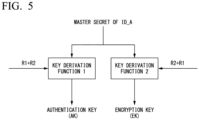
- FIG. 5 schematically illustrates the process for using a prescribed key derivation function (KDF) to derive an authentication key (AK) and an encryption key (EK) for an authenticated encryption process.
- KDF key derivation function
- This key derivation function is a function that takes, as inputs, multiple parameters including at least one secret parameter, and that provides, as an output, a key that is suitable for a prescribed algorithm or application (see, for example, ISO/IEC 11770-6:2016).
- the authentication key (AK) and the encryption key (EK) for authenticated encryption processing used as a cryptographic primitive is configured to be derived by using a key derivation function called Rocca.
- a key derivation function KDF taking, as an input, master secret data, which is a unique key shared by the terminal device 10 and the authentication server 30 through identification information for the terminal device 10, and using different combinations of a random number R1 generated by the terminal device 10 and a random number R2 generated by the authentication server 30 (in the example in FIG. 5 , a parameter prepared by coupling the random number R2 to the end of the random number R1 and a parameter prepared by coupling the random number R1 to the end of the random number R2) as keys.
- Two mutually different outputs are respectively used as an authentication key (AK) and an encryption key (EK) for an authenticated encryption process.
- AK authentication key
- EK encryption key
- any one of encrypt-then-MAC (EtM), Encrypt-and-MAC (E&M) and MAC-then-Encrypt (MtE) may be used.
- AK authentication key
- EK encryption key
- two different keys were derived by reversing the coupling order of the two random numbers R1 and R2.
- another mutually different numerical value may be added at an appropriate position (for example, random number R2 may be coupled to random number R1, and a different numeral (for example, 0 or 1) may be appended to the beginning thereof.
- the communication unit 13 is a communication module for digital wireless communication configured as an integrated circuit component including, for example, various types of passive devices for processing RF waves, and a processor for amplifying and processing signals, etc., the communication unit 13 performing data processing for wireless communication with the base station 20.
- the control unit 11 is provided with an authentication request unit 111, an authenticated encryption key derivation unit 112, and a response processing unit 113.
- the authentication request unit 111 generates a first random number R1 and transmits the first random number R1, together with identification information for itself, to the base station 20, as an authentication request.
- the authenticated encryption key derivation unit 112 receives, from the base station 20, a response request including a second random number R2 generated by the authentication server 30 and authenticated ciphertext obtained by authenticated encryption of the first random number R1 and the second random number R2, and calculates an authenticated encryption key based on the first random number R1, the second random number R2, and master secret data held by itself.
- the response processing unit 113 performs authenticated encryption of the second random number R2 by means of the authenticated encryption key calculated by the authenticated encryption key derivation unit 112, and returns a response including the authenticated ciphertext to the base station 20.
- FIG. 3 illustrates an example of the functional configuration of the base station 20 according to the present embodiment.
- the base station 20 is a server having communication functions, or an information processing device (computer), such as a personal computer, provided with a control unit 21, a storage unit 22, and a communication unit 23, as well as input/output devices, etc. for various types of data.
- an information processing device such as a personal computer, provided with a control unit 21, a storage unit 22, and a communication unit 23, as well as input/output devices, etc. for various types of data.
- the control unit 21 is a portion that controls the base station 20 overall, and that realizes the respective functions of the base station 20 in the present embodiment by appropriately reading out and executing various programs stored in the storage unit 22.
- the control unit 21 may be a processor such as a CPU.
- the storage unit 22 is a storage area for various types of data, various types of programs for making a hardware group function as the base station 20, etc., and may be a ROM, a RAM, a flash memory, a semiconductor (SSD), a hard disk (HDD), etc. Specifically, the storage unit 22 stores programs for making the control unit 21 execute the respective functions of the present embodiment, various parameters, data input from the terminal device 10 and the authentication server 30 to be described below, etc., various types of data generated by the respective functional units to be described below, etc.
- the communication unit 23 is a communication module for digital wireless communication configured as an integrated circuit component including, for example, various types of passive devices for processing RF waves, and a processor for amplifying and processing signals, etc.
- the communication unit 23 performs data processing for wireless or wired communication between the control unit 21 and the network 40.
- the control unit 21 is provided with an authentication request transfer unit 211, an authentication vector reception unit 212, and a response request transmission unit 213.
- the authentication request transfer unit 211 receives, from the terminal device 10, an authentication request including a first random number R1 and identification information for the terminal device 10, and transmits the authentication request to the authentication server 30.
- the authentication vector reception unit 212 receives, from the authentication server 30, an authentication vector including a second random number R2 generated by the authentication server 30, authenticated ciphertext obtained by authenticated encryption of the first random number R1 and the second random number R2, authenticated ciphertext obtained by authenticated encryption of the second random number R2, and an authenticated encryption key.
- the response request transmission unit 213 transmits, to the terminal device 10, a response request including the second random number R2, and the authenticated ciphertext obtained by authenticated encryption of the first random number R1 and the second random number R2.
- FIG. 4 illustrates an example of the functional configuration of the authentication server 30 according to the present embodiment.
- the authentication server 30 is a server having communication functions, or an information processing device (computer), such as a personal computer, provided with a control unit 31, a storage unit 32, and a communication unit 33, as well as input/output devices, etc. for various types of data.
- an information processing device such as a personal computer, provided with a control unit 31, a storage unit 32, and a communication unit 33, as well as input/output devices, etc. for various types of data.
- the control unit 31 is a portion that controls the authentication server 30 overall, and that realizes the respective functions of the authentication server 30 in the present embodiment by appropriately reading out and executing various programs stored in the storage unit 32.
- the control unit 31 may be a processor such as a CPU.
- the storage unit 32 is a storage area for various types of data, various types of programs for making a hardware group function as the authentication server 30, etc., and may be a ROM, a RAM, a flash memory, a semiconductor (SSD), a hard disk (HDD), etc. Specifically, the storage unit 32 stores programs for making the control unit 31 execute the respective functions of the present embodiment, various parameters, data input from the base station 20, etc., various types of data generated by the respective functional units to be described below, etc. The storage unit 32 also stores, in association with identification information unique to the terminal devices 10, master secret data that is to be input to key derivation functions for deriving authenticated encryption keys, and that is shared with the respective terminal devices 10.
- the communication unit 33 is a communication module for digital wireless communication configured as an integrated circuit component including, for example, various types of passive devices for processing RF waves, and a processor for amplifying and processing signals, etc.
- the communication unit 33 performs data processing for wireless or wired communication between the control unit 31 and the network 40.
- the control unit 31 is provided with an authentication request reception unit 311 and an authentication vector preparation unit 312.
- the authentication request reception unit 311 receives, from the base station 20, an authentication request for the terminal device 10.
- the authentication vector preparation unit 312 generates a second random number R2.
- the authentication vector preparation unit 312 calculates an authenticated encryption key based on the first random number R1, the second random number R2, and the master secret data associated with identification information obtained from the authentication request for the terminal device 10.
- the authentication vector preparation unit 312 uses the authenticated encryption key to generate an authentication vector by calculating authenticated ciphertext obtained by authenticated encryption of the first random number R1 and the second random number R2, and authenticated ciphertext obtained by authenticated encryption of the second random number R2, and transmits the authentication vector to the base station 20.
- FIG. 6 is a sequence diagram indicating the data processing between the terminal device 10, the base station 20, and the authentication server 30 in the mobile communication system for the authentication and key sharing process in the authentication and key sharing system of the present embodiment.
- the various types of data transmitted and received between the terminal device 10, the base station 20, and the authentication server 30 will be denoted by the same reference numbers as those in FIG. 6 .
- the authentication request unit 111 in the terminal device 10 When the terminal device 10 commences wireless communication with the base station 20, in step S1, the authentication request unit 111 in the terminal device 10 generates a first random number (R1). Additionally, the authentication request unit 111 reads its own identification information (ID_A) from the storage unit 12, and generates an authentication request including the first random number (R1) and the identification information (ID_A).
- ID_A its own identification information
- step S2 the authentication request unit 111 transmits the generated authentication request (1D_A, R1) to the base station 20 through the communication unit 13.
- step S3 the authentication request transfer unit 211 in the base station 20 receives the authentication request (ID_A, R1) received from the terminal device 10 through the communication unit 23.
- step S4 the authentication request transfer unit 211 in the base station 20 transmits the received authentication request (ID_A, R1) to the authentication server 30.
- step S5 the authentication request reception unit 311 in the authentication server 30 receives from the base station 20, through the communication unit 33, the authentication request (ID_A, R1) including the first random number (R1) and the identification information (1D_A) of the terminal device 10.
- the authentication vector preparation unit 312 in the authentication server 30 generates a second random number (R2).
- the authentication vector preparation unit 312 calculates a (first) authenticated encryption key (AK, EK) based on the first random number (R1), the second random number (R2), and the master secret data associated with the identification information (ID_A).
- the authentication vector preparation unit 312 uses the authenticated encryption key (AK, EK) that has been derived to calculate authenticated ciphertext (AE (R1, R2)) obtained by authenticated encryption of the first random number (R1) and the second random number (R2), and authenticated ciphertext (AE (R2)) obtained by authenticated encryption of the second random number (R2).
- the authentication vector preparation unit 312 generates an authentication vector (R2, AE (R1, R2), AE (R2), AK, EK) including the second random number (R2), the authenticated ciphertext (AE (R1, R2)) and (AE (R2)), as well as the authenticated encryption key (AK, EK).
- step S6 the authentication vector preparation unit 312 in the authentication server 30 transmits the authentication vector (R2, AE (R1, R2), AE (R2), AK, EK) that has been generated to the base station 20 through the communication unit 33.
- step S7 the authentication vector reception unit 212 in the base station 20 receives the authentication vector transmitted by the authentication server 30 through the communication unit 23.
- step S8 the response request transmission unit 213 in the base station 20 transmits to the terminal device 10, through the communication unit 23, a response request (R2, AE (R1, R2)) including the second random number (R2) and the authenticated ciphertext (AE (R1, R2)) included in the authentication vector (R2, AE (R1, R2), AE (R2), AK, EK) that has been received.
- a response request R2, AE (R1, R2)
- AE authenticated ciphertext
- step S9 the authenticated encryption key derivation unit 112 in the terminal device 10 receives the response request (R2, AE (R1, R2)) including the second random number (R2) and the authenticated ciphertext (AE (R1, R2)) received from the base station 20.
- the authenticated encryption key derivation unit 112 uses the first random number (R1) generated and held by itself, the second random number (R2) that has been received, and the master secret data stored by itself to calculate a (second) authenticated encryption key (AK, EK).
- the response processing unit 113 in the terminal device 10 performs authenticated encryption on the second random number (R2) by means of the authenticated encryption key (AK, EK) calculated by the authenticated encryption key derivation unit 112, and generates a response (AE (R2)) including the authenticated ciphertext (AE (R2)).
- step S10 the response processing unit 113 in the terminal device 10 transmits the authenticated ciphertext (AE (R2)) that has been generated to the base station 20 through the communication unit 13.
- AE authenticated ciphertext
- step S11 the base station 20 compares the authenticated ciphertext (AE (R2)) received from the terminal device 10 with the authenticated ciphertext (AE (R2)) that was received from the authentication server 30 in step S7 and held. In the case in which there is a match therebetween, the terminal device 10 is determined to have been authenticated, and wireless communication with the terminal device 10 is thereafter continued.
- AE (R2) authenticated ciphertext
- AE (R2) authenticated ciphertext
- the authentication and key sharing system in the present embodiment by using authenticated encryption as a primitive, authentication, encryption, and key derivation (key sharing) between the terminal device 10 and the base station 20 can be implemented in a single stage. As a result thereof, the safety of the authentication and key sharing system can be improved while also making the protocol more efficient. Additionally, the mounting area for a chip used to execute the protocol can be reduced, and the application for executing the protocol can be simplified. Additionally, by using authenticated encryption as a cryptographic primitive, encryption and message authentication can be realized simultaneously in the authentication and key sharing process.
- FIG. 7 indicates a sequence diagram, corresponding to FIG. 6 , according to the modified example.
- the processing steps corresponding to the processing steps in FIG. 6 are denoted by the same reference numbers.
- the authentication and key sharing process according to the modified example differs in that, when commencing wireless communication between the terminal device 10 and the base station 20, a message transmitted from the terminal device 10 is encrypted.
- the message transmitted from the terminal device 10 to the base station 20 is encrypted by a public key encryption scheme and can be decrypted by the authentication server 30, which holds, in advance, a private key for decryption.
- an authentication request unit 111 in the terminal device 10 generates an authentication request (1D_A, R1) including a first random number (R1) and identification information (ID_A), and generates ciphertext (Pub(ID_A, R1)) by encrypting the authentication request with a public key.
- This ciphertext (Pub(ID_A, R1)) is received by the authentication server 30 by using the processing steps from step S2A to step S5A.
- the ciphertext (Pub(ID_A, R1)) received by the authentication request reception unit 311 is decrypted with the held private key. Thereafter, the same process as that in the sequence diagram of FIG. 6 is performed.
- the authenticated encryption key derivation unit 112 may derive a key for authentication and a key for encryption based on the first random number R1, the second random number R2, and the unique key by using two different key derivation functions.
- the authenticated encryption key derivation unit 112 may generate the authenticated encryption key based on the first random number R1, the second random number R2, and the unique key by using one key derivation function.
- the authenticated encryption key derivation unit 112 may determine the validity of a calculated authenticated encryption key based on authenticated ciphertext obtained by authenticated encryption of the first random number R1 and the second random number R2 included in the response request received from the base station 20.
- the authentication and key sharing method according to the present embodiment is realized by means of software.
- programs constituting the software are installed in an information processing device (computer). Additionally, these programs may be recorded on removable media such as a CD-ROM and distributed to users, or they may be distributed by being downloaded to the computers of users over a network. Furthermore, these programs may be provided to the computers of users as web services over a network without being downloaded.
Landscapes
- Engineering & Computer Science (AREA)
- Computer Security & Cryptography (AREA)
- Computer Networks & Wireless Communication (AREA)
- Signal Processing (AREA)
- Theoretical Computer Science (AREA)
- Computer Hardware Design (AREA)
- Software Systems (AREA)
- Physics & Mathematics (AREA)
- General Engineering & Computer Science (AREA)
- General Physics & Mathematics (AREA)
- Mobile Radio Communication Systems (AREA)
Abstract
Description
- The present invention relates to a wireless communication terminal device, an authentication and key sharing method, a program, and an authentication and key sharing system.
- The present application claims priority on
Japanese Patent Application No. 2021-149641, filed September 14, 2021 - As infrastructures for high-speed mobile communication, 5G networks are coming into widespread use. The security on 5G networks is performed by the mutual link authentication described below between wireless communication terminal devices and networks. That is, a unique secret key (K) written into a SIM card provided in a terminal device is shared with an authentication device on the network side, and an encryption key (CK) and an authentication key (IK) used for communication are dynamically derived from the secret key (K). Therefore, during link authentication between a terminal device and a network, three types of algorithms are used, for the key derivation process using the secret key (K), for the encryption process using the encryption key (CK) and the authentication key that have been derived, and for the authentication process. Such a security configuration for a 5G network is disclosed, for example, in Non-Patent
Document 1. - [Non-Patent Document 1]
3GPP TS 33. 102 V16.0.0 (2020-07), Technical Specification, 3rd Generation Partnership Project; Technical Specification Group Services and System Aspects; 3G Security; Security architecture (Release 16) - Currently, technical specifications are being considered for a sixth-generation mobile communication system (6G) that is faster, that has lower latency, and that has excellent multi-connectivity. In 6G networks, the data processing associated with security is required to be as compact as possible in order to improve communication performance such as the high-speed performance. In this regard, there was a problem in that there is a need to simplify the scheme for authentication and key sharing between terminal devices and networks in comparison with 5G networks.
- One objective of the present invention is to provide a wireless communication terminal device, an authentication and key sharing method, a program, and an authentication and key sharing system that, by using authenticated encryption as a primitive, for an authentication process between wireless communication terminal devices and a network in a mobile communication network, makes the protocol more efficient, and allows for more simple execution while maintaining the necessary security level.
- A wireless communication terminal device according to one embodiment of the present invention is provided with a control unit, a storage unit that stores a unique key shared with an authentication server, and a communication unit, and the control unit is provided with an authentication request unit that generates a first random number, and that transmits to a base station, through the communication unit, an authentication request including the first random number and identification information for the wireless communication terminal device; an authenticated encryption key derivation unit that receives a response request from the base station, which has acquired a second random number generated by the authentication server that has received the authentication request from the base station, first authenticated ciphertext obtained by authenticated encryption of the first random number and the second random number, second authenticated ciphertext obtained by authenticated encryption of the second random number, and the first authenticated encryption key, the response request including the second random number and the first authenticated ciphertext, and that calculates a second authenticated encryption key based on the first random number, the second random number, and the unique key; and a response processing unit that returns to the base station, through the communication unit, a response including third authenticated ciphertext obtained by authenticated encryption of the second random number using the second authenticated encryption key calculated by the authenticated encryption key derivation unit.
- The authentication request unit may transmit to the base station, through the communication unit, an authentication request obtained by encrypting the first random number and the identification information for the wireless communication terminal device by using a public key of the wireless communication terminal device.
- The authenticated encryption key derivation unit may derive a key for authentication and a key for encryption, based on the first random number, the second random number, and the unique key, using two different key derivation functions.
- The authenticated encryption key derivation unit may derive an authenticated encryption key, based on the first random number, the second random number, and the unique key, using a single key derivation function.
- The authenticated encryption key derivation unit may determine the validity of the calculated second authenticated encryption key based on the first authenticated ciphertext included in the response request received from the base station.
- An authentication and key sharing method according to one embodiment of the present invention is performed by a wireless communication terminal device, which is provided with a control unit, a storage unit that stores a unique key shared with an authentication server, and a communication unit, executing an authentication request step of generating a first random number, and of transmitting to a base station, through the communication unit, an authentication request including the first random number and identification information for the wireless communication terminal device; an authenticated encryption key derivation step of receiving a response request from the base station, which has acquired a second random number generated by the authentication server that has received the authentication request from the base station, first authenticated ciphertext obtained by authenticated encryption of the first random number and the second random number, second authenticated ciphertext obtained by authenticated encryption of the second random number, and the first authenticated encryption key, the response request including the second random number and the first authenticated ciphertext, and of calculating a second authenticated encryption key based on the first random number, the second random number, and the unique key; and a response processing step of returning to the base station, through the communication unit, a response including third authenticated ciphertext obtained by authenticated encryption of the second random number using the second authenticated encryption key calculated in the authenticated encryption key derivation step.
- A program according to one embodiment of the present invention makes a computer function as the wireless communication terminal device described above.
- An authentication and key sharing system according to one embodiment of the present invention includes a wireless communication terminal device, a base station, and an authentication server, wherein
- the wireless communication terminal device is provided with a terminal device control unit, a storage unit that stores a unique key shared with the authentication server, and a terminal device communication unit, and the terminal device control unit is provided with an authentication request unit that generates a first random number, and that transmits to the base station, through the terminal device communication unit, an authentication request including the first random number and identification information for the wireless communication terminal device, an authenticated encryption key derivation unit that receives a response request from the base station, which has acquired a second random number generated by the authentication server that has received the authentication request from the base station, first authenticated ciphertext obtained by authenticated encryption of the first random number and the second random number, second authenticated ciphertext obtained by authenticated encryption of the second random number, and the first authenticated encryption key, the response request including the second random number and the first authenticated ciphertext, and that calculates a second authenticated encryption key based on the first random number, the second random number, and the unique key, and a response processing unit that returns to the base station, through the terminal device communication unit, a response including third authenticated ciphertext obtained by authenticated encryption of the second random number using the second authenticated encryption key calculated by the authenticated encryption key derivation unit;
- the base station is provided with a base station control unit and a base station communication unit, and the base station control unit is provided with an authentication request transfer unit that receives from the wireless communication terminal device, through the base station communication unit, the authentication request including the first random number and the identification information for the wireless communication terminal device, and that transmits the authentication request that has been received to the authentication server, an authentication vector reception unit that receives from the authentication server, through the base station communication unit, an authentication vector including the second random number generated by the authentication server, first authenticated ciphertext obtained by authenticated encryption of the first random number and the second random number, second authenticated ciphertext obtained by authenticated encryption of the second random number, and the first authenticated encryption key, and a response request transmission unit that transmits to the wireless communication terminal device, through the base station communication unit, a response request including the second random number and the first authenticated ciphertext included in the authentication vector; and
- the authentication server is provided with an authentication server control unit and an authentication server communication unit, and the authentication server control unit is provided with an authentication request reception unit that receives from the base station, through the authentication server communication unit, the authentication request including the first random number and identification information for the wireless communication terminal device, and an authentication vector preparation unit that generates the second random number, that generates the authentication vector by calculating the first authenticated encryption key based on the first random number, the second random number, and the unique key, by calculating the first authenticated ciphertext obtained by authenticated encryption of the first random number and the second random number, and by calculating the second authenticated ciphertext obtained by authenticated encryption of the second random number, and that transmits the authentication vector to the base station through the authentication server communication unit.
- In the authentication and key sharing system, the authentication request unit may transmit to the base station, through the terminal device communication unit, an authentication request obtained by encrypting the first random number and the identification information for the wireless communication terminal device by using a public key of the wireless communication terminal device; the authentication request transfer unit may transmit the authentication request to the authentication server; and the authentication request reception unit may receive the authentication request through the authentication server communication unit, and may acquire the first random number and the identification information for the wireless communication terminal device by decrypting the authentication request by using a private key.
- According to the present invention, by using authenticated encryption as a primitive, for an authentication process between wireless communication terminal devices and a network in a mobile communication network, the protocol can be made more efficient, and more simple execution is made possible while maintaining the necessary security level.
-
-
FIG. 1 is a block diagram illustrating an example of a configuration of a mobile communication network having an authentication and key sharing system according to an embodiment of the present invention. -
FIG. 2 is a block diagram illustrating an example of a configuration of a wireless communication terminal device according to an embodiment. -
FIG. 3 is a block diagram illustrating an example of a configuration of a base station according to an embodiment. -
FIG. 4 is a block diagram illustrating an example of a configuration of an authentication server according to an embodiment. -
FIG. 5 is a diagram indicating an example of the flow of a key derivation process implemented by an authentication and key sharing system according to an embodiment. -
FIG. 6 is a sequence diagram indicating an example of the flow of data processing executed by an authentication and key sharing system according to an embodiment of the present invention. -
FIG. 7 is a sequence diagram indicating an example of the flow of data processing executed by an authentication and key sharing system according to a modified example of an embodiment of the present invention. - Hereinafter, the present invention will be explained with reference to the attached drawings in accordance with embodiments thereof.
-
FIG. 1 schematically illustrates an example of the overall configuration of amobile communication system 1 to which the authentication and key sharing system according to an embodiment of the present invention is applied. In themobile communication system 1 inFIG. 1 , a wireless communication terminal device 10 (hereinafter abbreviated to "terminal device 10" where the full name is not particularly necessary), abase station 20, and anauthentication server 30 are communicably connected to anetwork 40. Thenetwork 40 is a mobile communication network including a wireless and a wired communication network. Theterminal device 10 is a wireless communication terminal device, such as a smartphone or a tablet terminal, that can communication with anotherterminal device 10 by wireless communication with abase station 20. Thebase station 20 mediates communication between theterminal devices 10 and exchanges information with the authentication server to execute authentication processes of theterminal devices 10 for communicating with otherterminal devices 10. Theauthentication server 30 executes various types of key derivation processes, etc. necessary for the authentication processes of theterminal devices 10 based on shared information, such as identification information for theterminal devices 10, received from thebase station 20. In the authentication and key sharing system according to the present embodiment applied to themobile communication system 1, an authenticated encryption process is used as a cryptographic primitive for the authentication process between the base station and the terminal devices described above. The algorithms used when executing the key derivation process, the encryption process, and the authentication process necessary for the authenticated encryption process are integrated to reduce data processing associated with the authentication process and to reduce hardware resources. The authentication and key sharing system according to the present embodiment can be favorably applied to a sixth-generation mobile communication system, or so-called 6G, though it is not limited thereto. - Next, the wireless
communication terminal device 10, thebase station 20, and theauthentication server 30 will each be explained.FIG. 2 illustrates an example of the functional configuration of the wirelesscommunication terminal device 10 according to the present embodiment. - The
terminal device 10 is an information processing device (computer) having communication functions, such as a smartphone or a tablet terminal, and is provided with acontrol unit 11, astorage unit 12, and acommunication unit 13, as well as an input/output device, etc. for various types of data. - The
control unit 11 is a portion that controls theterminal device 10 overall, and that realizes the respective functions of theterminal device 10 in the present embodiment by appropriately reading out and executing various programs stored in thestorage unit 20. Thecontrol unit 10 may be a processor such as a CPU. - The
storage unit 12 is a storage area for various types of data, various types of programs for making a hardware group function as theterminal device 10, etc., and may be a ROM, a RAM, a flash memory, a semiconductor (SSD), etc. Specifically, thestorage unit 20 stores programs for making thecontrol unit 10 execute the respective functions of the present embodiment, various parameters, data input from thebase station 20 to be described below, etc., data such as various types of keys derived by the respective functional units described below, etc. Thestorage unit 20 includes a storage medium in which identification information unique to theterminal device 10 is stored, and for example, includes a SIM card storing identification information for a subscriber in mobile communications. The data stored in the SIM card may be stored in thestorage unit 12 by using the eSIM standard. The data stored by means of the eSIM standard or on a SIM card, which is a portion of thestorage unit 12, includes master secret data (a unique key) that serves as input data to a key derivation function for deriving an authenticated encryption key to be described below. - Additionally, the
storage unit 12 also stores a key derivation function for deriving the authenticated encryption key mentioned above. The master secret data and the key derivation function are used to derive authenticated ciphertext used for the authentication process between theterminal device 10 and thebase station 20 to be described below. -
FIG. 5 schematically illustrates the process for using a prescribed key derivation function (KDF) to derive an authentication key (AK) and an encryption key (EK) for an authenticated encryption process. - This key derivation function is a function that takes, as inputs, multiple parameters including at least one secret parameter, and that provides, as an output, a key that is suitable for a prescribed algorithm or application (see, for example, ISO/IEC 11770-6:2016). In the present embodiment, the authentication key (AK) and the encryption key (EK) for authenticated encryption processing used as a cryptographic primitive is configured to be derived by using a key derivation function called Rocca. Regarding Rocca, see, for example, Kosei Sakamoto, Fukang Liu, Yuto Nakano, Shinsaku Kiyomoto, Takanori Isobe, "Rocca: An Efficient AES-based Encryption Scheme for Beyond 5G", Transactions on Symmetric Cryptology, ISSN 2519-173X, Vol. 2021, No. 2, pp. 1-30.
- Specifically, as illustrated in
FIG. 5 , computations are performed by a key derivation function KDF taking, as an input, master secret data, which is a unique key shared by theterminal device 10 and theauthentication server 30 through identification information for theterminal device 10, and using different combinations of a random number R1 generated by theterminal device 10 and a random number R2 generated by the authentication server 30 (in the example inFIG. 5 , a parameter prepared by coupling the random number R2 to the end of the random number R1 and a parameter prepared by coupling the random number R1 to the end of the random number R2) as keys. Two mutually different outputs are respectively used as an authentication key (AK) and an encryption key (EK) for an authenticated encryption process. As a cryptographic primitive allowing the authentication key (AK) and the encryption key (EK) that have been obtained to be used for secure communication between theterminal device 10 and thebase station 20, authenticated ciphertext can be used. - As the authenticated encryption scheme, any one of encrypt-then-MAC (EtM), Encrypt-and-MAC (E&M) and MAC-then-Encrypt (MtE) may be used.
- In the present embodiment, two different keys, i.e., an authentication key (AK) and an encryption key (EK), are derived. However, there may be only one type of parameter used as a key for the key derivation function, and the authenticated encryption process may be executed with a single key.
- Additionally, regarding the keys used by the key derivation function in the present embodiment, two different keys were derived by reversing the coupling order of the two random numbers R1 and R2. However, instead of changing the coupling order of the random numbers, another mutually different numerical value may be added at an appropriate position (for example, random number R2 may be coupled to random number R1, and a different numeral (for example, 0 or 1) may be appended to the beginning thereof.
- The
communication unit 13 is a communication module for digital wireless communication configured as an integrated circuit component including, for example, various types of passive devices for processing RF waves, and a processor for amplifying and processing signals, etc., thecommunication unit 13 performing data processing for wireless communication with thebase station 20. - The
control unit 11 is provided with anauthentication request unit 111, an authenticated encryptionkey derivation unit 112, and aresponse processing unit 113. - The
authentication request unit 111 generates a first random number R1 and transmits the first random number R1, together with identification information for itself, to thebase station 20, as an authentication request. The authenticated encryptionkey derivation unit 112 receives, from thebase station 20, a response request including a second random number R2 generated by theauthentication server 30 and authenticated ciphertext obtained by authenticated encryption of the first random number R1 and the second random number R2, and calculates an authenticated encryption key based on the first random number R1, the second random number R2, and master secret data held by itself. Theresponse processing unit 113 performs authenticated encryption of the second random number R2 by means of the authenticated encryption key calculated by the authenticated encryptionkey derivation unit 112, and returns a response including the authenticated ciphertext to thebase station 20. - Next, the
base station 20 in the present embodiment will be explained.FIG. 3 illustrates an example of the functional configuration of thebase station 20 according to the present embodiment. - The
base station 20 is a server having communication functions, or an information processing device (computer), such as a personal computer, provided with acontrol unit 21, astorage unit 22, and acommunication unit 23, as well as input/output devices, etc. for various types of data. - The
control unit 21 is a portion that controls thebase station 20 overall, and that realizes the respective functions of thebase station 20 in the present embodiment by appropriately reading out and executing various programs stored in thestorage unit 22. Thecontrol unit 21 may be a processor such as a CPU. - The
storage unit 22 is a storage area for various types of data, various types of programs for making a hardware group function as thebase station 20, etc., and may be a ROM, a RAM, a flash memory, a semiconductor (SSD), a hard disk (HDD), etc. Specifically, thestorage unit 22 stores programs for making thecontrol unit 21 execute the respective functions of the present embodiment, various parameters, data input from theterminal device 10 and theauthentication server 30 to be described below, etc., various types of data generated by the respective functional units to be described below, etc. - The
communication unit 23 is a communication module for digital wireless communication configured as an integrated circuit component including, for example, various types of passive devices for processing RF waves, and a processor for amplifying and processing signals, etc. Thecommunication unit 23 performs data processing for wireless or wired communication between thecontrol unit 21 and thenetwork 40. - The
control unit 21 is provided with an authenticationrequest transfer unit 211, an authenticationvector reception unit 212, and a responserequest transmission unit 213. - The authentication
request transfer unit 211 receives, from theterminal device 10, an authentication request including a first random number R1 and identification information for theterminal device 10, and transmits the authentication request to theauthentication server 30. The authenticationvector reception unit 212 receives, from theauthentication server 30, an authentication vector including a second random number R2 generated by theauthentication server 30, authenticated ciphertext obtained by authenticated encryption of the first random number R1 and the second random number R2, authenticated ciphertext obtained by authenticated encryption of the second random number R2, and an authenticated encryption key. The responserequest transmission unit 213 transmits, to theterminal device 10, a response request including the second random number R2, and the authenticated ciphertext obtained by authenticated encryption of the first random number R1 and the second random number R2. - Next, the
authentication server 30 in the present embodiment will be explained.FIG. 4 illustrates an example of the functional configuration of theauthentication server 30 according to the present embodiment. - The
authentication server 30 is a server having communication functions, or an information processing device (computer), such as a personal computer, provided with acontrol unit 31, astorage unit 32, and acommunication unit 33, as well as input/output devices, etc. for various types of data. - The
control unit 31 is a portion that controls theauthentication server 30 overall, and that realizes the respective functions of theauthentication server 30 in the present embodiment by appropriately reading out and executing various programs stored in thestorage unit 32. Thecontrol unit 31 may be a processor such as a CPU. - The
storage unit 32 is a storage area for various types of data, various types of programs for making a hardware group function as theauthentication server 30, etc., and may be a ROM, a RAM, a flash memory, a semiconductor (SSD), a hard disk (HDD), etc. Specifically, thestorage unit 32 stores programs for making thecontrol unit 31 execute the respective functions of the present embodiment, various parameters, data input from thebase station 20, etc., various types of data generated by the respective functional units to be described below, etc. Thestorage unit 32 also stores, in association with identification information unique to theterminal devices 10, master secret data that is to be input to key derivation functions for deriving authenticated encryption keys, and that is shared with the respectiveterminal devices 10. - The
communication unit 33 is a communication module for digital wireless communication configured as an integrated circuit component including, for example, various types of passive devices for processing RF waves, and a processor for amplifying and processing signals, etc. Thecommunication unit 33 performs data processing for wireless or wired communication between thecontrol unit 31 and thenetwork 40. - The
control unit 31 is provided with an authenticationrequest reception unit 311 and an authenticationvector preparation unit 312. - The authentication
request reception unit 311 receives, from thebase station 20, an authentication request for theterminal device 10. The authenticationvector preparation unit 312 generates a second random number R2. The authenticationvector preparation unit 312 calculates an authenticated encryption key based on the first random number R1, the second random number R2, and the master secret data associated with identification information obtained from the authentication request for theterminal device 10. The authenticationvector preparation unit 312 uses the authenticated encryption key to generate an authentication vector by calculating authenticated ciphertext obtained by authenticated encryption of the first random number R1 and the second random number R2, and authenticated ciphertext obtained by authenticated encryption of the second random number R2, and transmits the authentication vector to thebase station 20. - Next, the processing in the authentication process between the
terminal device 10 and thebase station 20 in the authentication and key sharing system according to the present embodiment will be explained.FIG. 6 is a sequence diagram indicating the data processing between theterminal device 10, thebase station 20, and theauthentication server 30 in the mobile communication system for the authentication and key sharing process in the authentication and key sharing system of the present embodiment. In the explanation below, the various types of data transmitted and received between theterminal device 10, thebase station 20, and theauthentication server 30 will be denoted by the same reference numbers as those inFIG. 6 . - When the
terminal device 10 commences wireless communication with thebase station 20, in step S1, theauthentication request unit 111 in theterminal device 10 generates a first random number (R1). Additionally, theauthentication request unit 111 reads its own identification information (ID_A) from thestorage unit 12, and generates an authentication request including the first random number (R1) and the identification information (ID_A). - In step S2, the
authentication request unit 111 transmits the generated authentication request (1D_A, R1) to thebase station 20 through thecommunication unit 13. - In step S3, the authentication
request transfer unit 211 in thebase station 20 receives the authentication request (ID_A, R1) received from theterminal device 10 through thecommunication unit 23. - In step S4, the authentication
request transfer unit 211 in thebase station 20 transmits the received authentication request (ID_A, R1) to theauthentication server 30. - In step S5, the authentication
request reception unit 311 in theauthentication server 30 receives from thebase station 20, through thecommunication unit 33, the authentication request (ID_A, R1) including the first random number (R1) and the identification information (1D_A) of theterminal device 10. The authenticationvector preparation unit 312 in theauthentication server 30 generates a second random number (R2). Next, the authenticationvector preparation unit 312 calculates a (first) authenticated encryption key (AK, EK) based on the first random number (R1), the second random number (R2), and the master secret data associated with the identification information (ID_A). Then, the authenticationvector preparation unit 312 uses the authenticated encryption key (AK, EK) that has been derived to calculate authenticated ciphertext (AE (R1, R2)) obtained by authenticated encryption of the first random number (R1) and the second random number (R2), and authenticated ciphertext (AE (R2)) obtained by authenticated encryption of the second random number (R2). As a result thereof, the authenticationvector preparation unit 312 generates an authentication vector (R2, AE (R1, R2), AE (R2), AK, EK) including the second random number (R2), the authenticated ciphertext (AE (R1, R2)) and (AE (R2)), as well as the authenticated encryption key (AK, EK). - In step S6, the authentication
vector preparation unit 312 in theauthentication server 30 transmits the authentication vector (R2, AE (R1, R2), AE (R2), AK, EK) that has been generated to thebase station 20 through thecommunication unit 33. - In step S7, the authentication
vector reception unit 212 in thebase station 20 receives the authentication vector transmitted by theauthentication server 30 through thecommunication unit 23. - In step S8, the response
request transmission unit 213 in thebase station 20 transmits to theterminal device 10, through thecommunication unit 23, a response request (R2, AE (R1, R2)) including the second random number (R2) and the authenticated ciphertext (AE (R1, R2)) included in the authentication vector (R2, AE (R1, R2), AE (R2), AK, EK) that has been received. - In step S9, the authenticated encryption
key derivation unit 112 in theterminal device 10 receives the response request (R2, AE (R1, R2)) including the second random number (R2) and the authenticated ciphertext (AE (R1, R2)) received from thebase station 20. Next, the authenticated encryptionkey derivation unit 112 uses the first random number (R1) generated and held by itself, the second random number (R2) that has been received, and the master secret data stored by itself to calculate a (second) authenticated encryption key (AK, EK). Then, theresponse processing unit 113 in theterminal device 10 performs authenticated encryption on the second random number (R2) by means of the authenticated encryption key (AK, EK) calculated by the authenticated encryptionkey derivation unit 112, and generates a response (AE (R2)) including the authenticated ciphertext (AE (R2)). - In step S10, the
response processing unit 113 in theterminal device 10 transmits the authenticated ciphertext (AE (R2)) that has been generated to thebase station 20 through thecommunication unit 13. - In step S11, the
base station 20 compares the authenticated ciphertext (AE (R2)) received from theterminal device 10 with the authenticated ciphertext (AE (R2)) that was received from theauthentication server 30 in step S7 and held. In the case in which there is a match therebetween, theterminal device 10 is determined to have been authenticated, and wireless communication with theterminal device 10 is thereafter continued. - As described above, according to the authentication and key sharing system in the present embodiment, by using authenticated encryption as a primitive, authentication, encryption, and key derivation (key sharing) between the
terminal device 10 and thebase station 20 can be implemented in a single stage. As a result thereof, the safety of the authentication and key sharing system can be improved while also making the protocol more efficient. Additionally, the mounting area for a chip used to execute the protocol can be reduced, and the application for executing the protocol can be simplified. Additionally, by using authenticated encryption as a cryptographic primitive, encryption and message authentication can be realized simultaneously in the authentication and key sharing process. - Next, a modified example of the authentication and key sharing system according to the present embodiment will be explained.
FIG. 7 indicates a sequence diagram, corresponding toFIG. 6 , according to the modified example. InFIG. 7 , the processing steps corresponding to the processing steps inFIG. 6 are denoted by the same reference numbers. - The authentication and key sharing process according to the modified example differs in that, when commencing wireless communication between the
terminal device 10 and thebase station 20, a message transmitted from theterminal device 10 is encrypted. The message transmitted from theterminal device 10 to thebase station 20 is encrypted by a public key encryption scheme and can be decrypted by theauthentication server 30, which holds, in advance, a private key for decryption. - Referring to
FIG. 7 , in step S1A, anauthentication request unit 111 in theterminal device 10 generates an authentication request (1D_A, R1) including a first random number (R1) and identification information (ID_A), and generates ciphertext (Pub(ID_A, R1)) by encrypting the authentication request with a public key. This ciphertext (Pub(ID_A, R1)) is received by theauthentication server 30 by using the processing steps from step S2A to step S5A. In theauthentication server 30, the ciphertext (Pub(ID_A, R1)) received by the authenticationrequest reception unit 311 is decrypted with the held private key. Thereafter, the same process as that in the sequence diagram ofFIG. 6 is performed. - Due to this modified example, in addition to the effects achieved by the authentication and key sharing system according to the present embodiment described above, since the message including the identification information (1D_A) transmitted from the
terminal device 10 is encrypted, there is no risk that the identification information (ID_A) could become known to a third party due to eavesdropping, thereby further increasing the security level. - The authenticated encryption
key derivation unit 112 may derive a key for authentication and a key for encryption based on the first random number R1, the second random number R2, and the unique key by using two different key derivation functions. - In this way, since different keys are used for authentication and encryption, the safety of communication can be further increased.
- The authenticated encryption
key derivation unit 112 may generate the authenticated encryption key based on the first random number R1, the second random number R2, and the unique key by using one key derivation function. - In this way, the load required for the authenticated encryption key derivation process can be reduced.
- The authenticated encryption
key derivation unit 112 may determine the validity of a calculated authenticated encryption key based on authenticated ciphertext obtained by authenticated encryption of the first random number R1 and the second random number R2 included in the response request received from thebase station 20. - In this way, since the validity of the authenticated encryption key is ensured, the safety of communication between the
terminal device 10 and thebase station 20 is improved. - Due to the embodiment described above, by using authenticated encryption as a primitive, for example, the safety of communication over a network can be improved and the protocol can be made more efficient. Additionally, the mounting area for a chip used to execute the protocol can be reduced, and the application for executing the protocol can be simplified. Therefore, it is possible to contribute to
Goal 9, "Build resilient infrastructure, promote inclusive and sustainable industrialization and foster innovation", in the sustainable development goals (SDGs) set out by the United Nations. - While embodiments of the present invention have been explained above, the present invention is not limited to the embodiments described above. Additionally, the effects described in the embodiments explained above are merely a listing of the most favorable effects occurring due to the present invention, and the effects due to the present invention are not limited to those described in the embodiments.
- The authentication and key sharing method according to the present embodiment is realized by means of software. In the case of implementation by means of software, programs constituting the software are installed in an information processing device (computer). Additionally, these programs may be recorded on removable media such as a CD-ROM and distributed to users, or they may be distributed by being downloaded to the computers of users over a network. Furthermore, these programs may be provided to the computers of users as web services over a network without being downloaded.
-
- 10
- Wireless communication terminal device
- 11
- Control unit
- 111
- Authentication request unit
- 112
- Authenticated encryption key derivation unit
- 113
- Response processing unit
- 12
- Storage unit
- 13
- Communication unit
- 20
- Base station
- 21
- Control unit
- 211
- Authentication request transfer unit
- 212
- Authentication vector reception unit
- 213
- Response request transmission unit
- 22
- Storage unit
- 23
- Communication unit
- 30
- Authentication server
- 31
- Control unit
- 311
- Authentication request reception unit
- 312
- Authentication vector preparation unit
- 32
- Storage unit
- 33
- Communication unit
- 40
- Network
Claims (9)
- A wireless communication terminal device comprising a control unit, a storage unit that stores a unique key shared with an authentication server, and a communication unit, wherein the control unit comprises:an authentication request unit that generates a first random number, and that transmits to a base station, through the communication unit, an authentication request including the first random number and identification information for the wireless communication terminal device;an authenticated encryption key derivation unit that receives a response request from the base station, which has acquired a second random number generated by the authentication server that has received the authentication request from the base station, first authenticated ciphertext obtained by authenticated encryption of the first random number and the second random number, second authenticated ciphertext obtained by authenticated encryption of the second random number, and the first authenticated encryption key, the response request including the second random number and the first authenticated ciphertext, and that calculates a second authenticated encryption key based on the first random number, the second random number, and the unique key; anda response processing unit that returns to the base station, through the communication unit, a response including third authenticated ciphertext obtained by authenticated encryption of the second random number using the second authenticated encryption key calculated by the authenticated encryption key derivation unit.
- The wireless communication terminal device according to claim 1, wherein the authentication request unit transmits to the base station, through the communication unit, an authentication request obtained by encrypting the first random number and the identification information for the wireless communication terminal device by using a public key of the wireless communication terminal device.
- The wireless communication terminal device according to claim 1 or claim 2, wherein the authenticated encryption key derivation unit derives a key for authentication and a key for encryption, based on the first random number, the second random number, and the unique key, using two different key derivation functions.
- The wireless communication terminal device according to claim 1 or claim 2, wherein the authenticated encryption key derivation unit derives the second authenticated encryption key, based on the first random number, the second random number, and the unique key, using a single key derivation function.
- The wireless communication terminal device according to any one of claim 1 to claim 4, wherein the authenticated encryption key derivation unit determines a validity of the second authenticated encryption key based on the first authenticated ciphertext included in the response request received from the base station.
- An authentication and key sharing method wherein a wireless communication terminal device comprising a control unit, a storage unit that stores a unique key shared with an authentication server, and a communication unit, executes:an authentication request step of generating a first random number, and of transmitting to a base station, through the communication unit, an authentication request including the first random number and identification information for the wireless communication terminal device;an authenticated encryption key derivation step of receiving a response request from the base station, which has acquired a second random number generated by the authentication server that has received the authentication request from the base station, first authenticated ciphertext obtained by authenticated encryption of the first random number and the second random number, second authenticated ciphertext obtained by authenticated encryption of the second random number, and the first authenticated encryption key, the response request including the second random number and the first authenticated ciphertext, and of calculating a second authenticated encryption key based on the first random number, the second random number, and the unique key; anda response processing step of returning to the base station, through the communication unit, a response including third authenticated ciphertext obtained by authenticated encryption of the second random number using the second authenticated encryption key calculated in the authenticated encryption key derivation step.
- A program for making a computer function as the wireless communication terminal device according to any one of claim 1 to claim 5.
- An authentication and key sharing system including a wireless communication terminal device, a base station, and an authentication server, whereinthe wireless communication terminal device comprises a terminal device control unit, a storage unit that stores a unique key shared with the authentication server, and a terminal device communication unit,the terminal device control unit comprisingan authentication request unit that generates a first random number, and that transmits to the base station, through the terminal device communication unit, an authentication request including the first random number and identification information for the wireless communication terminal device,an authenticated encryption key derivation unit that receives a response request from the base station, which has acquired a second random number generated by the authentication server that has received the authentication request from the base station, first authenticated ciphertext obtained by authenticated encryption of the first random number and the second random number, second authenticated ciphertext obtained by authenticated encryption of the second random number, and the first authenticated encryption key, the response request including the second random number and the first authenticated ciphertext, and that calculates a second authenticated encryption key based on the first random number, the second random number, and the unique key, anda response processing unit that returns to the base station, through the terminal device communication unit, a response including third authenticated ciphertext obtained by authenticated encryption of the second random number using the second authenticated encryption key calculated by the authenticated encryption key derivation unit;the base station comprises a base station control unit and a base station communication unit,the base station control unit comprisingan authentication request transfer unit that receives from the wireless communication terminal device, through the base station communication unit, the authentication request including the first random number and the identification information for the wireless communication terminal device, and that transmits the authentication request that has been received to the authentication server,an authentication vector reception unit that receives from the authentication server, through the base station communication unit, an authentication vector including the second random number generated by the authentication server, first authenticated ciphertext obtained by authenticated encryption of the first random number and the second random number, second authenticated ciphertext obtained by authenticated encryption of the second random number, and the first authenticated encryption key, anda response request transmission unit that transmits to the wireless communication terminal device, through the base station communication unit, a response request including the second random number and the first authenticated ciphertext included in the authentication vector; andthe authentication server comprises an authentication server control unit and an authentication server communication unit,the authentication server control unit comprisingan authentication request reception unit that receives from the base station, through the authentication server communication unit, the authentication request including the first random number and identification information for the wireless communication terminal device, andan authentication vector preparation unit that generates the second random number, that generates the authentication vector by calculating the first authenticated encryption key based on the first random number, the second random number, and the unique key, by calculating the first authenticated ciphertext obtained by authenticated encryption of the first random number and the second random number, and by calculating the second authenticated ciphertext obtained by authenticated encryption of the second random number, and that transmits the authentication vector to the base station through the authentication server communication unit.
- The authentication and key sharing system according to claim 8, wherein:the authentication request unit transmits to the base station, through the terminal device communication unit, an authentication request obtained by encrypting the first random number and the identification information for the wireless communication terminal device by using a public key of the wireless communication terminal device;the authentication request transfer unit transmits the authentication request to the authentication server; andthe authentication request reception unit receives the authentication request through the authentication server communication unit, and acquires the first random number and the identification information for the wireless communication terminal device by decrypting the authentication request by using a private key.
Applications Claiming Priority (2)
| Application Number | Priority Date | Filing Date | Title |
|---|---|---|---|
| JP2021149641A JP7674973B2 (en) | 2021-09-14 | 2021-09-14 | Wireless communication terminal device, authentication and key sharing method, program, and authentication and key sharing system |
| PCT/JP2022/031899 WO2023042618A1 (en) | 2021-09-14 | 2022-08-24 | Wireless communication terminal device, authentication and key sharing method, program, and authentication and key sharing system |
Publications (2)
| Publication Number | Publication Date |
|---|---|
| EP4404504A1 true EP4404504A1 (en) | 2024-07-24 |
| EP4404504A4 EP4404504A4 (en) | 2025-08-13 |
Family
ID=85602129
Family Applications (1)
| Application Number | Title | Priority Date | Filing Date |
|---|---|---|---|
| EP22869765.2A Pending EP4404504A4 (en) | 2021-09-14 | 2022-08-24 | WIRELESS COMMUNICATIONS TERMINAL, AUTHENTICATION AND KEY SHARING METHOD, PROGRAM AND AUTHENTICATION AND KEY SHARING SYSTEM |
Country Status (5)
| Country | Link |
|---|---|
| US (1) | US20240414534A1 (en) |
| EP (1) | EP4404504A4 (en) |
| JP (1) | JP7674973B2 (en) |
| CN (1) | CN118044153A (en) |
| WO (1) | WO2023042618A1 (en) |
Families Citing this family (1)
| Publication number | Priority date | Publication date | Assignee | Title |
|---|---|---|---|---|
| JP2025171778A (en) * | 2024-05-10 | 2025-11-20 | Kddi株式会社 | Key generation device, key generation method, and computer program |
Family Cites Families (14)
| Publication number | Priority date | Publication date | Assignee | Title |
|---|---|---|---|---|
| FR2825869B1 (en) * | 2001-06-08 | 2003-10-03 | France Telecom | AUTHENTICATION METHOD BETWEEN A PORTABLE TELECOMMUNICATION OBJECT AND A PUBLIC ACCESS TERMINAL |
| JP4804983B2 (en) * | 2006-03-29 | 2011-11-02 | 富士通株式会社 | Wireless terminal, authentication device, and program |
| US10181055B2 (en) * | 2007-09-27 | 2019-01-15 | Clevx, Llc | Data security system with encryption |
| US9232391B2 (en) * | 2012-05-07 | 2016-01-05 | Industrial Technology Research Institute | Authentication system for device-to-device communication and authentication method therefor |
| JP6187251B2 (en) | 2013-12-27 | 2017-08-30 | 富士通株式会社 | Data communication method and data communication apparatus |
| CN105577625B (en) | 2014-10-17 | 2019-04-23 | 西安西电捷通无线网络通信股份有限公司 | Method for authenticating entities and device based on wildcard |
| US10382206B2 (en) * | 2016-03-10 | 2019-08-13 | Futurewei Technologies, Inc. | Authentication mechanism for 5G technologies |
| CN107317789B (en) * | 2016-04-27 | 2020-07-21 | 华为技术有限公司 | Key distribution, authentication method, device and system |
| CN111512608B (en) * | 2017-09-27 | 2021-09-07 | 华为技术有限公司 | Authentication Protocol Based on Trusted Execution Environment |
| KR20190048422A (en) * | 2017-10-31 | 2019-05-09 | 삼성에스디에스 주식회사 | System and method for authentication |
| US10623186B1 (en) * | 2017-11-10 | 2020-04-14 | Amazon Technologies, Inc. | Authenticated encryption with multiple contexts |
| CN112533202B (en) * | 2019-08-30 | 2023-12-12 | 华为技术有限公司 | Identity authentication method and device |
| JP7532053B2 (en) | 2020-03-19 | 2024-08-13 | 日産自動車株式会社 | Object presentation device and object presentation method |
| WO2021109436A1 (en) * | 2020-04-28 | 2021-06-10 | Zte Corporation | Authentication server function selection in an authentication and key agreement |
-
2021
- 2021-09-14 JP JP2021149641A patent/JP7674973B2/en active Active
-
2022
- 2022-08-24 EP EP22869765.2A patent/EP4404504A4/en active Pending
- 2022-08-24 WO PCT/JP2022/031899 patent/WO2023042618A1/en not_active Ceased
- 2022-08-24 US US18/690,520 patent/US20240414534A1/en active Pending
- 2022-08-24 CN CN202280061612.4A patent/CN118044153A/en active Pending
Also Published As
| Publication number | Publication date |
|---|---|
| WO2023042618A1 (en) | 2023-03-23 |
| EP4404504A4 (en) | 2025-08-13 |
| JP7674973B2 (en) | 2025-05-12 |
| US20240414534A1 (en) | 2024-12-12 |
| CN118044153A (en) | 2024-05-14 |
| JP2023042375A (en) | 2023-03-27 |
Similar Documents
| Publication | Publication Date | Title |
|---|---|---|
| CA3061233C (en) | Provisioning a secure connection using a pre-shared key | |
| US8842833B2 (en) | System and method for secure transaction of data between wireless communication device and server | |
| KR100922906B1 (en) | Bootstrapping authentication using distinguished random challenges | |
| CN117546441A (en) | Secure communication method and device, terminal equipment and network equipment | |
| US20200195446A1 (en) | System and method for ensuring forward & backward secrecy using physically unclonable functions | |
| CN103415008A (en) | Encryption communication method and encryption communication system | |
| CN109413645A (en) | The method and apparatus of access authentication | |
| WO2018024048A1 (en) | Authentication method, server, terminal, and gateway | |
| US20190149326A1 (en) | Key obtaining method and apparatus | |
| CN112118568A (en) | Method and equipment for authenticating equipment identity | |
| WO2018047132A1 (en) | A system and method for authentication and secure communication | |
| CN112839329A (en) | A verification method, apparatus, device, and computer-readable storage medium | |
| US20240414534A1 (en) | Wireless communication terminal device, authentication and key sharing method, program, and authentication and key sharing system | |
| Khan et al. | Authentication and secure communication in GSM, GPRS, and UMTS using asymmetric cryptography | |
| EP2965488B1 (en) | Method and system for preparing a communication between a user device and a server | |
| Yang | Across-authority lightweight ownership transfer protocol | |
| KR101181558B1 (en) | Anonymous Authentication Method For Mobile Satellite Communication Systems | |
| Hu et al. | A Lightweight and Secure Authentication Protocol for 5G mMTC | |
| CN113411347B (en) | Transaction message processing method and processing device | |
| US7394901B2 (en) | Method for exchanging authentication information between a communication entity and an operator server | |
| CN114079924A (en) | Message processing method and device, related equipment and storage medium | |
| EP4697770A1 (en) | Secure communication method and apparatus | |
| CN114785497B (en) | A method and device for determining shared data for protecting data privacy | |
| Zhang et al. | CCMbAS: A Provably Secure CCM‐Based Authentication Scheme for Mobile Internet | |
| CN121036973A (en) | Physical layer data encryption methods, electronic devices and storage media |
Legal Events
| Date | Code | Title | Description |
|---|---|---|---|
| STAA | Information on the status of an ep patent application or granted ep patent |
Free format text: STATUS: THE INTERNATIONAL PUBLICATION HAS BEEN MADE |
|
| PUAI | Public reference made under article 153(3) epc to a published international application that has entered the european phase |
Free format text: ORIGINAL CODE: 0009012 |
|
| STAA | Information on the status of an ep patent application or granted ep patent |
Free format text: STATUS: REQUEST FOR EXAMINATION WAS MADE |
|
| 17P | Request for examination filed |
Effective date: 20240313 |
|
| AK | Designated contracting states |
Kind code of ref document: A1 Designated state(s): AL AT BE BG CH CY CZ DE DK EE ES FI FR GB GR HR HU IE IS IT LI LT LU LV MC MK MT NL NO PL PT RO RS SE SI SK SM TR |
|
| DAV | Request for validation of the european patent (deleted) | ||
| DAX | Request for extension of the european patent (deleted) | ||
| A4 | Supplementary search report drawn up and despatched |
Effective date: 20250714 |
|
| RIC1 | Information provided on ipc code assigned before grant |
Ipc: H04L 9/32 20060101AFI20250708BHEP Ipc: G06F 21/44 20130101ALI20250708BHEP Ipc: H04L 9/08 20060101ALI20250708BHEP Ipc: H04L 9/14 20060101ALI20250708BHEP Ipc: H04W 12/041 20210101ALI20250708BHEP Ipc: H04W 12/0431 20210101ALI20250708BHEP Ipc: H04W 12/0433 20210101ALI20250708BHEP Ipc: H04W 12/06 20210101ALI20250708BHEP |
|
| GRAP | Despatch of communication of intention to grant a patent |
Free format text: ORIGINAL CODE: EPIDOSNIGR1 |
|
| STAA | Information on the status of an ep patent application or granted ep patent |
Free format text: STATUS: GRANT OF PATENT IS INTENDED |