EP4404376A1 - Electronic device comprising antenna - Google Patents
Electronic device comprising antenna Download PDFInfo
- Publication number
- EP4404376A1 EP4404376A1 EP22878694.3A EP22878694A EP4404376A1 EP 4404376 A1 EP4404376 A1 EP 4404376A1 EP 22878694 A EP22878694 A EP 22878694A EP 4404376 A1 EP4404376 A1 EP 4404376A1
- Authority
- EP
- European Patent Office
- Prior art keywords
- electronic device
- conductive pattern
- conductive
- wireless communication
- connection member
- Prior art date
- Legal status (The legal status is an assumption and is not a legal conclusion. Google has not performed a legal analysis and makes no representation as to the accuracy of the status listed.)
- Pending
Links
Images







Classifications
-
- H—ELECTRICITY
- H01—ELECTRIC ELEMENTS
- H01Q—ANTENNAS, i.e. RADIO AERIALS
- H01Q1/00—Details of, or arrangements associated with, antennas
- H01Q1/44—Details of, or arrangements associated with, antennas using equipment having another main function to serve additionally as an antenna, e.g. means for giving an antenna an aesthetic aspect
- H01Q1/46—Electric supply lines or communication lines
-
- H—ELECTRICITY
- H01—ELECTRIC ELEMENTS
- H01Q—ANTENNAS, i.e. RADIO AERIALS
- H01Q1/00—Details of, or arrangements associated with, antennas
- H01Q1/12—Supports; Mounting means
- H01Q1/22—Supports; Mounting means by structural association with other equipment or articles
- H01Q1/24—Supports; Mounting means by structural association with other equipment or articles with receiving set
-
- H—ELECTRICITY
- H01—ELECTRIC ELEMENTS
- H01Q—ANTENNAS, i.e. RADIO AERIALS
- H01Q1/00—Details of, or arrangements associated with, antennas
- H01Q1/12—Supports; Mounting means
- H01Q1/22—Supports; Mounting means by structural association with other equipment or articles
- H01Q1/24—Supports; Mounting means by structural association with other equipment or articles with receiving set
- H01Q1/241—Supports; Mounting means by structural association with other equipment or articles with receiving set used in mobile communications, e.g. GSM
- H01Q1/242—Supports; Mounting means by structural association with other equipment or articles with receiving set used in mobile communications, e.g. GSM specially adapted for hand-held use
- H01Q1/243—Supports; Mounting means by structural association with other equipment or articles with receiving set used in mobile communications, e.g. GSM specially adapted for hand-held use with built-in antennas
-
- H—ELECTRICITY
- H01—ELECTRIC ELEMENTS
- H01Q—ANTENNAS, i.e. RADIO AERIALS
- H01Q1/00—Details of, or arrangements associated with, antennas
- H01Q1/36—Structural form of radiating elements, e.g. cone, spiral, umbrella; Particular materials used therewith
- H01Q1/38—Structural form of radiating elements, e.g. cone, spiral, umbrella; Particular materials used therewith formed by a conductive layer on an insulating support
-
- H—ELECTRICITY
- H01—ELECTRIC ELEMENTS
- H01Q—ANTENNAS, i.e. RADIO AERIALS
- H01Q5/00—Arrangements for simultaneous operation of antennas on two or more different wavebands, e.g. dual-band or multi-band arrangements
- H01Q5/30—Arrangements for providing operation on different wavebands
- H01Q5/307—Individual or coupled radiating elements, each element being fed in an unspecified way
- H01Q5/314—Individual or coupled radiating elements, each element being fed in an unspecified way using frequency dependent circuits or components, e.g. trap circuits or capacitors
- H01Q5/321—Individual or coupled radiating elements, each element being fed in an unspecified way using frequency dependent circuits or components, e.g. trap circuits or capacitors within a radiating element or between connected radiating elements
-
- H—ELECTRICITY
- H01—ELECTRIC ELEMENTS
- H01Q—ANTENNAS, i.e. RADIO AERIALS
- H01Q5/00—Arrangements for simultaneous operation of antennas on two or more different wavebands, e.g. dual-band or multi-band arrangements
- H01Q5/30—Arrangements for providing operation on different wavebands
- H01Q5/307—Individual or coupled radiating elements, each element being fed in an unspecified way
- H01Q5/314—Individual or coupled radiating elements, each element being fed in an unspecified way using frequency dependent circuits or components, e.g. trap circuits or capacitors
- H01Q5/335—Individual or coupled radiating elements, each element being fed in an unspecified way using frequency dependent circuits or components, e.g. trap circuits or capacitors at the feed, e.g. for impedance matching
-
- H—ELECTRICITY
- H01—ELECTRIC ELEMENTS
- H01Q—ANTENNAS, i.e. RADIO AERIALS
- H01Q5/00—Arrangements for simultaneous operation of antennas on two or more different wavebands, e.g. dual-band or multi-band arrangements
- H01Q5/30—Arrangements for providing operation on different wavebands
- H01Q5/307—Individual or coupled radiating elements, each element being fed in an unspecified way
- H01Q5/342—Individual or coupled radiating elements, each element being fed in an unspecified way for different propagation modes
- H01Q5/357—Individual or coupled radiating elements, each element being fed in an unspecified way for different propagation modes using a single feed point
- H01Q5/364—Creating multiple current paths
- H01Q5/371—Branching current paths
-
- H—ELECTRICITY
- H01—ELECTRIC ELEMENTS
- H01Q—ANTENNAS, i.e. RADIO AERIALS
- H01Q9/00—Electrically-short antennas having dimensions not more than twice the operating wavelength and consisting of conductive active radiating elements
- H01Q9/04—Resonant antennas
- H01Q9/30—Resonant antennas with feed to end of elongated active element, e.g. unipole
- H01Q9/42—Resonant antennas with feed to end of elongated active element, e.g. unipole with folded element, the folded parts being spaced apart a small fraction of the operating wavelength
-
- H—ELECTRICITY
- H04—ELECTRIC COMMUNICATION TECHNIQUE
- H04M—TELEPHONIC COMMUNICATION
- H04M1/00—Substation equipment, e.g. for use by subscribers
- H04M1/02—Constructional features of telephone sets
-
- H—ELECTRICITY
- H04—ELECTRIC COMMUNICATION TECHNIQUE
- H04M—TELEPHONIC COMMUNICATION
- H04M1/00—Substation equipment, e.g. for use by subscribers
- H04M1/02—Constructional features of telephone sets
- H04M1/0202—Portable telephone sets, e.g. cordless phones, mobile phones or bar type handsets
- H04M1/026—Details of the structure or mounting of specific components
-
- H—ELECTRICITY
- H04—ELECTRIC COMMUNICATION TECHNIQUE
- H04R—LOUDSPEAKERS, MICROPHONES, GRAMOPHONE PICK-UPS OR LIKE ACOUSTIC ELECTROMECHANICAL TRANSDUCERS; DEAF-AID SETS; PUBLIC ADDRESS SYSTEMS
- H04R1/00—Details of transducers, loudspeakers or microphones
- H04R1/02—Casings; Cabinets ; Supports therefor; Mountings therein
- H04R1/025—Arrangements for fixing loudspeaker transducers, e.g. in a box, furniture
-
- H—ELECTRICITY
- H04—ELECTRIC COMMUNICATION TECHNIQUE
- H04R—LOUDSPEAKERS, MICROPHONES, GRAMOPHONE PICK-UPS OR LIKE ACOUSTIC ELECTROMECHANICAL TRANSDUCERS; DEAF-AID SETS; PUBLIC ADDRESS SYSTEMS
- H04R1/00—Details of transducers, loudspeakers or microphones
- H04R1/02—Casings; Cabinets ; Supports therefor; Mountings therein
- H04R1/028—Casings; Cabinets ; Supports therefor; Mountings therein associated with devices performing functions other than acoustics, e.g. electric candles
-
- H—ELECTRICITY
- H04—ELECTRIC COMMUNICATION TECHNIQUE
- H04R—LOUDSPEAKERS, MICROPHONES, GRAMOPHONE PICK-UPS OR LIKE ACOUSTIC ELECTROMECHANICAL TRANSDUCERS; DEAF-AID SETS; PUBLIC ADDRESS SYSTEMS
- H04R3/00—Circuits for transducers, loudspeakers or microphones
-
- H—ELECTRICITY
- H04—ELECTRIC COMMUNICATION TECHNIQUE
- H04R—LOUDSPEAKERS, MICROPHONES, GRAMOPHONE PICK-UPS OR LIKE ACOUSTIC ELECTROMECHANICAL TRANSDUCERS; DEAF-AID SETS; PUBLIC ADDRESS SYSTEMS
- H04R2400/00—Loudspeakers
- H04R2400/11—Aspects regarding the frame of loudspeaker transducers
-
- H—ELECTRICITY
- H04—ELECTRIC COMMUNICATION TECHNIQUE
- H04R—LOUDSPEAKERS, MICROPHONES, GRAMOPHONE PICK-UPS OR LIKE ACOUSTIC ELECTROMECHANICAL TRANSDUCERS; DEAF-AID SETS; PUBLIC ADDRESS SYSTEMS
- H04R2420/00—Details of connection covered by H04R, not provided for in its groups
- H04R2420/07—Applications of wireless loudspeakers or wireless microphones
-
- H—ELECTRICITY
- H04—ELECTRIC COMMUNICATION TECHNIQUE
- H04R—LOUDSPEAKERS, MICROPHONES, GRAMOPHONE PICK-UPS OR LIKE ACOUSTIC ELECTROMECHANICAL TRANSDUCERS; DEAF-AID SETS; PUBLIC ADDRESS SYSTEMS
- H04R2499/00—Aspects covered by H04R or H04S not otherwise provided for in their subgroups
- H04R2499/10—General applications
- H04R2499/11—Transducers incorporated or for use in hand-held devices, e.g. mobile phones, PDA's, camera's
Definitions
- Various embodiments disclosed in this document relate to an electronic device including an antenna.
- Electronic devices can provide various functions in addition to voice communication.
- the electronic devices can provide various functions, such as a short-range wireless communication (e.g., Bluetooth, Wi-Fi, or near field communication (NFC)) function, a mobile communication (3rd generation (3G), 4G, 5G, etc.) function, a music or video playback function, a shooting function, or a navigation function.
- a short-range wireless communication e.g., Bluetooth, Wi-Fi, or near field communication (NFC)
- NFC near field communication
- the electronic device can include a speaker module for providing a sound output for voice communication, music, or video. Also, the electronic device can include an antenna that is adjacent to the speaker module and supports wireless communication.
- the electronic device can include a conductive path that delivers a low frequency signal (e.g., a direct current (DC) signal) for controlling the speaker module, and a conductive pattern that operates as an antenna radiator.
- a signal delivered to the conductive pattern can correspond to a high frequency signal (e.g., an AC signal).
- the electronic device can need to include a separate conductive connection member in order to connect the conductive path and the conductive pattern to a control circuit and a wireless communication circuit, respectively.
- the conductive path can be connected to the control circuit (e.g., an application processor) controlling the speaker module through a first conductive connection member (e.g., a C-clip).
- the conductive pattern can be connected to the wireless communication circuit (e.g., a communication processor) through a second conductive connection member.
- a material cost can increase, and there can be a disadvantage of limiting a mounting space of the electronic device.
- An embodiment of the disclosure can include a conductive pattern that includes a first portion connected to a speaker module and a second portion operating as an antenna radiator.
- An electronic device of an embodiment of the disclosure may include a first frame forming at least a portion of a first edge of the electronic device, a first speaker module disposed adjacent to the first frame, a wireless communication circuit, a conductive connection member connected to the wireless communication circuit via a first capacitor, a conductive pattern connected to the conductive connection member at a first point, and including a first portion extending from the first point and connected to the first speaker module and a second portion extending from the first point, and a control circuit electrically connected to the first speaker module through the conductive connection member.
- the first portion may include a first inductor.
- the second portion of the conductive pattern may operate as an antenna radiator.
- the wireless communication circuit may transmit and/or receive a first signal in a first frequency band by using a first electrical path comprising the first capacitor, the conductive connection member, and the second portion of the conductive pattern.
- An electronic device of an embodiment of the disclosure may include a speaker module, a wireless communication circuit, a conductive connection member connected to the wireless communication circuit via at least one capacitor, a conductive pattern connected at a first point to the conductive connection member, and including a first portion extending from the first point and connected to the speaker module and a second portion extending from the first point, and a control circuit electrically connected to the speaker module through the conductive connection member.
- the first portion may include at least one inductor.
- the wireless communication circuit may transmit and/or receive a first signal in a first frequency band by using a first electrical path that includes the at least one capacitor, the conductive connection member, and the second portion of the conductive pattern.
- the control circuit may apply a second signal to the speaker module by using a second electrical path comprising the conductive connection member, the first portion of the conductive pattern, and the at least one inductor.
- an electronic device may simplify a manufacturing process, and may minimize a manufacturing cost and a material cost.
- an electronic device may separate a low frequency signal from a high frequency signal by using a capacitor and an inductor and prevent interference between the signals.
- Fig. 1 is a block diagram illustrating an electronic device 101 in a network environment 100 according to various embodiments.
- the electronic device 101 in the network environment 100 may communicate with an electronic device 102 via a first network 198 (e.g., a short-range wireless communication network), or at least one of an electronic device 104 or a server 108 via a second network 199 (e.g., a long-range wireless communication network).
- the electronic device 101 may communicate with the electronic device 104 via the server 108.
- the electronic device 101 may include a processor 120, memory 130, an input module 150, a sound output module 155, a display module 160, an audio module 170, a sensor module 176, an interface 177, a connecting terminal 178, a haptic module 179, a camera module 180, a power management module 188, a battery 189, a communication module 190, a subscriber identification module(SIM) 196, or an antenna module 197.
- at least one of the components e.g., the connecting terminal 178) may be omitted from the electronic device 101, or one or more other components may be added in the electronic device 101.
- some of the components e.g., the sensor module 176, the camera module 180, or the antenna module 197) may be implemented as a single component (e.g., the display module 160).
- the processor 120 may execute, for example, software (e.g., a program 140) to control at least one other component (e.g., a hardware or software component) of the electronic device 101 coupled with the processor 120, and may perform various data processing or computation. According to one embodiment, as at least part of the data processing or computation, the processor 120 may store a command or data received from another component (e.g., the sensor module 176 or the communication module 190) in volatile memory 132, process the command or the data stored in the volatile memory 132, and store resulting data in non-volatile memory 134.
- software e.g., a program 140
- the processor 120 may store a command or data received from another component (e.g., the sensor module 176 or the communication module 190) in volatile memory 132, process the command or the data stored in the volatile memory 132, and store resulting data in non-volatile memory 134.
- the processor 120 may include a main processor 121 (e.g., a central processing unit (CPU) or an application processor (AP)), or an auxiliary processor 123 (e.g., a graphics processing unit (GPU), a neural processing unit (NPU), an image signal processor (ISP), a sensor hub processor, or a communication processor (CP)) that is operable independently from, or in conjunction with, the main processor 121.
- a main processor 121 e.g., a central processing unit (CPU) or an application processor (AP)
- auxiliary processor 123 e.g., a graphics processing unit (GPU), a neural processing unit (NPU), an image signal processor (ISP), a sensor hub processor, or a communication processor (CP)
- the main processor 121 may be adapted to consume less power than the main processor 121, or to be specific to a specified function.
- the auxiliary processor 123 may be implemented as separate from, or as part of the main processor 121.
- the auxiliary processor 123 may control at least some of functions or states related to at least one component (e.g., the display module 160, the sensor module 176, or the communication module 190) among the components of the electronic device 101, instead of the main processor 121 while the main processor 121 is in an inactive (e.g., sleep) state, or together with the main processor 121 while the main processor 121 is in an active state (e.g., executing an application).
- the auxiliary processor 123 e.g., an image signal processor or a communication processor
- the auxiliary processor 123 may include a hardware structure specified for artificial intelligence model processing.
- An artificial intelligence model may be generated by machine learning. Such learning may be performed, e.g., by the electronic device 101 where the artificial intelligence is performed or via a separate server (e.g., the server 108). Learning algorithms may include, but are not limited to, e.g., supervised learning, unsupervised learning, semi-supervised learning, or reinforcement learning.
- the artificial intelligence model may include a plurality of artificial neural network layers.
- the artificial neural network may be a deep neural network (DNN), a convolutional neural network (CNN), a recurrent neural network (RNN), a restricted boltzmann machine (RBM), a deep belief network (DBN), a bidirectional recurrent deep neural network (BRDNN), deep Q-network or a combination of two or more thereof but is not limited thereto.
- the artificial intelligence model may, additionally or alternatively, include a software structure other than the hardware structure.
- the memory 130 may store various data used by at least one component (e.g., the processor 120 or the sensor module 176) of the electronic device 101.
- the various data may include, for example, software (e.g., the program 140) and input data or output data for a command related thererto.
- the memory 130 may include the volatile memory 132 or the non-volatile memory 134.
- the program 140 may be stored in the memory 130 as software, and may include, for example, an operating system (OS) 142, middleware 144, or an application 146.
- OS operating system
- middleware middleware
- application application
- the input module 150 may receive a command or data to be used by another component (e.g., the processor 120) of the electronic device 101, from the outside (e.g., a user) of the electronic device 101.
- the input module 150 may include, for example, a microphone, a mouse, a keyboard, a key (e.g., a button), or a digital pen (e.g., a stylus pen).
- the sound output module 155 may output sound signals to the outside of the electronic device 101.
- the sound output module 155 may include, for example, a speaker or a receiver.
- the speaker may be used for general purposes, such as playing multimedia or playing record.
- the receiver may be used for receiving incoming calls. According to an embodiment, the receiver may be implemented as separate from, or as part of the speaker.
- the display module 160 may visually provide information to the outside (e.g., a user) of the electronic device 101.
- the display module 160 may include, for example, a display, a hologram device, or a projector and control circuitry to control a corresponding one of the display, hologram device, and projector.
- the display module 160 may include a touch sensor adapted to detect a touch, or a pressure sensor adapted to measure the intensity of force incurred by the touch.
- the audio module 170 may convert a sound into an electrical signal and vice versa. According to an embodiment, the audio module 170 may obtain the sound via the input module 150, or output the sound via the sound output module 155 or a headphone of an external electronic device (e.g., an electronic device 102) directly (e.g., wiredly) or wirelessly coupled with the electronic device 101.
- an external electronic device e.g., an electronic device 102
- directly e.g., wiredly
- wirelessly e.g., wirelessly
- the sensor module 176 may detect an operational state (e.g., power or temperature) of the electronic device 101 or an environmental state (e.g., a state of a user) external to the electronic device 101, and then generate an electrical signal or data value corresponding to the detected state.
- the sensor module 176 may include, for example, a gesture sensor, a gyro sensor, an atmospheric pressure sensor, a magnetic sensor, an acceleration sensor, a grip sensor, a proximity sensor, a color sensor, an infrared (IR) sensor, a biometric sensor, a temperature sensor, a humidity sensor, or an illuminance sensor.
- the interface 177 may support one or more specified protocols to be used for the electronic device 101 to be coupled with the external electronic device (e.g., the electronic device 102) directly (e.g., wiredly) or wirelessly.
- the interface 177 may include, for example, a high definition multimedia interface (HDMI), a universal serial bus (USB) interface, a secure digital (SD) card interface, or an audio interface.
- HDMI high definition multimedia interface
- USB universal serial bus
- SD secure digital
- a connecting terminal 178 may include a connector via which the electronic device 101 may be physically connected with the external electronic device (e.g., the electronic device 102).
- the connecting terminal 178 may include, for example, a HDMI connector, a USB connector, a SD card connector, or an audio connector (e.g., a headphone connector).
- the haptic module 179 may convert an electrical signal into a mechanical stimulus (e.g., a vibration or a movement) or electrical stimulus which may be recognized by a user via his tactile sensation or kinesthetic sensation.
- the haptic module 179 may include, for example, a motor, a piezoelectric element, or an electric stimulator.
- the camera module 180 may capture a still image or moving images.
- the camera module 180 may include one or more lenses, image sensors, image signal processors, or flashes.
- the power management module 188 may manage power supplied to the electronic device 101.
- the power management module 188 may be implemented as at least part of, for example, a power management integrated circuit (PMIC).
- PMIC power management integrated circuit
- the battery 189 may supply power to at least one component of the electronic device 101.
- the battery 189 may include, for example, a primary cell which is not rechargeable, a secondary cell which is rechargeable, or a fuel cell.
- the communication module 190 may support establishing a direct (e.g., wired) communication channel or a wireless communication channel between the electronic device 101 and the external electronic device (e.g., the electronic device 102, the electronic device 104, or the server 108) and performing communication via the established communication channel.
- the communication module 190 may include one or more communication processors that are operable independently from the processor 120 (e.g., the application processor (AP)) and supports a direct (e.g., wired) communication or a wireless communication.
- AP application processor
- the communication module 190 may include a wireless communication module 192 (e.g., a cellular communication module, a short-range wireless communication module, or a global navigation satellite system (GNSS) communication module) or a wired communication module 194 (e.g., a local area network (LAN) communication module or a power line communication (PLC) module).
- a wireless communication module 192 e.g., a cellular communication module, a short-range wireless communication module, or a global navigation satellite system (GNSS) communication module
- GNSS global navigation satellite system
- wired communication module 194 e.g., a local area network (LAN) communication module or a power line communication (PLC) module.
- LAN local area network
- PLC power line communication
- a corresponding one of these communication modules may communicate with the external electronic device via the first network 198 (e.g., a short-range communication network, such as Bluetooth TM , wireless-fidelity (Wi-Fi) direct, or infrared data association (IrDA)) or the second network 199 (e.g., a long-range communication network, such as a legacy cellular network, a 5G network, a next-generation communication network, the Internet, or a computer network (e.g., LAN or wide area network (WAN)).
- first network 198 e.g., a short-range communication network, such as Bluetooth TM , wireless-fidelity (Wi-Fi) direct, or infrared data association (IrDA)
- the second network 199 e.g., a long-range communication network, such as a legacy cellular network, a 5G network, a next-generation communication network, the Internet, or a computer network (e.g., LAN or wide area network (WAN)).
- the wireless communication module 192 may identify and authenticate the electronic device 101 in a communication network, such as the first network 198 or the second network 199, using subscriber information (e.g., international mobile subscriber identity (IMSI)) stored in the subscriber identification module 196.
- subscriber information e.g., international mobile subscriber identity (IMSI)
- the wireless communication module 192 may support a 5G network, after a 4G network, and next-generation communication technology, e.g., new radio (NR) access technology.
- the NR access technology may support enhanced mobile broadband (eMBB), massive machine type communications (mMTC), or ultra-reliable and low-latency communications (URLLC).
- eMBB enhanced mobile broadband
- mMTC massive machine type communications
- URLLC ultra-reliable and low-latency communications
- the wireless communication module 192 may support a high-frequency band (e.g., the mmWave band) to achieve, e.g., a high data transmission rate.
- the wireless communication module 192 may support various technologies for securing performance on a high-frequency band, such as, e.g., beamforming, massive multiple-input and multiple-output (massive MIMO), full dimensional MIMO (FD-MIMO), array antenna, analog beam-forming, or large scale antenna.
- the wireless communication module 192 may support various requirements specified in the electronic device 101, an external electronic device (e.g., the electronic device 104), or a network system (e.g., the second network 199).
- the wireless communication module 192 may support a peak data rate (e.g., 20Gbps or more) for implementing eMBB, loss coverage (e.g., 164dB or less) for implementing mMTC, or U-plane latency (e.g., 0.5ms or less for each of downlink (DL) and uplink (UL), or a round trip of 1ms or less) for implementing URLLC.
- a peak data rate e.g., 20Gbps or more
- loss coverage e.g., 164dB or less
- U-plane latency e.g., 0.5ms or less for each of downlink (DL) and uplink (UL), or a round trip of 1ms or less
- the antenna module 197 may transmit or receive a signal or power to or from the outside (e.g., the external electronic device) of the electronic device 101.
- the antenna module 197 may include an antenna including a radiating element composed of a conductive material or a conductive pattern formed in or on a substrate (e.g., a printed circuit board (PCB)).
- the antenna module 197 may include a plurality of antennas (e.g., array antennas). In such a case, at least one antenna appropriate for a communication scheme used in the communication network, such as the first network 198 or the second network 199, may be selected, for example, by the communication module 190 (e.g., the wireless communication module 192) from the plurality of antennas.
- the signal or the power may then be transmitted or received between the communication module 190 and the external electronic device via the selected at least one antenna.
- another component e.g., a radio frequency integrated circuit (RFIC)
- RFIC radio frequency integrated circuit
- the antenna module 197 may form a mm Wave antenna module.
- the mm Wave antenna module may include a printed circuit board, a RFIC disposed on a first surface (e.g., the bottom surface) of the printed circuit board, or adjacent to the first surface and capable of supporting a designated high-frequency band (e.g., the mmWave band), and a plurality of antennas (e.g., array antennas) disposed on a second surface (e.g., the top or a side surface) of the printed circuit board, or adjacent to the second surface and capable of transmitting or receiving signals of the designated high-frequency band.
- a RFIC disposed on a first surface (e.g., the bottom surface) of the printed circuit board, or adjacent to the first surface and capable of supporting a designated high-frequency band (e.g., the mmWave band)
- a plurality of antennas e.g., array antennas
- At least some of the above-described components may be coupled mutually and communicate signals (e.g., commands or data) therebetween via an inter-peripheral communication scheme (e.g., a bus, general purpose input and output (GPIO), serial peripheral interface (SPI), or mobile industry processor interface (MIPI)).
- an inter-peripheral communication scheme e.g., a bus, general purpose input and output (GPIO), serial peripheral interface (SPI), or mobile industry processor interface (MIPI)
- commands or data may be transmitted or received between the electronic device 101 and the external electronic device 104 via the server 108 coupled with the second network 199.
- Each of the electronic devices 102 or 104 may be a device of a same type as, or a different type, from the electronic device 101.
- all or some of operations to be executed at the electronic device 101 may be executed at one or more of the external electronic devices 102, 104, or 108. For example, if the electronic device 101 should perform a function or a service automatically, or in response to a request from a user or another device, the electronic device 101, instead of, or in addition to, executing the function or the service, may request the one or more external electronic devices to perform at least part of the function or the service.
- the one or more external electronic devices receiving the request may perform the at least part of the function or the service requested, or an additional function or an additional service related to the request, and transfer an outcome of the performing to the electronic device 101.
- the electronic device 101 may provide the outcome, with or without further processing of the outcome, as at least part of a reply to the request.
- a cloud computing, distributed computing, mobile edge computing (MEC), or client-server computing technology may be used, for example.
- the electronic device 101 may provide ultra low-latency services using, e.g., distributed computing or mobile edge computing.
- the external electronic device 104 may include an internet-of-things (IoT) device.
- the server 108 may be an intelligent server using machine learning and/or a neural network.
- the external electronic device 104 or the server 108 may be included in the second network 199.
- the electronic device 101 may be applied to intelligent services (e.g., smart home, smart city, smart car, or healthcare) based on 5G communication technology or IoT-related technology.
- the electronic device may be one of various types of electronic devices.
- the electronic devices may include, for example, a portable communication device (e.g., a smartphone), a computer device, a portable multimedia device, a portable medical device, a camera, a wearable device, or a home appliance. According to an embodiment of the disclosure, the electronic devices are not limited to those described above.
- each of such phrases as “A or B,” “at least one of A and B,” “at least one of A or B,” “A, B, or C,” “at least one of A, B, and C,” and “at least one of A, B, or C,” may include any one of, or all possible combinations of the items enumerated together in a corresponding one of the phrases.
- such terms as “1st” and “2nd,” or “first” and “second” may be used to simply distinguish a corresponding component from another, and does not limit the components in other aspect (e.g., importance or order).
- an element e.g., a first element
- the element may be coupled with the other element directly (e.g., wiredly), wirelessly, or via a third element.
- module may include a unit implemented in hardware, software, or firmware, and may interchangeably be used with other terms, for example, “logic,” “logic block,” “part,” or “circuitry”.
- a module may be a single integral component, or a minimum unit or part thereof, adapted to perform one or more functions.
- the module may be implemented in a form of an application-specific integrated circuit (ASIC).
- ASIC application-specific integrated circuit
- Various embodiments as set forth herein may be implemented as software (e.g., the program 140) including one or more instructions that are stored in a storage medium (e.g., internal memory 136 or external memory 138) that is readable by a machine (e.g., the electronic device 101).
- a processor e.g., the processor 120
- the machine e.g., the electronic device 101
- the one or more instructions may include a code generated by a complier or a code executable by an interpreter.
- the machine-readable storage medium may be provided in the form of a non-transitory storage medium.
- non-transitory simply means that the storage medium is a tangible device, and does not include a signal (e.g., an electromagnetic wave), but this term does not differentiate between where data is semi-permanently stored in the storage medium and where the data is temporarily stored in the storage medium.
- a method may be included and provided in a computer program product.
- the computer program product may be traded as a product between a seller and a buyer.
- the computer program product may be distributed in the form of a machine-readable storage medium (e.g., compact disc read only memory (CD-ROM)), or be distributed (e.g., downloaded or uploaded) online via an application store (e.g., PlayStore TM ), or between two user devices (e.g., smart phones) directly. If distributed online, at least part of the computer program product may be temporarily generated or at least temporarily stored in the machine-readable storage medium, such as memory of the manufacturer's server, a server of the application store, or a relay server.
- CD-ROM compact disc read only memory
- an application store e.g., PlayStore TM
- two user devices e.g., smart phones
- each component e.g., a module or a program of the above-described components may include a single entity or multiple entities, and some of the multiple entities may be separately disposed in different components. According to various embodiments, one or more of the above-described components may be omitted, or one or more other components may be added. Alternatively or additionally, a plurality of components (e.g., modules or programs) may be integrated into a single component. In such a case, according to various embodiments, the integrated component may still perform one or more functions of each of the plurality of components in the same or similar manner as they are performed by a corresponding one of the plurality of components before the integration.
- operations performed by the module, the program, or another component may be carried out sequentially, in parallel, repeatedly, or heuristically, or one or more of the operations may be executed in a different order or omitted, or one or more other operations may be added.
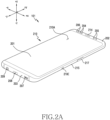
- FIG. 2A is a perspective view illustrating an electronic device according to an embodiment.
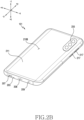
- FIG. 2B is a perspective view illustrating the electronic device of FIG. 2A seen from the rear.
- an electronic device 101 of an embodiment may include a housing 210 including a first face (or a front face) 210A, a second face (or a rear face) 210B, and a side face (or a side wall) 210C surrounding a space between the first face 210A and the second face 210B.
- a housing may also refer to a structure forming some of the first face 210A, the second face 210B, and the side face 210C of FIGS. 2A and 2B .
- the first face 210A of the electronic device 101 may be formed at least in part by a substantially transparent front plate 202 (e.g., a glass plate including various coating layers, or a polymer plate).
- the front plate 202 may include a curved portion that is bent and extended seamlessly from the first face 210A toward a rear cover 211 at least at one side edge portion.
- the second face 210B may be formed by the substantially opaque rear cover 211.
- the rear cover 211 may be formed of, for example, coated or colored glass, ceramic, polymer, metal (e.g., aluminum, stainless steel (STS), or magnesium), or a combination of at least two of the above materials.
- the rear cover 211 may include a curved portion that is bent and extended seamlessly from the second face 210B toward the front plate 202 at least at one side edge portion.
- the side face 210C of the electronic device 101 may be coupled to the front plate 202 and the rear cover 211, and may be formed by a frame structure 215 including metal and/or polymer.
- the rear cover 211 and the frame structure 215 may be formed integrally, and may include substantially the same material (e.g., a metallic material such as aluminum).
- the electronic device 101 may include at least one or more of a display 201, the audio module 170, a sensor module 204, a first camera module 205, a key input device 217, a first connector hole 208, and a second connector hole 209.
- the electronic device 101 may omit at least one (e.g., the key input device 217) of the components or may additionally include other components.
- a sensor such as a proximity sensor or illumination sensor may be integrated with the display 201 or be disposed adjacent to the display 201, within a region provided by the front plate 202.
- the electronic device 101 may further include a light emitting device 206, and the light emitting device 206 may be disposed adjacent to the display 201 within the region provided by the front plate 202.
- the light emitting device 206 may provide status information of the electronic device 101 in the form of light.
- the light emitting device 206 may provide, for example, a light source linked to the operation of the first camera module 205.
- the light emitting device 206 may include, for example, an LED, an IR LED, and a xenon lamp.
- the display 201 may be exposed, for example, through a significant portion of the front plate 202.
- the edge of the display 201 may be formed to be substantially the same as an adjacent outer edge shape (e.g., a curved face) of the front plate 202.
- an outer edge of the display 201 and an outer edge of the front plate 202 may be formed to have generally the same gap therebetween.
- a recess or opening may be formed in a portion of a screen display region of the display 201, and other electronic components aligned with the recess or opening, such as the first camera module 205 and the non-shown proximity sensor or illumination sensor, may be included.
- the display 201 may be coupled to or be disposed adjacent to a touch detection circuit, a pressure sensor capable of measuring the intensity (pressure) of touch, and/or a digitizer detecting a magnetic field-type stylus pen.
- the audio module 170 may include a microphone hole 203, at least one speaker hole 207, and a call receiver hole 214.
- a microphone for acquiring external sound may be disposed inside the microphone hole 203, and in an embodiment, a plurality of microphones may be disposed to detect the direction of sound.
- the at least one speaker hole 207 and the call receiver hole 214 may be implemented as a single hole along with the microphone hole 203, or a speaker may be included without the at least one speaker hole 207 and the call receiver hole 214 (e.g., a piezo speaker).
- the electronic device 101 may include the sensor module 204 to generate an electrical signal or data value corresponding to an internal operating state or external environmental state of the electronic device 101.
- the sensor module 204 may further include, for example, a proximity sensor disposed in the first face 210A of the housing 210, a fingerprint sensor integrated with or disposed adjacent to the display 201, and/or a biometric sensor (e.g., an HRM sensor) disposed in the second face 210B of the housing 210.
- the electronic device 101 may further include at least one of non-shown sensor modules, for example, a gesture sensor, a gyro sensor, a barometric pressure sensor, a magnetic sensor, an acceleration sensor, a grip sensor, a color sensor, an infrared (IR) sensor, a biometric sensor, a temperature sensor, a humidity sensor, or an illumination sensor.
- a gesture sensor for example, a gesture sensor, a gyro sensor, a barometric pressure sensor, a magnetic sensor, an acceleration sensor, a grip sensor, a color sensor, an infrared (IR) sensor, a biometric sensor, a temperature sensor, a humidity sensor, or an illumination sensor.
- a gesture sensor for example, a gesture sensor, a gyro sensor, a barometric pressure sensor, a magnetic sensor, an acceleration sensor, a grip sensor, a color sensor, an infrared (IR) sensor, a biometric sensor, a temperature sensor, a humidity sensor, or an illumination sensor
- the electronic device 101 may include a second camera module 255 disposed in the second face 210B.
- the first camera module 205 and the second camera module 255 may include one or more lenses, an image sensor, and/or an image signal processor.
- a flash not shown may be disposed in the second face 210B.
- the flash may include, for example, a light emitting diode or a xenon lamp.
- two or more lenses (an infrared camera, and a wide-angle and telephoto lens) and image sensors may be disposed on a face of the electronic device 101.
- the key input device 217 may be disposed in the side face 210C of the housing 210.
- the electronic device 101 may not include part or all of the key input device 217 mentioned above, and the key input devices 217 not included may be implemented in other forms such as a soft key on the display 201.
- the key input device may include at least a portion of the fingerprint sensor disposed in the second face 210B of the housing 210.
- the connector holes 208 and 209 may include the first connector hole 208 capable of accommodating a connector (e.g., a USB connector) for transmitting and receiving power and/or data with an external electronic device, and/ the second connector hole (e.g., an earphone jack) 209 capable of accommodating a connector for transmitting and receiving an audio signal with the external electronic device.
- a connector e.g., a USB connector
- the second connector hole e.g., an earphone jack
- the electronic device 101 is illustrated as a bar type, but this is only an example and the electronic device 101 may actually correspond to various types of devices.
- the electronic device 101 may correspond to a foldable device, a slidable device, a wearable device (e.g., a smart watch, and a wireless earphone), or a tablet PC. Therefore, the technical idea disclosed in this document is not limited to the bar type device illustrated in FIGS. 2A and 2B and may be applied to various types of devices.
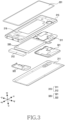
- FIG. 3 is an exploded perspective view of an electronic device according to an embodiment.
- the electronic device 101 may include the display 201, the frame structure 215, a bracket 216, a printed circuit board 310, a support member 320, a battery 330, and /or the rear cover 211.
- At least a portion of the frame structure 215 may be formed of a conductive material (e.g., aluminum), and at least a portion of the frame structure 215 may be operated as an antenna radiator for transmitting and/or receiving a wireless communication signal.
- a conductive material e.g., aluminum
- the bracket 216 may be coupled to the frame structure 215 and may support various electronic components (e.g., the display 201) within the electronic device 101. In an embodiment, the bracket 216 may support various components of the electronic device 101 or provide a space for fixing the components of the electronic device 101. For example, the bracket 216 may be disposed below (e.g., -z direction) the display 201 and support the display 201. For another example, the bracket 216 may provide a space for fixing the battery 330. In an embodiment, the frame structure 215 may be coupled to the bracket 216. In another embodiment, the frame structure 215 may be formed integrally with the bracket 216.
- the printed circuit board 310 may include a first printed circuit board 311 and/or a second printed circuit board 312. In an embodiment, the printed circuit board 310 may be disposed between the bracket 216 and the support member 320. In an embodiment, various electronic components (e.g., the processor 120 and the memory 130) may be disposed in the printed circuit board 310. In an embodiment, the printed circuit board 310 may provide an electrical connection path between various electronic components of the electronic device 101.
- the camera module 112, the battery 330, the display 201, and the processor 120 may be each directly or indirectly electrically connected to the printed circuit board 310, and the processor 120 may be operatively coupled to the camera module 112, the battery 330, and the display 260 through the electrical connection path provided by the printed circuit board 310.
- the battery 330 may be located below (e.g., -z direction) the bracket 216 and may be fixed by the bracket 216.
- the battery 330 may store power required for the electronic device 101.
- the battery 330 may include a non-rechargeable primary cell, a rechargeable secondary cell, or a fuel cell.
- the battery 330 may be disposed integrally within the electronic device 101, or may be disposed to be detachable from the electronic device 101.
- the support member 320 may include a first support member 321 and/or a second support member 322. In an embodiment, the support member 320 may be disposed below (e.g., -z direction) the printed circuit board 310 and support the printed circuit board 310.
- the support member 320 may include metal and/or non-metal (e.g., polymer).
- the rear cover 211 may be disposed below (e.g., -z direction) the support member 320.
- the rear cover 211 may be physically coupled to the frame structure 215.
- the rear cover 211 may be coupled to the frame structure 215 by at least one coupling member (e.g., a screw) not shown.
- the rear cover 211 may be coupled to the frame structure 215 by an adhesive member (e.g., an adhesive tape or adhesive liquid) not shown.
- the rear cover 211 may be formed by coated or colored glass, ceramic, polymer, metal (e.g., aluminum, stainless steel, or magnesium), or a combination of at least two of the above materials.
- the rear cover 211 may be formed integrally with the frame structure 215.
- FIG. 4A is a diagram for explaining the positions of conductive structures connected to speaker modules in an electronic device, according to an embodiment.
- the electronic device 101 of an embodiment may include a speaker module 440.
- the speaker module 440 may include a first speaker module 441 and/or a second speaker module 442.
- the speaker module 440 may be disposed in various positions of the support member 320.
- the first speaker module 441 may be disposed in a first portion 321a of the first support member 321.
- the first speaker module 441 may be located in a first direction (e.g., -z direction) of the first support member 321.
- the second speaker module 442 may be disposed in a second portion 322a of the second support member 322.
- the second speaker module 442 may be located in a first direction (e.g., -z direction) of the second support member 322.
- the electronic device 101 may include a conductive structure 430 (e.g., a flexible printed circuit board (FPCB)), and the conductive structure 430 may include a first conductive structure 431 and/or a second conductive structure 432.
- the first conductive structure 431 may be located in the first direction (e.g., -z direction) of the first support member 321 and may be electrically connected to the first speaker module 441
- the second conductive structure 432 may be located in the first direction (e.g., -z direction) of the second support member 322 and may be electrically connected to the second speaker module 442.
- the structure and electrical connection relationship of each of the conductive structure 430 and the speaker module 440 will be described in detail in FIG. 4B below.
- FIG. 4B is an enlarged view of a first region of a first support member where a first conductive structure and a first speaker module illustrated in FIG. 4A are arranged.
- the first conductive structure 431 of an embodiment may include a first conductive pattern 450.
- the first conductive pattern 450 may include a first portion 451 and/or a second portion 452.
- the first conductive pattern 450 may include the first portion 451 extending from a first point P1 and connected to the first speaker module 441.
- the first conductive pattern 450 may include the second portion 452 extending from the first point P1.
- the second portion 452 may be used as an antenna radiator as described later in FIG. 7 .
- the first point P1 may refer to a point connected to a first wireless communication circuit via a first conductive connection member 461 (e.g., C-clip) as described later in FIG. 5 .
- the first conductive pattern 450 may be formed of metal (e.g., copper (Cu)).
- the second portion 452 of the first conductive pattern 450 operating as the antenna radiator may have various shapes.
- the second portion 452 of the first conductive pattern 450 may have an L-shape.
- the shape and/or electrical length of the second portion 452 of the first conductive pattern 450 may correspond to a frequency band of a signal that the electronic device 101 will transmit and/or receive through the first conductive pattern 450.
- the first conductive structure 431 may include an additional conductive pattern 470 extending from a second point P2 and connected to the first speaker module 441.
- the second point P2 may refer to a point connected to a first control circuit via a second conductive connection member 462 (e.g., a C-clip) as described later in FIG. 6 .
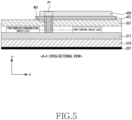
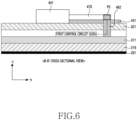
- FIG. 5 illustrates a cross-sectional view taken along line A-A' of the first conductive structure illustrated in FIG. 4B , according to an embodiment.
- the electronic device 101 of an embodiment may include a first wireless communication circuit 510, and the first wireless communication circuit 510 may be disposed on a face of the first printed circuit board 311.
- the electronic device 101 may include a first control circuit 520, and the first control circuit 520 may be disposed on a face of the first printed circuit board 311.
- the first wireless communication circuit 510 and first control circuit 520 of FIG. 5 are illustrated as being disposed on a face of the first printed circuit board 311, but this is just an example for convenience of explanation.
- the first wireless communication circuit 510 and the first control circuit 520 may be disposed in various positions of the first printed circuit board 311.
- the first control circuit 520 may correspond to a circuit that controls the operation of the first speaker module 441.
- the first control circuit 520 may include an application processor.
- the first support member 321 may be located in a first direction (e.g., -z direction) with respect to the first printed circuit board 311, and the first conductive structure 431 may be located in a first direction (e.g., -z direction) of the support member 321.
- the first direction (e.g., -z direction) may be referred to as a direction perpendicular to a face of the first printed circuit board 311 on which the first wireless communication circuit 510 and the first control circuit 520 are disposed.
- the electronic device 101 may include the first conductive connection member 461.
- the first conductive connection member 461 may be disposed at a point of the first printed circuit board 311 and may be electrically connected to the first wireless communication circuit 510 and the first control circuit 520.
- the first conductive connection member 461 may be formed to penetrate the first support member 321 and the first conductive structure 431, and may be electrically connected to the first conductive pattern 450 at the first point P1.
- the first wireless communication circuit 510 and the first control circuit 520 may be electrically connected to the first conductive pattern 450 through the first conductive connection member 461.
- FIG. 6 illustrates a cross-sectional view taken along line B-B' of the first conductive structure illustrated in FIG. 4B , according to an embodiment.
- the first control circuit 520 of an embodiment may be electrically connected to the first speaker module 441 via the second conductive connection member 462 and the additional conductive pattern 470.
- the second conductive connection member 462 may be formed to penetrate the first support member 321 and the first conductive structure 431 and may be electrically connected to the additional conductive pattern 470.
- the additional conductive pattern 470 may be electrically connected to the first speaker module 441. Since the first control circuit 520 is electrically connected to the second conductive connection member 462, as a result, the first control circuit 520 may be electrically connected to the speaker module 441 via the second conductive connection member 462 and the additional conductive pattern 470.
- the first control circuit 520 may transmit a control signal to the first speaker module 441 or receive a signal from the first speaker module 441. Signals transmitted and/or received between the first control circuit 520 and the first speaker module 441 may correspond to low frequency signals (e.g., DC signals).
- low frequency signals e.g., DC signals
- FIG. 7 is a conceptual diagram illustrating an electrical connection relationship between a first speaker module, a first conductive pattern, a first wireless communication circuit, and a first control circuit, according to an embodiment.
- the first portion 451 of the first conductive pattern 450 may be electrically connected to the first speaker module 441, and may include a first inductor L1.
- a description has been made as a concept in which the first portion 451 includes the first inductor L1 but this is only an example.
- a description may be also made as a concept in which the first inductor L1 is formed in the first portion 451 of the first conductive pattern 450.
- the second portion 452 of the first conductive pattern 450 may operate as an antenna radiator through feeding of power from the first wireless communication circuit 510.
- the first wireless communication circuit 510 may feed power to the first conductive pattern 450 via a first connection path 731 and the first conductive connection member 461.
- the second portion 452 of the first conductive pattern 450, and/or a third portion 453 between the first point P1 at which the first conductive member 461 contacts with the first conductive pattern 450 and the first inductor L1 may operate as an antenna radiator.
- the reason only up to the third portion 453 operate as the antenna radiator may be that a high frequency signal is blocked by the first inductor L1.
- the third portion 453 may substantially correspond to part of the first portion 451 of the first conductive pattern 450.
- the second portion 452 and/or third portion 453 of the first conductive pattern 450 may correspond to antenna radiators of various antenna types.
- the second portion 452 and/or third portion 453 of the first conductive pattern 450 may correspond to dipole, monopole, and/or inverted-F antenna (IFA) antenna radiators.
- IFA inverted-F antenna
- the first wireless communication circuit 510 and the first control circuit 520 may be electrically connected to the first conductive pattern 450 via the first conductive connection member 461.
- the first wireless communication circuit 510 may be electrically connected to the first conductive connection member 461 through the first connection path 731.
- a first capacitor C1 may be disposed in the first connection path 731.
- the first control circuit 520 may be electrically connected to a second conductive connection member 462 through a second connection path 732.
- a second inductor L2 may be disposed in the second connection path 732.
- the first control circuit 520 may be electrically connected to the first speaker module 441 via the additional conductive pattern 470.
- a description may be made as a concept in which the second inductor L2 is included in the second connection path 732.
- the first wireless communication circuit 510 may feed power to the second portion 452 of the first conductive pattern 450 and transmit and/or receive a signal in a specified frequency band.
- the first wireless communication circuit 510 may transmit and/or receive a signal in a first frequency band by using a first electrical path E1 that includes the first capacitor C1, the first conductive connection member 461, and/or the second portion 452 of the first conductive pattern 450.
- the first wireless communication circuit 510 may transmit and/or receive the signal in the first frequency band by using the first electrical path E1 that is formed by the first capacitor C1, the first conductive connection member 461, and/or the second portion 452 of the first conductive pattern 450.
- the first wireless communication circuit 510 may block a low frequency signal (e.g., DC signal).
- a low frequency signal e.g., DC signal
- the first wireless communication circuit 510 may not receive a low frequency signal (e.g., DC signal) applied to the first conductive pattern 450.
- the first control circuit 520 may transmit a control signal to, and/or receive from, the first speaker module 441 through the first portion 451 of the first conductive pattern 450.
- the first control circuit 520 may apply a signal to the first speaker module 441 by using a second electrical path E2 that includes the second inductor L2, the first conductive connection member 461, and/or the first portion 451 of the first conductive pattern 450.
- the first control circuit 520 may block a high frequency signal (e.g., alternating current (AC) signal).
- a high frequency signal e.g., AC signal
- a high frequency signal applied to the first conductive pattern 450 by the first wireless communication circuit 510 may be delivered to the first control circuit 520 via the second connection path 732.
- the first control circuit 520 may not receive a high frequency signal (e.g., AC signal) applied to the first conductive pattern 450.
- a high frequency signal e.g., AC signal
- the electronic device 101 may be prevented from transmitting a low frequency signal to the first wireless communication circuit 510 through the first inductor L1, the second inductor L2, and/or the first capacitor C1, or transmitting a high frequency signal to the first control circuit 520, even though the first portion of the first conductive pattern 450 used as a connection path between the first speaker module 441 and the first control circuit 520 of an embodiment is formed integrally with the second portion 452 used as an antenna radiator.
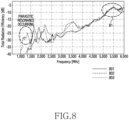
- FIG. 8 is a diagram for comparing antenna radiation efficiency graphs dependent on the arrangement or non-arrangement of a first inductor, according to an embodiment.
- a first graph 801 is an antenna radiation efficiency graph when a conductive pattern used as an antenna radiator is implemented independently without electrically connecting to the first speaker module 441.
- a second graph 802 is an antenna radiation efficiency graph when the first inductor L1 is not disposed in the first portion 451 of the first conductive pattern 450.
- a third graph 803 of an embodiment is an antenna radiation efficiency graph when the first inductor L1 is disposed in the first portion 451 of the first conductive pattern 450.
- a first inductance of the first inductor L1 may correspond to an appropriate value between about 100 nH and about 120 nH.
- the first graph 801, the second graph 802, and the third graph 803 of an embodiment show the radiation efficiency of about -10 dB to about -5 dB in a frequency band of about 5 GHz to about 6 GHz. Therefore, even when using the first conductive pattern 450 including the first portion 451 and the second portion 452, the electronic device 101 of an embodiment may secure substantially the same antenna radiation efficiency as when separately implementing only the antenna radiator.
- the second graph 802 shows a relatively high antenna radiation efficiency compared to the third graph 803, in a frequency band B1 of about 1 GHz to about 1.5 GHz.
- an inductor e.g., the first inductor L1
- parasitic resonance in the frequency band of about 1 GHz to about 1.5 GHz may be caused by the influence of a low frequency signal (e.g., DC signal) applied by the first control circuit 520.
- a low frequency signal e.g., DC signal
- the third graph 803 of an embodiment it may be identified that the parasitic resonance does not occur in the frequency band of about 1 GHz to about 1.5 GHz.
- the electronic device 101 of an embodiment may arrange the first inductor L1 in the first portion 451 of the first conductive pattern 450, thereby minimizing the influence of a low frequency signal applied by the first control circuit 520, and preventing the occurrence of parasitic resonance.
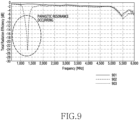
- FIG. 9 is a diagram for comparing S11 graphs dependent on the arrangement or non-arrangement of a first inductor, according to an embodiment.
- a first graph 901 of an embodiment is an S11 graph when a conductive pattern used as an antenna radiator is implemented independently without electrically connecting to the first speaker module 441.
- a second graph 902 is an S11 graph when the first inductor L1 is not disposed in the first portion 451 of the first conductive pattern 450.
- a third graph 803 of an embodiment is an S11 graph when the first inductor L1 is disposed in the first portion 451 of the first conductive pattern 450.
- the second graph 902 shows a relatively low S11 value (e.g., about -4 dB to about -24 dB) compared to the third graph 903, in a frequency band of about 1 GHz to about 1.5 GHz, and this may correspond to parasitic resonance.
- the parasitic resonance shown in the second graph 802 may be caused by the influence of a low frequency signal (e.g., DC signal) applied by the first control circuit 520.
- the electronic device 101 of an embodiment may arrange the first inductor L1 in the first portion 451 of the first conductive pattern 450, thereby minimizing the influence of the low frequency signal applied by the first control circuit 520, and preventing the occurrence of parasitic resonance in a specific frequency band (e.g., about 1 GHz to about 1.5 GHz).
- a specific frequency band e.g., about 1 GHz to about 1.5 GHz.
- FIG. 10A is a diagram illustrating a conductive structure including a matching circuit, according to an embodiment.
- the electronic device 101 of an embodiment may include a matching circuit 1010.
- the matching circuit 1010 may be disposed in the first conductive pattern 450 and may be electrically connected to the second portion 452 of the first conductive pattern 450.
- the first wireless communication circuit 510 may feed power to the second portion 452 of the first conductive pattern 450 and transmit and/or receive a signal in a first frequency band (e.g., about 5 GHz to about 6 GHz). In this case, the first wireless communication circuit 510 may control the matching circuit 1010 to perform impedance matching in response to the first frequency band.
- a first frequency band e.g., about 5 GHz to about 6 GHz
- the matching circuit 1010 may include various elements (e.g., a lumped element and a varactor), and may perform impedance matching by using the various elements.
- the matching circuit 1010 may include a variable capacitor, and may adjust a capacitance value of the variable capacitor, thereby performing impedance matching.
- the matching circuit 1010 may include a varactor, and may adjust the capacitance of the varactor, thereby performing impedance matching.
- the matching circuit 1010 may include a switch circuit and lumped elements connected to the switch circuit, and may adjust an electrical connection relationship with the lumped element through the switch circuit, thereby performing impedance matching.
- the matching circuit 1010 illustrated in FIG. 10A is illustrated as being disposed in the first conductive pattern 450, but this is for convenience of explanation and the matching circuit 101 may actually be disposed in various positions.
- the matching circuit 1010 may be disposed between the first wireless communication circuit 510 and the first conductive connection member 461.
- the matching circuit 1010 may be disposed in the first connection path 731 illustrated in FIG. 7 .
- the matching circuit 1010 may be disposed in the first printed circuit board 311.
- the matching circuit 1010 may be disposed in the first support member 321.
- the matching circuit 1010 may be disposed in the first conductive structure 431.
- the matching circuit 1010 may be formed in the first conductive pattern 450.
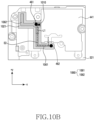
- FIG. 10B is a diagram for explaining the structure of arrangement of a first inductor L1, according to an embodiment.
- the electronic device 101 of an embodiment may include a first conductive structure 1021, and a first conductive pattern 1060 may be formed in the first conductive structure 1021.
- the first conductive pattern 1060 may include a first portion 1061 and/or a second portion 1062.
- the first portion 1061 of the first conductive pattern 1060 may refer to a portion that is connected to the first speaker module 441.
- the second portion 1062 of the first conductive pattern 1060 may refer to a portion that is electrically connected to the first conductive connection member 461 and operates as an antenna radiator.
- the first inductor L1 of an embodiment may be disposed in the first conductive structure 1021.
- the first inductor L1 may be disposed between the first portion 1061 and second portion 1062 of the first conductive pattern 1060 and may be included in a second electrical path E2 connecting the first control circuit 520 to the first speaker module 441.
- the first inductor L1 may have a first inductance (e.g., 100 nH).
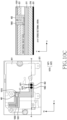
- FIG. 10C is a diagram illustrating a first conductive pattern according to an embodiment.
- a first conductive structure 1031 of an embodiment may include a conductive pattern 1050. Unlike the first conductive pattern 450 illustrated in FIG. 10A , the conductive pattern 1050 of an embodiment may not be electrically connected to the first speaker module 441.
- the first speaker module 441 may be electrically connected to the first control circuit 520.
- the second conductive connection member 462 may be formed to penetrate the first conductive structure 1031 and the first support member 321, and may be electrically connected to the first control circuit 520.
- the second conductive connection member 462 may be electrically connected to the first speaker module 441 via a first transmission path 1071 formed in the first conductive structure 1031.
- the first speaker module 441 may be electrically connected to the first control circuit 520 via the second conductive connection member 462 and the first transmission path 1071.
- a third conductive connection member 1063 may be formed to penetrate the first conductive structure 1031 and the first support member 321, and may be electrically connected to the first control circuit 520.
- the third conductive connection member 1063 may be electrically connected to the first speaker module 441 via a second transmission path 1072 formed in the first conductive structure 1031.
- the first speaker module 441 may be electrically connected to the first control circuit 520 via the third conductive connection member 1063 and the second transmission path 1072.
- the first control circuit 520 electrically connected to the first speaker module 441 may transmit a signal for speaker operation to the first speaker module 441, or receive a signal from the first speaker module 441.
- a signal transmitted and received between the first control circuit 520 and the first speaker module 441 may correspond to a low frequency signal (e.g., DC signal).
- a manufacturing process of the first conductive structure 1031 may be simplified.
- a manufacturing process may be complicated and a cost consumption may be high, since a first conductive structure in which the conductive pattern 1050 is formed and a second conductive structure in which the transmission paths 1070 are formed must be manufactured separately during the manufacturing process.
- the manufacturing process may be simplified and a manufacturing cost may be reduced.
- FIG. 11 is a diagram illustrating a method of feeding power to a frame structure by using a first conductive pattern, according to an embodiment.
- a frame structure 215 of an embodiment may form at least a portion of an edge 1110 of the electronic device 101.
- a first frame 215a of the frame structure 215 may form a portion of a first edge 1111 of the electronic device 101.
- a second frame 215b of the frame structure 215 may form a portion of the first edge 1111 and a portion of a second edge 1112 perpendicular to the first edge 1111.
- a first segment 1161 may be formed between the first frame 215a and the second frame 215b, and a non-conductive material may be disposed in the first segment 1161.
- a third frame 215c of the frame structure 215 may form a portion of the second edge 1112 of the electronic device 101.
- a second segment 1162 may be formed between the second frame 215b and the third frame 215c, and a non-conductive material may be disposed in the second segment 1162.
- a conductive pattern 1150 may be electrically connected to the second frame 215b through a third conductive connection member 1163 (e.g., a C-clip, a pogo-pin, or a coaxial cable).
- a third conductive connection member 1163 e.g., a C-clip, a pogo-pin, or a coaxial cable.
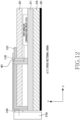
- FIG. 12 illustrates a cross-sectional view taken along line C-C' of the embodiment illustrated in FIG. 11 , according to an embodiment.
- the first wireless communication circuit 510 of an embodiment may feed power to the second frame 215b and transmit and/or receive a signal in a second frequency band.
- the first wireless communication circuit 510 may be electrically connected to a second portion 1152 of a conductive pattern 1150 via the first conductive connection member 461.
- the second portion 1152 of the conductive pattern 1150 may be electrically connected to the second frame 215b via the third conductive connection member 1163.
- the first wireless communication circuit 510 may be electrically connected to the second frame 215b via the first conductive connection member 461, the second portion 1152 of the conductive pattern 1150, and the third conductive connection member 463, and may feed power to the second frame 215b and transmit and/or receive the signal in the second frequency band.
- FIG. 13 is a diagram for explaining a second region of a second support member where the second speaker module and the second conductive structure illustrated in FIG. 4A are disposed, according to an embodiment.
- a second conductive pattern 1350 and/or an additional conductive pattern 1370 may be formed in the second conductive structure 432 (e.g., FPCB) of an embodiment.
- the second conductive pattern 1350 may be formed of metal (e.g., copper).
- the second conductive pattern 1350 may include a first portion 1351 extending from a third point P3 and connected to the second speaker module 442, and a second portion 1352 extending from the third point P3.
- the second portion 1352 of the second conductive pattern 1350 may be used as an antenna radiator.
- the second portion 1352 of the second conductive pattern 1350 used as the antenna radiator may have various shapes.
- the second portion 1352 may have an L-shape.
- the third point P3 may mean a point where a fifth conductive connection member 1365 is connected to the second conductive pattern 1350.
- the additional conductive pattern 1370 may extend from a fourth point P4 of the second conductive structure 432 and connect to the second speaker module 442.
- the fourth point P4 may mean a point where a sixth conductive connection member 1366 is connected to the additional conductive pattern 1370.
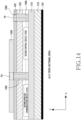
- FIG. 14 illustrates a cross-sectional view taken along line D-D' of the second conductive structure illustrated in FIG. 13 , according to an embodiment.
- the electronic device 101 of an embodiment may include a second wireless communication circuit 1410, and the second wireless communication circuit 1410 may be disposed on a face of the second printed circuit boards 312.
- the electronic device 101 may include a second control circuit 1420, and the second control circuit 1420 may be disposed on a face of the second printed circuit board 312.
- the positions of the second wireless communication circuit 1410 and second control circuit 1420 illustrated in FIG. 14 are only an example for convenience of explanation, and the second wireless communication circuit 1410 and the second control circuit 1420 may be disposed in various positions of the second printed circuit board 312.
- the second support member 322 may be located in a first direction (e.g., -z direction) with respect to the second printed circuit board 312, and the second conductive structure 432 may be located in a first direction (e.g., -z direction) of the support member 322.
- the fifth conductive connection member 1365 may be disposed at a point of the second printed circuit board 312 and may be electrically connected to the second wireless communication circuit 1410 and the second control circuit 1420.
- the fifth conductive connection member 1365 may be formed to penetrate the second support member 322 and the second conductive structure 432, and may be electrically connected to the second conductive pattern 1350 at the third point P3.
- the second wireless communication circuit 1410 and the second control circuit 1420 may be electrically connected to the third point P3 of the second conductive pattern 1350 via the fifth conductive connection member 1365.
- the sixth conductive connection member 1366 may be disposed at a point of the second printed circuit board 312 and may be electrically connected to the second control circuit 1420.
- the sixth conductive connection member 1366 may be formed to penetrate the second support member 322 and the second conductive structure 432, and may be electrically connected to the additional conductive pattern 1370 at the fourth point P4.
- the second control circuit 1420 may be electrically connected to the additional conductive pattern 1370 via the sixth conductive connection member 1366.
- the description for the first conductive structure 431, the first conductive pattern 450, the first speaker module 441, the first conductive connection member 461, the second conductive connection member 462, the first wireless communication circuit 510 and/or the first control circuit 520 given with reference to FIG. 1 to FIG. 12 may be sequentially applied to the second conductive structure 432, the second conductive pattern 1350, the second speaker module 442, the fifth conductive connection member 1365, the sixth conductive connection member 1366, the second wireless communication circuit 1410 and/or the second control circuit 1420.
- the second wireless communication circuit 1410 may feed power to the second portion 1352 of the second conductive pattern 1350 and transmit and/or receive a first signal in a specified frequency band.
- a second capacitor C2 may be disposed or formed in a path through which the second wireless communication circuit 1410 feeds power to the second portion 1352 of the second conductive pattern 1350.
- a third inductor L3 may be disposed or formed in the second portion 1352 of the second conductive pattern 1350, and the second control circuit 1420 may transmit a second signal to, and/or receive from, the second speaker module 442 by using the fifth conductive connection member 1365, the third inductor L3, and the second portion 1352 of the second conductive pattern 1350.
- the second signal may correspond to a low frequency signal (e.g., DC signal).
- An electronic device 101 of an embodiment of the disclosure may include a second frame 215b forming at least a portion of a first edge 1111 of the electronic device 101, a first speaker module 441 disposed adjacent to the second frame 215b, a first wireless communication circuit 510, a first conductive connection member 461 connected to the first wireless communication circuit 510 via a first capacitor C1, a first conductive pattern 450 connected at a first point P1 to the first conductive connection member 461, and including a first portion 451 extending from the first point P1 and connected to the first speaker module 441 and a second portion 452 extending from the first point P1, and a first control circuit 520 electrically connected to the first speaker module 441 through the first conductive connection member 461.
- the first portion 451 may include a first inductor L1.
- the second portion 452 of the first conductive pattern 450 may operate as an antenna radiator.
- the first wireless communication circuit 510 may transmit and/or receive a first signal in a first frequency band by using a first electrical path E1 that includes the first capacitor C1, the first conductive connection member 461, and the second portion 452 of the first conductive pattern 450.
- control circuit may apply a second signal to the speaker module by using a second electrical path that includes the conductive connection member, the first portion of the conductive pattern, and the first inductor.
- the second signal applied to the speaker module through the second electrical path may correspond to a direct current (DC) signal.
- DC direct current
- the electronic device of an embodiment may further include a second inductor, and the conductive connection member may be connected to the control circuit via the second inductor.
- a first inductance of the first inductor may have a value between 100 nH and 120 nH.
- the electronic device of an embodiment may further include a printed circuit board, and the wireless communication circuit and the control circuit may be disposed on a face of the printed circuit board.
- the electronic device of an embodiment may further include a support member disposed in a first direction perpendicular to the a face of the printed circuit board, and the conductive pattern and the speaker module may be disposed in the first direction of the support member.
- the electronic device of an embodiment may further include a matching circuit electrically connected to the second portion of the conductive pattern, and the wireless communication circuit may control the matching circuit to perform impedance matching corresponding to the first frequency band.
- the conductive connection member may correspond to a C-clip, a pogo-pin, or a coaxial cable.
- control circuit may include an application processor.
- the electronic device of an embodiment may further include a flexible printed circuit board (FPCB), and the conductive pattern may be formed on a face of the FPCB.
- FPCB flexible printed circuit board
- an end of the second portion of the conductive pattern may be electrically connected to a conductive portion of the first frame.
- the wireless communication circuit may feed power to the conductive portion of the first frame through the second portion of the conductive pattern and transmit and/or receive a signal in a second frequency band.
- the conductive pattern may have an L-shape.
- the first frequency band may include a frequency band of 5 GHz to 6 GHz.
- An electronic device 101 of an embodiment of the disclosure may include a first speaker module 441, a first wireless communication circuit 510, a first conductive connection member 461 connected to the first wireless communication circuit 510 via at least one capacitor (e.g., a first capacitor C1), a first conductive pattern 450 connected at a first point P1 to the first conductive connection member 461, and including a first portion 451 extending from the first point P1 and connected to the first speaker module 441 and a second portion 452 extending from the first point P1, and a first control circuit 520 electrically connected to the first speaker module 441 through the first conductive connection member 461.
- the first portion 451 may include at least one inductor (e.g., a first inductor L1).
- the first wireless communication circuit 510 may transmit and/or receive a first signal in a first frequency band by using a first electrical path E1 that includes the at least one capacitor (e.g., the first capacitor C1), the first conductive connection member 461, and the second portion 452 of the first conductive pattern 450.
- the first control circuit 520 may apply a second signal to the first speaker module 441 by using a second electrical path E2 that includes the first conductive connection member 461, the first portion 451 of the first conductive pattern 450, and the at least one inductor (e.g., the first inductor L1).
- the second signal applied to the speaker module through the second electrical path may correspond to a direct current (DC) signal.
- DC direct current
- the second portion of the conductive pattern may have an L-shape.
- the electronic device of an embodiment may further include a flexible printed circuit board (FPCB), and the conductive pattern may be formed on a face of the FPCB.
- FPCB flexible printed circuit board
- the electronic device of an embodiment may further include a matching circuit electrically connected to the second portion of the conductive pattern, and the wireless communication circuit may control the matching circuit to perform impedance matching corresponding to the first frequency band.
Landscapes
- Engineering & Computer Science (AREA)
- Signal Processing (AREA)
- Physics & Mathematics (AREA)
- Acoustics & Sound (AREA)
- Computer Networks & Wireless Communication (AREA)
- Telephone Set Structure (AREA)
Abstract
Description
- Various embodiments disclosed in this document relate to an electronic device including an antenna.
- Electronic devices (e.g., smart phones, tablets, or wearable devices) can provide various functions in addition to voice communication. For example, the electronic devices can provide various functions, such as a short-range wireless communication (e.g., Bluetooth, Wi-Fi, or near field communication (NFC)) function, a mobile communication (3rd generation (3G), 4G, 5G, etc.) function, a music or video playback function, a shooting function, or a navigation function.
- The electronic device can include a speaker module for providing a sound output for voice communication, music, or video. Also, the electronic device can include an antenna that is adjacent to the speaker module and supports wireless communication.
- The electronic device can include a conductive path that delivers a low frequency signal (e.g., a direct current (DC) signal) for controlling the speaker module, and a conductive pattern that operates as an antenna radiator. A signal delivered to the conductive pattern can correspond to a high frequency signal (e.g., an AC signal). When the conductive path and the conductive pattern are manufactured separately, a production process can become complicated and a manufacturing cost can increase.
- Also, the electronic device can need to include a separate conductive connection member in order to connect the conductive path and the conductive pattern to a control circuit and a wireless communication circuit, respectively. For example, the conductive path can be connected to the control circuit (e.g., an application processor) controlling the speaker module through a first conductive connection member (e.g., a C-clip). For another example, the conductive pattern can be connected to the wireless communication circuit (e.g., a communication processor) through a second conductive connection member. However, when the electronic device includes the respective separate conductive connection members, a material cost can increase, and there can be a disadvantage of limiting a mounting space of the electronic device.
- An embodiment of the disclosure can include a conductive pattern that includes a first portion connected to a speaker module and a second portion operating as an antenna radiator.
- An electronic device of an embodiment of the disclosure may include a first frame forming at least a portion of a first edge of the electronic device, a first speaker module disposed adjacent to the first frame, a wireless communication circuit, a conductive connection member connected to the wireless communication circuit via a first capacitor, a conductive pattern connected to the conductive connection member at a first point, and including a first portion extending from the first point and connected to the first speaker module and a second portion extending from the first point, and a control circuit electrically connected to the first speaker module through the conductive connection member. The first portion may include a first inductor. The second portion of the conductive pattern may operate as an antenna radiator. The wireless communication circuit may transmit and/or receive a first signal in a first frequency band by using a first electrical path comprising the first capacitor, the conductive connection member, and the second portion of the conductive pattern.
- An electronic device of an embodiment of the disclosure may include a speaker module, a wireless communication circuit, a conductive connection member connected to the wireless communication circuit via at least one capacitor, a conductive pattern connected at a first point to the conductive connection member, and including a first portion extending from the first point and connected to the speaker module and a second portion extending from the first point, and a control circuit electrically connected to the speaker module through the conductive connection member. The first portion may include at least one inductor. The wireless communication circuit may transmit and/or receive a first signal in a first frequency band by using a first electrical path that includes the at least one capacitor, the conductive connection member, and the second portion of the conductive pattern. The control circuit may apply a second signal to the speaker module by using a second electrical path comprising the conductive connection member, the first portion of the conductive pattern, and the at least one inductor.
- According to an embodiment of the disclosure, as a first portion of a conductive pattern connecting a speaker module to a control circuit is formed integrally with a second portion of the conductive pattern operating as an antenna, an electronic device may simplify a manufacturing process, and may minimize a manufacturing cost and a material cost.
- According to an embodiment of the disclosure, an electronic device may separate a low frequency signal from a high frequency signal by using a capacitor and an inductor and prevent interference between the signals.
- In addition, various effects directly or indirectly identified through this document may be provided.
-
-
FIG. 1 is a diagram illustrating an electronic device in a network environment, according to an embodiment. -
FIG. 2A is a perspective view illustrating an electronic device according to an embodiment. -
FIG. 2B is a perspective view illustrating the electronic device ofFIG. 2A seen from the rear, according to an embodiment. -
FIG. 3 is an exploded perspective view of an electronic device according to an embodiment. -
FIG. 4A is a diagram for explaining the positions of conductive structures connected to speaker modules in an electronic device, according to an embodiment. -
FIG. 4B is an enlarged view of a first region of a first support member where a first conductive structure and a first speaker module illustrated inFIG. 4A are disposed, according to an embodiment. -
FIG. 5 illustrates a cross-sectional view taken along line A-A' of the first conductive structure illustrated inFIG. 4B , according to an embodiment. -
FIG. 6 illustrates a cross-sectional view taken along line B-B' of the first conductive structure illustrated inFIG. 4B , according to an embodiment. -
FIG. 7 is a conceptual diagram illustrating an electrical connection relationship between a first speaker module, a first conductive pattern, a first wireless communication circuit, and a first control circuit, according to an embodiment. -
FIG. 8 is a diagram for comparing antenna radiation efficiency graphs dependent on the arrangement or non-arrangement of a first inductor, according to an embodiment. -
FIG. 9 is a diagram for comparing S11 graphs dependent on the arrangement or non-arrangement of a first inductor, according to an embodiment. -
FIG. 10A is a diagram illustrating a first conductive structure including a matching circuit, according to an embodiment. -
FIG. 10B is a diagram for explaining the structure of arrangement of a first inductor L1, according to an embodiment. -
FIG. 10C is a diagram illustrating a first conductive pattern according to an embodiment. -
FIG. 11 is a diagram for explaining a method of feeding power to a frame structure by using a first conductive pattern, according to an embodiment. -
FIG. 12 illustrates a cross-sectional view taken along line C-C' of the embodiment illustrated inFIG. 11 , according to an embodiment. -
FIG. 13 is a diagram for explaining a second region of a second support member where a second speaker module and a second conductive structure illustrated inFIG. 4A are disposed, according to an embodiment. -
FIG. 14 illustrates a cross-sectional view taken along line D-D' of the second conductive structure illustrated inFIG. 13 , according to an embodiment. - In relation to the description of the drawings, the same or similar reference numerals may be used for the same or similar components.
- Various embodiments of the disclosure are described below with reference to the accompanying drawings. However, this is not intended to limit the disclosure to a specific embodiment form, and should be understood as including various modifications, equivalents, and/or alternatives to the embodiments of the disclosure.
-
Fig. 1 is a block diagram illustrating anelectronic device 101 in anetwork environment 100 according to various embodiments. Referring toFig. 1 , theelectronic device 101 in thenetwork environment 100 may communicate with anelectronic device 102 via a first network 198 (e.g., a short-range wireless communication network), or at least one of anelectronic device 104 or aserver 108 via a second network 199 (e.g., a long-range wireless communication network). According to an embodiment, theelectronic device 101 may communicate with theelectronic device 104 via theserver 108. According to an embodiment, theelectronic device 101 may include aprocessor 120,memory 130, aninput module 150, asound output module 155, adisplay module 160, anaudio module 170, asensor module 176, aninterface 177, a connectingterminal 178, ahaptic module 179, acamera module 180, apower management module 188, abattery 189, acommunication module 190, a subscriber identification module(SIM) 196, or anantenna module 197. In some embodiments, at least one of the components (e.g., the connecting terminal 178) may be omitted from theelectronic device 101, or one or more other components may be added in theelectronic device 101. In some embodiments, some of the components (e.g., thesensor module 176, thecamera module 180, or the antenna module 197) may be implemented as a single component (e.g., the display module 160). - The
processor 120 may execute, for example, software (e.g., a program 140) to control at least one other component (e.g., a hardware or software component) of theelectronic device 101 coupled with theprocessor 120, and may perform various data processing or computation. According to one embodiment, as at least part of the data processing or computation, theprocessor 120 may store a command or data received from another component (e.g., thesensor module 176 or the communication module 190) involatile memory 132, process the command or the data stored in thevolatile memory 132, and store resulting data innon-volatile memory 134. According to an embodiment, theprocessor 120 may include a main processor 121 (e.g., a central processing unit (CPU) or an application processor (AP)), or an auxiliary processor 123 (e.g., a graphics processing unit (GPU), a neural processing unit (NPU), an image signal processor (ISP), a sensor hub processor, or a communication processor (CP)) that is operable independently from, or in conjunction with, themain processor 121. For example, when theelectronic device 101 includes themain processor 121 and theauxiliary processor 123, theauxiliary processor 123 may be adapted to consume less power than themain processor 121, or to be specific to a specified function. Theauxiliary processor 123 may be implemented as separate from, or as part of themain processor 121. - The
auxiliary processor 123 may control at least some of functions or states related to at least one component (e.g., thedisplay module 160, thesensor module 176, or the communication module 190) among the components of theelectronic device 101, instead of themain processor 121 while themain processor 121 is in an inactive (e.g., sleep) state, or together with themain processor 121 while themain processor 121 is in an active state (e.g., executing an application). According to an embodiment, the auxiliary processor 123 (e.g., an image signal processor or a communication processor) may be implemented as part of another component (e.g., thecamera module 180 or the communication module 190) functionally related to theauxiliary processor 123. According to an embodiment, the auxiliary processor 123 (e.g., the neural processing unit) may include a hardware structure specified for artificial intelligence model processing. An artificial intelligence model may be generated by machine learning. Such learning may be performed, e.g., by theelectronic device 101 where the artificial intelligence is performed or via a separate server (e.g., the server 108). Learning algorithms may include, but are not limited to, e.g., supervised learning, unsupervised learning, semi-supervised learning, or reinforcement learning. The artificial intelligence model may include a plurality of artificial neural network layers. The artificial neural network may be a deep neural network (DNN), a convolutional neural network (CNN), a recurrent neural network (RNN), a restricted boltzmann machine (RBM), a deep belief network (DBN), a bidirectional recurrent deep neural network (BRDNN), deep Q-network or a combination of two or more thereof but is not limited thereto. The artificial intelligence model may, additionally or alternatively, include a software structure other than the hardware structure. - The
memory 130 may store various data used by at least one component (e.g., theprocessor 120 or the sensor module 176) of theelectronic device 101. The various data may include, for example, software (e.g., the program 140) and input data or output data for a command related thererto. Thememory 130 may include thevolatile memory 132 or thenon-volatile memory 134. - The
program 140 may be stored in thememory 130 as software, and may include, for example, an operating system (OS) 142,middleware 144, or anapplication 146. - The
input module 150 may receive a command or data to be used by another component (e.g., the processor 120) of theelectronic device 101, from the outside (e.g., a user) of theelectronic device 101. Theinput module 150 may include, for example, a microphone, a mouse, a keyboard, a key (e.g., a button), or a digital pen (e.g., a stylus pen). - The
sound output module 155 may output sound signals to the outside of theelectronic device 101. Thesound output module 155 may include, for example, a speaker or a receiver. The speaker may be used for general purposes, such as playing multimedia or playing record. The receiver may be used for receiving incoming calls. According to an embodiment, the receiver may be implemented as separate from, or as part of the speaker. - The
display module 160 may visually provide information to the outside (e.g., a user) of theelectronic device 101. Thedisplay module 160 may include, for example, a display, a hologram device, or a projector and control circuitry to control a corresponding one of the display, hologram device, and projector. According to an embodiment, thedisplay module 160 may include a touch sensor adapted to detect a touch, or a pressure sensor adapted to measure the intensity of force incurred by the touch. - The
audio module 170 may convert a sound into an electrical signal and vice versa. According to an embodiment, theaudio module 170 may obtain the sound via theinput module 150, or output the sound via thesound output module 155 or a headphone of an external electronic device (e.g., an electronic device 102) directly (e.g., wiredly) or wirelessly coupled with theelectronic device 101. - The
sensor module 176 may detect an operational state (e.g., power or temperature) of theelectronic device 101 or an environmental state (e.g., a state of a user) external to theelectronic device 101, and then generate an electrical signal or data value corresponding to the detected state. According to an embodiment, thesensor module 176 may include, for example, a gesture sensor, a gyro sensor, an atmospheric pressure sensor, a magnetic sensor, an acceleration sensor, a grip sensor, a proximity sensor, a color sensor, an infrared (IR) sensor, a biometric sensor, a temperature sensor, a humidity sensor, or an illuminance sensor. - The
interface 177 may support one or more specified protocols to be used for theelectronic device 101 to be coupled with the external electronic device (e.g., the electronic device 102) directly (e.g., wiredly) or wirelessly. According to an embodiment, theinterface 177 may include, for example, a high definition multimedia interface (HDMI), a universal serial bus (USB) interface, a secure digital (SD) card interface, or an audio interface. - A connecting
terminal 178 may include a connector via which theelectronic device 101 may be physically connected with the external electronic device (e.g., the electronic device 102). According to an embodiment, the connectingterminal 178 may include, for example, a HDMI connector, a USB connector, a SD card connector, or an audio connector (e.g., a headphone connector). - The
haptic module 179 may convert an electrical signal into a mechanical stimulus (e.g., a vibration or a movement) or electrical stimulus which may be recognized by a user via his tactile sensation or kinesthetic sensation. According to an embodiment, thehaptic module 179 may include, for example, a motor, a piezoelectric element, or an electric stimulator. - The
camera module 180 may capture a still image or moving images. According to an embodiment, thecamera module 180 may include one or more lenses, image sensors, image signal processors, or flashes. - The
power management module 188 may manage power supplied to theelectronic device 101. According to one embodiment, thepower management module 188 may be implemented as at least part of, for example, a power management integrated circuit (PMIC). - The
battery 189 may supply power to at least one component of theelectronic device 101. According to an embodiment, thebattery 189 may include, for example, a primary cell which is not rechargeable, a secondary cell which is rechargeable, or a fuel cell. - The
communication module 190 may support establishing a direct (e.g., wired) communication channel or a wireless communication channel between theelectronic device 101 and the external electronic device (e.g., theelectronic device 102, theelectronic device 104, or the server 108) and performing communication via the established communication channel. Thecommunication module 190 may include one or more communication processors that are operable independently from the processor 120 (e.g., the application processor (AP)) and supports a direct (e.g., wired) communication or a wireless communication. According to an embodiment, thecommunication module 190 may include a wireless communication module 192 (e.g., a cellular communication module, a short-range wireless communication module, or a global navigation satellite system (GNSS) communication module) or a wired communication module 194 (e.g., a local area network (LAN) communication module or a power line communication (PLC) module). A corresponding one of these communication modules may communicate with the external electronic device via the first network 198 (e.g., a short-range communication network, such as Bluetooth™, wireless-fidelity (Wi-Fi) direct, or infrared data association (IrDA)) or the second network 199 (e.g., a long-range communication network, such as a legacy cellular network, a 5G network, a next-generation communication network, the Internet, or a computer network (e.g., LAN or wide area network (WAN)). These various types of communication modules may be implemented as a single component (e.g., a single chip), or may be implemented as multi components (e.g., multi chips) separate from each other. The wireless communication module 192 may identify and authenticate theelectronic device 101 in a communication network, such as thefirst network 198 or thesecond network 199, using subscriber information (e.g., international mobile subscriber identity (IMSI)) stored in thesubscriber identification module 196. - The wireless communication module 192 may support a 5G network, after a 4G network, and next-generation communication technology, e.g., new radio (NR) access technology. The NR access technology may support enhanced mobile broadband (eMBB), massive machine type communications (mMTC), or ultra-reliable and low-latency communications (URLLC). The wireless communication module 192 may support a high-frequency band (e.g., the mmWave band) to achieve, e.g., a high data transmission rate. The wireless communication module 192 may support various technologies for securing performance on a high-frequency band, such as, e.g., beamforming, massive multiple-input and multiple-output (massive MIMO), full dimensional MIMO (FD-MIMO), array antenna, analog beam-forming, or large scale antenna. The wireless communication module 192 may support various requirements specified in the
electronic device 101, an external electronic device (e.g., the electronic device 104), or a network system (e.g., the second network 199). According to an embodiment, the wireless communication module 192 may support a peak data rate (e.g., 20Gbps or more) for implementing eMBB, loss coverage (e.g., 164dB or less) for implementing mMTC, or U-plane latency (e.g., 0.5ms or less for each of downlink (DL) and uplink (UL), or a round trip of 1ms or less) for implementing URLLC. - The
antenna module 197 may transmit or receive a signal or power to or from the outside (e.g., the external electronic device) of theelectronic device 101. According to an embodiment, theantenna module 197 may include an antenna including a radiating element composed of a conductive material or a conductive pattern formed in or on a substrate (e.g., a printed circuit board (PCB)). According to an embodiment, theantenna module 197 may include a plurality of antennas (e.g., array antennas). In such a case, at least one antenna appropriate for a communication scheme used in the communication network, such as thefirst network 198 or thesecond network 199, may be selected, for example, by the communication module 190 (e.g., the wireless communication module 192) from the plurality of antennas. The signal or the power may then be transmitted or received between thecommunication module 190 and the external electronic device via the selected at least one antenna. According to an embodiment, another component (e.g., a radio frequency integrated circuit (RFIC)) other than the radiating element may be additionally formed as part of theantenna module 197. According to various embodiments, theantenna module 197 may form a mm Wave antenna module. According to an embodiment, the mm Wave antenna module may include a printed circuit board, a RFIC disposed on a first surface (e.g., the bottom surface) of the printed circuit board, or adjacent to the first surface and capable of supporting a designated high-frequency band (e.g., the mmWave band), and a plurality of antennas (e.g., array antennas) disposed on a second surface (e.g., the top or a side surface) of the printed circuit board, or adjacent to the second surface and capable of transmitting or receiving signals of the designated high-frequency band. - At least some of the above-described components may be coupled mutually and communicate signals (e.g., commands or data) therebetween via an inter-peripheral communication scheme (e.g., a bus, general purpose input and output (GPIO), serial peripheral interface (SPI), or mobile industry processor interface (MIPI)).
- According to an embodiment, commands or data may be transmitted or received between the
electronic device 101 and the externalelectronic device 104 via theserver 108 coupled with thesecond network 199. Each of theelectronic devices electronic device 101. According to an embodiment, all or some of operations to be executed at theelectronic device 101 may be executed at one or more of the externalelectronic devices electronic device 101 should perform a function or a service automatically, or in response to a request from a user or another device, theelectronic device 101, instead of, or in addition to, executing the function or the service, may request the one or more external electronic devices to perform at least part of the function or the service. The one or more external electronic devices receiving the request may perform the at least part of the function or the service requested, or an additional function or an additional service related to the request, and transfer an outcome of the performing to theelectronic device 101. Theelectronic device 101 may provide the outcome, with or without further processing of the outcome, as at least part of a reply to the request. To that end, a cloud computing, distributed computing, mobile edge computing (MEC), or client-server computing technology may be used, for example. Theelectronic device 101 may provide ultra low-latency services using, e.g., distributed computing or mobile edge computing. In another embodiment, the externalelectronic device 104 may include an internet-of-things (IoT) device. Theserver 108 may be an intelligent server using machine learning and/or a neural network. According to an embodiment, the externalelectronic device 104 or theserver 108 may be included in thesecond network 199. Theelectronic device 101 may be applied to intelligent services (e.g., smart home, smart city, smart car, or healthcare) based on 5G communication technology or IoT-related technology. - The electronic device according to various embodiments may be one of various types of electronic devices. The electronic devices may include, for example, a portable communication device (e.g., a smartphone), a computer device, a portable multimedia device, a portable medical device, a camera, a wearable device, or a home appliance. According to an embodiment of the disclosure, the electronic devices are not limited to those described above.
- It should be appreciated that various embodiments of the present disclosure and the terms used therein are not intended to limit the technological features set forth herein to particular embodiments and include various changes, equivalents, or replacements for a corresponding embodiment. With regard to the description of the drawings, similar reference numerals may be used to refer to similar or related elements. It is to be understood that a singular form of a noun corresponding to an item may include one or more of the things, unless the relevant context clearly indicates otherwise. As used herein, each of such phrases as "A or B," "at least one of A and B," "at least one of A or B," "A, B, or C," "at least one of A, B, and C," and "at least one of A, B, or C," may include any one of, or all possible combinations of the items enumerated together in a corresponding one of the phrases. As used herein, such terms as "1st" and "2nd," or "first" and "second" may be used to simply distinguish a corresponding component from another, and does not limit the components in other aspect (e.g., importance or order). It is to be understood that if an element (e.g., a first element) is referred to, with or without the term "operatively" or "communicatively", as "coupled with," "coupled to," "connected with," or "connected to" another element (e.g., a second element), it means that the element may be coupled with the other element directly (e.g., wiredly), wirelessly, or via a third element.
- As used in connection with various embodiments of the disclosure, the term "module" may include a unit implemented in hardware, software, or firmware, and may interchangeably be used with other terms, for example, "logic," "logic block," "part," or "circuitry". A module may be a single integral component, or a minimum unit or part thereof, adapted to perform one or more functions. For example, according to an embodiment, the module may be implemented in a form of an application-specific integrated circuit (ASIC).
- Various embodiments as set forth herein may be implemented as software (e.g., the program 140) including one or more instructions that are stored in a storage medium (e.g., internal memory 136 or external memory 138) that is readable by a machine (e.g., the electronic device 101). For example, a processor (e.g., the processor 120) of the machine (e.g., the electronic device 101) may invoke at least one of the one or more instructions stored in the storage medium, and execute it, with or without using one or more other components under the control of the processor. This allows the machine to be operated to perform at least one function according to the at least one instruction invoked. The one or more instructions may include a code generated by a complier or a code executable by an interpreter. The machine-readable storage medium may be provided in the form of a non-transitory storage medium. Wherein, the term "non-transitory" simply means that the storage medium is a tangible device, and does not include a signal (e.g., an electromagnetic wave), but this term does not differentiate between where data is semi-permanently stored in the storage medium and where the data is temporarily stored in the storage medium.
- According to an embodiment, a method according to various embodiments of the disclosure may be included and provided in a computer program product. The computer program product may be traded as a product between a seller and a buyer. The computer program product may be distributed in the form of a machine-readable storage medium (e.g., compact disc read only memory (CD-ROM)), or be distributed (e.g., downloaded or uploaded) online via an application store (e.g., PlayStore™), or between two user devices (e.g., smart phones) directly. If distributed online, at least part of the computer program product may be temporarily generated or at least temporarily stored in the machine-readable storage medium, such as memory of the manufacturer's server, a server of the application store, or a relay server.
According to various embodiments, each component (e.g., a module or a program) of the above-described components may include a single entity or multiple entities, and some of the multiple entities may be separately disposed in different components. According to various embodiments, one or more of the above-described components may be omitted, or one or more other components may be added. Alternatively or additionally, a plurality of components (e.g., modules or programs) may be integrated into a single component. In such a case, according to various embodiments, the integrated component may still perform one or more functions of each of the plurality of components in the same or similar manner as they are performed by a corresponding one of the plurality of components before the integration. According to various embodiments, operations performed by the module, the program, or another component may be carried out sequentially, in parallel, repeatedly, or heuristically, or one or more of the operations may be executed in a different order or omitted, or one or more other operations may be added. -
FIG. 2A is a perspective view illustrating an electronic device according to an embodiment. -
FIG. 2B is a perspective view illustrating the electronic device ofFIG. 2A seen from the rear. - Referring to
FIGS. 2A and2B , anelectronic device 101 of an embodiment may include ahousing 210 including a first face (or a front face) 210A, a second face (or a rear face) 210B, and a side face (or a side wall) 210C surrounding a space between thefirst face 210A and thesecond face 210B. In another embodiment (not shown), a housing may also refer to a structure forming some of thefirst face 210A, thesecond face 210B, and theside face 210C ofFIGS. 2A and2B . - According to an embodiment, the
first face 210A of theelectronic device 101 may be formed at least in part by a substantially transparent front plate 202 (e.g., a glass plate including various coating layers, or a polymer plate). In an embodiment, thefront plate 202 may include a curved portion that is bent and extended seamlessly from thefirst face 210A toward arear cover 211 at least at one side edge portion. - According to an embodiment, the
second face 210B may be formed by the substantially opaquerear cover 211. Therear cover 211 may be formed of, for example, coated or colored glass, ceramic, polymer, metal (e.g., aluminum, stainless steel (STS), or magnesium), or a combination of at least two of the above materials. According to an embodiment, therear cover 211 may include a curved portion that is bent and extended seamlessly from thesecond face 210B toward thefront plate 202 at least at one side edge portion. - According to an embodiment, the
side face 210C of theelectronic device 101 may be coupled to thefront plate 202 and therear cover 211, and may be formed by aframe structure 215 including metal and/or polymer. In another embodiment, therear cover 211 and theframe structure 215 may be formed integrally, and may include substantially the same material (e.g., a metallic material such as aluminum). - According to an embodiment, the
electronic device 101 may include at least one or more of adisplay 201, theaudio module 170, asensor module 204, afirst camera module 205, akey input device 217, afirst connector hole 208, and asecond connector hole 209. In another embodiment, theelectronic device 101 may omit at least one (e.g., the key input device 217) of the components or may additionally include other components. For example, a sensor such as a proximity sensor or illumination sensor may be integrated with thedisplay 201 or be disposed adjacent to thedisplay 201, within a region provided by thefront plate 202. In an embodiment, theelectronic device 101 may further include alight emitting device 206, and thelight emitting device 206 may be disposed adjacent to thedisplay 201 within the region provided by thefront plate 202. For example, thelight emitting device 206 may provide status information of theelectronic device 101 in the form of light. In another embodiment, thelight emitting device 206 may provide, for example, a light source linked to the operation of thefirst camera module 205. Thelight emitting device 206 may include, for example, an LED, an IR LED, and a xenon lamp. - The
display 201 may be exposed, for example, through a significant portion of thefront plate 202. In another embodiment, the edge of thedisplay 201 may be formed to be substantially the same as an adjacent outer edge shape (e.g., a curved face) of thefront plate 202. In a further embodiment, in order to expand an area where thedisplay 201 is exposed, an outer edge of thedisplay 201 and an outer edge of thefront plate 202 may be formed to have generally the same gap therebetween. In a yet another embodiment, a recess or opening may be formed in a portion of a screen display region of thedisplay 201, and other electronic components aligned with the recess or opening, such as thefirst camera module 205 and the non-shown proximity sensor or illumination sensor, may be included. - In another embodiment, the
display 201 may be coupled to or be disposed adjacent to a touch detection circuit, a pressure sensor capable of measuring the intensity (pressure) of touch, and/or a digitizer detecting a magnetic field-type stylus pen. - In an embodiment, the
audio module 170 may include amicrophone hole 203, at least onespeaker hole 207, and acall receiver hole 214. A microphone for acquiring external sound may be disposed inside themicrophone hole 203, and in an embodiment, a plurality of microphones may be disposed to detect the direction of sound. In another embodiment, the at least onespeaker hole 207 and thecall receiver hole 214 may be implemented as a single hole along with themicrophone hole 203, or a speaker may be included without the at least onespeaker hole 207 and the call receiver hole 214 (e.g., a piezo speaker). - In an embodiment, the
electronic device 101 may include thesensor module 204 to generate an electrical signal or data value corresponding to an internal operating state or external environmental state of theelectronic device 101. Thesensor module 204 may further include, for example, a proximity sensor disposed in thefirst face 210A of thehousing 210, a fingerprint sensor integrated with or disposed adjacent to thedisplay 201, and/or a biometric sensor (e.g., an HRM sensor) disposed in thesecond face 210B of thehousing 210. Theelectronic device 101 may further include at least one of non-shown sensor modules, for example, a gesture sensor, a gyro sensor, a barometric pressure sensor, a magnetic sensor, an acceleration sensor, a grip sensor, a color sensor, an infrared (IR) sensor, a biometric sensor, a temperature sensor, a humidity sensor, or an illumination sensor. - In an embodiment, the
electronic device 101 may include asecond camera module 255 disposed in thesecond face 210B. Thefirst camera module 205 and thesecond camera module 255 may include one or more lenses, an image sensor, and/or an image signal processor. A flash not shown may be disposed in thesecond face 210B. The flash may include, for example, a light emitting diode or a xenon lamp. In another embodiment, two or more lenses (an infrared camera, and a wide-angle and telephoto lens) and image sensors may be disposed on a face of theelectronic device 101. - In an embodiment, the
key input device 217 may be disposed in theside face 210C of thehousing 210. In another embodiment, theelectronic device 101 may not include part or all of thekey input device 217 mentioned above, and thekey input devices 217 not included may be implemented in other forms such as a soft key on thedisplay 201. In another embodiment, the key input device may include at least a portion of the fingerprint sensor disposed in thesecond face 210B of thehousing 210. - In an embodiment, the connector holes 208 and 209 may include the
first connector hole 208 capable of accommodating a connector (e.g., a USB connector) for transmitting and receiving power and/or data with an external electronic device, and/ the second connector hole (e.g., an earphone jack) 209 capable of accommodating a connector for transmitting and receiving an audio signal with the external electronic device. - In
FIGS. 2A and2B , theelectronic device 101 is illustrated as a bar type, but this is only an example and theelectronic device 101 may actually correspond to various types of devices. For example, theelectronic device 101 may correspond to a foldable device, a slidable device, a wearable device (e.g., a smart watch, and a wireless earphone), or a tablet PC. Therefore, the technical idea disclosed in this document is not limited to the bar type device illustrated inFIGS. 2A and2B and may be applied to various types of devices. -
FIG. 3 is an exploded perspective view of an electronic device according to an embodiment. - Referring to
FIG. 3 , theelectronic device 101 may include thedisplay 201, theframe structure 215, abracket 216, a printedcircuit board 310, asupport member 320, abattery 330, and /or therear cover 211. - According to an embodiment, at least a portion of the
frame structure 215 may be formed of a conductive material (e.g., aluminum), and at least a portion of theframe structure 215 may be operated as an antenna radiator for transmitting and/or receiving a wireless communication signal. - According to an embodiment, the
bracket 216 may be coupled to theframe structure 215 and may support various electronic components (e.g., the display 201) within theelectronic device 101. In an embodiment, thebracket 216 may support various components of theelectronic device 101 or provide a space for fixing the components of theelectronic device 101. For example, thebracket 216 may be disposed below (e.g., -z direction) thedisplay 201 and support thedisplay 201. For another example, thebracket 216 may provide a space for fixing thebattery 330. In an embodiment, theframe structure 215 may be coupled to thebracket 216. In another embodiment, theframe structure 215 may be formed integrally with thebracket 216. - According to an embodiment, the printed
circuit board 310 may include a first printedcircuit board 311 and/or a second printedcircuit board 312. In an embodiment, the printedcircuit board 310 may be disposed between thebracket 216 and thesupport member 320. In an embodiment, various electronic components (e.g., theprocessor 120 and the memory 130) may be disposed in the printedcircuit board 310. In an embodiment, the printedcircuit board 310 may provide an electrical connection path between various electronic components of theelectronic device 101. For example, the camera module 112, thebattery 330, thedisplay 201, and theprocessor 120 may be each directly or indirectly electrically connected to the printedcircuit board 310, and theprocessor 120 may be operatively coupled to the camera module 112, thebattery 330, and the display 260 through the electrical connection path provided by the printedcircuit board 310. - According to an embodiment, the
battery 330 may be located below (e.g., -z direction) thebracket 216 and may be fixed by thebracket 216. Thebattery 330 may store power required for theelectronic device 101. For example, thebattery 330 may include a non-rechargeable primary cell, a rechargeable secondary cell, or a fuel cell. Thebattery 330 may be disposed integrally within theelectronic device 101, or may be disposed to be detachable from theelectronic device 101. - According to an embodiment, the
support member 320 may include afirst support member 321 and/or asecond support member 322. In an embodiment, thesupport member 320 may be disposed below (e.g., -z direction) the printedcircuit board 310 and support the printedcircuit board 310. Thesupport member 320 may include metal and/or non-metal (e.g., polymer). - According to an embodiment, the
rear cover 211 may be disposed below (e.g., -z direction) thesupport member 320. In an embodiment, therear cover 211 may be physically coupled to theframe structure 215. For example, therear cover 211 may be coupled to theframe structure 215 by at least one coupling member (e.g., a screw) not shown. For another example, therear cover 211 may be coupled to theframe structure 215 by an adhesive member (e.g., an adhesive tape or adhesive liquid) not shown. In an embodiment, therear cover 211 may be formed by coated or colored glass, ceramic, polymer, metal (e.g., aluminum, stainless steel, or magnesium), or a combination of at least two of the above materials. According to another embodiment, therear cover 211 may be formed integrally with theframe structure 215. -
FIG. 4A is a diagram for explaining the positions of conductive structures connected to speaker modules in an electronic device, according to an embodiment. - Referring to
FIG. 4A , theelectronic device 101 of an embodiment may include aspeaker module 440. Thespeaker module 440 may include afirst speaker module 441 and/or asecond speaker module 442. In an embodiment, thespeaker module 440 may be disposed in various positions of thesupport member 320. For example, thefirst speaker module 441 may be disposed in afirst portion 321a of thefirst support member 321. Thefirst speaker module 441 may be located in a first direction (e.g., -z direction) of thefirst support member 321. For example, thesecond speaker module 442 may be disposed in asecond portion 322a of thesecond support member 322. Thesecond speaker module 442 may be located in a first direction (e.g., -z direction) of thesecond support member 322. - According to an embodiment, the
electronic device 101 may include a conductive structure 430 (e.g., a flexible printed circuit board (FPCB)), and theconductive structure 430 may include a firstconductive structure 431 and/or a secondconductive structure 432. In an embodiment, the firstconductive structure 431 may be located in the first direction (e.g., -z direction) of thefirst support member 321 and may be electrically connected to thefirst speaker module 441, and the secondconductive structure 432 may be located in the first direction (e.g., -z direction) of thesecond support member 322 and may be electrically connected to thesecond speaker module 442. The structure and electrical connection relationship of each of theconductive structure 430 and thespeaker module 440 will be described in detail inFIG. 4B below. -
FIG. 4B is an enlarged view of a first region of a first support member where a first conductive structure and a first speaker module illustrated inFIG. 4A are arranged. - Referring to
FIG. 4B , the firstconductive structure 431 of an embodiment may include a firstconductive pattern 450. The firstconductive pattern 450 may include afirst portion 451 and/or asecond portion 452. For example, the firstconductive pattern 450 may include thefirst portion 451 extending from a first point P1 and connected to thefirst speaker module 441. For example, the firstconductive pattern 450 may include thesecond portion 452 extending from the first point P1. Thesecond portion 452 may be used as an antenna radiator as described later inFIG. 7 . The first point P1 may refer to a point connected to a first wireless communication circuit via a first conductive connection member 461 (e.g., C-clip) as described later inFIG. 5 . In an embodiment, the firstconductive pattern 450 may be formed of metal (e.g., copper (Cu)). - According to an embodiment, the
second portion 452 of the firstconductive pattern 450 operating as the antenna radiator may have various shapes. For example, thesecond portion 452 of the firstconductive pattern 450 may have an L-shape. In an embodiment, the shape and/or electrical length of thesecond portion 452 of the firstconductive pattern 450 may correspond to a frequency band of a signal that theelectronic device 101 will transmit and/or receive through the firstconductive pattern 450. - According to an embodiment, the first
conductive structure 431 may include an additionalconductive pattern 470 extending from a second point P2 and connected to thefirst speaker module 441. The second point P2 may refer to a point connected to a first control circuit via a second conductive connection member 462 (e.g., a C-clip) as described later inFIG. 6 . -
FIG. 5 illustrates a cross-sectional view taken along line A-A' of the first conductive structure illustrated inFIG. 4B , according to an embodiment. - Referring to
FIG. 5 , theelectronic device 101 of an embodiment may include a firstwireless communication circuit 510, and the firstwireless communication circuit 510 may be disposed on a face of the first printedcircuit board 311. Theelectronic device 101 may include afirst control circuit 520, and thefirst control circuit 520 may be disposed on a face of the first printedcircuit board 311. In an embodiment, the firstwireless communication circuit 510 andfirst control circuit 520 ofFIG. 5 are illustrated as being disposed on a face of the first printedcircuit board 311, but this is just an example for convenience of explanation. The firstwireless communication circuit 510 and thefirst control circuit 520 may be disposed in various positions of the first printedcircuit board 311. In an embodiment, thefirst control circuit 520 may correspond to a circuit that controls the operation of thefirst speaker module 441. For example, thefirst control circuit 520 may include an application processor. - According to an embodiment, the
first support member 321 may be located in a first direction (e.g., -z direction) with respect to the first printedcircuit board 311, and the firstconductive structure 431 may be located in a first direction (e.g., -z direction) of thesupport member 321. The first direction (e.g., -z direction) may be referred to as a direction perpendicular to a face of the first printedcircuit board 311 on which the firstwireless communication circuit 510 and thefirst control circuit 520 are disposed. - According to an embodiment, the
electronic device 101 may include the firstconductive connection member 461. The firstconductive connection member 461 may be disposed at a point of the first printedcircuit board 311 and may be electrically connected to the firstwireless communication circuit 510 and thefirst control circuit 520. The firstconductive connection member 461 may be formed to penetrate thefirst support member 321 and the firstconductive structure 431, and may be electrically connected to the firstconductive pattern 450 at the first point P1. As a result, the firstwireless communication circuit 510 and thefirst control circuit 520 may be electrically connected to the firstconductive pattern 450 through the firstconductive connection member 461. -
FIG. 6 illustrates a cross-sectional view taken along line B-B' of the first conductive structure illustrated inFIG. 4B , according to an embodiment. - Referring to
FIG. 6 , thefirst control circuit 520 of an embodiment may be electrically connected to thefirst speaker module 441 via the secondconductive connection member 462 and the additionalconductive pattern 470. For example, the secondconductive connection member 462 may be formed to penetrate thefirst support member 321 and the firstconductive structure 431 and may be electrically connected to the additionalconductive pattern 470. The additionalconductive pattern 470 may be electrically connected to thefirst speaker module 441. Since thefirst control circuit 520 is electrically connected to the secondconductive connection member 462, as a result, thefirst control circuit 520 may be electrically connected to thespeaker module 441 via the secondconductive connection member 462 and the additionalconductive pattern 470. - In an embodiment, the
first control circuit 520 may transmit a control signal to thefirst speaker module 441 or receive a signal from thefirst speaker module 441. Signals transmitted and/or received between thefirst control circuit 520 and thefirst speaker module 441 may correspond to low frequency signals (e.g., DC signals). -
FIG. 7 is a conceptual diagram illustrating an electrical connection relationship between a first speaker module, a first conductive pattern, a first wireless communication circuit, and a first control circuit, according to an embodiment. - Referring to
FIG. 7 , according to an embodiment, thefirst portion 451 of the firstconductive pattern 450 may be electrically connected to thefirst speaker module 441, and may include a first inductor L1. InFIG. 7 , a description has been made as a concept in which thefirst portion 451 includes the first inductor L1 but this is only an example. For example, a description may be also made as a concept in which the first inductor L1 is formed in thefirst portion 451 of the firstconductive pattern 450. - According to an embodiment, the
second portion 452 of the firstconductive pattern 450 may operate as an antenna radiator through feeding of power from the firstwireless communication circuit 510. For example, the firstwireless communication circuit 510 may feed power to the firstconductive pattern 450 via afirst connection path 731 and the firstconductive connection member 461. In this case, thesecond portion 452 of the firstconductive pattern 450, and/or athird portion 453 between the first point P1 at which the firstconductive member 461 contacts with the firstconductive pattern 450 and the first inductor L1, may operate as an antenna radiator. In this case, the reason only up to thethird portion 453 operate as the antenna radiator may be that a high frequency signal is blocked by the first inductor L1. In an example, thethird portion 453 may substantially correspond to part of thefirst portion 451 of the firstconductive pattern 450. For example, thesecond portion 452 and/orthird portion 453 of the firstconductive pattern 450 may correspond to antenna radiators of various antenna types. For example, thesecond portion 452 and/orthird portion 453 of the firstconductive pattern 450 may correspond to dipole, monopole, and/or inverted-F antenna (IFA) antenna radiators. - According to an embodiment, the first
wireless communication circuit 510 and thefirst control circuit 520 may be electrically connected to the firstconductive pattern 450 via the firstconductive connection member 461. For example, the firstwireless communication circuit 510 may be electrically connected to the firstconductive connection member 461 through thefirst connection path 731. In an example, a first capacitor C1 may be disposed in thefirst connection path 731. For another example, thefirst control circuit 520 may be electrically connected to a secondconductive connection member 462 through asecond connection path 732. In an example, a second inductor L2 may be disposed in thesecond connection path 732. In an embodiment, thefirst control circuit 520 may be electrically connected to thefirst speaker module 441 via the additionalconductive pattern 470. InFIG. 7 , a description has been made as a concept in which the second inductor L2 is disposed in thesecond connection path 732 but this is just an example. For example, a description may be made as a concept in which the second inductor L2 is formed in thesecond connection path 732. For example, a description may be made as a concept in which the second inductor L2 is included in thesecond connection path 732. - According to an embodiment, the first
wireless communication circuit 510 may feed power to thesecond portion 452 of the firstconductive pattern 450 and transmit and/or receive a signal in a specified frequency band. For example, the firstwireless communication circuit 510 may transmit and/or receive a signal in a first frequency band by using a first electrical path E1 that includes the first capacitor C1, the firstconductive connection member 461, and/or thesecond portion 452 of the firstconductive pattern 450. For example, the firstwireless communication circuit 510 may transmit and/or receive the signal in the first frequency band by using the first electrical path E1 that is formed by the first capacitor C1, the firstconductive connection member 461, and/or thesecond portion 452 of the firstconductive pattern 450. - According to an embodiment, as the first capacitor C1 is disposed in the
first connection path 731, the firstwireless communication circuit 510 may block a low frequency signal (e.g., DC signal). For example, when the first capacitor C1 is not disposed in thefirst connection path 731, a low frequency signal (e.g., DC signal) applied to the firstconductive pattern 450 by thefirst control circuit 520 may be delivered to the firstwireless communication circuit 510 via thefirst connection path 731. On the other hand, when the first capacitor C1 of an embodiment is disposed in thefirst connection path 731, the firstwireless communication circuit 510 may not receive a low frequency signal (e.g., DC signal) applied to the firstconductive pattern 450. - According to an embodiment, the
first control circuit 520 may transmit a control signal to, and/or receive from, thefirst speaker module 441 through thefirst portion 451 of the firstconductive pattern 450. For example, thefirst control circuit 520 may apply a signal to thefirst speaker module 441 by using a second electrical path E2 that includes the second inductor L2, the firstconductive connection member 461, and/or thefirst portion 451 of the firstconductive pattern 450. - According to an embodiment, as the first inductor L1 is disposed in the
first portion 451 of the firstconductive pattern 450, and the second inductor L2 is disposed in thesecond connection path 732, thefirst control circuit 520 may block a high frequency signal (e.g., alternating current (AC) signal). For example, when the first inductor L1 and/or the second inductor L2 are not disposed, a high frequency signal (e.g., AC signal) applied to the firstconductive pattern 450 by the firstwireless communication circuit 510 may be delivered to thefirst control circuit 520 via thesecond connection path 732. On the other hand, when the first inductor L1 of an embodiment is disposed in thefirst portion 451, or the second inductor L2 is disposed in thesecond connection path 732, thefirst control circuit 520 may not receive a high frequency signal (e.g., AC signal) applied to the firstconductive pattern 450. - As a result, the
electronic device 101 may be prevented from transmitting a low frequency signal to the firstwireless communication circuit 510 through the first inductor L1, the second inductor L2, and/or the first capacitor C1, or transmitting a high frequency signal to thefirst control circuit 520, even though the first portion of the firstconductive pattern 450 used as a connection path between thefirst speaker module 441 and thefirst control circuit 520 of an embodiment is formed integrally with thesecond portion 452 used as an antenna radiator. -
FIG. 8 is a diagram for comparing antenna radiation efficiency graphs dependent on the arrangement or non-arrangement of a first inductor, according to an embodiment. - Referring to
FIG. 8 , a first graph 801 is an antenna radiation efficiency graph when a conductive pattern used as an antenna radiator is implemented independently without electrically connecting to thefirst speaker module 441. A second graph 802 is an antenna radiation efficiency graph when the first inductor L1 is not disposed in thefirst portion 451 of the firstconductive pattern 450. A third graph 803 of an embodiment is an antenna radiation efficiency graph when the first inductor L1 is disposed in thefirst portion 451 of the firstconductive pattern 450. For example, a first inductance of the first inductor L1 may correspond to an appropriate value between about 100 nH and about 120 nH. - Referring to the first graph 801, the second graph 802, and the third graph 803 of an embodiment, the first graph 801, second graph 802, and third graph 803 show the radiation efficiency of about -10 dB to about -5 dB in a frequency band of about 5 GHz to about 6 GHz. Therefore, even when using the first
conductive pattern 450 including thefirst portion 451 and thesecond portion 452, theelectronic device 101 of an embodiment may secure substantially the same antenna radiation efficiency as when separately implementing only the antenna radiator. - Comparing the second graph 802 with the third graph 803 of an embodiment, the second graph 802 shows a relatively high antenna radiation efficiency compared to the third graph 803, in a frequency band B1 of about 1 GHz to about 1.5 GHz. As an inductor (e.g., the first inductor L1) is not disposed in the
first portion 451 of the firstconductive pattern 450, parasitic resonance in the frequency band of about 1 GHz to about 1.5 GHz may be caused by the influence of a low frequency signal (e.g., DC signal) applied by thefirst control circuit 520. On the other hand, in the third graph 803 of an embodiment, it may be identified that the parasitic resonance does not occur in the frequency band of about 1 GHz to about 1.5 GHz. - Accordingly, the
electronic device 101 of an embodiment may arrange the first inductor L1 in thefirst portion 451 of the firstconductive pattern 450, thereby minimizing the influence of a low frequency signal applied by thefirst control circuit 520, and preventing the occurrence of parasitic resonance. -
FIG. 9 is a diagram for comparing S11 graphs dependent on the arrangement or non-arrangement of a first inductor, according to an embodiment. - Referring to
FIG. 9 , afirst graph 901 of an embodiment is an S11 graph when a conductive pattern used as an antenna radiator is implemented independently without electrically connecting to thefirst speaker module 441. Asecond graph 902 is an S11 graph when the first inductor L1 is not disposed in thefirst portion 451 of the firstconductive pattern 450. A third graph 803 of an embodiment is an S11 graph when the first inductor L1 is disposed in thefirst portion 451 of the firstconductive pattern 450. - Comparing the
second graph 902 with thethird graph 903 of an embodiment, thesecond graph 902 shows a relatively low S11 value (e.g., about -4 dB to about -24 dB) compared to thethird graph 903, in a frequency band of about 1 GHz to about 1.5 GHz, and this may correspond to parasitic resonance. As an inductor (e.g., the first inductor L1) is not disposed in thefirst portion 451 of the firstconductive pattern 450, the parasitic resonance shown in the second graph 802 may be caused by the influence of a low frequency signal (e.g., DC signal) applied by thefirst control circuit 520. - Accordingly, the
electronic device 101 of an embodiment may arrange the first inductor L1 in thefirst portion 451 of the firstconductive pattern 450, thereby minimizing the influence of the low frequency signal applied by thefirst control circuit 520, and preventing the occurrence of parasitic resonance in a specific frequency band (e.g., about 1 GHz to about 1.5 GHz). -
FIG. 10A is a diagram illustrating a conductive structure including a matching circuit, according to an embodiment. - Referring to
FIG. 10A , theelectronic device 101 of an embodiment may include amatching circuit 1010. For example, thematching circuit 1010 may be disposed in the firstconductive pattern 450 and may be electrically connected to thesecond portion 452 of the firstconductive pattern 450. In an embodiment, the firstwireless communication circuit 510 may feed power to thesecond portion 452 of the firstconductive pattern 450 and transmit and/or receive a signal in a first frequency band (e.g., about 5 GHz to about 6 GHz). In this case, the firstwireless communication circuit 510 may control thematching circuit 1010 to perform impedance matching in response to the first frequency band. - According to an embodiment, the
matching circuit 1010 may include various elements (e.g., a lumped element and a varactor), and may perform impedance matching by using the various elements. For example, thematching circuit 1010 may include a variable capacitor, and may adjust a capacitance value of the variable capacitor, thereby performing impedance matching. For another example, thematching circuit 1010 may include a varactor, and may adjust the capacitance of the varactor, thereby performing impedance matching. For further example, thematching circuit 1010 may include a switch circuit and lumped elements connected to the switch circuit, and may adjust an electrical connection relationship with the lumped element through the switch circuit, thereby performing impedance matching. - The
matching circuit 1010 illustrated inFIG. 10A is illustrated as being disposed in the firstconductive pattern 450, but this is for convenience of explanation and thematching circuit 101 may actually be disposed in various positions. For example, thematching circuit 1010 may be disposed between the firstwireless communication circuit 510 and the firstconductive connection member 461. In other words, thematching circuit 1010 may be disposed in thefirst connection path 731 illustrated inFIG. 7 . - For another example, the
matching circuit 1010 may be disposed in the first printedcircuit board 311. For further example, thematching circuit 1010 may be disposed in thefirst support member 321. For yet another example, thematching circuit 1010 may be disposed in the firstconductive structure 431. - For example, the
matching circuit 1010 may be formed in the firstconductive pattern 450. -
FIG. 10B is a diagram for explaining the structure of arrangement of a first inductor L1, according to an embodiment. - Referring to
FIG. 10B , theelectronic device 101 of an embodiment may include a first conductive structure 1021, and a firstconductive pattern 1060 may be formed in the first conductive structure 1021. In an embodiment, the firstconductive pattern 1060 may include afirst portion 1061 and/or asecond portion 1062. For example, thefirst portion 1061 of the firstconductive pattern 1060 may refer to a portion that is connected to thefirst speaker module 441. For another example, thesecond portion 1062 of the firstconductive pattern 1060 may refer to a portion that is electrically connected to the firstconductive connection member 461 and operates as an antenna radiator. - The first inductor L1 of an embodiment may be disposed in the first conductive structure 1021. For example, the first inductor L1 may be disposed between the
first portion 1061 andsecond portion 1062 of the firstconductive pattern 1060 and may be included in a second electrical path E2 connecting thefirst control circuit 520 to thefirst speaker module 441. The first inductor L1 may have a first inductance (e.g., 100 nH). -
FIG. 10C is a diagram illustrating a first conductive pattern according to an embodiment. - Referring to
FIG. 10C , a firstconductive structure 1031 of an embodiment may include aconductive pattern 1050. Unlike the firstconductive pattern 450 illustrated inFIG. 10A , theconductive pattern 1050 of an embodiment may not be electrically connected to thefirst speaker module 441. - According to an embodiment, the
first speaker module 441 may be electrically connected to thefirst control circuit 520. For example, the secondconductive connection member 462 may be formed to penetrate the firstconductive structure 1031 and thefirst support member 321, and may be electrically connected to thefirst control circuit 520. Also, the secondconductive connection member 462 may be electrically connected to thefirst speaker module 441 via afirst transmission path 1071 formed in the firstconductive structure 1031. As a result, thefirst speaker module 441 may be electrically connected to thefirst control circuit 520 via the secondconductive connection member 462 and thefirst transmission path 1071. - For another example, a third
conductive connection member 1063 may be formed to penetrate the firstconductive structure 1031 and thefirst support member 321, and may be electrically connected to thefirst control circuit 520. The thirdconductive connection member 1063 may be electrically connected to thefirst speaker module 441 via asecond transmission path 1072 formed in the firstconductive structure 1031. As a result, thefirst speaker module 441 may be electrically connected to thefirst control circuit 520 via the thirdconductive connection member 1063 and thesecond transmission path 1072. In an embodiment, thefirst control circuit 520 electrically connected to thefirst speaker module 441 may transmit a signal for speaker operation to thefirst speaker module 441, or receive a signal from thefirst speaker module 441. A signal transmitted and received between thefirst control circuit 520 and thefirst speaker module 441 may correspond to a low frequency signal (e.g., DC signal). - According to an embodiment, as the
conductive pattern 1050 and thetransmission paths 1070 are formed together in the firstconductive structure 1031, a manufacturing process of the firstconductive structure 1031 may be simplified. For example, when theconductive pattern 1050 and thetransmission paths 1070 are formed in separate conductive structures, a manufacturing process may be complicated and a cost consumption may be high, since a first conductive structure in which theconductive pattern 1050 is formed and a second conductive structure in which thetransmission paths 1070 are formed must be manufactured separately during the manufacturing process. On the other hand, as theconductive pattern 1050 andtransmission paths 1070 of an embodiment are formed in a conductive structure (e.g., the first conductive structure 1031), the manufacturing process may be simplified and a manufacturing cost may be reduced. -
FIG. 11 is a diagram illustrating a method of feeding power to a frame structure by using a first conductive pattern, according to an embodiment. - Referring to
FIG. 11 , aframe structure 215 of an embodiment may form at least a portion of anedge 1110 of theelectronic device 101. For example, afirst frame 215a of theframe structure 215 may form a portion of afirst edge 1111 of theelectronic device 101. For another example, asecond frame 215b of theframe structure 215 may form a portion of thefirst edge 1111 and a portion of asecond edge 1112 perpendicular to thefirst edge 1111. In an example, afirst segment 1161 may be formed between thefirst frame 215a and thesecond frame 215b, and a non-conductive material may be disposed in thefirst segment 1161. For further example, athird frame 215c of theframe structure 215 may form a portion of thesecond edge 1112 of theelectronic device 101. In an example, asecond segment 1162 may be formed between thesecond frame 215b and thethird frame 215c, and a non-conductive material may be disposed in thesecond segment 1162. - According to an embodiment, a
conductive pattern 1150 may be electrically connected to thesecond frame 215b through a third conductive connection member 1163 (e.g., a C-clip, a pogo-pin, or a coaxial cable). -
FIG. 12 illustrates a cross-sectional view taken along line C-C' of the embodiment illustrated inFIG. 11 , according to an embodiment. - Referring to
FIG. 12 , the firstwireless communication circuit 510 of an embodiment may feed power to thesecond frame 215b and transmit and/or receive a signal in a second frequency band. For example, the firstwireless communication circuit 510 may be electrically connected to asecond portion 1152 of aconductive pattern 1150 via the firstconductive connection member 461. Thesecond portion 1152 of theconductive pattern 1150 may be electrically connected to thesecond frame 215b via the thirdconductive connection member 1163. As a result, the firstwireless communication circuit 510 may be electrically connected to thesecond frame 215b via the firstconductive connection member 461, thesecond portion 1152 of theconductive pattern 1150, and the third conductive connection member 463, and may feed power to thesecond frame 215b and transmit and/or receive the signal in the second frequency band. -
FIG. 13 is a diagram for explaining a second region of a second support member where the second speaker module and the second conductive structure illustrated inFIG. 4A are disposed, according to an embodiment. - Referring to
FIG. 13 , a secondconductive pattern 1350 and/or an additional conductive pattern 1370 may be formed in the second conductive structure 432 (e.g., FPCB) of an embodiment. In an embodiment, the secondconductive pattern 1350 may be formed of metal (e.g., copper). - According to an embodiment, the second
conductive pattern 1350 may include afirst portion 1351 extending from a third point P3 and connected to thesecond speaker module 442, and asecond portion 1352 extending from the third point P3. Thesecond portion 1352 of the secondconductive pattern 1350 may be used as an antenna radiator. - In an embodiment, the
second portion 1352 of the secondconductive pattern 1350 used as the antenna radiator may have various shapes. For example, thesecond portion 1352 may have an L-shape. According to an embodiment, the third point P3 may mean a point where a fifthconductive connection member 1365 is connected to the secondconductive pattern 1350. - According to an embodiment, the additional conductive pattern 1370 may extend from a fourth point P4 of the second
conductive structure 432 and connect to thesecond speaker module 442. According to an embodiment, the fourth point P4 may mean a point where a sixthconductive connection member 1366 is connected to the additional conductive pattern 1370. -
FIG. 14 illustrates a cross-sectional view taken along line D-D' of the second conductive structure illustrated inFIG. 13 , according to an embodiment. - Referring to
FIG. 14 , theelectronic device 101 of an embodiment may include a secondwireless communication circuit 1410, and the secondwireless communication circuit 1410 may be disposed on a face of the second printedcircuit boards 312. Theelectronic device 101 may include asecond control circuit 1420, and thesecond control circuit 1420 may be disposed on a face of the second printedcircuit board 312. The positions of the secondwireless communication circuit 1410 andsecond control circuit 1420 illustrated inFIG. 14 are only an example for convenience of explanation, and the secondwireless communication circuit 1410 and thesecond control circuit 1420 may be disposed in various positions of the second printedcircuit board 312. - According to an embodiment, the
second support member 322 may be located in a first direction (e.g., -z direction) with respect to the second printedcircuit board 312, and the secondconductive structure 432 may be located in a first direction (e.g., -z direction) of thesupport member 322. - According to an embodiment, the fifth
conductive connection member 1365 may be disposed at a point of the second printedcircuit board 312 and may be electrically connected to the secondwireless communication circuit 1410 and thesecond control circuit 1420. The fifthconductive connection member 1365 may be formed to penetrate thesecond support member 322 and the secondconductive structure 432, and may be electrically connected to the secondconductive pattern 1350 at the third point P3. As a result, the secondwireless communication circuit 1410 and thesecond control circuit 1420 may be electrically connected to the third point P3 of the secondconductive pattern 1350 via the fifthconductive connection member 1365. - According to an embodiment, the sixth
conductive connection member 1366 may be disposed at a point of the second printedcircuit board 312 and may be electrically connected to thesecond control circuit 1420. The sixthconductive connection member 1366 may be formed to penetrate thesecond support member 322 and the secondconductive structure 432, and may be electrically connected to the additional conductive pattern 1370 at the fourth point P4. As a result, thesecond control circuit 1420 may be electrically connected to the additional conductive pattern 1370 via the sixthconductive connection member 1366. - In the disclosure, the description for the first
conductive structure 431, the firstconductive pattern 450, thefirst speaker module 441, the firstconductive connection member 461, the secondconductive connection member 462, the firstwireless communication circuit 510 and/or thefirst control circuit 520 given with reference toFIG. 1 to FIG. 12 may be sequentially applied to the secondconductive structure 432, the secondconductive pattern 1350, thesecond speaker module 442, the fifthconductive connection member 1365, the sixthconductive connection member 1366, the secondwireless communication circuit 1410 and/or thesecond control circuit 1420. - For example, the second
wireless communication circuit 1410 may feed power to thesecond portion 1352 of the secondconductive pattern 1350 and transmit and/or receive a first signal in a specified frequency band. In an example, a second capacitor C2 may be disposed or formed in a path through which the secondwireless communication circuit 1410 feeds power to thesecond portion 1352 of the secondconductive pattern 1350. For another example, a third inductor L3 may be disposed or formed in thesecond portion 1352 of the secondconductive pattern 1350, and thesecond control circuit 1420 may transmit a second signal to, and/or receive from, thesecond speaker module 442 by using the fifthconductive connection member 1365, the third inductor L3, and thesecond portion 1352 of the secondconductive pattern 1350. The second signal may correspond to a low frequency signal (e.g., DC signal). - An
electronic device 101 of an embodiment of the disclosure may include asecond frame 215b forming at least a portion of afirst edge 1111 of theelectronic device 101, afirst speaker module 441 disposed adjacent to thesecond frame 215b, a firstwireless communication circuit 510, a firstconductive connection member 461 connected to the firstwireless communication circuit 510 via a first capacitor C1, a firstconductive pattern 450 connected at a first point P1 to the firstconductive connection member 461, and including afirst portion 451 extending from the first point P1 and connected to thefirst speaker module 441 and asecond portion 452 extending from the first point P1, and afirst control circuit 520 electrically connected to thefirst speaker module 441 through the firstconductive connection member 461. Thefirst portion 451 may include a first inductor L1. Thesecond portion 452 of the firstconductive pattern 450 may operate as an antenna radiator. The firstwireless communication circuit 510 may transmit and/or receive a first signal in a first frequency band by using a first electrical path E1 that includes the first capacitor C1, the firstconductive connection member 461, and thesecond portion 452 of the firstconductive pattern 450. - According to an embodiment, the control circuit may apply a second signal to the speaker module by using a second electrical path that includes the conductive connection member, the first portion of the conductive pattern, and the first inductor.
- According to an embodiment, the second signal applied to the speaker module through the second electrical path may correspond to a direct current (DC) signal.
- The electronic device of an embodiment may further include a second inductor, and the conductive connection member may be connected to the control circuit via the second inductor.
- According to an embodiment, a first inductance of the first inductor may have a value between 100 nH and 120 nH.
- The electronic device of an embodiment may further include a printed circuit board, and the wireless communication circuit and the control circuit may be disposed on a face of the printed circuit board.
- The electronic device of an embodiment may further include a support member disposed in a first direction perpendicular to the a face of the printed circuit board, and the conductive pattern and the speaker module may be disposed in the first direction of the support member.
- The electronic device of an embodiment may further include a matching circuit electrically connected to the second portion of the conductive pattern, and the wireless communication circuit may control the matching circuit to perform impedance matching corresponding to the first frequency band.
- According to an embodiment, the conductive connection member may correspond to a C-clip, a pogo-pin, or a coaxial cable.
- According to an embodiment, the control circuit may include an application processor.
- The electronic device of an embodiment may further include a flexible printed circuit board (FPCB), and the conductive pattern may be formed on a face of the FPCB.
- According to an embodiment, an end of the second portion of the conductive pattern may be electrically connected to a conductive portion of the first frame.
- According to an embodiment, the wireless communication circuit may feed power to the conductive portion of the first frame through the second portion of the conductive pattern and transmit and/or receive a signal in a second frequency band.
- According to an embodiment, the conductive pattern may have an L-shape.
- According to an embodiment, the first frequency band may include a frequency band of 5 GHz to 6 GHz.
- An
electronic device 101 of an embodiment of the disclosure may include afirst speaker module 441, a firstwireless communication circuit 510, a firstconductive connection member 461 connected to the firstwireless communication circuit 510 via at least one capacitor (e.g., a first capacitor C1), a firstconductive pattern 450 connected at a first point P1 to the firstconductive connection member 461, and including afirst portion 451 extending from the first point P1 and connected to thefirst speaker module 441 and asecond portion 452 extending from the first point P1, and afirst control circuit 520 electrically connected to thefirst speaker module 441 through the firstconductive connection member 461. Thefirst portion 451 may include at least one inductor (e.g., a first inductor L1). The firstwireless communication circuit 510 may transmit and/or receive a first signal in a first frequency band by using a first electrical path E1 that includes the at least one capacitor (e.g., the first capacitor C1), the firstconductive connection member 461, and thesecond portion 452 of the firstconductive pattern 450. Thefirst control circuit 520 may apply a second signal to thefirst speaker module 441 by using a second electrical path E2 that includes the firstconductive connection member 461, thefirst portion 451 of the firstconductive pattern 450, and the at least one inductor (e.g., the first inductor L1). - According to an embodiment, the second signal applied to the speaker module through the second electrical path may correspond to a direct current (DC) signal.
- According to an embodiment, the second portion of the conductive pattern may have an L-shape.
- The electronic device of an embodiment may further include a flexible printed circuit board (FPCB), and the conductive pattern may be formed on a face of the FPCB.
- The electronic device of an embodiment may further include a matching circuit electrically connected to the second portion of the conductive pattern, and the wireless communication circuit may control the matching circuit to perform impedance matching corresponding to the first frequency band.
Claims (15)
- An electronic device comprising:a first frame forming at least a portion of a first edge of the electronic device;a speaker module disposed adjacent to the first frame;a wireless communication circuit;a conductive connection member connected to the wireless communication circuit via a first capacitor;a conductive pattern connected to the conductive connection member at a first point, wherein the conductive pattern comprises:a first portion extending from the first point and connected to the speaker module, the first portion comprising a first inductor; anda second portion extending from the first point, the second portion of the conductive pattern operating as an antenna radiator; anda control circuit electrically connected to the speaker module through the conductive connection member,wherein the wireless communication circuit transmits and/or receives a first signal in a first frequency band by using a first electrical path comprising the first capacitor, the conductive connection member, and the second portion of the conductive pattern.
- The electronic device of claim 1, wherein the control circuit applies a second signal to the speaker module by using a second electrical path that comprises the conductive connection member, the first portion of the conductive pattern, and the first inductor.
- The electronic device of claim 2, wherein the second signal applied to the speaker module through the second electrical path corresponds to a direct current (DC) signal.
- The electronic device of claim 1, further comprising a second inductor,
wherein the conductive connection member is connected to the control circuit via the second inductor. - The electronic device of claim 1, wherein a first inductance of the first inductor has a value between 100 nH and 120 nH.
- The electronic device of claim 1, further comprising a printed circuit board,
wherein the wireless communication circuit and the control circuit are disposed on a face of the printed circuit board. - The electronic device of claim 6, further comprising a support member disposed in a first direction perpendicular to the one surface of the printed circuit board,
wherein the conductive pattern and the speaker module are disposed in the first direction of the support member. - The electronic device of claim 1, further comprising a matching circuit electrically connected to the second portion of the conductive pattern,
wherein the wireless communication circuit controls the matching circuit to perform impedance matching corresponding to the first frequency band. - The electronic device of claim 1, wherein the conductive connection member corresponds to a C-clip, a pogo-pin, or a coaxial cable.
- The electronic device of claim 1, wherein the control circuit comprises an application processor.
- The electronic device of claim 1, further comprising a flexible printed circuit board (FPCB),
wherein the conductive pattern is formed on a face of the FPCB. - The electronic device of claim 1, wherein an end of the second portion of the conductive pattern is electrically connected to a conductive portion of the first frame.
- The electronic device of claim 12, wherein the wireless communication circuit feeds power to the conductive portion of the first frame through the second portion of the conductive pattern and transmits and/or receives a signal in a second frequency band.
- The electronic device of claim 1, wherein the conductive pattern has an L-shape.
- The electronic device of claim 1, wherein the first frequency band comprises a frequency band of 5 to 6 GHz.
Applications Claiming Priority (2)
| Application Number | Priority Date | Filing Date | Title |
|---|---|---|---|
| KR1020210133368A KR20230050089A (en) | 2021-10-07 | 2021-10-07 | An electronic device comprising an antenna |
| PCT/KR2022/011564 WO2023058873A1 (en) | 2021-10-07 | 2022-08-04 | Electronic device comprising antenna |
Publications (2)
| Publication Number | Publication Date |
|---|---|
| EP4404376A1 true EP4404376A1 (en) | 2024-07-24 |
| EP4404376A4 EP4404376A4 (en) | 2025-01-15 |
Family
ID=85803542
Family Applications (1)
| Application Number | Title | Priority Date | Filing Date |
|---|---|---|---|
| EP22878694.3A Pending EP4404376A4 (en) | 2021-10-07 | 2022-08-04 | ELECTRONIC DEVICE COMPRISING AN ANTENNA |
Country Status (4)
| Country | Link |
|---|---|
| US (1) | US20240250418A1 (en) |
| EP (1) | EP4404376A4 (en) |
| KR (1) | KR20230050089A (en) |
| WO (1) | WO2023058873A1 (en) |
Families Citing this family (3)
| Publication number | Priority date | Publication date | Assignee | Title |
|---|---|---|---|---|
| KR20230034696A (en) * | 2021-09-03 | 2023-03-10 | 삼성전자주식회사 | An electronic device comprising an antenna and microphone |
| WO2025079856A1 (en) * | 2023-10-10 | 2025-04-17 | 삼성전자 주식회사 | Antenna and electronic device comprising same |
| WO2025095754A1 (en) * | 2023-10-30 | 2025-05-08 | 삼성전자 주식회사 | Antenna structure and electronic device comprising same |
Family Cites Families (5)
| Publication number | Priority date | Publication date | Assignee | Title |
|---|---|---|---|---|
| WO2004070871A1 (en) * | 2003-02-10 | 2004-08-19 | Sony Ericsson Mobile Communications Ab | Combined speaker and antenna component |
| US7167130B2 (en) * | 2003-08-01 | 2007-01-23 | Sony Ericsson Mobile Communications Ab | Internal antenna and flat panel speaker assemblies and mobile terminals including the same |
| US9184494B1 (en) * | 2014-05-09 | 2015-11-10 | Futurewei Technologies, Inc. | Switchable Pi shape antenna |
| TWI590527B (en) * | 2015-04-17 | 2017-07-01 | 宏碁股份有限公司 | Antenna structure |
| KR102461035B1 (en) * | 2016-02-20 | 2022-11-01 | 삼성전자주식회사 | Electronic device including antenna |
-
2021
- 2021-10-07 KR KR1020210133368A patent/KR20230050089A/en active Pending
-
2022
- 2022-08-04 EP EP22878694.3A patent/EP4404376A4/en active Pending
- 2022-08-04 WO PCT/KR2022/011564 patent/WO2023058873A1/en not_active Ceased
-
2024
- 2024-04-05 US US18/628,158 patent/US20240250418A1/en active Pending
Also Published As
| Publication number | Publication date |
|---|---|
| KR20230050089A (en) | 2023-04-14 |
| EP4404376A4 (en) | 2025-01-15 |
| US20240250418A1 (en) | 2024-07-25 |
| WO2023058873A1 (en) | 2023-04-13 |
Similar Documents
| Publication | Publication Date | Title |
|---|---|---|
| EP4404376A1 (en) | Electronic device comprising antenna | |
| EP4224629B1 (en) | Electronic apparatus comprising antenna and printed circuit board | |
| US12550280B2 (en) | Electronic device comprising antenna | |
| US12272867B2 (en) | Antenna structure including interposer and electronic device including same | |
| US20240372247A1 (en) | Antenna and electronic device including the same | |
| US12424725B2 (en) | Electronic device including antenna | |
| US12013444B2 (en) | Detection circuit and electronic device including same | |
| KR102861112B1 (en) | Antenna module and electronic device including the same | |
| US11784395B2 (en) | Grip detection method and electronic device supporting same | |
| EP4216518A1 (en) | Printed circuit board structure and electronic device comprising same | |
| KR102876484B1 (en) | Antenna and electronic device comprising the same | |
| US12438255B2 (en) | Electronic apparatus including antenna | |
| US20240030589A1 (en) | Antenna module and electronic device comprising same | |
| EP4418455A1 (en) | Antenna and electronic apparatus comprising same | |
| US11973262B2 (en) | Electronic device including antenna module | |
| EP4459794A1 (en) | Electronic device comprising antenna | |
| KR102894642B1 (en) | An electronic device comprising an antenna | |
| US20250087886A1 (en) | Electronic device including antenna | |
| US20230327323A1 (en) | Electronic device comprising an antenna | |
| US20250105517A1 (en) | Electronic device comprising antenna | |
| US12095176B2 (en) | Electronic device including antenna feeding unit | |
| KR102813692B1 (en) | Electronic device including antenna module | |
| KR102838291B1 (en) | Antenna module and electronic device including the same | |
| KR102758022B1 (en) | Antenna and electronic device having thereof | |
| KR20250034846A (en) | Electronic device with antenna |
Legal Events
| Date | Code | Title | Description |
|---|---|---|---|
| STAA | Information on the status of an ep patent application or granted ep patent |
Free format text: STATUS: THE INTERNATIONAL PUBLICATION HAS BEEN MADE |
|
| PUAI | Public reference made under article 153(3) epc to a published international application that has entered the european phase |
Free format text: ORIGINAL CODE: 0009012 |
|
| STAA | Information on the status of an ep patent application or granted ep patent |
Free format text: STATUS: REQUEST FOR EXAMINATION WAS MADE |
|
| 17P | Request for examination filed |
Effective date: 20240417 |
|
| AK | Designated contracting states |
Kind code of ref document: A1 Designated state(s): AL AT BE BG CH CY CZ DE DK EE ES FI FR GB GR HR HU IE IS IT LI LT LU LV MC MK MT NL NO PL PT RO RS SE SI SK SM TR |
|
| A4 | Supplementary search report drawn up and despatched |
Effective date: 20241212 |
|
| DAV | Request for validation of the european patent (deleted) | ||
| DAX | Request for extension of the european patent (deleted) | ||
| RIC1 | Information provided on ipc code assigned before grant |
Ipc: H01Q 9/42 20060101ALI20241206BHEP Ipc: H01Q 5/371 20150101ALI20241206BHEP Ipc: H01Q 5/335 20150101ALI20241206BHEP Ipc: H01Q 5/321 20150101ALI20241206BHEP Ipc: H04M 1/02 20060101ALI20241206BHEP Ipc: H01Q 1/38 20060101ALI20241206BHEP Ipc: H01Q 1/24 20060101AFI20241206BHEP |