EP4404227A2 - Process of dry milling particulate materials - Google Patents
Process of dry milling particulate materials Download PDFInfo
- Publication number
- EP4404227A2 EP4404227A2 EP24164635.5A EP24164635A EP4404227A2 EP 4404227 A2 EP4404227 A2 EP 4404227A2 EP 24164635 A EP24164635 A EP 24164635A EP 4404227 A2 EP4404227 A2 EP 4404227A2
- Authority
- EP
- European Patent Office
- Prior art keywords
- graphene
- metal
- composite
- microns
- particle size
- Prior art date
- Legal status (The legal status is an assumption and is not a legal conclusion. Google has not performed a legal analysis and makes no representation as to the accuracy of the status listed.)
- Pending
Links
Images
Classifications
-
- B—PERFORMING OPERATIONS; TRANSPORTING
- B02—CRUSHING, PULVERISING, OR DISINTEGRATING; PREPARATORY TREATMENT OF GRAIN FOR MILLING
- B02C—CRUSHING, PULVERISING, OR DISINTEGRATING IN GENERAL; MILLING GRAIN
- B02C17/00—Disintegrating by tumbling mills, i.e. mills having a container charged with the material to be disintegrated with or without special disintegrating members such as pebbles or balls
- B02C17/18—Details
- B02C17/20—Disintegrating members
-
- B—PERFORMING OPERATIONS; TRANSPORTING
- B32—LAYERED PRODUCTS
- B32B—LAYERED PRODUCTS, i.e. PRODUCTS BUILT-UP OF STRATA OF FLAT OR NON-FLAT, e.g. CELLULAR OR HONEYCOMB, FORM
- B32B5/00—Layered products characterised by the non- homogeneity or physical structure, i.e. comprising a fibrous, filamentary, particulate or foam layer; Layered products characterised by having a layer differing constitutionally or physically in different parts
- B32B5/16—Layered products characterised by the non- homogeneity or physical structure, i.e. comprising a fibrous, filamentary, particulate or foam layer; Layered products characterised by having a layer differing constitutionally or physically in different parts characterised by features of a layer formed of particles, e.g. chips, powder or granules
-
- C—CHEMISTRY; METALLURGY
- C04—CEMENTS; CONCRETE; ARTIFICIAL STONE; CERAMICS; REFRACTORIES
- C04B—LIME, MAGNESIA; SLAG; CEMENTS; COMPOSITIONS THEREOF, e.g. MORTARS, CONCRETE OR LIKE BUILDING MATERIALS; ARTIFICIAL STONE; CERAMICS; REFRACTORIES; TREATMENT OF NATURAL STONE
- C04B35/00—Shaped ceramic products characterised by their composition; Ceramics compositions; Processing powders of inorganic compounds preparatory to the manufacturing of ceramic products
- C04B35/622—Forming processes; Processing powders of inorganic compounds preparatory to the manufacturing of ceramic products
- C04B35/626—Preparing or treating the powders individually or as batches ; preparing or treating macroscopic reinforcing agents for ceramic products, e.g. fibres; mechanical aspects section B
- C04B35/62605—Treating the starting powders individually or as mixtures
- C04B35/6261—Milling
-
- C—CHEMISTRY; METALLURGY
- C04—CEMENTS; CONCRETE; ARTIFICIAL STONE; CERAMICS; REFRACTORIES
- C04B—LIME, MAGNESIA; SLAG; CEMENTS; COMPOSITIONS THEREOF, e.g. MORTARS, CONCRETE OR LIKE BUILDING MATERIALS; ARTIFICIAL STONE; CERAMICS; REFRACTORIES; TREATMENT OF NATURAL STONE
- C04B35/00—Shaped ceramic products characterised by their composition; Ceramics compositions; Processing powders of inorganic compounds preparatory to the manufacturing of ceramic products
- C04B35/622—Forming processes; Processing powders of inorganic compounds preparatory to the manufacturing of ceramic products
- C04B35/626—Preparing or treating the powders individually or as batches ; preparing or treating macroscopic reinforcing agents for ceramic products, e.g. fibres; mechanical aspects section B
- C04B35/628—Coating the powders or the macroscopic reinforcing agents
- C04B35/62844—Coating fibres
- C04B35/62857—Coating fibres with non-oxide ceramics
- C04B35/62873—Carbon
-
- C—CHEMISTRY; METALLURGY
- C09—DYES; PAINTS; POLISHES; NATURAL RESINS; ADHESIVES; COMPOSITIONS NOT OTHERWISE PROVIDED FOR; APPLICATIONS OF MATERIALS NOT OTHERWISE PROVIDED FOR
- C09D—COATING COMPOSITIONS, e.g. PAINTS, VARNISHES OR LACQUERS; FILLING PASTES; CHEMICAL PAINT OR INK REMOVERS; INKS; CORRECTING FLUIDS; WOODSTAINS; PASTES OR SOLIDS FOR COLOURING OR PRINTING; USE OF MATERIALS THEREFOR
- C09D1/00—Coating compositions, e.g. paints, varnishes or lacquers, based on inorganic substances
-
- H—ELECTRICITY
- H01—ELECTRIC ELEMENTS
- H01B—CABLES; CONDUCTORS; INSULATORS; SELECTION OF MATERIALS FOR THEIR CONDUCTIVE, INSULATING OR DIELECTRIC PROPERTIES
- H01B1/00—Conductors or conductive bodies characterised by the conductive materials; Selection of materials as conductors
- H01B1/04—Conductors or conductive bodies characterised by the conductive materials; Selection of materials as conductors mainly consisting of carbon-silicon compounds, carbon or silicon
-
- H—ELECTRICITY
- H01—ELECTRIC ELEMENTS
- H01G—CAPACITORS; CAPACITORS, RECTIFIERS, DETECTORS, SWITCHING DEVICES, LIGHT-SENSITIVE OR TEMPERATURE-SENSITIVE DEVICES OF THE ELECTROLYTIC TYPE
- H01G11/00—Hybrid capacitors, i.e. capacitors having different positive and negative electrodes; Electric double-layer [EDL] capacitors; Processes for the manufacture thereof or of parts thereof
- H01G11/22—Electrodes
- H01G11/30—Electrodes characterised by their material
- H01G11/46—Metal oxides
-
- H—ELECTRICITY
- H01—ELECTRIC ELEMENTS
- H01G—CAPACITORS; CAPACITORS, RECTIFIERS, DETECTORS, SWITCHING DEVICES, LIGHT-SENSITIVE OR TEMPERATURE-SENSITIVE DEVICES OF THE ELECTROLYTIC TYPE
- H01G11/00—Hybrid capacitors, i.e. capacitors having different positive and negative electrodes; Electric double-layer [EDL] capacitors; Processes for the manufacture thereof or of parts thereof
- H01G11/84—Processes for the manufacture of hybrid or EDL capacitors, or components thereof
- H01G11/86—Processes for the manufacture of hybrid or EDL capacitors, or components thereof specially adapted for electrodes
-
- H—ELECTRICITY
- H01—ELECTRIC ELEMENTS
- H01M—PROCESSES OR MEANS, e.g. BATTERIES, FOR THE DIRECT CONVERSION OF CHEMICAL ENERGY INTO ELECTRICAL ENERGY
- H01M4/00—Electrodes
- H01M4/02—Electrodes composed of, or comprising, active material
- H01M4/04—Processes of manufacture in general
-
- H—ELECTRICITY
- H01—ELECTRIC ELEMENTS
- H01M—PROCESSES OR MEANS, e.g. BATTERIES, FOR THE DIRECT CONVERSION OF CHEMICAL ENERGY INTO ELECTRICAL ENERGY
- H01M4/00—Electrodes
- H01M4/02—Electrodes composed of, or comprising, active material
- H01M4/36—Selection of substances as active materials, active masses, active liquids
- H01M4/362—Composites
- H01M4/364—Composites as mixtures
-
- H—ELECTRICITY
- H01—ELECTRIC ELEMENTS
- H01M—PROCESSES OR MEANS, e.g. BATTERIES, FOR THE DIRECT CONVERSION OF CHEMICAL ENERGY INTO ELECTRICAL ENERGY
- H01M4/00—Electrodes
- H01M4/02—Electrodes composed of, or comprising, active material
- H01M4/36—Selection of substances as active materials, active masses, active liquids
- H01M4/38—Selection of substances as active materials, active masses, active liquids of elements or alloys
-
- H—ELECTRICITY
- H01—ELECTRIC ELEMENTS
- H01M—PROCESSES OR MEANS, e.g. BATTERIES, FOR THE DIRECT CONVERSION OF CHEMICAL ENERGY INTO ELECTRICAL ENERGY
- H01M4/00—Electrodes
- H01M4/02—Electrodes composed of, or comprising, active material
- H01M4/36—Selection of substances as active materials, active masses, active liquids
- H01M4/38—Selection of substances as active materials, active masses, active liquids of elements or alloys
- H01M4/386—Silicon or alloys based on silicon
-
- H—ELECTRICITY
- H01—ELECTRIC ELEMENTS
- H01M—PROCESSES OR MEANS, e.g. BATTERIES, FOR THE DIRECT CONVERSION OF CHEMICAL ENERGY INTO ELECTRICAL ENERGY
- H01M4/00—Electrodes
- H01M4/02—Electrodes composed of, or comprising, active material
- H01M4/36—Selection of substances as active materials, active masses, active liquids
- H01M4/48—Selection of substances as active materials, active masses, active liquids of inorganic oxides or hydroxides
-
- H—ELECTRICITY
- H01—ELECTRIC ELEMENTS
- H01M—PROCESSES OR MEANS, e.g. BATTERIES, FOR THE DIRECT CONVERSION OF CHEMICAL ENERGY INTO ELECTRICAL ENERGY
- H01M4/00—Electrodes
- H01M4/02—Electrodes composed of, or comprising, active material
- H01M4/36—Selection of substances as active materials, active masses, active liquids
- H01M4/58—Selection of substances as active materials, active masses, active liquids of inorganic compounds other than oxides or hydroxides, e.g. sulfides, selenides, tellurides, halogenides or LiCoFy; of polyanionic structures, e.g. phosphates, silicates or borates
- H01M4/583—Carbonaceous material, e.g. graphite-intercalation compounds or CFx
- H01M4/587—Carbonaceous material, e.g. graphite-intercalation compounds or CFx for inserting or intercalating light metals
-
- H—ELECTRICITY
- H01—ELECTRIC ELEMENTS
- H01M—PROCESSES OR MEANS, e.g. BATTERIES, FOR THE DIRECT CONVERSION OF CHEMICAL ENERGY INTO ELECTRICAL ENERGY
- H01M4/00—Electrodes
- H01M4/02—Electrodes composed of, or comprising, active material
- H01M4/62—Selection of inactive substances as ingredients for active masses, e.g. binders, fillers
- H01M4/621—Binders
- H01M4/622—Binders being polymers
-
- B—PERFORMING OPERATIONS; TRANSPORTING
- B82—NANOTECHNOLOGY
- B82Y—SPECIFIC USES OR APPLICATIONS OF NANOSTRUCTURES; MEASUREMENT OR ANALYSIS OF NANOSTRUCTURES; MANUFACTURE OR TREATMENT OF NANOSTRUCTURES
- B82Y30/00—Nanotechnology for materials or surface science, e.g. nanocomposites
-
- B—PERFORMING OPERATIONS; TRANSPORTING
- B82—NANOTECHNOLOGY
- B82Y—SPECIFIC USES OR APPLICATIONS OF NANOSTRUCTURES; MEASUREMENT OR ANALYSIS OF NANOSTRUCTURES; MANUFACTURE OR TREATMENT OF NANOSTRUCTURES
- B82Y40/00—Manufacture or treatment of nanostructures
-
- C—CHEMISTRY; METALLURGY
- C04—CEMENTS; CONCRETE; ARTIFICIAL STONE; CERAMICS; REFRACTORIES
- C04B—LIME, MAGNESIA; SLAG; CEMENTS; COMPOSITIONS THEREOF, e.g. MORTARS, CONCRETE OR LIKE BUILDING MATERIALS; ARTIFICIAL STONE; CERAMICS; REFRACTORIES; TREATMENT OF NATURAL STONE
- C04B2235/00—Aspects relating to ceramic starting mixtures or sintered ceramic products
- C04B2235/70—Aspects relating to sintered or melt-casted ceramic products
- C04B2235/74—Physical characteristics
- C04B2235/78—Grain sizes and shapes, product microstructures, e.g. acicular grains, equiaxed grains, platelet-structures
- C04B2235/781—Nanograined materials, i.e. having grain sizes below 100 nm
-
- C—CHEMISTRY; METALLURGY
- C04—CEMENTS; CONCRETE; ARTIFICIAL STONE; CERAMICS; REFRACTORIES
- C04B—LIME, MAGNESIA; SLAG; CEMENTS; COMPOSITIONS THEREOF, e.g. MORTARS, CONCRETE OR LIKE BUILDING MATERIALS; ARTIFICIAL STONE; CERAMICS; REFRACTORIES; TREATMENT OF NATURAL STONE
- C04B2235/00—Aspects relating to ceramic starting mixtures or sintered ceramic products
- C04B2235/70—Aspects relating to sintered or melt-casted ceramic products
- C04B2235/74—Physical characteristics
- C04B2235/78—Grain sizes and shapes, product microstructures, e.g. acicular grains, equiaxed grains, platelet-structures
- C04B2235/785—Submicron sized grains, i.e. from 0,1 to 1 micron
-
- C—CHEMISTRY; METALLURGY
- C04—CEMENTS; CONCRETE; ARTIFICIAL STONE; CERAMICS; REFRACTORIES
- C04B—LIME, MAGNESIA; SLAG; CEMENTS; COMPOSITIONS THEREOF, e.g. MORTARS, CONCRETE OR LIKE BUILDING MATERIALS; ARTIFICIAL STONE; CERAMICS; REFRACTORIES; TREATMENT OF NATURAL STONE
- C04B2235/00—Aspects relating to ceramic starting mixtures or sintered ceramic products
- C04B2235/70—Aspects relating to sintered or melt-casted ceramic products
- C04B2235/74—Physical characteristics
- C04B2235/78—Grain sizes and shapes, product microstructures, e.g. acicular grains, equiaxed grains, platelet-structures
- C04B2235/788—Aspect ratio of the grains
-
- H—ELECTRICITY
- H01—ELECTRIC ELEMENTS
- H01G—CAPACITORS; CAPACITORS, RECTIFIERS, DETECTORS, SWITCHING DEVICES, LIGHT-SENSITIVE OR TEMPERATURE-SENSITIVE DEVICES OF THE ELECTROLYTIC TYPE
- H01G11/00—Hybrid capacitors, i.e. capacitors having different positive and negative electrodes; Electric double-layer [EDL] capacitors; Processes for the manufacture thereof or of parts thereof
- H01G11/22—Electrodes
- H01G11/30—Electrodes characterised by their material
- H01G11/32—Carbon-based
- H01G11/36—Nanostructures, e.g. nanofibres, nanotubes or fullerenes
-
- H—ELECTRICITY
- H01—ELECTRIC ELEMENTS
- H01M—PROCESSES OR MEANS, e.g. BATTERIES, FOR THE DIRECT CONVERSION OF CHEMICAL ENERGY INTO ELECTRICAL ENERGY
- H01M4/00—Electrodes
- H01M4/02—Electrodes composed of, or comprising, active material
- H01M4/13—Electrodes for accumulators with non-aqueous electrolyte, e.g. for lithium-accumulators; Processes of manufacture thereof
-
- Y—GENERAL TAGGING OF NEW TECHNOLOGICAL DEVELOPMENTS; GENERAL TAGGING OF CROSS-SECTIONAL TECHNOLOGIES SPANNING OVER SEVERAL SECTIONS OF THE IPC; TECHNICAL SUBJECTS COVERED BY FORMER USPC CROSS-REFERENCE ART COLLECTIONS [XRACs] AND DIGESTS
- Y02—TECHNOLOGIES OR APPLICATIONS FOR MITIGATION OR ADAPTATION AGAINST CLIMATE CHANGE
- Y02E—REDUCTION OF GREENHOUSE GAS [GHG] EMISSIONS, RELATED TO ENERGY GENERATION, TRANSMISSION OR DISTRIBUTION
- Y02E60/00—Enabling technologies; Technologies with a potential or indirect contribution to GHG emissions mitigation
- Y02E60/10—Energy storage using batteries
-
- Y—GENERAL TAGGING OF NEW TECHNOLOGICAL DEVELOPMENTS; GENERAL TAGGING OF CROSS-SECTIONAL TECHNOLOGIES SPANNING OVER SEVERAL SECTIONS OF THE IPC; TECHNICAL SUBJECTS COVERED BY FORMER USPC CROSS-REFERENCE ART COLLECTIONS [XRACs] AND DIGESTS
- Y02—TECHNOLOGIES OR APPLICATIONS FOR MITIGATION OR ADAPTATION AGAINST CLIMATE CHANGE
- Y02E—REDUCTION OF GREENHOUSE GAS [GHG] EMISSIONS, RELATED TO ENERGY GENERATION, TRANSMISSION OR DISTRIBUTION
- Y02E60/00—Enabling technologies; Technologies with a potential or indirect contribution to GHG emissions mitigation
- Y02E60/13—Energy storage using capacitors
-
- Y—GENERAL TAGGING OF NEW TECHNOLOGICAL DEVELOPMENTS; GENERAL TAGGING OF CROSS-SECTIONAL TECHNOLOGIES SPANNING OVER SEVERAL SECTIONS OF THE IPC; TECHNICAL SUBJECTS COVERED BY FORMER USPC CROSS-REFERENCE ART COLLECTIONS [XRACs] AND DIGESTS
- Y10—TECHNICAL SUBJECTS COVERED BY FORMER USPC
- Y10T—TECHNICAL SUBJECTS COVERED BY FORMER US CLASSIFICATION
- Y10T428/00—Stock material or miscellaneous articles
- Y10T428/29—Coated or structually defined flake, particle, cell, strand, strand portion, rod, filament, macroscopic fiber or mass thereof
- Y10T428/2982—Particulate matter [e.g., sphere, flake, etc.]
Definitions
- This invention deals with graphene platelet nano composites with metal or metal oxide, and graphene platelet nano coated with metal or metal oxide.
- the coated and composited particles are useful as electrodes and for electrical applications.
- Graphite is formed by many layers of carbon in highly structured platelets. These platelets, when separated from the graphite superstructure, are collectively called graphene. Graphene has interesting chemical, physical, and electrical properties. These properties make graphene a highly valued product. The quality of the graphene, as defined by particle diameter, particle width, and surface area, determine its industrial utility. It is advantageous to coat or composite graphene with metal particles for electrical applications.
- Graphene produced by media ball milling has very small particle size with a relatively high surface area. It is uniquely suited to make nano-composites or coatings by coating or admixing other particles. Metals or metal oxides can be coated or formed into composites with the high surface area, relatively low aspect ratio graphene. It is believed by the inventors herein that the materials of this invention have unique aspect ratios. Ground graphite admixed with silicon has an aspect ratio fairly close to 1, graphene from a GO process, epitaxially grown graphene, or graphene from an intercalated - heating process has a very high aspect ratio. The moderate aspect ratio graphene of this invention better coats 1 to 4 micron particles and better mixes with even small nanoparticles.
- Native graphite has a very high G/D ratio.
- Graphite ground to amorphous powder has the G/D ratio, the material of the instant invention starts high and tends toward 2 the more the material is processed.
- Amorphous graphite also has a G peak red shift to 2000 cm -1 .
- the material of the instant invention may have a small red shift, but from the quality of the data it is hard to determine.
- the very high surface area and aspect ratio confirms it is largely graphene nano-platelets.
- Mechanically exfoliated graphene is distinct from ground graphite, in that, it maintains the strong crystalline sp2 structure. As graphite is ground to amorphous, the ratio of G to D Raman lines tends to 2 and the G line red shifts from 1560 cm -1 to 2000 cm -1 .
- the G peak is referred to as the graphene peak.
- the D peak referred to as the Disorder peak. The more graphite is ground, the more the G peak is reduced and the D peak is increased.
- the added particles are larger than the graphene, they are coated with graphene, and if they are about the same approximate size, a nano-composite forms.
- the nanocomposites are useful for producing electrodes, especially for battery and capacitor applications.
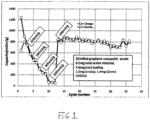
- Figure 1 is a graph of battery performance of a Si/graphene (200-250 m 2 /g, 100 minutes processing time).
- the exfoliated material has a particle size of 10 microns by 5 nm thick, or less.
- the dry milling is controlled by controlling the surface energy of the milling media in addition to controlling the hardness of the milling media.
- a second embodiment that is a process of dry milling particulate materials, wherein at least one of the particulate materials is a layered material, in the presence of a particulate material selected from the group consisting of i. ceramic, ii. glass, and iii. quartz, to obtain a composition wherein the layered material is exfoliated and wherein the particulate material is coated with the exfoliated material.
- the exfoliated material has a particle size of 500 nanometers or less.
- the dry milling is controlled by controlling the surface energy of the milling media in addition to controlling the hardness of the milling media.
- the graphene produced by the methods of this invention has a relatively narrow aspect ratio, greater than graphite.
- aspect ratios above 5 and below 200 are preferred and more preferred are aspect ratios above 10 and below 25.
- the small that is, 1 to 5 nanometers thick, and 50 to 100 nanometers diameter, high surface area (above 500 BET), medium aspect ratio graphene, is a unique size for coating with small metal or metal oxide particles.
- the metals useful in this invention are the metalloid silicon, and the metals tin, iron, magnesium, manganese, aluminum, lead, gold, silver, titanium, platinum, palladium, ruthenium, copper, nickel, rhodium, and alloys of any of the above.
- the plastic milling media useful in this invention has a hardness on the Brinell Scale in the range of 3 to 100.
- the plastic milling media is selected from the group consisting essentially of polyacetals, polyacrylates, such as, for example, methylmethacrylate, polycarbonate, polystyrene, poly- propylene, polyethylene, polytetrafluoroethylene, polyethylene- imide, polyvinylchloride, polyamine-imide, phenolics and formaldehyde-based thermosetting resins, and alloys of any of the plastics named.
- the particulate metal oxides useful in this invention are metal oxides selected from silicon, tin, iron, magnesium, manganese, aluminum, lead, gold, silver, titanium, platinum, palladium, ruthenium, copper, nickel, rhodium, tungsten, cobalt, molybdenum, and alloys of any the above named metal oxides, wherein the metal and metal oxide particles have a size of 100 microns or less. Preferred are particle sizes of 10 microns or less, and most preferred are particle sizes of 5 microns or less.
- Metal carbides, metal nitrides are useful in this invention, as well as non-layered materials.
- Graphene useful in this invention is preferred to have a thickness of 5 nm or less.
- the polymethylmethacrylate balls can be replaced with polycarbonate, polystyrene, polypropylene, polyethylene, polytetrafluoroethylene, polyethyleneimide, polyvinylchloride and polyamide-imide to control milling efficiency, graphene size, porosity distribution and surface area at a fixed milling time, contact quality between Si and graphene surface.
- the surface area of the Si/graphene composite produced can be varied from 100m 2 /g to 700m 2 /g depending on milling time (60 to 500 min.) and Si/graphene composition and type of ball materials.
- the result for the battery performance of a Si/graphene (200 to 250 m 2 /g, 100 min. processing) sample as an anode for a lithium ion battery is plotted infra.
- the Si/graphene shows high capacity (>800 mAh/g, electrode loading) over 35 cycles at 100 mA/g, which supports the low cost, simple, time-saving, environmentally benign, flexible way to produce high performance graphene-based composite materials for energy applications. Some fluctuation of the capacity is due to the variation of temperature.
Landscapes
- Chemical & Material Sciences (AREA)
- Engineering & Computer Science (AREA)
- Chemical Kinetics & Catalysis (AREA)
- General Chemical & Material Sciences (AREA)
- Electrochemistry (AREA)
- Manufacturing & Machinery (AREA)
- Power Engineering (AREA)
- Inorganic Chemistry (AREA)
- Materials Engineering (AREA)
- Composite Materials (AREA)
- Ceramic Engineering (AREA)
- Organic Chemistry (AREA)
- Microelectronics & Electronic Packaging (AREA)
- Structural Engineering (AREA)
- Life Sciences & Earth Sciences (AREA)
- Wood Science & Technology (AREA)
- Food Science & Technology (AREA)
- Battery Electrode And Active Subsutance (AREA)
- Carbon And Carbon Compounds (AREA)
- Crushing And Grinding (AREA)
- Electric Double-Layer Capacitors Or The Like (AREA)
- Catalysts (AREA)
- Conductive Materials (AREA)
- Non-Insulated Conductors (AREA)
Abstract
Description
- Be it known that we, Inhwan Do, residing in the City of East Lansing, County of Ingham, State of Michigan, a citizen of the Republic of Korea, Michael Knox, residing in the City of East Lansing, County Ingham, State of Michigan, a citizen of the United States of America, Scott Murray, residing in the City of East Lansing, County of Ingham, State of Michigan, a citizen of the United States of America, and Robert M. Privette, residing in the City of East Lansing, County of Ingham, State of Michigan, a citizen of the United States of America, have invented a new and novel
- the following of which is a specification therefor.
- This invention deals with graphene platelet nano composites with metal or metal oxide, and graphene platelet nano coated with metal or metal oxide. The coated and composited particles are useful as electrodes and for electrical applications.
- Graphite is formed by many layers of carbon in highly structured platelets. These platelets, when separated from the graphite superstructure, are collectively called graphene. Graphene has interesting chemical, physical, and electrical properties. These properties make graphene a highly valued product. The quality of the graphene, as defined by particle diameter, particle width, and surface area, determine its industrial utility. It is advantageous to coat or composite graphene with metal particles for electrical applications.
- Xg Sciences, Inc. headquartered in Lansing, Michigan produces a "C" grade graphene by a high energy, plastic media, dry, mechanical milling process. Grade size characteristics make it uniquely suited to coating or mixing with nanoparticles to form useful materials for electrodes.
- The applicant is aware of
U.S. Patent publication 2011/0111303 A1 that published on may 12, 2011 as showing a wet process for treating graphene with silicon. - Also, the patentees are aware of
EP2275385 in the name of Peukert, et al in which a wet process is set forth for grinding particulate materials, wherein the grinding media is yttrium stabilized zirconia. - Graphene produced by media ball milling has very small particle size with a relatively high surface area. It is uniquely suited to make nano-composites or coatings by coating or admixing other particles. Metals or metal oxides can be coated or formed into composites with the high surface area, relatively low aspect ratio graphene. It is believed by the inventors herein that the materials of this invention have unique aspect ratios. Ground graphite admixed with silicon has an aspect ratio fairly close to 1, graphene from a GO process, epitaxially grown graphene, or graphene from an intercalated - heating process has a very high aspect ratio. The moderate aspect ratio graphene of this invention better coats 1 to 4 micron particles and better mixes with even small nanoparticles.
- Based on Raman spectroscopy with the aspect ratio, particle size, and/or surface area, provides graphene in this invention that is unique.
- Based on the following table calculated from Raman Spectroscopy and measuring peak height, generated the following table.
m2/g G D G/D Gpeak 250 50 5 10 1580 400 19 6 3.2 500 21 7 3 600 16 6 2.7 1585 - Native graphite has a very high G/D ratio. Graphite ground to amorphous powder has the G/D ratio, the material of the instant invention starts high and tends toward 2 the more the material is processed. Amorphous graphite also has a G peak red shift to 2000 cm-1. The material of the instant invention may have a small red shift, but from the quality of the data it is hard to determine. The very high surface area and aspect ratio confirms it is largely graphene nano-platelets.
- Mechanically exfoliated graphene is distinct from ground graphite, in that, it maintains the strong crystalline sp2 structure. As graphite is ground to amorphous, the ratio of G to D Raman lines tends to 2 and the G line red shifts from 1560 cm-1 to 2000 cm-1. The G peak is referred to as the graphene peak. The D peak referred to as the Disorder peak. The more graphite is ground, the more the G peak is reduced and the D peak is increased.
- If the added particles are larger than the graphene, they are coated with graphene, and if they are about the same approximate size, a nano-composite forms. The nanocomposites are useful for producing electrodes, especially for battery and capacitor applications.
-
Figure 1 is a graph of battery performance of a Si/graphene (200-250 m2/g, 100 minutes processing time). - Thus, in one embodiment, there is a process of dry milling particulate materials, wherein at least one of the particulate materials is a layered material, in the presence of a non-layered material, to obtain a composition wherein the layered material is exfoliated and wherein the non-layered material is composited with the exfoliated material.
- The exfoliated material has a particle size of 10 microns by 5 nm thick, or less. In addition, the dry milling is controlled by controlling the surface energy of the milling media in addition to controlling the hardness of the milling media.
- In a second embodiment, that is a process of dry milling particulate materials, wherein at least one of the particulate materials is a layered material, in the presence of a particulate material selected from the group consisting of i. ceramic, ii. glass, and iii. quartz, to obtain a composition wherein the layered material is exfoliated and wherein the particulate material is coated with the exfoliated material.
- The exfoliated material has a particle size of 500 nanometers or less. In addition, the dry milling is controlled by controlling the surface energy of the milling media in addition to controlling the hardness of the milling media.
- In a fourth embodiment, there is a composited product obtained by the first embodiment and a coated product obtained by the second embodiment.
- The graphene produced by the methods of this invention has a relatively narrow aspect ratio, greater than graphite. For this invention aspect ratios above 5 and below 200 are preferred and more preferred are aspect ratios above 10 and below 25.
- The small, that is, 1 to 5 nanometers thick, and 50 to 100 nanometers diameter, high surface area (above 500 BET), medium aspect ratio graphene, is a unique size for coating with small metal or metal oxide particles.
- The metals useful in this invention are the metalloid silicon, and the metals tin, iron, magnesium, manganese, aluminum, lead, gold, silver, titanium, platinum, palladium, ruthenium, copper, nickel, rhodium, and alloys of any of the above.
- The plastic milling media useful in this invention has a hardness on the Brinell Scale in the range of 3 to 100. The plastic milling media is selected from the group consisting essentially of polyacetals, polyacrylates, such as, for example, methylmethacrylate, polycarbonate, polystyrene, poly- propylene, polyethylene, polytetrafluoroethylene, polyethylene- imide, polyvinylchloride, polyamine-imide, phenolics and formaldehyde-based thermosetting resins, and alloys of any of the plastics named.
- The particulate metal oxides useful in this invention are metal oxides selected from silicon, tin, iron, magnesium, manganese, aluminum, lead, gold, silver, titanium, platinum, palladium, ruthenium, copper, nickel, rhodium, tungsten, cobalt, molybdenum, and alloys of any the above named metal oxides, wherein the metal and metal oxide particles have a size of 100 microns or less. Preferred are particle sizes of 10 microns or less, and most preferred are particle sizes of 5 microns or less.
- Metal carbides, metal nitrides are useful in this invention, as well as non-layered materials.
- Graphene useful in this invention is preferred to have a thickness of 5 nm or less.
- Two grams of natural graphite and 1 g of micron sized Si (1 to 4 um) were loaded into a 65 ml stainless steel grinding container and milled in the presence of 24 g of polymethylmethacrylate balls. The polymethylmethacrylate balls consisted of two different sizes, namely, 1/4 inches and 3/8 inches in diameter. The high energy milling machine was operated at < 1500 rpm and its clamp speed was 1060 cycle/min. The polymethylmethacrylate balls can be replaced with polycarbonate, polystyrene, polypropylene, polyethylene, polytetrafluoroethylene, polyethyleneimide, polyvinylchloride and polyamide-imide to control milling efficiency, graphene size, porosity distribution and surface area at a fixed milling time, contact quality between Si and graphene surface. The surface area of the Si/graphene composite produced can be varied from 100m2/g to 700m2/g depending on milling time (60 to 500 min.) and Si/graphene composition and type of ball materials.
- The result for the battery performance of a Si/graphene (200 to 250 m2/g, 100 min. processing) sample as an anode for a lithium ion battery is plotted infra. The Si/graphene shows high capacity (>800 mAh/g, electrode loading) over 35 cycles at 100 mA/g, which supports the low cost, simple, time-saving, environmentally benign, flexible way to produce high performance graphene-based composite materials for energy applications. Some fluctuation of the capacity is due to the variation of temperature.
- Two grams of natural graphite and 1 g of nano sized metal oxides (Fe2O3, NiO, CoO3, MnO3) were loaded in a 65 ml stainless steel grinding container and milled in the presence of 24 g of polymethylmethyacrylate balls. The products can be used as anode materials for lithium batteries and electrodes for supercapacitors.
- Embodiments of the present invention:
-
Embodiment 1. A process of dry milling particulate materials, wherein at least one of the particulate materials is a layered material, in the presence of a non-layered material, to obtain a composition wherein the layered material is exfoliated and wherein the non-layered material is composited with the exfoliated material, the exfoliated material having a particle size of 10 microns by 5 nm thick, or less, and wherein the dry milling is controlled by controlling the surface energy of the milling media in addition to controlling the hardness of the milling media. - Embodiment 2. The process as in
embodiment 1 wherein the non-layered material is selected from the group consisting essentially of:- i. a particulate metal and,
- ii. A particulate metal oxide.
- Embodiment 3. The process as in
embodiment 1 wherein the layered material is graphite. - Embodiment 4. The process as in
embodiment 1 wherein the milling media has a surface energy essentially equivalent to the surface energy of the layered material. -
Embodiment 5. The process as inembodiment 1 wherein the milling media has a hardness on the Brinell Scale in the range of 3 to 100. Embodiment 6. The process as inembodiment 1 wherein the exfoliated material has an aspect ratio of greater than about 25. - Embodiment 7. The process as in
embodiment 1 wherein the exfoliated material has an aspect ratio of from 5 to 200. - Embodiment 8. The process as in
embodiment 1 wherein the exfoliated material has a size in the range of from 50 nm to 10 microns. Embodiment 9. The process as inembodiment 1 wherein the exfoliated material has a thickness of from 1 nm to 5 nm. -
Embodiment 10. The process as inembodiment 1 wherein the milling media is plastic material. - Embodiment 11. The process as in
embodiment 10 wherein the plastic is selected from the group consisting essentially of:- i. polymethylmethacrylate,
- ii. polycarbonate,
- iii. polystyrene,
- iv. polypropylene,
- v. polyethylene,
- vi. polytetrafluoroethylene,
- vii. polyethyleneimide,
- viii. polyvinylchloride,
- ix. polyamine-imide, and,
- x. alloys of any of i. to ix.
- Embodiment 12. The process as in embodiment 2 wherein the particulate metals are selected from the group consisting essentially of:
- i. silicon,
- ii. tin,
- iii. iron,
- iv. magnesium,
- v. manganese,
- vi. aluminum,
- vii. lead,
- viii. gold,
- ix. silver,
- x. titanium,
- xi. platinum,
- xii. palladium,
- xiii. ruthenium,
- xiv. copper,
- xv. nickel,
- xvi. rhodium, and,
- xvii. alloys of any of i. to xvi.
- Embodiment 13. The process as in embodiment 2 wherein the particulate metal oxides are selected from the group consisting essentially of oxides of:
- i. silicon,
- ii. tin,
- iii. iron,
- iv. magnesium,
- v. manganese,
- v . aluminum,
- vii. lead,
- viii. gold,
- ix. silver,
- x. titanium,
- xi. platinum,
- xii. palladium,
- xiii. ruthenium,
- xiv. copper,
- xv. nickel,
- xvi. rhodium, and,
- xvii. alloys of any of i. to xvi.
- Embodiment 14. The process as in
embodiment 1 wherein the particulate non-layered material has a size less than 100 microns.Embodiment 15. The process as inembodiment 1 wherein the particulate are metal carbides. - Embodiment 16. The process as in
embodiment 1 wherein the particulate materials are metal nitrides. - Embodiment 17. A product when produced by the process of
embodiment 1. - Embodiment 18. An electrode produced from the product as in embodiment 17.
- Embodiment 19. A catalyst produced from the product as in embodiment 17.
-
Embodiment 20. A coating produced from the product as in embodiment 17. - Embodiment 21. An electronic component manufactured from the product as in embodiment 17.
- Embodiment 22. A thermally conductive component manufactured from the product as in embodiment 17.
- Embodiment 23. A process of dry milling particulate materials, wherein at least one of the particulate materials is a layered material, in the presence of a particulate material selected from the group consisting of i. ceramic, ii. glass, and iii. quartz, to obtain a composition wherein the layered material is exfoliated and wherein the particulate material is coated with the exfoliated material, the exfoliated material having a particle size of 500 nanometers or less, and wherein the dry milling is controlled by controlling the surface energy of the milling media in addition to controlling the hardness of the milling media.
- Embodiment 24. A process of dry milling particulate materials, wherein at least one of the particulate materials is a layered material, in the presence of a particulate material selected from the group consisting of i. ceramic, ii. glass, and iii. quartz, to obtain a composition wherein the layered material is exfoliated and wherein the particulate material is coated with the exfoliated material, the exfoliated material having a particle size of 10 microns or more, and the wherein the dry milling is controlled by controlling the surface energy of the milling media in addition to controlling the hardness of the milling media.
-
Embodiment 25. A composition of matter comprising particles composited with graphene wherein the particles are selected from the group consisting essentially of metal particles, and metal oxide particles, wherein the metal and metal oxide particles have a size of 100 microns or smaller. - Embodiment 26. A composition of matter as in
embodiment 25 wherein the metal and metal oxide particles have a size of 100 microns or less. - Embodiment 27. A composition of matter as in
embodiment 25 wherein the metal and metal oxide particles have a size of 10 microns or less. - Embodiment 28. A composition of matter as in
embodiment 25 wherein the metal and metal oxide particles have a size of 1 micron or less. Embodiment 29. A composition of matter as inembodiment 25 wherein the graphene is less than 5 nm thick. -
Embodiment 30. A composition of matter as inembodiment 25 wherein the graphene is a monolayer thick. - Embodiment 31. A composition of matter as in
embodiment 25 wherein the oxygen content of the graphene is ten atomic weight percent or less. - Embodiment 32. A composition of matter as in
embodiment 25 wherein the metal is selected from the group consisting essentially of iron, magnesium, cobalt, molybdenum, and lead. - Embodiment 33. A composition of matter as in
embodiment 25 wherein the metal oxide is selected from the group of oxides consisting essentially of iron oxide, magnesium oxide, cobalt oxide, molybdenum oxide, and lead oxide. - Embodiment 34. A composition of matter as in
embodiment 25 wherein the size of the graphene particle is less than 5 microns.Embodiment 35. A composition of matter as inembodiment 25 wherein the surface area of the graphene is greater than about 300 m2/g BET. Embodiment 36. A composition of matter as inembodiment 25 wherein the metal particles are larger than the graphene composited with them. - Embodiment 37. A composition of matter as in
embodiment 25 wherein the metal particle are essentially the same size as the graphene they are combined with. - Embodiment 38. A composition of matter as in
embodiment 25 that is a nanocomposite. - Embodiment 39. An electrode manufactured from the composition of embodiment25.
-
Embodiment 40. A battery comprising at least one electrode as in embodiment 39. - Embodiment 41. A capacitor comprising an electrode as in embodiment 39.
Claims (15)
- A composite, comprising:a metal or metal oxide having a particle size of 100 microns or less; andgraphene having a particle size of no more than 10 microns to 5 nanometers thick or less, and an aspect ratio from 5 to 200, the graphene coating the metal or metal oxide.
- The composite of claim 1, wherein the ratio of graphene to metal or metal oxide is no more than 2.
- The composite of claim 1 or 2, wherein the metal or metal oxide is silicon, and the metal or metal oxide has a particle size of 10 microns or smaller.
- The composite of claim 1, wherein the graphene has an aspect ratio greater than 25.
- The composite of claim 1, wherein the graphene has a particle size in the range of 50 nm to 10 microns; and a thickness of 1 nm to 5 nm.
- The composite of claim any one of claims 1-5, wherein the graphene has a surface area greater than about 300 m2/g BET.
- The material of claim 1, wherein the metal or metal oxide has a particle size of 10 microns or smaller.
- The composite of claim 1, wherein the metal or metal oxide has a particle size of 5 microns or smaller.
- The composite of any one of claims 1-8, wherein the metal or metal oxide includes at least one of iron, magnesium, cobalt, molybdenum, or lead.
- The composite of any one of claims 1-8, wherein the metal or metal oxide includes at least one of iron oxide, magnesium oxide, cobalt oxide, molybdenum oxide, or lead oxide.
- A composite for use as an electrode, the composite including:a non-layered material having a particle size of no more than 100 microns,; andan exfoliated material of graphene disposed on the non-layered material, the exfoliated material of graphene having a particle size of 10 microns by 5 nanometers thick and an aspect ratio of 5 to 200.
- The composite of claim 11, wherein the non-layered material is silicon, and the non-layered material has a particle size of 10 microns or smaller.
- The composite of claim 11 or 12, wherein the exfoliated material of graphene has a surface area greater than about 300 m2/g BET.
- The composite of claim 11, wherein the layered exfoliated material of graphene has an aspect ratio greater than about 25.
- The composite of claim 11, wherein the non-layered material has a particle size of 5 microns or smaller.
Applications Claiming Priority (3)
| Application Number | Priority Date | Filing Date | Title |
|---|---|---|---|
| US13/474,860 US20130309495A1 (en) | 2012-05-18 | 2012-05-18 | Process of dry milling particulate materials |
| EP13790097.3A EP2849887B1 (en) | 2012-05-18 | 2013-05-01 | Process of dry milling particulate materials |
| PCT/US2013/038967 WO2013173053A1 (en) | 2012-05-18 | 2013-05-01 | Process of dry milling particulate materials |
Related Parent Applications (1)
| Application Number | Title | Priority Date | Filing Date |
|---|---|---|---|
| EP13790097.3A Division EP2849887B1 (en) | 2012-05-18 | 2013-05-01 | Process of dry milling particulate materials |
Publications (2)
| Publication Number | Publication Date |
|---|---|
| EP4404227A2 true EP4404227A2 (en) | 2024-07-24 |
| EP4404227A3 EP4404227A3 (en) | 2024-08-21 |
Family
ID=49581534
Family Applications (2)
| Application Number | Title | Priority Date | Filing Date |
|---|---|---|---|
| EP24164635.5A Pending EP4404227A3 (en) | 2012-05-18 | 2013-05-01 | Process of dry milling particulate materials |
| EP13790097.3A Active EP2849887B1 (en) | 2012-05-18 | 2013-05-01 | Process of dry milling particulate materials |
Family Applications After (1)
| Application Number | Title | Priority Date | Filing Date |
|---|---|---|---|
| EP13790097.3A Active EP2849887B1 (en) | 2012-05-18 | 2013-05-01 | Process of dry milling particulate materials |
Country Status (8)
| Country | Link |
|---|---|
| US (2) | US20130309495A1 (en) |
| EP (2) | EP4404227A3 (en) |
| JP (2) | JP6618800B2 (en) |
| KR (1) | KR102107868B1 (en) |
| CN (1) | CN104582855B (en) |
| ES (1) | ES2984346T3 (en) |
| TW (1) | TWI589524B (en) |
| WO (1) | WO2013173053A1 (en) |
Families Citing this family (26)
| Publication number | Priority date | Publication date | Assignee | Title |
|---|---|---|---|---|
| US10079389B2 (en) | 2012-05-18 | 2018-09-18 | Xg Sciences, Inc. | Silicon-graphene nanocomposites for electrochemical applications |
| US9959947B2 (en) | 2013-09-30 | 2018-05-01 | Samsung Electronics Co., Ltd. | Composite, carbon composite including the composite, electrode, lithium battery, electroluminescent device, biosensor, semiconductor device, and thermoelectric device including the composite and/or the carbon composite |
| CN103801298A (en) * | 2014-01-26 | 2014-05-21 | 同济大学 | Hydrothermal rapid synthesis method of graphene load nickel nanoparticle composite material |
| AU2015271619B2 (en) | 2014-06-06 | 2019-05-09 | Nanoxplore Inc. | Large scale production of thinned graphite, graphene, and graphite-graphene composites |
| CN104091915B (en) * | 2014-07-17 | 2016-07-06 | 浙江大学 | The electrochemistry storage sodium combination electrode of a kind of high power capacity and stable circulation and preparation method |
| US10644309B2 (en) | 2014-10-06 | 2020-05-05 | Xg Sciences, Inc. | LiF-embedded SiG powder for lithium ion battery |
| EP3230386B1 (en) | 2014-12-09 | 2024-02-21 | NanoXplore Inc. | Large scale production of oxidized graphene |
| GB2536465A (en) * | 2015-03-18 | 2016-09-21 | Univ Loughborough | Conformal coating, composition and method for the mitigation of growth of metallic crystalline structures |
| US10878976B2 (en) * | 2015-06-19 | 2020-12-29 | Hamilton Sundstrand Corporation | Composites and methods of making composite materials |
| CN105047255B (en) * | 2015-07-30 | 2017-03-22 | 江苏国瓷泓源光电科技有限公司 | Crystalline silicon solar cell aluminum paste with high disperse graphene content and preparation method of crystalline silicon solar cell aluminum paste |
| US11772975B2 (en) * | 2015-12-03 | 2023-10-03 | Global Graphene Group, Inc. | Chemical-free production of graphene materials |
| US9926427B2 (en) * | 2015-12-10 | 2018-03-27 | Nanotek Instruments, Inc. | Chemical-free production of graphene-reinforced polymer matrix composites |
| EP3412626A4 (en) * | 2016-02-01 | 2019-08-28 | Eficiencia Energética Aplicada, S.L. | METHOD OF OBTAINING GRAPHENE PRODUCT, GRAPHENIC PRODUCT AND USE THEREOF |
| US10850496B2 (en) * | 2016-02-09 | 2020-12-01 | Global Graphene Group, Inc. | Chemical-free production of graphene-reinforced inorganic matrix composites |
| US9899672B2 (en) * | 2016-05-17 | 2018-02-20 | Nanotek Instruments, Inc. | Chemical-free production of graphene-encapsulated electrode active material particles for battery applications |
| US10170749B2 (en) * | 2016-06-07 | 2019-01-01 | Nanotek Instruments, Inc. | Alkali metal battery having an integral 3D graphene-carbon-metal hybrid foam-based electrode |
| CN106582994B (en) * | 2016-11-04 | 2019-03-29 | 成都新柯力化工科技有限公司 | A kind of device and production method continuously preparing graphene slurry |
| EP3324419B1 (en) | 2016-11-18 | 2020-04-22 | Samsung Electronics Co., Ltd. | Porous silicon composite cluster structure, method of preparing the same, carbon composite using the same, and electrode, lithium battery, and device each including the same |
| IT201700000211A1 (en) * | 2017-01-02 | 2018-07-02 | Breton Spa | Graphene and other 2D materials as layered "shells" supported on "core" nanoparticle carriers |
| CN109103454A (en) * | 2018-07-05 | 2018-12-28 | 何亚龙 | Lithium battery graphene conductive slurry and preparation method thereof |
| KR102701081B1 (en) | 2018-10-25 | 2024-09-04 | 삼성전자주식회사 | Porous silicon-containing composite, carbon composite using the same, and electrode, lithium battery, and electronic device each including the same |
| KR102803819B1 (en) | 2018-12-10 | 2025-05-08 | 주식회사 엘지에너지솔루션 | Negative electrode active material, negative electrode and lithium secondary battery comprising the same |
| WO2020237241A1 (en) | 2019-05-23 | 2020-11-26 | Xg Sciences, Inc. | Process for in-situ functionalization of graphene |
| CN110143587A (en) * | 2019-05-27 | 2019-08-20 | 西安交通大学 | A method for evenly loading micro-nano particles on graphene |
| US12600870B2 (en) | 2020-06-24 | 2026-04-14 | Nanoxplore Inc. | Non-oxidized graphene-based anti-viral coating |
| WO2024211989A1 (en) | 2023-04-11 | 2024-10-17 | Nanoxplore Inc. | Anode particles including discarded graphite particles, and methods of producing the same |
Citations (2)
| Publication number | Priority date | Publication date | Assignee | Title |
|---|---|---|---|---|
| EP2275385A1 (en) | 2009-07-15 | 2011-01-19 | Friedrich-Alexander-Universität Erlangen-Nürnberg | Method of producing platelets comprising a layered material |
| US20110111303A1 (en) | 2009-11-06 | 2011-05-12 | Northwestern University | Electrode material comprising graphene composite materials in a graphite network formed from reconstituted graphene sheets |
Family Cites Families (20)
| Publication number | Priority date | Publication date | Assignee | Title |
|---|---|---|---|---|
| JPH1145705A (en) * | 1997-05-27 | 1999-02-16 | Tdk Corp | Manufacture of electrode for nonaqueous electric battery |
| US6620550B2 (en) * | 2001-01-23 | 2003-09-16 | The Gillette Company | Battery cathode and method of manufacture therefor |
| GB0200259D0 (en) * | 2002-01-07 | 2002-02-20 | Univ Reading The | Encapsulated radioactive nuclide microparticles and methods for their production |
| JP2006505483A (en) * | 2002-11-26 | 2006-02-16 | カーボン ナノテクノロジーズ インコーポレーテッド | Carbon nanotube fine particles, composition and method of use thereof |
| US20040137327A1 (en) * | 2003-01-13 | 2004-07-15 | Gross Karl J. | Synthesis of carbon/silicon composites |
| KR100745733B1 (en) * | 2005-09-23 | 2007-08-02 | 삼성에스디아이 주식회사 | Negative electrode active material, manufacturing method thereof and lithium battery employing same |
| US7906238B2 (en) * | 2005-12-23 | 2011-03-15 | 3M Innovative Properties Company | Silicon-containing alloys useful as electrodes for lithium-ion batteries |
| JP5182776B2 (en) * | 2006-04-27 | 2013-04-17 | 日立粉末冶金株式会社 | Graphite intercalation compound and catalyst using modified graphite, and production method thereof |
| FR2901491B1 (en) | 2006-05-24 | 2009-03-20 | Coatex Sas | DRY GRINDING METHOD OF MATERIALS CONTAINING CARBONATE ORE |
| US8262981B2 (en) * | 2006-12-18 | 2012-09-11 | Schott Corporation | Ceramic material product and method of manufacture |
| US7785498B2 (en) * | 2007-07-19 | 2010-08-31 | Nanotek Instruments, Inc. | Method of producing conducting polymer-transition metal electro-catalyst composition and electrodes for fuel cells |
| US7745047B2 (en) * | 2007-11-05 | 2010-06-29 | Nanotek Instruments, Inc. | Nano graphene platelet-base composite anode compositions for lithium ion batteries |
| WO2009127901A1 (en) | 2008-04-14 | 2009-10-22 | High Power Lithium S.A. | Lithium metal phosphate/carbon nanocomposites as cathode active materials for secondary lithium batteries |
| US8075794B2 (en) * | 2008-07-01 | 2011-12-13 | Teledyne Scientific & Imaging, Llc | Magnetic graphite nanoplatelets |
| US8257867B2 (en) * | 2008-07-28 | 2012-09-04 | Battelle Memorial Institute | Nanocomposite of graphene and metal oxide materials |
| US8658062B2 (en) * | 2008-09-26 | 2014-02-25 | University of Pittsburgh—of the Commonwealth System of Higher Education | Nanoscale silicon-based compositions and methods of preparation |
| CN102971892B (en) * | 2010-02-24 | 2016-05-18 | 株式会社Lg化学 | High-capacity positive electrode active material and lithium secondary battery comprising said high-capacity positive electrode active material |
| CN102214817A (en) * | 2010-04-09 | 2011-10-12 | 清华大学 | Carbon/silicon/carbon nano composite structure cathode material and preparation method thereof |
| US9558860B2 (en) * | 2010-09-10 | 2017-01-31 | Samsung Electronics Co., Ltd. | Graphene-enhanced anode particulates for lithium ion batteries |
| US10886526B2 (en) * | 2013-06-13 | 2021-01-05 | Zenlabs Energy, Inc. | Silicon-silicon oxide-carbon composites for lithium battery electrodes and methods for forming the composites |
-
2012
- 2012-05-18 US US13/474,860 patent/US20130309495A1/en not_active Abandoned
-
2013
- 2013-05-01 EP EP24164635.5A patent/EP4404227A3/en active Pending
- 2013-05-01 WO PCT/US2013/038967 patent/WO2013173053A1/en not_active Ceased
- 2013-05-01 JP JP2015512666A patent/JP6618800B2/en active Active
- 2013-05-01 CN CN201380025858.7A patent/CN104582855B/en active Active
- 2013-05-01 ES ES13790097T patent/ES2984346T3/en active Active
- 2013-05-01 KR KR1020147032292A patent/KR102107868B1/en active Active
- 2013-05-01 EP EP13790097.3A patent/EP2849887B1/en active Active
- 2013-05-14 TW TW102117000A patent/TWI589524B/en active
-
2016
- 2016-05-16 US US15/155,158 patent/US10232377B2/en active Active
-
2018
- 2018-04-03 JP JP2018071910A patent/JP2018134639A/en active Pending
Patent Citations (2)
| Publication number | Priority date | Publication date | Assignee | Title |
|---|---|---|---|---|
| EP2275385A1 (en) | 2009-07-15 | 2011-01-19 | Friedrich-Alexander-Universität Erlangen-Nürnberg | Method of producing platelets comprising a layered material |
| US20110111303A1 (en) | 2009-11-06 | 2011-05-12 | Northwestern University | Electrode material comprising graphene composite materials in a graphite network formed from reconstituted graphene sheets |
Also Published As
| Publication number | Publication date |
|---|---|
| TWI589524B (en) | 2017-07-01 |
| CN104582855B (en) | 2019-09-10 |
| JP2015526264A (en) | 2015-09-10 |
| KR102107868B1 (en) | 2020-05-07 |
| ES2984346T3 (en) | 2024-10-29 |
| KR20150035536A (en) | 2015-04-06 |
| JP6618800B2 (en) | 2019-12-11 |
| EP4404227A3 (en) | 2024-08-21 |
| EP2849887B1 (en) | 2024-03-20 |
| US20130309495A1 (en) | 2013-11-21 |
| EP2849887A4 (en) | 2016-01-06 |
| EP2849887A1 (en) | 2015-03-25 |
| TW201402458A (en) | 2014-01-16 |
| CN104582855A (en) | 2015-04-29 |
| JP2018134639A (en) | 2018-08-30 |
| WO2013173053A1 (en) | 2013-11-21 |
| US10232377B2 (en) | 2019-03-19 |
| US20160256873A1 (en) | 2016-09-08 |
Similar Documents
| Publication | Publication Date | Title |
|---|---|---|
| EP4404227A2 (en) | Process of dry milling particulate materials | |
| Thiagarajan et al. | Facile methodology of sol-gel synthesis for metal oxide nanostructures | |
| Meng et al. | NiO-functionalized In2O3 flower-like structures with enhanced trimethylamine gas sensing performance | |
| Ding et al. | SnO 2 nanosheets grown on graphene sheets with enhanced lithium storage properties | |
| Wang et al. | Assembling carbon-coated α-Fe 2 O 3 hollow nanohorns on the CNT backbone for superior lithium storage capability | |
| Li et al. | Synthesis of 3D hierarchical Fe3O4/graphene composites with high lithium storage capacity and for controlled drug delivery | |
| KR101414560B1 (en) | method for producing conductive film | |
| Chinnappan et al. | Carbon nanotube hybrid nanostructures: future generation conducting materials | |
| Salunkhe et al. | Binary metal hydroxide nanorods and multi-walled carbon nanotube composites for electrochemical energy storage applications | |
| Lee et al. | Improved supercapacitor performance of MnO 2–graphene composites constructed using a supercritical fluid and wrapped with an ionic liquid | |
| Tanaka et al. | Prussian blue derived iron oxide nanoparticles wrapped in graphene oxide sheets for electrochemical supercapacitors | |
| JP2014043357A (en) | Electroconductive ceramic sintered compact and electric and electronic members using the same | |
| Qin et al. | One-step synthesis of CuO@ brass foil by dealloying method for low-cost flexible supercapacitor electrodes | |
| Li et al. | Performance of chemically synthesized Mn3O4/rGO nanocomposite for electrochemical supercapacitor: a cost-effective high-performance electrode | |
| Bharatiya et al. | Preparation, characterization and dielectric properties of GO based ZnO embedded mixed metal oxides ternary nanostructured composites | |
| JP2015107881A (en) | Electrothermal nano composite material having high mechanical reliability and manufacturing method thereof | |
| Volodin et al. | Electro-conductive composites based on titania and carbon nanotubes | |
| KR20150035052A (en) | Method for preparing graphene-zinc oxide composite materials and piezo-electric element using the same | |
| Bashal et al. | Structural, conductivity, and dielectric properties of nickel oxide and copper (Cu) or chromium (Cr) doped nickel oxide nanoparticles | |
| Padhan et al. | NiO–Ti nanocomposites for contact electrification and energy harvesting: experimental and DFT+ U studies | |
| Kalita et al. | Nanoparticles and nanofillers | |
| González et al. | Hybrids of Graphite, Graphene and Graphene Oxide | |
| Jose et al. | Electrical Properties of Nanofillers | |
| Ding et al. | Effects of outer shell layer on the electronic transport behaviors of Sn@ SnOx nanoparticles | |
| Jyoti et al. | Recent Escalations in MXenes: From Fundamental to Applications |
Legal Events
| Date | Code | Title | Description |
|---|---|---|---|
| PUAI | Public reference made under article 153(3) epc to a published international application that has entered the european phase |
Free format text: ORIGINAL CODE: 0009012 |
|
| STAA | Information on the status of an ep patent application or granted ep patent |
Free format text: STATUS: THE APPLICATION HAS BEEN PUBLISHED |
|
| REG | Reference to a national code |
Ref country code: DE Ref legal event code: R079 Free format text: PREVIOUS MAIN CLASS: H01G0011460000 Ipc: B02C0017200000 |
|
| PUAL | Search report despatched |
Free format text: ORIGINAL CODE: 0009013 |
|
| AC | Divisional application: reference to earlier application |
Ref document number: 2849887 Country of ref document: EP Kind code of ref document: P |
|
| AK | Designated contracting states |
Kind code of ref document: A2 Designated state(s): AL AT BE BG CH CY CZ DE DK EE ES FI FR GB GR HR HU IE IS IT LI LT LU LV MC MK MT NL NO PL PT RO RS SE SI SK SM TR |
|
| AK | Designated contracting states |
Kind code of ref document: A3 Designated state(s): AL AT BE BG CH CY CZ DE DK EE ES FI FR GB GR HR HU IE IS IT LI LT LU LV MC MK MT NL NO PL PT RO RS SE SI SK SM TR |
|
| RIC1 | Information provided on ipc code assigned before grant |
Ipc: C04B 35/628 20060101ALI20240717BHEP Ipc: B82Y 30/00 20110101ALI20240717BHEP Ipc: C04B 35/626 20060101ALI20240717BHEP Ipc: B02C 17/20 20060101AFI20240717BHEP |
|
| STAA | Information on the status of an ep patent application or granted ep patent |
Free format text: STATUS: REQUEST FOR EXAMINATION WAS MADE |
|
| 17P | Request for examination filed |
Effective date: 20250220 |
|
| STAA | Information on the status of an ep patent application or granted ep patent |
Free format text: STATUS: EXAMINATION IS IN PROGRESS |