EP4404186A1 - Speech processing method and apparatus, and storage medium, computer device and program product - Google Patents
Speech processing method and apparatus, and storage medium, computer device and program product Download PDFInfo
- Publication number
- EP4404186A1 EP4404186A1 EP23802536.5A EP23802536A EP4404186A1 EP 4404186 A1 EP4404186 A1 EP 4404186A1 EP 23802536 A EP23802536 A EP 23802536A EP 4404186 A1 EP4404186 A1 EP 4404186A1
- Authority
- EP
- European Patent Office
- Prior art keywords
- speech
- loss function
- training
- noise
- feature
- Prior art date
- Legal status (The legal status is an assumption and is not a legal conclusion. Google has not performed a legal analysis and makes no representation as to the accuracy of the status listed.)
- Pending
Links
Images




Classifications
-
- G—PHYSICS
- G10—MUSICAL INSTRUMENTS; ACOUSTICS
- G10L—SPEECH ANALYSIS TECHNIQUES OR SPEECH SYNTHESIS; SPEECH RECOGNITION; SPEECH OR VOICE PROCESSING TECHNIQUES; SPEECH OR AUDIO CODING OR DECODING
- G10L15/00—Speech recognition
- G10L15/02—Feature extraction for speech recognition; Selection of recognition unit
-
- G—PHYSICS
- G10—MUSICAL INSTRUMENTS; ACOUSTICS
- G10L—SPEECH ANALYSIS TECHNIQUES OR SPEECH SYNTHESIS; SPEECH RECOGNITION; SPEECH OR VOICE PROCESSING TECHNIQUES; SPEECH OR AUDIO CODING OR DECODING
- G10L21/00—Speech or voice signal processing techniques to produce another audible or non-audible signal, e.g. visual or tactile, in order to modify its quality or its intelligibility
- G10L21/02—Speech enhancement, e.g. noise reduction or echo cancellation
- G10L21/0208—Noise filtering
-
- G—PHYSICS
- G10—MUSICAL INSTRUMENTS; ACOUSTICS
- G10L—SPEECH ANALYSIS TECHNIQUES OR SPEECH SYNTHESIS; SPEECH RECOGNITION; SPEECH OR VOICE PROCESSING TECHNIQUES; SPEECH OR AUDIO CODING OR DECODING
- G10L15/00—Speech recognition
- G10L15/06—Creation of reference templates; Training of speech recognition systems, e.g. adaptation to the characteristics of the speaker's voice
- G10L15/063—Training
-
- G—PHYSICS
- G10—MUSICAL INSTRUMENTS; ACOUSTICS
- G10L—SPEECH ANALYSIS TECHNIQUES OR SPEECH SYNTHESIS; SPEECH RECOGNITION; SPEECH OR VOICE PROCESSING TECHNIQUES; SPEECH OR AUDIO CODING OR DECODING
- G10L25/00—Speech or voice analysis techniques not restricted to a single one of groups G10L15/00 - G10L21/00
- G10L25/27—Speech or voice analysis techniques not restricted to a single one of groups G10L15/00 - G10L21/00 characterised by the analysis technique
- G10L25/30—Speech or voice analysis techniques not restricted to a single one of groups G10L15/00 - G10L21/00 characterised by the analysis technique using neural networks
-
- G—PHYSICS
- G10—MUSICAL INSTRUMENTS; ACOUSTICS
- G10L—SPEECH ANALYSIS TECHNIQUES OR SPEECH SYNTHESIS; SPEECH RECOGNITION; SPEECH OR VOICE PROCESSING TECHNIQUES; SPEECH OR AUDIO CODING OR DECODING
- G10L21/00—Speech or voice signal processing techniques to produce another audible or non-audible signal, e.g. visual or tactile, in order to modify its quality or its intelligibility
- G10L21/02—Speech enhancement, e.g. noise reduction or echo cancellation
- G10L21/0208—Noise filtering
- G10L2021/02082—Noise filtering the noise being echo, reverberation of the speech
Definitions
- the present disclosure relates to the field of speech recognition technologies, and more specifically, to a speech processing method and apparatus, a storage medium, a computer device, and a program product.
- speech denoising In daily life, speeches acquired by a microphone are generally "polluted” speeches with different noise, and a main objective of the speech enhancement is to recover speeches without noise from the "polluted” speeches with noise, to effectively suppress various interference signals and enhance target speech signals. This both improves voice quality of the speeches, and is conducive to improving performance of speech recognition.
- the speech enhancement is a preprocessing module for many speech coding and recognition systems, and may be usually divided into near-field speech enhancement and far-field speech enhancement.
- existing speech enhancement uses a denoising and dereverberation solution based on two levels of networks.
- a large calculation amount of the two levels of networks makes the speech enhancement impossible to meet performance requirements of actual applications.
- Embodiments of the present disclosure provide a speech processing method and apparatus, a storage medium, a computer device, and a program product, to improve performance of speech enhancement.
- An embodiment of the present disclosure provides a speech processing method, including: obtaining an initial speech feature of a call speech; inputting the initial speech feature to a pre-trained speech enhancement model, to obtain a target speech feature outputted by the speech enhancement model, the speech enhancement model being obtained through step training based on a deep clustering loss function and a mask inference loss function; and calculating a target speech without noise and reverberation according to the target speech feature.
- An embodiment of the present disclosure further provides a speech processing apparatus, including: an obtaining module, configured to obtain an initial speech feature of a call speech; an enhancement module, configured to input the initial speech feature to a pre-trained speech enhancement model, to obtain a target speech feature outputted by the speech enhancement model, the speech enhancement model being obtained through step training based on a deep clustering loss function and a mask inference loss function; and a calculation model, configured to calculate a target speech without noise and reverberation according to the target speech feature.
- An embodiment of the present disclosure further provides a computer device.
- the computer device includes a processor and a memory.
- the memory stores computer program instructions.
- the computer program instructions when invoked by the processor, perform the speech processing method.
- An embodiment of the present disclosure further provides a computer-readable storage medium.
- the computer-readable storage medium stores program code.
- the program code is executed by a processor, the speech processing method is performed.
- two different loss functions are used to perform model training on a preset speech enhancement model step by step, and the model is guided to efficiently remove noise and reverberation in a speech feature, causing a denoising task and a dereverberation task to implement an optimal training effect in respective training processes, so that it is conducive to improving capabilities of denoising and dereverberation of the speech enhancement model. While computing resources of a model are reduced, the performance of the speech enhancement is improved.
- a type of call that a user makes using a client may include a near-end call and a far-end call.
- a near-end is a location of a participant
- a far-end is a location of other participants in a teleconference.
- the near-end call of the client is only suitable for short-distance calls with a single person or a small number of people, and audio and video experience is mediocre.
- FIG. 1 shows two commonly used solutions for denoising and dereverberation, including denoising followed by dereverberation and dereverberation followed by denoising.
- a microphone array is divided into different subsets.
- Each subset obtains an enhanced speech of each microphone through a first-level speech enhancement network, and enhanced speeches are integrated together and then enhanced by a second-level speech enhancement network, to obtain a final output.
- a speech enhancement solution based on two levels of networks, a large calculation amount is required in a training process, which is not suitable for performance requirements of actual application of a product. If a number of network parameters is reduced to reduce a calculation amount, it leads to deterioration of an effect of the network performing speech enhancement.
- an initial speech feature of a call speech may be obtained, and the initial speech feature is inputted to a pre-trained speech enhancement model to obtain a target speech feature outputted by the speech enhancement model.
- the speech enhancement model is obtained through step training based on a deep clustering loss function and a mask inference loss function, so that two models (two levels of networks) are merged into a same model, reducing calculation costs in a model training process.
- a target speech without noise and reverberation is calculated according to the target speech feature.
- different loss functions are used to perform model training on a preset speech enhancement model, to guide the model to efficiently remove noise and reverberation in the initial speech feature. Therefore, while computing resources of a model are reduced, the performance of speech enhancement is improved.
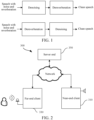
- FIG. 2 is a schematic diagram of an architecture of a speech processing system.
- a speech processing system 300 is used in a remote video conference scenario.
- the speech processing system 300 may include a near-end client 310, a far-end client 330, and a server end 350.
- the near-end client 310, the far-end client 330, and the server end 350 are communicatively connected through a network.
- the near-end client 310 and the far-end client 330 may be large-screen terminals configured for video chatting, and the server end 350 may be a cloud server.
- the far-end client 330 may acquire an initial speech with noise and reverberation generated by a participant, and transmits the initial speech to the server end 350.
- the server end 350 may perform denoising and dereverberation on the initial speech by using a pre-trained speech enhancement model, to obtain an enhanced clean speech (a target speech), and transmit the clean speech to the near-end client 310.
- the speech enhancement model may alternatively be configured in the near-end client 310 or the far-end client 330 according to requirements of actual application scenarios.
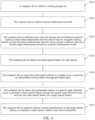
- FIG. 3 is a schematic flowchart of a speech processing method according to an embodiment of the present disclosure.
- the speech processing method is applied to a speech processing apparatus 500 shown in FIG. 9 and a computer device 600 ( FIG. 10 ) in which the speech processing apparatus 500 is configured.
- the computer device used in this embodiment of the present disclosure may be a server, a terminal, or the like.
- the server may be an independent physical server, or may be a server cluster including a plurality of physical servers or a distributed system, or may be a cloud server providing basic cloud computing services, such as a cloud service, a cloud database, cloud computing, a cloud function, cloud storage, a network service, cloud communication, a middleware service, a domain name service, a security service, a CDN, a blockchain, big data, and an artificial intelligence platform.
- the terminal may be a smartphone, a tablet computer, a notebook computer, a desktop computer, a smart speaker, a smartwatch, or the like, but is not limited thereto.
- FIG. 4 is a schematic diagram of an application scenario of a speech processing method according to an embodiment of the present disclosure.
- the speech processing method may be applied to a specific speech enhancement system.
- a speech enhancement model 411 of the speech enhancement system may be deployed in a cloud server 410.
- the cloud server 410 may be communicatively connected to conference terminals (a first conference terminal 430 and a second conference terminal 450) in two conferences respectively.
- the first conference terminal 430 and the second conference terminal 450 may acquire speeches (that is, original call speeches) of participants of respective conferences, and upload the acquired speeches to the cloud server 410.
- the cloud server 410 performs speech enhancement on the speech to obtain clean speeches.
- the cloud server 410 transmits the clean speeches to corresponding conference terminals for playback.
- the speech processing method may specifically include the following operations.
- the computer device may obtain an initial speech feature of a call speech on which speech enhancement needs to be performed.
- the initial speech feature is an acoustic feature obtained through conversion based on the call speech, for example, a logarithmic power spectrum (LPS) and Mel-frequency cepstral coefficients (MFCC), which is not limited herein.
- LPS logarithmic power spectrum
- MFCC Mel-frequency cepstral coefficients
- time domain data of a speech is usually formed at a sampling rate of 16K, that is, 16,000 sampling points in 1 second, and if time domain sampling points are directly inputted, it leads to an excessively large amount of data for training and it is difficult to achieve an effect of practical significance through training. Therefore, in speech processing related tasks, it is common to convert speech data into acoustic features as an input or an output of a model.
- framing processing and windowing processing may be performed on the call speech, to obtain the initial speech feature.
- frame processing and windowing processing are performed on call speeches acquired by all microphones in sequence, to obtain speech signal frames of the call speeches, fast Fourier transformation (FFT) is performed on the speech signal frames, a discrete power spectrum after the FFT is calculated, and then logarithmic calculation is performed on the obtained discrete power spectrum, to obtain a logarithmic power spectrum as the initial speech feature.
- FFT fast Fourier transformation
- the call speech can be converted from non-smooth time-varying signals in a time domain space into smooth signals in a frequency domain space, facilitating model training.
- An objective of framing processing on a speech signal is to divide several speech sampling points into one frame, and in the frame, a property of the speech signal may be considered as stable.
- a length of one frame needs to be short enough to ensure that an intra-frame signal is smooth. Therefore, the length of one frame needs to be less than a length of a phoneme, and duration of one phoneme is approximately 50 ms at a normal speech rate.
- one frame needs to include a sufficient number of vibration periods, namely, around 100 Hz for male voices and 200 Hz for female voices, which are 10 ms and 5 ms when converted into periods. Therefore, generally, a length of a speech frame ranges from 10 ms to 40 ms.
- window functions that can be used include: a rectangular window, a Hamming window, a Hanning window, and the like.
- the speech processing method provided in this embodiment of the present disclosure may be used to perform speech enhancement on the speeches of the participants, to remove the noise and the reverberation in the speeches.
- the second conference terminal 450 acquires a speech, that is, a call speech, of a participant 420 by a microphone in the conference, and sends the call speech to the cloud server 410 by a network. Then, after receiving the call speech, the cloud server 410 performs framing processing, windowing processing, and Fourier transform on the call speech, to obtain an initial speech feature.
- a speech that is, a call speech
- the cloud server 410 performs framing processing, windowing processing, and Fourier transform on the call speech, to obtain an initial speech feature.
- At S 120 Input the initial speech feature to a pre-trained speech enhancement model, to obtain a target speech feature outputted by the speech enhancement model.
- the call speech acquired by the microphone array includes both noise and reverberation.
- two levels of networks configured to perform denoising and dereverberation on the call speech have a large quantity of parameters during training of the two networks, a large quantity of computing resources need to be consumed.
- the quantity of parameters of each network is reduced, performance of the model performing denoising and dereverberation is also reduced. Therefore, the two levels of networks may be merged into a same network. Compared with the quantity of parameters of the two networks, a quantity of parameters of the merged model is reduced, so that a calculation amount in a training process can be greatly reduced, and the performance of the model performing speech enhancement can also be improved.
- the speech enhancement model may generate a target speech feature corresponding to the call speech based on the inputted initial speech feature, that is, a clean speech feature without noise and reverberation after the speech enhancement.
- FIG. 5 is a schematic diagram of an architecture of a speech enhancement model.
- the speech enhancement model may include a plurality of hidden layers, a deep clustering layer, a speech mask inference layer, and a noise mask inference layer.
- the speech enhancement model may first process the inputted initial speech feature using a Long Short-Term Memory (LSTM) or a Bi-directional Long Short-Term Memory (Bi-LSTM), and then process features outputted by LSTM or Bi-LSTM using a softmax function, to obtain the clean speech features without noise and reverberation after the speech enhancement.
- LSTM Long Short-Term Memory
- Bi-LSTM Bi-directional Long Short-Term Memory
- the deep clustering layer, the speech mask inference layer, and the noise mask inference layer may be linear layers, and all inputs of the three layers come from an output of the hidden layer.
- the hidden layer may calculate an intermediate feature based on the inputted initial speech feature, and the intermediate feature is an intermediate value in a speech enhancement process.
- the speech mask inference layer and the noise mask inference layer can be both implemented by using a softmax function.
- the speech mask inference layer may perform mask inference (MI) based on the intermediate feature, to obtain a target speech feature without noise and the reverberation.
- the noise mask inference layer may perform mask inference based on the intermediate feature, to obtain a speech feature with noise.
- the deep clustering layer performs deep clustering (DC) on the obtained intermediate feature, to assist the speech mask inference layer and the noise mask inference layer in denoising and dereverberation.
- the hidden layer may be a Long Short-Term Memory (LSTM) or a variant thereof, for example, a Bi-directional Long Short-Term Memory (Bi-LSTM), because a speech feature has a short-term stationary time series, which is consistent with a long short-term memory capability of the LSTM.
- the hidden layer may alternatively be another network with a memory property, for example, a gated recurrent unit (GRU).
- GRU gated recurrent unit
- step training may be performed on the model by using a deep clustering loss function corresponding to the deep clustering layer and mask inference loss functions respectively corresponding to the speech mask inference layer and the noise mask inference layer.
- a denoising model may be trained based on the deep clustering loss function and the mask inference loss function, and after the denoising model converges, the training is stopped.
- the mask inference loss function corresponding to the speech mask inference layer uses a clean speech label without noise and with reverberation.
- a dereverberation model is trained.
- the denoising model trained in operation 1 is used as the dereverberation model.
- the dereverberation model is trained based on the deep clustering loss function and the mask inference loss function, and after the dereverberation model converges, the training is stopped.
- the mask inference loss function corresponding to the speech mask inference layer uses a clean speech label without noise and reverberation. Therefore, a finally obtained dereverberation model, that is, the speech enhancement model, has a capability of performing both denoising and dereverberation.
- the deep clustering layer of the speech enhancement model is a binary loss based on time-frequency point clustering. Due to a regularization property of a depth clustering loss, in a training process in the related technology, it is difficult to guide the speech mask inference layer and the noise mask inference layer to effectively remove noise and reverberation in a speech, and consequently, it is difficult to effectively improve performance of the model performing speech enhancement.
- a denoising task and a dereverberation task can achieve an optimal training effect in respective training processes, thereby helping improve a capability of the speech enhancement model performing denoising and dereverberation.
- an intermediate feature may be obtained through a plurality of layers of LSTM.
- the speech mask inference layer may perform mask inference based on the intermediate feature, to calculate a mask of the speech, that is, the target speech feature.
- the cloud server 410 may input the initial speech feature to the speech enhancement model 411.
- a speech mask inference layer of the speech enhancement model 411 may perform mask inference based on an intermediate feature, to calculate a mask of a speech, that is, a target speech feature.
- the intermediate feature is obtained by using a plurality of layers of LSTM.
- feature inverse transformation may be performed on the obtained target speech feature, to calculate the target speech without noise and reverberation.
- IFT inverse Fourier transform
- the cloud server 410 may transform the target speech feature, that is, a clean speech feature, into a target speech through Inverse Fourier Transform, to obtain a clean speech without noise and reverberation.
- the cloud server 410 may send the clean speech to the first conference terminal 430, and a speaker of the first conference terminal 430 plays the speech without noise and reverberation of the participant 420.
- an initial speech feature of a call speech may be obtained, and the initial speech feature is inputted to a pre-trained speech enhancement model, to obtain a target speech feature outputted by the speech enhancement model.
- the speech enhancement model is obtained through step training based on a deep clustering loss function and a mask inference loss function.
- a target speech without noise and reverberation is calculated according to the target speech feature. Therefore, different loss functions are used to perform model training on a preset speech enhancement model, to guide the model to efficiently remove noise and reverberation in the initial speech feature, so that while computing resources of a model are reduced, the performance of speech enhancement is improved.
- FIG. 6 is a schematic flowchart of another speech processing method according to an embodiment of the present disclosure.
- the speech processing method uses a preset enhancement network as shown in FIG. 8 .
- the following describes in detail the procedure shown in FIG. 5 .
- AI Artificial intelligence
- AI is a theory, method, technology, and application system that uses a digital computer or a machine controlled by the digital computer to simulate, extend, and expand human intelligence, perceive an environment, obtain knowledge, and use knowledge to obtain an optimal result.
- AI is a comprehensive technology in computer science. This technology attempts to understand the essence of intelligence and produce a new intelligent machine that can react in a manner similar to human intelligence.
- AI is to study the design principles and implementation methods of various intelligent machines, so that the machines can perceive, infer, and make decisions.
- the AI technology is a comprehensive subject, relating to a wide range of fields, and involving both hardware and software techniques.
- Basic AI technologies generally include technologies such as a sensor, a dedicated AI chip, cloud computing, distributed storage, a big data processing technology, an operating/interaction system, and electromechanical integration.
- An AI software technology mainly includes fields such as a CV technology, a speech processing technology, a natural language processing technology, and machine learning/deep learning (DL).
- the solutions provided in the embodiments of the present disclosure relate to technologies such as an AI speech technology.
- Key technologies of the speech technology include an automatic speech recognition (ASR) technology, a text-to-speech (TTS) technology, and a voiceprint recognition (VPR) technology.
- ASR automatic speech recognition
- TTS text-to-speech
- VPR voiceprint recognition
- the speech processing method may specifically include the following operations.
- a computer device obtains a training sample set.
- the speech processing method provided in this embodiment of the present disclosure includes training of a preset enhancement network.
- the training of the preset enhancement network may be pre-performed according to obtained training sample data. Subsequently, each time speech enhancement needs to be performed on an initial speech feature of a call speech, a target speech feature without noise and reverberation may be calculated by using a speech enhancement model obtained through training without a need to train the preset enhancement network again each time speech enhancement is performed.
- a wsj0-2mix (Wall Street Journal) dataset may be used for determining the training sample set.
- the wsj0-2mix dataset includes a speech training set of 30 hours and a speech training set of 10 hours. Speeches of different speakers are randomly selected from corresponding sets and merged at a random relative signal-to-noise ratio (SNR) between 0 dB to 10 dB, to generate a speech with noise and reverberation configured for network training.
- SNR signal-to-noise ratio
- the first sample speech is a speech with noise and reverberation that is acquired based on a microphone.
- the second sample speech includes a clean speech without noise and with reverberation and a clean speech without noise and reverberation.
- the deep clustering annotation is a ratio of features of the first sample speech and the second sample speech at each time-frequency point.
- the computer device may directly acquire a call speech with noise and reverberation by using the microphone.
- a speech of a participant acquired by a microphone of a large-screen conference terminal is used as the first sample speech.
- a technician may directly obtain the first sample speech from a denoising training corpus that is already constructed.
- the computer device may perform speech feature extraction on the obtained first sample speech.
- FIG. 7 is a schematic flowchart of speech feature extraction. Framing processing and windowing processing are respectively performed on a call speech with noise and reverberation, that is, a first sample speech X , acquired by each microphone, to obtain a plurality of frames of speech signals x t i , where 0 ⁇ i ⁇ n & i ⁇ N *, n is a total frame number, t indicates a time domain space, and N* indicates a set of positive integers.
- the computer device may further perform FFT on each frame of speech signal, to transform each frame of speech signal from the time domain space into a frequency domain space, to obtain a corresponding discrete power spectrum.
- the computer device may alternatively obtain a clean speech as reference from the denoising training corpus, and use the clean speech as the second sample speech.
- a clean speech without noise and with reverberation and a clean speech without noise and reverberation may be obtained.
- speech feature extraction is performed on the clean speech without noise and with reverberation, to obtain a first clean speech label; and speech feature extraction is performed on the clean speech without noise and without reverberation, to obtain a second clean speech label.
- mathematical representations of the noise speech label ⁇ noise , the first clean speech label ⁇ ' clean , and the second clean speech label y ⁇ clean are feature vectors (Embedding), or may also be referred to as embedding vectors.
- a length of the feature vector is a dimension of a feature.
- the computer device may determine a deep clustering annotation ⁇ dc by comparing speech energy of the first sample speech and the second sample speech at each time-frequency point. Because the speech signal changes with time, energy of the speech signal also changes with time. Therefore, when energy of a digitized speech signal is calculated, energy at each time-frequency point is calculated frame-by-frame rather than overall energy.
- the computer device may use an energy ratio of the speech without noise and with reverberation to a noise speech as the deep clustering annotation, or may use an energy ratio of the speech without noise and reverberation to a noise speech as the deep clustering annotation.
- the deep clustering annotation is configured for calculating a deep clustering loss function.
- the computer device obtains a preset enhancement network.
- FIG. 8 is a schematic diagram of an architecture of a preset enhancement network.
- the preset enhancement network includes a hidden layer, a deep clustering layer, and a mask inference layer.
- the preset enhancement network is a network with a shared bottom-layer weight and multi-headed outputs.
- the deep clustering layer may assist the speech mask inference layer and the noise mask inference layer in performing mask inference, so that the speech mask inference layer and the noise mask inference layer can effectively distinguish noise and reverberation from a speech in a network training process, and the hidden layer may use an LSTM or a Bi-LSTM.
- the hidden layer shown in FIG. 8 is an LSTM, and the mask inference layer includes a speech mask layer (Clean-MI) and a noise mask layer (Noise-MI).
- the speech mask inference layer may calculate a mask of a speech, that is, a clean speech label
- the noise mask inference layer may calculate a mask of noise and reverberation, that is, a noise speech label.
- a speech is restored by using only a mask outputted by the speech mask inference layer. Therefore, a calculation amount in a speech enhancement process is not increased, so that efficiency of speech enhancement is improved.
- the computer device performs noise removal training and reverberation removal training on the preset enhancement network step by step by using the training sample set until the preset enhancement network meets a preset condition, and uses a trained target enhancement network as a speech enhancement model.
- the target enhancement network obtained after training that is, the speech enhancement model
- the embodiments of the present disclosure provide two manners of step training, for example, noise removal training may be first performed, and then reverberation removal training is performed; or reverberation removal training may be first performed, and then noise removal training is performed.
- An objective of the noise removal training is to equip the network with a denoising capability
- an objective of the reverberation removal training is to equip the network with a dereverberation capability.
- the two enhancement tasks may achieve an optimal training effect in respective training processes, thereby improving performance of the speech enhancement model performing speech enhancement.
- the operation that the computer device performs noise removal training and reverberation removal training on the preset enhancement network step by step by using the training sample set until the preset enhancement network meets a preset condition may include:
- the intermediate training feature is an intermediate value generated by the hidden layer of the preset enhancement network, and may be used as a shared value respectively inputted to the deep clustering layer, the speech mask inference layer, and the noise mask inference layer, so that a bottom-layer weight is shared to reduce a quantity of parameters of the network.
- the speech mask inference layer and the noise mask inference layer may respectively generate a clean speech training feature y clean and a noise speech training feature y noise based on the intermediate training feature.
- the deep clustering layer may generate a clustering training annotation y dc based on the intermediate training feature.
- the operation that the computer device constructs a target loss function according to the clean speech label, the noise speech label, the deep clustering annotation, the clean speech training feature, the noise speech training feature, and the clustering training annotation, and performs the noise removal training and the reverberation removal training on the preset enhancement network step by step according to the target loss function until the preset enhancement network meets the preset condition may include: (5.1) The computer device determines a first loss function according to the clustering training annotation and the deep clustering annotation.
- the first loss function is a deep clustering loss function, for example, the first loss function is Loss dc ( y dc , ⁇ dc ), where y dc is the clustering training annotation, and ⁇ dc is the deep clustering annotation.
- the computer device determines a second loss function according to the clean speech training feature and the clean speech label.
- two types of different second loss functions may be determined according to different clean speech labels.
- the computer device may determine a noise removal loss function Loss clean ( y clean , ⁇ ' clean ) according to the clean speech training feature y clean and the first clean speech label ⁇ ' clean , and use the noise removal loss function as a second loss function Loss clean ( y clean , ⁇ clean ) .
- the computer device may determine a noise removal loss function Loss clean y clean y ⁇ clean " according to the clean speech training feature y clean and the second clean speech label y ⁇ clean " , and use the noise removal loss function as a second loss function Loss clean (y clean , ⁇ clean ).
- the computer device determines a third loss function according to the noise speech training feature and the noise speech label.
- the third loss function is Loss noise ( y noise , ⁇ noise ), where y noise is the noise speech training feature, and ⁇ noise is the noise speech label.
- the second loss function Loss clean and the third loss function Loss noise ( y noise , ⁇ noise ) are the mask inference loss function.
- the computer device constructs a target loss function of the preset enhancement network according to the first loss function, the second loss function, and the third loss function, and performs the noise removal training and the reverberation removal training on the preset enhancement network step by step according to the target loss function until the preset enhancement network meets the preset condition.
- the target loss function Loss performs the noise removal training and the reverberation removal training step by step on the preset enhancement network until the preset enhancement network meets the preset condition.
- training may be performed on the preset enhancement network based on multi-task learning, to learn two enhancement tasks of denoising and dereverberation at the same time by using the deep clustering loss function and the mask inference loss function.
- the two tasks may share information learned in a learning process by sharing parameters, so that the target enhancement network obtained through training achieves a better generalization effect.
- noise refers to "unwanted sound” in some occasions, for example, a din of human and various sudden sounds.
- Reverberation refers to a phenomenon of sound continuation that still exists after an indoor sound source stops emitting sound.
- step training may be performed in different manners according to an actual scenario in which the final speech enhancement model is used.
- an application scenario attribute may be obtained according to the actual scenario in which the final speech enhancement model is used, and a corresponding distributed training policy is determined according to the application scenario attribute.
- the target loss function of the preset enhancement network is constructed based on the distributed training policy and according to the first loss function, the second loss function, and the third loss function, and the noise removal training and the reverberation removal training are performed on the preset enhancement network step by step according to the target loss function until the preset enhancement network meets the preset condition.
- the application scenario attribute is configured for indicating an actual scenario in which the speech enhancement model is used, for example, an attribute focusing on a denoising scenario or an attribute focusing on a dereverberation scenario.
- the distributed training policy includes a first distributed training policy and a second distributed training policy.
- the first distributed training policy is configured for focusing on a denoising scenario, where the noise removal training is first performed, and then the reverberation removal training is performed.
- the second distributed training policy is configured for focusing on a dereverberation scenario, where the reverberation removal training is first performed, and then the noise removal training is performed.
- a conference terminal in addition to sound generated by a speaker, a conference terminal also acquires sound of another person, and denoising processing needs to be performed on a call speech acquired by the conference terminal. Therefore, the noise removal training may be first performed, and then the reverberation removal training is performed.
- the computer device may determine the target loss function of the preset enhancement network based on the first distributed training policy and according to the first loss function, the second loss function, and the third loss function, where the second loss function is determined by the noise removal loss function; and then iteratively perform the noise removal training on the preset enhancement network according to the target loss function until the preset enhancement network meets the preset condition, to obtain a noise removal network.
- the noise removal network is only for denoising.
- the computer device may determine a target loss function of the noise removal network according to the first loss function, the second loss function, and the third loss function, where the second loss function is determined by the reverberation removal loss function; and then iteratively perform the reverberation removal training on the noise removal network according to the target loss function until the noise removal network meets the preset condition. In this way, separate noise removal training is first performed, to avoid interference of a reverberation factor in a training process, so that the generated target enhancement network has better denoising performance.
- the reverberation removal training may be first performed, and then the noise removal training is performed.
- the computer device may determine the target loss function of the preset enhancement network based on the second distributed training policy and according to the first loss function, the second loss function, and the third loss function, where the second loss function is determined by the reverberation removal loss function; and then iteratively perform the reverberation removal training on the preset enhancement network according to the target loss function until the preset enhancement network meets the preset condition, to obtain a reverberation removal network.
- the reverberation removal network is only for dereverberation.
- the computer device may determine a target loss function of the reverberation removal network according to the first loss function, the second loss function, and the third loss function, where the second loss function being determined by the noise removal loss function; and then iteratively perform the noise removal training on the reverberation removal network according to the target loss function until the reverberation removal network meets the preset condition. In this way, separate reverberation removal training is first performed, to avoid interference of a noise factor in a training process, so that the generated target enhancement network has better dereverberation performance.
- the noise removal training may be first performed on the preset enhancement network, and then the reverberation removal training is performed, so that a capability of dereverberation is further learned based on an excellent denoising network. In this way, an optimal training effect can be achieved in both training processes, so that the performance of the speech enhancement model performing speech enhancement is improved.
- the preset condition may be: a total loss value of the target loss function is less than a preset value, a total loss value of the target loss function no longer changes, or a number of training times reaches a preset number.
- an optimizer may be used to optimize the target loss function, and a learning rate, a batch size during training, and an epoch of training are set based on experimental experience.
- a parameter of the to-be-trained network is continuously optimized, and the total loss value is increasingly small and is finally reduced to a fixed value or less than the preset value. In this case, it represents that the to-be-trained network converges.
- the preset enhancement network/the noise removal network/the reverberation removal network converges after the number of training times reaches the preset number.
- the mask inference loss is only used in a validation process of selection of the target enhancement network, that is, the speech enhancement model.
- an output of a mask inference branch is used as a mask after speech enhancement, that is, the target speech feature.
- the computer device obtains an initial speech feature of a call speech.
- the computer device inputs the initial speech feature to a hidden layer, to generate an intermediate feature through the hidden layer.
- the computer device inputs the intermediate feature to a speech mask inference layer, to generate a clean speech feature through the speech mask inference layer, and uses the clean speech feature as a target speech feature.
- the computer device may perform speech feature extraction on the call speech, including performing framing processing, windowing framing, and Fourier transform on the call speech, to obtain an initial speech feature.
- the computer device may input the initial speech feature to the hidden layer of the speech enhance network, to generate an intermediate feature through the hidden layer.
- the computer device may input the intermediate feature to the speech mask inference layer, to generate a clean speech feature through the speech mask inference layer, and use the clean speech feature as a target speech feature.
- the computer device performs feature inverse transformation on the target speech feature, to calculate a target speech without noise and reverberation.
- the computer device may perform feature inverse transformation on the target speech feature, to transform the target speech feature (the mask) in a frequency domain space into the target speech in a time domain space.
- the feature inverse transformation may be Fourier inverse transform.
- the training sample set may be obtained, and the preset enhancement network may be obtained.
- the noise removal training and the reverberation removal training are performed on the preset enhancement network step by step through the training sample set until the preset enhancement network meets the preset condition.
- the trained target enhancement network is obtained as the speech enhancement model.
- the initial speech feature is inputted to the hidden layer, to generate the intermediate feature through the hidden layer, the intermediate feature is inputted to the speech mask inference layer, to generate the clean speech feature through the speech mask inference layer, the clean speech feature is used as the target speech feature, and feature inverse transformation is performed on the target speech feature, to calculate the target speech without noise and reverberation. Therefore, only the target speech feature outputted by the speech mask inference layer of the speech enhancement model needs to be used to restore a speech, so that an increase in a calculation amount in a speech enhancement process is avoided, and efficiency of speech enhancement is improved.
- FIG. 9 is a modular block diagram of a speech processing apparatus 500 according to an embodiment of the present disclosure.
- the speech processing apparatus 500 includes: an obtaining module 510, configured to obtain an initial speech feature of a call speech; an enhancement module 520, configured to input the initial speech feature to a pre-trained speech enhancement model, to obtain a target speech feature outputted by the speech enhancement model, the speech enhancement model being obtained through step training based on a deep clustering loss function and a mask inference loss function; and a calculation model 530, configured to calculate a target speech without noise and reverberation according to the target speech feature.
- the speech processing apparatus 500 may further include: a sample obtaining module, a network obtaining module, and a model training module.
- the sample obtaining module is configured to obtain a training sample set, the training sample set including a noise speech feature, a clean speech label, a noise speech label, and a deep clustering annotation.
- the network obtaining module is configured to obtain a preset enhancement network, the preset enhancement network including a hidden layer, a deep clustering layer, and a mask inference layer.
- the network training module is configured to perform noise removal training and reverberation removal training on the preset enhancement network step by step by using the training sample set until the preset enhancement network meets a preset condition, and use a trained target enhancement network as the speech enhancement model.
- the mask inference layer includes the speech mask inference layer and the noise mask inference layer.
- the network training module may include: a hiding unit, configured to input the noise speech feature to the hidden layer, to generate an intermediate training feature through the hidden layer; a deep clustering unit, configured to input the intermediate training feature to the deep clustering layer, to generate a clustering training annotation through the deep clustering layer; a speech inference unit, configured to input the intermediate training feature to the speech mask inference layer, to generate a clean speech training feature through the speech mask inference layer; a noise inference unit, configured to input the intermediate training feature to the noise mask inference layer, to generate a noise speech training feature through the noise mask inference layer; and a network training unit, configured to construct a target loss function according to the clean speech label, the noise speech label, the deep clustering annotation, the clean speech training feature, the noise speech training feature, and the clustering training annotation, and perform the noise removal training and the reverberation removal training on the preset enhancement network step by step according to the target loss function until
- the network training unit includes: a first subunit, configured to determine a first loss function according to the clustering training annotation and the deep clustering annotation; a second subunit, configured to determine a second loss function according to the clean speech training feature and the clean speech label; a third subunit, configured to determine a third loss function according to the noise speech training feature and the noise speech label; and a training subunit, configured to construct a target loss function of the preset enhancement network according to the first loss function, the second loss function, and the third loss function, and perform the noise removal training and the reverberation removal training on the preset enhancement network step by step according to the target loss function until the preset enhancement network meets the preset condition.
- the second subunit may be specifically configured to: determine a noise removal loss function according to the clean speech training feature and the first clean speech label; and use the noise removal loss function as the second loss function, where the first clean speech label is a speech label obtained based on a speech without noise and with reverberation.
- the second subunit may further be specifically configured to: determine a reverberation removal loss function according to the clean speech training feature and the second clean speech label; and use the reverberation removal loss function as the second loss function, where the second clean speech label is a speech label obtained based on a speech without noise and reverberation.
- the training subunit may be specifically configured to: determine the target loss function of the preset enhancement network according to the first loss function, the second loss function, and the third loss function, and iteratively perform the noise removal training on the preset enhancement network according to the target loss function until the preset enhancement network meets the preset condition, to obtain a noise removal network, where the second loss function is determined by the noise removal loss function; and determine a target loss function of the noise removal network according to the first loss function, the reverberation removal loss function, and the third loss function, and iteratively perform the reverberation removal training on the noise removal network according to the target loss function until the noise removal network meets the preset condition, where the second loss function is determined by the reverberation removal loss function.
- the training subunit may be specifically configured to: determine the target loss function of the preset enhancement network according to the first loss function, the second loss function, and the third loss function, and iteratively perform the reverberation removal training on the preset enhancement network according to the target loss function until the preset enhancement network meets the preset condition, to obtain a reverberation removal network, where the second loss function is determined by the reverberation removal loss function; and determine a target loss function of the reverberation removal network according to the first loss function, the second loss function, and the third loss function, and iteratively perform the noise removal training on the reverberation removal network according to the target loss function until the reverberation removal network meets the preset condition, where the second loss function is determined by the noise removal loss function.
- the sample obtaining module may be specifically configured to: obtain a first sample speech, where the first sample speech is a speech with noise and reverberation that is acquired based on a microphone; perform speech feature extraction on the first sample speech, to obtain a noise speech feature; obtain a second sample speech, where the second sample speech includes a clean speech without noise and with reverberation and a clean speech without noise and reverberation; perform speech feature extraction on the second sample speech, to obtain a first clean speech label and a second clean speech label; and determine the deep clustering annotation according to the first sample speech and the second sample speech.
- the speech enhancement model includes the hidden layer, the deep clustering layer, the speech mask inference layer, and the noise mask inference layer.
- the enhancement module 520 may be specifically configured to: input the initial speech feature to a hidden layer, to generate an intermediate feature through the hidden layer; and input the intermediate feature to a speech mask inference layer, to generate a clean speech feature through the speech mask inference layer, and uses the clean speech feature as a target speech feature.
- the calculation model 530 may be specifically configured to perform feature inverse transformation on the target speech feature, to calculate the target speech without noise and reverberation.
- coupling between modules may be electrical coupling, mechanical coupling, or other forms of coupling.
- modules in the embodiments of the present disclosure may be integrated into one processing module, or each of the modules may exist alone physically, or two or more modules may be integrated into one module.
- the integrated module may be implemented in the form of hardware, or may be implemented in the form of a software functional module.
- the initial speech feature of the call speech may be obtained, and the initial speech feature is inputted to the pre-trained speech enhancement model, to obtain the target speech feature outputted by the speech enhancement model.
- the speech enhancement model is obtained through step training based on the deep clustering loss function and the mask inference loss function.
- the target speech without noise and reverberation is calculated according to the target speech feature. Therefore, different loss functions are used to perform model training on the preset speech enhancement model, and the model is guided to efficiently remove noise and reverberation in the speech. While computing resources of a model are reduced, the performance of speech enhancement is improved.
- an embodiment of the present disclosure further provides a computer device 600.
- the computer device 600 includes a processor 610 and a memory 620, a power supply 630, and an input unit 640.
- the memory 620 stores computer program instructions.
- the computer program instructions when invoked by the processor 610, may perform method operations provided in the foregoing embodiments.
- a person skilled in the art may understand that, the structure of the computer device shown in the figure does not constitute a limitation to the computer device.
- the computer device may include components that are more or fewer than those shown in the figure, or some components may be combined, or a different component deployment may be used.
- the processor 610 may include one or more processing cores.
- the processor 610 connects various parts of the entire battery management system by using various interfaces and lines.
- the processor 610 executes various functions of the battery management system and processes data, and executes various functions of the computer device and processes data, to perform overall control of the computer device.
- the processor 610 may be implemented by using at least one hardware form of a digital signal processor (DSP), a field-programmable gate array (FPGA), and a programmable logic array (PLA).
- DSP digital signal processor
- FPGA field-programmable gate array
- PLA programmable logic array
- the processor 610 may integrate one or a combination of a central processing unit 610 (CPU), a graphics processing unit 610 (GPU), a modem, and the like.
- the CPU mainly processes an operating system, a user interface, an application program, and the like.
- the GPU is configured to be responsible for rendering and drawing content.
- the modem is mainly configured to process wireless communication. It may be understood that the modem may not be integrated into the processor 610, and is implemented by using a communication chip separately.
- the memory 620 may include a random access memory 620 (RAM), or may include a read-only memory 620.
- the memory 620 may be configured to store instructions, a program, code, a code set, or an instruction set.
- the memory 620 may include a program storage area and a data storage area.
- the program storage area may store instructions configured for implementing an operating system, instructions configured for implementing at least one function (such as a touch function, a sound playback function, and an image playback function), instructions configured for implementing the following various method embodiments, and the like.
- the data storage area may also store data (such as an address book and audio and video data) created in use of the computer device.
- the memory 620 may further include a memory controller, so that the processor 610 can access the memory 620.
- the power supply 630 may be logically connected to the processor 610 by using a power management system, thereby implementing functions such as charging, discharging, and power consumption management by using the power management system.
- the power supply 630 may further include one or more direct current or alternating current power supplies, a re-charging system, a power failure detection circuit, a power supply converter or inverter, a power supply state indicator, and any other component.
- the input unit 640 may be configured to receive entered numeric or character information and generate keyboard, mouse, joystick, optical, or trackball signal input related to user settings and function control.
- the computer device 600 may further include a display unit, and the like. Details are not described herein again.
- the processor 610 in the computer device may load executable files corresponding to processes of one or more application programs to the memory 620 according to the following instructions, and the processor 610 executes the application programs stored in the memory 620, to implement various method operations provided in the foregoing embodiments.
- an embodiment of the present disclosure further provides a computer-readable storage medium 700.
- the computer-readable storage medium 700 stores computer program instructions 710.
- the computer program instructions 710 may be invoked by a processor to perform the method described in the foregoing embodiments.
- the computer-readable storage medium may be an electronic memory such as a flash memory, an electrically erasable programmable read-only memory (EEPROM), an EPROM, a hard disk, or a ROM.
- the computer-readable storage medium includes a non-transitory computer-readable storage medium.
- the computer-readable storage medium 700 has a storage space of program code for performing any method operation in the foregoing method.
- the program code may be read from one or more computer program products or be written to the one or more computer program products.
- the program code may be, for example, compressed in an appropriate form.
- a computer program product or a computer program is provided, the computer program product or the computer program including computer instructions, the computer instructions being stored in a computer-readable storage medium.
- a processor of a computer device reads the computer instructions from the computer-readable storage medium, and executes the computer instructions, so that the computer device performs the method provided in the various optional implementations provided in the foregoing embodiments.
Landscapes
- Engineering & Computer Science (AREA)
- Multimedia (AREA)
- Health & Medical Sciences (AREA)
- Audiology, Speech & Language Pathology (AREA)
- Human Computer Interaction (AREA)
- Physics & Mathematics (AREA)
- Acoustics & Sound (AREA)
- Computational Linguistics (AREA)
- Signal Processing (AREA)
- Quality & Reliability (AREA)
- Artificial Intelligence (AREA)
- Evolutionary Computation (AREA)
- Computer Vision & Pattern Recognition (AREA)
- Telephonic Communication Services (AREA)
Abstract
Description
- This application is proposed based on
Chinese Patent Application No. 202210495197.5, filed on May 7, 2022 - The present disclosure relates to the field of speech recognition technologies, and more specifically, to a speech processing method and apparatus, a storage medium, a computer device, and a program product.
- The essence of speech enhancement is speech denoising. In daily life, speeches acquired by a microphone are generally "polluted" speeches with different noise, and a main objective of the speech enhancement is to recover speeches without noise from the "polluted" speeches with noise, to effectively suppress various interference signals and enhance target speech signals. This both improves voice quality of the speeches, and is conducive to improving performance of speech recognition.
- Application fields of the speech enhancement include video conferencing, speech recognition, and the like. The speech enhancement is a preprocessing module for many speech coding and recognition systems, and may be usually divided into near-field speech enhancement and far-field speech enhancement. In a complex speech acquisition environment, since noise and reverberation exist at the same time, existing speech enhancement uses a denoising and dereverberation solution based on two levels of networks. However, a large calculation amount of the two levels of networks makes the speech enhancement impossible to meet performance requirements of actual applications.
- Embodiments of the present disclosure provide a speech processing method and apparatus, a storage medium, a computer device, and a program product, to improve performance of speech enhancement.
- An embodiment of the present disclosure provides a speech processing method, including: obtaining an initial speech feature of a call speech; inputting the initial speech feature to a pre-trained speech enhancement model, to obtain a target speech feature outputted by the speech enhancement model, the speech enhancement model being obtained through step training based on a deep clustering loss function and a mask inference loss function; and calculating a target speech without noise and reverberation according to the target speech feature.
- An embodiment of the present disclosure further provides a speech processing apparatus, including: an obtaining module, configured to obtain an initial speech feature of a call speech; an enhancement module, configured to input the initial speech feature to a pre-trained speech enhancement model, to obtain a target speech feature outputted by the speech enhancement model, the speech enhancement model being obtained through step training based on a deep clustering loss function and a mask inference loss function; and a calculation model, configured to calculate a target speech without noise and reverberation according to the target speech feature.
- An embodiment of the present disclosure further provides a computer device. The computer device includes a processor and a memory. The memory stores computer program instructions. The computer program instructions, when invoked by the processor, perform the speech processing method.
- An embodiment of the present disclosure further provides a computer-readable storage medium. The computer-readable storage medium stores program code. When the program code is executed by a processor, the speech processing method is performed.
- An embodiment of the present disclosure further provides a computer program product or a computer program. The computer program product or the computer program includes computer instructions. The computer instructions are stored in a storage medium. A processor of a computer device reads the computer instructions from the storage medium, and the processor executes the computer instructions, to cause the computer to perform operations of the speech processing method.
- In the embodiments of the present disclosure, two different loss functions are used to perform model training on a preset speech enhancement model step by step, and the model is guided to efficiently remove noise and reverberation in a speech feature, causing a denoising task and a dereverberation task to implement an optimal training effect in respective training processes, so that it is conducive to improving capabilities of denoising and dereverberation of the speech enhancement model. While computing resources of a model are reduced, the performance of the speech enhancement is improved.
- To describe the technical solutions in embodiments of the present disclosure more clearly, the following briefly describes the accompanying drawings required for describing the embodiments. Apparently, the accompanying drawings in the following description show only some embodiments of the present disclosure, and a person skilled in the art may still derive other accompanying drawings according to the accompanying drawings without creative efforts.
-
FIG. 1 is a schematic diagram of a commonly used method for denoising and dereverberation according to an embodiment of the present disclosure. -
FIG. 2 is a schematic diagram of an architecture of a speech processing system according to an embodiment of the present disclosure. -
FIG. 3 is a schematic flowchart of a speech processing method according to an embodiment of the present disclosure. -
FIG. 4 is a schematic diagram of an application scenario of a speech processing method according to an embodiment of the present disclosure. -
FIG. 5 is a schematic diagram of an architecture of a speech enhancement model according to an embodiment of the present disclosure. -
FIG. 6 is a schematic flowchart of another speech processing method according to an embodiment of the present disclosure. -
FIG. 7 is a schematic flowchart of voice feature extraction according to an embodiment of the present disclosure. -
FIG. 8 is a schematic diagram of an architecture of a preset enhancement network according to an embodiment of the present disclosure. -
FIG. 9 is a modular block diagram of a speech processing apparatus according to an embodiment of the present disclosure. -
FIG. 10 is a modular block diagram of a computer device according to an embodiment of the present disclosure. -
FIG. 11 is a modular block diagram of a computer-readable storage medium according to an embodiment of the present disclosure. - The following describes in detail implementations of the present disclosure. Examples of the implementations are shown in the accompanying drawings, where reference signs that are the same or similar from beginning to end represent same or similar components or components that have same or similar functions. The following implementations described with reference to the accompanying drawings are exemplary, which are used merely to explain the present disclosure, and cannot be construed as a limitation to the present disclosure.
- To make a person skilled in the art understand the solutions in the present disclosure better, the following clearly and completely describes the technical solutions in the embodiments of the present disclosure with reference to the accompanying drawings in the embodiments of the present disclosure. Apparently, the described embodiments are merely some embodiments rather than all the embodiments of the present disclosure. All other embodiments obtained by a person skilled in the art based on the embodiments of the present disclosure without creative efforts shall fall within the protection scope of the present disclosure.
- In daily life, a problem of voice communication under noise interference is often encountered, for example, noise of an environment during use of mobile phones in cars and trains, and noisy far-end speech acquired by a microphone during multi-people video conferencing. Therefore, it is necessary to use a speech enhancement technology to extract an original speech as pure as possible from noisy speech signals. According to different call scenarios, a type of call that a user makes using a client may include a near-end call and a far-end call. In terms of call participants, a near-end is a location of a participant, and a far-end is a location of other participants in a teleconference. There are at least one microphone and speaker at each location. However, the near-end call of the client is only suitable for short-distance calls with a single person or a small number of people, and audio and video experience is mediocre.
- To improve user experience, the industry focuses on a study of far-end calls under large-screen communication devices. However, since far-end calls have a longer call distance and a lower signal-to-noise ratio, and a call speech is usually accompanied by noise and reverberation, it is necessary to utilize far-field speech enhancement with better performance for denoising and dereverberation on the call speech. Speech enhancement solutions in the related art usually use two models for denoising and dereverberation respectively. For a speech with noise and reverberation, referring to
FIG. 1, FIG. 1 shows two commonly used solutions for denoising and dereverberation, including denoising followed by dereverberation and dereverberation followed by denoising. - For example, a microphone array is divided into different subsets. Each subset obtains an enhanced speech of each microphone through a first-level speech enhancement network, and enhanced speeches are integrated together and then enhanced by a second-level speech enhancement network, to obtain a final output. However, in such a speech enhancement solution based on two levels of networks, a large calculation amount is required in a training process, which is not suitable for performance requirements of actual application of a product. If a number of network parameters is reduced to reduce a calculation amount, it leads to deterioration of an effect of the network performing speech enhancement.
- To resolve the above problem, the applicant, after research, proposes a speech processing method provided in the embodiments of the present disclosure. In the method, an initial speech feature of a call speech may be obtained, and the initial speech feature is inputted to a pre-trained speech enhancement model to obtain a target speech feature outputted by the speech enhancement model. The speech enhancement model is obtained through step training based on a deep clustering loss function and a mask inference loss function, so that two models (two levels of networks) are merged into a same model, reducing calculation costs in a model training process. A target speech without noise and reverberation is calculated according to the target speech feature. In this way, different loss functions are used to perform model training on a preset speech enhancement model, to guide the model to efficiently remove noise and reverberation in the initial speech feature. Therefore, while computing resources of a model are reduced, the performance of speech enhancement is improved.
- An application scenario of the speech processing method related to the present disclosure is first described below.
FIG. 2 is a schematic diagram of an architecture of a speech processing system. In some embodiments, aspeech processing system 300 is used in a remote video conference scenario. Thespeech processing system 300 may include a near-end client 310, a far-end client 330, and aserver end 350. The near-end client 310, the far-end client 330, and theserver end 350 are communicatively connected through a network. In an implementation, the near-end client 310 and the far-end client 330 may be large-screen terminals configured for video chatting, and theserver end 350 may be a cloud server. - For example, the far-
end client 330 may acquire an initial speech with noise and reverberation generated by a participant, and transmits the initial speech to theserver end 350. After receiving the initial speech, theserver end 350 may perform denoising and dereverberation on the initial speech by using a pre-trained speech enhancement model, to obtain an enhanced clean speech (a target speech), and transmit the clean speech to the near-end client 310. In some embodiments, the speech enhancement model may alternatively be configured in the near-end client 310 or the far-end client 330 according to requirements of actual application scenarios. - The
speech processing system 300 is only an example. An architecture and an application scenario of the speech processing system described in this embodiment of the present disclosure are intended to describe the technical solutions in the embodiments of the present disclosure more clearly, and do not constitute a limitation to the technical solutions provided in the embodiments of the present disclosure. A person of ordinary skill in the art may learn that, with evolution of the architecture of the speech processing system and emergence of a new application scenario, the technical solutions provided in the embodiments of the present disclosure are also applicable to similar technical problems. -
FIG. 3 is a schematic flowchart of a speech processing method according to an embodiment of the present disclosure. In a specific embodiment, the speech processing method is applied to aspeech processing apparatus 500 shown inFIG. 9 and a computer device 600 (FIG. 10 ) in which thespeech processing apparatus 500 is configured. - A computer device is used as an example below to describe a specific procedure of this embodiment of the present disclosure. Certainly, the computer device used in this embodiment of the present disclosure may be a server, a terminal, or the like. The server may be an independent physical server, or may be a server cluster including a plurality of physical servers or a distributed system, or may be a cloud server providing basic cloud computing services, such as a cloud service, a cloud database, cloud computing, a cloud function, cloud storage, a network service, cloud communication, a middleware service, a domain name service, a security service, a CDN, a blockchain, big data, and an artificial intelligence platform. The terminal may be a smartphone, a tablet computer, a notebook computer, a desktop computer, a smart speaker, a smartwatch, or the like, but is not limited thereto.
- The following describes the procedure shown in
FIG. 3 with reference to an application scenario shown inFIG. 4. FIG. 4 is a schematic diagram of an application scenario of a speech processing method according to an embodiment of the present disclosure. In the present disclosure scenario, the speech processing method may be applied to a specific speech enhancement system. Aspeech enhancement model 411 of the speech enhancement system may be deployed in acloud server 410. Thecloud server 410 may be communicatively connected to conference terminals (afirst conference terminal 430 and a second conference terminal 450) in two conferences respectively. Thefirst conference terminal 430 and thesecond conference terminal 450 may acquire speeches (that is, original call speeches) of participants of respective conferences, and upload the acquired speeches to thecloud server 410. Thecloud server 410 performs speech enhancement on the speech to obtain clean speeches. Finally, thecloud server 410 transmits the clean speeches to corresponding conference terminals for playback. The speech processing method may specifically include the following operations. - At S 110: Obtain an initial speech feature of a call speech.
- In this embodiment of the present disclosure, the computer device may obtain an initial speech feature of a call speech on which speech enhancement needs to be performed. The initial speech feature is an acoustic feature obtained through conversion based on the call speech, for example, a logarithmic power spectrum (LPS) and Mel-frequency cepstral coefficients (MFCC), which is not limited herein.
- Because speech data often cannot be directly inputted to a model for training like image data, and does not have apparent feature changes in a long time domain, it is difficult to learn features of the speech data. In addition, time domain data of a speech is usually formed at a sampling rate of 16K, that is, 16,000 sampling points in 1 second, and if time domain sampling points are directly inputted, it leads to an excessively large amount of data for training and it is difficult to achieve an effect of practical significance through training. Therefore, in speech processing related tasks, it is common to convert speech data into acoustic features as an input or an output of a model.
- In an implementation, after obtaining the call speech, framing processing and windowing processing may be performed on the call speech, to obtain the initial speech feature. For example, frame processing and windowing processing are performed on call speeches acquired by all microphones in sequence, to obtain speech signal frames of the call speeches, fast Fourier transformation (FFT) is performed on the speech signal frames, a discrete power spectrum after the FFT is calculated, and then logarithmic calculation is performed on the obtained discrete power spectrum, to obtain a logarithmic power spectrum as the initial speech feature. By performing framing processing and windowing processing on a call speech, the call speech can be converted from non-smooth time-varying signals in a time domain space into smooth signals in a frequency domain space, facilitating model training.
- An objective of framing processing on a speech signal is to divide several speech sampling points into one frame, and in the frame, a property of the speech signal may be considered as stable. Generally, a length of one frame needs to be short enough to ensure that an intra-frame signal is smooth. Therefore, the length of one frame needs to be less than a length of a phoneme, and duration of one phoneme is approximately 50 ms at a normal speech rate. In addition, to perform Fourier analysis, one frame needs to include a sufficient number of vibration periods, namely, around 100 Hz for male voices and 200 Hz for female voices, which are 10 ms and 5 ms when converted into periods. Therefore, generally, a length of a speech frame ranges from 10 ms to 40 ms.
- After framing processing, there are discontinuities at the beginning and end of each frame. Therefore, a larger number of frames obtained through division indicates a larger error with an original signal. Windowing is to resolve this problem and make the framed signals continuous, and each frame shows properties of a periodic function. For example, window functions that can be used include: a rectangular window, a Hamming window, a Hanning window, and the like.
- In the video conference scenario shown in
FIG. 4 , since there is a distance between the participants and the conference terminal, speeches of the participants acquired by the conference terminal has noise and reverberation. Therefore, the speech processing method provided in this embodiment of the present disclosure may be used to perform speech enhancement on the speeches of the participants, to remove the noise and the reverberation in the speeches. - For example, the
second conference terminal 450 acquires a speech, that is, a call speech, of aparticipant 420 by a microphone in the conference, and sends the call speech to thecloud server 410 by a network. Then, after receiving the call speech, thecloud server 410 performs framing processing, windowing processing, and Fourier transform on the call speech, to obtain an initial speech feature. - At S 120: Input the initial speech feature to a pre-trained speech enhancement model, to obtain a target speech feature outputted by the speech enhancement model.
- In an actual application scenario, the call speech acquired by the microphone array includes both noise and reverberation. Considering that two levels of networks configured to perform denoising and dereverberation on the call speech have a large quantity of parameters during training of the two networks, a large quantity of computing resources need to be consumed. In addition, if the quantity of parameters of each network is reduced, performance of the model performing denoising and dereverberation is also reduced. Therefore, the two levels of networks may be merged into a same network. Compared with the quantity of parameters of the two networks, a quantity of parameters of the merged model is reduced, so that a calculation amount in a training process can be greatly reduced, and the performance of the model performing speech enhancement can also be improved.
- In this embodiment of the present disclosure, the speech enhancement model may generate a target speech feature corresponding to the call speech based on the inputted initial speech feature, that is, a clean speech feature without noise and reverberation after the speech enhancement.
FIG. 5 is a schematic diagram of an architecture of a speech enhancement model. The speech enhancement model may include a plurality of hidden layers, a deep clustering layer, a speech mask inference layer, and a noise mask inference layer. - In the embodiments of the present disclosure including the embodiments of both the claims and the specification (hereinafter referred to as "all embodiments of the present disclosure"), the speech enhancement model may first process the inputted initial speech feature using a Long Short-Term Memory (LSTM) or a Bi-directional Long Short-Term Memory (Bi-LSTM), and then process features outputted by LSTM or Bi-LSTM using a softmax function, to obtain the clean speech features without noise and reverberation after the speech enhancement.
- The deep clustering layer, the speech mask inference layer, and the noise mask inference layer may be linear layers, and all inputs of the three layers come from an output of the hidden layer. The hidden layer may calculate an intermediate feature based on the inputted initial speech feature, and the intermediate feature is an intermediate value in a speech enhancement process.
- For example, the deep clustering layer may be implemented through normalization and a tangent function (denoted as tanh). Normalization processing is first performed on the output of the hidden layer, the output of the hidden layer is limited to a specific range for subsequent processing, for example, [0,1] or [-1,1], and then a tangent function value is calculated for the normalized result and used as an output of the deep clustering layer.
- For example, the speech mask inference layer and the noise mask inference layer can be both implemented by using a softmax function.
- The speech mask inference layer may perform mask inference (MI) based on the intermediate feature, to obtain a target speech feature without noise and the reverberation. The noise mask inference layer may perform mask inference based on the intermediate feature, to obtain a speech feature with noise. The deep clustering layer performs deep clustering (DC) on the obtained intermediate feature, to assist the speech mask inference layer and the noise mask inference layer in denoising and dereverberation. For example, the hidden layer may be a Long Short-Term Memory (LSTM) or a variant thereof, for example, a Bi-directional Long Short-Term Memory (Bi-LSTM), because a speech feature has a short-term stationary time series, which is consistent with a long short-term memory capability of the LSTM. The hidden layer may alternatively be another network with a memory property, for example, a gated recurrent unit (GRU).
- In an implementation, in a model training process, step training may be performed on the model by using a deep clustering loss function corresponding to the deep clustering layer and mask inference loss functions respectively corresponding to the speech mask inference layer and the noise mask inference layer. For example, in operation 1, a denoising model may be trained based on the deep clustering loss function and the mask inference loss function, and after the denoising model converges, the training is stopped. The mask inference loss function corresponding to the speech mask inference layer uses a clean speech label without noise and with reverberation. In
operation 2, a dereverberation model is trained. The denoising model trained in operation 1 is used as the dereverberation model. The dereverberation model is trained based on the deep clustering loss function and the mask inference loss function, and after the dereverberation model converges, the training is stopped. The mask inference loss function corresponding to the speech mask inference layer uses a clean speech label without noise and reverberation. Therefore, a finally obtained dereverberation model, that is, the speech enhancement model, has a capability of performing both denoising and dereverberation. - The deep clustering layer of the speech enhancement model is a binary loss based on time-frequency point clustering. Due to a regularization property of a depth clustering loss, in a training process in the related technology, it is difficult to guide the speech mask inference layer and the noise mask inference layer to effectively remove noise and reverberation in a speech, and consequently, it is difficult to effectively improve performance of the model performing speech enhancement. However, in a step training solution in this embodiment of the present disclosure, a denoising task and a dereverberation task can achieve an optimal training effect in respective training processes, thereby helping improve a capability of the speech enhancement model performing denoising and dereverberation.
- In this way, by using the speech enhancement model obtained by training, an intermediate feature may be obtained through a plurality of layers of LSTM. The speech mask inference layer may perform mask inference based on the intermediate feature, to calculate a mask of the speech, that is, the target speech feature. For example, in the video conference scenario shown in
FIG. 4 , after obtaining the initial speech feature, thecloud server 410 may input the initial speech feature to thespeech enhancement model 411. A speech mask inference layer of thespeech enhancement model 411 may perform mask inference based on an intermediate feature, to calculate a mask of a speech, that is, a target speech feature. The intermediate feature is obtained by using a plurality of layers of LSTM. In an application scenario of speech enhancement, because a speech is restored by using only the target speech feature outputted by the speech mask inference layer, a calculation amount in a speech enhancement process can be effectively reduced. - At S130: Calculate a target speech without noise and reverberation according to the target speech feature.
- In an implementation, feature inverse transformation may be performed on the obtained target speech feature, to calculate the target speech without noise and reverberation. For example, inverse Fourier transform (IFT) may be performed on the target speech feature, to transform the target speech feature from a frequency domain to a time domain, to obtain a time domain speech after speech enhancement, that is, a target speech. For example, in the video conference scenario shown in
FIG. 4 , after obtaining the target speech feature outputted by thespeech enhancement model 411, thecloud server 410 may transform the target speech feature, that is, a clean speech feature, into a target speech through Inverse Fourier Transform, to obtain a clean speech without noise and reverberation. Thecloud server 410 may send the clean speech to thefirst conference terminal 430, and a speaker of thefirst conference terminal 430 plays the speech without noise and reverberation of theparticipant 420. - In this embodiment of the present disclosure, an initial speech feature of a call speech may be obtained, and the initial speech feature is inputted to a pre-trained speech enhancement model, to obtain a target speech feature outputted by the speech enhancement model. The speech enhancement model is obtained through step training based on a deep clustering loss function and a mask inference loss function. A target speech without noise and reverberation is calculated according to the target speech feature. Therefore, different loss functions are used to perform model training on a preset speech enhancement model, to guide the model to efficiently remove noise and reverberation in the initial speech feature, so that while computing resources of a model are reduced, the performance of speech enhancement is improved.
- With reference to the method described in the foregoing embodiments, the following further provides detailed description by using examples.
- In this embodiment of the present disclosure, an example in which the speech processing apparatus is specifically integrated in a computer device is used for description.
-
FIG. 6 is a schematic flowchart of another speech processing method according to an embodiment of the present disclosure. In a specific embodiment, the speech processing method uses a preset enhancement network as shown inFIG. 8 . The following describes in detail the procedure shown inFIG. 5 . - In this embodiment of the present disclosure, Artificial intelligence (AI) is used. AI is a theory, method, technology, and application system that uses a digital computer or a machine controlled by the digital computer to simulate, extend, and expand human intelligence, perceive an environment, obtain knowledge, and use knowledge to obtain an optimal result. In other words, AI is a comprehensive technology in computer science. This technology attempts to understand the essence of intelligence and produce a new intelligent machine that can react in a manner similar to human intelligence. AI is to study the design principles and implementation methods of various intelligent machines, so that the machines can perceive, infer, and make decisions.
- The AI technology is a comprehensive subject, relating to a wide range of fields, and involving both hardware and software techniques. Basic AI technologies generally include technologies such as a sensor, a dedicated AI chip, cloud computing, distributed storage, a big data processing technology, an operating/interaction system, and electromechanical integration. An AI software technology mainly includes fields such as a CV technology, a speech processing technology, a natural language processing technology, and machine learning/deep learning (DL).
- The solutions provided in the embodiments of the present disclosure relate to technologies such as an AI speech technology. Key technologies of the speech technology include an automatic speech recognition (ASR) technology, a text-to-speech (TTS) technology, and a voiceprint recognition (VPR) technology. To make a computer capable of listening, seeing, speaking, and feeling is the future development direction of human-computer interaction, and speech has become one of the most promising human-computer interaction methods in the future.
- The following describes in detail with reference to the procedure shown in
FIG. 6 and a network architecture diagram shown inFIG. 8 . The speech processing method may specifically include the following operations. - At S210: A computer device obtains a training sample set.
- The speech processing method provided in this embodiment of the present disclosure includes training of a preset enhancement network. The training of the preset enhancement network may be pre-performed according to obtained training sample data. Subsequently, each time speech enhancement needs to be performed on an initial speech feature of a call speech, a target speech feature without noise and reverberation may be calculated by using a speech enhancement model obtained through training without a need to train the preset enhancement network again each time speech enhancement is performed.
- In some embodiments, a wsj0-2mix (Wall Street Journal) dataset may be used for determining the training sample set. The wsj0-2mix dataset includes a speech training set of 30 hours and a speech training set of 10 hours. Speeches of different speakers are randomly selected from corresponding sets and merged at a random relative signal-to-noise ratio (SNR) between 0 dB to 10 dB, to generate a speech with noise and reverberation configured for network training.
- In an implementation, the operation that the computer device obtains a training sample set may include:
- (1) The computer device obtains a first sample speech.
- (2) The computer device performs speech feature extraction on the first sample speech, to obtain a noise speech feature.
- (3) The computer device obtains a second sample speech.
- (4) The computer device performs speech feature extraction on the second sample speech, to obtain a first clean speech label and a second clean speech label.
- (5) The computer device determines a deep clustering annotation according to the first sample speech and the second sample speech.
- The first sample speech is a speech with noise and reverberation that is acquired based on a microphone. The second sample speech includes a clean speech without noise and with reverberation and a clean speech without noise and reverberation. The deep clustering annotation is a ratio of features of the first sample speech and the second sample speech at each time-frequency point.
- For example, the computer device may directly acquire a call speech with noise and reverberation by using the microphone. For example, during a video conference, a speech of a participant acquired by a microphone of a large-screen conference terminal is used as the first sample speech. In an actual training process, a technician may directly obtain the first sample speech from a denoising training corpus that is already constructed.
- The computer device may perform speech feature extraction on the obtained first sample speech.
FIG. 7 is a schematic flowchart of speech feature extraction. Framing processing and windowing processing are respectively performed on a call speech with noise and reverberation, that is, a first sample speechX , acquired by each microphone, to obtain a plurality of frames of speech signals


- The computer device may alternatively obtain a clean speech as reference from the denoising training corpus, and use the clean speech as the second sample speech. For convenience of performing step training on the preset enhancement network, a clean speech without noise and with reverberation and a clean speech without noise and reverberation may be obtained. Further, speech feature extraction is performed on the clean speech without noise and with reverberation, to obtain a first clean speech label; and speech feature extraction is performed on the clean speech without noise and without reverberation, to obtain a second clean speech label. In a calculation process, mathematical representations of the noise speech label ỹnoise, the first clean speech label ỹ' clean , and the second clean speech label

- In an implementation, the computer device may determine a deep clustering annotation ỹdc by comparing speech energy of the first sample speech and the second sample speech at each time-frequency point. Because the speech signal changes with time, energy of the speech signal also changes with time. Therefore, when energy of a digitized speech signal is calculated, energy at each time-frequency point is calculated frame-by-frame rather than overall energy. For example, the computer device may use an energy ratio of the speech without noise and with reverberation to a noise speech as the deep clustering annotation, or may use an energy ratio of the speech without noise and reverberation to a noise speech as the deep clustering annotation. The deep clustering annotation is configured for calculating a deep clustering loss function.
- At S220: The computer device obtains a preset enhancement network.
- Considering that products related to the speech enhancement technology have very strict requirements on a delay, that is, real-time performance, when industrialized and landed, it is necessary to reduce a quantity of parameters of the speech enhancement model as much as possible, but this leads to a significant decrease in an effect of the model performing speech enhancement. Therefore, in this embodiment of the present disclosure, it is provided to merge two levels of networks into a same network, so that the speech enhancement model can perform denoising and dereverberation at the same time. In this way, in a case that the quantity of parameters of the model is not reduced, the effect of speech enhancement can still be improved.
-
FIG. 8 is a schematic diagram of an architecture of a preset enhancement network. The preset enhancement network includes a hidden layer, a deep clustering layer, and a mask inference layer. The preset enhancement network is a network with a shared bottom-layer weight and multi-headed outputs. The deep clustering layer may assist the speech mask inference layer and the noise mask inference layer in performing mask inference, so that the speech mask inference layer and the noise mask inference layer can effectively distinguish noise and reverberation from a speech in a network training process, and the hidden layer may use an LSTM or a Bi-LSTM. The hidden layer shown inFIG. 8 is an LSTM, and the mask inference layer includes a speech mask layer (Clean-MI) and a noise mask layer (Noise-MI). - The speech mask inference layer may calculate a mask of a speech, that is, a clean speech label, and the noise mask inference layer may calculate a mask of noise and reverberation, that is, a noise speech label. During application, a speech is restored by using only a mask outputted by the speech mask inference layer. Therefore, a calculation amount in a speech enhancement process is not increased, so that efficiency of speech enhancement is improved.
- At S230: The computer device performs noise removal training and reverberation removal training on the preset enhancement network step by step by using the training sample set until the preset enhancement network meets a preset condition, and uses a trained target enhancement network as a speech enhancement model.
- The target enhancement network obtained after training, that is, the speech enhancement model, needs to perform two enhancement tasks, denoising and dereverberation, at the same time. If the two enhancement tasks are trained at the same time, training of the preset enhancement network cannot achieve an optimal training effect. Therefore, step training may be performed, to separately perform training processes of the two tasks.
- Specifically, the embodiments of the present disclosure provide two manners of step training, for example, noise removal training may be first performed, and then reverberation removal training is performed; or reverberation removal training may be first performed, and then noise removal training is performed. An objective of the noise removal training is to equip the network with a denoising capability, and an objective of the reverberation removal training is to equip the network with a dereverberation capability. The two enhancement tasks may achieve an optimal training effect in respective training processes, thereby improving performance of the speech enhancement model performing speech enhancement.
- In some embodiments, the operation that the computer device performs noise removal training and reverberation removal training on the preset enhancement network step by step by using the training sample set until the preset enhancement network meets a preset condition may include:
- (1) The computer device inputs the noise speech feature to the hidden layer, to generate an intermediate training feature through the hidden layer.
- (2) The computer device inputs the intermediate training feature to the deep clustering layer, to generate a clustering training annotation through the deep clustering layer.
- (3) The computer device inputs the intermediate training feature to the speech mask inference layer, to generate a clean speech training feature through the speech mask inference layer.
- (4) The computer device inputs the intermediate training feature to the noise mask inference layer, to generate a noise speech training feature through the noise mask inference layer.
- (5) The computer device constructs a target loss function according to the clean speech label, the noise speech label, the deep clustering annotation, the clean speech training feature, the noise speech training feature, and the clustering training annotation, and performs the noise removal training and the reverberation removal training on the preset enhancement network step by step according to the target loss function until the preset enhancement network meets the preset condition.
- The intermediate training feature is an intermediate value generated by the hidden layer of the preset enhancement network, and may be used as a shared value respectively inputted to the deep clustering layer, the speech mask inference layer, and the noise mask inference layer, so that a bottom-layer weight is shared to reduce a quantity of parameters of the network. The speech mask inference layer and the noise mask inference layer may respectively generate a clean speech training feature yclean and a noise speech training feature ynoise based on the intermediate training feature. The deep clustering layer may generate a clustering training annotation ydc based on the intermediate training feature.
- In an implementation, the operation that the computer device constructs a target loss function according to the clean speech label, the noise speech label, the deep clustering annotation, the clean speech training feature, the noise speech training feature, and the clustering training annotation, and performs the noise removal training and the reverberation removal training on the preset enhancement network step by step according to the target loss function until the preset enhancement network meets the preset condition may include:
(5.1) The computer device determines a first loss function according to the clustering training annotation and the deep clustering annotation. - The first loss function is a deep clustering loss function, for example, the first loss function is Lossdc (ydc,ỹdc ), where ydc is the clustering training annotation, and ỹdc is the deep clustering annotation.
- (5.2) The computer device determines a second loss function according to the clean speech training feature and the clean speech label.
- For the two step training manners, two types of different second loss functions may be determined according to different clean speech labels.
- In some embodiments, the computer device may determine a noise removal loss function Lossclean (yclean,ỹ'clean ) according to the clean speech training feature yclean and the first clean speech label ỹ'clean, and use the noise removal loss function as a second loss function Lossclean (yclean,ỹclean ).
- In some embodiments, the computer device may determine a noise removal loss function


- (5.3) The computer device determines a third loss function according to the noise speech training feature and the noise speech label.
- For example, the third loss function is Lossnoise (ynoise,ỹnoise ), where ynoise is the noise speech training feature, and ỹnoise is the noise speech label.
- The second loss function Lossclean and the third loss function Lossnoise (ynoise,ỹnoise ) are the mask inference loss function.
- (5.4) The computer device constructs a target loss function of the preset enhancement network according to the first loss function, the second loss function, and the third loss function, and performs the noise removal training and the reverberation removal training on the preset enhancement network step by step according to the target loss function until the preset enhancement network meets the preset condition.
- For example, the computer device may construct a target loss function Loss of the preset enhancement network according to the first loss function Lossdc, the second loss function Lossclean, and the third loss function Lossnoise, and may perform weighted summation on the three loss functions by using weight parameters respectively corresponding to the three loss functions, as the following formula:

- α, β, and γ are weight parameters. The target loss function Loss performs the noise removal training and the reverberation removal training step by step on the preset enhancement network until the preset enhancement network meets the preset condition. In some embodiments, training may be performed on the preset enhancement network based on multi-task learning, to learn two enhancement tasks of denoising and dereverberation at the same time by using the deep clustering loss function and the mask inference loss function. The two tasks may share information learned in a learning process by sharing parameters, so that the target enhancement network obtained through training achieves a better generalization effect.
- Generally, noise refers to "unwanted sound" in some occasions, for example, a din of human and various sudden sounds. Reverberation refers to a phenomenon of sound continuation that still exists after an indoor sound source stops emitting sound. Considering that different application scenarios require different directions for speech enhancement, for example, mainly removing noise from sound acquired by a conference terminal in a multi-people conference, and mainly removing reverberation from sound acquired by a recording device in a professional recording venue, step training may be performed in different manners according to an actual scenario in which the final speech enhancement model is used.
- In some embodiments, an application scenario attribute may be obtained according to the actual scenario in which the final speech enhancement model is used, and a corresponding distributed training policy is determined according to the application scenario attribute. The target loss function of the preset enhancement network is constructed based on the distributed training policy and according to the first loss function, the second loss function, and the third loss function, and the noise removal training and the reverberation removal training are performed on the preset enhancement network step by step according to the target loss function until the preset enhancement network meets the preset condition.
- The application scenario attribute is configured for indicating an actual scenario in which the speech enhancement model is used, for example, an attribute focusing on a denoising scenario or an attribute focusing on a dereverberation scenario. The distributed training policy includes a first distributed training policy and a second distributed training policy. The first distributed training policy is configured for focusing on a denoising scenario, where the noise removal training is first performed, and then the reverberation removal training is performed. The second distributed training policy is configured for focusing on a dereverberation scenario, where the reverberation removal training is first performed, and then the noise removal training is performed.
- In an implementation, in an application scenario in which an object is to remove noise, for example, in a multi-people video conference, in addition to sound generated by a speaker, a conference terminal also acquires sound of another person, and denoising processing needs to be performed on a call speech acquired by the conference terminal. Therefore, the noise removal training may be first performed, and then the reverberation removal training is performed. The computer device may determine the target loss function of the preset enhancement network based on the first distributed training policy and according to the first loss function, the second loss function, and the third loss function, where the second loss function is determined by the noise removal loss function; and then iteratively perform the noise removal training on the preset enhancement network according to the target loss function until the preset enhancement network meets the preset condition, to obtain a noise removal network. The noise removal network is only for denoising.
- In some embodiments, the computer device may determine a target loss function of the noise removal network according to the first loss function, the second loss function, and the third loss function, where the second loss function is determined by the reverberation removal loss function; and then iteratively perform the reverberation removal training on the noise removal network according to the target loss function until the noise removal network meets the preset condition. In this way, separate noise removal training is first performed, to avoid interference of a reverberation factor in a training process, so that the generated target enhancement network has better denoising performance.
- In another implementation, in an application scenario in which an objective is to remove reverberation, for example, in a recording studio, sound quality requirement is relatively high, and it is important to remove unwanted reverberation. In this case, the reverberation removal training may be first performed, and then the noise removal training is performed. The computer device may determine the target loss function of the preset enhancement network based on the second distributed training policy and according to the first loss function, the second loss function, and the third loss function, where the second loss function is determined by the reverberation removal loss function; and then iteratively perform the reverberation removal training on the preset enhancement network according to the target loss function until the preset enhancement network meets the preset condition, to obtain a reverberation removal network. The reverberation removal network is only for dereverberation.
- In some embodiments, the computer device may determine a target loss function of the reverberation removal network according to the first loss function, the second loss function, and the third loss function, where the second loss function being determined by the noise removal loss function; and then iteratively perform the noise removal training on the reverberation removal network according to the target loss function until the reverberation removal network meets the preset condition. In this way, separate reverberation removal training is first performed, to avoid interference of a noise factor in a training process, so that the generated target enhancement network has better dereverberation performance.
- For example, when noise is accurately defined, a concept of noise essentially includes reverberation. Therefore, when there is no special requirement for an application scenario of the speech enhancement model, the noise removal training may be first performed on the preset enhancement network, and then the reverberation removal training is performed, so that a capability of dereverberation is further learned based on an excellent denoising network. In this way, an optimal training effect can be achieved in both training processes, so that the performance of the speech enhancement model performing speech enhancement is improved.
- The preset condition may be: a total loss value of the target loss function is less than a preset value, a total loss value of the target loss function no longer changes, or a number of training times reaches a preset number. For example, an optimizer may be used to optimize the target loss function, and a learning rate, a batch size during training, and an epoch of training are set based on experimental experience.
- It may be understood that after a plurality of epochs of iterative training are performed on a to-be-trained network (the preset enhancement network/the noise removal network/the reverberation removal network) according to the training sample set, where each epoch includes a plurality of times of iterative training, a parameter of the to-be-trained network is continuously optimized, and the total loss value is increasingly small and is finally reduced to a fixed value or less than the preset value. In this case, it represents that the to-be-trained network converges. Certainly, it may alternatively be determined that the preset enhancement network/the noise removal network/the reverberation removal network converges after the number of training times reaches the preset number.
- Although training of the preset enhancement network through multi-task learning uses a combination of a deep clustering loss and a mask inference loss, the mask inference loss is only used in a validation process of selection of the target enhancement network, that is, the speech enhancement model. When the speech enhancement model runs, an output of a mask inference branch is used as a mask after speech enhancement, that is, the target speech feature.
- At S240: The computer device obtains an initial speech feature of a call speech.
- At S250: The computer device inputs the initial speech feature to a hidden layer, to generate an intermediate feature through the hidden layer.
- At S260: The computer device inputs the intermediate feature to a speech mask inference layer, to generate a clean speech feature through the speech mask inference layer, and uses the clean speech feature as a target speech feature.
- In an implementation, after acquiring a call speech, the computer device may perform speech feature extraction on the call speech, including performing framing processing, windowing framing, and Fourier transform on the call speech, to obtain an initial speech feature. The computer device may input the initial speech feature to the hidden layer of the speech enhance network, to generate an intermediate feature through the hidden layer. The computer device may input the intermediate feature to the speech mask inference layer, to generate a clean speech feature through the speech mask inference layer, and use the clean speech feature as a target speech feature.
- At S270: The computer device performs feature inverse transformation on the target speech feature, to calculate a target speech without noise and reverberation.
- In an implementation, after obtaining the target speech feature, the computer device may perform feature inverse transformation on the target speech feature, to transform the target speech feature (the mask) in a frequency domain space into the target speech in a time domain space. In some embodiments, the feature inverse transformation may be Fourier inverse transform. In this embodiment of the present disclosure, the training sample set may be obtained, and the preset enhancement network may be obtained. The noise removal training and the reverberation removal training are performed on the preset enhancement network step by step through the training sample set until the preset enhancement network meets the preset condition. The trained target enhancement network is obtained as the speech enhancement model. The initial speech feature is inputted to the hidden layer, to generate the intermediate feature through the hidden layer, the intermediate feature is inputted to the speech mask inference layer, to generate the clean speech feature through the speech mask inference layer, the clean speech feature is used as the target speech feature, and feature inverse transformation is performed on the target speech feature, to calculate the target speech without noise and reverberation. Therefore, only the target speech feature outputted by the speech mask inference layer of the speech enhancement model needs to be used to restore a speech, so that an increase in a calculation amount in a speech enhancement process is avoided, and efficiency of speech enhancement is improved.
-
FIG. 9 is a modular block diagram of aspeech processing apparatus 500 according to an embodiment of the present disclosure. Thespeech processing apparatus 500 includes: an obtainingmodule 510, configured to obtain an initial speech feature of a call speech; anenhancement module 520, configured to input the initial speech feature to a pre-trained speech enhancement model, to obtain a target speech feature outputted by the speech enhancement model, the speech enhancement model being obtained through step training based on a deep clustering loss function and a mask inference loss function; and acalculation model 530, configured to calculate a target speech without noise and reverberation according to the target speech feature. - In some embodiments, the
speech processing apparatus 500 may further include: a sample obtaining module, a network obtaining module, and a model training module. The sample obtaining module is configured to obtain a training sample set, the training sample set including a noise speech feature, a clean speech label, a noise speech label, and a deep clustering annotation. The network obtaining module is configured to obtain a preset enhancement network, the preset enhancement network including a hidden layer, a deep clustering layer, and a mask inference layer. The network training module is configured to perform noise removal training and reverberation removal training on the preset enhancement network step by step by using the training sample set until the preset enhancement network meets a preset condition, and use a trained target enhancement network as the speech enhancement model. - In some embodiments, the mask inference layer includes the speech mask inference layer and the noise mask inference layer. The network training module may include: a hiding unit, configured to input the noise speech feature to the hidden layer, to generate an intermediate training feature through the hidden layer; a deep clustering unit, configured to input the intermediate training feature to the deep clustering layer, to generate a clustering training annotation through the deep clustering layer; a speech inference unit, configured to input the intermediate training feature to the speech mask inference layer, to generate a clean speech training feature through the speech mask inference layer; a noise inference unit, configured to input the intermediate training feature to the noise mask inference layer, to generate a noise speech training feature through the noise mask inference layer; and a network training unit, configured to construct a target loss function according to the clean speech label, the noise speech label, the deep clustering annotation, the clean speech training feature, the noise speech training feature, and the clustering training annotation, and perform the noise removal training and the reverberation removal training on the preset enhancement network step by step according to the target loss function until the preset enhancement network meets the preset condition.
- In some embodiments, the network training unit includes: a first subunit, configured to determine a first loss function according to the clustering training annotation and the deep clustering annotation; a second subunit, configured to determine a second loss function according to the clean speech training feature and the clean speech label; a third subunit, configured to determine a third loss function according to the noise speech training feature and the noise speech label; and a training subunit, configured to construct a target loss function of the preset enhancement network according to the first loss function, the second loss function, and the third loss function, and perform the noise removal training and the reverberation removal training on the preset enhancement network step by step according to the target loss function until the preset enhancement network meets the preset condition.
- In some embodiments, the second subunit may be specifically configured to: determine a noise removal loss function according to the clean speech training feature and the first clean speech label; and use the noise removal loss function as the second loss function, where the first clean speech label is a speech label obtained based on a speech without noise and with reverberation.
- In some embodiments, the second subunit may further be specifically configured to: determine a reverberation removal loss function according to the clean speech training feature and the second clean speech label; and use the reverberation removal loss function as the second loss function, where the second clean speech label is a speech label obtained based on a speech without noise and reverberation.
- In some embodiments, the training subunit may be specifically configured to: determine the target loss function of the preset enhancement network according to the first loss function, the second loss function, and the third loss function, and iteratively perform the noise removal training on the preset enhancement network according to the target loss function until the preset enhancement network meets the preset condition, to obtain a noise removal network, where the second loss function is determined by the noise removal loss function; and determine a target loss function of the noise removal network according to the first loss function, the reverberation removal loss function, and the third loss function, and iteratively perform the reverberation removal training on the noise removal network according to the target loss function until the noise removal network meets the preset condition, where the second loss function is determined by the reverberation removal loss function.
- In some embodiments, the training subunit may be specifically configured to: determine the target loss function of the preset enhancement network according to the first loss function, the second loss function, and the third loss function, and iteratively perform the reverberation removal training on the preset enhancement network according to the target loss function until the preset enhancement network meets the preset condition, to obtain a reverberation removal network, where the second loss function is determined by the reverberation removal loss function; and determine a target loss function of the reverberation removal network according to the first loss function, the second loss function, and the third loss function, and iteratively perform the noise removal training on the reverberation removal network according to the target loss function until the reverberation removal network meets the preset condition, where the second loss function is determined by the noise removal loss function.
- In some embodiments, the sample obtaining module may be specifically configured to: obtain a first sample speech, where the first sample speech is a speech with noise and reverberation that is acquired based on a microphone; perform speech feature extraction on the first sample speech, to obtain a noise speech feature; obtain a second sample speech, where the second sample speech includes a clean speech without noise and with reverberation and a clean speech without noise and reverberation; perform speech feature extraction on the second sample speech, to obtain a first clean speech label and a second clean speech label; and determine the deep clustering annotation according to the first sample speech and the second sample speech.
- In some embodiments, the speech enhancement model includes the hidden layer, the deep clustering layer, the speech mask inference layer, and the noise mask inference layer. The
enhancement module 520 may be specifically configured to: input the initial speech feature to a hidden layer, to generate an intermediate feature through the hidden layer; and input the intermediate feature to a speech mask inference layer, to generate a clean speech feature through the speech mask inference layer, and uses the clean speech feature as a target speech feature. - The
calculation model 530 may be specifically configured to perform feature inverse transformation on the target speech feature, to calculate the target speech without noise and reverberation. - A person skilled in the art may clearly understand that, for simple and clear description, for specific work processes of the foregoing described apparatus, and module, reference may be made to corresponding process in the foregoing method embodiments, and details are not described herein again.
- In several embodiments provided in the present disclosure, coupling between modules may be electrical coupling, mechanical coupling, or other forms of coupling.
- In addition, functional modules in the embodiments of the present disclosure may be integrated into one processing module, or each of the modules may exist alone physically, or two or more modules may be integrated into one module. The integrated module may be implemented in the form of hardware, or may be implemented in the form of a software functional module.
- In the solutions provided in the present disclosure, the initial speech feature of the call speech may be obtained, and the initial speech feature is inputted to the pre-trained speech enhancement model, to obtain the target speech feature outputted by the speech enhancement model. The speech enhancement model is obtained through step training based on the deep clustering loss function and the mask inference loss function. The target speech without noise and reverberation is calculated according to the target speech feature. Therefore, different loss functions are used to perform model training on the preset speech enhancement model, and the model is guided to efficiently remove noise and reverberation in the speech. While computing resources of a model are reduced, the performance of speech enhancement is improved.
- As shown in
FIG. 10 , an embodiment of the present disclosure further provides acomputer device 600. Thecomputer device 600 includes aprocessor 610 and amemory 620, apower supply 630, and aninput unit 640. Thememory 620 stores computer program instructions. The computer program instructions, when invoked by theprocessor 610, may perform method operations provided in the foregoing embodiments. A person skilled in the art may understand that, the structure of the computer device shown in the figure does not constitute a limitation to the computer device. The computer device may include components that are more or fewer than those shown in the figure, or some components may be combined, or a different component deployment may be used. - The
processor 610 may include one or more processing cores. Theprocessor 610 connects various parts of the entire battery management system by using various interfaces and lines. By running or executing instructions, a program, a code set, or an instruction set stored in thememory 620 and invoking data stored in thememory 620, theprocessor 610 executes various functions of the battery management system and processes data, and executes various functions of the computer device and processes data, to perform overall control of the computer device. In some embodiments, theprocessor 610 may be implemented by using at least one hardware form of a digital signal processor (DSP), a field-programmable gate array (FPGA), and a programmable logic array (PLA). Theprocessor 610 may integrate one or a combination of a central processing unit 610 (CPU), a graphics processing unit 610 (GPU), a modem, and the like. The CPU mainly processes an operating system, a user interface, an application program, and the like. The GPU is configured to be responsible for rendering and drawing content. The modem is mainly configured to process wireless communication. It may be understood that the modem may not be integrated into theprocessor 610, and is implemented by using a communication chip separately. - The
memory 620 may include a random access memory 620 (RAM), or may include a read-only memory 620. Thememory 620 may be configured to store instructions, a program, code, a code set, or an instruction set. Thememory 620 may include a program storage area and a data storage area. The program storage area may store instructions configured for implementing an operating system, instructions configured for implementing at least one function (such as a touch function, a sound playback function, and an image playback function), instructions configured for implementing the following various method embodiments, and the like. The data storage area may also store data (such as an address book and audio and video data) created in use of the computer device. Correspondingly, thememory 620 may further include a memory controller, so that theprocessor 610 can access thememory 620. - The
power supply 630 may be logically connected to theprocessor 610 by using a power management system, thereby implementing functions such as charging, discharging, and power consumption management by using the power management system. Thepower supply 630 may further include one or more direct current or alternating current power supplies, a re-charging system, a power failure detection circuit, a power supply converter or inverter, a power supply state indicator, and any other component. - The
input unit 640 may be configured to receive entered numeric or character information and generate keyboard, mouse, joystick, optical, or trackball signal input related to user settings and function control. - Although not shown in the figure, the
computer device 600 may further include a display unit, and the like. Details are not described herein again. Specifically, in this embodiment of the present disclosure, theprocessor 610 in the computer device may load executable files corresponding to processes of one or more application programs to thememory 620 according to the following instructions, and theprocessor 610 executes the application programs stored in thememory 620, to implement various method operations provided in the foregoing embodiments. - As shown in
FIG. 11 , an embodiment of the present disclosure further provides a computer-readable storage medium 700. The computer-readable storage medium 700 storescomputer program instructions 710. Thecomputer program instructions 710 may be invoked by a processor to perform the method described in the foregoing embodiments. - The computer-readable storage medium may be an electronic memory such as a flash memory, an electrically erasable programmable read-only memory (EEPROM), an EPROM, a hard disk, or a ROM. In some embodiments, the computer-readable storage medium includes a non-transitory computer-readable storage medium. The computer-
readable storage medium 700 has a storage space of program code for performing any method operation in the foregoing method. The program code may be read from one or more computer program products or be written to the one or more computer program products. The program code may be, for example, compressed in an appropriate form. - According to an aspect of the present disclosure, a computer program product or a computer program is provided, the computer program product or the computer program including computer instructions, the computer instructions being stored in a computer-readable storage medium. A processor of a computer device reads the computer instructions from the computer-readable storage medium, and executes the computer instructions, so that the computer device performs the method provided in the various optional implementations provided in the foregoing embodiments.
- The above are merely preferred embodiments of the present disclosure, and are not intended to limit the present disclosure in any form. Although the present disclosure has been disclosed above through the preferred embodiments, the embodiments are not intended to limit the present disclosure. A person skilled in the art can make some equivalent variations, alterations or modifications to the above-disclosed technical content without departing from the scope of the technical solutions of the present disclosure to obtain equivalent embodiments. Any simple alteration, equivalent change or modification made to the above embodiments according to the technical essence of the present disclosure without departing from the content of the technical solutions of the present disclosure shall fall within the scope of the technical solutions of the present disclosure.
Claims (17)
- A method for speech processing, executable by a computer device, the method comprising:obtaining an initial speech feature of a call speech;inputting the initial speech feature to a speech enhancement model, to output a target speech feature, wherein speech enhancement model is obtained through step training using a deep clustering loss function and a mask inference loss function; andcalculating a target speech without noise and reverberation using the target speech feature.
- The method of claim 1, wherein the speech enhancement model is trained in the following manner:obtaining a training sample set, wherein the training sample set comprises a noise speech feature, a clean speech label, a noise speech label, and a deep clustering annotation;obtaining a preset enhancement network; andperforming noise removal training and reverberation removal training on the preset enhancement network step by step by using the training sample set until the preset enhancement network meets a preset condition, and using a trained target enhancement network as the speech enhancement model.
- The method of claim 2, wherein the preset enhancement network comprises a hidden layer, a deep clustering layer, a mask inference layer, the mask inference layer comprises a speech mask inference layer and a noise mask inference layer, and
wherein performing noise removal training and reverberation removal training on the preset enhancement network step by step by using the training sample set until the preset enhancement network meets the preset condition comprises:inputting the noise speech feature to the hidden layer, to output an intermediate training feature;inputting the intermediate training feature to the deep clustering layer, to output a clustering training annotation;inputting the intermediate training feature to the speech mask inference layer, to output a clean speech training feature;inputting the intermediate training feature to the noise mask inference layer, to output a noise speech training feature; andconstructing a target loss function using the clean speech label, the noise speech label, the deep clustering annotation, the clean speech training feature, the noise speech training feature, and the clustering training annotation, and performing the noise removal training and the reverberation removal training on the preset enhancement network step by step using the target loss function until the preset enhancement network meets the preset condition. - The method of claim 3, wherein constructing the target loss function using the clean speech label, the noise speech label, the deep clustering annotation, the clean speech training feature, the noise speech training feature, and the clustering training annotation, and performing the noise removal training and the reverberation removal training on the preset enhancement network step by step using the target loss function until the preset enhancement network meets the preset condition comprises:determining a first loss function using the clustering training annotation and the deep clustering annotation;determining a second loss function using the clean speech training feature and the clean speech label;determining a third loss function using the noise speech training feature and the noise speech label; andconstructing the target loss function of the preset enhancement network using the first loss function, the second loss function, and the third loss function, and performing the noise removal training and the reverberation removal training on the preset enhancement network step by step using the target loss function until the preset enhancement network meets the preset condition.
- The method of claim 4, wherein constructing the target loss function of the preset enhancement network using the first loss function, the second loss function, and the third loss function comprises:
performing weighted summation on the first loss function, the second loss function, and the third loss function using weight parameters respectively corresponding to the first loss function, the second loss function, and the third loss function, to obtain the target loss function of the preset enhancement network. - The method of claim 4, wherein the clean speech label comprises a first clean speech label, and
wherein determining the second loss function using the clean speech training feature and the clean speech label comprises:determining a noise removal loss function using the clean speech training feature and the first clean speech label; anddetermining the noise removal loss function as the second loss function, wherein the first clean speech label is a speech label obtained using a speech without noise and with reverberation. - The method of claim 4, wherein the clean speech label comprises a second clean speech label, and
wherein determining the second loss function using the clean speech training feature and the clean speech label comprises:determining a reverberation removal loss function using the clean speech training feature and the second clean speech label; anddetermining the reverberation removal loss function as the second loss function, wherein the second clean speech label is a speech label obtained using a speech without noise and reverberation. - The method of claim 5, 6, or 7, wherein constructing the target loss function of the preset enhancement network using the first loss function, the second loss function, and the third loss function, and performing the noise removal training and the reverberation removal training on the preset enhancement network step by step using the target loss function until the preset enhancement network meets the preset condition comprises:obtaining an application scenario attribute;determining a distributed training policy corresponding to the application scenario attribute; andconstructing the target loss function of the preset enhancement network using the distributed training policy and the first loss function, the second loss function, and the third loss function, and performing the noise removal training and the reverberation removal training on the preset enhancement network step by step using the target loss function until the preset enhancement network meets the preset condition.
- The method of claim 8, wherein the distributed training policy comprises a first distributed training policy, and
wherein constructing the target loss function of the preset enhancement network using the distributed training policy and the first loss function, the second loss function, and the third loss function, and performing the noise removal training and the reverberation removal training on the preset enhancement network step by step using the target loss function until the preset enhancement network meets the preset condition comprises:determining the target loss function of the preset enhancement network using the first loss function, the second loss function, and the third loss function when the distributed training policy is the first distributed training policy, and iteratively performing the noise removal training on the preset enhancement network using the target loss function until the preset enhancement network meets the preset condition, to obtain a noise removal network, wherein the second loss function is determined by the noise removal loss function; anddetermining a target loss function of the noise removal network using the first loss function, the second loss function, and the third loss function, and iteratively performing the reverberation removal training on the noise removal network using the target loss function until the noise removal network meets the preset condition, wherein the second loss function is determined by the reverberation removal loss function. - The method of claim 8, wherein the distributed training policy comprises a second distributed training policy, and
wherein constructing the target loss function of the preset enhancement network using the distributed training policy and the first loss function, the second loss function, and the third loss function, and performing the noise removal training and the reverberation removal training on the preset enhancement network step by step using the target loss function until the preset enhancement network meets the preset condition comprises:determining the target loss function of the preset enhancement network using the first loss function, the second loss function, and the third loss function when the distributed training policy is the second distributed training policy, and iteratively performing the reverberation removal training on the preset enhancement network using the target loss function until the preset enhancement network meets the preset condition, to obtain a reverberation removal network, wherein the second loss function is determined by the reverberation removal loss function; anddetermining a target loss function of the reverberation removal network using the first loss function, the second loss function, and the third loss function, and iteratively performing the noise removal training on the reverberation removal network using the target loss function until the reverberation removal network meets the preset condition, wherein the second loss function is determined by the noise removal loss function. - The method of claim 2, wherein obtaining the training sample set comprises:obtaining a first sample speech, wherein the first sample speech is a speech with noise and reverberation acquired through a microphone;performing speech feature extraction on the first sample speech, to obtain a noise speech feature;obtaining a second sample speech, wherein the second sample speech comprises a clean speech without noise and with reverberation and a clean speech without noise and reverberation;performing speech feature extraction on the second sample speech, to obtain a first clean speech label and a second clean speech label; anddetermining the deep clustering annotation using the first sample speech and the second sample speech.
- The method of any one of claims 3 to 11, wherein the preset condition comprises one of the following:a total loss value of the target loss function is less than a preset value;a total loss value of the target loss function no longer changes; ora number of training times reaches a preset number.
- The method of claim 1, wherein the speech enhancement model comprises a hidden layer, a deep clustering layer, a speech mask inference layer, and a noise mask inference layer, and
wherein inputting the initial speech feature to the speech enhancement model, to output the target speech feature comprises:inputting the initial speech feature to the hidden layer, to output an intermediate feature; andinputting the intermediate feature to the speech mask inference layer, to output a clean speech feature, and determining the clean speech feature as the target speech feature; andwherein calculating the target speech without noise and reverberation using the target speech feature comprises:
performing feature inverse transformation on the target speech feature, to calculate the target speech without noise and reverberation. - An apparatus for speech processing, comprising:an obtaining module, configured to obtain an initial speech feature of a call speech;an enhancement module, configured to input the initial speech feature to a speech enhancement model, to output a target speech feature, wherein the speech enhancement model is obtained through step training using a deep clustering loss function and a mask inference loss function; anda calculation module, configured to calculate a target speech without noise and reverberation using the target speech feature.
- A computer-readable storage medium having stored therein program codes which, when invoked and executed by a processor, cause the processor to perform the method of any one of claims 1 to 13.
- A computer device, comprising:a memory;one or more processors, coupled to the memory; andone or more application programs, the one or more application programs being stored in the memory and configured to be executed by the one or more processors, and the one or more application programs being configured to perform the method of any one of claims 1 to 13.
- A computer program product or a computer program, the computer program product or the computer program comprising computer instructions, the computer instructions being stored in a storage medium, a processor of a computer device reading the computer instructions from the storage medium, and the processor executing the computer instructions, to cause the computer device to perform the method of any one of claims 1 to 13.
Applications Claiming Priority (2)
| Application Number | Priority Date | Filing Date | Title |
|---|---|---|---|
| CN202210495197.5A CN117059068A (en) | 2022-05-07 | 2022-05-07 | Speech processing method, device, storage medium and computer equipment |
| PCT/CN2023/085321 WO2023216760A1 (en) | 2022-05-07 | 2023-03-31 | Speech processing method and apparatus, and storage medium, computer device and program product |
Publications (2)
| Publication Number | Publication Date |
|---|---|
| EP4404186A1 true EP4404186A1 (en) | 2024-07-24 |
| EP4404186A4 EP4404186A4 (en) | 2025-01-22 |
Family
ID=88667966
Family Applications (1)
| Application Number | Title | Priority Date | Filing Date |
|---|---|---|---|
| EP23802536.5A Pending EP4404186A4 (en) | 2022-05-07 | 2023-03-31 | Speech processing method and apparatus, and storage medium, computer device and program product |
Country Status (5)
| Country | Link |
|---|---|
| US (1) | US20240290338A1 (en) |
| EP (1) | EP4404186A4 (en) |
| JP (1) | JP2024542658A (en) |
| CN (1) | CN117059068A (en) |
| WO (1) | WO2023216760A1 (en) |
Families Citing this family (6)
| Publication number | Priority date | Publication date | Assignee | Title |
|---|---|---|---|---|
| MY198868A (en) * | 2013-02-05 | 2023-10-02 | Ericsson Telefon Ab L M | Method and appartus for controlling audio frame loss concealment |
| CN113823314B (en) * | 2021-08-12 | 2022-10-28 | 北京荣耀终端有限公司 | Voice processing method and electronic equipment |
| CN117594056A (en) * | 2024-01-18 | 2024-02-23 | 深圳市龙芯威半导体科技有限公司 | A SIFT-based RNN speech noise reduction and dereverberation method and system |
| CN117894319B (en) * | 2024-03-14 | 2024-05-17 | 南京土星信息科技有限公司 | Training method for small sample voiceprint recognition model based on machine learning data generation |
| CN121331149A (en) * | 2024-07-10 | 2026-01-13 | 腾讯科技(深圳)有限公司 | Speech enhancement methods, related methods, apparatus, devices and storage media |
| CN119229889B (en) * | 2024-12-05 | 2025-05-13 | 北京语言大学 | A method and device for speech denoising under low signal-to-noise ratio |
Family Cites Families (10)
| Publication number | Priority date | Publication date | Assignee | Title |
|---|---|---|---|---|
| US10529349B2 (en) * | 2018-04-16 | 2020-01-07 | Mitsubishi Electric Research Laboratories, Inc. | Methods and systems for end-to-end speech separation with unfolded iterative phase reconstruction |
| CN108648756A (en) * | 2018-05-21 | 2018-10-12 | 百度在线网络技术(北京)有限公司 | Voice interactive method, device and system |
| CN110176243B (en) * | 2018-08-10 | 2023-10-31 | 腾讯科技(深圳)有限公司 | Speech enhancement method, model training method, device and computer equipment |
| US11100941B2 (en) * | 2018-08-21 | 2021-08-24 | Krisp Technologies, Inc. | Speech enhancement and noise suppression systems and methods |
| AU2020242078B2 (en) * | 2019-03-20 | 2026-01-29 | Research Foundation Of The City University Of New York | Method for extracting speech from degraded signals by predicting the inputs to a speech vocoder |
| US11227586B2 (en) * | 2019-09-11 | 2022-01-18 | Massachusetts Institute Of Technology | Systems and methods for improving model-based speech enhancement with neural networks |
| CN110600017B (en) * | 2019-09-12 | 2022-03-04 | 腾讯科技(深圳)有限公司 | Training method of voice processing model, voice recognition method, system and device |
| EP4385013B1 (en) * | 2021-08-12 | 2025-10-08 | Dolby Laboratories Licensing Corporation | Reverb and noise robust voice activity detection based on modulation domain attention |
| US12272369B1 (en) * | 2022-01-19 | 2025-04-08 | Amazon Technologies, Inc. | Dereverberation and noise reduction |
| US12469510B2 (en) * | 2022-11-16 | 2025-11-11 | Cisco Technology, Inc. | Transforming speech signals to attenuate speech of competing individuals and other noise |
-
2022
- 2022-05-07 CN CN202210495197.5A patent/CN117059068A/en active Pending
-
2023
- 2023-03-31 JP JP2024532312A patent/JP2024542658A/en active Pending
- 2023-03-31 WO PCT/CN2023/085321 patent/WO2023216760A1/en not_active Ceased
- 2023-03-31 EP EP23802536.5A patent/EP4404186A4/en active Pending
-
2024
- 2024-05-08 US US18/658,964 patent/US20240290338A1/en active Pending
Also Published As
| Publication number | Publication date |
|---|---|
| JP2024542658A (en) | 2024-11-15 |
| CN117059068A (en) | 2023-11-14 |
| EP4404186A4 (en) | 2025-01-22 |
| WO2023216760A1 (en) | 2023-11-16 |
| US20240290338A1 (en) | 2024-08-29 |
Similar Documents
| Publication | Publication Date | Title |
|---|---|---|
| EP4404186A1 (en) | Speech processing method and apparatus, and storage medium, computer device and program product | |
| US11948552B2 (en) | Speech processing method, apparatus, electronic device, and computer-readable storage medium | |
| CN111951823B (en) | Audio processing method, device, equipment and medium | |
| US10810993B2 (en) | Sample-efficient adaptive text-to-speech | |
| US20260004788A1 (en) | Method and apparatus for performing speech enhancement, storage medium, device, and product | |
| CN108922525B (en) | Voice processing method, device, storage medium and electronic equipment | |
| CN107818798A (en) | Customer service quality evaluating method, device, equipment and storage medium | |
| CN116417003A (en) | Voice interaction system, method, electronic device and storage medium | |
| US20230058437A1 (en) | Method for human-computer interaction, apparatus for human-computer interaction, device, and storage medium | |
| CN114338623B (en) | Audio processing method, device, equipment and medium | |
| CN114333912B (en) | Voice activation detection method, device, electronic device and storage medium | |
| CN117894318A (en) | Audio processing model training method and device, storage medium, and electronic device | |
| JP7548482B2 (en) | Voice call control method, device, computer program, and electronic device | |
| CN113571075B (en) | Audio processing method, device, electronic equipment and storage medium | |
| CN119889310B (en) | Methods, systems, and electronic devices for generating real-time audio based on dialogue content | |
| CN113838466A (en) | Voice recognition method, device, equipment and storage medium | |
| CN110125946A (en) | Automatic call method, device, electronic equipment and computer-readable medium | |
| HK40092286B (en) | Method, apparatus, storage medium, and computer device for training speech enhancing network | |
| HK40092286A (en) | Method, apparatus, storage medium, and computer device for training speech enhancing network | |
| WO2026012012A1 (en) | Speech enhancement method and related method, apparatus, device, medium and program product | |
| HK40013062A (en) | Method, apparatus, electronic device, and computer-readable storage medium for speech processing | |
| HK40013062B (en) | Method, apparatus, electronic device, and computer-readable storage medium for speech processing | |
| HK40052891A (en) | Control method of voice call, device, computer readable medium and electronic equipment | |
| HK40069959A (en) | Audio processing method, device, equipment and medium | |
| HK40052891B (en) | Control method of voice call, device, computer readable medium and electronic equipment |
Legal Events
| Date | Code | Title | Description |
|---|---|---|---|
| STAA | Information on the status of an ep patent application or granted ep patent |
Free format text: STATUS: THE INTERNATIONAL PUBLICATION HAS BEEN MADE |
|
| PUAI | Public reference made under article 153(3) epc to a published international application that has entered the european phase |
Free format text: ORIGINAL CODE: 0009012 |
|
| STAA | Information on the status of an ep patent application or granted ep patent |
Free format text: STATUS: REQUEST FOR EXAMINATION WAS MADE |
|
| 17P | Request for examination filed |
Effective date: 20240416 |
|
| AK | Designated contracting states |
Kind code of ref document: A1 Designated state(s): AL AT BE BG CH CY CZ DE DK EE ES FI FR GB GR HR HU IE IS IT LI LT LU LV MC ME MK MT NL NO PL PT RO RS SE SI SK SM TR |
|
| REG | Reference to a national code |
Ref country code: DE Ref legal event code: R079 Free format text: PREVIOUS MAIN CLASS: G10L0015020000 Ipc: G10L0021020800 |
|
| A4 | Supplementary search report drawn up and despatched |
Effective date: 20250103 |
|
| RIC1 | Information provided on ipc code assigned before grant |
Ipc: G10L 25/30 20130101ALI20241219BHEP Ipc: G10L 21/0208 20130101AFI20241219BHEP |
|
| DAV | Request for validation of the european patent (deleted) | ||
| DAX | Request for extension of the european patent (deleted) | ||
| STAA | Information on the status of an ep patent application or granted ep patent |
Free format text: STATUS: EXAMINATION IS IN PROGRESS |
|
| 17Q | First examination report despatched |
Effective date: 20260225 |