EP4404172A1 - Information processing device, information processing method, program, driving control device, driving control method, and program - Google Patents
Information processing device, information processing method, program, driving control device, driving control method, and program Download PDFInfo
- Publication number
- EP4404172A1 EP4404172A1 EP22900851.1A EP22900851A EP4404172A1 EP 4404172 A1 EP4404172 A1 EP 4404172A1 EP 22900851 A EP22900851 A EP 22900851A EP 4404172 A1 EP4404172 A1 EP 4404172A1
- Authority
- EP
- European Patent Office
- Prior art keywords
- vehicle
- driving control
- tire
- information processing
- processing device
- Prior art date
- Legal status (The legal status is an assumption and is not a legal conclusion. Google has not performed a legal analysis and makes no representation as to the accuracy of the status listed.)
- Granted
Links
Images



Classifications
-
- G—PHYSICS
- G08—SIGNALLING
- G08G—TRAFFIC CONTROL SYSTEMS
- G08G1/00—Traffic control systems for road vehicles
- G08G1/16—Anti-collision systems
-
- B—PERFORMING OPERATIONS; TRANSPORTING
- B60—VEHICLES IN GENERAL
- B60W—CONJOINT CONTROL OF VEHICLE SUB-UNITS OF DIFFERENT TYPE OR DIFFERENT FUNCTION; CONTROL SYSTEMS SPECIALLY ADAPTED FOR HYBRID VEHICLES; ROAD VEHICLE DRIVE CONTROL SYSTEMS FOR PURPOSES NOT RELATED TO THE CONTROL OF A PARTICULAR SUB-UNIT
- B60W50/00—Details of control systems for road vehicle drive control not related to the control of a particular sub-unit, e.g. process diagnostic or vehicle driver interfaces
- B60W50/02—Ensuring safety in case of control system failures, e.g. by diagnosing, circumventing or fixing failures
- B60W50/0225—Failure correction strategy
-
- B—PERFORMING OPERATIONS; TRANSPORTING
- B60—VEHICLES IN GENERAL
- B60C—VEHICLE TYRES; TYRE INFLATION; TYRE CHANGING; CONNECTING VALVES TO INFLATABLE ELASTIC BODIES IN GENERAL; DEVICES OR ARRANGEMENTS RELATED TO TYRES
- B60C23/00—Devices for measuring, signalling, controlling, or distributing tyre pressure or temperature, specially adapted for mounting on vehicles; Arrangement of tyre inflating devices on vehicles, e.g. of pumps or of tanks; Tyre cooling arrangements
- B60C23/02—Signalling devices actuated by tyre pressure
- B60C23/04—Signalling devices actuated by tyre pressure mounted on the wheel or tyre
-
- B—PERFORMING OPERATIONS; TRANSPORTING
- B60—VEHICLES IN GENERAL
- B60W—CONJOINT CONTROL OF VEHICLE SUB-UNITS OF DIFFERENT TYPE OR DIFFERENT FUNCTION; CONTROL SYSTEMS SPECIALLY ADAPTED FOR HYBRID VEHICLES; ROAD VEHICLE DRIVE CONTROL SYSTEMS FOR PURPOSES NOT RELATED TO THE CONTROL OF A PARTICULAR SUB-UNIT
- B60W30/00—Purposes of road vehicle drive control systems not related to the control of a particular sub-unit, e.g. of systems using conjoint control of vehicle sub-units
- B60W30/18—Propelling the vehicle
-
- B—PERFORMING OPERATIONS; TRANSPORTING
- B60—VEHICLES IN GENERAL
- B60W—CONJOINT CONTROL OF VEHICLE SUB-UNITS OF DIFFERENT TYPE OR DIFFERENT FUNCTION; CONTROL SYSTEMS SPECIALLY ADAPTED FOR HYBRID VEHICLES; ROAD VEHICLE DRIVE CONTROL SYSTEMS FOR PURPOSES NOT RELATED TO THE CONTROL OF A PARTICULAR SUB-UNIT
- B60W60/00—Drive control systems specially adapted for autonomous road vehicles
-
- B—PERFORMING OPERATIONS; TRANSPORTING
- B60—VEHICLES IN GENERAL
- B60W—CONJOINT CONTROL OF VEHICLE SUB-UNITS OF DIFFERENT TYPE OR DIFFERENT FUNCTION; CONTROL SYSTEMS SPECIALLY ADAPTED FOR HYBRID VEHICLES; ROAD VEHICLE DRIVE CONTROL SYSTEMS FOR PURPOSES NOT RELATED TO THE CONTROL OF A PARTICULAR SUB-UNIT
- B60W50/00—Details of control systems for road vehicle drive control not related to the control of a particular sub-unit, e.g. process diagnostic or vehicle driver interfaces
- B60W2050/0001—Details of the control system
- B60W2050/0019—Control system elements or transfer functions
- B60W2050/0028—Mathematical models, e.g. for simulation
- B60W2050/0031—Mathematical model of the vehicle
-
- B—PERFORMING OPERATIONS; TRANSPORTING
- B60—VEHICLES IN GENERAL
- B60W—CONJOINT CONTROL OF VEHICLE SUB-UNITS OF DIFFERENT TYPE OR DIFFERENT FUNCTION; CONTROL SYSTEMS SPECIALLY ADAPTED FOR HYBRID VEHICLES; ROAD VEHICLE DRIVE CONTROL SYSTEMS FOR PURPOSES NOT RELATED TO THE CONTROL OF A PARTICULAR SUB-UNIT
- B60W50/00—Details of control systems for road vehicle drive control not related to the control of a particular sub-unit, e.g. process diagnostic or vehicle driver interfaces
- B60W2050/0001—Details of the control system
- B60W2050/0019—Control system elements or transfer functions
- B60W2050/0028—Mathematical models, e.g. for simulation
- B60W2050/0031—Mathematical model of the vehicle
- B60W2050/0033—Single-track, 2D vehicle model, i.e. two-wheel bicycle model
-
- B—PERFORMING OPERATIONS; TRANSPORTING
- B60—VEHICLES IN GENERAL
- B60W—CONJOINT CONTROL OF VEHICLE SUB-UNITS OF DIFFERENT TYPE OR DIFFERENT FUNCTION; CONTROL SYSTEMS SPECIALLY ADAPTED FOR HYBRID VEHICLES; ROAD VEHICLE DRIVE CONTROL SYSTEMS FOR PURPOSES NOT RELATED TO THE CONTROL OF A PARTICULAR SUB-UNIT
- B60W50/00—Details of control systems for road vehicle drive control not related to the control of a particular sub-unit, e.g. process diagnostic or vehicle driver interfaces
- B60W2050/0062—Adapting control system settings
- B60W2050/0075—Automatic parameter input, automatic initialising or calibrating means
- B60W2050/0082—Automatic parameter input, automatic initialising or calibrating means for initialising the control system
-
- B—PERFORMING OPERATIONS; TRANSPORTING
- B60—VEHICLES IN GENERAL
- B60W—CONJOINT CONTROL OF VEHICLE SUB-UNITS OF DIFFERENT TYPE OR DIFFERENT FUNCTION; CONTROL SYSTEMS SPECIALLY ADAPTED FOR HYBRID VEHICLES; ROAD VEHICLE DRIVE CONTROL SYSTEMS FOR PURPOSES NOT RELATED TO THE CONTROL OF A PARTICULAR SUB-UNIT
- B60W2530/00—Input parameters relating to vehicle conditions or values, not covered by groups B60W2510/00 or B60W2520/00
- B60W2530/20—Tyre data
-
- B—PERFORMING OPERATIONS; TRANSPORTING
- B60—VEHICLES IN GENERAL
- B60W—CONJOINT CONTROL OF VEHICLE SUB-UNITS OF DIFFERENT TYPE OR DIFFERENT FUNCTION; CONTROL SYSTEMS SPECIALLY ADAPTED FOR HYBRID VEHICLES; ROAD VEHICLE DRIVE CONTROL SYSTEMS FOR PURPOSES NOT RELATED TO THE CONTROL OF A PARTICULAR SUB-UNIT
- B60W2552/00—Input parameters relating to infrastructure
- B60W2552/40—Coefficient of friction
-
- B—PERFORMING OPERATIONS; TRANSPORTING
- B60—VEHICLES IN GENERAL
- B60W—CONJOINT CONTROL OF VEHICLE SUB-UNITS OF DIFFERENT TYPE OR DIFFERENT FUNCTION; CONTROL SYSTEMS SPECIALLY ADAPTED FOR HYBRID VEHICLES; ROAD VEHICLE DRIVE CONTROL SYSTEMS FOR PURPOSES NOT RELATED TO THE CONTROL OF A PARTICULAR SUB-UNIT
- B60W2556/00—Input parameters relating to data
- B60W2556/45—External transmission of data to or from the vehicle
-
- B—PERFORMING OPERATIONS; TRANSPORTING
- B60—VEHICLES IN GENERAL
- B60W—CONJOINT CONTROL OF VEHICLE SUB-UNITS OF DIFFERENT TYPE OR DIFFERENT FUNCTION; CONTROL SYSTEMS SPECIALLY ADAPTED FOR HYBRID VEHICLES; ROAD VEHICLE DRIVE CONTROL SYSTEMS FOR PURPOSES NOT RELATED TO THE CONTROL OF A PARTICULAR SUB-UNIT
- B60W2756/00—Output or target parameters relating to data
- B60W2756/10—Involving external transmission of data to or from the vehicle
Definitions
- the present disclosure relates to an information processing device, an information processing method, a program, a driving control device, a driving control method, and a program.
- An information processing device is an information processing device able to communicate with a vehicle via a network, comprising a controller, the controller being configured to execute operations comprising:
- An information processing method is an information processing method executable by an information processing device able to communicate with a vehicle via a network, the information processing method comprising:
- a program according to an embodiment of the present disclosure is a program configured to cause a computer to function as the information processing device described above.
- a driving control device is a driving control device able to communicate with an information processing device via a network, the driving control device being configured to execute operations comprising:
- a driving control method is a driving control method executable by a driving control device able to communicate with an information processing device via a network, the driving control method comprising:
- a program according to an embodiment of the present disclosure is a program configured to cause a computer to function as the driving control device described above.
- the controllability of a vehicle may be improved.
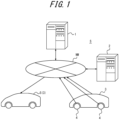
- FIG. 1 is a schematic diagram of an information processing system S according to an embodiment.
- the information processing system S includes an information processing device 1, an external information processing device 2, a first vehicle 3, tires 4 mounted on the first vehicle 3, and a second vehicle 5.
- the information processing device 1, the external information processing device 2, the first vehicle 3, the tires 4, and the second vehicle 5 are able to communicate with each other via a network NW.
- the network NW includes, for example, a mobile communication network or the Internet.
- the information processing device 1 is illustrated as one device in FIG. 1 .
- the information processing device 1 is not limited to being one device.
- a process executed by the information processing device 1 may be executed by the information processing device 1 as multiple distributed devices.
- the information processing device 1 is installed in a facility dedicated to a business operator or in a facility such as a data center.
- the information processing device 1 is computer such as a server belonging to a cloud computing system or other computing system.
- the information processing device 1 may be a server that supports provision of a service by a business operator.
- the information processing device 1 may be installed in the first vehicle 3 or the second vehicle 5.
- Another cloud computing system may intervene between the information processing device 1 and the first vehicle 3 or the second vehicle 5.
- the information processing device 1 includes a controller 11, a communicator 12, and a storage 13. Components of the information processing device 1 are communicatively connected to each other via dedicated lines, for example.
- the controller 11 includes, for example, a central processing unit (CPU) or one or more general-purpose processors, including a micro processing unit (MPU).
- the controller 11 may include one or more dedicated processors specialized for specific processing. Instead of a processor, the controller 11 may include one or more dedicated circuits. Each dedicated circuit may be, for example, a field-programmable gate array (FPGA) or an application specific integrated circuit (ASIC).
- FPGA field-programmable gate array
- ASIC application specific integrated circuit
- the communicator 12 includes one or more communication modules compatible with one or more wired or wireless local area network (LAN) standards for connection to a network.
- the communicator 12 may include modules for one or more mobile communication standards, including long term evolution (LTE), fourth generation (4G), or fifth generation (5G).
- LTE long term evolution
- 4G fourth generation
- 5G fifth generation
- the communicator 12 may include communication modules and the like that support one or more short-range communication standards or specifications, including Bluetooth ® (Bluetooth is a registered trademark in Japan, other countries, or both), AirDrop ® (AirDrop is a registered trademark in Japan, other countries, or both), IrDA, ZigBee ® (ZigBee is a registered trademark in Japan, other countries, or both), Felica ® (Felica is a registered trademark in Japan, other countries, or both), or RFID.
- the communicator 12 transmits and receives any information via the network.
- the storage 13 is, for example, semiconductor memory, magnetic memory, optical memory, or at least RAM or ROM of one of these examples.
- RAM is, for example, SRAM or DRAM.
- ROM is, for example, EEPROM.
- the storage 13 may function, for example, as a main storage device, an auxiliary storage device, or a cache memory.
- the storage 13 may store information on the results analyzed or processed by the controller 11.
- the storage 13 may store information and the like related to operation or control of the information processing device 1.
- the storage 13 may store a system program, an application program, embedded software, and the like.
- the external information processing device 2 is provided external to the information processing device 1.
- the description of the hardware structure of the external information processing device 2 is identical to the description of the hardware structure of the information processing device 1. Accordingly, the description is not repeated here.
- the external information processing device 2 may be, for example, a device that remotely monitors tires by periodically measuring tire-related information from a device set on the wheel or the like of any tire.
- the tire-related information here may include at least one of the following:
- the external information processing device 2 may be a device that provides a map platform. In this case, the external information processing device 2 collects the following information as tire-related information:
- the first vehicle 3 includes any type of automobile, for example, gasoline, diesel, HEV, PHEV, BEV, FCEV, and the like.
- HEV is an abbreviation for hybrid electric vehicle.
- PHEV is an abbreviation for plug-in hybrid electric vehicle.
- BEV is an abbreviation for battery electric vehicle.
- FCEV is an abbreviation for fuel cell electric vehicle.
- Driving of the first vehicle 3 may be automated to any level. The level of automation is, for example, any of Level 1 to Level 5 in the SAE levels.
- SAE is an abbreviation for Society of Automotive Engineers.
- the first vehicle 3 may be driven by a driver.
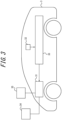
- the first vehicle 3 includes a driving control device 31, an electronic control unit (ECU) 32, and a controller area network (CAN) bus 33.
- the driving control device 31 may be operated by a user device 34, a robocar PC (Personal Computer) 35, or the like.
- the driving control device 31 is, for example, an automated driving system (ADS).
- ADS automated driving system
- the driving control device 31 acquires vehicle travel data (for example, G, steering angle, vehicle speed, and the like) from the ECU 32 regarding steering, acceleration, shifting, braking, vehicle speed, distance, and the like for the first vehicle 3 via the CAN bus 33.
- vehicle travel data for example, G, steering angle, vehicle speed, and the like
- the driving control device 31 acquires tire-related information about the tires 4 and transmits to the information processing device 1.
- Tire-related information may include, for example, at least one of the following:
- the vehicle travel data When the vehicle travel data is transmitted to the information processing device 1, the vehicle travel data may be raw data.
- the vehicle travel data, along with other tire-related information, may be used by sensor fusion to calculate a driving control parameter.
- the tires 4 are one or more tires mounted on the first vehicle 3. Each of the tires 4 acquires tire-related information and transmits to the information processing device 1.
- the tire-related information may include at least one of the following:
- a method for determining road surface condition from a G sensor disposed in the tire 4 is described in WO 2006/135090 A1 .
- a method for estimating road surface friction condition from a strain sensor disposed in the tire 4 is described in JP 2005-345238 A .
- one or more strain sensors may be disposed on a side portion of the wheel or the tire 4 rather than in the tire 4.
- the second vehicle 5 includes any type of automobile, for example, diesel, HEV, PHEV, BEV, FCEV, and the like. Driving of the second vehicle 5 may be automated to any level.
- the level of automation is, for example, any of Level 1 to Level 5 in the SAE levels.
- SAE is an abbreviation for Society of Automotive Engineers.
- the second vehicle 5 may be driven by a driver.
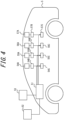
- the second vehicle 5 includes a driving control device 51, an accelerator 54A, a brake 55A, steering 56A, shift 57A, sensors 54B to 57B, and ECUs 54C to 57C.
- the driving control device 51 may be operated by a user device 52, a robocar PC 53, or the like.
- the driving control device 51 is, for example, an ADS. Upon acquiring the driving control parameter from the information processing device 1, the driving control device 51 electrically intervenes with respect to signals from each of the sensors 54B to 57B to the ECUs 54C to 57C. In this way, the driving control device 51 controls the driving of the second vehicle 5.
- first vehicle 3 and the second vehicle 5 are depicted as separate vehicles.
- the first vehicle 3 and the second vehicle 5 may be the same vehicle. That is, the controller 11 may acquire the tire-related information from the first vehicle 3, calculate the driving control parameter, and transmit the driving control parameter so calculated to the first vehicle 3.
- the controller 11 of the information processing device 1 acquires the tire-related information.
- the tire-related information is acquired from at least one of the external information processing device 2, the first vehicle 3, or the tire 4.
- the timing of acquisition may be any of the following:
- the controller 11 may request that the temperature information of the tire 4 be transmitted immediately after the first vehicle 3 travels until the temperature of the tire 4 reaches a steady value.
- the temperature of the tire 4 may be detected from a TPMS, external temperature, solar radiation situation, and the like.
- the controller 11 calculates a driving control parameter based on the tire-related information.
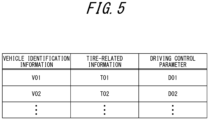
- the controller 11 acquires the tire-related information and vehicle identification information from the vehicle.
- the controller 11 stores the tire-related information and the driving control parameter in association with the vehicle identification information in the storage 13.
- the driving control parameter may be calculated from a correlation map between the tire-related information and the driving control parameter, or may be calculated based on a function.
- the controller 11 may update the correlation map or the function using the vehicle travel data such as CAN data (see below).
- the correlation map or the function may be maintained in the storage 13 for each piece of the tire-related information.
- the correlation map or the function may be calculated from actual measured data of the tire-related information and the vehicle travel data, or from a tire model.
- the controller 11 may calculate the driving control parameter corresponding to a maximum risk tire situation. For example, the controller 11 may calculate the driving control parameter with a smaller gain for the front and rear directions of the vehicle. The controller 11 may calculate different driving control parameters for the front-rear and side directions of the vehicle.
- the controller 11 may calculate or correct the driving control parameter based on a vehicle factor (such as vehicle type) of the second vehicle 5, to which the driving control parameter is transmitted.
- vehicle factor may be used for inverse estimation of equivalent cornering power (CP) and the like based on the vehicle travel data (such as CAN data).
- the controller 11 may estimate each piece of the tire-related information from the vehicle travel data. For example, the controller 11 may estimate the wear condition of the tire 4 from the running distance.
- the tire-related information may differ for each of the tires 4 mounted on the first vehicle 3.
- the controller 11 may calculate the driving control parameter based on representative values for tires (for example, average of left and right wheels or average of four wheels).
- the controller 11 may transmit to the second vehicle 5 a representative value of the driving control parameter (such as a four wheel average) calculated based on the wear condition or the internal pressure of each tire.
- the controller 11 may acquire the tire-related information from a plurality of vehicles.
- the tire-related information may then be acquired via inter-vehicle communication.
- the controller 11 detects gain change from the tire-related information and calculates the driving control parameter to cope with the gain change. For example, the controller 11 may calculate the driving control parameter so that the gain change returns to the state before the change, or the controller 11 may calculate the driving control parameter so that the gain increases or decreases.
- gain is a value that indicates responsiveness to driving operations. For example, the smaller the gain, the harder the vehicle is to turn when steering. The smaller the gain, the harder the vehicle is to stop when braking.
- the driving control parameter is calculated from the tire-related information, including the vehicle travel data.
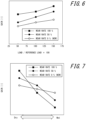
- the controller 11 acquires the load and wear condition as the tire-related information. As illustrated in FIG. 6 , the gain increases as the load increases. The gain increases as the wear rate increases.
- the controller 11 acquires the road surface condition and the wear condition as the tire-related information.
- the tread becomes thinner and the grooves shallower. Shallow grooves increase tread stiffness, so the gain increases during dry road conditions as indicated in FIG. 7 (corresponding to "Dry").
- wet road conditions corresponding to "Wet"
- the controller 11 when a turning radius R of the first vehicle 3 is known from position information such as Global Positioning System (GPS), the controller 11 is able to calculate lateral G from the turning radius R and vehicle speed V. The controller 11 is able to estimate the gain change of the tire 4 based on the relationship between the lateral G, the amount of steering wheel operation, and the turning radius R. At such a time, the controller 11 estimates the gain change based on the property that the amount of steering wheel operation that establishes the equation of motion changes depending on the wear condition. For example, the controller 11 is able to estimate a mass point system ⁇ together with load estimation such as Contact Area Information Sensing (CAIS) (analysis of in-tire accelerometer data).
- CAIS Contact Area Information Sensing
- the controller 11 is able to determine that the gain of the tire 4 has increased because the amount of steering wheel steering required has decreased. When raining, the controller 11 is able to detect a decrease in drainage and decrease in gain due to wear as a result of increased steering wheel steering.
- a two-wheel model is used as the vehicle model for the first vehicle 3.
- a two degree of freedom mass system model may be used as the vehicle model for the first vehicle 3.
- the controller 11 is able to estimate that tire gain relative to front-rear G has changed based on an amount of braking applied to the first vehicle 3 and braking distance calculated from position information.
- the controller 11 is able to estimate the mass point system ⁇ together with load estimation such as CAIS, for example.
- the controller 11 determines that the amount of braking required in fair weather has decreased, and therefore tire gain has increased.
- the controller 11 is able to detect a decrease in drainage and a decrease in gain due to wear as a result of increased brake operation amount during wet weather.
- the controller 11 may use an estimation device called a state observer in the calculation of the driving control parameter.
- the estimation device is able to run the vehicle travel data through an optimized filter to estimate unmeasurable gain and ⁇ .
- the controller 11 may calculate the control parameter from change over time of the Lissajous waveform of "vehicle side input of force vs. vehicle response" of the vehicle travel data.
- vehicle side input of force Vehicle response Steering angle Roll angle Pitch angle Yaw angle Roll angle speed (roll rate) Pitch angle speed (pitch rate) Yaw angle speed (yaw rate) Front-rear speed Left-right speed Up-down speed Travel speed Body slip angle Accelerator pedal position Pitch angle Pitch angle speed (pitch rate) Travel speed Brake pressure, brake pedal position Pitch angle Pitch angle speed (pitch rate) Front-rear speed Travel speed
- the controller 11 may estimate the Magic Formula (MF) tire model based on the "vehicle side input of force vs. vehicle response" of the vehicle travel data and calculate the control parameter using the estimated tire model.
- the vehicle response may be predicted based on the vehicle side input of force and vehicle and tire simulation models, and therefore when provided with the vehicle model, the controller 11 is able to estimate the tire model from the vehicle-side input of force and the vehicle response.
- MF Magic Formula
- the controller 11 may remove tire effects (such as vertical/horizontal springs, rotational springs) in the vehicle model (simulation) based on the tire-related information (such as wear condition).
- tire effects such as vertical/horizontal springs, rotational springs
- the controller 11 may calculate a dynamic loaded radius from the vehicle speed and tire rotation speed, and calculate the wear condition of the tire 4 from the difference between the calculated dynamic loaded radius and the dynamic loaded radius of a new tire.
- the controller 11 may determine the tire wear condition of the tire 4 from sprung mass vibration (acceleration), which is one piece of the vehicle travel data.
- the wear condition may be determined from vibration information previously acquired for each wear condition or from vibration simulation.
- the controller 11 may inversely estimate the road surface ⁇ (tire ⁇ ) from the current behavior of the first vehicle 3 and the wear condition of the tire 4.
- the controller 11 transmits the driving control parameter that is calculated to the second vehicle 5 via the communicator 12. Transmission may be executed in response to a request at OS startup in the second vehicle 5. As an alternative example, when the tire-related information is acquired from the first vehicle 3, the driving control parameter may be transmitted to the first vehicle 3 identified by the vehicle identification information.
- the controller 11 may impose a fee on the recipient for providing the driving control parameter. In determining the fee to be charged for providing the driving control parameter, the controller 11 may calculate the fee based on the number of requests from the second vehicle 5.
- the second vehicle 5 acquires the driving control parameter from the information processing device 1.
- the driving control parameter is a parameter corresponding to the tire-related information.
- the driving control device 51 of the second vehicle 5 controls driving based on the driving control parameter.
- the driving control parameter may be applied to at least one gain of acceleration or deceleration (front-rear G), or steering (lateral G) of the second vehicle 5.
- the driving control device 51 may have different gains for acceleration and deceleration for the same driving control parameter.
- the driving control device 51 may change the gain depending on the load on each wheel.
- the information processing method and the driving control method executed by the controller 11 of the information processing device 1 and the driving control device 51 of the second vehicle 5 are described, with reference to FIG. 9 .
- step S1 the controller 11 acquires the tire-related information via the network.
- step S2 the controller 11 calculates the driving control parameter based on the tire-related information.
- step S3 the controller 11 transmits the driving control parameter to the second vehicle 5.
- step S4 the second vehicle 5 acquires the driving control parameter from the information processing device 1.
- step S5 the second vehicle 5 executes the driving control of the second vehicle 5 based on the driving control parameter acquired.
- the controller 11 executes operations including acquiring the tire-related information, calculating the driving control parameter based on the tire-related information, and transmitting the driving control parameter to the second vehicle 5.
- the information processing device 1 calculates the driving control parameter, thus improving the controllability of the vehicle.
- the operations of the controller 11 include acquiring the tire-related information and vehicle identification information from the first vehicle 3 and transmitting the driving control parameter to the vehicle identified by the vehicle identification information. Further, the operations include acquiring the tire-related information from the tires 4 of the first vehicle 3. Further, the operations include acquiring the tire-related information from an external information processing device. This configuration allows the information processing device 1 to acquire a variety of tire-related information, which enables calculation of an optimal driving control parameter.
- the operations include, when at least some of the tire-related information cannot be acquired, calculating the driving control parameter corresponding to the maximum risk tire situation. This configuration allows the information processing device 1 to reduce the risk of accidents and the like.
- the operations include calculating the driving control parameter based on a vehicle factor of the second vehicle 5 to which the driving control parameter is to be transmitted. This configuration allows the information processing device 1 to calculate the driving control parameter suitable for the individual circumstances of the second vehicle 5.
- the operations include transmitting the driving control parameter to the second vehicle 5 in response to a request at the time of OS startup in the second vehicle 5.
- This configuration allows the information processing device 1 to transmit the driving control parameter early, before the second vehicle 5 starts travel.
- a program that executes all or part of the functions or processing of the information processing device 1 may be recorded on a computer-readable recording medium.
- computer-readable recording medium includes a non-transitory computer-readable medium, for example, a magnetic recording device, an optical disk, a magneto-optical recording medium, or a semiconductor memory.
- Program distribution may be achieved, for example, by selling, transferring, or lending a portable recording medium such as a digital versatile disc (DVD) or compact disc read-only memory (CD-ROM) on which the program is recorded.
- program distribution may be achieved by storing the program in storage on any server and transmitting the program from any server to another computer.
- the program may be provided as a program product.
- the present disclosure may also be realized as a program executable by a processor.
- the computer for example, temporarily stores in main memory the program recorded on a portable recording medium or transferred from a server.
- the computer then reads the program stored in the main memory by the processor and executes processing in accordance with the program read by the processor.
- the computer may read the program directly from a portable recording medium and perform processing according to the program.
- the computer may sequentially execute processing according to a received program each time the program is transferred from a server to the computer. Processing may be performed by ASP services that do not transfer the program from the server to the computer, but only realize functions by instruction execution and result acquisition. "ASP" is an abbreviation for application service provider.
- program includes information that is used for processing by a computer that is equivalent to a program. For example, data that is not a direct command to a computer but has the property of prescribing computer processing falls under the category of "equivalent to a program".
Landscapes
- Engineering & Computer Science (AREA)
- Automation & Control Theory (AREA)
- Mechanical Engineering (AREA)
- Transportation (AREA)
- Human Computer Interaction (AREA)
- Physics & Mathematics (AREA)
- General Physics & Mathematics (AREA)
- Control Of Driving Devices And Active Controlling Of Vehicle (AREA)
- Traffic Control Systems (AREA)
Abstract
Description
- The present application claims priority to and the benefit of
Japanese Patent Application No. 2021-194979 filed November 30, 2021 - The present disclosure relates to an information processing device, an information processing method, a program, a driving control device, a driving control method, and a program.
- Conventional technology is known to limit automated driving of a vehicle when the condition of the vehicle's tires is determined to be unsuitable for automated driving (for example, see Patent Literature (PTL) 1).
- PTL 1:
JP 2018-167645 A - The background art mentioned above does not take into account tire condition in vehicle control.
- In view of such circumstances, it would be helpful to provide an information processing device, an information processing method, a program, a driving control device, a driving control method, and a program that are able to improve controllability of a vehicle.
- An information processing device according to an embodiment of the present disclosure is
an information processing device able to communicate with a vehicle via a network, comprising a controller, the controller being configured to execute operations comprising: - acquiring tire-related information;
- calculating a driving control parameter based on the tire-related information; and
- transmitting the driving control parameter to the vehicle.
- An information processing method according to an embodiment of the present disclosure is
an information processing method executable by an information processing device able to communicate with a vehicle via a network, the information processing method comprising: - acquiring tire-related information;
- calculating a driving control parameter based on the tire-related information; and
- transmitting the driving control parameter to the vehicle.
- A program according to an embodiment of the present disclosure is
a program configured to cause a computer to function as the information processing device described above. - A driving control device according to an embodiment of the present disclosure is
a driving control device able to communicate with an information processing device via a network, the driving control device being configured to execute operations comprising: - acquiring from the information processing device a driving control parameter calculated based on tire-related information; and
- controlling driving of a vehicle based on the driving control parameter.
- A driving control method according to an embodiment of the present disclosure is
a driving control method executable by a driving control device able to communicate with an information processing device via a network, the driving control method comprising: - acquiring from the information processing device a driving control parameter calculated based on tire-related information; and
- controlling driving of a vehicle based on the driving control parameter.
- A program according to an embodiment of the present disclosure is
a program configured to cause a computer to function as the driving control device described above. - According to the information processing device, the information processing method, the program, the driving control device, the driving control method, and the program according to an embodiment of the present disclosure, the controllability of a vehicle may be improved.
- In the accompanying drawings:
-
FIG. 1 is a schematic diagram of an information processing system according to an embodiment; -
FIG. 2 is a block diagram illustrating a structure of an information processing device; -
FIG. 3 is a block diagram illustrating a first vehicle; -
FIG. 4 is a block diagram illustrating a second vehicle; -
FIG. 5 is a diagram illustrating a data structure of a tire-related information database (DB); -
FIG. 6 is a graph illustrating gain change with wear rate and load; -
FIG. 7 is a graph illustrating gain change with wear rate and road surface condition; -
FIG. 8 is a diagram illustrating a cornering situation of the first vehicle; and -
FIG. 9 is a flowchart illustrating operation of an information processing device and the second vehicle. -
FIG. 1 is a schematic diagram of an information processing system S according to an embodiment. The information processing system S includes an information processing device 1, an externalinformation processing device 2, afirst vehicle 3,tires 4 mounted on thefirst vehicle 3, and asecond vehicle 5. The information processing device 1, the externalinformation processing device 2, thefirst vehicle 3, thetires 4, and thesecond vehicle 5 are able to communicate with each other via a network NW. The network NW includes, for example, a mobile communication network or the Internet. - For simplicity of explanation, the information processing device 1 is illustrated as one device in
FIG. 1 . However, the information processing device 1 is not limited to being one device. For example, a process executed by the information processing device 1 may be executed by the information processing device 1 as multiple distributed devices. - The information processing device 1 is installed in a facility dedicated to a business operator or in a facility such as a data center. The information processing device 1 is computer such as a server belonging to a cloud computing system or other computing system. The information processing device 1 may be a server that supports provision of a service by a business operator. As an alternative example, the information processing device 1 may be installed in the
first vehicle 3 or thesecond vehicle 5. Another cloud computing system may intervene between the information processing device 1 and thefirst vehicle 3 or thesecond vehicle 5. - Internal structure of the information processing device 1 is described in detail, with reference to
FIG. 2 . - The information processing device 1 includes a
controller 11, acommunicator 12, and astorage 13. Components of the information processing device 1 are communicatively connected to each other via dedicated lines, for example. - The
controller 11 includes, for example, a central processing unit (CPU) or one or more general-purpose processors, including a micro processing unit (MPU). Thecontroller 11 may include one or more dedicated processors specialized for specific processing. Instead of a processor, thecontroller 11 may include one or more dedicated circuits. Each dedicated circuit may be, for example, a field-programmable gate array (FPGA) or an application specific integrated circuit (ASIC). - The
communicator 12 includes one or more communication modules compatible with one or more wired or wireless local area network (LAN) standards for connection to a network. Thecommunicator 12 may include modules for one or more mobile communication standards, including long term evolution (LTE), fourth generation (4G), or fifth generation (5G). Thecommunicator 12 may include communication modules and the like that support one or more short-range communication standards or specifications, including Bluetooth® (Bluetooth is a registered trademark in Japan, other countries, or both), AirDrop® (AirDrop is a registered trademark in Japan, other countries, or both), IrDA, ZigBee® (ZigBee is a registered trademark in Japan, other countries, or both), Felica® (Felica is a registered trademark in Japan, other countries, or both), or RFID. Thecommunicator 12 transmits and receives any information via the network. - The
storage 13 is, for example, semiconductor memory, magnetic memory, optical memory, or at least RAM or ROM of one of these examples. RAM is, for example, SRAM or DRAM. ROM is, for example, EEPROM. Thestorage 13 may function, for example, as a main storage device, an auxiliary storage device, or a cache memory. Thestorage 13 may store information on the results analyzed or processed by thecontroller 11. Thestorage 13 may store information and the like related to operation or control of the information processing device 1. Thestorage 13 may store a system program, an application program, embedded software, and the like. - The external
information processing device 2 is provided external to the information processing device 1. The description of the hardware structure of the externalinformation processing device 2 is identical to the description of the hardware structure of the information processing device 1. Accordingly, the description is not repeated here. - The external
information processing device 2 may be, for example, a device that remotely monitors tires by periodically measuring tire-related information from a device set on the wheel or the like of any tire. The tire-related information here may include at least one of the following: - Wear condition
- Load (wheel load)
- Internal pressure/temperature
- Tire type
- As an alternative example, the external
information processing device 2 may be a device that provides a map platform. In this case, the externalinformation processing device 2 collects the following information as tire-related information: - Condition of road surface under another vehicle traveling in front of the
first vehicle 3 - Temperature of region in which the
first vehicle 3 is traveling - The
first vehicle 3 includes any type of automobile, for example, gasoline, diesel, HEV, PHEV, BEV, FCEV, and the like. "HEV" is an abbreviation for hybrid electric vehicle. "PHEV" is an abbreviation for plug-in hybrid electric vehicle. "BEV" is an abbreviation for battery electric vehicle. "FCEV" is an abbreviation for fuel cell electric vehicle. Driving of thefirst vehicle 3 may be automated to any level. The level of automation is, for example, any of Level 1 toLevel 5 in the SAE levels. "SAE" is an abbreviation for Society of Automotive Engineers. As an alternative example, thefirst vehicle 3 may be driven by a driver. - Internal structure of the
first vehicle 3 is described in detail, with reference toFIG. 3 . - The
first vehicle 3 includes a drivingcontrol device 31, an electronic control unit (ECU) 32, and a controller area network (CAN)bus 33. The drivingcontrol device 31 may be operated by auser device 34, a robocar PC (Personal Computer) 35, or the like. - The driving
control device 31 is, for example, an automated driving system (ADS). The drivingcontrol device 31 acquires vehicle travel data (for example, G, steering angle, vehicle speed, and the like) from theECU 32 regarding steering, acceleration, shifting, braking, vehicle speed, distance, and the like for thefirst vehicle 3 via theCAN bus 33. - The driving
control device 31 acquires tire-related information about thetires 4 and transmits to the information processing device 1. Tire-related information may include, for example, at least one of the following: - Wear condition (determined from vehicle height or camera)
- Load (wheel load)
- Tire type (determined from camera or RFID) (ID of tire type may be transmitted to the information processing device 1)
- Internal pressure/temperature (determined from tire pressure monitoring system (TPMS))
- Road surface condition (determined from camera, G sensor or CAN data)
- Vehicle travel data described above
- When the vehicle travel data is transmitted to the information processing device 1, the vehicle travel data may be raw data. The vehicle travel data, along with other tire-related information, may be used by sensor fusion to calculate a driving control parameter.
- The
tires 4 are one or more tires mounted on thefirst vehicle 3. Each of thetires 4 acquires tire-related information and transmits to the information processing device 1. The tire-related information may include at least one of the following: - Wear condition (determined from in-tire G sensor or travel noise)
- Load/wheel load (determined from in-tire G sensor or the like)
- Internal pressure/temperature (determined from TPMS)
- Road surface condition (determined from in-tire G sensor and strain sensor)
- A method for determining road surface condition from a G sensor disposed in the
tire 4 is described inWO 2006/135090 A1 . A method for estimating road surface friction condition from a strain sensor disposed in thetire 4 is described inJP 2005-345238 A tire 4 rather than in thetire 4. - The
second vehicle 5 includes any type of automobile, for example, diesel, HEV, PHEV, BEV, FCEV, and the like. Driving of thesecond vehicle 5 may be automated to any level. The level of automation is, for example, any of Level 1 toLevel 5 in the SAE levels. "SAE" is an abbreviation for Society of Automotive Engineers. As an alternative example, thesecond vehicle 5 may be driven by a driver. - Internal structure of the
second vehicle 5 is described in detail, with reference toFIG. 4 . - The
second vehicle 5 includes a drivingcontrol device 51, anaccelerator 54A, abrake 55A, steering 56A, shift 57A,sensors 54B to 57B, andECUs 54C to 57C. The drivingcontrol device 51 may be operated by auser device 52, arobocar PC 53, or the like. - The driving
control device 51 is, for example, an ADS. Upon acquiring the driving control parameter from the information processing device 1, the drivingcontrol device 51 electrically intervenes with respect to signals from each of thesensors 54B to 57B to theECUs 54C to 57C. In this way, the drivingcontrol device 51 controls the driving of thesecond vehicle 5. - For ease of explanation, the
first vehicle 3 and thesecond vehicle 5 are depicted as separate vehicles. As an alternative example, thefirst vehicle 3 and thesecond vehicle 5 may be the same vehicle. That is, thecontroller 11 may acquire the tire-related information from thefirst vehicle 3, calculate the driving control parameter, and transmit the driving control parameter so calculated to thefirst vehicle 3. - The following is a detailed description of processing executed by the information processing system S according to the present embodiment.
- The
controller 11 of the information processing device 1 acquires the tire-related information. The tire-related information is acquired from at least one of the externalinformation processing device 2, thefirst vehicle 3, or thetire 4. - The timing of acquisition may be any of the following:
- When the
first vehicle 3 makes a request (for example, at operating system (OS) startup) - When a defined period of time has elapsed since a time stamp of each piece of the tire-related information
- When an environmental change (for example, a rise in tire rubber temperature) is detected
- The
controller 11 may request that the temperature information of thetire 4 be transmitted immediately after thefirst vehicle 3 travels until the temperature of thetire 4 reaches a steady value. The temperature of thetire 4 may be detected from a TPMS, external temperature, solar radiation situation, and the like. - The
controller 11 calculates a driving control parameter based on the tire-related information. When the tire-related information is acquired from a vehicle (for example, the first vehicle 3), thecontroller 11 acquires the tire-related information and vehicle identification information from the vehicle. As illustrated inFIG. 5 , thecontroller 11 stores the tire-related information and the driving control parameter in association with the vehicle identification information in thestorage 13. - The driving control parameter may be calculated from a correlation map between the tire-related information and the driving control parameter, or may be calculated based on a function. The
controller 11 may update the correlation map or the function using the vehicle travel data such as CAN data (see below). The correlation map or the function may be maintained in thestorage 13 for each piece of the tire-related information. The correlation map or the function may be calculated from actual measured data of the tire-related information and the vehicle travel data, or from a tire model. - When at least some of the tire-related information cannot be acquired, the
controller 11 may calculate the driving control parameter corresponding to a maximum risk tire situation. For example, thecontroller 11 may calculate the driving control parameter with a smaller gain for the front and rear directions of the vehicle. Thecontroller 11 may calculate different driving control parameters for the front-rear and side directions of the vehicle. - In addition to the tire-related information, the
controller 11 may calculate or correct the driving control parameter based on a vehicle factor (such as vehicle type) of thesecond vehicle 5, to which the driving control parameter is transmitted. The vehicle factor may be used for inverse estimation of equivalent cornering power (CP) and the like based on the vehicle travel data (such as CAN data). - The
controller 11 may estimate each piece of the tire-related information from the vehicle travel data. For example, thecontroller 11 may estimate the wear condition of thetire 4 from the running distance. - The tire-related information may differ for each of the
tires 4 mounted on thefirst vehicle 3. Thecontroller 11 may calculate the driving control parameter based on representative values for tires (for example, average of left and right wheels or average of four wheels). As an alternative example, thecontroller 11 may transmit to the second vehicle 5 a representative value of the driving control parameter (such as a four wheel average) calculated based on the wear condition or the internal pressure of each tire. - When using the road surface condition information as the tire-related information, the
controller 11 may acquire the tire-related information from a plurality of vehicles. The tire-related information may then be acquired via inter-vehicle communication. - When tire gain is fixed in driving control, controllability of the vehicle changes gradually with changes in the tire-related information. Therefore, the
controller 11 detects gain change from the tire-related information and calculates the driving control parameter to cope with the gain change. For example, thecontroller 11 may calculate the driving control parameter so that the gain change returns to the state before the change, or thecontroller 11 may calculate the driving control parameter so that the gain increases or decreases. Here, gain is a value that indicates responsiveness to driving operations. For example, the smaller the gain, the harder the vehicle is to turn when steering. The smaller the gain, the harder the vehicle is to stop when braking. - Specific examples of how the driving control parameter is calculated from the tire-related information, including the vehicle travel data, are described below.
- As a first example, the
controller 11 acquires the load and wear condition as the tire-related information. As illustrated inFIG. 6 , the gain increases as the load increases. The gain increases as the wear rate increases. - As a second example, the
controller 11 acquires the road surface condition and the wear condition as the tire-related information. As thetire 4 wears, the tread becomes thinner and the grooves shallower. Shallow grooves increase tread stiffness, so the gain increases during dry road conditions as indicated inFIG. 7 (corresponding to "Dry"). Conversely, in wet road conditions (corresponding to "Wet"), the more worn thetire 4 is, the more slippery, because of poor drainage. Thus, gain is reduced. - As a first example, as illustrated in
FIG. 8 , when a turning radius R of thefirst vehicle 3 is known from position information such as Global Positioning System (GPS), thecontroller 11 is able to calculate lateral G from the turning radius R and vehicle speed V. Thecontroller 11 is able to estimate the gain change of thetire 4 based on the relationship between the lateral G, the amount of steering wheel operation, and the turning radius R. At such a time, thecontroller 11 estimates the gain change based on the property that the amount of steering wheel operation that establishes the equation of motion changes depending on the wear condition. For example, thecontroller 11 is able to estimate a mass point system µ together with load estimation such as Contact Area Information Sensing (CAIS) (analysis of in-tire accelerometer data). - For example, the
controller 11 is able to determine that the gain of thetire 4 has increased because the amount of steering wheel steering required has decreased. When raining, thecontroller 11 is able to detect a decrease in drainage and decrease in gain due to wear as a result of increased steering wheel steering. - In
FIG. 8 , a two-wheel model is used as the vehicle model for thefirst vehicle 3. As an alternative example, a two degree of freedom mass system model may be used as the vehicle model for thefirst vehicle 3. - As a second example, the
controller 11 is able to estimate that tire gain relative to front-rear G has changed based on an amount of braking applied to thefirst vehicle 3 and braking distance calculated from position information. In this case, thecontroller 11 is able to estimate the mass point system µ together with load estimation such as CAIS, for example. - For example, the
controller 11 determines that the amount of braking required in fair weather has decreased, and therefore tire gain has increased. Thecontroller 11 is able to detect a decrease in drainage and a decrease in gain due to wear as a result of increased brake operation amount during wet weather. - The
controller 11 may use an estimation device called a state observer in the calculation of the driving control parameter. As a backup in the system, the estimation device is able to run the vehicle travel data through an optimized filter to estimate unmeasurable gain and µ. - As a first example, the
controller 11 may calculate the control parameter from change over time of the Lissajous waveform of "vehicle side input of force vs. vehicle response" of the vehicle travel data. The relationship between vehicle side input of force and vehicle response is as follows.[Table 1] Vehicle side input of force Vehicle response Steering angle Roll angle Pitch angle Yaw angle Roll angle speed (roll rate) Pitch angle speed (pitch rate) Yaw angle speed (yaw rate) Front-rear speed Left-right speed Up-down speed Travel speed Body slip angle Accelerator pedal position Pitch angle Pitch angle speed (pitch rate) Travel speed Brake pressure, brake pedal position Pitch angle Pitch angle speed (pitch rate) Front-rear speed Travel speed - As a second example, the
controller 11 may estimate the Magic Formula (MF) tire model based on the "vehicle side input of force vs. vehicle response" of the vehicle travel data and calculate the control parameter using the estimated tire model. The vehicle response may be predicted based on the vehicle side input of force and vehicle and tire simulation models, and therefore when provided with the vehicle model, thecontroller 11 is able to estimate the tire model from the vehicle-side input of force and the vehicle response. - The
controller 11 may remove tire effects (such as vertical/horizontal springs, rotational springs) in the vehicle model (simulation) based on the tire-related information (such as wear condition). - As a first example, the
controller 11 may calculate a dynamic loaded radius from the vehicle speed and tire rotation speed, and calculate the wear condition of thetire 4 from the difference between the calculated dynamic loaded radius and the dynamic loaded radius of a new tire. - As a second example, the
controller 11 may determine the tire wear condition of thetire 4 from sprung mass vibration (acceleration), which is one piece of the vehicle travel data. The wear condition may be determined from vibration information previously acquired for each wear condition or from vibration simulation. - As a third example, the
controller 11 may inversely estimate the road surface µ (tire µ) from the current behavior of thefirst vehicle 3 and the wear condition of thetire 4. - The
controller 11 transmits the driving control parameter that is calculated to thesecond vehicle 5 via thecommunicator 12. Transmission may be executed in response to a request at OS startup in thesecond vehicle 5. As an alternative example, when the tire-related information is acquired from thefirst vehicle 3, the driving control parameter may be transmitted to thefirst vehicle 3 identified by the vehicle identification information. - According to the present embodiment, the
controller 11 may impose a fee on the recipient for providing the driving control parameter. In determining the fee to be charged for providing the driving control parameter, thecontroller 11 may calculate the fee based on the number of requests from thesecond vehicle 5. - The
second vehicle 5 acquires the driving control parameter from the information processing device 1. The driving control parameter is a parameter corresponding to the tire-related information. - The driving
control device 51 of thesecond vehicle 5 controls driving based on the driving control parameter. The driving control parameter may be applied to at least one gain of acceleration or deceleration (front-rear G), or steering (lateral G) of thesecond vehicle 5. - The driving
control device 51 may have different gains for acceleration and deceleration for the same driving control parameter. The drivingcontrol device 51 may change the gain depending on the load on each wheel. - The information processing method and the driving control method executed by the
controller 11 of the information processing device 1 and the drivingcontrol device 51 of thesecond vehicle 5 are described, with reference toFIG. 9 . - In step S1, the
controller 11 acquires the tire-related information via the network. - In step S2, the
controller 11 calculates the driving control parameter based on the tire-related information. - In step S3, the
controller 11 transmits the driving control parameter to thesecond vehicle 5. - In step S4, the
second vehicle 5 acquires the driving control parameter from the information processing device 1. - In step S5, the
second vehicle 5 executes the driving control of thesecond vehicle 5 based on the driving control parameter acquired. - As described above, according to the present embodiment, the
controller 11 executes operations including acquiring the tire-related information, calculating the driving control parameter based on the tire-related information, and transmitting the driving control parameter to thesecond vehicle 5. In this way, the information processing device 1 calculates the driving control parameter, thus improving the controllability of the vehicle. - Further, according to the present embodiment, the operations of the
controller 11 include acquiring the tire-related information and vehicle identification information from thefirst vehicle 3 and transmitting the driving control parameter to the vehicle identified by the vehicle identification information. Further, the operations include acquiring the tire-related information from thetires 4 of thefirst vehicle 3. Further, the operations include acquiring the tire-related information from an external information processing device. This configuration allows the information processing device 1 to acquire a variety of tire-related information, which enables calculation of an optimal driving control parameter. - Further, according to the present embodiment, the operations include, when at least some of the tire-related information cannot be acquired, calculating the driving control parameter corresponding to the maximum risk tire situation. This configuration allows the information processing device 1 to reduce the risk of accidents and the like.
- Further, according to the present embodiment, the operations include calculating the driving control parameter based on a vehicle factor of the
second vehicle 5 to which the driving control parameter is to be transmitted. This configuration allows the information processing device 1 to calculate the driving control parameter suitable for the individual circumstances of thesecond vehicle 5. - Further, according to the present embodiment, the operations include transmitting the driving control parameter to the
second vehicle 5 in response to a request at the time of OS startup in thesecond vehicle 5. This configuration allows the information processing device 1 to transmit the driving control parameter early, before thesecond vehicle 5 starts travel. - Although the present disclosure is described based on the drawings and examples, it should be noted that a person skilled in the art may make variations and modifications based on the present disclosure. Other changes are possible without departing from the spirit of the present disclosure. For example, functions and the like included in each solution and step may be rearranged, and multiple solutions and steps may be combined into one or divided, as long as no logical inconsistency results.
- For example, according to the above embodiment, a program that executes all or part of the functions or processing of the information processing device 1 may be recorded on a computer-readable recording medium. Here, computer-readable recording medium includes a non-transitory computer-readable medium, for example, a magnetic recording device, an optical disk, a magneto-optical recording medium, or a semiconductor memory. Program distribution may be achieved, for example, by selling, transferring, or lending a portable recording medium such as a digital versatile disc (DVD) or compact disc read-only memory (CD-ROM) on which the program is recorded. Further, program distribution may be achieved by storing the program in storage on any server and transmitting the program from any server to another computer. Further, the program may be provided as a program product. The present disclosure may also be realized as a program executable by a processor.
- The computer, for example, temporarily stores in main memory the program recorded on a portable recording medium or transferred from a server. The computer then reads the program stored in the main memory by the processor and executes processing in accordance with the program read by the processor. The computer may read the program directly from a portable recording medium and perform processing according to the program. The computer may sequentially execute processing according to a received program each time the program is transferred from a server to the computer. Processing may be performed by ASP services that do not transfer the program from the server to the computer, but only realize functions by instruction execution and result acquisition. "ASP" is an abbreviation for application service provider. Here, program includes information that is used for processing by a computer that is equivalent to a program. For example, data that is not a direct command to a computer but has the property of prescribing computer processing falls under the category of "equivalent to a program".
-
- S
- information processing system
- NW
- network
- 1
- information processing device
- 11
- controller
- 12
- communicator
- 13
- storage
- 2
- external information processing device
- 3
- first vehicle
- 31
- driving control device
- 32
- ECU
- 33
- CAN Bus
- 34
- user device
- 35
- robocar PC
- 4
- tire
- 5
- second vehicle
- 51
- driving control device
- 52
- user device
- 53
- robocar PC
- 54A
- acceleration
- 55A
- brake
- 56A
- steering
- 57A
- shift
- 54B to 57B
- sensors
- 54C to 57C
- ECU
Claims (13)
- An information processing device able to communicate with a vehicle via a network, comprising a controller, the controller being configured to execute operations comprising:acquiring tire-related information;calculating a driving control parameter based on the tire-related information; andtransmitting the driving control parameter to the vehicle.
- The information processing device according to claim 1, wherein the operations further comprise:acquiring the tire-related information and vehicle identification information from the vehicle; andtransmitting the driving control parameter to a vehicle identified by the vehicle identification information.
- The information processing device according to claim 1 or 2, wherein the operations further comprise
acquiring the tire-related information from a tire of the vehicle. - The information processing device according to any one of claims 1 to 3, wherein the operations further comprise
acquiring the tire-related information from an external information processing device. - The information processing device according to any one of claims 1 to 4, wherein the operations further comprise,
when at least some of the tire-related information cannot be acquired, calculating the driving control parameter corresponding to a maximum risk tire situation. - The information processing device according to any one of claims 1 to 5, wherein the operations further comprise
calculating the driving control parameter based on a vehicle factor of the vehicle to which the driving control parameter is to be transmitted. - The information processing device according to any one of claims 1 to 6, wherein the operations further comprise
transmitting the driving control parameter to the vehicle in response to a request at the time of operating system (OS) startup in the vehicle. - The information processing device according to any one of claims 1 to 7, wherein
the driving control parameter is applied to tire gain. - An information processing method executable by an information processing device able to communicate with a vehicle via a network, the information processing method comprising:acquiring tire-related information;calculating a driving control parameter based on the tire-related information; andtransmitting the driving control parameter to the vehicle.
- A program configured to cause a computer to function as the information processing device according to any one of claims 1 to 8.
- A driving control device able to communicate with an information processing device via a network, the driving control device being configured to execute operations comprising:acquiring from the information processing device a driving control parameter calculated based on tire-related information; andcontrolling driving of a vehicle based on the driving control parameter.
- A driving control method executable by a driving control device able to communicate with an information processing device via a network, the driving control method comprising:acquiring from the information processing device a driving control parameter calculated based on tire-related information; andcontrolling driving of a vehicle based on the driving control parameter.
- A program configured to cause a computer to function as the driving control device according to claim 11.
Applications Claiming Priority (2)
| Application Number | Priority Date | Filing Date | Title |
|---|---|---|---|
| JP2021194979A JP7762053B2 (en) | 2021-11-30 | 2021-11-30 | Information processing device, information processing method, program, operation control device, operation control method, and program |
| PCT/JP2022/028822 WO2023100416A1 (en) | 2021-11-30 | 2022-07-26 | Information processing device, information processing method, program, driving control device, driving control method, and program |
Publications (3)
| Publication Number | Publication Date |
|---|---|
| EP4404172A1 true EP4404172A1 (en) | 2024-07-24 |
| EP4404172A4 EP4404172A4 (en) | 2025-01-08 |
| EP4404172B1 EP4404172B1 (en) | 2025-12-31 |
Family
ID=86611866
Family Applications (1)
| Application Number | Title | Priority Date | Filing Date |
|---|---|---|---|
| EP22900851.1A Active EP4404172B1 (en) | 2021-11-30 | 2022-07-26 | INFORMATION PROCESSING DEVICE, INFORMATION PROCESSING METHOD, PROGRAM, INFORMATION PROCESSING SYSTEM, INFORMATION PROCESSING AND DRIVE CONTROL METHOD |
Country Status (5)
| Country | Link |
|---|---|
| US (1) | US12612057B2 (en) |
| EP (1) | EP4404172B1 (en) |
| JP (1) | JP7762053B2 (en) |
| CN (1) | CN118019677A (en) |
| WO (1) | WO2023100416A1 (en) |
Family Cites Families (15)
| Publication number | Priority date | Publication date | Assignee | Title |
|---|---|---|---|---|
| JP2002162235A (en) * | 2000-11-24 | 2002-06-07 | Matsushita Electric Ind Co Ltd | Navigation device |
| JP4358035B2 (en) | 2004-06-02 | 2009-11-04 | 株式会社ブリヂストン | Method and apparatus for estimating road friction coefficient |
| EP1897706B1 (en) | 2005-06-17 | 2014-12-24 | Kabushiki Kaisha Bridgestone | Road surface state estimating method, road surface state estimating tire, road surface state estimating device, and vehicle control device |
| DE102014223902A1 (en) * | 2014-11-24 | 2016-05-25 | Robert Bosch Gmbh | Method for operating a longitudinal control device of a motor vehicle |
| JP6422812B2 (en) * | 2015-04-09 | 2018-11-14 | 三菱電機株式会社 | Driving support device and driving support method |
| JP6820668B2 (en) * | 2016-05-10 | 2021-01-27 | 三菱電機株式会社 | Driving support equipment, driving support system and driving support program |
| JP6790960B2 (en) * | 2017-03-29 | 2020-11-25 | 株式会社デンソー | Automatic operation control device |
| JP6770194B2 (en) * | 2017-06-15 | 2020-10-14 | 日立オートモティブシステムズ株式会社 | Vehicle control system |
| JP6930355B2 (en) | 2017-10-11 | 2021-09-01 | 株式会社Soken | Road surface condition determination device and tire system equipped with it |
| JP6733707B2 (en) | 2017-10-30 | 2020-08-05 | 株式会社デンソー | Road surface condition determination device and tire system including the same |
| JP2019192157A (en) * | 2018-04-27 | 2019-10-31 | 株式会社ブリヂストン | Operation management device of vehicle |
| JP6790142B2 (en) | 2019-01-31 | 2020-11-25 | Toyo Tire株式会社 | Tire force estimation system and tire force estimation method |
| US11254315B2 (en) * | 2019-03-12 | 2022-02-22 | Mitsubishi Electric Research Laboratories, Inc. | Friction adaptive vehicle control |
| EP3946983B1 (en) * | 2019-04-01 | 2024-10-30 | Bridgestone Americas Tire Operations, LLC | System and method for vehicle tire performance modeling and feedback |
| JP7530858B2 (en) * | 2021-04-19 | 2024-08-08 | 株式会社ブリヂストン | Tire temperature prediction system, tire temperature prediction program, and tire temperature prediction method |
-
2021
- 2021-11-30 JP JP2021194979A patent/JP7762053B2/en active Active
-
2022
- 2022-07-26 EP EP22900851.1A patent/EP4404172B1/en active Active
- 2022-07-26 WO PCT/JP2022/028822 patent/WO2023100416A1/en not_active Ceased
- 2022-07-26 CN CN202280064945.2A patent/CN118019677A/en active Pending
- 2022-07-26 US US18/705,993 patent/US12612057B2/en active Active
Also Published As
| Publication number | Publication date |
|---|---|
| EP4404172B1 (en) | 2025-12-31 |
| JP2023081213A (en) | 2023-06-09 |
| CN118019677A (en) | 2024-05-10 |
| US20250010866A1 (en) | 2025-01-09 |
| EP4404172A4 (en) | 2025-01-08 |
| JP7762053B2 (en) | 2025-10-29 |
| WO2023100416A1 (en) | 2023-06-08 |
| US12612057B2 (en) | 2026-04-28 |
Similar Documents
| Publication | Publication Date | Title |
|---|---|---|
| US11511725B2 (en) | System and method for correcting friction coefficient of brake pad for vehicle | |
| US9527484B2 (en) | Regenerative braking control using a dynamic maximum regenerative braking torque calculation | |
| CN113165614B (en) | Tire stiffness estimation and road friction estimation | |
| EP4201777B1 (en) | Fault diagnosis method and apparatus for vehicle speed measuring apparatus | |
| CN111791895B (en) | Architecture and reconfigurable tire force estimation for various powertrain configurations | |
| US10052957B2 (en) | Control of regenerative braking in an electric or hybrid vehicle | |
| CN109849683B (en) | Ramp anti-slip control method based on unmanned electric vehicle | |
| US12347245B2 (en) | Vehicle management system and vehicle inspection method | |
| EP4438423A1 (en) | Braking control method and device, vehicle, storage medium and chip | |
| CN116135558A (en) | Method for controlling axle load distribution of a vehicle | |
| JP7137424B2 (en) | Driving characteristics evaluation method, driving characteristics evaluation program, and storage device | |
| EP4404172A1 (en) | Information processing device, information processing method, program, driving control device, driving control method, and program | |
| CN114485879B (en) | Vehicle weight estimation method and system | |
| JP7424186B2 (en) | Vehicle computing device, program | |
| CN119459341A (en) | Vehicle control method, device, vehicle, storage medium and program product | |
| CN114852093B (en) | A semitrailer train weight estimation method, device and electronic equipment | |
| EP4289697A1 (en) | Device and method for controlling vehicle | |
| CN117584993B (en) | Vehicle control method, vehicle machine, vehicle and storage medium | |
| CN121224721B (en) | Road surface recognition methods, devices, road surface recognition instruments and media | |
| CN116394691B (en) | Trailer control method, device and vehicle | |
| CN117022210A (en) | ESC-based vehicle control method, device, vehicle and readable storage medium | |
| CN121469505A (en) | A vehicle braking control method based on smart tires | |
| CN121626098A (en) | Vehicle torque control method and device | |
| CN120440050A (en) | Vehicle speed estimation method and device | |
| KR20260054964A (en) | Vehicle, vehicle accident analysis server and method |
Legal Events
| Date | Code | Title | Description |
|---|---|---|---|
| STAA | Information on the status of an ep patent application or granted ep patent |
Free format text: STATUS: THE INTERNATIONAL PUBLICATION HAS BEEN MADE |
|
| PUAI | Public reference made under article 153(3) epc to a published international application that has entered the european phase |
Free format text: ORIGINAL CODE: 0009012 |
|
| STAA | Information on the status of an ep patent application or granted ep patent |
Free format text: STATUS: REQUEST FOR EXAMINATION WAS MADE |
|
| 17P | Request for examination filed |
Effective date: 20240415 |
|
| AK | Designated contracting states |
Kind code of ref document: A1 Designated state(s): AL AT BE BG CH CY CZ DE DK EE ES FI FR GB GR HR HU IE IS IT LI LT LU LV MC MK MT NL NO PL PT RO RS SE SI SK SM TR |
|
| A4 | Supplementary search report drawn up and despatched |
Effective date: 20241209 |
|
| RIC1 | Information provided on ipc code assigned before grant |
Ipc: B60W 50/00 20060101ALN20241203BHEP Ipc: B60W 30/18 20120101ALI20241203BHEP Ipc: B60C 23/04 20060101ALI20241203BHEP Ipc: B60W 60/00 20200101ALI20241203BHEP Ipc: B60W 40/12 20120101ALI20241203BHEP Ipc: G08G 1/16 20060101AFI20241203BHEP |
|
| DAV | Request for validation of the european patent (deleted) | ||
| DAX | Request for extension of the european patent (deleted) | ||
| STAA | Information on the status of an ep patent application or granted ep patent |
Free format text: STATUS: EXAMINATION IS IN PROGRESS |
|
| RIC1 | Information provided on ipc code assigned before grant |
Ipc: G08G 1/16 20060101AFI20250609BHEP Ipc: B60W 40/12 20120101ALI20250609BHEP Ipc: B60W 60/00 20200101ALI20250609BHEP Ipc: B60C 23/04 20060101ALI20250609BHEP Ipc: B60W 30/18 20120101ALI20250609BHEP Ipc: B60W 50/00 20060101ALN20250609BHEP |
|
| 17Q | First examination report despatched |
Effective date: 20250623 |
|
| GRAP | Despatch of communication of intention to grant a patent |
Free format text: ORIGINAL CODE: EPIDOSNIGR1 |
|
| STAA | Information on the status of an ep patent application or granted ep patent |
Free format text: STATUS: GRANT OF PATENT IS INTENDED |
|
| RIC1 | Information provided on ipc code assigned before grant |
Ipc: G08G 1/16 20060101AFI20250822BHEP Ipc: B60W 40/12 20120101ALI20250822BHEP Ipc: B60W 60/00 20200101ALI20250822BHEP Ipc: B60C 23/04 20060101ALI20250822BHEP Ipc: B60W 30/18 20120101ALI20250822BHEP Ipc: B60W 50/00 20060101ALN20250822BHEP |
|
| INTG | Intention to grant announced |
Effective date: 20250911 |
|
| P01 | Opt-out of the competence of the unified patent court (upc) registered |
Free format text: CASE NUMBER: UPC_APP_9422_4404172/2025 Effective date: 20251009 |
|
| GRAS | Grant fee paid |
Free format text: ORIGINAL CODE: EPIDOSNIGR3 |
|
| GRAA | (expected) grant |
Free format text: ORIGINAL CODE: 0009210 |
|
| STAA | Information on the status of an ep patent application or granted ep patent |
Free format text: STATUS: THE PATENT HAS BEEN GRANTED |
|
| AK | Designated contracting states |
Kind code of ref document: B1 Designated state(s): AL AT BE BG CH CY CZ DE DK EE ES FI FR GB GR HR HU IE IS IT LI LT LU LV MC MK MT NL NO PL PT RO RS SE SI SK SM TR |
|
| REG | Reference to a national code |
Ref country code: CH Ref legal event code: F10 Free format text: ST27 STATUS EVENT CODE: U-0-0-F10-F00 (AS PROVIDED BY THE NATIONAL OFFICE) Effective date: 20251231 Ref country code: GB Ref legal event code: FG4D |
|
| REG | Reference to a national code |
Ref country code: DE Ref legal event code: R096 Ref document number: 602022028176 Country of ref document: DE |
|
| REG | Reference to a national code |
Ref country code: IE Ref legal event code: FG4D |
|
| REG | Reference to a national code |
Ref country code: LT Ref legal event code: MG9D |
|
| PG25 | Lapsed in a contracting state [announced via postgrant information from national office to epo] |
Ref country code: NO Free format text: LAPSE BECAUSE OF FAILURE TO SUBMIT A TRANSLATION OF THE DESCRIPTION OR TO PAY THE FEE WITHIN THE PRESCRIBED TIME-LIMIT Effective date: 20260331 |
|
| PG25 | Lapsed in a contracting state [announced via postgrant information from national office to epo] |
Ref country code: FI Free format text: LAPSE BECAUSE OF FAILURE TO SUBMIT A TRANSLATION OF THE DESCRIPTION OR TO PAY THE FEE WITHIN THE PRESCRIBED TIME-LIMIT Effective date: 20251231 Ref country code: HR Free format text: LAPSE BECAUSE OF FAILURE TO SUBMIT A TRANSLATION OF THE DESCRIPTION OR TO PAY THE FEE WITHIN THE PRESCRIBED TIME-LIMIT Effective date: 20251231 |
|
| PG25 | Lapsed in a contracting state [announced via postgrant information from national office to epo] |
Ref country code: RS Free format text: LAPSE BECAUSE OF FAILURE TO SUBMIT A TRANSLATION OF THE DESCRIPTION OR TO PAY THE FEE WITHIN THE PRESCRIBED TIME-LIMIT Effective date: 20260331 |
|
| PG25 | Lapsed in a contracting state [announced via postgrant information from national office to epo] |
Ref country code: LV Free format text: LAPSE BECAUSE OF FAILURE TO SUBMIT A TRANSLATION OF THE DESCRIPTION OR TO PAY THE FEE WITHIN THE PRESCRIBED TIME-LIMIT Effective date: 20251231 |