EP4404066A1 - Automated test generation - Google Patents
Automated test generation Download PDFInfo
- Publication number
- EP4404066A1 EP4404066A1 EP23216898.9A EP23216898A EP4404066A1 EP 4404066 A1 EP4404066 A1 EP 4404066A1 EP 23216898 A EP23216898 A EP 23216898A EP 4404066 A1 EP4404066 A1 EP 4404066A1
- Authority
- EP
- European Patent Office
- Prior art keywords
- test
- automated
- scripts
- cases
- inputs
- Prior art date
- Legal status (The legal status is an assumption and is not a legal conclusion. Google has not performed a legal analysis and makes no representation as to the accuracy of the status listed.)
- Pending
Links
Images


Classifications
-
- G—PHYSICS
- G06—COMPUTING OR CALCULATING; COUNTING
- G06F—ELECTRIC DIGITAL DATA PROCESSING
- G06F11/00—Error detection; Error correction; Monitoring
- G06F11/36—Prevention of errors by analysis, debugging or testing of software
- G06F11/3668—Testing of software
- G06F11/3672—Test management
- G06F11/3684—Test management for test design, e.g. generating new test cases
-
- G—PHYSICS
- G06—COMPUTING OR CALCULATING; COUNTING
- G06F—ELECTRIC DIGITAL DATA PROCESSING
- G06F11/00—Error detection; Error correction; Monitoring
- G06F11/36—Prevention of errors by analysis, debugging or testing of software
- G06F11/3668—Testing of software
- G06F11/3672—Test management
- G06F11/3676—Test management for coverage analysis
-
- G—PHYSICS
- G06—COMPUTING OR CALCULATING; COUNTING
- G06F—ELECTRIC DIGITAL DATA PROCESSING
- G06F11/00—Error detection; Error correction; Monitoring
- G06F11/36—Prevention of errors by analysis, debugging or testing of software
- G06F11/3668—Testing of software
- G06F11/3672—Test management
- G06F11/3688—Test management for test execution, e.g. scheduling of test suites
Definitions
- the present disclosure relates to testing systems, and more particularly, to automated test generation.
- Formal software development processes include the creation of software requirements, the creation of software code to implement the requirements, and testing of the resulting software to verify that the software meets the requirements. This is typically a manual process where software systems engineers develop software requirements, software designers develop the software into executable code, and software test engineers design tests to verify that the software meets the requirements. For large-scale development projects, the complexity of testing software at multiple levels, such as a software unit level, a functional level, and end-to-end testing can present technical challenges.
- an automated test generation system includes a processing system and a memory system in communication with the processing system.
- the memory system stores instructions of an automated test generator that when executed by the processing system result in parsing a test input sheet to identify one or more inputs, one or more outputs, and one or more expressions that define one or more software requirements in a logical form with respect to the one or more inputs, accessing a data dictionary to determine one or more limits of the one or more inputs, applying a plurality of test case generation rules to produce one or more test cases to test whether a software configuration item under test meets the one or more software requirements, and applying a plurality of test script generation rules to produce one or more test scripts that implement the one or more test cases by setting values of the one or more inputs to the software configuration item under test based on the one or more limits and the one or more expressions to verify the one or more outputs.
- test input sheet defines a timing constraint of at least one of the one or more software requirements
- test case generation rules are configured to generate two or more test cases to verify whether the timing constraint is met
- test script generation rules are configured to generate two or more test scripts to verify whether the timing constraint is met.
- further embodiments can include where the data dictionary defines a timing constraint of at least one of the one or more inputs, the test case generation rules are configured to generate two or more test cases to verify whether the timing constraint is met, and the test script generation rules are configured to generate two or more test scripts to verify whether the timing constraint is met.
- test cases document a plurality of steps to implement a test
- test scripts set one or more environmental variables and trigger test execution.
- further embodiments can include where the automated test generator is configured to extract unit information and software scaling factor from the data dictionary and incorporate the unit information and software scaling factor in the one or more test cases and the one or more test scripts.
- further embodiments can include where the automated test generator is configured to generate the one or more test cases and the one or more test scripts as latching tests based on determining that the one or more software requirements include a latching requirement to set, hold, and reset at least one of the one or more outputs.
- further embodiments can include where the automated test generator is configured generate the one or more test cases and the one or more test scripts based on determining modified condition and decision coverage for the one or more expressions.
- further embodiments can include where the automated test generator is configured generate the one or more test cases and the one or more test scripts with boundary range tests based on one or more range values from the data dictionary.
- further embodiments can include extracting, by the automated test generator, unit information and software scaling factor from the data dictionary and incorporating, by the automated test generator, the unit information and software scaling factor in the one or more test cases and the one or more test scripts.
- further embodiments can include generating, by the automated test generator, the one or more test cases and the one or more test scripts as one or more multi-cycle tests for delayed output verification or sequential output verification.
- further embodiments can include generating, by the automated test generator, the one or more test cases and the one or more test scripts as latching tests based on determining that the one or more software requirements comprise a latching requirement to set, hold, and reset at least one of the one or more outputs.
- further embodiments can include generating, by the automated test generator, the one or more test cases and the one or more test scripts based on determining modified condition and decision coverage for the one or more expressions.
- test procedures and/or test scripts are typically manually generated to align with the manually generated test cases.
- the test procedures or scripts can be used to perform software testing. This can result in inefficiencies as test engineers may take different approaches to testing portions of the same large-scale software item. Accordingly, some conditions may be missed and other conditions may end up getting tested multiple times. Further, it may take additional resources to convert the manually generated test cases into scripts to perform testing in different environments. For instance, a test that is manually written for a simulation environment may be challenging to port for use with development or production hardware.
- automated test generation is provided by an automated test generation system that automates test case and test script generation.
- the automated generation of test cases and test scripts can increase resource utilization efficiency and reduce the risk of errors that can occur with a manual process.
- the automated test generation can establish traceability between requirements, test cases, and test scripts to ensure that all requirements are tested in a software configuration item under test.
- the automated test generation can apply a consistent approach to test various types of complex software structures to ensure that modified condition and decision coverage is achieved.
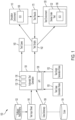
- the automated test generation system 100 can be used verify that software requirements 102 have been correctly implemented in code 104 used to create a software configuration item (SCI) 106 under test.
- the SCI 106 can include executable software and supporting data structures which may be tested in various environments, such as a simulation environment 110 and/or a test environment 120.
- the test environment 120 can include a device under test 122, such as customized hardware that is controlled by the SCI 106.
- the device under test 122 can be a controller for a motor, an engine, or other such electromechanical system.
- the test environment 120 can include sensors and actuators used by the device under test 122 or signals that replicate electrical, optical, and/or acoustic characteristics of the sensors and actuators.
- the simulation environment 110 can be a software test system configured on a workstation or other such computer with a processor and memory that simulates aspects of the device under test 122.
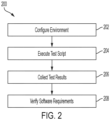
- test script 162 is executed in the selected environment to exercise one or more features of the SCI 106.
- the test script 162 can perform a sequence of multiple test cases 160.
- test results 170 are collected. In some tests, the test script 162 may use the test results 170, for instance, where intermediate outputs or past values become inputs for other tests.
- the software requirements 102 are verified.
- the test cases 160 and test scripts 162 can define expected outcomes of test script 162 execution, and results may confirm whether the code 104 correctly implemented the software requirements 102.
- a data dictionary 108 can define input and output variables and constants used by the code 104.
- the data dictionary 108 can be developed in combination with the code 104.
- entries in the data dictionary 108 can be used to populate portions of the code 104.
- the data dictionary 108 can document the input and output variables and constants used by the code 104 but need not have a direct link.
- the automated test generation system 100 can include an automated test generator 130.
- the automated test generator 130 can include a processing system 132 and a memory system 134, where the memory system 134 stores executable instructions to configure the processing system 132 to perform a plurality of operations.
- the processing system 132 can include any type or combination of central processing unit (CPU), including one or more of a microprocessor, a digital signal processor (DSP), a microcontroller, an application specific integrated circuit (ASIC), a field programmable gate array (FPGA), or the like.
- the memory system 134 can store data and instructions that are executed by the processing system 132.
- the memory system 134 may include random access memory (RAM), read only memory (ROM), or other electronic, optical, magnetic, or any other computer readable medium onto which is stored data and algorithms in a non-transitory form.
- the automated test generator 130 can also include an input/output (I/O) interface 136 operable to interface with various components of the automated test generation system 100 and other system components that interface with the automated test generation system 100 through an application programming interface (API) 138.
- I/O input/output
- API application programming interface
- the software requirements 102 can be parsed to identify requirements with associated inputs, outputs, expressions, timing constraints, and other such features and populate a test input sheet 140.
- the test input sheet 140 can provide a consistent format for documenting aspects of the software requirements 102 in a consistent format.
- FIG. 3 depicts a portion of a test input sheet 300 for test case generation as an example of a portion of the test input sheet 140 of FIG. 1 .
- fields of the test input sheet 300 can include a requirement identifier 302, a first input 304, a first input value 306, a second input 308, a timing constraint 310, an expression 312, a first output 314, a first output value 316, a requirement expected value 318, a requirement type 320, an applicability 322, a package 324, a test framework 326, a previous output field 328, a recursive field 330, a system test plan starting identifier 332, and a while-outer field 334.
- the requirement identifier 302 can identify one or more of the software requirements 102 being tested.
- the first input 304 can identify one or more inputs for testing that are time independent.
- the first input value 306 can include initial values for each of the one or more inputs of the first input 304.
- the second input 308 can identify one or more inputs having a timing dependency.
- the timing constraint 310 be a timing constraint of the timing dependency of the one or more inputs of the second input 308.
- the expression 312 can include one or more logical expressions that indicate how to logically evaluate one or more inputs (e.g., combinations of first input 304 and/or second input 308).
- the first output 314 can identify one or more output variables that can be set upon evaluating the expression 312.
- the first output value 316 can identify an output type value of the first output 314.
- the automated test generator 130 can parse the test input sheet 140 to identify the various fields stored therein.
- the automated test generator 130 can also access the data dictionary 108 to determine one or more characteristics of the inputs and outputs identified in the test input sheet 140.
- the automated test generator 130 can apply test case generation rules 150 to produce one or more test cases 160 to test whether the SCI 106 meets one or more software requirements 102.
- the automated test generator 130 can apply test script generation rules 152 to produce one or more test scripts 162 that implement the one or more test cases 160.
- the test scripts 162 can be configured for one or more environments, such as setting an environment configuration specific to the simulation environment 110 or the test environment 120. Test results 170 can be captured and used by the test scripts 162, for instance, for past value comparisons and to determine whether the software requirements 102 are met.
- the test cases 160 can document initial conditions, test objectives, input conditions, and expected results in a text format that is human readable.
- the test scripts 162 can be in format that directly interfaces with a target environment, such as commands to set initial conditions in the simulation environment 110 and extract the test results 170 from the simulation environment 110. Similarly, the test scripts 162 can set initial conditions of the test environment 120, control select inputs with a targeted rate of change, and meet other conditions defined through the test input sheet 140.
- the test case generation rules 150 can define a test case template and test case expansion rules. For example, where a boundary range check is needed, the test case generation rules 150 generate test cases for each boundary.
- the test case generation rules 150 can also determine multiple test cases for input combinations, such as a truth table expansion, all set, all clear, walking one testing, and other such test variations. For instance a boundary value can be tested at the value, below the value, and above the value.
- Range, scaling, and unit information can be extracted from the data dictionary 108 according to the test case generation rules 150 to generate the test cases 160.
- FIG. 4 depicts an example of a data dictionary format 400 that can be used for the data dictionary 108.
- the data dictionary format 400 can include, for instance, a software scale factor 402, units 404, a requirement data name 406, a range 408, and a data type 410.
- the software scale factor 402 can be used to determine how a raw value should be interpreted, for instance, where fixed-point math is used.
- the units 404 can be used to make the test cases 160 more descriptive, for instance, by including engineering units in the text.
- the range 408 can be used to determine a test case type and number of test cases needed. For example, a Boolean variable may have only two possible values, while an enumerated type can include a list of up to N possible values.
- FIG. 5 depicts an example of a dependent input format 500 for test case generation.
- the dependent input format 500 can define a variable name 502, a first condition 504, a second condition 506, a third condition 508, a fourth condition 510, and a continue until end condition 512.
- a Boolean value may have a TRUE dependency condition defined by the first condition 504 and a FALSE dependency condition defined by the second condition 506.
- An enumerated type may have dependency conditions sequentially defined across the first condition 504, second condition 506, third condition 508, fourth condition 510, and continue until end condition 512.
- the dependent input format 500 can be defined with the test input sheet 140 or elsewhere.
- the test scripts 162 can be generated using a similar approach as the test cases 160. In some aspects generation of the test scripts 162 can be independent from generation of the test cases 160. In other aspects, the test cases 160 can be converted into the test scripts 162 based on the test script generation rules 152. For instance, the test script generation rules 152 may define how to structure commands for the simulation environment 110 or the test environment 120 in JAVA or another such language known in the art.
- FIG. 6 depicts a process flow 600 according to a non-limiting embodiment. Although depicted in a particular order, it will be understood that the steps of process flow 600 can be done in an alternate order and steps may be added or further subdivided. Process flow 600 is described in references to the automated test generator 130 of FIG. 1 ; however, other system configurations can also perform the process flow 600. Steps of the process flow 600 can be performed by the processing system 132 executing instructions stored in memory system 134 and/or may be implemented in hardware.
- the automated test generator 130 can parse a test input sheet 140 to identify one or more inputs, one or more outputs, and one or more expressions that define one or more software requirements 102 in a logical form with respect to the one or more inputs.
- the automated test generator 130 can access a data dictionary 108 to determine one or more limits of the one or more inputs.
- the automated test generator 130 can apply a plurality of test case generation rules 150 to produce one or more test cases 160 to test whether a software configuration item 106 under test meets the one or more software requirements 102.
- the one or more test cases 160 can document a plurality of steps to implement a test.
- the automated test generator 130 can apply a plurality of test script generation rules 152 to produce one or more test scripts 162 that implement the one or more test cases 160 by setting values of the one or more inputs to the software configuration item 106 under test based on the one or more limits and the one or more expressions to verify the one or more outputs.
- the one or more test scripts 162 can set one or more environmental variables and trigger test execution.
- the test input sheet 140 can define a timing constraint of at least one of the one or more software requirements 102
- the test case generation rules 150 can be configured to generate two or more test cases 160 to verify whether the timing constraint is met
- the test script generation rules 152 can be configured to generate two or more test scripts 162 to verify whether the timing constraint is met.
- the data dictionary 108 can define a timing constraint of at least one of the one or more inputs
- the test case generation rules 150 can be configured to generate two or more test cases 160 to verify whether the timing constraint is met
- the test script generation rules 152 can be configured to generate two or more test scripts 162 to verify whether the timing constraint is met.
- the test input sheet 140 can also define an input dependency between at least two inputs, the test case generation rules 150 can be configured to generate two or more test cases 160 to verify the input dependency, and the test script generation rules 152 can be configured to generate two or more test scripts 162 to verify the input dependency.
- the automated test generator 130 can be configured to extract unit information and software scaling factor from the data dictionary 108 and incorporate the unit information and software scaling factor in the one or more test cases 160 and the one or more test scripts 162. Further, the automated test generator 130 can be configured to generate the one or more test cases 160 and the one or more test scripts 162 as one or more multi-cycle tests for delayed output verification or sequential output verification. The automated test generator 130 can be configured to generate the one or more test cases 160 and the one or more test scripts 162 as latching tests based on determining that the one or more software requirements 102 include a latching requirement to set, hold, and reset at least one of the one or more outputs.
- the automated test generator 130 can be configured generate the one or more test cases 160 and the one or more test scripts 162 based on determining modified condition and decision coverage for the one or more expressions.
- the automated test generator 130 can be configured generate the one or more test cases 160 and the one or more test scripts 162 with boundary range tests based on one or more range values from the data dictionary 108.
- aspects of the present invention may be embodied as a system, method, or computer program product and may take the form of a hardware embodiment, a software embodiment (including firmware, resident software, micro-code, etc.), or a combination thereof.
- aspects of the present invention may include a computer program product embodied in a non-transient form in one or more computer readable medium(s) having computer readable program code embodied thereon.
Landscapes
- Engineering & Computer Science (AREA)
- Theoretical Computer Science (AREA)
- Computer Hardware Design (AREA)
- Quality & Reliability (AREA)
- Physics & Mathematics (AREA)
- General Engineering & Computer Science (AREA)
- General Physics & Mathematics (AREA)
- Debugging And Monitoring (AREA)
Abstract
An automated test generation system (100) includes a processing system (132) and a memory system (134) in communication with the processing system. The memory system (134) stores instructions of an automated test generator that when executed result in parsing a test input sheet to identify one or more inputs, outputs, and expressions that define software requirements in a logical form with respect to the inputs, accessing a data dictionary to determine limits of the inputs, applying test case generation rules to produce test cases to test whether a software configuration item under test meets the software requirements, and applying test script generation rules to produce test scripts that implement the test cases by setting values of the inputs to the software configuration item under test based on the limits and the expressions to verify the outputs.
Description
- This application claims the benefit of
IN Application No. 202311003610 filed January 18, 2023 - The present disclosure relates to testing systems, and more particularly, to automated test generation.
- Formal software development processes include the creation of software requirements, the creation of software code to implement the requirements, and testing of the resulting software to verify that the software meets the requirements. This is typically a manual process where software systems engineers develop software requirements, software designers develop the software into executable code, and software test engineers design tests to verify that the software meets the requirements. For large-scale development projects, the complexity of testing software at multiple levels, such as a software unit level, a functional level, and end-to-end testing can present technical challenges.
- According to some embodiments of the present disclosure, an automated test generation system includes a processing system and a memory system in communication with the processing system. The memory system stores instructions of an automated test generator that when executed by the processing system result in parsing a test input sheet to identify one or more inputs, one or more outputs, and one or more expressions that define one or more software requirements in a logical form with respect to the one or more inputs, accessing a data dictionary to determine one or more limits of the one or more inputs, applying a plurality of test case generation rules to produce one or more test cases to test whether a software configuration item under test meets the one or more software requirements, and applying a plurality of test script generation rules to produce one or more test scripts that implement the one or more test cases by setting values of the one or more inputs to the software configuration item under test based on the one or more limits and the one or more expressions to verify the one or more outputs.
- In addition to one or more of the features described herein, or as an alternative, further embodiments can include where the test input sheet defines a timing constraint of at least one of the one or more software requirements, the test case generation rules are configured to generate two or more test cases to verify whether the timing constraint is met, and the test script generation rules are configured to generate two or more test scripts to verify whether the timing constraint is met.
- In addition to one or more of the features described herein, or as an alternative, further embodiments can include where the data dictionary defines a timing constraint of at least one of the one or more inputs, the test case generation rules are configured to generate two or more test cases to verify whether the timing constraint is met, and the test script generation rules are configured to generate two or more test scripts to verify whether the timing constraint is met.
- In addition to one or more of the features described herein, or as an alternative, further embodiments can include where the test input sheet defines an input dependency between at least two inputs, the test case generation rules are configured to generate two or more test cases to verify the input dependency, and the test script generation rules are configured to generate two or more test scripts to verify the input dependency.
- In addition to one or more of the features described herein, or as an alternative, further embodiments can include where the one or more test cases document a plurality of steps to implement a test, and the one or more test scripts set one or more environmental variables and trigger test execution.
- In addition to one or more of the features described herein, or as an alternative, further embodiments can include where the automated test generator is configured to extract unit information and software scaling factor from the data dictionary and incorporate the unit information and software scaling factor in the one or more test cases and the one or more test scripts.
- In addition to one or more of the features described herein, or as an alternative, further embodiments can include where the automated test generator is configured to generate the one or more test cases and the one or more test scripts as one or more multi-cycle tests for delayed output verification or sequential output verification.
- In addition to one or more of the features described herein, or as an alternative, further embodiments can include where the automated test generator is configured to generate the one or more test cases and the one or more test scripts as latching tests based on determining that the one or more software requirements include a latching requirement to set, hold, and reset at least one of the one or more outputs.
- In addition to one or more of the features described herein, or as an alternative, further embodiments can include where the automated test generator is configured generate the one or more test cases and the one or more test scripts based on determining modified condition and decision coverage for the one or more expressions.
- In addition to one or more of the features described herein, or as an alternative, further embodiments can include where the automated test generator is configured generate the one or more test cases and the one or more test scripts with boundary range tests based on one or more range values from the data dictionary.
- According to an aspect, a method of automated test generation includes parsing, by an automated test generator executing on a processing system, a test input sheet to identify one or more inputs, one or more outputs, and one or more expressions that define one or more software requirements in a logical form with respect to the one or more inputs. The method also includes accessing, by the automated test generator, a data dictionary to determine one or more limits of the one or more inputs and applying, by the automated test generator, a plurality of test case generation rules to produce one or more test cases to test whether a software configuration item under test meets the one or more software requirements. The method further includes applying, by the automated test generator, a plurality of test script generation rules to produce one or more test scripts that implement the one or more test cases by setting values of the one or more inputs to the software configuration item under test based on the one or more limits and the one or more expressions to verify the one or more outputs.
- In addition to one or more of the features described herein, or as an alternative, further embodiments can include extracting, by the automated test generator, unit information and software scaling factor from the data dictionary and incorporating, by the automated test generator, the unit information and software scaling factor in the one or more test cases and the one or more test scripts.
- In addition to one or more of the features described herein, or as an alternative, further embodiments can include generating, by the automated test generator, the one or more test cases and the one or more test scripts as one or more multi-cycle tests for delayed output verification or sequential output verification.
- In addition to one or more of the features described herein, or as an alternative, further embodiments can include generating, by the automated test generator, the one or more test cases and the one or more test scripts as latching tests based on determining that the one or more software requirements comprise a latching requirement to set, hold, and reset at least one of the one or more outputs.
- In addition to one or more of the features described herein, or as an alternative, further embodiments can include generating, by the automated test generator, the one or more test cases and the one or more test scripts based on determining modified condition and decision coverage for the one or more expressions.
- In addition to one or more of the features described herein, or as an alternative, further embodiments can include generating, by the automated test generator, the one or more test cases and the one or more test scripts with boundary range tests based on one or more range values from the data dictionary.
- The foregoing features and elements may be combined in various combinations without exclusivity, unless expressly indicated otherwise. Features which are described in the context of separate aspects and embodiments may be used together and/or be interchangeable. Similarly, features described in the context of a single embodiment may also be provided separately or in any suitable subcombination. These features and elements as well as the operation thereof will become more apparent in light of the following description and the accompanying drawings. It should be understood, however, that the following description and drawings are intended to be illustrative and explanatory in nature and non-limiting.
- Various features will become apparent to those skilled in the art from the following detailed description of the disclosed non-limiting embodiments. The drawings that accompany the detailed description can be briefly described as follows:
-
FIG. 1 is a block diagram of an automated test generation system according to a non-limiting embodiment of the present disclosure; -
FIG. 2 is a process flow according to a non-limiting embodiment of the present disclosure; -
FIG. 3 depicts a portion of a test input sheet for test case and test script generation according to a non-limiting embodiment of the present disclosure; -
FIG. 4 depicts a data dictionary format according to a non-limiting embodiment of the present disclosure; -
FIG. 5 depicts a dependent input format for test case and test script generation according to a non-limiting embodiment of the present disclosure; and -
FIG. 6 depicts a process flow according to a non-limiting embodiment of the present disclosure. - The foregoing features and elements may be combined in various combinations without exclusivity, unless expressly indicated otherwise. These features and elements as well as the operation thereof will become more apparent in light of the following description and the accompanying drawings. It should be understood, however, that the following description and drawings are intended to be illustrative and explanatory in nature and non-limiting.
- Various non-limiting embodiments of the present disclosure provide automated test generation for software. The process of developing tests for software is typically performed by test engineers who analyze software requirements and manually write test cases. Test procedures and/or test scripts are typically manually generated to align with the manually generated test cases. The test procedures or scripts can be used to perform software testing. This can result in inefficiencies as test engineers may take different approaches to testing portions of the same large-scale software item. Accordingly, some conditions may be missed and other conditions may end up getting tested multiple times. Further, it may take additional resources to convert the manually generated test cases into scripts to perform testing in different environments. For instance, a test that is manually written for a simulation environment may be challenging to port for use with development or production hardware.
- According to aspects of the disclosure, automated test generation is provided by an automated test generation system that automates test case and test script generation. The automated generation of test cases and test scripts can increase resource utilization efficiency and reduce the risk of errors that can occur with a manual process. Further, the automated test generation can establish traceability between requirements, test cases, and test scripts to ensure that all requirements are tested in a software configuration item under test. The automated test generation can apply a consistent approach to test various types of complex software structures to ensure that modified condition and decision coverage is achieved.
- With reference now to
FIG. 1 , an automatedtest generation system 100 is illustrated according to a non-limiting embodiment of the present disclosure. The automatedtest generation system 100 can be used verify thatsoftware requirements 102 have been correctly implemented incode 104 used to create a software configuration item (SCI) 106 under test. The SCI 106 can include executable software and supporting data structures which may be tested in various environments, such as asimulation environment 110 and/or atest environment 120. Thetest environment 120 can include a device undertest 122, such as customized hardware that is controlled by the SCI 106. For example, the device undertest 122 can be a controller for a motor, an engine, or other such electromechanical system. Thetest environment 120 can include sensors and actuators used by the device undertest 122 or signals that replicate electrical, optical, and/or acoustic characteristics of the sensors and actuators. Thesimulation environment 110 can be a software test system configured on a workstation or other such computer with a processor and memory that simulates aspects of the device undertest 122. - A generalized approach to performing tests of the
SCI 106 through thesimulation environment 110 or thetest environment 120 is illustrated in the example ofprocess 200 ofFIG. 2 . Atblock 202, an environment is configured, such as thesimulation environment 110 or thetest environment 120. Atblock 204, atest script 162 is executed in the selected environment to exercise one or more features of theSCI 106. Thetest script 162 can perform a sequence ofmultiple test cases 160. Atblock 206,test results 170 are collected. In some tests, thetest script 162 may use thetest results 170, for instance, where intermediate outputs or past values become inputs for other tests. Atblock 208, thesoftware requirements 102 are verified. Thetest cases 160 and testscripts 162 can define expected outcomes oftest script 162 execution, and results may confirm whether thecode 104 correctly implemented thesoftware requirements 102. - With continued reference to
FIG. 1 , adata dictionary 108 can define input and output variables and constants used by thecode 104. Thedata dictionary 108 can be developed in combination with thecode 104. For example, in some aspects, entries in thedata dictionary 108 can be used to populate portions of thecode 104. In other aspects, thedata dictionary 108 can document the input and output variables and constants used by thecode 104 but need not have a direct link. - The automated
test generation system 100 can include anautomated test generator 130. Theautomated test generator 130 can include aprocessing system 132 and amemory system 134, where thememory system 134 stores executable instructions to configure theprocessing system 132 to perform a plurality of operations. Theprocessing system 132 can include any type or combination of central processing unit (CPU), including one or more of a microprocessor, a digital signal processor (DSP), a microcontroller, an application specific integrated circuit (ASIC), a field programmable gate array (FPGA), or the like. Thememory system 134 can store data and instructions that are executed by theprocessing system 132. In embodiments, thememory system 134 may include random access memory (RAM), read only memory (ROM), or other electronic, optical, magnetic, or any other computer readable medium onto which is stored data and algorithms in a non-transitory form. Theautomated test generator 130 can also include an input/output (I/O)interface 136 operable to interface with various components of the automatedtest generation system 100 and other system components that interface with the automatedtest generation system 100 through an application programming interface (API) 138. - The
software requirements 102 can be parsed to identify requirements with associated inputs, outputs, expressions, timing constraints, and other such features and populate atest input sheet 140. Thetest input sheet 140 can provide a consistent format for documenting aspects of thesoftware requirements 102 in a consistent format.FIG. 3 depicts a portion of atest input sheet 300 for test case generation as an example of a portion of thetest input sheet 140 ofFIG. 1 . As depicted in the example of thetest input sheet 300, fields of thetest input sheet 300 can include arequirement identifier 302, afirst input 304, afirst input value 306, asecond input 308, atiming constraint 310, anexpression 312, afirst output 314, afirst output value 316, a requirement expectedvalue 318, arequirement type 320, anapplicability 322, apackage 324, atest framework 326, aprevious output field 328, arecursive field 330, a system testplan starting identifier 332, and a while-outer field 334. Therequirement identifier 302 can identify one or more of thesoftware requirements 102 being tested. Thefirst input 304 can identify one or more inputs for testing that are time independent. Thefirst input value 306 can include initial values for each of the one or more inputs of thefirst input 304. Thesecond input 308 can identify one or more inputs having a timing dependency. Thetiming constraint 310 be a timing constraint of the timing dependency of the one or more inputs of thesecond input 308. Theexpression 312 can include one or more logical expressions that indicate how to logically evaluate one or more inputs (e.g., combinations offirst input 304 and/or second input 308). Thefirst output 314 can identify one or more output variables that can be set upon evaluating theexpression 312. Thefirst output value 316 can identify an output type value of thefirst output 314. The requirement expectedvalue 318 indicates an expected value of thefirst output 314 based on thesoftware requirements 102, and therequirement type 320 indicates whether the expected transition is a set, latch, or reset for the requirement expectedvalue 318. Theapplicability 322 can identify whether the device undertest 122 is targeted. Thepackage 324 can identify whether theSCI 106 is intended to run in a test wrapper to configure the environment. Thetest framework 326 can identify a type of environment. Theprevious output field 328 can be used to perform test analysis on a previous execution cycle, such the last cycle, two cycles back, three cycles back, etc. Therecursive field 330 can indicate whether one or more of the inputs is used multiple places with different values. The system testplan starting identifier 332 can include a test plan identifier. The while-outer field 334 can indicate that a variable value has an outer condition for an inner input block, such as a first state in combination with two or more conditions being maintained. - Returning to
FIG. 1 , theautomated test generator 130 can parse thetest input sheet 140 to identify the various fields stored therein. Theautomated test generator 130 can also access thedata dictionary 108 to determine one or more characteristics of the inputs and outputs identified in thetest input sheet 140. Theautomated test generator 130 can apply test case generation rules 150 to produce one ormore test cases 160 to test whether theSCI 106 meets one ormore software requirements 102. Theautomated test generator 130 can apply test script generation rules 152 to produce one ormore test scripts 162 that implement the one ormore test cases 160. Thetest scripts 162 can be configured for one or more environments, such as setting an environment configuration specific to thesimulation environment 110 or thetest environment 120. Test results 170 can be captured and used by thetest scripts 162, for instance, for past value comparisons and to determine whether thesoftware requirements 102 are met. - The
test cases 160 can document initial conditions, test objectives, input conditions, and expected results in a text format that is human readable. Thetest scripts 162 can be in format that directly interfaces with a target environment, such as commands to set initial conditions in thesimulation environment 110 and extract thetest results 170 from thesimulation environment 110. Similarly, thetest scripts 162 can set initial conditions of thetest environment 120, control select inputs with a targeted rate of change, and meet other conditions defined through thetest input sheet 140. The test case generation rules 150 can define a test case template and test case expansion rules. For example, where a boundary range check is needed, the test case generation rules 150 generate test cases for each boundary. The test case generation rules 150 can also determine multiple test cases for input combinations, such as a truth table expansion, all set, all clear, walking one testing, and other such test variations. For instance a boundary value can be tested at the value, below the value, and above the value. - Range, scaling, and unit information can be extracted from the
data dictionary 108 according to the test case generation rules 150 to generate thetest cases 160.FIG. 4 depicts an example of adata dictionary format 400 that can be used for thedata dictionary 108. Thedata dictionary format 400 can include, for instance, asoftware scale factor 402,units 404, arequirement data name 406, arange 408, and adata type 410. Thesoftware scale factor 402 can be used to determine how a raw value should be interpreted, for instance, where fixed-point math is used. Theunits 404 can be used to make thetest cases 160 more descriptive, for instance, by including engineering units in the text. Therange 408 can be used to determine a test case type and number of test cases needed. For example, a Boolean variable may have only two possible values, while an enumerated type can include a list of up to N possible values. - Additional variations in the
test cases 160 can be generated for dependent input cases.FIG. 5 depicts an example of adependent input format 500 for test case generation. In the example ofFIG. 5 , thedependent input format 500 can define avariable name 502, afirst condition 504, asecond condition 506, athird condition 508, afourth condition 510, and a continue untilend condition 512. For instance, a Boolean value may have a TRUE dependency condition defined by thefirst condition 504 and a FALSE dependency condition defined by thesecond condition 506. An enumerated type may have dependency conditions sequentially defined across thefirst condition 504,second condition 506,third condition 508,fourth condition 510, and continue untilend condition 512. Thedependent input format 500 can be defined with thetest input sheet 140 or elsewhere. It will be understood that thedependent input format 500 is an example for purposes of explanation and is in no way limiting. Thus, further dependency types can also be defined. Thetest scripts 162 can be generated using a similar approach as thetest cases 160. In some aspects generation of thetest scripts 162 can be independent from generation of thetest cases 160. In other aspects, thetest cases 160 can be converted into thetest scripts 162 based on the test script generation rules 152. For instance, the test script generation rules 152 may define how to structure commands for thesimulation environment 110 or thetest environment 120 in JAVA or another such language known in the art. -
FIG. 6 depicts aprocess flow 600 according to a non-limiting embodiment. Although depicted in a particular order, it will be understood that the steps ofprocess flow 600 can be done in an alternate order and steps may be added or further subdivided.Process flow 600 is described in references to theautomated test generator 130 ofFIG. 1 ; however, other system configurations can also perform theprocess flow 600. Steps of theprocess flow 600 can be performed by theprocessing system 132 executing instructions stored inmemory system 134 and/or may be implemented in hardware. - At
block 602, theautomated test generator 130 can parse atest input sheet 140 to identify one or more inputs, one or more outputs, and one or more expressions that define one ormore software requirements 102 in a logical form with respect to the one or more inputs. - At
block 604, theautomated test generator 130 can access adata dictionary 108 to determine one or more limits of the one or more inputs. - At
block 606, theautomated test generator 130 can apply a plurality of test case generation rules 150 to produce one ormore test cases 160 to test whether asoftware configuration item 106 under test meets the one ormore software requirements 102. The one ormore test cases 160 can document a plurality of steps to implement a test. - At
block 608, theautomated test generator 130 can apply a plurality of test script generation rules 152 to produce one ormore test scripts 162 that implement the one ormore test cases 160 by setting values of the one or more inputs to thesoftware configuration item 106 under test based on the one or more limits and the one or more expressions to verify the one or more outputs. The one ormore test scripts 162 can set one or more environmental variables and trigger test execution. - According to some aspects, the
test input sheet 140 can define a timing constraint of at least one of the one ormore software requirements 102, the test case generation rules 150 can be configured to generate two ormore test cases 160 to verify whether the timing constraint is met, and the test script generation rules 152 can be configured to generate two ormore test scripts 162 to verify whether the timing constraint is met. Thedata dictionary 108 can define a timing constraint of at least one of the one or more inputs, the test case generation rules 150 can be configured to generate two ormore test cases 160 to verify whether the timing constraint is met, and the test script generation rules 152 can be configured to generate two ormore test scripts 162 to verify whether the timing constraint is met. Thetest input sheet 140 can also define an input dependency between at least two inputs, the test case generation rules 150 can be configured to generate two ormore test cases 160 to verify the input dependency, and the test script generation rules 152 can be configured to generate two ormore test scripts 162 to verify the input dependency. - According to some aspects, the
automated test generator 130 can be configured to extract unit information and software scaling factor from thedata dictionary 108 and incorporate the unit information and software scaling factor in the one ormore test cases 160 and the one ormore test scripts 162. Further, theautomated test generator 130 can be configured to generate the one ormore test cases 160 and the one ormore test scripts 162 as one or more multi-cycle tests for delayed output verification or sequential output verification. Theautomated test generator 130 can be configured to generate the one ormore test cases 160 and the one ormore test scripts 162 as latching tests based on determining that the one ormore software requirements 102 include a latching requirement to set, hold, and reset at least one of the one or more outputs. Theautomated test generator 130 can be configured generate the one ormore test cases 160 and the one ormore test scripts 162 based on determining modified condition and decision coverage for the one or more expressions. Theautomated test generator 130 can be configured generate the one ormore test cases 160 and the one ormore test scripts 162 with boundary range tests based on one or more range values from thedata dictionary 108. - It will be appreciated that aspects of the present invention may be embodied as a system, method, or computer program product and may take the form of a hardware embodiment, a software embodiment (including firmware, resident software, micro-code, etc.), or a combination thereof. Furthermore, aspects of the present invention may include a computer program product embodied in a non-transient form in one or more computer readable medium(s) having computer readable program code embodied thereon.
- The terms "about" and "substantially" are intended to include the degree of error associated with measurement of the particular quantity based upon the equipment available at the time of filing the application. For example, "about" or "substantially" can include a range of ± 8% or 5%, or 2% of a given value. The terminology used herein is for the purpose of describing particular embodiments only and is not intended to be limiting of the present disclosure. As used herein, the singular forms "a," "an" and "the" are intended to include the plural forms as well, unless the context clearly indicates otherwise. It will be further understood that the terms "comprises" and/or "comprising," when used in this specification, specify the presence of stated features, integers, steps, operations, elements, and/or components, but do not preclude the presence or addition of one or more other features, integers, steps, operations, element components, and/or groups thereof.
- While the present disclosure has been described with reference to an exemplary embodiment or embodiments, it will be understood by those skilled in the art that various changes may be made, and equivalents may be substituted for elements thereof without departing from the scope of the present disclosure. In addition, many modifications may be made to adapt a particular situation or material to the teachings of the present disclosure without departing from the essential scope thereof. Therefore, it is intended that the present disclosure is not limited to the particular embodiment disclosed as the best mode contemplated for carrying out this present disclosure, but that the present disclosure will include all embodiments falling within the scope of the claims.
Claims (15)
- An automated test generation system (100) comprising:a processing system (132); anda memory system (134) in communication with the processing system (132), the memory system storing instructions of an automated test generator (130) that when executed by the processing system (132) result in:parsing a test input sheet to identify one or more inputs, one or more outputs, and one or more expressions that define one or more software requirements in a logical form with respect to the one or more inputs;accessing a data dictionary to determine one or more limits of the one or more inputs;applying a plurality of test case generation rules to produce one or more test cases to test whether a software configuration item under test meets the one or more software requirements; andapplying a plurality of test script generation rules to produce one or more test scripts that implement the one or more test cases by setting values of the one or more inputs to the software configuration item under test based on the one or more limits and the one or more expressions to verify the one or more outputs.
- The automated test generation system of claim 1, wherein the test input sheet defines a timing constraint of at least one of the one or more software requirements, the test case generation rules are configured to generate two or more test cases to verify whether the timing constraint is met, and the test script generation rules are configured to generate two or more test scripts to verify whether the timing constraint is met.
- The automated test generation system of claim 1 or 2, wherein the data dictionary defines a timing constraint of at least one of the one or more inputs, the test case generation rules are configured to generate two or more test cases to verify whether the timing constraint is met, and the test script generation rules are configured to generate two or more test scripts to verify whether the timing constraint is met.
- The automated test generation system of any preceding claim, wherein the test input sheet defines an input dependency between at least two inputs, the test case generation rules are configured to generate two or more test cases to verify the input dependency, and the test script generation rules are configured to generate two or more test scripts to verify the input dependency.
- The automated test generation system of any preceding claim, wherein the one or more test cases document a plurality of steps to implement a test, and the one or more test scripts set one or more environmental variables and trigger test execution.
- The automated test generation system of any preceding claim, wherein the automated test generator is configured to extract unit information and software scaling factor from the data dictionary and incorporate the unit information and software scaling factor in the one or more test cases and the one or more test scripts; and/orwherein the automated test generator is configured to generate the one or more test cases and the one or more test scripts as one or more multi-cycle tests for delayed output verification or sequential output verification; and/orwherein the automated test generator is configured to generate the one or more test cases and the one or more test scripts as latching tests based on determining that the one or more software requirements comprise a latching requirement to set, hold, and reset at least one of the one or more outputs.
- The automated test generation system of any preceding claim, wherein the automated test generator is configured generate the one or more test cases and the one or more test scripts based on determining modified condition and decision coverage for the one or more expressions, and preferably wherein the automated test generator is configured generate the one or more test cases and the one or more test scripts with boundary range tests based on one or more range values from the data dictionary.
- A method of automated test generation comprising:parsing, by an automated test generator executing on a processing system, a test input sheet to identify one or more inputs, one or more outputs, and one or more expressions that define one or more software requirements in a logical form with respect to the one or more inputs;accessing, by the automated test generator, a data dictionary to determine one or more limits of the one or more inputs;applying, by the automated test generator, a plurality of test case generation rules to produce one or more test cases to test whether a software configuration item under test meets the one or more software requirements; andapplying, by the automated test generator, a plurality of test script generation rules to produce one or more test scripts that implement the one or more test cases by setting values of the one or more inputs to the software configuration item under test based on the one or more limits and the one or more expressions to verify the one or more outputs.
- The method of claim 8, wherein the test input sheet defines a timing constraint of at least one of the one or more software requirements, the test case generation rules are configured to generate two or more test cases to verify whether the timing constraint is met, and the test script generation rules are configured to generate two or more test scripts to verify whether the timing constraint is met.
- The method of claim 8 or 9, wherein the data dictionary defines a timing constraint of at least one of the one or more inputs, the test case generation rules are configured to generate two or more test cases to verify whether the timing constraint is met, and the test script generation rules are configured to generate two or more test scripts to verify whether the timing constraint is met.
- The method of any of claims 8-10, wherein the test input sheet defines an input dependency between at least two inputs, the test case generation rules are configured to generate two or more test cases to verify the input dependency, and the test script generation rules are configured to generate two or more test scripts to verify the input dependency.
- The method of any of claims 8-11, wherein the one or more test cases document a plurality of steps to implement a test, and the one or more test scripts set one or more environmental variables and trigger test execution.
- The method of any of claims 8-12, further comprising:extracting, by the automated test generator, unit information and software scaling factor from the data dictionary; andincorporating, by the automated test generator, the unit information and software scaling factor in the one or more test cases and the one or more test scripts.
- The method of any of claims 8-13, further comprising:
generating, by the automated test generator, the one or more test cases and the one or more test scripts as one or more multi-cycle tests for delayed output verification or sequential output verification; and/or further comprising:
generating, by the automated test generator, the one or more test cases and the one or more test scripts as latching tests based on determining that the one or more software requirements comprise a latching requirement to set, hold, and reset at least one of the one or more outputs. - The method of any of claims 8-14, further comprising:
generating, by the automated test generator, the one or more test cases and the one or more test scripts based on determining modified condition and decision coverage for the one or more expressions, and preferably further comprising:
generating, by the automated test generator, the one or more test cases and the one or more test scripts with boundary range tests based on one or more range values from the data dictionary.
Applications Claiming Priority (1)
| Application Number | Priority Date | Filing Date | Title |
|---|---|---|---|
| IN202311003610 | 2023-01-18 |
Publications (1)
| Publication Number | Publication Date |
|---|---|
| EP4404066A1 true EP4404066A1 (en) | 2024-07-24 |
Family
ID=89223209
Family Applications (1)
| Application Number | Title | Priority Date | Filing Date |
|---|---|---|---|
| EP23216898.9A Pending EP4404066A1 (en) | 2023-01-18 | 2023-12-14 | Automated test generation |
Country Status (2)
| Country | Link |
|---|---|
| US (1) | US12339763B2 (en) |
| EP (1) | EP4404066A1 (en) |
Cited By (1)
| Publication number | Priority date | Publication date | Assignee | Title |
|---|---|---|---|---|
| RU2852488C1 (en) * | 2025-06-18 | 2025-12-08 | Акционерное общество "Информационные спутниковые системы" имени академика М.Ф. Решетнёва" | Method for generating embedded software tests based on use scenarios |
Families Citing this family (4)
| Publication number | Priority date | Publication date | Assignee | Title |
|---|---|---|---|---|
| US20250238352A1 (en) * | 2024-01-22 | 2025-07-24 | Honeywell International Inc. | Large language model analysis and grouping of software requirements to generate test cases for software testing |
| US20250272219A1 (en) * | 2024-02-22 | 2025-08-28 | Netapp, Inc. | Cell based test automation framework |
| CN119336609B (en) * | 2024-12-20 | 2025-06-24 | 西安中朗智控科技有限公司 | Automatic generation method of software configuration item test cases based on large language model |
| CN119559989B (en) * | 2025-01-22 | 2025-06-10 | 深圳市晶存科技股份有限公司 | Function test method, device and storage medium of random access memory |
Citations (2)
| Publication number | Priority date | Publication date | Assignee | Title |
|---|---|---|---|---|
| EP3206129A1 (en) * | 2016-02-09 | 2017-08-16 | General Electric Company | System and method of test case generation based on equivalence class analysis derived from design requirements |
| EP3572945A1 (en) * | 2018-03-09 | 2019-11-27 | General Electric Company | System and method for safety-critical software automated requirements-based test case generation |
Family Cites Families (13)
| Publication number | Priority date | Publication date | Assignee | Title |
|---|---|---|---|---|
| US3790885A (en) * | 1972-03-27 | 1974-02-05 | Ibm | Serial test patterns for mosfet testing |
| JPH056291A (en) * | 1991-06-28 | 1993-01-14 | Hitachi Ltd | How to create and manage test resources |
| JP2004234066A (en) * | 2003-01-28 | 2004-08-19 | Hitachi Ltd | Database management method, its implementation system, and its processing program |
| US7490307B2 (en) * | 2006-06-29 | 2009-02-10 | Lsi Corporation | Automatic generating of timing constraints for the validation/signoff of test structures |
| US9665350B1 (en) | 2009-05-29 | 2017-05-30 | The Mathworks, Inc. | Automatic test generation for model-based code coverage |
| US9639442B2 (en) | 2012-08-29 | 2017-05-02 | Hcl Technologies Limited | Modified condition/decision coverage test case automation |
| CN104063314B (en) * | 2014-05-20 | 2016-10-05 | 中国工商银行股份有限公司 | A kind of automated test data generation device and method |
| US9710367B1 (en) | 2015-10-30 | 2017-07-18 | EMC IP Holding Company LLC | Method and system for dynamic test case creation and documentation to the test repository through automation |
| US10169217B2 (en) * | 2016-04-06 | 2019-01-01 | General Electric Company | System and method for test generation from software specification models that contain nonlinear arithmetic constraints over real number ranges |
| CA3064771A1 (en) * | 2017-06-01 | 2018-12-06 | Royal Bank Of Canada | System and method for test generation |
| US10846059B2 (en) * | 2019-02-05 | 2020-11-24 | Simply Inspired Software, Inc. | Automated generation of software bindings |
| CN113220566B (en) * | 2021-04-26 | 2024-06-28 | 深圳市云网万店科技有限公司 | Method and device for generating interface performance test script and computer equipment |
| CN113238932B (en) | 2021-04-30 | 2024-03-19 | 西南电子技术研究所(中国电子科技集团公司第十研究所) | Automatic test case generation method |
-
2023
- 2023-03-17 US US18/185,629 patent/US12339763B2/en active Active
- 2023-12-14 EP EP23216898.9A patent/EP4404066A1/en active Pending
Patent Citations (2)
| Publication number | Priority date | Publication date | Assignee | Title |
|---|---|---|---|---|
| EP3206129A1 (en) * | 2016-02-09 | 2017-08-16 | General Electric Company | System and method of test case generation based on equivalence class analysis derived from design requirements |
| EP3572945A1 (en) * | 2018-03-09 | 2019-11-27 | General Electric Company | System and method for safety-critical software automated requirements-based test case generation |
Cited By (1)
| Publication number | Priority date | Publication date | Assignee | Title |
|---|---|---|---|---|
| RU2852488C1 (en) * | 2025-06-18 | 2025-12-08 | Акционерное общество "Информационные спутниковые системы" имени академика М.Ф. Решетнёва" | Method for generating embedded software tests based on use scenarios |
Also Published As
| Publication number | Publication date |
|---|---|
| US12339763B2 (en) | 2025-06-24 |
| US20240241816A1 (en) | 2024-07-18 |
Similar Documents
| Publication | Publication Date | Title |
|---|---|---|
| US12339763B2 (en) | Automated test generation | |
| JP7270764B2 (en) | artificial intelligence chip verification | |
| US10025696B2 (en) | System and method for equivalence class analysis-based automated requirements-based test case generation | |
| US20180196739A1 (en) | System and method for safety-critical software automated requirements-based test case generation | |
| US8683282B2 (en) | Automatic identification of information useful for generation-based functional verification | |
| JP2018136985A5 (en) | ||
| CN106446412B (en) | Model-based test method for avionics system | |
| US8868976B2 (en) | System-level testcase generation | |
| US10936474B2 (en) | Software test program generation | |
| CN113632018B (en) | Method, computer program and apparatus for analyzing programmable logic controller program | |
| US10592703B1 (en) | Method and system for processing verification tests for testing a design under test | |
| US20150234965A1 (en) | Method and an apparatus for automatic processor design and verification | |
| CN116069635B (en) | SOC system testing method and device, computer equipment and storage medium | |
| US20150242541A1 (en) | Assertion extraction from design and its signal traces | |
| US9235670B2 (en) | Method and an apparatus for automatic generation of verification environment for processor design and verification | |
| CN112580282A (en) | Method, apparatus, device and storage medium for integrated circuit design verification | |
| US10169217B2 (en) | System and method for test generation from software specification models that contain nonlinear arithmetic constraints over real number ranges | |
| US7895575B2 (en) | Apparatus and method for generating test driver | |
| CN114548027B (en) | Method, electronic device and storage medium for tracking signals in verification system | |
| US20130035908A1 (en) | Identifying invariant candidates based on proofs | |
| CN103678114B (en) | Generate the device and method of the device and method and verification processing device asserted | |
| US11023357B1 (en) | Method and system for sequential equivalence checking | |
| CN114647568A (en) | Automatic testing method and device, electronic equipment and readable storage medium | |
| US10579761B1 (en) | Method and system for reconstructing a graph presentation of a previously executed verification test | |
| CN115510782B (en) | Method for locating verification errors, electronic device and storage medium |
Legal Events
| Date | Code | Title | Description |
|---|---|---|---|
| PUAI | Public reference made under article 153(3) epc to a published international application that has entered the european phase |
Free format text: ORIGINAL CODE: 0009012 |
|
| STAA | Information on the status of an ep patent application or granted ep patent |
Free format text: STATUS: THE APPLICATION HAS BEEN PUBLISHED |
|
| AK | Designated contracting states |
Kind code of ref document: A1 Designated state(s): AL AT BE BG CH CY CZ DE DK EE ES FI FR GB GR HR HU IE IS IT LI LT LU LV MC ME MK MT NL NO PL PT RO RS SE SI SK SM TR |
|
| STAA | Information on the status of an ep patent application or granted ep patent |
Free format text: STATUS: REQUEST FOR EXAMINATION WAS MADE |
|
| 17P | Request for examination filed |
Effective date: 20250120 |