EP4403609A1 - Sealant material composition and tire obtained using same - Google Patents
Sealant material composition and tire obtained using same Download PDFInfo
- Publication number
- EP4403609A1 EP4403609A1 EP22869673.8A EP22869673A EP4403609A1 EP 4403609 A1 EP4403609 A1 EP 4403609A1 EP 22869673 A EP22869673 A EP 22869673A EP 4403609 A1 EP4403609 A1 EP 4403609A1
- Authority
- EP
- European Patent Office
- Prior art keywords
- sealant composition
- composition according
- rubber
- mass
- sealant
- Prior art date
- Legal status (The legal status is an assumption and is not a legal conclusion. Google has not performed a legal analysis and makes no representation as to the accuracy of the status listed.)
- Pending
Links
Images

Classifications
-
- B—PERFORMING OPERATIONS; TRANSPORTING
- B29—WORKING OF PLASTICS; WORKING OF SUBSTANCES IN A PLASTIC STATE IN GENERAL
- B29C—SHAPING OR JOINING OF PLASTICS; SHAPING OF MATERIAL IN A PLASTIC STATE, NOT OTHERWISE PROVIDED FOR; AFTER-TREATMENT OF THE SHAPED PRODUCTS, e.g. REPAIRING
- B29C73/00—Repairing of articles made from plastics or substances in a plastic state, e.g. of articles shaped or produced by using techniques covered by this subclass or subclass B29D
- B29C73/16—Auto-repairing or self-sealing arrangements or agents
- B29C73/163—Sealing compositions or agents, e.g. combined with propellant agents
-
- B—PERFORMING OPERATIONS; TRANSPORTING
- B29—WORKING OF PLASTICS; WORKING OF SUBSTANCES IN A PLASTIC STATE IN GENERAL
- B29C—SHAPING OR JOINING OF PLASTICS; SHAPING OF MATERIAL IN A PLASTIC STATE, NOT OTHERWISE PROVIDED FOR; AFTER-TREATMENT OF THE SHAPED PRODUCTS, e.g. REPAIRING
- B29C73/00—Repairing of articles made from plastics or substances in a plastic state, e.g. of articles shaped or produced by using techniques covered by this subclass or subclass B29D
- B29C73/16—Auto-repairing or self-sealing arrangements or agents
- B29C73/22—Auto-repairing or self-sealing arrangements or agents the article containing elements including a sealing composition, e.g. powder being liberated when the article is damaged
-
- C—CHEMISTRY; METALLURGY
- C08—ORGANIC MACROMOLECULAR COMPOUNDS; THEIR PREPARATION OR CHEMICAL WORKING-UP; COMPOSITIONS BASED THEREON
- C08K—Use of inorganic or non-macromolecular organic substances as compounding ingredients
- C08K3/00—Use of inorganic substances as compounding ingredients
- C08K3/01—Use of inorganic substances as compounding ingredients characterized by their specific function
- C08K3/011—Crosslinking or vulcanising agents, e.g. accelerators
-
- C—CHEMISTRY; METALLURGY
- C08—ORGANIC MACROMOLECULAR COMPOUNDS; THEIR PREPARATION OR CHEMICAL WORKING-UP; COMPOSITIONS BASED THEREON
- C08L—COMPOSITIONS OF MACROMOLECULAR COMPOUNDS
- C08L91/00—Compositions of oils, fats or waxes; Compositions of derivatives thereof
-
- B—PERFORMING OPERATIONS; TRANSPORTING
- B29—WORKING OF PLASTICS; WORKING OF SUBSTANCES IN A PLASTIC STATE IN GENERAL
- B29D—PRODUCING PARTICULAR ARTICLES FROM PLASTICS OR FROM SUBSTANCES IN A PLASTIC STATE
- B29D30/00—Producing pneumatic or solid tyres or parts thereof
- B29D30/06—Pneumatic tyres or parts thereof (e.g. produced by casting, moulding, compression moulding, injection moulding, centrifugal casting)
- B29D30/0681—Parts of pneumatic tyres; accessories, auxiliary operations
- B29D30/0685—Incorporating auto-repairing or self-sealing arrangements or agents on or into tyres
- B29D2030/0686—Incorporating sealants on or into tyres not otherwise provided for; auxiliary operations therefore, e.g. preparation of the tyre
- B29D2030/0694—Incorporating sealants on or into tyres not otherwise provided for; auxiliary operations therefore, e.g. preparation of the tyre the sealant being in the form of one or more narrow strips, e.g. applied by winding into the interior of the tyre
-
- B—PERFORMING OPERATIONS; TRANSPORTING
- B29—WORKING OF PLASTICS; WORKING OF SUBSTANCES IN A PLASTIC STATE IN GENERAL
- B29D—PRODUCING PARTICULAR ARTICLES FROM PLASTICS OR FROM SUBSTANCES IN A PLASTIC STATE
- B29D30/00—Producing pneumatic or solid tyres or parts thereof
- B29D30/06—Pneumatic tyres or parts thereof (e.g. produced by casting, moulding, compression moulding, injection moulding, centrifugal casting)
- B29D30/0681—Parts of pneumatic tyres; accessories, auxiliary operations
- B29D30/0685—Incorporating auto-repairing or self-sealing arrangements or agents on or into tyres
- B29D2030/0686—Incorporating sealants on or into tyres not otherwise provided for; auxiliary operations therefore, e.g. preparation of the tyre
- B29D2030/0695—Incorporating sealants on or into tyres not otherwise provided for; auxiliary operations therefore, e.g. preparation of the tyre the sealant being in the form of one wide strip, e.g. a patch
-
- B—PERFORMING OPERATIONS; TRANSPORTING
- B29—WORKING OF PLASTICS; WORKING OF SUBSTANCES IN A PLASTIC STATE IN GENERAL
- B29D—PRODUCING PARTICULAR ARTICLES FROM PLASTICS OR FROM SUBSTANCES IN A PLASTIC STATE
- B29D30/00—Producing pneumatic or solid tyres or parts thereof
- B29D30/06—Pneumatic tyres or parts thereof (e.g. produced by casting, moulding, compression moulding, injection moulding, centrifugal casting)
- B29D30/0681—Parts of pneumatic tyres; accessories, auxiliary operations
- B29D30/0685—Incorporating auto-repairing or self-sealing arrangements or agents on or into tyres
-
- B—PERFORMING OPERATIONS; TRANSPORTING
- B29—WORKING OF PLASTICS; WORKING OF SUBSTANCES IN A PLASTIC STATE IN GENERAL
- B29L—INDEXING SCHEME ASSOCIATED WITH SUBCLASS B29C, RELATING TO PARTICULAR ARTICLES
- B29L2030/00—Pneumatic or solid tyres or parts thereof
-
- B—PERFORMING OPERATIONS; TRANSPORTING
- B60—VEHICLES IN GENERAL
- B60C—VEHICLE TYRES; TYRE INFLATION; TYRE CHANGING; CONNECTING VALVES TO INFLATABLE ELASTIC BODIES IN GENERAL; DEVICES OR ARRANGEMENTS RELATED TO TYRES
- B60C19/00—Tyre parts or constructions not otherwise provided for
- B60C19/12—Puncture preventing arrangements
-
- B—PERFORMING OPERATIONS; TRANSPORTING
- B60—VEHICLES IN GENERAL
- B60C—VEHICLE TYRES; TYRE INFLATION; TYRE CHANGING; CONNECTING VALVES TO INFLATABLE ELASTIC BODIES IN GENERAL; DEVICES OR ARRANGEMENTS RELATED TO TYRES
- B60C19/00—Tyre parts or constructions not otherwise provided for
- B60C19/12—Puncture preventing arrangements
- B60C19/122—Puncture preventing arrangements disposed inside of the inner liner
Definitions
- the present invention relates to a sealant composition and a tire using the same.
- a pneumatic tire that is provided with a sealant layer disposed on an inner side of an innerliner layer in a tire radial direction in a tread portion.
- a sealant flows into a through-hole, which makes it possible to suppress a decrease in air pressure and to maintain travel.
- Patent Document 1 describes a self-sealing elastomer composition for use as a puncture preventative layer in an inflatable article, which includes at least an unsaturated diene elastomer as a main elastomer having a content of a repeating unit derived from a conjugated diene greater than 30 mol%, hydrocarbon resin having a mass content between 30 phr and 90 phr, a liquid plasticizer having a glass transition temperature (Tg) lower than - 20°C and a mass content of 5 phr to less than 60 phr, and a filler having a mass content from 0 to less than 30 phr.
- Tg glass transition temperature
- Patent Document 1 JP 5525522 B
- An object of the present invention is to solve the aforementioned issues.
- a sealant composition produced by blending a rubber component, a plasticizer, and a crosslinking component, the sealant composition having, when shear stress is applied under specific conditions, an amount of deformation (strain) of a specific value or less, and thus the present invention can be completed.
- the present invention provides a sealant composition constituting a sealant layer of a pneumatic tire provided with the sealant layer on a tire inner surface.
- the sealant composition contains:
- An amount of deformation of a sample made of the sealant composition and having a thickness of 1.2 mm, when the sample is placed on a parallel plate having a diameter of 8 mm and a shear stress of 3000 Pa is applied in a rotation direction of the parallel plate for 60 minutes, is 1000% or less.
- a sealant composition according to an embodiment of the present invention blends (A) a rubber component, (B) a plasticizer, and (C) a crosslinking component.
- An amount of deformation of a sample made of the sealant composition and having a thickness of 1.2 mm, when the sample is placed on a parallel plate having a diameter of 8 mm and a shear stress of 3000 Pa is applied in a rotation direction of the parallel plate for 60 minutes, may be 1000% or less. According to this configuration, the amount of deformation (strain) of the sealant composition during tire travel is appropriately adjusted, making it possible to solve the issue of the sealant composition flowing toward the center of the tire tread in the width direction during tire travel. Accordingly, the sealing properties against a through-hole formed when foreign matter such as a nail penetrates into the tread portion are improved.
- Examples of a rubber component (A) used in an embodiment of the present invention include diene rubber such as natural rubber (NR), synthetic isoprene rubber (IR), butadiene rubber (BR), styrene-butadiene copolymer rubber (SBR), acrylonitrile-butadiene copolymer rubber (NBR), ethylenepropylene-diene terpolymer (EPDM), and butyl rubber. These may be used alone, or two or more may be used in combination.
- diene rubber such as natural rubber (NR), synthetic isoprene rubber (IR), butadiene rubber (BR), styrene-butadiene copolymer rubber (SBR), acrylonitrile-butadiene copolymer rubber (NBR), ethylenepropylene-diene terpolymer (EPDM), and butyl rubber.
- NR natural rubber
- IR synthetic isoprene rubber
- BR butadiene rubber
- SBR styrene
- the rubber component (A) is preferably NR, IR, SBR, BR, or a blend thereof.
- plasticizer used in an embodiment of the present invention examples include a carboxylic acid ester plasticizer, a phosphoric acid ester plasticizer, a sulfonic acid ester plasticizer, oil, and liquid rubber.
- carboxylic acid ester plasticizer examples include known phthalic acid esters, isophthalic acid esters, tetrahydrophthalic acid esters, adipic acid esters, maleic acid esters, fumaric acid esters, trimellitic acid esters, linoleic acid esters, oleic acid esters, stearic acid esters, and ricinoleic acid esters.
- Examples of the phosphoric acid ester plasticizer include known trimethyl phosphate, triethyl phosphate, tributyl phosphate, tri(2-ethylhexyl) phosphate, 2-ethylhexyl diphenyl phosphate, tributoxyethyl phosphate, triphenyl phosphate, cresyl diphenyl phosphate, isodecyl diphenyl phosphate, tricresyl phosphate, tritolyl phosphate, trixylenyl phosphate, tris(chloroethyl) phosphate, and diphenyl mono-o-xenyl phosphate.
- sulfonic acid ester plasticizer examples include known benzene sulfone butylamide, toluenesulfonamide, N-ethyl-toluenesulfonamide, and N-cyclohexyl-p-toluenesulfonamide.
- oil examples include known mineral oils such as paraffin-based process oil, naphthene-based process oil, and aromatic process oil.
- liquid rubber examples include liquid polyisoprene, liquid polybutadiene, and liquid polystyrene butadiene, and a weight average molecular weight thereof is preferably from 1000 to 100000, and more preferably from 1500 to 75000.
- the weight average molecular weight in the present invention refers to a value or a weight average molecular weight determined by gel permeation chromatography (GPC) in terms of calibration with polystyrene.
- GPC gel permeation chromatography
- the liquid rubber used in the present invention is liquid at 23°C. As a result, the liquid rubber is distinguished from the aforementioned rubber component that is solid at this temperature.
- oil or liquid rubber is preferable as the plasticizer from the perspective of improving the effects of the present invention.
- crosslinking component used in an embodiment of the present invention examples include sulfur and a vulcanization accelerator as components to improve sealing properties.
- Examples of the vulcanization accelerator used in an embodiment of the present invention include known sulfenamide-based, thiazole-based, guadinine-based, thiourea-based, dithiocarbamate-based, xanthogenate-based, and thiuram-based vulcanization accelerators.
- one or more types selected from a sulfenamide-based vulcanization accelerator and a thiazole-based vulcanization accelerator are preferred from the perspective of ease of adjusting the amount of deformation (strain) described below to the range specified in the present invention.
- the sealant composition according to an embodiment of the present invention can be blended with a tackifier.
- a tackifier include a hydrocarbon resin.
- the hydrocarbon resin include petroleum resin such as aromatic hydrocarbon resin that is manufactured by polymerizing components produced by performing treatments such as distillation, decomposition, and reforming on crude oil, or petroleum resin such as saturated or unsaturated hydrocarbon resin.
- Examples of the petroleum resin include C5 petroleum resin (aliphatic petroleum resin formed by polymerizing fractions such as isoprene, 1,3-pentadiene, cyclopentadiene, methylbutene, and pentene), C9 petroleum resin (aromatic petroleum resin formed by polymerizing fractions such as ⁇ -methylstyrene, o-vinyl toluene, m-vinyl toluene, and p-vinyl toluene), and C5C9 copolymer petroleum resin.
- C5 petroleum resin aliphatic petroleum resin formed by polymerizing fractions such as isoprene, 1,3-pentadiene, cyclopentadiene, methylbutene, and pentene
- C9 petroleum resin aromatic petroleum resin formed by polymerizing fractions such as ⁇ -methylstyrene, o-vinyl toluene, m-vinyl toluene, and p-vinyl toluen
- a glass transition temperature (Tg) of the tackifier is preferably higher than 0°C.
- Tg thermography measurement with differential scanning calorimetry (DSC) at a rate of temperature increase of 20°C/minute.
- the aforementioned Tg is more preferably 30°C or higher and 90°C or lower.
- the number average molecular weight of the tackifier is preferably from 400 to 2000. Having a number average molecular weight in this range improves adhesive force.
- a blended amount of the plasticizer (B) is, for example, from 20 to 100 parts by mass, preferably from 30 to 90 parts by mass per 100 parts by mass of the rubber component (A).
- a blended amount of the crosslinking component (C) is, for example, in terms of the total amount of the sulfur and the vulcanization accelerator, 1.0 parts by mass or more, preferably from 1.0 to 3.0 parts by mass, and more preferably from 1.5 to 2.5 parts by mass per 100 parts by mass of the rubber component (A).
- the blended amount of the vulcanization accelerator is, for example, 0.5 parts by mass or more, preferably from 0.5 to 2.5 parts by mass, and more preferably from 0.5 to 1.5 parts by mass per 100 parts by mass of the rubber component (A).
- a blended amount of the tackifier is, for example, from 10 to 100 parts by mass, preferably from 20 to 80 parts by mass per 100 parts by mass of the rubber component (A).
- additives such as a vulcanizing or crosslinking agent, a vulcanizing or cross-linking accelerator, zinc oxide, an anti-aging agent, and carbon black can be blended in the sealant composition according to an embodiment of the present invention.
- Such additives can be kneaded by a typical method to form a composition, and a blended amount of the additives can be a typical blended amount in the related art unless contrary to the object of the present invention.
- the sealant composition according to an embodiment of the present invention can be dynamically crosslinked.
- the complex viscosity at 30°C is preferably from 1000 to 20000 Pa ⁇ s.
- the complex viscosity at 30°C is 1000 Pa s or more, the sealant composition does not excessively flow, excellent fluidity is achieved, and deterioration of sealing properties can be prevented. Further, the complex viscosity being 20000 Pa ⁇ s or less has the effect of achieving good sealing properties.
- the complex viscosity at 30°C is preferably from 3000 to 15000 Pa ⁇ s, and more preferably from 5000 to 10000 Pa ⁇ s.
- complex viscosity can be measured by a method according to American Society for Testing and Materials D4440.
- an amount of deformation of a sample made of the sealant composition and having a thickness of 1.2 mm, when the sample is placed on a parallel plate having a diameter of 8 mm and a shear stress of 3000 Pa is applied in a rotation direction of the parallel plate for 60 minutes, may be 1000% or less.
- the amount of deformation of the sample is measured under the following conditions.
- Measuring device Dynamic viscoelasticity measuring instrument ARES-G2 available from TA Instruments Inc.
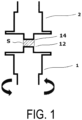
- the measuring device includes, as main portions, a jig 1 that is rotatable and a jig 2 facing the jig 1.
- the jig 1 includes a parallel plate 12 and the jig 2 includes a parallel plate 14.
- a sample S of the sealant composition having a thickness of 1.2 mm is placed on the parallel plate 12 having a diameter of 8 mm, and the sample S is fixed between the parallel plate 12 and the other parallel plate 14.
- the sample S has a thickness of 1.2 mm.
- the parallel plate 12 only is rotated, a shearing stress of 3000 Pa is applied in the rotation direction for 60 minutes, and the amount of deformation (strain) of the sample S after the 60 minutes is measured.
- the temperature in the measurement chamber is set to 80°C.
- the amount of deformation of the sample described above may be achieved by, for example, adjusting the total of the blended amounts of the sulfur and the vulcanization accelerator as well as the blended amount of the vulcanization accelerator to the preferred ranges described above, and adjusting the blended amount of the plasticizer to the preferred range described above.
- FIG. 2 is a schematic graph showing that the relationship between shear stress and the amount of deformation varies among a sealant composition in the related art and sealant compositions according to embodiments of the present invention.
- the shear stress described above when the shear stress described above is applied to the sealant composition (sample 3) in the related art, the amount of deformation increases with time and exceeds 1000% in 60 minutes.
- the sealant composition in the related art the sealant composition flows toward the center of the tire tread in the width direction due to tire travel as described above, and desired sealing properties cannot be exhibited.
- the sealant compositions according to embodiments of the present invention examples 1, 2
- the amount of deformation does not reach 1000% even when the shear stress described above is applied for 60 minutes.
- the flow of the sealant composition during tire travel can be suppressed, and the sealing properties against a through-hole formed when foreign matter such as a nail penetrates into the tread portion can be improved.
- the amount of deformation is preferably from 100 to 1000%, and more preferably from 100 to 700%.
- the sealant composition according to an embodiment of the present invention can be provided as a sealant layer on an inner side of an innerliner layer in a tire radial direction in a tread portion in a pneumatic tire.
- the sealant layer can be formed by attaching a sheet-shaped molded sealant made of the sealant composition according to an embodiment of the present invention to the entire circumference of the tire inner surface.
- the sealant layer can be formed by spirally attaching a string-shaped or band-shaped molded sealant made of the sealant composition according to an embodiment of the present invention to the tire inner surface.
- the sealant can be a vulcanized product.
- the sealant layer When foreign matter such as a nail or the like penetrates into the tread portion, the sealant constituting the sealant layer flows into the through-hole, and as a result, a decrease in air pressure can be suppressed and travel can be maintained.
- the sealant layer has a thickness of, for example, from 0.5 mm to 5.0 mm.
- the amount of oil in the innerliner layer is 3 parts by mass or more per 100 parts by mass of the rubber component containing butyl-based rubber as a main component, oil migration from the sealant layer to the innerliner layer is suppressed and the durability of the tire is maintained, and thus such an amount is preferred.
- kneading was performed for 40 minutes in a 1.7-L sealed Banbury mixer to produce a rubber composition.
- the resulting rubber composition was press-vulcanized in a predetermined mold at 180°C for 10 minutes to produce a sealant having a thickness of 3 mm.
- the amount of deformation of the sealant produced as described above was measured according to the method described above.
- a pneumatic tire having a tire size of 215/55R17 including a tread portion, a pair of sidewall portions, and a pair of bead portions, and including a sealant layer made of a sealant on an inner side of the innerliner layer in a tire radial direction in the tread portion
- the sealant was attached as the sealant layer to manufacture various test tires. The following physical properties were measured for the resulting test tires.
- test tires were assembled on wheels having a rim size of 16 ⁇ 6.5 J, mounted on a drum testing machine, and subjected to high deflection test with an air pressure of 160 kPa, a load of 8.5 kN, and a traveling speed of 80 km/h for 80 hours, and then the flow state of the sealant was examined.
- the evaluation results were as follows: Given that, when the thickness of the sealant was changed from 3 mm to 1.5 mm or less after testing at each position from the sealant end, it was determined that flow was observed.
- the sealant composition of each Example contained (A) a rubber component, (B) a plasticizer, and (C) a crosslinking component, and an amount of deformation of a sample made of the sealant composition and having a thickness of 1.2 mm, when the sample was placed on a parallel plate having a diameter of 8 mm and a shear stress of 3000 Pa was applied in a rotation direction of the parallel plate for 60 minutes, was 1000% or less, improving flowability.
- the present disclosure includes the following embodiments.
- Embodiment 1 A sealant composition constituting a sealant layer of a pneumatic tire provided with the sealant layer on a tire inner surface, the sealant composition containing:
- Embodiment 2 The sealant composition according to Embodiment 1, in which the amount of deformation is 700% or less.
- Embodiment 3 The sealant composition according to Embodiment 1 or 2, in which a complex viscosity at 30°C of the sealant composition is from 1000 to 20000 Pa ⁇ s.
- Embodiment 4 The sealant composition according to any one of Embodiments 1 to 3, in which the crosslinking component (C) contains sulfur and a vulcanization accelerator, and a total of a blended amount of the sulfur and a blended amount of the vulcanization accelerator is 1.0 parts by mass or more per 100 parts by mass of the rubber component.
- Embodiment 5 The sealant composition according to Embodiment 4, in which the blended amount of the vulcanization accelerator is 0.5 parts by mass or more per 100 parts by mass of the rubber component.
- Embodiment 6 The sealant composition according to Embodiment 4 or 5, in which the vulcanization accelerator is a sulfenamide-based and/or a thiazole-based vulcanization accelerator.
- Embodiment 7 The sealant composition according to any one of Embodiments 1 to 6, in which the rubber component (A) is natural rubber, synthetic isoprene rubber, styrene-butadiene copolymer rubber, butadiene rubber, or a blend of these rubbers.
- the rubber component (A) is natural rubber, synthetic isoprene rubber, styrene-butadiene copolymer rubber, butadiene rubber, or a blend of these rubbers.
- Embodiment 8 The sealant composition according to any one of Embodiments 1 to 7, in which the plasticizer (B) is oil or liquid rubber, and a blended amount of the oil or the liquid rubber is from 20 to 100 parts by mass per 100 parts by mass of the rubber component.
- the plasticizer (B) is oil or liquid rubber
- a blended amount of the oil or the liquid rubber is from 20 to 100 parts by mass per 100 parts by mass of the rubber component.
- Embodiment 9 The sealant composition according to Embodiment 8, in which the oil is paraffin-based process oil, naphthene-based process oil, or aromatic process oil.
- Embodiment 10 The sealant composition according to Embodiment 8 or 9, in which the liquid rubber is liquid polyisoprene, liquid polybutadiene, or liquid polystyrene butadiene.
- Embodiment 11 The sealant composition according to any one of Embodiments 8 to 10, in which a weight average molecular weight of the liquid rubber is from 1000 to 100000.
- Embodiment 12 The sealant composition according to any one of Embodiments 1 to 11, further containing a tackifier, the tackifier being a hydrocarbon resin, and a blended amount of the hydrocarbon resin being from 10 to 100 parts by mass per 100 parts by mass of the rubber component.
- a tackifier being a hydrocarbon resin
- a blended amount of the hydrocarbon resin being from 10 to 100 parts by mass per 100 parts by mass of the rubber component.
- Embodiment 13 The sealant composition according to Embodiment 12, in which the tackifier is C5 petroleum resin, C9 petroleum resin, or C5C9 copolymer petroleum resin.
- Embodiment 14 The sealant composition according to Embodiment 12 or 13, in which a glass transition temperature (Tg) of the tackifier is higher than 0°C.
- Tg glass transition temperature
- Embodiment 15 A tire using the sealant composition according to any one of Embodiments 1 to 14.
Landscapes
- Chemical & Material Sciences (AREA)
- Engineering & Computer Science (AREA)
- Mechanical Engineering (AREA)
- Health & Medical Sciences (AREA)
- Chemical Kinetics & Catalysis (AREA)
- Medicinal Chemistry (AREA)
- Polymers & Plastics (AREA)
- Organic Chemistry (AREA)
- Oil, Petroleum & Natural Gas (AREA)
- Compositions Of Macromolecular Compounds (AREA)
- Sealing Material Composition (AREA)
Abstract
Description
- The present invention relates to a sealant composition and a tire using the same.
- Among pneumatic tires, a pneumatic tire is known that is provided with a sealant layer disposed on an inner side of an innerliner layer in a tire radial direction in a tread portion. In such a pneumatic tire, when foreign matter such as a nail or the like penetrates into the tread portion, a sealant flows into a through-hole, which makes it possible to suppress a decrease in air pressure and to maintain travel.
- For example,
Patent Document 1 describes a self-sealing elastomer composition for use as a puncture preventative layer in an inflatable article, which includes at least an unsaturated diene elastomer as a main elastomer having a content of a repeating unit derived from a conjugated diene greater than 30 mol%, hydrocarbon resin having a mass content between 30 phr and 90 phr, a liquid plasticizer having a glass transition temperature (Tg) lower than - 20°C and a mass content of 5 phr to less than 60 phr, and a filler having a mass content from 0 to less than 30 phr. - Patent Document 1:
JP 5525522 B - However, in the related art described above, there is room for improvement in the sealing properties against through-holes formed when foreign matter such as nails or the like penetrate into the tread portion. On the other hand, to improve the sealing properties, it is necessary to ensure that the soft sealant composition does not flow during tire travel. However, in the technology of the related art described above, the sealant composition unfortunately flows toward the center of the tire tread in a width direction, and a solution for this issue is in demand.
- An object of the present invention is to solve the aforementioned issues.
- As a result of diligent research, the present inventors found that the issues described above can be solved by a sealant composition produced by blending a rubber component, a plasticizer, and a crosslinking component, the sealant composition having, when shear stress is applied under specific conditions, an amount of deformation (strain) of a specific value or less, and thus the present invention can be completed.
- That is, the present invention provides a sealant composition constituting a sealant layer of a pneumatic tire provided with the sealant layer on a tire inner surface. The sealant composition contains:
- (A) a rubber component;
- (B) a plasticizer; and
- (C) a crosslinking component.
- An amount of deformation of a sample made of the sealant composition and having a thickness of 1.2 mm, when the sample is placed on a parallel plate having a diameter of 8 mm and a shear stress of 3000 Pa is applied in a rotation direction of the parallel plate for 60 minutes, is 1000% or less.
- A sealant composition according to an embodiment of the present invention blends (A) a rubber component, (B) a plasticizer, and (C) a crosslinking component. An amount of deformation of a sample made of the sealant composition and having a thickness of 1.2 mm, when the sample is placed on a parallel plate having a diameter of 8 mm and a shear stress of 3000 Pa is applied in a rotation direction of the parallel plate for 60 minutes, may be 1000% or less. According to this configuration, the amount of deformation (strain) of the sealant composition during tire travel is appropriately adjusted, making it possible to solve the issue of the sealant composition flowing toward the center of the tire tread in the width direction during tire travel. Accordingly, the sealing properties against a through-hole formed when foreign matter such as a nail penetrates into the tread portion are improved.
-
-
FIG. 1 is a diagram for explaining measurement of an amount of deformation. -
FIG. 2 is a schematic graph showing that the relationship between shear stress and the amount of deformation varies among a sealant composition in the related art and sealant compositions according to embodiments of the present invention. - The present invention will be described in further detail below.
- Examples of a rubber component (A) used in an embodiment of the present invention include diene rubber such as natural rubber (NR), synthetic isoprene rubber (IR), butadiene rubber (BR), styrene-butadiene copolymer rubber (SBR), acrylonitrile-butadiene copolymer rubber (NBR), ethylenepropylene-diene terpolymer (EPDM), and butyl rubber. These may be used alone, or two or more may be used in combination.
- In particular, from the perspective of improving the effects of the present invention, the rubber component (A) is preferably NR, IR, SBR, BR, or a blend thereof.
- Examples of the plasticizer used in an embodiment of the present invention include a carboxylic acid ester plasticizer, a phosphoric acid ester plasticizer, a sulfonic acid ester plasticizer, oil, and liquid rubber.
- Examples of the carboxylic acid ester plasticizer include known phthalic acid esters, isophthalic acid esters, tetrahydrophthalic acid esters, adipic acid esters, maleic acid esters, fumaric acid esters, trimellitic acid esters, linoleic acid esters, oleic acid esters, stearic acid esters, and ricinoleic acid esters.
- Examples of the phosphoric acid ester plasticizer include known trimethyl phosphate, triethyl phosphate, tributyl phosphate, tri(2-ethylhexyl) phosphate, 2-ethylhexyl diphenyl phosphate, tributoxyethyl phosphate, triphenyl phosphate, cresyl diphenyl phosphate, isodecyl diphenyl phosphate, tricresyl phosphate, tritolyl phosphate, trixylenyl phosphate, tris(chloroethyl) phosphate, and diphenyl mono-o-xenyl phosphate.
- Examples of the sulfonic acid ester plasticizer include known benzene sulfone butylamide, toluenesulfonamide, N-ethyl-toluenesulfonamide, and N-cyclohexyl-p-toluenesulfonamide.
- Examples of the oil include known mineral oils such as paraffin-based process oil, naphthene-based process oil, and aromatic process oil.
- Examples of the liquid rubber include liquid polyisoprene, liquid polybutadiene, and liquid polystyrene butadiene, and a weight average molecular weight thereof is preferably from 1000 to 100000, and more preferably from 1500 to 75000. Note that the weight average molecular weight in the present invention refers to a value or a weight average molecular weight determined by gel permeation chromatography (GPC) in terms of calibration with polystyrene. Note that the liquid rubber used in the present invention is liquid at 23°C. As a result, the liquid rubber is distinguished from the aforementioned rubber component that is solid at this temperature.
- Of the rubbers described above, oil or liquid rubber is preferable as the plasticizer from the perspective of improving the effects of the present invention.
- Examples of the crosslinking component used in an embodiment of the present invention include sulfur and a vulcanization accelerator as components to improve sealing properties.
- Examples of the vulcanization accelerator used in an embodiment of the present invention include known sulfenamide-based, thiazole-based, guadinine-based, thiourea-based, dithiocarbamate-based, xanthogenate-based, and thiuram-based vulcanization accelerators. In particular, one or more types selected from a sulfenamide-based vulcanization accelerator and a thiazole-based vulcanization accelerator are preferred from the perspective of ease of adjusting the amount of deformation (strain) described below to the range specified in the present invention.
- As a suitable form, the sealant composition according to an embodiment of the present invention can be blended with a tackifier. Examples of a tackifier include a hydrocarbon resin. Examples of the hydrocarbon resin include petroleum resin such as aromatic hydrocarbon resin that is manufactured by polymerizing components produced by performing treatments such as distillation, decomposition, and reforming on crude oil, or petroleum resin such as saturated or unsaturated hydrocarbon resin. Examples of the petroleum resin include C5 petroleum resin (aliphatic petroleum resin formed by polymerizing fractions such as isoprene, 1,3-pentadiene, cyclopentadiene, methylbutene, and pentene), C9 petroleum resin (aromatic petroleum resin formed by polymerizing fractions such as α-methylstyrene, o-vinyl toluene, m-vinyl toluene, and p-vinyl toluene), and C5C9 copolymer petroleum resin.
- Further, a glass transition temperature (Tg) of the tackifier is preferably higher than 0°C. By specifying Tg as just described, fluidity is improved. The glass transition temperature (Tg) in an embodiment of the present invention refers to a temperature at the midpoint of the transition region obtained by performing a thermography measurement with differential scanning calorimetry (DSC) at a rate of temperature increase of 20°C/minute.
- The aforementioned Tg is more preferably 30°C or higher and 90°C or lower.
- Further, the number average molecular weight of the tackifier is preferably from 400 to 2000. Having a number average molecular weight in this range improves adhesive force.
- In the sealant composition according to an embodiment of the present invention, a blended amount of the plasticizer (B) is, for example, from 20 to 100 parts by mass, preferably from 30 to 90 parts by mass per 100 parts by mass of the rubber component (A).
- Further, in the sealant composition according to an embodiment of the present invention, a blended amount of the crosslinking component (C) is, for example, in terms of the total amount of the sulfur and the vulcanization accelerator, 1.0 parts by mass or more, preferably from 1.0 to 3.0 parts by mass, and more preferably from 1.5 to 2.5 parts by mass per 100 parts by mass of the rubber component (A).
- Note that the blended amount of the vulcanization accelerator is, for example, 0.5 parts by mass or more, preferably from 0.5 to 2.5 parts by mass, and more preferably from 0.5 to 1.5 parts by mass per 100 parts by mass of the rubber component (A).
- Further, in the sealant composition according to an embodiment of the present invention, a blended amount of the tackifier is, for example, from 10 to 100 parts by mass, preferably from 20 to 80 parts by mass per 100 parts by mass of the rubber component (A).
- In addition to the aforementioned components, various additives such as a vulcanizing or crosslinking agent, a vulcanizing or cross-linking accelerator, zinc oxide, an anti-aging agent, and carbon black can be blended in the sealant composition according to an embodiment of the present invention. Such additives can be kneaded by a typical method to form a composition, and a blended amount of the additives can be a typical blended amount in the related art unless contrary to the object of the present invention.
- When sulfur is blended as a vulcanizing agent, the sealant composition according to an embodiment of the present invention can be dynamically crosslinked.
- In the sealant composition of an embodiment of the present invention, the complex viscosity at 30°C is preferably from 1000 to 20000 Pa·s. When the complex viscosity at 30°C is 1000 Pa s or more, the sealant composition does not excessively flow, excellent fluidity is achieved, and deterioration of sealing properties can be prevented. Further, the complex viscosity being 20000 Pa·s or less has the effect of achieving good sealing properties. The complex viscosity at 30°C is preferably from 3000 to 15000 Pa·s, and more preferably from 5000 to 10000 Pa·s.
- Note that the complex viscosity can be measured by a method according to American Society for Testing and Materials D4440.
- With the sealant composition according to an embodiment of the present invention, an amount of deformation of a sample made of the sealant composition and having a thickness of 1.2 mm, when the sample is placed on a parallel plate having a diameter of 8 mm and a shear stress of 3000 Pa is applied in a rotation direction of the parallel plate for 60 minutes, may be 1000% or less.
- The amount of deformation of the sample is measured under the following conditions.
- Measuring device: Dynamic viscoelasticity measuring instrument ARES-G2 available from TA Instruments Inc.
- Jigs: Parallel plates with 8-mm diameter
- Sample thickness: 1.2 mm
- Shear stress: 3000 Pa
- Time: 60 minutes
- Hereinafter, measurement of the amount of deformation of the sample will be described with reference to
FIG. 1 . - The measuring device includes, as main portions, a
jig 1 that is rotatable and ajig 2 facing thejig 1. Thejig 1 includes aparallel plate 12 and thejig 2 includes aparallel plate 14. First, a sample S of the sealant composition having a thickness of 1.2 mm is placed on theparallel plate 12 having a diameter of 8 mm, and the sample S is fixed between theparallel plate 12 and the otherparallel plate 14. The sample S has a thickness of 1.2 mm. Theparallel plate 12 only is rotated, a shearing stress of 3000 Pa is applied in the rotation direction for 60 minutes, and the amount of deformation (strain) of the sample S after the 60 minutes is measured. The temperature in the measurement chamber is set to 80°C. - In the present invention, the amount of deformation of the sample described above may be achieved by, for example, adjusting the total of the blended amounts of the sulfur and the vulcanization accelerator as well as the blended amount of the vulcanization accelerator to the preferred ranges described above, and adjusting the blended amount of the plasticizer to the preferred range described above.
-
FIG. 2 is a schematic graph showing that the relationship between shear stress and the amount of deformation varies among a sealant composition in the related art and sealant compositions according to embodiments of the present invention. As shown inFIG. 2 , when the shear stress described above is applied to the sealant composition (sample 3) in the related art, the amount of deformation increases with time and exceeds 1000% in 60 minutes. In the sealant composition in the related art, the sealant composition flows toward the center of the tire tread in the width direction due to tire travel as described above, and desired sealing properties cannot be exhibited. On the other hand, in the sealant compositions according to embodiments of the present invention (samples 1, 2), the amount of deformation does not reach 1000% even when the shear stress described above is applied for 60 minutes. With such a sealant composition according to an embodiment of the present invention, the flow of the sealant composition during tire travel can be suppressed, and the sealing properties against a through-hole formed when foreign matter such as a nail penetrates into the tread portion can be improved. - As a result of repeating the experiment described above, the present inventors found that there is an interrelationship between the flowability of the sealant composition and the amount of deformation of the sample, thereby completing the present invention.
- In the present invention, the amount of deformation is preferably from 100 to 1000%, and more preferably from 100 to 700%.
- The sealant composition according to an embodiment of the present invention can be provided as a sealant layer on an inner side of an innerliner layer in a tire radial direction in a tread portion in a pneumatic tire. The sealant layer can be formed by attaching a sheet-shaped molded sealant made of the sealant composition according to an embodiment of the present invention to the entire circumference of the tire inner surface. Alternatively, the sealant layer can be formed by spirally attaching a string-shaped or band-shaped molded sealant made of the sealant composition according to an embodiment of the present invention to the tire inner surface. The sealant can be a vulcanized product. With the sealant layer, when foreign matter such as a nail or the like penetrates into the tread portion, the sealant constituting the sealant layer flows into the through-hole, and as a result, a decrease in air pressure can be suppressed and travel can be maintained. The sealant layer has a thickness of, for example, from 0.5 mm to 5.0 mm.
- Note that as long as the amount of oil in the innerliner layer is 3 parts by mass or more per 100 parts by mass of the rubber component containing butyl-based rubber as a main component, oil migration from the sealant layer to the innerliner layer is suppressed and the durability of the tire is maintained, and thus such an amount is preferred.
- The present invention will be described in further detail by way of examples and comparative examples, but the present invention is not limited by these examples. Note that, in the following examples, "parts" means "parts by mass".
- According to the composition (parts by mass) shown in Table 1, kneading was performed for 40 minutes in a 1.7-L sealed Banbury mixer to produce a rubber composition. Next, the resulting rubber composition was press-vulcanized in a predetermined mold at 180°C for 10 minutes to produce a sealant having a thickness of 3 mm.
- The amount of deformation of the sealant produced as described above was measured according to the method described above.
- Further, the complex viscosity at 30°C of the sealant produced as described above was measured according to the method described above.
- In a pneumatic tire having a tire size of 215/55R17, including a tread portion, a pair of sidewall portions, and a pair of bead portions, and including a sealant layer made of a sealant on an inner side of the innerliner layer in a tire radial direction in the tread portion, the sealant was attached as the sealant layer to manufacture various test tires. The following physical properties were measured for the resulting test tires.
- The test tires were assembled on wheels having a rim size of 16 × 6.5 J, mounted on a drum testing machine, and subjected to high deflection test with an air pressure of 160 kPa, a load of 8.5 kN, and a traveling speed of 80 km/h for 80 hours, and then the flow state of the sealant was examined. The evaluation results were as follows: Given that, when the thickness of the sealant was changed from 3 mm to 1.5 mm or less after testing at each position from the sealant end, it was determined that flow was observed. The case where no flow was observed at a
position 1 cm away from the sealant end was indicated by "O", the case where flow was observed at aposition 1 cm away from the sealant end and no flow was observed at aposition 2 cm away from the sealant end was indicated by "△", and the case where flow was observed at aposition 2 cm away from the sealant end was indicated by "×". - The results are shown in Table 1.
Table 1-1 (parts by mass) Comparative Example Blend 1 2 3 NR *1 100 50 60 BR *2 50 SBR *3 40 Tackifier 1*4 50 50 Tackifier 2*5 25 Plasticizer 1*6 15 15 Plasticizer 2*7 60 Plasticizer 3*8 Carbon black *9 1 1 Sulfur *10 0.5 0.5 Guanidine-based vulcanization accelerator DPG *11 0.3 Thiuram-based vulcanization accelerator TBzTD *12 3 Thiazole-based vulcanization accelerator DM *13 Sulfenamide-based vulcanization accelerator CZ *14 0.4 Complex viscosity (Pa•S) 9100 8500 4920 Amount of deformation (%) 1100 1150 1800 Flowability × × × Table 1-2 (parts by mass) Example Blend 1 2 3 4 5 6 7 8 NR *1 60 60 60 60 60 60 60 60 BR *2 SBR *3 40 40 40 40 40 40 40 40 Tackifier 1*4 Tackifier 2*5 25 25 25 25 25 25 25 25 Plasticizer 1*6 Plasticizer 2*7 60 60 60 60 60 60 60 60 Plasticizer 3*8 Carbon black *9 Sulfur *10 0.5 0.75 1 1 1.25 0.4 0.5 0.5 Guanidine-based vulcanization accelerator DPG *11 Thiuram-based vulcanization accelerator TBzTD *12 Thiazole-based vulcanization accelerator DM *13 1 1 0.5 1 1 Sulfenamide-based vulcanization accelerator CZ *14 0.8 0.5 0.8 Complex viscosity (Pa•S) 7090 6800 8020 6500 5080 6250 6500 5900 Amount of deformation (%) 390 120 260 150 140 820 900 570 Flowability ⊚ ⊚ ⊚ ⊚ ⊚ ○ ○ ⊚ Table 1-3 (parts by mass) Example Blend 9 10 11 12 13 14 15 NR *1 60 60 60 60 60 60 100 BR *2 SBR *3 40 40 40 40 40 40 Tackifier 1*4 Tackifier 2*5 25 25 25 25 60 60 Plasticizer 1*6 Plasticizer 2*7 60 60 60 90 30 60 Plasticizer 3*8 100 Carbon black *9 10 Sulfur *10 1 0.5 0.5 0.5 0.5 0.5 1.25 Guanidine-based vulcanization accelerator DPG *11 Thiuram-based vulcanization accelerator TBzTD *12 Thiazole-based vulcanization accelerator DM *13 0.3 1 1 1 1 Sulfenamide-based vulcanization accelerator CZ *14 0.8 0.6 0.3 Complex viscosity (Pa•S) 4800 6100 5950 7350 8500 5570 2700 Amount of deformation (%) 350 400 690 950 200 300 350 Flowability ⊚ ⊚ ⊚ ○ ⊚ ⊚ ⊚ *1: NR (SIR20)
*2: BR (Nipol 1220 available from Zeon Corporation)
*3: SBR (Nipol 1502 available from Zeon Corporation)
*4: Tackifier 1 (Escorez 2101, C5/C9 petroleum resin available from Exxon Mobil Corporation)
*5: Tackifier 2 (T-REZ RC115, C5 petroleum resin available from ENEOS Corporation)
*6: Plasticizer 1 (Ricon 154, liquid butadiene rubber available from Cray Valley)
*7: Plasticizer 2 (Diana Process Oil NP250 (naphthene-based process oil) available from Idemitsu Kosan Co., Ltd.)
*8: Plasticizer 3 (Diana Process Oil PW-380 (paraffin oil) available from Idemitsu Kosan Co., Ltd.)
*9: Carbon black (carbon black N660)
*10: Sulfur (Golden Flower oil treated sulfur powder, available from Tsurumi Chemical Industry Co., Ltd.)
*11: Guanidine-based vulcanization accelerator DPG (NOCCELER D available from Ouchi Shinko Chemical Industrial Co., Ltd.)
*12: Thiuram-based vulcanization accelerator TBzTD (SANCELER TBZTD available from Sanshin Chemical Industry Co., Ltd.)
*13: Thiazole-based vulcanization accelerator DM (SANCELER DM-PO available from Sanshin Chemical Industry Co., Ltd.)
*14: Sulfenamide-based vulcanization accelerator CZ (NOCCELER CZ-G, available from Ouchi Shinko Chemical Industrial Co., Ltd.) - From the results in Table 1, the sealant composition of each Example contained (A) a rubber component, (B) a plasticizer, and (C) a crosslinking component, and an amount of deformation of a sample made of the sealant composition and having a thickness of 1.2 mm, when the sample was placed on a parallel plate having a diameter of 8 mm and a shear stress of 3000 Pa was applied in a rotation direction of the parallel plate for 60 minutes, was 1000% or less, improving flowability.
- On the other hand, in each of the Comparative Examples 1 to 3, the amount of deformation exceeded 1000%, deteriorating flowability.
- The present disclosure includes the following embodiments.
- Embodiment 1: A sealant composition constituting a sealant layer of a pneumatic tire provided with the sealant layer on a tire inner surface, the sealant composition containing:
- (A) a rubber component;
- (B) a plasticizer; and
- (C) a crosslinking component,
- Embodiment 2: The sealant composition according to
Embodiment 1, in which the amount of deformation is 700% or less. - Embodiment 3: The sealant composition according to
Embodiment - Embodiment 4: The sealant composition according to any one of
Embodiments 1 to 3, in which the crosslinking component (C) contains sulfur and a vulcanization accelerator, and a total of a blended amount of the sulfur and a blended amount of the vulcanization accelerator is 1.0 parts by mass or more per 100 parts by mass of the rubber component. - Embodiment 5: The sealant composition according to Embodiment 4, in which the blended amount of the vulcanization accelerator is 0.5 parts by mass or more per 100 parts by mass of the rubber component.
- Embodiment 6: The sealant composition according to Embodiment 4 or 5, in which the vulcanization accelerator is a sulfenamide-based and/or a thiazole-based vulcanization accelerator.
- Embodiment 7: The sealant composition according to any one of
Embodiments 1 to 6, in which the rubber component (A) is natural rubber, synthetic isoprene rubber, styrene-butadiene copolymer rubber, butadiene rubber, or a blend of these rubbers. - Embodiment 8: The sealant composition according to any one of
Embodiments 1 to 7, in which the plasticizer (B) is oil or liquid rubber, and a blended amount of the oil or the liquid rubber is from 20 to 100 parts by mass per 100 parts by mass of the rubber component. - Embodiment 9: The sealant composition according to Embodiment 8, in which the oil is paraffin-based process oil, naphthene-based process oil, or aromatic process oil.
- Embodiment 10: The sealant composition according to Embodiment 8 or 9, in which the liquid rubber is liquid polyisoprene, liquid polybutadiene, or liquid polystyrene butadiene.
- Embodiment 11: The sealant composition according to any one of Embodiments 8 to 10, in which a weight average molecular weight of the liquid rubber is from 1000 to 100000.
- Embodiment 12: The sealant composition according to any one of
Embodiments 1 to 11, further containing a tackifier, the tackifier being a hydrocarbon resin, and a blended amount of the hydrocarbon resin being from 10 to 100 parts by mass per 100 parts by mass of the rubber component. - Embodiment 13: The sealant composition according to
Embodiment 12, in which the tackifier is C5 petroleum resin, C9 petroleum resin, or C5C9 copolymer petroleum resin. - Embodiment 14: The sealant composition according to
Embodiment 12 or 13, in which a glass transition temperature (Tg) of the tackifier is higher than 0°C. - Embodiment 15: A tire using the sealant composition according to any one of
Embodiments 1 to 14.
Claims (15)
- A sealant composition constituting a sealant layer of a pneumatic tire provided with the sealant layer on a tire inner surface, the sealant composition comprising:(A) a rubber component;(B) a plasticizer; and(C) a crosslinking component,an amount of deformation of a sample made of the sealant composition and having a thickness of 1.2 mm, when the sample is placed on a parallel plate having a diameter of 8 mm and a shear stress of 3000 Pa is applied in a rotation direction of the parallel plate for 60 minutes, being 1000% or less.
- The sealant composition according to claim 1, wherein the amount of deformation is 700% or less.
- The sealant composition according to claim 1, wherein a complex viscosity at 30°C of the sealant composition is from 1000 to 20000 Pa s.
- The sealant composition according to claim 1, wherein the crosslinking component (C) comprises sulfur and a vulcanization accelerator, and a total of a blended amount of the sulfur and a blended amount of the vulcanization accelerator is 1.0 parts by mass or more per 100 parts by mass of the rubber component.
- The sealant composition according to claim 4, wherein the blended amount of the vulcanization accelerator is 0.5 parts by mass or more per 100 parts by mass of the rubber component.
- The sealant composition according to claim 4, wherein the vulcanization accelerator is a sulfenamide-based vulcanization accelerator and/or a thiazole-based vulcanization accelerator.
- The sealant composition according to claim 1, wherein the rubber component (A) is natural rubber, synthetic isoprene rubber, styrene-butadiene copolymer rubber, butadiene rubber, or a blend of these rubbers.
- The sealant composition according to claim 1, wherein the plasticizer (B) is oil or liquid rubber, and a blended amount of the oil or the liquid rubber is from 20 to 100 parts by mass per 100 parts by mass of the rubber component.
- The sealant composition according to claim 8, wherein the oil is paraffin-based process oil, naphthene-based process oil, or aromatic process oil.
- The sealant composition according to claim 8, wherein the liquid rubber is liquid polyisoprene, liquid polybutadiene, or liquid polystyrene butadiene.
- The sealant composition according to claim 8, wherein a weight average molecular weight of the liquid rubber is from 1000 to 100000.
- The sealant composition according to claim 1, further comprising a tackifier, the tackifier being a hydrocarbon resin, and a blended amount of the hydrocarbon resin being from 10 to 100 parts by mass per 100 parts by mass of the rubber component.
- The sealant composition according to claim 12, wherein the tackifier is C5 petroleum resin, C9 petroleum resin, or C5C9 copolymer petroleum resin.
- The sealant composition according to claim 12, wherein a glass transition temperature (Tg) of the tackifier is higher than 0°C.
- A tire using the sealant composition according to claim 1.
Applications Claiming Priority (2)
| Application Number | Priority Date | Filing Date | Title |
|---|---|---|---|
| JP2021150111A JP7368753B2 (en) | 2021-09-15 | 2021-09-15 | Sealant composition and tires using the same |
| PCT/JP2022/026175 WO2023042524A1 (en) | 2021-09-15 | 2022-06-30 | Sealant material composition and tire obtained using same |
Publications (2)
| Publication Number | Publication Date |
|---|---|
| EP4403609A1 true EP4403609A1 (en) | 2024-07-24 |
| EP4403609A4 EP4403609A4 (en) | 2025-09-10 |
Family
ID=85602134
Family Applications (1)
| Application Number | Title | Priority Date | Filing Date |
|---|---|---|---|
| EP22869673.8A Pending EP4403609A4 (en) | 2021-09-15 | 2022-06-30 | Sealing material composition and tire made therewith |
Country Status (4)
| Country | Link |
|---|---|
| EP (1) | EP4403609A4 (en) |
| JP (1) | JP7368753B2 (en) |
| CN (1) | CN117940530A (en) |
| WO (1) | WO2023042524A1 (en) |
Family Cites Families (8)
| Publication number | Priority date | Publication date | Assignee | Title |
|---|---|---|---|---|
| KR100668631B1 (en) * | 2005-03-21 | 2007-01-16 | 금호타이어 주식회사 | Inner liner rubber composition for tires containing polybutadiene |
| FR2934603B1 (en) | 2008-08-01 | 2012-12-14 | Michelin Soc Tech | SELF-SWITCHING COMPOSITION FOR PNEUMATIC OBJECT. |
| FR2955587B1 (en) | 2010-01-28 | 2012-02-17 | Michelin Soc Tech | ELASTOMER COMPOSITION FOR PNEUMATIC OBJECT, WITH SELF-SWITCHING PROPERTY |
| ITUB20159519A1 (en) * | 2015-12-22 | 2017-06-22 | Pirelli | SELF-SEALING TIRE FOR VEHICLE WHEELS |
| BR112018068858B1 (en) * | 2016-03-25 | 2022-05-03 | Pirelli Tyre S.P.A | Sound-insulating self-sealing tire, and process for manufacturing a sound-insulating self-sealing tire |
| CN110225834A (en) * | 2016-12-15 | 2019-09-10 | 普利司通美国轮胎运营有限责任公司 | Sealant layer with obstacle, tire including sealant layer and associated method |
| EP3981831B1 (en) | 2019-06-04 | 2026-02-18 | The Yokohama Rubber Co., Ltd. | Sealant material composition |
| DE112020006191T5 (en) | 2019-12-17 | 2022-11-10 | The Yokohama Rubber Co., Ltd. | sealant composition |
-
2021
- 2021-09-15 JP JP2021150111A patent/JP7368753B2/en active Active
-
2022
- 2022-06-30 CN CN202280062310.9A patent/CN117940530A/en active Pending
- 2022-06-30 EP EP22869673.8A patent/EP4403609A4/en active Pending
- 2022-06-30 WO PCT/JP2022/026175 patent/WO2023042524A1/en not_active Ceased
Also Published As
| Publication number | Publication date |
|---|---|
| EP4403609A4 (en) | 2025-09-10 |
| WO2023042524A1 (en) | 2023-03-23 |
| JP7368753B2 (en) | 2023-10-25 |
| CN117940530A (en) | 2024-04-26 |
| JP2023042783A (en) | 2023-03-28 |
Similar Documents
| Publication | Publication Date | Title |
|---|---|---|
| JP6917696B2 (en) | Tires with treads for cold performance and wet traction | |
| JP7195271B2 (en) | Rubber composition and pneumatic tire | |
| JP2005213486A (en) | Rubber composition for under-tread and pneumatic tire using the same | |
| US20230151189A1 (en) | Rubber composition for tyre body compounds | |
| EP3567080B1 (en) | Rubber composition for inner liner and pneumatic tire | |
| JP2018012818A (en) | Tire rubber composition | |
| JP7368753B2 (en) | Sealant composition and tires using the same | |
| EP4365259A1 (en) | Sealant material composition and tire using same | |
| JP7464878B2 (en) | Sealant composition and tire using same | |
| JP7188468B2 (en) | SEALANT COMPOSITION AND TIRE USING THE SAME | |
| US20240246304A1 (en) | Sealant composition and tire using the same | |
| JP7648941B1 (en) | Sealant composition and tire using same | |
| RU2699673C1 (en) | Pneumatic tire | |
| CN116745355A (en) | Sealant material composition and tire using the sealant material composition | |
| EP4617313A1 (en) | Elastomer compositions and articles thereof | |
| EP4382286A1 (en) | Sealant composition and pneumatic tire | |
| JP2014040524A (en) | Rubber composition for tires and pneumatic tire | |
| JP2024157114A (en) | Rubber composition for tires | |
| WO2024190574A1 (en) | Tire rubber composition |
Legal Events
| Date | Code | Title | Description |
|---|---|---|---|
| STAA | Information on the status of an ep patent application or granted ep patent |
Free format text: STATUS: THE INTERNATIONAL PUBLICATION HAS BEEN MADE |
|
| PUAI | Public reference made under article 153(3) epc to a published international application that has entered the european phase |
Free format text: ORIGINAL CODE: 0009012 |
|
| STAA | Information on the status of an ep patent application or granted ep patent |
Free format text: STATUS: REQUEST FOR EXAMINATION WAS MADE |
|
| 17P | Request for examination filed |
Effective date: 20240314 |
|
| AK | Designated contracting states |
Kind code of ref document: A1 Designated state(s): AL AT BE BG CH CY CZ DE DK EE ES FI FR GB GR HR HU IE IS IT LI LT LU LV MC MK MT NL NO PL PT RO RS SE SI SK SM TR |
|
| DAV | Request for validation of the european patent (deleted) | ||
| DAX | Request for extension of the european patent (deleted) | ||
| REG | Reference to a national code |
Ref country code: DE Ref legal event code: R079 Free format text: PREVIOUS MAIN CLASS: C09K0003100000 Ipc: B29C0073160000 |
|
| A4 | Supplementary search report drawn up and despatched |
Effective date: 20250812 |
|
| RIC1 | Information provided on ipc code assigned before grant |
Ipc: B29C 73/16 20060101AFI20250806BHEP Ipc: B29C 73/22 20060101ALI20250806BHEP Ipc: C09K 3/10 20060101ALI20250806BHEP Ipc: C08K 3/011 20180101ALI20250806BHEP Ipc: C08L 21/00 20060101ALI20250806BHEP Ipc: C08L 91/08 20060101ALI20250806BHEP Ipc: C08L 91/00 20060101ALI20250806BHEP Ipc: B60C 19/12 20060101ALN20250806BHEP |