EP4401167A1 - Method for preparing positive electrode active material for lithium secondary battery and positive electrode active material prepared thereby - Google Patents
Method for preparing positive electrode active material for lithium secondary battery and positive electrode active material prepared thereby Download PDFInfo
- Publication number
- EP4401167A1 EP4401167A1 EP23872812.5A EP23872812A EP4401167A1 EP 4401167 A1 EP4401167 A1 EP 4401167A1 EP 23872812 A EP23872812 A EP 23872812A EP 4401167 A1 EP4401167 A1 EP 4401167A1
- Authority
- EP
- European Patent Office
- Prior art keywords
- positive electrode
- active material
- electrode active
- secondary battery
- lithium secondary
- Prior art date
- Legal status (The legal status is an assumption and is not a legal conclusion. Google has not performed a legal analysis and makes no representation as to the accuracy of the status listed.)
- Pending
Links
Images




Classifications
-
- C—CHEMISTRY; METALLURGY
- C01—INORGANIC CHEMISTRY
- C01G—COMPOUNDS CONTAINING METALS NOT COVERED BY SUBCLASSES C01D OR C01F
- C01G53/00—Compounds of nickel
-
- H—ELECTRICITY
- H01—ELECTRIC ELEMENTS
- H01M—PROCESSES OR MEANS, e.g. BATTERIES, FOR THE DIRECT CONVERSION OF CHEMICAL ENERGY INTO ELECTRICAL ENERGY
- H01M4/00—Electrodes
- H01M4/02—Electrodes composed of, or comprising, active material
- H01M4/36—Selection of substances as active materials, active masses, active liquids
- H01M4/362—Composites
- H01M4/366—Composites as layered products
-
- C—CHEMISTRY; METALLURGY
- C01—INORGANIC CHEMISTRY
- C01G—COMPOUNDS CONTAINING METALS NOT COVERED BY SUBCLASSES C01D OR C01F
- C01G53/00—Compounds of nickel
- C01G53/40—Complex oxides containing nickel and at least one other metal element
- C01G53/42—Complex oxides containing nickel and at least one other metal element containing alkali metals, e.g. LiNiO2
- C01G53/44—Complex oxides containing nickel and at least one other metal element containing alkali metals, e.g. LiNiO2 containing manganese
- C01G53/50—Complex oxides containing nickel and at least one other metal element containing alkali metals, e.g. LiNiO2 containing manganese of the type (MnO2)n-, e.g. Li(NixMn1-x)O2 or Li(MyNixMn1-x-y)O2
-
- H—ELECTRICITY
- H01—ELECTRIC ELEMENTS
- H01M—PROCESSES OR MEANS, e.g. BATTERIES, FOR THE DIRECT CONVERSION OF CHEMICAL ENERGY INTO ELECTRICAL ENERGY
- H01M10/00—Secondary cells; Manufacture thereof
- H01M10/05—Accumulators with non-aqueous electrolyte
- H01M10/052—Li-accumulators
-
- H—ELECTRICITY
- H01—ELECTRIC ELEMENTS
- H01M—PROCESSES OR MEANS, e.g. BATTERIES, FOR THE DIRECT CONVERSION OF CHEMICAL ENERGY INTO ELECTRICAL ENERGY
- H01M10/00—Secondary cells; Manufacture thereof
- H01M10/05—Accumulators with non-aqueous electrolyte
- H01M10/052—Li-accumulators
- H01M10/0525—Rocking-chair batteries, i.e. batteries with lithium insertion or intercalation in both electrodes; Lithium-ion batteries
-
- H—ELECTRICITY
- H01—ELECTRIC ELEMENTS
- H01M—PROCESSES OR MEANS, e.g. BATTERIES, FOR THE DIRECT CONVERSION OF CHEMICAL ENERGY INTO ELECTRICAL ENERGY
- H01M10/00—Secondary cells; Manufacture thereof
- H01M10/05—Accumulators with non-aqueous electrolyte
- H01M10/056—Accumulators with non-aqueous electrolyte characterised by the materials used as electrolytes, e.g. mixed inorganic/organic electrolytes
- H01M10/0561—Accumulators with non-aqueous electrolyte characterised by the materials used as electrolytes, e.g. mixed inorganic/organic electrolytes the electrolyte being constituted of inorganic materials only
- H01M10/0562—Solid materials
-
- H—ELECTRICITY
- H01—ELECTRIC ELEMENTS
- H01M—PROCESSES OR MEANS, e.g. BATTERIES, FOR THE DIRECT CONVERSION OF CHEMICAL ENERGY INTO ELECTRICAL ENERGY
- H01M10/00—Secondary cells; Manufacture thereof
- H01M10/05—Accumulators with non-aqueous electrolyte
- H01M10/058—Construction or manufacture
- H01M10/0585—Construction or manufacture of accumulators having only flat construction elements, i.e. flat positive electrodes, flat negative electrodes and flat separators
-
- H—ELECTRICITY
- H01—ELECTRIC ELEMENTS
- H01M—PROCESSES OR MEANS, e.g. BATTERIES, FOR THE DIRECT CONVERSION OF CHEMICAL ENERGY INTO ELECTRICAL ENERGY
- H01M4/00—Electrodes
- H01M4/02—Electrodes composed of, or comprising, active material
- H01M4/13—Electrodes for accumulators with non-aqueous electrolyte, e.g. for lithium-accumulators; Processes of manufacture thereof
- H01M4/131—Electrodes based on mixed oxides or hydroxides, or on mixtures of oxides or hydroxides, e.g. LiCoOx
-
- H—ELECTRICITY
- H01—ELECTRIC ELEMENTS
- H01M—PROCESSES OR MEANS, e.g. BATTERIES, FOR THE DIRECT CONVERSION OF CHEMICAL ENERGY INTO ELECTRICAL ENERGY
- H01M4/00—Electrodes
- H01M4/02—Electrodes composed of, or comprising, active material
- H01M4/36—Selection of substances as active materials, active masses, active liquids
- H01M4/48—Selection of substances as active materials, active masses, active liquids of inorganic oxides or hydroxides
- H01M4/50—Selection of substances as active materials, active masses, active liquids of inorganic oxides or hydroxides of manganese
- H01M4/505—Selection of substances as active materials, active masses, active liquids of inorganic oxides or hydroxides of manganese of mixed oxides or hydroxides containing manganese for inserting or intercalating light metals, e.g. LiMn2O4 or LiMn2OxFy
-
- H—ELECTRICITY
- H01—ELECTRIC ELEMENTS
- H01M—PROCESSES OR MEANS, e.g. BATTERIES, FOR THE DIRECT CONVERSION OF CHEMICAL ENERGY INTO ELECTRICAL ENERGY
- H01M4/00—Electrodes
- H01M4/02—Electrodes composed of, or comprising, active material
- H01M4/36—Selection of substances as active materials, active masses, active liquids
- H01M4/48—Selection of substances as active materials, active masses, active liquids of inorganic oxides or hydroxides
- H01M4/52—Selection of substances as active materials, active masses, active liquids of inorganic oxides or hydroxides of nickel, cobalt or iron
- H01M4/525—Selection of substances as active materials, active masses, active liquids of inorganic oxides or hydroxides of nickel, cobalt or iron of mixed oxides or hydroxides containing iron, cobalt or nickel for inserting or intercalating light metals, e.g. LiNiO2, LiCoO2 or LiCoOxFy
-
- H—ELECTRICITY
- H01—ELECTRIC ELEMENTS
- H01M—PROCESSES OR MEANS, e.g. BATTERIES, FOR THE DIRECT CONVERSION OF CHEMICAL ENERGY INTO ELECTRICAL ENERGY
- H01M4/00—Electrodes
- H01M4/02—Electrodes composed of, or comprising, active material
- H01M4/62—Selection of inactive substances as ingredients for active masses, e.g. binders, fillers
-
- H—ELECTRICITY
- H01—ELECTRIC ELEMENTS
- H01M—PROCESSES OR MEANS, e.g. BATTERIES, FOR THE DIRECT CONVERSION OF CHEMICAL ENERGY INTO ELECTRICAL ENERGY
- H01M4/00—Electrodes
- H01M4/02—Electrodes composed of, or comprising, active material
- H01M2004/021—Physical characteristics, e.g. porosity, surface area
-
- H—ELECTRICITY
- H01—ELECTRIC ELEMENTS
- H01M—PROCESSES OR MEANS, e.g. BATTERIES, FOR THE DIRECT CONVERSION OF CHEMICAL ENERGY INTO ELECTRICAL ENERGY
- H01M4/00—Electrodes
- H01M4/02—Electrodes composed of, or comprising, active material
- H01M2004/026—Electrodes composed of, or comprising, active material characterised by the polarity
- H01M2004/028—Positive electrodes
-
- Y—GENERAL TAGGING OF NEW TECHNOLOGICAL DEVELOPMENTS; GENERAL TAGGING OF CROSS-SECTIONAL TECHNOLOGIES SPANNING OVER SEVERAL SECTIONS OF THE IPC; TECHNICAL SUBJECTS COVERED BY FORMER USPC CROSS-REFERENCE ART COLLECTIONS [XRACs] AND DIGESTS
- Y02—TECHNOLOGIES OR APPLICATIONS FOR MITIGATION OR ADAPTATION AGAINST CLIMATE CHANGE
- Y02E—REDUCTION OF GREENHOUSE GAS [GHG] EMISSIONS, RELATED TO ENERGY GENERATION, TRANSMISSION OR DISTRIBUTION
- Y02E60/00—Enabling technologies; Technologies with a potential or indirect contribution to GHG emissions mitigation
- Y02E60/10—Energy storage using batteries
Definitions
- the present invention relates to a method for producing a positive electrode active material for a lithium secondary battery, and a positive electrode active material manufactured thereby.
- a lithium ion secondary battery with high energy density, low self-discharge rate, and long lifetime is suitable to meet the demand for high-capacity batteries.
- a lithium ion secondary battery since a lithium ion secondary battery has the structure where the negative and positive electrodes are separated by a separating film, a short circuit can occur if the separating film is damaged due to deformation or external impact, and therefore, there is the stability issue against overheating, so research is being conducted to improve it.
- All-solid-state batteries have been presented as a solution to overcome the safety concerns of lithium ion secondary batteries. Unlike conventional batteries that use liquid electrolyte, all-solid-state batteries have an electrolyte layer containing solid electrolyte.
- the solid electrolyte in an all-solid-state battery may have a positive electrode layer and a negative electrode layer that contain solid electrolyte on both sides. Each electrode in an all-solid-state battery may be coupled to a current collector.
- All-solid-state batteries use a solid electrolyte instead of a liquid electrolyte, there is very little possibility of evaporation of the liquid due to temperature changes or leakage of the electrolyte due to external shocks, which makes the batteries safe from explosions or fires. All-solid-state batteries also have reduced weight and volume because they do not require components for leakage and explosion prevention.
- All-solid-state batteries are categorized into oxide-, polymer-, or sulfide-based depending on the raw material of the solid electrolyte. Among them, sulfide-based all-solid-state batteries have attracted much attention due to their higher lithium ion conductivity (10 -2 s/cm) than other batteries and excellent temperature stability.
- the method of manufacturing the positive and negative electrodes of an all-solid-state battery is similar to the method of producing the positive and negative electrodes of a conventional lithium ion battery. Active materials, conductive materials, and binder solid particles are mixed with a solvent in a certain ratio to form a mixture slurry having low fluidity, and the slurry is coated in the form of a thin film on a metal current collector, dried, and pressed. In an all-solid-state battery, solid electrolytes are mixed in the slurry preparation stage.
- solid electrolytes Compared to liquid electrolytes, solid electrolytes have a difficulty forming interfaces with active materials. Since the binder interferes with the formation of the interface between the active material and the solid electrolyte, the electrical resistance significantly increases. This leads to a drop in power output. Even if a material with high ionic conductivity is used as a solid electrolyte, the crystallized solid electrolyte must be ground into fine particles in order to mix it into the electrode slurry. In addition, since a solid electrolyte is mixed with a solvent, conductivity degradation occurs due to the material constraints rather than the inherent properties of the material. It is known that the ionic conductivity of batteries using solid electrolytes (10 -5 s/cm to 10 -2 s/cm) is lower than that of batteries using liquid electrolytes (10 -2 s/cm).
- all-solid-state batteries has low ionic conductivity because the batteries cannot form triplets in the electrode.
- the triple point is the point where the electrochemical reaction occurs in the electrode, so it is desirable to form many triple points within the electrode so that many electrochemical reactions can occur.
- the simultaneous mixing of electrode active material, solid electrolyte, conductive material, and binder to form a slurry results in either dead active material isolated by the conductive material within the electrode structure, or dead solid electrolyte isolated by the active material.
- the isolated solid electrolyte is formed, the active material and the solid electrolyte are unnecessarily wasted.
- the migration path of the lithium ions is blocked, resulting in the additional problem of reduced energy density.
- a method is known in which the constituent powders of the battery are sequentially placed in a cylindrical mold and pressurized to combine a current collector on the positive and negative electrodes.
- the method does not bring out uniform deposition on the positive electrode (layer) on the electrolyte layer.
- the method fails to form a uniform current distribution in the positive electrode, and deviations in current density occurs, which may cause performance degradation of the battery.
- uneven distribution of the composition in the positive electrode can also be problematic. Uneven distribution of the positive electrode composition causes localized overcharging of the electrode, degradation of the active material, and dendrite growth in the lithium metal. This accelerates the degradation of charge and discharge life of the battery.
- the contact surface between the active material, solid electrolyte and conductive material must be increased to ensure an optimal ion conduction pathway. It is also important to ensure that the electrode compound is uniformly distributed over the current collector and that the materials in the electrode compound have a uniform and even distribution.
- An object of the present invention is to provide a method of manufacturing a positive electrode active material for a lithium secondary battery in which a coating layer comprising a niobium-based compound can be uniformly and effectively introduced on the surface of the positive electrode active material.
- Another object of the present invention is to provide a positive electrode active material for a lithium secondary battery prepared by the above method.
- One embodiment of the present invention provides a method of manufacturing a positive electrode active material for a lithium secondary battery, comprising the steps of (a) mixing a positive electrode active material capable of reversible adsorption and release of lithium ions, and a solvent to produce a positive electrode active material dispersion; (b) adding and mixing a raw coating material comprising lithium (Li) and niobium (Nb) to produce a coating solution comprising a niobium-based compound; (c) adding to the positive electrode active material dispersion of step (a), the coating solution of step (b) to form a coating layer on the surface of the positive electrode active material; and (d) removing a solvent by pressing filtering the product of step (c).
- Step (a) may indicate mixing a positive electrode active material capable of reversible adsorption and release of lithium ions with an organic solvent, and then further adding an aqueous solvent to the mixture.
- hydrophilic functional groups may be introduced to the surface of the positive electrode active material by further adding the aqueous solvent.
- the positive electrode active material dispersion may comprise from 10 to 50 wt% solids, based on the total weight thereof.
- the surface coating layer of the positive electrode active material may comprise 1.0 to 1.2 wt% of a niobium-based compound, based on the total weight of the solids in the positive electrode active material dispersion.
- the aqueous solvent may be added in an amount of 1.2 to 1.4 wt%, based on the total weight of the solids in the dispersion of the positive electrode active material.
- the pressing filtration may be carried out by applying a pressure of 0.3 to 0.5 MPa.
- the thickness of the coating layer may be from 10 to 30 nm.
- the method may further comprise the step of drying the solvent-removed product at 80 to 120 °C.
- Another embodiment of the present invention provides a positive electrode active material for a lithium secondary battery prepared by the above manufacturing method.
- An object of the present invention is to provide a method of manufacturing a positive electrode active material for a lithium secondary battery, in which a niobium-based compound can be uniformly and effectively coated on the surface of the positive electrode active material by introducing hydrophilic functional groups via an aqueous solvent to the surface of the positive electrode active material during the formation of a coating layer comprising the niobium-based compound to reduce the reactivity between the sulfide-based solid electrolyte and the positive electrode active material of a lithium secondary battery, particularly an all-solid-state battery.
- the present invention has the effect of solving the problem that the niobium-based compound cannot be introduced to the surface of the positive electrode active material, but separated therefrom due to the removal of residual solvent with a high heat as a conventional method, by removing the residual solvent by pressing filtering the positive electrode active material dispersion formed with a coating layer comprising the niobium-based compound, instead of removing the residual solvent with a high heat as a conventional method.
- nano used herein means nanoscale and includes sizes of 1 ⁇ m or less.
- the present invention relates to a method of manufacturing a positive electrode active material for a lithium secondary battery in which a niobium-based compound can be uniformly and effectively coated on the surface of the positive electrode active material.
- An all-solid-state battery developed to improve the stability problem of lithium ion secondary batteries includes a positive electrode, a negative electrode and a solid electrolyte, wherein a sulfide-based solid electrolyte with high lithium ion conductivity and excellent stability is mainly used for the positive electrode.
- the present inventors have discovered a method for manufacturing a positive electrode active material for a lithium secondary battery in which a coating layer comprising a niobium-based compound is formed on the surface of the positive electrode active material, but by first introducing hydrophilic functional groups to the surface of the positive electrode active material by introducing an aqueous solvent, the niobium-based compound can be uniformly and effectively coated on the surface of the positive electrode active material, and completed the present invention.
- the present invention was also completed by the discovery that, by removing the residual solvent by pressing filtering the positive electrode active material dispersion in which a coating layer comprising the niobium-based compound is formed, instead of removing the residual solvent by using a high heat as a conventional method, the problem that the niobium-based compound cannot be introduced to the surface of the positive electrode active material by removing the residual solvent by using a high heat as a conventional method, and is separated therefrom can be solved.
- a method of manufacturing a positive electrode active material for a lithium secondary battery comprises the steps of (a) mixing a positive electrode active material capable of reversible adsorption and release of lithium ions, and a solvent to produce a positive electrode active material dispersion; (b) adding and mixing a coating material comprising lithium (Li) and niobium (Nb) to produce a coating solution comprising a niobium-based compound; (c) adding to the positive electrode active material dispersion of step (a), the coating solution of step (b) to form a coating layer on the surface of the positive electrode active material; and (d) pressing filtering the product of step (c) to remove a solvent.
- a positive electrode active material dispersion is prepared by mixing a positive electrode active material capable of reversible adsorption and release of lithium ions and a solvent. (Step (a))
- the positive electrode active material capable of reversible adsorption and release of lithium ions can be used without limitation as long as it can be used as a positive electrode active material of a lithium ion secondary battery.
- the positive electrode active material may be, but is not limited to, a layered compound such as lithium cobalt oxides (LiCoO 2 ), lithium nickel oxides (LiNiO 2 ), or a compound substituted with one or more transition metals; lithium manganese oxides of Li 1+x Mn 2-x O 4 (wherein x is 0 to 0.33), LiMnOs, LiMn 2 O 3 or LiMnO 2 ; lithium copper oxides (Li 2 CuO 2 ) ; vanadium oxides, such as LiV 3 O 8 , LiV 3 O 4 , V 2 O 5 or Cu 2 V 2 O 7 ; lithium nickel oxides represented by LiNi 1-x M x O 2 (wherein M is Co, Mn, Al, Cu, Fe, Mg, B or Ga, and
- step (a) may comprise mixing a positive electrode active material capable of reversible adsorption and release of lithium ions and an organic solvent, and then further adding an aqueous solvent to the mixture.
- the organic solvent may be used without special restriction as long as it is capable of effectively dispersing the positive electrode active material, and an alcohol-based solvent such as ethanol or isopropyl alcohol is preferably used.
- hydrophilic functional groups can be introduced on the surface of the positive electrode active material.
- the niobium-based compound comprised in the solution forming a positive electrode active material coating layer described hereinafter, it induces a "hydrolysis-condensation" reaction with the hydrophilic functional groups introduced by the aqueous solvent, which plays a role in enabling the niobium-based compound to be effectively coated on the surface compared to the positive electrode active material in which no hydrophilic functional groups are introduced.
- an organic solvent has priority in dispersing a positive electrode active material, and has a reduced ability to introduce hydrophilic functional groups to the surface of the positive electrode active material compared to an aqueous solvent.
- the aqueous solvent is not particularly limited, provided that it does not affect the properties of the positive electrode active material, but deionized water, ultrapure water, or distilled water can be specifically used.
- the hydrophilic functional groups introduced to the surface of the positive electrode active material by the aqueous solvent may be, for example, a hydroxyl group (-OH).
- a positive electrode active material dispersion In the process of preparing a positive electrode active material dispersion, if the positive electrode active material is first mixed with an aqueous solvent instead of an organic solvent, there is a problem that the positive electrode active material cannot be uniformly dispersed in the aqueous solvent and may agglomerate, and the hydrophilic functional groups may not be effectively introduced to the surface of the positive electrode active material, so it is preferable to prepare the positive electrode active material dispersion by first mixing the positive electrode active material with the organic solvent and then adding the aqueous solvent thereto.
- the positive electrode active material dispersion may comprise from 10 to 50 wt% solids, based on the total weight thereof.
- the solids content may be 20 to 50 wt%, 30 to 50 wt%, preferably 40 to 50 wt%, based on the total weight of the positive electrode active material dispersion.
- the content of solids in the positive electrode active material dispersion is less than 10 wt%, there is a problem that the capacity of the loading amount of the positive electrode active material in the electrode is reduced, which may lead to a reduction of the capacity of the lithium secondary battery, and if the content of solids exceeds 50 wt%, there is a problem that agglomeration of solids may occur due to uneven stirring during the preparation of the positive electrode active material dispersion.
- the aqueous solvent may be introduced in an amount of 1.2 to 1.4 wt%, based on the total weight of the solids in the dispersion of the positive electrode active material.
- the content of the aqueous solvent may be comprised in an amount of 1.25 to 1.4 wt%, 1.3 to 1.4 wt%, preferably 1.34 to 1.4 wt%, based on the total weight of solids in the positive electrode active material dispersion.
- the amount of aqueous solvent is less than 1.2 wt%, it may be difficult to effectively introduce hydrophilic functional groups to the surface of the positive electrode active material, so the coating layer of the niobium-based compound may not be properly formed, and if the amount exceeds 1.4 wt%, a gelation may occur, resulting in agglomeration of the positive electrode active material and formation of an uneven coating layer, so the amount of aqueous solvent is appropriately adjusted within the above ranges.
- the raw coating material including lithium (Li) or niobium (Nb) is added and mixed to prepare a coating solution including a niobium-based compound (step (b)).
- An aqueous solvent such as deionized, ultrapure or distilled water, or an organic solvent such as ethanol or isopropyl alcohol can be used as a solvent for preparing the coating solution.
- a raw material comprising lithium or niobium that can be completely dissolved in an aqueous solvent or an organic solvent can be used, more preferably lithium ethoxides or niobium acids.
- the amount of raw material to be introduced is preferably 0.05 M to 0.3 M of lithium element and niobium element, respectively, on the basis of molarity (M), which refers to the molar ratio of elements per liter, more preferably 0.1 M to 0.2 M of solution concentration.
- step (b) the coating solution of step (b) is added to the positive electrode active material dispersion of step (a) to form a coating layer on the surface of the positive electrode active material (step (c)).
- the coating solution of step (b) may be added in a trickle until the formation of the coating layer on the surface of the positive electrode active material is completed, for example, the coating solution may be added at a rate of 1 mL/min to 20 mL/min.
- the niobium-based compound in the coating solution can combine with the hydrophilic functional groups on the surface of the positive electrode active material to effectively form a uniform coating layer.
- the surface coating layer of the positive electrode active material may comprise 1.0 to 1.2 wt% of a niobium-based compound, based on the total weight of the solids in the positive electrode active material dispersion.
- the content of a niobium-based compound is less than 1.0 wt%, it may be difficult to form a coating layer and reduce the side reaction between the sulfide-based solid electrolyte and the positive electrode active material, and if the content is more than 1.2 wt%, the niobium-based compound may agglomerate or form an uneven coating layer on the surface of the positive electrode active material, so the content of the niobium-based compound is appropriately adjusted within the above range.
- step (d) the coating solution is added to the positive electrode active material dispersion, and the product with a coating layer formed on the surface of the positive electrode active material is pressed and filtered to remove the solvent (step (d)).
- the product of the positive electrode active material in which a coating layer of the niobium-based compound is formed is pressed and filtered, a heat is not generated compared to the case in which the residual solvent is removed by a conventional separate heat treatment process, so that the detachment of the niobium-based compound in the coating layer can be prevented, and thus the formation of an uneven coating layer can be also prevented.
- the excess organic solvent added to prepare the positive electrode active material dispersion and the excess aqueous solvent added to provide hydrophilic functional groups to the surface of the positive electrode active material can be largely removed.
- the pressing filtration can be performed using techniques known in the art. As devices for pressing filtration, pressing filters, filter presses, screw presses, V-shaped disk presses, and the like can be used.
- the pressing filtration may be carried out by applying a predetermined pressure using the above devices, for example, by applying a pressure of 0.3 to 0.5 MPa. If the pressure of the pressing filtration is less than 0.3 MPa, an organic solvent may remain in the product in which a coating layer is formed on the positive electrode active material, and lithium niobates may not be completely coated on the positive electrode active material and may be separated therefrom, resulting in forming an uneven coating layer.
- step (d) after the pressing filtration step (step (d)), the step of drying the product from which the solvent has been removed may be further comprised.
- step (d) Since, in the positive electrode active material product with the coating layer formed in step (d), most of the solvent is removed by pressing filtration, even in the additional drying step, the niobium-based compound formed on the surface of the positive electrode active material is not separated therefrom.
- the drying process is a process for removing residual solvents and moisture contained in the positive electrode active material on which the coating layer is formed, and can be performed, for example, in a vacuum oven at 80 to 120 °C for 8 to 16 hours. Drying methods include, for example, drying by warm air, hot air or low humidity air, vacuum drying, or irradiation with (far) infrared or electromagnetic radiation. After the drying process, a cooling process may be further comprised, wherein the cooling process may be slow cooling to room temperature to ensure that the coating layer on the surface of the positive electrode active material is well formed.
- the positive electrode active material prepared by the above steps can improve the performance of an all-solid-state battery by reducing the reactivity with a sulfide-based solid electrolyte by forming a coating layer comprising a niobium compound on the surface thereof.
- the thickness of the coating layer comprising the niobium compound may be, for example, from 10 to 30 nm, for example, from 15 to 25 nm, and preferably from 20 to 25 nm. If the thickness of the coating layer is less than 10 nm, the effect of reducing the reactivity with the solid electrolyte by the niobium compound may be reduced, and if the thickness of the coating layer is greater than 30 nm, it may affect the absorption and release of lithium ions, or the coating layer may act as a resistance and thus act as a resistance of the all-solid-state battery, so the thickness is appropriately adjusted in the above ranges.
- Another embodiment of the present invention provides a positive electrode active material for a lithium secondary battery prepared by the method of preparing the positive electrode active material.
- Another embodiment of the present invention provides a lithium secondary battery comprising a positive electrode active material prepared by the above method.
- the lithium secondary battery may comprise a positive electrode, a negative electrode, and an electrolyte interposed between these electrodes, and in one embodiment, the lithium secondary battery may be an all-solid-state battery comprising a solid electrolyte film.
- the positive electrode may comprise a current collector and a positive electrode active material layer formed on at least one side of the current collector, wherein the positive electrode active material layer may comprise a positive electrode active material, a solid electrolyte and a conductive material. Further, in one specific embodiment of the present invention, the positive electrode active material layer may further comprise a binder material. The addition of the binder material may increase the adhesion of the positive electrode active material layer to the current collector and/or the solid electrolyte layer, and independently or in conjunction therewith, may also help to improve the adhesion between the components comprised in the positive electrode active material.
- the positive electrode active material can be used without limitation as long as it can be used as a positive electrode active material of a lithium ion secondary battery, and the specific description thereof is the same as described above, so the specific description is omitted herein.
- the solid electrolyte included in the positive electrode may be one or more selected from, for example, Li 2 S-P 2 S 5 , Li 2 S-LiI-P 2 S 5 , Li 2 S-P 2 S 5 -LiCl, Li 2 S-LiI-Li 2 O-P 2 S 5 , Li 2 S-LiBr-P 2 S 5 , Li 2 S-Li 2 O-P 2 S 5 , Li 2 S-Li 3 PO 4 -P 2 S 5 , Li 2 S-P 2 S 5 -P 2 O 5 , Li 2 S-P 2 S 5 -SiS 2 , Li 2 S-P 2 S 5 -SnS, Li 2 S-P 2 S 5 -Al 2 S 3 , Li 2 S-GeS 2 or Li 2 S-GeS 2 -ZnS, Li 6 PS 5 Cl, Li 6 PS 5 Br or Li 6 PS 5 Cl x Br (1-x) (wherein x is 0.1 ⁇ x ⁇ 0.9) and combinations thereof,
- the conductive material is not particularly limited as long as it has conductivity without causing any chemical changes in the battery, for example, graphite such as natural graphite or artificial graphite; carbon black such as carbon black, acetylene black, ketjen black, channel black, furnace black, lamp black, summer black, etc; conductive fibers such as carbon fibers such as vapor grown carbon fiber (VGCF) or metal fibers; metal powders such as carbon fluorides, aluminum or nickel powders; conductive whiskers such as zinc oxides or potassium titanates; conductive metal oxides such as titanium oxides; the conductive materials, such as polyphenylene derivatives, or mixtures of one or two or more selected therefrom.
- the conductive material may typically be comprised in a range of 1 to 10 wt%, or 1 to 5 wt%, based on 100 wt% of the electrode layer.
- the binder is not particularly limited as long as it is a component that aids in the bonding of the active material to the conductive material or the bonding to the current collector, e.g., polyvinylidene fluoride, polyvinyl alcohol, carboxymethyl cellulose (CMC), starch, hydroxypropyl cellulose, regenerated cellulose, polyvinylpyrrolidone, polytetrafluoroethylene, polyethylene, polypropylene, ethylene-propylene-diene monomer (EPDM), sulfonated EPDM, styrene butadiene rubber, fluorinated rubber, or various copolymers thereof.
- the binder may typically be comprised in a range of 1 to 20 wt%, or 1 to 10 wt%, based on 100 wt% of the electrode layer.
- the negative electrode may be a negative current collector, or comprise a negative electrode active material layer formed on the surface of the current collector.
- the negative electrode current collector is not particularly limited as long as it is conductive without causing any chemical changes in the all-solid-state battery, and for example, copper, stainless steel, aluminum, nickel, titanium, calcined carbon, copper or stainless steel whose surface is treated with carbon, nickel, titanium, silver, etc., or an aluminum-cadmium alloy may be used.
- the negative electrode current collector may be in various forms, such as a film, sheet, foil, net, porous material, foam or nonwoven material with fine irregularities formed on the surface thereof.
- the negative electrode active material layer may comprise one or more elements selected from alkali metals, alkaline earth metals, 3B group metals and transition metals.
- the alkali metal include at least one metal selected from the group consisting of lithium (Li), sodium (Na), potassium (K), rubidium (Rb), cesium (Cs) and francium (Fr), preferably lithium.
- the negative electrode may be a lithium metal or a lithium alloy as the negative electrode active material.
- the lithium alloy may be an alloy comprising lithium and at least one metal selected from the group consisting of Na, K, Rb, Cs, Fr, Be, Mg, Ca, Sr, Ba, Ra, Al and Sn.
- the negative electrode may be laminated with a negative electrode current collector and a lithium metal thin film having a predetermined thickness bonded to each other by pressing.
- the negative and/or positive electrode may further comprise various additives for the purpose of complementing or improving physicochemical properties thereof.
- the additives may include one or more of, but are not limited to, oxidation stable additives, reduction stable additives, flame retardants, heat stabilizers or antifogging agents.
- Each of the negative and positive electrodes may use cyclic aliphatic hydrocarbons such as cyclopentane, cyclohexane or mixtures thereof, aromatic hydrocarbons such as toluene, xylene or mixtures thereof, or aromatic hydrocarbon solvents such as cyclopentane, cyclohexane or mixtures thereof, or mixtures of one or two or more of the aliphatic hydrocarbon solvents and the aromatic hydrocarbon solvents, as an organic solvent in the preparation of the electrode slurry.
- the organic solvent can be selected and used with appropriate drying rates and environmental conditions.
- the solid electrolyte film may be provided between the negative and positive electrodes.
- the solid electrolyte film may comprise a solid electrolyte and a binder.
- the solid electrolyte included in the solid electrolyte film includes, for example, Li 2 S-P 2 S 5 , Li 2 S-LiI-P 2 S 5 , Li 2 S-P 2 S 5 -LiCl, Li 2 S-LiI-Li 2 O-P 2 S 5 , Li 2 S-LiBr-P 2 S 5 , Li 2 S-Li 2 O-P 2 S 5 , Li 2 S-Li 3 PO 4 -P 2 S 5 , Li 2 S-P 2 S 5 -P 2 O 5 , Li 2 S-P 2 S 5 -SiS 2 , Li 2 S-P 2 S 5 -SnS, Li 2 S-P 2 S 5 -Al 2 S 3 , Li 2 S-GeS 2 or Li 2 S-GeS 2 -ZnS, Li 6 PS 5 Cl, Li 6 PS 5 Br or Li 6 PS 5 Cl x Br (1-x) (wherein x is 0.1 ⁇ x ⁇ 0.9) and combinations thereof.
- the binder included in the solid electrolyte membrane is not particularly limited, as long as it is a component that assists the binding of the solid electrolyte, for example, polyvinylidene fluoride, polyvinyl alcohol, carboxymethyl cellulose (CMC), starch, hydroxypropyl cellulose, regenerated cellulose, polyvinylpyrrolidone, polytetrafluoroethylene, polyethylene, polypropylene, ethylene-propylene-diene monomer (EPDM), sulfonated EPDM, styrene butadiene rubber, fluorinated rubber, or various copolymers thereof.
- the binder may typically be included in a range of 1 to 20 wt%, or 1 to 10 wt%, based on 100 wt% of the solid electrolyte membrane.
- the ionic conductivity of the solid electrolyte film may be, for example, greater than 5 ⁇ 10 -3 S/cm and less than or equal to 1 ⁇ 10 -1 S/cm. If the ionic conductivity of the solid electrolyte film is less than 5 ⁇ 10 -3 S/cm, it does not provide lithium ion conduction between the negative and positive electrodes in the all-solid-state battery structure to a main pathway, making it difficult to implement basic cell performance. Although the higher the ionic conductivity of the solid electrolyte film, the more advantageous it is, it is preferably limited to a range of 1 ⁇ 10 -1 S/cm or less, based on comprehensive consideration of the characteristics of the solid electrolyte, limitation of performance to be implemented, and atmosphere stability.
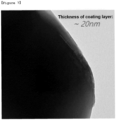
- a coating layer containing a niobium-based compound is formed on the surface of the positive electrode active material with a thickness of about 20 nm.
- the coating layer on the surface of the positive electrode active material contains a niobium-based compound.
- the positive electrode active material for a lithium secondary battery in which lithium niobate (LiNbOs) is formed as a surface coating layer was prepared as in Example 1, except that the coating solution was prepared so that the niobium compound was comprised in an amount of 1.2 wt% based on the total weight of the solids in the positive electrode active material dispersion.
- the positive electrode active material for a lithium secondary battery was prepared as in Example 1, except that the solids content in the positive electrode active material dispersion, the content of the niobium-based compound in the coating solution, and the content of the aqueous solvent to be added were adjusted as shown in Table 1 below.
- [Table 1] (compared to the total weight of the positive electrode active material dispersion) (compared to the total weight of solids) (compared to the total weight of solids)
- Solids (%) Niobium-based compound content (wt%) Aqueous solvent content (wt%)
- Example 1 50 1.0 1.34
- Example 2 50 1.2 1.34 Comp.
- Example 3 50 1.0 1.1 Comp.
- Example 4 50 1.0 1.6 Comp.
- Example 5 60 1.0 1.34 Comp.
- Example 6 70 1.0 1.34 Comp.
- Example 7 80 1.0 1.34
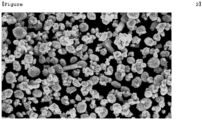
- the surface of the positive electrode active material was uniformly coated with a niobium-based compound by further adding an aqueous solvent before adding a coating solution of the niobium-based compound to the positive electrode active material dispersion.
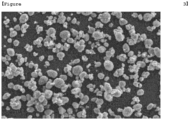
- the niobium-based compound was not sufficiently introduced into the coating layer because the content of the aqueous solvent added during manufacturing the positive electrode active material was low, so that hydrophilic functional groups were not sufficiently introduced into the surface of the positive electrode active material.
- hydrophilic functional groups were introduced to the surface of the positive electrode active material by further adding an aqueous solvent to the positive electrode active material dispersion before forming a coating layer of the niobium-based compound, so that the niobium-based compound indicated by red was uniformly coated on the surface of the positive electrode active material.
- All-solid-state batteries were prepared using the positive electrode active materials prepared in Example 1, Example 2, and Comparative Examples 1 to 7, respectively, and charge and discharge efficiency and lifetime characteristics for each was evaluated.
- a mixture was prepared such that the weight ratio of the positive electrode active material prepared according to Example 1, Example 2, and Comparative Examples 1 to 7, sulfide-based LPSCl (Li 6 PS 5 Cl manufactured by JeongKwan Co.Ltd) solid electrolyte, binder, and conductive material was 65:25:5:5. That is, based on 100 parts by weight of the positive electrode active material prepared according to Example 1, Example 2, and Comparative Examples 1 to 7, the mixture was prepared by mixing 38.46 parts by weight of the LPSCl solid electrolyte, 7.69 parts by weight of the NBR binder, and 7.69 parts by weight of the conductive material, Super-P.
- the NBR binder is a solution comprising nitrile butadiene rubber (NBR) and xylene, and the amount of NBR is 5 wt%.
- the NBR binder does not contain lithium salts.
- the positive electrode active material prepared according to Example 1, Example 2 and Comparative Examples 1 to 7, LPSCl solid electrolyte and Super-p were weighed in the above weight ratio, and then mixed for 30 minutes using a mortar to prepare a mixed powder.
- the mixed powder was transferred to a container for a thinky mixer, and the NBR binder was mixed with the above weight ratio, mounted on the mixer and mixed three times at 1,800 rpm for 5 minutes to prepare a mixture.
- xylene was added to the mixture to adjust it to a suitable viscosity, zircon balls were added, and then the mixture was mixed at 1,800 rpm for 5 minutes to prepare a slurry.
- the slurry was cast onto aluminum foil and dried in a vacuum oven at 60 °C for 24 hours to prepare a positive electrode with a loading amount of 3 mg/cm 2 .
- a mixture was prepared so that the weight ratio of Li 6 PS 5 Cl as a sulfide-based solid electrolyte and the binder was 70:30. That is, the mixture was prepared by mixing 42.9 parts by weight of polyethylene oxide (PEO) binder based on 100 parts by weight of Li 6 PS 5 Cl, a solid electrolyte.
- the PEO binder was prepared by mixing polyethylene oxide (PEO with a molecular weight of 200,000) and Li 6 PS 5 Cl in a molar ratio [EO]:[Li] of 15:1.
- the solid electrolyte Li 6 PS 5 Cl and the PEO binder were weighed in the above weight ratio, and then the mixture was prepared by stirring at 2,000 rpm for 5 minutes using a Thinky mixer.
- Acetonitrile (ACN) was added to the mixture and stirred with a synchro mixer to adjust to have a suitable viscosity.
- 2 mm zircon balls were added and stirred with a synchro mixer at 2,000 rpm for 5 minutes to prepare a slurry.
- the slurry was cast on a polyethylene terephthalate (PET) film and dried at room temperature to prepare a solid electrolyte layer with a thickness of 150 ⁇ m.
- PET polyethylene terephthalate
- the prepared positive electrode and solid electrolyte layer were punched to a diameter of 14 cm or 16 cm, respectively, and then laminated. Next, the laminate was prepared by heating it to about 60°C and pressurizing it to 0.3 MPa for 0.5 minutes.
- a negative electrode comprising lithium metal was placed on the laminate to prepare an all-solid-state battery comprising the positive electrode active material of Example 1, Example 2, and Comparative Examples 1 to 7 using a 2032-size coin cell.
- Example 2 For each of the all-solid-state batteries of Example 1, Example 2, and Comparative Examples 1 to 7, a charge to 4.25V at 25°C with a 0.2C constant current was conducted, and a discharge to 3.0V with a 0.2C constant current was conducted, and the charge and discharge capacities in this first cycle were measured.
- the discharge capacities in the first cycle divided by the charge capacities in the first cycle multiplied by 100 are the charge and discharge efficiencies (%), and they are shown in Table 2 below.
- Example 2 208.7 155.3 74.4 74.7 Comp.
- Example 3 208.1 153.2 73.6 73.5 Comp.
- Example 4 209.1 156.4 74.8 72.8 Comp.
- Example 5 210.0 160.0 76.2 76.4 Comp.
- Example 6 209.7 156.4 74.6 72.8 Comp.
- Example 7 201.4 147.2 73.1 71.1
Landscapes
- Chemical & Material Sciences (AREA)
- Electrochemistry (AREA)
- General Chemical & Material Sciences (AREA)
- Chemical Kinetics & Catalysis (AREA)
- Inorganic Chemistry (AREA)
- Composite Materials (AREA)
- Engineering & Computer Science (AREA)
- Organic Chemistry (AREA)
- Manufacturing & Machinery (AREA)
- Materials Engineering (AREA)
- Physics & Mathematics (AREA)
- Condensed Matter Physics & Semiconductors (AREA)
- General Physics & Mathematics (AREA)
- Battery Electrode And Active Subsutance (AREA)
Abstract
Description
- This application claims the benefit of priority based on
Korean Patent Application No. 10-2022-0125099 filed on September 30, 2022 - The present invention relates to a method for producing a positive electrode active material for a lithium secondary battery, and a positive electrode active material manufactured thereby.
- A lithium ion secondary battery with high energy density, low self-discharge rate, and long lifetime is suitable to meet the demand for high-capacity batteries. On the other hand, since a lithium ion secondary battery has the structure where the negative and positive electrodes are separated by a separating film, a short circuit can occur if the separating film is damaged due to deformation or external impact, and therefore, there is the stability issue against overheating, so research is being conducted to improve it.
- All-solid-state batteries have been presented as a solution to overcome the safety concerns of lithium ion secondary batteries. Unlike conventional batteries that use liquid electrolyte, all-solid-state batteries have an electrolyte layer containing solid electrolyte. The solid electrolyte in an all-solid-state battery may have a positive electrode layer and a negative electrode layer that contain solid electrolyte on both sides. Each electrode in an all-solid-state battery may be coupled to a current collector.
- Since all-solid-state batteries use a solid electrolyte instead of a liquid electrolyte, there is very little possibility of evaporation of the liquid due to temperature changes or leakage of the electrolyte due to external shocks, which makes the batteries safe from explosions or fires. All-solid-state batteries also have reduced weight and volume because they do not require components for leakage and explosion prevention.
- All-solid-state batteries are categorized into oxide-, polymer-, or sulfide-based depending on the raw material of the solid electrolyte. Among them, sulfide-based all-solid-state batteries have attracted much attention due to their higher lithium ion conductivity (10-2 s/cm) than other batteries and excellent temperature stability.
- The method of manufacturing the positive and negative electrodes of an all-solid-state battery is similar to the method of producing the positive and negative electrodes of a conventional lithium ion battery. Active materials, conductive materials, and binder solid particles are mixed with a solvent in a certain ratio to form a mixture slurry having low fluidity, and the slurry is coated in the form of a thin film on a metal current collector, dried, and pressed. In an all-solid-state battery, solid electrolytes are mixed in the slurry preparation stage.
- Compared to liquid electrolytes, solid electrolytes have a difficulty forming interfaces with active materials. Since the binder interferes with the formation of the interface between the active material and the solid electrolyte, the electrical resistance significantly increases. This leads to a drop in power output. Even if a material with high ionic conductivity is used as a solid electrolyte, the crystallized solid electrolyte must be ground into fine particles in order to mix it into the electrode slurry. In addition, since a solid electrolyte is mixed with a solvent, conductivity degradation occurs due to the material constraints rather than the inherent properties of the material. It is known that the ionic conductivity of batteries using solid electrolytes (10-5 s/cm to 10-2 s/cm) is lower than that of batteries using liquid electrolytes (10-2 s/cm).
- It is believed that all-solid-state batteries has low ionic conductivity because the batteries cannot form triplets in the electrode. The triple point is the point where the electrochemical reaction occurs in the electrode, so it is desirable to form many triple points within the electrode so that many electrochemical reactions can occur.
- The simultaneous mixing of electrode active material, solid electrolyte, conductive material, and binder to form a slurry results in either dead active material isolated by the conductive material within the electrode structure, or dead solid electrolyte isolated by the active material. When the isolated solid electrolyte is formed, the active material and the solid electrolyte are unnecessarily wasted. In addition, the migration path of the lithium ions is blocked, resulting in the additional problem of reduced energy density.
- Among the methods of manufacturing an all-solid-state battery, a method is known in which the constituent powders of the battery are sequentially placed in a cylindrical mold and pressurized to combine a current collector on the positive and negative electrodes. The method does not bring out uniform deposition on the positive electrode (layer) on the electrolyte layer. The method fails to form a uniform current distribution in the positive electrode, and deviations in current density occurs, which may cause performance degradation of the battery.
- In addition to uneven deposition in the positive electrode, uneven distribution of the composition in the positive electrode can also be problematic. Uneven distribution of the positive electrode composition causes localized overcharging of the electrode, degradation of the active material, and dendrite growth in the lithium metal. This accelerates the degradation of charge and discharge life of the battery.
- Accordingly, when manufacturing an all-solid-state battery, the contact surface between the active material, solid electrolyte and conductive material must be increased to ensure an optimal ion conduction pathway. It is also important to ensure that the electrode compound is uniformly distributed over the current collector and that the materials in the electrode compound have a uniform and even distribution.
-
- (Patent reference 1)
Japanese Patent Laid-open Publication No. 2012-234648 (Publication Date: November 29, 2012 - (Patent reference 2)
Korean Patent Laid-open Publication No. 2022-0045460 (Publication Date: April 12, 2022 - An object of the present invention is to provide a method of manufacturing a positive electrode active material for a lithium secondary battery in which a coating layer comprising a niobium-based compound can be uniformly and effectively introduced on the surface of the positive electrode active material.
- Another object of the present invention is to provide a positive electrode active material for a lithium secondary battery prepared by the above method.
- One embodiment of the present invention provides a method of manufacturing a positive electrode active material for a lithium secondary battery, comprising the steps of (a) mixing a positive electrode active material capable of reversible adsorption and release of lithium ions, and a solvent to produce a positive electrode active material dispersion; (b) adding and mixing a raw coating material comprising lithium (Li) and niobium (Nb) to produce a coating solution comprising a niobium-based compound; (c) adding to the positive electrode active material dispersion of step (a), the coating solution of step (b) to form a coating layer on the surface of the positive electrode active material; and (d) removing a solvent by pressing filtering the product of step (c).
- Step (a) may indicate mixing a positive electrode active material capable of reversible adsorption and release of lithium ions with an organic solvent, and then further adding an aqueous solvent to the mixture.
- In step (a), hydrophilic functional groups may be introduced to the surface of the positive electrode active material by further adding the aqueous solvent.
- The positive electrode active material dispersion may comprise from 10 to 50 wt% solids, based on the total weight thereof.
- The surface coating layer of the positive electrode active material may comprise 1.0 to 1.2 wt% of a niobium-based compound, based on the total weight of the solids in the positive electrode active material dispersion.
- The aqueous solvent may be added in an amount of 1.2 to 1.4 wt%, based on the total weight of the solids in the dispersion of the positive electrode active material.
- The pressing filtration may be carried out by applying a pressure of 0.3 to 0.5 MPa.
- The thickness of the coating layer may be from 10 to 30 nm.
- After step (d), the method may further comprise the step of drying the solvent-removed product at 80 to 120 °C.
- Another embodiment of the present invention provides a positive electrode active material for a lithium secondary battery prepared by the above manufacturing method.
- An object of the present invention is to provide a method of manufacturing a positive electrode active material for a lithium secondary battery, in which a niobium-based compound can be uniformly and effectively coated on the surface of the positive electrode active material by introducing hydrophilic functional groups via an aqueous solvent to the surface of the positive electrode active material during the formation of a coating layer comprising the niobium-based compound to reduce the reactivity between the sulfide-based solid electrolyte and the positive electrode active material of a lithium secondary battery, particularly an all-solid-state battery.
- In addition, the present invention has the effect of solving the problem that the niobium-based compound cannot be introduced to the surface of the positive electrode active material, but separated therefrom due to the removal of residual solvent with a high heat as a conventional method, by removing the residual solvent by pressing filtering the positive electrode active material dispersion formed with a coating layer comprising the niobium-based compound, instead of removing the residual solvent with a high heat as a conventional method.
-
-
FIG. 1 is an SEM image of a positive electrode active material for a lithium secondary battery according to Example 1 of the present invention. -
FIG. 2 is an SEM image of a positive electrode active material for a lithium secondary battery according to Comparative Example 1 of the present invention. -
FIG. 3 is an SEM image of a positive electrode active material for a lithium secondary battery according to Comparative Example 3 of the present invention. -
FIG. 4 is an SEM image of a positive electrode active material for a lithium secondary battery according to Comparative Example 7 of the present invention. -
FIG. 5 is an energy dispersive X-ray (EDX) image of the positive electrode active material of Example 1 of the present invention. -
FIG. 6 is an energy dispersive X-ray (EDX) image of the positive electrode active material of Comparative Example 1 of the present invention. -
FIGS. 7 and8 are field emission transmission electron microscopy (FE-TEM) images of the positive electrode active material of Example 1 of the present invention. - Embodiments of the present invention are described hereinafter. It is noted that the terms and words used in this specification and claims are not to be construed in their ordinary or dictionary sense, but rather in a sense and concept consistent with the technical idea of the present invention, based on the principle that the inventor(s) may properly define the concept of a term to best describe his/her invention. Accordingly, it is to be understood that the compositions described in the embodiments provided in the specification are only the most preferred embodiments of the present invention and are not exhaustive of the technical ideas of the present invention, and that there may be various equivalents and variations that may substitute for them at the time of filing.
- Throughout the specification, when a part "includes" a component, it means that a part may further include other components, not excludes other components, unless otherwise stated.
- The term "nano" used herein means nanoscale and includes sizes of 1 µm or less.
- Hereinafter, a method of manufacturing a positive electrode active material for a lithium secondary battery according to one embodiment is described.
- The present invention relates to a method of manufacturing a positive electrode active material for a lithium secondary battery in which a niobium-based compound can be uniformly and effectively coated on the surface of the positive electrode active material.
- An all-solid-state battery developed to improve the stability problem of lithium ion secondary batteries includes a positive electrode, a negative electrode and a solid electrolyte, wherein a sulfide-based solid electrolyte with high lithium ion conductivity and excellent stability is mainly used for the positive electrode.
- There are problems that the sulfide-based solid electrolyte and the positive electrode active material generate an interaction therebetween at the interface to generate a resistance material that hinders the smooth operation of the all-solid-state battery, and the initial capacity and operation efficiency of the all-solid-state battery are reduced by the generated resistance material.
- To solve these problems, research has been conducted to improve the performance of all-solid-state batteries by reducing the reactivity with sulfide-based solid electrolytes by coating the positive electrode active material of all-solid-state batteries with lithium niobate (LiNbOs).
- However, in the course of coating the positive electrode active material with lithium niobate, a problem was found that, when the lithium niobate was subjected to heat treatment in a high-temperature environment to evaporate the organic solvent contained in the coating solution, the lithium niobate was not fully coated on the surface of the positive electrode active material and was separated therefrom, resulting in forming an uneven coating layer.
- Accordingly, in order to prevent side reactions of the positive electrode active material with a solid electrolyte of an all-solid-state battery, especially a sulfide-based solid electrolyte, the present inventors have discovered a method for manufacturing a positive electrode active material for a lithium secondary battery in which a coating layer comprising a niobium-based compound is formed on the surface of the positive electrode active material, but by first introducing hydrophilic functional groups to the surface of the positive electrode active material by introducing an aqueous solvent, the niobium-based compound can be uniformly and effectively coated on the surface of the positive electrode active material, and completed the present invention.
- Furthermore, the present invention was also completed by the discovery that, by removing the residual solvent by pressing filtering the positive electrode active material dispersion in which a coating layer comprising the niobium-based compound is formed, instead of removing the residual solvent by using a high heat as a conventional method, the problem that the niobium-based compound cannot be introduced to the surface of the positive electrode active material by removing the residual solvent by using a high heat as a conventional method, and is separated therefrom can be solved.
- A method of manufacturing a positive electrode active material for a lithium secondary battery according to one embodiment of the present invention comprises the steps of (a) mixing a positive electrode active material capable of reversible adsorption and release of lithium ions, and a solvent to produce a positive electrode active material dispersion; (b) adding and mixing a coating material comprising lithium (Li) and niobium (Nb) to produce a coating solution comprising a niobium-based compound; (c) adding to the positive electrode active material dispersion of step (a), the coating solution of step (b) to form a coating layer on the surface of the positive electrode active material; and (d) pressing filtering the product of step (c) to remove a solvent.
- First, a positive electrode active material dispersion is prepared by mixing a positive electrode active material capable of reversible adsorption and release of lithium ions and a solvent. (Step (a))
- The positive electrode active material capable of reversible adsorption and release of lithium ions can be used without limitation as long as it can be used as a positive electrode active material of a lithium ion secondary battery. For example, the positive electrode active material may be, but is not limited to, a layered compound such as lithium cobalt oxides (LiCoO2), lithium nickel oxides (LiNiO2), or a compound substituted with one or more transition metals; lithium manganese oxides of Li1+xMn2-xO4 (wherein x is 0 to 0.33), LiMnOs, LiMn2O3 or LiMnO2; lithium copper oxides (Li2CuO2) ; vanadium oxides, such as LiV3O8, LiV3O4, V2O5 or Cu2V2O7; lithium nickel oxides represented by LiNi1-xMxO2 (wherein M is Co, Mn, Al, Cu, Fe, Mg, B or Ga, and comprises one or more therefrom, and x is 0.01 to 0.3), such as LiN0.8Co0.1M0.1O2; lithium manganese complex oxides represented by LiMn2-xMxO2 (wherein M is Co, Ni, Fe, Cr, Zn or Ta, wherein x is 0.01 to 0.1) or Li2Mn3MO8 (wherein M is Fe, Co, Ni, Cu or Zn); lithium manganese complex oxides with a spinel structure represented by LiNixMn2-xO4; LiMn2O4 in which the Li is partially replaced by an alkaline earth metal ion; disulfide compounds; or Fe2(MoO4)3. The positive electrode active material may typically be comprised in an amount of 70 to 95 wt%, 75 to 95 wt%, or 80 to 95 wt%, based on 100 wt% of the electrode layer.
- In one embodiment of the present invention, step (a) may comprise mixing a positive electrode active material capable of reversible adsorption and release of lithium ions and an organic solvent, and then further adding an aqueous solvent to the mixture.
- The organic solvent may be used without special restriction as long as it is capable of effectively dispersing the positive electrode active material, and an alcohol-based solvent such as ethanol or isopropyl alcohol is preferably used.
- By further adding aqueous solvent to the mixture of the positive electrode active material and the organic solvent, hydrophilic functional groups can be introduced on the surface of the positive electrode active material.
- In the case of the niobium-based compound comprised in the solution forming a positive electrode active material coating layer described hereinafter, it induces a "hydrolysis-condensation" reaction with the hydrophilic functional groups introduced by the aqueous solvent, which plays a role in enabling the niobium-based compound to be effectively coated on the surface compared to the positive electrode active material in which no hydrophilic functional groups are introduced.
- This can be understood that an organic solvent has priority in dispersing a positive electrode active material, and has a reduced ability to introduce hydrophilic functional groups to the surface of the positive electrode active material compared to an aqueous solvent.
- The aqueous solvent is not particularly limited, provided that it does not affect the properties of the positive electrode active material, but deionized water, ultrapure water, or distilled water can be specifically used.
- The hydrophilic functional groups introduced to the surface of the positive electrode active material by the aqueous solvent may be, for example, a hydroxyl group (-OH).
- In the process of preparing a positive electrode active material dispersion, if the positive electrode active material is first mixed with an aqueous solvent instead of an organic solvent, there is a problem that the positive electrode active material cannot be uniformly dispersed in the aqueous solvent and may agglomerate, and the hydrophilic functional groups may not be effectively introduced to the surface of the positive electrode active material, so it is preferable to prepare the positive electrode active material dispersion by first mixing the positive electrode active material with the organic solvent and then adding the aqueous solvent thereto.
- In one embodiment of the present invention, the positive electrode active material dispersion may comprise from 10 to 50 wt% solids, based on the total weight thereof. For example, the solids content may be 20 to 50 wt%, 30 to 50 wt%, preferably 40 to 50 wt%, based on the total weight of the positive electrode active material dispersion.
- If the content of solids in the positive electrode active material dispersion is less than 10 wt%, there is a problem that the capacity of the loading amount of the positive electrode active material in the electrode is reduced, which may lead to a reduction of the capacity of the lithium secondary battery, and if the content of solids exceeds 50 wt%, there is a problem that agglomeration of solids may occur due to uneven stirring during the preparation of the positive electrode active material dispersion.
- In one embodiment of the present invention, the aqueous solvent may be introduced in an amount of 1.2 to 1.4 wt%, based on the total weight of the solids in the dispersion of the positive electrode active material. For example, the content of the aqueous solvent may be comprised in an amount of 1.25 to 1.4 wt%, 1.3 to 1.4 wt%, preferably 1.34 to 1.4 wt%, based on the total weight of solids in the positive electrode active material dispersion.
- If the amount of aqueous solvent is less than 1.2 wt%, it may be difficult to effectively introduce hydrophilic functional groups to the surface of the positive electrode active material, so the coating layer of the niobium-based compound may not be properly formed, and if the amount exceeds 1.4 wt%, a gelation may occur, resulting in agglomeration of the positive electrode active material and formation of an uneven coating layer, so the amount of aqueous solvent is appropriately adjusted within the above ranges.
- Next, the raw coating material including lithium (Li) or niobium (Nb) is added and mixed to prepare a coating solution including a niobium-based compound (step (b)).
- An aqueous solvent such as deionized, ultrapure or distilled water, or an organic solvent such as ethanol or isopropyl alcohol can be used as a solvent for preparing the coating solution.
- As the raw coating material, a raw material comprising lithium or niobium that can be completely dissolved in an aqueous solvent or an organic solvent can be used, more preferably lithium ethoxides or niobium acids. The amount of raw material to be introduced is preferably 0.05 M to 0.3 M of lithium element and niobium element, respectively, on the basis of molarity (M), which refers to the molar ratio of elements per liter, more preferably 0.1 M to 0.2 M of solution concentration.
- In the process of preparing a coating solution, even if the raw coating material is dissolved in the solvent, a local reprecipitation reaction may occur and niobium oxide (Nb2O5) precipitates may be formed if the hydrogen ion concentration and reaction temperature are not finely controlled, so the hydrogen ion concentration, reaction temperature, and reaction time are controlled within a desirable range.
- Next, the coating solution of step (b) is added to the positive electrode active material dispersion of step (a) to form a coating layer on the surface of the positive electrode active material (step (c)).
- The coating solution of step (b) may be added in a trickle until the formation of the coating layer on the surface of the positive electrode active material is completed, for example, the coating solution may be added at a rate of 1 mL/min to 20 mL/min.
- As a result of the introduction of hydrophilic functional groups on the surface of the positive electrode active material due to the aqueous solvent during the preparation of the positive electrode active material dispersion, the niobium-based compound in the coating solution can combine with the hydrophilic functional groups on the surface of the positive electrode active material to effectively form a uniform coating layer.
- In one embodiment of the present invention, the surface coating layer of the positive electrode active material may comprise 1.0 to 1.2 wt% of a niobium-based compound, based on the total weight of the solids in the positive electrode active material dispersion.
- If the content of a niobium-based compound is less than 1.0 wt%, it may be difficult to form a coating layer and reduce the side reaction between the sulfide-based solid electrolyte and the positive electrode active material, and if the content is more than 1.2 wt%, the niobium-based compound may agglomerate or form an uneven coating layer on the surface of the positive electrode active material, so the content of the niobium-based compound is appropriately adjusted within the above range.
- Next, the coating solution is added to the positive electrode active material dispersion, and the product with a coating layer formed on the surface of the positive electrode active material is pressed and filtered to remove the solvent (step (d)).
- When the product of the positive electrode active material in which a coating layer of the niobium-based compound is formed is pressed and filtered, a heat is not generated compared to the case in which the residual solvent is removed by a conventional separate heat treatment process, so that the detachment of the niobium-based compound in the coating layer can be prevented, and thus the formation of an uneven coating layer can be also prevented. Through the pressing filtration process, the excess organic solvent added to prepare the positive electrode active material dispersion and the excess aqueous solvent added to provide hydrophilic functional groups to the surface of the positive electrode active material can be largely removed.
- The pressing filtration can be performed using techniques known in the art. As devices for pressing filtration, pressing filters, filter presses, screw presses, V-shaped disk presses, and the like can be used.
- The pressing filtration may be carried out by applying a predetermined pressure using the above devices, for example, by applying a pressure of 0.3 to 0.5 MPa. If the pressure of the pressing filtration is less than 0.3 MPa, an organic solvent may remain in the product in which a coating layer is formed on the positive electrode active material, and lithium niobates may not be completely coated on the positive electrode active material and may be separated therefrom, resulting in forming an uneven coating layer.
- In one embodiment of the present invention, after the pressing filtration step (step (d)), the step of drying the product from which the solvent has been removed may be further comprised.
- Since, in the positive electrode active material product with the coating layer formed in step (d), most of the solvent is removed by pressing filtration, even in the additional drying step, the niobium-based compound formed on the surface of the positive electrode active material is not separated therefrom.
- The drying process is a process for removing residual solvents and moisture contained in the positive electrode active material on which the coating layer is formed, and can be performed, for example, in a vacuum oven at 80 to 120 °C for 8 to 16 hours. Drying methods include, for example, drying by warm air, hot air or low humidity air, vacuum drying, or irradiation with (far) infrared or electromagnetic radiation. After the drying process, a cooling process may be further comprised, wherein the cooling process may be slow cooling to room temperature to ensure that the coating layer on the surface of the positive electrode active material is well formed.
- The positive electrode active material prepared by the above steps can improve the performance of an all-solid-state battery by reducing the reactivity with a sulfide-based solid electrolyte by forming a coating layer comprising a niobium compound on the surface thereof.
- The thickness of the coating layer comprising the niobium compound may be, for example, from 10 to 30 nm, for example, from 15 to 25 nm, and preferably from 20 to 25 nm. If the thickness of the coating layer is less than 10 nm, the effect of reducing the reactivity with the solid electrolyte by the niobium compound may be reduced, and if the thickness of the coating layer is greater than 30 nm, it may affect the absorption and release of lithium ions, or the coating layer may act as a resistance and thus act as a resistance of the all-solid-state battery, so the thickness is appropriately adjusted in the above ranges.
- Another embodiment of the present invention provides a positive electrode active material for a lithium secondary battery prepared by the method of preparing the positive electrode active material.
- Another embodiment of the present invention provides a lithium secondary battery comprising a positive electrode active material prepared by the above method.
- The lithium secondary battery may comprise a positive electrode, a negative electrode, and an electrolyte interposed between these electrodes, and in one embodiment, the lithium secondary battery may be an all-solid-state battery comprising a solid electrolyte film.
- The positive electrode may comprise a current collector and a positive electrode active material layer formed on at least one side of the current collector, wherein the positive electrode active material layer may comprise a positive electrode active material, a solid electrolyte and a conductive material. Further, in one specific embodiment of the present invention, the positive electrode active material layer may further comprise a binder material. The addition of the binder material may increase the adhesion of the positive electrode active material layer to the current collector and/or the solid electrolyte layer, and independently or in conjunction therewith, may also help to improve the adhesion between the components comprised in the positive electrode active material.
- The positive electrode active material can be used without limitation as long as it can be used as a positive electrode active material of a lithium ion secondary battery, and the specific description thereof is the same as described above, so the specific description is omitted herein.
- The solid electrolyte included in the positive electrode may be one or more selected from, for example, Li2S-P2S5, Li2S-LiI-P2S5, Li2S-P2S5-LiCl, Li2S-LiI-Li2O-P2S5, Li2S-LiBr-P2S5, Li2S-Li2O-P2S5, Li2S-Li3PO4-P2S5, Li2S-P2S5-P2O5, Li2S-P2S5-SiS2, Li2S-P2S5-SnS, Li2S-P2S5-Al2S3, Li2S-GeS2 or Li2S-GeS2-ZnS, Li6PS5Cl, Li6PS5Br or Li6PS5ClxBr(1-x) (wherein x is 0.1≤x≤0.9) and combinations thereof, and may preferably include Li6PS5Cl, Li6PS5Br or Li6PS5ClxBr(1-x) (wherein x is 0.1≤x≤0.9) with the Argyrodite structure or combinations thereof. The solid electrolyte may typically be comprised in a range of 1 to 30 wt%, 1 to 20 wt%, or 1 to 15 wt%, based on 100 wt% of the electrode layer.
- The conductive material is not particularly limited as long as it has conductivity without causing any chemical changes in the battery, for example, graphite such as natural graphite or artificial graphite; carbon black such as carbon black, acetylene black, ketjen black, channel black, furnace black, lamp black, summer black, etc; conductive fibers such as carbon fibers such as vapor grown carbon fiber (VGCF) or metal fibers; metal powders such as carbon fluorides, aluminum or nickel powders; conductive whiskers such as zinc oxides or potassium titanates; conductive metal oxides such as titanium oxides; the conductive materials, such as polyphenylene derivatives, or mixtures of one or two or more selected therefrom. The conductive material may typically be comprised in a range of 1 to 10 wt%, or 1 to 5 wt%, based on 100 wt% of the electrode layer.
- The binder is not particularly limited as long as it is a component that aids in the bonding of the active material to the conductive material or the bonding to the current collector, e.g., polyvinylidene fluoride, polyvinyl alcohol, carboxymethyl cellulose (CMC), starch, hydroxypropyl cellulose, regenerated cellulose, polyvinylpyrrolidone, polytetrafluoroethylene, polyethylene, polypropylene, ethylene-propylene-diene monomer (EPDM), sulfonated EPDM, styrene butadiene rubber, fluorinated rubber, or various copolymers thereof. The binder may typically be comprised in a range of 1 to 20 wt%, or 1 to 10 wt%, based on 100 wt% of the electrode layer.
- The negative electrode may be a negative current collector, or comprise a negative electrode active material layer formed on the surface of the current collector.
- The negative electrode current collector is not particularly limited as long as it is conductive without causing any chemical changes in the all-solid-state battery, and for example, copper, stainless steel, aluminum, nickel, titanium, calcined carbon, copper or stainless steel whose surface is treated with carbon, nickel, titanium, silver, etc., or an aluminum-cadmium alloy may be used. Also, like the positive electrode current collector, the negative electrode current collector may be in various forms, such as a film, sheet, foil, net, porous material, foam or nonwoven material with fine irregularities formed on the surface thereof.
- The negative electrode active material layer may comprise one or more elements selected from alkali metals, alkaline earth metals, 3B group metals and transition metals. In a specific embodiment of the present invention, non-limiting examples of the alkali metal include at least one metal selected from the group consisting of lithium (Li), sodium (Na), potassium (K), rubidium (Rb), cesium (Cs) and francium (Fr), preferably lithium. Alternatively, the negative electrode may be a lithium metal or a lithium alloy as the negative electrode active material. The lithium alloy may be an alloy comprising lithium and at least one metal selected from the group consisting of Na, K, Rb, Cs, Fr, Be, Mg, Ca, Sr, Ba, Ra, Al and Sn. In a specific embodiment of the present invention, the negative electrode may be laminated with a negative electrode current collector and a lithium metal thin film having a predetermined thickness bonded to each other by pressing.
- In one embodiment of the present invention, the negative and/or positive electrode may further comprise various additives for the purpose of complementing or improving physicochemical properties thereof. The additives may include one or more of, but are not limited to, oxidation stable additives, reduction stable additives, flame retardants, heat stabilizers or antifogging agents.
- Each of the negative and positive electrodes may use cyclic aliphatic hydrocarbons such as cyclopentane, cyclohexane or mixtures thereof, aromatic hydrocarbons such as toluene, xylene or mixtures thereof, or aromatic hydrocarbon solvents such as cyclopentane, cyclohexane or mixtures thereof, or mixtures of one or two or more of the aliphatic hydrocarbon solvents and the aromatic hydrocarbon solvents, as an organic solvent in the preparation of the electrode slurry. The organic solvent can be selected and used with appropriate drying rates and environmental conditions.
- The solid electrolyte film may be provided between the negative and positive electrodes.
- The solid electrolyte film may comprise a solid electrolyte and a binder.
- The solid electrolyte included in the solid electrolyte film includes, for example, Li2S-P2S5, Li2S-LiI-P2S5, Li2S-P2S5-LiCl, Li2S-LiI-Li2O-P2S5, Li2S-LiBr-P2S5, Li2S-Li2O-P2S5, Li2S-Li3PO4-P2S5, Li2S-P2S5-P2O5, Li2S-P2S5-SiS2, Li2S-P2S5-SnS, Li2S-P2S5-Al2S3, Li2S-GeS2 or Li2S-GeS2-ZnS, Li6PS5Cl, Li6PS5Br or Li6PS5ClxBr(1-x) (wherein x is 0.1≤x≤0.9) and combinations thereof. The solid electrolyte may typically comprise a range of 80 to 100 wt%, 90 to 100 wt%, or 95 to 100 wt%, based on 100 wt% of the solid electrolyte film.
- The binder included in the solid electrolyte membrane is not particularly limited, as long as it is a component that assists the binding of the solid electrolyte, for example, polyvinylidene fluoride, polyvinyl alcohol, carboxymethyl cellulose (CMC), starch, hydroxypropyl cellulose, regenerated cellulose, polyvinylpyrrolidone, polytetrafluoroethylene, polyethylene, polypropylene, ethylene-propylene-diene monomer (EPDM), sulfonated EPDM, styrene butadiene rubber, fluorinated rubber, or various copolymers thereof. The binder may typically be included in a range of 1 to 20 wt%, or 1 to 10 wt%, based on 100 wt% of the solid electrolyte membrane.
- The ionic conductivity of the solid electrolyte film may be, for example, greater than 5×10⁻³ S/cm and less than or equal to 1×10⁻¹ S/cm. If the ionic conductivity of the solid electrolyte film is less than 5×10⁻³ S/cm, it does not provide lithium ion conduction between the negative and positive electrodes in the all-solid-state battery structure to a main pathway, making it difficult to implement basic cell performance. Although the higher the ionic conductivity of the solid electrolyte film, the more advantageous it is, it is preferably limited to a range of 1×10⁻¹ S/cm or less, based on comprehensive consideration of the characteristics of the solid electrolyte, limitation of performance to be implemented, and atmosphere stability.
- Hereinafter, Examples of the present invention are provided. However, Examples are presented to specifically illustrate or describe the present invention, but the present invention is not limited thereto. In addition, even matters not described herein are sufficiently to be inferred by those skilled in the art and are omitted herein.
-
- (1) In a vessel with a diameter of 30 cm, 6 kg of Li(NixCoyMnz)O2 as a positive electrode active material and 4.0 L of ethanol were added and dispersed, and then 80.4 g of distilled water was added and stirred at a speed of 200 rpm for 20 minutes to prepare a positive electrode active material dispersion.
- (2) Next, a lithium precursor, lithium ethoxide (CH3CH2OLi), was dissolved in ethanol for 1 hour, and then a niobium precursor, niobium pentaethoxide (Nb(OCH2CH3)5), was added to this solution to prepare a coating solution. The coating solution was mixed so that the niobium compound was comprised in an amount of 1.0 wt% based on the total weight of the solids in the positive electrode active material dispersion.
- (3) Next, the coating solution was added to the positive electrode active material dispersion to form a coating layer on the surface of the positive electrode active material. The coating solution was dropped into the container containing the positive electrode active material dispersion at a rate of 2 to 10 mL/min.
- (4) The positive electrode active material on which the coating layer was formed was obtained, and the residual solvent was removed by pressing it through a pressure filter at a pressure of 0.5 MPa.
- (5) The positive electrode active material with the solvent removed was collected, placed in a vacuum oven, and dried at 80 °C for 12 hours to prepare a positive electrode active material for a lithium secondary battery with a surface coating layer of lithium niobate (LiNbOs).
- Referring to
FIG. 7 , in which the prepared positive electrode active material is observed by a field emission transmission electron microscope (FE-TEM), it can be seen that a coating layer containing a niobium-based compound is formed on the surface of the positive electrode active material with a thickness of about 20 nm. Also, referring toFIG. 8 , it can be seen that the coating layer on the surface of the positive electrode active material contains a niobium-based compound. - The positive electrode active material for a lithium secondary battery in which lithium niobate (LiNbOs) is formed as a surface coating layer was prepared as in Example 1, except that the coating solution was prepared so that the niobium compound was comprised in an amount of 1.2 wt% based on the total weight of the solids in the positive electrode active material dispersion.
- The positive electrode active material for a lithium secondary battery was prepared as in Example 1, except that the solids content in the positive electrode active material dispersion, the content of the niobium-based compound in the coating solution, and the content of the aqueous solvent to be added were adjusted as shown in Table 1 below.
[Table 1] (compared to the total weight of the positive electrode active material dispersion) (compared to the total weight of solids) (compared to the total weight of solids) Solids (%) Niobium-based compound content (wt%) Aqueous solvent content (wt%) Example 1 50 1.0 1.34 Example 2 50 1.2 1.34 Comp. Example 1 50 1.0 - Comp. Example 2 50 1.4 1.34 Comp. Example 3 50 1.0 1.1 Comp. Example 4 50 1.0 1.6 Comp. Example 5 60 1.0 1.34 Comp. Example 6 70 1.0 1.34 Comp. Example 7 80 1.0 1.34 - Particle samples of the positive electrode active material for a lithium secondary battery prepared according to Example 1, Comparative Example 1, Comparative Example 3, and Comparative Example 7 were obtained to confirm the surface characteristics of the positive electrode active material by scanning electron microscopy (SEM) analysis, and the results are shown in
FIGS. 1 to 4 . - Referring to
FIG. 1 , in the positive electrode active material according to Example 1, it can be seen that the surface of the positive electrode active material was uniformly coated with a niobium-based compound by further adding an aqueous solvent before adding a coating solution of the niobium-based compound to the positive electrode active material dispersion. - On the other hand, referring to
FIG. 2 , it can be seen that, in the positive electrode active material according to Comparative Example 1, since a separate aqueous solvent was not added during manufacturing the positive electrode active material, hydrophilic functional groups cannot be introduced to the surface of the positive electrode active material, and as a result, the niobium-based compound contained in the coating solution did not self-aggregate to form a uniform coating layer. - Referring to
FIG. 3 , it can be seen that, in the positive electrode active material according to Comparative Example 3, the niobium-based compound was not sufficiently introduced into the coating layer because the content of the aqueous solvent added during manufacturing the positive electrode active material was low, so that hydrophilic functional groups were not sufficiently introduced into the surface of the positive electrode active material. - Referring to
FIG. 4 , it can be seen that, in the positive electrode active material according to Comparative Example 7, due to the excessive content of solids in the positive electrode active material dispersion, the surplus of the positive electrode active material that did not form a coating layer agglomerated together and appeared in the coating layer. - Energy dispersive X-ray (EDX) analysis of the positive electrode active material for a lithium secondary battery prepared according to Example 1 and Comparative Example 1 was performed to confirm the positive electrode active material surface characteristics, and the results are shown in
FIGS. 5 and6 . - Referring to
FIG. 5 , it can be seen that, in the positive electrode active material for a lithium secondary battery prepared according to Example 1, hydrophilic functional groups were introduced to the surface of the positive electrode active material by further adding an aqueous solvent to the positive electrode active material dispersion before forming a coating layer of the niobium-based compound, so that the niobium-based compound indicated by red was uniformly coated on the surface of the positive electrode active material. - Referring to
FIG. 6 , it can be seen that, in the positive electrode active material for a lithium secondary battery prepared according to Comparative Example 1, by not adding a separate aqueous solvent to the positive electrode active material dispersion, hydrophilic functional groups were not introduced to the surface of the positive electrode active material, and the niobium-based compound indicated by red was not uniformly coated on the surface of the positive electrode active material. - All-solid-state batteries were prepared using the positive electrode active materials prepared in Example 1, Example 2, and Comparative Examples 1 to 7, respectively, and charge and discharge efficiency and lifetime characteristics for each was evaluated.
- First, a mixture was prepared such that the weight ratio of the positive electrode active material prepared according to Example 1, Example 2, and Comparative Examples 1 to 7, sulfide-based LPSCl (Li6PS5Cl manufactured by JeongKwan Co.Ltd) solid electrolyte, binder, and conductive material was 65:25:5:5. That is, based on 100 parts by weight of the positive electrode active material prepared according to Example 1, Example 2, and Comparative Examples 1 to 7, the mixture was prepared by mixing 38.46 parts by weight of the LPSCl solid electrolyte, 7.69 parts by weight of the NBR binder, and 7.69 parts by weight of the conductive material, Super-P. In this case, the NBR binder is a solution comprising nitrile butadiene rubber (NBR) and xylene, and the amount of NBR is 5 wt%. The NBR binder does not contain lithium salts.
- Specifically, the positive electrode active material prepared according to Example 1, Example 2 and Comparative Examples 1 to 7, LPSCl solid electrolyte and Super-p were weighed in the above weight ratio, and then mixed for 30 minutes using a mortar to prepare a mixed powder. The mixed powder was transferred to a container for a thinky mixer, and the NBR binder was mixed with the above weight ratio, mounted on the mixer and mixed three times at 1,800 rpm for 5 minutes to prepare a mixture. Next, xylene was added to the mixture to adjust it to a suitable viscosity, zircon balls were added, and then the mixture was mixed at 1,800 rpm for 5 minutes to prepare a slurry. The slurry was cast onto aluminum foil and dried in a vacuum oven at 60 °C for 24 hours to prepare a positive electrode with a loading amount of 3 mg/cm2.
- A mixture was prepared so that the weight ratio of Li6PS5Cl as a sulfide-based solid electrolyte and the binder was 70:30. That is, the mixture was prepared by mixing 42.9 parts by weight of polyethylene oxide (PEO) binder based on 100 parts by weight of Li6PS5Cl, a solid electrolyte. The PEO binder was prepared by mixing polyethylene oxide (PEO with a molecular weight of 200,000) and Li6PS5Cl in a molar ratio [EO]:[Li] of 15:1.
- Specifically, the solid electrolyte Li6PS5Cl and the PEO binder were weighed in the above weight ratio, and then the mixture was prepared by stirring at 2,000 rpm for 5 minutes using a Thinky mixer.
- Acetonitrile (ACN) was added to the mixture and stirred with a synchro mixer to adjust to have a suitable viscosity. Next, 2 mm zircon balls were added and stirred with a synchro mixer at 2,000 rpm for 5 minutes to prepare a slurry. The slurry was cast on a polyethylene terephthalate (PET) film and dried at room temperature to prepare a solid electrolyte layer with a thickness of 150 µm.
- The prepared positive electrode and solid electrolyte layer were punched to a diameter of 14 cm or 16 cm, respectively, and then laminated. Next, the laminate was prepared by heating it to about 60°C and pressurizing it to 0.3 MPa for 0.5 minutes. A negative electrode comprising lithium metal was placed on the laminate to prepare an all-solid-state battery comprising the positive electrode active material of Example 1, Example 2, and Comparative Examples 1 to 7 using a 2032-size coin cell.
- For each of the all-solid-state batteries of Example 1, Example 2, and Comparative Examples 1 to 7, a charge to 4.25V at 25°C with a 0.2C constant current was conducted, and a discharge to 3.0V with a 0.2C constant current was conducted, and the charge and discharge capacities in this first cycle were measured. The discharge capacities in the first cycle divided by the charge capacities in the first cycle multiplied by 100 are the charge and discharge efficiencies (%), and they are shown in Table 2 below.
- Furthermore, for each of the all-solid-state batteries of Example 1, Example 2, and Comparative Examples 1 to 7, a 50-cycle charge and discharge at 1C/1C at 45 °C was performed, and then the 50-cycle discharge capacity retention rate (%) was calculated according to
Equation 1 below and is shown in Table 2 below.50-cycle discharge capacity retention (%)=Discharge capacity of all-solid-state battery at 50th cycle/discharge capacity of all-solid-state battery at 1st cycle×100 [Table 2] Charging Discharge Efficiency 50th Cycle Life Characteristics (mAh/g) (mAh/g) (%) (%) Example 1 211.6 161.9 76.5 81.4 Example 2 210.3 158.1 75.2 78.3 Comp. Example 1 201.6 146.6 72.7 67.2 Comp. Example 2 208.7 155.3 74.4 74.7 Comp. Example 3 208.1 153.2 73.6 73.5 Comp. Example 4 209.1 156.4 74.8 72.8 Comp. Example 5 210.0 160.0 76.2 76.4 Comp. Example 6 209.7 156.4 74.6 72.8 Comp. Example 7 201.4 147.2 73.1 71.1 - Referring to Table 2 above, it can be seen that, in the all-solid-state battery having the positive electrode active material according to Examples 1 and 2, compared to the all-solid-state battery according to Comparative Examples 1 to 7, as a result of the introduction of hydrophilic functional groups on the surface of the positive electrode active material by introducing an aqueous solvent during the preparation of the positive electrode active material, a coating layer comprising a niobium-based compound was uniformly formed, and the reactivity of the coating layer with the sulfide-based solid electrolyte was suppressed, thereby improving the charge capacity and life characteristics of the all-solid-state battery.
- From the above, the preferred embodiments of the present invention have been described in detail, but the scope of the present invention is not limited thereto, and various modifications and improvements by those skilled in the art utilizing the basic concepts of the present invention as defined in the following claims are also within the scope of the present invention.
Claims (10)
- A method for manufacturing a positive electrode active material for a lithium secondary battery, comprising:(a) preparing a positive electrode active material dispersion by mixing a positive electrode active material capable of reversible adsorption and release of lithium ions and a solvent;(b) adding and mixing a raw coating material comprising lithium (Li) and niobium (Nb) to prepare a coating solution comprising a niobium-based compound;(c) adding to the positive electrode active material dispersion of step (a), the coating solution of step (b) to form a coating layer on the surface of the positive electrode active material; and(d) pressing filtering the product of step (c) to remove the solvent;
- The method for manufacturing a positive electrode active material for a lithium secondary battery according to claim 1, wherein in step (a), the positive electrode active material capable of reversible adsorption and release of lithium ions and the organic solvent are mixed, and then an aqueous solvent was further added to the mixture.
- The method for manufacturing a positive electrode active material for a lithium secondary battery according to claim 2, comprising introducing hydrophilic functional groups to the surface of the positive electrode active material by further adding the aqueous solvent.
- The method for manufacturing a positive electrode active material for a lithium secondary battery according to claim 1, wherein the positive electrode active material dispersion comprises from 10 to 50 percent by weight of solids, based on the total weight thereof.
- The method for manufacturing a positive electrode active material for a lithium secondary battery according to claim 1, wherein surface coating layer of the the positive electrode active material comprises 1.0 to 1.2 wt% of a niobium-based compound, based on the total weight of the solids in the positive electrode active material dispersion.
- The method for manufacturing a positive electrode active material for a lithium secondary battery according to claim 2, wherein the aqueous solvent is added in an amount of 1.2 to 1.4 wt% based on the total weight of the solids in the positive electrode active material dispersion.
- The method for manufacturing a positive electrode active material for a lithium secondary battery according to claim 1, wherein the pressing filtration is carried out at a pressure of 0.3 to 0.5 MPa.
- The method for manufacturing a positive electrode active material for a lithium secondary battery according to claim 1, wherein the coating layer has a thickness of 10 to 30 nm.
- The method for manufacturing a positive electrode active material for a lithium secondary battery according to claim 1, further comprising the step of drying the solvent-removed product at 80 to 120°C after step (d).
- A positive electrode active material for a lithium secondary battery prepared by the method of manufacturing a positive electrode active material for a lithium secondary battery according to any one of claims 1 to 9.
Applications Claiming Priority (2)
| Application Number | Priority Date | Filing Date | Title |
|---|---|---|---|
| KR1020220125099A KR20240045595A (en) | 2022-09-30 | 2022-09-30 | Preparing method of positive electrode active material for lithium secondary battery and positive electrode active material thereby |
| PCT/KR2023/012467 WO2024071690A1 (en) | 2022-09-30 | 2023-08-23 | Method for preparing positive electrode active material for lithium secondary battery and positive electrode active material prepared thereby |
Publications (2)
| Publication Number | Publication Date |
|---|---|
| EP4401167A1 true EP4401167A1 (en) | 2024-07-17 |
| EP4401167A4 EP4401167A4 (en) | 2025-10-15 |
Family
ID=90478438
Family Applications (1)
| Application Number | Title | Priority Date | Filing Date |
|---|---|---|---|
| EP23872812.5A Pending EP4401167A4 (en) | 2022-09-30 | 2023-08-23 | Method for producing a positive electrode active material for a lithium secondary battery and positive electrode active material produced thereby |
Country Status (6)
| Country | Link |
|---|---|
| US (1) | US20240429374A1 (en) |
| EP (1) | EP4401167A4 (en) |
| JP (1) | JP2024541725A (en) |
| KR (1) | KR20240045595A (en) |
| CN (1) | CN118140329A (en) |
| WO (1) | WO2024071690A1 (en) |
Family Cites Families (11)
| Publication number | Priority date | Publication date | Assignee | Title |
|---|---|---|---|---|
| JP5784961B2 (en) | 2011-04-28 | 2015-09-24 | 国立大学法人高知大学 | Method for producing coated active material |
| JP6578635B2 (en) * | 2013-11-22 | 2019-09-25 | 住友金属鉱山株式会社 | Method for producing positive electrode active material for non-aqueous electrolyte secondary battery, positive electrode active material for non-aqueous electrolyte secondary battery, and non-aqueous electrolyte secondary battery using the same |
| KR101808373B1 (en) * | 2014-08-21 | 2017-12-12 | 주식회사 엘지화학 | Positive electrode active material for lithium secondary battery and lithium secondary battery comprising same |
| KR20170076222A (en) * | 2015-12-24 | 2017-07-04 | 주식회사 포스코 | Positive active material for rechargeable lithium battery, method of preparing the same, and rechargeable lithium battery including the same |
| CN111656574A (en) * | 2018-02-02 | 2020-09-11 | 本田技研工业株式会社 | Positive electrode for solid-state battery, solid-state battery, and manufacturing method of solid-state battery |
| US20210328218A1 (en) * | 2018-10-02 | 2021-10-21 | Basf Se | Process for making a partially coated electrode active material |
| JP7457688B2 (en) * | 2019-02-21 | 2024-03-28 | 住友金属鉱山株式会社 | Method for producing positive electrode active material for lithium ion secondary batteries |
| KR102350047B1 (en) * | 2020-03-03 | 2022-01-12 | 한국생산기술연구원 | High voltage all solid lithium secondary battery comprising sulfide solid electrolyte- based cathode and method of preparing same |
| KR20220045460A (en) | 2020-10-05 | 2022-04-12 | 현대자동차주식회사 | A cathode material manufacturing method and a cathode comprising a cathode material manufactured through the method |
| KR102478075B1 (en) | 2021-03-04 | 2022-12-15 | 현대모비스 주식회사 | Apparatus for reducing temperature effects in stray inductance based switching current measurement |
| EP4296237A4 (en) * | 2021-03-25 | 2024-11-13 | Lg Chem, Ltd. | PROCESS FOR MANUFACTURING ACTIVE CATHODE MATERIAL |
-
2022
- 2022-09-30 KR KR1020220125099A patent/KR20240045595A/en active Pending
-
2023
- 2023-08-23 JP JP2024529875A patent/JP2024541725A/en active Pending
- 2023-08-23 EP EP23872812.5A patent/EP4401167A4/en active Pending
- 2023-08-23 CN CN202380014067.8A patent/CN118140329A/en active Pending
- 2023-08-23 WO PCT/KR2023/012467 patent/WO2024071690A1/en not_active Ceased
- 2023-08-23 US US18/708,205 patent/US20240429374A1/en active Pending
Also Published As
| Publication number | Publication date |
|---|---|
| CN118140329A (en) | 2024-06-04 |
| JP2024541725A (en) | 2024-11-11 |
| US20240429374A1 (en) | 2024-12-26 |
| EP4401167A4 (en) | 2025-10-15 |
| KR20240045595A (en) | 2024-04-08 |
| WO2024071690A1 (en) | 2024-04-04 |
Similar Documents
| Publication | Publication Date | Title |
|---|---|---|
| JP7540536B2 (en) | All-solid-state battery | |
| JP5273931B2 (en) | Negative electrode active material and method for producing the same | |
| US9666870B2 (en) | Composite electrodes for lithium ion battery and method of making | |
| CN111602272B (en) | Solid electrolyte composition and method for producing same, sheet containing solid electrolyte, electrode sheet for all-solid secondary battery, and method for producing same | |
| JP7523591B2 (en) | All-solid-state battery containing silicon (Si) as the negative electrode active material | |
| JP7575572B2 (en) | Anode current collector for all-solid-state battery and anode for all-solid-state battery including the same | |
| JP7498303B2 (en) | All-solid-state battery | |
| JP2009245917A (en) | Positive electrode active material for nonaqueous electrolyte secondary battery, method for manufacturing same, and positive electrode for nonaqueous electrolyte secondary battery, and nonaqueous electrolyte secondary battery | |
| KR20240013696A (en) | Solid electrolyte, manufacturing method thereof and all solid battery comprising the same | |
| CN113711382A (en) | Negative electrode for nonaqueous electrolyte secondary battery and nonaqueous electrolyte secondary battery | |
| JP2022189427A (en) | Positive electrode active material for lithium secondary battery, positive electrode for lithium secondary battery, and lithium secondary battery | |
| CN113054239A (en) | Solid-state battery and method for manufacturing same | |
| CN116632167A (en) | Cathode and secondary battery including said cathode | |
| KR102874935B1 (en) | Complex solid electrolyte and all-solid-sate battery comprising the same | |
| US20240429374A1 (en) | Method for preparing positive electrode active material for lithium secondary battery and positive electrode active material prepared thereby | |
| JP7680136B2 (en) | Positive electrode active material for lithium secondary battery, positive electrode containing the same and lithium secondary battery | |
| JP2025530180A (en) | Method for producing solid electrolyte and solid electrolyte | |
| WO2024062851A1 (en) | Method for producing electrode | |
| JP7846503B2 (en) | All-solid-state secondary battery and charging method thereof | |
| JP7457688B2 (en) | Method for producing positive electrode active material for lithium ion secondary batteries | |
| EP4641659A1 (en) | Negative electrode and lithium ion secondary battery comprising negative electrode | |
| KR101505218B1 (en) | Lithium secondary battery comprising a fast-charging anode without life cycle shortening | |
| JP2025530268A (en) | Method for producing solid electrolyte and solid electrolyte | |
| KR20250046221A (en) | Sulfide solid electrolyte, fabrication method thereof, and all-solid-state battery comprising the same | |
| JP2025532920A (en) | Porous carbon-Ag composite, negative electrode including the same, and lithium ion secondary battery including the negative electrode |
Legal Events
| Date | Code | Title | Description |
|---|---|---|---|
| STAA | Information on the status of an ep patent application or granted ep patent |
Free format text: STATUS: THE INTERNATIONAL PUBLICATION HAS BEEN MADE |
|
| PUAI | Public reference made under article 153(3) epc to a published international application that has entered the european phase |
Free format text: ORIGINAL CODE: 0009012 |
|
| STAA | Information on the status of an ep patent application or granted ep patent |
Free format text: STATUS: REQUEST FOR EXAMINATION WAS MADE |
|
| 17P | Request for examination filed |
Effective date: 20240411 |
|
| AK | Designated contracting states |
Kind code of ref document: A1 Designated state(s): AL AT BE BG CH CY CZ DE DK EE ES FI FR GB GR HR HU IE IS IT LI LT LU LV MC ME MK MT NL NO PL PT RO RS SE SI SK SM TR |
|
| A4 | Supplementary search report drawn up and despatched |
Effective date: 20250911 |
|
| RIC1 | Information provided on ipc code assigned before grant |
Ipc: H01M 4/36 20060101AFI20250905BHEP Ipc: C01G 53/00 20060101ALI20250905BHEP Ipc: H01M 4/525 20100101ALI20250905BHEP Ipc: H01M 4/505 20100101ALI20250905BHEP Ipc: H01M 4/02 20060101ALI20250905BHEP Ipc: H01M 10/0562 20100101ALI20250905BHEP Ipc: H01M 10/0585 20100101ALI20250905BHEP Ipc: C01G 53/50 20250101ALI20250905BHEP Ipc: H01M 10/052 20100101ALI20250905BHEP Ipc: H01M 4/131 20100101ALI20250905BHEP Ipc: H01M 4/62 20060101ALI20250905BHEP |
|
| DAV | Request for validation of the european patent (deleted) | ||
| DAX | Request for extension of the european patent (deleted) |