EP4401083A2 - Systems and methods for identifying multi component alloy catalysts for a target chemical reaction - Google Patents
Systems and methods for identifying multi component alloy catalysts for a target chemical reaction Download PDFInfo
- Publication number
- EP4401083A2 EP4401083A2 EP24150004.0A EP24150004A EP4401083A2 EP 4401083 A2 EP4401083 A2 EP 4401083A2 EP 24150004 A EP24150004 A EP 24150004A EP 4401083 A2 EP4401083 A2 EP 4401083A2
- Authority
- EP
- European Patent Office
- Prior art keywords
- alloy
- multi component
- initial set
- alloy compositions
- component alloy
- Prior art date
- Legal status (The legal status is an assumption and is not a legal conclusion. Google has not performed a legal analysis and makes no representation as to the accuracy of the status listed.)
- Pending
Links
- 239000000956 alloy Substances 0.000 title claims abstract description 232
- 229910045601 alloy Inorganic materials 0.000 title claims abstract description 232
- 238000000034 method Methods 0.000 title claims abstract description 64
- 238000006243 chemical reaction Methods 0.000 title claims abstract description 53
- 239000003054 catalyst Substances 0.000 title claims abstract description 49
- 239000000203 mixture Substances 0.000 claims abstract description 116
- 238000001179 sorption measurement Methods 0.000 claims abstract description 65
- 238000010801 machine learning Methods 0.000 claims abstract description 61
- 230000000694 effects Effects 0.000 claims abstract description 52
- 238000005457 optimization Methods 0.000 claims abstract description 38
- 239000007806 chemical reaction intermediate Substances 0.000 claims abstract description 31
- 238000005204 segregation Methods 0.000 claims description 39
- 230000007717 exclusion Effects 0.000 claims description 23
- 230000015654 memory Effects 0.000 claims description 22
- 239000000543 intermediate Substances 0.000 claims description 18
- 238000003970 interatomic potential Methods 0.000 claims description 11
- 238000001311 chemical methods and process Methods 0.000 claims description 7
- 238000000329 molecular dynamics simulation Methods 0.000 claims description 7
- 238000012549 training Methods 0.000 claims description 7
- 238000004891 communication Methods 0.000 claims description 6
- 238000013473 artificial intelligence Methods 0.000 abstract description 11
- 238000012216 screening Methods 0.000 abstract description 9
- 238000013459 approach Methods 0.000 abstract description 7
- 239000000126 substance Substances 0.000 abstract description 7
- 239000000463 material Substances 0.000 abstract description 5
- UGFAIRIUMAVXCW-UHFFFAOYSA-N Carbon monoxide Chemical compound [O+]#[C-] UGFAIRIUMAVXCW-UHFFFAOYSA-N 0.000 description 32
- 229910002091 carbon monoxide Inorganic materials 0.000 description 32
- 239000010949 copper Substances 0.000 description 16
- 230000006870 function Effects 0.000 description 15
- 229910052739 hydrogen Inorganic materials 0.000 description 12
- 125000004429 atom Chemical group 0.000 description 11
- 238000003775 Density Functional Theory Methods 0.000 description 9
- 229910052802 copper Inorganic materials 0.000 description 9
- BASFCYQUMIYNBI-UHFFFAOYSA-N platinum Chemical compound [Pt] BASFCYQUMIYNBI-UHFFFAOYSA-N 0.000 description 8
- KDLHZDBZIXYQEI-UHFFFAOYSA-N Palladium Chemical compound [Pd] KDLHZDBZIXYQEI-UHFFFAOYSA-N 0.000 description 7
- RYGMFSIKBFXOCR-UHFFFAOYSA-N Copper Chemical compound [Cu] RYGMFSIKBFXOCR-UHFFFAOYSA-N 0.000 description 6
- 238000006722 reduction reaction Methods 0.000 description 6
- 238000003887 surface segregation Methods 0.000 description 6
- 239000002156 adsorbate Substances 0.000 description 5
- 238000004364 calculation method Methods 0.000 description 5
- 239000010931 gold Substances 0.000 description 5
- 239000001257 hydrogen Substances 0.000 description 5
- 229910052763 palladium Inorganic materials 0.000 description 5
- 229910052697 platinum Inorganic materials 0.000 description 5
- 238000004088 simulation Methods 0.000 description 5
- 238000012360 testing method Methods 0.000 description 5
- 238000004422 calculation algorithm Methods 0.000 description 4
- 230000003197 catalytic effect Effects 0.000 description 4
- 229910052737 gold Inorganic materials 0.000 description 4
- 125000004435 hydrogen atom Chemical class [H]* 0.000 description 4
- 229910052751 metal Inorganic materials 0.000 description 4
- 239000002184 metal Substances 0.000 description 4
- 230000009467 reduction Effects 0.000 description 4
- UFHFLCQGNIYNRP-UHFFFAOYSA-N Hydrogen Chemical compound [H][H] UFHFLCQGNIYNRP-UHFFFAOYSA-N 0.000 description 3
- 238000011156 evaluation Methods 0.000 description 3
- 238000012986 modification Methods 0.000 description 3
- 230000004048 modification Effects 0.000 description 3
- 230000003071 parasitic effect Effects 0.000 description 3
- 229910052709 silver Inorganic materials 0.000 description 3
- 239000006104 solid solution Substances 0.000 description 3
- OKTJSMMVPCPJKN-UHFFFAOYSA-N Carbon Chemical compound [C] OKTJSMMVPCPJKN-UHFFFAOYSA-N 0.000 description 2
- 238000004458 analytical method Methods 0.000 description 2
- 229910052799 carbon Inorganic materials 0.000 description 2
- 239000000470 constituent Substances 0.000 description 2
- 238000013500 data storage Methods 0.000 description 2
- 238000011161 development Methods 0.000 description 2
- 230000006872 improvement Effects 0.000 description 2
- 238000007620 mathematical function Methods 0.000 description 2
- 238000000324 molecular mechanic Methods 0.000 description 2
- 230000008569 process Effects 0.000 description 2
- 238000012545 processing Methods 0.000 description 2
- 238000007637 random forest analysis Methods 0.000 description 2
- 230000009897 systematic effect Effects 0.000 description 2
- BQCADISMDOOEFD-UHFFFAOYSA-N Silver Chemical compound [Ag] BQCADISMDOOEFD-UHFFFAOYSA-N 0.000 description 1
- 230000006978 adaptation Effects 0.000 description 1
- 230000003466 anti-cipated effect Effects 0.000 description 1
- 238000006555 catalytic reaction Methods 0.000 description 1
- 230000001413 cellular effect Effects 0.000 description 1
- 230000008859 change Effects 0.000 description 1
- 238000002790 cross-validation Methods 0.000 description 1
- 238000010586 diagram Methods 0.000 description 1
- PCHJSUWPFVWCPO-UHFFFAOYSA-N gold Chemical compound [Au] PCHJSUWPFVWCPO-UHFFFAOYSA-N 0.000 description 1
- 150000002739 metals Chemical class 0.000 description 1
- 238000010295 mobile communication Methods 0.000 description 1
- 230000007935 neutral effect Effects 0.000 description 1
- 230000003287 optical effect Effects 0.000 description 1
- 238000005381 potential energy Methods 0.000 description 1
- 238000003077 quantum chemistry computational method Methods 0.000 description 1
- 238000011160 research Methods 0.000 description 1
- 238000005070 sampling Methods 0.000 description 1
- 239000004332 silver Substances 0.000 description 1
- 239000010944 silver (metal) Substances 0.000 description 1
- 239000000243 solution Substances 0.000 description 1
- 230000003068 static effect Effects 0.000 description 1
- 230000001052 transient effect Effects 0.000 description 1
Images


Classifications
-
- G—PHYSICS
- G16—INFORMATION AND COMMUNICATION TECHNOLOGY [ICT] SPECIALLY ADAPTED FOR SPECIFIC APPLICATION FIELDS
- G16C—COMPUTATIONAL CHEMISTRY; CHEMOINFORMATICS; COMPUTATIONAL MATERIALS SCIENCE
- G16C60/00—Computational materials science, i.e. ICT specially adapted for investigating the physical or chemical properties of materials or phenomena associated with their design, synthesis, processing, characterisation or utilisation
-
- G—PHYSICS
- G16—INFORMATION AND COMMUNICATION TECHNOLOGY [ICT] SPECIALLY ADAPTED FOR SPECIFIC APPLICATION FIELDS
- G16C—COMPUTATIONAL CHEMISTRY; CHEMOINFORMATICS; COMPUTATIONAL MATERIALS SCIENCE
- G16C10/00—Computational theoretical chemistry, i.e. ICT specially adapted for theoretical aspects of quantum chemistry, molecular mechanics, molecular dynamics or the like
-
- G—PHYSICS
- G16—INFORMATION AND COMMUNICATION TECHNOLOGY [ICT] SPECIALLY ADAPTED FOR SPECIFIC APPLICATION FIELDS
- G16C—COMPUTATIONAL CHEMISTRY; CHEMOINFORMATICS; COMPUTATIONAL MATERIALS SCIENCE
- G16C20/00—Chemoinformatics, i.e. ICT specially adapted for the handling of physicochemical or structural data of chemical particles, elements, compounds or mixtures
- G16C20/70—Machine learning, data mining or chemometrics
-
- G—PHYSICS
- G16—INFORMATION AND COMMUNICATION TECHNOLOGY [ICT] SPECIALLY ADAPTED FOR SPECIFIC APPLICATION FIELDS
- G16C—COMPUTATIONAL CHEMISTRY; CHEMOINFORMATICS; COMPUTATIONAL MATERIALS SCIENCE
- G16C20/00—Chemoinformatics, i.e. ICT specially adapted for the handling of physicochemical or structural data of chemical particles, elements, compounds or mixtures
- G16C20/10—Analysis or design of chemical reactions, syntheses or processes
-
- G—PHYSICS
- G16—INFORMATION AND COMMUNICATION TECHNOLOGY [ICT] SPECIALLY ADAPTED FOR SPECIFIC APPLICATION FIELDS
- G16C—COMPUTATIONAL CHEMISTRY; CHEMOINFORMATICS; COMPUTATIONAL MATERIALS SCIENCE
- G16C20/00—Chemoinformatics, i.e. ICT specially adapted for the handling of physicochemical or structural data of chemical particles, elements, compounds or mixtures
- G16C20/30—Prediction of properties of chemical compounds, compositions or mixtures
Definitions
- the disclosure herein generally relates to multi component alloy catalysts, and, more particularly, to systems and methods for identifying multi component alloy catalysts for a target chemical reaction.
- Multi component alloys are emerging as such promising candidates.
- a systematic approach to screen the exceptionally large compositional and configurational space of these alloys to identify 'active' catalysts is currently lacking. Exploration based on a purely experimental approach, or via accurate quantum chemistry calculations alone is impractical to cover this vast space. Further, conventional approaches may not be efficient and simultaneously do not incorporate elements of materials chemistry and optimization that require screening of active multi component catalysts.
- Embodiments of the present disclosure present technological improvements as solutions to one or more of the above-mentioned technical problems recognized by the inventors in conventional systems.
- a processor implemented method for identifying multi component alloy catalysts for a target chemical reaction comprises receiving, via one or more hardware processors, (i) a set of elements constituting a multi component alloy, and (ii) a target chemical reaction; generating an initial set of alloy compositions from the set of elements constituting the multi component alloy; analyzing the initial set of alloy compositions for the multi component alloy to determine an inclusion or an exclusion of one or more segregation effects in the initial set of alloy compositions; iteratively optimizing the multi component alloy by: predicting a set of relevant intermediate adsorption energies on the one or more surface atomic structures of the initial set of alloy compositions using the one or more trained ML models based on the inclusion or the exclusion of one or more segregation effects in the initial set of alloy compositions; and identifying one or more subsequent best candidate alloy compositions using the initial set of alloy compositions and the set of relevant predicted intermediate adsorption energies, until an optimization convergence is reached; and identifying at least one
- the one or more trained ML models are obtained by identifying, via the one or more hardware processors, one or more relevant reaction intermediates for the target chemical reaction; computing, by using a quantum chemical technique via the one or more hardware processors, an adsorption energy of the one or more relevant reaction intermediates on one or more surface atomic structures of the multi component alloy; and training, via the one or more hardware processors, one or more machine learning (ML) models using the adsorption energy of the one or more relevant reaction intermediates on the one or more surface atomic structures of the multi component alloy.
- ML machine learning
- the inclusion of the one or more segregation effects in the initial set of alloy compositions comprises simulating the one or more surface atomic structures of the multi component alloy by using an interatomic potential based hybrid monte-carlo molecular dynamic technique.
- the exclusion of one or more segregation effects in the initial set of alloy compositions comprises randomly arranging one or more atoms in the one or more surface atomic structures of the multi component alloy.
- a processor implemented system for identifying multi component alloy catalysts for a target chemical reaction comprises: a memory storing instructions; one or more communication interfaces; and one or more hardware processors coupled to the memory via the one or more communication interfaces, wherein the one or more hardware processors are configured by the instructions to: receive (i) a set of elements constituting a multi component alloy, and (ii) a target chemical reaction; generate an initial set of alloy compositions from the set of elements constituting the multi component alloy; analyze the initial set of alloy compositions for the multi component alloy to determine an inclusion or an exclusion of one or more segregation effects in the initial set of alloy compositions; iteratively optimize the multi component alloy by: predicting a set of relevant intermediate adsorption energies on the one or more surface atomic structures of the initial set of alloy compositions using one or more trained ML models based on the inclusion or the exclusion of one or more segregation effects in the initial set of alloy compositions; and identifying one or more subsequent best candidate alloy compositions
- the one or more trained ML models are obtained by identifying one or more relevant reaction intermediates for the target chemical reaction; computing, by using a quantum chemical technique, an adsorption energy of the one or more relevant reaction intermediates on one or more surface atomic structures of the multi component alloy; and training one or more machine learning (ML) models using the adsorption energy of the one or more relevant reaction intermediates on the one or more surface atomic structures of the multi component alloy.
- ML machine learning
- the inclusion of the one or more segregation effects in the initial set of alloy compositions comprises simulating the one or more surface atomic structures of the multi component alloy by using an interatomic potential based hybrid monte-carlo molecular dynamic technique.
- the exclusion of one or more segregation effects in the initial set of alloy compositions comprises randomly arranging one or more atoms in the one or more surface atomic structures of the multi component alloy.
- one or more non-transitory machine-readable information storage mediums comprising one or more instructions which when executed by one or more hardware processors cause identifying multi component alloy catalysts for a target chemical reaction by: receiving (i) a set of elements constituting a multi component alloy, and (ii) a target chemical reaction; generating an initial set of alloy compositions from the set of elements constituting the multi component alloy; analyzing the initial set of alloy compositions for the multi component alloy to determine an inclusion or an exclusion of one or more segregation effects in the initial set of alloy compositions; iteratively optimizing the multi component alloy by: predicting a set of relevant intermediate adsorption energies on the one or more surface atomic structures of the initial set of alloy compositions using the one or more trained ML models based on the inclusion or the exclusion of one or more segregation effects in the initial set of alloy compositions; and identifying one or more subsequent best candidate alloy compositions using the initial set of alloy compositions and the set of relevant predicted intermediate adsorption energies,
- the one or more trained ML models are obtained by: identifying one or more relevant reaction intermediates for the target chemical reaction; computing, by using a quantum chemical technique, an adsorption energy of the one or more relevant reaction intermediates on one or more surface atomic structures of the multi component alloy; training the one or more machine learning (ML) models using the adsorption energy of the one or more relevant reaction intermediates on the one or more surface atomic structures of the multi component alloy.
- ML machine learning
- the inclusion of the one or more segregation effects in the initial set of alloy compositions comprises simulating the one or more surface atomic structures of the multi component alloy by using an interatomic potential based hybrid monte-carlo molecular dynamic technique.
- the exclusion of one or more segregation effects in the initial set of alloy compositions comprises randomly arranging one or more atoms in the one or more surface atomic structures of the multi component alloy.
- present disclosure provides systems and method that incorporate elements of materials chemistry, artificial intelligence (AI)/machine learning (ML) and optimization, for the screening of multi component alloys that are efficient catalysts for a target chemical conversion.
- AI artificial intelligence
- ML machine learning
- the systems and methods Given a set of elements constituting the alloy and the target reaction, the systems and methods first construct surface models (also referred as surface atomic structures) of several different alloy compositions and configurations. Then, the adsorption energy of key reaction intermediates on these surfaces (also referred as surface atomic structures and interchangeably used herein) are computed using one or more quantum chemical methods (e.g., density functional theory (DFT) calculations).
- DFT density functional theory
- an AI/MI, model is trained using the data obtained from DFT calculations to predict the adsorption energy of the reaction intermediates on the alloy surface.
- numerical optimization is used to identify alloy compositions that maximize the activity of the catalyst for the target reaction.
- a mathematical function of these adsorption energies is used as the objective function in numerical optimization. Since multicomponent alloys tend to undergo preferential elemental segregation, classical interatomic potential based monte-carlo/molecular mechanics (MC/MM) calculations are carried out to identify such effects in alloy compositions identified during each iteration of the optimization procedure.
- the AI/MI, model is then used to predict the adsorption energies on the segregated surfaces and the objective function is evaluated using these values.
- the MC/MM step can be avoided if the goal is to screen purely random multi component alloy catalysts.
- the AI/ML model is directly used on the surface of alloy composition predicted in each iteration of the optimization procedure, bypassing the MC/MM step.
- FIGS. 1 through 4B where similar reference characters denote corresponding features consistently throughout the figures, there are shown preferred embodiments and these embodiments are described in the context of the following exemplary system and/or method.
- FIG. 1 depicts an exemplary system 100 for identifying multi component alloy catalysts for a target chemical reaction, in accordance with an embodiment of the present disclosure.
- the system 100 includes one or more hardware processors 104, communication interface device(s) or input/output (I/O) interface(s) 106 (also referred as interface(s)), and one or more data storage devices or memory 102 operatively coupled to the one or more hardware processors 104.
- the one or more processors 104 may be one or more software processing components and/or hardware processors.
- the hardware processors can be implemented as one or more microprocessors, microcomputers, microcontrollers, digital signal processors, central processing units, state machines, logic circuitries, and/or any devices that manipulate signals based on operational instructions.
- the processor(s) is/are configured to fetch and execute computer-readable instructions stored in the memory.
- the system 100 can be implemented in a variety of computing systems, such as laptop computers, notebooks, hand-held devices (e.g., smartphones, tablet phones, mobile communication devices, and the like), workstations, mainframe computers, servers, a network cloud, and the like.
- the I/O interface device(s) 106 can include a variety of software and hardware interfaces, for example, a web interface, a graphical user interface, and the like and can facilitate multiple communications within a wide variety of networks N/W and protocol types, including wired networks, for example, LAN, cable, etc., and wireless networks, such as WLAN, cellular, or satellite.
- the I/O interface device(s) can include one or more ports for connecting a number of devices to one another or to another server.
- the memory 102 may include any computer-readable medium known in the art including, for example, volatile memory, such as static random-access memory (SRAM) and dynamic-random access memory (DRAM), and/or non-volatile memory, such as read only memory (ROM), erasable programmable ROM, flash memories, hard disks, optical disks, and magnetic tapes.
- volatile memory such as static random-access memory (SRAM) and dynamic-random access memory (DRAM)
- non-volatile memory such as read only memory (ROM), erasable programmable ROM, flash memories, hard disks, optical disks, and magnetic tapes.
- ROM read only memory
- erasable programmable ROM erasable programmable ROM
- the database 108 further comprises one or more relevant reaction intermediates for the target chemical reaction, adsorption energy of the one or more relevant reaction intermediates on one or more surface atomic structures of the multi component alloy, initial set of alloy compositions generated from the set of elements constituting the multi component alloy, analyzes of the initial set of alloy compositions for the multi component alloy, relevant intermediate adsorption energies, subsequent best candidate alloy compositions, one or more multi component alloy catalysts, and the like.
- the memory 102 further comprises various models such as artificial intelligence, machine learning model(s), and the like that are trained and invoked for execution and when executed enable method of predicting catalyst for target chemical reaction as described herein.
- the memory 102 further comprises (or may further comprise) information pertaining to input(s)/output(s) of each step performed by the systems and methods of the present disclosure.
- input(s) fed at each step and output(s) generated at each step are comprised in the memory 102 and can be utilized in further processing and analysis.
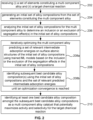
- FIG. 2 depicts an exemplary flow chart illustrating a method for identifying multi component alloy catalysts for a target chemical reaction, using the system 100 of FIG. 1 , in accordance with an embodiment of the present disclosure.
- the system(s) 100 comprises one or more data storage devices or the memory 102 operatively coupled to the one or more hardware processors 104 and is configured to store instructions for execution of steps of the method by the one or more processors 104.
- the steps of the method of the present disclosure will now be explained with reference to components of the system 100 of FIG. 1 , and the flow diagram as depicted in FIG. 2 .
- the one or more hardware processors 104 receive (i) a set of elements constituting a multi component alloy, and (ii) a target chemical reaction.
- the system 100 considers elements Silver (Ag), Gold (Au), Copper (Cu), Palladium (Pd), and Platinum (Pt) containing multi component alloy for carbon monoxide (CO) reduction reaction (target chemical reaction).
- the one or more hardware processors 104 generate an initial set of alloy compositions from the set of elements constituting the multi component alloy, to be used as the initial guesses for the optimization of the alloy composition.
- the initial dataset for optimization consisted of 58 different alloys of unary, binary, ternary, quaternary as well as quinary compositions, sampled randomly.
- the initial set of alloy compositions is generated using one or more trained ML models.
- the step of obtaining the one or more trained ML models is better understood by way of following description:
- the one or more hardware processors 104 identify one or more relevant reaction intermediates for the target chemical reaction (or a plurality of target chemical reactions). Identification of the one or more relevant reaction intermediates for the target chemical reaction is better understood by way of following description.
- CORR CO/CO2 reduction
- the major impediment towards realizing this is the development of a catalyst that is active and selective for CORR.
- catalysts for a reaction can be qualified by using the adsorption energy of one or more key intermediates as the 'descriptor'. In the specific case of CORR, the adsorption energy of CO molecule on the catalyst surface is a widely accepted descriptor for ranking catalysts.
- the catalyst In addition to CORR, the catalyst must be poorly active for parasitic reactions such as hydrogen evolution reaction (HER).
- HER the adsorption energy of hydrogen atom on the surface of the catalyst is usually used as the descriptor to qualify the catalyst.
- the task herein is to optimize the composition of the Ag, Au, Cu, Pd, Pt containing multi component alloy to maximize its activity and selectivity for CORR and minimize its activity towards HER.
- the one or more hardware processors 104 compute, by using a quantum chemical technique, an adsorption energy of the one or more relevant reaction intermediates on one or more surface atomic structures of the multi component alloy. Computation of the adsorption energy of the one or more relevant reaction intermediates on one or more surface atomic structures of the multi component alloy is better understood by way of following description.
- the first step is to generate data for the adsorption energy of CO and H on the surface atomic structures of the multi component alloy.
- This data is usually generated via high throughput density function theory (DFT) calculations.
- DFT high throughput density function theory
- the system 100 and the method took this DFT data from a recently published article available in the open literature (e.g., refer " Pedersen et al, ACS Catal. 2020, 10, 3, 2169-2176 ").
- This DFT data consisted of the adsorption energy of CO molecule on various 'ontop' sites and H atom on various ⁇ HCP' and ⁇ FCC' hollow sites on the 111 surface atomic structures of the multi component alloy.
- the one or more hardware processors 104 train one or more machine learning (ML) models (also referred as ML algorithms and interchangeably used herein) using the adsorption energy of the one or more relevant reaction intermediates on the one or more surface atomic structures of the multi component alloy. Training of the one or more machine learning (ML) models is better understood by way of following description.
- ML machine learning
- the system 100 and the method train artificial intelligence (AI)/ML models for predicting the adsorption energies of these adsorbates. While several different models of varying sophistication can be trained, the system 100 trained a ML model that used a one-hot encoded representation of the chemical environment around the binding site of both CO and H adsorbates as the features, as outlined in Pedersen et al, ACS Catal. 2020, 10, 3, 2169-2176 . Eight (8) different ML algorithms were used to build ML models for each of CO and H adsorption energies. Seven different data scaling techniques were tested with each ML model. The ML models were validated using a 10-fold cross-validation procedure. GridSearchCV module of sci-kit learn as used for hyperparameter optimization.
- AI artificial intelligence
- Tables 1 and 2 show the results from the ML model fitting to CO and H adsorbate adsorption energies. More specifically, Table 1 depicts Evaluation of the ML models employed to fit CO Adsorption energies. Table 2 depicts Evaluation of the ML models employed to fit H Adsorption energies. Kernel ridge regression (KRR) model performed best on both the regression tasks, with a very small test MAE of 0.04 and 0.05 eV respectively. Now, for any new alloy composition, these trained ML models can be used to predict the adsorption energy of the two intermediates on the (111) surface atomic structures of the multi component alloy.
- KRR Kernel ridge regression
- the one or more hardware processors 104 analyze the initial set of alloy compositions for the multi component alloy to determine an inclusion or an exclusion of one or more segregation effects in the initial set of alloy compositions. More specifically, at step 206, it is checked whether the one or more segregation effects are needed to be included in or excluded from the initial set of alloy compositions. Since the atomic radius of Ag is greater than that of other constituent elements, preferential elemental segregation at the surface is likely to occur in this alloy. This check of the inclusion or exclusion of segregation effects is carried out (or the analysis of the initial set of alloy compositions) by the system 100 and method of the present disclosure.
- the inclusion of the one or more segregation effects in the initial set of alloy compositions comprises simulating the one or more surface atomic structures of the multi component alloy by using an interatomic potential based hybrid monte-carlo molecular dynamic technique, in an embodiment of the present disclosure.
- the inclusion of the one or more segregation effects in the initial set of alloy compositions is better understood by way of following description.
- Multi component alloys are prone to elemental segregation at the surface atomic structures that significantly modifies both the chemical and structural diversity at the surface atomic structures. Since catalytic activity is intimately related to the surface microstructure, a knowledge of the atomic configuration at the surface is utmost essential for a correct evaluation of the alloy's efficiency as a catalyst. While a number of different interatomic potentials exit, the system 100 and method described herein chose the embedded atom potentials (EAM) to simulate surface segregation (or one or more surface atomic structures) in these alloys as EAM potentials are the most widely accepted choice for simulations of metals and alloys.
- EAM embedded atom potentials
- FIGS. 1 through 2 depicts a carbon monoxide (CO) and Hydrogen (H) Adsorption energy distribution on the (111) random and segregated surface atomic structures of an equimolar AgAuCuPdPt alloy (also referred as random and segregated surface atomic structures of an equimolar AgAuCuPdPt alloy of orientation (111)), in accordance with an embodiment of the present disclosure.
- CO carbon monoxide
- H Hydrogen
- the exclusion of one or more segregation effects in the initial set of alloy compositions comprises randomly arranging one or more atoms in the one or more surface atomic structures of the multi component alloy, in an embodiment of the present disclosure.
- the next step is to optimize the composition of the alloy by including all these factors.
- the most active mono-metal catalyst for CORR is copper.
- it is plagued by poor product selectivity, one of the reasons for which is the occurrence of parasitic HER.
- the goal of the system 100 and method described herein is to search for an alloy that is at least as active as Cu for CORR but much worse than Cu in catalyzing the parasitic HER.
- the system and method have a multi-objective optimization problem with the two objective functions/optimization convergences, being minimize dE(CO) and maximize dE(H).
- the one or more hardware processors 104 iteratively perform optimization of the composition of the multi component alloy.
- the step 208 pertaining to the optimization of the multi component alloy includes one or more steps. More specifically, at step 208a the one or more hardware processors 104 predict a set of relevant intermediate adsorption energies on the one or more surface atomic structures of the initial set of alloy compositions using one or more trained ML models based on the inclusion or the exclusion of one or more segregation effects in the initial set of alloy compositions. At step 208b the one or more hardware processors 104 identify one or more subsequent best candidate alloy compositions using the initial set of alloy compositions and the set of relevant predicted intermediate adsorption energies. These steps 208a and 208b are iteratively carried out until an optimization convergence is reached.
- the step 208 can be better understood by way of the following description.
- the one or more trained ML models are configured by the one or more hardware processors 104 to predict the average CO and H adsorption energies (averaged over 25 different atomic configurations for each alloy composition) on these segregated surface atomic structures.
- each point in the initial dataset e.g., also referred as the initial set of alloy compositions and interchangeably used herein
- the ⁇ m' dimension composition vector e.g., 5 dimension composition vector
- the step 208b is better understood by way of following description.
- the catalyst composition optimization was carried out using a multi-objective Bayesian optimization (BO) technique using BoTorch package.
- BO Bayesian optimization
- Two different models were created using SingleTaskGp function in BoTorch, one each each for dE(CO) and dE(H) and these were combined using ModelListGP function.
- the loglikelihood was calculated using SumMarginalLogLikelihood while qNoisyExpectedImprovement was used as an acquisition function.
- Sampling of the composition space was carried out using SobolQMCNormalSampler with num_samples set at 10000 while the ⁇ next best candidate' for successive iterations of BO was given by the optimize_acqf_list function.
- a gaussian process regression (GPR) model was used as the surrogate model in the BO procedure
- a surrogate Gaussian Process Regression (GPR) model was trained using the set of elements of step 202 and the trained GPR model was used to predict the property values on the 10,000 sampled drawn by SobolQMCNormalSampler (e.g., sampler as known in the art). Subsequently, the ⁇ next best candidate' was identified based on the expected improvement scores.
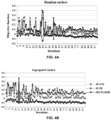
- FIGS. 4A-4B depict an evolution of one or more objective function values (also referred as optimization convergence) over the 100 Bayesian Optimization (BO) iterations for the random and segregated systems respectively, in accordance with an embodiment of the present disclosure.
- the one or more hardware processors 104 identify at least one best candidate alloy composition amongst the one or more subsequent best candidate alloy compositions as a multi component alloy catalyst that potentially maximizes activity and selectivity for the target chemical reaction.
- the step 210 is better understood by way of following description.
- the multi component alloy that is likely to be the best candidate for CORR was found to have a composition of 22.3%Au-20.81%Cu-27.11%Pd-29.77%Pt.
- the best candidate had a composition of 37.74%Au - 35.15%Cu - 27.11%Pd.
- the system 100 and method noted that the best alloy candidate was devoid of any Ag content.
- the system 100 and method identify new alloy compositions that are active and selective for CO reduction reaction (CORR). After following the steps that are provided in FIG. 2 the alloys that are having best activity and selectivity towards CORR over Hydrogen evolution reaction (HER) have been obtained.
- the best candidate alloy compositions for CORR in both random and segregated states are depicted in Table 3 below: Table 3 State Alloy Composition Random 37.74%Au-35.15%Cu-27.11%Pd Segregated 22.3%Au-20.81%Cu-27.11%Pd-29.77%Pt
- Copper is the best mono-metal catalysts for CORR as outlined in the research.
- the alloy must weakly bind to H and optimally binds CO.
- the alloys mentioned above optimally binds to CO (as good as copper) and weakly bind to H.
- the corresponding adsorption energy values for these alloys and pure copper are depicted in Table 4. More specifically, Table 4 illustrates comparison of CO and H adsorption energies of Cu and the best alloys found for CORR.
- Embodiments of the present disclosure provide systems and methods that overcome this limitation by including surface segregation as an inherent part of catalyst composition optimization. At first, given the principal components of the alloy and a target chemical reaction, surface models of the alloy for diverse compositions and atomic configurations are created.
- Quantum chemical calculations are then carried out on these surface atomic structures to compute the adsorption energy of the key reaction intermediates.
- AI/ML models are trained to predict the adsorption energy of the key reaction intermediates.
- the trained AI/ML models can be used to predict the adsorption energy of the intermediates on any new composition/configuration of the alloy.
- Interatomic potential based MC/MM simulations are carried out for observing the surface atomic structures of the multi component alloy and their evolvement to a thermodynamically stable state resulting from the preferential segregation of one or more elements to the surface of the alloy.
- the same procedure can also be followed without the inclusion of the MC/MM step, in which case, the system 100 identifies the best random solid solution composition formed from the multiple principal components.
- the catalyst screening as performed by the method of the present disclosure is physically more realistic compared to earlier reports of conventional approaches.
- Such computer-readable storage means contain program-code means for implementation of one or more steps of the method, when the program runs on a server or mobile device or any suitable programmable device.
- the hardware device can be any kind of device which can be programmed including e.g., any kind of computer like a server or a personal computer, or the like, or any combination thereof.
- the device may also include means which could be e.g., hardware means like e.g., an application-specific integrated circuit (ASIC), a field-programmable gate array (FPGA), or a combination of hardware and software means, e.g., an ASIC and an FPGA, or at least one microprocessor and at least one memory with software processing components located therein.
- the means can include both hardware means and software means.
- the method embodiments described herein could be implemented in hardware and software.
- the device may also include software means. Alternatively, the embodiments may be implemented on different hardware devices, e.g., using a plurality of CPUs.
- the embodiments herein can comprise hardware and software elements.
- the embodiments that are implemented in software include but are not limited to, firmware, resident software, microcode, etc.
- the functions performed by various components described herein may be implemented in other components or combinations of other components.
- a computer-usable or computer readable medium can be any apparatus that can comprise, store, communicate, propagate, or transport the program for use by or in connection with the instruction execution system, apparatus, or device.
- a computer-readable storage medium refers to any type of physical memory on which information or data readable by a processor may be stored.
- a computer-readable storage medium may store instructions for execution by one or more processors, including instructions for causing the processor(s) to perform steps or stages consistent with the embodiments described herein.
- the term "computer-readable medium” should be understood to include tangible items and exclude carrier waves and transient signals, i.e., be non-transitory. Examples include random access memory (RAM), read-only memory (ROM), volatile memory, nonvolatile memory, hard drives, CD ROMs, DVDs, flash drives, disks, and any other known physical storage media.
Landscapes
- Engineering & Computer Science (AREA)
- Theoretical Computer Science (AREA)
- Computing Systems (AREA)
- Life Sciences & Earth Sciences (AREA)
- Bioinformatics & Computational Biology (AREA)
- Bioinformatics & Cheminformatics (AREA)
- Health & Medical Sciences (AREA)
- General Health & Medical Sciences (AREA)
- Databases & Information Systems (AREA)
- Software Systems (AREA)
- Chemical & Material Sciences (AREA)
- Crystallography & Structural Chemistry (AREA)
- Medical Informatics (AREA)
- Evolutionary Computation (AREA)
- Data Mining & Analysis (AREA)
- Computer Vision & Pattern Recognition (AREA)
- Artificial Intelligence (AREA)
- Physics & Mathematics (AREA)
- Spectroscopy & Molecular Physics (AREA)
- Catalysts (AREA)
- Investigating Or Analyzing Non-Biological Materials By The Use Of Chemical Means (AREA)
Abstract
Description
- The present application claims priority to
Indian application no. 202321002360, filed on January 11, 2023 - The disclosure herein generally relates to multi component alloy catalysts, and, more particularly, to systems and methods for identifying multi component alloy catalysts for a target chemical reaction.
- With an ever-increasing demand for clean energy and reduction of carbon emissions, identification of unique, active, and earth-abundant catalysts for various chemical conversions is essential. Multi component alloys are emerging as such promising candidates. However, a systematic approach to screen the exceptionally large compositional and configurational space of these alloys to identify 'active' catalysts is currently lacking. Exploration based on a purely experimental approach, or via accurate quantum chemistry calculations alone is impractical to cover this vast space. Further, conventional approaches may not be efficient and simultaneously do not incorporate elements of materials chemistry and optimization that require screening of active multi component catalysts.
- Embodiments of the present disclosure present technological improvements as solutions to one or more of the above-mentioned technical problems recognized by the inventors in conventional systems.
- For example, in one aspect, there is provided a processor implemented method for identifying multi component alloy catalysts for a target chemical reaction. The method comprises receiving, via one or more hardware processors, (i) a set of elements constituting a multi component alloy, and (ii) a target chemical reaction; generating an initial set of alloy compositions from the set of elements constituting the multi component alloy; analyzing the initial set of alloy compositions for the multi component alloy to determine an inclusion or an exclusion of one or more segregation effects in the initial set of alloy compositions; iteratively optimizing the multi component alloy by: predicting a set of relevant intermediate adsorption energies on the one or more surface atomic structures of the initial set of alloy compositions using the one or more trained ML models based on the inclusion or the exclusion of one or more segregation effects in the initial set of alloy compositions; and identifying one or more subsequent best candidate alloy compositions using the initial set of alloy compositions and the set of relevant predicted intermediate adsorption energies, until an optimization convergence is reached; and identifying at least one best candidate alloy composition amongst the one or more subsequent best candidate alloy compositions as a multi component alloy catalyst that potentially maximizes activity and selectivity for the target chemical reaction.
- In an embodiment, the one or more trained ML models are obtained by identifying, via the one or more hardware processors, one or more relevant reaction intermediates for the target chemical reaction; computing, by using a quantum chemical technique via the one or more hardware processors, an adsorption energy of the one or more relevant reaction intermediates on one or more surface atomic structures of the multi component alloy; and training, via the one or more hardware processors, one or more machine learning (ML) models using the adsorption energy of the one or more relevant reaction intermediates on the one or more surface atomic structures of the multi component alloy.
- In an embodiment, the inclusion of the one or more segregation effects in the initial set of alloy compositions comprises simulating the one or more surface atomic structures of the multi component alloy by using an interatomic potential based hybrid monte-carlo molecular dynamic technique.
- In an embodiment, the exclusion of one or more segregation effects in the initial set of alloy compositions comprises randomly arranging one or more atoms in the one or more surface atomic structures of the multi component alloy.
- In another aspect, there is provided a processor implemented system for identifying multi component alloy catalysts for a target chemical reaction. The system comprises: a memory storing instructions; one or more communication interfaces; and one or more hardware processors coupled to the memory via the one or more communication interfaces, wherein the one or more hardware processors are configured by the instructions to: receive (i) a set of elements constituting a multi component alloy, and (ii) a target chemical reaction; generate an initial set of alloy compositions from the set of elements constituting the multi component alloy; analyze the initial set of alloy compositions for the multi component alloy to determine an inclusion or an exclusion of one or more segregation effects in the initial set of alloy compositions; iteratively optimize the multi component alloy by: predicting a set of relevant intermediate adsorption energies on the one or more surface atomic structures of the initial set of alloy compositions using one or more trained ML models based on the inclusion or the exclusion of one or more segregation effects in the initial set of alloy compositions; and identifying one or more subsequent best candidate alloy compositions using the initial set of alloy compositions and the set of relevant predicted intermediate adsorption energies, until an optimization convergence is reached; and identify at least one best candidate alloy composition amongst the one or more subsequent best candidate alloy compositions as a multi component alloy catalyst that potentially maximizes activity and selectivity for the target chemical reaction.
- In an embodiment, the one or more trained ML models are obtained by identifying one or more relevant reaction intermediates for the target chemical reaction; computing, by using a quantum chemical technique, an adsorption energy of the one or more relevant reaction intermediates on one or more surface atomic structures of the multi component alloy; and training one or more machine learning (ML) models using the adsorption energy of the one or more relevant reaction intermediates on the one or more surface atomic structures of the multi component alloy.
- In an embodiment, the inclusion of the one or more segregation effects in the initial set of alloy compositions comprises simulating the one or more surface atomic structures of the multi component alloy by using an interatomic potential based hybrid monte-carlo molecular dynamic technique.
- In an embodiment, the exclusion of one or more segregation effects in the initial set of alloy compositions comprises randomly arranging one or more atoms in the one or more surface atomic structures of the multi component alloy.
- In yet another aspect, there are provided one or more non-transitory machine-readable information storage mediums comprising one or more instructions which when executed by one or more hardware processors cause identifying multi component alloy catalysts for a target chemical reaction by: receiving (i) a set of elements constituting a multi component alloy, and (ii) a target chemical reaction; generating an initial set of alloy compositions from the set of elements constituting the multi component alloy; analyzing the initial set of alloy compositions for the multi component alloy to determine an inclusion or an exclusion of one or more segregation effects in the initial set of alloy compositions; iteratively optimizing the multi component alloy by: predicting a set of relevant intermediate adsorption energies on the one or more surface atomic structures of the initial set of alloy compositions using the one or more trained ML models based on the inclusion or the exclusion of one or more segregation effects in the initial set of alloy compositions; and identifying one or more subsequent best candidate alloy compositions using the initial set of alloy compositions and the set of relevant predicted intermediate adsorption energies, until an optimization convergence is reached; and identifying at least one best candidate alloy composition amongst the one or more subsequent best candidate alloy compositions as a multi component alloy catalyst that potentially maximizes activity and selectivity for the target chemical reaction.
- In an embodiment, the one or more trained ML models are obtained by: identifying one or more relevant reaction intermediates for the target chemical reaction; computing, by using a quantum chemical technique, an adsorption energy of the one or more relevant reaction intermediates on one or more surface atomic structures of the multi component alloy; training the one or more machine learning (ML) models using the adsorption energy of the one or more relevant reaction intermediates on the one or more surface atomic structures of the multi component alloy.
- In an embodiment, the inclusion of the one or more segregation effects in the initial set of alloy compositions comprises simulating the one or more surface atomic structures of the multi component alloy by using an interatomic potential based hybrid monte-carlo molecular dynamic technique.
- In an embodiment, the exclusion of one or more segregation effects in the initial set of alloy compositions comprises randomly arranging one or more atoms in the one or more surface atomic structures of the multi component alloy.
- It is to be understood that both the foregoing general description and the following detailed description are exemplary and explanatory only and are not restrictive of the invention, as claimed.
- The accompanying drawings, which are incorporated in and constitute a part of this disclosure, illustrate exemplary embodiments and, together with the description, serve to explain the disclosed principles:
-
FIG. 1 depicts an exemplary system for identifying multi component alloy catalysts for a target chemical reaction, in accordance with an embodiment of the present disclosure. -
FIG. 2 depicts an exemplary flow chart illustrating a method for identifying multi component alloy catalysts for a target chemical reaction, using the system ofFIG. 1 , in accordance with an embodiment of the present disclosure. -
FIG. 3 depicts a carbon monoxide (CO) and Hydrogen (H) Adsorption energy distribution on (111) random and segregated surface atomic structures of an equimolar AgAuCuPdPt alloy (also referred as random and segregated surface atomic structures of an equimolar AgAuCuPdPt alloy of orientation (111)), in accordance with an embodiment of the present disclosure. -
FIGS. 4A-4B depict an evolution of one or more objective function values (also referred as optimization convergence) over the 100 Bayesian Optimization (BO) iterations for the random and segregated systems respectively, in accordance with an embodiment of the present disclosure. - Exemplary embodiments are described with reference to the accompanying drawings. In the figures, the left-most digit(s) of a reference number identifies the figure in which the reference number first appears. Wherever convenient, the same reference numbers are used throughout the drawings to refer to the same or like parts. While examples and features of disclosed principles are described herein, modifications, adaptations, and other implementations are possible without departing from the scope of the disclosed embodiments.
- As mentioned earlier, conventional approaches may not be efficient and simultaneously do not incorporate elements of materials chemistry and optimization that are required for screening of active multi component catalysts. Present disclosure provides systems and method that incorporate elements of materials chemistry, artificial intelligence (AI)/machine learning (ML) and optimization, for the screening of multi component alloys that are efficient catalysts for a target chemical conversion. Given a set of elements constituting the alloy and the target reaction, the systems and methods first construct surface models (also referred as surface atomic structures) of several different alloy compositions and configurations. Then, the adsorption energy of key reaction intermediates on these surfaces (also referred as surface atomic structures and interchangeably used herein) are computed using one or more quantum chemical methods (e.g., density functional theory (DFT) calculations). Next, an AI/MI, model is trained using the data obtained from DFT calculations to predict the adsorption energy of the reaction intermediates on the alloy surface. Finally, numerical optimization is used to identify alloy compositions that maximize the activity of the catalyst for the target reaction. A mathematical function of these adsorption energies is used as the objective function in numerical optimization. Since multicomponent alloys tend to undergo preferential elemental segregation, classical interatomic potential based monte-carlo/molecular mechanics (MC/MM) calculations are carried out to identify such effects in alloy compositions identified during each iteration of the optimization procedure. The AI/MI, model is then used to predict the adsorption energies on the segregated surfaces and the objective function is evaluated using these values.
- In the above outlined procedure, the MC/MM step can be avoided if the goal is to screen purely random multi component alloy catalysts. In that case, the AI/ML model is directly used on the surface of alloy composition predicted in each iteration of the optimization procedure, bypassing the MC/MM step.
- The present disclosure and its system and method address the following technical problems:
- 1. Overcomes the lack of a systematic computational framework for the screening of active catalysts for any target reaction from the vast compositional and configurational space of multi-component alloys.
- 2. Provides a `chemical reaction' and `principal alloy component' agnostic methodology for screening of these alloy catalysts.
- 3. Integrates aspects of materials chemistry, data driven modeling and optimization into a single unified framework for the discovery of multi component alloy catalysts.
- Referring now to the drawings, and more particularly to
FIGS. 1 through 4B , where similar reference characters denote corresponding features consistently throughout the figures, there are shown preferred embodiments and these embodiments are described in the context of the following exemplary system and/or method. -
FIG. 1 depicts anexemplary system 100 for identifying multi component alloy catalysts for a target chemical reaction, in accordance with an embodiment of the present disclosure. In an embodiment, thesystem 100 includes one ormore hardware processors 104, communication interface device(s) or input/output (I/O) interface(s) 106 (also referred as interface(s)), and one or more data storage devices ormemory 102 operatively coupled to the one ormore hardware processors 104. The one ormore processors 104 may be one or more software processing components and/or hardware processors. In an embodiment, the hardware processors can be implemented as one or more microprocessors, microcomputers, microcontrollers, digital signal processors, central processing units, state machines, logic circuitries, and/or any devices that manipulate signals based on operational instructions. Among other capabilities, the processor(s) is/are configured to fetch and execute computer-readable instructions stored in the memory. In an embodiment, thesystem 100 can be implemented in a variety of computing systems, such as laptop computers, notebooks, hand-held devices (e.g., smartphones, tablet phones, mobile communication devices, and the like), workstations, mainframe computers, servers, a network cloud, and the like. - The I/O interface device(s) 106 can include a variety of software and hardware interfaces, for example, a web interface, a graphical user interface, and the like and can facilitate multiple communications within a wide variety of networks N/W and protocol types, including wired networks, for example, LAN, cable, etc., and wireless networks, such as WLAN, cellular, or satellite. In an embodiment, the I/O interface device(s) can include one or more ports for connecting a number of devices to one another or to another server.
- The
memory 102 may include any computer-readable medium known in the art including, for example, volatile memory, such as static random-access memory (SRAM) and dynamic-random access memory (DRAM), and/or non-volatile memory, such as read only memory (ROM), erasable programmable ROM, flash memories, hard disks, optical disks, and magnetic tapes. In an embodiment, adatabase 108 is comprised in thememory 102, wherein thedatabase 108 comprises information elements constituting a multi component alloy, and a target chemical reaction. Thedatabase 108 further comprises one or more relevant reaction intermediates for the target chemical reaction, adsorption energy of the one or more relevant reaction intermediates on one or more surface atomic structures of the multi component alloy, initial set of alloy compositions generated from the set of elements constituting the multi component alloy, analyzes of the initial set of alloy compositions for the multi component alloy, relevant intermediate adsorption energies, subsequent best candidate alloy compositions, one or more multi component alloy catalysts, and the like. Thememory 102 further comprises various models such as artificial intelligence, machine learning model(s), and the like that are trained and invoked for execution and when executed enable method of predicting catalyst for target chemical reaction as described herein. Thememory 102 further comprises (or may further comprise) information pertaining to input(s)/output(s) of each step performed by the systems and methods of the present disclosure. In other words, input(s) fed at each step and output(s) generated at each step are comprised in thememory 102 and can be utilized in further processing and analysis. -
FIG. 2 , with reference toFIG. 1 , depicts an exemplary flow chart illustrating a method for identifying multi component alloy catalysts for a target chemical reaction, using thesystem 100 ofFIG. 1 , in accordance with an embodiment of the present disclosure. In an embodiment, the system(s) 100 comprises one or more data storage devices or thememory 102 operatively coupled to the one ormore hardware processors 104 and is configured to store instructions for execution of steps of the method by the one ormore processors 104. The steps of the method of the present disclosure will now be explained with reference to components of thesystem 100 ofFIG. 1 , and the flow diagram as depicted inFIG. 2 . - At
step 202 of the method of the present disclosure, the one ormore hardware processors 104 receive (i) a set of elements constituting a multi component alloy, and (ii) a target chemical reaction. For instance, thesystem 100 considers elements Silver (Ag), Gold (Au), Copper (Cu), Palladium (Pd), and Platinum (Pt) containing multi component alloy for carbon monoxide (CO) reduction reaction (target chemical reaction). - At
step 204 of the method of the present disclosure, the one ormore hardware processors 104 generate an initial set of alloy compositions from the set of elements constituting the multi component alloy, to be used as the initial guesses for the optimization of the alloy composition. The initial dataset for optimization consisted of 58 different alloys of unary, binary, ternary, quaternary as well as quinary compositions, sampled randomly. The initial set of alloy compositions is generated using one or more trained ML models. - The step of obtaining the one or more trained ML models is better understood by way of following description:
- At first, the one or
more hardware processors 104 identify one or more relevant reaction intermediates for the target chemical reaction (or a plurality of target chemical reactions). Identification of the one or more relevant reaction intermediates for the target chemical reaction is better understood by way of following description. Large scale deployment of CO/CO2 reduction (CORR) to value added chemicals is one of the ways to achieve a carbon neutral economy. The major impediment towards realizing this is the development of a catalyst that is active and selective for CORR. As with any catalytic conversion, catalysts for a reaction can be qualified by using the adsorption energy of one or more key intermediates as the 'descriptor'. In the specific case of CORR, the adsorption energy of CO molecule on the catalyst surface is a widely accepted descriptor for ranking catalysts. In addition to CORR, the catalyst must be poorly active for parasitic reactions such as hydrogen evolution reaction (HER). For HER, the adsorption energy of hydrogen atom on the surface of the catalyst is usually used as the descriptor to qualify the catalyst. Hence, the task herein is to optimize the composition of the Ag, Au, Cu, Pd, Pt containing multi component alloy to maximize its activity and selectivity for CORR and minimize its activity towards HER. - Further, the one or
more hardware processors 104 compute, by using a quantum chemical technique, an adsorption energy of the one or more relevant reaction intermediates on one or more surface atomic structures of the multi component alloy. Computation of the adsorption energy of the one or more relevant reaction intermediates on one or more surface atomic structures of the multi component alloy is better understood by way of following description. - The first step is to generate data for the adsorption energy of CO and H on the surface atomic structures of the multi component alloy. This data is usually generated via high throughput density function theory (DFT) calculations. In the present disclosure, the
system 100 and the method took this DFT data from a recently published article available in the open literature (e.g., refer "Pedersen et al, ACS Catal. 2020, 10, 3, 2169-2176"). This DFT data consisted of the adsorption energy of CO molecule on various 'ontop' sites and H atom on various `HCP' and `FCC' hollow sites on the 111 surface atomic structures of the multi component alloy. - Furthermore, the one or
more hardware processors 104 train one or more machine learning (ML) models (also referred as ML algorithms and interchangeably used herein) using the adsorption energy of the one or more relevant reaction intermediates on the one or more surface atomic structures of the multi component alloy. Training of the one or more machine learning (ML) models is better understood by way of following description. - More specifically, the
system 100 and the method train artificial intelligence (AI)/ML models for predicting the adsorption energies of these adsorbates. While several different models of varying sophistication can be trained, thesystem 100 trained a ML model that used a one-hot encoded representation of the chemical environment around the binding site of both CO and H adsorbates as the features, as outlined in Pedersen et al, ACS Catal. 2020, 10, 3, 2169-2176. Eight (8) different ML algorithms were used to build ML models for each of CO and H adsorption energies. Seven different data scaling techniques were tested with each ML model. The ML models were validated using a 10-fold cross-validation procedure. GridSearchCV module of sci-kit learn as used for hyperparameter optimization. Below Tables 1 and 2 show the results from the ML model fitting to CO and H adsorbate adsorption energies. More specifically, Table 1 depicts Evaluation of the ML models employed to fit CO Adsorption energies. Table 2 depicts Evaluation of the ML models employed to fit H Adsorption energies. Kernel ridge regression (KRR) model performed best on both the regression tasks, with a very small test MAE of 0.04 and 0.05 eV respectively. Now, for any new alloy composition, these trained ML models can be used to predict the adsorption energy of the two intermediates on the (111) surface atomic structures of the multi component alloy.Table 1 ML Algorithm (ML model) Scaling method Test MAE (eV) Test R2 Optimized hyperparameters KRR (linear) Quantile (Normal) 0.055 0.9823 α = 0.25 KRR (RBF) MinMaxScaler 0.040 0.9921 α = 0.01, γ = 0.048 KRR (Laplacian) Quantile (Uniform) 0.041 0.9916 α=0.08, γ = 0.01 KRR (Polynomial) PowerTransformer 0.041 0.9920 α = 0.07, γ = 0.01, degree = 3 Random Forest PowerTransformer 0.045 0.9894 n_estimators = 55, max_depth = 8, min_sample_leaf = 1 AdaBoost MinMaxScaler 0.057 0.9836 n_estimators = 43, loss = square XgBoost Quantile (Uniform) 0.043 0.9910 n_estimators = 92, loss = huber KNN MinMaxScaler 0.051 0.9850 n_neighbors=7, p = 1 Table 2 ML Algorithm Scaling method Test MAE (eV) Test R2 Optimized hyperparameters KRR (linear) RobustScaler 0.059 0.8930 α = 0.05 KRR (RBF) Quantile (Uniform) 0.060 0.8913 α = 0.01, γ = 0.01 KRR (Laplacian) StandardScaler 0.059 0.8933 α=0.03, γ = 0.01 KRR (Polynomial) MinMaxScaler 0.059 0.8930 α = 0.01, γ = 0.181, degree = 1 Random Forest MaxAbsScaler 0.064 0.8798 n_estimators = 54, max_depth = 33, min_sample_leaf = 1 AdaBoost RobustScaler 0.16 0.3581 n_estimators = 40, loss = square XgBoost RobustScaler 0.060 0.8827 n_estimators = 197, loss = ls KNN MinMaxScaler 0.067 0.8712 n_neighbors=4, p = 2 - Referring to steps of
FIG. 2 , atstep 206 of the method of the present disclosure, the one ormore hardware processors 104 analyze the initial set of alloy compositions for the multi component alloy to determine an inclusion or an exclusion of one or more segregation effects in the initial set of alloy compositions. More specifically, atstep 206, it is checked whether the one or more segregation effects are needed to be included in or excluded from the initial set of alloy compositions. Since the atomic radius of Ag is greater than that of other constituent elements, preferential elemental segregation at the surface is likely to occur in this alloy. This check of the inclusion or exclusion of segregation effects is carried out (or the analysis of the initial set of alloy compositions) by thesystem 100 and method of the present disclosure. - The inclusion of the one or more segregation effects in the initial set of alloy compositions comprises simulating the one or more surface atomic structures of the multi component alloy by using an interatomic potential based hybrid monte-carlo molecular dynamic technique, in an embodiment of the present disclosure. The inclusion of the one or more segregation effects in the initial set of alloy compositions is better understood by way of following description.
- Multi component alloys are prone to elemental segregation at the surface atomic structures that significantly modifies both the chemical and structural diversity at the surface atomic structures. Since catalytic activity is intimately related to the surface microstructure, a knowledge of the atomic configuration at the surface is utmost essential for a correct evaluation of the alloy's efficiency as a catalyst. While a number of different interatomic potentials exit, the
system 100 and method described herein chose the embedded atom potentials (EAM) to simulate surface segregation (or one or more surface atomic structures) in these alloys as EAM potentials are the most widely accepted choice for simulations of metals and alloys. It is to be understood by a person having ordinary skill in the art or person skilled in the art that such simulating techniques shall not be construed as limiting the scope of the present disclosure. Each simulation was carried out in an (x*y*z) supercell(s) size where values of x, y and z are 8, 8, and 6 respectively, wherein the supercell consisted of 384 atoms. An MC/MM protocol was used to 'evolve' the surfaces in these simulations wherein two different atoms in the system were swapped with a probability of
FIG. 3 , clearly indicates the average adsorbate carbon monoxide (*CO) and Hydrogen (*H) Adsorption energies on both the surfaces is starkly different. Thus, inclusion of surface segregation as an inherent step in the screening Ag-Au-Cu-Pd-Pt containing catalysts is essential to identify realistic alloy compositions with potentially high activity and selectivity for CORR. More specifically,FIG. 3 , with reference toFIGS. 1 through 2 , depicts a carbon monoxide (CO) and Hydrogen (H) Adsorption energy distribution on the (111) random and segregated surface atomic structures of an equimolar AgAuCuPdPt alloy (also referred as random and segregated surface atomic structures of an equimolar AgAuCuPdPt alloy of orientation (111)), in accordance with an embodiment of the present disclosure. - The exclusion of one or more segregation effects in the initial set of alloy compositions comprises randomly arranging one or more atoms in the one or more surface atomic structures of the multi component alloy, in an embodiment of the present disclosure.
- Having developed a ML model to predict the adsorbate adsorption energies and a protocol to obtain realistic surface microstructures with preferential element segregation, the next step is to optimize the composition of the alloy by including all these factors. Currently, the most active mono-metal catalyst for CORR is copper. However, it is plagued by poor product selectivity, one of the reasons for which is the occurrence of parasitic HER. Thus, the goal of the
system 100 and method described herein is to search for an alloy that is at least as active as Cu for CORR but much worse than Cu in catalyzing the parasitic HER. Since CO and H adsorption energies are known to be excellent descriptors to qualify a catalyst for these two reactions, the quest for thesystem 100 and method described herein is to identify a catalyst with CO adsorption energy as close to Cu as possible (to maximize CORR activity), i.e., dE(CO) = abs(Eads HEA(CO) - Eads Cu(CO)) ~= 0 and H adsorption energy that is much more unfavorable than Cu (to penalize HER activity), i.e., dE(H) = Eads HEA(H) - Eads Cu(H) » 0. In other words, the system and method have a multi-objective optimization problem with the two objective functions/optimization convergences, being minimize dE(CO) and maximize dE(H). - At
step 208 of the method of the present disclosure, the one ormore hardware processors 104 iteratively perform optimization of the composition of the multi component alloy. Thestep 208 pertaining to the optimization of the multi component alloy includes one or more steps. More specifically, atstep 208a the one ormore hardware processors 104 predict a set of relevant intermediate adsorption energies on the one or more surface atomic structures of the initial set of alloy compositions using one or more trained ML models based on the inclusion or the exclusion of one or more segregation effects in the initial set of alloy compositions. Atstep 208b the one ormore hardware processors 104 identify one or more subsequent best candidate alloy compositions using the initial set of alloy compositions and the set of relevant predicted intermediate adsorption energies. Thesesteps - The
step 208, includingsteps more hardware processors 104 to predict the average CO and H adsorption energies (averaged over 25 different atomic configurations for each alloy composition) on these segregated surface atomic structures. Thus, each point in the initial dataset (e.g., also referred as the initial set of alloy compositions and interchangeably used herein) was described using the `m' dimension composition vector (e.g., 5 dimension composition vector) as features and the corresponding dE(CO) and dE(H) as the property values. Thestep 208b is better understood by way of following description. The catalyst composition optimization was carried out using a multi-objective Bayesian optimization (BO) technique using BoTorch package. Two different models were created using SingleTaskGp function in BoTorch, one each each for dE(CO) and dE(H) and these were combined using ModelListGP function. The loglikelihood was calculated using SumMarginalLogLikelihood while qNoisyExpectedImprovement was used as an acquisition function. Sampling of the composition space was carried out using SobolQMCNormalSampler with num_samples set at 10000 while the `next best candidate' for successive iterations of BO was given by the optimize_acqf_list function. A gaussian process regression (GPR) model was used as the surrogate model in the BO procedure A surrogate Gaussian Process Regression (GPR) model was trained using the set of elements ofstep 202 and the trained GPR model was used to predict the property values on the 10,000 sampled drawn by SobolQMCNormalSampler (e.g., sampler as known in the art). Subsequently, the `next best candidate' was identified based on the expected improvement scores. -
FIGS. 4A-4B , with reference toFIGS. 1 through 3 , depict an evolution of one or more objective function values (also referred as optimization convergence) over the 100 Bayesian Optimization (BO) iterations for the random and segregated systems respectively, in accordance with an embodiment of the present disclosure. Once the iterations are completed, and the objective function is satisfied or the optimization convergence is reached, atstep 210 of the method of the present disclosure, the one ormore hardware processors 104 identify at least one best candidate alloy composition amongst the one or more subsequent best candidate alloy compositions as a multi component alloy catalyst that potentially maximizes activity and selectivity for the target chemical reaction. Thestep 210 is better understood by way of following description. Considering surface segregation, the multi component alloy that is likely to be the best candidate for CORR was found to have a composition of 22.3%Au-20.81%Cu-27.11%Pd-29.77%Pt. Excluding segregation effects, i.e., considering a random solid solution for this alloy (or random arrangement of the constituent atoms in the surface atomic structure), the best candidate had a composition of 37.74%Au - 35.15%Cu - 27.11%Pd. Interestingly, in both the cases (e.g., the inclusion and exclusion), thesystem 100 and method noted that the best alloy candidate was devoid of any Ag content. The above description may be better understood by way of following experimental results: - The
system 100 and method identify new alloy compositions that are active and selective for CO reduction reaction (CORR). After following the steps that are provided inFIG. 2 the alloys that are having best activity and selectivity towards CORR over Hydrogen evolution reaction (HER) have been obtained. The best candidate alloy compositions for CORR in both random and segregated states are depicted in Table 3 below:Table 3 State Alloy Composition Random 37.74%Au-35.15%Cu-27.11%Pd Segregated 22.3%Au-20.81%Cu-27.11%Pd-29.77%Pt - Copper is the best mono-metal catalysts for CORR as outlined in the research. To achieve selective reduction of CO, the alloy must weakly bind to H and optimally binds CO. The alloys mentioned above optimally binds to CO (as good as copper) and weakly bind to H. The corresponding adsorption energy values for these alloys and pure copper are depicted in Table 4. More specifically, Table 4 illustrates comparison of CO and H adsorption energies of Cu and the best alloys found for CORR.
Table 4 Metal/Alloy ECO Ads (eV) EH Ads (eV) 100%Cu -0.3735 -0.0782 37.74%Au-35.15%Cu-27.11%Pd -0.3737 0.0008 22.3%Au-20.81%Cu-27.11%Pd-29.77%Pt -0.3726 0.0462 - The difference in the CO adsorption energies of Cu and the best alloys is almost nil whereas the difference in the H binding energies is significantly wider. Hence, these alloys (or also referred as candidate alloy compositions) are likely to show better activity and selectivity towards CORR as compared to pure copper. Likewise, for any catalytic reaction the system and method of the present disclosure enable finding an alternative, more active and selective alloy (s) as a replacement of existing ones.
- As mentioned above, conventional approaches fail to consider important effect of surface segregation on the catalytic activity. Preferential segregation of elements, which is a physical reality for many different alloys, significantly alters the surface microstructure. Catalytic activity is intimately related to the surface microstructure. Thus, optimization of such alloy compositions needs to include surface segregation as an integral part of the procedure. Embodiments of the present disclosure provide systems and methods that overcome this limitation by including surface segregation as an inherent part of catalyst composition optimization. At first, given the principal components of the alloy and a target chemical reaction, surface models of the alloy for diverse compositions and atomic configurations are created. Quantum chemical calculations (e.g., such as, but are not limited to, Density Function Theory (DFT), all electron calculations, and the like)) are then carried out on these surface atomic structures to compute the adsorption energy of the key reaction intermediates. Secondly, AI/ML models are trained to predict the adsorption energy of the key reaction intermediates. Later, instead of DFT calculations, the trained AI/ML models can be used to predict the adsorption energy of the intermediates on any new composition/configuration of the alloy. Interatomic potential based MC/MM simulations are carried out for observing the surface atomic structures of the multi component alloy and their evolvement to a thermodynamically stable state resulting from the preferential segregation of one or more elements to the surface of the alloy. At last, numerical optimization has been implemented by the system and method of the present disclosure to identify alloy compositions that maximize the activity and selectivity of the catalyst for the target chemical reaction. A mathematical function of the adsorption energies is used as the objective function (or optimization convergence) in numerical optimization. Since multicomponent alloys tend to undergo preferential elemental segregation, interatomic potential based monte-carlo/molecular mechanics (MC/MM) calculations/simulations have been carried out to identify such effects in alloy compositions identified during each iteration of the optimization procedure. The AI/MI, model is then used to predict the adsorption energies on the segregated surface atomic structures and the objective function/optimization convergence is evaluated using these values. The same procedure can also be followed without the inclusion of the MC/MM step, in which case, the
system 100 identifies the best random solid solution composition formed from the multiple principal components. Thus, the catalyst screening as performed by the method of the present disclosure is physically more realistic compared to earlier reports of conventional approaches. - The written description describes the subject matter herein to enable any person skilled in the art to make and use the embodiments. The scope of the subject matter embodiments is defined by the claims and may include other modifications that occur to those skilled in the art. Such other modifications are intended to be within the scope of the claims if they have similar elements that do not differ from the literal language of the claims or if they include equivalent elements with insubstantial differences from the literal language of the claims.
- It is to be understood that the scope of the protection is extended to such a program and in addition to a computer-readable means having a message therein; such computer-readable storage means contain program-code means for implementation of one or more steps of the method, when the program runs on a server or mobile device or any suitable programmable device. The hardware device can be any kind of device which can be programmed including e.g., any kind of computer like a server or a personal computer, or the like, or any combination thereof. The device may also include means which could be e.g., hardware means like e.g., an application-specific integrated circuit (ASIC), a field-programmable gate array (FPGA), or a combination of hardware and software means, e.g., an ASIC and an FPGA, or at least one microprocessor and at least one memory with software processing components located therein. Thus, the means can include both hardware means and software means. The method embodiments described herein could be implemented in hardware and software. The device may also include software means. Alternatively, the embodiments may be implemented on different hardware devices, e.g., using a plurality of CPUs.
- The embodiments herein can comprise hardware and software elements. The embodiments that are implemented in software include but are not limited to, firmware, resident software, microcode, etc. The functions performed by various components described herein may be implemented in other components or combinations of other components. For the purposes of this description, a computer-usable or computer readable medium can be any apparatus that can comprise, store, communicate, propagate, or transport the program for use by or in connection with the instruction execution system, apparatus, or device.
- The illustrated steps are set out to explain the exemplary embodiments shown, and it should be anticipated that ongoing technological development will change the manner in which particular functions are performed. These examples are presented herein for purposes of illustration, and not limitation. Further, the boundaries of the functional building blocks have been arbitrarily defined herein for the convenience of the description. Alternative boundaries can be defined so long as the specified functions and relationships thereof are appropriately performed. Alternatives (including equivalents, extensions, variations, deviations, etc., of those described herein) will be apparent to persons skilled in the relevant art(s) based on the teachings contained herein. Such alternatives fall within the scope of the disclosed embodiments. Also, the words "comprising," "having," "containing," and "including," and other similar forms are intended to be equivalent in meaning and be open ended in that an item or items following any one of these words is not meant to be an exhaustive listing of such item or items, or meant to be limited to only the listed item or items. It must also be noted that as used herein and in the appended claims, the singular forms "a," "an," and "the" include plural references unless the context clearly dictates otherwise.
- Furthermore, one or more computer-readable storage media may be utilized in implementing embodiments consistent with the present disclosure. A computer-readable storage medium refers to any type of physical memory on which information or data readable by a processor may be stored. Thus, a computer-readable storage medium may store instructions for execution by one or more processors, including instructions for causing the processor(s) to perform steps or stages consistent with the embodiments described herein. The term "computer-readable medium" should be understood to include tangible items and exclude carrier waves and transient signals, i.e., be non-transitory. Examples include random access memory (RAM), read-only memory (ROM), volatile memory, nonvolatile memory, hard drives, CD ROMs, DVDs, flash drives, disks, and any other known physical storage media.
- It is intended that the disclosure and examples be considered as exemplary only, with a true scope of disclosed embodiments being indicated by the following claims.
Claims (12)
- A processor implemented method, comprising:receiving, via one or more hardware processors, (i) a set of elements constituting a multi component alloy, and (ii) a target chemical reaction (202);generating, via the one or more hardware processors, an initial set of alloy compositions from the set of elements constituting the multi component alloy (204);analyzing, via the one or more hardware processors, the initial set of alloy compositions for the multi component alloy to determine an inclusion or an exclusion of one or more segregation effects in the initial set of alloy compositions (206);iteratively optimizing (208) the multi component alloy by:predicting, via the one or more hardware processors, a set of relevant intermediate adsorption energies on one or more surface atomic structures of the initial set of alloy compositions using one or more trained machine learning (ML) models based on the inclusion or the exclusion of the one or more segregation effects in the initial set of alloy compositions (208a); andidentifying, via the one or more hardware processors, one or more subsequent best candidate alloy compositions using the initial set of alloy compositions and the set of relevant predicted intermediate adsorption energies (208b),until an optimization convergence is reached; andidentifying, via the one or more hardware processors, at least one best candidate alloy composition amongst the one or more subsequent best candidate alloy compositions as a multi component alloy catalyst that potentially maximizes activity and selectivity for the target chemical reaction (210).
- The processor implemented method as claimed in claim 1, wherein the one or more trained ML models are obtained by:identifying, via the one or more hardware processors, one or more relevant reaction intermediates for the target chemical reaction;computing, by using a quantum chemical technique via the one or more hardware processors, an adsorption energy of the one or more relevant reaction intermediates on one or more surface atomic structures of the multi component alloy; andtraining, via the one or more hardware processors, the one or more machine learning (ML) models using the adsorption energy of the one or more relevant reaction intermediates on the one or more surface atomic structures of the multi component alloy.
- The processor implemented method as claimed in claim 1, wherein the inclusion of the one or more segregation effects in the initial set of alloy compositions comprises simulating the one or more surface atomic structures of the multi component alloy by using an interatomic potential based hybrid monte-carlo molecular dynamic technique.
- The processor implemented method as claimed in claim 1, wherein the exclusion of one or more segregation effects in the initial set of alloy compositions comprises randomly arranging one or more atoms in the one or more surface atomic structures of the multi component alloy.
- A system (100), comprising:a memory (102) storing instructions;one or more communication interfaces (106); andone or more hardware processors (104) coupled to the memory (102) via the one or more communication interfaces (106), wherein the one or more hardware processors (104) are configured by the instructions to:receive (i) a set of elements constituting a multi component alloy, and (ii) a target chemical reaction;generate an initial set of alloy compositions from the set of elements constituting the multi component alloy;analyze the initial set of alloy compositions for the multi component alloy to determine an inclusion or an exclusion of one or more segregation effects in the initial set of alloy compositions;iteratively optimize the multi component alloy by:predicting a set of relevant intermediate adsorption energies on one or more surface atomic structures of the initial set of alloy compositions using the one or more trained machine learning (ML) models based on the inclusion or the exclusion of the one or more segregation effects in the initial set of alloy compositions; andidentifying one or more subsequent best candidate alloy compositions using the initial set of alloy compositions and the set of relevant predicted intermediate adsorption energies,until an optimization convergence is reached; andidentify at least one best candidate alloy composition amongst the one or more subsequent best candidate alloy compositions as a multi component alloy catalyst that potentially maximizes activity and selectivity for the target chemical reaction.
- The system as claimed in claim 5, wherein the one or more trained ML models are obtained by:identifying, via the one or more hardware processors, one or more relevant reaction intermediates for the target chemical reaction;computing, by using a quantum chemical technique via the one or more hardware processors, an adsorption energy of the one or more relevant reaction intermediates on one or more surface atomic structures of the multi component alloy; andtraining, via the one or more hardware processors, one or more machine learning (ML) models using the adsorption energy of the one or more relevant reaction intermediates on the one or more surface atomic structures of the multi component alloy to obtain the one or more trained ML models.
- The system as claimed in claim 5, wherein the inclusion of the one or more segregation effects in the initial set of alloy compositions comprises simulating the one or more surface atomic structures of the multi component alloy by using an interatomic potential based hybrid monte-carlo molecular dynamic technique.
- The system as claimed in claim 5, wherein the exclusion of one or more segregation effects in the initial set of alloy compositions comprises randomly arranging one or more atoms in the one or more surface atomic structures of the multi component alloy.
- One or more non-transitory machine-readable information storage mediums comprising one or more instructions which when executed by one or more hardware processors cause:receiving (i) a set of elements constituting a multi component alloy, and (ii) a target chemical reaction;generating an initial set of alloy compositions from the set of elements constituting the multi component alloy;analyzing the initial set of alloy compositions for the multi component alloy to determine an inclusion or an exclusion of one or more segregation effects in the initial set of alloy compositions;iteratively optimizing the multi component alloy by:predicting a set of relevant intermediate adsorption energies on one or more surface atomic structures of the initial set of alloy compositions using one or more trained machine learning (ML) models based on the inclusion or the exclusion of the one or more segregation effects in the initial set of alloy compositions; andidentifying one or more subsequent best candidate alloy compositions using the initial set of alloy compositions and the set of relevant predicted intermediate adsorption energies,until an optimization convergence is reached; andidentifying at least one best candidate alloy composition amongst the one or more subsequent best candidate alloy compositions as a multi component alloy catalyst that potentially maximizes activity and selectivity for the target chemical reaction.
- The one or more non-transitory machine-readable information storage mediums as claimed in claim 9, wherein the one or more trained ML models are obtained by:identifying one or more relevant reaction intermediates for the target chemical reaction;computing, by using a quantum chemical technique, an adsorption energy of the one or more relevant reaction intermediates on one or more surface atomic structures of the multi component alloy; andtraining the one or more machine learning (ML) models using the adsorption energy of the one or more relevant reaction intermediates on the one or more surface atomic structures of the multi component alloy.
- The one or more non-transitory machine-readable information storage mediums as claimed in claim 9, wherein the inclusion of the one or more segregation effects in the initial set of alloy compositions comprises simulating the one or more surface atomic structures of the multi component alloy by using an interatomic potential based hybrid monte-carlo molecular dynamic technique.
- The one or more non-transitory machine-readable information storage mediums as claimed in claim 9, wherein the exclusion of one or more segregation effects in the initial set of alloy compositions comprises randomly arranging one or more atoms in the one or more surface atomic structures of the multi component alloy.
Applications Claiming Priority (1)
| Application Number | Priority Date | Filing Date | Title |
|---|---|---|---|
| IN202321002360 | 2023-01-11 |
Publications (2)
| Publication Number | Publication Date |
|---|---|
| EP4401083A2 true EP4401083A2 (en) | 2024-07-17 |
| EP4401083A3 EP4401083A3 (en) | 2024-07-24 |
Family
ID=89430253
Family Applications (1)
| Application Number | Title | Priority Date | Filing Date |
|---|---|---|---|
| EP24150004.0A Pending EP4401083A3 (en) | 2023-01-11 | 2024-01-02 | Systems and methods for identifying multi component alloy catalysts for a target chemical reaction |
Country Status (2)
| Country | Link |
|---|---|
| US (1) | US20240233885A1 (en) |
| EP (1) | EP4401083A3 (en) |
Families Citing this family (2)
| Publication number | Priority date | Publication date | Assignee | Title |
|---|---|---|---|---|
| CN120089242B (en) * | 2025-01-14 | 2025-11-18 | 海南大学 | High-entropy alloy catalyst component optimization method |
| CN120893182B (en) * | 2025-07-11 | 2026-02-06 | 科映未来(上海)智能科技有限公司 | Microchannel reactor design method, device, and storage medium based on multi-objective Bayesian optimization |
Family Cites Families (1)
| Publication number | Priority date | Publication date | Assignee | Title |
|---|---|---|---|---|
| CN114613445B (en) * | 2022-02-18 | 2025-04-04 | 北京工业大学 | A method for predicting copper alloy catalysts for carbon dioxide electroreduction |
-
2024
- 2024-01-02 EP EP24150004.0A patent/EP4401083A3/en active Pending
- 2024-01-03 US US18/402,796 patent/US20240233885A1/en active Pending
Non-Patent Citations (1)
| Title |
|---|
| PEDERSEN ET AL., ACS CATAL, vol. 10, no. 3, 2020, pages 2169 - 2176 |
Also Published As
| Publication number | Publication date |
|---|---|
| US20240233885A1 (en) | 2024-07-11 |
| EP4401083A3 (en) | 2024-07-24 |
Similar Documents
| Publication | Publication Date | Title |
|---|---|---|
| Deshpande et al. | Graph theory approach to determine configurations of multidentate and high coverage adsorbates for heterogeneous catalysis | |
| US20240233885A1 (en) | Systems and methods for identifying multi component alloy catalysts for a target chemical reaction | |
| CN109657805B (en) | Hyper-parameter determination method, device, electronic equipment and computer readable medium | |
| Zhang et al. | A novel extreme adaptive GRU for multivariate time series forecasting | |
| Besta et al. | Motif prediction with graph neural networks | |
| EP4250107A1 (en) | Method and system for evolved sarsa reinforcement learning for flow shop scheduling | |
| King et al. | MIST: Maximum Information Spanning Trees for dimension reduction of biological data sets | |
| Fujinuma et al. | Why big data and compute are not necessarily the path to big materials science | |
| Vecchi et al. | eSPA+: Scalable entropy-optimal machine learning classification for small data problems | |
| US20100198761A1 (en) | Systems, methods and circuits for learning of relation-based networks | |
| Nguyen et al. | ADAPTIVE: leArning DAta-dePendenT, concIse molecular VEctors for fast, accurate metabolite identification from tandem mass spectra | |
| Han et al. | Rapid mapping of alloy surface phase diagrams via Bayesian evolutionary multitasking | |
| Speagle et al. | Deriving photometric redshifts using fuzzy archetypes and self-organizing maps–II. Implementation | |
| Liu et al. | SP-DTI: subpocket-informed transformer for drug–target interaction prediction | |
| Ravipati et al. | A caching scheme to accelerate kinetic Monte Carlo simulations of catalytic reactions | |
| Shang et al. | Diversity subsampling: Custom subsamples from large data sets | |
| Yang et al. | Active learning driven discovery of novel alloyed catalysts for selective ammonia oxidation | |
| Hendy et al. | GAPF-DFT: A graph-based alchemical perturbation density functional theory for catalytic high-entropy alloys | |
| Espinosa et al. | Embedded feature selection in LSTM networks with multi-objective evolutionary ensemble learning for time series forecasting | |
| Vecchi et al. | Gauge-optimal approximate learning for small data classification | |
| Huang et al. | Actracer: Active testing of large language model via multi-stage sampling | |
| Heard et al. | Adaptive sequential Monte Carlo for multiple changepoint analysis | |
| EP4550210A1 (en) | Method and system for time series forecasting incorporating seasonal correlations using scalable architecture | |
| Salimpour et al. | Solving dynamic facility layout problem using a hybridized heuristic dynamic programming approach | |
| KR20230090959A (en) | Business data analyzing method |
Legal Events
| Date | Code | Title | Description |
|---|---|---|---|
| PUAI | Public reference made under article 153(3) epc to a published international application that has entered the european phase |
Free format text: ORIGINAL CODE: 0009012 |
|
| STAA | Information on the status of an ep patent application or granted ep patent |
Free format text: STATUS: THE APPLICATION HAS BEEN PUBLISHED |
|
| PUAL | Search report despatched |
Free format text: ORIGINAL CODE: 0009013 |
|
| AK | Designated contracting states |
Kind code of ref document: A2 Designated state(s): AL AT BE BG CH CY CZ DE DK EE ES FI FR GB GR HR HU IE IS IT LI LT LU LV MC ME MK MT NL NO PL PT RO RS SE SI SK SM TR |
|
| AK | Designated contracting states |
Kind code of ref document: A3 Designated state(s): AL AT BE BG CH CY CZ DE DK EE ES FI FR GB GR HR HU IE IS IT LI LT LU LV MC ME MK MT NL NO PL PT RO RS SE SI SK SM TR |
|
| RIC1 | Information provided on ipc code assigned before grant |
Ipc: G16C 60/00 20190101AFI20240618BHEP |
|
| STAA | Information on the status of an ep patent application or granted ep patent |
Free format text: STATUS: REQUEST FOR EXAMINATION WAS MADE |
|
| 17P | Request for examination filed |
Effective date: 20250120 |