EP4400940A1 - System and method for reducing power consumption in computing systems - Google Patents
System and method for reducing power consumption in computing systems Download PDFInfo
- Publication number
- EP4400940A1 EP4400940A1 EP23220783.7A EP23220783A EP4400940A1 EP 4400940 A1 EP4400940 A1 EP 4400940A1 EP 23220783 A EP23220783 A EP 23220783A EP 4400940 A1 EP4400940 A1 EP 4400940A1
- Authority
- EP
- European Patent Office
- Prior art keywords
- timeslot
- processor
- task
- low power
- power mode
- Prior art date
- Legal status (The legal status is an assumption and is not a legal conclusion. Google has not performed a legal analysis and makes no representation as to the accuracy of the status listed.)
- Granted
Links
Images


Classifications
-
- G—PHYSICS
- G06—COMPUTING OR CALCULATING; COUNTING
- G06F—ELECTRIC DIGITAL DATA PROCESSING
- G06F1/00—Details not covered by groups G06F3/00 - G06F13/00 and G06F21/00
- G06F1/26—Power supply means, e.g. regulation thereof
- G06F1/32—Means for saving power
- G06F1/3203—Power management, i.e. event-based initiation of a power-saving mode
- G06F1/3206—Monitoring of events, devices or parameters that trigger a change in power modality
- G06F1/3228—Monitoring task completion, e.g. by use of idle timers, stop commands or wait commands
-
- G—PHYSICS
- G06—COMPUTING OR CALCULATING; COUNTING
- G06F—ELECTRIC DIGITAL DATA PROCESSING
- G06F1/00—Details not covered by groups G06F3/00 - G06F13/00 and G06F21/00
- G06F1/26—Power supply means, e.g. regulation thereof
- G06F1/32—Means for saving power
- G06F1/3203—Power management, i.e. event-based initiation of a power-saving mode
- G06F1/3234—Power saving characterised by the action undertaken
- G06F1/3287—Power saving characterised by the action undertaken by switching off individual functional units in the computer system
-
- G—PHYSICS
- G06—COMPUTING OR CALCULATING; COUNTING
- G06F—ELECTRIC DIGITAL DATA PROCESSING
- G06F1/00—Details not covered by groups G06F3/00 - G06F13/00 and G06F21/00
- G06F1/26—Power supply means, e.g. regulation thereof
- G06F1/32—Means for saving power
- G06F1/3203—Power management, i.e. event-based initiation of a power-saving mode
- G06F1/3234—Power saving characterised by the action undertaken
- G06F1/329—Power saving characterised by the action undertaken by task scheduling
-
- G—PHYSICS
- G06—COMPUTING OR CALCULATING; COUNTING
- G06F—ELECTRIC DIGITAL DATA PROCESSING
- G06F9/00—Arrangements for program control, e.g. control units
- G06F9/06—Arrangements for program control, e.g. control units using stored programs, i.e. using an internal store of processing equipment to receive or retain programs
- G06F9/46—Multiprogramming arrangements
- G06F9/48—Program initiating; Program switching, e.g. by interrupt
- G06F9/4806—Task transfer initiation or dispatching
- G06F9/4843—Task transfer initiation or dispatching by program, e.g. task dispatcher, supervisor, operating system
- G06F9/4881—Scheduling strategies for dispatcher, e.g. round robin, multi-level priority queues
- G06F9/4887—Scheduling strategies for dispatcher, e.g. round robin, multi-level priority queues involving deadlines, e.g. rate based, periodic
-
- G—PHYSICS
- G06—COMPUTING OR CALCULATING; COUNTING
- G06F—ELECTRIC DIGITAL DATA PROCESSING
- G06F9/00—Arrangements for program control, e.g. control units
- G06F9/06—Arrangements for program control, e.g. control units using stored programs, i.e. using an internal store of processing equipment to receive or retain programs
- G06F9/46—Multiprogramming arrangements
- G06F9/48—Program initiating; Program switching, e.g. by interrupt
- G06F9/4806—Task transfer initiation or dispatching
- G06F9/4843—Task transfer initiation or dispatching by program, e.g. task dispatcher, supervisor, operating system
- G06F9/4881—Scheduling strategies for dispatcher, e.g. round robin, multi-level priority queues
- G06F9/4893—Scheduling strategies for dispatcher, e.g. round robin, multi-level priority queues taking into account power or heat criteria
-
- Y—GENERAL TAGGING OF NEW TECHNOLOGICAL DEVELOPMENTS; GENERAL TAGGING OF CROSS-SECTIONAL TECHNOLOGIES SPANNING OVER SEVERAL SECTIONS OF THE IPC; TECHNICAL SUBJECTS COVERED BY FORMER USPC CROSS-REFERENCE ART COLLECTIONS [XRACs] AND DIGESTS
- Y02—TECHNOLOGIES OR APPLICATIONS FOR MITIGATION OR ADAPTATION AGAINST CLIMATE CHANGE
- Y02D—CLIMATE CHANGE MITIGATION TECHNOLOGIES IN INFORMATION AND COMMUNICATION TECHNOLOGIES [ICT], I.E. INFORMATION AND COMMUNICATION TECHNOLOGIES AIMING AT THE REDUCTION OF THEIR OWN ENERGY USE
- Y02D10/00—Energy efficient computing, e.g. low power processors, power management or thermal management
Definitions
- the embodiments are directed to computing systems and more specifically to a system and method for reducing power consumption in computing systems.
- Processors executing software tasks and running at full processing power utilize external cooling mechanisms to prevent generated heat from rising above a maximum processor permissible limit.
- a real-time operating system process or RTOS process
- RTOS process with periodic schedules having a plurality of software tasks, there may be a fixed set of timeslots allocated for each task. However, the software tasks typically do not occupy full set of allocated timeslots.
- the processor is in a dead-wait, during which the processor runs, though no task is performed.
- the processor may unnecessarily consume power and generate heat, requiring additional load on the external cooling mechanisms.
- Overutilization of the external cooling mechanisms may reduce their reliability during the execution of critical applications. Reducing the processor speed may require less cooling but may also compromise the overall performance of the processor. In avionics, for example, the failure of an external cooling system or the reduction of a processor speed when the processor is executing task functions may result in undesired safety issues.
- a system including: a processor, wherein the processor is configured for executing a process of reducing power consumption that includes executing a first task over a first plurality of timeslots and a second task over a second plurality of timeslots, and wherein the processor is configured to: execute a real-time operating system (RTOS) process; determine that the first task is complete during a first timeslot of the first plurality of timeslots; and enter a low power mode for a reminder of the first timeslot upon determining that there is enough time to enter a low power mode during the first timeslot and a next timeslot is allocated to the first task, otherwise perform a dead-wait for the reminder of the first timeslot.
- RTOS real-time operating system
- the processor when the first timeslot is an initial timeslot allocated to the first task, the processor is configured to execute context switching while the processor executes the RTOS process.
- entering the low power mode includes flushing of instruction cache, flushing translation look-aside buffers and disabling the instruction cache.
- the processor upon entering a timeslot that follows the first timeslot, is configured to: determine that the low power mode was entered into during the first timeslot; and enabling the instruction cache.
- the processor after enabling the instruction cache, the processor is configured to continue to execute the RTOS process.
- the system includes: a cooling mechanism operationally coupled to the processor, wherein the cooling mechanism is deactivated during the remainder of the first timeslot upon entering the low power mode.
- the cooling mechanism is a fan.
- the system includes: a power unit operationally coupled to the cooling mechanism and the processor.
- the power unit is a battery.
- a method of executing a process of reducing power consumption of a processor including: executing a first task over a first plurality of timeslots and a second task over a second plurality of timeslots, and wherein the method further includes: executing a real-time operating system (RTOS) process; determining that the first task is complete during a first timeslot of the first plurality of timeslots; and entering a low power mode for a reminder of the first timeslot upon determining that there is enough time to enter a low power mode during the first timeslot and a next timeslot is allocated to the first task, otherwise performing a dead-wait for the reminder of the first timeslot.
- RTOS real-time operating system
- the method upon determining the first task is complete during the first timeslot, the method further includes: determining the next timeslot is allocated to a next task; and performing the dead-wait for the reminder of the first timeslot.
- the method further includes executing context switching while executing the RTOS process.
- entering the low power mode includes flushing of instruction cache, flushing translation look-aside buffers and disabling the instruction cache.
- the method upon entering a timeslot that follows the first timeslot, includes: determining that the low power mode was entered into during the first timeslot; and enabling the instruction cache.
- the method further includes continuing to execute the RTOS process.
- entering the low power mode further includes depowering a cooling mechanism that cools the processor for the remainder of the first timeslot.
- the system 100 provides an operational schedule or protocol 200 for the processor 110 that divides the processing time of the processor 110 for different tasks (or TSK) into plural time-sequential timeslots (or TS).
- TSK processing time of the processor 110 for different tasks
- TSK-A first task
- TSK-B second task
- TK-C third task
- the processor 110 allocates nine TSs, e.g., first through ninth timeslots (TS1-TS9) to complete these TSKs.
- each TSK represents a processing function that requires a finite execution time (illustrated in FIG. 2 as TM), and such execution may span across fewer TSs than originally allocated.
- RTOS process at the start of a new TSK which is a RTOS-i (initial) process
- RTOS-i process includes the additional requirement of context switching.
- Context switching is the saving the context of a previous TSK and generating or restoring a context for the new TSK.
- the RTOS process and RTOS-i process may both be referred to as an RTOS process.
- the processor 110 may perform processing activity (or PA) throughout an entire available TSK processing time in a TS or part of the TS.
- the available TSK processing time is time not otherwise accounted for to perform the RTOS process.
- TSK-A the available TSK processing time in TS1 is completely occupied with PA and TS2 is partially occupied with PA.
- TSK-B the available TSK processing time in TS5 is completely occupied with PA while TS6 is partially occupied with PA.
- TSK-C the available TSK processing time in TS9 is completely occupied with PA.
- certain TSs may be entirely or partially unoccupied with a PAin the available TSK processing time. That is, the TS may have negligible processing activity (or NPA) in the available TSK processing time, because processing required for the TSK is complete, that is, a TSK complete (or TC) state is reached.
- NPA negligible processing activity
- the TC state is reached during TS2.
- available TSK processing time in TS3 and TS4 have only NPA.
- TSK-B the TC state is reached during TS6.
- the available TSK processing time for a portion of TS6 has NPA.
- the available TSK processing time for TS7 and TS8 have NPA.
- the processor 110 may operate in a low power mode, otherwise referred to as a nap mode (NM), for the duration of time in a TS that is available for TSK processing and NPA is required.
- NM a low power mode
- the processor 110 executes a process for entering NM, identified as NM-EN and another process for exiting NM, identified as NM-EX.
- the cooling mechanism 120 may be deactivated.
- NM-EN may be executed within a TS after the RTOS process has completed and TSK processing has also completed. Executing NM-EN involves performing sequence of steps including flushing instruction cache, flushing translation look-aside buffers (TLBs), disabling the instruction cache and then entering the low power mode, collectively referred to as the nap-entering sequence. If the nap-entering sequence is interrupted, the processor 110 might undesirably enter an undefined state. Thus, under the protocol 200, NM may be entered in a TS provided that there is enough time to completely execute the nap-entering sequence.
- TLBs translation look-aside buffers
- Executing NM-EX involves re-enabling the instruction cache which was disabled while executing NM-EN. In each instance where the processor 110 enters NM, the processor 110 executes NM-EX at the start of the next TS and revaluates whether to enter NM, as it does for each TS. Exiting NM is time consuming. To avoid impacting the ability of a processor 110 to perform a next TSK, the processor 110 does not enter NM during a last TS of a TSK. That is, under the protocol 200, to enter NM in a TS, a next TS should be within the same TSK.
- the processor 110 enters NM during TS3.
- the processor 110 enters NM during part of TS6 and all of TS7. For each of these TSs, there was NPA for at least a portion of the available TS processing time because the TC state was reached, there was enough time to execute NM-EN, and the following TS was within the same TSK.
- the second TS2 has NPA butNM cannot be entered for that TS because there was insufficient time to execute NM-EN after the TC state was reached.
- the fourth TS4 has NPA but a NM cannot be entered for that TS, even though the TC state has been reached, because the next TS is allocated to TSK-B.
- TS8 there is NPA but NM cannot be entered for that TS, even though the TC state has been reached, because the next TS is allocated to TSK-C.
- the flowchart shows the process of entering the NM during a TS of a TSK in which the TC state is reached.
- the RTOS process is executed at block 310.
- a determination is made at block 315 during the TS that the TC stated is reached, i.e., the TSK is complete and there will be NPA for the remainder of the TS.
- the processor 110 makes a determination as to whether there is enough time remaining in the TS to safely execute NM-EN, e.g., whether there is enough time to execute the nap-entering sequence.
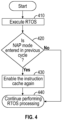
- FIG. 4 the flowchart shows the process of exiting the NM.
- the processor 110 executes the RTOS process at block 410.
- the processor 110 checks at block 420 to see whether NM was entered in the previous TS, as it does for each TS. If in the previous TS, the processor 110 entered NM (YES at 420), then the processor 110 executes NM-EX of enabling the instruction cache at block 430 and the processor 110 continues with the RTOS process at block 440. Otherwise, if the processor 110 had not entered NM (NO at 420) then the processor 110 continues with the RTOS process at block 440.
- the processor 110 may enter NM for many TSs.
- the generation of heat by the processor 110 is substantially diminished compared with, for example, a DW.
- the utilization of the cooling mechanism 120 is reduced.
- the embodiments therefore increase the useful life and reliability of the cooling mechanism 120. In avionics, for example, this reduces a safety issue related to the processor 110 without having to reduce a processing power of the processor 110 while executing critical task functions.
- embodiments can be in the form of processor-implemented processes and devices for practicing those processes, such as a processor.
- Embodiments can also be in the form of computer program code containing instructions embodied in tangible media, such as network cloud storage, SD cards, flash drives, floppy diskettes, CD ROMs, hard drives, or any other computer-readable storage medium, wherein, when the computer program code is loaded into and executed by a computer, the computer becomes a device for practicing the embodiments.
- Embodiments can also be in the form of computer program code, for example, whether stored in a storage medium, loaded into and/or executed by a computer, or transmitted over some transmission medium, loaded into and/or executed by a computer, or transmitted over some transmission medium, such as over electrical wiring or cabling, through fiber optics, or via electromagnetic radiation, wherein, when the computer program code is loaded into an executed by a computer, the computer becomes an device for practicing the embodiments.
- the computer program code segments configure the microprocessor to create specific logic circuits.
Landscapes
- Engineering & Computer Science (AREA)
- Theoretical Computer Science (AREA)
- General Engineering & Computer Science (AREA)
- Physics & Mathematics (AREA)
- General Physics & Mathematics (AREA)
- Software Systems (AREA)
- Computer Hardware Design (AREA)
- Computing Systems (AREA)
- Power Sources (AREA)
Abstract
Description
- This application claims the benefit of
IN Application No. 202311003173 filed January 16, 2023 - The embodiments are directed to computing systems and more specifically to a system and method for reducing power consumption in computing systems.
- Processors executing software tasks and running at full processing power utilize external cooling mechanisms to prevent generated heat from rising above a maximum processor permissible limit. In a real-time operating system process (or RTOS process), with periodic schedules having a plurality of software tasks, there may be a fixed set of timeslots allocated for each task. However, the software tasks typically do not occupy full set of allocated timeslots. During the unused timeslots, the processor is in a dead-wait, during which the processor runs, though no task is performed. During the dead-wait, the processor may unnecessarily consume power and generate heat, requiring additional load on the external cooling mechanisms. Overutilization of the external cooling mechanisms may reduce their reliability during the execution of critical applications. Reducing the processor speed may require less cooling but may also compromise the overall performance of the processor. In avionics, for example, the failure of an external cooling system or the reduction of a processor speed when the processor is executing task functions may result in undesired safety issues.
- Disclosed is a system including: a processor, wherein the processor is configured for executing a process of reducing power consumption that includes executing a first task over a first plurality of timeslots and a second task over a second plurality of timeslots, and wherein the processor is configured to: execute a real-time operating system (RTOS) process; determine that the first task is complete during a first timeslot of the first plurality of timeslots; and enter a low power mode for a reminder of the first timeslot upon determining that there is enough time to enter a low power mode during the first timeslot and a next timeslot is allocated to the first task, otherwise perform a dead-wait for the reminder of the first timeslot.
- In addition to one or more aspects of the system, or as an alternate: upon determining the first task is complete during the first timeslot, the processor is further configured to: determine that the next timeslot is allocated to a next task; and perform the dead-wait for the reminder of the first timeslot.
- In addition to one or more aspects of the system, or as an alternate: when the first timeslot is an initial timeslot allocated to the first task, the processor is configured to execute context switching while the processor executes the RTOS process.
- In addition to one or more aspects of the system, or as an alternate: entering the low power mode includes flushing of instruction cache, flushing translation look-aside buffers and disabling the instruction cache.
- In addition to one or more aspects of the system, or as an alternate: upon entering a timeslot that follows the first timeslot, the processor is configured to: determine that the low power mode was entered into during the first timeslot; and enabling the instruction cache.
- In addition to one or more aspects of the system, or as an alternate: after enabling the instruction cache, the processor is configured to continue to execute the RTOS process.
- In addition to one or more aspects of the system, or as an alternate, the system includes: a cooling mechanism operationally coupled to the processor, wherein the cooling mechanism is deactivated during the remainder of the first timeslot upon entering the low power mode.
- In addition to one or more aspects of the system, or as an alternate: the cooling mechanism is a fan.
- In addition to one or more aspects of the system, or as an alternate, the system includes: a power unit operationally coupled to the cooling mechanism and the processor.
- In addition to one or more aspects of the system, or as an alternate: the power unit is a battery.
- Further disclosed is a method of executing a process of reducing power consumption of a processor, including: executing a first task over a first plurality of timeslots and a second task over a second plurality of timeslots, and wherein the method further includes: executing a real-time operating system (RTOS) process; determining that the first task is complete during a first timeslot of the first plurality of timeslots; and entering a low power mode for a reminder of the first timeslot upon determining that there is enough time to enter a low power mode during the first timeslot and a next timeslot is allocated to the first task, otherwise performing a dead-wait for the reminder of the first timeslot.
- In addition to one or more aspects of the method, or as an alternate, upon determining the first task is complete during the first timeslot, the method further includes: determining the next timeslot is allocated to a next task; and performing the dead-wait for the reminder of the first timeslot.
- In addition to one or more aspects of the method, or as an alternate, when the first timeslot is an initial timeslot allocated to the first task, the method further includes executing context switching while executing the RTOS process.
- In addition to one or more aspects of the method, or as an alternate, entering the low power mode includes flushing of instruction cache, flushing translation look-aside buffers and disabling the instruction cache.
- In addition to one or more aspects of the method, or as an alternate, upon entering a timeslot that follows the first timeslot, the method includes: determining that the low power mode was entered into during the first timeslot; and enabling the instruction cache.
- In addition to one or more aspects of the method, or as an alternate, after enabling the instruction cache, the method further includes continuing to execute the RTOS process.
- In addition to one or more aspects of the method, or as an alternate, entering the low power mode further includes depowering a cooling mechanism that cools the processor for the remainder of the first timeslot.
- The present disclosure is illustrated by way of example and not limited in the accompanying figures in which like reference numerals indicate similar elements.
-
FIG. 1 shows a system configured to reduce power consumption according to an embodiment; -
FIG. 2 shows a timing diagram executed by the system according to an embodiment; -
FIG. 3 is a flowchart showing a process of the system entering a low power (nap) mode; and -
FIG. 4 is a flowchart showing a process of the system exiting the low power mode. - The disclosed embodiments provide a process of reducing power consumption for a computing systems such as that used on an aircraft. thermal dissipation associated with the execution of software. As will be appreciated from the disclosure, this process occurs without compromising the processing power of the processor.
- Turning to
FIG. 1 , asystem 100 is shown with aprocessor 110, acooling mechanism 120 for theprocessor 110 and apower unit 130 that powers thecooling mechanism 120 and theprocessor 110. Thecooling mechanism 120 may be a fan and thepower unit 130 may be a battery. Thesystem 100 may be an avionics system on anaircraft 140 shown schematically, which may be an enclosed system in which providing cooling to electronics is not a readily available option. - As shown in
FIG. 2 , thesystem 100 provides an operational schedule orprotocol 200 for theprocessor 110 that divides the processing time of theprocessor 110 for different tasks (or TSK) into plural time-sequential timeslots (or TS). In the illustrated example, there are three TSKs including a first task (TSK-A), a second task (TSK-B), and a third task (TSK-C). Theprocessor 110 allocates nine TSs, e.g., first through ninth timeslots (TS1-TS9) to complete these TSKs. Four of the TSs, i.e., TS1-TS4, which are a first plurality of TS, are allocated for the first TSK-A and four other TSs, i.e., TS5-TS8, which are a second plurality of TSs, are allocated for the TSK-B. One TS9 is allocated for the third TSK-C. The allocation of TSs to the differing TSKs is predetermined, for example, based on an expected time to perform a TSK. In operation, theprocessor 110 may process the TSK in fewer than the allocated number of TSs. That is, each TSK represents a processing function that requires a finite execution time (illustrated inFIG. 2 as TM), and such execution may span across fewer TSs than originally allocated. - At the onset of each TS, a certain amount of time in each TS is unavailable for task processing because it is occupied by the RTOS process. The RTOS process at the start of a new TSK, which is a RTOS-i (initial) process, is longer than the RTOS process in TSs of a same TSK. This is because the RTOS-i process includes the additional requirement of context switching. Context switching is the saving the context of a previous TSK and generating or restoring a context for the new TSK. For simplicity, the RTOS process and RTOS-i process may both be referred to as an RTOS process.
- For each of the TSs in a TSK, the
processor 110 may perform processing activity (or PA) throughout an entire available TSK processing time in a TS or part of the TS. The available TSK processing time is time not otherwise accounted for to perform the RTOS process. For example, as illustrated and not by way of limitations, with respect to TSK-A, the available TSK processing time in TS1 is completely occupied with PA and TS2 is partially occupied with PA. With respect to TSK-B, the available TSK processing time in TS5 is completely occupied with PA while TS6 is partially occupied with PA. For TSK-C, the available TSK processing time in TS9 is completely occupied with PA. - On the other hand, certain TSs may be entirely or partially unoccupied with a PAin the available TSK processing time. That is, the TS may have negligible processing activity (or NPA) in the available TSK processing time, because processing required for the TSK is complete, that is, a TSK complete (or TC) state is reached. For TSK-A, the TC state is reached during TS2. Thus a portion of the available TSK processing time in TS2 has NPA. For the same reason, available TSK processing time in TS3 and TS4 have only NPA. For TSK-B, the TC state is reached during TS6. Thus the available TSK processing time for a portion of TS6 has NPA. The available TSK processing time for TS7 and TS8 have NPA.
- According to the
protocol 200, theprocessor 110 may operate in a low power mode, otherwise referred to as a nap mode (NM), for the duration of time in a TS that is available for TSK processing and NPA is required. As discussed in greater detail below, theprocessor 110 executes a process for entering NM, identified as NM-EN and another process for exiting NM, identified as NM-EX. During an NM, thecooling mechanism 120 may be deactivated. - The process of NM-EN may be executed within a TS after the RTOS process has completed and TSK processing has also completed. Executing NM-EN involves performing sequence of steps including flushing instruction cache, flushing translation look-aside buffers (TLBs), disabling the instruction cache and then entering the low power mode, collectively referred to as the nap-entering sequence. If the nap-entering sequence is interrupted, the
processor 110 might undesirably enter an undefined state. Thus, under theprotocol 200, NM may be entered in a TS provided that there is enough time to completely execute the nap-entering sequence. - Executing NM-EX involves re-enabling the instruction cache which was disabled while executing NM-EN. In each instance where the
processor 110 enters NM, theprocessor 110 executes NM-EX at the start of the next TS and revaluates whether to enter NM, as it does for each TS. Exiting NM is time consuming. To avoid impacting the ability of aprocessor 110 to perform a next TSK, theprocessor 110 does not enter NM during a last TS of a TSK. That is, under theprotocol 200, to enter NM in a TS, a next TS should be within the same TSK. - Under the
protocol 200, theprocessor 110 performs a dead-wait (or DW) (otherwise referred to as entering a dead-wait state) during the time (TM) in a TS where there is NPA and theprocessor 110 cannot enter NM for reasons identified above. DW does not reduce the processing load of theprocessor 110 to the extent of NM. AS a result external cooling of theprocessor 110 is required during DW, placing the additional workload strain on thecooling mechanism 120. - Applying the
above protocol 200 to the TSKs inFIG. 2 , during TSK-A, theprocessor 110 enters NM during TS3. During TSK-B, theprocessor 110 enters NM during part of TS6 and all of TS7. For each of these TSs, there was NPA for at least a portion of the available TS processing time because the TC state was reached, there was enough time to execute NM-EN, and the following TS was within the same TSK. - For the first TSK-A, the second TS2 has NPA butNM cannot be entered for that TS because there was insufficient time to execute NM-EN after the TC state was reached. In addition, the fourth TS4 has NPA but a NM cannot be entered for that TS, even though the TC state has been reached, because the next TS is allocated to TSK-B. The same condition applies to TS8. That is, there is NPA but NM cannot be entered for that TS, even though the TC state has been reached, because the next TS is allocated to TSK-C.
- Turning to
FIG. 3 , the flowchart shows the process of entering the NM during a TS of a TSK in which the TC state is reached. During the TS, the RTOS process is executed atblock 310. Then a determination is made atblock 315 during the TS that the TC stated is reached, i.e., the TSK is complete and there will be NPA for the remainder of the TS. Atblock 320 theprocessor 110 makes a determination as to whether there is enough time remaining in the TS to safely execute NM-EN, e.g., whether there is enough time to execute the nap-entering sequence. - If enough time is available for the
processor 110 to enter NM (YES at 320) in a TS, a determination is made atblock 330 as to whether the next TS is allocated to same TSK, e.g., or is allocated to a next TSK. If the next TS is within the same TSK (YES at 330), then theprocessor 110 executes NM-EN by executing the nap-entering sequence atblock 350. Theprocessor 110 will remain in NM for the reminder of the TS. If there is not enough time for theprocessor 110 to execute NM-EN (NO at 320) or if the next TS is not within the same TSK (NO at 330), then theprocessor 110 performs a DW until the next TS atblock 340. - Turning to
FIG. 4 , the flowchart shows the process of exiting the NM. At the beginning of a TS following an NM, which would be in the same TSK as the prior TS, theprocessor 110 executes the RTOS process atblock 410. During this time, theprocessor 110 checks atblock 420 to see whether NM was entered in the previous TS, as it does for each TS. If in the previous TS, theprocessor 110 entered NM (YES at 420), then theprocessor 110 executes NM-EX of enabling the instruction cache atblock 430 and theprocessor 110 continues with the RTOS process atblock 440. Otherwise, if theprocessor 110 had not entered NM (NO at 420) then theprocessor 110 continues with the RTOS process atblock 440. - It can be appreciated that the
processor 110 may enter NM for many TSs. During the NM, the generation of heat by theprocessor 110 is substantially diminished compared with, for example, a DW. Thus, the utilization of thecooling mechanism 120 is reduced. The embodiments therefore increase the useful life and reliability of thecooling mechanism 120. In avionics, for example, this reduces a safety issue related to theprocessor 110 without having to reduce a processing power of theprocessor 110 while executing critical task functions. - As described above, embodiments can be in the form of processor-implemented processes and devices for practicing those processes, such as a processor. Embodiments can also be in the form of computer program code containing instructions embodied in tangible media, such as network cloud storage, SD cards, flash drives, floppy diskettes, CD ROMs, hard drives, or any other computer-readable storage medium, wherein, when the computer program code is loaded into and executed by a computer, the computer becomes a device for practicing the embodiments. Embodiments can also be in the form of computer program code, for example, whether stored in a storage medium, loaded into and/or executed by a computer, or transmitted over some transmission medium, loaded into and/or executed by a computer, or transmitted over some transmission medium, such as over electrical wiring or cabling, through fiber optics, or via electromagnetic radiation, wherein, when the computer program code is loaded into an executed by a computer, the computer becomes an device for practicing the embodiments. When implemented on a general-purpose microprocessor, the computer program code segments configure the microprocessor to create specific logic circuits.
- The terminology used herein is for the purpose of describing particular embodiments only and is not intended to be limiting of the present disclosure. As used herein, the singular forms "a", "an" and "the" are intended to include the plural forms as well, unless the context clearly indicates otherwise. It will be further understood that the terms "comprises" and/or "comprising," when used in this specification, specify the presence of stated features, integers, steps, operations, elements, and/or components, but do not preclude the presence or addition of one or more other features, integers, steps, operations, element components, and/or groups thereof.
- Those of skill in the art will appreciate that various example embodiments are shown and described herein, each having certain features in the particular embodiments, but the present disclosure is not thus limited. Rather, the present disclosure can be modified to incorporate any number of variations, alterations, substitutions, combinations, sub-combinations, or equivalent arrangements not heretofore described, but which are commensurate with the scope of the present disclosure. Additionally, while various embodiments of the present disclosure have been described, it is to be understood that aspects of the present disclosure may include only some of the described embodiments. Accordingly, the present disclosure is not to be seen as limited by the foregoing description, but is only limited by the scope of the appended claims.
Claims (15)
- A system comprising:a processor (110),wherein the processor (110) is configured for executing a process of reducing power consumption that includes executing a first task over a first plurality of timeslots and a second task over a second plurality of timeslots, and wherein the processor (110) is configured to:execute a real-time operating system (RTOS) process;determine that the first task is complete during a first timeslot of the first plurality of timeslots; andenter a low power mode for a reminder of the first timeslot upon determining that there is enough time to enter a low power mode during the first timeslot and a next timeslot is allocated to the first task, otherwise perform a dead-wait for the reminder of the first timeslot.
- The system of claim 1, wherein:
upon determining the first task is complete during the first timeslot, the processor (110) is further configured to:determine that the next timeslot is allocated to a next task; andperform the dead-wait for the reminder of the first timeslot. - The system of claim 1 or 2, wherein:
when the first timeslot is an initial timeslot allocated to the first task, the processor (110) is configured to execute context switching while the processor (110) executes the RTOS process. - The system of any preceding claim, wherein:
entering the low power mode includes flushing of instruction cache, flushing translation look-aside buffers and disabling the instruction cache. - The system of claim 4, wherein:
upon entering a timeslot that follows the first timeslot, the processor (110) is configured to:determine that the low power mode was entered into during the first timeslot; andenabling the instruction cache. - The system of claim 5, wherein:
after enabling the instruction cache, the processor (110) is configured to continue to execute the RTOS process. - The system of any preceding claim, further comprising:
a cooling mechanism operationally coupled to the processor (110), wherein the cooling mechanism is deactivated during the remainder of the first timeslot upon entering the low power mode. - The system of claim 7, wherein:
the cooling mechanism is a fan. - The system of claim 7, further comprising:
a power unit operationally coupled to the cooling mechanism and the processor (110), and optionally wherein:
the power unit is a battery. - A method of executing a process of reducing power consumption of a processor (110), comprising:
executing a first task over a first plurality of timeslots and a second task over a second plurality of timeslots, and wherein the method further comprises:executing a real-time operating system (RTOS) process;determining that the first task is complete during a first timeslot of the first plurality of timeslots; andentering a low power mode for a reminder of the first timeslot upon determining that there is enough time to enter a low power mode during the first timeslot and a next timeslot is allocated to the first task, otherwise performing a dead-wait for the reminder of the first timeslot. - The method of claim 10, wherein:
upon determining the first task is complete during the first timeslot, the method further comprises:determining the next timeslot is allocated to a next task; andperforming the dead-wait for the reminder of the first timeslot. - The method of claim 10 or 11, wherein:
when the first timeslot is an initial timeslot allocated to the first task, the method further comprises executing context switching while executing the RTOS process. - The method of any of claims 10 to 12, wherein:
entering the low power mode includes flushing of instruction cache, flushing translation look-aside buffers and disabling the instruction cache. - The method of claim 13, wherein:
upon entering a timeslot that follows the first timeslot, the method includes:determining that the low power mode was entered into during the first timeslot; andenabling the instruction cache. - The method of claim 14, wherein:
after enabling the instruction cache, the method further comprises continuing to execute the RTOS process, and optionally wherein entering the low power mode further comprises depowering a cooling mechanism that cools the processor (110) for the remainder of the first timeslot.
Applications Claiming Priority (1)
| Application Number | Priority Date | Filing Date | Title |
|---|---|---|---|
| IN202311003173 | 2023-01-16 |
Publications (2)
| Publication Number | Publication Date |
|---|---|
| EP4400940A1 true EP4400940A1 (en) | 2024-07-17 |
| EP4400940B1 EP4400940B1 (en) | 2025-06-25 |
Family
ID=89428834
Family Applications (1)
| Application Number | Title | Priority Date | Filing Date |
|---|---|---|---|
| EP23220783.7A Active EP4400940B1 (en) | 2023-01-16 | 2023-12-29 | System and method for reducing power consumption in computing systems |
Country Status (2)
| Country | Link |
|---|---|
| US (1) | US12117882B2 (en) |
| EP (1) | EP4400940B1 (en) |
Citations (3)
| Publication number | Priority date | Publication date | Assignee | Title |
|---|---|---|---|---|
| US5339425A (en) * | 1990-12-11 | 1994-08-16 | Fisher Controls International, Inc. | Operating system for a process controller |
| CN111371815A (en) * | 2018-12-25 | 2020-07-03 | 上海亮衡信息科技有限公司 | Communication method, system and communication equipment based on time slice triggering |
| KR20220064179A (en) * | 2020-11-11 | 2022-05-18 | 주식회사 텔레웍스 | Method for embodying power save mode using RTOS kernel idle hook |
Family Cites Families (11)
| Publication number | Priority date | Publication date | Assignee | Title |
|---|---|---|---|---|
| US5623647A (en) | 1995-03-07 | 1997-04-22 | Intel Corporation | Application specific clock throttling |
| JP3610930B2 (en) * | 2001-07-12 | 2005-01-19 | 株式会社デンソー | Operating system, program, vehicle electronic control unit |
| TWI228885B (en) * | 2003-01-23 | 2005-03-01 | Mediatek Inc | Method for controlling a mobile communication device to enter a power-saving mode and to recover timing after the mobile communication device leaves the power-saving mode |
| US8224639B2 (en) | 2004-03-29 | 2012-07-17 | Sony Computer Entertainment Inc. | Methods and apparatus for achieving thermal management using processing task scheduling |
| US8032889B2 (en) | 2006-04-05 | 2011-10-04 | Maxwell Technologies, Inc. | Methods and apparatus for managing and controlling power consumption and heat generation in computer systems |
| US8996330B2 (en) | 2011-01-06 | 2015-03-31 | Qualcomm Incorporated | Method and system for managing thermal policies of a portable computing device |
| US8972759B2 (en) | 2012-06-29 | 2015-03-03 | Qualcomm Incorporated | Adaptive thermal management in a portable computing device including monitoring a temperature signal and holding a performance level during a penalty period |
| US9720467B2 (en) | 2013-08-09 | 2017-08-01 | Qualcomm Incorporated | Thermal mitigation adaptation for a mobile electronic device |
| US9958933B2 (en) * | 2015-06-04 | 2018-05-01 | Apple Inc. | Opportunistic waking of an application processor |
| US11399720B2 (en) | 2016-04-05 | 2022-08-02 | Qulacomm Incorporated | Circuits and methods providing temperature mitigation for computing devices |
| US10452437B2 (en) | 2016-06-24 | 2019-10-22 | Advanced Micro Devices, Inc. | Temperature-aware task scheduling and proactive power management |
-
2023
- 2023-03-15 US US18/184,164 patent/US12117882B2/en active Active
- 2023-12-29 EP EP23220783.7A patent/EP4400940B1/en active Active
Patent Citations (3)
| Publication number | Priority date | Publication date | Assignee | Title |
|---|---|---|---|---|
| US5339425A (en) * | 1990-12-11 | 1994-08-16 | Fisher Controls International, Inc. | Operating system for a process controller |
| CN111371815A (en) * | 2018-12-25 | 2020-07-03 | 上海亮衡信息科技有限公司 | Communication method, system and communication equipment based on time slice triggering |
| KR20220064179A (en) * | 2020-11-11 | 2022-05-18 | 주식회사 텔레웍스 | Method for embodying power save mode using RTOS kernel idle hook |
Also Published As
| Publication number | Publication date |
|---|---|
| US20240241563A1 (en) | 2024-07-18 |
| US12117882B2 (en) | 2024-10-15 |
| EP4400940B1 (en) | 2025-06-25 |
Similar Documents
| Publication | Publication Date | Title |
|---|---|---|
| Herman et al. | RTOS support for multicore mixed-criticality systems | |
| EP2435914B1 (en) | Method and scheduler in an operating system | |
| JP4370336B2 (en) | Low power consumption job management method and computer system | |
| US8423999B2 (en) | Computer system, virtual machine monitor and scheduling method for virtual machine monitor | |
| US8141079B2 (en) | Dynamic application scheduler in a polling system | |
| EP2580657B1 (en) | Information processing device and method | |
| Kumar et al. | Reliability aware energy optimized scheduling of non-preemptive periodic real-time tasks on heterogeneous multiprocessor system | |
| Ellsworth et al. | Pow: System-wide dynamic reallocation of limited power in hpc | |
| EP3142008B1 (en) | Systems and methods for allocation of environmentally regulated slack | |
| US20140137122A1 (en) | Modified backfill scheduler and a method employing frequency control to reduce peak cluster power requirements | |
| US8892819B2 (en) | Multi-core system and external input/output bus control method | |
| Ali et al. | A dynamic power-aware scheduling of mixed-criticality real-time systems | |
| Awan et al. | Energy efficient mapping of mixed criticality applications on unrelated heterogeneous multicore platforms | |
| JP2010160565A (en) | Task scheduling apparatus, control method for task scheduling, and control program for task scheduling | |
| US20090313629A1 (en) | Task processing system and task processing method | |
| Boudjadar et al. | Combining task-level and system-level scheduling modes for mixed criticality systems | |
| JP2013149221A (en) | Control device for processor and method for controlling the same | |
| Ali et al. | Predictable GPU sharing in component-based real-time systems | |
| EP4400940B1 (en) | System and method for reducing power consumption in computing systems | |
| US7398378B2 (en) | Allocating lower priority interrupt for processing to slave processor via master processor currently processing higher priority interrupt through special interrupt among processors | |
| US20190391846A1 (en) | Semiconductor integrated circuit, cpu allocation method, and program | |
| Melani et al. | A scheduling framework for handling integrated modular avionic systems on multicore platforms | |
| Zakarya et al. | Energy efficient workload balancing algorithm for real-time tasks over multi-core | |
| US11138043B2 (en) | System and methods for contingency budgeting for time-partitioned systems | |
| CN114556120B (en) | Method, arrangement and computer program product for organizing stimulation of processing paths for testing microcircuits |
Legal Events
| Date | Code | Title | Description |
|---|---|---|---|
| PUAI | Public reference made under article 153(3) epc to a published international application that has entered the european phase |
Free format text: ORIGINAL CODE: 0009012 |
|
| STAA | Information on the status of an ep patent application or granted ep patent |
Free format text: STATUS: THE APPLICATION HAS BEEN PUBLISHED |
|
| AK | Designated contracting states |
Kind code of ref document: A1 Designated state(s): AL AT BE BG CH CY CZ DE DK EE ES FI FR GB GR HR HU IE IS IT LI LT LU LV MC ME MK MT NL NO PL PT RO RS SE SI SK SM TR |
|
| STAA | Information on the status of an ep patent application or granted ep patent |
Free format text: STATUS: REQUEST FOR EXAMINATION WAS MADE |
|
| 17P | Request for examination filed |
Effective date: 20240806 |
|
| RBV | Designated contracting states (corrected) |
Designated state(s): AL AT BE BG CH CY CZ DE DK EE ES FI FR GB GR HR HU IE IS IT LI LT LU LV MC ME MK MT NL NO PL PT RO RS SE SI SK SM TR |
|
| GRAP | Despatch of communication of intention to grant a patent |
Free format text: ORIGINAL CODE: EPIDOSNIGR1 |
|
| STAA | Information on the status of an ep patent application or granted ep patent |
Free format text: STATUS: GRANT OF PATENT IS INTENDED |
|
| INTG | Intention to grant announced |
Effective date: 20250121 |
|
| RIC1 | Information provided on ipc code assigned before grant |
Ipc: G06F 9/48 20060101ALI20250114BHEP Ipc: G06F 1/3287 20190101ALI20250114BHEP Ipc: G06F 1/329 20190101ALI20250114BHEP Ipc: G06F 1/3228 20190101AFI20250114BHEP |
|
| GRAS | Grant fee paid |
Free format text: ORIGINAL CODE: EPIDOSNIGR3 |
|
| GRAA | (expected) grant |
Free format text: ORIGINAL CODE: 0009210 |
|
| STAA | Information on the status of an ep patent application or granted ep patent |
Free format text: STATUS: THE PATENT HAS BEEN GRANTED |
|
| AK | Designated contracting states |
Kind code of ref document: B1 Designated state(s): AL AT BE BG CH CY CZ DE DK EE ES FI FR GB GR HR HU IE IS IT LI LT LU LV MC ME MK MT NL NO PL PT RO RS SE SI SK SM TR |
|
| REG | Reference to a national code |
Ref country code: GB Ref legal event code: FG4D |
|
| REG | Reference to a national code |
Ref country code: CH Ref legal event code: EP |
|
| REG | Reference to a national code |
Ref country code: DE Ref legal event code: R096 Ref document number: 602023004328 Country of ref document: DE |
|
| REG | Reference to a national code |
Ref country code: CH Ref legal event code: EP |
|
| REG | Reference to a national code |
Ref country code: IE Ref legal event code: FG4D |
|
| PG25 | Lapsed in a contracting state [announced via postgrant information from national office to epo] |
Ref country code: FI Free format text: LAPSE BECAUSE OF FAILURE TO SUBMIT A TRANSLATION OF THE DESCRIPTION OR TO PAY THE FEE WITHIN THE PRESCRIBED TIME-LIMIT Effective date: 20250625 |
|
| REG | Reference to a national code |
Ref country code: LT Ref legal event code: MG9D |
|
| PG25 | Lapsed in a contracting state [announced via postgrant information from national office to epo] |
Ref country code: GR Free format text: LAPSE BECAUSE OF FAILURE TO SUBMIT A TRANSLATION OF THE DESCRIPTION OR TO PAY THE FEE WITHIN THE PRESCRIBED TIME-LIMIT Effective date: 20250926 Ref country code: NO Free format text: LAPSE BECAUSE OF FAILURE TO SUBMIT A TRANSLATION OF THE DESCRIPTION OR TO PAY THE FEE WITHIN THE PRESCRIBED TIME-LIMIT Effective date: 20250925 |
|
| PG25 | Lapsed in a contracting state [announced via postgrant information from national office to epo] |
Ref country code: BG Free format text: LAPSE BECAUSE OF FAILURE TO SUBMIT A TRANSLATION OF THE DESCRIPTION OR TO PAY THE FEE WITHIN THE PRESCRIBED TIME-LIMIT Effective date: 20250625 |
|
| PG25 | Lapsed in a contracting state [announced via postgrant information from national office to epo] |
Ref country code: HR Free format text: LAPSE BECAUSE OF FAILURE TO SUBMIT A TRANSLATION OF THE DESCRIPTION OR TO PAY THE FEE WITHIN THE PRESCRIBED TIME-LIMIT Effective date: 20250625 |
|
| PG25 | Lapsed in a contracting state [announced via postgrant information from national office to epo] |
Ref country code: RS Free format text: LAPSE BECAUSE OF FAILURE TO SUBMIT A TRANSLATION OF THE DESCRIPTION OR TO PAY THE FEE WITHIN THE PRESCRIBED TIME-LIMIT Effective date: 20250925 |
|
| PG25 | Lapsed in a contracting state [announced via postgrant information from national office to epo] |
Ref country code: LV Free format text: LAPSE BECAUSE OF FAILURE TO SUBMIT A TRANSLATION OF THE DESCRIPTION OR TO PAY THE FEE WITHIN THE PRESCRIBED TIME-LIMIT Effective date: 20250625 |
|
| REG | Reference to a national code |
Ref country code: NL Ref legal event code: MP Effective date: 20250625 |
|
| PG25 | Lapsed in a contracting state [announced via postgrant information from national office to epo] |
Ref country code: NL Free format text: LAPSE BECAUSE OF FAILURE TO SUBMIT A TRANSLATION OF THE DESCRIPTION OR TO PAY THE FEE WITHIN THE PRESCRIBED TIME-LIMIT Effective date: 20250625 |
|
| PG25 | Lapsed in a contracting state [announced via postgrant information from national office to epo] |
Ref country code: PT Free format text: LAPSE BECAUSE OF FAILURE TO SUBMIT A TRANSLATION OF THE DESCRIPTION OR TO PAY THE FEE WITHIN THE PRESCRIBED TIME-LIMIT Effective date: 20251027 |
|
| REG | Reference to a national code |
Ref country code: AT Ref legal event code: MK05 Ref document number: 1807131 Country of ref document: AT Kind code of ref document: T Effective date: 20250625 |
|
| PG25 | Lapsed in a contracting state [announced via postgrant information from national office to epo] |
Ref country code: IS Free format text: LAPSE BECAUSE OF FAILURE TO SUBMIT A TRANSLATION OF THE DESCRIPTION OR TO PAY THE FEE WITHIN THE PRESCRIBED TIME-LIMIT Effective date: 20251025 |
|
| PG25 | Lapsed in a contracting state [announced via postgrant information from national office to epo] |
Ref country code: AT Free format text: LAPSE BECAUSE OF FAILURE TO SUBMIT A TRANSLATION OF THE DESCRIPTION OR TO PAY THE FEE WITHIN THE PRESCRIBED TIME-LIMIT Effective date: 20250625 Ref country code: SM Free format text: LAPSE BECAUSE OF FAILURE TO SUBMIT A TRANSLATION OF THE DESCRIPTION OR TO PAY THE FEE WITHIN THE PRESCRIBED TIME-LIMIT Effective date: 20250625 |
|
| PGFP | Annual fee paid to national office [announced via postgrant information from national office to epo] |
Ref country code: FR Payment date: 20251120 Year of fee payment: 3 |
|
| PG25 | Lapsed in a contracting state [announced via postgrant information from national office to epo] |
Ref country code: CZ Free format text: LAPSE BECAUSE OF FAILURE TO SUBMIT A TRANSLATION OF THE DESCRIPTION OR TO PAY THE FEE WITHIN THE PRESCRIBED TIME-LIMIT Effective date: 20250625 |
|
| PG25 | Lapsed in a contracting state [announced via postgrant information from national office to epo] |
Ref country code: PL Free format text: LAPSE BECAUSE OF FAILURE TO SUBMIT A TRANSLATION OF THE DESCRIPTION OR TO PAY THE FEE WITHIN THE PRESCRIBED TIME-LIMIT Effective date: 20250625 |
|
| PG25 | Lapsed in a contracting state [announced via postgrant information from national office to epo] |
Ref country code: EE Free format text: LAPSE BECAUSE OF FAILURE TO SUBMIT A TRANSLATION OF THE DESCRIPTION OR TO PAY THE FEE WITHIN THE PRESCRIBED TIME-LIMIT Effective date: 20250625 |
|
| PG25 | Lapsed in a contracting state [announced via postgrant information from national office to epo] |
Ref country code: SK Free format text: LAPSE BECAUSE OF FAILURE TO SUBMIT A TRANSLATION OF THE DESCRIPTION OR TO PAY THE FEE WITHIN THE PRESCRIBED TIME-LIMIT Effective date: 20250625 |
|
| PG25 | Lapsed in a contracting state [announced via postgrant information from national office to epo] |
Ref country code: ES Free format text: LAPSE BECAUSE OF FAILURE TO SUBMIT A TRANSLATION OF THE DESCRIPTION OR TO PAY THE FEE WITHIN THE PRESCRIBED TIME-LIMIT Effective date: 20250625 |
|
| PG25 | Lapsed in a contracting state [announced via postgrant information from national office to epo] |
Ref country code: RO Free format text: LAPSE BECAUSE OF FAILURE TO SUBMIT A TRANSLATION OF THE DESCRIPTION OR TO PAY THE FEE WITHIN THE PRESCRIBED TIME-LIMIT Effective date: 20250625 |
|
| PG25 | Lapsed in a contracting state [announced via postgrant information from national office to epo] |
Ref country code: DK Free format text: LAPSE BECAUSE OF FAILURE TO SUBMIT A TRANSLATION OF THE DESCRIPTION OR TO PAY THE FEE WITHIN THE PRESCRIBED TIME-LIMIT Effective date: 20250625 |
|
| PG25 | Lapsed in a contracting state [announced via postgrant information from national office to epo] |
Ref country code: IT Free format text: LAPSE BECAUSE OF FAILURE TO SUBMIT A TRANSLATION OF THE DESCRIPTION OR TO PAY THE FEE WITHIN THE PRESCRIBED TIME-LIMIT Effective date: 20250625 |
|
| PLBE | No opposition filed within time limit |
Free format text: ORIGINAL CODE: 0009261 |
|
| STAA | Information on the status of an ep patent application or granted ep patent |
Free format text: STATUS: NO OPPOSITION FILED WITHIN TIME LIMIT |
|
| REG | Reference to a national code |
Ref country code: CH Ref legal event code: L10 Free format text: ST27 STATUS EVENT CODE: U-0-0-L10-L00 (AS PROVIDED BY THE NATIONAL OFFICE) Effective date: 20260507 |