EP4400562A1 - Method for estimating code strength after reaction and method for manufacturing coke - Google Patents
Method for estimating code strength after reaction and method for manufacturing coke Download PDFInfo
- Publication number
- EP4400562A1 EP4400562A1 EP22889661.9A EP22889661A EP4400562A1 EP 4400562 A1 EP4400562 A1 EP 4400562A1 EP 22889661 A EP22889661 A EP 22889661A EP 4400562 A1 EP4400562 A1 EP 4400562A1
- Authority
- EP
- European Patent Office
- Prior art keywords
- coke
- reaction
- holding
- strength
- estimating
- Prior art date
- Legal status (The legal status is an assumption and is not a legal conclusion. Google has not performed a legal analysis and makes no representation as to the accuracy of the status listed.)
- Granted
Links
Images

Classifications
-
- C—CHEMISTRY; METALLURGY
- C10—PETROLEUM, GAS OR COKE INDUSTRIES; TECHNICAL GASES CONTAINING CARBON MONOXIDE; FUELS; LUBRICANTS; PEAT
- C10B—DESTRUCTIVE DISTILLATION OF CARBONACEOUS MATERIALS FOR PRODUCTION OF GAS, COKE, TAR, OR SIMILAR MATERIALS
- C10B57/00—Other carbonising or coking processes; Features of destructive distillation processes in general
- C10B57/04—Other carbonising or coking processes; Features of destructive distillation processes in general using charges of special composition
-
- G—PHYSICS
- G01—MEASURING; TESTING
- G01N—INVESTIGATING OR ANALYSING MATERIALS BY DETERMINING THEIR CHEMICAL OR PHYSICAL PROPERTIES
- G01N33/00—Investigating or analysing materials by specific methods not covered by groups G01N1/00 - G01N31/00
- G01N33/22—Fuels; Explosives
- G01N33/222—Solid fuels, e.g. coal
-
- G—PHYSICS
- G01—MEASURING; TESTING
- G01N—INVESTIGATING OR ANALYSING MATERIALS BY DETERMINING THEIR CHEMICAL OR PHYSICAL PROPERTIES
- G01N5/00—Analysing materials by weighing, e.g. weighing small particles separated from a gas or liquid
- G01N5/04—Analysing materials by weighing, e.g. weighing small particles separated from a gas or liquid by removing a component, e.g. by evaporation, and weighing the remainder
Definitions
- the present invention relates to a method for rapidly estimating coke strength after reaction and a method for manufacturing coke utilizing such an estimation method.
- coke is an indispensable material as a reducing agent for iron ore.
- the primary reason for this is because coke, which is porous, has gas permeability such that a gas blown from the lower part of the blast furnace passes through the coke to the upper part of the blast furnace.
- coke is required to have strength sufficient to suppress fracturing from occurring in the coke in a blast furnace.
- coke strength is often represented by a value such as rotating drum strength or the like which is obtained by performing a test in air at room temperature.
- the interior of a blast furnace is in a high-temperature environment whose temperature is higher than 1000°C and which contains a gas such as carbon dioxide that is reactive with coke, the coke strength obtained on the basis of the results of the conventional test described above does not always correspond to the coke strength in the environment in a blast furnace.
- CSR coke strength after CO 2 reaction
- the most important issue regarding the CSR analysis described above is the time required. Although the prescribed reaction time between coke and CO 2 is two hours, since a large furnace is used, a long time is required for heating and cooling processes. Moreover, in the case where the time required for a series of operations such as sample preparation, evaluation based on rotating test after heating test, and the like is additive, the total time required may be almost one day. Even in the case where coke is subjected to the CSR analysis immediately after having been discharged from a coke oven, the coke is usually charged into a blast furnace before the analysis value is obtained. Therefore, since it is not possible to give an immediate response when an abnormal value is observed, there are potential risks of a delay in a corrective action and unstable blast furnace operation. Therefore, there is a demand for a method for rapidly evaluating the CSR value.
- Patent Literature 1 proposes a method for estimating the CSR value from the abundance ratios of inorganic constituents in coal.
- Patent Literature 3 discloses a method in which the CRI value of coke made from a coal blend is determined on the basis of the weighted average of the CRI values of relevant kinds of coke made from single coal brands and in which the CSR value of the coke made from the coal blend is estimated on the basis of the determined CRI value and drum strength of the coke made from the coal blend.
- the present invention has been completed in view of the problem described above, and an object of the present invention is to provide a method for rapidly estimating coke strength after reaction.
- the present inventors diligently conducted investigations and, as a result, completed the present invention by focusing on the weight decrease rate of coke in the early stage of the reaction when the coke is analyzed by using a thermogravimetry (TG) method in a CO 2 atmosphere.
- TG thermogravimetry
- CSR coke strength after reaction
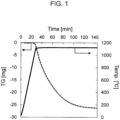
- Fig. 1 is a diagram illustrating the part of the TG curve of common coke which is obtained when, in a CO 2 atmosphere, the coke is heated from room temperature at a heating rate of 40°C/min and held at a temperature of 1120°C for two hours. First, in the heating process of heating to a temperature of 1120°C, a minute weight change is observed. This is because of a weight increase due to inorganic materials contained in the coke in an amount of about 10 mass% absorbing CO 2 and a weight decrease due to the thermal decomposition of the coke.
- the present inventors analyzed such a TG curve and found that there is a correlation between a weight decrease rate in the early stage of the reaction and the CSR value.
- a weight decrease rate in a time range from 15 minutes to 25 minutes from the start of holding at the holding temperature in the predetermined temperature range, in which the thermal decomposition of carbon is recognized on the TG curve, it is possible to use the analysis value as the index of the CSR value.
- thermogravimetry (TG) apparatus As an apparatus in which a coke sample is subjected to a thermal decomposition reaction test, a thermogravimetry (TG) apparatus is used. Since the TG apparatus is excellent in terms of atmosphere control and temperature responsivity, it is possible to rapidly measure a weight decrease rate due to the gasification reaction of coke in a CO 2 atmosphere.
- a measurement atmosphere (of the holding process described below) is set to be a carbon dioxide (CO 2 ) atmosphere to simulate the interior of a blast furnace.
- CO 2 carbon dioxide
- This is the same environment as that used for the CSR analysis prescribed by ASTM and ISO.
- the CSR analysis there may be a case where heating is performed in a nitrogen atmosphere.
- the atmosphere in which heating is performed in the CSR analysis is set to be an inert gas atmosphere (of N 2 , Ar, He, or the like) and/or a CO 2 atmosphere.
- ground coke is used. It is preferable that such coke be uniformly and finely powdered. In the case where the coke is not sufficiently ground, there is a risk that it is not possible to correctly measure the weight decrease rate due to variations in the distributions of the pores and inorganic materials in the coke. It is preferable that the particle size of the ground coke be 500 um or less or more preferably 200 um or less. The particle size of the ground coke may be adjusted by, for example, sieving the coke by using a sieve having a predetermined sieve opening.
- the amount of coke used in the present invention may be adjusted in accordance with the capacity of the TG apparatus. To realize uniform heating, it is preferable that the above-mentioned amount of coke be 20 mg to 40 mg.
- the coke is heated to a predetermined temperature range in an inert gas atmosphere (of N 2 , Ar, He, or the like) and/or a CO 2 atmosphere (heating process). That is, in the heating process, the coke is heated to a predetermined temperature range in any one of an inert gas atmosphere, a CO 2 (CO 2 gas) atmosphere, and an atmosphere of a mixture of an inert gas and CO 2 .
- the atmosphere gas be fed into the TG apparatus at a flow rate of 200 mL/min or higher. In the case where the flow rate is lower than this, since the amount of gas fed is insufficient in relation to the amount of coke, there is a risk that it is not possible to correctly analyze the weight decrease rate due to a reaction.
- the holding process is performed in a CO 2 atmosphere.
- the atmosphere gas is switched to CO 2 gas at the same time as the transition to the holding process.
- the predetermined temperature range described above be 900°C or higher and 1150°C or lower. It is more preferable that the predetermined temperature range described above be 950°C or higher. It is more preferable that the predetermined temperature range described above be 1125°C or lower. In the case where the temperature range described above is lower than 900°C, since the weight decrease rate is low, it is difficult to recognize the difference between the samples.
- the heating rate to the temperature range described above may be appropriately adjusted in accordance with the capacity of the TG apparatus, it is preferable that the heating rate be 20°C/min or higher and 150°C/min or lower. In the case where the heating rate is lower than 20°C/min, since a long time is required for the temperature range described above to be reached, there is a decrease in the contribution to a method for rapid analysis.
- room temperature is, for example, 25°C.
- the weight decrease rate of the coke after having been held at the holding temperature (soaking temperature) in a predetermined temperature range for a predetermined time is determined by using a thermogravimetry method.
- coke strength after reaction is estimated from the determined weight decrease rate.
- the predetermined time described above be 15 minutes or more and 25 minutes or less, which is sufficient for a sample (coke) charged into a TG apparatus to react. More in detail, it is preferable that the predetermined time be 15 minutes or more and 25 minutes or less after holding at the holding temperature in a predetermined temperature range has been started in the holding process. In the case where the predetermined time is less than 15 minutes, since the thermal decomposition of inorganic materials and the like are included in the decomposition reaction, there is a risk that an analysis error occurs. In addition, in the case where the predetermined time is more than 25 minutes, since the decomposition reaction of coke progresses sufficiently, the weight decrease rate is low. Therefore, since it is difficult to recognize the difference in the weight decrease rate, there is a risk that an analysis error occurs.
- the weight decrease rate is defined as the amount of weight decrease (the amount of decrease in weight) per unit time of the sample (coke) when the sample is held at the holding temperature in the predetermined temperature range for the predetermined time. It is preferable that the weight decrease rate be defined as the amount of weight (mg) decrease per unit time (min) of the sample (coke) when the sample is held at the holding temperature in the predetermined temperature range for 15 minutes or more and 25 minutes or less.
- the weight decrease rate be defined as the amount of weight (mg) decrease per unit time (min) of the sample (coke) when the sample is held at the holding temperature in the predetermined temperature range in a period from when 15 minutes has elapsed until 25 minutes has elapsed after holding at the holding temperature in the predetermined temperature range has been started in the holding process [(amount of change (decrease) in weight (mg))/(10 (min)) of the coke when the coke is held at the holding temperature in the predetermined temperature range in a period from when 15 minutes has elapsed until 25 minutes has elapsed after holding at the holding temperature in the predetermined temperature range has been started].
- the weight decrease rate of the coke defined as described above has a high correlation with the CSR value. That is, in the case where the weight decrease rate is low, since the decomposition reaction of coke does not occur, the CSR value is high because the coke strength is maintained. In addition, by utilizing such a correlation, it is possible to estimate the CSR value of the coke from the weight decrease rate obtained by using a thermogravimetry method.
- the modification of the conditions applied for manufacturing coke in accordance with the coke strength after reaction corresponds to the "method for manufacturing coke" according to the present invention.
- the modification of conditions applied for manufacturing coke includes the modification of the coal blending ratios in accordance with the coke strength after reaction.
- a sample was prepared by weighing out 20 g of each kind of coke, and the whole volume of the sample was ground and sieved so as to have a particle size of 150 um or less. After the sieved sample had been subjected to air drying, a specimen was prepared by weighing out 30 mg of the dried sample.
- a TG apparatus Thermo Plus 2 TG8120 produced by RIGAKU Corporation was used. The prepared specimen was packed in a container made of platinum, which was attached to the apparatus, and charged into the apparatus. The atmosphere gas was CO 2 , and the gas flow rate was 300 mL/min.
- the specimen was heated from room temperature to a temperature of 1100°C at a heating rate of 40°C/min, held at a temperature of 1100°C for 30 minutes, and then naturally cooled to room temperature.
- a weight decrease rate in periods of 5 minutes (10 minutes in total) before and after the time when 20 minutes had elapsed after heating to a temperature of 1100°C had been completed and holding at a temperature of 1100°C had been started was determined.
- Fig. 2 The relationship between the weight decrease rate obtained as described above and the CSR value obtained by using a method in accordance with the ASTM standard is illustrated in Fig. 2 . It is clarified that there is a high correlation between the two. That is, it is possible to estimate the CSR value from the weight decrease rate determined from the TG as described above. While it may take half a day or more or about 24 hours in some cases in total in the case of the method prescribed by ASTM, that is the conventional method, it is possible to estimate the CSR value in about 3 hours in the case of the method for estimating coke strength after reaction according to the present invention.
Landscapes
- Chemical & Material Sciences (AREA)
- Health & Medical Sciences (AREA)
- Life Sciences & Earth Sciences (AREA)
- Immunology (AREA)
- Engineering & Computer Science (AREA)
- Biochemistry (AREA)
- General Health & Medical Sciences (AREA)
- General Physics & Mathematics (AREA)
- Physics & Mathematics (AREA)
- Pathology (AREA)
- Analytical Chemistry (AREA)
- Food Science & Technology (AREA)
- Medicinal Chemistry (AREA)
- Materials Engineering (AREA)
- Oil, Petroleum & Natural Gas (AREA)
- Organic Chemistry (AREA)
- Coke Industry (AREA)
- Investigating Or Analyzing Materials Using Thermal Means (AREA)
Abstract
Description
- The present invention relates to a method for rapidly estimating coke strength after reaction and a method for manufacturing coke utilizing such an estimation method.
- When pig iron is manufactured by using a blast furnace, coke is an indispensable material as a reducing agent for iron ore. The primary reason for this is because coke, which is porous, has gas permeability such that a gas blown from the lower part of the blast furnace passes through the coke to the upper part of the blast furnace.
- To ensure sufficient gas permeability, coke is required to have strength sufficient to suppress fracturing from occurring in the coke in a blast furnace. Usually, coke strength is often represented by a value such as rotating drum strength or the like which is obtained by performing a test in air at room temperature. However, since the interior of a blast furnace is in a high-temperature environment whose temperature is higher than 1000°C and which contains a gas such as carbon dioxide that is reactive with coke, the coke strength obtained on the basis of the results of the conventional test described above does not always correspond to the coke strength in the environment in a blast furnace.
- As an index for accurately estimating the coke strength in a blast furnace, coke strength after CO2 reaction (CSR) is proposed, and the blast furnace is operated on the basis of the CSR value. The analysis procedures of the CSR value are prescribed in ISO 18894 and ASTM D 5341. For example, in the case of the method prescribed by ASTM, after coke having a constant particle size has been held in a carbon dioxide atmosphere at a temperature of 1100°C for two hours, the coke is subjected to a rotating test utilizing an I-type drum tester, and the CSR value is defined as a lump residual ratio after a rotation number of 600. Usually, the lower limit of the CSR value is set, and daily operations are often performed while the CSR value is controlled not to be lower than the lower limit.
- The most important issue regarding the CSR analysis described above is the time required. Although the prescribed reaction time between coke and CO2 is two hours, since a large furnace is used, a long time is required for heating and cooling processes. Moreover, in the case where the time required for a series of operations such as sample preparation, evaluation based on rotating test after heating test, and the like is additive, the total time required may be almost one day. Even in the case where coke is subjected to the CSR analysis immediately after having been discharged from a coke oven, the coke is usually charged into a blast furnace before the analysis value is obtained. Therefore, since it is not possible to give an immediate response when an abnormal value is observed, there are potential risks of a delay in a corrective action and unstable blast furnace operation. Therefore, there is a demand for a method for rapidly evaluating the CSR value.
- Regarding a method for rapidly evaluating the CSR value, various investigations have been conducted on the basis of methods for estimating the CSR value from the results of other analyses. In Patent Literature 1, by using Raman spectroscopy, an attempt is made to estimate the CSR value by utilizing the intensity ratio of a certain peak. Patent Literature 2 proposes a method for estimating the CSR value from the abundance ratios of inorganic constituents in coal.
- In addition, investigations have also been conducted regarding a method for utilizing a coke reaction index (CRI), which has a high correlation with the CSR value.
- Patent Literature 3 discloses a method in which the CRI value of coke made from a coal blend is determined on the basis of the weighted average of the CRI values of relevant kinds of coke made from single coal brands and in which the CSR value of the coke made from the coal blend is estimated on the basis of the determined CRI value and drum strength of the coke made from the coal blend.
- However, to establish a method synchronized with the operation, a more rapid and simpler method for estimating the CSR value is required. In addition, particularly in the case of Patent Literature 2 and Patent Literature 3, since analysis values based on coal before being subjected to coking and reference samples prepared separately are used, there is also a problem in that it is difficult to take into consideration the effect of daily variance in practical operation of a coke oven.
-
- PTL 1:
Japanese Unexamined Patent Application Publication No. 2019-163986 - PTL 2:
Japanese Unexamined Patent Application Publication No. 2001-172643 - PTL 3:
Japanese Unexamined Patent Application Publication No. 2005-232350 - The present invention has been completed in view of the problem described above, and an object of the present invention is to provide a method for rapidly estimating coke strength after reaction.
- The present inventors diligently conducted investigations and, as a result, completed the present invention by focusing on the weight decrease rate of coke in the early stage of the reaction when the coke is analyzed by using a thermogravimetry (TG) method in a CO2 atmosphere. The subject matter of the present invention is as follows.
- [1] A method for estimating coke strength after reaction, the method including:
- a heating process of heating ground coke to a predetermined temperature range in an inert gas atmosphere and/or in a CO2 atmosphere;
- a holding process of holding the heated coke in a CO2 atmosphere at a holding temperature in the predetermined temperature range; and
- a process of determining a weight decrease rate of the coke after having been held at the holding temperature for a predetermined time by using a thermogravimetry method and of estimating coke strength after reaction from the weight decrease rate.
- [2] The method for estimating coke strength after reaction according to item [1], in which, in the heating process, the coke is heated to a temperature range of 900°C or higher and 1150°C or lower at a heating rate of 20°C/min or higher and 150°C/min or lower.
- [3] The method for estimating coke strength after reaction according to item [1] or [2], in which the predetermined time is 15 minutes or more and 25 minutes or less.
- [4] A method for manufacturing coke, the method including estimating coke strength after reaction by using the method for estimating coke strength after reaction according to any one of items [1] to [3] and modifying conditions applied for manufacturing coke in accordance with the estimated coke strength after reaction.
- [5] The method for manufacturing coke according to item [4], in which the modified conditions include coal blending ratios.
- According to the present invention, it is possible to rapidly estimate coke strength after reaction (CSR) on the basis of the weight decrease rate of coke obtained by using a thermogravimetry (TG) method. Therefore, it is possible to expect to contribute to stabilizing blast furnace operation and a coal blending plan for manufacturing coke.
-
- [
Fig. 1] Fig. 1 is a diagram illustrating the part of the TG curve of common coke which is obtained when, in a CO2 atmosphere, the coke is heated from room temperature at a heating rate of 40°C/min and held at a temperature of 1120°C for two hours. - [
Fig. 2] Fig. 2 is a graph illustrating the relationship between the CSR value obtained by using a method in accordance with the ASTM standard and the weight decrease rate obtained by using the present invention. Description of Embodiments -
Fig. 1 is a diagram illustrating the part of the TG curve of common coke which is obtained when, in a CO2 atmosphere, the coke is heated from room temperature at a heating rate of 40°C/min and held at a temperature of 1120°C for two hours. First, in the heating process of heating to a temperature of 1120°C, a minute weight change is observed. This is because of a weight increase due to inorganic materials contained in the coke in an amount of about 10 mass% absorbing CO2 and a weight decrease due to the thermal decomposition of the coke. - In a range in which the holding temperature (1120°C in
Fig. 1 ) is almost reached and holding is started, a sharp weight decrease starts. This is mainly because of a gasification reaction in which carbon reacts with CO2 to form CO. That is, carbon which makes up the skeleton of coke is decomposed. Due to this, it is easy to assume that there is also a decrease in strength. Therefore, it is considered that such a range is a factor having an effect on the CSR value. - The present inventors analyzed such a TG curve and found that there is a correlation between a weight decrease rate in the early stage of the reaction and the CSR value. In particular, it was found that, by utilizing and analyzing a weight decrease rate in a time range from 15 minutes to 25 minutes from the start of holding at the holding temperature in the predetermined temperature range, in which the thermal decomposition of carbon is recognized on the TG curve, it is possible to use the analysis value as the index of the CSR value.
- Hereafter, the specific embodiments of the present invention will be described. However, the present invention is not limited to the embodiments described below.
- In the present invention, as an apparatus in which a coke sample is subjected to a thermal decomposition reaction test, a thermogravimetry (TG) apparatus is used. Since the TG apparatus is excellent in terms of atmosphere control and temperature responsivity, it is possible to rapidly measure a weight decrease rate due to the gasification reaction of coke in a CO2 atmosphere.
- A measurement atmosphere (of the holding process described below) is set to be a carbon dioxide (CO2) atmosphere to simulate the interior of a blast furnace. This is the same environment as that used for the CSR analysis prescribed by ASTM and ISO. Here, in the CSR analysis, there may be a case where heating is performed in a nitrogen atmosphere. However, in the present invention, since it is confirmed that a difference in the atmosphere in which heating is performed in the CSR analysis causes only a small disturbance within an acceptable margin of error, the atmosphere in which heating is performed in the CSR analysis is set to be an inert gas atmosphere (of N2, Ar, He, or the like) and/or a CO2 atmosphere.
- In the present invention, ground coke is used. It is preferable that such coke be uniformly and finely powdered. In the case where the coke is not sufficiently ground, there is a risk that it is not possible to correctly measure the weight decrease rate due to variations in the distributions of the pores and inorganic materials in the coke. It is preferable that the particle size of the ground coke be 500 um or less or more preferably 200 um or less. The particle size of the ground coke may be adjusted by, for example, sieving the coke by using a sieve having a predetermined sieve opening.
- The amount of coke used in the present invention may be adjusted in accordance with the capacity of the TG apparatus. To realize uniform heating, it is preferable that the above-mentioned amount of coke be 20 mg to 40 mg.
- In the TG apparatus, the coke is heated to a predetermined temperature range in an inert gas atmosphere (of N2, Ar, He, or the like) and/or a CO2 atmosphere (heating process). That is, in the heating process, the coke is heated to a predetermined temperature range in any one of an inert gas atmosphere, a CO2 (CO2 gas) atmosphere, and an atmosphere of a mixture of an inert gas and CO2. Here, in the heating process and the holding process described below, it is preferable that the atmosphere gas be fed into the TG apparatus at a flow rate of 200 mL/min or higher. In the case where the flow rate is lower than this, since the amount of gas fed is insufficient in relation to the amount of coke, there is a risk that it is not possible to correctly analyze the weight decrease rate due to a reaction.
- Subsequently, holding is performed at a holding temperature (soaking temperature) in a predetermined temperature range (holding process). The holding process is performed in a CO2 atmosphere. In the case where a gas which is different from CO2 is used in the heating process described above, the atmosphere gas is switched to CO2 gas at the same time as the transition to the holding process. It is preferable that the predetermined temperature range described above be 900°C or higher and 1150°C or lower. It is more preferable that the predetermined temperature range described above be 950°C or higher. It is more preferable that the predetermined temperature range described above be 1125°C or lower. In the case where the temperature range described above is lower than 900°C, since the weight decrease rate is low, it is difficult to recognize the difference between the samples. In addition, in the case where the temperature range described above is higher than 1150°C, since a decomposition reaction sharply progresses, there is a risk that an analysis error occurs. Although the heating rate to the temperature range described above (heating rate from room temperature to the temperature range described above) may be appropriately adjusted in accordance with the capacity of the TG apparatus, it is preferable that the heating rate be 20°C/min or higher and 150°C/min or lower. In the case where the heating rate is lower than 20°C/min, since a long time is required for the temperature range described above to be reached, there is a decrease in the contribution to a method for rapid analysis. On the other hand, in the case where the heating rate is higher than 150°C/min, since the portion of the TG curve corresponding to the decomposition reaction of inorganic materials, which occurs in a lower temperature range, and the portion of the TG curve corresponding to the decomposition reaction of the coke overlap each other due to the sharp temperature change, there is a risk that it is difficult to correctly determine the weight decrease rate. Here, room temperature is, for example, 25°C.
- Subsequently, the weight decrease rate of the coke after having been held at the holding temperature (soaking temperature) in a predetermined temperature range for a predetermined time is determined by using a thermogravimetry method. In addition, coke strength after reaction is estimated from the determined weight decrease rate.
- It is preferable that the predetermined time described above be 15 minutes or more and 25 minutes or less, which is sufficient for a sample (coke) charged into a TG apparatus to react. More in detail, it is preferable that the predetermined time be 15 minutes or more and 25 minutes or less after holding at the holding temperature in a predetermined temperature range has been started in the holding process. In the case where the predetermined time is less than 15 minutes, since the thermal decomposition of inorganic materials and the like are included in the decomposition reaction, there is a risk that an analysis error occurs. In addition, in the case where the predetermined time is more than 25 minutes, since the decomposition reaction of coke progresses sufficiently, the weight decrease rate is low. Therefore, since it is difficult to recognize the difference in the weight decrease rate, there is a risk that an analysis error occurs.
- In addition, the weight decrease rate is defined as the amount of weight decrease (the amount of decrease in weight) per unit time of the sample (coke) when the sample is held at the holding temperature in the predetermined temperature range for the predetermined time. It is preferable that the weight decrease rate be defined as the amount of weight (mg) decrease per unit time (min) of the sample (coke) when the sample is held at the holding temperature in the predetermined temperature range for 15 minutes or more and 25 minutes or less. It is more preferable that the weight decrease rate be defined as the amount of weight (mg) decrease per unit time (min) of the sample (coke) when the sample is held at the holding temperature in the predetermined temperature range in a period from when 15 minutes has elapsed until 25 minutes has elapsed after holding at the holding temperature in the predetermined temperature range has been started in the holding process [(amount of change (decrease) in weight (mg))/(10 (min)) of the coke when the coke is held at the holding temperature in the predetermined temperature range in a period from when 15 minutes has elapsed until 25 minutes has elapsed after holding at the holding temperature in the predetermined temperature range has been started]. The weight decrease rate of the coke defined as described above has a high correlation with the CSR value. That is, in the case where the weight decrease rate is low, since the decomposition reaction of coke does not occur, the CSR value is high because the coke strength is maintained. In addition, by utilizing such a correlation, it is possible to estimate the CSR value of the coke from the weight decrease rate obtained by using a thermogravimetry method. Specifically, for example, by determining in advance the correlation between the weight decrease rate obtained by using a thermogravimetry method and the CSR value obtained by using a method in accordance with the prescription by ASTM regarding plural kinds of coke, and by determining, by using a thermogravimetry method, the weight decrease rate of target coke, whose CSR value is to be estimated, it is possible to estimate the CSR value of the target coke from the determined weight decrease rate and the correlation determined in advance.
- In the method for estimating coke strength after reaction according to the present invention, by utilizing the weight decrease rate of coke when the coke is held at the holding temperature in the predetermined temperature range for the predetermined time, it is possible to estimate the CSR value within about two to three hours. Therefore, it is also possible to assess the CSR value in real time during coke oven operation.
- In a practical application, in the case where the estimated coke strength after reaction is out of the operationally acceptable range of coke strength after reaction, it is possible to stop feeding the coke into a blast furnace without delay, which results in stable blast furnace operation. In addition, since it is also possible to efficiently control the coal blending ratios of coke by, for example, modifying coal blending ratios in accordance with the estimated coke strength after reaction, it is also possible to optimize the coal blending ratios. In addition, since it is also possible to modify conditions applied for manufacturing coke without delay in accordance with the modified coal blending ratios, it is possible to improve the quality of coke and to stabilize blast furnace operation. Here, the modification of the conditions applied for manufacturing coke in accordance with the coke strength after reaction corresponds to the "method for manufacturing coke" according to the present invention. In addition, the modification of conditions applied for manufacturing coke includes the modification of the coal blending ratios in accordance with the coke strength after reaction.
- Hereafter, the present invention will be described in accordance with examples. However, the present invention is not limited to the examples below.
- 13 kinds of coke (Nos. 1 to 13) given in Table 1 were prepared. The CSR value of each kind of coke was calculated by using the method prescribed by ASTM. The results are given in Table 1. Here, the drum strength index DI of each kind of coke is also given in Table 1 for reference.
- Separately, a sample was prepared by weighing out 20 g of each kind of coke, and the whole volume of the sample was ground and sieved so as to have a particle size of 150 um or less. After the sieved sample had been subjected to air drying, a specimen was prepared by weighing out 30 mg of the dried sample. As a TG apparatus, Thermo Plus 2 TG8120 produced by RIGAKU Corporation was used. The prepared specimen was packed in a container made of platinum, which was attached to the apparatus, and charged into the apparatus. The atmosphere gas was CO2, and the gas flow rate was 300 mL/min. After the apparatus had been stabilized, the specimen was heated from room temperature to a temperature of 1100°C at a heating rate of 40°C/min, held at a temperature of 1100°C for 30 minutes, and then naturally cooled to room temperature. With reference to the TG curve obtained by the TG measurement, a weight decrease rate in periods of 5 minutes (10 minutes in total) before and after the time when 20 minutes had elapsed after heating to a temperature of 1100°C had been completed and holding at a temperature of 1100°C had been started was determined. That is, the amount of coke weight decrease per unit time in a period from when 15 minutes had elapsed until 25 minutes had elapsed after holding at a temperature of 1100°C had been started [(difference (mg) between the amount of weight decrease after 15 minutes had elapsed and the amount of weight decrease after 25 minutes had elapsed)/10 (min)] was determined.
[Table 1] No. DI CSR 1 85.4 60.1 2 85.7 60.9 3 86.1 58.8 4 86 56.4 5 85.4 62.1 6 85.8 65.9 7 85.8 63.7 8 85.9 64.3 9 86 67.7 10 85.4 68.9 11 85.5 66.2 12 86.4 66.2 13 85.7 63.6 - The relationship between the weight decrease rate obtained as described above and the CSR value obtained by using a method in accordance with the ASTM standard is illustrated in
Fig. 2 . It is clarified that there is a high correlation between the two. That is, it is possible to estimate the CSR value from the weight decrease rate determined from the TG as described above. While it may take half a day or more or about 24 hours in some cases in total in the case of the method prescribed by ASTM, that is the conventional method, it is possible to estimate the CSR value in about 3 hours in the case of the method for estimating coke strength after reaction according to the present invention.
Claims (5)
- A method for estimating coke strength after reaction, the method comprising:a heating process of heating ground coke to a predetermined temperature range in an inert gas atmosphere and/or in a CO2 atmosphere;a holding process of holding the heated coke in a CO2 atmosphere at a holding temperature in the predetermined temperature range; anda process of determining a weight decrease rate of the coke after having been held at the holding temperature for a predetermined time by using a thermogravimetry method and of estimating coke strength after reaction from the weight decrease rate.
- The method for estimating coke strength after reaction according to Claim 1, wherein, in the heating process, the coke is heated to a temperature range of 900°C or higher and 1150°C or lower at a heating rate of 20°C/min or higher and 150°C/min or lower.
- The method for estimating coke strength after reaction according to Claim 1 or 2, wherein the predetermined time is 15 minutes or more and 25 minutes or less.
- A method for manufacturing coke, the method comprising estimating coke strength after reaction by using the method for estimating coke strength after reaction according to any one of Claims 1 to 3 and modifying conditions applied for manufacturing coke in accordance with the estimated coke strength after reaction.
- The method for manufacturing coke according to Claim 4, wherein the modified conditions include coal blending ratios.
Applications Claiming Priority (2)
| Application Number | Priority Date | Filing Date | Title |
|---|---|---|---|
| JP2021179413 | 2021-11-02 | ||
| PCT/JP2022/034153 WO2023079837A1 (en) | 2021-11-02 | 2022-09-13 | Method for estimating post-reaction strength of coke and method for producing coke |
Publications (3)
| Publication Number | Publication Date |
|---|---|
| EP4400562A1 true EP4400562A1 (en) | 2024-07-17 |
| EP4400562A4 EP4400562A4 (en) | 2024-12-25 |
| EP4400562B1 EP4400562B1 (en) | 2025-11-05 |
Family
ID=85252033
Family Applications (1)
| Application Number | Title | Priority Date | Filing Date |
|---|---|---|---|
| EP22889661.9A Active EP4400562B1 (en) | 2021-11-02 | 2022-09-13 | Method for estimating coke strength after reaction and method for manufacturing coke |
Country Status (4)
| Country | Link |
|---|---|
| EP (1) | EP4400562B1 (en) |
| JP (1) | JP7226676B1 (en) |
| AU (1) | AU2022380036B2 (en) |
| CA (1) | CA3231627A1 (en) |
Family Cites Families (5)
| Publication number | Priority date | Publication date | Assignee | Title |
|---|---|---|---|---|
| US4643977A (en) * | 1985-03-11 | 1987-02-17 | Coal Industry (Patents) Limited | Process for assessing coke micro-reactivity |
| JP5772277B2 (en) * | 2011-06-21 | 2015-09-02 | 新日鐵住金株式会社 | Coke hot reaction strength estimation method |
| JP6436565B2 (en) * | 2014-10-10 | 2018-12-12 | 国立研究開発法人産業技術総合研究所 | Estimation method of strength after hot reaction of coke. |
| CN106153489B (en) * | 2015-04-15 | 2018-08-14 | 华北理工大学 | The reactive test method of smelter coke |
| JP7180544B2 (en) * | 2019-06-06 | 2022-11-30 | 日本製鉄株式会社 | Method for estimating post-hot reaction strength of coke and method for producing coke |
-
2022
- 2022-09-13 EP EP22889661.9A patent/EP4400562B1/en active Active
- 2022-09-13 JP JP2022569488A patent/JP7226676B1/en active Active
- 2022-09-13 AU AU2022380036A patent/AU2022380036B2/en active Active
- 2022-09-13 CA CA3231627A patent/CA3231627A1/en active Pending
Also Published As
| Publication number | Publication date |
|---|---|
| JP7226676B1 (en) | 2023-02-21 |
| JPWO2023079837A1 (en) | 2023-05-11 |
| CA3231627A1 (en) | 2023-05-11 |
| AU2022380036A1 (en) | 2024-04-04 |
| EP4400562B1 (en) | 2025-11-05 |
| AU2022380036B2 (en) | 2025-08-28 |
| EP4400562A4 (en) | 2024-12-25 |
Similar Documents
| Publication | Publication Date | Title |
|---|---|---|
| EP4407304A1 (en) | Method for creating coke strength after reaction estimation model, method for estimating coke strength after reaction, and coke production method | |
| EP2767574B1 (en) | Method for manufacturing coke | |
| EP2832822A1 (en) | Coal blending method for coke production, production method for coke | |
| CN107271312A (en) | A kind of method that stem content in pipe tobacco is determined based on thermoanalysis technology | |
| CN108931549B (en) | Coking coal coking performance detection method | |
| CN110441187B (en) | Tobacco component detection method and blending uniformity discrimination method | |
| EP3124574B1 (en) | Method for producing coal mixture and method for producing coke | |
| EP3936586B1 (en) | Evaluation method for coal, preparation method for blended coal, and production method for coke | |
| EP4400562B1 (en) | Method for estimating coke strength after reaction and method for manufacturing coke | |
| CN109580326A (en) | The measuring method of zinc oxide and alkali metal in a kind of dedusting ash | |
| JP2019163986A (en) | Coke analysis method | |
| CN113962152B (en) | Calculation Method of Reactivity and Post-Reaction Strength of Alkali-Rich Coke in High-Titanium Blast Furnace | |
| KR101246502B1 (en) | Measuring method of free-carbon content which is contained in mixed raw material | |
| CN107024398A (en) | The assay method and evaluation method of hot strength of coke index based on different coal ejection ratios | |
| WO2023079837A1 (en) | Method for estimating post-reaction strength of coke and method for producing coke | |
| JP2026022062A (en) | Evaluation method for post-reaction strength of highly reactive coke | |
| EP4663718A1 (en) | Method for estimating blended coal coke strength after reaction, method for producing blended coal coke, method for operating coke oven, and method for controlling single coal blending ratio | |
| CN105571913A (en) | Preparation method of novel mixed iron powder chemical analysis sample | |
| EP4332199A1 (en) | Method for generating post-reaction coke strength inference model, method for inferring post-reaction strength of coke, and method for producing coke | |
| TWI902308B (en) | Method and device for evaluating softening and melting behavior | |
| KR102786630B1 (en) | Method for evaluating the quality of raw materials | |
| CN115684256B (en) | Method for detecting content of cut stems in cut tobacco based on activation energy | |
| CN109612959A (en) | Carbon, test methods of sulphur contents in reduced iron powder in a kind of iron-calcium core-spun yarn | |
| CN117191625A (en) | A method for detecting dry quenching coke burning rate | |
| CN108318367A (en) | In a kind of MOX pellets oxygen metallic atom than analysis method |
Legal Events
| Date | Code | Title | Description |
|---|---|---|---|
| STAA | Information on the status of an ep patent application or granted ep patent |
Free format text: STATUS: THE INTERNATIONAL PUBLICATION HAS BEEN MADE |
|
| PUAI | Public reference made under article 153(3) epc to a published international application that has entered the european phase |
Free format text: ORIGINAL CODE: 0009012 |
|
| STAA | Information on the status of an ep patent application or granted ep patent |
Free format text: STATUS: REQUEST FOR EXAMINATION WAS MADE |
|
| 17P | Request for examination filed |
Effective date: 20240408 |
|
| AK | Designated contracting states |
Kind code of ref document: A1 Designated state(s): AL AT BE BG CH CY CZ DE DK EE ES FI FR GB GR HR HU IE IS IT LI LT LU LV MC MK MT NL NO PL PT RO RS SE SI SK SM TR |
|
| A4 | Supplementary search report drawn up and despatched |
Effective date: 20241126 |
|
| RIC1 | Information provided on ipc code assigned before grant |
Ipc: G01N 5/04 20060101ALI20241120BHEP Ipc: G01N 33/22 20060101ALI20241120BHEP Ipc: C10B 57/04 20060101ALI20241120BHEP Ipc: C10B 57/00 20060101AFI20241120BHEP |
|
| DAV | Request for validation of the european patent (deleted) | ||
| DAX | Request for extension of the european patent (deleted) | ||
| GRAP | Despatch of communication of intention to grant a patent |
Free format text: ORIGINAL CODE: EPIDOSNIGR1 |
|
| STAA | Information on the status of an ep patent application or granted ep patent |
Free format text: STATUS: GRANT OF PATENT IS INTENDED |
|
| INTG | Intention to grant announced |
Effective date: 20250611 |
|
| GRAS | Grant fee paid |
Free format text: ORIGINAL CODE: EPIDOSNIGR3 |
|
| GRAA | (expected) grant |
Free format text: ORIGINAL CODE: 0009210 |
|
| STAA | Information on the status of an ep patent application or granted ep patent |
Free format text: STATUS: THE PATENT HAS BEEN GRANTED |
|
| AK | Designated contracting states |
Kind code of ref document: B1 Designated state(s): AL AT BE BG CH CY CZ DE DK EE ES FI FR GB GR HR HU IE IS IT LI LT LU LV MC MK MT NL NO PL PT RO RS SE SI SK SM TR |
|
| REG | Reference to a national code |
Ref country code: CH Ref legal event code: F10 Free format text: ST27 STATUS EVENT CODE: U-0-0-F10-F00 (AS PROVIDED BY THE NATIONAL OFFICE) Effective date: 20251105 Ref country code: GB Ref legal event code: FG4D |
|
| REG | Reference to a national code |
Ref country code: DE Ref legal event code: R096 Ref document number: 602022024671 Country of ref document: DE |
|
| REG | Reference to a national code |
Ref country code: IE Ref legal event code: FG4D |
|
| REG | Reference to a national code |
Ref country code: NL Ref legal event code: MP Effective date: 20251105 |
|
| PG25 | Lapsed in a contracting state [announced via postgrant information from national office to epo] |
Ref country code: ES Free format text: LAPSE BECAUSE OF FAILURE TO SUBMIT A TRANSLATION OF THE DESCRIPTION OR TO PAY THE FEE WITHIN THE PRESCRIBED TIME-LIMIT Effective date: 20251105 |
|
| REG | Reference to a national code |
Ref country code: LT Ref legal event code: MG9D |
|
| PG25 | Lapsed in a contracting state [announced via postgrant information from national office to epo] |
Ref country code: NO Free format text: LAPSE BECAUSE OF FAILURE TO SUBMIT A TRANSLATION OF THE DESCRIPTION OR TO PAY THE FEE WITHIN THE PRESCRIBED TIME-LIMIT Effective date: 20260205 |
|
| PG25 | Lapsed in a contracting state [announced via postgrant information from national office to epo] |
Ref country code: HR Free format text: LAPSE BECAUSE OF FAILURE TO SUBMIT A TRANSLATION OF THE DESCRIPTION OR TO PAY THE FEE WITHIN THE PRESCRIBED TIME-LIMIT Effective date: 20251105 Ref country code: FI Free format text: LAPSE BECAUSE OF FAILURE TO SUBMIT A TRANSLATION OF THE DESCRIPTION OR TO PAY THE FEE WITHIN THE PRESCRIBED TIME-LIMIT Effective date: 20251105 Ref country code: AT Free format text: LAPSE BECAUSE OF FAILURE TO SUBMIT A TRANSLATION OF THE DESCRIPTION OR TO PAY THE FEE WITHIN THE PRESCRIBED TIME-LIMIT Effective date: 20251105 |
|
| REG | Reference to a national code |
Ref country code: AT Ref legal event code: MK05 Ref document number: 1854355 Country of ref document: AT Kind code of ref document: T Effective date: 20251105 |
|
| PG25 | Lapsed in a contracting state [announced via postgrant information from national office to epo] |
Ref country code: NL Free format text: LAPSE BECAUSE OF FAILURE TO SUBMIT A TRANSLATION OF THE DESCRIPTION OR TO PAY THE FEE WITHIN THE PRESCRIBED TIME-LIMIT Effective date: 20251105 |
|
| PG25 | Lapsed in a contracting state [announced via postgrant information from national office to epo] |
Ref country code: RS Free format text: LAPSE BECAUSE OF FAILURE TO SUBMIT A TRANSLATION OF THE DESCRIPTION OR TO PAY THE FEE WITHIN THE PRESCRIBED TIME-LIMIT Effective date: 20260205 |
|
| PG25 | Lapsed in a contracting state [announced via postgrant information from national office to epo] |
Ref country code: IS Free format text: LAPSE BECAUSE OF FAILURE TO SUBMIT A TRANSLATION OF THE DESCRIPTION OR TO PAY THE FEE WITHIN THE PRESCRIBED TIME-LIMIT Effective date: 20260305 |
|
| PG25 | Lapsed in a contracting state [announced via postgrant information from national office to epo] |
Ref country code: PT Free format text: LAPSE BECAUSE OF FAILURE TO SUBMIT A TRANSLATION OF THE DESCRIPTION OR TO PAY THE FEE WITHIN THE PRESCRIBED TIME-LIMIT Effective date: 20260305 |
|
| PG25 | Lapsed in a contracting state [announced via postgrant information from national office to epo] |
Ref country code: PL Free format text: LAPSE BECAUSE OF FAILURE TO SUBMIT A TRANSLATION OF THE DESCRIPTION OR TO PAY THE FEE WITHIN THE PRESCRIBED TIME-LIMIT Effective date: 20251105 |
|
| PG25 | Lapsed in a contracting state [announced via postgrant information from national office to epo] |
Ref country code: LV Free format text: LAPSE BECAUSE OF FAILURE TO SUBMIT A TRANSLATION OF THE DESCRIPTION OR TO PAY THE FEE WITHIN THE PRESCRIBED TIME-LIMIT Effective date: 20251105 |
|
| PG25 | Lapsed in a contracting state [announced via postgrant information from national office to epo] |
Ref country code: BG Free format text: LAPSE BECAUSE OF FAILURE TO SUBMIT A TRANSLATION OF THE DESCRIPTION OR TO PAY THE FEE WITHIN THE PRESCRIBED TIME-LIMIT Effective date: 20251105 |