EP4400211A1 - Fabrication method of platinum/granular activated carbon catalyst for ambient temperature catalytic oxidation of co and h2, said catalyst and its use in trace contaminant control - Google Patents
Fabrication method of platinum/granular activated carbon catalyst for ambient temperature catalytic oxidation of co and h2, said catalyst and its use in trace contaminant control Download PDFInfo
- Publication number
- EP4400211A1 EP4400211A1 EP23211255.7A EP23211255A EP4400211A1 EP 4400211 A1 EP4400211 A1 EP 4400211A1 EP 23211255 A EP23211255 A EP 23211255A EP 4400211 A1 EP4400211 A1 EP 4400211A1
- Authority
- EP
- European Patent Office
- Prior art keywords
- activated carbon
- granular activated
- carbon material
- mesh
- catalyst composition
- Prior art date
- Legal status (The legal status is an assumption and is not a legal conclusion. Google has not performed a legal analysis and makes no representation as to the accuracy of the status listed.)
- Withdrawn
Links
Images


Classifications
-
- B—PERFORMING OPERATIONS; TRANSPORTING
- B01—PHYSICAL OR CHEMICAL PROCESSES OR APPARATUS IN GENERAL
- B01D—SEPARATION
- B01D53/00—Separation of gases or vapours; Recovering vapours of volatile solvents from gases; Chemical or biological purification of waste gases, e.g. engine exhaust gases, smoke, fumes, flue gases, aerosols
- B01D53/34—Chemical or biological purification of waste gases
- B01D53/74—General processes for purification of waste gases; Apparatus or devices specially adapted therefor
- B01D53/86—Catalytic processes
- B01D53/864—Removing carbon monoxide or hydrocarbons
-
- B—PERFORMING OPERATIONS; TRANSPORTING
- B01—PHYSICAL OR CHEMICAL PROCESSES OR APPARATUS IN GENERAL
- B01D—SEPARATION
- B01D53/00—Separation of gases or vapours; Recovering vapours of volatile solvents from gases; Chemical or biological purification of waste gases, e.g. engine exhaust gases, smoke, fumes, flue gases, aerosols
- B01D53/34—Chemical or biological purification of waste gases
- B01D53/74—General processes for purification of waste gases; Apparatus or devices specially adapted therefor
- B01D53/86—Catalytic processes
- B01D53/8671—Removing components of defined structure not provided for in B01D53/8603 - B01D53/8668
-
- B—PERFORMING OPERATIONS; TRANSPORTING
- B01—PHYSICAL OR CHEMICAL PROCESSES OR APPARATUS IN GENERAL
- B01J—CHEMICAL OR PHYSICAL PROCESSES, e.g. CATALYSIS OR COLLOID CHEMISTRY; THEIR RELEVANT APPARATUS
- B01J21/00—Catalysts comprising the elements, oxides, or hydroxides of magnesium, boron, aluminium, carbon, silicon, titanium, zirconium, or hafnium
- B01J21/18—Carbon
-
- B—PERFORMING OPERATIONS; TRANSPORTING
- B01—PHYSICAL OR CHEMICAL PROCESSES OR APPARATUS IN GENERAL
- B01J—CHEMICAL OR PHYSICAL PROCESSES, e.g. CATALYSIS OR COLLOID CHEMISTRY; THEIR RELEVANT APPARATUS
- B01J23/00—Catalysts comprising metals or metal oxides or hydroxides, not provided for in group B01J21/00
- B01J23/38—Catalysts comprising metals or metal oxides or hydroxides, not provided for in group B01J21/00 of noble metals
- B01J23/40—Catalysts comprising metals or metal oxides or hydroxides, not provided for in group B01J21/00 of noble metals of the platinum group metals
- B01J23/42—Platinum
-
- B—PERFORMING OPERATIONS; TRANSPORTING
- B01—PHYSICAL OR CHEMICAL PROCESSES OR APPARATUS IN GENERAL
- B01J—CHEMICAL OR PHYSICAL PROCESSES, e.g. CATALYSIS OR COLLOID CHEMISTRY; THEIR RELEVANT APPARATUS
- B01J35/00—Catalysts, in general, characterised by their form or physical properties
- B01J35/30—Catalysts, in general, characterised by their form or physical properties characterised by their physical properties
- B01J35/34—Mechanical properties
- B01J35/37—Crush or impact strength
-
- B—PERFORMING OPERATIONS; TRANSPORTING
- B01—PHYSICAL OR CHEMICAL PROCESSES OR APPARATUS IN GENERAL
- B01J—CHEMICAL OR PHYSICAL PROCESSES, e.g. CATALYSIS OR COLLOID CHEMISTRY; THEIR RELEVANT APPARATUS
- B01J35/00—Catalysts, in general, characterised by their form or physical properties
- B01J35/40—Catalysts, in general, characterised by their form or physical properties characterised by dimensions, e.g. grain size
-
- B—PERFORMING OPERATIONS; TRANSPORTING
- B01—PHYSICAL OR CHEMICAL PROCESSES OR APPARATUS IN GENERAL
- B01J—CHEMICAL OR PHYSICAL PROCESSES, e.g. CATALYSIS OR COLLOID CHEMISTRY; THEIR RELEVANT APPARATUS
- B01J37/00—Processes, in general, for preparing catalysts; Processes, in general, for activation of catalysts
- B01J37/0009—Use of binding agents; Moulding; Pressing; Powdering; Granulating; Addition of materials ameliorating the mechanical properties of the product catalyst
- B01J37/0027—Powdering
- B01J37/0036—Grinding
-
- B—PERFORMING OPERATIONS; TRANSPORTING
- B01—PHYSICAL OR CHEMICAL PROCESSES OR APPARATUS IN GENERAL
- B01J—CHEMICAL OR PHYSICAL PROCESSES, e.g. CATALYSIS OR COLLOID CHEMISTRY; THEIR RELEVANT APPARATUS
- B01J37/00—Processes, in general, for preparing catalysts; Processes, in general, for activation of catalysts
- B01J37/009—Preparation by separation, e.g. by filtration, decantation, screening
-
- B—PERFORMING OPERATIONS; TRANSPORTING
- B01—PHYSICAL OR CHEMICAL PROCESSES OR APPARATUS IN GENERAL
- B01J—CHEMICAL OR PHYSICAL PROCESSES, e.g. CATALYSIS OR COLLOID CHEMISTRY; THEIR RELEVANT APPARATUS
- B01J37/00—Processes, in general, for preparing catalysts; Processes, in general, for activation of catalysts
- B01J37/02—Impregnation, coating or precipitation
- B01J37/0201—Impregnation
- B01J37/0207—Pretreatment of the support
-
- B—PERFORMING OPERATIONS; TRANSPORTING
- B01—PHYSICAL OR CHEMICAL PROCESSES OR APPARATUS IN GENERAL
- B01J—CHEMICAL OR PHYSICAL PROCESSES, e.g. CATALYSIS OR COLLOID CHEMISTRY; THEIR RELEVANT APPARATUS
- B01J37/00—Processes, in general, for preparing catalysts; Processes, in general, for activation of catalysts
- B01J37/02—Impregnation, coating or precipitation
- B01J37/0236—Drying, e.g. preparing a suspension, adding a soluble salt and drying
-
- B—PERFORMING OPERATIONS; TRANSPORTING
- B01—PHYSICAL OR CHEMICAL PROCESSES OR APPARATUS IN GENERAL
- B01J—CHEMICAL OR PHYSICAL PROCESSES, e.g. CATALYSIS OR COLLOID CHEMISTRY; THEIR RELEVANT APPARATUS
- B01J37/00—Processes, in general, for preparing catalysts; Processes, in general, for activation of catalysts
- B01J37/06—Washing
-
- B—PERFORMING OPERATIONS; TRANSPORTING
- B01—PHYSICAL OR CHEMICAL PROCESSES OR APPARATUS IN GENERAL
- B01J—CHEMICAL OR PHYSICAL PROCESSES, e.g. CATALYSIS OR COLLOID CHEMISTRY; THEIR RELEVANT APPARATUS
- B01J37/00—Processes, in general, for preparing catalysts; Processes, in general, for activation of catalysts
- B01J37/08—Heat treatment
-
- B—PERFORMING OPERATIONS; TRANSPORTING
- B01—PHYSICAL OR CHEMICAL PROCESSES OR APPARATUS IN GENERAL
- B01J—CHEMICAL OR PHYSICAL PROCESSES, e.g. CATALYSIS OR COLLOID CHEMISTRY; THEIR RELEVANT APPARATUS
- B01J37/00—Processes, in general, for preparing catalysts; Processes, in general, for activation of catalysts
- B01J37/08—Heat treatment
- B01J37/082—Decomposition and pyrolysis
- B01J37/088—Decomposition of a metal salt
-
- B—PERFORMING OPERATIONS; TRANSPORTING
- B64—AIRCRAFT; AVIATION; COSMONAUTICS
- B64G—COSMONAUTICS; VEHICLES OR EQUIPMENT THEREFOR
- B64G1/00—Cosmonautic vehicles
- B64G1/22—Parts of, or equipment specially adapted for fitting in or to, cosmonautic vehicles
- B64G1/46—Arrangements or adaptations of devices for control of environment or living conditions
- B64G1/48—Arrangements or adaptations of devices for control of environment or living conditions for treatment of the atmosphere
-
- C—CHEMISTRY; METALLURGY
- C01—INORGANIC CHEMISTRY
- C01B—NON-METALLIC ELEMENTS; COMPOUNDS THEREOF; METALLOIDS OR COMPOUNDS THEREOF NOT COVERED BY SUBCLASS C01C
- C01B32/00—Carbon; Compounds thereof
- C01B32/30—Active carbon
- C01B32/312—Preparation
- C01B32/318—Preparation characterised by the starting materials
-
- C—CHEMISTRY; METALLURGY
- C01—INORGANIC CHEMISTRY
- C01B—NON-METALLIC ELEMENTS; COMPOUNDS THEREOF; METALLOIDS OR COMPOUNDS THEREOF NOT COVERED BY SUBCLASS C01C
- C01B32/00—Carbon; Compounds thereof
- C01B32/30—Active carbon
- C01B32/354—After-treatment
-
- C—CHEMISTRY; METALLURGY
- C01—INORGANIC CHEMISTRY
- C01B—NON-METALLIC ELEMENTS; COMPOUNDS THEREOF; METALLOIDS OR COMPOUNDS THEREOF NOT COVERED BY SUBCLASS C01C
- C01B32/00—Carbon; Compounds thereof
- C01B32/30—Active carbon
- C01B32/354—After-treatment
- C01B32/384—Granulation
-
- B—PERFORMING OPERATIONS; TRANSPORTING
- B01—PHYSICAL OR CHEMICAL PROCESSES OR APPARATUS IN GENERAL
- B01D—SEPARATION
- B01D2255/00—Catalysts
- B01D2255/10—Noble metals or compounds thereof
- B01D2255/102—Platinum group metals
- B01D2255/1021—Platinum
-
- B—PERFORMING OPERATIONS; TRANSPORTING
- B01—PHYSICAL OR CHEMICAL PROCESSES OR APPARATUS IN GENERAL
- B01D—SEPARATION
- B01D2255/00—Catalysts
- B01D2255/70—Non-metallic catalysts, additives or dopants
- B01D2255/702—Carbon
-
- B—PERFORMING OPERATIONS; TRANSPORTING
- B01—PHYSICAL OR CHEMICAL PROCESSES OR APPARATUS IN GENERAL
- B01D—SEPARATION
- B01D2255/00—Catalysts
- B01D2255/90—Physical characteristics of catalysts
- B01D2255/92—Dimensions
-
- B—PERFORMING OPERATIONS; TRANSPORTING
- B01—PHYSICAL OR CHEMICAL PROCESSES OR APPARATUS IN GENERAL
- B01D—SEPARATION
- B01D2255/00—Catalysts
- B01D2255/90—Physical characteristics of catalysts
- B01D2255/92—Dimensions
- B01D2255/9202—Linear dimensions
-
- B—PERFORMING OPERATIONS; TRANSPORTING
- B01—PHYSICAL OR CHEMICAL PROCESSES OR APPARATUS IN GENERAL
- B01D—SEPARATION
- B01D2257/00—Components to be removed
- B01D2257/10—Single element gases other than halogens
- B01D2257/108—Hydrogen
-
- B—PERFORMING OPERATIONS; TRANSPORTING
- B01—PHYSICAL OR CHEMICAL PROCESSES OR APPARATUS IN GENERAL
- B01D—SEPARATION
- B01D2257/00—Components to be removed
- B01D2257/50—Carbon oxides
- B01D2257/502—Carbon monoxide
-
- B—PERFORMING OPERATIONS; TRANSPORTING
- B01—PHYSICAL OR CHEMICAL PROCESSES OR APPARATUS IN GENERAL
- B01D—SEPARATION
- B01D2258/00—Sources of waste gases
- B01D2258/06—Polluted air
-
- B—PERFORMING OPERATIONS; TRANSPORTING
- B01—PHYSICAL OR CHEMICAL PROCESSES OR APPARATUS IN GENERAL
- B01D—SEPARATION
- B01D2259/00—Type of treatment
- B01D2259/45—Gas separation or purification devices adapted for specific applications
- B01D2259/4566—Gas separation or purification devices adapted for specific applications for use in transportation means
- B01D2259/4575—Gas separation or purification devices adapted for specific applications for use in transportation means in aeroplanes or space ships
Definitions
- the present disclosure relates to ambient temperature catalyst compositions for trace contaminant control (e.g., for environmental control assemblies for space systems) and related methods of fabrication and use.
- ambient temperature catalyst compositions for trace contaminant control are known.
- some ambient temperature catalyst compositions for trace contaminant control of environmental control systems are not efficient for carbon monoxide and hydrogen capture.
- the present disclosure provides for ambient temperature catalyst compositions for trace contaminant control (e.g., for environmental control assemblies for space systems) and related methods of fabrication and use. More particularly, the present disclosure provides for ambient temperature catalytic oxidation (ATCO) catalyst compositions for trace contaminant control with improvements to carbon monoxide and hydrogen capture, and related methods of fabrication and use.
- ATCO ambient temperature catalytic oxidation
- the present disclosure provides for a method for fabricating an ambient temperature catalytic oxidation catalyst composition including loading 4x8 US mesh granular activated carbon material into a rotating cylinder abrasimeter and subjecting the 4x8 US mesh granular activated carbon material to abrasion via the abrasimeter; screening the abraded granular activated carbon material with a 6 US mesh screen; washing the screened granular activated carbon material with water, and then drying the screened granular activated carbon material in a heating oven; further screening the dried granular activated carbon material with a 6 US mesh screen to produce a 4x6 US mesh granular activated carbon material; loading the 4x6 US mesh granular activated carbon material into a container, and adding a solution of chloroplatinic acid to the 4x6 US mesh granular activated carbon material; loading the container into a rotary evaporator, and rotating the rotary evaporator to remove water from the container; and removing the 4x6 US mesh granular activated carbon material from the container
- the granular activated carbon is coconut granular activated carbon.
- the coconut granular activated carbon is fabricated from grades of coconut shell.
- the platinum on the 4x6 US mesh granular activated carbon material catalyst composition is a 10% platinum on the 4x6 US mesh granular activated carbon material catalyst composition.
- the 4x8 US mesh granular activated carbon material is subjected to abrasion at 90 cycles per minute for about four hours.
- washing the screened granular activated carbon material includes first washing the screened granular activated carbon material with tap water until a supernatant water is clear, and then washing the screened granular activated carbon material with deionized water.
- drying the screened granular activated carbon material in a heating oven includes heating at 90 °C for about three hours, and then heating at 150 °C for about three hours.
- the dried granular activated carbon material is cooled to ambient temperature.
- adding the solution of chloroplatinic acid to the 4x6 US mesh granular activated carbon material includes dripping the solution of chloroplatinic acid to the 4x6 US mesh granular activated carbon material.
- loading the container into the rotary evaporator includes positioning a portion of the container in a hot water bath.
- rotating the rotary evaporator to remove water from the container includes rotating the container for about five minutes while cooling water is turned on to condense water vapor.
- rotating the rotary evaporator to remove water from the container includes turning on and providing a vacuum to the rotary evaporator.
- heating the 4x6 US mesh granular activated carbon material in the oven includes heating in the oven at 250 °C for about four hours.
- the at least one contaminant is hydrogen or carbon monoxide.
- the trace contaminant control assembly is an environmental control assembly for a space system.
- the present disclosure provides for an ambient temperature catalytic oxidation catalyst composition fabricated by the disclosed methods.
- the example embodiments disclosed herein are illustrative of ambient temperature catalyst compositions, and related methods of fabrication and use. It should be understood, however, that the disclosed embodiments are merely examples of the present disclosure, which may be embodied in various forms. Therefore, details disclosed herein with reference to example ambient temperature catalyst compositions and associated processes/techniques of fabrication/assembly and use are not to be interpreted as limiting, but merely as the basis for teaching one skilled in the art how to make and use the ambient temperature catalyst compositions of the present disclosure.
- the present disclosure provides for ambient temperature catalyst compositions for trace contaminant control (e.g., for environmental control assemblies for space systems) and related methods of fabrication and use. More particularly, the present disclosure provides for ambient temperature catalytic oxidation (ATCO) catalyst compositions for trace contaminant control with improvements to carbon monoxide and hydrogen capture, and related methods of fabrication and use.
- ambient temperature is less than 100 °F (less than 38 °C).
- the present disclosure provides ambient temperature catalyst compositions for trace contaminant assemblies/systems to remove low molecular volatiles (e.g., hydrogen, carbon monoxide, etc.).
- low molecular volatiles e.g., hydrogen, carbon monoxide, etc.
- the present disclosure provides ambient temperature catalyst compositions for trace contaminant control for a trace contaminant control assembly.
- the trace contaminant control assembly should remove hydrogen at a rate of 168.0 milligrams per day, with a maximum allowable concentration (and therefore a maximum assembly inlet concentration) of 170 milligrams per cubic meter.
- tests were conducted in a subscale axial fixed-bed reactor at various process parameters.
- H 2 removal efficiency of an example ATCO catalyst composition (OVC (4x6) ATCO catalyst composition) of the present disclosure was about 80%, significantly higher than a comparative ATCO catalyst composition of 3.5%, and their CO (carbon monoxide) efficiencies were very comparable.
- the comparative ATCO catalyst composition was 2% platinum on 4x8 US mesh granular activated carbon (ATCO (4x8)).
- the example OVC (4x6) ATCO catalyst composition was a 10% platinum on 4x6 US mesh granular activated carbon, fabricated via example methods of the present disclosure.
- an example OVC (4x8) ATCO catalyst composition was a 10% platinum on 4x8 US mesh granular activated carbon, fabricated via other example methods of the present disclosure.
- FIG. 1 is a graph showing pressure drops of (i) the example OVC (4x6) ATCO catalyst composition, and (ii) the example OVC (4x8) ATCO catalyst composition, and (iii) the comparative ATCO catalyst composition (ATCO (4x8)), at various flow rates.
- the example OVC (4x6) ATCO catalyst composition, the example OVC (4x8) ATCO catalyst composition, and the comparative ATCO catalyst composition (ATCO (4x8)) were tested in a pressure drop test set-up at various flow rates (various superficial velocities). As shown in FIG. 1 , the pressure drop (Delta P) of the example OVC (4x6) ATCO catalyst composition was comparable to the comparative ATCO catalyst composition (ATCO (4x8)).
- the crush strengths of the example OVC (4x6) ATCO catalyst composition and the comparative ATCO catalyst composition were evaluated using a CRUSH-BK500 tester per ASTM D7084-4.
- Table 1 summarizes the test data.
- the crush strength of the example OVC (4x6) ATCO catalyst composition was 101 lb/in 2 , which was about two times that of the comparative ATCO catalyst composition (52.46 lb/in 2 ).
- the present disclosure provides ambient temperature catalyst compositions for trace contaminant assemblies/systems to remove low molecular volatiles (e.g., hydrogen, carbon monoxide, etc.).
- Table 2 shows some important example requirements for example ATCO catalyst compositions of the present disclosure.
- Performance criteria for example ATCO catalyst compositions Condition Set ID Bed Length Residence Time Inlet Temperature Inlet Dew Point H2 Concentration CO Concentration H2 Efficiency Requirement CO Efficiency Requirement (inch) (second) (F) (F) (ppm) (ppm) % % 1 1.87 0.367 61 40.5 2000 7.3 1.3 12
- the H 2 and CO removal performances of the example OVC (4x6) ATCO catalyst composition and the comparative ATCO catalyst composition were evaluated using an ATCO subscale reactor.
- a Teflon cylindrical reactor with a dimension of 1.6 inch inner diameter (I.D.) and 7 inch depth was used as the subscale reactor for testing.
- the packed length of ATCO catalyst bed was 1.87 inches, and the remainder void was filled with glass beads.
- Premixed hydrogen and carbon monoxide with humidified air was fed to the ATCO subscale reactor.
- a heat exchanger and water chiller with recirculating water were used to chill inlet gas to below ambient temperature.
- a gas pipeline was wrap-insulated to maintain the temperature and also to avoid water condensation.
- Pre-mixed gas was initially by-passed from the reactor and fed directly to instruments for inlet gas concentration analysis.
- GOW-MAC 580 gas chromatography with a thermal conductivity detector (TCD) and Horiba via-510 CO analyzer were used for determining hydrogen and carbon monoxide gas concentrations, respectively.
- a first gas cylinder (0.2 H 2 /N 2 ) was used for calibrating the gas chromatography (GC), and a second gas cylinder (50 ppm CO/N 2 ) was used for CO analyzer calibration.
- GC gas chromatography
- 50 ppm CO/N 2 was used for CO analyzer calibration.
- Each test started after a feed concentration of 2000 ppm for hydrogen and 7.6 ppm for carbon monoxide were verified at the flow rate settings and the tests terminated after the effluent concentrations leveled off for about one hour. Data of test duration, temperature, mass flow rate, dew point, and carbon monoxide concentration were acquired automatically every 0.5 seconds, while effluent hydrogen concentrations were manually analyzed every 6 to 10 minutes.
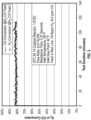
- FIG. 2 illustrates the H 2 or CO conversions at the listed test conditions for the comparative ATCO catalyst composition.
- FIG. 3 illustrates the H 2 or CO conversions at the listed test conditions for the example OVC (4x6) ATCO catalyst composition.
- the CO performances of the comparative ATCO catalyst composition and the example OVC (4x6) ATCO catalyst composition are very comparable, around 80% efficiency.
- the H 2 conversion performance of the example OVC (4x6) ATCO catalyst composition was about 80%, significantly higher than the comparative ATCO catalyst composition of only 3.5%.
- the example OVC (4x6) ATCO catalyst composition was fabricated as described below.
- OVC 4x8 (mesh) coconut granular activated carbon was provided (CalgonCarbon).
- the OVC 4x8 coconut granular activated carbon was fabricated from grades of coconut shell.
- OVC 4x8 coconut granular activated carbon OVC was loaded to a ROTAB-AS/S rotating abrasimeter for abrasion at 90 cycles per minute (cpm) for a total of about four hours.
- the OVC carbon material was initially washed with tap water until the supernatant water was clear. Then, the OVC carbon material had a final wash with deionized (DI) water.
- DI deionized
- the water was then drained out from the OVC carbon material, and then spread over a Pyrex dish, and then put in a heating oven at 90 °C to dry for about three hours, and then at 150 °C for another three hours.
- the OVC carbon material was then cooled down to ambient temperature.
- the OVC carbon material was then further screened through a 6 US mesh metal screen. After this further screening, the OVC carbon material was a dry 4x6 mesh carbon material.
- the about 250 cubic centimeters of the OVC dry 4x6 mesh carbon material was loaded into a container (e.g., 400 cc flask), and then the CPA solution was slowly added/dripped onto the carbon material. The container was then shook/rotated clockwise to ensure well mixing.
- a container e.g., 400 cc flask
- the container was then loaded into a rotary evaporator with about half of the container immersed in a pre-set hot water bath. The container was then rotated for about five minutes while cooling water was turned on to condense water vapor. Then, a vacuum was turned on and the container continued to rotate in the hot water bath to remove water from the Pt/carbon material until substantially no condensed water was observed from the water collector container, thereby completing this "wash coat" process of the Pt/carbon material.
- the Pt/carbon material was then loaded a container (Pyrex dish), and then heated in an oven at 250 °C for about four hours. Thereafter, the Pt/carbon material was cooled (e.g., to ambient or room temperature).
- ranges disclosed herein are inclusive of the endpoints, and the endpoints are independently combinable with each other (e.g., ranges of "up to 25 wt.%, or, more specifically, 5 wt.% to 20 wt.%", is inclusive of the endpoints and all intermediate values of the ranges of "5 wt.% to 25 wt.%,” etc.).
- “Combinations” is inclusive of blends, mixtures, alloys, reaction products, and the like.
- the terms “first,” “second,” and the like, do not denote any order, quantity, or importance, but rather are used to distinguish one element from another.
- test standards are the most recent standard in effect as of the filing date of this application, or, if priority is claimed, the filing date of the earliest priority application in which the test standard appears.
Landscapes
- Chemical & Material Sciences (AREA)
- Engineering & Computer Science (AREA)
- Organic Chemistry (AREA)
- Chemical Kinetics & Catalysis (AREA)
- Materials Engineering (AREA)
- Environmental & Geological Engineering (AREA)
- Health & Medical Sciences (AREA)
- Biomedical Technology (AREA)
- Oil, Petroleum & Natural Gas (AREA)
- General Chemical & Material Sciences (AREA)
- Analytical Chemistry (AREA)
- Inorganic Chemistry (AREA)
- Thermal Sciences (AREA)
- Physics & Mathematics (AREA)
- Biodiversity & Conservation Biology (AREA)
- Remote Sensing (AREA)
- Aviation & Aerospace Engineering (AREA)
- Toxicology (AREA)
- General Health & Medical Sciences (AREA)
- Environmental Sciences (AREA)
- Life Sciences & Earth Sciences (AREA)
- Catalysts (AREA)
Abstract
Description
- The present disclosure relates to ambient temperature catalyst compositions for trace contaminant control (e.g., for environmental control assemblies for space systems) and related methods of fabrication and use.
- In general, some ambient temperature catalyst compositions for trace contaminant control are known. For example, some ambient temperature catalyst compositions for trace contaminant control of environmental control systems are not efficient for carbon monoxide and hydrogen capture.
- The present disclosure provides for ambient temperature catalyst compositions for trace contaminant control (e.g., for environmental control assemblies for space systems) and related methods of fabrication and use. More particularly, the present disclosure provides for ambient temperature catalytic oxidation (ATCO) catalyst compositions for trace contaminant control with improvements to carbon monoxide and hydrogen capture, and related methods of fabrication and use.
- The present disclosure provides for a method for fabricating an ambient temperature catalytic oxidation catalyst composition including loading 4x8 US mesh granular activated carbon material into a rotating cylinder abrasimeter and subjecting the 4x8 US mesh granular activated carbon material to abrasion via the abrasimeter; screening the abraded granular activated carbon material with a 6 US mesh screen; washing the screened granular activated carbon material with water, and then drying the screened granular activated carbon material in a heating oven; further screening the dried granular activated carbon material with a 6 US mesh screen to produce a 4x6 US mesh granular activated carbon material; loading the 4x6 US mesh granular activated carbon material into a container, and adding a solution of chloroplatinic acid to the 4x6 US mesh granular activated carbon material; loading the container into a rotary evaporator, and rotating the rotary evaporator to remove water from the container; and removing the 4x6 US mesh granular activated carbon material from the container and heating the 4x6 US mesh granular activated carbon material in an oven to produce a platinum on the 4x6 US mesh granular activated carbon material catalyst composition.
- In addition to one or more of the features described, or as an alternative to any of the foregoing embodiments, the granular activated carbon is coconut granular activated carbon.
- In addition to one or more of the features described, or as an alternative to any of the foregoing embodiments, the coconut granular activated carbon is fabricated from grades of coconut shell.
- In addition to one or more of the features described, or as an alternative to any of the foregoing embodiments, the platinum on the 4x6 US mesh granular activated carbon material catalyst composition is a 10% platinum on the 4x6 US mesh granular activated carbon material catalyst composition.
- In addition to one or more of the features described, or as an alternative to any of the foregoing embodiments, the 4x8 US mesh granular activated carbon material is subjected to abrasion at 90 cycles per minute for about four hours.
- In addition to one or more of the features described, or as an alternative to any of the foregoing embodiments, wherein washing the screened granular activated carbon material includes first washing the screened granular activated carbon material with tap water until a supernatant water is clear, and then washing the screened granular activated carbon material with deionized water.
- In addition to one or more of the features described, or as an alternative to any of the foregoing embodiments, wherein after washing the screened granular activated carbon material with water, the water is drained from the screened granular activated carbon material prior to drying.
- In addition to one or more of the features described, or as an alternative to any of the foregoing embodiments, wherein drying the screened granular activated carbon material in a heating oven includes heating at 90 °C for about three hours, and then heating at 150 °C for about three hours.
- In addition to one or more of the features described, or as an alternative to any of the foregoing embodiments, wherein prior to further screening the dried granular activated carbon material, the dried granular activated carbon material is cooled to ambient temperature.
- In addition to one or more of the features described, or as an alternative to any of the foregoing embodiments, wherein adding the solution of chloroplatinic acid to the 4x6 US mesh granular activated carbon material includes dripping the solution of chloroplatinic acid to the 4x6 US mesh granular activated carbon material.
- In addition to one or more of the features described, or as an alternative to any of the foregoing embodiments, wherein loading the container into the rotary evaporator includes positioning a portion of the container in a hot water bath.
- In addition to one or more of the features described, or as an alternative to any of the foregoing embodiments, wherein rotating the rotary evaporator to remove water from the container includes rotating the container for about five minutes while cooling water is turned on to condense water vapor.
- In addition to one or more of the features described, or as an alternative to any of the foregoing embodiments, wherein rotating the rotary evaporator to remove water from the container includes turning on and providing a vacuum to the rotary evaporator.
- In addition to one or more of the features described, or as an alternative to any of the foregoing embodiments, wherein heating the 4x6 US mesh granular activated carbon material in the oven includes heating in the oven at 250 °C for about four hours.
- In addition to one or more of the features described, or as an alternative to any of the foregoing embodiments, further including utilizing the produced platinum on the 4x6 US mesh granular activated carbon material catalyst composition as an ambient temperature catalytic oxidation catalyst composition in a trace contaminant control assembly to remove at least one contaminant from an environment.
- In addition to one or more of the features described, or as an alternative to any of the foregoing embodiments, wherein the at least one contaminant is hydrogen or carbon monoxide.
- In addition to one or more of the features described, or as an alternative to any of the foregoing embodiments, wherein the trace contaminant control assembly is an environmental control assembly for a space system.
- The present disclosure provides for an ambient temperature catalytic oxidation catalyst composition fabricated by the disclosed methods.
- The above described and other features are exemplified by the following figures and detailed description.
- Any combination or permutation of embodiments is envisioned. Additional features, functions and applications of the disclosed systems, assemblies and methods of the present disclosure will be apparent from the description which follows, particularly when read in conjunction with the appended figures. All references listed in this disclosure are hereby incorporated by reference in their entireties.
- The following figures are example embodiments wherein the like elements are numbered alike.
- Features and aspects of embodiments are described below with reference to the accompanying drawings, in which elements are not necessarily depicted to scale.
- Example embodiments of the present disclosure are further described with reference to the appended figures. It is to be noted that the various features, steps, and combinations of features/steps described below and illustrated in the figures can be arranged and organized differently to result in embodiments which are still within the scope of the present disclosure. To assist those of ordinary skill in the art in making and using the disclosed systems, assemblies and methods, reference is made to the appended figures, wherein:
-
FIG. 1 is a graph showing pressure drops of (i) the example OVC (4x6) ATCO catalyst composition, and (ii) the example OVC (4x8) ATCO catalyst composition, and (iii) the comparative ATCO catalyst composition, at various flow rates; -
FIG. 2 is a graph that illustrates the H2 or CO conversions at the listed test conditions for the comparative ATCO catalyst composition; and -
FIG. 3 is a illustrates the H2 or CO conversions at the listed test conditions for the example OVC (4x6) ATCO catalyst composition. - The example embodiments disclosed herein are illustrative of ambient temperature catalyst compositions, and related methods of fabrication and use. It should be understood, however, that the disclosed embodiments are merely examples of the present disclosure, which may be embodied in various forms. Therefore, details disclosed herein with reference to example ambient temperature catalyst compositions and associated processes/techniques of fabrication/assembly and use are not to be interpreted as limiting, but merely as the basis for teaching one skilled in the art how to make and use the ambient temperature catalyst compositions of the present disclosure.
- The present disclosure provides for ambient temperature catalyst compositions for trace contaminant control (e.g., for environmental control assemblies for space systems) and related methods of fabrication and use. More particularly, the present disclosure provides for ambient temperature catalytic oxidation (ATCO) catalyst compositions for trace contaminant control with improvements to carbon monoxide and hydrogen capture, and related methods of fabrication and use. In example embodiments, ambient temperature is less than 100 °F (less than 38 °C).
- In general, the present disclosure provides ambient temperature catalyst compositions for trace contaminant assemblies/systems to remove low molecular volatiles (e.g., hydrogen, carbon monoxide, etc.).
- As discussed further below, the present disclosure provides ambient temperature catalyst compositions for trace contaminant control for a trace contaminant control assembly. In example embodiments, the trace contaminant control assembly should remove hydrogen at a rate of 168.0 milligrams per day, with a maximum allowable concentration (and therefore a maximum assembly inlet concentration) of 170 milligrams per cubic meter. To verify hydrogen and carbon monoxide removal efficiency of the ambient temperature catalytic oxidation catalyst compositions, tests were conducted in a subscale axial fixed-bed reactor at various process parameters.
- As discussed further below, some results indicate that the H2 removal efficiency of an example ATCO catalyst composition (OVC (4x6) ATCO catalyst composition) of the present disclosure was about 80%, significantly higher than a comparative ATCO catalyst composition of 3.5%, and their CO (carbon monoxide) efficiencies were very comparable. The comparative ATCO catalyst composition was 2% platinum on 4x8 US mesh granular activated carbon (ATCO (4x8)).
- The example OVC (4x6) ATCO catalyst composition was a 10% platinum on 4x6 US mesh granular activated carbon, fabricated via example methods of the present disclosure. As discussed further below, an example OVC (4x8) ATCO catalyst composition was a 10% platinum on 4x8 US mesh granular activated carbon, fabricated via other example methods of the present disclosure.
- The pressure drop and crush strength mechanical parameters of the example OVC (4x6) ATCO catalyst composition and the example OVC (4x8) ATCO catalyst composition were tested relative to the comparative ATCO catalyst composition.
-
FIG. 1 is a graph showing pressure drops of (i) the example OVC (4x6) ATCO catalyst composition, and (ii) the example OVC (4x8) ATCO catalyst composition, and (iii) the comparative ATCO catalyst composition (ATCO (4x8)), at various flow rates. - The example OVC (4x6) ATCO catalyst composition, the example OVC (4x8) ATCO catalyst composition, and the comparative ATCO catalyst composition (ATCO (4x8)) were tested in a pressure drop test set-up at various flow rates (various superficial velocities). As shown in
FIG. 1 , the pressure drop (Delta P) of the example OVC (4x6) ATCO catalyst composition was comparable to the comparative ATCO catalyst composition (ATCO (4x8)). - The crush strengths of the example OVC (4x6) ATCO catalyst composition and the comparative ATCO catalyst composition were evaluated using a CRUSH-BK500 tester per ASTM D7084-4.
- Table 1 below summarizes the test data. The crush strength of the example OVC (4x6) ATCO catalyst composition was 101 lb/in2, which was about two times that of the comparative ATCO catalyst composition (52.46 lb/in2).

- As noted above, the present disclosure provides ambient temperature catalyst compositions for trace contaminant assemblies/systems to remove low molecular volatiles (e.g., hydrogen, carbon monoxide, etc.). Table 2 below shows some important example requirements for example ATCO catalyst compositions of the present disclosure.
Table 2: Performance criteria for example ATCO catalyst compositions Condition Set ID Bed Length Residence Time Inlet Temperature Inlet Dew Point H2 Concentration CO Concentration H2 Efficiency Requirement CO Efficiency Requirement (inch) (second) (F) (F) (ppm) (ppm) % % 1 1.87 0.367 61 40.5 2000 7.3 1.3 12 - The H2 and CO removal performances of the example OVC (4x6) ATCO catalyst composition and the comparative ATCO catalyst composition were evaluated using an ATCO subscale reactor. A Teflon cylindrical reactor with a dimension of 1.6 inch inner diameter (I.D.) and 7 inch depth was used as the subscale reactor for testing. The packed length of ATCO catalyst bed was 1.87 inches, and the remainder void was filled with glass beads.
- Premixed hydrogen and carbon monoxide with humidified air (by flowing through gas bubbler) was fed to the ATCO subscale reactor. A heat exchanger and water chiller with recirculating water were used to chill inlet gas to below ambient temperature. A gas pipeline was wrap-insulated to maintain the temperature and also to avoid water condensation. Pre-mixed gas was initially by-passed from the reactor and fed directly to instruments for inlet gas concentration analysis. GOW-MAC 580 gas chromatography with a thermal conductivity detector (TCD) and Horiba via-510 CO analyzer were used for determining hydrogen and carbon monoxide gas concentrations, respectively. A first gas cylinder (0.2 H2/N2) was used for calibrating the gas chromatography (GC), and a second gas cylinder (50 ppm CO/N2) was used for CO analyzer calibration. Each test started after a feed concentration of 2000 ppm for hydrogen and 7.6 ppm for carbon monoxide were verified at the flow rate settings and the tests terminated after the effluent concentrations leveled off for about one hour. Data of test duration, temperature, mass flow rate, dew point, and carbon monoxide concentration were acquired automatically every 0.5 seconds, while effluent hydrogen concentrations were manually analyzed every 6 to 10 minutes.
-
FIG. 2 illustrates the H2 or CO conversions at the listed test conditions for the comparative ATCO catalyst composition. -
FIG. 3 illustrates the H2 or CO conversions at the listed test conditions for the example OVC (4x6) ATCO catalyst composition. - As shown in
FIGS. 2 and3 , the CO performances of the comparative ATCO catalyst composition and the example OVC (4x6) ATCO catalyst composition are very comparable, around 80% efficiency. However, the H2 conversion performance of the example OVC (4x6) ATCO catalyst composition was about 80%, significantly higher than the comparative ATCO catalyst composition of only 3.5%. - In example embodiments, the example OVC (4x6) ATCO catalyst composition was fabricated as described below.
- OVC 4x8 (mesh) coconut granular activated carbon was provided (CalgonCarbon). The OVC 4x8 coconut granular activated carbon was fabricated from grades of coconut shell.
- About 600 cubic centimeters of the OVC 4x8 coconut granular activated carbon OVC was loaded to a ROTAB-AS/S rotating abrasimeter for abrasion at 90 cycles per minute (cpm) for a total of about four hours.
- Thereafter, the OVC carbon material after abrasion was unloaded from the abrasimeter, and dust and the like was screened out from the OVC carbon material with a 6 US mesh metal screen.
- Then, the OVC carbon material was initially washed with tap water until the supernatant water was clear. Then, the OVC carbon material had a final wash with deionized (DI) water.
- The water was then drained out from the OVC carbon material, and then spread over a Pyrex dish, and then put in a heating oven at 90 °C to dry for about three hours, and then at 150 °C for another three hours. The OVC carbon material was then cooled down to ambient temperature.
- The OVC carbon material was then further screened through a 6 US mesh metal screen. After this further screening, the OVC carbon material was a dry 4x6 mesh carbon material.
- Thereafter, about 250 cubic centimeters (cc) of the OVC dry 4x6 mesh carbon material was weighed, and the mass of chloroplatinic acid (CPA - also named hexachloroplatinic acid) solution (20% Pt mass) needed to make 10% Pt on the OVC dry 4x6 mesh carbon material was calculated (e.g., a 10% platinum on 4x6 mesh granular activated carbon material).
- The about 250 cubic centimeters of the OVC dry 4x6 mesh carbon material was loaded into a container (e.g., 400 cc flask), and then the CPA solution was slowly added/dripped onto the carbon material. The container was then shook/rotated clockwise to ensure well mixing.
- The container was then loaded into a rotary evaporator with about half of the container immersed in a pre-set hot water bath. The container was then rotated for about five minutes while cooling water was turned on to condense water vapor. Then, a vacuum was turned on and the container continued to rotate in the hot water bath to remove water from the Pt/carbon material until substantially no condensed water was observed from the water collector container, thereby completing this "wash coat" process of the Pt/carbon material.
- The Pt/carbon material was then loaded a container (Pyrex dish), and then heated in an oven at 250 °C for about four hours. Thereafter, the Pt/carbon material was cooled (e.g., to ambient or room temperature).
- While particular embodiments have been described, alternatives, modifications, variations, improvements, and substantial equivalents that are or may be presently unforeseen may arise to applicants or others skilled in the art. Accordingly, the appended claims as filed and as they may be amended are intended to embrace all such alternatives, modifications variations, improvements, and substantial equivalents.
- The ranges disclosed herein are inclusive of the endpoints, and the endpoints are independently combinable with each other (e.g., ranges of "up to 25 wt.%, or, more specifically, 5 wt.% to 20 wt.%", is inclusive of the endpoints and all intermediate values of the ranges of "5 wt.% to 25 wt.%," etc.). "Combinations" is inclusive of blends, mixtures, alloys, reaction products, and the like. The terms "first," "second," and the like, do not denote any order, quantity, or importance, but rather are used to distinguish one element from another. The terms "a" and "an" and "the" do not denote a limitation of quantity and are to be construed to cover both the singular and the plural, unless otherwise indicated herein or clearly contradicted by context. "Or" means "and/or" unless clearly stated otherwise. Reference throughout the specification to "some embodiments", "an embodiment", and so forth, means that a particular element described in connection with the embodiment is included in at least one embodiment described herein, and may or may not be present in other embodiments. In addition, it is to be understood that the described elements may be combined in any suitable manner in the various embodiments. A "combination thereof' is open and includes any combination comprising at least one of the listed components or properties optionally together with a like or equivalent component or property not listed.
- Unless defined otherwise, technical and scientific terms used herein have the same meaning as is commonly understood by one of skill in the art to which this application belongs. All cited patents, patent applications, and other references are incorporated herein by reference in their entirety. However, if a term in the present application contradicts or conflicts with a term in the incorporated reference, the term from the present application takes precedence over the conflicting term from the incorporated reference.
- Unless specified to the contrary herein, all test standards are the most recent standard in effect as of the filing date of this application, or, if priority is claimed, the filing date of the earliest priority application in which the test standard appears.
- Although the systems and methods of the present disclosure have been described with reference to example embodiments thereof, the present disclosure is not limited to such example embodiments and/or implementations. Rather, the systems and methods of the present disclosure are susceptible to many implementations and applications, as will be readily apparent to persons skilled in the art from the disclosure hereof. The present disclosure expressly encompasses such modifications, enhancements and/or variations of the disclosed embodiments. Since many changes could be made in the above construction and many widely different embodiments of this disclosure could be made without departing from the scope thereof, it is intended that all matter contained in the drawings and specification shall be interpreted as illustrative and not in a limiting sense. Additional modifications, changes, and substitutions are intended in the foregoing disclosure. Accordingly, it is appropriate that the appended claims be construed broadly and in a manner consistent with the scope of the disclosure.
Claims (15)
- A method for fabricating an ambient temperature catalytic oxidation catalyst composition comprising:loading 4x8 US mesh granular activated carbon material into a rotating cylinder abrasimeter and subjecting the 4x8 US mesh granular activated carbon material to abrasion via the abrasimeter;screening the abraded granular activated carbon material with a 6 US mesh screen;washing the screened granular activated carbon material with water, and then drying the screened granular activated carbon material in a heating oven;further screening the dried granular activated carbon material with a 6 US mesh screen to produce a 4x6 US mesh granular activated carbon material;loading the 4x6 US mesh granular activated carbon material into a container, and adding a solution of chloroplatinic acid to the 4x6 US mesh granular activated carbon material;loading the container into a rotary evaporator, and rotating the rotary evaporator to remove water from the container;removing the 4x6 US mesh granular activated carbon material from the container and heating the 4x6 US mesh granular activated carbon material in an oven to produce a platinum on the 4x6 US mesh granular activated carbon material catalyst composition.
- The method of claim 1, wherein the granular activated carbon is coconut granular activated carbon, or wherein the coconut granular activated carbon is fabricated from grades of coconut shell.
- The method of any preceding claim, wherein the platinum on the 4x6 US mesh granular activated carbon material catalyst composition is a 10% platinum on the 4x6 US mesh granular activated carbon material catalyst composition.
- The method of any preceding claim, wherein the 4x8 US mesh granular activated carbon material is subjected to abrasion at 90 cycles per minute for about four hours.
- The method of any preceding claim, wherein washing the screened granular activated carbon material comprises first washing the screened granular activated carbon material with tap water until a supernatant water is clear, and then washing the screened granular activated carbon material with deionized water.
- The method of any preceding claim, wherein after washing the screened granular activated carbon material with water, the water is drained from the screened granular activated carbon material prior to drying.
- The method of any preceding claim, wherein drying the screened granular activated carbon material in a heating oven comprises heating at 90 °C for about three hours, and then heating at 150 °C for about three hours.
- The method of any preceding claim, wherein prior to further screening the dried granular activated carbon material, the dried granular activated carbon material is cooled to ambient temperature.
- The method of any preceding claim, wherein adding the solution of chloroplatinic acid to the 4x6 US mesh granular activated carbon material comprises dripping the solution of chloroplatinic acid to the 4x6 US mesh granular activated carbon material.
- The method of any preceding claim, wherein loading the container into the rotary evaporator comprises positioning a portion of the container in a hot water bath.
- The method of any preceding claim, wherein rotating the rotary evaporator to remove water from the container comprises rotating the container for about five minutes while cooling water is turned on to condense water vapor, or wherein rotating the rotary evaporator to remove water from the container comprises turning on and providing a vacuum to the rotary evaporator.
- The method of any preceding claim, wherein heating the 4x6 US mesh granular activated carbon material in the oven comprises heating in the oven at 250 °C for about four hours.
- The method of any preceding claim, further comprising utilizing the produced platinum on the 4x6 US mesh granular activated carbon material catalyst composition as an ambient temperature catalytic oxidation catalyst composition in a trace contaminant control assembly to remove at least one contaminant from an environment.
- The method of claim 13, wherein the at least one contaminant is hydrogen or carbon monoxide, or wherein the trace contaminant control assembly is an environmental control assembly for a space system.
- An ambient temperature catalytic oxidation catalyst composition fabricated by the method of any preceding Claim.
Applications Claiming Priority (1)
| Application Number | Priority Date | Filing Date | Title |
|---|---|---|---|
| US18/078,209 US12533632B2 (en) | 2022-12-09 | 2022-12-09 | Ambient temperature catalyst for trace contaminant control with improvements to carbon monoxide and hydrogen capture |
Publications (1)
| Publication Number | Publication Date |
|---|---|
| EP4400211A1 true EP4400211A1 (en) | 2024-07-17 |
Family
ID=88920764
Family Applications (1)
| Application Number | Title | Priority Date | Filing Date |
|---|---|---|---|
| EP23211255.7A Withdrawn EP4400211A1 (en) | 2022-12-09 | 2023-11-21 | Fabrication method of platinum/granular activated carbon catalyst for ambient temperature catalytic oxidation of co and h2, said catalyst and its use in trace contaminant control |
Country Status (2)
| Country | Link |
|---|---|
| US (1) | US12533632B2 (en) |
| EP (1) | EP4400211A1 (en) |
Cited By (1)
| Publication number | Priority date | Publication date | Assignee | Title |
|---|---|---|---|---|
| US20240189770A1 (en) * | 2022-12-09 | 2024-06-13 | Hamilton Sundstrand Corporation | Ambient temperature catalyst for trace contaminant control with improvements to carbon monoxide and hydrogen capture |
Citations (4)
| Publication number | Priority date | Publication date | Assignee | Title |
|---|---|---|---|---|
| JPS52104492A (en) * | 1977-03-16 | 1977-09-01 | Kiyataraa Kougiyou Kk | Methof of manufacturing oxidation catalysts |
| JP4136318B2 (en) * | 2001-02-06 | 2008-08-20 | セントラル硝子株式会社 | Method for producing 1,3-difluoroacetone |
| RU2366694C2 (en) * | 2006-09-05 | 2009-09-10 | Общество с ограниченной ответственностью Научно-производственное предприятие "Технофильтр" | Method for treatment of vodka "platinum filtration" |
| US20150060365A1 (en) * | 2011-12-23 | 2015-03-05 | Tusaar Inc. | System for dynamic fluidized loading of a ligand upon carbon media and methods associated therewith |
Family Cites Families (8)
| Publication number | Priority date | Publication date | Assignee | Title |
|---|---|---|---|---|
| US3658724A (en) * | 1967-08-01 | 1972-04-25 | Du Pont | Adsorbent oxidation catalyst |
| US4003979A (en) | 1973-11-26 | 1977-01-18 | Kanebo, Ltd. | Method of cleaning air containing carbon monoxide |
| US4463104A (en) | 1981-11-23 | 1984-07-31 | Uop Inc. | Platinum group and phosphorus containing catalyst composition for hydrocarbon conversion |
| US5700436A (en) | 1993-01-21 | 1997-12-23 | Calgon Carbon Corporation | Purification of air in enclosed spaces |
| US6093670A (en) | 1998-12-11 | 2000-07-25 | Phillips Petroleum Company | Carbon monoxide oxidation catalyst and process therefor |
| US7407121B2 (en) * | 2004-12-28 | 2008-08-05 | Kerns Kevin C | Method and process for providing a controlled batch of micrometer-sized or nanometer-sized coal material |
| CN110280241B (en) * | 2014-04-29 | 2022-09-02 | 阿彻丹尼尔斯米德兰公司 | Carbon black-based shaped porous product |
| US12533632B2 (en) * | 2022-12-09 | 2026-01-27 | Hamilton Sundstrand Corporation | Ambient temperature catalyst for trace contaminant control with improvements to carbon monoxide and hydrogen capture |
-
2022
- 2022-12-09 US US18/078,209 patent/US12533632B2/en active Active
-
2023
- 2023-11-21 EP EP23211255.7A patent/EP4400211A1/en not_active Withdrawn
Patent Citations (4)
| Publication number | Priority date | Publication date | Assignee | Title |
|---|---|---|---|---|
| JPS52104492A (en) * | 1977-03-16 | 1977-09-01 | Kiyataraa Kougiyou Kk | Methof of manufacturing oxidation catalysts |
| JP4136318B2 (en) * | 2001-02-06 | 2008-08-20 | セントラル硝子株式会社 | Method for producing 1,3-difluoroacetone |
| RU2366694C2 (en) * | 2006-09-05 | 2009-09-10 | Общество с ограниченной ответственностью Научно-производственное предприятие "Технофильтр" | Method for treatment of vodka "platinum filtration" |
| US20150060365A1 (en) * | 2011-12-23 | 2015-03-05 | Tusaar Inc. | System for dynamic fluidized loading of a ligand upon carbon media and methods associated therewith |
Non-Patent Citations (1)
| Title |
|---|
| TIMOTHY ARTHUR NALETTE: "CO Oxidation in Catalytic Hollow Fibres and Granular Catalysts: A Comparative Investigation of Catalyst Effectiveness", 9 March 2011 (2011-03-09), pages 1 - 221, XP093169593, Retrieved from the Internet <URL:https://researchportal.bath.ac.uk/files/213126504/Tim_Nalette_PhD_Thesis_PDF.pdf> [retrieved on 20240603] * |
Cited By (2)
| Publication number | Priority date | Publication date | Assignee | Title |
|---|---|---|---|---|
| US20240189770A1 (en) * | 2022-12-09 | 2024-06-13 | Hamilton Sundstrand Corporation | Ambient temperature catalyst for trace contaminant control with improvements to carbon monoxide and hydrogen capture |
| US12533632B2 (en) * | 2022-12-09 | 2026-01-27 | Hamilton Sundstrand Corporation | Ambient temperature catalyst for trace contaminant control with improvements to carbon monoxide and hydrogen capture |
Also Published As
| Publication number | Publication date |
|---|---|
| US12533632B2 (en) | 2026-01-27 |
| US20240189770A1 (en) | 2024-06-13 |
Similar Documents
| Publication | Publication Date | Title |
|---|---|---|
| Suda et al. | Gas permeation through micropores of carbon molecular sieve membranes derived from Kapton polyimide | |
| Kumashiro et al. | New analysis of oxidation state and coordination environment of copper ion-exchanged in ZSM-5 zeolite | |
| Park et al. | Gas sensor array using a hybrid structure based on zeolite and oxide semiconductors for multiple bio-gas detection | |
| Thür et al. | Correlating MOF-808 parameters with mixed-matrix membrane (MMM) CO 2 permeation for a more rational MMM development | |
| CN103394336B (en) | Metal organic framework compound sol-gel coating stirring rod and preparation method and application thereof | |
| US12533632B2 (en) | Ambient temperature catalyst for trace contaminant control with improvements to carbon monoxide and hydrogen capture | |
| US12270784B2 (en) | Detector for detecting analytes in gas phase comprising porous dielectric or semiconducting sorbent and corresponding detection method | |
| US20100107731A1 (en) | Chemically modified organic cdc based rapid analysis system | |
| CN116422364B (en) | Catalyst for removing chlorobenzene by utilizing bimetal load modified molecular sieve and preparation method thereof | |
| Shim et al. | Adsorption of carbon tetrachloride and chloroform on activated carbon at (300.15, 310.15, 320.15, and 330.15) K | |
| JP6804541B2 (en) | Elemental analysis methods for determining carbon and nitrogen content, use of metal oxide catalysts, and elemental analysis equipment for determining carbon content | |
| Kotobuki et al. | XAFS characterization of Pt–Fe/zeolite catalysts for preferential oxidation of CO in hydrogen fuel gases | |
| Mohsen et al. | Selection and characterization of adsorbents for the analysis of an explosive-related molecule traces in the air | |
| Borghard et al. | Characterization and testing of periodic mesoporous organosilicas as potential selective benzene adsorbents | |
| CN107497478B (en) | A kind of catalyst for ultraviolet photocatalytic removal of VOCs and preparation method thereof | |
| CN104941612B (en) | A kind of adsorption catalyst and its preparation method and application and a kind of air purification method and its application | |
| CN109289937A (en) | A kind of preparation method of highly dispersed supported metal catalyst | |
| Zhang et al. | Decomposition of N2O by Ruthenium Catalysts–RuO2 as Active Phase on Non‐Reducible Supports | |
| CN114073987A (en) | Formaldehyde elimination catalyst with storage-oxidation series and its preparation and application | |
| CN111589432B (en) | Preparation and application of ionic liquid-DNPH-MOFs adsorbent | |
| CN109211827A (en) | Volatile organic compounds measurement device and method | |
| JP5607742B2 (en) | Nuclear exhaust gas recombination catalyst and recombiner | |
| CN113828349A (en) | Catalytic combustion catalyst containing chlorine volatile organic compounds, and preparation method and application thereof | |
| JPS6123023B2 (en) | ||
| CN109465025B (en) | A kind of preparation method of isomerization catalyst with *BEA structure molecular sieve as carrier |
Legal Events
| Date | Code | Title | Description |
|---|---|---|---|
| PUAI | Public reference made under article 153(3) epc to a published international application that has entered the european phase |
Free format text: ORIGINAL CODE: 0009012 |
|
| STAA | Information on the status of an ep patent application or granted ep patent |
Free format text: STATUS: THE APPLICATION HAS BEEN PUBLISHED |
|
| AK | Designated contracting states |
Kind code of ref document: A1 Designated state(s): AL AT BE BG CH CY CZ DE DK EE ES FI FR GB GR HR HU IE IS IT LI LT LU LV MC ME MK MT NL NO PL PT RO RS SE SI SK SM TR |
|
| STAA | Information on the status of an ep patent application or granted ep patent |
Free format text: STATUS: REQUEST FOR EXAMINATION WAS MADE |
|
| STAA | Information on the status of an ep patent application or granted ep patent |
Free format text: STATUS: THE APPLICATION HAS BEEN WITHDRAWN |
|
| 17P | Request for examination filed |
Effective date: 20250116 |
|
| 18W | Application withdrawn |
Effective date: 20250124 |