EP4399270B1 - Perfume particle - Google Patents
Perfume particle Download PDFInfo
- Publication number
- EP4399270B1 EP4399270B1 EP22769231.6A EP22769231A EP4399270B1 EP 4399270 B1 EP4399270 B1 EP 4399270B1 EP 22769231 A EP22769231 A EP 22769231A EP 4399270 B1 EP4399270 B1 EP 4399270B1
- Authority
- EP
- European Patent Office
- Prior art keywords
- perfume
- biomass
- derived
- ethoxylate
- perfume particle
- Prior art date
- Legal status (The legal status is an assumption and is not a legal conclusion. Google has not performed a legal analysis and makes no representation as to the accuracy of the status listed.)
- Active
Links
Images
Classifications
-
- C—CHEMISTRY; METALLURGY
- C11—ANIMAL OR VEGETABLE OILS, FATS, FATTY SUBSTANCES OR WAXES; FATTY ACIDS THEREFROM; DETERGENTS; CANDLES
- C11D—DETERGENT COMPOSITIONS; USE OF SINGLE SUBSTANCES AS DETERGENTS; SOAP OR SOAP-MAKING; RESIN SOAPS; RECOVERY OF GLYCEROL
- C11D3/00—Other compounding ingredients of detergent compositions covered in group C11D1/00
- C11D3/50—Perfumes
- C11D3/502—Protected perfumes
- C11D3/505—Protected perfumes encapsulated or adsorbed on a carrier, e.g. zeolite or clay
-
- A—HUMAN NECESSITIES
- A61—MEDICAL OR VETERINARY SCIENCE; HYGIENE
- A61K—PREPARATIONS FOR MEDICAL, DENTAL OR TOILETRY PURPOSES
- A61K8/00—Cosmetics or similar toiletry preparations
- A61K8/02—Cosmetics or similar toiletry preparations characterised by special physical form
- A61K8/0241—Containing particulates characterized by their shape and/or structure
-
- A—HUMAN NECESSITIES
- A61—MEDICAL OR VETERINARY SCIENCE; HYGIENE
- A61K—PREPARATIONS FOR MEDICAL, DENTAL OR TOILETRY PURPOSES
- A61K8/00—Cosmetics or similar toiletry preparations
- A61K8/18—Cosmetics or similar toiletry preparations characterised by the composition
- A61K8/72—Cosmetics or similar toiletry preparations characterised by the composition containing organic macromolecular compounds
- A61K8/84—Cosmetics or similar toiletry preparations characterised by the composition containing organic macromolecular compounds obtained by reactions otherwise than those involving only carbon-carbon unsaturated bonds
- A61K8/86—Polyethers
-
- A—HUMAN NECESSITIES
- A61—MEDICAL OR VETERINARY SCIENCE; HYGIENE
- A61Q—SPECIFIC USE OF COSMETICS OR SIMILAR TOILETRY PREPARATIONS
- A61Q13/00—Formulations or additives for perfume preparations
-
- C—CHEMISTRY; METALLURGY
- C11—ANIMAL OR VEGETABLE OILS, FATS, FATTY SUBSTANCES OR WAXES; FATTY ACIDS THEREFROM; DETERGENTS; CANDLES
- C11D—DETERGENT COMPOSITIONS; USE OF SINGLE SUBSTANCES AS DETERGENTS; SOAP OR SOAP-MAKING; RESIN SOAPS; RECOVERY OF GLYCEROL
- C11D11/00—Special methods for preparing compositions containing mixtures of detergents
- C11D11/0082—Special methods for preparing compositions containing mixtures of detergents one or more of the detergent ingredients being in a liquefied state, e.g. slurry, paste or melt, and the process resulting in solid detergent particles such as granules, powders or beads
-
- C—CHEMISTRY; METALLURGY
- C11—ANIMAL OR VEGETABLE OILS, FATS, FATTY SUBSTANCES OR WAXES; FATTY ACIDS THEREFROM; DETERGENTS; CANDLES
- C11D—DETERGENT COMPOSITIONS; USE OF SINGLE SUBSTANCES AS DETERGENTS; SOAP OR SOAP-MAKING; RESIN SOAPS; RECOVERY OF GLYCEROL
- C11D17/00—Detergent materials or soaps characterised by their shape or physical properties
- C11D17/0039—Coated compositions or coated components in the compositions, (micro)capsules
-
- C—CHEMISTRY; METALLURGY
- C11—ANIMAL OR VEGETABLE OILS, FATS, FATTY SUBSTANCES OR WAXES; FATTY ACIDS THEREFROM; DETERGENTS; CANDLES
- C11D—DETERGENT COMPOSITIONS; USE OF SINGLE SUBSTANCES AS DETERGENTS; SOAP OR SOAP-MAKING; RESIN SOAPS; RECOVERY OF GLYCEROL
- C11D17/00—Detergent materials or soaps characterised by their shape or physical properties
- C11D17/06—Powder; Flakes; Free-flowing mixtures; Sheets
- C11D17/065—High-density particulate detergent compositions
-
- C—CHEMISTRY; METALLURGY
- C11—ANIMAL OR VEGETABLE OILS, FATS, FATTY SUBSTANCES OR WAXES; FATTY ACIDS THEREFROM; DETERGENTS; CANDLES
- C11D—DETERGENT COMPOSITIONS; USE OF SINGLE SUBSTANCES AS DETERGENTS; SOAP OR SOAP-MAKING; RESIN SOAPS; RECOVERY OF GLYCEROL
- C11D3/00—Other compounding ingredients of detergent compositions covered in group C11D1/00
- C11D3/16—Organic compounds
- C11D3/20—Organic compounds containing oxygen
- C11D3/22—Carbohydrates or derivatives thereof
- C11D3/221—Mono, di- or trisaccharides or derivatives thereof
-
- C—CHEMISTRY; METALLURGY
- C11—ANIMAL OR VEGETABLE OILS, FATS, FATTY SUBSTANCES OR WAXES; FATTY ACIDS THEREFROM; DETERGENTS; CANDLES
- C11D—DETERGENT COMPOSITIONS; USE OF SINGLE SUBSTANCES AS DETERGENTS; SOAP OR SOAP-MAKING; RESIN SOAPS; RECOVERY OF GLYCEROL
- C11D3/00—Other compounding ingredients of detergent compositions covered in group C11D1/00
- C11D3/16—Organic compounds
- C11D3/37—Polymers
- C11D3/3703—Macromolecular compounds obtained otherwise than by reactions only involving carbon-to-carbon unsaturated bonds
- C11D3/3707—Polyethers, e.g. polyalkyleneoxides
-
- C—CHEMISTRY; METALLURGY
- C11—ANIMAL OR VEGETABLE OILS, FATS, FATTY SUBSTANCES OR WAXES; FATTY ACIDS THEREFROM; DETERGENTS; CANDLES
- C11D—DETERGENT COMPOSITIONS; USE OF SINGLE SUBSTANCES AS DETERGENTS; SOAP OR SOAP-MAKING; RESIN SOAPS; RECOVERY OF GLYCEROL
- C11D3/00—Other compounding ingredients of detergent compositions covered in group C11D1/00
- C11D3/40—Dyes ; Pigments
-
- A—HUMAN NECESSITIES
- A61—MEDICAL OR VETERINARY SCIENCE; HYGIENE
- A61K—PREPARATIONS FOR MEDICAL, DENTAL OR TOILETRY PURPOSES
- A61K2800/00—Properties of cosmetic compositions or active ingredients thereof or formulation aids used therein and process related aspects
- A61K2800/40—Chemical, physico-chemical or functional or structural properties of particular ingredients
- A61K2800/56—Compounds, absorbed onto or entrapped into a solid carrier, e.g. encapsulated perfumes, inclusion compounds, sustained release forms
-
- D—TEXTILES; PAPER
- D06—TREATMENT OF TEXTILES OR THE LIKE; LAUNDERING; FLEXIBLE MATERIALS NOT OTHERWISE PROVIDED FOR
- D06M—TREATMENT, NOT PROVIDED FOR ELSEWHERE IN CLASS D06, OF FIBRES, THREADS, YARNS, FABRICS, FEATHERS OR FIBROUS GOODS MADE FROM SUCH MATERIALS
- D06M13/00—Treating fibres, threads, yarns, fabrics or fibrous goods made from such materials, with non-macromolecular organic compounds; Such treatment combined with mechanical treatment
- D06M13/005—Compositions containing perfumes; Compositions containing deodorants
Definitions
- the present invention relates to perfume particles comprising ingredients comprising ethoxylate units derived from biomass.
- Fragrance is an important aspect of the laundry process. Consumers often associate fragrance with cleanliness or simply enjoy the smell; accordingly, many laundry products comprise perfumes. However, the desired quantity of perfume varies from consumer to consumer. Consequently, perfume particles have been developed to allow consumers to tailor their perfume experience based on their personal preferences.
- Perfume particles generally include ingredients such as fragrance materials and a carrier material.
- Common carrier materials include ingredients comprising ethoxylate groups, such as alcohol ethoxylates and polyethylene glycol ingredients, such as disclosed in WO 2019/025216 A1 .
- fragrance particles are an important characteristic of fragrance particles. If the particles change their aesthetic characteristics over time, the consumers may view the products as inferior.
- perfume particles comprising at least 10 wt.% of a carrier material which comprises at least one ethoxylate unit derived from biomass provides enhanced colour stability.
- the present invention relates to a perfume particle composition according to claim 1.
- the invention further relates to a method of preparing said perfume particle composition, according to claim 11.
- the invention additionally relates to a use of said perfume particle as described herein to reduce the carbon footprint of the perfume particle, according to claim 12.
- biomass' refers to organic matter, such as plants and does not include virgin fossil fuels.
- the perfume particles described herein comprise carrier materials comprising at least one ethoxylate unit derived from biomass.
- the biomass must be converted to ethanol and then used to produce a carrier material for use in perfume particles.
- the conversion of biomass to ethanol and then ethanol to a carrier material may occur in one continuous process or may occur in several stages and/or at several different locations.
- carrier a solid material which provides the solid structure of the perfume particle.
- the compositions described herein preferably comprise at least 50 wt.% carrier materials, preferably 65 wt.%, more preferably 80 wt.% and most preferably at least 90 wt.% carrier materials, by weight of the composition. Preferably less than 98 wt. % carrier materials. This refers to the carrier material which comprises at least one ethoxylate unit derived from biomass and any additional carrier materials.
- carrier materials may be any material which disperses, dissolves, disintegrates or solubilises in water.
- the composition my comprise one carrier material or a combination of different carrier materials.
- the perfume particles comprise at least 10 wt.% of a carrier material which comprises at least one ethoxylate unit derived from biomass, more preferably at least 20 wt. %, even more preferably at least 50 wt.%, most preferably at least 60 wt.% and preferably less than 98 wt. %.
- the carrier material which comprises at least one ethoxylate unit derived from biomass on average comprises at least 50 wt.% of the ethoxylate units derived from biomass, more preferably at least 70 wt.%, most preferably all the ethoxylate units in the molecule are derived from biomass.
- the carrier material which comprises at least one ethoxylate unit derived from biomass may also comprise ethoxylate groups derived from virgin fossil fuels, however this is not preferable.
- less than 50 wt. %, more preferably less than 10 wt.% of the ethoxylate groups are derived directly from virgin fossil fuels.
- ethanol produced as outlined above is dehydrated to ethylene.
- the dehydration of ethanol to ethylene is a common industrial process.
- the ethylene is then oxidised to form ethylene oxide.
- the ethylene oxide can be reacted with a long chain fatty alcohol via a polymerisation type reaction. This process is commonly referred to as ethoxylation and gives rise to alcohol ethoxylates.
- the long chain fatty alcohol comprises carbon from non-virgin fossil fuel sources, more preferably a bio-mass source. More preferably the long chain fatty alcohol comprises only carbon from a plant source.
- the ethylene oxide can be polymerised, for example in the presence of water and a catalyst to yield a polyethylene glycol chain.
- all carbons within the carrier material ingredient molecule are derived from a bio-mass source, more preferably a plant source.
- Preferred ethoxylated materials include: fatty acid ethoxylates, fatty amine ethoxylates, fatty alcohol ethoxylates, nonylphenol ethoxylates, alkyl phenol ethoxylate, amide ethoxylates, Sorbitan(ol) ester ethoxylates, glyceride ethoxylates (castor oil or hydrogenated castor oil ethoxylates) and mixtures thereof.
- the carrier materials comprising at least one ethoxylate unit derived from biomass are selected from alcohol ethoxylates, polyethylene glycols and combinations thereof.
- Alcohol ethoxylates preferably have the general formula: R 1 O(R 2 O) x H
- R 1 preferably comprises 8 to 25 carbon atoms and mixtures thereof, more preferably 10 to 20 carbon atoms and mixtures thereof most preferably 12 to 18 carbon atoms and mixtures thereof.
- R 1 is selected from the group consisting of primary, secondary and branched chain saturated and/or unsaturated hydrocarbon groups comprising an alcohol, carboxy or phenolic group.
- R 1 is a natural alcohol.
- R 2 preferably comprises at least 50% C 2 H 4 , more preferably 75% C 2 H 4 , most preferably R 2 is C 2 H 4 .
- R 2 comprises carbons from biomass.
- x is preferably 8 to 90 and most preferably 30 to 90.
- the weight average molecular weight of the PEG is preferably 2000 to 20000, more preferably 3000 to 15000, most preferably 3000 to 11000.
- the PEG may solely comprise ethoxylates derived from biomass or may comprise a mixture of ethoxylates derived from biomass and ethoxylates derived from other carbon sources.
- a carrier material comprising at least one ethoxylate derived from biomass enhances the colour stability of the perfume particles.
- the perfume particles may comprise an additional carrier or a combination of additional carriers.
- the additional carrier materials may be selected from the group consisting of: non-biomass derived synthetic polymers (e g, polyethylene glycol, ethylene oxide/propylene oxide block copolymers, polyvinyl alcohol, polyvinyl acetate, and derivatives thereof), proteins (e.g., gelatin, albumin, casein), saccharides (e.g. dextrose, fructose, galactose, glucose, isoglucose, sucrose), polysaccharides (e.g., starch, xanthan gum, cellulose, or derivatives thereof), water-soluble or water dispersible fillers (e.g.
- non-biomass it is meant that no carbon atoms are derived from biomass.
- suitable carrier materials include: water soluble organic alkali metal salt, water soluble inorganic alkaline earth metal salt, water soluble organic alkaline earth metal salt, water soluble carbohydrate, water soluble silicate, water soluble urea, starch, xanthan gum, dextrose, clay, water insoluble silicate, citric acid carboxymethyl cellulose, fatty acid, fatty alcohol, glyceryl diester of hydrogenated tallow, glycerol, non-biomass polyvinyl alcohol, non-biomass non-ionic surfactants sold under the trade name Lutensol ex. BASF and combinations thereof.
- Preferred additional carrier materials may be selected from the group consisting of non-biomass derived synthetic polymers (e g, polyethylene glycol, ethylene oxide/propylene oxide block copolymers, polyvinyl alcohol, polyvinyl acetate, and derivatives thereof), polysaccharides (e.g., starch, xanthan gum, cellulose, or derivatives thereof), saccharides (e.g, dextrose, fructose, galactose, glucose, isoglucose, sucrose), vegetable soap (e.g.
- non-biomass derived synthetic polymers e g, polyethylene glycol, ethylene oxide/propylene oxide block copolymers, polyvinyl alcohol, polyvinyl acetate, and derivatives thereof
- polysaccharides e.g., starch, xanthan gum, cellulose, or derivatives thereof
- saccharides e.g, dextrose, fructose, galactose, glucose, isoglucos
- More preferably additional carriers are selected from starch, dextrose, coconut soap beads, palm soap and combinations thereof.
- Saccharides are molecular compounds comprising carbon, hydrogen and oxygen.
- a saccharide is defined as comprising one to ten monosaccharide units and mixtures thereof. In other words either a monosaccharide or an oligosaccharide or mixtures thereof.
- An oligosaccharide is a short saccharide polymer, typically considered in the art to comprise between two and ten monosaccharides units. It is preferred that a saccharide comprises 1 to 5 monosaccharide units, more preferably 1 to 4 monosaccharide units, most preferably the saccharide comprises monosaccharides, disaccharides or mixtures thereof. Disaccharides are the product of a reaction between two monosaccharides.
- monosaccharides may be formed from two identical monosaccharides or two different monosaccharides.
- disaccharides include: sucrose, maltose, lactose.
- Monosaccharides are simple sugar units having the general formula (CH 2 O) n . Commonly n is 3, 5 or 6. According, monosaccharides can be classified by the number n, for example: trioses (e.g. glyceraldehyde), pentoses (e.g. ribose) and hexoses (e.g. fructose, glucose and galactose).
- Some monosaccharides may be substituted with additional functional groups, e.g. Glucosamine, others may have undergone deoxgenation and lost an oxygen atom e.g. deoxyribose. Therefore, the general chemical formulae can vary slightly depending on the monosaccharide.
- the hexose monosaccharide is glucose.
- Glucose is a chiral molecule, having a mixture of D and L stereo isomers.
- the glucose of the present invention is the D isomer of glucose, also known as dextrose.
- a saccharide material used in the present invention is anhydrous, i.e. free of any water.
- dextrose monohydrate contains one molecule of water whereas anhydrous dextrose contains none.
- Non-limiting examples of suitable saccharides for the present invention are: C*Dex ex Cargill, Treha ex Cargill, Anhydrous Dextrose ex Foodchem.
- a saccharide When a saccharide is used in the present invention, it may be preferable to include bitter material such as Bitrex ex Johnson Matthey Fine Chemicals, due to the sweetness of the saccharide.
- the percentage modern carbon (pMC) level is based on measuring the level of radiocarbon (C14) which is generated in the upper atmosphere from where it diffuses, providing a general background level in the air.
- C14 radiocarbon
- the level of C14, once captured (e.g. by biomass) decreases over time, in such a way that the amount of C14 is essentially depleted after 45,000 years.
- C14 level of fossil-based carbons, as used in the conventional petrochemical industry is virtually zero.
- a pMC value of 100% would indicate that 100% of the carbon came from plants or animal by-products (biomass) living in the natural environment and a value of 0% would mean that all the carbon was derived from petrochemicals, coal and other fossil sources. A value between 0 and 100% would indicate a mixture. The higher the value, the greater the proportion of naturally sourced components in the material.
- the carrier material comprising at least one ethoxylate derived from biomass preferably has a pMC of 50% to 100%, preferably 75% to 100%, most preferably 90% to 100%.
- the pMC provides a measurable indication of the carbon origins.
- the use of fossil fuel based carbon alters the pMC in a measurable way, pMC can therefore be used as an eco-marker in products.
- the pMC level can be determined using the % Biobased Carbon Content ASTM D6866-20 Method B, using a National Institute of Standards and Technology (NIST) modern reference standard (SRM 4990C). Such measurements are known in the art and are performed commercially, such as by Beta Analytic Inc. (USA). The technique to measure the C14 carbon level is known since decades and most known from carbon-dating archaeological organic findings.
- compositions of the present invention comprise perfume ingredients i.e. free oil perfume or non-confined perfumes and/or perfume microcapsules.
- compositions of the present invention further comprise one or more perfume compositions.
- the perfume compositions may be in the form of a mixture of free perfume compositions or a mixture of encapsulated and free oil perfume compositions.
- compositions of the present invention comprise 0.5 to 20 wt.% perfume ingredients, more preferably 1 to 15 wt.% perfume ingredients, most preferably 2 to 10 wt. % perfume ingredients.
- perfume ingredients it is meant the combined free perfume and any encapsulated perfume.
- Useful perfume components may include materials of both natural and synthetic origin. They include single compounds and mixtures. Specific examples of such components may be found in the current literature, e.g., in Fenaroli's Handbook of Flavor Ingredients, 1975, CRC Press ; Synthetic Food Adjuncts, 1947 by M. B. Jacobs, edited by Van Nostr and; or Perfume and Flavor Chemicals by S. Arctander 1969, Montclair, N.J. (USA ). These substances are well known to the person skilled in the art of perfuming, flavouring, and/or aromatizing consumer products.
- Particularly preferred perfume components are blooming perfume components and substantive perfume components. Blooming perfume components are defined by a boiling point less than 250°C and a LogP greater than 2.5. Substantive perfume components are defined by a boiling point greater than 250°C and a LogP greater than 2.5. Preferably a perfume composition will comprise a mixture of blooming and substantive perfume components. The perfume composition may comprise other perfume components.
- perfume components it is commonplace for a plurality of perfume components to be present in a free oil perfume composition.
- compositions for use in the present invention it is envisaged that there will be three or more, preferably four or more, more preferably five or more, most preferably six or more different perfume components.
- An upper limit of 300 perfume ingredients may be applied.
- Free perfume may preferably be present in an amount from 0.01 to 20 wt. %, more preferably 0.1 to 15 wt.%, more preferably from 0.1 to 10 wt.%, even more preferably from 0.1 to 6.0 wt.%, most preferably from 0.5 to 6.0 wt. %, based on the total weight of the composition.
- Suitable encapsulating materials may comprise, but are not limited to; aminoplasts, proteins, polyurethanes, polyacrylates, polymethacrylates, polysaccharides, polyamides, polyolefins, gums, silicones, lipids, modified cellulose, polyphosphate, polystyrene, polyesters or combinations thereof.
- Perfume components contained in a microcapsule may comprise odiferous materials and/or pro-fragrance materials.
- Particularly preferred perfume components are as described for free perfumes.
- Encapsulated perfume may preferably be present in an amount from 0.01 to 20 wt.%, more preferably 0.1 to wt.15 %, more preferably from 0.1 to 10 wt.%, even more preferably from 0.1 to 9.0 wt.%, most preferably from 0.5 to 8.0 wt.%, based on the total weight of the composition.
- Colour may optionally be provided to the perfume particles by the addition of one or more colorants.
- the colorant comprises one or more dyes and/or pigments.
- the pigment/dye may be any colour. These may be substantive or nonsubstantive dyes/pigments. For substantive dyes/pigments a blue or violet colour is preferred. A preferred level is one where the colour is discernible to the consumer and aesthetically pleasing.
- the laundry products may be a plurality of colours.
- Pigments may be selected from inorganic and organic pigments, most preferably the pigments are organic pigments.
- Pigments are described in Industrial Inorganic Pigments edited by G. Buxbaum and G. Pfaff (3rd edition Wiley-VCH 2005 ). Suitable organic pigments are described in Industrial Organic Pigments edited by W. Herbst and K.Hunger (3rd edition Wiley-VCH 2004 ). Pigments are listed in the colour index international ⁇ Society of Dyers and Colourists and American Association of Textile Chemists and Colorists 2002.
- Pigments are practically insoluble coloured particles, preferably they have a primary particle size of 0.02 to 10 ⁇ m, where the distance represent the longest dimension of the primary particle.
- the primary particle size is measured by scanning electron microscopy.
- Most preferably the organic pigments have a primary particle size between 0.02 and 0.2 ⁇ m.
- insoluble we mean having a water solubility of less than 500 part per trillion (ppt), preferably 10 ppt at 20°C with a 10 wt% surfactant solution.
- Organic pigments are preferably selected from monoazo pigments, beta-naphthol pigments, naphthol AS pigments, benzimidazolone pigments, metal complex pigments, isoindolinone and isoindoline pigments, phthalocyanine pigments, quinacridone pigments, perylene and perinone pigments, diketopyrrolo-pyrrole pigments, thioindigo pigments, anthraquinone pigments, anthrapyrmidine pigments, flavanthrone pigments, anthanthrone pigments, dioxazine pigments and quinophthalone pigments.
- Preferred pigments are pigment green 8, pigment blue 28, pigment yellow 1, pigment yellow 3, pigment orange 1, pigment red 4, pigment red 3, pigment red 22, pigment red 112, pigment red 7, pigment brown 1, pigment red 5, pigment red 68, pigment red 51, pigment 53, pigment red 53:1, pigment red 49, pigment red 49:1, pigment red 49:2, pigment red 49:3, pigment red 64:1, pigment red 57, pigment red 57:1, pigment red 48, pigment red 63:1, pigment yellow 16, pigment yellow 12, pigment yellow 13, pigment yellow 83, pigment orange 13, pigment violet 23, pigment red 83, pigment blue 60, pigment blue 64, pigment orange 43, pigment blue 66, pigment blue 63, pigment violet 36, pigment violet 19, pigment red 122, pigment blue 16, pigment blue 15, pigment blue 15:1, pigment blue 15:2, pigment blue 15:3, pigment blue 15:4, pigment blue 15:6, pigment green 7, pigment green 36, pigment blue 29, pigment green 24, pigment red 101:1, pigment green 17, pigment green 18, pigment green 14, pigment brown 6, pigment blue 27 and pigment violet 16.
- Cosmenyl Green, Cosmenyl Yellow, Cosmenyl Blue and Cosmenyl Red are preferred commercially available pigments.
- Dyes for use in the current invention are selected from cationic, anionic and non-ionic dyes.
- the dyes may be alkoxylated.
- Alkoxylated dyes are preferably of the following generic form: Dye-NR 1 R 2 .
- the NR 1 R 2 group is attached to an aromatic ring of the dye.
- R 1 and R 2 are independently selected from polyoxyalkylene chains having 2 or more repeating units and preferably having 2 to 20 repeating units. Examples of polyoxyalkylene chains include ethylene oxide, propylene oxide, glycidol oxide, butylene oxide and mixtures thereof.
- the dye is selected from acid dyes; disperse dyes and alkoxylated dyes.
- the dye is an anionic or non-ionic dye. It is even more preferred that the dye is a non-ionic dye.
- the dye is selected from those having: anthraquinone; mono-azo; bis-azo; xanthene; phthalocyanine; and, phenazine chromophores. More preferably the dye is selected from those having: anthraquinone and, mono-azo chromophores.
- the dye may be any colour, preferably the dye is blue, violet, green or red.
- the dye is selected from: acid blue 80, acid blue 62, acid violet 43, acid green 25, direct blue 86, acid blue 59, acid blue 98, direct violet 9, direct violet 99, direct violet 35, direct violet 51, acid violet 50, acid yellow 3, acid red 94, acid red 51, acid red 95, acid red 92, acid red 98, acid red 87, acid yellow 73, acid red 50, acid violet 9, acid red 52, food black 1, food black 2, acid red 163, acid black 1, acid orange 24, acid yellow 23, acid yellow 40, acid yellow 11, acid red 180, acid red 155, acid red 1, acid red 33, acid red 41, acid red 19, acid orange 10, acid red 27, acid red 26, acid orange 20, acid orange 6, sulphonated Al and Zn phthalocyanines, solvent violet 13, disperse violet 26, disperse violet 28, solvent green 3, solvent blue 63, disperse blue 56, disperse violet 27, solvent yellow 33, disperse blue 79:1.
- the dye may be covalently bound to polymeric species.
- the perfume particles may additionally comprise fabric care ingredients.
- fabric care ingredients include silicones, low levels of quaternary ammonium compounds, ester oils and the like.
- compositions of the present invention may contain further optional laundry ingredients.
- Such ingredients include colourants, preservatives, pH buffering agents, perfume carriers, hydrotropes, polyelectrolytes, anti-shrinking agents, anti-oxidants, anticorrosion agents, drape imparting agents, anti-static agents, ironing aids, antifoams, colorants, pearlisers and/or opacifiers, natural oils/extracts, processing aids, e.g. electrolytes, hygiene agents, e.g. anti-bacterials and antifungals, thickeners and skin benefit agents.
- the perfume particles may be in any solid form, for example: powder, pellet, tablet, prill, pastille or extrudate.
- the composition in the form of a pastille or extrudate.
- Pastilles can, for example, be produced using ROTOFORMER Granulation Systems ex. Sandvick Materials.
- the perfume particle compositions of the present invention may be formed from a melt.
- the solid composition can for example, be formed into particles by: Pastillation e.g. using a ROTOFORMER ex Sandvick Materials, extrusion, prilling, by using moulds, casting the melt and cutting to size or spraying the melt.
- An example manufacturing process may involve melting the carrier material (including the carrier material comprising at least one ethoxylate unit derived from biomass) at a temperature above the melting point of that carrier material, preferably at least 2°C above the melting point of the carrier material, more preferably at least 5°C above the melting point of the carrier material, preferably not more than 20°C above the melting point of the carrier material. Where more than one carrier materials are used, the melting point is considered to be the highest of the melting points of the individual materials. Once melted, perfume and other ingredients may be mixed into the compositions. This is followed by a process in which the melt in cooled and shaped, e.g. extrusion or pastillation.
- the perfume particle compositions of the present invention are preferably homogeneously structured.
- homogeneous it is meant that there is a continuous phase throughout the solid product. There is not a core and shell type structure. Any particles present such as perfume microcapsules will be distributed within the continuous phase.
- the continuous phase is provided predominately by the carrier materials.
- each individual particle of the solid composition has a mass of between 0.95mg to 5 grams, more preferably 0.01 to 1 gram and most preferably 0.02 to 0.5 grams.
- each individual particle has a maximum linear dimension in any direction of 10 mm, more preferably 1-8 mm and most preferably a maximum linear dimension of 4-6 mm.
- the shape of the particles may be selected for example from spherical, hemispherical, compressed hemispherical, lentil shaped, oblong, or planar shapes such as petals.
- a preferred shape for the particles is hemispherical, i.e.
- the particles are compressed hemispherical, it is preferred that diameter of the substantially flat base provides the maximum linear dimension and the height of the particle is 1-5mm, more preferably 2-3mm.
- the dimensions of the particles of the present invention can be measured using Calipers.
- the perfume particles are packaged in a container.
- the container is plastic
- the container comprises recycled plastic, in particular PCR.
- PCR post-consumer resin
- plastic typically means plastic that has been collected via established consumer recycling streams, sorted, washed and reprocessed, for example into pellets.
- an ingredient comprising at least one ethoxylate derived from biomass to improve the colour stability of the perfume particles.
- Improved colour stability can be measured by colour change. The more stable, the smaller the colour change.
- the measurement can be made simply by visual assessment or can be measured using UV Vis spectrometry such as the spectrometers produced by X-rite, in particular the model VS450.
- a colourant is not required to see a colour change.
- a colour change may simply be the yellowing of a white (uncoloured) perfume particle.
- the present invention provides a use of perfume particles as described herein to reduce the carbon footprint of a product, by using biomass rather than virgin fossil fuels.
- Biomass is a renewable source and contributes to a circular carbon economy.
- an ingredient comprising at least one ethoxylate derived from biomass provides the consumer with a tangible eco marker in the product. Accordingly in one aspect of the present invention is provided a use of an ingredient comprising at least one ethoxylate unit derived from biomass as a tangible eco marker in a perfume particle composition.
- Table 1 Formulations: Comparative A Example 1 PEG 8000 (petrochemical) 1 65 - PEG 8000 (biomass) 2 - 65 Anhydrous Dextrose 3 27 27 Free perfume 6 6 Perfume microcapsules 4 2 2 PEG 8000 (petrochemical) 1 - All ethoxylate groups are derived from petrochemical sources PEG 8000 (biomass) 2 - All ethoxylate groups are derived from plant biomass Anhydrous Dextrose 3 - C*Dex ex Cargill Perfume microcapsules 4 - weight as supplied
- the PEG was heated in a mixing vessel, with stirring, until molten and homogeneous.
- the dextrose was then slowly added with stirring. Stirring was maintained during the addition of the fragrance, followed by the encapsulated fragrance.
- the mix was then dropped onto a cold stainless steel surface using a 2 ml pipet and allowed to cool.
- the perfume particles comprising PEG derived from biomass have a significantly smaller ⁇ E, demonstrating a smaller colour change and therefore a more stable perfume particle.
Landscapes
- Chemical & Material Sciences (AREA)
- Life Sciences & Earth Sciences (AREA)
- Engineering & Computer Science (AREA)
- Chemical Kinetics & Catalysis (AREA)
- Oil, Petroleum & Natural Gas (AREA)
- Wood Science & Technology (AREA)
- Organic Chemistry (AREA)
- Health & Medical Sciences (AREA)
- General Health & Medical Sciences (AREA)
- Animal Behavior & Ethology (AREA)
- Public Health (AREA)
- Veterinary Medicine (AREA)
- Dispersion Chemistry (AREA)
- Birds (AREA)
- Epidemiology (AREA)
- Emergency Medicine (AREA)
- Molecular Biology (AREA)
- Detergent Compositions (AREA)
Description
- The present invention relates to perfume particles comprising ingredients comprising ethoxylate units derived from biomass.
- Fragrance is an important aspect of the laundry process. Consumers often associate fragrance with cleanliness or simply enjoy the smell; accordingly, many laundry products comprise perfumes. However, the desired quantity of perfume varies from consumer to consumer. Consequently, perfume particles have been developed to allow consumers to tailor their perfume experience based on their personal preferences.
- Perfume particles generally include ingredients such as fragrance materials and a carrier material. Common carrier materials include ingredients comprising ethoxylate groups, such as alcohol ethoxylates and polyethylene glycol ingredients, such as disclosed in
WO 2019/025216 A1 . - The colour stability or aesthetics of fragrance particles are an important characteristic of fragrance particles. If the particles change their aesthetic characteristics over time, the consumers may view the products as inferior.
- It has been observed that fragrance particles comprising ingredients comprising ethoxylate groups can demonstrate colour changes under certain storage conditions. Therefore, there is a need to ensure colour stability overtime for fragrance particles.
- We have found that perfume particles comprising at least 10 wt.% of a carrier material which comprises at least one ethoxylate unit derived from biomass provides enhanced colour stability.
- The present invention relates to a perfume particle composition according to claim 1.
- The invention further relates to a method of preparing said perfume particle composition, according to claim 11.
- The invention additionally relates to a use of said perfume particle as described herein to reduce the carbon footprint of the perfume particle, according to
claim 12. - These and other aspects, features and advantages will become apparent to those of ordinary skill in the art from a reading of the following detailed description and the appended claims. For the avoidance of doubt, any feature of one aspect of the present invention may be utilised in any other aspect of the invention. The word "comprising" is intended to mean "including" but not necessarily "consisting of" or "composed of." In other words, the listed steps or options need not be exhaustive. It is noted that the examples given in the description below are intended to clarify the invention and are not intended to limit the invention to those examples per se. Similarly, all percentages are weight/weight percentages unless otherwise indicated. Except in the operating and comparative examples, or where otherwise explicitly indicated, all numbers in this description indicating amounts of material or conditions of reaction, physical properties of materials and/or use are to be understood as modified by the word "about". Numerical ranges expressed in the format "from x to y" are understood to include x and y. When for a specific feature multiple preferred ranges are described in the format "from x to y", it is understood that all ranges combining the different endpoints are also contemplated.
- The term 'virgin fossil fuels' refers to fossil fuel sources (coal, crude oil, natural gas) which have not previously been used for any other purpose, i.e. have not been burnt for energy, or are not the waste gas from an industrial process.
- The term 'biomass' refers to organic matter, such as plants and does not include virgin fossil fuels.
- The perfume particles described herein comprise carrier materials comprising at least one ethoxylate unit derived from biomass. To obtain these carrier materials from biomass the biomass must be converted to ethanol and then used to produce a carrier material for use in perfume particles. The conversion of biomass to ethanol and then ethanol to a carrier material may occur in one continuous process or may occur in several stages and/or at several different locations.
- The biomass may be any suitable organic material. Preferably the biomass is plant biomass, more preferably cellulosic materials.
- There are various methods of converting biomass to ethanol. One particularly method involves hydrolysing the cellulose to simple sugars such as sucrose, fructose or glucose, then fermenting the simple sugars to produce ethanol. The hydrolysis is preferably performed using concentrated acids, dilute acids or enzymes. The fermentation is preferably performed by yeast in the absence of oxygen.
- Once the ethanol is produced, it is preferably purified by fractional distillation. The ethanol is then used to produce a carrier material.
- By carrier is meant a solid material which provides the solid structure of the perfume particle. The compositions described herein preferably comprise at least 50 wt.% carrier materials, preferably 65 wt.%, more preferably 80 wt.% and most preferably at least 90 wt.% carrier materials, by weight of the composition. Preferably less than 98 wt. % carrier materials. This refers to the carrier material which comprises at least one ethoxylate unit derived from biomass and any additional carrier materials.
- Generally, carrier materials may be any material which disperses, dissolves, disintegrates or solubilises in water. The composition my comprise one carrier material or a combination of different carrier materials.
- The perfume particles comprise at least 10 wt.% of a carrier material which comprises at least one ethoxylate unit derived from biomass, more preferably at least 20 wt. %, even more preferably at least 50 wt.%, most preferably at least 60 wt.% and preferably less than 98 wt. %.
- The carrier material which comprises at least one ethoxylate unit derived from biomass on average comprises at least 50 wt.% of the ethoxylate units derived from biomass, more preferably at least 70 wt.%, most preferably all the ethoxylate units in the molecule are derived from biomass. The carrier material which comprises at least one ethoxylate unit derived from biomass may also comprise ethoxylate groups derived from virgin fossil fuels, however this is not preferable. Preferably, less than 50 wt. %, more preferably less than 10 wt.% of the ethoxylate groups are derived directly from virgin fossil fuels.
- To produce ethoxylates from biomass, first ethanol produced as outlined above is dehydrated to ethylene. The dehydration of ethanol to ethylene is a common industrial process. The ethylene is then oxidised to form ethylene oxide.
- Depending on the desired carrier material, different routes are available.
- If an alcohol ethoxylate is desired, the ethylene oxide can be reacted with a long chain fatty alcohol via a polymerisation type reaction. This process is commonly referred to as ethoxylation and gives rise to alcohol ethoxylates. Preferably the long chain fatty alcohol comprises carbon from non-virgin fossil fuel sources, more preferably a bio-mass source. More preferably the long chain fatty alcohol comprises only carbon from a plant source.
- If a polyethylene glycol is desired, the ethylene oxide can be polymerised, for example in the presence of water and a catalyst to yield a polyethylene glycol chain.
- Preferably all carbons within the carrier material ingredient molecule are derived from a bio-mass source, more preferably a plant source.
- Preferred ethoxylated materials include: fatty acid ethoxylates, fatty amine ethoxylates, fatty alcohol ethoxylates, nonylphenol ethoxylates, alkyl phenol ethoxylate, amide ethoxylates, Sorbitan(ol) ester ethoxylates, glyceride ethoxylates (castor oil or hydrogenated castor oil ethoxylates) and mixtures thereof.
- Preferably the carrier materials comprising at least one ethoxylate unit derived from biomass are selected from alcohol ethoxylates, polyethylene glycols and combinations thereof.
- Alcohol ethoxylates preferably have the general formula:
R1O(R2O)xH
- R1 = hydrophobic moiety.
- R2 = C2H4 or mixture of C2H4 and C3H6 units
- x = 4 to 120
- R1 preferably comprises 8 to 25 carbon atoms and mixtures thereof, more preferably 10 to 20 carbon atoms and mixtures thereof most preferably 12 to 18 carbon atoms and mixtures thereof. Preferably R1 is selected from the group consisting of primary, secondary and branched chain saturated and/or unsaturated hydrocarbon groups comprising an alcohol, carboxy or phenolic group. Preferably R1 is a natural alcohol.
- R2 preferably comprises at least 50% C2H4, more preferably 75% C2H4, most preferably R2 is C2H4. Preferably R2 comprises carbons from biomass.
- x is preferably 8 to 90 and most preferably 30 to 90.
- Polyethylene glycols:
- Polyethylene glycols (PEGs) have a general formula:

- The weight average molecular weight of the PEG is preferably 2000 to 20000, more preferably 3000 to 15000, most preferably 3000 to 11000.
- The PEG may solely comprise ethoxylates derived from biomass or may comprise a mixture of ethoxylates derived from biomass and ethoxylates derived from other carbon sources.
- The use of a carrier material comprising at least one ethoxylate derived from biomass enhances the colour stability of the perfume particles.
- The perfume particles may comprise an additional carrier or a combination of additional carriers. The additional carrier materials may be selected from the group consisting of: non-biomass derived synthetic polymers (e g, polyethylene glycol, ethylene oxide/propylene oxide block copolymers, polyvinyl alcohol, polyvinyl acetate, and derivatives thereof), proteins (e.g., gelatin, albumin, casein), saccharides (e.g. dextrose, fructose, galactose, glucose, isoglucose, sucrose), polysaccharides (e.g., starch, xanthan gum, cellulose, or derivatives thereof), water-soluble or water dispersible fillers (e.g. sodium chloride, sodium sulfate, sodium carbonate/bicarbonate, zeolite, silica, clay), vegetable soap (e.g. coconut soap beads or palm soap), non-biomass derived ethoxylated non-ionic surfactants (having a formula R1O(R2O)xH, wherein R1 preferably comprises 12 to 20 carbon atoms, R2 is C2H4 or mixture of C2H4 and C3H6 units and x = 8 to 120), urea and combinations thereof. By non-biomass it is meant that no carbon atoms are derived from biomass.
- Examples of suitable carrier materials include: water soluble organic alkali metal salt, water soluble inorganic alkaline earth metal salt, water soluble organic alkaline earth metal salt, water soluble carbohydrate, water soluble silicate, water soluble urea, starch, xanthan gum, dextrose, clay, water insoluble silicate, citric acid carboxymethyl cellulose, fatty acid, fatty alcohol, glyceryl diester of hydrogenated tallow, glycerol, non-biomass polyvinyl alcohol, non-biomass non-ionic surfactants sold under the trade name Lutensol ex. BASF and combinations thereof.
- Preferred additional carrier materials may be selected from the group consisting of non-biomass derived synthetic polymers (e g, polyethylene glycol, ethylene oxide/propylene oxide block copolymers, polyvinyl alcohol, polyvinyl acetate, and derivatives thereof), polysaccharides (e.g., starch, xanthan gum, cellulose, or derivatives thereof), saccharides (e.g, dextrose, fructose, galactose, glucose, isoglucose, sucrose), vegetable soap (e.g. coconut soap beads or palm soap), non-biomass derived ethoxylated non-ionic surfactants (having a formula R10(R2O)xH, wherein R1 preferably comprises 12 to 20 carbon atoms, R2 is C2H4 or mixture of C2H4 and C3H6 units and x = 8 to 120) and combinations thereof.
- More preferably additional carriers are selected from starch, dextrose, coconut soap beads, palm soap and combinations thereof.
- Saccharides are molecular compounds comprising carbon, hydrogen and oxygen. For the purposes of this invention a saccharide is defined as comprising one to ten monosaccharide units and mixtures thereof. In other words either a monosaccharide or an oligosaccharide or mixtures thereof. An oligosaccharide is a short saccharide polymer, typically considered in the art to comprise between two and ten monosaccharides units. It is preferred that a saccharide comprises 1 to 5 monosaccharide units, more preferably 1 to 4 monosaccharide units, most preferably the saccharide comprises monosaccharides, disaccharides or mixtures thereof. Disaccharides are the product of a reaction between two monosaccharides. They may be formed from two identical monosaccharides or two different monosaccharides. Examples of disaccharides include: sucrose, maltose, lactose. Monosaccharides are simple sugar units having the general formula (CH2O)n. Commonly n is 3, 5 or 6. According, monosaccharides can be classified by the number n, for example: trioses (e.g. glyceraldehyde), pentoses (e.g. ribose) and hexoses (e.g. fructose, glucose and galactose). Some monosaccharides may be substituted with additional functional groups, e.g. Glucosamine, others may have undergone deoxgenation and lost an oxygen atom e.g. deoxyribose. Therefore, the general chemical formulae can vary slightly depending on the monosaccharide.
- Preferred monosaccharides for the present invention are hexose molecules (n=6). Hexose molecules all have the same molecular formula, however, have a different structural formula, i.e. are structural isomers. It is preferred that the hexose comprises a 6-membered ring, opposed to a 5 membered ring. Glucose and galactose have 6-membered rings. In a preferred embodiment the hexose monosaccharide is glucose. Glucose is a chiral molecule, having a mixture of D and L stereo isomers. Particularly preferably, the glucose of the present invention is the D isomer of glucose, also known as dextrose.
- Preferably a saccharide material used in the present invention is anhydrous, i.e. free of any water. For example, dextrose monohydrate contains one molecule of water whereas anhydrous dextrose contains none.
- Non-limiting examples of suitable saccharides for the present invention are: C*Dex ex Cargill, Treha ex Cargill, Anhydrous Dextrose ex Foodchem.
- When a saccharide is used in the present invention, it may be preferable to include bitter material such as Bitrex ex Johnson Matthey Fine Chemicals, due to the sweetness of the saccharide.
- The percentage modern carbon (pMC) level is based on measuring the level of radiocarbon (C14) which is generated in the upper atmosphere from where it diffuses, providing a general background level in the air. The level of C14, once captured (e.g. by biomass) decreases over time, in such a way that the amount of C14 is essentially depleted after 45,000 years. Hence the C14 level of fossil-based carbons, as used in the conventional petrochemical industry is virtually zero.
- A pMC value of 100% would indicate that 100% of the carbon came from plants or animal by-products (biomass) living in the natural environment and a value of 0% would mean that all the carbon was derived from petrochemicals, coal and other fossil sources. A value between 0 and 100% would indicate a mixture. The higher the value, the greater the proportion of naturally sourced components in the material.
- In one embodiment, the carrier material comprising at least one ethoxylate derived from biomass preferably has a pMC of 50% to 100%, preferably 75% to 100%, most preferably 90% to 100%.
- The pMC provides a measurable indication of the carbon origins. The use of fossil fuel based carbon alters the pMC in a measurable way, pMC can therefore be used as an eco-marker in products.
- The pMC level can be determined using the % Biobased Carbon Content ASTM D6866-20 Method B, using a National Institute of Standards and Technology (NIST) modern reference standard (SRM 4990C). Such measurements are known in the art and are performed commercially, such as by Beta Analytic Inc. (USA). The technique to measure the C14 carbon level is known since decades and most known from carbon-dating archaeological organic findings.
- The compositions of the present invention comprise perfume ingredients i.e. free oil perfume or non-confined perfumes and/or perfume microcapsules.
- The compositions of the present invention further comprise one or more perfume compositions. The perfume compositions may be in the form of a mixture of free perfume compositions or a mixture of encapsulated and free oil perfume compositions.
- Preferably the compositions of the present invention comprise 0.5 to 20 wt.% perfume ingredients, more preferably 1 to 15 wt.% perfume ingredients, most preferably 2 to 10 wt. % perfume ingredients. By perfume ingredients it is meant the combined free perfume and any encapsulated perfume.
- Useful perfume components may include materials of both natural and synthetic origin. They include single compounds and mixtures. Specific examples of such components may be found in the current literature, e.g., in Fenaroli's Handbook of Flavor Ingredients, 1975, CRC Press; Synthetic Food Adjuncts, 1947 by M. B. Jacobs, edited by Van Nostrand; or Perfume and Flavor Chemicals by S. Arctander 1969, Montclair, N.J. (USA). These substances are well known to the person skilled in the art of perfuming, flavouring, and/or aromatizing consumer products.
- Particularly preferred perfume components are blooming perfume components and substantive perfume components. Blooming perfume components are defined by a boiling point less than 250°C and a LogP greater than 2.5. Substantive perfume components are defined by a boiling point greater than 250°C and a LogP greater than 2.5. Preferably a perfume composition will comprise a mixture of blooming and substantive perfume components. The perfume composition may comprise other perfume components.
- It is commonplace for a plurality of perfume components to be present in a free oil perfume composition. In the compositions for use in the present invention it is envisaged that there will be three or more, preferably four or more, more preferably five or more, most preferably six or more different perfume components. An upper limit of 300 perfume ingredients may be applied.
- Free perfume may preferably be present in an amount from 0.01 to 20 wt. %, more preferably 0.1 to 15 wt.%, more preferably from 0.1 to 10 wt.%, even more preferably from 0.1 to 6.0 wt.%, most preferably from 0.5 to 6.0 wt. %, based on the total weight of the composition.
- Preferably some of the perfume components are contained in a microcapsule. Suitable encapsulating materials may comprise, but are not limited to; aminoplasts, proteins, polyurethanes, polyacrylates, polymethacrylates, polysaccharides, polyamides, polyolefins, gums, silicones, lipids, modified cellulose, polyphosphate, polystyrene, polyesters or combinations thereof.
- Perfume components contained in a microcapsule may comprise odiferous materials and/or pro-fragrance materials.
- Particularly preferred perfume components are as described for free perfumes.
- Encapsulated perfume may preferably be present in an amount from 0.01 to 20 wt.%, more preferably 0.1 to wt.15 %, more preferably from 0.1 to 10 wt.%, even more preferably from 0.1 to 9.0 wt.%, most preferably from 0.5 to 8.0 wt.%, based on the total weight of the composition.
- Colour may optionally be provided to the perfume particles by the addition of one or more colorants. The colorant comprises one or more dyes and/or pigments. The pigment/dye may be any colour. These may be substantive or nonsubstantive dyes/pigments. For substantive dyes/pigments a blue or violet colour is preferred. A preferred level is one where the colour is discernible to the consumer and aesthetically pleasing. The laundry products may be a plurality of colours.
- Pigments may be selected from inorganic and organic pigments, most preferably the pigments are organic pigments.
- Pigments are described in Industrial Inorganic Pigments edited by G. Buxbaum and G. Pfaff (3rd edition Wiley-VCH 2005). Suitable organic pigments are described in Industrial Organic Pigments edited by W. Herbst and K.Hunger (3rd edition Wiley-VCH 2004). Pigments are listed in the colour index international © Society of Dyers and Colourists and American Association of Textile Chemists and Colorists 2002.
- Pigments are practically insoluble coloured particles, preferably they have a primary particle size of 0.02 to 10µm, where the distance represent the longest dimension of the primary particle. The primary particle size is measured by scanning electron microscopy. Most preferably the organic pigments have a primary particle size between 0.02 and 0.2 µm.
- By practically insoluble we mean having a water solubility of less than 500 part per trillion (ppt), preferably 10 ppt at 20°C with a 10 wt% surfactant solution.
- Organic pigments are preferably selected from monoazo pigments, beta-naphthol pigments, naphthol AS pigments, benzimidazolone pigments, metal complex pigments, isoindolinone and isoindoline pigments, phthalocyanine pigments, quinacridone pigments, perylene and perinone pigments, diketopyrrolo-pyrrole pigments, thioindigo pigments, anthraquinone pigments, anthrapyrmidine pigments, flavanthrone pigments, anthanthrone pigments, dioxazine pigments and quinophthalone pigments.
- Preferred pigments are pigment green 8, pigment blue 28, pigment yellow 1, pigment yellow 3, pigment orange 1, pigment red 4, pigment red 3, pigment red 22, pigment red 112, pigment red 7, pigment brown 1, pigment red 5, pigment red 68, pigment red 51, pigment 53, pigment red 53:1, pigment red 49, pigment red 49:1, pigment red 49:2, pigment red 49:3, pigment red 64:1, pigment red 57, pigment red 57:1, pigment red 48, pigment red 63:1, pigment yellow 16, pigment yellow 12, pigment yellow 13, pigment yellow 83, pigment orange 13, pigment violet 23, pigment red 83, pigment blue 60, pigment blue 64, pigment orange 43, pigment blue 66, pigment blue 63, pigment violet 36, pigment violet 19, pigment red 122, pigment blue 16, pigment blue 15, pigment blue 15:1, pigment blue 15:2, pigment blue 15:3, pigment blue 15:4, pigment blue 15:6, pigment green 7, pigment green 36, pigment blue 29, pigment green 24, pigment red 101:1, pigment green 17, pigment green 18, pigment green 14, pigment brown 6, pigment blue 27 and pigment violet 16.
- Cosmenyl Green, Cosmenyl Yellow, Cosmenyl Blue and Cosmenyl Red are preferred commercially available pigments.
- Dyes are described in Industrial Dyes edited by K.Hunger 2003 Wiley-VCH ISBN 3-527-30426-6.
- Dyes for use in the current invention are selected from cationic, anionic and non-ionic dyes.
- The dyes may be alkoxylated. Alkoxylated dyes are preferably of the following generic form: Dye-NR1R2. The NR1R2 group is attached to an aromatic ring of the dye. R1 and R2 are independently selected from polyoxyalkylene chains having 2 or more repeating units and preferably having 2 to 20 repeating units. Examples of polyoxyalkylene chains include ethylene oxide, propylene oxide, glycidol oxide, butylene oxide and mixtures thereof.
- Preferably the dye is selected from acid dyes; disperse dyes and alkoxylated dyes.
- Most preferably the dye is an anionic or non-ionic dye. It is even more preferred that the dye is a non-ionic dye.
- Preferably the dye is selected from those having: anthraquinone; mono-azo; bis-azo; xanthene; phthalocyanine; and, phenazine chromophores. More preferably the dye is selected from those having: anthraquinone and, mono-azo chromophores.
- The dye may be any colour, preferably the dye is blue, violet, green or red.
- Preferably the dye is selected from: acid blue 80, acid blue 62, acid violet 43, acid green 25, direct blue 86, acid blue 59, acid blue 98, direct violet 9, direct violet 99, direct violet 35, direct violet 51, acid violet 50, acid yellow 3, acid red 94, acid red 51, acid red 95, acid red 92, acid red 98, acid red 87, acid yellow 73, acid red 50, acid violet 9, acid red 52, food black 1,
food black 2, acid red 163, acid black 1, acid orange 24, acid yellow 23, acid yellow 40, acid yellow 11, acid red 180, acid red 155, acid red 1, acid red 33, acid red 41, acid red 19,acid orange 10, acid red 27, acid red 26, acid orange 20,acid orange 6, sulphonated Al and Zn phthalocyanines, solvent violet 13, disperse violet 26, disperse violet 28, solvent green 3, solvent blue 63, disperse blue 56, disperse violet 27, solvent yellow 33, disperse blue 79:1. - The dye may be covalently bound to polymeric species.
- The perfume particles may additionally comprise fabric care ingredients. Such fabric care ingredients include silicones, low levels of quaternary ammonium compounds, ester oils and the like.
- The compositions of the present invention may contain further optional laundry ingredients. Such ingredients include colourants, preservatives, pH buffering agents, perfume carriers, hydrotropes, polyelectrolytes, anti-shrinking agents, anti-oxidants, anticorrosion agents, drape imparting agents, anti-static agents, ironing aids, antifoams, colorants, pearlisers and/or opacifiers, natural oils/extracts, processing aids, e.g. electrolytes, hygiene agents, e.g. anti-bacterials and antifungals, thickeners and skin benefit agents.
- In one embodiment of the present invention is provided a method of preparing said perfume particle composition, wherein the method comprises the steps of:
- i. Obtaining a carrier ingredient comprising at least one ethoxylate unit derived from biomass;
- ii. Melting said carrier material;
- iii. Adding the perfume ingredients;
- iv. Shaping and cooling the melt.
- The perfume particles may be in any solid form, for example: powder, pellet, tablet, prill, pastille or extrudate. Preferably the composition in the form of a pastille or extrudate. Pastilles can, for example, be produced using ROTOFORMER Granulation Systems ex. Sandvick Materials.
- The perfume particle compositions of the present invention may be formed from a melt. The solid composition can for example, be formed into particles by: Pastillation e.g. using a ROTOFORMER ex Sandvick Materials, extrusion, prilling, by using moulds, casting the melt and cutting to size or spraying the melt.
- An example manufacturing process may involve melting the carrier material (including the carrier material comprising at least one ethoxylate unit derived from biomass) at a temperature above the melting point of that carrier material, preferably at least 2°C above the melting point of the carrier material, more preferably at least 5°C above the melting point of the carrier material, preferably not more than 20°C above the melting point of the carrier material. Where more than one carrier materials are used, the melting point is considered to be the highest of the melting points of the individual materials. Once melted, perfume and other ingredients may be mixed into the compositions. This is followed by a process in which the melt in cooled and shaped, e.g. extrusion or pastillation.
- The perfume particle compositions of the present invention are preferably homogeneously structured. By homogeneous, it is meant that there is a continuous phase throughout the solid product. There is not a core and shell type structure. Any particles present such as perfume microcapsules will be distributed within the continuous phase. The continuous phase is provided predominately by the carrier materials.
- The perfume particle compositions may be any shape or size suitable for dissolution in the laundry process. Preferably, each individual particle of the solid composition has a mass of between 0.95mg to 5 grams, more preferably 0.01 to 1 gram and most preferably 0.02 to 0.5 grams. Preferably each individual particle has a maximum linear dimension in any direction of 10 mm, more preferably 1-8 mm and most preferably a maximum linear dimension of 4-6 mm. The shape of the particles may be selected for example from spherical, hemispherical, compressed hemispherical, lentil shaped, oblong, or planar shapes such as petals. A preferred shape for the particles is hemispherical, i.e. a dome shaped wherein the height of the dome is less than the radius of the base. When the particles are compressed hemispherical, it is preferred that diameter of the substantially flat base provides the maximum linear dimension and the height of the particle is 1-5mm, more preferably 2-3mm. The dimensions of the particles of the present invention can be measured using Calipers.
- Preferably the perfume particles are packaged in a container. When the container is plastic, preferably the container comprises recycled plastic, in particular PCR. "post-consumer resin (PCR)" typically means plastic that has been collected via established consumer recycling streams, sorted, washed and reprocessed, for example into pellets.
- In one aspect of the present invention is provided the use of an ingredient comprising at least one ethoxylate derived from biomass to improve the colour stability of the perfume particles. Improved colour stability can be measured by colour change. The more stable, the smaller the colour change. The measurement can be made simply by visual assessment or can be measured using UV Vis spectrometry such as the spectrometers produced by X-rite, in particular the model VS450. A colourant is not required to see a colour change. A colour change may simply be the yellowing of a white (uncoloured) perfume particle.
- Additionally, the present invention provides a use of perfume particles as described herein to reduce the carbon footprint of a product, by using biomass rather than virgin fossil fuels. Biomass is a renewable source and contributes to a circular carbon economy.
- The use of an ingredient comprising at least one ethoxylate derived from biomass provides the consumer with a tangible eco marker in the product. Accordingly in one aspect of the present invention is provided a use of an ingredient comprising at least one ethoxylate unit derived from biomass as a tangible eco marker in a perfume particle composition.
- The effect of using biomass derived carrier materials, rather than virgin petrochemical derived materials is demonstrated herein.
Table 1: Formulations: Comparative A Example 1 PEG 8000 (petrochemical)1 65 - PEG 8000 (biomass)2 - 65 Anhydrous Dextrose3 27 27 Free perfume 6 6 Perfume microcapsules 42 2 PEG 8000 (petrochemical)1 - All ethoxylate groups are derived from petrochemical sources
PEG 8000 (biomass)2 - All ethoxylate groups are derived from plant biomass
Anhydrous Dextrose3 - C*Dex ex Cargill
Perfume microcapsules4 - weight as supplied - The PEG was heated in a mixing vessel, with stirring, until molten and homogeneous. The dextrose was then slowly added with stirring. Stirring was maintained during the addition of the fragrance, followed by the encapsulated fragrance. The mix was then dropped onto a cold stainless steel surface using a 2 ml pipet and allowed to cool.
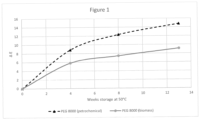
- To test the colour stability the perfume particles were stored at 50°C. Colour measurements were taken at 0 weeks to provide a baseline, 4 weeks, 8 weeks and 13 weeks. Colour was assessed by the ΔE value, comparing the aged sample to the 0 weeks sample. ΔE was calculated using the CIELAB colour space, wherein each colour has an L*, a* and b* value and

- The colour assessment was performed using an X-rite VS450 colour spectrometer.
Table 2: Colour stability results Δ E value Weeks stored at 50°C Comparative A Example 1 0 0 0 4 8.83 5.81 8 12.31 7.44 13 14.77 9.11 - As demonstrated, the perfume particles comprising PEG derived from biomass have a significantly smaller ΔE, demonstrating a smaller colour change and therefore a more stable perfume particle.
Claims (12)
- A perfume particle composition comprising:a) at least 10 wt.% of a carrier material selected from alcohol ethoxylates, polyethylene glycols and combinations thereof, which comprises at least one ethoxylate unit derived from biomass; andb) perfume ingredientswherein at least 50 wt. % of the ethoxylate units in ingredient a) are derived from plant biomass.
- A perfume particle according to claim 1, wherein less than 10 wt.%, of the ethoxylate units in ingredient a) are obtained directly from virgin fossil fuel sources.
- A perfume particle according to any preceding claim, wherein ingredient a) is an alcohol ethoxylate.
- A perfume particle according to any preceding claim, wherein ingredient a) is a polyethylene glycol having a molecular weight of 2000 to 20000.
- A perfume particle according to any preceding claim, wherein the biomass is cellulosic materials.
- A perfume particle according to any preceding claim, wherein the carrier material comprising at least one ethoxylate derived from biomass has a percentage modern carbon (pMC) of 50% to 100%, which is determined according to the specification in the description.
- A perfume particle according to any preceding claim, wherein the perfume particle comprises an additional carrier material, selected from: non-biomass derived synthetic polymers, proteins, saccharides, polysaccharides, water-soluble or water dispersible fillers, vegetable soap, non-biomass derived ethoxylated non-ionic surfactants, urea and combinations thereof.
- A perfume particle according to any preceding claim, wherein the perfume ingredients comprise free perfume.
- A perfume particle according to any preceding claim, wherein the perfume ingredients comprise encapsulated perfume.
- A perfume particle according to any preceding claim, wherein the perfume particles further comprise a colourant.
- A method of preparing a perfume particle composition according to claim 1, wherein the method comprises the steps of:i. Obtaining a carrier ingredient comprising at least one ethoxylate derived from biomass;ii. Melting said carrier material;iii. Adding the perfume ingredients;iv. Shaping and cooling the melt.
- Use of a perfume particle according to claims 1 to 10 to reduce the carbon footprint of the perfume particle.
Applications Claiming Priority (2)
| Application Number | Priority Date | Filing Date | Title |
|---|---|---|---|
| EP21196185 | 2021-09-10 | ||
| PCT/EP2022/073725 WO2023036623A1 (en) | 2021-09-10 | 2022-08-25 | Laundry composition |
Publications (2)
| Publication Number | Publication Date |
|---|---|
| EP4399270A1 EP4399270A1 (en) | 2024-07-17 |
| EP4399270B1 true EP4399270B1 (en) | 2025-04-30 |
Family
ID=77738959
Family Applications (1)
| Application Number | Title | Priority Date | Filing Date |
|---|---|---|---|
| EP22769231.6A Active EP4399270B1 (en) | 2021-09-10 | 2022-08-25 | Perfume particle |
Country Status (5)
| Country | Link |
|---|---|
| US (1) | US20250066697A1 (en) |
| EP (1) | EP4399270B1 (en) |
| CN (1) | CN117957302A (en) |
| PL (1) | PL4399270T3 (en) |
| WO (1) | WO2023036623A1 (en) |
Citations (5)
| Publication number | Priority date | Publication date | Assignee | Title |
|---|---|---|---|---|
| DE102005060006A1 (en) | 2005-12-13 | 2007-06-14 | Henkel Kgaa | Perfumation of substrates, useful in detergent industry, comprises spraying a mixture of a perfume and an aggregating agent on the substrate, where the aggregating agent is a surfactant, ethylene oxide adduct, a co-polymer and a solvent |
| US7585825B2 (en) | 2004-04-23 | 2009-09-08 | Henkel Ag & Co. Kgaa | Scented solid substances comprising a non-ionic surfactant-impregnated carrier |
| WO2017125235A1 (en) | 2016-01-21 | 2017-07-27 | Unilever Plc | Laundry product |
| WO2019025216A1 (en) | 2017-08-02 | 2019-02-07 | Unilever Plc | Laundry composition |
| US20240199976A1 (en) | 2021-04-15 | 2024-06-20 | Conopco, Inc., D/B/A Unilever | Laundry composition |
Family Cites Families (4)
| Publication number | Priority date | Publication date | Assignee | Title |
|---|---|---|---|---|
| US6624136B2 (en) * | 1998-02-02 | 2003-09-23 | Rhodia Chimie | Water-dispersible granules comprising a fragrance in a water-soluble or water-dispersible matrix, and process for their preparation |
| JP5258756B2 (en) * | 2006-05-17 | 2013-08-07 | イー・アイ・デュポン・ドウ・ヌムール・アンド・カンパニー | Personal care composition |
| CA2762589A1 (en) * | 2011-12-20 | 2013-06-20 | The Procter & Gamble Company | Sustainable containers and dispensers for consumer compositions, sustainable consumer products comprising sustainable consumer compositions in sustainable containers, and methods thereof |
| BR112021020485A2 (en) * | 2019-04-12 | 2021-12-14 | Int Flavors & Fragrances Inc | Consumer product with controlled release, biodegradable core-shell microcapsule compositions |
-
2022
- 2022-08-25 WO PCT/EP2022/073725 patent/WO2023036623A1/en not_active Ceased
- 2022-08-25 US US18/689,248 patent/US20250066697A1/en active Pending
- 2022-08-25 EP EP22769231.6A patent/EP4399270B1/en active Active
- 2022-08-25 CN CN202280061016.6A patent/CN117957302A/en active Pending
- 2022-08-25 PL PL22769231.6T patent/PL4399270T3/en unknown
Patent Citations (6)
| Publication number | Priority date | Publication date | Assignee | Title |
|---|---|---|---|---|
| US7585825B2 (en) | 2004-04-23 | 2009-09-08 | Henkel Ag & Co. Kgaa | Scented solid substances comprising a non-ionic surfactant-impregnated carrier |
| DE102005060006A1 (en) | 2005-12-13 | 2007-06-14 | Henkel Kgaa | Perfumation of substrates, useful in detergent industry, comprises spraying a mixture of a perfume and an aggregating agent on the substrate, where the aggregating agent is a surfactant, ethylene oxide adduct, a co-polymer and a solvent |
| WO2017125235A1 (en) | 2016-01-21 | 2017-07-27 | Unilever Plc | Laundry product |
| WO2019025216A1 (en) | 2017-08-02 | 2019-02-07 | Unilever Plc | Laundry composition |
| US20200224126A1 (en) | 2017-08-02 | 2020-07-16 | Conopco, Inc., D/B/A Unilever | Laundry composition |
| US20240199976A1 (en) | 2021-04-15 | 2024-06-20 | Conopco, Inc., D/B/A Unilever | Laundry composition |
Non-Patent Citations (4)
| Title |
|---|
| ANONYMOUS: "Lutensol® Surfactants", PRODUCT GUIDE, 1 December 2020 (2020-12-01), pages 1 - 32, XP093186469 |
| ANONYMOUS: "Sustainable Bio-based Surfactants", CRODA, 1 January 2020 (2020-01-01), XP093367053 |
| STICHNOTHE HEINZ, JØRGENSEN HENNING, FOUNDATION NOVO NORDISK, DE I, ENEA BARI, VAN HAVEREN JACCO: "Bio-Based Chemicals A 2020 Update ", 6 March 2020 (2020-03-06), pages 1 - 80, XP093253265 |
| TAMERS MURRY: "Distinguishing Between ‘Bio-Ethanol' And Petroleum Ethanol", ETHANOL PRODUCER MAGAZINE, 1 June 2006 (2006-06-01), XP093367049, Retrieved from the Internet <URL:https://ethanolproducer.com/articles/distinguishing-between-%E2%80%98bio-ethanol'-and-petroleum-ethanol-2077> |
Also Published As
| Publication number | Publication date |
|---|---|
| US20250066697A1 (en) | 2025-02-27 |
| PL4399270T3 (en) | 2025-11-12 |
| WO2023036623A1 (en) | 2023-03-16 |
| CN117957302A (en) | 2024-04-30 |
| EP4399270A1 (en) | 2024-07-17 |
Similar Documents
| Publication | Publication Date | Title |
|---|---|---|
| US12534692B2 (en) | Laundry composition | |
| EP1131396B1 (en) | Process for the preparation of granular detergent components | |
| EP3662043B1 (en) | Laundry composition | |
| US6616705B2 (en) | Laundry detergent compositions | |
| EP1409633B1 (en) | Improved detergent bar and a process for manufacture | |
| EP4211214B1 (en) | Laundry composition | |
| EP4168524B1 (en) | Laundry composition | |
| EP3405558B1 (en) | Laundry product | |
| EP3662045B1 (en) | Perfume particles for laundry composition | |
| EP4399270B1 (en) | Perfume particle | |
| DE60312647T2 (en) | LAUNDRY DETERGENT | |
| EP1117759B1 (en) | Granulation method | |
| JP2009532506A (en) | Biologically based compositions comprising mono- and diesters of 1,3-propanediol | |
| EP4532653B1 (en) | Premix and composition and method of preparing the same | |
| US20250002822A1 (en) | Laundry method | |
| AU695009B2 (en) | Perfume composition | |
| CN117120017A (en) | Laundry composition | |
| US20030130157A1 (en) | Detergent compostitions | |
| EP3266861A1 (en) | Liquid detergent composition | |
| EP0905115A1 (en) | Method for making acetal compounds | |
| DE19855380A1 (en) | Granulation process | |
| EP4532649B1 (en) | Composition | |
| DE60208414T2 (en) | DETERGENT COMPOSITIONS CONTAINING CALIUM CARBONATE AND METHOD FOR THE PRODUCTION THEREOF | |
| DE10116021A1 (en) | Detergent composition useful for cleaning hard and/or soft surfaces comprises a nonionic surfactant which is an ethoxylated medium-chain branched alcohol | |
| CN116761913A (en) | Methods of preparing treatment compositions containing botanical rosin materials and related premix compositions |
Legal Events
| Date | Code | Title | Description |
|---|---|---|---|
| STAA | Information on the status of an ep patent application or granted ep patent |
Free format text: STATUS: UNKNOWN |
|
| STAA | Information on the status of an ep patent application or granted ep patent |
Free format text: STATUS: THE INTERNATIONAL PUBLICATION HAS BEEN MADE |
|
| PUAI | Public reference made under article 153(3) epc to a published international application that has entered the european phase |
Free format text: ORIGINAL CODE: 0009012 |
|
| STAA | Information on the status of an ep patent application or granted ep patent |
Free format text: STATUS: REQUEST FOR EXAMINATION WAS MADE |
|
| 17P | Request for examination filed |
Effective date: 20240116 |
|
| AK | Designated contracting states |
Kind code of ref document: A1 Designated state(s): AL AT BE BG CH CY CZ DE DK EE ES FI FR GB GR HR HU IE IS IT LI LT LU LV MC MK MT NL NO PL PT RO RS SE SI SK SM TR |
|
| DAV | Request for validation of the european patent (deleted) | ||
| DAX | Request for extension of the european patent (deleted) | ||
| GRAP | Despatch of communication of intention to grant a patent |
Free format text: ORIGINAL CODE: EPIDOSNIGR1 |
|
| STAA | Information on the status of an ep patent application or granted ep patent |
Free format text: STATUS: GRANT OF PATENT IS INTENDED |
|
| INTG | Intention to grant announced |
Effective date: 20250117 |
|
| GRAS | Grant fee paid |
Free format text: ORIGINAL CODE: EPIDOSNIGR3 |
|
| GRAA | (expected) grant |
Free format text: ORIGINAL CODE: 0009210 |
|
| STAA | Information on the status of an ep patent application or granted ep patent |
Free format text: STATUS: THE PATENT HAS BEEN GRANTED |
|
| AK | Designated contracting states |
Kind code of ref document: B1 Designated state(s): AL AT BE BG CH CY CZ DE DK EE ES FI FR GB GR HR HU IE IS IT LI LT LU LV MC MK MT NL NO PL PT RO RS SE SI SK SM TR |
|
| REG | Reference to a national code |
Ref country code: CH Ref legal event code: EP Ref country code: GB Ref legal event code: FG4D |
|
| REG | Reference to a national code |
Ref country code: IE Ref legal event code: FG4D |
|
| REG | Reference to a national code |
Ref country code: DE Ref legal event code: R096 Ref document number: 602022013993 Country of ref document: DE |
|
| P01 | Opt-out of the competence of the unified patent court (upc) registered |
Free format text: CASE NUMBER: APP_19030/2025 Effective date: 20250422 |
|
| REG | Reference to a national code |
Ref country code: NL Ref legal event code: MP Effective date: 20250430 |
|
| REG | Reference to a national code |
Ref country code: AT Ref legal event code: MK05 Ref document number: 1790044 Country of ref document: AT Kind code of ref document: T Effective date: 20250430 |
|
| RAP4 | Party data changed (patent owner data changed or rights of a patent transferred) |
Owner name: UNILEVER IP HOLDINGS B.V. Owner name: UNILEVER GLOBAL IP LIMITED |
|
| PG25 | Lapsed in a contracting state [announced via postgrant information from national office to epo] |
Ref country code: FI Free format text: LAPSE BECAUSE OF FAILURE TO SUBMIT A TRANSLATION OF THE DESCRIPTION OR TO PAY THE FEE WITHIN THE PRESCRIBED TIME-LIMIT Effective date: 20250430 Ref country code: PT Free format text: LAPSE BECAUSE OF FAILURE TO SUBMIT A TRANSLATION OF THE DESCRIPTION OR TO PAY THE FEE WITHIN THE PRESCRIBED TIME-LIMIT Effective date: 20250901 Ref country code: ES Free format text: LAPSE BECAUSE OF FAILURE TO SUBMIT A TRANSLATION OF THE DESCRIPTION OR TO PAY THE FEE WITHIN THE PRESCRIBED TIME-LIMIT Effective date: 20250430 |
|
| PGFP | Annual fee paid to national office [announced via postgrant information from national office to epo] |
Ref country code: DE Payment date: 20250820 Year of fee payment: 4 |
|
| REG | Reference to a national code |
Ref country code: LT Ref legal event code: MG9D |
|
| PG25 | Lapsed in a contracting state [announced via postgrant information from national office to epo] |
Ref country code: NO Free format text: LAPSE BECAUSE OF FAILURE TO SUBMIT A TRANSLATION OF THE DESCRIPTION OR TO PAY THE FEE WITHIN THE PRESCRIBED TIME-LIMIT Effective date: 20250730 Ref country code: GR Free format text: LAPSE BECAUSE OF FAILURE TO SUBMIT A TRANSLATION OF THE DESCRIPTION OR TO PAY THE FEE WITHIN THE PRESCRIBED TIME-LIMIT Effective date: 20250731 |
|
| PG25 | Lapsed in a contracting state [announced via postgrant information from national office to epo] |
Ref country code: NL Free format text: LAPSE BECAUSE OF FAILURE TO SUBMIT A TRANSLATION OF THE DESCRIPTION OR TO PAY THE FEE WITHIN THE PRESCRIBED TIME-LIMIT Effective date: 20250430 |
|
| PGFP | Annual fee paid to national office [announced via postgrant information from national office to epo] |
Ref country code: TR Payment date: 20250818 Year of fee payment: 4 Ref country code: IT Payment date: 20250901 Year of fee payment: 4 |
|
| PG25 | Lapsed in a contracting state [announced via postgrant information from national office to epo] |
Ref country code: BG Free format text: LAPSE BECAUSE OF FAILURE TO SUBMIT A TRANSLATION OF THE DESCRIPTION OR TO PAY THE FEE WITHIN THE PRESCRIBED TIME-LIMIT Effective date: 20250430 |
|
| PG25 | Lapsed in a contracting state [announced via postgrant information from national office to epo] |
Ref country code: HR Free format text: LAPSE BECAUSE OF FAILURE TO SUBMIT A TRANSLATION OF THE DESCRIPTION OR TO PAY THE FEE WITHIN THE PRESCRIBED TIME-LIMIT Effective date: 20250430 |
|
| PG25 | Lapsed in a contracting state [announced via postgrant information from national office to epo] |
Ref country code: AT Free format text: LAPSE BECAUSE OF FAILURE TO SUBMIT A TRANSLATION OF THE DESCRIPTION OR TO PAY THE FEE WITHIN THE PRESCRIBED TIME-LIMIT Effective date: 20250430 |
|
| PGFP | Annual fee paid to national office [announced via postgrant information from national office to epo] |
Ref country code: FR Payment date: 20250828 Year of fee payment: 4 |
|
| PG25 | Lapsed in a contracting state [announced via postgrant information from national office to epo] |
Ref country code: RS Free format text: LAPSE BECAUSE OF FAILURE TO SUBMIT A TRANSLATION OF THE DESCRIPTION OR TO PAY THE FEE WITHIN THE PRESCRIBED TIME-LIMIT Effective date: 20250731 |
|
| PG25 | Lapsed in a contracting state [announced via postgrant information from national office to epo] |
Ref country code: IS Free format text: LAPSE BECAUSE OF FAILURE TO SUBMIT A TRANSLATION OF THE DESCRIPTION OR TO PAY THE FEE WITHIN THE PRESCRIBED TIME-LIMIT Effective date: 20250830 |
|
| PG25 | Lapsed in a contracting state [announced via postgrant information from national office to epo] |
Ref country code: LV Free format text: LAPSE BECAUSE OF FAILURE TO SUBMIT A TRANSLATION OF THE DESCRIPTION OR TO PAY THE FEE WITHIN THE PRESCRIBED TIME-LIMIT Effective date: 20250430 |
|
| PG25 | Lapsed in a contracting state [announced via postgrant information from national office to epo] |
Ref country code: SM Free format text: LAPSE BECAUSE OF FAILURE TO SUBMIT A TRANSLATION OF THE DESCRIPTION OR TO PAY THE FEE WITHIN THE PRESCRIBED TIME-LIMIT Effective date: 20250430 Ref country code: DK Free format text: LAPSE BECAUSE OF FAILURE TO SUBMIT A TRANSLATION OF THE DESCRIPTION OR TO PAY THE FEE WITHIN THE PRESCRIBED TIME-LIMIT Effective date: 20250430 |
|
| PG25 | Lapsed in a contracting state [announced via postgrant information from national office to epo] |
Ref country code: CZ Free format text: LAPSE BECAUSE OF FAILURE TO SUBMIT A TRANSLATION OF THE DESCRIPTION OR TO PAY THE FEE WITHIN THE PRESCRIBED TIME-LIMIT Effective date: 20250430 |
|
| PGFP | Annual fee paid to national office [announced via postgrant information from national office to epo] |
Ref country code: PL Payment date: 20250818 Year of fee payment: 4 |
|
| PG25 | Lapsed in a contracting state [announced via postgrant information from national office to epo] |
Ref country code: EE Free format text: LAPSE BECAUSE OF FAILURE TO SUBMIT A TRANSLATION OF THE DESCRIPTION OR TO PAY THE FEE WITHIN THE PRESCRIBED TIME-LIMIT Effective date: 20250430 |
|
| PG25 | Lapsed in a contracting state [announced via postgrant information from national office to epo] |
Ref country code: SK Free format text: LAPSE BECAUSE OF FAILURE TO SUBMIT A TRANSLATION OF THE DESCRIPTION OR TO PAY THE FEE WITHIN THE PRESCRIBED TIME-LIMIT Effective date: 20250430 |
|
| REG | Reference to a national code |
Ref country code: DE Ref legal event code: R026 Ref document number: 602022013993 Country of ref document: DE |
|
| PLBI | Opposition filed |
Free format text: ORIGINAL CODE: 0009260 |
|
| REG | Reference to a national code |
Ref country code: CH Ref legal event code: L10 Free format text: ST27 STATUS EVENT CODE: U-0-0-L10-L00 (AS PROVIDED BY THE NATIONAL OFFICE) Effective date: 20260211 |
|
| PLAX | Notice of opposition and request to file observation + time limit sent |
Free format text: ORIGINAL CODE: EPIDOSNOBS2 |
|
| PG25 | Lapsed in a contracting state [announced via postgrant information from national office to epo] |
Ref country code: RO Free format text: LAPSE BECAUSE OF FAILURE TO SUBMIT A TRANSLATION OF THE DESCRIPTION OR TO PAY THE FEE WITHIN THE PRESCRIBED TIME-LIMIT Effective date: 20250430 |
|
| 26 | Opposition filed |
Opponent name: THE PROCTER & GAMBLE COMPANY Effective date: 20260130 |
|
| REG | Reference to a national code |
Ref country code: CH Ref legal event code: H13 Free format text: ST27 STATUS EVENT CODE: U-0-0-H10-H13 (AS PROVIDED BY THE NATIONAL OFFICE) Effective date: 20260324 |
|
| PG25 | Lapsed in a contracting state [announced via postgrant information from national office to epo] |
Ref country code: LU Free format text: LAPSE BECAUSE OF NON-PAYMENT OF DUE FEES Effective date: 20250825 |