EP4399115B1 - Method of management of an electric propulsion system and electric propulsion system implementing the method - Google Patents
Method of management of an electric propulsion system and electric propulsion system implementing the method Download PDFInfo
- Publication number
- EP4399115B1 EP4399115B1 EP22761014.4A EP22761014A EP4399115B1 EP 4399115 B1 EP4399115 B1 EP 4399115B1 EP 22761014 A EP22761014 A EP 22761014A EP 4399115 B1 EP4399115 B1 EP 4399115B1
- Authority
- EP
- European Patent Office
- Prior art keywords
- propulsion
- torque
- lines
- line
- requested
- Prior art date
- Legal status (The legal status is an assumption and is not a legal conclusion. Google has not performed a legal analysis and makes no representation as to the accuracy of the status listed.)
- Active
Links
Images



Classifications
-
- B—PERFORMING OPERATIONS; TRANSPORTING
- B60—VEHICLES IN GENERAL
- B60L—PROPULSION OF ELECTRICALLY-PROPELLED VEHICLES; SUPPLYING ELECTRIC POWER FOR AUXILIARY EQUIPMENT OF ELECTRICALLY-PROPELLED VEHICLES; ELECTRODYNAMIC BRAKE SYSTEMS FOR VEHICLES IN GENERAL; MAGNETIC SUSPENSION OR LEVITATION FOR VEHICLES; MONITORING OPERATING VARIABLES OF ELECTRICALLY-PROPELLED VEHICLES; ELECTRIC SAFETY DEVICES FOR ELECTRICALLY-PROPELLED VEHICLES
- B60L15/00—Methods, circuits, or devices for controlling the traction-motor speed of electrically-propelled vehicles
- B60L15/20—Methods, circuits, or devices for controlling the traction-motor speed of electrically-propelled vehicles for control of the vehicle or its driving motor to achieve a desired performance, e.g. speed, torque, programmed variation of speed
- B60L15/2054—Methods, circuits, or devices for controlling the traction-motor speed of electrically-propelled vehicles for control of the vehicle or its driving motor to achieve a desired performance, e.g. speed, torque, programmed variation of speed by controlling transmissions or clutches
-
- B—PERFORMING OPERATIONS; TRANSPORTING
- B60—VEHICLES IN GENERAL
- B60L—PROPULSION OF ELECTRICALLY-PROPELLED VEHICLES; SUPPLYING ELECTRIC POWER FOR AUXILIARY EQUIPMENT OF ELECTRICALLY-PROPELLED VEHICLES; ELECTRODYNAMIC BRAKE SYSTEMS FOR VEHICLES IN GENERAL; MAGNETIC SUSPENSION OR LEVITATION FOR VEHICLES; MONITORING OPERATING VARIABLES OF ELECTRICALLY-PROPELLED VEHICLES; ELECTRIC SAFETY DEVICES FOR ELECTRICALLY-PROPELLED VEHICLES
- B60L15/00—Methods, circuits, or devices for controlling the traction-motor speed of electrically-propelled vehicles
- B60L15/007—Physical arrangements or structures of drive train converters specially adapted for the propulsion motors of electric vehicles
-
- B—PERFORMING OPERATIONS; TRANSPORTING
- B60—VEHICLES IN GENERAL
- B60L—PROPULSION OF ELECTRICALLY-PROPELLED VEHICLES; SUPPLYING ELECTRIC POWER FOR AUXILIARY EQUIPMENT OF ELECTRICALLY-PROPELLED VEHICLES; ELECTRODYNAMIC BRAKE SYSTEMS FOR VEHICLES IN GENERAL; MAGNETIC SUSPENSION OR LEVITATION FOR VEHICLES; MONITORING OPERATING VARIABLES OF ELECTRICALLY-PROPELLED VEHICLES; ELECTRIC SAFETY DEVICES FOR ELECTRICALLY-PROPELLED VEHICLES
- B60L2240/00—Control parameters of input or output; Target parameters
- B60L2240/40—Drive Train control parameters
- B60L2240/48—Drive Train control parameters related to transmissions
- B60L2240/486—Operating parameters
-
- B—PERFORMING OPERATIONS; TRANSPORTING
- B60—VEHICLES IN GENERAL
- B60L—PROPULSION OF ELECTRICALLY-PROPELLED VEHICLES; SUPPLYING ELECTRIC POWER FOR AUXILIARY EQUIPMENT OF ELECTRICALLY-PROPELLED VEHICLES; ELECTRODYNAMIC BRAKE SYSTEMS FOR VEHICLES IN GENERAL; MAGNETIC SUSPENSION OR LEVITATION FOR VEHICLES; MONITORING OPERATING VARIABLES OF ELECTRICALLY-PROPELLED VEHICLES; ELECTRIC SAFETY DEVICES FOR ELECTRICALLY-PROPELLED VEHICLES
- B60L50/00—Electric propulsion with power supplied within the vehicle
- B60L50/10—Electric propulsion with power supplied within the vehicle using propulsion power supplied by engine-driven generators, e.g. generators driven by combustion engines
- B60L50/15—Electric propulsion with power supplied within the vehicle using propulsion power supplied by engine-driven generators, e.g. generators driven by combustion engines with additional electric power supply
Definitions
- the present invention relates to the field of electric propulsion systems, in particular in the field of industrial and commercial vehicles.
- US 2021/152105 A1 discloses an electric propulsion system.
- the purpose of the present invention is to present a method for managing a propulsion system and a propulsion system that are better or alternative to the known art.
- the present invention is based on a propulsion system comprising two parallel propulsion lines which converge on the same driving axle.
- Each propulsion line comprises in succession, an electric motor, a gearbox and a clutch.
- the control of the first propulsion line is independent of the second propulsion line, so that while, for example, the first line is operational, the second can be deactivated or can operate differently from the first line.
- a processing unit distributes the torque between the propulsion lines.
- this distribution is not fair and the two propulsion lines work with different transmission ratios and torque values.
- the transmission ratio is varied sequentially between the two propulsion lines.
- the propulsion line which remains operational while the other performs the variation in the transmission ratio, delivers the entire torque required to the propulsion system or the maximum torque that can be delivered by the propulsion line itself.
- the entire torque required by the propulsion system is delivered by the first propulsion line, while the second performs the variation in the transmission ratio.
- the first propulsion line that carries out the variation of the transmission ratio is:
- both propulsion lines can be equipped with constructively identical electric motors, the maximum deliverable torque can be different.
- the maximum deliverable torque of an electric motor depends on its electro-mechanical characteristics but also on its operating conditions in terms of temperature, generally of the stator. Therefore, the maximum deliverable (or available) torque may be different even if the motors of the two propulsion lines are constructively identical to each other, since the operating temperature influences the maximum deliverable torque value.
- the maximum deliverable torque is calculated dynamically in order to avoid damage to each of the electric motors of the two propulsion lines
- the system includes two propulsion lines L1 and L2.
- Each propulsion line includes an electric motor generator M1, M2, a gearbox G1, G2 and a clutch C1, C2.
- motor refers to an "electric motogenerator”.
- the gearbox G1, G2 has preferably discrete ratios and preferably comprises two transmission ratios, indicated in Figs. 1 and 2 with “1st Gear” and “2nd Gear”, indicating first and second gear respectively.
- the clutch C1, C2 is made by means of a dog clutch that can be controlled in order to connect or disconnect the respective propulsion line from the driving axle X indicated in figure 5 .
- the clutch can be integrated into a gearbox capable of interrupting the connection with the driving axle X as well as selectively selecting a gear ratio between the two or more gear ratios.
- Figure 1 also provides for a condition in which the first line L1 is completely disconnected from the driving axle X.
- This disconnected condition is indicated in Figure 1 with the label "Disengagement”.
- this disconnected condition is indicated with zero torque 0% delivery.
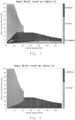
- the two diagrams of figures 1 and 2 are very similar to each other and have a vertical area, very close to the ordinate axis, in which the first transmission ratio is engaged and a horizontal area, very close to the abscissa axis, in which the engaging of the second transmission ratio is foreseen.
- the first diagram differs from the second one in that it includes a third area, contiguous with the abscissa axis, according to which the disconnection of the relative propulsion line is expected.
- the first L1 and the second L2 propulsion line provide for the use of the same transmission ratio, namely the first gear.
- the two propulsion lines adopt the same transmission ratio, i.e. second gear.
- one transmission line can adopt the first transmission ratio, while the other adopts the second transmission ratio.
- Figure 3 shows the torque split between the two transmission lines.
- the diagram is drawn for the first motor M1, therefore, the torque delivered by the second motor M2 of the second propulsion line corresponds to the torque complementary to that required by the first motor M1.
- the two propulsion lines adopt the same transmission ratio, they participate equally in the delivery of the driving torque. Instead, where percentage values of 0, 10, 15, 25% are indicated, it means that the first motor delivers 0 or 10, 15, 25% of the required torque, while the second motor M2 delivers respectively and complementarily 100, 90, 85, 75% of the required torque, i.e. the complementary value.
- the first propulsion line which delivers less torque than the second propulsion line, implements a higher gear ratio.
- the discriminating factor for choosing the distribution of the torque between the propulsion lines and the transmission ratios is always the minimization of the sum of the dissipated powers.
- both propulsion lines when, following a variation in the control signals, both propulsion lines have to vary the relative transmission ratio, then priority is given to the propulsion line that delivers less torque and subsequently the variation of the propulsion ratio on the other propulsion line.
- the other propulsion line delivers the entire drive torque required to the propulsion system, possibly saturated to the maximum torque that can be delivered by the same.
- Figure 7 shows an example of flow chart, exemplary of the present invention.
- step 2GS It envisages cyclically checking, in step 2GS, if the simultaneous variation of the transmission ratio is required on both propulsion lines.
- the maximum deliverable torque is reduced although it may be delivering a lower drive torque than the second electric motor at the moment in which the transmission ratio variation signal is generated.
- the control strategy of the present invention is particularly advantageous, since this allows the propulsion system to be able to react promptly to the driver's torque requests even during the variation of the transmission ratio on both propulsion lines.
- the deactivation of the driving torque delivery by the motor that has lower residual driving torque allows it to cool.
- the torque delivered by the selected propulsion line is limited to the maximum torque that can be delivered by the propulsion line itself.
- the other propulsion line delivers zero torque, in particular the other propulsion line is controlled exclusively to ensure the synchronization of the gearbox, that is, in order to minimize friction and impact of the operating parts of the gearbox.
- the first propulsion line is completely disconnected by opening the clutch C1.
- an approximately linear curve is represented that defines the boundary between two contiguous areas that provide for the implementation of the second gear or the "Disengagement" disconnection of the first line L1 of propulsion in figure 1 and the delivery of 50% and 0% of the driving torque by the propulsion line L1 in figure 3 .
- the table as a function of a torque required from the propulsion system and a rotation speed of the driving axle X, returns a distribution value of the torque required between the first and second lines and provides
- figures 1 - 3 may vary, albeit slightly. More specifically, in the case of more than two transmission ratios, the curves would change in the central area, i.e. proximal to the origin of the axes, but the concept of "disengagement" of the area Z2 remains unchanged.
- Figure 6 shows a preferred flow chart for generating the "look up tables" of Figures 1 - 3 .
- FIGS. 1 - 3 represent diagrams and at the same time look up tables (or simply tables).
- the ordinate axis represents the torque required by the propulsion system.
- the required torque varies from 0 to 100% with a predetermined pitch M, for example by one percentage point.
- all the possible torque distribution ratios R between the two propulsion lines are considered, for example 0/100, 1/99, 2/98... etc.
- the number C of combinations are: M / 2 ⁇ 1 ⁇ 4 + 1 ⁇ N .
- the losses on both propulsion lines are calculated, both of a mechanical nature P loss,G , and of an electrical nature P loss,M .
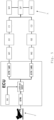
- Figure 5 shows a logical-functional diagram of the propulsion system object of the present invention.
- the signal relating to the torque required by the driver is acquired by means of an inclination sensor (not shown), associated with the accelerator pedal P.
- a speed sensor SS is associated with the X axle to measure vehicle speed.
- the signals generated by the inclination sensor and the speed sensor are sent to a processing unit ECU (Electronic control Unit), operatively connected to said sensors.
- the processing unit using the tables in figures 1 - 3 , briefly indicated as “Look-up Table", calculates the partitioning of the torque between the two propulsion lines L1 and L2 ( figure 3 ) and the transmission ratios ( figures 1 and 2 ) of both propulsion lines.
- the processing unit uses the diagrams in Figures 1 and 2 , selects the gear to be used in the G1 and G2 gearboxes, or selects the disconnection of one of the propulsion lines by disengaging the relative clutch.
- the processing unit calculates the torque distribution between the two transmission lines in response to a position of the accelerator pedal and in particular, in response to a variation in the position of the accelerator pedal and/or in response to a variation of the load perceived by the propulsion system, the processing unit can control the simultaneous variation of the transmission ratios of both propulsion lines.
- the present invention finds particular application.
- the output shafts of the two propulsion lines L1, L2 converge on the same driving axle X.
- the axle includes a central differential DF from which the drive shafts depart driving the wheels W1 and W2.
- a preferred aspect of the present invention is the fact of performing the following steps:
- the diagram of Figure 1 is temporarily attributed alternately to the first propulsion line L1 and to the second propulsion line L2. This fact ensures that the transmission lines are subject to the same wear and thermal stress.
- the processing unit calculates a new distribution of driving torque, based on a variation in the inclination of the accelerator pedal and/or the speed of the vehicle, it sends new instructions to the propulsion lines.
- the present invention can be advantageously implemented by means of a computer program which comprises coding means for carrying out one or more steps of the method, when this program is executed on a computer. Therefore, it is intended that the scope of protection extends to said computer program and further to computer readable means comprising a recorded message, said computer readable means comprising program coding means for carrying out one or more steps of the method, when said program is run on a computer.
Landscapes
- Engineering & Computer Science (AREA)
- Power Engineering (AREA)
- Transportation (AREA)
- Mechanical Engineering (AREA)
- Electric Propulsion And Braking For Vehicles (AREA)
- Control Of Vehicles With Linear Motors And Vehicles That Are Magnetically Levitated (AREA)
- Control Of Transmission Device (AREA)
Description
- The present invention relates to the field of electric propulsion systems, in particular in the field of industrial and commercial vehicles.
- In the field of commercial and industrial vehicles, massive electrification is underway which sees the replacement of internal combustion motors with electric motors.
- However, electric motors have very different characteristics compared to internal combustion motors. Therefore, it is necessary to provide for dedicated control strategies in order to guarantee range, robustness and performance adequate for the purposes.
-
US 2021/152105 A1 discloses an electric propulsion system. - The purpose of the present invention is to present a method for managing a propulsion system and a propulsion system that are better or alternative to the known art.
- The present invention is based on a propulsion system comprising two parallel propulsion lines which converge on the same driving axle. Each propulsion line comprises in succession, an electric motor, a gearbox and a clutch.
- The control of the first propulsion line is independent of the second propulsion line, so that while, for example, the first line is operational, the second can be deactivated or can operate differently from the first line.
- Depending on the torque required from the propulsion system and vehicle speed, a processing unit distributes the torque between the propulsion lines.
- In some cases, this distribution is not fair and the two propulsion lines work with different transmission ratios and torque values.
- As the speed of the driving axle and therefore of the vehicle varies, the operating conditions of the two propulsion lines vary and the simultaneous variation of the transmission ratio on both propulsion lines may be required. However, this involves the interruption of torque delivery by the propulsion system for the time necessary to perform this variation in the transmission ratio.
- According to the present invention, to avoid the interruption of the torque delivered by the propulsion system, the transmission ratio is varied sequentially between the two propulsion lines.
- In addition, the propulsion line, which remains operational while the other performs the variation in the transmission ratio, delivers the entire torque required to the propulsion system or the maximum torque that can be delivered by the propulsion line itself.
- After the first of the two propulsion lines has performed the variation in the transmission ratio, the entire torque required by the propulsion system is delivered by the first propulsion line, while the second performs the variation in the transmission ratio.
- According to a preferred aspect of the invention, the first propulsion line that carries out the variation of the transmission ratio is:
- Any one of the two, when both propulsion lines have the same maximum torque value that can be delivered, when the variation in the transmission ratio is requested on both propulsion lines,
- The one that has a lower maximum deliverable torque value between the two propulsion lines, when the propulsion lines have a different maximum deliverable torque, when a variation in the transmission ratio is requested on both propulsion lines.
- Although both propulsion lines can be equipped with constructively identical electric motors, the maximum deliverable torque can be different.
- This depends on the fact that the maximum deliverable torque is a function of the temperature of the electric motor itself.
- It is in fact known that the maximum deliverable torque of an electric motor depends on its electro-mechanical characteristics but also on its operating conditions in terms of temperature, generally of the stator. Therefore, the maximum deliverable (or available) torque may be different even if the motors of the two propulsion lines are constructively identical to each other, since the operating temperature influences the maximum deliverable torque value. The maximum deliverable torque is calculated dynamically in order to avoid damage to each of the electric motors of the two propulsion lines
- The dependent claims describe preferred variants of the invention, forming an integral part of this description.
- Further objects and advantages of the present invention will become clear from the following detailed description of an example of embodiment of the same (and its variants) and from the attached drawings given purely for explanatory and non-limiting purposes, in which:
-
Figs. 1 and 2 show transmission ratio selection diagrams in relation to vehicle speed and required percentage torque; -
Fig. 3 shows a diagram of distribution of the torque required between the motors of the two propulsion lines; -
Fig. 4 schematically illustrates the propulsion system according to the present invention; -
Fig. 5 schematically shows the propulsion system offigure 4 with an indication also of the logic functions realized by means of the diagrams ofFigures 1 - 3 ; -
Fig. 6 shows a flow diagram for generating the diagrams ofFigures 1 - 3 ; -
Fig. 7 shows an example of a flow chart representative of a preferred variant of the present invention. - The same reference numbers and letters in the figures identify the same elements or components or functions.
- It should also be noted that the terms "first", "second", "third", "upper", "lower" and the like can be used here to distinguish various elements. These terms do not imply a spatial, sequential or hierarchical order for the modified elements unless specifically indicated or inferred from the text.
- The elements and features illustrated in the various preferred embodiments, including the drawings, can be combined with each other without however departing from the scope of this application as described below.
- With reference to
Figures 4 and5 , a propulsion system according to the present invention is shown. - The system includes two propulsion lines L1 and L2.
- Each propulsion line includes an electric motor generator M1, M2, a gearbox G1, G2 and a clutch C1, C2.
- Hereinafter, for convenience, the term "motor" refers to an "electric motogenerator".
- The gearbox G1, G2 has preferably discrete ratios and preferably comprises two transmission ratios, indicated in
Figs. 1 and 2 with "1st Gear" and "2nd Gear", indicating first and second gear respectively. - Preferably, the clutch C1, C2 is made by means of a dog clutch that can be controlled in order to connect or disconnect the respective propulsion line from the driving axle X indicated in
figure 5 . - However, the clutch can be integrated into a gearbox capable of interrupting the connection with the driving axle X as well as selectively selecting a gear ratio between the two or more gear ratios.
-
Figure 1 also provides for a condition in which the first line L1 is completely disconnected from the driving axle X. This disconnected condition is indicated inFigure 1 with the label "Disengagement". InFigure 3 , this disconnected condition is indicated with zerotorque 0% delivery. - The diagrams in
figures 1 - 3 show areas in the Cartesian plane as a function of the vehicle speed "Vehicle speed" and the torque required "Driver Torque Demand" from the propulsion system. For example, if the maximum torque that each propulsion line can provide is 900Nm and the driver requires 70% of the maximum torque, then the torque delivered by the propulsion system is 1800 * 0.7 = 1260Nm. - It is evident that the vehicle speed and the rotation speed of the driving axle X are equivalent by a fixed gear ratio. Therefore, it is indifferent to speak about one or the other in the following description.
- In
Figs. 1 and 2 , the areas are hatched so that each point belonging to the same areas indicates the feasible transmission ratio. - The two diagrams of
figures 1 and 2 are very similar to each other and have a vertical area, very close to the ordinate axis, in which the first transmission ratio is engaged and a horizontal area, very close to the abscissa axis, in which the engaging of the second transmission ratio is foreseen. The first diagram differs from the second one in that it includes a third area, contiguous with the abscissa axis, according to which the disconnection of the relative propulsion line is expected. - By observing the diagrams of
figures 1 and 2 simultaneously, it can be understood, for example, that for a vehicle speed up to 40 km/h and for torque required greater than 30% of the maximum deliverable torque, the first L1 and the second L2 propulsion line provide for the use of the same transmission ratio, namely the first gear. - Similarly, when the required torque is greater than 10% and the vehicle speed is greater than 40 km/h, the two propulsion lines adopt the same transmission ratio, i.e. second gear.
- There are areas where the two propulsion lines adopt different transmission ratios, especially in the torque range between 0 and 30% and in the speed range between 0 and 40 km/h, i.e. in the near area at the origin of the axes.
- Under these conditions, one transmission line can adopt the first transmission ratio, while the other adopts the second transmission ratio.
- This fact is justified by a different distribution of the driving torque between the two propulsion lines in order to minimize losses, both electrical and mechanical.
-
Figure 3 shows the torque split between the two transmission lines. In particular, the diagram is drawn for the first motor M1, therefore, the torque delivered by the second motor M2 of the second propulsion line corresponds to the torque complementary to that required by the first motor M1. - In the same areas where the two propulsion lines adopt the same transmission ratio, they participate equally in the delivery of the driving torque. Instead, where percentage values of 0, 10, 15, 25% are indicated, it means that the first motor delivers 0 or 10, 15, 25% of the required torque, while the second motor M2 delivers respectively and
complementarily - At the same time, the first propulsion line, which delivers less torque than the second propulsion line, implements a higher gear ratio.
- This fact leads to optimizing the overall performance of the propulsion system. The discriminating factor for choosing the distribution of the torque between the propulsion lines and the transmission ratios is always the minimization of the sum of the dissipated powers.
- According to the present invention, when, following a variation in the control signals, both propulsion lines have to vary the relative transmission ratio, then priority is given to the propulsion line that delivers less torque and subsequently the variation of the propulsion ratio on the other propulsion line. Preferably, during the gear variation of the propulsion line that first performs the gear variation, the other propulsion line delivers the entire drive torque required to the propulsion system, possibly saturated to the maximum torque that can be delivered by the same.
- This shift control strategy guarantees reduced discomfort for the driver.
-
Figure 7 shows an example of flow chart, exemplary of the present invention. - It envisages cyclically checking, in step 2GS, if the simultaneous variation of the transmission ratio is required on both propulsion lines.
- When it comes that the simultaneous variation of the transmission ratio is required on both propulsion lines, then the following steps are carried out in succession:
- GS_S step selection of the propulsion line that has the highest deliverable driving torque, when the propulsion lines have a different maximum deliverable driving torque, or one of the two propulsion lines according to a predetermined selection criterion, when the propulsion lines have equal maximum deliverable driving torque;
- Step GS_1 delivery of the entire driving torque by the selected propulsion line and variation of the transmission ratio by the other propulsion line;
- Step GS_2 delivery of the entire driving torque by the unselected propulsion line and variation of the transmission ratio by the selected propulsion line.
- At the end of the variation in the transmission ratio by both propulsion lines, you return to the beginning of the diagram pending a new request for a simultaneous variation in the transmission ratio on both propulsion lines.
- If, for example, the first of the two electric motors reach a higher operating temperature, the maximum deliverable torque is reduced although it may be delivering a lower drive torque than the second electric motor at the moment in which the transmission ratio variation signal is generated.
- The control strategy of the present invention is particularly advantageous, since this allows the propulsion system to be able to react promptly to the driver's torque requests even during the variation of the transmission ratio on both propulsion lines. In addition, the deactivation of the driving torque delivery by the motor that has lower residual driving torque allows it to cool.
- It is evident that the torque delivered by the selected propulsion line is limited to the maximum torque that can be delivered by the propulsion line itself. At the same time, the other propulsion line delivers zero torque, in particular the other propulsion line is controlled exclusively to ensure the synchronization of the gearbox, that is, in order to minimize friction and impact of the operating parts of the gearbox.
- When the two propulsion lines are delivering the same driving torque and the simultaneous variation of the transmission ratio is commanded, it is possible to select the line that first performs the variation of the transmission ratio in a random or balanced way, i.e. in order to alternate the precedence between the two lines of propulsion.
- According to a preferred variant of the invention, when the required torque is relatively low, for example under a variable threshold and a function of the speed of the vehicle, the first propulsion line is completely disconnected by opening the clutch C1. This fact leads to several benefits:
- firstly it allows the second motor M2, which remains operational, to work at an optimal operating point, and
- secondly, the field weakening losses are also eliminated, that would occur if a single motor were powered, keeping the other motor mechanically connected to the driving axle.
- Indeed, it is planned to adopt permanent magnet electric motors. This fact involves on the one hand having a high specific power, but on the other hand the generation of counter-electromotive force, when the motor is driven into rotation and power disconnected. In fact, this counter-electromotive force involves the generation of a resistant torque which causes a reduction in the efficiency of the propulsion system.
- To overcome this resistant torque, it is possible to inject current along the so-called weakening axis, to demagnetize the motor in order to keep the induced voltage across the motor under control. This leads to an increase in the dissipated electrical power.
- It is worth highlighting that for low torque delivering, in the diagram of
figures 1 and3 , an approximately linear curve is represented that defines the boundary between two contiguous areas that provide for the implementation of the second gear or the "Disengagement" disconnection of the first line L1 of propulsion infigure 1 and the delivery of 50% and 0% of the driving torque by the propulsion line L1 infigure 3 . - With reference to
Figure 3 , the table, as a function of a torque required from the propulsion system and a rotation speed of the driving axle X, returns a distribution value of the torque required between the first and second lines and provides - a first zone Z1 contiguous with the torque axis, the torque required by the propulsion system is equally divided between said first and second propulsion lines;
- a second zone Z2 contiguous with the axis of rotation speed of the driving axle, the torque required by the propulsion system is generated only by one of the two propulsion lines, while the other is deactivated and disconnected from the driving axle;
- a third zone Z3 contiguous with the second zone, the torque required by the propulsion system is equally divided between said first and second propulsion lines;
- a fourth zone Z4 delimited by two curves that originate in the origin of the axes, the torque required by the propulsion system is generated unevenly between the two propulsion lines in order to minimize the electrical and mechanical losses of the propulsion system.
- It is evident that for particular types of electric motors or transmissions,
figures 1 - 3 may vary, albeit slightly. More specifically, in the case of more than two transmission ratios, the curves would change in the central area, i.e. proximal to the origin of the axes, but the concept of "disengagement" of the area Z2 remains unchanged. -
Figure 6 shows a preferred flow chart for generating the "look up tables" ofFigures 1 - 3 . - It is worth noting that
figures 1 - 3 represent diagrams and at the same time look up tables (or simply tables). - It is important to note that in all the tables, the ordinate axis represents the torque required by the propulsion system. The required torque varies from 0 to 100% with a predetermined pitch M, for example by one percentage point. For each value of the required torque, all the possible torque distribution ratios R between the two propulsion lines are considered, for example 0/100, 1/99, 2/98... etc.
- It is evident that once the 50/50 distribution ratio is reached, by virtue of the fact that the two propulsion lines are identical to each other, the process stops starting again with another required torque value TD as long as all the possible torque values, required to the propulsion system, from 0 to 100% have been scanned.
- For each of the distribution values R in which both propulsion lines are operational, all possible combinations of transmission ratios are evaluated. When each gearbox has a number N of only 2 transmission ratios, the permutations P are 4, so there is a total of 49 x 4 + 1 x 2 combinations.
- In general, the number C of combinations are:

- For each of the C combinations, the losses on both propulsion lines are calculated, both of a mechanical nature Ploss,G, and of an electrical nature Ploss,M.
- It is evident that the losses depend on the rotation speed of the propulsion line. Therefore, these values are obtained for a predetermined number S of discrete vehicle speed values which correspond to the rotation speeds ω1 and ω2 of the individual propulsion lines L1 and L2.
- Of all the aforementioned values, the one that minimizes the sum of the losses on the entire propulsion system as the vehicle speed varies, is calculated for each speed value.
- Through the method just described, the tables of
figures 1 - 3 are produced. - The method can be summarized as follows:
- for each required torque value,
- for each value of rotation speed of the towing axle,
- identification of a predetermined number of distribution ratios of the required torque between the two propulsion lines, all the possible permutations (P) due to the transmission ratios of the two propulsion lines are considered, then
- calculation of mechanical and electrical losses and
- memorization of the permutation which allows to minimize the sum of mechanical and electrical losses.
-
Figure 5 shows a logical-functional diagram of the propulsion system object of the present invention. - The signal relating to the torque required by the driver is acquired by means of an inclination sensor (not shown), associated with the accelerator pedal P. A speed sensor SS is associated with the X axle to measure vehicle speed. The signals generated by the inclination sensor and the speed sensor are sent to a processing unit ECU (Electronic control Unit), operatively connected to said sensors. The processing unit, using the tables in
figures 1 - 3 , briefly indicated as "Look-up Table", calculates the partitioning of the torque between the two propulsion lines L1 and L2 (figure 3 ) and the transmission ratios (figures 1 and 2 ) of both propulsion lines. - In
figure 5 , the block DTR indicates the calculation of the torque required to the propulsion system based on the inclination of the accelerator pedal. Therefore, DTR*%M1 indicates the portion of torque that must be delivered by the first propulsion line L1, while DTR*%M2 indicates the remaining portion of torque that must be delivered by the second propulsion line L2. Evidently DTR*%M2 = 1 - DTR * %M1. - Furthermore, the processing unit, using the diagrams in
Figures 1 and 2 , selects the gear to be used in the G1 and G2 gearboxes, or selects the disconnection of one of the propulsion lines by disengaging the relative clutch. - In other words, the processing unit calculates the torque distribution between the two transmission lines in response to a position of the accelerator pedal and in particular, in response to a variation in the position of the accelerator pedal and/or in response to a variation of the load perceived by the propulsion system, the processing unit can control the simultaneous variation of the transmission ratios of both propulsion lines. In such circumstances the present invention finds particular application.
- In the following, the expression "when it is required to vary the transmission ratio of both the first and the second propulsion line" must be understood in the sense that the processing unit carries out the steps of the present invention "in response to a request of variation of the transmission ratio of both the first and second propulsion lines. " It is evident that the same processing unit or an additional processing unit can generate the request.
- From a hardware point of view, the output shafts of the two propulsion lines L1, L2 converge on the same driving axle X. In particular, the axle includes a central differential DF from which the drive shafts depart driving the wheels W1 and W2.
- A preferred aspect of the present invention is the fact of performing the following steps:
- Distribution of the torque between the two propulsion lines;
- For each propulsion line, based on the torque demand and vehicle speed, the gear ratio or disconnection is selected. The above steps can be performed in the same succession of listing or simultaneously.
- According to a preferred aspect of the invention, the diagram of
Figure 1 is temporarily attributed alternately to the first propulsion line L1 and to the second propulsion line L2. This fact ensures that the transmission lines are subject to the same wear and thermal stress. - When the processing unit calculates a new distribution of driving torque, based on a variation in the inclination of the accelerator pedal and/or the speed of the vehicle, it sends new instructions to the propulsion lines.
- The present invention can be advantageously implemented by means of a computer program which comprises coding means for carrying out one or more steps of the method, when this program is executed on a computer. Therefore, it is intended that the scope of protection extends to said computer program and further to computer readable means comprising a recorded message, said computer readable means comprising program coding means for carrying out one or more steps of the method, when said program is run on a computer.
Claims (11)
- Electric propulsion system (S) comprising a first (L1) and a second (L2) propulsion line, operatively connectable individually to a common driving axle (X), each propulsion line comprising- an electric motor (M1, M2),- a gearbox (G1, G2) including at least two gear ratios (1st Gear, 2nd Gear)- a clutch (C1, C2) to connect/disconnect the related propulsion line from the driving axle (X),the system comprising processing means (ECU) configured to distribute a requested torque (TD) between said first and second propulsion lines and to select, for each propulsion line, a relating transmission ratio and wherein when it is requested to vary the transmission ratio of both the first and second propulsion lines, the processing means are configured for commanding- Interruption of the supply of driving torque and consequent variation of the transmission ratio, first in a first propulsion line which has a lower maximum deliverable torque between the two propulsion lines and, at the end of the variation of the transmission ratio,- Reactivation of the torque delivery of the first transmission line, interruption of torque delivery and consequent variation of the transmission ratio, in the other propulsion line and, at the end of the variation of the transmission ratio,- Reactivation of the torque delivery of the other transmission line.
- System according to claim 1, wherein said processing means are configured so that when they control the interruption of the torque delivery of one of the two propulsion lines, they simultaneously control the other propulsion line to deliver the entire requested driving torque (TD), limited to a maximum torque value that can be delivered by a single propulsion line.
- Propulsion system according to claim 1 or 2, wherein when it is requested to vary the transmission ratio of both the first and second propulsion lines and both the first and second propulsion lines deliver equal driving torque, then, as propulsion line delivering lower driving torque, one of the two propulsion lines according to a predetermined criterion is selected.
- System according to claim 3, wherein said criterion is random or balanced.
- System according to any one of claims 2 - 3, comprising the following steps in succession:- (Step GS_S) selection of the propulsion line that has the highest deliverable driving torque, when the propulsion lines have a different maximum deliverable torque, or of one of the two propulsion lines according to a predetermined selection criterion, when the propulsion lines have an equal maximum deliverable drive torque;- (Step GS_1) delivery of the entire requested driving torque (TD) by the selected propulsion line and variation of the transmission ratio by the other propulsion line;- (Step GS_2) delivery of the entire driving torque by the unselected propulsion line and variation of the transmission ratio by the selected propulsion line.
- System according to any one of the preceding claims 1 - 5, wherein said processing means are configured to differentiate a torque delivered between the first and second propulsion lines to minimize the sum of the mechanical and electrical losses of the propulsion system.
- System according to claim 6, wherein said processing means comprise storage means in which one or more tables are stored which are arranged for returning a distribution ratio of the requested torque between the first and second propulsion lines and a relating transmission ratio as a function of the requested torque and the speed of rotation of the driving axle (X).
- System according to claim 6 or 7, wherein said storage means comprise a first table in which, as a function of the torque requested to the propulsion system and a rotation speed of the driving axle (X), it returns a value of distribution of the requested torque between the first and second lines and in which said table is arranged so that in- a first zone (Z1) contiguous with an axis of the requested torque, the torque requested to the propulsion system is equally divided between said first and second propulsion lines;- a second zone (Z2) contiguous with an axis of the rotation speed of the driving axle, the torque requested by the propulsion system is supplied only by one of the two propulsion lines, while the other propulsion line is deactivated and disconnected from the driving axle;- a third zone (Z3) contiguous with the second zone, the torque requested by the propulsion system is equally divided between said first and second propulsion lines;- a fourth zone (Z4) delimited by two approximately linear curves that originate in the origin of the axles, the torque requested to the propulsion system is delivered differently between the two propulsion lines in order to minimize the electrical and mechanical losses of the propulsion system.
- System according to any one of the preceding claims 1 - 8, wherein said residual available torque is a function of electro-mechanical characteristics of the electric motor of the transmission line and of the current temperature of the electric motor.
- Method of generating a torque distribution and gear ratio selection scheme for each of the propulsion lines of the propulsion system according to any one of claims 6 to 8, wherein,- for each requested torque value,- for each value of rotation speed of the towing axle,. identification of a predetermined number of distribution ratios of the requested torque between the two propulsion lines, considering all the possible permutations (P) due to the transmission ratios of the two propulsion lines, then. calculation of mechanical and electrical losses and. memorization of the permutation which allows to minimize the sum of mechanical and electrical losses.
- Method for controlling of an electric propulsion system (S) comprising a first (L1) and a second (L2) propulsion line, operably connectable to a driving axle (X), each propulsion line comprising- an electric motor (M1, M2),- a gearbox (G1, G2) including at least two gear ratios (1st Gear, 2nd Gear)- a clutch (C1, C2) to connect/disconnect the relating propulsion line from the driving axle (X),the method comprising a strategy of distributing a requested torque (TD) between said first and second propulsion lines and for selecting, for each propulsion line, a relating transmission ratio and in wherein when it is requested to vary the transmission ratio of both first and second propulsion lines, the method includes the following steps:- Interruption of the supply of driving torque and consequent variation of the transmission ratio, first in a first propulsion line which has a lower maximum deliverable torque between the two propulsion lines and, at the end of the variation of the transmission ratio,- Reactivation of the torque delivery from the first transmission line, interruption of torque delivery and consequent variation of the transmission ratio on the other propulsion line and, at the end of the variation of the transmission ratio,- Reactivation of the torque delivery of the other transmission line.
Applications Claiming Priority (2)
| Application Number | Priority Date | Filing Date | Title |
|---|---|---|---|
| IT102021000023192A IT202100023192A1 (en) | 2021-09-08 | 2021-09-08 | METHOD OF MANAGING AN ELECTRIC PROPULSION SYSTEM AND ELECTRIC PROPULSION SYSTEM IMPLEMENTING THE METHOD |
| PCT/IB2022/057147 WO2023037177A1 (en) | 2021-09-08 | 2022-08-02 | Method of management of an electric propulsion system and electric propulsion system implementing the method |
Publications (2)
| Publication Number | Publication Date |
|---|---|
| EP4399115A1 EP4399115A1 (en) | 2024-07-17 |
| EP4399115B1 true EP4399115B1 (en) | 2025-05-14 |
Family
ID=78649932
Family Applications (1)
| Application Number | Title | Priority Date | Filing Date |
|---|---|---|---|
| EP22761014.4A Active EP4399115B1 (en) | 2021-09-08 | 2022-08-02 | Method of management of an electric propulsion system and electric propulsion system implementing the method |
Country Status (5)
| Country | Link |
|---|---|
| US (1) | US12109896B2 (en) |
| EP (1) | EP4399115B1 (en) |
| CN (1) | CN117980178A (en) |
| IT (1) | IT202100023192A1 (en) |
| WO (1) | WO2023037177A1 (en) |
Families Citing this family (1)
| Publication number | Priority date | Publication date | Assignee | Title |
|---|---|---|---|---|
| GB2620183B (en) * | 2022-06-30 | 2024-10-09 | Bamford Excavators Ltd | A method and system for enhanced braking in a tractor unit |
Family Cites Families (9)
| Publication number | Priority date | Publication date | Assignee | Title |
|---|---|---|---|---|
| ITTO20110483A1 (en) * | 2011-06-03 | 2012-12-04 | Oerlikon Graziano Spa | ELECTRIC PROPULSION SYSTEM FOR VEHICLES |
| US11121650B2 (en) * | 2019-11-17 | 2021-09-14 | Michael L Froelich | Direct current motor combinations for electric vehicles |
| GB2566962B (en) * | 2017-09-28 | 2020-08-12 | Jaguar Land Rover Ltd | Method and apparatus for controlling electric machines |
| GB2571331B (en) * | 2018-02-26 | 2021-06-23 | Jaguar Land Rover Ltd | BEV torque split control |
| FR3084623B1 (en) * | 2018-08-03 | 2020-08-28 | Valeo Embrayages | PROPULSION SYSTEM FOR ELECTRIC VEHICLE |
| US10913460B2 (en) * | 2019-02-26 | 2021-02-09 | Volvo Car Corporation | Vehicle propulsion control using gear dependent pedal mapping during gear shift |
| US11654761B2 (en) * | 2019-09-10 | 2023-05-23 | Dana Heavy Vehicle Systems Group, Llc | Electric propulsion system |
| IT202000014236A1 (en) * | 2020-06-15 | 2021-12-15 | Automac Eng S R L | COMPACT ENGINE FOR TRANSPORTATION |
| FR3118729B1 (en) * | 2021-01-08 | 2024-04-12 | Punch Powerglide Strasbourg | Propulsion system for a vehicle, comprising a thermal engine, two electric machines and a transmission device |
-
2021
- 2021-09-08 IT IT102021000023192A patent/IT202100023192A1/en unknown
-
2022
- 2022-08-02 WO PCT/IB2022/057147 patent/WO2023037177A1/en not_active Ceased
- 2022-08-02 CN CN202280060818.5A patent/CN117980178A/en active Pending
- 2022-08-02 EP EP22761014.4A patent/EP4399115B1/en active Active
- 2022-08-02 US US18/690,264 patent/US12109896B2/en active Active
Also Published As
| Publication number | Publication date |
|---|---|
| CN117980178A (en) | 2024-05-03 |
| US20240270090A1 (en) | 2024-08-15 |
| US12109896B2 (en) | 2024-10-08 |
| EP4399115A1 (en) | 2024-07-17 |
| IT202100023192A1 (en) | 2023-03-08 |
| WO2023037177A1 (en) | 2023-03-16 |
Similar Documents
| Publication | Publication Date | Title |
|---|---|---|
| EP2070792B1 (en) | Method for preferential selection of modes and gear with inertia effects for a hybrid powertrain system | |
| EP2055578B1 (en) | Method for stabilization of optimal input speed in mode for a hybrid powertrain system | |
| CN101508295B (en) | Control method for hybrid powertrain system | |
| US8909448B2 (en) | Driving force distribution control device and four-wheel-drive vehicle | |
| EP2055605B1 (en) | Control architecture and method for two-dimensional optimization of input speed and input power including search windowing | |
| EP2192013B1 (en) | Driving device for vehicle | |
| US8057357B2 (en) | Power output apparatus, control method of power output apparatus, and vehicle equipped with power output apparatus | |
| US20030173934A1 (en) | Control system of hybrid transmission | |
| US20110213519A1 (en) | Method and device for operating a hybrid drive for a vehicle | |
| KR102805092B1 (en) | System and method for driving control of electric 4-wheel drive vehicle | |
| US12090990B2 (en) | Vehicle drive device and control method therefor | |
| EP1953056A2 (en) | Vehicle driving system | |
| US20170120880A1 (en) | System and method to improve engagement shift quality in automatic transmissions using engagement brake torque control | |
| US12109896B2 (en) | Method of management of an electric propulsion system and electric propulsion system implementing the method | |
| US7131932B2 (en) | Method for determing a transmittable torque of a clutch in an automatic transmission of a motor vehicle | |
| EP4190624A1 (en) | Method of management of an electric propulsion system and electric propulsion system implementing the method | |
| US10899352B2 (en) | Vehicle apparatus and method | |
| EP4147900A1 (en) | Method for managing an electric propulsion system and electric propulsion system implementing the method | |
| US8924108B2 (en) | Method of managing available operating states in an electric vehicle powertrain | |
| JP7556023B2 (en) | Method for selecting a target state of a vehicle drivetrain - Patents.com | |
| US12472933B2 (en) | Vehicle drive device | |
| EP3907113A1 (en) | A propulsion apparatus for a vehicle and a related contol method | |
| US20220112948A1 (en) | Method and Control Unit for Operating a Power-Shift Transmission | |
| US20260116210A1 (en) | Vehicle torque equalization | |
| US10525976B2 (en) | Vehicle apparatus and method |
Legal Events
| Date | Code | Title | Description |
|---|---|---|---|
| STAA | Information on the status of an ep patent application or granted ep patent |
Free format text: STATUS: UNKNOWN |
|
| STAA | Information on the status of an ep patent application or granted ep patent |
Free format text: STATUS: THE INTERNATIONAL PUBLICATION HAS BEEN MADE |
|
| PUAI | Public reference made under article 153(3) epc to a published international application that has entered the european phase |
Free format text: ORIGINAL CODE: 0009012 |
|
| STAA | Information on the status of an ep patent application or granted ep patent |
Free format text: STATUS: REQUEST FOR EXAMINATION WAS MADE |
|
| 17P | Request for examination filed |
Effective date: 20240209 |
|
| AK | Designated contracting states |
Kind code of ref document: A1 Designated state(s): AL AT BE BG CH CY CZ DE DK EE ES FI FR GB GR HR HU IE IS IT LI LT LU LV MC MK MT NL NO PL PT RO RS SE SI SK SM TR |
|
| DAV | Request for validation of the european patent (deleted) | ||
| DAX | Request for extension of the european patent (deleted) | ||
| GRAP | Despatch of communication of intention to grant a patent |
Free format text: ORIGINAL CODE: EPIDOSNIGR1 |
|
| STAA | Information on the status of an ep patent application or granted ep patent |
Free format text: STATUS: GRANT OF PATENT IS INTENDED |
|
| GRAS | Grant fee paid |
Free format text: ORIGINAL CODE: EPIDOSNIGR3 |
|
| GRAA | (expected) grant |
Free format text: ORIGINAL CODE: 0009210 |
|
| STAA | Information on the status of an ep patent application or granted ep patent |
Free format text: STATUS: THE PATENT HAS BEEN GRANTED |
|
| INTG | Intention to grant announced |
Effective date: 20250402 |
|
| AK | Designated contracting states |
Kind code of ref document: B1 Designated state(s): AL AT BE BG CH CY CZ DE DK EE ES FI FR GB GR HR HU IE IS IT LI LT LU LV MC MK MT NL NO PL PT RO RS SE SI SK SM TR |
|
| REG | Reference to a national code |
Ref country code: GB Ref legal event code: FG4D |
|
| REG | Reference to a national code |
Ref country code: CH Ref legal event code: EP |
|
| P01 | Opt-out of the competence of the unified patent court (upc) registered |
Free format text: CASE NUMBER: APP_18907/2025 Effective date: 20250417 |
|
| REG | Reference to a national code |
Ref country code: DE Ref legal event code: R096 Ref document number: 602022014734 Country of ref document: DE |
|
| REG | Reference to a national code |
Ref country code: IE Ref legal event code: FG4D |
|
| REG | Reference to a national code |
Ref country code: NL Ref legal event code: MP Effective date: 20250514 |
|
| PG25 | Lapsed in a contracting state [announced via postgrant information from national office to epo] |
Ref country code: FI Free format text: LAPSE BECAUSE OF FAILURE TO SUBMIT A TRANSLATION OF THE DESCRIPTION OR TO PAY THE FEE WITHIN THE PRESCRIBED TIME-LIMIT Effective date: 20250514 Ref country code: ES Free format text: LAPSE BECAUSE OF FAILURE TO SUBMIT A TRANSLATION OF THE DESCRIPTION OR TO PAY THE FEE WITHIN THE PRESCRIBED TIME-LIMIT Effective date: 20250514 Ref country code: PT Free format text: LAPSE BECAUSE OF FAILURE TO SUBMIT A TRANSLATION OF THE DESCRIPTION OR TO PAY THE FEE WITHIN THE PRESCRIBED TIME-LIMIT Effective date: 20250915 |
|
| PGFP | Annual fee paid to national office [announced via postgrant information from national office to epo] |
Ref country code: DE Payment date: 20250828 Year of fee payment: 4 |
|
| REG | Reference to a national code |
Ref country code: LT Ref legal event code: MG9D |
|
| PG25 | Lapsed in a contracting state [announced via postgrant information from national office to epo] |
Ref country code: NO Free format text: LAPSE BECAUSE OF FAILURE TO SUBMIT A TRANSLATION OF THE DESCRIPTION OR TO PAY THE FEE WITHIN THE PRESCRIBED TIME-LIMIT Effective date: 20250814 Ref country code: GR Free format text: LAPSE BECAUSE OF FAILURE TO SUBMIT A TRANSLATION OF THE DESCRIPTION OR TO PAY THE FEE WITHIN THE PRESCRIBED TIME-LIMIT Effective date: 20250815 |
|
| PG25 | Lapsed in a contracting state [announced via postgrant information from national office to epo] |
Ref country code: NL Free format text: LAPSE BECAUSE OF FAILURE TO SUBMIT A TRANSLATION OF THE DESCRIPTION OR TO PAY THE FEE WITHIN THE PRESCRIBED TIME-LIMIT Effective date: 20250514 Ref country code: PL Free format text: LAPSE BECAUSE OF FAILURE TO SUBMIT A TRANSLATION OF THE DESCRIPTION OR TO PAY THE FEE WITHIN THE PRESCRIBED TIME-LIMIT Effective date: 20250514 |
|
| PGFP | Annual fee paid to national office [announced via postgrant information from national office to epo] |
Ref country code: IT Payment date: 20250901 Year of fee payment: 4 |
|
| REG | Reference to a national code |
Ref country code: AT Ref legal event code: MK05 Ref document number: 1794525 Country of ref document: AT Kind code of ref document: T Effective date: 20250514 |
|
| PG25 | Lapsed in a contracting state [announced via postgrant information from national office to epo] |
Ref country code: BG Free format text: LAPSE BECAUSE OF FAILURE TO SUBMIT A TRANSLATION OF THE DESCRIPTION OR TO PAY THE FEE WITHIN THE PRESCRIBED TIME-LIMIT Effective date: 20250514 |
|
| PG25 | Lapsed in a contracting state [announced via postgrant information from national office to epo] |
Ref country code: HR Free format text: LAPSE BECAUSE OF FAILURE TO SUBMIT A TRANSLATION OF THE DESCRIPTION OR TO PAY THE FEE WITHIN THE PRESCRIBED TIME-LIMIT Effective date: 20250514 |
|
| PG25 | Lapsed in a contracting state [announced via postgrant information from national office to epo] |
Ref country code: AT Free format text: LAPSE BECAUSE OF FAILURE TO SUBMIT A TRANSLATION OF THE DESCRIPTION OR TO PAY THE FEE WITHIN THE PRESCRIBED TIME-LIMIT Effective date: 20250514 |
|
| PGFP | Annual fee paid to national office [announced via postgrant information from national office to epo] |
Ref country code: FR Payment date: 20250826 Year of fee payment: 4 |
|
| PG25 | Lapsed in a contracting state [announced via postgrant information from national office to epo] |
Ref country code: RS Free format text: LAPSE BECAUSE OF FAILURE TO SUBMIT A TRANSLATION OF THE DESCRIPTION OR TO PAY THE FEE WITHIN THE PRESCRIBED TIME-LIMIT Effective date: 20250814 |
|
| PG25 | Lapsed in a contracting state [announced via postgrant information from national office to epo] |
Ref country code: IS Free format text: LAPSE BECAUSE OF FAILURE TO SUBMIT A TRANSLATION OF THE DESCRIPTION OR TO PAY THE FEE WITHIN THE PRESCRIBED TIME-LIMIT Effective date: 20250914 |
|
| PG25 | Lapsed in a contracting state [announced via postgrant information from national office to epo] |
Ref country code: LV Free format text: LAPSE BECAUSE OF FAILURE TO SUBMIT A TRANSLATION OF THE DESCRIPTION OR TO PAY THE FEE WITHIN THE PRESCRIBED TIME-LIMIT Effective date: 20250514 |
|
| PG25 | Lapsed in a contracting state [announced via postgrant information from national office to epo] |
Ref country code: DK Free format text: LAPSE BECAUSE OF FAILURE TO SUBMIT A TRANSLATION OF THE DESCRIPTION OR TO PAY THE FEE WITHIN THE PRESCRIBED TIME-LIMIT Effective date: 20250514 Ref country code: SM Free format text: LAPSE BECAUSE OF FAILURE TO SUBMIT A TRANSLATION OF THE DESCRIPTION OR TO PAY THE FEE WITHIN THE PRESCRIBED TIME-LIMIT Effective date: 20250514 |
|
| PG25 | Lapsed in a contracting state [announced via postgrant information from national office to epo] |
Ref country code: CZ Free format text: LAPSE BECAUSE OF FAILURE TO SUBMIT A TRANSLATION OF THE DESCRIPTION OR TO PAY THE FEE WITHIN THE PRESCRIBED TIME-LIMIT Effective date: 20250514 |
|
| PG25 | Lapsed in a contracting state [announced via postgrant information from national office to epo] |
Ref country code: EE Free format text: LAPSE BECAUSE OF FAILURE TO SUBMIT A TRANSLATION OF THE DESCRIPTION OR TO PAY THE FEE WITHIN THE PRESCRIBED TIME-LIMIT Effective date: 20250514 |
|
| PG25 | Lapsed in a contracting state [announced via postgrant information from national office to epo] |
Ref country code: SK Free format text: LAPSE BECAUSE OF FAILURE TO SUBMIT A TRANSLATION OF THE DESCRIPTION OR TO PAY THE FEE WITHIN THE PRESCRIBED TIME-LIMIT Effective date: 20250514 |
|
| REG | Reference to a national code |
Ref country code: DE Ref legal event code: R097 Ref document number: 602022014734 Country of ref document: DE |
|
| PG25 | Lapsed in a contracting state [announced via postgrant information from national office to epo] |
Ref country code: RO Free format text: LAPSE BECAUSE OF FAILURE TO SUBMIT A TRANSLATION OF THE DESCRIPTION OR TO PAY THE FEE WITHIN THE PRESCRIBED TIME-LIMIT Effective date: 20250514 |
|
| PLBE | No opposition filed within time limit |
Free format text: ORIGINAL CODE: 0009261 |
|
| STAA | Information on the status of an ep patent application or granted ep patent |
Free format text: STATUS: NO OPPOSITION FILED WITHIN TIME LIMIT |
|
| REG | Reference to a national code |
Ref country code: CH Ref legal event code: H13 Free format text: ST27 STATUS EVENT CODE: U-0-0-H10-H13 (AS PROVIDED BY THE NATIONAL OFFICE) Effective date: 20260324 |
|
| REG | Reference to a national code |
Ref country code: CH Ref legal event code: L10 Free format text: ST27 STATUS EVENT CODE: U-0-0-L10-L00 (AS PROVIDED BY THE NATIONAL OFFICE) Effective date: 20260325 |
|
| PG25 | Lapsed in a contracting state [announced via postgrant information from national office to epo] |
Ref country code: MC Free format text: LAPSE BECAUSE OF FAILURE TO SUBMIT A TRANSLATION OF THE DESCRIPTION OR TO PAY THE FEE WITHIN THE PRESCRIBED TIME-LIMIT Effective date: 20250514 |
|
| PG25 | Lapsed in a contracting state [announced via postgrant information from national office to epo] |
Ref country code: LU Free format text: LAPSE BECAUSE OF NON-PAYMENT OF DUE FEES Effective date: 20250802 |
|
| 26N | No opposition filed |
Effective date: 20260217 |
|
| PG25 | Lapsed in a contracting state [announced via postgrant information from national office to epo] |
Ref country code: CH Free format text: LAPSE BECAUSE OF NON-PAYMENT OF DUE FEES Effective date: 20250831 |