EP4398514A2 - Computer implemented voting process and system - Google Patents
Computer implemented voting process and system Download PDFInfo
- Publication number
- EP4398514A2 EP4398514A2 EP24178258.0A EP24178258A EP4398514A2 EP 4398514 A2 EP4398514 A2 EP 4398514A2 EP 24178258 A EP24178258 A EP 24178258A EP 4398514 A2 EP4398514 A2 EP 4398514A2
- Authority
- EP
- European Patent Office
- Prior art keywords
- shares
- participants
- threshold number
- participant
- held
- Prior art date
- Legal status (The legal status is an assumption and is not a legal conclusion. Google has not performed a legal analysis and makes no representation as to the accuracy of the status listed.)
- Withdrawn
Links
Images
Classifications
-
- H—ELECTRICITY
- H04—ELECTRIC COMMUNICATION TECHNIQUE
- H04L—TRANSMISSION OF DIGITAL INFORMATION, e.g. TELEGRAPHIC COMMUNICATION
- H04L9/00—Cryptographic mechanisms or cryptographic arrangements for secret or secure communications; Network security protocols
- H04L9/008—Cryptographic mechanisms or cryptographic arrangements for secret or secure communications; Network security protocols involving homomorphic encryption
-
- G—PHYSICS
- G06—COMPUTING OR CALCULATING; COUNTING
- G06Q—INFORMATION AND COMMUNICATION TECHNOLOGY [ICT] SPECIALLY ADAPTED FOR ADMINISTRATIVE, COMMERCIAL, FINANCIAL, MANAGERIAL OR SUPERVISORY PURPOSES; SYSTEMS OR METHODS SPECIALLY ADAPTED FOR ADMINISTRATIVE, COMMERCIAL, FINANCIAL, MANAGERIAL OR SUPERVISORY PURPOSES, NOT OTHERWISE PROVIDED FOR
- G06Q20/00—Payment architectures, schemes or protocols
- G06Q20/08—Payment architectures
- G06Q20/12—Payment architectures specially adapted for electronic shopping systems
- G06Q20/123—Shopping for digital content
- G06Q20/1235—Shopping for digital content with control of digital rights management [DRM]
-
- G—PHYSICS
- G06—COMPUTING OR CALCULATING; COUNTING
- G06Q—INFORMATION AND COMMUNICATION TECHNOLOGY [ICT] SPECIALLY ADAPTED FOR ADMINISTRATIVE, COMMERCIAL, FINANCIAL, MANAGERIAL OR SUPERVISORY PURPOSES; SYSTEMS OR METHODS SPECIALLY ADAPTED FOR ADMINISTRATIVE, COMMERCIAL, FINANCIAL, MANAGERIAL OR SUPERVISORY PURPOSES, NOT OTHERWISE PROVIDED FOR
- G06Q20/00—Payment architectures, schemes or protocols
- G06Q20/38—Payment protocols; Details thereof
- G06Q20/382—Payment protocols; Details thereof insuring higher security of transaction
- G06Q20/3825—Use of electronic signatures
-
- G—PHYSICS
- G06—COMPUTING OR CALCULATING; COUNTING
- G06Q—INFORMATION AND COMMUNICATION TECHNOLOGY [ICT] SPECIALLY ADAPTED FOR ADMINISTRATIVE, COMMERCIAL, FINANCIAL, MANAGERIAL OR SUPERVISORY PURPOSES; SYSTEMS OR METHODS SPECIALLY ADAPTED FOR ADMINISTRATIVE, COMMERCIAL, FINANCIAL, MANAGERIAL OR SUPERVISORY PURPOSES, NOT OTHERWISE PROVIDED FOR
- G06Q20/00—Payment architectures, schemes or protocols
- G06Q20/38—Payment protocols; Details thereof
- G06Q20/382—Payment protocols; Details thereof insuring higher security of transaction
- G06Q20/3829—Payment protocols; Details thereof insuring higher security of transaction involving key management
-
- G—PHYSICS
- G06—COMPUTING OR CALCULATING; COUNTING
- G06Q—INFORMATION AND COMMUNICATION TECHNOLOGY [ICT] SPECIALLY ADAPTED FOR ADMINISTRATIVE, COMMERCIAL, FINANCIAL, MANAGERIAL OR SUPERVISORY PURPOSES; SYSTEMS OR METHODS SPECIALLY ADAPTED FOR ADMINISTRATIVE, COMMERCIAL, FINANCIAL, MANAGERIAL OR SUPERVISORY PURPOSES, NOT OTHERWISE PROVIDED FOR
- G06Q40/00—Finance; Insurance; Tax strategies; Processing of corporate or income taxes
- G06Q40/04—Trading; Exchange, e.g. stocks, commodities, derivatives or currency exchange
-
- H—ELECTRICITY
- H04—ELECTRIC COMMUNICATION TECHNIQUE
- H04L—TRANSMISSION OF DIGITAL INFORMATION, e.g. TELEGRAPHIC COMMUNICATION
- H04L9/00—Cryptographic mechanisms or cryptographic arrangements for secret or secure communications; Network security protocols
- H04L9/08—Key distribution or management, e.g. generation, sharing or updating, of cryptographic keys or passwords
- H04L9/0816—Key establishment, i.e. cryptographic processes or cryptographic protocols whereby a shared secret becomes available to two or more parties, for subsequent use
- H04L9/085—Secret sharing or secret splitting, e.g. threshold schemes
-
- H—ELECTRICITY
- H04—ELECTRIC COMMUNICATION TECHNIQUE
- H04L—TRANSMISSION OF DIGITAL INFORMATION, e.g. TELEGRAPHIC COMMUNICATION
- H04L9/00—Cryptographic mechanisms or cryptographic arrangements for secret or secure communications; Network security protocols
- H04L9/30—Public key, i.e. encryption algorithm being computationally infeasible to invert or user's encryption keys not requiring secrecy
- H04L9/3066—Public key, i.e. encryption algorithm being computationally infeasible to invert or user's encryption keys not requiring secrecy involving algebraic varieties, e.g. elliptic or hyper-elliptic curves
-
- H—ELECTRICITY
- H04—ELECTRIC COMMUNICATION TECHNIQUE
- H04L—TRANSMISSION OF DIGITAL INFORMATION, e.g. TELEGRAPHIC COMMUNICATION
- H04L9/00—Cryptographic mechanisms or cryptographic arrangements for secret or secure communications; Network security protocols
- H04L9/32—Cryptographic mechanisms or cryptographic arrangements for secret or secure communications; Network security protocols including means for verifying the identity or authority of a user of the system or for message authentication, e.g. authorization, entity authentication, data integrity or data verification, non-repudiation, key authentication or verification of credentials
- H04L9/3236—Cryptographic mechanisms or cryptographic arrangements for secret or secure communications; Network security protocols including means for verifying the identity or authority of a user of the system or for message authentication, e.g. authorization, entity authentication, data integrity or data verification, non-repudiation, key authentication or verification of credentials using cryptographic hash functions
-
- H—ELECTRICITY
- H04—ELECTRIC COMMUNICATION TECHNIQUE
- H04L—TRANSMISSION OF DIGITAL INFORMATION, e.g. TELEGRAPHIC COMMUNICATION
- H04L9/00—Cryptographic mechanisms or cryptographic arrangements for secret or secure communications; Network security protocols
- H04L9/32—Cryptographic mechanisms or cryptographic arrangements for secret or secure communications; Network security protocols including means for verifying the identity or authority of a user of the system or for message authentication, e.g. authorization, entity authentication, data integrity or data verification, non-repudiation, key authentication or verification of credentials
- H04L9/3247—Cryptographic mechanisms or cryptographic arrangements for secret or secure communications; Network security protocols including means for verifying the identity or authority of a user of the system or for message authentication, e.g. authorization, entity authentication, data integrity or data verification, non-repudiation, key authentication or verification of credentials involving digital signatures
- H04L9/3255—Cryptographic mechanisms or cryptographic arrangements for secret or secure communications; Network security protocols including means for verifying the identity or authority of a user of the system or for message authentication, e.g. authorization, entity authentication, data integrity or data verification, non-repudiation, key authentication or verification of credentials involving digital signatures using group based signatures, e.g. ring or threshold signatures
-
- H—ELECTRICITY
- H04—ELECTRIC COMMUNICATION TECHNIQUE
- H04L—TRANSMISSION OF DIGITAL INFORMATION, e.g. TELEGRAPHIC COMMUNICATION
- H04L9/00—Cryptographic mechanisms or cryptographic arrangements for secret or secure communications; Network security protocols
- H04L9/50—Cryptographic mechanisms or cryptographic arrangements for secret or secure communications; Network security protocols using hash chains, e.g. blockchains or hash trees
-
- G—PHYSICS
- G06—COMPUTING OR CALCULATING; COUNTING
- G06Q—INFORMATION AND COMMUNICATION TECHNOLOGY [ICT] SPECIALLY ADAPTED FOR ADMINISTRATIVE, COMMERCIAL, FINANCIAL, MANAGERIAL OR SUPERVISORY PURPOSES; SYSTEMS OR METHODS SPECIALLY ADAPTED FOR ADMINISTRATIVE, COMMERCIAL, FINANCIAL, MANAGERIAL OR SUPERVISORY PURPOSES, NOT OTHERWISE PROVIDED FOR
- G06Q20/00—Payment architectures, schemes or protocols
- G06Q20/38—Payment protocols; Details thereof
- G06Q20/389—Keeping log of transactions for guaranteeing non-repudiation of a transaction
-
- G—PHYSICS
- G06—COMPUTING OR CALCULATING; COUNTING
- G06Q—INFORMATION AND COMMUNICATION TECHNOLOGY [ICT] SPECIALLY ADAPTED FOR ADMINISTRATIVE, COMMERCIAL, FINANCIAL, MANAGERIAL OR SUPERVISORY PURPOSES; SYSTEMS OR METHODS SPECIALLY ADAPTED FOR ADMINISTRATIVE, COMMERCIAL, FINANCIAL, MANAGERIAL OR SUPERVISORY PURPOSES, NOT OTHERWISE PROVIDED FOR
- G06Q2220/00—Business processing using cryptography
-
- G—PHYSICS
- G06—COMPUTING OR CALCULATING; COUNTING
- G06Q—INFORMATION AND COMMUNICATION TECHNOLOGY [ICT] SPECIALLY ADAPTED FOR ADMINISTRATIVE, COMMERCIAL, FINANCIAL, MANAGERIAL OR SUPERVISORY PURPOSES; SYSTEMS OR METHODS SPECIALLY ADAPTED FOR ADMINISTRATIVE, COMMERCIAL, FINANCIAL, MANAGERIAL OR SUPERVISORY PURPOSES, NOT OTHERWISE PROVIDED FOR
- G06Q2220/00—Business processing using cryptography
- G06Q2220/10—Usage protection of distributed data files
-
- G—PHYSICS
- G06—COMPUTING OR CALCULATING; COUNTING
- G06Q—INFORMATION AND COMMUNICATION TECHNOLOGY [ICT] SPECIALLY ADAPTED FOR ADMINISTRATIVE, COMMERCIAL, FINANCIAL, MANAGERIAL OR SUPERVISORY PURPOSES; SYSTEMS OR METHODS SPECIALLY ADAPTED FOR ADMINISTRATIVE, COMMERCIAL, FINANCIAL, MANAGERIAL OR SUPERVISORY PURPOSES, NOT OTHERWISE PROVIDED FOR
- G06Q2230/00—Voting or election arrangements
-
- H—ELECTRICITY
- H04—ELECTRIC COMMUNICATION TECHNIQUE
- H04L—TRANSMISSION OF DIGITAL INFORMATION, e.g. TELEGRAPHIC COMMUNICATION
- H04L2209/00—Additional information or applications relating to cryptographic mechanisms or cryptographic arrangements for secret or secure communication H04L9/00
- H04L2209/46—Secure multiparty computation, e.g. millionaire problem
-
- H—ELECTRICITY
- H04—ELECTRIC COMMUNICATION TECHNIQUE
- H04L—TRANSMISSION OF DIGITAL INFORMATION, e.g. TELEGRAPHIC COMMUNICATION
- H04L2209/00—Additional information or applications relating to cryptographic mechanisms or cryptographic arrangements for secret or secure communication H04L9/00
- H04L2209/46—Secure multiparty computation, e.g. millionaire problem
- H04L2209/463—Electronic voting
-
- H—ELECTRICITY
- H04—ELECTRIC COMMUNICATION TECHNIQUE
- H04L—TRANSMISSION OF DIGITAL INFORMATION, e.g. TELEGRAPHIC COMMUNICATION
- H04L2209/00—Additional information or applications relating to cryptographic mechanisms or cryptographic arrangements for secret or secure communication H04L9/00
- H04L2209/56—Financial cryptography, e.g. electronic payment or e-cash
Definitions
- This invention relates generally to an automated voting process, and more particularly to a threshold signature scheme.
- the invention is particularly suited, but not limited to, use in a threshold signature scheme for blockchain transactions.
- blockchain to include all forms of electronic, computer-based, distributed ledgers. These include consensus-based blockchain and transaction-chain technologies, permissioned and un-permissioned ledgers, shared ledgers and variations thereof.
- the most widely known application of blockchain technology is the Bitcoin ledger, although other blockchain implementations have been proposed and developed. While Bitcoin may be referred to herein for the purpose of convenience and illustration, it should be noted that the invention is not limited to use with the Bitcoin blockchain and alternative blockchain implementations and protocols fall within the scope of the present invention.
- the term "user” may refer herein to a human or a processor-based resource.
- a blockchain is a peer-to-peer, electronic ledger which is implemented as a computer-based decentralised, distributed system made up of blocks which in turn are made up of transactions.
- Each transaction is a data structure that encodes the transfer of control of a digital asset between participants in the blockchain system, and includes at least one input and at least one output.
- Each block contains a hash of the previous block so that blocks become chained together to create a permanent, unalterable record of all transactions which have been written to the blockchain since its inception.
- Transactions contain small programs known as scripts embedded into their inputs and outputs, which specify how and by whom the outputs of the transactions can be accessed. On the Bitcoin platform, these scripts are written using a stack-based scripting language.
- Automated voting process can be used to execute blockchain transactions, for example by means of a majority decision based on votes cast by a plurality of participants, or by means of threshold signature schemes requiring multiple signatures.
- Existing automated voting processes have drawbacks when a number of parties have a varying number of votes, a sub-set of which needs to provide support or consent in order to enable a motion to be passed, or a transaction such as a blockchain transaction to be signed.
- this provides the advantage of enabling the first threshold number of shares to be determined dynamically as the number of shares held by various participants changes, thereby improving efficiency of the voting process.
- voting includes not only voting in the sense of a collective decision being made by a majority of participants, but also includes a polling process enabling an automatic decision to be made, for example to control a computer or other machine, or to enable signature of a blockchain transaction to enable the blockchain transaction to be executed, on the basis of a majority of shares of votes of those polled.
- the step of determining at least one said combination may comprise applying a knapsack algorithm to data including information representing respective numbers of shares held by a plurality of said participants.
- the data may further include information representing estimated voting behaviour of a plurality of said participants.
- This provides the advantage of enabling expected voting behaviour of participants to be taken into account, thereby improving the efficiency of the voting process.
- the information representing estimated voting behaviour may include a coefficient by which the information representing respective numbers of shares held by a plurality of said participants is multiplied.
- the knapsack algorithm may determine at least one first said combination for shares held by a first plurality of said participants on the basis of at least one second said combination for shares held by a second plurality of said participants, wherein said second plurality is different from said first plurality.
- Numbers of shares held by a plurality of participants may be estimated by comparing said data to a plurality of predetermined values.
- the predetermined values may be based on at least one Stern series.
- This provides the advantage of enabling the predetermined values to be generated in a computationally efficient manner by enabling recursive determination of the predetermined values.
- a plurality of said predetermined values may be determined on the basis of other said predetermined values.
- This provides the advantage of improving computational efficiency by enabling recursive determination of the predetermined values.
- the first common secret may be a digital signature.
- Each said share may be a partial signature, signed by a respective share of a private key and a respective share of an ephemeral key
- the method may further comprise distributing a plurality of shares of said private key among said plurality of participants, wherein said first private key is accessible to a second threshold number of shares and is inaccessible to less than said second threshold number of shares, and distributing a plurality of shares of said ephemeral key among said plurality of participants, wherein said ephemeral key is accessible to a third threshold number of shares and is inaccessible to less than said third threshold number of shares.
- the invention also provides a system, comprising:
- the invention also provides a non-transitory computer-readable storage medium having stored thereon executable instructions that, as a result of being executed by a processor of a computer system, cause the computer system to at least perform an embodiment of the computer-implemented process described herein.
- a mechanism for generating shares of a signed blockchain transaction will first be described.
- a 0 is the secret for each participant p ( i ) and is not shared.
- Participant p ( i ) now uses the share in calculating signatures. This role can be conducted by any participant or by a party p ( c ) that acts as a coordinator in the process of collecting a signature. The participant p ( c ) can vary and does not need to be the same party on each attempt to collect enough shares to sign a transaction.
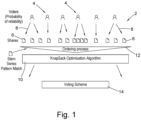
- a computer-implemented voting process 2 embodying the present invention for a plurality of participants 4 is disclosed.
- Each participant 4 holds a number of shares 6 of votes in the form of shares of a signed blockchain transaction, so that a threshold number of shares 6 is required in order to sign, and therefore execute 14, the blockchain transaction.
- the participants 4 can hold varying numbers of shares 6, and therefore the participants 4 can each hold a varying proportion of the total number of shares 6.
- a probability of reliability 8 can be assigned to each participant 4, wherein the probability of reliability 8 specifies the estimated probability that that participant 4 will vote as expected (or as required) on a given voting decision.
- a further advantage is that if the voting profile of the voters changes, or the reliability profile of the voters changes, the ordering and optimisation can be recomputed by rerunning the same computation. This enables use of this technique in highly dynamically changing circumstances. This also enables the technique to scale to scenarios where there are large numbers of voters.
- Step 2 Calculate the proportion of total shares each voter has. Assess the degree of reliability that the voter has in voting habits. Assign a 'cost' to the voter for the issue being voted on, as described above. Create a series of computational 'bins' sized according to the rational numbers of value less than unity, as described by the Stern-Brocot tree.
- the KP is unbounded; otherwise, the KP is bounded, as described in more detail in Chen T.S. Huang G.S. Liu T.P. and Chung Y.F (2002), ⁇ Digital Signature Scheme Resulted from Identification Protocol for Elliptic Curve Cryptosystem', Proceedings of IEEE TENCON'02. pp. 192-195 .
- Dynamic Programming solves problems whose solutions satisfy recurrence relations with overlapping sub-problems.
- the table is then used to obtain a solution to the original problem.
- the dynamic programming approach works bottom-up, for example as described in Hsu C.L and Wu T. C. (1998), Authenticated Encryption Scheme with (t, n) Shared Verification', IEEE Proceedings - Computers and Digital Techniques, Vol. 145, no. 2, pp. 117-120 , but the technique can also be applied top-down.
- Table [ i, j ] be the optimal solution of this instance (that is, the value of the most valuable subsets of the first i items that fit into the knapsack capacity of j).
- All the subsets of the first i items that fit the knapsack of capacity j can be divided into two subsets that do not include the i th item and subsets that include the i th item.
- ⁇ denotes assignment of a value to a data structure.
- the aim is to find Table [N , Capacity] the maximal value of a subset of the knapsack.
- the persistent storage 2610 can provide persistent (non-volatile) storage for program and data and may include flash memory, one or more solid state drives, one or more magnetic hard disk drives, one or more floppy disk drives with associated removable media, one or more optical drives (e.g. CD-ROM or DVD or Blue-Ray) drive with associated removable media, and other like storage media.
- Such program and data can include programs for carrying out the steps of one or more embodiments as described in the present disclosure as well as data associated with transactions and blocks as described in the present disclosure.
- the invention may be implemented by means of hardware comprising several distinct elements, and by means of a suitably programmed computer.
- a device claim enumerating several means several of these means may be embodied by one and the same item of hardware.
- the mere fact that certain measures are recited in mutually different dependent claims does not indicate that a combination of these measures cannot be used to advantage.
Landscapes
- Engineering & Computer Science (AREA)
- Computer Security & Cryptography (AREA)
- Computer Networks & Wireless Communication (AREA)
- Signal Processing (AREA)
- Business, Economics & Management (AREA)
- Accounting & Taxation (AREA)
- Theoretical Computer Science (AREA)
- Finance (AREA)
- Physics & Mathematics (AREA)
- General Physics & Mathematics (AREA)
- Strategic Management (AREA)
- General Business, Economics & Management (AREA)
- Development Economics (AREA)
- Technology Law (AREA)
- Marketing (AREA)
- Economics (AREA)
- Mathematical Physics (AREA)
- Mathematical Analysis (AREA)
- Mathematical Optimization (AREA)
- Algebra (AREA)
- Pure & Applied Mathematics (AREA)
- Computing Systems (AREA)
- Storage Device Security (AREA)
- Information Retrieval, Db Structures And Fs Structures Therefor (AREA)
- Management, Administration, Business Operations System, And Electronic Commerce (AREA)
- Power Engineering (AREA)
- Time Recorders, Dirve Recorders, Access Control (AREA)
- Telephonic Communication Services (AREA)
Abstract
Description
- This invention relates generally to an automated voting process, and more particularly to a threshold signature scheme. The invention is particularly suited, but not limited to, use in a threshold signature scheme for blockchain transactions.
- In this document we use the term 'blockchain' to include all forms of electronic, computer-based, distributed ledgers. These include consensus-based blockchain and transaction-chain technologies, permissioned and un-permissioned ledgers, shared ledgers and variations thereof. The most widely known application of blockchain technology is the Bitcoin ledger, although other blockchain implementations have been proposed and developed. While Bitcoin may be referred to herein for the purpose of convenience and illustration, it should be noted that the invention is not limited to use with the Bitcoin blockchain and alternative blockchain implementations and protocols fall within the scope of the present invention. The term "user" may refer herein to a human or a processor-based resource.
- A blockchain is a peer-to-peer, electronic ledger which is implemented as a computer-based decentralised, distributed system made up of blocks which in turn are made up of transactions. Each transaction is a data structure that encodes the transfer of control of a digital asset between participants in the blockchain system, and includes at least one input and at least one output. Each block contains a hash of the previous block so that blocks become chained together to create a permanent, unalterable record of all transactions which have been written to the blockchain since its inception. Transactions contain small programs known as scripts embedded into their inputs and outputs, which specify how and by whom the outputs of the transactions can be accessed. On the Bitcoin platform, these scripts are written using a stack-based scripting language.
- In order for a transaction to be written to the blockchain, it must be "validated". Network nodes (miners) perform work to ensure that each transaction is valid, with invalid transactions rejected from the network. Software clients installed on the nodes perform this validation work on an unspent transaction (UTXO) by executing its locking and unlocking scripts. If execution of the locking and unlocking scripts evaluate to TRUE, the transaction is valid and the transaction is written to the blockchain. Thus, in order for a transaction to be written to the blockchain, it must be i) validated by the first node that receives the transaction - if the transaction is validated, the node relays it to the other nodes in the network; and ii) added to a new block built by a miner; and iii) mined, i.e. added to the public ledger of past transactions.
- Although blockchain technology is most widely known for the use of cryptocurrency implementation, digital entrepreneurs have begun exploring the use of both the cryptographic security system Bitcoin is based on and the data that can be stored on the Blockchain to implement new systems. It would be highly advantageous if the blockchain could be used for automated tasks and processes which are not limited to the realm of cryptocurrency. Such solutions would be able to harness the benefits of the blockchain (e.g. a permanent, tamper proof records of events, distributed processing etc) while being more versatile in their applications.
- Automated voting process can be used to execute blockchain transactions, for example by means of a majority decision based on votes cast by a plurality of participants, or by means of threshold signature schemes requiring multiple signatures. Existing automated voting processes have drawbacks when a number of parties have a varying number of votes, a sub-set of which needs to provide support or consent in order to enable a motion to be passed, or a transaction such as a blockchain transaction to be signed.
- Thus, it is desirable to provide an arrangement which enables this to be achieved as the computational demands of finding optimal combinations of parties increases.
- Such an improved solution has now been devised.
- Thus, in accordance with the present invention there is provided a process as defined in the appended claims.
- In accordance with the invention there may be provided a computer implemented voting process comprising:-
- distributing a plurality of shares of a first common secret among a plurality of participants, wherein the shares are not equally allocated to the participants such that each participant has a respective number of shares, and wherein said first common secret is used to implement an automated voting process by the participants and is accessible using a first threshold number of said shares and is inaccessible using less than said first threshold number of shares;
- for each of said participants, determining a value representing the reliability of the participant's estimated voting behaviour, and obtaining a contribution score by multiplying said value by the respective number of shares held by the participant;
- ordering the contribution scores;
- In accordance with the an aspect of the disclosure there may be provided a computer implemented voting process comprising:-
- distributing a plurality of shares of a first common secret among a plurality of participants, wherein said first common secret implements an automated voting process by the participants and is accessible to a first threshold number of said shares and is inaccessible to less than said first threshold number of shares; and
- determining, based on different numbers of said shares of said first common secret held by a plurality of said participants, at least one combination of said shares held by a plurality of said participants, to provide said first threshold number of shares.
- By determining, based on different numbers of shares of the first common secret held by a plurality of the participants, at least one combination of shares to provide the first threshold number of shares, this provides the advantage of enabling the first threshold number of shares to be determined dynamically as the number of shares held by various participants changes, thereby improving efficiency of the voting process.
- In the context of the present invention, the term "voting" includes not only voting in the sense of a collective decision being made by a majority of participants, but also includes a polling process enabling an automatic decision to be made, for example to control a computer or other machine, or to enable signature of a blockchain transaction to enable the blockchain transaction to be executed, on the basis of a majority of shares of votes of those polled.
- The step of determining at least one said combination may comprise applying a knapsack algorithm to data including information representing respective numbers of shares held by a plurality of said participants.
- This provides the advantage of improving the computational efficiency of the process.
- The data may further include information representing estimated voting behaviour of a plurality of said participants.
- This provides the advantage of enabling expected voting behaviour of participants to be taken into account, thereby improving the efficiency of the voting process.
- The information representing estimated voting behaviour may include a coefficient by which the information representing respective numbers of shares held by a plurality of said participants is multiplied.
- The knapsack algorithm may determine at least one first said combination for shares held by a first plurality of said participants on the basis of at least one second said combination for shares held by a second plurality of said participants, wherein said second plurality is different from said first plurality.
- This provides the advantage of enabling the combination to be determined recursively, thereby improving computational efficiency of the process.
- Numbers of shares held by a plurality of participants may be estimated by comparing said data to a plurality of predetermined values.
- This provides the advantage of enabling more rapid determination of approximate numbers of shares.
- The predetermined values may be based on at least one Stern series.
- This provides the advantage of enabling the predetermined values to be generated in a computationally efficient manner by enabling recursive determination of the predetermined values.
- A plurality of said predetermined values may be determined on the basis of other said predetermined values.
- This provides the advantage of improving computational efficiency by enabling recursive determination of the predetermined values.
- The first common secret may be a digital signature.
- Each said share may be a partial signature, signed by a respective share of a private key and a respective share of an ephemeral key, and the method may further comprise distributing a plurality of shares of said private key among said plurality of participants, wherein said first private key is accessible to a second threshold number of shares and is inaccessible to less than said second threshold number of shares, and distributing a plurality of shares of said ephemeral key among said plurality of participants, wherein said ephemeral key is accessible to a third threshold number of shares and is inaccessible to less than said third threshold number of shares.
- The digital signature may be applied to a blockchain transaction.
- The invention also provides a system, comprising:
- a processor; and
- memory including executable instructions that, as a result of execution by the processor, causes the system to perform any embodiment of the computer-implemented process described herein.
- The invention also provides a non-transitory computer-readable storage medium having stored thereon executable instructions that, as a result of being executed by a processor of a computer system, cause the computer system to at least perform an embodiment of the computer-implemented process described herein.
- These and other aspects of the present invention will be apparent from and elucidated with reference to, the embodiment described herein. An embodiment of the present invention will now be described, by way of example only, and with reference to the accompany drawings, in which:
-
Figure 1 shows a schematic representation of an automated voting process embodying the present invention; and -
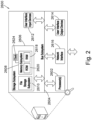
Figure 2 is a schematic diagram illustrates a computing environment in which various embodiments can be implemented. - A mechanism for generating shares of a signed blockchain transaction will first be described.
- Initially, secure communication channels are established between participants in a manner described in detail in International Patent Application
WO 2017/145016 , so that data can be exchanged between participants without being made available to other participants. - When secure communication channels have been established between the participants, shares dA(i) of a first private key dA are distributed between a group of first participants by means of a method as described below.

- The method for algorithm 1 follows:
- 1) Each participant p (i) of (N) where 1 ≤ i ≤ N exchanges an ECC public key (or in this implementation, a Bitcoin address) with all other participants. This address is the Group identity address and does not need to be used for any other purpose.
- It should be noted that this is a derived address, for example as disclosed in International patent application
WO2017/145016 , and key based on a shared value between each of the participants from the process disclosed therein.
2) Each participant p (i) selects a polynomial ƒi (x) of degree (k-1) with random coefficients in a manner that is secret from all other parties. - This function is subject to the participant's secret

- ƒi (h) is defined to be the result of the function, ƒ (x) that was selected by participant p (i) for the value at point (x = h), and the base equation for participant p (i) is defined as the function:

- In this equation, a 0 is the secret for each participant p (i) and is not shared.
- Hence, each participant p (i) has a secretly kept function ƒi (x) that is expressed as the degree (k-1) polynomial with a free term


- Given that Zn is a field and it is possible to validly do Lagrange interpolation modulo n over the values selected as ECC private keys, a condition exists which leads to the conclusion that Shamir's Secret Sharing Scheme SSSS [5] can be implemented over Z n .
4) Each participant P (i) broadcasts the values below to all participants. - a)

- b)

- The value associated with the variable h in the equation above can either be the position of the participant P (h) such that if participant P (h) represents the third participant in a scheme, then h=3 or equally may represent the value of the ECC public key used by the participant as an integer. Use cases and scenarios exist for either implementation. In the latter implementation, the value h = {1,..., N} would be replaced by an array of values mapped to the individual participant's utilised public key.
5) Each participant P (h≠i) verifies the consistency of the received shares with those received from each other participant. That is:
- And that fi (h)G is consistent with the participant's share.
6) Each participant P (h≠i) validates that the share owned by that participant (P (h≠i)) and which was received is consistent with the other received shares:
- In effect, this means that the participant carries out a process which would recover the shared secret from the received shares, but instead recovers the shared secret multiplied by the generator point G, from the shares multiplied by G. If this is not consistent, the participant rejects the protocol and starts again.
7) Participant p (i) now either calculates their share d A(i) as:
- Where: SHARE(p (i))∈Zn
and - Where: QA = Exp -Interpolate(ƒ 1,...,ƒN ) ▷[= G × dA ]
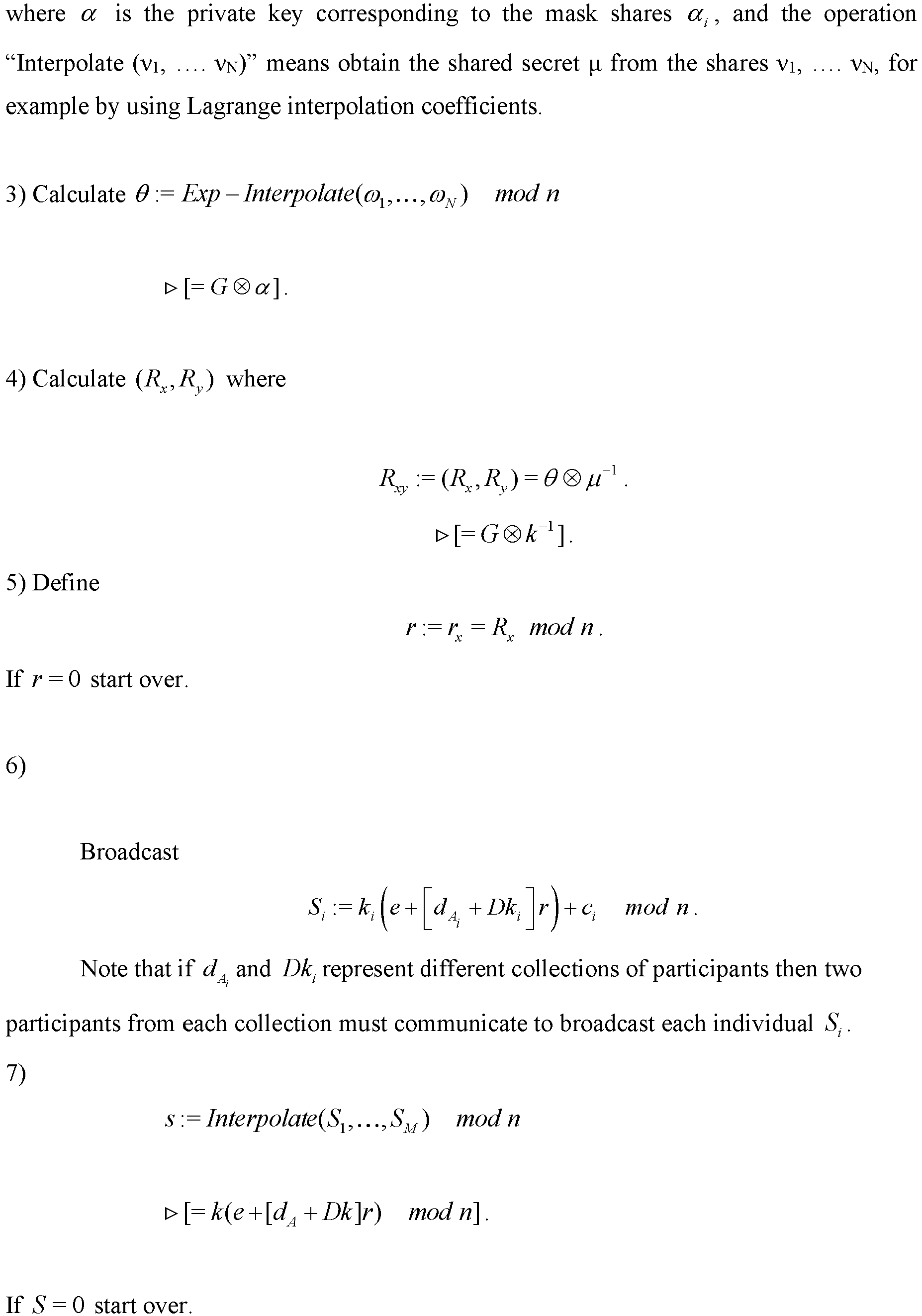
- Where the operation "Exp - Interpolate(ƒ 1,...,ƒN ) "means carrying out an operation to recover the shared secret value G × dA, from the shares f1 × G, ... fN × G, in the manner usually used to recover a shared secret dA, from the shares f1, ...fN, for example by means of interpolation using Lagrange coefficients in the case of a Shamir secret sharing scheme.

- Participant p (i) now uses the share in calculating signatures. This role can be conducted by any participant or by a party p (c) that acts as a coordinator in the process of collecting a signature. The participant p (c) can vary and does not need to be the same party on each attempt to collect enough shares to sign a transaction.
- Hence private key shares


-
Algorithm 2 can be used to both update the private key as well as to add randomness into the protocol. - 1) Each participant selects a random polynomial of degree (k-1) subject to zero as its free term. This is analogous to Algorithm 1 but that the participants must validate that the selected secret of all other participants is zero.
- It should be noted that: ∅G = nG = 0 where 0 is a point at infinity on the elliptic curve.
- Using this equality, all active participants validate the function:

- Generate the zero share:

- 2) d A(i) ' = d A(i) + zi
- 3) Return: d A(i) '
- A collection of participants construct private key shares d A
1 ,d A2 ,...,dAN in accordance with algorithm 1. New key shares Dk 1 ,Dk 2,...,DkN are introduced to each participant in the collection. These shares may be constructed using algorithm 1 above in which a threshold share of participants may be able to construct a shared secret Dk that is not previously known. Alternatively, Dk may be known in advance (eg a deterministic key) and shares may be constructed in a manner similar to algorithm but such that a pre-known Dk is chosen to be the free term in the polynomial. In either case, Dk⊗G is known to all but only a slice Dk 1,Dk 2,...,DkN is known by each of the participant in the collection. - As all participants know 1st public key


d A1 ,...,dAN and Dk 1,...,DkN
remain known only to each individual participant. - A new address P 2S can be created and a transaction tx signed to this, that changes who controls the main funds. That is, a payment from P 1S to P 2S can be signed by members of address P 1 S.
- The Dk collection can be set as either a group from P 1S collection (either a threshold number or all members) or may be a new group. Each threshold slice of Dk is able to be assigned separately, but it should be remembered that if P 1S and Dk are controlled separately then this creates a dual signing structure where both P 1S and Dk are required at the respective threshold rates to sign a transaction tx. It should also be noted that P 1S and Dk do not require the same members nor the same proportions.

- The private key shares d A
1 ,d A2 ,..., dAN are generated by means of algorithm 1. The deterministic key shares Dk 1 ,Dk 2,...,DkN are generated by means of algorithm 1 using a random constant as the free term in the polynomial or using a pre-known deterministic key Dk as the free term.


- Referring to
Figure 1 , a computer-implementedvoting process 2 embodying the present invention for a plurality ofparticipants 4 is disclosed. Eachparticipant 4 holds a number ofshares 6 of votes in the form of shares of a signed blockchain transaction, so that a threshold number ofshares 6 is required in order to sign, and therefore execute 14, the blockchain transaction. Theparticipants 4 can hold varying numbers ofshares 6, and therefore theparticipants 4 can each hold a varying proportion of the total number ofshares 6. A probability ofreliability 8 can be assigned to eachparticipant 4, wherein the probability ofreliability 8 specifies the estimated probability that thatparticipant 4 will vote as expected (or as required) on a given voting decision. The reliability value for the voter can be used as a measure of a cost of an item in aknapsack algorithm 10, described in greater detail below, for example so that cost = 1-reliability. - A threshold number of shares needs to be achieved in order to have a transaction signed. The proportions of shares can be assembled in ascending order. A safety margin for the number of required votes in the threshold can be included, i.e. combinations are calculated which provide higher than the threshold number of shares, in case the probability of
reliability 8 is estimated too low. A collection of computational 'bins' is then constructed, sized corresponding to rational numbers ordered according to the Stern-Brocot tree, described in greater detail below. The Stern-Brocot tree can be constructed by dividing neighbouring terms of the Stern series to generate rational numbers. Alternatively the Stern-Brocot tree can be computed by following a matrix multiplication procedure detailed below. The tree to infinite depth lists a complete set of the rational numbers, as in this construction each rational number occurs only once. Clearly this set is an infinite set. In implementation the depth of the Stern-Brocot tree can be calibrated to tune the granularity of the computational bins. As the number of bins required grows, the computational expense of the sorting procedure increases. - Only the rational numbers whose value is between zero and one are considered, and these values are ordered by
value 12 as the upper and lower bound values for the computational bins. These bins will hold the proportion of total votes that a voter has cast in favour of a 'motion' in question, for example a proposal to execute a blockchain transaction. - The share proportions multiplied by their reliability (as defined above) are compared to the ordering of the rational numbers less than unity in value and the share proportions placed in the rational number bin that is closest (but larger) in value. This provides an ordering, or a sorting, of the proportions of the
shares 6. There will inevitably be a residual, as the share proportions will not exactly match the rational numbers in value, they will however, fall into the computational bins with upper and lower bounds defined as above. - To illustrate this an example is shown in the table below:
Total Share proportion Reliability Contribution 20% 80% 16% 15% 100% 15% 30% 40% 12% - The contribution is the product of the total share proportion that a voter has and the reliability of those votes. The contribution can be viewed as the 'expected' number of votes a voter will contribute.
- The optimum collection of voters can then be computed using a solution to a Knapsack problem (for example dynamic programming, or genetic algorithms), as described in greater detail in "Different Approaches to Solve the 0/1 Knapsack Problem", Maya Hristakeva Computer Science Department, Simpson College, Indianola, IA 50125.
- A further advantage is that if the voting profile of the voters changes, or the reliability profile of the voters changes, the ordering and optimisation can be recomputed by rerunning the same computation. This enables use of this technique in highly dynamically changing circumstances. This also enables the technique to scale to scenarios where there are large numbers of voters.
- Step 1: Collect information on voters and the number shares that they have.
- Step 2: Calculate the proportion of total shares each voter has. Assess the degree of reliability that the voter has in voting habits. Assign a 'cost' to the voter for the issue being voted on, as described above. Create a series of computational 'bins' sized according to the rational numbers of value less than unity, as described by the Stern-Brocot tree.
- Step 3: Compare proportions of shares with the values of the rationals less than unity as enumerated by the Stern-Brocot tree. This is an efficient way of sorting values in order of size based on rational fractions of value less than one. This procedure defines both the upper and lower bounds for computational bins. Place the expected proportions of the shares in the associated bin. Keep a track of each entry in each bin. Keep a track of how many entries there are in each bin. This prepares the information about the proportion of shares for the knapsack optimisation process.
- Step 4: Run standard solutions to Knapsack algorithm, for example as described in "Different Approaches to Solve the 0/1 Knapsack Problem", Maya Hristakeva Computer Science Department, Simpson College, Indianola, IA 50125, with threshold values as constraints. An example of a `dynamic programming' approach to Knapsack is detailed below.
- An analogy can be drawn between filing a knapsack with valuable items and achieving a threshold vote with expected contributions from a number of voters, as described above. Solutions to the Knapsack problem are described in the Hristakeva reference cited above. One example is described in detail below.
- The Knapsack problem specification is as follows:
Let Xi denote how many copies of item i are to be placed into the knapsack. The objective function to maximise: -


0 ≤ Xi ≤ Qi. where Q is the maximum number of items of type i - If one or more of the Qi is infinite, the KP is unbounded; otherwise, the KP is bounded, as described in more detail in Chen T.S. Huang G.S. Liu T.P. and Chung Y.F (2002), `Digital Signature Scheme Resulted from Identification Protocol for Elliptic Curve Cryptosystem', Proceedings of IEEE TENCON'02. pp. 192-195.
- A dynamic programming approach solution is described below.
- Dynamic Programming solves problems whose solutions satisfy recurrence relations with overlapping sub-problems.
- Dynamic Programming solves each of the smaller sub-problems only once and records the results in a table. This increases the computational efficiency of the overall solution.
- The table is then used to obtain a solution to the original problem. The dynamic programming approach works bottom-up, for example as described in Hsu C.L and Wu T. C. (1998), Authenticated Encryption Scheme with (t, n) Shared Verification', IEEE Proceedings - Computers and Digital Techniques, Vol. 145, no. 2, pp. 117-120, but the technique can also be applied top-down.
- To design a dynamic programming algorithm for the 0/1 Knapsack problem, it is first necessary to derive a recurrence relation that expresses a solution to an instance of the knapsack problem in terms of solutions to its smaller instances.
- Consider an instance of the problem defined by the first i items, 1 ≤ i ≤ N,, with:
                              weights w1, ..., wN,
                              values v1, ... , vN,
                                and knapsack capacity j, 1 ≤ j ≤ V.

- The knapsack has no value when there no items included in it (that is, i = 0).

- The knapsack has no value when its capacity is zero (that is, j = 0), because no items can be included in it.


- 1. A computer implemented voting process comprising:-
- distributing a plurality of shares of a first common secret among a plurality of participants, wherein said first common secret implements an automated voting process by the participants and is accessible to a first threshold number of said shares and is inaccessible to less than said first threshold number of shares; and
- determining, based on different numbers of said shares of said first common secret held by a plurality of said participants, at least one combination of said shares held by a plurality of said participants, to provide said first threshold number of shares.
- 2. A process according to clause 1, wherein the step of determining at least one said combination comprises applying a knapsack algorithm to data including information representing respective numbers of shares held by a plurality of said participants.
- 3. A process according to
clause 2, where the data further includes information representing estimated voting behaviour of a plurality of said participants. - 4. A process according to clause 3, wherein the information representing estimated voting behaviour includes a coefficient by which the information representing respective numbers of shares held by a plurality of said participants is multiplied.
- 5. A process according to any one of
clauses 2 to 5, wherein the knapsack algorithm determines at least one first said combination for shares held by a first plurality of said participants on the basis of at least one second said combination for shares held by a second plurality of said participants, wherein said second plurality is different from said first plurality. - 6. A process according to any one of the preceding clauses, wherein numbers of shares held by a plurality of participants are estimated by comparing said data to a plurality of predetermined values.
- 7. A process according to
clause 6, wherein the predetermined values are based on at least one Stern series. - 8. A process according to
clause 6 or 7, wherein a plurality of said predetermined values are determined on the basis of other said predetermined values. - 9. A process according to any one of the preceding clauses, wherein the first common secret is a digital signature.
- 10. A process according to clause 9, wherein each said share is a partial signature, signed by a respective share of a private key and a respective share of an ephemeral key, and the method further comprises distributing a plurality of shares of said private key among said plurality of participants, wherein said first private key is accessible to a second threshold number of shares and is inaccessible to less than said second threshold number of shares, and distributing a plurality of shares of said ephemeral key among said plurality of participants, wherein said ephemeral key is accessible to a third threshold number of shares and is inaccessible to less than said third threshold number of shares.
- 11. A process according to
clause 9 or 10, wherein the digital signature is applied to a blockchain transaction. - 12. A system, comprising:
a processor; and memory including executable instructions that, as a result of execution by the processor, causes the system to perform any embodiment of the computer-implemented process as defined in any one of clauses 1 to 11. - 13. A non-transitory computer-readable storage medium having stored thereon executable instructions that, as a result of being executed by a processor of a computer system, cause the computer system to at least perform an embodiment of the computer-implemented process as defined in any one of clauses 1 to 11.
- 1. Chen T.S. Huang G.S. Liu T.P. and Chung Y.F (2002), `Digital Signature Scheme Resulted from Identification Protocol for Elliptic Curve Cryptosystem', Proceedings of IEEE TENCON'02. pp. 192-195
- 2. Hsu C.L and Wu T. C. (1998), Authenticated Encryption Scheme with (t, n) Shared Verification', IEEE Proceedings - Computers and Digital Techniques, Vol. 145, no. 2, pp. 117-120.
- 3. Graham, R. L.; Knuth, D. E.; and Patashnik, O. Concrete Mathematics: A Foundation for Computer Science, 2nd ed. Reading, MA: Addison-Wesley, pp. 116-117, 1994.
- 4. Koblitz N. (1987), `Elliptic Curve Cryptosystems', Mathematics of Computation, pp 203-209.
- 4a. Padma Bh et. al. / (IJCSE) International Journal on Computer Science and Engineering Vol. 02, No. 05, 2010, 1904-1907 Encoding And Decoding of a Message in the Implementation of Elliptic Curve Cryptography using Koblitz's Method
- 5. Nyberg K. and Rueppel R.A. (1993), `A New Signature Scheme Based on DSA giving message Recovery', ACM Computer and Communications Security, Vol.1,pp.58-61.
- 6. Rajaram Ramasamy R, Prabakar M.A, Devi M.I, and Suguna M(2009), `Knapsack Based ECC Encryption and Decryption', International Journal of Network Security, Vol.9, no.3, pp. 218-226.
- 7. Rajaram Ramasamy R. and Amutha Prabakar M. (2011), `Digital Signature Scheme with message Recovery Using Knapsack -based ECC', International Journal of Network Security, Vol.12, no.1,pp.15,20.
- 8. Reznick (2008), `Regularity Properties of the Stern Enumeration of the Rationals', Journal of Integer Sequence.
- 9. Stem, M. A. "Über eine zahlentheoretische Funktion." J. reine angew. Math. 55, 193-220, 1858.
- 10. Different Approaches to Solve the 0/1 Knapsack Problem Maya Hristakeva Computer Science Department Simpson College Indianola, IA 50125 hristake@simpson.edu
Claims (11)
- A computer implemented voting method comprising:-distributing a plurality of shares (6) of a first common secret among a plurality of participants (4), wherein the shares are not equally allocated to the participants such that each participant has a respective number of shares, and wherein said first common secret is used to implement an automated voting process (14) by the participants and is accessible using a first threshold number of said shares and is inaccessible using less than said first threshold number of shares;for each of said participants, determining a value (8) representing the reliability of the participant's estimated voting behaviour, and obtaining a contribution score by multiplying said value by the respective number of shares held by the participant;ordering (12) the contribution scores; andapplying (10) a knapsack algorithm to data including the contribution scores and the respective numbers of shares held by the participants, to determine at least one combination of said shares held by a set of said participants to provide said first threshold number of shares.
- A method according to claim 1, wherein the step of ordering the contribution scores comprises:determining a set of computational bins spanning the numbers between zero and one, each having an upper and lower bound;placing each contribution score into a computational bin.
- A method according to claim 1, wherein the upper and lower bounds of the computational bins are derived from a Stern-Brocot tree.
- A method according to either of claims 2 or 3, wherein data for the knapsack algorithm includes the number of entries in each bin.
- A method according to any one of claims 1 to 4, wherein the knapsack algorithm determines at least one first said combination for shares held by a first plurality of said participants on the basis of at least one second said combination for shares held by a second plurality of said participants, wherein said second plurality is different from said first plurality.
- A method according to any one of the preceding claims, wherein the determined combination of shares held by the set of participants provides more than the first threshold number of shares.
- A method according to any one of the preceding claims, wherein the first common secret is a digital signature.
- A method according to claim 7, wherein each said share is a partial signature, signed by a respective share of a private key and a respective share of an ephemeral key, and the method further comprises distributing a plurality of shares of said private key among said plurality of participants, wherein said private key is accessible to a second threshold number of shares and is inaccessible using less than said second threshold number of shares, and distributing a plurality of shares of said ephemeral key among said plurality of participants, wherein said ephemeral key is accessible to a third threshold number of shares and is inaccessible using less than said third threshold number of shares.
- A method according to claim 7 or 8, wherein the digital signature is applied to a blockchain transaction.
- A system, comprising:a processor; andmemory including executable instructions that, as a result of execution by the processor, causes the system to carry out the computer-implemented method as defined in any one of claims 1 to 9.
- A non-transitory computer-readable storage medium having stored thereon executable instructions that, as a result of being executed by a processor of a computer system, cause the computer system to carry out the computer-implemented method as defined in any one of claims 1 to 9.
Applications Claiming Priority (5)
| Application Number | Priority Date | Filing Date | Title |
|---|---|---|---|
| IB2018051338 | 2018-03-02 | ||
| GBGB1803396.9A GB201803396D0 (en) | 2018-03-02 | 2018-03-02 | Computer implemented method and system |
| GBGB1817506.7A GB201817506D0 (en) | 2018-03-02 | 2018-10-29 | Computer implemented method and system |
| EP19710154.6A EP3759864B1 (en) | 2018-03-02 | 2019-02-19 | Computer implemented voting process and system |
| PCT/IB2019/051327 WO2019166916A1 (en) | 2018-03-02 | 2019-02-19 | Computer implemented voting process and system |
Related Parent Applications (2)
| Application Number | Title | Priority Date | Filing Date |
|---|---|---|---|
| EP19710154.6A Division-Into EP3759864B1 (en) | 2018-03-02 | 2019-02-19 | Computer implemented voting process and system |
| EP19710154.6A Division EP3759864B1 (en) | 2018-03-02 | 2019-02-19 | Computer implemented voting process and system |
Publications (2)
| Publication Number | Publication Date |
|---|---|
| EP4398514A2 true EP4398514A2 (en) | 2024-07-10 |
| EP4398514A3 EP4398514A3 (en) | 2024-09-25 |
Family
ID=64560280
Family Applications (3)
| Application Number | Title | Priority Date | Filing Date |
|---|---|---|---|
| EP24178258.0A Withdrawn EP4398514A3 (en) | 2018-03-02 | 2019-02-19 | Computer implemented voting process and system |
| EP19710154.6A Active EP3759864B1 (en) | 2018-03-02 | 2019-02-19 | Computer implemented voting process and system |
| EP19710153.8A Withdrawn EP3759863A1 (en) | 2018-03-02 | 2019-02-19 | Computer implemented method and system for transferring control of a digital asset |
Family Applications After (2)
| Application Number | Title | Priority Date | Filing Date |
|---|---|---|---|
| EP19710154.6A Active EP3759864B1 (en) | 2018-03-02 | 2019-02-19 | Computer implemented voting process and system |
| EP19710153.8A Withdrawn EP3759863A1 (en) | 2018-03-02 | 2019-02-19 | Computer implemented method and system for transferring control of a digital asset |
Country Status (9)
| Country | Link |
|---|---|
| US (3) | US20210049690A1 (en) |
| EP (3) | EP4398514A3 (en) |
| JP (4) | JP7385580B2 (en) |
| KR (1) | KR20200125980A (en) |
| CN (3) | CN118316591A (en) |
| GB (1) | GB201817506D0 (en) |
| SG (1) | SG11202007880PA (en) |
| TW (1) | TWI821248B (en) |
| WO (2) | WO2019166915A1 (en) |
Families Citing this family (16)
| Publication number | Priority date | Publication date | Assignee | Title |
|---|---|---|---|---|
| EP4062350A4 (en) * | 2019-11-22 | 2024-03-06 | Conio Inc. | METHOD AND APPARATUS FOR SECURE BLOCKCHAIN AGNOSTIC MULTI-SIGNATURE DIGITAL ASSET MANAGEMENT |
| GB2594312A (en) * | 2020-04-23 | 2021-10-27 | Nchain Holdings Ltd | Digital Signatures |
| CN111600721B (en) * | 2020-05-26 | 2023-06-16 | 牛津(海南)区块链研究院有限公司 | Asset management system, method and device based on multi-person voting mechanism |
| US11870914B2 (en) | 2020-09-04 | 2024-01-09 | Nchain Licensing Ag | Digital signatures |
| CN112511314B (en) * | 2020-11-26 | 2022-03-22 | 中国电子科技集团公司第五十四研究所 | An identity-based blind signature generation method for recoverable messages |
| CN113037461B (en) * | 2021-03-04 | 2022-06-07 | 西安电子科技大学 | Multi-candidate anonymous electronic voting method based on homomorphic encryption |
| TWI776416B (en) * | 2021-03-08 | 2022-09-01 | 英屬開曼群島商現代財富控股有限公司 | Threshold signature scheme system for hierarchical deterministic wallet and method thereof |
| TWI759138B (en) * | 2021-03-15 | 2022-03-21 | 英屬開曼群島商現代財富控股有限公司 | Threshold signature scheme system based on inputting password and method thereof |
| WO2022195860A1 (en) * | 2021-03-19 | 2022-09-22 | 日本電気株式会社 | Voting system and voting method |
| CN115239333B (en) * | 2021-04-23 | 2025-03-21 | 清雁科技(北京)有限公司 | Data processing method, device and storage medium |
| CN113726517A (en) * | 2021-08-10 | 2021-11-30 | 北京信安世纪科技股份有限公司 | Information sharing method and device |
| CN113704831B (en) * | 2021-08-11 | 2023-11-03 | 北京天威诚信电子商务服务有限公司 | Digital signature multiparty generation method and system without simultaneous online of participants |
| US12081653B2 (en) * | 2022-02-02 | 2024-09-03 | Coinbase, Inc. | Systems and methods for providing secure, encrypted communications across distributed computer networks by coordinating cryptography-based digital repositories in order to perform blockchain operations in decentralized applications |
| US12627486B2 (en) * | 2023-02-27 | 2026-05-12 | Capital One Services, Llc | Non-fungible token (NFT) vehicle information |
| US12316751B2 (en) * | 2023-05-04 | 2025-05-27 | Fmr Llc | Secret zero generation and usage |
| CN117852019B (en) * | 2024-03-06 | 2024-05-24 | 天逸财金科技服务(武汉)有限公司 | Digital asset circulation method and system based on cryptography |
Citations (1)
| Publication number | Priority date | Publication date | Assignee | Title |
|---|---|---|---|---|
| WO2017145016A1 (en) | 2016-02-23 | 2017-08-31 | nChain Holdings Limited | Determining a common secret for the secure exchange of information and hierarchical, deterministic cryptographic keys |
Family Cites Families (44)
| Publication number | Priority date | Publication date | Assignee | Title |
|---|---|---|---|---|
| US6957331B2 (en) | 2000-01-14 | 2005-10-18 | International Business Machines Corporation | Method of achieving multiple processor agreement in asynchronous networks |
| US7359507B2 (en) | 2000-03-10 | 2008-04-15 | Rsa Security Inc. | Server-assisted regeneration of a strong secret from a weak secret |
| JP2002217891A (en) | 2001-01-22 | 2002-08-02 | Toshiba Corp | Secret sharing management program and system |
| US8429056B2 (en) * | 2001-09-05 | 2013-04-23 | Bgc Partners, Inc. | Systems and methods for sharing excess profits |
| JP2005311623A (en) | 2004-04-20 | 2005-11-04 | Matsushita Electric Ind Co Ltd | Electronic voting system and electronic voting method |
| JP2007058771A (en) | 2005-08-26 | 2007-03-08 | Nec Corp | Storage system, storage subsystem, and cache/duplication storing method |
| US7743253B2 (en) | 2005-11-04 | 2010-06-22 | Microsoft Corporation | Digital signature for network coding |
| US20080052539A1 (en) * | 2006-07-29 | 2008-02-28 | Macmillan David M | Inline storage protection and key devices |
| FR2930357A1 (en) * | 2008-04-17 | 2009-10-23 | Alcatel Lucent Sas | ELECTRONIC VOTING METHOD, DECODER FOR CARRYING OUT SAID METHOD, AND NETWORK COMPRISING A VOTE SERVER FOR IMPLEMENTING THE METHOD. |
| US8189789B2 (en) | 2008-11-03 | 2012-05-29 | Telcordia Technologies, Inc. | Intrusion-tolerant group management for mobile ad-hoc networks |
| US8713329B2 (en) * | 2009-02-26 | 2014-04-29 | Red Hat, Inc. | Authenticated secret sharing |
| US20110087745A1 (en) * | 2009-10-14 | 2011-04-14 | International Business Machines Corporation | Group voting access control for multi-party forums |
| US8745415B2 (en) | 2012-09-26 | 2014-06-03 | Pure Storage, Inc. | Multi-drive cooperation to generate an encryption key |
| US9489522B1 (en) * | 2013-03-13 | 2016-11-08 | Hrl Laboratories, Llc | Method for secure and resilient distributed generation of elliptic curve digital signature algorithm (ECDSA) based digital signatures with proactive security |
| WO2015160839A1 (en) | 2014-04-17 | 2015-10-22 | Hrl Laboratories, Llc | A method for secure and resilient distributed generation of elliptic curve digital signature algorithm (ecdsa) based digital signatures with proactive security |
| GB2530726B (en) * | 2014-09-25 | 2016-11-02 | Ibm | Distributed single sign-on |
| US10467389B2 (en) * | 2015-01-15 | 2019-11-05 | Secretskydbltd | Secret shared random access machine |
| US9413735B1 (en) | 2015-01-20 | 2016-08-09 | Ca, Inc. | Managing distribution and retrieval of security key fragments among proxy storage devices |
| US9641341B2 (en) * | 2015-03-31 | 2017-05-02 | Duo Security, Inc. | Method for distributed trust authentication |
| US9735958B2 (en) | 2015-05-19 | 2017-08-15 | Coinbase, Inc. | Key ceremony of a security system forming part of a host computer for cryptographic transactions |
| US9673975B1 (en) * | 2015-06-26 | 2017-06-06 | EMC IP Holding Company LLC | Cryptographic key splitting for offline and online data protection |
| CN107924389B (en) * | 2015-07-02 | 2020-11-13 | 纳斯达克公司 | System and method for secure traceability of distributed transaction databases |
| US20170083889A1 (en) * | 2015-09-21 | 2017-03-23 | Sk Planet Co., Ltd. | User equipment, service providing device, pos terminal, payment system including the same, control method thereof, and non-transitory computer readable storage medium storing computer program recorded thereon |
| US20170213210A1 (en) | 2016-01-22 | 2017-07-27 | International Business Machines Corporation | Asset transfers using a multi-tenant transaction database |
| JP6799061B2 (en) * | 2016-02-23 | 2020-12-09 | エヌチェーン ホールディングス リミテッドNchain Holdings Limited | Secure multi-party loss resistant storage and transfer of cryptographic keys for blockchain-based systems combined with wallet management systems |
| KR102753027B1 (en) | 2016-02-23 | 2025-01-14 | 엔체인 홀딩스 리미티드 | Method and system for secure transfer of entities on blockchain |
| CA3015697C (en) | 2016-02-29 | 2022-11-22 | Securekey Technologies Inc. | Systems and methods for distributed identity verification |
| US11057198B2 (en) | 2016-03-04 | 2021-07-06 | Assured Enterprises, Inc. | Utilization of a proxy technique in escrow encryption key usage |
| CN105812369B (en) * | 2016-03-15 | 2019-09-10 | 广东石油化工学院 | A kind of traceable anonymous authentication method based on elliptic curve |
| GB201611948D0 (en) | 2016-07-08 | 2016-08-24 | Kalypton Int Ltd | Distributed transcation processing and authentication system |
| CN107666388B (en) * | 2016-07-28 | 2019-11-01 | 郑珂威 | Block chain information encryption method based on complete homomorphic cryptography method |
| GB2538022B (en) | 2016-08-20 | 2018-07-11 | PQ Solutions Ltd | Multiple secrets in quorum based data processing |
| CN106373251A (en) * | 2016-08-30 | 2017-02-01 | 中科院成都信息技术股份有限公司 | Electronic vote counting method based on secret sharing |
| CN106503994B (en) * | 2016-11-02 | 2020-07-28 | 西安电子科技大学 | Blockchain privacy data access control method based on attribute encryption |
| CN106548345B (en) | 2016-12-07 | 2020-08-21 | 北京信任度科技有限公司 | Method and system for realizing block chain private key protection based on key partitioning |
| CN106533675A (en) | 2016-12-19 | 2017-03-22 | 北京洋浦伟业科技发展有限公司 | Digital signature method and system |
| CN106982205B (en) | 2017-03-01 | 2020-05-19 | 中钞信用卡产业发展有限公司杭州区块链技术研究院 | Block chain-based digital asset processing method and device |
| EP3379767B1 (en) * | 2017-03-24 | 2021-01-13 | Hewlett-Packard Development Company, L.P. | Distributed authentication |
| US10805072B2 (en) * | 2017-06-12 | 2020-10-13 | Change Healthcare Holdings, Llc | System and method for autonomous dynamic person management |
| WO2019020830A1 (en) * | 2017-07-28 | 2019-01-31 | Koninklijke Philips N.V. | Evaluation of a monitoring function |
| US10511436B1 (en) * | 2017-07-31 | 2019-12-17 | EMC IP Holding Company LLC | Protecting key material using white-box cryptography and split key techniques |
| US10818121B2 (en) * | 2017-09-15 | 2020-10-27 | Panasonic Intellectual Property Corporation Of America | Electronic voting system and control method |
| EP3688922A4 (en) * | 2017-09-27 | 2020-09-09 | Visa International Service Association | GENERATION OF SECURE SHARED KEYS FOR PEER-TO-PEER COMMUNICATIONS |
| CN113496406A (en) * | 2020-03-19 | 2021-10-12 | 东北大学秦皇岛分校 | Strong-anonymity electronic voting protocol based on block chain |
-
2018
- 2018-10-29 GB GBGB1817506.7A patent/GB201817506D0/en not_active Ceased
-
2019
- 2019-02-19 JP JP2020544897A patent/JP7385580B2/en active Active
- 2019-02-19 WO PCT/IB2019/051326 patent/WO2019166915A1/en not_active Ceased
- 2019-02-19 CN CN202410475089.0A patent/CN118316591A/en active Pending
- 2019-02-19 CN CN201980016368.8A patent/CN111819815B/en not_active Expired - Fee Related
- 2019-02-19 EP EP24178258.0A patent/EP4398514A3/en not_active Withdrawn
- 2019-02-19 US US16/977,412 patent/US20210049690A1/en not_active Abandoned
- 2019-02-19 KR KR1020207028072A patent/KR20200125980A/en active Pending
- 2019-02-19 EP EP19710154.6A patent/EP3759864B1/en active Active
- 2019-02-19 WO PCT/IB2019/051327 patent/WO2019166916A1/en not_active Ceased
- 2019-02-19 EP EP19710153.8A patent/EP3759863A1/en not_active Withdrawn
- 2019-02-19 JP JP2020544956A patent/JP7328237B2/en active Active
- 2019-02-19 SG SG11202007880PA patent/SG11202007880PA/en unknown
- 2019-02-19 US US16/977,406 patent/US11791992B2/en active Active
- 2019-02-19 CN CN201980016404.0A patent/CN111788791B/en not_active Expired - Fee Related
- 2019-02-27 TW TW108106835A patent/TWI821248B/en not_active IP Right Cessation
-
2023
- 2023-08-03 JP JP2023127140A patent/JP2023133560A/en active Pending
- 2023-09-05 US US18/242,475 patent/US20240064008A1/en not_active Abandoned
- 2023-11-10 JP JP2023191977A patent/JP2024010226A/en active Pending
Patent Citations (1)
| Publication number | Priority date | Publication date | Assignee | Title |
|---|---|---|---|---|
| WO2017145016A1 (en) | 2016-02-23 | 2017-08-31 | nChain Holdings Limited | Determining a common secret for the secure exchange of information and hierarchical, deterministic cryptographic keys |
Non-Patent Citations (10)
| Title |
|---|
| CHEN T.SHUANG G.SLIU T.PCHUNG Y.F: "`Digital Signature Scheme Resulted from Identification Protocol for Elliptic Curve Cryptosystem", PROCEEDINGS OF IEEE TENCON'02, 2002, pages 192 - 195, XP010628457, DOI: 10.1109/TENCON.2002.1181247 |
| GRAHAM, R. L.KNUTH, D. E.PATASHNIK, O: "Concrete Mathematics: A Foundation for Computer Science", 1994, ADDISON-WESLEY, pages: 116 - 117 |
| HSU C.L AND WU T.C.: "Authenticated Encryption Scheme with (t, n) Shared Verification", IEEE PROCEEDINGS - COMPUTERS AND DIGITAL TECHNIQUES, vol. 145, no. 2, 1998, pages 117 - 120, XP006010826, DOI: 10.1049/ip-cdt:19981905 |
| KOBLITZ N, `ELLIPTIC CURVE CRYPTOSYSTEMS', MATHEMATICS OF COMPUTATION, 1987, pages 203 - 209 |
| NYBERG KRUEPPEL R.A: "A New Signature Scheme Based on DSA giving message Recovery", ACM COMPUTER AND COMMUNICATIONS SECURITY, vol. 1, 1993, pages 58 - 61, XP002148830, DOI: 10.1145/168588.168595 |
| PADMA BH: "Encoding And Decoding of a Message in the Implementation of Elliptic Curve Cryptography using Koblitz's Method", INTERNATIONAL JOURNAL ON COMPUTER SCIENCE AND ENGINEERING, vol. 02, no. 05, 2010, pages 1904 - 1907 |
| RAJARAM RAMASAMY RAMUTHA PRABAKAR M: "`Digital Signature Scheme with message Recovery Using Knapsack -based ECC", INTERNATIONAL JOURNAL OF NETWORK SECURITY, vol. 12, no. 1, 2011, pages 15,20 |
| RAJARAM RAMASAMY RPRABAKAR M.ADEVI M.ISUGUNA M: "Knapsack Based ECC Encryption and Decryption", INTERNATIONAL JOURNAL OF NETWORK SECURITY, vol. 9, no. 3, 2009, pages 218 - 226 |
| REZNICK: "Regularity Properties of the Stern Enumeration of the Rationals", JOURNAL OF INTEGER SEQUENCE, 2008 |
| STERN, M. A: "Uber eine zahlentheoretische Funktion.", J. REINE ANGEW. MATH, vol. 55, 8 January 1958 (1958-01-08), pages 193 - 220 |
Also Published As
| Publication number | Publication date |
|---|---|
| GB201817506D0 (en) | 2018-12-12 |
| JP7328237B2 (en) | 2023-08-16 |
| SG11202007880PA (en) | 2020-09-29 |
| JP7385580B2 (en) | 2023-11-22 |
| US20210042829A1 (en) | 2021-02-11 |
| KR20200125980A (en) | 2020-11-05 |
| CN118316591A (en) | 2024-07-09 |
| CN111788791B (en) | 2024-09-20 |
| JP2023133560A (en) | 2023-09-22 |
| CN111788791A (en) | 2020-10-16 |
| US20240064008A1 (en) | 2024-02-22 |
| EP3759863A1 (en) | 2021-01-06 |
| JP2021515270A (en) | 2021-06-17 |
| TW201946412A (en) | 2019-12-01 |
| EP3759864A1 (en) | 2021-01-06 |
| EP3759864B1 (en) | 2024-07-10 |
| JP2024010226A (en) | 2024-01-23 |
| JP2021515271A (en) | 2021-06-17 |
| WO2019166916A1 (en) | 2019-09-06 |
| EP4398514A3 (en) | 2024-09-25 |
| TWI821248B (en) | 2023-11-11 |
| WO2019166915A1 (en) | 2019-09-06 |
| CN111819815A (en) | 2020-10-23 |
| CN111819815B (en) | 2024-05-14 |
| US20210049690A1 (en) | 2021-02-18 |
| US11791992B2 (en) | 2023-10-17 |
Similar Documents
| Publication | Publication Date | Title |
|---|---|---|
| EP3759864B1 (en) | Computer implemented voting process and system | |
| JP7848288B2 (en) | System and method for authenticating off-chain data based on proof verification | |
| US20230412358A1 (en) | Blockchain-implemented security systems and methods for blinded outcome selection | |
| Wang et al. | Certificateless public auditing for data integrity in the cloud | |
| EP4395228B1 (en) | Computer-implemented system and method including public key combination verification | |
| CN109274717B (en) | Block chain based shared storage method, device, medium and electronic equipment | |
| US20240388422A1 (en) | Generating shared keys | |
| KR20260041846A (en) | (ec)dsa threshold signature with secret sharing | |
| US12445287B2 (en) | Computer implemented method and system for knowledge proof in blockchain transactions | |
| JPWO2017099117A1 (en) | PRE-COMPUTER DEVICE, METHOD, AND COMPUTER-READABLE RECORDING MEDIUM, AND VECTOR MULTIPLY DEVICE, AND METHOD | |
| Gritti et al. | Efficient dynamic provable data possession with public verifiability and data privacy | |
| CN117795901A (en) | Generate digital signature share | |
| US20230316241A1 (en) | Partitioning a request into transactions for a blockchain | |
| Hong et al. | Constructing conditional PKEET with verification mechanism for data privacy protection in intelligent systems: H. Hong, Z. Sun | |
| Bergers et al. | Dwh-dim: a blockchain based decentralized integrity verification model for data warehouses | |
| CN115481440B (en) | Data processing methods, devices, electronic equipment and media | |
| US20250125972A1 (en) | Generating digital signatures | |
| US20170317820A1 (en) | Information secure protocol for mobile proactive secret sharing with near-optimal resilience | |
| CN117811733B (en) | Task confirmation completion method and related device based on secret sharing algorithm | |
| CN117837127A (en) | Generate a digital signature | |
| CN114742649A (en) | Transaction data processing method, device and server | |
| HK40086405A (en) | Blockchain-implemented security systems and methods for blinded outcome selection | |
| HK40029723A (en) | Blockchain-implemented security systems and methods for blinded outcome selection | |
| HK40029723B (en) | Blockchain-implemented security systems and methods for blinded outcome selection |
Legal Events
| Date | Code | Title | Description |
|---|---|---|---|
| PUAI | Public reference made under article 153(3) epc to a published international application that has entered the european phase |
Free format text: ORIGINAL CODE: 0009012 |
|
| STAA | Information on the status of an ep patent application or granted ep patent |
Free format text: STATUS: THE APPLICATION HAS BEEN PUBLISHED |
|
| AC | Divisional application: reference to earlier application |
Ref document number: 3759864 Country of ref document: EP Kind code of ref document: P |
|
| AK | Designated contracting states |
Kind code of ref document: A2 Designated state(s): AL AT BE BG CH CY CZ DE DK EE ES FI FR GB GR HR HU IE IS IT LI LT LU LV MC MK MT NL NO PL PT RO RS SE SI SK SM TR |
|
| REG | Reference to a national code |
Ref country code: DE Ref legal event code: R079 Free format text: PREVIOUS MAIN CLASS: H04L0009320000 Ipc: H04L0009000000 |
|
| P01 | Opt-out of the competence of the unified patent court (upc) registered |
Free format text: CASE NUMBER: APP_42197/2024 Effective date: 20240717 |
|
| PUAL | Search report despatched |
Free format text: ORIGINAL CODE: 0009013 |
|
| AK | Designated contracting states |
Kind code of ref document: A3 Designated state(s): AL AT BE BG CH CY CZ DE DK EE ES FI FR GB GR HR HU IE IS IT LI LT LU LV MC MK MT NL NO PL PT RO RS SE SI SK SM TR |
|
| RIC1 | Information provided on ipc code assigned before grant |
Ipc: H04L 9/32 20060101ALI20240820BHEP Ipc: H04L 9/08 20060101ALI20240820BHEP Ipc: H04L 9/00 20220101AFI20240820BHEP |
|
| STAA | Information on the status of an ep patent application or granted ep patent |
Free format text: STATUS: THE APPLICATION IS DEEMED TO BE WITHDRAWN |
|
| 18D | Application deemed to be withdrawn |
Effective date: 20250326 |