EP4398505A2 - Harq-ack transmission on unlicensed spectrum - Google Patents
Harq-ack transmission on unlicensed spectrum Download PDFInfo
- Publication number
- EP4398505A2 EP4398505A2 EP24177397.7A EP24177397A EP4398505A2 EP 4398505 A2 EP4398505 A2 EP 4398505A2 EP 24177397 A EP24177397 A EP 24177397A EP 4398505 A2 EP4398505 A2 EP 4398505A2
- Authority
- EP
- European Patent Office
- Prior art keywords
- harq
- ack codebook
- ack
- candidate
- transmission
- Prior art date
- Legal status (The legal status is an assumption and is not a legal conclusion. Google has not performed a legal analysis and makes no representation as to the accuracy of the status listed.)
- Pending
Links
Images




Classifications
-
- H—ELECTRICITY
- H04—ELECTRIC COMMUNICATION TECHNIQUE
- H04L—TRANSMISSION OF DIGITAL INFORMATION, e.g. TELEGRAPHIC COMMUNICATION
- H04L1/00—Arrangements for detecting or preventing errors in the information received
- H04L1/12—Arrangements for detecting or preventing errors in the information received by using return channel
- H04L1/16—Arrangements for detecting or preventing errors in the information received by using return channel in which the return channel carries supervisory signals, e.g. repetition request signals
- H04L1/18—Automatic repetition systems, e.g. Van Duuren systems
- H04L1/1829—Arrangements specially adapted for the receiver end
- H04L1/1854—Scheduling and prioritising arrangements
-
- H—ELECTRICITY
- H04—ELECTRIC COMMUNICATION TECHNIQUE
- H04L—TRANSMISSION OF DIGITAL INFORMATION, e.g. TELEGRAPHIC COMMUNICATION
- H04L1/00—Arrangements for detecting or preventing errors in the information received
- H04L1/12—Arrangements for detecting or preventing errors in the information received by using return channel
- H04L1/16—Arrangements for detecting or preventing errors in the information received by using return channel in which the return channel carries supervisory signals, e.g. repetition request signals
- H04L1/18—Automatic repetition systems, e.g. Van Duuren systems
- H04L1/1812—Hybrid protocols; Hybrid automatic repeat request [HARQ]
- H04L1/1819—Hybrid protocols; Hybrid automatic repeat request [HARQ] with retransmission of additional or different redundancy
-
- H—ELECTRICITY
- H04—ELECTRIC COMMUNICATION TECHNIQUE
- H04L—TRANSMISSION OF DIGITAL INFORMATION, e.g. TELEGRAPHIC COMMUNICATION
- H04L1/00—Arrangements for detecting or preventing errors in the information received
- H04L1/12—Arrangements for detecting or preventing errors in the information received by using return channel
- H04L1/16—Arrangements for detecting or preventing errors in the information received by using return channel in which the return channel carries supervisory signals, e.g. repetition request signals
- H04L1/18—Automatic repetition systems, e.g. Van Duuren systems
- H04L1/1867—Arrangements specially adapted for the transmitter end
- H04L1/1896—ARQ related signaling
-
- H—ELECTRICITY
- H04—ELECTRIC COMMUNICATION TECHNIQUE
- H04W—WIRELESS COMMUNICATION NETWORKS
- H04W72/00—Local resource management
- H04W72/04—Wireless resource allocation
- H04W72/044—Wireless resource allocation based on the type of the allocated resource
- H04W72/0446—Resources in time domain, e.g. slots or frames
-
- H—ELECTRICITY
- H04—ELECTRIC COMMUNICATION TECHNIQUE
- H04W—WIRELESS COMMUNICATION NETWORKS
- H04W72/00—Local resource management
- H04W72/20—Control channels or signalling for resource management
- H04W72/23—Control channels or signalling for resource management in the downlink direction of a wireless link, i.e. towards a terminal
-
- H—ELECTRICITY
- H04—ELECTRIC COMMUNICATION TECHNIQUE
- H04W—WIRELESS COMMUNICATION NETWORKS
- H04W74/00—Wireless channel access
- H04W74/08—Non-scheduled access, e.g. ALOHA
- H04W74/0808—Non-scheduled access, e.g. ALOHA using carrier sensing, e.g. carrier sense multiple access [CSMA]
- H04W74/0816—Non-scheduled access, e.g. ALOHA using carrier sensing, e.g. carrier sense multiple access [CSMA] with collision avoidance
Definitions
- the subject matter disclosed herein generally relates to wireless communications and, more particularly, to HARQ-ACK codebook transmission on unlicensed spectrum.
- Downlink (DL) TBs (transport blocks) are carried on Physical Downlink Shared Channel (PDSCH) in 3GPP LTE Release 8 and onwards.
- HARQ-ACK represents collectively Positive Acknowledgement (ACK) and Negative Acknowledgement (NACK).
- the ACK means that a TB is correctly received while the NACK means a TB is erroneously received.
- the HARQ-ACK codebook corresponding to the PDSCH transmission are transmitted either on a Physical Uplink Control Channel (PUCCH) or on a Physical Uplink Shared Channel (PUSCH)
- the HARQ-ACK codebook When the HARQ-ACK codebook is transmitted on unlicensed spectrum, if LBT fails, the HARQ-ACK codebook cannot be transmitted to gNB.
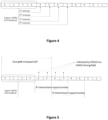
- Figure 4 depicts HARQ-ACK codebook for PDSCHs transmissions received in slots 0, 1, 2 and 3, transmitted in one PUCCH slot and has RRC configured four consecutive transmission opportunities. If the LBT for the first transmission attempt in slot 4 is not successful, then UE continues LBT for the second transmission attempt in slot 5. If the LBT for the second transmission attempt in slot 5 is successful, then the HARQ-ACK codebook is transmitted in slot 5 and the remaining PUCCH resources allocated for slot 6 and 7 are unused or to be used for PUCCH repetition.
- modules may be implemented as a hardware circuit comprising custom very-large-scale integration (VLSI) circuits or gate arrays, off-the-shelf semiconductors such as logic chips, transistors, or other discrete components.
- VLSI very-large-scale integration
- a module may also be implemented in programmable hardware devices such as field programmable gate arrays, programmable array logic, programmable logic devices or the like.
- Modules may also be implemented in code and/or software for execution by various types of processors.
- An identified module of code may, for instance, include one or more physical or logical blocks of executable code which may, for instance, be organized as an object, procedure, or function. Nevertheless, the executables of an identified module need not be physically located together, but, may include disparate instructions stored in different locations which, when joined logically together, include the module and achieve the stated purpose for the module.
- a module of code may be a single instruction, or many instructions, and may even be distributed over several different code segments, among different programs, and across several memory devices.
- operational data may be identified and illustrated herein within modules and may be embodied in any suitable form and organized within any suitable type of data structure. This operational data may be collected as a single data set, or may be distributed over different locations including over different computer readable storage devices.
- the software portions are stored on one or more computer readable storage devices.
- the computer readable medium may be a computer readable storage medium.
- the computer readable storage medium may be a storage device storing code.
- the storage device may be, for example, but need not necessarily be, an electronic, magnetic, optical, electromagnetic, infrared, holographic, micromechanical, or semiconductor system, apparatus, or device, or any suitable combination of the foregoing.
- a storage device would include the following: an electrical connection having one or more wires, a portable computer diskette, a hard disk, random access memory (RAM), read-only memory (ROM), erasable programmable read-only memory (EPROM or Flash Memory), portable compact disc read-only memory (CD-ROM), an optical storage device, a magnetic storage device, or any suitable combination of the foregoing.
- a computer-readable storage medium may be any tangible medium that can contain or store a program for use by or in connection with an instruction execution system, apparatus, or device.
- the memory 204 in one embodiment, is a computer readable storage medium.
- the memory 204 includes volatile computer storage media.
- the memory 204 may include a RAM, including dynamic RAM (DRAM), synchronous dynamic RAM (SDRAM), and/or static RAM (SRAM).
- the memory 204 includes non-volatile computer storage media.
- the memory 204 may include a hard disk drive, a flash memory, or any other suitable non-volatile computer storage device.
- the memory 204 includes both volatile and non-volatile computer storage media.
- the memory 204 stores data relating to system parameters.
- the memory 204 also stores program code and related data, such as an operating system or other controller algorithms operating on the remote unit 102.
- one bit in DCI explicitly enables or disables the multiple transmission opportunities for one HARQ-ACK codebook transmission.
- the HARQ-ACK codebook is allowed to be transmitted in multiple consecutive candidate slots, i.e., the HARQ-ACK codebook is allowed to have N transmission opportunities, wherein N is configured by RRC signaling and the first candidate slot for the HARQ-ACK codebook transmission is indicated by PDSCH-to-HARQ-timing field in DCI. For example, if slot 6 is indicated as the first candidate slot, slots 6-9 are the multiple consecutive candidate slots in case of N being configured to 4. In this case, LBT Category 4 may be used for the HARQ-ACK codebook transmission, and there is lower possibility to succeed in LBT Category 4 than in LBT Category 2.
- the number N of the multiple transmission opportunities is configured by RRC signaling, and the first candidate slot is determined according to the PDSCH-to-HARQ-timing field.
- the number of transmission opportunities is explicitly indicated in DCI to improve flexibility.
- a set of four possible number of transmission opportunities can be configured.
- a set may be configured as ⁇ 1, 2, 4, 8 ⁇ by RRC and two bits in DCI are used to indicate one value of the set.
- the DCI for scheduling associated PDSCH transmission also indicates the transmission times for the corresponding HARQ-ACK codebook.
- each combination of the two bits may indicate one of the number of transmission opportunities configured in the set configured by RRC.
- the first candidate slot for the HARQ-ACK codebook transmission is indicated by PDSCH-to-HARQ-timing field in DCI.
- the number of transmission opportunities is indicated by RRC and DCI to further improve flexibility.
- the total number of consecutive candidate slots may be set to any number including 1, it is unnecessary to explicitly indicate whether the HARQ-ACK codebook is allowed to be transmitted with only one or multiple transmission opportunities.
- Each of the above-identified values in the subsets refers to a HARQ timing offset value. That is to say, suppose the last PDSCH is received at slot n, the number "1" means that the HARQ-ACK codebook shall be transmitted at the slot "n+1".
- time-domain repetition number of 1, 2, 3 or 4 is added for PUCCH resource configuration to indicate multiple candidate slots of 1, 2, 3 or 4.
- PUCCH resource indicator field indicates to UE which PUCCH resource is used for the transmission of HARQ-ACK codebook. If the time domain repetition number is more than 1, the indicated PUCCH resource is reused in the following slots.
- repetition number is added for PUCCH configuration so as to dynamically control the number of transmission opportunities by existing PUCCH resource indicator.
- Figure 6 a flow chart diagram illustrating a method performed at UE for HARQ-ACK transmission on unlicensed spectrum.
- step 610 the UE receives one or multiple downlink transmissions within a channel occupancy initiated by gNB.
- the UE determines one or multiple candidate slots for transmission of a HARQ-ACK codebook corresponding to the one or multiple downlink transmissions.
- a HARQ-ACK codebook corresponding to the one or multiple downlink transmissions.
- each of the above-described first to ninth embodiments may be used to determine the one or multiple candidate slots.
- step 630 the UE determines whether LBT is successful for the first determined candidate slot. In the condition that the LBT is successful in step 630, the UE transmits the HARQ-ACK codebook on the first determined candidate slot in step 640. And the method 600 ends.
- the UE judges whether there exists next determined candidate slot in step 650.
- step 650 the UE determines whether LBT is successful for the next determined candidate slot in step 660. If the determination is successful in step 660, the UE transmits the HARQ-ACK codebook on the next determined candidate slot in step 670. If the determination is not successful in step 660, the UE re-performs step 650 to checks whether there exist more determined candidate slots (a next determined candidate slot).
- step 650 If the judgement is NO in step 650, there is no more determined candidate slot for the UE to attempt to transmit the HARQ-ACK codebook. And the method 600 ends.
- the UE when the UE receives downlink transmission, it determines one or multiple candidate slots for transmission of the HARQ-ACK codebook. Once LBT is successful for a determined candidate slot, the UE transmits the HARQ-ACK codebook on the determined candidate slot. If LBT is failed for all of the determined candidate slots, the HARQ-ACK codebook will not be transmitted.
- Figure 7 is a flow chart diagram illustrating a method performed at gNB for HARQ-ACK reception on unlicensed spectrum.
- the gNB transmits one or multiple downlink transmissions within initiated channel occupancy to UE.
- the gNB determines one or multiple candidate slots for reception of a HARQ-ACK codebook corresponding to the one or multiple downlink transmissions.
- each of the above-described first to ninth embodiments may be used to determine the one or multiple candidate slots.
- step 730 the gNB attempts to receive the HARQ-ACK codebook on the first determined slot. If the reception of the HARQ-ACK codebook is successful in step 730, the method ends in step 760.
- the gNB judges whether there exists next determined candidate slot in step 740. If the judgement is YES in step 740, the gNB attempts to receive the HARQ-ACK codebook on the next determined candidate slot in step 750.
- step 750 the gNB re-performs step 740 to judge whether there exists next determined candidate slot.
- step 750 the method ends in step 760.
- the gNB After the gNB transmits downlink transmission, it determines one or multiple candidate slots for reception of a HARQ-ACK codebook corresponding to the downlink transmission. The gNB attempts to receive the HARQ-ACK codebook on each of the determined candidate slots sequentially until one of the attempts is successful. If all of the attempts are failed, the HARQ-ACK codebook can't be received.
- one transmission opportunity corresponds to one slot.
- a plurality of transmission opportunities may be configured in the same slot.
Landscapes
- Engineering & Computer Science (AREA)
- Computer Networks & Wireless Communication (AREA)
- Signal Processing (AREA)
- Mobile Radio Communication Systems (AREA)
- Detection And Prevention Of Errors In Transmission (AREA)
Abstract
Description
- The subject matter disclosed herein generally relates to wireless communications and, more particularly, to HARQ-ACK codebook transmission on unlicensed spectrum.
- The following abbreviations are herewith defined, some of which are referred to within the following description: Third Generation Partnership Project (3GPP), European Telecommunications Standards Institute (ETSI), Frequency Division Duplex (FDD), Frequency Division Multiple Access (FDMA), Long Term Evolution (LTE), New Radio (NR), Very Large Scale Integration (VLSI), Random Access Memory (RAM), Read-Only Memory (ROM), Erasable Programmable Read-Only Memory (EPROM or Flash Memory), Compact Disc Read-Only Memory (CD-ROM), Local Area Network (LAN), Wide Area Network (WAN), Personal Digital Assistant (PDA), User Equipment (UE), Uplink (UL), Evolved Node B (eNB), Next Generation Node B (gNB), Downlink (DL), Central Processing Unit (CPU), Graphics Processing Unit (GPU), Field Programmable Gate Array (FPGA), Dynamic RAM (DRAM), Synchronous Dynamic RAM (SDRAM), Static RAM (SRAM), Liquid Crystal Display (LCD), Light Emitting Diode (LED), Organic LED (OLED), Multiple-Input Multiple-Output (MIMO), Physical Uplink Shared Channel (PUSCH), Physical Uplink Control Channel (PUCCH), Physical Downlink Shared Channel (PDSCH), Time division multiplexing (TDM), Code division multiplexing (CDM), Orthogonal Cover Code (OCC), Cycling Shift (CS), Physical Resource Block (PRB), Hybrid Automatic Repeat Request-Acknowledgement (HARQ-ACK), Positive Acknowledgement (ACK), Negative Acknowledgement (NACK), Media Access Control-Control Element (MAC-CE). Listen Before Talk (LBT), Clear Channel Assessment (CCA), Channel Occupancy Time (COT), Maximum Channel Occupancy Time (MCOT), Radio Resource Control (RRC), cyclic prefix (CP), downlink control indicator (DCI), NR-access on unlicensed spectrum (NR-U).
- Downlink (DL) TBs (transport blocks) are carried on Physical Downlink Shared Channel (PDSCH) in
3GPP LTE Release 8 and onwards. HARQ-ACK represents collectively Positive Acknowledgement (ACK) and Negative Acknowledgement (NACK). The ACK means that a TB is correctly received while the NACK means a TB is erroneously received. The HARQ-ACK codebook corresponding to the PDSCH transmission are transmitted either on a Physical Uplink Control Channel (PUCCH) or on a Physical Uplink Shared Channel (PUSCH) - For transmission on unlicensed spectrum, in order to achieve fair coexistence with other wireless systems, channel access procedure, also named LBT (listen before talk), is required before the transmission on unlicensed spectrum. By means of performing energy detection on a certain channel, if the received power is below a predefined threshold, then the LBT is successful, which means the channel is deemed as empty and available for transmission. Only when the LBT is successful, an equipment can start transmitting on the channel to occupy the channel up to a maximum channel occupancy time (MCOT); otherwise, the equipment can't start the transmission and continues to performing LBT until it is successful.
- LBT includes several types of operations. For example, one type of the operation is
LBT Category 4 operation with a random backoff counter selected from a variable contention window (liketype 1 UL channel access procedure for UL LBT). Another type of the operation isLBT Category 2 with one-shot LBT operation with at least 25 µs sensing interval (liketype 2 UL channel access procedure for UL LBT). - Upon reception of DL grant for scheduling PDSCH transmission, UE attempts to transmit the corresponding HARQ-ACK codebook in the targeted slot based on the PDSCH-to-HARQ-timing field in the DL grant. The PDSCH-to-HARQ-timing field indicates one value from K1 set. The K1 set includes up to 8 values and the values are within the range of 0 to 15. Each value indicates the offset between the slot where PDSCH is received and the slot where the corresponding HARQ-ACK codebook is transmitted. The offset is indicated in unit of slots. For example, suppose the last PDSCH is received at
slot 3 and the PDSCH-to-HARQ-timing field indicates avalue 3, the HARQ-ACK codebook would be transmitted atslot 6. - When the HARQ-ACK codebook is transmitted on unlicensed spectrum, if LBT fails, the HARQ-ACK codebook cannot be transmitted to gNB.
- In order to solve this problem, it is beneficial to allow multiple opportunities in time domain for a UE to transmit one HARQ-ACK codebook. In detail, a HARQ-ACK codebook feedback window comprising multiple consecutive or non-consecutive slots can be configured and UE is allowed to transmit one HARQ-ACK codebook within the feedback window. Particularly, UE performs LBT for each transmission opportunity and transmits the HARQ-ACK codebook in a certain slot once the LBT for the slot is successful.
- The remaining transmission opportunities within the feedback window can be left unused since only one HARQ-ACK codebook transmission is enough. Alternatively, the HARQ-ACK codebook can be transmitted repeatedly in the remaining transmission opportunities till the end of the feedback window as long as the LBT for a certain transmission opportunity is successful. In this way, the HARQ-ACK transmission reliability can be further enhanced.
- One example is shown in
Figure 4 that depicts HARQ-ACK codebook for PDSCHs transmissions received inslots slot 4 is not successful, then UE continues LBT for the second transmission attempt inslot 5. If the LBT for the second transmission attempt inslot 5 is successful, then the HARQ-ACK codebook is transmitted inslot 5 and the remaining PUCCH resources allocated forslot - However, it is obvious that this kind of HARQ-ACK transmission on unlicensed spectrum may lead to PUCCH resource waste. Especially, when the target slot for HARQ-ACK transmission is within the gNB-initiated COT, the channel access procedure has relatively higher possibility to win the competition of LBT, compared to the case when HARQ-ACK transmission is outside of the gNB-initiated COT. Semi-statically configured number of transmission opportunities inevitably causes resource waste.
- In this disclosure, we focus on the further enhancement of HARQ-ACK transmission on unlicensed spectrum in order to flexibly and dynamically change the number of transmission opportunities for HARQ-ACK codebook.
- Methods and apparatuses for HARQ-ACK codebook transmission on unlicensed spectrum are disclosed.
- In one embodiment, a remote unit comprises: a receiver that receives, from a base unit, one or multiple downlink transmissions within a channel occupancy time initiated by the base unit, a first message indicating a first candidate opportunity for transmission of a Hybrid Automatic Repeat Request-Acknowledgement (HARQ-ACK) codebook corresponding to the one or multiple downlink transmissions and a second message indicating a number of allowed opportunities for transmission of the HARQ-ACK codebook; a processor that determines the HARQ-ACK codebook and a number of total candidate opportunities for transmission of the HARQ-ACK codebook; and a transmitter that, in response to a channel access for the first candidate opportunity being successful, transmits the HARQ-ACK codebook in the first candidate opportunity, and, in response to the channel access for the first candidate opportunity being failed and the number of the total candidate opportunities being larger than one, attempts to transmit the HARQ-ACK codebook in a second candidate opportunity. In addition, in response to the channel access for the second candidate opportunity being failed, the transmitter attempts to transmit the HARQ-ACK codebook in a next candidate opportunity as long as there exists the next candidate opportunity among the total candidate opportunities.
- In some embodiment, the processor determines the number of total candidate opportunities based on the first candidate opportunity being inside or outside of the channel occupancy time. In particular, the number of total candidate opportunities is equal to one in response to the first candidate opportunity being inside of the channel occupancy time, and is equal to the number of allowed opportunities in response to the first candidate opportunity being outside of the channel occupancy time.
- In some embodiment, the first message is received in a Radio Resource Control (RRC) signaling and the receiver further receives an indicator in downlink control indicator (DCI) indicating enabling or disabling multiple opportunities for transmission of the HARQ-ACK codebook. In this condition, the processor determines the number of total candidate opportunities being equal to one in response to the indicator indicating disabling multiple opportunities, and being equal to the number of allowed opportunities in response to the indicator indicating enabling multiple opportunities.
- In some embodiment, the receiver further receives an indicator indicating the first candidate opportunity being inside or outside of the channel occupancy time. In this condition, the processor determines the number of total candidate opportunities being equals to one in response to the indicator indicating the first candidate opportunity being inside of the channel occupancy time, and being equal to the number of allowed opportunities in response to the indicator indicating the first candidate opportunity being outside of the channel occupancy time. In addition, the processor further determines the type of the channel access being Listen Before Talk (LBT)
Category 2 with at least 25 µs Clear Channel Assessment (CCA) in response to the first candidate opportunity being inside of the channel occupancy time, and being LBTCategory 4 in response to the first candidate opportunity being outside of the channel occupancy time. - In some embodiment, the first message is received in DCI and the number of the total candidate opportunities is equal to the number of the allowed opportunities. Alternatively, the receiver receives a RRC signaling for configuring a set of values each of which indicates a number of allowed opportunities, and the first message is received in DCI for indicating one value of the set. Further alternatively, the receiver receives a RRC signaling for configuring a set of Physical Uplink Control Channel (PUCCH) resources each of which includes resource repetition information, and the first message is received in DCI for indicating one resource of the set. As another implementation, the receiver receives a RRC signaling for configuring multiple subsets in a set of PDSCH-to-HARQ timing values and each of the multiple subsets includes one or multiple opportunities for transmission of the HARQ-ACK codebook, and the first message is received in DCI for indicating one subset of the set of PDSCH-to-HARQ timing values. As yet another implementation, the receiver receives a RRC signaling for configuring multiple subsets in a set of PDSCH-to-HARQ timing values and each of the multiple subsets includes the first candidate opportunity and the number of allowed opportunities, and the first message is received in DCI for indicating one subset of the set of PDSCH-to-HARQ timing values.
- In some embodiment, a number of opportunities for transmission of the HARQ-ACK codebook is at least one in one slot.
- In another embodiment, a method a remote unit comprises: receiving, from a base unit, one or multiple downlink transmissions within a channel occupancy time initiated by the base unit, a first message indicating a first candidate opportunity for transmission of a Hybrid Automatic Repeat Request-Acknowledgement (HARQ-ACK) codebook corresponding to the one or multiple downlink transmissions and a second message indicating a number of allowed opportunities for transmission of the HARQ-ACK codebook; determining the HARQ-ACK codebook and a number of total candidate opportunities for transmission of the HARQ-ACK codebook; and in response to a channel access for the first candidate opportunity being successful, transmitting the HARQ-ACK codebook in the first candidate opportunity, and, in response to the channel access for the first candidate opportunity being failed and the number of the total candidate opportunities being larger than one, attempting to transmit the HARQ-ACK codebook in a second candidate opportunity.
- In yet another embodiment, a base unit comprises: a transmitter that transmits, to a remote unit, one or multiple downlink transmissions within a channel occupancy time, a first message indicating a first candidate opportunity for transmission of a Hybrid Automatic Repeat Request-Acknowledgement (HARQ-ACK) codebook corresponding to the one or multiple downlink transmissions and a second message indicating a number of allowed opportunities for transmission of the HARQ-ACK codebook; and a receiver that attempts to receive the HARQ-ACK codebook in the first candidate opportunity, and attempts to receive the HARQ-ACK codebook in a second candidate opportunity in response to the reception of the HARQ-ACK codebook in the first candidate opportunity being failed and the number of a total candidate opportunities being larger than one.
- In further embodiment, a method at a base unit comprises: transmitting, to a remote unit, one or multiple downlink transmissions within a channel occupancy time, a first message indicating a first candidate opportunity for transmission of a Hybrid Automatic Repeat Request-Acknowledgement (HARQ-ACK) codebook corresponding to the one or multiple downlink transmissions and a second message indicating a number of allowed opportunities for transmission of the HARQ-ACK codebook; and attempting to receive the HARQ-ACK codebook in the first candidate opportunity, and attempting to receive the HARQ-ACK codebook in a second candidate opportunity in response to the reception of the HARQ-ACK codebook in the first candidate opportunity being failed and the number of a total candidate opportunities being larger than one.
- A more particular description of the embodiments briefly described above will be rendered by reference to specific embodiments that are illustrated in the appended drawings. Understanding that these drawings depict only some embodiments, and are not therefore to be considered as limiting of scope, the embodiments will be described and explained with additional specificity and detail using accompanying drawings, in which:
-
Figure 1 is a schematic block diagram illustrating one embodiment of a wireless communication system; -
Figure 2 is a schematic block diagram illustrating one embodiment of an apparatus that may be used for HARQ-ACK transmission on unlicensed spectrum; -
Figure 3 is a schematic block diagram illustrating one embodiment of another apparatus that may be used for HARQ-ACK transmission on unlicensed spectrum; -
Figures 4 is a schematic diagram illustrating multiple transmission opportunities for transmitting one HARQ-ACK codebook; -
Figure 5 is a schematic diagram illustrating gNB-initiated COT with HARQ-ACK codebook transmission on unlicensed spectrum; -
Figure 6 is a flow chart diagram illustrating a method for HARQ-ACK codebook transmission on unlicensed spectrum; and -
Figure 7 is a flow chart diagram illustrating a method for HARQ-ACK codebook reception on unlicensed spectrum. - As will be appreciated by one skilled in the art, aspects of the embodiments may be embodied as a system, apparatus, method, or program product. Accordingly, embodiments may take the form of an entirely hardware embodiment, an entirely software embodiment (including firmware, resident software, micro-code, etc.) or an embodiment combining software and hardware aspects that may generally all be referred to herein as a "circuit", "module" or "system". Furthermore, embodiments may take the form of a program product embodied in one or more computer readable storage devices storing machine-readable code, computer readable code, and/or program code, referred to hereafter as "code". The storage devices may be tangible, non-transitory, and/or non-transmission. The storage devices may not embody signals. In a certain embodiment, the storage devices only employ signals for accessing code.
- Certain functional units described in this specification may be labeled as "modules", in order to more particularly emphasize their independent implementation. For example, a module may be implemented as a hardware circuit comprising custom very-large-scale integration (VLSI) circuits or gate arrays, off-the-shelf semiconductors such as logic chips, transistors, or other discrete components. A module may also be implemented in programmable hardware devices such as field programmable gate arrays, programmable array logic, programmable logic devices or the like.
- Modules may also be implemented in code and/or software for execution by various types of processors. An identified module of code may, for instance, include one or more physical or logical blocks of executable code which may, for instance, be organized as an object, procedure, or function. Nevertheless, the executables of an identified module need not be physically located together, but, may include disparate instructions stored in different locations which, when joined logically together, include the module and achieve the stated purpose for the module.
- Indeed, a module of code may be a single instruction, or many instructions, and may even be distributed over several different code segments, among different programs, and across several memory devices. Similarly, operational data may be identified and illustrated herein within modules and may be embodied in any suitable form and organized within any suitable type of data structure. This operational data may be collected as a single data set, or may be distributed over different locations including over different computer readable storage devices. Where a module or portions of a module are implemented in software, the software portions are stored on one or more computer readable storage devices.
- Any combination of one or more computer readable medium may be utilized. The computer readable medium may be a computer readable storage medium. The computer readable storage medium may be a storage device storing code. The storage device may be, for example, but need not necessarily be, an electronic, magnetic, optical, electromagnetic, infrared, holographic, micromechanical, or semiconductor system, apparatus, or device, or any suitable combination of the foregoing.
- A non-exhaustive list of more specific examples of the storage device would include the following: an electrical connection having one or more wires, a portable computer diskette, a hard disk, random access memory (RAM), read-only memory (ROM), erasable programmable read-only memory (EPROM or Flash Memory), portable compact disc read-only memory (CD-ROM), an optical storage device, a magnetic storage device, or any suitable combination of the foregoing. In the context of this document, a computer-readable storage medium may be any tangible medium that can contain or store a program for use by or in connection with an instruction execution system, apparatus, or device.
- Code for carrying out operations for embodiments may be any number of lines and may be written in any combination of one or more programming languages including an object-oriented programming language such as Python, Ruby, Java, Smalltalk, C++, or the like, and conventional procedural programming languages, such as the "C" programming language, or the like, and/or machine languages such as assembly languages. The code may be executed entirely on the user's computer, partly on the user's computer, as a stand-alone software package, partly on the user's computer and partly on a remote computer or entirely on the remote computer or server. In the very last scenario, the remote computer may be connected to the user's computer through any type of network, including a local area network (LAN) or a wide area network (WAN), or the connection may be made to an external computer (for example, through the Internet using an Internet Service Provider).
- Reference throughout this specification to "one embodiment", "an embodiment", or similar language means that a particular feature, structure, or characteristic described in connection with the embodiment is included in at least one embodiment. Thus, appearances of the phrases "in one embodiment", "in an embodiment", and similar language throughout this specification may, but do not necessarily, all refer to the same embodiment, but mean "one or more but not all embodiments" unless expressly specified otherwise. The terms "including", "comprising", "having", and variations thereof mean "including but are not limited to", unless otherwise expressly specified. An enumerated listing of items does not imply that any or all of the items are mutually exclusive, otherwise unless expressly specified. The terms "a", "an", and "the" also refer to "one or more" unless otherwise expressly specified.
- Furthermore, the described features, structures, or characteristics of the embodiments may be combined in any suitable manner. In the following description, numerous specific details are provided, such as examples of programming, software modules, user selections, network transactions, database queries, database structures, hardware modules, hardware circuits, hardware chips, etc., to provide a thorough understanding of embodiments. One skilled in the relevant art will recognize, however, that embodiments may be practiced without one or more of the specific details, or with other methods, components, materials, and so forth. In other instances, well-known structures, materials, or operations are not shown or described in detail to avoid any obscuring of aspects of an embodiment.
- Aspects of the embodiments are described below with reference to schematic flowchart diagrams and/or schematic block diagrams of methods, apparatuses, systems, and program products according to embodiments. It will be understood that each block of the schematic flowchart diagrams and/or schematic block diagrams, and combinations of blocks in the schematic flowchart diagrams and/or schematic block diagrams, can be implemented by code. This code may be provided to a processor of a general purpose computer, special purpose computer, or other programmable data processing apparatus to produce a machine, such that the instructions, which are executed via the processor of the computer or other programmable data processing apparatus, create means for implementing the functions specified in the schematic flowchart diagrams and/or schematic block diagrams for the block or blocks.
- The code may also be stored in a storage device that can direct a computer, other programmable data processing apparatus, or other devices, to function in a particular manner, such that the instructions stored in the storage device produce an article of manufacture including instructions which implement the function specified in the schematic flowchart diagrams and/or schematic block diagrams block or blocks.
- The code may also be loaded onto a computer, other programmable data processing apparatus, or other devices, to cause a series of operational steps to be performed on the computer, other programmable apparatus or other devices to produce a computer implemented process such that the code executed on the computer or other programmable apparatus provides processes for implementing the functions specified in the flowchart and/or block diagram block or blocks.
- The schematic flowchart diagrams and/or schematic block diagrams in the Figures illustrate the architecture, functionality, and operation of possible implementations of apparatuses, systems, methods and program products according to various embodiments. In this regard, each block in the schematic flowchart diagrams and/or schematic block diagrams may represent a module, segment, or portion of code, which includes one or more executable instructions of the code for implementing the specified logical function(s).
- It should also be noted that in some alternative implementations, the functions noted in the block may occur out of the order noted in the Figures. For example, two blocks shown in succession may substantially be executed concurrently, or the blocks may sometimes be executed in the reverse order, depending upon the functionality involved. Other steps and methods may be conceived that are equivalent in function, logic, or effect to one or more blocks, or portions thereof, to the illustrated Figures.
- Although various arrow types and line types may be employed in the flowchart and/or block diagrams, they are understood not to limit the scope of the corresponding embodiments. Indeed, some arrows or other connectors may be used to indicate only the logical flow of the depicted embodiment. For instance, an arrow may indicate a waiting or monitoring period of unspecified duration between enumerated steps of the depicted embodiment. It will also be noted that each block of the block diagrams and/or flowchart diagrams, and combinations of blocks in the block diagrams and/or flowchart diagrams, can be implemented by special purpose hardware-based systems that perform the specified functions or acts, or combinations of special purpose hardware and code.
- The description of elements in each figure may refer to elements of proceeding figures. Like numbers refer to like elements in all figures, including alternate embodiments of like elements.
-
Figure 1 depicts an embodiment of awireless communication system 100 for HARQ-ACK codebook transmission on unlicensed spectrum. In one embodiment, thewireless communication system 100 includesremote units 102 andbase units 104. Even though a specific number ofremote units 102 andbase units 104 are depicted inFigure 1 , one skilled in the art will recognize that any number ofremote units 102 andbase units 104 may be included in thewireless communication system 100. - In one embodiment, the
remote units 102 may include computing devices, such as desktop computers, laptop computers, personal digital assistants (PDAs), tablet computers, smart phones, smart televisions (e.g., televisions connected to the Internet), set-top boxes, game consoles, security systems (including security cameras), vehicle on-board computers, network devices (e.g., routers, switches, modems), or the like. In some embodiments, theremote units 102 include wearable devices, such as smart watches, fitness bands, optical head-mounted displays, or the like. Theremote units 102 may be referred to as subscriber units, mobiles, mobile stations, users, terminals, mobile terminals, fixed terminals, subscriber stations, user equipment (UE), user terminals, a device, or by other terminology used in the art. - The
remote units 102 may communicate directly with one or more of thebase units 104 via UL communication signals. - The
base units 104 may be distributed over a geographic region. In certain embodiments, abase unit 104 may also be referred to as an access point, an access terminal, a base, a base station, a Node-B, an eNB, a gNB, a Home Node-B, a relay node, a device, or by any other terminology used in the art. Thebase units 104 are generally part of a radio access network that includes one or more controllers communicably coupled to one or morecorresponding base units 104. The radio access network is generally communicably coupled to one or more core networks, which may be coupled to other networks, like the Internet and public switched telephone networks, among other networks. These and other elements of radio access and core networks are not illustrated, but are well known generally by those having ordinary skill in the art. - In one implementation, the
wireless communication system 100 is compliant with 3GPP 5G new radio (NR). More generally, however, thewireless communication system 100 may implement some other open or proprietary communication protocol. - The
base units 104 may serve a number ofremote units 102 within a serving area, for example, a cell (or a cell sector) or more cells via a wireless communication link. Thebase units 104 transmit DL communication signals to serve theremote units 102 in the time, frequency, and/or spatial domain. -
Figure 2 depicts one embodiment of anapparatus 200 that may be used for HARQ-ACK codebook transmission on unlicensed spectrum. Theapparatus 200 includes one embodiment of theremote unit 102. Furthermore, theremote unit 102 may include aprocessor 202, amemory 204, aninput device 206, adisplay 208, atransmitter 210, and areceiver 212. In some embodiments, theinput device 206 and thedisplay 208 are combined into a single device, such as a touch screen. In certain embodiments, theremote unit 102 may not include anyinput device 206 and/ordisplay 208. In various embodiments, theremote unit 102 may include at least one of theprocessor 202, thememory 204, thetransmitter 210 and thereceiver 212, and may not include theinput device 206 and/or thedisplay 208. - The
processor 202, in one embodiment, may include any known controller capable of executing computer-readable instructions and/or capable of performing logical operations. For example, theprocessor 202 may be a microcontroller, a microprocessor, a central processing unit (CPU), a graphics processing unit (GPU), an auxiliary processing unit, a field programmable gate array (FPGA), or similar programmable controller. In some embodiments, theprocessor 202 executes instructions stored in thememory 204 to perform the methods and routines described herein. Theprocessor 202 is communicatively coupled to thememory 204, theinput device 206, thedisplay 208, thetransmitter 210, and thereceiver 212. - The
memory 204, in one embodiment, is a computer readable storage medium. In some embodiments, thememory 204 includes volatile computer storage media. For example, thememory 204 may include a RAM, including dynamic RAM (DRAM), synchronous dynamic RAM (SDRAM), and/or static RAM (SRAM). In some embodiments, thememory 204 includes non-volatile computer storage media. For example, thememory 204 may include a hard disk drive, a flash memory, or any other suitable non-volatile computer storage device. In some embodiments, thememory 204 includes both volatile and non-volatile computer storage media. In some embodiments, thememory 204 stores data relating to system parameters. In some embodiments, thememory 204 also stores program code and related data, such as an operating system or other controller algorithms operating on theremote unit 102. - The
input device 206, in one embodiment, may include any known computer input device including a touch panel, a button, a keyboard, a stylus, a microphone, or the like. In some embodiments, theinput device 206 may be integrated with thedisplay 208, for example, as a touch screen or similar touch-sensitive display. In some embodiments, theinput device 206 includes a touch screen such that text may be input using a virtual keyboard displayed on the touch screen and/or by handwriting on the touch screen. In some embodiments, theinput device 206 includes two or more different devices, such as a keyboard and a touch panel. - The
display 208, in one embodiment, may include any known electronically controllable display or display device. Thedisplay 208 may be designed to output visual, audible, and/or haptic signals. In some embodiments, thedisplay 208 includes an electronic display capable of outputting visual data to a user. For example, thedisplay 208 may include, but is not limited to, an LCD display, an LED display, an OLED display, a projector, or similar display device capable of outputting images, text, or the like to a user. As another, non-limiting example, thedisplay 208 may include a wearable display such as a smart watch, smart glasses, a heads-up display, or the like. Further, thedisplay 208 may be a component of a smart phone, a personal digital assistant, a television, a table computer, a notebook (laptop) computer, a personal computer, a vehicle dashboard, or the like. - In certain embodiments, the
display 208 includes one or more speakers for producing sound. For example, thedisplay 208 may produce an audible alert or notification (e.g., a beep or chime). In some embodiments, thedisplay 208 includes one or more haptic devices for producing vibrations, motion, or other haptic feedback. In some embodiments, all or portions of thedisplay 208 may be integrated with theinput device 206. For example, theinput device 206 anddisplay 208 may form a touch screen or similar touch-sensitive display. In other embodiments, thedisplay 208 may be located near theinput device 206. - The
transmitter 210 is used to provide UL communication signals to thebase unit 104 and thereceiver 212 is used to receive DL communication signals from thebase unit 104. In various embodiments, thetransmitter 210 and thereceiver 212 may transmit and receive resources via different cells. Although only onetransmitter 210 and onereceiver 212 are illustrated, theremote unit 102 may have any suitable number oftransmitters 210 andreceivers 212. Thetransmitter 210 and thereceiver 212 may be any suitable type of transmitters and receivers. In one embodiment, thetransmitter 210 and thereceiver 212 may be part of a transceiver. -
Figure 3 depicts one embodiment of anotherapparatus 300 that may be used for HARQ-ACK codebook transmission on unlicensed spectrum. Theapparatus 300 includes one embodiment of thebase unit 104. Furthermore, thebase unit 104 may include at least one of aprocessor 302, amemory 304, aninput device 306, adisplay 308, atransmitter 310 and areceiver 312. As may be appreciated, theprocessor 302, thememory 304, theinput device 306, thedisplay 308, thetransmitter 310, and thereceiver 312 may be substantially similar to theprocessor 202, thememory 204, theinput device 206, thedisplay 208, thetransmitter 210, and thereceiver 212 of theremote unit 102, respectively. - Although only one
transmitter 310 and onereceiver 312 are illustrated, thebase unit 104 may have any suitable number oftransmitters 310 andreceivers 312. Thetransmitter 310 and thereceiver 312 may be any suitable type of transmitters and receivers. In one embodiment, thetransmitter 310 and thereceiver 312 may be part of a transceiver. - In
Figure 4 , a HARQ-ACK codebook feedback window including four slots is semi-statically configured. The slot(s) after the slot for which the LBT is successful are unused or to be used for retransmission of the transmitted HARQ-ACK codebook. In the condition that there is high possibility that the LBT for the first candidate slot is successful, the resource waste is inevitable. - According to a first embodiment, one bit in DCI is used to indicate enabling or disabling the multiple candidate slots for one HARQ-ACK codebook.
- For example, the bit may be set to "1" as an enabling indicator that indicates that one HARQ-ACK codebook is allowed to be transmitted in multiple consecutive candidate slots, i.e., the HARQ-ACK codebook is allowed to have N transmission opportunities. N is configured by RRC signaling. The first candidate slot for the HARQ-ACK codebook transmission is indicated by PDSCH-to-HARQ-timing field in the DCI. The PDSCH-to-HARQ-timing field indicates one value from K1 set that indicates an offset between the slot where PDSCH is received and the first candidate slot where the HARQ-ACK codebook is to be transmitted.
- The bit may alternatively be set to "0" as a disabling indicator that indicates that the HARQ-ACK codebook is allowed to be transmitted with only one opportunity, i.e. only in the slot indicated by PDSCH-to-HARQ-timing field in DCI.
- According to the first embodiment, one bit in DCI explicitly enables or disables the multiple transmission opportunities for one HARQ-ACK codebook transmission.
- According to a second embodiment, one bit in DCI is used to indicate whether the HARQ-ACK codebook is to be transmitted inside of a gNB-initiated COT or outside of the gNB-initiated COT.
- The gNB-initiated COT is a plurality of slots acquired by a gNB after successful LBT. The COT may include slots used for DL transmissions and slot(s) used for UL transmission.
Figure 5 is a schematic diagram illustrating gNB-initiated COT with HARQ-ACK codebook transmission on unlicensed spectrum. InFigure 5 , slots 0-5 are within the gNB-initiated COT. As an example, slots 0-3 are the slots used for the gNB to send DL transmissions to the UE and slots 4-5 are the slots used for the UE to send HARQ-ACK codebook to the gNB. - There is high possibility that the LBT for the slot inside of the gNB-initiated COT is successful for the UE. On the other hand, there is low possibility that the LBT for the slot outside of the gNB-initiated COT is successful for the UE.
- The DCI bit, according to the second embodiment, may be set to "1" to indicate that the HARQ-ACK codebook is to be transmitted inside of the gNB-initiated COT. Alternatively, the bit may be set to "0" to indicate that the HARQ-ACK codebook is to be transmitted outside of the gNB-initiated COT.
- There are various variations on whether one HARQ-ACK codebook is allowed to be transmitted with only one opportunity or in multiple consecutive candidate slots.
- In a first variation of the second embodiment, in the condition that the DCI bit is set to "1" to indicate that the HARQ-ACK codebook is to be transmitted inside of the gNB-initiated COT, the HARQ-ACK codebook is allowed to be transmitted with only one opportunity, i.e., only in the slot indicated by PDSCH-to-HARQ-timing field in DCI. As there might be more than one slot (for example,
slots Figure 5 ) for UL transmission inside of the gNB-initiated COT, the PDSCH-to-HARQ-timing field of DCI indicates the only one slot for transmission of the HARQ-ACK codebook. In this case,LBT Category 2 with at least 25µs CCA may be used for the HARQ-ACK codebook transmission, and there is high possibility to succeed inLBT Category 2. - In the condition that the DCI bit is set to "0" to indicate that the HARQ-ACK codebook is to be transmitted outside of the gNB-initiated COT, the HARQ-ACK codebook is allowed to be transmitted in multiple consecutive candidate slots, i.e., the HARQ-ACK codebook is allowed to have N transmission opportunities, wherein N is configured by RRC signaling and the first candidate slot for the HARQ-ACK codebook transmission is indicated by PDSCH-to-HARQ-timing field in DCI. For example, if
slot 6 is indicated as the first candidate slot, slots 6-9 are the multiple consecutive candidate slots in case of N being configured to 4. In this case,LBT Category 4 may be used for the HARQ-ACK codebook transmission, and there is lower possibility to succeed inLBT Category 4 than inLBT Category 2. - In a second variation of the second embodiment, in the condition that the DCI bit is set to "1" to indicate that the HARQ-ACK codebook is to be transmitted inside of the gNB-initiated COT, the HARQ-ACK codebook is allowed to be transmitted in multiple consecutive candidate slots, i.e., the HARQ-ACK codebook is allowed to have N transmission opportunities, wherein N is configured by RRC signaling and the first candidate slot for the HARQ-ACK codebook transmission is indicated by PDSCH-to-HARQ-timing field in DCI. In this case,
LBT Category 2 with at least 25µs CCA may be used for the HARQ-ACK codebook transmission, and there is high possibility to succeed inLBT Category 2. If the N transmission opportunities extend beyond the end of the gNB-initiated COT, the UE further attempts to transmit the HARQ-ACK codebook outside of the gNB-initiated COT, whereLBT Category 4 may be used for the HARQ-ACK codebook transmission. As shown inFigure 5 ,slot 4 is indicated as the first candidate slot. Slots 4-7 are the multiple consecutive candidate slots with N being configured to 4. Forslots LBT Category 2 is used. And forslots LBT Category 4 is used. - In the condition that the DCI bit is set to "0" to indicate that the HARQ-ACK codebook is to be transmitted outside of the gNB-initiated COT, the second variation is the same as the first variation. In particular, the HARQ-ACK codebook is allowed to be transmitted in multiple consecutive candidate slots, i.e., the HARQ-ACK codebook is allowed to have N transmission opportunities, wherein N is configured by RRC signaling and the first candidate slot for the HARQ-ACK codebook transmission is indicated by PDSCH-to-HARQ-timing field in DCI. In this case,
LBT Category 4 may be used for the HARQ-ACK codebook transmission, and there is low possibility to succeed inLBT Category 4. - In a third variation of the second embodiment, in the condition that the DCI bit is set to "1" to indicate that the HARQ-ACK codebook is to be transmitted inside of the gNB-initiated COT, the HARQ-ACK codebook is allowed to be transmitted in multiple consecutive candidate slots (the same as the second variation), i.e., the HARQ-ACK codebook is allowed to have N transmission opportunities, wherein N is configured by RRC signaling and the first candidate slot for the HARQ-ACK codebook transmission is indicated by PDSCH-to-HARQ-timing field in DCI. In this case,
LBT Category 2 with at least 25µs CCA may be used for the HARQ-ACK codebook transmission, and there is high possibility to succeed inLBT Category 2. Different from the second variation, in the third variation, no HARQ-ACK codebook transmission outside of the gNB-initiated COT is allowed, i.e. the number of candidate slots is upper-bounded by a smaller value of N and remaining slots inside of the gNB-initiated COT. As shown inFigure 5 ,slot 4 is indicated as the first candidate slot. Slots 4-7 are the multiple consecutive candidate slots with N being configured to 4. Forslots LBT Category 2 is used. On the other side, althoughslots slots - In the condition that the DCI bit is set to "0" to indicate that the HARQ-ACK codebook is to be transmitted outside of the gNB-initiated COT, the third variation is the same as the first variation and the second variation. In particular, the HARQ-ACK codebook is allowed to be transmitted in multiple consecutive candidate slots, i.e., the HARQ-ACK codebook is allowed to have N transmission opportunities, wherein N is configured by RRC signaling and the first candidate slot for the HARQ-ACK codebook transmission is indicated by PDSCH-to-HARQ-timing field in DCI. In this case,
LBT Category 4 may be used for the HARQ-ACK codebook transmission, and there is low possibility to succeed inLBT Category 4. - According to the second embodiment, one bit in DCI indicating whether the HARQ-ACK codebook transmission is inside or outside of the gNB-initiated COT is used to determine whether one or multiple transmission opportunities are allowed for the HARQ-ACK codebook transmission and determine the LBT type (
LBT Category 2 or LBT Category 4). - According to a third embodiment, an implicit method is used for gNB and UE to determine whether one HARQ-ACK codebook is allowed to be transmitted with only one or more transmission opportunities.
- In the beginning of the gNB-initiated COT, a COT structure indication is transmitted to the UE. The COT structure refers to UL/DL split pattern, the number and location of the UL-to-DL and DL-to-UL switching point(s), the location and duration of DL bursts and UL bursts including the starting position and the ending position of the gNB-initiated COT. An example of transmitting the COT structure indication is an indication in DCI format 2_0 that indicates the slot combinations for all the slots within the gNB-initiated COT.
- Upon reception of PDSCH-to-HARQ-timing field in DCI for scheduling PDSCH transmission, the UE identifies the target slot for the corresponding HARQ-ACK codebook transmission, and accordingly determines whether the target slot is inside of the gNB-initiated COT or outside of the gNB-initiated COT.
- In case that the HARQ-ACK codebook is to be transmitted inside of gNB-initiated COT,
LBT Category 2 with at least 25 µs CCA may be used for the HARQ-ACK codebook transmission. UE knows the corresponding HARQ-ACK codebook is allowed to be transmitted with only one opportunity in the target slot. Instead, in case that the HARQ-ACK codebook is to be transmitted outside of gNB-initiated COT,LBT Category 4 may be used for the HARQ-ACK codebook transmission. So, UE knows the corresponding HARQ-ACK codebook is allowed to be transmitted in multiple consecutive candidate slots, i.e., the HARQ-ACK codebook is allowed to have N transmission opportunities, wherein N is configured by RRC signaling and the first candidate slot for the HARQ-ACK codebook transmission is the target slot indicated by PDSCH-to-HARQ-timing field in DCI. - For example, as shown in
Figure 5 , in the condition that the gNB-initiated COT includes slots 0-5, if the PDSCH-to-HARQ-timing field in DCI indicatesslot example slot 6 that is outside of the gNB-initiated COT, the HARQ-ACK codebook is allowed to have N transmission opportunities. - According to the third embodiment, whether one HARQ-ACK codebook is allowed to be transmitted with only one or more transmission opportunities is implicitly determined based on COT structure indication.
- According to a fourth embodiment, one bit in DCI is used to indicate whether the HARQ-ACK codebook is to be transmitted using
LBT Category 2 orLBT Category 4. - For example, such bit may be set to "1" to indicate that the HARQ-ACK codebook is to be transmitted using
LBT Category 2 with at least 25µs CCA. As there is high possibility to succeed inLBT Category 2, the HARQ-ACK codebook is allowed to be transmitted with only one opportunity, i.e., only in the slot indicated by PDSCH-to-HARQ-timing field in DCI. - Alternatively, the bit may be set to "0" to indicate that the HARQ-ACK codebook is to be transmitted using
LBT Category 4. As there is low possibility to succeed inLBT Category 4, the HARQ-ACK codebook is allowed to be transmitted in multiple consecutive candidate slots, i.e., the HARQ-ACK codebook is allowed to have N transmission opportunities, wherein N is configured by RRC signaling and the first candidate slot for the HARQ-ACK codebook transmission is indicated by PDSCH-to-HARQ-timing field in DCI. Optionally, if the HARQ-ACK codebook transmission opportunity is within the gNB-initiated COT, the UE may attempt to use, instead ofLBT Category 4,LBT Category 2 with at least 25µs CCA for that transmission opportunity. - According to the fourth embodiment, one bit in DCI indicates whether the HARQ-ACK codebook is to be transmitted using
LBT Category 2 orLBT Category 4 to determine whether one or multiple transmission opportunities are allowed for the HARQ-ACK codebook transmission. - In the first to the fourth embodiments, if multiple transmission opportunities are allowed for the HARQ-ACK codebook transmission, the number N of the multiple transmission opportunities is configured by RRC signaling, and the first candidate slot is determined according to the PDSCH-to-HARQ-timing field.
- As the number N of the multiple transmission opportunities is semi-statically configured by RRC signaling, further improvement is possible.
- According to a fifth embodiment, the number of the transmission opportunities for one HARQ-ACK codebook is explicitly indicated in DCI.
- In particular, for DL transmission, the DCI for scheduling associated PDSCH transmission also indicates the transmission times for the corresponding HARQ-ACK codebook.
- For example, assuming that one HARQ-ACK codebook can have 1, 2, 3 or 4 transmission opportunities in time domain, two bits in DCI are used to indicate the transmission times for one HARQ-ACK codebook. The first candidate slot for the HARQ-ACK codebook transmission is indicated by PDSCH-to-HARQ-timing field in DCI.
- According to the fifth embodiment, the number of transmission opportunities is explicitly indicated in DCI to improve flexibility.
- According to a sixth embodiment, a set of possible number of transmission opportunities for one HARQ-ACK codebook is configured by RRC and the DCI is used to indicate one value from the set.
- In the fifth embodiment, if two bits in DCI are used, only 1, 2, 3 or 4 transmission opportunities can be configured. On the other hand, according to the sixth embodiment, a set of four possible number of transmission opportunities can be configured. For example, a set may be configured as {1, 2, 4, 8} by RRC and two bits in DCI are used to indicate one value of the set.
- According to the sixth embodiment, for DL transmission, the DCI for scheduling associated PDSCH transmission also indicates the transmission times for the corresponding HARQ-ACK codebook. For example, each combination of the two bits may indicate one of the number of transmission opportunities configured in the set configured by RRC. The first candidate slot for the HARQ-ACK codebook transmission is indicated by PDSCH-to-HARQ-timing field in DCI.
- According to the sixth embodiment, the number of transmission opportunities is indicated by RRC and DCI to further improve flexibility.
- According to a seventh embodiment, subsets are configured in K1 set to support multiple candidate slots for one HARQ-ACK codebook transmission and PDSCH-to-HARQ-timing filed in DCI is used to indicate one of them.
- For example, K1 set may be reconfigured to include a plurality of subsets of {x, y}, in which x is the offset from the slot where PDSCHs are transmitted and the first candidate slot where the transmission of the corresponding HARQ-ACK codebook is allowed; y is the total number of consecutive candidate slots for the transmission of the HARQ-ACK codebook. As an example, the K1 set may be configured as {{1, 1}, {1, 2}, {1, 4}, {2, 1}, {2, 2}, {2, 4}, {3, 1}, {3, 2}}. Therefore, an example of using 3-bit PDSCH-to-HARQ-timing field to indicate the candidate slots for HARQ-ACK codebook transmission is shown in below table.
Index First candidate slot, the total number of consecutive candidate slots 000 {1, 1} 001 {1, 2} 010 {1, 4} 011 {2, 1} 100 {2, 2} 101 {2, 4} 110 {3, 1} 111 {3, 2} - Take
Figure 5 as an example, suppose the last slot where PDSCHs are transmitted is 3, if the 3-bit PDSCH-to-HARQ-timing field is set to "100", then the first candidate slot would be 3 + 2 (i.e. first candidate slot) = 5, and the total number of consecutive candidate slots is 2. Therefore, the candidate slots would beslots - According to the seventh embodiment, because the total number of consecutive candidate slots may be set to any number including 1, it is unnecessary to explicitly indicate whether the HARQ-ACK codebook is allowed to be transmitted with only one or multiple transmission opportunities.
- According to an eighth embodiment, similar to the seventh embodiment, subsets are configured in K1 set to support one or multiple candidate slots for transmission of one HARQ-ACK codebook, and PDSCH-to-HARQ-timing filed in DCI is used to indicate one of the subsets.
- The eighth embodiment differs from the seventh embodiment in that all of the candidate slots, instead of the first candidate slot and the number of consecutive candidate slots, are explicitly indicated in the subsets. For example, the K1 set may be configured as {{1}, {1, 2}, {1, 2, 3}, {1, 2, 3, 4}, {2}, {2, 3}, {2, 3, 4}, {2, 3, 4, 5}} to support up to 4 consecutive slots for one HARQ-ACK codebook transmission.
- As all of candidate slots are explicitly indicated, the eighth embodiment can support, in addition to multiple consecutive candidate slots as above-identified, non-consecutive multiple candidate slots. For example, the K1 set may be configured as {{ 1}, {1, 3}, {1, 3, 5}, {2}, {2, 4}, {2, 4, 6}, {3}, {3, 5}}.
- Each of the above-identified values in the subsets refers to a HARQ timing offset value. That is to say, suppose the last PDSCH is received at slot n, the number "1" means that the HARQ-ACK codebook shall be transmitted at the slot "n+1".
- Take
Figure 5 as an example, suppose the last slot where PDSCHs are transmitted is 3, if the subset {2, 4} is indicated, then the candidate slots would be 3 + 2 = 5 and 3 + 4 = 7. Therefore, the candidate slots would beslots - According to the seventh and eighth embodiments, new subsets in K1 set are introduced to indicate one or multiple candidate slots. The existing PDSCH-to-HARQ timing field is used to indicate one of the subsets.
- According to a ninth embodiment, PUCCH resource set is configured to include the information of repetition number for each PUCCH resource so as to support multiple candidate slots for transmission of one HARQ-ACK codebook. PUCCH resource indicator field in DCI is used to indicate one of the repetition number.
- For example, time-domain repetition number of 1, 2, 3 or 4 is added for PUCCH resource configuration to indicate multiple candidate slots of 1, 2, 3 or 4.
- For DL transmission, the DCI for scheduling associated PDSCH transmission indicates the PUCCH resource for transmission of the corresponding HARQ-ACK codebook. The first candidate slot for transmission of the HARQ-ACK codebook is indicated by PDSCH-to-HARQ-timing field in DCI.
- PUCCH resource indicator field indicates to UE which PUCCH resource is used for the transmission of HARQ-ACK codebook. If the time domain repetition number is more than 1, the indicated PUCCH resource is reused in the following slots.
- According to the ninth embodiment, repetition number is added for PUCCH configuration so as to dynamically control the number of transmission opportunities by existing PUCCH resource indicator.
-
Figure 6 a flow chart diagram illustrating a method performed at UE for HARQ-ACK transmission on unlicensed spectrum. - In
step 610, the UE receives one or multiple downlink transmissions within a channel occupancy initiated by gNB. - In
step 620, the UE determines one or multiple candidate slots for transmission of a HARQ-ACK codebook corresponding to the one or multiple downlink transmissions. In particular, each of the above-described first to ninth embodiments may be used to determine the one or multiple candidate slots. - In
step 630, the UE determines whether LBT is successful for the first determined candidate slot. In the condition that the LBT is successful instep 630, the UE transmits the HARQ-ACK codebook on the first determined candidate slot instep 640. And themethod 600 ends. - On the other hand, if the LBT is not successful in
step 630, the UE judges whether there exists next determined candidate slot instep 650. - If the judgement is YES in
step 650, the UE determines whether LBT is successful for the next determined candidate slot instep 660. If the determination is successful instep 660, the UE transmits the HARQ-ACK codebook on the next determined candidate slot instep 670. If the determination is not successful instep 660, the UE re-performs step 650 to checks whether there exist more determined candidate slots (a next determined candidate slot). - If the judgement is NO in
step 650, there is no more determined candidate slot for the UE to attempt to transmit the HARQ-ACK codebook. And themethod 600 ends. - As a whole, when the UE receives downlink transmission, it determines one or multiple candidate slots for transmission of the HARQ-ACK codebook. Once LBT is successful for a determined candidate slot, the UE transmits the HARQ-ACK codebook on the determined candidate slot. If LBT is failed for all of the determined candidate slots, the HARQ-ACK codebook will not be transmitted.
-
Figure 7 is a flow chart diagram illustrating a method performed at gNB for HARQ-ACK reception on unlicensed spectrum. - In
step 710, the gNB transmits one or multiple downlink transmissions within initiated channel occupancy to UE. - In
step 720, the gNB determines one or multiple candidate slots for reception of a HARQ-ACK codebook corresponding to the one or multiple downlink transmissions. In particular, each of the above-described first to ninth embodiments may be used to determine the one or multiple candidate slots. - In
step 730, the gNB attempts to receive the HARQ-ACK codebook on the first determined slot. If the reception of the HARQ-ACK codebook is successful instep 730, the method ends instep 760. - If the attempt is failed in
step 730, the gNB judges whether there exists next determined candidate slot instep 740. If the judgement is YES instep 740, the gNB attempts to receive the HARQ-ACK codebook on the next determined candidate slot instep 750. - If the attempt is failed in
step 750, the gNBre-performs step 740 to judge whether there exists next determined candidate slot. - Once the attempt (the reception of the HARQ-ACK codebook) is successful in
step 750, the method ends instep 760. - If the judgement is NO in
step 740, there is no additional determined candidate slot for the gNB to attempt to receive the HARQ-ACK codebook. - As a whole, after the gNB transmits downlink transmission, it determines one or multiple candidate slots for reception of a HARQ-ACK codebook corresponding to the downlink transmission. The gNB attempts to receive the HARQ-ACK codebook on each of the determined candidate slots sequentially until one of the attempts is successful. If all of the attempts are failed, the HARQ-ACK codebook can't be received.
- In the above embodiments, one transmission opportunity corresponds to one slot. However, it is applicable that a plurality of transmission opportunities may be configured in the same slot. In other words, in one slot, there may be at least one transmission opportunity for one HARQ-ACK codebook.
- Embodiments may be practiced in other specific forms. The described embodiments are to be considered in all respects to be only illustrative and not restrictive. The scope of the invention is, therefore, indicated by the appended claims rather than by the foregoing description. All changes which come within the meaning and range of equivalency of the claims are to be embraced within their scope.
- Further aspects of the invention are provided by the following numbered clauses:
- 1. A remote unit comprising:
- a receiver that receives, from a base unit, one or multiple downlink transmissions within a channel occupancy time initiated by the base unit, a first message indicating a first candidate opportunity for transmission of a Hybrid Automatic Repeat Request-Acknowledgement (HARQ-ACK) codebook corresponding to the one or multiple downlink transmissions and a second message indicating a number of allowed opportunities for transmission of the HARQ-ACK codebook;
- a processor that determines the HARQ-ACK codebook and a number of total candidate opportunities for transmission of the HARQ-ACK codebook; and
- a transmitter that, in response to a channel access for the first candidate opportunity being successful, transmits the HARQ-ACK codebook in the first candidate opportunity, and, in response to the channel access for the first candidate opportunity being failed and the number of the total candidate opportunities being larger than one, attempts to transmit the HARQ-ACK codebook in a second candidate opportunity.
- 2. The remote unit of
clause 1, wherein the processor determines the number of total candidate opportunities based on the first candidate opportunity being inside or outside of the channel occupancy time. - 3. The remote unit of
clause 2, wherein the number of total candidate opportunities is equal to one in response to the first candidate opportunity being inside of the channel occupancy time, and is equal to the number of allowed opportunities in response to the first candidate opportunity being outside of the channel occupancy time. - 4. The remote unit of
clause 1, wherein the first message is received in a Radio Resource Control (RRC) signaling and the receiver further receives an indicator in downlink control indicator (DCI) indicating enabling or disabling multiple opportunities for transmission of the HARQ-ACK codebook. - 5. The remote unit of
clause 4, wherein the processor determines the number of total candidate opportunities being equal to one in response to the indicator indicating disabling multiple opportunities, and being equal to the number of allowed opportunities in response to the indicator indicating enabling multiple opportunities. - 6. The remote unit of
clause 1, wherein the receiver further receives an indicator indicating the first candidate opportunity being inside or outside of the channel occupancy time. - 7. The remote unit of
clause 6, wherein the processor determines the number of total candidate opportunities being equals to one in response to the indicator indicating the first candidate opportunity being inside of the channel occupancy time, and being equal to the number of allowed opportunities in response to the indicator indicating the first candidate opportunity being outside of the channel occupancy time. - 8. The remote unit of
clause 6, wherein the processor further determines the type of the channel access being Listen Before Talk (LBT)Category 2 with at least 25µs Clear Channel Assessment (CCA) in response to the first candidate opportunity being inside of the channel occupancy time, and beingLBT Category 4 in response to the first candidate opportunity being outside of the channel occupancy time. - 9. The remote unit of
clause 1, wherein the first message is received in DCI and the number of the total candidate opportunities is equal to the number of the allowed opportunities. - 10. The remote unit of
clause 1, wherein the receiver receives a RRC signaling for configuring a set of values each of which indicates a number of allowed opportunities, and the first message is received in DCI for indicating one value of the set. - 11. The remote unit of
clause 1, wherein the receiver receives a RRC signaling for configuring a set of Physical Uplink Control Channel (PUCCH) resources each of which includes resource repetition information, and the first message is received in DCI for indicating one resource of the set. - 12. The remote unit of
clause 1, wherein the receiver receives a RRC signaling for configuring multiple subsets in a set of PDSCH-to-HARQ timing values and each of the multiple subsets includes one or multiple opportunities for transmission of the HARQ-ACK codebook, and the first message is received in DCI for indicating one subset of the set of PDSCH-to-HARQ timing values. - 13. The remote unit of
clause 1, wherein the receiver receives a RRC signaling for configuring multiple subsets in a set of PDSCH-to-HARQ timing values and each of the multiple subsets includes the first candidate opportunity and the number of allowed opportunities, and the first message is received in DCI for indicating one subset of the set of PDSCH-to-HARQ timing values. - 14. The remote unit of
clause 1, wherein a number of opportunities for transmission of the HARQ-ACK codebook is at least one in one slot. - 15. The remote unit of
clause 1, wherein in response to the channel access for the second candidate opportunity being failed, the transmitter attempts to transmit the HARQ-ACK codebook in a next candidate opportunity as long as there exists the next candidate opportunity among the total candidate opportunities. - 16. A method at a remote unit comprising:
- receiving, from a base unit, one or multiple downlink transmissions within a channel occupancy time initiated by the base unit, a first message indicating a first candidate opportunity for transmission of a Hybrid Automatic Repeat Request-Acknowledgement (HARQ-ACK) codebook corresponding to the one or multiple downlink transmissions and a second message indicating a number of allowed opportunities for transmission of the HARQ-ACK codebook;
- determining the HARQ-ACK codebook and a number of total candidate opportunities for transmission of the HARQ-ACK codebook; and
- in response to a channel access for the first candidate opportunity being successful, transmitting the HARQ-ACK codebook in the first candidate opportunity, and, in response to the channel access for the first candidate opportunity being failed and the number of the total candidate opportunities being larger than one, attempting to transmit the HARQ-ACK codebook in a second candidate opportunity.
- 17. The method of clause 16, wherein the number of total candidate opportunities is determined based on the first candidate opportunity being inside or outside of the channel occupancy time.
- 18. The method of clause 17, wherein the number of total candidate opportunities is equal to one in response to the first candidate opportunity being inside of the channel occupancy time, and is equal to the number of allowed opportunities in response to the first candidate opportunity being outside of the channel occupancy time.
- 19. The method of clause 16, wherein the first message is received in a Radio Resource Control (RRC) signaling, and the method further comprising receiving an indicator in downlink control indicator (DCI) indicating enabling or disabling multiple opportunities for transmission of the HARQ-ACK codebook.
- 20. The method of clause 19, wherein the number of total candidate opportunities is determined being equal to one in response to the indicator indicating disabling multiple opportunities, and being equal to the number of allowed opportunities in response to the indicator indicating enabling multiple opportunities.
- 21. The method of clause 16, wherein the method further comprising receiving an indicator indicating the first candidate opportunity being inside or outside of the channel occupancy time.
- 22. The method of clause 21, wherein the number of total candidate opportunities is determined being equals to one in response to the indicator indicating the first candidate opportunity being inside of the channel occupancy time, and being equal to the number of allowed opportunities in response to the indicator indicating the first candidate opportunity being outside of the channel occupancy time.
- 23. The method of clause 21, wherein the method further comprising: determining the type of the channel access being Listen Before Talk (LBT)
Category 2 with at least 25µs Clear Channel Assessment (CCA) in response to the first candidate opportunity being inside of the channel occupancy time, and beingLBT Category 4 in response to the first candidate opportunity being outside of the channel occupancy time. - 24. The method of clause 16, wherein the first message is received in DCI and the number of the total candidate opportunities is equal to the number of the allowed opportunities.
- 25. The method of clause 16, wherein the method comprising: receiving a RRC signaling for configuring a set of values each of which indicates a number of allowed opportunities, and the first message is received in DCI for indicating one value of the set.
- 26. The method of clause 16, wherein the method comprising: receiving RRC signaling for configuring a set of Physical Uplink Control Channel (PUCCH) resources each of which includes resource repetition information, and the first message is received in DCI for indicating one resource of the set.
- 27. The method of clause 16, wherein the method comprising: receiving a RRC signaling for configuring multiple subsets in a set of PDSCH-to-HARQ timing values and each of the multiple subsets includes one or multiple opportunities for transmission of the HARQ-ACK codebook, and the first message is received in DCI for indicating one subset of the set of PDSCH-to-HARQ timing values.
- 28. The method of clause 16, wherein the method comprising: receiving a RRC signaling for configuring multiple subsets in a set of PDSCH-to-HARQ timing values and each of the multiple subsets includes the first candidate opportunity and the number of allowed opportunities, and the first message is received in DCI for indicating one subset of the set of PDSCH-to-HARQ timing values.
- 29. The method of clause 16, wherein a number of opportunities for transmission of the HARQ-ACK codebook is at least one in one slot.
- 30. The method of clause 16, wherein the method further comprising: in response to the channel access for the second candidate opportunity being failed, attempting to transmit the HARQ-ACK codebook in a next candidate opportunity as long as there exists the next candidate opportunity among the total candidate opportunities.
- 31. A base unit comprising:
- a transmitter that transmits, to a remote unit, one or multiple downlink transmissions within a channel occupancy time, a first message indicating a first candidate opportunity for transmission of a Hybrid Automatic Repeat Request-Acknowledgement (HARQ-ACK) codebook corresponding to the one or multiple downlink transmissions and a second message indicating a number of allowed opportunities for transmission of the HARQ-ACK codebook; and
- a receiver that attempts to receive the HARQ-ACK codebook in the first candidate opportunity, and attempts to receive the HARQ-ACK codebook in a second candidate opportunity in response to the reception of the HARQ-ACK codebook in the first candidate opportunity being failed and the number of a total candidate opportunities being larger than one.
- 32. The base unit of clause 31, wherein the number of total candidate opportunities is equal to one in response to the first candidate opportunity being inside of the channel occupancy time, and is equal to the number of allowed opportunities in response to the first candidate opportunity being outside of the channel occupancy time.
- 33. The base unit of clause 31, wherein the transmitter further transmits an indicator in downlink control indicator (DCI) indicating enabling or disabling multiple opportunities for transmission of the HARQ-ACK codebook.
- 34. The base unit of clause 33, wherein the number of total candidate opportunities is equal to one in response to the indicator indicating disabling multiple opportunities, and is equal to the number of allowed opportunities in response to the indicator indicating enabling multiple opportunities.
- 35. The base unit of clause 31, wherein the transmitter further transmits an indicator indicating the first candidate opportunity being inside or outside of the channel occupancy time.
- 36. The base unit of clause 35, wherein the number of the total candidate opportunities is equal to one in response to the indicator indicating the first candidate opportunity being inside of the channel occupancy time, and is equal to the number of the allowed opportunities in response to the indicator indicating the first candidate opportunity being outside of the channel occupancy time.
- 37. The base unit of clause 31, wherein the second message is transmitted in DCI, and the number of the total candidate opportunities is equal to the number of the allowed opportunities.
- 38. The base unit of clause 31, wherein the transmitter further transmits a Radio Resource Control (RRC) signaling for configuring a set of values each of which indicates a number of allowed opportunities, and the first message is transmitted in DCI for indicating one value of the set.
- 39. The base unit of clause 31, wherein the transmitter further transmits a RRC signaling for configuring a set of Physical Uplink Control Channel (PUCCH) resources each of which includes resource repetition information, and the first message is transmitted in DCI for indicating one resource of the set.
- 40. The base unit of clause 31, wherein the transmitter transmits a RRC signaling for configuring multiple subsets in a set of PDSCH-to-HARQ timing values and each of the multiple subsets includes one or multiple opportunities for transmission of the HARQ-ACK codebook, and the first message is transmitted in DCI for indicating one subset of the set of PDSCH-to-HARQ timing values.
- 41. The base unit of clause 31, wherein the transmitter transmits a RRC signaling for configuring multiple subsets in a set of PDSCH-to-HARQ timing values and each of the multiple subsets includes the first candidate opportunity and the number of allowed opportunities, and the first message is transmitted in DCI for indicating one subset of the set of PDSCH-to-HARQ timing values.
- 42. The base unit of clause 31, wherein a number of opportunities for transmission of the HARQ-ACK codebook is at least one in one slot.
- 43. The base unit of clause 31, wherein in response to reception of the HARQ-ACK codebook in the second candidate opportunity being failed, the receiver attempts to receive the HARQ-ACK codebook in a next candidate opportunity as long as there exists the next candidate opportunity among the total candidate opportunities.
- 44. A method at a base unit comprising:
- transmitting, to a remote unit, one or multiple downlink transmissions within a channel occupancy time, a first message indicating a first candidate opportunity for transmission of a Hybrid Automatic Repeat Request-Acknowledgement (HARQ-ACK) codebook corresponding to the one or multiple downlink transmissions and a second message indicating a number of allowed opportunities for transmission of the HARQ-ACK codebook; and
- attempting to receive the HARQ-ACK codebook in the first candidate opportunity, and attempting to receive the HARQ-ACK codebook in a second candidate opportunity in response to the reception of the HARQ-ACK codebook in the first candidate opportunity being failed and the number of a total candidate opportunities being larger than one.
- 45. The method of clause 44, wherein the number of total candidate opportunities is equal to one in response to the first candidate opportunity being inside of the channel occupancy time, and is equal to the number of allowed opportunities in response to the first candidate opportunity being outside of the channel occupancy time.
- 46. The method of clause 44, wherein the method further comprising: transmitting an indicator in downlink control indicator (DCI) indicating enabling or disabling multiple opportunities for transmission of the HARQ-ACK codebook.
- 47. The method of clause 46, wherein the number of total candidate opportunities is equal to one in response to the indicator indicating disabling multiple opportunities, and is equal to the number of allowed opportunities in response to the indicator indicating enabling multiple opportunities.
- 48. The method of clause 44, wherein the method further comprising: transmitting an indicator indicating the first candidate opportunity being inside or outside of the channel occupancy time.
- 49. The method of clause 48, wherein the number of the total candidate opportunities is equal to one in response to the indicator indicating the first candidate opportunity being inside of the channel occupancy time, and is equal to the number of the allowed opportunities in response to the indicator indicating the first candidate opportunity being outside of the channel occupancy time.
- 50. The method of clause 44, wherein the second message is transmitted in DCI, and the number of the total candidate opportunities is equal to the number of the allowed opportunities.
- 51. The method of clause 44, wherein the method further comprising: transmitting a Radio Resource Control (RRC) signaling for configuring a set of values each of which indicates a number of allowed opportunities, and the first message is transmitted in DCI for indicating one value of the set.
- 52. The method of clause 44, wherein the method further comprising: transmitting a RRC signaling for configuring a set of Physical Uplink Control Channel (PUCCH) resources each of which includes resource repetition information, and the first message is transmitted in DCI for indicating one resource of the set.
- 53. The method of clause 44, wherein the method further comprising: transmitting a RRC signaling for configuring multiple subsets in a set of PDSCH-to-HARQ timing values and each of the multiple subsets includes one or multiple opportunities for transmission of the HARQ-ACK codebook, and the first message is transmitted in DCI for indicating one subset of the set of PDSCH-to-HARQ timing values.
- 54. The method of clause 44, wherein the method comprising: transmitting a RRC signaling for configuring multiple subsets in a set of PDSCH-to-HARQ timing values and each of the multiple subsets includes the first candidate opportunity and the number of allowed opportunities, and the first message is transmitted in DCI for indicating one subset of the set of PDSCH-to-HARQ timing values.
- 55. The method of clause 44, wherein a number of opportunities for transmission of the HARQ-ACK codebook is at least one in one slot.
- 56. The method of clause 44, wherein in response to reception of the HARQ-ACK codebook in the second candidate opportunity being failed, the method further comprising: attempting to receive the HARQ-ACK codebook in a next candidate opportunity as long as there exists the next candidate opportunity among the total candidate opportunities.
Claims (15)
- A remote unit comprising:a receiver that is configured to receive one or multiple DCI formats scheduling one or multiple downlink transmissions, a first message included in the one or multiple DCI formats indicating a first HARQ-ACK feedback transmission occasion for transmitting a first HARQ-ACK codebook corresponding to the one or multiple downlink transmissions, and a second message included in the one or multiple DCI formats indicating enabling or disabling retransmission of the first HARQ-ACK codebook; anda transmitter that is configured to only transmit the first HARQ-ACK codebook in the first HARQ-ACK feedback transmission occasion in response to the second message indicating disabling retransmission of the first HARQ-ACK codebook, transmits the first HARQ-ACK codebook in both the first HARQ-ACK feedback transmission occasion and a second HARQ-ACK feedback transmission occasion in response to the second message indicating enabling retransmission of the first HARQ-ACK codebook.
- The remote unit of claim 1, wherein the first message is indicated by PDSCH-to-HARQ-timing field in a DCI format of the one or multiple DCI formats.
- The remote unit of claim 2, wherein a total number of retransmissions of the first HARQ-ACK codebook is configured by RRC signaling.
- The remote unit of claim 1, wherein the second message is indicated by one bit in a DCI format of the one or multiple DCI formats.
- The remote unit of claim 1, wherein the second HARQ-ACK feedback transmission occasion is indicated with reference to the first HARQ-ACK feedback transmission occasion.
- The remote unit of claim 1, wherein the receiver is configured to receive a RRC signaling for configuring multiple subsets in a set of PDSCH-to-HARQ timing values and each of the multiple subsets includes one or multiple values indicating the first HARQ-ACK feedback transmission occasion and the subsequent HARQ-ACK feedback transmission occasions, and the first message is received in DCI for indicating one subset of the set of PDSCH-to-HARQ timing values.
- The remote unit of claim 1, wherein the receiver is configured to receive a RRC signaling for configuring multiple subsets in a set of PDSCH-to-HARQ timing values and each of the multiple subsets indicates the first HARQ-ACK feedback transmission occasion and the HARQ-ACK feedback transmission times, and the first message is received in DCI for indicating one subset of the set of PDSCH-to-HARQ timing values.
- A base unit, comprising:a transmitter that is configured to transmit, to a user equipment, UE, one or multiple DCI formats scheduling one or multiple downlink transmissions, a first message included in the one or multiple DCI formats indicating a first HARQ-ACK feedback transmission occasion for the UE to transmit a first HARQ-ACK codebook corresponding to the one or multiple downlink transmissions, and a second message included in the one or multiple DCI formats indicating the UE to enable or disable retransmission of the first HARQ-ACK codebook; anda receiver that is configured to only receive the first HARQ-ACK codebook in the first HARQ-ACK feedback transmission occasion in response to the second message indicating the UE disabling retransmission of the first HARQ-ACK codebook, receives the first HARQ-ACK codebook in both the first HARQ-ACK feedback transmission occasion and a second HARQ-ACK feedback transmission occasion in response to the second message indicating the UE enabling retransmission of the first HARQ-ACK codebook.
- The base unit of claim 8, wherein the first message is indicated by PDSCH-to-HARQ-timing field in a DCI format of the one or multiple DCI formats.
- The base unit of claim 9, wherein a total number of retransmissions of the first HARQ-ACK codebook is configured by RRC signaling.
- The base unit of claim 8, wherein the second message is indicated by one bit in a DCI format of the one or multiple DCI formats.
- The base unit of claim 8, wherein the second HARQ-ACK feedback transmission occasion is indicated with reference to the first HARQ-ACK feedback transmission occasion.
- A method performed by a remote unit, the method comprising:receiving one or multiple DCI formats scheduling one or multiple downlink transmissions, a first message included in the one or multiple DCI formats indicating a first HARQ-ACK feedback transmission occasion for transmitting a first HARQ-ACK codebook corresponding to the one or multiple downlink transmissions, and a second message included in the one or multiple DCI formats indicating enabling or disabling retransmission of the first HARQ-ACK codebook; andonly transmitting the first HARQ-ACK codebook in the first HARQ-ACK feedback transmission occasion in response to the second message indicating disabling retransmission of the first HARQ-ACK codebook, transmits the first HARQ-ACK codebook in both the first HARQ-ACK feedback transmission occasion and a second HARQ-ACK feedback transmission occasion in response to the second message indicating enabling retransmission of the first HARQ-ACK codebook.
- A method performed by a base unit, the method comprising:transmitting, to a user equipment, UE, one or multiple DCI formats scheduling one or multiple downlink transmissions, a first message included in the one or multiple DCI formats indicating a first HARQ-ACK feedback transmission occasion for the UE to transmit a first HARQ-ACK codebook corresponding to the one or multiple downlink transmissions, and a second message included in the one or multiple DCI formats indicating the UE to enable or disable retransmission of the first HARQ-ACK codebook; andonly receiving the first HARQ-ACK codebook in the first HARQ-ACK feedback transmission occasion in response to the second message indicating the UE disabling retransmission of the first HARQ-ACK codebook, receives the first HARQ-ACK codebook in both the first HARQ-ACK feedback transmission occasion and a second HARQ-ACK feedback transmission occasion in response to the second message indicating the UE enabling retransmission of the first HARQ-ACK codebook.
- A processor for wireless communication, comprising:
at least one controller coupled with at least one memory and configured to cause the processor to perform the method of claim 13 or 14.
Priority Applications (1)
| Application Number | Priority Date | Filing Date | Title |
|---|---|---|---|
| EP24177397.7A EP4398505A3 (en) | 2018-12-28 | 2018-12-28 | Harq-ack transmission on unlicensed spectrum |
Applications Claiming Priority (3)
| Application Number | Priority Date | Filing Date | Title |
|---|---|---|---|
| PCT/CN2018/124773 WO2020133184A1 (en) | 2018-12-28 | 2018-12-28 | Harq-ack transmission on unlicensed spectrum |
| EP18945258.4A EP3903435B1 (en) | 2018-12-28 | 2018-12-28 | Harq-ack transmission on unlicensed spectrum |
| EP24177397.7A EP4398505A3 (en) | 2018-12-28 | 2018-12-28 | Harq-ack transmission on unlicensed spectrum |
Related Parent Applications (2)
| Application Number | Title | Priority Date | Filing Date |
|---|---|---|---|
| EP18945258.4A Division EP3903435B1 (en) | 2018-12-28 | 2018-12-28 | Harq-ack transmission on unlicensed spectrum |
| EP18945258.4A Division-Into EP3903435B1 (en) | 2018-12-28 | 2018-12-28 | Harq-ack transmission on unlicensed spectrum |
Publications (2)
| Publication Number | Publication Date |
|---|---|
| EP4398505A2 true EP4398505A2 (en) | 2024-07-10 |
| EP4398505A3 EP4398505A3 (en) | 2024-09-25 |
Family
ID=71129356
Family Applications (2)
| Application Number | Title | Priority Date | Filing Date |
|---|---|---|---|
| EP24177397.7A Pending EP4398505A3 (en) | 2018-12-28 | 2018-12-28 | Harq-ack transmission on unlicensed spectrum |
| EP18945258.4A Active EP3903435B1 (en) | 2018-12-28 | 2018-12-28 | Harq-ack transmission on unlicensed spectrum |
Family Applications After (1)
| Application Number | Title | Priority Date | Filing Date |
|---|---|---|---|
| EP18945258.4A Active EP3903435B1 (en) | 2018-12-28 | 2018-12-28 | Harq-ack transmission on unlicensed spectrum |
Country Status (4)
| Country | Link |
|---|---|
| US (2) | US11888625B2 (en) |
| EP (2) | EP4398505A3 (en) |
| CN (2) | CN115801201B (en) |
| WO (1) | WO2020133184A1 (en) |
Families Citing this family (10)
| Publication number | Priority date | Publication date | Assignee | Title |
|---|---|---|---|---|
| KR102549454B1 (en) * | 2019-01-10 | 2023-06-29 | 애플 인크. | Control of the number of downlink-uplink and uplink-downlink switching points within a shared channel occupancy time in new radio systems operating in unlicensed spectrum |
| KR20220005435A (en) * | 2019-03-27 | 2022-01-13 | 아이디에이씨 홀딩스, 인크. | How to access broadband unlicensed channels |
| WO2020230862A1 (en) * | 2019-05-16 | 2020-11-19 | 株式会社Nttドコモ | User terminal and wireless communication method |
| KR20250084249A (en) * | 2019-07-25 | 2025-06-10 | 프라운호퍼 게젤샤프트 쭈르 푀르데룽 데어 안겐반텐 포르슝 에. 베. | Configured grants within a transmitter cot |
| US11716755B2 (en) * | 2020-02-07 | 2023-08-01 | Qualcomm Incorporated | Multiple opportunity ack to pre-grant design for receiver side eCCA for mmWave band operation |
| JP7510003B2 (en) | 2020-10-08 | 2024-07-02 | アップル インコーポレイテッド | Reception and transmission in new radio (NR) based on subcarrier spacing |
| CN116491189A (en) * | 2020-10-08 | 2023-07-25 | 苹果公司 | HARQ Transmission in New Radio (NR) Based on Subcarrier Spacing |
| EP4260500B1 (en) | 2020-12-08 | 2025-07-30 | Qualcomm Incorporated | Techniques for cross channel occupancy time hybrid automatic repeat request feedback transmission for sidelink communication in unlicensed spectrum |
| US12295033B2 (en) * | 2021-04-02 | 2025-05-06 | Qualcomm Incorporated | Network configured sensing bandwidth and channel occupancy time (COT) sharing |
| CN116155462B (en) * | 2021-11-23 | 2026-03-20 | 华为技术有限公司 | Initial access method and device |
Family Cites Families (19)
| Publication number | Priority date | Publication date | Assignee | Title |
|---|---|---|---|---|
| WO2011099926A2 (en) * | 2010-02-15 | 2011-08-18 | Telefonaktiebolaget L M Ericsson (Publ) | Harq ack/nack signaling for multi-carrier hsdpa |
| CN102263622B (en) * | 2010-05-28 | 2015-04-29 | 华为技术有限公司 | Response information and scheduling request feedback method and related equipment |
| EP4007196B1 (en) * | 2012-03-05 | 2023-09-20 | Samsung Electronics Co., Ltd. | Harq-ack signal transmission in response to detection of control channel type in case of multiple control channel types |
| CN104901775B (en) * | 2014-03-09 | 2018-12-21 | 上海朗帛通信技术有限公司 | A kind of communication means and device in unlicensed spectrum |
| US10158473B2 (en) * | 2014-10-03 | 2018-12-18 | Intel IP Corporation | Methods, apparatuses, and systems for transmitting hybrid automatic repeat request transmissions using channels in an unlicensed shared medium |
| HUE052072T2 (en) * | 2014-11-07 | 2021-04-28 | Nokia Technologies Oy | Listen-before-talk channel access |
| TWI594652B (en) * | 2015-02-08 | 2017-08-01 | 財團法人工業技術研究院 | Method of radio resource scheduling in unlicensed spectrum and related apparatuses using the same |
| WO2016153290A1 (en) * | 2015-03-24 | 2016-09-29 | 엘지전자 주식회사 | Uplink data transmission method and user equipment, and uplink data reception method and base station |
| CN107743695B (en) * | 2015-06-12 | 2020-09-08 | 诺基亚技术有限公司 | Method and apparatus for transmitting uplink control information |
| WO2017018758A1 (en) * | 2015-07-24 | 2017-02-02 | 엘지전자 주식회사 | Downlink control information receiving method and user equipment, and downlink control information transmission method and base station |
| WO2017030489A1 (en) * | 2015-08-14 | 2017-02-23 | Telefonaktiebolaget Lm Ericsson (Publ) | Methods for determining a harq-ack codebook size for a user equipment and base station |
| US11147090B2 (en) * | 2015-11-19 | 2021-10-12 | Nokia Solutions And Networks Oy | Dynamic HARQ-ACK codebook size in unlicensed spectrum |
| WO2017123356A1 (en) * | 2016-01-12 | 2017-07-20 | Intel IP Corporation | Dynamic harq configuration and bitmap based ack/nack |
| WO2017120804A1 (en) * | 2016-01-13 | 2017-07-20 | Lenovo Innovations Limited (Hong Kong) | Data acknowledgement in a wireless communication system |
| WO2017161541A1 (en) * | 2016-03-24 | 2017-09-28 | 华为技术有限公司 | Method and apparatus for hybrid automatic repeat request feedback of downlink data |
| CN105978671A (en) * | 2016-06-27 | 2016-09-28 | 深圳市金立通信设备有限公司 | Indication method for HARQ (Hybrid Automatic Repeat reQuest) retransmission and associated devices |
| CN116405165A (en) | 2017-01-09 | 2023-07-07 | 北京三星通信技术研究有限公司 | Method and device for sending HARQ-ACK/NACK and downlink transmission method and device |
| CN110943806B (en) * | 2018-09-21 | 2021-10-26 | 大唐移动通信设备有限公司 | Transmission method and equipment of hybrid automatic repeat request acknowledgement codebook |
| WO2020034533A1 (en) * | 2018-12-21 | 2020-02-20 | Zte Corporation | Hybrid automatic repeat request acknowledgement (harq-ack) feedback techniques |
-
2018
- 2018-12-28 CN CN202211382559.6A patent/CN115801201B/en active Active
- 2018-12-28 EP EP24177397.7A patent/EP4398505A3/en active Pending
- 2018-12-28 CN CN201880100533.3A patent/CN113228543B/en active Active
- 2018-12-28 WO PCT/CN2018/124773 patent/WO2020133184A1/en not_active Ceased
- 2018-12-28 EP EP18945258.4A patent/EP3903435B1/en active Active
- 2018-12-28 US US17/279,581 patent/US11888625B2/en active Active
-
2023
- 2023-12-19 US US18/544,972 patent/US12212421B2/en active Active
Also Published As
| Publication number | Publication date |
|---|---|
| EP3903435A4 (en) | 2022-08-03 |
| EP3903435A1 (en) | 2021-11-03 |
| US11888625B2 (en) | 2024-01-30 |
| US12212421B2 (en) | 2025-01-28 |
| CN113228543B (en) | 2022-11-29 |
| CN115801201B (en) | 2024-11-26 |
| EP3903435C0 (en) | 2024-07-03 |
| WO2020133184A1 (en) | 2020-07-02 |
| EP4398505A3 (en) | 2024-09-25 |
| CN113228543A (en) | 2021-08-06 |
| US20210344453A1 (en) | 2021-11-04 |
| CN115801201A (en) | 2023-03-14 |
| US20240250779A1 (en) | 2024-07-25 |
| EP3903435B1 (en) | 2024-07-03 |
Similar Documents
| Publication | Publication Date | Title |
|---|---|---|
| US12212421B2 (en) | HARQ-ACK transmission on unlicensed spectrum | |
| US11219048B2 (en) | Scheduling transmission of data | |
| US10992367B2 (en) | Indicating a beam switch request | |
| US11356165B2 (en) | Determining a TPMI for a codebook set | |
| US11991702B2 (en) | Resource reservation | |
| US11412529B2 (en) | Determining a transmission scheme | |
| US11405939B2 (en) | Scheduling request indication | |
| US11350407B2 (en) | Information indicating data in slots | |
| US11317365B2 (en) | Apparatuses and methods for determining time delay | |
| US20210099268A1 (en) | Feedback message transmission for one or more processes | |
| US11490424B2 (en) | Performing multiple random access procedures | |
| US11283582B2 (en) | Uplink transmission blanking | |
| US11228965B2 (en) | Determining a time-frequency resource using a system parameter | |
| US11265806B2 (en) | Determining discovery announcement pool |
Legal Events
| Date | Code | Title | Description |
|---|---|---|---|
| PUAI | Public reference made under article 153(3) epc to a published international application that has entered the european phase |
Free format text: ORIGINAL CODE: 0009012 |
|
| STAA | Information on the status of an ep patent application or granted ep patent |
Free format text: STATUS: THE APPLICATION HAS BEEN PUBLISHED |
|
| AC | Divisional application: reference to earlier application |
Ref document number: 3903435 Country of ref document: EP Kind code of ref document: P |
|
| AK | Designated contracting states |
Kind code of ref document: A2 Designated state(s): AL AT BE BG CH CY CZ DE DK EE ES FI FR GB GR HR HU IE IS IT LI LT LU LV MC MK MT NL NO PL PT RO RS SE SI SK SM TR |
|
| PUAL | Search report despatched |
Free format text: ORIGINAL CODE: 0009013 |
|
| AK | Designated contracting states |
Kind code of ref document: A3 Designated state(s): AL AT BE BG CH CY CZ DE DK EE ES FI FR GB GR HR HU IE IS IT LI LT LU LV MC MK MT NL NO PL PT RO RS SE SI SK SM TR |
|
| RIC1 | Information provided on ipc code assigned before grant |
Ipc: H04L 1/18 20230101AFI20240820BHEP |
|
| STAA | Information on the status of an ep patent application or granted ep patent |
Free format text: STATUS: REQUEST FOR EXAMINATION WAS MADE |
|
| 17P | Request for examination filed |
Effective date: 20250128 |
|
| STAA | Information on the status of an ep patent application or granted ep patent |
Free format text: STATUS: EXAMINATION IS IN PROGRESS |
|
| 17Q | First examination report despatched |
Effective date: 20250611 |