EP4398364A1 - Nonaqueous electrolyte battery and nonaqueous electrolyte used in same - Google Patents
Nonaqueous electrolyte battery and nonaqueous electrolyte used in same Download PDFInfo
- Publication number
- EP4398364A1 EP4398364A1 EP22864383.9A EP22864383A EP4398364A1 EP 4398364 A1 EP4398364 A1 EP 4398364A1 EP 22864383 A EP22864383 A EP 22864383A EP 4398364 A1 EP4398364 A1 EP 4398364A1
- Authority
- EP
- European Patent Office
- Prior art keywords
- nonaqueous electrolyte
- positive electrode
- group
- negative electrode
- mass
- Prior art date
- Legal status (The legal status is an assumption and is not a legal conclusion. Google has not performed a legal analysis and makes no representation as to the accuracy of the status listed.)
- Pending
Links
- 239000011255 nonaqueous electrolyte Substances 0.000 title claims abstract description 75
- -1 thiophene compound Chemical class 0.000 claims abstract description 67
- YTPLMLYBLZKORZ-UHFFFAOYSA-N Divinylene sulfide Natural products C=1C=CSC=1 YTPLMLYBLZKORZ-UHFFFAOYSA-N 0.000 claims abstract description 43
- 229930192474 thiophene Natural products 0.000 claims abstract description 37
- 125000006575 electron-withdrawing group Chemical group 0.000 claims abstract description 13
- IJGRMHOSHXDMSA-UHFFFAOYSA-N Atomic nitrogen Chemical compound N#N IJGRMHOSHXDMSA-UHFFFAOYSA-N 0.000 claims abstract description 12
- 150000003839 salts Chemical class 0.000 claims abstract description 10
- 239000002904 solvent Substances 0.000 claims abstract description 9
- QVGXLLKOCUKJST-UHFFFAOYSA-N atomic oxygen Chemical compound [O] QVGXLLKOCUKJST-UHFFFAOYSA-N 0.000 claims abstract description 8
- 229910052760 oxygen Inorganic materials 0.000 claims abstract description 8
- 239000001301 oxygen Substances 0.000 claims abstract description 8
- 229910052757 nitrogen Inorganic materials 0.000 claims abstract description 6
- 229910052751 metal Inorganic materials 0.000 claims description 27
- 239000007774 positive electrode material Substances 0.000 claims description 18
- 235000002639 sodium chloride Nutrition 0.000 claims description 15
- VAUMDUIUEPIGHM-UHFFFAOYSA-N 5-Methyl-2-thiophenecarboxaldehyde Chemical compound CC1=CC=C(C=O)S1 VAUMDUIUEPIGHM-UHFFFAOYSA-N 0.000 claims description 13
- 229910052744 lithium Inorganic materials 0.000 claims description 13
- 229910052782 aluminium Inorganic materials 0.000 claims description 9
- 125000002915 carbonyl group Chemical group [*:2]C([*:1])=O 0.000 claims description 9
- 229910052723 transition metal Inorganic materials 0.000 claims description 7
- 229910052748 manganese Inorganic materials 0.000 claims description 6
- 239000002905 metal composite material Substances 0.000 claims description 6
- IQPQWNKOIGAROB-UHFFFAOYSA-N isocyanate group Chemical group [N-]=C=O IQPQWNKOIGAROB-UHFFFAOYSA-N 0.000 claims description 5
- 229910052759 nickel Inorganic materials 0.000 claims description 5
- 125000002560 nitrile group Chemical group 0.000 claims description 5
- FAPWRFPIFSIZLT-UHFFFAOYSA-M Sodium chloride Chemical compound [Na+].[Cl-] FAPWRFPIFSIZLT-UHFFFAOYSA-M 0.000 claims description 4
- 239000011780 sodium chloride Substances 0.000 claims description 4
- ZYXKKRLXNLXYBV-UHFFFAOYSA-N 2-(5-methylthiophen-2-yl)propanenitrile Chemical compound N#CC(C)C1=CC=C(C)S1 ZYXKKRLXNLXYBV-UHFFFAOYSA-N 0.000 claims description 2
- TYOUGUHTXIYXLR-UHFFFAOYSA-N 2-isocyanato-5-methylthiophene Chemical compound CC1=CC=C(N=C=O)S1 TYOUGUHTXIYXLR-UHFFFAOYSA-N 0.000 claims description 2
- NQWNJWZLWMCDOJ-UHFFFAOYSA-N 3,5-dimethylthiophene-2-carbaldehyde Chemical compound CC1=CC(C)=C(C=O)S1 NQWNJWZLWMCDOJ-UHFFFAOYSA-N 0.000 claims description 2
- XTNYBMGQLIRVPS-UHFFFAOYSA-N 5-cyclopropylthiophene-2-carbaldehyde Chemical compound S1C(C=O)=CC=C1C1CC1 XTNYBMGQLIRVPS-UHFFFAOYSA-N 0.000 claims description 2
- 229910021645 metal ion Inorganic materials 0.000 description 28
- 210000004027 cell Anatomy 0.000 description 23
- 125000004429 atom Chemical group 0.000 description 20
- 239000002131 composite material Substances 0.000 description 20
- 230000008021 deposition Effects 0.000 description 18
- 239000000203 mixture Substances 0.000 description 18
- 239000002184 metal Substances 0.000 description 17
- 238000011156 evaluation Methods 0.000 description 15
- 239000000463 material Substances 0.000 description 14
- PXHVJJICTQNCMI-UHFFFAOYSA-N nickel Substances [Ni] PXHVJJICTQNCMI-UHFFFAOYSA-N 0.000 description 14
- OKTJSMMVPCPJKN-UHFFFAOYSA-N Carbon Chemical compound [C] OKTJSMMVPCPJKN-UHFFFAOYSA-N 0.000 description 12
- 239000010410 layer Substances 0.000 description 12
- 239000002245 particle Substances 0.000 description 12
- 238000004090 dissolution Methods 0.000 description 10
- 230000009467 reduction Effects 0.000 description 10
- 238000006243 chemical reaction Methods 0.000 description 9
- 239000010408 film Substances 0.000 description 9
- 239000011267 electrode slurry Substances 0.000 description 8
- 239000007773 negative electrode material Substances 0.000 description 8
- 238000007789 sealing Methods 0.000 description 8
- JPVYNHNXODAKFH-UHFFFAOYSA-N Cu2+ Chemical compound [Cu+2] JPVYNHNXODAKFH-UHFFFAOYSA-N 0.000 description 7
- 230000000694 effects Effects 0.000 description 7
- 229910001416 lithium ion Inorganic materials 0.000 description 7
- RYGMFSIKBFXOCR-UHFFFAOYSA-N Copper Chemical compound [Cu] RYGMFSIKBFXOCR-UHFFFAOYSA-N 0.000 description 6
- HBBGRARXTFLTSG-UHFFFAOYSA-N Lithium ion Chemical compound [Li+] HBBGRARXTFLTSG-UHFFFAOYSA-N 0.000 description 6
- SECXISVLQFMRJM-UHFFFAOYSA-N N-Methylpyrrolidone Chemical compound CN1CCCC1=O SECXISVLQFMRJM-UHFFFAOYSA-N 0.000 description 6
- 239000011230 binding agent Substances 0.000 description 6
- 229910001431 copper ion Inorganic materials 0.000 description 6
- 230000007423 decrease Effects 0.000 description 6
- 229910002804 graphite Inorganic materials 0.000 description 6
- 239000010439 graphite Substances 0.000 description 6
- 239000012948 isocyanate Substances 0.000 description 6
- 239000011244 liquid electrolyte Substances 0.000 description 6
- WHXSMMKQMYFTQS-UHFFFAOYSA-N Lithium Chemical compound [Li] WHXSMMKQMYFTQS-UHFFFAOYSA-N 0.000 description 5
- VYPSYNLAJGMNEJ-UHFFFAOYSA-N Silicium dioxide Chemical compound O=[Si]=O VYPSYNLAJGMNEJ-UHFFFAOYSA-N 0.000 description 5
- 239000000654 additive Substances 0.000 description 5
- 239000003575 carbonaceous material Substances 0.000 description 5
- 230000000052 comparative effect Effects 0.000 description 5
- 238000004519 manufacturing process Methods 0.000 description 5
- 239000002562 thickening agent Substances 0.000 description 5
- HNENEALJPWJWJY-UHFFFAOYSA-N 2,4-difluoro-1-isocyanatobenzene Chemical compound FC1=CC=C(N=C=O)C(F)=C1 HNENEALJPWJWJY-UHFFFAOYSA-N 0.000 description 4
- KMTRUDSVKNLOMY-UHFFFAOYSA-N Ethylene carbonate Chemical compound O=C1OCCO1 KMTRUDSVKNLOMY-UHFFFAOYSA-N 0.000 description 4
- 239000002041 carbon nanotube Substances 0.000 description 4
- 229910021393 carbon nanotube Inorganic materials 0.000 description 4
- 239000000356 contaminant Substances 0.000 description 4
- 229910052802 copper Inorganic materials 0.000 description 4
- 239000010949 copper Substances 0.000 description 4
- 239000013078 crystal Substances 0.000 description 4
- 230000003247 decreasing effect Effects 0.000 description 4
- 239000002612 dispersion medium Substances 0.000 description 4
- JBTWLSYIZRCDFO-UHFFFAOYSA-N ethyl methyl carbonate Chemical compound CCOC(=O)OC JBTWLSYIZRCDFO-UHFFFAOYSA-N 0.000 description 4
- 239000011888 foil Substances 0.000 description 4
- 238000002347 injection Methods 0.000 description 4
- 239000007924 injection Substances 0.000 description 4
- 150000002500 ions Chemical class 0.000 description 4
- 239000005001 laminate film Substances 0.000 description 4
- 229920005989 resin Polymers 0.000 description 4
- 239000011347 resin Substances 0.000 description 4
- 230000006641 stabilisation Effects 0.000 description 4
- 238000011105 stabilization Methods 0.000 description 4
- XEKOWRVHYACXOJ-UHFFFAOYSA-N Ethyl acetate Chemical compound CCOC(C)=O XEKOWRVHYACXOJ-UHFFFAOYSA-N 0.000 description 3
- XEEYBQQBJWHFJM-UHFFFAOYSA-N Iron Chemical compound [Fe] XEEYBQQBJWHFJM-UHFFFAOYSA-N 0.000 description 3
- 229910001290 LiPF6 Inorganic materials 0.000 description 3
- XBDQKXXYIPTUBI-UHFFFAOYSA-M Propionate Chemical compound CCC([O-])=O XBDQKXXYIPTUBI-UHFFFAOYSA-M 0.000 description 3
- 230000000996 additive effect Effects 0.000 description 3
- XAGFODPZIPBFFR-UHFFFAOYSA-N aluminium Chemical compound [Al] XAGFODPZIPBFFR-UHFFFAOYSA-N 0.000 description 3
- 238000007600 charging Methods 0.000 description 3
- 150000001875 compounds Chemical class 0.000 description 3
- 239000006258 conductive agent Substances 0.000 description 3
- 125000000524 functional group Chemical group 0.000 description 3
- 238000000034 method Methods 0.000 description 3
- 239000011163 secondary particle Substances 0.000 description 3
- 229910052710 silicon Inorganic materials 0.000 description 3
- 229910052814 silicon oxide Inorganic materials 0.000 description 3
- 229910001220 stainless steel Inorganic materials 0.000 description 3
- 239000010935 stainless steel Substances 0.000 description 3
- 229920003048 styrene butadiene rubber Polymers 0.000 description 3
- BTBUEUYNUDRHOZ-UHFFFAOYSA-N Borate Chemical compound [O-]B([O-])[O-] BTBUEUYNUDRHOZ-UHFFFAOYSA-N 0.000 description 2
- 229920002134 Carboxymethyl cellulose Polymers 0.000 description 2
- OIFBSDVPJOWBCH-UHFFFAOYSA-N Diethyl carbonate Chemical compound CCOC(=O)OCC OIFBSDVPJOWBCH-UHFFFAOYSA-N 0.000 description 2
- 239000002174 Styrene-butadiene Substances 0.000 description 2
- KXKVLQRXCPHEJC-UHFFFAOYSA-N acetic acid trimethyl ester Natural products COC(C)=O KXKVLQRXCPHEJC-UHFFFAOYSA-N 0.000 description 2
- 230000004075 alteration Effects 0.000 description 2
- 229910052791 calcium Inorganic materials 0.000 description 2
- 229910052799 carbon Inorganic materials 0.000 description 2
- 125000003178 carboxy group Chemical group [H]OC(*)=O 0.000 description 2
- 150000007942 carboxylates Chemical class 0.000 description 2
- 239000001913 cellulose Substances 0.000 description 2
- 229920002678 cellulose Polymers 0.000 description 2
- 150000005678 chain carbonates Chemical class 0.000 description 2
- 239000011889 copper foil Substances 0.000 description 2
- 150000005676 cyclic carbonates Chemical class 0.000 description 2
- 238000007599 discharging Methods 0.000 description 2
- 238000001035 drying Methods 0.000 description 2
- 238000002149 energy-dispersive X-ray emission spectroscopy Methods 0.000 description 2
- FKRCODPIKNYEAC-UHFFFAOYSA-N ethyl propionate Chemical compound CCOC(=O)CC FKRCODPIKNYEAC-UHFFFAOYSA-N 0.000 description 2
- GAEKPEKOJKCEMS-UHFFFAOYSA-N gamma-valerolactone Chemical compound CC1CCC(=O)O1 GAEKPEKOJKCEMS-UHFFFAOYSA-N 0.000 description 2
- 238000002354 inductively-coupled plasma atomic emission spectroscopy Methods 0.000 description 2
- 229910052742 iron Inorganic materials 0.000 description 2
- AMXOYNBUYSYVKV-UHFFFAOYSA-M lithium bromide Chemical compound [Li+].[Br-] AMXOYNBUYSYVKV-UHFFFAOYSA-M 0.000 description 2
- KWGKDLIKAYFUFQ-UHFFFAOYSA-M lithium chloride Chemical compound [Li+].[Cl-] KWGKDLIKAYFUFQ-UHFFFAOYSA-M 0.000 description 2
- 229910003002 lithium salt Inorganic materials 0.000 description 2
- 159000000002 lithium salts Chemical class 0.000 description 2
- QSZMZKBZAYQGRS-UHFFFAOYSA-N lithium;bis(trifluoromethylsulfonyl)azanide Chemical compound [Li+].FC(F)(F)S(=O)(=O)[N-]S(=O)(=O)C(F)(F)F QSZMZKBZAYQGRS-UHFFFAOYSA-N 0.000 description 2
- TZIHFWKZFHZASV-UHFFFAOYSA-N methyl formate Chemical compound COC=O TZIHFWKZFHZASV-UHFFFAOYSA-N 0.000 description 2
- 238000002156 mixing Methods 0.000 description 2
- 238000012986 modification Methods 0.000 description 2
- 230000004048 modification Effects 0.000 description 2
- 229910052758 niobium Inorganic materials 0.000 description 2
- 238000002360 preparation method Methods 0.000 description 2
- 239000011164 primary particle Substances 0.000 description 2
- RUOJZAUFBMNUDX-UHFFFAOYSA-N propylene carbonate Chemical compound CC1COC(=O)O1 RUOJZAUFBMNUDX-UHFFFAOYSA-N 0.000 description 2
- 230000000630 rising effect Effects 0.000 description 2
- 239000002002 slurry Substances 0.000 description 2
- 239000011877 solvent mixture Substances 0.000 description 2
- 229910052712 strontium Inorganic materials 0.000 description 2
- 125000003396 thiol group Chemical group [H]S* 0.000 description 2
- 239000010936 titanium Substances 0.000 description 2
- 229910052719 titanium Inorganic materials 0.000 description 2
- XLYOFNOQVPJJNP-UHFFFAOYSA-N water Substances O XLYOFNOQVPJJNP-UHFFFAOYSA-N 0.000 description 2
- VAYTZRYEBVHVLE-UHFFFAOYSA-N 1,3-dioxol-2-one Chemical compound O=C1OC=CO1 VAYTZRYEBVHVLE-UHFFFAOYSA-N 0.000 description 1
- GEWWCWZGHNIUBW-UHFFFAOYSA-N 1-(4-nitrophenyl)propan-2-one Chemical compound CC(=O)CC1=CC=C([N+]([O-])=O)C=C1 GEWWCWZGHNIUBW-UHFFFAOYSA-N 0.000 description 1
- UHOPWFKONJYLCF-UHFFFAOYSA-N 2-(2-sulfanylethyl)isoindole-1,3-dione Chemical compound C1=CC=C2C(=O)N(CCS)C(=O)C2=C1 UHOPWFKONJYLCF-UHFFFAOYSA-N 0.000 description 1
- BJWMSGRKJIOCNR-UHFFFAOYSA-N 4-ethenyl-1,3-dioxolan-2-one Chemical compound C=CC1COC(=O)O1 BJWMSGRKJIOCNR-UHFFFAOYSA-N 0.000 description 1
- SBLRHMKNNHXPHG-UHFFFAOYSA-N 4-fluoro-1,3-dioxolan-2-one Chemical compound FC1COC(=O)O1 SBLRHMKNNHXPHG-UHFFFAOYSA-N 0.000 description 1
- 229920000178 Acrylic resin Polymers 0.000 description 1
- 239000004925 Acrylic resin Substances 0.000 description 1
- 229910000838 Al alloy Inorganic materials 0.000 description 1
- FERIUCNNQQJTOY-UHFFFAOYSA-M Butyrate Chemical compound CCCC([O-])=O FERIUCNNQQJTOY-UHFFFAOYSA-M 0.000 description 1
- 101100257262 Caenorhabditis elegans soc-1 gene Proteins 0.000 description 1
- 229920000049 Carbon (fiber) Polymers 0.000 description 1
- 229910000881 Cu alloy Inorganic materials 0.000 description 1
- LFQSCWFLJHTTHZ-UHFFFAOYSA-N Ethanol Chemical compound CCO LFQSCWFLJHTTHZ-UHFFFAOYSA-N 0.000 description 1
- YCKRFDGAMUMZLT-UHFFFAOYSA-N Fluorine atom Chemical compound [F] YCKRFDGAMUMZLT-UHFFFAOYSA-N 0.000 description 1
- 229910000733 Li alloy Inorganic materials 0.000 description 1
- 229910003253 LiB10Cl10 Inorganic materials 0.000 description 1
- 229910000552 LiCF3SO3 Inorganic materials 0.000 description 1
- 229910013164 LiN(FSO2)2 Inorganic materials 0.000 description 1
- 229910015746 LiNi0.88Co0.09Al0.03O2 Inorganic materials 0.000 description 1
- RJUFJBKOKNCXHH-UHFFFAOYSA-N Methyl propionate Chemical compound CCC(=O)OC RJUFJBKOKNCXHH-UHFFFAOYSA-N 0.000 description 1
- 229910014248 MzO2 Inorganic materials 0.000 description 1
- 229910000990 Ni alloy Inorganic materials 0.000 description 1
- 239000002033 PVDF binder Substances 0.000 description 1
- 239000004698 Polyethylene Substances 0.000 description 1
- 239000004743 Polypropylene Substances 0.000 description 1
- 229910000676 Si alloy Inorganic materials 0.000 description 1
- XUIMIQQOPSSXEZ-UHFFFAOYSA-N Silicon Chemical compound [Si] XUIMIQQOPSSXEZ-UHFFFAOYSA-N 0.000 description 1
- RTAQQCXQSZGOHL-UHFFFAOYSA-N Titanium Chemical compound [Ti] RTAQQCXQSZGOHL-UHFFFAOYSA-N 0.000 description 1
- 125000003172 aldehyde group Chemical group 0.000 description 1
- 125000003342 alkenyl group Chemical group 0.000 description 1
- 125000000217 alkyl group Chemical group 0.000 description 1
- 150000001450 anions Chemical class 0.000 description 1
- 229910021383 artificial graphite Inorganic materials 0.000 description 1
- 125000003118 aryl group Chemical group 0.000 description 1
- 230000015572 biosynthetic process Effects 0.000 description 1
- 229910052796 boron Inorganic materials 0.000 description 1
- 239000006229 carbon black Substances 0.000 description 1
- 239000004917 carbon fiber Substances 0.000 description 1
- 239000001768 carboxy methyl cellulose Substances 0.000 description 1
- 235000010948 carboxy methyl cellulose Nutrition 0.000 description 1
- 239000008112 carboxymethyl-cellulose Substances 0.000 description 1
- 229920003086 cellulose ether Polymers 0.000 description 1
- 229910052681 coesite Inorganic materials 0.000 description 1
- 238000010280 constant potential charging Methods 0.000 description 1
- 238000010277 constant-current charging Methods 0.000 description 1
- 229910052906 cristobalite Inorganic materials 0.000 description 1
- 230000001186 cumulative effect Effects 0.000 description 1
- 125000001559 cyclopropyl group Chemical group [H]C1([H])C([H])([H])C1([H])* 0.000 description 1
- 238000000354 decomposition reaction Methods 0.000 description 1
- 210000001787 dendrite Anatomy 0.000 description 1
- 238000001514 detection method Methods 0.000 description 1
- IJKVHSBPTUYDLN-UHFFFAOYSA-N dihydroxy(oxo)silane Chemical compound O[Si](O)=O IJKVHSBPTUYDLN-UHFFFAOYSA-N 0.000 description 1
- IEJIGPNLZYLLBP-UHFFFAOYSA-N dimethyl carbonate Chemical compound COC(=O)OC IEJIGPNLZYLLBP-UHFFFAOYSA-N 0.000 description 1
- 238000009826 distribution Methods 0.000 description 1
- 229920001971 elastomer Polymers 0.000 description 1
- 239000008151 electrolyte solution Substances 0.000 description 1
- 238000010828 elution Methods 0.000 description 1
- 150000002148 esters Chemical group 0.000 description 1
- 229940093499 ethyl acetate Drugs 0.000 description 1
- 125000001495 ethyl group Chemical group [H]C([H])([H])C([H])([H])* 0.000 description 1
- 239000011737 fluorine Substances 0.000 description 1
- 229910052731 fluorine Inorganic materials 0.000 description 1
- WBJINCZRORDGAQ-UHFFFAOYSA-N formic acid ethyl ester Natural products CCOC=O WBJINCZRORDGAQ-UHFFFAOYSA-N 0.000 description 1
- 238000004817 gas chromatography Methods 0.000 description 1
- 229910021469 graphitizable carbon Inorganic materials 0.000 description 1
- 229910021385 hard carbon Inorganic materials 0.000 description 1
- 125000004435 hydrogen atom Chemical group [H]* 0.000 description 1
- 125000002887 hydroxy group Chemical group [H]O* 0.000 description 1
- 150000003949 imides Chemical class 0.000 description 1
- 230000006872 improvement Effects 0.000 description 1
- 239000011229 interlayer Substances 0.000 description 1
- 230000010220 ion permeability Effects 0.000 description 1
- 230000002427 irreversible effect Effects 0.000 description 1
- 125000000468 ketone group Chemical group 0.000 description 1
- 229910052745 lead Inorganic materials 0.000 description 1
- 239000001989 lithium alloy Substances 0.000 description 1
- 229910003473 lithium bis(trifluoromethanesulfonyl)imide Inorganic materials 0.000 description 1
- 229910001547 lithium hexafluoroantimonate(V) Inorganic materials 0.000 description 1
- 229910001540 lithium hexafluoroarsenate(V) Inorganic materials 0.000 description 1
- HSZCZNFXUDYRKD-UHFFFAOYSA-M lithium iodide Inorganic materials [Li+].[I-] HSZCZNFXUDYRKD-UHFFFAOYSA-M 0.000 description 1
- MHCFAGZWMAWTNR-UHFFFAOYSA-M lithium perchlorate Chemical compound [Li+].[O-]Cl(=O)(=O)=O MHCFAGZWMAWTNR-UHFFFAOYSA-M 0.000 description 1
- 229910001486 lithium perchlorate Inorganic materials 0.000 description 1
- 229910001537 lithium tetrachloroaluminate Inorganic materials 0.000 description 1
- 229910001496 lithium tetrafluoroborate Inorganic materials 0.000 description 1
- HSFDLPWPRRSVSM-UHFFFAOYSA-M lithium;2,2,2-trifluoroacetate Chemical compound [Li+].[O-]C(=O)C(F)(F)F HSFDLPWPRRSVSM-UHFFFAOYSA-M 0.000 description 1
- 229910052749 magnesium Inorganic materials 0.000 description 1
- 239000011159 matrix material Substances 0.000 description 1
- VNWKTOKETHGBQD-UHFFFAOYSA-N methane Chemical compound C VNWKTOKETHGBQD-UHFFFAOYSA-N 0.000 description 1
- 229920000609 methyl cellulose Polymers 0.000 description 1
- 125000002496 methyl group Chemical group [H]C([H])([H])* 0.000 description 1
- 229940017219 methyl propionate Drugs 0.000 description 1
- 239000001923 methylcellulose Substances 0.000 description 1
- 238000010295 mobile communication Methods 0.000 description 1
- 229910052750 molybdenum Inorganic materials 0.000 description 1
- YKYONYBAUNKHLG-UHFFFAOYSA-N n-Propyl acetate Natural products CCCOC(C)=O YKYONYBAUNKHLG-UHFFFAOYSA-N 0.000 description 1
- 229910021382 natural graphite Inorganic materials 0.000 description 1
- 229910021470 non-graphitizable carbon Inorganic materials 0.000 description 1
- 239000004745 nonwoven fabric Substances 0.000 description 1
- 230000008520 organization Effects 0.000 description 1
- 230000000704 physical effect Effects 0.000 description 1
- 229920006122 polyamide resin Polymers 0.000 description 1
- 229920000573 polyethylene Polymers 0.000 description 1
- 229920001721 polyimide Polymers 0.000 description 1
- 239000009719 polyimide resin Substances 0.000 description 1
- 229920000098 polyolefin Polymers 0.000 description 1
- 229920005672 polyolefin resin Polymers 0.000 description 1
- 229920001155 polypropylene Polymers 0.000 description 1
- 229920002981 polyvinylidene fluoride Polymers 0.000 description 1
- 229940090181 propyl acetate Drugs 0.000 description 1
- 238000006479 redox reaction Methods 0.000 description 1
- 239000005060 rubber Substances 0.000 description 1
- 239000000523 sample Substances 0.000 description 1
- 229910052706 scandium Inorganic materials 0.000 description 1
- 238000000790 scattering method Methods 0.000 description 1
- 239000010703 silicon Substances 0.000 description 1
- 150000003377 silicon compounds Chemical class 0.000 description 1
- 239000000377 silicon dioxide Substances 0.000 description 1
- 101150114085 soc-2 gene Proteins 0.000 description 1
- 239000011734 sodium Substances 0.000 description 1
- 159000000000 sodium salts Chemical class 0.000 description 1
- 229910021384 soft carbon Inorganic materials 0.000 description 1
- 239000000243 solution Substances 0.000 description 1
- 229910052682 stishovite Inorganic materials 0.000 description 1
- 239000000126 substance Substances 0.000 description 1
- 230000001629 suppression Effects 0.000 description 1
- 239000010409 thin film Substances 0.000 description 1
- 229910052718 tin Inorganic materials 0.000 description 1
- 150000003624 transition metals Chemical class 0.000 description 1
- 229910052905 tridymite Inorganic materials 0.000 description 1
- 229910052721 tungsten Inorganic materials 0.000 description 1
- NQPDZGIKBAWPEJ-UHFFFAOYSA-N valeric acid Chemical compound CCCCC(O)=O NQPDZGIKBAWPEJ-UHFFFAOYSA-N 0.000 description 1
- 125000000391 vinyl group Chemical group [H]C([*])=C([H])[H] 0.000 description 1
- 229920002554 vinyl polymer Polymers 0.000 description 1
- 238000003466 welding Methods 0.000 description 1
- 239000002759 woven fabric Substances 0.000 description 1
- 229910052727 yttrium Inorganic materials 0.000 description 1
- 229910052725 zinc Inorganic materials 0.000 description 1
- 229910052726 zirconium Inorganic materials 0.000 description 1
Images

Classifications
-
- H—ELECTRICITY
- H01—ELECTRIC ELEMENTS
- H01M—PROCESSES OR MEANS, e.g. BATTERIES, FOR THE DIRECT CONVERSION OF CHEMICAL ENERGY INTO ELECTRICAL ENERGY
- H01M10/00—Secondary cells; Manufacture thereof
- H01M10/05—Accumulators with non-aqueous electrolyte
- H01M10/052—Li-accumulators
-
- H—ELECTRICITY
- H01—ELECTRIC ELEMENTS
- H01M—PROCESSES OR MEANS, e.g. BATTERIES, FOR THE DIRECT CONVERSION OF CHEMICAL ENERGY INTO ELECTRICAL ENERGY
- H01M10/00—Secondary cells; Manufacture thereof
- H01M10/05—Accumulators with non-aqueous electrolyte
- H01M10/056—Accumulators with non-aqueous electrolyte characterised by the materials used as electrolytes, e.g. mixed inorganic/organic electrolytes
- H01M10/0564—Accumulators with non-aqueous electrolyte characterised by the materials used as electrolytes, e.g. mixed inorganic/organic electrolytes the electrolyte being constituted of organic materials only
- H01M10/0566—Liquid materials
- H01M10/0567—Liquid materials characterised by the additives
-
- H—ELECTRICITY
- H01—ELECTRIC ELEMENTS
- H01M—PROCESSES OR MEANS, e.g. BATTERIES, FOR THE DIRECT CONVERSION OF CHEMICAL ENERGY INTO ELECTRICAL ENERGY
- H01M10/00—Secondary cells; Manufacture thereof
- H01M10/05—Accumulators with non-aqueous electrolyte
- H01M10/052—Li-accumulators
- H01M10/0525—Rocking-chair batteries, i.e. batteries with lithium insertion or intercalation in both electrodes; Lithium-ion batteries
-
- H—ELECTRICITY
- H01—ELECTRIC ELEMENTS
- H01M—PROCESSES OR MEANS, e.g. BATTERIES, FOR THE DIRECT CONVERSION OF CHEMICAL ENERGY INTO ELECTRICAL ENERGY
- H01M10/00—Secondary cells; Manufacture thereof
- H01M10/05—Accumulators with non-aqueous electrolyte
- H01M10/056—Accumulators with non-aqueous electrolyte characterised by the materials used as electrolytes, e.g. mixed inorganic/organic electrolytes
- H01M10/0564—Accumulators with non-aqueous electrolyte characterised by the materials used as electrolytes, e.g. mixed inorganic/organic electrolytes the electrolyte being constituted of organic materials only
- H01M10/0566—Liquid materials
- H01M10/0569—Liquid materials characterised by the solvents
-
- H—ELECTRICITY
- H01—ELECTRIC ELEMENTS
- H01M—PROCESSES OR MEANS, e.g. BATTERIES, FOR THE DIRECT CONVERSION OF CHEMICAL ENERGY INTO ELECTRICAL ENERGY
- H01M4/00—Electrodes
- H01M4/02—Electrodes composed of, or comprising, active material
- H01M4/13—Electrodes for accumulators with non-aqueous electrolyte, e.g. for lithium-accumulators; Processes of manufacture thereof
- H01M4/131—Electrodes based on mixed oxides or hydroxides, or on mixtures of oxides or hydroxides, e.g. LiCoOx
-
- H—ELECTRICITY
- H01—ELECTRIC ELEMENTS
- H01M—PROCESSES OR MEANS, e.g. BATTERIES, FOR THE DIRECT CONVERSION OF CHEMICAL ENERGY INTO ELECTRICAL ENERGY
- H01M4/00—Electrodes
- H01M4/02—Electrodes composed of, or comprising, active material
- H01M4/36—Selection of substances as active materials, active masses, active liquids
- H01M4/48—Selection of substances as active materials, active masses, active liquids of inorganic oxides or hydroxides
- H01M4/50—Selection of substances as active materials, active masses, active liquids of inorganic oxides or hydroxides of manganese
- H01M4/505—Selection of substances as active materials, active masses, active liquids of inorganic oxides or hydroxides of manganese of mixed oxides or hydroxides containing manganese for inserting or intercalating light metals, e.g. LiMn2O4 or LiMn2OxFy
-
- H—ELECTRICITY
- H01—ELECTRIC ELEMENTS
- H01M—PROCESSES OR MEANS, e.g. BATTERIES, FOR THE DIRECT CONVERSION OF CHEMICAL ENERGY INTO ELECTRICAL ENERGY
- H01M4/00—Electrodes
- H01M4/02—Electrodes composed of, or comprising, active material
- H01M4/36—Selection of substances as active materials, active masses, active liquids
- H01M4/48—Selection of substances as active materials, active masses, active liquids of inorganic oxides or hydroxides
- H01M4/52—Selection of substances as active materials, active masses, active liquids of inorganic oxides or hydroxides of nickel, cobalt or iron
- H01M4/525—Selection of substances as active materials, active masses, active liquids of inorganic oxides or hydroxides of nickel, cobalt or iron of mixed oxides or hydroxides containing iron, cobalt or nickel for inserting or intercalating light metals, e.g. LiNiO2, LiCoO2 or LiCoOxFy
-
- H—ELECTRICITY
- H01—ELECTRIC ELEMENTS
- H01M—PROCESSES OR MEANS, e.g. BATTERIES, FOR THE DIRECT CONVERSION OF CHEMICAL ENERGY INTO ELECTRICAL ENERGY
- H01M4/00—Electrodes
- H01M4/02—Electrodes composed of, or comprising, active material
- H01M2004/026—Electrodes composed of, or comprising, active material characterised by the polarity
- H01M2004/028—Positive electrodes
-
- H—ELECTRICITY
- H01—ELECTRIC ELEMENTS
- H01M—PROCESSES OR MEANS, e.g. BATTERIES, FOR THE DIRECT CONVERSION OF CHEMICAL ENERGY INTO ELECTRICAL ENERGY
- H01M2300/00—Electrolytes
- H01M2300/0017—Non-aqueous electrolytes
- H01M2300/0025—Organic electrolyte
-
- Y—GENERAL TAGGING OF NEW TECHNOLOGICAL DEVELOPMENTS; GENERAL TAGGING OF CROSS-SECTIONAL TECHNOLOGIES SPANNING OVER SEVERAL SECTIONS OF THE IPC; TECHNICAL SUBJECTS COVERED BY FORMER USPC CROSS-REFERENCE ART COLLECTIONS [XRACs] AND DIGESTS
- Y02—TECHNOLOGIES OR APPLICATIONS FOR MITIGATION OR ADAPTATION AGAINST CLIMATE CHANGE
- Y02E—REDUCTION OF GREENHOUSE GAS [GHG] EMISSIONS, RELATED TO ENERGY GENERATION, TRANSMISSION OR DISTRIBUTION
- Y02E60/00—Enabling technologies; Technologies with a potential or indirect contribution to GHG emissions mitigation
- Y02E60/10—Energy storage using batteries
Definitions
- Nonaqueous electrolyte batteries represented by lithium ion secondary batteries include a positive electrode, a negative electrode, and a nonaqueous electrolyte.
- a positive electrode When metal contaminants such as copper, iron, and the like are present in nonaqueous electrolyte batteries in which electrochemical redox reactions are used, dissolution and deposition reactions of the metal contaminants occur, and the voltage of the nonaqueous electrolyte battery may decrease.
- An aspect of the present disclosure relates to a nonaqueous electrolyte for a nonaqueous electrolyte battery including a nonaqueous solvent, an electrolytic salt, and a thiophene compound having at least one electron-withdrawing group R including oxygen or nitrogen, wherein a content of the thiophene compound is 0.01 mass% or more and 10 mass% or less.
- FIG. 1 is a partially cutaway oblique view of a nonaqueous electrolyte battery in an embodiment of the present disclosure.
- any of the exemplified lower limits and any of the exemplified upper limits can be paired arbitrarily unless the lower limit equals the upper limit or more.
- a plurality of materials are given as examples, one of them can be selected and used singly, or two or more can be used in combination.
- the nonaqueous electrolyte for a nonaqueous electrolyte battery of the present disclosure includes a nonaqueous solvent, an electrolytic salt, and a thiophene compound having at least one electron-withdrawing group R including oxygen or nitrogen.
- a content of the thiophene compound relative to the nonaqueous electrolyte as a whole is 0.01 mass% or more and 10 mass% or less.
- the thiophene compound traps metal ions in the nonaqueous electrolyte at its thiophene ring structure portion, and suppresses reduction and deposition reactions of metal ions in the negative electrode.
- the electron-withdrawing group R included in the thiophene compound has effects of improving entrapment of metal ions by the thiophene ring, and furthermore, the electron-withdrawing group R itself also works to trap metal ions in the nonaqueous electrolyte, and suppress reduction and deposition reactions of metal ions in the negative electrode.
- Examples of the thiophene compound having a nitrile group include 5-ethinylthiophene-2-carbonitrile, 2-(5-methylthiophen-2-yl) propane nitrile, and 4-(2-(5-hexylthiophen-2-yl) vinyl)-1,3,5-triazine-2-carbonitrile.
- the electrolytic salt concentration of the nonaqueous electrolyte is, for example, 0.5 mol/L or more and 2 mol/L or less.
- the positive electrode active material may be a material that can be used as a positive electrode active material of nonaqueous electrolyte batteries (particularly lithium ion secondary batteries), but it is not limited thereto.
- a preferable positive electrode active material is, for example, a lithium transition metal composite oxide having a layered rock salt type structure, and including Ni and at least one selected from the group consisting of Co, Mn, and Al.
- the ratio of Mn in the metal elements other than Li may be 10 atom % or less, or 5 atom % or less.
- the ratio of Mn in the metal elements other than Li may be 1 atom % or more, 3 atom % or more, or 5 atom % or more. When the range is to be limited, these upper and lower limits can be combined in any combinations.
- the ratio of Al in the metal elements other than Li may be 10 atom % or less, or 5 atom % or less.
- the ratio of Al in the metal elements other than Li may be 1 atom % or more, 3 atom % or more, or 5 atom % or more. When the range is to be limited, these upper and lower limits can be combined in any combinations.
- the composite oxide HN is represented by, for example, a formula: Li ⁇ Ni (1-x1-x2-y-z) Co x1 Mn x2 Al y M z O 2+ ⁇ .
- the element M is an element other than Li, Ni, Co, Mn, Al, and oxygen.
- the coefficient x1 representing the atomic ratio of Co is, for example, 0.1 or less (0 ⁇ x1 ⁇ 0.1), may be 0.08 or less, 0.05 or less, or 0.01 or less.
- a case where x1 is 0 includes a case where a ratio of Co is under a detection limit.
- the coefficient y representing the atomic ratio of Al is, for example, 0.1 or less (0 ⁇ y ⁇ 0.1), may be 0.08 or less, 0.05 or less, or 0.03 or less.
- the coefficient y may be 0.01 or more, or 0.03 or more.
- Al contributes to stabilization of the crystal structure of the composite oxide HN. When the range is to be limited, these upper and lower limits can be combined in any combinations.
- the coefficient z representing the atomic ratio of the element M is, for example, 0 ⁇ z ⁇ 0.10, may be 0 ⁇ z ⁇ 0.05, or 0.001 ⁇ z ⁇ 0.01. When the range is to be limited, these upper and lower limits can be combined in any combinations.
- the composite oxide HN is, for example, secondary particles of coagulated plurality of primary particles.
- the primary particles have a particle size of, for example, 0.05 ⁇ m or more and 1 ⁇ m or less.
- the secondary particles of the composite oxide HN have an average particle size of, for example, 3 ⁇ m or more and 30 ⁇ m or less, or may be 5 ⁇ m or more and 25 ⁇ m or less.
- the binder for example, those materials exemplified for the positive electrode can be used.
- the nonaqueous electrolyte was injected from the non-heat healed short side of the Al laminate film, to impregnate each of the mixture layers with the nonaqueous electrolyte.
- the end face of the injected side of the Al laminate film was sealed, thereby producing evaluation cells A1 to A5 of Examples 1 to 5.
- Table 1 shows evaluation results for the self-discharge rate sd of the evaluation cells A1 to A5, B 1, and B2. Table 1 also shows the kinds of additives having effects of suppressing dissolution and deposition of metal ions in each of the cells, and the contents thereof.
Landscapes
- Chemical & Material Sciences (AREA)
- Chemical Kinetics & Catalysis (AREA)
- Electrochemistry (AREA)
- General Chemical & Material Sciences (AREA)
- Engineering & Computer Science (AREA)
- Inorganic Chemistry (AREA)
- Manufacturing & Machinery (AREA)
- Physics & Mathematics (AREA)
- Condensed Matter Physics & Semiconductors (AREA)
- General Physics & Mathematics (AREA)
- Materials Engineering (AREA)
- Secondary Cells (AREA)
Abstract
Description
- The present disclosure relates mainly to a nonaqueous electrolyte for nonaqueous electrolyte batteries.
- Nonaqueous electrolyte batteries represented by lithium ion secondary batteries include a positive electrode, a negative electrode, and a nonaqueous electrolyte. When metal contaminants such as copper, iron, and the like are present in nonaqueous electrolyte batteries in which electrochemical redox reactions are used, dissolution and deposition reactions of the metal contaminants occur, and the voltage of the nonaqueous electrolyte battery may decrease.
- Patent Literature 1 proposes a method in which a compound including one or more thiol groups in the molecule is included in a unit cell of a battery to allow the compound including a thiol group to react with copper ions generated during battery operation or trap copper ions to cause reduction of the copper ions at the negative electrode surface to prevent dendrite formation.
- Patent Literature 2 proposes using a nonaqueous electrolyte containing an isocyanate compound having at least one aromatic ring in the molecule to improve cycle characteristics of a secondary battery in which a negative electrode active material containing an atom of at least one selected from the group consisting of Si, Sn, and Pb.
-
- [PLT 1]
Japanese Unexamined Patent Publication No. 2014-531720 - [PLT 2]
Japanese Laid-open Patent Publication No. 2009-87934 - However, use of the method described in Patent Literature 1 is insufficient for suppressing the dissolution and deposition of metal contaminants. Further suppression of the dissolution and deposition of the metal contaminants is demanded.
- An aspect of the present disclosure relates to a nonaqueous electrolyte for a nonaqueous electrolyte battery including a nonaqueous solvent, an electrolytic salt, and a thiophene compound having at least one electron-withdrawing group R including oxygen or nitrogen, wherein a content of the thiophene compound is 0.01 mass% or more and 10 mass% or less.
- Another aspect of the present disclosure relates to a nonaqueous electrolyte battery including a positive electrode including a positive electrode active material, a separator, a negative electrode opposing the positive electrode with the separator interposed therebetween, and the above-described nonaqueous electrolyte.
- With the present disclosure, decrease in the voltage in nonaqueous electrolyte batteries due to dissolution and deposition reactions of metal can be suppressed.
- While the novel features of the invention are set forth particularly in the appended claims, the invention, both as to organization and content, will be better understood and appreciated, along with other objects and features thereof, from the following detailed description taken in conjunction with the drawings.
- [
FIG. 1] FIG. 1 is a partially cutaway oblique view of a nonaqueous electrolyte battery in an embodiment of the present disclosure. - In the following, examples are illustrated for embodiments of the present disclosure, but the present disclosure is not limited to the examples illustrated below. In the following description, specific numerical values and materials may be exemplified, but other numerical values and other materials may be used as long as the effect of the present disclosure is obtained. In this specification, the phrase "numeral value A to numeral value B" means to include the numeral value A and numeral value B, and can be read as "the numeral value A or more and the numeral value B or less". In the description below, when a lower limit and an upper limit of numeral values relating to specific physical properties and conditions are exemplified, any of the exemplified lower limits and any of the exemplified upper limits can be paired arbitrarily unless the lower limit equals the upper limit or more. When a plurality of materials are given as examples, one of them can be selected and used singly, or two or more can be used in combination.
- The present disclosure includes a combination of two or more of the items described in claims arbitrarily selected from the plurality of claims in the appended Claims. That is, as long as there is no technical contradiction, two or more items described in claims arbitrarily selected from the plurality of claims in the appended Claims can be combined.
- The nonaqueous electrolyte for a nonaqueous electrolyte battery of the present disclosure includes a nonaqueous solvent, an electrolytic salt, and a thiophene compound having at least one electron-withdrawing group R including oxygen or nitrogen. A content of the thiophene compound relative to the nonaqueous electrolyte as a whole is 0.01 mass% or more and 10 mass% or less.
- A nonaqueous electrolyte battery of the present disclosure includes a positive electrode including a positive electrode active material, a separator, a negative electrode opposing the positive electrode with the separator interposed therebetween, and the above-described nonaqueous electrolyte.
- When metal is exposed to a positive electrode potential, metal ions may elute from the metal into the nonaqueous electrolyte. Metal ions may elute also from the positive electrode active material. For example, the positive electrode of a nonaqueous electrolyte battery includes a positive electrode active material, and the positive electrode active material has a high potential, and includes a metal component (in many cases, transition metal). The metal ions eluted into the nonaqueous electrolyte move from the positive electrode side to the negative electrode side, and deposit at the negative electrode side. As such dissolution and deposition reactions progress, the voltage of the nonaqueous electrolyte battery decreases. In nonaqueous electrolyte batteries, it is important to suppress dissolution and deposition of metal.
- With the present disclosure, by adding a thiophene compound to the nonaqueous electrolyte, dissolution and deposition reactions of metal are significantly suppressed, and decrease in the voltage of the battery is suppressed.
- The thiophene compound traps metal ions in the nonaqueous electrolyte at its thiophene ring structure portion, and suppresses reduction and deposition reactions of metal ions in the negative electrode. In addition, it is considered that the electron-withdrawing group R included in the thiophene compound has effects of improving entrapment of metal ions by the thiophene ring, and furthermore, the electron-withdrawing group R itself also works to trap metal ions in the nonaqueous electrolyte, and suppress reduction and deposition reactions of metal ions in the negative electrode. By the improvement of entrapment of metal ions by the thiophene compound, or by including a plurality of different functional groups capable of trapping metal ions in the thiophene compound, many metal ions are trapped effectively, and reduction and deposition of the metal ions are significantly suppressed.
- Also, generally, metal ions may be present with a plurality of different ion valencies in the nonaqueous electrolyte. For example, copper ions can be present in the nonaqueous electrolyte with two different valencies of Cu+ and Cu2+, each having different electron acceptance. When there is only one kind of functional group that can form a coordinate bond with metal ions, there may be a case where, out of the metal ions with different ion valencies, a coordinate bond can be easily formed with one ion (e.g., monovalent copper ion), but it is difficult to form a coordinate bond with the other ion (e.g., divalent copper ion), making it difficult to trap all the metal ions that generate in the battery. In contrast, a compound having two or more different functional groups that can easily form a coordinate bond in accordance with the valency of the metal ion can achieve highly efficient trapping of metal ions.
- The electron-withdrawing group R included in the thiophene compound may be capable of forming a coordinate bond with metal ions. The electron-withdrawing group R includes oxygen or nitrogen. The electron-withdrawing group R may include both oxygen and nitrogen. Examples of the electron-withdrawing group R include at least one selected from the group consisting of a carbonyl group, a nitrile group, and an isocyanate group. The carbonyl group may form an aldehyde group in which one end of the carbonyl group is bonded to a hydrogen atom, a carboxy group in which one end of the carbonyl group is bonded to a hydroxyl group, or may be a ketone group. The carboxy group may form an anion or a salt. The carbonyl group, the nitrile group, and the isocyanate group may be bonded to the thiophene ring. That is, the electron-withdrawing group R may be directly bonded to the thiophene ring. The carbonyl group may be an ester carbonyl group.
- The thiophene compound may further have an alkyl group (a methyl group, an ethyl group, a cyclopropyl group, etc.) bonded to the thiophene ring, or an alkenyl group.
- Specific examples of the thiophene compound are shown below. However, the thiophene compound is not limited to these examples shown below. The thiophene compound may be used singly, or may be used in combination of two or more. The thiophene ring of the thiophene compound may be hydrogenated.
- Examples of the thiophene compound having a carbonyl group include 5-methylthiophene-2-carbaldehyde, 3,5-dimethylthiophene-2-carbaldehyde, 5-cyclopropyl thiophene-2-carbaldehyde, and 2-((trimethylsilyl)methyl) tetrahydrothiophene-2-carbaldehyde.
- Examples of the thiophene compound having a nitrile group include 5-ethinylthiophene-2-carbonitrile, 2-(5-methylthiophen-2-yl) propane nitrile, and 4-(2-(5-hexylthiophen-2-yl) vinyl)-1,3,5-triazine-2-carbonitrile.
- Examples of the thiophene compound having an isocyanate group include 2-isocyanato-5-methylthiophene, and 2-isocyanato-5-(trifluoromethyl) thiophene.
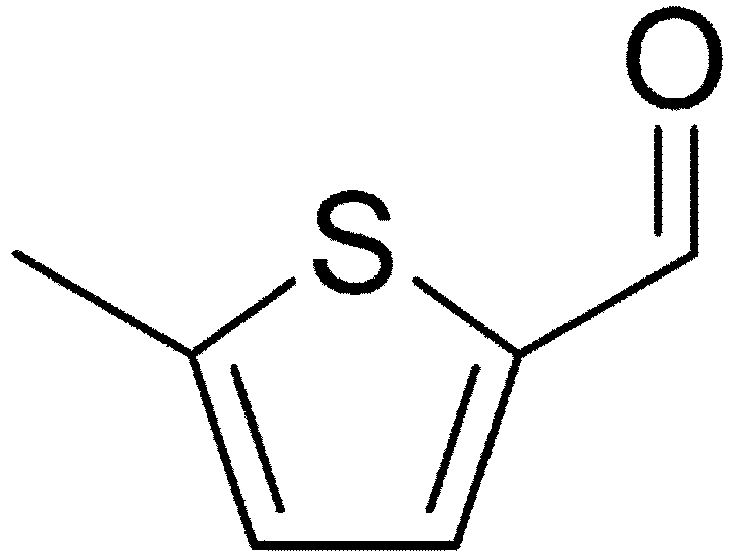
- Of these examples of the thiophene compound, in particular, in view of high compatibility with nonaqueous solvents, 5-methylthiophene-2-carbaldehyde can be preferably used. A structural formula of 5-methylthiophene-2-carbaldehyde is shown below.

- In the following, a nonaqueous electrolyte battery of the present disclosure is described in detail for each element. A nonaqueous electrolyte battery includes, for example, a positive electrode, a negative electrode, a nonaqueous electrolyte, and a separator such as below.
- The nonaqueous electrolyte includes a nonaqueous solvent, an electrolytic salt, and a thiophene compound. The thiophene compound has the above-described electron-withdrawing group R.
- With a content of the thiophene compound relative to the nonaqueous electrolyte as a whole of 0.01 mass% or more and 10 mass% or less, the effects of suppressing reduction and deposition of metal ions can be sufficiently achieved. In view of achieving effects of suppressing reduction and deposition of metal ions highly significantly, the content of the thiophene compound relative to the nonaqueous electrolyte as a whole preferably is 0.1 mass% or more and 5 mass% or less.
- The content of the thiophene compound in the nonaqueous electrolyte can be determined, for example, by using gas chromatography with the conditions below.
- Device used: GC-2010 Plus manufactured by SHIMADZU CORPORATION
- Column: HP-1 (film thickness 1 µm, internal diameter 0.32 mm, length 60 m) manufactured by J & W
- Column temperature: from 50 °C, increased to 90 °C with a temperature rising speed of 5 °C/min, kept at 90 °C for 15 minutes, then from 90 °C, increased to 250 °C with a temperature rising speed of 10 °C/min, and kept at 250 °C for 15 minutes
- Split ratio: 1/50
- Linear velocity: 30.0 cm/sec
- Injection port temperature: 270 °C
- Injection amount: 1 µL
- Detector: FID 290 °C (sens.101)
- Examples of the nonaqueous solvent include cyclic carbonate, chain carbonate, cyclic carboxylate, and chain carboxylate. Examples of the cyclic carbonate include propylene carbonate (PC) and ethylene carbonate (EC). Examples of the chain carbonate include diethyl carbonate (DEC), ethyl methyl carbonate (EMC), and dimethyl carbonate (DMC). Examples of the cyclic carboxylate include γ-butyrolactone (GBL) and γ-valerolactone (GVL). Examples of the chain carboxylate include methyl formate, ethyl formate, propyl formate, methyl acetate (MA), ethyl acetate, propyl acetate, methyl propionate, ethyl propionate, and propyl propionate. The nonaqueous electrolyte may include one kind of the nonaqueous solvent, or two or more kinds may be used in combination.
- For the electrolytic salt, lithium salts are suitable. Examples of the lithium salt include LiClO4, LiBF4, LiPF6, LiAlCl4, LiSbF6, LiSCN, LiCF3SO3, LiCF3CO2, LiAsF6, LiB10Cl10, lithium lower aliphatic carboxylate, LiCl, LiBr, LiI, borate, and imide salts. Examples of the borate include lithium difluoro oxalateborate and lithium bis oxalateborate. Examples of the imide salt include lithium bisfluorosulfonyl imide (LiN(FSO2)2), and lithium bis(trifluoromethanesulfonyl) imide(LiN(CF3SO2)2). The nonaqueous electrolyte may have an electrolytic salt singly, or two or more of them may be used in combination.
- The electrolytic salt concentration of the nonaqueous electrolyte is, for example, 0.5 mol/L or more and 2 mol/L or less.
- The nonaqueous electrolyte may include other additives. Examples of the other additive include at least one selected from the group consisting of vinylene carbonate, fluoroethylene carbonate, and vinyl ethylene carbonate.
- The nonaqueous electrolyte may include, as an additive for suppressing dissolution and deposition reactions of metal ions, an isocyanate compound having an isocyanate group and/or a nitrile compound having two or more nitrile groups. The isocyanate compound is reduced and decomposed at the negative electrode, and works to form a film on the surface of the negative electrode active material (e.g., carbon material such as graphite), suppressing reduction and decomposition of the nonaqueous electrolyte. In this manner, reduction and deposition reactions of metal ions can be suppressed. Meanwhile, the nitrile compound is oxidized at the positive electrode, and works to form a film on the positive electrode active material. In this manner, dissolving of metal ions composing the positive electrode active material into the nonaqueous electrolyte can be suppressed. However, in view of suppressing dissolution and deposition reactions of metal ions, the thiophene compound of the present disclosure is significantly excellent compared with the isocyanate compound and the nitrile compound.
- The positive electrode includes a positive electrode active material. The positive electrode generally includes a positive electrode current collector, a layered positive electrode mixture (hereinafter, referred to as "positive electrode mixture layer") supported on the positive electrode current collector. The positive electrode mixture layer can be formed by applying a positive electrode slurry in which the elements of the positive electrode mixture are dispersed in a dispersion medium on a surface of the positive electrode current collector, and drying the slurry. The dried film may be rolled, if necessary. The positive electrode mixture may include, as an essential component, a positive electrode active material, and as optional components, a binder, a thickener, and the like.
- The positive electrode active material may be a material that can be used as a positive electrode active material of nonaqueous electrolyte batteries (particularly lithium ion secondary batteries), but it is not limited thereto. A preferable positive electrode active material is, for example, a lithium transition metal composite oxide having a layered rock salt type structure, and including Ni and at least one selected from the group consisting of Co, Mn, and Al.
- In view of achieving a high capacity, the ratio of Ni in the metal elements other than Li included in the lithium transition metal composite oxide is preferably 80 atom % or more. The Ni ratio in the metal elements other than Li may be 85 atom % or more, or 90 atom % or more. The Ni ratio in the metal elements other than Li is, for example, preferably 95 atom % or less. When the range is to be limited, these upper and lower limits can be combined in any combinations.
- In the following, a lithium transition metal composite oxide having a layered rock salt type structure, including Ni and at least one selected from the group consisting of Co, Mn, and Al, and having a Ni ratio relative to metal elements other than Li of 80 atom% or more is also referred to as a "composite oxide HN". Li ions can be reversibly inserted to and desorbed from interlayers of the layered rock salt type structure of the composite oxide HN. With a higher Ni ratio, many lithium ions can be drawn from the composite oxide HN during charging, and the capacity can be increased.
- Co, Mn, and Al contribute to stabilization of the crystal structure of the composite oxide HN with a high Ni content. However, in view of reduction in production costs, the Co content is preferably low. The composite oxide HN with a low Co content or not containing Co may contain Mn and Al.
- The ratio of Co in the metal elements other than Li is preferably 10 atom% or less, more preferably 5 atom% or less, or Co does not have to be contained. In view of stabilization of the crystal structure of the composite oxide HN, 1 atom % or more, or 1.5 atom % or more of Co is preferably contained.
- The ratio of Mn in the metal elements other than Li may be 10 atom % or less, or 5 atom % or less. The ratio of Mn in the metal elements other than Li may be 1 atom % or more, 3 atom % or more, or 5 atom % or more. When the range is to be limited, these upper and lower limits can be combined in any combinations.
- The ratio of Al in the metal elements other than Li may be 10 atom % or less, or 5 atom % or less. The ratio of Al in the metal elements other than Li may be 1 atom % or more, 3 atom % or more, or 5 atom % or more. When the range is to be limited, these upper and lower limits can be combined in any combinations.
- The composite oxide HN is represented by, for example, a formula: LiαNi(1-x1-x2-y-z) Cox1Mnx2AlyMzO2+β. The element M is an element other than Li, Ni, Co, Mn, Al, and oxygen.
- In the above-described formula, α representing the atomic ratio of lithium is, for example, 0.95 ≤ α ≤ 1.05. However, αincreases or decreases by charging and discharging. In (2+β) representing the atomic ratio of oxygen, β satisfies -0.05 ≤ β ≤ 0.05.
- The coefficient 1-x1-x2-y-z (= v) representing the atomic ratio of Ni is 0.8 or more, or may be 0.85 or more, 0.90 or more, or 0.95 or more. The coefficient v representing the atomic ratio of Ni may be 0.98 or less, or 0.95 or less. When the range is to be limited, these upper and lower limits can be combined arbitrarily.
- The coefficient x1 representing the atomic ratio of Co is, for example, 0.1 or less (0 ≤ x1 ≤ 0.1), may be 0.08 or less, 0.05 or less, or 0.01 or less. A case where x1 is 0 includes a case where a ratio of Co is under a detection limit.
- The coefficient x2 representing the atomic ratio of Mn is, for example, 0.1 or less (0 ≤ x2 ≤ 0.1), may be 0.08 or less, 0.05 or less, or 0.03 or less. The coefficient x2 may be 0.01 or more, or 0.03 or more. Mn contributes to stabilization of the crystal structure of the composite oxide HN, and by including low cost Mn in the composite oxide HN, it is advantageous in reduction of costs. When the range is to be limited, these upper and lower limits can be combined in any combinations.
- The coefficient y representing the atomic ratio of Al is, for example, 0.1 or less (0 ≤ y ≤ 0.1), may be 0.08 or less, 0.05 or less, or 0.03 or less. The coefficient y may be 0.01 or more, or 0.03 or more. Al contributes to stabilization of the crystal structure of the composite oxide HN. When the range is to be limited, these upper and lower limits can be combined in any combinations.
- The coefficient z representing the atomic ratio of the element M is, for example, 0 ≤ z ≤ 0.10, may be 0 < z ≤ 0.05, or 0.001 ≤ z ≤ 0.01. When the range is to be limited, these upper and lower limits can be combined in any combinations.
- The element M may be at least one selected from the group consisting of Ti, Zr, Nb, Mo, W, Fe, Zn, B, Si, Mg, Ca, Sr, Sc, and Y. In particular, when at least one selected from the group consisting of Nb, Sr, and Ca is contained in the composite oxide HN, it is assumed that the surface structure of the composite oxide HN stabilizes and the resistance decreases, and elution of metal is further suppressed. The element M present locally near the surface of the composite oxide HN particles is more effective.
- The amount of elements contained in the composite oxide HN can be measured by, for example, an inductively coupled plasma atomic emission spectroscopy (ICP-AES), an electron probe micro analyzer (EPMA), or energy-dispersive X-ray spectroscopy (EDX).
- The composite oxide HN is, for example, secondary particles of coagulated plurality of primary particles. The primary particles have a particle size of, for example, 0.05 µm or more and 1 µm or less. The secondary particles of the composite oxide HN have an average particle size of, for example, 3 µm or more and 30 µm or less, or may be 5 µm or more and 25 µm or less.
- In this specification, the average particle size of the secondary particles means a particle size (volume average particle size) at which cumulative volume is 50% in the particle size distribution measured by the laser diffraction scattering method. Such a particle size may be referred to as D50. For example, "LA-750" manufactured by Horiba Corporation can be used as the measuring device.
- The positive electrode active material may contain a lithium transition metal composite oxide other than the composite oxide HN, but preferably, the ratio of the composite oxide HN is high. The ratio of the composite oxide HN in the positive electrode active material is, for example, 90 mass% or more, may be 95 mass% or more, or 100%.
- For the binder, for example, a resin material is used. Examples of the binder include fluorine resin, polyolefin resin, polyamide resin, polyimide resin, acrylic resin, vinyl resin, and rubber materials (e.g., styrene-butadiene copolymer (SBR)). The binder may be used singly, or two or more kinds thereof may be used in combination.
- Examples of the thickener include cellulose derivatives such as cellulose ether. Examples of the cellulose derivative include carboxymethyl cellulose (CMC) and a modified product thereof, and methylcellulose. The thickener may be used singly, or two or more kinds thereof may be used in combination.
- Examples of the conductive agent include carbon nanotube (CNT), carbon fiber other than CNT, and conductive particles (e.g., carbon black, graphite).
- The dispersion medium used for the positive electrode slurry is not particularly limited, and examples thereof include water, alcohol, N-methyl-2-pyrrolidone (NMP), and a solvent mixture thereof.
- For the positive electrode current collector, for example, metal foil may be used. The positive electrode current collector may be porous. Examples of the porous current collector include a net, a punched sheet, and expanded metal. Examples of the material of the positive electrode current collector may be stainless steel, aluminum, an aluminum alloy, and titanium. The positive electrode current collector has a thickness of, for example, 1 to 50 µm, or the thickness may be 5 to 30 µm, although not limited thereto.
- The negative electrode includes a negative electrode active material. The negative electrode generally includes a negative electrode current collector, a layered negative electrode mixture (hereinafter, referred to as negative electrode mixture layer) supported on the negative electrode current collector. The negative electrode mixture layer can be formed by applying a negative electrode slurry in which the elements of the negative electrode mixture are dispersed in a dispersion medium on a surface of the negative electrode current collector, and drying the slurry. The dried film may be rolled, if necessary.
- The negative electrode mixture may include, as an essential component, a negative electrode active material, and as optional components, a binder, a thickener, a conductive agent, and the like.
- For the negative electrode active material, a metal lithium, or a lithium alloy may be used, but a material that is capable of electrochemically absorbing and releasing lithium ions is suitably used. Examples of such a material include a carbon material and a Si-containing material. The negative electrode may include one kind of negative electrode active material, or two or more kinds can be used in combination.
- Examples of the carbon material include graphite, graphitizable carbon (soft carbon), and non-graphitizable carbon (hard carbon). The carbon material may be used singly, or two or more kinds thereof may be used in combination. The carbon material is preferably graphite, because it has excellent charge and discharge stability, and has a small irreversible capacity. Graphite includes, for example, natural graphite, artificial graphite, graphitized mesophase carbon particles, and the like.
- Examples of the Si-containing material include Si simple substance, a silicon alloy, a silicon compound (silicon oxide, etc.), and a composite material in which a silicon phase is dispersed in a lithium ion conductive phase (matrix). Examples of the silicon oxide include SiOx particles. The coefficient x is, for example, 0.5 ≤ x < 2, or may be 0.8 ≤ x ≤ 1.6. Examples of the lithium ion conductive phase include at least one selected from the group consisting of a SiO2 phase, a silicate phase, and a carbon phase.
- For the binder, the thickener, and the conductive agent, and the dispersion medium used for the negative electrode slurry, for example, those materials exemplified for the positive electrode can be used.
- For the negative electrode current collector, for example, metal foil may be used. The negative electrode current collector may be porous. As the material of the negative electrode current collector, stainless steel, nickel, a nickel alloy, copper, a copper alloy, and the like can be exemplified. The negative electrode current collector has a thickness of, for example, 1 to 50 µm, or the thickness may be 5 to 30 µm, although not limited thereto.
- It is desirable to interpose a separator between the positive electrode and the negative electrode. The separator is excellent in ion permeability and has suitable mechanical strength and electrically insulating properties. For the separator, a microporous thin film, a woven fabric, and a nonwoven fabric can be used. For the material of the separator, a polyolefin such as polypropylene or polyethylene is preferred.
- In an example structure of the nonaqueous electrolyte battery, a positive electrode and a negative electrode are wound with a separator interposed therebetween to form an electrode group, and the electrode group is accommodated in an outer case along with a nonaqueous electrolyte. However, the structure is not limited thereto, and other forms of electrode groups may be used. For example, it can be a layered electrode group, in which a positive electrode and a negative electrode are layered with a separator interposed therebetween. The nonaqueous electrolyte secondary batteries may be of any form, for example, a cylindrical type, a prismatic type, a coin type, a button type, a laminated type, etc.
- The nonaqueous electrolyte battery may be primary batteries, or secondary batteries.
- In the following, a structure of a prismatic nonaqueous electrolyte secondary battery as an example of the nonaqueous electrolyte battery of the present disclosure is described with reference to
FIG. 1 . - The battery includes a bottomed prismatic battery case 4, and an electrode group 1 and a nonaqueous electrolytic solution (not shown) housed within the battery case 4. The electrode group 1 has a negative electrode in the form of a long strip, a positive electrode in the form of a long strip, and a separator interposed therebetween. The negative electrode current collector of the negative electrode is electrically connected to a negative electrode terminal 6 provided in a
sealing plate 5 through a negative electrode lead 3. A negative electrode terminal 6 is insulated from the sealingplate 5 with a resin-made gasket 7. A positive electrode current collector of the positive electrode is electrically connected to a rear face of the sealingplate 5 through a positive electrode lead 2. That is, the positive electrode is electrically connected to the battery case 4 also serving as a positive electrode terminal. The periphery of the sealingplate 5 is fitted to the open end of the battery case 4, and the fitting portion is laser welded. The sealingplate 5 has an injection port for a nonaqueous electrolyte, and is sealed with a sealingplug 8 after injection. - The present disclosure will be described in detail below with reference to Examples and Comparative Examples. The present disclosure, however, is not limited to the following Examples.
- A nonaqueous electrolyte secondary battery was made and evaluated in accordance with the following procedures.
- By mixing 100 parts by mass of positive electrode active material particles (LiNi0.88Co0.09Al0.03O2), 1 part by mass of carbon nanotube, 1 part by mass of polyvinylidene fluoride, and a suitable amount of NMP, a positive electrode slurry was produced. Then, the positive electrode slurry was applied on one surface of an aluminum foil, the film was dried, and then rolled to form a positive electrode mixture layer (thickness 95 µm, density 3.6 g/cm3) on both surfaces of the aluminum foil, thereby producing a positive electrode.
- By mixing 98 parts by mass of the negative electrode active material (graphite), 1 part by mass of sodium salt (CMC-Na) of carboxymethyl cellulose, 1 part by mass of SBR, and a suitable amount of water, a negative electrode slurry was produced. Then, the negative electrode slurry was applied on one surface a copper foil as a negative electrode current collector, the film was dried, and rolled to form a negative electrode mixture layer on both surfaces of the copper foil.
- To a solvent mixture of EC and EMC (EC: EMC = 3: 7(volume ratio)), LiPF6, and 5-methylthiophene-2-carbaldehyde as the thiophene compound were dissolved, thereby producing a liquid electrolyte. The liquid electrolyte had a LiPF6 concentration of 1.0 mol/L. The content of the thiophene compound was set to the mass% as shown in Table 1 relative to the total amount of the liquid electrolyte.
- The positive electrode was cut into a predetermined shape to obtain a positive electrode for evaluation. The positive electrode had a region of 20 mm × 20 mm that works as the positive electrode, and a connection region of 5 mm × 5 mm for connection with a tab lead. Thereafter, the positive electrode mixture layer formed on the above-described connection region was scraped to expose the positive electrode current collector. Near the center of the positive electrode mixture layer, metal copper balls with a diameter of about 100 µm were embedded intentionally. Afterwards, the exposed portion of the positive electrode current collector was connected to the positive electrode tab lead and a predetermined region of the outer periphery of the positive electrode tab lead was covered with an insulating tab film.
- The negative electrode was cut into the same form as the positive electrode, to obtain a negative electrode for evaluation. The negative electrode mixture layer formed on the connection region similarly to the positive electrode was peeled off to expose the negative electrode current collector. Afterwards, the exposed portion of the negative electrode current collector was connected to the negative electrode tab lead in the same manner as the positive electrode, and a predetermined region of the outer periphery of the negative electrode tab lead was covered with an insulating tab film.
- A cell was produced using the positive electrode and negative electrode for evaluation. First, the positive electrode and the negative electrode were allowed to oppose each other with a polyethylene-made separator (thickness 12 µm) interposed therebetween so that the positive electrode mixture layer and the negative electrode mixture layer overlapped with each other, thereby producing an electrode plate group. Next, an Al laminate film (thickness 100 µm) cut into a 60 × 90 mm rectangle was folded to half, and the 60 mm long side end portion was heat-sealed to make an envelope of 60 × 45 mm. Afterwards, the produced electrode plate group was put into the envelope, and the end face of the Al laminate film was aligned with the position of the thermal welding resin of respective tab leads and sealed. Next, the nonaqueous electrolyte was injected from the non-heat healed short side of the Al laminate film, to impregnate each of the mixture layers with the nonaqueous electrolyte. Lastly, the end face of the injected side of the Al laminate film was sealed, thereby producing evaluation cells A1 to A5 of Examples 1 to 5.
- The evaluation cell was sandwiched by a clamp with a pair of 80 × 80 cm stainless steel (thickness 2 mm) plates and fixed under a pressure of 0.2 MPa.
- Also, a reference cell was produced. The reference cell had the same configuration with the evaluation cells A1 to A5: in the positive electrode, metal copper balls were not embedded, and the thiophene compound was not added to the nonaqueous electrolyte. The reference cell was charged under an environment of a temperature of 25 °C at a constant current of 0.05 C until the battery voltage reached 4.2 V. Afterwards, the reference cell was discharged at a constant current of 0.05 C until the battery voltage reached 2.5 V, and a charge and discharge curve was obtained. The batteries were allowed to stand with an open circuit for 20 minutes between the charging and discharging.
- The each of the evaluation cell was subjected to constant current charging under an environment of a temperature of 25 °C at a current of 0.3 C until the voltage reached 3.58 V, and thereafter, subjected to constant voltage charging at a constant voltage of 3.58 V until the electric current reached 0.02 C. Then, the evaluation cell was stored under an environment of a temperature of 25 °C, and the battery voltage V1 after 48 hours passed, and the battery voltage V2 after 72 hours passed were measured.
- From the battery voltages V1 and V2, the state of charge SOC1 after 48 hours passed and the state of charge SOC2 after 72 hours passed were determined based on the charge and discharge curve. Based on the formula below, self-discharge rate sd per day was determined and evaluated.

- In the preparation of the nonaqueous electrolyte, 5-methylthiophene-2-carbaldehyde was not added.
- Except for the above, a nonaqueous electrolyte secondary battery was produced in the same manner as in Examples 1 to 5, thereby producing an evaluation cell B1 of Comparative Example 1. The self-discharge rate sd was determined in the same manner as in Examples 1 to 5, and evaluation was performed.
- In the preparation of the nonaqueous electrolyte, 2,4-difluoro-1-isocyanato benzene was added as the isocyanate compound instead of 5-methylthiophene-2-carbaldehyde, thereby preparing a liquid electrolyte. The content of 2,4-difluoro-1-isocyanato benzene relative to the total amount of the liquid electrolyte was set to 1 mass%. The structural formula of 2,4-difluoro-1-isocyanato benzene is shown below.

- Except for the above, a nonaqueous electrolyte secondary battery was produced in the same manner as in Examples 1 to 5, thereby producing an evaluation cell B2 of Comparative Example 2. The self-discharge rate sd was determined in the same manner as in Examples 1 to 5, and evaluation was performed.
- Table 1 shows evaluation results for the self-discharge rate sd of the evaluation cells A1 to A5, B 1, and B2. Table 1 also shows the kinds of additives having effects of suppressing dissolution and deposition of metal ions in each of the cells, and the contents thereof.
Table 1] Cell Additive Self-discharge rate sd (%) Kind Content (mass%) A1 5-methylthiophene-2-carbaldehyde 0.01 3.7 A2 5-methylthiophene-2-carbaldehyde 0.1 2.4 A3 5-methylthiophene-2-carbaldehyde 1 2.0 A4 5-methylthiophene-2- carbaldehyde 5 2.1 A5 5-methylthiophene-2-carbaldehyde 10 3.5 B1 Not used - 6.9 B2 2,4-difluoro-1-isocyanato benzene 1 5.8 - Based on Table 1, comparison of the cell B1 with the cell B2 shows that in the cell B2, by adding the isocyanate compound, the self-discharge rate sd decreased compared with the cell B1, showing some effects of suppressing deposition of metal ions. However, the amount of the decreased self-discharge rate sd is small.
- In contrast, in the cells A1 to A5, in which the thiophene compound was added in a range of 0.01 mass% to 10 mass%, compared with the cell B2, the self-discharge rate sd decreased, and deposition of metal ions was suppressed. In particular, in the cells A2 to A4, in which the thiophene compound was added in a range of 0.1 mass% to 5 mass%, the self-discharge rate sd significantly decreased.
- The nonaqueous electrolyte battery of the present disclosure is suitable for a main power source of mobile communication devices and mobile electronic devices, and for an on-vehicle power source, but applications are not limited thereto.
- Although the present invention has been described in terms of the presently preferred embodiments, it is to be understood that such disclosure is not to be interpreted as limiting. Various alterations and modifications will no doubt become apparent to those skilled in the art to which the present invention pertains, after having read the above disclosure. Accordingly, it is intended that the appended claims be interpreted as covering all alterations and modifications as fall within the true spirit and scope of the invention.
- 1: electrode group, 2: positive electrode lead, 3: negative electrode lead, 4: battery case, 5: sealing plate, 6: negative electrode terminal, 7: gasket, 8: sealing plug
Claims (7)
- A nonaqueous electrolyte for a nonaqueous electrolyte battery comprising:a nonaqueous solvent,an electrolytic salt, anda thiophene compound having at least one electron-withdrawing group R including oxygen or nitrogen, whereina content of the thiophene compound is 0.01 mass% or more and 10 mass% or less.
- The nonaqueous electrolyte of claim 1, wherein the content of the thiophene compound is 0.1 mass% or more and 5 mass% or less.
- The nonaqueous electrolyte of claim 1 or 2, wherein the electron-withdrawing group R is at least one selected from the group consisting of a carbonyl group, a nitrile group, and an isocyanate group.
- The nonaqueous electrolyte of claim 3, wherein the thiophene compound includes at least one selected from the group consisting of 5-methylthiophene-2-carbaldehyde, 3,5-dimethylthiophene-2-carbaldehyde, 5-cyclopropyl thiophene-2-carbaldehyde, 2-((trimethylsilyl) methyl) tetrahydrothiophene-2-carbaldehyde, 5-ethinylthiophene-2-carbonitrile, 2-(5-methylthiophene-2-yl) propane nitrile, 4-(2-(5-hexylthiophene-2-yl) vinyl)-1,3,5-triazine-2-carbonitrile, 2-isocyanato-5-methylthiophene, and 2-isocyanato-5-(trifluoromethyl) thiophene.
- The nonaqueous electrolyte of claim 4, wherein the thiophene compound includes at least 5-methylthiophene-2-carbaldehyde.
- A nonaqueous electrolyte battery comprising:a positive electrode including a positive electrode active material,a separator,a negative electrode opposing the positive electrode with the separator interposed therebetween, andthe nonaqueous electrolyte of any one of claims 1 to 5.
- The nonaqueous electrolyte battery of claim 6, wherein the positive electrode active material includes a lithium transition metal composite oxide having a layered rock salt type structure and including Ni and at least one selected from the group consisting of Co, Mn, and Al, and
a Ni ratio in metal elements other than Li included in the lithium transition metal composite oxide is 80 atom% or more.
Applications Claiming Priority (2)
| Application Number | Priority Date | Filing Date | Title |
|---|---|---|---|
| JP2021140433 | 2021-08-30 | ||
| PCT/JP2022/031988 WO2023032799A1 (en) | 2021-08-30 | 2022-08-25 | Nonaqueous electrolyte battery and nonaqueous electrolyte used in same |
Publications (2)
| Publication Number | Publication Date |
|---|---|
| EP4398364A1 true EP4398364A1 (en) | 2024-07-10 |
| EP4398364A4 EP4398364A4 (en) | 2025-05-07 |
Family
ID=85412640
Family Applications (1)
| Application Number | Title | Priority Date | Filing Date |
|---|---|---|---|
| EP22864383.9A Pending EP4398364A4 (en) | 2021-08-30 | 2022-08-25 | NONAQUEOUS ELECTROLYTE BATTERY AND NONAQUEOUS ELECTROLYTE USED THEREIN |
Country Status (5)
| Country | Link |
|---|---|
| US (1) | US20240356074A1 (en) |
| EP (1) | EP4398364A4 (en) |
| JP (1) | JPWO2023032799A1 (en) |
| CN (1) | CN117859228A (en) |
| WO (1) | WO2023032799A1 (en) |
Families Citing this family (3)
| Publication number | Priority date | Publication date | Assignee | Title |
|---|---|---|---|---|
| CN120981955A (en) * | 2023-04-20 | 2025-11-18 | 松下知识产权经营株式会社 | Non-aqueous electrolyte batteries and non-aqueous electrolyte batteries |
| JPWO2024219362A1 (en) * | 2023-04-20 | 2024-10-24 | ||
| JP2025040095A (en) * | 2023-09-11 | 2025-03-24 | トヨタ自動車株式会社 | Positive electrode mixture and lithium secondary battery |
Family Cites Families (22)
| Publication number | Priority date | Publication date | Assignee | Title |
|---|---|---|---|---|
| CA2216898C (en) * | 1997-09-26 | 2005-03-22 | Moli Energy (1990) Limited | Improved additives for overcharge protection in non-aqueous rechargeable lithium batteries |
| JP2001266939A (en) * | 2000-03-16 | 2001-09-28 | Mitsubishi Gas Chem Co Inc | Non-aqueous electrolytic solution for lithium ion secondary battery |
| DE10340500A1 (en) * | 2002-09-16 | 2004-03-25 | H.C. Starck Gmbh | Rechargeable lithium battery for electronic applications, includes non-aqueous electrolyte containing thiophene |
| JP2008016252A (en) * | 2006-07-04 | 2008-01-24 | Sony Corp | Non-aqueous electrolyte composition and non-aqueous electrolyte battery |
| JP5446183B2 (en) | 2007-09-12 | 2014-03-19 | 三菱化学株式会社 | Non-aqueous electrolyte for secondary battery and non-aqueous electrolyte secondary battery using the same |
| KR101579648B1 (en) | 2012-08-28 | 2015-12-22 | 주식회사 엘지화학 | Lithium-ion secondary battery without internal short |
| KR101718061B1 (en) * | 2013-05-15 | 2017-03-20 | 삼성에스디아이 주식회사 | Organic electrolytic solution and and Lithium battery comprising the solution |
| JP2015072769A (en) * | 2013-10-02 | 2015-04-16 | Tdk株式会社 | Nonaqueous electrolytic solution and lithium ion secondary battery |
| KR20150075495A (en) * | 2013-12-26 | 2015-07-06 | 동우 화인켐 주식회사 | Electrolyte solution for lithium secondary battery and lithium secondary battery comprising the same |
| JP6424436B2 (en) * | 2014-02-07 | 2018-11-21 | 日本電気株式会社 | Electrolyte and secondary battery using the same |
| CN104009255B (en) * | 2014-06-24 | 2017-06-23 | 东莞市凯欣电池材料有限公司 | A kind of nonaqueous electrolytic solution and preparation method thereof and a kind of lithium ion battery |
| WO2017167638A1 (en) * | 2016-03-31 | 2017-10-05 | Sony Corporation | Non-aqueous electrolytes and uses thereof |
| CN105845971A (en) * | 2016-05-17 | 2016-08-10 | 山东海容电源材料有限公司 | Non-aqueous electrolyte containing high-voltage protective agent |
| JP7003394B2 (en) * | 2016-09-06 | 2022-01-20 | 株式会社村田製作所 | Batteries for secondary batteries, secondary batteries, battery packs, electric vehicles, power storage systems, power tools and electronic devices |
| JP2019091792A (en) * | 2017-11-14 | 2019-06-13 | 旭化成株式会社 | Nonaqueous lithium-type power storage element |
| KR102613190B1 (en) * | 2018-05-29 | 2023-12-14 | 현대자동차주식회사 | Electrolyte for lithium secondary battery and lithium secondary battery containing same |
| US11569530B2 (en) * | 2019-06-05 | 2023-01-31 | Enevate Corporation | Silicon-based energy storage devices with functional thiophene compounds or derivatives of thiophene containing electrolyte additives |
| CN109473721A (en) * | 2018-11-15 | 2019-03-15 | 合肥国轩高科动力能源有限公司 | A high-voltage electrolyte additive, high-voltage electrolyte and lithium-ion battery |
| JP2020129440A (en) * | 2019-02-07 | 2020-08-27 | 三洋化成工業株式会社 | Nonaqueous electrolyte for lithium ion secondary battery and lithium ion secondary battery |
| CN110931872B (en) * | 2019-12-11 | 2022-07-08 | 多氟多新能源科技有限公司 | Lithium ion battery electrolyte additive and lithium ion battery electrolyte |
| US11949072B2 (en) * | 2020-02-03 | 2024-04-02 | Enevate Corporation | Silicon-based energy storage devices with electrolyte containing cyanate based compounds |
| CN112939984B (en) * | 2021-02-02 | 2022-05-13 | 浙江工业大学 | Maleimidocarbazole compounds and preparation method and application thereof |
-
2022
- 2022-08-25 US US18/686,329 patent/US20240356074A1/en active Pending
- 2022-08-25 JP JP2023545504A patent/JPWO2023032799A1/ja active Pending
- 2022-08-25 WO PCT/JP2022/031988 patent/WO2023032799A1/en not_active Ceased
- 2022-08-25 EP EP22864383.9A patent/EP4398364A4/en active Pending
- 2022-08-25 CN CN202280057089.8A patent/CN117859228A/en active Pending
Also Published As
| Publication number | Publication date |
|---|---|
| EP4398364A4 (en) | 2025-05-07 |
| WO2023032799A1 (en) | 2023-03-09 |
| CN117859228A (en) | 2024-04-09 |
| US20240356074A1 (en) | 2024-10-24 |
| JPWO2023032799A1 (en) | 2023-03-09 |
Similar Documents
| Publication | Publication Date | Title |
|---|---|---|
| EP3930043B1 (en) | Nonaqueous electrolyte, nonaqueous secondary battery, cell pack, and hybrid system | |
| EP3279996B1 (en) | Nonaqueous electrolyte and nonaqueous secondary battery | |
| EP3598558A1 (en) | Nonaqueous electrolyte, nonaqueous secondary battery, cell pack, and hybrid system | |
| JP5783425B2 (en) | Method for producing non-aqueous electrolyte secondary battery | |
| JP4976715B2 (en) | Non-aqueous electrolyte and lithium secondary battery using the same | |
| DE102019109226A1 (en) | Separator for lithium metal-based batteries | |
| EP3836276A1 (en) | Nonaqueous electrolytic solution and nonaqueous secondary battery | |
| EP4398364A1 (en) | Nonaqueous electrolyte battery and nonaqueous electrolyte used in same | |
| EP2840639B1 (en) | Electrolyte solution for lithium secondary battery and lithium secondary battery using the same | |
| CN103904368A (en) | Lithium secondary battery | |
| CN105990576A (en) | Electrode, nonaqueous electrolyte battery, and battery pack | |
| EP4475256A1 (en) | Nonaqueous electrolyte for nonaqueous-electrolyte cell, and nonaqueous-electrolyte cell | |
| EP4145567A1 (en) | Non-aqueous electrolyte secondary battery | |
| JP2007335143A (en) | Lithium ion secondary battery | |
| JP6796445B2 (en) | Non-aqueous secondary battery | |
| EP4398331A1 (en) | Positive electrode for secondary batteries, and secondary battery | |
| EP4270521A1 (en) | Positive electrode for secondary battery, and secondary battery | |
| JP2020077576A (en) | Lithium ion secondary battery | |
| EP4700893A1 (en) | Nonaqueous electrolyte for nonaqueous-electrolyte cell, and nonaqueous-electrolyte cell | |
| EP4379846A1 (en) | Positive electrode for secondary batteries, and secondary battery | |
| EP4239724A1 (en) | Nonaqueous electrolyte secondary battery | |
| US20230187649A1 (en) | Lithium Ion Battery and Method for Manufacturing Such a Lithium Ion Battery | |
| EP4040528A1 (en) | Nonaqueous electrolyte secondary battery | |
| JP2007103198A (en) | Negative electrode and battery | |
| EP4475255A1 (en) | Nonaqueous electrolyte for nonaqueous-electrolyte cell, and nonaqueous-electrolyte cell |
Legal Events
| Date | Code | Title | Description |
|---|---|---|---|
| STAA | Information on the status of an ep patent application or granted ep patent |
Free format text: STATUS: THE INTERNATIONAL PUBLICATION HAS BEEN MADE |
|
| PUAI | Public reference made under article 153(3) epc to a published international application that has entered the european phase |
Free format text: ORIGINAL CODE: 0009012 |
|
| STAA | Information on the status of an ep patent application or granted ep patent |
Free format text: STATUS: REQUEST FOR EXAMINATION WAS MADE |
|
| 17P | Request for examination filed |
Effective date: 20240307 |
|
| AK | Designated contracting states |
Kind code of ref document: A1 Designated state(s): AL AT BE BG CH CY CZ DE DK EE ES FI FR GB GR HR HU IE IS IT LI LT LU LV MC MK MT NL NO PL PT RO RS SE SI SK SM TR |
|
| DAV | Request for validation of the european patent (deleted) | ||
| DAX | Request for extension of the european patent (deleted) | ||
| RIC1 | Information provided on ipc code assigned before grant |
Ipc: H01M 10/0525 20100101ALI20250110BHEP Ipc: H01M 10/0569 20100101ALI20250110BHEP Ipc: H01M 10/052 20100101ALI20250110BHEP Ipc: H01M 4/525 20100101ALI20250110BHEP Ipc: H01M 4/505 20100101ALI20250110BHEP Ipc: H01M 10/0567 20100101AFI20250110BHEP |
|
| A4 | Supplementary search report drawn up and despatched |
Effective date: 20250403 |
|
| RIC1 | Information provided on ipc code assigned before grant |
Ipc: H01M 10/0525 20100101ALI20250331BHEP Ipc: H01M 10/0569 20100101ALI20250331BHEP Ipc: H01M 10/052 20100101ALI20250331BHEP Ipc: H01M 4/525 20100101ALI20250331BHEP Ipc: H01M 4/505 20100101ALI20250331BHEP Ipc: H01M 10/0567 20100101AFI20250331BHEP |