EP4398281A1 - Breaker, safety circuit, and secondary battery pack - Google Patents
Breaker, safety circuit, and secondary battery pack Download PDFInfo
- Publication number
- EP4398281A1 EP4398281A1 EP22892444.5A EP22892444A EP4398281A1 EP 4398281 A1 EP4398281 A1 EP 4398281A1 EP 22892444 A EP22892444 A EP 22892444A EP 4398281 A1 EP4398281 A1 EP 4398281A1
- Authority
- EP
- European Patent Office
- Prior art keywords
- movable piece
- breaker
- contact
- resin case
- recess
- Prior art date
- Legal status (The legal status is an assumption and is not a legal conclusion. Google has not performed a legal analysis and makes no representation as to the accuracy of the status listed.)
- Pending
Links
Images


Classifications
-
- H—ELECTRICITY
- H01—ELECTRIC ELEMENTS
- H01H—ELECTRIC SWITCHES; RELAYS; SELECTORS; EMERGENCY PROTECTIVE DEVICES
- H01H37/00—Thermally-actuated switches
- H01H37/02—Details
- H01H37/04—Bases; Housings; Mountings
-
- H—ELECTRICITY
- H01—ELECTRIC ELEMENTS
- H01H—ELECTRIC SWITCHES; RELAYS; SELECTORS; EMERGENCY PROTECTIVE DEVICES
- H01H1/00—Contacts
- H01H1/50—Means for increasing contact pressure, preventing vibration of contacts, holding contacts together after engagement, or biasing contacts to the open position
- H01H1/504—Means for increasing contact pressure, preventing vibration of contacts, holding contacts together after engagement, or biasing contacts to the open position by thermal means
-
- H—ELECTRICITY
- H01—ELECTRIC ELEMENTS
- H01H—ELECTRIC SWITCHES; RELAYS; SELECTORS; EMERGENCY PROTECTIVE DEVICES
- H01H37/00—Thermally-actuated switches
- H01H37/02—Details
- H01H37/32—Thermally-sensitive members
- H01H37/46—Thermally-sensitive members actuated due to expansion or contraction of a solid
-
- H—ELECTRICITY
- H01—ELECTRIC ELEMENTS
- H01H—ELECTRIC SWITCHES; RELAYS; SELECTORS; EMERGENCY PROTECTIVE DEVICES
- H01H37/00—Thermally-actuated switches
- H01H37/02—Details
- H01H37/32—Thermally-sensitive members
- H01H37/52—Thermally-sensitive members actuated due to deflection of bimetallic element
- H01H37/54—Thermally-sensitive members actuated due to deflection of bimetallic element wherein the bimetallic element is inherently snap acting
-
- H—ELECTRICITY
- H01—ELECTRIC ELEMENTS
- H01M—PROCESSES OR MEANS, e.g. BATTERIES, FOR THE DIRECT CONVERSION OF CHEMICAL ENERGY INTO ELECTRICAL ENERGY
- H01M50/00—Constructional details or processes of manufacture of the non-active parts of electrochemical cells other than fuel cells, e.g. hybrid cells
- H01M50/50—Current conducting connections for cells or batteries
- H01M50/572—Means for preventing undesired use or discharge
- H01M50/574—Devices or arrangements for the interruption of current
- H01M50/581—Devices or arrangements for the interruption of current in response to temperature
-
- H—ELECTRICITY
- H01—ELECTRIC ELEMENTS
- H01H—ELECTRIC SWITCHES; RELAYS; SELECTORS; EMERGENCY PROTECTIVE DEVICES
- H01H37/00—Thermally-actuated switches
- H01H37/02—Details
- H01H37/32—Thermally-sensitive members
- H01H37/52—Thermally-sensitive members actuated due to deflection of bimetallic element
- H01H37/54—Thermally-sensitive members actuated due to deflection of bimetallic element wherein the bimetallic element is inherently snap acting
- H01H37/5427—Thermally-sensitive members actuated due to deflection of bimetallic element wherein the bimetallic element is inherently snap acting encapsulated in sealed miniaturised housing
-
- H—ELECTRICITY
- H01—ELECTRIC ELEMENTS
- H01M—PROCESSES OR MEANS, e.g. BATTERIES, FOR THE DIRECT CONVERSION OF CHEMICAL ENERGY INTO ELECTRICAL ENERGY
- H01M2200/00—Safety devices for primary or secondary batteries
- H01M2200/10—Temperature sensitive devices
-
- H—ELECTRICITY
- H01—ELECTRIC ELEMENTS
- H01M—PROCESSES OR MEANS, e.g. BATTERIES, FOR THE DIRECT CONVERSION OF CHEMICAL ENERGY INTO ELECTRICAL ENERGY
- H01M2200/00—Safety devices for primary or secondary batteries
- H01M2200/10—Temperature sensitive devices
- H01M2200/106—PTC
-
- Y—GENERAL TAGGING OF NEW TECHNOLOGICAL DEVELOPMENTS; GENERAL TAGGING OF CROSS-SECTIONAL TECHNOLOGIES SPANNING OVER SEVERAL SECTIONS OF THE IPC; TECHNICAL SUBJECTS COVERED BY FORMER USPC CROSS-REFERENCE ART COLLECTIONS [XRACs] AND DIGESTS
- Y02—TECHNOLOGIES OR APPLICATIONS FOR MITIGATION OR ADAPTATION AGAINST CLIMATE CHANGE
- Y02E—REDUCTION OF GREENHOUSE GAS [GHG] EMISSIONS, RELATED TO ENERGY GENERATION, TRANSMISSION OR DISTRIBUTION
- Y02E60/00—Enabling technologies; Technologies with a potential or indirect contribution to GHG emissions mitigation
- Y02E60/10—Energy storage using batteries
Definitions
- the present invention relates to a minisize breaker to be built into an electrical device, and the like.
- breakers have been used as protective devices (safety circuits) for secondary batteries, motors, heaters, etc. of various electrical devices (see, for example, Patent Document 1).
- Patent document 1 WO2011/105175
- Patent Document 1 discloses a breaker in which a case main body and a lid member are ultrasonically welded to form a case.
- the present invention was made in view of the above-mentioned circumstances, and its primary objective is to provide a breaker in which it is possible to suppress the generation of cutting scrap when welding a case.
- the present invention is a breaker comprising:
- the first resin case has a first slope formed on an outside in the short direction of the movable piece, of the first protruding portion, and the second resin case has a second slope corresponding to the first slope.
- the second slope is provided, along an outer edge of the second resin case, with a rib protruding toward the first resin case.
- the rib is formed continuously from the second slope to the embedding portion.
- the first resin case has a second recess on the fixed contact side
- the second resin case has a second protruding portion which is fitted into the second recess.
- the present invention is a safety circuit for an electrical device, comprising the breaker.
- the present invention is a secondary battery pack comprising the breaker.
- a part of the movable piece is embedded in the second resin case.
- the movable piece is fixed at an accurate position with respect to the second resin case.
- the first resin case has the first protruding portion which fits into the first recess of the second resin case.
- the fitting between the first recess and the first protruding portion suppresses the displacement of the second resin case with respect to the first resin case during welding.
- the movable piece is accurately positioned with respect to the first resin case, so displacement of the movable piece due to vibration during welding is suppressed, and generation of cutting scrap is suppressed.
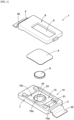
- FIGS. 1 to 3 show a configuration of a breaker 1 manufactured according to the present invention.
- the breaker 1 is composed of
- the fixed piece 2 is formed, for example, by pressing a metal plate whose main component is copper or the like (in addition, a metal plate made of copper-titanium alloy, nickel silver, brass, etc.), and is embedded in the case main body 7 by insert molding.
- the terminal 22 protrudes to the outside of the case main body 7.
- the PTC thermistor 6 is placed on convex projections (dowels) 24 which are formed at three positions on the support portion 23 of the fixed piece 2, and is supported by the projections 24.
- the fixed piece 2 Since the fixed piece 2 is bent in a stepwise manner, the fixed contact 21 and the support portion 23 are arranged at different levels and a space to accommodate the PTC thermistor 6 is easily secured.
- the terminal 22 projects outward from an edge of the case main body 7.
- the movable piece 4 is formed into an arm shape symmetrical with respect to its centerline along the longer direction, by pressing a plate-shaped metal material whose main component is copper or the like.
- the terminal 42 protrudes outward from an edge of the lid member 8. Between the movable contact 41 and the terminal 42, there is provided the above-mentioned fixed portion 43 embedded in and fixed to the lid member 8. The fixed portion 43 is arranged on the terminal 42 side.
- the movable piece 4 has an elastic portion 44.
- the thermally-actuated element 5 is arranged between the movable piece 4 and the PTC thermistor 6. That is, the thermally-actuated element 5 is placed on the first surface of the PTC thermistor 6, which will be described later.
- the initial shape of the thermally-actuated element 5 can be formed by press working.
- the PTC thermistor 6 continues to generate heat, and maintains the thermally-actuated element 5 in the reversely warped state to dramatically increases the resistance value, therefore, the current does not flow between the fixed contact 21 and the movable contact 41, and only the slight leakage current described above exists (constitutes a self-holding circuit). This leakage current can be used for other functions of the safety device.
- the lid member 8 has a first bottom surface 84a and a second bottom surface 84b.
- the second slope 85 is arranged between the first bottom surface 84a and the second bottom surface 84b, and connects between the first bottom surface 84a and the second bottom surface 84b which have different heights.
- the first bottom surface 84a, the second bottom surface 84b, and the second slopes 85 constitute an outer peripheral portion continuously extending along the outer edge of the lid member 8.
- the case main body 7 is provided with a second recess 77.
- the projecting portion 88 is formed between a pair of the first recesses 82.
- the first recess 82 is formed on each side in the short direction D1, of the projecting portion 88. This arrangement allows the movable piece 4 to be positioned more accurately with respect to the case main body 7.
- the breaker 1 of the present invention is a breaker 1 which has at least a fixed contact 21;
Landscapes
- Physics & Mathematics (AREA)
- Thermal Sciences (AREA)
- Chemical & Material Sciences (AREA)
- Chemical Kinetics & Catalysis (AREA)
- Electrochemistry (AREA)
- General Chemical & Material Sciences (AREA)
- Thermally Actuated Switches (AREA)
Abstract
Description
- The present invention relates to a minisize breaker to be built into an electrical device, and the like.
- Conventionally, breakers have been used as protective devices (safety circuits) for secondary batteries, motors, heaters, etc. of various electrical devices (see, for example, Patent Document 1).
- Patent document 1:
WO2011/105175 - The above-mentioned
Patent Document 1 discloses a breaker in which a case main body and a lid member are ultrasonically welded to form a case. - However, due to the vibration during welding, a movable piece is displaced with respect to an accommodation recess of the case main body, and when the movable piece is vibrated while interfering with the case main body, then resin of the case main body is scraped by the movable piece and generates cutting scrap. If the cutting scrap moves and becomes interposed between the movable contact and a fixed contact, there is a possibility of contact failure.
- The present invention was made in view of the above-mentioned circumstances, and its primary objective is to provide a breaker in which it is possible to suppress the generation of cutting scrap when welding a case.
- The present invention is a breaker comprising:
- a fixed contact;
- a movable piece, which has an elastic portion being elastically deformable and a movable contact in one end portion of the elastic portion, and which is for pressing the movable contact against the fixed contact to contact therewith;
- a thermally-actuated element which is deformed in response to temperature changes so as to shift the movable piece from a conductive state in which the movable contact contacts with the fixed contact to a cut-off state in which the movable contact is separated from the fixed contact;
- a first resin case which has an accommodation recess for accommodating the fixed contact, the movable piece and the thermally-actuated element; and
- a second resin case which is fixed to the first resin case and covers the accommodation recess,
- the second resin case has an embedding portion in which a part of the movable piece is embedded, and a first recess which is recessed in a thickness direction of the second resin case, and
- the first resin case has a first protruding portion which is fitted into the first recess.
- In the breaker according to the present invention, it is preferable that
- the first protruding portion comprises
- a first side surface perpendicular to a short direction of the movable piece, and a second side surface perpendicular to a longer direction of the movable piece.
- In the breaker according to the present invention, it is preferable that the first resin case has a first slope formed on an outside in the short direction of the movable piece, of the first protruding portion, and
the second resin case has a second slope corresponding to the first slope. - In the breaker according to the present invention, it is preferable that the second slope is provided, along an outer edge of the second resin case, with a rib protruding toward the first resin case.
- In the breaker according to the present invention, it is preferable that the rib is formed continuously from the second slope to the embedding portion.
- In the breaker according to the present invention, it is preferable that the first resin case has a second recess on the fixed contact side, and
the second resin case has a second protruding portion which is fitted into the second recess. - In the breaker according to the present invention, it is preferable that
the first protruding portion is disposed on an outside in the longer direction of the movable piece, of the accommodation recess. - In the breaker according to the present invention, it is preferable that
- the second resin case comprises a projecting portion projecting toward the movable contact from the embedding portion, and
- the first recess is formed on each side in the short direction of the movable piece, of the projecting portion.
- The present invention is a safety circuit for an electrical device, comprising the breaker.
- The present invention is a secondary battery pack comprising the breaker.
- In the breaker of the present invention, a part of the movable piece is embedded in the second resin case. Thereby, the movable piece is fixed at an accurate position with respect to the second resin case.
- The first resin case has the first protruding portion which fits into the first recess of the second resin case. The fitting between the first recess and the first protruding portion suppresses the displacement of the second resin case with respect to the first resin case during welding.
- Accordingly, the movable piece is accurately positioned with respect to the first resin case, so displacement of the movable piece due to vibration during welding is suppressed, and generation of cutting scrap is suppressed.
-
- [
FIG. 1 ] A perspective view showing a state of a breaker, which is to be manufactured by the present invention, before assembled. - [
FIG. 2 ] A cross-sectional view showing the above-said breaker in its normal charging or discharging state. - [
FIG. 3 ] A cross-sectional view showing the above-said breaker in its overcharge state or abnormality. - [
FIG. 4 ] A perspective view showing a lid member in which a movable piece and a cover piece are embedded. - [
FIG. 5 ] A perspective view showing the case main body in which the fixing piece is embedded. - [
FIG. 6 ] A plan view showing a configuration of a secondary battery pack equipped with the above-said breaker of the present invention. - [
FIG. 7 ] A circuit diagram of a safety circuit comprising the above-said breaker of the present invention. - A breaker according to an embodiment of the present invention will be described with reference to the drawings.
-
FIGS. 1 to 3 show a configuration of abreaker 1 manufactured according to the present invention. - The
breaker 1 is mounted on an electrical equipment, etc., and protects the electrical equipment from excessive temperature rise or overcurrent. - The
breaker 1 is composed of - a
fixed piece 2 having afixed contact 21, - a
movable piece 4 having amovable contact 41 in its one end portion, - a thermally-actuated
element 5 which deforms with temperature changes, - a PTC (Positive Temperature Coefficient)
thermistor 6, and - a
resin case 10 housing thefixed piece 2, themovable piece 4, the thermally-actuatedelement 5 and thePTC thermistor 6. - The
resin case 10 is composed of a case main body (first resin case) 7, a lid member (second resin case) 8 attached to the upper surface of the casemain body 7, and the like. - The
fixed piece 2 is formed, for example, by pressing a metal plate whose main component is copper or the like (in addition, a metal plate made of copper-titanium alloy, nickel silver, brass, etc.), and is embedded in the casemain body 7 by insert molding. - The
fixed piece 2 is provided, in its one end portion, with aterminal 22 to be electrically connected to an external circuit, and in its other end portion, with asupport portion 23 for supporting thePTC thermistor 6. - The
terminal 22 protrudes to the outside of the casemain body 7. - The
PTC thermistor 6 is placed on convex projections (dowels) 24 which are formed at three positions on thesupport portion 23 of the fixedpiece 2, and is supported by theprojections 24. - Since the fixed
piece 2 is bent in a stepwise manner, the fixedcontact 21 and thesupport portion 23 are arranged at different levels and a space to accommodate thePTC thermistor 6 is easily secured. - The fixed
contact 21 is formed at a position opposite to themovable contact 41 by cladding, plating, welding, coating, etc. with a highly conductive material such as silver, nickel, nickel-silver alloy, copper-silver alloy, or gold-silver alloy. And the fixedcontact 21 is exposed through a part of anopening 73a formed inside the casemain body 7. - The terminal 22 projects outward from an edge of the case
main body 7. - The
support portion 23 is exposed through anopening 73d formed inside the casemain body 7. - In this application, unless otherwise noted, the description was made on the assumption that, with respect to the fixed
piece 2, a first surface is the surface on which the fixedcontact 21 is formed (i.e., the upper surface inFIG. 1 ), and a second surface is the surface on the opposite side. - The same applies to other parts such as the
movable piece 4, the thermally-actuatedelement 5, thePTC thermistor 6 and theresin case 10. - The
movable piece 4 is formed into an arm shape symmetrical with respect to its centerline along the longer direction, by pressing a plate-shaped metal material whose main component is copper or the like. - A portion of the movable piece 4 (the undermentioned fixed portion 43) is embedded in the
lid member 8 by insert molding. - The
movable contact 41 is formed in one end portion in the longer direction, of themovable piece 4. - The
movable contact 41 is made of, for example, the same material as the fixedcontact 21, and is joined to one end portion of themovable piece 4 by welding or other methods, cladding, crimping and the like. - In the other end portion of the
movable piece 4, there is formed a terminal 42 electrically connected to an external circuit. - The terminal 42 protrudes outward from an edge of the
lid member 8. Between themovable contact 41 and the terminal 42, there is provided the above-mentionedfixed portion 43 embedded in and fixed to thelid member 8. The fixedportion 43 is arranged on the terminal 42 side. - Between the
movable contact 41 and the fixedportion 43, themovable piece 4 has anelastic portion 44. - The
elastic portion 44 extends from the fixedportion 43 toward themovable contact 41. - The
movable piece 4 is cantilever-supported by thelid member 8 at the fixedportion 43 on the base end side of theelastic portion 44, and
in this state, when theelastic portion 44 is elastically deformed toward the first surface, themovable contact 41 formed at the tip is pressed against and contacts with the fixedcontact 21, and the fixedpiece 2 and themovable piece 4 become a state in which electricity can flow therebetween. - It is preferable that the
movable piece 4 is curved or bent at theelastic portion 44 by press working. - The degree of curvature or bending is not particularly limited as long as the thermally-actuated
element 5 can be accommodated, and may be arbitrarily set in consideration of the elastic force at the operating temperature and reset temperature, the pressing force of the contacts, etc. - Further, a pair of projections (contact portions) 44a and 44b are formed on the second surface of the
elastic portion 44 so as to face the thermally-actuatedelement 5. - The
projections element 5 and, via theprojections element 5 is transmitted to the elastic portion 44 (seeFIGS. 1 ,2 , and3 ). - The thermally-actuated
element 5 is arranged between themovable piece 4 and thePTC thermistor 6. That is, the thermally-actuatedelement 5 is placed on the first surface of thePTC thermistor 6, which will be described later. - The thermally-actuated
element 5 shifts the state of themovable piece 4 from a conductive state in which themovable contact 41 contacts with the fixedcontact 21 to a disconnected state in which themovable contact 41 is separated from the fixedcontact 21. - By laminating thin plate materials having different coefficients of thermal expansion, the thermally-actuated
element 5 is formed into a plate shape and has an initial shape whose cross section is curved into an arc. - The curved shape of the thermally-actuated
element 5 is reversely warped with a snap motion when the reverse-operation temperature is reached due to overheating, and is restored when the temperature drops below the normally-reset temperature due to cooling. - The initial shape of the thermally-actuated
element 5 can be formed by press working. - The material and shape of the thermally-actuated
element 5 are not particularly limited as long as the thermally-actuatedelement 5 pushes up theelastic portion 44 of themovable piece 4 due to the reversely-warping deformation at the desired temperature, and is returned to its original state by the elastic force of theelastic portion 44. - However, from the viewpoint of productivity and efficiency of reversely-warping deformation, a rectangular shape is preferred.
- As to the materials for the thermally-actuated
element 5, two types of materials having different thermal expansion coefficients and made of various alloys, e.g. nickel silver, brass, stainless steel and the like are used in combination as a laminated material depending on the required conditions. - For example, as a material for the thermally-actuated
element 5 that can provide stable reverse-operation temperature and normally-reset temperature, preferred is a combination of a copper-nickel-manganese alloy on the high expansion side and an iron-nickel alloy on the low expansion side. - Further, a material which is more desirable from the viewpoint of chemical stability, includes a combination of an iron-nickel-chromium alloy on the high expansion side and an iron-nickel alloy on the low expansion side. Furthermore, a material which is more desirable from the viewpoint of chemical stability and processability, includes a combination of an iron-nickel-chromium alloy on the high-expansion side and an iron-nickel-cobalt alloy on the low-expansion side.
- When the
movable piece 4 is in the cut-off state, thePTC thermistor 6 makes it conductive between thefixed piece 2 and themovable piece 4 via the thermally-actuatedelement 5. - The
PTC thermistor 6 is disposed between thefixed piece 2 and the thermally-actuatedelement 5. That is, thesupport portion 23 of the fixedpiece 2 is located directly below the thermally-actuatedelement 5 with thePTC thermistor 6 in between. - When the current flow between the
fixed piece 2 and themovable piece 4 is cut off due to the reversely-warping deformation of the thermally-actuatedelement 5, the current flowing through thePTC thermistor 6 is increased. - As long as the
PTC thermistor 6 is a positive characteristic thermistor whose resistance increases as the temperature rises and limits its current, the type can be selected depending on the operating current, operating voltage, operating temperature, reset temperature, etc. And the material and shape are not particularly limited as long as these characteristics are not impaired. - In this embodiment, a ceramic sintered body containing barium titanate, strontium titanate, or calcium titanate is used.
- In addition to the ceramic sintered body, a so-called polymer PTC, which is a polymer containing conductive particles such as carbon, may be used.
- The case
main body 7 and thelid member 8 constituting theresin case 10, are molded from thermoplastic resin such as flame-retardant polyamide, polyphenylene sulfide (PPS) with excellent heat resistance, liquid crystal polymer (LCP), and polybutylene terephthalate (PBT). - As long as properties equivalent to or better than those of the resins described above can be obtained, materials other than resins may be used.
- On the first surface side of the case
main body 7, there is formed anaccommodation recess 73 which is an internal space for accommodating thefixed contact 21, themovable piece 4, the thermally-actuatedelement 5, thePTC thermistor 6, and the like. - The
accommodation recess 73 has anopening 73a for the reception of the fixedcontact 21 and themovable piece 4, anopening 73c for the reception of themovable piece 4 and the thermally-actuatedelement 5, anopening 73d for the reception of thePTC thermistor 6, and the like. - The edges of the
movable piece 4 and the thermally-actuatedelement 5 mounted into the casemain body 7 are brought into contact with frames forming theaccommodation recess 73 and guided when the thermally-actuatedelement 5 makes reversely-warping deformation. That is, theaccommodation recess 73 accommodates themovable piece 4 and the thermally-actuatedelement 5 so that they can deform. - The
lid member 8 is configured to cover theaccommodation recess 73. - The
lid member 8 may be configured to cover at least a portion of theaccommodation recess 73. - In the
lid member 8, acover piece 9 which is made of a metal plate containing copper or the like as a main component or made of stainless steel or the like, is embedded by insert molding. - The
cover piece 9 is embedded in thelid member 8 in a state being in contact with the first surface of the fixedportion 43 of themovable piece 4. - The
cover piece 9 limits the movement of themovable piece 4, and increases the rigidity and strength of thelid member 8 and consequently theresin case 10 as a housing, contributing to miniaturization of thebreaker 1. - The case
main body 7 and thelid member 8 are formed by injection molding using the above-mentioned resin material. As already described, the fixedpiece 2 is inserted in the casemain body 7, and themovable piece 4 and thecover piece 9 are inserted in thelid member 8. - As shown in
FIG. 1 , thelid member 8 is attached to the casemain body 7 so as to close theopenings main body 7 housing the fixedpiece 2, themovable piece 4, the thermally-actuatedelement 5, thePTC thermistor 6, etc. - The
accommodation recess 73 is covered by thelid member 8. - The case
main body 7 and thelid member 8 are joined by, for example, ultrasonic welding. Thereby, theresin case 10 is formed. -
FIGS. 2 and3 schematically show the operations of thebreaker 1. -
FIG. 2 shows the operation of thebreaker 1 in the normal charging or discharging state. - In the normal charging or discharging state, the thermally-actuated
element 5 maintains its initial shape before being reversely warped. - When the
movable contact 41 is pressed toward the fixedcontact 21 by theelastic portion 44, themovable contact 41 and the fixedcontact 21 come into contact with each other, and the fixedpiece 2 and themovable piece 4 of thebreaker 1 are placed in a state where they are electrically connected via theelastic portion 44 of themovable piece 4. - The
elastic portion 44 of themovable piece 4 may be in contact with the thermally-actuatedelement 5. - In this case, the
movable piece 4, the thermally-actuatedelement 5, thePTC thermistor 6 and the fixedpiece 2 are electrically connected as a circuit. - But, as the resistance of the
PTC thermistor 6 is overwhelmingly larger than the resistance of themovable piece 4, the current flowing through thePTC thermistor 6 is negligibly small in substance when compared with the amount flowing through the fixedcontact 21 and themovable contact 41. -
FIG. 3 shows the operation of thebreaker 1 in an overcharged state or in an abnormal state. - The thermally-actuated
element 5 in which thin plate materials having different coefficients of thermal expansion are laminated, deforms as the temperature rises so that the initial curved shape shown inFIG. 2 is remedied. Then, the thermally-actuatedelement 5 which has reached the operating temperature is snap-deformed into a reversely warped shape as shown inFIG. 3 . - Thereby, the thermally-actuated
element 5 comes into contact with theelastic portion 44 of themovable piece 4, and theelastic portion 44 is pushed up by the thermally-actuatedelement 5, and as a result, the fixedcontact 21 and themovable contact 41 are separated from each other. - At this time, the current flowing between the fixed
contact 21 and themovable contact 41 is cut off. - On the other hand, the thermally-actuated
element 5 comes into contact with themovable piece 4, and a slight leakage current flows through the thermally-actuatedelement 5 and thePTC thermistor 6. That is, thePTC thermistor 6 causes the fixedpiece 2 and themovable piece 4 to be electrically connected via the thermally-actuatedelement 5 which caused themovable piece 4 to shift into the cut-off state. - As long as such leakage current flows, the
PTC thermistor 6 continues to generate heat, and maintains the thermally-actuatedelement 5 in the reversely warped state to dramatically increases the resistance value, therefore, the current does not flow between the fixedcontact 21 and themovable contact 41, and only the slight leakage current described above exists (constitutes a self-holding circuit). This leakage current can be used for other functions of the safety device. - When the overcharge state is canceled or the abnormal state is eliminated, the heat generated by the
PTC thermistor 6 stops, and the thermally-actuatedelement 5 returns to the normal rotation reset temperature and restores its original initial shape. - Then, the
movable contact 41 and the fixedcontact 21 come into contact again due to the elastic force of theelastic portion 44 of themovable piece 4, and the circuit is released from the disconnected state and returns to the conductive state shown inFIG. 2 . -
FIG. 4 shows thelid member 8 in which themovable piece 4 and thecover piece 9 are embedded. - The
lid member 8 has afirst recess 82 and an embeddingportion 81 in which themovable piece 4 is embedded. - The embedding
portion 81 embeds the fixedportion 43 of themovable piece 4. Thereby, themovable piece 4 is fixed at an accurate position relative to thelid member 8. - The embedding
portion 81 is formed to extend in the short direction D1 of themovable piece 4 along an edge on the terminal 42 side, of thelid member 8. In this embodiment, the embeddingportion 81 extends to edges in the short direction D1, of thelid member 8. - The
first recess 82 is recessed in the thickness direction of thelid member 8 from the embeddingportion 81. - The
first recess 82 is formed across both outer sides in the short direction D1, of themovable piece 4. - Furthermore, in this embodiment, the
first recess 82 is formed along the longer direction D2 of themovable piece 4. - The
first recess 82 constitutes a part of anaccommodation recess 83 for accommodating theelastic portion 44 and themovable contact 41 of themovable piece 4. - By providing the
lid member 8 with thefirst recess 82, thecover piece 9 is exposed to theaccommodation recess 83. -
FIG. 5 shows the casemain body 7 in which the fixedpiece 2 is embedded. The casemain body 7 has a first protrudingportion 74 protruding toward thelid member 8. - The first protruding
portion 74 is formed in a position and a shape corresponding to thefirst recess 82. - When the
lid member 8 is attached to the casemain body 7, the first protrudingportion 74 of the casemain body 7 is fitted into thefirst recess 82 of thelid member 8. - The fitting between the
first recess 82 and the first protrudingportion 74 suppresses displacement of thelid member 8 with respect to the casemain body 7 during welding. - At this time, the
movable piece 4 is accurately positioned with respect to the casemain body 7 via thelid member 8 since themovable piece 4 is fixed at an accurate position with respect to thelid member 8 by insert molding. - Thereby, displacement of the
movable piece 4 with respect to the accommodation recess 63 due to vibration during welding is suppressed, and the generation of cutting scrap is suppressed. - It is preferable that the first protruding
portion 74 comprises - a
first side surface 74a perpendicular to the short direction D1 of themovable piece 4, and - a
second side surface 74b perpendicular to the longer direction D2 of themovable piece 4. - The
first side surface 74a and thesecond side surface 74b are orthogonal to each other. - As shown in
FIG. 4 , thefirst recess 82 comprises athird side surface 82a opposing thefirst side surface 74a, and afourth side surface 82b opposing thesecond side surface 74b. - By making contact between the
first side surface 74a and thethird side surface 82a, displacement of thelid member 8 in the short direction D1 with respect to the casemain body 7 is suppressed. - By making contact between the
second side surface 74b and thefourth side surface 82b, displacement of thelid member 8 in the longer direction D2 with respect to the casemain body 7 is suppressed. - As shown in
FIG. 4 , thelid member 8 has a firstbottom surface 84a and a secondbottom surface 84b. - The first
bottom surface 84a is formed from the periphery of themovable contact 41 to the sides of theelastic portion 44. - The second
bottom surface 84b is formed in the embeddingportion 81. - The embedding
portion 81 protrudes toward the casemain body 7 in order to embed the fixedportion 43 of themovable piece 4. - Therefore, the second
bottom surface 84b projects further toward the casemain body 7 than the firstbottom surface 84a. - As shown in
FIG. 5 , the casemain body 7 has a firsttop surface 75a and a secondtop surface 75b. - The first
top surface 75a is formed from the periphery of the fixedcontact 21 to the lateral periphery of theaccommodation recess 73. - The second
top surface 75b is formed on the terminal 42 side of themovable piece 4 with respect to theaccommodation recess 73. - As shown in
FIGS. 4 and5 , the height of the secondtop surface 75b with respect to the firsttop surface 75a is set according to the height of the secondbottom surface 84b with respect to the firstbottom surface 84a. - Therefore, the height of the first
top surface 75a is set to be higher than the height of the secondtop surface 75b, from the bottom surface (second surface) of the casemain body 7. - When the
lid member 8 is attached to the casemain body 7, the firsttop surface 75a and the firstbottom surface 84a come into contact with each other and are welded together, and the secondtop surface 75b and the secondbottom surface 84b come into contact with each other and are welded together. - The case
main body 7 is provided with a pair of first slopes 76. - The
first slope 76 is formed on an outside in the short direction D1, of the first protrudingportion 74. - The
first slope 76 is arranged between the firsttop surface 75a and the secondtop surface 75b, and connects between the firsttop surface 75a and the secondtop surface 75b which have different heights. - The first
top surface 75a, the secondtop surface 75b, and thefirst slope 76 constitute an outer peripheral portion continuously extending along the outer edge of the casemain body 7. - The
lid member 8 is provided with a pair of second slopes 85. - The
second slope 85 is formed at a position corresponding to thefirst slope 76, that is, on an outside in the short direction D1, of thefirst recess 82. - The
second slope 85 is arranged between the firstbottom surface 84a and the secondbottom surface 84b, and connects between the firstbottom surface 84a and the secondbottom surface 84b which have different heights. - The first
bottom surface 84a, the secondbottom surface 84b, and thesecond slopes 85 constitute an outer peripheral portion continuously extending along the outer edge of thelid member 8. - When the
lid member 8 is attached to the casemain body 7, thefirst slope 76 and thesecond slope 85 come into contact with each other and are welded together. - The
first slope 76 and thesecond slope 85 smoothly absorb - the difference in level between the first
top surface 75a and the secondtop surface 75b and - the difference in level between the first
bottom surface 84a and the secondbottom surface 84b. - And the airtightness between the case
main body 7 and thelid member 8 can be easily improved. - It is preferable that the
second slope 85 is provided with arib 86. - The
rib 86 is formed along the outer edge of thelid member 8 so as to protrude toward the casemain body 7. - When the case
main body 7 and thelid member 8 are welded together, theribs 86 melt at an initial stage of welding, which makes the welding between the casemain body 7 and thelid member 8 better. - It is preferable that the
rib 86 is formed continuously from thesecond slope 85 to the embeddingportion 81. - The
rib 86 in this embodiment is formed so as to extend continuously along the outer edge of thelid member 8 around the firstbottom surface 84a, thesecond slope 85, and the secondbottom surface 84b. - Owing to
such rib 86, the welding between the casemain body 7 and thelid member 8 becomes much better, and the airtightness between the casemain body 7 and thelid member 8 is easily improved. - Instead of the
rib 86, a rib may be formed on thefirst slope 76. - In this case, it is preferably formed so as to extend continuously along the outer edge of the case
main body 7 around the firsttop surface 75a, thefirst slope 76, and the secondtop surface 75b. - The case
main body 7 is provided with asecond recess 77. - The
second recess 77 is arranged closer to the fixedcontact 21 than theopening 73c for accommodating the thermally-actuatedelement 5. - In this embodiment, the
second recess 77 is provided on each side in the short direction D1, of the fixedcontact 21. - The
lid member 8 is provided with a second protrudingportion 87. - The second protruding
portion 87 is formed at a position corresponding to thesecond recess 77. - When the
lid member 8 is attached to the casemain body 7, the second protrudingportion 87 is fitted into thesecond recess 77. - By fitting the second protruding
portion 87 into thesecond recess 77, thelid member 8 is positioned more accurately with respect to the casemain body 7 at the periphery of the fixedcontact 21 and themovable contact 41. - In the present embodiment, owing to the fitting between the first protruding
portion 74 and thefirst recess 82, and the fitting between the second protrudingportion 87 and thesecond recess 77,
theentire lid member 8 is more accurately positioned with respect to the casemain body 7 and fixed thereto. - It is preferable that the first protruding
portion 74 is disposed on an outside in the longer direction D2, of theaccommodation recess 73. - With such configuration, the
lid member 8 is positioned and fixed to the casemain body 7 more accurately. - Further, it is preferable that the
second recess 77 is disposed on the opposite side in the longer direction D2, of the first protrudingportion 74 with theaccommodation recess 73 in between. - With this configuration, the
lid member 8 is more accurately positioned with respect to the casemain body 7 near four corners of thelid member 8, and fixed thereto. - The
lid member 8 of this embodiment comprises a projectingportion 88 projecting from the embeddingportion 81 toward themovable contact 41. - By providing the projecting
portion 88, themovable piece 4 is sandwiched between thecover piece 9 and the projectingportion 88, and is firmly fixed to thelid member 8 at an accurate position. - It is preferable that the projecting
portion 88 is formed between a pair of the first recesses 82. In other words, it is preferable that thefirst recess 82 is formed on each side in the short direction D1, of the projectingportion 88. This arrangement allows themovable piece 4 to be positioned more accurately with respect to the casemain body 7. - While detailed description has been made of the
breaker 1 of the present invention, the present invention can be embodied in various modes without being limited to the above-described specific embodiment. - That is, the
breaker 1 of the present invention is abreaker 1 which has at least afixed contact 21; - a
movable piece 4, which has anelastic portion 44 being elastically deformable and amovable contact 41 in one end portion of theelastic portion 44, and which is for pressing themovable contact 41 against the fixedcontact 21 to contact therewith; - a thermally-actuated
element 5 which is deformed in response to temperature changes so as to shift themovable piece 4 from a conductive state in which themovable contact 41 contacts with the fixedcontact 21 to a cut-off state in which themovable contact 41 is separated from the fixedcontact 21; - a case
main body 7 which has anaccommodation recess 73 for accommodating thefixed contact 21, themovable piece 4 and the thermally-actuatedelement 5; and - a
lid member 8 which is fixed to the casemain body 7 and covers theaccommodation recess 73, wherein - it is sufficient if the
lid member 8 has an embeddingportion 81 in which a part of themovable piece 4 is embedded, and afirst recess 82 which is recessed in a thickness direction of thelid member 8, and the casemain body 7 has a first protrudingportion 74 which is fitted into thefirst recess 82. -
- 1: Breaker
- 4: Movable piece
- 5: Thermally-actuated element
- 6: PTC thermistor (Thermally-actuated element)
- 7: Case main body (First resin case)
- 8: Lid member (Second resin case)
- 10: Resin case
- 21: Fixed contact
- 41: Movable contact
- 44: Elastic portion
- 73: Accommodation recess
- 74: First protruding portion
- 74a: First side surface
- 74b: Second side surface
- 76: First slope
- 77: Second recess
- 81: Embedding portion
- 82: First recess
- 83: Accommodation recess
- 85: Second slope
- 86: Rib
- 87: Second protruding portion
- 88: Projecting portion
- D1: Short direction
- D2: Longer direction
Claims (10)
- A breaker comprising:a fixed contact;a movable piece, which has an elastic portion being elastically deformable and a movable contact in one end portion of the elastic portion, and which is for pressing the movable contact against the fixed contact to contact therewith;a thermally-actuated element which is deformed in response to temperature changes so as to shift the movable piece from a conductive state in which the movable contact contacts with the fixed contact to a cut-off state in which the movable contact is separated from the fixed contact;a first resin case which has an accommodation recess for accommodating the fixed contact, the movable piece and the thermally-actuated element; anda second resin case which is fixed to the first resin case and covers the accommodation recess,whereinthe second resin case has an embedding portion in which a part of the movable piece is embedded, and a first recess which is recessed in a thickness direction of the second resin case, andthe first resin case has a first protruding portion which is fitted into the first recess.
- The breaker as set forth in claim 1, wherein
the first protruding portion comprisesa first side surface perpendicular to a short direction of the movable piece, anda second side surface perpendicular to a longer direction of the movable piece. - The breaker as set forth in claim 1 or 2, whereinthe first resin case has a first slope formed on an outside in the short direction of the movable piece, of the first protruding portion, andthe second resin case has a second slope corresponding to the first slope.
- The breaker as set forth in claim 3, wherein
the second slope is provided, along an outer edge of the second resin case, with a rib protruding toward the first resin case. - The breaker as set forth in claim 4, wherein
the rib is formed continuously from the second slope to the embedding portion. - The breaker as set forth in any one of claims 1 to 5, whereinthe first resin case has a second recess on the fixed contact side, andthe second resin case has a second protruding portion which is fitted into the second recess.
- The breaker as set forth in any one of claims 1 to 6, wherein
the first protruding portion is disposed on an outside in the longer direction of the movable piece, of the accommodation recess. - The breaker as set forth in any one of claims 1 to 7, whereinthe second resin case comprises a projecting portion projecting toward the movable contact from the embedding portion, andthe first recess is formed on each side in the short direction of the movable piece, of the projecting portion.
- A safety circuit for an electrical device, comprising the breaker as set forth in any one of claims 1 to 8.
- A secondary battery pack comprising the breaker as set forth in any one of claims 1 to 8.
Applications Claiming Priority (2)
| Application Number | Priority Date | Filing Date | Title |
|---|---|---|---|
| JP2021184780A JP7776967B2 (en) | 2021-11-12 | 2021-11-12 | Breakers, safety circuits and secondary battery packs |
| PCT/JP2022/036941 WO2023084944A1 (en) | 2021-11-12 | 2022-10-03 | Breaker, safety circuit, and secondary battery pack |
Publications (2)
| Publication Number | Publication Date |
|---|---|
| EP4398281A1 true EP4398281A1 (en) | 2024-07-10 |
| EP4398281A4 EP4398281A4 (en) | 2025-07-23 |
Family
ID=86335533
Family Applications (1)
| Application Number | Title | Priority Date | Filing Date |
|---|---|---|---|
| EP22892444.5A Pending EP4398281A4 (en) | 2021-11-12 | 2022-10-03 | Circuit breaker, safety circuit and secondary battery pack |
Country Status (4)
| Country | Link |
|---|---|
| US (1) | US20250006443A1 (en) |
| EP (1) | EP4398281A4 (en) |
| JP (1) | JP7776967B2 (en) |
| WO (1) | WO2023084944A1 (en) |
Family Cites Families (21)
| Publication number | Priority date | Publication date | Assignee | Title |
|---|---|---|---|---|
| US5229739A (en) * | 1992-02-21 | 1993-07-20 | Littelfuse, Inc. | Automotive high current fuse |
| US6046665A (en) * | 1996-08-22 | 2000-04-04 | Littelfuse, Inc. | Fusible link, and link and cable assembly |
| JP3756700B2 (en) * | 1999-07-22 | 2006-03-15 | ウチヤ・サーモスタット株式会社 | Thermal protector |
| JP3413167B2 (en) * | 2000-09-08 | 2003-06-03 | 古河精密金属工業株式会社 | Manufacturing method of small breaker |
| KR20030047801A (en) * | 2001-12-07 | 2003-06-18 | 후루카와 덴키 고교 가부시키가이샤 | Thermal protector |
| JP2004220944A (en) * | 2003-01-15 | 2004-08-05 | Furukawa Electric Co Ltd:The | Thermal protector |
| JP2005108585A (en) * | 2003-09-30 | 2005-04-21 | Alps Electric Co Ltd | Thermally-actuated switch |
| DE102008048554B3 (en) * | 2008-09-16 | 2010-02-04 | Hofsaess, Marcel P. | Temperature-dependent switch |
| WO2011105175A1 (en) | 2010-02-26 | 2011-09-01 | 株式会社小松ライト製作所 | Breaker |
| CN104011823B (en) * | 2011-10-20 | 2017-05-24 | 泰科电子日本合同会社 | Protection device |
| JP5886609B2 (en) * | 2011-11-22 | 2016-03-16 | 株式会社小松ライト製作所 | Breaker, safety circuit including the same, and secondary battery pack |
| JP5901055B2 (en) * | 2011-12-05 | 2016-04-06 | 大塚テクノ株式会社 | breaker |
| WO2013094725A1 (en) * | 2011-12-22 | 2013-06-27 | 株式会社小松ライト製作所 | Breaker, and safety circuit and secondary battery pack equipped with same |
| JP6111063B2 (en) * | 2012-12-14 | 2017-04-05 | 大塚テクノ株式会社 | breaker |
| JP6224920B2 (en) * | 2013-06-03 | 2017-11-01 | ボーンズ株式会社 | Breaker, safety circuit including the same, and secondary battery circuit |
| JP6267528B2 (en) * | 2014-01-30 | 2018-01-24 | ボーンズ株式会社 | Current interrupt device |
| JP2016039122A (en) * | 2014-08-11 | 2016-03-22 | 株式会社小松ライト製作所 | Switch and manufacturing method of the same |
| JP2016122551A (en) * | 2014-12-25 | 2016-07-07 | 株式会社小松ライト製作所 | breaker |
| JP7017874B2 (en) * | 2017-07-19 | 2022-02-09 | ボーンズ株式会社 | A breaker and a safety circuit equipped with it. |
| JP2017208358A (en) * | 2017-08-30 | 2017-11-24 | ボーンズ株式会社 | Breaker and safety circuit and secondary battery circuit including the same |
| JP6997685B2 (en) * | 2018-07-31 | 2022-01-18 | ボーンズ株式会社 | Current breaker, safety circuit and rechargeable battery pack |
-
2021
- 2021-11-12 JP JP2021184780A patent/JP7776967B2/en active Active
-
2022
- 2022-10-03 WO PCT/JP2022/036941 patent/WO2023084944A1/en not_active Ceased
- 2022-10-03 US US18/708,571 patent/US20250006443A1/en active Pending
- 2022-10-03 EP EP22892444.5A patent/EP4398281A4/en active Pending
Also Published As
| Publication number | Publication date |
|---|---|
| JP2023072318A (en) | 2023-05-24 |
| JP7776967B2 (en) | 2025-11-27 |
| US20250006443A1 (en) | 2025-01-02 |
| WO2023084944A1 (en) | 2023-05-19 |
| EP4398281A4 (en) | 2025-07-23 |
Similar Documents
| Publication | Publication Date | Title |
|---|---|---|
| JP7064350B2 (en) | Breaker and safety circuit with it | |
| JP6967878B2 (en) | A breaker and a safety circuit equipped with it. | |
| US11551895B2 (en) | Breaker, safety circuit and secondary battery pack | |
| JP6967932B2 (en) | A breaker and a safety circuit equipped with it. | |
| WO2020184298A1 (en) | Method for manufacturing breaker | |
| EP4398281A1 (en) | Breaker, safety circuit, and secondary battery pack | |
| US12183526B2 (en) | Breaker, safety circuit and secondary battery pack | |
| JP7083742B2 (en) | Thermal response element, breaker, safety circuit and secondary battery pack | |
| JP7645783B2 (en) | Breakers, safety circuits and secondary battery packs | |
| EP4386804A1 (en) | Breaker, safety circuit, and secondary battery pack | |
| US12224139B2 (en) | Breaker and safety circuit equipped with the same, and secondary battery pack | |
| JP7425768B2 (en) | Breakers, safety circuits and secondary battery packs | |
| JP6777438B2 (en) | Breakers and safety circuits and connectors equipped with them. | |
| WO2023119887A1 (en) | Breaker, safety circuit, and secondary battery pack | |
| WO2025069152A1 (en) | Breaker, safety circuit, and secondary battery pack | |
| JP2025005860A (en) | Breakers, safety circuits and secondary battery packs | |
| JP2025073240A (en) | Breakers, safety circuits for electrical equipment and secondary battery packs |
Legal Events
| Date | Code | Title | Description |
|---|---|---|---|
| STAA | Information on the status of an ep patent application or granted ep patent |
Free format text: STATUS: THE INTERNATIONAL PUBLICATION HAS BEEN MADE |
|
| PUAI | Public reference made under article 153(3) epc to a published international application that has entered the european phase |
Free format text: ORIGINAL CODE: 0009012 |
|
| STAA | Information on the status of an ep patent application or granted ep patent |
Free format text: STATUS: REQUEST FOR EXAMINATION WAS MADE |
|
| 17P | Request for examination filed |
Effective date: 20240404 |
|
| AK | Designated contracting states |
Kind code of ref document: A1 Designated state(s): AL AT BE BG CH CY CZ DE DK EE ES FI FR GB GR HR HU IE IS IT LI LT LU LV MC ME MK MT NL NO PL PT RO RS SE SI SK SM TR |
|
| DAV | Request for validation of the european patent (deleted) | ||
| DAX | Request for extension of the european patent (deleted) | ||
| A4 | Supplementary search report drawn up and despatched |
Effective date: 20250624 |
|
| RIC1 | Information provided on ipc code assigned before grant |
Ipc: H01H 37/04 20060101AFI20250617BHEP Ipc: H01H 1/50 20060101ALI20250617BHEP Ipc: H01H 37/54 20060101ALI20250617BHEP |