EP4397734A1 - Method of preparing heterocyclic compound, heterocyclic compound prepared according to the method, light-emitting device comprising the heterocyclic compound, and electronic apparatus and electronic equipment comprising the light-emitting device - Google Patents
Method of preparing heterocyclic compound, heterocyclic compound prepared according to the method, light-emitting device comprising the heterocyclic compound, and electronic apparatus and electronic equipment comprising the light-emitting device Download PDFInfo
- Publication number
- EP4397734A1 EP4397734A1 EP23210706.0A EP23210706A EP4397734A1 EP 4397734 A1 EP4397734 A1 EP 4397734A1 EP 23210706 A EP23210706 A EP 23210706A EP 4397734 A1 EP4397734 A1 EP 4397734A1
- Authority
- EP
- European Patent Office
- Prior art keywords
- group
- substituted
- unsubstituted
- compound
- formula
- Prior art date
- Legal status (The legal status is an assumption and is not a legal conclusion. Google has not performed a legal analysis and makes no representation as to the accuracy of the status listed.)
- Pending
Links
Images



Classifications
-
- C—CHEMISTRY; METALLURGY
- C07—ORGANIC CHEMISTRY
- C07F—ACYCLIC, CARBOCYCLIC OR HETEROCYCLIC COMPOUNDS CONTAINING ELEMENTS OTHER THAN CARBON, HYDROGEN, HALOGEN, OXYGEN, NITROGEN, SULFUR, SELENIUM OR TELLURIUM
- C07F5/00—Compounds containing elements of Groups 3 or 13 of the Periodic Table
- C07F5/02—Boron compounds
-
- C—CHEMISTRY; METALLURGY
- C07—ORGANIC CHEMISTRY
- C07F—ACYCLIC, CARBOCYCLIC OR HETEROCYCLIC COMPOUNDS CONTAINING ELEMENTS OTHER THAN CARBON, HYDROGEN, HALOGEN, OXYGEN, NITROGEN, SULFUR, SELENIUM OR TELLURIUM
- C07F5/00—Compounds containing elements of Groups 3 or 13 of the Periodic Table
- C07F5/02—Boron compounds
- C07F5/027—Organoboranes and organoborohydrides
-
- C—CHEMISTRY; METALLURGY
- C09—DYES; PAINTS; POLISHES; NATURAL RESINS; ADHESIVES; COMPOSITIONS NOT OTHERWISE PROVIDED FOR; APPLICATIONS OF MATERIALS NOT OTHERWISE PROVIDED FOR
- C09K—MATERIALS FOR MISCELLANEOUS APPLICATIONS, NOT PROVIDED FOR ELSEWHERE
- C09K11/00—Luminescent materials, e.g. electroluminescent or chemiluminescent
- C09K11/06—Luminescent materials, e.g. electroluminescent or chemiluminescent containing organic luminescent materials
-
- H—ELECTRICITY
- H10—SEMICONDUCTOR DEVICES; ELECTRIC SOLID-STATE DEVICES NOT OTHERWISE PROVIDED FOR
- H10K—ORGANIC ELECTRIC SOLID-STATE DEVICES
- H10K50/00—Organic light-emitting devices
- H10K50/10—OLEDs or polymer light-emitting diodes [PLED]
- H10K50/11—OLEDs or polymer light-emitting diodes [PLED] characterised by the electroluminescent [EL] layers
-
- H—ELECTRICITY
- H10—SEMICONDUCTOR DEVICES; ELECTRIC SOLID-STATE DEVICES NOT OTHERWISE PROVIDED FOR
- H10K—ORGANIC ELECTRIC SOLID-STATE DEVICES
- H10K50/00—Organic light-emitting devices
- H10K50/10—OLEDs or polymer light-emitting diodes [PLED]
- H10K50/11—OLEDs or polymer light-emitting diodes [PLED] characterised by the electroluminescent [EL] layers
- H10K50/12—OLEDs or polymer light-emitting diodes [PLED] characterised by the electroluminescent [EL] layers comprising dopants
-
- H—ELECTRICITY
- H10—SEMICONDUCTOR DEVICES; ELECTRIC SOLID-STATE DEVICES NOT OTHERWISE PROVIDED FOR
- H10K—ORGANIC ELECTRIC SOLID-STATE DEVICES
- H10K85/00—Organic materials used in the body or electrodes of devices covered by this subclass
- H10K85/60—Organic compounds having low molecular weight
- H10K85/649—Aromatic compounds comprising a hetero atom
- H10K85/657—Polycyclic condensed heteroaromatic hydrocarbons
-
- H—ELECTRICITY
- H10—SEMICONDUCTOR DEVICES; ELECTRIC SOLID-STATE DEVICES NOT OTHERWISE PROVIDED FOR
- H10K—ORGANIC ELECTRIC SOLID-STATE DEVICES
- H10K85/00—Organic materials used in the body or electrodes of devices covered by this subclass
- H10K85/60—Organic compounds having low molecular weight
- H10K85/649—Aromatic compounds comprising a hetero atom
- H10K85/657—Polycyclic condensed heteroaromatic hydrocarbons
- H10K85/6572—Polycyclic condensed heteroaromatic hydrocarbons comprising only nitrogen in the heteroaromatic polycondensed ring system, e.g. phenanthroline or carbazole
-
- H—ELECTRICITY
- H10—SEMICONDUCTOR DEVICES; ELECTRIC SOLID-STATE DEVICES NOT OTHERWISE PROVIDED FOR
- H10K—ORGANIC ELECTRIC SOLID-STATE DEVICES
- H10K85/00—Organic materials used in the body or electrodes of devices covered by this subclass
- H10K85/60—Organic compounds having low molecular weight
- H10K85/658—Organoboranes
-
- C—CHEMISTRY; METALLURGY
- C09—DYES; PAINTS; POLISHES; NATURAL RESINS; ADHESIVES; COMPOSITIONS NOT OTHERWISE PROVIDED FOR; APPLICATIONS OF MATERIALS NOT OTHERWISE PROVIDED FOR
- C09K—MATERIALS FOR MISCELLANEOUS APPLICATIONS, NOT PROVIDED FOR ELSEWHERE
- C09K2211/00—Chemical nature of organic luminescent or tenebrescent compounds
- C09K2211/10—Non-macromolecular compounds
- C09K2211/1018—Heterocyclic compounds
-
- C—CHEMISTRY; METALLURGY
- C09—DYES; PAINTS; POLISHES; NATURAL RESINS; ADHESIVES; COMPOSITIONS NOT OTHERWISE PROVIDED FOR; APPLICATIONS OF MATERIALS NOT OTHERWISE PROVIDED FOR
- C09K—MATERIALS FOR MISCELLANEOUS APPLICATIONS, NOT PROVIDED FOR ELSEWHERE
- C09K2211/00—Chemical nature of organic luminescent or tenebrescent compounds
- C09K2211/10—Non-macromolecular compounds
- C09K2211/1018—Heterocyclic compounds
- C09K2211/1025—Heterocyclic compounds characterised by ligands
- C09K2211/1029—Heterocyclic compounds characterised by ligands containing one nitrogen atom as the heteroatom
-
- C—CHEMISTRY; METALLURGY
- C09—DYES; PAINTS; POLISHES; NATURAL RESINS; ADHESIVES; COMPOSITIONS NOT OTHERWISE PROVIDED FOR; APPLICATIONS OF MATERIALS NOT OTHERWISE PROVIDED FOR
- C09K—MATERIALS FOR MISCELLANEOUS APPLICATIONS, NOT PROVIDED FOR ELSEWHERE
- C09K2211/00—Chemical nature of organic luminescent or tenebrescent compounds
- C09K2211/10—Non-macromolecular compounds
- C09K2211/1018—Heterocyclic compounds
- C09K2211/1025—Heterocyclic compounds characterised by ligands
- C09K2211/1044—Heterocyclic compounds characterised by ligands containing two nitrogen atoms as heteroatoms
- C09K2211/1055—Heterocyclic compounds characterised by ligands containing two nitrogen atoms as heteroatoms with other heteroatoms
Definitions
- One or more embodiments relate to a method of preparing a heterocyclic compound, a heterocyclic compound prepared according to the method, a light-emitting device comprising the heterocyclic compound, and an electronic apparatus and electronic equipment that comprise the light-emitting device.
- a first electrode is arranged on a substrate, and a hole transport region, an emission layer, an electron transport region, and a second electrode are sequentially arranged on the first electrode. Holes provided from the first electrode move toward the emission layer through the hole transport region, and electrons provided from the second electrode move toward the emission layer through the electron transport region. Carriers, such as holes and electrons, recombine in the emission layer to produce excitons. These excitons transition (relax) from an excited state to a ground state to thereby generate light.
- aspects according to one or more embodiments of the present disclosure are directed toward a method of preparing a heterocyclic compound, a heterocyclic compound prepared according to the method, a light-emitting device comprising the heterocyclic compound, and an electronic apparatus and electronic equipment that comprise the light-emitting device.
- At least one of R 1 to R 3 in Formula 1 is a group represented by Formula 1-1, and the group represented by Formula 1-1 is introduced into the heterocyclic compound after the reacting of the intermediate compound or a derivative thereof with the boron halide:
- a light-emitting device comprises
- an electronic apparatus comprises the light-emitting device.
- the expression "at least one of a, b or c", “at least one selected from a, b, and c", “at least one selected from the group consisting of a, b, and c", “at least one from among a, b, and c", “at least one of a to c", etc. indicates only a, only b, only c, both (e.g., simultaneously) a and b, both (e.g., simultaneously) a and c, both (e.g., simultaneously) band c, all of a, b, and c, or variations thereof.
- the second reactant may be utilized as a solvent.
- the second reactant may be iodobenzene, bromobenzene, 1-iodobenzene-2,3,4,5,6-D 5 , 1-bromobenzene-2,3,4,5,6-Ds, 1-bromo-4-(tert-butyl)benzene, 1-iodo-4-(tert-butyl)benzene, 1-bromo-3,5-di-tert-butylbenzene, 1-iodo-3,5-di-tert-butylbenzene, 1-chloro-3-iodobenzene, 1-bromo-3-iodobenzene, 1-fluoro-3-iodobenzene, 1-fluoro-4-iodobenzene, 1-bromo-3-fluorobenzene, 1-bromo-4-fluorobenzene, 1-chloro-3-iodobenzene, 1-bromo-3-chlorobenzene, 1-chloro-3-i
- the base may be K 2 CO 3 , Na 2 CO 3 , Cs 2 CO 3 , K 3 PO 4 , KOH, or NaOtBu.
- the number of moles of the second reactant may be about 5 times to about 30 times, about 6 times to about 30 times, about 7 times to about 30 times, about 8 times to about 30 times, about 9 times to about 30 times, about 5 times to about 25 times, about 6 times to about 25 times, about 7 times to about 25 times, about 8 times to about 25 times, about 9 times to about 25 times, about 5 times to about 20 times, about 6 times to about 20 times, about 7 times to about 20 times, about 8 times to about 20 times, about 9 times to about 20 times, about 5 times to about 18 times, about 6 times to about 18 times, about 7 times to about 18 times, about 8 times to about 18 times, about 9 times to about 18 times, about 5 times to about 16 times, about 6 times to about 16 times, about 7 times to about 16 times, about 8 times to about 16 times, or about 9 times to about 16 times the number of moles of the first reactant.
- a molar ratio between the second reactant and the first reactant may be about 5 times to about 16 times, about 6 times
- the number of molecules (e.g., number of moles) of the base may be about 5 times to about 15 times the number of molecules (e.g., number of moles) of the first reactant. That is, in the preparing of the intermediate compound, a molar ratio between the base and the first reactant (base : first reactant) may be about 5 to about 15.
- the second reactant may be in a liquid state, or a mixture of the second reactant and the auxiliary solvent may be in a liquid state.
- a volume of the auxiliary solvent may be less than or equal to a volume of the second reactant.
- the yield of the intermediate compound may be about 40 % to about 100 %, about 50 % to about 100 %, about 60 % to about 100 %, about 70 % to about 100 %, about 80 % to about 100 %, about 40 % to about 99 %, about 50 % to about 99 %, about 60 % to about 99 %, about 70 % to about 99 %, about 80 % to about 99 %, about 40 % to about 95 %, about 50 % to about 95 %, about % 60 to about 95 %, about 70 % to about 95 %, about 80 % to about 95 %, about 40 % to about 90 %, about 50 % to about 90 %, about 60 % to about 90 %, about 70 % to about 90 %, or about 80 % to about 90 %, based on the number of moles of the first reactant.
- the group represented by Formula 3 may cause steric hindrance.
- R 10a may be as defined herein.
- R 1 to R 3 in Formula 1 when at least one of R 1 to R 3 in Formula 1 is a group represented by Formula 1-1, the group represented by Formula 1-1 may be introduced into the heterocyclic compound after the reacting of the intermediate compound or a derivative thereof with the boron halide:
- a heterocyclic compound comprising boron for example, the heterocyclic compound represented by Formula 1
- a method of the related art for example, a process utilizing a Pd catalyst
- a substituent with large steric hindrance for example, when at least one of R 21 or R 22 in Formula 2-1a or 2-1b is a group represented by Formula 3
- a reaction may not proceed or by-products may be produced, resulting in a significantly reduced yield, and the yield may converge to about 0 during large-scale synthesis.
- a product may be obtained with high yield, and even when the number of moles of the reactant is increased, the yield of the product may not be reduced below a certain level.
- the efficiency of a purification process following preparation of a final compound may be increased, so that economic efficiency may be improved and large-scale synthesis may be possible, thus enabling mass production of the heterocyclic compound.
- a method of preparing a heterocyclic compound represented by Formula 1 comprises:
- a difference between a triplet energy level (eV) of the heterocyclic compound and a singlet energy level (eV) of the heterocyclic compound may be greater than or equal to 0 eV and less than or equal to 0.5 eV (or, greater than or equal to 0 eV and less than or equal to 0.3 eV).
- (an interlayer and/or a capping layer) comprises at least one heterocyclic compound represented by Formula 1" as used herein may comprise a case in which "(an interlayer and/or a capping layer) comprises identical heterocyclic compounds represented by Formula 1" and a case in which "(an organic layer) comprises two or more different heterocyclic compounds represented by Formula 1.”
- the interlayer and/or the capping layer may comprise Compound 1 only as the heterocyclic compound.
- Compound 1 may be present in the emission layer of the light-emitting device.
- the interlayer may comprise, as the heterocyclic compound, Compound 1 and Compound 2.
- Compound 1 and Compound 2 may be present in substantially the same layer (for example, both Compound 1 and Compound 2 may be present in the emission layer), or may be present in different layers (for example, Compound 1 may be present in the emission layer, and Compound 2 may be present in the electron transport region).
- interlayer refers to a single layer and/or all of a plurality of layers arranged between the first electrode and the second electrode of the light-emitting device.
- a1 indicates the number of R 1 , and may be an integer from 1 to 3.
- a2 and a3 indicate the number of R 2 and the number of R 3 , respectively, and may each independently be an integer from 1 to 4.
- R 10a and Q 1 to Q 3 may each be as defined herein.
- R 6 may be hydrogen, deuterium, a C 1 -C 20 alkyl group, a C 2 -C 20 alkenyl group, a C 2 -C 20 alkynyl group, a C 3 -C 20 cycloalkyl group, a C 3 -C 20 cycloalkenyl group, a C 3 -C 20 cycloalkynyl group, a phenyl group, or a biphenyl group.
- Z 21 to Z 23 may each independently be:
- Z 21 to Z 23 may not each be a group represented by Formula 1-1.
- b1 indicates the number of Z 21 , and may be an integer from 1 to 4.
- b2 and b3 indicate the number of Z 22 and the number of Z 23 , respectively, and may each independently be an integer from 1 to 5.
- X 1 may be defined the same as X 1 in Formula 1.
- R 21 , Z 21 to Z 23 , and b1 to b3 may be defined the same as R 21 , Z 21 to Z 23 , and b1 to b3 in Formulae 2-3a and 2-3b, respectively.
- R 31 , R 32 , and Z 31 may each independently be hydrogen, deuterium, -F, -Cl, - Br, -I, a hydroxyl group, a cyano group, a nitro group, a C 1 -C 60 alkyl group unsubstituted or substituted with at least one R 10a , a C 2 -C 60 alkenyl group unsubstituted or substituted with at least one R 10a , a C 2 -C 60 alkynyl group unsubstituted or substituted with at least one R 10a , a C 1 -C 60 alkoxy group unsubstituted or substituted with at least one R 10a , a C 3 -C 60 carbocyclic group unsubstituted or substituted with at least one R 10a , a C 1 -C 60 heterocyclic group unsubstituted or substituted with at least one R 10a , a C 6 -C 60 ary
- R 10a and Q 1 to Q 3 may each be as defined herein.
- two or more adjacent groups selected from R 31 , R 32 , and Z 31 may optionally be bonded to each other to form a C 5 -C 30 carbocyclic group unsubstituted or substituted with at least one R 10a or a C 2 -C 30 heterocyclic group unsubstituted or substituted with at least one R 10a .
- R 10a may be as defined herein.
- At least one of R 31 or R 32 may be a C 3 -C 60 carbocyclic group unsubstituted or substituted with at least one R 10a , a C 1 -C 60 heterocyclic group unsubstituted or substituted with at least one R 10a , a C 6 -C 60 aryloxy group unsubstituted or substituted with at least one R 10a , a C 6 -C 60 arylthio group unsubstituted or substituted with at least one R 10a , or -Si(Q 1 )(Q 2 )(Q 3 ).
- R 10a and Q 1 to Q 3 may each be as defined herein.
- R 31 , R 32 , and Z 31 may each independently be:
- R 31 , R 32 , and Z 31 may each independently be:
- R 31 or R 32 may be a cyclopentyl group, a cyclohexyl group, a cycloheptyl group, a cyclooctyl group, a cyclopentenyl group, a cyclohexenyl group, a cycloheptenyl group, a phenyl group, a biphenyl group, a C 1 -C 10 alkylphenyl group, or a naphthyl group, each unsubstituted or substituted with a cyclopentyl group, a cyclohexyl group, a cycloheptyl group, a cyclooctyl group, a cyclopentenyl group, a cyclohexenyl group, a cycloheptenyl group, a phenyl group, a biphenyl group, a C 1 -C 10 alkylphenyl group
- Z 31 may not be a group represented by Formula 1-1.
- d1 indicates the number of Z 31 , and may be an integer from 1 to 3.
- * indicates a binding site to a neighboring atom.
- M may be platinum (Pt), palladium (Pd), copper (Cu), silver (Ag), gold (Au), rhodium (Rh), ruthenium (Ru), osmium (Os), titanium (Ti), zirconium (Zr), hafnium (Hf), europium (Eu), terbium (Tb), or thulium (Tm).
- M may be Pt.
- X 51 to X 54 may each independently be C or N.
- X 51 may be C.
- X 51 in Formula 3 may be C, and C may be carbon of a carbene moiety.
- X 52 and X 53 may each be C, and X 54 may be N.
- a bond between X 51 and M may be a coordinate bond
- ii) one of a bond between X 52 and M, a bond between X 53 and M, and a bond between X 54 and M may be a coordinate bond
- the other two e.g., the remaining two
- a bond between X 51 and M and a bond between X 54 and M may each be a coordinate bond
- a bond between X 52 and M and a bond between X 53 and M may each be a covalent bond.
- ring CY 51 may be a nitrogen-containing C 1 -C 60 heterocyclic group.
- ring CY 51 may be i) an X 51 -containing 5-membered ring, ii) an X 51 -containing 5-membered ring in which at least one 6-membered ring is condensed, or iii) an X 51 -containing 6-membered ring.
- ring CY 51 in Formula 5 may be i) an X 51 -containing 5-membered ring or ii) an X 51 -containing 5-membered ring in which at least one 6-membered ring is condensed.
- ring CY 51 may comprise a 5-membered ring bonded to M in Formula 5 via X 51 .
- the X 51 -containing 5-membered ring may be a pyrrole group, a pyrazole group, an imidazole group, a triazole group, an oxazole group, an isoxazole group, a thiazole group, an isothiazole group, an oxadiazole group, or a thiadiazole group
- the X 51 -containing 6-membered ring and the 6-membered ring which may be optionally condensed to the X 51 -containing 5-membered ring may each independently be a benzene group, a pyridine group, or a pyrimidine group.
- ring CY 53 may be: a C 2 -C 8 monocyclic group; or a C 4 -C 20 polycyclic group in which two or three C 2 -C 8 monocyclic groups are condensed with each other.
- C 2 -C 8 monocyclic group refers to a non-condensed cyclic group.
- the C 2 -C 8 monocyclic group may be a cyclopentadiene group, a pyrrole group, a pyrazole group, an imidazole group, a triazole group, an oxazole group, an isoxazole group, a thiazole group, an isothiazole group, an oxadiazole group, a thiadiazole group, a benzene group, a pyridine group, a pyrimidine group, a pyrazine group, a pyridazine group, a triazine group, a cycloheptadiene group, or a cyclooctadiene group.
- ring CY 53 may be a benzene group, a pyridine group, a pyrimidine group, a naphthalene group, a dibenzofuran group, a dibenzothiophene group, a carbazole group, a fluorene group, a dibenzosilole group, an azadibenzofuran group, an azadibenzothiophene group, an azacarbazole group, an azafluorene group, or an azadibenzosilole group.
- R 51 to R 54 , R 1a , and R 1b may each independently be hydrogen, deuterium, -F, - Cl, -Br, -I, a hydroxyl group, a cyano group, a nitro group, a C 1 -C 60 alkyl group unsubstituted or substituted with at least one R 10a , a C 2 -C 60 alkenyl group unsubstituted or substituted with at least one R 10a , a C 2 -C 60 alkynyl group unsubstituted or substituted with at least one R 10a , a C 1 -C 60 alkoxy group unsubstituted or substituted with at least one R 10a , a C 3 -C 60 carbocyclic group unsubstituted or substituted with at least one R 10a , a C 1 -C 60 heterocyclic group unsubstituted or substituted with at least one R 10a , a C 6
- Q 1 to Q 3 , Q 11 to Q 13 , Q 21 to Q 23 , and Q 31 to Q 33 in Formulae 1, 2-1a, 2-1b, 2-2, 2-3a, 2-3b, 2-4, 3, 4, 4-1 to 4-5, 5, and 6 may each independently be: hydrogen; deuterium; -F; -Cl; -Br; -I; a hydroxyl group; a cyano group; a nitro group; a C 1 -C 60 alkyl group; a C 2 -C 60 alkenyl group; a C 2 -C 60 alkynyl group; a C 1 -C 60 alkoxy group; or a C 3 -C 60 carbocyclic group or a C 1 -C 60 heterocyclic group, each unsubstituted or substituted with deuterium, -F, a cyano group, a C 1 -C 60 alkyl group, a C 1 -C 60 alkoxy group, a C 3
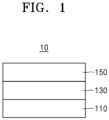
- FIG. 1 is a schematic cross-sectional view of a light-emitting device 10 according to an embodiment.
- the light-emitting device 10 comprises a first electrode 110, an interlayer 130, and a second electrode 150.
- a substrate may be additionally arranged under the first electrode 110 or on the second electrode 150.
- a glass substrate and/or a plastic substrate may be utilized as the substrate.
- the substrate may be a flexible substrate, and may comprise plastics with excellent or suitable heat resistance and durability, such as polyimide, polyethylene terephthalate (PET), polycarbonate, polyethylene naphthalate, polyarylate (PAR), polyetherimide, or any combination thereof.
- the hole transport region may have a multi-layer structure comprising a hole injection layer/hole transport layer structure, a hole injection layer/hole transport layer/emission auxiliary layer structure, a hole injection layer/emission auxiliary layer structure, a hole transport layer/emission auxiliary layer structure, or a hole injection layer/hole transport layer/electron blocking layer structure, wherein constituent layers of each structure are stacked sequentially from the first electrode 110 in the respective stated order.
- each of Formulae 201 and 202 may not comprise (e.g., may exclude) any of the groups represented by Formulae CY201 to CY203, and may comprise at least one of the groups represented by Formulae CY204 to CY217.
- the metal telluride may comprise (e.g., may be) an alkali metal telluride (for example, Li 2 Te, Na 2 Te, K 2 Te, Rb 2 Te, Cs 2 Te, etc.), an alkaline earth metal telluride (for example, BeTe, MgTe, CaTe, SrTe, BaTe, etc.), a transition metal telluride (for example, TiTe 2 , ZrTe 2 , HfTe 2 , V 2 Te 3 , Nb 2 Te 3 , Ta 2 Te 3 , Cr 2 Te 3 , Mo 2 Te 3 , W 2 Te 3 , MnTe, TcTe, ReTe, FeTe, RuTe, OsTe, CoTe, RhTe, IrTe, NiTe, PdTe, PtTe, Cu 2 Te, CuTe, Ag 2 Te, AgTe, Au 2 Te, etc.), a post-transition metal telluride (for example, ZnT
- the emission layer may comprise a host and a dopant (or emitter). In one or more embodiments, the emission layer may further comprise an auxiliary dopant that promotes energy transfer to a dopant (or emitter), in addition to the host and the dopant (or emitter). When the emission layer comprises the dopant (or emitter) and the auxiliary dopant, the dopant (or emitter) and the auxiliary dopant are different from each other.
- the host may comprise a compound represented by Formula 301-1, a compound represented by Formula 301-2, or any combination thereof:
- L 402 may be an organic ligand.
- the emission layer may comprise the transition metal-containing compound represented by Formula 5 described herein, wherein, when the transition metal-containing compound represented by Formula 5 described herein acts as an auxiliary dopant, the emission layer may further comprise a fluorescent dopant.
- Ar 501 in Formula 501 may be a condensed cyclic group (for example, an anthracene group, a chrysene group, a pyrene group, etc.) in which three or more monocyclic groups are condensed together.
- a condensed cyclic group for example, an anthracene group, a chrysene group, a pyrene group, etc.
- the fluorescent dopant and the auxiliary dopant may each comprise at least one of Compounds FD1 to FD36, DPVBi, DPAVBi, or any combination thereof:
- the fluorescent dopant and the auxiliary dopant may each independently comprise the delayed fluorescence compound represented by Formula 1 described herein.
- Electron transport region in interlayer 130 is Electron transport region in interlayer 130
- Ar 601 in Formula 601 may be a substituted or unsubstituted anthracene group.
- xe1 and xe611 to xe613 in Formulae 601 and 601-1 may each independently be 0, 1, or 2.
- the electron transport region may comprise at least one of Compounds ET1 to ET46, 2,9-dimethyl-4,7-diphenyl-1,10-phenanthroline (BCP), 4,7-diphenyl-1,10-phenanthroline (Bphen), Alq 3 , BAIq, TAZ, NTAZ, or any combination thereof:
- a thickness of the electron transport region may be about 100 ⁇ to about 5,000 ⁇ , for example, about 160 ⁇ to about 4,000 ⁇ .
- a thickness of the buffer layer, the hole blocking layer, or the electron control layer may be about 20 ⁇ to about 1,000 ⁇ , for example, about 30 ⁇ to about 300 ⁇
- a thickness of the electron transport layer may be about 100 ⁇ to about 1,000 ⁇ , for example, about 150 ⁇ to about 500 ⁇ .
- the electron transport region (for example, the electron transport layer in the electron transport region) may further comprise, in addition to the materials described above, a metal-containing material.
- the metal-containing material may comprise an alkali metal complex, an alkaline earth metal complex, or any combination thereof.
- the metal ion of the alkali metal complex may be a Li ion, a Na ion, a K ion, a Rb ion, or a Cs ion
- the metal ion of the alkaline earth metal complex may be a Be ion, a Mg ion, a Ca ion, a Sr ion, or a Ba ion.
- a ligand coordinated with the metal ion of the alkali metal complex or the alkaline earth-metal complex may comprise a hydroxyquinoline, a hydroxyisoquinoline, a hydroxybenzoquinoline, a hydroxyacridine, a hydroxyphenanthridine, a hydroxyphenyloxazole, a hydroxyphenylthiazole, a hydroxyphenyloxadiazole, a hydroxyphenylthiadiazole, a hydroxyphenylpyridine, a hydroxyphenylbenzimidazole, a hydroxyphenylbenzothiazole, a bipyridine, a phenanthroline, a cyclopentadiene, or any combination thereof.
- the electron transport region may comprise an electron injection layer that facilitates the injection of electrons from the second electrode 150.
- the electron injection layer may directly contact the second electrode 150.
- the electron injection layer may have i) a single-layer structure consisting of a single layer consisting of a single material, ii) a single-layer structure consisting of a single layer comprising (e.g., consisting of) multiple different materials, or iii) a multi-layer structure comprising multiple layers comprising different materials.
- the electron injection layer may comprise an alkali metal, an alkaline earth metal, a rare earth metal, an alkali metal-containing compound, an alkaline earth metal-containing compound, a rare earth metal-containing compound, an alkali metal complex, an alkaline earth metal complex, a rare earth metal complex, or any combination thereof.
- the alkali metal may comprise Li, Na, K, Rb, Cs, or any combination thereof.
- the alkaline earth metal may comprise Mg, Ca, Sr, Ba, or any combination thereof.
- the rare earth metal may comprise Sc, Y, Ce, Tb, Yb, Gd, or any combination thereof.
- the alkali metal-containing compound, the alkaline earth metal-containing compound, and the rare earth metal-containing compound may be one or more oxides, halides (for example, fluorides, chlorides, bromides, iodides, etc.), and/or tellurides of the alkali metal, the alkaline earth metal, and the rare earth metal, or any combination thereof.
- the alkali metal-containing compound may comprise: an alkali metal oxide, such as Li 2 O, Cs 2 O, and/or K 2 O; an alkali metal halide, such as LiF, NaF, CsF, KF, Lil, Nal, Csl, KI, and/or Rbl; or any combination thereof.
- the alkaline earth metal-containing compound may comprise an alkaline earth metal compound, such as BaO, SrO, CaO, Ba x Sr 1-x O (wherein x is a real number satisfying 0 ⁇ x ⁇ 1), Ba x Ca 1-x O (wherein x is a real number satisfying 0 ⁇ x ⁇ 1), and/or the like.
- the rare earth metal-containing compound may comprise YbF 3 , ScF 3 , Sc 2 O 3 , Y 2 O 3 , Ce 2 O 3 , GdF 3 , TbF 3 , YbI 3 , ScI 3 , Tbls, or any combination thereof.
- the rare earth metal-containing compound may comprise lanthanide metal telluride.
- Examples of the lanthanide metal telluride may comprise (e.g., may be) LaTe, CeTe, PrTe, NdTe, PmTe, SmTe, EuTe, GdTe, TbTe, DyTe, HoTe, ErTe, TmTe, YbTe, LuTe, La 2 Te 3 , Ce 2 Te 3 , Pr 2 Te 3 , Nd 2 Te 3 , Pm 2 Te 3 , Sm 2 Te 3 , Eu 2 Te 3 , Gd 2 Te 3 , Tb 2 Te 3 , Dy 2 Te 3 , Ho 2 Te 3 , Er 2 Te 3 , Tm 2 Te 3 , Yb 2 Te 3 , Lu 2 Te 3 , and/or the like.
- the alkali metal complex, the alkaline earth-metal complex, and the rare earth metal complex may comprise i) one of metal ions of the alkali metal, the alkaline earth metal, and the rare earth metal and ii), as a ligand bonded to the metal ion, for example, a hydroxyquinoline, a hydroxyisoquinoline, a hydroxybenzoquinoline, a hydroxyacridine, a hydroxyphenanthridine, a hydroxyphenyloxazole, a hydroxyphenylthiazole, a hydroxyphenyloxadiazole, a hydroxyphenylthiadiazole, a hydroxyphenylpyridine, a hydroxyphenyl benzimidazole, a hydroxyphenylbenzothiazole, a bipyridine, a phenanthroline, a cyclopentadiene, or any combination thereof.
- the electron injection layer further comprises an organic material
- the alkali metal, the alkaline earth metal, the rare earth metal, the alkali metal-containing compound, the alkaline earth metal-containing compound, the rare earth metal-containing compound, the alkali metal complex, the alkaline earth-metal complex, the rare earth metal complex, or any combination thereof may be uniformly or non-uniformly dispersed in a matrix comprising the organic material.
- a thickness of the electron injection layer may be about 1 ⁇ to about 100 ⁇ , for example, about 3 ⁇ to about 90 ⁇ . When the thickness of the electron injection layer is within the ranges described above, satisfactory electron injection characteristics may be obtained without a substantial increase in driving voltage.
- the second electrode 150 may be arranged on the interlayer 130 having a structure as described above.
- the second electrode 150 may be a cathode, which is an electron injection electrode, and as a material for forming the second electrode 150, a metal, an alloy, an electrically conductive compound, or any combination thereof, each having a low-work function, may be utilized.
- the second electrode 150 may comprise lithium (Li), silver (Ag), magnesium (Mg), aluminum (Al), aluminum-lithium (Al-Li), calcium (Ca), magnesium-indium (Mg-In), magnesium-silver (Mg-Ag), ytterbium (Yb), silver-ytterbium (Ag-Yb), ITO, IZO, or any combination thereof.
- the second electrode 150 may be a transmissive electrode, a semi-transmissive electrode, or a reflective electrode.
- the second electrode 150 may have a single-layer structure or a multi-layer structure comprising multiple layers.
- a first capping layer may be arranged outside the first electrode 110, and/or a second capping layer may be arranged outside the second electrode 150.
- the light-emitting device 10 may have a structure in which the first capping layer, the first electrode 110, the interlayer 130, and the second electrode 150 are sequentially stacked in the stated order, a structure in which the first electrode 110, the interlayer 130, the second electrode 150, and the second capping layer are sequentially stacked in the stated order, or a structure in which the first capping layer, the first electrode 110, the interlayer 130, the second electrode 150, and the second capping layer are sequentially stacked in the stated order.
- Light generated in the emission layer of the interlayer 130 of the light-emitting device 10 may be extracted toward the outside through the first electrode 110 which is a semi-transmissive electrode or a transmissive electrode, and the first capping layer.
- Light generated in the emission layer of the interlayer 130 of the light-emitting device 10 may be extracted toward the outside through the second electrode 150 which is a semi-transmissive electrode or a transmissive electrode, and the second capping layer.
- the first capping layer and the second capping layer may increase external emission efficiency according to the principle of constructive interference. Accordingly, the light extraction efficiency of the light-emitting device 10 may be increased, so that the luminescence efficiency of the light-emitting device 10 may be improved.
- Each of the first capping layer and the second capping layer may comprise a material having a refractive index of greater than or equal to 1.6 (at 589 nm).
- the first capping layer and the second capping layer may each independently be an organic capping layer comprising an organic material, an inorganic capping layer comprising an inorganic material, or an organic-inorganic composite capping layer comprising an organic material and an inorganic material.
- the plurality of color filter areas may comprise a first area emitting a first color light, a second area emitting a second color light, and/or a third area emitting a third color light, wherein the first color light, the second color light, and/or the third color light may have different maximum emission wavelengths.
- the first color light may be red light
- the second color light may be green light
- the third color light may be blue light.
- the plurality of color filter areas (or the plurality of color conversion areas) may comprise quantum dots.
- the first area may comprise a red quantum dot
- the second area may comprise a green quantum dot
- the third area may not comprise (e.g., may exclude) a quantum dot. Details on the quantum dot may be as described herein.
- the first area, the second area, and/or the third area may each further comprise a scatter.
- the light-emitting device may be to emit first light
- the first area may be to absorb the first light to emit first-first color light
- the second area may be to absorb the first light to emit second-first color light
- the third area may be to absorb the first light to emit third-first color light.
- the first-first color light, the second-first color light, and the third-first color light may have different maximum emission wavelengths.
- the first light may be blue light
- the first-first color light may be red light
- the second-first color light may be green light
- the third-first color light may be blue light.
- the electronic apparatus may further comprise a sealing portion for sealing the light-emitting device.
- the sealing portion may be arranged between the color filter and the light-emitting device and/or between the color conversion layer and the light-emitting device.
- the sealing portion allows light from the light-emitting device to be extracted to the outside, and concurrently (e.g., simultaneously) prevents or substantially prevents ambient air and moisture from penetrating into the light-emitting device.
- the sealing portion may be a sealing substrate comprising a transparent glass substrate and/or a plastic substrate.
- the sealing portion may be a thin-film encapsulation layer comprising at least one layer of an organic layer and/or an inorganic layer. When the sealing portion is a thin-film encapsulation layer, the electronic apparatus may be flexible.
- the authentication apparatus may further comprise, in addition to the light-emitting device described above, a biometric information collector.
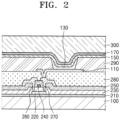
- FIG. 2 is a cross-sectional view of a light-emitting apparatus as an electronic apparatus according to an embodiment.
- the substrate 100 may be a flexible substrate, a glass substrate, or a metal substrate.
- a buffer layer 210 may be arranged on the substrate 100. The buffer layer 210 may prevent or reduce penetration of impurities through the substrate 100 and may provide a flat surface on the substrate 100.
- a TFT may be arranged on the buffer layer 210.
- the TFT may comprise an activation layer 220, a gate electrode 240, a source electrode 260, and a drain electrode 270.
- the activation layer 220 may comprise an inorganic semiconductor such as silicon and/or polysilicon, an organic semiconductor, and/or an oxide semiconductor, and may comprise a source region, a drain region, and a channel region.
- a gate insulating film 230 for insulating the activation layer 220 from the gate electrode 240 may be arranged on the activation layer 220, and the gate electrode 240 may be arranged on the gate insulating film 230.
- An interlayer insulating film 250 may be arranged on the gate electrode 240.
- the interlayer insulating film 250 may be arranged between the gate electrode 240 and the source electrode 260 to insulate the gate electrode 240 from the source electrode 260 and between the gate electrode 240 and the drain electrode 270, to insulate the gate electrode 240 from the drain electrode 270.
- the source electrode 260 and the drain electrode 270 may be arranged on the interlayer insulating film 250.
- the interlayer insulating film 250 and the gate insulating film 230 may be formed to expose the source region and the drain region of the activation layer 220, and the source electrode 260 and the drain electrode 270 may be arranged in contact with the exposed portions of the source region and the drain region of the activation layer 220.
- biphenyl group refers to "a phenyl group substituted with a phenyl group.”
- the "biphenyl group” may be a substituted phenyl group having a C 6 -C 60 aryl group as a substituent.
- a product may be obtained in high yield, and even when the number of moles of reaction of the reactant is increased, the yield of the product may not be reduced at a certain level. Accordingly, the efficiency of a purification process following preparation of a final compound may be increased, so that economic efficiency may be improved and large-scale synthesis may be possible, thus enabling mass production of the heterocyclic compound.
- diameter indicates a particle diameter or an average particle diameter
- the average particle diameter indicates a major axis length or an average major axis length.
- the diameter (or size) of the particles may be measured utilizing a scanning electron microscope or a particle size analyzer.
- the particle size analyzer for example, HORIBA, LA-950 laser particle size analyzer, may be utilized.
- the average particle diameter is referred to as D50.
- the term “substantially,” “about,” and similar terms are used as terms of approximation and not as terms of degree, and are intended to account for the inherent deviations in measured or calculated values that would be recognized by those of ordinary skill in the art.
- “About” or “approximately,” as used herein, is inclusive of the stated value and means within an acceptable range of deviation for the particular value as determined by one of ordinary skill in the art, considering the measurement in question and the error associated with measurement of the particular quantity (i.e., the limitations of the measurement system). For example, “about” may mean within one or more standard deviations, or within ⁇ 30%, 20%, 10%, 5% of the stated value.
- any numerical range recited herein is intended to comprise all sub-ranges of the same numerical precision subsumed within the recited range.
- a range of "1.0 to 10.0" is intended to comprise all subranges between (and comprising) the recited minimum value of 1.0 and the recited maximum value of 10.0, that is, having a minimum value equal to or greater than 1.0 and a maximum value equal to or less than 10.0, such as, for example, 2.4 to 7.6.
- Any maximum numerical limitation recited herein is intended to comprise all lower numerical limitations subsumed therein and any minimum numerical limitation recited in this specification is intended to comprise all higher numerical limitations subsumed therein. Accordingly, Applicant reserves the right to amend this specification, comprising the claims, to expressly recite any sub-range subsumed within the ranges expressly recited herein.
- the computer program instructions are stored in a memory which may be implemented in a computing device using a standard memory device, such as, for example, a random access memory (RAM).
- the computer program instructions may also be stored in other non-transitory computer readable media such as, for example, a CD-ROM, flash drive, or the like.
- a person of skill in the art should recognize that the functionality of various computing devices may be combined or integrated into a single computing device, or the functionality of a particular computing device may be distributed across one or more other computing devices without departing from the scope of the embodiments of the present disclosure.
Landscapes
- Chemical & Material Sciences (AREA)
- Organic Chemistry (AREA)
- Engineering & Computer Science (AREA)
- Materials Engineering (AREA)
- Physics & Mathematics (AREA)
- Spectroscopy & Molecular Physics (AREA)
- Optics & Photonics (AREA)
- Electroluminescent Light Sources (AREA)
Abstract

Description
- This application claims priority to and the benefit of
Korean Patent Application No. 1 0-2023-0003029, filed on January 9, 2023 - One or more embodiments relate to a method of preparing a heterocyclic compound, a heterocyclic compound prepared according to the method, a light-emitting device comprising the heterocyclic compound, and an electronic apparatus and electronic equipment that comprise the light-emitting device.
- From among light-emitting devices, self-emissive devices have relatively wide viewing angles, high contrast ratios, short response times, and/or excellent or suitable characteristics in terms of luminance, driving voltage, and/or response speed.
- In a light-emitting device, a first electrode is arranged on a substrate, and a hole transport region, an emission layer, an electron transport region, and a second electrode are sequentially arranged on the first electrode. Holes provided from the first electrode move toward the emission layer through the hole transport region, and electrons provided from the second electrode move toward the emission layer through the electron transport region. Carriers, such as holes and electrons, recombine in the emission layer to produce excitons. These excitons transition (relax) from an excited state to a ground state to thereby generate light.
- Aspects according to one or more embodiments of the present disclosure are directed toward a method of preparing a heterocyclic compound, a heterocyclic compound prepared according to the method, a light-emitting device comprising the heterocyclic compound, and an electronic apparatus and electronic equipment that comprise the light-emitting device.
- Additional aspects will be set forth in part in the description which follows and, in part, will be apparent from the description, or may be learned by practice of the presented embodiments of the disclosure.
- According to one or more embodiments,
- a method of preparing a heterocyclic compound represented by Formula 1 comprises
- preparing a first reactant,
- preparing a second reactant represented by Formula 2-2, and
- preparing an intermediate compound by mixing the first reactant and the second reactant with a copper catalyst, a base, and optionally, an auxiliary solvent, to allow the first reactant and the second reactant to react,
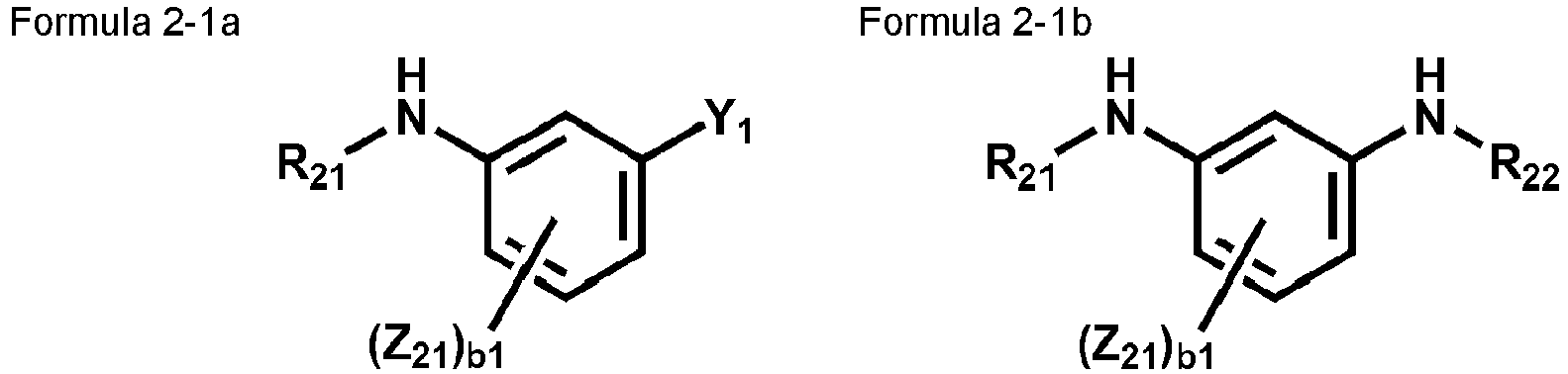
- wherein the first reactant is represented by Formula 2-1a, and the intermediate compound is represented by Formula 2-3a, or
- the first reactant is represented by Formula 2-1b, and the intermediate compound is represented by Formula 2-3b:



- wherein, in Formula 1,
- X1 may be N(R11), O, S, or Se,
- R1 to R4 and R11 may each independently be hydrogen, deuterium, -F, -Cl, -Br, -I, a hydroxyl group, a cyano group, a nitro group, a C1-C60 alkyl group unsubstituted or substituted with at least one R10a, a C2-C60 alkenyl group unsubstituted or substituted with at least one R10a, a C2-C60 alkynyl group unsubstituted or substituted with at least one R10a, a C1-C60 alkoxy group unsubstituted or substituted with at least one R10a, a C3-C60 carbocyclic group unsubstituted or substituted with at least one R10a, a C1-C60 heterocyclic group unsubstituted or substituted with at least one R10a, a C6-C60 aryloxy group unsubstituted or substituted with at least one R10a, a C6-C60 arylthio group unsubstituted or substituted with at least one R10a, -Si(Q1)(Q2)(Q3), -B(Q1)(Q2), -C(=O)(Q1), -S(=O)2(Q1), or -P(=O)(Q1)(Q2),
- a1 may be an integer from 1 to 3, and
- a2 and a3 may each independently be an integer from 1 to 4,
- wherein, in Formulae 2-1a, 2-1b, 2-2, 2-3a, and 2-3b,
- Y1 and Y2 may each independently be -F, -Cl, -Br, or -I,
- R21, R22, and Z21 to Z23 may each independently be hydrogen, deuterium, -F, -Cl, -Br, -I, a hydroxyl group, a cyano group, a nitro group, a C1-C60 alkyl group unsubstituted or substituted with at least one R10a, a C2-C60 alkenyl group unsubstituted or substituted with at least one R10a, a C2-C60 alkynyl group unsubstituted or substituted with at least one R10a, a C1-C60 alkoxy group unsubstituted or substituted with at least one R10a, a C3-C60 carbocyclic group unsubstituted or substituted with at least one R10a, a C1-C60 heterocyclic group unsubstituted or substituted with at least one R10a, a C6-C60 aryloxy group unsubstituted or substituted with at least one R10a, a C6-C60 arylthio group unsubstituted or substituted with at least one R10a, -Si(Q1)(Q2)(Q3), -B(Q1)(Q2), -C(=O)(Q1), -S(=O)2(Q1), or-P(=O)(Q1)(Q2),
- b1 may be an integer from 1 to 4,
- b2 and b3 may each independently be an integer from 1 to 5,
- two or more adjacent groups selected from R1 to R4, R11, R21, R22, and Z21 to Z23 may optionally be bonded to each other to form a C5-C30 carbocyclic group unsubstituted or substituted with at least one R10a or a C2-C30 heterocyclic group unsubstituted or substituted with at least one R10a,
- R10a may be
- deuterium, -F, -Cl, -Br, -I, a hydroxyl group, a cyano group, or a nitro group,
- a C1-C60 alkyl group, a C2-C60 alkenyl group, a C2-C60 alkynyl group, or a C1-C60 alkoxy group, each unsubstituted or substituted with deuterium, -F, -Cl, -Br, -I, a hydroxyl group, a cyano group, a nitro group, a C3-C60 carbocyclic group, a C1-C60 heterocyclic group, a C6-C60 aryloxy group, a C6-C60 arylthio group, -Si(Q11)(Q12)(Q13), -B(Q11)(Q12), -C(=O)(Q11), -S(=O)2(Q11), -P(=O)(Q11)(Q12), or any combination thereof,
- a C3-C60 carbocyclic group, a C1-C60 heterocyclic group, a C6-C60 aryloxy group, or a C6-C60 arylthio group, each unsubstituted or substituted with deuterium, -F, -Cl, -Br, -I, a hydroxyl group, a cyano group, a nitro group, a C1-C60 alkyl group, a C2-C60 alkenyl group, a C2-C60 alkynyl group, a C1-C60 alkoxy group, a C3-C60 carbocyclic group, a C1-C60 heterocyclic group, a C6-C60 aryloxy group, a C6-C60 arylthio group, -Si(Q21)(Q22)(Q23), -B(Q21)(Q22), -C(=O)(Q21), -S(-O)2(Q21), -P(=O)(Q21)(Q22), or any combination thereof, or
- -Si(Q31)(Q32)(Q33), -B(Q31)(Q32), -C(=O)(Q31), -S(=O)2(Q31), or -P(=O)(Q31)(Q32), and
- Q1 to Q3, Q11 to Q13, Q21 to Q23, and Q31 to Q33 may each independently be hydrogen, deuterium, -F, -Cl, -Br, -I, a hydroxyl group, a cyano group, a nitro group, a C1-C60 alkyl group, a C2-C60 alkenyl group, a C2-C60 alkynyl group, a C1-C60 alkoxy group, or a C3-C60 carbocyclic group or a C1-C60 heterocyclic group, each unsubstituted or substituted with deuterium, -F, a cyano group, a C1-C60 alkyl group, a C1-C60 alkoxy group, a C3-C60 carbocyclic group, a C1-C60 heterocyclic group, or any combination thereof.
- According to one or more embodiments,
- a method of preparing a heterocyclic compound represented by Formula 1 comprises
- reacting an intermediate compound represented by Formula 2-3a or 2-3b or a derivative thereof with a boron halide.
- In an embodiment, at least one of R1 to R3 in
Formula 1 is a group represented by Formula 1-1, and the group represented by Formula 1-1 is introduced into the heterocyclic compound after the reacting of the intermediate compound or a derivative thereof with the boron halide:


- wherein, in Formulae 1 and 1-1,
- X1 may be N(R11), O, S, or Se,
- CY1 may be a C5-C30 carbocyclic group or a C1-C30 heterocyclic group,
- R1 to R4, R11, and R6 may each independently be hydrogen, deuterium, -F, -Cl, -Br, -I, a hydroxyl group, a cyano group, a nitro group, a C1-C60 alkyl group unsubstituted or substituted with at least one R10a, a C2-C60 alkenyl group unsubstituted or substituted with at least one R10a, a C2-C60 alkynyl group unsubstituted or substituted with at least one R10a, a C1-C60 alkoxy group unsubstituted or substituted with at least one R10a, a C3-C60 carbocyclic group unsubstituted or substituted with at least one R10a, a C1-C60 heterocyclic group unsubstituted or substituted with at least one R10a, a C6-C60 aryloxy group unsubstituted or substituted with at least one R10a, a C6-C60 arylthio group unsubstituted or substituted with at least one R10a, -Si(Q1)(Q2)(Q3), -B(Q1)(Q2), -C(=O)(Q1), -S(=O)2(Q1), or-P(=O)(Q1)(Q2),
- a1 may be an integer from 1 to 3,
- a2 and a3 may each independently be an integer from 1 to 4,
- a6 may be an integer from 1 to 10, and
- * indicates a binding site to a neighboring atom,
- wherein, in Formulae 2-3a and 2-3b,
- Y1 and Y2 may each independently be -F, -Cl, -Br, or -I,
- R21, R22, and Z21 to Z23 may each independently be hydrogen, deuterium, -F, -Cl, -Br, -I, a hydroxyl group, a cyano group, a nitro group, a C1-C60 alkyl group unsubstituted or substituted with at least one R10a, a C2-C60 alkenyl group unsubstituted or substituted with at least one R10a, a C2-C60 alkynyl group unsubstituted or substituted with at least one R10a, a C1-C60 alkoxy group unsubstituted or substituted with at least one R10a, a C3-C60 carbocyclic group unsubstituted or substituted with at least one R10a, a C1-C60 heterocyclic group unsubstituted or substituted with at least one R10a, a C6-C60 aryloxy group unsubstituted or substituted with at least one R10a, a C6-C60 arylthio group unsubstituted or substituted with at least one R10a, -Si(Q1)(Q2)(Q3), -B(Q1)(Q2), -C(=O)(Q1), -S(=O)2(Q1), or-P(=O)(Q1)(Q2),
- b1 may be an integer from 1 to 4,
- b2 and b3 may each independently be an integer from 1 to 5,
- two or more groups of R1 to R4, R11, R6, R21, R22, and Z21 to Z23 may optionally be bonded to each other to form a C5-C30 carbocyclic group unsubstituted or substituted with at least one R10a or a C2-C30 heterocyclic group unsubstituted or substituted with at least one R10a,
- R10a may be
- deuterium, -F, -Cl, -Br, -I, a hydroxyl group, a cyano group, or a nitro group,
- a C1-C60 alkyl group, a C2-C60 alkenyl group, a C2-C60 alkynyl group, or a C1-C60 alkoxy group, each unsubstituted or substituted with deuterium, -F, -Cl, -Br, -I, a hydroxyl group, a cyano group, a nitro group, a C3-C60 carbocyclic group, a C1-C60 heterocyclic group, a C6-C60 aryloxy group, a C6-C60 arylthio group, -Si(Q11)(Q12)(Q13), -B(Q11)(Q12), -C(=O)(Q11), -S(=O)2(Q11), -P(=O)(Q11)(Q12), or any combination thereof,
- a C3-C60 carbocyclic group, a C1-C60 heterocyclic group, a C6-C60 aryloxy group, or a C6-C60 arylthio group, each unsubstituted or substituted with deuterium, -F, -Cl, -Br, -I, a hydroxyl group, a cyano group, a nitro group, a C1-C60 alkyl group, a C2-C60 alkenyl group, a C2-C60 alkynyl group, a C1-C60 alkoxy group, a C3-C60 carbocyclic group, a C1-C60 heterocyclic group, a C6-C60 aryloxy group, a C6-C60 arylthio group, -Si(Q21)(Q22)(Q23), -B(Q21)(Q22), -C(=O)(Q21), -S(=O)2(Q21), -P(=O)(Q21)(Q22), or any combination thereof, or
- -Si(Q31)(Q32)(Q33), -B(Q31)(Q32), -C(=O)(Q31), -S(=O)2(Q31), or -P(=O)(Q31)(Q32), and
- Q1 to Q3, Q11 to Q13, Q21 to Q23, and Q31 to Q33 may each independently be hydrogen, deuterium, -F, -Cl, -Br, -I, a hydroxyl group, a cyano group, a nitro group, a C1-C60 alkyl group, a C2-C60 alkenyl group, a C2-C60 alkynyl group, a C1-C60 alkoxy group, or a C3-C60 carbocyclic group or a C1-C60 heterocyclic group, each unsubstituted or substituted with deuterium, -F, a cyano group, a C1-C60 alkyl group, a C1-C60 alkoxy group, a C3-C60 carbocyclic group, a C1-C60 heterocyclic group, or any combination thereof.
- According to one or more embodiments,
- a heterocyclic compound is represented by
Formula 1, the heterocyclic compound being prepared according to the method:
- wherein, in
Formula 1, - X1 may be N(R11), O, S, or Se,
- R1 to R4 and R11 may each independently be hydrogen, deuterium, -F, -Cl, -Br, -I, a hydroxyl group, a cyano group, a nitro group, a C1-C60 alkyl group unsubstituted or substituted with at least one R10a, a C2-C60 alkenyl group unsubstituted or substituted with at least one R10a, a C2-C60 alkynyl group unsubstituted or substituted with at least one R10a, a C1-C60 alkoxy group unsubstituted or substituted with at least one R10a, a C3-C60 carbocyclic group unsubstituted or substituted with at least one R10a, a C1-C60 heterocyclic group unsubstituted or substituted with at least one R10a, a C6-C60 aryloxy group unsubstituted or substituted with at least one R10a, a C6-C60 arylthio group unsubstituted or substituted with at least one R10a, -Si(Q1)(Q2)(Q3), -B(Q1)(Q2), -C(=O)(Q1), -S(=O)2(Q1), or -P(=O)(Q1)(Q2),
- a1 may be an integer from 1 to 3,
- a2 and a3 may each independently be an integer from 1 to 4,
- two or more adjacent groups selected from R1 to R4 and R11 may optionally be bonded to each other to form a C5-C30 carbocyclic group unsubstituted or substituted with at least one R10a or a C2-C30 heterocyclic group unsubstituted or substituted with at least one R10a,
- R10a may be
- deuterium, -F, -Cl, -Br, -I, a hydroxyl group, a cyano group, or a nitro group,
- a C1-C60 alkyl group, a C2-C60 alkenyl group, a C2-C60 alkynyl group, or a C1-C60 alkoxy group, each unsubstituted or substituted with deuterium, -F, -Cl, -Br, -I, a hydroxyl group, a cyano group, a nitro group, a C3-C60 carbocyclic group, a C1-C60 heterocyclic group, a C6-C60 aryloxy group, a C6-C60 arylthio group, -Si(Q11)(Q12)(Q13), -B(Q11)(Q12), -C(=O)(Q11), -S(=O)2(Q11), -P(=O)(Q11)(Q12), or any combination thereof,
- a C3-C60 carbocyclic group, a C1-C60 heterocyclic group, a C6-C60 aryloxy group, or a C6-C60 arylthio group, each unsubstituted or substituted with deuterium, -F, -Cl, -Br, -I, a hydroxyl group, a cyano group, a nitro group, a C1-C60 alkyl group, a C2-C60 alkenyl group, a C2-C60 alkynyl group, a C1-C60 alkoxy group, a C3-C60 carbocyclic group, a C1-C60 heterocyclic group, a C6-C60 aryloxy group, a C6-C60 arylthio group, -Si(Q21)(Q22)(Q23), -B(Q21)(Q22), -C(=O)(Q21), -S(=O)2(Q21), -P(=O)(Q21)(Q22), or any combination thereof, or
- -Si(Q31)(Q32)(Q33), -B(Q31)(Q32), -C(=O)(Q31), -S(=O)2(Q31), or -P(=O)(Q31)(Q32), and
- Q1 to Q3, Q11 to Q13, Q21 to Q23, and Q31 to Q33 may each independently be hydrogen, deuterium, -F, -Cl, -Br, -I, a hydroxyl group, a cyano group, a nitro group, a C1-C60 alkyl group, a C2-C60 alkenyl group, a C2-C60 alkynyl group, a C1-C60 alkoxy group, or a C3-C60 carbocyclic group or a C1-C60 heterocyclic group, each unsubstituted or substituted with deuterium, -F, a cyano group, a C1-C60 alkyl group, a C1-C60 alkoxy group, a C3-C60 carbocyclic group, a C1-C60 heterocyclic group, or any combination thereof.
- According to one or more embodiments, a light-emitting device comprises
- a first electrode,
- a second electrode facing the first electrode,
- an interlayer arranged between the first electrode and the second electrode and comprising an emission layer, and
- the heterocyclic compound.
- According to one or more embodiments, an electronic apparatus comprises the light-emitting device.
- According to one or more embodiments, an electronic equipment comprises the light-emitting device.
- The above and other aspects, features, and enhancements of certain embodiments of the disclosure will be more apparent from the following description taken in conjunction with the accompanying drawings, in which:
-
FIG. 1 is a schematic view of a light-emitting device according to an embodiment; -
FIG. 2 is a schematic view of an electronic apparatus according to an embodiment; -
FIG. 3 is a schematic view of an electronic apparatus according to another embodiment; and -
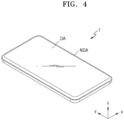
FIG. 4 is a schematic view of an electronic equipment according to an embodiment. -
FIG. 5 is a schematic view of an electronic equipment according to an embodiment. -
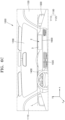
FIG. 6A is a schematic view of an electronic equipment according to an embodiment. -
FIG. 6B is a schematic view of an electronic equipment according to an embodiment. -
FIG. 6C is a schematic view of an electronic equipment according to an embodiment. - Reference will now be made in more detail to embodiments, examples of which are illustrated in the accompanying drawings, wherein like reference numerals refer to like elements throughout, and duplicative descriptions thereof may not be provided. In this regard, the present embodiments may have different forms and should not be construed as being limited to the descriptions set forth herein. Accordingly, the embodiments are merely described below, by referring to the drawings, to explain aspects of the present description. As used herein, the term "and/or" comprises any and all combinations of one or more of the associated listed items. Throughout the disclosure, the expression "at least one of a, b or c", "at least one selected from a, b, and c", "at least one selected from the group consisting of a, b, and c", "at least one from among a, b, and c", "at least one of a to c", etc., indicates only a, only b, only c, both (e.g., simultaneously) a and b, both (e.g., simultaneously) a and c, both (e.g., simultaneously) band c, all of a, b, and c, or variations thereof.
- According to one or more embodiments of the present disclosure,
- a method of preparing a heterocyclic compound represented by
Formula 1 comprises: - preparing a first reactant;
- preparing a second reactant represented by Formula 2-2; and
- preparing an intermediate compound by mixing the first reactant and the second reactant with: i) a copper catalyst; ii) a base; and optionally, iii) an auxiliary solvent, to allow the first reactant and the second reactant to react,
- wherein the first reactant may be a compound represented by Formula 2-1a, and the intermediate compound may be a compound represented by Formula 2-3a, or
- the first reactant may be a compound represented by Formula 2-1b, and the intermediate compound may be a compound represented by Formula 2-3b:


- Details of
Formulae 1, 2-1a, 2-1b, 2-2, 2-3a, and 2-3b may be as described herein. - In an embodiment, the second reactant may be utilized as a solvent.
- In an embodiment, the second reactant may be iodobenzene, bromobenzene, 1-iodobenzene-2,3,4,5,6-D5, 1-bromobenzene-2,3,4,5,6-Ds, 1-bromo-4-(tert-butyl)benzene, 1-iodo-4-(tert-butyl)benzene, 1-bromo-3,5-di-tert-butylbenzene, 1-iodo-3,5-di-tert-butylbenzene, 1-chloro-3-iodobenzene, 1-bromo-3-iodobenzene, 1-fluoro-3-iodobenzene, 1-fluoro-4-iodobenzene, 1-bromo-3-fluorobenzene, 1-bromo-4-fluorobenzene, 1-chloro-3-iodobenzene, 1-bromo-3-chlorobenzene, 1-chloro-4-iodobenzene, 1-bromo-4-iodobenzene, 1-chloro-4-iodobenzene, 1-bromo-4-chlorobenzene, 1-chloro-3-iodobenzene-2,4,5,6-D4, 1-bromo-3-iodobenzene-2,4,5,6-D4, 1-chloro-4-iodobenzene-2,3,5,6-D4, 1-bromo-4-iodobenzene-2,3,5,6-D4, 4-iodo-1,1'-biphenyl, or 4-bromo-1,1'-biphenyl.
- In an embodiment, the copper catalyst may be metal copper, CuCI, CuBr, CuI, CuCl2, CuBr2, Culz, CuO, or CuS.
- In an embodiment, the copper catalyst may be CuI.
- In an embodiment, the base may be K2CO3, Na2CO3, Cs2CO3, K3PO4, KOH, or NaOtBu.
- In an embodiment, the auxiliary solvent may be o-dichlorobenzene, chlorobenzene, toluene, 1,2,4-trimethylbenzene, xylene, diphenyl ether, anisole, cyclopentylmethyl ether, dioxane, trichlorotoluene, dimethylformamide (DMF), or dimethyl sulfoxide (DMSO).
- In an embodiment, in the preparing of the intermediate compound, the number of moles of the second reactant may be 5 times or more, 6 times or more, 7 times or more, 8 times or more, 9 times or more, or 10 times or more the number of moles of the first reactant. That is, in the preparing of the intermediate compound, a molar ratio between the second reactant and the first reactant (second reactant: first reactant) may be 5 or more, 6 or more, 7 or more, 8 or more, 9 or more, or 10 or more.
- For example, in the preparing of the intermediate compound, the number of moles of the second reactant may be about 5 times to about 30 times, about 6 times to about 30 times, about 7 times to about 30 times, about 8 times to about 30 times, about 9 times to about 30 times, about 5 times to about 25 times, about 6 times to about 25 times, about 7 times to about 25 times, about 8 times to about 25 times, about 9 times to about 25 times, about 5 times to about 20 times, about 6 times to about 20 times, about 7 times to about 20 times, about 8 times to about 20 times, about 9 times to about 20 times, about 5 times to about 18 times, about 6 times to about 18 times, about 7 times to about 18 times, about 8 times to about 18 times, about 9 times to about 18 times, about 5 times to about 16 times, about 6 times to about 16 times, about 7 times to about 16 times, about 8 times to about 16 times, or about 9 times to about 16 times the number of moles of the first reactant. For example, a molar ratio between the second reactant and the first reactant may be 5 to 30.
- In an embodiment, in the preparing of the intermediate compound, the number of moles of the copper(I) catalyst may be about 1 times to about 3 times the number of moles of the first reactant. That is, in the preparing of the intermediate compound, a molar ratio between the copper(I) catalyst and the first reactant (copper(I) catalyst: first reactant) may be about 1 to about 3.
- In an embodiment, in the preparing of the intermediate compound, the number of molecules (e.g., number of moles) of the base may be about 5 times to about 15 times the number of molecules (e.g., number of moles) of the first reactant. That is, in the preparing of the intermediate compound, a molar ratio between the base and the first reactant (base : first reactant) may be about 5 to about 15.
- In an embodiment, the preparing of the intermediate compound may be performed at a temperature of about 170 °C to about 210 °C, about 175 °C to about 210 °C, about 180 °C to about 210 °C, about 170 °C to about 205 °C, about 175 °C to about 205 °C, about 180 °C to about 205 °C, about 170 °C to about 200 °C, about 175 °C to about 200 °C, or about 180 °C to about 200 °C.
- In an embodiment, at the temperature of about 170 °C to about 210 °C, about 175 °C to about 210 °C, about 180 °C to about 210 °C, about 170 °C to about 205 °C, about 175 °C to about 205 °C, about 180 °C to about 205 °C, about 170 °C to about 200 °C, about 175 °C to about 200 °C, or about 180 °C to about 200 °C, the second reactant may be in a liquid state, or a mixture of the second reactant and the auxiliary solvent may be in a liquid state.
- In an embodiment, in the mixture of the second reactant and the auxiliary solvent, a volume of the auxiliary solvent may be less than or equal to a volume of the second reactant.
- In an embodiment, the preparing of the intermediate compound may be performed for about 100 hours to about 140 hours, about 105 hours to about 140 hours, about 110 hours to about 140 hours, about 100 hours to about 135 hours, about 105 hours to about 135 hours, about 110 hours to about 135 hours, about 100 hours to about 130 hours, about 105 hours to about 130 hours, or about 110 hours to about 130 hours.
- In an embodiment, in the preparing of the intermediate compound, the first reactant may be added in an amount of 60 mmol or more, 70 mmol or more, 80 mmol or more, 90 mmol or more, 100 mmol or more, 120 mmol or more, 150 mmol or more, or 200 mmol or more.
- For example, in the preparing of the intermediate compound, the first reactant may be added in an amount of about 60 mmol to about 1,000 mmol, about 70 mmol to about 1,000 mmol, about 80 mmol to about 1,000 mmol, about 90 mmol to about 1,000 mmol, about 100 mmol to about 1,000 mmol, about 120 mmol to about 1,000 mmol, about 150 mmol to about 1,000 mmol, about 200 mmol to about 1,000 mmol, about 60 mmol to about 700 mmol, about 70 mmol to about 700 mmol, about 80 mmol to about 700 mmol, about 90 mmol to about 700 mmol, about 100 mmol to about 700 mmol, about 120 mmol to about 700 mmol, about 150 mmol to about 700 mmol, about 200 mmol to about 700 mmol, about 60 mmol to about 500 mmol, about 70 mmol to about 500 mmol, about 80 mmol to about 500 mmol, about 90 mmol to about 500 mmol, about 100 mmol to about 500 mmol, about 120 mmol to about 500 mmol, about 150 mmol to about 500 mmol, about 200 mmol to about 500 mmol, about 60 mmol to about 400 mmol, about 70 mmol to about 400 mmol, about 80 mmol to about 400 mmol, about 90 mmol to about 400 mmol, about 100 mmol to about 400 mmol, about 120 mmol to about 400 mmol, about 150 mmol to about 400 mmol, about 200 mmol to about 400 mmol, about 60 mmol to about 300 mmol, about 70 mmol to about 300 mmol, about 80 mmol to about 300 mmol, about 90 mmol to about 300 mmol, about 100 mmol to about 300 mmol, about 120 mmol to about 300 mmol, about 150 mmol to about 300 mmol, or about 200 mmol to about 300 mmol.
- In an embodiment, a yield of the intermediate compound may be 40 % or more, 50 % or more, 60 % or more, 70 % or more, or 80 % or more based on the number of moles of the first reactant (e.g., before the reaction started). The yield of the intermediate compound may be measured based on, for example, when the first reactant is added in an amount of about 20 mmol, about 40 mmol, about 60 mmol, about 80 mmol, about 100 mmol, or about 200 mmol.
- For example, the yield of the intermediate compound may be about 40 % to about 100 %, about 50 % to about 100 %, about 60 % to about 100 %, about 70 % to about 100 %, about 80 % to about 100 %, about 40 % to about 99 %, about 50 % to about 99 %, about 60 % to about 99 %, about 70 % to about 99 %, about 80 % to about 99 %, about 40 % to about 95 %, about 50 % to about 95 %, about % 60 to about 95 %, about 70 % to about 95 %, about 80 % to about 95 %, about 40 % to about 90 %, about 50 % to about 90 %, about 60 % to about 90 %, about 70 % to about 90 %, or about 80 % to about 90 %, based on the number of moles of the first reactant.
- In an embodiment, when the first reactant is added in an amount of about 100 mmol, the yield of the intermediate compound may be 40 % or more, 50 % or more, 60 % or more, 70 % or more, or 80 % or more, based on the number of moles of the first reactant.
- For example, when the first reactant is added in the amount of 100 mmol, the yield of the intermediate compound may be about 40 % to about 100 %, about 50 % to about 100 %, about 60 % to about 100 %, about 70 % to about 100 %, about 80 % to about 100 %, about 40 % to about 99 %, about 50 % to about 99 %, about 60 % to about 99 %, about 70 % to about 99 %, about 80 % to about 99 %, about 40 % to about 95 %, about 50 % to about 95 %, about 60 % to about 95 %, about 70 % to about 95 %, about 80 % to about 95 %, about 40 % to about 90 %, about 50 % to about 90 %, about 60 % to about 90 %, about 70 % to about 90 %, or about 80 % to about 90 %, based on the number of moles of the first reactant.
- In an embodiment, at least one of R21 or R22 may be a group represented by Formula 3:

- Details of
Formula 3 may be as described herein. - In an embodiment, the group represented by
Formula 3 may cause steric hindrance. - In an embodiment, at least one of R31 or R32 may be a C3-C60 carbocyclic group unsubstituted or substituted with at least one R10a, a C1-C60 heterocyclic group unsubstituted or substituted with at least one R10a, a C6-C60 aryloxy group unsubstituted or substituted with at least one R10a, a C6-C60 arylthio group unsubstituted or substituted with at least one R10a, or -Si(Q1)(Q2)(Q3).
- R10a may be as defined herein.
- In an embodiment, the method of preparing a heterocyclic compound may further comprise reacting the intermediate compound or a derivative thereof with a boron halide. Due to the reaction, for example, a compound represented by Formula 2-4 may be obtained:

- Details of Formula 2-4 may be as described herein.
- In an embodiment, the boron halide may be BI3 or BBr3.
- In an embodiment, when at least one of R1 to R3 in
Formula 1 is a group represented by Formula 1-1, the group represented by Formula 1-1 may be introduced into the heterocyclic compound after the reacting of the intermediate compound or a derivative thereof with the boron halide:
- Details of Formula 1-1 may be as described herein.
- In preparing a heterocyclic compound comprising boron (for example, the heterocyclic compound represented by Formula 1), in a method of the related art (for example, a process utilizing a Pd catalyst), when a substituent with large steric hindrance is present in a reactant (for example, when at least one of R21 or R22 in Formula 2-1a or 2-1b is a group represented by Formula 3), a reaction may not proceed or by-products may be produced, resulting in a significantly reduced yield, and the yield may converge to about 0 during large-scale synthesis. In contrast, according to the method of preparing a heterocyclic compound described above, even when a reactant comprises a substituent with large steric hindrance, a product may be obtained with high yield, and even when the number of moles of the reactant is increased, the yield of the product may not be reduced below a certain level. For example, according to the method of preparing a heterocyclic compound described above, the efficiency of a purification process following preparation of a final compound may be increased, so that economic efficiency may be improved and large-scale synthesis may be possible, thus enabling mass production of the heterocyclic compound.
- According to one or more embodiments of the present disclosure,
a method of preparing a heterocyclic compound represented byFormula 1 comprises: - reacting an intermediate compound represented by Formula 2-3a or 2-3b or a derivative thereof with a boron halide,
- wherein, at least one of R1 to R3 in
Formula 1 is a group represented by Formula 1-1, and the group represented by Formula 1-1 may be introduced into the heterocyclic compound after the reacting of the intermediate compound or a derivative thereof with the boron halide:


- Details of
Formulae 1, 1-1, 2-3a, and 2-3b may be as described herein. - In an embodiment, due to the reacting of the intermediate compound or a derivative thereof with the boron halide, for example, a compound represented by Formula 2-4 may be obtained:

- Details of Formula 2-4 may be as described herein.
- In an embodiment, the boron halide may be BI3 or BBr3.
- In an embodiment, Z21 to Z23 in Formulae 2-3a and 2-3b may not each be a group represented by Formula 1-1.
- In an embodiment,
the method of preparing a heterocyclic compound may comprise: - obtaining a secondary intermediate compound represented by Formula 2-4 by reacting the intermediate compound or a derivative thereof with a boron halide; and
- introducing the group represented by Formula 1-1 into at least one of Z21 to Z23 in the secondary intermediate compound.
- In preparing a heterocyclic compound comprising boron (for example, the heterocyclic compound represented by Formula 1), when a substituent bonded to the heterocyclic compound through N is present in a final product (e.g., final synthesized product) (for example, when at least one of R1 to R3 in
Formula 1 is a group represented by Formula 1-1), and when the substituent is introduced prior to boron (e.g., prior to adding boron to the reaction product), a reaction may not proceed or by-products may be produced, resulting in a significant decrease in the yield of the final product. However, according to the method of preparing a heterocyclic compound described above, because the substituent is introduced into the heterocyclic compound after boron has been introduced (e.g., boron has been added prior to the substituent), a reaction may proceed easily and production of by-products may be suppressed or reduced, so that the yield of the final product may be improved. - According to one or more embodiments of the present disclosure, a heterocyclic compound is represented by
Formula 1, the heterocyclic compound being prepared according to the method of preparing a heterocyclic compound:
- Details of
Formula 1 may be as described herein. - In an embodiment, the heterocyclic compound may be to emit thermally activated delayed fluorescence (TADF).
- In an embodiment, a difference between a triplet energy level (eV) of the heterocyclic compound and a singlet energy level (eV) of the heterocyclic compound may be greater than or equal to 0 eV and less than or equal to 0.5 eV (or, greater than or equal to 0 eV and less than or equal to 0.3 eV).
- According to one or more embodiments of the present disclosure, a light-emitting device comprises:
- a first electrode;
- a second electrode facing the first electrode;
- an interlayer arranged between the first electrode and the second electrode and comprising an emission layer; and
- the heterocyclic compound.
- In an embodiment,
- the first electrode of the light-emitting device may be an anode,
- the second electrode of the light-emitting device may be a cathode,
- the interlayer may further comprise a hole transport region arranged between the first electrode and the emission layer and an electron transport region arranged between the emission layer and the second electrode,
- the hole transport region may comprise a hole injection layer, a hole transport layer, an emission auxiliary layer, an electron blocking layer, or any combination thereof, and
- the electron transport region may comprise a hole blocking layer, an electron transport layer, an electron injection layer, or any combination thereof.
- In an embodiment, the emission layer of the light-emitting device may comprise a dopant and a host.
- In an embodiment, the electron transport region of the light-emitting device may comprise a hole blocking layer, and the hole blocking layer may comprise a phosphine oxide-containing compound, a silicon-containing compound, or any combination thereof. For example, the hole blocking layer may directly contact the emission layer.
- In an embodiment, the heterocyclic compound may be comprised in the interlayer.
- In an embodiment, the heterocyclic compound may be comprised in the emission layer (e.g., as a first compound).
- In an embodiment, the emission layer may further comprise: i) a transition metal-containing compound (e.g., as a second compound); ii) a third compound comprising at least one π electron-deficient nitrogen-containing C1-C60 heterocyclic group; iii) a fourth compound comprising a group represented by Formula 4; iv) or any combination thereof, and
the transition metal-containing compound, the third compound, and the fourth compound may be different from each other:
- Details of Formula 4 may be as described herein.
- In an embodiment, the transition metal-containing compound may be a compound represented by Formula 5:

- Details of Formula 5 may be as described herein.
- In an embodiment, the heterocyclic compound may comprise at least one deuterium (D).
- In one or more embodiments, the transition metal-containing compound, the third compound, or the fourth compound may comprise at least one deuterium.
- In one or more embodiments, the light-emitting device may comprise the heterocyclic compound, a transition metal-containing compound, a third compound, and a fourth compound, and at least one of the third compound or the fourth compound may comprise at least one deuterium, at least one silicon, or any combination thereof.
- In an embodiment, the light-emitting device (for example, the emission layer in the light-emitting device) may further comprise, in addition to the heterocyclic compound, a transition metal-containing compound. At least one of the heterocyclic compound or the transition metal-containing compound may comprise at least one deuterium. For example, the light-emitting device (for example, the emission layer in the light-emitting device) may further comprise, in addition to the heterocyclic compound and the transition metal-containing compound, a third compound, a fourth compound, or any combination thereof.
- In one or more embodiments, the light-emitting device (for example, the emission layer in the light-emitting device) may further comprise, in addition to the heterocyclic compound, a third compound. At least one of the heterocyclic compound or the third compound may comprise at least one deuterium. For example, the light-emitting device (for example, the emission layer in the light-emitting device) may further comprise, in addition to the heterocyclic compound and the third compound, a transition metal-containing compound, a fourth compound, or any combination thereof.
- In one or more embodiments, the light-emitting device (for example, the emission layer in the light-emitting device) may further comprise, in addition to the heterocyclic compound, a fourth compound. At least one of the heterocyclic compound or the fourth compound may comprise at least one deuterium. For example, the light-emitting device (for example, the emission layer in the light-emitting device) may further comprise, in addition to the heterocyclic compound and the fourth compound, a transition metal-containing compound, a third compound, or any combination thereof.
- In one or more embodiments, the light-emitting device (for example, the emission layer in the light-emitting device) may further comprise, in addition to the heterocyclic compound, a third compound and a fourth compound. The third compound and the fourth compound may form an exciplex. At least one of the heterocyclic compound, the third compound, or the fourth compound may comprise at least one deuterium.
- In one or more embodiments, the emission layer of the light-emitting device may comprise: i) the heterocyclic compound; and ii) the transition metal-containing compound, the third compound, the fourth compound, or any combination thereof, and the emission layer may be to emit blue light.
- In one or more embodiments, a maximum emission wavelength of the blue light may be about 430 nm to about 475 nm, about 440 nm to about 475 nm, about 450 nm to about 475 nm, about 430 nm to about 470 nm, about 440 nm to about 470 nm, about 450 nm to about 470 nm, about 430 nm to about 465 nm, about 440 nm to about 465 nm, about 450 nm to about 465 nm, about 430 nm to about 460 nm, about 440 nm to about 460 nm, or about 450 nm to about 460 nm.
- For example, the third compound may comprise a pyridine group, a pyrimidine group, a pyrazine group, a pyridazine group, a triazine group, or any combination thereof.
- In an embodiment, the fourth compound may not comprise (e.g., may exclude) the following compounds:

- In an embodiment, the third compound may comprise a compound represented by Formula 6:

- Details of Formula 6 may be as described herein.
- In one or more embodiments, the fourth compound may comprise a compound represented by Formula 4-1, a compound represented by Formula 4-2, a compound represented by Formula 4-3, a compound represented by Formula 4-4, a compound represented by Formula 4-5, or any combination thereof:


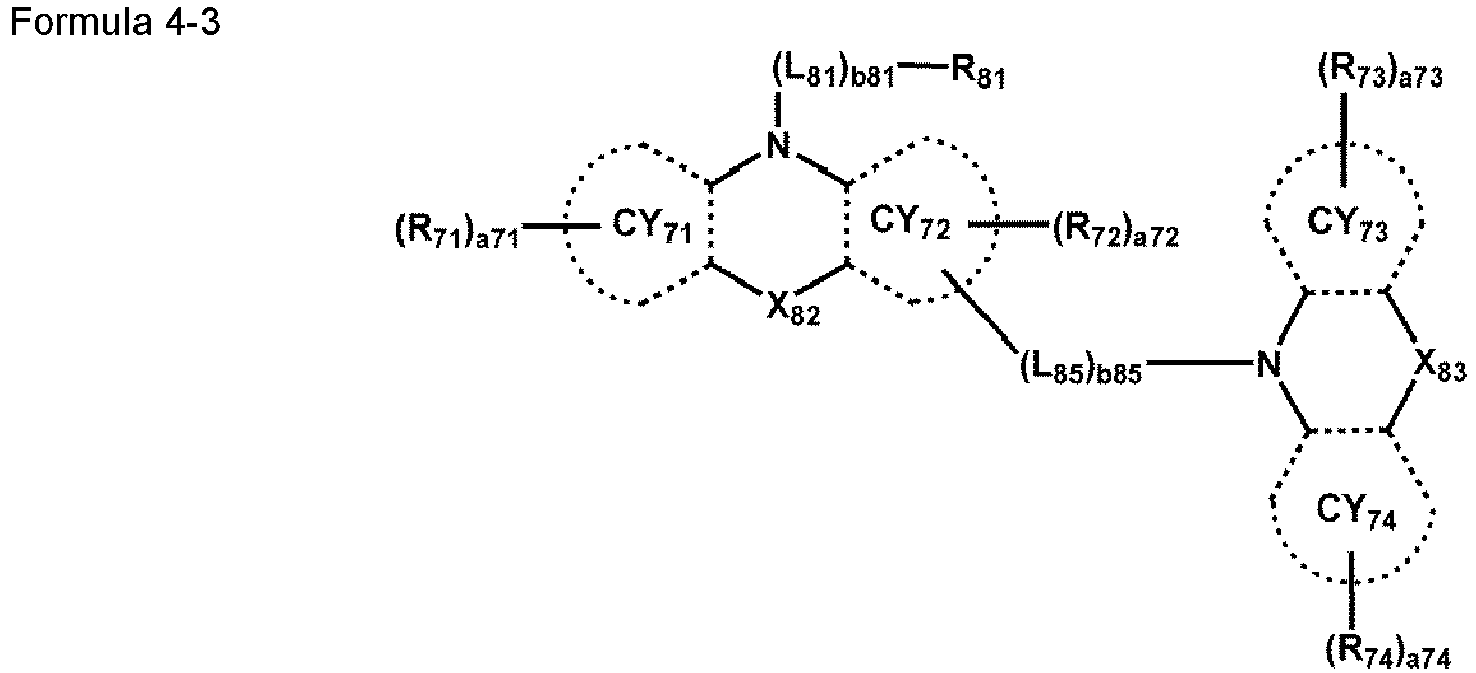


- Details of Formulae 4-1 to 4-5 may be as described herein.
- In an embodiment, the light-emitting device may satisfy at least one of
Conditions 1 to 4: -
Condition 1
lowest unoccupied molecular orbital (LUMO) energy level (eV) of fourth compound > LUMO energy level (eV) of transition metal-containing compound; -
Condition 2
LUMO energy level (eV) of transition metal-containing compound > LUMO energy level (eV) of third compound; -
Condition 3
highest occupied molecular orbital (HOMO) energy level (eV) of transition metal-containing compound > HOMO energy level (eV) of fourth compound; and - Condition 4
HOMO energy level (eV) of fourth compound > HOMO energy level (eV) of third compound. - Each of the HOMO energy level and LUMO energy level of each of the transition metal-containing compound, the third compound, and the fourth compound may be a negative value, and may be measured according to a suitable method.
- In one or more embodiments, an absolute value of a difference between the LUMO energy level of the transition metal-containing compound and the LUMO energy level of the third compound may be greater than or equal to 0.1 eV and less than or equal to 1.0 eV, an absolute value of a difference between the LUMO energy level of the transition metal-containing compound and the LUMO energy level of the fourth compound may be greater than or equal to 0.1 eV and less than or equal to 1.0 eV, an absolute value of a difference between the HOMO energy level of the transition metal-containing compound and the HOMO energy level of the third compound may be less than or equal to 1.25 eV (for example, less than or equal to 1.25 eV and greater than or equal to 0.2 eV), and an absolute value of a difference between the HOMO energy level of the transition metal-containing compound and the HOMO energy level of the fourth compound may be less than or equal to 1.25 eV (for example, less than or equal to 1.25 eV and greater than or equal to 0.2 eV).
- When the relationships between the LUMO energy level and the HOMO energy level satisfy the conditions described above, a balance between holes and electrons injected into the emission layer may be obtained.
- The light-emitting device may have, for example, a structure of a first embodiment or a second embodiment.
- According to the first embodiment, the heterocyclic compound may be comprised in the emission layer in the interlayer of the light-emitting device, wherein the emission layer may further comprise the transition metal-containing compound and a host, and the heterocyclic compound, the transition metal-containing compound, and the host may be different from each other. The emission layer may be to emit phosphorescence or fluorescence emitted from the transition metal-containing compound. For example, the transition metal-containing compound may act as a dopant or an emitter, and the heterocyclic compound may act as an auxiliary dopant that improves luminescence efficiency by effectively transferring energy to the transition metal-containing compound.
- In this regard, the phosphorescence or fluorescence emitted from the transition metal-containing compound may be blue light.
- According to the second embodiment, the heterocyclic compound may be comprised in the emission layer in the interlayer of the light-emitting device, wherein the emission layer may further comprise the transition metal-containing compound and a host, and the heterocyclic compound, the transition metal-containing compound, and the host may be different from each other. The emission layer may be to emit phosphorescence or fluorescence (for example, delayed fluorescence) emitted from the heterocyclic compound. For example, the heterocyclic compound may act as a dopant or an emitter, and the transition metal-containing compound may act as an auxiliary dopant that improves luminescence efficiency by transferring energy to the heterocyclic compound.
- For example, the phosphorescence or fluorescence emitted from the heterocyclic compound may be blue delayed fluorescence.
- The blue light in the first embodiment and the second embodiment may be blue light having a maximum emission wavelength of about 390 nm to about 500 nm, about 410 nm to about 490 nm, about 430 nm to about 480 nm, about 440 nm to about 475 nm, or about 455 nm to about 470 nm.
- The host in the first embodiment and the second embodiment may be any suitable host material (for example, a compound represented by Formula 301, a compound represented by 301-1, a compound represented by Formula 301-2, or any combination thereof).
- In an embodiment, the host in the first embodiment and the second embodiment may be the third compound, the fourth compound, or any combination thereof.
- In one or more embodiments, the light-emitting device may further comprise a capping layer arranged outside the first electrode and/or outside the second electrode.
- For example, the light-emitting device may further comprise at least one of a first capping layer arranged outside the first electrode or a second capping layer arranged outside the second electrode, wherein at least one of the first capping layer or the second capping layer may comprise the heterocyclic compound represented by
Formula 1. More details on the first capping layer and/or second capping layer may be as described herein. - In an embodiment, the light-emitting device may comprise:
- a first capping layer arranged outside the first electrode and comprising the heterocyclic compound represented by
Formula 1; - a second capping layer arranged outside the second electrode and comprising the heterocyclic compound represented by
Formula 1; or - the first capping layer and the second capping layer.
- The expression "(an interlayer and/or a capping layer) comprises at least one heterocyclic compound represented by
Formula 1" as used herein may comprise a case in which "(an interlayer and/or a capping layer) comprises identical heterocyclic compounds represented byFormula 1" and a case in which "(an organic layer) comprises two or more different heterocyclic compounds represented byFormula 1." - For example, the interlayer and/or the capping layer may comprise
Compound 1 only as the heterocyclic compound. In this regard,Compound 1 may be present in the emission layer of the light-emitting device. In an embodiment, the interlayer may comprise, as the heterocyclic compound,Compound 1 andCompound 2. In this regard,Compound 1 andCompound 2 may be present in substantially the same layer (for example, bothCompound 1 andCompound 2 may be present in the emission layer), or may be present in different layers (for example,Compound 1 may be present in the emission layer, andCompound 2 may be present in the electron transport region). - The term "interlayer" as used herein refers to a single layer and/or all of a plurality of layers arranged between the first electrode and the second electrode of the light-emitting device.
- According to one or more embodiments of the present disclosure, an electronic apparatus comprises the light-emitting device. For example, the electronic apparatus may further comprise a thin-film transistor, the thin-film transistor may comprise a source electrode and a drain electrode, wherein the first electrode of the light-emitting device may be electrically connected to the source electrode or the drain electrode of the thin-film transistor. In an embodiment, the electronic apparatus may further comprise a color filter, a color conversion layer, a touch screen layer, a polarizing layer, or any combination thereof. More details on the electronic apparatus may be as described herein.
- According to one or more embodiments of the present disclosure, an electronic equipment comprises the light-emitting device.
- For example, the electronic equipment may be a flat panel display, a curved display, a computer monitor, a medical monitor, a television, a billboard, an indoor or outdoor light and/or light for signal, a head-up display, a fully or partially transparent display, a flexible display, a rollable display, a foldable display, a stretchable display, a laser printer, a telephone, a portable phone, a tablet personal computer, a phablet, a personal digital assistant (PDA), a wearable device, a laptop computer, a digital camera, a camcorder, a viewfinder, a micro display, a three-dimensional (3D) display, a virtual reality or augmented reality display, a vehicle, a video wall with multiple displays tiled together, a theater or stadium screen, a phototherapy device, and/or a signboard.
-

- In
Formula 1, X1 may be N(R11), O, S, or Se. - In an embodiment, X1 may be N(R11).
- In
Formula 1, R1 to R4 and R11 may each independently be hydrogen, deuterium, -F, -Cl, -Br, -I, a hydroxyl group, a cyano group, a nitro group, a C1-C60 alkyl group unsubstituted or substituted with at least one R10a, a C2-C60 alkenyl group unsubstituted or substituted with at least one R10a, a C2-C60 alkynyl group unsubstituted or substituted with at least one R10a, a C1-C60 alkoxy group unsubstituted or substituted with at least one R10a, a C3-C60 carbocyclic group unsubstituted or substituted with at least one R10a, a C1-C60 heterocyclic group unsubstituted or substituted with at least one R10a, a C6-C60 aryloxy group unsubstituted or substituted with at least one R10a, a C6-C60 arylthio group unsubstituted or substituted with at least one R10a, -Si(Q1)(Q2)(Q3), -B(Q1)(Q2), -C(=O)(Q1), -S(=O)2(Q1), or-P(=O)(Q1)(Q2). - R10a and Q1 to Q3 may each be as defined herein.
- In an embodiment, R1 to R4 and R11 may each independently be:
- hydrogen, deuterium, -F, -Cl, -Br, -I, a hydroxyl group, a cyano group, a nitro group, a C1-C20 alkyl group, or a C1-C20 alkoxy group;
- a C1-C20 alkyl group or a C1-C20 alkoxy group, each substituted with deuterium, -F, -Cl, -Br, - I, -CD3, -CD2H, -CDH2, -CF3, -CF2H, -CFH2, a hydroxyl group, a cyano group, a nitro group, a C1-C10 alkyl group, a cyclopentyl group, a cyclohexyl group, a cycloheptyl group, a cyclooctyl group, an adamantanyl group, a norbornanyl group, a norbornenyl group, a cyclopentenyl group, a cyclohexenyl group, a cycloheptenyl group, a phenyl group, a biphenyl group, a naphthyl group, a pyridinyl group, a pyrimidinyl group, or any combination thereof;
- a cyclopentyl group, a cyclohexyl group, a cycloheptyl group, a cyclooctyl group, an adamantanyl group, a norbornanyl group, a norbornenyl group, a cyclopentenyl group, a cyclohexenyl group, a cycloheptenyl group, a phenyl group, a biphenyl group, a C1-C10 alkylphenyl group, a naphthyl group, a fluorenyl group, a phenanthrenyl group, an anthracenyl group, a fluoranthenyl group, a triphenylenyl group, a pyrenyl group, a chrysenyl group, a pyrrolyl group, a thiophenyl group, a furanyl group, an imidazolyl group, a pyrazolyl group, a thiazolyl group, an isothiazolyl group, an oxazolyl group, an isoxazolyl group, a pyridinyl group, a pyrazinyl group, a pyrimidinyl group, a pyridazinyl group, an isoindolyl group, an indolyl group, an indazolyl group, a purinyl group, a quinolinyl group, an isoquinolinyl group, a benzoquinolinyl group, a quinoxalinyl group, a quinazolinyl group, a cinnolinyl group, a carbazolyl group, a phenanthrolinyl group, a benzimidazolyl group, a benzofuranyl group, a benzothiophenyl group, a benzothiazolyl group, a benzoisoxazolyl group, a benzoisoxazolyl group, a triazolyl group, a tetrazolyl group, an oxadiazolyl group, a triazinyl group, a dibenzofuranyl group, a dibenzothiophenyl group, a benzocarbazolyl group, a dibenzocarbazolyl group, an imidazopyridinyl group, an imidazopyrimidinyl group, an azacarbazolyl group, an azadibenzofuranyl group, an azadibenzothiophenyl group, an azafluorenyl group, or an azadibenzosilolyl group, each unsubstituted or substituted with deuterium, -F, -Cl, -Br, -I, -CD3, -CD2H, -CDH2, -CF3, -CF2H, -CFH2, a hydroxyl group, a cyano group, a nitro group, a C1-C20 alkyl group, a C1-C20 alkoxy group, a cyclopentyl group, a cyclohexyl group, a cycloheptyl group, a cyclooctyl group, an adamantanyl group, a norbornanyl group, a norbornenyl group, a cyclopentenyl group, a cyclohexenyl group, a cycloheptenyl group, a phenyl group, a biphenyl group, a C1-C10 alkylphenyl group, a naphthyl group, a fluorenyl group, a phenanthrenyl group, an anthracenyl group, a fluoranthenyl group, a triphenylenyl group, a pyrenyl group, a chrysenyl group, a pyrrolyl group, a thiophenyl group, a furanyl group, an imidazolyl group, a pyrazolyl group, a thiazolyl group, an isothiazolyl group, an oxazolyl group, an isoxazolyl group, a pyridinyl group, a pyrazinyl group, a pyrimidinyl group, a pyridazinyl group, an isoindolyl group, an indolyl group, an indazolyl group, a purinyl group, a quinolinyl group, an isoquinolinyl group, a benzoquinolinyl group, a quinoxalinyl group, a quinazolinyl group, a cinnolinyl group, a carbazolyl group, a phenanthrolinyl group, a benzimidazolyl group, a benzofuranyl group, a benzothiophenyl group, a benzoisothiazolyl group, a benzoxazolyl group, a benzoisoxazolyl group, a triazolyl group, a tetrazolyl group, an oxadiazolyl group, a triazinyl group, a dibenzofuranyl group, a dibenzothiophenyl group, a benzocarbazolyl group, a dibenzocarbazolyl group, an imidazopyridinyl group, an imidazopyrimidinyl group, -O(Q31), -S(Q31), -Si(Q31)(Q32)(Q33), -N(Q31)(Q32), -B(Q31)(Q32), -P(Q31)(Q32), -C(=O)(Q31), - S(=O)2(Q31), -P(=O)(Q31)(Q32), or any combination thereof; or
- -C(Q1)(Q2)(Q3), -Si(Q1)(Q2)(Q3), -N(Q1)(Q2), -B(Q1)(Q2), -C(=O)(Q1), -S(=O)2(Q1), or - P(=O)(Q1)(Q2), and
- Q1 to Q3 and Q31 to Q33 may each independently be: hydrogen; deuterium; -F; -Cl; -Br; -I; a hydroxyl group; a cyano group; a nitro group; a C1-C60 alkyl group; a C2-C60 alkenyl group; a C2-C60 alkynyl group; a C1-C60 alkoxy group; or a C3-C60 carbocyclic group or a C1-C60 heterocyclic group, each unsubstituted or substituted with deuterium, -F, a cyano group, a C1-C60 alkyl group, a C1-C60 alkoxy group, a phenyl group, a biphenyl group, or any combination thereof.
- In an embodiment, R1 to R3 may each independently be:
- hydrogen, deuterium, a hydroxyl group, a cyano group, a C1-C20 alkyl group, or a C1-C20 alkoxy group;
- a C1-C20 alkyl group or a C1-C20 alkoxy group, each substituted with deuterium, -CD3, - CD2H, -CDH2, a hydroxyl group, a cyano group, a C1-C20 alkyl group, a cyclopentyl group, a cyclohexyl group, a cycloheptyl group, a cyclooctyl group, a cyclopentenyl group, a cyclohexenyl group, a cycloheptenyl group, a phenyl group, a biphenyl group, a naphthyl group, a pyridinyl group, a pyrimidinyl group, or any combination thereof;
- a cyclopentyl group, a cyclohexyl group, a cycloheptyl group, a cyclooctyl group, a cyclopentenyl group, a cyclohexenyl group, a cycloheptenyl group, a phenyl group, a biphenyl group, a C1-C10 alkylphenyl group, a naphthyl group, a pyrrolyl group, an imidazolyl group, a pyrazolyl group, a pyridinyl group, a pyrazinyl group, a pyrimidinyl group, a pyridazinyl group, an isoindolyl group, an indolyl group, an indazolyl group, a purinyl group, a quinolinyl group, an isoquinolinyl group, a benzoquinolinyl group, a quinoxalinyl group, a quinazolinyl group, a cinnolinyl group, a carbazolyl group, a phenanthrolinyl group, a benzimidazolyl group, a triazolyl group, a tetrazolyl group, a triazinyl group, a benzocarbazolyl group, a dibenzocarbazolyl group, an imidazopyridinyl group, an imidazopyrimidinyl group, an azacarbazolyl group, or an azafluorenyl group, each unsubstituted or substituted with deuterium, -CD3, -CD2H, -CDH2, a hydroxyl group, a cyano group, a C1-C20 alkyl group, a C1-C20 alkoxy group, a cyclopentyl group, a cyclohexyl group, a cycloheptyl group, a cyclooctyl group, a cyclopentenyl group, a cyclohexenyl group, a cycloheptenyl group, a phenyl group, a biphenyl group, a C1-C10 alkylphenyl group, a naphthyl group, a pyrrolyl group, an imidazolyl group, a pyrazolyl group, a pyridinyl group, a pyrazinyl group, a pyrimidinyl group, a pyridazinyl group, an isoindolyl group, an indolyl group, an indazolyl group, a purinyl group, a quinolinyl group, an isoquinolinyl group, a benzoquinolinyl group, a quinoxalinyl group, a quinazolinyl group, a cinnolinyl group, a carbazolyl group, a phenanthrolinyl group, a benzimidazolyl group, a triazolyl group, a tetrazolyl group, a triazinyl group, a benzocarbazolyl group, a dibenzocarbazolyl group, an imidazopyridinyl group, an imidazopyrimidinyl group, an azacarbazolyl group, an azafluorenyl group, -O (Q31), -S(Q31), -Si(Q31)(Q32)(Q33), N(Q31)(Q32), or any combination thereof; or
- -C(Q1)(Q2)(Q3), -Si(Q1)(Q2)(Q3), or -N(Q1)(Q2), and
- Q1 to Q3 and Q31 to Q33 may each independently be: hydrogen; deuterium; a hydroxyl group; a cyano group; a C1-C60 alkyl group; a C2-C60 alkenyl group; a C2-C60 alkynyl group; or a C3-C60 carbocyclic group or a C1-C60 heterocyclic group, each unsubstituted or substituted with deuterium, -F, a cyano group, a C1-C60 alkyl group, a phenyl group, a biphenyl group, or any combination thereof.
- In an embodiment, R4 and R11 may each independently be:
- hydrogen, deuterium, or a C1-C20 alkyl group;
- a C1-C20 alkyl group substituted with deuterium, -CD3, -CD2H, -CDH2, a C1-C10 alkyl group, a cyclopentyl group, a cyclohexyl group, a cycloheptyl group, a cyclooctyl group, a cyclopentenyl group, a cyclohexenyl group, a cycloheptenyl group, a phenyl group, a biphenyl group, a naphthyl group, or any combination thereof;
- a cyclopentyl group, a cyclohexyl group, a cycloheptyl group, a cyclooctyl group, a cyclopentenyl group, a cyclohexenyl group, a cycloheptenyl group, a phenyl group, a biphenyl group, a C1-C10 alkylphenyl group, or a naphthyl group, each unsubstituted or substituted with deuterium, -CD3, - CD2H, -CDH2, a C1-C20 alkyl group, a cyclopentyl group, a cyclohexyl group, a cycloheptyl group, a cyclooctyl group, a cyclopentenyl group, a cyclohexenyl group, a cycloheptenyl group, a phenyl group, a biphenyl group, a C1-C10 alkylphenyl group, a naphthyl group, -Si(Q31)(Q32)(Q33), or any combination thereof; or
- -C(Q1)(Q2)(Q3) or -Si(Q1)(Q2)(Q3), and
- Q1 to Q3 and Q31 to Q33 may each independently be: hydrogen; deuterium; a C1-C60 alkyl group; a C2-C60 alkenyl group; a C2-C60 alkynyl group; or a C3-C60 carbocyclic group or a C1-C60 heterocyclic group, each unsubstituted or substituted with deuterium, a C1-C60 alkyl group, a phenyl group, a biphenyl group, or any combination thereof.
- In an embodiment, at least one of R4 or R11 may be a group represented by
Formula 3. - In
Formula 1, a1 indicates the number of R1, and may be an integer from 1 to 3. - In
Formula 1, a2 and a3 indicate the number of R2 and the number of R3, respectively, and may each independently be an integer from 1 to 4.
- In Formula 1-1, CY1 may be a C5-C30 carbocyclic group or a C1-C30 heterocyclic group.
- In an embodiment, CY1 may be a pyrrole group, a pyrazole group, an imidazole group, a triazole group, an oxazole group, an isoxazole group, an oxadiazole group, a thiazole group, an isothiazole group, a thiadiazole group, a pyridine group, a pyrimidine group, a pyrazine group, a pyridazine group, an indole group, an isoindole group, a carbazole group, a benzocarbazole group, a dibenzocarbazole group, an azaindole group, an azacarbazole group, an azabenzocarbazole group, or an azadibenzocarbazole group.
- In Formula 1-1, R6 may be hydrogen, deuterium, -F, -Cl, -Br, -I, a hydroxyl group, a cyano group, a nitro group, a C1-C60 alkyl group unsubstituted or substituted with at least one R10a, a C2-C60 alkenyl group unsubstituted or substituted with at least one R10a, a C2-C60 alkynyl group unsubstituted or substituted with at least one R10a, a C1-C60 alkoxy group unsubstituted or substituted with at least one R10a, a C3-C60 carbocyclic group unsubstituted or substituted with at least one R10a, a C1-C60 heterocyclic group unsubstituted or substituted with at least one R10a, a C6-C60 aryloxy group unsubstituted or substituted with at least one R10a, a C6-C60 arylthio group unsubstituted or substituted with at least one R10a, -Si(Q1)(Q2)(Q3), -B(Q1)(Q2), -C(=O)(Q1), -S(=O)2(Q1), or -P(=O)(Q1)(Q2).
- R10a and Q1 to Q3 may each be as defined herein.
- In an embodiment, R6 may be hydrogen, deuterium, a C1-C20 alkyl group, a C2-C20 alkenyl group, a C2-C20 alkynyl group, a C3-C20 cycloalkyl group, a C3-C20 cycloalkenyl group, a C3-C20 cycloalkynyl group, a phenyl group, or a biphenyl group.
- In Formula 1-1, a6 indicates the number of R6, and may be an integer from 1 to 10.
- In Formula 1-1, * indicates a binding site to a neighboring atom.


- In Formulae 2-1a, 2-1b, 2-2, 2-3a, and 2-3b, Y1 and Y2 may each independently be -F, -Cl, - Br, or -I.
- In Formulae 2-1a, 2-1b, 2-2, 2-3a, and 2-3b, R21, R22, and Z21 to Z23 may each independently be hydrogen, deuterium, -F, -Cl, -Br, -I, a hydroxyl group, a cyano group, a nitro group, a C1-C60 alkyl group unsubstituted or substituted with at least one R10a, a C2-C60 alkenyl group unsubstituted or substituted with at least one R10a, a C2-C60 alkynyl group unsubstituted or substituted with at least one R10a, a C1-C60 alkoxy group unsubstituted or substituted with at least one R10a, a C3-C60 carbocyclic group unsubstituted or substituted with at least one R10a, a C1-C60 heterocyclic group unsubstituted or substituted with at least one R10a, a C6-C60 aryloxy group unsubstituted or substituted with at least one R10a, a C6-C60 arylthio group unsubstituted or substituted with at least one R10a, - Si(Q1)(Q2)(Q3), -B(Q1)(Q2), -C(=O)(Q1), -S(=O)2(Q1), or-P(=O)(Q1)(Q2).
- R10a and Q1 to Q3 may each be as defined herein.
- In an embodiment, two or more adjacent groups selected from R21, R22, and Z21 to Z23 may optionally be bonded to each other to form a C5-C30 carbocyclic group unsubstituted or substituted with at least one R10a or a C2-C30 heterocyclic group unsubstituted or substituted with at least one R10a.
- R10a may be as defined herein.
- In an embodiment, R21 and R22 may each independently be:
- hydrogen, deuterium, -F, -Cl, -Br, -I, a hydroxyl group, a cyano group, a nitro group, a C1-C20 alkyl group, or a C1-C20 alkoxy group;
- a C1-C20 alkyl group or a C1-C20 alkoxy group, each substituted with deuterium, -F, -Cl, -Br, - I, -CD3, -CD2H, -CDH2, -CF3, -CF2H, -CFH2, a hydroxyl group, a cyano group, a nitro group, a C1-C10 alkyl group, a cyclopentyl group, a cyclohexyl group, a cycloheptyl group, a cyclooctyl group, an adamantanyl group, a norbornanyl group, a norbornenyl group, a cyclopentenyl group, a cyclohexenyl group, a cycloheptenyl group, a phenyl group, a biphenyl group, a naphthyl group, a pyridinyl group, a pyrimidinyl group, or any combination thereof;
- a cyclopentyl group, a cyclohexyl group, a cycloheptyl group, a cyclooctyl group, an adamantanyl group, a norbornanyl group, a norbornenyl group, a cyclopentenyl group, a cyclohexenyl group, a cycloheptenyl group, a phenyl group, a biphenyl group, a C1-C10 alkylphenyl group, a naphthyl group, a fluorenyl group, a phenanthrenyl group, an anthracenyl group, a fluoranthenyl group, a triphenylenyl group, a pyrenyl group, a chrysenyl group, a pyrrolyl group, a thiophenyl group, a furanyl group, an imidazolyl group, a pyrazolyl group, a thiazolyl group, an isothiazolyl group, an oxazolyl group, an isoxazolyl group, a pyridinyl group, a pyrazinyl group, a pyrimidinyl group, a pyridazinyl group, an isoindolyl group, an indolyl group, an indazolyl group, a purinyl group, a quinolinyl group, an isoquinolinyl group, a benzoquinolinyl group, a quinoxalinyl group, a quinazolinyl group, a cinnolinyl group, a carbazolyl group, a phenanthrolinyl group, a benzimidazolyl group, a benzofuranyl group, a benzothiophenyl group, a benzothiazolyl group, a benzoisoxazolyl group, a benzoisoxazolyl group, a triazolyl group, a tetrazolyl group, an oxadiazolyl group, a triazinyl group, a dibenzofuranyl group, a dibenzothiophenyl group, a benzocarbazolyl group, a dibenzocarbazolyl group, an imidazopyridinyl group, an imidazopyrimidinyl group, an azacarbazolyl group, an azadibenzofuranyl group, an azadibenzothiophenyl group, an azafluorenyl group, or an azadibenzosilolyl group, each unsubstituted or substituted with deuterium, -F, -Cl, -Br, -I, -CD3, -CD2H, -CDH2, -CF3, -CF2H, -CFH2, a hydroxyl group, a cyano group, a nitro group, a C1-C20 alkyl group, a C1-C20 alkoxy group, a cyclopentyl group, a cyclohexyl group, a cycloheptyl group, a cyclooctyl group, an adamantanyl group, a norbornanyl group, a norbornenyl group, a cyclopentenyl group, a cyclohexenyl group, a cycloheptenyl group, a phenyl group, a biphenyl group, a C1-C10 alkylphenyl group, a naphthyl group, a fluorenyl group, a phenanthrenyl group, an anthracenyl group, a fluoranthenyl group, a triphenylenyl group, a pyrenyl group, a chrysenyl group, a pyrrolyl group, a thiophenyl group, a furanyl group, an imidazolyl group, a pyrazolyl group, a thiazolyl group, an isothiazolyl group, an oxazolyl group, an isoxazolyl group, a pyridinyl group, a pyrazinyl group, a pyrimidinyl group, a pyridazinyl group, an isoindolyl group, an indolyl group, an indazolyl group, a purinyl group, a quinolinyl group, an isoquinolinyl group, a benzoquinolinyl group, a quinoxalinyl group, a quinazolinyl group, a cinnolinyl group, a carbazolyl group, a phenanthrolinyl group, a benzimidazolyl group, a benzofuranyl group, a benzothiophenyl group, a benzoisothiazolyl group, a benzoxazolyl group, a benzoisoxazolyl group, a triazolyl group, a tetrazolyl group, an oxadiazolyl group, a triazinyl group, a dibenzofuranyl group, a dibenzothiophenyl group, a benzocarbazolyl group, a dibenzocarbazolyl group, an imidazopyridinyl group, an imidazopyrimidinyl group, -O(Q31), -S(Q31), -Si(Q31)(Q32)(Q33), -N(Q31)(Q32), -B(Q31)(Q32), -P(Q31)(Q32), -C(=O)(Q31), - S(=O)2(Q31), -P(=O)(Q31)(Q32), or any combination thereof; or
- -C(Q1)(Q2)(Q3), -Si(Q1)(Q2)(Q3), -N(Q1)(Q2), -B(Q1)(Q2), -C(=O)(Q1), -S(=O)2(Q1), or - P(=O)(Q1)(Q2).
- Q1 to Q3 and Q31 to Q33 may each be as defined herein.
- In an embodiment, R21 and R22 may each independently be:
- hydrogen, deuterium, -F, -Cl, -Br, -I, or a C1-C20 alkyl group;
- a C1-C20 alkyl group substituted with deuterium, -F, -Cl, -Br, -I, -CD3, -CD2H, -CDH2, -CF3, - CF2H, -CFH2, a C1-C10 alkyl group, a cyclopentyl group, a cyclohexyl group, a cycloheptyl group, a cyclooctyl group, a cyclopentenyl group, a cyclohexenyl group, a cycloheptenyl group, a phenyl group, a biphenyl group, a naphthyl group, or any combination thereof;
- a cyclopentyl group, a cyclohexyl group, a cycloheptyl group, a cyclooctyl group, a cyclopentenyl group, a cyclohexenyl group, a cycloheptenyl group, a phenyl group, a biphenyl group, a C1-C10 alkylphenyl group, or a naphthyl group, each unsubstituted or substituted with deuterium, -F, -Cl, -Br, -I, -CD3, -CD2H, -CDH2, -CF3, -CF2H, -CFH2, a C1-C20 alkyl group, a cyclopentyl group, a cyclohexyl group, a cycloheptyl group, a cyclooctyl group, a cyclopentenyl group, a cyclohexenyl group, a cycloheptenyl group, a phenyl group, a biphenyl group, a C1-C10 alkylphenyl group, a naphthyl group, - Si(Q31)(Q32)(Q33), or any combination thereof; or
- -C(Q1)(Q2)(Q3) or -Si(Q1)(Q2)(Q3), and
- Q1 to Q3 and Q31 to Q33 may each independently be: hydrogen; deuterium; -F; -Cl; -Br; -I; a C1-C60 alkyl group; a C2-C60 alkenyl group; a C2-C60 alkynyl group; or a C3-C60 carbocyclic group or a C1-C60 heterocyclic group, each unsubstituted or substituted with deuterium, -F, a C1-C60 alkyl group, a phenyl group, a biphenyl group, or any combination thereof.
- In an embodiment, Z21 to Z23 may each independently be:
- hydrogen, deuterium, -F, -Cl, -Br, -I, a hydroxyl group, a cyano group, a nitro group, a C1-C20 alkyl group, or a C1-C20 alkoxy group;
- a C1-C20 alkyl group or a C1-C20 alkoxy group, each substituted with deuterium, -F, -Cl, -Br, - I, -CD3, -CD2H, -CDH2, -CF3, -CF2H, -CFH2, a hydroxyl group, a cyano group, a nitro group, a C1-C10 alkyl group, a cyclopentyl group, a cyclohexyl group, a cycloheptyl group, a cyclooctyl group, an adamantanyl group, a norbornanyl group, a norbornenyl group, a cyclopentenyl group, a cyclohexenyl group, a cycloheptenyl group, a phenyl group, a biphenyl group, a naphthyl group, a pyridinyl group, a pyrimidinyl group, or any combination thereof;
- a cyclopentyl group, a cyclohexyl group, a cycloheptyl group, a cyclooctyl group, an adamantanyl group, a norbornanyl group, a norbornenyl group, a cyclopentenyl group, a cyclohexenyl group, a cycloheptenyl group, a phenyl group, a biphenyl group, a C1-C10 alkylphenyl group, a naphthyl group, a fluorenyl group, a phenanthrenyl group, an anthracenyl group, a fluoranthenyl group, a triphenylenyl group, a pyrenyl group, a chrysenyl group, a pyrrolyl group, a thiophenyl group, a furanyl group, an imidazolyl group, a pyrazolyl group, a thiazolyl group, an isothiazolyl group, an oxazolyl group, an isoxazolyl group, a pyridinyl group, a pyrazinyl group, a pyrimidinyl group, a pyridazinyl group, an isoindolyl group, an indolyl group, an indazolyl group, a purinyl group, a quinolinyl group, an isoquinolinyl group, a benzoquinolinyl group, a quinoxalinyl group, a quinazolinyl group, a cinnolinyl group, a carbazolyl group, a phenanthrolinyl group, a benzimidazolyl group, a benzofuranyl group, a benzothiophenyl group, a benzothiazolyl group, a benzoisoxazolyl group, a benzoisoxazolyl group, a triazolyl group, a tetrazolyl group, an oxadiazolyl group, a triazinyl group, a dibenzofuranyl group, a dibenzothiophenyl group, a benzocarbazolyl group, a dibenzocarbazolyl group, an imidazopyridinyl group, an imidazopyrimidinyl group, an azacarbazolyl group, an azadibenzofuranyl group, an azadibenzothiophenyl group, an azafluorenyl group, or an azadibenzosilolyl group, each unsubstituted or substituted with deuterium, -F, -Cl, -Br, -I, -CD3, -CD2H, -CDH2, -CF3, -CF2H, -CFH2, a hydroxyl group, a cyano group, a nitro group, a C1-C20 alkyl group, a C1-C20 alkoxy group, a cyclopentyl group, a cyclohexyl group, a cycloheptyl group, a cyclooctyl group, an adamantanyl group, a norbornanyl group, a norbornenyl group, a cyclopentenyl group, a cyclohexenyl group, a cycloheptenyl group, a phenyl group, a biphenyl group, a C1-C10 alkylphenyl group, a naphthyl group, a fluorenyl group, a phenanthrenyl group, an anthracenyl group, a fluoranthenyl group, a triphenylenyl group, a pyrenyl group, a chrysenyl group, a pyrrolyl group, a thiophenyl group, a furanyl group, an imidazolyl group, a pyrazolyl group, a thiazolyl group, an isothiazolyl group, an oxazolyl group, an isoxazolyl group, a pyridinyl group, a pyrazinyl group, a pyrimidinyl group, a pyridazinyl group, an isoindolyl group, an indolyl group, an indazolyl group, a purinyl group, a quinolinyl group, an isoquinolinyl group, a benzoquinolinyl group, a quinoxalinyl group, a quinazolinyl group, a cinnolinyl group, a carbazolyl group, a phenanthrolinyl group, a benzimidazolyl group, a benzofuranyl group, a benzothiophenyl group, a benzoisothiazolyl group, a benzoxazolyl group, a benzoisoxazolyl group, a triazolyl group, a tetrazolyl group, an oxadiazolyl group, a triazinyl group, a dibenzofuranyl group, a dibenzothiophenyl group, a benzocarbazolyl group, a dibenzocarbazolyl group, an imidazopyridinyl group, an imidazopyrimidinyl group, -O(Q31), -S(Q31), -Si(Q31)(Q32)(Q33), -N(Q31)(Q32), -B(Q31)(Q32), -P(Q31)(Q32), -C(=O)(Q31), - S(=O)2(Q31), -P(=O)(Q31)(Q32), or any combination thereof; or
- -C(Q1)(Q2)(Q3), -Si(Q1)(Q2)(Q3), -N(Q1)(Q2), -B(Q1)(Q2), -C(=O)(Q1), -S(=O)2(Q1), or - P(=O)(Q1)(Q2).
- Q1 to Q3 and Q31 to Q33 may each be as defined herein.
- In an embodiment, Z21 to Z23 may each independently be:
- hydrogen, deuterium, -F, -Cl, -Br, -I, or a C1-C20 alkyl group;
- a C1-C20 alkyl group substituted with deuterium, -F, -Cl, -Br, -I, -CD3, -CD2H, -CDH2, -CF3, - CF2H, -CFH2, a C1-C10 alkyl group, a cyclopentyl group, a cyclohexyl group, a cycloheptyl group, a cyclooctyl group, a cyclopentenyl group, a cyclohexenyl group, a cycloheptenyl group, a phenyl group, a biphenyl group, a naphthyl group, or any combination thereof;
- a cyclopentyl group, a cyclohexyl group, a cycloheptyl group, a cyclooctyl group, a cyclopentenyl group, a cyclohexenyl group, a cycloheptenyl group, a phenyl group, a biphenyl group, a C1-C10 alkylphenyl group, or a naphthyl group, each unsubstituted or substituted with deuterium, -F, -Cl, -Br, -I, -CD3, -CD2H, -CDH2, -CF3, -CF2H, -CFH2, a C1-C20 alkyl group, a cyclopentyl group, a cyclohexyl group, a cycloheptyl group, a cyclooctyl group, a cyclopentenyl group, a cyclohexenyl group, a cycloheptenyl group, a phenyl group, a biphenyl group, a C1-C10 alkylphenyl group, a naphthyl group, - Si(Q31)(Q32)(Q33), or any combination thereof; or
- -C(Q1)(Q2)(Q3) or -Si(Q1)(Q2)(Q3), and
- Q1 to Q3 and Q31 to Q33 may each independently be: hydrogen; deuterium; -F; -Cl; -Br; -I; a C1-C60 alkyl group; a C2-C60 alkenyl group; a C2-C60 alkynyl group; or a C3-C60 carbocyclic group or a C1-C60 heterocyclic group, each unsubstituted or substituted with deuterium, -F, a C1-C60 alkyl group, a phenyl group, a biphenyl group, or any combination thereof.
- In an embodiment, Z21 to Z23 may not each be a group represented by Formula 1-1.
- In an embodiment, at least one of R21 or R22 may be a group represented by
Formula 3. - In Formulae 2-1a, 2-1b, 2-2, 2-3a, and 2-3b, b1 indicates the number of Z21, and may be an integer from 1 to 4.
- In Formulae 2-1a, 2-1b, 2-2, 2-3a, and 2-3b, b2 and b3 indicate the number of Z22 and the number of Z23, respectively, and may each independently be an integer from 1 to 5.

- In Formula 2-4, X1 may be defined the same as X1 in
Formula 1. - In Formula 2-4, R21, Z21 to Z23, and b1 to b3 may be defined the same as R21, Z21 to Z23, and b1 to b3 in Formulae 2-3a and 2-3b, respectively.

- In
Formula 3, R31, R32, and Z31 may each independently be hydrogen, deuterium, -F, -Cl, - Br, -I, a hydroxyl group, a cyano group, a nitro group, a C1-C60 alkyl group unsubstituted or substituted with at least one R10a, a C2-C60 alkenyl group unsubstituted or substituted with at least one R10a, a C2-C60 alkynyl group unsubstituted or substituted with at least one R10a, a C1-C60 alkoxy group unsubstituted or substituted with at least one R10a, a C3-C60 carbocyclic group unsubstituted or substituted with at least one R10a, a C1-C60 heterocyclic group unsubstituted or substituted with at least one R10a, a C6-C60 aryloxy group unsubstituted or substituted with at least one R10a, a C6-C60 arylthio group unsubstituted or substituted with at least one R10a, -Si(Q1)(Q2)(Q3), -B(Q1)(Q2), -C(=O)(Q1), -S(=O)2(Q1), or-P(=O)(Q1)(Q2). - R10a and Q1 to Q3 may each be as defined herein.
- In an embodiment, two or more adjacent groups selected from R31, R32, and Z31 may optionally be bonded to each other to form a C5-C30 carbocyclic group unsubstituted or substituted with at least one R10a or a C2-C30 heterocyclic group unsubstituted or substituted with at least one R10a.
- R10a may be as defined herein.
- In an embodiment, at least one of R31 or R32 may be a C3-C60 carbocyclic group unsubstituted or substituted with at least one R10a, a C1-C60 heterocyclic group unsubstituted or substituted with at least one R10a, a C6-C60 aryloxy group unsubstituted or substituted with at least one R10a, a C6-C60 arylthio group unsubstituted or substituted with at least one R10a, or -Si(Q1)(Q2)(Q3).
- R10a and Q1 to Q3 may each be as defined herein.
- In an embodiment, R31, R32, and Z31 may each independently be:
- hydrogen, deuterium, -F, -Cl, -Br, -I, a hydroxyl group, a cyano group, a nitro group, a C1-C20 alkyl group, or a C1-C20 alkoxy group;
- a C1-C20 alkyl group or a C1-C20 alkoxy group, each substituted with deuterium, -F, -Cl, -Br, - I, -CD3, -CD2H, -CDH2, -CF3, -CF2H, -CFH2, a hydroxyl group, a cyano group, a nitro group, a C1-C10 alkyl group, a cyclopentyl group, a cyclohexyl group, a cycloheptyl group, a cyclooctyl group, an adamantanyl group, a norbornanyl group, a norbornenyl group, a cyclopentenyl group, a cyclohexenyl group, a cycloheptenyl group, a phenyl group, a biphenyl group, a naphthyl group, a pyridinyl group, a pyrimidinyl group, or any combination thereof;
- a cyclopentyl group, a cyclohexyl group, a cycloheptyl group, a cyclooctyl group, an adamantanyl group, a norbornanyl group, a norbornenyl group, a cyclopentenyl group, a cyclohexenyl group, a cycloheptenyl group, a phenyl group, a biphenyl group, a C1-C10 alkylphenyl group, a naphthyl group, a fluorenyl group, a phenanthrenyl group, an anthracenyl group, a fluoranthenyl group, a triphenylenyl group, a pyrenyl group, a chrysenyl group, a pyrrolyl group, a thiophenyl group, a furanyl group, an imidazolyl group, a pyrazolyl group, a thiazolyl group, an isothiazolyl group, an oxazolyl group, an isoxazolyl group, a pyridinyl group, a pyrazinyl group, a pyrimidinyl group, a pyridazinyl group, an isoindolyl group, an indolyl group, an indazolyl group, a purinyl group, a quinolinyl group, an isoquinolinyl group, a benzoquinolinyl group, a quinoxalinyl group, a quinazolinyl group, a cinnolinyl group, a carbazolyl group, a phenanthrolinyl group, a benzimidazolyl group, a benzofuranyl group, a benzothiophenyl group, a benzothiazolyl group, a benzoisoxazolyl group, a benzoisoxazolyl group, a triazolyl group, a tetrazolyl group, an oxadiazolyl group, a triazinyl group, a dibenzofuranyl group, a dibenzothiophenyl group, a benzocarbazolyl group, a dibenzocarbazolyl group, an imidazopyridinyl group, an imidazopyrimidinyl group, an azacarbazolyl group, an azadibenzofuranyl group, an azadibenzothiophenyl group, an azafluorenyl group, or an azadibenzosilolyl group, each unsubstituted or substituted with deuterium, -F, -Cl, -Br, -I, -CD3, -CD2H, -CDH2, -CF3, -CF2H, -CFH2, a hydroxyl group, a cyano group, a nitro group, a C1-C20 alkyl group, a C1-C20 alkoxy group, a cyclopentyl group, a cyclohexyl group, a cycloheptyl group, a cyclooctyl group, an adamantanyl group, a norbornanyl group, a norbornenyl group, a cyclopentenyl group, a cyclohexenyl group, a cycloheptenyl group, a phenyl group, a biphenyl group, a C1-C10 alkylphenyl group, a naphthyl group, a fluorenyl group, a phenanthrenyl group, an anthracenyl group, a fluoranthenyl group, a triphenylenyl group, a pyrenyl group, a chrysenyl group, a pyrrolyl group, a thiophenyl group, a furanyl group, an imidazolyl group, a pyrazolyl group, a thiazolyl group, an isothiazolyl group, an oxazolyl group, an isoxazolyl group, a pyridinyl group, a pyrazinyl group, a pyrimidinyl group, a pyridazinyl group, an isoindolyl group, an indolyl group, an indazolyl group, a purinyl group, a quinolinyl group, an isoquinolinyl group, a benzoquinolinyl group, a quinoxalinyl group, a quinazolinyl group, a cinnolinyl group, a carbazolyl group, a phenanthrolinyl group, a benzimidazolyl group, a benzofuranyl group, a benzothiophenyl group, a benzoisothiazolyl group, a benzoxazolyl group, a benzoisoxazolyl group, a triazolyl group, a tetrazolyl group, an oxadiazolyl group, a triazinyl group, a dibenzofuranyl group, a dibenzothiophenyl group, a benzocarbazolyl group, a dibenzocarbazolyl group, an imidazopyridinyl group, an imidazopyrimidinyl group, -O(Q31), -S(Q31), -Si(Q31)(Q32)(Q33), -N(Q31)(Q32), -B(Q31)(Q32), -P(Q31)(Q32), -C(=O)(Q31), - S(=O)2(Q31), -P(=O)(Q31)(Q32), or any combination thereof; or
- -C(Q1)(Q2)(Q3), -Si(Q1)(Q2)(Q3), -N(Q1)(Q2), -B(Q1)(Q2), -C(=O)(Q1), -S(=O)2(Q1), or-P(=O)(Q1)(Q2).
- Q1 to Q3 and Q31 to Q33 may each be as defined herein.
- In an embodiment, R31, R32, and Z31 may each independently be:
- hydrogen, deuterium, -F, -Cl, -Br, -I, or a C1-C20 alkyl group;
- a C1-C20 alkyl group substituted with deuterium, -F, -Cl, -Br, -I, -CD3, -CD2H, -CDH2, -CF3, - CF2H, -CFH2, a C1-C10 alkyl group, a cyclopentyl group, a cyclohexyl group, a cycloheptyl group, a cyclooctyl group, a cyclopentenyl group, a cyclohexenyl group, a cycloheptenyl group, a phenyl group, a biphenyl group, a naphthyl group, or any combination thereof;
- a cyclopentyl group, a cyclohexyl group, a cycloheptyl group, a cyclooctyl group, a cyclopentenyl group, a cyclohexenyl group, a cycloheptenyl group, a phenyl group, a biphenyl group, a C1-C10 alkylphenyl group, or a naphthyl group, each unsubstituted or substituted with deuterium, -F, -Cl, -Br, -I, -CD3, -CD2H, -CDH2, -CF3, -CF2H, -CFH2, a C1-C20 alkyl group, a cyclopentyl group, a cyclohexyl group, a cycloheptyl group, a cyclooctyl group, a cyclopentenyl group, a cyclohexenyl group, a cycloheptenyl group, a phenyl group, a biphenyl group, a C1-C10 alkylphenyl group, a naphthyl group, - Si(Q31)(Q32)(Q33), or any combination thereof; or
- -C(Q1)(Q2)(Q3) or -Si(Q1)(Q2)(Q3), and
- Q1 to Q3 and Q31 to Q33 may each independently be: hydrogen; deuterium; -F; -Cl; -Br; -I; a C1-C60 alkyl group; a C2-C60 alkenyl group; a C2-C60 alkynyl group; or a C3-C60 carbocyclic group or a C1-C60 heterocyclic group, each unsubstituted or substituted with deuterium, -F, a C1-C60 alkyl group, a phenyl group, a biphenyl group, or any combination thereof.
- In an embodiment, at least one of R31 or R32 may be
a cyclopentyl group, a cyclohexyl group, a cycloheptyl group, a cyclooctyl group, a cyclopentenyl group, a cyclohexenyl group, a cycloheptenyl group, a phenyl group, a biphenyl group, a C1-C10 alkylphenyl group, or a naphthyl group, each unsubstituted or substituted with a cyclopentyl group, a cyclohexyl group, a cycloheptyl group, a cyclooctyl group, a cyclopentenyl group, a cyclohexenyl group, a cycloheptenyl group, a phenyl group, a biphenyl group, a C1-C10 alkylphenyl group, a naphthyl group, or any combination thereof. - In an embodiment, Z31 may not be a group represented by Formula 1-1.
- In
Formula 3, d1 indicates the number of Z31, and may be an integer from 1 to 3. - In
Formula 3, * indicates a binding site to a neighboring atom.
- In Formula 4,
- ring CY71 and ring CY72 may each independently be a π electron-rich C3-C60 cyclic group or a pyridine group,
- X71 may be a single bond, or a linking group comprising O, S, N, B, C, Si, or any combination thereof, and
- * indicates a binding site to any atom included in a remaining portion of the fourth compound other than the group represented by Formula 4.


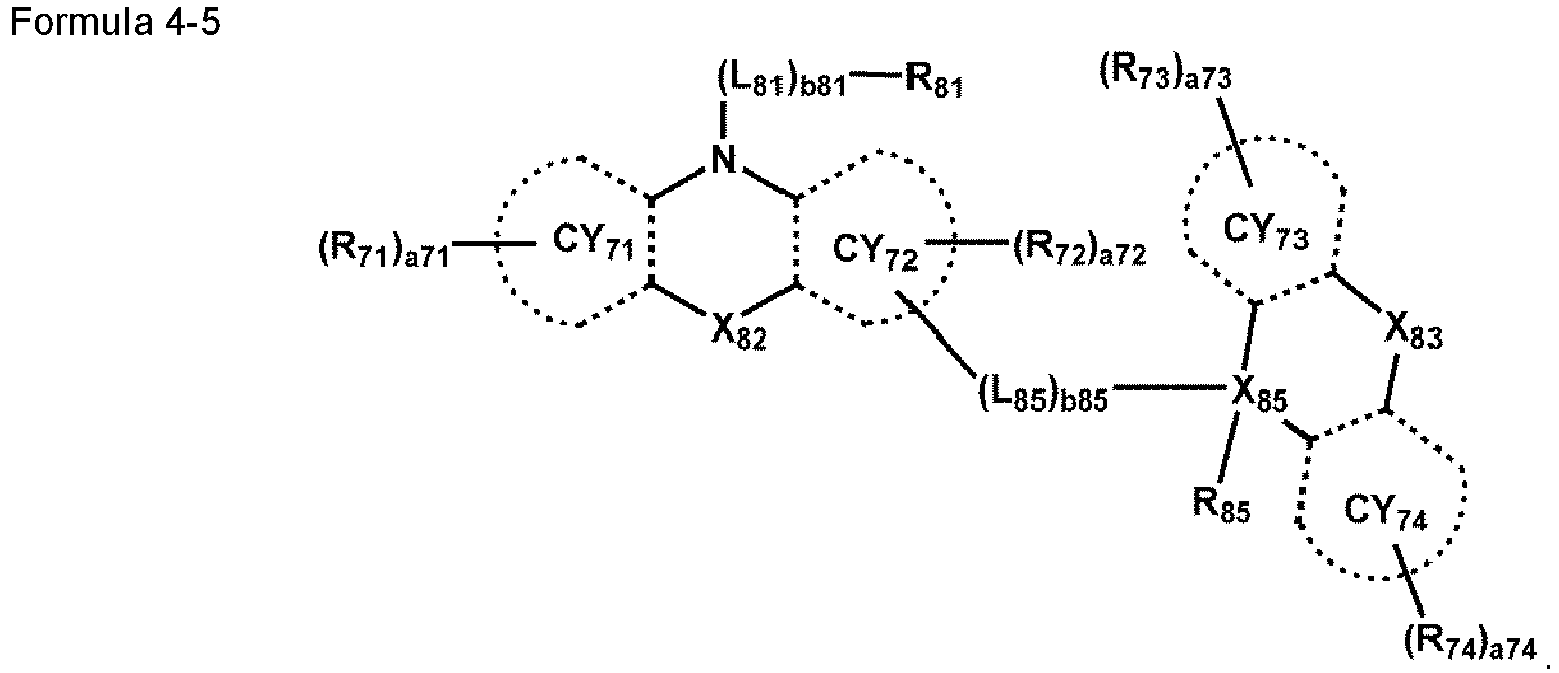
- In Formulae 4-1 to 4-5,
- ring CY71 to ring CY74 may each independently be a π electron-rich C3-C60 cyclic group or a pyridine group,
- X82 may be a single bond, O, S, N-[(L82)b82-R82], C(R82a)(R82b), or Si(R82a)(R82b),
- X83 may be a single bond, O, S, N-[(L83)b83-R83], C(R83a)(R83b), or Si(R83a)(R83b),
- X84 may be O, S, N-[(L84)b84-R84], C(R84a)(R84b), or Si(R84a)(R84b),
- X85 may be C or Si,
- L81 to L85 may each independently be a single bond, *-C(Q4)(Q5)-*', *-Si(Q4)(Q5)-*', a π electron-rich C3-C60 cyclic group unsubstituted or substituted with at least one R10a, or a pyridine group unsubstituted or substituted with at least one R10a, wherein Q4 and Q5 may each independently be defined the same as Q1,
- b81 to b85 may each independently be an integer from 1 to 5,
- R71 to R74, R81 to R85, R82a, R82b, R83a, R83b, R84a, and R84b may each be as defined herein,
- a71 to a74 may each independently be an integer from 0 to 20, and
- R10a may be as defined herein.

- In Formula 5, M may be platinum (Pt), palladium (Pd), copper (Cu), silver (Ag), gold (Au), rhodium (Rh), ruthenium (Ru), osmium (Os), titanium (Ti), zirconium (Zr), hafnium (Hf), europium (Eu), terbium (Tb), or thulium (Tm).
- In an embodiment, M may be Pt.
- In Formula 5, X51 to X54 may each independently be C or N.
- In an embodiment, X51 may be C. For example, X51 in
Formula 3 may be C, and C may be carbon of a carbene moiety. - In an embodiment, X52 and X53 may each be C, and X54 may be N.
- In Formula 5, i) a bond between X51 and M may be a coordinate bond, and ii) one of a bond between X52 and M, a bond between X53 and M, and a bond between X54 and M may be a coordinate bond, and the other two (e.g., the remaining two) may each be a covalent bond.
- For example, a bond between X51 and M and a bond between X54 and M may each be a coordinate bond, and a bond between X52 and M and a bond between X53 and M may each be a covalent bond.
- In Formula 5, ring CY51 to ring CY54 may each independently be a C5-C30 carbocyclic group or a C1-C30 heterocyclic group.
- For example, ring CY51 may be a nitrogen-containing C1-C60 heterocyclic group.
- In Formula 5, ring CY51 may be i) an X51-containing 5-membered ring, ii) an X51-containing 5-membered ring in which at least one 6-membered ring is condensed, or iii) an X51-containing 6-membered ring. In an embodiment, ring CY51 in Formula 5 may be i) an X51-containing 5-membered ring or ii) an X51-containing 5-membered ring in which at least one 6-membered ring is condensed. For example, ring CY51 may comprise a 5-membered ring bonded to M in Formula 5 via X51. In this regard, the X51-containing 5-membered ring may be a pyrrole group, a pyrazole group, an imidazole group, a triazole group, an oxazole group, an isoxazole group, a thiazole group, an isothiazole group, an oxadiazole group, or a thiadiazole group, and the X51-containing 6-membered ring and the 6-membered ring which may be optionally condensed to the X51-containing 5-membered ring may each independently be a benzene group, a pyridine group, or a pyrimidine group.
- In one or more embodiments, ring CY51 may be an imidazole group, a triazole group, a benzimidazole group, or an imidazopyridine group.
- In one or more embodiments, ring CY52 may be a benzene group, a pyridine group, a pyrimidine group, a naphthalene group, a dibenzofuran group, a dibenzothiophene group, a carbazole group, a fluorene group, a dibenzosilole group, a naphthobenzofuran group, a naphthobenzothiophene group, a benzocarbazole group, a benzofluorene group, a naphthobenzosilole group, a dinaphthofuran group, a dinaphthothiophene group, a dibenzocarbazole group, a dibenzofluorene group, a dinaphthosilole group, an azadibenzofuran group, an azadibenzothiophene group, an azacarbazole group, an azafluorene group, an azadibenzosilole group, an azanaphthobenzofuran group, an azanaphthobenzothiophene group, an azabenzocarbazole group, an azabenzofluorene group, an azanaphthobenbenzosilole group, an azadinaphthofuran group, an azadinaphthothiophene group, an azadibenzocarbazole group, an azadibenzofluorene group, or an azadinaphthosilole group.
- In Formula 5, ring CY53 may be: a C2-C8 monocyclic group; or a C4-C20 polycyclic group in which two or three C2-C8 monocyclic groups are condensed with each other.
- The term "C2-C8 monocyclic group" as used herein refers to a non-condensed cyclic group. For example, the C2-C8 monocyclic group may be a cyclopentadiene group, a pyrrole group, a pyrazole group, an imidazole group, a triazole group, an oxazole group, an isoxazole group, a thiazole group, an isothiazole group, an oxadiazole group, a thiadiazole group, a benzene group, a pyridine group, a pyrimidine group, a pyrazine group, a pyridazine group, a triazine group, a cycloheptadiene group, or a cyclooctadiene group.
- For example, ring CY53 may be a benzene group, a pyridine group, a pyrimidine group, a naphthalene group, a dibenzofuran group, a dibenzothiophene group, a carbazole group, a fluorene group, a dibenzosilole group, an azadibenzofuran group, an azadibenzothiophene group, an azacarbazole group, an azafluorene group, or an azadibenzosilole group.
- In Formula 5, ring CY54 may be a nitrogen-containing C1-C60 heterocyclic group.
- For example, ring CY54 may be a pyridine group, a pyrimidine group, a pyrazine group, a pyridazine group, a triazine group, a quinoline group, an isoquinoline group, a quinoxaline group, a quinazoline group, a phenanthroline group, a pyrrole group, a pyrazole group, an imidazole group, a triazole group, a benzopyrazole group, a benzimidazole group, or a benzothiazole group.
- In Formula 5, L51 to L53 may each independently be a single bond, *-C(R1a)(R1b)-*', *-C(R1a)=*', *=C(R1a)-*', *-C(R1a)=C(R1b)-*', *-C(=O)-*', *-C(=S)-*', *-C≡C-*', *-B(R1a)-*', *-N(R1a)-*', *-O-*', *-P(R1a)-*', *-Si(R1a)(R1b)-*', *-P(=O)(R1a)-*', *-S-*', *-S(=O)-*', *-S(=O)2-*', or *-Ge(R1a)(R1b)-*', wherein * and *' each indicate a binding site to a neighboring atom.
- R1a and R1b may each be as defined herein.
- In Formula 5, n51 to n53 indicate the number of L51, L52, and L53, respectively, and may each independently be an integer from 1 to 5. When each of n51 to n53 is 2 or more, each of two or more of L51 to two or more of L53 may be identical to or different from each other.
- In Formula 5, R51 to R54, R1a, and R1b may each independently be hydrogen, deuterium, -F, - Cl, -Br, -I, a hydroxyl group, a cyano group, a nitro group, a C1-C60 alkyl group unsubstituted or substituted with at least one R10a, a C2-C60 alkenyl group unsubstituted or substituted with at least one R10a, a C2-C60 alkynyl group unsubstituted or substituted with at least one R10a, a C1-C60 alkoxy group unsubstituted or substituted with at least one R10a, a C3-C60 carbocyclic group unsubstituted or substituted with at least one R10a, a C1-C60 heterocyclic group unsubstituted or substituted with at least one R10a, a C6-C60 aryloxy group unsubstituted or substituted with at least one R10a, a C6-C60 arylthio group unsubstituted or substituted with at least one R10a, -C(Q1)(Q2)(Q3), -Si(Q1)(Q2)(Q3), -N(Q1)(Q2), - B(Q1)(Q2), -C(=O)(Q1), -S(=O)2(Q1), or-P(=O)(Q1)(Q2).
- R10a, Q1, Q2, and Q3 may each be as defined herein.
- In Formula 5, a51 to a54 indicate the number of R51, R52, R53, and R54, respectively, and may each independently be an integer from 1 to 10. When each of a51 to a54 is 2 or more, each of two or more of R51 to two or more of R54 may be identical to or different from each other.

- In Formula 6,
- L51 to L53 may each independently be a single bond, a C3-C60 carbocyclic group unsubstituted or substituted with at least one R10a, or a C1-C60 heterocyclic group unsubstituted or substituted with at least one R10a,
- b51 to b53 may each independently be an integer from 1 to 5,
- X54 may be N or C(R54), X55 may be N or C(R55), X56 may be N or C(R56), and at least one of X54 to X56 may be N, and
- R51 to R56 and R10a may each be as defined herein.
- Unless otherwise defined, R10a in
Formulae 1, 2-1a, 2-1b, 2-2, 2-3a, 2-3b, 2-4, 3, 4, 4-1 to 4-5, 5, and 6 may be: - deuterium, -F, -Cl, -Br, -I, a hydroxyl group, a cyano group, or a nitro group;
- a C1-C60 alkyl group, a C2-C60 alkenyl group, a C2-C60 alkynyl group, or a C1-C60 alkoxy group, each unsubstituted or substituted with deuterium, -F, -Cl, -Br, -I, a hydroxyl group, a cyano group, a nitro group, a C3-C60 carbocyclic group, a C1-C60 heterocyclic group, a C6-C60 aryloxy group, a C6-C60 arylthio group, -Si(Q11)(Q12)(Q13), -B(Q11)(Q12), -C(=O)(Q11), -S(=O)2(Q11), -P(=O)(Q11)(Q12), or any combination thereof;
- a C3-C60 carbocyclic group, a C1-C60 heterocyclic group, a C6-C60 aryloxy group, or a C6-C60 arylthio group, each unsubstituted or substituted with deuterium, -F, -Cl, -Br, -I, a hydroxyl group, a cyano group, a nitro group, a C1-C60 alkyl group, a C2-C60 alkenyl group, a C2-C60 alkynyl group, a C1-C60 alkoxy group, a C3-C60 carbocyclic group, a C1-C60 heterocyclic group, a C6-C60 aryloxy group, a C6-C60 arylthio group, -Si(Q21)(Q22)(Q23), -B(Q21)(Q22), -C(=O)(Q21), -S(=O)2(Q21), -P(=O)(Q21)(Q22), or any combination thereof; or
- -Si(Q31)(Q32)(Q33), -B(Q31)(Q32), -C(=O)(Q31), -S(=O)2(Q31), or -P(=O)(Q31)(Q32).
- Unless otherwise defined, Q1 to Q3, Q11 to Q13, Q21 to Q23, and Q31 to Q33 in
Formulae 1, 2-1a, 2-1b, 2-2, 2-3a, 2-3b, 2-4, 3, 4, 4-1 to 4-5, 5, and 6 may each independently be: hydrogen; deuterium; -F; -Cl; -Br; -I; a hydroxyl group; a cyano group; a nitro group; a C1-C60 alkyl group; a C2-C60 alkenyl group; a C2-C60 alkynyl group; a C1-C60 alkoxy group; or a C3-C60 carbocyclic group or a C1-C60 heterocyclic group, each unsubstituted or substituted with deuterium, -F, a cyano group, a C1-C60 alkyl group, a C1-C60 alkoxy group, a C3-C60 carbocyclic group, a C1-C60 heterocyclic group, or any combination thereof. - In an embodiment, the heterocyclic compound may be selected from
Compounds 1 to 6:

-
FIG. 1 is a schematic cross-sectional view of a light-emittingdevice 10 according to an embodiment. The light-emittingdevice 10 comprises afirst electrode 110, aninterlayer 130, and asecond electrode 150. - Hereinafter, the structure of the light-emitting
device 10 according to an embodiment and a method of manufacturing the light-emittingdevice 10 will be described with reference toFIG. 1 . - In
FIG. 1 , a substrate may be additionally arranged under thefirst electrode 110 or on thesecond electrode 150. In an embodiment, as the substrate, a glass substrate and/or a plastic substrate may be utilized. In one or more embodiments, the substrate may be a flexible substrate, and may comprise plastics with excellent or suitable heat resistance and durability, such as polyimide, polyethylene terephthalate (PET), polycarbonate, polyethylene naphthalate, polyarylate (PAR), polyetherimide, or any combination thereof. - The
first electrode 110 may be formed by, for example, depositing or sputtering a material for forming thefirst electrode 110 on the substrate. When thefirst electrode 110 is an anode, a material for forming thefirst electrode 110 may be a high-work function material that can facilitate injection of holes. - The
first electrode 110 may be a reflective electrode, a semi-transmissive electrode, or a transmissive electrode. In an embodiment, when thefirst electrode 110 is a transmissive electrode, a material for forming thefirst electrode 110 may comprise indium tin oxide (ITO), indium zinc oxide (IZO), tin oxide (SnO2), zinc oxide (ZnO), or any combination thereof. In one or more embodiments, when thefirst electrode 110 is a semi-transmissive electrode or a reflective electrode, a material for forming thefirst electrode 110 may comprise magnesium (Mg), silver (Ag), aluminum (Al), aluminum-lithium (Al-Li), calcium (Ca), magnesium-indium (Mg-In), magnesium-silver (Mg-Ag), or any combination thereof. - The
first electrode 110 may have a single-layer structure consisting of a single layer or a multi-layer structure comprising multiple layers. For example, thefirst electrode 110 may have a three-layer structure of ITO/Ag/ITO. - The
interlayer 130 is arranged on thefirst electrode 110. Theinterlayer 130 comprises an emission layer. - The
interlayer 130 may further comprise a hole transport region arranged between thefirst electrode 110 and the emission layer, and an electron transport region arranged between the emission layer and thesecond electrode 150. - In an embodiment, the
interlayer 130 may further comprise, in addition to one or more suitable organic materials, a metal-containing compound such as a transition metal-containing compound, an inorganic material such as a quantum dot, and/or the like. - In one or more embodiments, the
interlayer 130 may comprise i) two or more emitting units sequentially stacked between thefirst electrode 110 and thesecond electrode 150, and ii) a charge generation layer arranged between two neighboring emitting units. When theinterlayer 130 comprises the two or more emitting units and the charge generation layer, the light-emittingdevice 10 may be a tandem light-emitting device. - The hole transport region may have i) a single-layer structure consisting of a single layer consisting of a single material, ii) a single-layer structure consisting of a single layer comprising (e.g., consisting of) multiple materials that are different from each other, or iii) a multi-layer structure comprising multiple layers comprising multiple materials that are different from each other.
- The hole transport region may comprise a hole injection layer, a hole transport layer, an emission auxiliary layer, an electron blocking layer, or any combination thereof.
- For example, the hole transport region may have a multi-layer structure comprising a hole injection layer/hole transport layer structure, a hole injection layer/hole transport layer/emission auxiliary layer structure, a hole injection layer/emission auxiliary layer structure, a hole transport layer/emission auxiliary layer structure, or a hole injection layer/hole transport layer/electron blocking layer structure, wherein constituent layers of each structure are stacked sequentially from the
first electrode 110 in the respective stated order. - The hole transport region may comprise a compound represented by Formula 201, a compound represented by Formula 202, or any combination thereof:


- In Formulae 201 and 202,
- L201 to L204 may each independently be a C3-C60 carbocyclic group unsubstituted or substituted with at least one R10a or a C1-C60 heterocyclic group unsubstituted or substituted with at least one R10a,
- L205 may be *-O-*', *-S-*', *-N(Q201)-*', a C1-C20 alkylene group unsubstituted or substituted with at least one R10a, a C2-C20 alkenylene group unsubstituted or substituted with at least one R10a, a C3-C60 carbocyclic group unsubstituted or substituted with at least one R10a, or a C1-C60 heterocyclic group unsubstituted or substituted with at least one R10a,
- xa1 to xa4 may each independently be an integer from 0 to 5,
- xa5 may be an integer from 1 to 10,
- R201 to R204 and Q201 may each independently be a C3-C60 carbocyclic group unsubstituted or substituted with at least one R10a or a C1-C60 heterocyclic group unsubstituted or substituted with at least one R10a,
- R201 and R202 may optionally be linked to each other via a single bond, a C1-C5 alkylene group unsubstituted or substituted with at least one R10a, or a C2-C5 alkenylene group unsubstituted or substituted with at least one R10a, to form a C8-C60 polycyclic group (for example, a carbazole group, etc.) unsubstituted or substituted with at least one R10a (for example, Compound HT16, etc.),
- R203 and R204 may optionally be linked to each other via a single bond, a C1-C5 alkylene group unsubstituted or substituted with at least one R10a, or a C2-C5 alkenylene group unsubstituted or substituted with at least one R10a, to form a C8-C60 polycyclic group unsubstituted or substituted with at least one R10a, and
- na1 may be an integer from 1 to 4.
- For example, each of Formulae 201 and 202 may comprise at least one of the groups represented by Formulae CY201 to CY217:


- In Formulae CY201 to CY217, R10b and R10c may each be defined the same as R10a, ring CY201 to ring CY204 may each independently be a C3-C20 carbocyclic group or a C1-C20 heterocyclic group, and at least one hydrogen in Formulae CY201 to CY217 may be unsubstituted or substituted with R10a.
- In an embodiment, ring CY201 to ring CY204 in Formulae CY201 to CY217 may each independently be a benzene group, a naphthalene group, a phenanthrene group, or an anthracene group.
- In one or more embodiments, each of Formulae 201 and 202 may comprise at least one of the groups represented by Formulae CY201 to CY203.
- In one or more embodiments, Formula 201 may comprise at least one of the groups represented by Formulae CY201 to CY203 and at least one of the groups represented by Formulae CY204 to CY217.
- In one or more embodiments, in Formula 201, xa1 may be 1, R201 may be one of the groups represented by Formulae CY201 to CY203, xa2 may be 0, and R202 may be one of the groups represented by Formulae CY204 to CY207.
- In one or more embodiments, each of Formulae 201 and 202 may not comprise (e.g., may exclude) any of the groups represented by Formulae CY201 to CY203.
- In one or more embodiments, each of Formulae 201 and 202 may not comprise (e.g., may exclude) any of the groups represented by Formulae CY201 to CY203, and may comprise at least one of the groups represented by Formulae CY204 to CY217.
- In one or more embodiments, each of Formulae 201 and 202 may not comprise (e.g., may exclude) any of the groups represented by Formulae CY201 to CY217.
- For example, the hole transport region may comprise at least one of Compounds HT1 to HT46, m-MTDATA, TDATA, 2-TNATA, NPB(NPD), β-NPB, TPD, Spiro-TPD, Spiro-NPB, methylated NPB, TAPC, HMTPD, 4,4',4"-tris(N-carbazolyl)triphenylamine (TCTA), polyaniline/dodecylbenzenesulfonic acid (PANI/DBSA), poly(3,4-ethylenedioxythiophene)/poly(4-styrenesulfonate) (PEDOT/PSS), polyaniline/camphor sulfonic acid (PANI/CSA), polyaniline/poly(4-styrenesulfonate) (PANI/PSS), or any combination thereof:


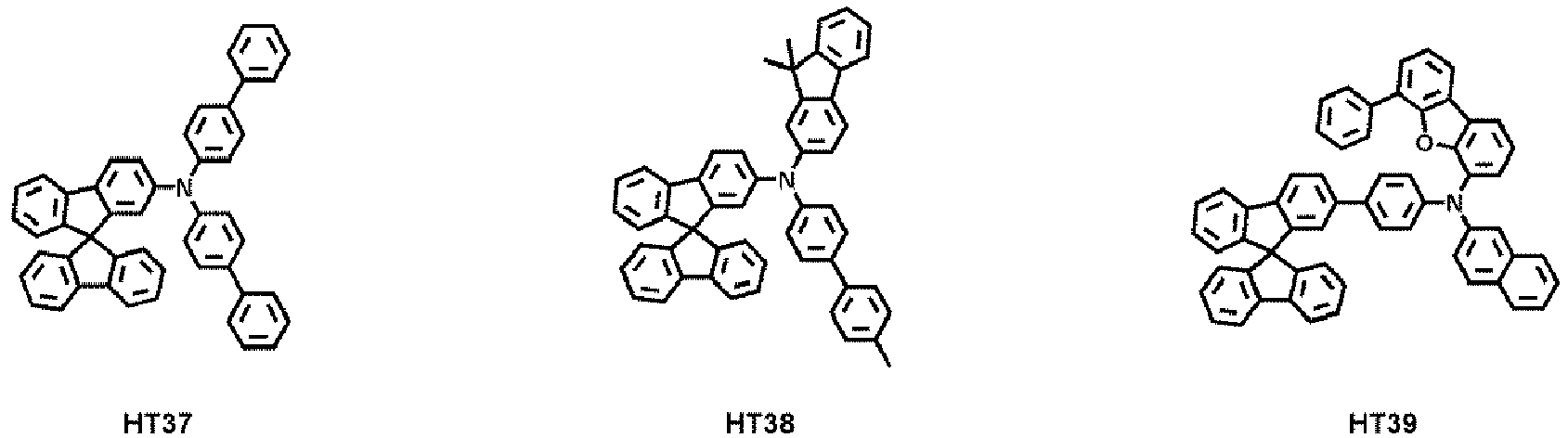
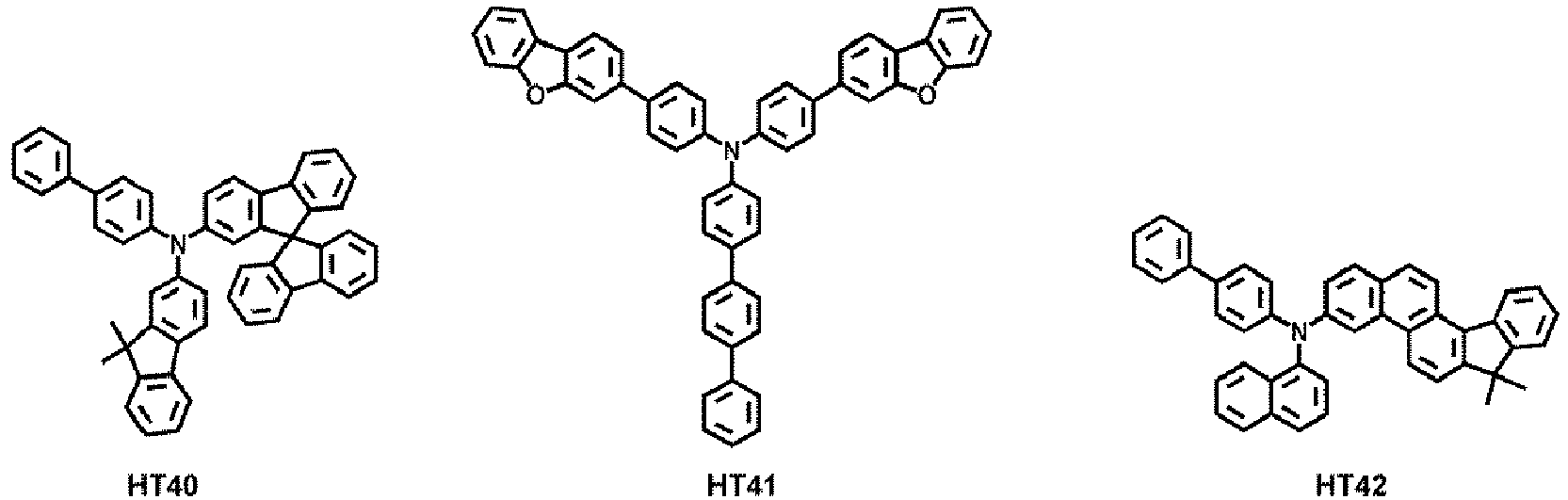


- A thickness of the hole transport region may be about 50 Å to about 10,000 Å, for example, about 100 Å to about 4,000 Å. When the hole transport region comprises a hole injection layer, a hole transport layer, or any combination thereof, a thickness of the hole injection layer may be about 100 Å to about 9,000 Å, for example, about 100 Å to about 1,000 Å, and a thickness of the hole transport layer may be about 50 Å to about 2,000 Å, for example, about 100 Å to about 1,500 Å. When the thicknesses of the hole transport region, the hole injection layer, and the hole transport layer are within the ranges described above, suitable or satisfactory hole transporting characteristics may be obtained without a substantial increase in driving voltage.
- The emission auxiliary layer may increase light-emission efficiency by compensating for an optical resonance distance according to the wavelength of light emitted by the emission layer, and the electron blocking layer may block or reduce the leakage of electrons from the emission layer to the hole transport region. Materials that may be comprised in the hole transport region may be comprised in the emission auxiliary layer and the electron blocking layer.
- The hole transport region may further comprise, in addition to the materials described above, a charge-generation material for the improvement of conductive properties. The charge-generation material may be uniformly or non-uniformly dispersed in the hole transport region (for example, in the form of a single layer consisting of a charge-generation material).
- The charge-generation material may be, for example, a p-dopant.
- For example, the p-dopant may have a LUMO energy level of less than or equal to -3.5 eV.
- In an embodiment, the p-dopant may comprise a quinone derivative, a cyano group-containing compound, a compound comprising element EL1 and element EL2, or any combination thereof.
- Examples of the quinone derivative may comprise TCNQ, F4-TCNQ, and/or the like.
- Examples of the cyano group-containing compound may comprise HAT-CN, a compound represented by Formula 221, and/or the like:


- In Formula 221,
- R221 to R223 may each independently be a C3-C60 carbocyclic group unsubstituted or substituted with at least one R10a or a C1-C60 heterocyclic group unsubstituted or substituted with at least one R10a, and
- at least one of R221 to R223 may each independently be a C3-C60 carbocyclic group or a C1-C60 heterocyclic group, each substituted with: a cyano group; -F; -Cl; -Br; -I; a C1-C20 alkyl group substituted with a cyano group, -F, -Cl, -Br, -I, or any combination thereof; or any combination thereof.
- In the compound comprising element EL1 and element EL2, element EL1 may be metal, metalloid, or any combination thereof, and element EL2 may be non-metal, metalloid, or any combination thereof.
- Examples of the metal may comprise (e.g., may be): an alkali metal (for example, lithium (Li), sodium (Na), potassium (K), rubidium (Rb), cesium (Cs), etc.); an alkaline earth metal (for example, beryllium (Be), magnesium (Mg), calcium (Ca), strontium (Sr), barium (Ba), etc.); a transition metal (for example, titanium (Ti), zirconium (Zr), hafnium (Hf), vanadium (V), niobium (Nb), tantalum (Ta), chromium (Cr), molybdenum (Mo), tungsten (W), manganese (Mn), technetium (Tc), rhenium (Re), iron (Fe), ruthenium (Ru), osmium (Os), cobalt (Co), rhodium (Rh), iridium (Ir), nickel (Ni), palladium (Pd), platinum (Pt), copper (Cu), silver (Ag), gold (Au), etc.); post-transition metal (for example, zinc (Zn), indium (In), tin (Sn), etc.); a lanthanide metal (for example, lanthanum (La), cerium (Ce), praseodymium (Pr), neodymium (Nd), promethium (Pm), samarium (Sm), europium (Eu), gadolinium (Gd), terbium (Tb), dysprosium (Dy), holmium (Ho), erbium (Er), thulium (Tm), ytterbium (Yb), lutetium (Lu), etc.); and/or the like.
- Examples of the metalloid may comprise (e.g., may be) silicon (Si), antimony (Sb), tellurium (Te), and/or the like.
- Examples of the non-metal may comprise (e.g., may be) oxygen (O), halogen (for example, F, Cl, Br, I, etc.), and/or the like.
- Examples of the compound comprising element EL1 and element EL2 may comprise (e.g., may be) a metal oxide, a metal halide (for example, a metal fluoride, a metal chloride, a metal bromide, a metal iodide, etc.), a metalloid halide (for example, a metalloid fluoride, a metalloid chloride, a metalloid bromide, a metalloid iodide, etc.), a metal telluride, or any combination thereof.
- Examples of the metal oxide may comprise (e.g., may be) tungsten oxide (for example, WO, W2O3, WO2, WO3, WzOs, etc.), vanadium oxide (for example, VO, V2O3, VO2, VzOs, etc.), molybdenum oxide (MoO, MozOs, MoO2, MoOs, MozOs, etc.), rhenium oxide (for example, ReOs, etc.), and/or the like.
- Examples of the metal halide may comprise (e.g., may be) an alkali metal halide, an alkaline earth metal halide, a transition metal halide, a post-transition metal halide, a lanthanide metal halide, and/or the like.
- Examples of the alkali metal halide may comprise (e.g., may be) LiF, NaF, KF, RbF, CsF, LiCI, NaCl, KCI, RbCI, CsCI, LiBr, NaBr, KBr, RbBr, CsBr, Lil, Nal, KI, Rbl, Csl, and/orthe like.
- Examples of the alkaline earth metal halide may comprise (e.g., may be) BeF2, MgF2, CaF2, SrF2, BaF2, BeCl2, MgCl2, CaCl2, SrCl2, BaCl2, BeBr2, MgBr2, CaBr2, SrBr2, BaBr2, BeI2, MgI2, CaI2, SrI2, BaI2, and/orthe like.
- Examples of the transition metal halide may comprise (e.g., may be) titanium halide (for example, TiF4, TiCl4, TiBr4, TiI4, etc.), zirconium halide (for example, ZrF4, ZrCl4, ZrBr4, ZrI4, etc.), hafnium halide (for example, HfF4, HfCl4, HfBr4, HfI4, etc.), vanadium halide (for example, VF3, VCl3, VBrs, VI3, etc.), niobium halide (for example, NbFs, NbCl3, NbBr3, NbI3, etc.), tantalum halide (for example, TaF3, TaCl3, TaBr3, TaI3, etc.), chromium halide (for example, CrFs, CrCl3, CrBr3, CrI3, etc.), molybdenum halide (for example, MoF3, MoCl3, MoBr3, MoI3, etc.), tungsten halide (for example, WF3, WCl3, WBrs, WI3, etc.), manganese halide (for example, MnF2, MnCl2, MnBr2, MnI2, etc.), technetium halide (for example, TcF2, TcCl2, TcBr2, TcI2, etc.), rhenium halide (for example, ReF2, ReCl2, ReBr2, ReI2, etc.), iron halide (for example, FeF2, FeCl2, FeBr2, FeI2, etc.), ruthenium halide (for example, RuF2, RuCl2, RuBr2, RuI2, etc.), osmium halide (for example, OsF2, OsCl2, OsBr2, OsI2, etc.), cobalt halide (for example, CoF2, CoCl2, CoBr2, CoI2, etc.), rhodium halide (for example, RhF2, RhCl2, RhBr2, RhI2, etc.), iridium halide (for example, IrF2, IrCl2, IrBr2, IrI2, etc.), nickel halide (for example, NiF2, NiCl2, NiBr2, NiI2, etc.), palladium halide (for example, PdF2, PdCl2, PdBr2, PdI2, etc.), platinum halide (for example, PtF2, PtCl2, PtBr2, PtI2, etc.), copper halide (for example, CuF, CuCI, CuBr, Cul, etc.), silver halide (for example, AgF, AgCl, AgBr, Agl, etc.), gold halide (for example, AuF, AuCI, AuBr, Aul, etc.), and/orthe like.
- Examples of the post-transition metal halide may comprise (e.g., may be) zinc halide (for example, ZnF2, ZnCl2, ZnBr2, ZnI2, etc.), indium halide (for example, InI3, etc.), tin halide (for example, SnI2, etc.), and/or the like.
- Examples of the lanthanide metal halide may comprise (e.g., may be) YbF, YbF2, YbF3, SmF3, YbCl, YbCl2, YbCl3, SmCl3, YbBr, YbBr2, YbBr3, SmBr3, YbI, YbI2, YbI3, SmI3, and/or the like.
- Examples of the metalloid halide may comprise (e.g., may be) antimony halide (for example, SbCl5, etc.) and/or the like.
- Examples of the metal telluride may comprise (e.g., may be) an alkali metal telluride (for example, Li2Te, Na2Te, K2Te, Rb2Te, Cs2Te, etc.), an alkaline earth metal telluride (for example, BeTe, MgTe, CaTe, SrTe, BaTe, etc.), a transition metal telluride (for example, TiTe2, ZrTe2, HfTe2, V2Te3, Nb2Te3, Ta2Te3, Cr2Te3, Mo2Te3, W2Te3, MnTe, TcTe, ReTe, FeTe, RuTe, OsTe, CoTe, RhTe, IrTe, NiTe, PdTe, PtTe, Cu2Te, CuTe, Ag2Te, AgTe, Au2Te, etc.), a post-transition metal telluride (for example, ZnTe, etc.), a lanthanide metal telluride (for example, LaTe, CeTe, PrTe, NdTe, PmTe, EuTe, GdTe, TbTe, DyTe, HoTe, ErTe, TmTe, YbTe, LuTe, etc.), and/or the like.
- When the light-emitting
device 10 is a full-color light-emitting device, the emission layer may be patterned into a red emission layer, a green emission layer, and/or a blue emission layer, according to a sub-pixel. In an embodiment, the emission layer may have a stacked structure of two or more layers of a red emission layer, a green emission layer, and a blue emission layer, in which the two or more layers contact each other or are separated from each other, to emit white light. In one or more embodiments, the emission layer may comprise two or more materials of a red light-emitting material, a green light-emitting material, and a blue light-emitting material, in which the two or more materials are mixed with each other in a single layer, to emit white light. - In an embodiment, the emission layer may comprise a host and a dopant (or emitter). In one or more embodiments, the emission layer may further comprise an auxiliary dopant that promotes energy transfer to a dopant (or emitter), in addition to the host and the dopant (or emitter). When the emission layer comprises the dopant (or emitter) and the auxiliary dopant, the dopant (or emitter) and the auxiliary dopant are different from each other.
- The transition metal-containing compound represented by Formula 5 described herein may act as the dopant (or emitter), or may act as the auxiliary dopant.
- An amount (weight) of the dopant (or emitter) in the emission layer may be about 0.01 parts by weight to about 15 parts by weight based on 100 parts by weight of the host.
- The transition metal-containing compound represented by Formula 5 may be comprised in the emission layer. An amount (weight) of the transition metal-containing compound in the emission layer may be about 0.01 parts by weight to about 30 parts by weight, about 0.1 parts by weight to about 20 parts by weight, or about 0.1 parts by weight to about 15 parts by weight, based on 100 parts by weight of the emission layer.
- A thickness of the emission layer may about 100 Å to about 1,000 Å, for example, about 200 Å to about 600 Å. When the thickness of the emission layer is within the ranges described above, excellent or suitable luminescence characteristics may be obtained without a substantial increase in driving voltage.
- The host in the emission layer may comprise the third compound or the fourth compound described herein, or any combination thereof.
- In an embodiment, the host may comprise a compound represented by Formula 301: Formula 301
[Ar301]xb11-[(L301)xb1-R301]xb21
- wherein, in Formula 301,
- Ar301 and L301 may each independently be a C3-C60 carbocyclic group unsubstituted or substituted with at least one R10a or a C1-C60 heterocyclic group unsubstituted or substituted with at least one R10a,
- xb11 may be 1, 2, or 3,
- xb1 may be an integer from 0 to 5,
- R301 may be hydrogen, deuterium, -F, -Cl, -Br, -I, a hydroxyl group, a cyano group, a nitro group, a C1-C60 alkyl group unsubstituted or substituted with at least one R10a, a C2-C60 alkenyl group unsubstituted or substituted with at least one R10a, a C2-C60 alkynyl group unsubstituted or substituted with at least one R10a, a C1-C60 alkoxy group unsubstituted or substituted with at least one R10a, a C3-C60 carbocyclic group unsubstituted or substituted with at least one R10a, a C1-C60 heterocyclic group unsubstituted or substituted with at least one R10a, -Si(Q301)(Q302)(Q303), -N(Q301)(Q302), -B(Q301)(Q302), - C(=O)(Q301), -S(=O)2(Q301), or -P(=O)(Q301)(Q302),
- xb21 may be an integer from 1 to 5, and
- Q301 to Q303 may each be defined the same as Q1.
- For example, when xb11 in Formula 301 is 2 or more, two or more of Ar301 may be linked to each other via a single bond.
- In an embodiment, the host may comprise a compound represented by Formula 301-1, a compound represented by Formula 301-2, or any combination thereof:


- In Formulae 301-1 and 301-2,
- ring A301 to ring A304 may each independently be a C3-C60 carbocyclic group unsubstituted or substituted with at least one R10a or a C1-C60 heterocyclic group unsubstituted or substituted with at least one R10a,
- X301 may be O, S, N-[(L304)xb4-R304], C(R304)(R305), or Si(R304)(R305),
- xb22 and xb23 may each independently be 0, 1, or 2,
- L301, xb1, and R301 may each be as defined herein,
- L302 to L304 may each independently be defined the same as L301,
- xb2 to xb4 may each independently be defined the same as xb1, and
- R302 to R305 and R311 to R314 may each independently be defined the same as R301.
- In one or more embodiments, the host may comprise an alkaline earth metal complex, a post-transition metal complex, or any combination thereof. For example, the host may comprise a Be complex (for example, Compound H55), an Mg complex, a Zn complex, or any combination thereof.
- In one or more embodiments, the host may comprise at least one of Compounds H1 to H130, 9,10-di(2-naphthyl)anthracene (ADN), 2-methyl-9,10-bis(naphthalen-2-yl)anthracene (MADN), 9,10-di(2-naphthyl)-2-t-butyl-anthracene (TBADN), 4,4'-bis(N-carbazolyl)-1,1'-biphenyl (CBP), 1,3-di-9-carbazolylbenzene (mCP), 1,3,5-tri(carbazol-9-yl)benzene (TCP), or any combination thereof:


- In an embodiment, the host may comprise a silicon-containing compound, a phosphine oxide-containing compound, or any combination thereof.
- The host may have one or more suitable modifications. For example, the host may comprise only one kind of compound, or may comprise two or more kinds of different compounds.
- The emission layer may comprise, as a phosphorescent dopant, the transition metal-containing compound represented by Formula 5 described herein.
- In an embodiment, the emission layer may comprise the transition metal-containing compound represented by Formula 5 described herein, wherein, when the transition metal-containing compound represented by Formula 5 described herein acts as an auxiliary dopant, the emission layer may comprise a phosphorescent dopant.
- The phosphorescent dopant may comprise at least one transition metal as a central metal.
- The phosphorescent dopant may comprise a monodentate ligand, a bidentate ligand, a tridentate ligand, a tetradentate ligand, a pentadentate ligand, a hexadentate ligand, or any combination thereof.
- The phosphorescent dopant may be electrically neutral.
- For example, the phosphorescent dopant may comprise a transition metal-containing compound represented by 401:
Formula 401 M(L401)xc1(L402)xc2

- In Formulae 401 and 402,
- M may be a transition metal (for example, iridium (Ir), platinum (Pt), palladium (Pd), osmium (Os), titanium (Ti), gold (Au), hafnium (Hf), europium (Eu), terbium (Tb), rhodium (Rh), rhenium (Re), or thulium (Tm)),
- L401 may be a ligand represented by Formula 402, and xc1 is 1, 2, or 3, wherein, when xc1 is 2 or more, two or more of L401 may be identical to or different from each other,
- L402 may be an organic ligand, and xc2 may be 0, 1, 2, 3, or 4, wherein, when xc2 is 2 or more, two or more of L402 may be identical to or different from each other,
- X401 and X402 may each independently be N or C,
- ring A401 and ring A402 may each independently be a C3-C60 carbocyclic group or a C1-C60 heterocyclic group,
- T401 may be a single bond, *-O-*', *-S-*', *-C(=O)-*', *-N(Q411)-*', *-C(Q411)(Q412)-*', *-C(Q411)=C(Q412)-*', *-C(Q411)=*', or *=C=*',
- X403 and X404 may each independently be a chemical bond (for example, a covalent bond or a coordinate bond), O, S, N(Q413), B(Q413), P(Q413), C(Q413)(Q414), or Si(Q413)(Q414),
- Q411 to Q414 may each independently be defined the same as Q1,
- R401 and R402 may each independently be hydrogen, deuterium, -F, -Cl, -Br, -I, a hydroxyl group, a cyano group, a nitro group, a C1-C20 alkyl group unsubstituted or substituted with at least one R10a, a C1-C20 alkoxy group unsubstituted or substituted with at least one R10a, a C3-C60 carbocyclic group unsubstituted or substituted with at least one R10a, a C1-C60 heterocyclic group unsubstituted or substituted with at least one R10a, -Si(Q401)(Q402)(Q403), -N(Q401)(Q402), -B(Q401)(Q402), -C(=O)(Q401), - S(=O)2(Q401), or -P(=O)(Q401)(Q402),
- Q401 to Q403 may each independently be defined the same as Q1,
- xc11 and xc12 may each independently be an integer from 0 to 10, and
- * and *' in Formula 402 each indicate a binding site to M in Formula 401.
- For example, in Formula 402, i) X401 may be nitrogen and X402 may be carbon, or ii) each of X401 and X402 may be nitrogen.
- In an embodiment, when xc1 in Formula 402 is 2 or more, two ring A401(s) among two or more of L401 may optionally be linked to each other via T402, which is a linking group, and two ring A402(s) among two or more of L401 may optionally be linked to each other via T403, which is a linking group (see Compounds PD1 to PD4 and PD7). T402 and T403 may each independently be defined the same as T401.
- In Formula 401, L402 may be an organic ligand. For example, L402 may comprise a halogen group, a diketone group (for example, an acetylacetonate group), a carboxylic acid group (for example, a picolinate group), -C(=O), an isonitrile group, a -CN group, a phosphorus group (for example, a phosphine group, a phosphite group, etc.), or any combination thereof.
- The phosphorescent dopant may comprise, for example, at least one of Compounds PD1 to PD25, or any combination thereof:


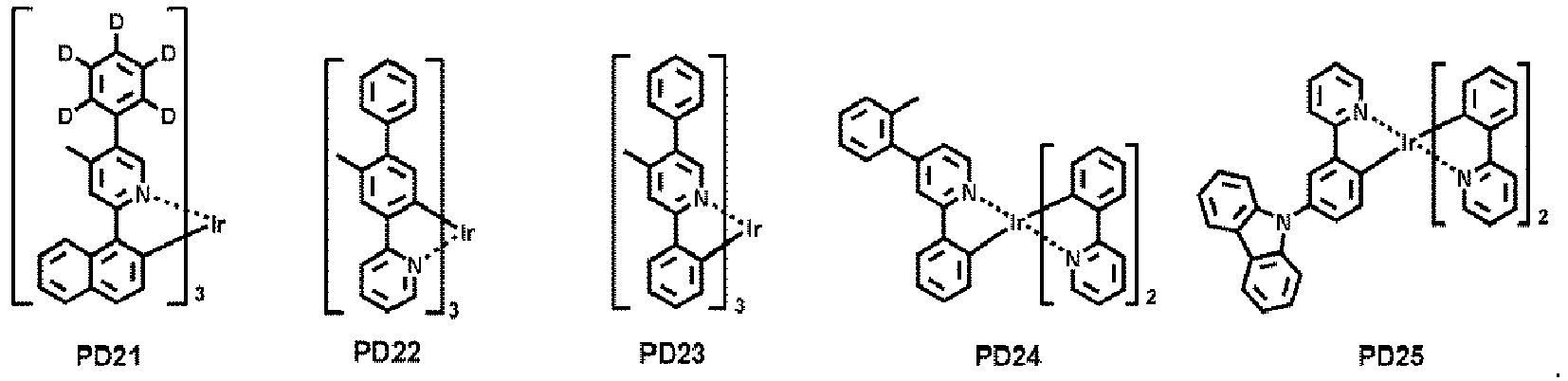
- The emission layer may comprise the transition metal-containing compound represented by Formula 5 described herein, wherein, when the transition metal-containing compound represented by Formula 5 described herein acts as an auxiliary dopant, the emission layer may further comprise a fluorescent dopant.
- In an embodiment, the emission layer may comprise the transition metal-containing compound represented by Formula 5 described herein, wherein, when the transition metal-containing compound represented by Formula 5 described herein acts as a phosphorescent dopant, the emission layer may further comprise an auxiliary dopant.
- The fluorescent dopant and the auxiliary dopant may each independently comprise an arylamine compound, a styrylamine compound, a boron-containing compound, or any combination thereof.
- For example, the fluorescent dopant and the auxiliary dopant may each independently comprise a compound represented by Formula 501:

- In Formula 501,
- Ar501, L501 to L503, R501, and R502 may each independently be a C3-C60 carbocyclic group unsubstituted or substituted with at least one R10a or a C1-C60 heterocyclic group unsubstituted or substituted with at least one R10a,
- xd1 to xd3 may each independently be 0, 1, 2, or 3, and
- xd4 may be 1, 2, 3, 4, 5, or 6.
- For example, Ar501 in Formula 501 may be a condensed cyclic group (for example, an anthracene group, a chrysene group, a pyrene group, etc.) in which three or more monocyclic groups are condensed together.
- In an embodiment, xd4 in Formula 501 may be 2.
- For example, the fluorescent dopant and the auxiliary dopant may each comprise at least one of Compounds FD1 to FD36, DPVBi, DPAVBi, or any combination thereof:
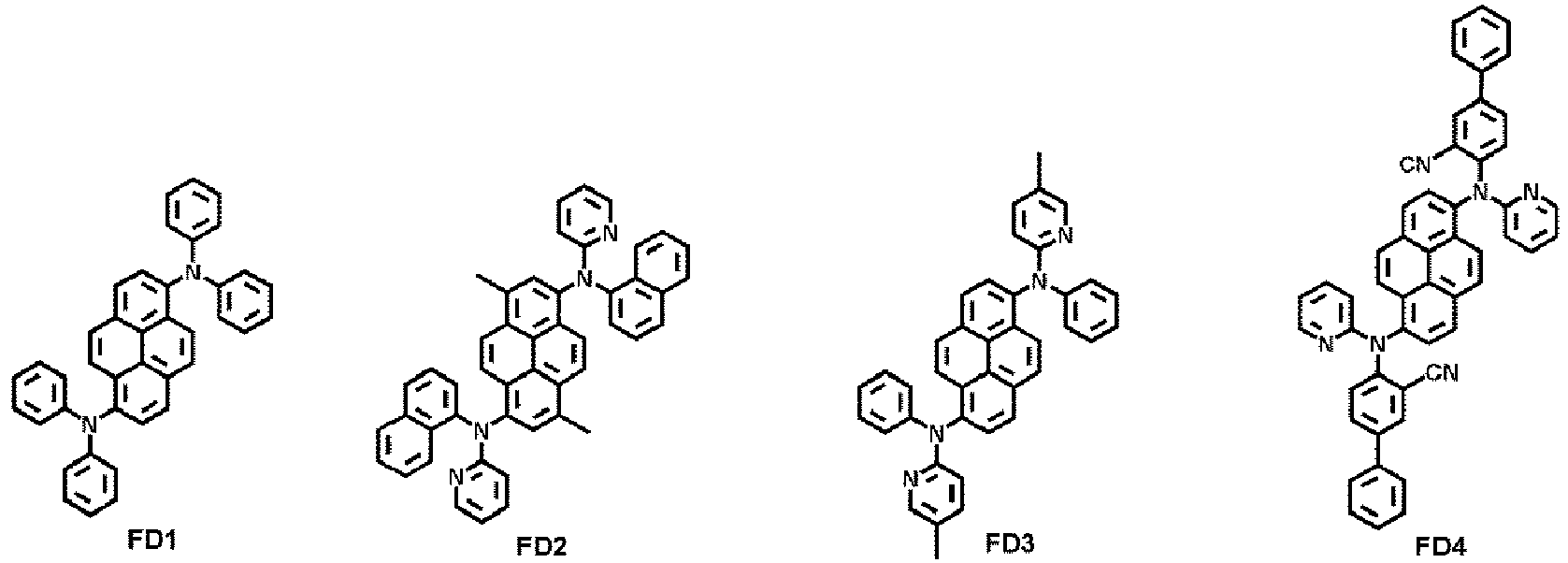


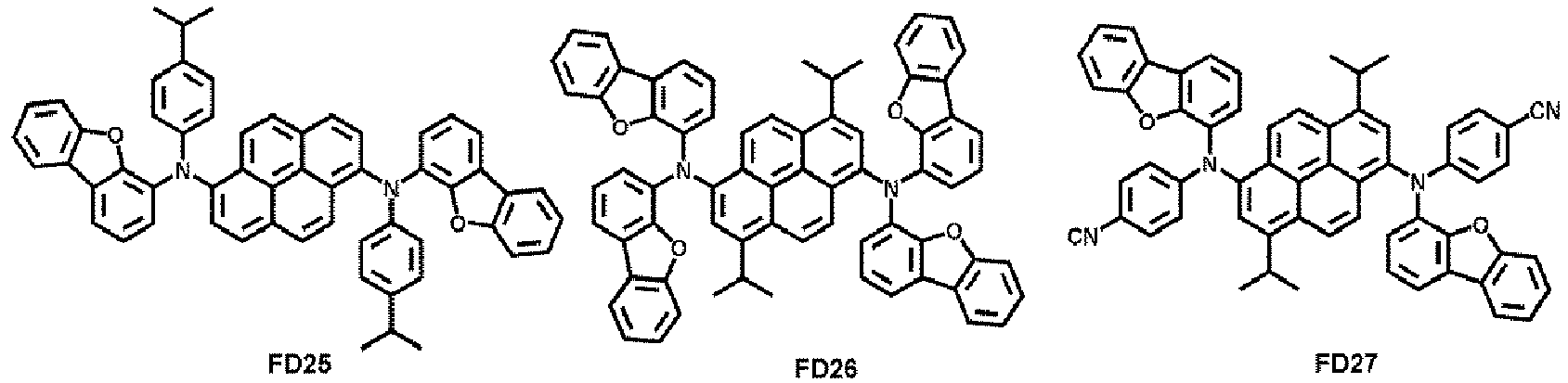


- In an embodiment, the fluorescent dopant and the auxiliary dopant may each independently comprise the delayed fluorescence compound represented by
Formula 1 described herein. - The electron transport region may have i) a single-layer structure consisting of a single layer consisting of a single material, ii) a single-layer structure consisting of a single layer comprising (e.g., consisting of) multiple different materials, or iii) a multi-layer structure comprising multiple layers comprising different materials.
- The electron transport region may comprise a buffer layer, a hole blocking layer, an electron control layer, an electron transport layer, an electron injection layer, or any combination thereof.
- For example, the electron transport region may have an electron transport layer/electron injection layer structure, a hole blocking layer/electron transport layer/electron injection layer structure, an electron control layer/electron transport layer/electron injection layer structure, or a buffer layer/electron transport layer/electron injection layer structure, wherein constituent layers of each structure are sequentially stacked from the emission layer in the respective stated order.
- In an embodiment, the electron transport region (for example, the buffer layer, the hole blocking layer, the electron control layer, or the electron transport layer in the electron transport region) may comprise a metal-free compound comprising at least one π electron-deficient nitrogen-containing C1-C60 heterocyclic group.
- For example, the electron transport region may comprise a compound represented by Formula 601:
Formula 601 [Ar601]xe11-[(L601)xe1-R601]xe21
- wherein, in Formula 601,
- Ar601 and L601 may each independently be a C3-C60 carbocyclic group unsubstituted or substituted with at least one R10a or a C1-C60 heterocyclic group unsubstituted or substituted with at least one R10a,
- xe11 may be 1, 2, or 3,
- xe1 may be 0, 1, 2, 3, 4, or 5,
- R601 may be a C3-C60 carbocyclic group unsubstituted or substituted with at least one R10a, a C1-C60 heterocyclic group unsubstituted or substituted with at least one R10a, -Si(Q601)(Q602)(Q603), - C(=O)(Q601), -S(=O)2(Q601), or-P(=O)(Q601)(Q602),
- Q601 to Q603 may each be defined the same as Q1,
- xe21 may be 1, 2, 3, 4, or 5, and
- at least one of Ar601, L601, or R601 may each independently be a π electron-deficient nitrogen-containing C1-C60 heterocyclic group unsubstituted or substituted with at least one R10a.
- For example, when xe11 in Formula 601 is 2 or more, two or more of Ar601 may be linked to each other via a single bond.
- In an embodiment, Ar601 in Formula 601 may be a substituted or unsubstituted anthracene group.
- In one or more embodiments, the electron transport region may comprise a compound represented by Formula 601-1:

- In Formula 601-1,
- X614 may be N or C(R614), X615 may be N or C(R615), X616 may be N or C(R616), and at least one of X614 to X616 may be N,
- L611 to L613 may each be defined the same as L601,
- xe611 to xe613 may each be defined the same as xe1,
- R611 to R613 may each be defined the same as R601, and
- R614 to R616 may each independently be hydrogen, deuterium, -F, -Cl, -Br, -I, a hydroxyl group, a cyano group, a nitro group, a C1-C20 alkyl group, a C1-C20 alkoxy group, a C3-C60 carbocyclic group unsubstituted or substituted with at least one R10a, or a C1-C60 heterocyclic group unsubstituted or substituted with at least one R10a.
- For example, xe1 and xe611 to xe613 in Formulae 601 and 601-1 may each independently be 0, 1, or 2.
- The electron transport region may comprise at least one of Compounds ET1 to ET46, 2,9-dimethyl-4,7-diphenyl-1,10-phenanthroline (BCP), 4,7-diphenyl-1,10-phenanthroline (Bphen), Alq3, BAIq, TAZ, NTAZ, or any combination thereof:


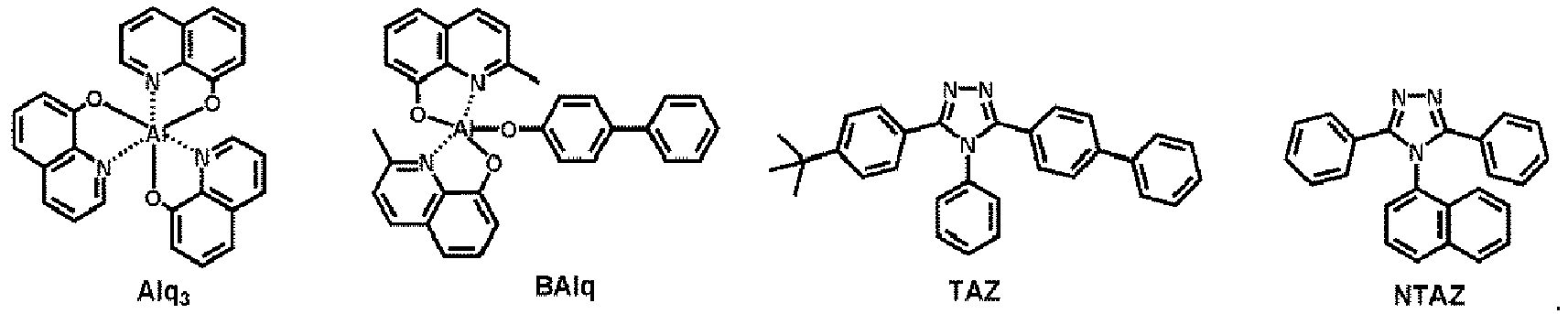
- A thickness of the electron transport region may be about 100 Å to about 5,000 Å, for example, about 160 Å to about 4,000 Å. When the electron transport region comprises a buffer layer, a hole blocking layer, an electron control layer, an electron transport layer, or any combination thereof, a thickness of the buffer layer, the hole blocking layer, or the electron control layer may be about 20 Å to about 1,000 Å, for example, about 30 Å to about 300 Å, and a thickness of the electron transport layer may be about 100 Å to about 1,000 Å, for example, about 150 Å to about 500 Å. When the thicknesses of the buffer layer, the hole blocking layer, the electron control layer, the electron transport layer, and/or the electron transport layer are within the ranges described above, satisfactory electron transporting characteristics may be obtained without a substantial increase in driving voltage.
- The electron transport region (for example, the electron transport layer in the electron transport region) may further comprise, in addition to the materials described above, a metal-containing material.
- The metal-containing material may comprise an alkali metal complex, an alkaline earth metal complex, or any combination thereof. The metal ion of the alkali metal complex may be a Li ion, a Na ion, a K ion, a Rb ion, or a Cs ion, and the metal ion of the alkaline earth metal complex may be a Be ion, a Mg ion, a Ca ion, a Sr ion, or a Ba ion. A ligand coordinated with the metal ion of the alkali metal complex or the alkaline earth-metal complex may comprise a hydroxyquinoline, a hydroxyisoquinoline, a hydroxybenzoquinoline, a hydroxyacridine, a hydroxyphenanthridine, a hydroxyphenyloxazole, a hydroxyphenylthiazole, a hydroxyphenyloxadiazole, a hydroxyphenylthiadiazole, a hydroxyphenylpyridine, a hydroxyphenylbenzimidazole, a hydroxyphenylbenzothiazole, a bipyridine, a phenanthroline, a cyclopentadiene, or any combination thereof.
- For example, the metal-containing material may comprise a Li complex. The Li complex may comprise, for example, Compound ET-D1 (LiQ) or ET-D2:

- The electron transport region may comprise an electron injection layer that facilitates the injection of electrons from the
second electrode 150. The electron injection layer may directly contact thesecond electrode 150. - The electron injection layer may have i) a single-layer structure consisting of a single layer consisting of a single material, ii) a single-layer structure consisting of a single layer comprising (e.g., consisting of) multiple different materials, or iii) a multi-layer structure comprising multiple layers comprising different materials.
- The electron injection layer may comprise an alkali metal, an alkaline earth metal, a rare earth metal, an alkali metal-containing compound, an alkaline earth metal-containing compound, a rare earth metal-containing compound, an alkali metal complex, an alkaline earth metal complex, a rare earth metal complex, or any combination thereof.
- The alkali metal may comprise Li, Na, K, Rb, Cs, or any combination thereof. The alkaline earth metal may comprise Mg, Ca, Sr, Ba, or any combination thereof. The rare earth metal may comprise Sc, Y, Ce, Tb, Yb, Gd, or any combination thereof.
- The alkali metal-containing compound, the alkaline earth metal-containing compound, and the rare earth metal-containing compound may be one or more oxides, halides (for example, fluorides, chlorides, bromides, iodides, etc.), and/or tellurides of the alkali metal, the alkaline earth metal, and the rare earth metal, or any combination thereof.
- The alkali metal-containing compound may comprise: an alkali metal oxide, such as Li2O, Cs2O, and/or K2O; an alkali metal halide, such as LiF, NaF, CsF, KF, Lil, Nal, Csl, KI, and/or Rbl; or any combination thereof. The alkaline earth metal-containing compound may comprise an alkaline earth metal compound, such as BaO, SrO, CaO, BaxSr1-xO (wherein x is a real number satisfying 0<x<1), BaxCa1-xO (wherein x is a real number satisfying 0<x<1), and/or the like. The rare earth metal-containing compound may comprise YbF3, ScF3, Sc2O3, Y2O3, Ce2O3, GdF3, TbF3, YbI3, ScI3, Tbls, or any combination thereof. In an embodiment, the rare earth metal-containing compound may comprise lanthanide metal telluride. Examples of the lanthanide metal telluride may comprise (e.g., may be) LaTe, CeTe, PrTe, NdTe, PmTe, SmTe, EuTe, GdTe, TbTe, DyTe, HoTe, ErTe, TmTe, YbTe, LuTe, La2Te3, Ce2Te3, Pr2Te3, Nd2Te3, Pm2Te3, Sm2Te3, Eu2Te3, Gd2Te3, Tb2Te3, Dy2Te3, Ho2Te3, Er2Te3, Tm2Te3, Yb2Te3, Lu2Te3, and/or the like.
- The alkali metal complex, the alkaline earth-metal complex, and the rare earth metal complex may comprise i) one of metal ions of the alkali metal, the alkaline earth metal, and the rare earth metal and ii), as a ligand bonded to the metal ion, for example, a hydroxyquinoline, a hydroxyisoquinoline, a hydroxybenzoquinoline, a hydroxyacridine, a hydroxyphenanthridine, a hydroxyphenyloxazole, a hydroxyphenylthiazole, a hydroxyphenyloxadiazole, a hydroxyphenylthiadiazole, a hydroxyphenylpyridine, a hydroxyphenyl benzimidazole, a hydroxyphenylbenzothiazole, a bipyridine, a phenanthroline, a cyclopentadiene, or any combination thereof.
- In an embodiment, the electron injection layer may comprise (e.g., consist of) an alkali metal, an alkaline earth metal, a rare earth metal, an alkali metal-containing compound, an alkaline earth metal-containing compound, a rare earth metal-containing compound, an alkali metal complex, an alkaline earth metal complex, a rare earth metal complex, or any combination thereof, as described above. In one or more embodiments, the electron injection layer may further comprise an organic material (for example, a compound represented by Formula 601).
- In an embodiment, the electron injection layer may comprise (e.g., consist of) i) an alkali metal-containing compound (for example, an alkali metal halide), or ii) a) an alkali metal-containing compound (for example, an alkali metal halide); and b) an alkali metal, an alkaline earth metal, a rare earth metal, or any combination thereof. For example, the electron injection layer may be a KI:Yb co-deposited layer, an RbI:Yb co-deposited layer, a LiF:Yb co-deposited layer, and/or the like.
- When the electron injection layer further comprises an organic material, the alkali metal, the alkaline earth metal, the rare earth metal, the alkali metal-containing compound, the alkaline earth metal-containing compound, the rare earth metal-containing compound, the alkali metal complex, the alkaline earth-metal complex, the rare earth metal complex, or any combination thereof may be uniformly or non-uniformly dispersed in a matrix comprising the organic material.
- A thickness of the electron injection layer may be about 1 Å to about 100 Å, for example, about 3 Å to about 90 Å. When the thickness of the electron injection layer is within the ranges described above, satisfactory electron injection characteristics may be obtained without a substantial increase in driving voltage.
- The
second electrode 150 may be arranged on theinterlayer 130 having a structure as described above. Thesecond electrode 150 may be a cathode, which is an electron injection electrode, and as a material for forming thesecond electrode 150, a metal, an alloy, an electrically conductive compound, or any combination thereof, each having a low-work function, may be utilized. - The
second electrode 150 may comprise lithium (Li), silver (Ag), magnesium (Mg), aluminum (Al), aluminum-lithium (Al-Li), calcium (Ca), magnesium-indium (Mg-In), magnesium-silver (Mg-Ag), ytterbium (Yb), silver-ytterbium (Ag-Yb), ITO, IZO, or any combination thereof. Thesecond electrode 150 may be a transmissive electrode, a semi-transmissive electrode, or a reflective electrode. - The
second electrode 150 may have a single-layer structure or a multi-layer structure comprising multiple layers. - A first capping layer may be arranged outside the
first electrode 110, and/or a second capping layer may be arranged outside thesecond electrode 150. In particular, the light-emittingdevice 10 may have a structure in which the first capping layer, thefirst electrode 110, theinterlayer 130, and thesecond electrode 150 are sequentially stacked in the stated order, a structure in which thefirst electrode 110, theinterlayer 130, thesecond electrode 150, and the second capping layer are sequentially stacked in the stated order, or a structure in which the first capping layer, thefirst electrode 110, theinterlayer 130, thesecond electrode 150, and the second capping layer are sequentially stacked in the stated order. - Light generated in the emission layer of the
interlayer 130 of the light-emittingdevice 10 may be extracted toward the outside through thefirst electrode 110 which is a semi-transmissive electrode or a transmissive electrode, and the first capping layer. Light generated in the emission layer of theinterlayer 130 of the light-emittingdevice 10 may be extracted toward the outside through thesecond electrode 150 which is a semi-transmissive electrode or a transmissive electrode, and the second capping layer. - The first capping layer and the second capping layer may increase external emission efficiency according to the principle of constructive interference. Accordingly, the light extraction efficiency of the light-emitting
device 10 may be increased, so that the luminescence efficiency of the light-emittingdevice 10 may be improved. - Each of the first capping layer and the second capping layer may comprise a material having a refractive index of greater than or equal to 1.6 (at 589 nm).
- The first capping layer and the second capping layer may each independently be an organic capping layer comprising an organic material, an inorganic capping layer comprising an inorganic material, or an organic-inorganic composite capping layer comprising an organic material and an inorganic material.
- At least one of the first capping layer or the second capping layer may each independently comprise a carbocyclic compound, a heterocyclic compound, an amine group-containing compound, a porphine derivative, a phthalocyanine derivative, a naphthalocyanine derivative, an alkali metal complex, an alkaline earth metal complex, or any combination thereof. The carbocyclic compound, the heterocyclic compound, and the amine group-containing compound may optionally be substituted with a substituent comprising O, N, S, Se, Si, F, Cl, Br, I, or any combination thereof. In an embodiment, at least one of the first capping layer or the second capping layer may each independently comprise an amine group-containing compound.
- For example, at least one of the first capping layer or the second capping layer may each independently comprise a compound represented by Formula 201, a compound represented by Formula 202, or any combination thereof.
- In one or more embodiments, at least one of the first capping layer or the second capping layer may each independently comprise at least one of Compounds HT28 to HT33, at least one of Compounds CP1 to CP6, β-NPB, or any combination thereof:


- The light-emitting device may be comprised in one or more suitable electronic apparatuses. For example, the electronic apparatus comprising the light-emitting device may be a light-emitting apparatus, an authentication apparatus, and/or the like.
- The electronic apparatus (for example, a light-emitting apparatus) may further comprise, in addition to the light-emitting device, i) a color filter, ii) a color conversion layer, or iii) a color filter and a color conversion layer. The color filter and/or the color conversion layer may be arranged in at least one direction in which light emitted from the light-emitting device travels. For example, the light emitted from the light-emitting device may be blue light, green light, or white light. Details on the light-emitting device may be as described herein. In an embodiment, the color conversion layer may comprise a quantum dot.
- The electronic apparatus may comprise a first substrate. The first substrate may comprise a plurality of subpixel areas, the color filter may comprise a plurality of color filter areas respectively corresponding to the plurality of sub pixel areas, and the color conversion layer may comprise a plurality of color conversion areas respectively corresponding to the plurality of subpixel areas.
- A pixel-defining film may be arranged among the subpixel areas to define each of the plurality of subpixel areas.
- The color filter may further comprise a plurality of color filter areas and light-shielding patterns arranged among the plurality of color filter areas, and the color conversion layer may further comprise a plurality of color conversion areas and light-shielding patterns arranged among the plurality of color conversion areas.
- The plurality of color filter areas (or the plurality of color conversion areas) may comprise a first area emitting a first color light, a second area emitting a second color light, and/or a third area emitting a third color light, wherein the first color light, the second color light, and/or the third color light may have different maximum emission wavelengths. For example, the first color light may be red light, the second color light may be green light, and the third color light may be blue light. For example, the plurality of color filter areas (or the plurality of color conversion areas) may comprise quantum dots. In particular, the first area may comprise a red quantum dot, the second area may comprise a green quantum dot, and the third area may not comprise (e.g., may exclude) a quantum dot. Details on the quantum dot may be as described herein. The first area, the second area, and/or the third area may each further comprise a scatter.
- For example, the light-emitting device may be to emit first light, the first area may be to absorb the first light to emit first-first color light, the second area may be to absorb the first light to emit second-first color light, and the third area may be to absorb the first light to emit third-first color light. In this regard, the first-first color light, the second-first color light, and the third-first color light may have different maximum emission wavelengths. In particular, the first light may be blue light, the first-first color light may be red light, the second-first color light may be green light, and the third-first color light may be blue light.
- The electronic apparatus may further comprise a thin-film transistor, in addition to the light-emitting device described above. The thin-film transistor may comprise a source electrode, a drain electrode, and an activation layer, wherein the source electrode or the drain electrode may be electrically connected to the first electrode or the second electrode of the light-emitting device.
- The thin-film transistor may further comprise a gate electrode, a gate insulating film, and/or the like.
- The activation layer may comprise crystalline silicon, amorphous silicon, an organic semiconductor, an oxide semiconductor, and/or the like.
- The electronic apparatus may further comprise a sealing portion for sealing the light-emitting device. The sealing portion may be arranged between the color filter and the light-emitting device and/or between the color conversion layer and the light-emitting device. The sealing portion allows light from the light-emitting device to be extracted to the outside, and concurrently (e.g., simultaneously) prevents or substantially prevents ambient air and moisture from penetrating into the light-emitting device. The sealing portion may be a sealing substrate comprising a transparent glass substrate and/or a plastic substrate. The sealing portion may be a thin-film encapsulation layer comprising at least one layer of an organic layer and/or an inorganic layer. When the sealing portion is a thin-film encapsulation layer, the electronic apparatus may be flexible.
- Various suitable functional layers may be additionally arranged on the sealing portion, in addition to the color filter and/or the color conversion layer, according to the usage of the electronic apparatus. Examples of the functional layers may comprise a touch screen layer, a polarizing layer, and/or the like. The touch screen layer may be a pressure-sensitive touch screen layer, a capacitive touch screen layer, or an infrared touch screen layer. The authentication apparatus may be, for example, a biometric authentication apparatus that authenticates an individual by utilizing biometric information of a living body (for example, fingertips, pupils, etc.).
- The authentication apparatus may further comprise, in addition to the light-emitting device described above, a biometric information collector.
- The electronic apparatus may be applied to one or more suitable displays, light sources, lighting apparatuses, personal computers (for example, a mobile personal computer), mobile phones, digital cameras, electronic organizers, electronic dictionaries, electronic game machines, medical instruments (for example, electronic thermometers, sphygmomanometers, blood glucose meters, pulse measurement devices, pulse wave measurement devices, electrocardiogram displays, ultrasonic diagnostic devices, or endoscope displays), fish finders, one or more suitable measuring instruments, meters (for example, meters for a vehicle, an aircraft, and a vessel), projectors, and/or the like.
-
FIG. 2 is a cross-sectional view of a light-emitting apparatus as an electronic apparatus according to an embodiment. - The light-emitting apparatus of
FIG. 2 comprises asubstrate 100, a thin-film transistor (TFT), a light-emitting device, and anencapsulation portion 300 that seals the light-emitting device. - The
substrate 100 may be a flexible substrate, a glass substrate, or a metal substrate. Abuffer layer 210 may be arranged on thesubstrate 100. Thebuffer layer 210 may prevent or reduce penetration of impurities through thesubstrate 100 and may provide a flat surface on thesubstrate 100. - A TFT may be arranged on the
buffer layer 210. The TFT may comprise anactivation layer 220, agate electrode 240, asource electrode 260, and adrain electrode 270. - The
activation layer 220 may comprise an inorganic semiconductor such as silicon and/or polysilicon, an organic semiconductor, and/or an oxide semiconductor, and may comprise a source region, a drain region, and a channel region. - A
gate insulating film 230 for insulating theactivation layer 220 from thegate electrode 240 may be arranged on theactivation layer 220, and thegate electrode 240 may be arranged on thegate insulating film 230. - An interlayer insulating
film 250 may be arranged on thegate electrode 240. Theinterlayer insulating film 250 may be arranged between thegate electrode 240 and thesource electrode 260 to insulate thegate electrode 240 from thesource electrode 260 and between thegate electrode 240 and thedrain electrode 270, to insulate thegate electrode 240 from thedrain electrode 270. - The
source electrode 260 and thedrain electrode 270 may be arranged on theinterlayer insulating film 250. Theinterlayer insulating film 250 and thegate insulating film 230 may be formed to expose the source region and the drain region of theactivation layer 220, and thesource electrode 260 and thedrain electrode 270 may be arranged in contact with the exposed portions of the source region and the drain region of theactivation layer 220. - The TFT may be electrically connected to a light-emitting device to drive the light-emitting device, and may be covered and protected by a
passivation layer 280. Thepassivation layer 280 may comprise an inorganic insulating film, an organic insulating film, or any combination thereof. A light-emitting device may be provided on thepassivation layer 280. The light-emitting device may comprise thefirst electrode 110, theinterlayer 130, and thesecond electrode 150. - The
first electrode 110 may be arranged on thepassivation layer 280. Thepassivation layer 280 may be arranged to expose a portion of thedrain electrode 270, not fully covering thedrain electrode 270, and thefirst electrode 110 may be arranged to be connected to the exposed portion of thedrain electrode 270. - A
pixel defining layer 290 comprising an insulating material may be arranged on thefirst electrode 110. Thepixel defining layer 290 may expose a certain region of thefirst electrode 110, and aninterlayer 130 may be formed in the exposed region of thefirst electrode 110. Thepixel defining layer 290 may be a polyimide-based organic film or a polyacrylic-based organic film. In one or more embodiments, at least some layers of theinterlayer 130 may extend beyond the upper portion of thepixel defining layer 290 to be arranged in the form of a common layer. - The
second electrode 150 may be arranged on theinterlayer 130, and asecond capping layer 170 may be additionally formed on thesecond electrode 150. Thesecond capping layer 170 may be formed to cover thesecond electrode 150. - The
encapsulation portion 300 may be arranged on thesecond capping layer 170. Theencapsulation portion 300 may be arranged on a light-emitting device to protect the light-emitting device from moisture or oxygen. Theencapsulation portion 300 may comprise: an inorganic film comprising silicon nitride (SiNx), silicon oxide (SiOx), indium tin oxide, indium zinc oxide, or any combination thereof; an organic film comprising polyethylene terephthalate, polyethylene naphthalate, polycarbonate, polyimide, polyethylene sulfonate, polyoxymethylene, polyarylate, hexamethyldisiloxane, an acrylic resin (for example, polymethyl methacrylate, polyacrylic acid, and/or the like), an epoxy-based resin (for example, aliphatic glycidyl ether (AGE), and/or the like), or any combination thereof; or any combination of the inorganic films and the organic films. -
FIG. 3 is a cross-sectional view of a light-emitting apparatus as an electronic apparatus according to another embodiment. - The light-emitting apparatus of
FIG. 3 is the same as the light-emitting apparatus ofFIG. 2 , except that a light-shielding pattern 500 and afunctional region 400 are additionally arranged on theencapsulation portion 300. Thefunctional region 400 may be i) a color filter area, ii) a color conversion area, or iii) a combination of the color filter area and the color conversion area. In an embodiment, the light-emitting device comprised in the light-emitting apparatus ofFIG. 3 may be a tandem light-emitting device. -
FIG. 4 is a schematic perspective view ofelectronic equipment 1 comprising a light-emitting device according to an embodiment. Theelectronic equipment 1 may be, as an apparatus that displays a moving image and/or still image, a portable electronic equipment, such as a mobile phone, a smart phone, a tablet personal computer (PC), a mobile communication terminal, an electronic notebook, an electronic book, a portable multimedia player (PMP), a navigation, and/or an ultra mobile PC (UMPC), as well as one or more suitable products, such as a television, a laptop, a monitor, a billboard, and/or an Internet of things (IOT). Theelectronic equipment 1 may be a product described above or a part thereof. In some embodiments, theelectronic equipment 1 may be a wearable device, such as a smart watch, a watch phone, a glasses-type or kind display, and/or a head mounted display (HMD), and/or a part of the wearable device. However, embodiments of the disclosure are not limited thereto. For example, theelectron equipment 1 may comprise a dashboard of a vehicle, a center fascia of a vehicle, a center information display arranged on a dashboard of a vehicle, a room mirror display replacing a side mirror of a vehicle, an entertainment display for the rear seat of a vehicle and/or a display arranged on the back of the front seat, and/or a head up display (HUD) installed in the front of a vehicle and/or projected on a front window glass, and/or a computer generated hologram augmented reality head up display (CGH AR HUD).FIG. 4 illustrates a case in which theelectronic equipment 1 is a smart phone for convenience of explanation. - The
electronic equipment 1 may comprise a display area DA and a non-display area NDA outside the display area DA. A display apparatus may implement an image through an array of a plurality of pixels that are two-dimensionally arranged in the display area DA. - The non-display area NDA is an area that does not display an image, and may be around (e.g., entirely surround) the display area DA. On the non-display area NDA, a driver for providing electrical signals and/or power to display devices arranged on the display area DA may be arranged. On the non-display area NDA, a pad, which is an area to which an electronic device and/or a printing circuit board may be electrically connected, may be arranged.
- In the
electronic equipment 1, a length in the x-axis direction and a length in the y-axis direction may be different from each other. In an embodiment, as shown inFIG. 4 , the length in the x-axis direction may be shorter than the length in the y-axis direction. In one or more embodiments, the length in the x-axis direction may be the same as the length in the y-axis direction. In one or more embodiments, the length in the x-axis direction may be longer than the length in the y-axis direction. -
FIG. 5 is a schematic view of the exterior of avehicle 1000 as electronic equipment comprising a light-emitting device according to an embodiment.FIGS. 6A to 6C are each a schematic view of the interior of thevehicle 1000 according to one or more suitable embodiments. - Referring to
FIGS. 5 ,6A ,6B , and6C , thevehicle 1000 may refer to one or more suitable apparatuses for moving a subject to be transported, such as a human, an object, and/or an animal, from a departure point to a destination point. Thevehicle 1000 may comprise a vehicle traveling on a road or track, a vessel moving over the sea or river, an airplane flying in the sky utilizing the action of air, and/or the like. - The
vehicle 1000 may travel on a road and/or a track. Thevehicle 1000 may move in a certain direction according to rotation of at least one wheel. For example, thevehicle 1000 may comprise a three-wheeled or four-wheeled vehicle, a construction machine, a two-wheeled vehicle, a prime mover apparatus, a bicycle, and a train running on a track. - The
vehicle 1000 may comprise a body having an interior and an exterior, and a chassis in which mechanical apparatuses necessary for driving are installed as other parts except for the body. The exterior of the body may comprise a front panel, a bonnet, a roof panel, a rear panel, a trunk, a pillar provided at a boundary between doors, and/or the like. The chassis of thevehicle 1000 may comprise a power generating apparatus, a power transmitting apparatus, a driving apparatus, a steering apparatus, a braking apparatus, a suspension apparatus, a transmission apparatus, a fuel apparatus, front and rear wheels, left and right wheels, and/or the like. - The
vehicle 1000 may comprise aside window glass 1100, afront window glass 1200, aside mirror 1300, acluster 1400, acenter fascia 1500, apassenger seat dashboard 1600, and adisplay apparatus 2. - The
side window glass 1100 and thefront window glass 1200 may be partitioned by a pillar arranged between theside window glass 1100 and thefront window glass 1200. - The
side window glass 1100 may be installed on the side of thevehicle 1000. In an embodiment, theside window glass 1100 may be installed on a door of thevehicle 1000. A plurality ofside window glasses 1100 may be provided and may face each other. In an embodiment, theside window glass 1100 may comprise a firstside window glass 1110 and a secondside window glass 1120. In an embodiment, the firstside window glass 1110 may be arranged adjacent to thecluster 1400. The secondside window glass 1120 may be arranged adjacent to thepassenger seat dashboard 1600. - In an embodiment, the
side window glasses 1100 may be spaced apart from each other in the x-direction or the -x-direction. For example, the firstside window glass 1110 and the secondside window glass 1120 may be spaced apart from each other in the x direction or the -x direction. In other words, an imaginary straight line L connecting theside window glasses 1100 may extend in the x-direction or the -x-direction. For example, the imaginary straight line L connecting the firstside window glass 1110 and the secondside window glass 1120 to each other may extend in the x direction or the -x direction. - The
front window glass 1200 may be installed in the front of thevehicle 1000. Thefront window glass 1200 may be arranged between theside window glasses 1100 facing each other. - The
side mirror 1300 may provide a rear view of thevehicle 1000. Theside mirror 1300 may be installed on the exterior of the body. In an embodiment, a plurality of side mirrors 1300 may be provided. Any one of the plurality of side mirrors 1300 may be arranged outside the firstside window glass 1110. The other one of the plurality of side mirrors 1300 may be arranged outside the secondside window glass 1120. - The
cluster 1400 may be arranged in front of the steering wheel. Thecluster 1400 may comprise a tachometer, a speedometer, a coolant thermometer, a fuel gauge, a turn indicator, a high beam indicator, a warning lamp, a seat belt warning lamp, an odometer, a hodometer, an automatic shift selector indicator lamp, a door open warning lamp, an engine oil warning lamp, and/or a low fuel warning lamp. - The
center fascia 1500 may comprise a control panel on which a plurality of buttons for adjusting an audio apparatus, an air conditioning apparatus, and a heater of a seat are arranged. Thecenter fascia 1500 may be arranged on one side of thecluster 1400. - The
passenger seat dashboard 1600 may be spaced apart from thecluster 1400 with thecenter fascia 1500 arranged therebetween. In an embodiment, thecluster 1400 may be arranged to correspond to a driver seat, and thepassenger seat dashboard 1600 may be arranged to correspond to a passenger seat. In an embodiment, thecluster 1400 may be adjacent to the firstside window glass 1110, and thepassenger seat dashboard 1600 may be adjacent to the secondside window glass 1120. - In an embodiment, the
display apparatus 2 may comprise adisplay panel 3, and thedisplay panel 3 may display an image. Thedisplay apparatus 2 may be arranged inside thevehicle 1000. In an embodiment, thedisplay apparatus 2 may be arranged between theside window glasses 1100 facing each other. Thedisplay apparatus 2 may be arranged on at least one of thecluster 1400, thecenter fascia 1500, or thepassenger seat dashboard 1600. - The
display apparatus 2 may comprise an organic light-emitting display apparatus, an inorganic light-emitting display apparatus, a quantum dot display apparatus, and/or the like. Hereinafter, as thedisplay apparatus 2 according to an embodiment of the disclosure, an organic light-emitting display apparatus comprising the light-emitting device according to the disclosure will be described as an example, but one or more suitable types (kinds) of display apparatuses as described above may be utilized in embodiments of the disclosure. - Referring to
FIG. 6A , thedisplay apparatus 2 may be arranged on thecenter fascia 1500. In an embodiment, thedisplay apparatus 2 may display navigation information. In an embodiment, thedisplay apparatus 2 may display audio, video, or information regarding vehicle settings. - Referring to
FIG. 6B , thedisplay apparatus 2 may be arranged on thecluster 1400. When thedisplay apparatus 2 is arranged on thecluster 1400, thecluster 1400 may display driving information and/or the like through thedisplay apparatus 2. For example, thecluster 1400 may be implemented digitally. Thedigital cluster 1400 may display vehicle information and driving information as images. For example, a needle and a gauge of a tachometer and one or more suitable warning light icons may be displayed by digital signals. - Referring to
FIG. 6C , thedisplay apparatus 2 may be arranged on thepassenger seat dashboard 1600. Thedisplay apparatus 2 may be embedded in thepassenger seat dashboard 1600 or arranged on thepassenger seat dashboard 1600. In an embodiment, thedisplay apparatus 2 arranged on thepassenger seat dashboard 1600 may display an image related to information displayed on thecluster 1400 and/or information displayed on thecenter fascia 1500. In one or more embodiments, thedisplay apparatus 2 arranged on thepassenger seat dashboard 1600 may display information different from information displayed on thecluster 1400 and/or information displayed on thecenter fascia 1500. - Respective layers comprised in the hole transport region, the emission layer, and respective layers comprised in the electron transport region may be formed in a certain region by utilizing one or more suitable methods selected from vacuum deposition, spin coating, casting, Langmuir-Blodgett (LB) deposition, ink-jet printing, laser-printing, laser-induced thermal imaging, and/or the like.
- When respective layers comprised in the hole transport region, the emission layer, and respective layers comprised in the electron transport region are formed by vacuum deposition, the deposition may be performed at a deposition temperature of about 100 °C to about 500 °C, a vacuum degree of about 10-8 torr to about 10-3 torr, and a deposition speed of about 0.01 Å/sec to about 100 Å/sec, depending on a material to be comprised in a layer to be formed and the structure of a layer to be formed.
- The term "C3-C60 carbocyclic group" as used herein refers to a cyclic group consisting of carbon only as a ring-forming atom and having 3 to 60 carbon atoms, and the term "C1-C60 heterocyclic group" as used herein refers to a cyclic group that has 1 to 60 carbon atoms and further has, in addition to carbon, a heteroatom as a ring-forming atom. The C3-C60 carbocyclic group and the C1-C60 heterocyclic group may each be a monocyclic group consisting of one ring or a polycyclic group in which two or more rings are condensed with each other. For example, the number of ring-forming atoms of the C1-C60 heterocyclic group may be from 3 to 61.
- The "cyclic group" as used herein may comprise both the C3-C60 carbocyclic group and the C1-C60 heterocyclic group.
- The term "π electron-rich C3-C60 cyclic group" as used herein refers to a cyclic group that has 3 to 60 carbon atoms and does not comprise *-N=*' as a ring-forming moiety, and the term "π electron-deficient nitrogen-containing C1-C60 heterocyclic group" as used herein refers to a heterocyclic group that has 1 to 60 carbon atoms and comprises *-N=*' as a ring-forming moiety.
- For example,
- the C3-C60 carbocyclic group may be i) a T1 group or ii) a condensed cyclic group in which two or more T1 groups are condensed with each other (for example, the C3-C60 carbocyclic group may be a cyclopentadiene group, an adamantane group, a norbornane group, a benzene group, a pentalene group, a naphthalene group, an azulene group, an indacene group, an acenaphthylene group, a phenalene group, a phenanthrene group, an anthracene group, a fluoranthene group, a triphenylene group, a pyrene group, a chrysene group, a perylene group, a pentaphene group, a heptalene group, a naphthacene group, a picene group, a hexacene group, a pentacene group, a rubicene group, a coronene group, an ovalene group, an indene group, a fluorene group, a spiro-bifluorene group, a benzofluorene group, an indenophenanthrene group, or an indenoanthracene group),
- the C1-C60 heterocyclic group may be i) a T2 group, ii) a condensed cyclic group in which two or more T2 groups are condensed with each other, or iii) a condensed cyclic group in which at least one T2 group and at least one T1 group are condensed with each other (for example, the C1-C60 heterocyclic group may be a pyrrole group, a thiophene group, a furan group, an indole group, a benzoindole group, a naphthoindole group, an isoindole group, a benzoisoindole group, a naphthoisoindole group, a benzosilole group, a benzothiophene group, a benzofuran group, a carbazole group, a dibenzosilole group, a dibenzothiophene group, a dibenzofuran group, an indenocarbazole group, an indolocarbazole group, a benzofurocarbazole group, a benzothienocarbazole group, a benzosilolocarbazole group, a benzoindolocarbazole group, a benzocarbazole group, a benzonaphthofuran group, a benzonaphthothiophene group, a benzonaphthosilole group, a benzofurodibenzofuran group, a benzofurodibenzothiophene group, a benzothienodibenzothiophene group, a pyrazole group, an imidazole group, a triazole group, an oxazole group, an isoxazole group, an oxadiazole group, a thiazole group, an isothiazole group, a thiadiazole group, a benzopyrazole group, a benzimidazole group, a benzoxazole group, a benzoisoxazole group, a benzothiazole group, a benzoisothiazole group, a pyridine group, a pyrimidine group, a pyrazine group, a pyridazine group, a triazine group, a quinoline group, an isoquinoline group, a benzoquinoline group, a benzoisoquinoline group, a quinoxaline group, a benzoquinoxaline group, a quinazoline group, a benzoquinazoline group, a phenanthroline group, a cinnoline group, a phthalazine group, a naphthyridine group, an imidazopyridine group, an imidazopyrimidine group, an imidazotriazine group, an imidazopyrazine group, an imidazopyridazine group, an azacarbazole group, an azafluorene group, an azadibenzosilole group, an azadibenzothiophene group, an azadibenzofuran group, etc.),
- the π electron-rich C3-C60 cyclic group may be i) a T1 group, ii) a condensed cyclic group in which two or more T1 groups are condensed with each other, iii) a T3 group, iv) a condensed cyclic group in which two or more T3 groups are condensed with each other, or v) a condensed cyclic group in which at least one T3 group and at least one T1 group are condensed with each other (for example, the π electron-rich C3-C60 cyclic group may be the C3-C60 carbocyclic group, a 1H-pyrrole group, a silole group, a borole group, a 2H-pyrrole group, a 3H-pyrrole group, a thiophene group, a furan group, an indole group, a benzoindole group, a naphthoindole group, an isoindole group, a benzoisoindole group, a naphthoisoindole group, a benzosilole group, a benzothiophene group, a benzofuran group, a carbazole group, a dibenzosilole group, a dibenzothiophene group, a dibenzofuran group, an indenocarbazole group, an indolocarbazole group, a benzofurocarbazole group, a benzothienocarbazole group, a benzosilolocarbazole group, a benzoindolocarbazole group, a benzocarbazole group, a benzonaphthofuran group, a benzonaphthothiophene group, a benzonaphthosilole group, a benzofurodibenzofuran group, a benzofurodibenzothiophene group, a benzothienodibenzothiophene group, etc.),
- the π electron-deficient nitrogen-containing C1-C60 heterocyclic group may be i) a T4 group, ii) a condensed cyclic group in which two or more T4 groups are condensed with each other, iii) a condensed cyclic group in which at least one T4 group and at least one T1 group are condensed with each other, iv) a condensed cyclic group in which at least one T4 group and at least one T3 group are condensed with each other, or v) a condensed cyclic group in which at least one T4 group, at least one T1 group, and at least one T3 group are condensed with one another (for example, the π electron-deficient nitrogen-containing C1-C60 heterocyclic group may be a pyrazole group, an imidazole group, a triazole group, an oxazole group, an isoxazole group, an oxadiazole group, a thiazole group, an isothiazole group, a thiadiazole group, a benzopyrazole group, a benzimidazole group, a benzoxazole group, a benzoisoxazole group, a benzothiazole group, a benzoisothiazole group, a pyridine group, a pyrimidine group, a pyrazine group, a pyridazine group, a triazine group, a quinoline group, an isoquinoline group, a benzoquinoline group, a benzoisoquinoline group, a quinoxaline group, a benzoquinoxaline group, a quinazoline group, a benzoquinazoline group, a phenanthroline group, a cinnoline group, a phthalazine group, a naphthyridine group, an imidazopyridine group, an imidazopyrimidine group, an imidazotriazine group, an imidazopyrazine group, an imidazopyridazine group, an azacarbazole group, an azafluorene group, an azadibenzosilole group, an azadibenzothiophene group, an azadibenzofuran group, etc.),
- the T1 group may be a cyclopropane group, a cyclobutane group, a cyclopentane group, a cyclohexane group, a cycloheptane group, a cyclooctane group, a cyclobutene group, a cyclopentene group, a cyclopentadiene group, a cyclohexene group, a cyclohexadiene group, a cycloheptene group, an adamantane group, a norbornane (or bicyclo[2.2.1]heptane) group, a norbornene group, a bicyclo[1.1.1]pentane group, a bicyclo[2.1.1]hexane group, a bicyclo[2.2.2]octane group, or a benzene group,
- the T2 group may be a furan group, a thiophene group, a 1H-pyrrole group, a silole group, a borole group, a 2H-pyrrole group, a 3H-pyrrole group, an imidazole group, a pyrazole group, a triazole group, a tetrazole group, an oxazole group, an isoxazole group, an oxadiazole group, a thiazole group, an isothiazole group, a thiadiazole group, an azasilole group, an azaborole group, a pyridine group, a pyrimidine group, a pyrazine group, a pyridazine group, a triazine group, a tetrazine group, a pyrrolidine group, an imidazolidine group, a dihydropyrrole group, a piperidine group, a tetrahydropyridine group, a dihydropyridine group, a hexahydropyrimidine group, a tetrahydropyrimidine group, a dihydropyrimidine group, a piperazine group, a tetrahydropyrazine group, a dihydropyrazine group, a tetrahydropyridazine group, or a dihydropyridazine group,
- the T3 group may be a furan group, a thiophene group, a 1H-pyrrole group, a silole group, or a borole group, and
- the T4 group may be a 2H-pyrrole group, a 3H-pyrrole group, an imidazole group, a pyrazole group, a triazole group, a tetrazole group, an oxazole group, an isoxazole group, an oxadiazole group, a thiazole group, an isothiazole group, a thiadiazole group, an azasilole group, an azaborole group, a pyridine group, a pyrimidine group, a pyrazine group, a pyridazine group, a triazine group, or a tetrazine group.
- The terms "the cyclic group," "the C3-C60 carbocyclic group," "the C1-C60 heterocyclic group," "the π electron-rich C3-C60 cyclic group," or "the π electron-deficient nitrogen-containing C1-C60 heterocyclic group" as used herein refer to a group condensed to any cyclic group, a monovalent group, or a polyvalent group (for example, a divalent group, a trivalent group, a tetravalent group, etc.) according to the structure of a formula for which the corresponding term is used. For example, the "benzene group" may be a benzo group, a phenyl group, a phenylene group, and/or the like, which may be easily understood by one of ordinary skill in the art according to the structure of a formula comprising the "benzene group."
- Examples of the monovalent C3-C60 carbocyclic group and the monovalent C1-C60 heterocyclic group may comprise (e.g., may be) a C3-C10 cycloalkyl group, a C1-C10 heterocycloalkyl group, a C3-C10 cycloalkenyl group, a C1-C10 heterocycloalkenyl group, a C6-C60 aryl group, a C1-C60 heteroaryl group, a monovalent non-aromatic condensed polycyclic group, and a monovalent non-aromatic condensed heteropolycyclic group. Examples of the divalent C3-C60 carbocyclic group and the divalent C1-C60 heterocyclic group may comprise (e.g., may be) a C3-C10 cycloalkylene group, a C1-C10 heterocycloalkylene group, a C3-C10 cycloalkenylene group, a C1-C10 heterocycloalkenylene group, a C6-C60 arylene group, a C1-C60 heteroarylene group, a divalent non-aromatic condensed polycyclic group, and a substituted or unsubstituted divalent non-aromatic condensed heteropolycyclic group.
- The term "C1-C60 alkyl group" as used herein refers to a linear or branched aliphatic hydrocarbon monovalent group that has 1 to 60 carbon atoms, and examples thereof may comprise (e.g., may be) a methyl group, an ethyl group, an n-propyl group, an isopropyl group, an n-butyl group, a sec-butyl group, an isobutyl group, a tert-butyl group, an n-pentyl group, a tert-pentyl group, a neopentyl group, an isopentyl group, a sec-pentyl group, a 3-pentyl group, a sec-isopentyl group, an n-hexyl group, an isohexyl group, a sec-hexyl group, a tert-hexyl group, an n-heptyl group, an isoheptyl group, a sec-heptyl group, a tert-heptyl group, an n-octyl group, an isooctyl group, a sec-octyl group, a tert-octyl group, an n-nonyl group, an isononyl group, a sec-nonyl group, a tert-nonyl group, an n-decyl group, an isodecyl group, a sec-decyl group, a tert-decyl group, and/or the like. The term "C1-C60 alkylene group" as used herein refers to a divalent group having substantially the same structure as the C1-C60 alkyl group.
- The term "C2-C60 alkenyl group" as used herein refers to a monovalent hydrocarbon group having at least one carbon-carbon double bond in the middle and/or at a terminal end (e.g., the terminus) of the C2-C60 alkyl group, and examples thereof may comprise (e.g., may be) an ethenyl group, a propenyl group, a butenyl group, and/or the like. The term "C2-C60 alkenylene group" as used herein refers to a divalent group having substantially the same structure as the C2-C60 alkenyl group.
- The term "C2-C60 alkynyl group" as used herein refers to a monovalent hydrocarbon group having at least one carbon-carbon triple bond in the middle and/or at a terminal end (e.g., the terminus) of the C2-C60 alkyl group, and examples thereof may comprise (e.g., may be) an ethynyl group, a propynyl group, and/or the like. The term "C2-C60 alkynylene group" as used herein refers to a divalent group having substantially the same structure as the C2-C60 alkynyl group.
- The term "C1-C60 alkoxy group" as used herein refers to a monovalent group represented by -OA101 (wherein A101 is the C1-C60 alkyl group), and examples thereof may comprise (e.g., may be) a methoxy group, an ethoxy group, an isopropyloxy group, and/or the like.
- The term "C3-C10 cycloalkyl group" as used herein refers to a monovalent saturated hydrocarbon cyclic group having 3 to 10 carbon atoms, and examples thereof may comprise (e.g., may be) a cyclopropyl group, a cyclobutyl group, a cyclopentyl group, a cyclohexyl group, a cycloheptyl group, a cyclooctyl group, an adamantanyl group, a norbornanyl group (or bicyclo[2.2.1]heptyl group), a bicyclo[1.1.1]pentyl group, a bicyclo[2.1.1]hexyl group, a bicyclo[2.2.2]octyl group, and/or the like. The term "C3-C10 cycloalkylene group" as used herein refers to a divalent group having substantially the same structure as the C3-C10 cycloalkyl group.
- The term "C1-C10 heterocycloalkyl group" as used herein refers to a monovalent cyclic group that comprises, in addition to 1 to 10 carbon atoms, at least one heteroatom, as ring-forming atoms, and examples thereof may comprise (e.g., may be) a 1,2,3,4-oxatriazolidinyl group, a tetrahydrofuranyl group, a tetrahydrothiophenyl group, and/or the like. The term "C1-C10 heterocycloalkylene group" as used herein refers to a divalent group having substantially the same structure as the C1-C10 heterocycloalkyl group.
- The term "C3-C10 cycloalkenyl group" as used herein refers to a monovalent cyclic group that has 3 to 10 carbon atoms and at least one carbon-carbon double bond in the ring thereof and no aromaticity, and examples thereof may comprise (e.g., may be) a cyclopentenyl group, a cyclohexenyl group, a cycloheptenyl group, and/or the like. The term "C3-C10 cycloalkenylene group" as used herein refers to a divalent group having substantially the same structure as the C3-C10 cycloalkenyl group.
- The term "C1-C10 heterocycloalkenyl group" as used herein refers to a monovalent cyclic group that comprises, in addition to 1 to 10 carbon atoms, at least one heteroatom, as ring-forming atoms, and having at least one carbon-carbon double bond in the cyclic structure thereof. Examples of the C1-C10 heterocycloalkenyl group may comprise (e.g., may be) a 4,5-dihydro-1 ,2,3,4-oxatriazolyl group, a 2,3-dihydrofuranyl group, a 2,3-dihydrothiophenyl group, and/or the like. The term "C1-C10 heterocycloalkenylene group" as used herein refers to a divalent group having substantially the same structure as the C1-C10 heterocycloalkenyl group.
- The term "C6-C60 aryl group" as used herein refers to a monovalent group having a carbocyclic aromatic system of 6 to 60 carbon atoms, and the term "C6-C60 arylene group" as used herein refers to a divalent group having a carbocyclic aromatic system of 6 to 60 carbon atoms. Examples of the C6-C60 aryl group may comprise (e.g., may be) a phenyl group, a pentalenyl group, a naphthyl group, an azulenyl group, an indacenyl group, an acenaphthyl group, a phenalenyl group, a phenanthrenyl group, an anthracenyl group, a fluoranthenyl group, a triphenylenyl group, a pyrenyl group, a chrysenyl group, a perylenyl group, a pentaphenyl group, a heptalenyl group, a naphthacenyl group, a picenyl group, a hexacenyl group, a pentacenyl group, a rubicenyl group, a coronenyl group, an ovalenyl group, and/or the like. When the C6-C60 aryl group and the C6-C60 arylene group each comprise two or more rings, the rings may be condensed with each other.
- The term "C1-C60 heteroaryl group" as used herein refers to a monovalent group having a heterocyclic aromatic system that comprises, in addition to 1 to 60 carbon atoms, at least one heteroatom, as ring-forming atoms. The term "C1-C60 heteroarylene group" as used herein refers to a divalent group having a heterocyclic aromatic system that comprises, in addition to 1 to 60 carbon atoms, at least one heteroatom, as ring-forming atoms. Examples of the C1-C60 heteroaryl group may comprise (e.g., may be) a pyridinyl group, a pyrimidinyl group, a pyrazinyl group, a pyridazinyl group, a triazinyl group, a quinolinyl group, a benzoquinolinyl group, an isoquinolinyl group, a benzoisoquinolinyl group, a quinoxalinyl group, a benzoquinoxalinyl group, a quinazolinyl group, a benzoquinazolinyl group, a cinnolinyl group, a phenanthrolinyl group, a phthalazinyl group, a naphthyridinyl group, a carbazolyl group, a dibenzofuranyl group, a dibenzothiofuranyl group, and/or the like. When the C1-C60 heteroaryl group and the C1-C60 heteroarylene group each comprise two or more rings, the two or more rings may be condensed with each other.
- The term "monovalent non-aromatic condensed polycyclic group" as used herein refers to a monovalent group (for example, having 8 to 60 carbon atoms) having two or more rings condensed to each other, only carbon atoms as ring-forming atoms, and no aromaticity in its entire molecular structure. Examples of the monovalent non-aromatic condensed polycyclic group may comprise (e.g., may be) an indenyl group, a fluorenyl group, a spiro-bifluorenyl group, a benzofluorenyl group, an indenophenanthrenyl group, an indeno anthracenyl group, and/or the like. The term "divalent non-aromatic condensed polycyclic group" as used herein refers to a divalent group having substantially the same structure as the monovalent non-aromatic condensed polycyclic group.
- The term "monovalent non-aromatic condensed heteropolycyclic group" as used herein refers to a monovalent group (for example, having 1 to 60 carbon atoms) having two or more rings condensed to each other, in addition to carbon atoms, at least one heteroatom, as ring-forming atoms, and having non-aromaticity in its entire molecular structure. Examples of the monovalent non-aromatic condensed heteropolycyclic group may comprise (e.g., may be) a pyrrolyl group, a thiophenyl group, a furanyl group, an indolyl group, a benzoindolyl group, a naphthoindolyl group, an isoindolyl group, a benzoisoindolyl group, a naphthoisoindolyl group, a benzosilolyl group, a benzothiophenyl group, a benzofuranyl group, a carbazolyl group, a dibenzosilolyl group, a dibenzothiophenyl group, a dibenzofuranyl group, an azacarbazolyl group, an azafluorenyl group, an azadibenzosilolyl group, an azadibenzothiophenyl group, an azadibenzofuranyl group, a pyrazolyl group, an imidazolyl group, a triazolyl group, a tetrazolyl group, an oxazolyl group, an isoxazolyl group, a thiazolyl group, an isothiazolyl group, an oxadiazolyl group, a thiadiazolyl group, a benzopyrazolyl group, a benzimidazolyl group, a benzoxazolyl group, a benzothiazolyl group, a benzoxadiazolyl group, a benzothiadiazolyl group, an imidazopyridinyl group, an imidazopyrimidinyl group, an imidazotriazinyl group, an imidazopyrazinyl group, an imidazopyridazinyl group, an indeno carbazolyl group, an indolocarbazolyl group, a benzofurocarbazolyl group, a benzothienocarbazolyl group, a benzosilolocarbazolyl group, a benzoindolocarbazolyl group, a benzocarbazolyl group, a benzonaphthofuranyl group, a benzonaphthothiophenyl group, a benzonaphthosilolyl group, a benzofurodibenzofuranyl group, a benzofurodibenzothiophenyl group, a benzothienodibenzothiophenyl group, an azaadamantyl group, and/or the like. The term "divalent non-aromatic condensed heteropolycyclic group" as utilized herein refers to a divalent group having substantially the same structure as the monovalent non-aromatic condensed heteropolycyclic group.
- The term "C6-C60 aryloxy group" as used herein refers to a monovalent group represented by -OA102 (wherein A102 is the C6-C60 aryl group), and the term "C6-C60 arylthio group" as used herein refers to a monovalent group represented by -SA103 (wherein A103 is the C6-C60 aryl group).
- The term "C7-C60 arylalkyl group" as used herein refers to a monovalent group represented by -A104A105 (wherein A104 is a C1-C54 alkylene group, and A105 is a C6-C59 aryl group), and the term "C2-C60 heteroarylalkyl group" as used herein refers to a monovalent group represented by -A106A107 (wherein A106 is a C1-C59 alkylene group, and A107 is a C1-C59 heteroaryl group).
- The term "R10a" as used herein may be:
- deuterium, -F, -Cl, -Br, -I, a hydroxyl group, a cyano group, or a nitro group;
- a C1-C60 alkyl group, a C2-C60 alkenyl group, a C2-C60 alkynyl group, or a C1-C60 alkoxy group, each unsubstituted or substituted with deuterium, -F, -Cl, -Br, -I, a hydroxyl group, a cyano group, a nitro group, a C3-C60 carbocyclic group, a C1-C60 heterocyclic group, a C6-C60 aryloxy group, a C6-C60 arylthio group, a C7-C60 arylalkyl group, a C2-C60 heteroarylalkyl group, -Si(Q11)(Q12)(Q13), -N(Q11)(Q12), - B(Q11)(Q12), -C(=O)(Q11), -S(=O)2(Q11), -P(=O)(Q11)(Q12), or any combination thereof;
- a C3-C60 carbocyclic group, a C1-C60 heterocyclic group, a C6-C60 aryloxy group, a C6-C60 arylthio group, a C7-C60 arylalkyl group, or a C2-C60 heteroarylalkyl group, each unsubstituted or substituted with deuterium, -F, -Cl, -Br, -I, a hydroxyl group, a cyano group, a nitro group, a C1-C60 alkyl group, a C2-C60 alkenyl group, a C2-C60 alkynyl group, a C1-C60 alkoxy group, a C3-C60 carbocyclic group, a C1-C60 heterocyclic group, a C6-C60 aryloxy group, a C6-C60 arylthio group, a C7-C60 arylalkyl group, a C2-C60 heteroarylalkyl group, -Si(Q21)(Q22)(Q23), -N(Q21)(Q22), -B(Q21)(Q22), -C(=O)(Q21), -S(=O)2(Q21), - P(=O)(Q21)(Q22), or any combination thereof; or
- -Si(Q31)(Q32)(Q33), -N(Q31)(Q32), -B(Q31)(Q32), -C(=O)(Q31), -S(=O)2(Q31), or -P(=O)(Q31)(Q32).
- Q1 to Q3, Q11 to Q13, Q21 to Q23, and Q31 to Q33 as used herein may each independently be: hydrogen; deuterium; -F; -Cl; -Br; -I; a hydroxyl group; a cyano group; a nitro group; or a C1-C60 alkyl group, a C2-C60 alkenyl group, a C2-C60 alkynyl group, a C1-C60 alkoxy group, a C3-C60 carbocyclic group, or a C1-C60 heterocyclic group, each unsubstituted or substituted with deuterium, -F, a cyano group, a C1-C60 alkyl group, a C1-C60 alkoxy group, a phenyl group, a biphenyl group, or any combination thereof.
- The term "heteroatom" as used herein refers to any atom other than a carbon atom. Examples of the heteroatom may comprise (e.g., may be) O, S, N, P, Si, B, Ge, Se, and any combination thereof.
- The term "third-row transition metal" as used herein comprises hafnium (Hf), tantalum (Ta), tungsten (W), rhenium (Re), osmium (Os), iridium (Ir), platinum (Pt), gold (Au), and/or the like.
- The term "Ph" as used herein refers to a phenyl group, the term "Me" as used herein refers to a methyl group, the term "Et" as used herein refers to an ethyl group, the term "ter-Bu" or "But" as used herein refers to a tert-butyl group, and the term "OMe" as used herein refers to a methoxy group.
- The term "biphenyl group" as used herein refers to "a phenyl group substituted with a phenyl group." In other words, the "biphenyl group" may be a substituted phenyl group having a C6-C60 aryl group as a substituent.
- The term "terphenyl group" as used herein refers to "a phenyl group substituted with a biphenyl group." In other words, the "terphenyl group" may be a substituted phenyl group having, as a substituent, a C6-C60 aryl group substituted with a C6-C60 aryl group.
- * and *' as used herein, unless defined otherwise, each refer to a binding site to a neighboring atom in a corresponding formula or moiety.
- Hereinafter, compounds according to embodiments and light-emitting devices according to embodiments will be described in more detail with reference to the following synthesis examples and examples. The wording "B was utilized instead of A" utilized in describing Synthesis Examples refers to that an identical molar equivalent of B was utilized in place of A.
- The heterocyclic compound according to an embodiment may be synthesized, for example, as follows. However, synthesis methods of the heterocyclic compound according to an embodiment are not limited thereto.
-

- 1,3-dibromo-5-chlorobenzene (27 g, 100 mmol), 5'-(tert-butyl)-[1,1':3',1"-terphenyl]-2'-amine (60.29 g, 200 mmol), tris(dibenzylideneacetone)dipalladium(0) (4.58 g, 5 mmol), tri-tert-butylphosphine (1.01 g, 5 mmol), and sodium tert-butoxide (28.8 g, 300 mmol) were dissolved in 1 L of toluene, and the mixture was stirred at 110 °C for 12 hours. After cooling, the mixture was washed with ethyl acetate and water three times, and the organic layer obtained by separation was dried over MgSO4 and then dried under reduced pressure. The resulting product was purified by column chromatography utilizing MC and n-hexane to obtain Intermediate Compound 1-a (51.22 g, 72 mmol). (Yield: 72 %)
- Intermediate Compound 1-a (51.22 g, 72 mmol), 4-iodo-1,1'-biphenyl (302.5 g, 1,080 mmol), copper(I) iodide (27.43 g, 144 mmol), and potassium carbonate (99.5 g, 720 mmol) were dissolved in o-xylene (60 mL), and the mixture was stirred at 190 °C for about 5 days. After completion of the reaction, the resulting solid was filtered utilizing a Celite pad filter, purified utilizing a silica filter, and finally purified by recrystallization (DCM/Hx) to obtain Intermediate Compound 1-b (white solid, 54.12 g, 53.28 mmol, 74 %).
- In a nitrogen atmosphere, Intermediate Compound 1-b (54.12 g, 53.28 mmol) and Bl3 (42 g, 106.6 mmol) were dissolved in 1,000 mL of ortho dichlorobenzene, and the mixture was stirred at 150 °C for 24 hours. After cooling, triethylamine was slowly added dropwise into the flask containing the reactant to terminate the reaction, and ethyl alcohol was added into the reactant to cause precipitation, thereby obtaining a reaction product. The obtained solid was purified by column chromatography utilizing MC and n-hexane, and then recrystallized utilizing toluene and acetone to obtain Intermediate Compound 1-c (14.18 g, 13.85 mmol, 26 %).
- Intermediate Compound 1-c (14.18 g, 13.85 mmol), carbazole (5.83 g, 35 mmol), tris(dibenzylideneacetone)dipalladium(0) (0.64 g, 0.7 mmol), tri-tert-butylphosphine (0.15 g, 0.7 mmol), and sodium tert-butoxide (4 g, 41.9 mmol) were dissolved in 300 mL of toluene, and the mixture was stirred at 110 °C for 12 hours. After cooling, the mixture was washed with ethyl acetate and water three times, and the organic layer obtained by separation was dried over MgSO4 and then dried under reduced pressure. The resulting product was purified by column chromatography utilizing MC and n-hexane to obtain Compound 1 (12.47 g, 10.8 mmol, 78 %).
-

- 1,3-dibromo-5-(tert-butyl)benzene (58.4 g, 200 mmol), N-([1,1'-biphenyl]-4-yl)-5-(tert-butyl)-[1,1'-biphenyl]-2-amine (75.5 g, 200 mmol), tris(dibenzylideneacetone)dipalladium(0) (9.2 g, 10 mmol), BINAP (6.22 g, 10 mmol), and sodium tert-butoxide (57.6 g, 600 mmol) were dissolved in 2 L of toluene, and the mixture was stirred at 90 °C for 24 hours. After cooling, the mixture was washed with ethyl acetate and water three times, and the organic layer obtained by separation was dried over MgSO4 and then dried under reduced pressure. The resulting product was purified by column chromatography utilizing MC and n-hexane to obtain Intermediate Compound 2-a (88.3 g, 150 mmol). (Yield: 75 %)
- Intermediate Compound 2-a (88.3 g, 150 mmol), 5'-(tert-butyl)-[1,1':3',1"-terphenyl]-2'-amine (45.22 g, 150 mmol), tris(dibenzylideneacetone)dipalladium(0) (6.87 g, 7.5 mmol), tri-tert-butylphosphine (1.52 g, 7.5 mmol), and sodium tert-butoxide (43.25 g, 450 mmol) were dissolved in 1.5 L of toluene, and the mixture was stirred at 110 °C for 24 hours. After cooling, the mixture was washed with ethyl acetate and water three times, and the organic layer obtained by separation was dried over MgSO4 and then dried under reduced pressure. The resulting product was purified by column chromatography utilizing MC and n-hexane to obtain Intermediate Compound 2-b (86.17 g, 106.5 mmol, 71 %).
- Intermediate Compound 2-b (86.17 g, 106.5 mmol), 4-iodo-1,1'-biphenyl (298.3 g, 1,065 mmol), copper(I) iodide (40.56 g, 213 mmol), and potassium carbonate (147 g, 1,065 mmol) were dissolved in o-xylene (80 mL), and the mixture was stirred at 190 °C for about 5 days. After completion of the reaction, the resulting solid was filtered utilizing a Celite pad filter, purified utilizing a silica filter, and finally purified by recrystallization (DCM/Hx) to obtain Intermediate Compound 2-c (white solid, 82.9 g, 86.23 mmol, 81 %).
- In a nitrogen atmosphere, Intermediate Compound 2-c (82.9 g, 86.23 mmol) and Bl3 (67.5 g, 172.47 mmol) were dissolved in 900 mL of ortho dichlorobenzene, and the mixture was stirred at 150 °C for 24 hours. After cooling, triethylamine was slowly added dropwise into the flask containing the reactant to terminate the reaction, and ethyl alcohol was added into the reactant to cause precipitation, thereby obtaining a reaction product. The obtained solid was purified by column chromatography utilizing MC and n-hexane, and then recrystallized utilizing toluene and acetone to obtain Compound 2 (23.4 g, 24.14 mmol, 28 %).
-

- 1,3-dibromo-5-(tert-butyl)benzene (58.4 g, 200 mmol), [1,1':3',1"-terphenyl]-2'-amine (49.07 g, 200 mmol), tris(dibenzylideneacetone)dipalladium(0) (9.2 g, 10 mmol), BINAP (6.22 g, 10 mmol), and sodium tert-butoxide (57.6 g, 600 mmol) were dissolved in 2 L of toluene, and the mixture was stirred at 90 °C for 24 hours. After cooling, the mixture was washed with ethyl acetate and water three times, and the organic layer obtained by separation was dried over MgSO4 and then dried under reduced pressure. The resulting product was purified by column chromatography utilizing MC and n-hexane to obtain Intermediate Compound 3-a (70.3 g, 154 mmol, 77 %).
- Intermediate Compound 3-a (70.3 g, 154 mmol), 4-iodo-1,1'-biphenyl (431.43 g, 1,540 mmol), copper(I) iodide (58.67 g, 308 mmol), and potassium carbonate (213 g, 1,540 mmol) were dissolved in o-xylene (100 mL), and the mixture was stirred at 190 °C for about 5 days. After completion of the reaction, the resulting solid was filtered utilizing a Celite pad filter, purified utilizing a silica filter, and finally purified by recrystallization (DCM/Hx) to obtain Intermediate Compound 3-b (74 g, 122 mmol, 79 %).
- Intermediate Compound 3-b (74 g, 122 mmol), [1,1':3',1"-terphenyl]-2'-amine (29.9 g, 122 mmol), tris(dibenzylideneacetone)dipalladium(0) (5.57 g, 6.1 mmol), tri-tert-butylphosphine (1.23 g, 6.1 mmol), and sodium tert-butoxide (35 g, 365 mmol) were dissolved in 1.1 L of toluene, and the mixture was stirred at 110 °C for 24 hours. After cooling, the mixture was washed with ethyl acetate and water three times, and the organic layer obtained by separation was dried over MgSO4 and then dried under reduced pressure. The resulting product was purified by column chromatography utilizing MC and n-hexane to obtain Intermediate Compound 3-c (85.8 g, 111 mmol, 81 %).
- Intermediate Compound 3-c (85.8 g, 111 mmol), 1-bromo-3-iodobenzene (314 g, 1,110 mmol), copper(I) iodide (42.27 g, 222 mmol), and potassium carbonate (153.4 g, 1,110 mmol) were dissolved in 1,2-dichlorobenzene (90 mL), and the mixture was stirred at 190 °C for about 5 days. After completion of the reaction, the resulting solid was filtered utilizing a Celite pad filter, purified utilizing a silica filter, and finally purified by recrystallization (DCM/Hx) to obtain Intermediate Compound 3-d (79.3 g, 85.5 mmol, 77 %).
- In a nitrogen atmosphere, Intermediate Compound 3-d (79.3 g, 85.5 mmol) and Bl3 (66.9 g, 171 mmol) were dissolved in 900 mL of ortho dichlorobenzene, and the mixture was stirred at 150 °C for 24 hours. After cooling, triethylamine was slowly added dropwise into the flask containing the reactant to terminate the reaction, and ethyl alcohol was added into the reactant to cause precipitation, thereby obtaining a reaction product. The obtained solid was purified by column chromatography utilizing MC and n-hexane, and then recrystallized utilizing toluene and acetone to obtain Intermediate Compound 3-e (27.2 g, 29.1 mmol, 34 %).
- Intermediate Compound 3-e (27.2 g, 29.1 mmol), carbazole (9.72 g, 58.13 mmol), tris(dibenzylideneacetone)dipalladium(0) (1.33 g, 1.45 mmol), tri-tert-butylphosphine (0.3 g, 1.45 mmol), and sodium tert-butoxide (8.38 g, 87.2 mmol) were dissolved in 400 mL of toluene, and the mixture was stirred at 110 °C for 24 hours. After cooling, the mixture was washed with ethyl acetate and water three times, and the organic layer obtained by separation was dried over MgSO4 and then dried under reduced pressure. The resulting product was purified by column chromatography utilizing MC and n-hexane to obtain Compound 3 (24.1 g, 23.6 mmol, 81 %).
-

- 1,3-dibromo-5-(tert-butyl)benzene (58.4 g, 200 mmol), [1,1':3',1":3",1‴-quaterphenyl]-2'-amine (128.56 g, 400 mmol), tris(dibenzylideneacetone)dipalladium(0) (9.16 g, 10 mmol), tri-tert-butylphosphine (2.02 g, 10 mmol), and sodium tert-butoxide (57.66 g, 600 mmol) were dissolved in 1.5 L of toluene, and the mixture was stirred at 110 °C for 12 hours. After cooling, the mixture was washed with ethyl acetate and water three times, and the organic layer obtained by separation was dried over MgSO4 and then dried under reduced pressure. The resulting product was purified by column chromatography utilizing MC and n-hexane to obtain Intermediate Compound 4-a (112.9 g, 146 mmol, 73 %).
- Intermediate Compound 4-a (112.9 g, 146 mmol), 1-bromo-3-iodobenzene-2,4,5,6-d4 (419 g, 1,460 mmol), copper(I) iodide (55.63 g, 292 mmol), and potassium carbonate (201.85 g, 1,460 mmol) were dissolved in 1,2-dichlorobenzene (110 mL), and the mixture was stirred at 190 °C for about 5 days. After completion of the reaction, the resulting solid was filtered utilizing a Celite pad filter, purified utilizing a silica filter, and finally purified by recrystallization (DCM/Hx) to obtain Intermediate Compound 4-b (119.5 g, 110 mmol, 75 %).
- In a nitrogen atmosphere, Intermediate Compound 4-b (119.5 g, 110 mmol) and Bl3 (85.76 g, 219 mmol) were dissolved in 1,300 mL of ortho dichlorobenzene, and the mixture was stirred at 150 °C for 24 hours. After cooling, triethylamine was slowly added dropwise into the flask containing the reactant to terminate the reaction, and ethyl alcohol was added into the reactant to cause precipitation, thereby obtaining a reaction product. The obtained solid was purified by column chromatography utilizing MC and n-hexane, and then recrystallized utilizing toluene and acetone to obtain Intermediate Compound 4-c (29 g, 26.4 mmol, 24 %).
- Intermediate Compound 4-c (29 g, 26.4 mmol), carbazole (8.84 g, 52.88 mmol), tris(dibenzylideneacetone)dipalladium(0) (1.21 g, 1.32 mmol), tri-tert-butylphosphine (0.27 g, 1.32 mmol), and sodium tert-butoxide (7.62 g, 79.32 mmol) were dissolved in 300 mL of toluene, and the mixture was stirred at 110 °C for 24 hours. After cooling, the mixture was washed with ethyl acetate and water three times, and the organic layer obtained by separation was dried over MgSO4 and then dried under reduced pressure. The resulting product was purified by column chromatography utilizing MC and n-hexane to obtain Compound 4 (23.1 g, 18.2 mmol, 69 %).
-

- 1,3-dibromo-5-(tert-butyl)benzene (58.4 g, 200 mmol), 3,3",5'-tri-tert-butyl-[1,1':3',1"-terphenyl]-2'-amine (165.45 g, 400 mmol), tris(dibenzylideneacetone)dipalladium(0) (9.16 g, 10 mmol), tri-tert-butylphosphine (2.02 g, 10 mmol), and sodium tert-butoxide (57.66 g, 600 mmol) were dissolved in 1.5 L of toluene, and the mixture was stirred at 110 °C for 12 hours. After cooling, the mixture was washed with ethyl acetate and water three times, and the organic layer obtained by separation was dried over MgSO4 and then dried under reduced pressure. The resulting product was purified by column chromatography utilizing MC and n-hexane to obtain Intermediate Compound 5-a (147.5 g, 154 mmol, 77 %).
- Intermediate Compound 5-a (147.5 g, 154 mmol), 1-bromo-3-iodobenzene (436 g, 1,540 mmol), copper(I) iodide (58.68 g, 308 mmol), and potassium carbonate (213 g, 1,541 mmol) were dissolved in 1,2-dichlorobenzene (120 mL), and the mixture was stirred at 190 °C for about 5 days. After completion of the reaction, the resulting solid was filtered utilizing a Celite pad filter, purified utilizing a silica filter, and finally purified by recrystallization (DCM/Hx) to obtain Intermediate Compound 5-b (148.3 g, 117 mmol, 76 %).
- In a nitrogen atmosphere, Intermediate Compound 5-b (148.3 g, 117 mmol) and Bl3 (91.62 g, 234 mmol) were dissolved in 1,600 mL of ortho dichlorobenzene, and the mixture was stirred at 150 °C for 24 hours. After cooling, triethylamine was slowly added dropwise into the flask containing the reactant to terminate the reaction, and ethyl alcohol was added into the reactant to cause precipitation, thereby obtaining a reaction product. The obtained solid was purified by column chromatography utilizing MC and n-hexane, and then recrystallized utilizing toluene and acetone to obtain Intermediate Compound 5-c (35.8 g, 28.1 mmol, 24 %).
- Intermediate Compound 5-c (35.8 g, 28.1 mmol), 9H-carbazole-1,2,3,4,5,6,7,8-d8 (9.84 g, 56.15 mmol), tris(dibenzylideneacetone)dipalladium(0) (1.29 g, 1.4 mmol), tri-tert-butylphosphine (0.29 g, 1.4 mmol), and sodium tert-butoxide (8.1 g, 84.22 mmol) were dissolved in 700 mL of toluene, and the mixture was stirred at 110 °C for 24 hours. After cooling, the mixture was washed with ethyl acetate and water three times, and the organic layer obtained by separation was dried over MgSO4 and then dried under reduced pressure. The resulting product was purified by column chromatography utilizing MC and n-hexane to obtain Compound 5 (28.4 g, 19.4 mmol, 69 %).
-

- 1,3-dibromo-5-(tert-butyl)benzene (29.2 g, 100 mmol), 3,3',5-tri-tert-butyl-[1,1'-biphenyl]-2-amine (67.5 g, 200 mmol), tris(dibenzylideneacetone)dipalladium(0) (4.58 g, 5 mmol), tri-tert-butylphosphine (1.01 g, 5 mmol), and sodium tert-butoxide (28.83 g, 300 mmol) were dissolved in 1 L of toluene, and the mixture was stirred at 110 °C for 12 hours. After cooling, the mixture was washed with ethyl acetate and water three times, and the organic layer obtained by separation was dried over MgSO4 and then dried under reduced pressure. The resulting product was purified by column chromatography utilizing MC and n-hexane to obtain Intermediate Compound 6-a (64.4 g, 80 mmol, 80 %).
- Intermediate Compound 6-a (64.4 g, 80 mmol), 1-bromo-3-iodobenzene (226.25 g, 800 mmol), copper(I) iodide (30.46 g, 160 mmol), and potassium carbonate (111 g, 800 mmol) were dissolved in 1,2-dichlorobenzene (45 mL), and the mixture was stirred at 190 °C for about 5 days. After completion of the reaction, the resulting solid was filtered utilizing a Celite pad filter, purified utilizing a silica filter, and finally purified by recrystallization (DCM/Hx) to obtain Intermediate Compound 6-b (65.1 g, 58.4 mmol, 73 %).
- In a nitrogen atmosphere, Intermediate Compound 6-b (65.1 g, 58.4 mmol) and Bl3 (45.71 g, 117 mmol) were dissolved in 840 mL of ortho dichlorobenzene, and the mixture was stirred at 150 °C for 24 hours. After cooling, triethylamine was slowly added dropwise into the flask containing the reactant to terminate the reaction, and ethyl alcohol was added into the reactant to cause precipitation, thereby obtaining a reaction product. The obtained solid was purified by column chromatography utilizing MC and n-hexane, and then recrystallized utilizing toluene and acetone to obtain Intermediate Compound 6-c (18.4 g, 16.4 mmol, 28 %).
- Intermediate Compound 6-c (18.4 g, 16.4 mmol), 9H-carbazole-1,2,3,4,5,6,7,8-d8 (5.74 g, 32.77 mmol), tris(dibenzylideneacetone)dipalladium(0) (0.75 g, 0.82 mmol), tri-tert-butylphosphine (0.17 g, 0.82 mmol), and sodium tert-butoxide (4.72 g, 49.15 mmol) were dissolved in 300 mL of toluene, and the mixture was stirred at 110 °C for 24 hours. After cooling, the mixture was washed with ethyl acetate and water three times, and the organic layer obtained by separation was dried over MgSO4 and then dried under reduced pressure. The resulting product was purified by column chromatography utilizing MC and n-hexane to obtain Compound 6 (17.6 g, 13.4 mmol, 82 %).
-
Compound 1 was synthesized in substantially the same manner as in Synthesis Example 1, except that the synthesis method of Intermediate Compound 1-b was changed as follows. - Intermediate Compound 1-a (71.1 g, 100 mmol), 4-iodo-1,1'-biphenyl (84.0 g, 300 mmol), Pd2dba3 (4.6 g, 5.0 mmol), tris-tert-butyl phosphine (50 % in toluene) (4.7 mL, 10 mmol), and sodium tert-butoxide (28.8 g, 300 mmol) were dissolved in o-xylene (100 mL), and the mixture was stirred at 140 °C for about 72 hours. After completion of the reaction, the resulting solid was filtered utilizing a Celite pad filter, purified utilizing a silica filter, and finally purified by recrystallization (DCM/Hx) to obtain Intermediate Compound 1-b (white solid, 3.0 g, 3.0 mmol, 3 %).
-
Compound 2 was synthesized in substantially the same manner as in Synthesis Example 2, except that the synthesis method of Intermediate Compound 2-c was changed as follows. - Intermediate Compound 2-b (80.9 g, 100 mmol), 4-iodo-1,1'-biphenyl (56.0 g, 200 mmol), Pd2dba3 (4.6 g, 5.0 mmol), tris-tert-butyl phosphine (50 % in toluene) (4.7 mL, 10.0 mmol), and sodium tert-butoxide (28.8 g, 300 mmol) were dissolved in o-xylene (100 mL), and the mixture was stirred at 140 °C for about 72 hours. After completion of the reaction, the resulting solid was filtered utilizing a Celite pad filter, purified utilizing a silica filter, and finally purified by recrystallization (DCM/Hx) to obtain Intermediate Compound 2-c (white solid, 2.9 g, 3 mmol, 3 %).
- Compound 4 was synthesized in substantially the same manner as in Synthesis Example 4, except that the synthesis method of Intermediate Compound 4-b was changed as follows.
- Intermediate Compound 4-a (80.9 g, 100 mmol), 1-bromo-3-iodobenzene-2,4,5,6-d4 (57.4 g, 200 mmol), Pd2dba3 (4.6 g, 5.0 mmol), tris-tert-butyl phosphine (50 % in toluene) (4.7 mL, 10.0 mmol), and sodium tert-butoxide (28.8 g, 300 mmol) were dissolved in o-xylene (100 mL), and the mixture was stirred at 140 °C for about 72 hours. After completion of the reaction, the resulting solid was filtered utilizing a Celite pad filter, purified utilizing a silica filter, and finally purified by recrystallization (DCM/Hx) to obtain Intermediate Compound 4-b (5.48 g, 5 mmol, 5 %).
- Compound 5 was synthesized in substantially the same manner as in Synthesis Example 5, except that the synthesis method of Intermediate Compound 5-b was changed as follows.
- Intermediate Compound 5-a (95.7 g, 100 mmol), 1-bromo-3-iodobenzene (56.6 g, 200 mmol), Pd2dba3 (4.6 g, 5.0 mmol), tris-tert-butyl phosphine (50 % in toluene) (4.7 mL, 10.0 mmol), and sodium tert-butoxide (28.8 g, 300 mmol) were dissolved in o-xylene (100 mL), and the mixture was stirred at 140 °C for about 72 hours. After completion of the reaction, the resulting solid was filtered utilizing a Celite pad filter, purified utilizing a silica filter, and finally purified by recrystallization (DCM/Hx) to obtain Intermediate Compound 5-b (2.55 g, 2 mmol, 2 %).
-

-
Compound 1 was synthesized in substantially the same manner as in Synthesis Example 1, except that, after the synthesis of Intermediate Compound 1-b, the order of synthesis was changed as follows. - Intermediate Compound 1-b (54.12 g, 53.28 mmol, 74 %) carbazole (11.7 g, 70 mmol), tris(dibenzylideneacetone)dipalladium(0) (2.75 g, 3 mmol), tri-tert-butylphosphine (0.61 g, 3 mmol), and sodium tert-butoxide (15.36 g, 160 mmol) were dissolved in 600 mL of toluene, and the mixture was stirred at 110 °C for 12 hours. After cooling, the mixture was washed with ethyl acetate and water three times, and the organic layer obtained by separation was dried over MgSO4 and then dried under reduced pressure. The resulting product was purified by column chromatography utilizing MC and n-hexane to obtain Intermediate Compound 1-c (47.65 g, 41.56 mmol). (Yield: 78 %)
- In a nitrogen atmosphere, Intermediate Compound 1-c (47.65 g, 41.56 mmol) and Bl3 (32.42 g, 83 mmol) were dissolved in 840 mL of ortho dichlorobenzene, and the mixture was stirred at 150 °C for 24 hours. After cooling, triethylamine was slowly added dropwise into the flask containing the reactant to terminate the reaction, and ethyl alcohol was added into the reactant to cause precipitation, thereby obtaining a reaction product. The obtained solid was purified by column chromatography utilizing MC and n-hexane, and then recrystallized utilizing toluene and acetone to obtain Compound 1 (4.8 g, 4.17 mmol, 1 %).
- 1H NMR and MS/FAB of the compounds synthesized according to Synthesis Examples are shown in Table 1. Synthesis methods of compounds other than the compounds synthesized in Synthesis Examples above may be easily recognized by those skilled in the art by referring to the synthesis paths and source materials.
Table 1 Compound No. 1H NMR (CDCl3, 400 MHz) MS/FAB found calc. 1 9.12-9.09 (2H, d), 8.36 (2H, s), 7.86-7.83 (4H, d), 7.75-7.69 (4H, s), 7.62-7.58 (2H, d), 7.55-7.48 (8H, m), 7.41-7.37 (2H, m), 7.23-7.19 (2H, s), 7.11-7.08 (22H, d), 6.93 (2H, s), 1.41 (18H, s) 1154.321 1154.317 2 8.98-8.92 (2H, s), 7.81-7.62 (12H, m) 7.6-7.57 (4H, s) 7.18-7.13 (2H, m), 7.05-6.90 (16H, m), 6.25 (2H, s) 1.41 (18H, s), 1.04 (9H, s) 969.136 969.125 3 8.96-8.93 (1H, s), 8.86-8.82 (1H, d), 8.21-8.17 (2H, d), 7.81-7.62 (6H, m), 7.6-7.57 (6H, s), 7.49-7.43 (4H, m), 7.31-7.26 (2H, m), 7.18-7.13 (3H, m), 7.05-6.90 (20H, m), 6.25 (2H, s), 1.04 (9H, s) 1022.115 1022.108 4 8.21-8.15 (4H, d), 7.61-7.57 (6H, m) 7.49-7.41 (8H, m), 7.26-7.22 (4H, m), 7.17-7.13 (4H, m) 7.11-6.96 (24H, m), 6.24 (2H, s), 1.08 (9H, s) 1269.445 1269.442 5 8.62-8.58 (2H, d), 7.6-7.57 (4H, s), 7.12-7.07 (4H, m) 7.07-6.98 (16H, m), 6.33 (2H, s) 1.41 (18H, s), 1.20(36H, s) 1.03 (9H, s) 1463.958 1463.936 6 8.67-8.61 (2H, d), 7.61-7.58 (4H, m), 7.12-7.07 (4H, m) 7.08-6.95 (8H, m), 6.32 (2H, s) 1.43 (18H, s), 1.18(18H, s) 1.12 (18H, s), 1.05 (9H, s) 1311.762 1311.757 - The number of moles of reaction of Intermediate Compound 1-a in Synthesis Example 1, the number of moles of reaction of Intermediate Compound 2-b in Synthesis Example 2, the number of moles of reaction of Intermediate Compound 4-a in Synthesis Example 4, and the number of moles of reaction of Intermediate Compound 5-a in Synthesis Example 5 were changed as shown in Table 2, and the yield of Intermediate Compound 1-b, the yield of Intermediate Compound 2-c, the yield of Intermediate Compound 4-b, and the yield of Intermediate Compound 5-b were measured relative to the number of moles of corresponding reactants, and results thereof are shown in Table 2.
Table 2 Number of moles of reactant Yield of product Intermediate Compound 1-b Intermediate Compound 2-c Intermediate Compound 4-b Intermediate Compound 5-b 20 mmol 88% 85 % 73 % 75% 40 mmol 85% 84 % 70 % 74% 60 mmol 80% 82 % 69 % 72% 80 mmol 79% 81 % 68 % 70% 100 mmol 75% 81 % 65 % 69% 200 mmol 74% 78 % 63 % 66% - In addition, the number of moles of reaction of Intermediate Compound 1-a in Comparative Synthesis Example 1, the number of moles of reaction of Intermediate Compound 2-b in Comparative Synthesis Example 2, the number of moles of reaction of Intermediate Compound 4-a in Comparative Synthesis Example 3, and the number of moles of reaction of Intermediate Compound 5-a in Comparative Synthesis Example 4 were changed as shown in Table 3, and the yield of Intermediate Compound 1-b, the yield of Intermediate Compound 2-c, the yield of Intermediate Compound 4-b, and the yield of Intermediate Compound 5-b were measured relative to the number of moles of corresponding reactants, and results thereof are shown in Table 3.
Table 3 Number of moles of reactant Yield of product Intermediate Compound 1-b Intermediate Compound 2-c Intermediate Compound 4-b Intermediate Compound 5-b 20 mmol 67% 72 % 55 % 65% 40 mmol 61 % 68 % 52 % 59% 60 mmol 40% 50 % 22 % 38% 80 mmol 17% 19 % 6% 11 % 100 mmol 3% 5% 0% 2% 200 mmol 0% 0% 0% 0% - Referring to Tables 2 and 3, it was confirmed that in Synthesis Examples 1 to 5, as compared with Comparative Synthesis Examples 1 to 4, the yield of the product at the same number of moles of the reactant was excellent or suitable, and the decrease in yield according to the increase in the number of moles of the reactant was not large.
- The yield of the final
synthesized Compound 1 relative to the number of moles of reaction of Intermediate Compound 1-b in Synthesis Example 1, and the yield of the finalsynthesized Compound 1 relative to the number of moles of reaction of Intermediate Compound 1-b in Comparative Synthesis Example 5 were measured, and results thereof are shown in Table 4.Table 4 Synthesis method Number of moles of reactant (Intermediate Compound 1-b) Yield of final product (Compound 1) Synthesis Example 1 100 mmol 20.28 % Comparative Synthesis Example 4 100 mmol 0.78 % - Referring to Table 4, it was confirmed that in Synthesis Example 1, as compared with Comparative Synthesis Example 5, production of by-products was suppressed or reduced and the reaction rate was excellent or suitable, so that
Compound 1, which was the target final compound, was obtained in high yield. - By utilizing the method of preparing a heterocyclic compound according to one or more embodiments, even when a reactant comprises a substituent with large steric hindrance, a product may be obtained in high yield, and even when the number of moles of reaction of the reactant is increased, the yield of the product may not be reduced at a certain level. Accordingly, the efficiency of a purification process following preparation of a final compound may be increased, so that economic efficiency may be improved and large-scale synthesis may be possible, thus enabling mass production of the heterocyclic compound.
- The use of "may" when describing embodiments of the inventive concept refers to "one or more embodiments of the inventive concept."
- As utilized herein, the singular forms "a," "an," "one," and "the" are intended to comprise the plural forms as well, unless the context clearly indicates otherwise. Further, the use of "may" when describing embodiments of the present disclosure refers to "one or more embodiments of the present disclosure".
- In the present disclosure, when particles are spherical, "diameter" indicates a particle diameter or an average particle diameter, and when the particles are non-spherical, the "diameter" indicates a major axis length or an average major axis length. The diameter (or size) of the particles may be measured utilizing a scanning electron microscope or a particle size analyzer. As the particle size analyzer, for example, HORIBA, LA-950 laser particle size analyzer, may be utilized. When the size of the particles is measured utilizing a particle size analyzer, the average particle diameter (or size) is referred to as D50. D50 refers to the average diameter (or size) of particles whose cumulative volume corresponds to 50 vol% in the particle size distribution (e.g., cumulative distribution), and refers to the value of the particle size corresponding to 50% from the smallest particle when the total number of particles is 100% in the distribution curve accumulated in the order of the smallest particle size to the largest particle size.
- As used herein, the term "substantially," "about," and similar terms are used as terms of approximation and not as terms of degree, and are intended to account for the inherent deviations in measured or calculated values that would be recognized by those of ordinary skill in the art. "About" or "approximately," as used herein, is inclusive of the stated value and means within an acceptable range of deviation for the particular value as determined by one of ordinary skill in the art, considering the measurement in question and the error associated with measurement of the particular quantity (i.e., the limitations of the measurement system). For example, "about" may mean within one or more standard deviations, or within ± 30%, 20%, 10%, 5% of the stated value.
- Also, any numerical range recited herein is intended to comprise all sub-ranges of the same numerical precision subsumed within the recited range. For example, a range of "1.0 to 10.0" is intended to comprise all subranges between (and comprising) the recited minimum value of 1.0 and the recited maximum value of 10.0, that is, having a minimum value equal to or greater than 1.0 and a maximum value equal to or less than 10.0, such as, for example, 2.4 to 7.6. Any maximum numerical limitation recited herein is intended to comprise all lower numerical limitations subsumed therein and any minimum numerical limitation recited in this specification is intended to comprise all higher numerical limitations subsumed therein. Accordingly, Applicant reserves the right to amend this specification, comprising the claims, to expressly recite any sub-range subsumed within the ranges expressly recited herein.
- The electronic apparatus and/or any other relevant devices or components according to embodiments of the present invention described herein may be implemented utilizing any suitable hardware, firmware (e.g. an application-specific integrated circuit), software, or a combination of software, firmware, and hardware. For example, the various components of the apparatus may be formed on one integrated circuit (IC) chip or on separate IC chips. Further, the various components of the apparatus may be implemented on a flexible printed circuit film, a tape carrier package (TCP), a printed circuit board (PCB), or formed on one substrate. Further, the various components of the apparatus may be a process or thread, running on one or more processors, in one or more computing devices, executing computer program instructions and interacting with other system components for performing the various functionalities described herein. The computer program instructions are stored in a memory which may be implemented in a computing device using a standard memory device, such as, for example, a random access memory (RAM). The computer program instructions may also be stored in other non-transitory computer readable media such as, for example, a CD-ROM, flash drive, or the like. Also, a person of skill in the art should recognize that the functionality of various computing devices may be combined or integrated into a single computing device, or the functionality of a particular computing device may be distributed across one or more other computing devices without departing from the scope of the embodiments of the present disclosure.
- It should be understood that embodiments described herein should be considered in a descriptive sense only and not for purposes of limitation. Descriptions of features or aspects within each embodiment should typically be considered as available for other similar features or aspects in other embodiments. While one or more embodiments have been described with reference to the drawings, it will be understood by those of ordinary skill in the art that one or more suitable changes in form and details may be made therein without departing from the spirit and scope as defined by the following claims and equivalents thereof.
Claims (20)
- A method of preparing a heterocyclic compound represented by Formula 1, the method comprising:preparing a first reactant;preparing a second reactant represented by Formula 2-2; andreacting the first reactant with the second reactant by mixing the first and second reactants in a mixture with a copper catalyst, a base, and optionally, an auxiliary solvent, to prepare an intermediate compound,wherein the first reactant is represented by Formula 2-1a, and the intermediate compound is represented by Formula 2-3a, orthe first reactant is represented by Formula 2-1b, and the intermediate compound is represented by Formula 2-3b:


 wherein, in Formula 1,X1 is N(R11), O, S, or Se,R1 to R4 and R11 are each independently hydrogen, deuterium, -F, -Cl, -Br, -I, a hydroxyl group, a cyano group, a nitro group, a C1-C60 alkyl group unsubstituted or substituted with at least one R10a, a C2-C60 alkenyl group unsubstituted or substituted with at least one R10a, a C2-C60 alkynyl group unsubstituted or substituted with at least one R10a, a C1-C60 alkoxy group unsubstituted or substituted with at least one R10a, a C3-C60 carbocyclic group unsubstituted or substituted with at least one R10a, a C1-C60 heterocyclic group unsubstituted or substituted with at least one R10a, a C6-C60 aryloxy group unsubstituted or substituted with at least one R10a, a C6-C60 arylthio group unsubstituted or substituted with at least one R10a, -Si(Q1)(Q2)(Q3), -B(Q1)(Q2), -C(=O)(Q1), -S(=O)2(Q1), or -P(=O)(Q1)(Q2),a1 is an integer from 1 to 3, anda2 and a3 are each independently an integer from 1 to 4,wherein, in Formulae 2-1a, 2-1b, 2-2, 2-3a, and 2-3b,Y1 and Y2 are each independently -F, -Cl, -Br, or -I,R21, R22, and Z21 to Z23 are each independently hydrogen, deuterium, -F, -Cl, -Br, -I, a hydroxyl group, a cyano group, a nitro group, a C1-C60 alkyl group unsubstituted or substituted with at least one R10a, a C2-C60 alkenyl group unsubstituted or substituted with at least one R10a, a C2-C60 alkynyl group unsubstituted or substituted with at least one R10a, a C1-C60 alkoxy group unsubstituted or substituted with at least one R10a, a C3-C60 carbocyclic group unsubstituted or substituted with at least one R10a, a C1-C60 heterocyclic group unsubstituted or substituted with at least one R10a, a C6-C60 aryloxy group unsubstituted or substituted with at least one R10a, a C6-C60 arylthio group unsubstituted or substituted with at least one R10a, -Si(Q1)(Q2)(Q3), -B(Q1)(Q2), -C(=O)(Q1), -S(=O)2(Q1), or -P(=O)(Q1)(Q2),b1 is an integer from 1 to 4,b2 and b3 are each independently an integer from 1 to 5,two or more adjacent groups selected from R1 to R4, R11, R21, R22, and Z21 to Z23 are optionally bonded to each other to form a C5-C30 carbocyclic group unsubstituted or substituted with at least one R10a or a C2-C30 heterocyclic group unsubstituted or substituted with at least one R10a,R10a is:deuterium, -F, -Cl, -Br, -I, a hydroxyl group, a cyano group, or a nitro group;a C1-C60 alkyl group, a C2-C60 alkenyl group, a C2-C60 alkynyl group, or a C1-C60 alkoxy group, each unsubstituted or substituted with deuterium, -F, -Cl, -Br, -I, a hydroxyl group, a cyano group, a nitro group, a C3-C60 carbocyclic group, a C1-C60 heterocyclic group, a C6-C60 aryloxy group, a C6-C60 arylthio group, -Si(Q11)(Q12)(Q13), -B(Q11)(Q12), -C(=O)(Q11), -S(=O)2(Q11), -P(=O)(Q11)(Q12), or any combination thereof;a C3-C60 carbocyclic group, a C1-C60 heterocyclic group, a C6-C60 aryloxy group, or a C6-C60 arylthio group, each unsubstituted or substituted with deuterium, -F, -Cl, -Br, -I, a hydroxyl group, a cyano group, a nitro group, a C1-C60 alkyl group, a C2-C60 alkenyl group, a C2-C60 alkynyl group, a C1-C60 alkoxy group, a C3-C60 carbocyclic group, a C1-C60 heterocyclic group, a C6-C60 aryloxy group, a C6-C60 arylthio group, -Si(Q21)(Q22)(Q23), -B(Q21)(Q22), -C(=O)(Q21), -S(=O)2(Q21), -P(=O)(Q21)(Q22), or any combination thereof; or-Si(Q31)(Q32)(Q33), -B(Q31)(Q32), -C(=O)(Q31), -S(=O)2(Q31), or -P(=O)(Q31)(Q32), andQ1 to Q3, Q11 to Q13, Q21 to Q23, and Q31 to Q33 are each independently: hydrogen; deuterium; -F; -Cl; -Br; -I; a hydroxyl group; a cyano group; a nitro group; a C1-C60 alkyl group; a C2-C60 alkenyl group; a C2-C60 alkynyl group; a C1-C60 alkoxy group; or a C3-C60 carbocyclic group or a C1-C60 heterocyclic group, each unsubstituted or substituted with deuterium, -F, a cyano group, a C1-C60 alkyl group, a C1-C60 alkoxy group, a C3-C60 carbocyclic group, a C1-C60 heterocyclic group, or any combination thereof.
 - The method of claim 1, wherein the copper catalyst is metal copper, CuCl, CuBr, Cul, CuCl2, CuBr2, CuI2, CuO, or CuS.
- The method of claim 1 or claim 2, wherein, a molar ratio between the second reactant and the first reactant is 5 or greater.
- The method of any one of claims 1 to 3, wherein the reacting is performed at a temperature of about 170 °C to about 210 °C for about 100 hours to about 140 hours.
- The method of claim 4, wherein:
the second reactant is in a liquid state, or the second reactant mixed with the auxiliary solvent is in a liquid state at the temperature of about 170 °C to about 210 °C. - The method of claim 5, wherein, in the liquid state of the second reactant mixed with the auxiliary solvent, a volume of the auxiliary solvent is less than or equal to a volume of the second reactant.
- The method of any one of claims 1 to 6, wherein, in the mixture, the first reactant is 80 mmol or more in amount.
- The method of any one of claims 1 to 7, wherein a yield of the intermediate compound is 60 % or more based on a total number of moles of the first reactant in the mixture.
- The method of any one of claims 1 to 8, wherein at least one of R21 or R22 is a group represented by Formula 3:
 wherein, in Formula 3,R31, R32, and Z31 are each independently hydrogen, deuterium, -F, -Cl, -Br, -I, a hydroxyl group, a cyano group, a nitro group, a C1-C60 alkyl group unsubstituted or substituted with at least one R10a, a C2-C60 alkenyl group unsubstituted or substituted with at least one R10a, a C2-C60 alkynyl group unsubstituted or substituted with at least one R10a, a C1-C60 alkoxy group unsubstituted or substituted with at least one R10a, a C3-C60 carbocyclic group unsubstituted or substituted with at least one R10a, a C1-C60 heterocyclic group unsubstituted or substituted with at least one R10a, a C6-C60 aryloxy group unsubstituted or substituted with at least one R10a, a C6-C60 arylthio group unsubstituted or substituted with at least one R10a, -Si(Q1)(Q2)(Q3), -B(Q1)(Q2), -C(=O)(Q1), -S(=O)2(Q1), or -P(=O)(Q1)(Q2),d1 is an integer from 1 to 3,* indicates a binding site to a neighboring atom,two or more adjacent groups selected from R31, R32, and Z31 are optionally bonded to each other to form a C5-C30 carbocyclic group unsubstituted or substituted with at least one R10a or a C2-C30 heterocyclic group unsubstituted or substituted with at least one R10a, andat least one of R31 or R32 is a C3-C60 carbocyclic group unsubstituted or substituted with at least one R10a, a C1-C60 heterocyclic group unsubstituted or substituted with at least one R10a, a C6-C60 aryloxy group unsubstituted or substituted with at least one R10a, a C6-C60 arylthio group unsubstituted or substituted with at least one R10a, or-Si(Q1)(Q2)(Q3).
 - The method of any one of claims 1 to 9, further comprising reacting the intermediate compound or a derivative thereof with a boron halide.
- The method of claim 10, wherein at least one of R1 to R3 in Formula 1 is a group represented by Formula 1-1, andthe group represented by Formula 1-1 is introduced into the heterocyclic compound after the reacting of the intermediate compound or the derivative thereof with the boron halide:

 wherein, in Formula 1-1,CY1 is a C5-C30 carbocyclic group or a C1-C30 heterocyclic group,R6 is hydrogen, deuterium, -F, -Cl, -Br, -I, a hydroxyl group, a cyano group, a nitro group, a C1-C60 alkyl group unsubstituted or substituted with at least one R10a, a C2-C60 alkenyl group unsubstituted or substituted with at least one R10a, a C2-C60 alkynyl group unsubstituted or substituted with at least one R10a, a C1-C60 alkoxy group unsubstituted or substituted with at least one R10a, a C3-C60 carbocyclic group unsubstituted or substituted with at least one R10a, a C1-C60 heterocyclic group unsubstituted or substituted with at least one R10a, a C6-C60 aryloxy group unsubstituted or substituted with at least one R10a, a C6-C60 arylthio group unsubstituted or substituted with at least one R10a, -Si(Q1)(Q2)(Q3), - B(Q1)(Q2), -C(=O)(Q1), -S(=O)2(Q1), or-P(=O)(Q1)(Q2),a6 is an integer from 1 to 10, and* indicates a binding site to a neighboring atom.
 - A heterocyclic compound represented by Formula 1, the heterocyclic compound being prepared according to the method of any one of claims 1 to 11.
- The heterocyclic compound of claim 12, wherein the heterocyclic compound is to emit thermally activated delayed fluorescence (TADF).
- A light-emitting device comprising:a first electrode;a second electrode facing the first electrode;an interlayer between the first electrode and the second electrode and comprising an emission layer; andthe heterocyclic compound of claim 12.
- The light-emitting device of claim 14, whereinthe emission layer comprises the heterocyclic compound,the emission layer further comprises: i) a transition metal-containing compound; ii) a third compound comprising at least one π electron-deficient nitrogen-containing C1-C60 heterocyclic group; iii) a fourth compound comprising a group represented by Formula 4; iv) or any combination thereof, andthe transition metal-containing compound, the third compound, and the fourth compound are different from each other:
 wherein, in Formula 4,ring CY71 and ring CY72 are each independently a π electron-rich C3-C60 cyclic group or a pyridine group,X71 is a single bond, or a linking group comprising O, S, N, B, C, Si, or any combination thereof, and* indicates a binding site to any atom comprised in a remaining portion of the fourth compound other than the group represented by Formula 4.
 - An electronic apparatus comprising the light-emitting device of claim 14 or 15.
- The electronic apparatus of claim 16, further comprising:a thin-film transistor,wherein the thin-film transistor comprises a source electrode and a drain electrode, andthe first electrode of the light-emitting device is electrically connected to the source electrode or the drain electrode of the thin-film transistor.
- The electronic apparatus of claim 16, further comprising a color filter, a color conversion layer, a touch screen layer, a polarizing layer, or any combination thereof.
- An electronic equipment comprising the light-emitting device of claim 14 or 15.
- The electronic equipment of claim 19, wherein the electronic equipment is a flat panel display, a curved display, a computer monitor, a medical monitor, a television, a billboard, an indoor or outdoor light and/or light for signal, a head-up display, a fully or partially transparent display, a flexible display, a rollable display, a foldable display, a stretchable display, a laser printer, a telephone, a portable phone, a tablet personal computer, a phablet, a personal digital assistant (PDA), a wearable device, a laptop computer, a digital camera, a camcorder, a viewfinder, a micro display, a three-dimensional (3D) display, a virtual reality or augmented reality display, a vehicle, a video wall with multiple displays tiled together, a theater or stadium screen, a phototherapy device, and/or a signboard.
Applications Claiming Priority (1)
| Application Number | Priority Date | Filing Date | Title |
|---|---|---|---|
| KR1020230003029A KR20240111373A (en) | 2023-01-09 | 2023-01-09 | Method for preparing heterocyclic compound, heterocyclic compound prepared according to the method, light emitting device including the heterocyclic compound, electronic apparatus and electronic device including the light emitting device |
Publications (1)
| Publication Number | Publication Date |
|---|---|
| EP4397734A1 true EP4397734A1 (en) | 2024-07-10 |
Family
ID=88839251
Family Applications (1)
| Application Number | Title | Priority Date | Filing Date |
|---|---|---|---|
| EP23210706.0A Pending EP4397734A1 (en) | 2023-01-09 | 2023-11-17 | Method of preparing heterocyclic compound, heterocyclic compound prepared according to the method, light-emitting device comprising the heterocyclic compound, and electronic apparatus and electronic equipment comprising the light-emitting device |
Country Status (4)
| Country | Link |
|---|---|
| US (1) | US20240270761A1 (en) |
| EP (1) | EP4397734A1 (en) |
| KR (1) | KR20240111373A (en) |
| CN (1) | CN118307567A (en) |
-
2023
- 2023-01-09 KR KR1020230003029A patent/KR20240111373A/en active Pending
- 2023-09-19 US US18/470,296 patent/US20240270761A1/en active Pending
- 2023-11-17 EP EP23210706.0A patent/EP4397734A1/en active Pending
-
2024
- 2024-01-04 CN CN202410016619.5A patent/CN118307567A/en active Pending
Non-Patent Citations (1)
| Title |
|---|
| XIAO LIANG ET AL: "Peripheral Amplification of Multi-Resonance Induced Thermally Activated Delayed Fluorescence for Highly Efficient OLEDs", ANGEWANDTE CHEMIE INTERNATIONAL EDITION, vol. 57, no. 35, 30 July 2018 (2018-07-30), Hoboken, USA, pages 11316 - 11320, XP055537488, ISSN: 1433-7851, DOI: 10.1002/anie.201806323 * |
Also Published As
| Publication number | Publication date |
|---|---|
| US20240270761A1 (en) | 2024-08-15 |
| CN118307567A (en) | 2024-07-09 |
| KR20240111373A (en) | 2024-07-17 |
Similar Documents
| Publication | Publication Date | Title |
|---|---|---|
| KR102547691B1 (en) | Composition, light emitting device, and electronic apparatus including the same | |
| EP4395520A2 (en) | Light-emitting device, electronic device including the same, and electronic apparatus including the same | |
| EP4284147A1 (en) | Light-emitting device, electronic device including the same, and electronic apparatus including the same | |
| EP4210452A1 (en) | Light-emitting device and electronic apparatus including the same | |
| EP4400559B1 (en) | Light-emitting device including organometallic compound, electronic apparatus including the light-emitting device, and the organometallic compound | |
| US20250098517A1 (en) | Light-emitting device, electronic apparatus including the light-emitting device, and electronic equipment including the electronic apparatus | |
| US20240196637A1 (en) | Composition, light-emitting device, and electronic device including light-emitting device | |
| EP4284144A1 (en) | Light-emitting device, electronic device including the same, and electronic apparatus including the same | |
| EP4210454A1 (en) | Light-emitting device and electronic apparatus including the same | |
| KR20240068022A (en) | Boron-based compound and organic light emitting device including the same | |
| KR20230164550A (en) | Light emitting device, electronic device including the same and electronic apparatus including the same | |
| US20240270761A1 (en) | Method of preparing heterocyclic compound, heterocyclic compound prepared according to the method, light-emitting device including the heterocyclic compound, and electronic apparatus and electronic equipment including the light-emitting device | |
| EP4311848A1 (en) | Composition, light-emitting device, electronic apparatus comprising the light-emitting device, and organometallic compound | |
| EP4297549B1 (en) | Light-emitting device | |
| US20250115632A1 (en) | Composition, light-emitting device and electronic equipment including the same, and organometallic compound | |
| US20240268215A1 (en) | Light-emitting device including organometallic compound, electronic apparatus including the light-emitting device, and the organometallic compound | |
| EP4580379A1 (en) | Light-emitting device comprising condensed cyclic compound, electronic apparatus comprising the light-emitting device, and the condensed cyclic compound | |
| US20240260290A1 (en) | Composition, light-emitting device, and electronic apparatus including the same | |
| US20240381769A1 (en) | Light-emitting device including condensed cyclic compound, electronic apparatus including the light-emitting device, and the condensed cyclic compound | |
| KR102763282B1 (en) | Composition, light emitting device, electronic device including the same and organometallic compound | |
| US20240292742A1 (en) | Light-emitting device including heterocyclic compound, electronic apparatus including light-emitting device, and heterocyclic compound | |
| US20240180022A1 (en) | Light-emitting device including organometallic compound, electronic device including the light-emitting device, and the organometallic compound | |
| EP4210453B1 (en) | Light-emitting device and electronic apparatus including the same | |
| US20240284782A1 (en) | Light-emitting device including organometallic compound, electronic apparatus including the light-emitting device, the organometallic compound | |
| US20250393475A1 (en) | Light-emitting device including condensed cyclic compound, electronic apparatus including the light-emitting device, and the condensed cyclic compound |
Legal Events
| Date | Code | Title | Description |
|---|---|---|---|
| PUAI | Public reference made under article 153(3) epc to a published international application that has entered the european phase |
Free format text: ORIGINAL CODE: 0009012 |
|
| STAA | Information on the status of an ep patent application or granted ep patent |
Free format text: STATUS: THE APPLICATION HAS BEEN PUBLISHED |
|
| AK | Designated contracting states |
Kind code of ref document: A1 Designated state(s): AL AT BE BG CH CY CZ DE DK EE ES FI FR GB GR HR HU IE IS IT LI LT LU LV MC ME MK MT NL NO PL PT RO RS SE SI SK SM TR |
|
| STAA | Information on the status of an ep patent application or granted ep patent |
Free format text: STATUS: REQUEST FOR EXAMINATION WAS MADE |
|
| 17P | Request for examination filed |
Effective date: 20241231 |
|
| P01 | Opt-out of the competence of the unified patent court (upc) registered |
Free format text: CASE NUMBER: UPC_APP_0007296_4397734/2026 Effective date: 20260226 |